Cambridge A Level Biology 9700 — 2020 May/June Paper 1 · Variant 1
9700/11/M/J/20 · 40 questions · 40 marks · ≈45 min
The question paper and its mark scheme, free to read here and free to download. This is Cambridge’s own paper, exactly as it was sat.
Question paper20 pages


Mark scheme3 pages
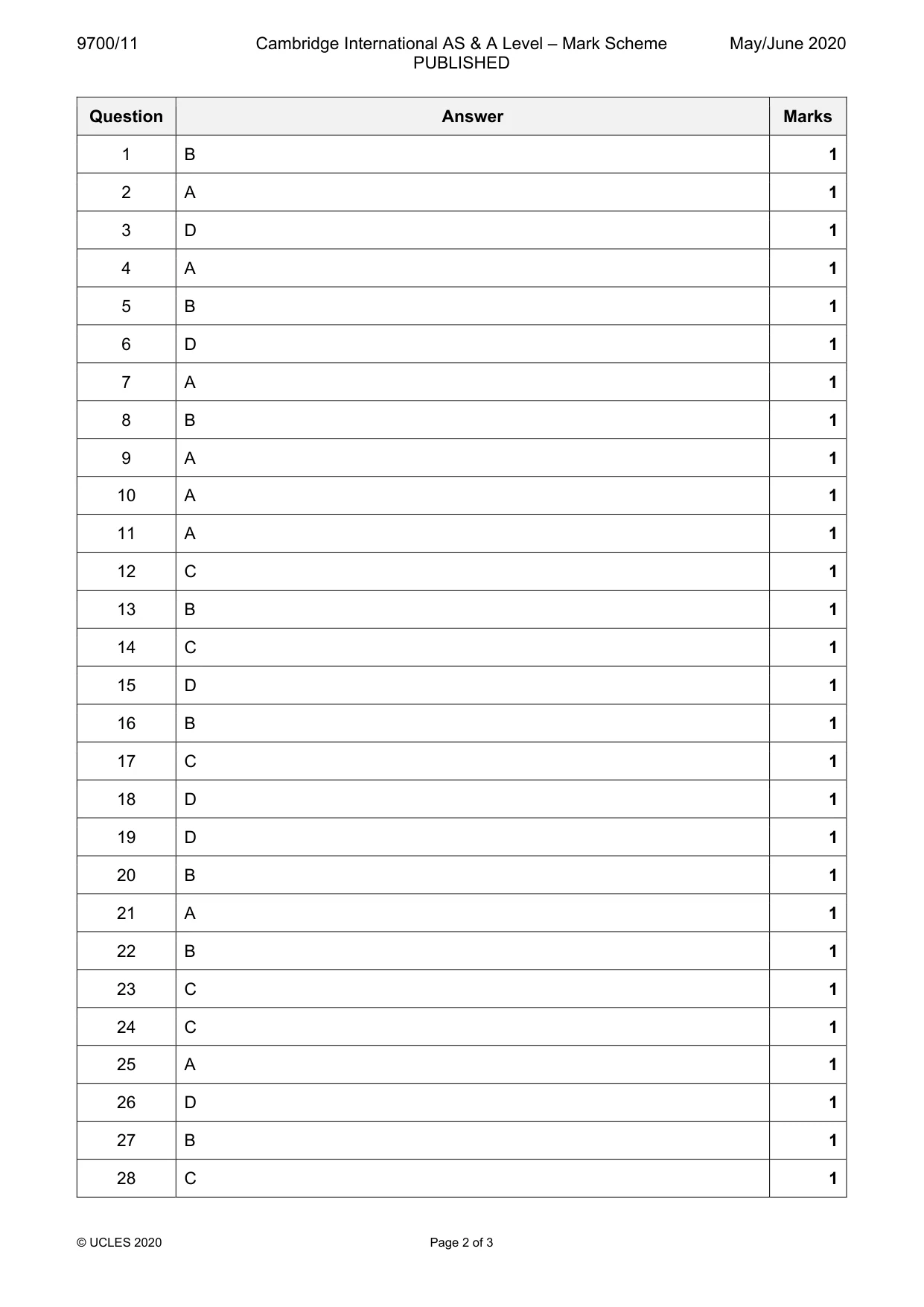
Answers below. Sit the paper first if you are practising.
Questions as text
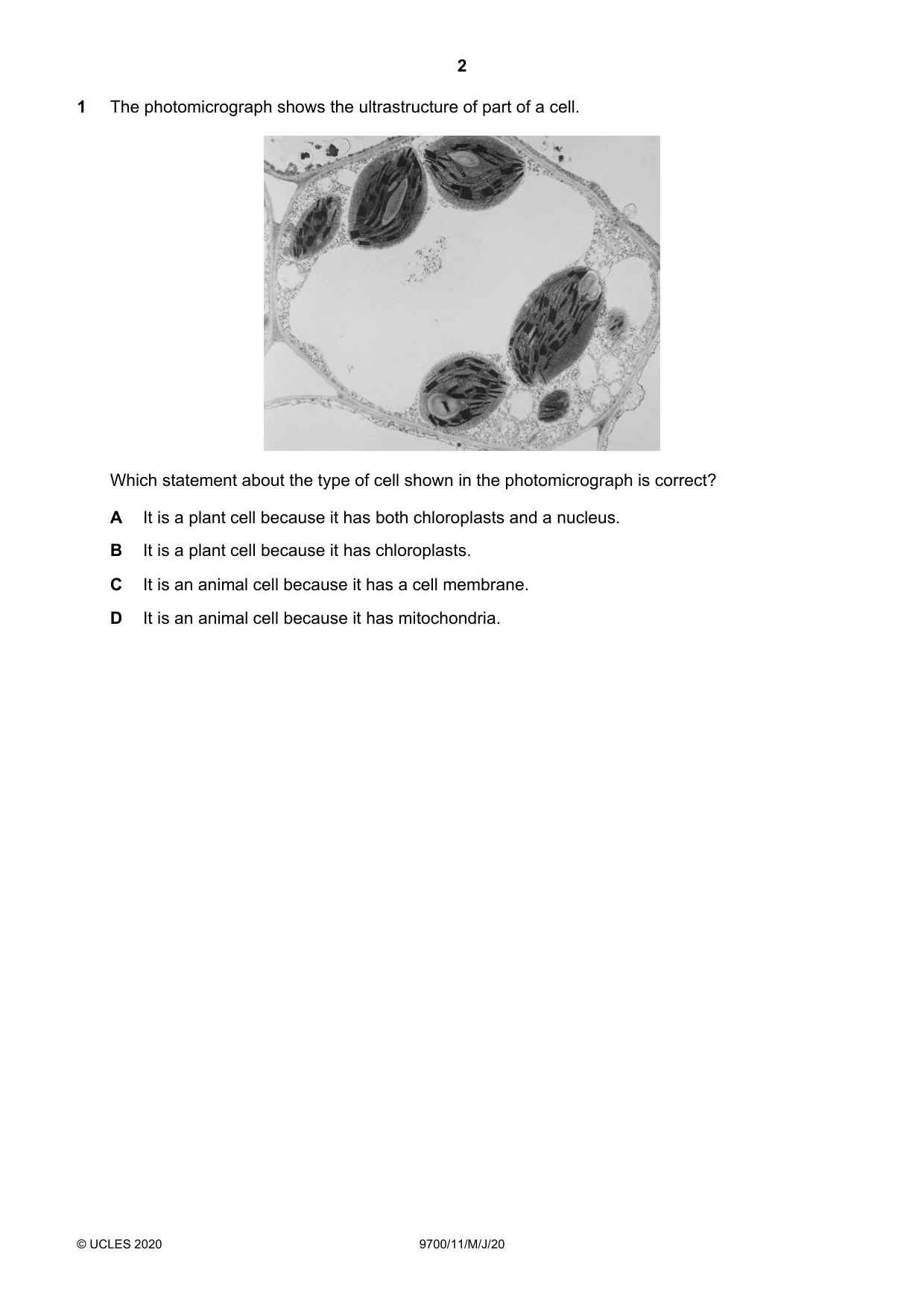
Q1 · The photomicrograph shows the ultrastructure of part of a cell
1 The photomicrograph shows the ultrastructure of part of a cell. Which statement about the type of cell shown in the photomicrograph is correct? A It is a plant cell because it has both chloroplasts and a nucleus. B It is a plant cell because it has chloroplasts. C It is an animal cell because it has a cell membrane. D It is an animal cell because it has mitochondria.
Mark scheme: B
More questions on Cells as the basic units of living organisms
Q2 · Which structures are found in typical eukaryotic cells?
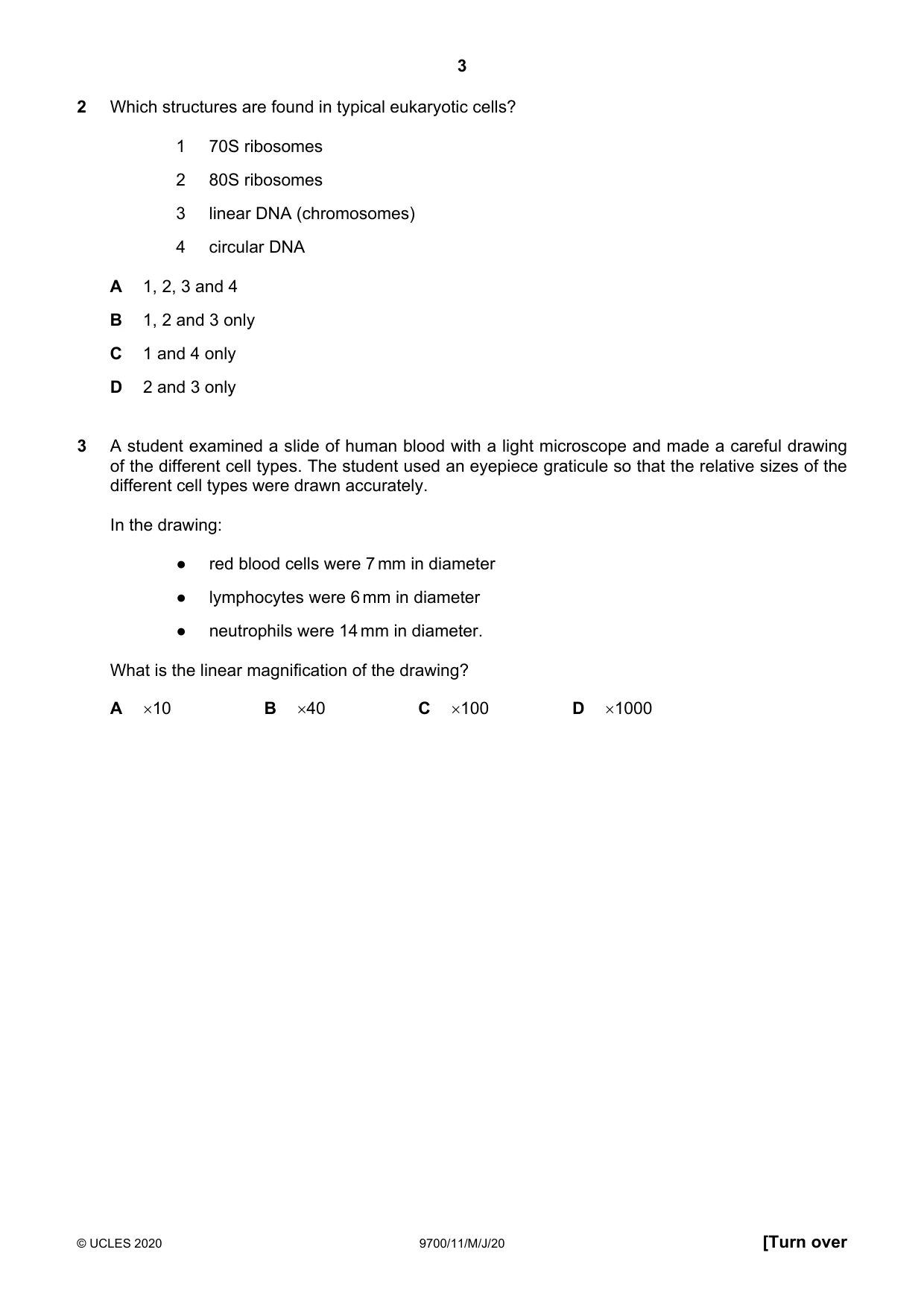
2 Which structures are found in typical eukaryotic cells? 1 70S ribosomes 2 80S ribosomes 3 linear DNA (chromosomes) 4 circular DNA A 1, 2, 3 and 4 B 1, 2 and 3 only C 1 and 4 only D 2 and 3 only
Mark scheme: A
More questions on Cells as the basic units of living organisms
Q3 · A student examined a slide of human blood with a light microscope and made a careful…
3 A student examined a slide of human blood with a light microscope and made a careful drawing of the different cell types. The student used an eyepiece graticule so that the relative sizes of the different cell types were drawn accurately. In the drawing: ● red blood cells were 7 mm in diameter ● lymphocytes were 6 mm in diameter ● neutrophils were 14 mm in diameter. What is the linear magnification of the drawing? A ×10 B ×40 C ×100 D ×1000
Mark scheme: D
Q4 · The diagram shows a graduated slide, with divisions of 0.1 mm viewed using an eyepiece…
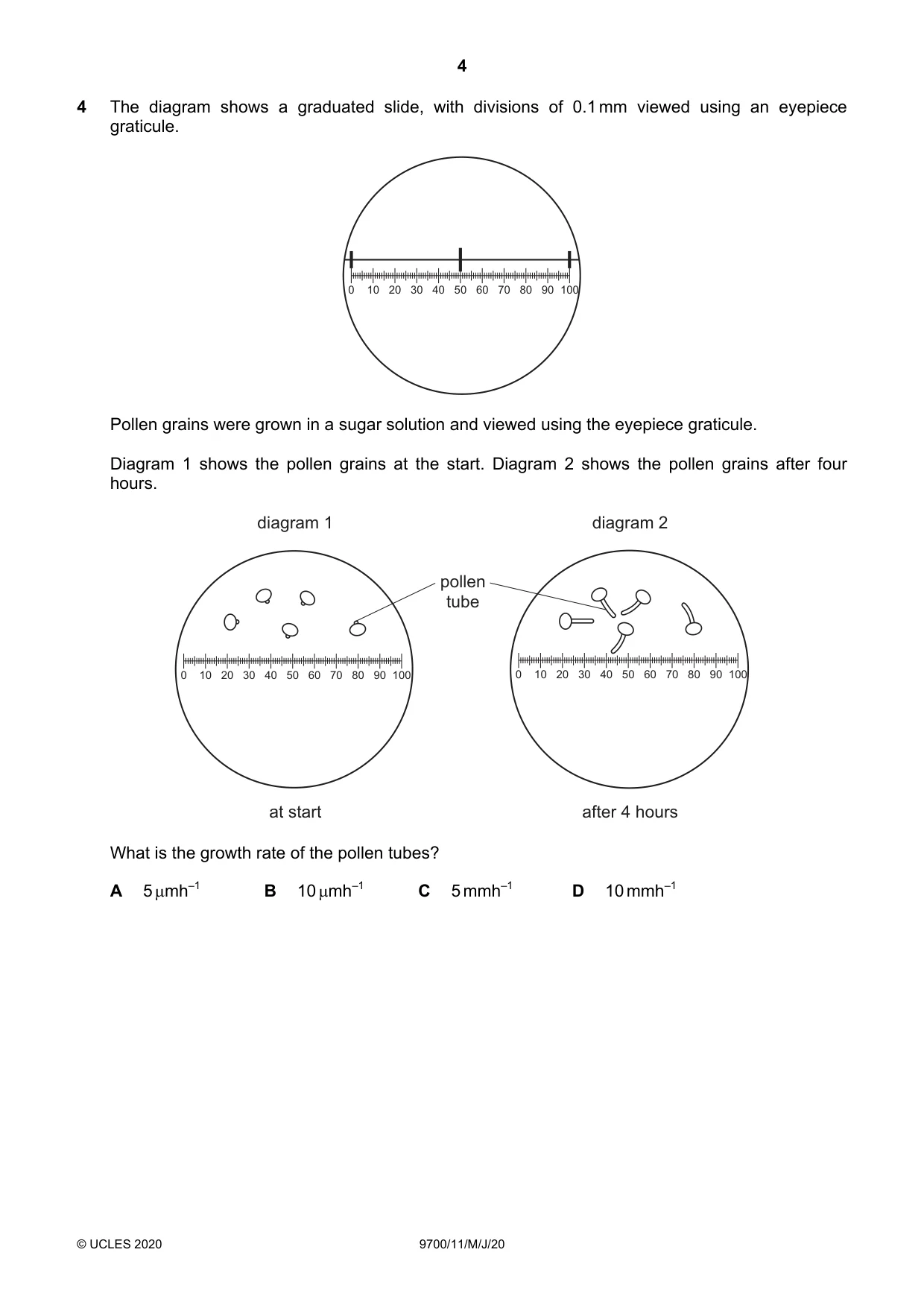
4 The diagram shows a graduated slide, with divisions of 0.1 mm viewed using an eyepiece graticule. 0 10 20 30 40 50 60 70 80 90 100 Pollen grains were grown in a sugar solution and viewed using the eyepiece graticule. Diagram 1 shows the pollen grains at the start. Diagram 2 shows the pollen grains after four hours. diagram 1 diagram 2 pollen tube 0 10 20 30 40 50 60 70 80 90 100 0 10 20 30 40 50 60 70 80 90 100 at start after 4 hours What is the growth rate of the pollen tubes? A 5 µmh–1 B 10 µmh–1 C 5 mmh–1 D 10 mmh–1
Mark scheme: A
Q5 · The table shows a comparison between two features of a typical eukaryotic cell and a…
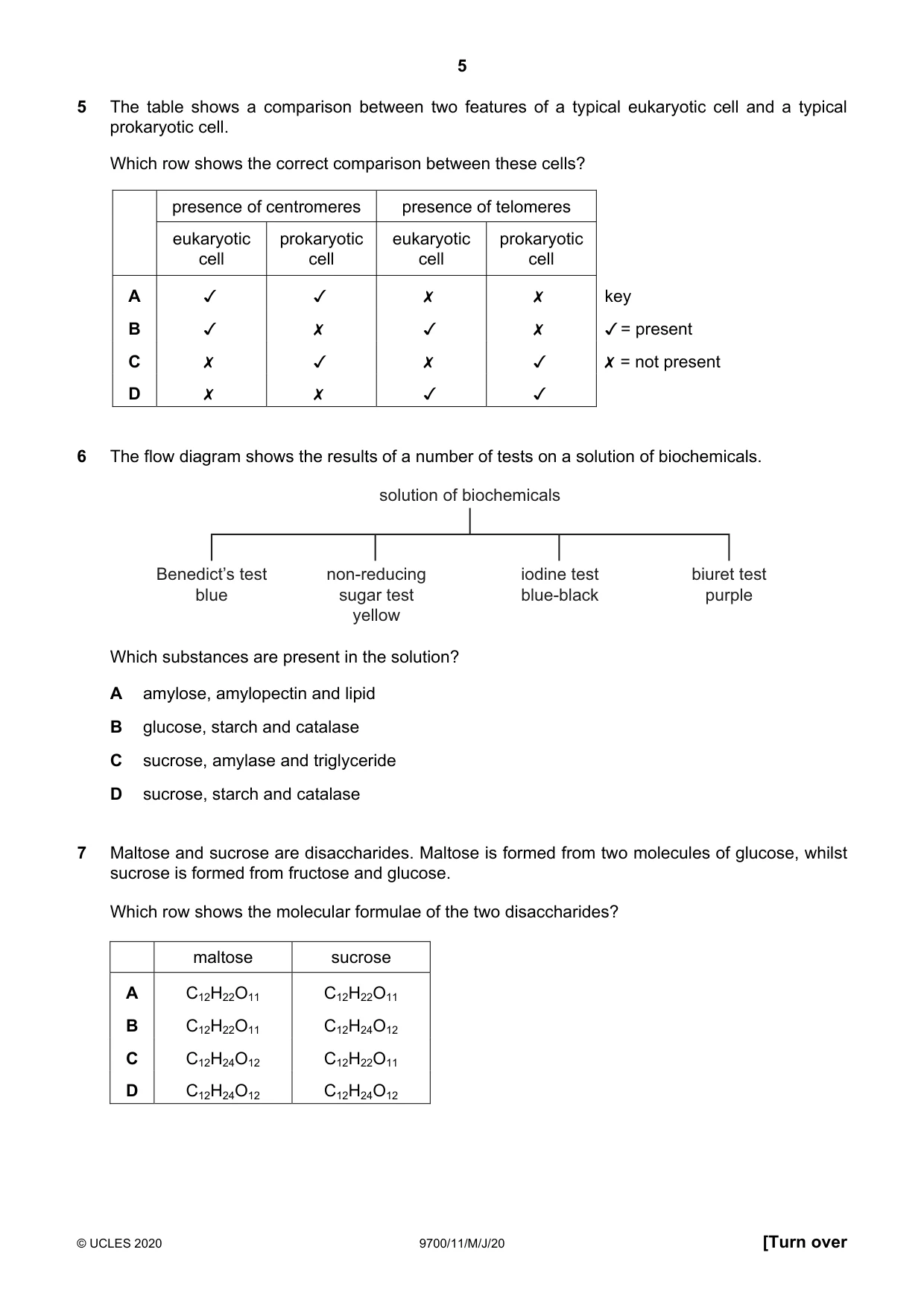
5 The table shows a comparison between two features of a typical eukaryotic cell and a typical prokaryotic cell. Which row shows the correct comparison between these cells? presence of centromeres presence of telomeres eukaryotic | prokaryotic | eukaryotic | prokaryotic cell cell cell cell v v x x 00 WwW > v x v x x v x v x x v v key v¥ = present X = not present
Mark scheme: B
More questions on Cells as the basic units of living organisms
Q6 · The flow diagram shows the results of a number of tests on a solution of biochemicals
6 The flow diagram shows the results of a number of tests on a solution of biochemicals. solution of biochemicals Benedict’s test non-reducing iodine test biuret test blue sugar test blue-black purple yellow Which substances are present in the solution? A amylose, amylopectin and lipid B glucose, starch and catalase C sucrose, amylase and triglyceride D sucrose, starch and catalase
Mark scheme: D
Q7 · Maltose and sucrose are disaccharides
7 Maltose and sucrose are disaccharides. Maltose is formed from two molecules of glucose, whilst sucrose is formed from fructose and glucose. Which row shows the molecular formulae of the two disaccharides? maltose sucrose A C12H22O11 C12H22O11 B C12H22O11 C12H24O12 C C12H24O12 C12H22O11 D C12H24O12 C12H24O12
Mark scheme: A
Q8 · The diagrams show short sections of some common polysaccharides and modified…
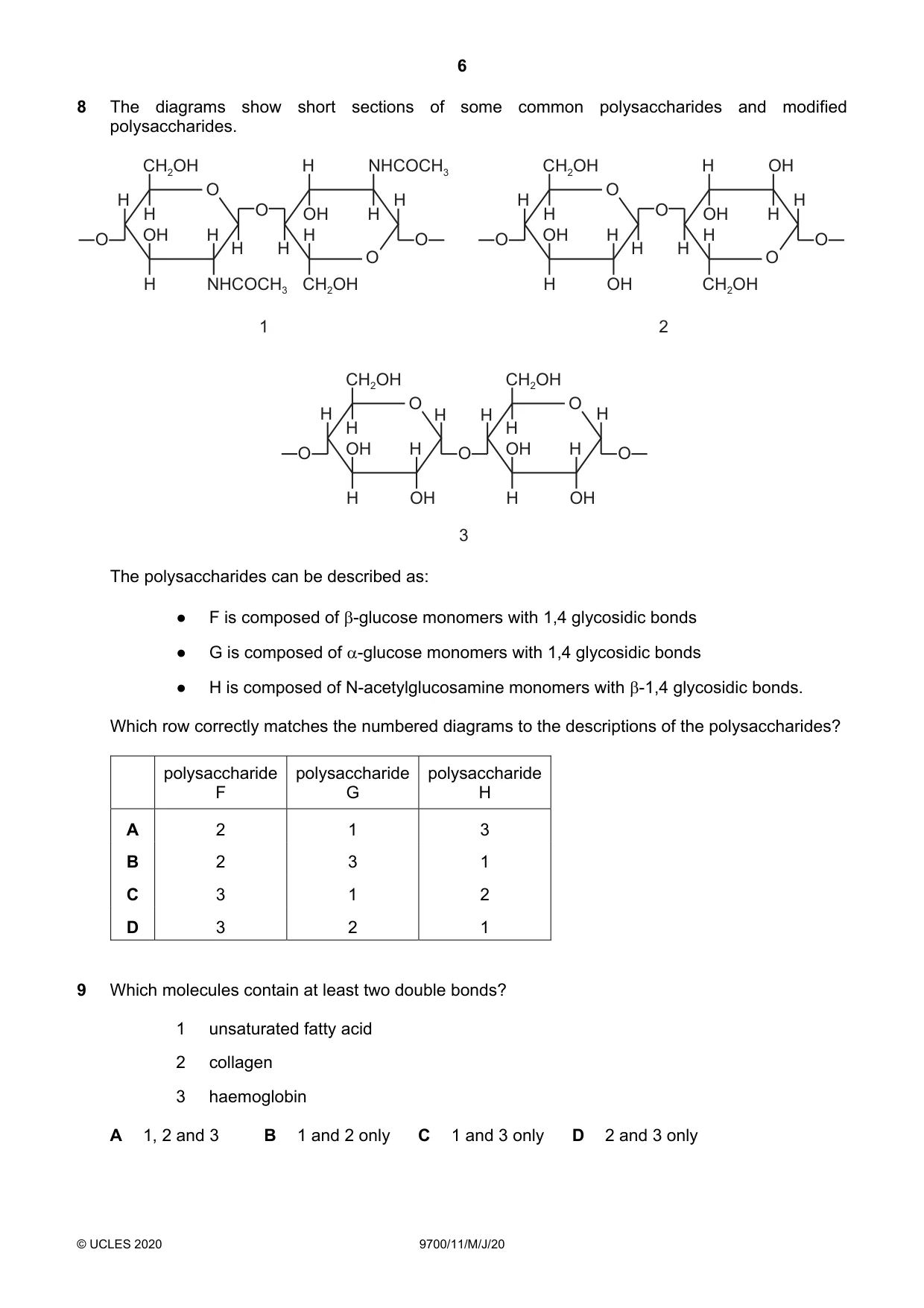
8 The diagrams show short sections of some common polysaccharides and modified polysaccharides. CH2OH H NHCOCH3 CH2OH H OH O O H O H H O H H OH H H OH H O OH H H O O OH H H O H H H H O O H NHCOCH3 CH2OH H OH CH2OH 1 2 CH2OH CH2OH O O H H H H H H O OH H O OH H O H OH H OH 3 The polysaccharides can be described as: ● F is composed of β-glucose monomers with 1,4 glycosidic bonds ● G is composed of α-glucose monomers with 1,4 glycosidic bonds ● H is composed of N-acetylglucosamine monomers with β-1,4 glycosidic bonds. Which row correctly matches the numbered diagrams to the descriptions of the polysaccharides? polysaccharide polysaccharide polysaccharide F G H A 2 1 3 B 2 3 1 C 3 1 2 D 3 2 1
Mark scheme: B
Q9 · Which molecules contain at least two double bonds?
9 Which molecules contain at least two double bonds? 1 unsaturated fatty acid 2 collagen 3 haemoglobin A 1, 2 and 3 B 1 and 2 only C 1 and 3 only D 2 and 3 only
Mark scheme: A
Q10 · The diagram shows a protein molecule
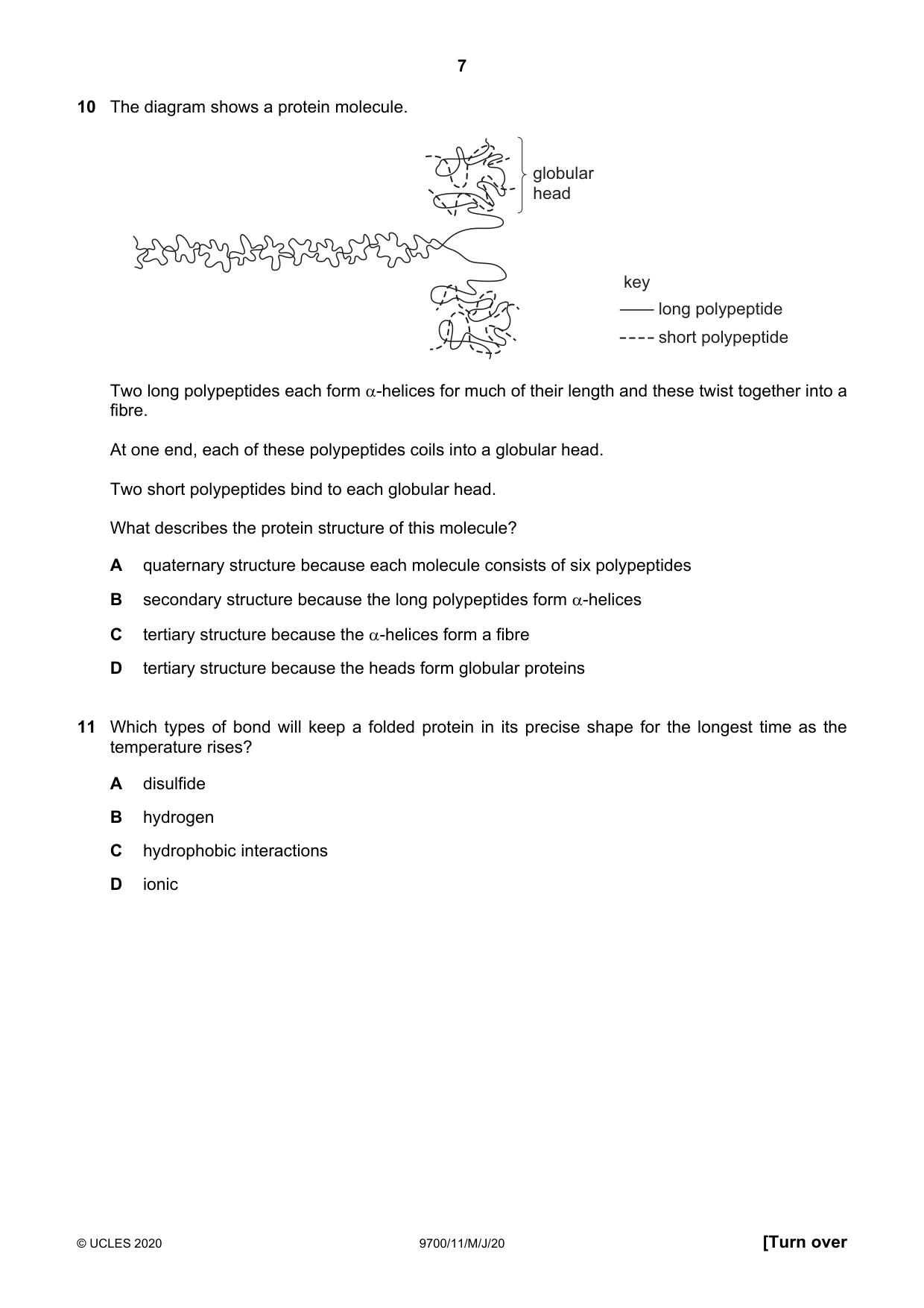
10 The diagram shows a protein molecule. globular head key long polypeptide short polypeptide Two long polypeptides each form α-helices for much of their length and these twist together into a fibre. At one end, each of these polypeptides coils into a globular head. Two short polypeptides bind to each globular head. What describes the protein structure of this molecule? A quaternary structure because each molecule consists of six polypeptides B secondary structure because the long polypeptides form α-helices C tertiary structure because the α-helices form a fibre D tertiary structure because the heads form globular proteins
Mark scheme: A
Q11 · Which types of bond will keep a folded protein in its precise shape for the longest time…
11 Which types of bond will keep a folded protein in its precise shape for the longest time as the temperature rises? A disulfide B hydrogen C hydrophobic interactions D ionic
Mark scheme: A
Q12 · Protease enzymes are found in many locations inside and outside the cells
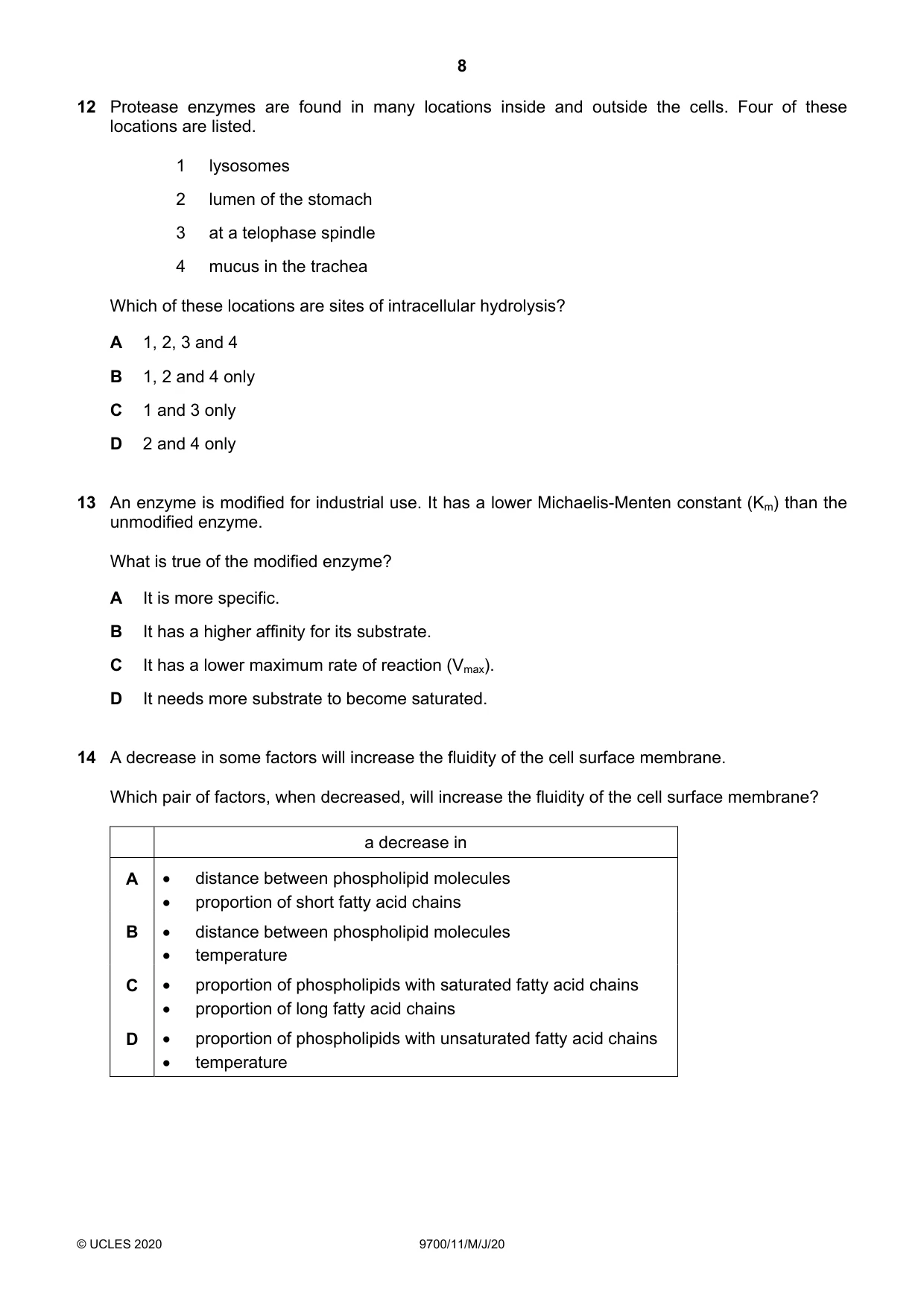
12 Protease enzymes are found in many locations inside and outside the cells. Four of these locations are listed. 1 lysosomes 2 lumen of the stomach 3 at a telophase spindle 4 mucus in the trachea Which of these locations are sites of intracellular hydrolysis? A 1, 2, 3 and 4 B 1, 2 and 4 only C 1 and 3 only D 2 and 4 only
Mark scheme: C
Q13 · An enzyme is modified for industrial use
13 An enzyme is modified for industrial use. It has a lower Michaelis-Menten constant (Km) than the unmodified enzyme. What is true of the modified enzyme? A It is more specific. B It has a higher affinity for its substrate. C It has a lower maximum rate of reaction (Vmax). D It needs more substrate to become saturated.
Mark scheme: B
Q14 · A decrease in some factors will increase the fluidity of the cell surface membrane
14 A decrease in some factors will increase the fluidity of the cell surface membrane. Which pair of factors, when decreased, will increase the fluidity of the cell surface membrane? a decrease in A • distance between phospholipid molecules • proportion of short fatty acid chains B • distance between phospholipid molecules • temperature C • proportion of phospholipids with saturated fatty acid chains • proportion of long fatty acid chains D • proportion of phospholipids with unsaturated fatty acid chains • temperature
Mark scheme: C
Q15 · The diagram shows a cell surface membrane
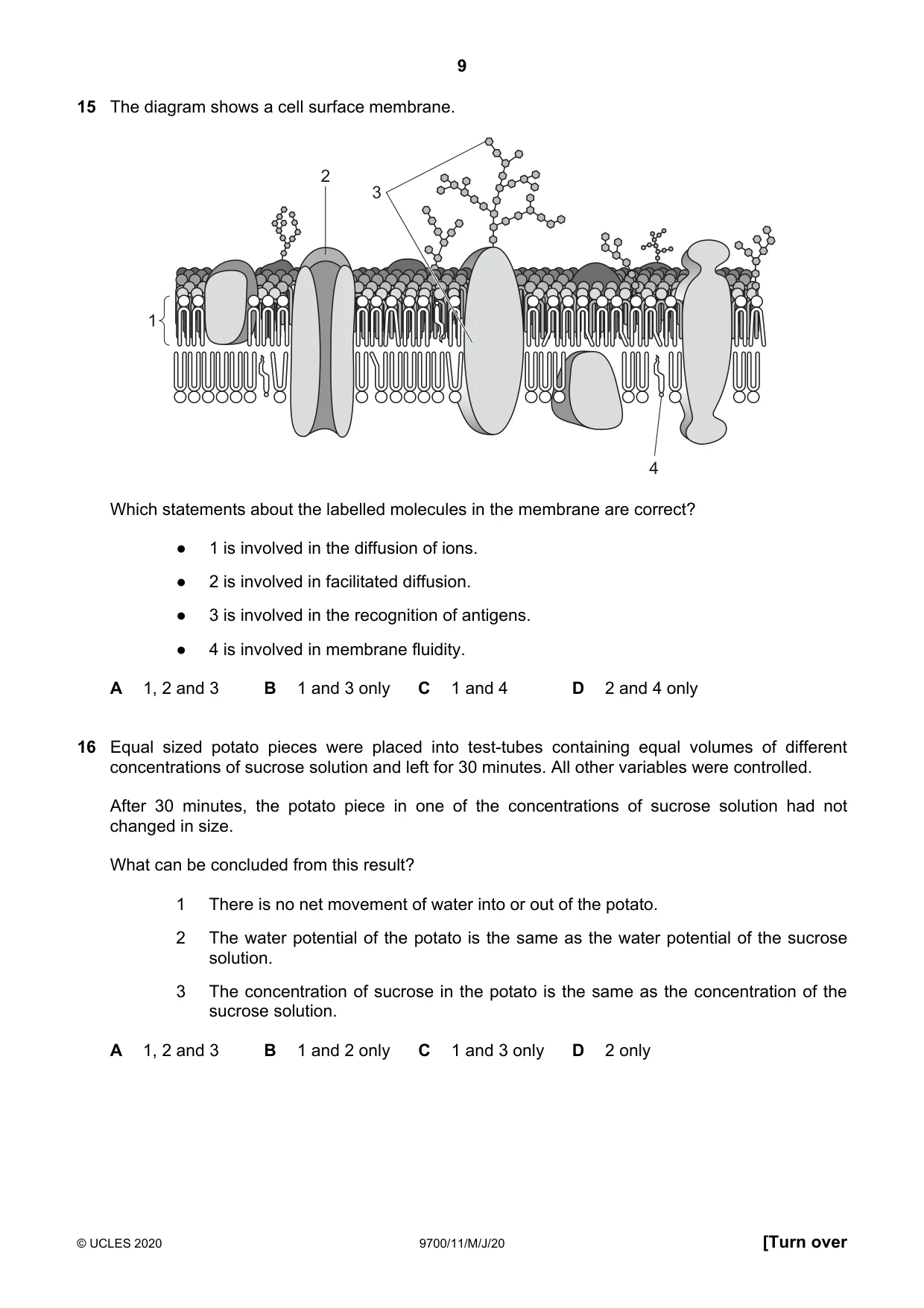
15 The diagram shows a cell surface membrane. 2 3 1 4 Which statements about the labelled molecules in the membrane are correct? ● 1 is involved in the diffusion of ions. ● 2 is involved in facilitated diffusion. ● 3 is involved in the recognition of antigens. ● 4 is involved in membrane fluidity. A 1, 2 and 3 B 1 and 3 only C 1 and 4 D 2 and 4 only
Mark scheme: D
Q16 · Equal sized potato pieces were placed into test-tubes containing equal volumes of…
16 Equal sized potato pieces were placed into test-tubes containing equal volumes of different concentrations of sucrose solution and left for 30 minutes. All other variables were controlled. After 30 minutes, the potato piece in one of the concentrations of sucrose solution had not changed in size. What can be concluded from this result? 1 There is no net movement of water into or out of the potato. 2 The water potential of the potato is the same as the water potential of the sucrose solution. 3 The concentration of sucrose in the potato is the same as the concentration of the sucrose solution. A 1, 2 and 3 B 1 and 2 only C 1 and 3 only D 2 only
Mark scheme: B
Q17 · Which feature of stem cells enables them to replace cells in tissues such as the skin?
17 Which feature of stem cells enables them to replace cells in tissues such as the skin? A They are undifferentiated cells that are present at birth. B They differentiate to form skin cells. C They divide by mitosis to supply some cells that can differentiate. D They have the full number of chromosomes.
Mark scheme: C
More questions on Replication and division of nuclei and cells
Q18 · During prophase, a scientist stains the chromosomes of a diploid animal cell with a…
18 During prophase, a scientist stains the chromosomes of a diploid animal cell with a fluorescent dye to stain telomeres. This cell has 32 chromosomes. How many telomeres will the scientist observe? A 32 B 64 C 96 D 128
Mark scheme: D
Q19 · The diagram shows the cell cycle
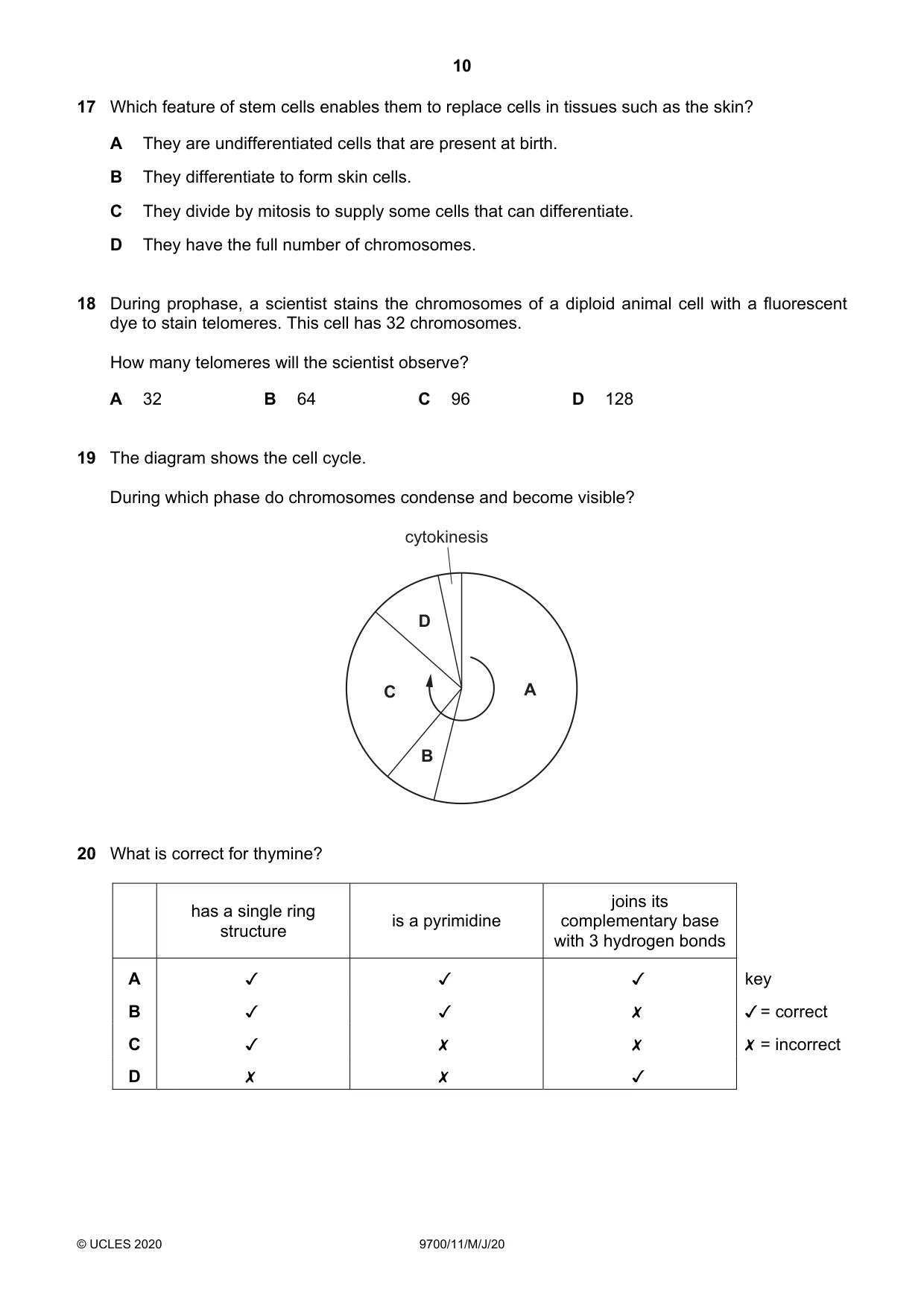
19 The diagram shows the cell cycle. During which phase do chromosomes condense and become visible? cytokinesis D C A B
Mark scheme: D
More questions on Replication and division of nuclei and cells
Q20 · What is correct for thymine?
20 What is correct for thymine? has a single ring is a pyrimidine joins its complementary base structure with 3 hydrogen bonds A v v v B "4 v x c Y x x D x x v key Y = correct X = incorrect
Mark scheme: B
More questions on Structure of nucleic acids and replication of DNA
Q21 · A short piece of DNA 15 base pairs long was analysed to find the number of nucleotide…
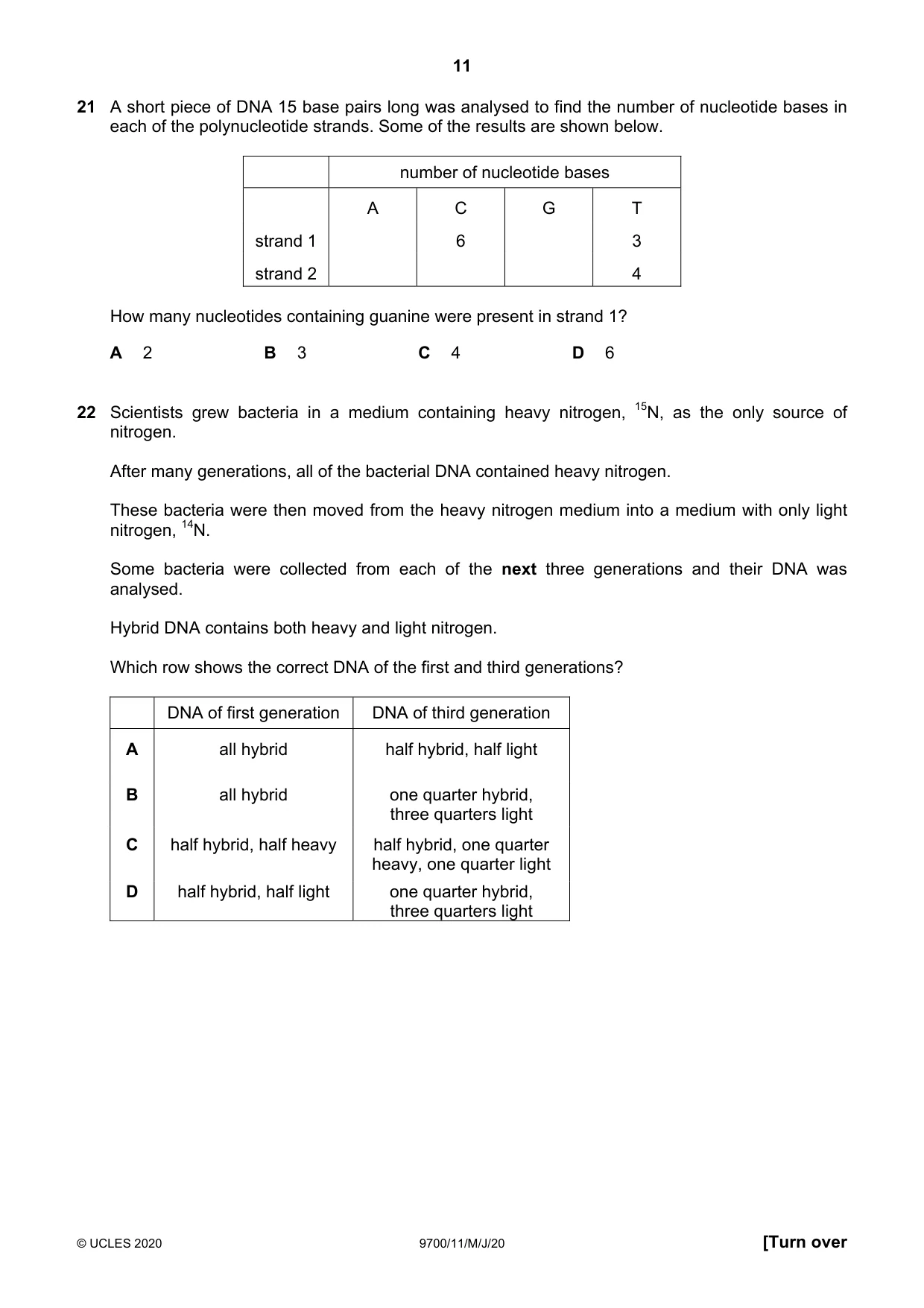
21 A short piece of DNA 15 base pairs long was analysed to find the number of nucleotide bases in each of the polynucleotide strands. Some of the results are shown below. number of nucleotide bases A C G T strand 1 6 3 strand 2 4 How many nucleotides containing guanine were present in strand 1? A 2 B 3 C 4 D 6
Mark scheme: A
More questions on Structure of nucleic acids and replication of DNA
Q22 · Scientists grew bacteria in a medium containing heavy nitrogen, 15N, as the only source…
22 Scientists grew bacteria in a medium containing heavy nitrogen, 15N, as the only source of nitrogen. After many generations, all of the bacterial DNA contained heavy nitrogen. These bacteria were then moved from the heavy nitrogen medium into a medium with only light nitrogen, 14N. Some bacteria were collected from each of the next three generations and their DNA was analysed. Hybrid DNA contains both heavy and light nitrogen. Which row shows the correct DNA of the first and third generations? DNA of first generation DNA of third generation A all hybrid half hybrid, half light B all hybrid one quarter hybrid, three quarters light C half hybrid, half heavy half hybrid, one quarter heavy, one quarter light D half hybrid, half light one quarter hybrid, three quarters light
Mark scheme: B
More questions on Structure of nucleic acids and replication of DNA
Q23 · A population of bacteria is exposed to the antibiotic penicillin
23 A population of bacteria is exposed to the antibiotic penicillin. Most of the bacteria die. However, some bacteria in the population have an allele coding for an enzyme that breaks down penicillin. These bacteria are able to survive. Which could explain how these bacterial cells acquired this allele? 1 An error during DNA replication. 2 An error during transcription. 3 An error during translation. A 1, 2 and 3 B 1 and 3 only C 1 only D 2 and 3 only
Mark scheme: C
Q24 · A dicotyledonous leaf has a palisade mesophyll layer that is approximately twice as thick…
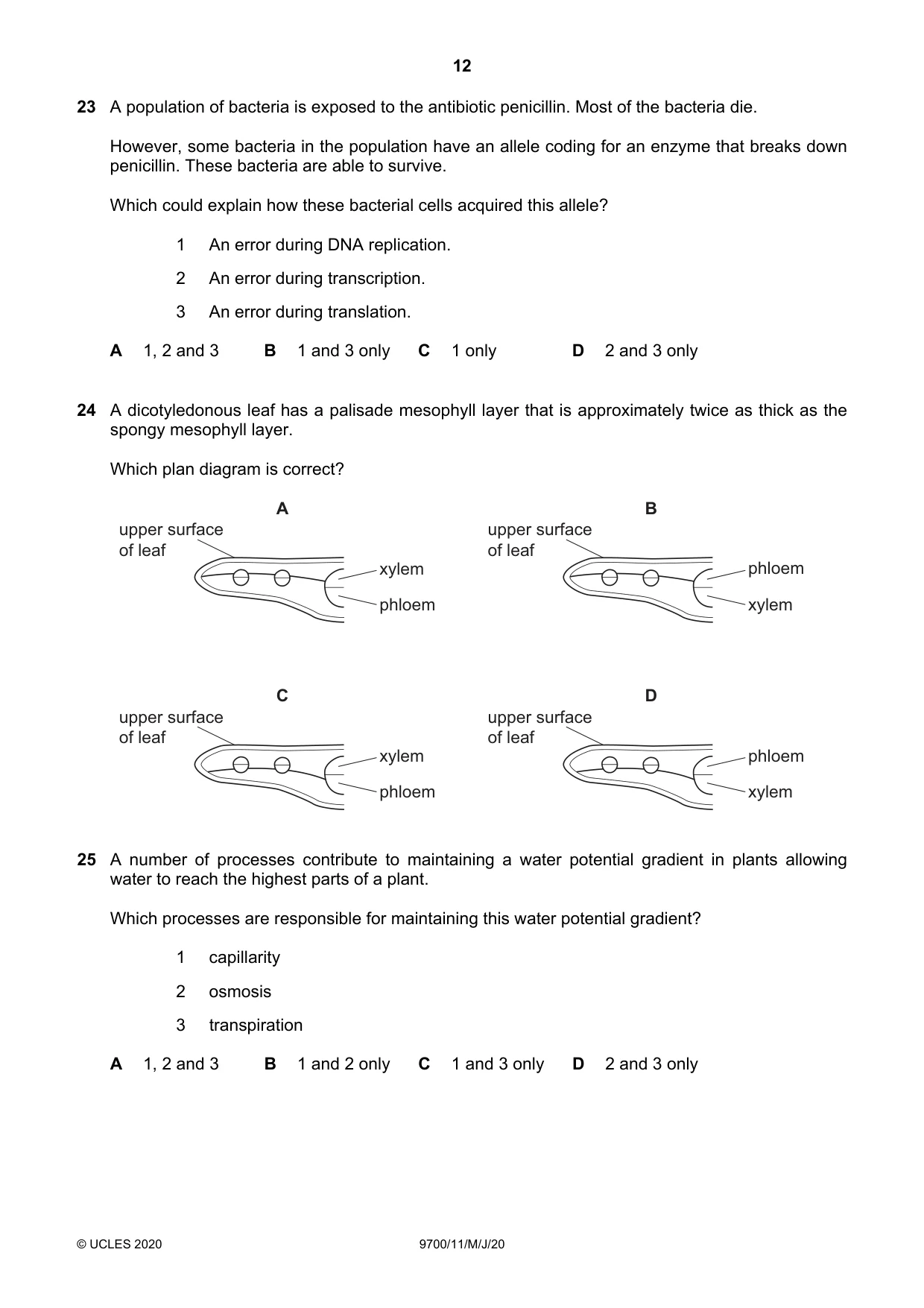
24 A dicotyledonous leaf has a palisade mesophyll layer that is approximately twice as thick as the spongy mesophyll layer. Which plan diagram is correct? A B upper surface upper surface of leaf of leaf xylem phloem phloem xylem C D upper surface upper surface of leaf of leaf xylem phloem phloem xylem
Mark scheme: C
Q25 · A number of processes contribute to maintaining a water potential gradient in plants…
25 A number of processes contribute to maintaining a water potential gradient in plants allowing water to reach the highest parts of a plant. Which processes are responsible for maintaining this water potential gradient? 1 capillarity 2 osmosis 3 transpiration A 1, 2 and 3 B 1 and 2 only C 1 and 3 only D 2 and 3 only
Mark scheme: A
Q26 · What is a correct statement about the movement of substances absorbed by roots?
26 What is a correct statement about the movement of substances absorbed by roots? A Ions have to pass through cell walls to cross the endodermis. B Ions move through the symplastic pathway only until they reach the Casparian strip. C Soil water has a more negative water potential than the xylem sap. D Water passes through the symplastic pathway along a water potential gradient.
Mark scheme: D
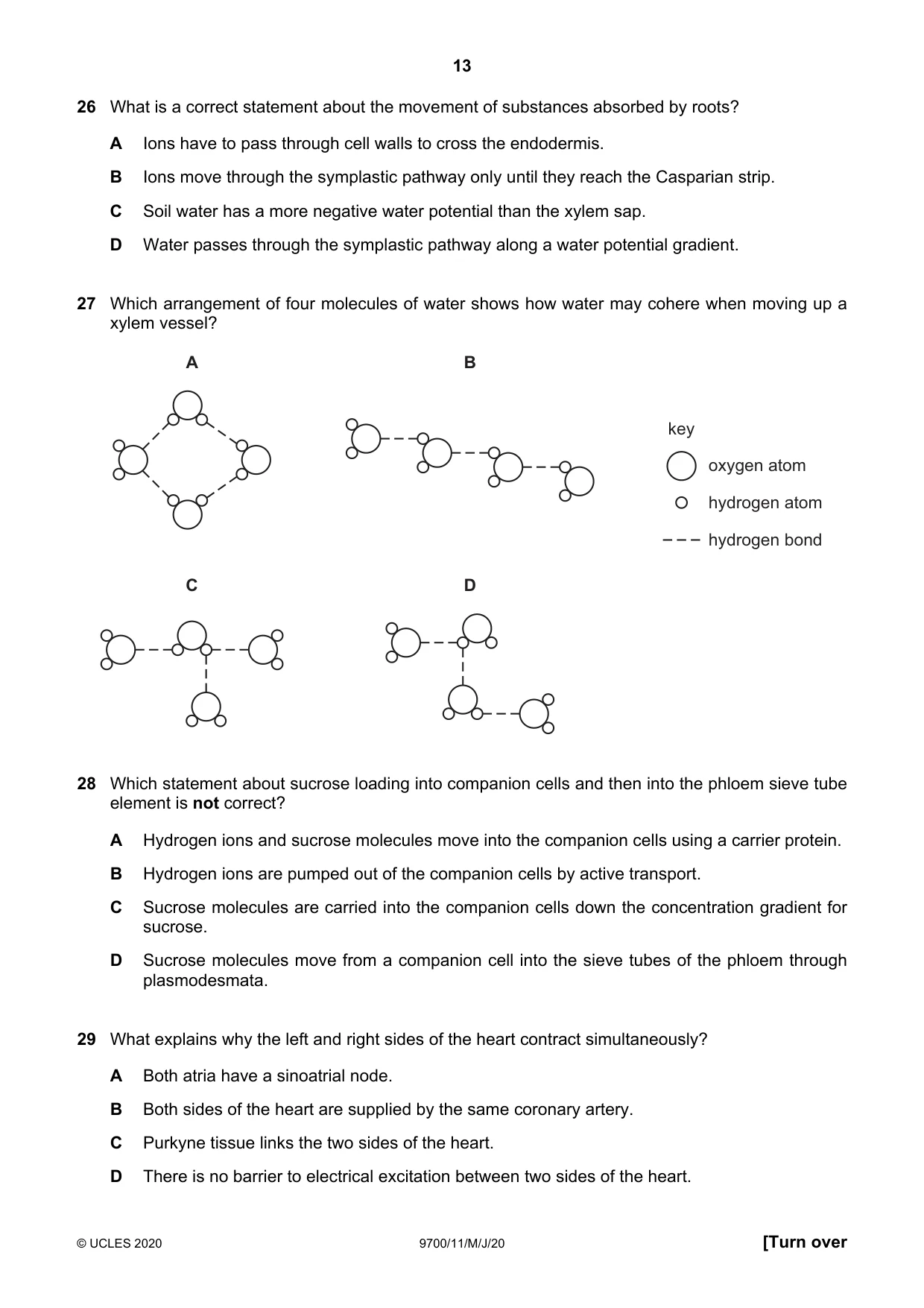
Q27 · Which arrangement of four molecules of water shows how water may cohere when moving up a…
27 Which arrangement of four molecules of water shows how water may cohere when moving up a xylem vessel? A B key oxygen atom hydrogen atom hydrogen bond C D
Mark scheme: B
Q28 · Which statement about sucrose loading into companion cells and then into the phloem sieve…
28 Which statement about sucrose loading into companion cells and then into the phloem sieve tube element is not correct? A Hydrogen ions and sucrose molecules move into the companion cells using a carrier protein. B Hydrogen ions are pumped out of the companion cells by active transport. C Sucrose molecules are carried into the companion cells down the concentration gradient for sucrose. D Sucrose molecules move from a companion cell into the sieve tubes of the phloem through plasmodesmata.
Mark scheme: C
Q29 · What explains why the left and right sides of the heart contract simultaneously?
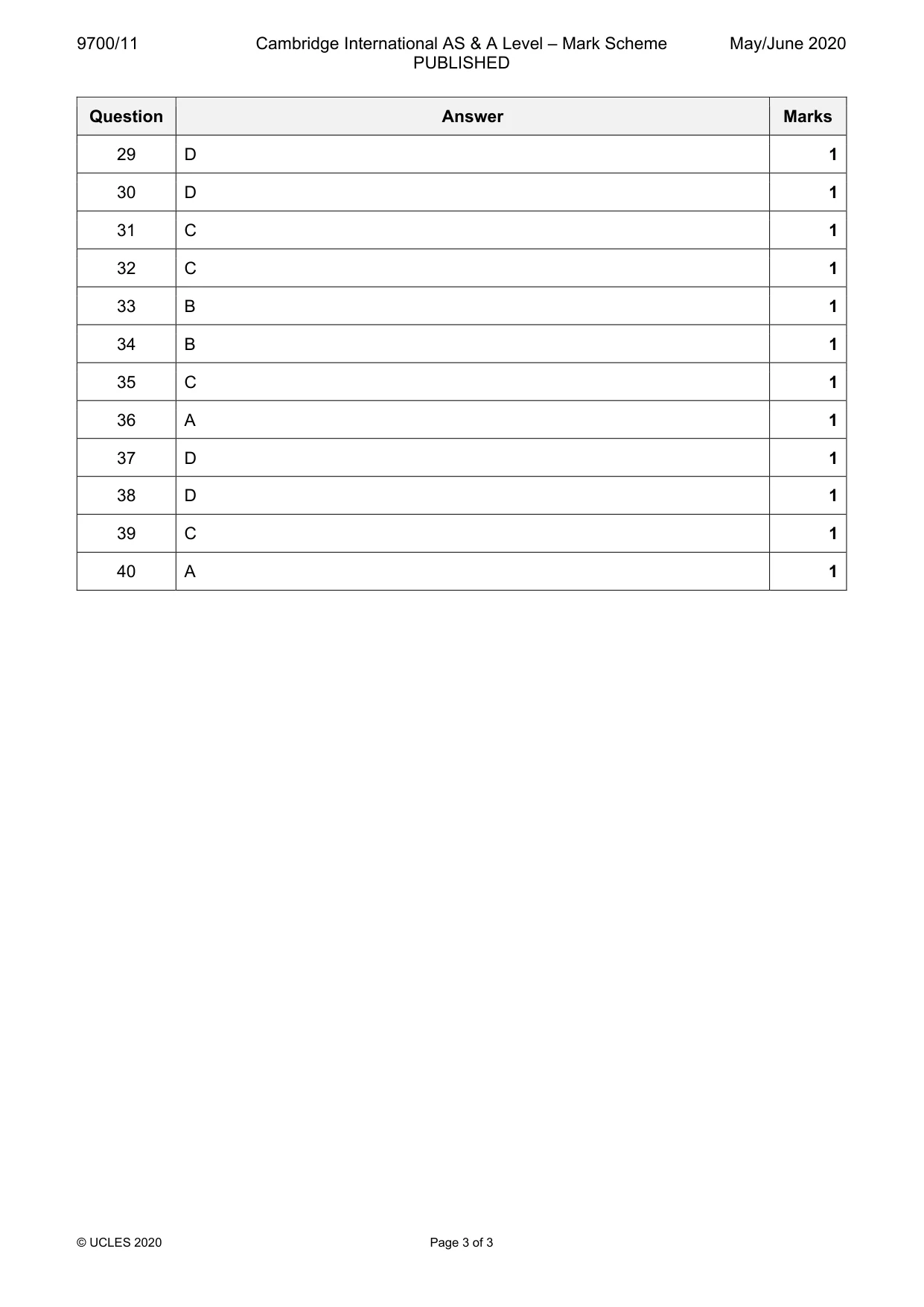
29 What explains why the left and right sides of the heart contract simultaneously? A Both atria have a sinoatrial node. B Both sides of the heart are supplied by the same coronary artery. C Purkyne tissue links the two sides of the heart. D There is no barrier to electrical excitation between two sides of the heart.
Mark scheme: D
Q30 · The statements list some of the events in the cardiac cycle
30 The statements list some of the events in the cardiac cycle. They are not in the correct order. 1 The impulse travels through Purkyne tissue. 2 A wave of excitation sweeps across the atria. 3 The atrioventricular node delays the impulse for a fraction of a second. 4 The sinoatrial node contracts. 5 The wave of excitation sweeps upwards from the base of the ventricles. 6 The ventricles contract. 7 The atria contract. Which statement describes the third of these events to occur in the cardiac cycle? A 1 B 3 C 4 D 7
Mark scheme: D
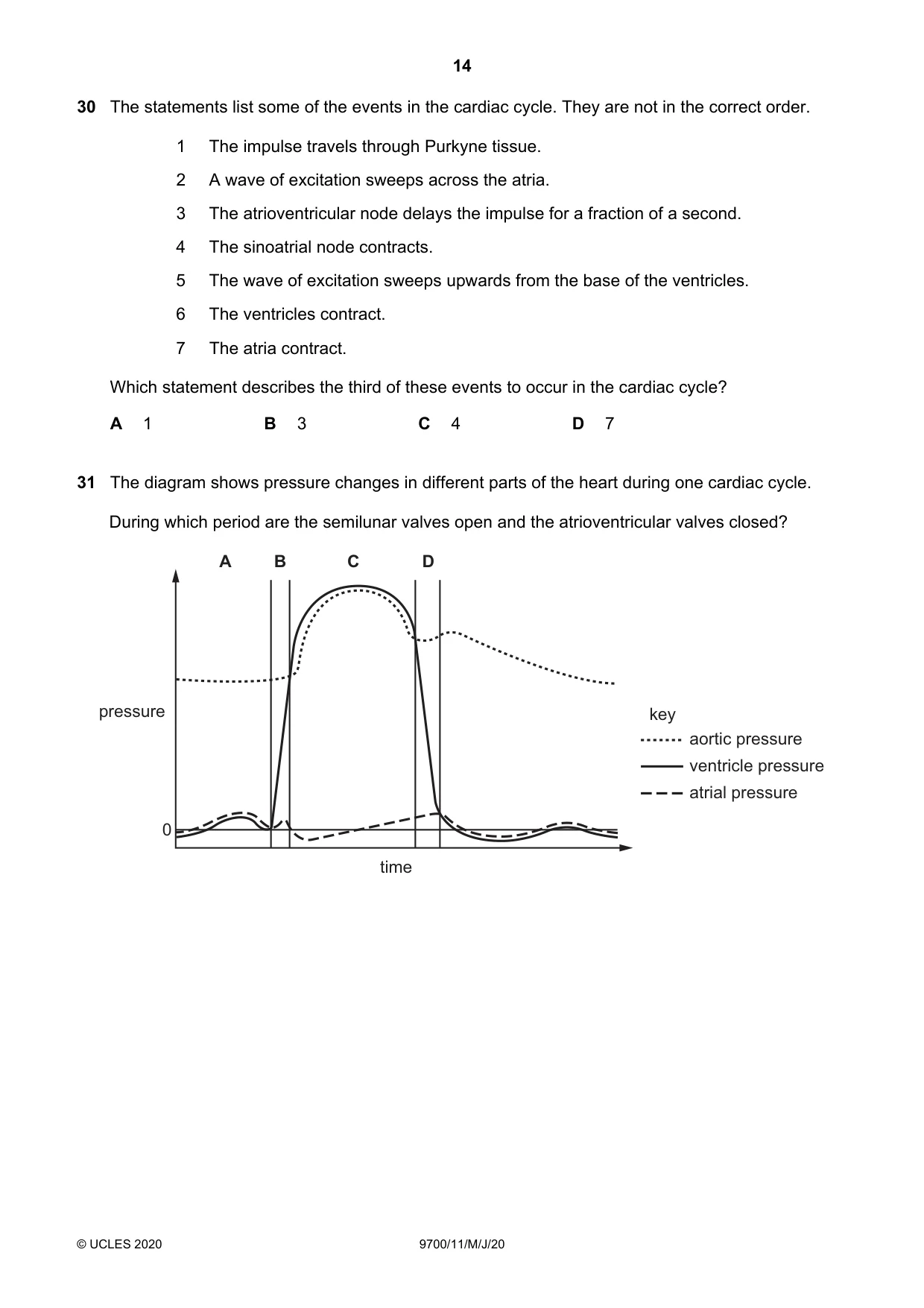
Q31 · The diagram shows pressure changes in different parts of the heart during one cardiac…
31 The diagram shows pressure changes in different parts of the heart during one cardiac cycle. During which period are the semilunar valves open and the atrioventricular valves closed? A B C D pressure key aortic pressure ventricle pressure atrial pressure 0 time
Mark scheme: C
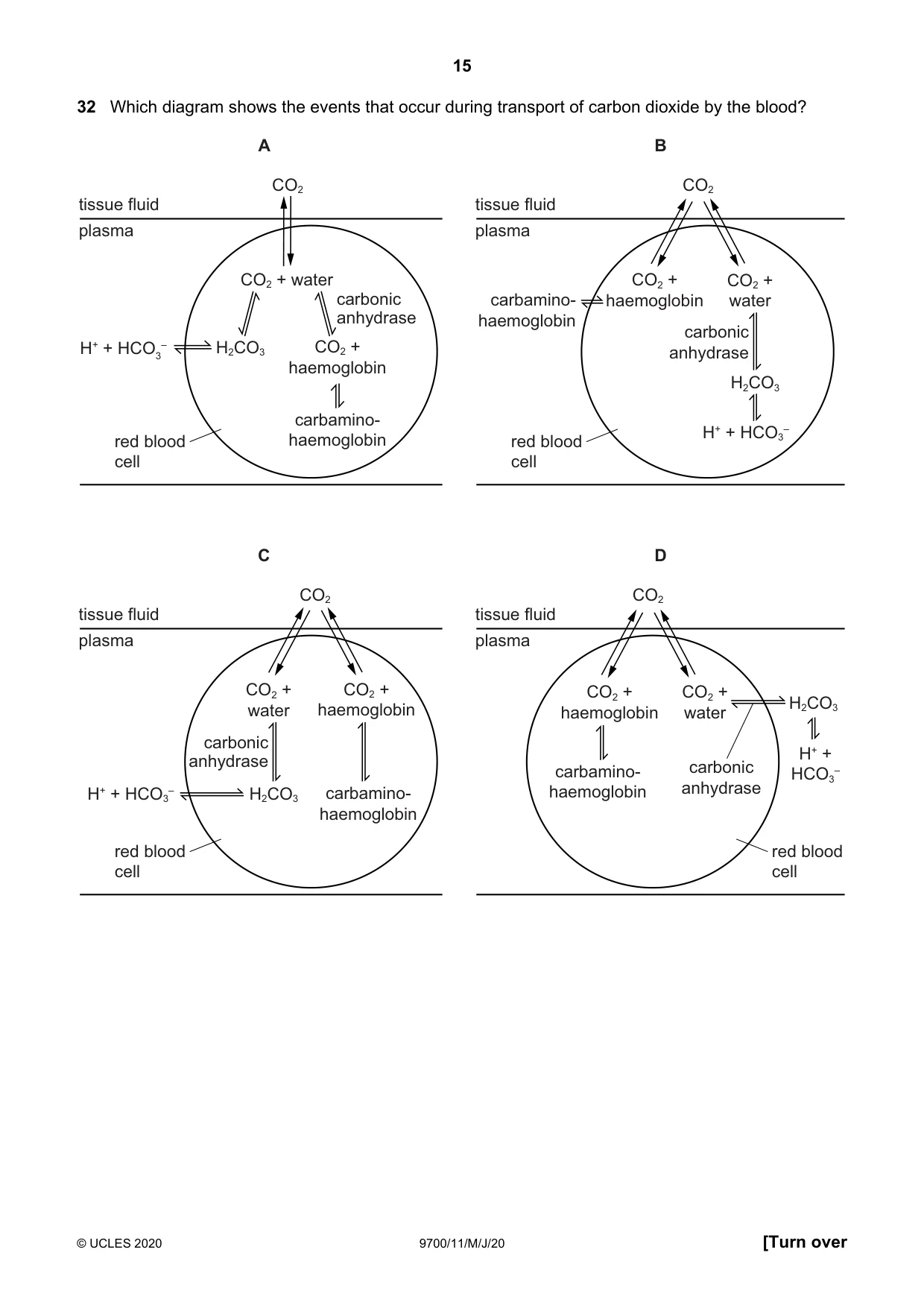
Q32 · Which diagram shows the events that occur during transport of carbon dioxide by the blood?
32 Which diagram shows the events that occur during transport of carbon dioxide by the blood? A B CO2 CO2 tissue fluid tissue fluid plasma plasma CO2 + water CO2 + CO2 + carbonic carbamino- haemoglobin water anhydrase haemoglobin carbonic H+ + HCO3 – H2CO3 CO2 + anhydrase haemoglobin H2CO3 carbamino- haemoglobin H+ + HCO3 – red blood red blood cell cell C D CO2 CO2 tissue fluid tissue fluid plasma plasma CO2 + CO2 + CO2 + CO2 + water haemoglobin H2CO3 haemoglobin water carbonic H+ + anhydrase carbonic carbamino- HCO3 – H+ + HCO3 – H2CO3 carbamino- haemoglobin anhydrase haemoglobin red blood red blood cell cell
Mark scheme: C
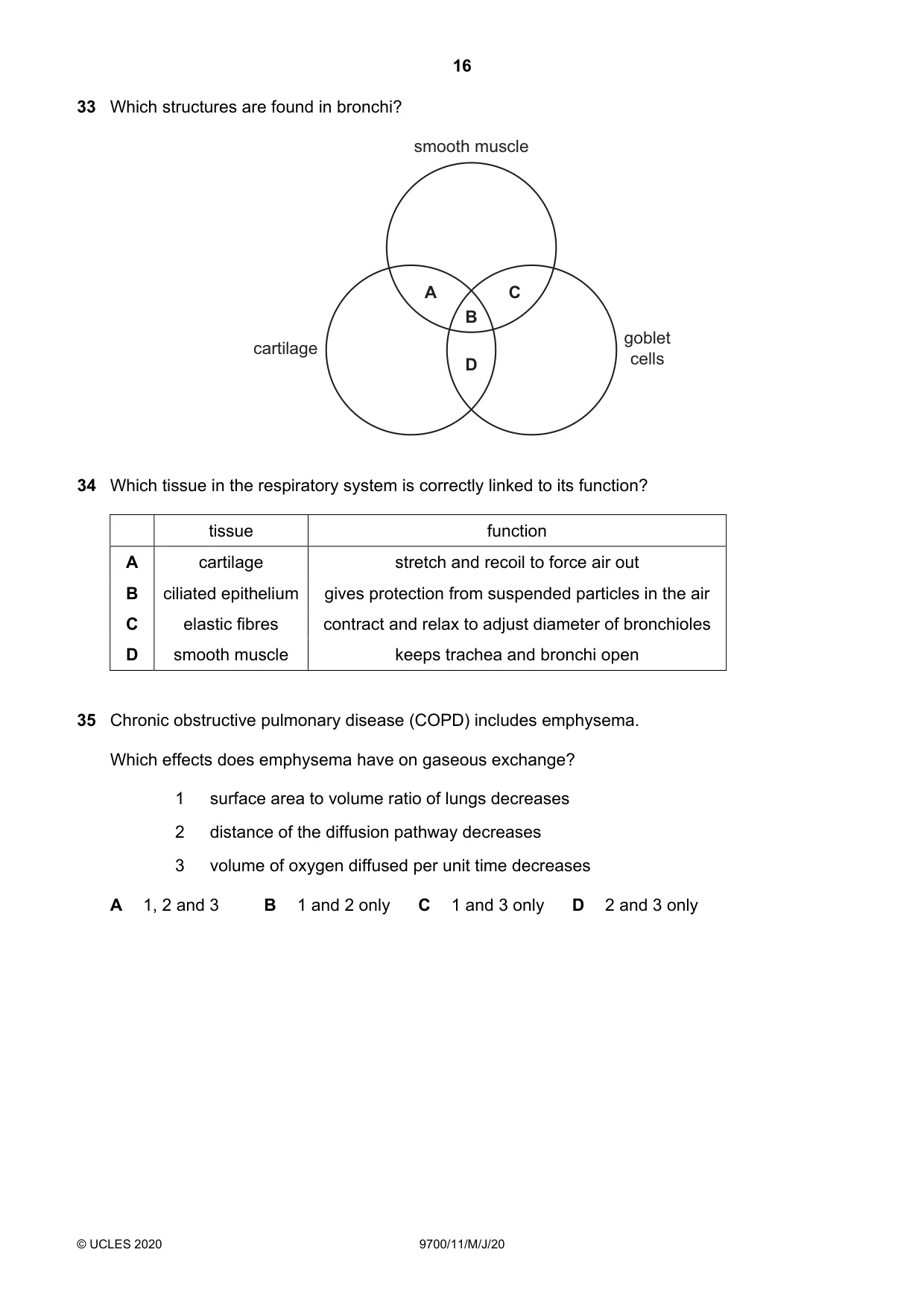
Q33 · Which structures are found in bronchi?
33 Which structures are found in bronchi? smooth muscle A C B goblet cartilage D cells
Mark scheme: B
Q34 · Which tissue in the respiratory system is correctly linked to its function?
34 Which tissue in the respiratory system is correctly linked to its function? tissue function A cartilage stretch and recoil to force air out B ciliated epithelium gives protection from suspended particles in the air C elastic fibres contract and relax to adjust diameter of bronchioles D smooth muscle keeps trachea and bronchi open
Mark scheme: B
Q35 · Chronic obstructive pulmonary disease (COPD) includes emphysema
35 Chronic obstructive pulmonary disease (COPD) includes emphysema. Which effects does emphysema have on gaseous exchange? 1 surface area to volume ratio of lungs decreases 2 distance of the diffusion pathway decreases 3 volume of oxygen diffused per unit time decreases A 1, 2 and 3 B 1 and 2 only C 1 and 3 only D 2 and 3 only
Mark scheme: C
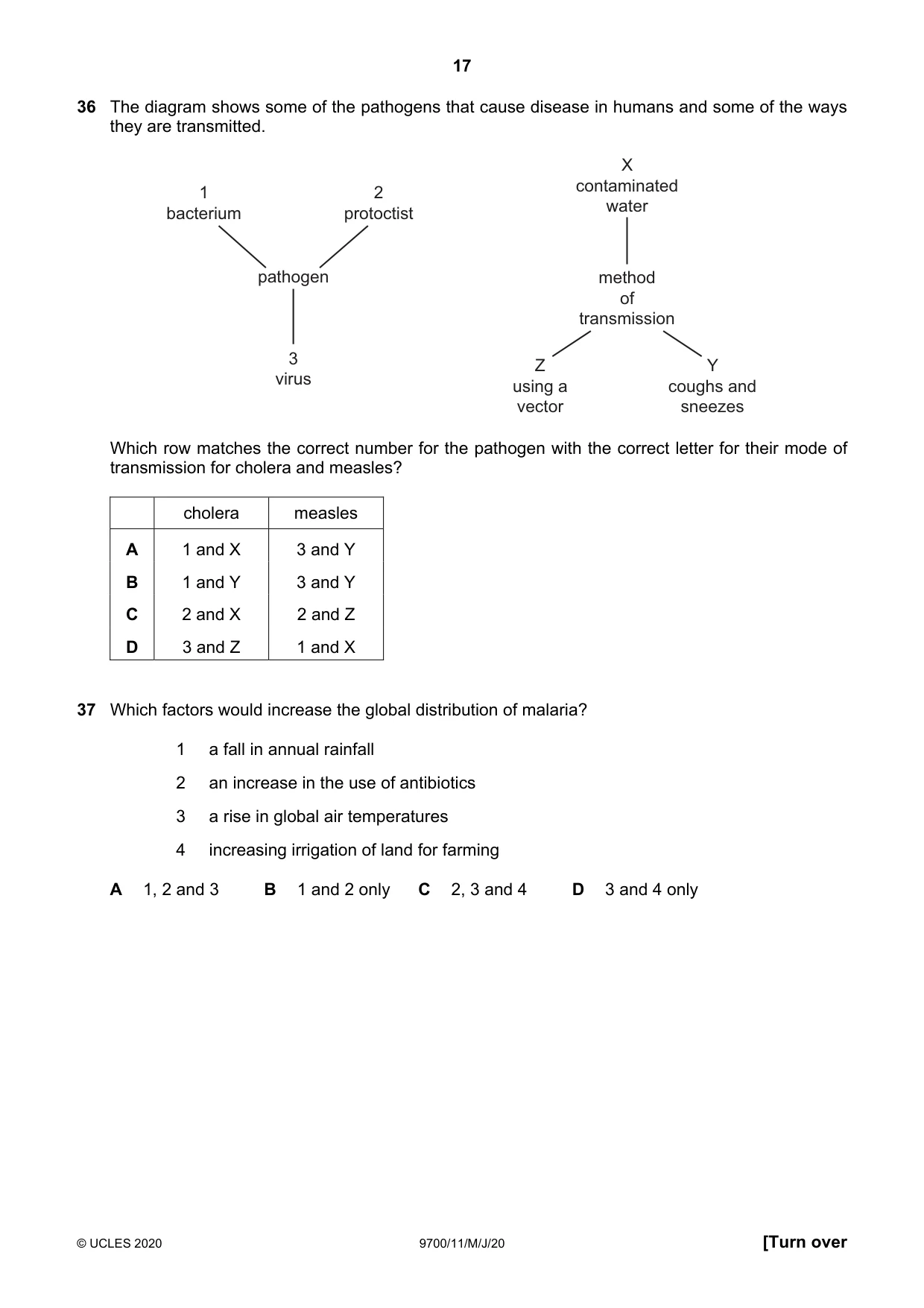
Q36 · The diagram shows some of the pathogens that cause disease in humans and some of the ways…
36 The diagram shows some of the pathogens that cause disease in humans and some of the ways they are transmitted. X 1 2 contaminated bacterium protoctist water pathogen method of transmission 3 Z Y virus using a coughs and vector sneezes Which row matches the correct number for the pathogen with the correct letter for their mode of transmission for cholera and measles? cholera measles A 1 and X 3 and Y B 1 and Y 3 and Y C 2 and X 2 and Z D 3 and Z 1 and X
Mark scheme: A
Q37 · Which factors would increase the global distribution of malaria?
37 Which factors would increase the global distribution of malaria? 1 a fall in annual rainfall 2 an increase in the use of antibiotics 3 a rise in global air temperatures 4 increasing irrigation of land for farming A 1, 2 and 3 B 1 and 2 only C 2, 3 and 4 D 3 and 4 only
Mark scheme: D
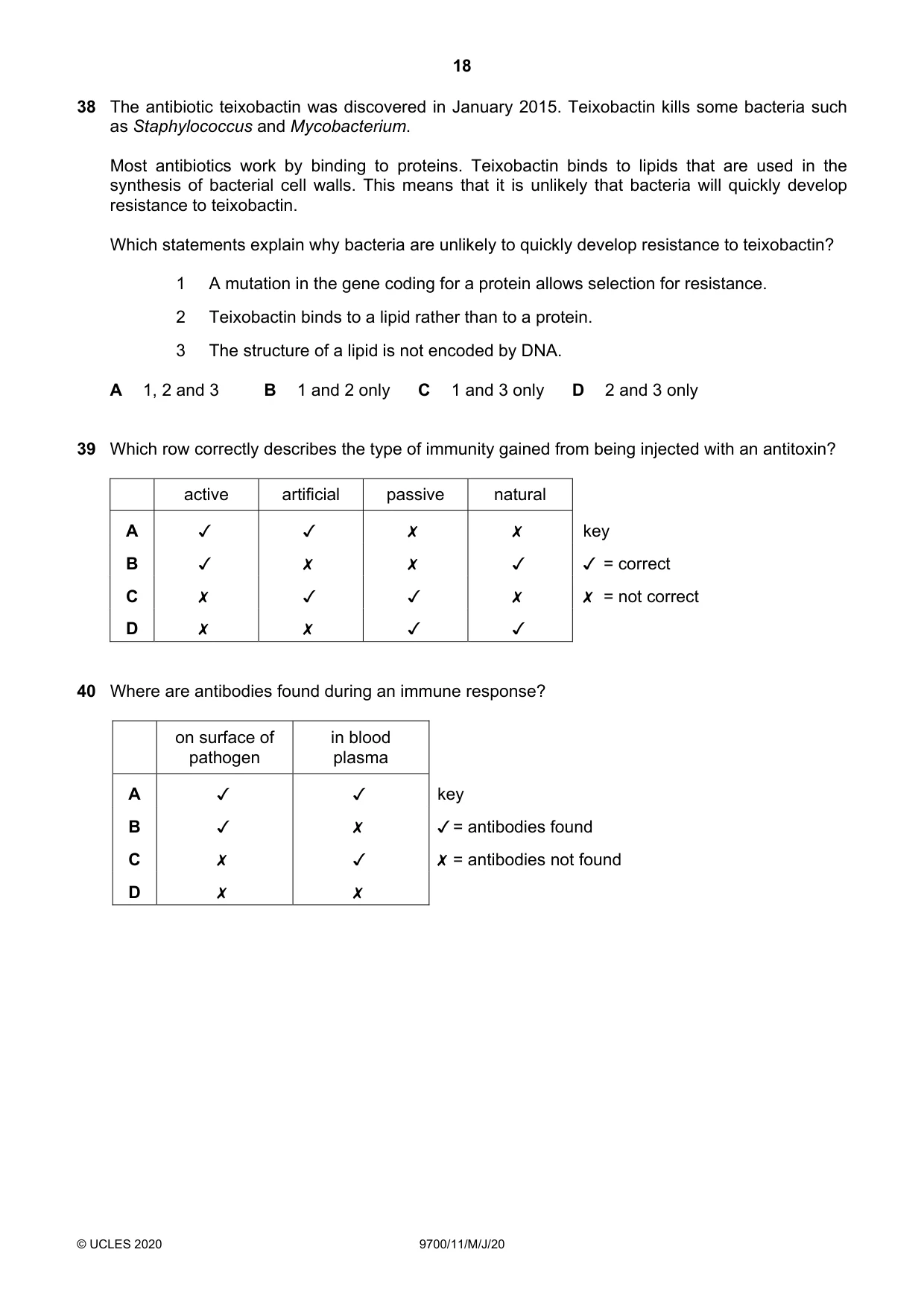
Q38 · The antibiotic teixobactin was discovered in January 2015
38 The antibiotic teixobactin was discovered in January 2015. Teixobactin kills some bacteria such as Staphylococcus and Mycobacterium. Most antibiotics work by binding to proteins. Teixobactin binds to lipids that are used in the synthesis of bacterial cell walls. This means that it is unlikely that bacteria will quickly develop resistance to teixobactin. Which statements explain why bacteria are unlikely to quickly develop resistance to teixobactin? 1 A mutation in the gene coding for a protein allows selection for resistance. 2 Teixobactin binds to a lipid rather than to a protein. 3 The structure of a lipid is not encoded by DNA. A 1, 2 and 3 B 1 and 2 only C 1 and 3 only D 2 and 3 only
Mark scheme: D
Q39 · Which row correctly describes the type of immunity gained from being injected with an…
39 Which row correctly describes the type of immunity gained from being injected with an antitoxin? active artificial passive natural v Jv x x key Y =correct X =not correct 0 0O WwW D> v x x v x x << x KM
Mark scheme: C
Q40 · Where are antibodies found during an immune response?
40 Where are antibodies found during an immune response? on surface of in blood pathogen plasma Jv v key JY = antibodies found 0 Oo WwW > J x x v X = antibodies not found x x
Mark scheme: A
What was in this paper
The subtopics covered by these 40 questions, and how many questions each got. Open one in a new tab to see every Cambridge question on it.
4Carbohydrates and lipids3Cells as the basic units of living organisms3Structure of nucleic acids and replication of DNA3The gas exchange system3The heart3Antibiotics2Fluid mosaic membranes2Infectious diseases2Proteins2Replication and division of nuclei and cells2The microscope in cell studies2Antibodies and vaccination1Chromosome behaviour in mitosis1Factors that affect enzyme action1Mode of action of enzymes1Movement into and out of cells1Structure of transport tissues1Testing for biological molecules1The immune system1Transport of oxygen and carbon dioxide1