Cambridge A Level Biology 9700 — 2008 Oct/Nov Paper 1 · Variant 1
9700/11/O/N/08 · 40 questions · 40 marks · ≈45 min
The question paper and its mark scheme, free to read here and free to download. This is Cambridge’s own paper, exactly as it was sat.
Question paper20 pages
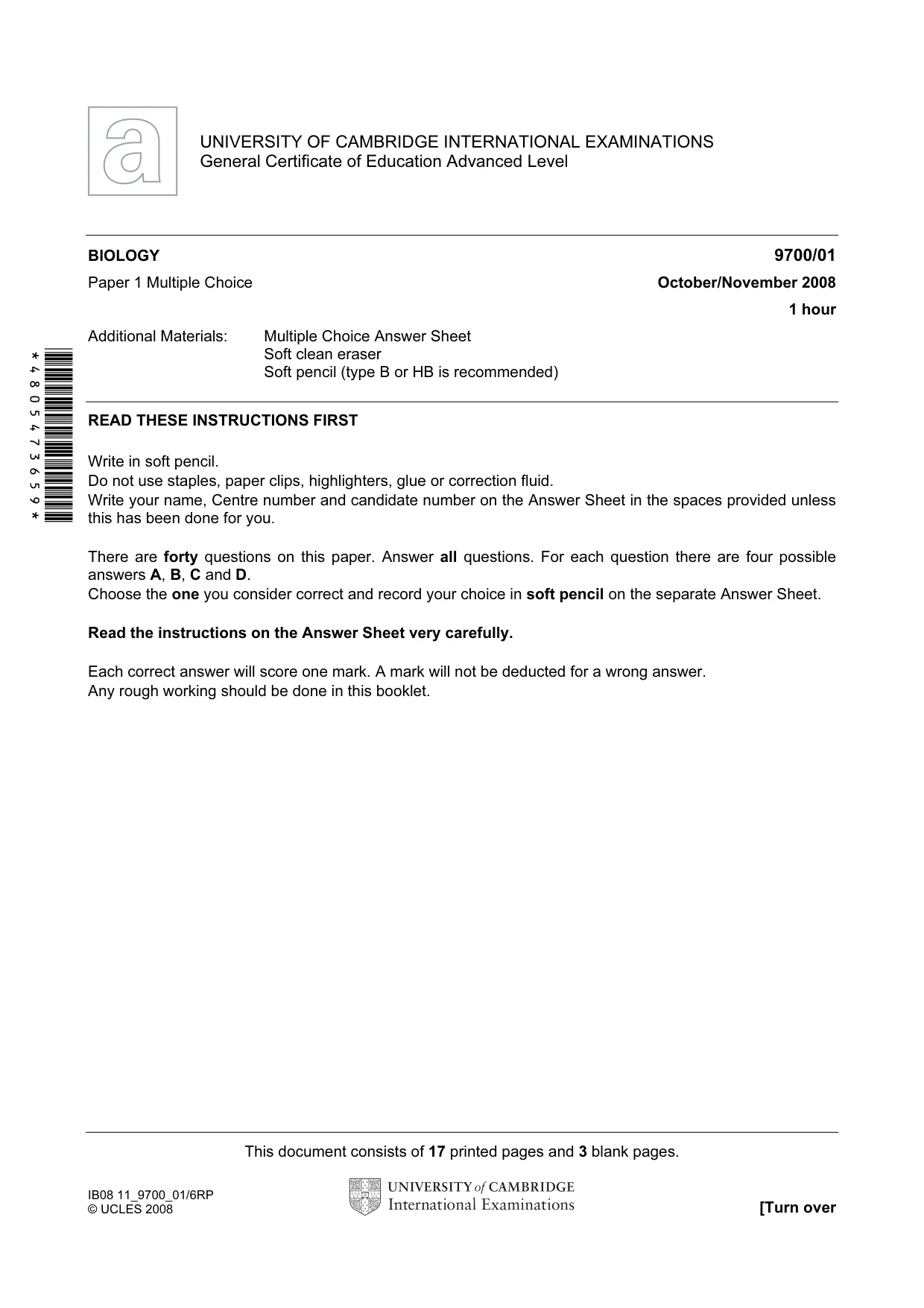


Mark scheme2 pages
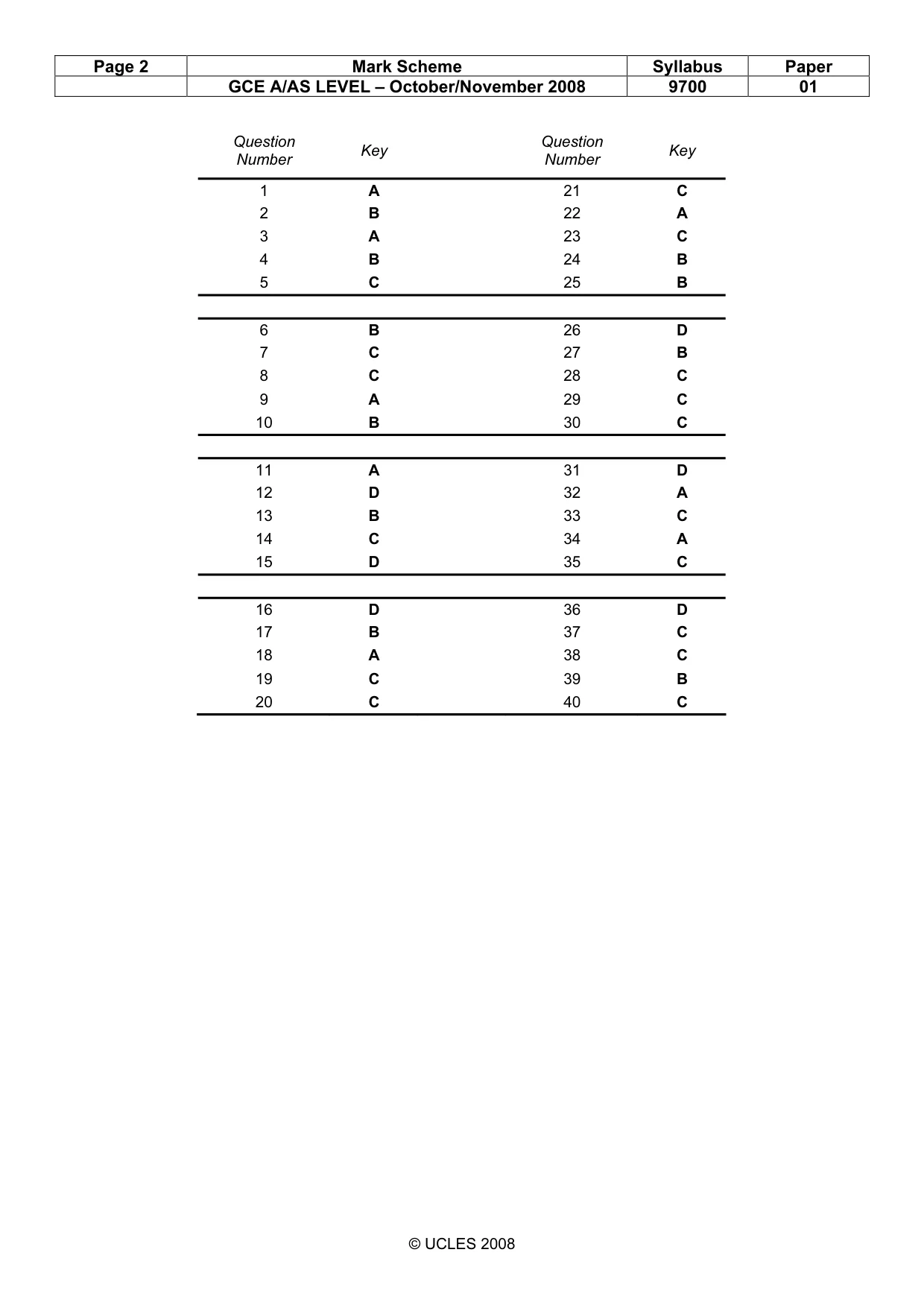
Answers below. Sit the paper first if you are practising.
Questions as text
Q1 · Which eyepiece and objective lens combination enables you to see the greatest number of…
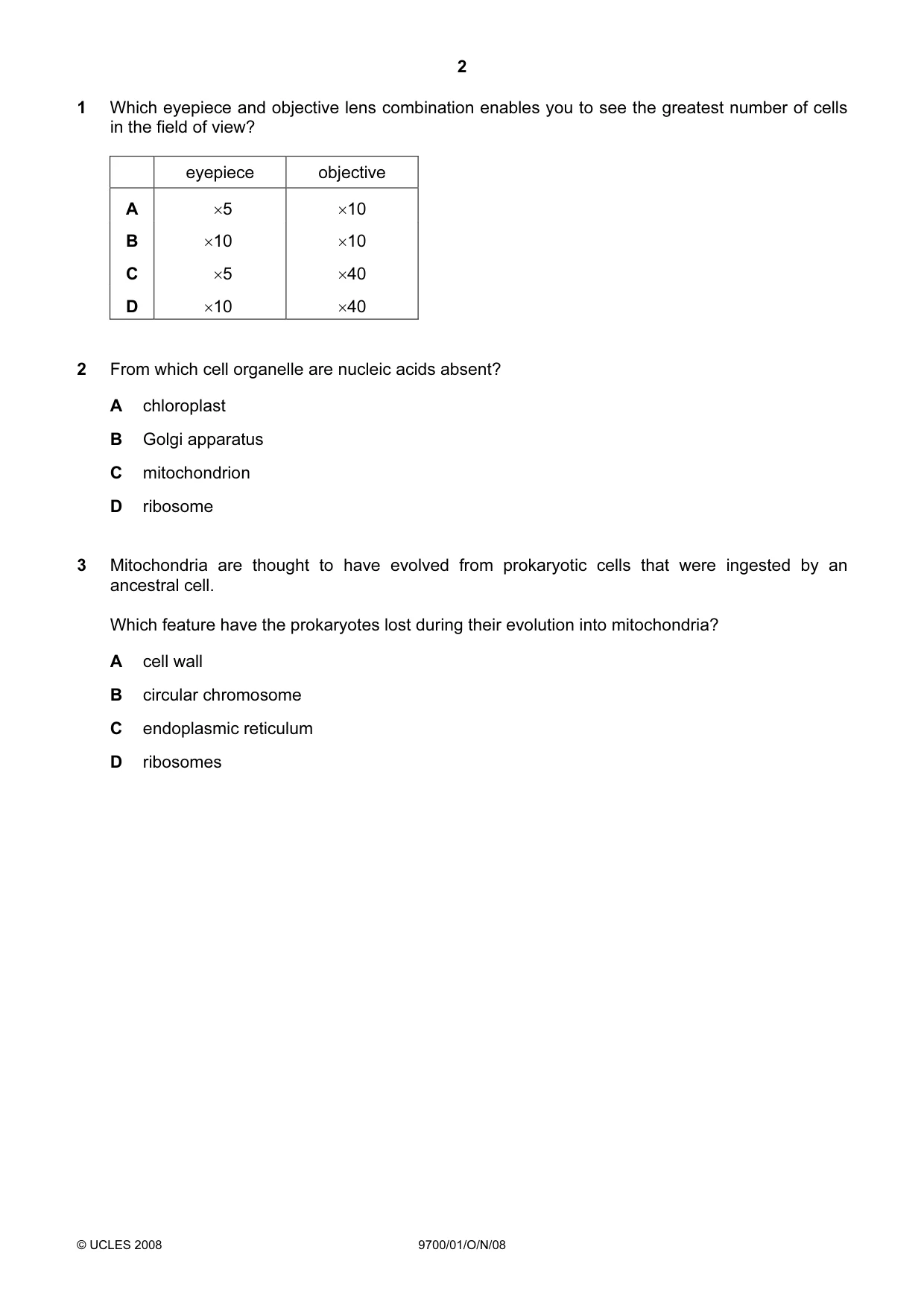
1 Which eyepiece and objective lens combination enables you to see the greatest number of cells in the field of view? eyepiece objective A ×5 ×10 B ×10 ×10 C ×5 ×40 D ×10 ×40
Mark scheme: A
Q2 · From which cell organelle are nucleic acids absent?
2 From which cell organelle are nucleic acids absent? A chloroplast B Golgi apparatus C mitochondrion D ribosome
Mark scheme: B
More questions on Cells as the basic units of living organisms
Q3 · Mitochondria are thought to have evolved from prokaryotic cells that were ingested by an…
3 Mitochondria are thought to have evolved from prokaryotic cells that were ingested by an ancestral cell. Which feature have the prokaryotes lost during their evolution into mitochondria? A cell wall B circular chromosome C endoplasmic reticulum D ribosomes
Mark scheme: A
More questions on Cells as the basic units of living organisms
Q4 · The diagram is a drawing made from an electron micrograph showing a cross-section of an…
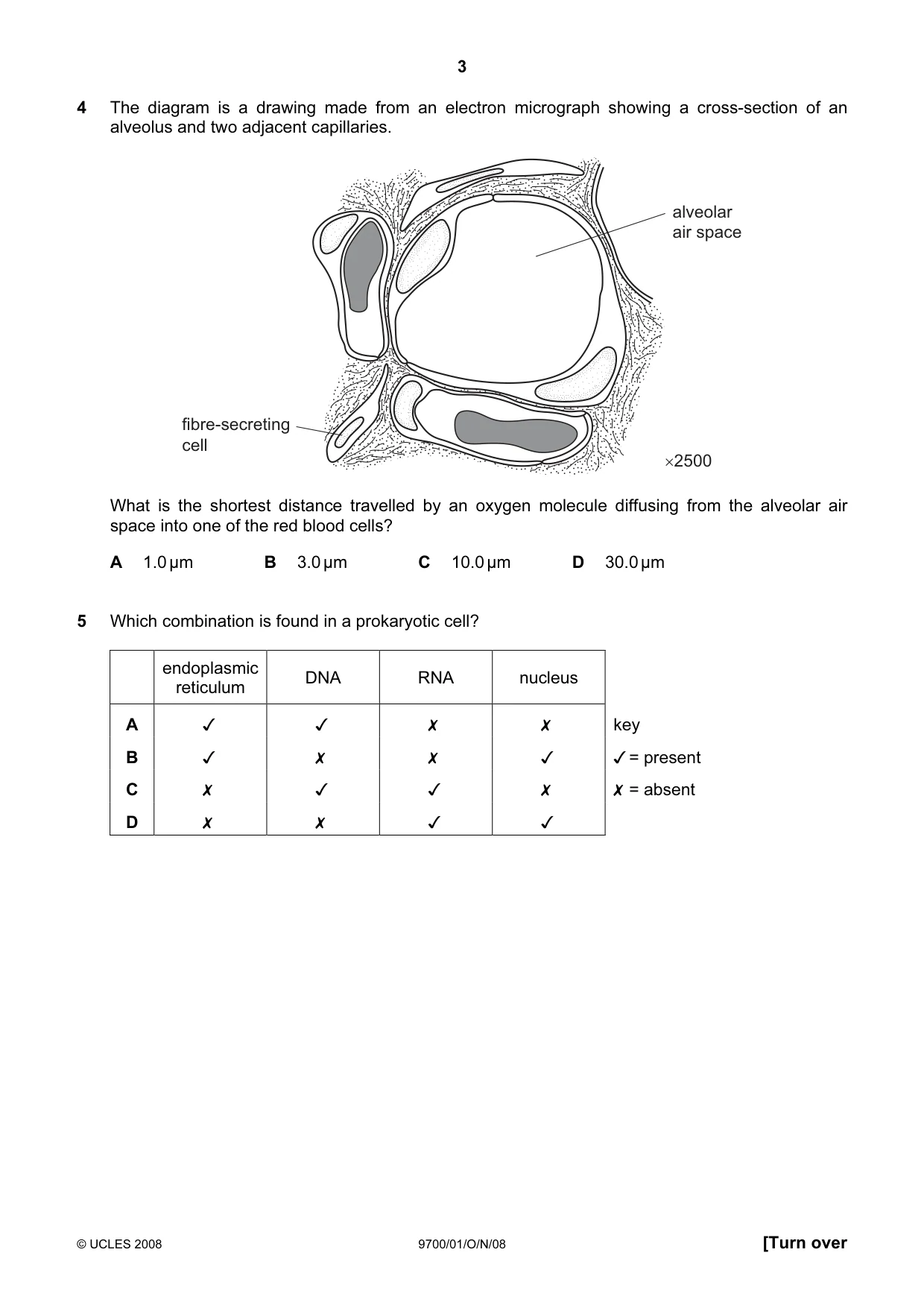
4 The diagram is a drawing made from an electron micrograph showing a cross-section of an alveolus and two adjacent capillaries. alveolar air space fibre-secreting cell ×2500 What is the shortest distance travelled by an oxygen molecule diffusing from the alveolar air space into one of the red blood cells? A 1.0 µm B 3.0 µm C 10.0 µm D 30.0 µm
Mark scheme: B
Q5 · = Which combination is found in a prokaryotic cell?
5 = Which combination is found in a prokaryotic cell? endoplasmic reticulum DNA RNA nucleus A JV JV x x B J x x y Cc x V4 J x D x x J V key Jv = present X = absent
Mark scheme: C
More questions on Cells as the basic units of living organisms
Q6 · Which diagram shows part of a structural polysaccharide?
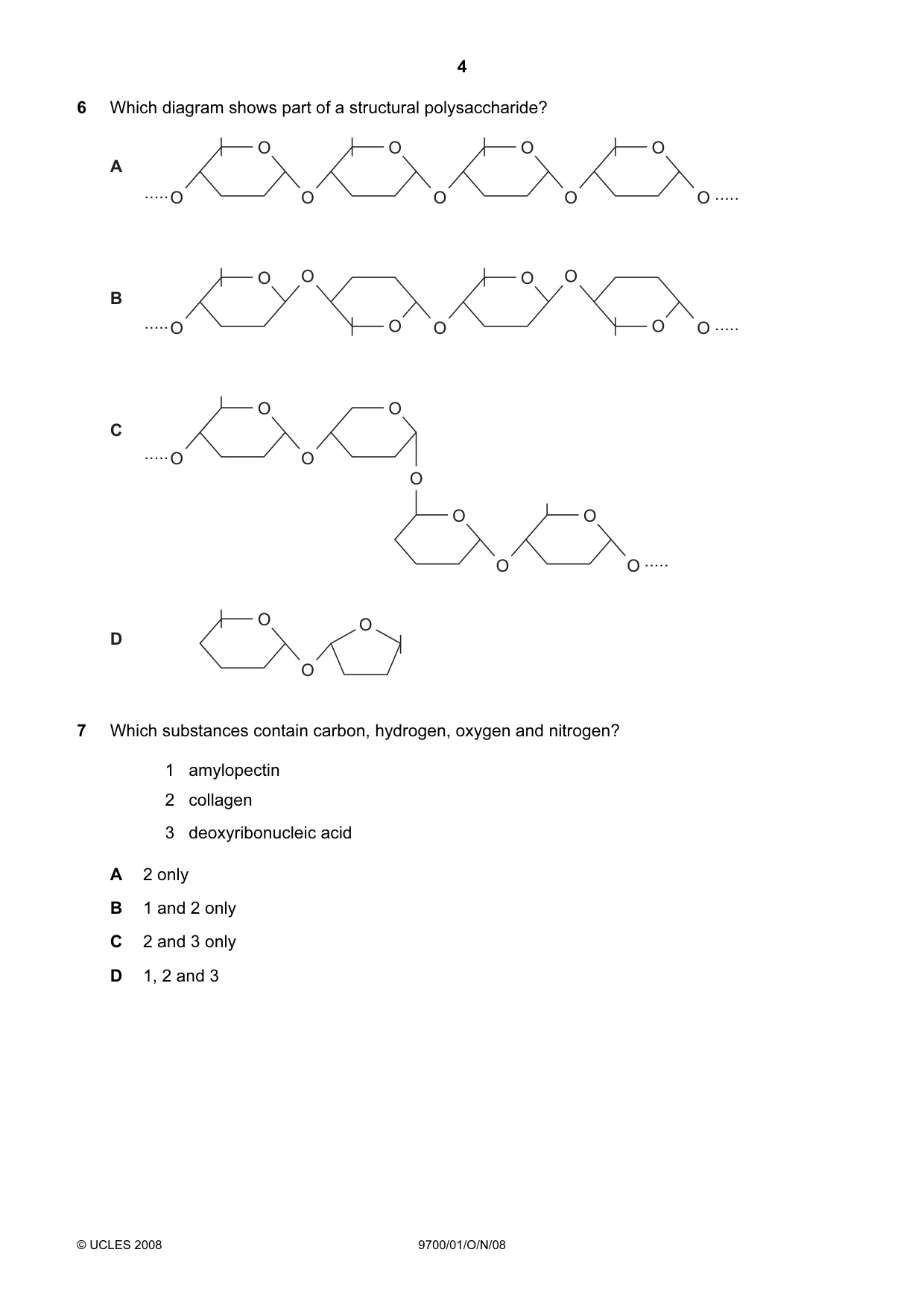
6 Which diagram shows part of a structural polysaccharide? O O O O A ..... O O O O O ..... O O O O B ..... O O O O O ..... O O C ..... O O O O O O O ..... O O D O
Mark scheme: B
Q7 · Which substances contain carbon, hydrogen, oxygen and nitrogen?
7 Which substances contain carbon, hydrogen, oxygen and nitrogen? 1 amylopectin 2 collagen 3 deoxyribonucleic acid A 2 only B 1 and 2 only C 2 and 3 only D 1, 2 and 3
Mark scheme: C
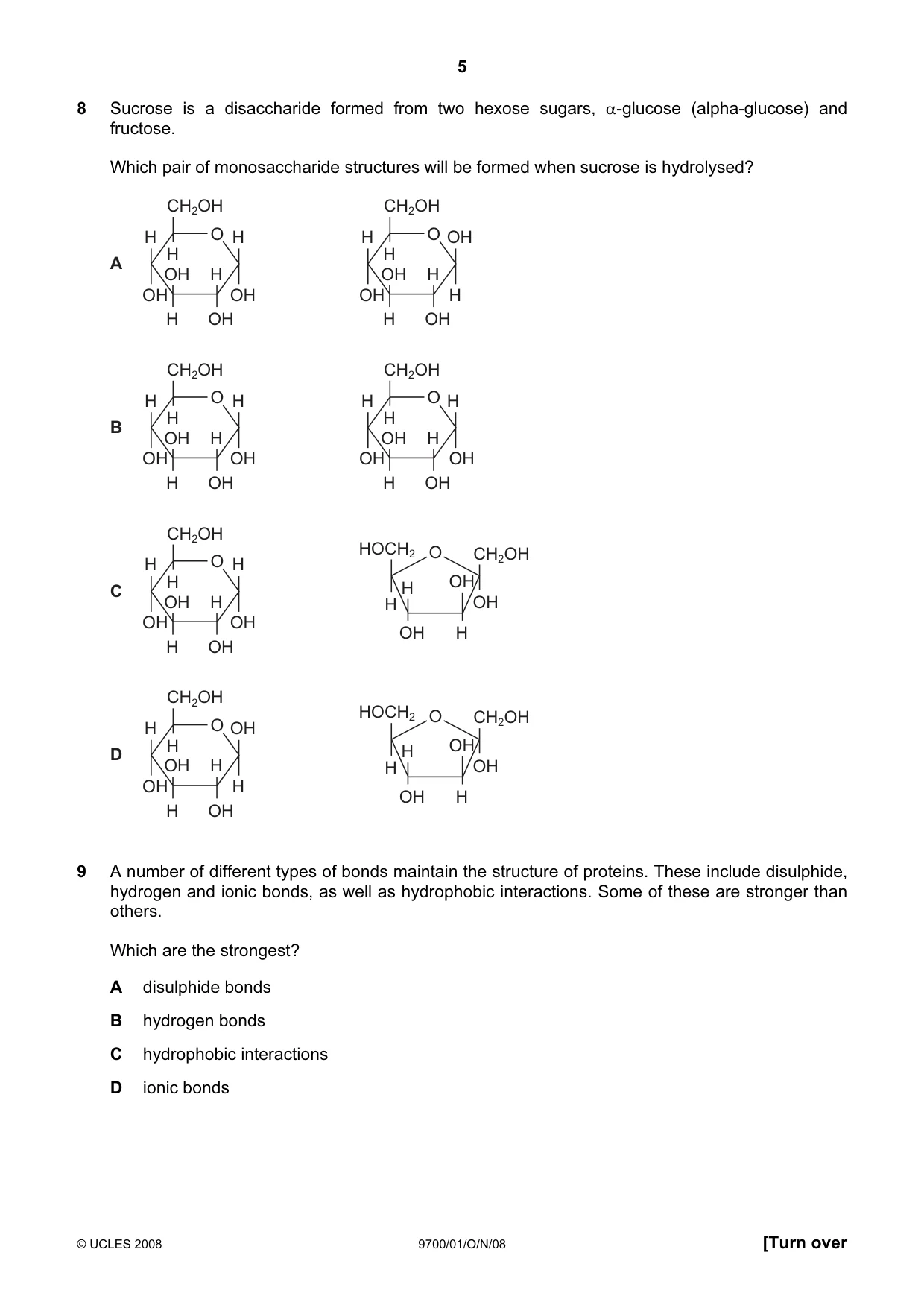
Q8 · Sucrose is a disaccharide formed from two hexose sugars, α-glucose (alpha-glucose) and…
8 Sucrose is a disaccharide formed from two hexose sugars, α-glucose (alpha-glucose) and fructose. Which pair of monosaccharide structures will be formed when sucrose is hydrolysed? CH2OH CH2OH H O H H O OH H H A OH H OH H OH OH OH H H OH H OH CH2OH CH2OH H O H H O H H H B OH H OH H OH OH OH OH H OH H OH CH2OH HOCH2 O CH2OH H O H H H OH C OH H H OH OH OH OH H H OH CH2OH HOCH2 O CH2OH H O OH H H OH D OH H H OH OH H OH H H OH
Mark scheme: C
Q9 · A number of different types of bonds maintain the structure of proteins
9 A number of different types of bonds maintain the structure of proteins. These include disulphide, hydrogen and ionic bonds, as well as hydrophobic interactions. Some of these are stronger than others. Which are the strongest? A disulphide bonds B hydrogen bonds C hydrophobic interactions D ionic bonds
Mark scheme: A
Q10 · Haemoglobin is a globular protein consisting of four polypeptide chains – 2 alpha chains…
10 Haemoglobin is a globular protein consisting of four polypeptide chains – 2 alpha chains and 2 beta chains. In normal individuals, in the DNA which codes for each beta chain, the sixth triplet has a code for glutamic acid. In individuals with sickle cell anaemia this base triplet changes and codes for valine. What aspect of the haemoglobin molecule does this mutation change? A the iron content B the primary structure C the quaternary structure D the secondary structure
Mark scheme: B
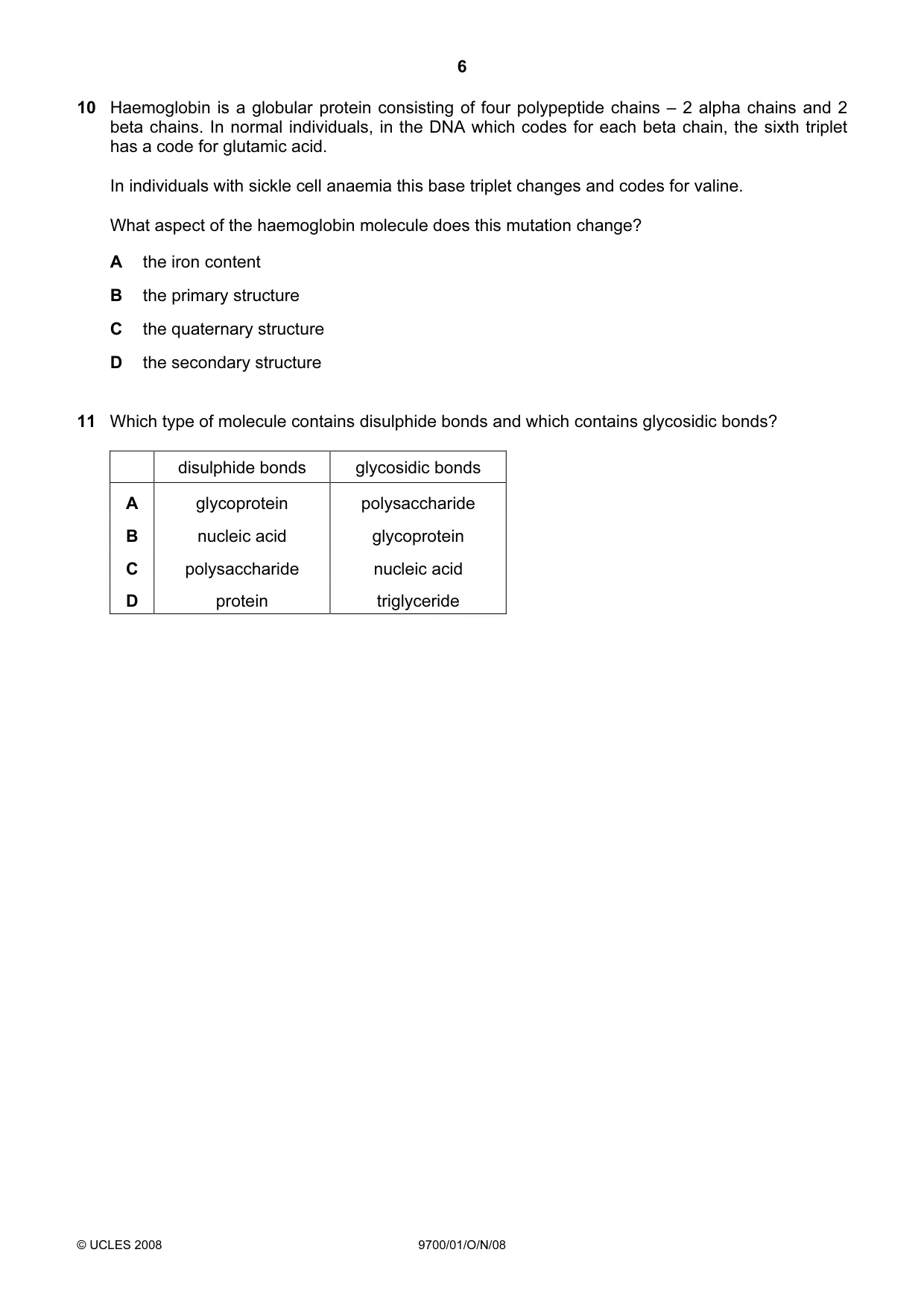
Q11 · Which type of molecule contains disulphide bonds and which contains glycosidic bonds?
11 Which type of molecule contains disulphide bonds and which contains glycosidic bonds? disulphide bonds glycosidic bonds A glycoprotein polysaccharide B nucleic acid glycoprotein C polysaccharide nucleic acid D protein triglyceride
Mark scheme: A
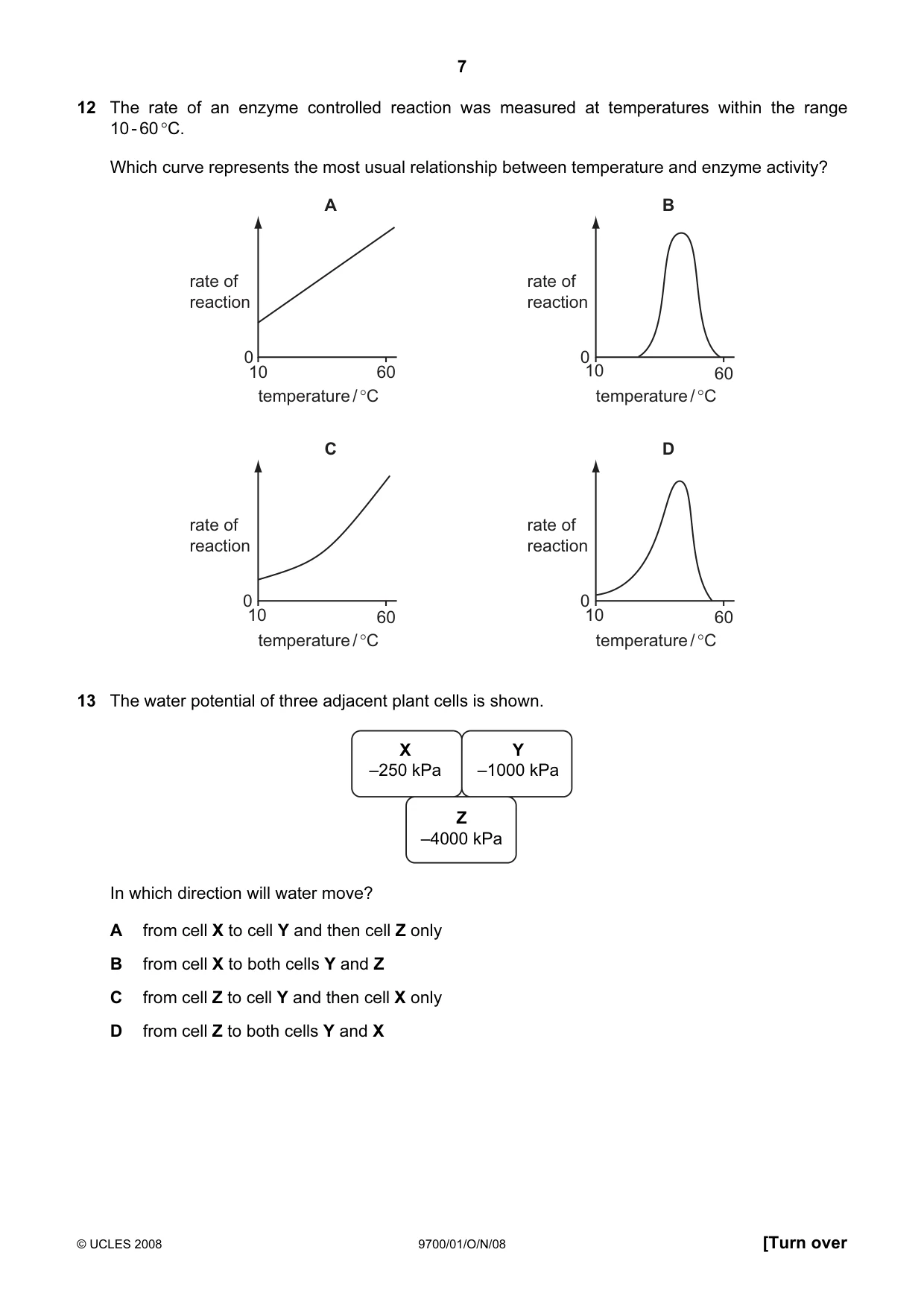
Q12 · The rate of an enzyme controlled reaction was measured at temperatures within the range…
12 The rate of an enzyme controlled reaction was measured at temperatures within the range 10 - 60 °C. Which curve represents the most usual relationship between temperature and enzyme activity? A B rate of rate of reaction reaction 0 0 10 60 10 60 temperature / °C temperature / °C C D rate of rate of reaction reaction 0 0 10 60 10 60 temperature / °C temperature / °C
Mark scheme: D
Q13 · The water potential of three adjacent plant cells is shown
13 The water potential of three adjacent plant cells is shown. X Y –250 kPa –1000 kPa Z –4000 kPa In which direction will water move? A from cell X to cell Y and then cell Z only B from cell X to both cells Y and Z C from cell Z to cell Y and then cell X only D from cell Z to both cells Y and X
Mark scheme: B
Q14 · The table shows three processes that contribute to transport across cell surface membranes
14 The table shows three processes that contribute to transport across cell surface membranes. Which processes are the result of random movement of molecules? diffusion endocytosis osmosis A x x x B x v v Cc v x v D v v x < I key qj I random non random
Mark scheme: C
Q15 · The epithelial cells of people with cystic fibrosis have a defect in the structure of the…
15 The epithelial cells of people with cystic fibrosis have a defect in the structure of the cell surface membrane. The ability of the cell to transport chloride ions out of the cell is affected. Which membrane component is involved? A cholesterol B glycolipid C phospholipid D protein
Mark scheme: D
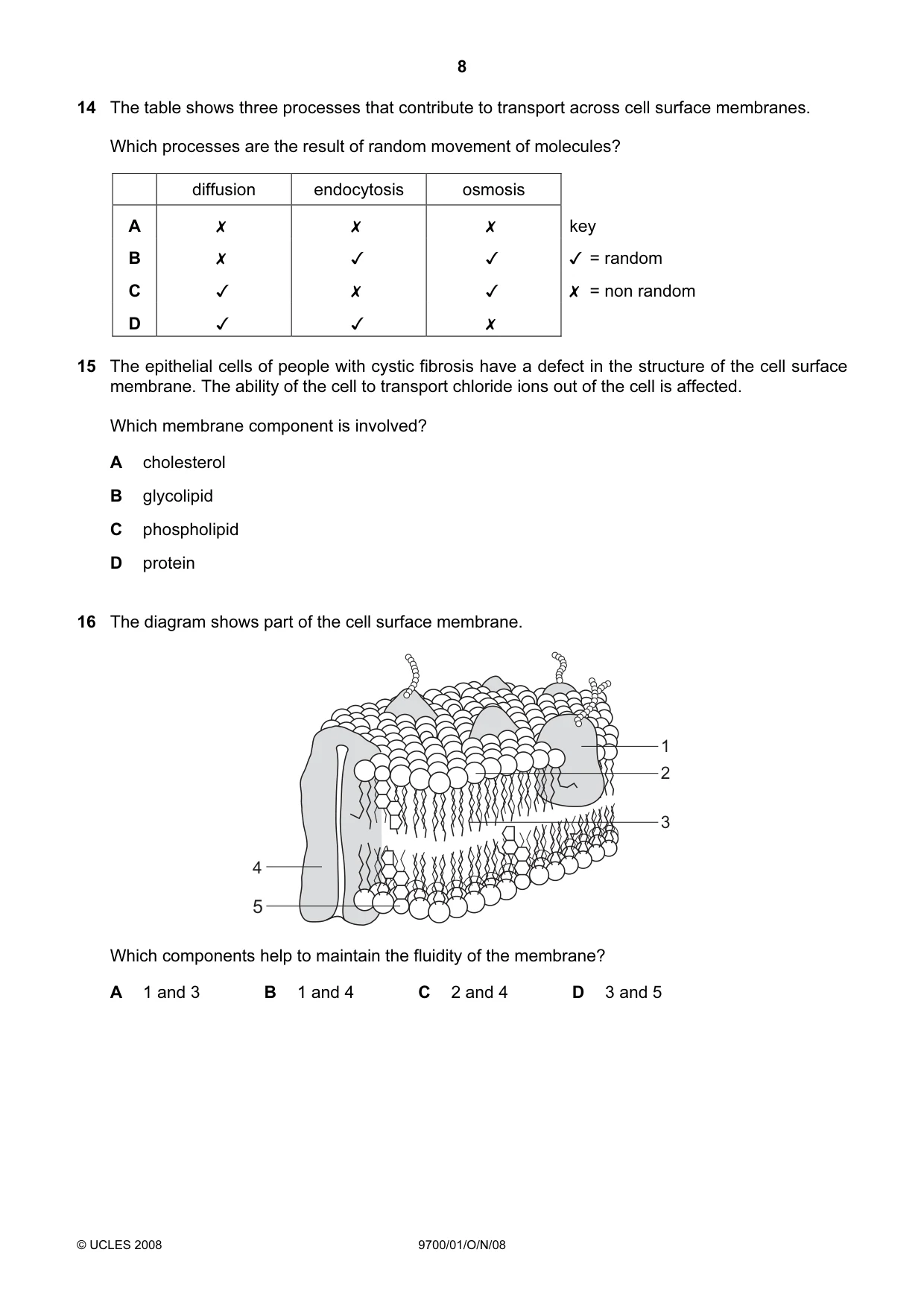
Q16 · The diagram shows part of the cell surface membrane
16 The diagram shows part of the cell surface membrane. 1 2 3 4 5 Which components help to maintain the fluidity of the membrane? A 1 and 3 B 1 and 4 C 2 and 4 D 3 and 5
Mark scheme: D
Q17 · Which statement describes events during interphase of the mitotic cell cycle?
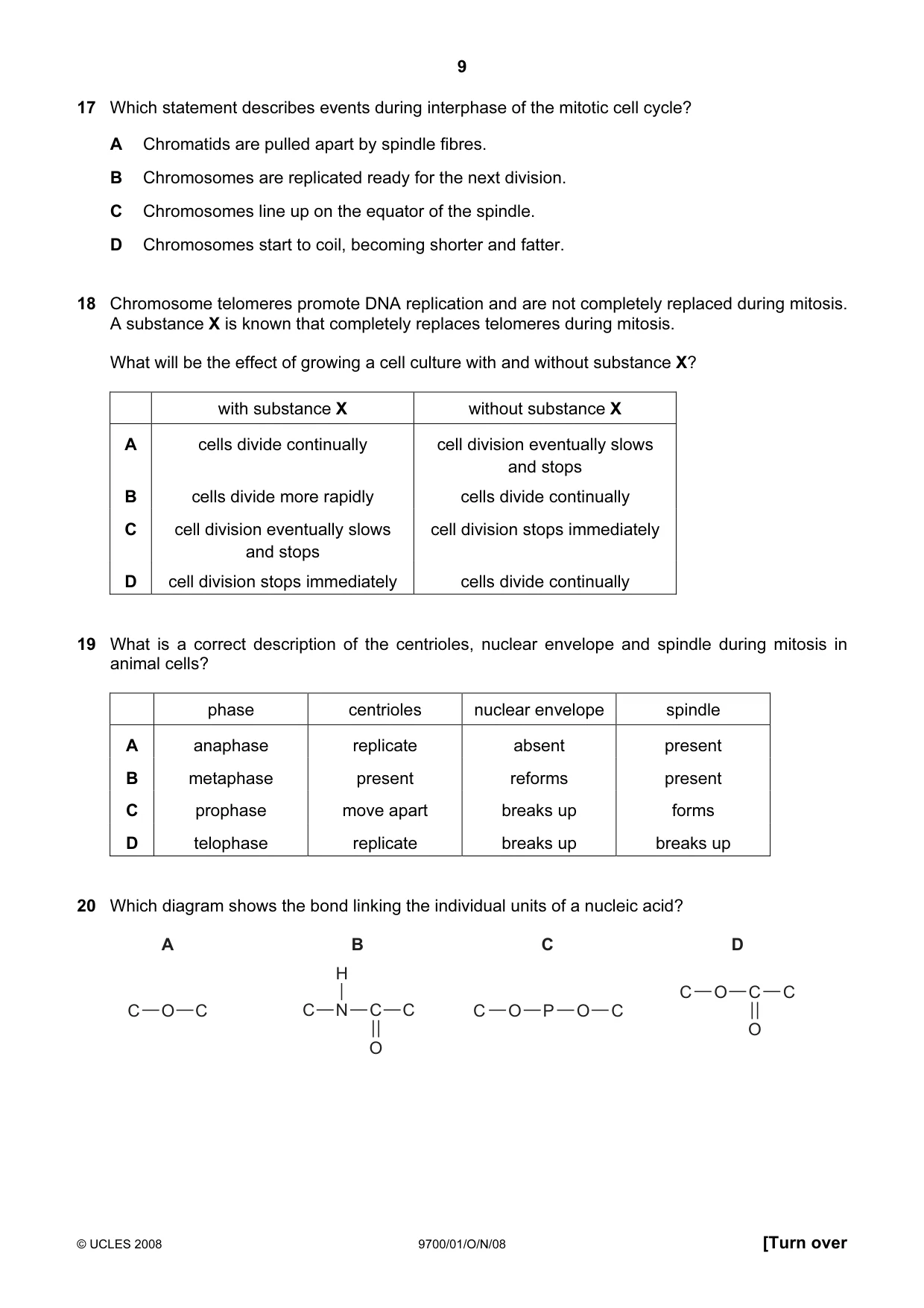
17 Which statement describes events during interphase of the mitotic cell cycle? A Chromatids are pulled apart by spindle fibres. B Chromosomes are replicated ready for the next division. C Chromosomes line up on the equator of the spindle. D Chromosomes start to coil, becoming shorter and fatter.
Mark scheme: B
More questions on Replication and division of nuclei and cells
Q18 · Chromosome telomeres promote DNA replication and are not completely replaced during…
18 Chromosome telomeres promote DNA replication and are not completely replaced during mitosis. A substance X is known that completely replaces telomeres during mitosis. What will be the effect of growing a cell culture with and without substance X? with substance X without substance X A cells divide continually cell division eventually slows and stops B cells divide more rapidly cells divide continually C cell division eventually slows cell division stops immediately and stops D cell division stops immediately cells divide continually
Mark scheme: A
More questions on Replication and division of nuclei and cells
Q19 · What is a correct description of the centrioles, nuclear envelope and spindle during…
19 What is a correct description of the centrioles, nuclear envelope and spindle during mitosis in animal cells? phase centrioles nuclear envelope spindle A anaphase replicate absent present B metaphase present reforms present C prophase move apart breaks up forms D telophase replicate breaks up breaks up
Mark scheme: C
Q20 · Which diagram shows the bond linking the individual units of a nucleic acid?
20 Which diagram shows the bond linking the individual units of a nucleic acid? A B C D H C O C C C O C C N C C C O P O C O O
Mark scheme: C
More questions on Structure of nucleic acids and replication of DNA
Q21 · What is the function of the enzyme RNA polymerase?
21 What is the function of the enzyme RNA polymerase? A to form a polypeptide using mRNA as a template B to form a strand of DNA using mRNA as a template C to form a strand of mRNA using DNA as a template D to form a strand of mRNA using tRNA as a template
Mark scheme: C
Q22 · The table gives the tRNA anticodons for four amino acids
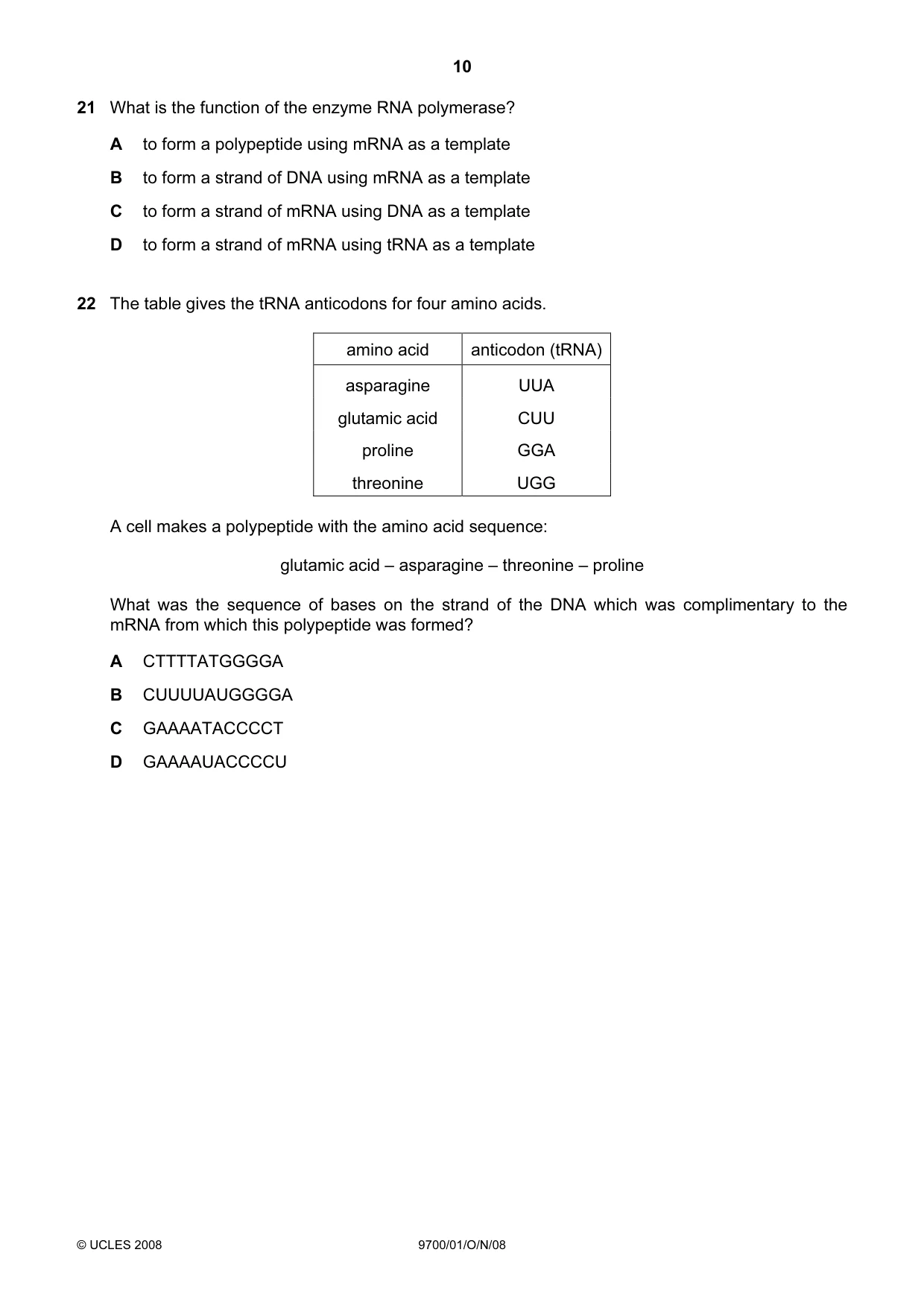
22 The table gives the tRNA anticodons for four amino acids. amino acid anticodon (tRNA) asparagine UUA glutamic acid CUU proline GGA threonine UGG A cell makes a polypeptide with the amino acid sequence: glutamic acid – asparagine – threonine – proline What was the sequence of bases on the strand of the DNA which was complimentary to the mRNA from which this polypeptide was formed? A CTTTTATGGGGA B CUUUUAUGGGGA C GAAAATACCCCT D GAAAAUACCCCU
Mark scheme: A
Q23 · Four solutions, with different water potentials are listed
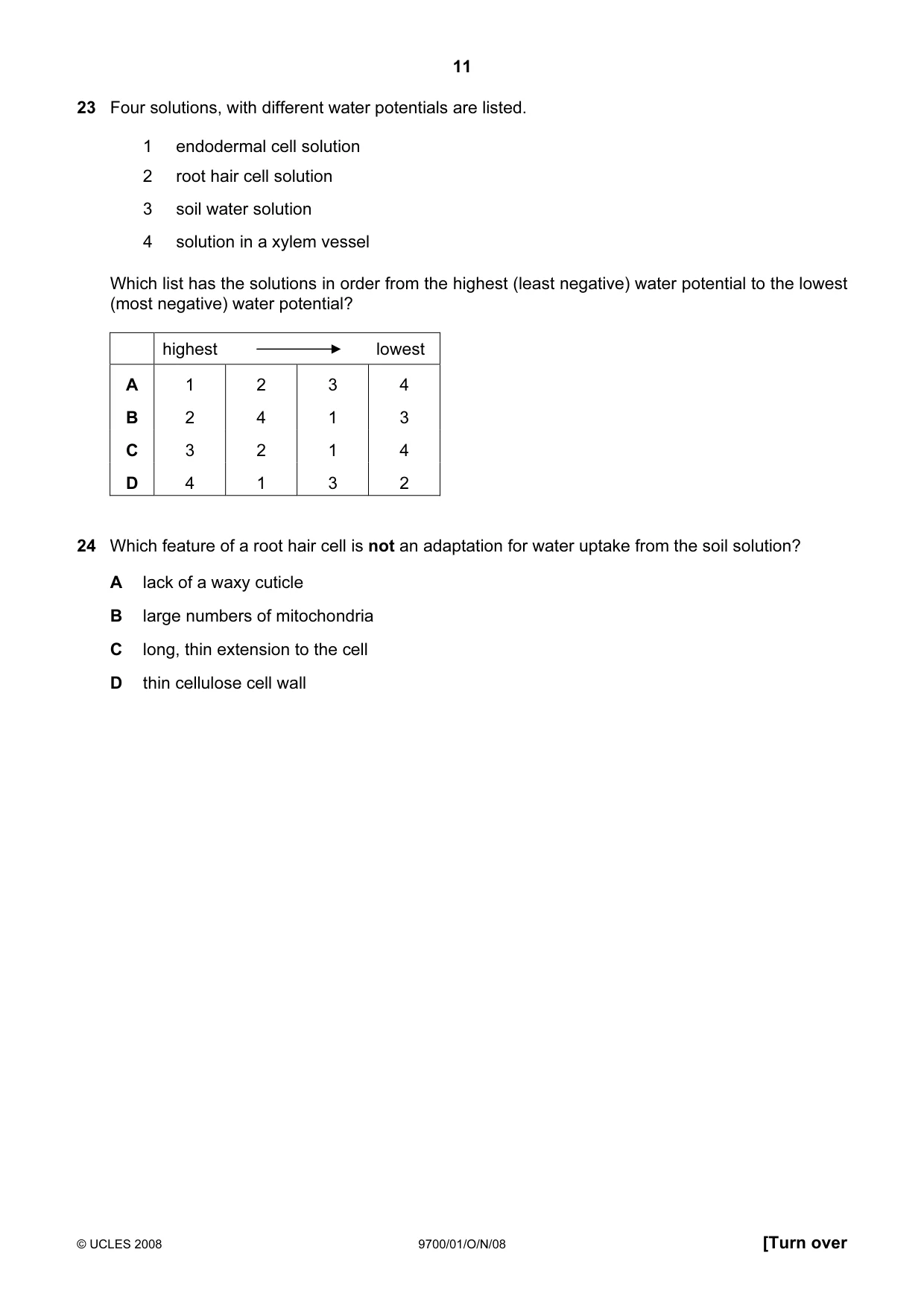
23 Four solutions, with different water potentials are listed. 1 endodermal cell solution 2 root hair cell solution 3 soil water solution 4 solution in a xylem vessel Which list has the solutions in order from the highest (least negative) water potential to the lowest (most negative) water potential? highest lowest A 1 2 3 4 B 2 4 1 3 C 3 2 1 4 D 4 1 3 2
Mark scheme: C
Q24 · Which feature of a root hair cell is not an adaptation for water uptake from the soil…
24 Which feature of a root hair cell is not an adaptation for water uptake from the soil solution? A lack of a waxy cuticle B large numbers of mitochondria C long, thin extension to the cell D thin cellulose cell wall
Mark scheme: B
Q25 · The diagram shows a model to demonstrate the mass-flow hypothesis of translocation
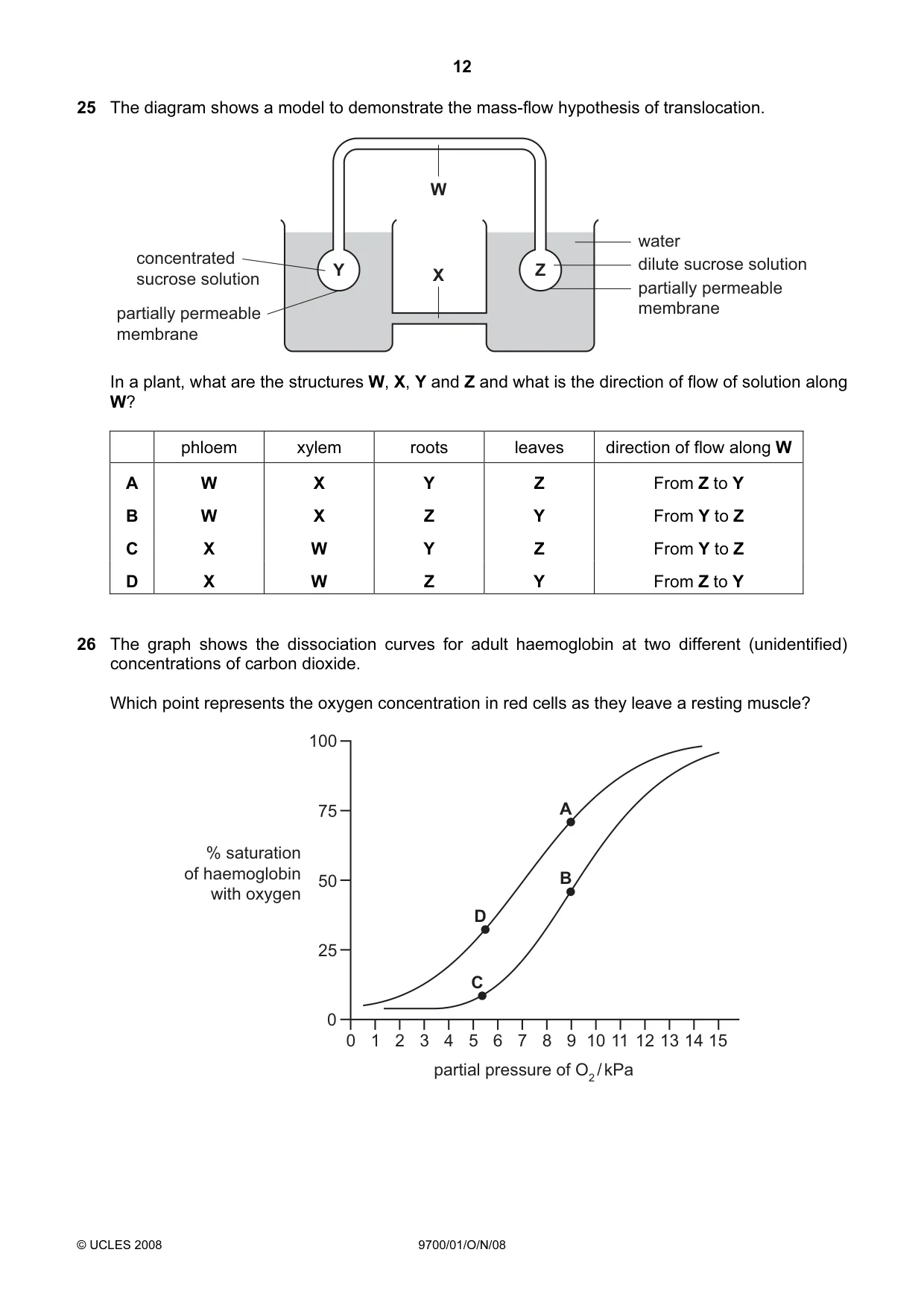
25 The diagram shows a model to demonstrate the mass-flow hypothesis of translocation. W water concentrated dilute sucrose solution Y X Z sucrose solution partially permeable partially permeable membrane membrane In a plant, what are the structures W, X, Y and Z and what is the direction of flow of solution along W? phloem xylem roots leaves direction of flow along W A W X Y Z From Z to Y B W X Z Y From Y to Z C X W Y Z From Y to Z D X W Z Y From Z to Y
Mark scheme: B
Q26 · The graph shows the dissociation curves for adult haemoglobin at two different…
26 The graph shows the dissociation curves for adult haemoglobin at two different (unidentified) concentrations of carbon dioxide. Which point represents the oxygen concentration in red cells as they leave a resting muscle? 100 75 A % saturation of haemoglobin 50 B with oxygen D 25 C 0 0 1 2 3 4 5 6 7 8 9 10 11 12 13 14 15 partial pressure of O2 / kPa
Mark scheme: D
Q27 · Which chamber of the heart shows the greatest pressure changes during one cardiac cycle?
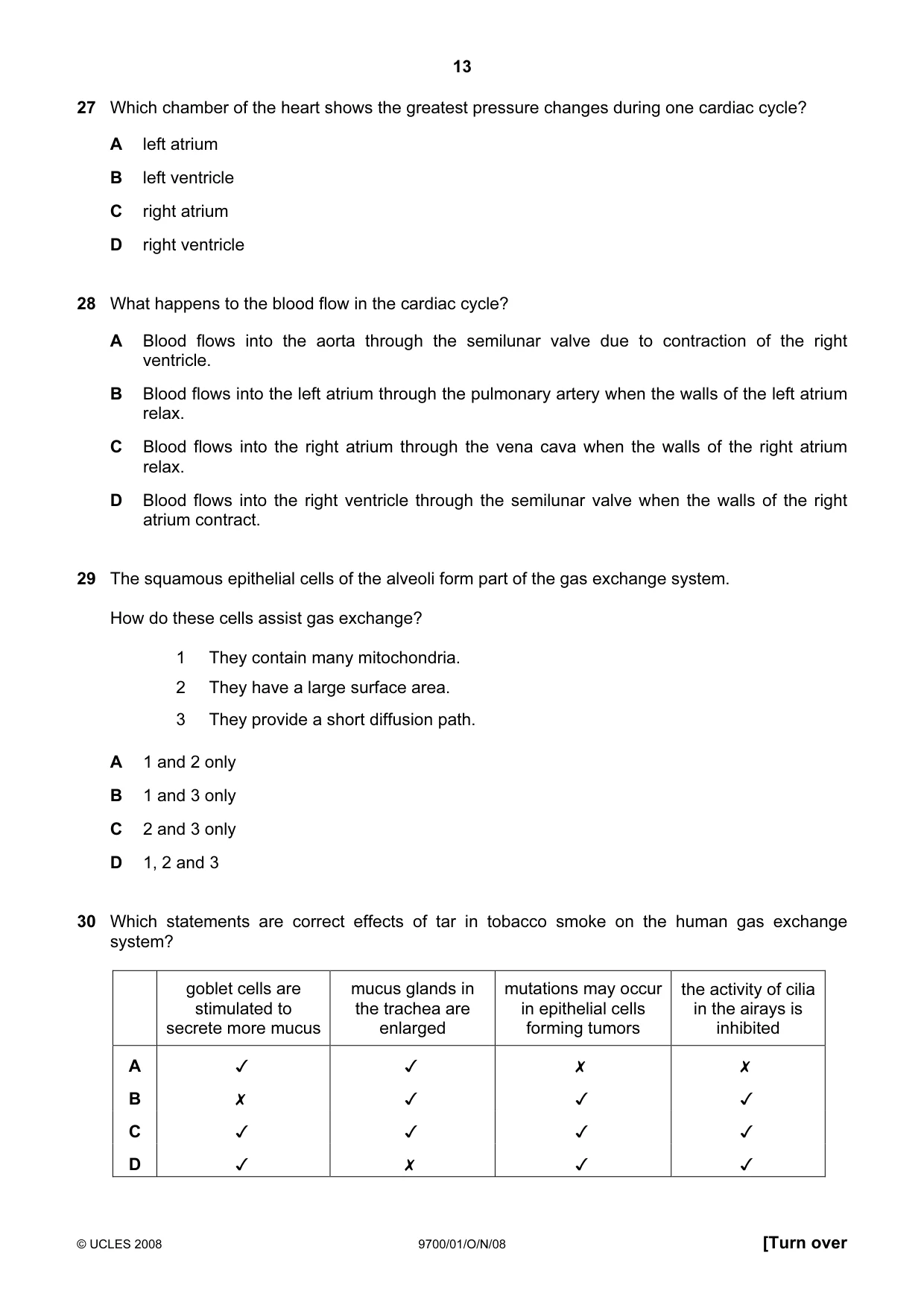
27 Which chamber of the heart shows the greatest pressure changes during one cardiac cycle? A left atrium B left ventricle C right atrium D right ventricle
Mark scheme: B
Q28 · What happens to the blood flow in the cardiac cycle?
28 What happens to the blood flow in the cardiac cycle? A Blood flows into the aorta through the semilunar valve due to contraction of the right ventricle. B Blood flows into the left atrium through the pulmonary artery when the walls of the left atrium relax. C Blood flows into the right atrium through the vena cava when the walls of the right atrium relax. D Blood flows into the right ventricle through the semilunar valve when the walls of the right atrium contract.
Mark scheme: C
Q29 · The squamous epithelial cells of the alveoli form part of the gas exchange system
29 The squamous epithelial cells of the alveoli form part of the gas exchange system. How do these cells assist gas exchange? 1 They contain many mitochondria. 2 They have a large surface area. 3 They provide a short diffusion path. A 1 and 2 only B 1 and 3 only C 2 and 3 only D 1, 2 and 3
Mark scheme: C
Q30 · Which statements are correct effects of tar in tobacco smoke on the human gas exchange…
30 Which statements are correct effects of tar in tobacco smoke on the human gas exchange system? goblet cells are mucus glands in mutations may occur | the activity of cilia stimulated to the trachea are in epithelial cells in the airays is secrete more mucus enlarged forming tumors inhibited 0 0O WwW > << x x KM S44 <4 x
Mark scheme: C
Q31 · The diagram shows a record of a person’s breathing
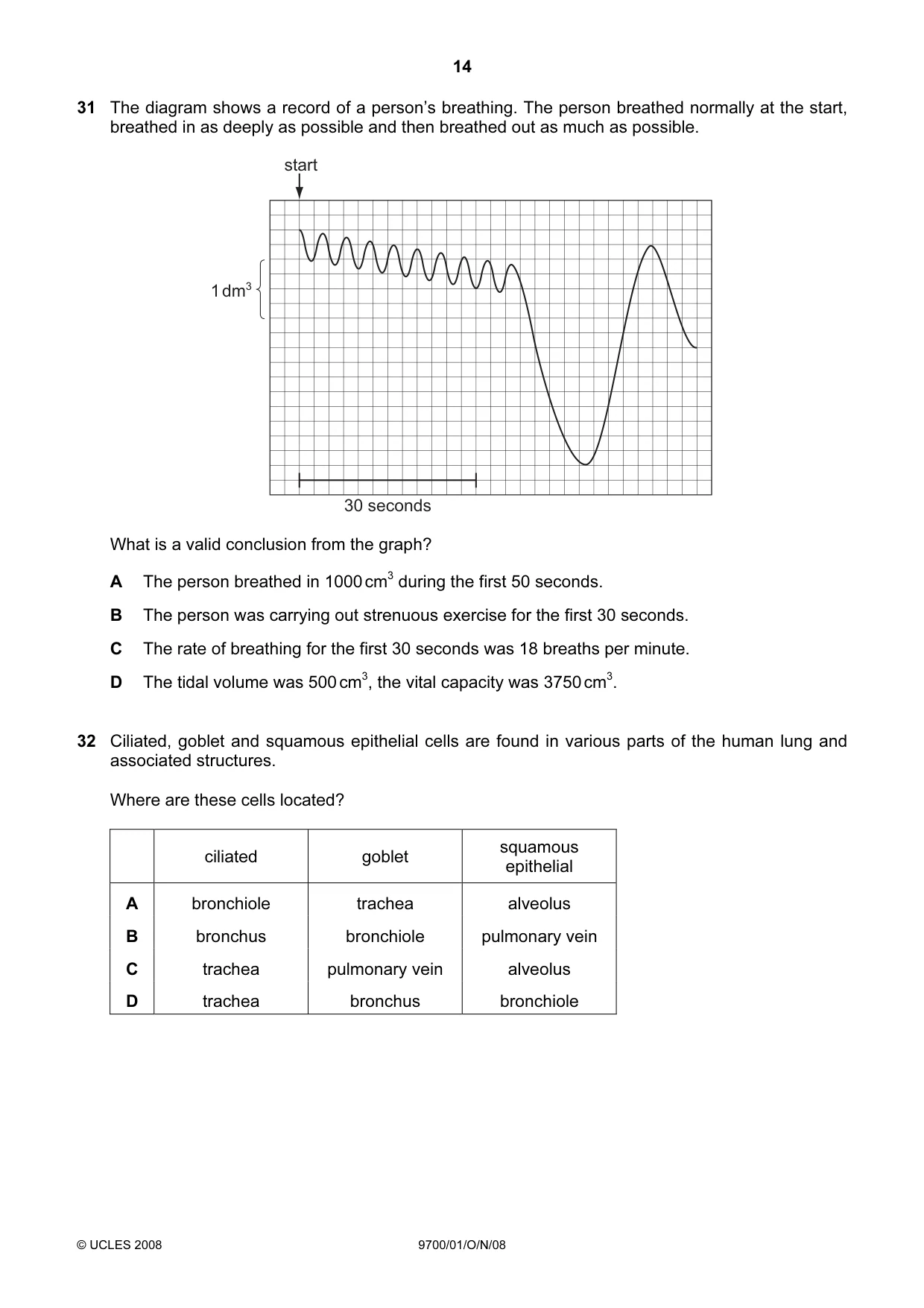
31 The diagram shows a record of a person’s breathing. The person breathed normally at the start, breathed in as deeply as possible and then breathed out as much as possible. start 1 dm3 30 seconds What is a valid conclusion from the graph? A The person breathed in 1000 cm3 during the first 50 seconds. B The person was carrying out strenuous exercise for the first 30 seconds. C The rate of breathing for the first 30 seconds was 18 breaths per minute. D The tidal volume was 500 cm3, the vital capacity was 3750 cm3.
Mark scheme: D
Q32 · Ciliated, goblet and squamous epithelial cells are found in various parts of the human…
32 Ciliated, goblet and squamous epithelial cells are found in various parts of the human lung and associated structures. Where are these cells located? squamous ciliated goblet epithelial A bronchiole trachea alveolus B bronchus bronchiole pulmonary vein C trachea pulmonary vein alveolus D trachea bronchus bronchiole
Mark scheme: A
Q33 · Some antibiotics are used in animal feed to reduce disease
33 Some antibiotics are used in animal feed to reduce disease. What explains why these antibiotics should not be used in the treatment of human diseases? A Humans may be allergic to these antibiotics. B Human cells may stop responding to these antibiotics. C Pathogenic bacteria may develop resistance to these antibiotics. D Useful gut bacteria may be killed by these antibiotics.
Mark scheme: C
Q34 · Some children are born with Severe Combined Immune Deficiency (SCID)
34 Some children are born with Severe Combined Immune Deficiency (SCID). These children do not normally have any T-lymphocytes and suffer from many diseases. How can these children be cured? A bone marrow transplantation B continual use of antibiotics C transfusion of antibodies D vaccination against all diseases
Mark scheme: A
Q35 · The diagram represents the structure of a molecule of antibody
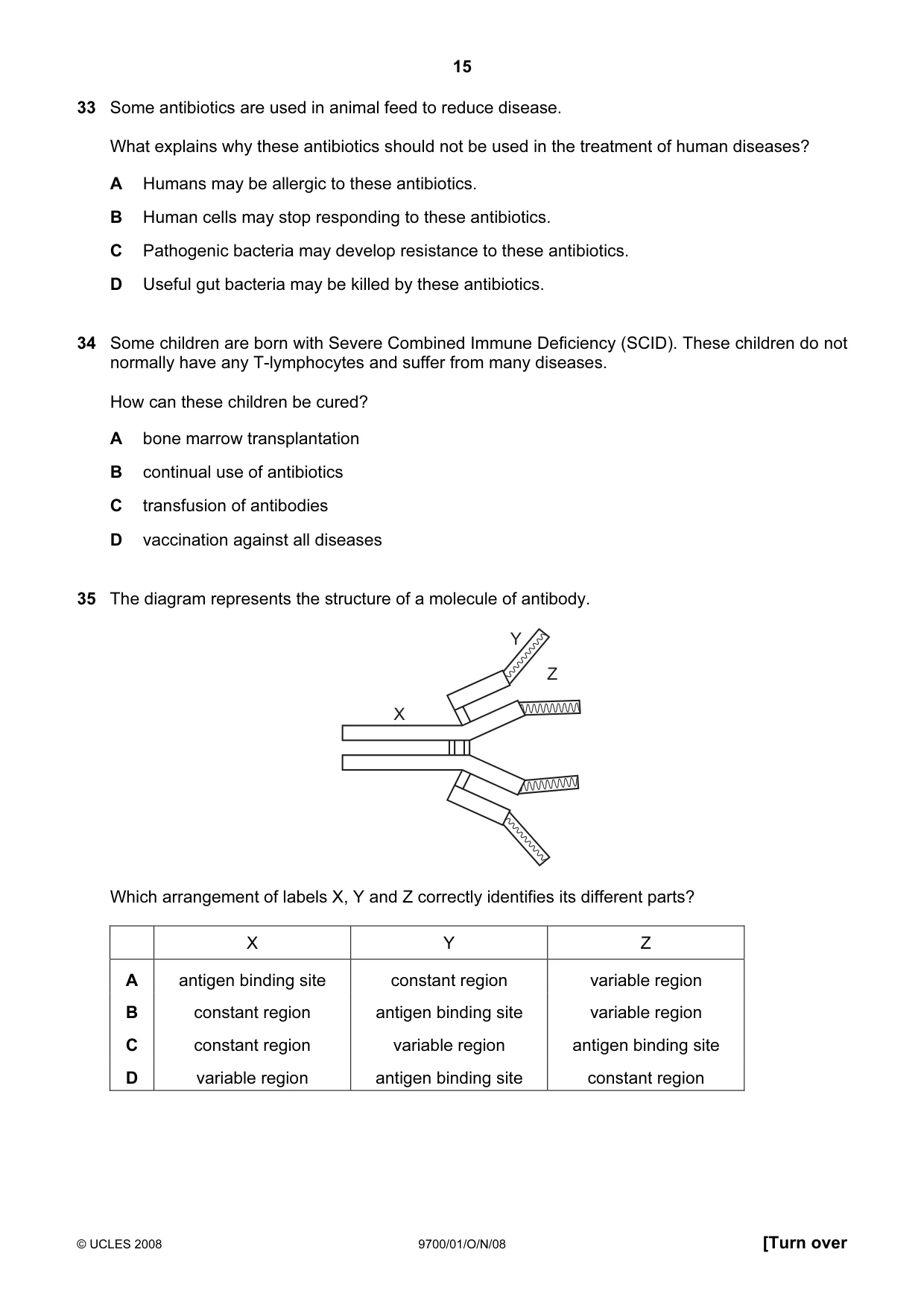
35 The diagram represents the structure of a molecule of antibody. Y Z X Which arrangement of labels X, Y and Z correctly identifies its different parts? X Y Z A antigen binding site constant region variable region B constant region antigen binding site variable region C constant region variable region antigen binding site D variable region antigen binding site constant region
Mark scheme: C
Q36 · Which of the following are increasing the spread of malaria?
36 Which of the following are increasing the spread of malaria? 1 continued migration of people due to war and civil unrest 2 increasing carbon dioxide levels causing global warming 3 increasing resistance to antibiotics and other drugs A 1 and 2 only B 1 and 3 only C 2 and 3 only D 1, 2 and 3
Mark scheme: D
Q37 · Which examples show the different types of immunity?
37 Which examples show the different types of immunity? active artificial passive natural A immunity to measles after infection receiving antibodies to measles in colostrum B immunity to measles after infection receiving antibodies to tetanus by injection C immunity to smallpox after vaccination receiving antibodies to measles in colostrum D immunity to smallpox after vaccination receiving antibodies to tetanus by injection
Mark scheme: C
Q38 · The diagram shows a simplified nitrogen cycle
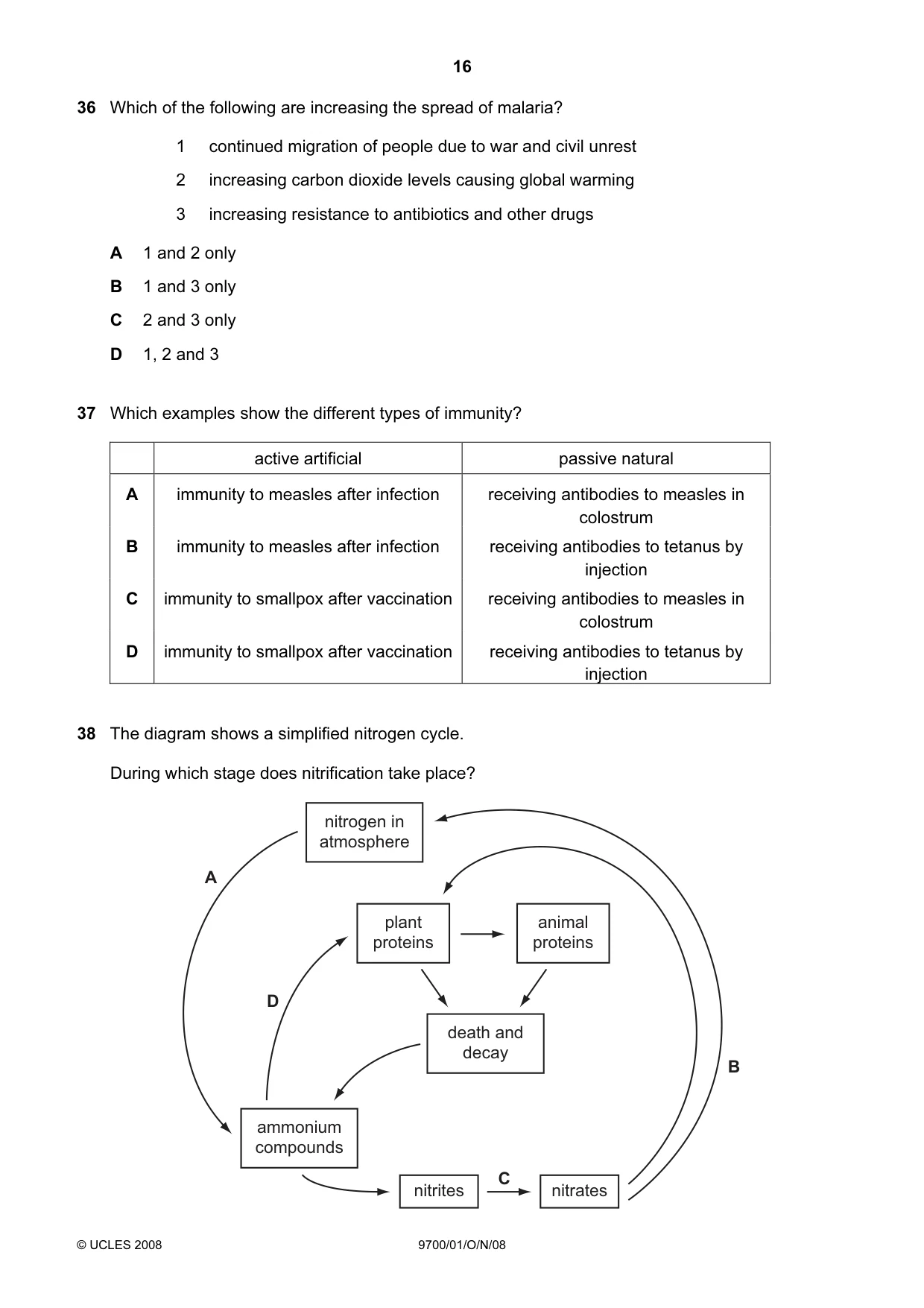
38 The diagram shows a simplified nitrogen cycle. During which stage does nitrification take place? nitrogen in atmosphere A plant animal proteins proteins D death and decay B ammonium compounds C nitrites nitrates
Mark scheme: C
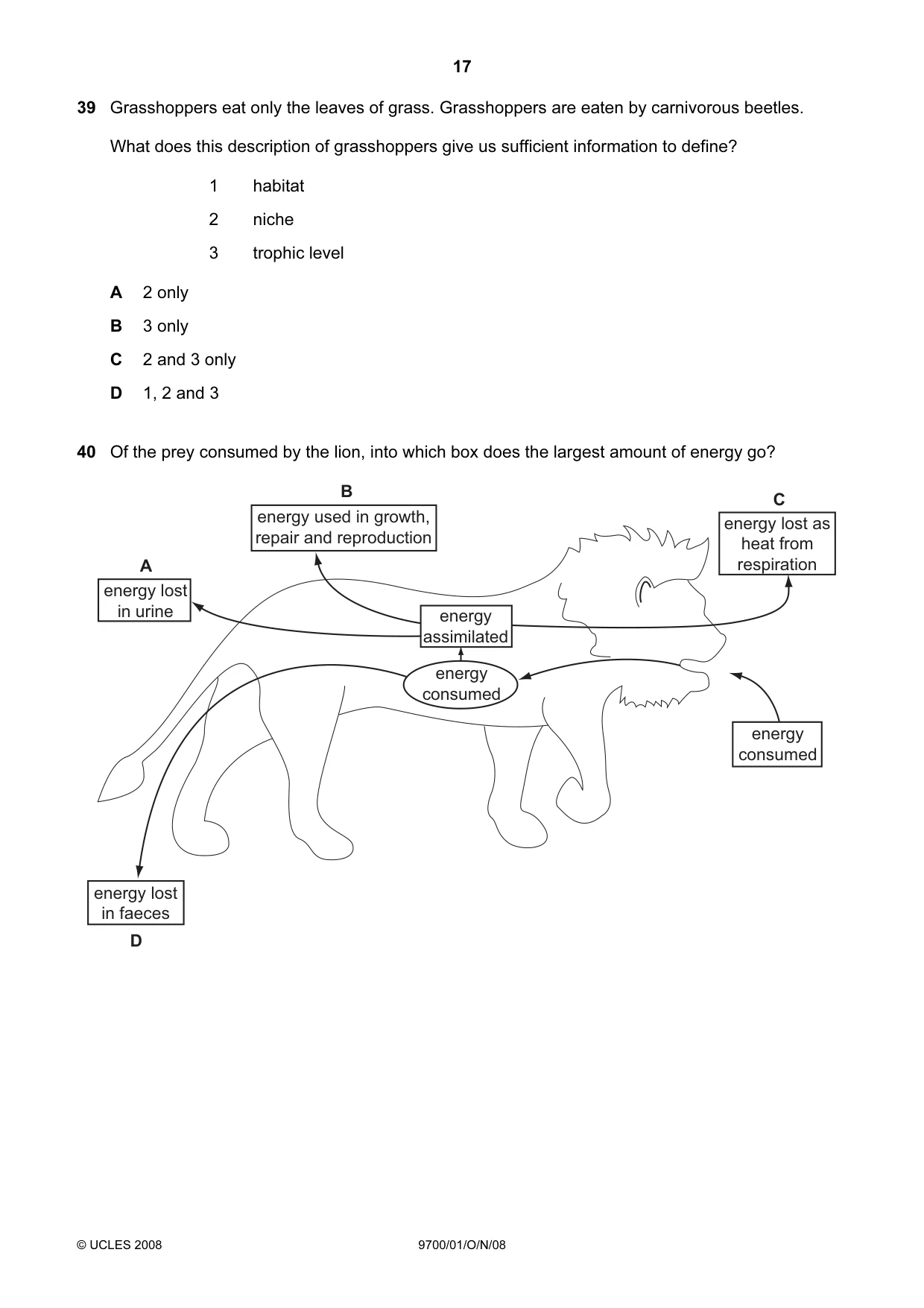
Q39 · Grasshoppers eat only the leaves of grass
39 Grasshoppers eat only the leaves of grass. Grasshoppers are eaten by carnivorous beetles. What does this description of grasshoppers give us sufficient information to define? 1 habitat 2 niche 3 trophic level A 2 only B 3 only C 2 and 3 only D 1, 2 and 3
Mark scheme: B
Q40 · Of the prey consumed by the lion, into which box does the largest amount of energy go?
40 Of the prey consumed by the lion, into which box does the largest amount of energy go? B C energy used in growth, energy lost as repair and reproduction heat from A respiration energy lost in urine energy assimilated energy consumed energy consumed energy lost in faeces D
Mark scheme: C
What was in this paper
The subtopics covered by these 40 questions, and how many questions each got. Open one in a new tab to see every Cambridge question on it.
5Proteins4Biodiversity3Cells as the basic units of living organisms3Carbohydrates and lipids2Fluid mosaic membranes2Movement into and out of cells2Protein synthesis2Replication and division of nuclei and cells2The heart2The immune system2Transport mechanisms2Antibiotics1Antibodies and vaccination1Chromosome behaviour in mitosis1Factors that affect enzyme action1Infectious diseases1Structure of nucleic acids and replication of DNA1Structure of transport tissues1The microscope in cell studies1Transport of oxygen and carbon dioxide1What you needed in this session
Cambridge’s own grade thresholds for 2008 Oct/Nov, Paper 1 · Variant 1. A higher threshold means an easier paper — the bar moves with how the cohort did.