Cambridge A Level Biology 9700 — 2016 May/June Paper 1 · Variant 1
9700/11/M/J/16 · 40 questions · 40 marks · ≈45 min
The question paper and its mark scheme, free to read here and free to download. This is Cambridge’s own paper, exactly as it was sat.
Question paper16 pages
Mark scheme2 pages
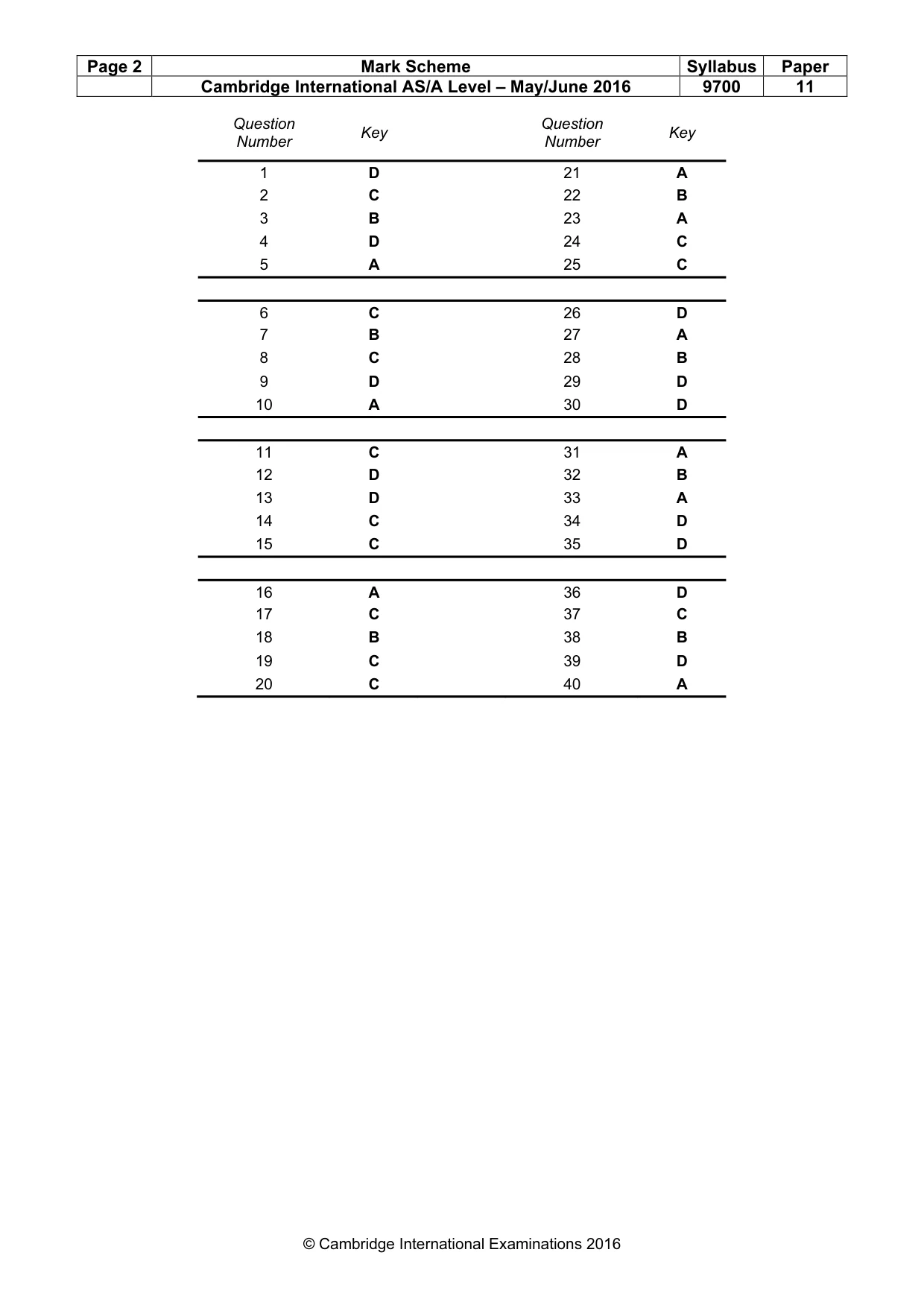
Answers below. Sit the paper first if you are practising.
Questions as text
Q1 · Which of the cell organelles will be clearly visible under the high power (x400) of the…
1. Which of the cell organelles will be clearly visible under the high power (x400) of the light microscope? lysosomes oncoplasmic mitochondria | chloroplasts A Jv v x x key B v x v x ¥ = clearly visible Cc x v v v X = not clearly visible D x x x v
Mark scheme: D
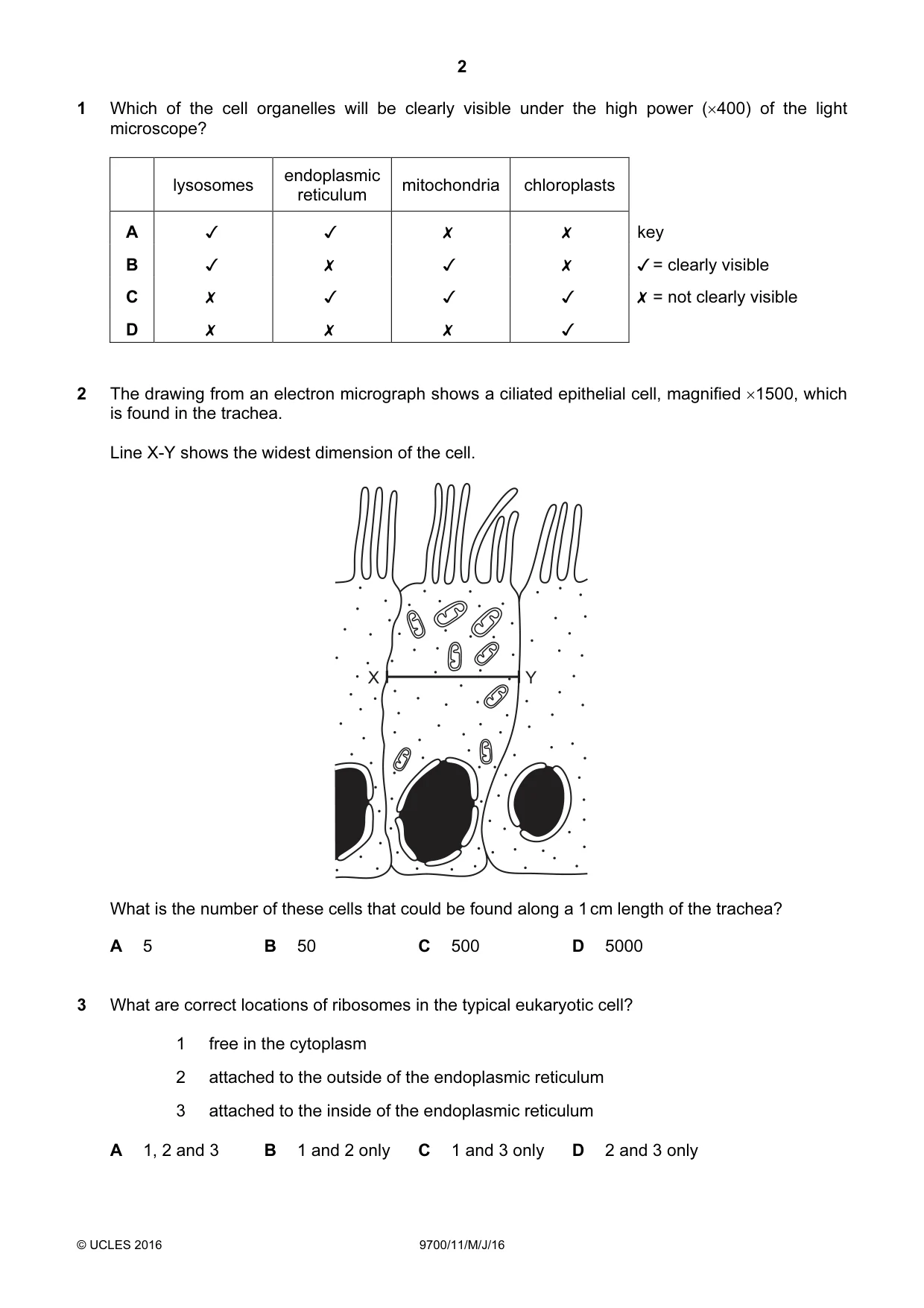
Q2 · The drawing from an electron micrograph shows a ciliated epithelial cell, magnified…
2 The drawing from an electron micrograph shows a ciliated epithelial cell, magnified ×1500, which is found in the trachea. Line X-Y shows the widest dimension of the cell. X Y What is the number of these cells that could be found along a 1 cm length of the trachea? A 5 B 50 C 500 D 5000
Mark scheme: C
More questions on Cells as the basic units of living organisms
Q3 · What are correct locations of ribosomes in the typical eukaryotic cell?
3 What are correct locations of ribosomes in the typical eukaryotic cell? 1 free in the cytoplasm 2 attached to the outside of the endoplasmic reticulum 3 attached to the inside of the endoplasmic reticulum A 1, 2 and 3 B 1 and 2 only C 1 and 3 only D 2 and 3 only
Mark scheme: B
More questions on Cells as the basic units of living organisms
Q4 · Visking tubing is an artificial partially permeable membrane used to demonstrate diffusion
4 Visking tubing is an artificial partially permeable membrane used to demonstrate diffusion. Glucose molecules can pass through the pores in the membrane which are approximately 2.4 nm in diameter. Which of the following could pass through the pores? 1 bacteria 2 haemoglobin 3 ribosomes 4 glycogen A 1 and 3 B 2 and 4 C 2 only D none of the above
Mark scheme: D
Q5 · What are found in both chloroplasts and typical prokaryotic cells?
5 What are found in both chloroplasts and typical prokaryotic cells? A 70S ribosomes and circular DNA B 70S ribosomes only C 80S ribosomes and circular DNA D circular DNA only
Mark scheme: A
More questions on Cells as the basic units of living organisms
Q6 · Two solutions, 1 and 2, one containing starch and sucrose, and the other containing…
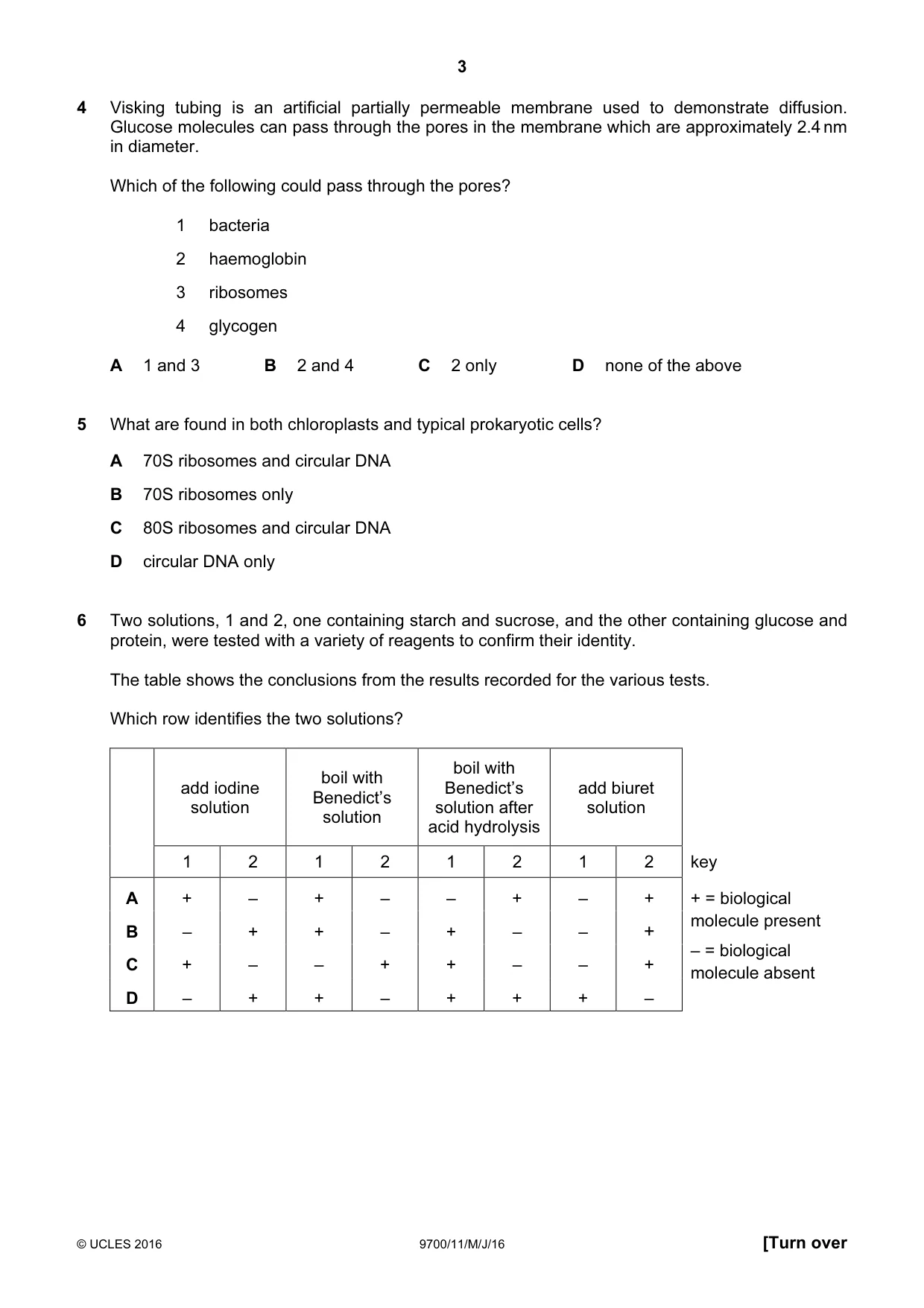
6 Two solutions, 1 and 2, one containing starch and sucrose, and the other containing glucose and protein, were tested with a variety of reagents to confirm their identity. The table shows the conclusions from the results recorded for the various tests. Which row identifies the two solutions? boil with boil with add iodine Benedict’s add biuret Benedict’s solution solution after solution solution acid hydrolysis 1 2 1 2 1 2 1 2 key A + – + – – + – + + = biological molecule present B – + + – + – – + – = biological C + – – + + – – + molecule absent D – + + – + + + –
Mark scheme: C
Q7 · X and Y are two monomers found in biological polymers
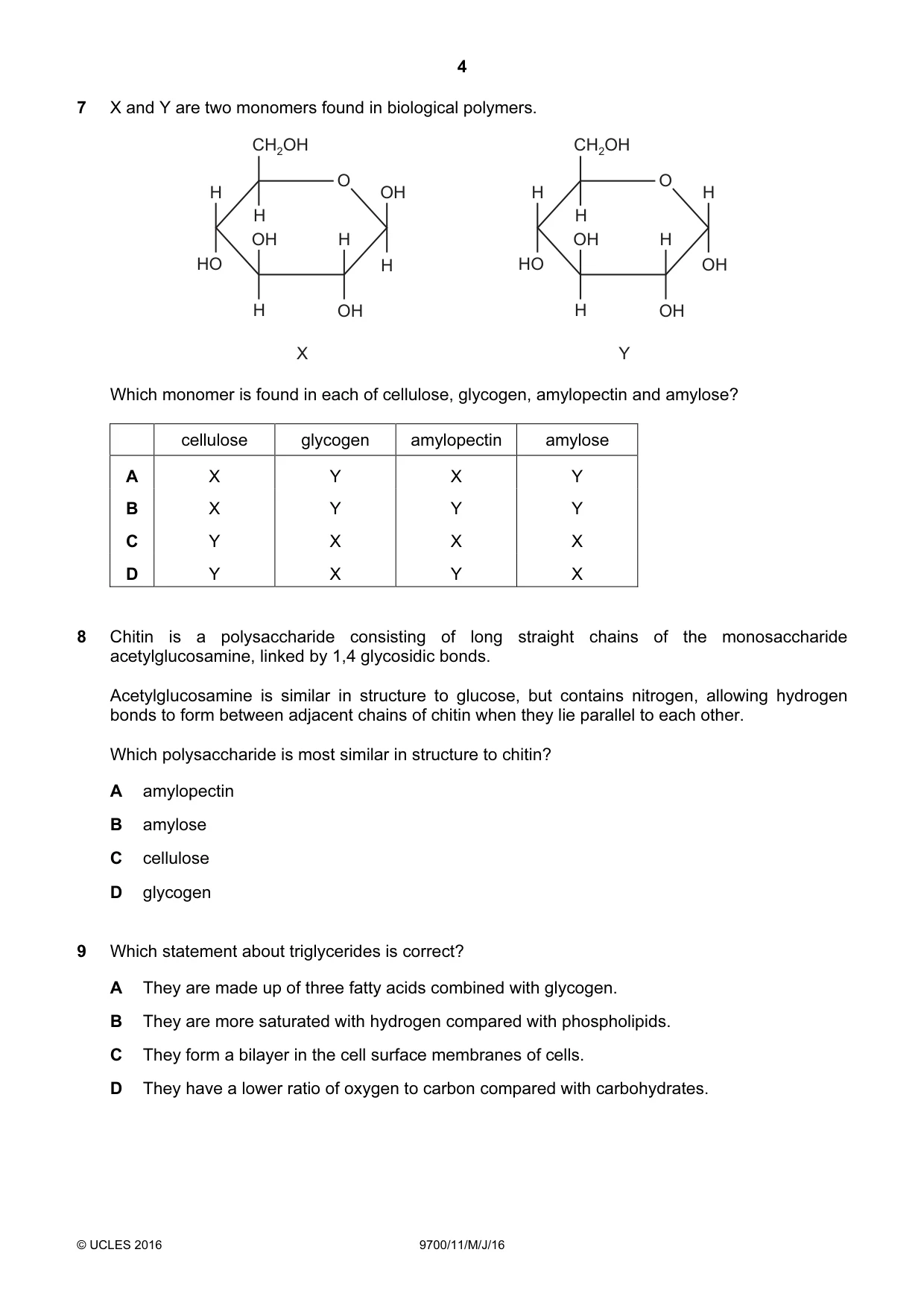
7 X and Y are two monomers found in biological polymers. CH2OH CH2OH O O H OH H H H H OH H OH H HO H HO OH H OH H OH X Y Which monomer is found in each of cellulose, glycogen, amylopectin and amylose? cellulose glycogen amylopectin amylose A X Y X Y B X Y Y Y C Y X X X D Y X Y X
Mark scheme: B
Q8 · Chitin is a polysaccharide consisting of long straight chains of the monosaccharide…
8 Chitin is a polysaccharide consisting of long straight chains of the monosaccharide acetylglucosamine, linked by 1,4 glycosidic bonds. Acetylglucosamine is similar in structure to glucose, but contains nitrogen, allowing hydrogen bonds to form between adjacent chains of chitin when they lie parallel to each other. Which polysaccharide is most similar in structure to chitin? A amylopectin B amylose C cellulose D glycogen
Mark scheme: C
Q9 · Which statement about triglycerides is correct?
9 Which statement about triglycerides is correct? A They are made up of three fatty acids combined with glycogen. B They are more saturated with hydrogen compared with phospholipids. C They form a bilayer in the cell surface membranes of cells. D They have a lower ratio of oxygen to carbon compared with carbohydrates.
Mark scheme: D
Q10 · The diagrams show the structures of two amino acids, one of which has two amine (–NH2)…
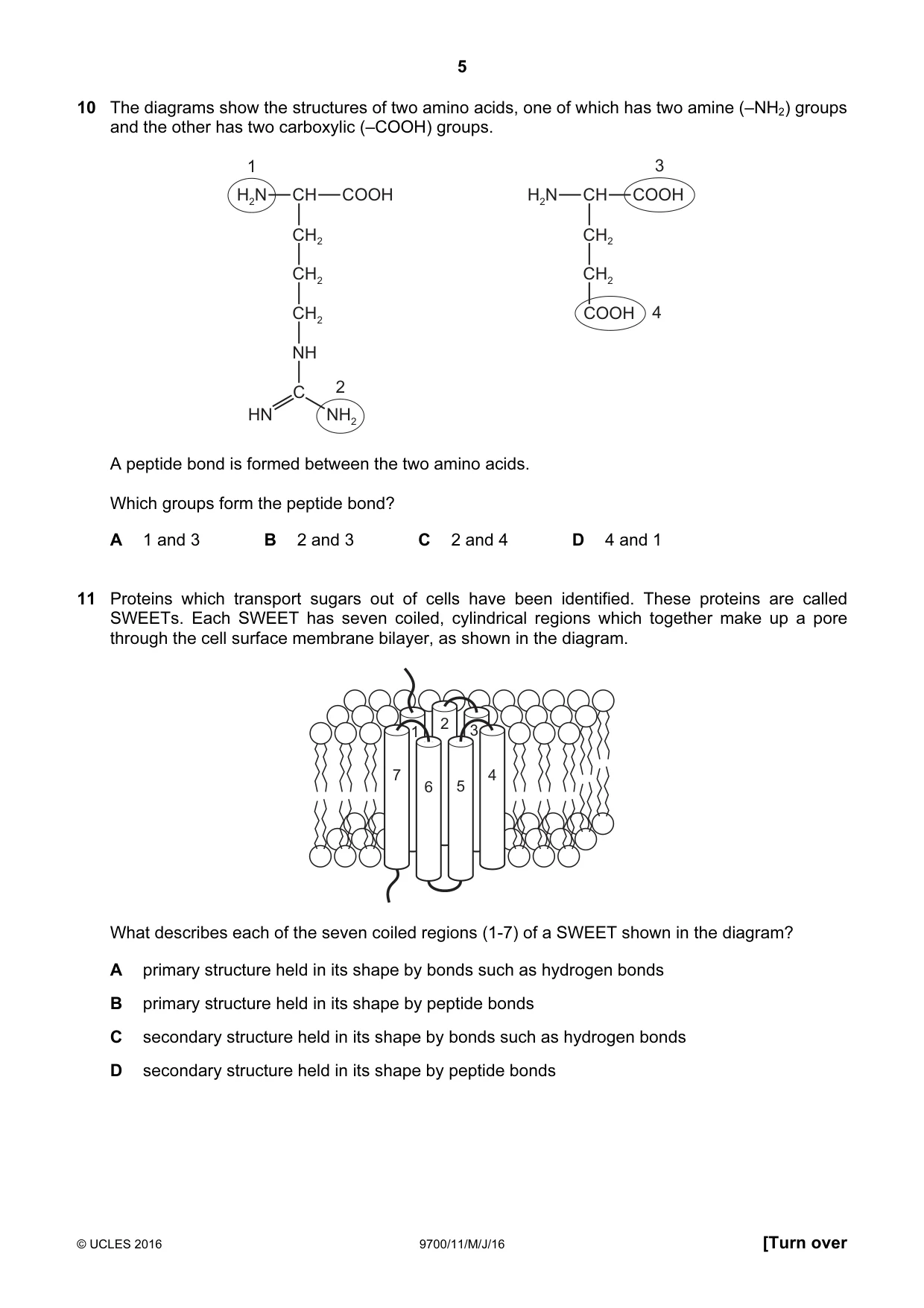
10 The diagrams show the structures of two amino acids, one of which has two amine (–NH2) groups and the other has two carboxylic (–COOH) groups. 1 3 H2N CH COOH H2N CH COOH CH2 CH2 CH2 CH2 CH2 COOH 4 NH C 2 HN NH2 A peptide bond is formed between the two amino acids. Which groups form the peptide bond? A 1 and 3 B 2 and 3 C 2 and 4 D 4 and 1
Mark scheme: A
Q11 · Proteins which transport sugars out of cells have been identified
11 Proteins which transport sugars out of cells have been identified. These proteins are called SWEETs. Each SWEET has seven coiled, cylindrical regions which together make up a pore through the cell surface membrane bilayer, as shown in the diagram. 1 2 3 7 4 6 5 What describes each of the seven coiled regions (1-7) of a SWEET shown in the diagram? A primary structure held in its shape by bonds such as hydrogen bonds B primary structure held in its shape by peptide bonds C secondary structure held in its shape by bonds such as hydrogen bonds D secondary structure held in its shape by peptide bonds
Mark scheme: C
Q12 · Influenza virus has an enzyme called neuraminidase which breaks down glycoproteins in the…
12 Influenza virus has an enzyme called neuraminidase which breaks down glycoproteins in the membrane of the cell that the virus will infect. The glycoprotein binds to the active site of neuraminidase by induced fit. Which statements about the induced fit hypothesis of enzyme action are correct? 1 The active site must have a complementary shape to the substrate for them to bind together. 2 This enzyme is less likely to be affected by non-competitive inhibitors than an enzyme working by the lock and key mechanism. 3 The substrate is converted to product by specific R-groups in the active site just like the lock and key mechanism. A 1 and 2 B 2 and 3 C 2 only D 3 only
Mark scheme: D
Q13 · Which row about competitive inhibitors of enzymes is correct?
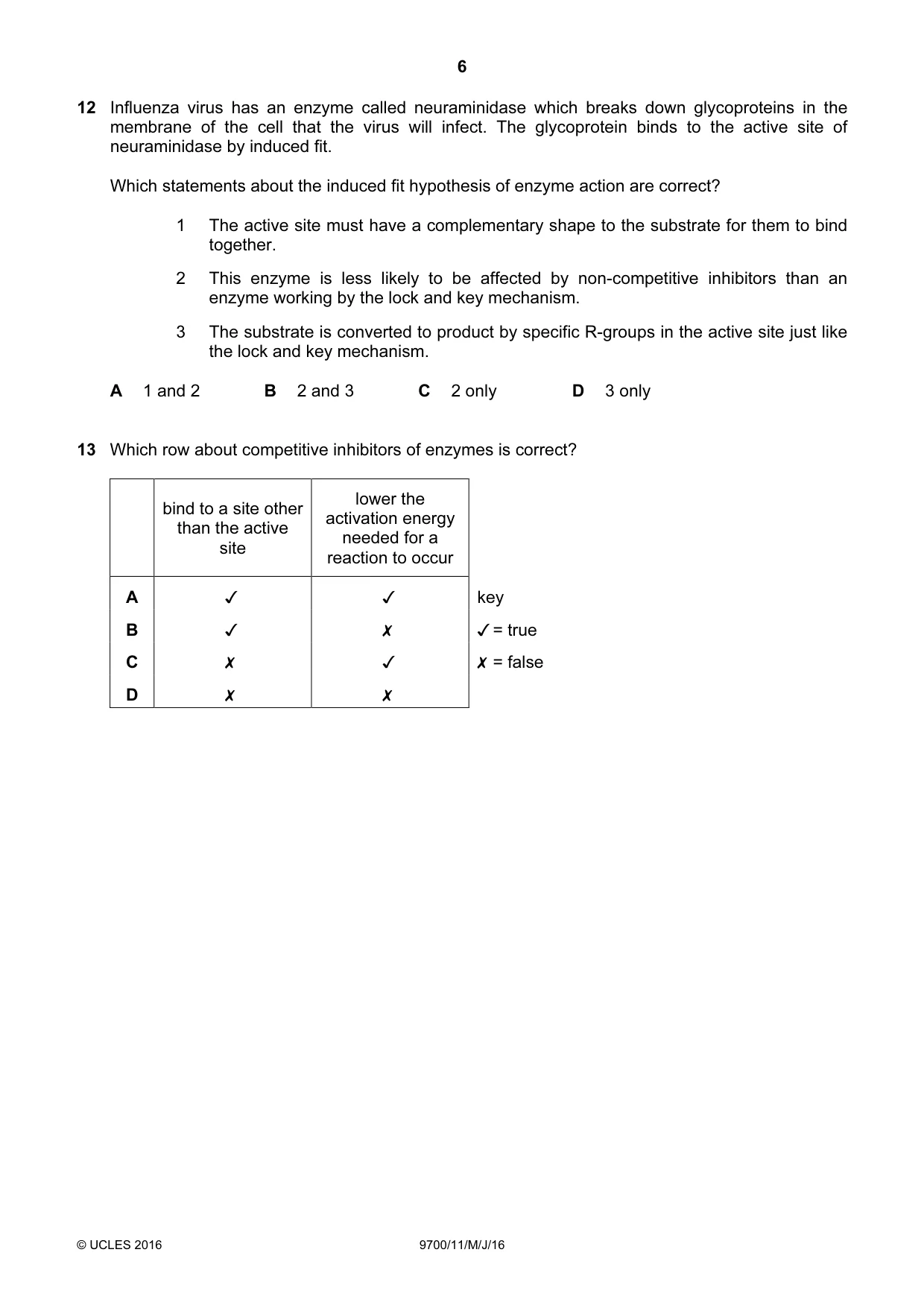
13 Which row about competitive inhibitors of enzymes is correct? bind to a site other than the active site lower the activation energy needed for a reaction to occur 0 0O DW > x KOK v key x ¥ = true v X = false x
Mark scheme: D
Q14 · The graph shows the effect of increasing the concentration of substrate on the rate of an…
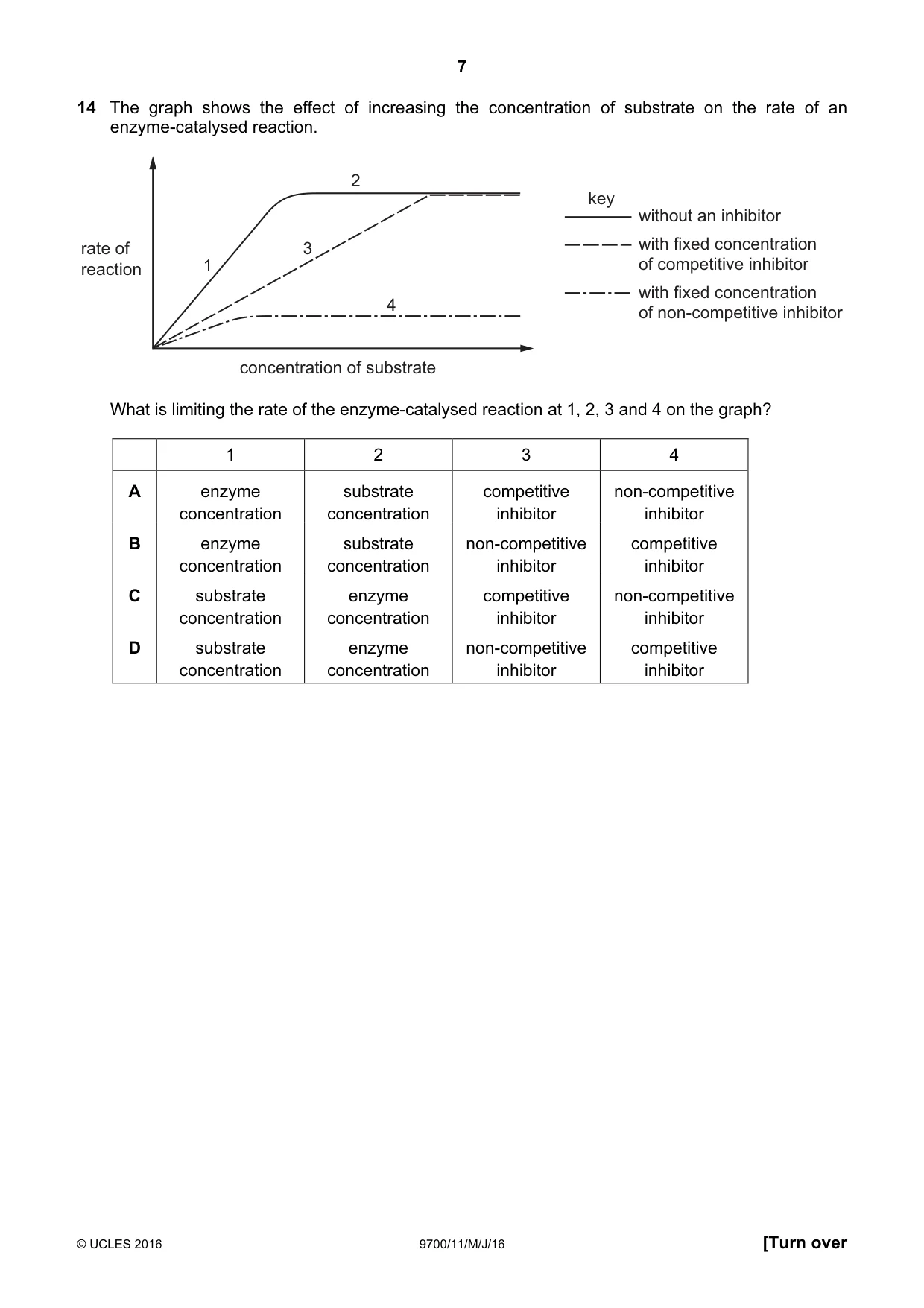
14 The graph shows the effect of increasing the concentration of substrate on the rate of an enzyme-catalysed reaction. 2 key without an inhibitor rate of 3 with fixed concentration reaction 1 of competitive inhibitor with fixed concentration 4 of non-competitive inhibitor concentration of substrate What is limiting the rate of the enzyme-catalysed reaction at 1, 2, 3 and 4 on the graph? 1 2 3 4 A enzyme substrate competitive non-competitive concentration concentration inhibitor inhibitor B enzyme substrate non-competitive competitive concentration concentration inhibitor inhibitor C substrate enzyme competitive non-competitive concentration concentration inhibitor inhibitor D substrate enzyme non-competitive competitive concentration concentration inhibitor inhibitor
Mark scheme: C
Q15 · The diagram represents a cell surface membrane of a metabolically active cell and the…
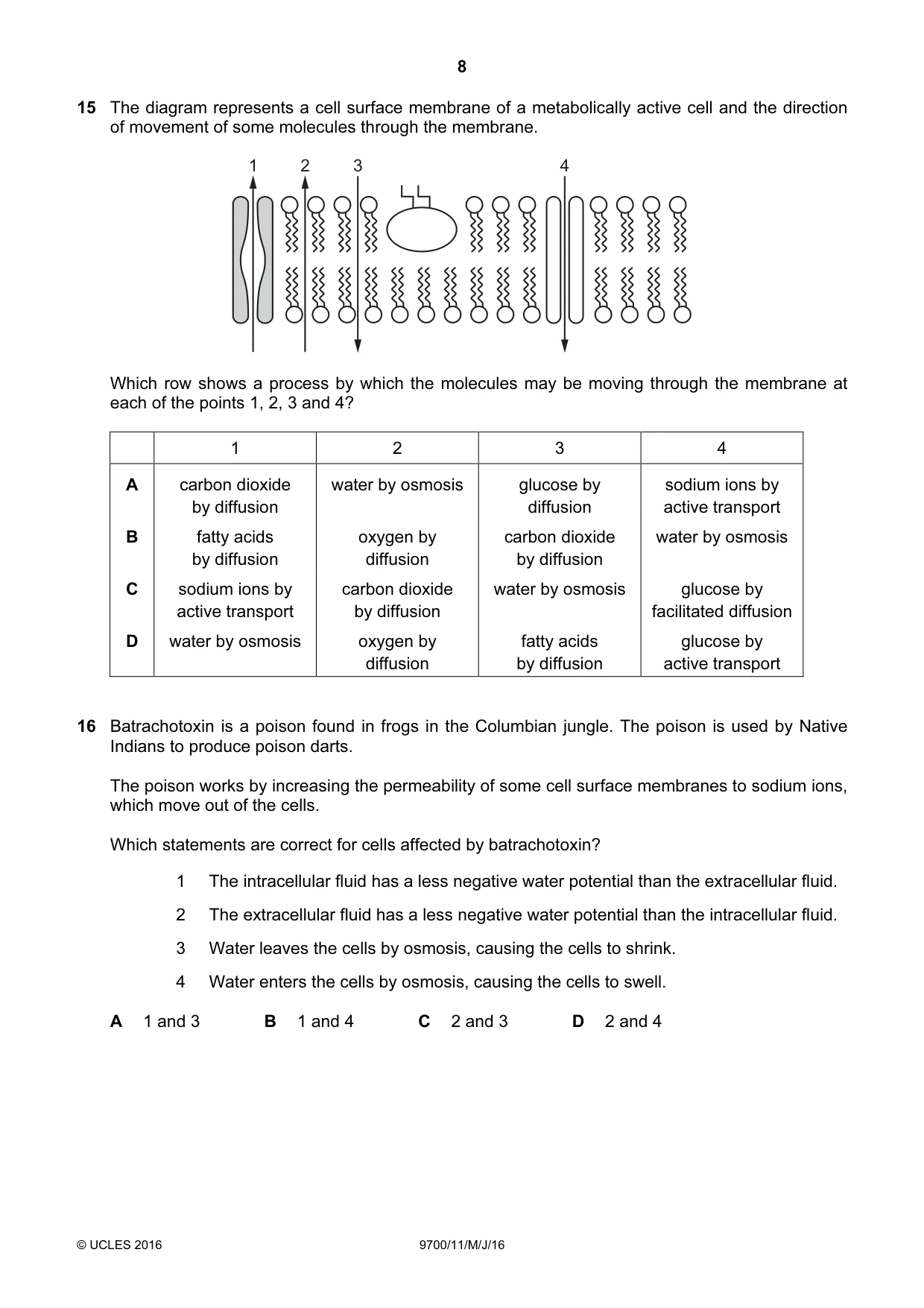
15 The diagram represents a cell surface membrane of a metabolically active cell and the direction of movement of some molecules through the membrane. 1 2 3 4 Which row shows a process by which the molecules may be moving through the membrane at each of the points 1, 2, 3 and 4? 1 2 3 4 A carbon dioxide water by osmosis glucose by sodium ions by by diffusion diffusion active transport B fatty acids oxygen by carbon dioxide water by osmosis by diffusion diffusion by diffusion C sodium ions by carbon dioxide water by osmosis glucose by active transport by diffusion facilitated diffusion D water by osmosis oxygen by fatty acids glucose by diffusion by diffusion active transport
Mark scheme: C
Q16 · Batrachotoxin is a poison found in frogs in the Columbian jungle
16 Batrachotoxin is a poison found in frogs in the Columbian jungle. The poison is used by Native Indians to produce poison darts. The poison works by increasing the permeability of some cell surface membranes to sodium ions, which move out of the cells. Which statements are correct for cells affected by batrachotoxin? 1 The intracellular fluid has a less negative water potential than the extracellular fluid. 2 The extracellular fluid has a less negative water potential than the intracellular fluid. 3 Water leaves the cells by osmosis, causing the cells to shrink. 4 Water enters the cells by osmosis, causing the cells to swell. A 1 and 3 B 1 and 4 C 2 and 3 D 2 and 4
Mark scheme: A
Q17 · Which processes occur during prophase of the mitotic cell cycle in an animal cell?
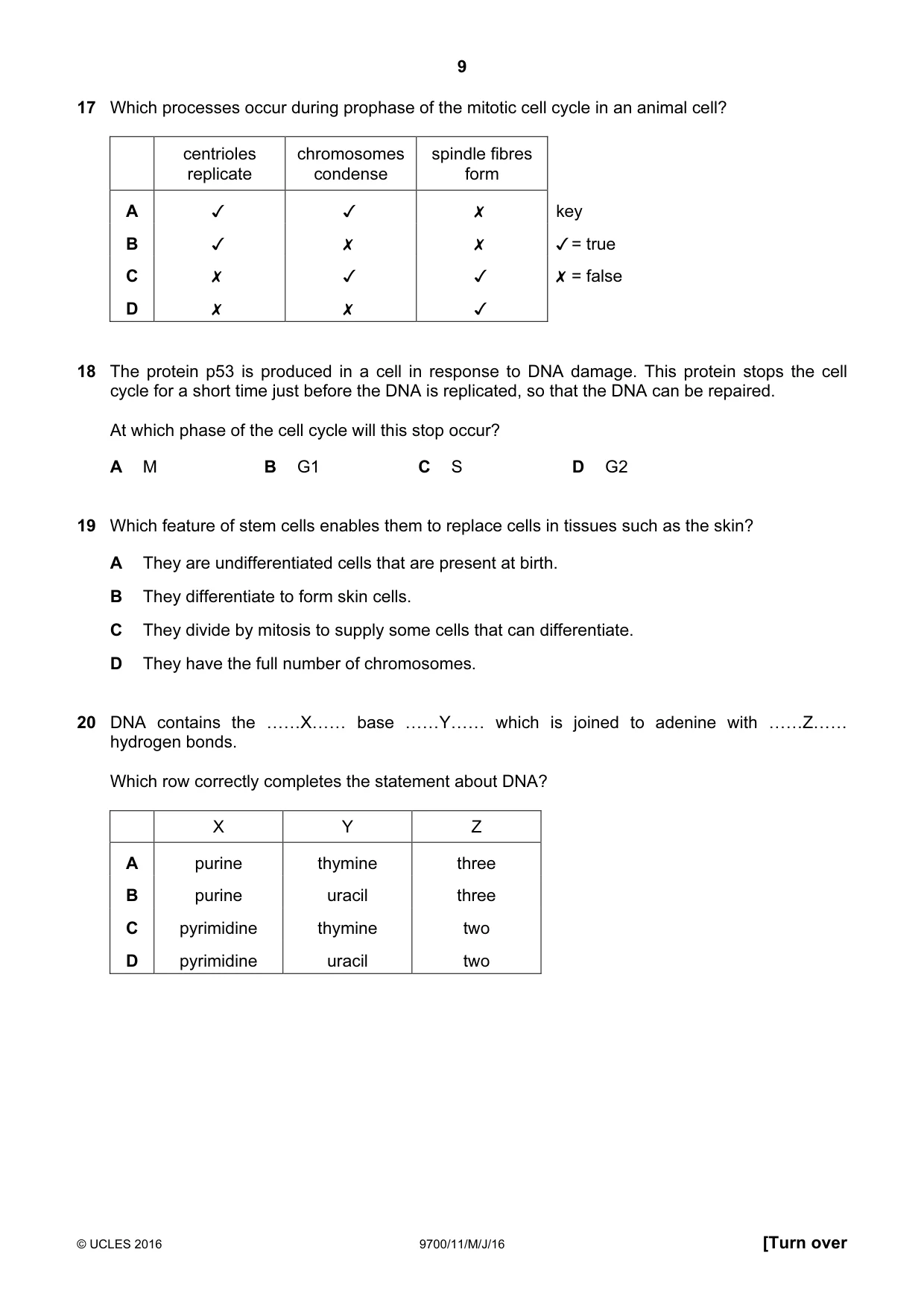
17 Which processes occur during prophase of the mitotic cell cycle in an animal cell? centrioles chromosomes | spindle fibres replicate condense form v v x key ¥ = true 0 0O WwW D> Jv x x x Jv Jv X = false x x Jv
Mark scheme: C
Q18 · The protein p53 is produced in a cell in response to DNA damage
18 The protein p53 is produced in a cell in response to DNA damage. This protein stops the cell cycle for a short time just before the DNA is replicated, so that the DNA can be repaired. At which phase of the cell cycle will this stop occur? A M B G1 C S D G2
Mark scheme: B
More questions on Replication and division of nuclei and cells
Q19 · Which feature of stem cells enables them to replace cells in tissues such as the skin?
19 Which feature of stem cells enables them to replace cells in tissues such as the skin? A They are undifferentiated cells that are present at birth. B They differentiate to form skin cells. C They divide by mitosis to supply some cells that can differentiate. D They have the full number of chromosomes.
Mark scheme: C
More questions on Replication and division of nuclei and cells
Q20 · DNA contains the ……X…… base ……Y…… which is joined to adenine with ……Z…… hydrogen bonds
20 DNA contains the ……X…… base ……Y…… which is joined to adenine with ……Z…… hydrogen bonds. Which row correctly completes the statement about DNA? X Y Z A purine thymine three B purine uracil three C pyrimidine thymine two D pyrimidine uracil two
Mark scheme: C
More questions on Structure of nucleic acids and replication of DNA
Q21 · The diagram shows the nucleotide sequence of a small section of a gene which is…
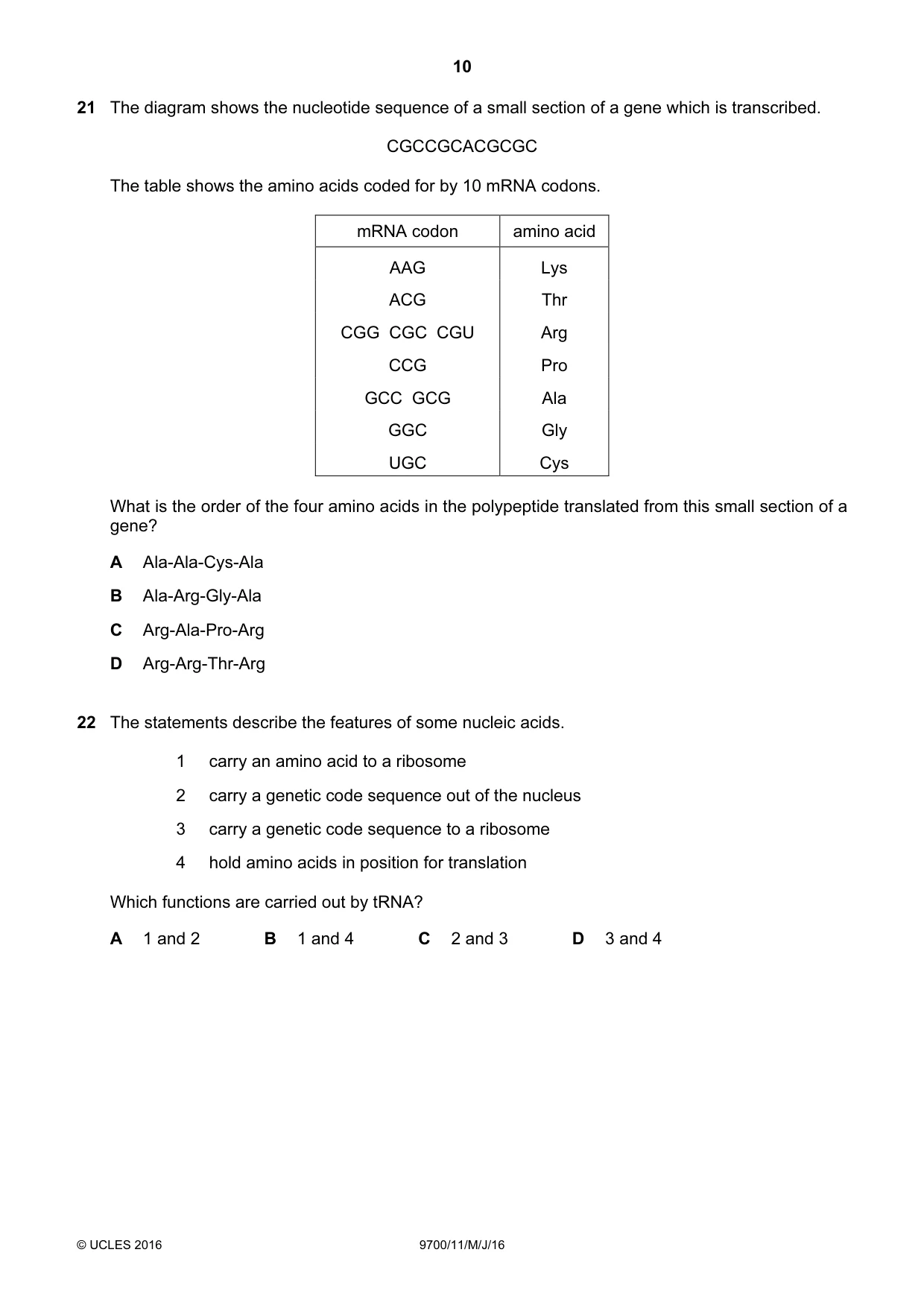
21 The diagram shows the nucleotide sequence of a small section of a gene which is transcribed. CGCCGCACGCGC The table shows the amino acids coded for by 10 mRNA codons. mRNA codon amino acid AAG Lys ACG Thr CGG CGC CGU Arg CCG Pro GCC GCG Ala GGC Gly UGC Cys What is the order of the four amino acids in the polypeptide translated from this small section of a gene? A Ala-Ala-Cys-Ala B Ala-Arg-Gly-Ala C Arg-Ala-Pro-Arg D Arg-Arg-Thr-Arg
Mark scheme: A
Q22 · The statements describe the features of some nucleic acids
22 The statements describe the features of some nucleic acids. 1 carry an amino acid to a ribosome 2 carry a genetic code sequence out of the nucleus 3 carry a genetic code sequence to a ribosome 4 hold amino acids in position for translation Which functions are carried out by tRNA? A 1 and 2 B 1 and 4 C 2 and 3 D 3 and 4
Mark scheme: B
Q23 · A student was asked to draw a plan diagram of the plant tissue shown in the…
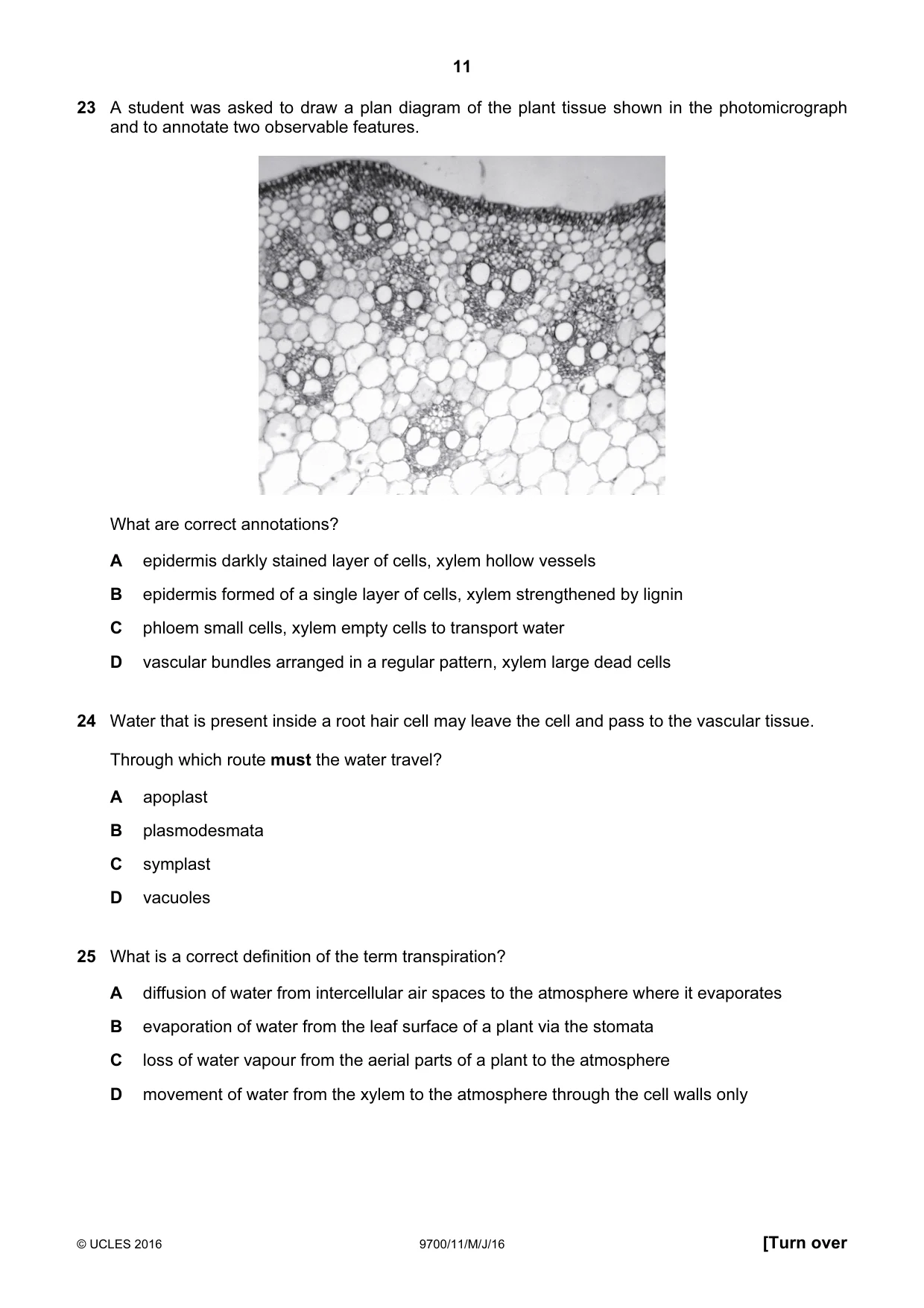
23 A student was asked to draw a plan diagram of the plant tissue shown in the photomicrograph and to annotate two observable features. What are correct annotations? A epidermis darkly stained layer of cells, xylem hollow vessels B epidermis formed of a single layer of cells, xylem strengthened by lignin C phloem small cells, xylem empty cells to transport water D vascular bundles arranged in a regular pattern, xylem large dead cells
Mark scheme: A
Q24 · Water that is present inside a root hair cell may leave the cell and pass to the vascular…
24 Water that is present inside a root hair cell may leave the cell and pass to the vascular tissue. Through which route must the water travel? A apoplast B plasmodesmata C symplast D vacuoles
Mark scheme: C
Q25 · What is a correct definition of the term transpiration?
25 What is a correct definition of the term transpiration? A diffusion of water from intercellular air spaces to the atmosphere where it evaporates B evaporation of water from the leaf surface of a plant via the stomata C loss of water vapour from the aerial parts of a plant to the atmosphere D movement of water from the xylem to the atmosphere through the cell walls only
Mark scheme: C
Q26 · Which changes to the water potential and the volume of liquid in the phloem sieve tube…
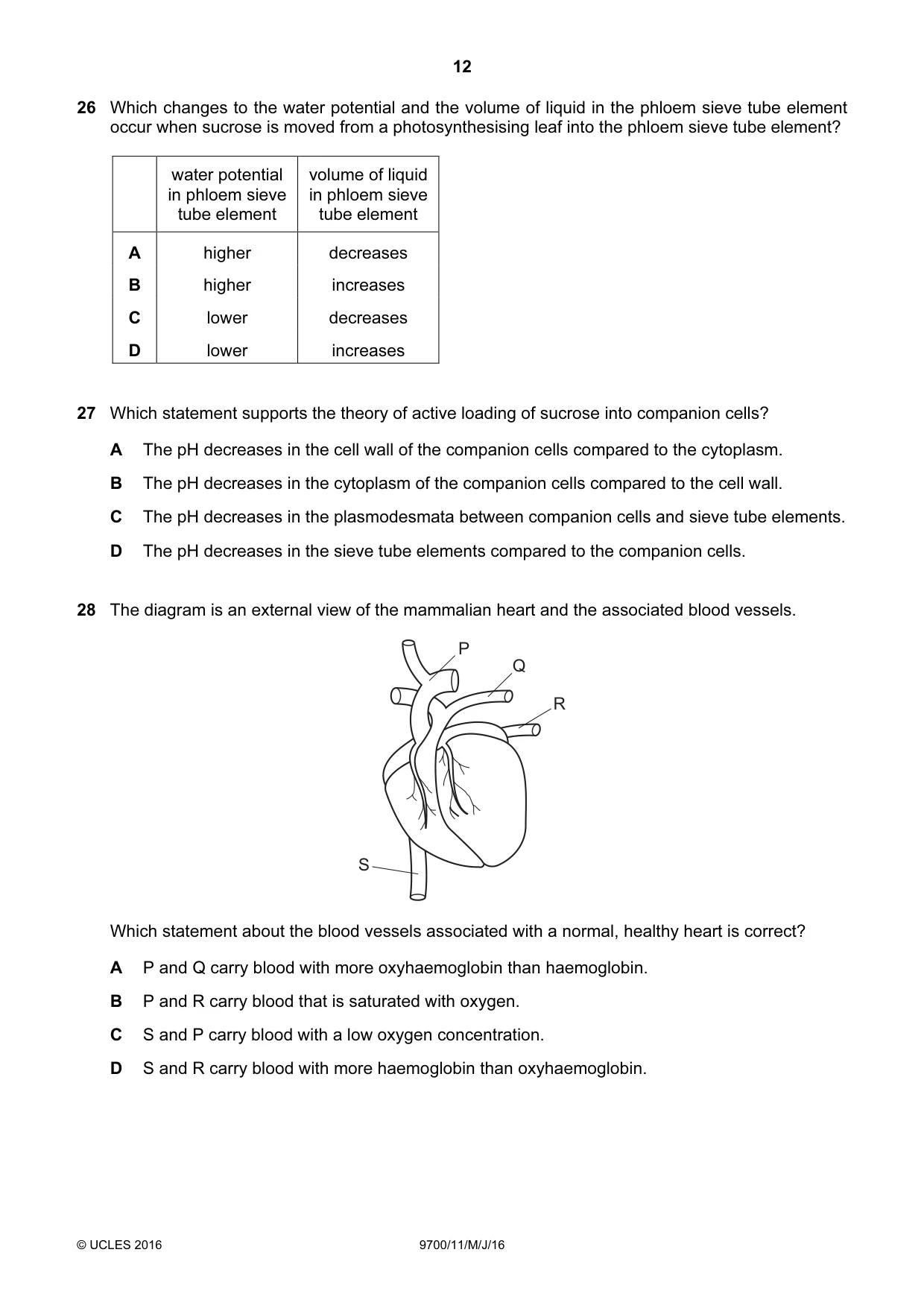
26 Which changes to the water potential and the volume of liquid in the phloem sieve tube element occur when sucrose is moved from a photosynthesising leaf into the phloem sieve tube element? water potential volume of liquid in phloem sieve in phloem sieve tube element tube element A higher decreases B higher increases C lower decreases D lower increases
Mark scheme: D
Q27 · Which statement supports the theory of active loading of sucrose into companion cells?
27 Which statement supports the theory of active loading of sucrose into companion cells? A The pH decreases in the cell wall of the companion cells compared to the cytoplasm. B The pH decreases in the cytoplasm of the companion cells compared to the cell wall. C The pH decreases in the plasmodesmata between companion cells and sieve tube elements. D The pH decreases in the sieve tube elements compared to the companion cells.
Mark scheme: A
Q28 · The diagram is an external view of the mammalian heart and the associated blood vessels
28 The diagram is an external view of the mammalian heart and the associated blood vessels. P Q R S Which statement about the blood vessels associated with a normal, healthy heart is correct? A P and Q carry blood with more oxyhaemoglobin than haemoglobin. B P and R carry blood that is saturated with oxygen. C S and P carry blood with a low oxygen concentration. D S and R carry blood with more haemoglobin than oxyhaemoglobin.
Mark scheme: B
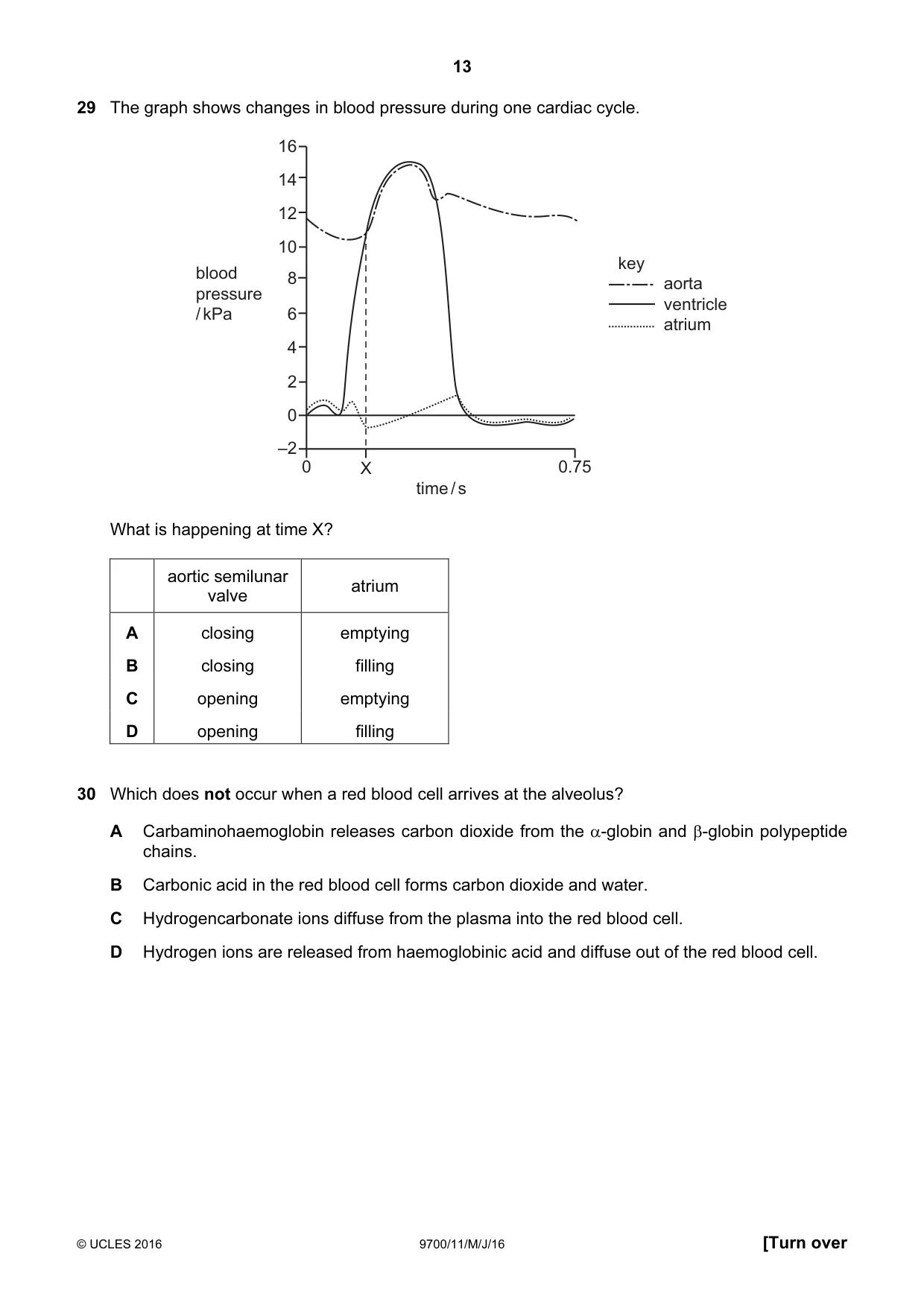
Q29 · The graph shows changes in blood pressure during one cardiac cycle
29 The graph shows changes in blood pressure during one cardiac cycle. 16 14 12 10 key blood 8 aorta pressure ventricle / kPa 6 atrium 4 2 0 –2 0 X 0.75 time / s What is happening at time X? aortic semilunar atrium valve A closing emptying B closing filling C opening emptying D opening filling
Mark scheme: D
Q30 · Which does not occur when a red blood cell arrives at the alveolus?
30 Which does not occur when a red blood cell arrives at the alveolus? A Carbaminohaemoglobin releases carbon dioxide from the α-globin and β-globin polypeptide chains. B Carbonic acid in the red blood cell forms carbon dioxide and water. C Hydrogencarbonate ions diffuse from the plasma into the red blood cell. D Hydrogen ions are released from haemoglobinic acid and diffuse out of the red blood cell.
Mark scheme: D
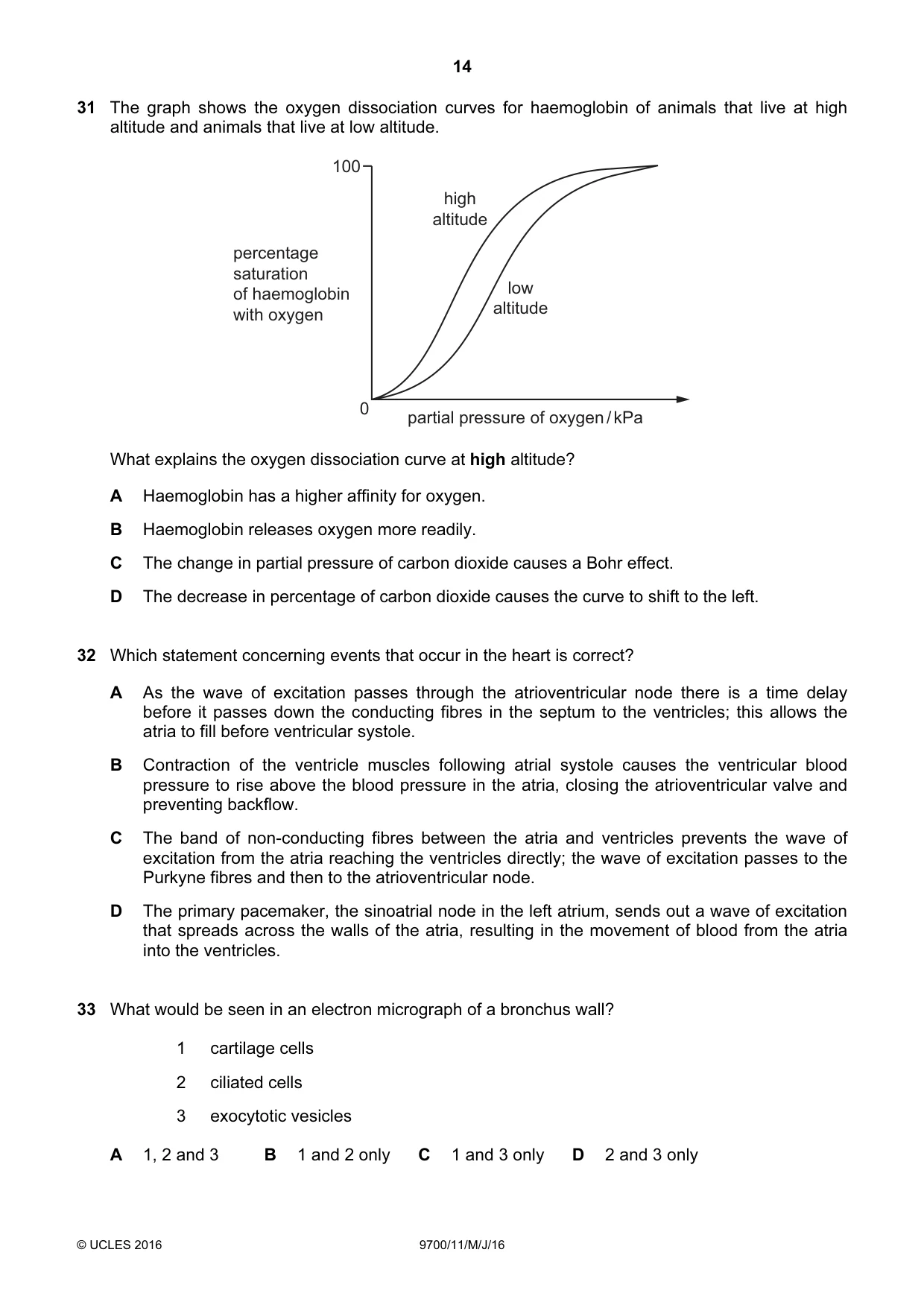
Q31 · The graph shows the oxygen dissociation curves for haemoglobin of animals that live at…
31 The graph shows the oxygen dissociation curves for haemoglobin of animals that live at high altitude and animals that live at low altitude. 100 high altitude percentage saturation of haemoglobin low with oxygen altitude 0 partial pressure of oxygen / kPa What explains the oxygen dissociation curve at high altitude? A Haemoglobin has a higher affinity for oxygen. B Haemoglobin releases oxygen more readily. C The change in partial pressure of carbon dioxide causes a Bohr effect. D The decrease in percentage of carbon dioxide causes the curve to shift to the left.
Mark scheme: A
Q32 · Which statement concerning events that occur in the heart is correct?
32 Which statement concerning events that occur in the heart is correct? A As the wave of excitation passes through the atrioventricular node there is a time delay before it passes down the conducting fibres in the septum to the ventricles; this allows the atria to fill before ventricular systole. B Contraction of the ventricle muscles following atrial systole causes the ventricular blood pressure to rise above the blood pressure in the atria, closing the atrioventricular valve and preventing backflow. C The band of non-conducting fibres between the atria and ventricles prevents the wave of excitation from the atria reaching the ventricles directly; the wave of excitation passes to the Purkyne fibres and then to the atrioventricular node. D The primary pacemaker, the sinoatrial node in the left atrium, sends out a wave of excitation that spreads across the walls of the atria, resulting in the movement of blood from the atria into the ventricles.
Mark scheme: B
Q33 · What would be seen in an electron micrograph of a bronchus wall?
33 What would be seen in an electron micrograph of a bronchus wall? 1 cartilage cells 2 ciliated cells 3 exocytotic vesicles A 1, 2 and 3 B 1 and 2 only C 1 and 3 only D 2 and 3 only
Mark scheme: A
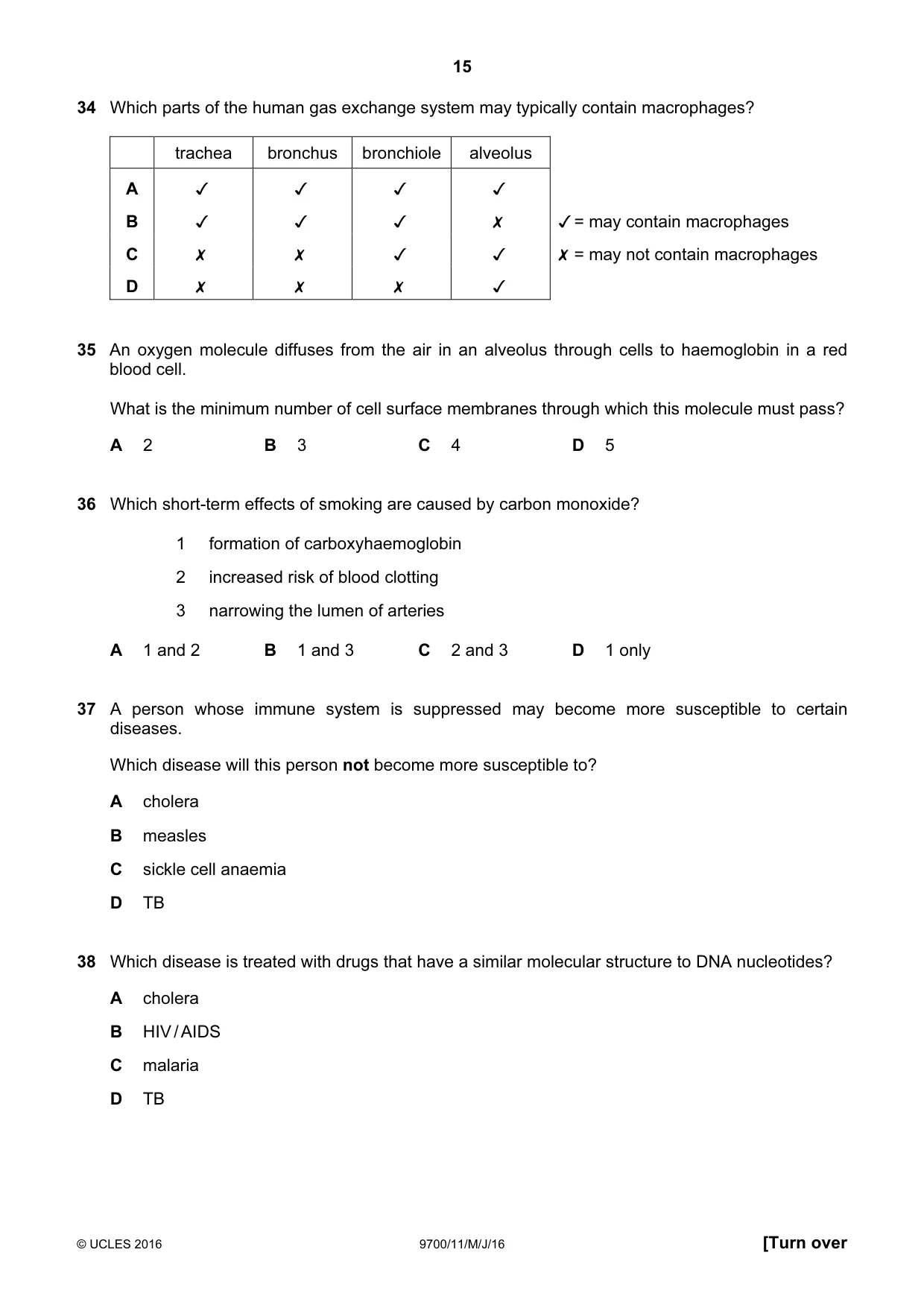
Q34 · Which parts of the human gas exchange system may typically contain macrophages?
34 Which parts of the human gas exchange system may typically contain macrophages? 0 0O WwW > trachea ~ « & bronchus x «KX bronchiole ~ KOK alveolus << x v = may contain macrophages X = may not contain macrophages
Mark scheme: D
Q35 · An oxygen molecule diffuses from the air in an alveolus through cells to haemoglobin in a…
35 An oxygen molecule diffuses from the air in an alveolus through cells to haemoglobin in a red blood cell. What is the minimum number of cell surface membranes through which this molecule must pass? A 2 B 3 C 4 D 5
Mark scheme: D
Q36 · Which short-term effects of smoking are caused by carbon monoxide?
36 Which short-term effects of smoking are caused by carbon monoxide? 1 formation of carboxyhaemoglobin 2 increased risk of blood clotting 3 narrowing the lumen of arteries A 1 and 2 B 1 and 3 C 2 and 3 D 1 only
Mark scheme: D
Q37 · A person whose immune system is suppressed may become more susceptible to certain diseases
37 A person whose immune system is suppressed may become more susceptible to certain diseases. Which disease will this person not become more susceptible to? A cholera B measles C sickle cell anaemia D TB
Mark scheme: C
Q38 · Which disease is treated with drugs that have a similar molecular structure to DNA…
38 Which disease is treated with drugs that have a similar molecular structure to DNA nucleotides? A cholera B HIV / AIDS C malaria D TB
Mark scheme: B
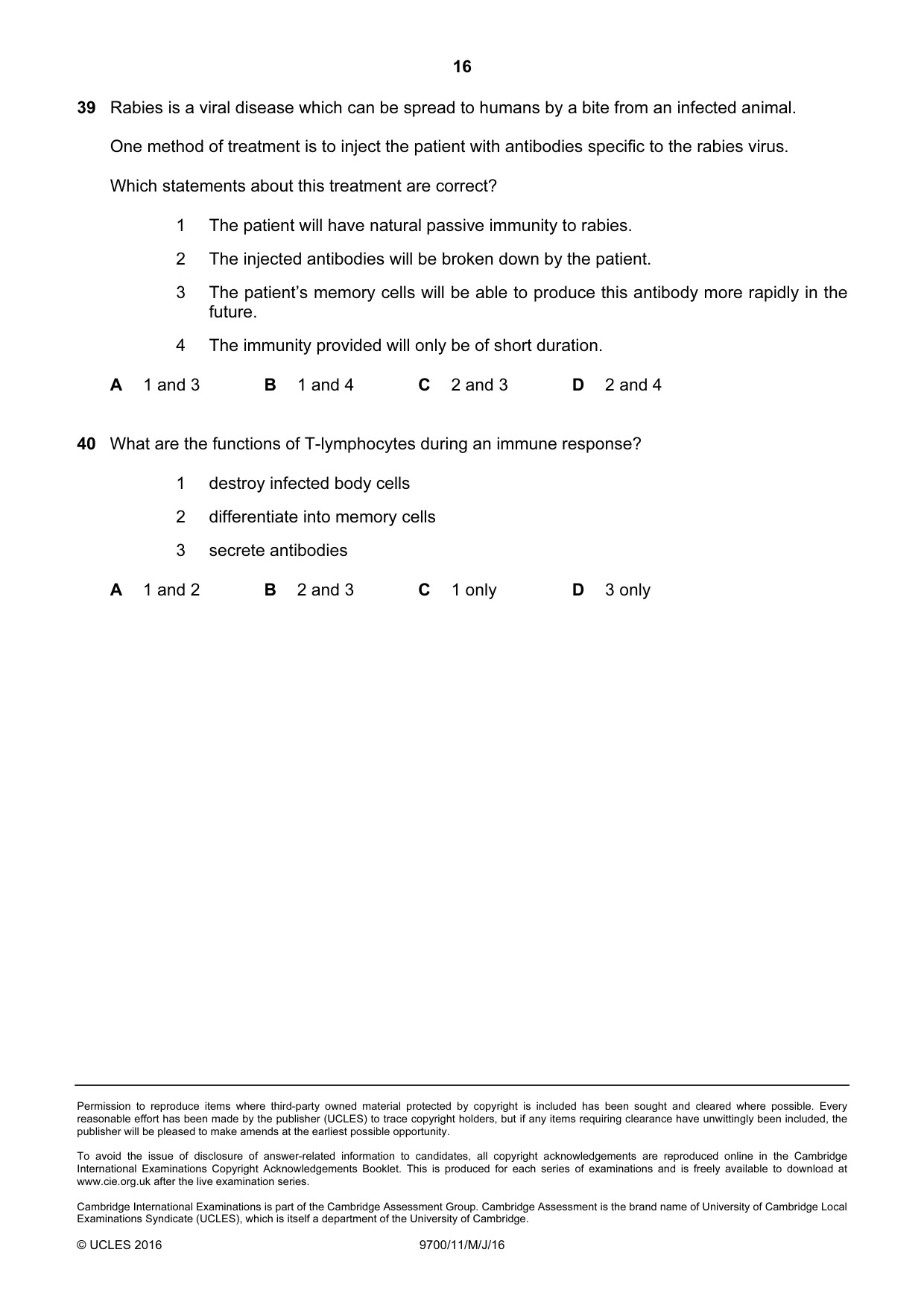
Q39 · Rabies is a viral disease which can be spread to humans by a bite from an infected animal
39 Rabies is a viral disease which can be spread to humans by a bite from an infected animal. One method of treatment is to inject the patient with antibodies specific to the rabies virus. Which statements about this treatment are correct? 1 The patient will have natural passive immunity to rabies. 2 The injected antibodies will be broken down by the patient. 3 The patient’s memory cells will be able to produce this antibody more rapidly in the future. 4 The immunity provided will only be of short duration. A 1 and 3 B 1 and 4 C 2 and 3 D 2 and 4
Mark scheme: D
Q40 · What are the functions of T-lymphocytes during an immune response?
40 What are the functions of T-lymphocytes during an immune response? 1 destroy infected body cells 2 differentiate into memory cells 3 secrete antibodies A 1 and 2 B 2 and 3 C 1 only D 3 only
Mark scheme: A
What was in this paper
The subtopics covered by these 40 questions, and how many questions each got. Open one in a new tab to see every Cambridge question on it.
4Carbohydrates and lipids3Cells as the basic units of living organisms3Movement into and out of cells3The gas exchange system3The heart3Factors that affect enzyme action2Infectious diseases2Protein synthesis2Proteins2Replication and division of nuclei and cells2Transport of oxygen and carbon dioxide2Antibiotics1Antibodies and vaccination1Chromosome behaviour in mitosis1Mode of action of enzymes1Structure of nucleic acids and replication of DNA1Structure of transport tissues1Testing for biological molecules1The immune system1The microscope in cell studies1What you needed in this session
Cambridge’s own grade thresholds for 2016 May/June, Paper 1 · Variant 1. A higher threshold means an easier paper — the bar moves with how the cohort did.