Cambridge A Level Biology 9700 — 2025 May/June Paper 1 · Variant 3
9700/13/M/J/25 · 40 questions · 40 marks · 75 min
The question paper and its mark scheme, free to read here and free to download. This is Cambridge’s own paper, exactly as it was sat.
Question paper20 pages
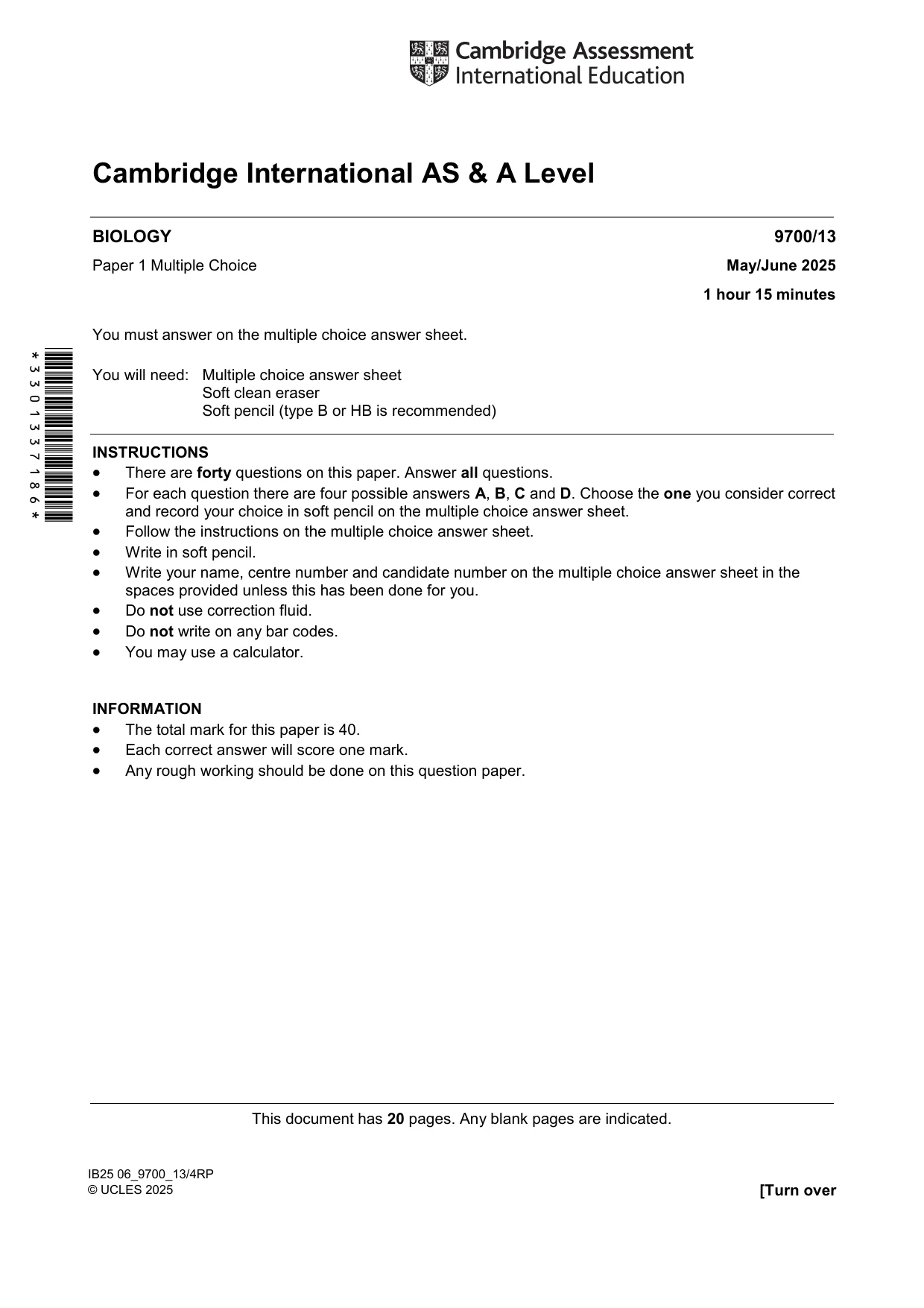

Mark scheme3 pages
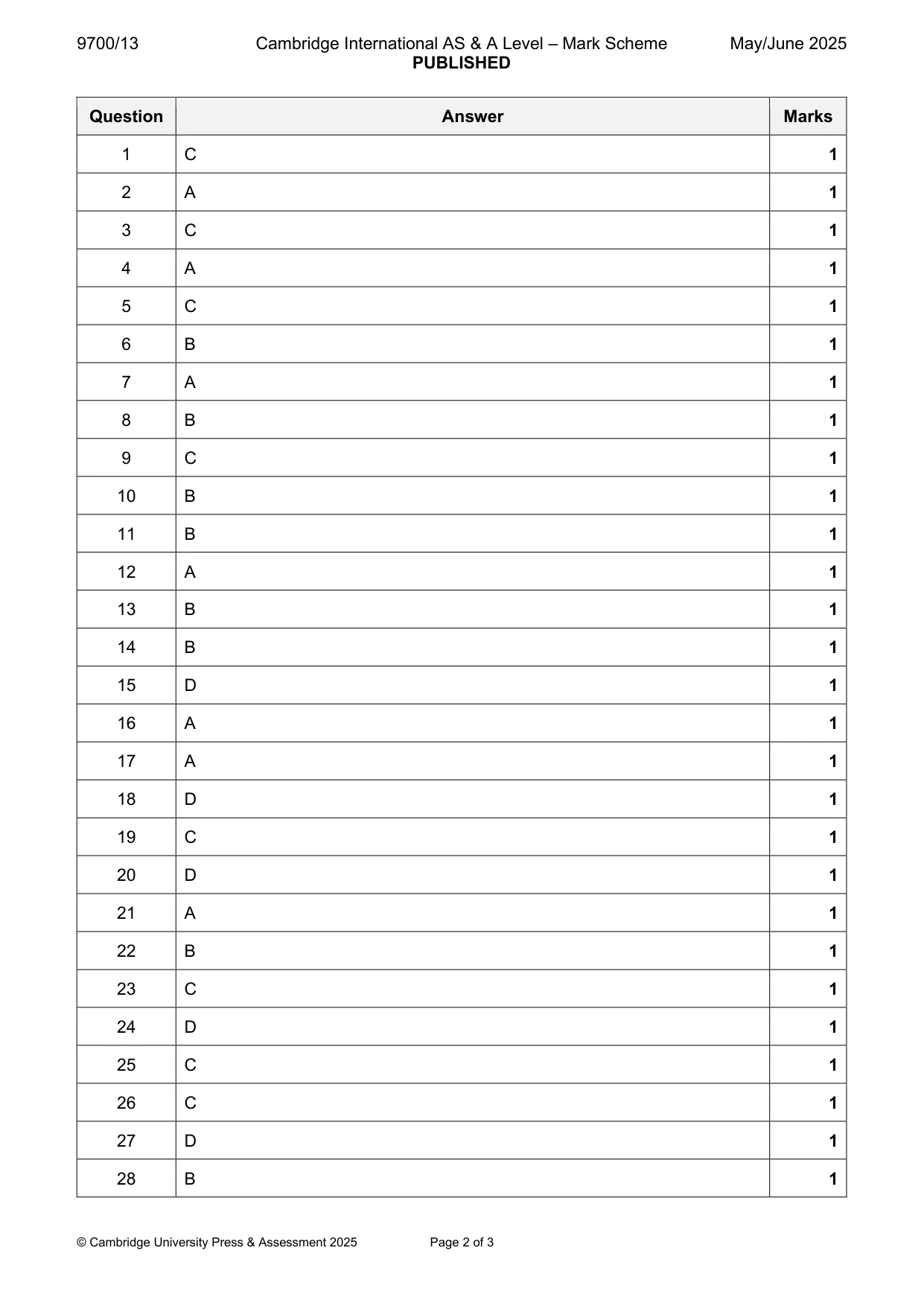
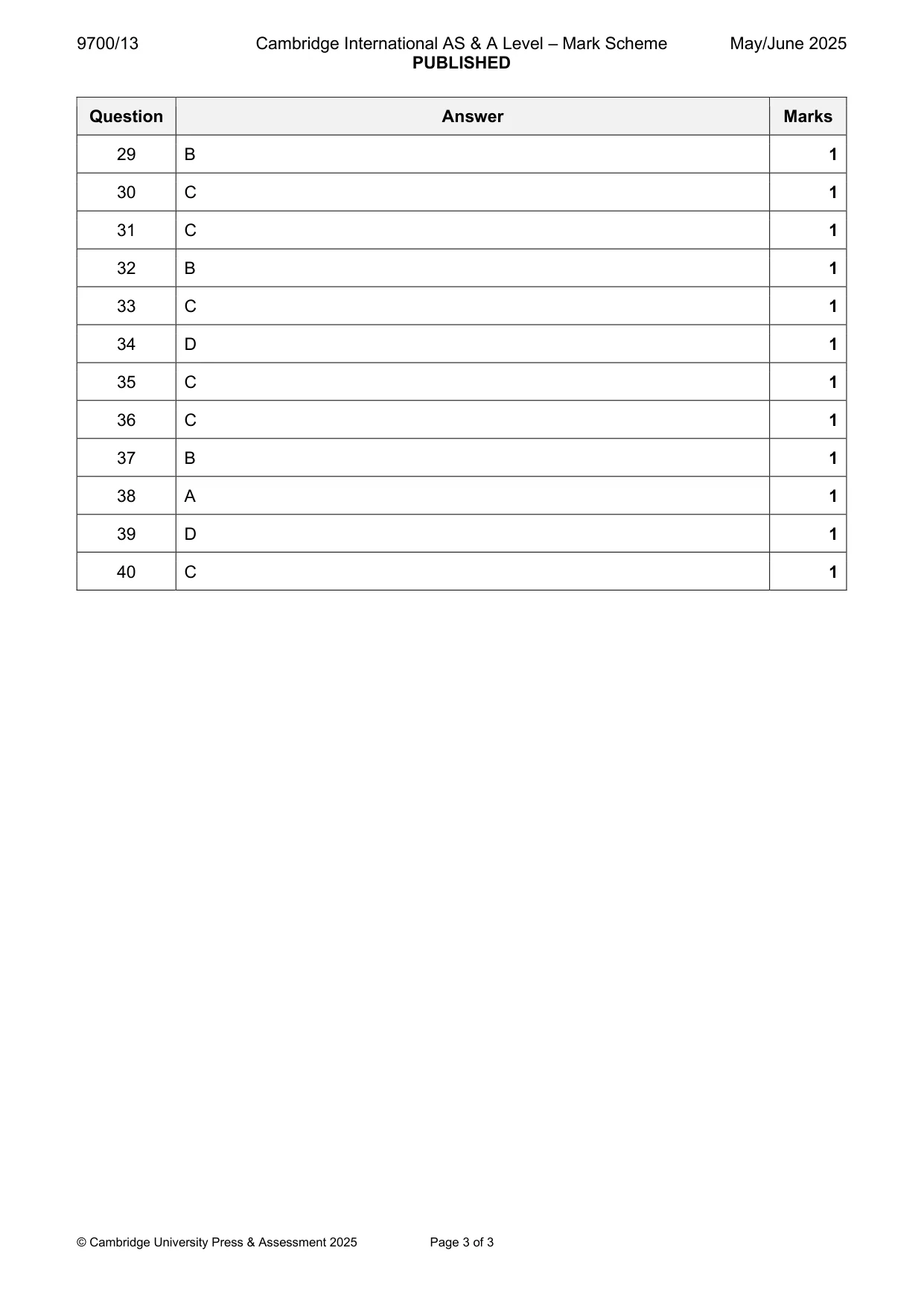
Answers below. Sit the paper first if you are practising.
Questions as text
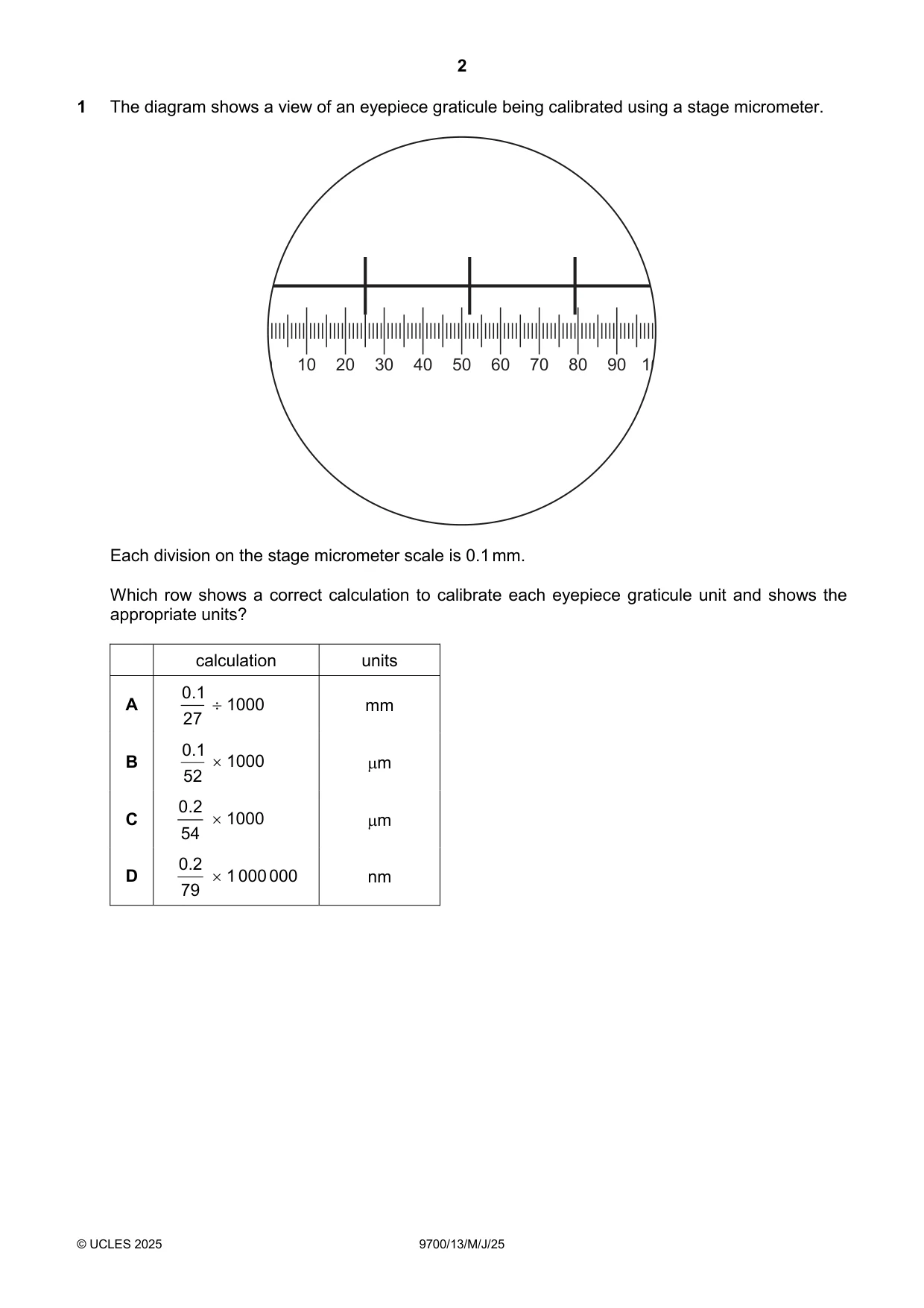
Q1 · The diagram shows a view of an eyepiece graticule being calibrated using a stage…
1 The diagram shows a view of an eyepiece graticule being calibrated using a stage micrometer. 0 10 20 30 40 50 60 70 80 90 10 Each division on the stage micrometer scale is 0.1 mm. Which row shows a correct calculation to calibrate each eyepiece graticule unit and shows the appropriate units? calculation units 0.1 A 1000 mm 27 0.1 1000 B m 52 0.2 C 1000 m 54 0.2 1 000 000 D nm 79
Mark scheme: C
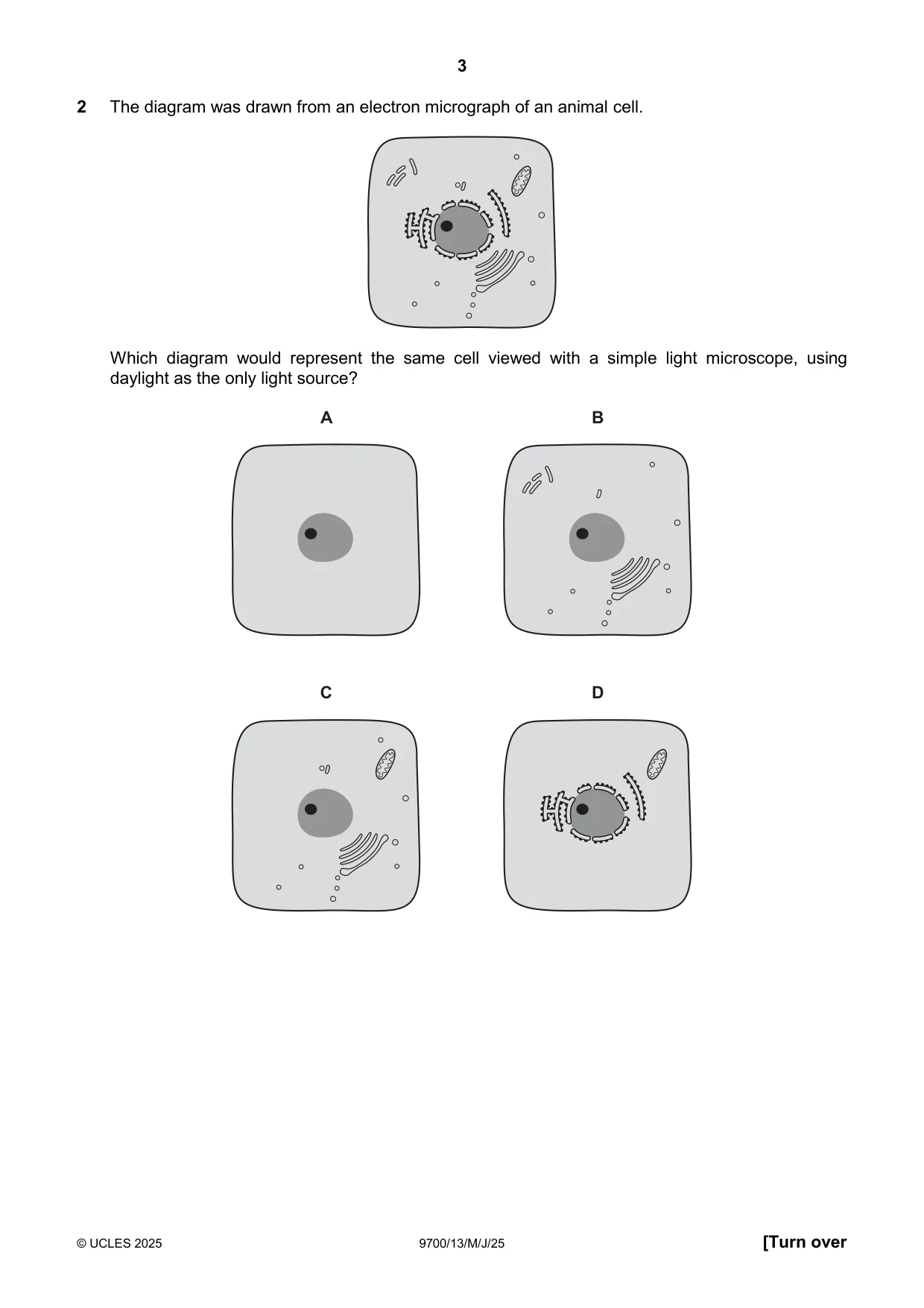
Q2 · The diagram was drawn from an electron micrograph of an animal cell
2 The diagram was drawn from an electron micrograph of an animal cell. Which diagram would represent the same cell viewed with a simple light microscope, using daylight as the only light source? A B C D
Mark scheme: A
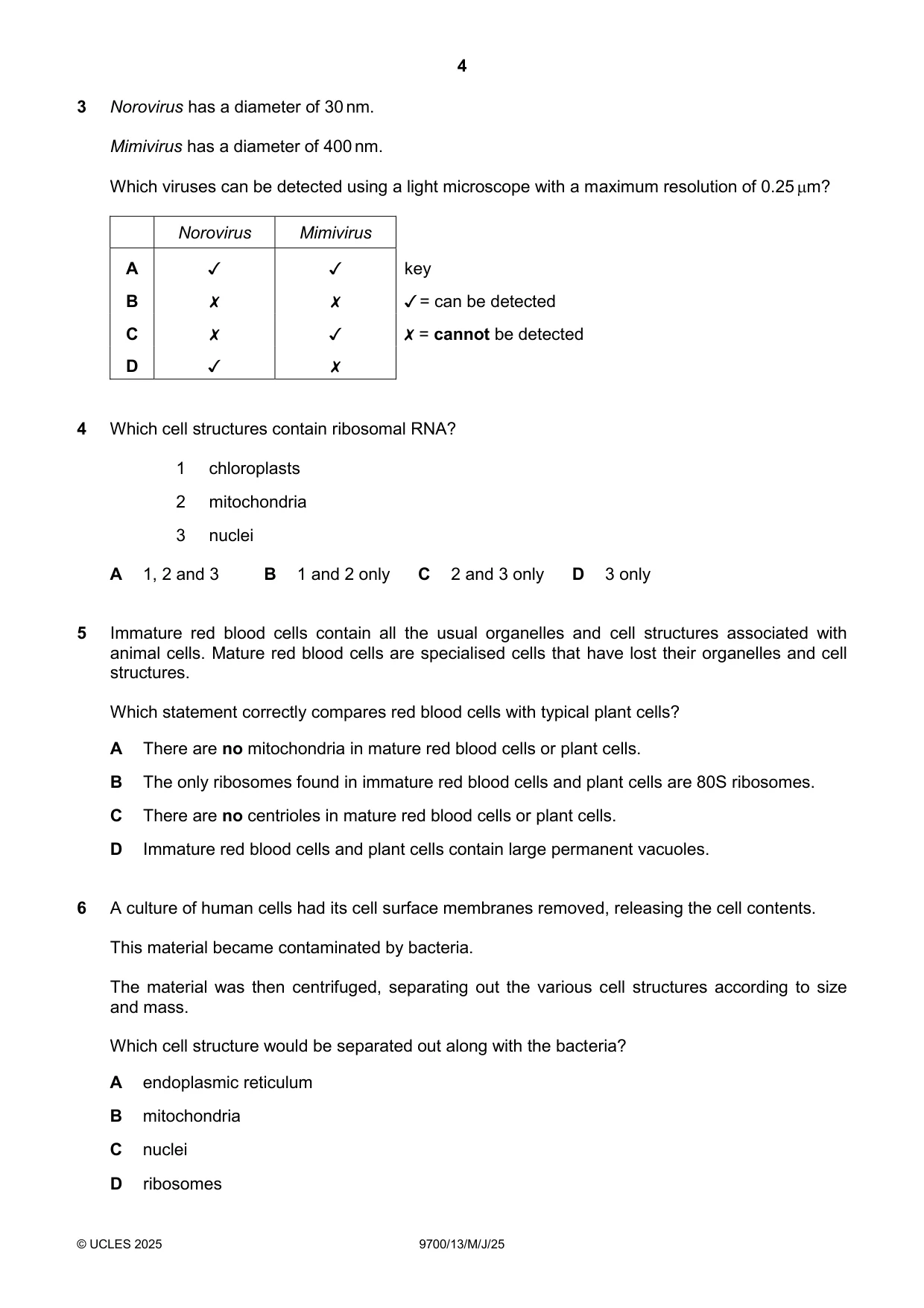
Q3 · Norovirus has a diameter of 30 nm
3 Norovirus has a diameter of 30 nm. Mimivirus has a diameter of 400 nm. Which viruses can be detected using a light microscope with a maximum resolution of 0.25 um? Mimivirus Jv key / = can be detected X = cannot be detected x \ x
Mark scheme: C
Q4 · Which cell structures contain ribosomal RNA?
4 Which cell structures contain ribosomal RNA? 1 chloroplasts 2 mitochondria 3 nuclei A 1, 2 and 3 B 1 and 2 only C 2 and 3 only D 3 only
Mark scheme: A
More questions on Cells as the basic units of living organisms
Q5 · Immature red blood cells contain all the usual organelles and cell structures associated…
5 Immature red blood cells contain all the usual organelles and cell structures associated with animal cells. Mature red blood cells are specialised cells that have lost their organelles and cell structures. Which statement correctly compares red blood cells with typical plant cells? A There are no mitochondria in mature red blood cells or plant cells. B The only ribosomes found in immature red blood cells and plant cells are 80S ribosomes. C There are no centrioles in mature red blood cells or plant cells. D Immature red blood cells and plant cells contain large permanent vacuoles.
Mark scheme: C
More questions on Cells as the basic units of living organisms
Q6 · A culture of human cells had its cell surface membranes removed, releasing the cell…
6 A culture of human cells had its cell surface membranes removed, releasing the cell contents. This material became contaminated by bacteria. The material was then centrifuged, separating out the various cell structures according to size and mass. Which cell structure would be separated out along with the bacteria? A endoplasmic reticulum B mitochondria C nuclei D ribosomes
Mark scheme: B
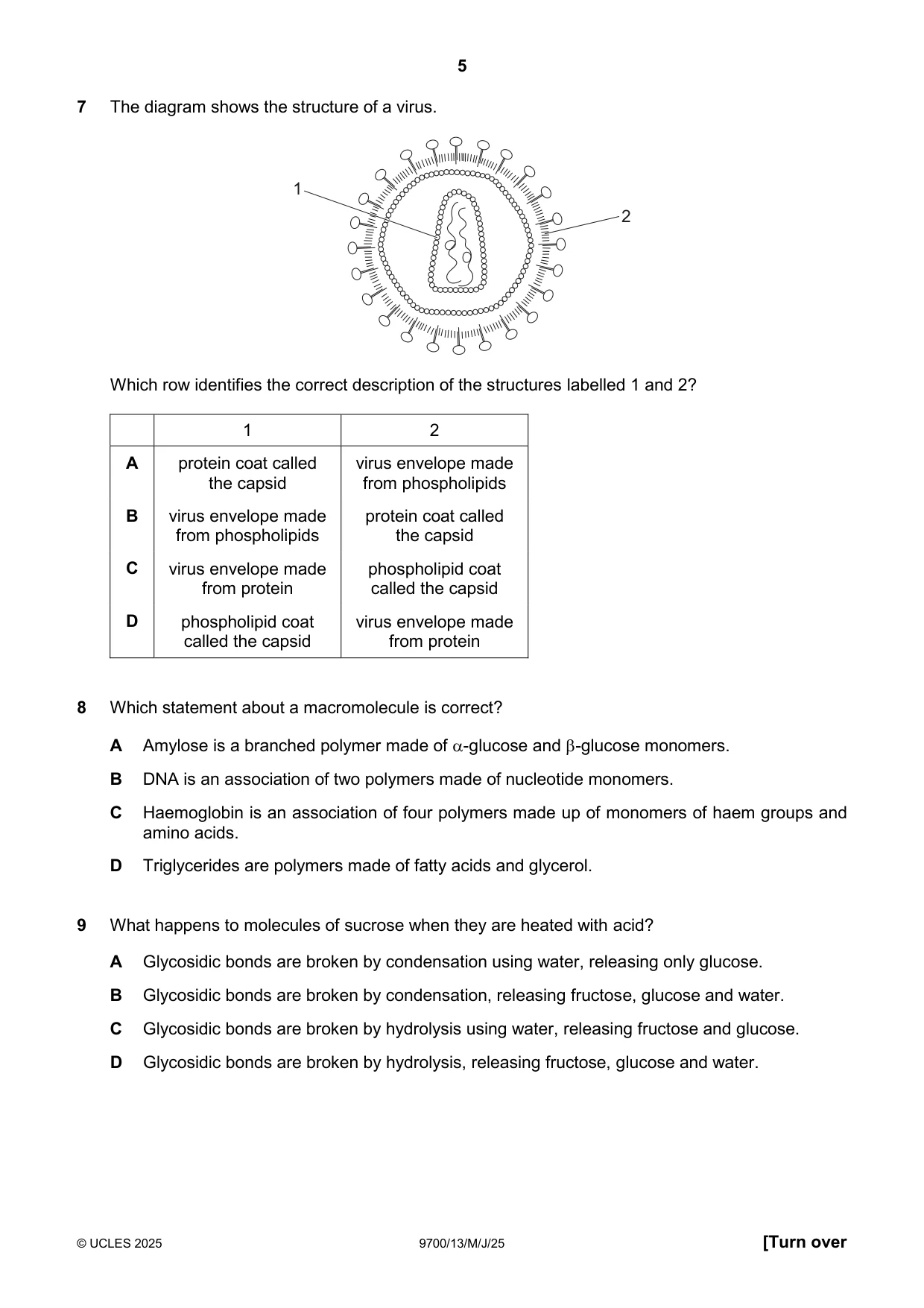
Q7 · The diagram shows the structure of a virus
7 The diagram shows the structure of a virus. 1 2 Which row identifies the correct description of the structures labelled 1 and 2? 1 2 A protein coat called virus envelope made the capsid from phospholipids B virus envelope made protein coat called from phospholipids the capsid C virus envelope made phospholipid coat from protein called the capsid D phospholipid coat virus envelope made called the capsid from protein
Mark scheme: A
More questions on Cells as the basic units of living organisms
Q8 · Which statement about a macromolecule is correct?
8 Which statement about a macromolecule is correct? A Amylose is a branched polymer made of -glucose and -glucose monomers. B DNA is an association of two polymers made of nucleotide monomers. C Haemoglobin is an association of four polymers made up of monomers of haem groups and amino acids. D Triglycerides are polymers made of fatty acids and glycerol.
Mark scheme: B
Q9 · What happens to molecules of sucrose when they are heated with acid?
9 What happens to molecules of sucrose when they are heated with acid? A Glycosidic bonds are broken by condensation using water, releasing only glucose. B Glycosidic bonds are broken by condensation, releasing fructose, glucose and water. C Glycosidic bonds are broken by hydrolysis using water, releasing fructose and glucose. D Glycosidic bonds are broken by hydrolysis, releasing fructose, glucose and water.
Mark scheme: C
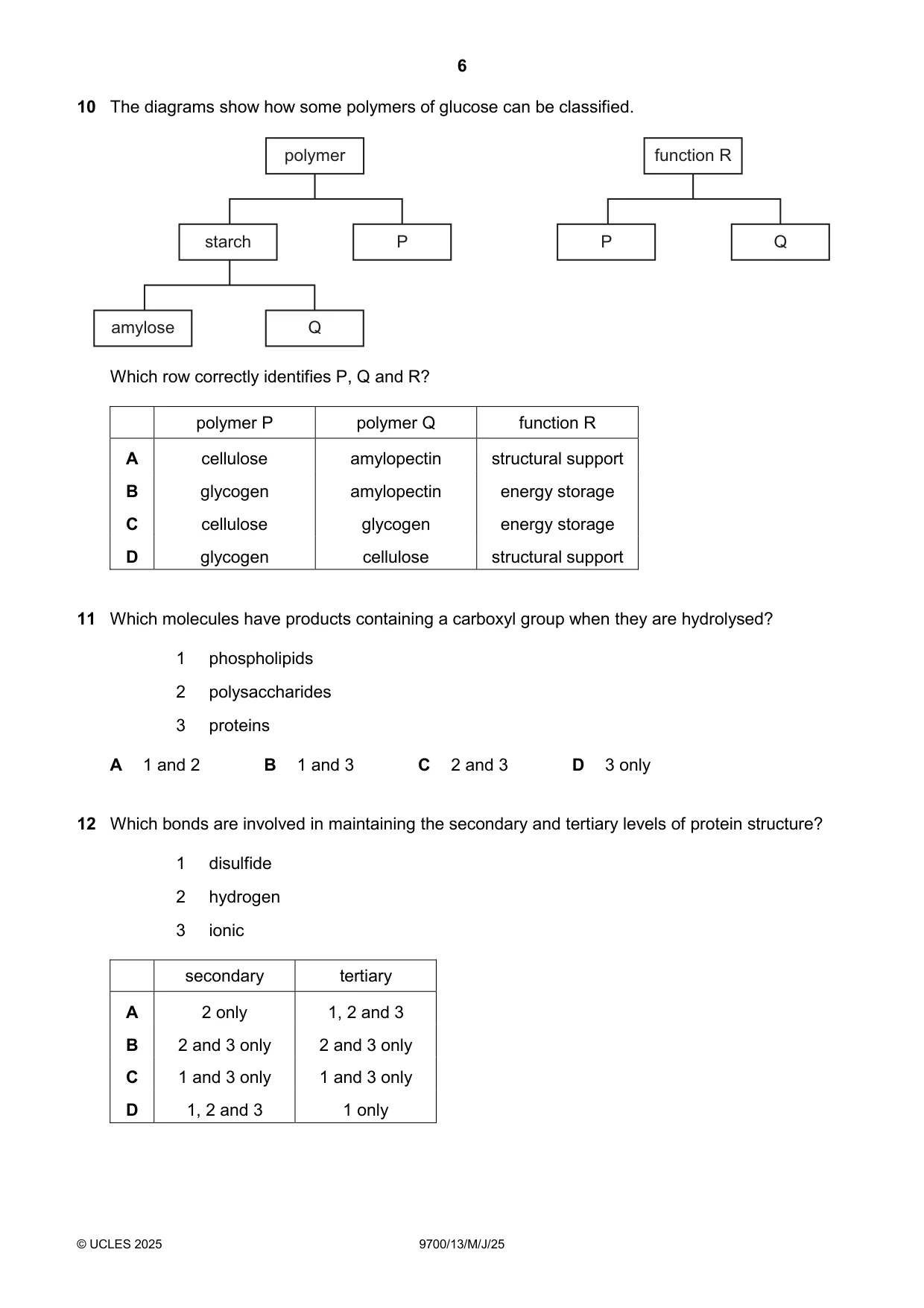
Q10 · The diagrams show how some polymers of glucose can be classified
10 The diagrams show how some polymers of glucose can be classified. polymer function R starch P P Q amylose Q Which row correctly identifies P, Q and R? polymer P polymer Q function R A cellulose amylopectin structural support B glycogen amylopectin energy storage C cellulose glycogen energy storage D glycogen cellulose structural support
Mark scheme: B
Q11 · Which molecules have products containing a carboxyl group when they are hydrolysed?
11 Which molecules have products containing a carboxyl group when they are hydrolysed? 1 phospholipids 2 polysaccharides 3 proteins A 1 and 2 B 1 and 3 C 2 and 3 D 3 only
Mark scheme: B
Q12 · Which bonds are involved in maintaining the secondary and tertiary levels of protein…
12 Which bonds are involved in maintaining the secondary and tertiary levels of protein structure? 1 disulfide 2 hydrogen 3 ionic secondary tertiary A 2 only 1, 2 and 3 B 2 and 3 only 2 and 3 only C 1 and 3 only 1 and 3 only D 1, 2 and 3 1 only
Mark scheme: A
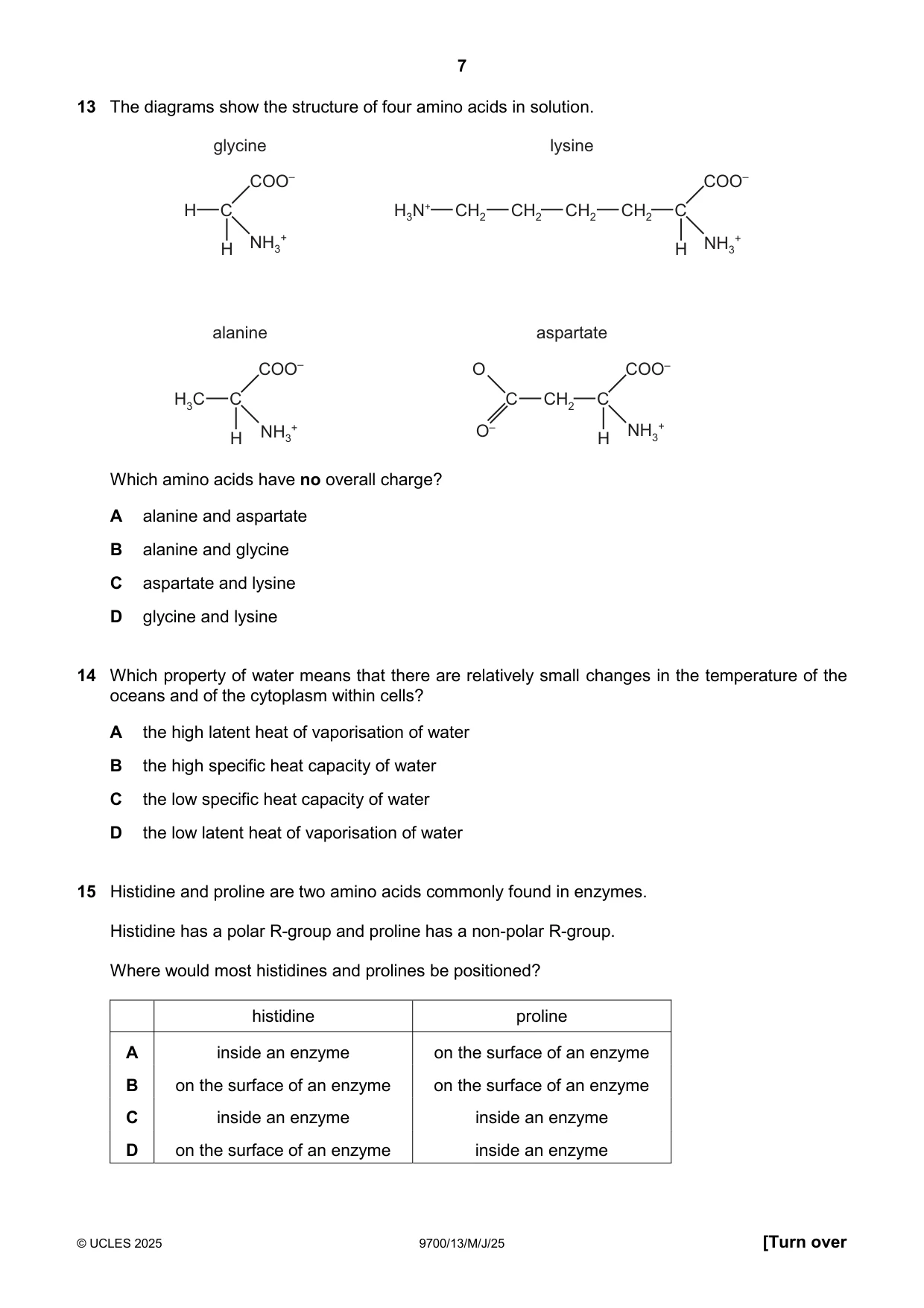
Q13 · The diagrams show the structure of four amino acids in solution
13 The diagrams show the structure of four amino acids in solution. glycine lysine COO– COO– H C H3N+ CH2 CH2 CH2 CH2 C NH3 + NH3 + H H alanine aspartate COO– O COO– H3C C C CH2 C NH3 + O– NH3 + H H Which amino acids have no overall charge? A alanine and aspartate B alanine and glycine C aspartate and lysine D glycine and lysine
Mark scheme: B
Q14 · Which property of water means that there are relatively small changes in the temperature…
14 Which property of water means that there are relatively small changes in the temperature of the oceans and of the cytoplasm within cells? A the high latent heat of vaporisation of water B the high specific heat capacity of water C the low specific heat capacity of water D the low latent heat of vaporisation of water
Mark scheme: B
Q15 · Histidine and proline are two amino acids commonly found in enzymes
15 Histidine and proline are two amino acids commonly found in enzymes. Histidine has a polar R-group and proline has a non-polar R-group. Where would most histidines and prolines be positioned? histidine proline A inside an enzyme on the surface of an enzyme B on the surface of an enzyme on the surface of an enzyme C inside an enzyme inside an enzyme D on the surface of an enzyme inside an enzyme
Mark scheme: D
Q16 · The activity of an enzyme can be affected by a competitive inhibitor
16 The activity of an enzyme can be affected by a competitive inhibitor. Which row is correct for the effect of a competitive inhibitor on the value of Km and the reason for this? effect of a competitive inhibitor reason on the value of Km A increased Few substrate molecules will bind to the active site when the substrate concentration is low because the active site is blocked by the inhibitor. B increased Vmax will increase because the substrate will only bind to the active site when the concentration of the substrate is high. C no effect At high substrate concentrations, substrate molecules are still able to bind to the enzymes in the presence of a competitive inhibitor. D no effect The inhibitor molecule does not bind to the active site; it binds to a site on another part of the enzyme.
Mark scheme: A
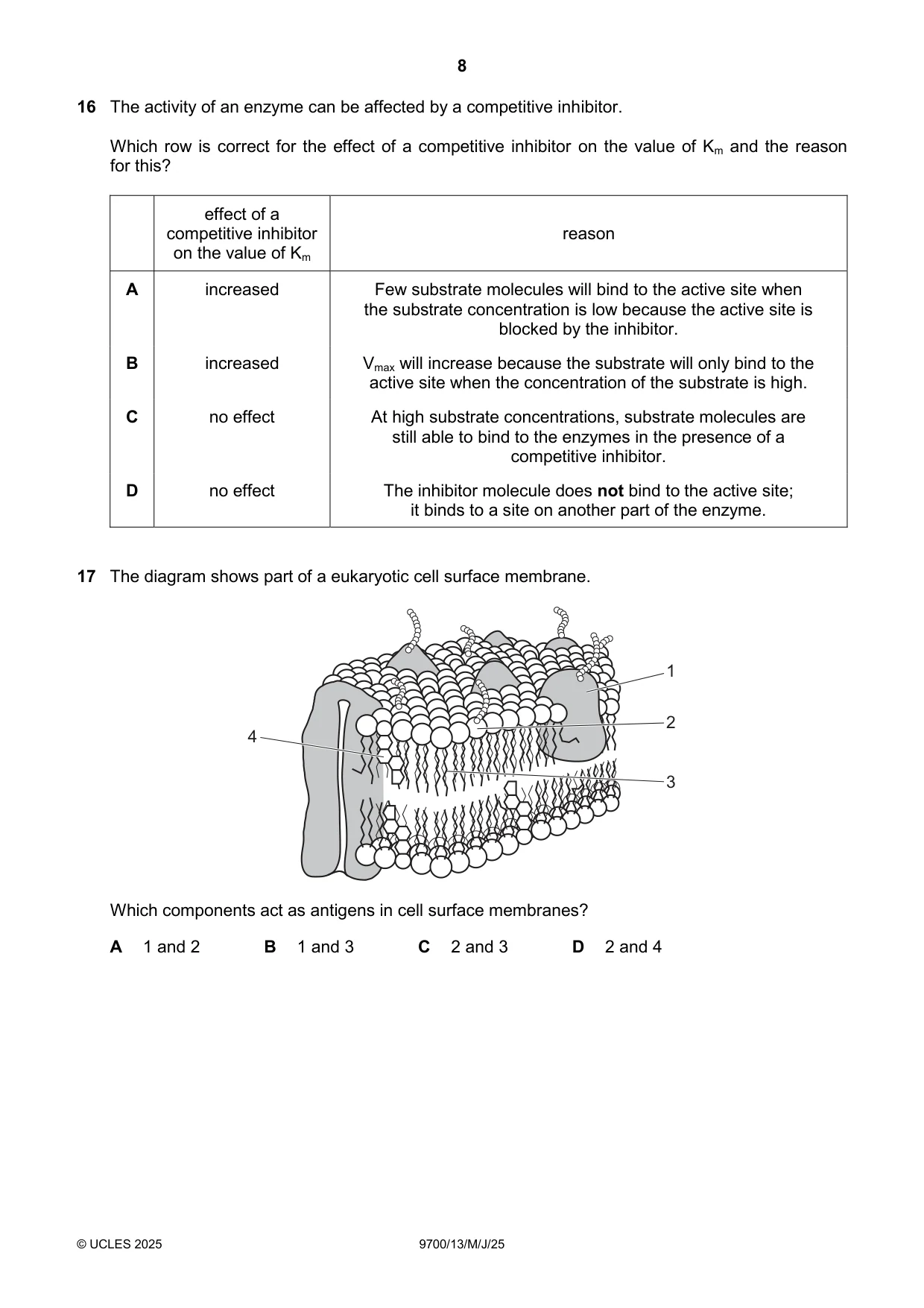
Q17 · The diagram shows part of a eukaryotic cell surface membrane
17 The diagram shows part of a eukaryotic cell surface membrane. 1 2 4 3 Which components act as antigens in cell surface membranes? A 1 and 2 B 1 and 3 C 2 and 3 D 2 and 4
Mark scheme: A
Q18 · Descriptions of three biological molecules found in cell surface membranes are given
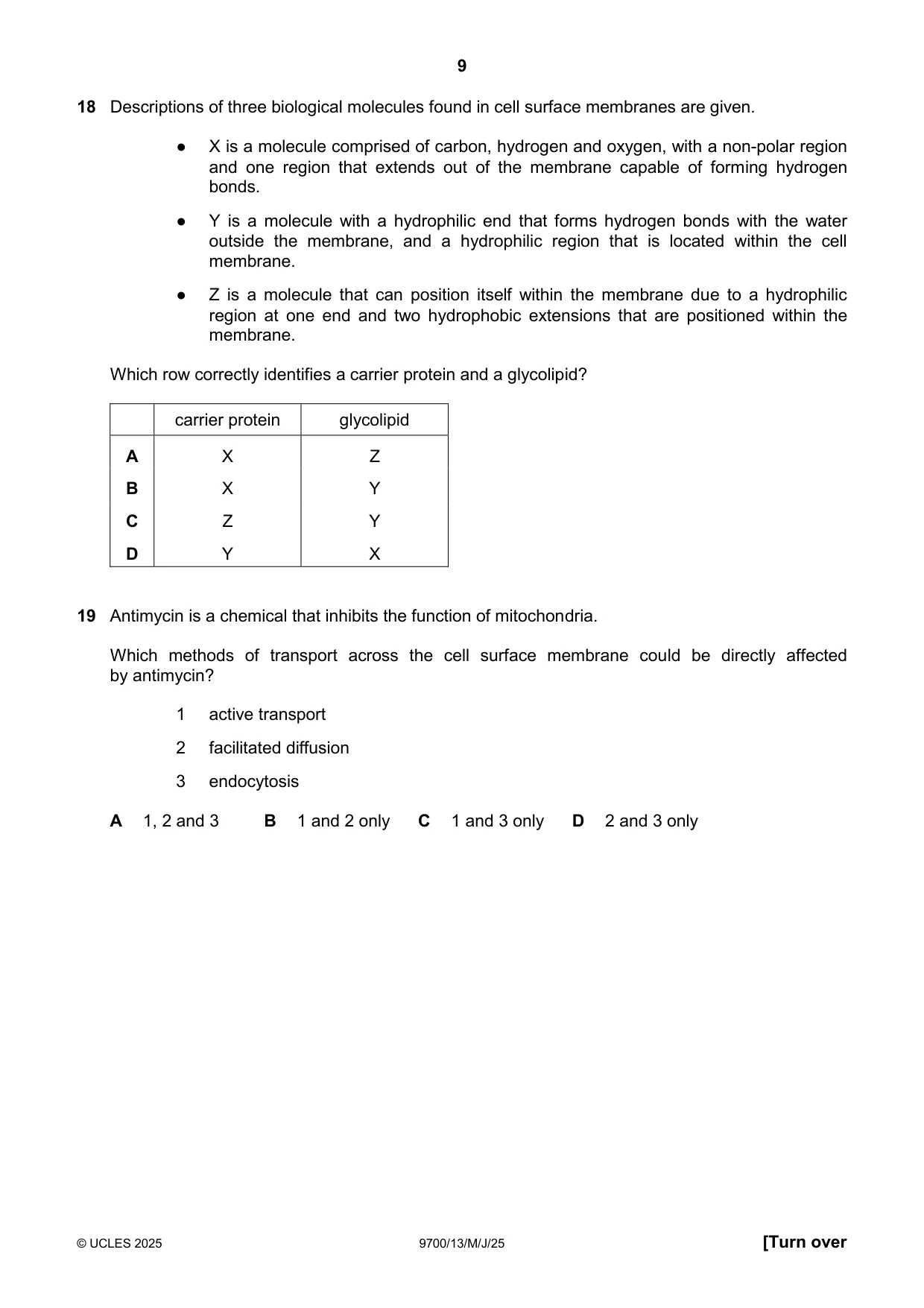
18 Descriptions of three biological molecules found in cell surface membranes are given. ● X is a molecule comprised of carbon, hydrogen and oxygen, with a non-polar region and one region that extends out of the membrane capable of forming hydrogen bonds. ● Y is a molecule with a hydrophilic end that forms hydrogen bonds with the water outside the membrane, and a hydrophilic region that is located within the cell membrane. ● Z is a molecule that can position itself within the membrane due to a hydrophilic region at one end and two hydrophobic extensions that are positioned within the membrane. Which row correctly identifies a carrier protein and a glycolipid? carrier protein glycolipid A X Z B X Y C Z Y D Y X
Mark scheme: D
Q19 · Antimycin is a chemical that inhibits the function of mitochondria
19 Antimycin is a chemical that inhibits the function of mitochondria. Which methods of transport across the cell surface membrane could be directly affected by antimycin? 1 active transport 2 facilitated diffusion 3 endocytosis A 1, 2 and 3 B 1 and 2 only C 1 and 3 only D 2 and 3 only
Mark scheme: C
Q20 · A student half filled a beaker with solution X
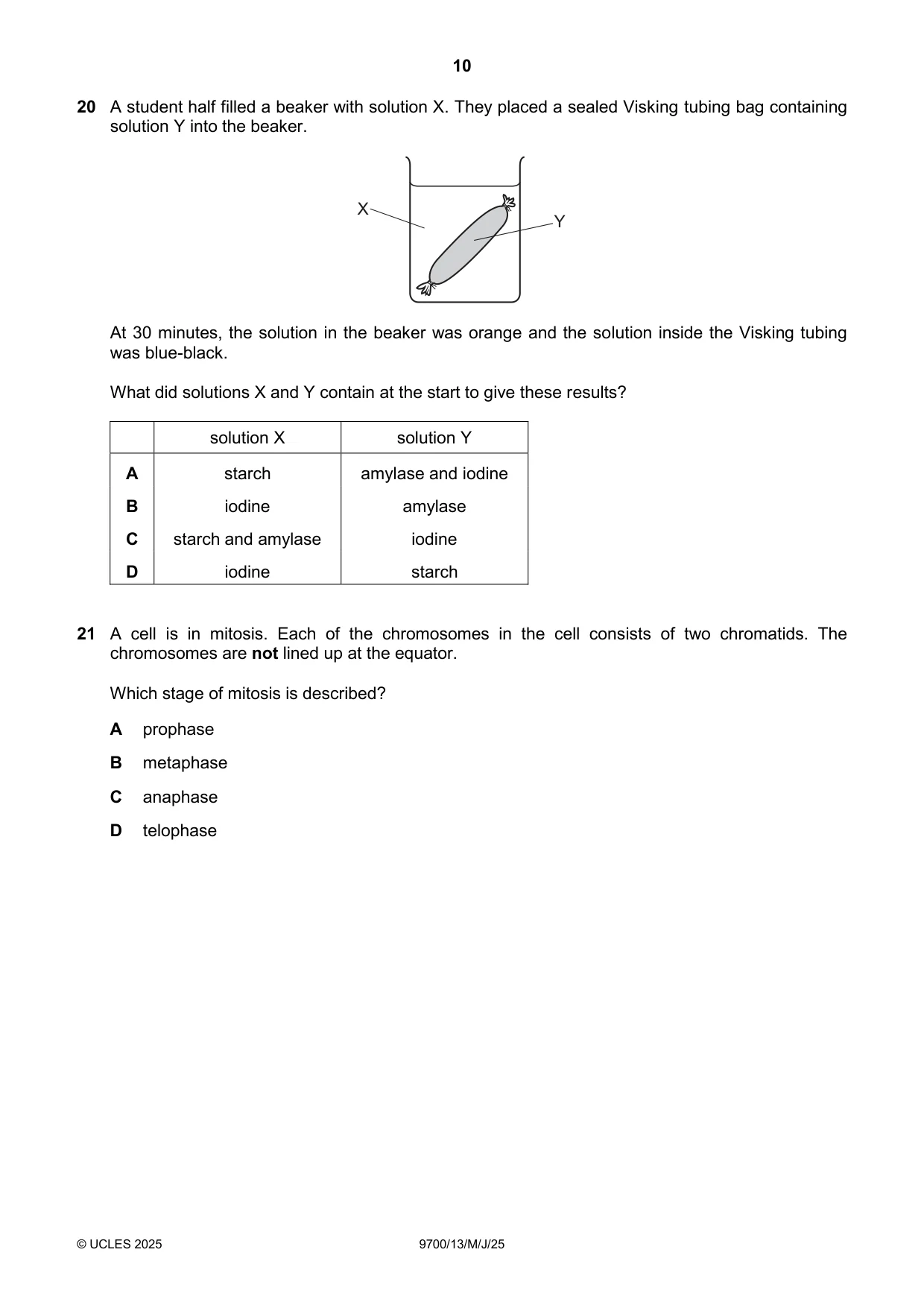
20 A student half filled a beaker with solution X. They placed a sealed Visking tubing bag containing solution Y into the beaker. X Y At 30 minutes, the solution in the beaker was orange and the solution inside the Visking tubing was blue-black. What did solutions X and Y contain at the start to give these results? solution X solution Y A starch amylase and iodine B iodine amylase C starch and amylase iodine D iodine starch
Mark scheme: D
Q21 · A cell is in mitosis
21 A cell is in mitosis. Each of the chromosomes in the cell consists of two chromatids. The chromosomes are not lined up at the equator. Which stage of mitosis is described? A prophase B metaphase C anaphase D telophase
Mark scheme: A
Q22 · The diagrams show two stages of the cell cycle in different organisms
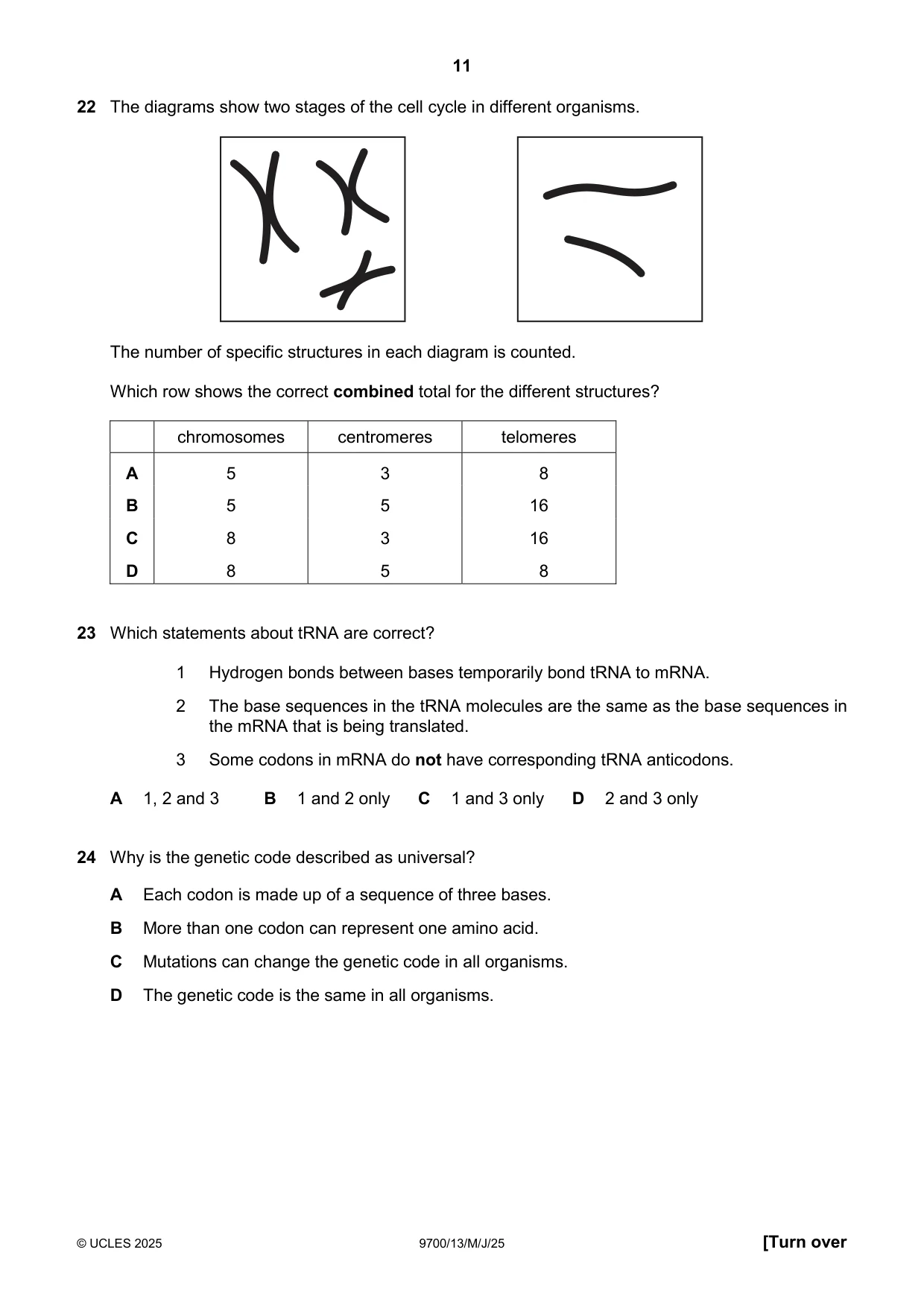
22 The diagrams show two stages of the cell cycle in different organisms. The number of specific structures in each diagram is counted. Which row shows the correct combined total for the different structures? chromosomes centromeres telomeres A 5 3 8 B 5 5 16 C 8 3 16 D 8 5 8
Mark scheme: B
Q23 · Which statements about tRNA are correct?
23 Which statements about tRNA are correct? 1 Hydrogen bonds between bases temporarily bond tRNA to mRNA. 2 The base sequences in the tRNA molecules are the same as the base sequences in the mRNA that is being translated. 3 Some codons in mRNA do not have corresponding tRNA anticodons. A 1, 2 and 3 B 1 and 2 only C 1 and 3 only D 2 and 3 only
Mark scheme: C
Q24 · Why is the genetic code described as universal?
24 Why is the genetic code described as universal? A Each codon is made up of a sequence of three bases. B More than one codon can represent one amino acid. C Mutations can change the genetic code in all organisms. D The genetic code is the same in all organisms.
Mark scheme: D
Q25 · What correctly identifies the number and type of bonds between cytosine and guanine in a…
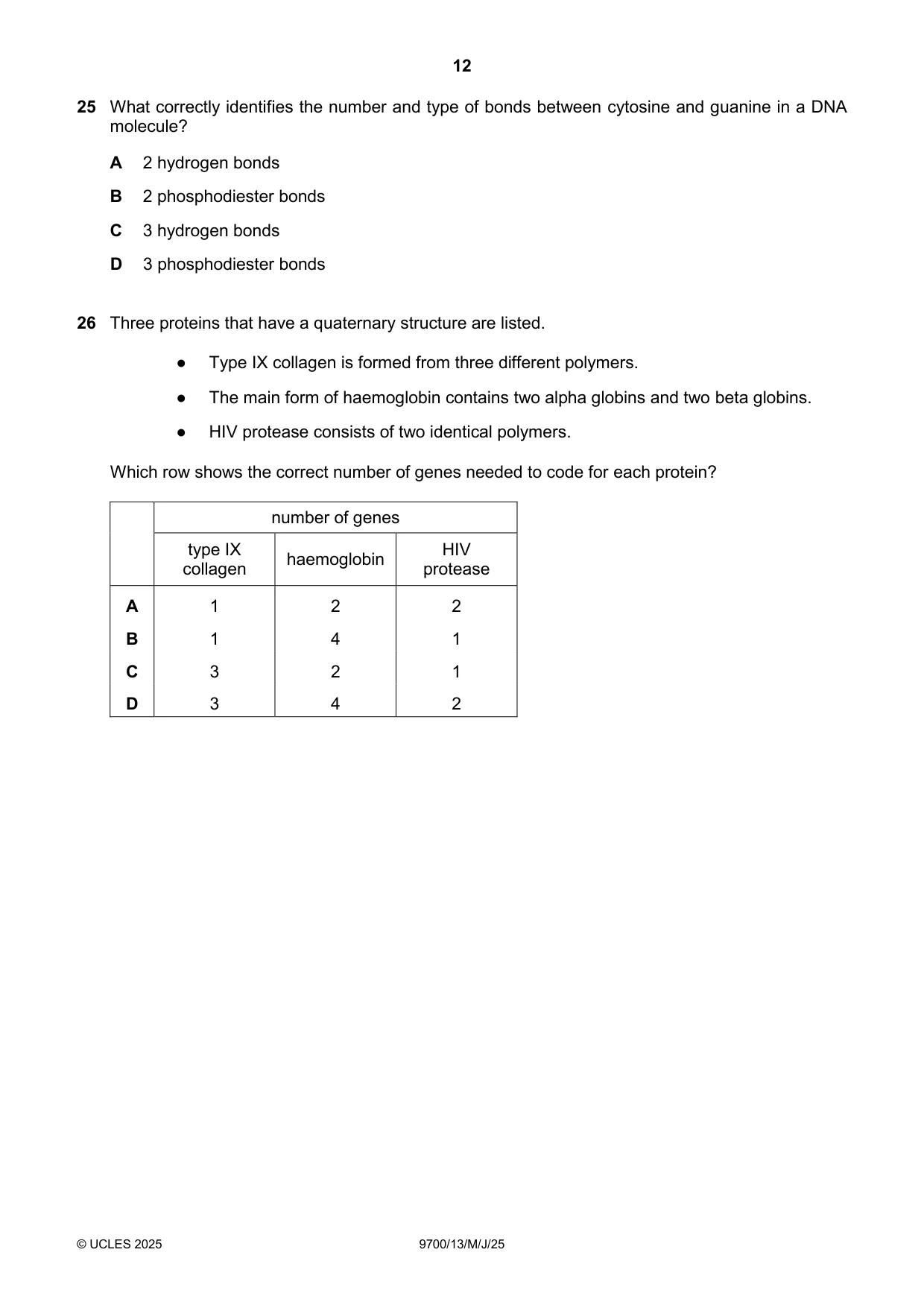
25 What correctly identifies the number and type of bonds between cytosine and guanine in a DNA molecule? A 2 hydrogen bonds B 2 phosphodiester bonds C 3 hydrogen bonds D 3 phosphodiester bonds
Mark scheme: C
More questions on Structure of nucleic acids and replication of DNA
Q26 · Three proteins that have a quaternary structure are listed
26 Three proteins that have a quaternary structure are listed. ● Type IX collagen is formed from three different polymers. ● The main form of haemoglobin contains two alpha globins and two beta globins. ● HIV protease consists of two identical polymers. Which row shows the correct number of genes needed to code for each protein? number of genes type IX HIV haemoglobin collagen protease A 1 2 2 B 1 4 1 C 3 2 1 D 3 4 2
Mark scheme: C
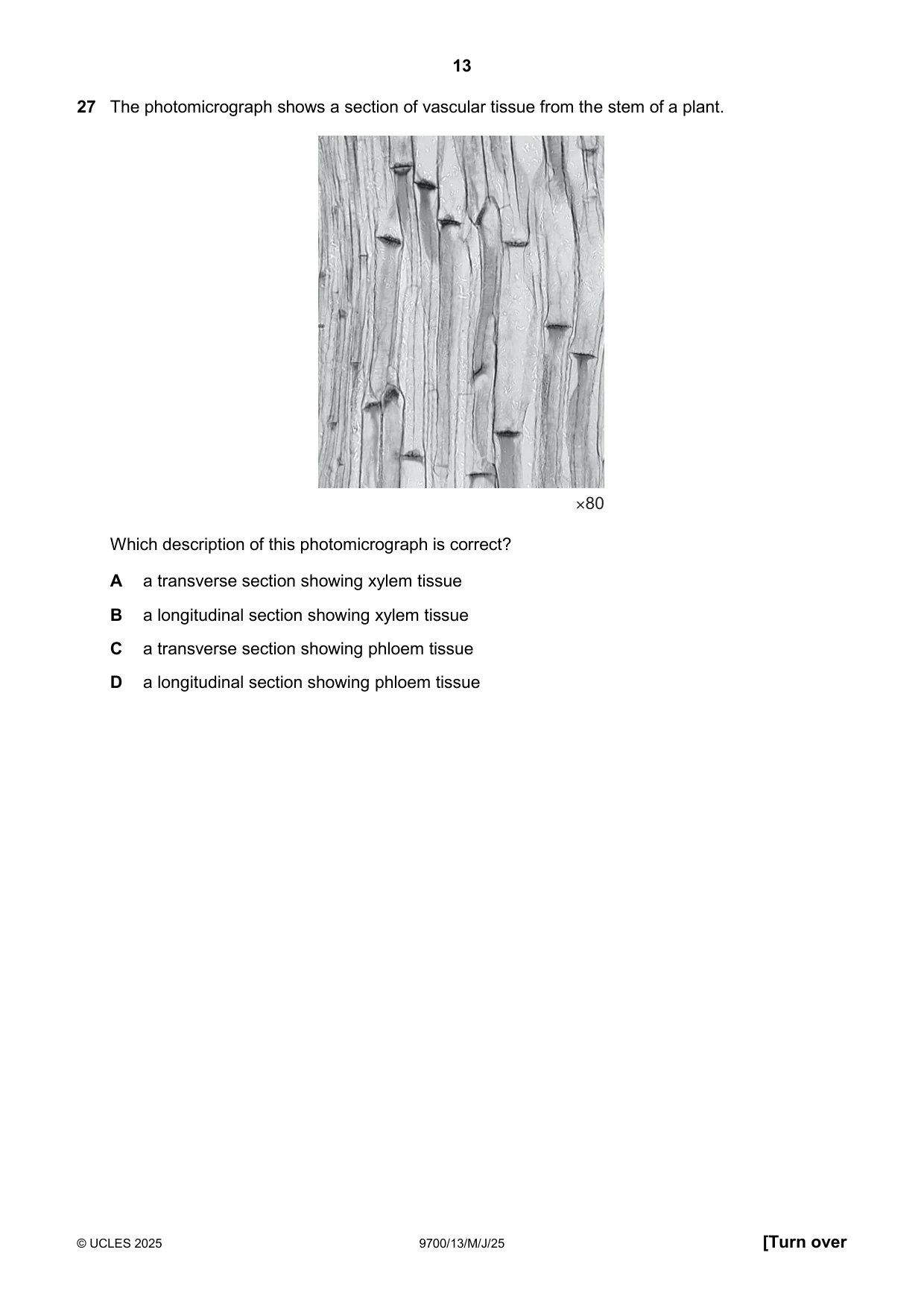
Q27 · The photomicrograph shows a section of vascular tissue from the stem of a plant
27 The photomicrograph shows a section of vascular tissue from the stem of a plant. ×80 Which description of this photomicrograph is correct? A a transverse section showing xylem tissue B a longitudinal section showing xylem tissue C a transverse section showing phloem tissue D a longitudinal section showing phloem tissue
Mark scheme: D
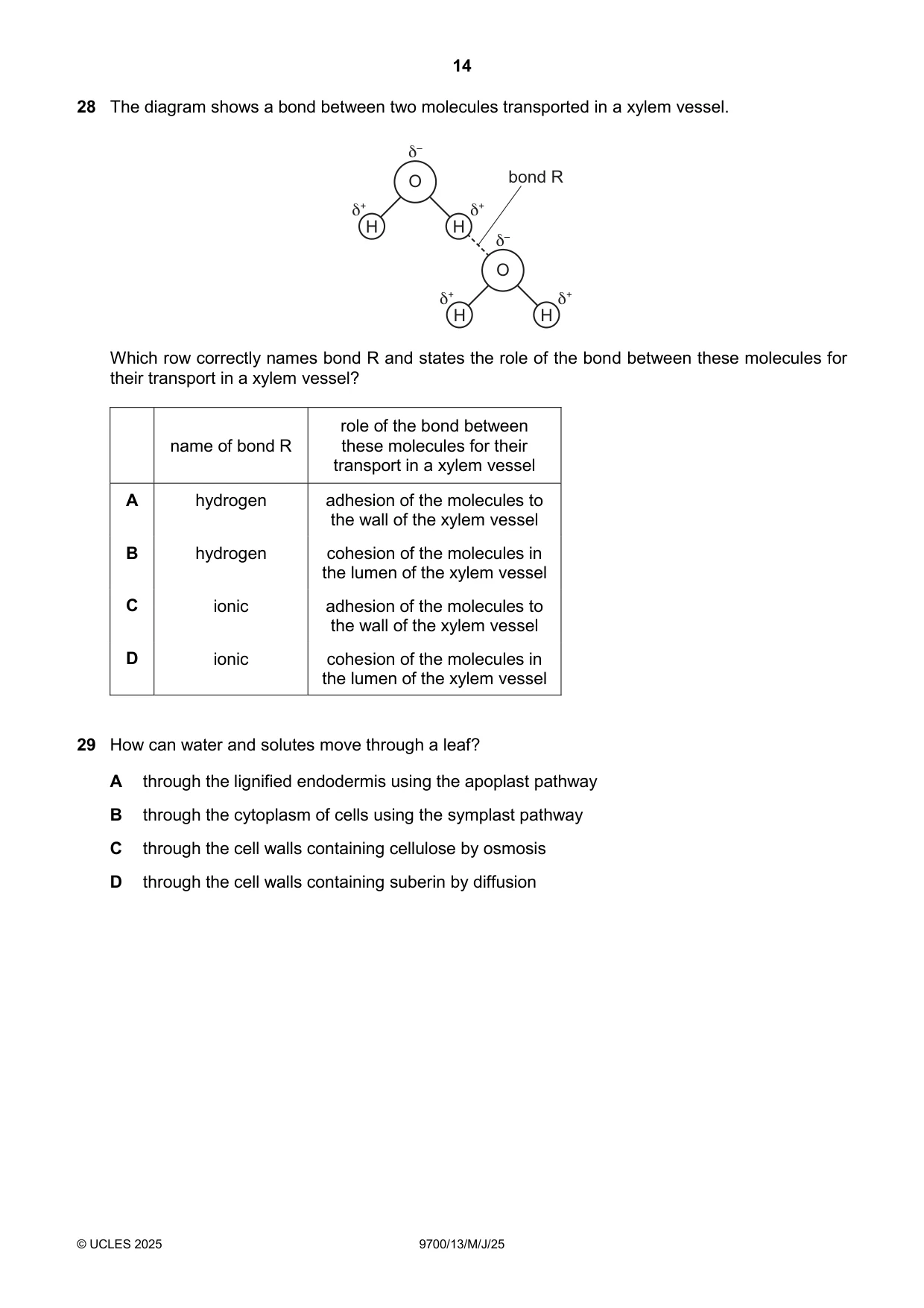
Q28 · The diagram shows a bond between two molecules transported in a xylem vessel
28 The diagram shows a bond between two molecules transported in a xylem vessel. δ– O bond R δ+ δ+ H H δ– O δ+ δ+ H H Which row correctly names bond R and states the role of the bond between these molecules for their transport in a xylem vessel? role of the bond between name of bond R these molecules for their transport in a xylem vessel A hydrogen adhesion of the molecules to the wall of the xylem vessel B hydrogen cohesion of the molecules in the lumen of the xylem vessel C ionic adhesion of the molecules to the wall of the xylem vessel D ionic cohesion of the molecules in the lumen of the xylem vessel
Mark scheme: B
Q29 · How can water and solutes move through a leaf?
29 How can water and solutes move through a leaf? A through the lignified endodermis using the apoplast pathway B through the cytoplasm of cells using the symplast pathway C through the cell walls containing cellulose by osmosis D through the cell walls containing suberin by diffusion
Mark scheme: B
Q30 · Atrial septal defect (ASD) is a heart defect found in some newborn babies
30 Atrial septal defect (ASD) is a heart defect found in some newborn babies. ASD is an opening between the right and left atria. What are possible effects for babies born with ASD compared with babies born with no ASD? blood in blood in aorta pulmonary artery A less oxygen same level of oxygen B less oxygen more oxygen C more oxygen same level of oxygen D more oxygen more oxygen
Mark scheme: C
Q31 · Which statement is correct?
31 Which statement is correct? A The contraction of heart muscle causes blood to enter arteries that pump the blood to organs, causing the formation of tissue fluid between cells before returning to the heart in veins. B The heart connects two types of blood vessels so that oxygen from the lungs can be distributed by red blood cells and wastes can be collected from tissues directly into blood plasma for removal. C The heart muscle contracts and relaxes which causes molecules such as carbon dioxide and antibodies to be transported in blood plasma through blood vessels that connect different parts of the body. D The heart provides enough pressure to push blood through arteries to capillaries between cells, causing filtration of blood and the formation of tissue fluid which diffuses back into veins.
Mark scheme: C
Q32 · What describes the function of the atrioventricular node of the heart?
32 What describes the function of the atrioventricular node of the heart? A It causes the muscles of the atria to contract. B It delays the transmission of a wave of electrical activity from the sinoatrial node. C It initiates a new wave of electrical activity in the ventricles. D It provides a non-conducting barrier between the atria and the ventricles.
Mark scheme: B
Q33 · A sample of adult haemoglobin was tested to determine its saturation with oxygen
33 A sample of adult haemoglobin was tested to determine its saturation with oxygen. All other variables were standardised. At a partial pressure of 0 kPa, the saturation was 0%. The saturation reached 97% at a partial pressure of 14 kPa. Which row shows the possible percentage saturation of haemoglobin at some intermediate partial pressures? 2 kPa 4 kPa 7 kPa 12 kPa A 5 10 15 40 B 10 25 40 65 C 15 56 80 93 D 60 80 90 95
Mark scheme: C
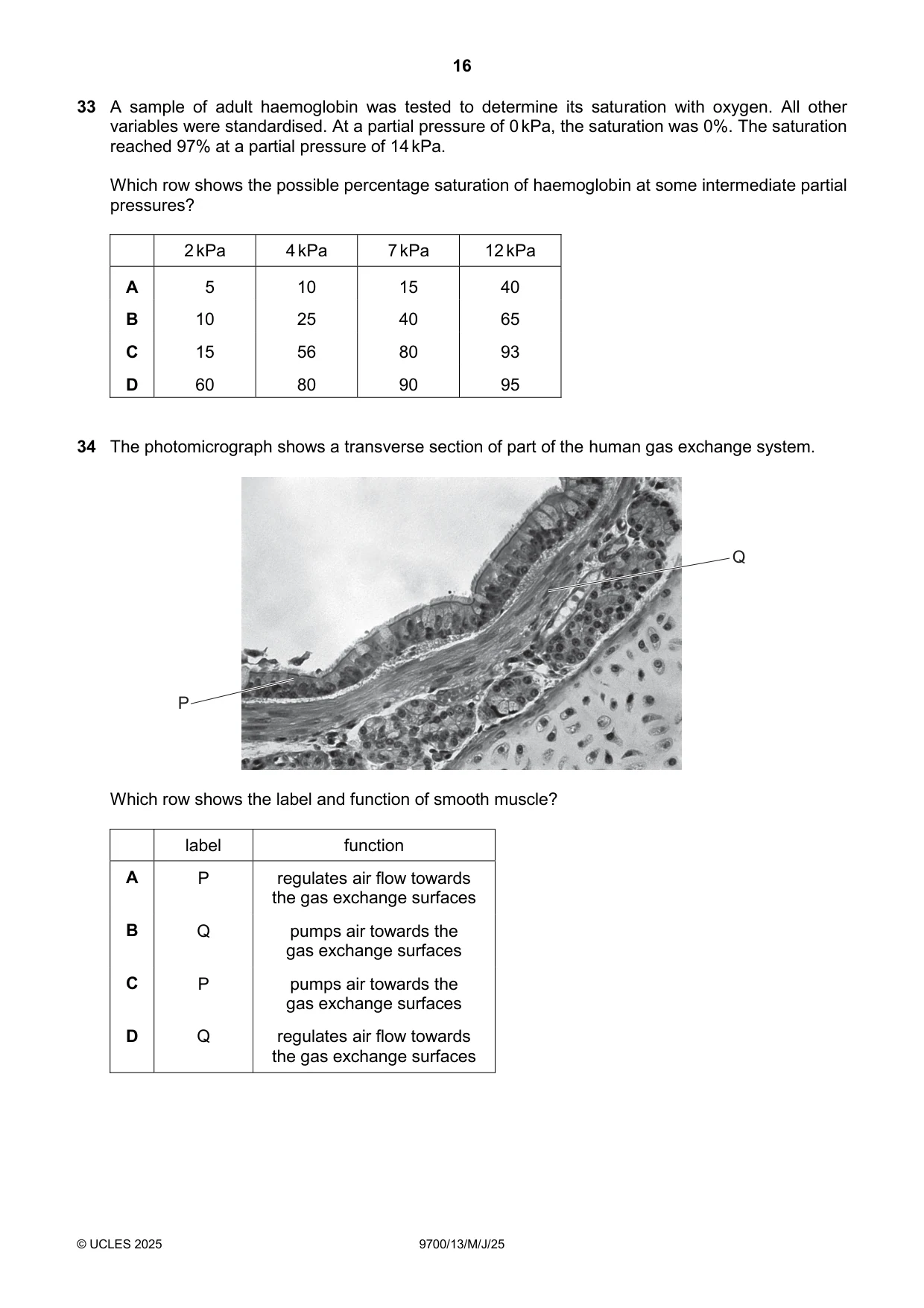
Q34 · The photomicrograph shows a transverse section of part of the human gas exchange system
34 The photomicrograph shows a transverse section of part of the human gas exchange system. Q P Which row shows the label and function of smooth muscle? label function A P regulates air flow towards the gas exchange surfaces B Q pumps air towards the gas exchange surfaces C P pumps air towards the gas exchange surfaces D Q regulates air flow towards the gas exchange surfaces
Mark scheme: D
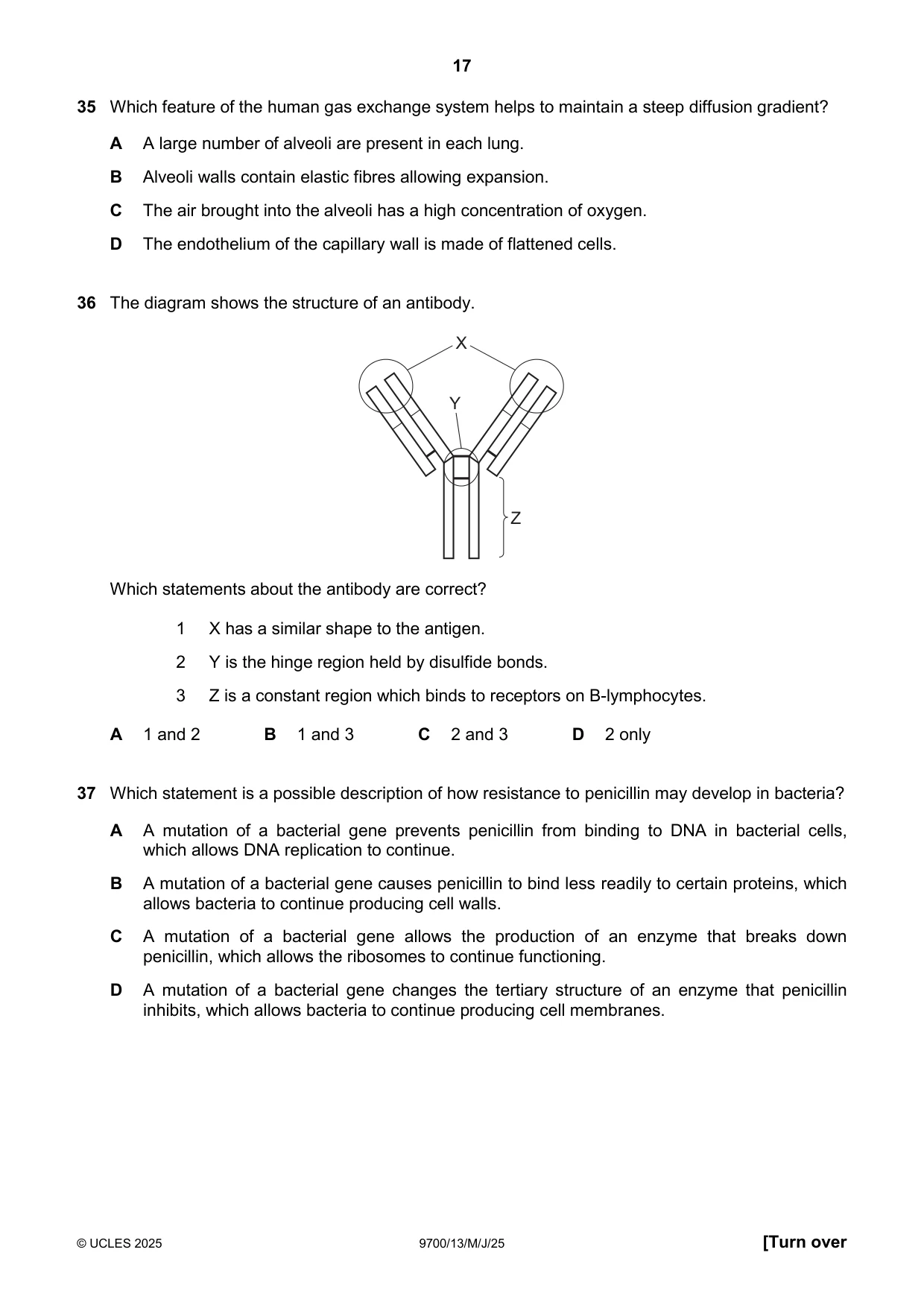
Q35 · Which feature of the human gas exchange system helps to maintain a steep diffusion…
35 Which feature of the human gas exchange system helps to maintain a steep diffusion gradient? A A large number of alveoli are present in each lung. B Alveoli walls contain elastic fibres allowing expansion. C The air brought into the alveoli has a high concentration of oxygen. D The endothelium of the capillary wall is made of flattened cells.
Mark scheme: C
Q36 · The diagram shows the structure of an antibody
36 The diagram shows the structure of an antibody. X Y Z Which statements about the antibody are correct? 1 X has a similar shape to the antigen. 2 Y is the hinge region held by disulfide bonds. 3 Z is a constant region which binds to receptors on B-lymphocytes. A 1 and 2 B 1 and 3 C 2 and 3 D 2 only
Mark scheme: C
Q37 · Which statement is a possible description of how resistance to penicillin may develop in…
37 Which statement is a possible description of how resistance to penicillin may develop in bacteria? A A mutation of a bacterial gene prevents penicillin from binding to DNA in bacterial cells, which allows DNA replication to continue. B A mutation of a bacterial gene causes penicillin to bind less readily to certain proteins, which allows bacteria to continue producing cell walls. C A mutation of a bacterial gene allows the production of an enzyme that breaks down penicillin, which allows the ribosomes to continue functioning. D A mutation of a bacterial gene changes the tertiary structure of an enzyme that penicillin inhibits, which allows bacteria to continue producing cell membranes.
Mark scheme: B
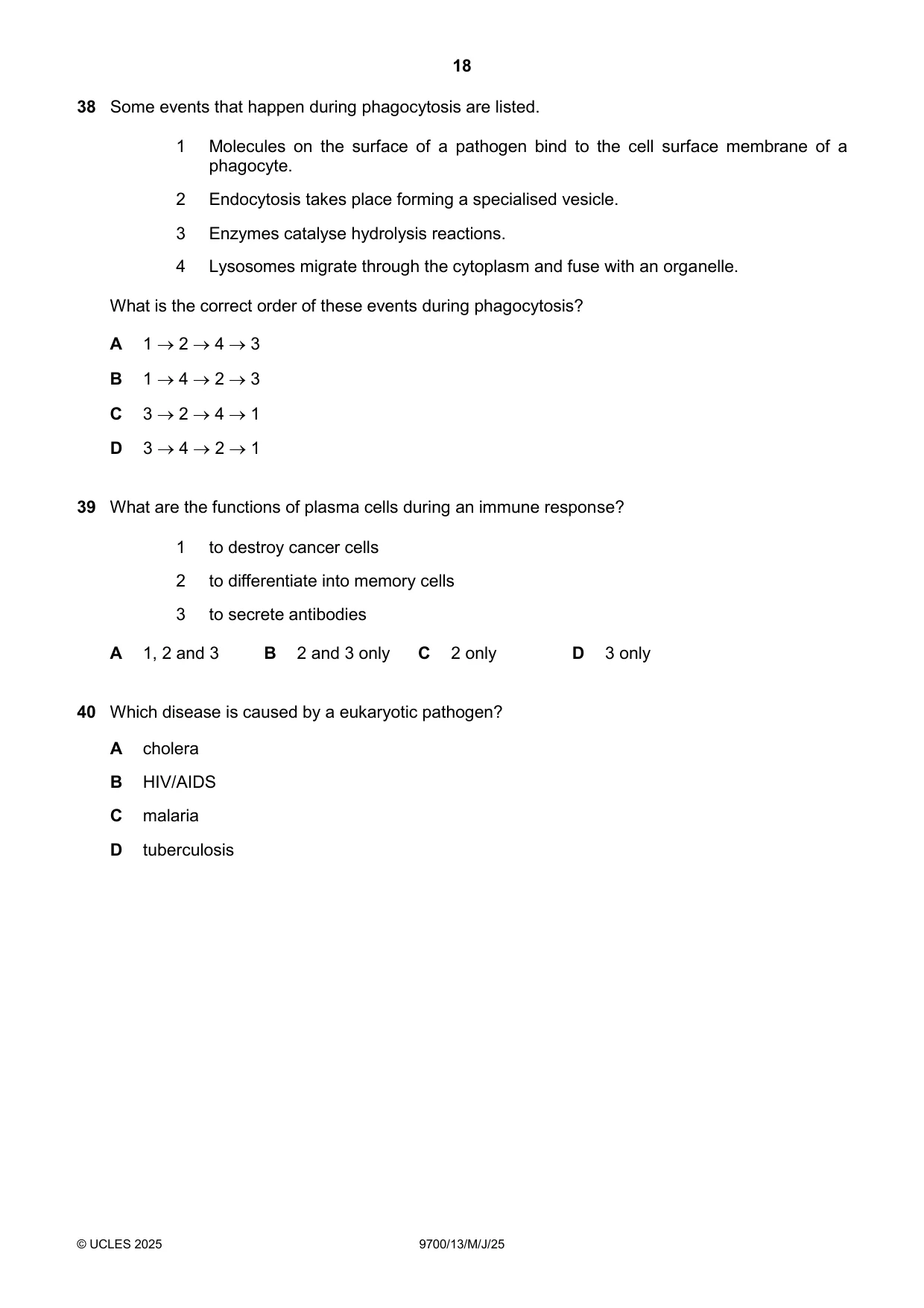
Q38 · Some events that happen during phagocytosis are listed
38 Some events that happen during phagocytosis are listed. 1 Molecules on the surface of a pathogen bind to the cell surface membrane of a phagocyte. 2 Endocytosis takes place forming a specialised vesicle. 3 Enzymes catalyse hydrolysis reactions. 4 Lysosomes migrate through the cytoplasm and fuse with an organelle. What is the correct order of these events during phagocytosis? A 1 2 4 3 B 1 4 2 3 C 3 2 4 1 D 3 4 2 1
Mark scheme: A
Q39 · What are the functions of plasma cells during an immune response?
39 What are the functions of plasma cells during an immune response? 1 to destroy cancer cells 2 to differentiate into memory cells 3 to secrete antibodies A 1, 2 and 3 B 2 and 3 only C 2 only D 3 only
Mark scheme: D
Q40 · Which disease is caused by a eukaryotic pathogen?
40 Which disease is caused by a eukaryotic pathogen? A cholera B HIV/AIDS C malaria D tuberculosis
Mark scheme: C
What was in this paper
The subtopics covered by these 40 questions, and how many questions each got. Open one in a new tab to see every Cambridge question on it.
4The microscope in cell studies4Cells as the basic units of living organisms3Protein synthesis3Proteins3Antibodies and vaccination2Chromosome behaviour in mitosis2Fluid mosaic membranes2Movement into and out of cells2The circulatory system2The gas exchange system2Transport mechanisms2Antibiotics1Factors that affect enzyme action1Infectious diseases1Structure of nucleic acids and replication of DNA1Structure of transport tissues1The heart1The immune system1Transport of oxygen and carbon dioxide1Water1What you needed in this session
Cambridge’s own grade thresholds for 2025 May/June, Paper 1 · Variant 3. A higher threshold means an easier paper — the bar moves with how the cohort did.