Cambridge A Level Biology 9700 — 2020 Oct/Nov Paper 1 · Variant 1
9700/11/O/N/20 · 40 questions · 40 marks · ≈45 min
The question paper and its mark scheme, free to read here and free to download. This is Cambridge’s own paper, exactly as it was sat.
Question paper20 pages
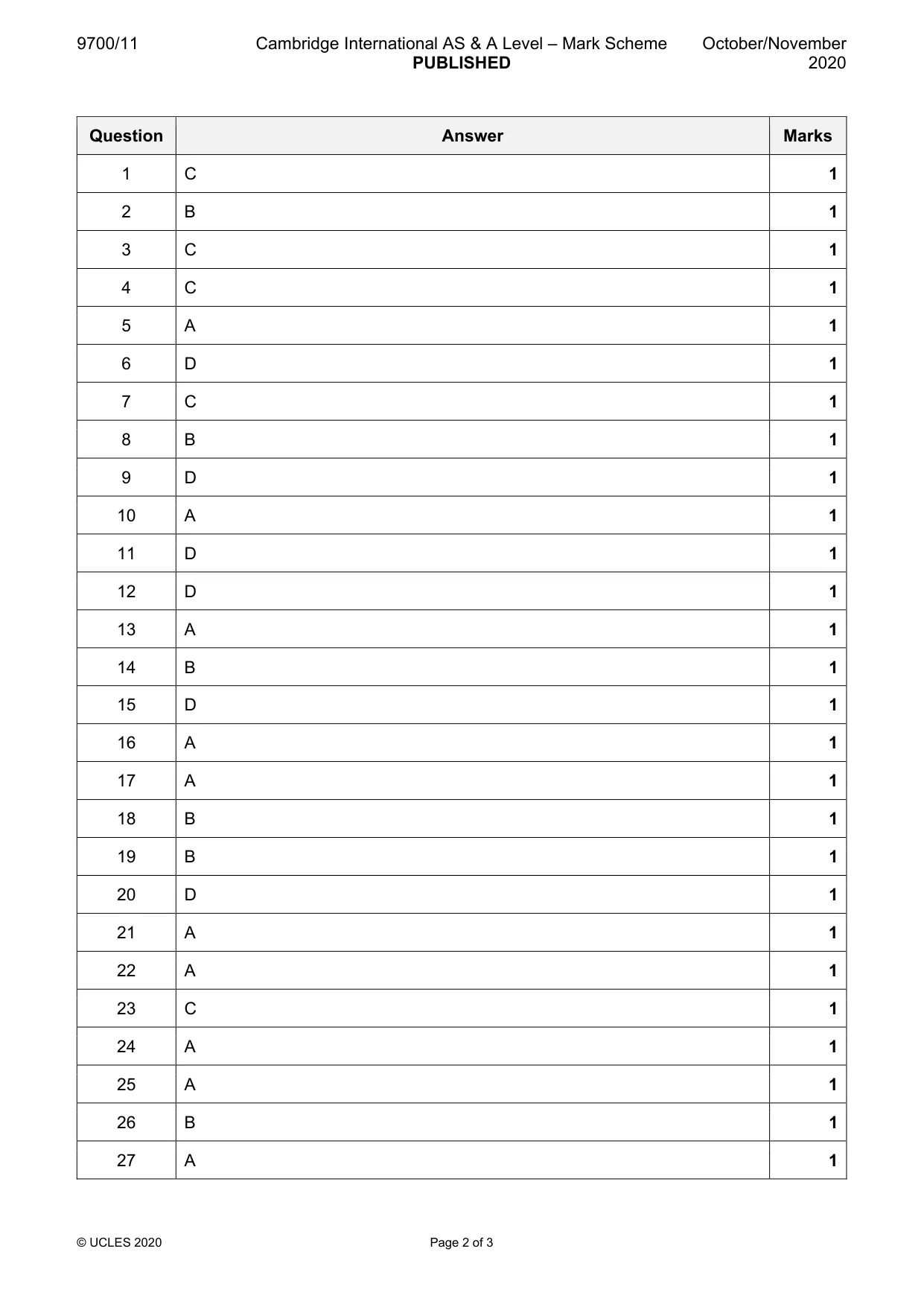
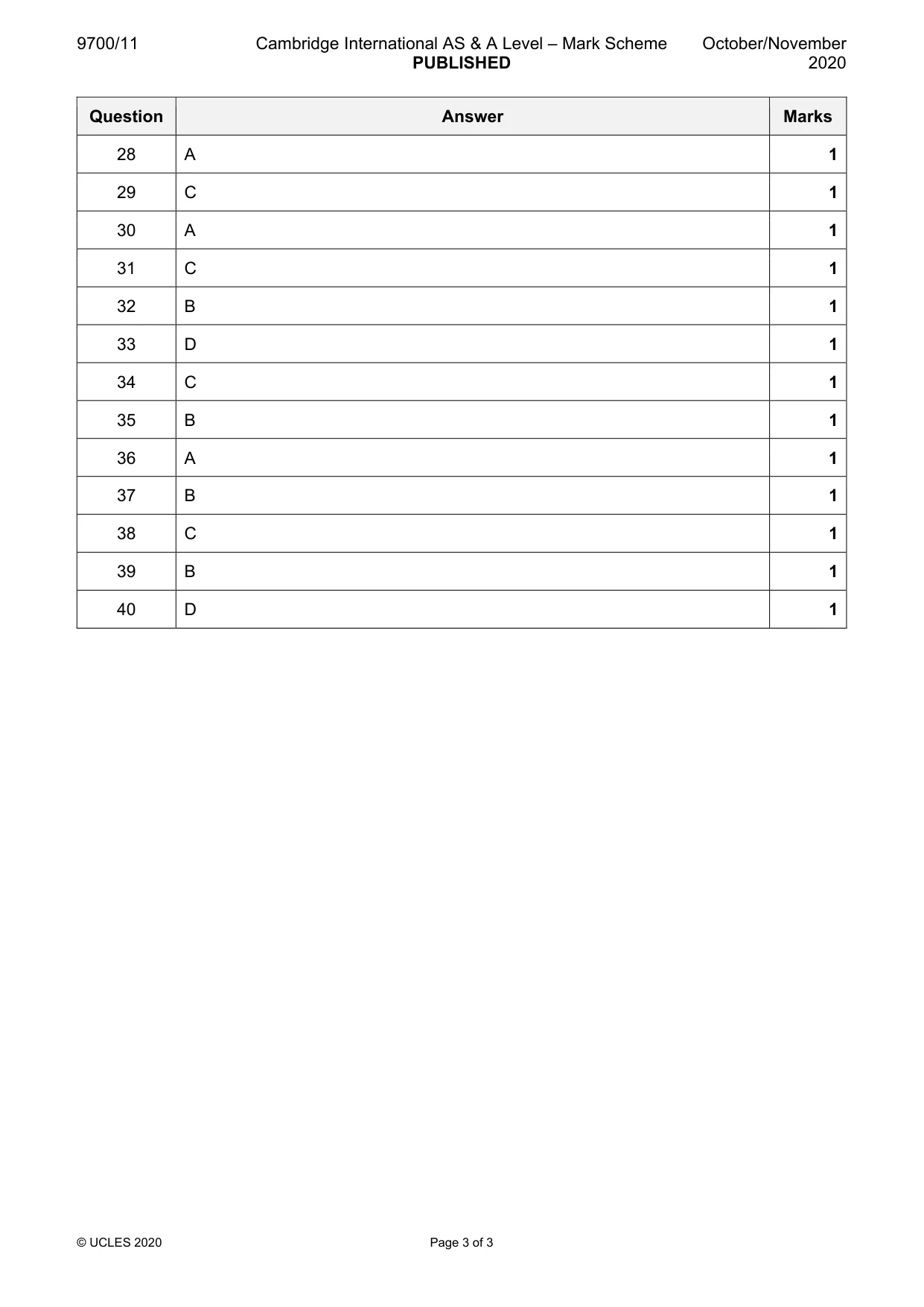
Mark scheme3 pages
Answers below. Sit the paper first if you are practising.
Questions as text
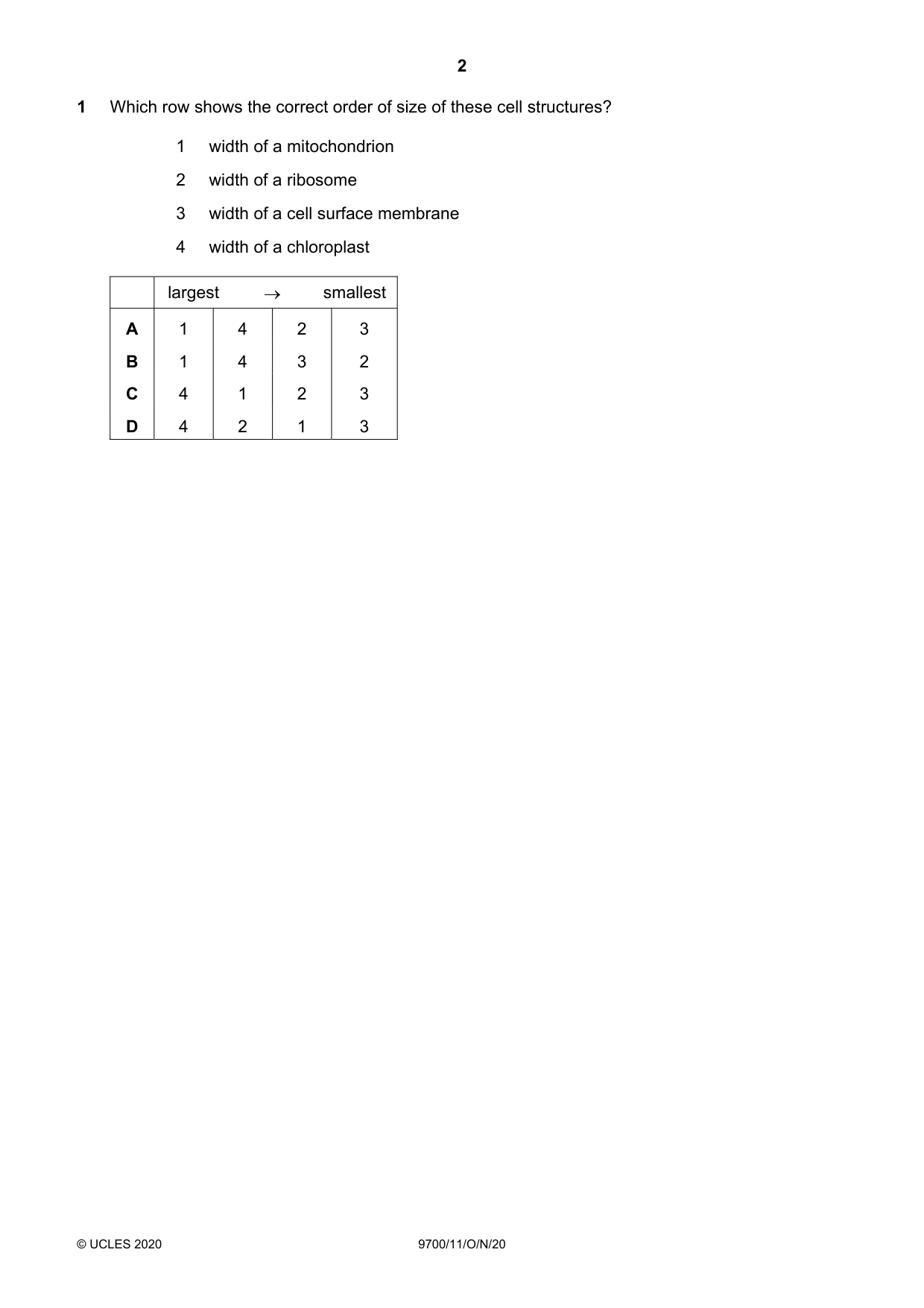
Q1 · Which row shows the correct order of size of these cell structures?
1 Which row shows the correct order of size of these cell structures? 1 width of a mitochondrion 2 width of a ribosome 3 width of a cell surface membrane 4 width of a chloroplast largest smallest A 1 4 2 3 B 1 4 3 2 C 4 1 2 3 D 4 2 1 3
Mark scheme: C
More questions on Cells as the basic units of living organisms
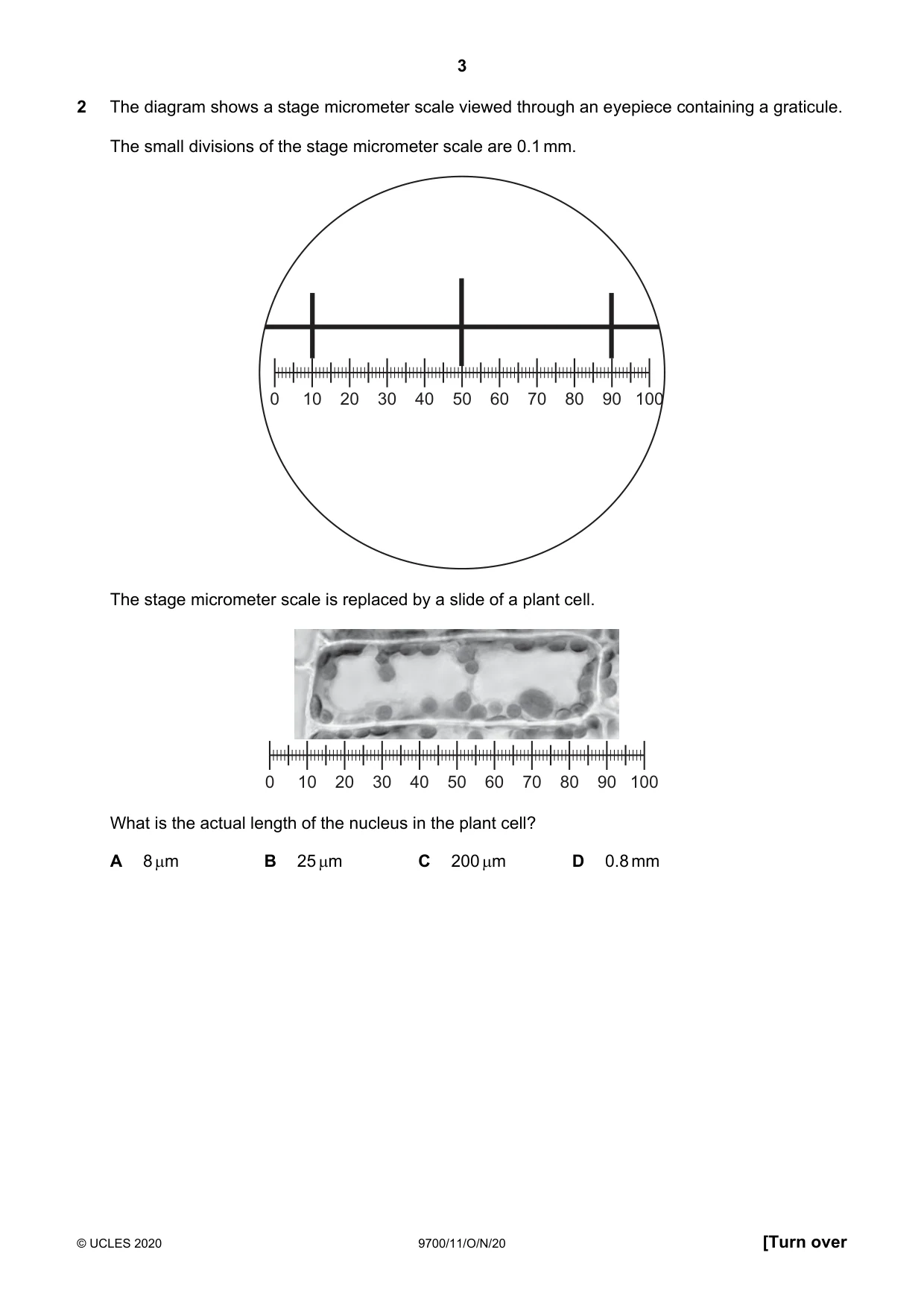
Q2 · The diagram shows a stage micrometer scale viewed through an eyepiece containing a…
2 The diagram shows a stage micrometer scale viewed through an eyepiece containing a graticule. The small divisions of the stage micrometer scale are 0.1 mm. 0 10 20 30 40 50 60 70 80 90 100 The stage micrometer scale is replaced by a slide of a plant cell. 0 10 20 30 40 50 60 70 80 90 100 What is the actual length of the nucleus in the plant cell? A 8 m B 25 m C 200 m D 0.8 mm
Mark scheme: B
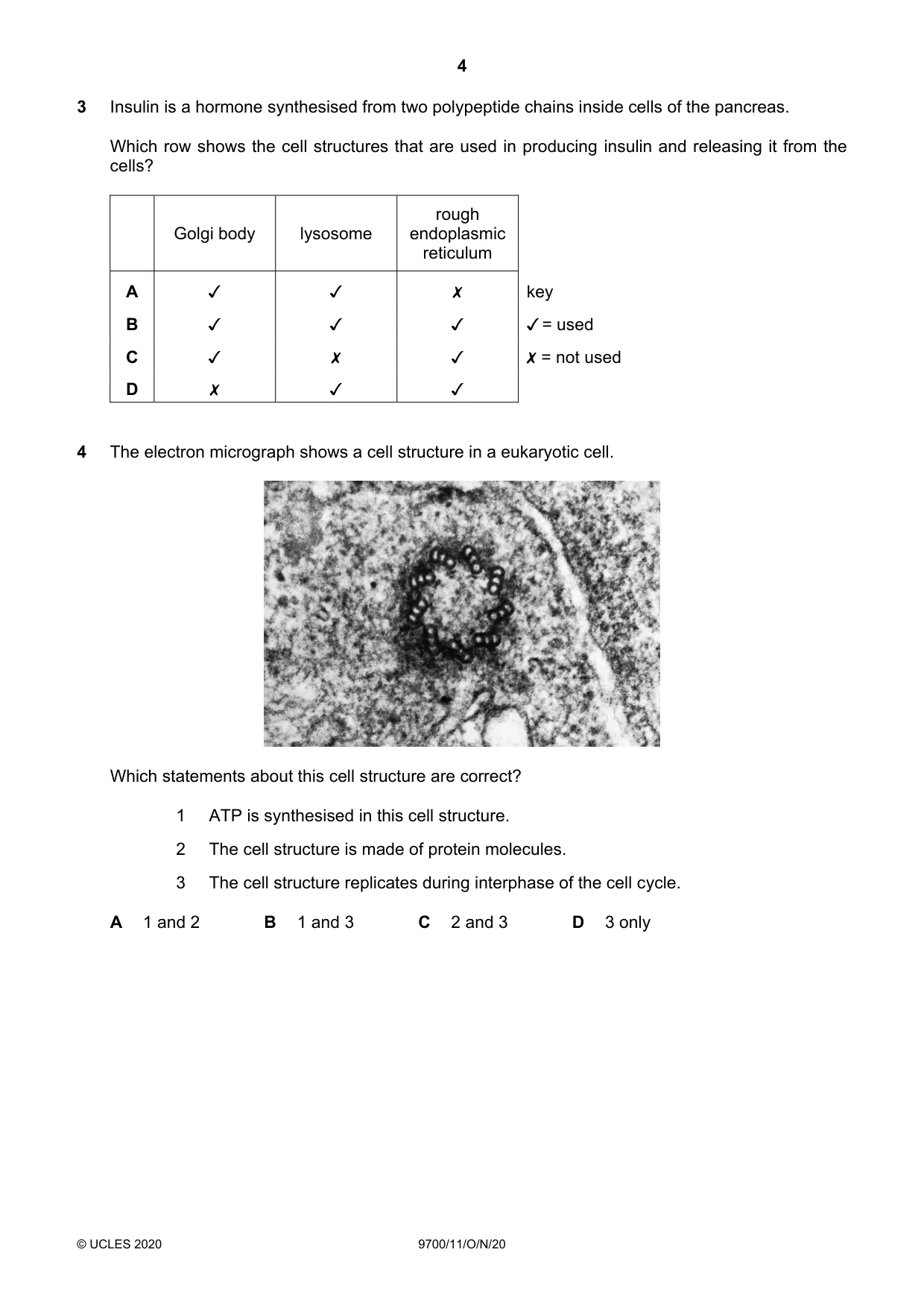
Q3 · Insulin is a hormone synthesised from two polypeptide chains inside cells of the pancreas
3 Insulin is a hormone synthesised from two polypeptide chains inside cells of the pancreas. Which row shows the cell structures that are used in producing insulin and releasing it from the cells? rough Golgi body lysosome endoplasmic reticulum A v v x B v v v Cc v x v D x v v key JY = used X = not used
Mark scheme: C
More questions on Cells as the basic units of living organisms
Q4 · The electron micrograph shows a cell structure in a eukaryotic cell
4 The electron micrograph shows a cell structure in a eukaryotic cell. Which statements about this cell structure are correct? 1 ATP is synthesised in this cell structure. 2 The cell structure is made of protein molecules. 3 The cell structure replicates during interphase of the cell cycle. A 1 and 2 B 1 and 3 C 2 and 3 D 3 only
Mark scheme: C
More questions on Cells as the basic units of living organisms
Q5 · Four students were asked to match the function with the appearance of some cell…
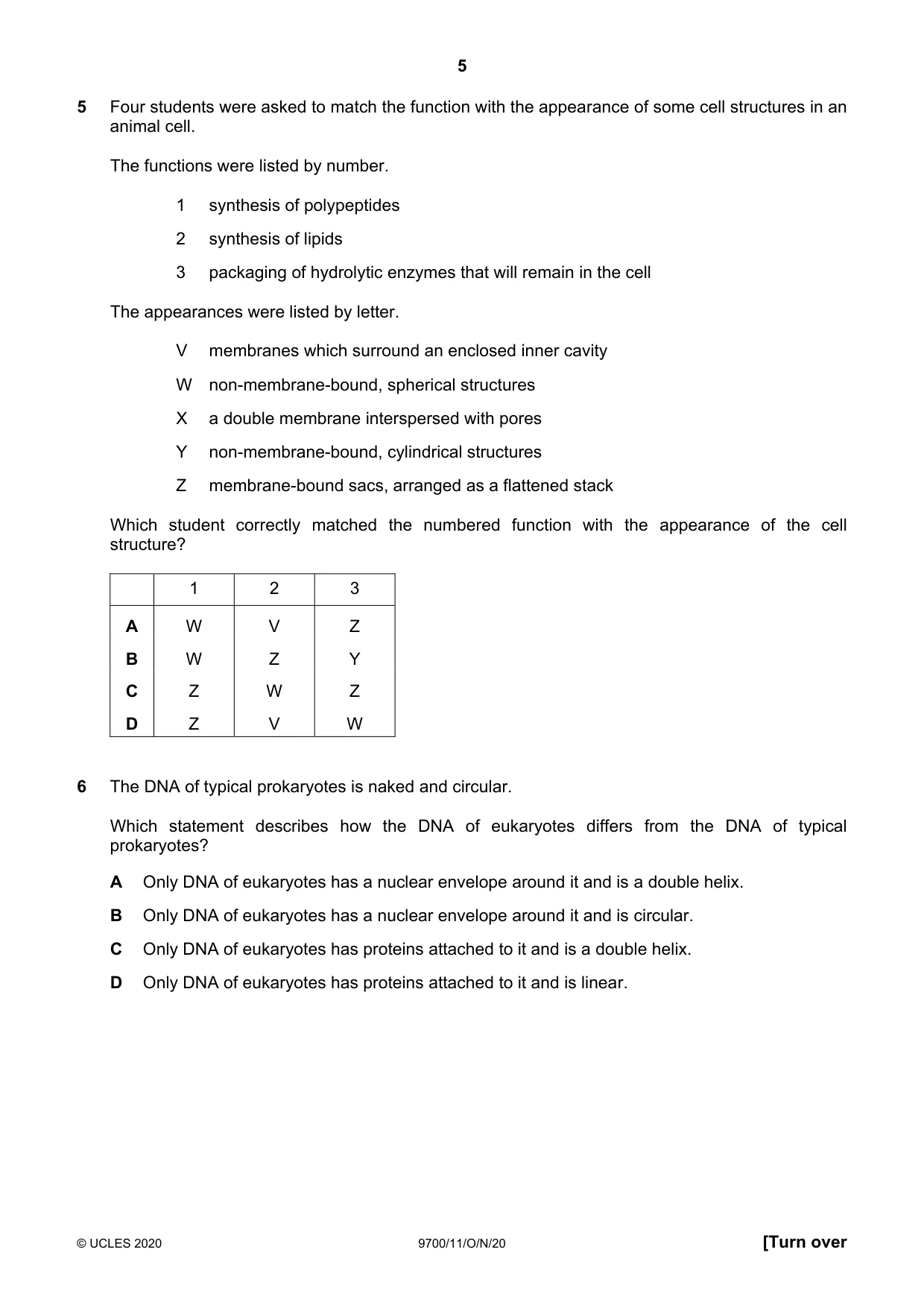
5 Four students were asked to match the function with the appearance of some cell structures in an animal cell. The functions were listed by number. 1 synthesis of polypeptides 2 synthesis of lipids 3 packaging of hydrolytic enzymes that will remain in the cell The appearances were listed by letter. V membranes which surround an enclosed inner cavity W non-membrane-bound, spherical structures X a double membrane interspersed with pores Y non-membrane-bound, cylindrical structures Z membrane-bound sacs, arranged as a flattened stack Which student correctly matched the numbered function with the appearance of the cell structure? 1 2 3 A W V Z B W Z Y C Z W Z D Z V W
Mark scheme: A
More questions on Cells as the basic units of living organisms
Q6 · The DNA of typical prokaryotes is naked and circular
6 The DNA of typical prokaryotes is naked and circular. Which statement describes how the DNA of eukaryotes differs from the DNA of typical prokaryotes? A Only DNA of eukaryotes has a nuclear envelope around it and is a double helix. B Only DNA of eukaryotes has a nuclear envelope around it and is circular. C Only DNA of eukaryotes has proteins attached to it and is a double helix. D Only DNA of eukaryotes has proteins attached to it and is linear.
Mark scheme: D
More questions on Cells as the basic units of living organisms
Q7 · A student carried out the Benedict’s test on two different types of milk, X and Y
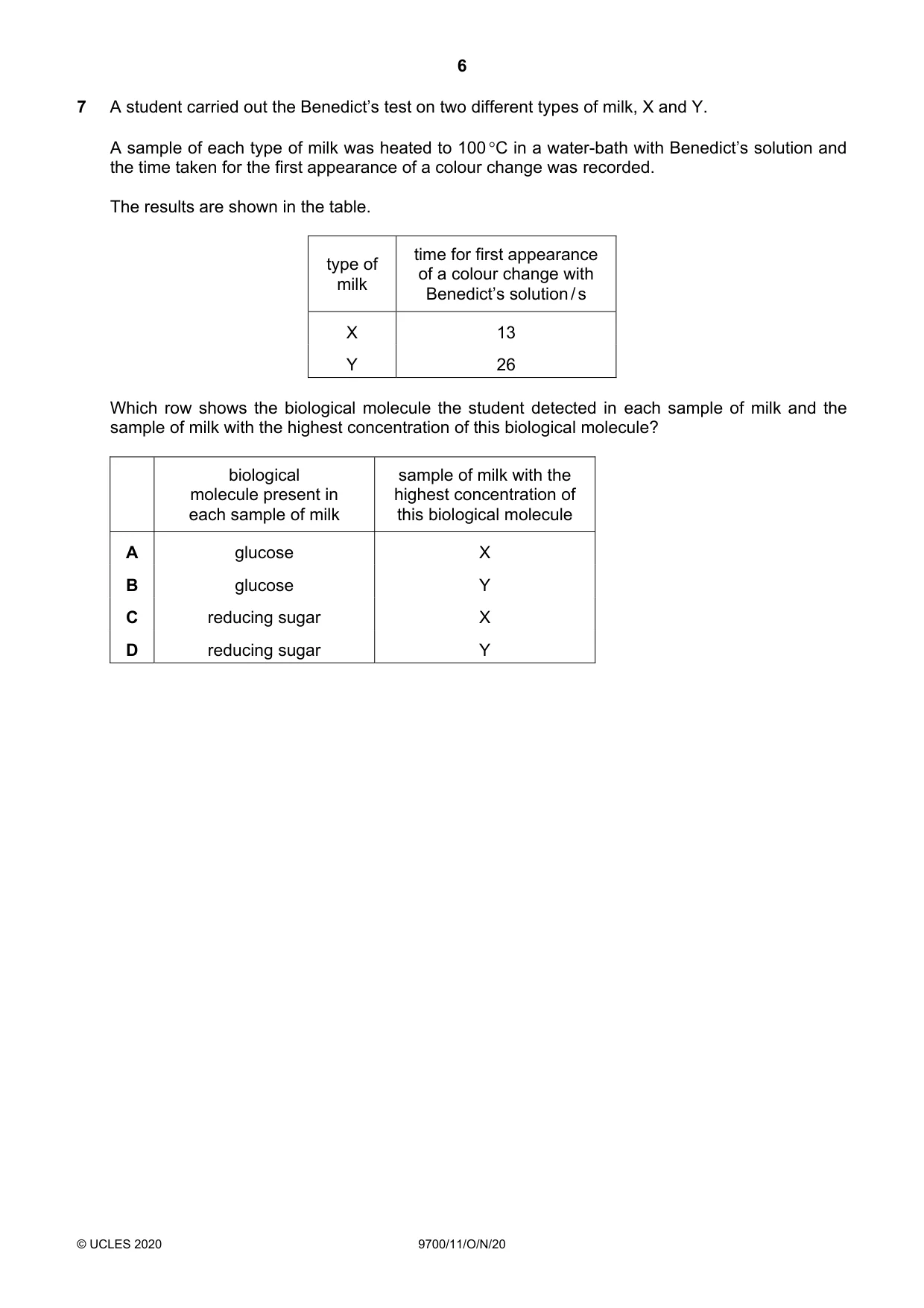
7 A student carried out the Benedict’s test on two different types of milk, X and Y. A sample of each type of milk was heated to 100 C in a water-bath with Benedict’s solution and the time taken for the first appearance of a colour change was recorded. The results are shown in the table. time for first appearance type of of a colour change with milk Benedict’s solution / s X 13 Y 26 Which row shows the biological molecule the student detected in each sample of milk and the sample of milk with the highest concentration of this biological molecule? biological sample of milk with the molecule present in highest concentration of each sample of milk this biological molecule A glucose X B glucose Y C reducing sugar X D reducing sugar Y
Mark scheme: C
Q8 · The diagram shows the structure of a monomer
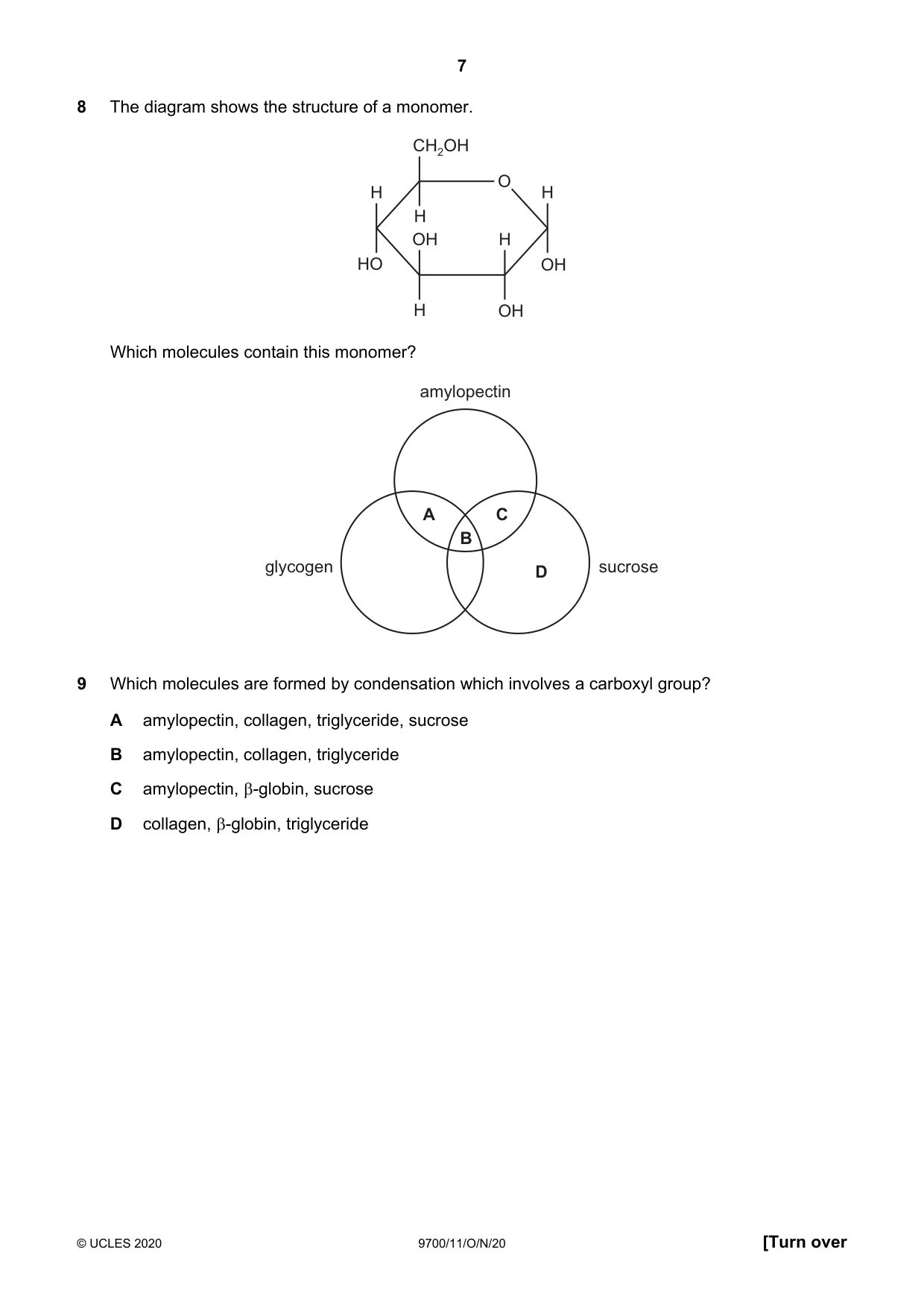
8 The diagram shows the structure of a monomer. CH2OH O H H H OH H HO OH H OH Which molecules contain this monomer? amylopectin A C B glycogen D sucrose
Mark scheme: B
Q9 · Which molecules are formed by condensation which involves a carboxyl group?
9 Which molecules are formed by condensation which involves a carboxyl group? A amylopectin, collagen, triglyceride, sucrose B amylopectin, collagen, triglyceride C amylopectin, -globin, sucrose D collagen, -globin, triglyceride
Mark scheme: D
Q10 · Which row correctly matches the function with the structural features of cellulose…
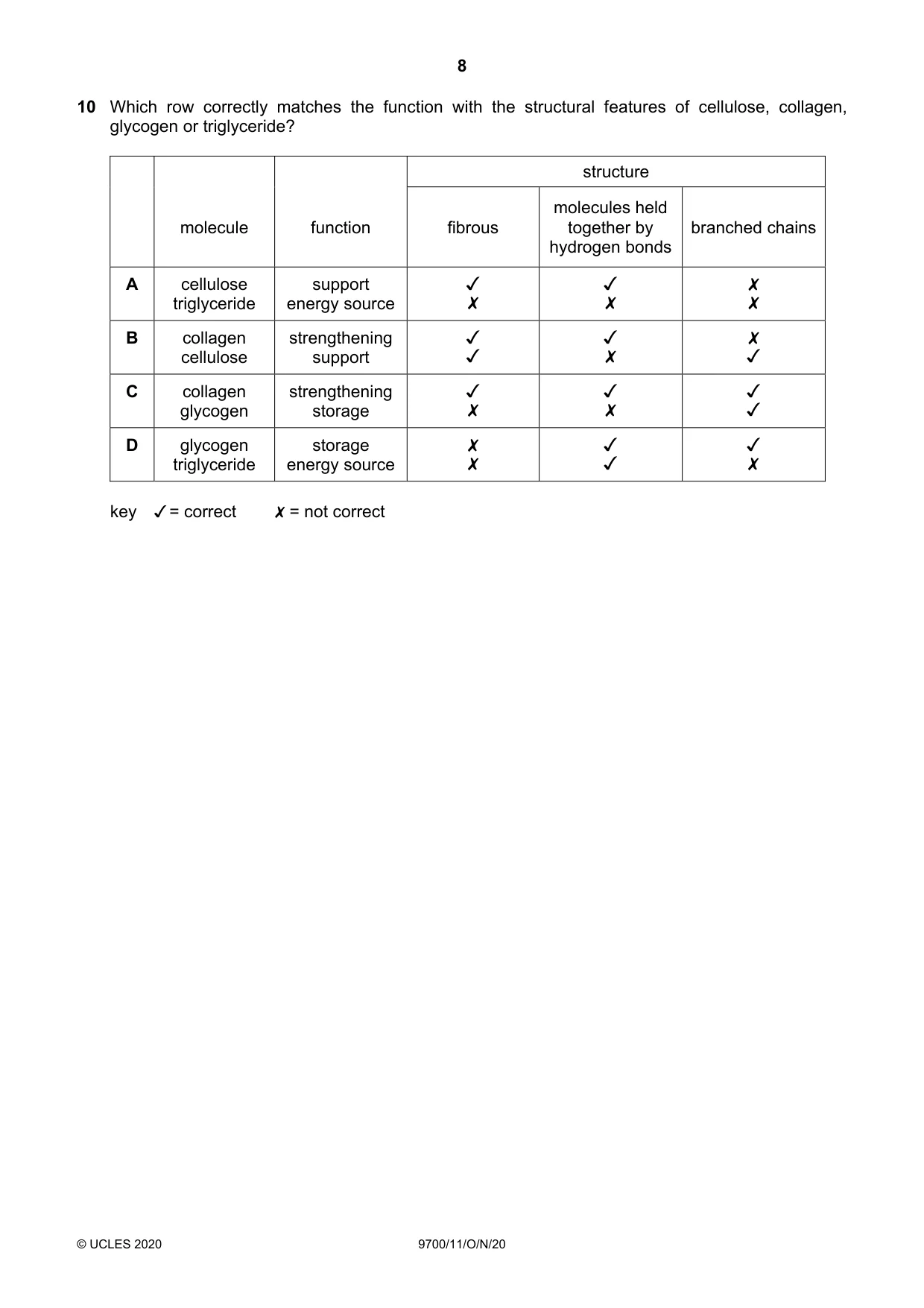
10 Which row correctly matches the function with the structural features of cellulose, collagen, glycogen or triglyceride? structure molecules held molecule function fibrous together by branched chains hydrogen bonds A cellulose support Jv Jv x triglyceride | energy source x x x B collagen strengthening Jv Jv x cellulose support Jv x v Cc collagen strengthening Jv Jv Jv glycogen storage x x Jv D glycogen storage x Jv Jv x Jv x triglyceride energy source key J/=correct X = not correct
Mark scheme: A
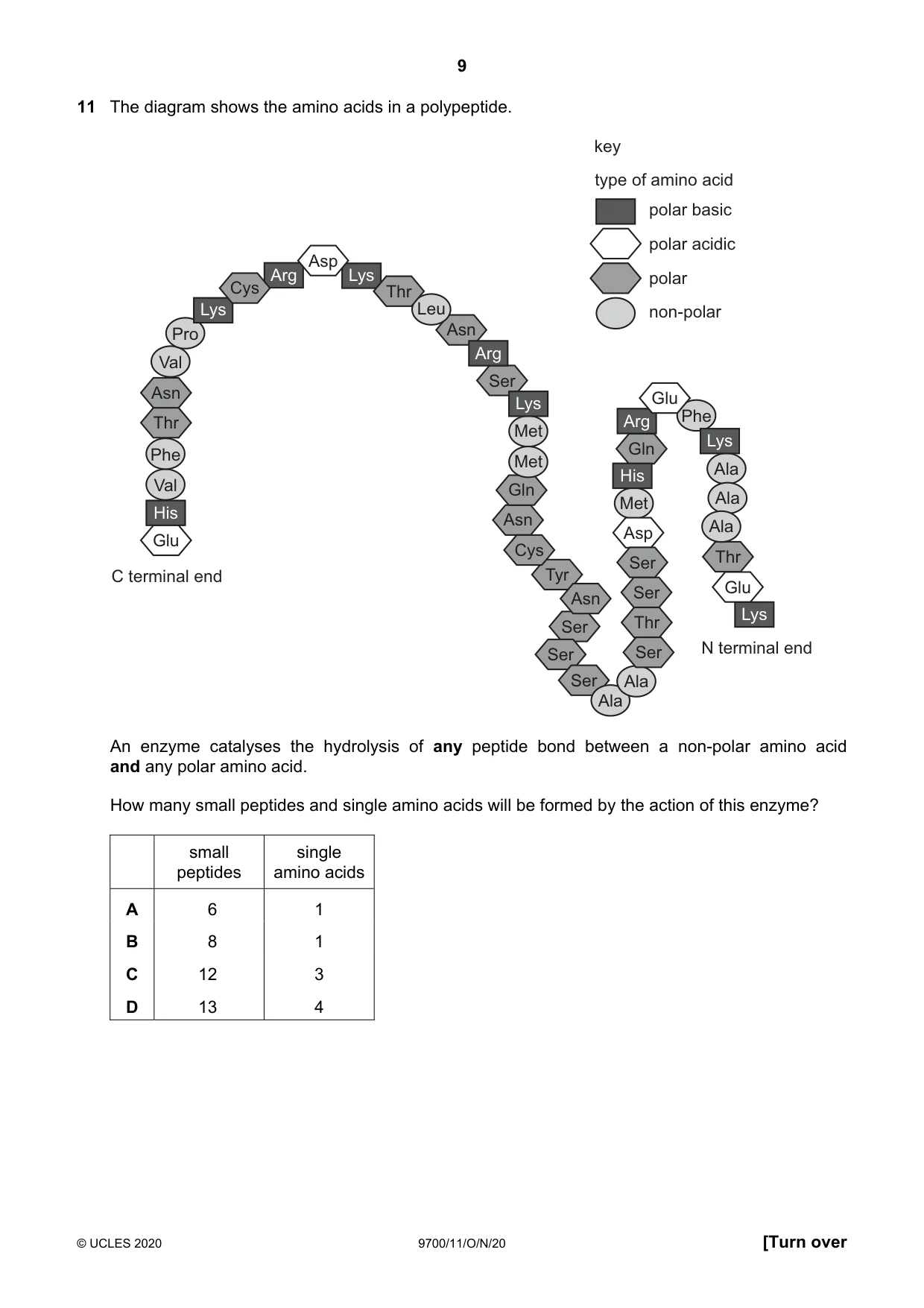
Q11 · The diagram shows the amino acids in a polypeptide
11 The diagram shows the amino acids in a polypeptide. key type of amino acid polar basic polar acidic Asp Arg Lys polar Cys Thr Lys Leu non-polar Pro Asn Arg Val Ser Asn Glu Lys Thr Arg Phe Met Lys Phe Gln Met Ala His Val Gln Met Ala His Asn Asp Ala Glu Cys Thr Ser C terminal end Tyr Ser Glu Asn Lys Ser Thr Ser Ser N terminal end Ser Ala Ala An enzyme catalyses the hydrolysis of any peptide bond between a non-polar amino acid and any polar amino acid. How many small peptides and single amino acids will be formed by the action of this enzyme? small single peptides amino acids A 6 1 B 8 1 C 12 3 D 13 4
Mark scheme: D
Q12 · Which properties of water reduce temperature changes inside cells?
12 Which properties of water reduce temperature changes inside cells? 1 cohesion 2 latent heat of vaporisation 3 specific heat capacity A 1 and 2 B 1 and 3 C 2 and 3 D 3 only
Mark scheme: D
Q13 · Which enzyme is extracellular?
13 Which enzyme is extracellular? A Amylase in saliva is an enzyme that catalyses the breakdown of starch in the mouth. B ATP synthetase is an enzyme found in mitochondria that synthesises ATP. C DNA polymerase is an enzyme that helps build DNA molecules by assembling nucleotides. D RNA polymerase is an enzyme involved in the process of gene transcription.
Mark scheme: A
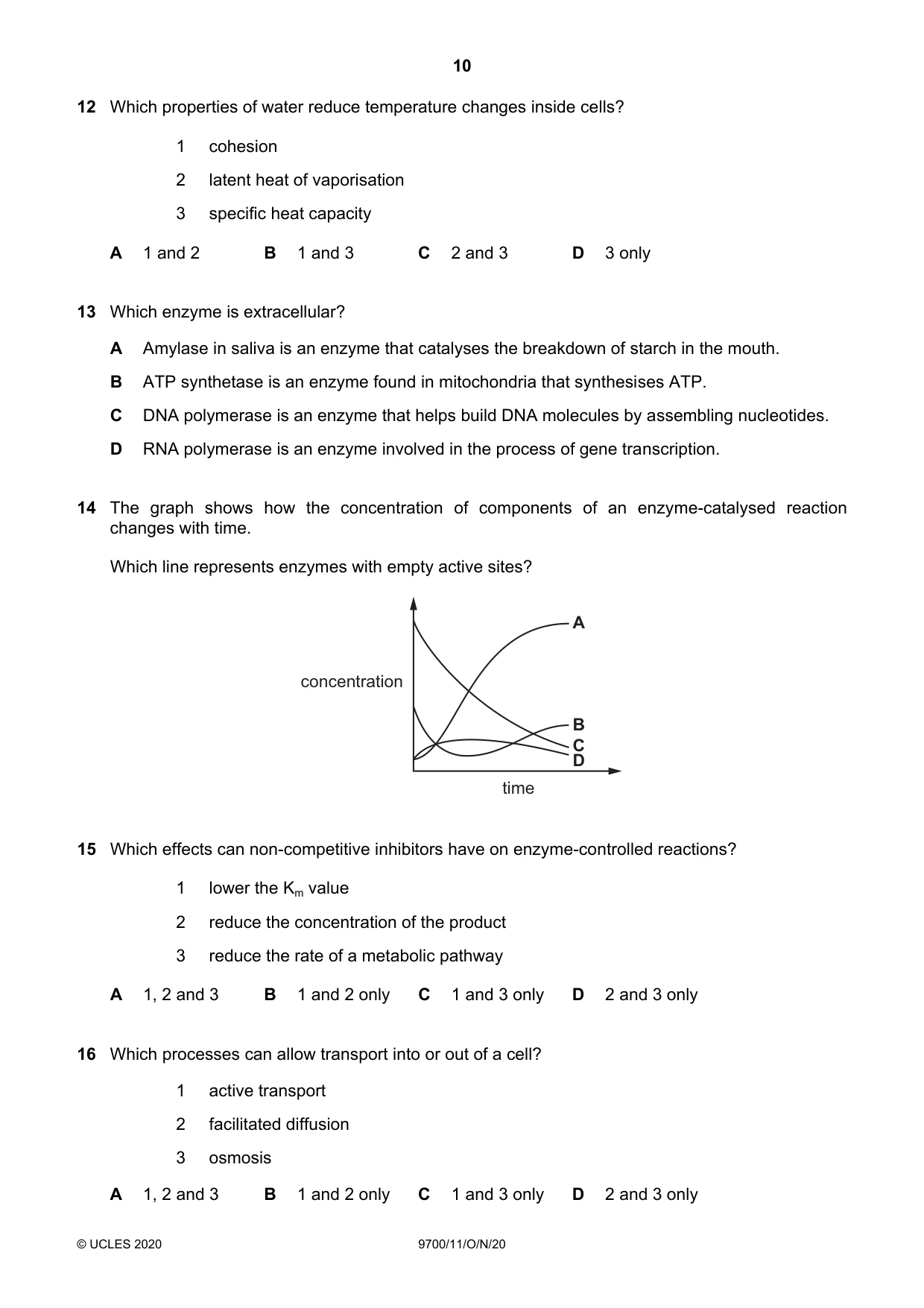
Q14 · The graph shows how the concentration of components of an enzyme-catalysed reaction…
14 The graph shows how the concentration of components of an enzyme-catalysed reaction changes with time. Which line represents enzymes with empty active sites? A concentration B C D time
Mark scheme: B
Q15 · Which effects can non-competitive inhibitors have on enzyme-controlled reactions?
15 Which effects can non-competitive inhibitors have on enzyme-controlled reactions? 1 lower the Km value 2 reduce the concentration of the product 3 reduce the rate of a metabolic pathway A 1, 2 and 3 B 1 and 2 only C 1 and 3 only D 2 and 3 only
Mark scheme: D
Q16 · Which processes can allow transport into or out of a cell?
16 Which processes can allow transport into or out of a cell? 1 active transport 2 facilitated diffusion 3 osmosis A 1, 2 and 3 B 1 and 2 only C 1 and 3 only D 2 and 3 only
Mark scheme: A
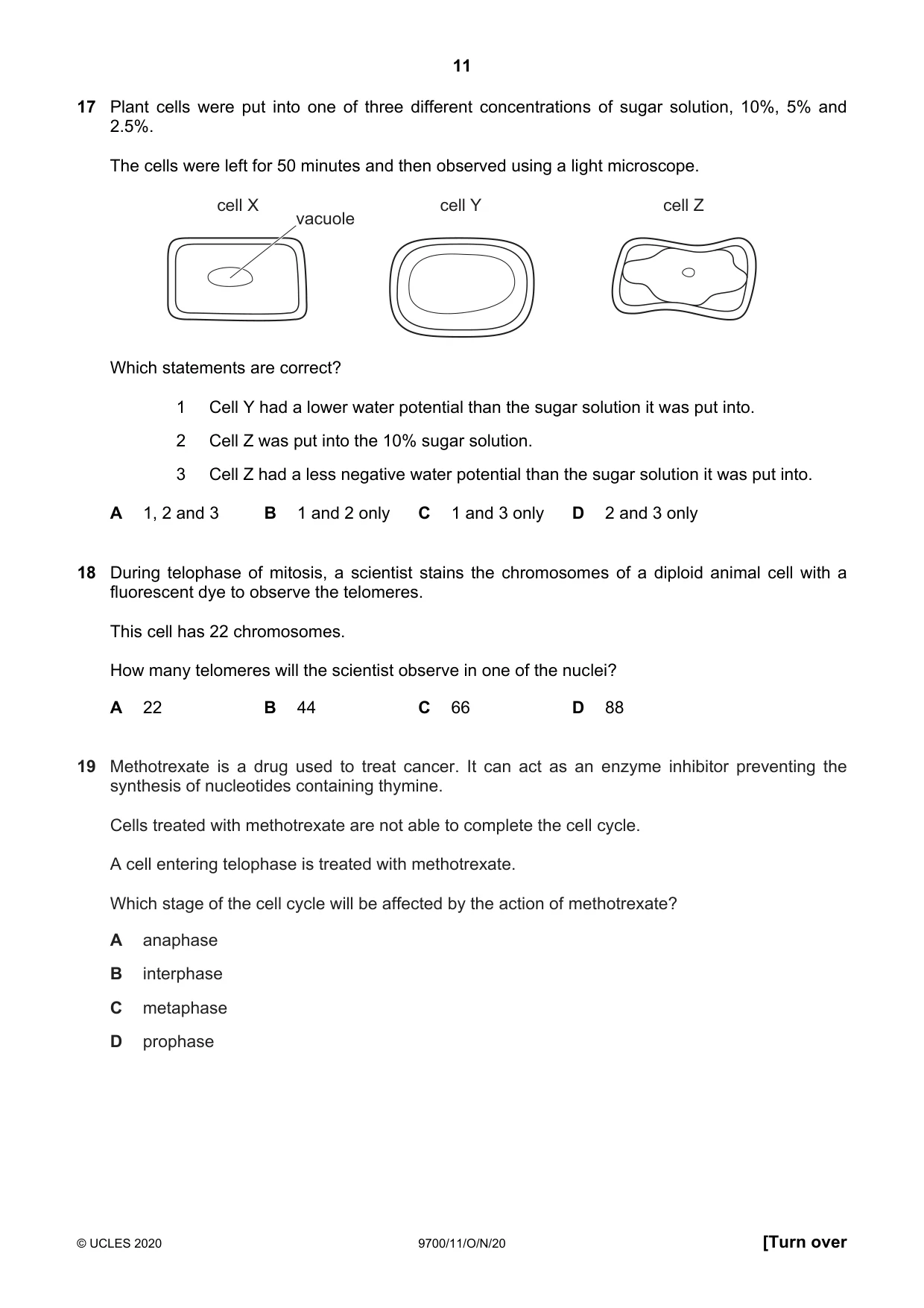
Q17 · Plant cells were put into one of three different concentrations of sugar solution, 10%…
17 Plant cells were put into one of three different concentrations of sugar solution, 10%, 5% and 2.5%. The cells were left for 50 minutes and then observed using a light microscope. cell X cell Y cell Z vacuole Which statements are correct? 1 Cell Y had a lower water potential than the sugar solution it was put into. 2 Cell Z was put into the 10% sugar solution. 3 Cell Z had a less negative water potential than the sugar solution it was put into. A 1, 2 and 3 B 1 and 2 only C 1 and 3 only D 2 and 3 only
Mark scheme: A
Q18 · During telophase of mitosis, a scientist stains the chromosomes of a diploid animal cell…
18 During telophase of mitosis, a scientist stains the chromosomes of a diploid animal cell with a fluorescent dye to observe the telomeres. This cell has 22 chromosomes. How many telomeres will the scientist observe in one of the nuclei? A 22 B 44 C 66 D 88
Mark scheme: B
Q19 · Methotrexate is a drug used to treat cancer
19 Methotrexate is a drug used to treat cancer. It can act as an enzyme inhibitor preventing the synthesis of nucleotides containing thymine. Cells treated with methotrexate are not able to complete the cell cycle. A cell entering telophase is treated with methotrexate. Which stage of the cell cycle will be affected by the action of methotrexate? A anaphase B interphase C metaphase D prophase
Mark scheme: B
More questions on Replication and division of nuclei and cells
Q20 · Which stage of mitosis is correctly described?
20 Which stage of mitosis is correctly described? A In anaphase chromosomes line up across the equator. B In metaphase the centrosomes replicate. C In prophase chromatids move to opposite poles. D In telophase chromosomes uncoil to form chromatin.
Mark scheme: D
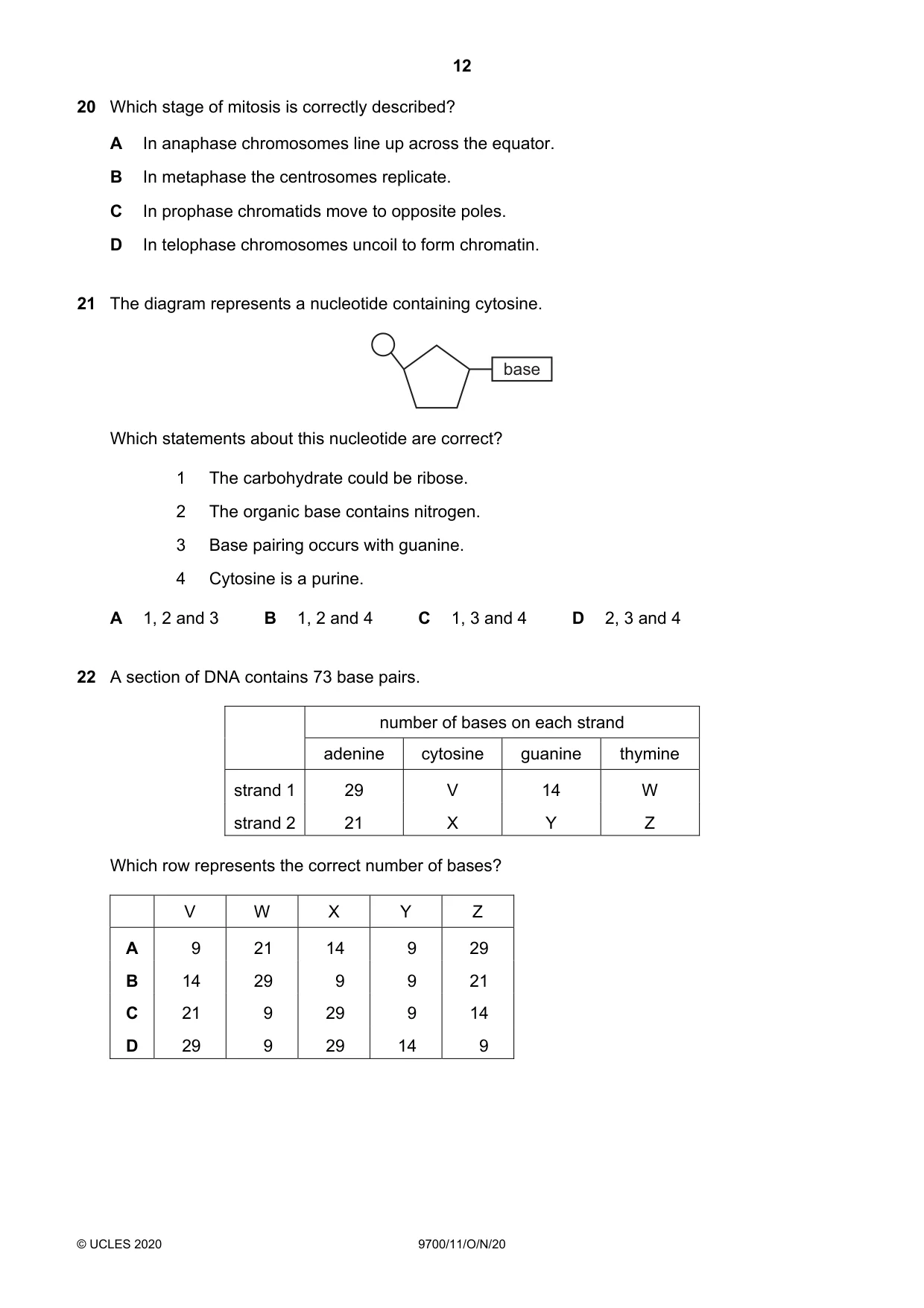
Q21 · The diagram represents a nucleotide containing cytosine
21 The diagram represents a nucleotide containing cytosine. base Which statements about this nucleotide are correct? 1 The carbohydrate could be ribose. 2 The organic base contains nitrogen. 3 Base pairing occurs with guanine. 4 Cytosine is a purine. A 1, 2 and 3 B 1, 2 and 4 C 1, 3 and 4 D 2, 3 and 4
Mark scheme: A
More questions on Structure of nucleic acids and replication of DNA
Q22 · A section of DNA contains 73 base pairs
22 A section of DNA contains 73 base pairs. number of bases on each strand adenine cytosine guanine thymine strand 1 29 V 14 W strand 2 21 X Y Z Which row represents the correct number of bases? V W X Y Z A 9 21 14 9 29 B 14 29 9 9 21 C 21 9 29 9 14 D 29 9 29 14 9
Mark scheme: A
More questions on Structure of nucleic acids and replication of DNA
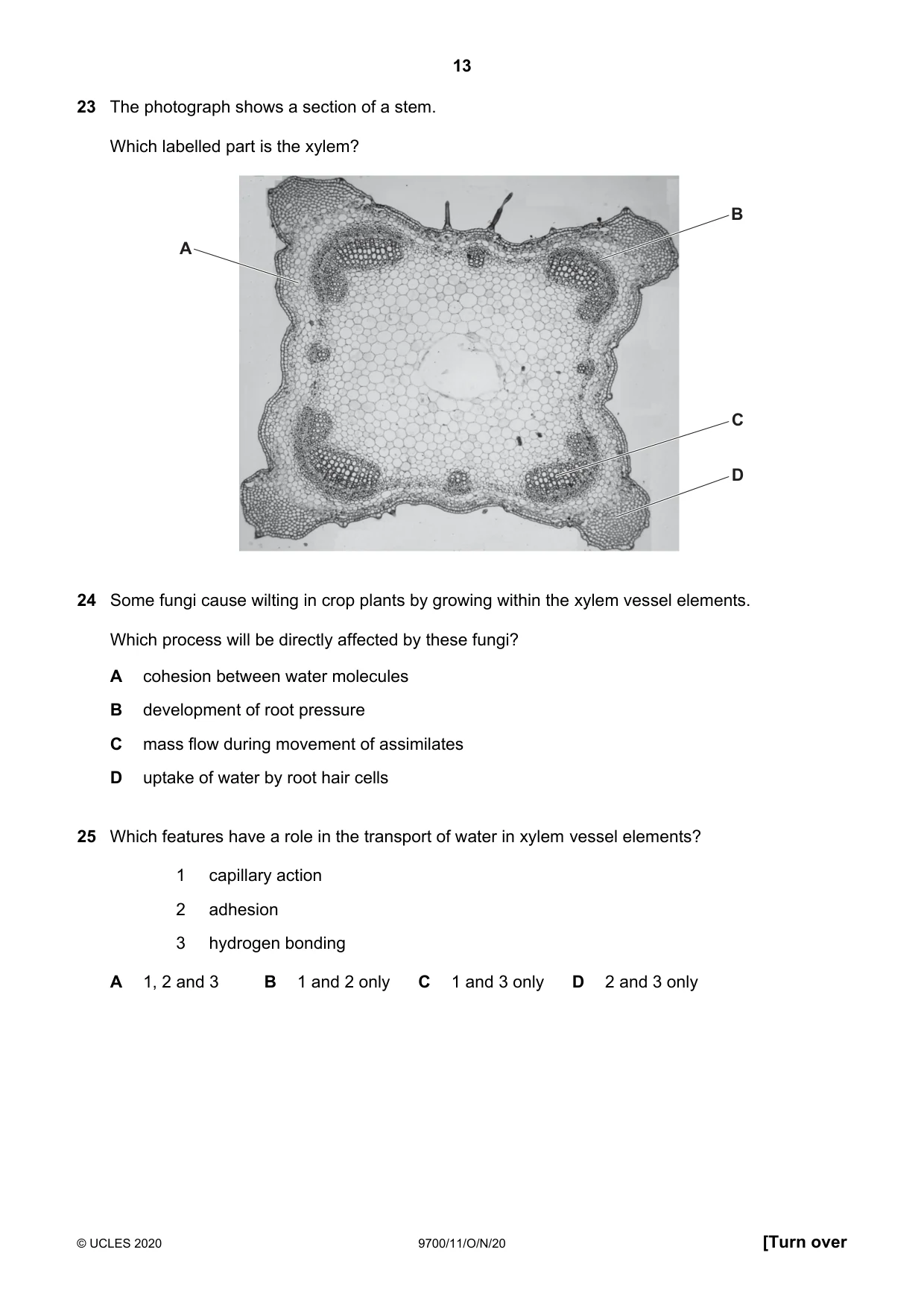
Q23 · The photograph shows a section of a stem
23 The photograph shows a section of a stem. Which labelled part is the xylem? B A C D
Mark scheme: C
Q24 · Some fungi cause wilting in crop plants by growing within the xylem vessel elements
24 Some fungi cause wilting in crop plants by growing within the xylem vessel elements. Which process will be directly affected by these fungi? A cohesion between water molecules B development of root pressure C mass flow during movement of assimilates D uptake of water by root hair cells
Mark scheme: A
Q25 · Which features have a role in the transport of water in xylem vessel elements?
25 Which features have a role in the transport of water in xylem vessel elements? 1 capillary action 2 adhesion 3 hydrogen bonding A 1, 2 and 3 B 1 and 2 only C 1 and 3 only D 2 and 3 only
Mark scheme: A
Q26 · The loading of sucrose into companion cells involves a number of processes
26 The loading of sucrose into companion cells involves a number of processes. Which process is active? A the movement of hydrogen ions into the cytoplasm of companion cells B the movement of hydrogen ions out of the cytoplasm of companion cells C the movement of sucrose into companion cells D the movement of sucrose out of companion cells
Mark scheme: B
Q27 · The statements describe events that occur during the movement of sucrose
27 The statements describe events that occur during the movement of sucrose. 1 Hydrostatic pressure is decreased. 2 Hydrostatic pressure is increased. 3 Sucrose is loaded into the phloem vessel. 4 Sucrose is unloaded from the phloem vessel. 5 Water moves by osmosis into the phloem. 6 Water moves by osmosis out of the phloem. 7 Water potential decreases in the phloem. 8 Water potential increases in the phloem. Which sequence correctly describes what happens in a plant at a source during the movement of sucrose? A 3 7 5 2 B 3 8 6 1 C 4 7 5 2 D 4 8 6 1
Mark scheme: A
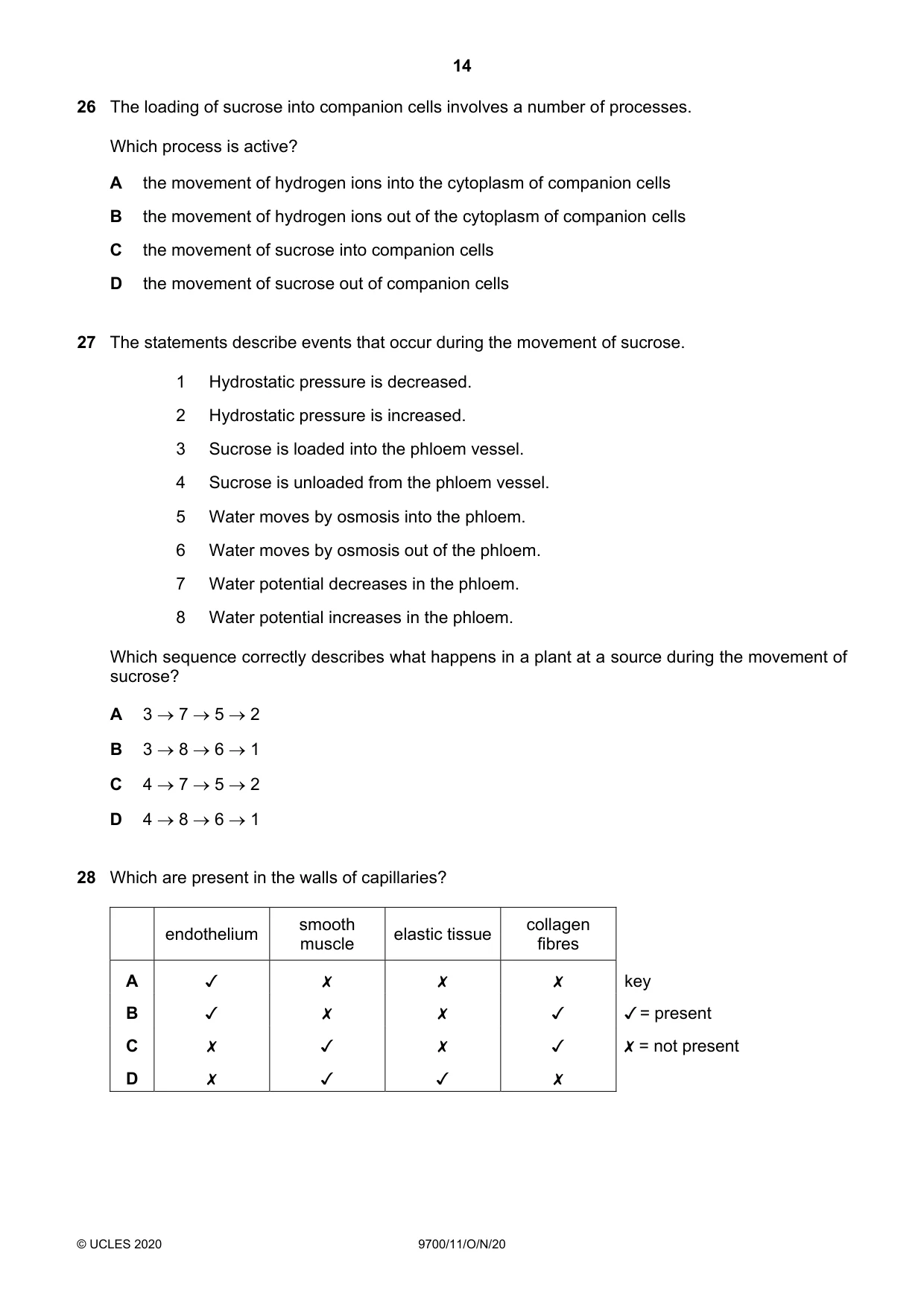
Q28 · Which are present in the walls of capillaries?
28 Which are present in the walls of capillaries? 0 0O WwW D> endothelium ~ «QOS smooth muscle \ \ x elastic tissue \ « & x collagen fibres x \ \ x key / = present X = not present
Mark scheme: A
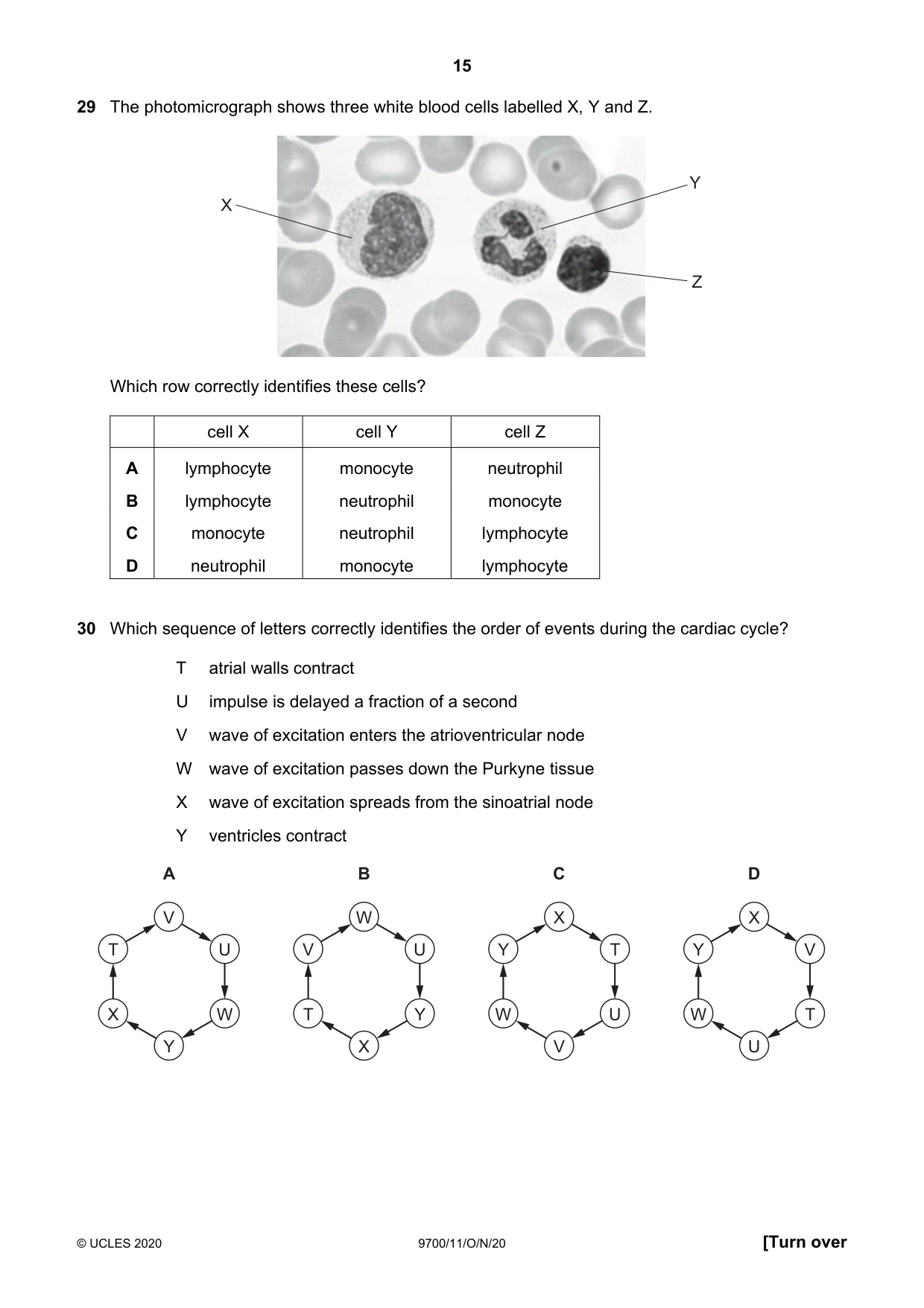
Q29 · The photomicrograph shows three white blood cells labelled X, Y and Z
29 The photomicrograph shows three white blood cells labelled X, Y and Z. Y X Z Which row correctly identifies these cells? cell X cell Y cell Z A lymphocyte monocyte neutrophil B lymphocyte neutrophil monocyte C monocyte neutrophil lymphocyte D neutrophil monocyte lymphocyte
Mark scheme: C
Q30 · Which sequence of letters correctly identifies the order of events during the cardiac…
30 Which sequence of letters correctly identifies the order of events during the cardiac cycle? T atrial walls contract U impulse is delayed a fraction of a second V wave of excitation enters the atrioventricular node W wave of excitation passes down the Purkyne tissue X wave of excitation spreads from the sinoatrial node Y ventricles contract A B C D V W X X T U V U Y T Y V X W T Y W U W T Y X V U
Mark scheme: A
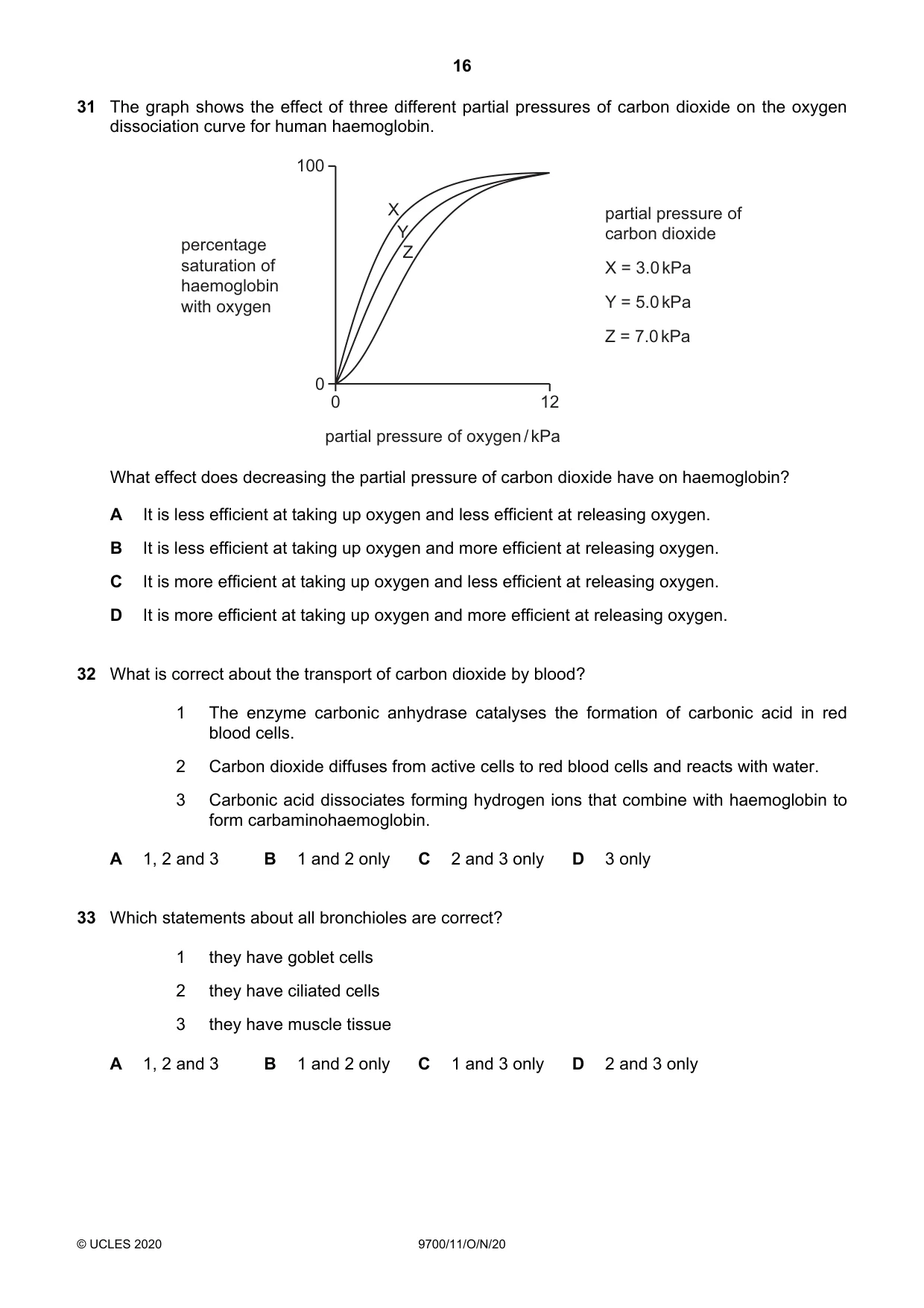
Q31 · The graph shows the effect of three different partial pressures of carbon dioxide on the…
31 The graph shows the effect of three different partial pressures of carbon dioxide on the oxygen dissociation curve for human haemoglobin. 100 X partial pressure of Y carbon dioxide percentage Z saturation of X = 3.0 kPa haemoglobin with oxygen Y = 5.0 kPa Z = 7.0 kPa 0 0 12 partial pressure of oxygen / kPa What effect does decreasing the partial pressure of carbon dioxide have on haemoglobin? A It is less efficient at taking up oxygen and less efficient at releasing oxygen. B It is less efficient at taking up oxygen and more efficient at releasing oxygen. C It is more efficient at taking up oxygen and less efficient at releasing oxygen. D It is more efficient at taking up oxygen and more efficient at releasing oxygen.
Mark scheme: C
Q32 · What is correct about the transport of carbon dioxide by blood?
32 What is correct about the transport of carbon dioxide by blood? 1 The enzyme carbonic anhydrase catalyses the formation of carbonic acid in red blood cells. 2 Carbon dioxide diffuses from active cells to red blood cells and reacts with water. 3 Carbonic acid dissociates forming hydrogen ions that combine with haemoglobin to form carbaminohaemoglobin. A 1, 2 and 3 B 1 and 2 only C 2 and 3 only D 3 only
Mark scheme: B
Q33 · Which statements about all bronchioles are correct?
33 Which statements about all bronchioles are correct? 1 they have goblet cells 2 they have ciliated cells 3 they have muscle tissue A 1, 2 and 3 B 1 and 2 only C 1 and 3 only D 2 and 3 only
Mark scheme: D
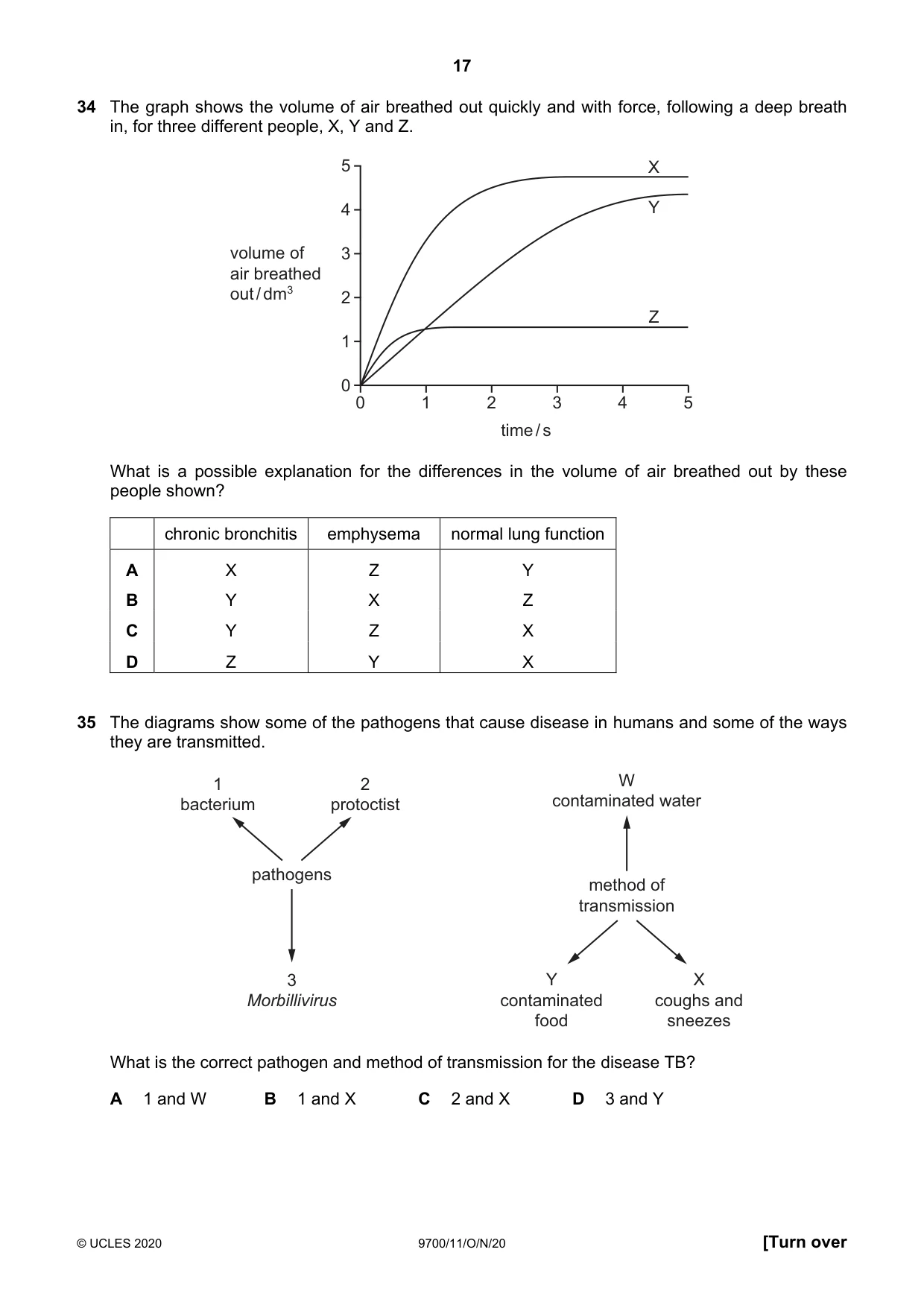
Q34 · The graph shows the volume of air breathed out quickly and with force, following a deep…
34 The graph shows the volume of air breathed out quickly and with force, following a deep breath in, for three different people, X, Y and Z. 5 X 4 Y volume of 3 air breathed out / dm3 2 Z 1 0 0 1 2 3 4 5 time / s What is a possible explanation for the differences in the volume of air breathed out by these people shown? chronic bronchitis emphysema normal lung function A X Z Y B Y X Z C Y Z X D Z Y X
Mark scheme: C
Q35 · The diagrams show some of the pathogens that cause disease in humans and some of the ways…
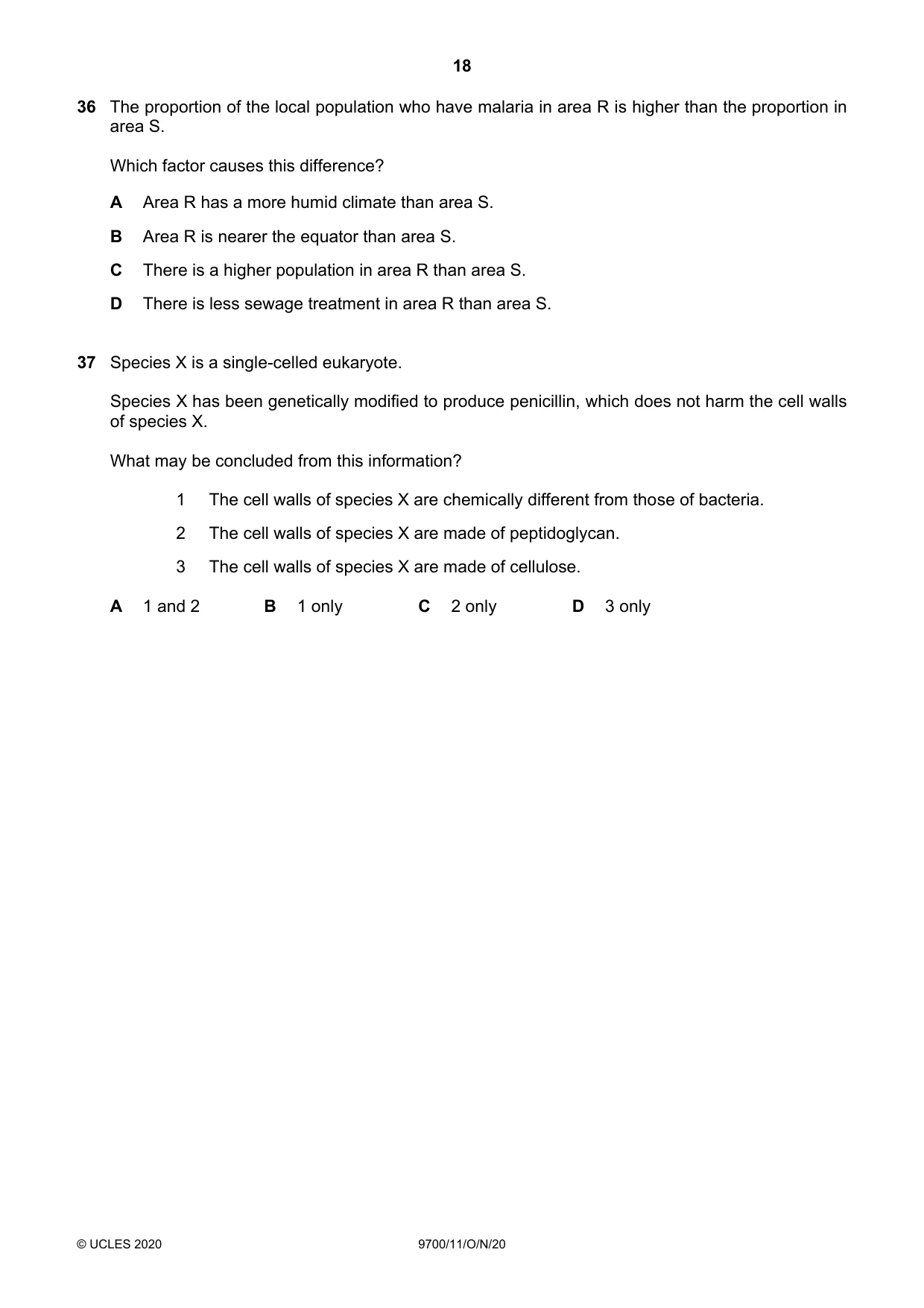
35 The diagrams show some of the pathogens that cause disease in humans and some of the ways they are transmitted. 1 2 W bacterium protoctist contaminated water pathogens method of transmission 3 Y X Morbillivirus contaminated coughs and food sneezes What is the correct pathogen and method of transmission for the disease TB? A 1 and W B 1 and X C 2 and X D 3 and Y
Mark scheme: B
Q36 · The proportion of the local population who have malaria in area R is higher than the…
36 The proportion of the local population who have malaria in area R is higher than the proportion in area S. Which factor causes this difference? A Area R has a more humid climate than area S. B Area R is nearer the equator than area S. C There is a higher population in area R than area S. D There is less sewage treatment in area R than area S.
Mark scheme: A
Q37 · Species X is a single-celled eukaryote
37 Species X is a single-celled eukaryote. Species X has been genetically modified to produce penicillin, which does not harm the cell walls of species X. What may be concluded from this information? 1 The cell walls of species X are chemically different from those of bacteria. 2 The cell walls of species X are made of peptidoglycan. 3 The cell walls of species X are made of cellulose. A 1 and 2 B 1 only C 2 only D 3 only
Mark scheme: B
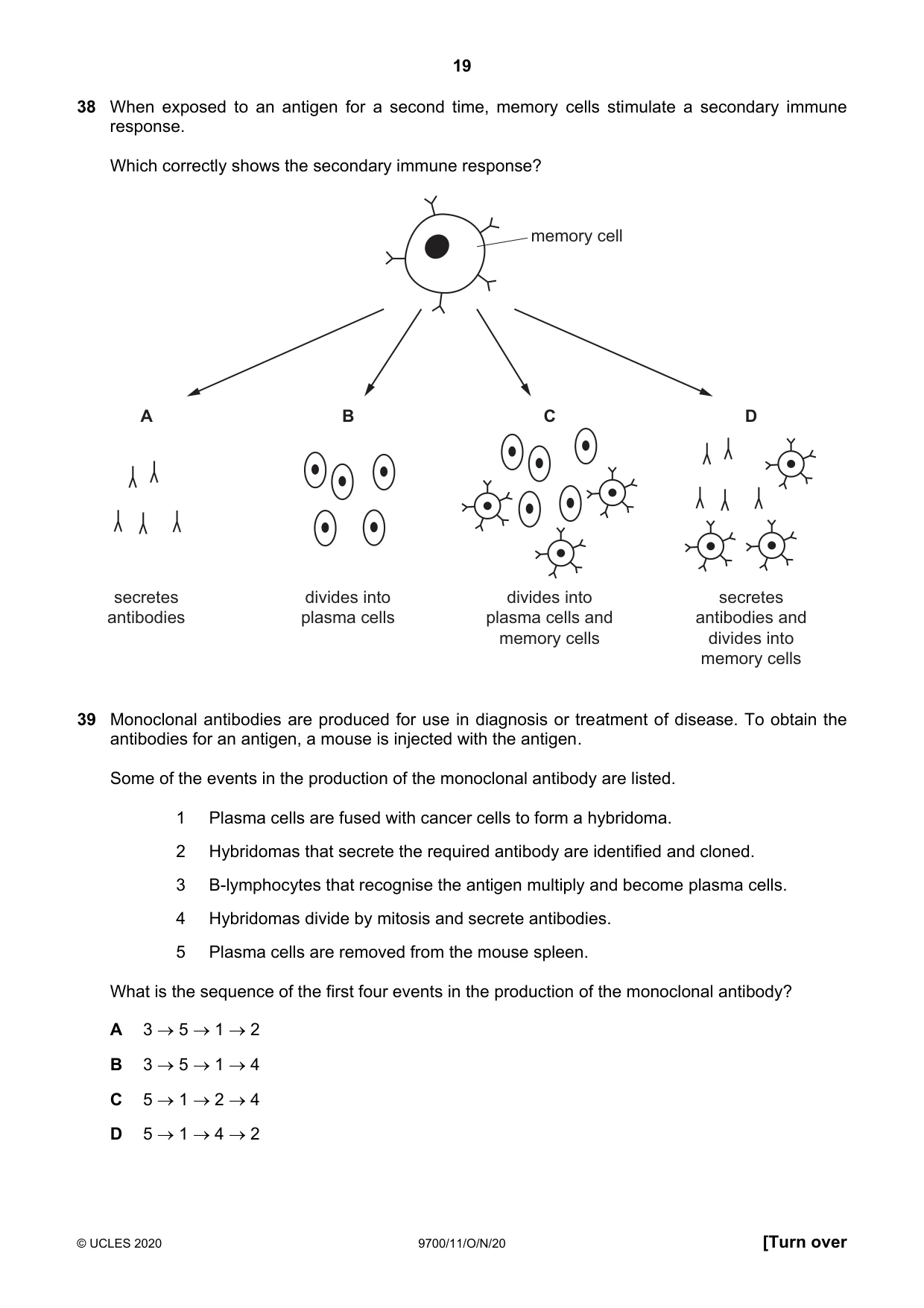
Q38 · When exposed to an antigen for a second time, memory cells stimulate a secondary immune…
38 When exposed to an antigen for a second time, memory cells stimulate a secondary immune response. Which correctly shows the secondary immune response? memory cell A B C D secretes divides into divides into secretes antibodies plasma cells plasma cells and antibodies and memory cells divides into memory cells
Mark scheme: C
Q39 · Monoclonal antibodies are produced for use in diagnosis or treatment of disease
39 Monoclonal antibodies are produced for use in diagnosis or treatment of disease. To obtain the antibodies for an antigen, a mouse is injected with the antigen. Some of the events in the production of the monoclonal antibody are listed. 1 Plasma cells are fused with cancer cells to form a hybridoma. 2 Hybridomas that secrete the required antibody are identified and cloned. 3 B-lymphocytes that recognise the antigen multiply and become plasma cells. 4 Hybridomas divide by mitosis and secrete antibodies. 5 Plasma cells are removed from the mouse spleen. What is the sequence of the first four events in the production of the monoclonal antibody? A 3 5 1 2 B 3 5 1 4 C 5 1 2 4 D 5 1 4 2
Mark scheme: B
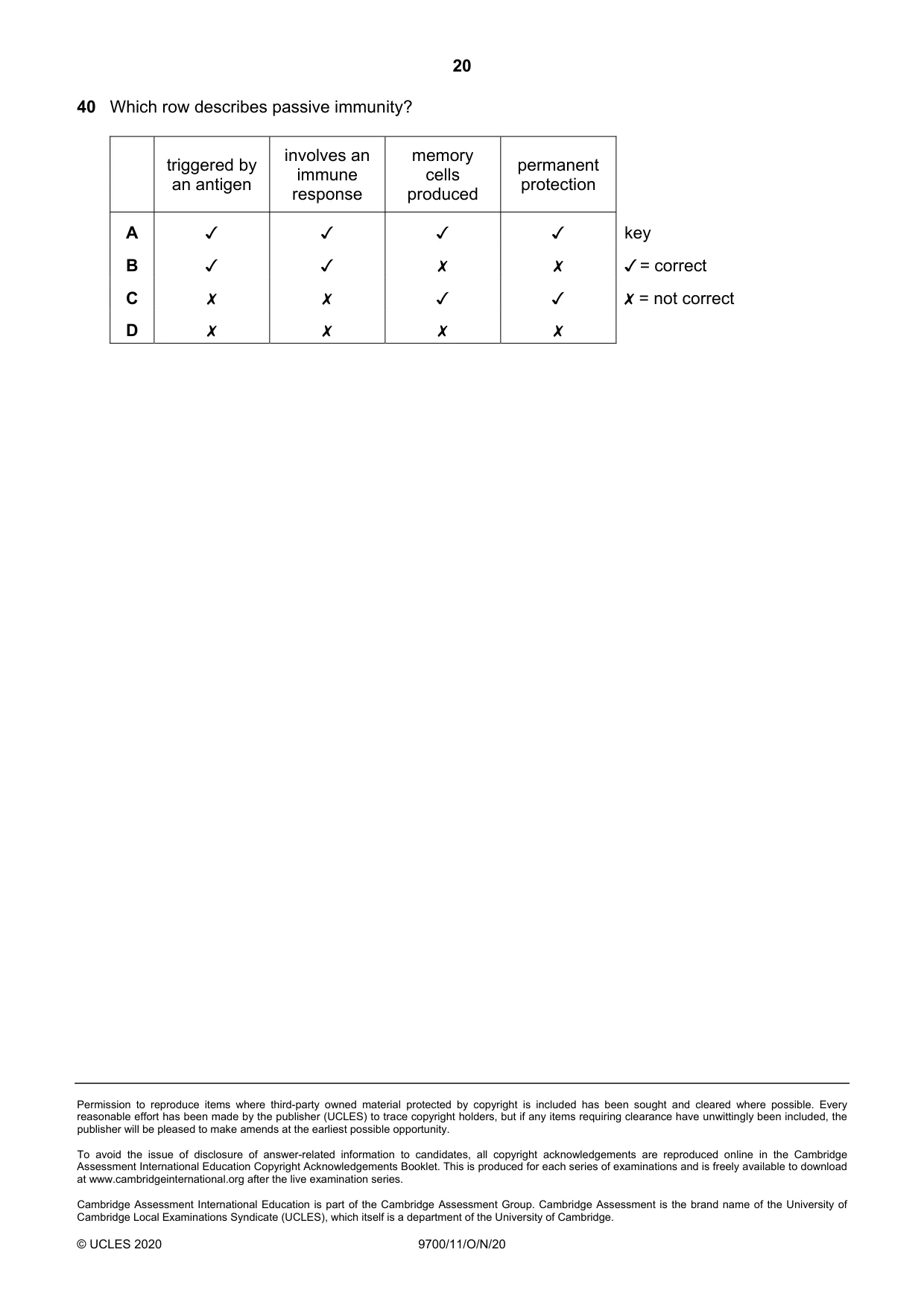
Q40 · Which row describes passive immunity?
40 Which row describes passive immunity? involves an memory triggered by permanent : immune cells ; an antigen protection response produced A v v v v B v v x Xx Cc x x v v D x x x Xx key Y = correct X = not correct
Mark scheme: D
What was in this paper
The subtopics covered by these 40 questions, and how many questions each got. Open one in a new tab to see every Cambridge question on it.
5Transport mechanisms4Antibodies and vaccination2Carbohydrates and lipids2Chromosome behaviour in mitosis2Infectious diseases2Mode of action of enzymes2Movement into and out of cells2Proteins2Structure of nucleic acids and replication of DNA2The circulatory system2The gas exchange system2Transport of oxygen and carbon dioxide2Antibiotics1Factors that affect enzyme action1Replication and division of nuclei and cells1Structure of transport tissues1Testing for biological molecules1The heart1The immune system1The microscope in cell studies1Water1What you needed in this session
Cambridge’s own grade thresholds for 2020 Oct/Nov, Paper 1 · Variant 1. A higher threshold means an easier paper — the bar moves with how the cohort did.