Cambridge A Level Biology 9700 — 2015 Oct/Nov Paper 1 · Variant 1
9700/11/O/N/15 · 40 questions · 40 marks · ≈45 min
The question paper and its mark scheme, free to read here and free to download. This is Cambridge’s own paper, exactly as it was sat.
Question paper16 pages
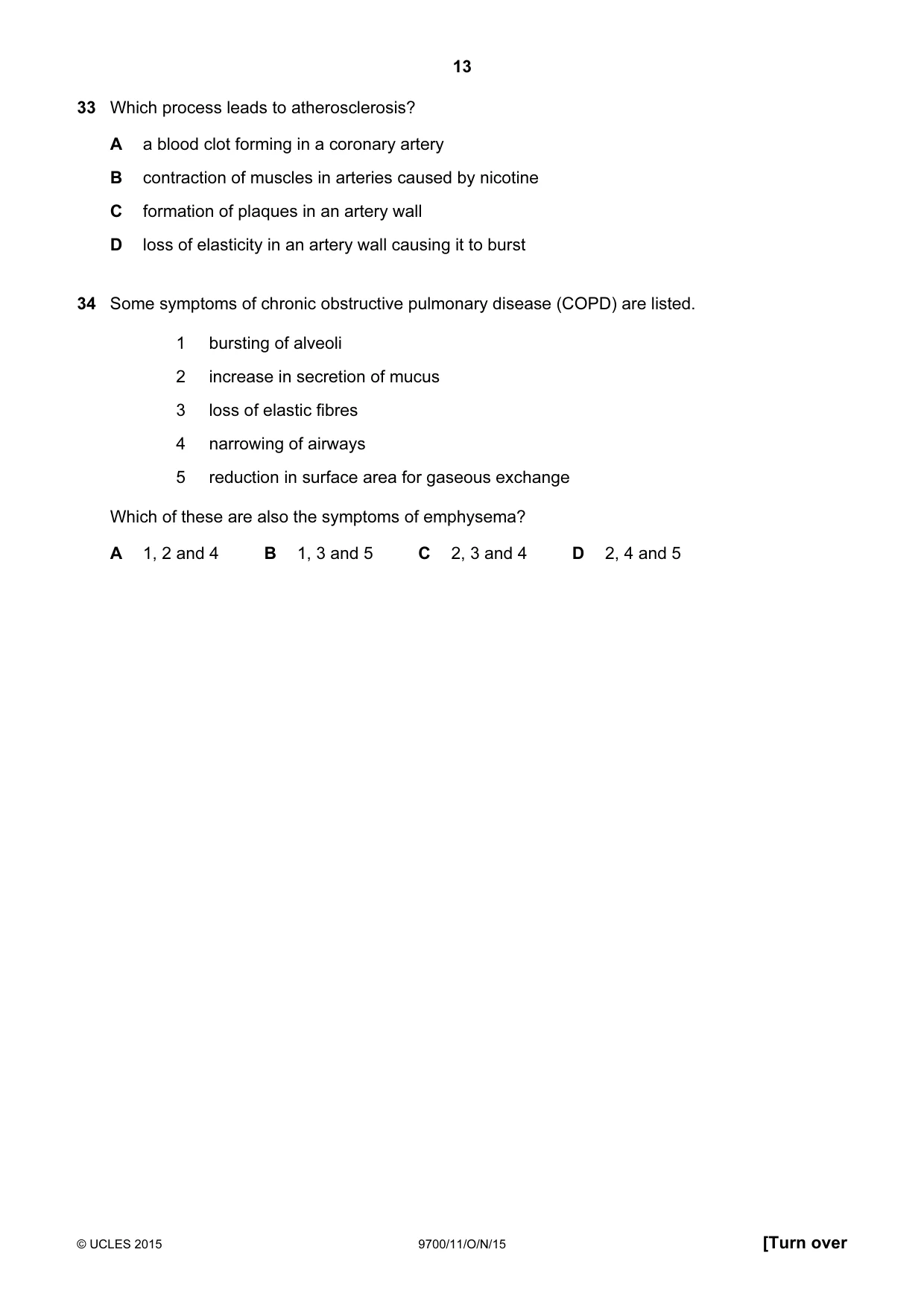
Mark scheme2 pages
Answers below. Sit the paper first if you are practising.
Questions as text
Q1 · Which size of ribosome is found in chloroplasts and typical prokaryotic cells?
1 Which size of ribosome is found in chloroplasts and typical prokaryotic cells? A 60S B 70S C 80S D 90S
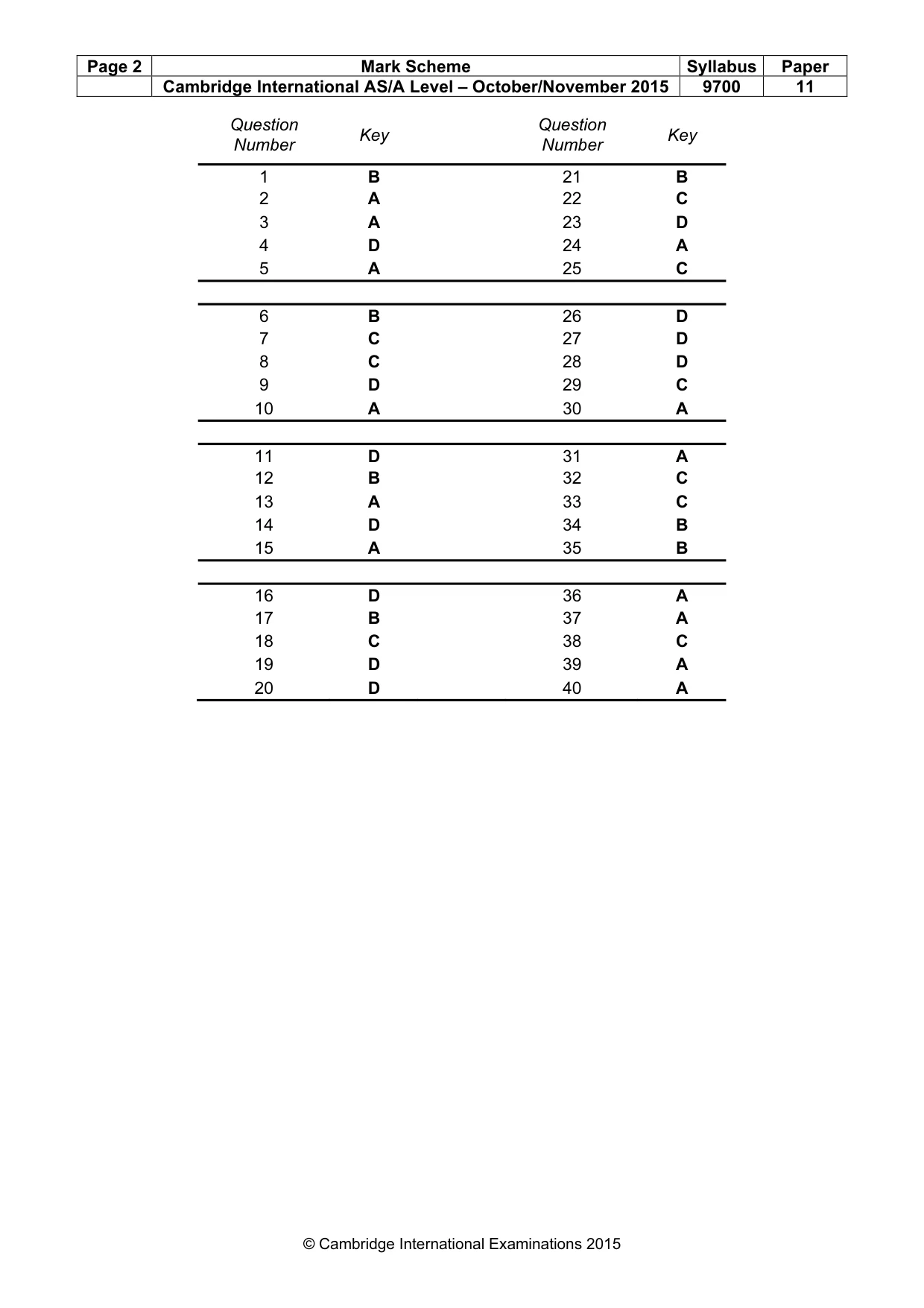
Mark scheme: B
More questions on Cells as the basic units of living organisms
Q2 · Pancreatic cells have a diameter of 35 µm
2 Pancreatic cells have a diameter of 35 µm. Red blood cells have a diameter of 7000 nm. Which statement is correct? A Pancreatic cells are 5 times larger than red blood cells. B Pancreatic cells are 50 times larger than red blood cells. C Pancreatic cells are 5 times smaller than red blood cells. D Pancreatic cells are 50 times smaller than red blood cells.
Mark scheme: A
More questions on Cells as the basic units of living organisms
Q3 · Which process occurs in a mature red blood cell?
3 Which process occurs in a mature red blood cell? A active transport B cell division C transcription D translation
Mark scheme: A
More questions on Cells as the basic units of living organisms
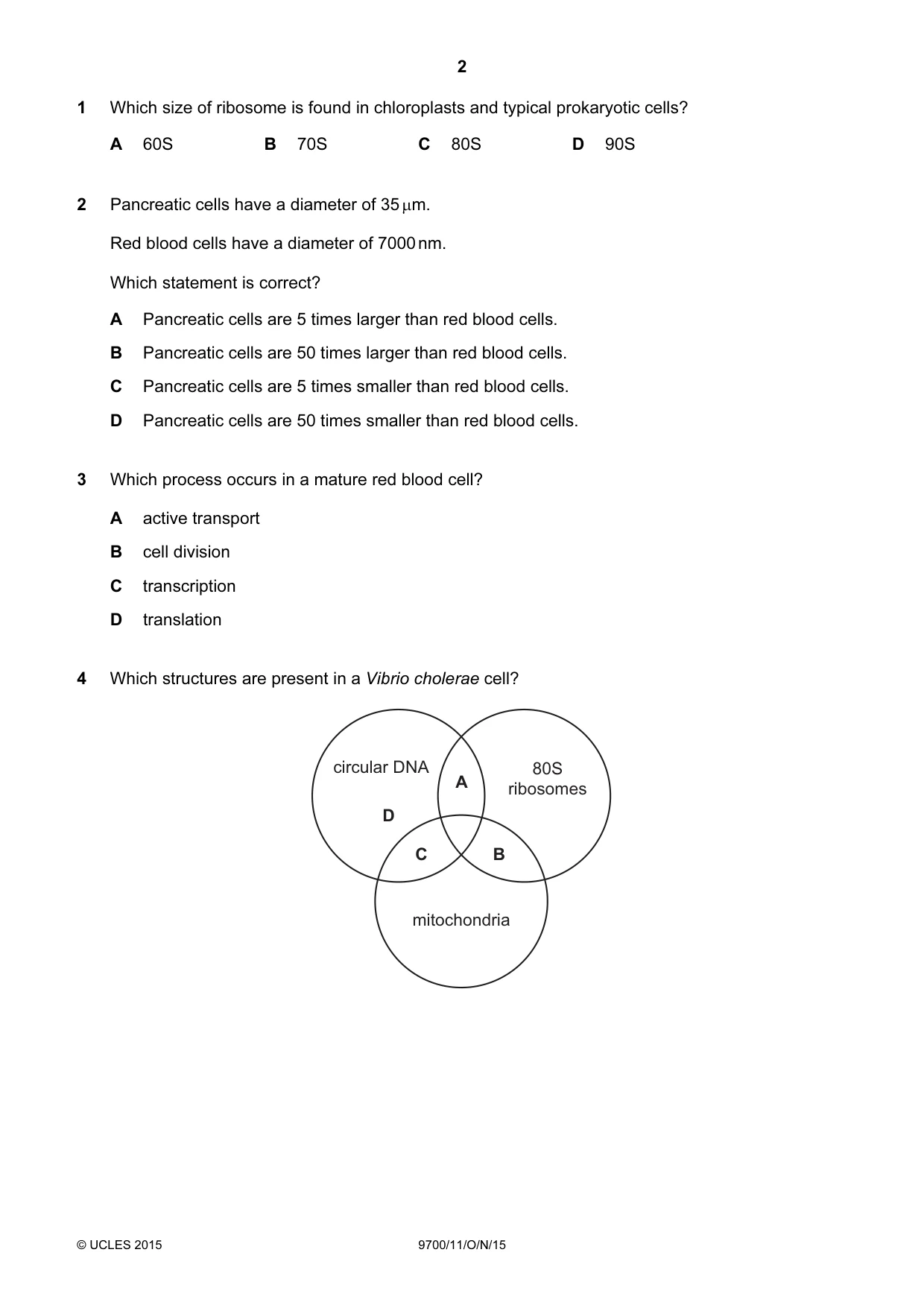
Q4 · Which structures are present in a Vibrio cholerae cell?
4 Which structures are present in a Vibrio cholerae cell? circular DNA 80S A ribosomes D C B mitochondria
Mark scheme: D
More questions on Cells as the basic units of living organisms
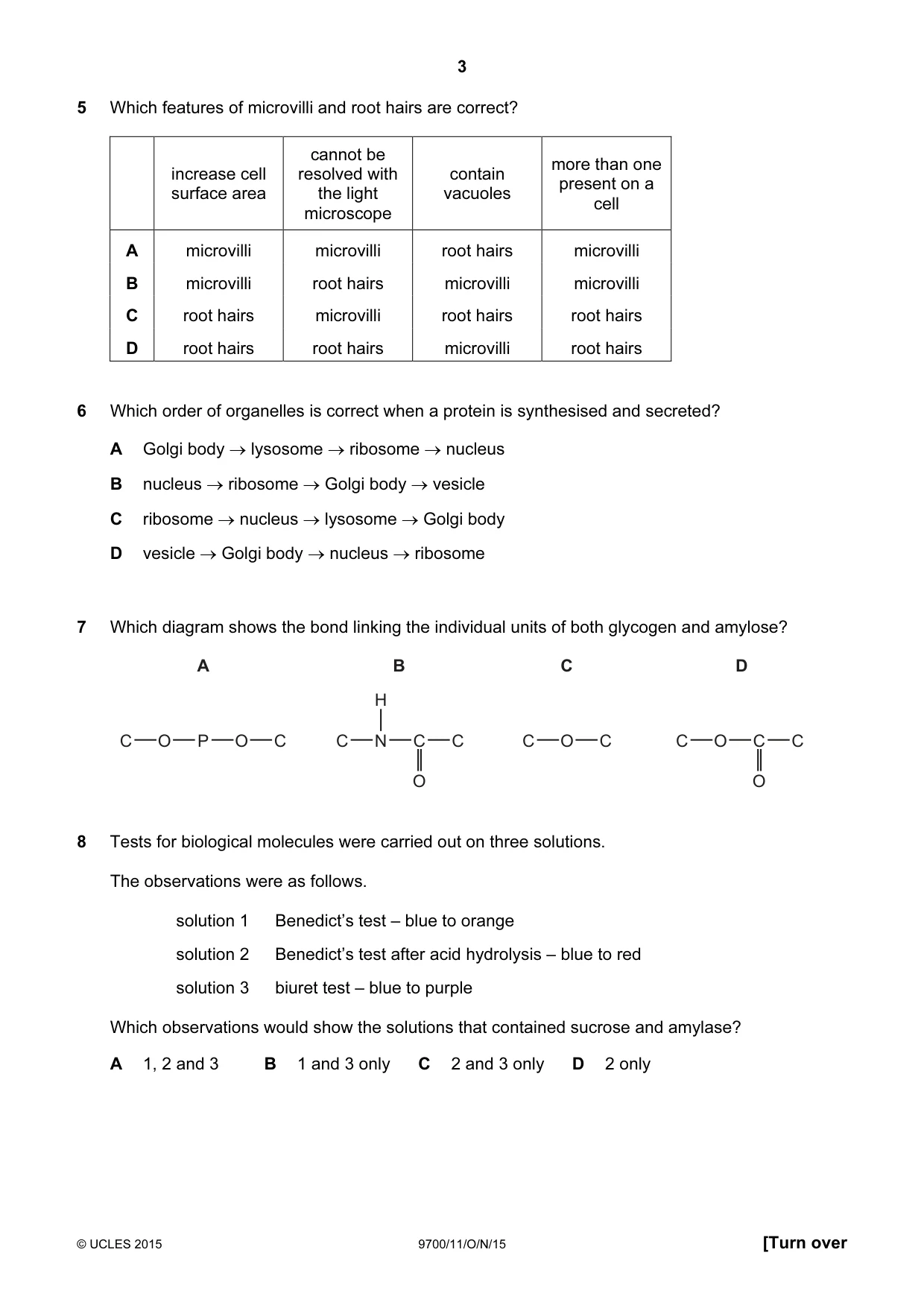
Q5 · Which features of microvilli and root hairs are correct?
5 Which features of microvilli and root hairs are correct? cannot be more than one increase cell resolved with contain present on a surface area the light vacuoles cell microscope A microvilli microvilli root hairs microvilli B microvilli root hairs microvilli microvilli C root hairs microvilli root hairs root hairs D root hairs root hairs microvilli root hairs
Mark scheme: A
More questions on Cells as the basic units of living organisms
Q6 · Which order of organelles is correct when a protein is synthesised and secreted?
6 Which order of organelles is correct when a protein is synthesised and secreted? A Golgi body → lysosome → ribosome → nucleus B nucleus → ribosome → Golgi body → vesicle C ribosome → nucleus → lysosome → Golgi body D vesicle → Golgi body → nucleus → ribosome
Mark scheme: B
More questions on Cells as the basic units of living organisms
Q7 · Which diagram shows the bond linking the individual units of both glycogen and amylose?
7 Which diagram shows the bond linking the individual units of both glycogen and amylose? A B C D H C O P O C C N C C C O C C O C C O O
Mark scheme: C
Q8 · Tests for biological molecules were carried out on three solutions
8 Tests for biological molecules were carried out on three solutions. The observations were as follows. solution 1 Benedict’s test – blue to orange solution 2 Benedict’s test after acid hydrolysis – blue to red solution 3 biuret test – blue to purple Which observations would show the solutions that contained sucrose and amylase? A 1, 2 and 3 B 1 and 3 only C 2 and 3 only D 2 only
Mark scheme: C
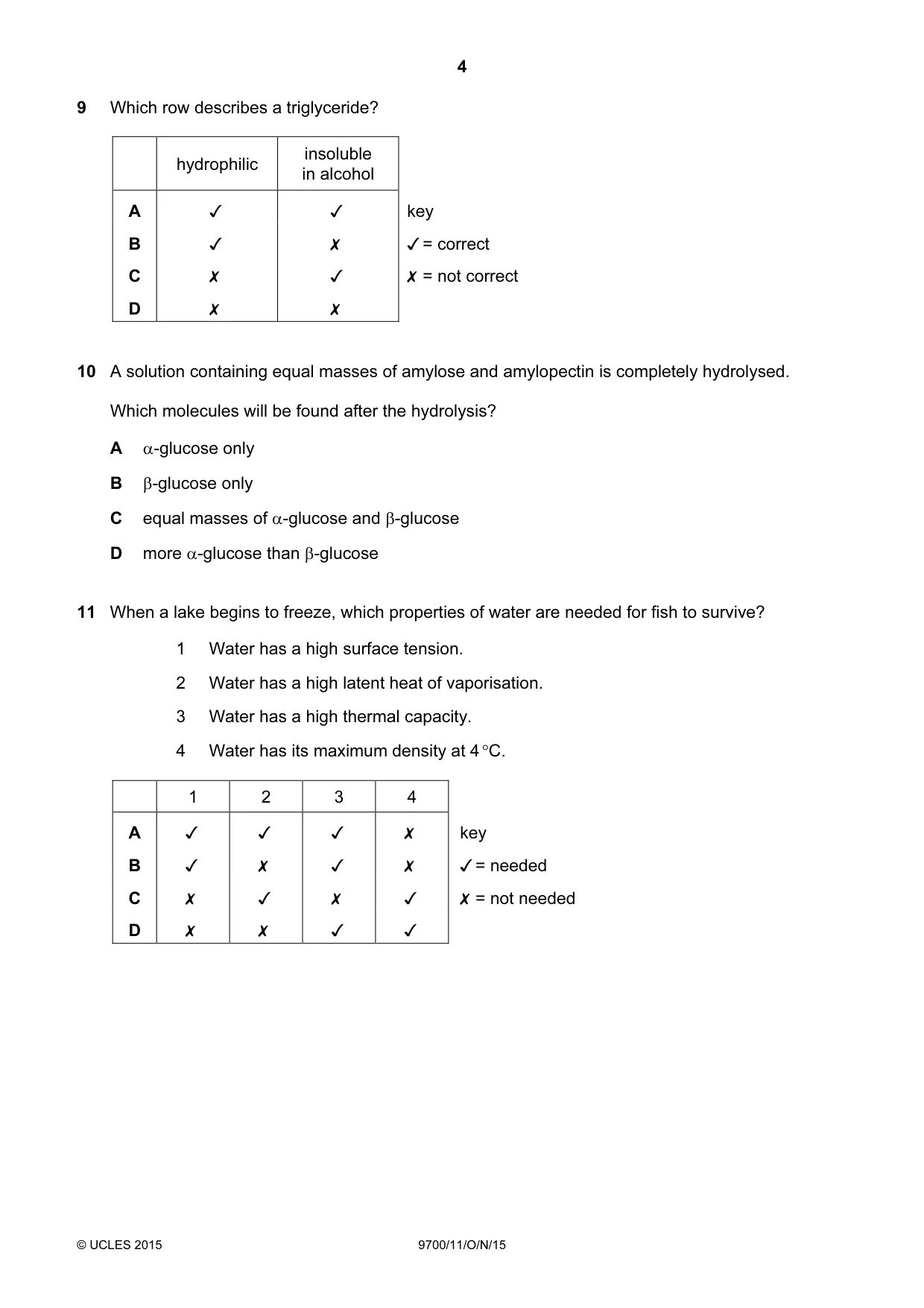
Q9 · Which row describes a triglyceride?
9 Which row describes a triglyceride? A v Jv B v x Cc x J D x x key ¥ = correct X = not correct
Mark scheme: D
Q10 · A solution containing equal masses of amylose and amylopectin is completely hydrolysed
10 A solution containing equal masses of amylose and amylopectin is completely hydrolysed. Which molecules will be found after the hydrolysis? A α-glucose only B β-glucose only C equal masses of α-glucose and β-glucose D more α-glucose than β-glucose
Mark scheme: A
Q11 · When a lake begins to freeze, which properties of water are needed for fish to survive?
11 When a lake begins to freeze, which properties of water are needed for fish to survive? 1 2 3 4 — Water has a high surface tension. Water has a high latent heat of vaporisation. Water has a high thermal capacity. Water has its maximum density at 4°C. 0 0O WwW D> x «KS key / = needed X = not needed S << & & [a ~*~ QL €® LI N €& NN fe
Mark scheme: D
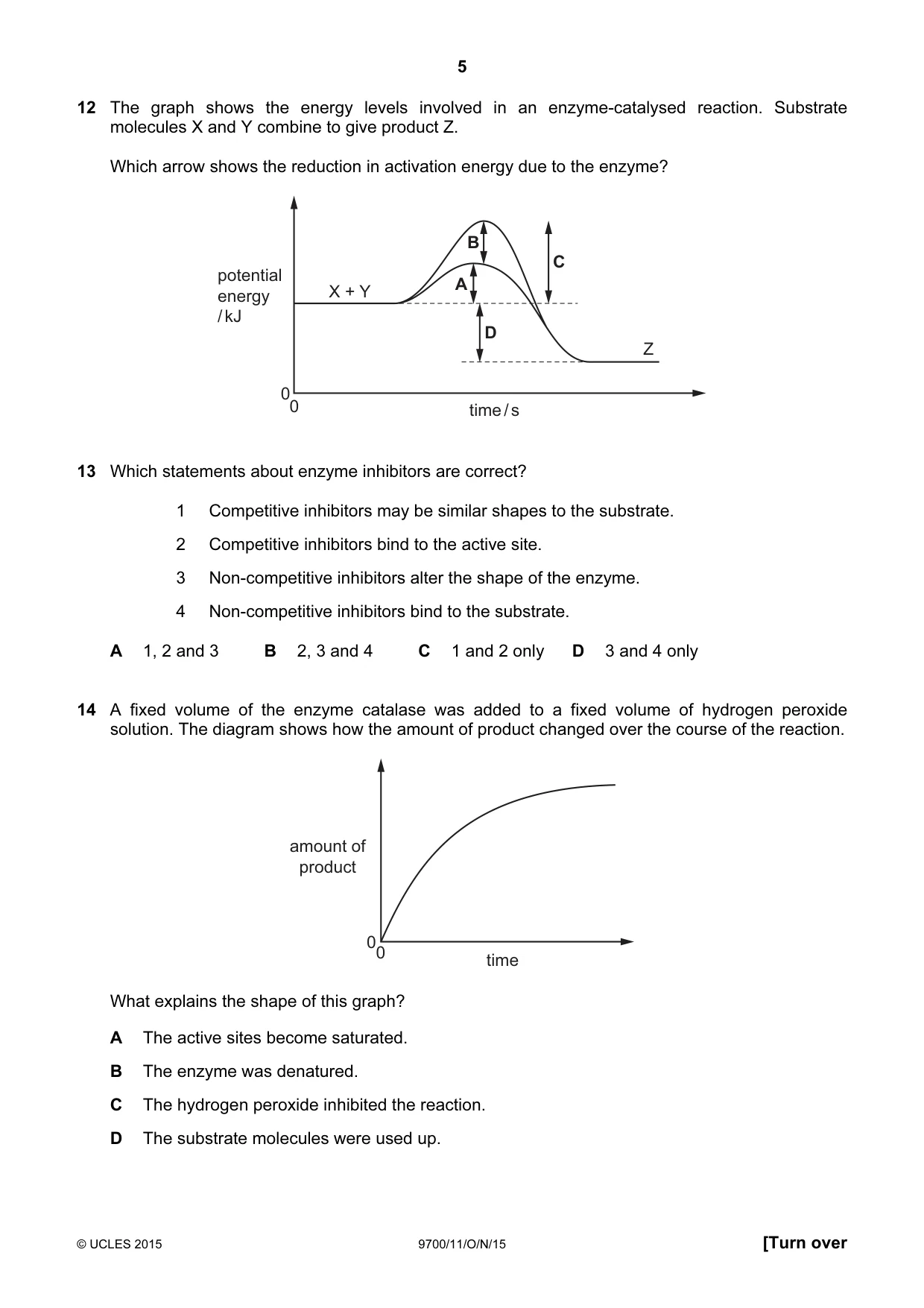
Q12 · The graph shows the energy levels involved in an enzyme-catalysed reaction
12 The graph shows the energy levels involved in an enzyme-catalysed reaction. Substrate molecules X and Y combine to give product Z. Which arrow shows the reduction in activation energy due to the enzyme? B C potential X + Y A energy / kJ D Z 00 time / s
Mark scheme: B
Q13 · Which statements about enzyme inhibitors are correct?
13 Which statements about enzyme inhibitors are correct? 1 Competitive inhibitors may be similar shapes to the substrate. 2 Competitive inhibitors bind to the active site. 3 Non-competitive inhibitors alter the shape of the enzyme. 4 Non-competitive inhibitors bind to the substrate. A 1, 2 and 3 B 2, 3 and 4 C 1 and 2 only D 3 and 4 only
Mark scheme: A
Q14 · A fixed volume of the enzyme catalase was added to a fixed volume of hydrogen peroxide…
14 A fixed volume of the enzyme catalase was added to a fixed volume of hydrogen peroxide solution. The diagram shows how the amount of product changed over the course of the reaction. amount of product 00 time What explains the shape of this graph? A The active sites become saturated. B The enzyme was denatured. C The hydrogen peroxide inhibited the reaction. D The substrate molecules were used up.
Mark scheme: D
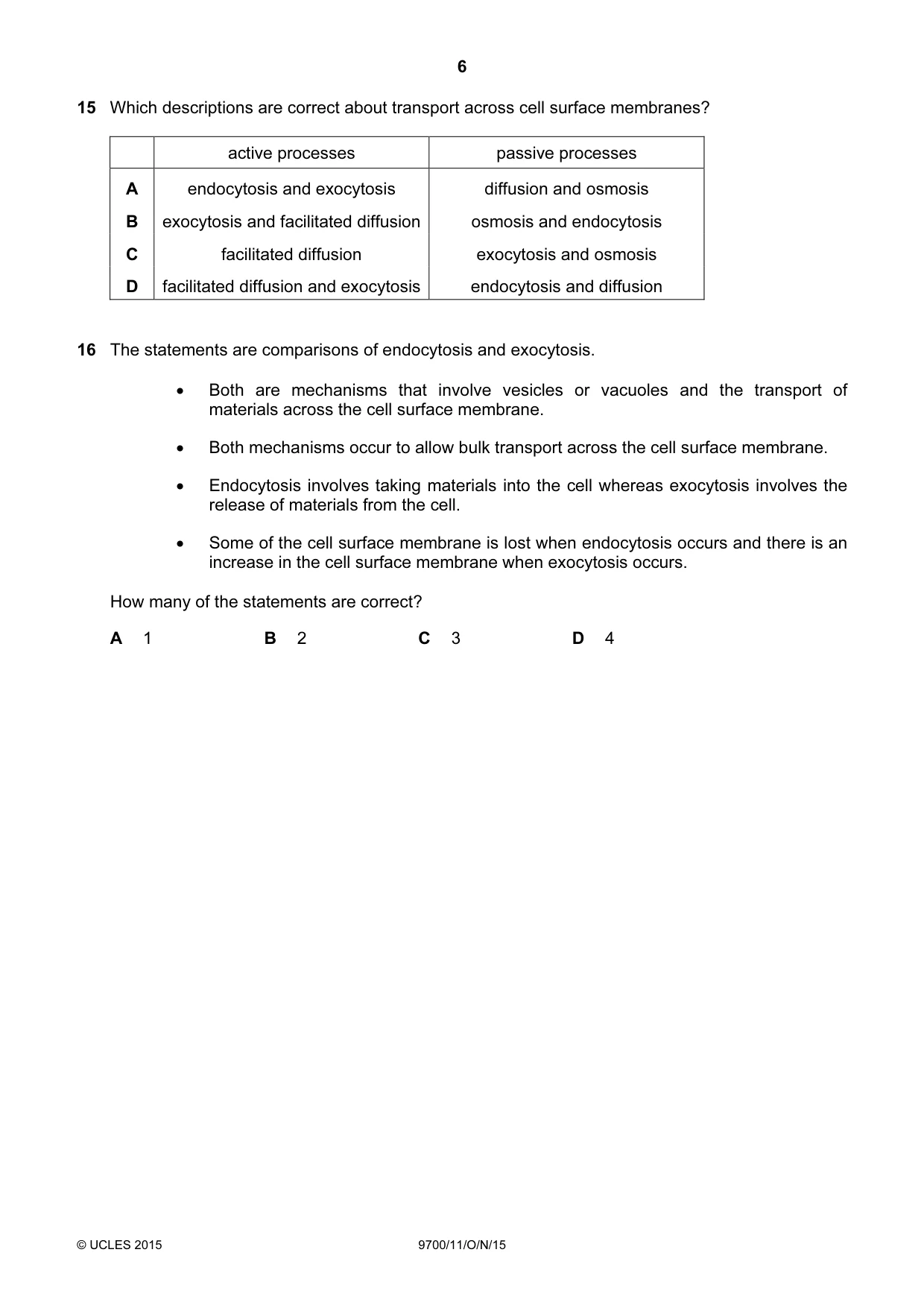
Q15 · Which descriptions are correct about transport across cell surface membranes?
15 Which descriptions are correct about transport across cell surface membranes? active processes passive processes A endocytosis and exocytosis diffusion and osmosis B exocytosis and facilitated diffusion osmosis and endocytosis C facilitated diffusion exocytosis and osmosis D facilitated diffusion and exocytosis endocytosis and diffusion
Mark scheme: A
Q16 · The statements are comparisons of endocytosis and exocytosis
16 The statements are comparisons of endocytosis and exocytosis. • Both are mechanisms that involve vesicles or vacuoles and the transport of materials across the cell surface membrane. • Both mechanisms occur to allow bulk transport across the cell surface membrane. • Endocytosis involves taking materials into the cell whereas exocytosis involves the release of materials from the cell. • Some of the cell surface membrane is lost when endocytosis occurs and there is an increase in the cell surface membrane when exocytosis occurs. How many of the statements are correct? A 1 B 2 C 3 D 4
Mark scheme: D
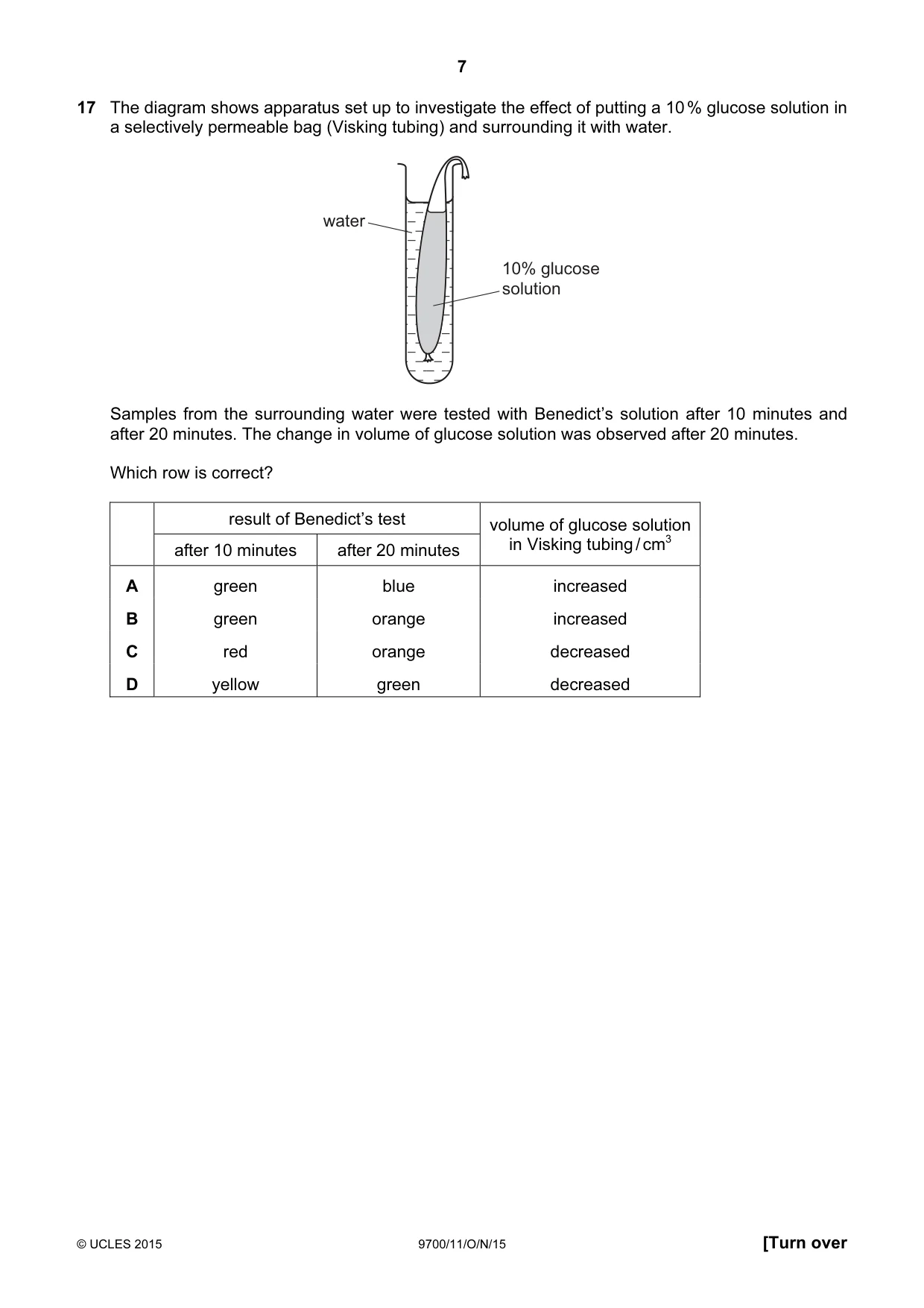
Q17 · The diagram shows apparatus set up to investigate the effect of putting a 10 % glucose…
17 The diagram shows apparatus set up to investigate the effect of putting a 10 % glucose solution in a selectively permeable bag (Visking tubing) and surrounding it with water. water 10% glucose solution Samples from the surrounding water were tested with Benedict’s solution after 10 minutes and after 20 minutes. The change in volume of glucose solution was observed after 20 minutes. Which row is correct? result of Benedict’s test volume of glucose solution in Visking tubing / cm3 after 10 minutes after 20 minutes A green blue increased B green orange increased C red orange decreased D yellow green decreased
Mark scheme: B
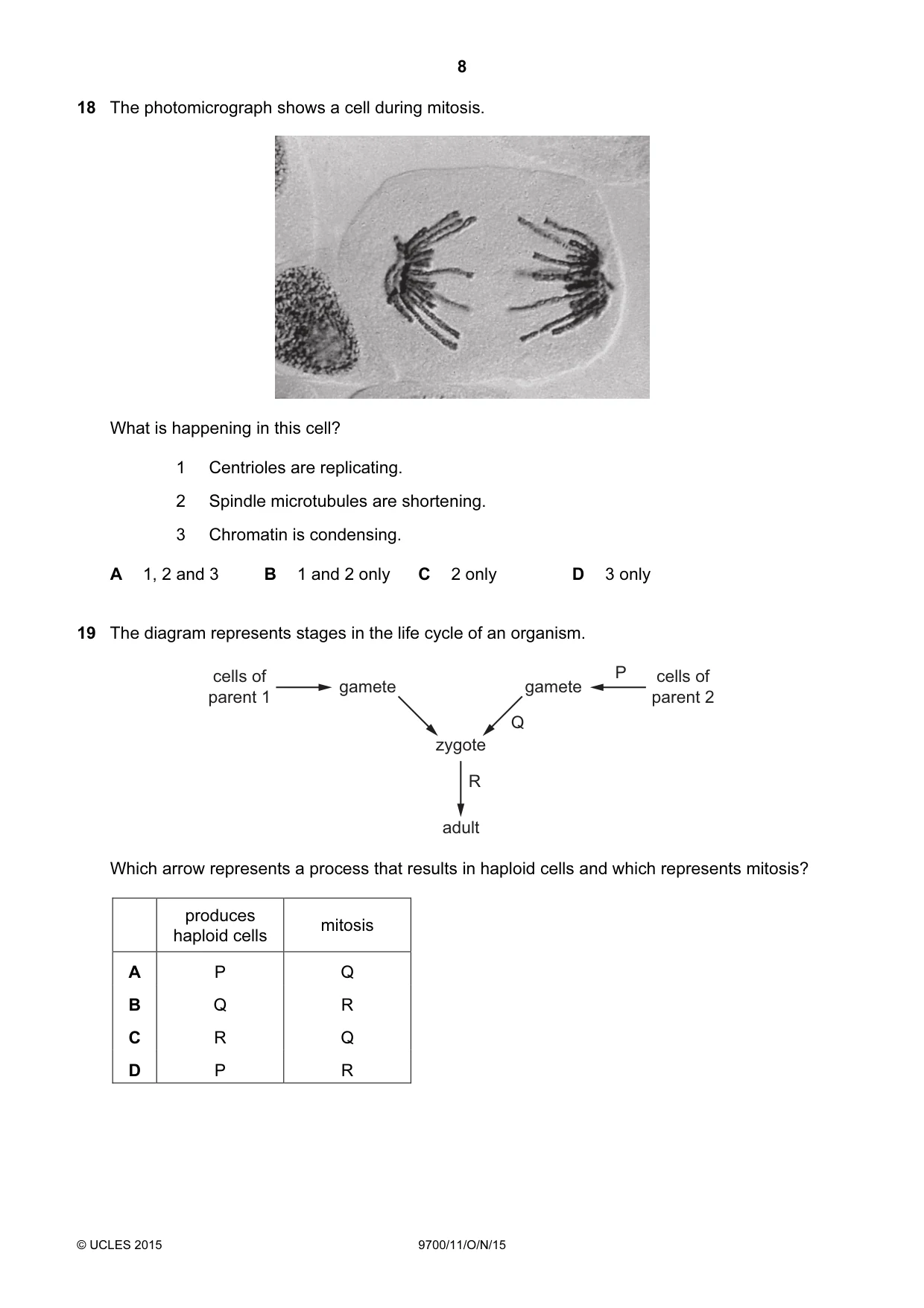
Q18 · The photomicrograph shows a cell during mitosis
18 The photomicrograph shows a cell during mitosis. What is happening in this cell? 1 Centrioles are replicating. 2 Spindle microtubules are shortening. 3 Chromatin is condensing. A 1, 2 and 3 B 1 and 2 only C 2 only D 3 only
Mark scheme: C
Q19 · The diagram represents stages in the life cycle of an organism
19 The diagram represents stages in the life cycle of an organism. cells of P cells of gamete gamete parent 1 parent 2 Q zygote R adult Which arrow represents a process that results in haploid cells and which represents mitosis? produces mitosis haploid cells A P Q B Q R C R Q D P R
Mark scheme: D
More questions on Replication and division of nuclei and cells
Q20 · The statements describe the features of some nucleic acids
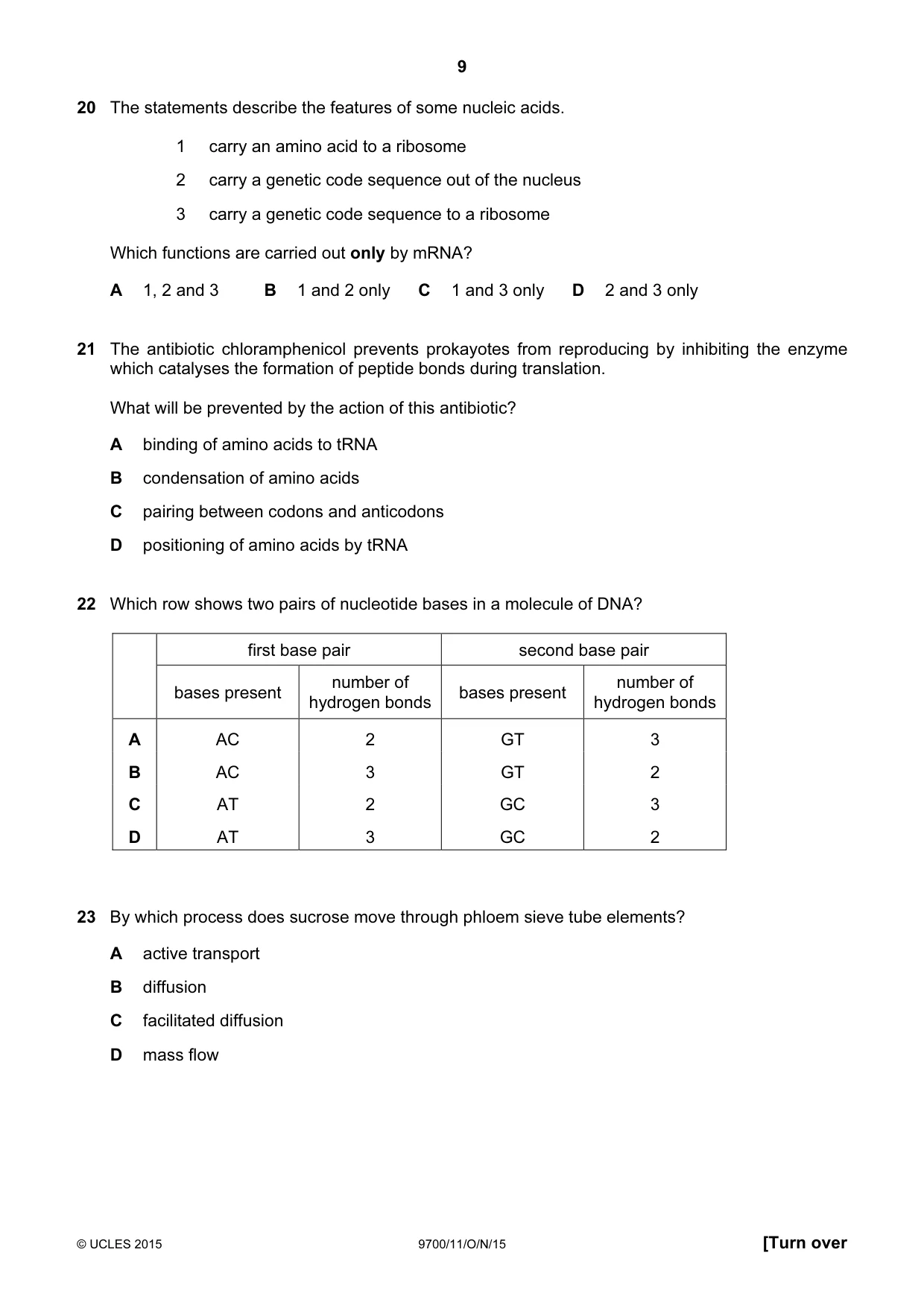
20 The statements describe the features of some nucleic acids. 1 carry an amino acid to a ribosome 2 carry a genetic code sequence out of the nucleus 3 carry a genetic code sequence to a ribosome Which functions are carried out only by mRNA? A 1, 2 and 3 B 1 and 2 only C 1 and 3 only D 2 and 3 only
Mark scheme: D
Q21 · The antibiotic chloramphenicol prevents prokayotes from reproducing by inhibiting the…
21 The antibiotic chloramphenicol prevents prokayotes from reproducing by inhibiting the enzyme which catalyses the formation of peptide bonds during translation. What will be prevented by the action of this antibiotic? A binding of amino acids to tRNA B condensation of amino acids C pairing between codons and anticodons D positioning of amino acids by tRNA
Mark scheme: B
Q22 · Which row shows two pairs of nucleotide bases in a molecule of DNA?
22 Which row shows two pairs of nucleotide bases in a molecule of DNA? first base pair second base pair number of number of bases present bases present hydrogen bonds hydrogen bonds A AC 2 GT 3 B AC 3 GT 2 C AT 2 GC 3 D AT 3 GC 2
Mark scheme: C
More questions on Structure of nucleic acids and replication of DNA
Q23 · By which process does sucrose move through phloem sieve tube elements?
23 By which process does sucrose move through phloem sieve tube elements? A active transport B diffusion C facilitated diffusion D mass flow
Mark scheme: D
Q24 · The diagram shows the results of an experiment using leaves with the same surface area…
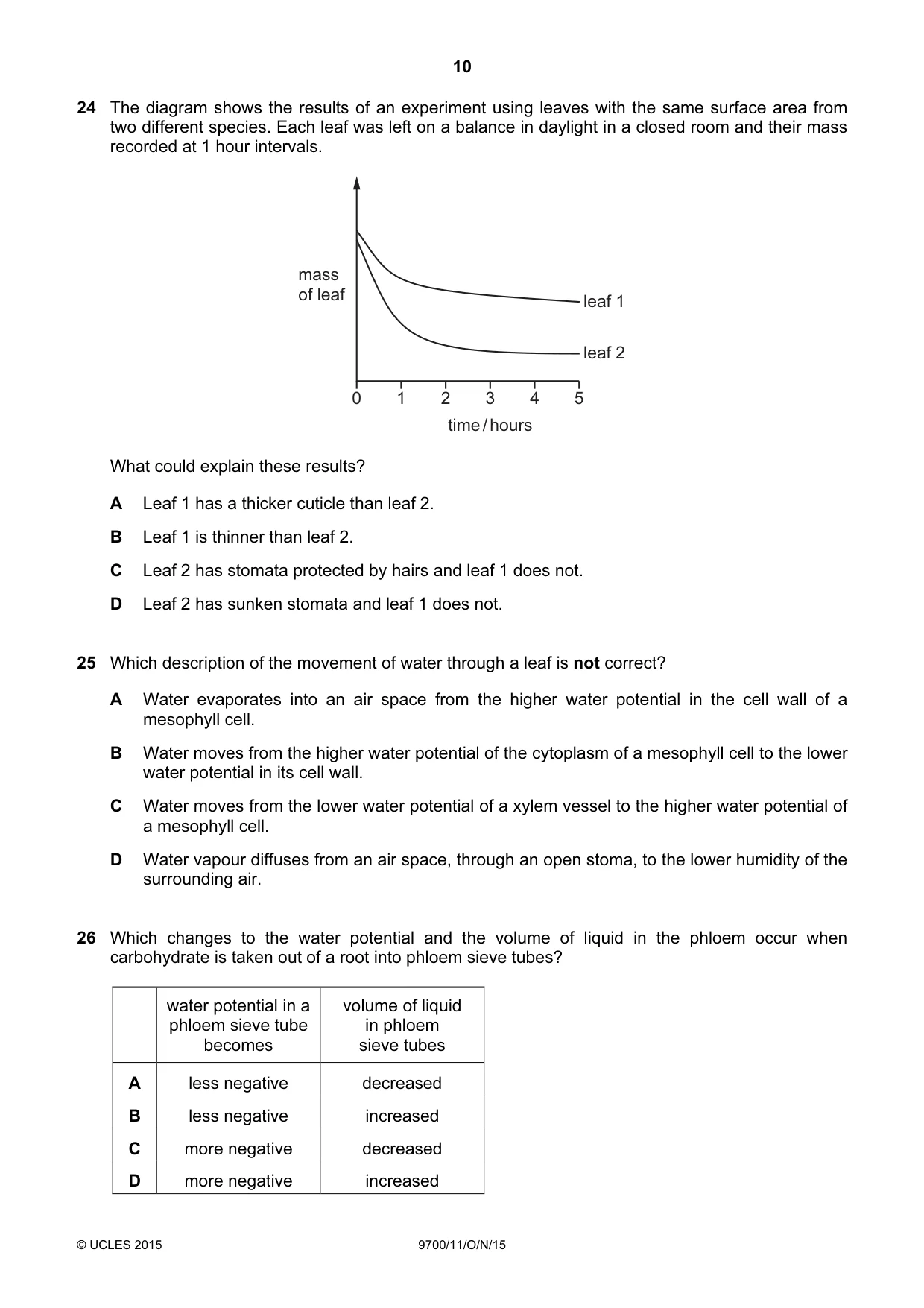
24 The diagram shows the results of an experiment using leaves with the same surface area from two different species. Each leaf was left on a balance in daylight in a closed room and their mass recorded at 1 hour intervals. mass of leaf leaf 1 leaf 2 0 1 2 3 4 5 time / hours What could explain these results? A Leaf 1 has a thicker cuticle than leaf 2. B Leaf 1 is thinner than leaf 2. C Leaf 2 has stomata protected by hairs and leaf 1 does not. D Leaf 2 has sunken stomata and leaf 1 does not.
Mark scheme: A
Q25 · Which description of the movement of water through a leaf is not correct?
25 Which description of the movement of water through a leaf is not correct? A Water evaporates into an air space from the higher water potential in the cell wall of a mesophyll cell. B Water moves from the higher water potential of the cytoplasm of a mesophyll cell to the lower water potential in its cell wall. C Water moves from the lower water potential of a xylem vessel to the higher water potential of a mesophyll cell. D Water vapour diffuses from an air space, through an open stoma, to the lower humidity of the surrounding air.
Mark scheme: C
Q26 · Which changes to the water potential and the volume of liquid in the phloem occur when…
26 Which changes to the water potential and the volume of liquid in the phloem occur when carbohydrate is taken out of a root into phloem sieve tubes? water potential in a volume of liquid phloem sieve tube in phloem becomes sieve tubes A less negative decreased B less negative increased C more negative decreased D more negative increased
Mark scheme: D
Q27 · Which reactions take place in a capillary in the lungs?
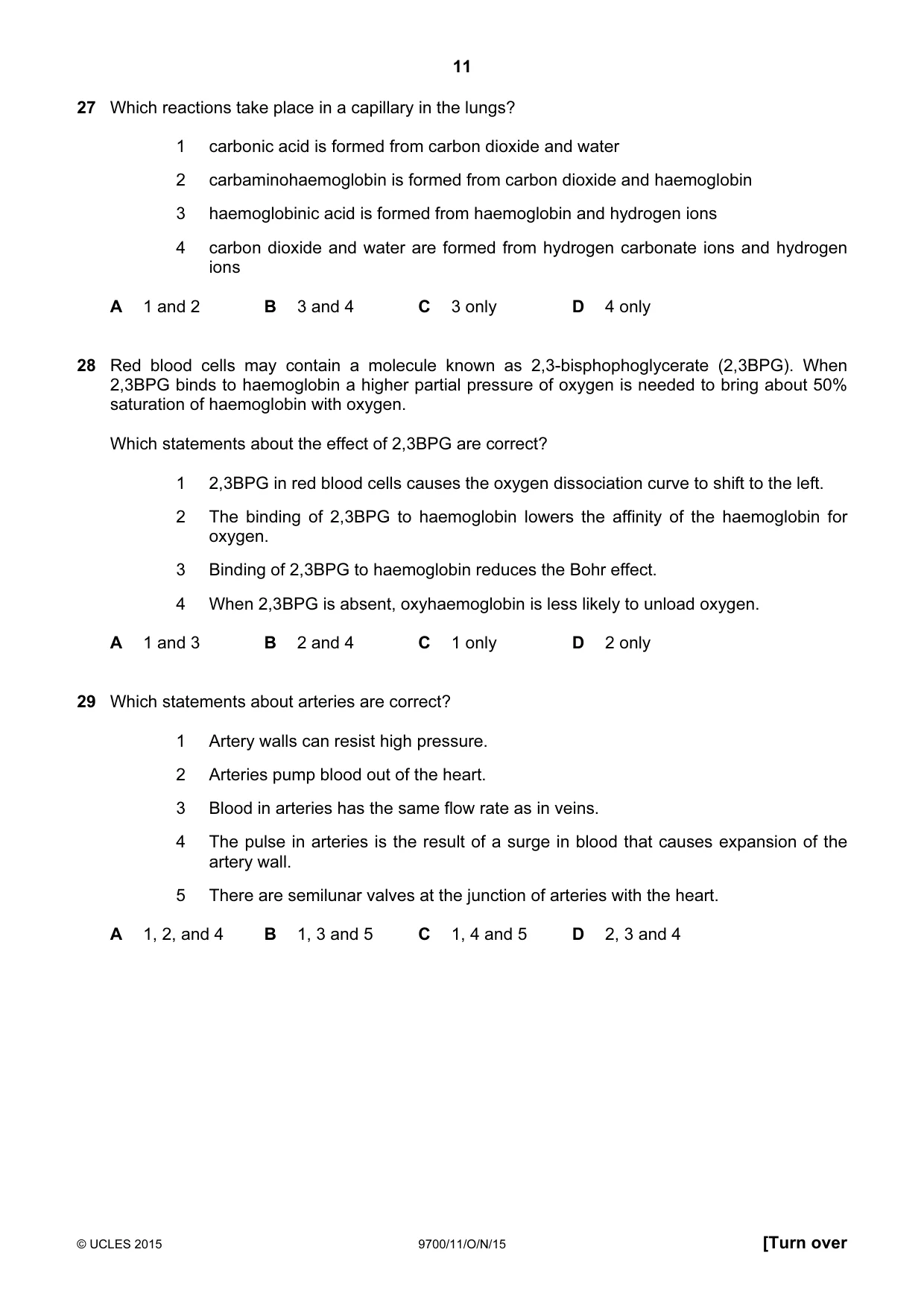
27 Which reactions take place in a capillary in the lungs? 1 carbonic acid is formed from carbon dioxide and water 2 carbaminohaemoglobin is formed from carbon dioxide and haemoglobin 3 haemoglobinic acid is formed from haemoglobin and hydrogen ions 4 carbon dioxide and water are formed from hydrogen carbonate ions and hydrogen ions A 1 and 2 B 3 and 4 C 3 only D 4 only
Mark scheme: D
Q28 · Red blood cells may contain a molecule known as 2,3-bisphophoglycerate (2,3BPG)
28 Red blood cells may contain a molecule known as 2,3-bisphophoglycerate (2,3BPG). When 2,3BPG binds to haemoglobin a higher partial pressure of oxygen is needed to bring about 50% saturation of haemoglobin with oxygen. Which statements about the effect of 2,3BPG are correct? 1 2,3BPG in red blood cells causes the oxygen dissociation curve to shift to the left. 2 The binding of 2,3BPG to haemoglobin lowers the affinity of the haemoglobin for oxygen. 3 Binding of 2,3BPG to haemoglobin reduces the Bohr effect. 4 When 2,3BPG is absent, oxyhaemoglobin is less likely to unload oxygen. A 1 and 3 B 2 and 4 C 1 only D 2 only
Mark scheme: D
Q29 · Which statements about arteries are correct?
29 Which statements about arteries are correct? 1 Artery walls can resist high pressure. 2 Arteries pump blood out of the heart. 3 Blood in arteries has the same flow rate as in veins. 4 The pulse in arteries is the result of a surge in blood that causes expansion of the artery wall. 5 There are semilunar valves at the junction of arteries with the heart. A 1, 2, and 4 B 1, 3 and 5 C 1, 4 and 5 D 2, 3 and 4
Mark scheme: C
Q30 · The graph shows the changes in pressure that occur in the left side of the heart during…
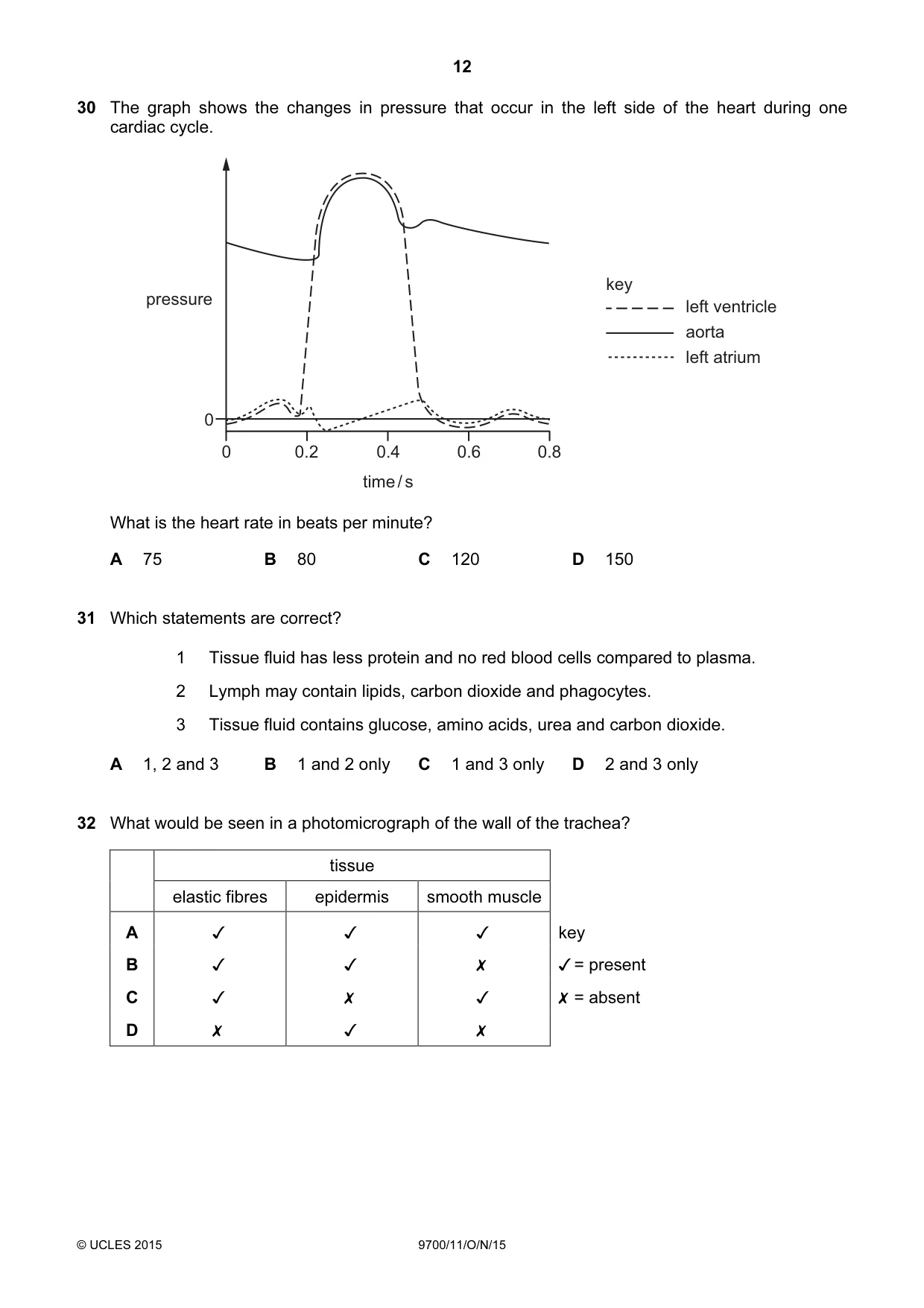
30 The graph shows the changes in pressure that occur in the left side of the heart during one cardiac cycle. key pressure left ventricle aorta left atrium 0 0 0.2 0.4 0.6 0.8 time / s What is the heart rate in beats per minute? A 75 B 80 C 120 D 150
Mark scheme: A
Q31 · Which statements are correct?
31 Which statements are correct? 1 Tissue fluid has less protein and no red blood cells compared to plasma. 2 Lymph may contain lipids, carbon dioxide and phagocytes. 3 Tissue fluid contains glucose, amino acids, urea and carbon dioxide. A 1, 2 and 3 B 1 and 2 only C 1 and 3 only D 2 and 3 only
Mark scheme: A
Q32 · What would be seen in a photomicrograph of the wall of the trachea?
32 What would be seen in a photomicrograph of the wall of the trachea? tissue elastic fibres epidermis smooth muscle A v v v B v v x Cc v x v D x v x key /¥ = present X = absent
Mark scheme: C
Q33 · Which process leads to atherosclerosis?
33 Which process leads to atherosclerosis? A a blood clot forming in a coronary artery B contraction of muscles in arteries caused by nicotine C formation of plaques in an artery wall D loss of elasticity in an artery wall causing it to burst
Mark scheme: C
Q34 · Some symptoms of chronic obstructive pulmonary disease (COPD) are listed
34 Some symptoms of chronic obstructive pulmonary disease (COPD) are listed. 1 bursting of alveoli 2 increase in secretion of mucus 3 loss of elastic fibres 4 narrowing of airways 5 reduction in surface area for gaseous exchange Which of these are also the symptoms of emphysema? A 1, 2 and 4 B 1, 3 and 5 C 2, 3 and 4 D 2, 4 and 5
Mark scheme: B
Q35 · The diagram shows one way of testing the effect of an antibiotic on bacteria
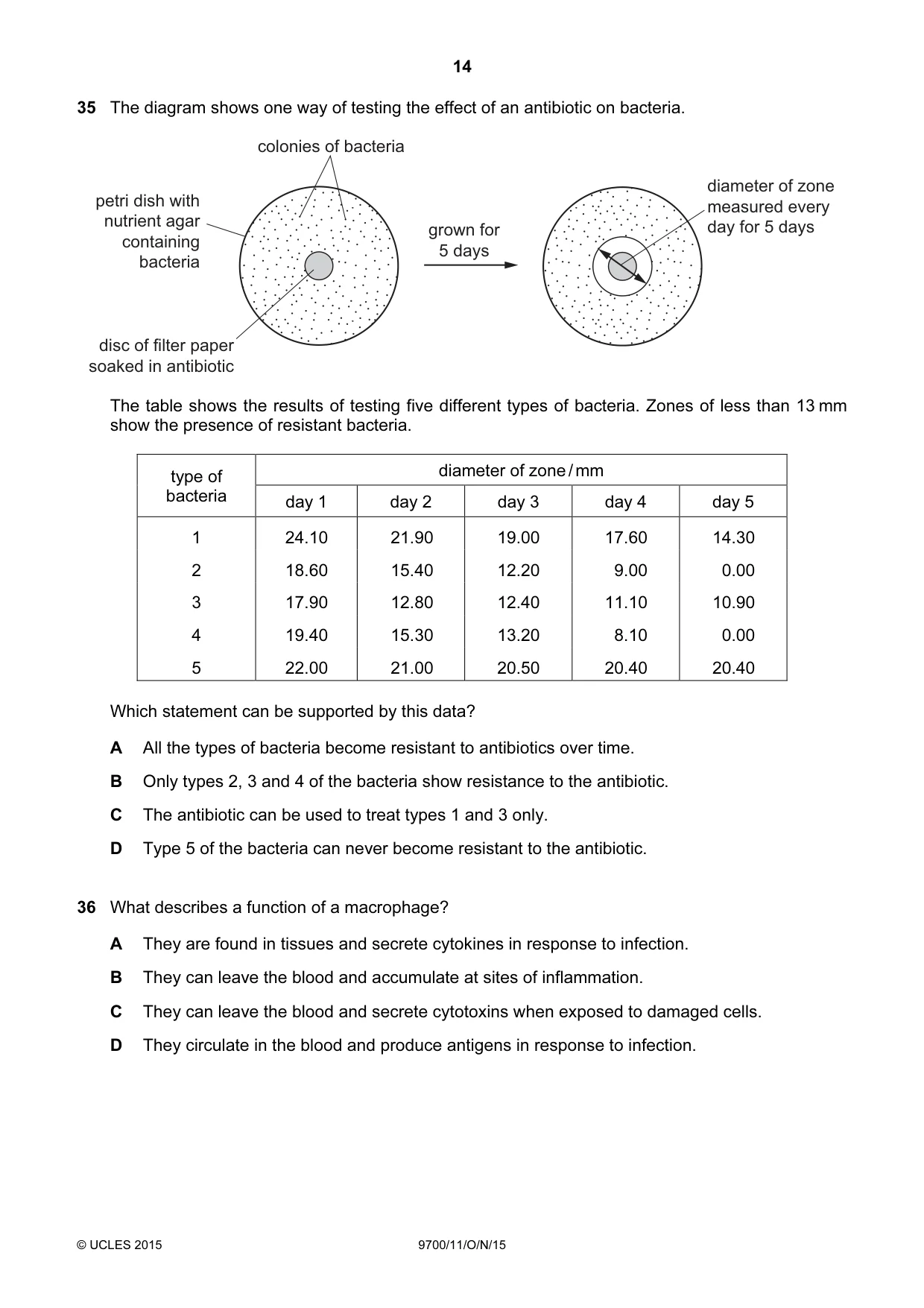
35 The diagram shows one way of testing the effect of an antibiotic on bacteria. colonies of bacteria diameter of zone petri dish with measured every nutrient agar day for 5 days grown for containing 5 days bacteria disc of filter paper soaked in antibiotic The table shows the results of testing five different types of bacteria. Zones of less than 13 mm show the presence of resistant bacteria. type of diameter of zone / mm bacteria day 1 day 2 day 3 day 4 day 5 1 24.10 21.90 19.00 17.60 14.30 2 18.60 15.40 12.20 9.00 0.00 3 17.90 12.80 12.40 11.10 10.90 4 19.40 15.30 13.20 8.10 0.00 5 22.00 21.00 20.50 20.40 20.40 Which statement can be supported by this data? A All the types of bacteria become resistant to antibiotics over time. B Only types 2, 3 and 4 of the bacteria show resistance to the antibiotic. C The antibiotic can be used to treat types 1 and 3 only. D Type 5 of the bacteria can never become resistant to the antibiotic.
Mark scheme: B
Q36 · What describes a function of a macrophage?
36 What describes a function of a macrophage? A They are found in tissues and secrete cytokines in response to infection. B They can leave the blood and accumulate at sites of inflammation. C They can leave the blood and secrete cytotoxins when exposed to damaged cells. D They circulate in the blood and produce antigens in response to infection.
Mark scheme: A
Q37 · There has been an increase in the number of cases of the disease whooping cough
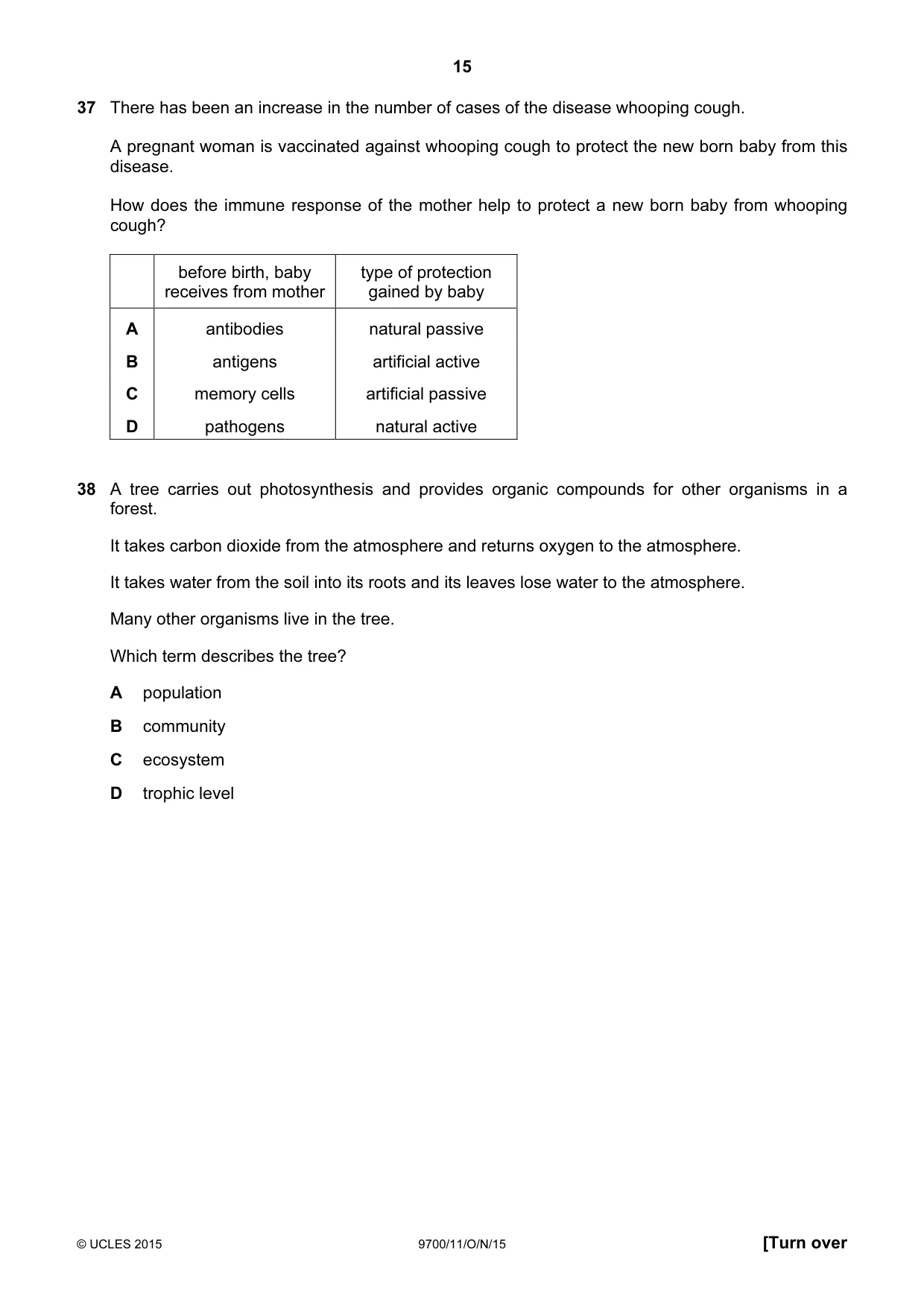
37 There has been an increase in the number of cases of the disease whooping cough. A pregnant woman is vaccinated against whooping cough to protect the new born baby from this disease. How does the immune response of the mother help to protect a new born baby from whooping cough? before birth, baby type of protection receives from mother gained by baby A antibodies natural passive B antigens artificial active C memory cells artificial passive D pathogens natural active
Mark scheme: A
Q38 · A tree carries out photosynthesis and provides organic compounds for other organisms in a…
38 A tree carries out photosynthesis and provides organic compounds for other organisms in a forest. It takes carbon dioxide from the atmosphere and returns oxygen to the atmosphere. It takes water from the soil into its roots and its leaves lose water to the atmosphere. Many other organisms live in the tree. Which term describes the tree? A population B community C ecosystem D trophic level
Mark scheme: C
Q39 · The diagram shows the flow of energy through a food chain
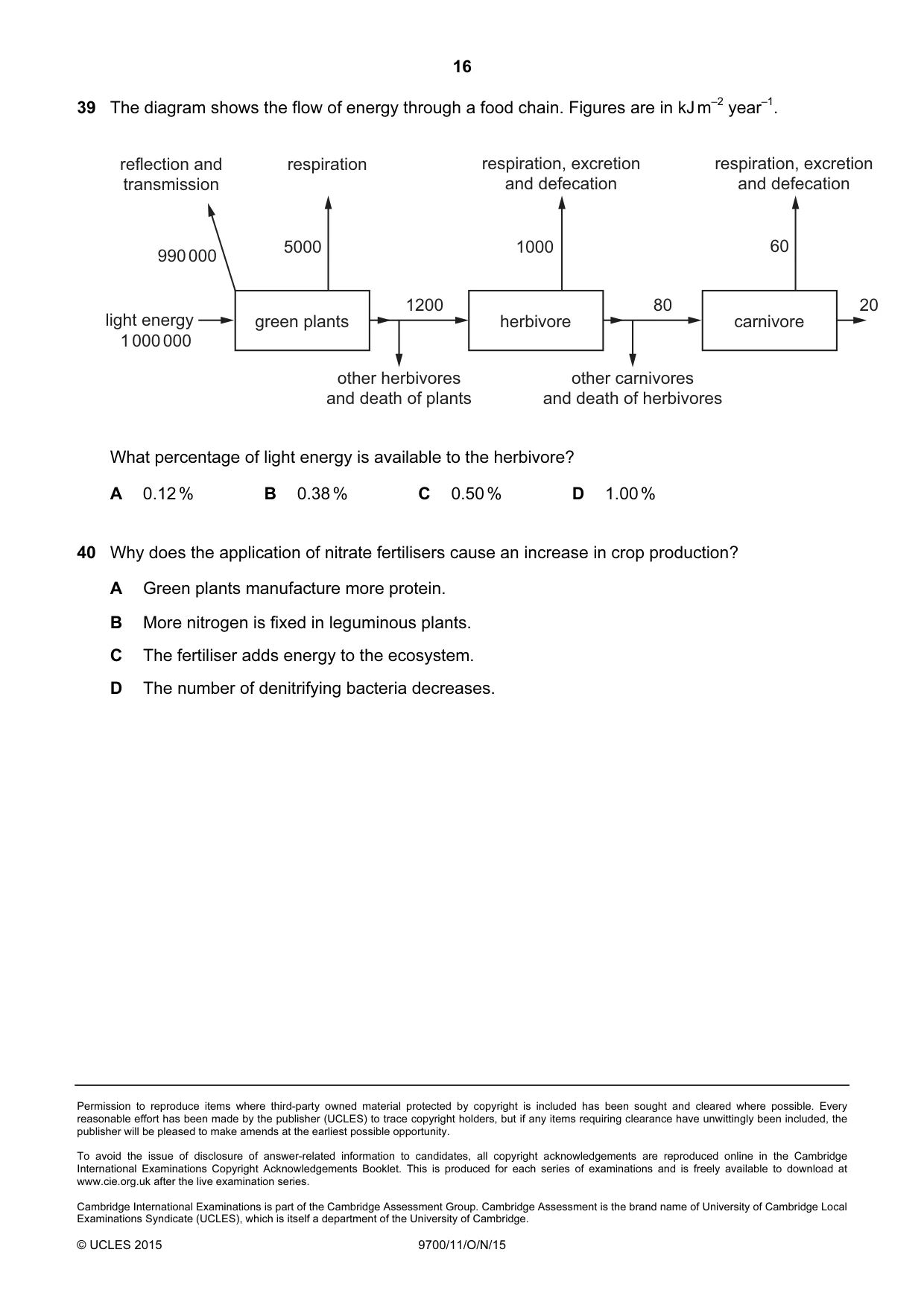
39 The diagram shows the flow of energy through a food chain. Figures are in kJ m–2 year–1. reflection and respiration respiration, excretion respiration, excretion transmission and defecation and defecation 5000 1000 60 990 000 1200 80 20 light energy green plants herbivore carnivore 1 000 000 other herbivores other carnivores and death of plants and death of herbivores What percentage of light energy is available to the herbivore? A 0.12 % B 0.38 % C 0.50 % D 1.00 %
Mark scheme: A
Q40 · Why does the application of nitrate fertilisers cause an increase in crop production?
40 Why does the application of nitrate fertilisers cause an increase in crop production? A Green plants manufacture more protein. B More nitrogen is fixed in leguminous plants. C The fertiliser adds energy to the ecosystem. D The number of denitrifying bacteria decreases.
Mark scheme: A
What was in this paper
The subtopics covered by these 40 questions, and how many questions each got. Open one in a new tab to see every Cambridge question on it.
6Transport mechanisms4Carbohydrates and lipids3Movement into and out of cells3The circulatory system3Factors that affect enzyme action2Protein synthesis2The gas exchange system2Transport of oxygen and carbon dioxide2Antibiotics1Antibodies and vaccination1Biodiversity1Chromosome behaviour in mitosis1Classification1Conservation1Mode of action of enzymes1Replication and division of nuclei and cells1Structure of nucleic acids and replication of DNA1Testing for biological molecules1The heart1The immune system1Water1What you needed in this session
Cambridge’s own grade thresholds for 2015 Oct/Nov, Paper 1 · Variant 1. A higher threshold means an easier paper — the bar moves with how the cohort did.