Cambridge A Level Biology 9700 — 2024 Oct/Nov Paper 1 · Variant 2
9700/12/O/N/24 · 40 questions · 40 marks · ≈45 min
The question paper and its mark scheme, free to read here and free to download. This is Cambridge’s own paper, exactly as it was sat.
Question paper20 pages
Mark scheme3 pages
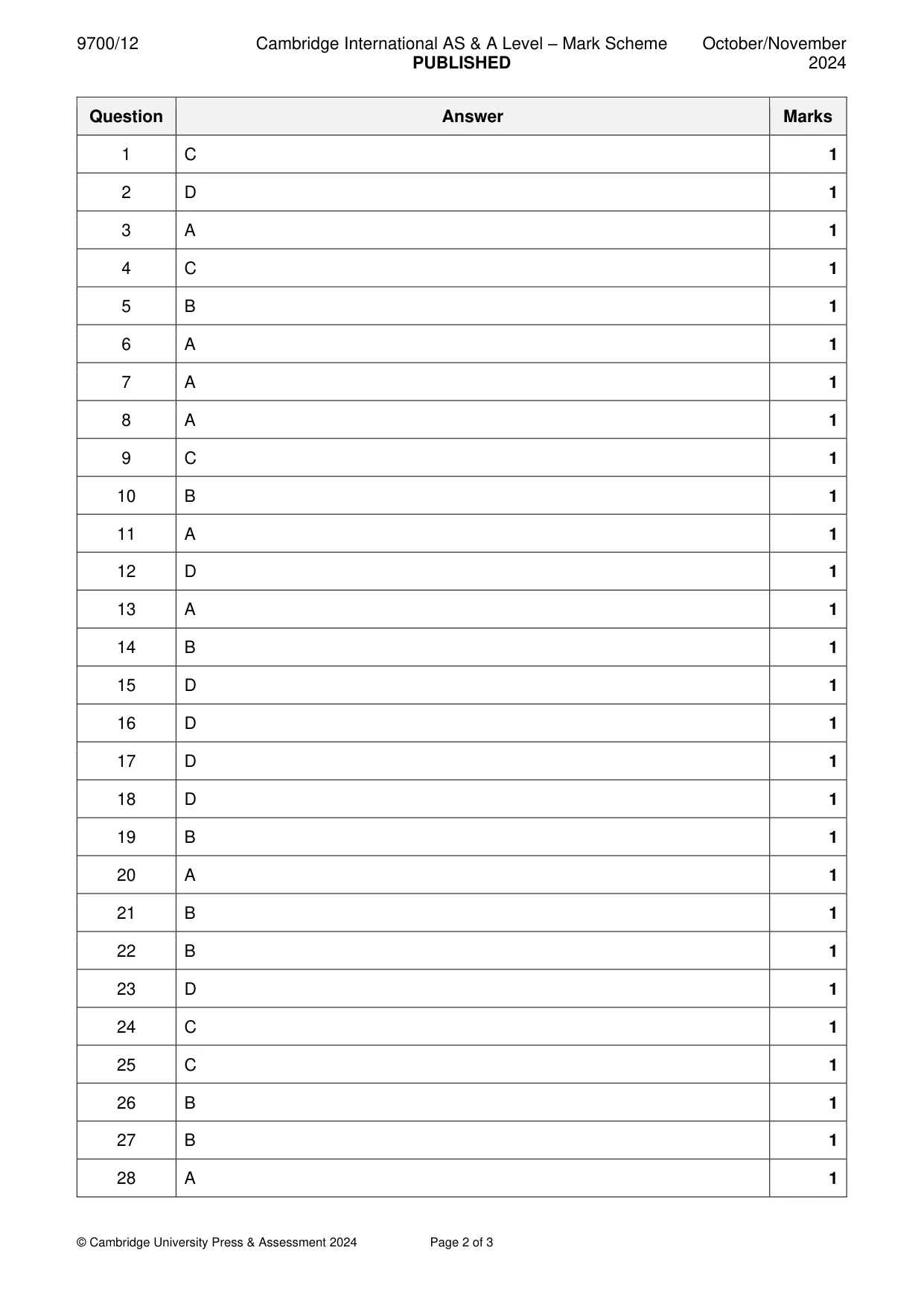
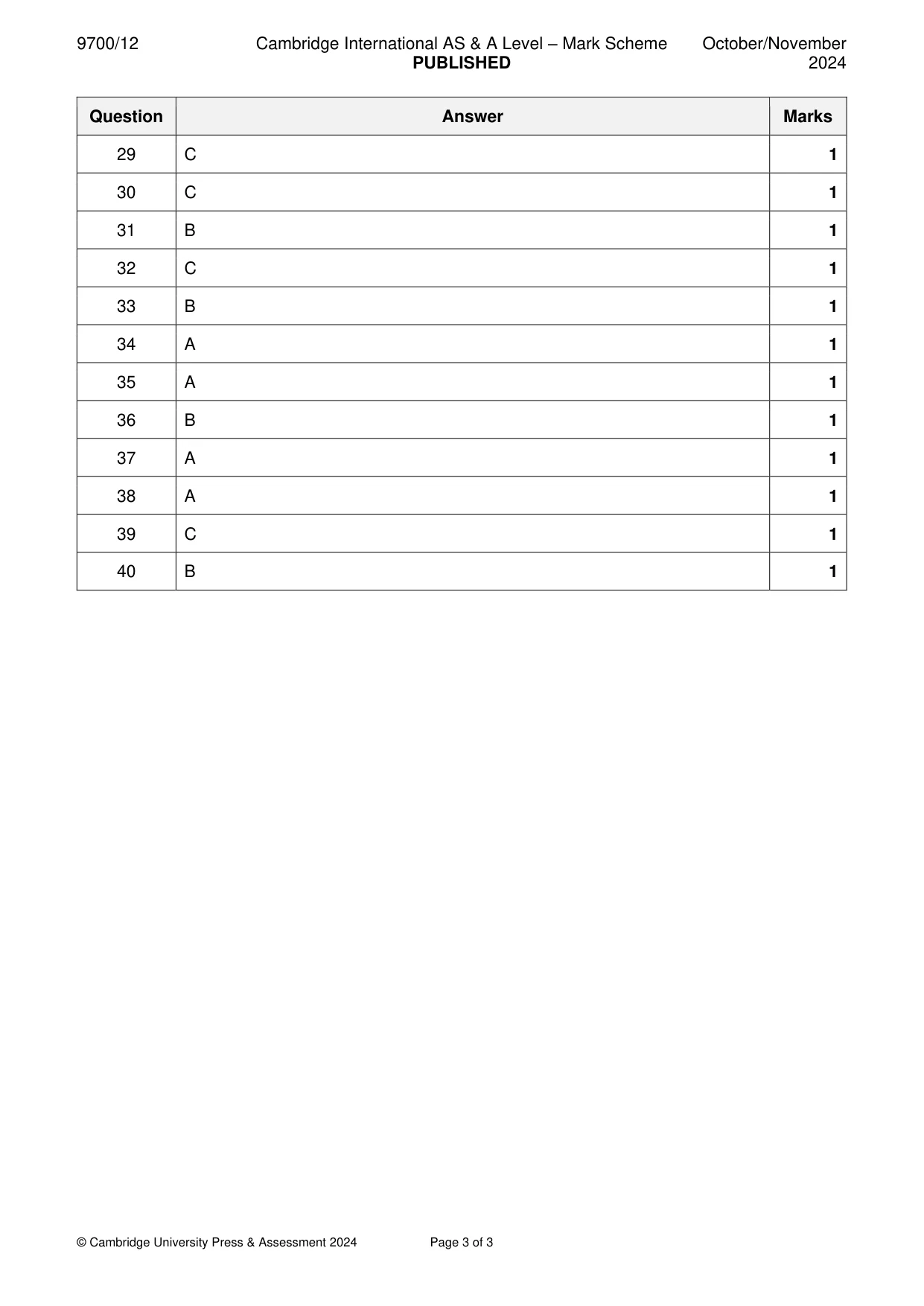
Answers below. Sit the paper first if you are practising.
Questions as text
Q1 · A light microscope is used to observe two structures that are 200 nm apart on the slide
1 A light microscope is used to observe two structures that are 200 nm apart on the slide. What is the actual distance between the two structures when the magnification is changed from 40 to 400? A 2 m B 20 m C 200 nm D 2000 nm
Mark scheme: C
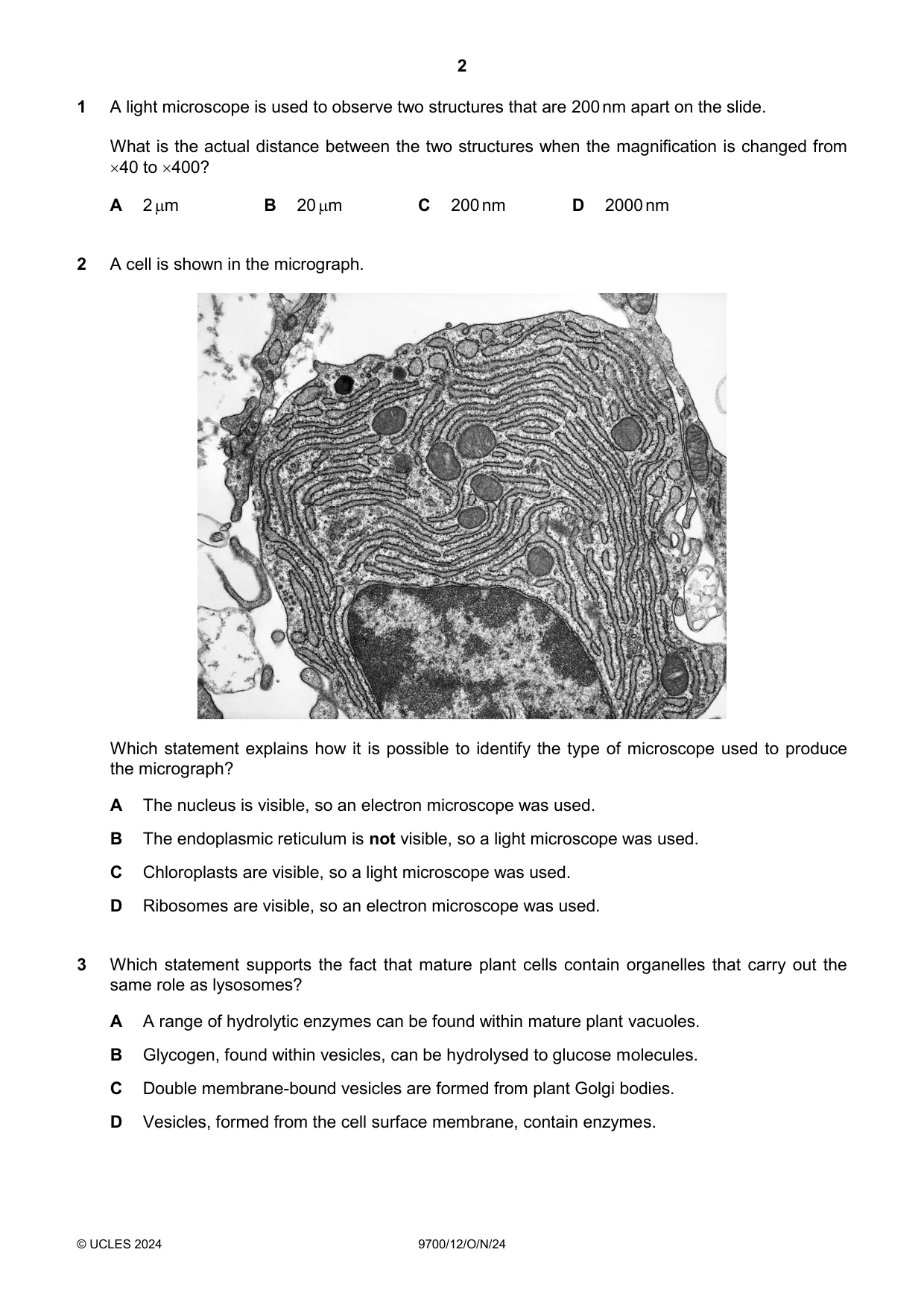
Q2 · A cell is shown in the micrograph
2 A cell is shown in the micrograph. Which statement explains how it is possible to identify the type of microscope used to produce the micrograph? A The nucleus is visible, so an electron microscope was used. B The endoplasmic reticulum is not visible, so a light microscope was used. C Chloroplasts are visible, so a light microscope was used. D Ribosomes are visible, so an electron microscope was used.
Mark scheme: D
Q3 · Which statement supports the fact that mature plant cells contain organelles that carry…
3 Which statement supports the fact that mature plant cells contain organelles that carry out the same role as lysosomes? A A range of hydrolytic enzymes can be found within mature plant vacuoles. B Glycogen, found within vesicles, can be hydrolysed to glucose molecules. C Double membrane-bound vesicles are formed from plant Golgi bodies. D Vesicles, formed from the cell surface membrane, contain enzymes.
Mark scheme: A
More questions on Cells as the basic units of living organisms
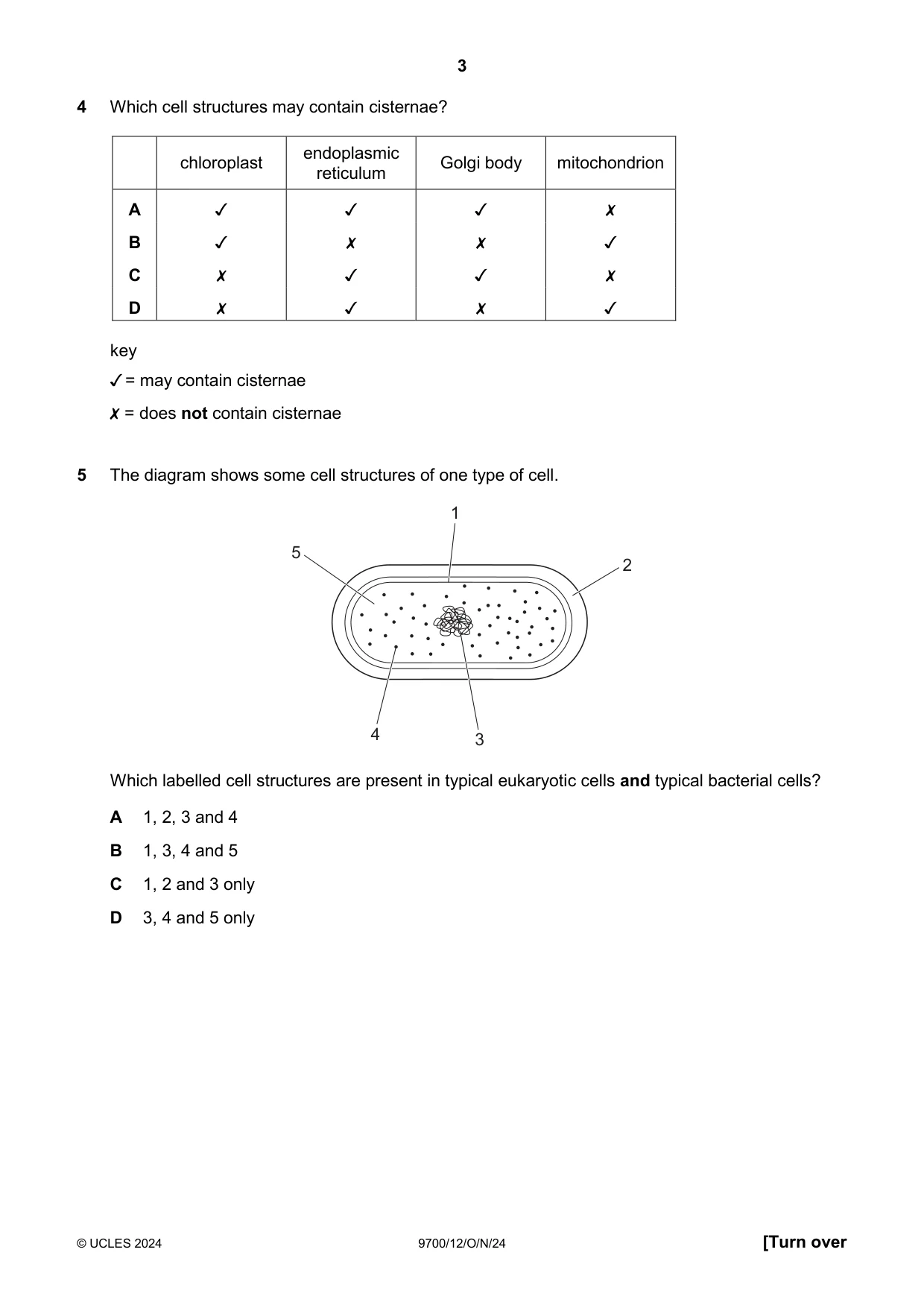
Q4 · Which cell structures may contain cisternae?
4 Which cell structures may contain cisternae? chloroplast oncoplasmic Golgi body mitochondrion A JV v v x B Jv x x Jv Cc x J Jv x D x Jv x JV key ¥ = may contain cisternae X = does not contain cisternae
Mark scheme: C
More questions on Cells as the basic units of living organisms
Q5 · The diagram shows some cell structures of one type of cell
5 The diagram shows some cell structures of one type of cell. 1 5 2 4 3 Which labelled cell structures are present in typical eukaryotic cells and typical bacterial cells? A 1, 2, 3 and 4 B 1, 3, 4 and 5 C 1, 2 and 3 only D 3, 4 and 5 only
Mark scheme: B
More questions on Cells as the basic units of living organisms
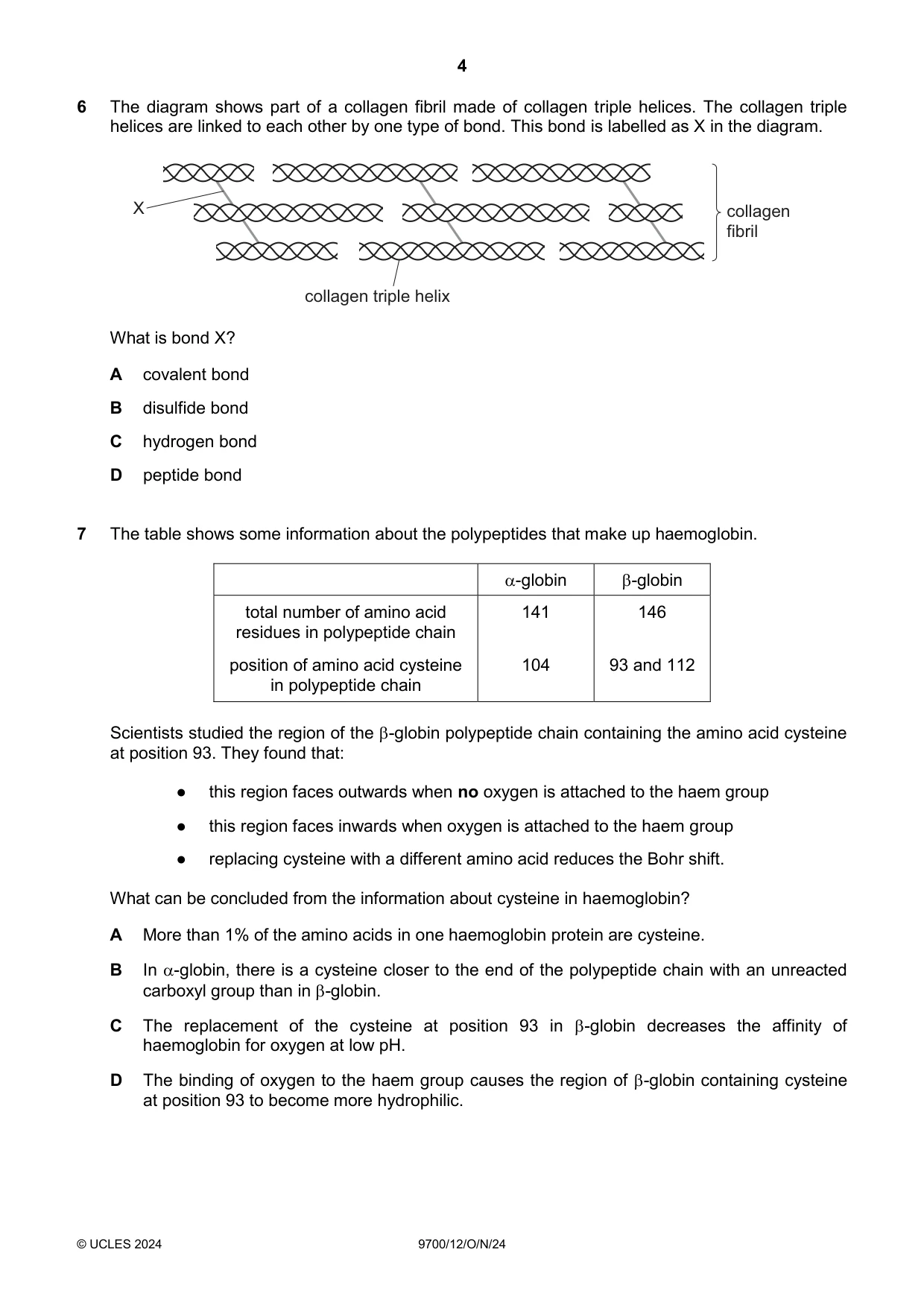
Q6 · The diagram shows part of a collagen fibril made of collagen triple helices
6 The diagram shows part of a collagen fibril made of collagen triple helices. The collagen triple helices are linked to each other by one type of bond. This bond is labelled as X in the diagram. X collagen fibril collagen triple helix What is bond X? A covalent bond B disulfide bond C hydrogen bond D peptide bond
Mark scheme: A
Q7 · The table shows some information about the polypeptides that make up haemoglobin
7 The table shows some information about the polypeptides that make up haemoglobin. -globin -globin total number of amino acid 141 146 residues in polypeptide chain position of amino acid cysteine 104 93 and 112 in polypeptide chain Scientists studied the region of the -globin polypeptide chain containing the amino acid cysteine at position 93. They found that: ● this region faces outwards when no oxygen is attached to the haem group ● this region faces inwards when oxygen is attached to the haem group ● replacing cysteine with a different amino acid reduces the Bohr shift. What can be concluded from the information about cysteine in haemoglobin? A More than 1% of the amino acids in one haemoglobin protein are cysteine. B In -globin, there is a cysteine closer to the end of the polypeptide chain with an unreacted carboxyl group than in -globin. C The replacement of the cysteine at position 93 in -globin decreases the affinity of haemoglobin for oxygen at low pH. D The binding of oxygen to the haem group causes the region of -globin containing cysteine at position 93 to become more hydrophilic.
Mark scheme: A
Q8 · Which feature of glycogen distinguishes it from starch?
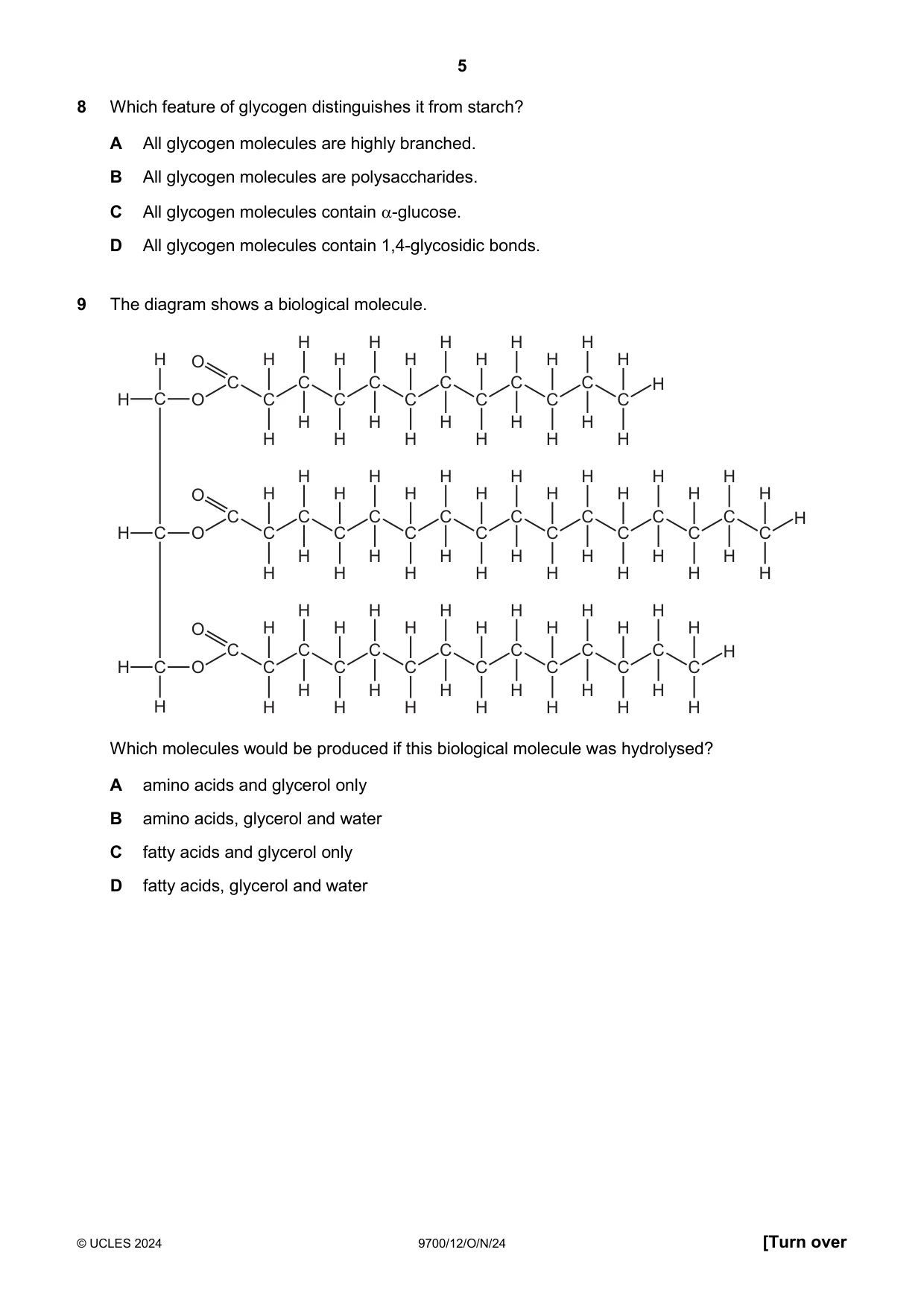
8 Which feature of glycogen distinguishes it from starch? A All glycogen molecules are highly branched. B All glycogen molecules are polysaccharides. C All glycogen molecules contain -glucose. D All glycogen molecules contain 1,4-glycosidic bonds.
Mark scheme: A
Q9 · The diagram shows a biological molecule
9 The diagram shows a biological molecule. H H H H H H O H H H H H H C C C C C C H H C O C C C C C C H H H H H H H H H H H H H H H H H H O H H H H H H H H C C C C C C C C H H C O C C C C C C C C H H H H H H H H H H H H H H H H H H H H H O H H H H H H H C C C C C C C H H C O C C C C C C C H H H H H H H H H H H H H H Which molecules would be produced if this biological molecule was hydrolysed? A amino acids and glycerol only B amino acids, glycerol and water C fatty acids and glycerol only D fatty acids, glycerol and water
Mark scheme: C
Q10 · A mixture of glucose and starch solutions was placed in a length of dialysis (Visking)…
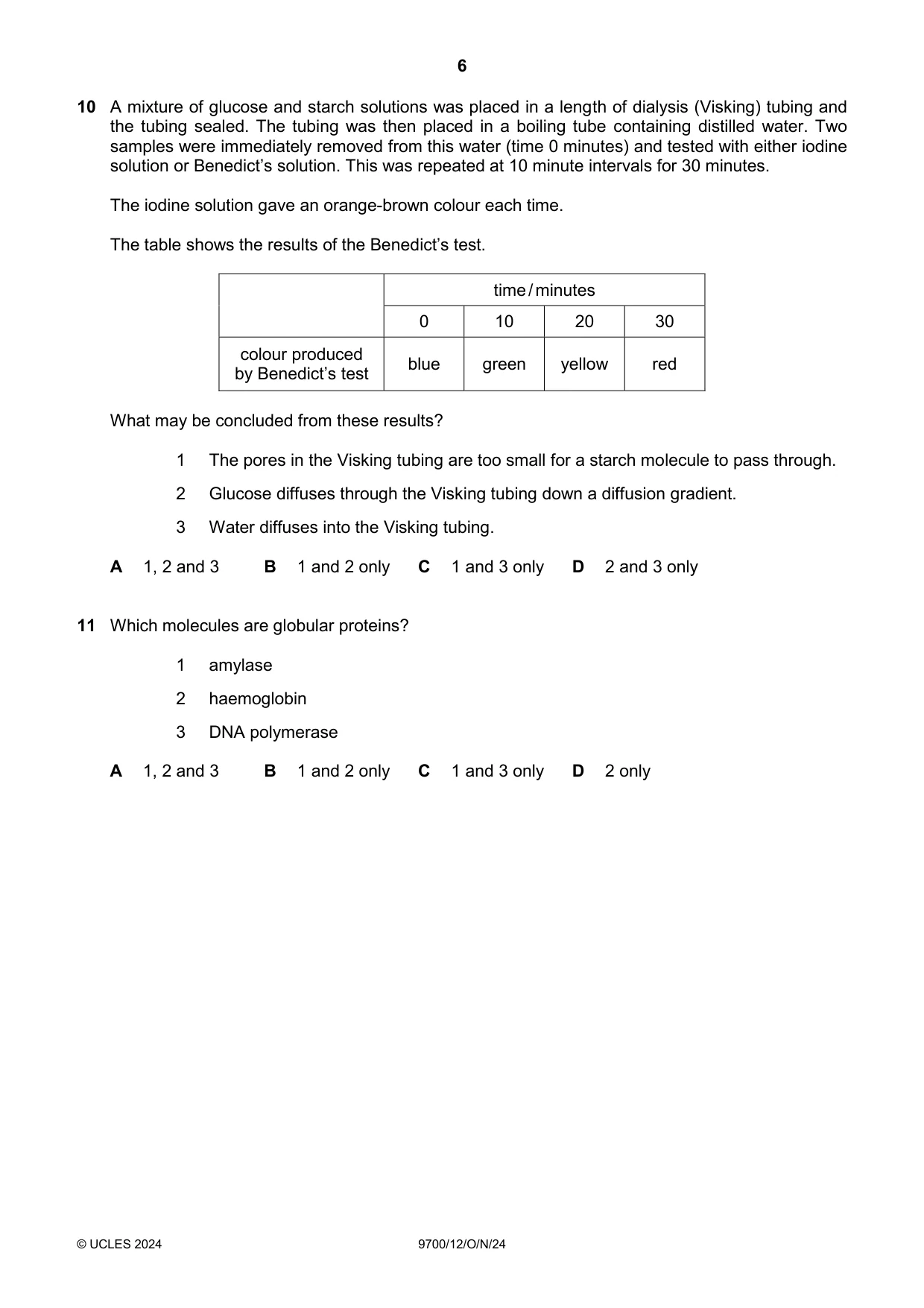
10 A mixture of glucose and starch solutions was placed in a length of dialysis (Visking) tubing and the tubing sealed. The tubing was then placed in a boiling tube containing distilled water. Two samples were immediately removed from this water (time 0 minutes) and tested with either iodine solution or Benedict’s solution. This was repeated at 10 minute intervals for 30 minutes. The iodine solution gave an orange-brown colour each time. The table shows the results of the Benedict’s test. time / minutes 0 10 20 30 colour produced blue green yellow red by Benedict’s test What may be concluded from these results? 1 The pores in the Visking tubing are too small for a starch molecule to pass through. 2 Glucose diffuses through the Visking tubing down a diffusion gradient. 3 Water diffuses into the Visking tubing. A 1, 2 and 3 B 1 and 2 only C 1 and 3 only D 2 and 3 only
Mark scheme: B
Q11 · Which molecules are globular proteins?
11 Which molecules are globular proteins? 1 amylase 2 haemoglobin 3 DNA polymerase A 1, 2 and 3 B 1 and 2 only C 1 and 3 only D 2 only
Mark scheme: A
Q12 · The initial rate of a reaction catalysed by an enzyme was measured at various substrate…
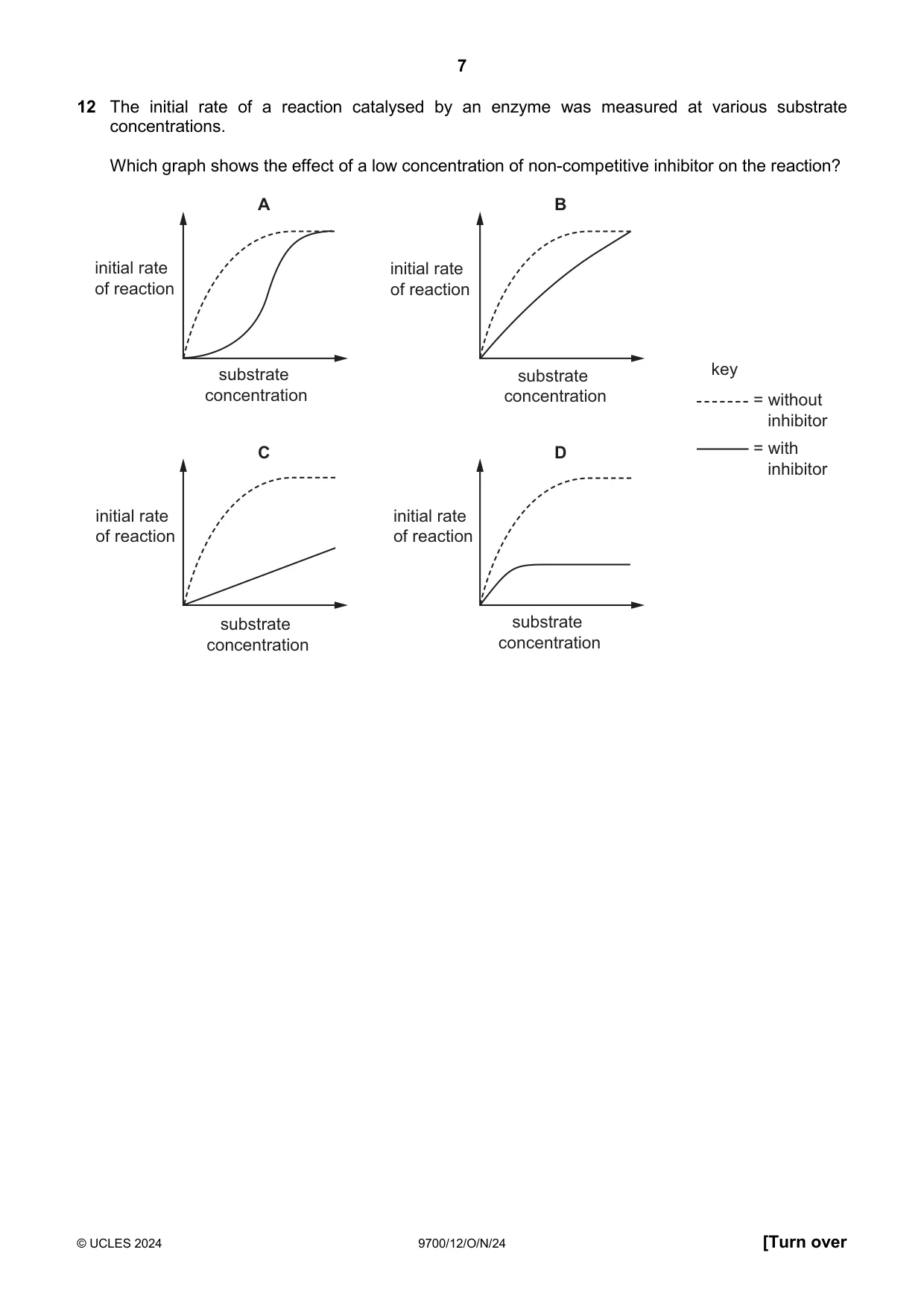
12 The initial rate of a reaction catalysed by an enzyme was measured at various substrate concentrations. Which graph shows the effect of a low concentration of non-competitive inhibitor on the reaction? A B initial rate initial rate of reaction of reaction substrate substrate key concentration concentration = without inhibitor C D = with inhibitor initial rate initial rate of reaction of reaction substrate substrate concentration concentration
Mark scheme: D
Q13 · Gout is a type of arthritis in which small uric acid crystals form inside and around the…
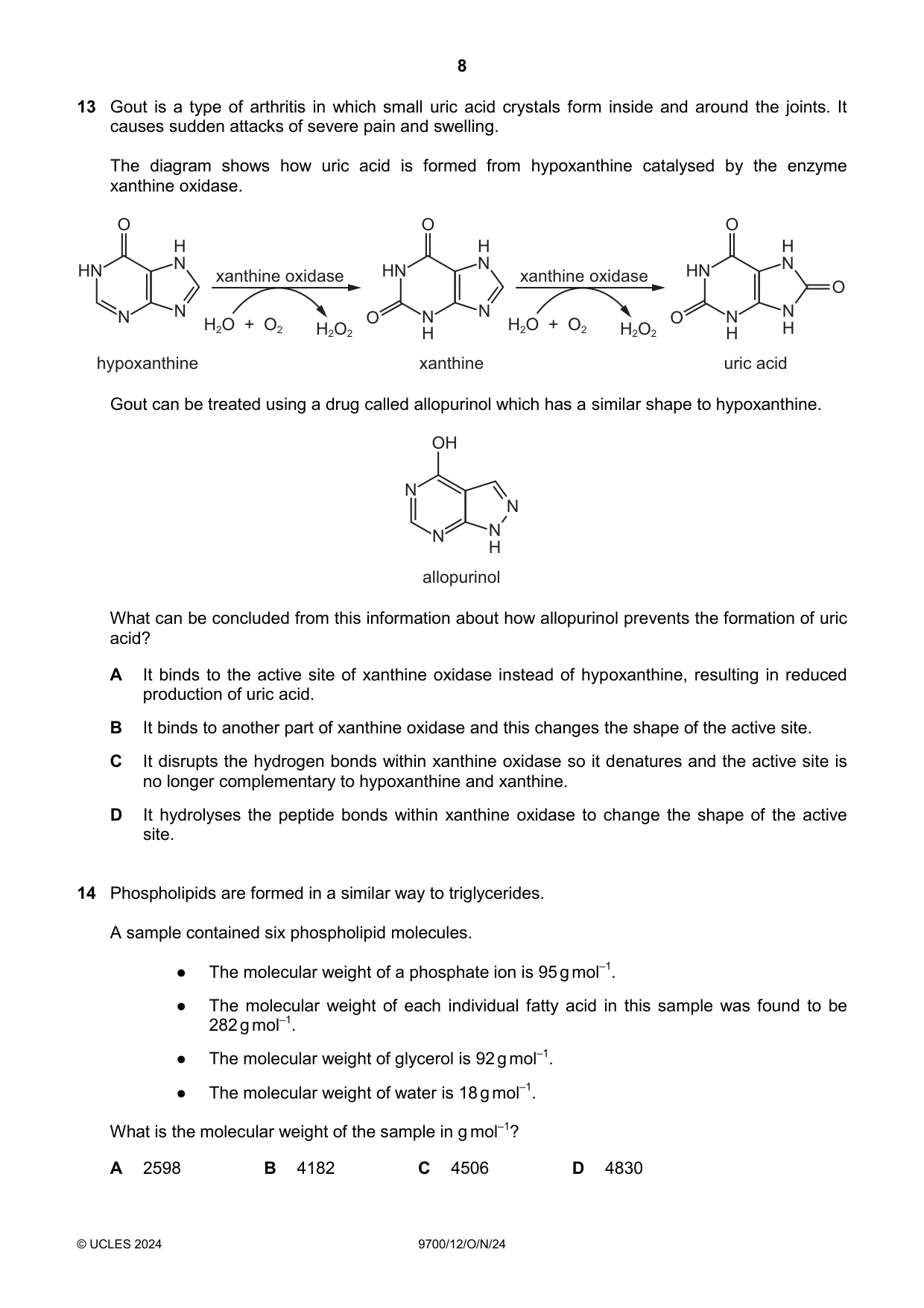
13 Gout is a type of arthritis in which small uric acid crystals form inside and around the joints. It causes sudden attacks of severe pain and swelling. The diagram shows how uric acid is formed from hypoxanthine catalysed by the enzyme xanthine oxidase. O O O H H H HN N HN N HN N xanthine oxidase xanthine oxidase O N N O N N O N N H2O + O2 H2O2 H2O + O2 H2O2 H H H hypoxanthine xanthine uric acid Gout can be treated using a drug called allopurinol which has a similar shape to hypoxanthine. OH N N N N H allopurinol What can be concluded from this information about how allopurinol prevents the formation of uric acid? A It binds to the active site of xanthine oxidase instead of hypoxanthine, resulting in reduced production of uric acid. B It binds to another part of xanthine oxidase and this changes the shape of the active site. C It disrupts the hydrogen bonds within xanthine oxidase so it denatures and the active site is no longer complementary to hypoxanthine and xanthine. D It hydrolyses the peptide bonds within xanthine oxidase to change the shape of the active site.
Mark scheme: A
Q14 · Phospholipids are formed in a similar way to triglycerides
14 Phospholipids are formed in a similar way to triglycerides. A sample contained six phospholipid molecules. ● The molecular weight of a phosphate ion is 95 g mol–1. ● The molecular weight of each individual fatty acid in this sample was found to be 282 g mol–1. ● The molecular weight of glycerol is 92 g mol–1. ● The molecular weight of water is 18 g mol–1. What is the molecular weight of the sample in g mol–1? A 2598 B 4182 C 4506 D 4830
Mark scheme: B
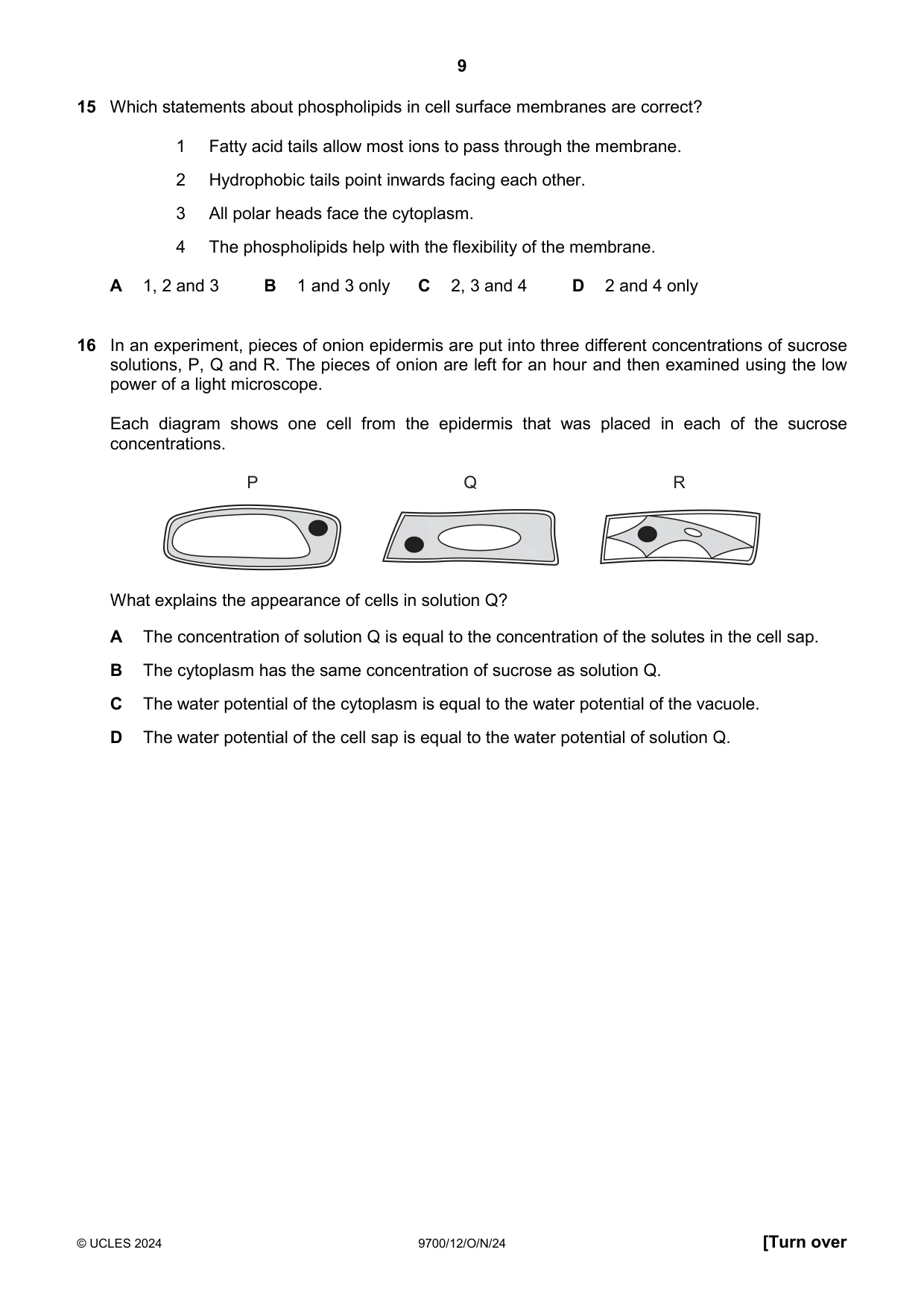
Q15 · Which statements about phospholipids in cell surface membranes are correct?
15 Which statements about phospholipids in cell surface membranes are correct? 1 Fatty acid tails allow most ions to pass through the membrane. 2 Hydrophobic tails point inwards facing each other. 3 All polar heads face the cytoplasm. 4 The phospholipids help with the flexibility of the membrane. A 1, 2 and 3 B 1 and 3 only C 2, 3 and 4 D 2 and 4 only
Mark scheme: D
Q16 · In an experiment, pieces of onion epidermis are put into three different concentrations…
16 In an experiment, pieces of onion epidermis are put into three different concentrations of sucrose solutions, P, Q and R. The pieces of onion are left for an hour and then examined using the low power of a light microscope. Each diagram shows one cell from the epidermis that was placed in each of the sucrose concentrations. P Q R What explains the appearance of cells in solution Q? A The concentration of solution Q is equal to the concentration of the solutes in the cell sap. B The cytoplasm has the same concentration of sucrose as solution Q. C The water potential of the cytoplasm is equal to the water potential of the vacuole. D The water potential of the cell sap is equal to the water potential of solution Q.
Mark scheme: D
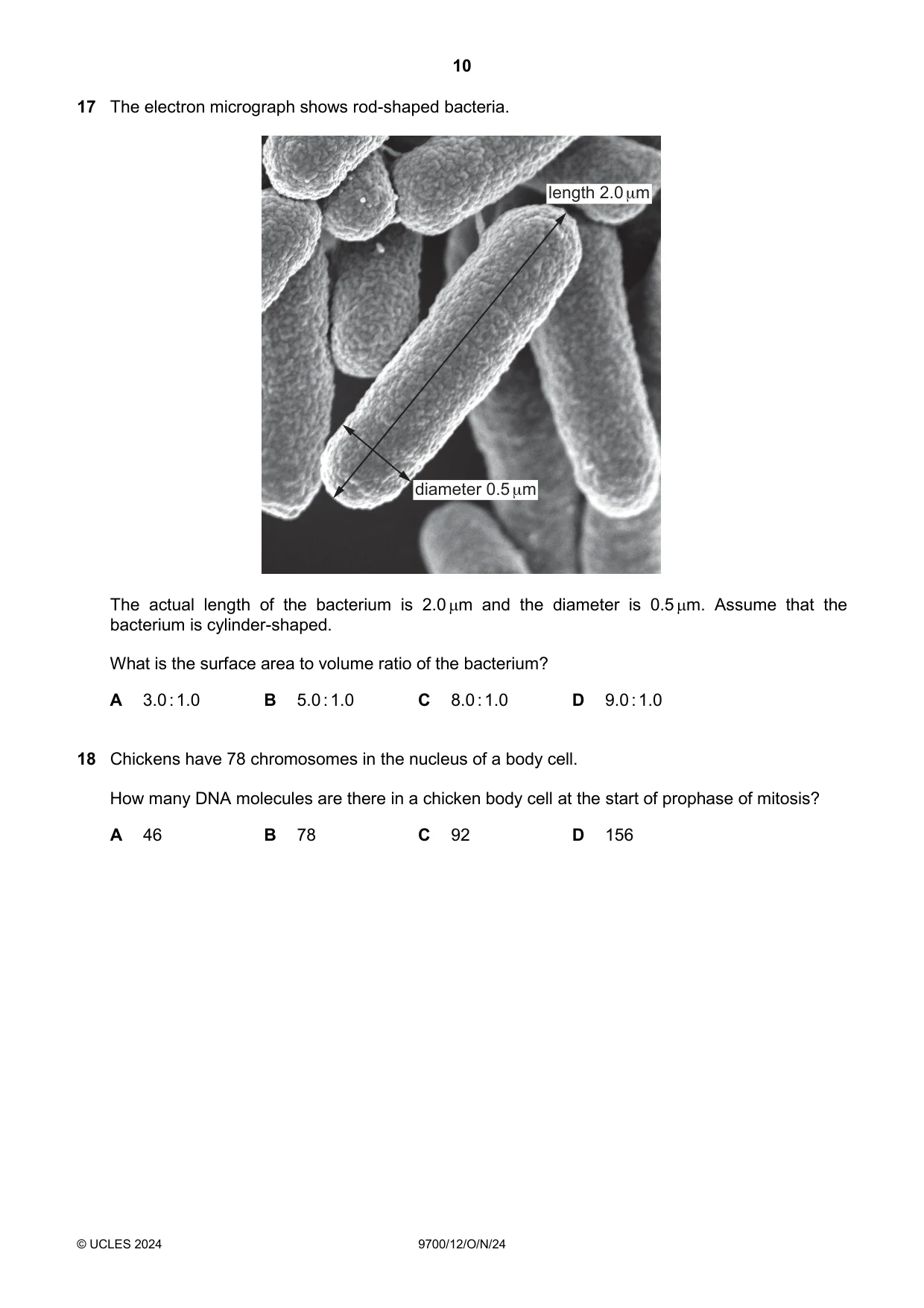
Q17 · The electron micrograph shows rod-shaped bacteria
17 The electron micrograph shows rod-shaped bacteria. length 2.0 μm diameter 0.5 μm The actual length of the bacterium is 2.0 m and the diameter is 0.5 m. Assume that the bacterium is cylinder-shaped. What is the surface area to volume ratio of the bacterium? A 3.0 : 1.0 B 5.0 : 1.0 C 8.0 : 1.0 D 9.0 : 1.0
Mark scheme: D
More questions on Cells as the basic units of living organisms
Q18 · Chickens have 78 chromosomes in the nucleus of a body cell
18 Chickens have 78 chromosomes in the nucleus of a body cell. How many DNA molecules are there in a chicken body cell at the start of prophase of mitosis? A 46 B 78 C 92 D 156
Mark scheme: D
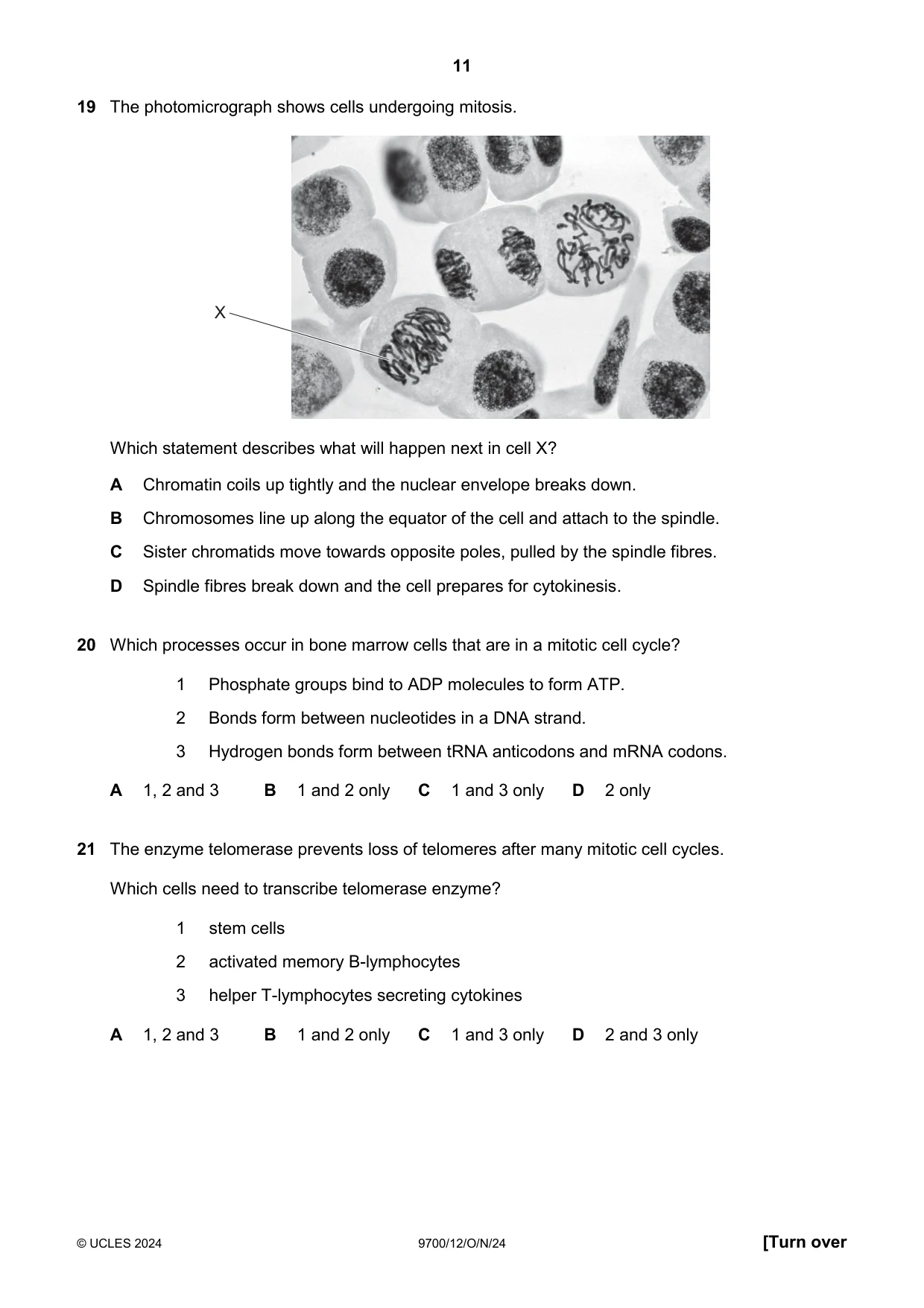
Q19 · The photomicrograph shows cells undergoing mitosis
19 The photomicrograph shows cells undergoing mitosis. X Which statement describes what will happen next in cell X? A Chromatin coils up tightly and the nuclear envelope breaks down. B Chromosomes line up along the equator of the cell and attach to the spindle. C Sister chromatids move towards opposite poles, pulled by the spindle fibres. D Spindle fibres break down and the cell prepares for cytokinesis.
Mark scheme: B
Q20 · Which processes occur in bone marrow cells that are in a mitotic cell cycle?
20 Which processes occur in bone marrow cells that are in a mitotic cell cycle? 1 Phosphate groups bind to ADP molecules to form ATP. 2 Bonds form between nucleotides in a DNA strand. 3 Hydrogen bonds form between tRNA anticodons and mRNA codons. A 1, 2 and 3 B 1 and 2 only C 1 and 3 only D 2 only
Mark scheme: A
More questions on Replication and division of nuclei and cells
Q21 · The enzyme telomerase prevents loss of telomeres after many mitotic cell cycles
21 The enzyme telomerase prevents loss of telomeres after many mitotic cell cycles. Which cells need to transcribe telomerase enzyme? 1 stem cells 2 activated memory B-lymphocytes 3 helper T-lymphocytes secreting cytokines A 1, 2 and 3 B 1 and 2 only C 1 and 3 only D 2 and 3 only
Mark scheme: B
More questions on Replication and division of nuclei and cells
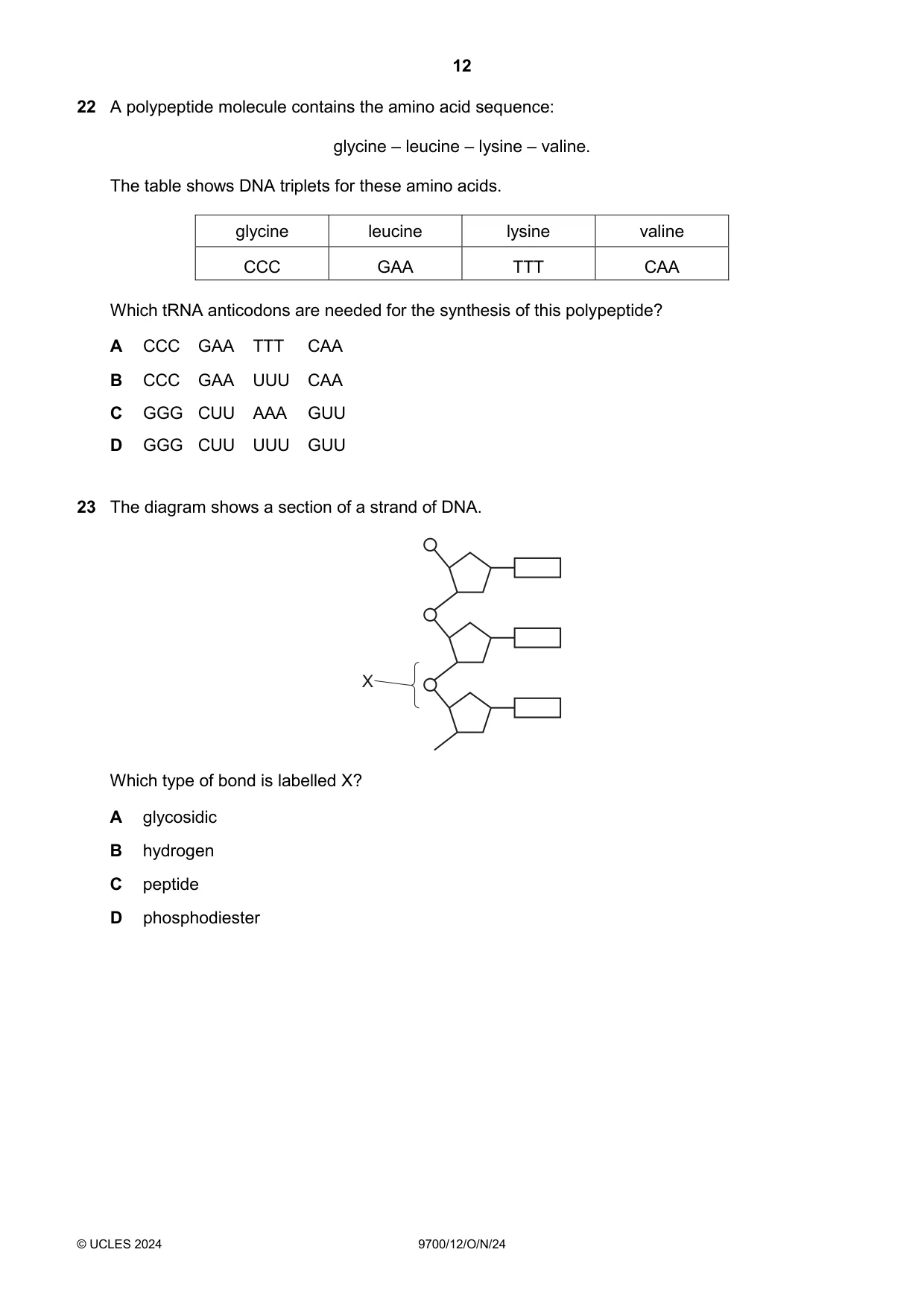
Q22 · A polypeptide molecule contains the amino acid sequence: glycine – leucine – lysine…
22 A polypeptide molecule contains the amino acid sequence: glycine – leucine – lysine – valine. The table shows DNA triplets for these amino acids. glycine leucine lysine valine CCC GAA TTT CAA Which tRNA anticodons are needed for the synthesis of this polypeptide? A CCC GAA TTT CAA B CCC GAA UUU CAA C GGG CUU AAA GUU D GGG CUU UUU GUU
Mark scheme: B
Q23 · The diagram shows a section of a strand of DNA
23 The diagram shows a section of a strand of DNA. X Which type of bond is labelled X? A glycosidic B hydrogen C peptide D phosphodiester
Mark scheme: D
More questions on Structure of nucleic acids and replication of DNA
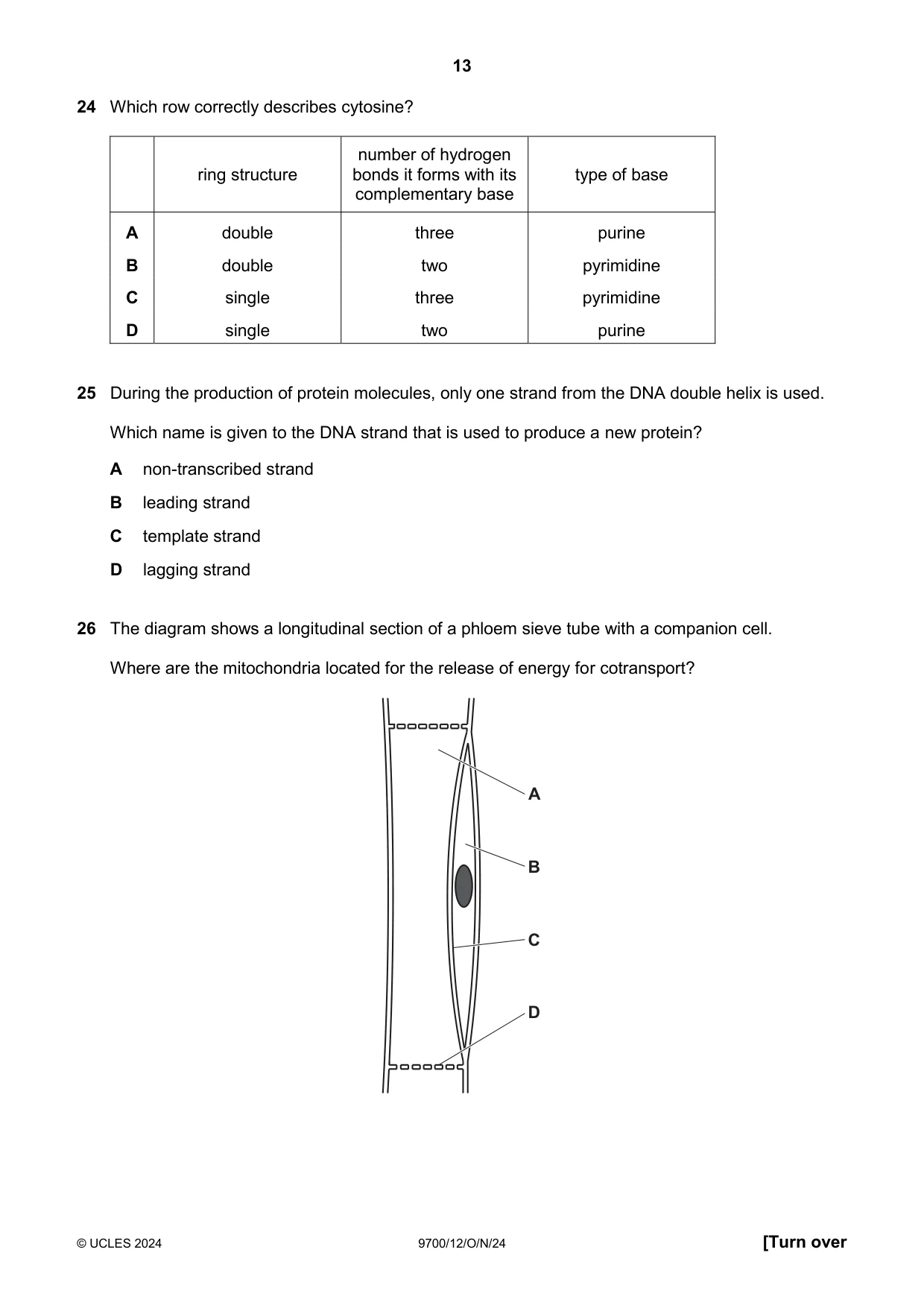
Q24 · Which row correctly describes cytosine?
24 Which row correctly describes cytosine? number of hydrogen ring structure bonds it forms with its type of base complementary base A double three purine B double two pyrimidine C single three pyrimidine D single two purine
Mark scheme: C
More questions on Structure of nucleic acids and replication of DNA
Q25 · During the production of protein molecules, only one strand from the DNA double helix is…
25 During the production of protein molecules, only one strand from the DNA double helix is used. Which name is given to the DNA strand that is used to produce a new protein? A non-transcribed strand B leading strand C template strand D lagging strand
Mark scheme: C
Q26 · The diagram shows a longitudinal section of a phloem sieve tube with a companion cell
26 The diagram shows a longitudinal section of a phloem sieve tube with a companion cell. Where are the mitochondria located for the release of energy for cotransport? A B C D
Mark scheme: B
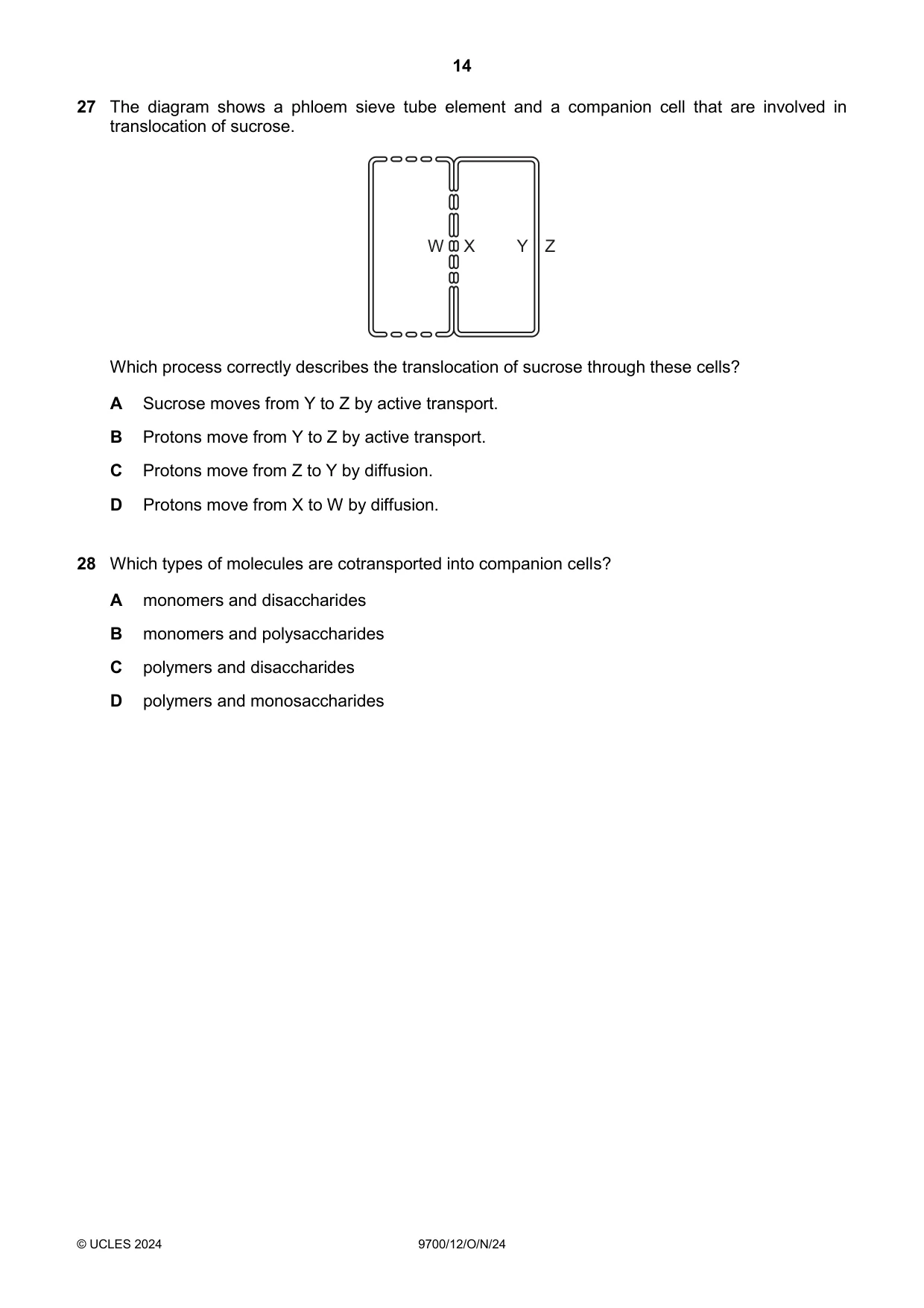
Q27 · The diagram shows a phloem sieve tube element and a companion cell that are involved in…
27 The diagram shows a phloem sieve tube element and a companion cell that are involved in translocation of sucrose. W X Y Z Which process correctly describes the translocation of sucrose through these cells? A Sucrose moves from Y to Z by active transport. B Protons move from Y to Z by active transport. C Protons move from Z to Y by diffusion. D Protons move from X to W by diffusion.
Mark scheme: B
Q28 · Which types of molecules are cotransported into companion cells?
28 Which types of molecules are cotransported into companion cells? A monomers and disaccharides B monomers and polysaccharides C polymers and disaccharides D polymers and monosaccharides
Mark scheme: A
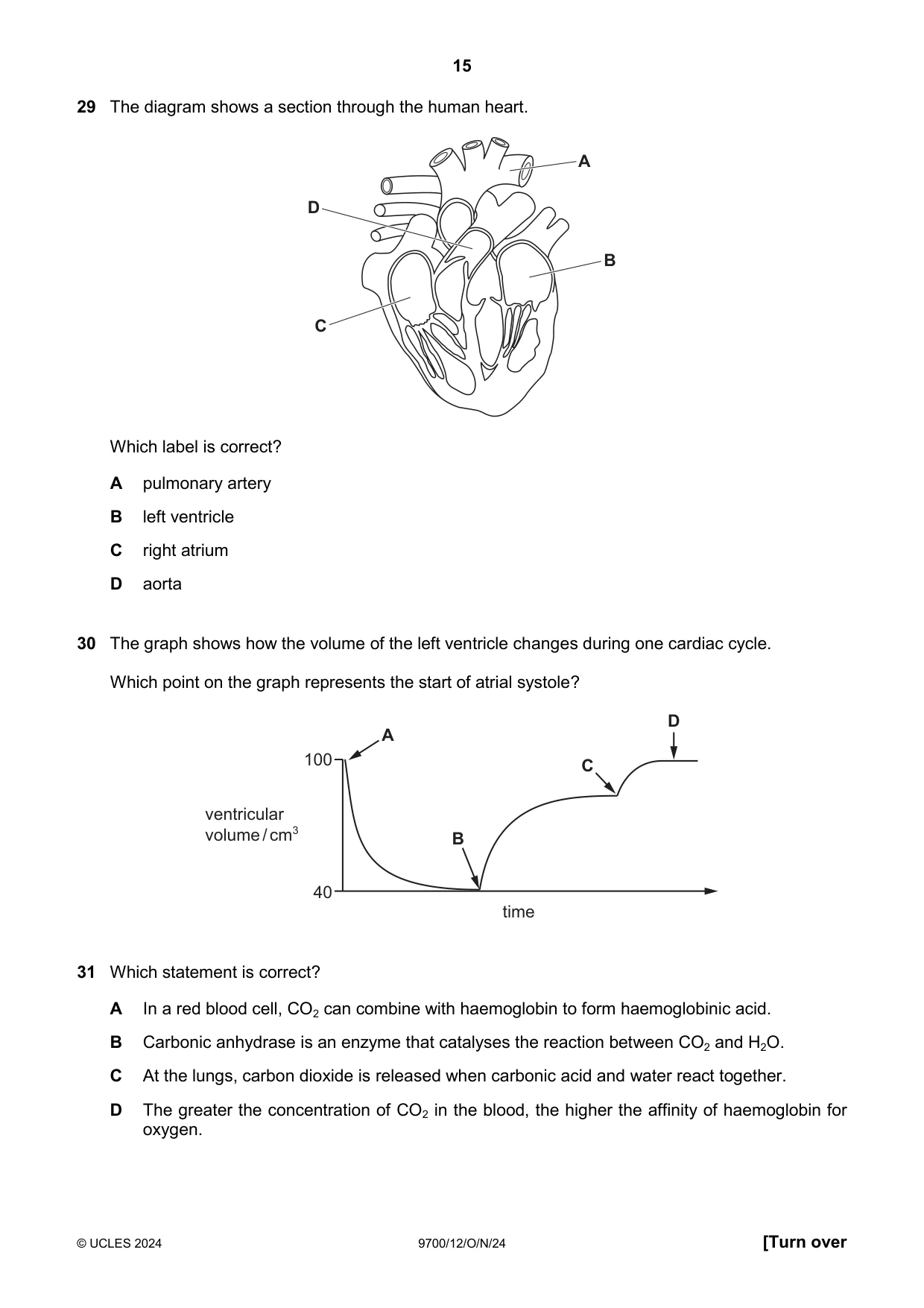
Q29 · The diagram shows a section through the human heart
29 The diagram shows a section through the human heart. A D B C Which label is correct? A pulmonary artery B left ventricle C right atrium D aorta
Mark scheme: C
Q30 · The graph shows how the volume of the left ventricle changes during one cardiac cycle
30 The graph shows how the volume of the left ventricle changes during one cardiac cycle. Which point on the graph represents the start of atrial systole? D A 100 C ventricular volume / cm3 B 40 time
Mark scheme: C
Q31 · Which statement is correct?
31 Which statement is correct? A In a red blood cell, CO2 can combine with haemoglobin to form haemoglobinic acid. B Carbonic anhydrase is an enzyme that catalyses the reaction between CO2 and H2O. C At the lungs, carbon dioxide is released when carbonic acid and water react together. D The greater the concentration of CO2 in the blood, the higher the affinity of haemoglobin for oxygen.
Mark scheme: B
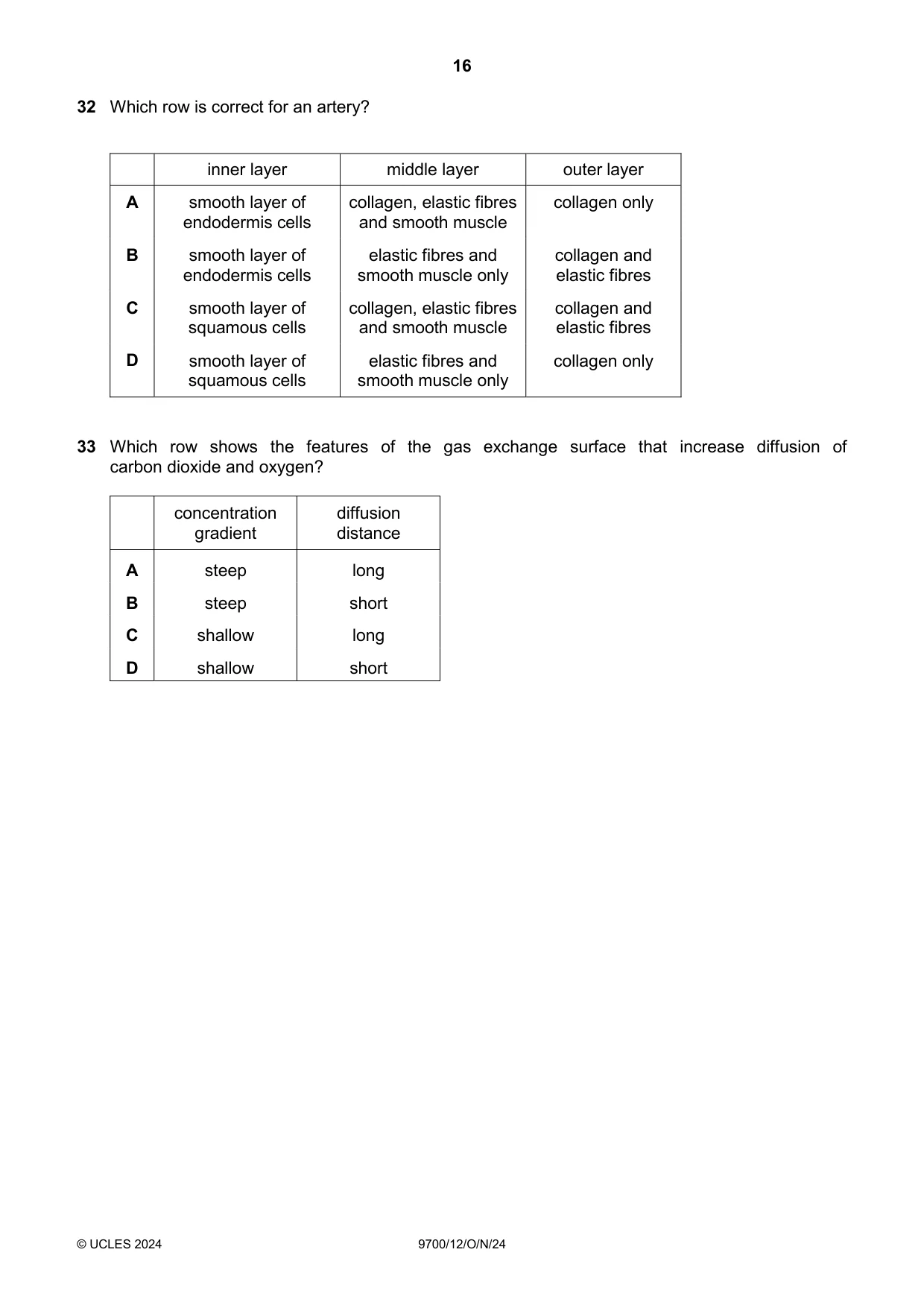
Q32 · Which row is correct for an artery?
32 Which row is correct for an artery? inner layer middle layer outer layer A smooth layer of collagen, elastic fibres collagen only endodermis cells and smooth muscle B smooth layer of elastic fibres and collagen and endodermis cells smooth muscle only elastic fibres C smooth layer of collagen, elastic fibres collagen and squamous cells and smooth muscle elastic fibres D smooth layer of elastic fibres and collagen only squamous cells smooth muscle only
Mark scheme: C
Q33 · Which row shows the features of the gas exchange surface that increase diffusion of…
33 Which row shows the features of the gas exchange surface that increase diffusion of carbon dioxide and oxygen? concentration diffusion gradient distance A steep long B steep short C shallow long D shallow short
Mark scheme: B
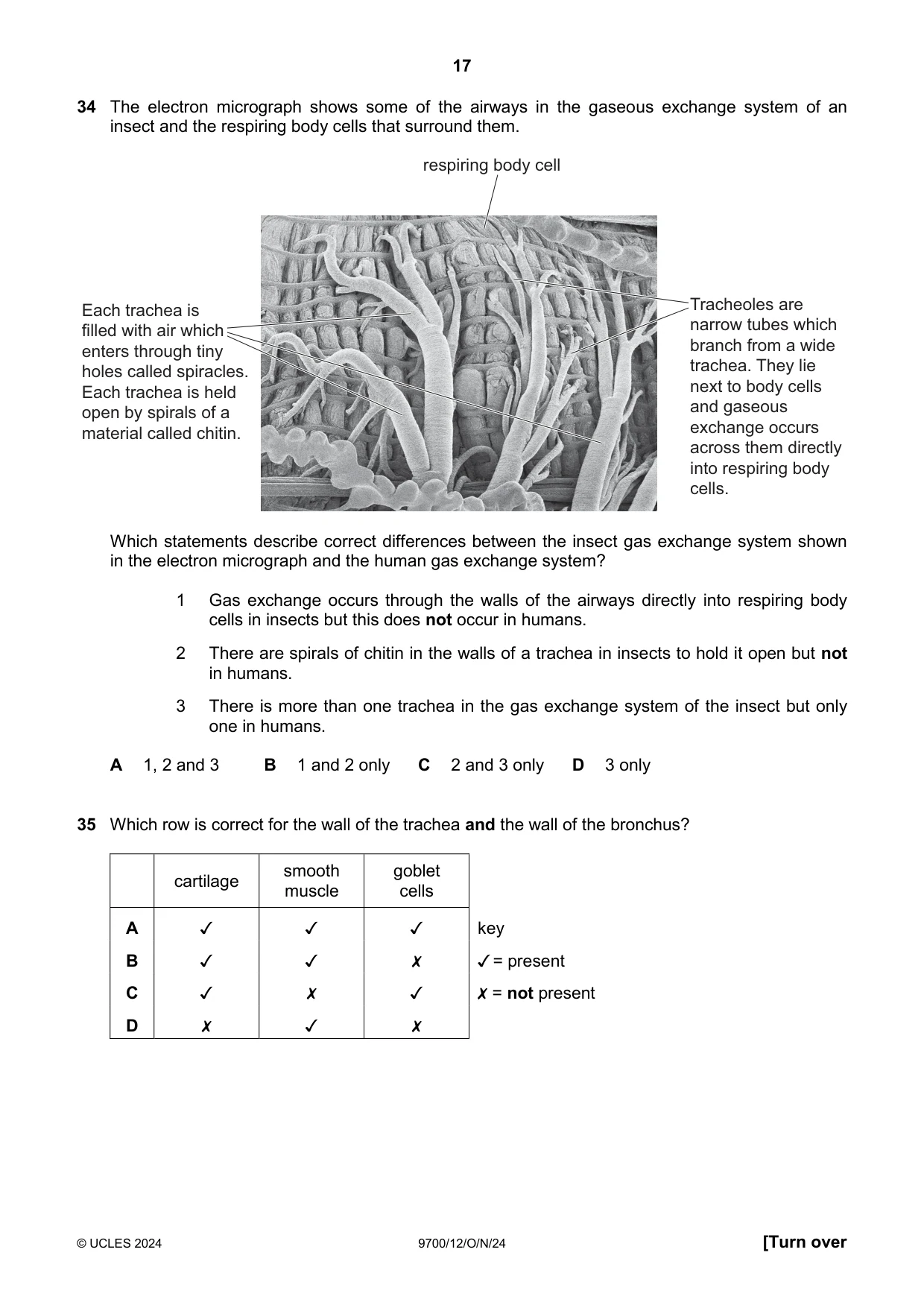
Q34 · The electron micrograph shows some of the airways in the gaseous exchange system of an…
34 The electron micrograph shows some of the airways in the gaseous exchange system of an insect and the respiring body cells that surround them. respiring body cell Each trachea is Tracheoles are filled with air which narrow tubes which enters through tiny branch from a wide holes called spiracles. trachea. They lie Each trachea is held next to body cells open by spirals of a and gaseous material called chitin. exchange occurs across them directly into respiring body cells. Which statements describe correct differences between the insect gas exchange system shown in the electron micrograph and the human gas exchange system? 1 Gas exchange occurs through the walls of the airways directly into respiring body cells in insects but this does not occur in humans. 2 There are spirals of chitin in the walls of a trachea in insects to hold it open but not in humans. 3 There is more than one trachea in the gas exchange system of the insect but only one in humans. A 1, 2 and 3 B 1 and 2 only C 2 and 3 only D 3 only
Mark scheme: A
Q35 · Which row is correct for the wall of the trachea and the wall of the bronchus?
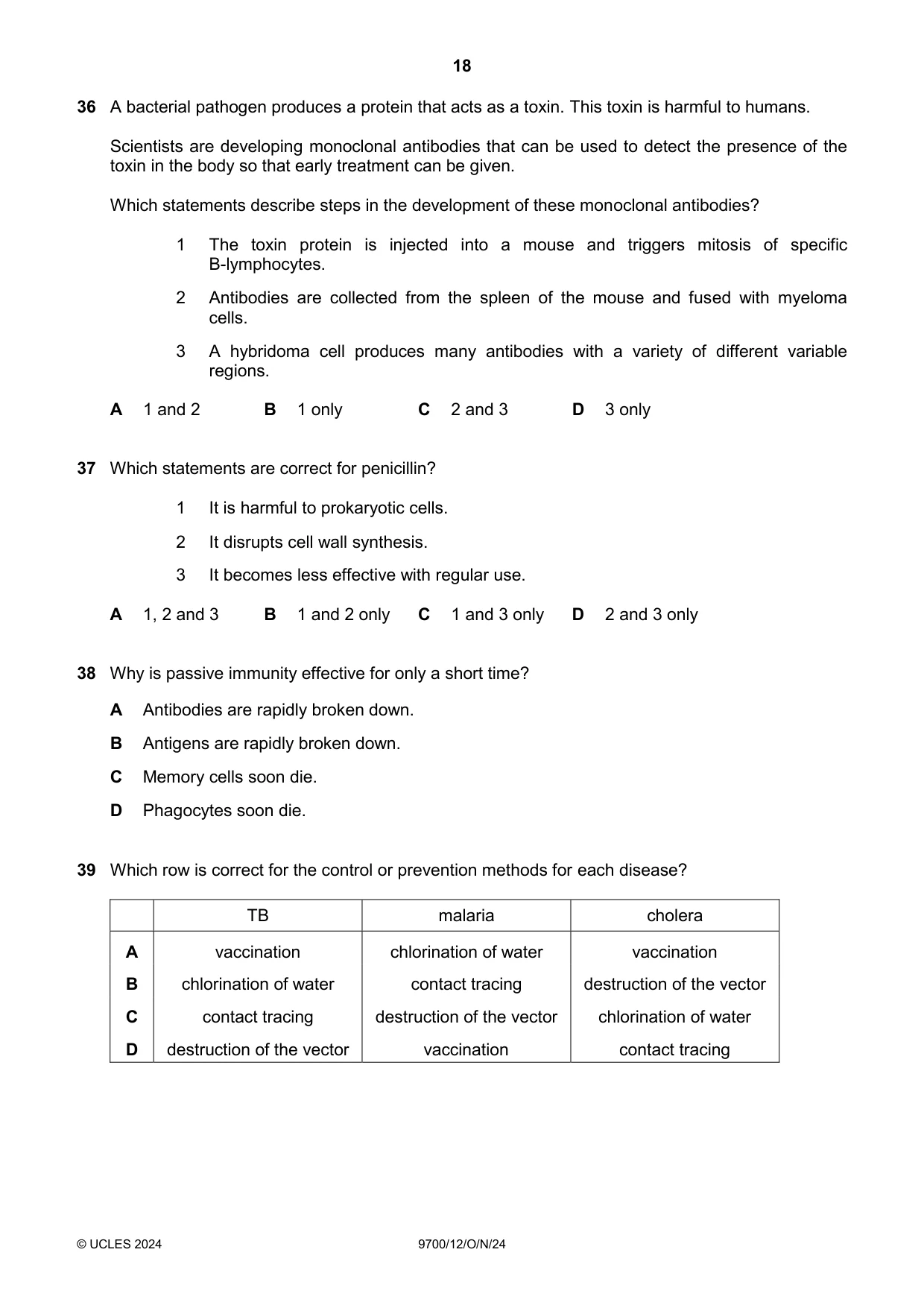
35 Which row is correct for the wall of the trachea and the wall of the bronchus? cartilage smooth goblet muscle cells A v v v key B Jv v x ¥ = present Cc v x v X = not present D x v x
Mark scheme: A
Q36 · A bacterial pathogen produces a protein that acts as a toxin
36 A bacterial pathogen produces a protein that acts as a toxin. This toxin is harmful to humans. Scientists are developing monoclonal antibodies that can be used to detect the presence of the toxin in the body so that early treatment can be given. Which statements describe steps in the development of these monoclonal antibodies? 1 The toxin protein is injected into a mouse and triggers mitosis of specific B-lymphocytes. 2 Antibodies are collected from the spleen of the mouse and fused with myeloma cells. 3 A hybridoma cell produces many antibodies with a variety of different variable regions. A 1 and 2 B 1 only C 2 and 3 D 3 only
Mark scheme: B
Q37 · Which statements are correct for penicillin?
37 Which statements are correct for penicillin? 1 It is harmful to prokaryotic cells. 2 It disrupts cell wall synthesis. 3 It becomes less effective with regular use. A 1, 2 and 3 B 1 and 2 only C 1 and 3 only D 2 and 3 only
Mark scheme: A
Q38 · Why is passive immunity effective for only a short time?
38 Why is passive immunity effective for only a short time? A Antibodies are rapidly broken down. B Antigens are rapidly broken down. C Memory cells soon die. D Phagocytes soon die.
Mark scheme: A
Q39 · Which row is correct for the control or prevention methods for each disease?
39 Which row is correct for the control or prevention methods for each disease? TB malaria cholera A vaccination chlorination of water vaccination B chlorination of water contact tracing destruction of the vector C contact tracing destruction of the vector chlorination of water D destruction of the vector vaccination contact tracing
Mark scheme: C
Q40 · Peptidoglycan is stained purple by the chemical crystal violet
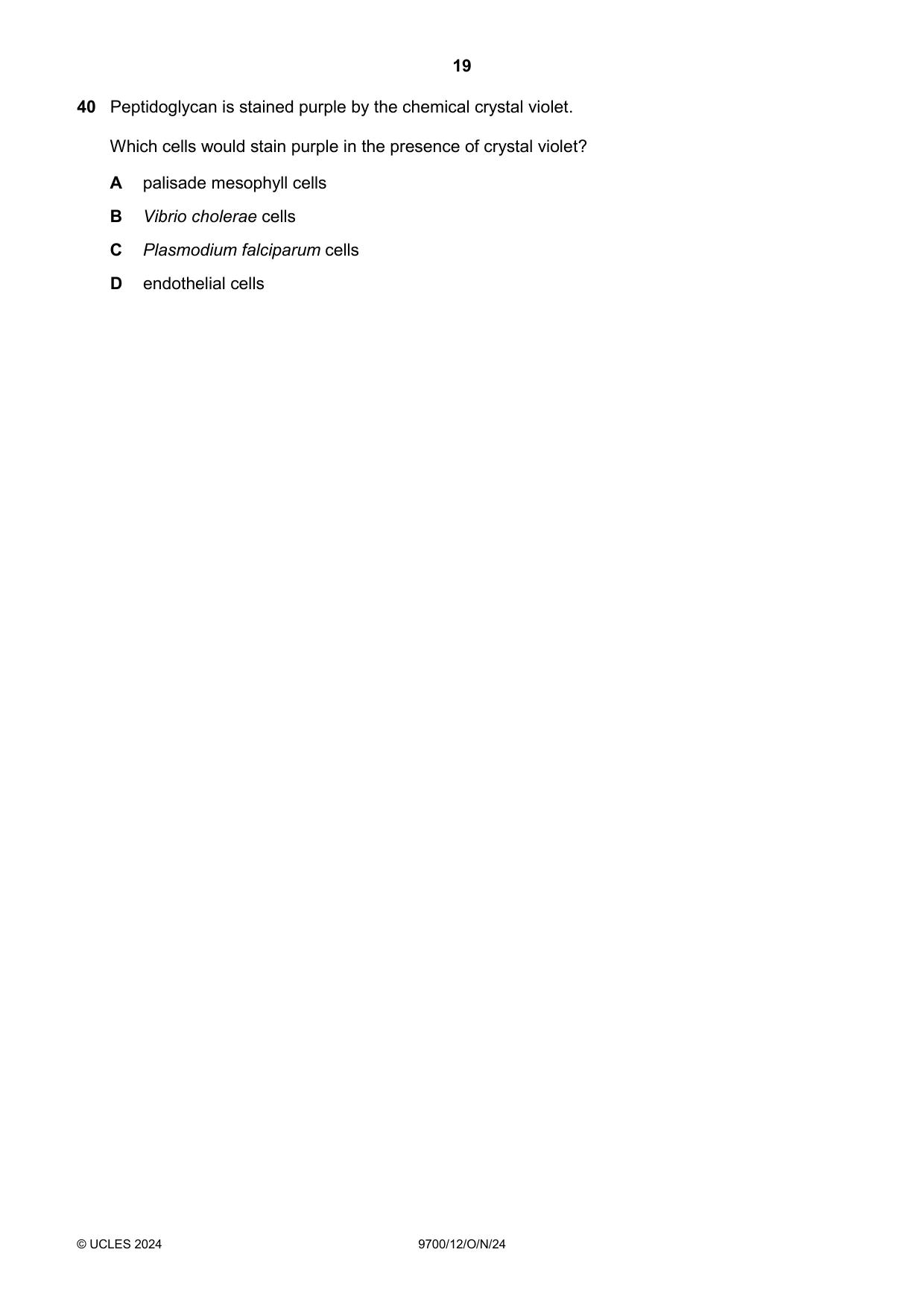
40 Peptidoglycan is stained purple by the chemical crystal violet. Which cells would stain purple in the presence of crystal violet? A palisade mesophyll cells B Vibrio cholerae cells C Plasmodium falciparum cells D endothelial cells
Mark scheme: B
What was in this paper
The subtopics covered by these 40 questions, and how many questions each got. Open one in a new tab to see every Cambridge question on it.
4Carbohydrates and lipids3The gas exchange system3Transport mechanisms3Antibodies and vaccination2Chromosome behaviour in mitosis2Factors that affect enzyme action2Infectious diseases2Movement into and out of cells2Protein synthesis2Proteins2Replication and division of nuclei and cells2Structure of nucleic acids and replication of DNA2The heart2The microscope in cell studies2Transport of oxygen and carbon dioxide2Antibiotics1Fluid mosaic membranes1The circulatory system1What you needed in this session
Cambridge’s own grade thresholds for 2024 Oct/Nov, Paper 1 · Variant 2. A higher threshold means an easier paper — the bar moves with how the cohort did.