Cambridge A Level Biology 9700 — 2025 May/June Paper 1 · Variant 2
9700/12/M/J/25 · 40 questions · 40 marks · 75 min
The question paper and its mark scheme, free to read here and free to download. This is Cambridge’s own paper, exactly as it was sat.
Question paper20 pages

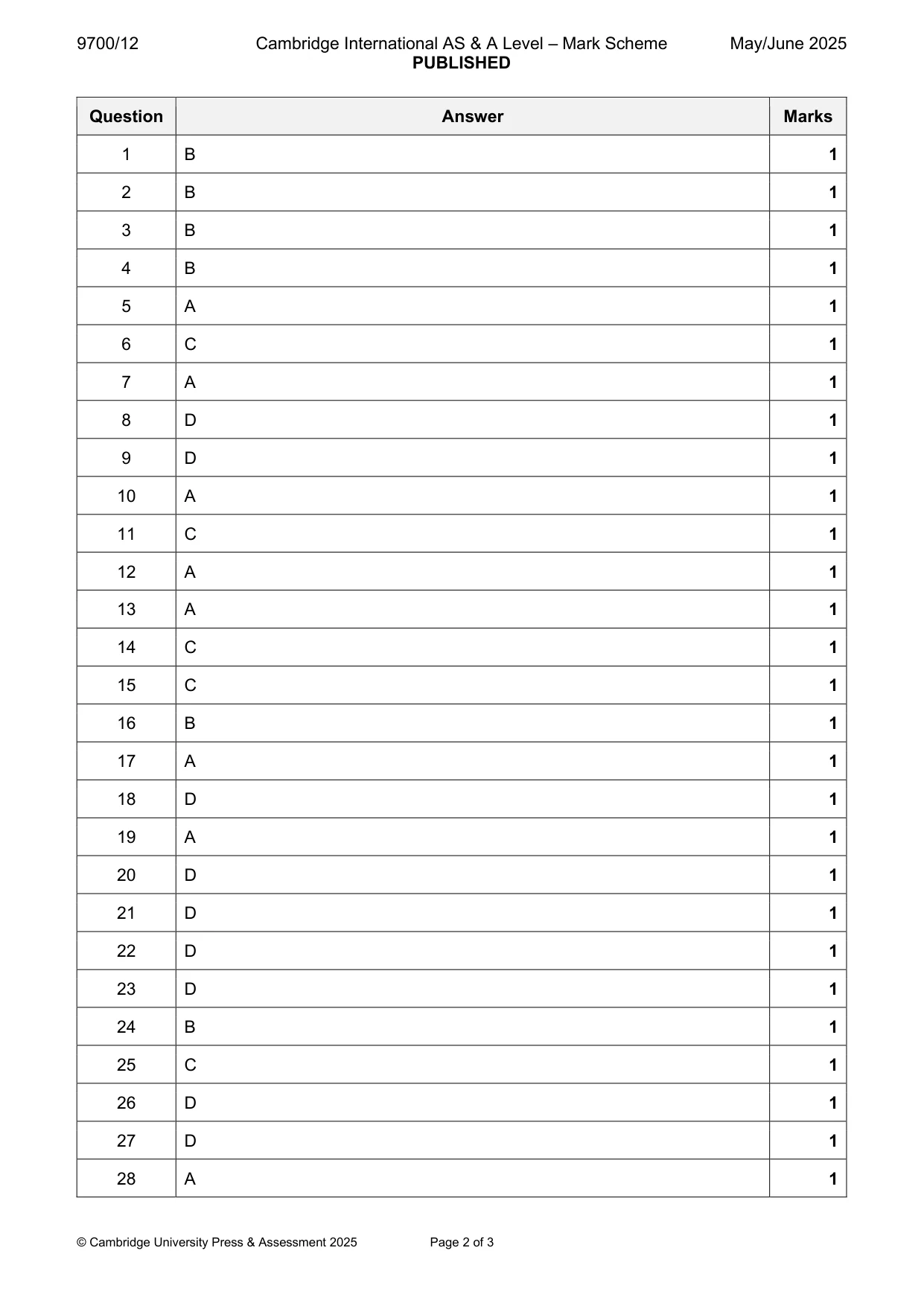
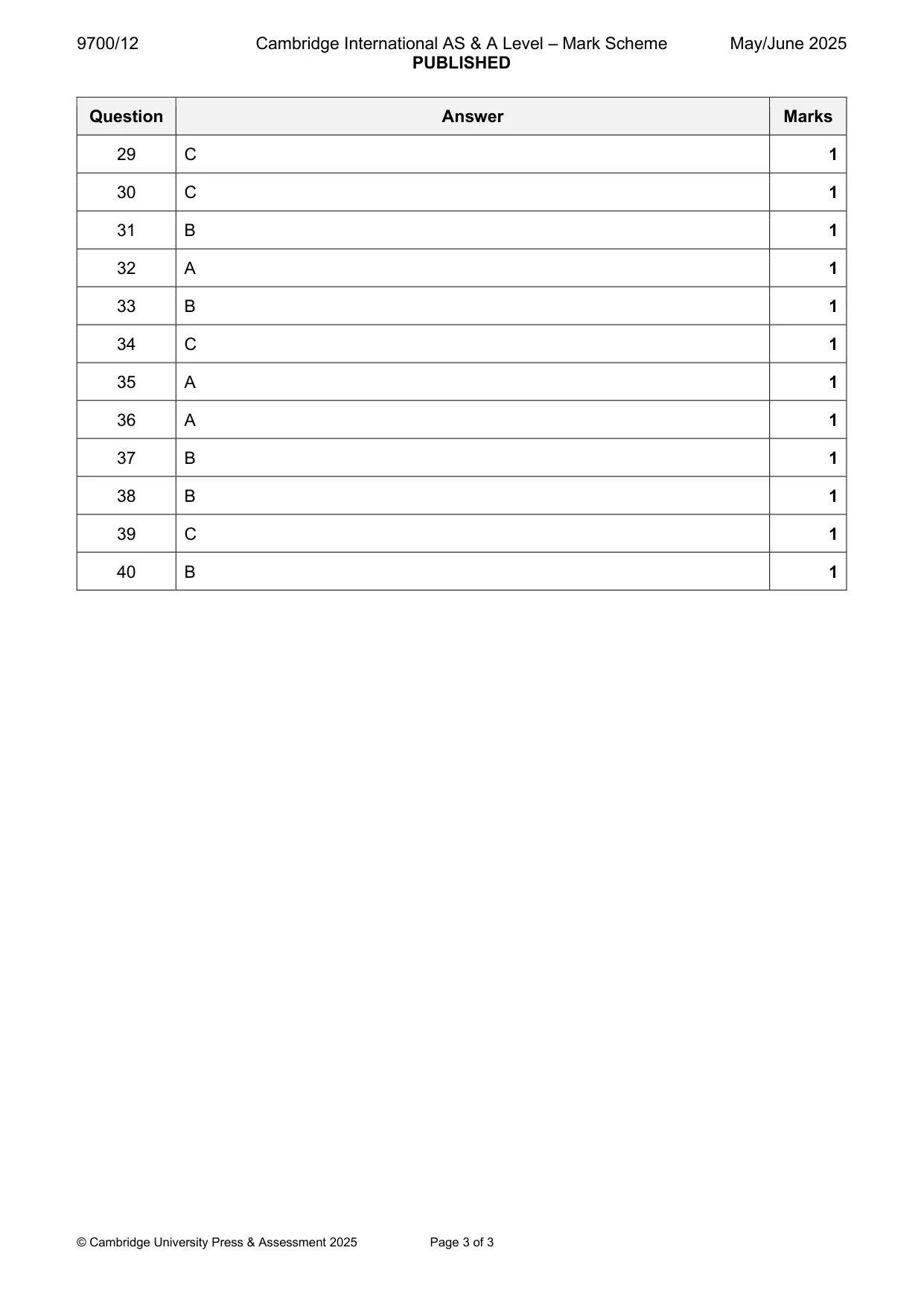
Mark scheme3 pages
Answers below. Sit the paper first if you are practising.
Questions as text
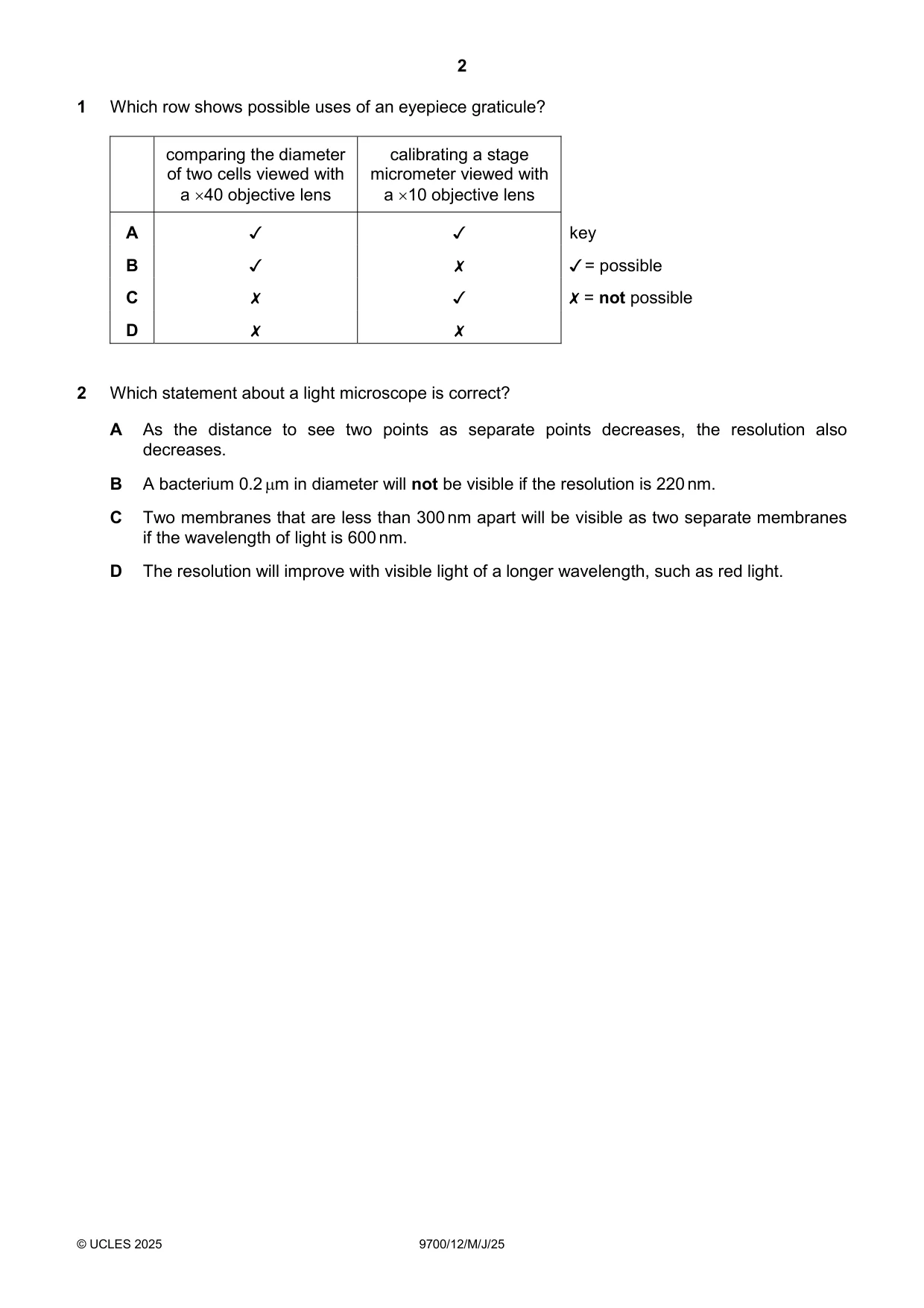
Q1 · Which row shows possible uses of an eyepiece graticule?
1 Which row shows possible uses of an eyepiece graticule? calibrating a stage micrometer viewed with a x10 objective lens comparing the diameter of two cells viewed with a x40 objective lens v v v x x v x x key / = possible X = not possible
Mark scheme: B
Q2 · Which statement about a light microscope is correct?
2 Which statement about a light microscope is correct? A As the distance to see two points as separate points decreases, the resolution also decreases. B A bacterium 0.2 m in diameter will not be visible if the resolution is 220 nm. C Two membranes that are less than 300 nm apart will be visible as two separate membranes if the wavelength of light is 600 nm. D The resolution will improve with visible light of a longer wavelength, such as red light.
Mark scheme: B
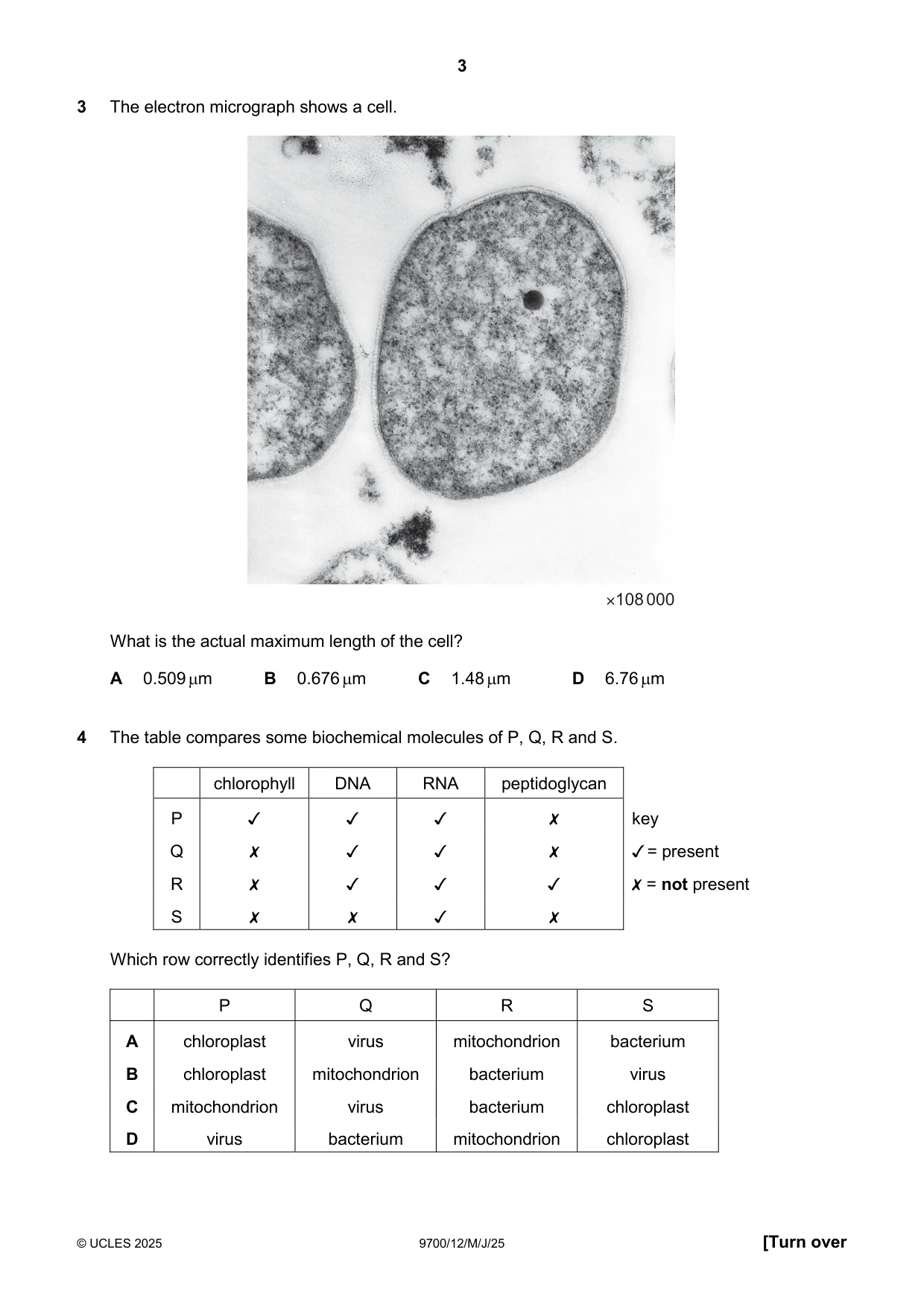
Q3 · The electron micrograph shows a cell
3 The electron micrograph shows a cell. ×108 000 What is the actual maximum length of the cell? A 0.509 m B 0.676 m C 1.48 m D 6.76 m
Mark scheme: B
Q4 · The table compares some biochemical molecules of P, Q, R and S
4 The table compares some biochemical molecules of P, Q, R and S. chlorophyll oO DO VU Which row correctly identifies P, Q, R and S? Q R key / = present X = not present S) chloroplast chloroplast mitochondrion virus virus mitochondrion virus bacterium mitochondrion bacterium bacterium mitochondrion bacterium virus chloroplast chloroplast
Mark scheme: B
More questions on Cells as the basic units of living organisms
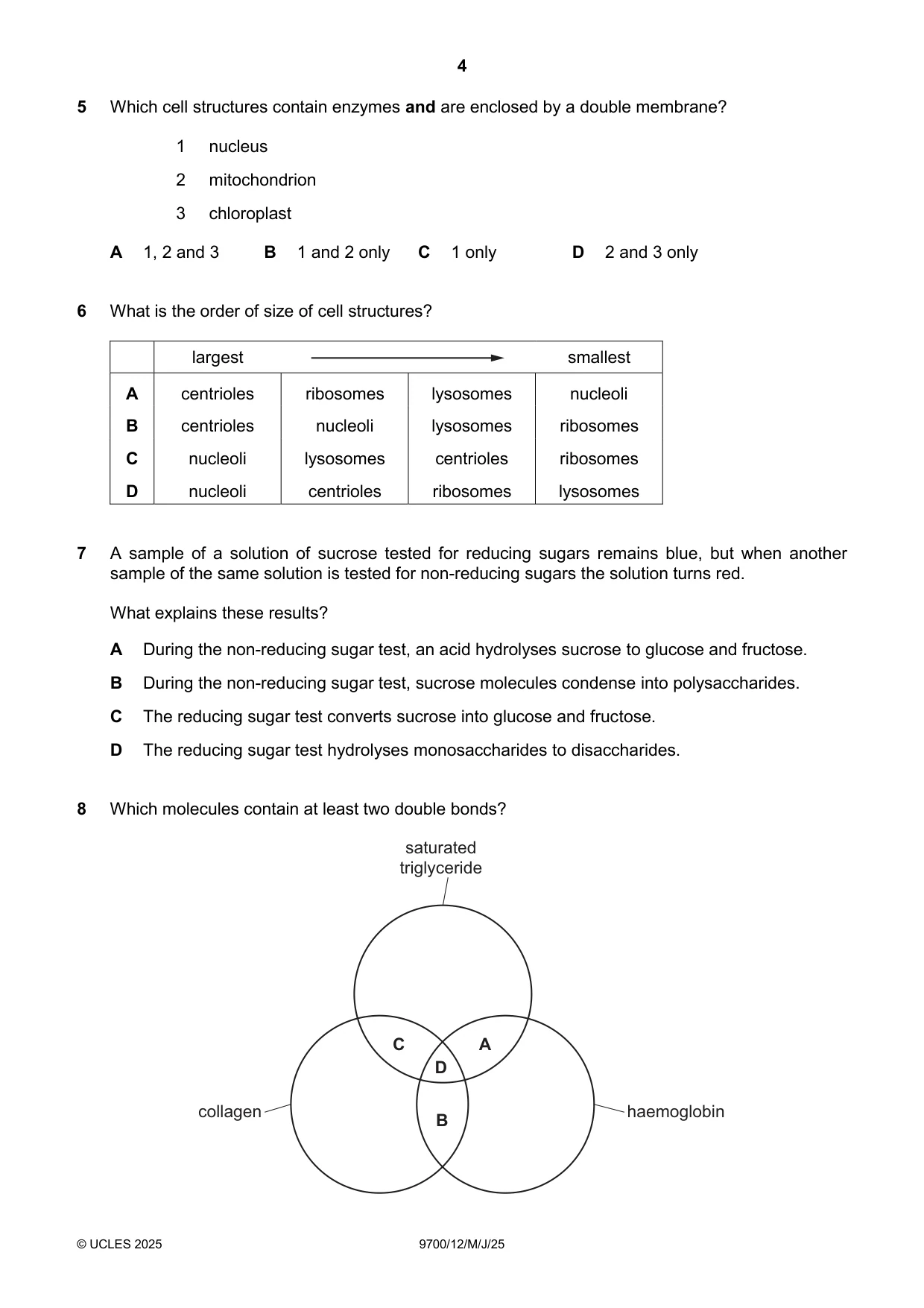
Q5 · Which cell structures contain enzymes and are enclosed by a double membrane?
5 Which cell structures contain enzymes and are enclosed by a double membrane? 1 nucleus 2 mitochondrion 3 chloroplast A 1, 2 and 3 B 1 and 2 only C 1 only D 2 and 3 only
Mark scheme: A
More questions on Cells as the basic units of living organisms
Q6 · What is the order of size of cell structures?
6 What is the order of size of cell structures? largest smallest A centrioles ribosomes lysosomes nucleoli B centrioles nucleoli lysosomes ribosomes C nucleoli lysosomes centrioles ribosomes D nucleoli centrioles ribosomes lysosomes
Mark scheme: C
More questions on Cells as the basic units of living organisms
Q7 · A sample of a solution of sucrose tested for reducing sugars remains blue, but when…
7 A sample of a solution of sucrose tested for reducing sugars remains blue, but when another sample of the same solution is tested for non-reducing sugars the solution turns red. What explains these results? A During the non-reducing sugar test, an acid hydrolyses sucrose to glucose and fructose. B During the non-reducing sugar test, sucrose molecules condense into polysaccharides. C The reducing sugar test converts sucrose into glucose and fructose. D The reducing sugar test hydrolyses monosaccharides to disaccharides.
Mark scheme: A
Q8 · Which molecules contain at least two double bonds?
8 Which molecules contain at least two double bonds? saturated triglyceride C A D collagen haemoglobin B
Mark scheme: D
Q9 · Amylose, amylopectin and glycogen are all polysaccharides
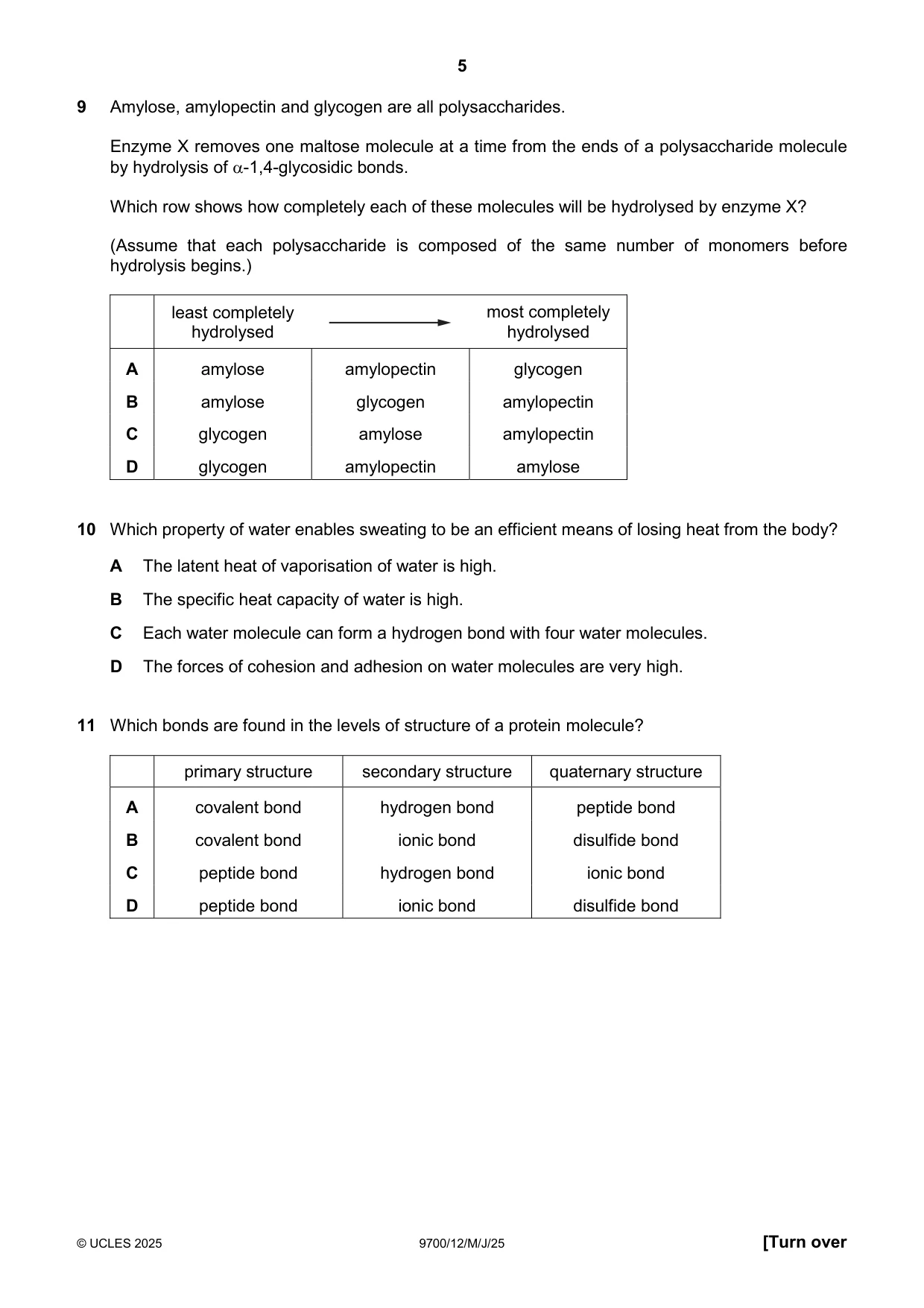
9 Amylose, amylopectin and glycogen are all polysaccharides. Enzyme X removes one maltose molecule at a time from the ends of a polysaccharide molecule by hydrolysis of -1,4-glycosidic bonds. Which row shows how completely each of these molecules will be hydrolysed by enzyme X? (Assume that each polysaccharide is composed of the same number of monomers before hydrolysis begins.) least completely most completely hydrolysed hydrolysed A amylose amylopectin glycogen B amylose glycogen amylopectin C glycogen amylose amylopectin D glycogen amylopectin amylose
Mark scheme: D
Q10 · Which property of water enables sweating to be an efficient means of losing heat from the…
10 Which property of water enables sweating to be an efficient means of losing heat from the body? A The latent heat of vaporisation of water is high. B The specific heat capacity of water is high. C Each water molecule can form a hydrogen bond with four water molecules. D The forces of cohesion and adhesion on water molecules are very high.
Mark scheme: A
Q11 · Which bonds are found in the levels of structure of a protein molecule?
11 Which bonds are found in the levels of structure of a protein molecule? primary structure secondary structure quaternary structure A covalent bond hydrogen bond peptide bond B covalent bond ionic bond disulfide bond C peptide bond hydrogen bond ionic bond D peptide bond ionic bond disulfide bond
Mark scheme: C
Q12 · Prokaryotes and eukaryotes use extracellular enzymes
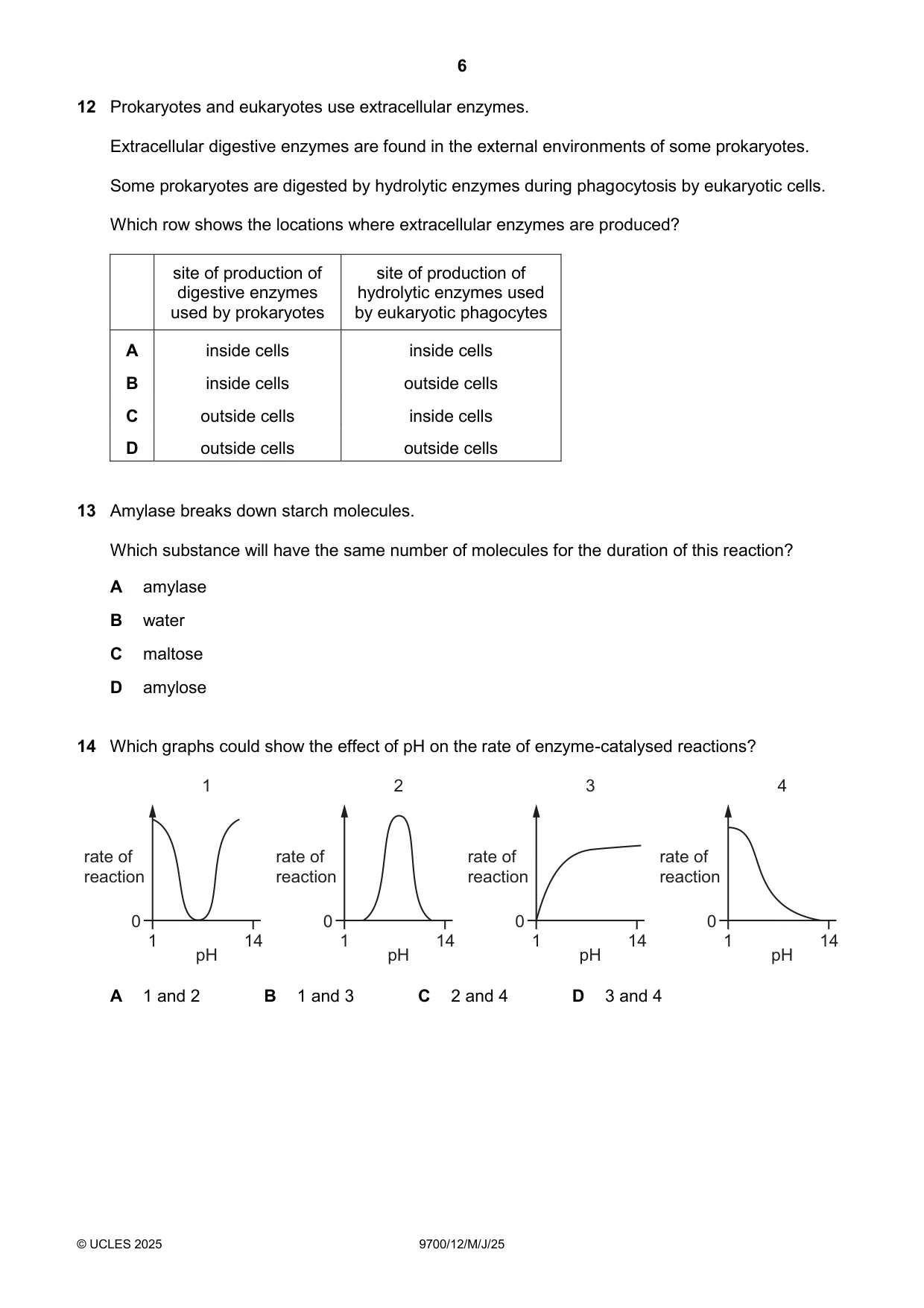
12 Prokaryotes and eukaryotes use extracellular enzymes. Extracellular digestive enzymes are found in the external environments of some prokaryotes. Some prokaryotes are digested by hydrolytic enzymes during phagocytosis by eukaryotic cells. Which row shows the locations where extracellular enzymes are produced? site of production of site of production of digestive enzymes hydrolytic enzymes used used by prokaryotes by eukaryotic phagocytes A inside cells inside cells B inside cells outside cells C outside cells inside cells D outside cells outside cells
Mark scheme: A
More questions on Cells as the basic units of living organisms
Q13 · Amylase breaks down starch molecules
13 Amylase breaks down starch molecules. Which substance will have the same number of molecules for the duration of this reaction? A amylase B water C maltose D amylose
Mark scheme: A
Q14 · Which graphs could show the effect of pH on the rate of enzyme-catalysed reactions?
14 Which graphs could show the effect of pH on the rate of enzyme-catalysed reactions? 1 2 3 4 rate of rate of rate of rate of reaction reaction reaction reaction 0 0 0 0 1 14 1 14 1 14 1 14 pH pH pH pH A 1 and 2 B 1 and 3 C 2 and 4 D 3 and 4
Mark scheme: C
Q15 · After a heart attack, the enzyme lactate dehydrogenase leaks into the blood plasma from…
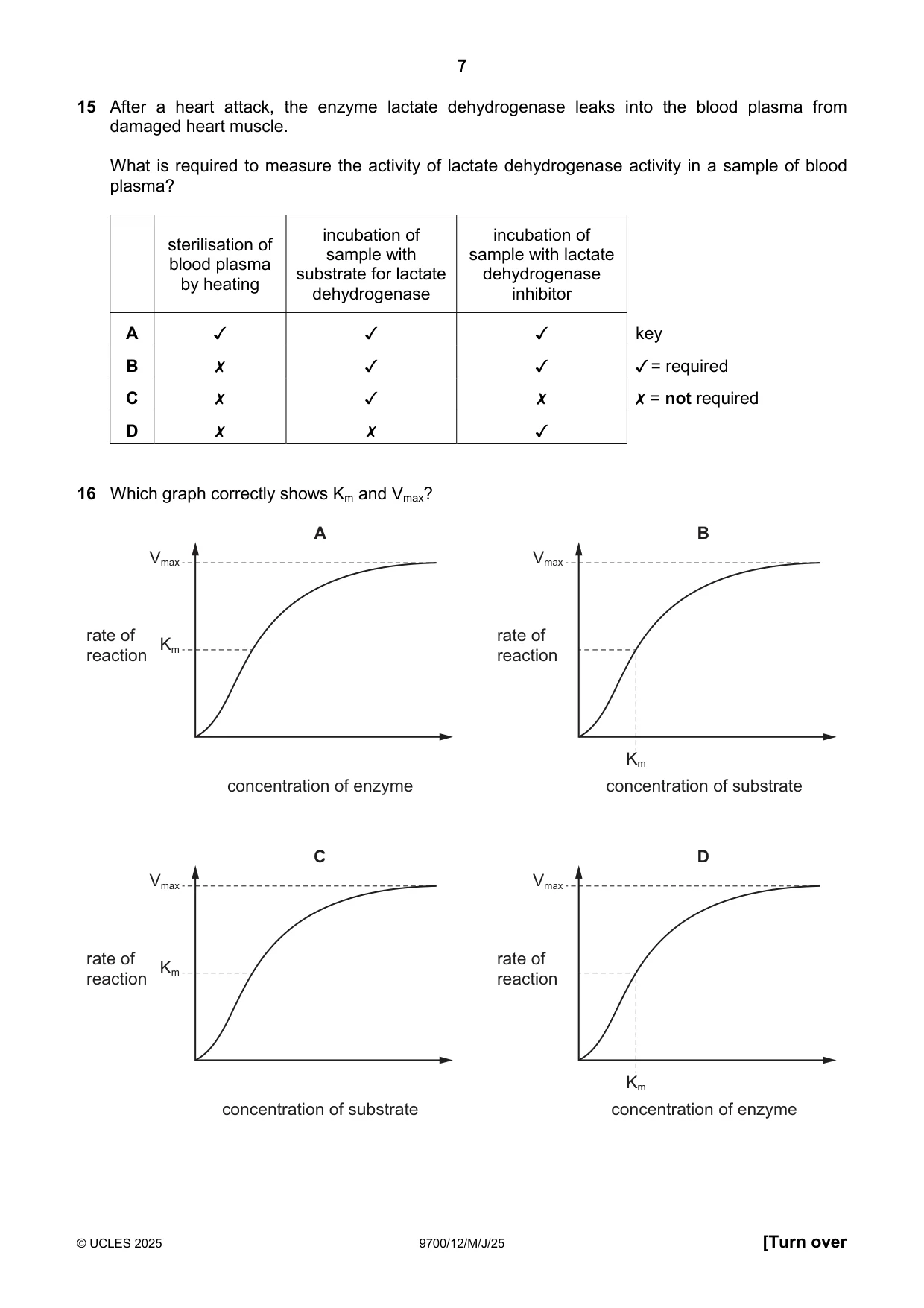
15 After a heart attack, the enzyme lactate dehydrogenase leaks into the blood plasma from damaged heart muscle. What is required to measure the activity of lactate dehydrogenase activity in a sample of blood plasma? sterilisation of incubation of incubation of blood plasma sample with sample with lactate b heatin substrate for lactate dehydrogenase y g dehydrogenase inhibitor A v v v B x v v Cc x v x D x x v key /¥ = required X = not required
Mark scheme: C
Q16 · Which graph correctly shows Km and Vmax?
16 Which graph correctly shows Km and Vmax? A B Vmax Vmax rate of rate of Km reaction reaction Km concentration of enzyme concentration of substrate C D Vmax Vmax rate of rate of Km reaction reaction Km concentration of substrate concentration of enzyme
Mark scheme: B
Q17 · Cell membranes become less fluid as the temperature decreases
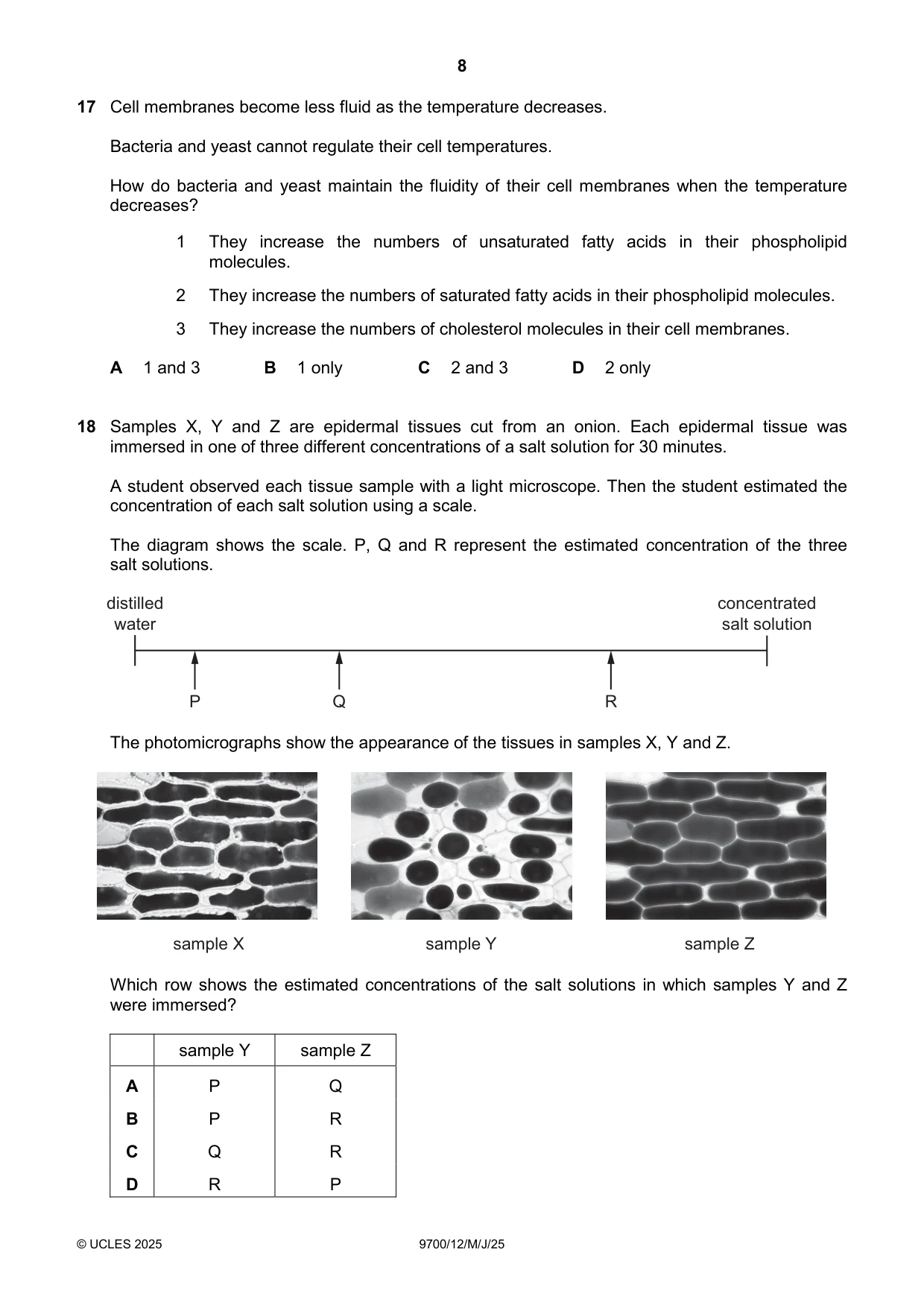
17 Cell membranes become less fluid as the temperature decreases. Bacteria and yeast cannot regulate their cell temperatures. How do bacteria and yeast maintain the fluidity of their cell membranes when the temperature decreases? 1 They increase the numbers of unsaturated fatty acids in their phospholipid molecules. 2 They increase the numbers of saturated fatty acids in their phospholipid molecules. 3 They increase the numbers of cholesterol molecules in their cell membranes. A 1 and 3 B 1 only C 2 and 3 D 2 only
Mark scheme: A
Q18 · Samples X, Y and Z are epidermal tissues cut from an onion
18 Samples X, Y and Z are epidermal tissues cut from an onion. Each epidermal tissue was immersed in one of three different concentrations of a salt solution for 30 minutes. A student observed each tissue sample with a light microscope. Then the student estimated the concentration of each salt solution using a scale. The diagram shows the scale. P, Q and R represent the estimated concentration of the three salt solutions. distilled concentrated water salt solution P Q R The photomicrographs show the appearance of the tissues in samples X, Y and Z. sample X sample Y sample Z Which row shows the estimated concentrations of the salt solutions in which samples Y and Z were immersed? sample Y sample Z A P Q B P R C Q R D R P
Mark scheme: D
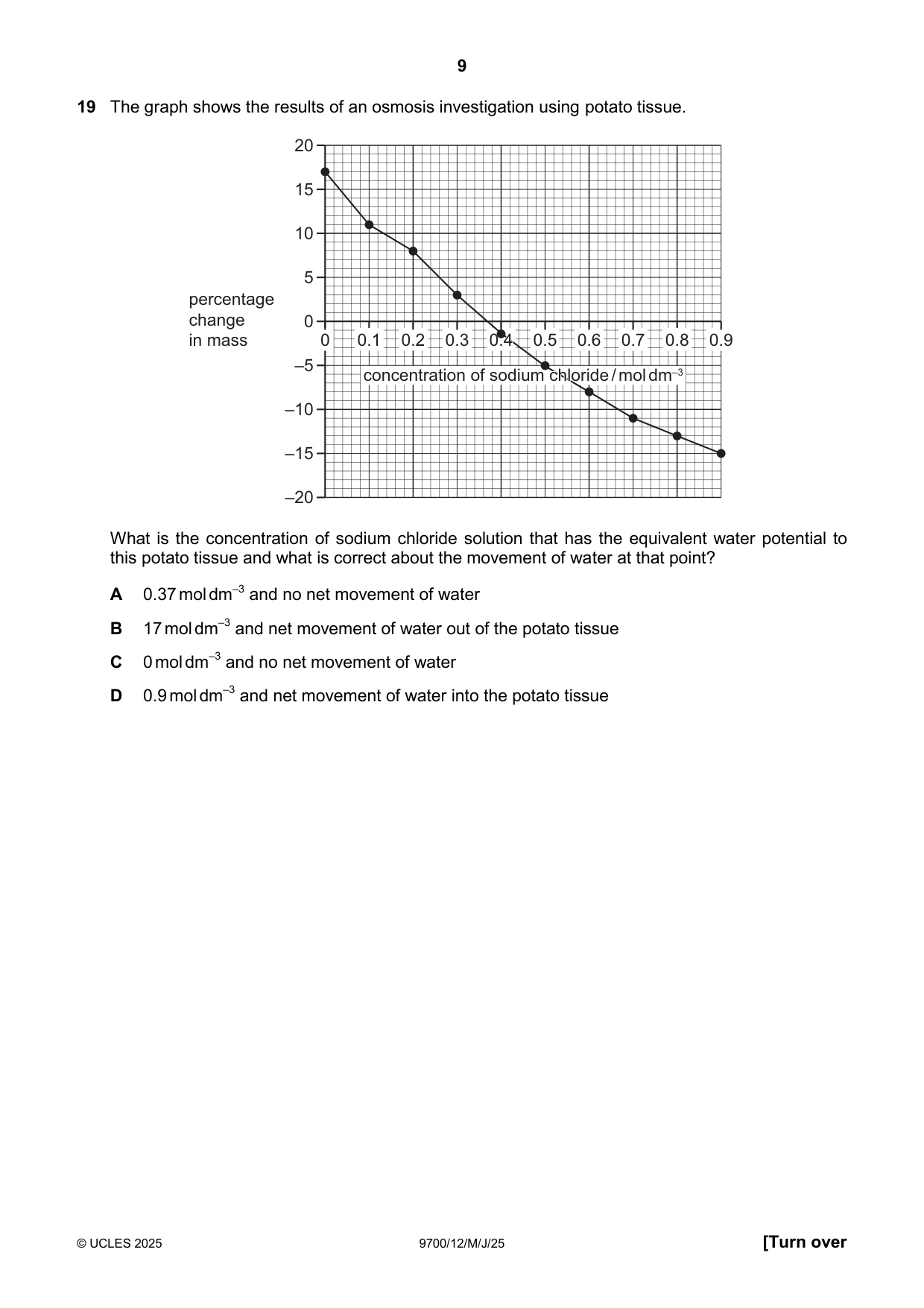
Q19 · The graph shows the results of an osmosis investigation using potato tissue
19 The graph shows the results of an osmosis investigation using potato tissue. 20 15 10 5 percentage change 0 in mass 0 0.1 0.2 0.3 0.4 0.4 0.4 0.5 0.6 0.7 0.8 0.9 –5 concentration of sodium chloride / mol dm–3 concentration of sodium chloride concentration of sodium chloride / mol mol dm dm–3 –3 –10 –15 –20 What is the concentration of sodium chloride solution that has the equivalent water potential to this potato tissue and what is correct about the movement of water at that point? A 0.37 mol dm–3 and no net movement of water B 17 mol dm–3 and net movement of water out of the potato tissue C 0 mol dm–3 and no net movement of water D 0.9 mol dm–3 and net movement of water into the potato tissue
Mark scheme: A
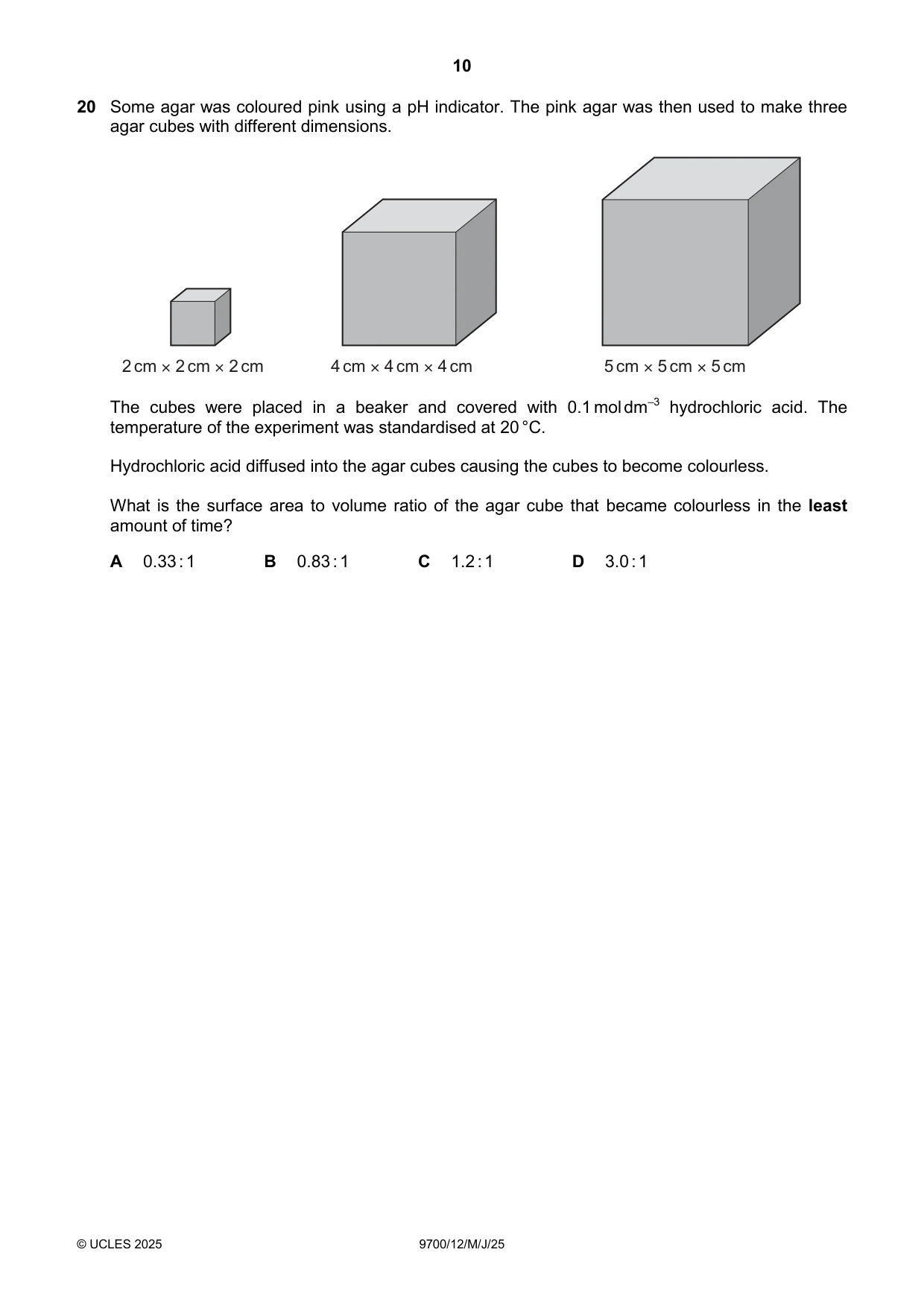
Q20 · Some agar was coloured pink using a pH indicator
20 Some agar was coloured pink using a pH indicator. The pink agar was then used to make three agar cubes with different dimensions. 2 cm × 2 cm × 2 cm 4 cm × 4 cm × 4 cm 5 cm × 5 cm × 5 cm The cubes were placed in a beaker and covered with 0.1 mol dm–3 hydrochloric acid. The temperature of the experiment was standardised at 20 °C. Hydrochloric acid diffused into the agar cubes causing the cubes to become colourless. What is the surface area to volume ratio of the agar cube that became colourless in the least amount of time? A 0.33 : 1 B 0.83 : 1 C 1.2 : 1 D 3.0 : 1
Mark scheme: D
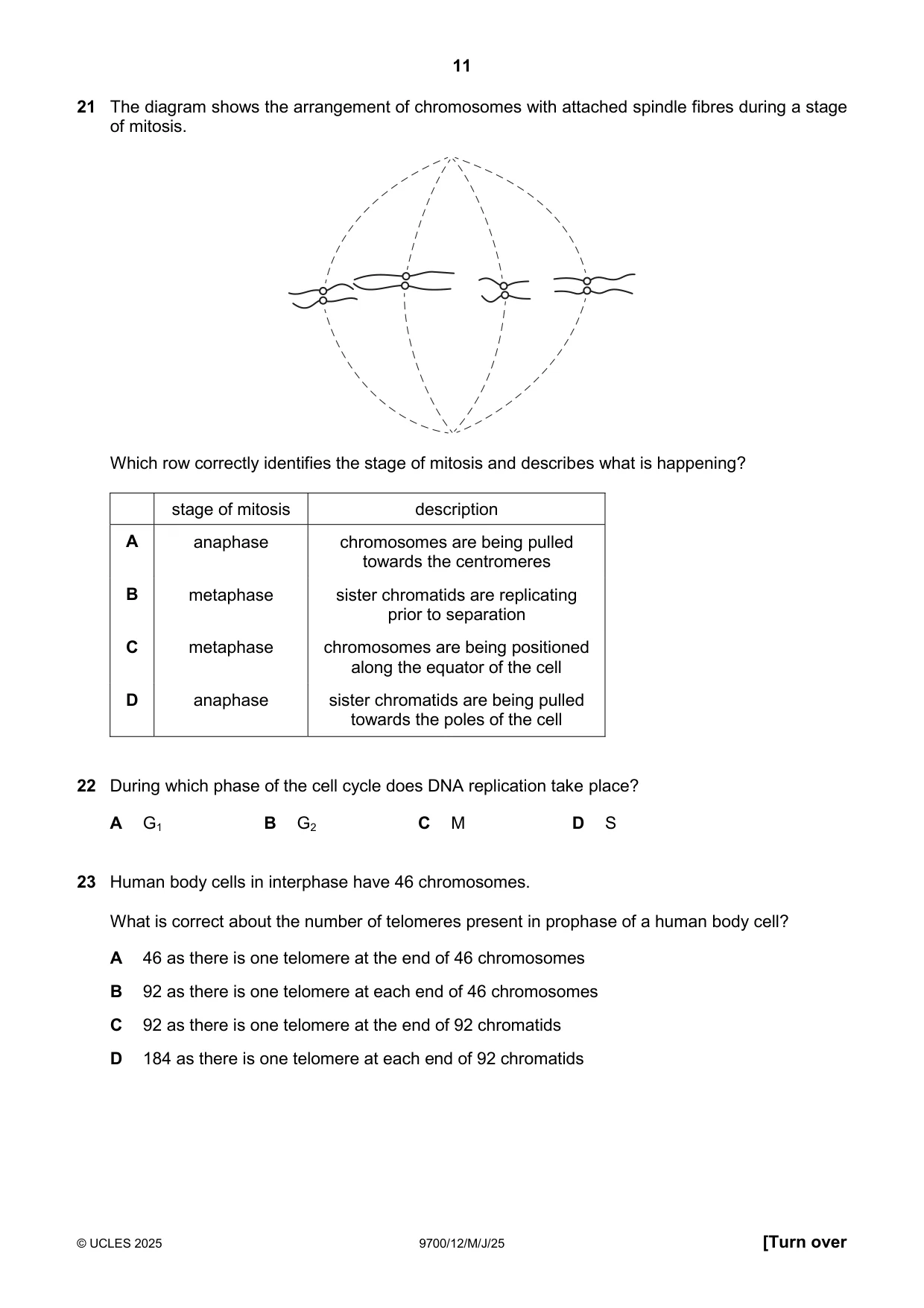
Q21 · The diagram shows the arrangement of chromosomes with attached spindle fibres during a…
21 The diagram shows the arrangement of chromosomes with attached spindle fibres during a stage of mitosis. Which row correctly identifies the stage of mitosis and describes what is happening? stage of mitosis description A anaphase chromosomes are being pulled towards the centromeres B metaphase sister chromatids are replicating prior to separation C metaphase chromosomes are being positioned along the equator of the cell D anaphase sister chromatids are being pulled towards the poles of the cell
Mark scheme: D
Q22 · During which phase of the cell cycle does DNA replication take place?
22 During which phase of the cell cycle does DNA replication take place? A G1 B G2 C M D S
Mark scheme: D
More questions on Replication and division of nuclei and cells
Q23 · Human body cells in interphase have 46 chromosomes
23 Human body cells in interphase have 46 chromosomes. What is correct about the number of telomeres present in prophase of a human body cell? A 46 as there is one telomere at the end of 46 chromosomes B 92 as there is one telomere at each end of 46 chromosomes C 92 as there is one telomere at the end of 92 chromatids D 184 as there is one telomere at each end of 92 chromatids
Mark scheme: D
Q24 · Sometimes hydrogen bonds form temporarily between the bases of two strands of RNA
24 Sometimes hydrogen bonds form temporarily between the bases of two strands of RNA. How many hydrogen bonds form when guanine and uracil each bind to their complementary base? guanine uracil A 3 3 B 3 2 C 2 3 D 2 2
Mark scheme: B
More questions on Structure of nucleic acids and replication of DNA
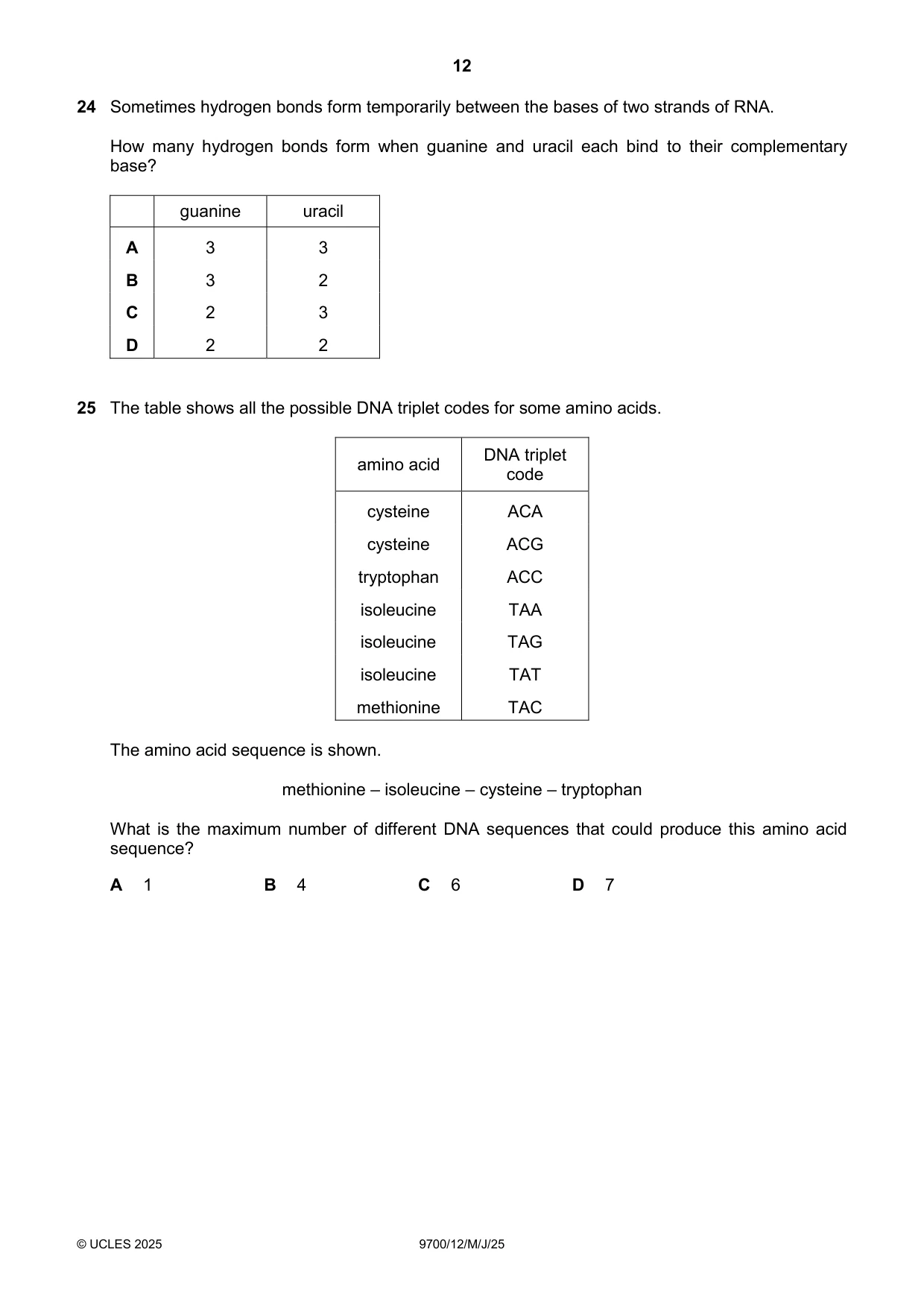
Q25 · The table shows all the possible DNA triplet codes for some amino acids
25 The table shows all the possible DNA triplet codes for some amino acids. DNA triplet amino acid code cysteine ACA cysteine ACG tryptophan ACC isoleucine TAA isoleucine TAG isoleucine TAT methionine TAC The amino acid sequence is shown. methionine – isoleucine – cysteine – tryptophan What is the maximum number of different DNA sequences that could produce this amino acid sequence? A 1 B 4 C 6 D 7
Mark scheme: C
Q26 · Which row is correct for transpiration?
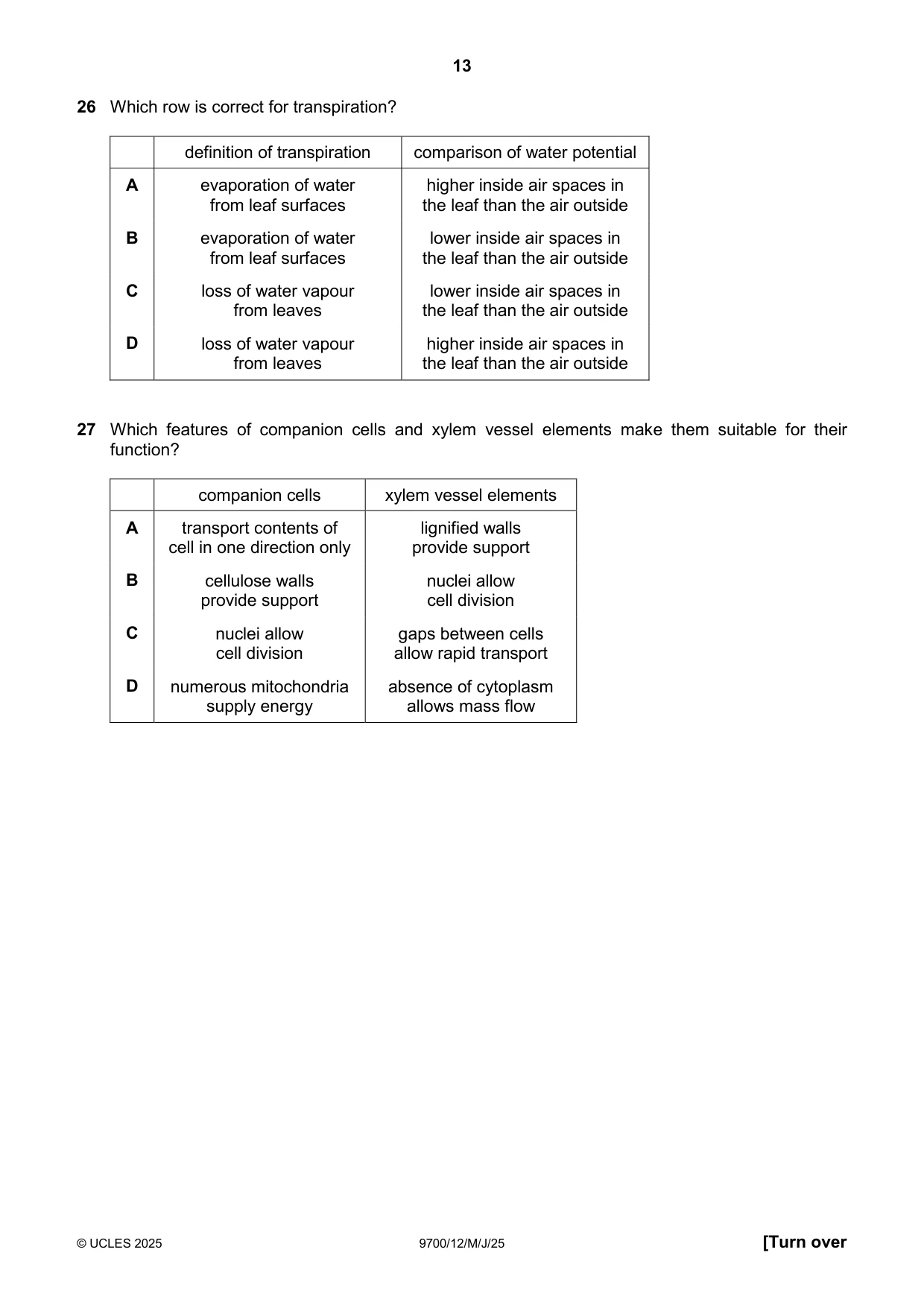
26 Which row is correct for transpiration? definition of transpiration comparison of water potential A evaporation of water higher inside air spaces in from leaf surfaces the leaf than the air outside B evaporation of water lower inside air spaces in from leaf surfaces the leaf than the air outside C loss of water vapour lower inside air spaces in from leaves the leaf than the air outside D loss of water vapour higher inside air spaces in from leaves the leaf than the air outside
Mark scheme: D
Q27 · Which features of companion cells and xylem vessel elements make them suitable for their…
27 Which features of companion cells and xylem vessel elements make them suitable for their function? companion cells xylem vessel elements A transport contents of lignified walls cell in one direction only provide support B cellulose walls nuclei allow provide support cell division C nuclei allow gaps between cells cell division allow rapid transport D numerous mitochondria absence of cytoplasm supply energy allows mass flow
Mark scheme: D
Q28 · The diagram shows some root cells
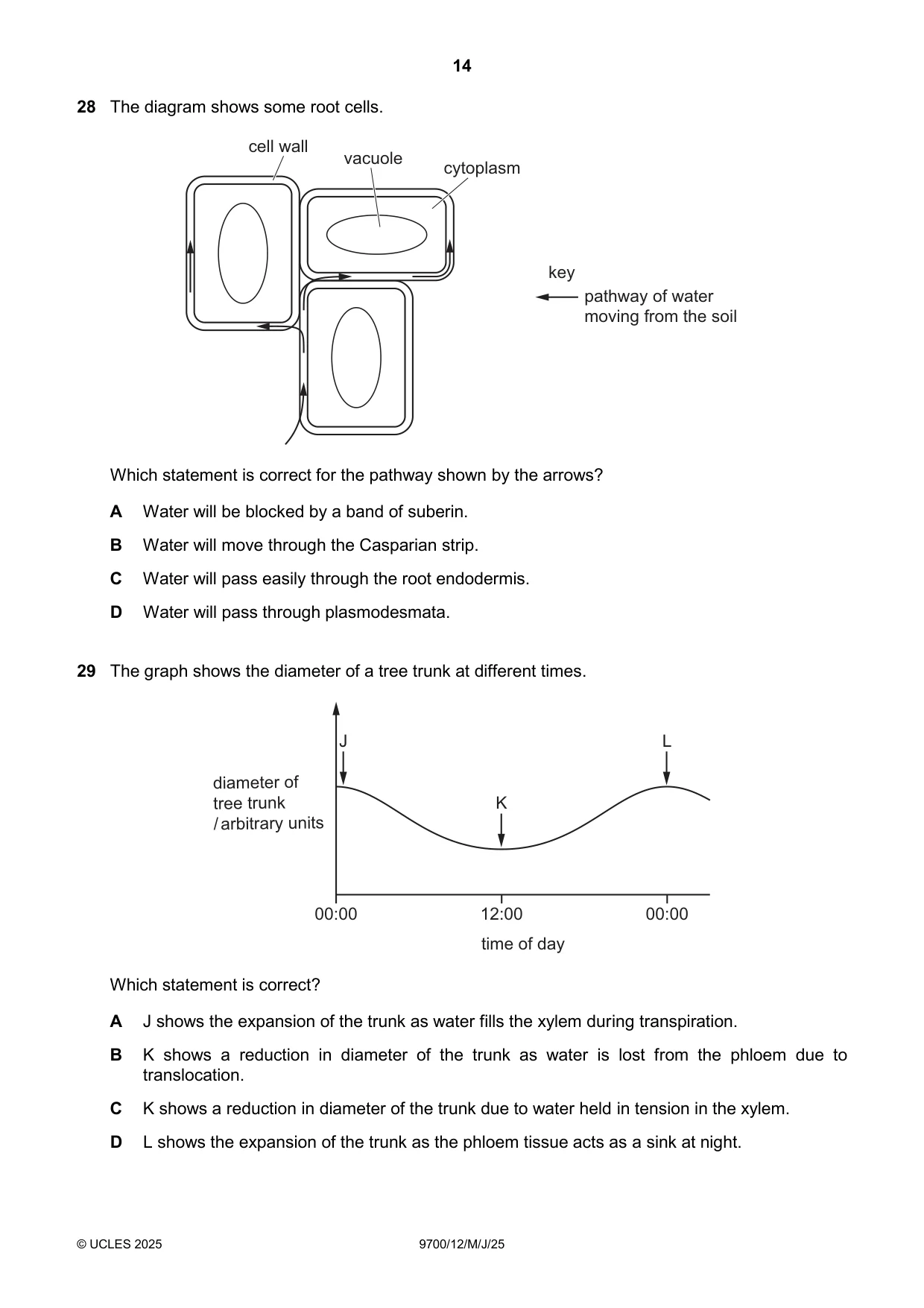
28 The diagram shows some root cells. cell wall vacuole cytoplasm key pathway of water moving from the soil Which statement is correct for the pathway shown by the arrows? A Water will be blocked by a band of suberin. B Water will move through the Casparian strip. C Water will pass easily through the root endodermis. D Water will pass through plasmodesmata.
Mark scheme: A
Q29 · The graph shows the diameter of a tree trunk at different times
29 The graph shows the diameter of a tree trunk at different times. J L diameter of tree trunk K / arbitrary units 00:00 12:00 00:00 time of day Which statement is correct? A J shows the expansion of the trunk as water fills the xylem during transpiration. B K shows a reduction in diameter of the trunk as water is lost from the phloem due to translocation. C K shows a reduction in diameter of the trunk due to water held in tension in the xylem. D L shows the expansion of the trunk as the phloem tissue acts as a sink at night.
Mark scheme: C
Q30 · The plan diagrams of transverse sections of two plant organs are shown
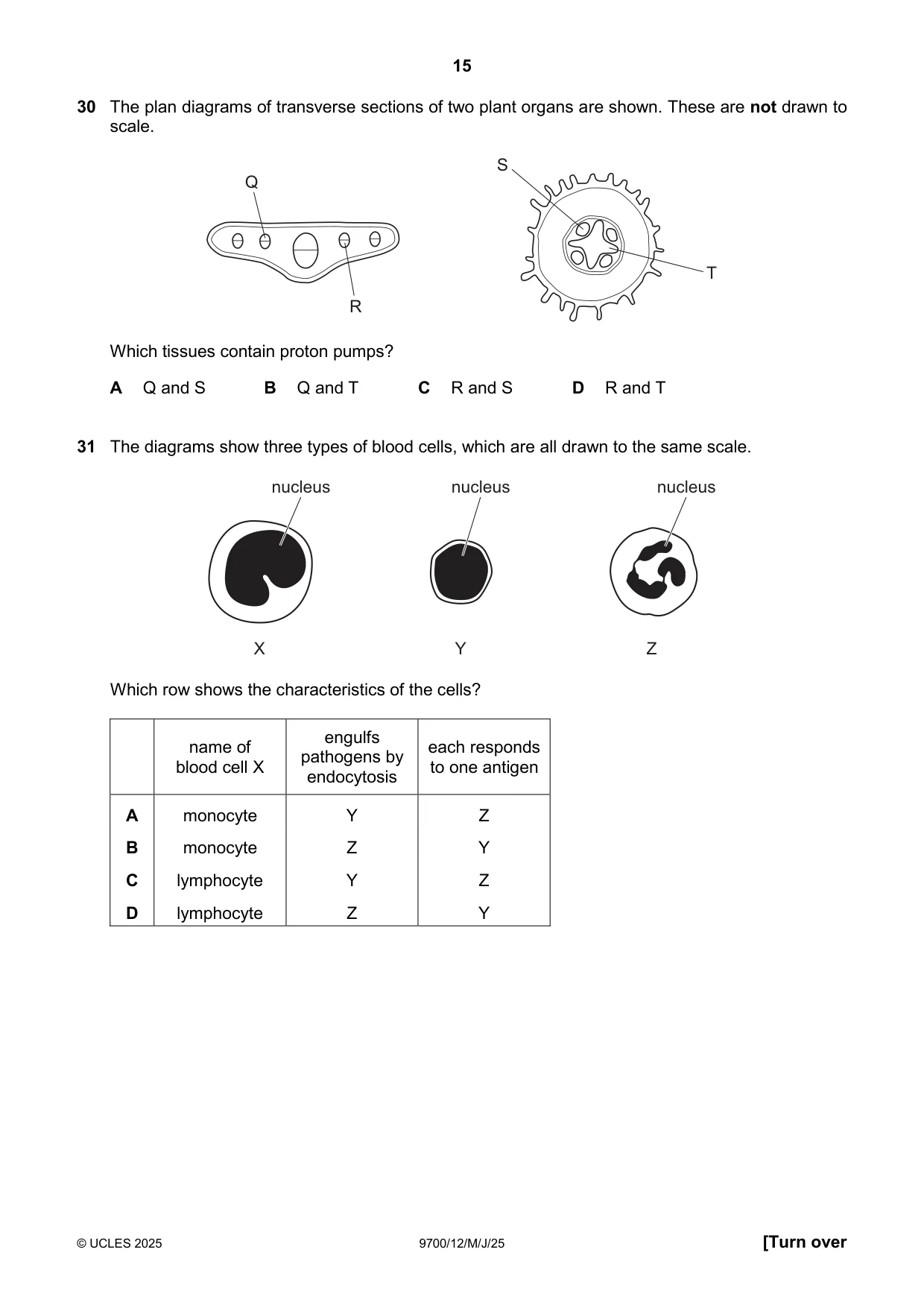
30 The plan diagrams of transverse sections of two plant organs are shown. These are not drawn to scale. S Q T R Which tissues contain proton pumps? A Q and S B Q and T C R and S D R and T
Mark scheme: C
Q31 · The diagrams show three types of blood cells, which are all drawn to the same scale
31 The diagrams show three types of blood cells, which are all drawn to the same scale. nucleus nucleus nucleus X Y Z Which row shows the characteristics of the cells? engulfs name of each responds pathogens by blood cell X to one antigen endocytosis A monocyte Y Z B monocyte Z Y C lymphocyte Y Z D lymphocyte Z Y
Mark scheme: B
Q32 · The graph shows oxygen dissociation curves for three animals
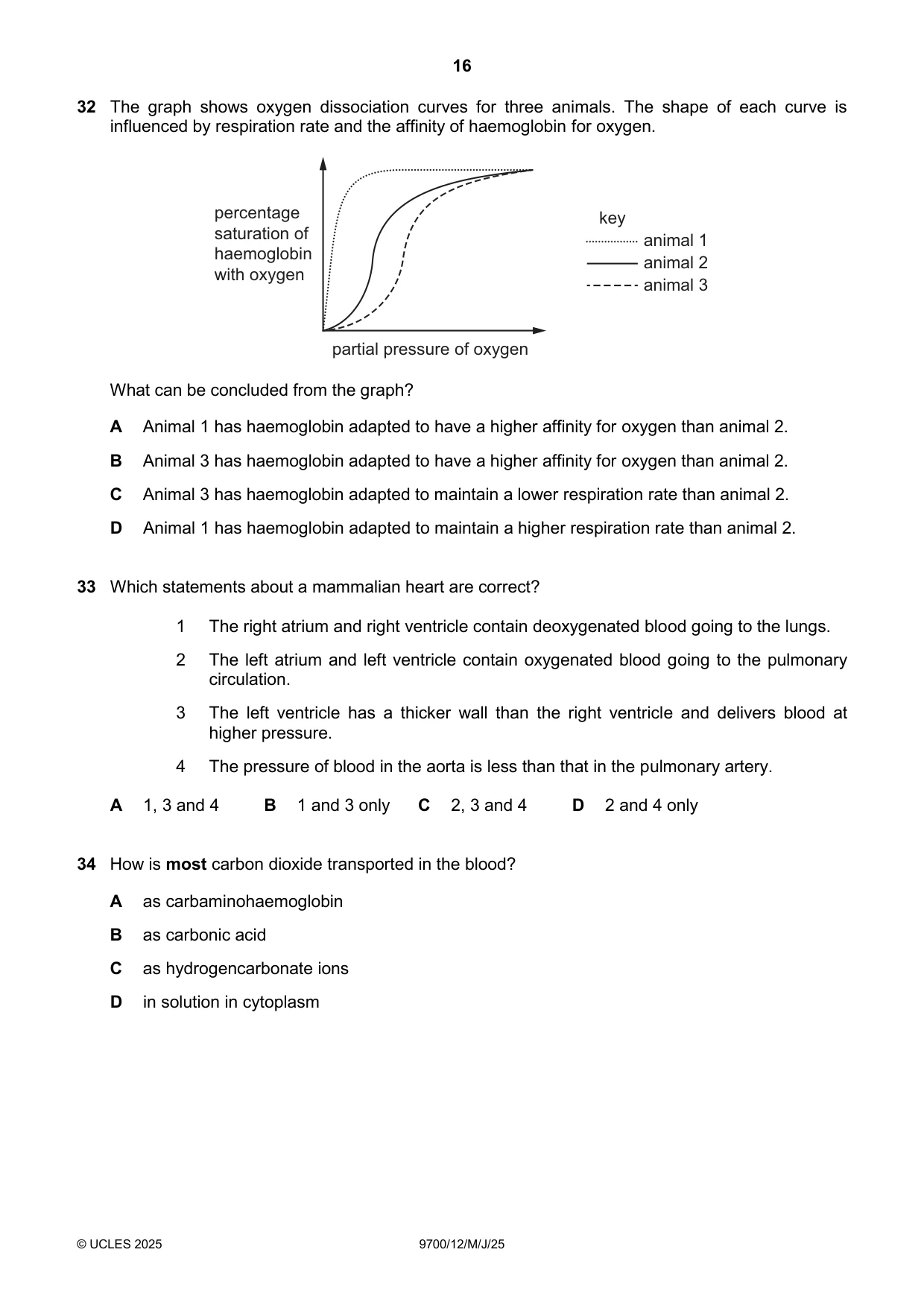
32 The graph shows oxygen dissociation curves for three animals. The shape of each curve is influenced by respiration rate and the affinity of haemoglobin for oxygen. percentage key saturation of animal 1 haemoglobin animal 2 with oxygen animal 3 partial pressure of oxygen What can be concluded from the graph? A Animal 1 has haemoglobin adapted to have a higher affinity for oxygen than animal 2. B Animal 3 has haemoglobin adapted to have a higher affinity for oxygen than animal 2. C Animal 3 has haemoglobin adapted to maintain a lower respiration rate than animal 2. D Animal 1 has haemoglobin adapted to maintain a higher respiration rate than animal 2.
Mark scheme: A
Q33 · Which statements about a mammalian heart are correct?
33 Which statements about a mammalian heart are correct? 1 The right atrium and right ventricle contain deoxygenated blood going to the lungs. 2 The left atrium and left ventricle contain oxygenated blood going to the pulmonary circulation. 3 The left ventricle has a thicker wall than the right ventricle and delivers blood at higher pressure. 4 The pressure of blood in the aorta is less than that in the pulmonary artery. A 1, 3 and 4 B 1 and 3 only C 2, 3 and 4 D 2 and 4 only
Mark scheme: B
Q34 · How is most carbon dioxide transported in the blood?
34 How is most carbon dioxide transported in the blood? A as carbaminohaemoglobin B as carbonic acid C as hydrogencarbonate ions D in solution in cytoplasm
Mark scheme: C
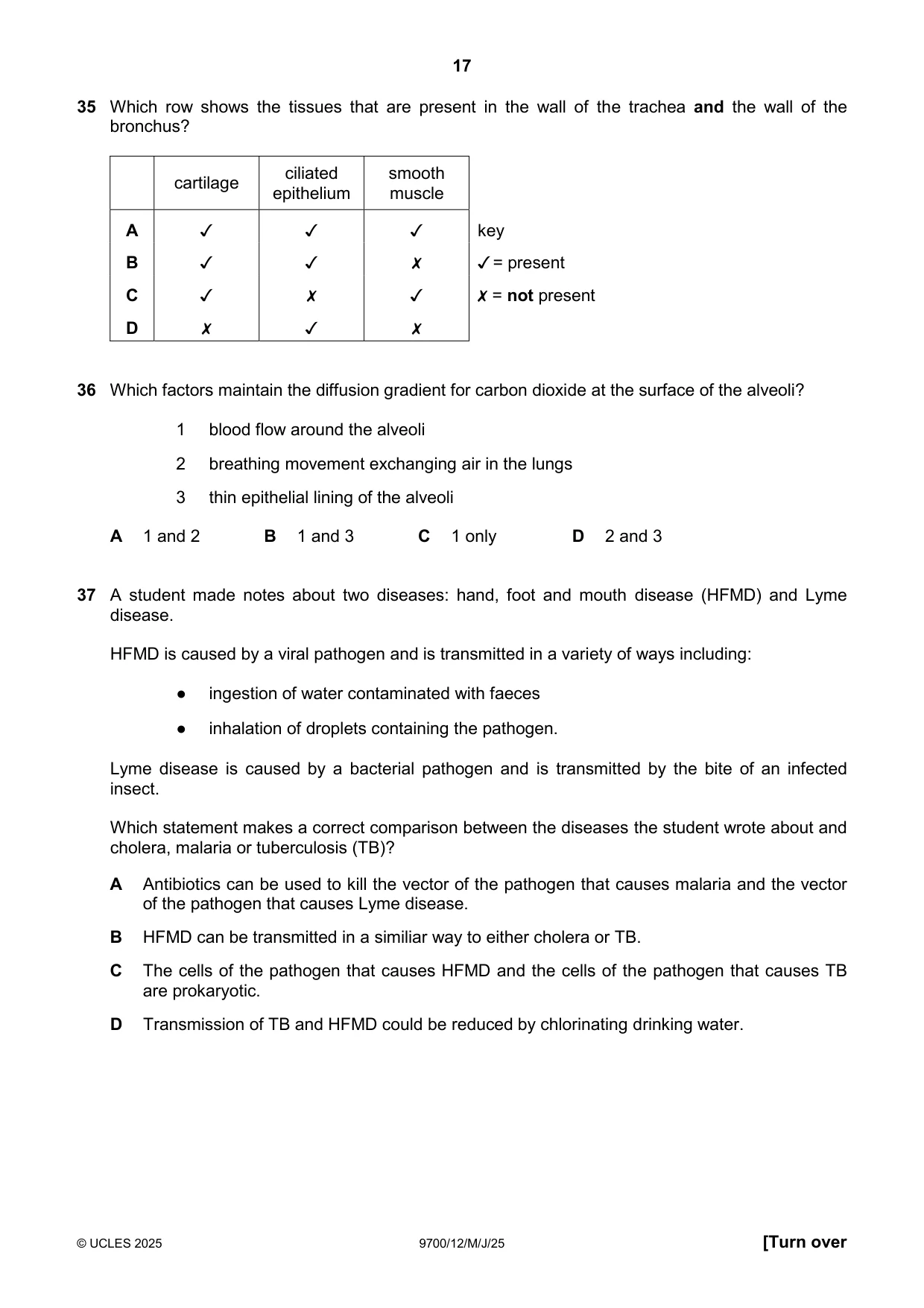
Q35 · Which row shows the tissues that are present in the wall of the trachea and the wall of…
35 Which row shows the tissues that are present in the wall of the trachea and the wall of the bronchus? ciliated smooth epithelium muscle cartilage v v key ¥ = present X = not present 00 DW > ~x~ NN OK NS & OS x \ x
Mark scheme: A
Q36 · Which factors maintain the diffusion gradient for carbon dioxide at the surface of the…
36 Which factors maintain the diffusion gradient for carbon dioxide at the surface of the alveoli? 1 blood flow around the alveoli 2 breathing movement exchanging air in the lungs 3 thin epithelial lining of the alveoli A 1 and 2 B 1 and 3 C 1 only D 2 and 3
Mark scheme: A
Q37 · A student made notes about two diseases: hand, foot and mouth disease (HFMD) and Lyme…
37 A student made notes about two diseases: hand, foot and mouth disease (HFMD) and Lyme disease. HFMD is caused by a viral pathogen and is transmitted in a variety of ways including: ● ingestion of water contaminated with faeces ● inhalation of droplets containing the pathogen. Lyme disease is caused by a bacterial pathogen and is transmitted by the bite of an infected insect. Which statement makes a correct comparison between the diseases the student wrote about and cholera, malaria or tuberculosis (TB)? A Antibiotics can be used to kill the vector of the pathogen that causes malaria and the vector of the pathogen that causes Lyme disease. B HFMD can be transmitted in a similiar way to either cholera or TB. C The cells of the pathogen that causes HFMD and the cells of the pathogen that causes TB are prokaryotic. D Transmission of TB and HFMD could be reduced by chlorinating drinking water.
Mark scheme: B
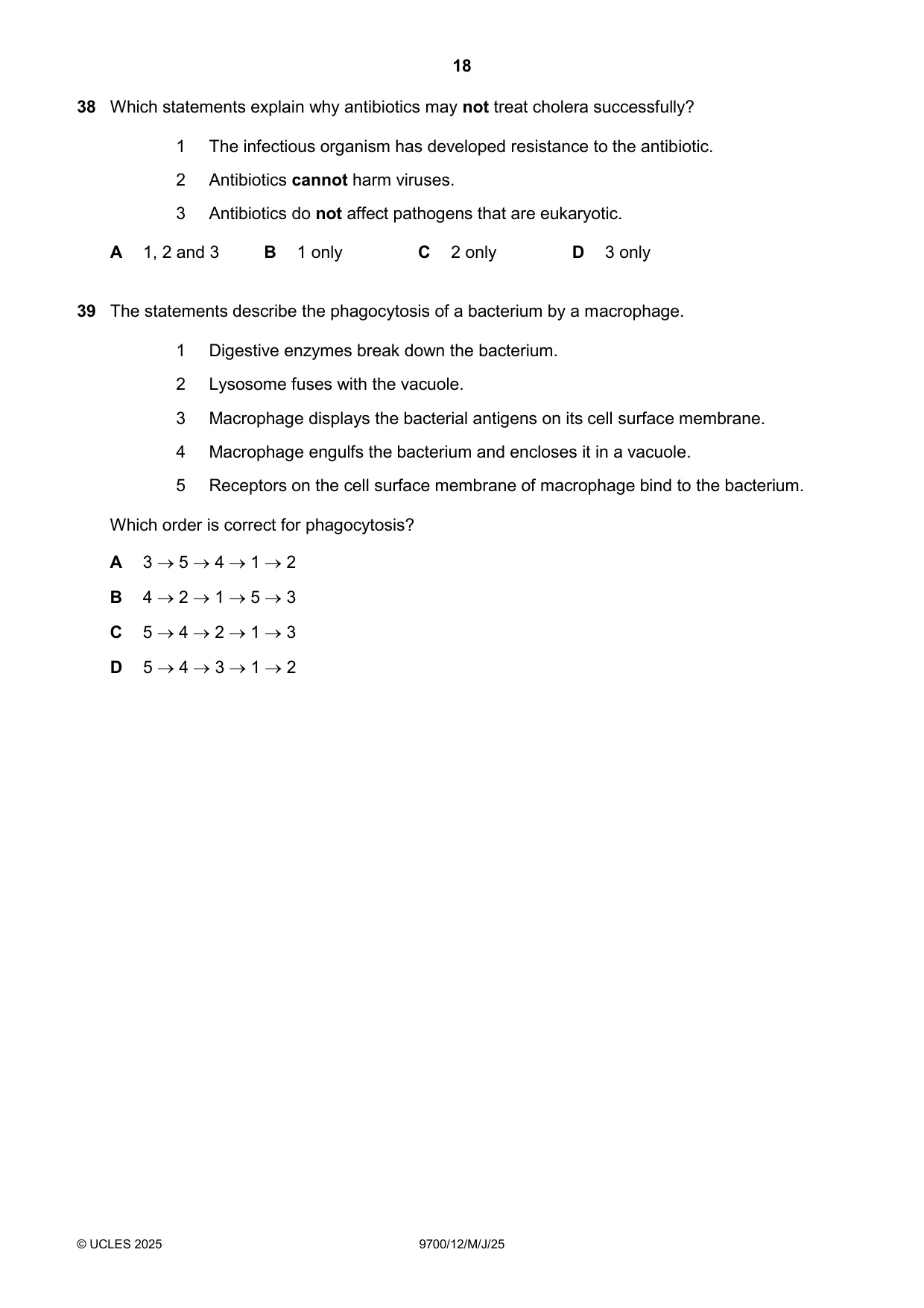
Q38 · Which statements explain why antibiotics may not treat cholera successfully?
38 Which statements explain why antibiotics may not treat cholera successfully? 1 The infectious organism has developed resistance to the antibiotic. 2 Antibiotics cannot harm viruses. 3 Antibiotics do not affect pathogens that are eukaryotic. A 1, 2 and 3 B 1 only C 2 only D 3 only
Mark scheme: B
Q39 · The statements describe the phagocytosis of a bacterium by a macrophage
39 The statements describe the phagocytosis of a bacterium by a macrophage. 1 Digestive enzymes break down the bacterium. 2 Lysosome fuses with the vacuole. 3 Macrophage displays the bacterial antigens on its cell surface membrane. 4 Macrophage engulfs the bacterium and encloses it in a vacuole. 5 Receptors on the cell surface membrane of macrophage bind to the bacterium. Which order is correct for phagocytosis? A 3 5 4 1 2 B 4 2 1 5 3 C 5 4 2 1 3 D 5 4 3 1 2
Mark scheme: C
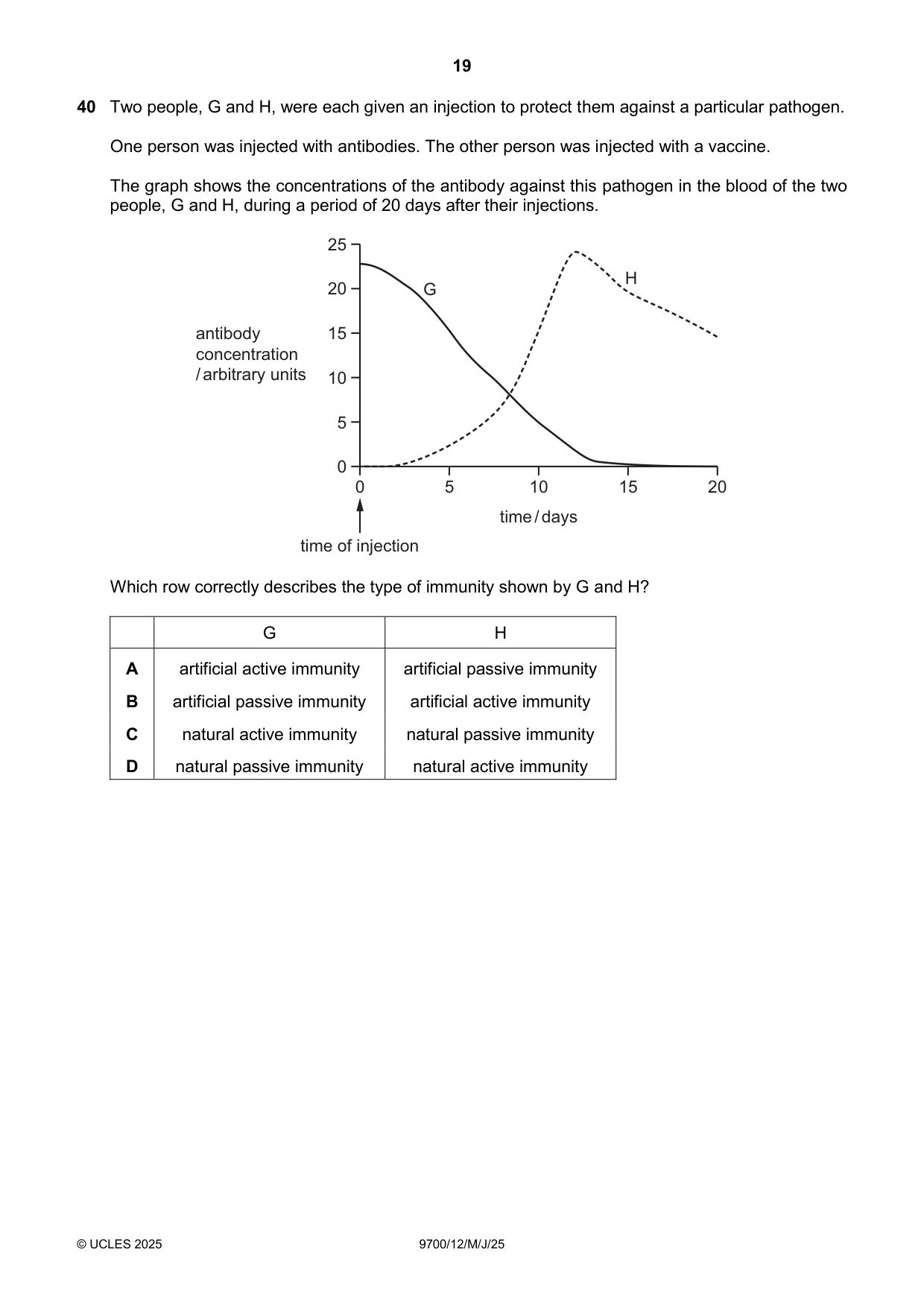
Q40 · Two people, G and H, were each given an injection to protect them against a particular…
40 Two people, G and H, were each given an injection to protect them against a particular pathogen. One person was injected with antibodies. The other person was injected with a vaccine. The graph shows the concentrations of the antibody against this pathogen in the blood of the two people, G and H, during a period of 20 days after their injections. 25 H 20 G antibody 15 concentration / arbitrary units 10 5 0 0 5 10 15 20 time / days time of injection Which row correctly describes the type of immunity shown by G and H? G H A artificial active immunity artificial passive immunity B artificial passive immunity artificial active immunity C natural active immunity natural passive immunity D natural passive immunity natural active immunity
Mark scheme: B
What was in this paper
The subtopics covered by these 40 questions, and how many questions each got. Open one in a new tab to see every Cambridge question on it.
4Transport mechanisms4Factors that affect enzyme action3Movement into and out of cells3The microscope in cell studies3Carbohydrates and lipids2Chromosome behaviour in mitosis2The gas exchange system2The immune system2Transport of oxygen and carbon dioxide2Antibiotics1Antibodies and vaccination1Fluid mosaic membranes1Infectious diseases1Mode of action of enzymes1Protein synthesis1Proteins1Replication and division of nuclei and cells1Structure of nucleic acids and replication of DNA1Structure of transport tissues1Testing for biological molecules1The heart1Water1What you needed in this session
Cambridge’s own grade thresholds for 2025 May/June, Paper 1 · Variant 2. A higher threshold means an easier paper — the bar moves with how the cohort did.