Cambridge A Level Biology 9700 — 2013 Oct/Nov Paper 1 · Variant 1
9700/11/O/N/13 · 40 questions · 40 marks · ≈45 min
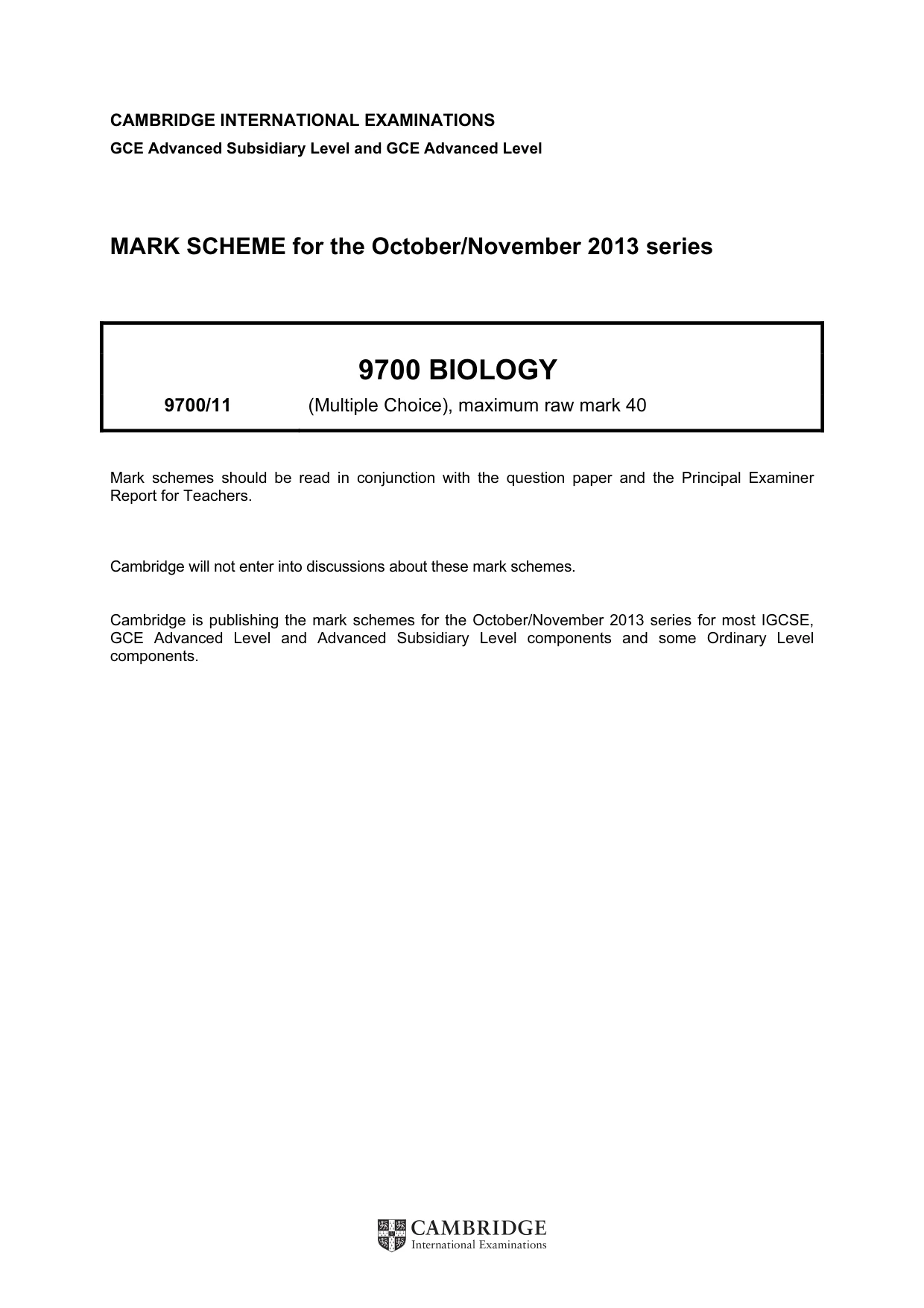
The question paper and its mark scheme, free to read here and free to download. This is Cambridge’s own paper, exactly as it was sat.
Question paper16 pages
Mark scheme2 pages
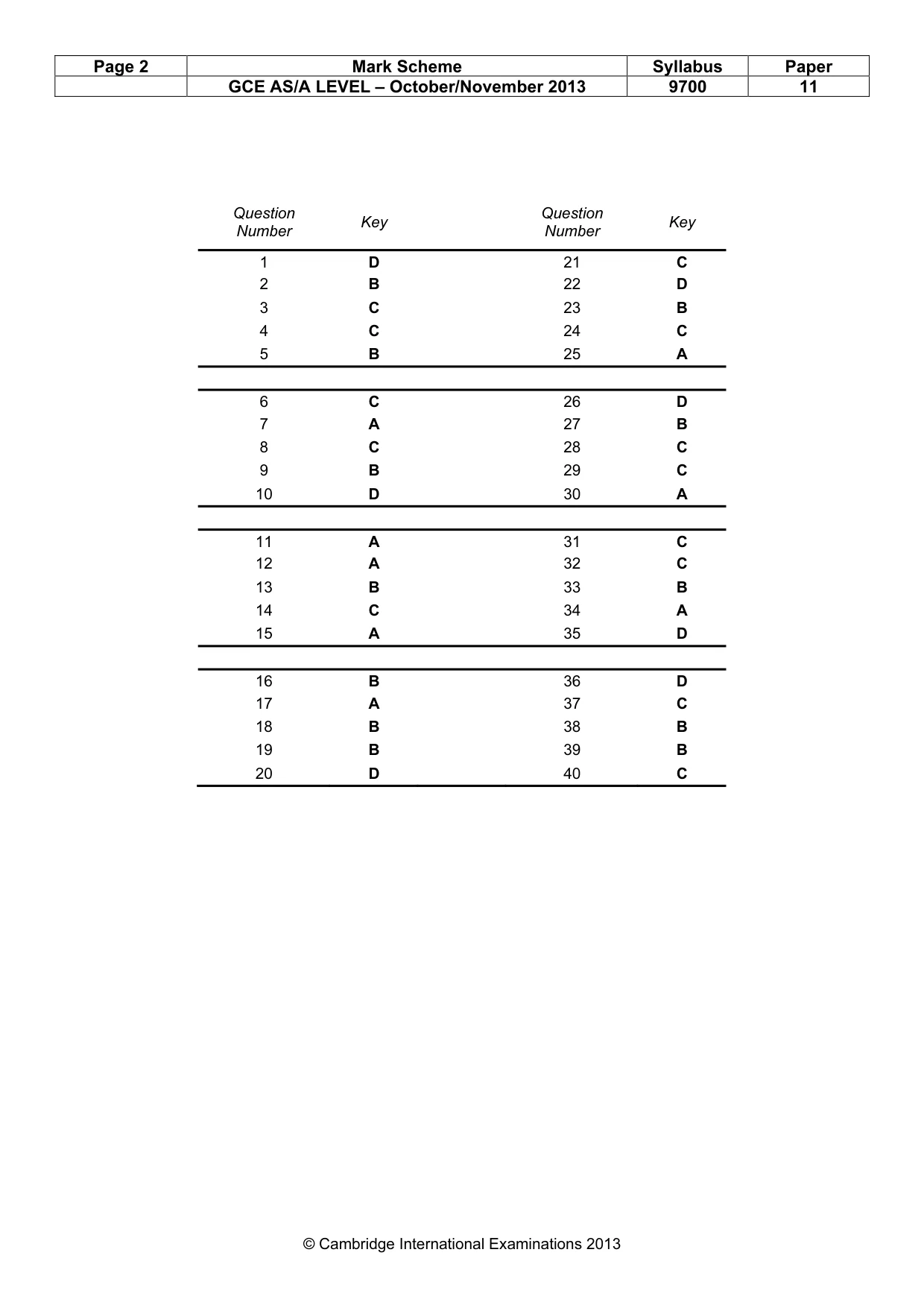
Answers below. Sit the paper first if you are practising.
Questions as text
Q1 · Which cell structure can be seen only with an electron microscope?
1 Which cell structure can be seen only with an electron microscope? A cell wall B chromosome C nucleolus D ribosome
Mark scheme: D
Q2 · Which statement is not correct in its description of a light microscope or an electron…
2 Which statement is not correct in its description of a light microscope or an electron microscope? A A light microscope has a maximum resolution of 0.2 µm. B An electron microscope has a maximum resolution of 0.05 nm. C A light microscope can resolve specimens as small as 200 nm in diameter. D An electron microscope can resolve specimens as small as 0.5 nm in diameter.
Mark scheme: B
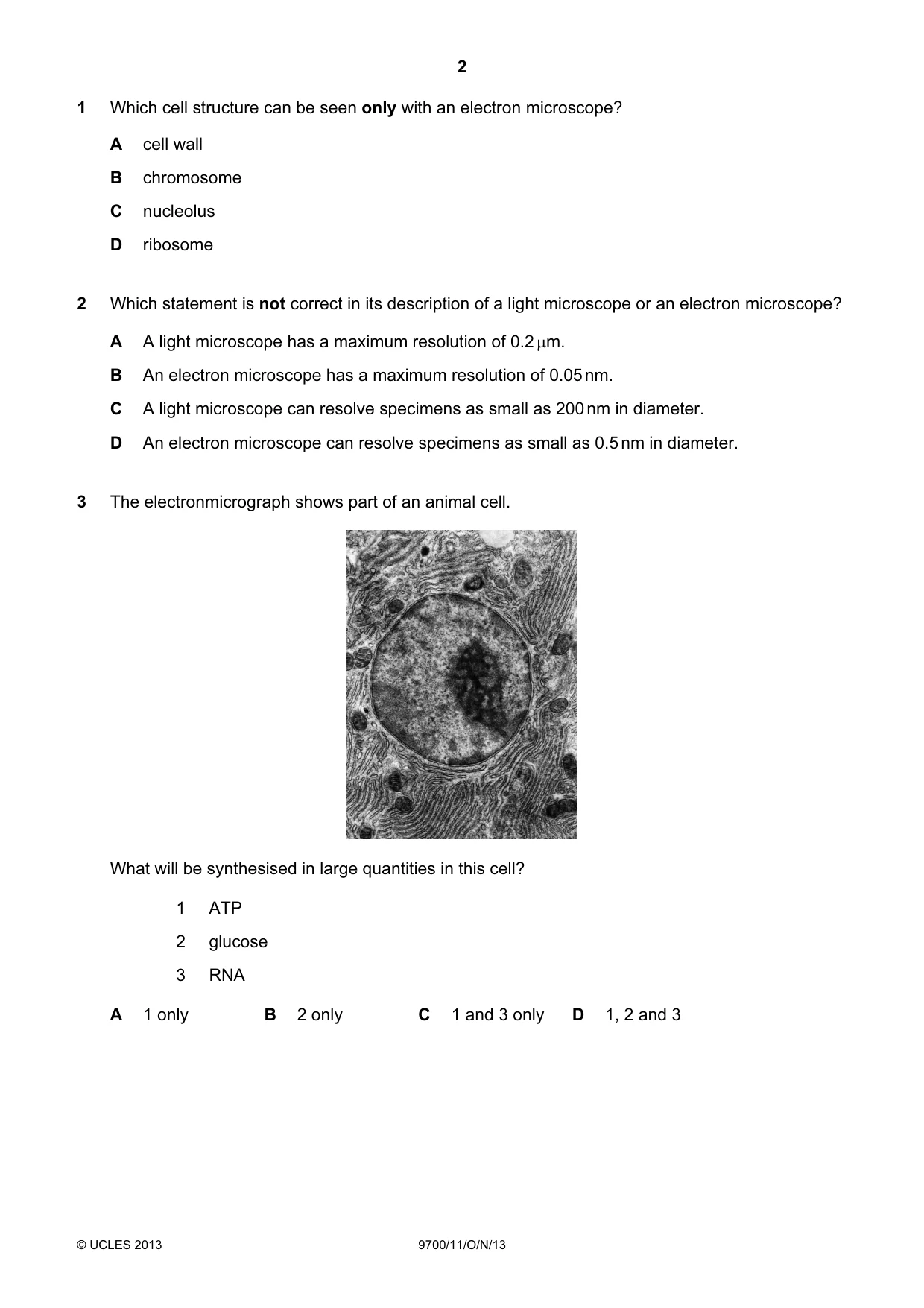
Q3 · The electronmicrograph shows part of an animal cell
3 The electronmicrograph shows part of an animal cell. What will be synthesised in large quantities in this cell? 1 ATP 2 glucose 3 RNA A 1 only B 2 only C 1 and 3 only D 1, 2 and 3
Mark scheme: C
More questions on Cells as the basic units of living organisms
Q4 · Which statements about a typical eukaryotic cell are correct?
4 Which statements about a typical eukaryotic cell are correct? 1 It is smaller than 2 µm. 2 It has a nucleolus. 3 It has linear DNA. 4 It only has small (70S) ribosomes. A 1 and 2 only B 1 and 4 only C 2 and 3 only D 3 and 4 only
Mark scheme: C
More questions on Cells as the basic units of living organisms
Q5 · Which animal cells would have the most Golgi apparatus?
5 Which animal cells would have the most Golgi apparatus? A ciliated epithelial cells B goblet cells C red blood cells D smooth muscle cells
Mark scheme: B
More questions on Cells as the basic units of living organisms
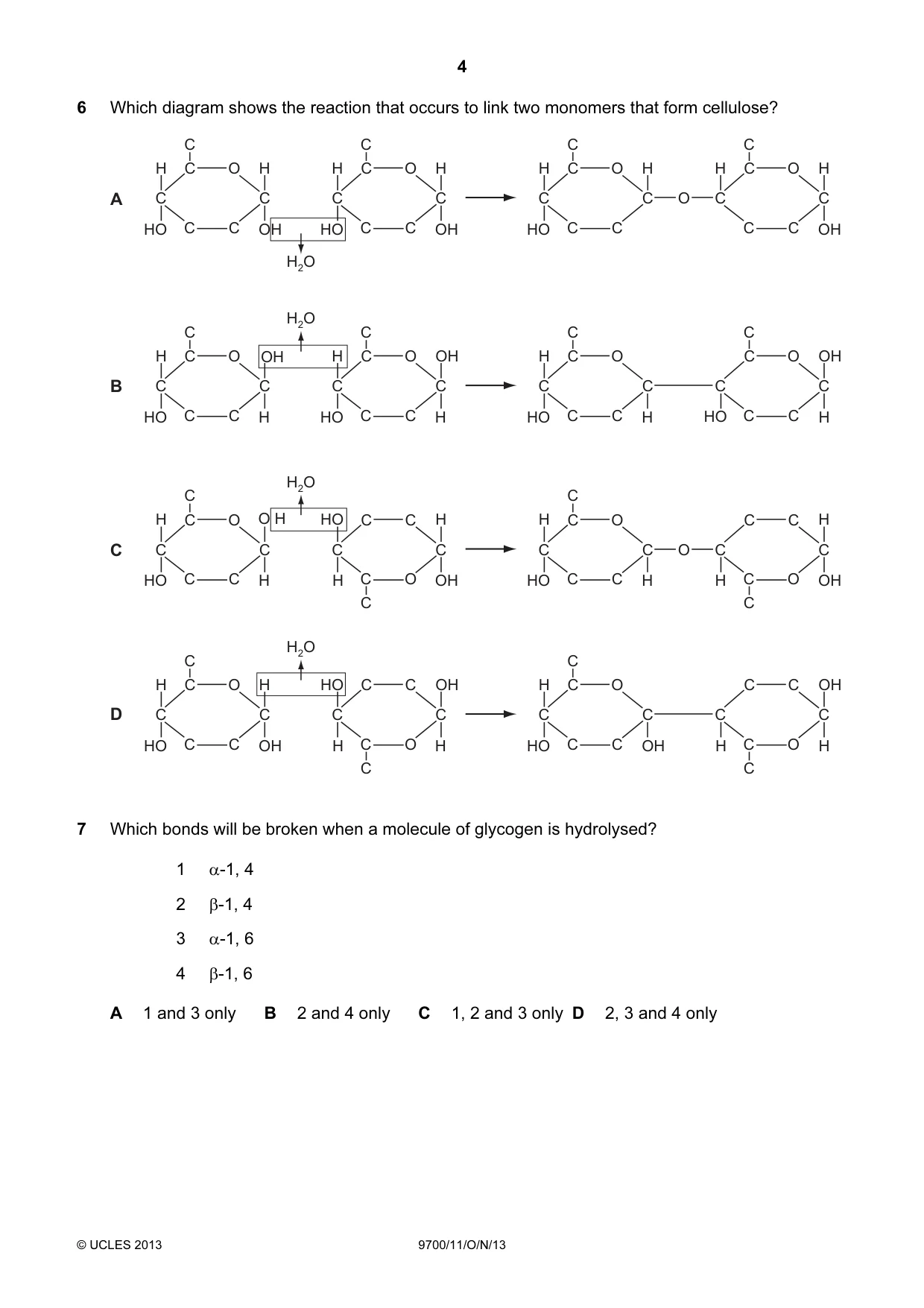
Q6 · Which diagram shows the reaction that occurs to link two monomers that form cellulose?
6 Which diagram shows the reaction that occurs to link two monomers that form cellulose? C C C C H C O H H C O H H C O H H C O H A C C C C C C O C C HO C C OH HO C C OH HO C C C C OH H2O H2O C C C C H C O OH H C O OH H C O C O OH B C C C C C C C C HO C C H HO C C H HO C C H HO C C H H2O C C H C O O H HO C C H H C O C C H C C C C C C C O C C HO C C H H C O OH HO C C H H C O OH C C H2O C C H C O H HO C C OH H C O C C OH D C C C C C C C C HO C C OH H C O H HO C C OH H C O H C C
Mark scheme: C
Q7 · Which bonds will be broken when a molecule of glycogen is hydrolysed?
7 Which bonds will be broken when a molecule of glycogen is hydrolysed? 1 α-1, 4 2 β-1, 4 3 α-1, 6 4 β-1, 6 A 1 and 3 only B 2 and 4 only C 1, 2 and 3 only D 2, 3 and 4 only
Mark scheme: A
Q8 · Collagen is a macromolecule with three polypeptides lying closely side by side in the…
8 Collagen is a macromolecule with three polypeptides lying closely side by side in the form of a triple helix. Every third amino acid in each polypeptide has the shortest possible R-group or side chain (– H) to allow close packing of the polypeptides. Which is the amino acid? A glucose B glycerol C glycine D guanine
Mark scheme: C
Q9 · The diagrams show the structures of two amino acids, each of which has two amine (–NH2)…
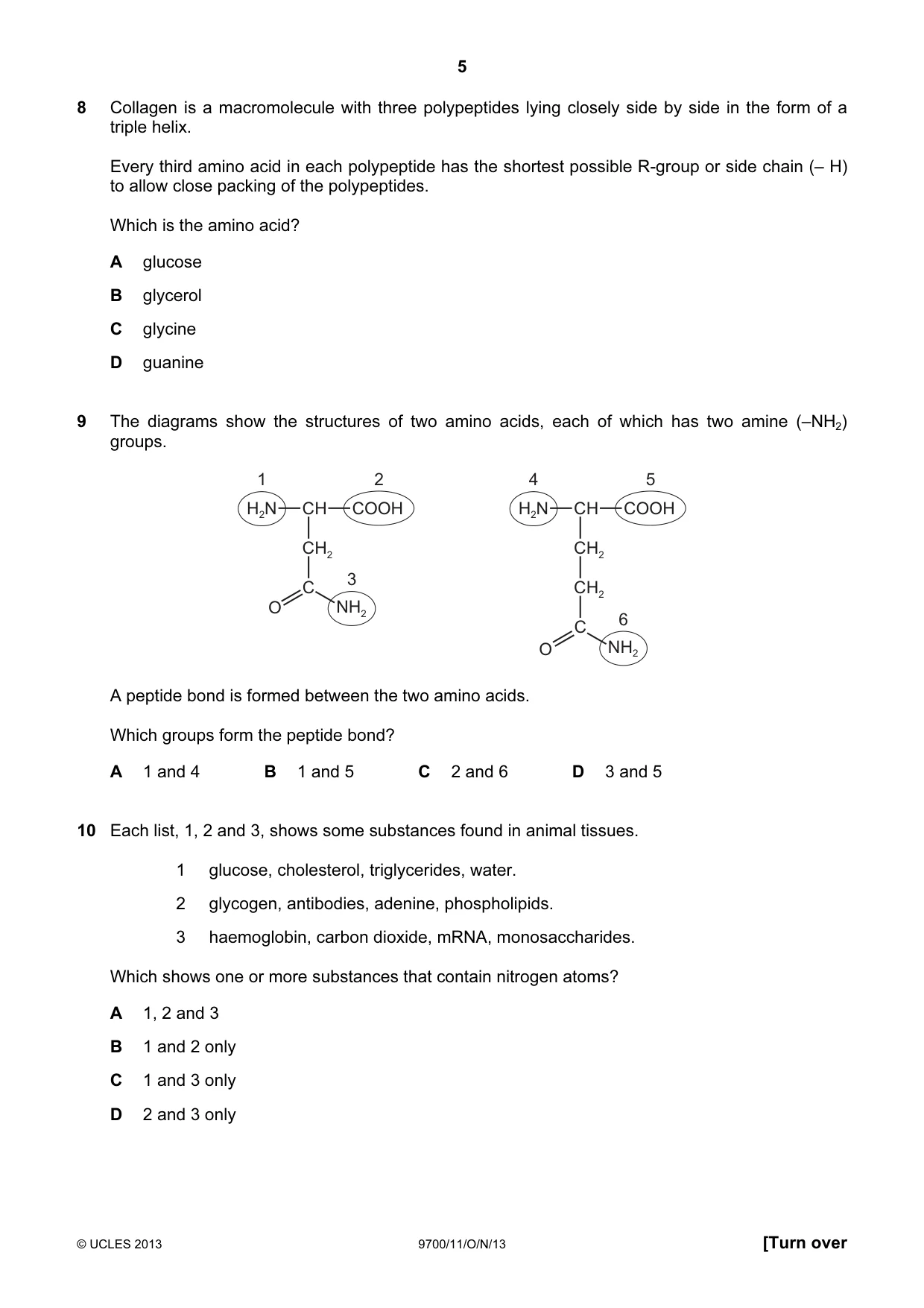
9 The diagrams show the structures of two amino acids, each of which has two amine (–NH2) groups. 1 2 4 5 H2N CH COOH H2N CH COOH CH2 CH2 3 C CH2 O NH2 6 C O NH2 A peptide bond is formed between the two amino acids. Which groups form the peptide bond? A 1 and 4 B 1 and 5 C 2 and 6 D 3 and 5
Mark scheme: B
Q10 · Each list, 1, 2 and 3, shows some substances found in animal tissues
10 Each list, 1, 2 and 3, shows some substances found in animal tissues. 1 glucose, cholesterol, triglycerides, water. 2 glycogen, antibodies, adenine, phospholipids. 3 haemoglobin, carbon dioxide, mRNA, monosaccharides. Which shows one or more substances that contain nitrogen atoms? A 1, 2 and 3 B 1 and 2 only C 1 and 3 only D 2 and 3 only
Mark scheme: D
Q11 · Which statements about competitive inhibitors of enzyme action are correct?
11 Which statements about competitive inhibitors of enzyme action are correct? 1 Increasing the concentration of the enzyme’s substrate will reduce their effect. 2 They bind to an enzyme at its active site. 3 They reduce the activation energy required for a reaction to take place. 4 They reduce the maximum rate of reaction. A 1 and 2 only B 1 and 3 only C 2 and 3 only D 2, 3 and 4 only
Mark scheme: A
Q12 · An enzyme is completely denatured at 50 °C
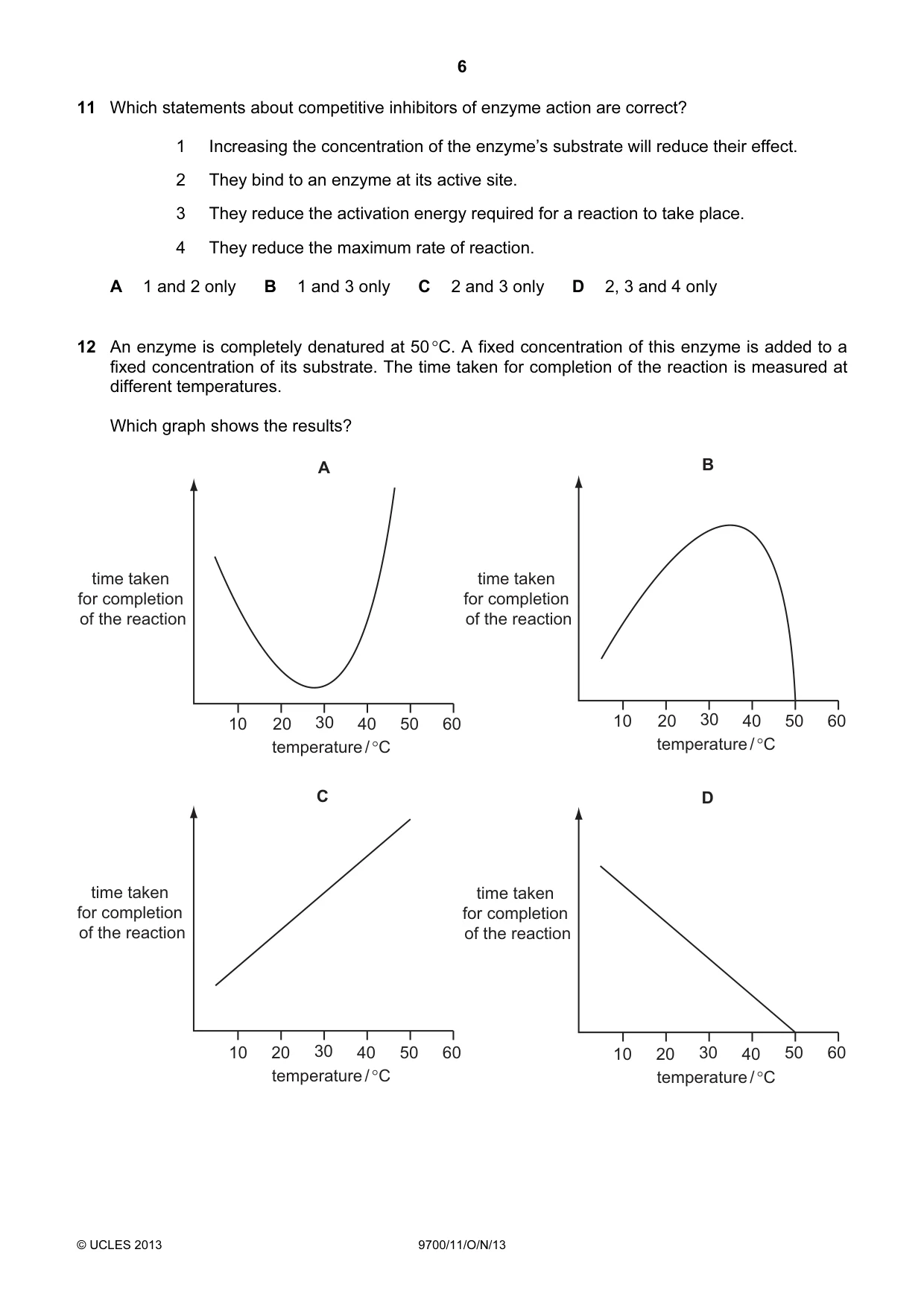
12 An enzyme is completely denatured at 50 °C. A fixed concentration of this enzyme is added to a fixed concentration of its substrate. The time taken for completion of the reaction is measured at different temperatures. Which graph shows the results? A B time taken time taken for completion for completion of the reaction of the reaction 10 20 30 40 50 60 10 20 30 40 50 60 temperature / °C temperature / °C C D time taken time taken for completion for completion of the reaction of the reaction 10 20 30 40 50 60 10 20 30 40 50 60 temperature / °C temperature / °C
Mark scheme: A
Q13 · Molecules 1, 2 and 3 are found in cell surface membranes
13 Molecules 1, 2 and 3 are found in cell surface membranes. 1 glycolipids 2 glycoproteins 3 phospholipids Which contribute to cell recognition? A 2 only B 1 and 2 only C 1 and 3 only D 2 and 3 only
Mark scheme: B
Q14 · What are the features of facilitated diffusion?
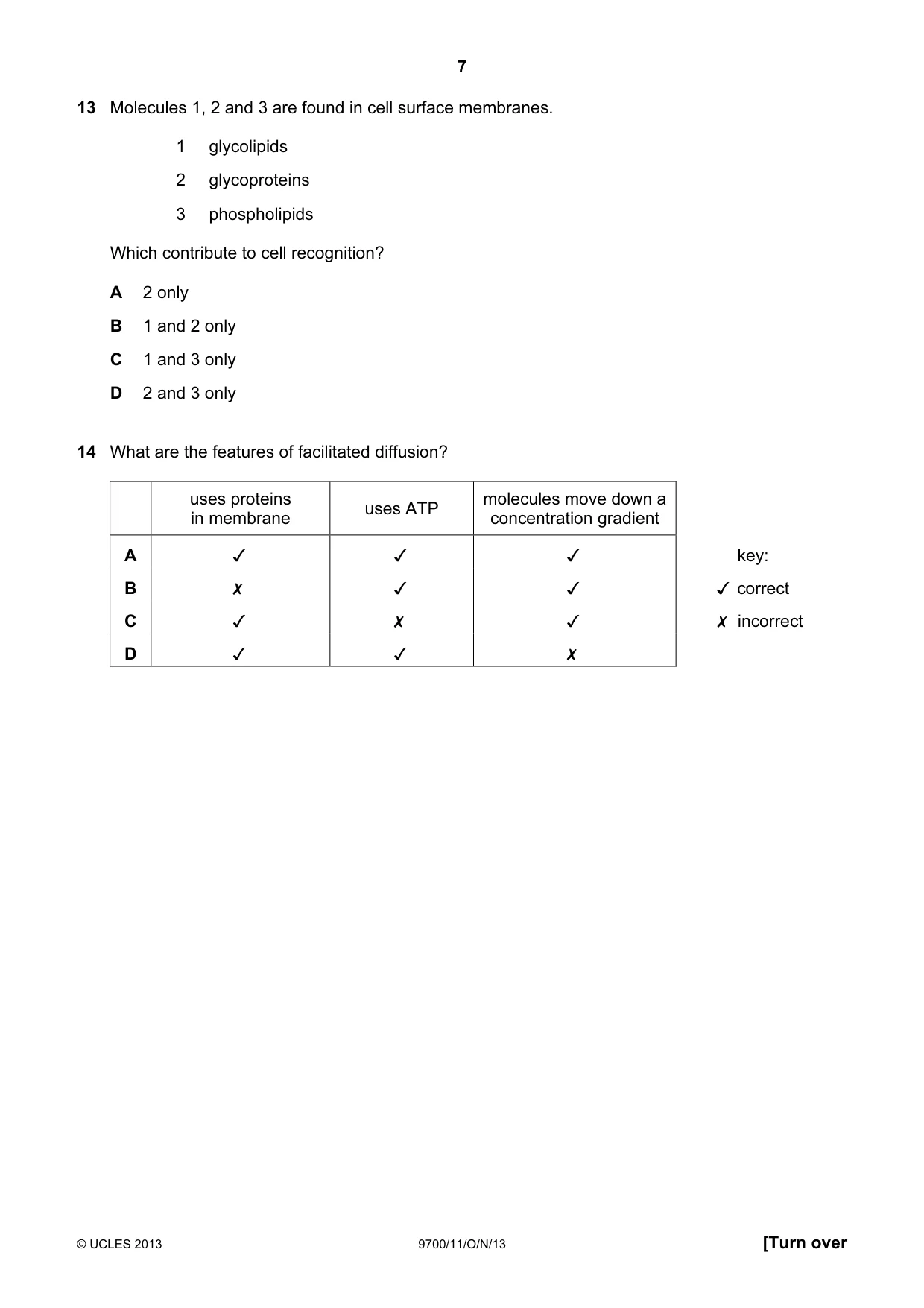
14 What are the features of facilitated diffusion? uses proteins molecules move down a in membrane uses ATP concentration gradient A v v v B x v v Cc v x v D v v x key: JY correct X incorrect
Mark scheme: C
Q15 · The stalk of a dandelion flower is a hollow tube
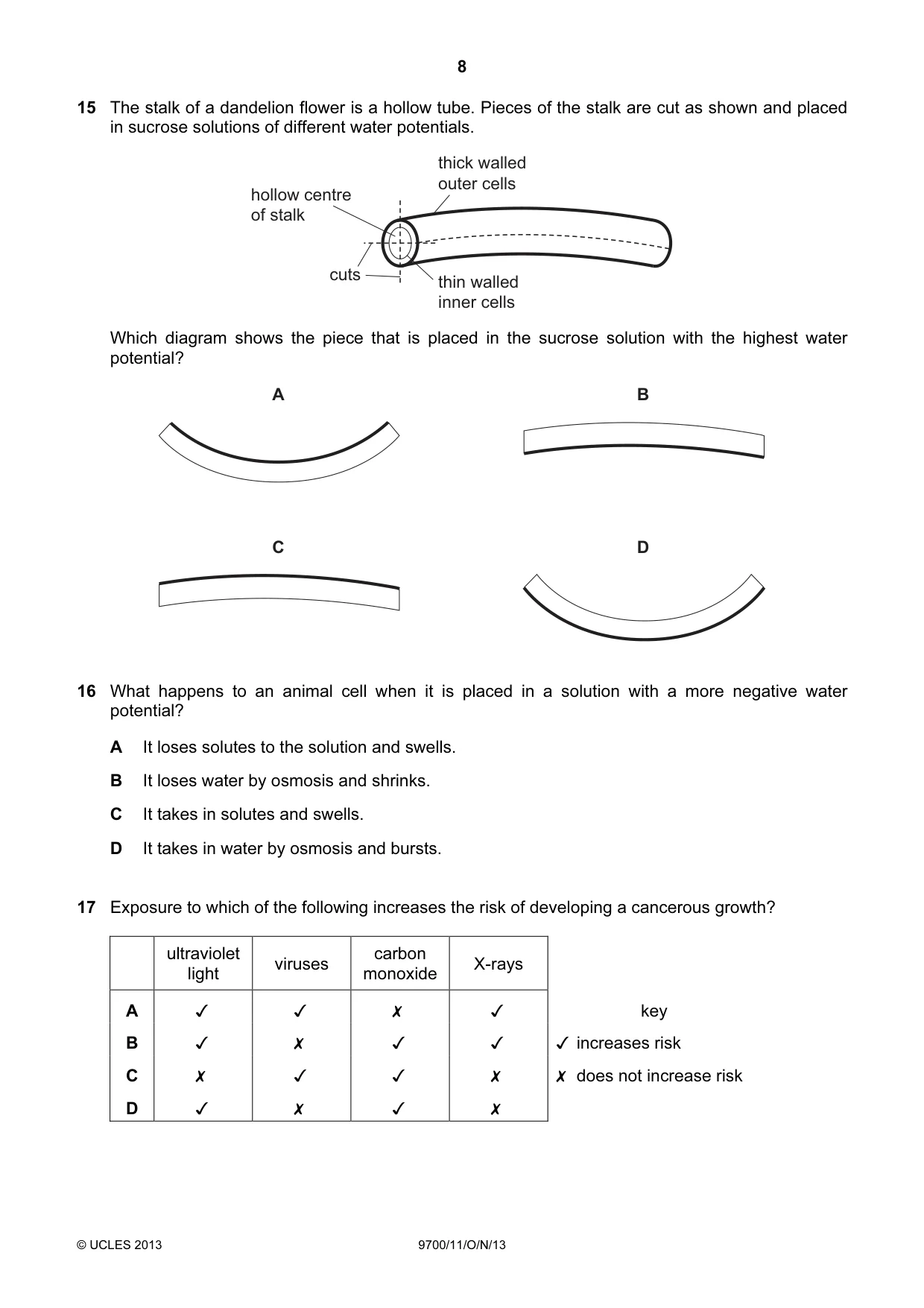
15 The stalk of a dandelion flower is a hollow tube. Pieces of the stalk are cut as shown and placed in sucrose solutions of different water potentials. thick walled outer cells hollow centre of stalk cuts thin walled inner cells Which diagram shows the piece that is placed in the sucrose solution with the highest water potential? A B C D
Mark scheme: A
Q16 · What happens to an animal cell when it is placed in a solution with a more negative water…
16 What happens to an animal cell when it is placed in a solution with a more negative water potential? A It loses solutes to the solution and swells. B It loses water by osmosis and shrinks. C It takes in solutes and swells. D It takes in water by osmosis and bursts.
Mark scheme: B
Q17 · Exposure to which of the following increases the risk of developing a cancerous growth?
17 Exposure to which of the following increases the risk of developing a cancerous growth? ultraviolet viruses carbon X-rays light monoxide y v x key JY increases risk Jv Jv x Jv X does not increase risk Jv Jv
Mark scheme: A
More questions on Replication and division of nuclei and cells
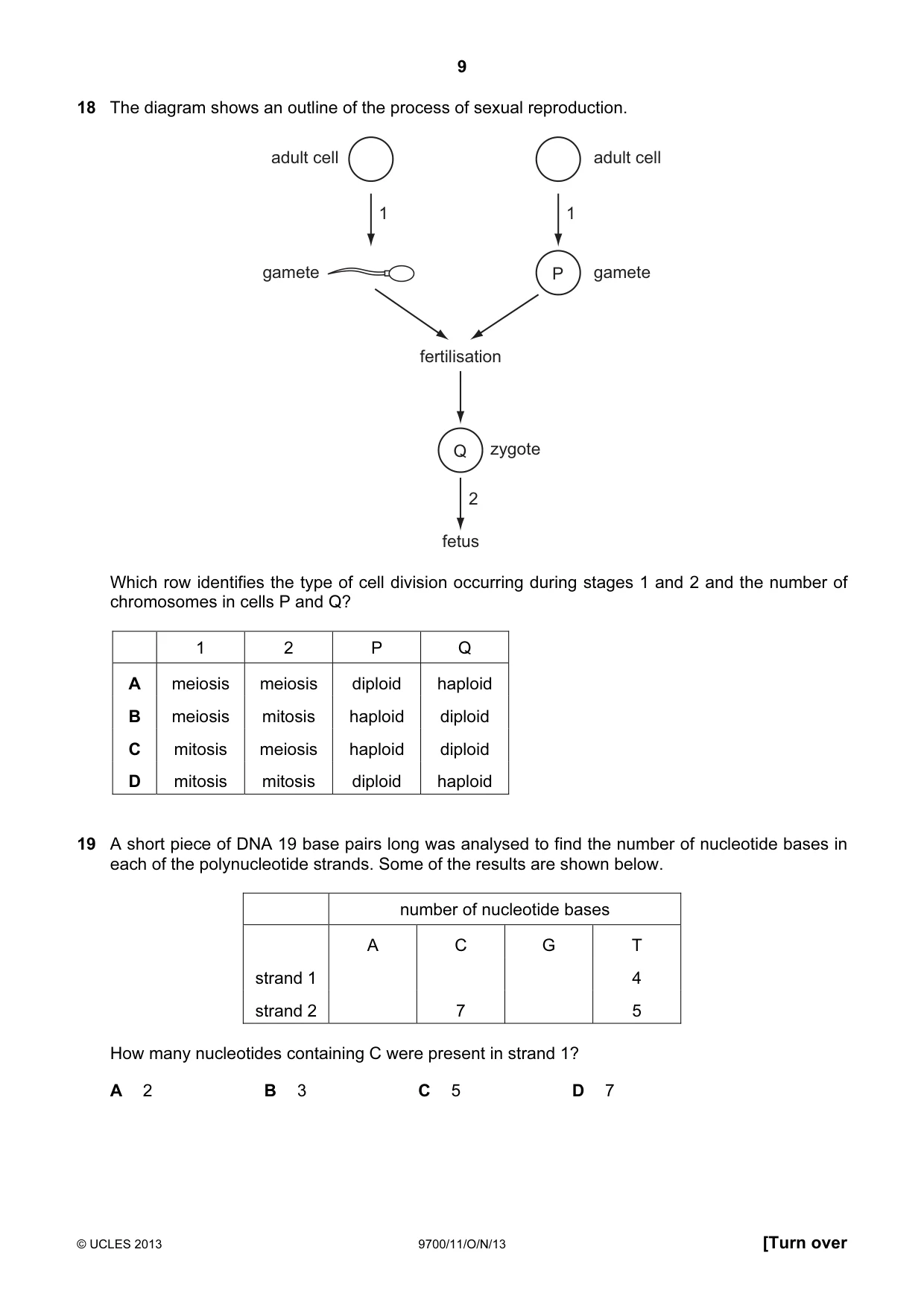
Q18 · The diagram shows an outline of the process of sexual reproduction
18 The diagram shows an outline of the process of sexual reproduction. adult cell adult cell 1 1 gamete P gamete fertilisation Q zygote 2 fetus Which row identifies the type of cell division occurring during stages 1 and 2 and the number of chromosomes in cells P and Q? 1 2 P Q A meiosis meiosis diploid haploid B meiosis mitosis haploid diploid C mitosis meiosis haploid diploid D mitosis mitosis diploid haploid
Mark scheme: B
More questions on Replication and division of nuclei and cells
Q19 · A short piece of DNA 19 base pairs long was analysed to find the number of nucleotide…
19 A short piece of DNA 19 base pairs long was analysed to find the number of nucleotide bases in each of the polynucleotide strands. Some of the results are shown below. number of nucleotide bases A C G T strand 1 4 strand 2 7 5 How many nucleotides containing C were present in strand 1? A 2 B 3 C 5 D 7
Mark scheme: B
More questions on Structure of nucleic acids and replication of DNA
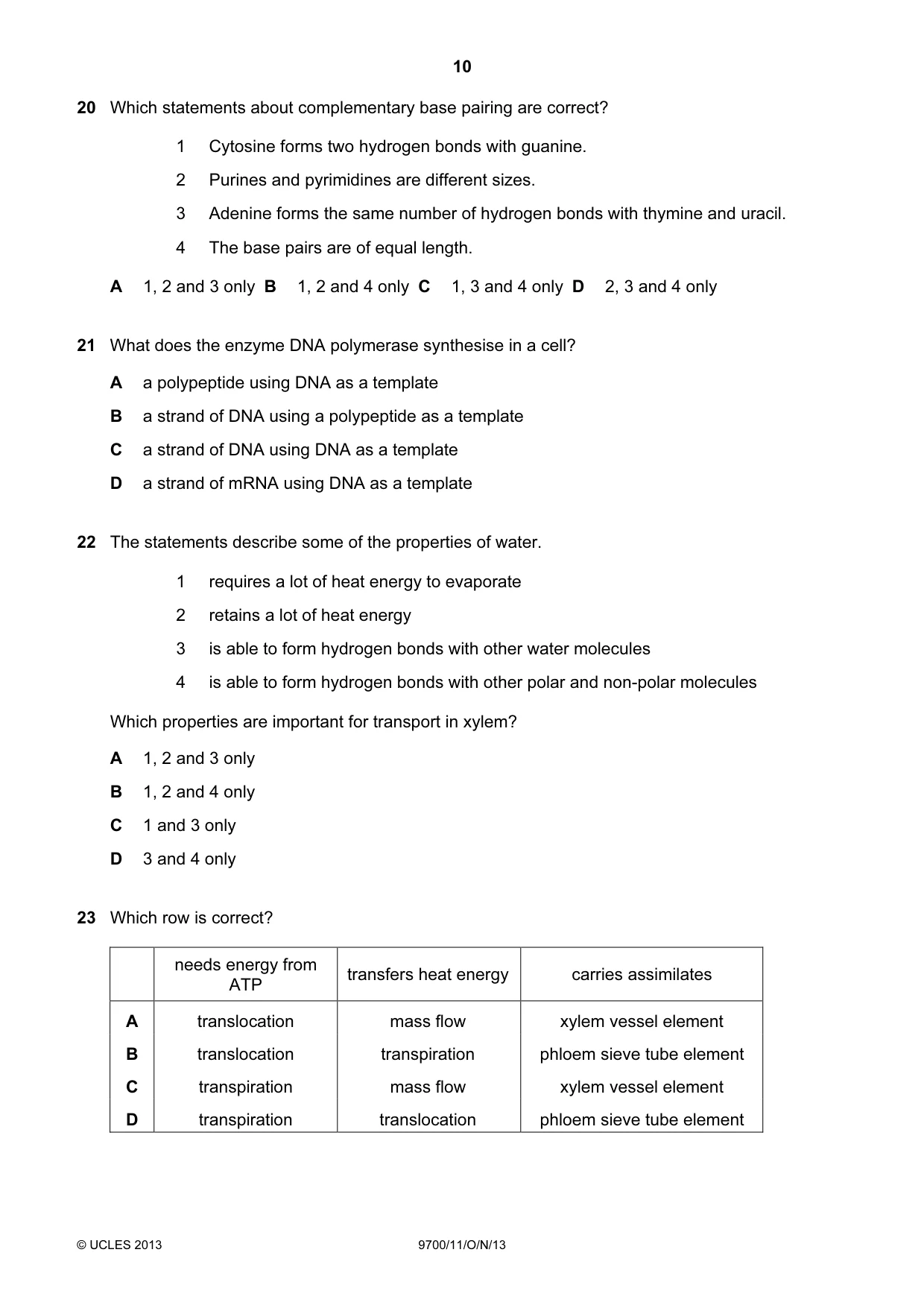
Q20 · Which statements about complementary base pairing are correct?
20 Which statements about complementary base pairing are correct? 1 Cytosine forms two hydrogen bonds with guanine. 2 Purines and pyrimidines are different sizes. 3 Adenine forms the same number of hydrogen bonds with thymine and uracil. 4 The base pairs are of equal length. A 1, 2 and 3 only B 1, 2 and 4 only C 1, 3 and 4 only D 2, 3 and 4 only
Mark scheme: D
More questions on Structure of nucleic acids and replication of DNA
Q21 · What does the enzyme DNA polymerase synthesise in a cell?
21 What does the enzyme DNA polymerase synthesise in a cell? A a polypeptide using DNA as a template B a strand of DNA using a polypeptide as a template C a strand of DNA using DNA as a template D a strand of mRNA using DNA as a template
Mark scheme: C
More questions on Structure of nucleic acids and replication of DNA
Q22 · The statements describe some of the properties of water
22 The statements describe some of the properties of water. 1 requires a lot of heat energy to evaporate 2 retains a lot of heat energy 3 is able to form hydrogen bonds with other water molecules 4 is able to form hydrogen bonds with other polar and non-polar molecules Which properties are important for transport in xylem? A 1, 2 and 3 only B 1, 2 and 4 only C 1 and 3 only D 3 and 4 only
Mark scheme: D
Q23 · Which row is correct?
23 Which row is correct? needs energy from transfers heat energy carries assimilates ATP A translocation mass flow xylem vessel element B translocation transpiration phloem sieve tube element C transpiration mass flow xylem vessel element D transpiration translocation phloem sieve tube element
Mark scheme: B
Q24 · Which feature of xylem vessel elements allows them to have reduced resistance to water…
24 Which feature of xylem vessel elements allows them to have reduced resistance to water movement? A lignin forms an incomplete secondary wall B new vessels carry extra water as a plant grows C there are no cross walls between vessel elements D vessel elements join to form narrow tubes
Mark scheme: C
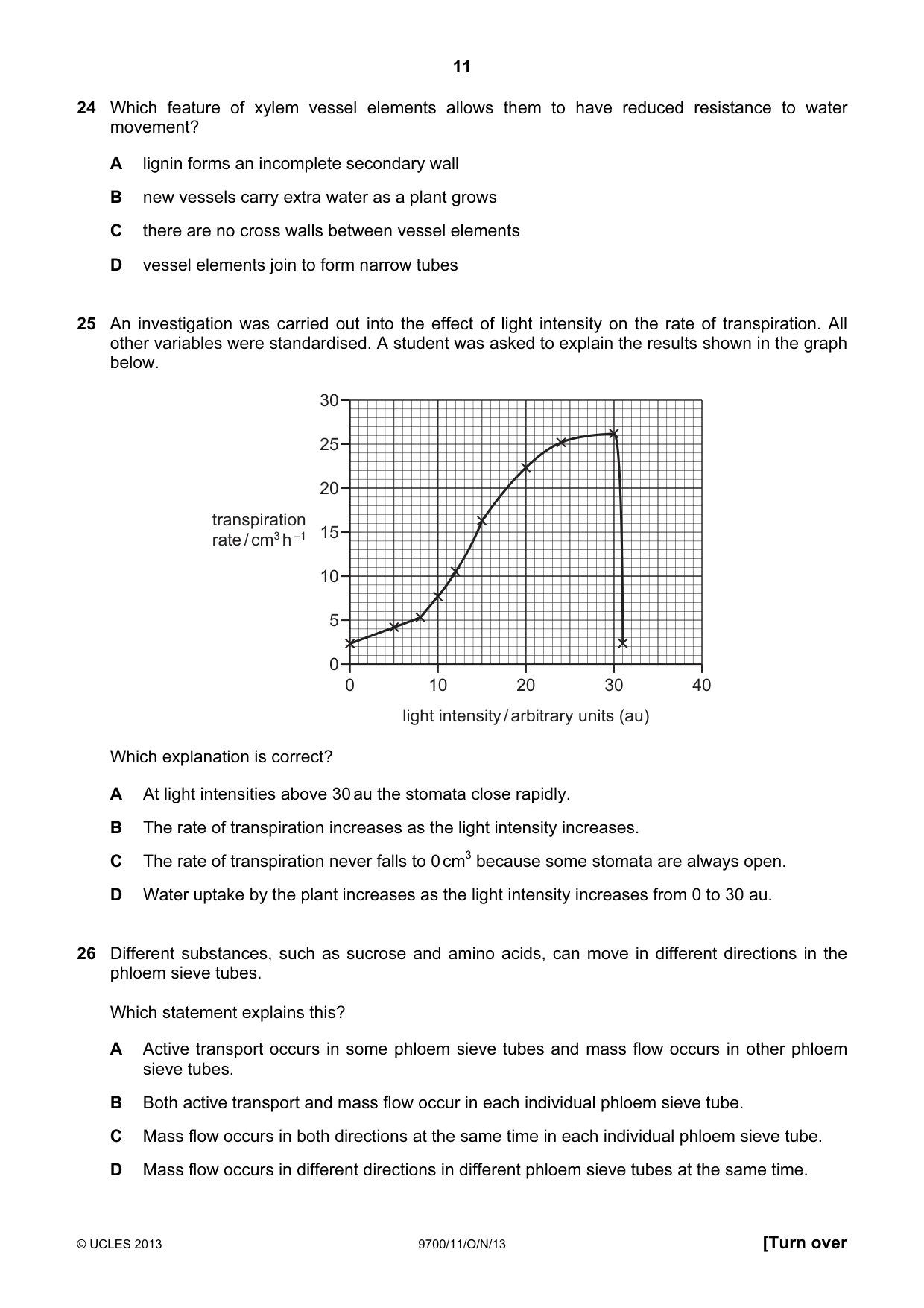
Q25 · An investigation was carried out into the effect of light intensity on the rate of…
25 An investigation was carried out into the effect of light intensity on the rate of transpiration. All other variables were standardised. A student was asked to explain the results shown in the graph below. 30 25 20 transpiration rate / cm3 h –1 15 10 5 0 0 10 20 30 40 light intensity / arbitrary units (au) Which explanation is correct? A At light intensities above 30 au the stomata close rapidly. B The rate of transpiration increases as the light intensity increases. C The rate of transpiration never falls to 0 cm3 because some stomata are always open. D Water uptake by the plant increases as the light intensity increases from 0 to 30 au.
Mark scheme: A
Q26 · Different substances, such as sucrose and amino acids, can move in different directions…
26 Different substances, such as sucrose and amino acids, can move in different directions in the phloem sieve tubes. Which statement explains this? A Active transport occurs in some phloem sieve tubes and mass flow occurs in other phloem sieve tubes. B Both active transport and mass flow occur in each individual phloem sieve tube. C Mass flow occurs in both directions at the same time in each individual phloem sieve tube. D Mass flow occurs in different directions in different phloem sieve tubes at the same time.
Mark scheme: D
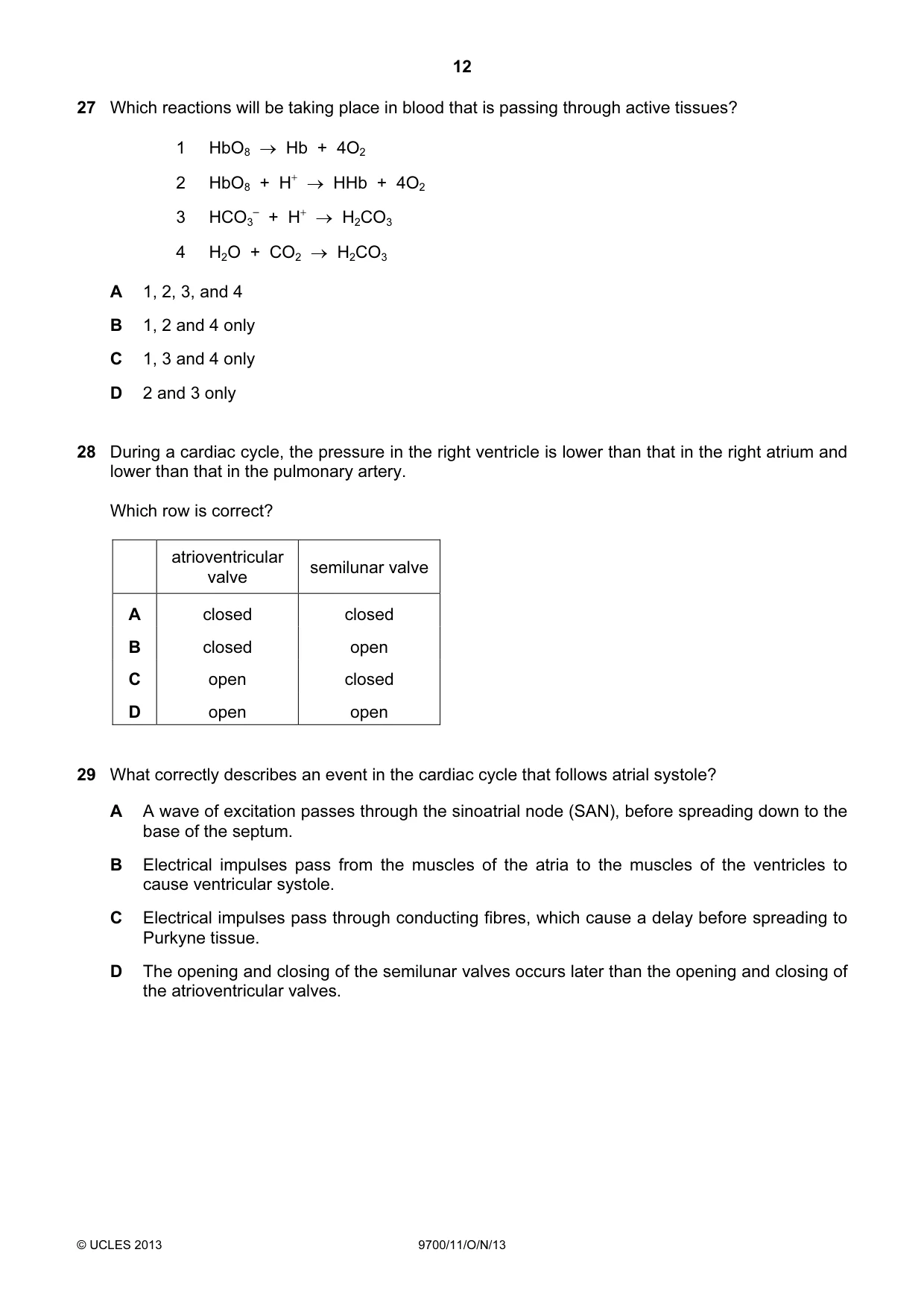
Q27 · Which reactions will be taking place in blood that is passing through active tissues?
27 Which reactions will be taking place in blood that is passing through active tissues? 1 HbO8 → Hb + 4O2 2 HbO8 + H+ → HHb + 4O2 3 HCO3 – + H+ → H2CO3 4 H2O + CO2 → H2CO3 A 1, 2, 3, and 4 B 1, 2 and 4 only C 1, 3 and 4 only D 2 and 3 only
Mark scheme: B
Q28 · During a cardiac cycle, the pressure in the right ventricle is lower than that in the…
28 During a cardiac cycle, the pressure in the right ventricle is lower than that in the right atrium and lower than that in the pulmonary artery. Which row is correct? atrioventricular semilunar valve valve A closed closed B closed open C open closed D open open
Mark scheme: C
Q29 · What correctly describes an event in the cardiac cycle that follows atrial systole?
29 What correctly describes an event in the cardiac cycle that follows atrial systole? A A wave of excitation passes through the sinoatrial node (SAN), before spreading down to the base of the septum. B Electrical impulses pass from the muscles of the atria to the muscles of the ventricles to cause ventricular systole. C Electrical impulses pass through conducting fibres, which cause a delay before spreading to Purkyne tissue. D The opening and closing of the semilunar valves occurs later than the opening and closing of the atrioventricular valves.
Mark scheme: C
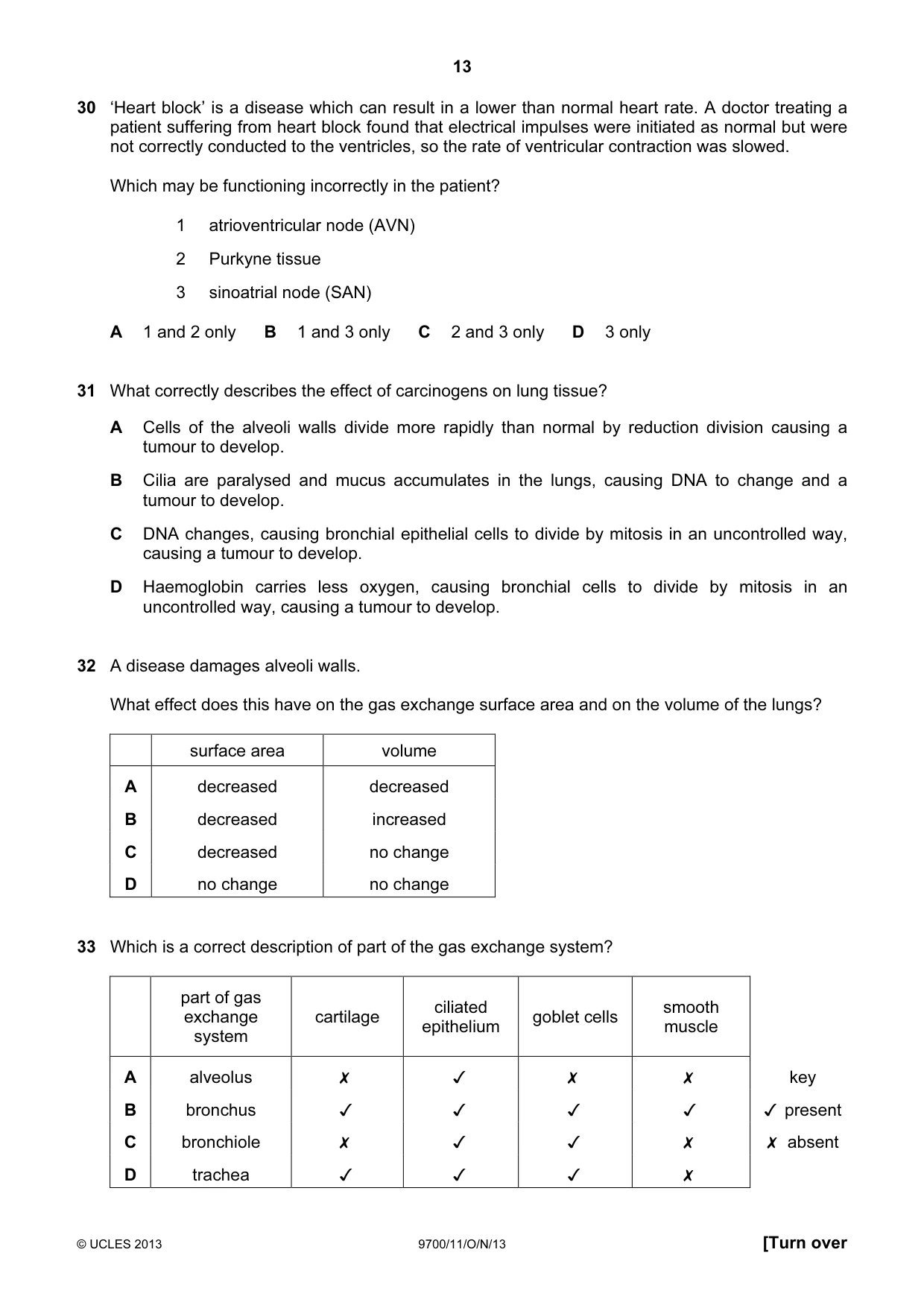
Q30 · ‘Heart block’ is a disease which can result in a lower than normal heart rate
30 ‘Heart block’ is a disease which can result in a lower than normal heart rate. A doctor treating a patient suffering from heart block found that electrical impulses were initiated as normal but were not correctly conducted to the ventricles, so the rate of ventricular contraction was slowed. Which may be functioning incorrectly in the patient? 1 atrioventricular node (AVN) 2 Purkyne tissue 3 sinoatrial node (SAN) A 1 and 2 only B 1 and 3 only C 2 and 3 only D 3 only
Mark scheme: A
Q31 · What correctly describes the effect of carcinogens on lung tissue?
31 What correctly describes the effect of carcinogens on lung tissue? A Cells of the alveoli walls divide more rapidly than normal by reduction division causing a tumour to develop. B Cilia are paralysed and mucus accumulates in the lungs, causing DNA to change and a tumour to develop. C DNA changes, causing bronchial epithelial cells to divide by mitosis in an uncontrolled way, causing a tumour to develop. D Haemoglobin carries less oxygen, causing bronchial cells to divide by mitosis in an uncontrolled way, causing a tumour to develop.
Mark scheme: C
Q32 · A disease damages alveoli walls
32 A disease damages alveoli walls. What effect does this have on the gas exchange surface area and on the volume of the lungs? surface area volume A decreased decreased B decreased increased C decreased no change D no change no change
Mark scheme: C
Q33 · Which is a correct description of part of the gas exchange system?
33. Which is a correct description of part of the gas exchange system? part of gas exchange system cartilage ciliated epithelium goblet cells smooth muscle 0 Oo WwW > alveolus bronchus bronchiole trachea \ & \ x SK KK <4 x «x « & x key v present X absent
Mark scheme: B
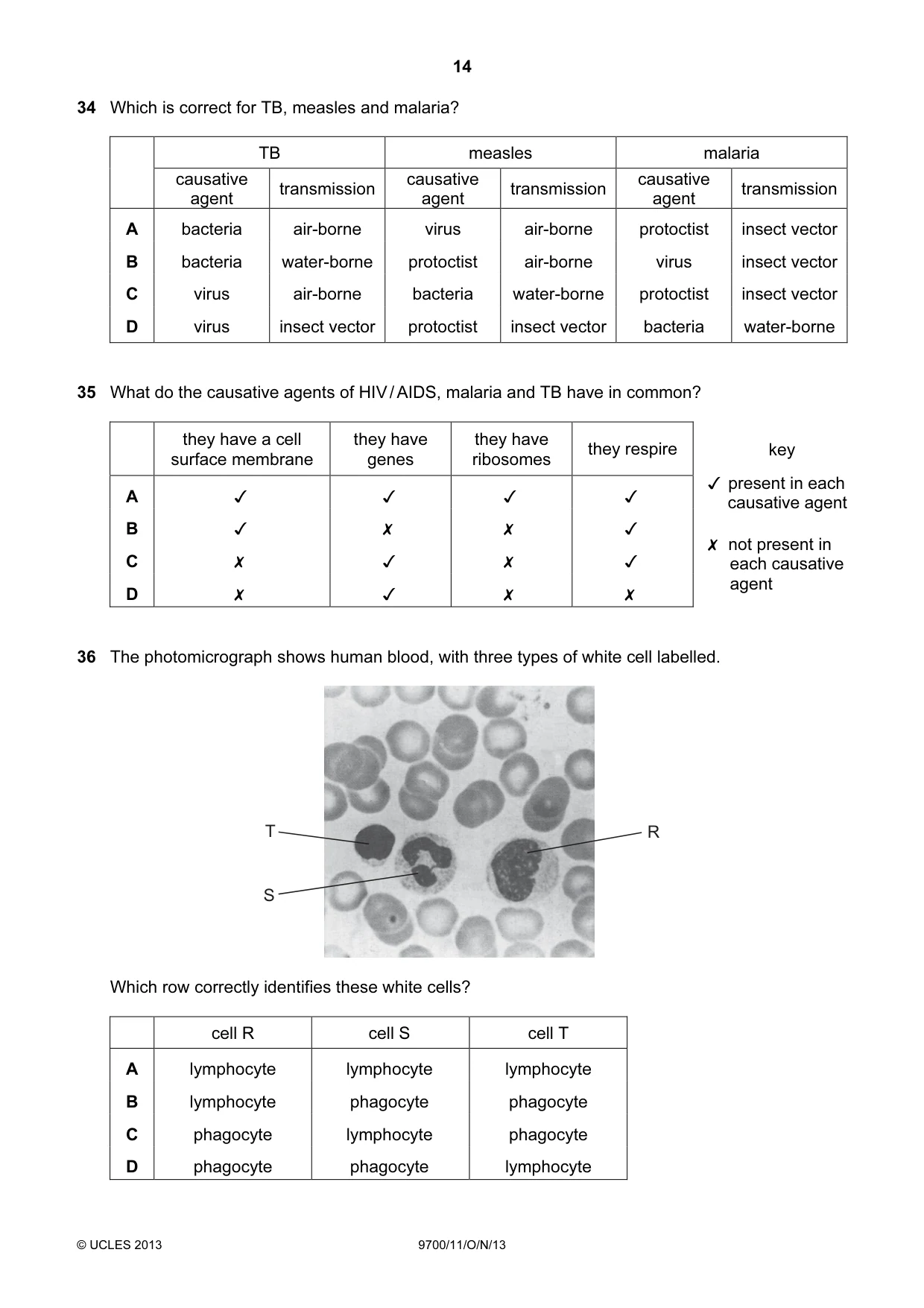
Q34 · Which is correct for TB, measles and malaria?
34 Which is correct for TB, measles and malaria? TB measles malaria causative causative causative transmission transmission transmission agent agent agent A bacteria air-borne virus air-borne protoctist insect vector B bacteria water-borne protoctist air-borne virus insect vector C virus air-borne bacteria water-borne protoctist insect vector D virus insect vector protoctist insect vector bacteria water-borne
Mark scheme: A
Q35 · What do the causative agents of HIV/AIDS, malaria and TB have in common?
35 What do the causative agents of HIV/AIDS, malaria and TB have in common? they have a cell they have they have ; they respire key surface membrane genes ribosomes ¥ present in each v v v causative agent X not present in each causative agent 0 Oo WwW PY a CS v x x x v x x v x
Mark scheme: D
Q36 · The photomicrograph shows human blood, with three types of white cell labelled
36 The photomicrograph shows human blood, with three types of white cell labelled. T R S Which row correctly identifies these white cells? cell R cell S cell T A lymphocyte lymphocyte lymphocyte B lymphocyte phagocyte phagocyte C phagocyte lymphocyte phagocyte D phagocyte phagocyte lymphocyte
Mark scheme: D
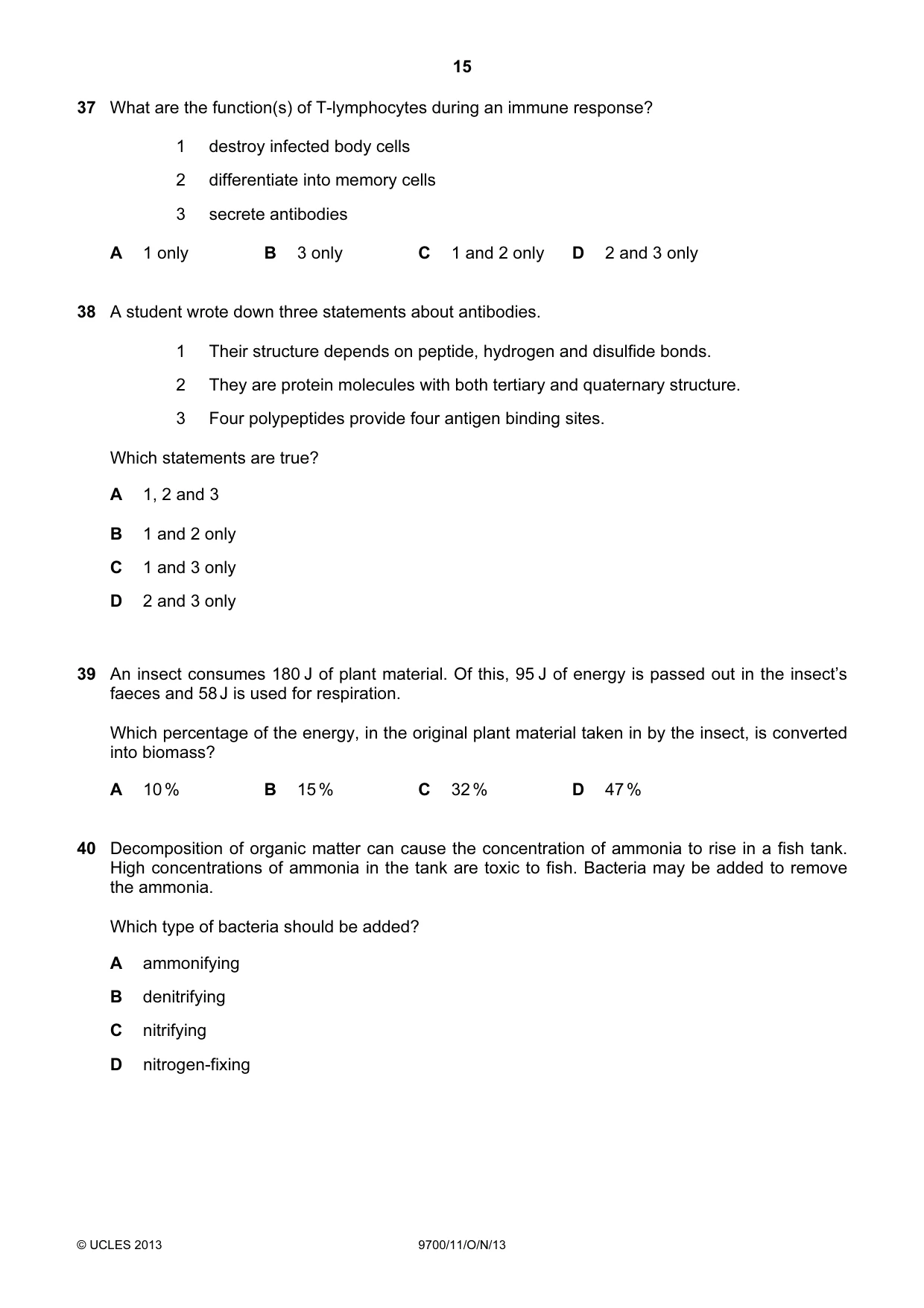
Q37 · What are the function(s) of T-lymphocytes during an immune response?
37 What are the function(s) of T-lymphocytes during an immune response? 1 destroy infected body cells 2 differentiate into memory cells 3 secrete antibodies A 1 only B 3 only C 1 and 2 only D 2 and 3 only
Mark scheme: C
Q38 · A student wrote down three statements about antibodies
38 A student wrote down three statements about antibodies. 1 Their structure depends on peptide, hydrogen and disulfide bonds. 2 They are protein molecules with both tertiary and quaternary structure. 3 Four polypeptides provide four antigen binding sites. Which statements are true? A 1, 2 and 3 B 1 and 2 only C 1 and 3 only D 2 and 3 only
Mark scheme: B
Q39 · An insect consumes 180 J of plant material
39 An insect consumes 180 J of plant material. Of this, 95 J of energy is passed out in the insect’s faeces and 58 J is used for respiration. Which percentage of the energy, in the original plant material taken in by the insect, is converted into biomass? A 10 % B 15 % C 32 % D 47 %
Mark scheme: B
Q40 · Decomposition of organic matter can cause the concentration of ammonia to rise in a fish…
40 Decomposition of organic matter can cause the concentration of ammonia to rise in a fish tank. High concentrations of ammonia in the tank are toxic to fish. Bacteria may be added to remove the ammonia. Which type of bacteria should be added? A ammonifying B denitrifying C nitrifying D nitrogen-fixing
Mark scheme: C
What was in this paper
The subtopics covered by these 40 questions, and how many questions each got. Open one in a new tab to see every Cambridge question on it.
3Movement into and out of cells3Proteins3Structure of nucleic acids and replication of DNA3The gas exchange system3The heart3Transport mechanisms3Carbohydrates and lipids2Factors that affect enzyme action2Infectious diseases2Replication and division of nuclei and cells2The immune system2The microscope in cell studies2Antibodies and vaccination1Conservation1Energy1Fluid mosaic membranes1Structure of transport tissues1Transport of oxygen and carbon dioxide1Water1What you needed in this session
Cambridge’s own grade thresholds for 2013 Oct/Nov, Paper 1 · Variant 1. A higher threshold means an easier paper — the bar moves with how the cohort did.