Cambridge A Level Biology 9700 — 2012 Oct/Nov Paper 1 · Variant 2
9700/12/O/N/12 · 40 questions · 40 marks · ≈45 min
The question paper and its mark scheme, free to read here and free to download. This is Cambridge’s own paper, exactly as it was sat.
Question paper16 pages
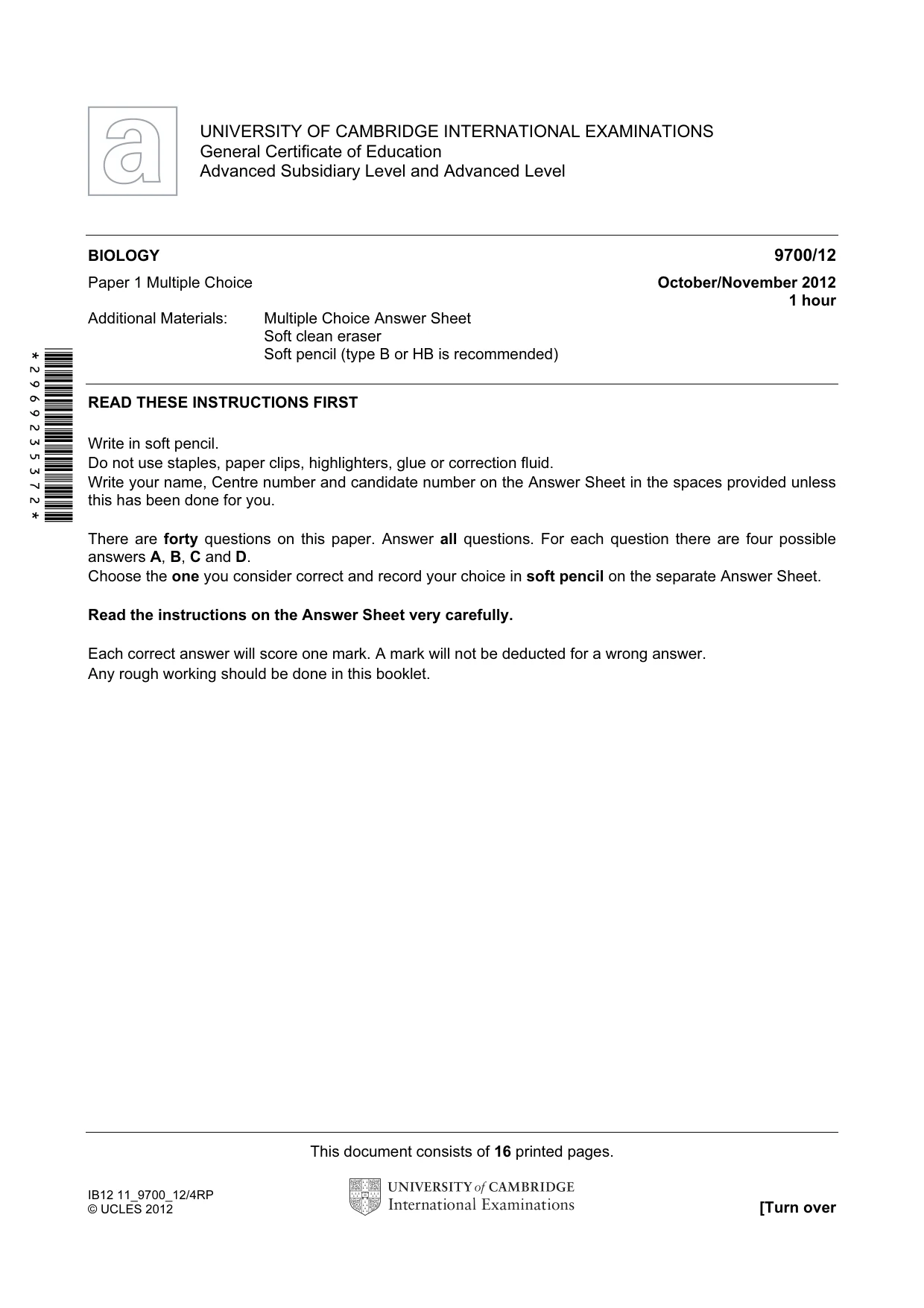
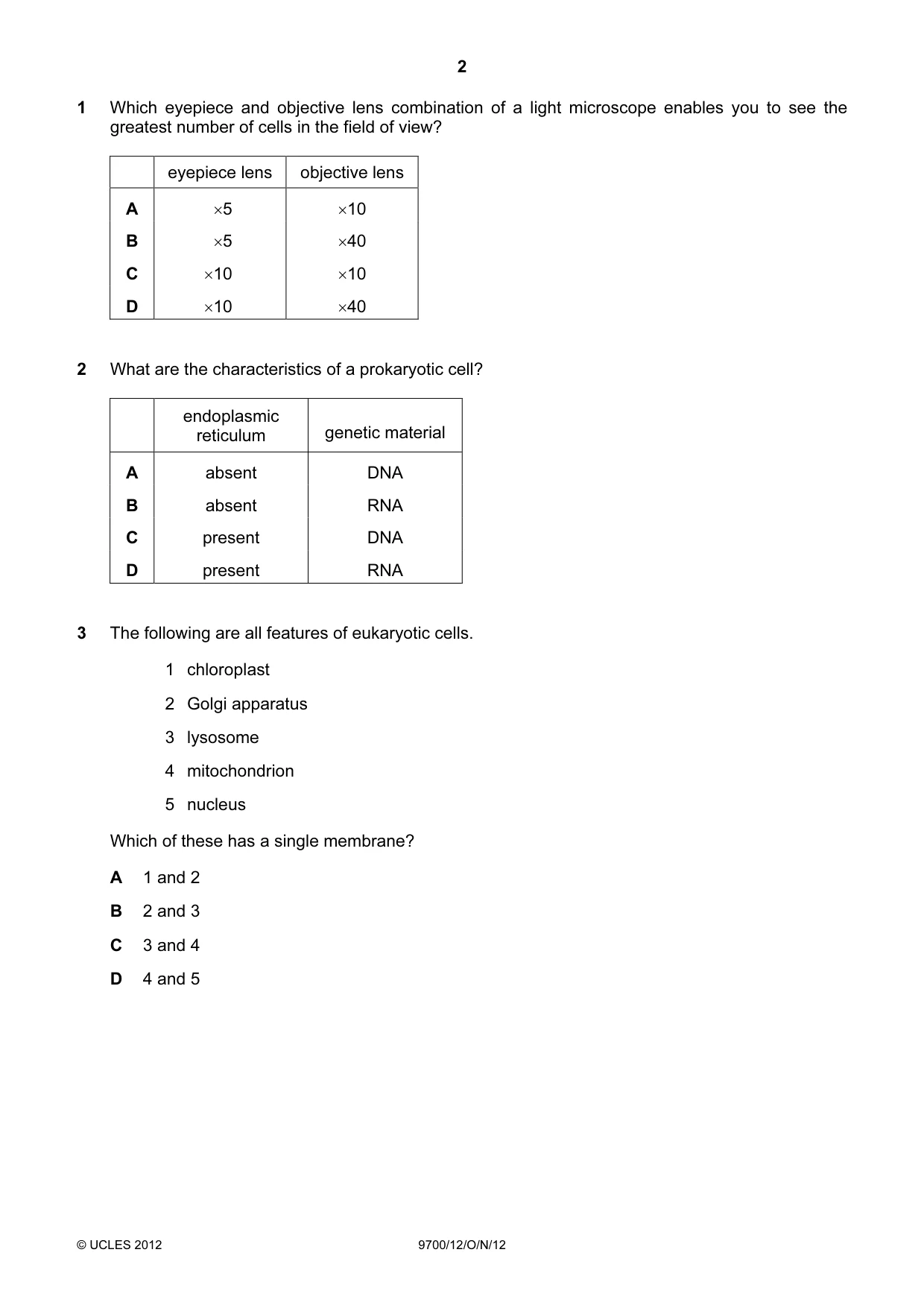
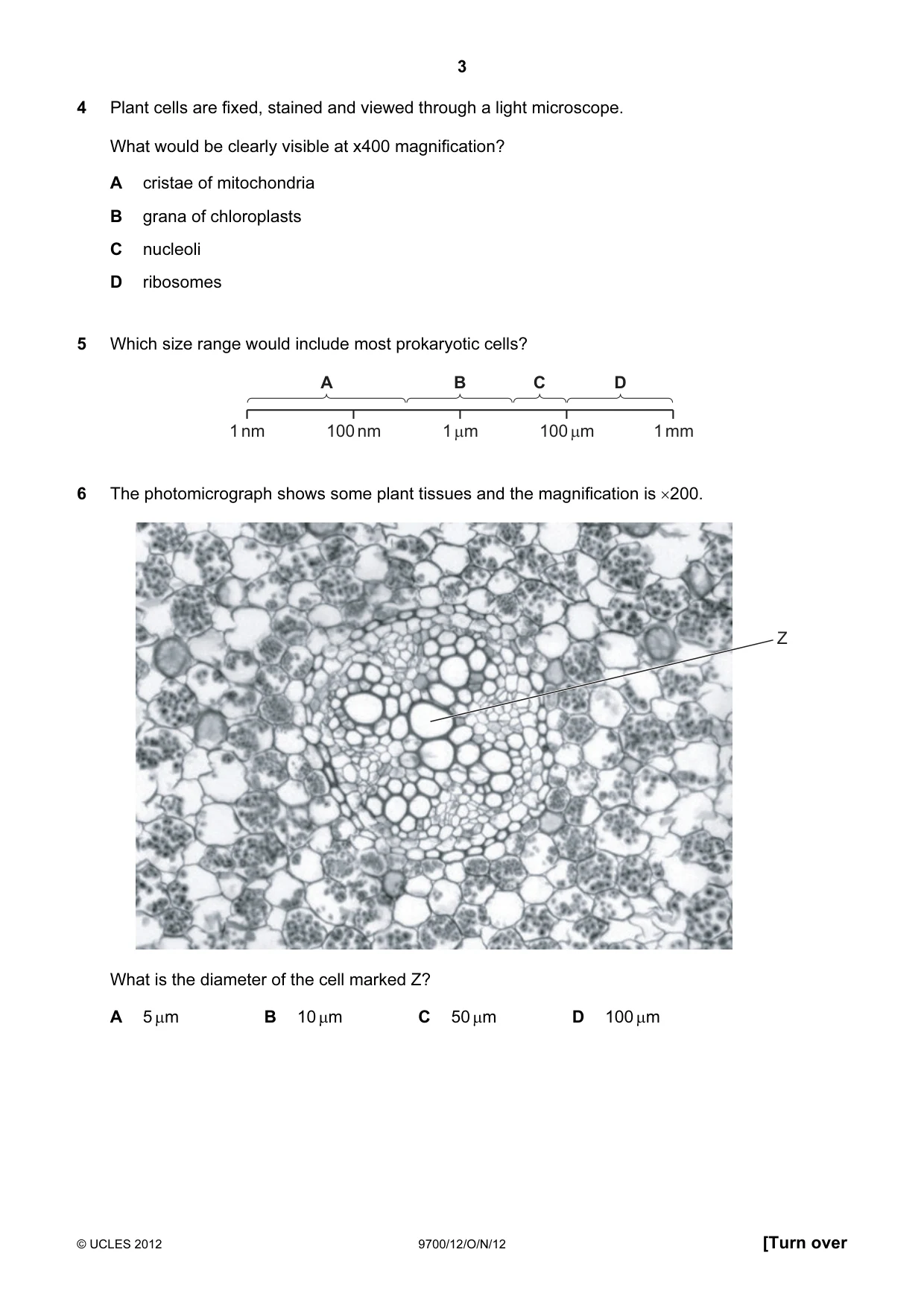
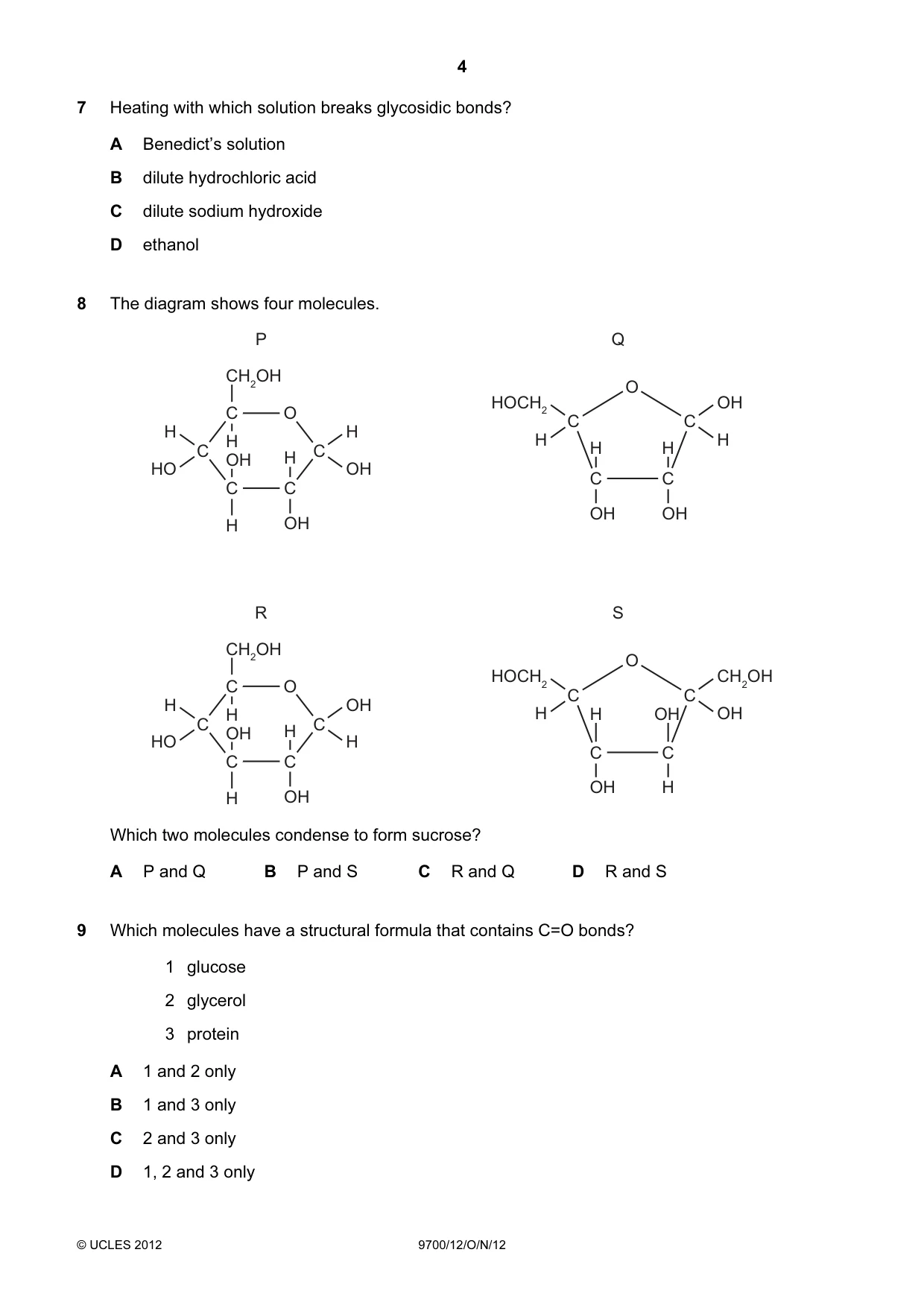
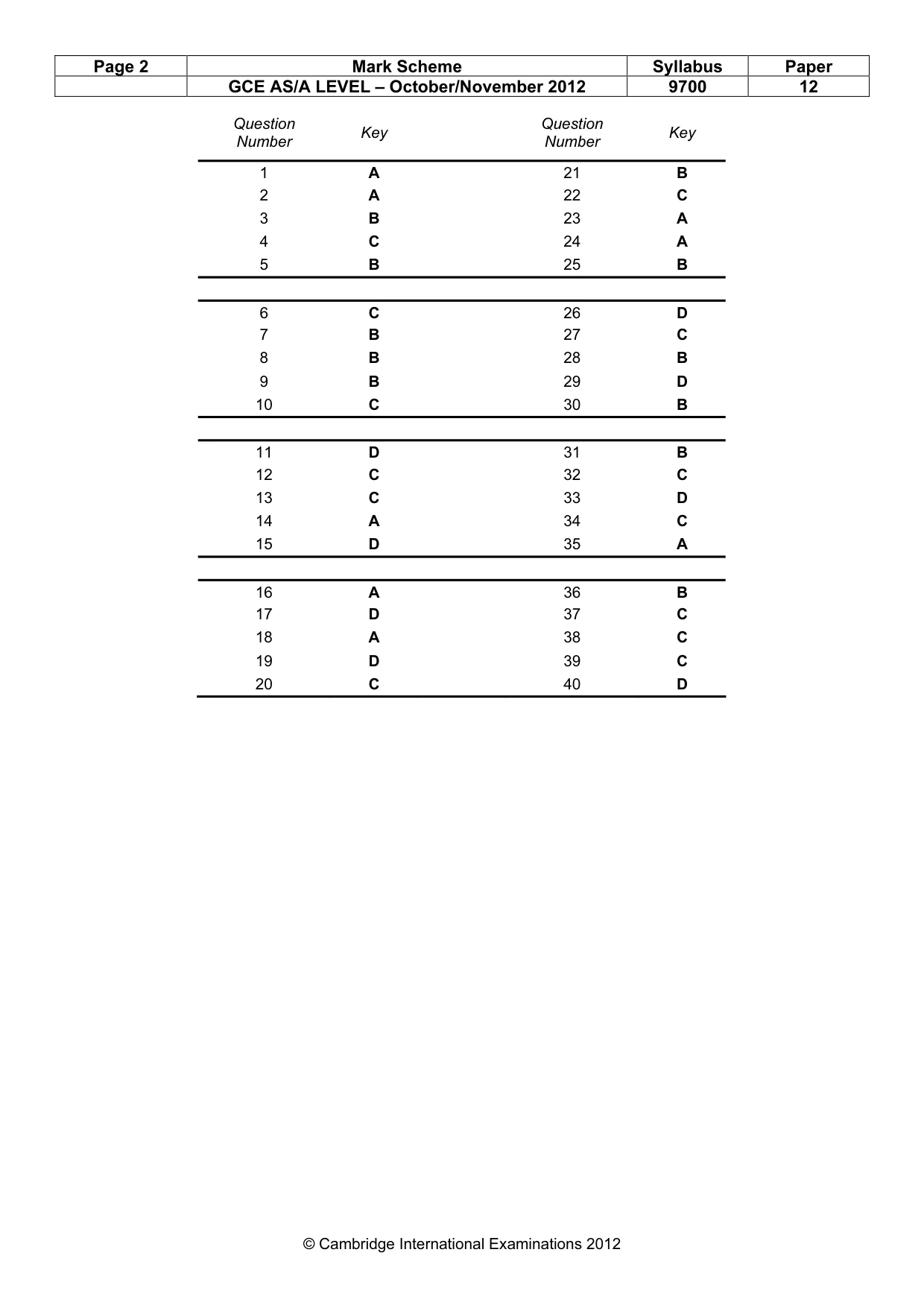
Mark scheme2 pages
Answers below. Sit the paper first if you are practising.
Questions as text
Q1 · Which eyepiece and objective lens combination of a light microscope enables you to see…
1 Which eyepiece and objective lens combination of a light microscope enables you to see the greatest number of cells in the field of view? eyepiece lens objective lens A ×5 ×10 B ×5 ×40 C ×10 ×10 D ×10 ×40
Mark scheme: A
Q2 · What are the characteristics of a prokaryotic cell?
2 What are the characteristics of a prokaryotic cell? endoplasmic reticulum genetic material A absent DNA B absent RNA C present DNA D present RNA
Mark scheme: A
More questions on Cells as the basic units of living organisms
Q3 · The following are all features of eukaryotic cells
3 The following are all features of eukaryotic cells. 1 chloroplast 2 Golgi apparatus 3 lysosome 4 mitochondrion 5 nucleus Which of these has a single membrane? A 1 and 2 B 2 and 3 C 3 and 4 D 4 and 5
Mark scheme: B
More questions on Cells as the basic units of living organisms
Q4 · Plant cells are fixed, stained and viewed through a light microscope
4 Plant cells are fixed, stained and viewed through a light microscope. What would be clearly visible at x400 magnification? A cristae of mitochondria B grana of chloroplasts C nucleoli D ribosomes
Mark scheme: C
Q5 · Which size range would include most prokaryotic cells?
5 Which size range would include most prokaryotic cells? A B C D 1 nm 100 nm 1 µm 100 µm 1 mm
Mark scheme: B
More questions on Cells as the basic units of living organisms
Q6 · The photomicrograph shows some plant tissues and the magnification is ×200
6 The photomicrograph shows some plant tissues and the magnification is ×200. Z What is the diameter of the cell marked Z? A 5 µm B 10 µm C 50 µm D 100 µm
Mark scheme: C
Q7 · Heating with which solution breaks glycosidic bonds?
7 Heating with which solution breaks glycosidic bonds? A Benedict’s solution B dilute hydrochloric acid C dilute sodium hydroxide D ethanol
Mark scheme: B
Q8 · The diagram shows four molecules
8 The diagram shows four molecules. P Q CH2OH O O O HOCH2 OH C C C O O O C C C C C C H H H H H C C C C C C H H OH H HO OH C C C C C C C C C O O C OH OH H OH R S CH2OH O O O HOCH2 CH2OH C C C O O O C C C C C C H OH H H H OH OH C C C H C C C OH HO H C C C C C C C C C O O C OH H H OH Which two molecules condense to form sucrose? A P and Q B P and S C R and Q D R and S
Mark scheme: B
Q9 · Which molecules have a structural formula that contains C=O bonds?
9 Which molecules have a structural formula that contains C=O bonds? 1 glucose 2 glycerol 3 protein A 1 and 2 only B 1 and 3 only C 2 and 3 only D 1, 2 and 3 only
Mark scheme: B
Q10 · Haemoglobin consists of two α chains and two β chains
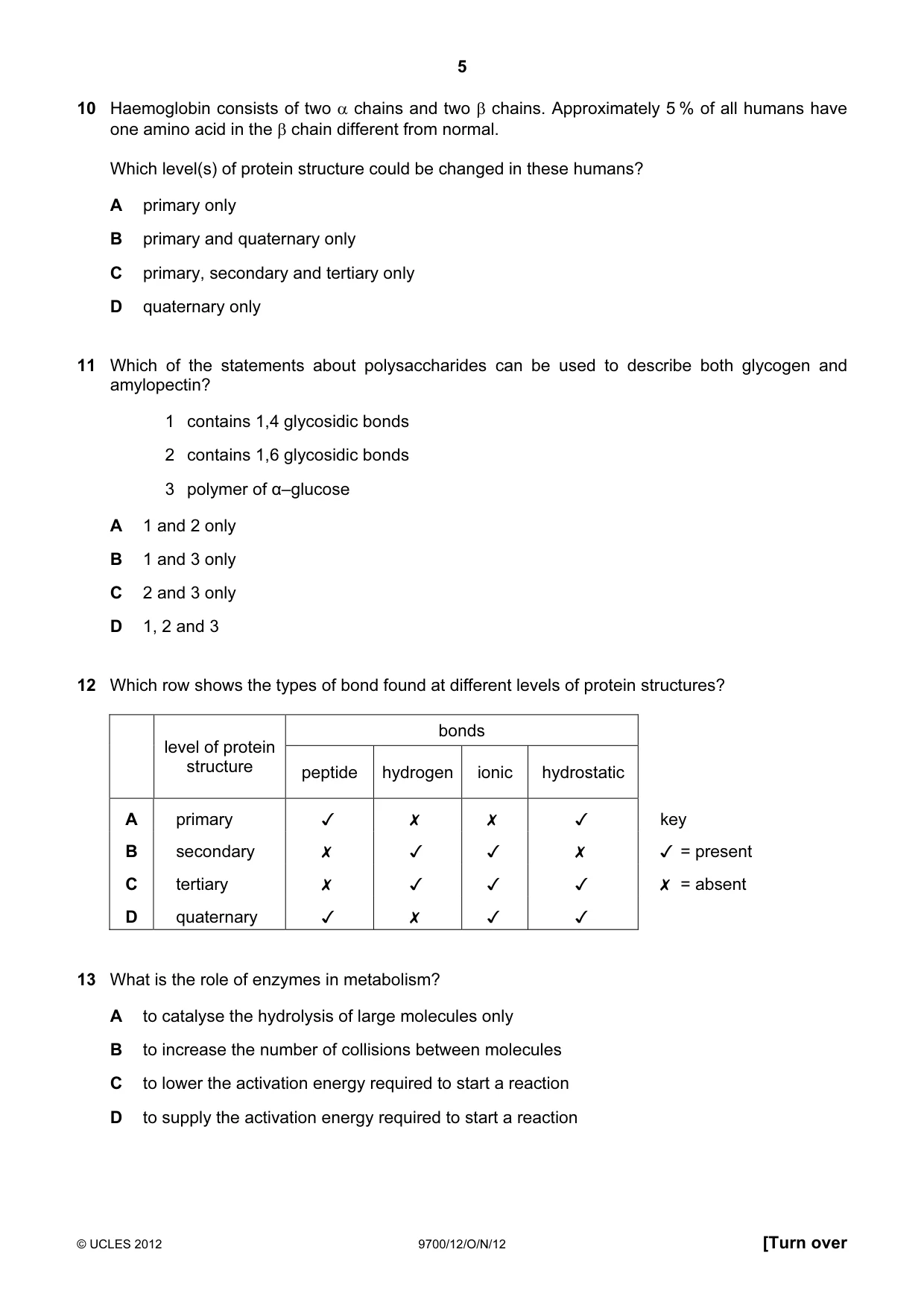
10 Haemoglobin consists of two α chains and two β chains. Approximately 5 % of all humans have one amino acid in the β chain different from normal. Which level(s) of protein structure could be changed in these humans? A primary only B primary and quaternary only C primary, secondary and tertiary only D quaternary only
Mark scheme: C
Q11 · Which of the statements about polysaccharides can be used to describe both glycogen and…
11 Which of the statements about polysaccharides can be used to describe both glycogen and amylopectin? 1 contains 1,4 glycosidic bonds 2 contains 1,6 glycosidic bonds 3 polymer of α–glucose A 1 and 2 only B 1 and 3 only C 2 and 3 only D 1, 2 and 3
Mark scheme: D
Q12 · Which row shows the types of bond found at different levels of protein structures?
12 Which row shows the types of bond found at different levels of protein structures? bonds level of protein structure peptide | hydrogen | ionic | hydrostatic A primary J x x v B secondary Xx v v x Cc tertiary x v v v D quaternary v x v v key Jv = present X = absent
Mark scheme: C
Q13 · What is the role of enzymes in metabolism?
13 What is the role of enzymes in metabolism? A to catalyse the hydrolysis of large molecules only B to increase the number of collisions between molecules C to lower the activation energy required to start a reaction D to supply the activation energy required to start a reaction
Mark scheme: C
Q14 · Two enzyme experiments were carried out
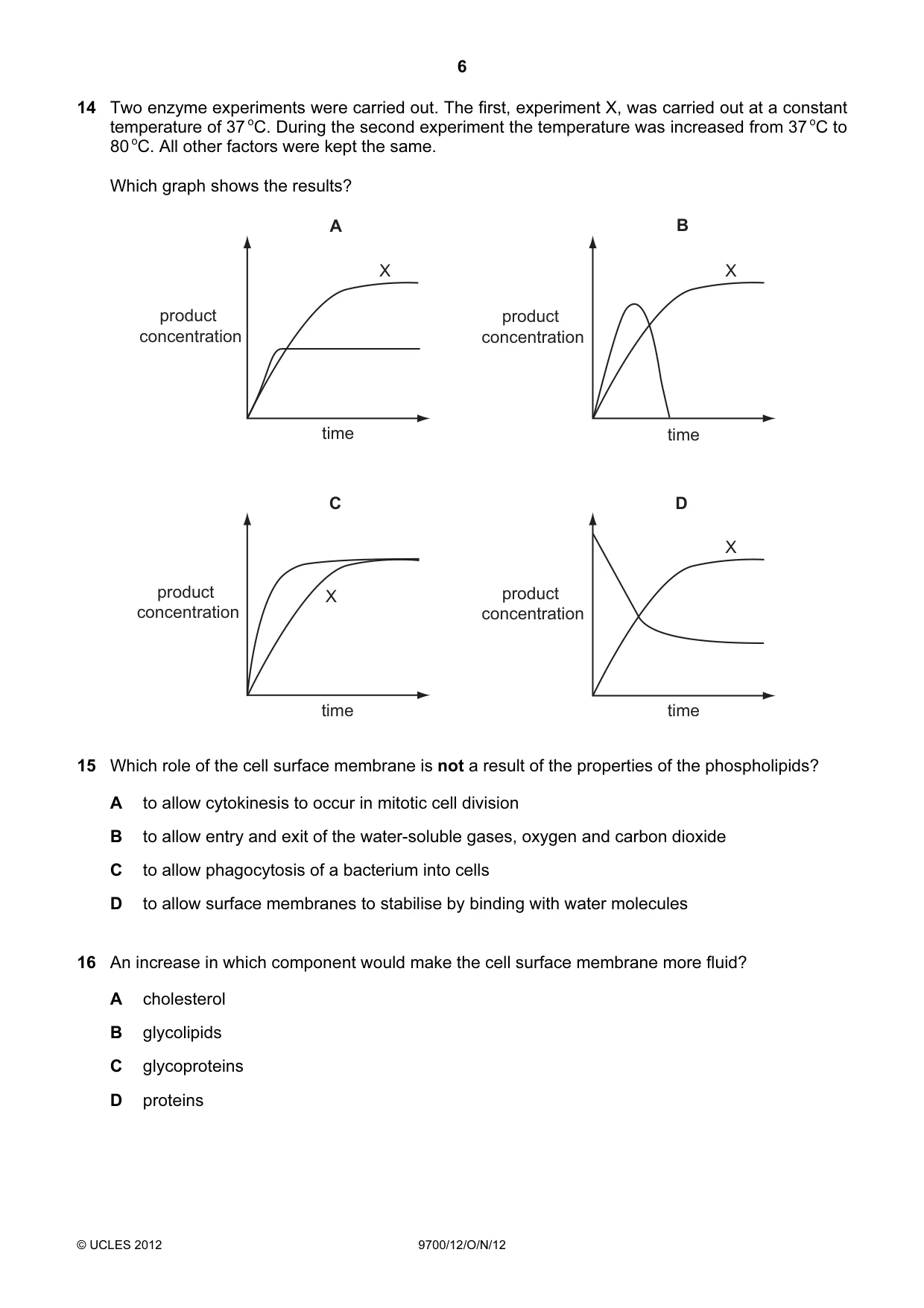
14 Two enzyme experiments were carried out. The first, experiment X, was carried out at a constant temperature of 37 oC. During the second experiment the temperature was increased from 37 oC to 80 oC. All other factors were kept the same. Which graph shows the results? A B X X product product concentration concentration time time C D X product X product concentration concentration time time
Mark scheme: A
Q15 · Which role of the cell surface membrane is not a result of the properties of the…
15 Which role of the cell surface membrane is not a result of the properties of the phospholipids? A to allow cytokinesis to occur in mitotic cell division B to allow entry and exit of the water-soluble gases, oxygen and carbon dioxide C to allow phagocytosis of a bacterium into cells D to allow surface membranes to stabilise by binding with water molecules
Mark scheme: D
Q16 · An increase in which component would make the cell surface membrane more fluid?
16 An increase in which component would make the cell surface membrane more fluid? A cholesterol B glycolipids C glycoproteins D proteins
Mark scheme: A
Q17 · Which processes that move substances across cell surface membranes result in an…
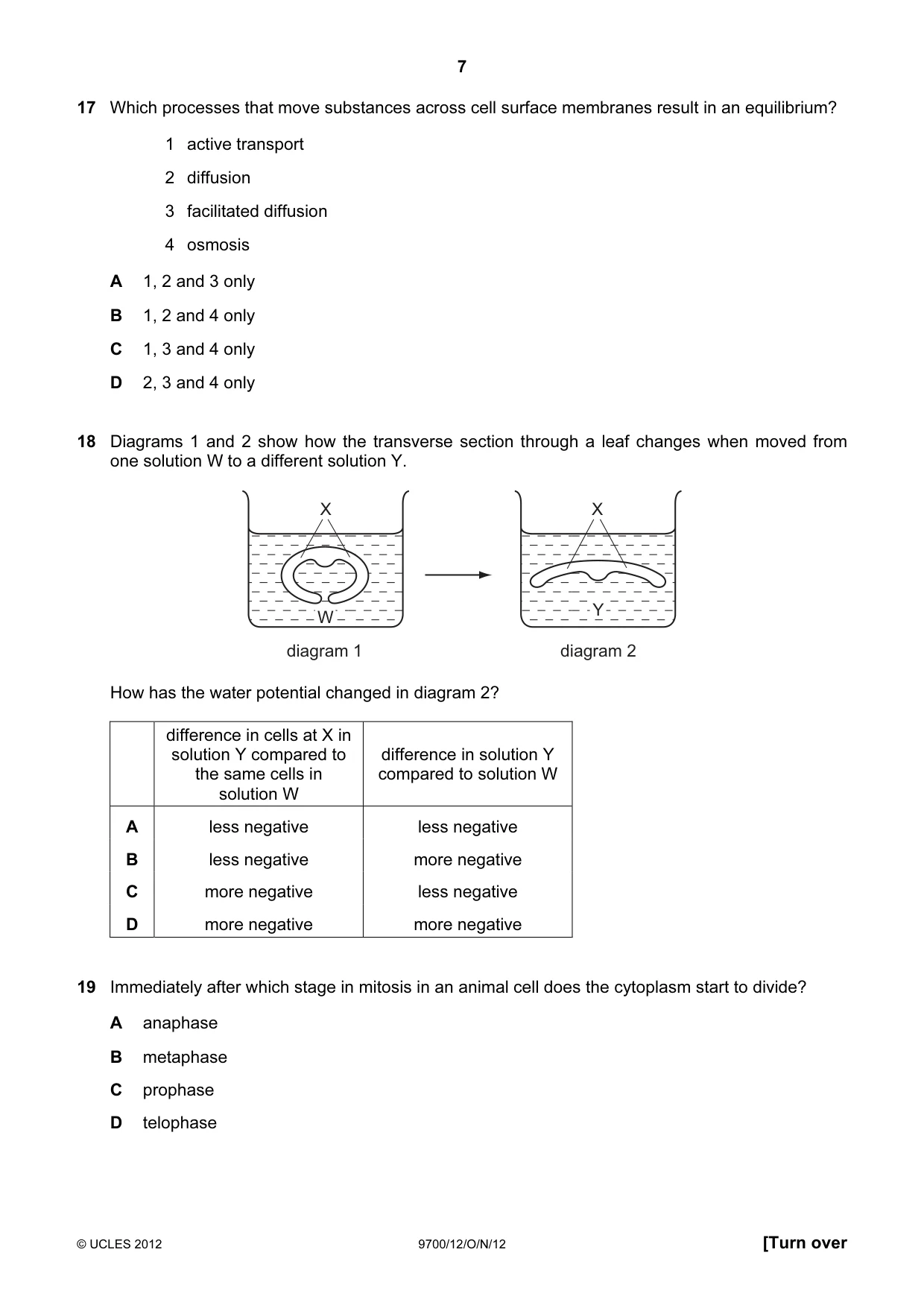
17 Which processes that move substances across cell surface membranes result in an equilibrium? 1 active transport 2 diffusion 3 facilitated diffusion 4 osmosis A 1, 2 and 3 only B 1, 2 and 4 only C 1, 3 and 4 only D 2, 3 and 4 only
Mark scheme: D
Q18 · Diagrams 1 and 2 show how the transverse section through a leaf changes when moved from…
18 Diagrams 1 and 2 show how the transverse section through a leaf changes when moved from one solution W to a different solution Y. X X W Y diagram 1 diagram 2 How has the water potential changed in diagram 2? difference in cells at X in solution Y compared to difference in solution Y the same cells in compared to solution W solution W A less negative less negative B less negative more negative C more negative less negative D more negative more negative
Mark scheme: A
Q19 · Immediately after which stage in mitosis in an animal cell does the cytoplasm start to…
19 Immediately after which stage in mitosis in an animal cell does the cytoplasm start to divide? A anaphase B metaphase C prophase D telophase
Mark scheme: D
More questions on Replication and division of nuclei and cells
Q20 · The diagram shows a cell of an organism formed by reduction division
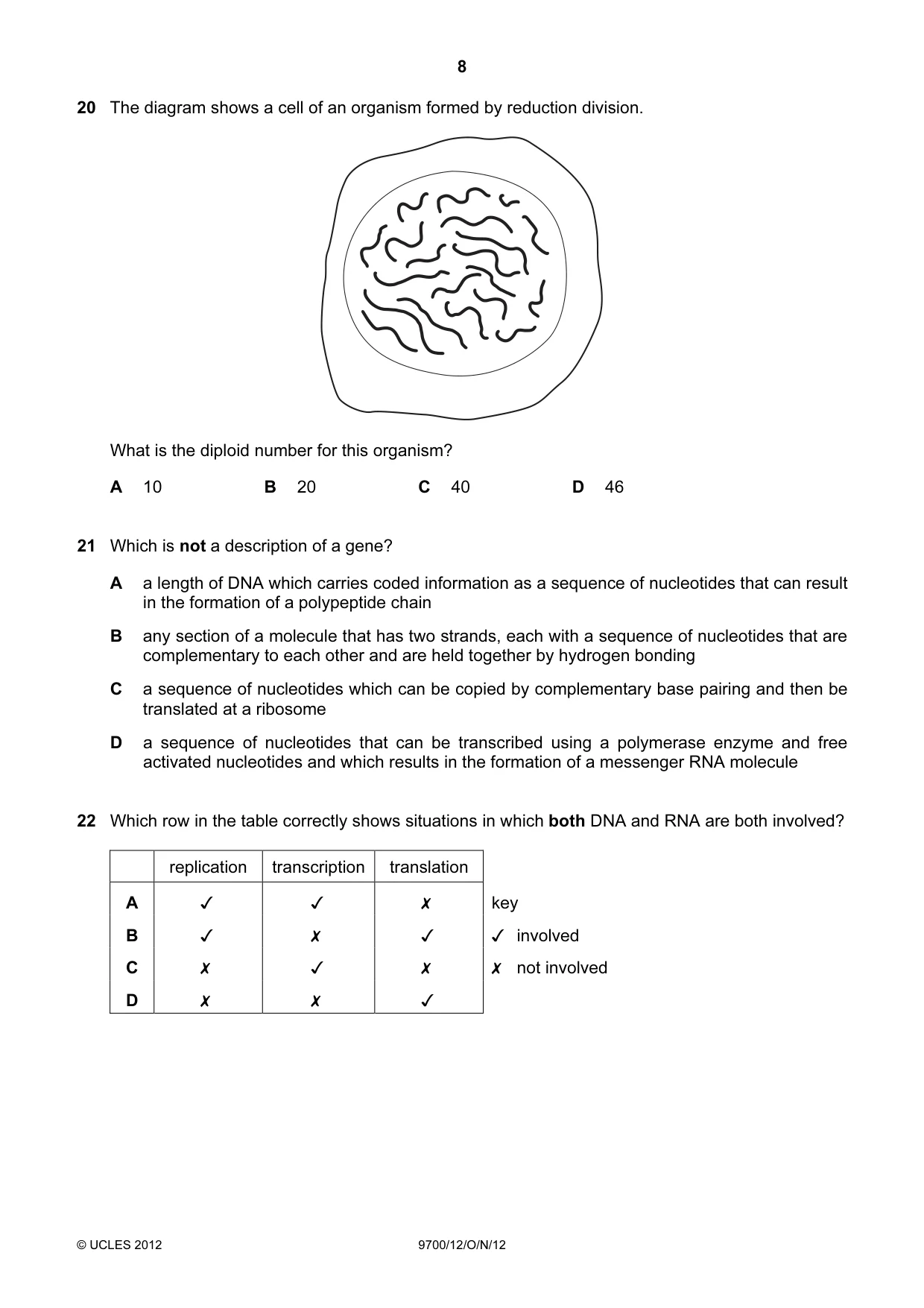
20 The diagram shows a cell of an organism formed by reduction division. What is the diploid number for this organism? A 10 B 20 C 40 D 46
Mark scheme: C
Q21 · Which is not a description of a gene?
21 Which is not a description of a gene? A a length of DNA which carries coded information as a sequence of nucleotides that can result in the formation of a polypeptide chain B any section of a molecule that has two strands, each with a sequence of nucleotides that are complementary to each other and are held together by hydrogen bonding C a sequence of nucleotides which can be copied by complementary base pairing and then be translated at a ribosome D a sequence of nucleotides that can be transcribed using a polymerase enzyme and free activated nucleotides and which results in the formation of a messenger RNA molecule
Mark scheme: B
More questions on Structure of nucleic acids and replication of DNA
Q22 · Which row in the table correctly shows situations in which both DNA and RNA are both…
22 Which row in the table correctly shows situations in which both DNA and RNA are both involved? replication | transcription | translation v v x key JY involved 0 0O DW > Jv x Jv x Jv x X not involved x x Jv
Mark scheme: C
Q23 · The diagram shows the stages in the production of a polypeptide
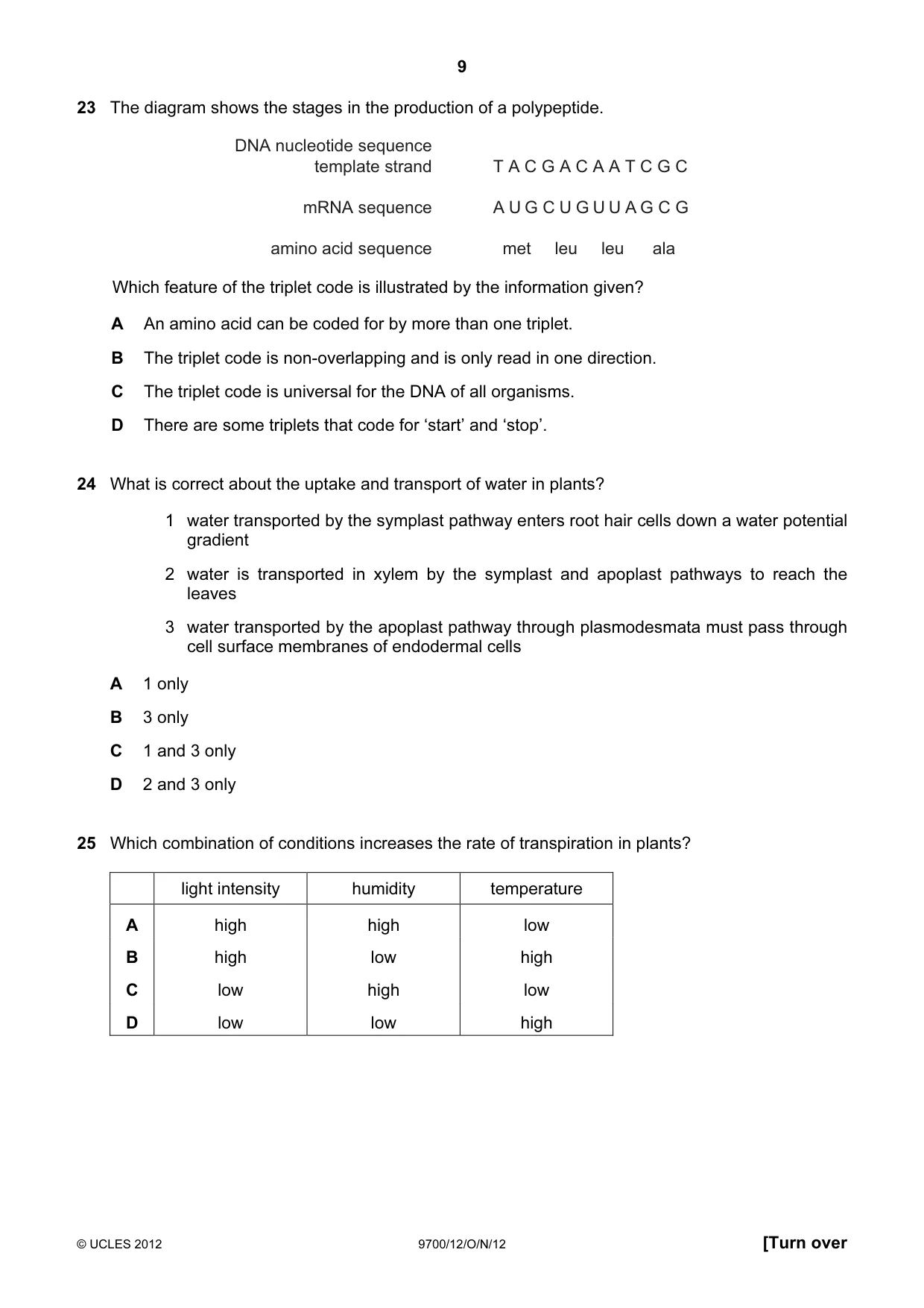
23 The diagram shows the stages in the production of a polypeptide. DNA nucleotide sequence template strand T A C G A C A A T C G C mRNA sequence A U G C U G U U A G C G amino acid sequence met leu leu ala Which feature of the triplet code is illustrated by the information given? A An amino acid can be coded for by more than one triplet. B The triplet code is non-overlapping and is only read in one direction. C The triplet code is universal for the DNA of all organisms. D There are some triplets that code for ‘start’ and ‘stop’.
Mark scheme: A
Q24 · What is correct about the uptake and transport of water in plants?
24 What is correct about the uptake and transport of water in plants? 1 water transported by the symplast pathway enters root hair cells down a water potential gradient 2 water is transported in xylem by the symplast and apoplast pathways to reach the leaves 3 water transported by the apoplast pathway through plasmodesmata must pass through cell surface membranes of endodermal cells A 1 only B 3 only C 1 and 3 only D 2 and 3 only
Mark scheme: A
Q25 · Which combination of conditions increases the rate of transpiration in plants?
25 Which combination of conditions increases the rate of transpiration in plants? light intensity humidity temperature A high high low B high low high C low high low D low low high
Mark scheme: B
Q26 · Which statement explains why sucrose, rather than glucose, is transported by phloem?
26 Which statement explains why sucrose, rather than glucose, is transported by phloem? A Sucrose can pass through plant cell surface membranes more easily. B Sucrose is a disaccharide and is more easily converted to starch. C Sucrose is a larger molecule. D Sucrose is a non-reducing sugar, so is less reactive.
Mark scheme: D
Q27 · The diagrams show transverse sections of parts of a plant
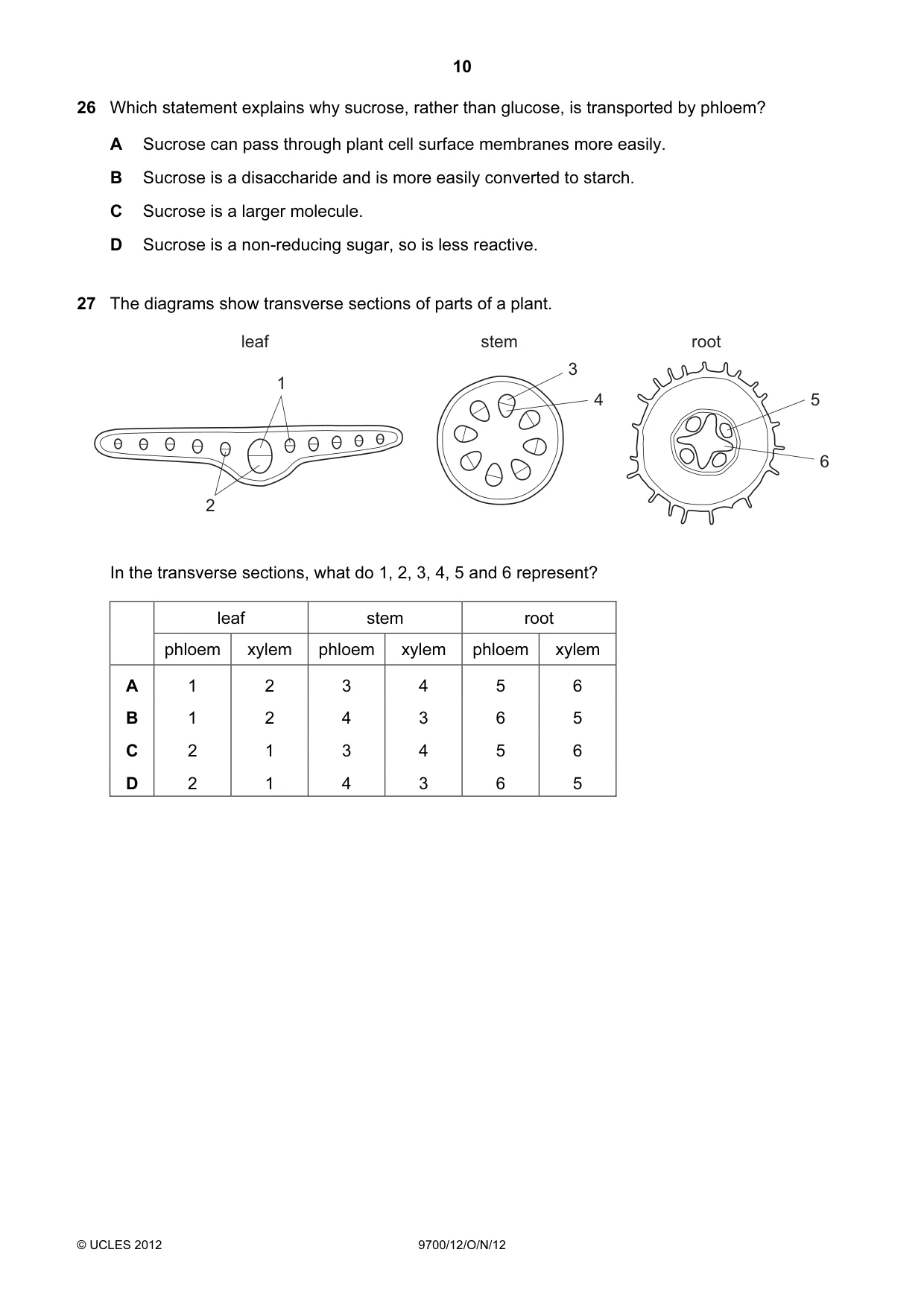
27 The diagrams show transverse sections of parts of a plant. leaf stem root 3 1 4 5 6 2 In the transverse sections, what do 1, 2, 3, 4, 5 and 6 represent? leaf stem root phloem xylem phloem xylem phloem xylem A 1 2 3 4 5 6 B 1 2 4 3 6 5 C 2 1 3 4 5 6 D 2 1 4 3 6 5
Mark scheme: C
Q28 · The diagram shows the effect of three different concentrations of carbon dioxide on the…
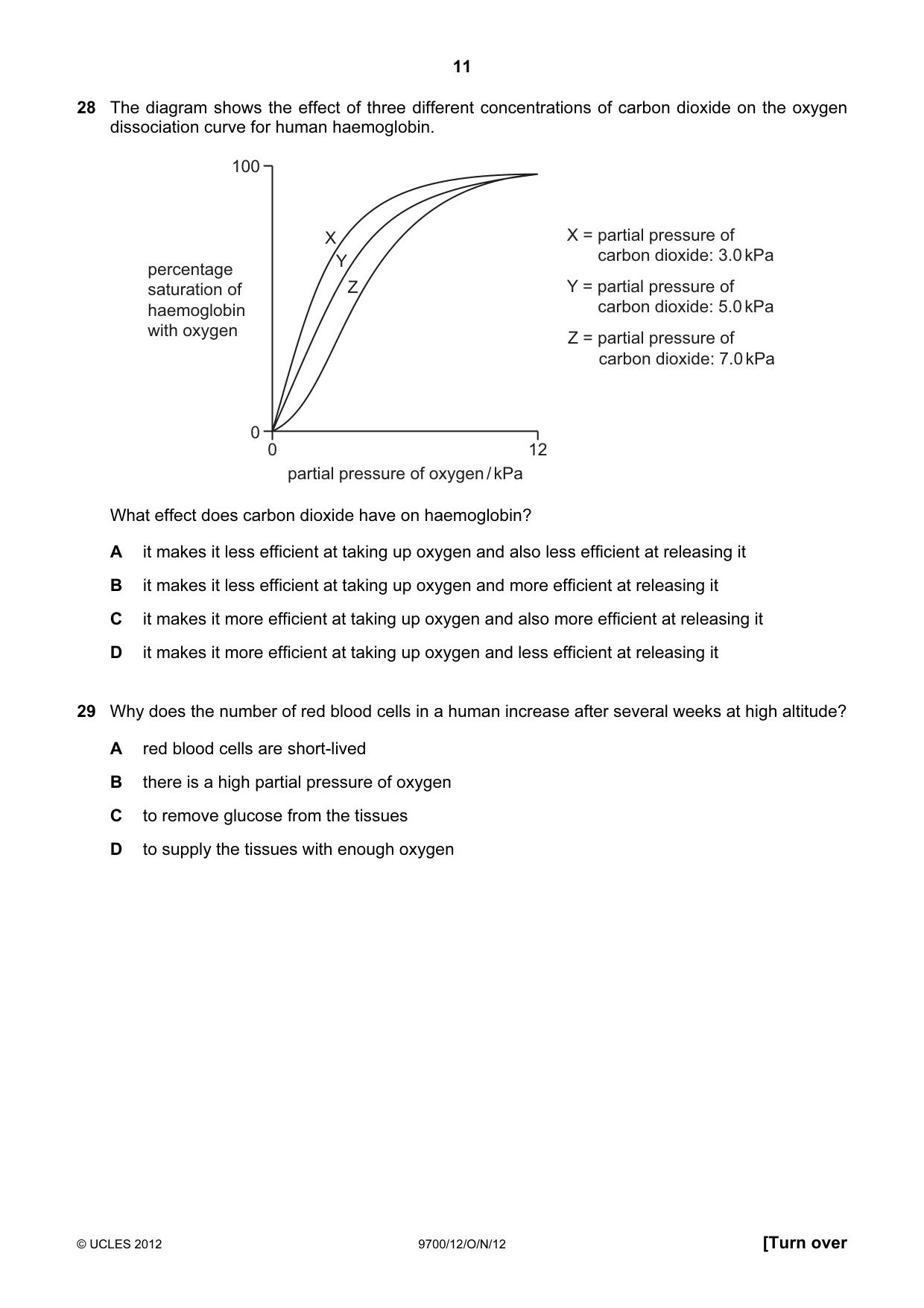
28 The diagram shows the effect of three different concentrations of carbon dioxide on the oxygen dissociation curve for human haemoglobin. 100 X X = partial pressure of Y carbon dioxide: 3.0 kPa percentage saturation of Z Y = partial pressure of haemoglobin carbon dioxide: 5.0 kPa with oxygen Z = partial pressure of carbon dioxide: 7.0 kPa 0 0 12 partial pressure of oxygen / kPa What effect does carbon dioxide have on haemoglobin? A it makes it less efficient at taking up oxygen and also less efficient at releasing it B it makes it less efficient at taking up oxygen and more efficient at releasing it C it makes it more efficient at taking up oxygen and also more efficient at releasing it D it makes it more efficient at taking up oxygen and less efficient at releasing it
Mark scheme: B
Q29 · Why does the number of red blood cells in a human increase after several weeks at high…
29 Why does the number of red blood cells in a human increase after several weeks at high altitude? A red blood cells are short-lived B there is a high partial pressure of oxygen C to remove glucose from the tissues D to supply the tissues with enough oxygen
Mark scheme: D
Q30 · The graph shows the pressure changes in the left atrium, left ventricle and aorta during…
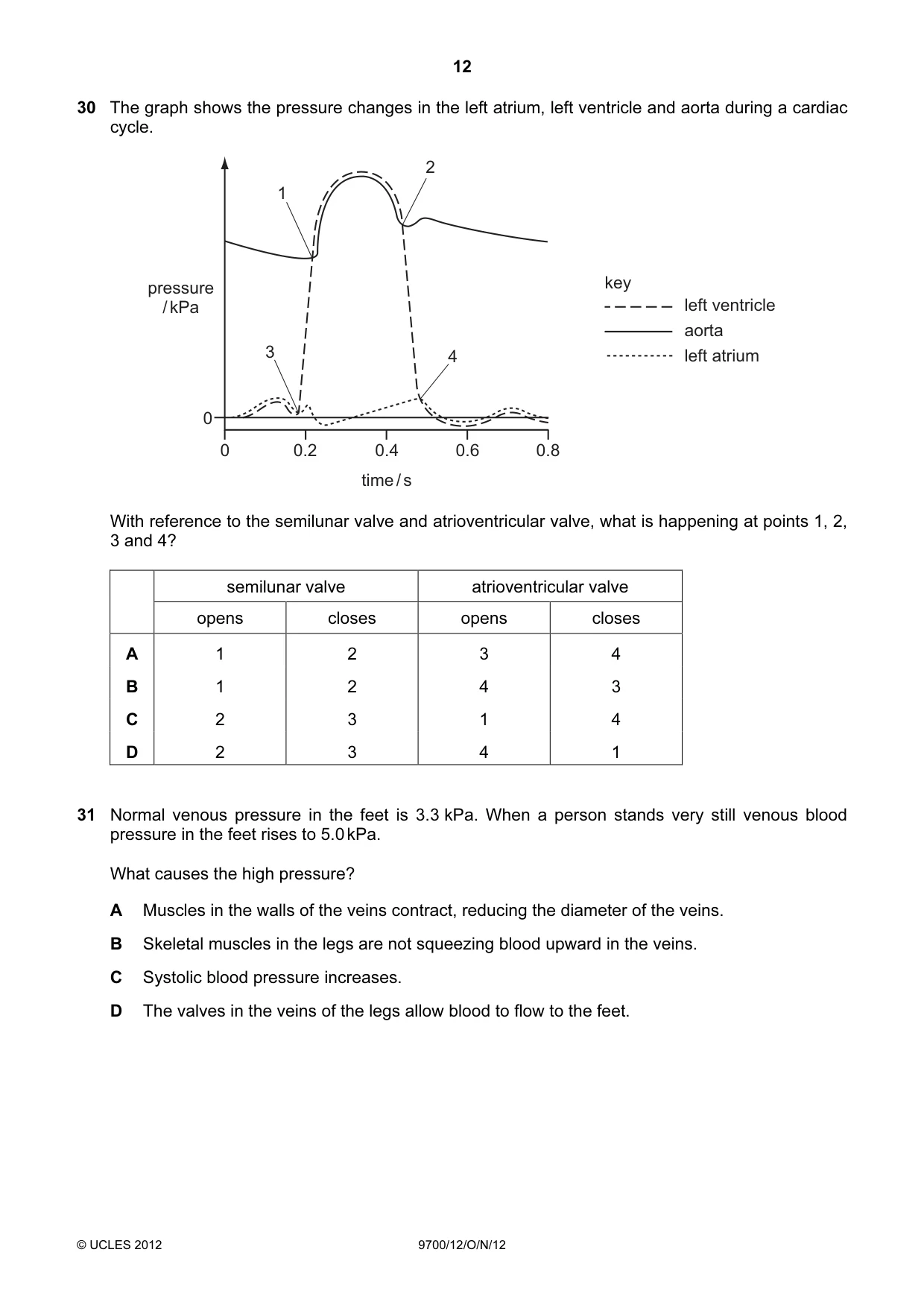
30 The graph shows the pressure changes in the left atrium, left ventricle and aorta during a cardiac cycle. 2 1 pressure key / kPa left ventricle aorta 3 4 left atrium 0 0 0.2 0.4 0.6 0.8 time / s With reference to the semilunar valve and atrioventricular valve, what is happening at points 1, 2, 3 and 4? semilunar valve atrioventricular valve opens closes opens closes A 1 2 3 4 B 1 2 4 3 C 2 3 1 4 D 2 3 4 1
Mark scheme: B
Q31 · Normal venous pressure in the feet is 3.3 kPa
31 Normal venous pressure in the feet is 3.3 kPa. When a person stands very still venous blood pressure in the feet rises to 5.0 kPa. What causes the high pressure? A Muscles in the walls of the veins contract, reducing the diameter of the veins. B Skeletal muscles in the legs are not squeezing blood upward in the veins. C Systolic blood pressure increases. D The valves in the veins of the legs allow blood to flow to the feet.
Mark scheme: B
Q32 · Some people find it difficult to breath out large volumes of air from their lungs
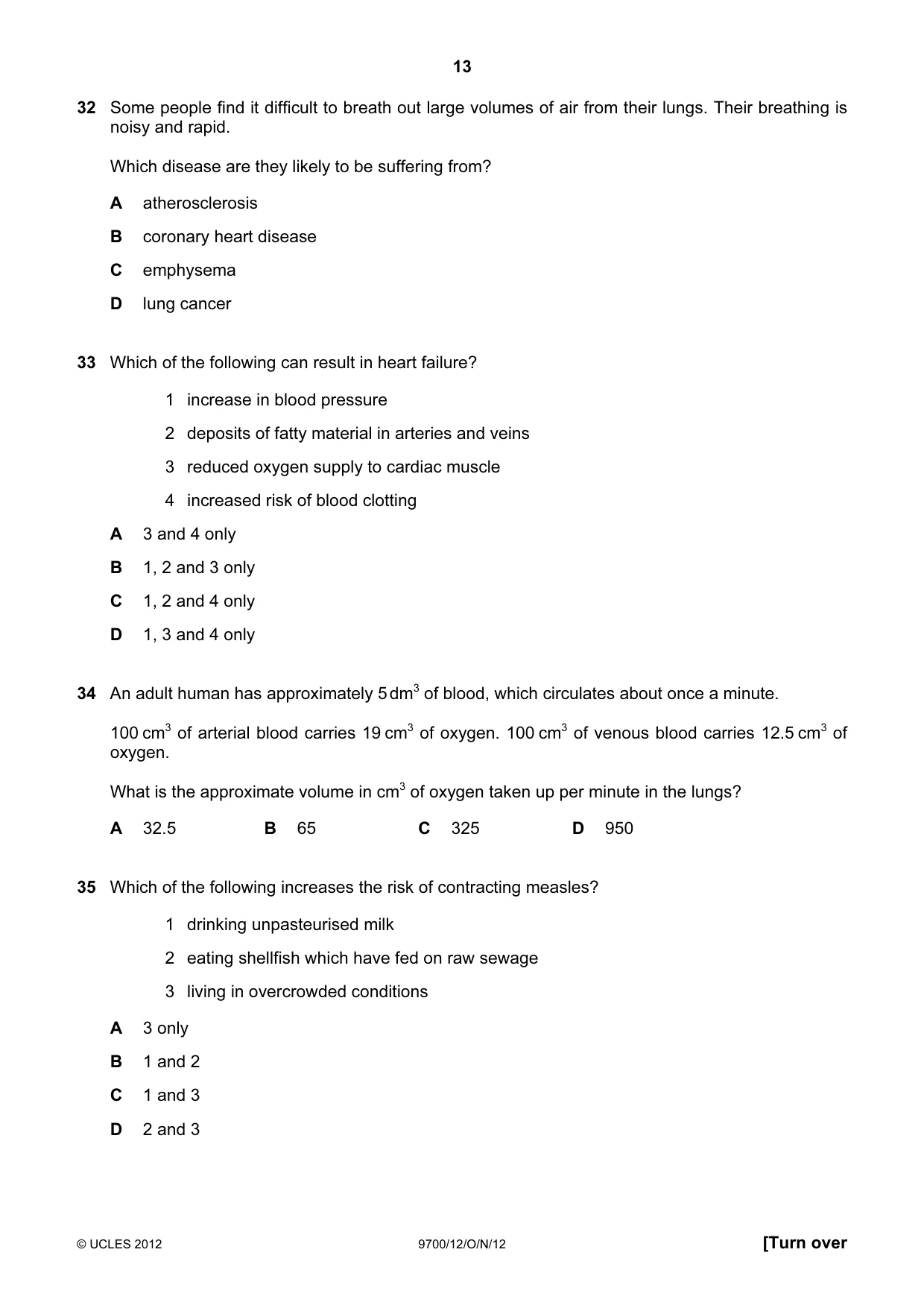
32 Some people find it difficult to breath out large volumes of air from their lungs. Their breathing is noisy and rapid. Which disease are they likely to be suffering from? A atherosclerosis B coronary heart disease C emphysema D lung cancer
Mark scheme: C
Q33 · Which of the following can result in heart failure?
33 Which of the following can result in heart failure? 1 increase in blood pressure 2 deposits of fatty material in arteries and veins 3 reduced oxygen supply to cardiac muscle 4 increased risk of blood clotting A 3 and 4 only B 1, 2 and 3 only C 1, 2 and 4 only D 1, 3 and 4 only
Mark scheme: D
Q34 · An adult human has approximately 5 dm3 of blood, which circulates about once a minute
34 An adult human has approximately 5 dm3 of blood, which circulates about once a minute. 100 cm3 of arterial blood carries 19 cm3 of oxygen. 100 cm3 of venous blood carries 12.5 cm3 of oxygen. What is the approximate volume in cm3 of oxygen taken up per minute in the lungs? A 32.5 B 65 C 325 D 950
Mark scheme: C
Q35 · Which of the following increases the risk of contracting measles?
35 Which of the following increases the risk of contracting measles? 1 drinking unpasteurised milk 2 eating shellfish which have fed on raw sewage 3 living in overcrowded conditions A 3 only B 1 and 2 C 1 and 3 D 2 and 3
Mark scheme: A
Q36 · To prevent a disease, dead bacteria may be injected into the body
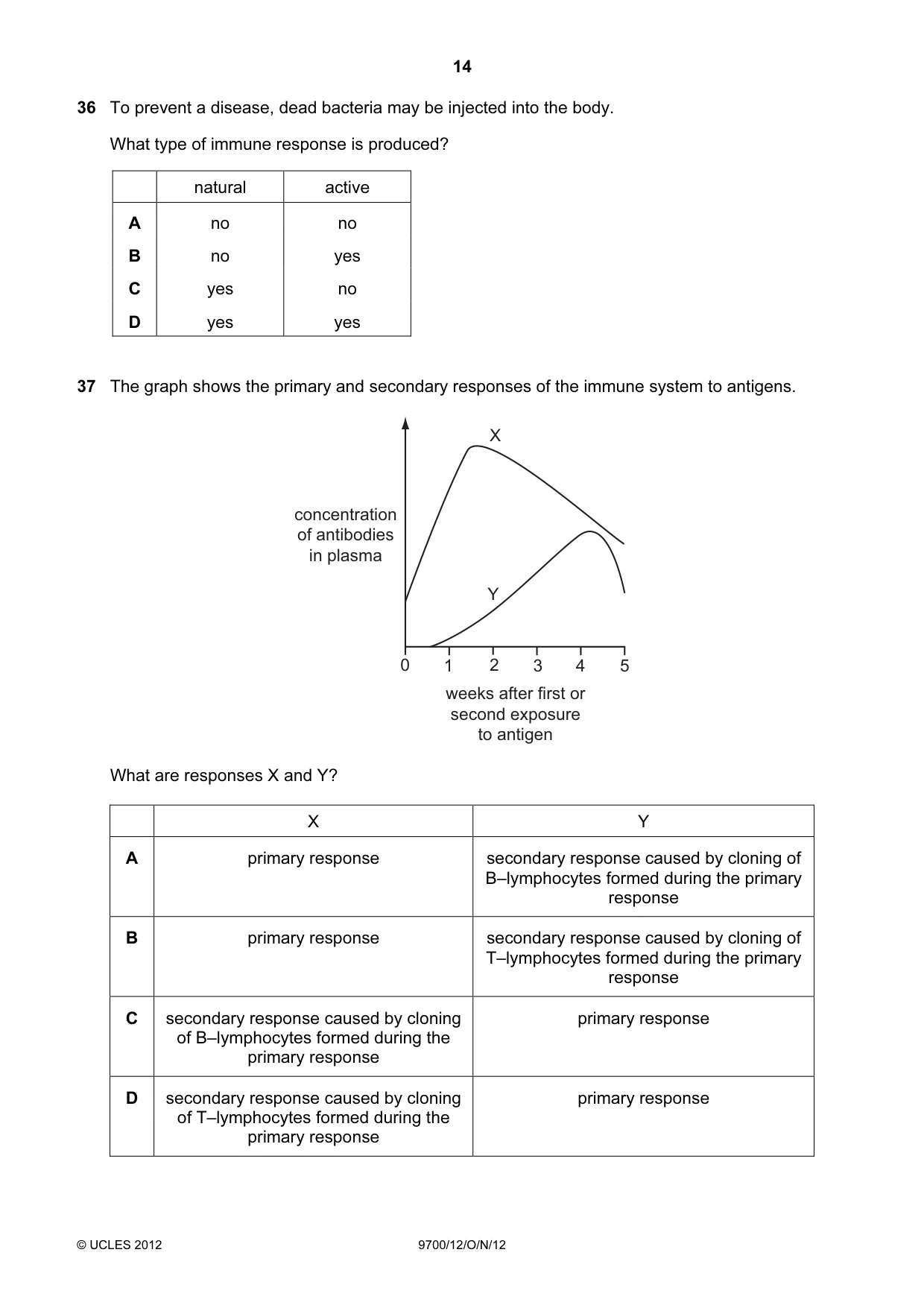
36 To prevent a disease, dead bacteria may be injected into the body. What type of immune response is produced? natural active A no no B no yes C yes no D yes yes
Mark scheme: B
Q37 · The graph shows the primary and secondary responses of the immune system to antigens
37 The graph shows the primary and secondary responses of the immune system to antigens. X concentration of antibodies in plasma Y 0 1 2 3 4 5 weeks after first or second exposure to antigen What are responses X and Y? X Y A primary response secondary response caused by cloning of B–lymphocytes formed during the primary response B primary response secondary response caused by cloning of T–lymphocytes formed during the primary response C secondary response caused by cloning primary response of B–lymphocytes formed during the primary response D secondary response caused by cloning primary response of T–lymphocytes formed during the primary response
Mark scheme: C
Q38 · A primary consumer, X, is removed from a community due to a lethal viral infection
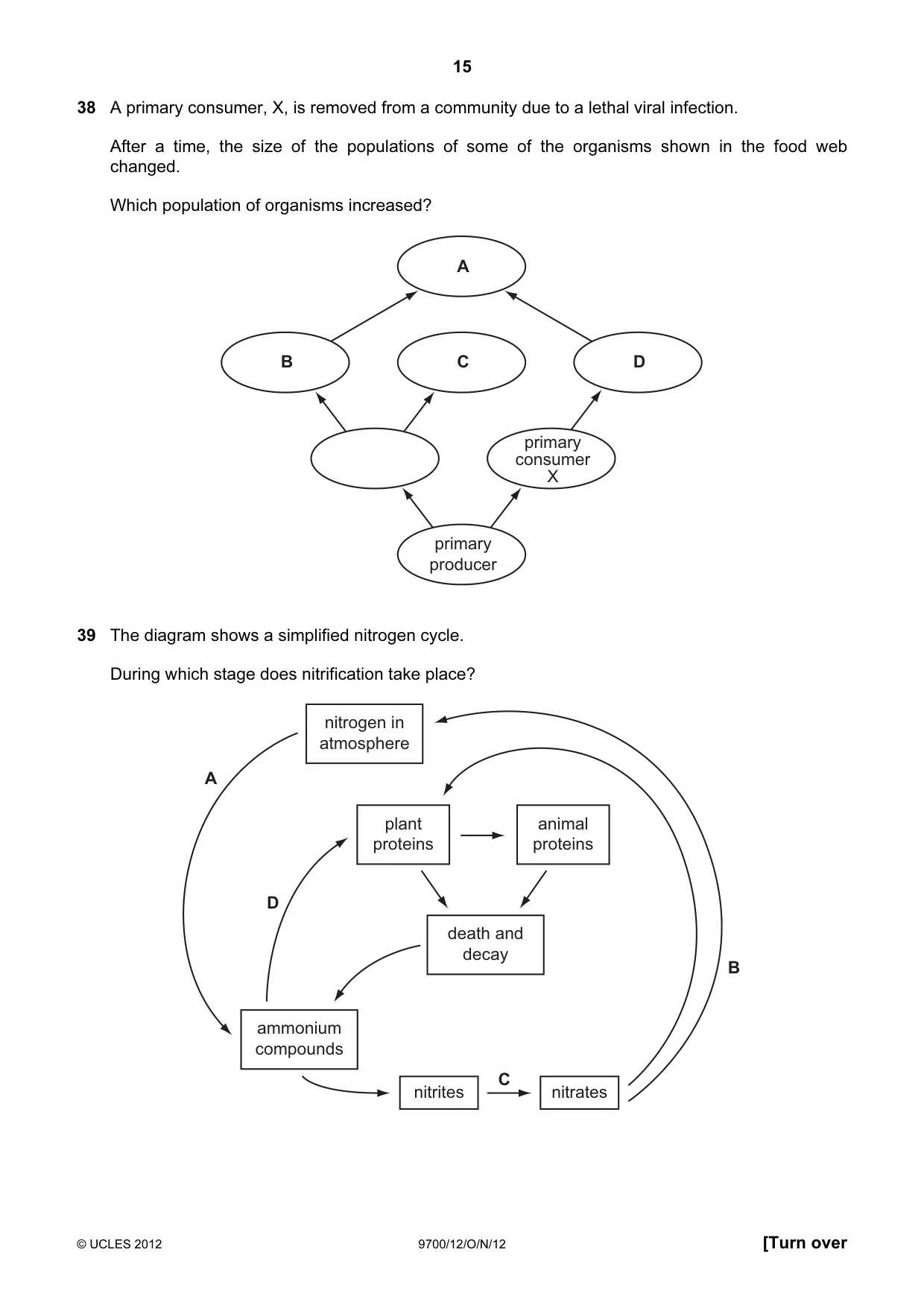
38 A primary consumer, X, is removed from a community due to a lethal viral infection. After a time, the size of the populations of some of the organisms shown in the food web changed. Which population of organisms increased? A B C D primary consumer X primary producer
Mark scheme: C
Q39 · The diagram shows a simplified nitrogen cycle
39 The diagram shows a simplified nitrogen cycle. During which stage does nitrification take place? nitrogen in atmosphere A plant animal proteins proteins D death and decay B ammonium compounds C nitrites nitrates
Mark scheme: C
Q40 · The total rate at which producers synthesise organic material is called gross primary…
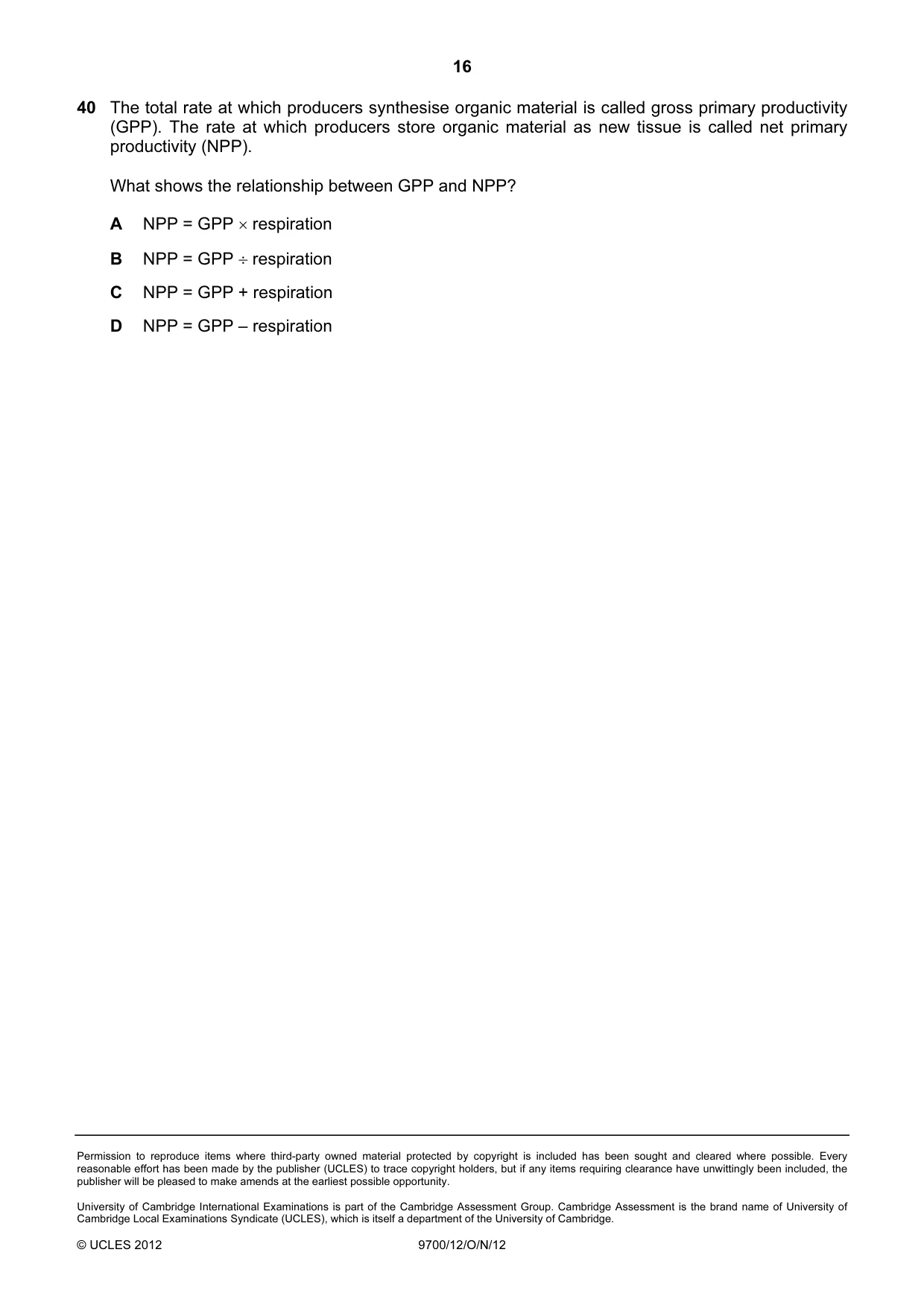
40 The total rate at which producers synthesise organic material is called gross primary productivity (GPP). The rate at which producers store organic material as new tissue is called net primary productivity (NPP). What shows the relationship between GPP and NPP? A NPP = GPP × respiration B NPP = GPP ÷ respiration C NPP = GPP + respiration D NPP = GPP – respiration
Mark scheme: D
More questions on Photosynthesis as an energy transfer process
What was in this paper
The subtopics covered by these 40 questions, and how many questions each got. Open one in a new tab to see every Cambridge question on it.
3Cells as the basic units of living organisms3The microscope in cell studies3Transport mechanisms3Transport of oxygen and carbon dioxide3Biodiversity2Fluid mosaic membranes2Movement into and out of cells2Protein synthesis2Proteins2The circulatory system2Antibodies and vaccination1Chromosome behaviour in mitosis1Factors that affect enzyme action1Infectious diseases1Mode of action of enzymes1Photosynthesis as an energy transfer process1Replication and division of nuclei and cells1Structure of nucleic acids and replication of DNA1Structure of transport tissues1Testing for biological molecules1The gas exchange system1The heart1The immune system1What you needed in this session
Cambridge’s own grade thresholds for 2012 Oct/Nov, Paper 1 · Variant 2. A higher threshold means an easier paper — the bar moves with how the cohort did.