Cambridge A Level Biology 9700 — 2017 Oct/Nov Paper 1 · Variant 3
9700/13/O/N/17 · 40 questions · 40 marks · ≈45 min
The question paper and its mark scheme, free to read here and free to download. This is Cambridge’s own paper, exactly as it was sat.
Question paper20 pages




Mark scheme3 pages
Answers below. Sit the paper first if you are practising.
Questions as text
Q1 · Which statement about the light microscope is correct?
1 Which statement about the light microscope is correct? A As the smallest distance to see two points as distinct separate points decreases, the resolution also decreases. B If the resolution is 220 nm, then a bacterium 0.2 µm in diameter will not be visible. C If the wavelength of light is 600 nm, then two membranes 300 nm apart will be visible as two distinct membranes. D Using visible light of a longer wavelength, such as red light, will improve the resolution.
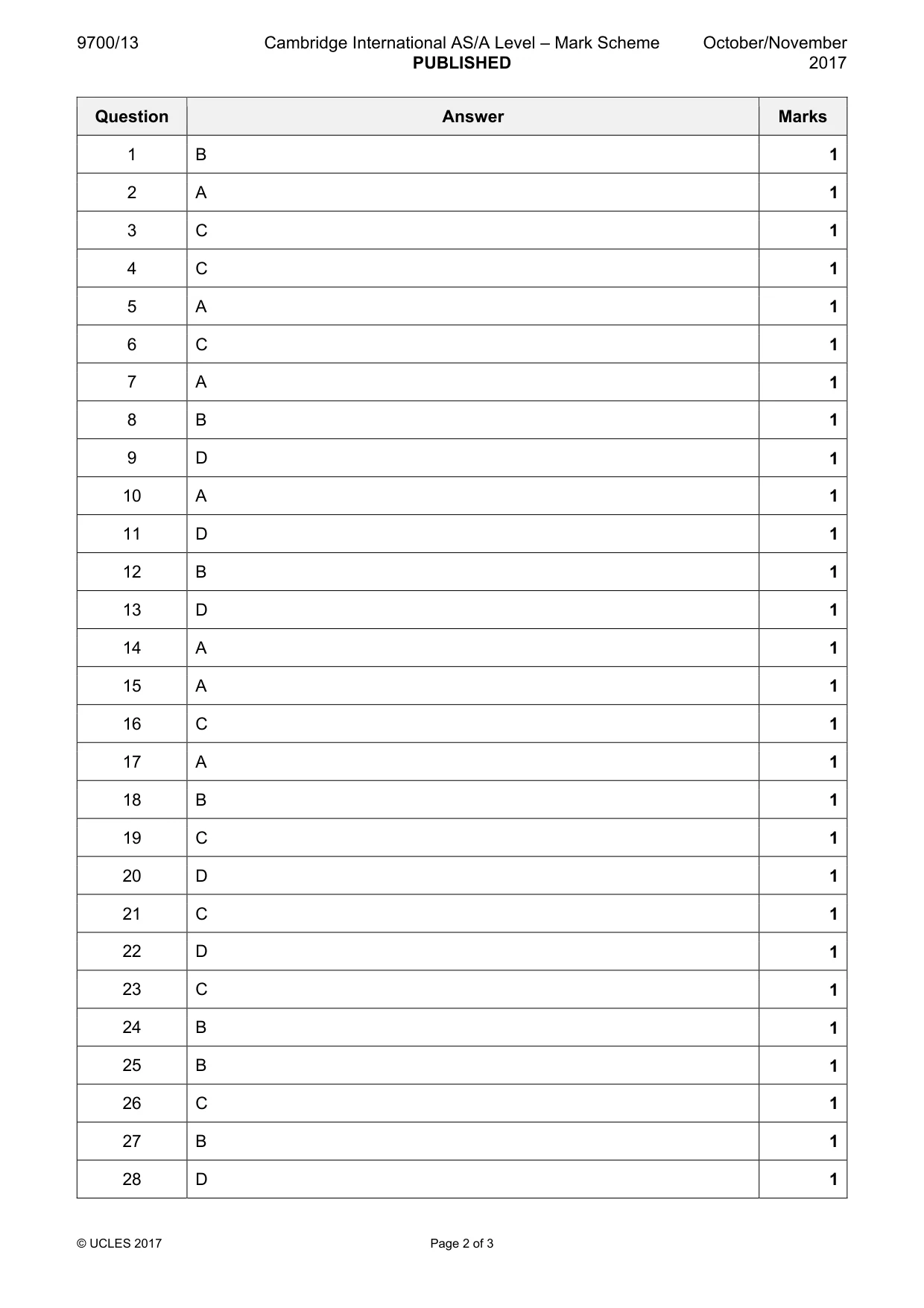
Mark scheme: B
Q2 · The diagram shows a stage micrometer scale viewed with an eyepiece graticule, using a…
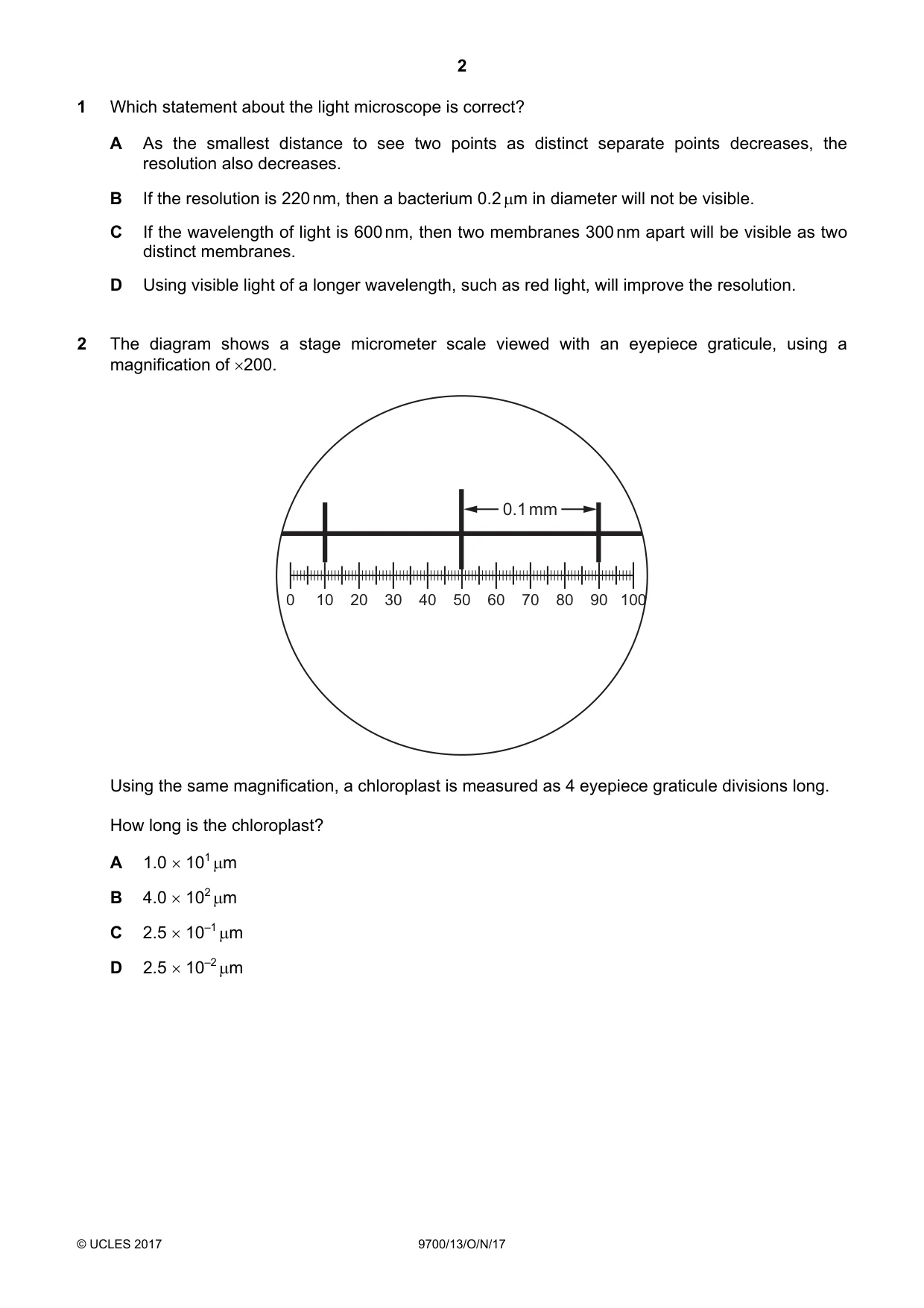
2 The diagram shows a stage micrometer scale viewed with an eyepiece graticule, using a magnification of ×200. 0.1 mm 0 10 20 30 40 50 60 70 80 90 100 Using the same magnification, a chloroplast is measured as 4 eyepiece graticule divisions long. How long is the chloroplast? A 1.0 × 101 µm B 4.0 × 102 µm C 2.5 × 10⁻¹ µm D 2.5 × 10⁻² µm
Mark scheme: A
Q3 · A cell was supplied with cytosine labelled with radioactive carbon
3 A cell was supplied with cytosine labelled with radioactive carbon. In which cell structure would radioactivity be detected first? A endoplasmic reticulum B Golgi body C nucleus D ribosome
Mark scheme: C
More questions on Cells as the basic units of living organisms
Q4 · The diagram shows some similarities between chloroplasts, mitochondria and typical…
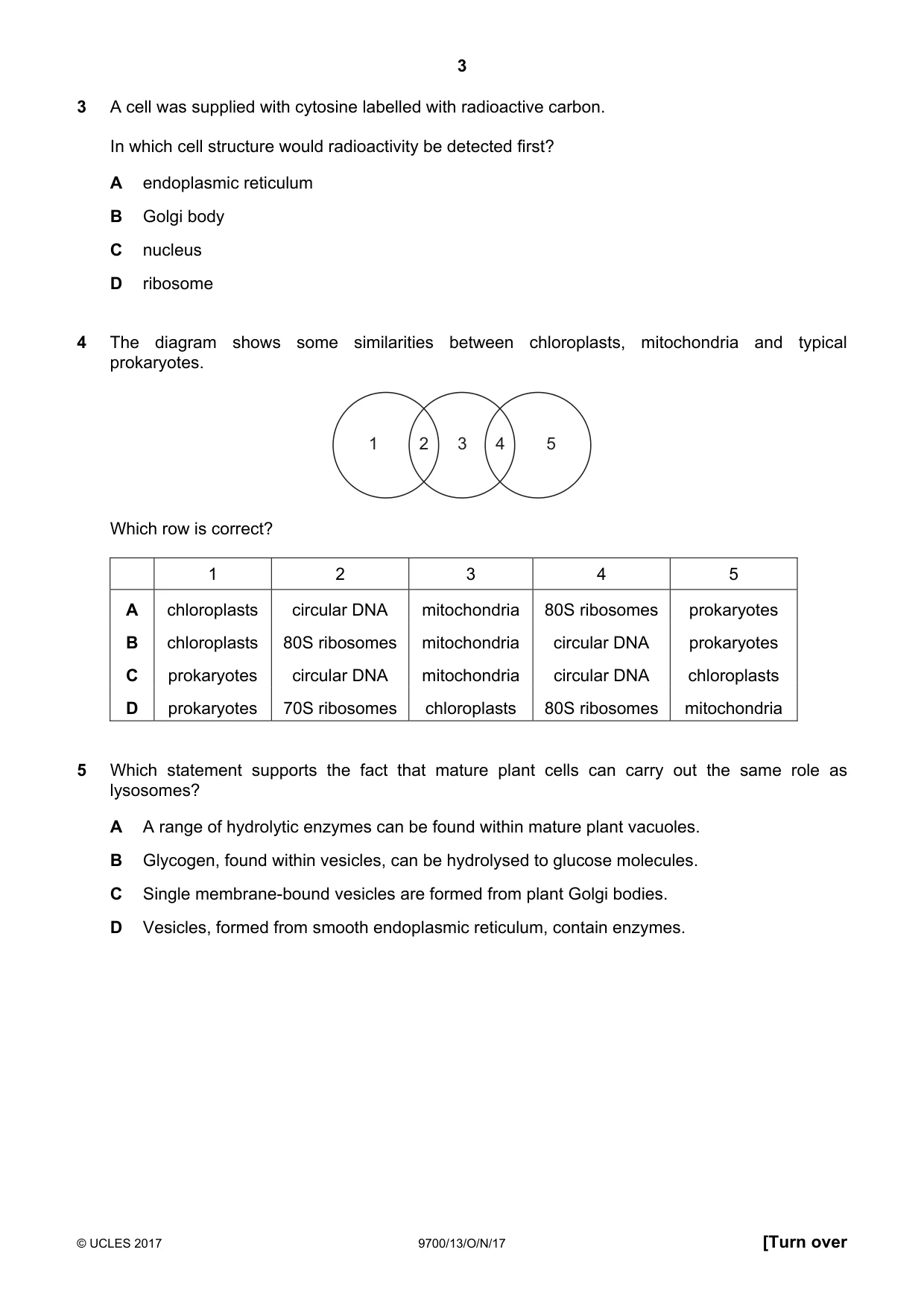
4 The diagram shows some similarities between chloroplasts, mitochondria and typical prokaryotes. 1 2 3 4 5 Which row is correct? 1 2 3 4 5 A chloroplasts circular DNA mitochondria 80S ribosomes prokaryotes B chloroplasts 80S ribosomes mitochondria circular DNA prokaryotes C prokaryotes circular DNA mitochondria circular DNA chloroplasts D prokaryotes 70S ribosomes chloroplasts 80S ribosomes mitochondria
Mark scheme: C
More questions on Cells as the basic units of living organisms
Q5 · Which statement supports the fact that mature plant cells can carry out the same role as…
5 Which statement supports the fact that mature plant cells can carry out the same role as lysosomes? A A range of hydrolytic enzymes can be found within mature plant vacuoles. B Glycogen, found within vesicles, can be hydrolysed to glucose molecules. C Single membrane-bound vesicles are formed from plant Golgi bodies. D Vesicles, formed from smooth endoplasmic reticulum, contain enzymes.
Mark scheme: A
More questions on Cells as the basic units of living organisms
Q6 · A student carried out four tests for biological molecules on a sample of milk
6 A student carried out four tests for biological molecules on a sample of milk. The tests and their results were as follows. ● Heating to 80 °C with Benedict’s solution gave a green colour. ● Adding Biuret solution gave a purple colour. ● Adding iodine solution gave an orange colour. ● Boiling with acid, followed by neutralisation, then heating to 80 °C with Benedict’s solution gave a brick red colour. Which conclusion about these results is correct? A only protein and reducing sugar present B only protein and non-reducing sugar present C only protein, reducing sugar and non-reducing sugar present D only starch, protein and sugar present
Mark scheme: C
Q7 · The diagrams show four monosaccharides with the formula C6H12O6
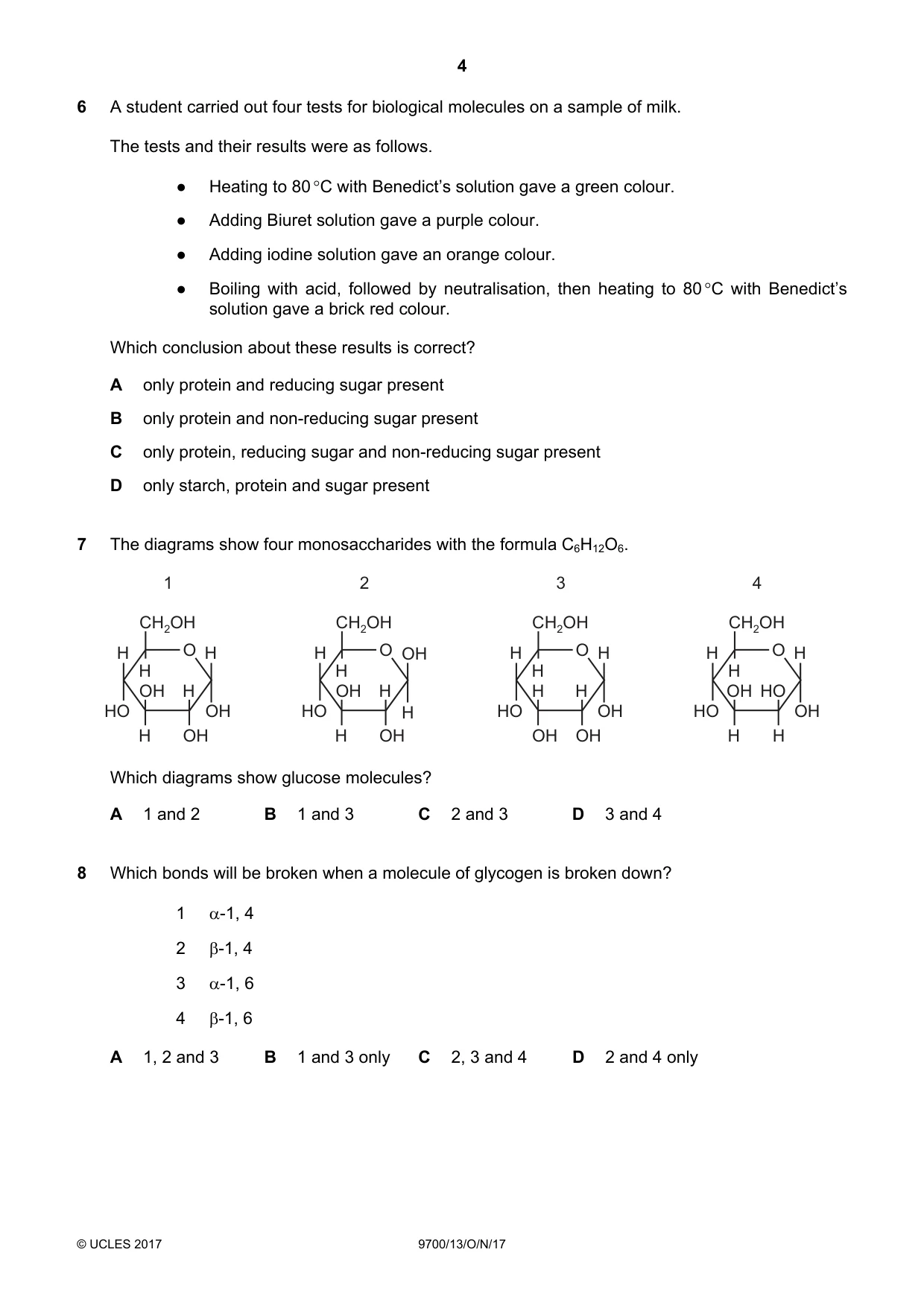
7 The diagrams show four monosaccharides with the formula C6H12O6. 1 2 3 4 CH2OH CH2OH CH2OH CH2OH H O H H O OH H O H H O H H H H H OH H OH H H H OH HO HO OH HO H HO OH HO OH H OH H OH OH OH H H Which diagrams show glucose molecules? A 1 and 2 B 1 and 3 C 2 and 3 D 3 and 4
Mark scheme: A
Q8 · Which bonds will be broken when a molecule of glycogen is broken down?
8 Which bonds will be broken when a molecule of glycogen is broken down? 1 α-1, 4 2 β-1, 4 3 α-1, 6 4 β-1, 6 A 1, 2 and 3 B 1 and 3 only C 2, 3 and 4 D 2 and 4 only
Mark scheme: B
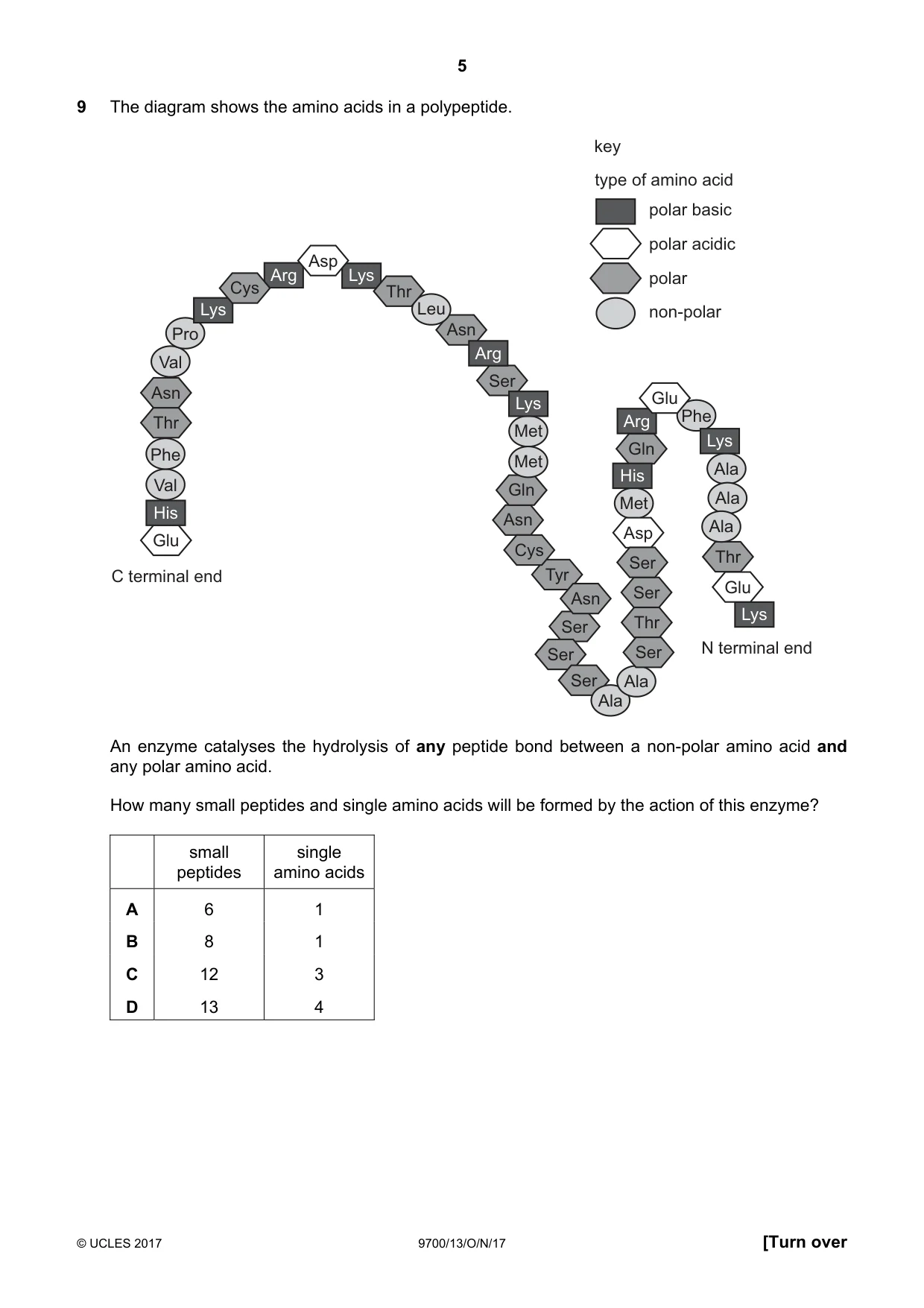
Q9 · The diagram shows the amino acids in a polypeptide
9 The diagram shows the amino acids in a polypeptide. key type of amino acid polar basic polar acidic Asp Arg Lys polar Cys Thr Lys Leu non-polar Pro Asn Arg Val Ser Asn Glu Lys Thr Arg Phe Met Lys Phe Gln Met Ala His Val Gln Met Ala His Asn Asp Ala Glu Cys Thr Ser C terminal end Tyr Ser Glu Asn Lys Ser Thr Ser Ser N terminal end Ser Ala Ala An enzyme catalyses the hydrolysis of any peptide bond between a non-polar amino acid and any polar amino acid. How many small peptides and single amino acids will be formed by the action of this enzyme? small single peptides amino acids A 6 1 B 8 1 C 12 3 D 13 4
Mark scheme: D
Q10 · A person with diabetes is unable to make enough of the protein insulin
10 A person with diabetes is unable to make enough of the protein insulin. Some forms of diabetes can be treated by using insulin produced by animals. Scientists have compared the amino acids in insulin produced by animals to human insulin. Which level of protein structure were the scientists studying? A primary B secondary C tertiary D quaternary
Mark scheme: A
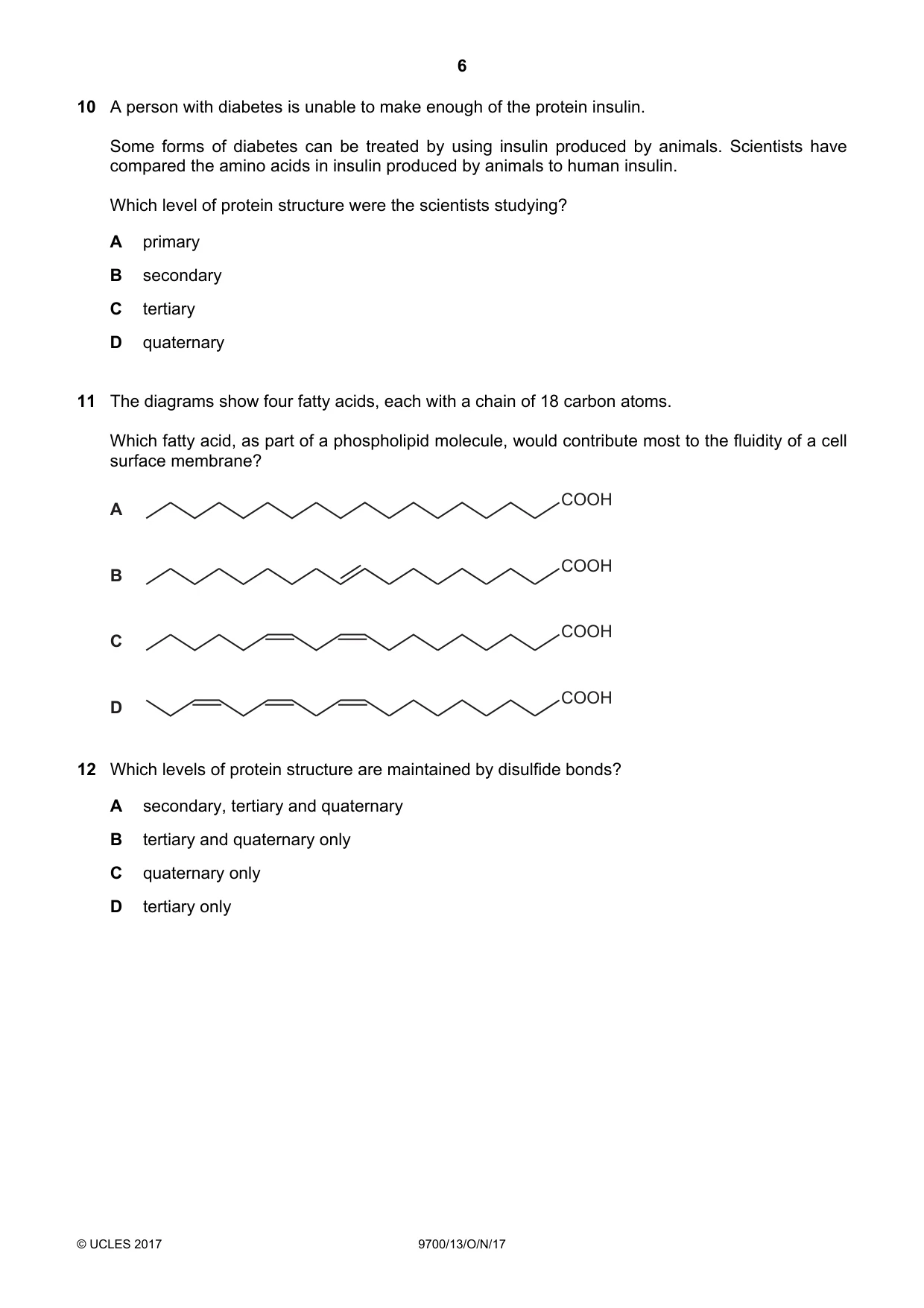
Q11 · The diagrams show four fatty acids, each with a chain of 18 carbon atoms
11 The diagrams show four fatty acids, each with a chain of 18 carbon atoms. Which fatty acid, as part of a phospholipid molecule, would contribute most to the fluidity of a cell surface membrane? COOH A COOH B COOH C COOH D
Mark scheme: D
Q12 · Which levels of protein structure are maintained by disulfide bonds?
12 Which levels of protein structure are maintained by disulfide bonds? A secondary, tertiary and quaternary B tertiary and quaternary only C quaternary only D tertiary only
Mark scheme: B
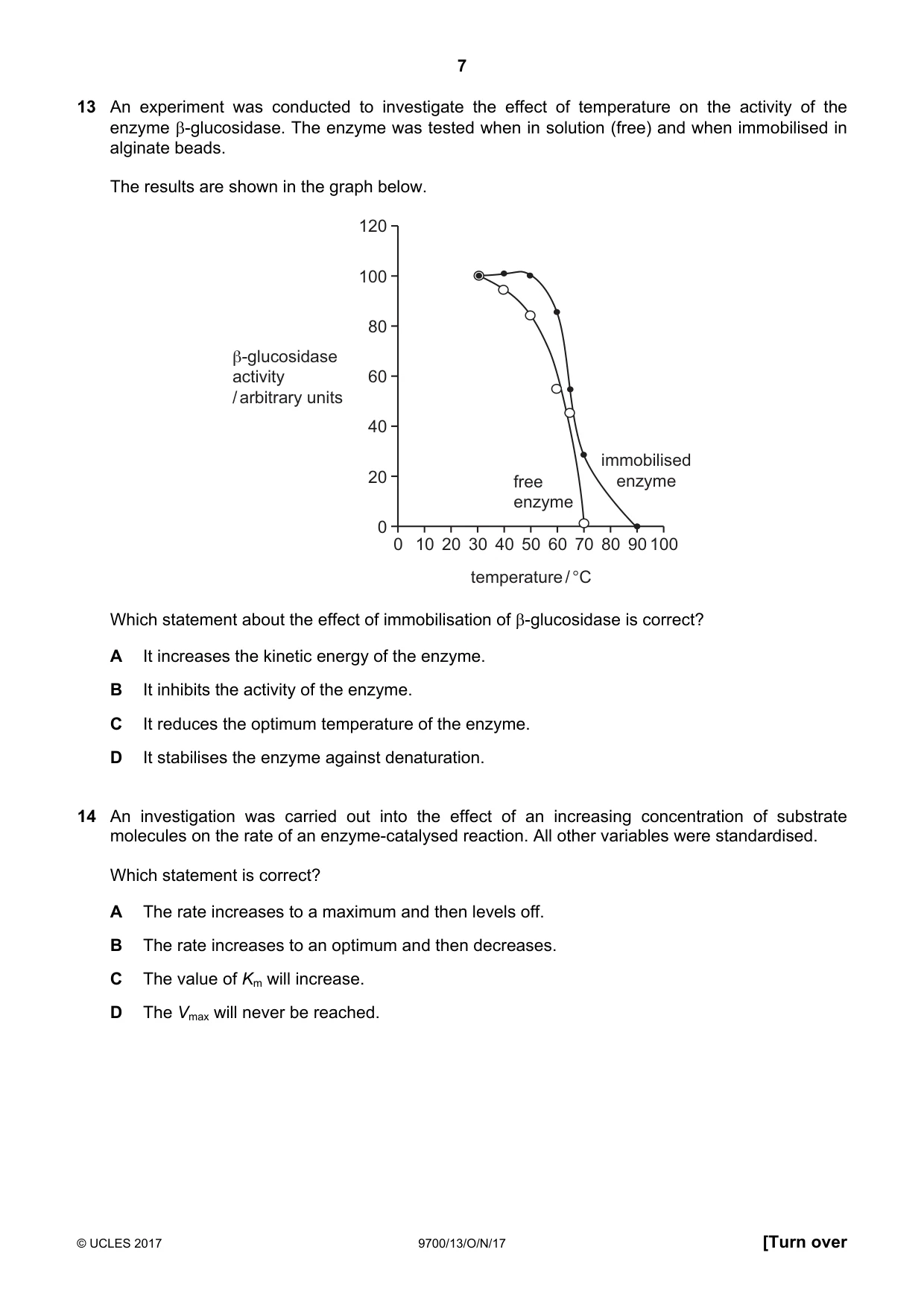
Q13 · An experiment was conducted to investigate the effect of temperature on the activity of…
13 An experiment was conducted to investigate the effect of temperature on the activity of the enzyme β-glucosidase. The enzyme was tested when in solution (free) and when immobilised in alginate beads. The results are shown in the graph below. 120 100 80 β-glucosidase activity 60 / arbitrary units 40 immobilised 20 free enzyme enzyme 0 0 10 20 30 40 50 60 70 80 90 100 temperature / °C Which statement about the effect of immobilisation of β-glucosidase is correct? A It increases the kinetic energy of the enzyme. B It inhibits the activity of the enzyme. C It reduces the optimum temperature of the enzyme. D It stabilises the enzyme against denaturation.
Mark scheme: D
Q14 · An investigation was carried out into the effect of an increasing concentration of…
14 An investigation was carried out into the effect of an increasing concentration of substrate molecules on the rate of an enzyme-catalysed reaction. All other variables were standardised. Which statement is correct? A The rate increases to a maximum and then levels off. B The rate increases to an optimum and then decreases. C The value of Km will increase. D The Vmax will never be reached.
Mark scheme: A
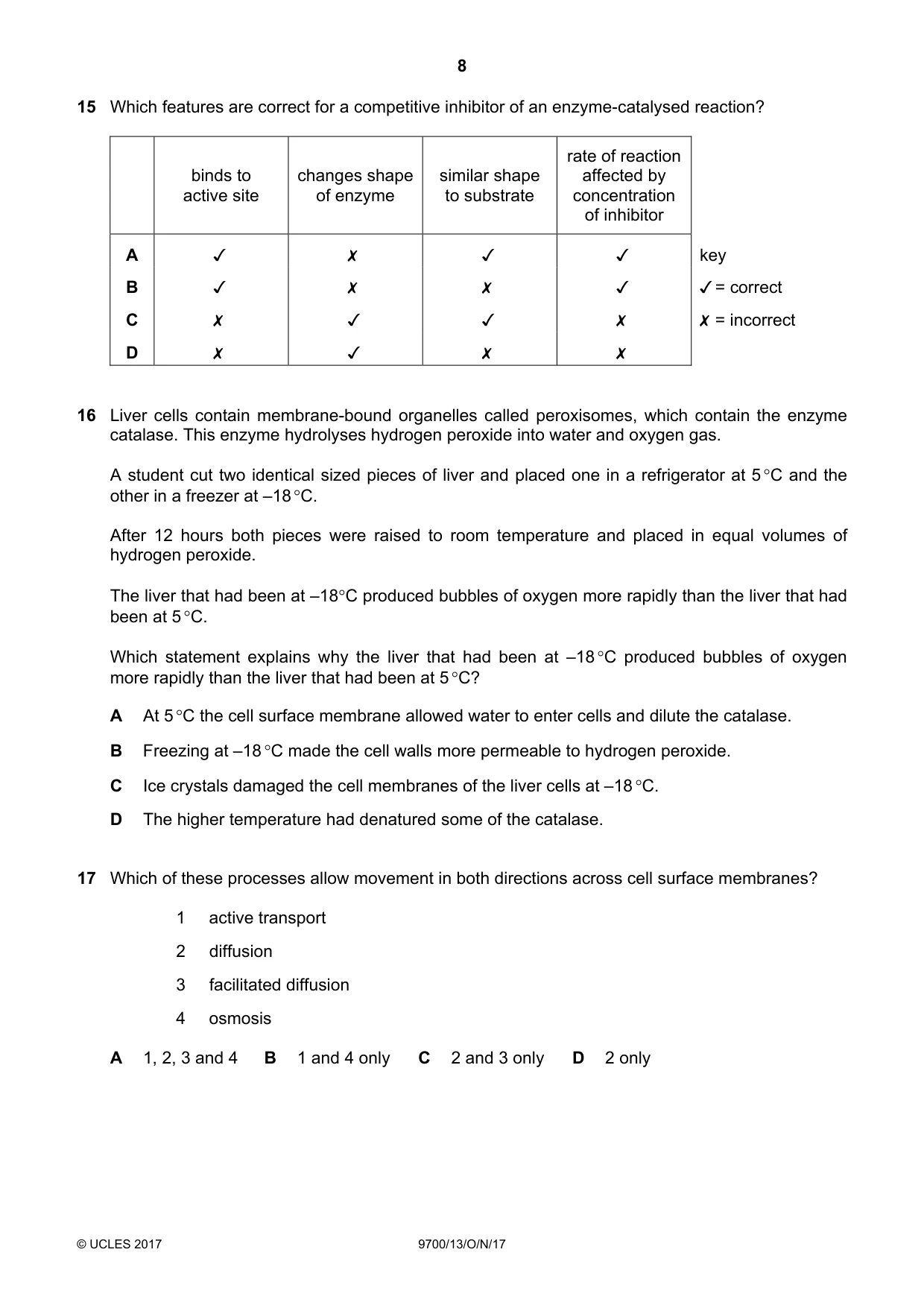
Q15 · Which features are correct for a competitive inhibitor of an enzyme-catalysed reaction?
15 Which features are correct for a competitive inhibitor of an enzyme-catalysed reaction? rate of reaction binds to changes shape | similar shape affected by active site of enzyme to substrate concentration of inhibitor A J x J Jv key B Jv x x Jv ¥ = correct Cc x v v x X = incorrect D x v x x
Mark scheme: A
Q16 · Liver cells contain membrane-bound organelles called peroxisomes, which contain the…
16 Liver cells contain membrane-bound organelles called peroxisomes, which contain the enzyme catalase. This enzyme hydrolyses hydrogen peroxide into water and oxygen gas. A student cut two identical sized pieces of liver and placed one in a refrigerator at 5 °C and the other in a freezer at –18 °C. After 12 hours both pieces were raised to room temperature and placed in equal volumes of hydrogen peroxide. The liver that had been at –18°C produced bubbles of oxygen more rapidly than the liver that had been at 5 °C. Which statement explains why the liver that had been at –18 °C produced bubbles of oxygen more rapidly than the liver that had been at 5 °C? A At 5 °C the cell surface membrane allowed water to enter cells and dilute the catalase. B Freezing at –18 °C made the cell walls more permeable to hydrogen peroxide. C Ice crystals damaged the cell membranes of the liver cells at –18 °C. D The higher temperature had denatured some of the catalase.
Mark scheme: C
Q17 · Which of these processes allow movement in both directions across cell surface membranes?
17 Which of these processes allow movement in both directions across cell surface membranes? 1 active transport 2 diffusion 3 facilitated diffusion 4 osmosis A 1, 2, 3 and 4 B 1 and 4 only C 2 and 3 only D 2 only
Mark scheme: A
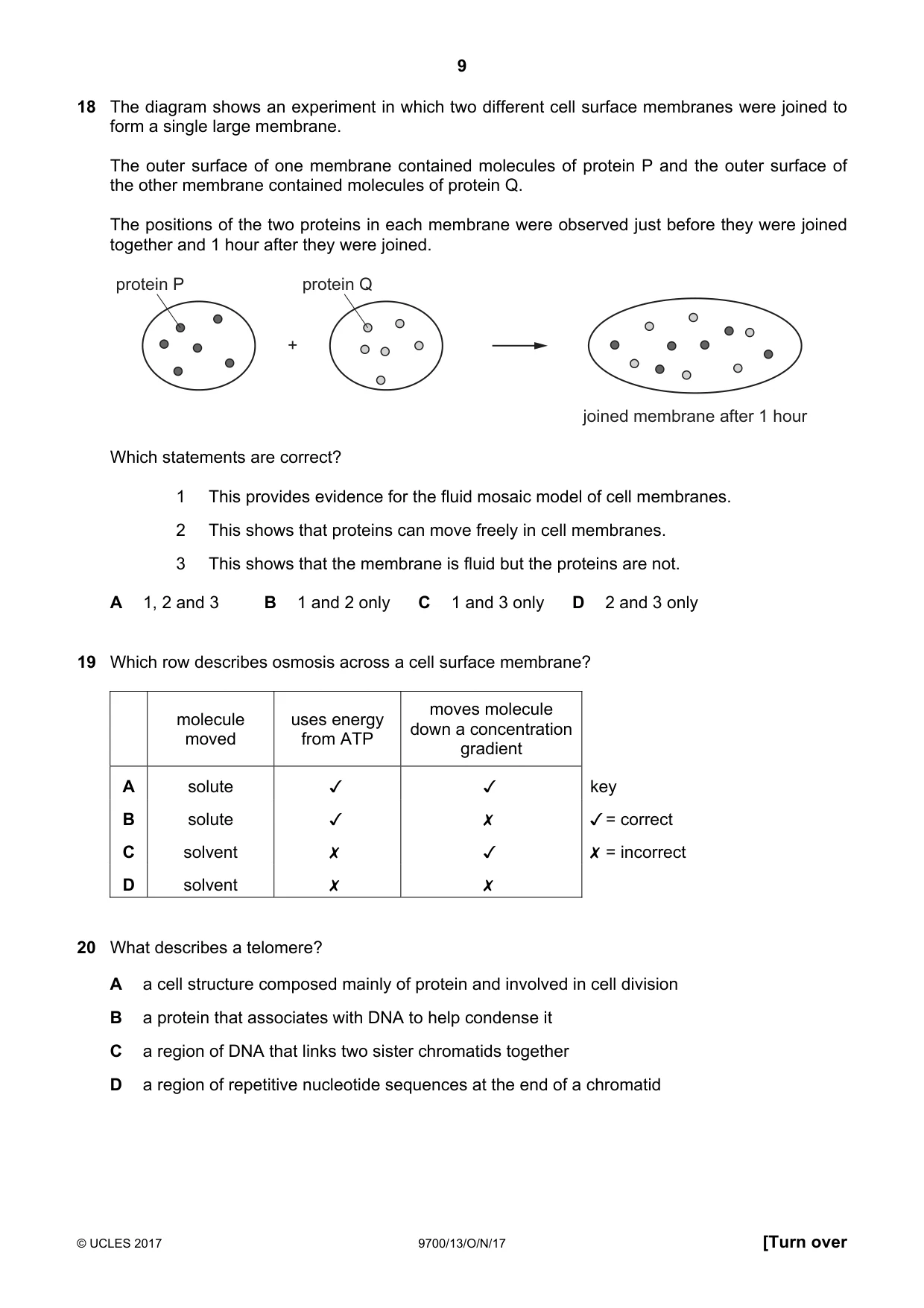
Q18 · The diagram shows an experiment in which two different cell surface membranes were joined…
18 The diagram shows an experiment in which two different cell surface membranes were joined to form a single large membrane. The outer surface of one membrane contained molecules of protein P and the outer surface of the other membrane contained molecules of protein Q. The positions of the two proteins in each membrane were observed just before they were joined together and 1 hour after they were joined. protein P protein Q + joined membrane after 1 hour Which statements are correct? 1 This provides evidence for the fluid mosaic model of cell membranes. 2 This shows that proteins can move freely in cell membranes. 3 This shows that the membrane is fluid but the proteins are not. A 1, 2 and 3 B 1 and 2 only C 1 and 3 only D 2 and 3 only
Mark scheme: B
Q19 · Which row describes osmosis across a cell surface membrane?
19 Which row describes osmosis across a cell surface membrane? moves molecule molecule uses energy down a concentration moved from ATP gradient A solute Jv Jv key B solute v x JY = correct Cc solvent x v X = incorrect D solvent x x
Mark scheme: C
Q20 · What describes a telomere?
20 What describes a telomere? A a cell structure composed mainly of protein and involved in cell division B a protein that associates with DNA to help condense it C a region of DNA that links two sister chromatids together D a region of repetitive nucleotide sequences at the end of a chromatid
Mark scheme: D
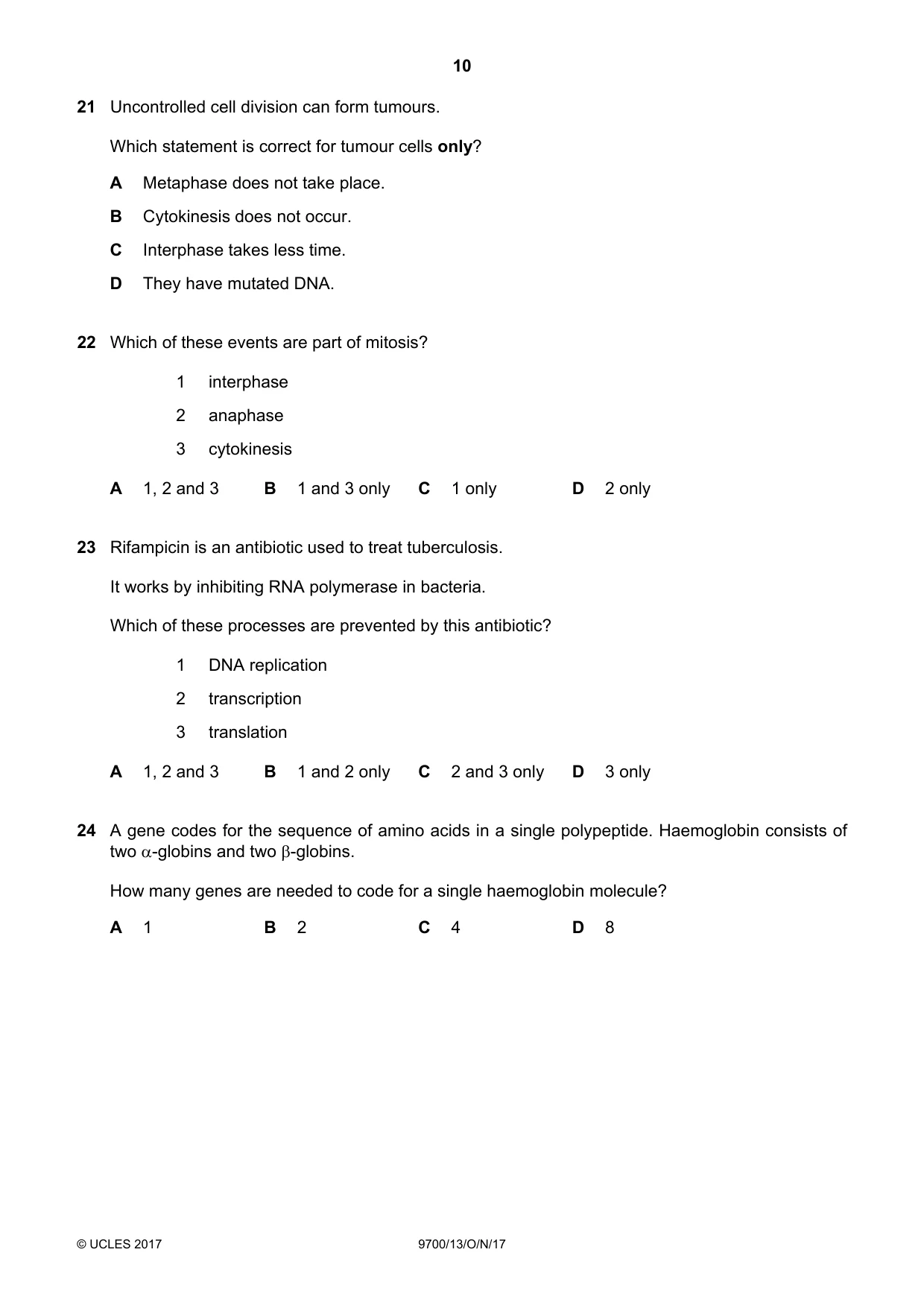
Q21 · Uncontrolled cell division can form tumours
21 Uncontrolled cell division can form tumours. Which statement is correct for tumour cells only? A Metaphase does not take place. B Cytokinesis does not occur. C Interphase takes less time. D They have mutated DNA.
Mark scheme: C
More questions on Replication and division of nuclei and cells
Q22 · Which of these events are part of mitosis?
22 Which of these events are part of mitosis? 1 interphase 2 anaphase 3 cytokinesis A 1, 2 and 3 B 1 and 3 only C 1 only D 2 only
Mark scheme: D
More questions on Replication and division of nuclei and cells
Q23 · Rifampicin is an antibiotic used to treat tuberculosis
23 Rifampicin is an antibiotic used to treat tuberculosis. It works by inhibiting RNA polymerase in bacteria. Which of these processes are prevented by this antibiotic? 1 DNA replication 2 transcription 3 translation A 1, 2 and 3 B 1 and 2 only C 2 and 3 only D 3 only
Mark scheme: C
Q24 · A gene codes for the sequence of amino acids in a single polypeptide
24 A gene codes for the sequence of amino acids in a single polypeptide. Haemoglobin consists of two α-globins and two β-globins. How many genes are needed to code for a single haemoglobin molecule? A 1 B 2 C 4 D 8
Mark scheme: B
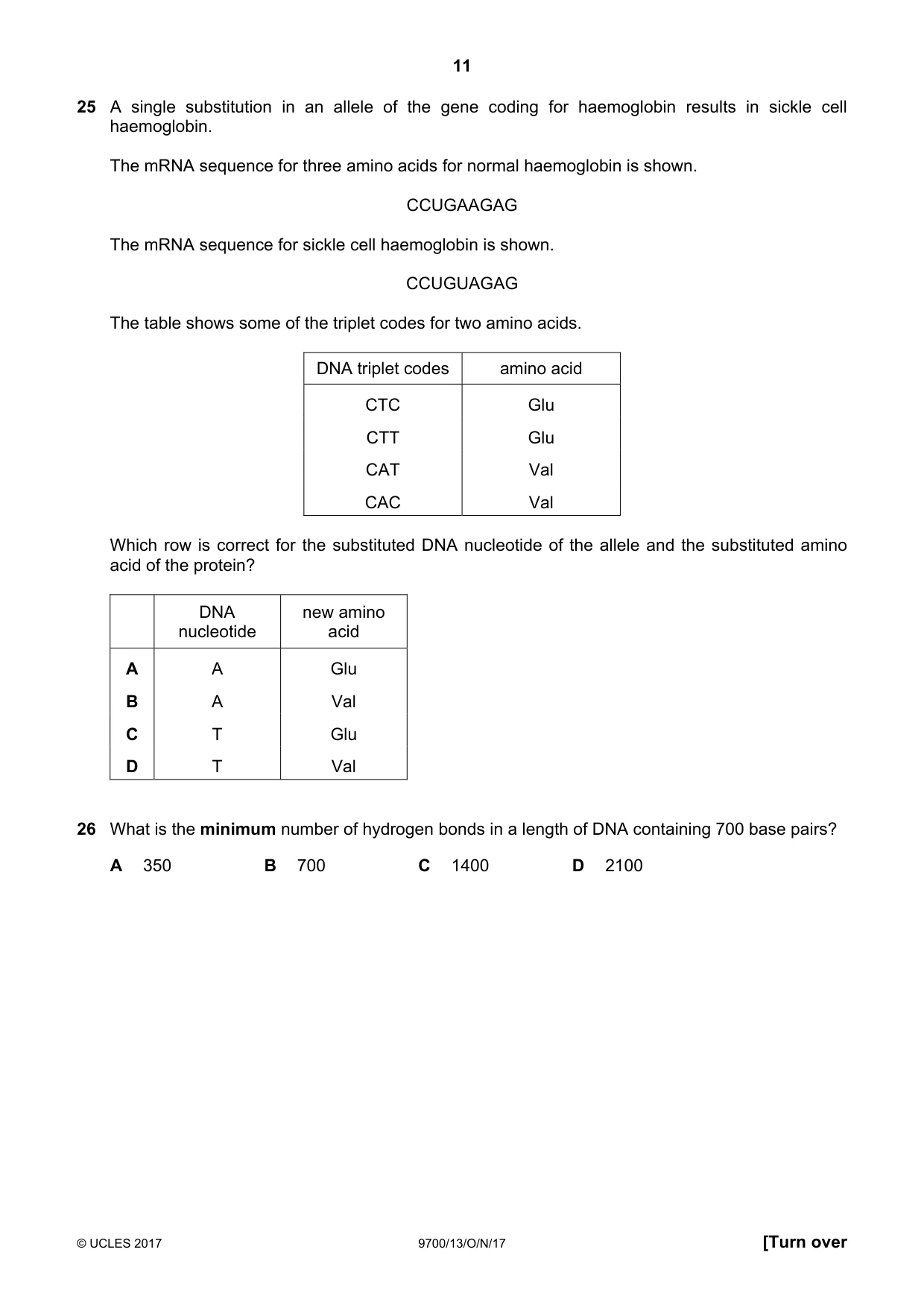
Q25 · A single substitution in an allele of the gene coding for haemoglobin results in sickle…
25 A single substitution in an allele of the gene coding for haemoglobin results in sickle cell haemoglobin. The mRNA sequence for three amino acids for normal haemoglobin is shown. CCUGAAGAG The mRNA sequence for sickle cell haemoglobin is shown. CCUGUAGAG The table shows some of the triplet codes for two amino acids. DNA triplet codes amino acid CTC Glu CTT Glu CAT Val CAC Val Which row is correct for the substituted DNA nucleotide of the allele and the substituted amino acid of the protein? DNA new amino nucleotide acid A A Glu B A Val C T Glu D T Val
Mark scheme: B
Q26 · What is the minimum number of hydrogen bonds in a length of DNA containing 700 base pairs?
26 What is the minimum number of hydrogen bonds in a length of DNA containing 700 base pairs? A 350 B 700 C 1400 D 2100
Mark scheme: C
More questions on Structure of nucleic acids and replication of DNA
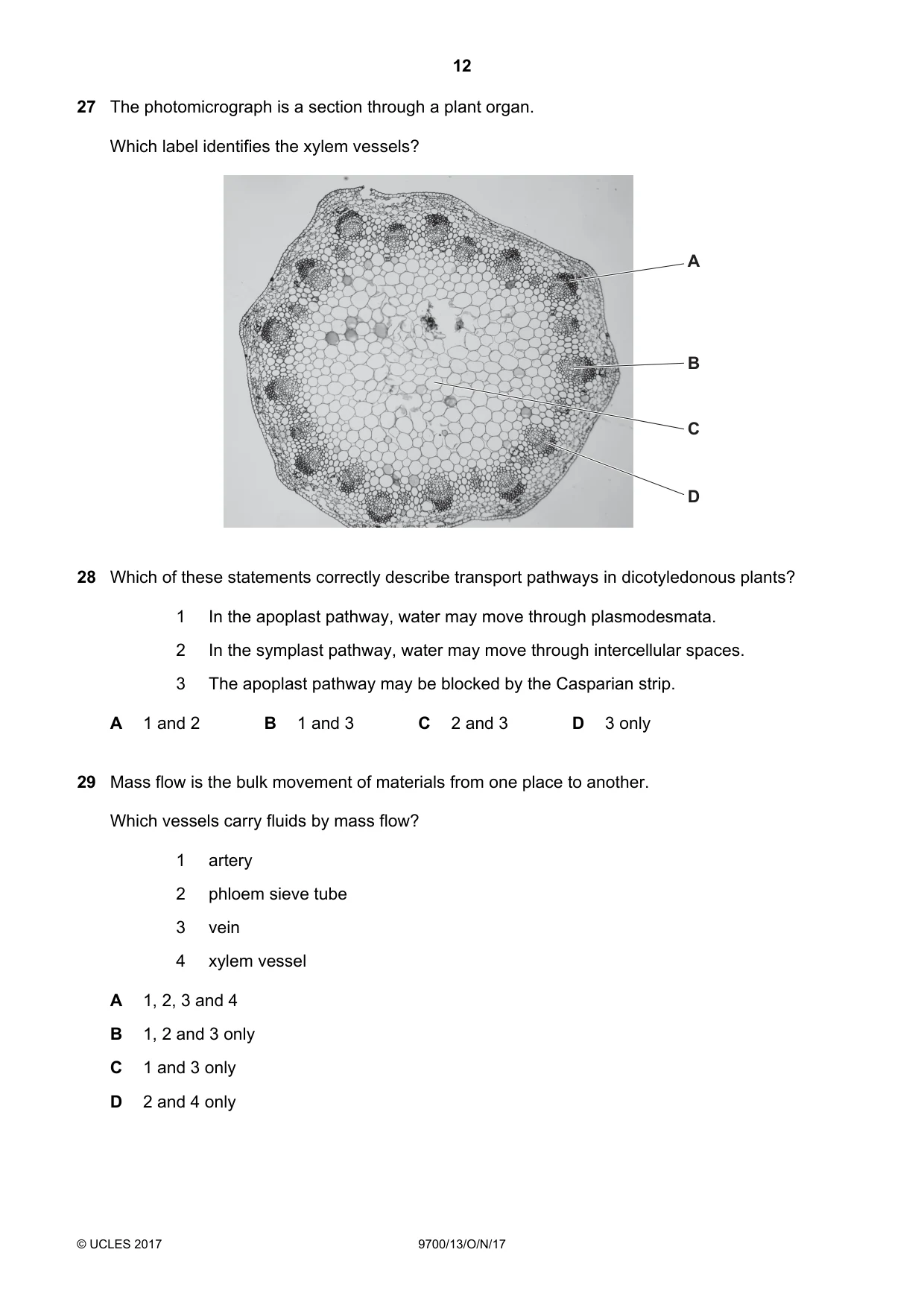
Q27 · The photomicrograph is a section through a plant organ
27 The photomicrograph is a section through a plant organ. Which label identifies the xylem vessels? A B C D
Mark scheme: B
Q28 · Which of these statements correctly describe transport pathways in dicotyledonous plants?
28 Which of these statements correctly describe transport pathways in dicotyledonous plants? 1 In the apoplast pathway, water may move through plasmodesmata. 2 In the symplast pathway, water may move through intercellular spaces. 3 The apoplast pathway may be blocked by the Casparian strip. A 1 and 2 B 1 and 3 C 2 and 3 D 3 only
Mark scheme: D
Q29 · Mass flow is the bulk movement of materials from one place to another
29 Mass flow is the bulk movement of materials from one place to another. Which vessels carry fluids by mass flow? 1 artery 2 phloem sieve tube 3 vein 4 xylem vessel A 1, 2, 3 and 4 B 1, 2 and 3 only C 1 and 3 only D 2 and 4 only
Mark scheme: A
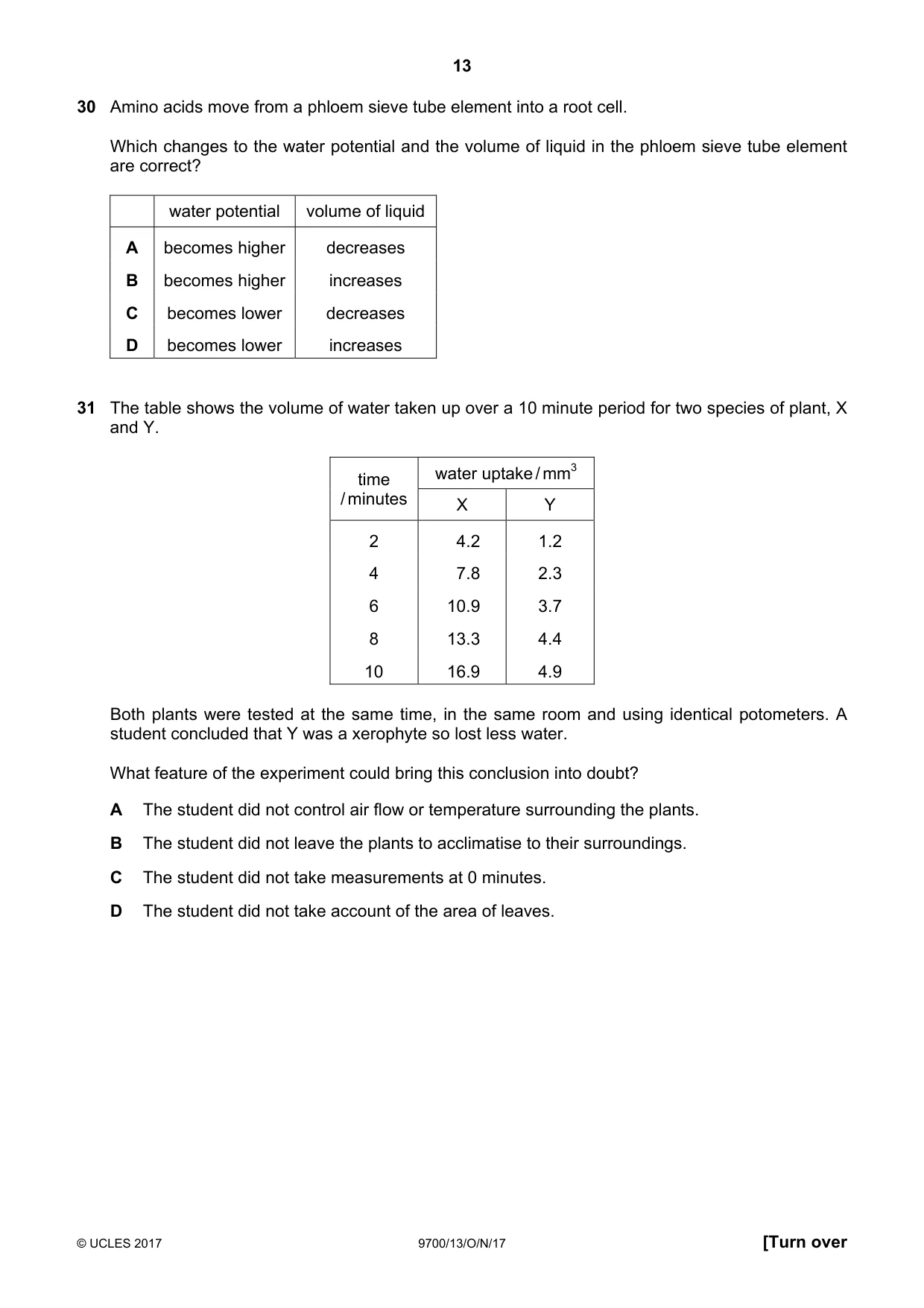
Q30 · Amino acids move from a phloem sieve tube element into a root cell
30 Amino acids move from a phloem sieve tube element into a root cell. Which changes to the water potential and the volume of liquid in the phloem sieve tube element are correct? water potential volume of liquid A becomes higher decreases B becomes higher increases C becomes lower decreases D becomes lower increases
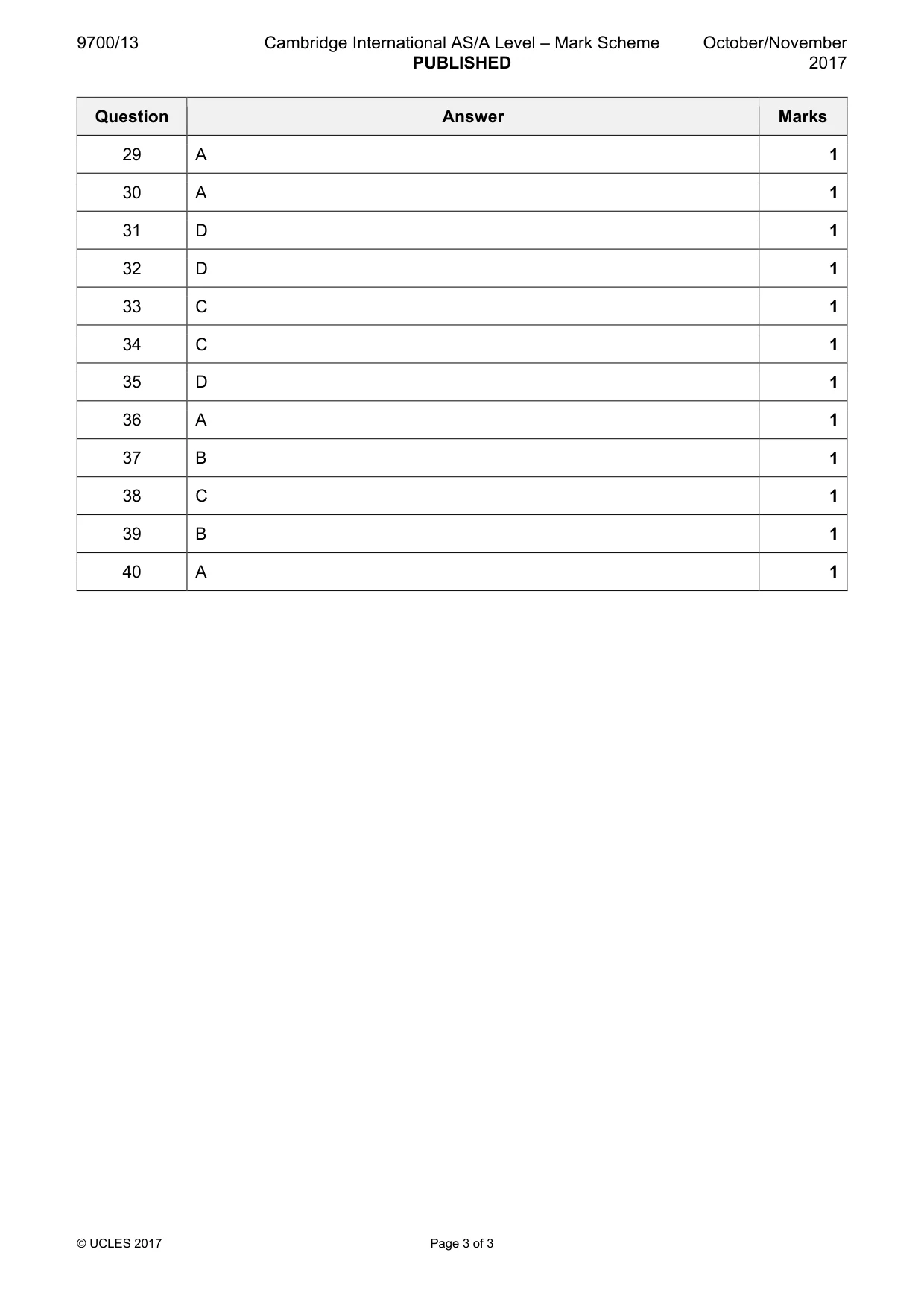
Mark scheme: A
Q31 · The table shows the volume of water taken up over a 10 minute period for two species of…
31 The table shows the volume of water taken up over a 10 minute period for two species of plant, X and Y. water uptake / mm3 time / minutes X Y 2 4.2 1.2 4 7.8 2.3 6 10.9 3.7 8 13.3 4.4 10 16.9 4.9 Both plants were tested at the same time, in the same room and using identical potometers. A student concluded that Y was a xerophyte so lost less water. What feature of the experiment could bring this conclusion into doubt? A The student did not control air flow or temperature surrounding the plants. B The student did not leave the plants to acclimatise to their surroundings. C The student did not take measurements at 0 minutes. D The student did not take account of the area of leaves.
Mark scheme: D
Q32 · What happens during left ventricular systole?
32 What happens during left ventricular systole? A The atrioventricular node causes the immediate contraction of the ventricle, causing the atrioventricular valve to close. B The Purkyne tissue between the atrium and ventricle causes the ventricle to contract, closing the atrioventricular valve and opening the semilunar valve. C The sinoatrial node causes the atrium to stop contracting and the blood pressure in the ventricle to increase above that in the atrium. D The wave of excitation causes the ventricle to contract so that the blood pressure in the ventricle is higher than in the aorta, opening the semilunar valve.
Mark scheme: D
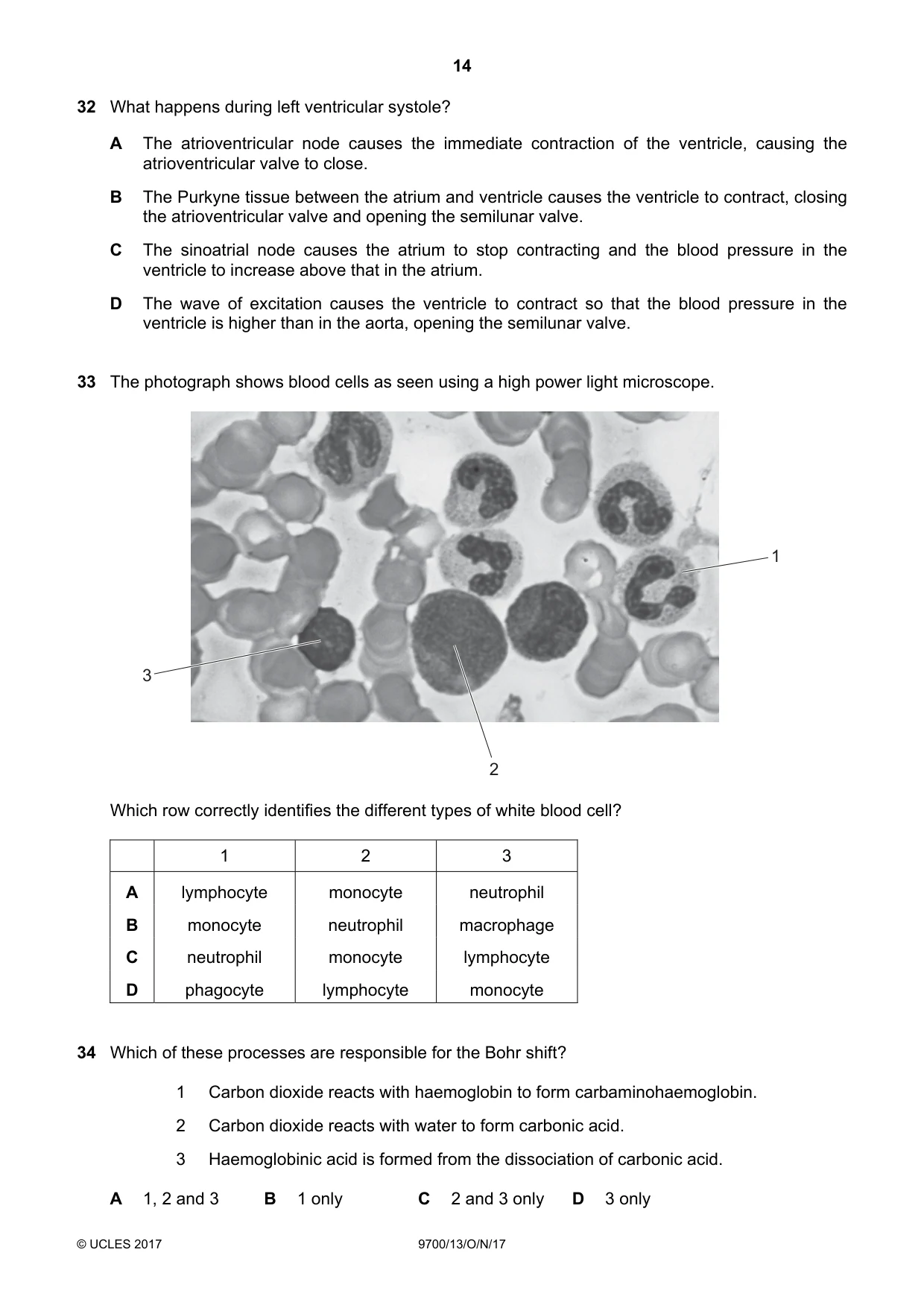
Q33 · The photograph shows blood cells as seen using a high power light microscope
33 The photograph shows blood cells as seen using a high power light microscope. 1 3 2 Which row correctly identifies the different types of white blood cell? 1 2 3 A lymphocyte monocyte neutrophil B monocyte neutrophil macrophage C neutrophil monocyte lymphocyte D phagocyte lymphocyte monocyte
Mark scheme: C
Q34 · Which of these processes are responsible for the Bohr shift?
34 Which of these processes are responsible for the Bohr shift? 1 Carbon dioxide reacts with haemoglobin to form carbaminohaemoglobin. 2 Carbon dioxide reacts with water to form carbonic acid. 3 Haemoglobinic acid is formed from the dissociation of carbonic acid. A 1, 2 and 3 B 1 only C 2 and 3 only D 3 only
Mark scheme: C
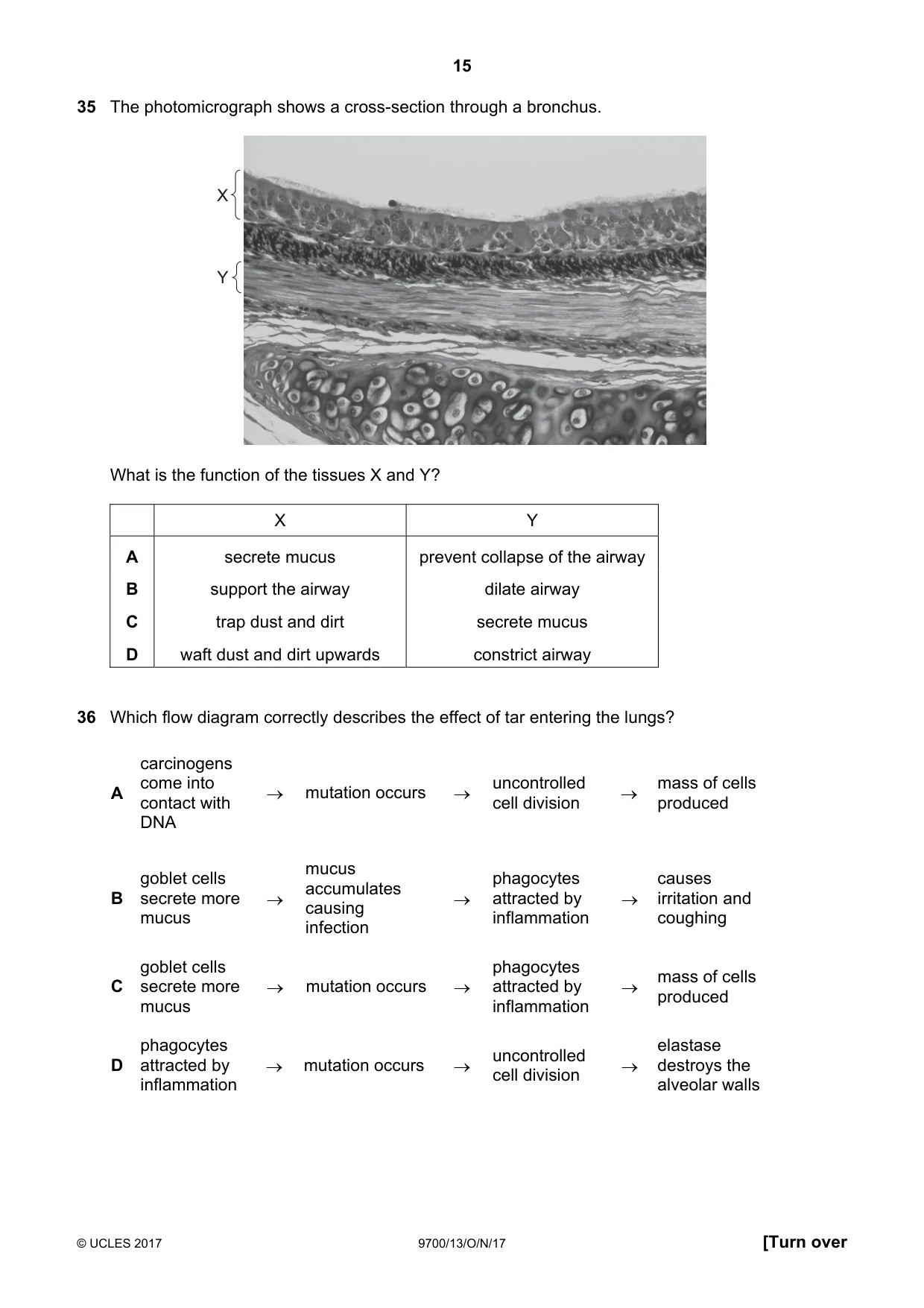
Q35 · The photomicrograph shows a cross-section through a bronchus
35 The photomicrograph shows a cross-section through a bronchus. X Y What is the function of the tissues X and Y? X Y A secrete mucus prevent collapse of the airway B support the airway dilate airway C trap dust and dirt secrete mucus D waft dust and dirt upwards constrict airway
Mark scheme: D
Q36 · Which flow diagram correctly describes the effect of tar entering the lungs?
36 Which flow diagram correctly describes the effect of tar entering the lungs? carcinogens come into uncontrolled mass of cells A → mutation occurs → → contact with cell division produced DNA mucus goblet cells phagocytes causes accumulates B secrete more → → attracted by → irritation and causing mucus inflammation coughing infection goblet cells phagocytes mass of cells C secrete more → mutation occurs → attracted by → produced mucus inflammation phagocytes elastase uncontrolled D attracted by → mutation occurs → → destroys the cell division inflammation alveolar walls
Mark scheme: A
Q37 · The antibiotic penicillin prevents the formation of cross-links between peptidoglycans…
37 The antibiotic penicillin prevents the formation of cross-links between peptidoglycans during bacterial cell wall synthesis by blocking the enzyme transpeptidase. Which statements describe the action of penicillin on bacteria? 1 It is an enzyme inhibitor. 2 It weakens the bacterial cell wall. 3 It will work at any stage during the bacterial life cycle. A 1, 2 and 3 B 1 and 2 only C 1 and 3 only D 2 and 3 only
Mark scheme: B
Q38 · Which pathogens are spread by droplet infection?
38 Which pathogens are spread by droplet infection? 1 Mycobacterium tuberculosis 2 Vibrio cholerae 3 Morbillivirus A 1, 2 and 3 B 1 and 2 only C 1 and 3 only D 2 and 3 only
Mark scheme: C
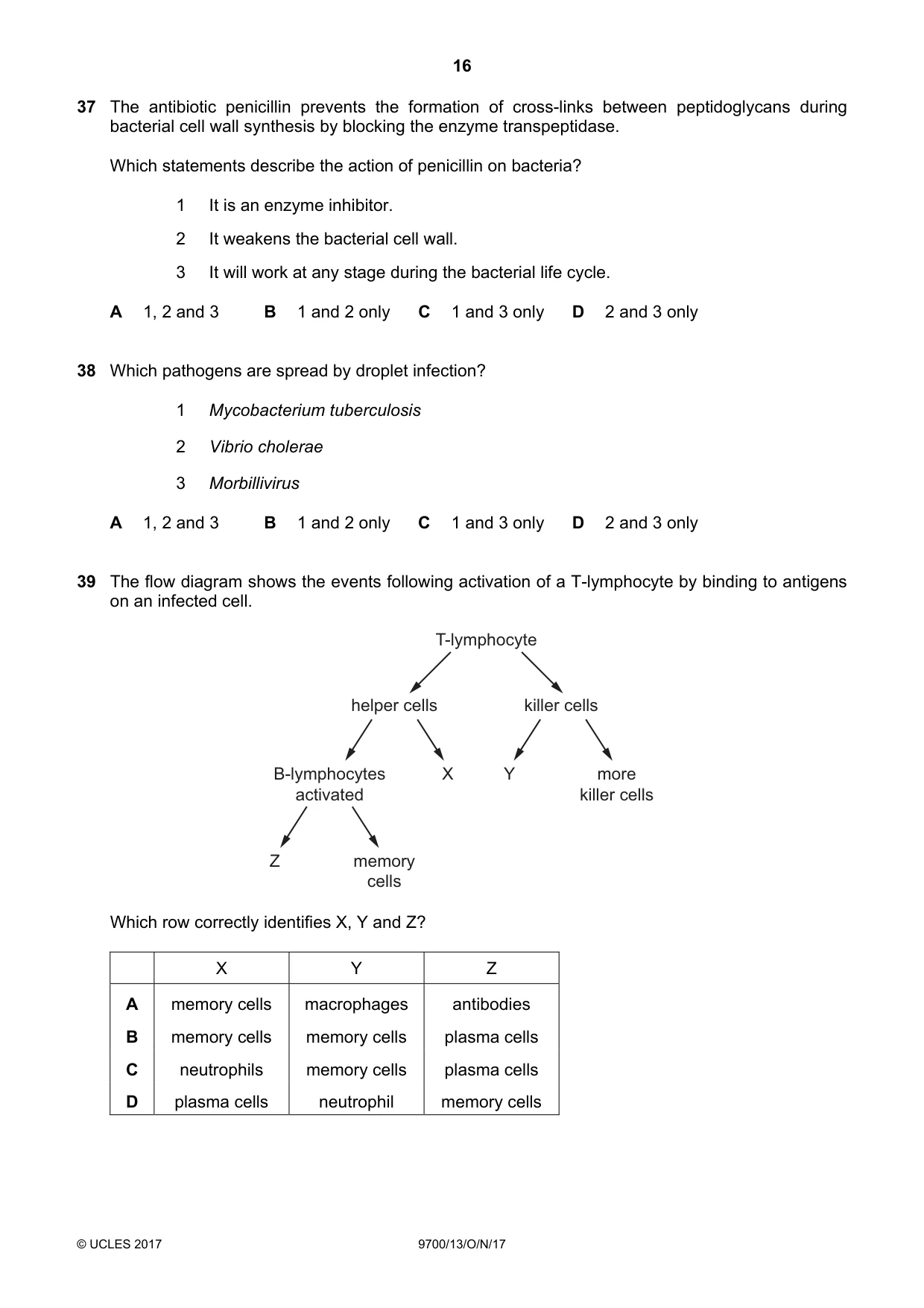
Q39 · The flow diagram shows the events following activation of a T-lymphocyte by binding to…
39 The flow diagram shows the events following activation of a T-lymphocyte by binding to antigens on an infected cell. T-lymphocyte helper cells killer cells B-lymphocytes X Y more activated killer cells Z memory cells Which row correctly identifies X, Y and Z? X Y Z A memory cells macrophages antibodies B memory cells memory cells plasma cells C neutrophils memory cells plasma cells D plasma cells neutrophil memory cells
Mark scheme: B
Q40 · Smallpox was eradicated from the human population by a worldwide preventative programme
40 Smallpox was eradicated from the human population by a worldwide preventative programme. Which type of immunity was triggered in people who were treated as part of this programme? A artificial active immunity B artificial passive immunity C natural active immunity D natural passive immunity
Mark scheme: A
What was in this paper
The subtopics covered by these 40 questions, and how many questions each got. Open one in a new tab to see every Cambridge question on it.
4Carbohydrates and lipids3Cells as the basic units of living organisms3Proteins3Transport mechanisms3Movement into and out of cells2Replication and division of nuclei and cells2The gas exchange system2The immune system2The microscope in cell studies2The roles of genes in2Antibiotics1Antibodies and vaccination1Chromosome behaviour in mitosis1Fluid mosaic membranes1Infectious diseases1Protein synthesis1Structure of nucleic acids and replication of DNA1Structure of transport tissues1Testing for biological molecules1The circulatory system1The heart1Transport of oxygen and carbon dioxide1What you needed in this session
Cambridge’s own grade thresholds for 2017 Oct/Nov, Paper 1 · Variant 3. A higher threshold means an easier paper — the bar moves with how the cohort did.