Cambridge A Level Biology 9700 — 2012 May/June Paper 1 · Variant 2
9700/12/M/J/12 · 40 questions · 40 marks · ≈45 min
The question paper and its mark scheme, free to read here and free to download. This is Cambridge’s own paper, exactly as it was sat.
Question paper20 pages



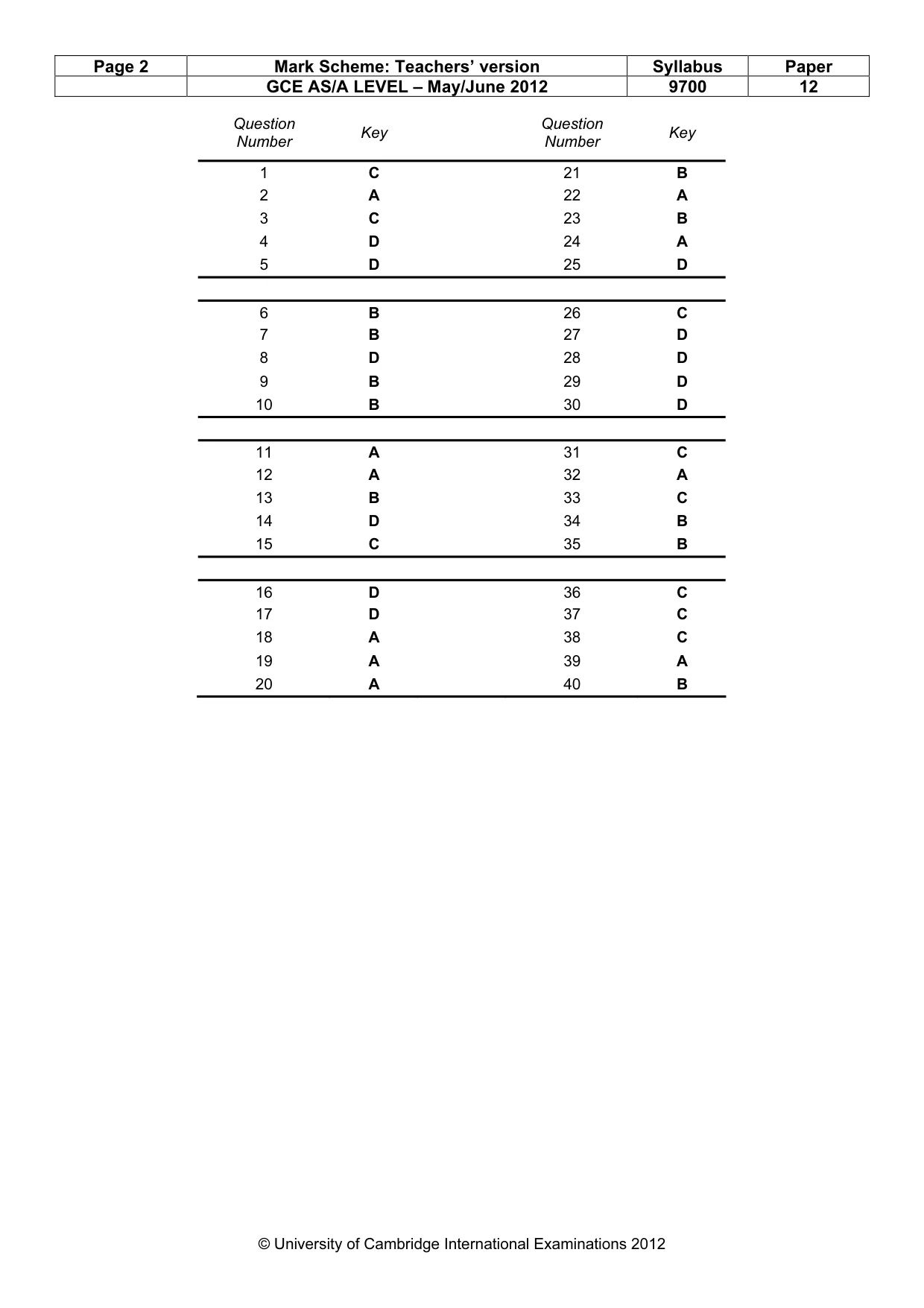
Mark scheme2 pages
Answers below. Sit the paper first if you are practising.
Questions as text
Q1 · Which range of sizes would include most eukaryotic cells?
1 Which range of sizes would include most eukaryotic cells? A 1 × 10² nm to 1 µm B 1 µm to 1 × 101 µm C 1 × 101 µm to 1 × 102 µm D 1 × 102 µm to 1 × 103 µm
Mark scheme: C
More questions on Cells as the basic units of living organisms
Q2 · A student was asked to draw a plan diagram of the plant tissue shown in the…
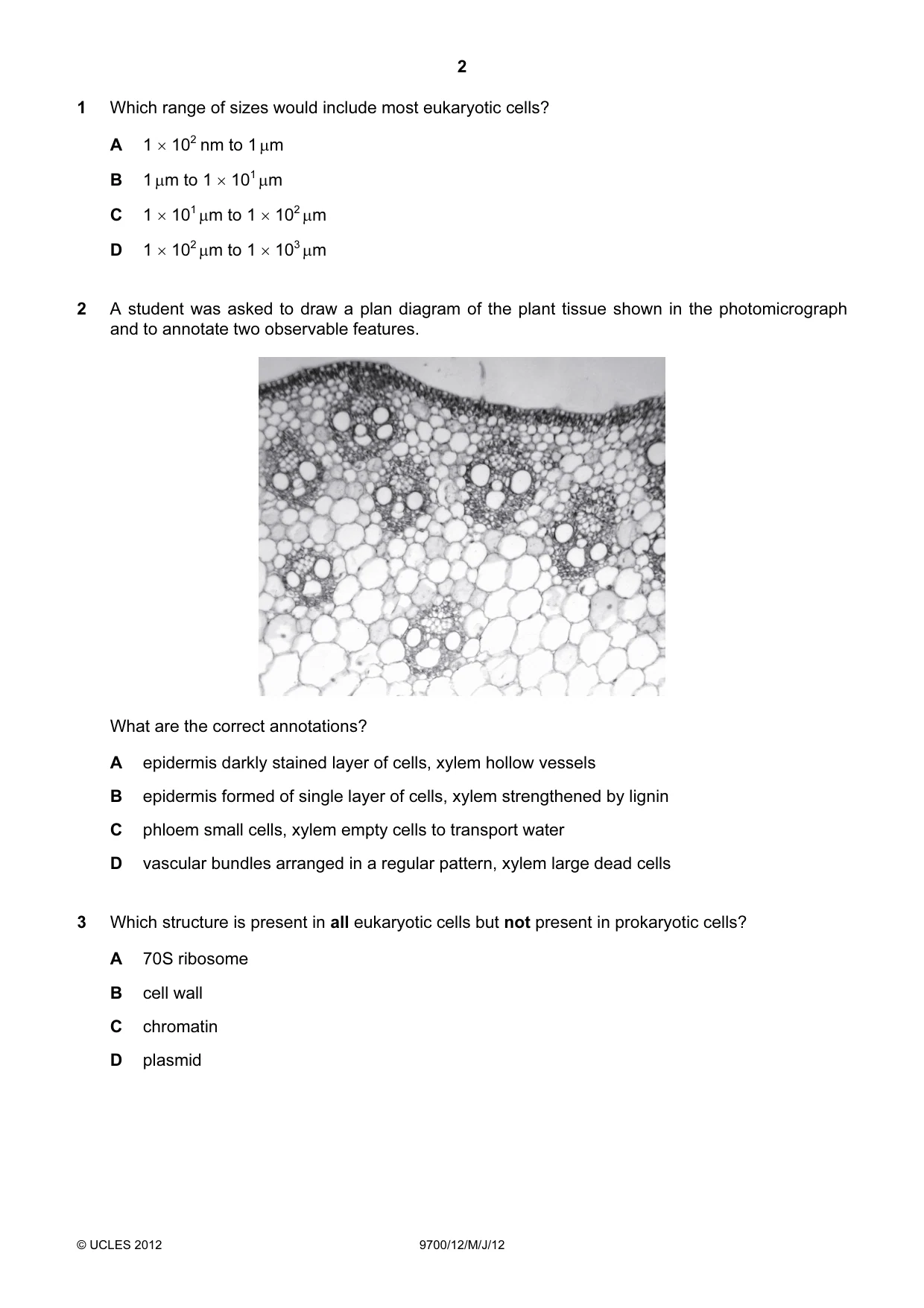
2 A student was asked to draw a plan diagram of the plant tissue shown in the photomicrograph and to annotate two observable features. What are the correct annotations? A epidermis darkly stained layer of cells, xylem hollow vessels B epidermis formed of single layer of cells, xylem strengthened by lignin C phloem small cells, xylem empty cells to transport water D vascular bundles arranged in a regular pattern, xylem large dead cells
Mark scheme: A
Q3 · Which structure is present in all eukaryotic cells but not present in prokaryotic cells?
3 Which structure is present in all eukaryotic cells but not present in prokaryotic cells? A 70S ribosome B cell wall C chromatin D plasmid
Mark scheme: C
More questions on Cells as the basic units of living organisms
Q4 · What restricts the resolution of the light microscope?
4 What restricts the resolution of the light microscope? A the inability to cut very thin sections B the low light intensity of microscope lamps C the low magnification produced by glass D the wavelengths of visible light
Mark scheme: D
Q5 · The diagram shows an electron micrograph of virus particles in a human nucleus
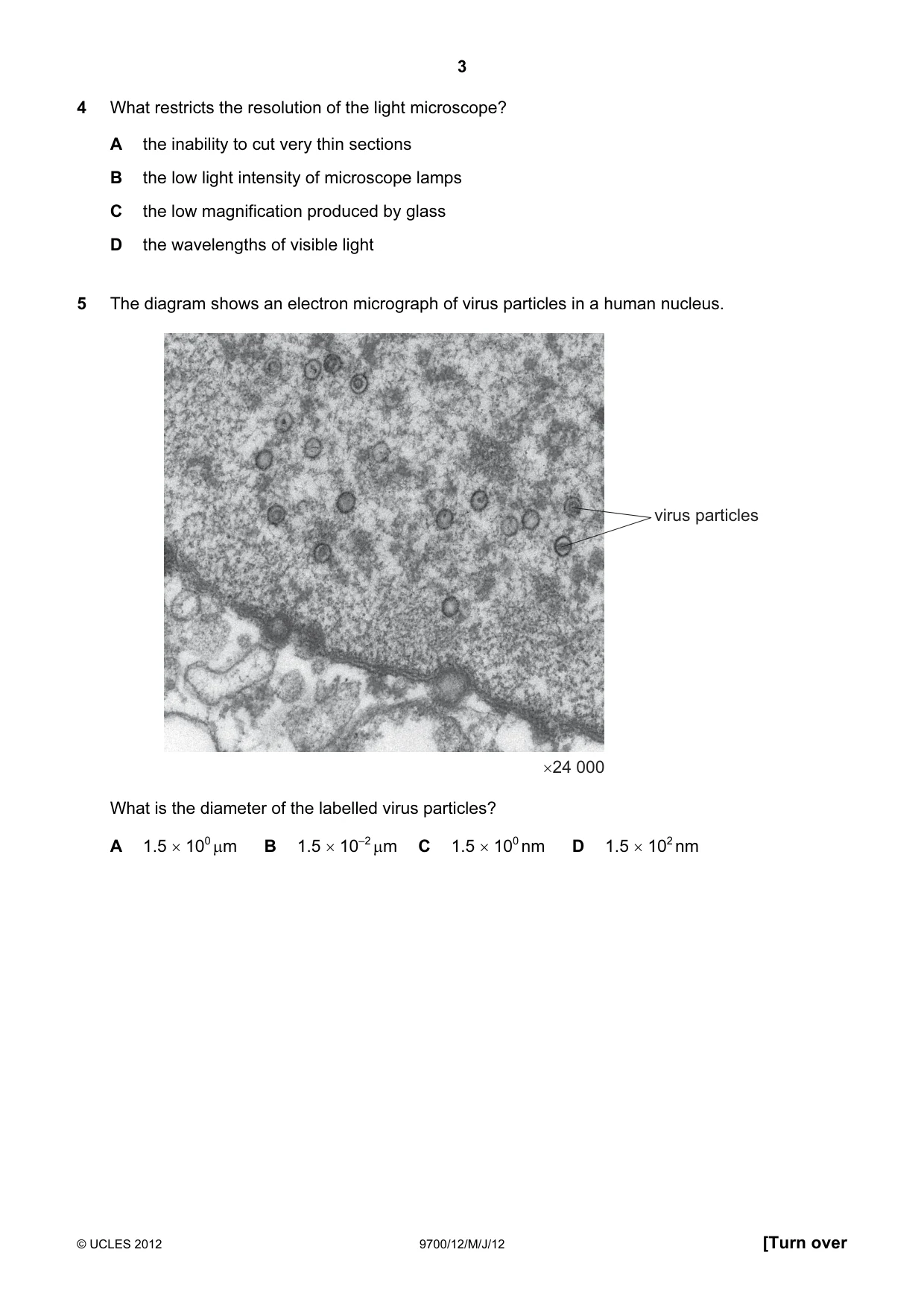
5 The diagram shows an electron micrograph of virus particles in a human nucleus. virus particles ×24 000 What is the diameter of the labelled virus particles? A 1.5 × 100 µm B 1.5 × 10⁻² µm C 1.5 × 100 nm D 1.5 × 10² nm
Mark scheme: D
Q6 · A student carried out a series of tests on an extract from a plant
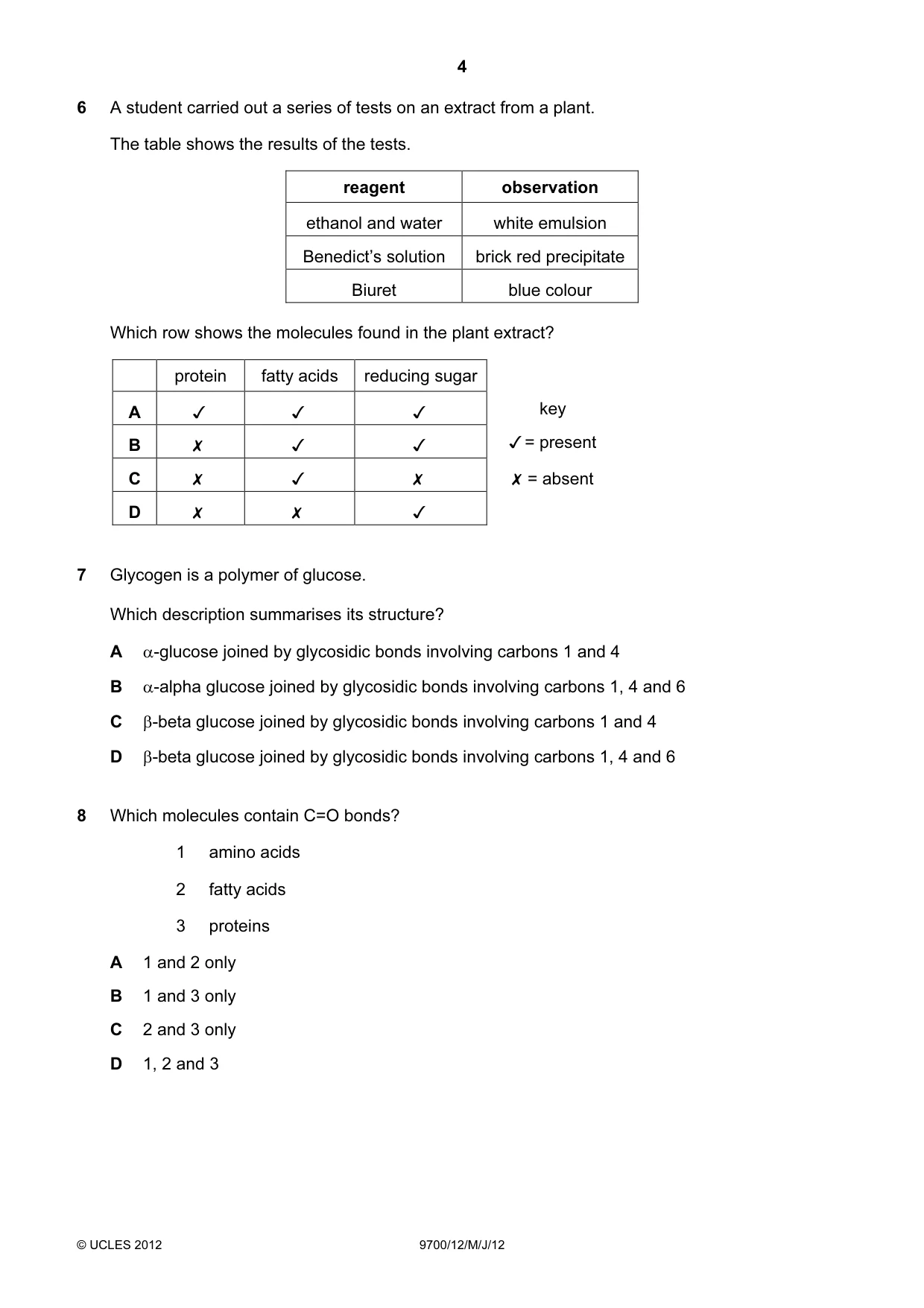
6 A student carried out a series of tests on an extract from a plant. The table shows the results of the tests. reagent observation ethanol and water white emulsion Benedict’s solution brick red precipitate Biuret blue colour Which row shows the molecules found in the plant extract? protein fatty acids | reducing sugar A v v v | key B x V V | /¥ = present Cc x J x | X = absent D x x Jv |
Mark scheme: B
Q7 · Glycogen is a polymer of glucose
7 Glycogen is a polymer of glucose. Which description summarises its structure? A α-glucose joined by glycosidic bonds involving carbons 1 and 4 B α-alpha glucose joined by glycosidic bonds involving carbons 1, 4 and 6 C β-beta glucose joined by glycosidic bonds involving carbons 1 and 4 D β-beta glucose joined by glycosidic bonds involving carbons 1, 4 and 6
Mark scheme: B
Q8 · Which molecules contain C=O bonds?
8 Which molecules contain C=O bonds? 1 amino acids 2 fatty acids 3 proteins A 1 and 2 only B 1 and 3 only C 2 and 3 only D 1, 2 and 3
Mark scheme: D
Q9 · Which of the statements about polysaccharides can be used to describe both amylose and…
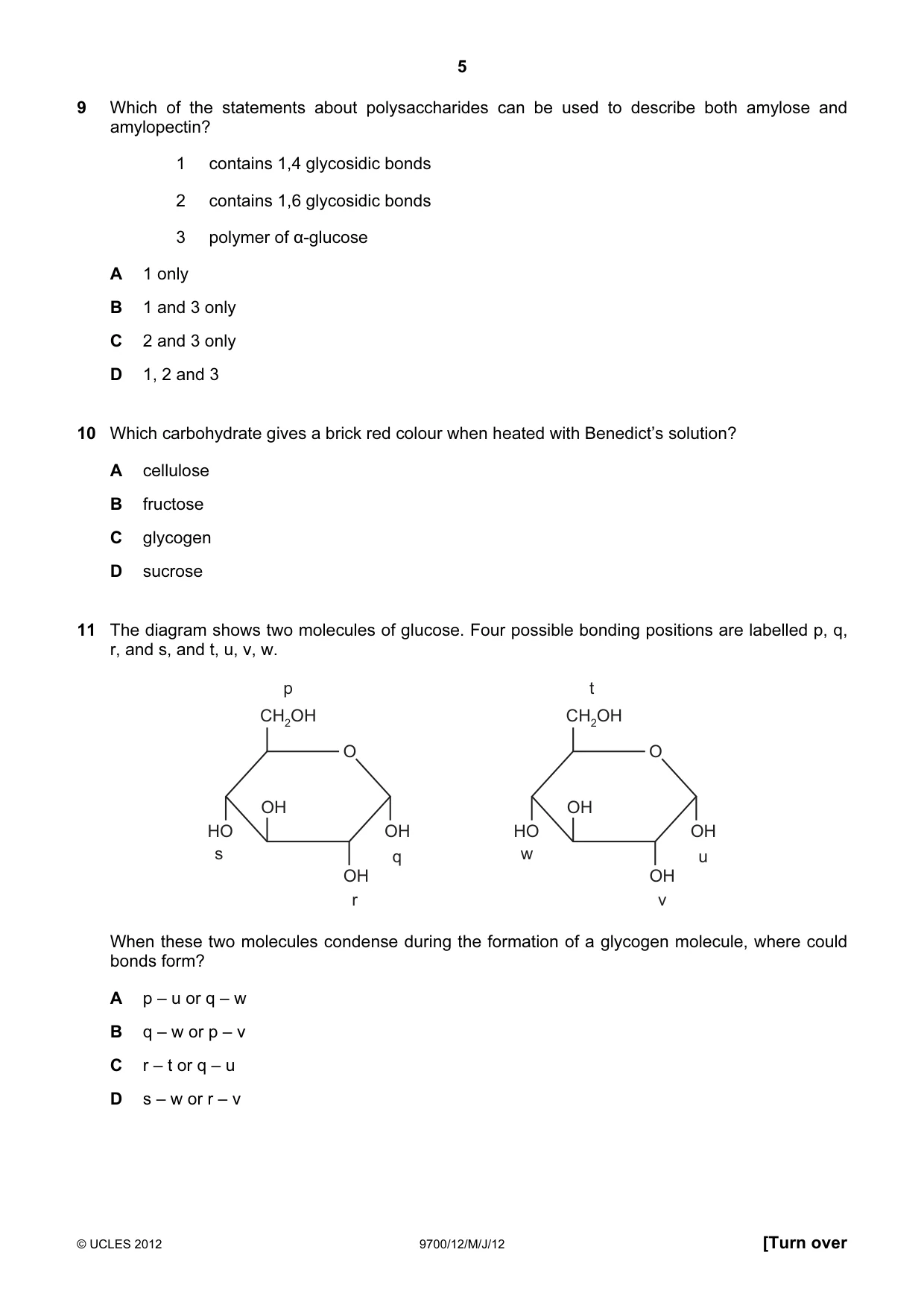
9 Which of the statements about polysaccharides can be used to describe both amylose and amylopectin? 1 contains 1,4 glycosidic bonds 2 contains 1,6 glycosidic bonds 3 polymer of α-glucose A 1 only B 1 and 3 only C 2 and 3 only D 1, 2 and 3
Mark scheme: B
Q10 · Which carbohydrate gives a brick red colour when heated with Benedict’s solution?
10 Which carbohydrate gives a brick red colour when heated with Benedict’s solution? A cellulose B fructose C glycogen D sucrose
Mark scheme: B
Q11 · The diagram shows two molecules of glucose
11 The diagram shows two molecules of glucose. Four possible bonding positions are labelled p, q, r, and s, and t, u, v, w. p t CH2OH CH2OH O O OH OH HO OH HO OH s q w u OH OH r v When these two molecules condense during the formation of a glycogen molecule, where could bonds form? A p – u or q – w B q – w or p – v C r – t or q – u D s – w or r – v
Mark scheme: A
Q12 · Which graph represents the changes in concentration of a substrate and its product in the…
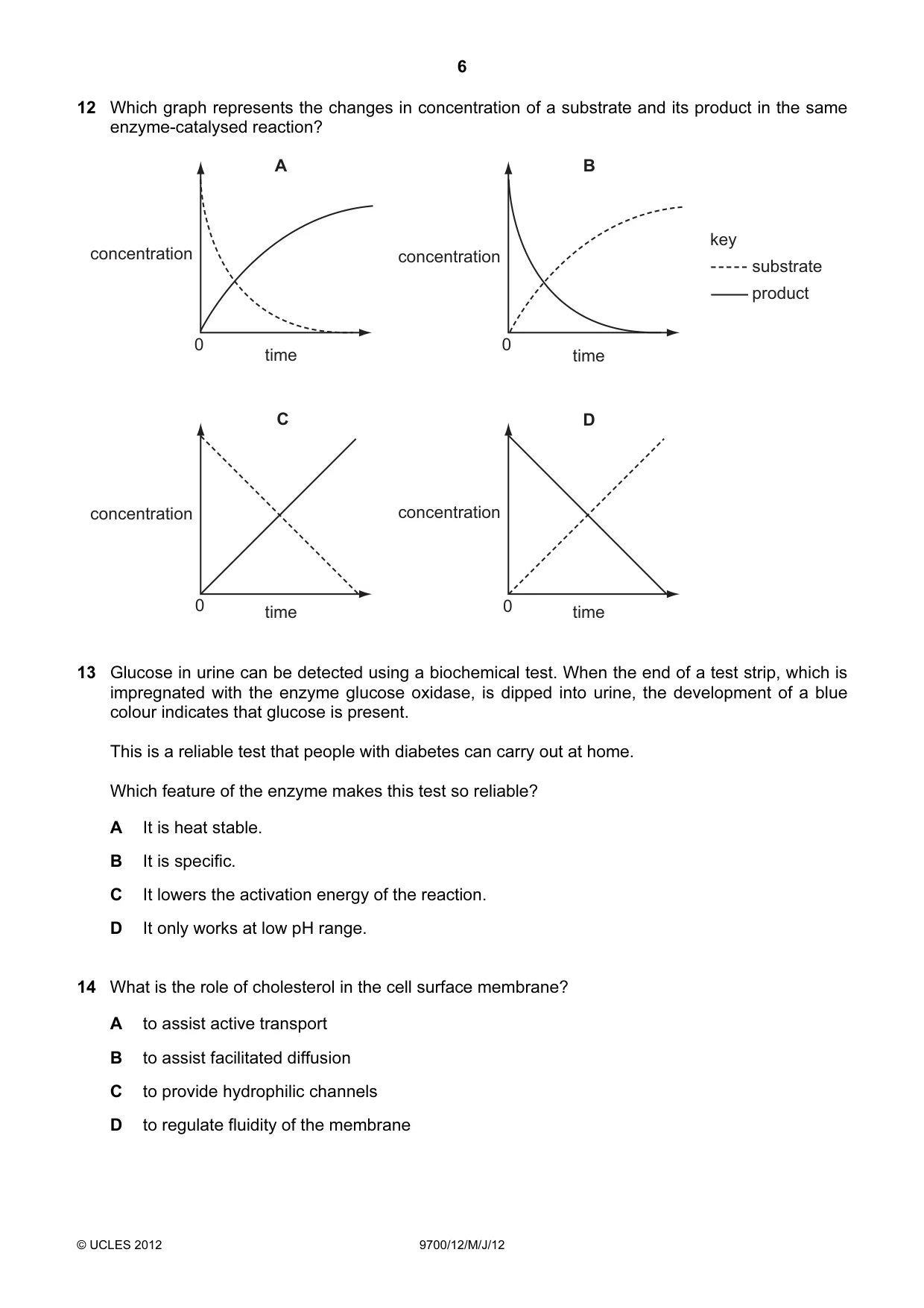
12 Which graph represents the changes in concentration of a substrate and its product in the same enzyme-catalysed reaction? A B key concentration concentration substrate product 0 0 time time C D concentration concentration 0 time 0 time
Mark scheme: A
Q13 · Glucose in urine can be detected using a biochemical test
13 Glucose in urine can be detected using a biochemical test. When the end of a test strip, which is impregnated with the enzyme glucose oxidase, is dipped into urine, the development of a blue colour indicates that glucose is present. This is a reliable test that people with diabetes can carry out at home. Which feature of the enzyme makes this test so reliable? A It is heat stable. B It is specific. C It lowers the activation energy of the reaction. D It only works at low pH range.
Mark scheme: B
Q14 · What is the role of cholesterol in the cell surface membrane?
14 What is the role of cholesterol in the cell surface membrane? A to assist active transport B to assist facilitated diffusion C to provide hydrophilic channels D to regulate fluidity of the membrane
Mark scheme: D
Q15 · The following are all processes by which substances can enter a cell
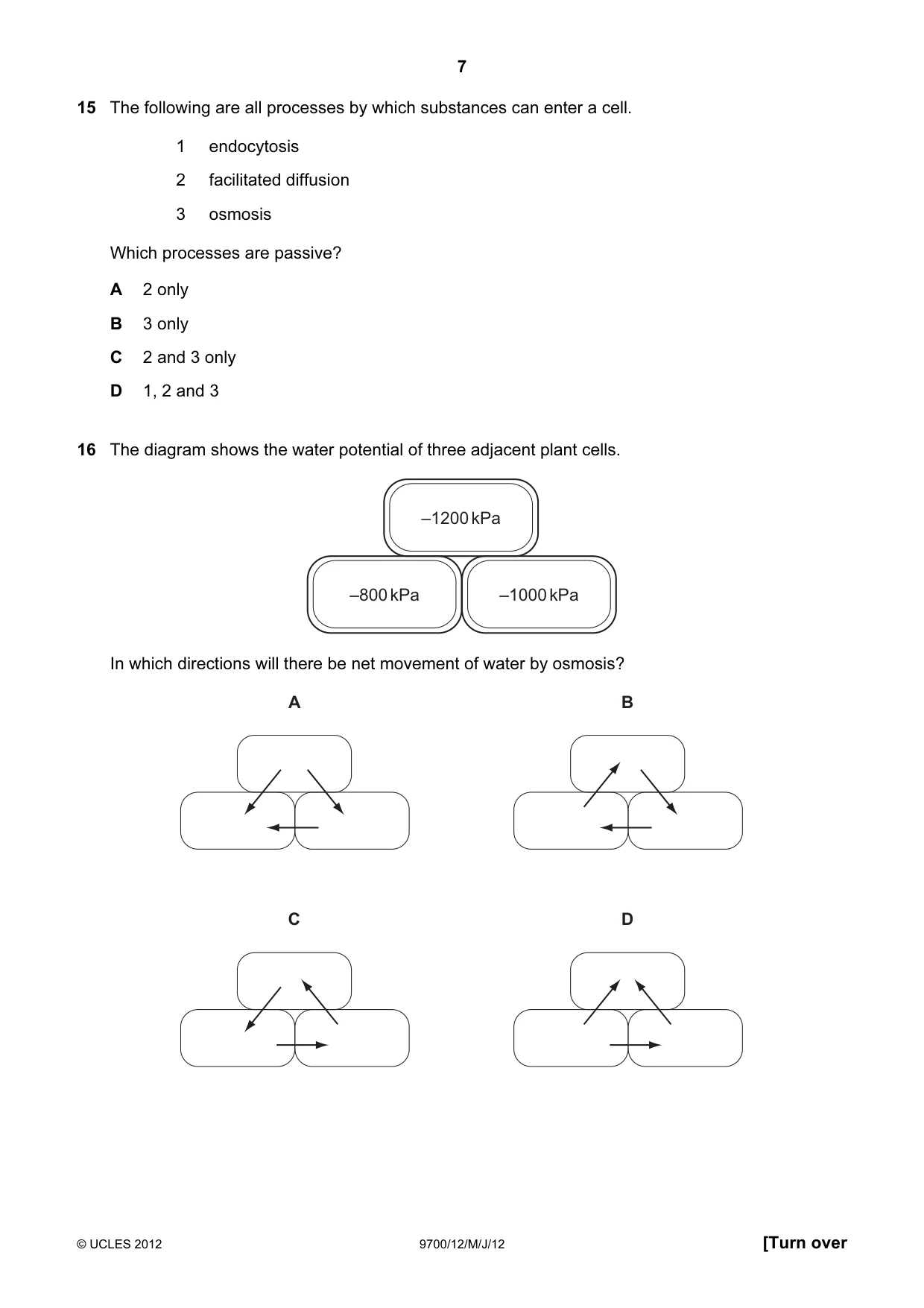
15 The following are all processes by which substances can enter a cell. 1 endocytosis 2 facilitated diffusion 3 osmosis Which processes are passive? A 2 only B 3 only C 2 and 3 only D 1, 2 and 3
Mark scheme: C
Q16 · The diagram shows the water potential of three adjacent plant cells
16 The diagram shows the water potential of three adjacent plant cells. –1200 kPa –800 kPa –1000 kPa In which directions will there be net movement of water by osmosis? A B C D
Mark scheme: D
Q17 · Each of the following events takes place during mitosis
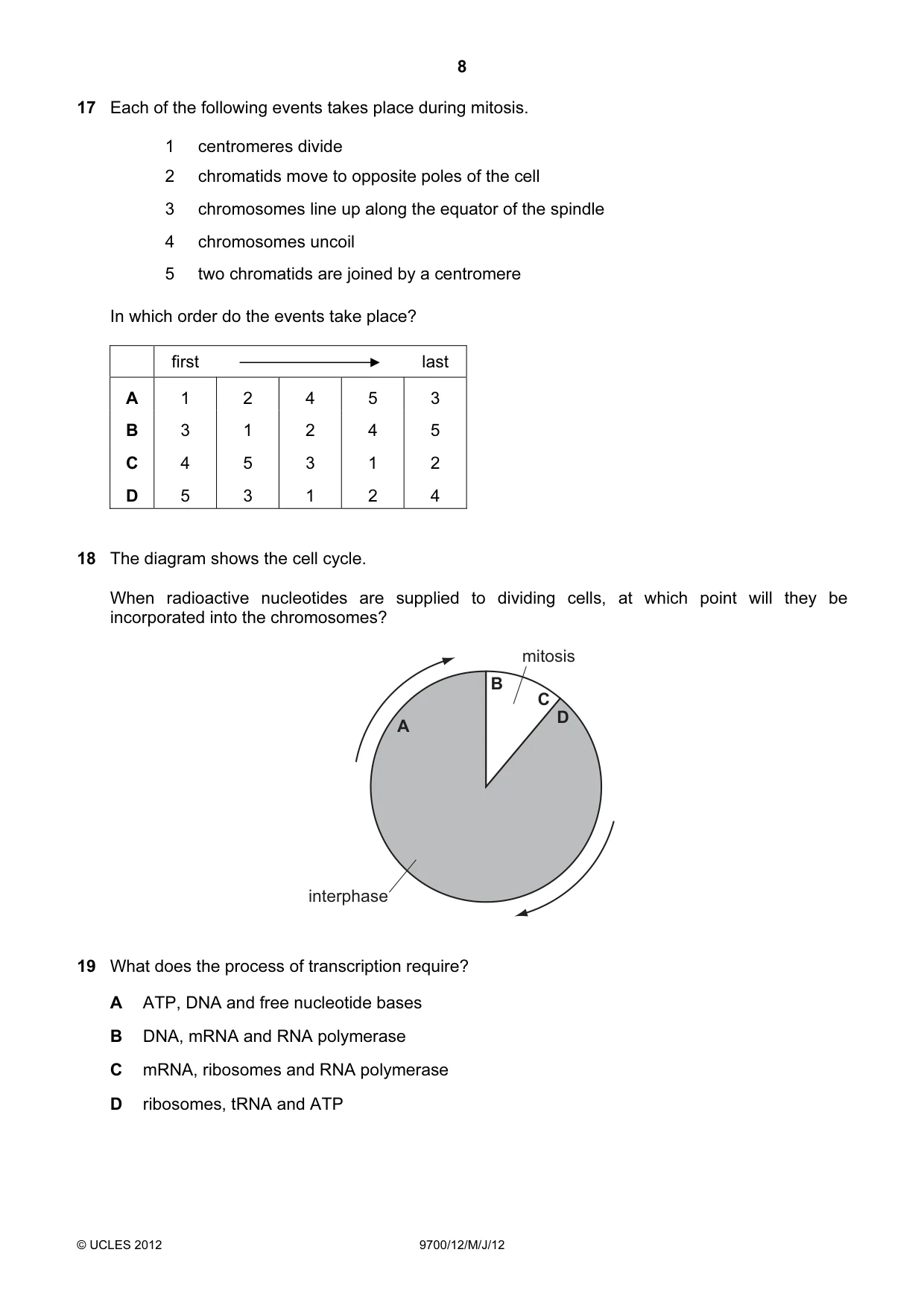
17 Each of the following events takes place during mitosis. 1 centromeres divide 2 chromatids move to opposite poles of the cell 3 chromosomes line up along the equator of the spindle 4 chromosomes uncoil 5 two chromatids are joined by a centromere In which order do the events take place? first last A 1 2 4 5 3 B 3 1 2 4 5 C 4 5 3 1 2 D 5 3 1 2 4
Mark scheme: D
Q18 · The diagram shows the cell cycle
18 The diagram shows the cell cycle. When radioactive nucleotides are supplied to dividing cells, at which point will they be incorporated into the chromosomes? mitosis B C D A interphase
Mark scheme: A
More questions on Replication and division of nuclei and cells
Q19 · What does the process of transcription require?
19 What does the process of transcription require? A ATP, DNA and free nucleotide bases B DNA, mRNA and RNA polymerase C mRNA, ribosomes and RNA polymerase D ribosomes, tRNA and ATP
Mark scheme: A
Q20 · A peptide consists of ten amino acids of four different kinds
20 A peptide consists of ten amino acids of four different kinds. What is the theoretical minimum number of different tRNA molecules required to translate the mRNA for this peptide? A 4 B 10 C 12 D 30
Mark scheme: A
Q21 · Which statements about tRNA structure are correct?
21 Which statements about tRNA structure are correct? 1 There is a binding site for the attachment of a specific amino acid, as well as a different binding site for the attachment to the ribosome, in order to allow translation to occur. 2 There is a ribose-phosphate backbone with strong covalent phosphodiester bonds and areas within the polynucleotide chain where base-pairing by hydrogen bonding occurs. 3 There is a section known as an anticodon that contains the same triplet of bases as the triplet of DNA bases that has been transcribed to produce the mRNA codon. A 1 only B 1 and 2 only C 2 and 3 only D 1, 2 and 3
Mark scheme: B
Q22 · Which statements describe why a large animal has had to evolve a transport system?
22 Which statements describe why a large animal has had to evolve a transport system? 1 diffusion occurs slowly over long distances 2 it has a high rate of gas exchange 3 it has a large surface area to volume ratio A 1 only B 3 only C 1 and 2 only D 1, 2 and 3
Mark scheme: A
Q23 · Which row identifies the tissue that contains the Casparian strip and the molecule…
23 Which row identifies the tissue that contains the Casparian strip and the molecule forming this strip? tissue molecule A cortex lignin B endodermis suberin C epidermis cellulose D xylem lignin
Mark scheme: B
Q24 · Which of the following are included in the apoplast pathway?
24 Which of the following are included in the apoplast pathway? 1 living components 2 plant vacuoles 3 cell walls 4 xylem vessels A 3 only B 1 and 2 only C 3 and 4 only D 1, 2 and 4 only
Mark scheme: A
Q25 · Which statement explains why the circumference (girth) of a tree is less in the middle of…
25 Which statement explains why the circumference (girth) of a tree is less in the middle of the day than at night? A Mineral uptake by the root hair cells decreases during the night because root pressure has decreased. B Stomata close during the night and there is a build-up of water in the vascular tissue within the stem. C The phloem sieve tubes fill with dissolved solutes because the translocation rate is reduced at night. D There is less tension in the xylem vessels at night because the rate of transpiration is at a minimum.
Mark scheme: D
Q26 · Sucrose is transported in solution in the phloem of plants
26 Sucrose is transported in solution in the phloem of plants. Transport takes place from sources to sinks. The process depends on differences in hydrostatic pressure between the sources and the sinks. X leaf tissue parenchyma cell nucleus chloroplast companion cell Y root tissue Which tissues are either a source or a sink and what is the hydrostatic pressure at X and Y within the phloem? tissue hydrostatic pressure leaf root high low A sink source X Y B sink source Y X C source sink X Y D source sink Y X
Mark scheme: C
Q27 · Which of the following are found in all blood vessels, lymph and tissue fluid?
27 Which of the following are found in all blood vessels, lymph and tissue fluid? 1 carbon dioxide 2 glucose 3 white blood cells 4 antibodies A 2 and 4 only B 1, 2 and 3 only C 1, 3 and 4 only D 1, 2, 3 and 4
Mark scheme: D
Q28 · The diagram shows the Bohr effect
28 The diagram shows the Bohr effect. 100 80 X percentage 60 saturation of haemoglobin Y with oxygen 40 20 0 0 2 4 6 8 10 partial pressure of oxygen / kPa What causes the shift from X to Y? A decreased concentration of carbon dioxide and high pH B decreased concentration of carbon dioxide and low pH C increased concentration of carbon dioxide and high pH D increased concentration of carbon dioxide and low pH
Mark scheme: D
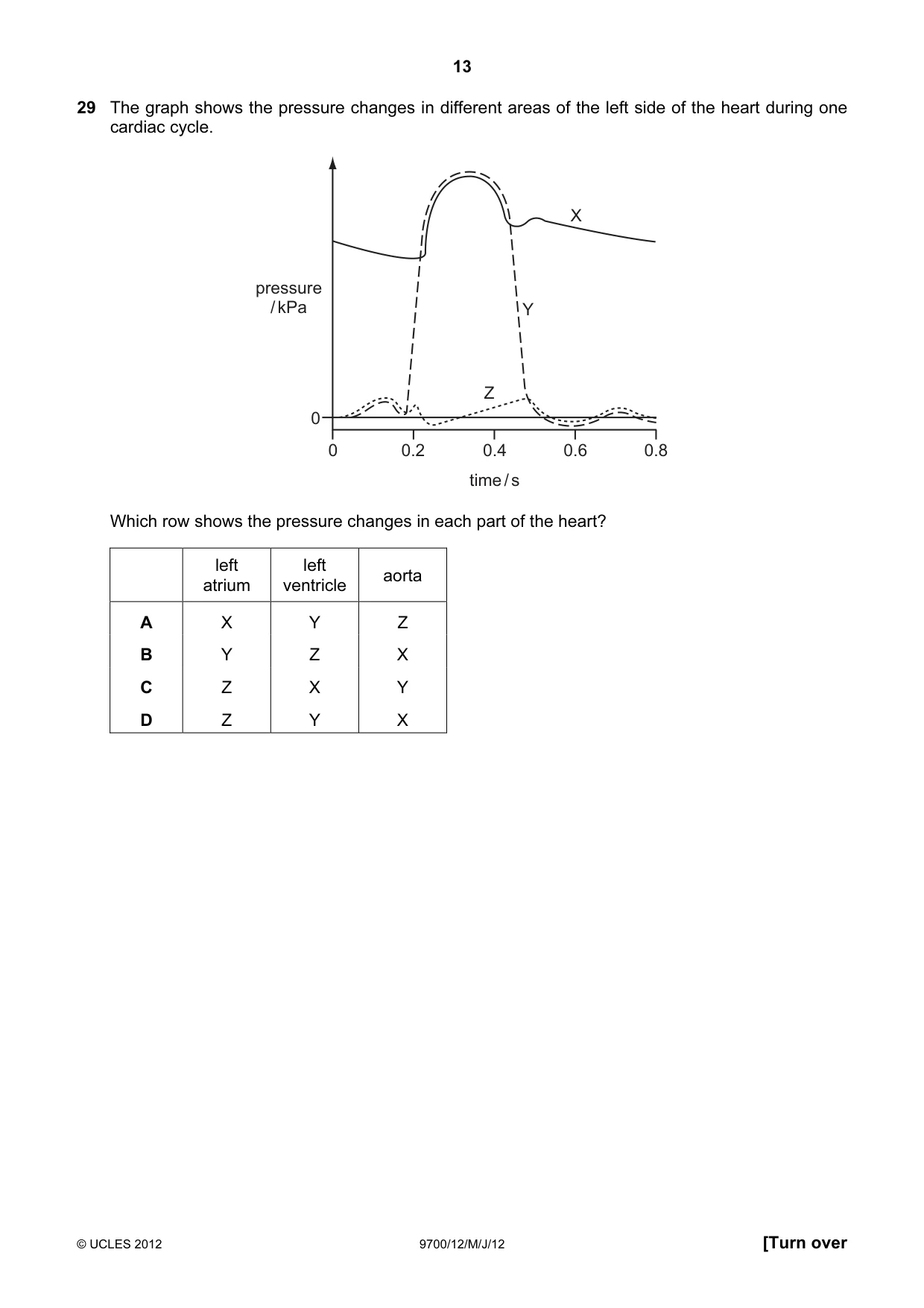
Q29 · The graph shows the pressure changes in different areas of the left side of the heart…
29 The graph shows the pressure changes in different areas of the left side of the heart during one cardiac cycle. X pressure / kPa Y Z 0 0 0.2 0.4 0.6 0.8 time / s Which row shows the pressure changes in each part of the heart? left left aorta atrium ventricle A X Y Z B Y Z X C Z X Y D Z Y X
Mark scheme: D
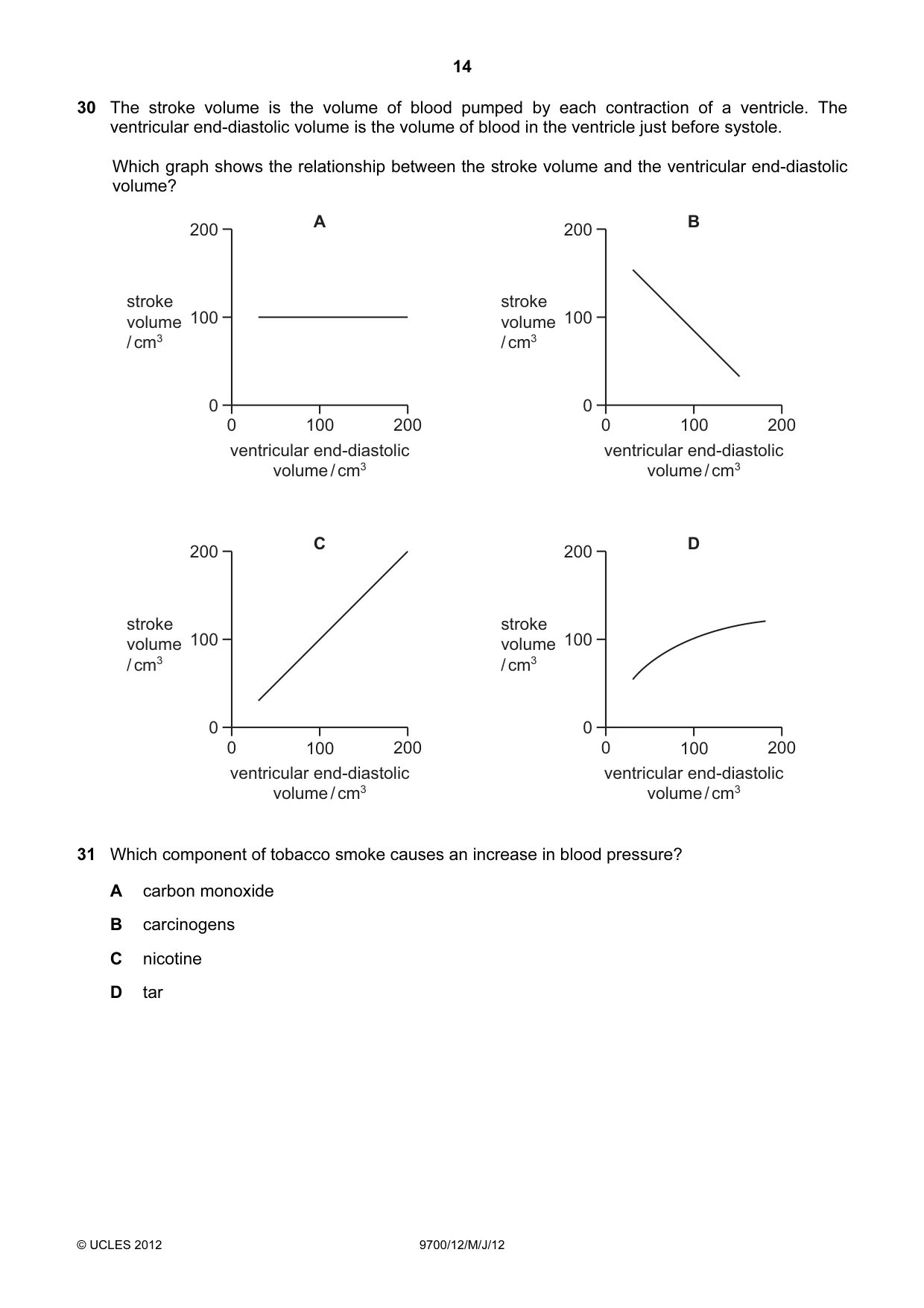
Q30 · The stroke volume is the volume of blood pumped by each contraction of a ventricle
30 The stroke volume is the volume of blood pumped by each contraction of a ventricle. The ventricular end-diastolic volume is the volume of blood in the ventricle just before systole. Which graph shows the relationship between the stroke volume and the ventricular end-diastolic volume? A B 200 200 stroke stroke volume 100 volume 100 / cm3 / cm3 0 0 0 100 200 0 100 200 ventricular end-diastolic ventricular end-diastolic volume / cm3 volume / cm3 C D 200 200 stroke stroke volume 100 volume 100 / cm3 / cm3 0 0 0 100 200 0 100 200 ventricular end-diastolic ventricular end-diastolic volume / cm3 volume / cm3
Mark scheme: D
Q31 · Which component of tobacco smoke causes an increase in blood pressure?
31 Which component of tobacco smoke causes an increase in blood pressure? A carbon monoxide B carcinogens C nicotine D tar
Mark scheme: C
Q32 · Which statements about chronic obstructive pulmonary disease (COPD) are correct?
32 Which statements about chronic obstructive pulmonary disease (COPD) are correct? 1 The patient coughs a lot, bringing up mucus. 2 The patient’s symptoms normally do not change. 3 The patient is normally over 30 years old. 4 The disease can often be reversed by treatment. A 1, 2 and 3 only B 1, 2 and 4 only C 2, 3 and 4 only D 1, 2, 3 and 4
Mark scheme: A
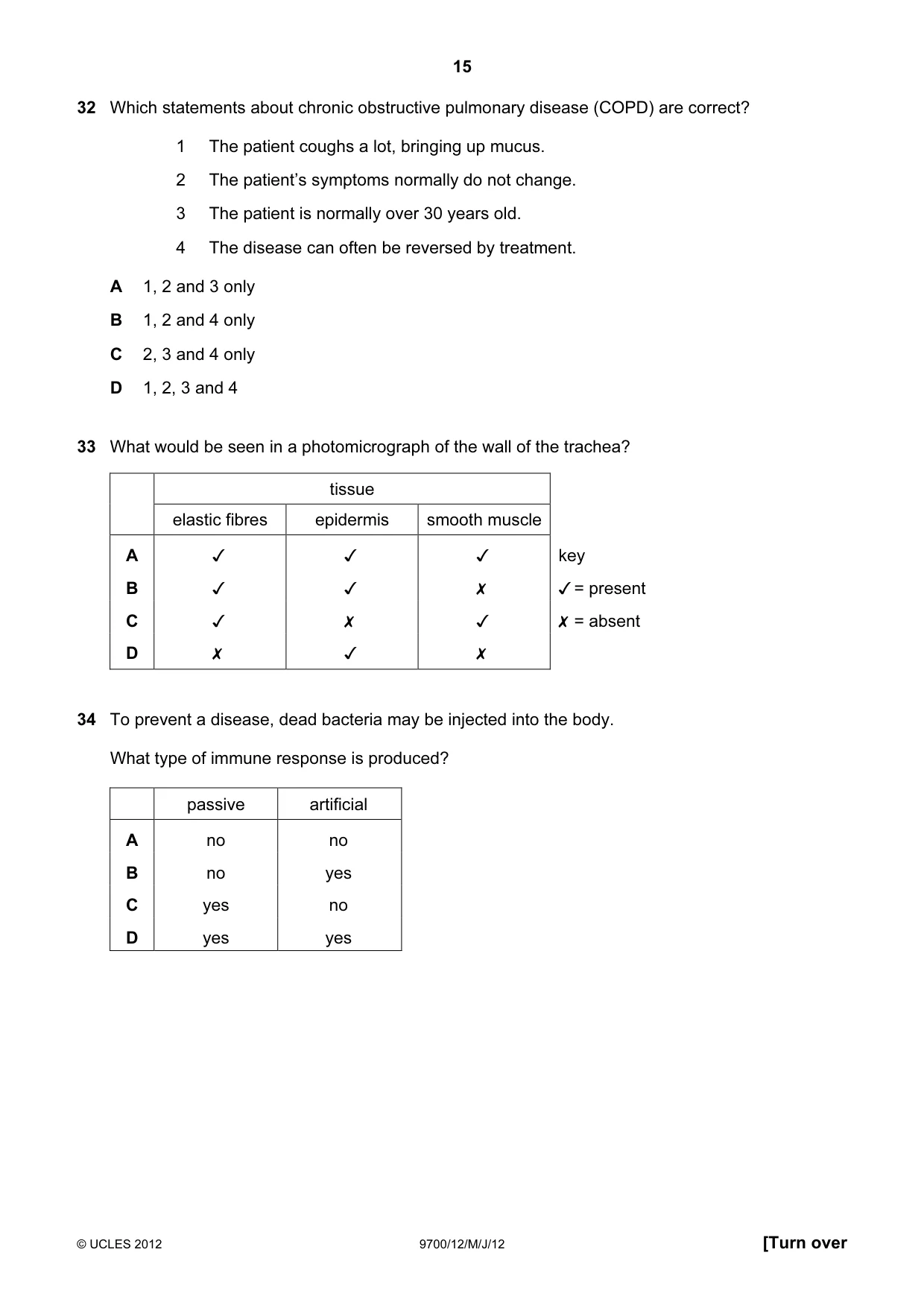
Q33 · What would be seen in a photomicrograph of the wall of the trachea?
33 What would be seen in a photomicrograph of the wall of the trachea? tissue elastic fibres epidermis smooth muscle A v v v B v v x Cc v x v D x v x key v¥ = present X = absent
Mark scheme: C
Q34 · To prevent a disease, dead bacteria may be injected into the body
34 To prevent a disease, dead bacteria may be injected into the body. What type of immune response is produced? passive artificial A no no B no yes C yes no D yes yes
Mark scheme: B
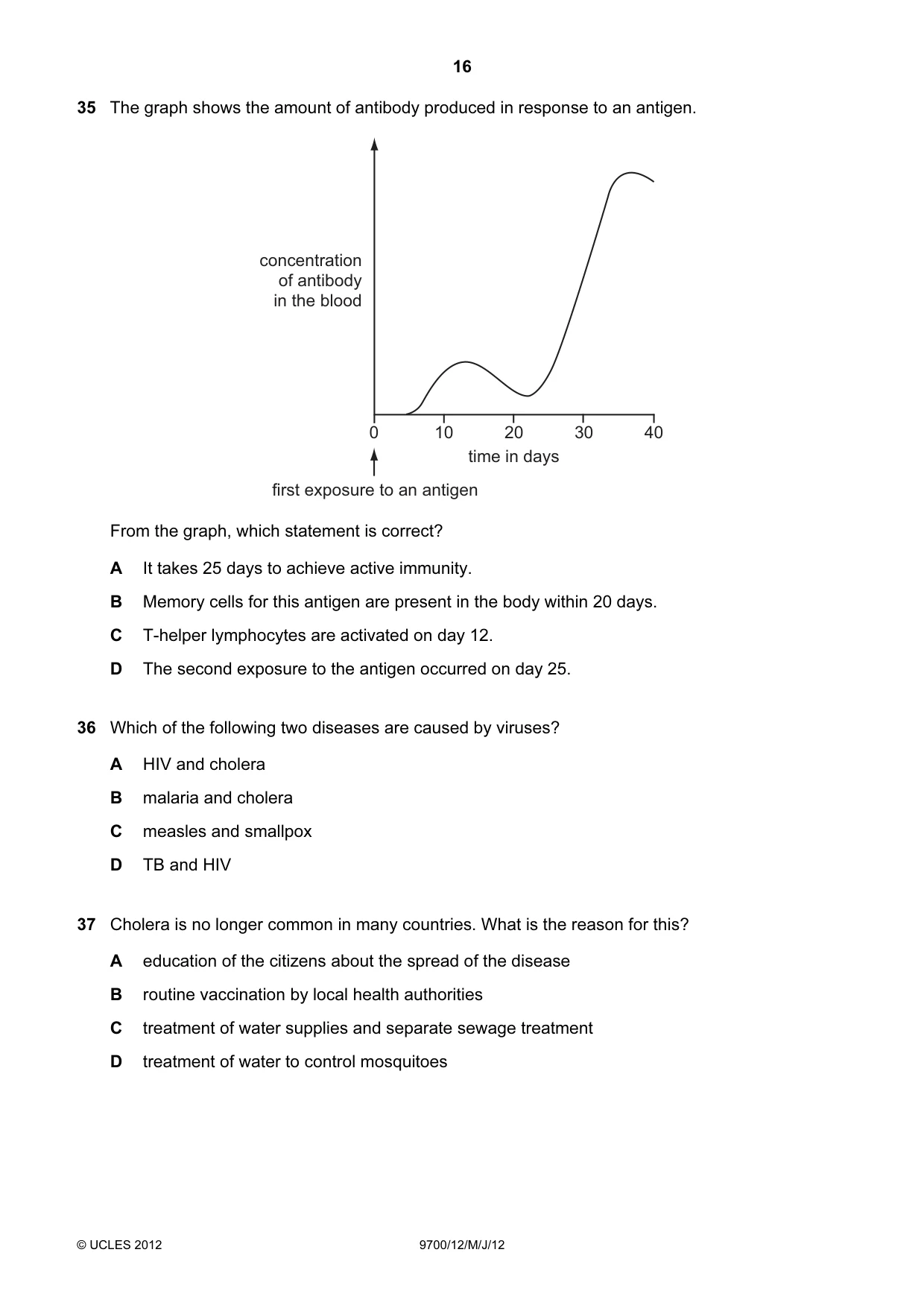
Q35 · The graph shows the amount of antibody produced in response to an antigen
35 The graph shows the amount of antibody produced in response to an antigen. concentration of antibody in the blood 0 10 20 30 40 time in days first exposure to an antigen From the graph, which statement is correct? A It takes 25 days to achieve active immunity. B Memory cells for this antigen are present in the body within 20 days. C T-helper lymphocytes are activated on day 12. D The second exposure to the antigen occurred on day 25.
Mark scheme: B
Q36 · Which of the following two diseases are caused by viruses?
36 Which of the following two diseases are caused by viruses? A HIV and cholera B malaria and cholera C measles and smallpox D TB and HIV
Mark scheme: C
Q37 · Cholera is no longer common in many countries
37 Cholera is no longer common in many countries. What is the reason for this? A education of the citizens about the spread of the disease B routine vaccination by local health authorities C treatment of water supplies and separate sewage treatment D treatment of water to control mosquitoes
Mark scheme: C
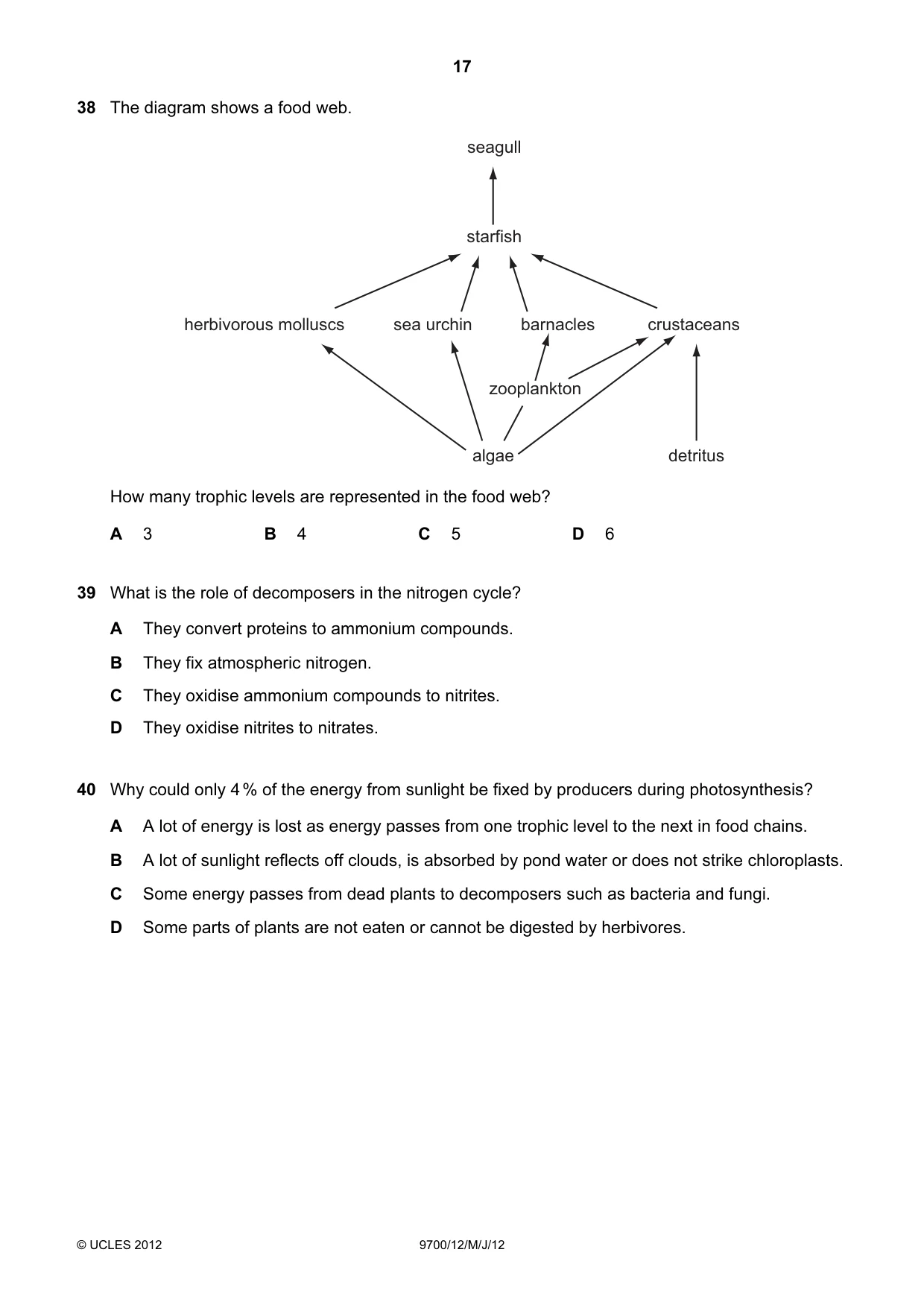
Q38 · The diagram shows a food web
38 The diagram shows a food web. seagull starfish herbivorous molluscs sea urchin barnacles crustaceans zooplankton algae detritus How many trophic levels are represented in the food web? A 3 B 4 C 5 D 6
Mark scheme: C
Q39 · What is the role of decomposers in the nitrogen cycle?
39 What is the role of decomposers in the nitrogen cycle? A They convert proteins to ammonium compounds. B They fix atmospheric nitrogen. C They oxidise ammonium compounds to nitrites. D They oxidise nitrites to nitrates.
Mark scheme: A
Q40 · Why could only 4 % of the energy from sunlight be fixed by producers during…
40 Why could only 4 % of the energy from sunlight be fixed by producers during photosynthesis? A A lot of energy is lost as energy passes from one trophic level to the next in food chains. B A lot of sunlight reflects off clouds, is absorbed by pond water or does not strike chloroplasts. C Some energy passes from dead plants to decomposers such as bacteria and fungi. D Some parts of plants are not eaten or cannot be digested by herbivores.
Mark scheme: B
More questions on Photosynthesis as an energy transfer process
What was in this paper
The subtopics covered by these 40 questions, and how many questions each got. Open one in a new tab to see every Cambridge question on it.
4Carbohydrates and lipids3Protein synthesis3The circulatory system3The microscope in cell studies3Antibodies and vaccination2Biodiversity2Cells as the basic units of living organisms2Infectious diseases2Mode of action of enzymes2Movement into and out of cells2Testing for biological molecules2The gas exchange system2The heart2Chromosome behaviour in mitosis1Fluid mosaic membranes1Photosynthesis as an energy transfer process1Proteins1Replication and division of nuclei and cells1Transport of oxygen and carbon dioxide1What you needed in this session
Cambridge’s own grade thresholds for 2012 May/June, Paper 1 · Variant 2. A higher threshold means an easier paper — the bar moves with how the cohort did.