Cambridge A Level Biology 9700 — 2022 Oct/Nov Paper 1 · Variant 3
9700/13/O/N/22 · 40 questions · 40 marks · ≈45 min
The question paper and its mark scheme, free to read here and free to download. This is Cambridge’s own paper, exactly as it was sat.
Question paper20 pages


Mark scheme3 pages
Answers below. Sit the paper first if you are practising.
Questions as text
Q1 · The electron micrograph shows a chloroplast from a tobacco leaf
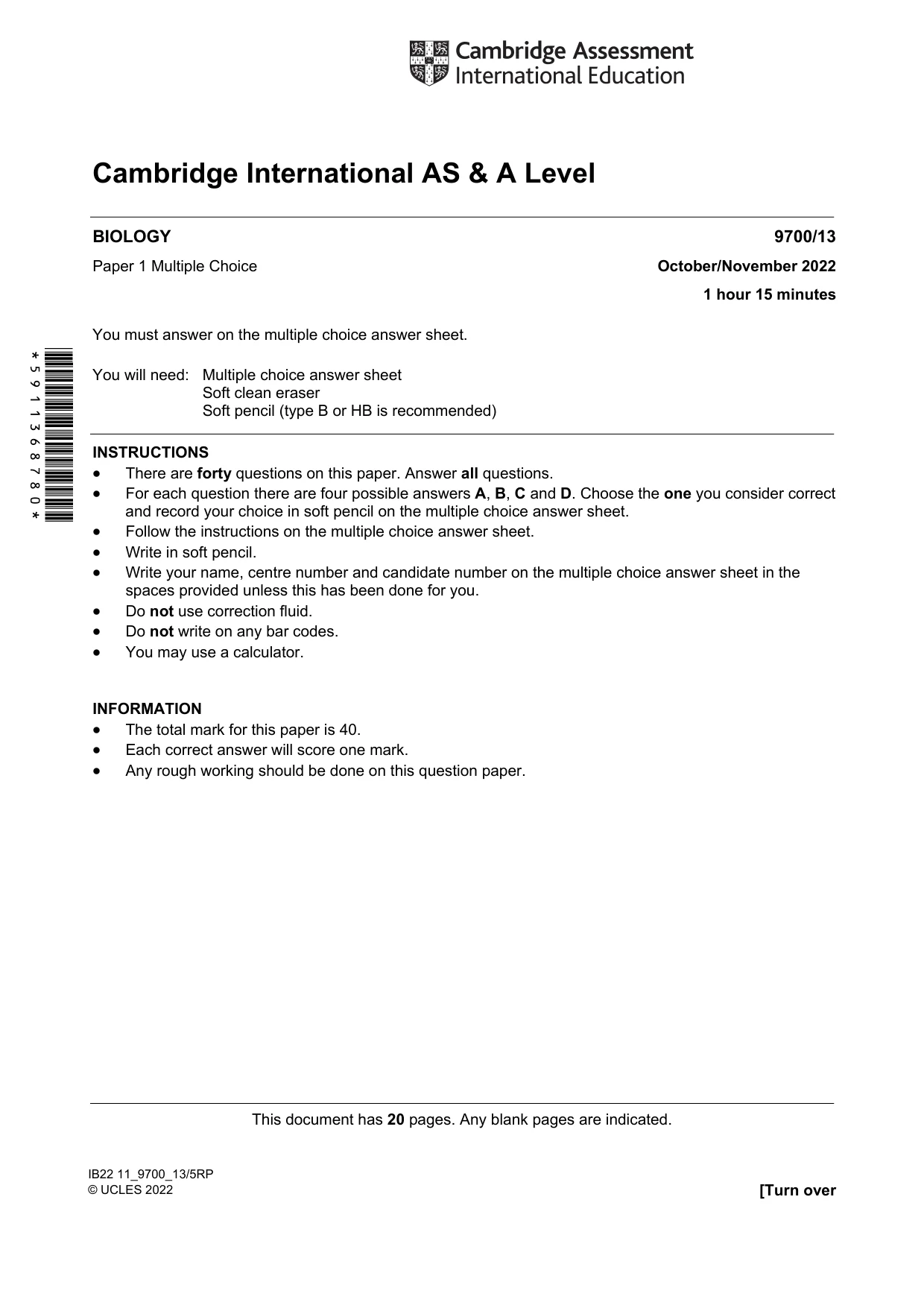
1 The electron micrograph shows a chloroplast from a tobacco leaf. X X Y Y If the actual length of this chloroplast measured along X–Y is 10 µm, what is the magnification of the image? A ×6.3 B ×63 C ×630 D ×6300
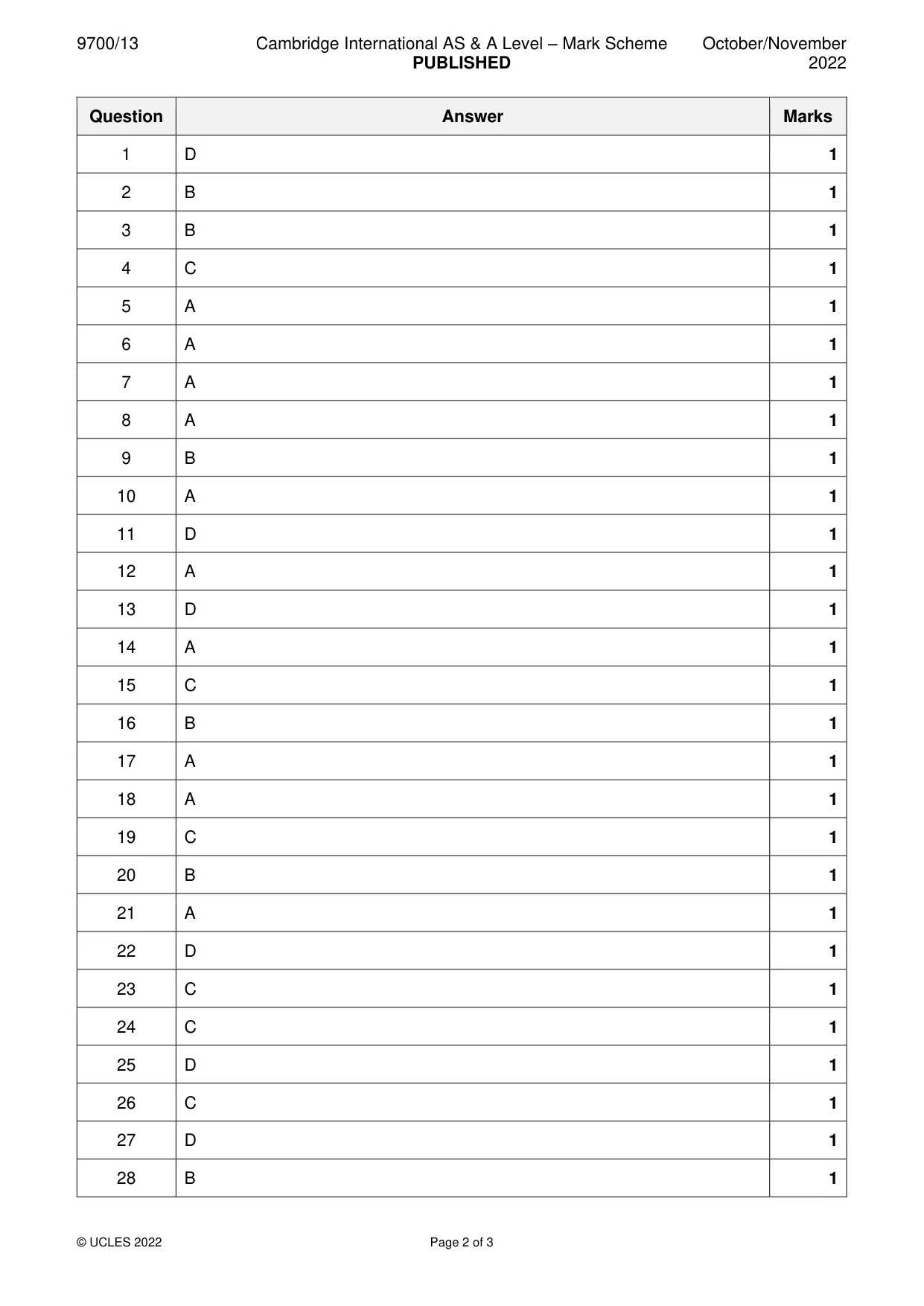
Mark scheme: D
Q2 · Some cell structures are listed
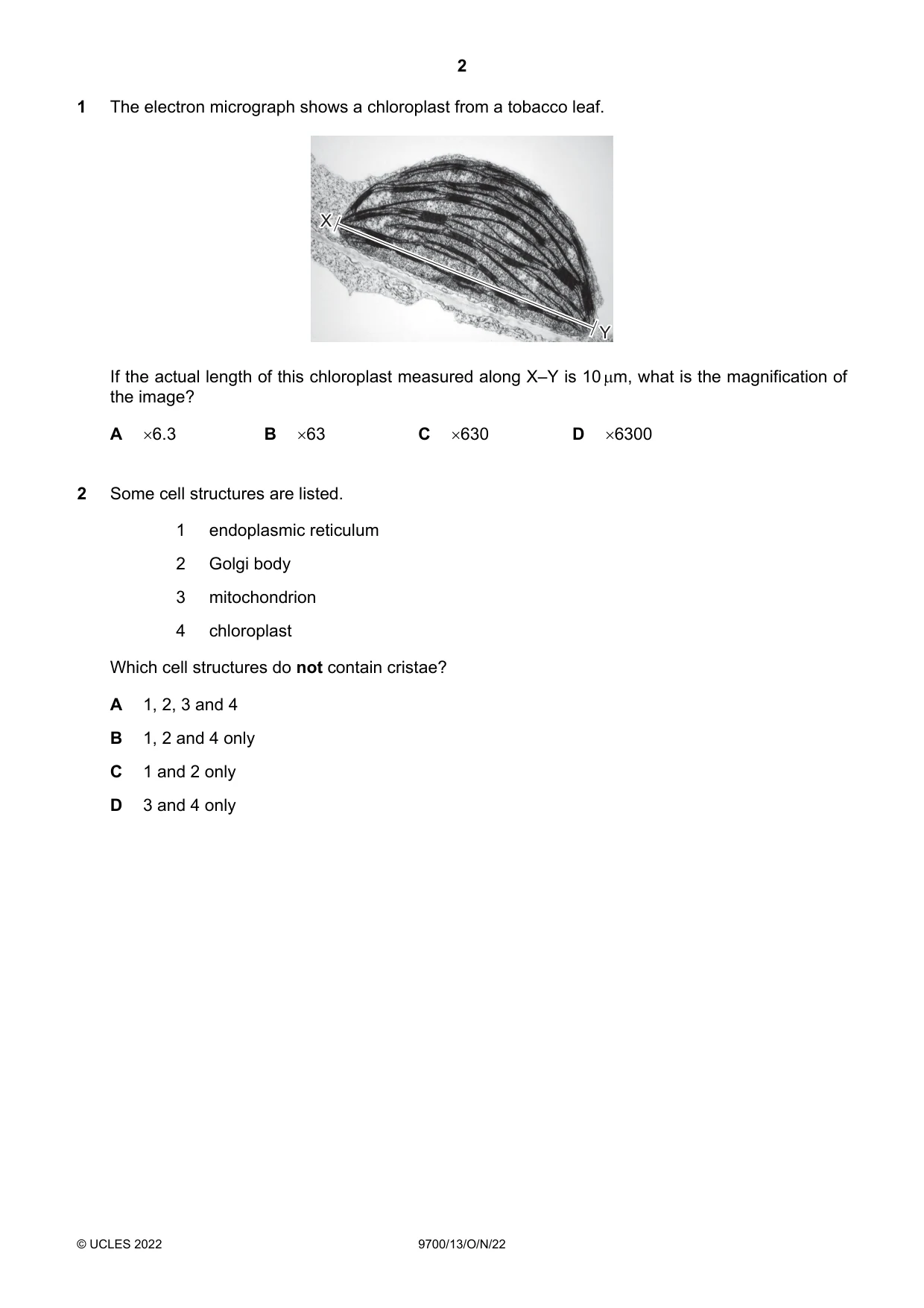
2 Some cell structures are listed. 1 endoplasmic reticulum 2 Golgi body 3 mitochondrion 4 chloroplast Which cell structures do not contain cristae? A 1, 2, 3 and 4 B 1, 2 and 4 only C 1 and 2 only D 3 and 4 only
Mark scheme: B
More questions on Cells as the basic units of living organisms
Q3 · Which letter represents cell structures where mRNA may be found?
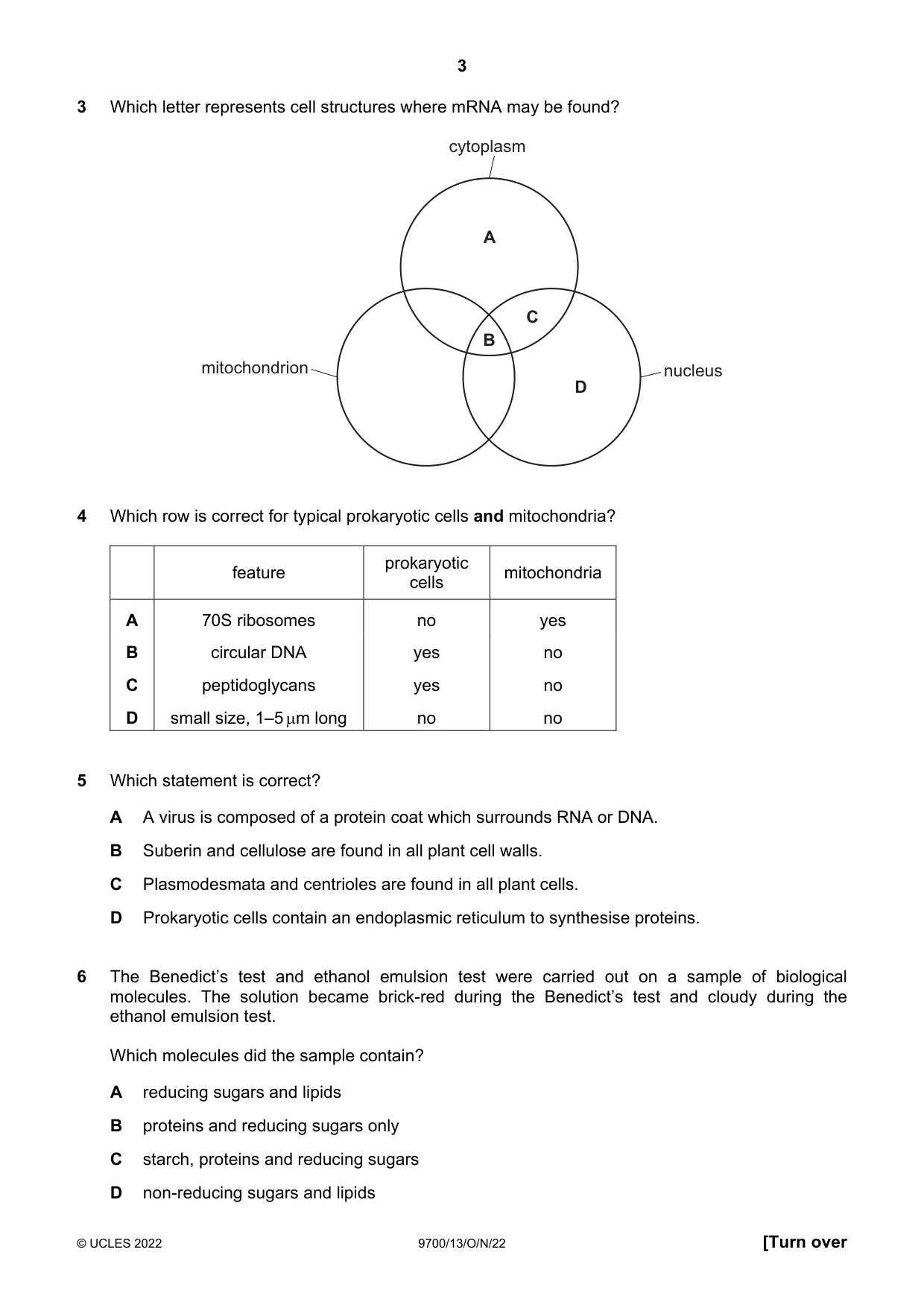
3 Which letter represents cell structures where mRNA may be found? cytoplasm A C B mitochondrion nucleus D
Mark scheme: B
More questions on Cells as the basic units of living organisms
Q4 · Which row is correct for typical prokaryotic cells and mitochondria?
4 Which row is correct for typical prokaryotic cells and mitochondria? prokaryotic feature mitochondria cells A 70S ribosomes no yes B circular DNA yes no C peptidoglycans yes no D small size, 1–5 µm long no no
Mark scheme: C
More questions on Cells as the basic units of living organisms
Q5 · Which statement is correct?
5 Which statement is correct? A A virus is composed of a protein coat which surrounds RNA or DNA. B Suberin and cellulose are found in all plant cell walls. C Plasmodesmata and centrioles are found in all plant cells. D Prokaryotic cells contain an endoplasmic reticulum to synthesise proteins.
Mark scheme: A
More questions on Cells as the basic units of living organisms
Q6 · The Benedict’s test and ethanol emulsion test were carried out on a sample of biological…
6 The Benedict’s test and ethanol emulsion test were carried out on a sample of biological molecules. The solution became brick-red during the Benedict’s test and cloudy during the ethanol emulsion test. Which molecules did the sample contain? A reducing sugars and lipids B proteins and reducing sugars only C starch, proteins and reducing sugars D non-reducing sugars and lipids
Mark scheme: A
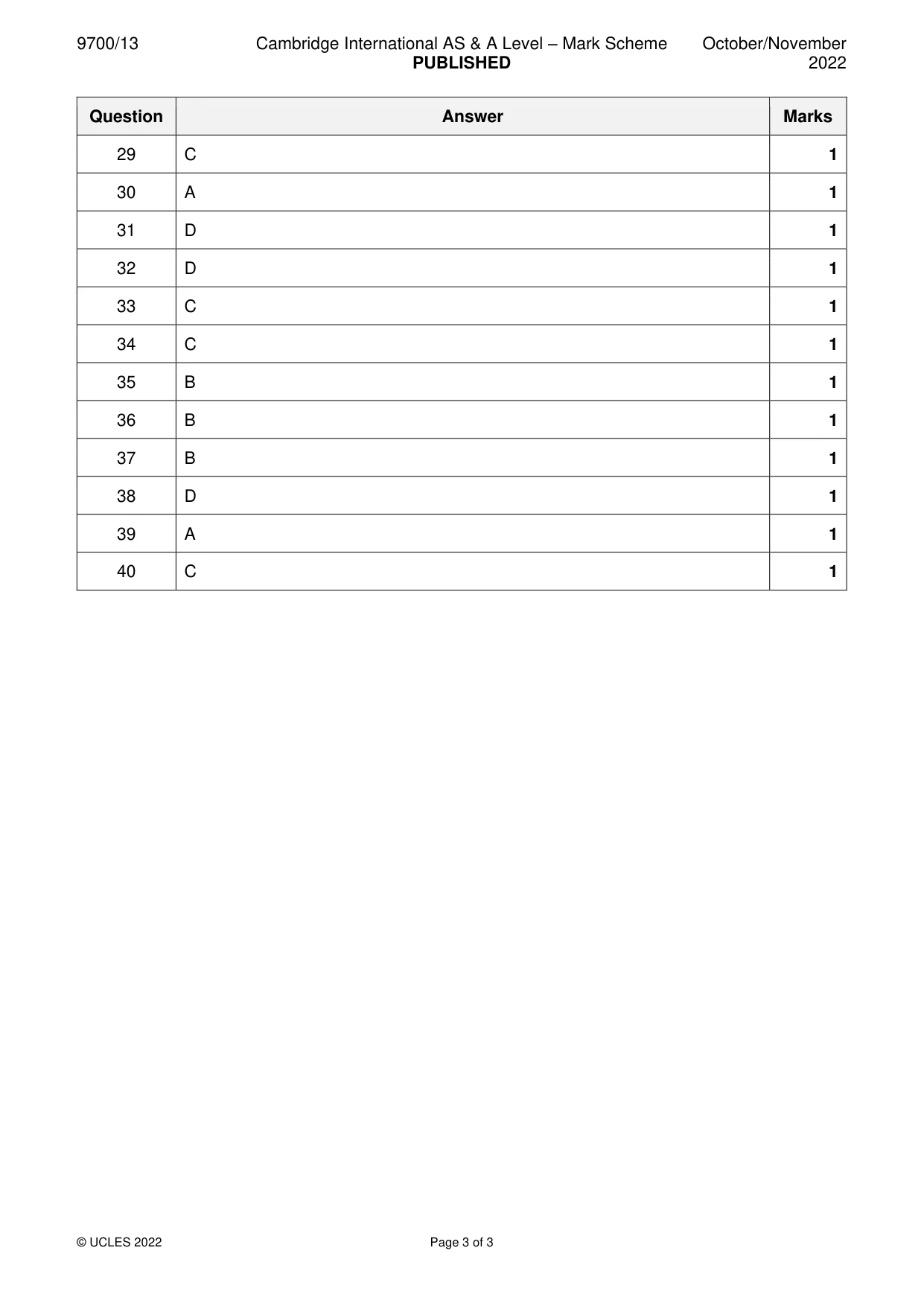
Q7 · Which diagram is correct for α-glucose?
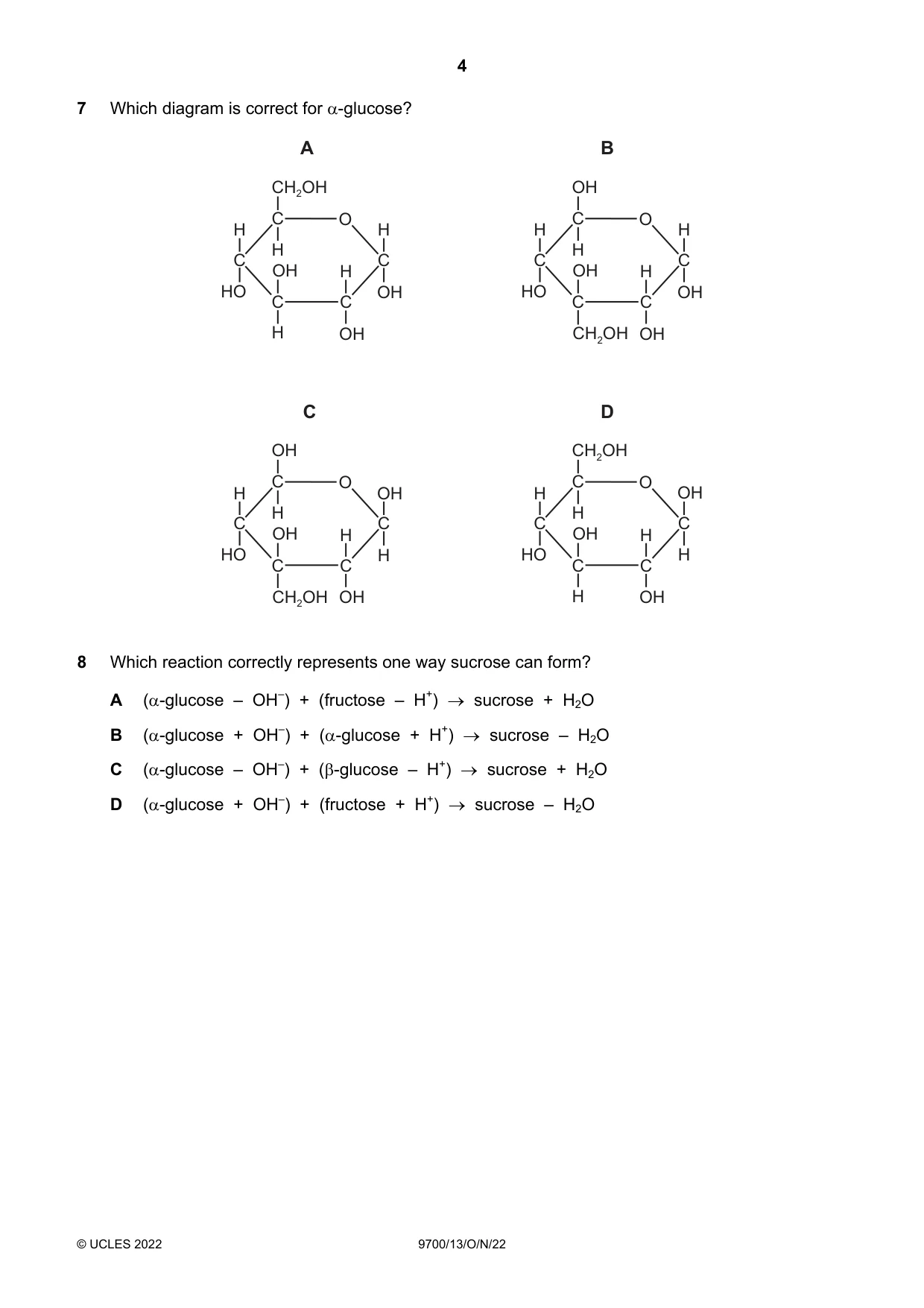
7 Which diagram is correct for α-glucose? A B CH2OH OH C O C O H H H H H H C C C C OH H OH H HO OH HO OH C C C C H OH CH2OH OH C D OH CH2OH C O C O H OH H OH H H C C C C OH H OH H HO H HO H C C C C CH2OH OH H OH
Mark scheme: A
Q8 · Which reaction correctly represents one way sucrose can form?
8 Which reaction correctly represents one way sucrose can form? A (α-glucose – OH–) + (fructose – H+) → sucrose + H2O B (α-glucose + OH–) + (α-glucose + H+) → sucrose – H2O C (α-glucose – OH–) + (β-glucose – H+) → sucrose + H2O D (α-glucose + OH–) + (fructose + H+) → sucrose – H2O
Mark scheme: A
Q9 · The diagram represents part of an alginic acid molecule
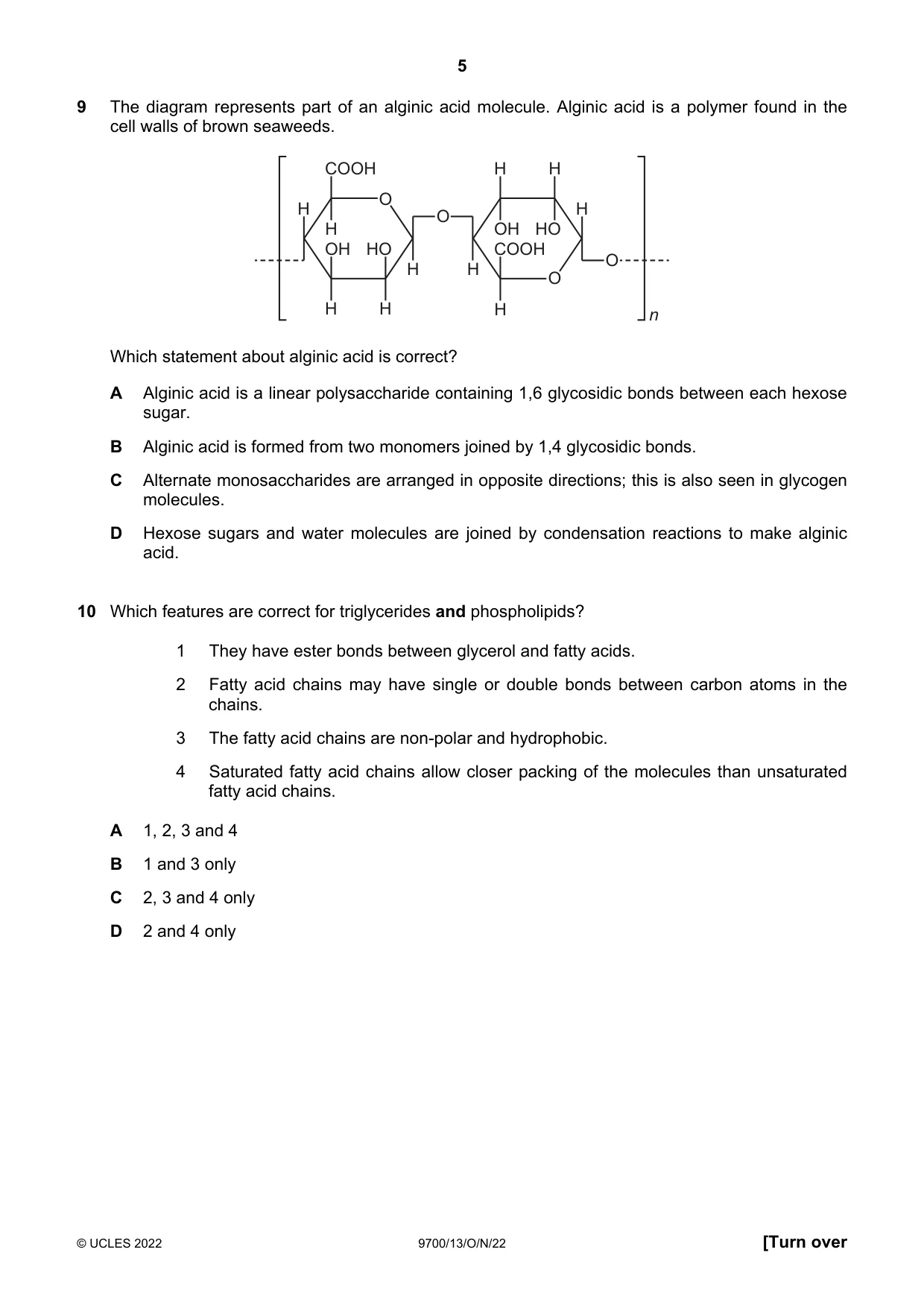
9 The diagram represents part of an alginic acid molecule. Alginic acid is a polymer found in the cell walls of brown seaweeds. COOH H H O H O H H OH HO OH HO COOH O H H O H H H n Which statement about alginic acid is correct? A Alginic acid is a linear polysaccharide containing 1,6 glycosidic bonds between each hexose sugar. B Alginic acid is formed from two monomers joined by 1,4 glycosidic bonds. C Alternate monosaccharides are arranged in opposite directions; this is also seen in glycogen molecules. D Hexose sugars and water molecules are joined by condensation reactions to make alginic acid.
Mark scheme: B
Q10 · Which features are correct for triglycerides and phospholipids?
10 Which features are correct for triglycerides and phospholipids? 1 They have ester bonds between glycerol and fatty acids. 2 Fatty acid chains may have single or double bonds between carbon atoms in the chains. 3 The fatty acid chains are non-polar and hydrophobic. 4 Saturated fatty acid chains allow closer packing of the molecules than unsaturated fatty acid chains. A 1, 2, 3 and 4 B 1 and 3 only C 2, 3 and 4 only D 2 and 4 only
Mark scheme: A
Q11 · A scientist studying the structure of a protein reported that it consists of two…
11 A scientist studying the structure of a protein reported that it consists of two polypeptide chains joined by disulfide bonds. Which feature of protein structure does this describe? A primary structure B secondary structure C tertiary structure D quaternary structure
Mark scheme: D
Q12 · Some molecules fluoresce when illuminated with ultraviolet light
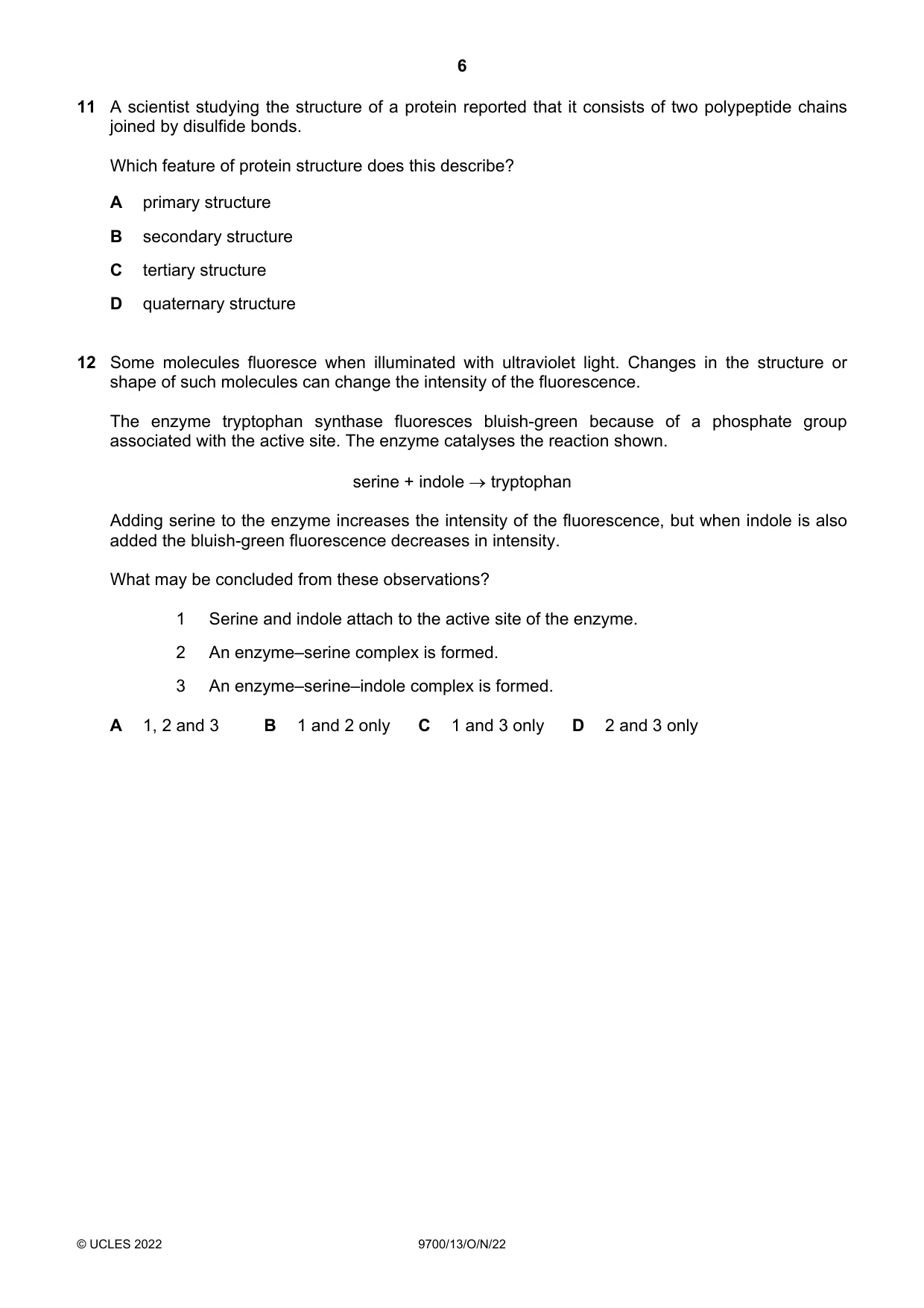
12 Some molecules fluoresce when illuminated with ultraviolet light. Changes in the structure or shape of such molecules can change the intensity of the fluorescence. The enzyme tryptophan synthase fluoresces bluish-green because of a phosphate group associated with the active site. The enzyme catalyses the reaction shown. serine + indole → tryptophan Adding serine to the enzyme increases the intensity of the fluorescence, but when indole is also added the bluish-green fluorescence decreases in intensity. What may be concluded from these observations? 1 Serine and indole attach to the active site of the enzyme. 2 An enzyme–serine complex is formed. 3 An enzyme–serine–indole complex is formed. A 1, 2 and 3 B 1 and 2 only C 1 and 3 only D 2 and 3 only
Mark scheme: A
Q13 · Yeast contains the enzyme catalase which catalyses the breakdown of hydrogen peroxide…
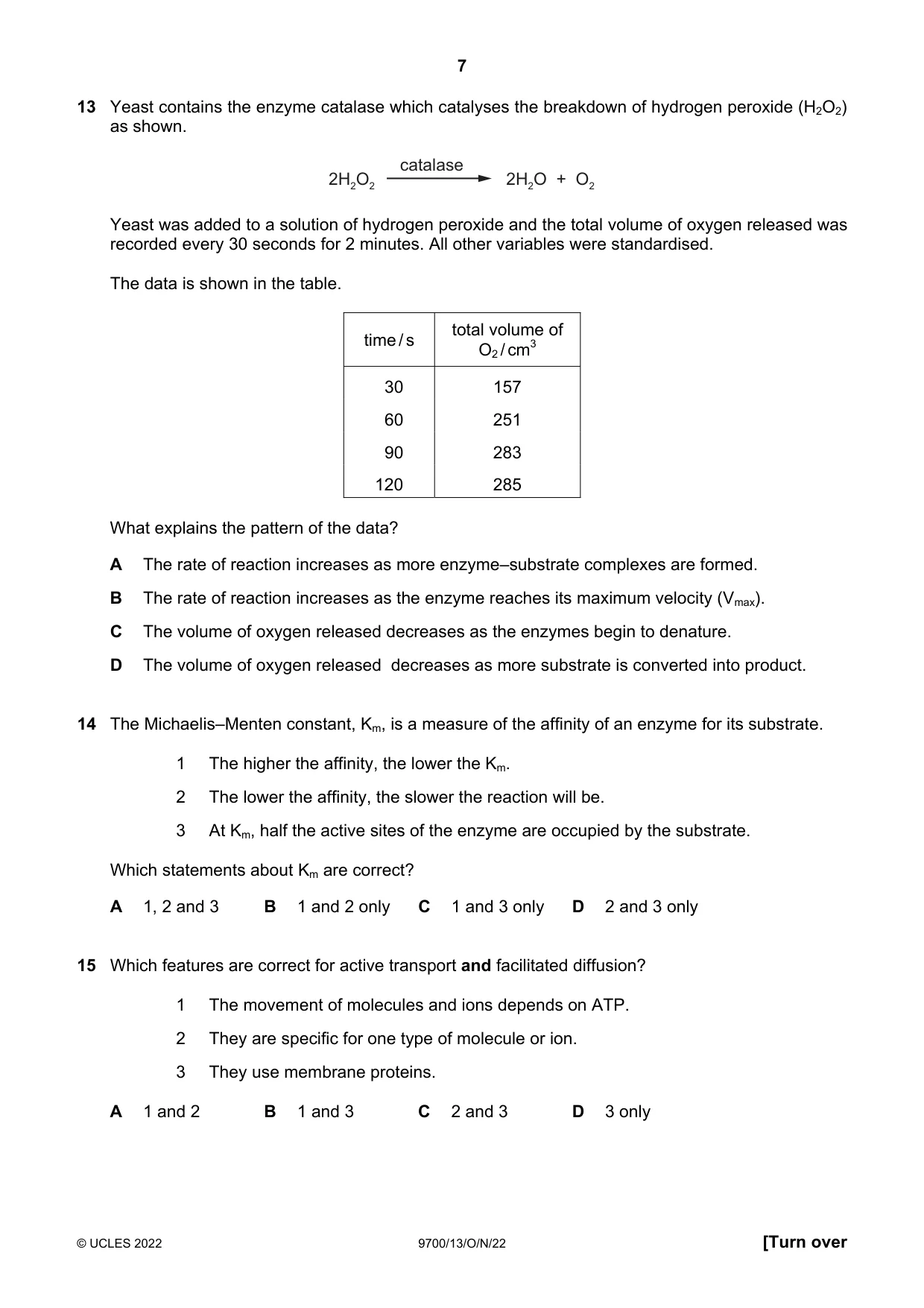
13 Yeast contains the enzyme catalase which catalyses the breakdown of hydrogen peroxide (H2O2) as shown. catalase 2H2O2 2H2O + O2 Yeast was added to a solution of hydrogen peroxide and the total volume of oxygen released was recorded every 30 seconds for 2 minutes. All other variables were standardised. The data is shown in the table. total volume of time / s O2 / cm3 30 157 60 251 90 283 120 285 What explains the pattern of the data? A The rate of reaction increases as more enzyme–substrate complexes are formed. B The rate of reaction increases as the enzyme reaches its maximum velocity (Vmax). C The volume of oxygen released decreases as the enzymes begin to denature. D The volume of oxygen released decreases as more substrate is converted into product.
Mark scheme: D
Q14 · The Michaelis–Menten constant, Km, is a measure of the affinity of an enzyme for its…
14 The Michaelis–Menten constant, Km, is a measure of the affinity of an enzyme for its substrate. 1 The higher the affinity, the lower the Km. 2 The lower the affinity, the slower the reaction will be. 3 At Km, half the active sites of the enzyme are occupied by the substrate. Which statements about Km are correct? A 1, 2 and 3 B 1 and 2 only C 1 and 3 only D 2 and 3 only
Mark scheme: A
Q15 · Which features are correct for active transport and facilitated diffusion?
15 Which features are correct for active transport and facilitated diffusion? 1 The movement of molecules and ions depends on ATP. 2 They are specific for one type of molecule or ion. 3 They use membrane proteins. A 1 and 2 B 1 and 3 C 2 and 3 D 3 only
Mark scheme: C
Q16 · The diagram represents two solutions, P and Q, that were separated by a partially…
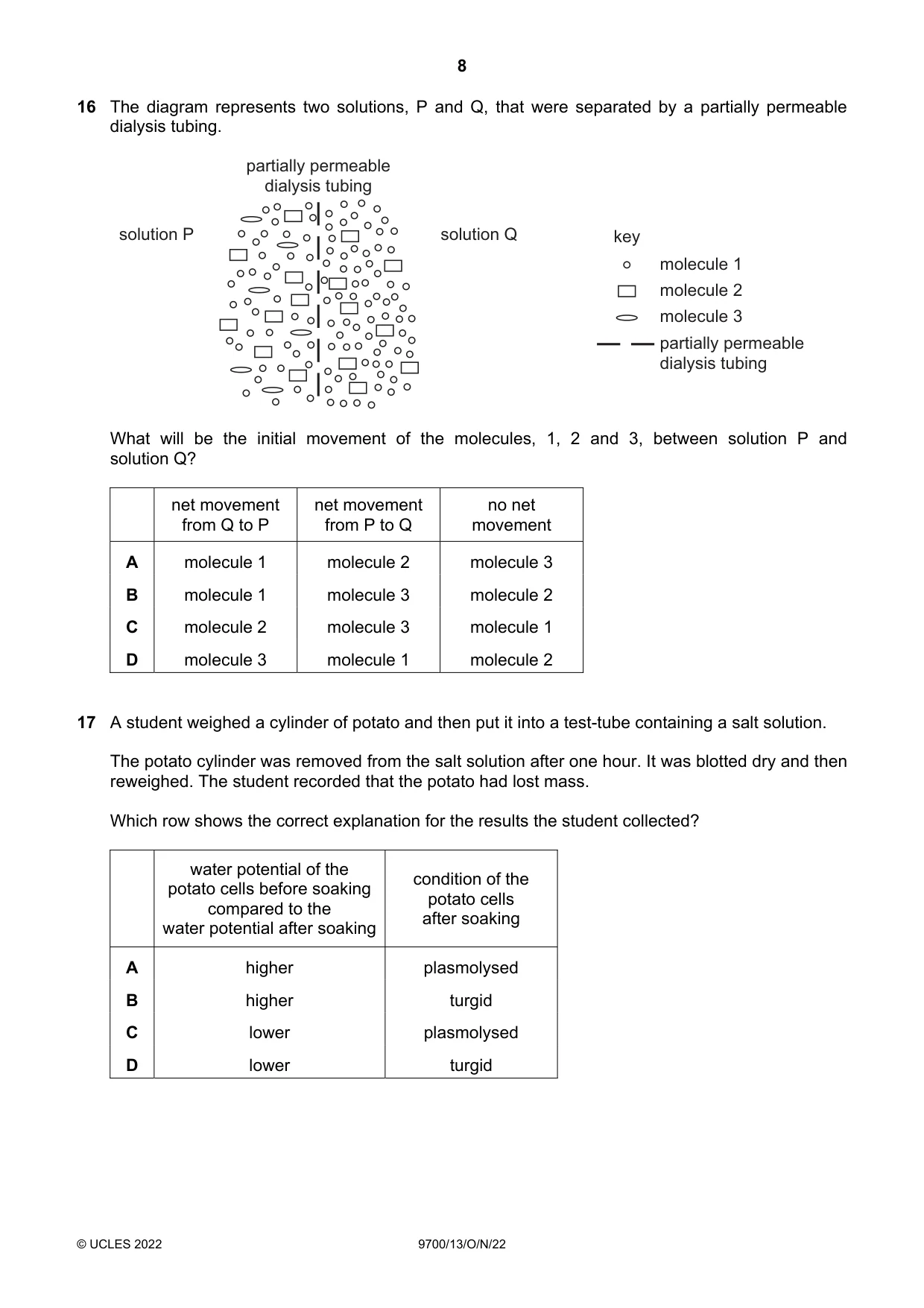
16 The diagram represents two solutions, P and Q, that were separated by a partially permeable dialysis tubing. partially permeable dialysis tubing solution P solution Q key molecule 1 molecule 2 molecule 3 partially permeable dialysis tubing What will be the initial movement of the molecules, 1, 2 and 3, between solution P and solution Q? net movement net movement no net from Q to P from P to Q movement A molecule 1 molecule 2 molecule 3 B molecule 1 molecule 3 molecule 2 C molecule 2 molecule 3 molecule 1 D molecule 3 molecule 1 molecule 2
Mark scheme: B
Q17 · A student weighed a cylinder of potato and then put it into a test-tube containing a salt…
17 A student weighed a cylinder of potato and then put it into a test-tube containing a salt solution. The potato cylinder was removed from the salt solution after one hour. It was blotted dry and then reweighed. The student recorded that the potato had lost mass. Which row shows the correct explanation for the results the student collected? water potential of the condition of the potato cells before soaking potato cells compared to the after soaking water potential after soaking A higher plasmolysed B higher turgid C lower plasmolysed D lower turgid
Mark scheme: A
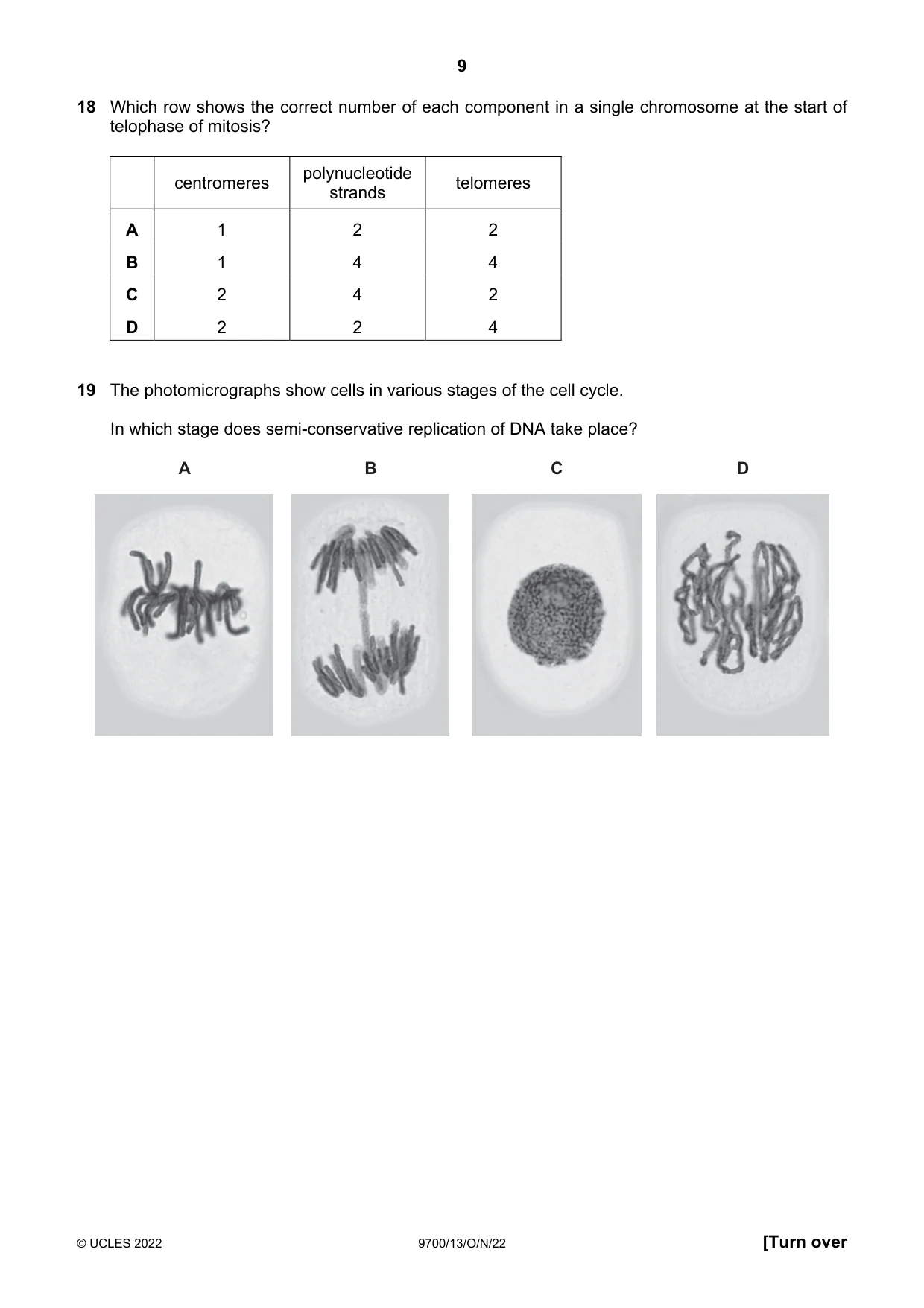
Q18 · Which row shows the correct number of each component in a single chromosome at the start…
18 Which row shows the correct number of each component in a single chromosome at the start of telophase of mitosis? polynucleotide centromeres telomeres strands A 1 2 2 B 1 4 4 C 2 4 2 D 2 2 4
Mark scheme: A
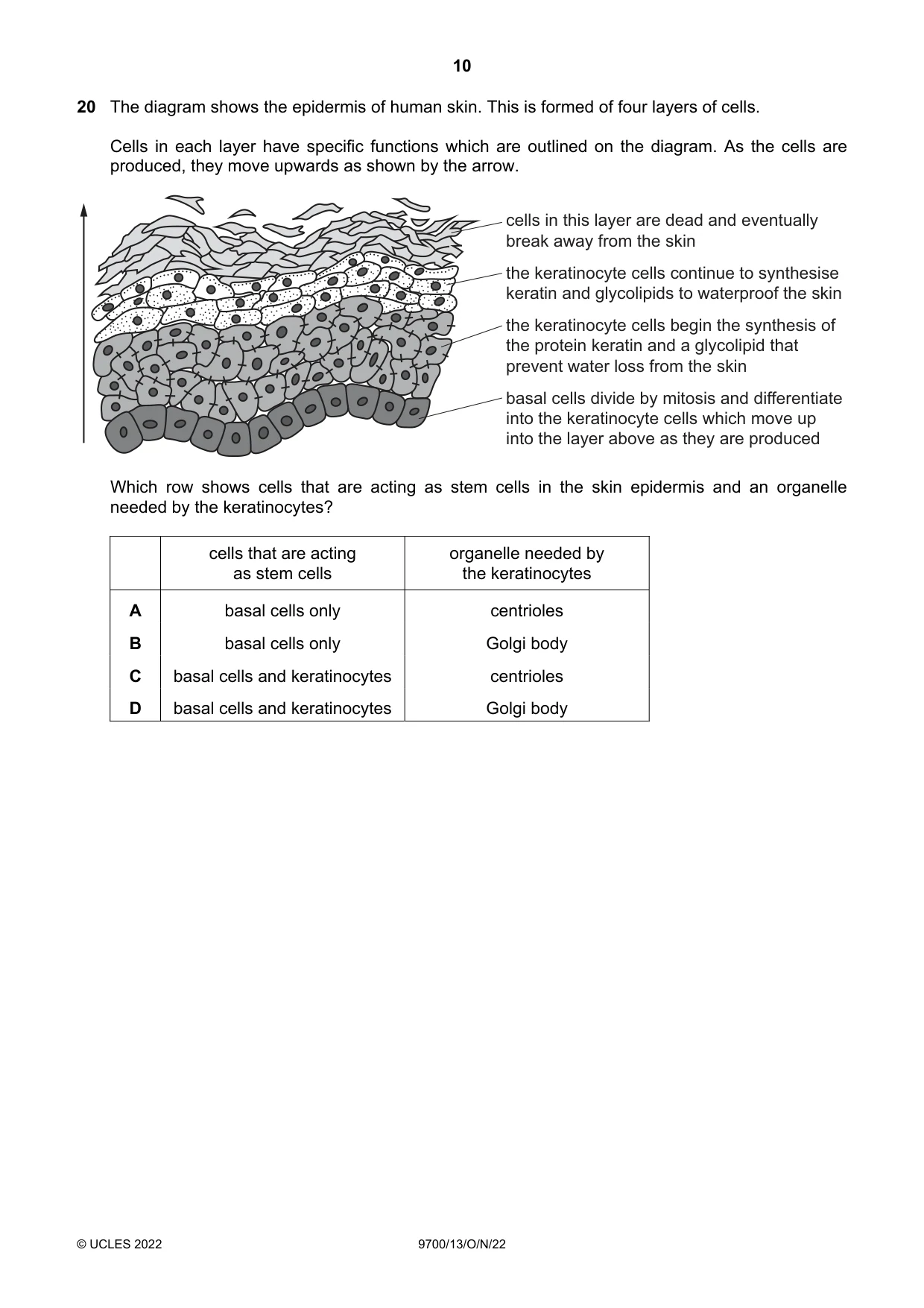
Q19 · The photomicrographs show cells in various stages of the cell cycle
19 The photomicrographs show cells in various stages of the cell cycle. In which stage does semi-conservative replication of DNA take place? A B C D
Mark scheme: C
More questions on Replication and division of nuclei and cells
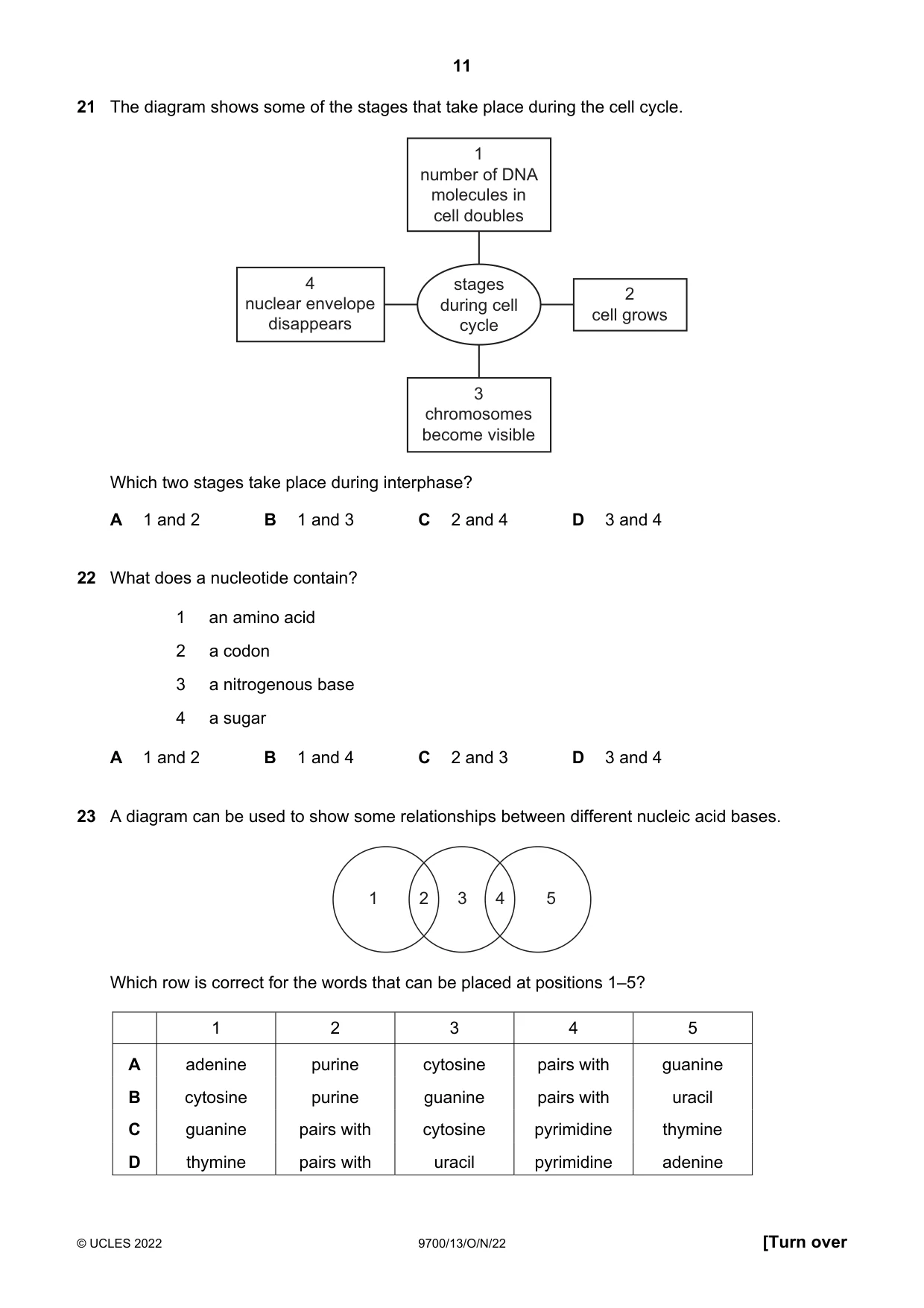
Q20 · The diagram shows the epidermis of human skin
20 The diagram shows the epidermis of human skin. This is formed of four layers of cells. Cells in each layer have specific functions which are outlined on the diagram. As the cells are produced, they move upwards as shown by the arrow. cells in this layer are dead and eventually break away from the skin the keratinocyte cells continue to synthesise keratin and glycolipids to waterproof the skin the keratinocyte cells begin the synthesis of the protein keratin and a glycolipid that prevent water loss from the skin basal cells divide by mitosis and differentiate into the keratinocyte cells which move up into the layer above as they are produced Which row shows cells that are acting as stem cells in the skin epidermis and an organelle needed by the keratinocytes? cells that are acting organelle needed by as stem cells the keratinocytes A basal cells only centrioles B basal cells only Golgi body C basal cells and keratinocytes centrioles D basal cells and keratinocytes Golgi body
Mark scheme: B
More questions on Replication and division of nuclei and cells
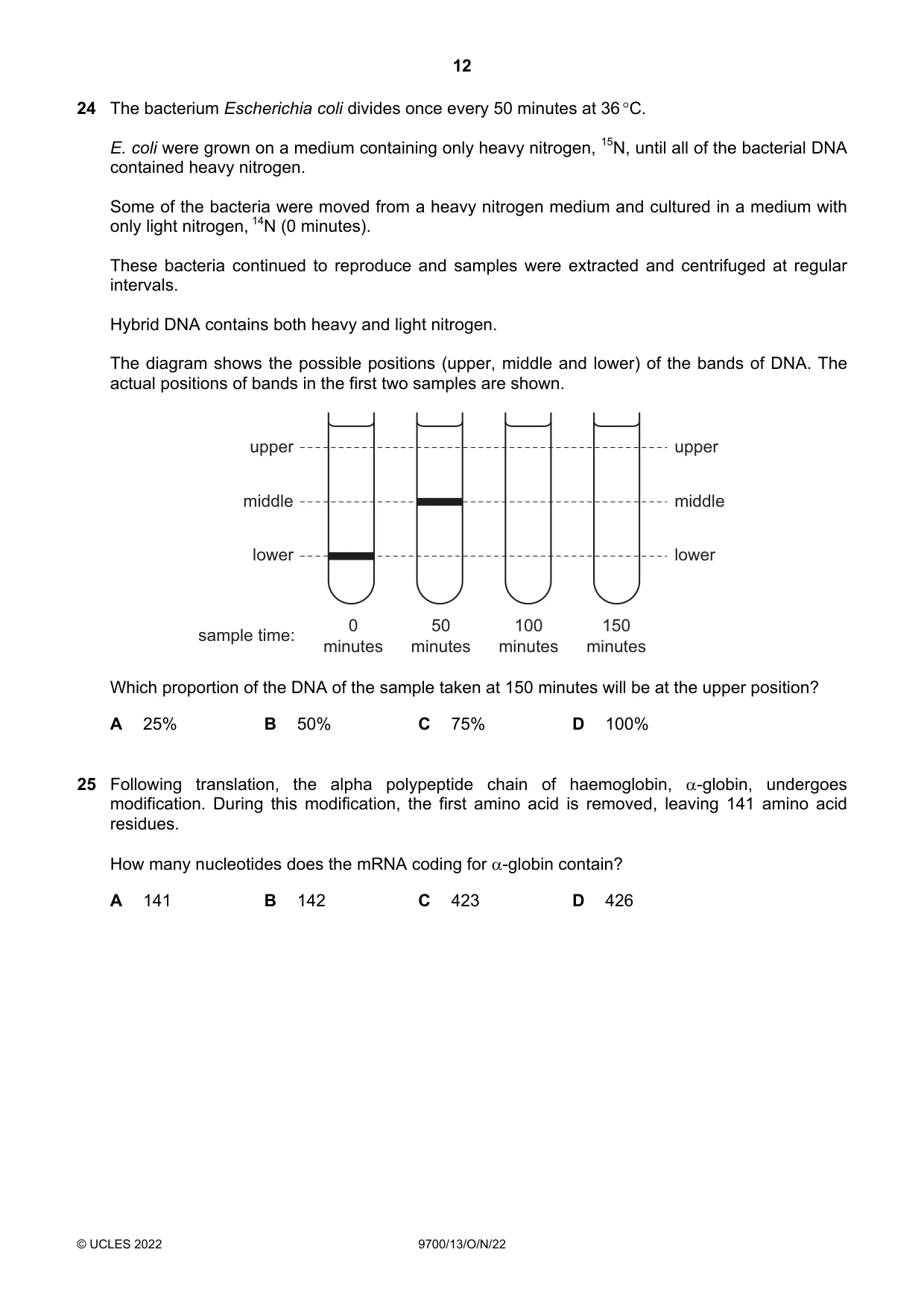
Q21 · The diagram shows some of the stages that take place during the cell cycle
21 The diagram shows some of the stages that take place during the cell cycle. 1 number of DNA molecules in cell doubles 4 stages 2 nuclear envelope during cell cell grows disappears cycle 3 chromosomes become visible Which two stages take place during interphase? A 1 and 2 B 1 and 3 C 2 and 4 D 3 and 4
Mark scheme: A
More questions on Replication and division of nuclei and cells
Q22 · What does a nucleotide contain?
22 What does a nucleotide contain? 1 an amino acid 2 a codon 3 a nitrogenous base 4 a sugar A 1 and 2 B 1 and 4 C 2 and 3 D 3 and 4
Mark scheme: D
More questions on Structure of nucleic acids and replication of DNA
Q23 · A diagram can be used to show some relationships between different nucleic acid bases
23 A diagram can be used to show some relationships between different nucleic acid bases. 1 2 3 4 5 Which row is correct for the words that can be placed at positions 1–5? 1 2 3 4 5 A adenine purine cytosine pairs with guanine B cytosine purine guanine pairs with uracil C guanine pairs with cytosine pyrimidine thymine D thymine pairs with uracil pyrimidine adenine
Mark scheme: C
More questions on Structure of nucleic acids and replication of DNA
Q24 · The bacterium Escherichia coli divides once every 50 minutes at 36 °C
24 The bacterium Escherichia coli divides once every 50 minutes at 36 °C. E. coli were grown on a medium containing only heavy nitrogen, 15N, until all of the bacterial DNA contained heavy nitrogen. Some of the bacteria were moved from a heavy nitrogen medium and cultured in a medium with only light nitrogen, 14N (0 minutes). These bacteria continued to reproduce and samples were extracted and centrifuged at regular intervals. Hybrid DNA contains both heavy and light nitrogen. The diagram shows the possible positions (upper, middle and lower) of the bands of DNA. The actual positions of bands in the first two samples are shown. upper upper middle middle lower lower 0 50 100 150 sample time: minutes minutes minutes minutes Which proportion of the DNA of the sample taken at 150 minutes will be at the upper position? A 25% B 50% C 75% D 100%
Mark scheme: C
More questions on Structure of nucleic acids and replication of DNA
Q25 · Following translation, the alpha polypeptide chain of haemoglobin, α-globin, undergoes…
25 Following translation, the alpha polypeptide chain of haemoglobin, α-globin, undergoes modification. During this modification, the first amino acid is removed, leaving 141 amino acid residues. How many nucleotides does the mRNA coding for α-globin contain? A 141 B 142 C 423 D 426
Mark scheme: D
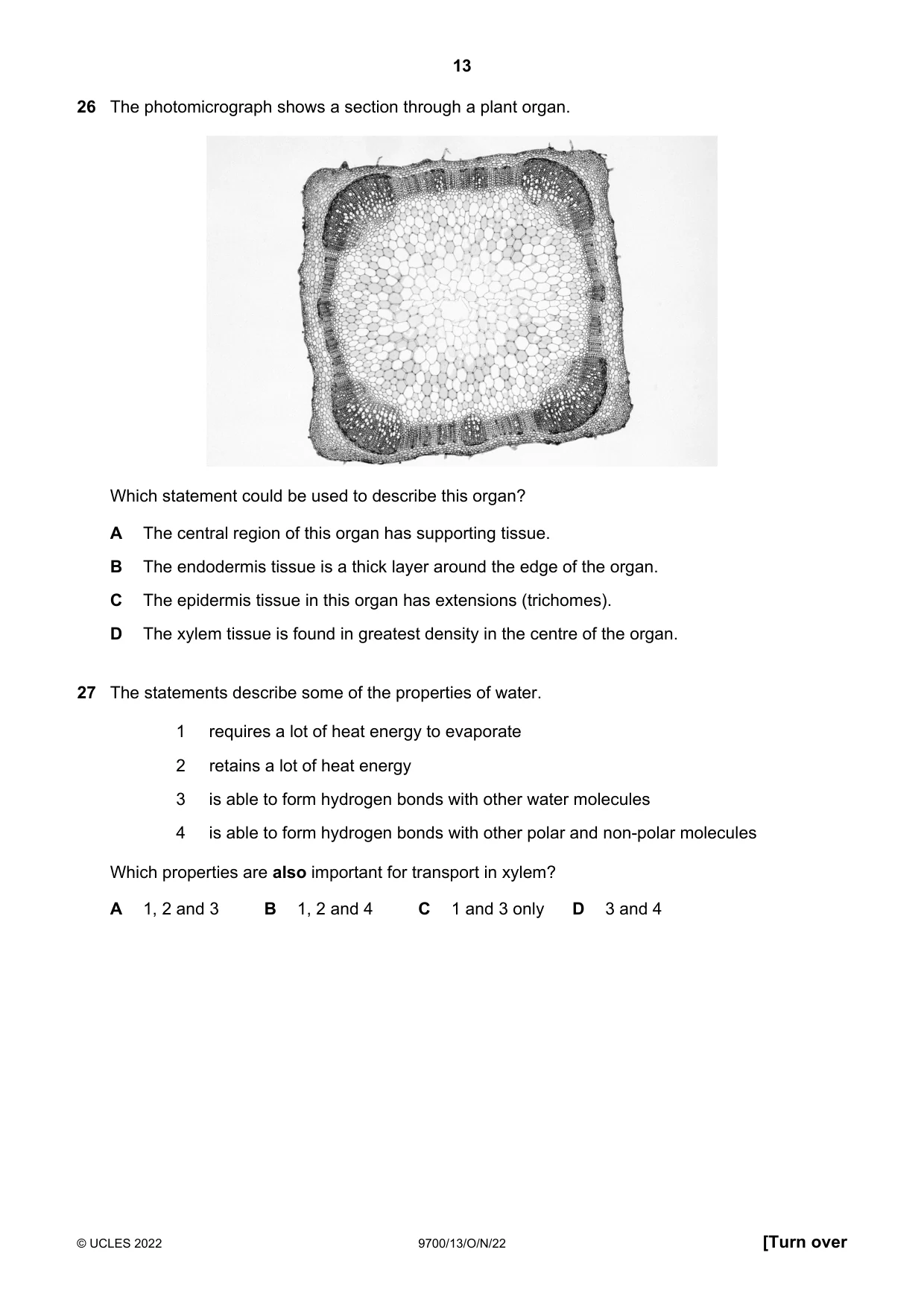
Q26 · The photomicrograph shows a section through a plant organ
26 The photomicrograph shows a section through a plant organ. Which statement could be used to describe this organ? A The central region of this organ has supporting tissue. B The endodermis tissue is a thick layer around the edge of the organ. C The epidermis tissue in this organ has extensions (trichomes). D The xylem tissue is found in greatest density in the centre of the organ.
Mark scheme: C
Q27 · The statements describe some of the properties of water
27 The statements describe some of the properties of water. 1 requires a lot of heat energy to evaporate 2 retains a lot of heat energy 3 is able to form hydrogen bonds with other water molecules 4 is able to form hydrogen bonds with other polar and non-polar molecules Which properties are also important for transport in xylem? A 1, 2 and 3 B 1, 2 and 4 C 1 and 3 only D 3 and 4
Mark scheme: D
Q28 · Which xerophytic adaptations reduce the water potential gradient between leaf surface and…
28 Which xerophytic adaptations reduce the water potential gradient between leaf surface and atmosphere? 1 rolled leaves 2 hairy leaves 3 sunken stomata 4 fewer stomata 5 fleshy leaves A 1, 2, 3, 4 and 5 B 1, 2 and 3 only C 1, 3 and 4 only D 2 and 5 only
Mark scheme: B
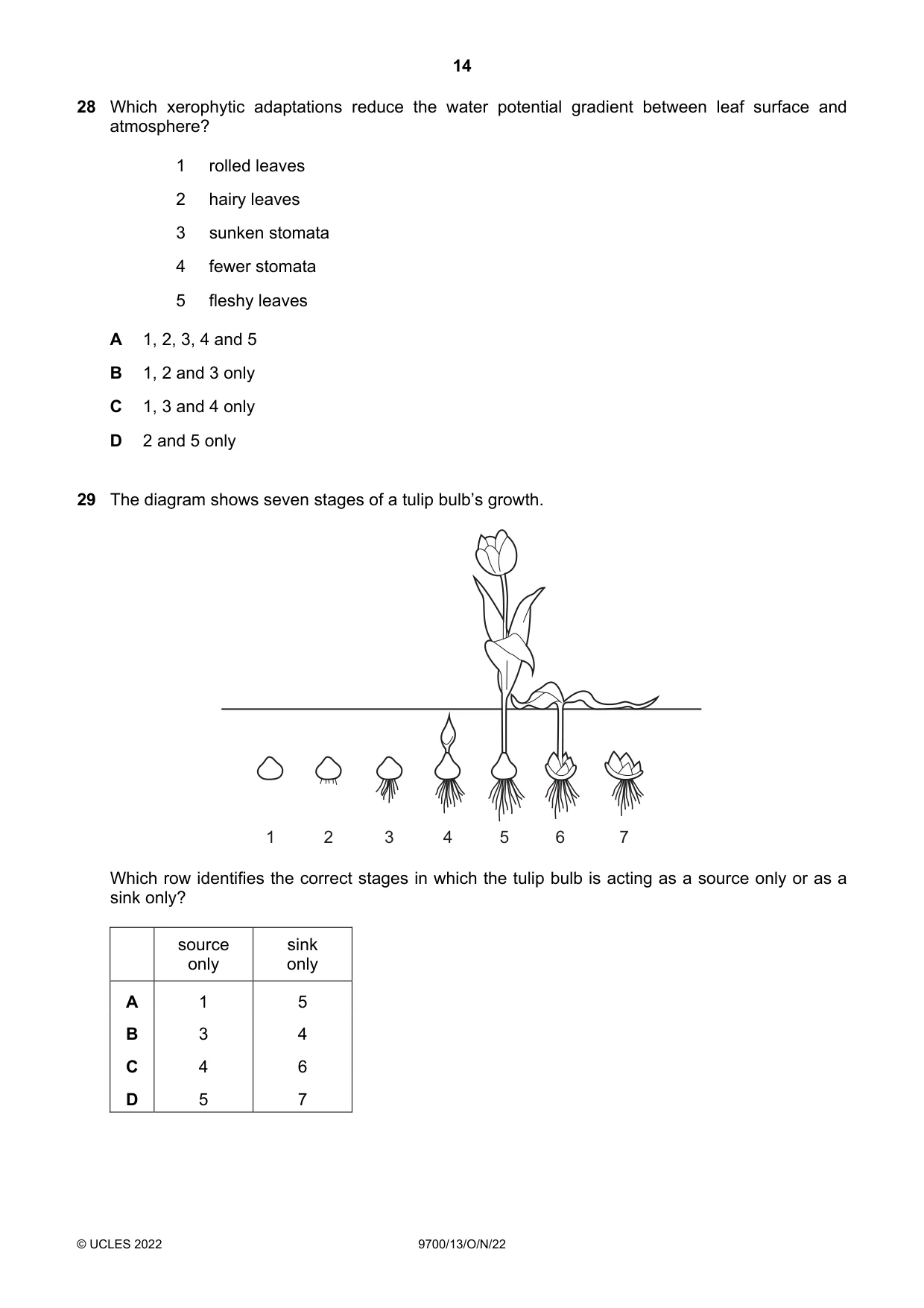
Q29 · The diagram shows seven stages of a tulip bulb’s growth
29 The diagram shows seven stages of a tulip bulb’s growth. 1 2 3 4 5 6 7 Which row identifies the correct stages in which the tulip bulb is acting as a source only or as a sink only? source sink only only A 1 5 B 3 4 C 4 6 D 5 7
Mark scheme: C
Q30 · What would be changed if mitochondrial activity was inhibited by a metabolic poison…
30 What would be changed if mitochondrial activity was inhibited by a metabolic poison acting on cells in the phloem tissue? 1 concentration of hydrogen ions in the cell wall of companion cells 2 concentration of sucrose in the cytoplasm of cells in a leaf 3 hydrostatic pressure gradient in the phloem sieve tube A 1, 2 and 3 B 1 and 2 only C 1 and 3 only D 2 and 3 only
Mark scheme: A
Q31 · By which process does sucrose move through phloem sieve tube elements?
31 By which process does sucrose move through phloem sieve tube elements? A active transport B diffusion C facilitated diffusion D mass flow
Mark scheme: D
Q32 · Which blood vessels carry blood into the atria?
32 Which blood vessels carry blood into the atria? 1 coronary artery 2 vena cava 3 pulmonary artery 4 pulmonary vein A 1 and 2 B 1 and 3 C 2 and 3 D 2 and 4
Mark scheme: D
Q33 · Which statements about the cardiac cycle are correct?
33 Which statements about the cardiac cycle are correct? 1 The atrioventricular valves close during atrial systole. 2 The left and right ventricles contract together. 3 There is a time delay as the electrical impulse passes from the atrioventricular node to the sinoatrial node. 4 Electrical impulses pass along the Purkyne tissue to the ventricles. A 1, 2 and 3 B 1, 3 and 4 C 2 and 4 D 3 and 4 only
Mark scheme: C
Q34 · At one point in the cardiac cycle, the pressure in the right ventricle is lower than that…
34 At one point in the cardiac cycle, the pressure in the right ventricle is lower than that in the right atrium and lower than that in the pulmonary artery. Which row is correct? atrioventricular semilunar valve valve A closed closed B closed open C open closed D open open
Mark scheme: C
Q35 · Which statements about the formation of haemoglobinic acid are correct?
35 Which statements about the formation of haemoglobinic acid are correct? 1 It is linked to the action of carbonic anhydrase. 2 It prevents blood from becoming too acidic by removing excess hydrogen ions. 3 It can only occur when oxygen associates with haemoglobin. A 1, 2 and 3 B 1 and 2 only C 1 only D 2 and 3 only
Mark scheme: B
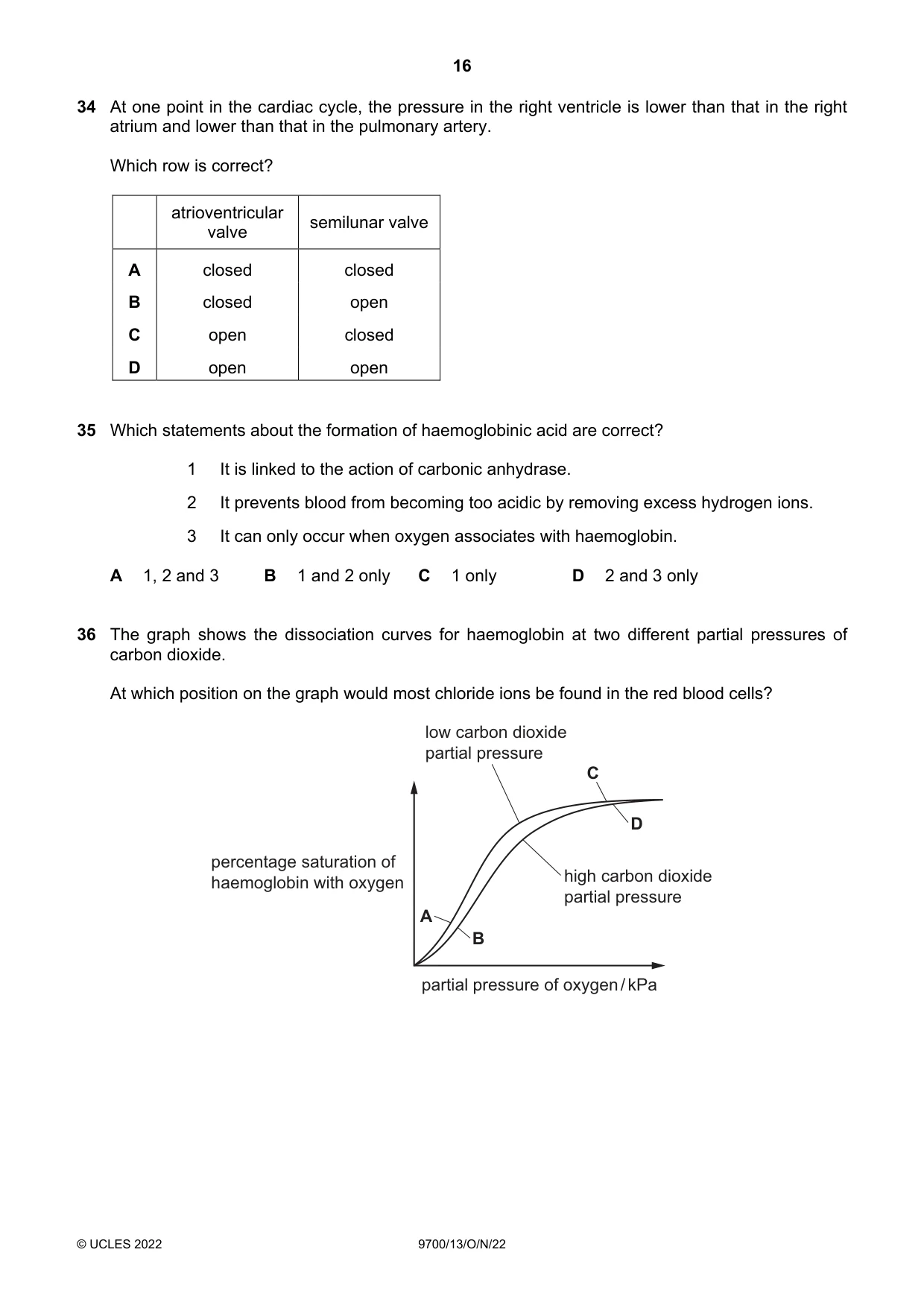
Q36 · The graph shows the dissociation curves for haemoglobin at two different partial…
36 The graph shows the dissociation curves for haemoglobin at two different partial pressures of carbon dioxide. At which position on the graph would most chloride ions be found in the red blood cells? low carbon dioxide partial pressure C D percentage saturation of haemoglobin with oxygen high carbon dioxide partial pressure A B partial pressure of oxygen / kPa
Mark scheme: B
Q37 · Oedema is caused by the accumulation of tissue fluid around body cells
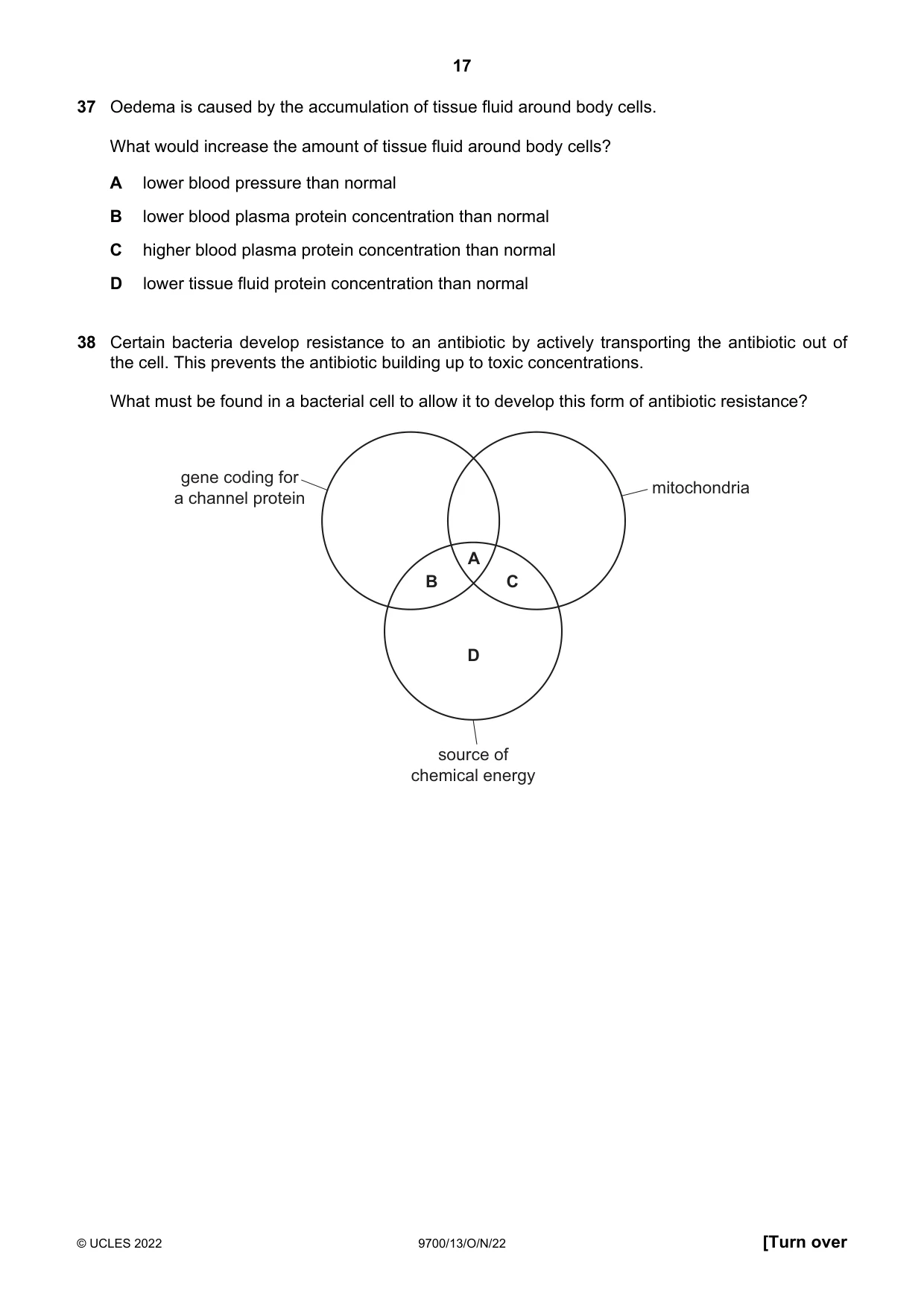
37 Oedema is caused by the accumulation of tissue fluid around body cells. What would increase the amount of tissue fluid around body cells? A lower blood pressure than normal B lower blood plasma protein concentration than normal C higher blood plasma protein concentration than normal D lower tissue fluid protein concentration than normal
Mark scheme: B
Q38 · Certain bacteria develop resistance to an antibiotic by actively transporting the…
38 Certain bacteria develop resistance to an antibiotic by actively transporting the antibiotic out of the cell. This prevents the antibiotic building up to toxic concentrations. What must be found in a bacterial cell to allow it to develop this form of antibiotic resistance? gene coding for mitochondria a channel protein A B C D source of chemical energy
Mark scheme: D
Q39 · Which statements explain the differences between a primary and a secondary response to…
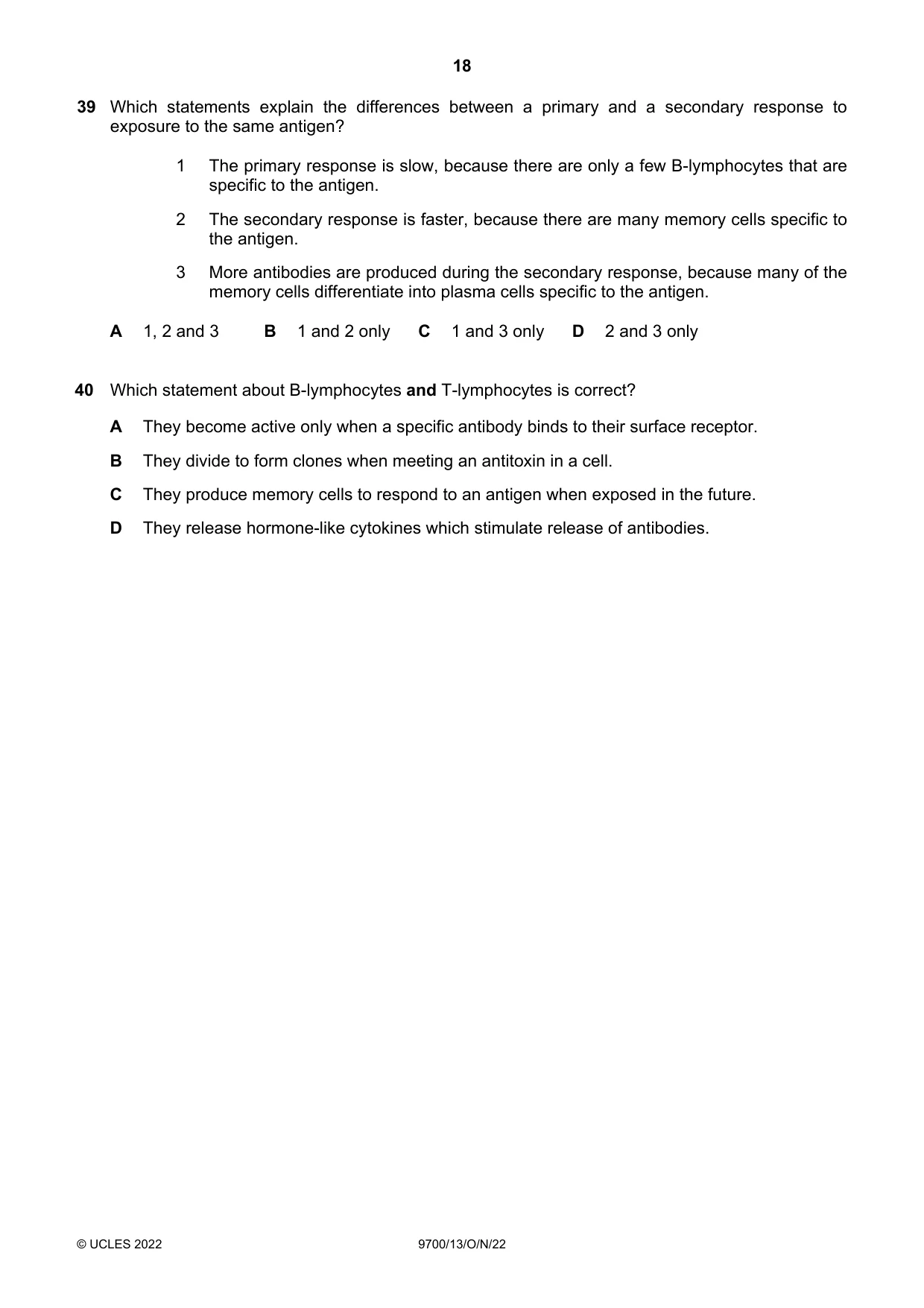
39 Which statements explain the differences between a primary and a secondary response to exposure to the same antigen? 1 The primary response is slow, because there are only a few B-lymphocytes that are specific to the antigen. 2 The secondary response is faster, because there are many memory cells specific to the antigen. 3 More antibodies are produced during the secondary response, because many of the memory cells differentiate into plasma cells specific to the antigen. A 1, 2 and 3 B 1 and 2 only C 1 and 3 only D 2 and 3 only
Mark scheme: A
Q40 · Which statement about B-lymphocytes and T-lymphocytes is correct?
40 Which statement about B-lymphocytes and T-lymphocytes is correct? A They become active only when a specific antibody binds to their surface receptor. B They divide to form clones when meeting an antitoxin in a cell. C They produce memory cells to respond to an antigen when exposed in the future. D They release hormone-like cytokines which stimulate release of antibodies.
Mark scheme: C
What was in this paper
The subtopics covered by these 40 questions, and how many questions each got. Open one in a new tab to see every Cambridge question on it.
5Carbohydrates and lipids4Cells as the basic units of living organisms4Movement into and out of cells3Replication and division of nuclei and cells3Structure of nucleic acids and replication of DNA3The heart3Factors that affect enzyme action2The immune system2Transport of oxygen and carbon dioxide2Antibiotics1Chromosome behaviour in mitosis1Mode of action of enzymes1Protein synthesis1Proteins1Structure of transport tissues1Testing for biological molecules1The circulatory system1The microscope in cell studies1What you needed in this session
Cambridge’s own grade thresholds for 2022 Oct/Nov, Paper 1 · Variant 3. A higher threshold means an easier paper — the bar moves with how the cohort did.