Cambridge A Level Biology 9700 — 2013 Oct/Nov Paper 1 · Variant 3
9700/13/O/N/13 · 40 questions · 40 marks · ≈45 min
The question paper and its mark scheme, free to read here and free to download. This is Cambridge’s own paper, exactly as it was sat.
Question paper16 pages

Mark scheme2 pages
Answers below. Sit the paper first if you are practising.
Questions as text
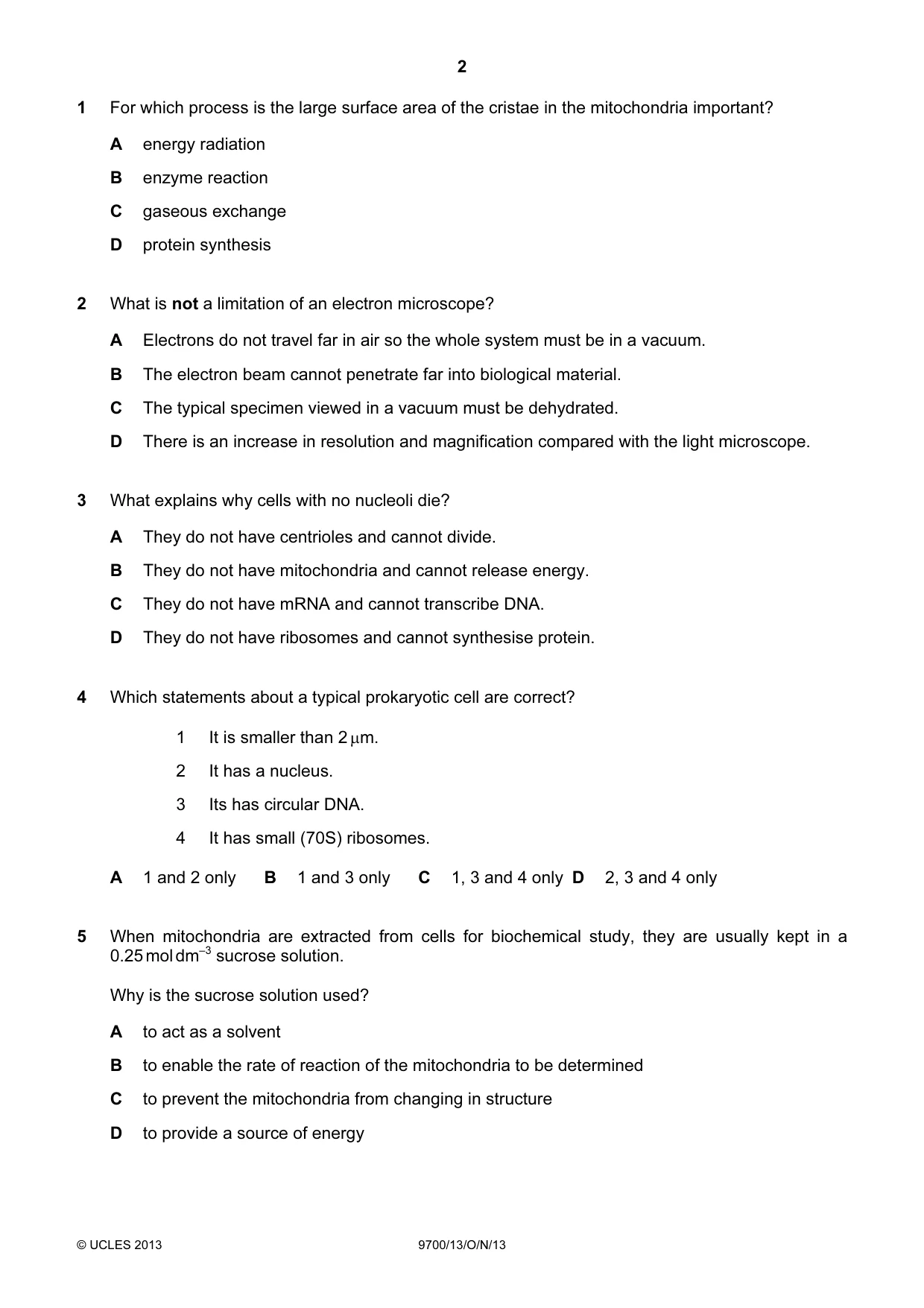
Q1 · For which process is the large surface area of the cristae in the mitochondria important?
1 For which process is the large surface area of the cristae in the mitochondria important? A energy radiation B enzyme reaction C gaseous exchange D protein synthesis
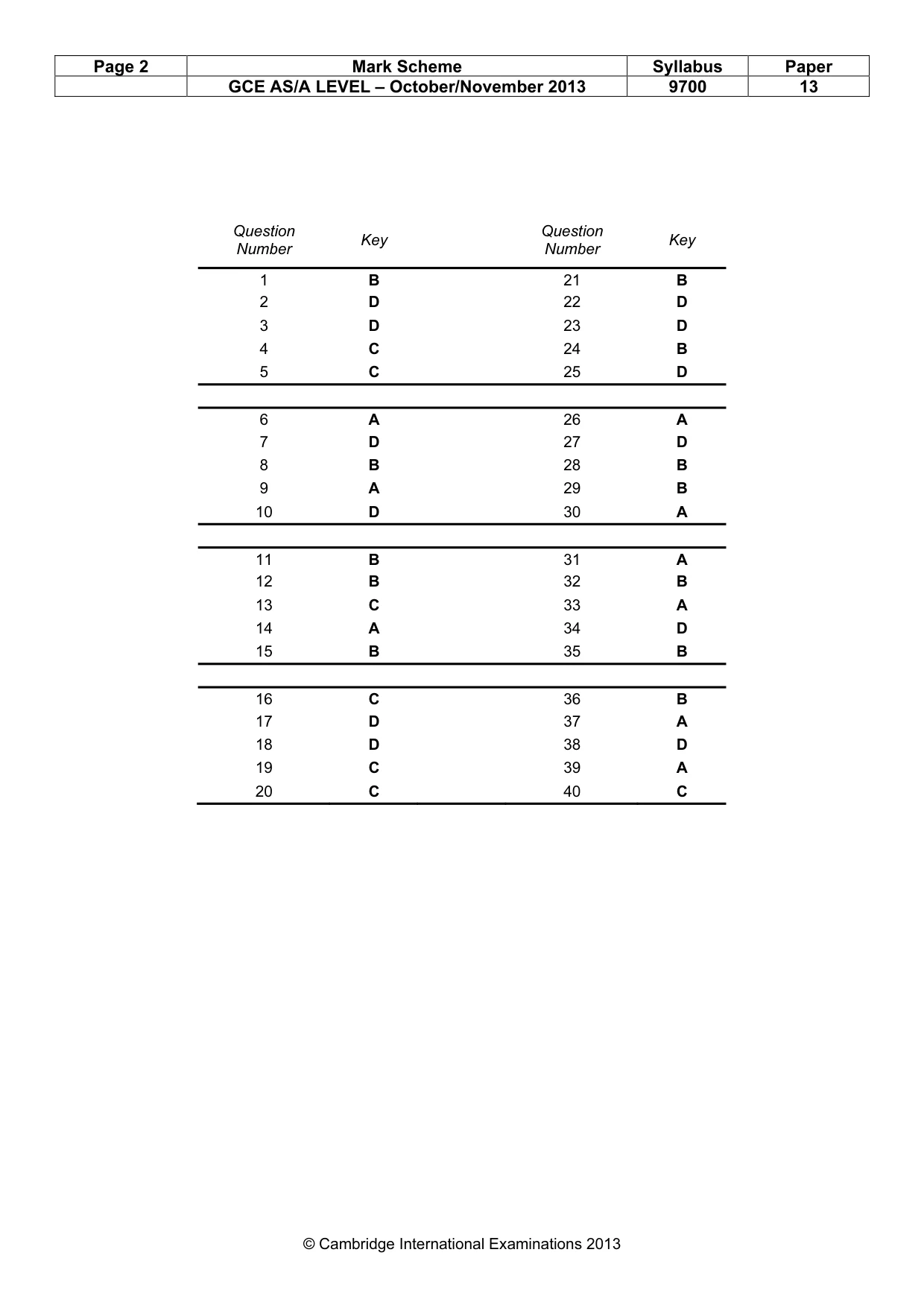
Mark scheme: B
Q2 · What is not a limitation of an electron microscope?
2 What is not a limitation of an electron microscope? A Electrons do not travel far in air so the whole system must be in a vacuum. B The electron beam cannot penetrate far into biological material. C The typical specimen viewed in a vacuum must be dehydrated. D There is an increase in resolution and magnification compared with the light microscope.
Mark scheme: D
Q3 · What explains why cells with no nucleoli die?
3 What explains why cells with no nucleoli die? A They do not have centrioles and cannot divide. B They do not have mitochondria and cannot release energy. C They do not have mRNA and cannot transcribe DNA. D They do not have ribosomes and cannot synthesise protein.
Mark scheme: D
Q4 · Which statements about a typical prokaryotic cell are correct?
4 Which statements about a typical prokaryotic cell are correct? 1 It is smaller than 2 µm. 2 It has a nucleus. 3 Its has circular DNA. 4 It has small (70S) ribosomes. A 1 and 2 only B 1 and 3 only C 1, 3 and 4 only D 2, 3 and 4 only
Mark scheme: C
More questions on Cells as the basic units of living organisms
Q5 · When mitochondria are extracted from cells for biochemical study, they are usually kept…
5 When mitochondria are extracted from cells for biochemical study, they are usually kept in a 0.25 mol dm–3 sucrose solution. Why is the sucrose solution used? A to act as a solvent B to enable the rate of reaction of the mitochondria to be determined C to prevent the mitochondria from changing in structure D to provide a source of energy
Mark scheme: C
Q6 · Which shows the basic unit of cellulose?
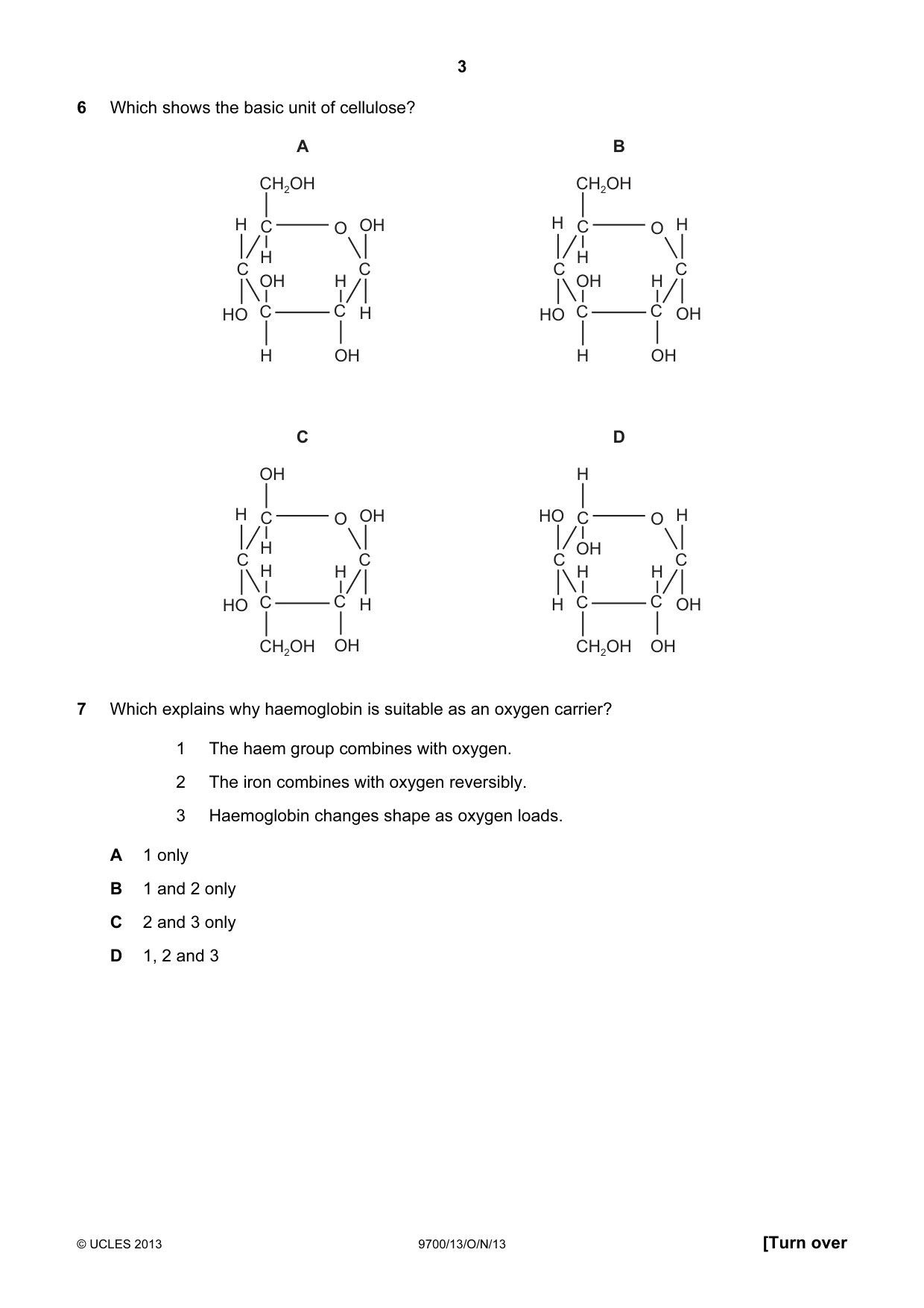
6 Which shows the basic unit of cellulose? A B CH2OH CH2OH H C O OH H C O H H H C C C C OH H OH H HO C C H HO C C OH H OH H OH C D OH H H C O OH HO C O H H OH C C C C H H H H HO C C H H C C OH CH2OH OH CH2OH OH
Mark scheme: A
Q7 · Which explains why haemoglobin is suitable as an oxygen carrier?
7 Which explains why haemoglobin is suitable as an oxygen carrier? 1 The haem group combines with oxygen. 2 The iron combines with oxygen reversibly. 3 Haemoglobin changes shape as oxygen loads. A 1 only B 1 and 2 only C 2 and 3 only D 1, 2 and 3
Mark scheme: D
Q8 · Which diagram shows part of a structural polysaccharide?
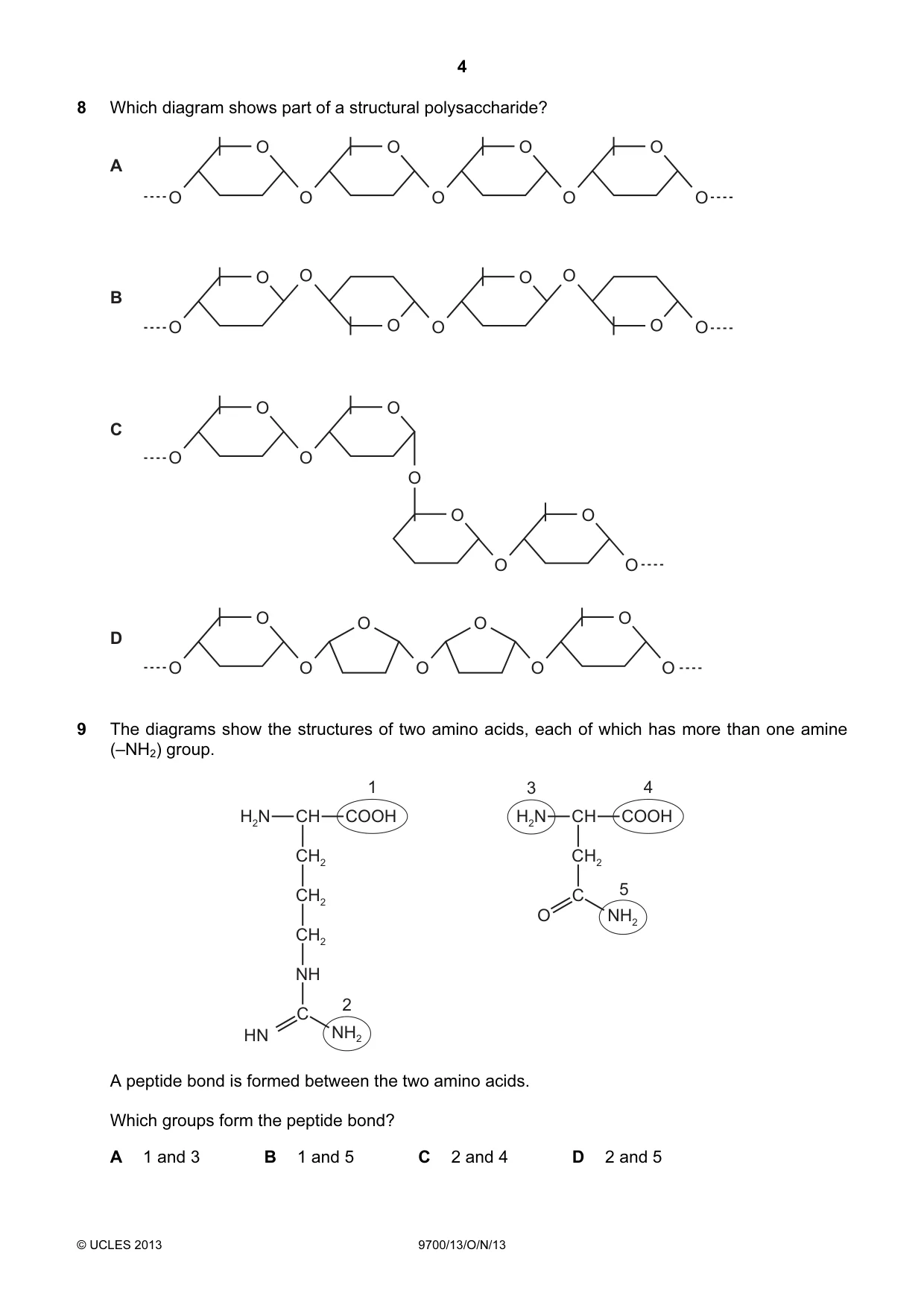
8 Which diagram shows part of a structural polysaccharide? O O O O A O O O O O O O O O B O O O O O O O C O O O O O O O O O O O D O O O O O
Mark scheme: B
Q9 · The diagrams show the structures of two amino acids, each of which has more than one…
9 The diagrams show the structures of two amino acids, each of which has more than one amine (–NH2) group. 1 3 4 H2N CH COOH H2N CH COOH CH2 CH2 CH2 C 5 O NH2 CH2 NH 2 C HN NH2 A peptide bond is formed between the two amino acids. Which groups form the peptide bond? A 1 and 3 B 1 and 5 C 2 and 4 D 2 and 5
Mark scheme: A
Q10 · Which combination of bond types correctly shows the weak and strong bonds that hold a…
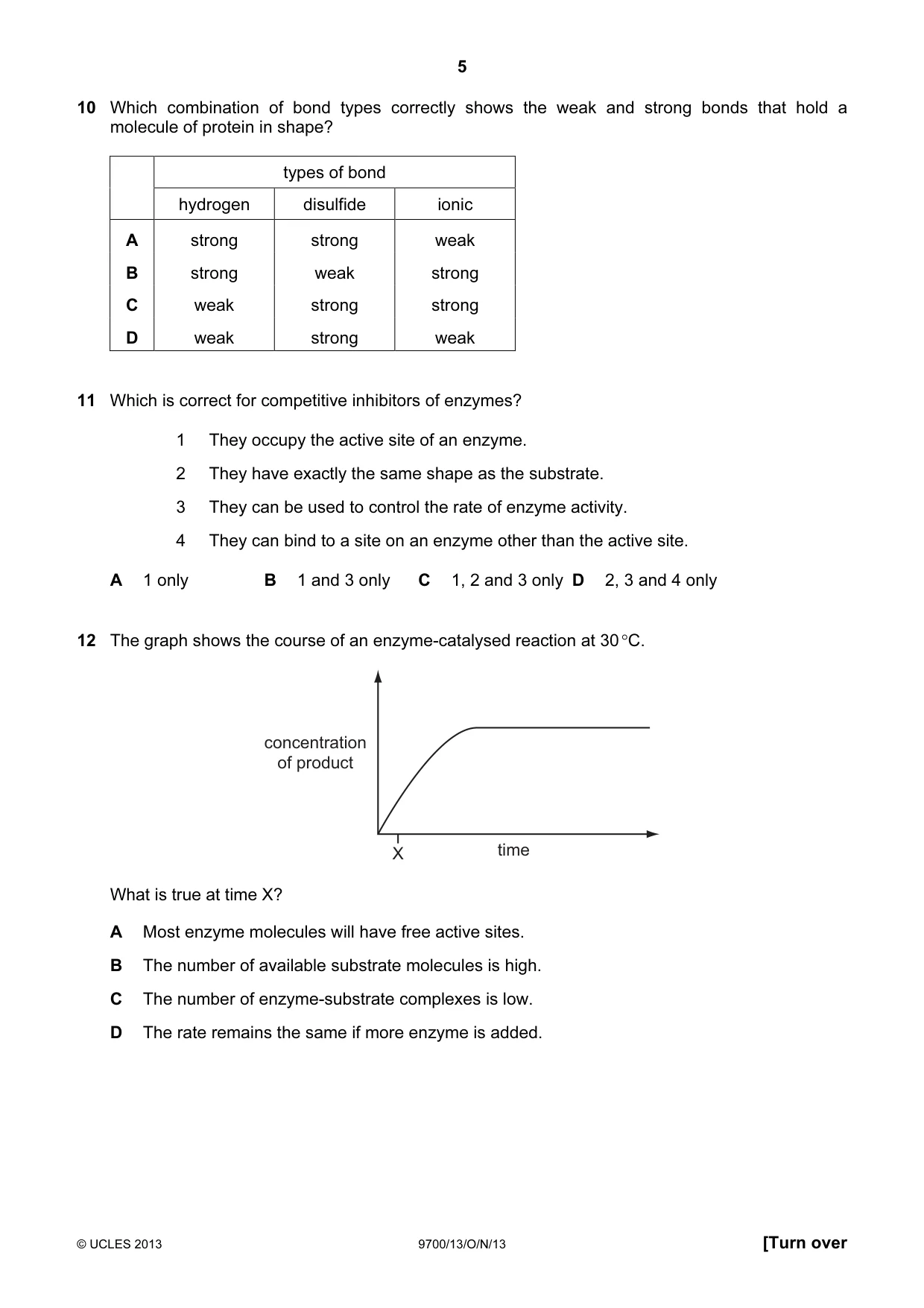
10 Which combination of bond types correctly shows the weak and strong bonds that hold a molecule of protein in shape? types of bond hydrogen disulfide ionic A strong strong weak B strong weak strong C weak strong strong D weak strong weak
Mark scheme: D
Q11 · Which is correct for competitive inhibitors of enzymes?
11 Which is correct for competitive inhibitors of enzymes? 1 They occupy the active site of an enzyme. 2 They have exactly the same shape as the substrate. 3 They can be used to control the rate of enzyme activity. 4 They can bind to a site on an enzyme other than the active site. A 1 only B 1 and 3 only C 1, 2 and 3 only D 2, 3 and 4 only
Mark scheme: B
Q12 · The graph shows the course of an enzyme-catalysed reaction at 30 °C
12 The graph shows the course of an enzyme-catalysed reaction at 30 °C. concentration of product X time What is true at time X? A Most enzyme molecules will have free active sites. B The number of available substrate molecules is high. C The number of enzyme-substrate complexes is low. D The rate remains the same if more enzyme is added.
Mark scheme: B
Q13 · Which statement concerning the role of cholesterol in the cell surface membrane is…
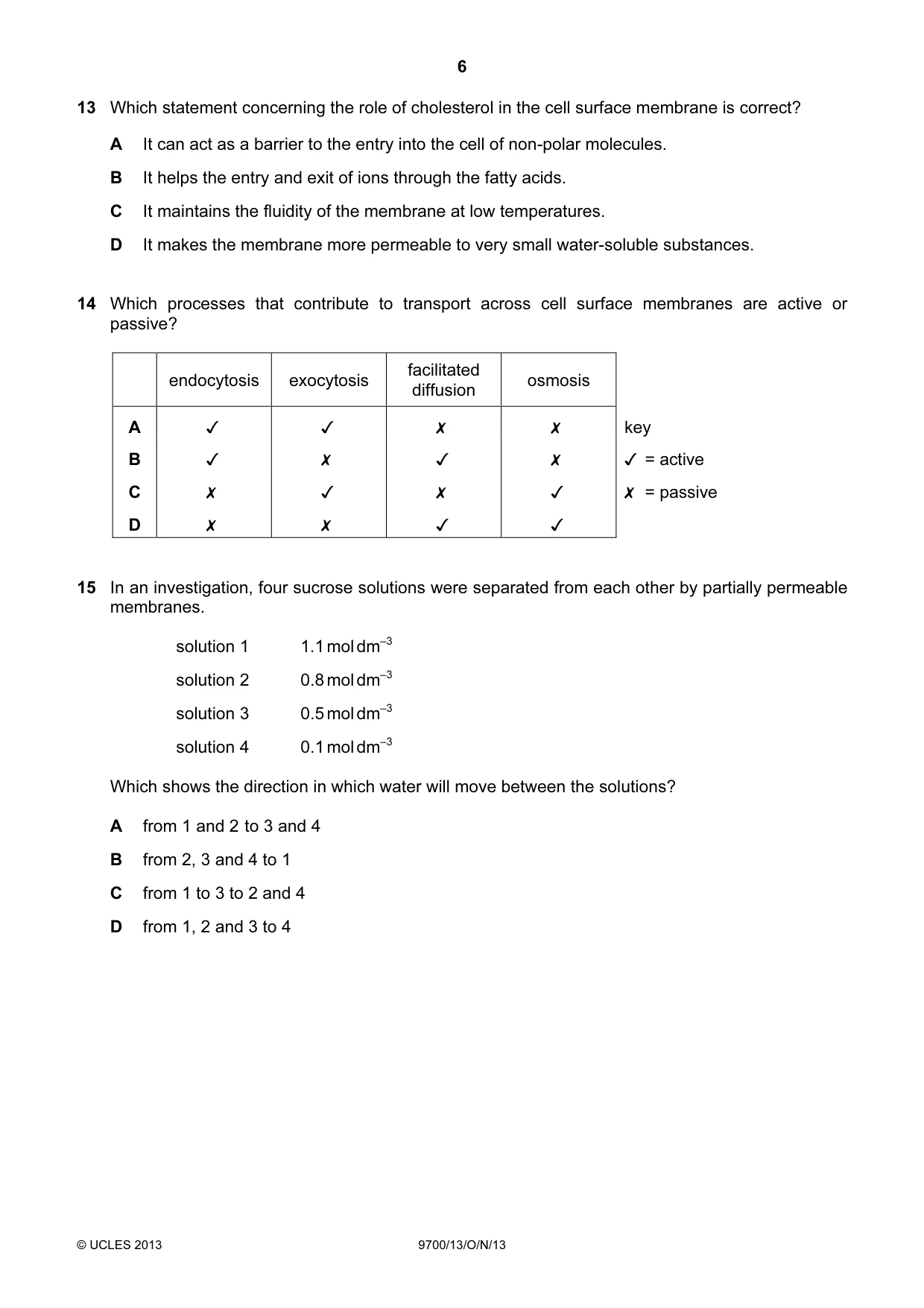
13 Which statement concerning the role of cholesterol in the cell surface membrane is correct? A It can act as a barrier to the entry into the cell of non-polar molecules. B It helps the entry and exit of ions through the fatty acids. C It maintains the fluidity of the membrane at low temperatures. D It makes the membrane more permeable to very small water-soluble substances.
Mark scheme: C
Q14 · Which processes that contribute to transport across cell surface membranes are active or…
14 Which processes that contribute to transport across cell surface membranes are active or passive? endocytosis | exocytosis facilitated osmosis diffusion A v v x x key B v x v x ¥ =active Cc Xx v Xx v X = passive D x x v v
Mark scheme: A
Q15 · In an investigation, four sucrose solutions were separated from each other by partially…
15 In an investigation, four sucrose solutions were separated from each other by partially permeable membranes. solution 1 1.1 mol dm–3 solution 2 0.8 mol dm–3 solution 3 0.5 mol dm–3 solution 4 0.1 mol dm–3 Which shows the direction in which water will move between the solutions? A from 1 and 2 to 3 and 4 B from 2, 3 and 4 to 1 C from 1 to 3 to 2 and 4 D from 1, 2 and 3 to 4
Mark scheme: B
Q16 · The diagram shows a partially plasmolysed plant cell
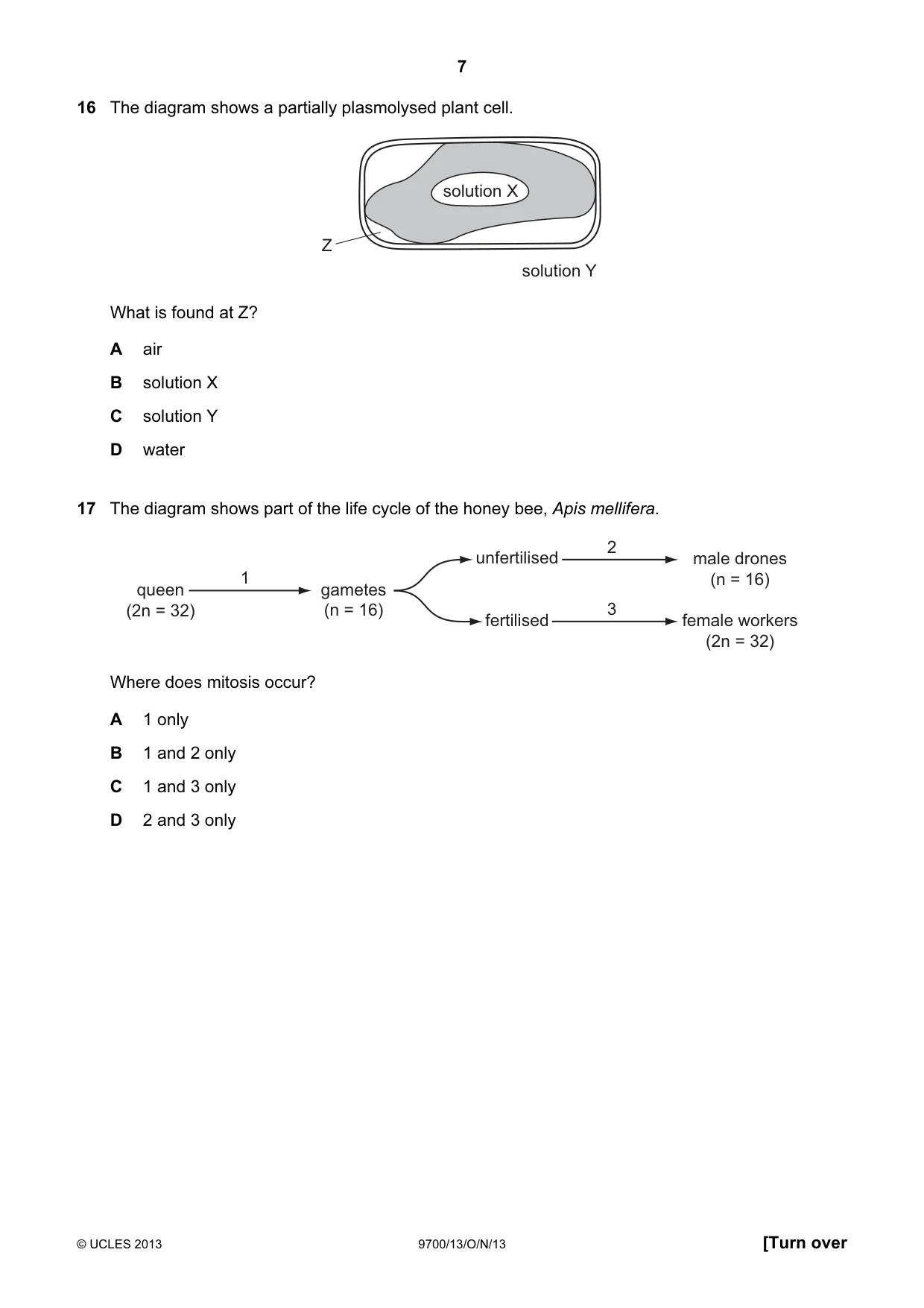
16 The diagram shows a partially plasmolysed plant cell. solution X Z solution Y What is found at Z? A air B solution X C solution Y D water
Mark scheme: C
Q17 · The diagram shows part of the life cycle of the honey bee, Apis mellifera
17 The diagram shows part of the life cycle of the honey bee, Apis mellifera. 2 unfertilised male drones 1 (n = 16) queen gametes (2n = 32) (n = 16) 3 fertilised female workers (2n = 32) Where does mitosis occur? A 1 only B 1 and 2 only C 1 and 3 only D 2 and 3 only
Mark scheme: D
More questions on Replication and division of nuclei and cells
Q18 · The graph shows the change in the quantity of DNA in a cell during a reduction division…
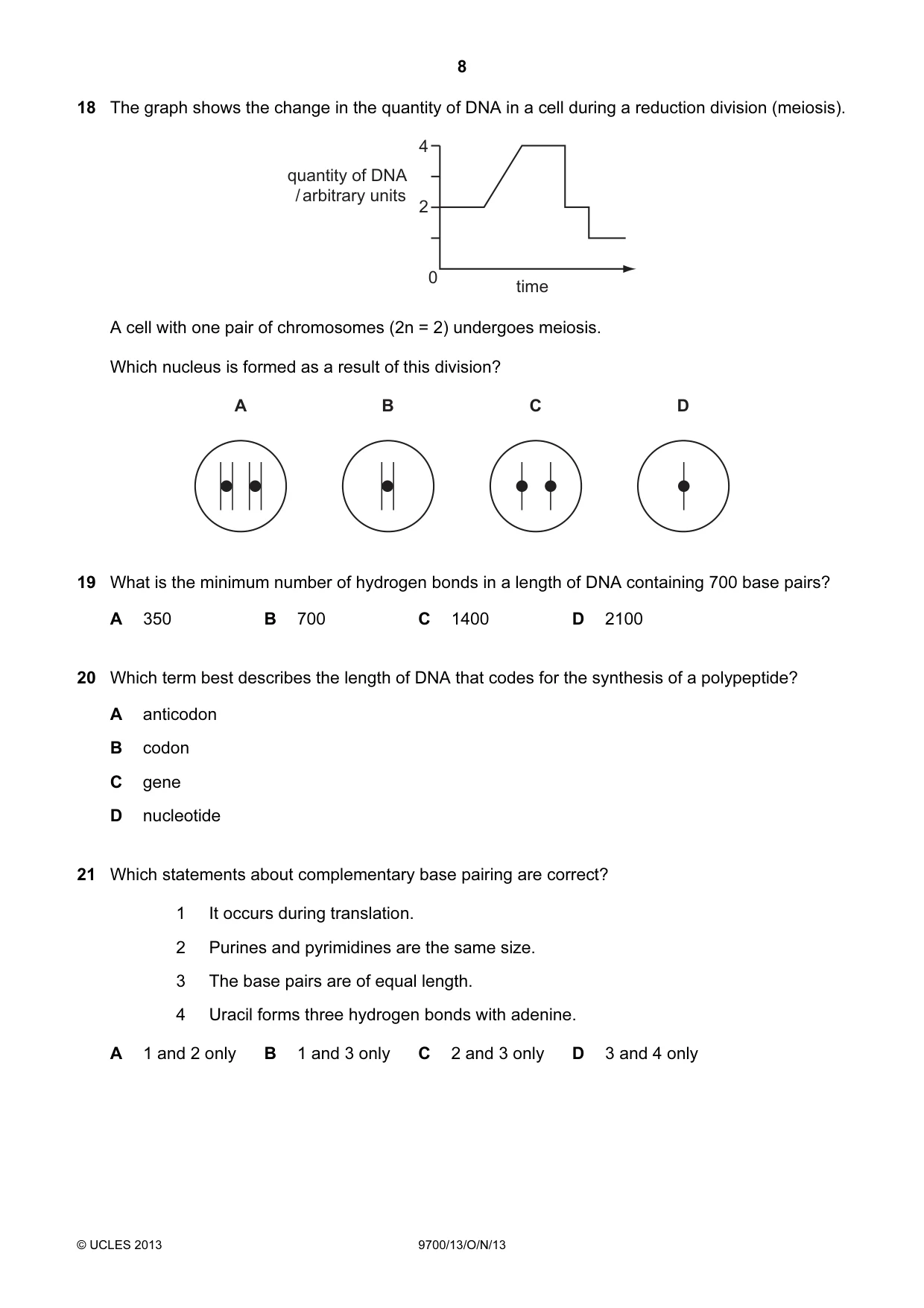
18 The graph shows the change in the quantity of DNA in a cell during a reduction division (meiosis). 4 quantity of DNA / arbitrary units 2 0 time A cell with one pair of chromosomes (2n = 2) undergoes meiosis. Which nucleus is formed as a result of this division? A B C D
Mark scheme: D
Q19 · What is the minimum number of hydrogen bonds in a length of DNA containing 700 base pairs?
19 What is the minimum number of hydrogen bonds in a length of DNA containing 700 base pairs? A 350 B 700 C 1400 D 2100
Mark scheme: C
More questions on Structure of nucleic acids and replication of DNA
Q20 · Which term best describes the length of DNA that codes for the synthesis of a polypeptide?
20 Which term best describes the length of DNA that codes for the synthesis of a polypeptide? A anticodon B codon C gene D nucleotide
Mark scheme: C
Q21 · Which statements about complementary base pairing are correct?
21 Which statements about complementary base pairing are correct? 1 It occurs during translation. 2 Purines and pyrimidines are the same size. 3 The base pairs are of equal length. 4 Uracil forms three hydrogen bonds with adenine. A 1 and 2 only B 1 and 3 only C 2 and 3 only D 3 and 4 only
Mark scheme: B
More questions on Structure of nucleic acids and replication of DNA
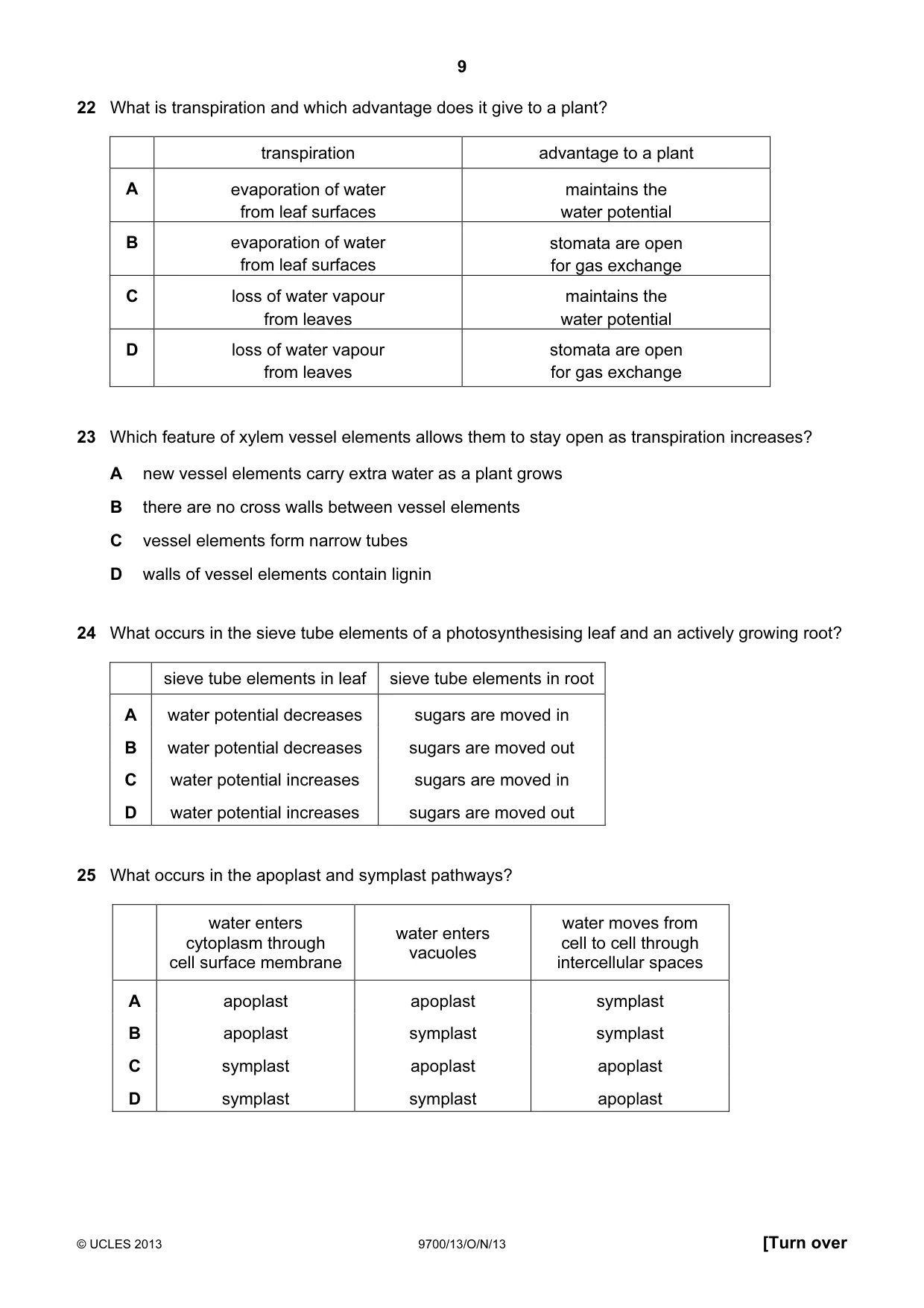
Q22 · What is transpiration and which advantage does it give to a plant?
22 What is transpiration and which advantage does it give to a plant? transpiration advantage to a plant A evaporation of water maintains the from leaf surfaces water potential B evaporation of water stomata are open from leaf surfaces for gas exchange C loss of water vapour maintains the from leaves water potential D loss of water vapour stomata are open from leaves for gas exchange
Mark scheme: D
Q23 · Which feature of xylem vessel elements allows them to stay open as transpiration…
23 Which feature of xylem vessel elements allows them to stay open as transpiration increases? A new vessel elements carry extra water as a plant grows B there are no cross walls between vessel elements C vessel elements form narrow tubes D walls of vessel elements contain lignin
Mark scheme: D
Q24 · What occurs in the sieve tube elements of a photosynthesising leaf and an actively…
24 What occurs in the sieve tube elements of a photosynthesising leaf and an actively growing root? sieve tube elements in leaf sieve tube elements in root A water potential decreases sugars are moved in B water potential decreases sugars are moved out C water potential increases sugars are moved in D water potential increases sugars are moved out
Mark scheme: B
Q25 · What occurs in the apoplast and symplast pathways?
25 What occurs in the apoplast and symplast pathways? water enters water moves from water enters cytoplasm through cell to cell through vacuoles cell surface membrane intercellular spaces A apoplast apoplast symplast B apoplast symplast symplast C symplast apoplast apoplast D symplast symplast apoplast
Mark scheme: D
Q26 · Some fungi cause wilting in crop plants by growing within the xylem vessels
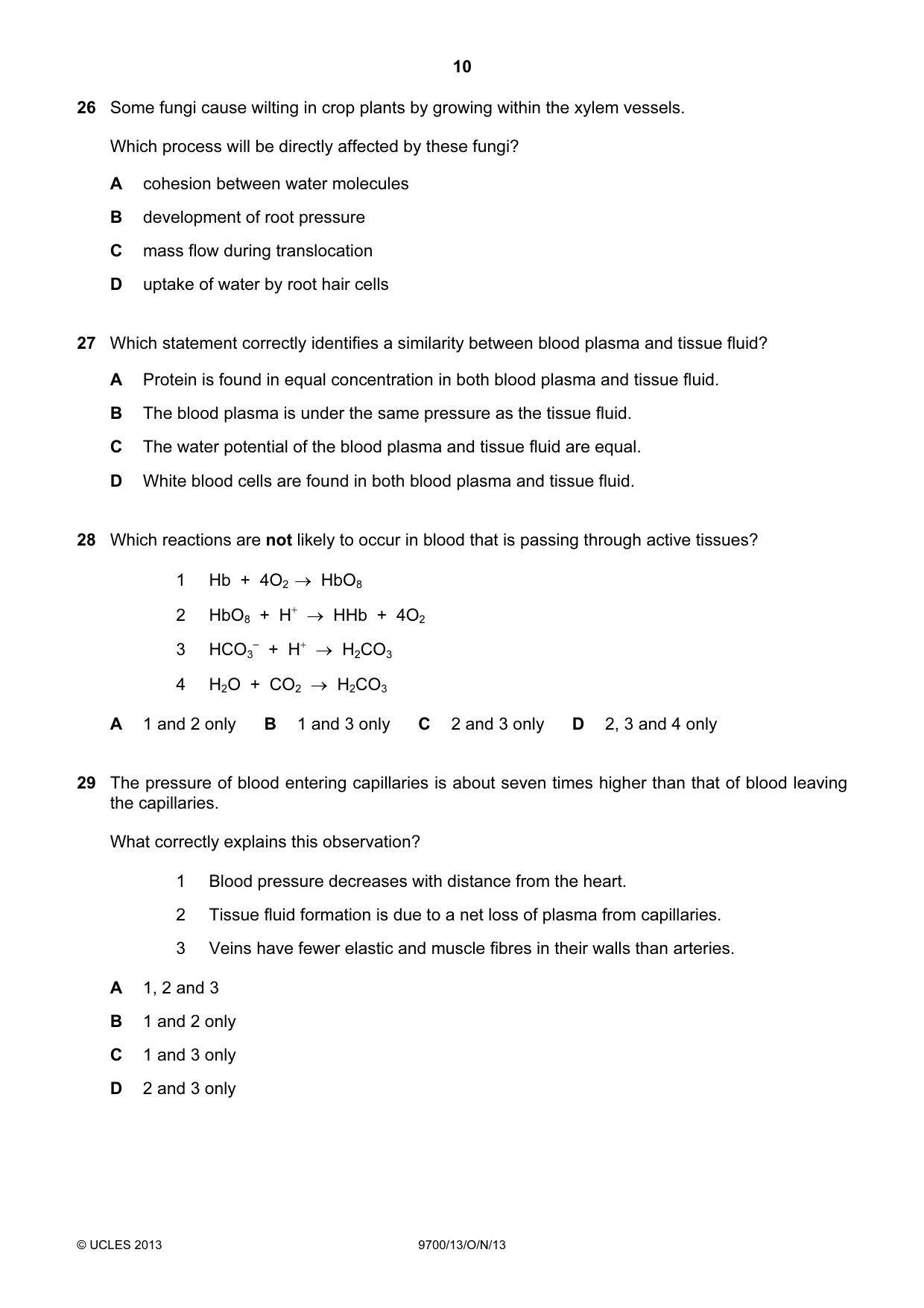
26 Some fungi cause wilting in crop plants by growing within the xylem vessels. Which process will be directly affected by these fungi? A cohesion between water molecules B development of root pressure C mass flow during translocation D uptake of water by root hair cells
Mark scheme: A
Q27 · Which statement correctly identifies a similarity between blood plasma and tissue fluid?
27 Which statement correctly identifies a similarity between blood plasma and tissue fluid? A Protein is found in equal concentration in both blood plasma and tissue fluid. B The blood plasma is under the same pressure as the tissue fluid. C The water potential of the blood plasma and tissue fluid are equal. D White blood cells are found in both blood plasma and tissue fluid.
Mark scheme: D
Q28 · Which reactions are not likely to occur in blood that is passing through active tissues?
28 Which reactions are not likely to occur in blood that is passing through active tissues? 1 Hb + 4O2 → HbO8 2 HbO8 + H+ → HHb + 4O2 3 HCO3 – + H+ → H2CO3 4 H2O + CO2 → H2CO3 A 1 and 2 only B 1 and 3 only C 2 and 3 only D 2, 3 and 4 only
Mark scheme: B
Q29 · The pressure of blood entering capillaries is about seven times higher than that of blood…
29 The pressure of blood entering capillaries is about seven times higher than that of blood leaving the capillaries. What correctly explains this observation? 1 Blood pressure decreases with distance from the heart. 2 Tissue fluid formation is due to a net loss of plasma from capillaries. 3 Veins have fewer elastic and muscle fibres in their walls than arteries. A 1, 2 and 3 B 1 and 2 only C 1 and 3 only D 2 and 3 only
Mark scheme: B
Q30 · The red blood cell count of humans increases when they remain at high altitudes
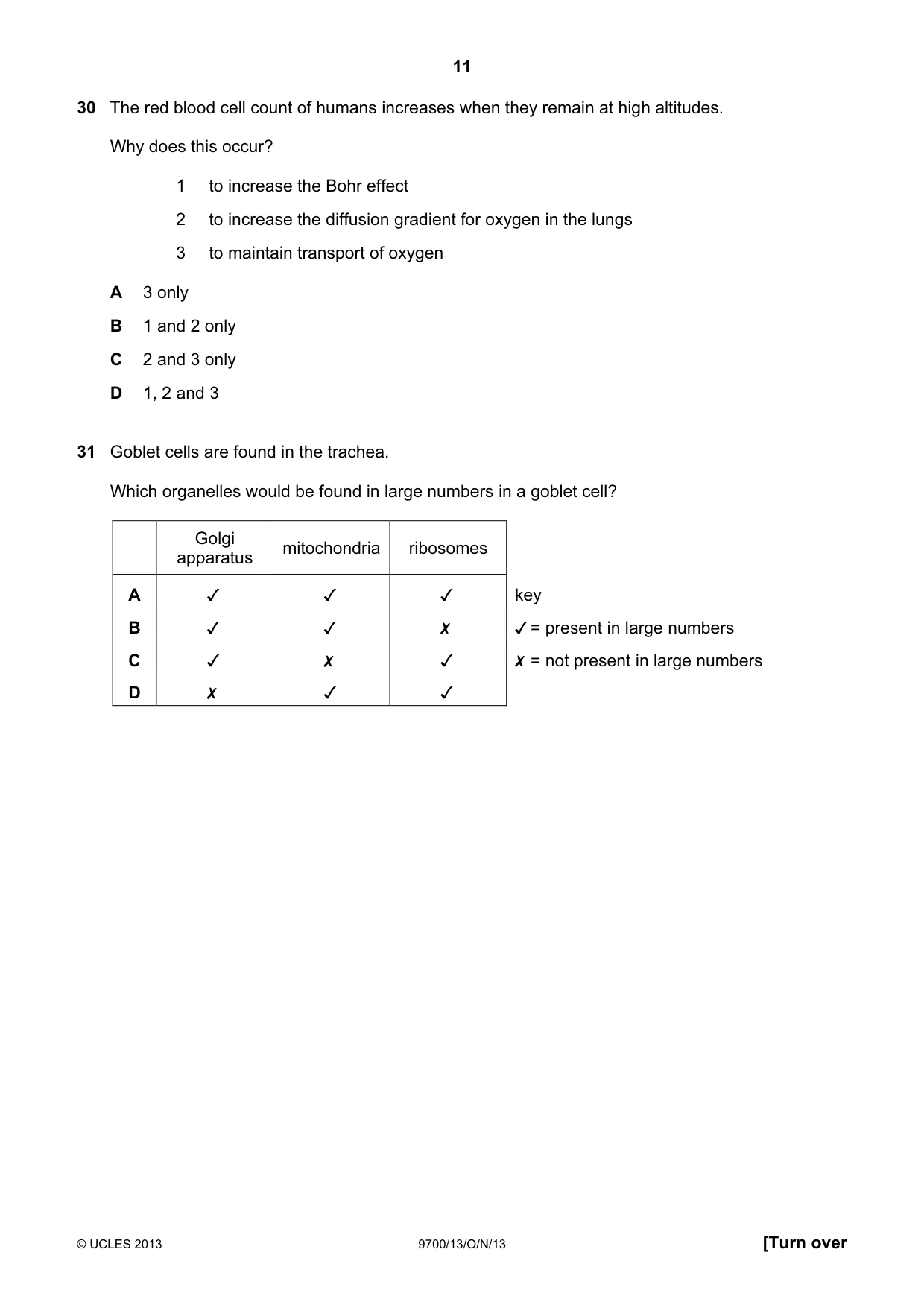
30 The red blood cell count of humans increases when they remain at high altitudes. Why does this occur? 1 to increase the Bohr effect 2 to increase the diffusion gradient for oxygen in the lungs 3 to maintain transport of oxygen A 3 only B 1 and 2 only C 2 and 3 only D 1, 2 and 3
Mark scheme: A
Q31 · Goblet cells are found in the trachea
31 Goblet cells are found in the trachea. Which organelles would be found in large numbers in a goblet cell? Golgi mitochondria ribosomes apparatus J key ¥ = present in large numbers X = not present in large numbers 00NO WwW > Kk 4 4 QS 4 O&M v v x
Mark scheme: A
Q32 · The photomicrographs show a TS of an artery from a non-smoker and a TS of an artery from…
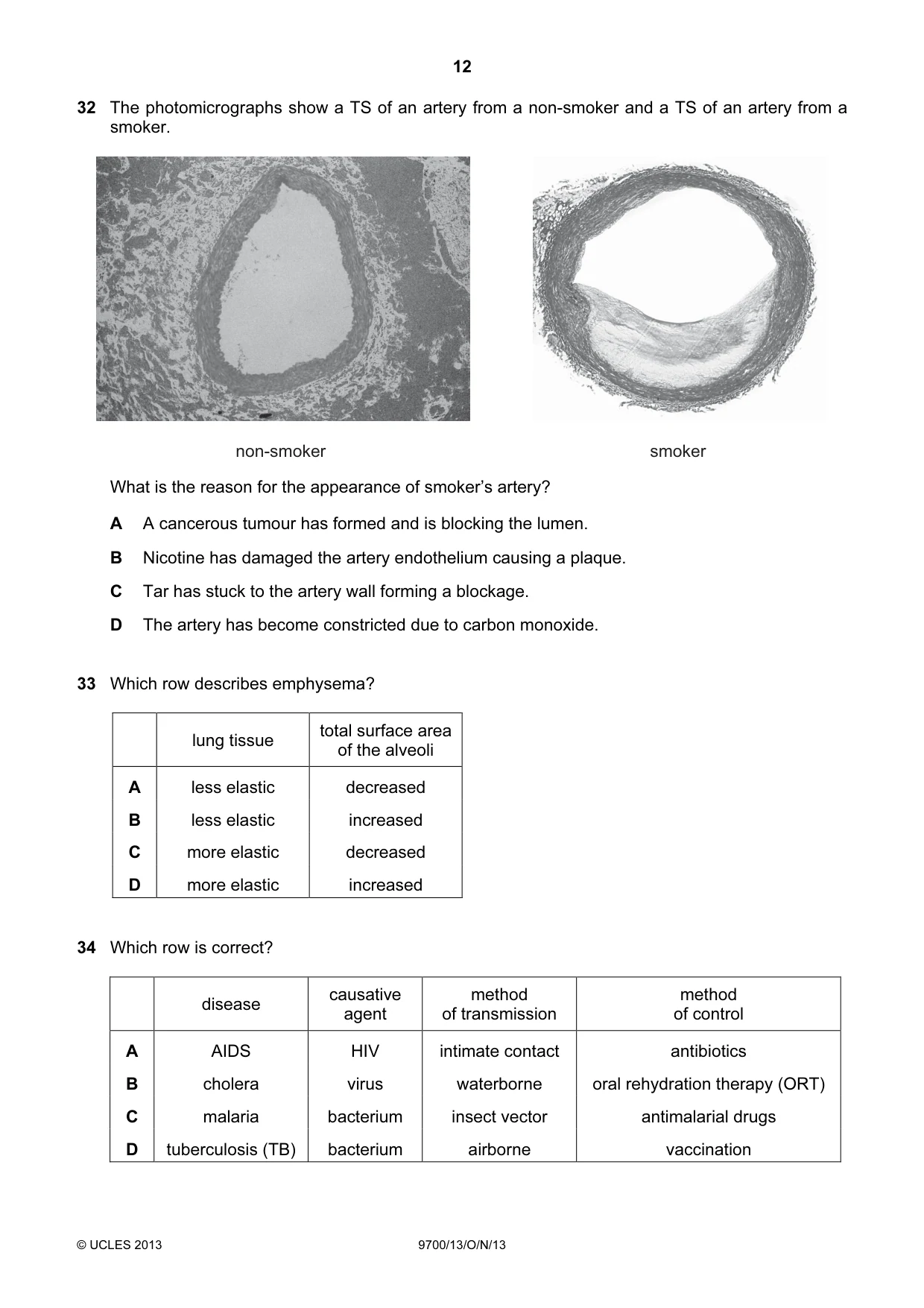
32 The photomicrographs show a TS of an artery from a non-smoker and a TS of an artery from a smoker. non-smoker smoker What is the reason for the appearance of smoker’s artery? A A cancerous tumour has formed and is blocking the lumen. B Nicotine has damaged the artery endothelium causing a plaque. C Tar has stuck to the artery wall forming a blockage. D The artery has become constricted due to carbon monoxide.
Mark scheme: B
Q33 · Which row describes emphysema?
33 Which row describes emphysema? total surface area lung tissue of the alveoli A less elastic decreased B less elastic increased C more elastic decreased D more elastic increased
Mark scheme: A
Q34 · Which row is correct?
34 Which row is correct? causative method method disease agent of transmission of control A AIDS HIV intimate contact antibiotics B cholera virus waterborne oral rehydration therapy (ORT) C malaria bacterium insect vector antimalarial drugs D tuberculosis (TB) bacterium airborne vaccination
Mark scheme: D
Q35 · Scientists are concerned that avian (bird) flu caused by the H5N1 virus could infect…
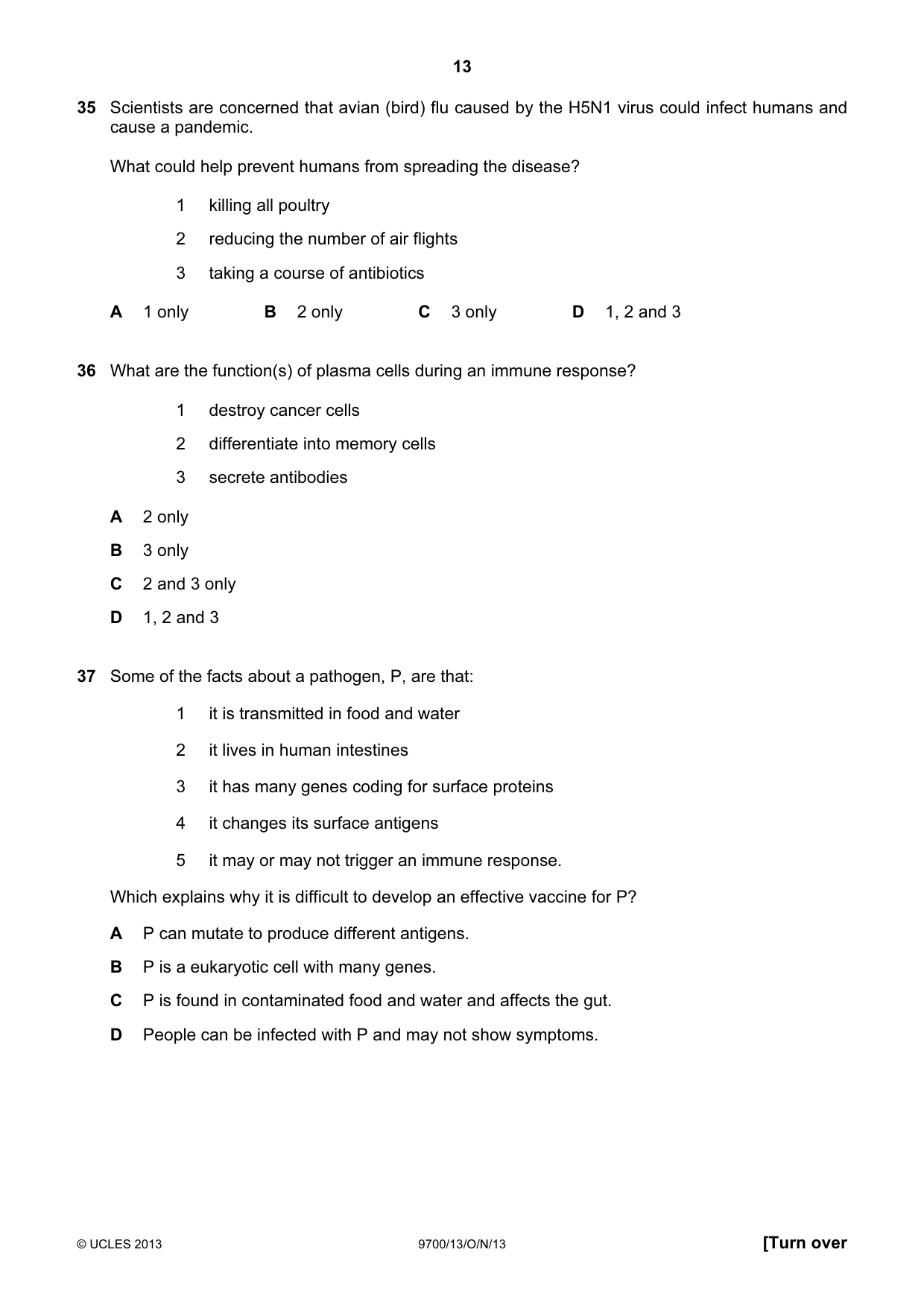
35 Scientists are concerned that avian (bird) flu caused by the H5N1 virus could infect humans and cause a pandemic. What could help prevent humans from spreading the disease? 1 killing all poultry 2 reducing the number of air flights 3 taking a course of antibiotics A 1 only B 2 only C 3 only D 1, 2 and 3
Mark scheme: B
Q36 · What are the function(s) of plasma cells during an immune response?
36 What are the function(s) of plasma cells during an immune response? 1 destroy cancer cells 2 differentiate into memory cells 3 secrete antibodies A 2 only B 3 only C 2 and 3 only D 1, 2 and 3
Mark scheme: B
Q37 · Some of the facts about a pathogen, P, are that: 1 it is transmitted in food and water 2…
37 Some of the facts about a pathogen, P, are that: 1 it is transmitted in food and water 2 it lives in human intestines 3 it has many genes coding for surface proteins 4 it changes its surface antigens 5 it may or may not trigger an immune response. Which explains why it is difficult to develop an effective vaccine for P? A P can mutate to produce different antigens. B P is a eukaryotic cell with many genes. C P is found in contaminated food and water and affects the gut. D People can be infected with P and may not show symptoms.
Mark scheme: A
Q38 · Which description is correct for B-lymphocytes?
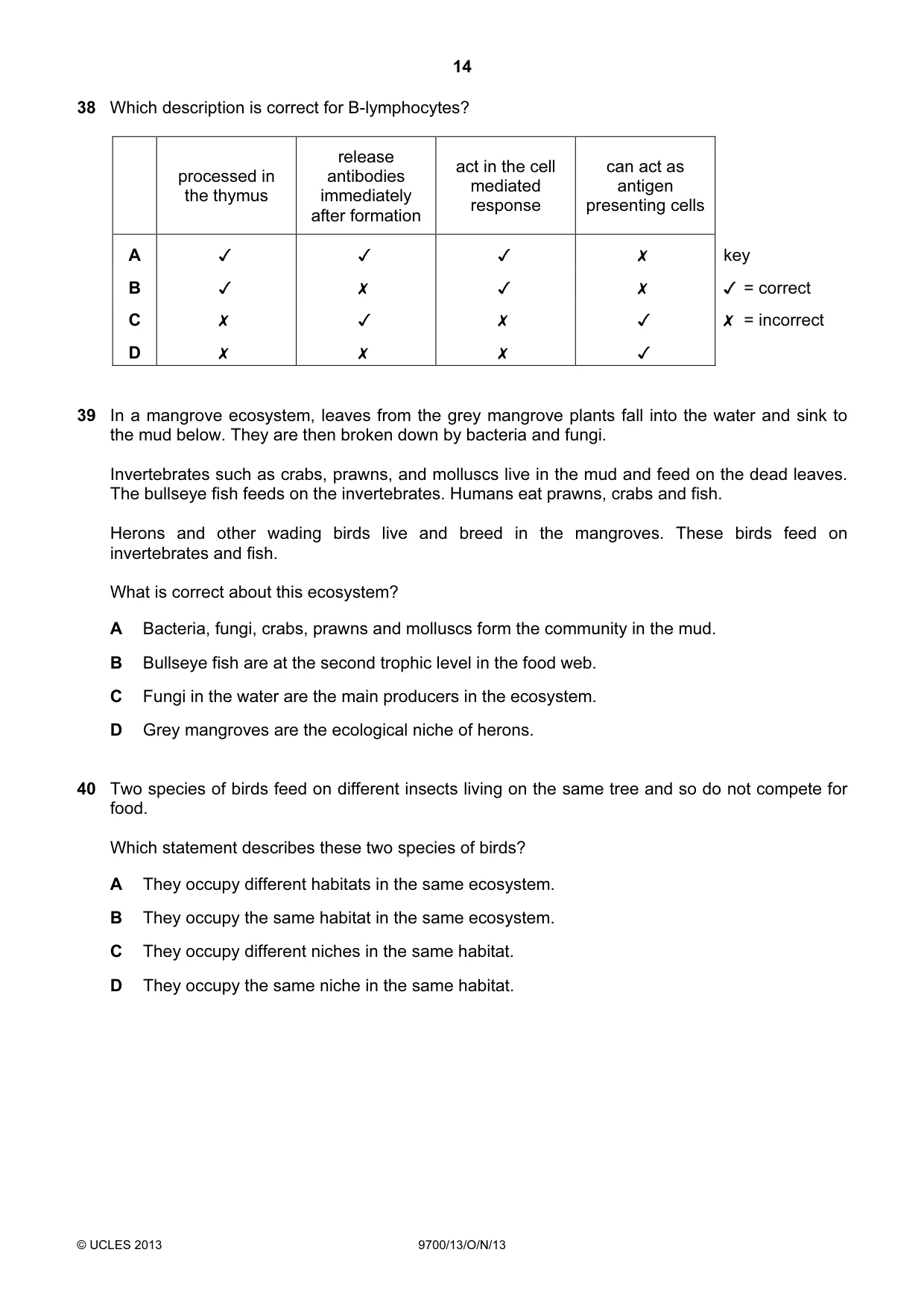
38 Which description is correct for B-lymphocytes? 0 0O DW > processed in the thymus x KOK release antibodies immediately after formation x < x act in the cell mediated response x x KOK can act as antigen presenting cells << x x key Y =correct X =incorrect
Mark scheme: D
Q39 · In a mangrove ecosystem, leaves from the grey mangrove plants fall into the water and…
39 In a mangrove ecosystem, leaves from the grey mangrove plants fall into the water and sink to the mud below. They are then broken down by bacteria and fungi. Invertebrates such as crabs, prawns, and molluscs live in the mud and feed on the dead leaves. The bullseye fish feeds on the invertebrates. Humans eat prawns, crabs and fish. Herons and other wading birds live and breed in the mangroves. These birds feed on invertebrates and fish. What is correct about this ecosystem? A Bacteria, fungi, crabs, prawns and molluscs form the community in the mud. B Bullseye fish are at the second trophic level in the food web. C Fungi in the water are the main producers in the ecosystem. D Grey mangroves are the ecological niche of herons.
Mark scheme: A
Q40 · Two species of birds feed on different insects living on the same tree and so do not…
40 Two species of birds feed on different insects living on the same tree and so do not compete for food. Which statement describes these two species of birds? A They occupy different habitats in the same ecosystem. B They occupy the same habitat in the same ecosystem. C They occupy different niches in the same habitat. D They occupy the same niche in the same habitat.
Mark scheme: C
What was in this paper
The subtopics covered by these 40 questions, and how many questions each got. Open one in a new tab to see every Cambridge question on it.
4Transport mechanisms4The circulatory system3Transport of oxygen and carbon dioxide3Antibodies and vaccination2Biodiversity2Carbohydrates and lipids2Factors that affect enzyme action2Infectious diseases2Proteins2Structure of nucleic acids and replication of DNA2The gas exchange system2Cells as the basic units of living organisms1Chromosome behaviour in mitosis1Fluid mosaic membranes1Protein synthesis1Replication and division of nuclei and cells1Respiration1Structure of transport tissues1The immune system1The microscope in cell studies1The roles of genes in1What you needed in this session
Cambridge’s own grade thresholds for 2013 Oct/Nov, Paper 1 · Variant 3. A higher threshold means an easier paper — the bar moves with how the cohort did.