Cambridge A Level Biology 9700 — 2011 May/June Paper 1 · Variant 3
9700/13/M/J/11 · 40 questions · 40 marks · ≈45 min
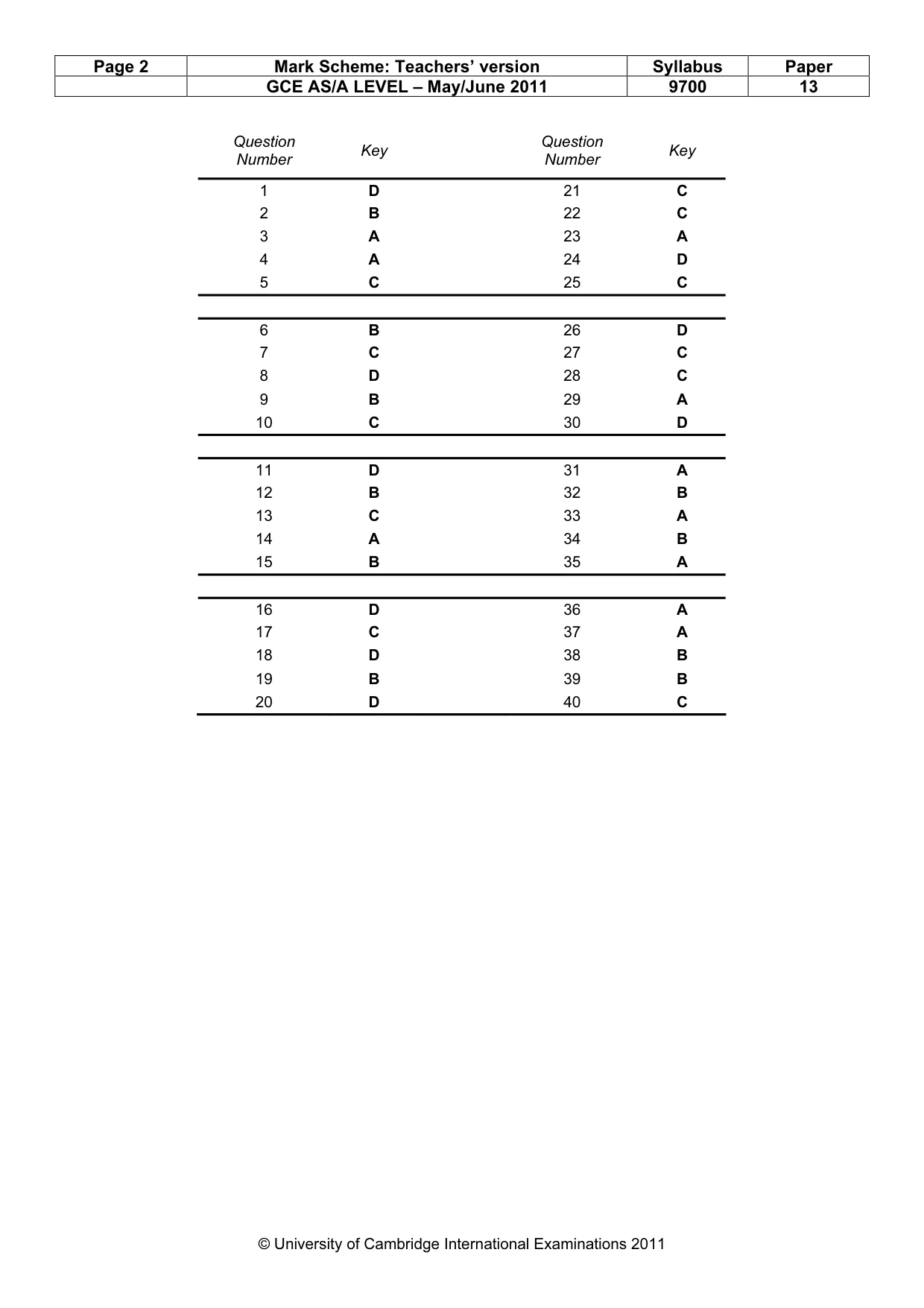
The question paper and its mark scheme, free to read here and free to download. This is Cambridge’s own paper, exactly as it was sat.
Question paper16 pages

Mark scheme2 pages
Answers below. Sit the paper first if you are practising.
Questions as text
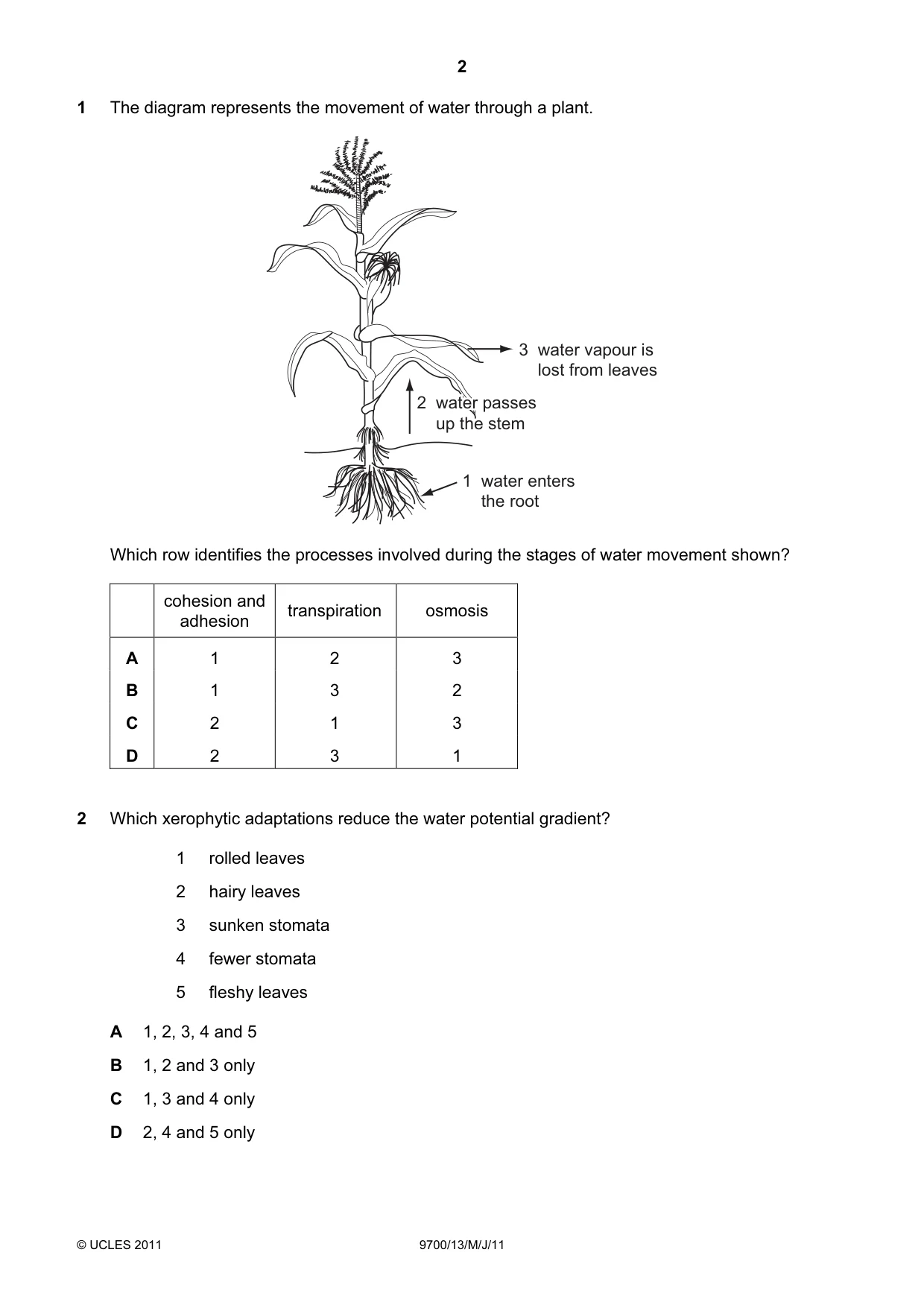
Q1 · The diagram represents the movement of water through a plant
1 The diagram represents the movement of water through a plant. 3 water vapour is lost from leaves 2 water passes 2 water passes 2 water passes up the stem up the stem up the stem 1 water enters the root Which row identifies the processes involved during the stages of water movement shown? cohesion and transpiration osmosis adhesion A 1 2 3 B 1 3 2 C 2 1 3 D 2 3 1
Mark scheme: D
Q2 · Which xerophytic adaptations reduce the water potential gradient?
2 Which xerophytic adaptations reduce the water potential gradient? 1 rolled leaves 2 hairy leaves 3 sunken stomata 4 fewer stomata 5 fleshy leaves A 1, 2, 3, 4 and 5 B 1, 2 and 3 only C 1, 3 and 4 only D 2, 4 and 5 only
Mark scheme: B
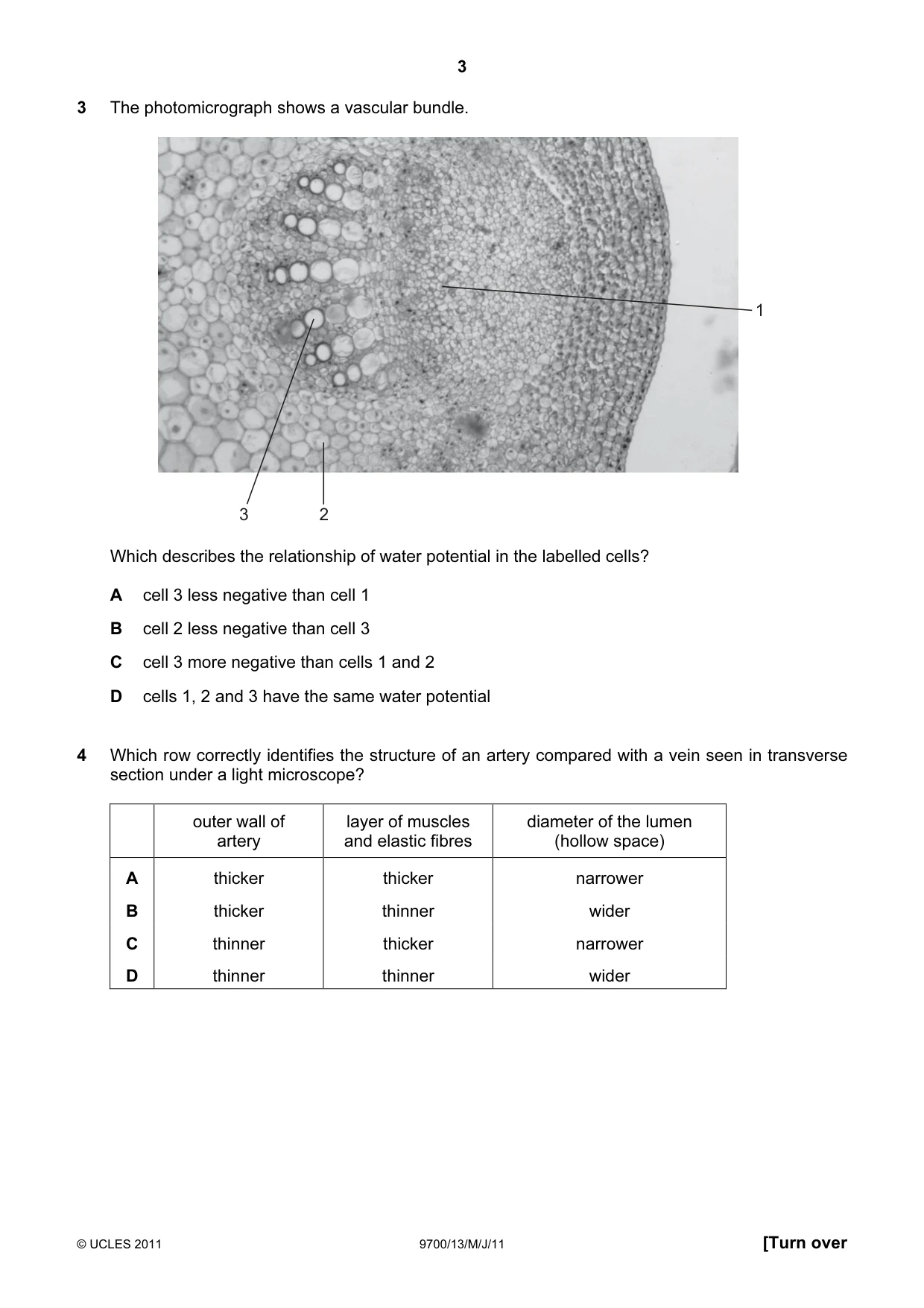
Q3 · The photomicrograph shows a vascular bundle
3 The photomicrograph shows a vascular bundle. 1 3 2 Which describes the relationship of water potential in the labelled cells? A cell 3 less negative than cell 1 B cell 2 less negative than cell 3 C cell 3 more negative than cells 1 and 2 D cells 1, 2 and 3 have the same water potential
Mark scheme: A
Q4 · Which row correctly identifies the structure of an artery compared with a vein seen in…
4 Which row correctly identifies the structure of an artery compared with a vein seen in transverse section under a light microscope? outer wall of layer of muscles diameter of the lumen artery and elastic fibres (hollow space) A thicker thicker narrower B thicker thinner wider C thinner thicker narrower D thinner thinner wider
Mark scheme: A
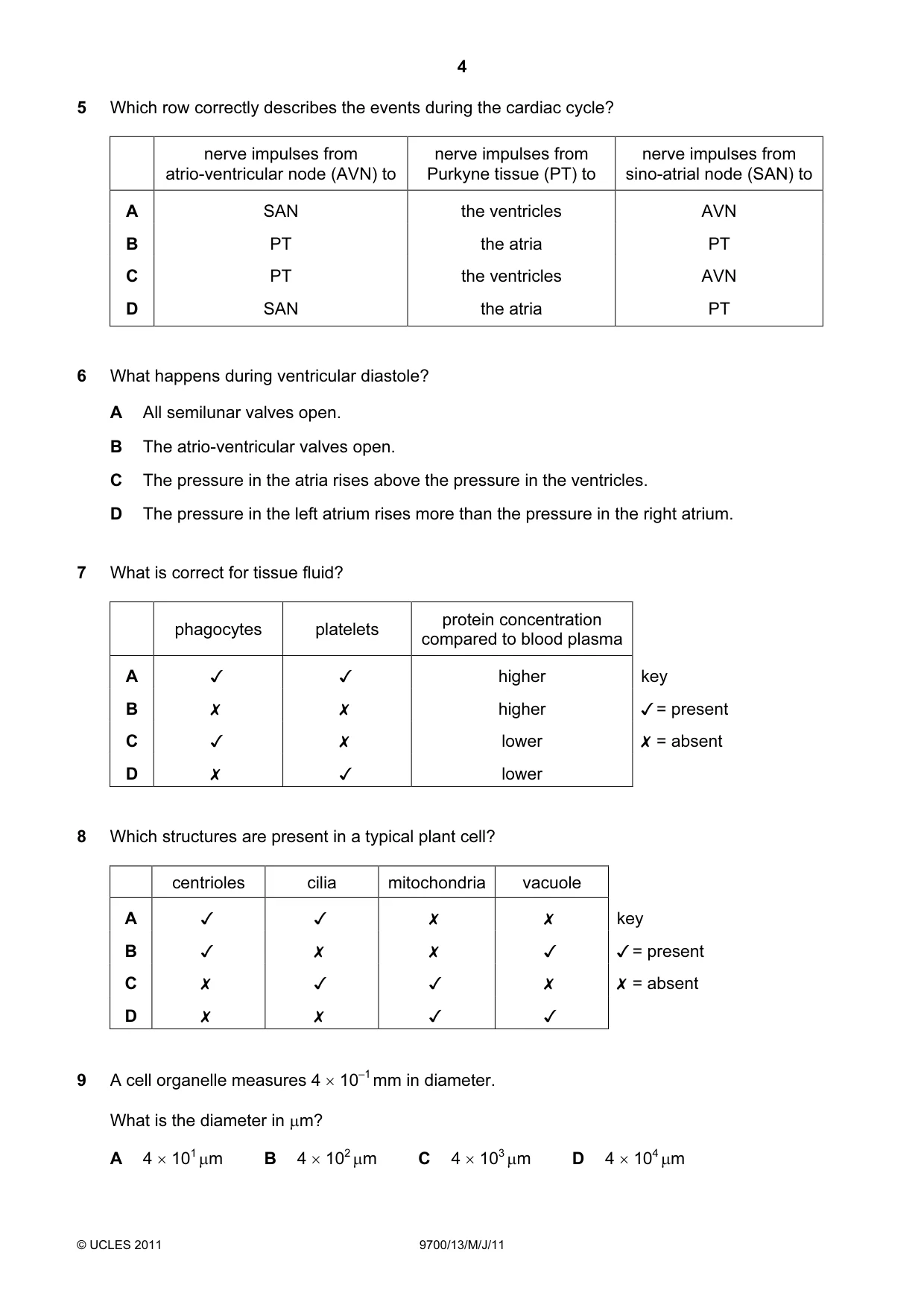
Q5 · Which row correctly describes the events during the cardiac cycle?
5 Which row correctly describes the events during the cardiac cycle? nerve impulses from nerve impulses from nerve impulses from atrio-ventricular node (AVN) to Purkyne tissue (PT) to sino-atrial node (SAN) to A SAN the ventricles AVN B PT the atria PT C PT the ventricles AVN D SAN the atria PT
Mark scheme: C
Q6 · What happens during ventricular diastole?
6 What happens during ventricular diastole? A All semilunar valves open. B The atrio-ventricular valves open. C The pressure in the atria rises above the pressure in the ventricles. D The pressure in the left atrium rises more than the pressure in the right atrium.
Mark scheme: B
Q7 · What is correct for tissue fluid?
7 What is correct for tissue fluid? protein concentration phagocytes platelets compared to blood plasma A V V higher B x x higher res JV x lower D x J lower key J/ = present X = absent
Mark scheme: C
Q8 · Which structures are present in a typical plant cell?
8 Which structures are present in a typical plant cell? centrioles cilia mitochondria vacuole A v v x x B v x x v Cc x v v x D x x v v key J/ = present X = absent
Mark scheme: D
More questions on Cells as the basic units of living organisms
Q9 · A cell organelle measures 4 × 10⁻¹ mm in diameter
9 A cell organelle measures 4 × 10⁻¹ mm in diameter. What is the diameter in µm? A 4 × 101 µm B 4 × 102 µm C 4 × 103 µm D 4 × 104 µm
Mark scheme: B
Q10 · Plant cells are stained and then viewed through a light microscope
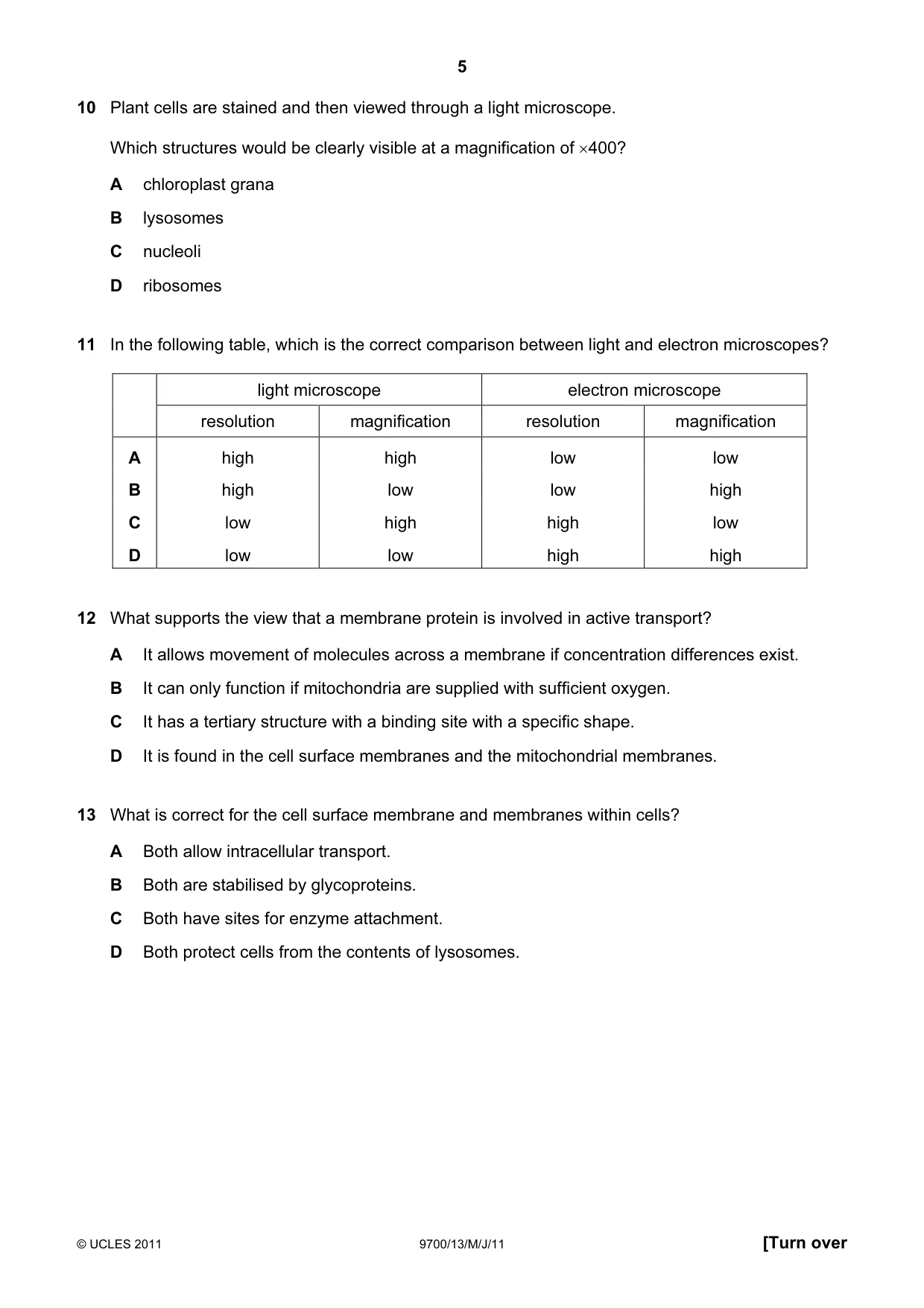
10 Plant cells are stained and then viewed through a light microscope. Which structures would be clearly visible at a magnification of ×400? A chloroplast grana B lysosomes C nucleoli D ribosomes
Mark scheme: C
Q11 · In the following table, which is the correct comparison between light and electron…
11 In the following table, which is the correct comparison between light and electron microscopes? light microscope electron microscope resolution magnification resolution magnification A high high low low B high low low high C low high high low D low low high high
Mark scheme: D
Q12 · What supports the view that a membrane protein is involved in active transport?
12 What supports the view that a membrane protein is involved in active transport? A It allows movement of molecules across a membrane if concentration differences exist. B It can only function if mitochondria are supplied with sufficient oxygen. C It has a tertiary structure with a binding site with a specific shape. D It is found in the cell surface membranes and the mitochondrial membranes.
Mark scheme: B
Q13 · What is correct for the cell surface membrane and membranes within cells?
13 What is correct for the cell surface membrane and membranes within cells? A Both allow intracellular transport. B Both are stabilised by glycoproteins. C Both have sites for enzyme attachment. D Both protect cells from the contents of lysosomes.
Mark scheme: C
Q14 · Strips of plant tissue were immersed in a range of sucrose solutions of different…
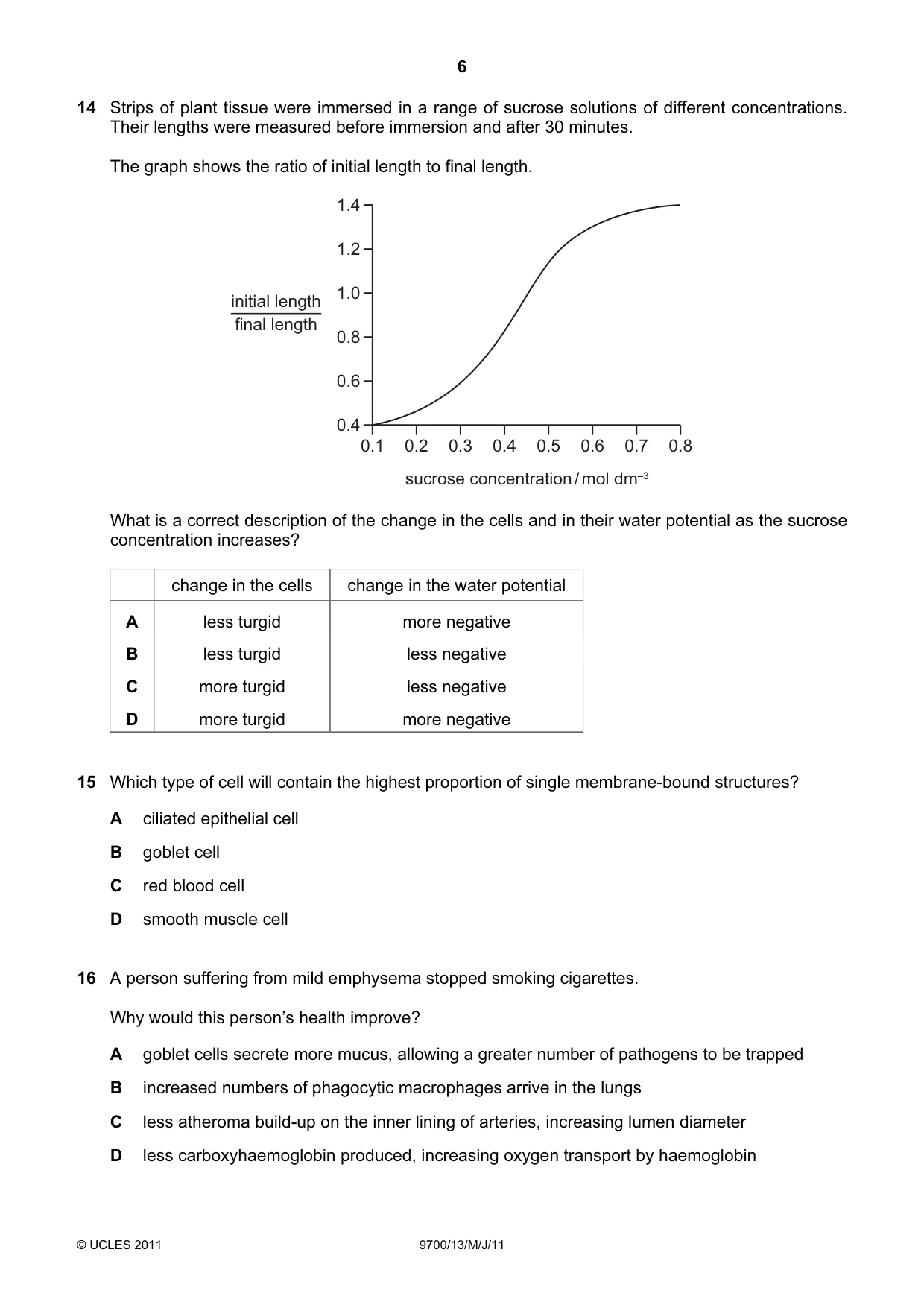
14 Strips of plant tissue were immersed in a range of sucrose solutions of different concentrations. Their lengths were measured before immersion and after 30 minutes. The graph shows the ratio of initial length to final length. 1.4 1.2 1.0 initial length final length 0.8 0.6 0.4 0.1 0.2 0.3 0.4 0.5 0.6 0.7 0.8 sucrose concentration / mol dm–3 What is a correct description of the change in the cells and in their water potential as the sucrose concentration increases? change in the cells change in the water potential A less turgid more negative B less turgid less negative C more turgid less negative D more turgid more negative
Mark scheme: A
Q15 · Which type of cell will contain the highest proportion of single membrane-bound…
15 Which type of cell will contain the highest proportion of single membrane-bound structures? A ciliated epithelial cell B goblet cell C red blood cell D smooth muscle cell
Mark scheme: B
More questions on Cells as the basic units of living organisms
Q16 · A person suffering from mild emphysema stopped smoking cigarettes
16 A person suffering from mild emphysema stopped smoking cigarettes. Why would this person’s health improve? A goblet cells secrete more mucus, allowing a greater number of pathogens to be trapped B increased numbers of phagocytic macrophages arrive in the lungs C less atheroma build-up on the inner lining of arteries, increasing lumen diameter D less carboxyhaemoglobin produced, increasing oxygen transport by haemoglobin
Mark scheme: D
Q17 · A student was asked to describe the differences between four microscope slides of…
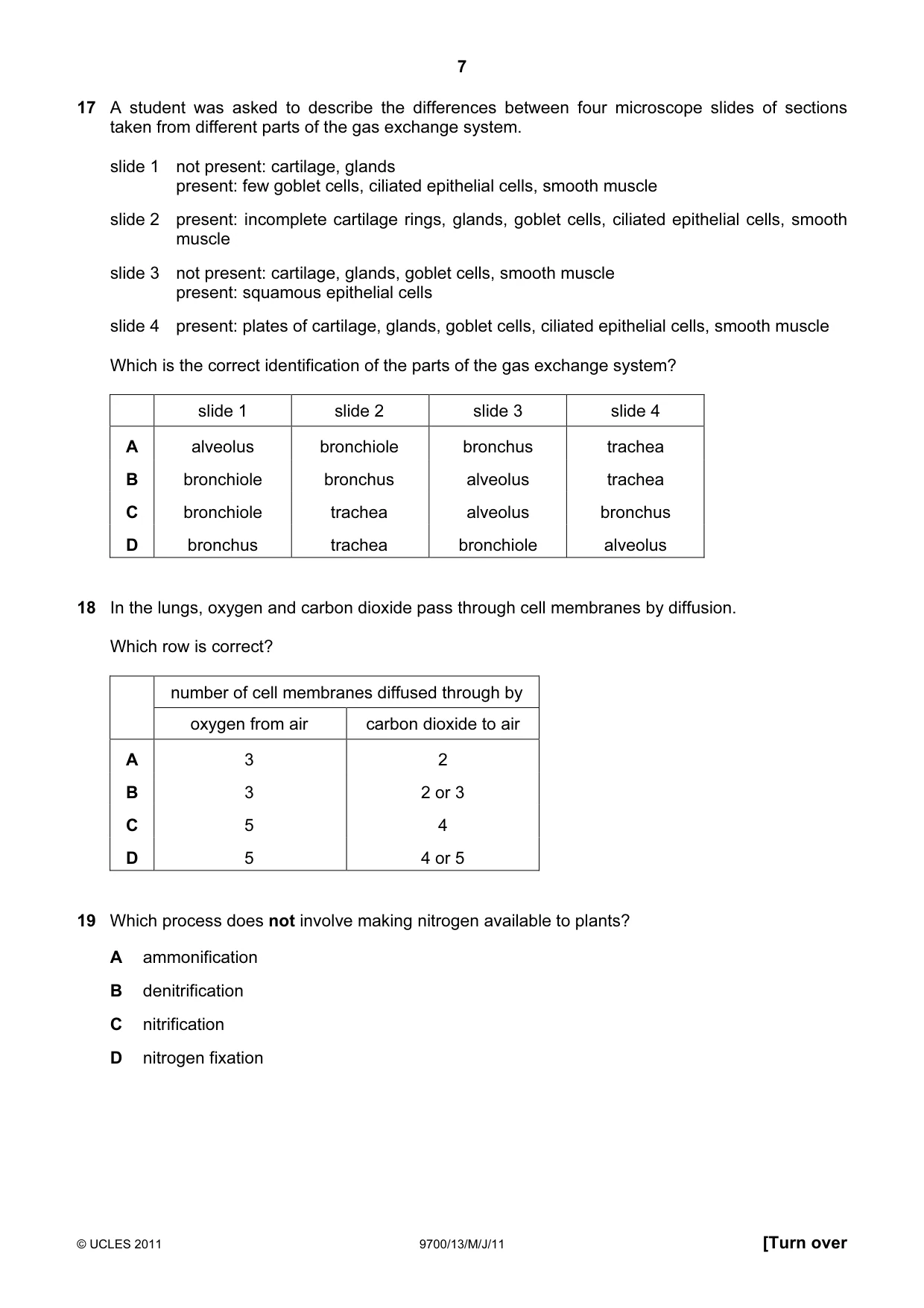
17 A student was asked to describe the differences between four microscope slides of sections taken from different parts of the gas exchange system. slide 1 not present: cartilage, glands present: few goblet cells, ciliated epithelial cells, smooth muscle slide 2 present: incomplete cartilage rings, glands, goblet cells, ciliated epithelial cells, smooth muscle slide 3 not present: cartilage, glands, goblet cells, smooth muscle present: squamous epithelial cells slide 4 present: plates of cartilage, glands, goblet cells, ciliated epithelial cells, smooth muscle Which is the correct identification of the parts of the gas exchange system? slide 1 slide 2 slide 3 slide 4 A alveolus bronchiole bronchus trachea B bronchiole bronchus alveolus trachea C bronchiole trachea alveolus bronchus D bronchus trachea bronchiole alveolus
Mark scheme: C
Q18 · In the lungs, oxygen and carbon dioxide pass through cell membranes by diffusion
18 In the lungs, oxygen and carbon dioxide pass through cell membranes by diffusion. Which row is correct? number of cell membranes diffused through by oxygen from air carbon dioxide to air A 3 2 B 3 2 or 3 C 5 4 D 5 4 or 5
Mark scheme: D
Q19 · Which process does not involve making nitrogen available to plants?
19 Which process does not involve making nitrogen available to plants? A ammonification B denitrification C nitrification D nitrogen fixation
Mark scheme: B
Q20 · A square metre of grassland receives about 1 047 000 kJ of solar light energy each year
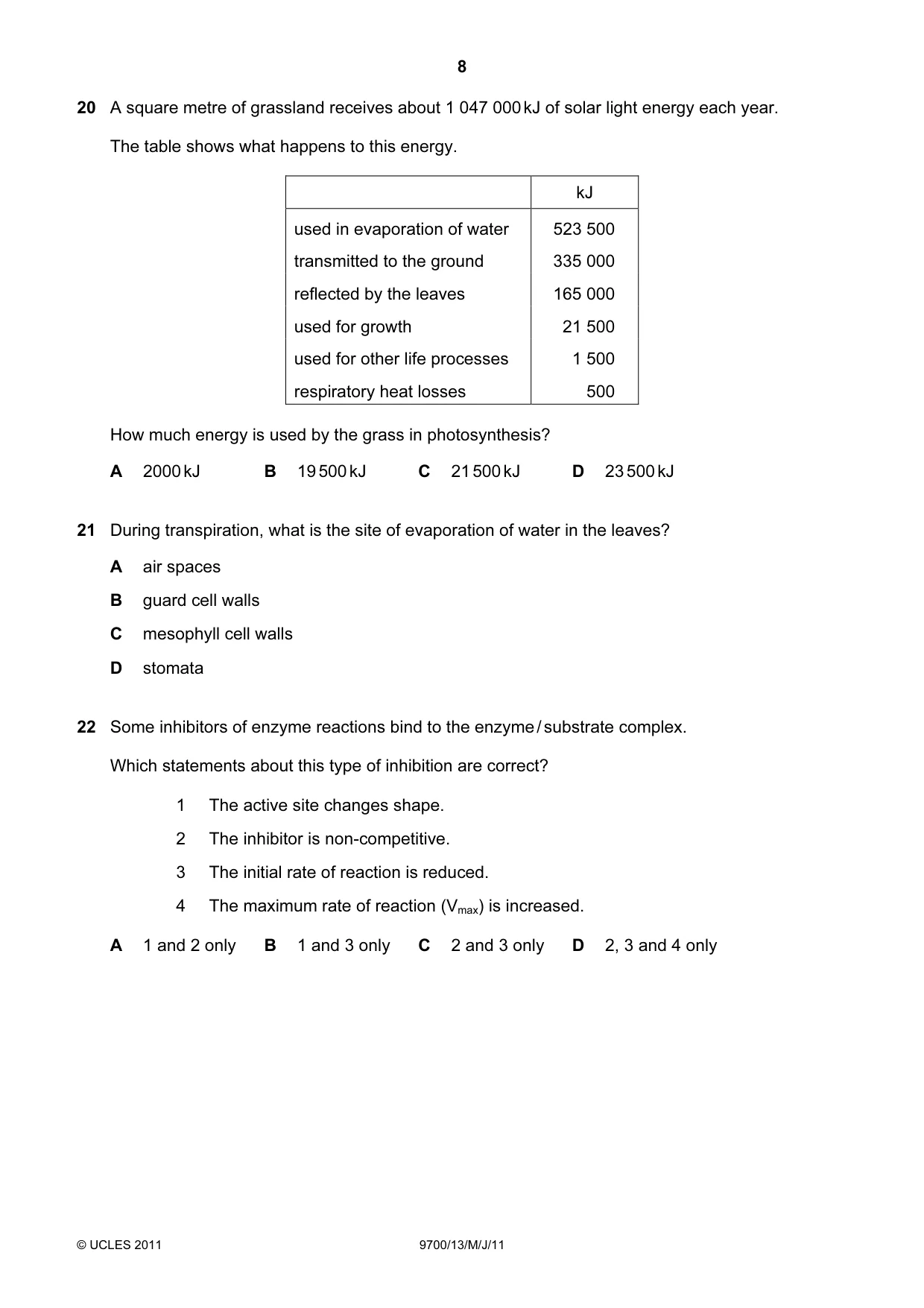
20 A square metre of grassland receives about 1 047 000 kJ of solar light energy each year. The table shows what happens to this energy. kJ used in evaporation of water 523 500 transmitted to the ground 335 000 reflected by the leaves 165 000 used for growth 21 500 used for other life processes 1 500 respiratory heat losses 500 How much energy is used by the grass in photosynthesis? A 2000 kJ B 19 500 kJ C 21 500 kJ D 23 500 kJ
Mark scheme: D
More questions on Photosynthesis as an energy transfer process
Q21 · During transpiration, what is the site of evaporation of water in the leaves?
21 During transpiration, what is the site of evaporation of water in the leaves? A air spaces B guard cell walls C mesophyll cell walls D stomata
Mark scheme: C
Q22 · Some inhibitors of enzyme reactions bind to the enzyme / substrate complex
22 Some inhibitors of enzyme reactions bind to the enzyme / substrate complex. Which statements about this type of inhibition are correct? 1 The active site changes shape. 2 The inhibitor is non-competitive. 3 The initial rate of reaction is reduced. 4 The maximum rate of reaction (Vmax) is increased. A 1 and 2 only B 1 and 3 only C 2 and 3 only D 2, 3 and 4 only
Mark scheme: C
Q23 · Which levels of protein structure can determine the specificity of an enzyme?
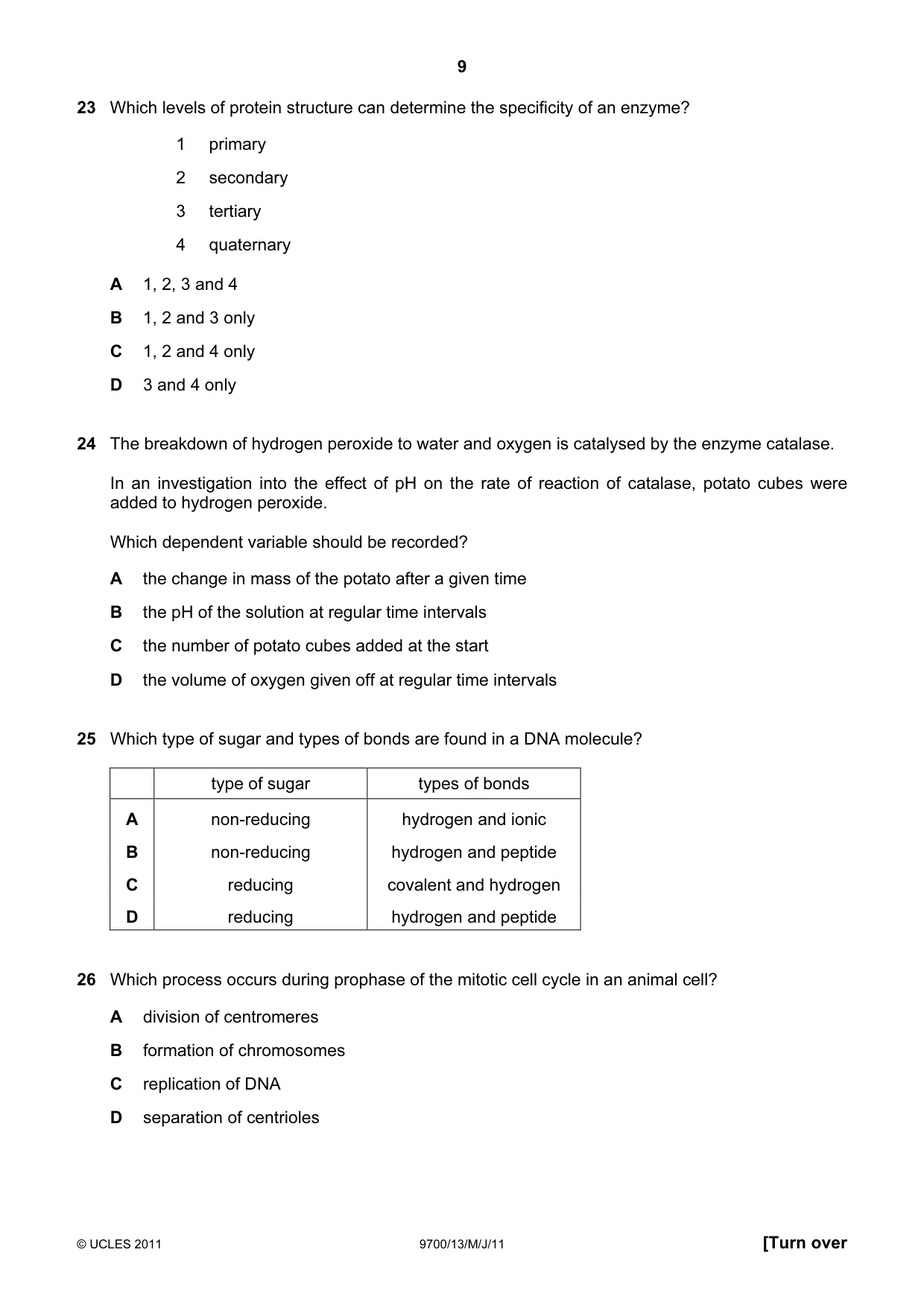
23 Which levels of protein structure can determine the specificity of an enzyme? 1 primary 2 secondary 3 tertiary 4 quaternary A 1, 2, 3 and 4 B 1, 2 and 3 only C 1, 2 and 4 only D 3 and 4 only
Mark scheme: A
Q24 · The breakdown of hydrogen peroxide to water and oxygen is catalysed by the enzyme catalase
24 The breakdown of hydrogen peroxide to water and oxygen is catalysed by the enzyme catalase. In an investigation into the effect of pH on the rate of reaction of catalase, potato cubes were added to hydrogen peroxide. Which dependent variable should be recorded? A the change in mass of the potato after a given time B the pH of the solution at regular time intervals C the number of potato cubes added at the start D the volume of oxygen given off at regular time intervals
Mark scheme: D
Q25 · Which type of sugar and types of bonds are found in a DNA molecule?
25 Which type of sugar and types of bonds are found in a DNA molecule? type of sugar types of bonds A non-reducing hydrogen and ionic B non-reducing hydrogen and peptide C reducing covalent and hydrogen D reducing hydrogen and peptide
Mark scheme: C
More questions on Structure of nucleic acids and replication of DNA
Q26 · Which process occurs during prophase of the mitotic cell cycle in an animal cell?
26 Which process occurs during prophase of the mitotic cell cycle in an animal cell? A division of centromeres B formation of chromosomes C replication of DNA D separation of centrioles
Mark scheme: D
Q27 · Which is always true of cytokinesis?
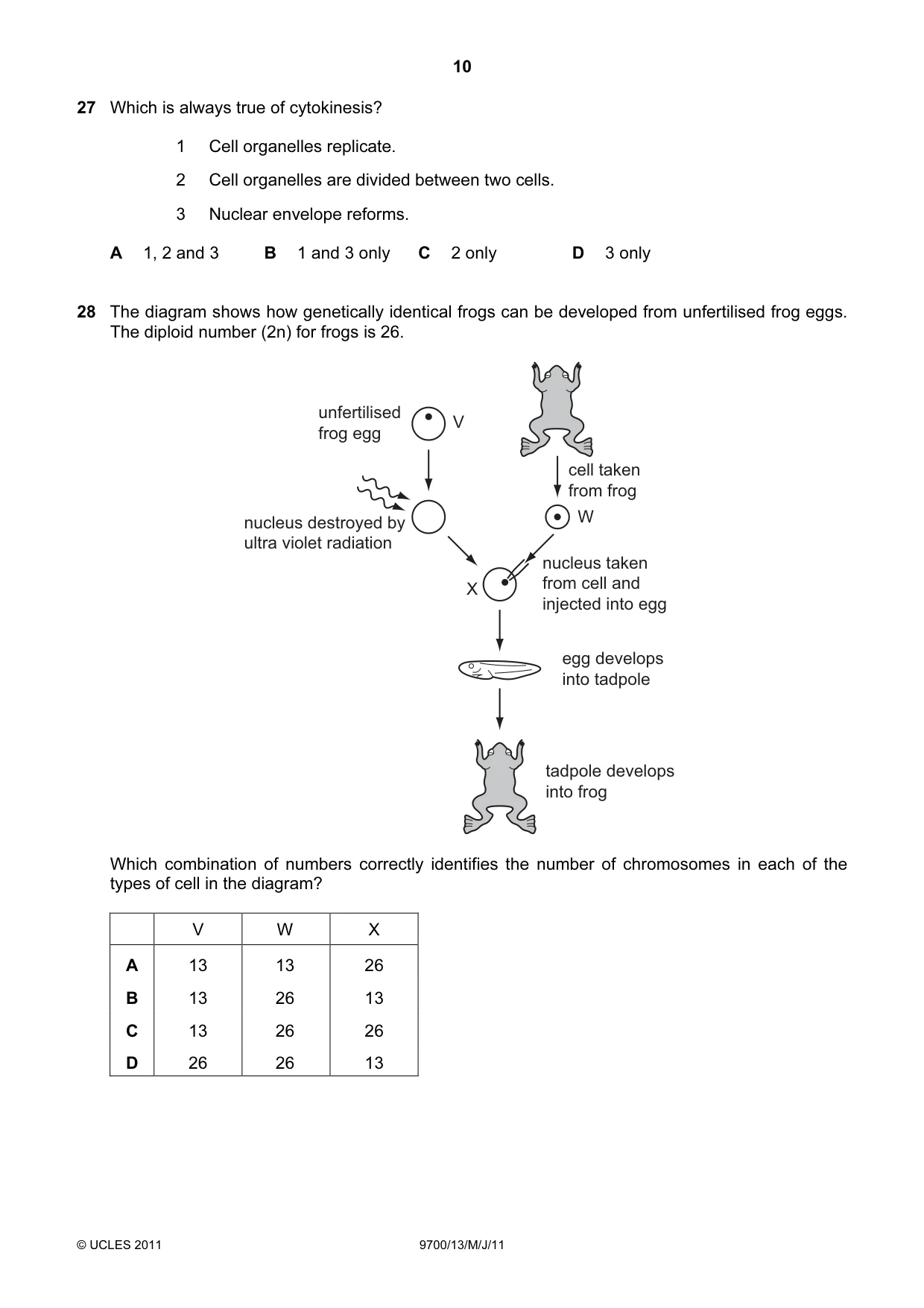
27 Which is always true of cytokinesis? 1 Cell organelles replicate. 2 Cell organelles are divided between two cells. 3 Nuclear envelope reforms. A 1, 2 and 3 B 1 and 3 only C 2 only D 3 only
Mark scheme: C
More questions on Replication and division of nuclei and cells
Q28 · The diagram shows how genetically identical frogs can be developed from unfertilised frog…
28 The diagram shows how genetically identical frogs can be developed from unfertilised frog eggs. The diploid number (2n) for frogs is 26. unfertilised V frog egg cell taken from frog nucleus destroyed by W ultra violet radiation nucleus taken X from cell and injected into egg egg develops into tadpole tadpole develops into frog Which combination of numbers correctly identifies the number of chromosomes in each of the types of cell in the diagram? V W X A 13 13 26 B 13 26 13 C 13 26 26 D 26 26 13
Mark scheme: C
More questions on Replication and division of nuclei and cells
Q29 · The following events occur during transcription
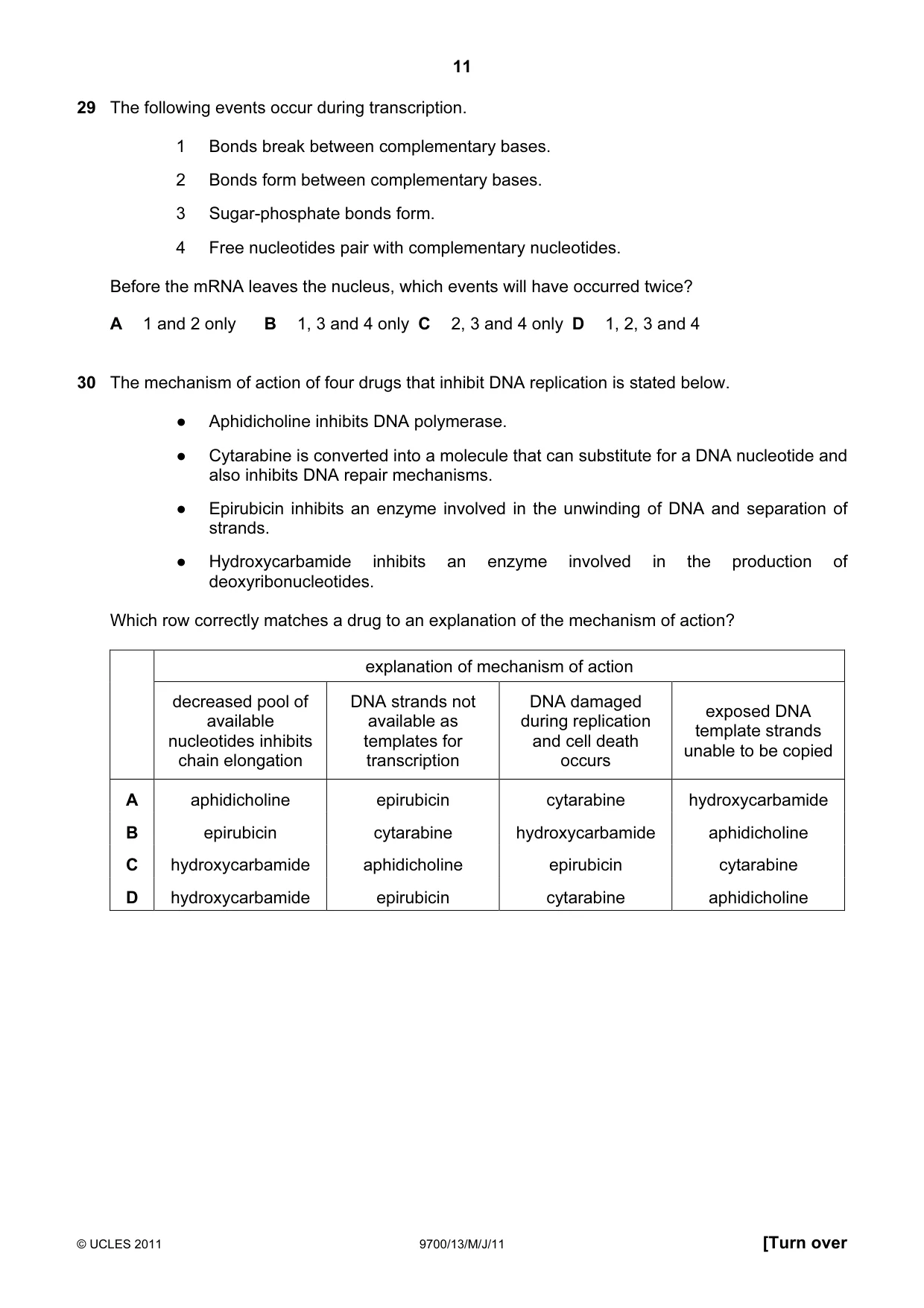
29 The following events occur during transcription. 1 Bonds break between complementary bases. 2 Bonds form between complementary bases. 3 Sugar-phosphate bonds form. 4 Free nucleotides pair with complementary nucleotides. Before the mRNA leaves the nucleus, which events will have occurred twice? A 1 and 2 only B 1, 3 and 4 only C 2, 3 and 4 only D 1, 2, 3 and 4
Mark scheme: A
Q30 · The mechanism of action of four drugs that inhibit DNA replication is stated below
30 The mechanism of action of four drugs that inhibit DNA replication is stated below. ● Aphidicholine inhibits DNA polymerase. ● Cytarabine is converted into a molecule that can substitute for a DNA nucleotide and also inhibits DNA repair mechanisms. ● Epirubicin inhibits an enzyme involved in the unwinding of DNA and separation of strands. ● Hydroxycarbamide inhibits an enzyme involved in the production of deoxyribonucleotides. Which row correctly matches a drug to an explanation of the mechanism of action? explanation of mechanism of action decreased pool of DNA strands not DNA damaged exposed DNA available available as during replication template strands nucleotides inhibits templates for and cell death unable to be copied chain elongation transcription occurs A aphidicholine epirubicin cytarabine hydroxycarbamide B epirubicin cytarabine hydroxycarbamide aphidicholine C hydroxycarbamide aphidicholine epirubicin cytarabine D hydroxycarbamide epirubicin cytarabine aphidicholine
Mark scheme: D
More questions on Structure of nucleic acids and replication of DNA
Q31 · Four different fruit juices, A, B, C and D, were tested with Benedict’s solution
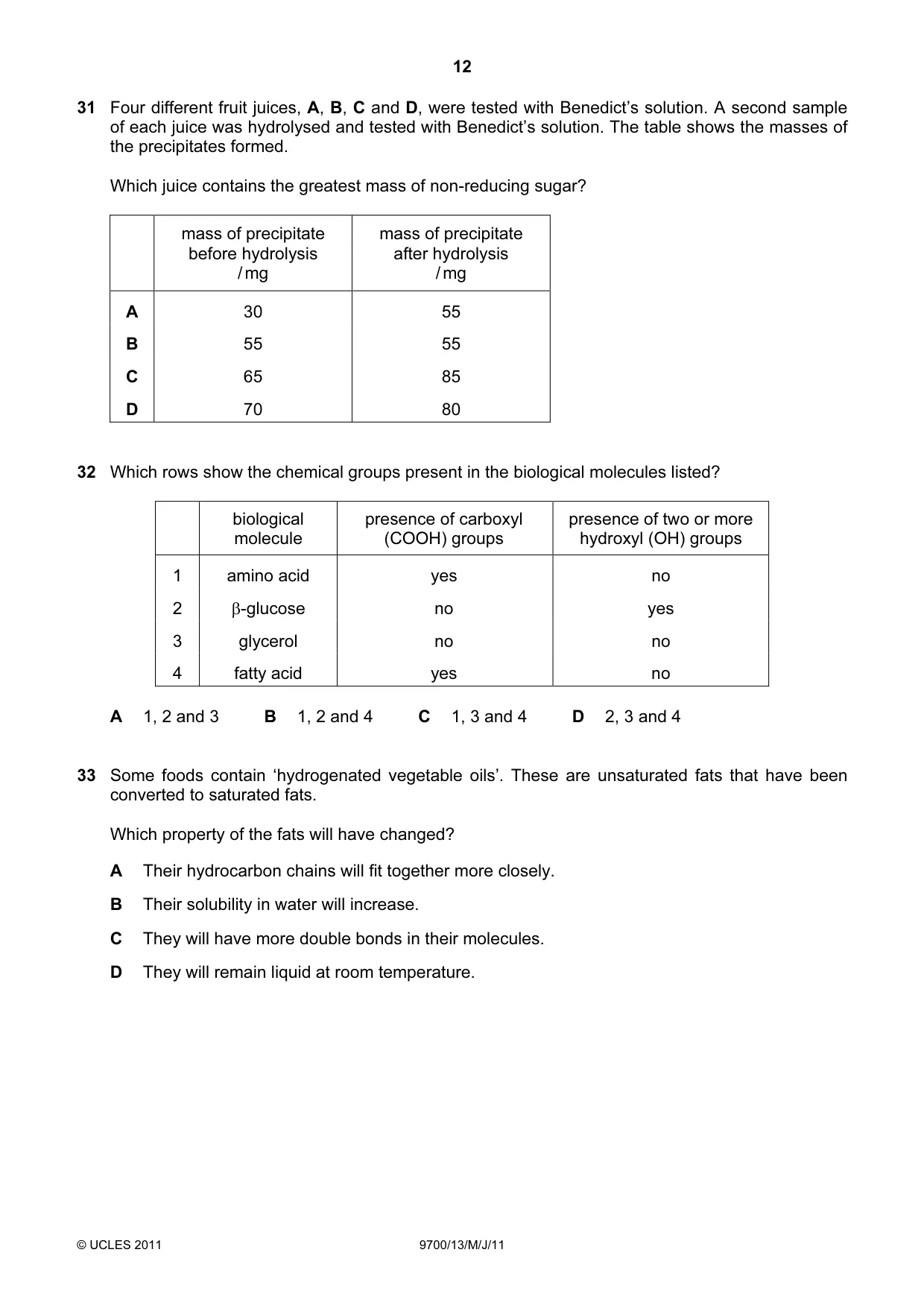
31 Four different fruit juices, A, B, C and D, were tested with Benedict’s solution. A second sample of each juice was hydrolysed and tested with Benedict’s solution. The table shows the masses of the precipitates formed. Which juice contains the greatest mass of non-reducing sugar? mass of precipitate mass of precipitate before hydrolysis after hydrolysis / mg / mg A 30 55 B 55 55 C 65 85 D 70 80
Mark scheme: A
Q32 · Which rows show the chemical groups present in the biological molecules listed?
32 Which rows show the chemical groups present in the biological molecules listed? biological presence of carboxyl presence of two or more molecule (COOH) groups hydroxyl (OH) groups 1 amino acid yes no 2 β-glucose no yes 3 glycerol no no 4 fatty acid yes no A 1, 2 and 3 B 1, 2 and 4 C 1, 3 and 4 D 2, 3 and 4
Mark scheme: B
Q33 · Some foods contain ‘hydrogenated vegetable oils’
33 Some foods contain ‘hydrogenated vegetable oils’. These are unsaturated fats that have been converted to saturated fats. Which property of the fats will have changed? A Their hydrocarbon chains will fit together more closely. B Their solubility in water will increase. C They will have more double bonds in their molecules. D They will remain liquid at room temperature.
Mark scheme: A
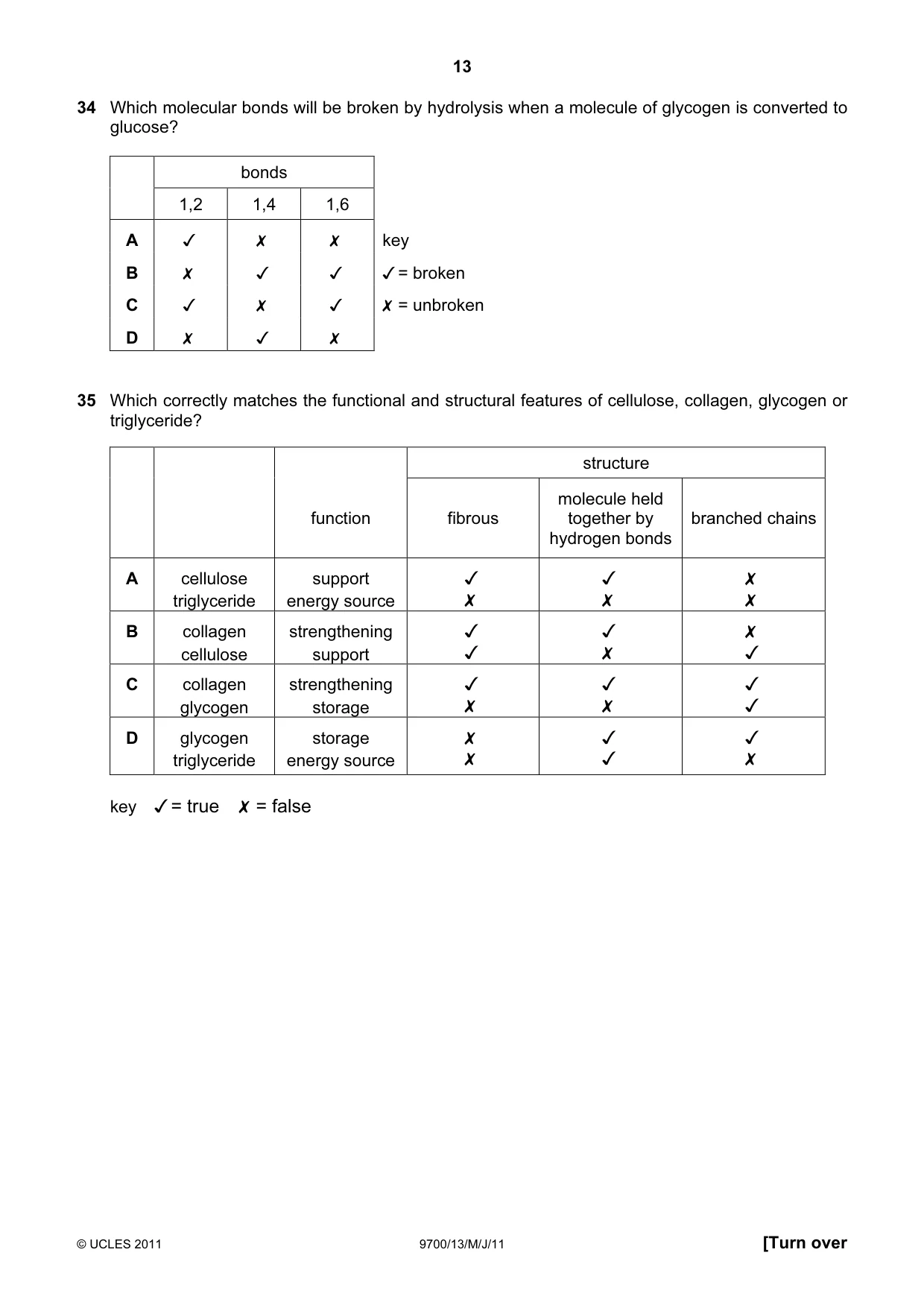
Q34 · Which molecular bonds will be broken by hydrolysis when a molecule of glycogen is…
34 Which molecular bonds will be broken by hydrolysis when a molecule of glycogen is converted to glucose? bonds 1,2 1,4 1,6 A v x x key B x v v ¥ = broken Cc v x v X = unbroken D x v x
Mark scheme: B
Q35 · Which correctly matches the functional and structural features of cellulose, collagen…
35 Which correctly matches the functional and structural features of cellulose, collagen, glycogen or triglyceride? structure molecule held function fibrous together by branched chains hydrogen bonds A cellulose support J Jv x triglyceride | energy source x x x B collagen strengthening Jv Jv x cellulose support Jv x J Cc collagen strengthening Jv Jv Jv glycogen storage x x v D glycogen storage x Jv Jv triglyceride | energy source x Jv x key /=true xX = false
Mark scheme: A
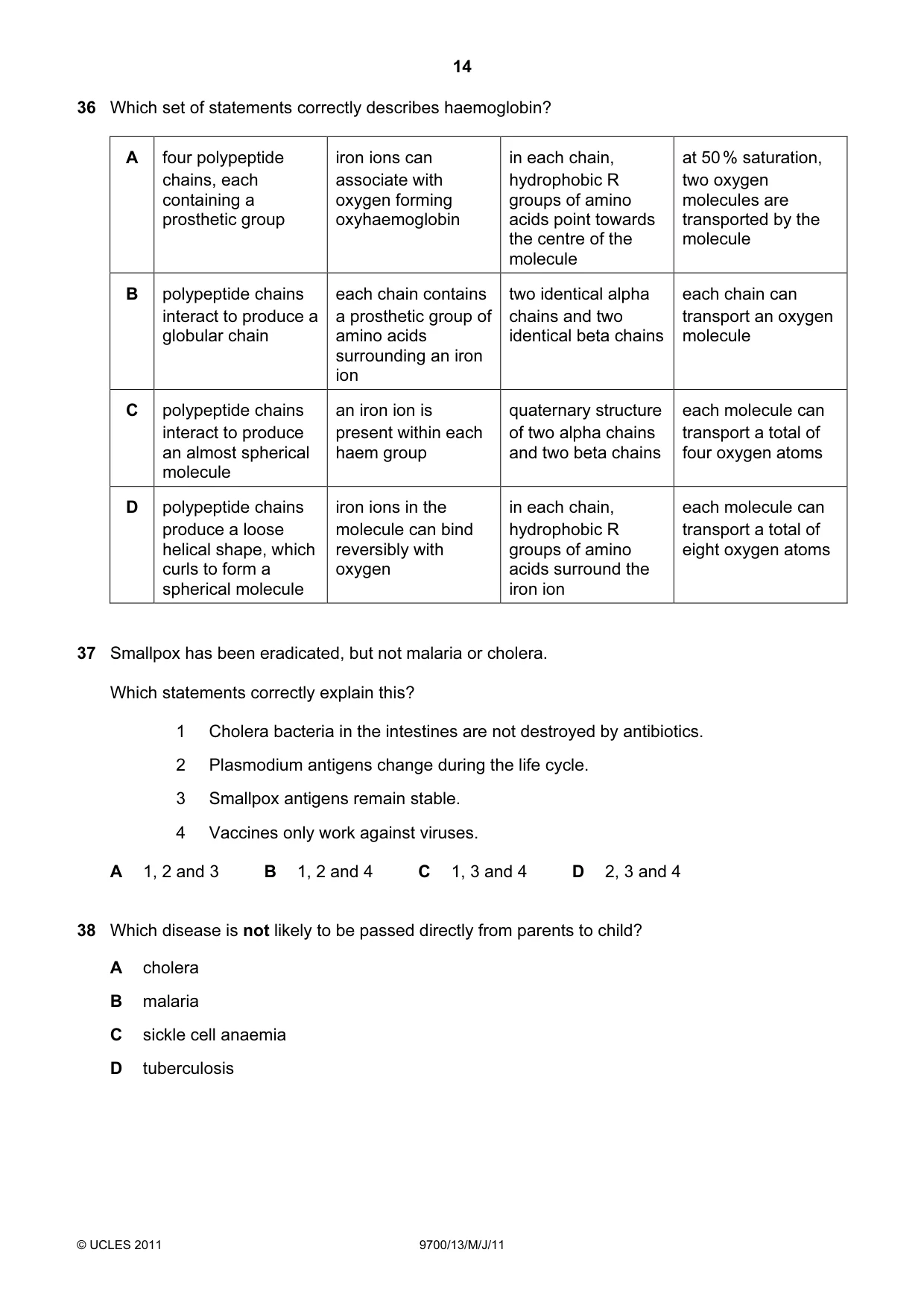
Q36 · Which set of statements correctly describes haemoglobin?
36 Which set of statements correctly describes haemoglobin? A four polypeptide iron ions can in each chain, at 50 % saturation, chains, each associate with hydrophobic R two oxygen containing a oxygen forming groups of amino molecules are prosthetic group oxyhaemoglobin acids point towards transported by the the centre of the molecule molecule B polypeptide chains each chain contains two identical alpha each chain can interact to produce a a prosthetic group of chains and two transport an oxygen globular chain amino acids identical beta chains molecule surrounding an iron ion C polypeptide chains an iron ion is quaternary structure each molecule can interact to produce present within each of two alpha chains transport a total of an almost spherical haem group and two beta chains four oxygen atoms molecule D polypeptide chains iron ions in the in each chain, each molecule can produce a loose molecule can bind hydrophobic R transport a total of helical shape, which reversibly with groups of amino eight oxygen atoms curls to form a oxygen acids surround the spherical molecule iron ion
Mark scheme: A
Q37 · Smallpox has been eradicated, but not malaria or cholera
37 Smallpox has been eradicated, but not malaria or cholera. Which statements correctly explain this? 1 Cholera bacteria in the intestines are not destroyed by antibiotics. 2 Plasmodium antigens change during the life cycle. 3 Smallpox antigens remain stable. 4 Vaccines only work against viruses. A 1, 2 and 3 B 1, 2 and 4 C 1, 3 and 4 D 2, 3 and 4
Mark scheme: A
Q38 · Which disease is not likely to be passed directly from parents to child?
38 Which disease is not likely to be passed directly from parents to child? A cholera B malaria C sickle cell anaemia D tuberculosis
Mark scheme: B
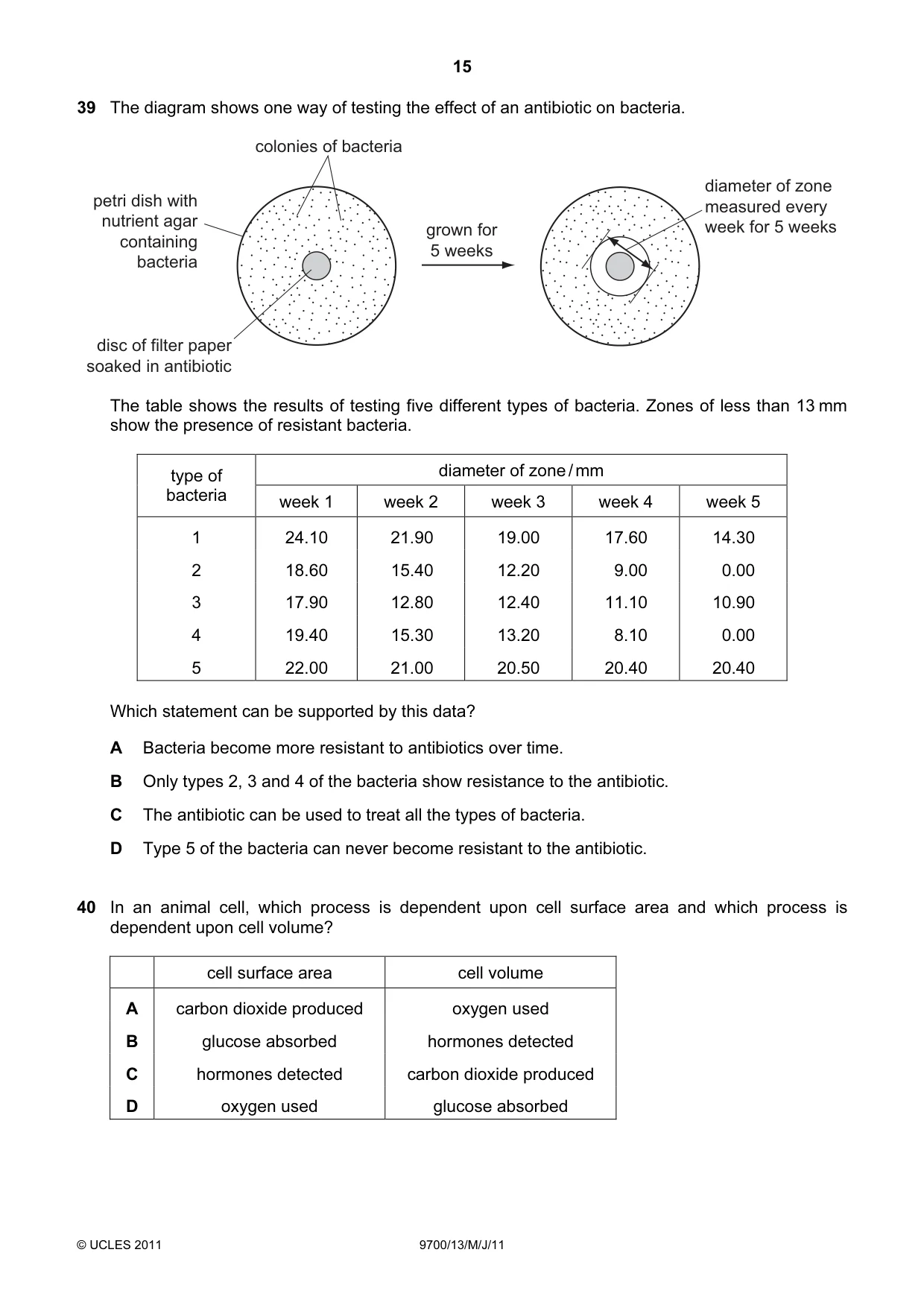
Q39 · The diagram shows one way of testing the effect of an antibiotic on bacteria
39 The diagram shows one way of testing the effect of an antibiotic on bacteria. colonies of bacteria diameter of zone petri dish with measured every nutrient agar week for 5 weeks grown for containing 5 weeks bacteria disc of filter paper soaked in antibiotic The table shows the results of testing five different types of bacteria. Zones of less than 13 mm show the presence of resistant bacteria. type of diameter of zone / mm bacteria week 1 week 2 week 3 week 4 week 5 1 24.10 21.90 19.00 17.60 14.30 2 18.60 15.40 12.20 9.00 0.00 3 17.90 12.80 12.40 11.10 10.90 4 19.40 15.30 13.20 8.10 0.00 5 22.00 21.00 20.50 20.40 20.40 Which statement can be supported by this data? A Bacteria become more resistant to antibiotics over time. B Only types 2, 3 and 4 of the bacteria show resistance to the antibiotic. C The antibiotic can be used to treat all the types of bacteria. D Type 5 of the bacteria can never become resistant to the antibiotic.
Mark scheme: B
Q40 · In an animal cell, which process is dependent upon cell surface area and which process is…
40 In an animal cell, which process is dependent upon cell surface area and which process is dependent upon cell volume? cell surface area cell volume A carbon dioxide produced oxygen used B glucose absorbed hormones detected C hormones detected carbon dioxide produced D oxygen used glucose absorbed
Mark scheme: C
More questions on Cells as the basic units of living organisms
What was in this paper
The subtopics covered by these 40 questions, and how many questions each got. Open one in a new tab to see every Cambridge question on it.
3Cells as the basic units of living organisms3The gas exchange system3The microscope in cell studies3Transport mechanisms3Factors that affect enzyme action2Movement into and out of cells2Replication and division of nuclei and cells2Structure of nucleic acids and replication of DNA2The circulatory system2The heart2Antibiotics1Antibodies and vaccination1Biodiversity1Chromosome behaviour in mitosis1Fluid mosaic membranes1Homeostasis in plants1Infectious diseases1Mode of action of enzymes1Photosynthesis as an energy transfer process1Protein synthesis1Proteins1Testing for biological molecules1Transport of oxygen and carbon dioxide1What you needed in this session
Cambridge’s own grade thresholds for 2011 May/June, Paper 1 · Variant 3. A higher threshold means an easier paper — the bar moves with how the cohort did.