Cambridge A Level Biology 9700 — 2024 May/June Paper 1 · Variant 1
9700/11/M/J/24 · 40 questions · 40 marks · ≈45 min
The question paper and its mark scheme, free to read here and free to download. This is Cambridge’s own paper, exactly as it was sat.
Question paper20 pages
Mark scheme3 pages
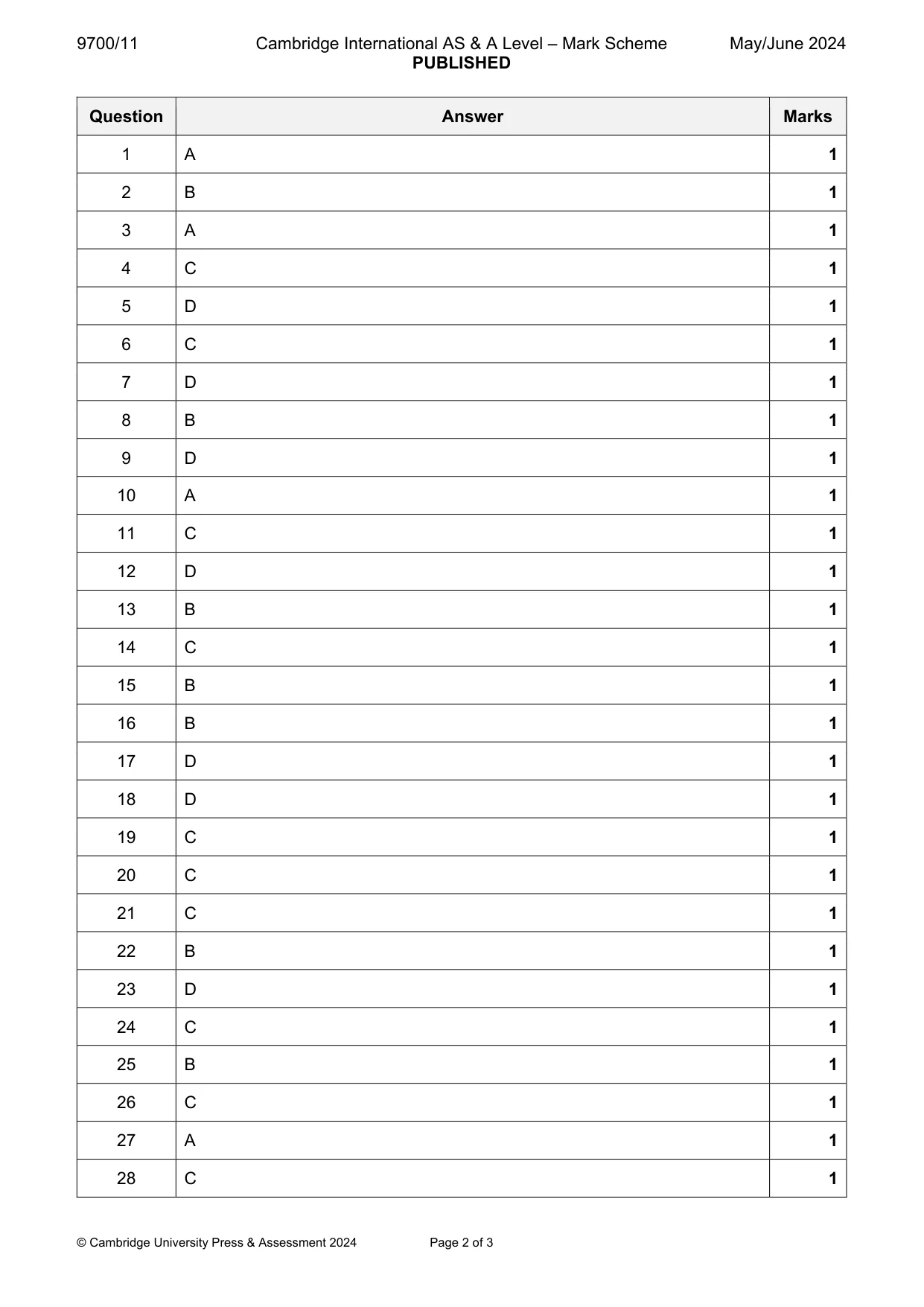
Answers below. Sit the paper first if you are practising.
Questions as text
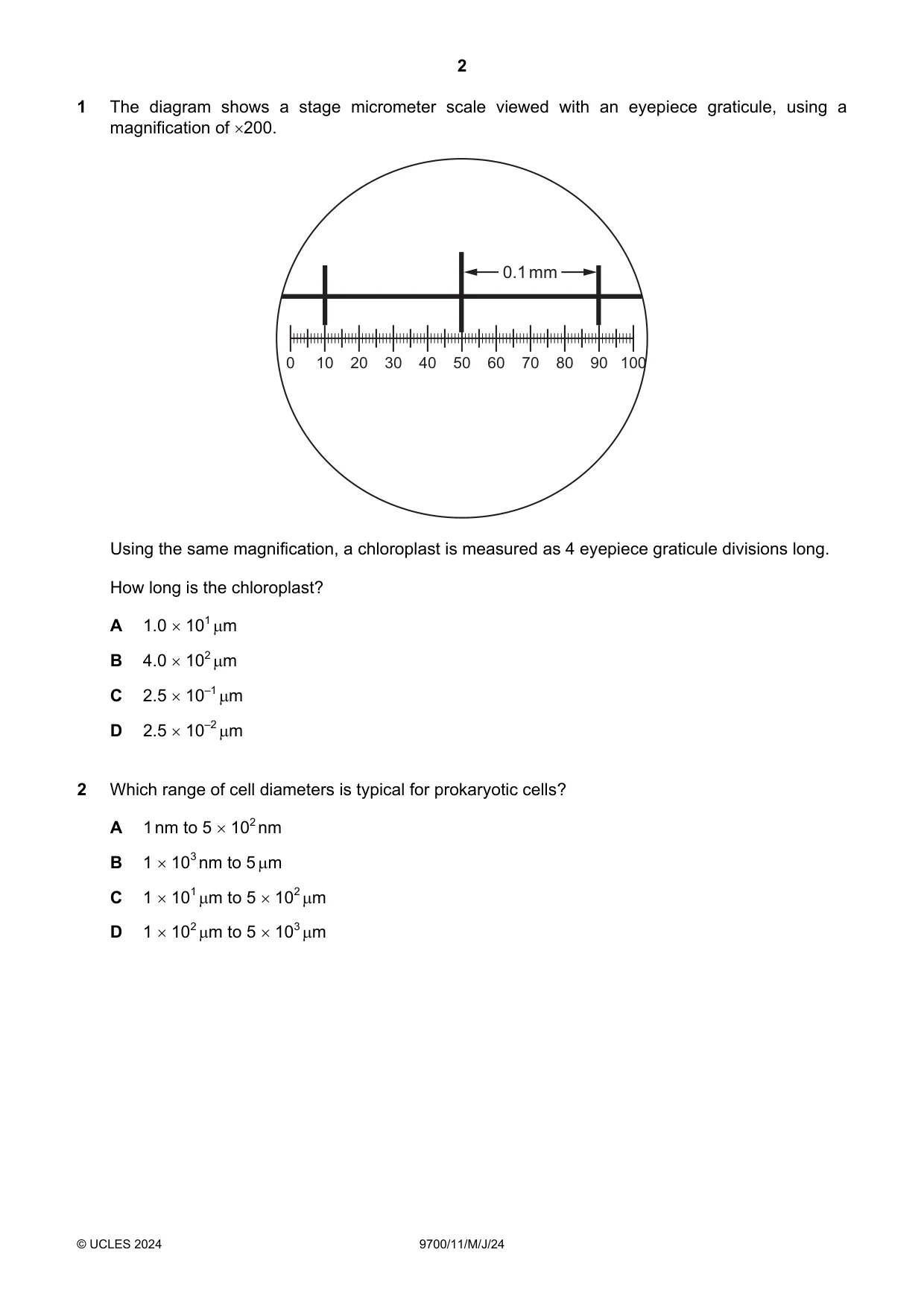
Q1 · The diagram shows a stage micrometer scale viewed with an eyepiece graticule, using a…
1 The diagram shows a stage micrometer scale viewed with an eyepiece graticule, using a magnification of 200. 0.1 mm 0 10 20 30 40 50 60 70 80 90 100 Using the same magnification, a chloroplast is measured as 4 eyepiece graticule divisions long. How long is the chloroplast? A 1.0 101 m B 4.0 102 m C 2.5 10–1 m D 2.5 10–2 m
Mark scheme: A
Q2 · Which range of cell diameters is typical for prokaryotic cells?
2 Which range of cell diameters is typical for prokaryotic cells? A 1 nm to 5 102 nm B 1 103 nm to 5 m C 1 101 m to 5 102 m D 1 102 m to 5 103 m
Mark scheme: B
More questions on Cells as the basic units of living organisms
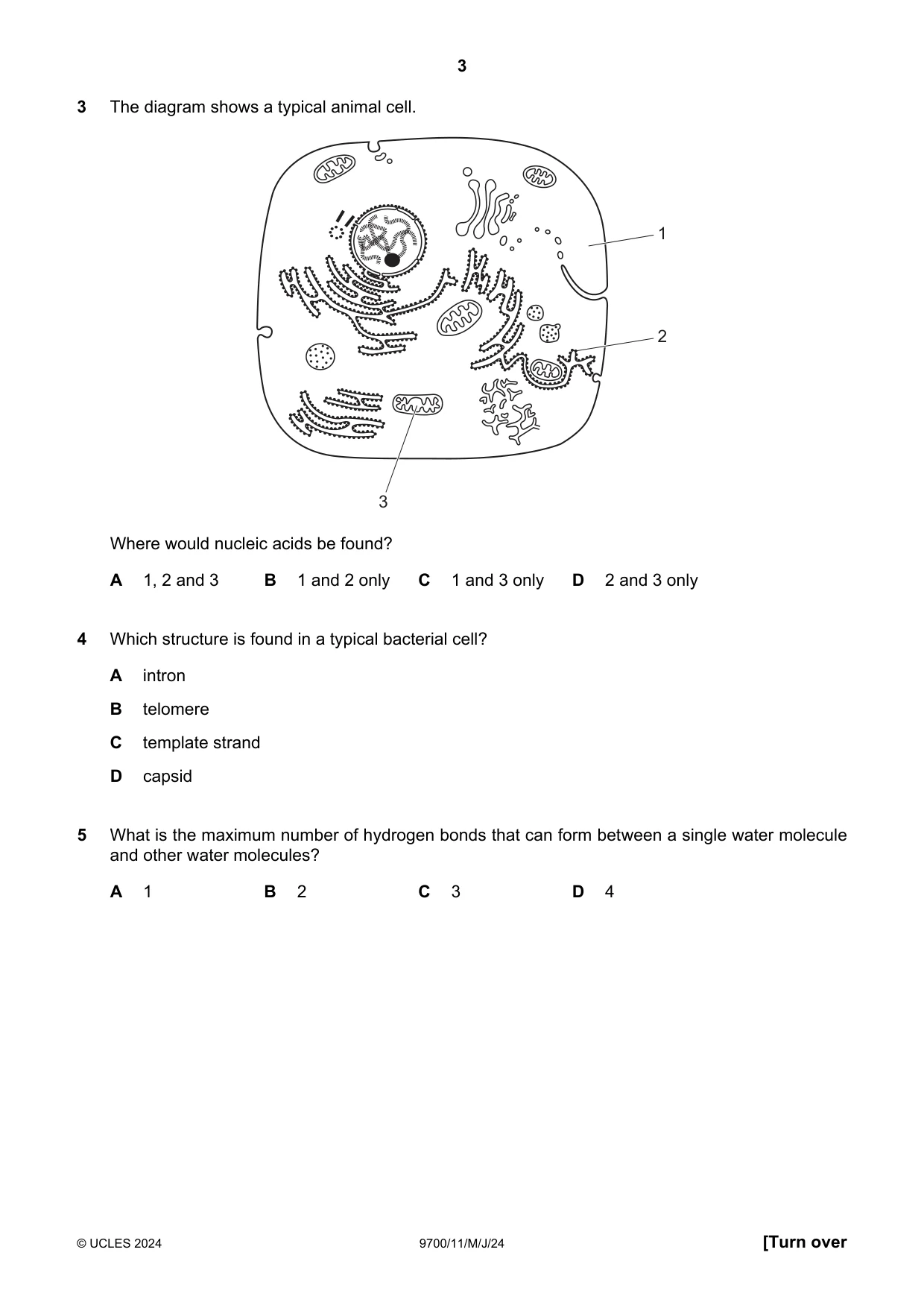
Q3 · The diagram shows a typical animal cell
3 The diagram shows a typical animal cell. 1 2 3 Where would nucleic acids be found? A 1, 2 and 3 B 1 and 2 only C 1 and 3 only D 2 and 3 only
Mark scheme: A
More questions on Cells as the basic units of living organisms
Q4 · Which structure is found in a typical bacterial cell?
4 Which structure is found in a typical bacterial cell? A intron B telomere C template strand D capsid
Mark scheme: C
More questions on Cells as the basic units of living organisms
Q5 · What is the maximum number of hydrogen bonds that can form between a single water…
5 What is the maximum number of hydrogen bonds that can form between a single water molecule and other water molecules? A 1 B 2 C 3 D 4
Mark scheme: D
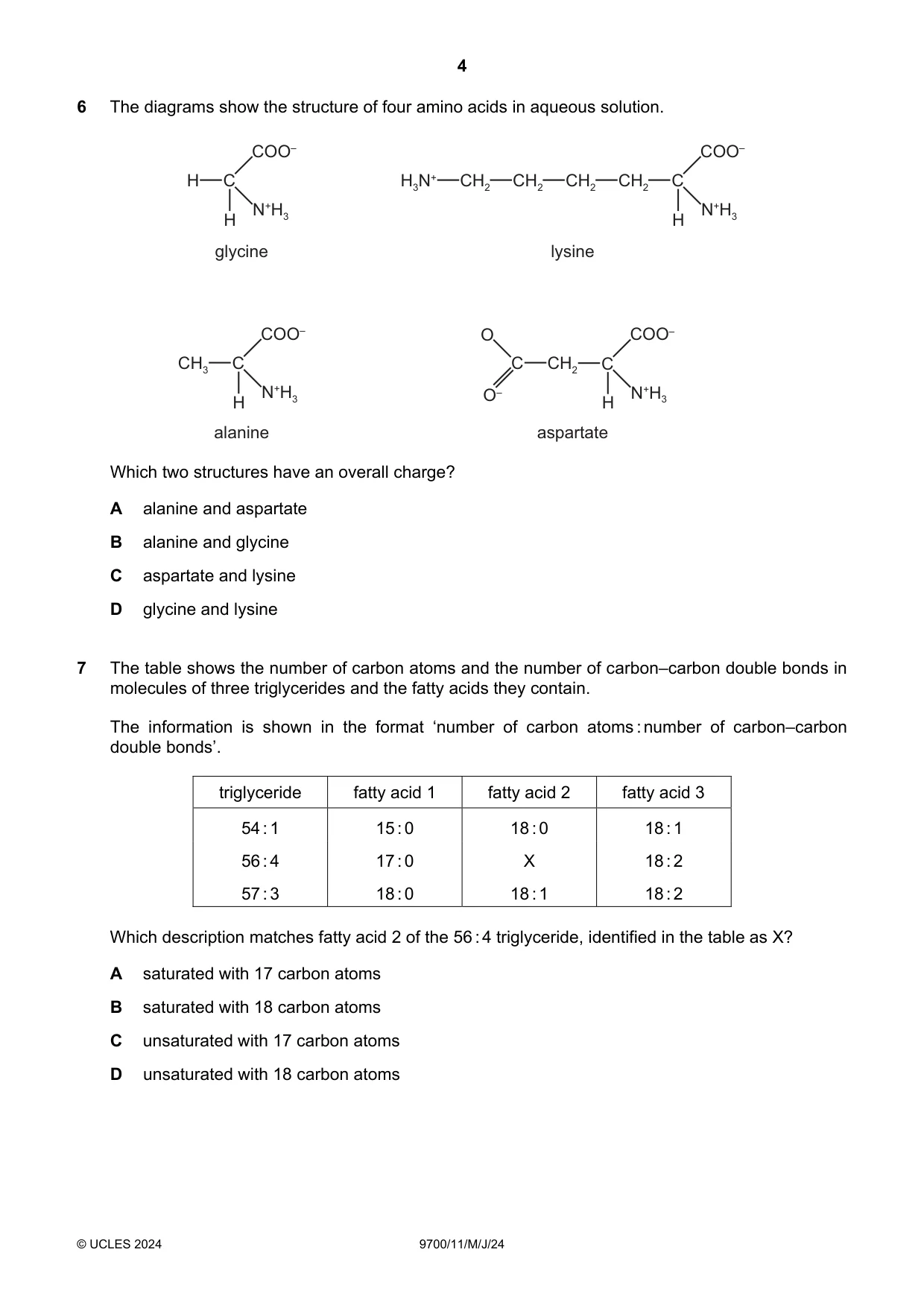
Q6 · The diagrams show the structure of four amino acids in aqueous solution
6 The diagrams show the structure of four amino acids in aqueous solution. COO– COO– H C H3N+ CH2 CH2 CH2 CH2 C N+H3 N+H3 H H glycine lysine COO– O COO– CH3 C C CH2 C N+H3 O– N+H3 H H alanine aspartate Which two structures have an overall charge? A alanine and aspartate B alanine and glycine C aspartate and lysine D glycine and lysine
Mark scheme: C
Q7 · The table shows the number of carbon atoms and the number of carbon–carbon double bonds…
7 The table shows the number of carbon atoms and the number of carbon–carbon double bonds in molecules of three triglycerides and the fatty acids they contain. The information is shown in the format ‘number of carbon atoms : number of carbon–carbon double bonds’. triglyceride fatty acid 1 fatty acid 2 fatty acid 3 54 : 1 15 : 0 18 : 0 18 : 1 56 : 4 17 : 0 X 18 : 2 57 : 3 18 : 0 18 : 1 18 : 2 Which description matches fatty acid 2 of the 56 : 4 triglyceride, identified in the table as X? A saturated with 17 carbon atoms B saturated with 18 carbon atoms C unsaturated with 17 carbon atoms D unsaturated with 18 carbon atoms
Mark scheme: D
Q8 · Collagen molecules are made up of three polypeptide chains interacting together
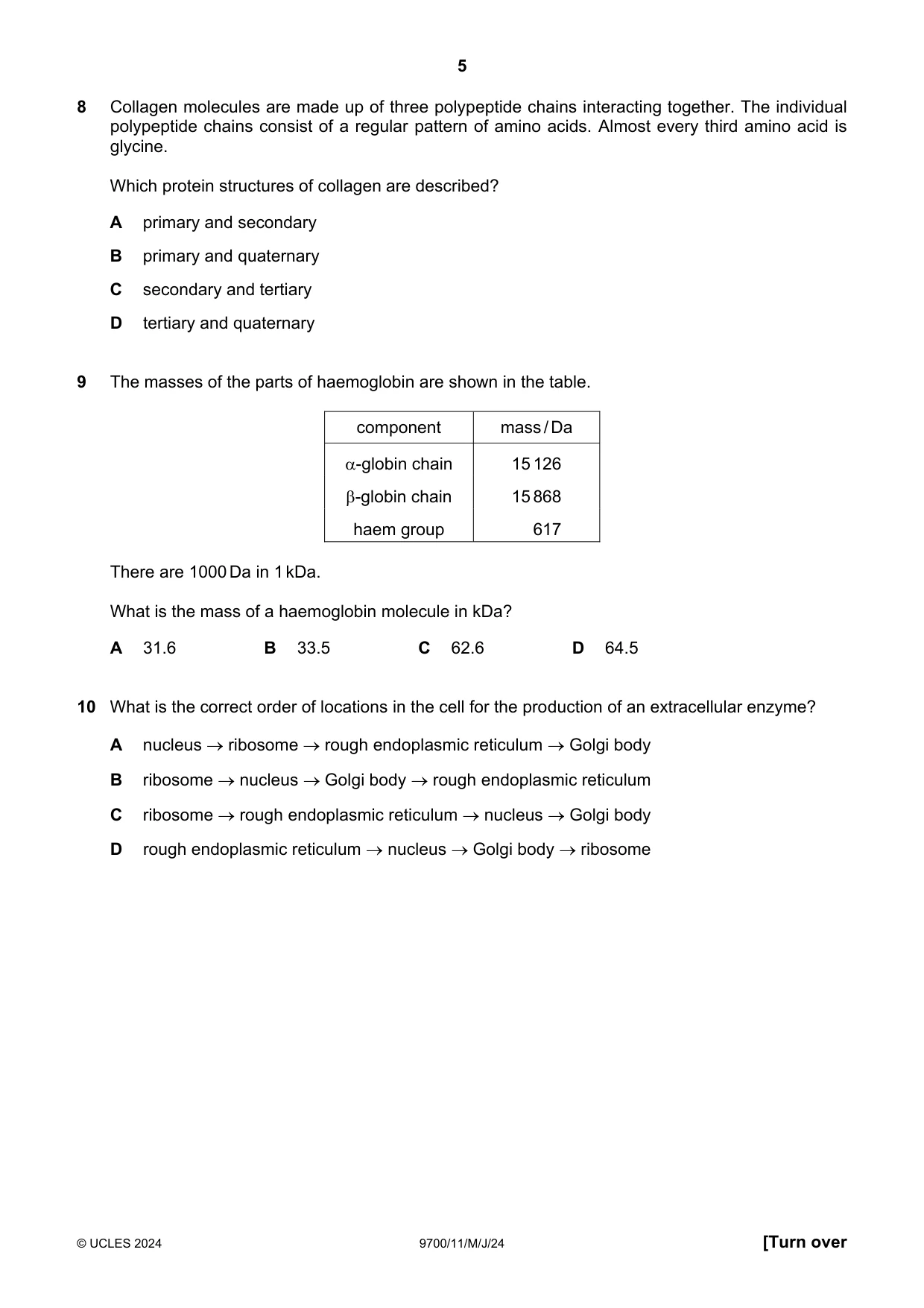
8 Collagen molecules are made up of three polypeptide chains interacting together. The individual polypeptide chains consist of a regular pattern of amino acids. Almost every third amino acid is glycine. Which protein structures of collagen are described? A primary and secondary B primary and quaternary C secondary and tertiary D tertiary and quaternary
Mark scheme: B
Q9 · The masses of the parts of haemoglobin are shown in the table
9 The masses of the parts of haemoglobin are shown in the table. component mass / Da -globin chain 15 126 -globin chain 15 868 haem group 15 617 There are 1000 Da in 1 kDa. What is the mass of a haemoglobin molecule in kDa? A 31.6 B 33.5 C 62.6 D 64.5
Mark scheme: D
Q10 · What is the correct order of locations in the cell for the production of an extracellular…
10 What is the correct order of locations in the cell for the production of an extracellular enzyme? A nucleus ribosome rough endoplasmic reticulum Golgi body B ribosome nucleus Golgi body rough endoplasmic reticulum C ribosome rough endoplasmic reticulum nucleus Golgi body D rough endoplasmic reticulum nucleus Golgi body ribosome
Mark scheme: A
Q11 · The graph shows the trend from an enzyme-catalysed reaction
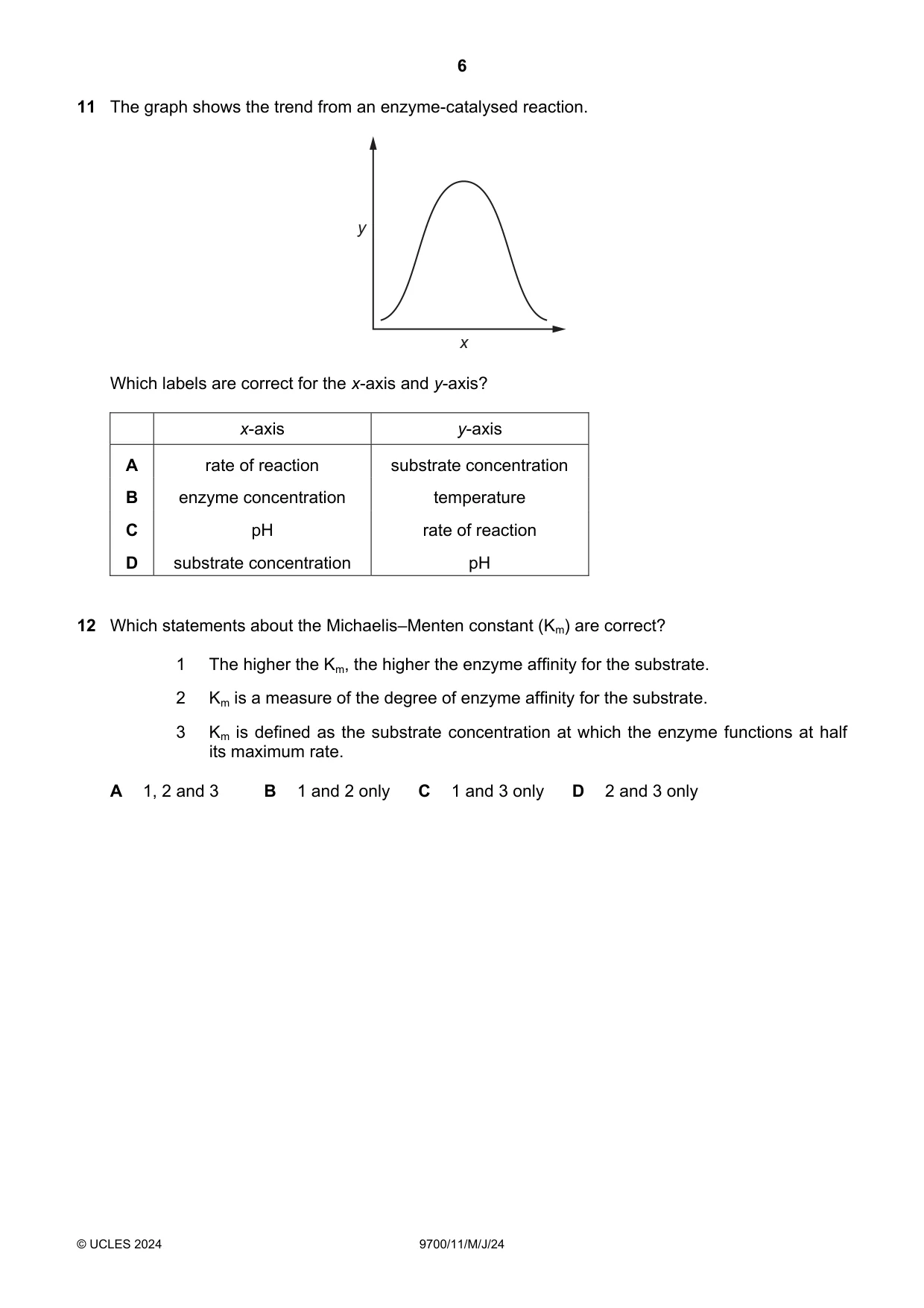
11 The graph shows the trend from an enzyme-catalysed reaction. y x Which labels are correct for the x-axis and y-axis? x-axis y-axis A rate of reaction substrate concentration B enzyme concentration temperature C pH rate of reaction D substrate concentration pH
Mark scheme: C
Q12 · Which statements about the Michaelis–Menten constant (Km) are correct?
12 Which statements about the Michaelis–Menten constant (Km) are correct? 1 The higher the Km, the higher the enzyme affinity for the substrate. 2 Km is a measure of the degree of enzyme affinity for the substrate. 3 Km is defined as the substrate concentration at which the enzyme functions at half its maximum rate. A 1, 2 and 3 B 1 and 2 only C 1 and 3 only D 2 and 3 only
Mark scheme: D
Q13 · The diagram shows how nicotine is transported from the blood plasma into a cell using a…
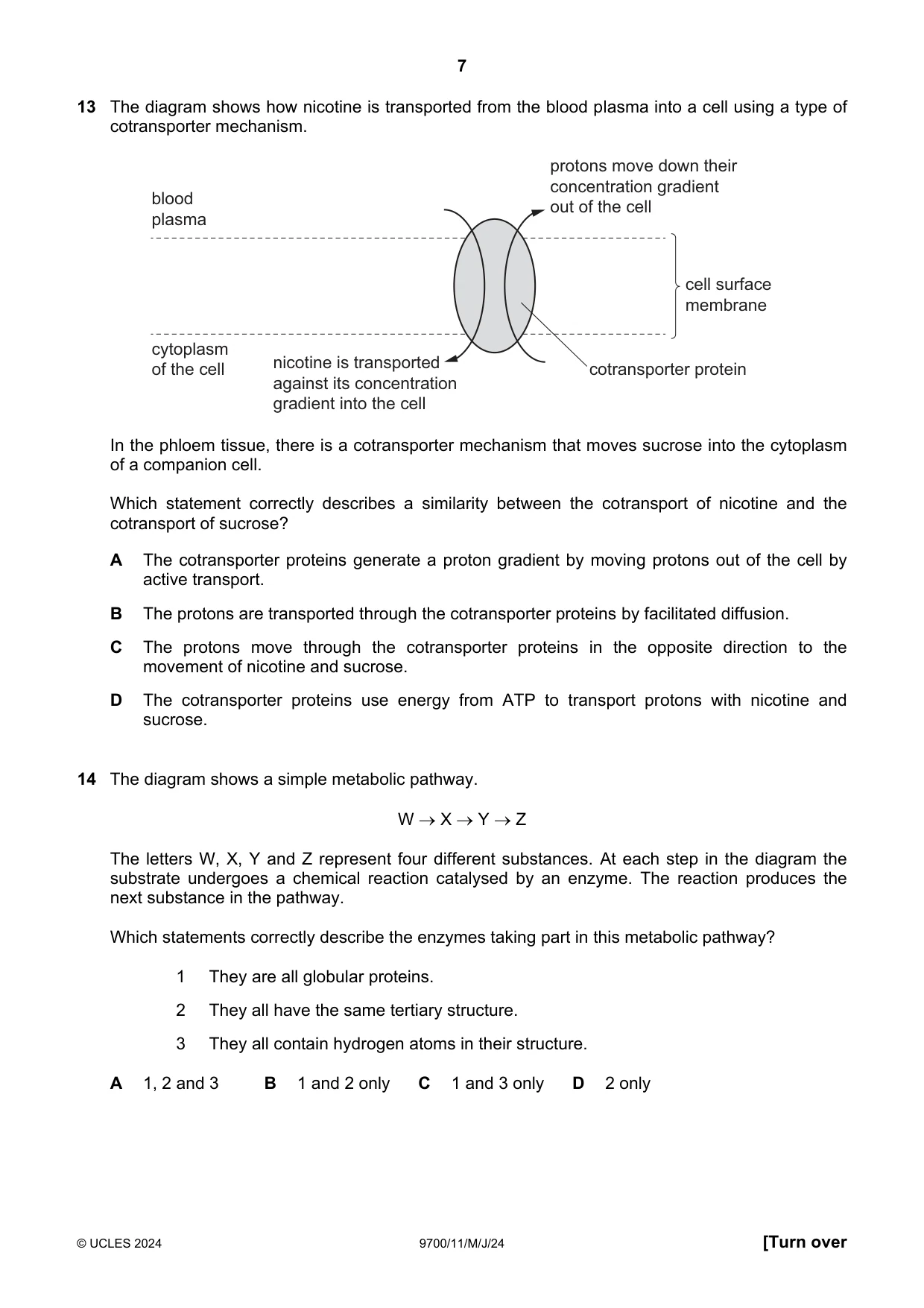
13 The diagram shows how nicotine is transported from the blood plasma into a cell using a type of cotransporter mechanism. protons move down their concentration gradient blood out of the cell plasma cell surface membrane cytoplasm of the cell nicotine is transported cotransporter protein against its concentration gradient into the cell In the phloem tissue, there is a cotransporter mechanism that moves sucrose into the cytoplasm of a companion cell. Which statement correctly describes a similarity between the cotransport of nicotine and the cotransport of sucrose? A The cotransporter proteins generate a proton gradient by moving protons out of the cell by active transport. B The protons are transported through the cotransporter proteins by facilitated diffusion. C The protons move through the cotransporter proteins in the opposite direction to the movement of nicotine and sucrose. D The cotransporter proteins use energy from ATP to transport protons with nicotine and sucrose.
Mark scheme: B
Q14 · The diagram shows a simple metabolic pathway
14 The diagram shows a simple metabolic pathway. W X Y Z The letters W, X, Y and Z represent four different substances. At each step in the diagram the substrate undergoes a chemical reaction catalysed by an enzyme. The reaction produces the next substance in the pathway. Which statements correctly describe the enzymes taking part in this metabolic pathway? 1 They are all globular proteins. 2 They all have the same tertiary structure. 3 They all contain hydrogen atoms in their structure. A 1, 2 and 3 B 1 and 2 only C 1 and 3 only D 2 only
Mark scheme: C
Q15 · A student observed the effect of two different concentrations of salt solution on blood…
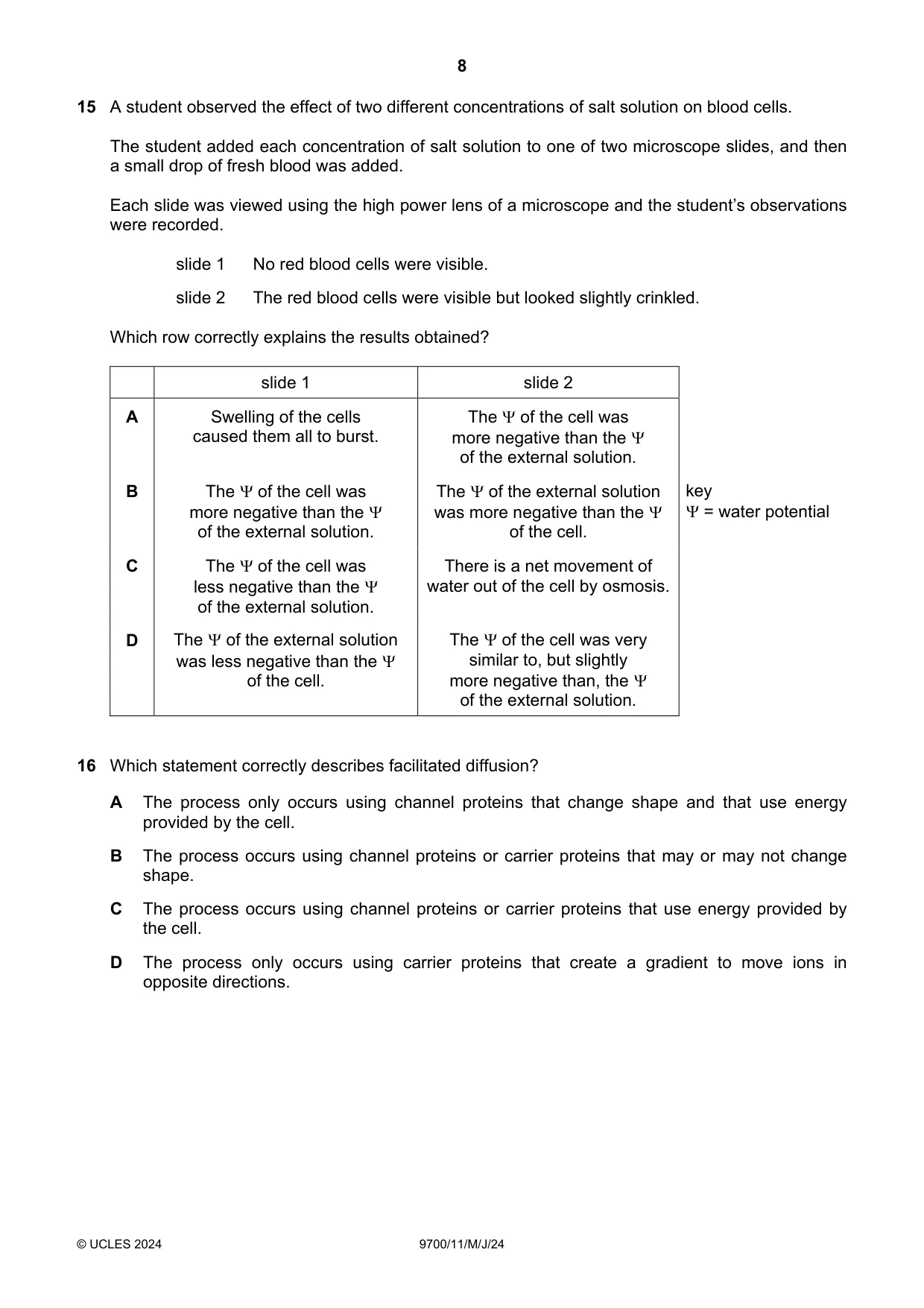
15 A student observed the effect of two different concentrations of salt solution on blood cells. The student added each concentration of salt solution to one of two microscope slides, and then a small drop of fresh blood was added. Each slide was viewed using the high power lens of a microscope and the student’s observations were recorded. slide 1 No red blood cells were visible. slide 2 The red blood cells were visible but looked slightly crinkled. Which row correctly explains the results obtained? slide 1 slide 2 A Swelling of the cells The of the cell was caused them all to burst. more negative than the of the external solution. B The of the cell was The of the external solution key more negative than the was more negative than the = water potential of the external solution. of the cell. C The of the cell was There is a net movement of less negative than the water out of the cell by osmosis. of the external solution. D The of the external solution The of the cell was very was less negative than the similar to, but slightly of the cell. more negative than, the of the external solution.
Mark scheme: B
Q16 · Which statement correctly describes facilitated diffusion?
16 Which statement correctly describes facilitated diffusion? A The process only occurs using channel proteins that change shape and that use energy provided by the cell. B The process occurs using channel proteins or carrier proteins that may or may not change shape. C The process occurs using channel proteins or carrier proteins that use energy provided by the cell. D The process only occurs using carrier proteins that create a gradient to move ions in opposite directions.
Mark scheme: B
Q17 · Which row is correct for stem cells?
17 Which row is correct for stem cells? can be involved in the can repair cells formation of phagocytes A yes no B yes yes C no no D no yes
Mark scheme: D
More questions on Cells as the basic units of living organisms
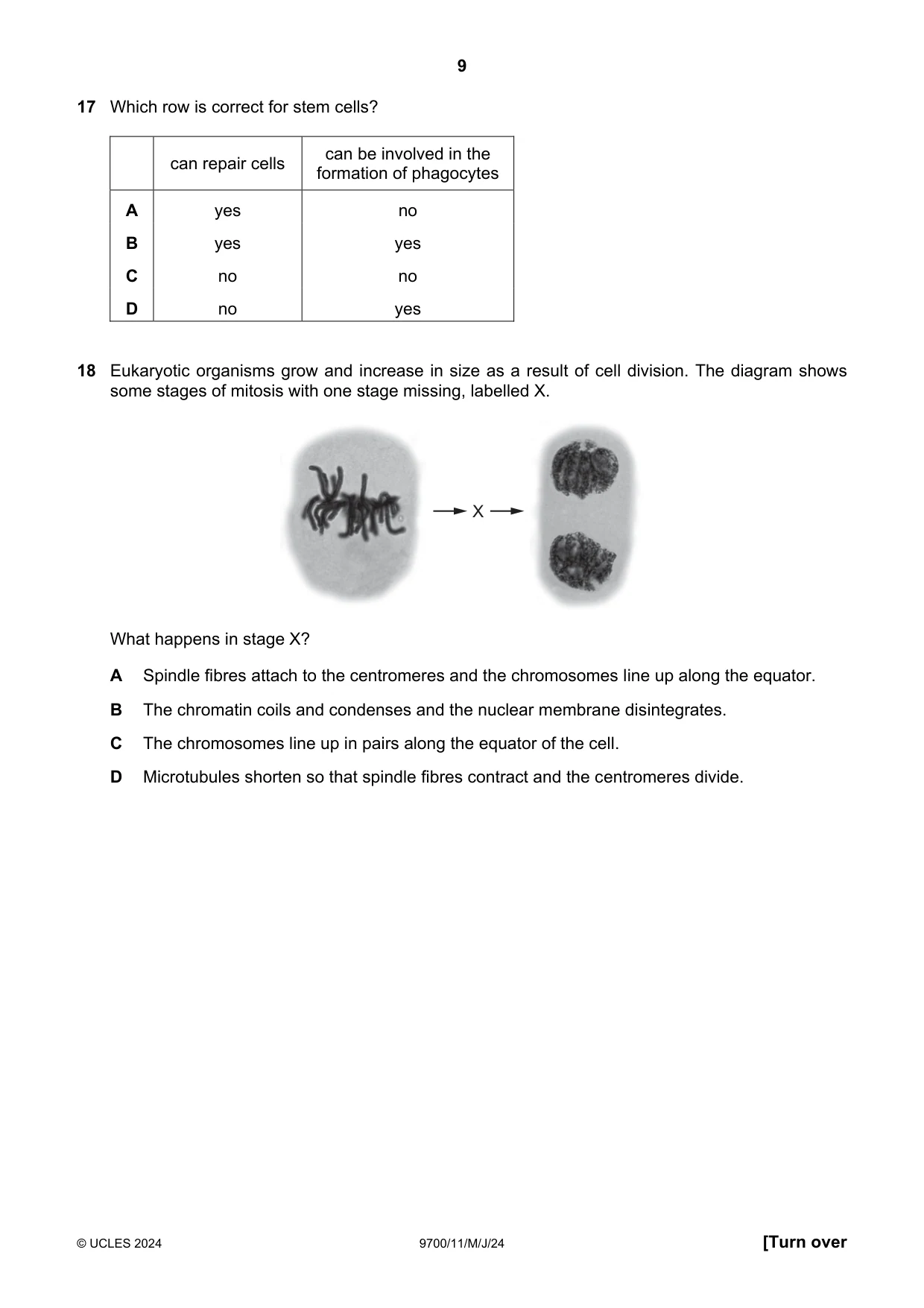
Q18 · Eukaryotic organisms grow and increase in size as a result of cell division
18 Eukaryotic organisms grow and increase in size as a result of cell division. The diagram shows some stages of mitosis with one stage missing, labelled X. X What happens in stage X? A Spindle fibres attach to the centromeres and the chromosomes line up along the equator. B The chromatin coils and condenses and the nuclear membrane disintegrates. C The chromosomes line up in pairs along the equator of the cell. D Microtubules shorten so that spindle fibres contract and the centromeres divide.
Mark scheme: D
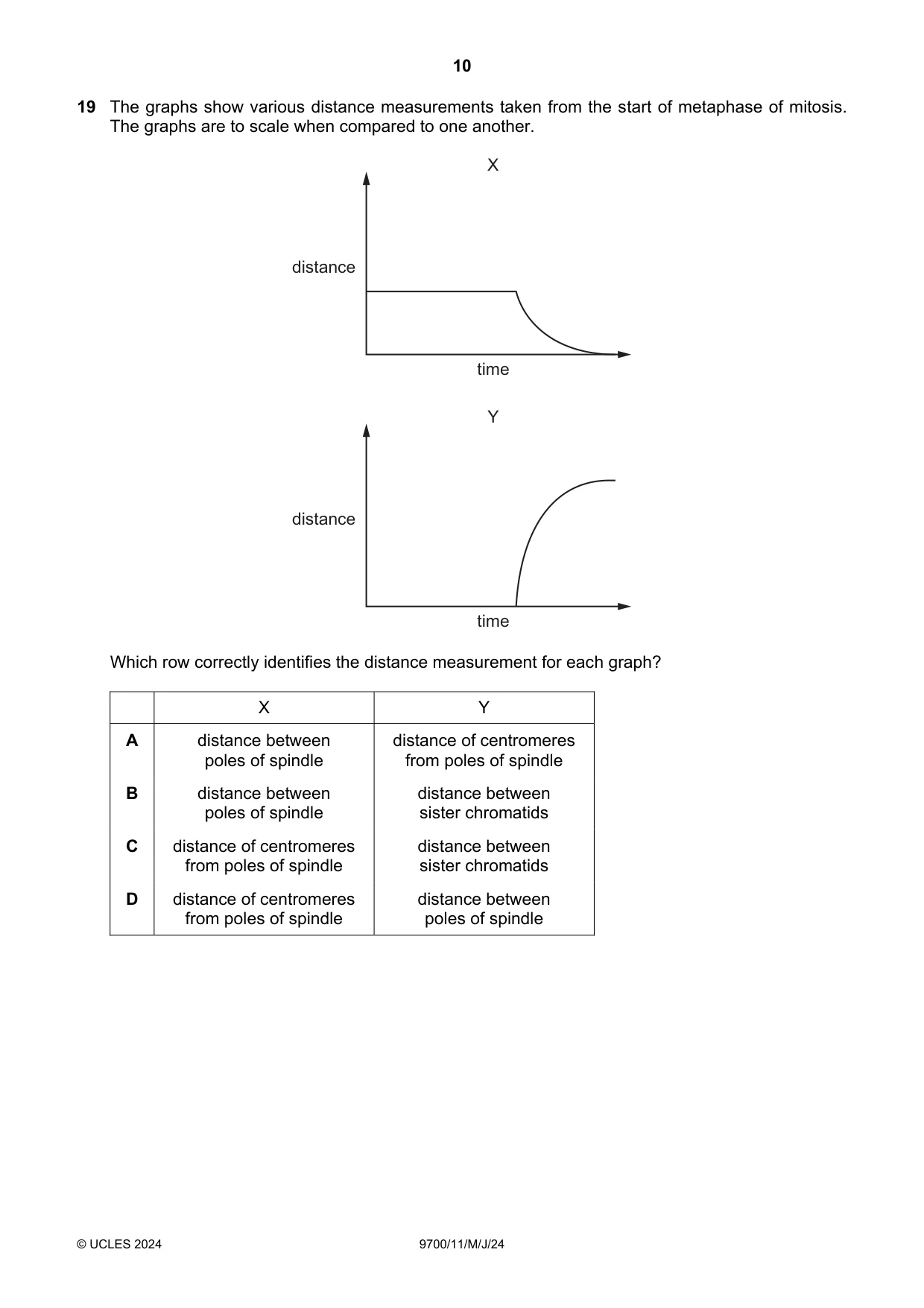
Q19 · The graphs show various distance measurements taken from the start of metaphase of mitosis
19 The graphs show various distance measurements taken from the start of metaphase of mitosis. The graphs are to scale when compared to one another. X distance time Y distance time Which row correctly identifies the distance measurement for each graph? X Y A distance between distance of centromeres poles of spindle from poles of spindle B distance between distance between poles of spindle sister chromatids C distance of centromeres distance between from poles of spindle sister chromatids D distance of centromeres distance between from poles of spindle poles of spindle
Mark scheme: C
Q20 · Which row is correct for the start of anaphase of mitosis?
20 Which row is correct for the start of anaphase of mitosis? DNA is associated state of the form of DNA with histone cell surface proteins membrane A chromosomes always broken apart B chromosomes sometimes intact C separated sister chromatids always intact D separated sister chromatids sometimes broken apart
Mark scheme: C
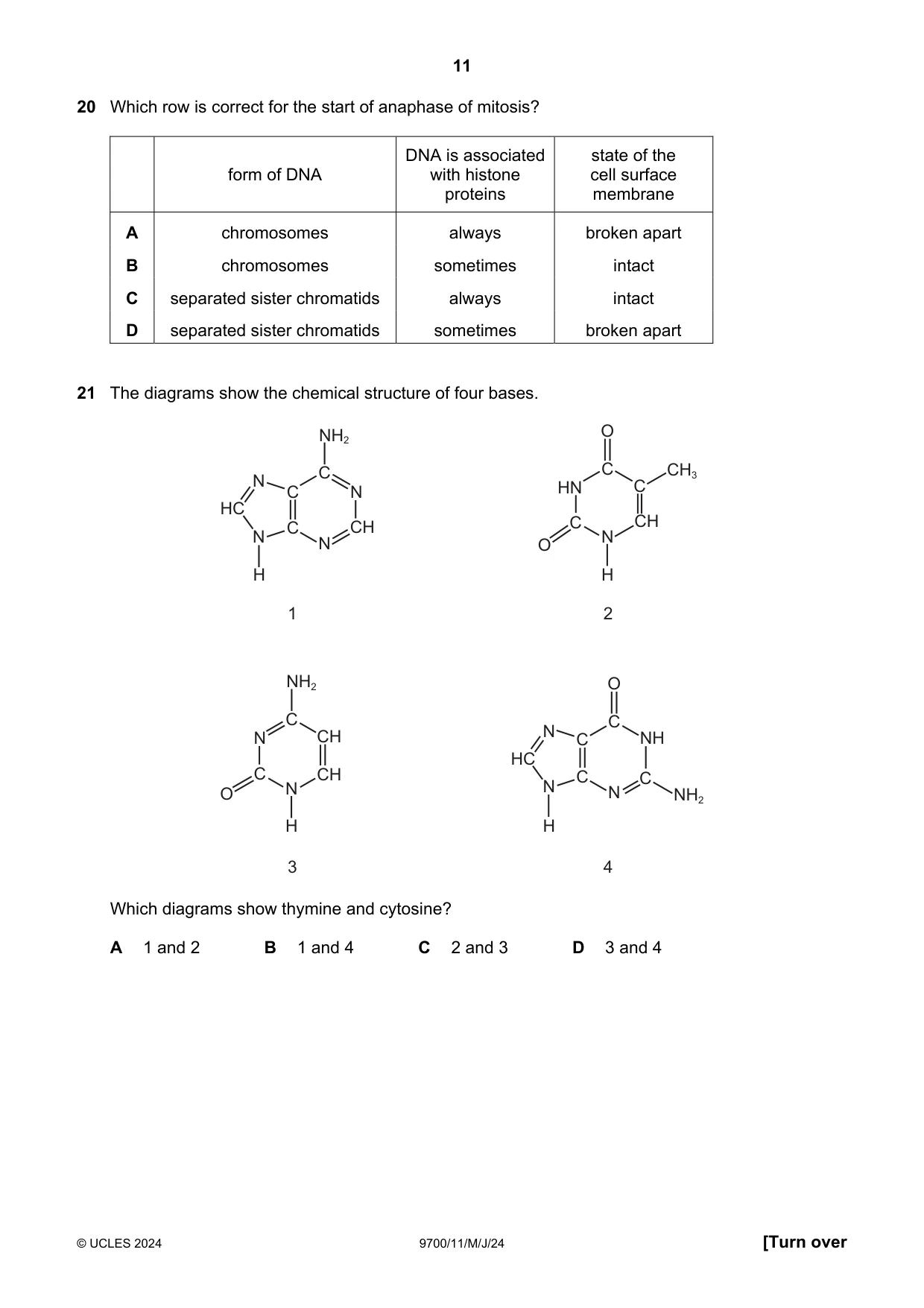
Q21 · The diagrams show the chemical structure of four bases
21 The diagrams show the chemical structure of four bases. NH2 O C C CH3 N HN C C N HC C CH C CH N N N O H H 1 2 NH2 O C C N CH N NH C HC C CH C C O N N N NH2 H H 3 4 Which diagrams show thymine and cytosine? A 1 and 2 B 1 and 4 C 2 and 3 D 3 and 4
Mark scheme: C
More questions on Structure of nucleic acids and replication of DNA
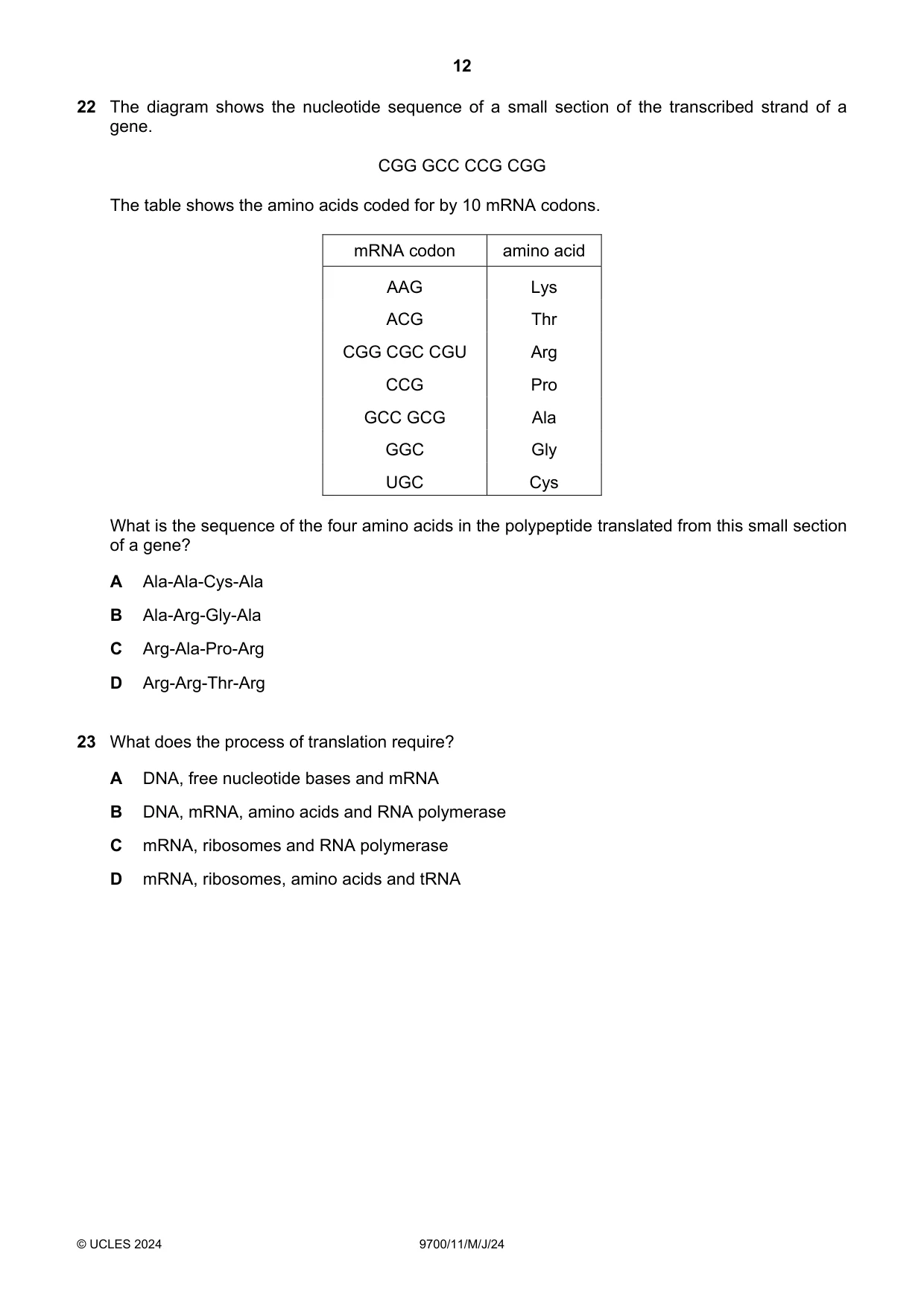
Q22 · The diagram shows the nucleotide sequence of a small section of the transcribed strand of…
22 The diagram shows the nucleotide sequence of a small section of the transcribed strand of a gene. CGG GCC CCG CGG The table shows the amino acids coded for by 10 mRNA codons. mRNA codon amino acid AAG Lys ACG Thr CGG CGC CGU Arg CCG Pro GCC GCG Ala GGC Gly UGC Cys What is the sequence of the four amino acids in the polypeptide translated from this small section of a gene? A Ala-Ala-Cys-Ala B Ala-Arg-Gly-Ala C Arg-Ala-Pro-Arg D Arg-Arg-Thr-Arg
Mark scheme: B
Q23 · What does the process of translation require?
23 What does the process of translation require? A DNA, free nucleotide bases and mRNA B DNA, mRNA, amino acids and RNA polymerase C mRNA, ribosomes and RNA polymerase D mRNA, ribosomes, amino acids and tRNA
Mark scheme: D
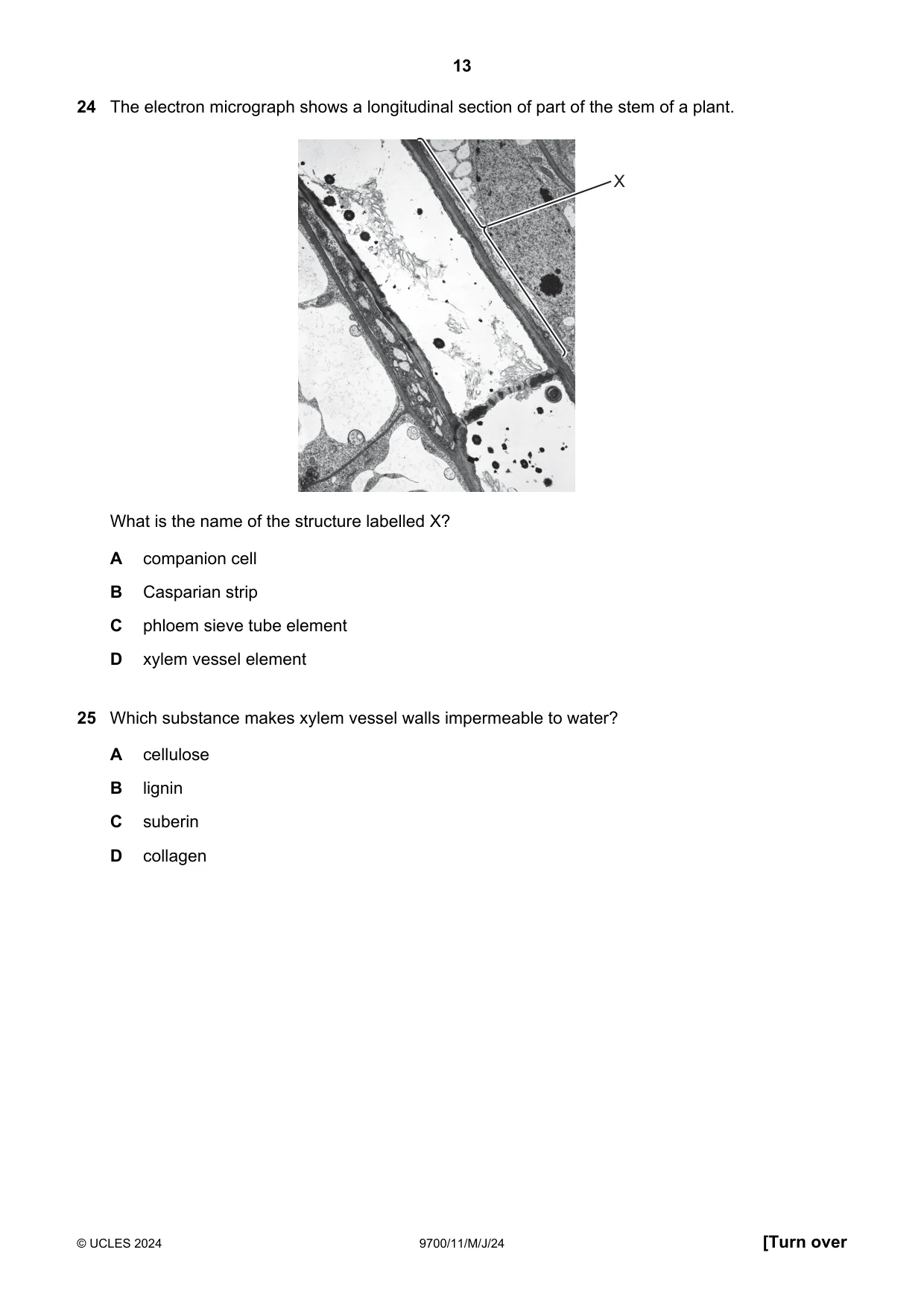
Q24 · The electron micrograph shows a longitudinal section of part of the stem of a plant
24 The electron micrograph shows a longitudinal section of part of the stem of a plant. X What is the name of the structure labelled X? A companion cell B Casparian strip C phloem sieve tube element D xylem vessel element
Mark scheme: C
Q25 · Which substance makes xylem vessel walls impermeable to water?
25 Which substance makes xylem vessel walls impermeable to water? A cellulose B lignin C suberin D collagen
Mark scheme: B
Q26 · The following tissues carry an electrical impulse during the cardiac cycle
26 The following tissues carry an electrical impulse during the cardiac cycle. 1 atrioventricular node 2 muscle wall of atria 3 Purkyne tissue 4 sinoatrial node In which order does the electrical impulse travel during the cardiac cycle? A 1 2 3 4 B 1 4 2 3 C 4 2 1 3 D 4 2 3 1
Mark scheme: C
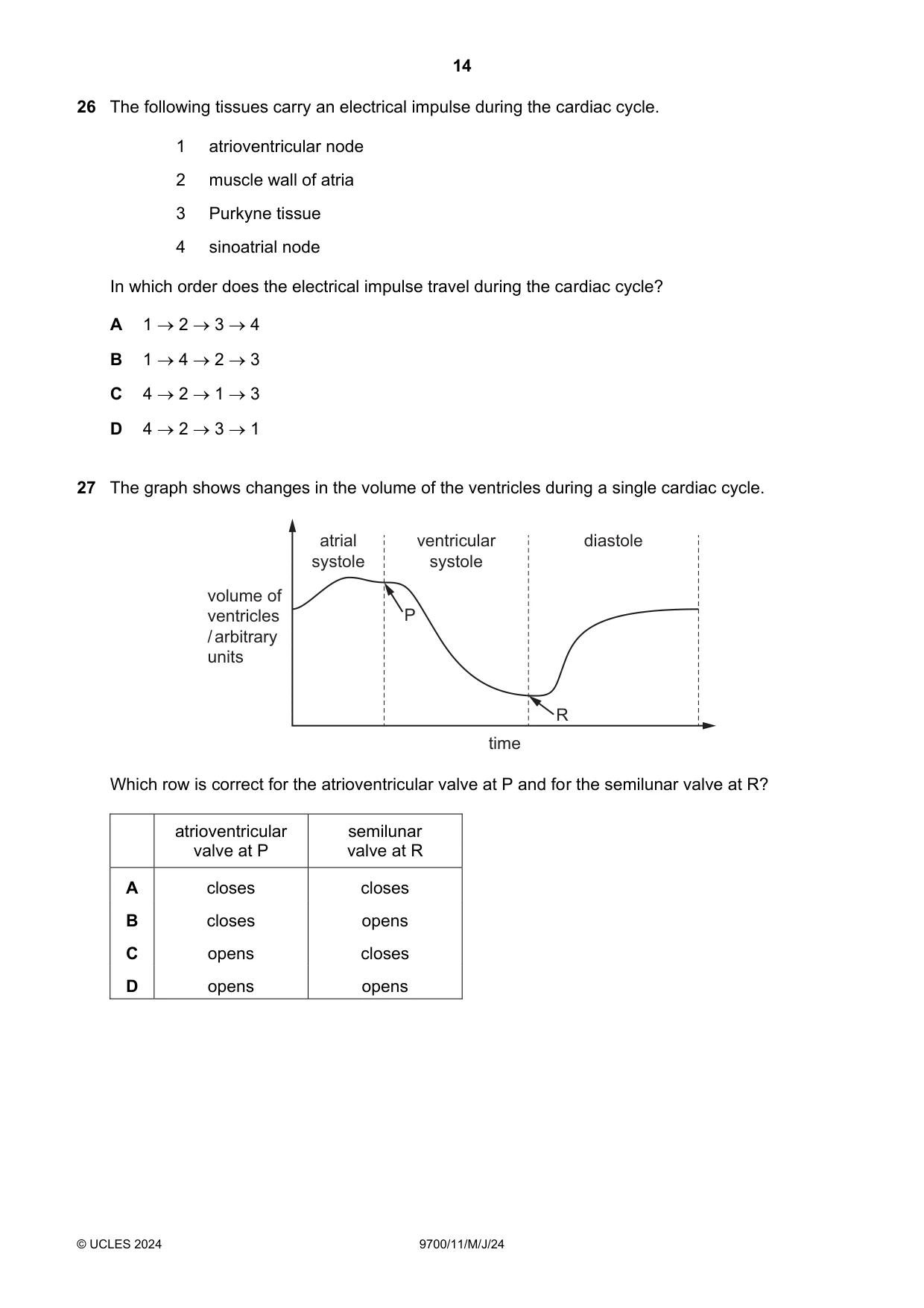
Q27 · The graph shows changes in the volume of the ventricles during a single cardiac cycle
27 The graph shows changes in the volume of the ventricles during a single cardiac cycle. atrial ventricular diastole systole systole volume of ventricles P / arbitrary units R time Which row is correct for the atrioventricular valve at P and for the semilunar valve at R? atrioventricular semilunar valve at P valve at R A closes closes B closes opens C opens closes D opens opens
Mark scheme: A
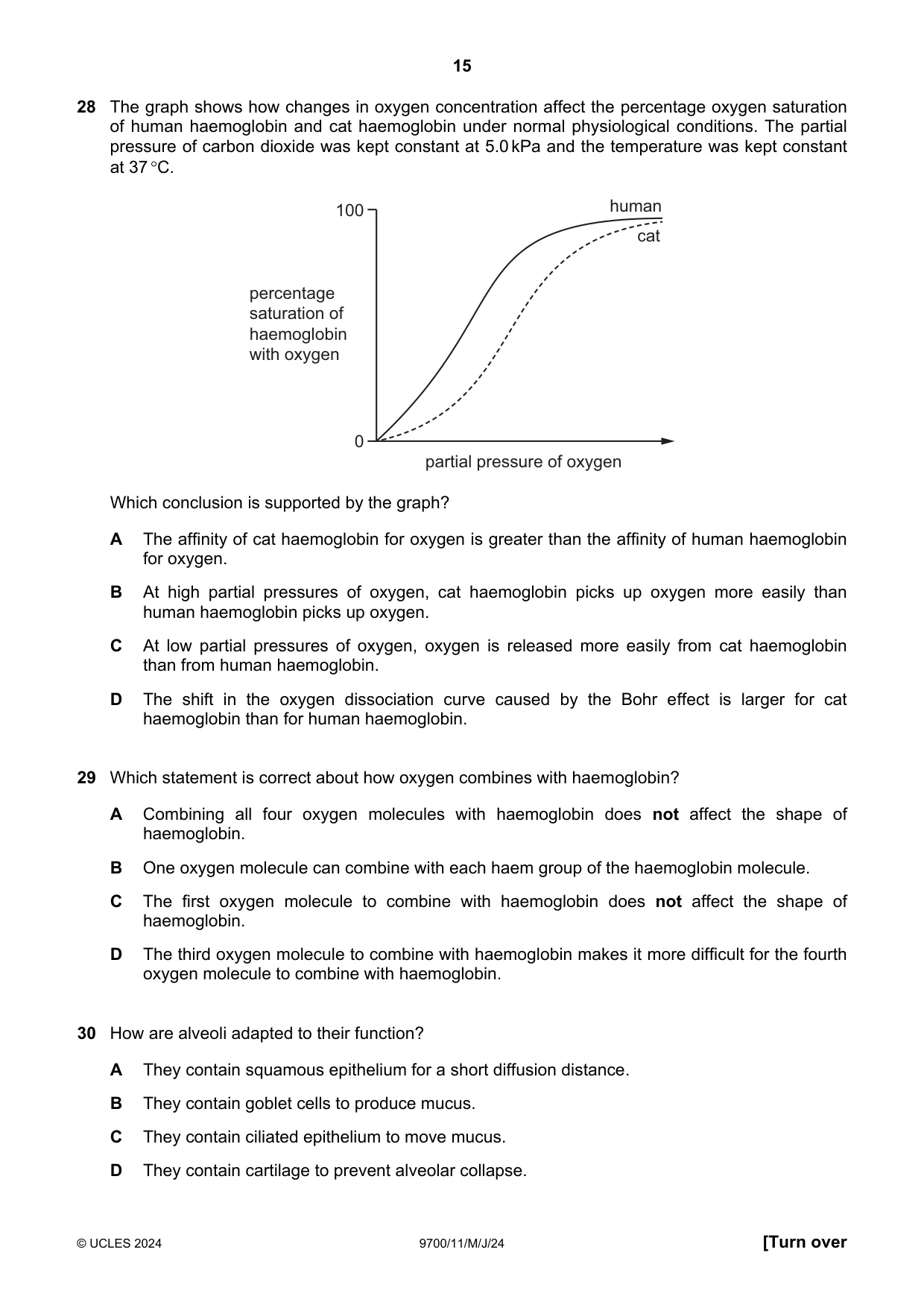
Q28 · The graph shows how changes in oxygen concentration affect the percentage oxygen…
28 The graph shows how changes in oxygen concentration affect the percentage oxygen saturation of human haemoglobin and cat haemoglobin under normal physiological conditions. The partial pressure of carbon dioxide was kept constant at 5.0 kPa and the temperature was kept constant at 37 C. 100 human cat percentage saturation of haemoglobin with oxygen 0 partial pressure of oxygen Which conclusion is supported by the graph? A The affinity of cat haemoglobin for oxygen is greater than the affinity of human haemoglobin for oxygen. B At high partial pressures of oxygen, cat haemoglobin picks up oxygen more easily than human haemoglobin picks up oxygen. C At low partial pressures of oxygen, oxygen is released more easily from cat haemoglobin than from human haemoglobin. D The shift in the oxygen dissociation curve caused by the Bohr effect is larger for cat haemoglobin than for human haemoglobin.
Mark scheme: C
Q29 · Which statement is correct about how oxygen combines with haemoglobin?
29 Which statement is correct about how oxygen combines with haemoglobin? A Combining all four oxygen molecules with haemoglobin does not affect the shape of haemoglobin. B One oxygen molecule can combine with each haem group of the haemoglobin molecule. C The first oxygen molecule to combine with haemoglobin does not affect the shape of haemoglobin. D The third oxygen molecule to combine with haemoglobin makes it more difficult for the fourth oxygen molecule to combine with haemoglobin.
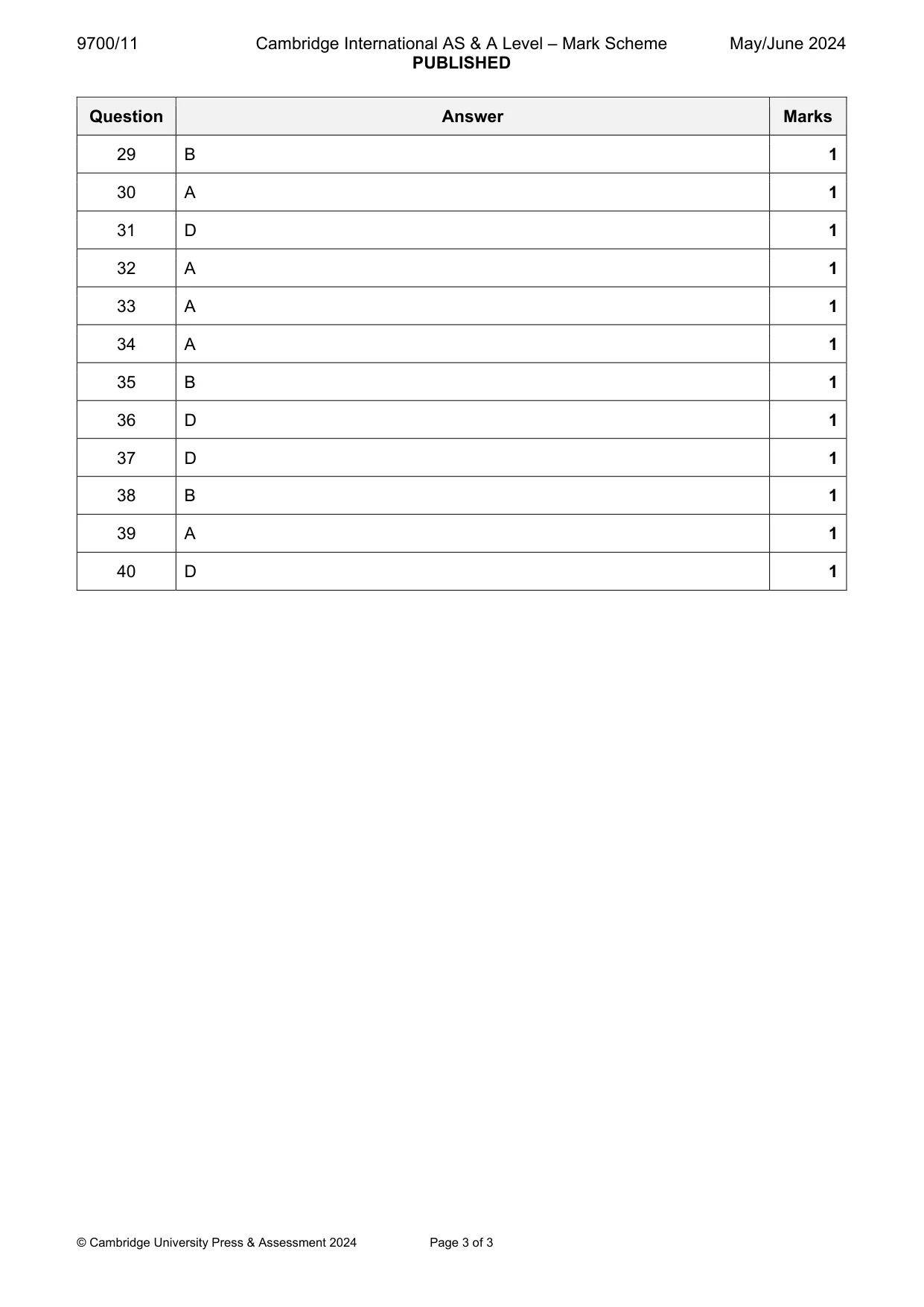
Mark scheme: B
Q30 · How are alveoli adapted to their function?
30 How are alveoli adapted to their function? A They contain squamous epithelium for a short diffusion distance. B They contain goblet cells to produce mucus. C They contain ciliated epithelium to move mucus. D They contain cartilage to prevent alveolar collapse.
Mark scheme: A
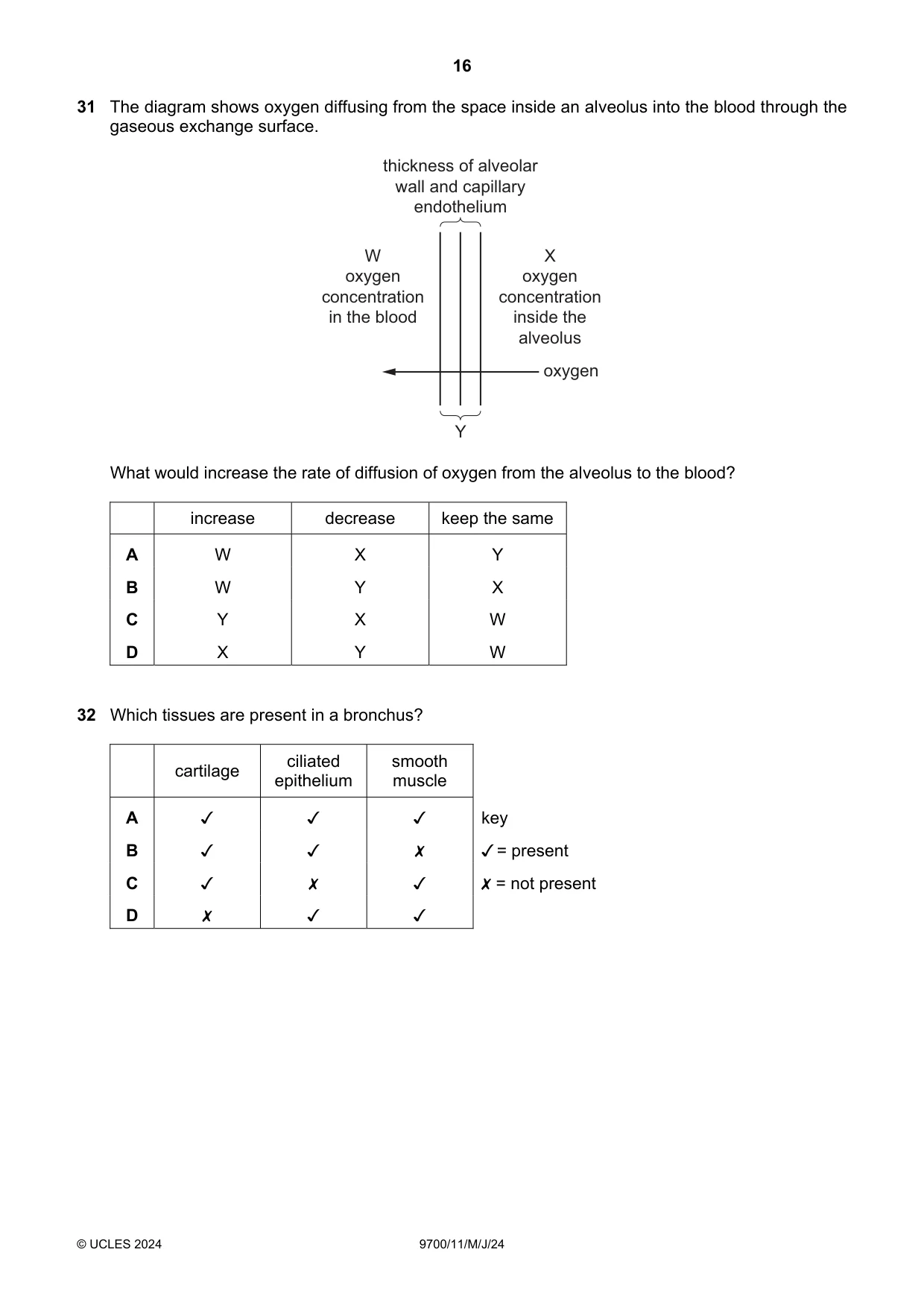
Q31 · The diagram shows oxygen diffusing from the space inside an alveolus into the blood…
31 The diagram shows oxygen diffusing from the space inside an alveolus into the blood through the gaseous exchange surface. thickness of alveolar wall and capillary endothelium W X oxygen oxygen concentration concentration in the blood inside the alveolus oxygen Y What would increase the rate of diffusion of oxygen from the alveolus to the blood? increase decrease keep the same A W X Y B W Y X C Y X W D X Y W
Mark scheme: D
Q32 · Which tissues are present in a bronchus?
32 Which tissues are present in a bronchus? . ciliated smooth cartilage an epithelium muscle Jv Jv Jv x x Jv Jv Jv key ¥ = present X = not present
Mark scheme: A
Q33 · Steep concentration gradients must be maintained for efficient gaseous exchange to occur…
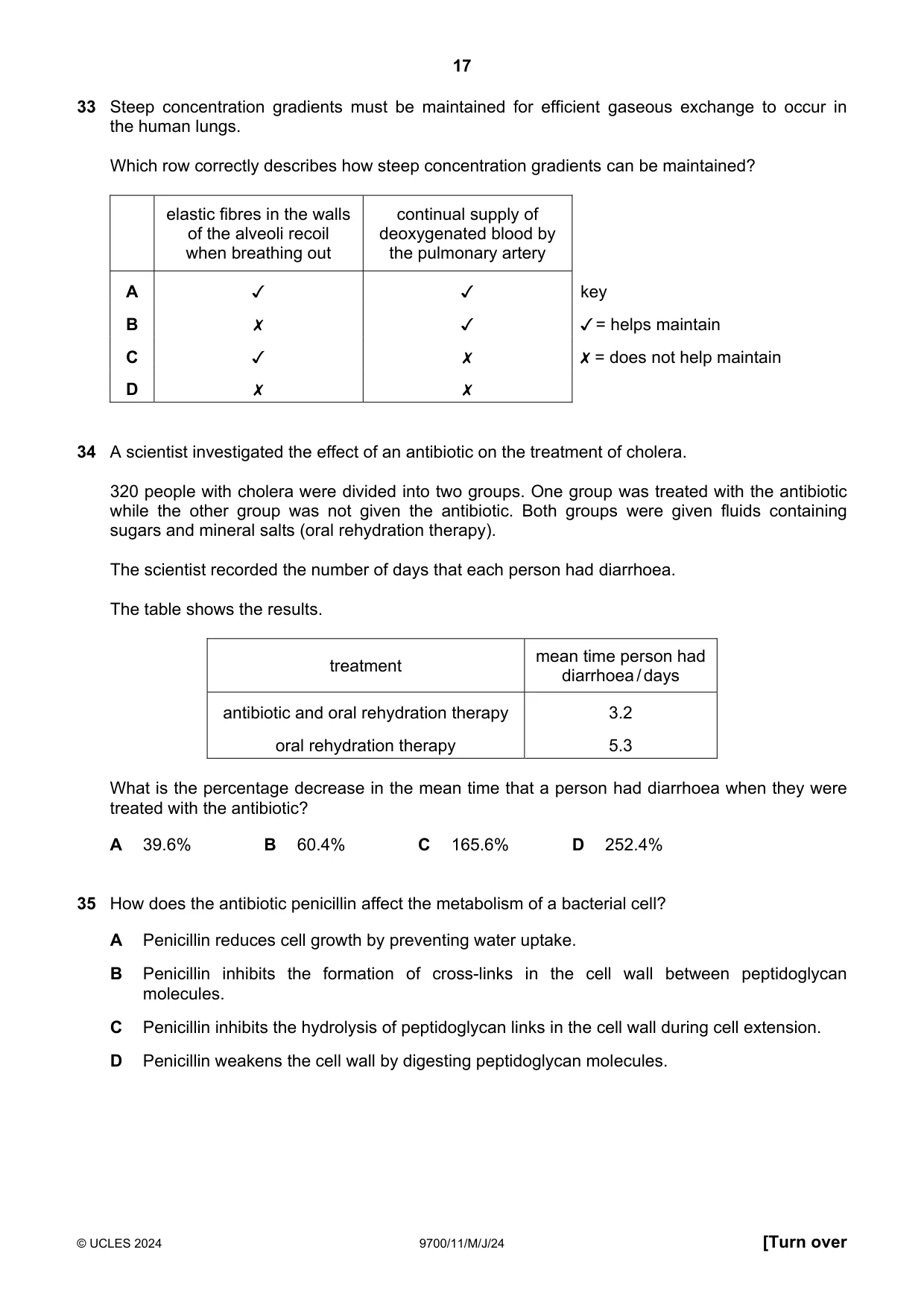
33 Steep concentration gradients must be maintained for efficient gaseous exchange to occur in the human lungs. Which row correctly describes how steep concentration gradients can be maintained? elastic fibres in the walls of the alveoli recoil when breathing out continual supply of deoxygenated blood by the pulmonary artery 0 0O WwW D> v x v x v v x x key ¥ = helps maintain X = does not help maintain
Mark scheme: A
Q34 · A scientist investigated the effect of an antibiotic on the treatment of cholera
34 A scientist investigated the effect of an antibiotic on the treatment of cholera. 320 people with cholera were divided into two groups. One group was treated with the antibiotic while the other group was not given the antibiotic. Both groups were given fluids containing sugars and mineral salts (oral rehydration therapy). The scientist recorded the number of days that each person had diarrhoea. The table shows the results. mean time person had treatment diarrhoea / days antibiotic and oral rehydration therapy 3.2 oral rehydration therapy 5.3 What is the percentage decrease in the mean time that a person had diarrhoea when they were treated with the antibiotic? A 39.6% B 60.4% C 165.6% D 252.4%
Mark scheme: A
Q35 · How does the antibiotic penicillin affect the metabolism of a bacterial cell?
35 How does the antibiotic penicillin affect the metabolism of a bacterial cell? A Penicillin reduces cell growth by preventing water uptake. B Penicillin inhibits the formation of cross-links in the cell wall between peptidoglycan molecules. C Penicillin inhibits the hydrolysis of peptidoglycan links in the cell wall during cell extension. D Penicillin weakens the cell wall by digesting peptidoglycan molecules.
Mark scheme: B
Q36 · Scientists studied the multidrug-resistant bacterial infections in children caused by one…
36 Scientists studied the multidrug-resistant bacterial infections in children caused by one type of bacteria between 2007 and 2015. The percentage of multidrug-resistant infections rose from 0.2% to 1.5%. What was the percentage increase in multidrug-resistant infections between 2007 and 2015? A 1.3% B 87% C 130% D 650%
Mark scheme: D
Q37 · Whooping cough is a highly infectious disease of the gas exchange system, caused by the…
37 Whooping cough is a highly infectious disease of the gas exchange system, caused by the bacterium Bordetella pertussis. Which method provides protection to infants against whooping cough and reduces the chance of developing this disease later? A a short course of more than one type of antibiotic B a six-month course of one type of antibiotic C injections of antibodies specific to Bordetella pertussis D injections of antigens from Bordetella pertussis bacteria
Mark scheme: D
Q38 · The electron micrograph shows a type of blood cell
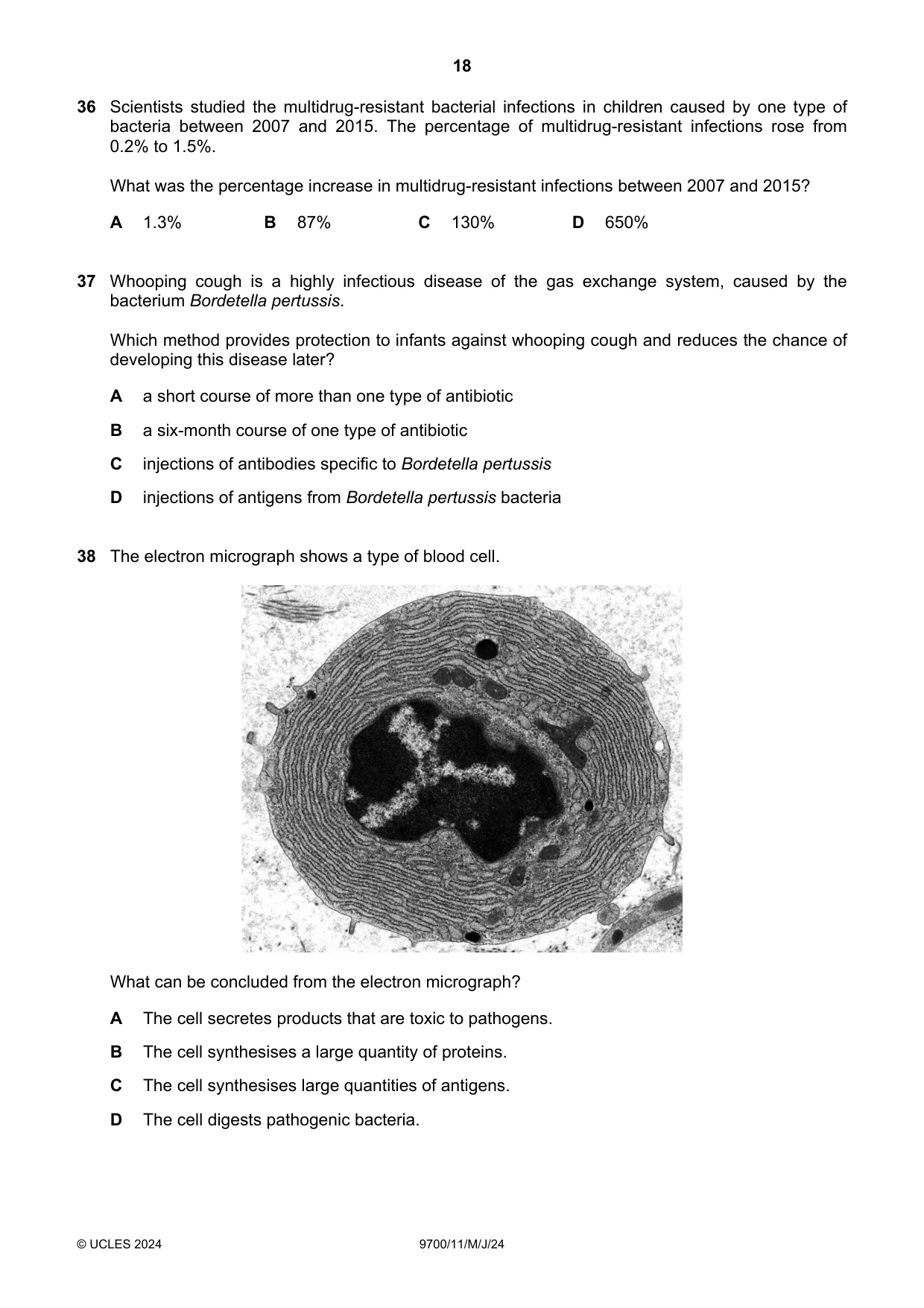
38 The electron micrograph shows a type of blood cell. What can be concluded from the electron micrograph? A The cell secretes products that are toxic to pathogens. B The cell synthesises a large quantity of proteins. C The cell synthesises large quantities of antigens. D The cell digests pathogenic bacteria.
Mark scheme: B
Q39 · Why is mitosis important in the immune response?
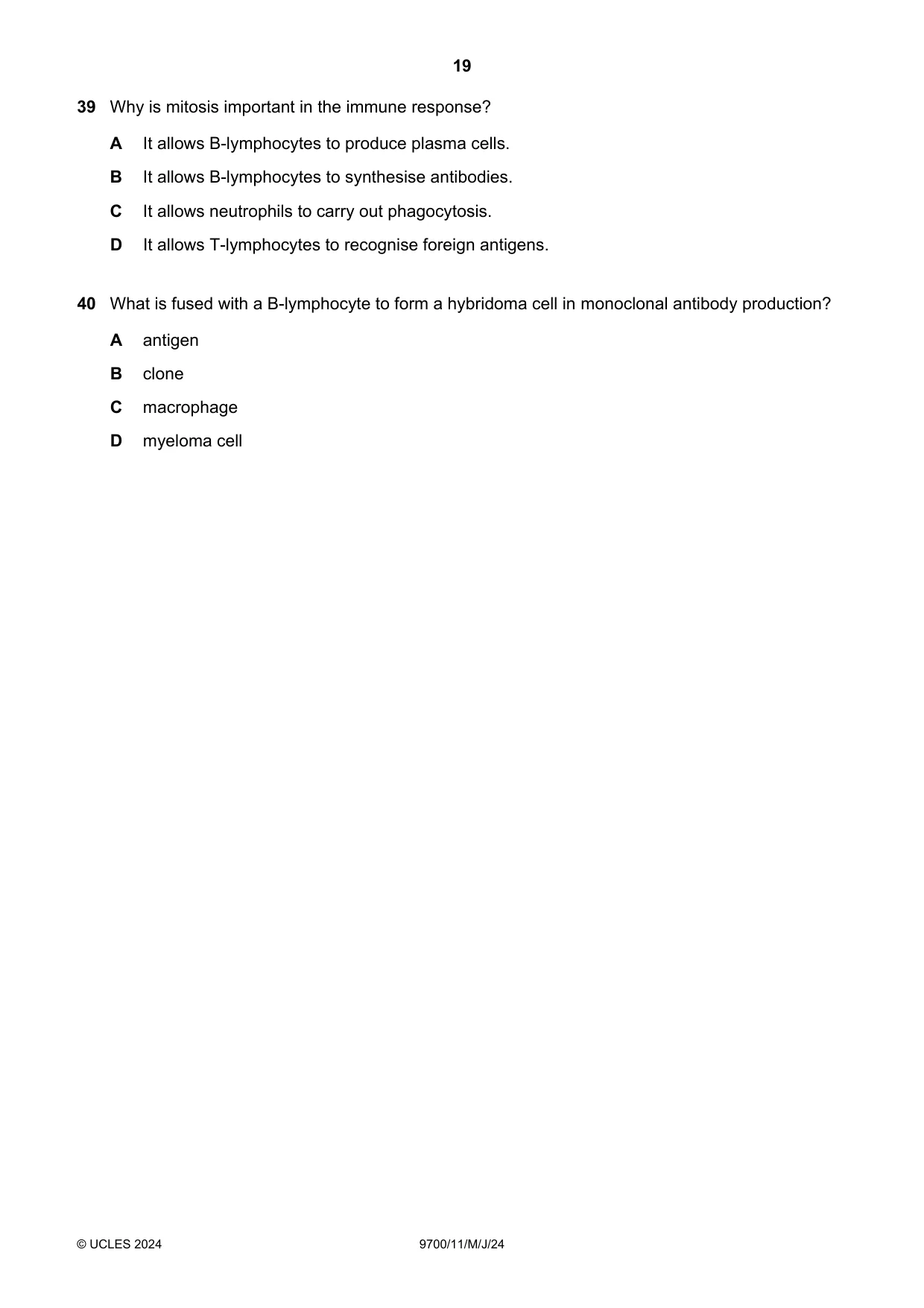
39 Why is mitosis important in the immune response? A It allows B-lymphocytes to produce plasma cells. B It allows B-lymphocytes to synthesise antibodies. C It allows neutrophils to carry out phagocytosis. D It allows T-lymphocytes to recognise foreign antigens.
Mark scheme: A
Q40 · What is fused with a B-lymphocyte to form a hybridoma cell in monoclonal antibody…
40 What is fused with a B-lymphocyte to form a hybridoma cell in monoclonal antibody production? A antigen B clone C macrophage D myeloma cell
Mark scheme: D
What was in this paper
The subtopics covered by these 40 questions, and how many questions each got. Open one in a new tab to see every Cambridge question on it.
4The gas exchange system4Antibiotics3Chromosome behaviour in mitosis3Movement into and out of cells3Protein synthesis3Proteins3Antibodies and vaccination2Factors that affect enzyme action2Structure of transport tissues2The heart2The immune system2Transport of oxygen and carbon dioxide2Carbohydrates and lipids1Mode of action of enzymes1Structure of nucleic acids and replication of DNA1The microscope in cell studies1Water1What you needed in this session
Cambridge’s own grade thresholds for 2024 May/June, Paper 1 · Variant 1. A higher threshold means an easier paper — the bar moves with how the cohort did.