Cambridge A Level Biology 9700 — 2012 May/June Paper 1 · Variant 3
9700/13/M/J/12 · 40 questions · 40 marks · ≈45 min
The question paper and its mark scheme, free to read here and free to download. This is Cambridge’s own paper, exactly as it was sat.
Question paper20 pages

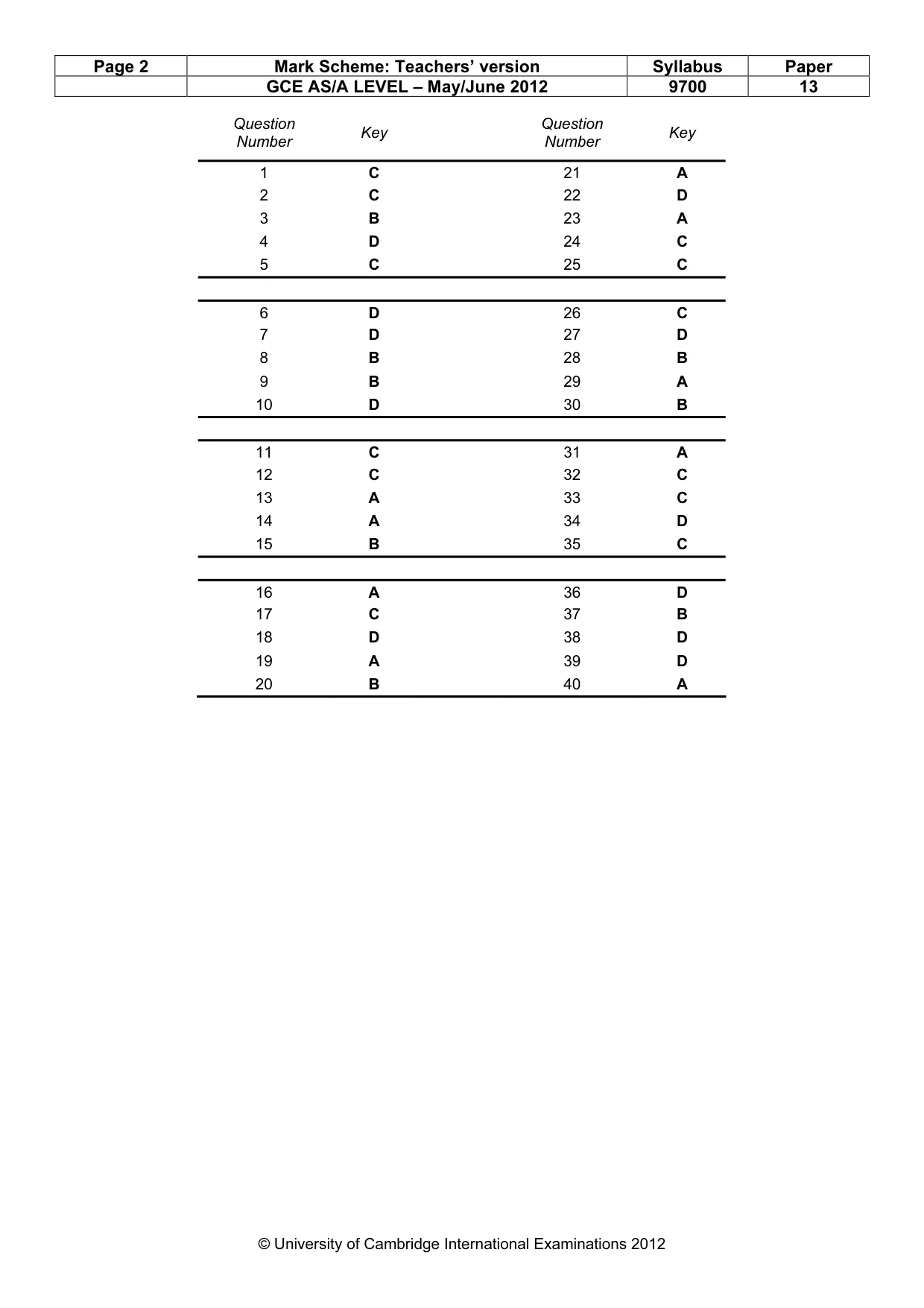
Mark scheme2 pages
Answers below. Sit the paper first if you are practising.
Questions as text
Q1 · What is the ecological definition of the term community?
1 What is the ecological definition of the term community? A all the food webs in an ecosystem B all the individuals of one species in an area C all the organisms in an area D the living organisms and their non-living environment
Mark scheme: C
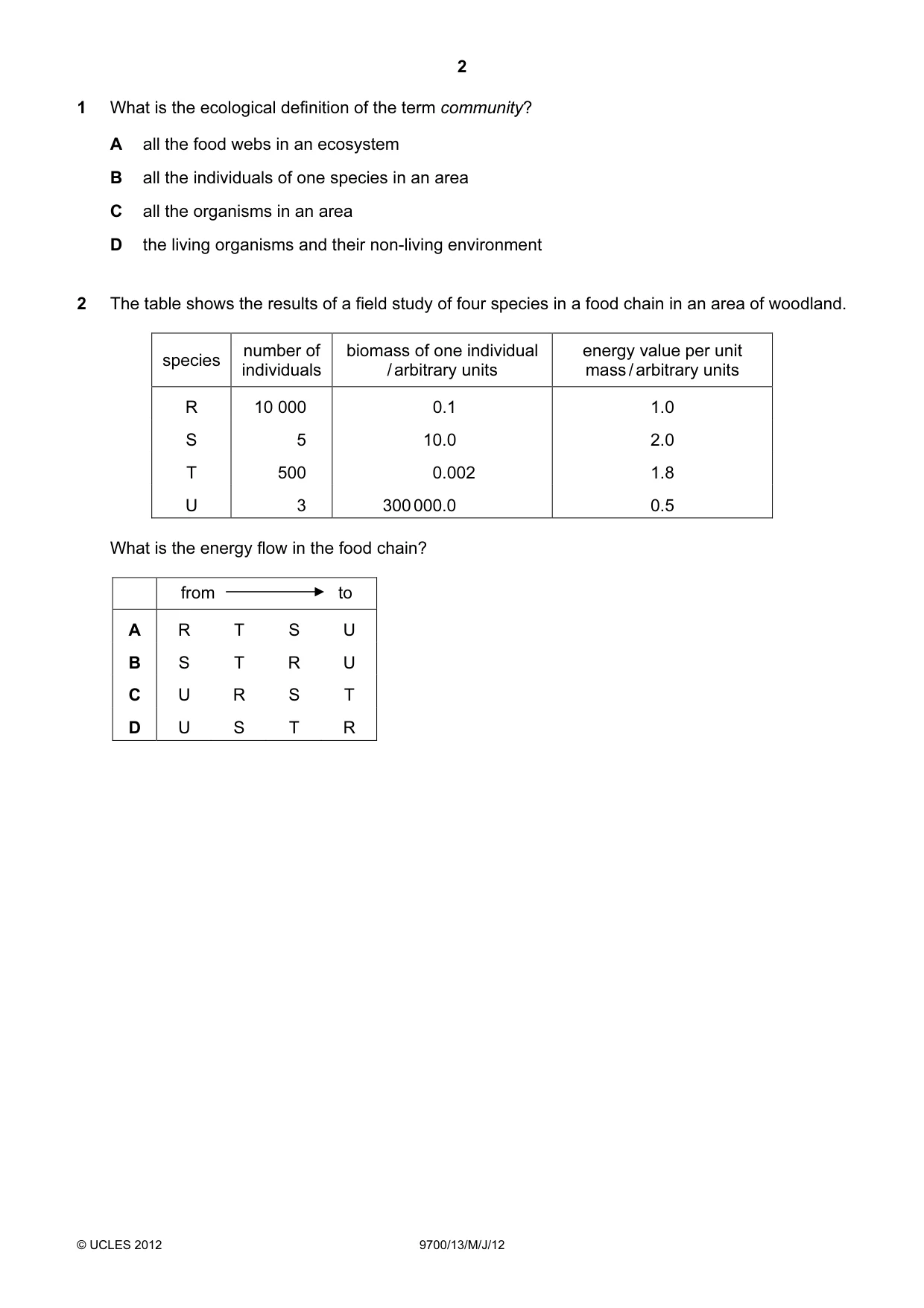
Q2 · The table shows the results of a field study of four species in a food chain in an area…
2 The table shows the results of a field study of four species in a food chain in an area of woodland. number of biomass of one individual energy value per unit species individuals / arbitrary units mass / arbitrary units R 10 000 0.1 1.0 S 5 10.0 2.0 T 500 0.002 1.8 U 3 300 000.0 0.5 What is the energy flow in the food chain? from to A R T S U B S T R U C U R S T D U S T R
Mark scheme: C
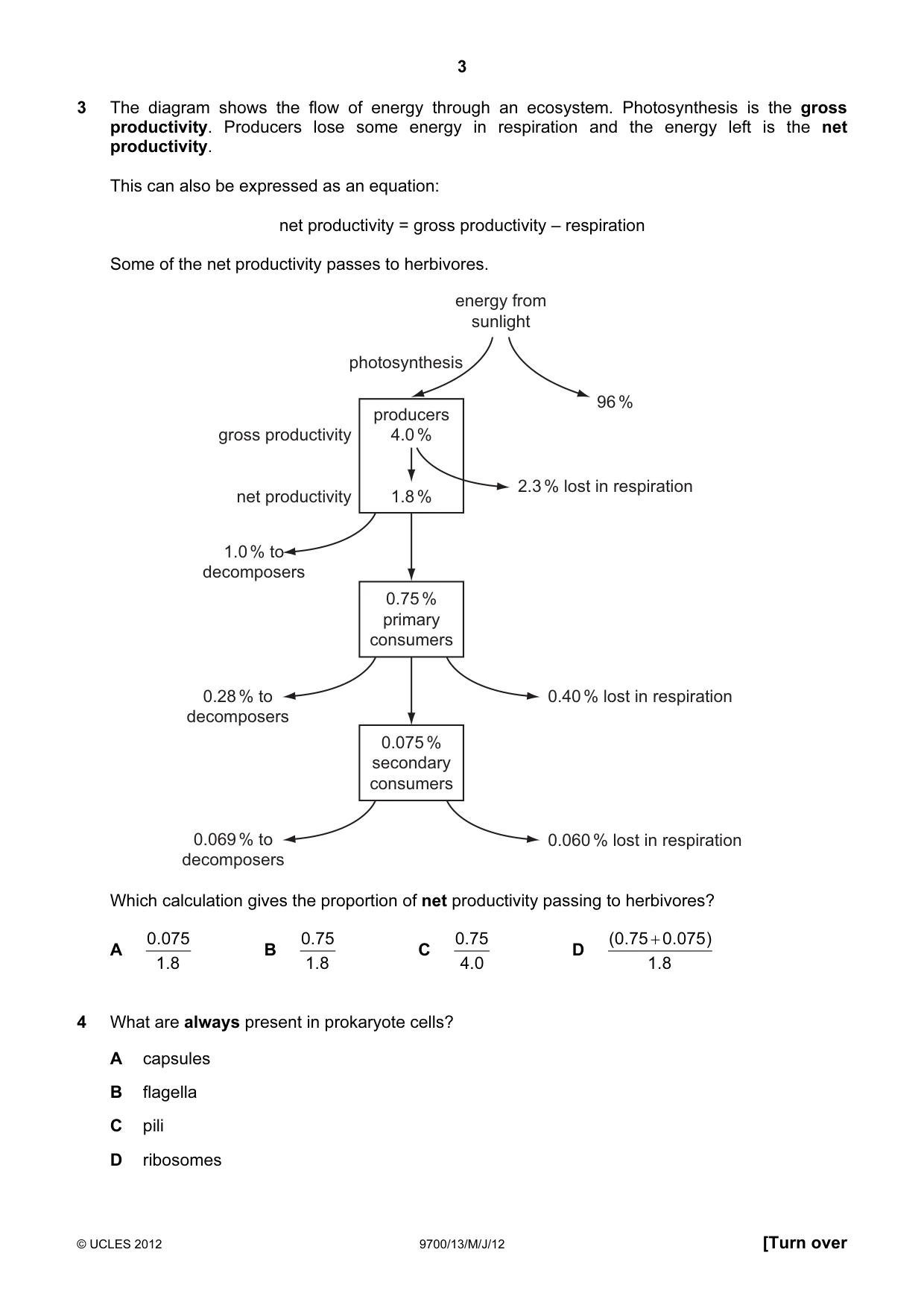
Q3 · The diagram shows the flow of energy through an ecosystem
3 The diagram shows the flow of energy through an ecosystem. Photosynthesis is the gross productivity. Producers lose some energy in respiration and the energy left is the net productivity. This can also be expressed as an equation: net productivity = gross productivity – respiration Some of the net productivity passes to herbivores. energy from sunlight photosynthesis 96 % producers gross productivity 4.0 % 2.3 % lost in respiration net productivity 1.8 % 1.0 % to decomposers 0.75 % primary consumers 0.28 % to 0.40 % lost in respiration decomposers 0.075 % secondary consumers 0.069 % to 0.060 % lost in respiration decomposers Which calculation gives the proportion of net productivity passing to herbivores? 0 . 075 0 . 75 0 . 75 ( 0 . 75 + 0 . 075 ) A B C D 1 . 8 1 . 8 4 . 0 1 . 8
Mark scheme: B
Q4 · What are always present in prokaryote cells?
4 What are always present in prokaryote cells? A capsules B flagella C pili D ribosomes
Mark scheme: D
More questions on Cells as the basic units of living organisms
Q5 · The following are all features of eukaryotic cells
5 The following are all features of eukaryotic cells. 1 chloroplast 2 endoplasmic reticulum 3 lysosome 4 mitochondrion 5 nucleus Which of these have a double membrane? A 1, 2 and 4 B 1, 3 and 5 C 1, 4 and 5 D 2, 3 and 5
Mark scheme: C
More questions on Cells as the basic units of living organisms
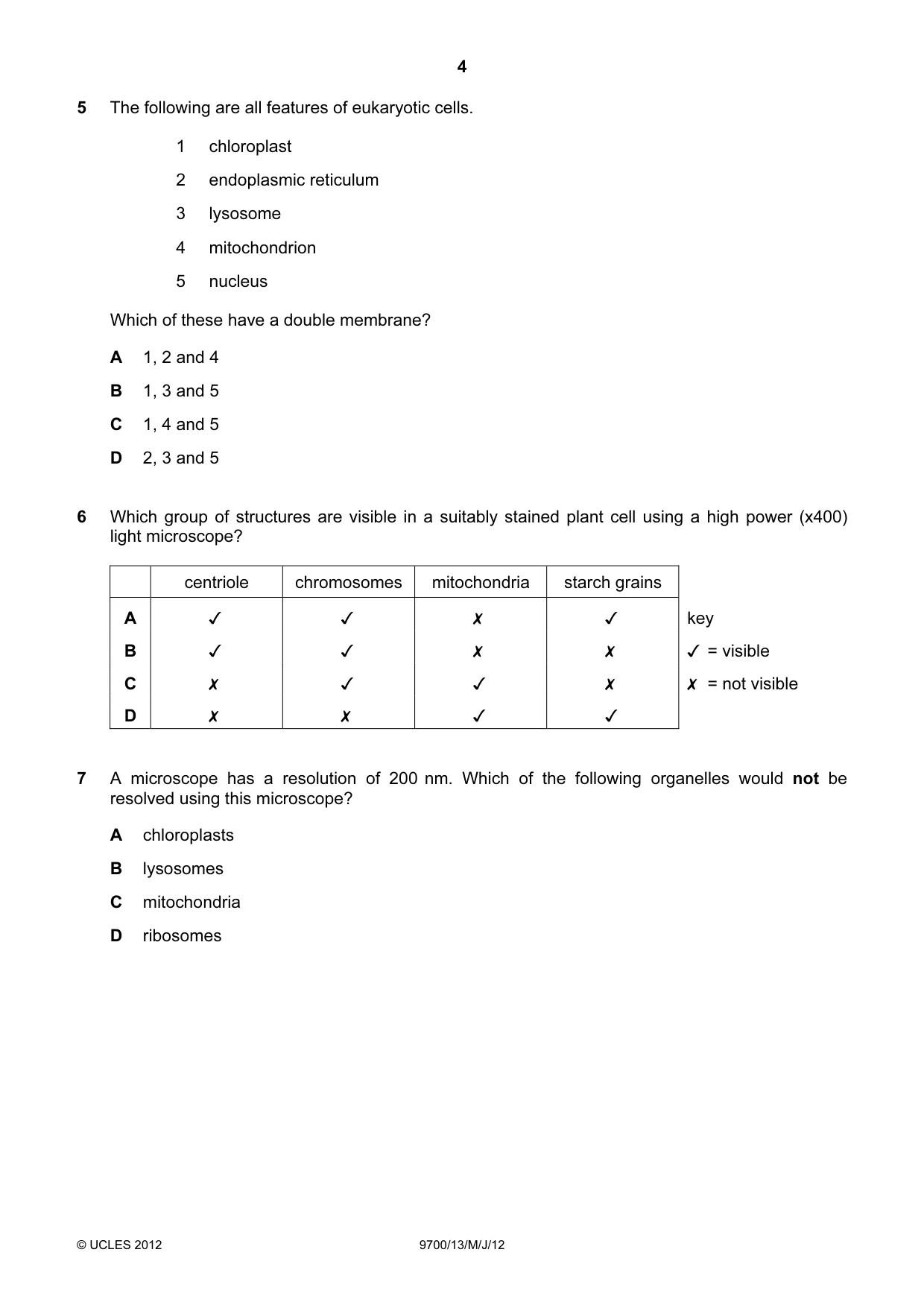
Q6 · Which group of structures are visible in a suitably stained plant cell using a high power…
6 Which group of structures are visible in a suitably stained plant cell using a high power (x400) light microscope? centriole chromosomes | mitochondria starch grains v v x v key JY =visible 0 0O WwW > Jv Jv x x x Jv Jv x X =not visible x x Jv Jv
Mark scheme: D
Q7 · A microscope has a resolution of 200 nm
7 A microscope has a resolution of 200 nm. Which of the following organelles would not be resolved using this microscope? A chloroplasts B lysosomes C mitochondria D ribosomes
Mark scheme: D
Q8 · The magnification of the photomicrograph is ×4000
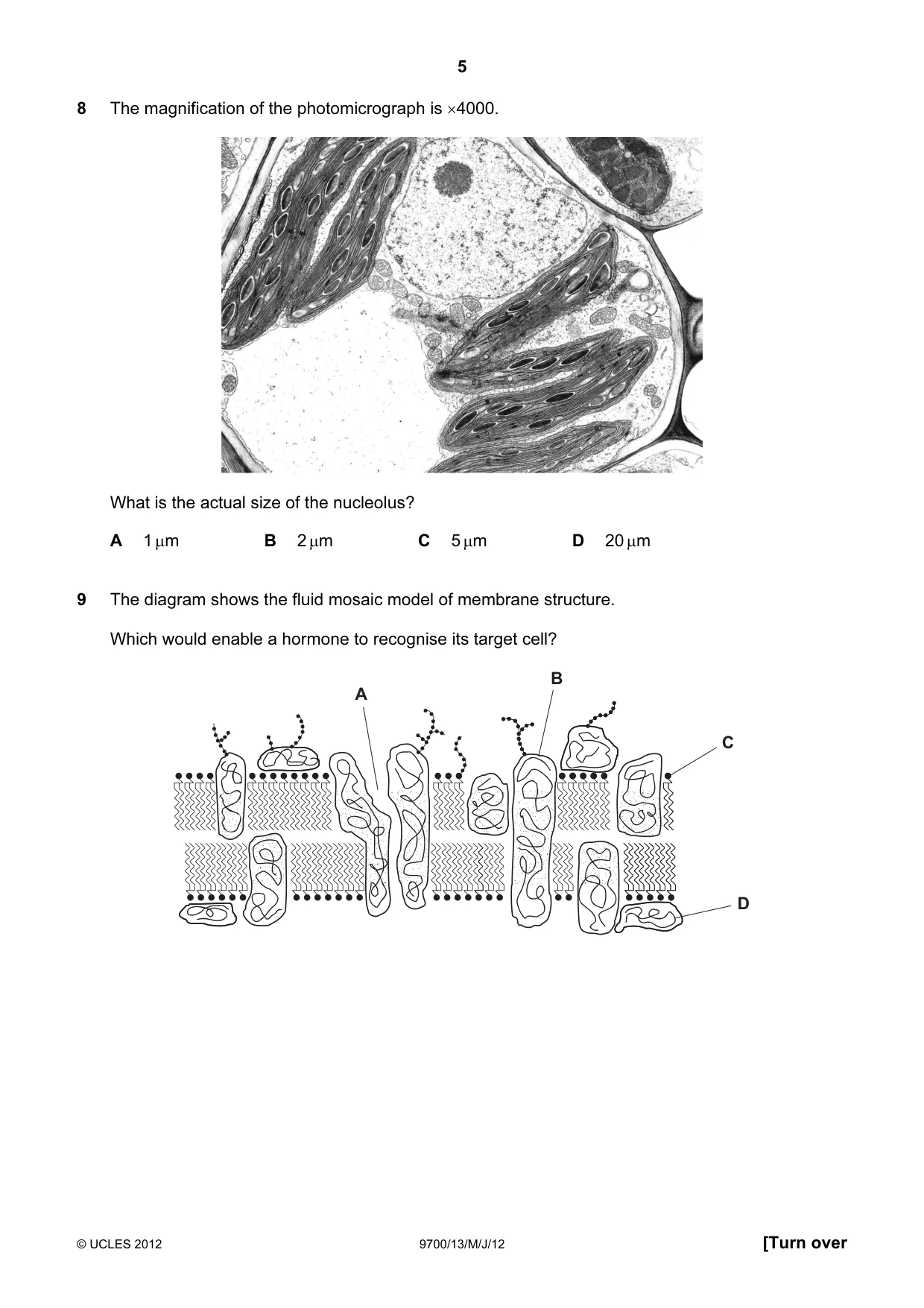
8 The magnification of the photomicrograph is ×4000. What is the actual size of the nucleolus? A 1 µm B 2 µm C 5 µm D 20 µm
Mark scheme: B
Q9 · The diagram shows the fluid mosaic model of membrane structure
9 The diagram shows the fluid mosaic model of membrane structure. Which would enable a hormone to recognise its target cell? B A C D
Mark scheme: B
Q10 · Which of the following ways of moving substances across cell surface membranes allows…
10 Which of the following ways of moving substances across cell surface membranes allows movement in both directions? 1 active transport 2 diffusion 3 facilitated diffusion 4 osmosis A 2 only B 1 and 4 only C 2 and 3 only D 1, 2, 3 and 4
Mark scheme: D
Q11 · The graphs show the rate of uptake of sugars by a culture of animal cells, under…
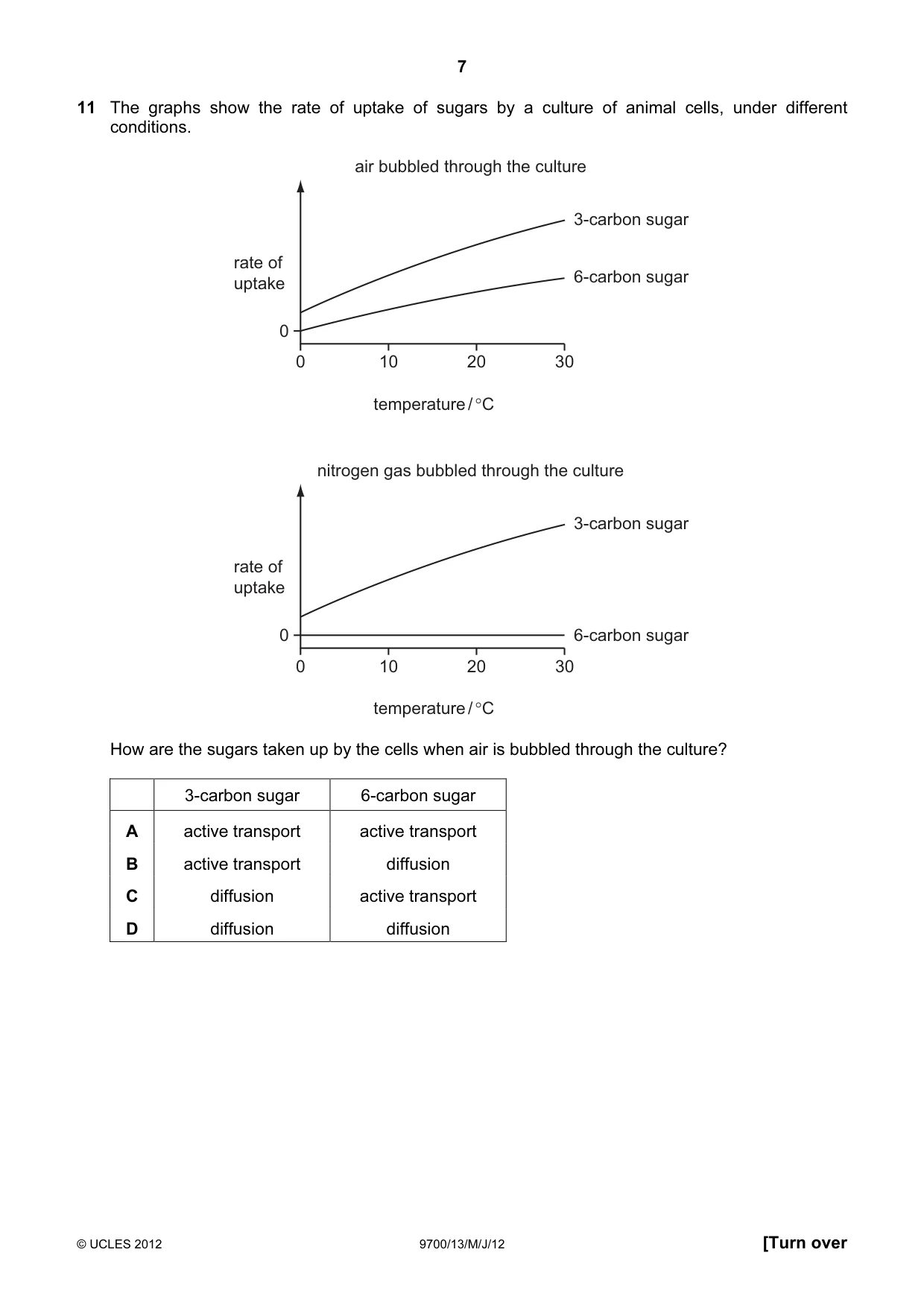
11 The graphs show the rate of uptake of sugars by a culture of animal cells, under different conditions. air bubbled through the culture 3-carbon sugar rate of uptake 6-carbon sugar 0 0 10 20 30 temperature / °C nitrogen gas bubbled through the culture 3-carbon sugar rate of uptake 0 6-carbon sugar 0 10 20 30 temperature / °C How are the sugars taken up by the cells when air is bubbled through the culture? 3-carbon sugar 6-carbon sugar A active transport active transport B active transport diffusion C diffusion active transport D diffusion diffusion
Mark scheme: C
Q12 · Which molecule in the key is sucrose?
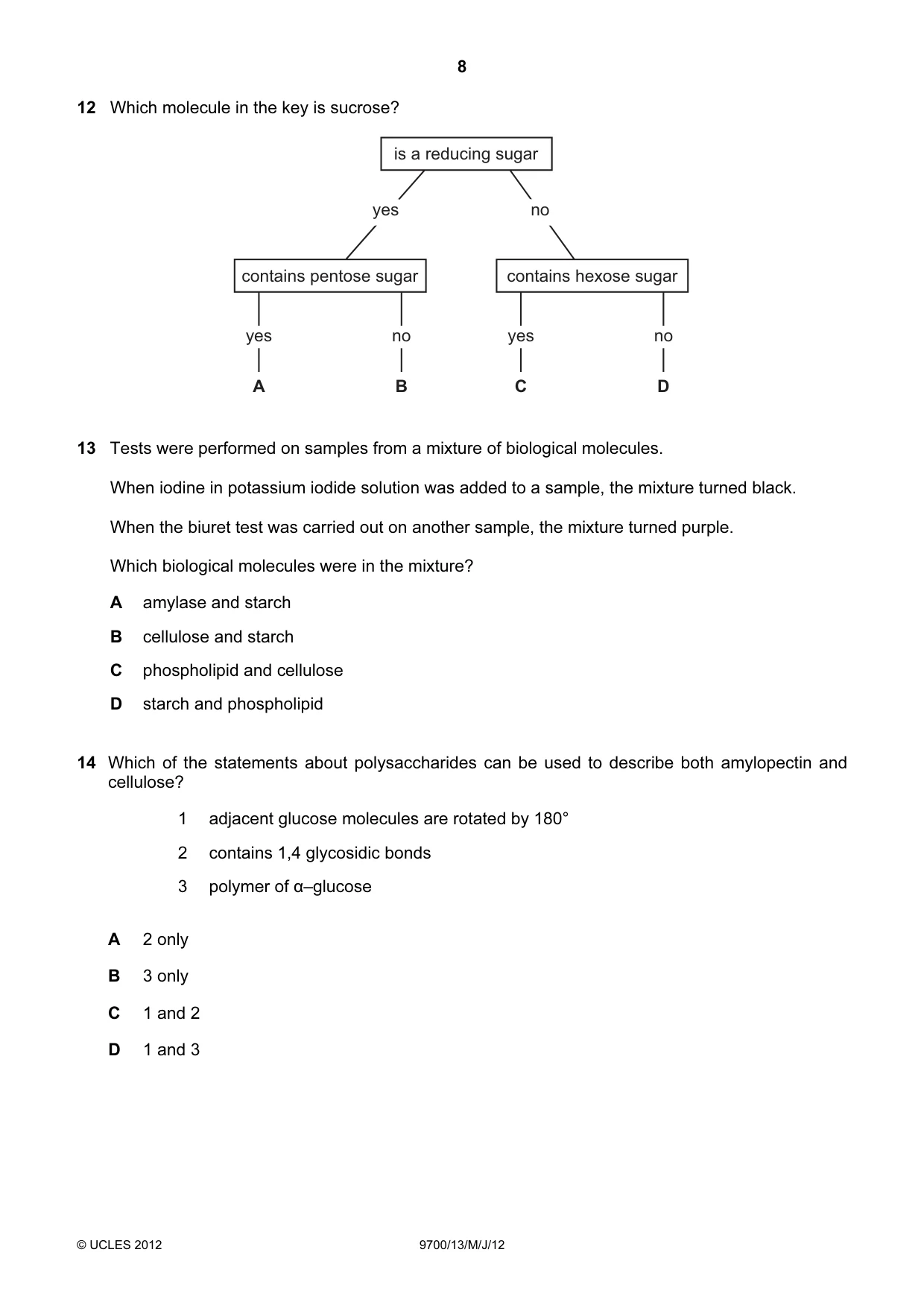
12 Which molecule in the key is sucrose? is a reducing sugar yes no contains pentose sugar contains hexose sugar yes no yes no A B C D
Mark scheme: C
Q13 · Tests were performed on samples from a mixture of biological molecules
13 Tests were performed on samples from a mixture of biological molecules. When iodine in potassium iodide solution was added to a sample, the mixture turned black. When the biuret test was carried out on another sample, the mixture turned purple. Which biological molecules were in the mixture? A amylase and starch B cellulose and starch C phospholipid and cellulose D starch and phospholipid
Mark scheme: A
Q14 · Which of the statements about polysaccharides can be used to describe both amylopectin…
14 Which of the statements about polysaccharides can be used to describe both amylopectin and cellulose? 1 adjacent glucose molecules are rotated by 180° 2 contains 1,4 glycosidic bonds 3 polymer of α–glucose A 2 only B 3 only C 1 and 2 D 1 and 3
Mark scheme: A
Q15 · Which substances contain carbon, hydrogen, oxygen and nitrogen?
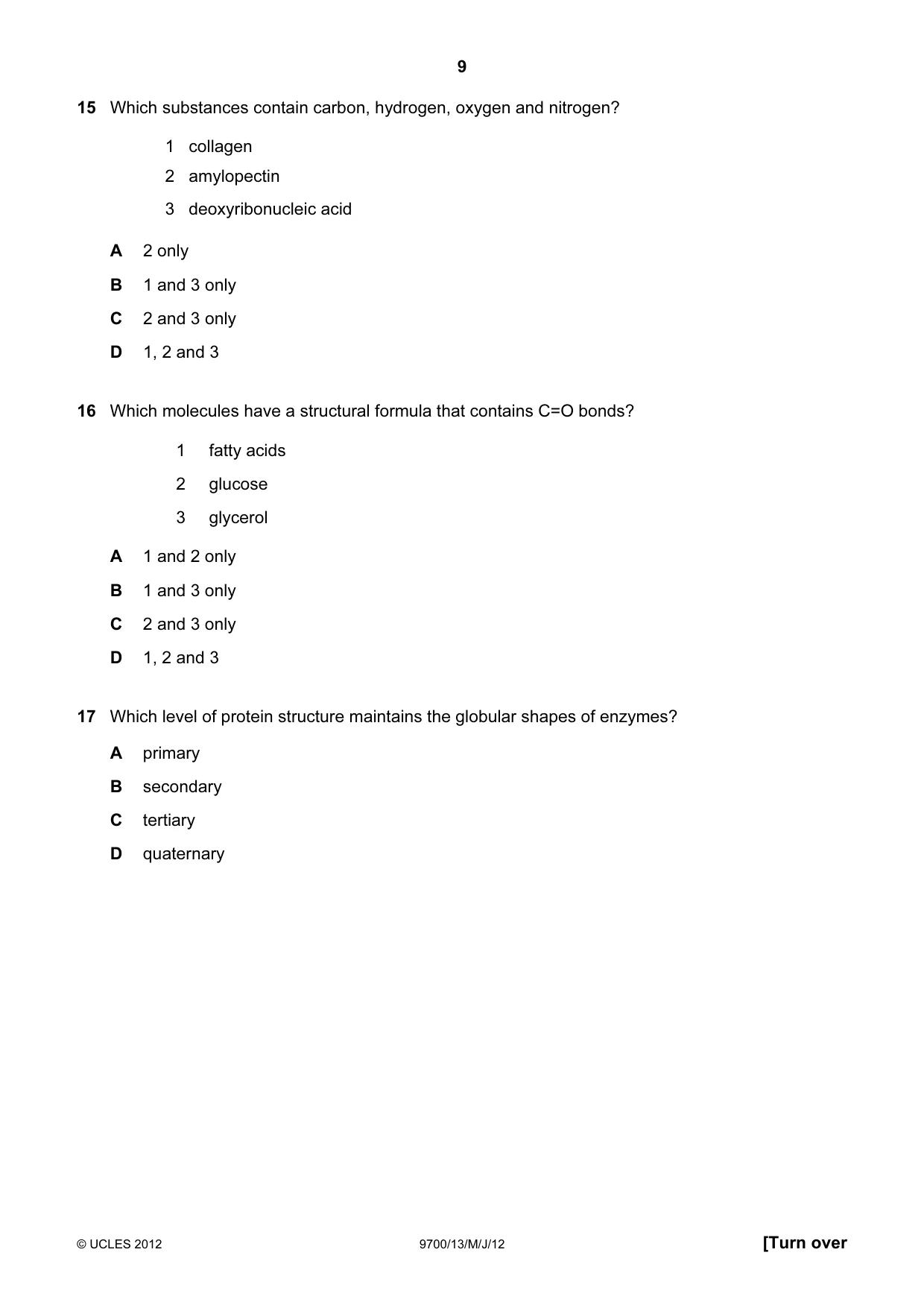
15 Which substances contain carbon, hydrogen, oxygen and nitrogen? 1 collagen 2 amylopectin 3 deoxyribonucleic acid A 2 only B 1 and 3 only C 2 and 3 only D 1, 2 and 3
Mark scheme: B
Q16 · Which molecules have a structural formula that contains C=O bonds?
16 Which molecules have a structural formula that contains C=O bonds? 1 fatty acids 2 glucose 3 glycerol A 1 and 2 only B 1 and 3 only C 2 and 3 only D 1, 2 and 3
Mark scheme: A
Q17 · Which level of protein structure maintains the globular shapes of enzymes?
17 Which level of protein structure maintains the globular shapes of enzymes? A primary B secondary C tertiary D quaternary
Mark scheme: C
Q18 · Catalase is an enzyme that catalyses the conversion of hydrogen peroxide into water and…
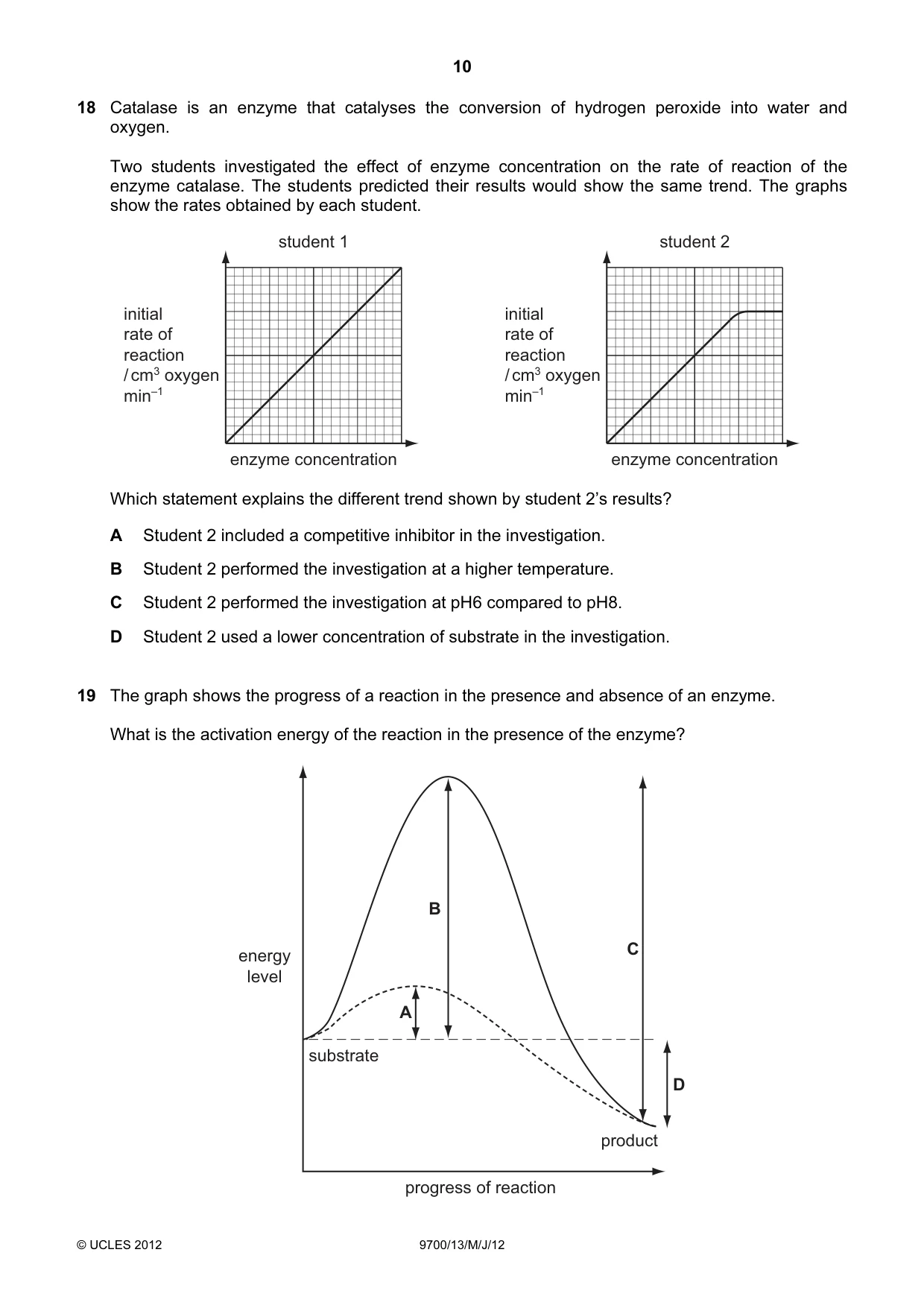
18 Catalase is an enzyme that catalyses the conversion of hydrogen peroxide into water and oxygen. Two students investigated the effect of enzyme concentration on the rate of reaction of the enzyme catalase. The students predicted their results would show the same trend. The graphs show the rates obtained by each student. student 1 student 2 initial initial rate of rate of reaction reaction / cm3 oxygen / cm3 oxygen min–1 min–1 enzyme concentration enzyme concentration Which statement explains the different trend shown by student 2’s results? A Student 2 included a competitive inhibitor in the investigation. B Student 2 performed the investigation at a higher temperature. C Student 2 performed the investigation at pH6 compared to pH8. D Student 2 used a lower concentration of substrate in the investigation.
Mark scheme: D
Q19 · The graph shows the progress of a reaction in the presence and absence of an enzyme
19 The graph shows the progress of a reaction in the presence and absence of an enzyme. What is the activation energy of the reaction in the presence of the enzyme? B energy C level A substrate D product progress of reaction
Mark scheme: A
Q20 · For organisms undergoing sexual reproduction, a reduction division occurs before…
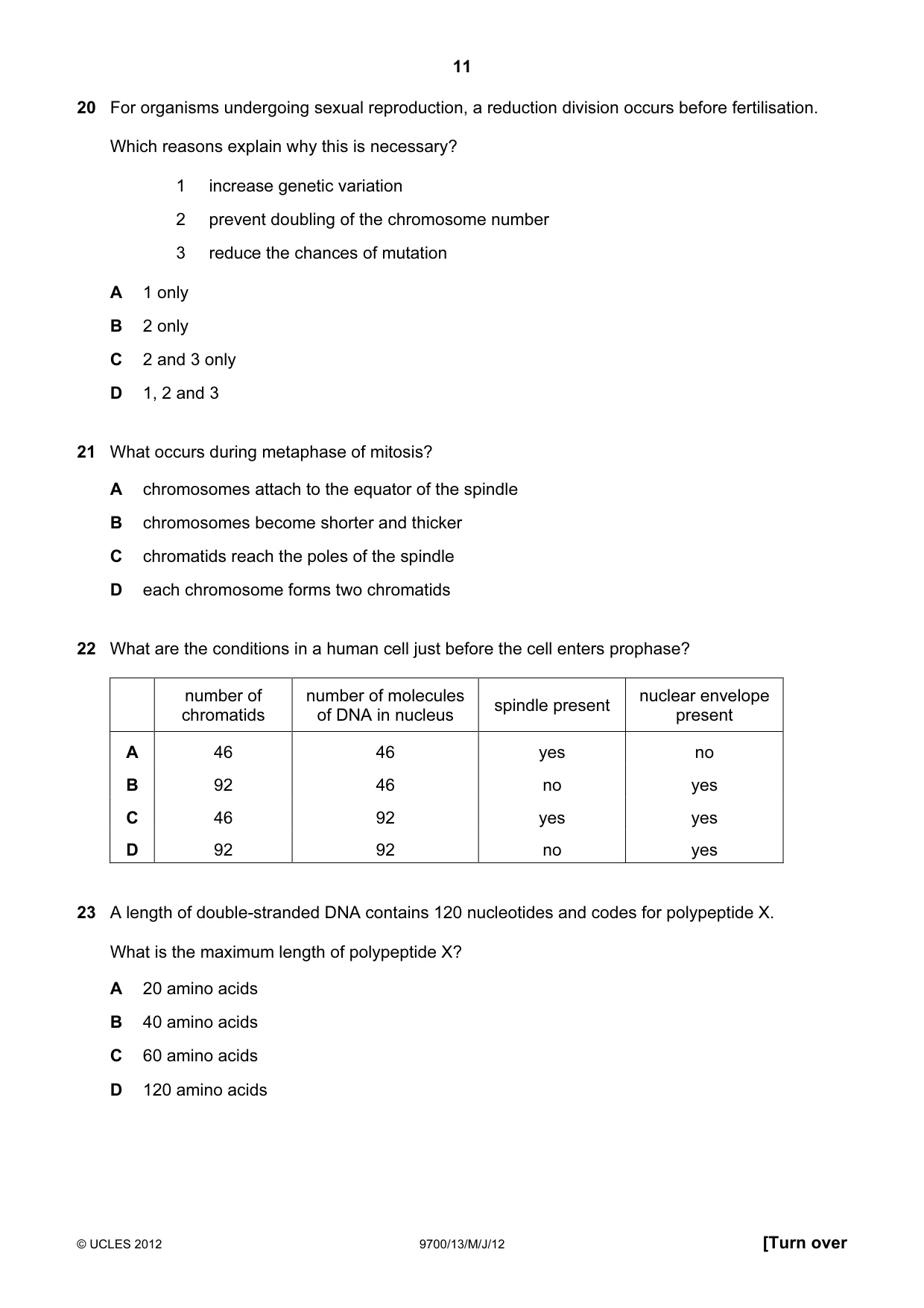
20 For organisms undergoing sexual reproduction, a reduction division occurs before fertilisation. Which reasons explain why this is necessary? 1 increase genetic variation 2 prevent doubling of the chromosome number 3 reduce the chances of mutation A 1 only B 2 only C 2 and 3 only D 1, 2 and 3
Mark scheme: B
More questions on Replication and division of nuclei and cells
Q21 · What occurs during metaphase of mitosis?
21 What occurs during metaphase of mitosis? A chromosomes attach to the equator of the spindle B chromosomes become shorter and thicker C chromatids reach the poles of the spindle D each chromosome forms two chromatids
Mark scheme: A
Q22 · What are the conditions in a human cell just before the cell enters prophase?
22 What are the conditions in a human cell just before the cell enters prophase? number of number of molecules nuclear envelope spindle present chromatids of DNA in nucleus present A 46 46 yes no B 92 46 no yes C 46 92 yes yes D 92 92 no yes
Mark scheme: D
More questions on Replication and division of nuclei and cells
Q23 · A length of double-stranded DNA contains 120 nucleotides and codes for polypeptide X
23 A length of double-stranded DNA contains 120 nucleotides and codes for polypeptide X. What is the maximum length of polypeptide X? A 20 amino acids B 40 amino acids C 60 amino acids D 120 amino acids
Mark scheme: A
Q24 · Which statement describes a process that occurs during protein synthesis?
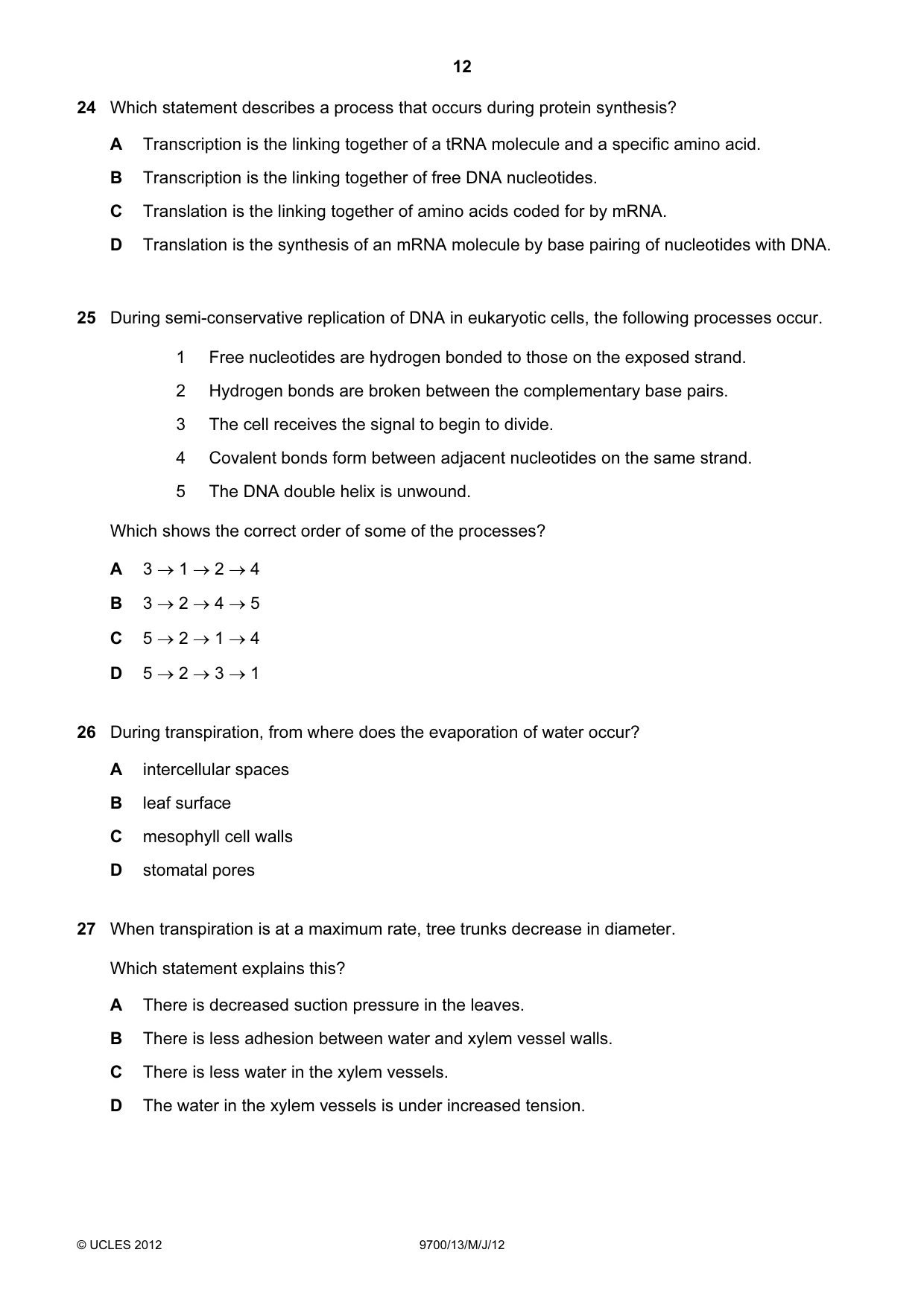
24 Which statement describes a process that occurs during protein synthesis? A Transcription is the linking together of a tRNA molecule and a specific amino acid. B Transcription is the linking together of free DNA nucleotides. C Translation is the linking together of amino acids coded for by mRNA. D Translation is the synthesis of an mRNA molecule by base pairing of nucleotides with DNA.
Mark scheme: C
Q25 · During semi-conservative replication of DNA in eukaryotic cells, the following processes…
25 During semi-conservative replication of DNA in eukaryotic cells, the following processes occur. 1 Free nucleotides are hydrogen bonded to those on the exposed strand. 2 Hydrogen bonds are broken between the complementary base pairs. 3 The cell receives the signal to begin to divide. 4 Covalent bonds form between adjacent nucleotides on the same strand. 5 The DNA double helix is unwound. Which shows the correct order of some of the processes? A 3 → 1 → 2 → 4 B 3 → 2 → 4 → 5 C 5 → 2 → 1 → 4 D 5 → 2 → 3 → 1
Mark scheme: C
More questions on Structure of nucleic acids and replication of DNA
Q26 · During transpiration, from where does the evaporation of water occur?
26 During transpiration, from where does the evaporation of water occur? A intercellular spaces B leaf surface C mesophyll cell walls D stomatal pores
Mark scheme: C
Q27 · When transpiration is at a maximum rate, tree trunks decrease in diameter
27 When transpiration is at a maximum rate, tree trunks decrease in diameter. Which statement explains this? A There is decreased suction pressure in the leaves. B There is less adhesion between water and xylem vessel walls. C There is less water in the xylem vessels. D The water in the xylem vessels is under increased tension.
Mark scheme: D
Q28 · The graph shows stomatal opening and closing in the leaves of a species of Pelargonium…
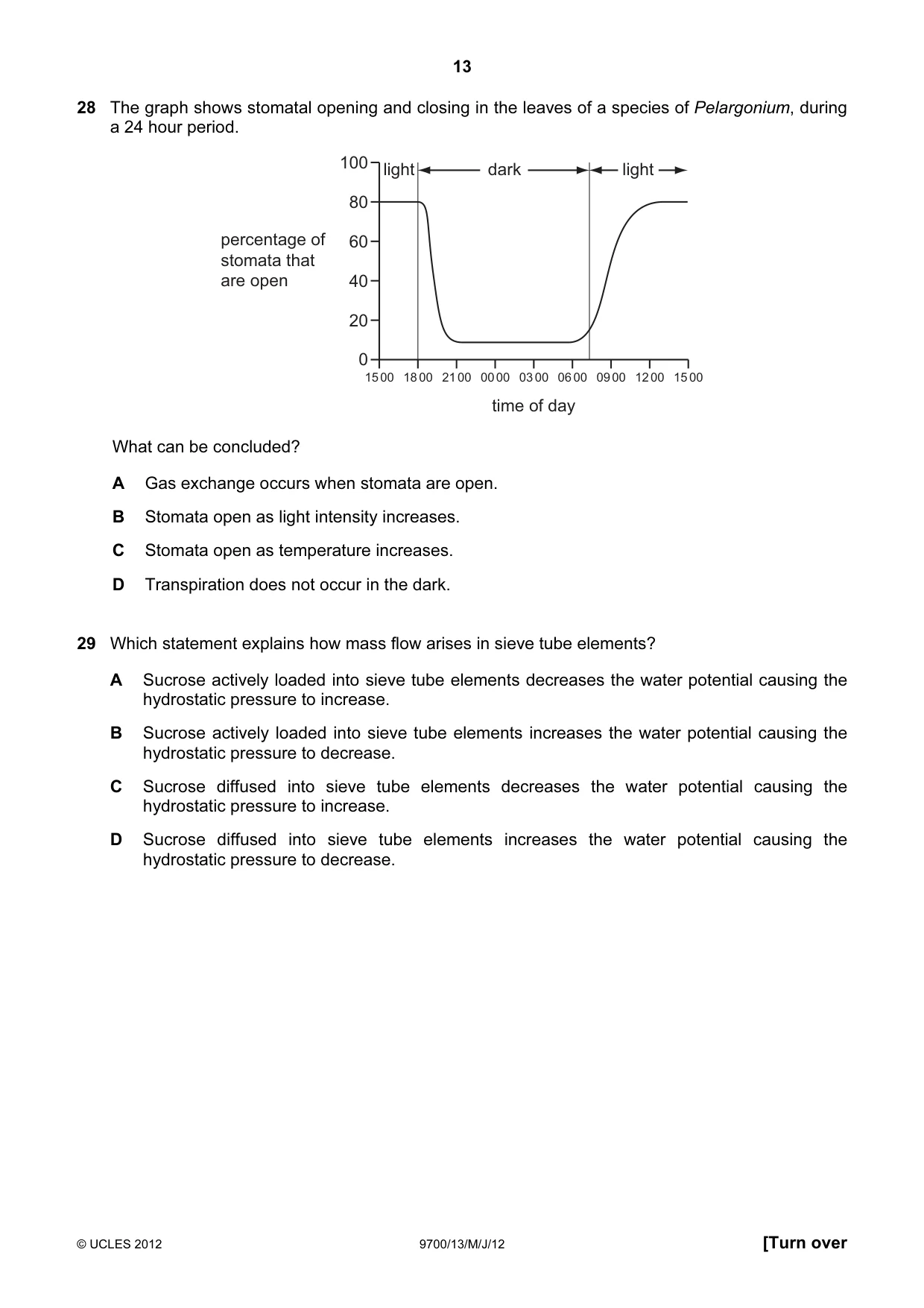
28 The graph shows stomatal opening and closing in the leaves of a species of Pelargonium, during a 24 hour period. 100 light dark light 80 percentage of 60 stomata that are open 40 20 0 15 00 18 00 21 00 00 00 03 00 06 00 09 00 12 00 15 00 time of day What can be concluded? A Gas exchange occurs when stomata are open. B Stomata open as light intensity increases. C Stomata open as temperature increases. D Transpiration does not occur in the dark.
Mark scheme: B
Q29 · Which statement explains how mass flow arises in sieve tube elements?
29 Which statement explains how mass flow arises in sieve tube elements? A Sucrose actively loaded into sieve tube elements decreases the water potential causing the hydrostatic pressure to increase. B Sucrose actively loaded into sieve tube elements increases the water potential causing the hydrostatic pressure to decrease. C Sucrose diffused into sieve tube elements decreases the water potential causing the hydrostatic pressure to increase. D Sucrose diffused into sieve tube elements increases the water potential causing the hydrostatic pressure to decrease.
Mark scheme: A
Q30 · The diagram shows a model to demonstrate the mass flow hypothesis of translocation
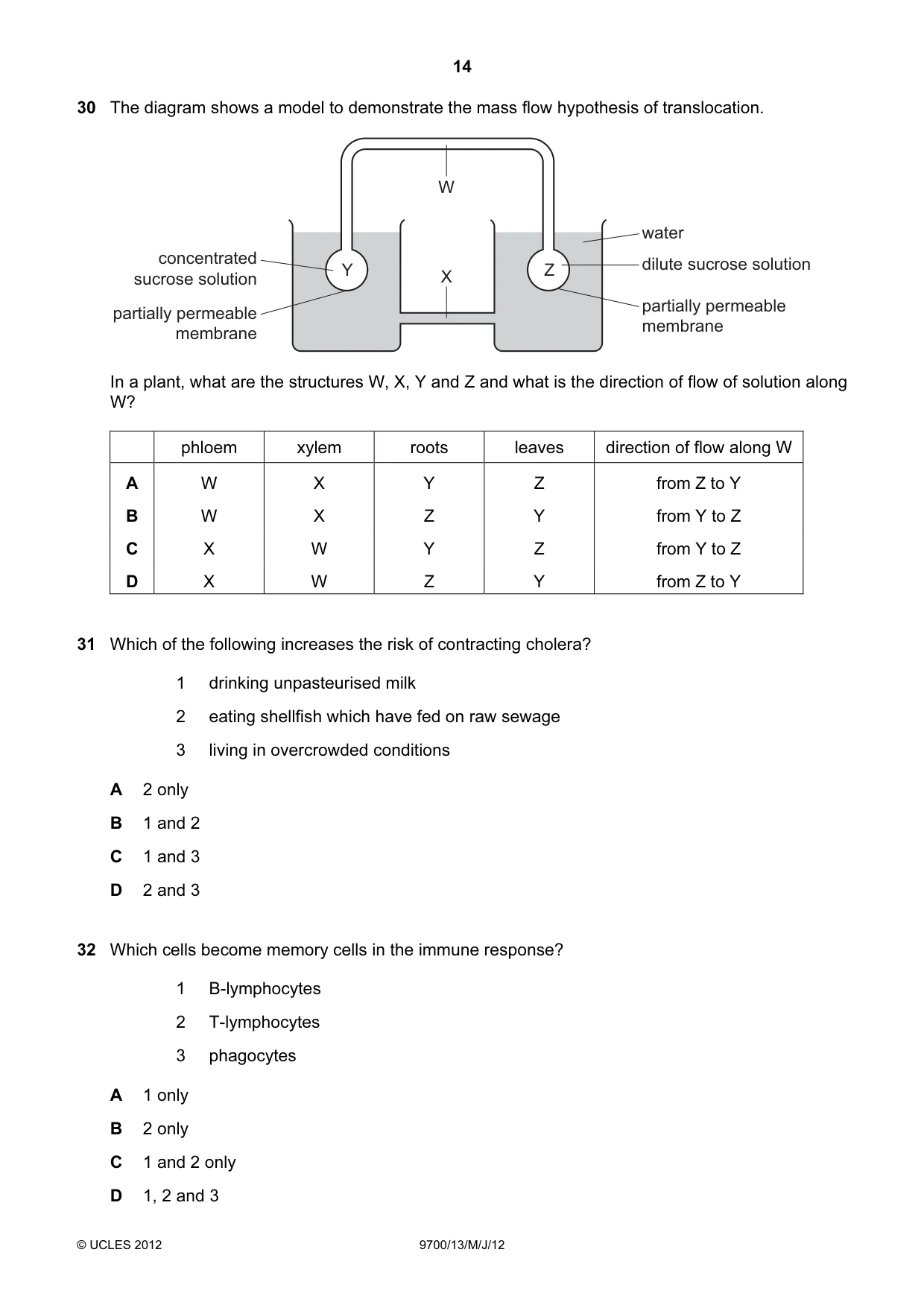
30 The diagram shows a model to demonstrate the mass flow hypothesis of translocation. W water concentrated dilute sucrose solution Y X Z sucrose solution partially permeable partially permeable membrane membrane In a plant, what are the structures W, X, Y and Z and what is the direction of flow of solution along W? phloem xylem roots leaves direction of flow along W A W X Y Z from Z to Y B W X Z Y from Y to Z C X W Y Z from Y to Z D X W Z Y from Z to Y
Mark scheme: B
Q31 · Which of the following increases the risk of contracting cholera?
31 Which of the following increases the risk of contracting cholera? 1 drinking unpasteurised milk 2 eating shellfish which have fed on raw sewage 3 living in overcrowded conditions A 2 only B 1 and 2 C 1 and 3 D 2 and 3
Mark scheme: A
Q32 · Which cells become memory cells in the immune response?
32 Which cells become memory cells in the immune response? 1 B-lymphocytes 2 T-lymphocytes 3 phagocytes A 1 only B 2 only C 1 and 2 only D 1, 2 and 3
Mark scheme: C
Q33 · Which describes a T-helper lymphocyte?
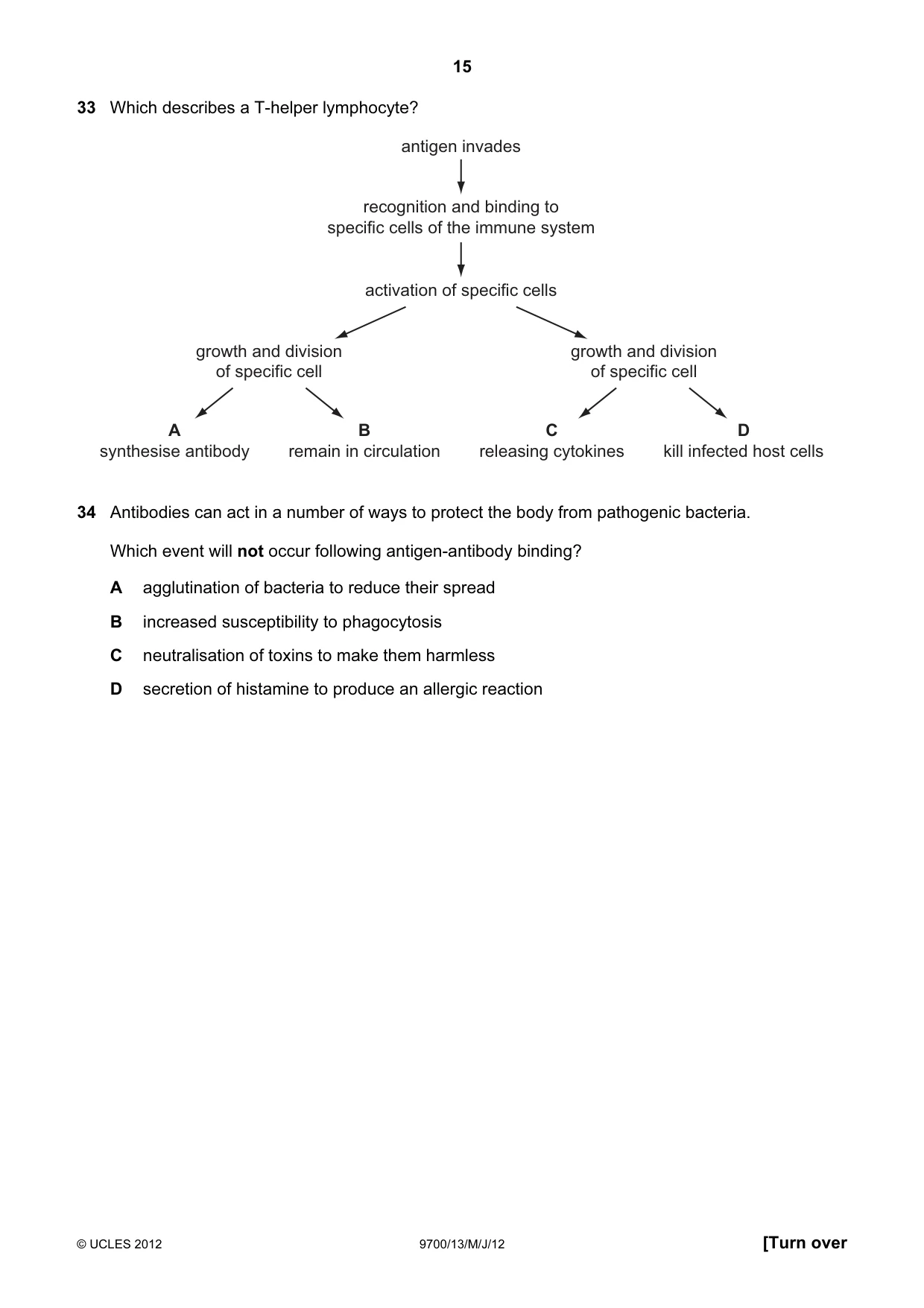
33 Which describes a T-helper lymphocyte? antigen invades recognition and binding to specific cells of the immune system activation of specific cells growth and division growth and division of specific cell of specific cell A B C D synthesise antibody remain in circulation releasing cytokines kill infected host cells
Mark scheme: C
Q34 · Antibodies can act in a number of ways to protect the body from pathogenic bacteria
34 Antibodies can act in a number of ways to protect the body from pathogenic bacteria. Which event will not occur following antigen-antibody binding? A agglutination of bacteria to reduce their spread B increased susceptibility to phagocytosis C neutralisation of toxins to make them harmless D secretion of histamine to produce an allergic reaction
Mark scheme: D
Q35 · The graph shows the pressure in three parts of the heart during one cycle
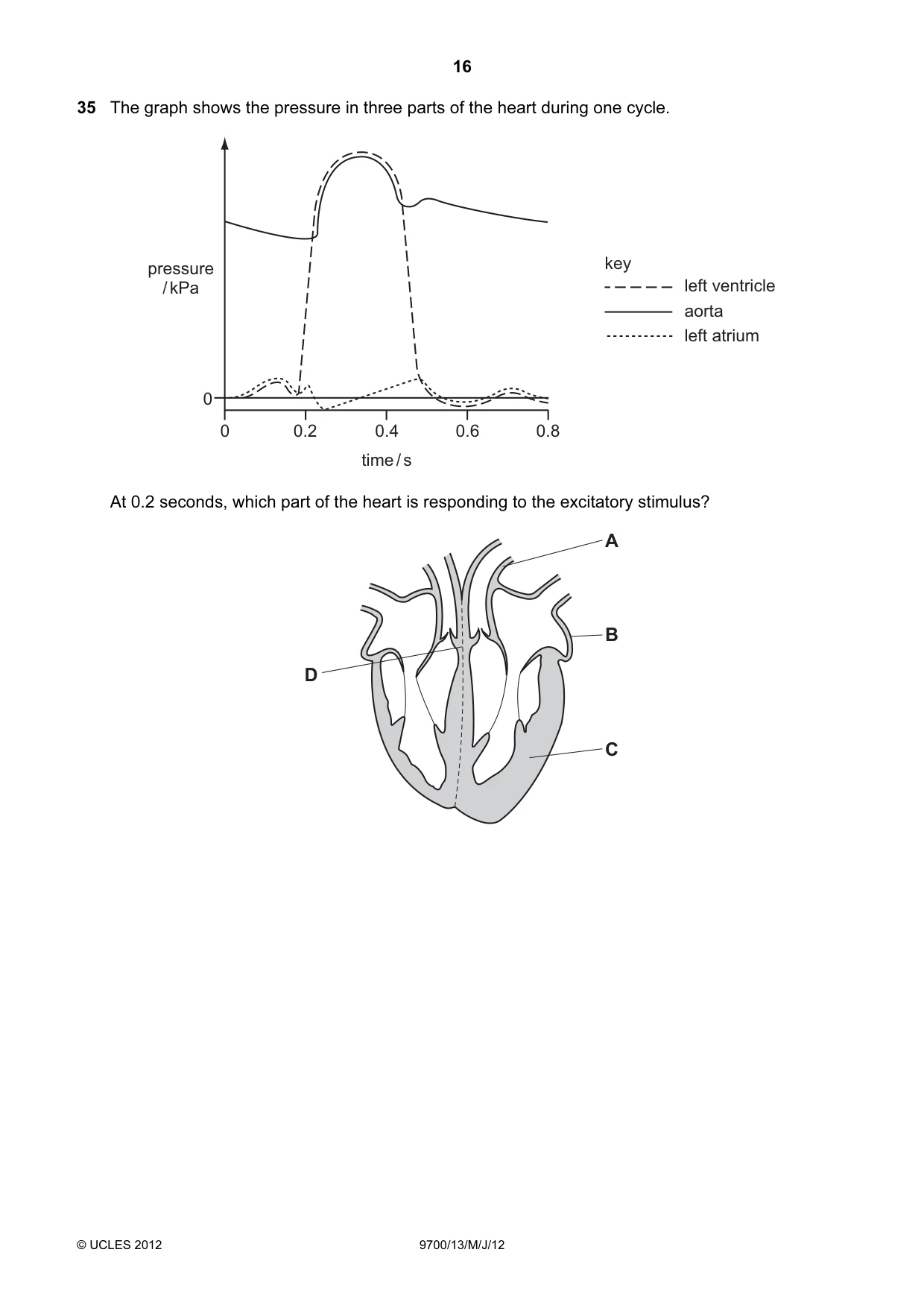
35 The graph shows the pressure in three parts of the heart during one cycle. pressure key / kPa left ventricle aorta left atrium 0 0 0.2 0.4 0.6 0.8 time / s At 0.2 seconds, which part of the heart is responding to the excitatory stimulus? A B D C
Mark scheme: C
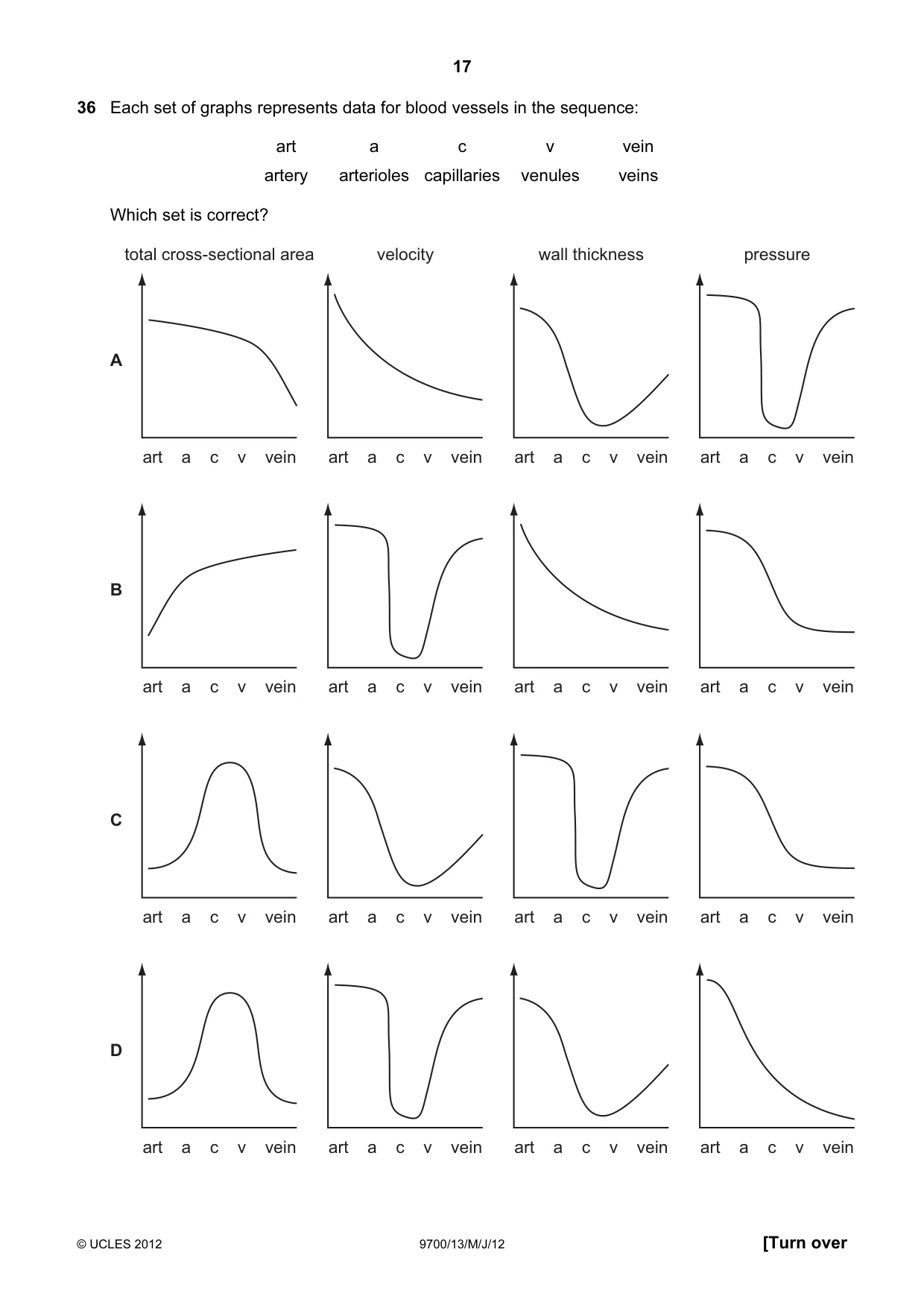
Q36 · Each set of graphs represents data for blood vessels in the sequence: art a c v vein…
36 Each set of graphs represents data for blood vessels in the sequence: art a c v vein artery arterioles capillaries venules veins Which set is correct? total cross-sectional area velocity wall thickness pressure A art a c v vein art a c v vein art a c v vein art a c v vein B art a c v vein art a c v vein art a c v vein art a c v vein C art a c v vein art a c v vein art a c v vein art a c v vein D art a c v vein art a c v vein art a c v vein art a c v vein
Mark scheme: D
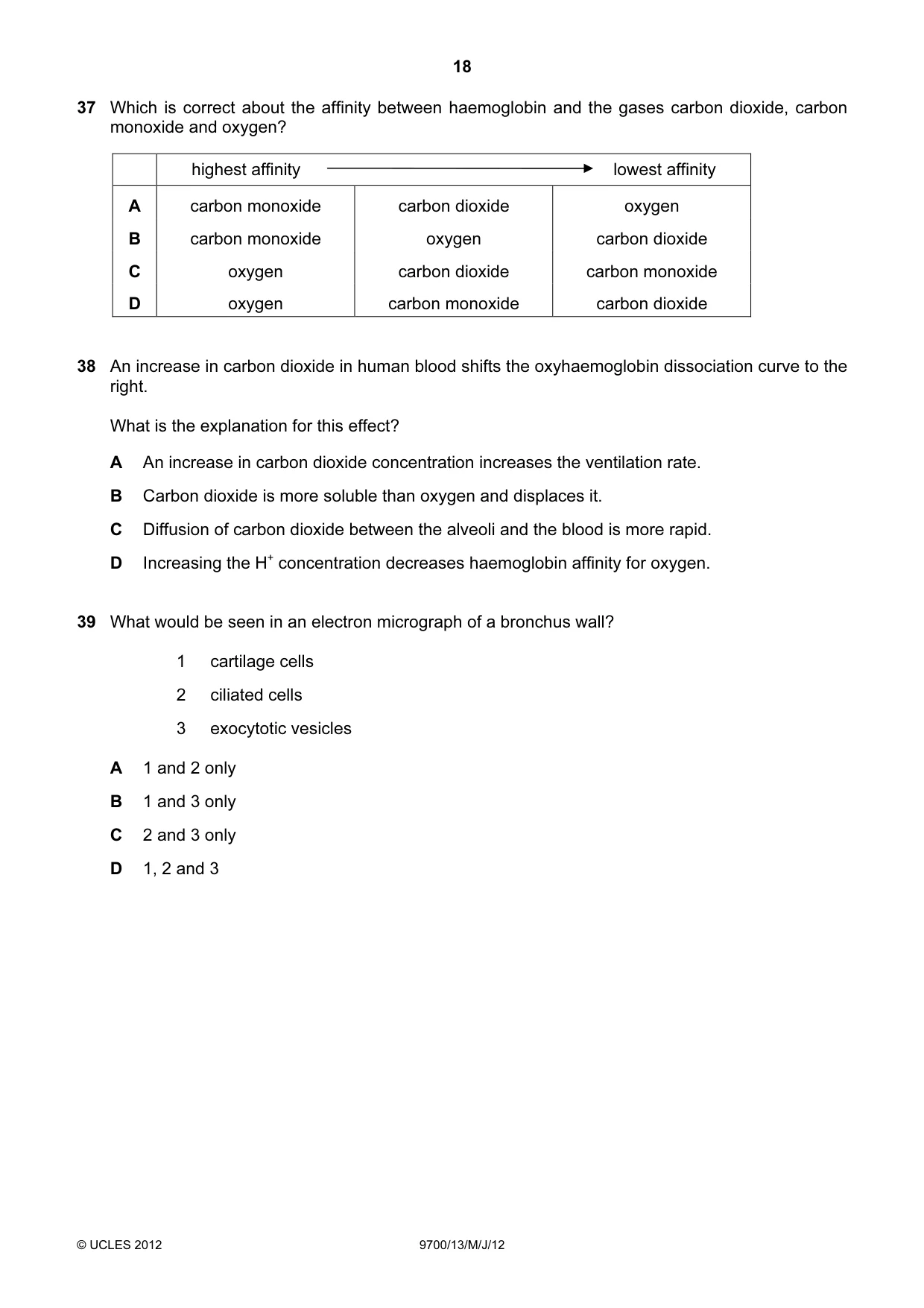
Q37 · Which is correct about the affinity between haemoglobin and the gases carbon dioxide…
37 Which is correct about the affinity between haemoglobin and the gases carbon dioxide, carbon monoxide and oxygen? highest affinity lowest affinity A carbon monoxide carbon dioxide oxygen B carbon monoxide oxygen carbon dioxide C oxygen carbon dioxide carbon monoxide D oxygen carbon monoxide carbon dioxide
Mark scheme: B
Q38 · An increase in carbon dioxide in human blood shifts the oxyhaemoglobin dissociation curve…
38 An increase in carbon dioxide in human blood shifts the oxyhaemoglobin dissociation curve to the right. What is the explanation for this effect? A An increase in carbon dioxide concentration increases the ventilation rate. B Carbon dioxide is more soluble than oxygen and displaces it. C Diffusion of carbon dioxide between the alveoli and the blood is more rapid. D Increasing the H+ concentration decreases haemoglobin affinity for oxygen.
Mark scheme: D
Q39 · What would be seen in an electron micrograph of a bronchus wall?
39 What would be seen in an electron micrograph of a bronchus wall? 1 cartilage cells 2 ciliated cells 3 exocytotic vesicles A 1 and 2 only B 1 and 3 only C 2 and 3 only D 1, 2 and 3
Mark scheme: D
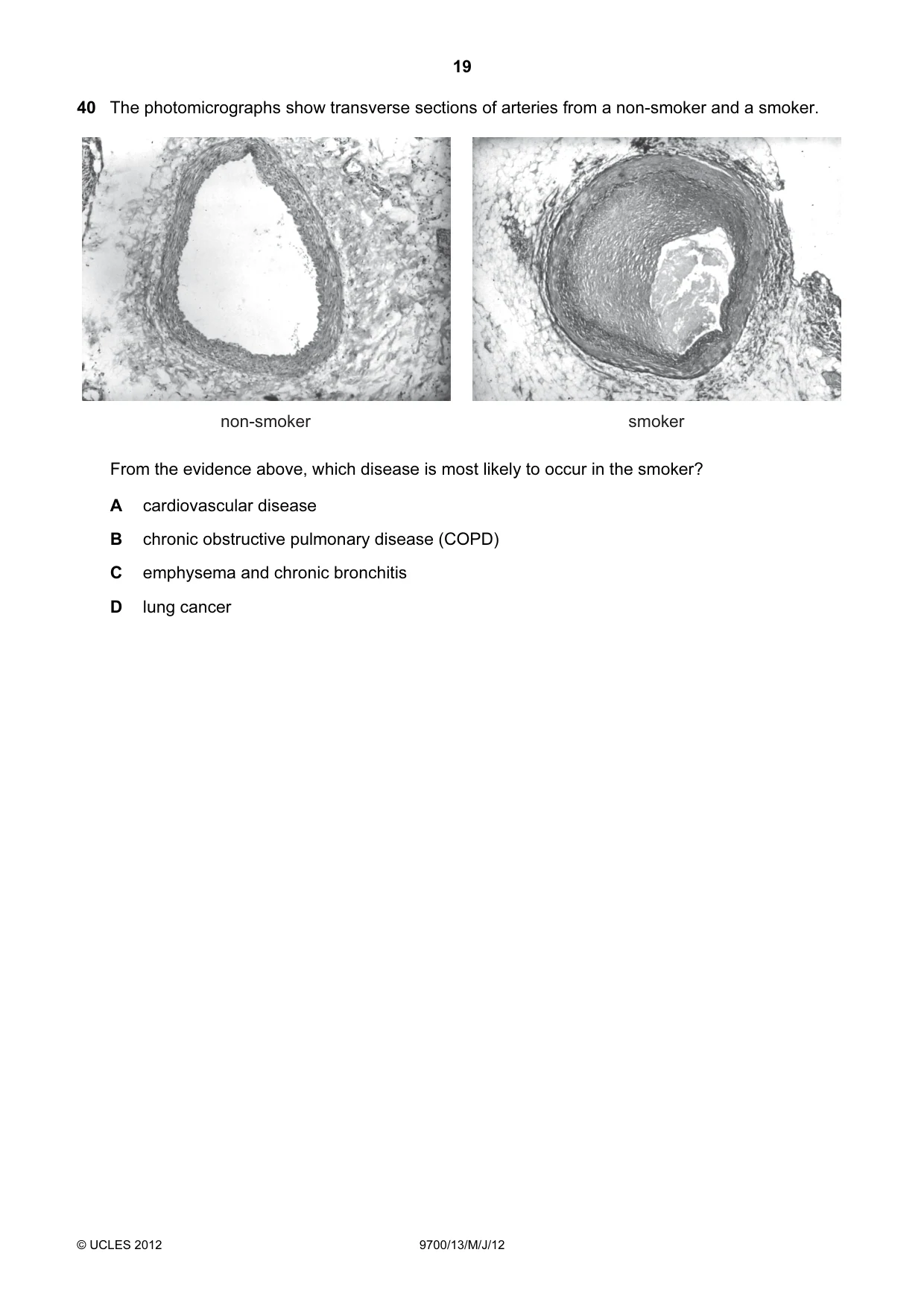
Q40 · The photomicrographs show transverse sections of arteries from a non-smoker and a smoker
40 The photomicrographs show transverse sections of arteries from a non-smoker and a smoker. non-smoker smoker From the evidence above, which disease is most likely to occur in the smoker? A cardiovascular disease B chronic obstructive pulmonary disease (COPD) C emphysema and chronic bronchitis D lung cancer
Mark scheme: A
What was in this paper
The subtopics covered by these 40 questions, and how many questions each got. Open one in a new tab to see every Cambridge question on it.
5Carbohydrates and lipids3The microscope in cell studies3Cells as the basic units of living organisms2Energy2Movement into and out of cells2Protein synthesis2Proteins2Replication and division of nuclei and cells2The circulatory system2The immune system2Transport of oxygen and carbon dioxide2Antibodies and vaccination1Biodiversity1Chromosome behaviour in mitosis1Factors that affect enzyme action1Fluid mosaic membranes1Infectious diseases1Mode of action of enzymes1Structure of nucleic acids and replication of DNA1Testing for biological molecules1The gas exchange system1The heart1What you needed in this session
Cambridge’s own grade thresholds for 2012 May/June, Paper 1 · Variant 3. A higher threshold means an easier paper — the bar moves with how the cohort did.