Cambridge A Level Biology 9700 — 2020 Feb/March Paper 1 · Variant 2
9700/12/F/M/20 · 40 questions · 40 marks · ≈45 min
The question paper and its mark scheme, free to read here and free to download. This is Cambridge’s own paper, exactly as it was sat.
Question paper16 pages
Mark scheme3 pages
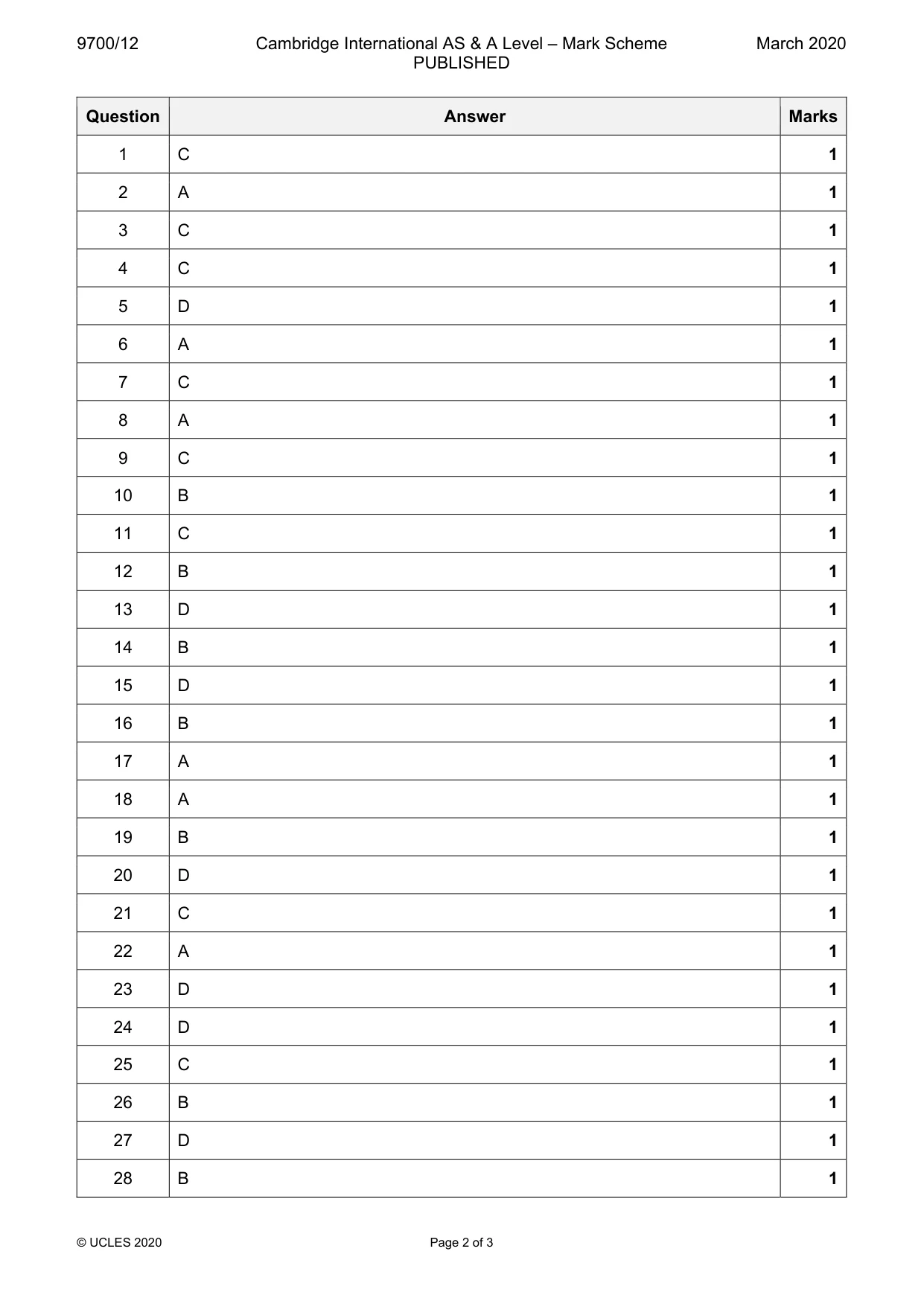
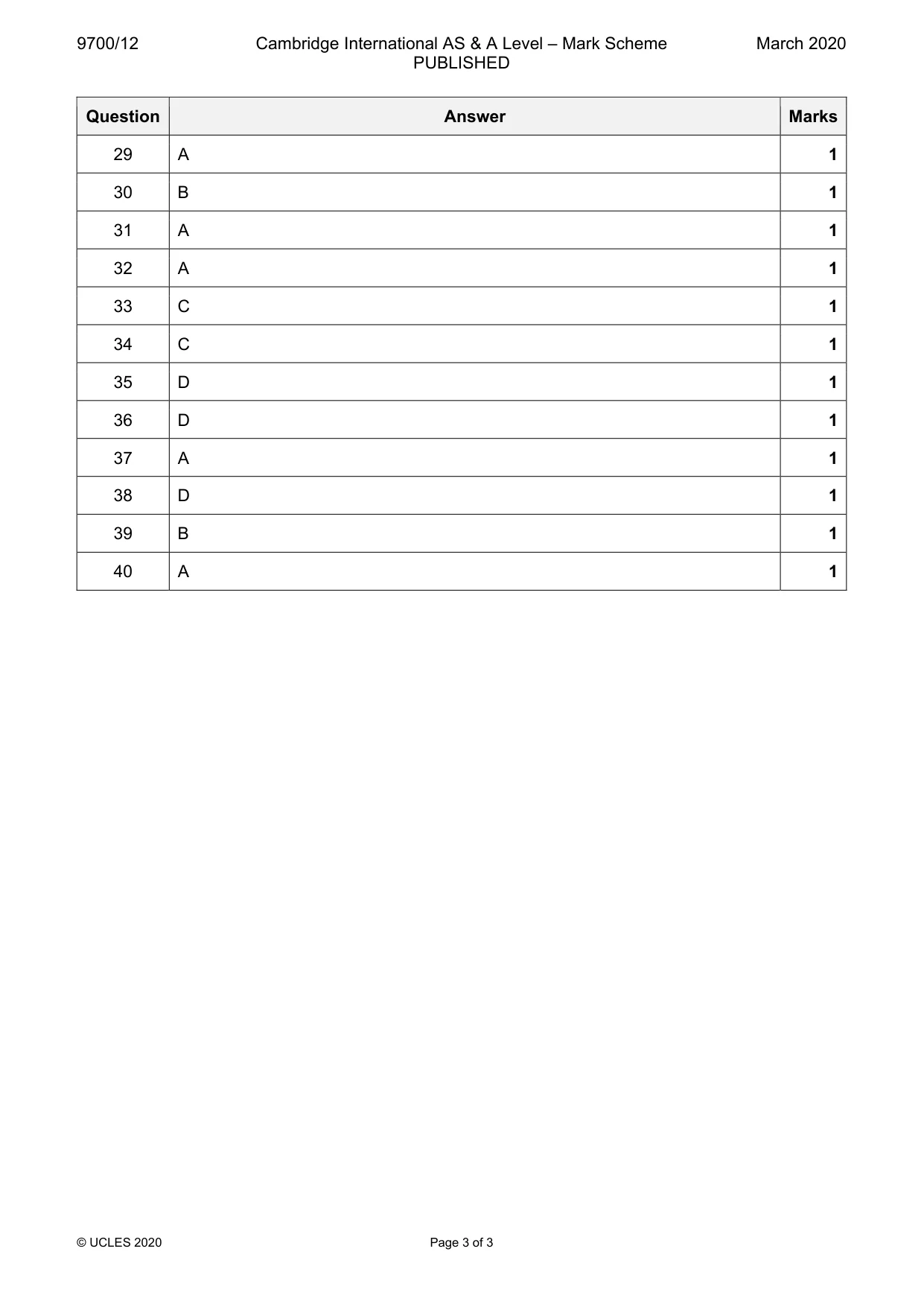
Answers below. Sit the paper first if you are practising.
Questions as text
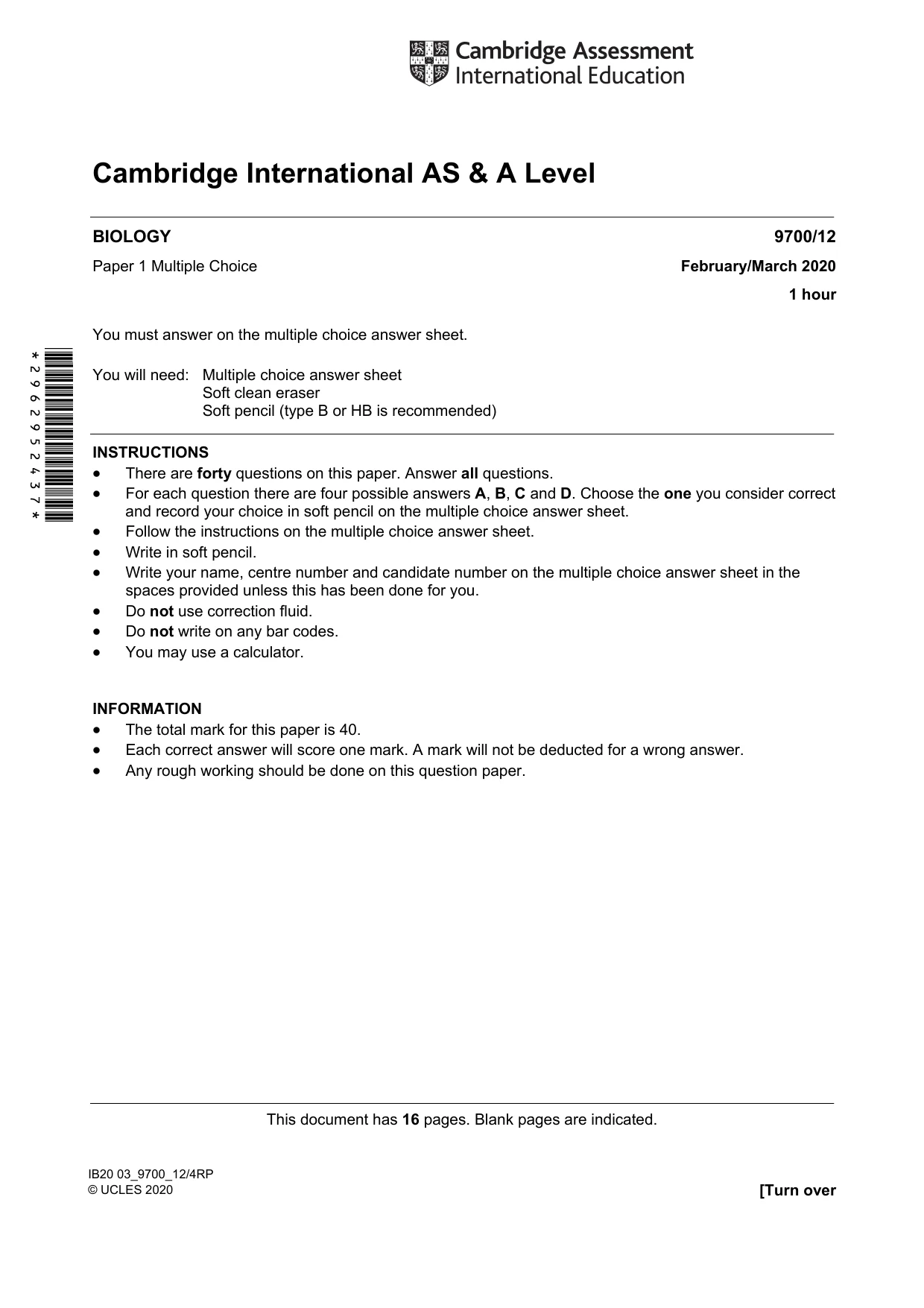
Q1 · The diagram shows an eyepiece graticule and cell viewed through a microscope
1 The diagram shows an eyepiece graticule and cell viewed through a microscope. When the eyepiece graticule was calibrated at this magnification, the whole length of the graticule shown covered 12 divisions of a stage micrometer scale. There were 100 divisions in 10 mm of the stage micrometer. 0 10 20 30 40 50 60 70 80 90 100 What is the actual length of the cell? A 2.5 µm B 3.6 µm C 360 µm D 3 mm
Mark scheme: C
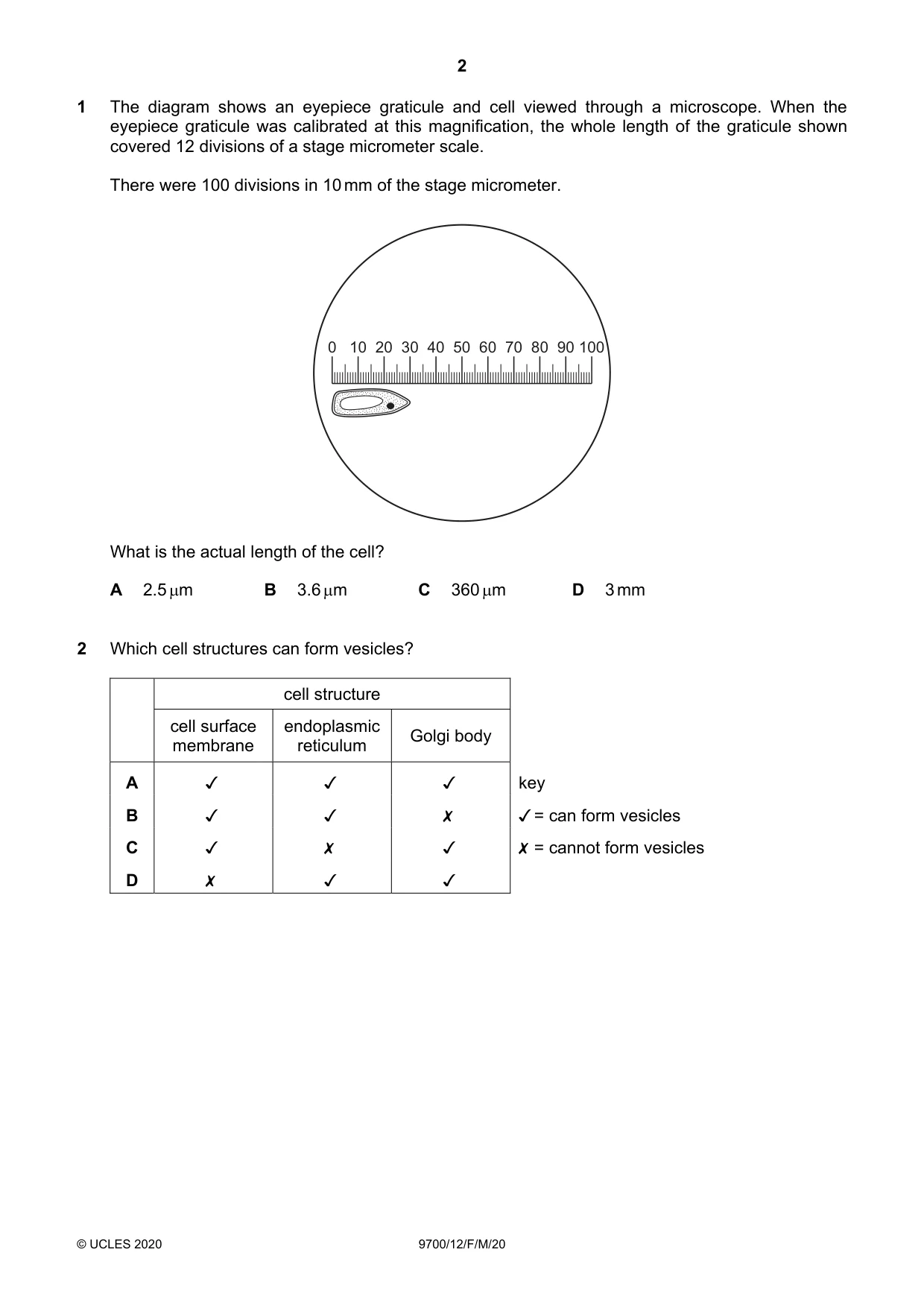
Q2 · Which cell structures can form vesicles?
2 Which cell structures can form vesicles? cell structure cell surface membrane endoplasmic reticulum Golgi body key / = can form vesicles X = cannot form vesicles
Mark scheme: A
More questions on Cells as the basic units of living organisms
Q3 · The diagram shows three circles, 1, 3 and 5, representing chloroplasts, mitochondria and…
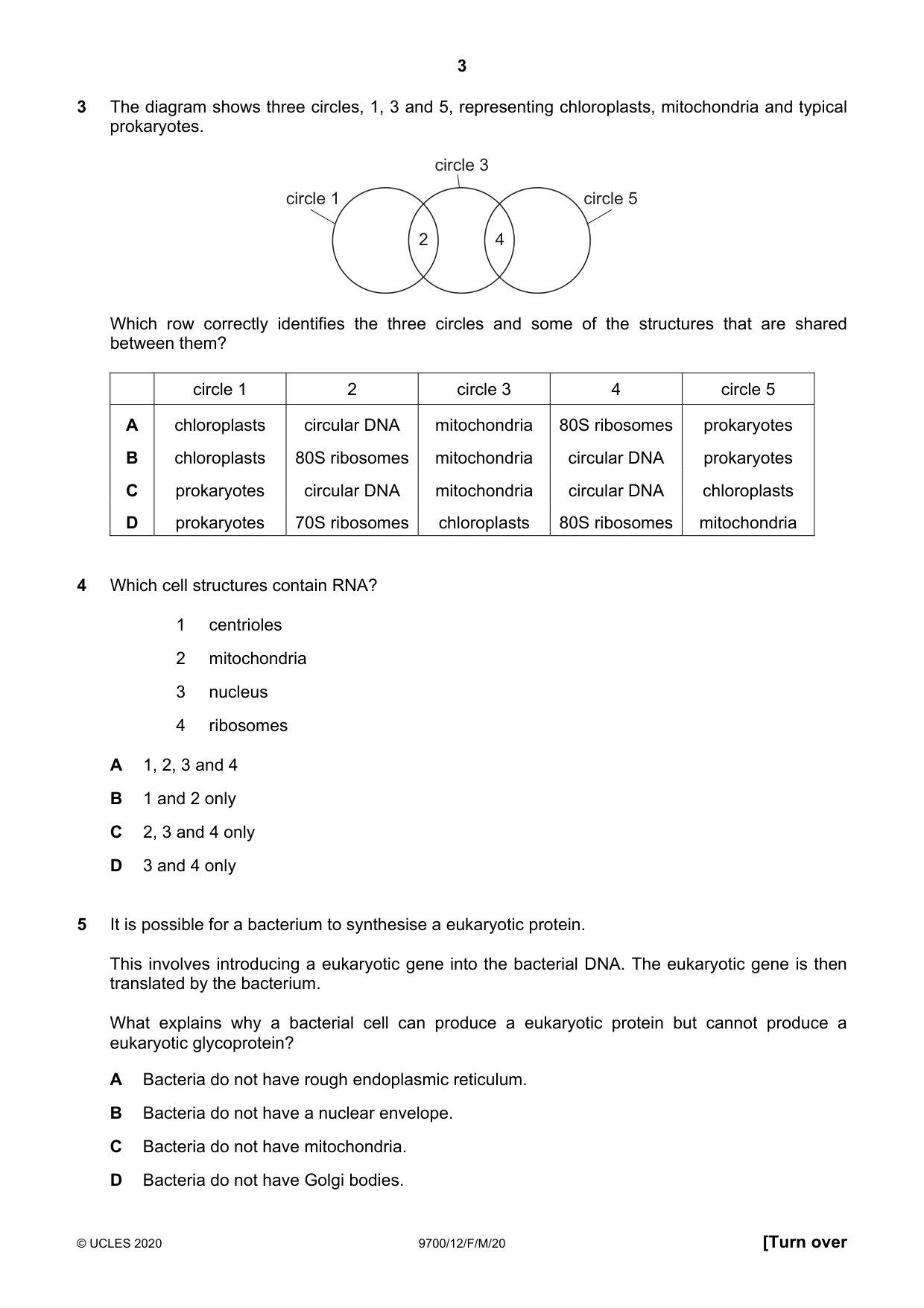
3 The diagram shows three circles, 1, 3 and 5, representing chloroplasts, mitochondria and typical prokaryotes. circle 3 circle 1 circle 5 2 4 Which row correctly identifies the three circles and some of the structures that are shared between them? circle 1 2 circle 3 4 circle 5 A chloroplasts circular DNA mitochondria 80S ribosomes prokaryotes B chloroplasts 80S ribosomes mitochondria circular DNA prokaryotes C prokaryotes circular DNA mitochondria circular DNA chloroplasts D prokaryotes 70S ribosomes chloroplasts 80S ribosomes mitochondria
Mark scheme: C
More questions on Cells as the basic units of living organisms
Q4 · Which cell structures contain RNA?
4 Which cell structures contain RNA? 1 centrioles 2 mitochondria 3 nucleus 4 ribosomes A 1, 2, 3 and 4 B 1 and 2 only C 2, 3 and 4 only D 3 and 4 only
Mark scheme: C
More questions on Cells as the basic units of living organisms
Q5 · It is possible for a bacterium to synthesise a eukaryotic protein
5 It is possible for a bacterium to synthesise a eukaryotic protein. This involves introducing a eukaryotic gene into the bacterial DNA. The eukaryotic gene is then translated by the bacterium. What explains why a bacterial cell can produce a eukaryotic protein but cannot produce a eukaryotic glycoprotein? A Bacteria do not have rough endoplasmic reticulum. B Bacteria do not have a nuclear envelope. C Bacteria do not have mitochondria. D Bacteria do not have Golgi bodies.
Mark scheme: D
More questions on Cells as the basic units of living organisms
Q6 · Which structures are found in typical prokaryotic cells and also in typical plant cells?
6 Which structures are found in typical prokaryotic cells and also in typical plant cells? A cell walls B histones C telomeres D tonoplasts
Mark scheme: A
More questions on Cells as the basic units of living organisms
Q7 · The molecule shown is a polymer of reducing sugars
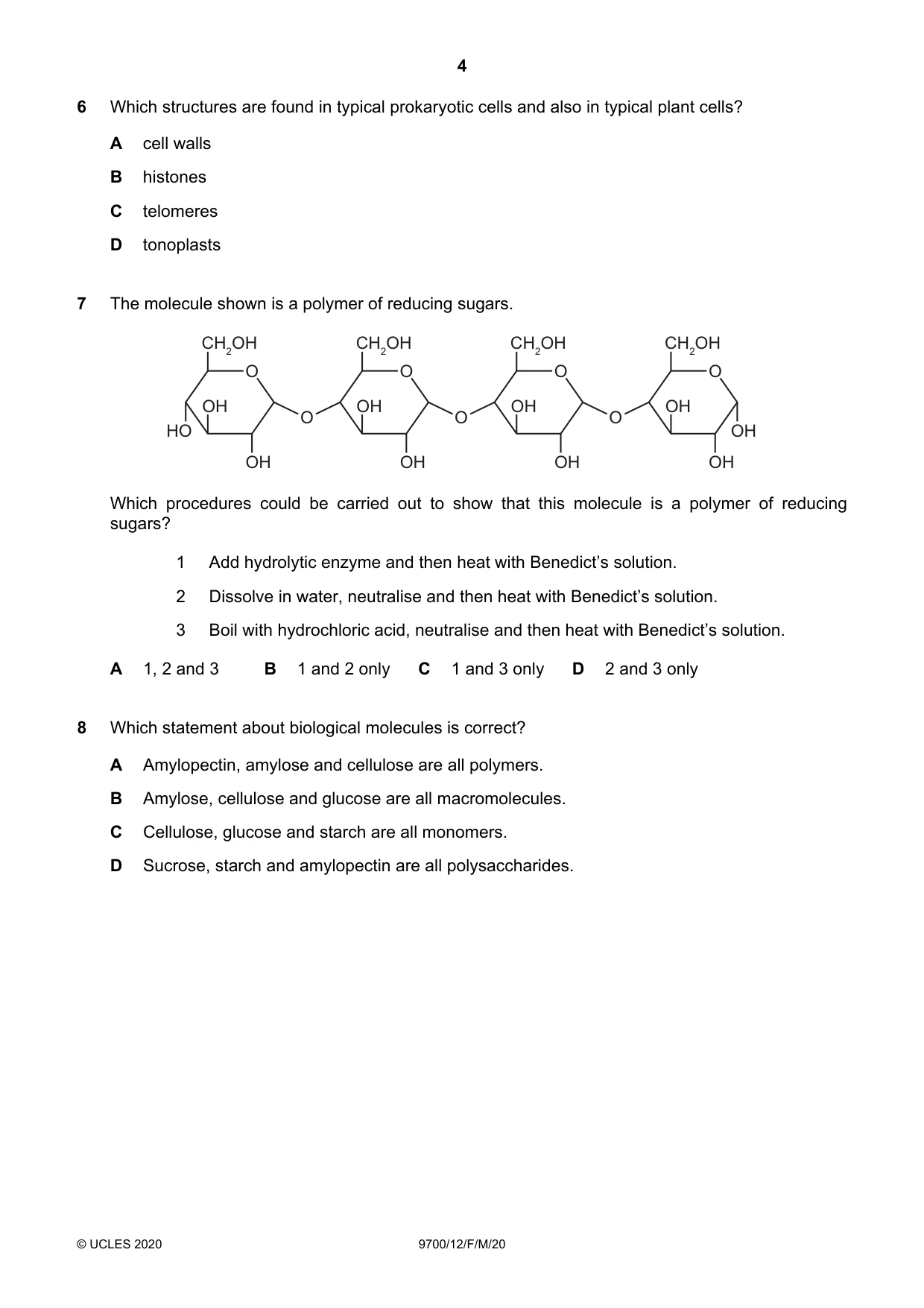
7 The molecule shown is a polymer of reducing sugars. CH2OH CH2OH CH2OH CH2OH O O O O OH OH OH OH O O O HO OH OH OH OH OH Which procedures could be carried out to show that this molecule is a polymer of reducing sugars? 1 Add hydrolytic enzyme and then heat with Benedict’s solution. 2 Dissolve in water, neutralise and then heat with Benedict’s solution. 3 Boil with hydrochloric acid, neutralise and then heat with Benedict’s solution. A 1, 2 and 3 B 1 and 2 only C 1 and 3 only D 2 and 3 only
Mark scheme: C
Q8 · Which statement about biological molecules is correct?
8 Which statement about biological molecules is correct? A Amylopectin, amylose and cellulose are all polymers. B Amylose, cellulose and glucose are all macromolecules. C Cellulose, glucose and starch are all monomers. D Sucrose, starch and amylopectin are all polysaccharides.
Mark scheme: A
Q9 · Sugars with a ring structure can also have a linear structure
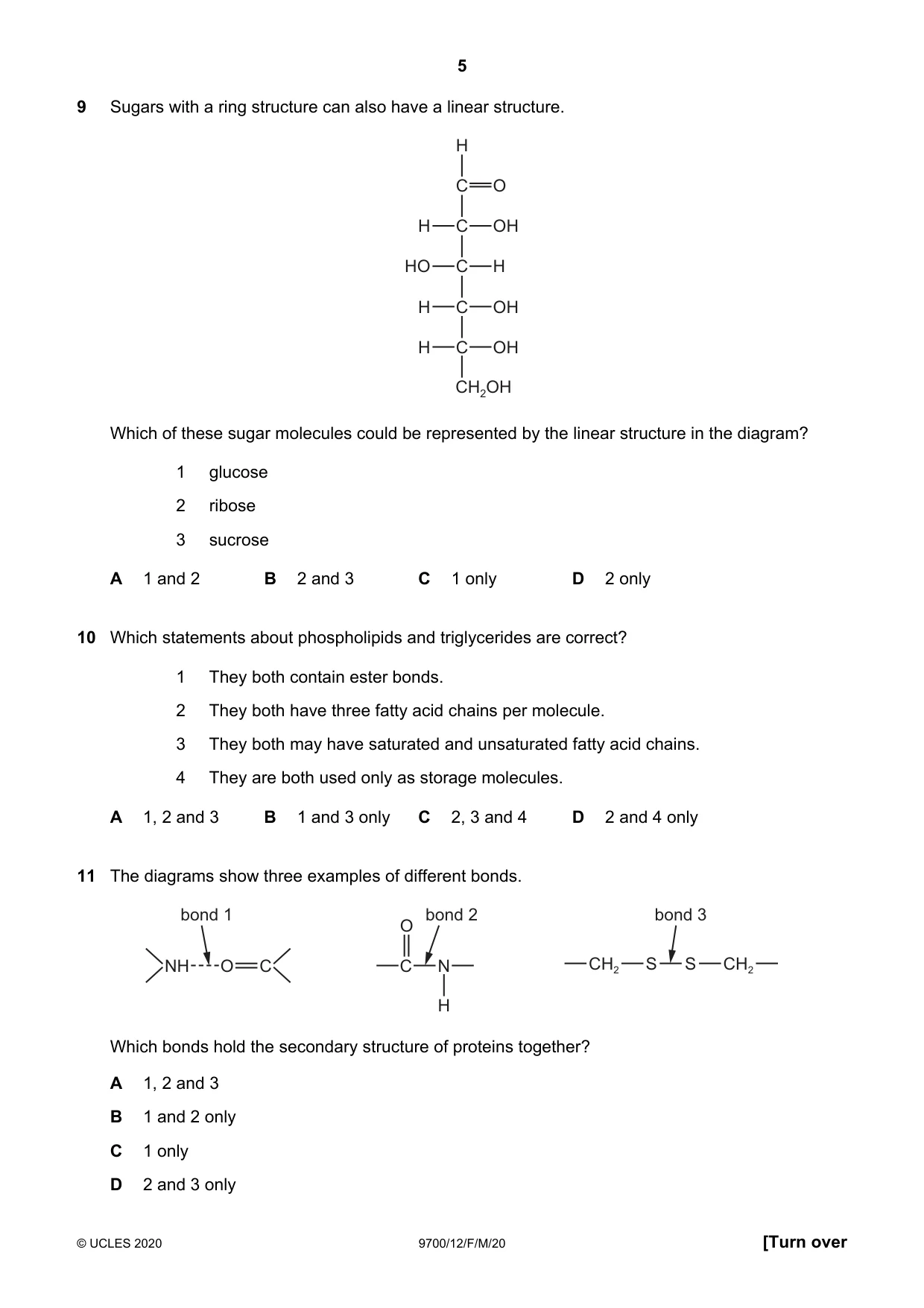
9 Sugars with a ring structure can also have a linear structure. H C O H C OH HO C H H C OH H C OH CH2OH Which of these sugar molecules could be represented by the linear structure in the diagram? 1 glucose 2 ribose 3 sucrose A 1 and 2 B 2 and 3 C 1 only D 2 only
Mark scheme: C
Q10 · Which statements about phospholipids and triglycerides are correct?
10 Which statements about phospholipids and triglycerides are correct? 1 They both contain ester bonds. 2 They both have three fatty acid chains per molecule. 3 They both may have saturated and unsaturated fatty acid chains. 4 They are both used only as storage molecules. A 1, 2 and 3 B 1 and 3 only C 2, 3 and 4 D 2 and 4 only
Mark scheme: B
Q11 · The diagrams show three examples of different bonds
11 The diagrams show three examples of different bonds. bond 1 bond 2 bond 3 O NH O C C N CH2 S S CH2 H Which bonds hold the secondary structure of proteins together? A 1, 2 and 3 B 1 and 2 only C 1 only D 2 and 3 only
Mark scheme: C
Q12 · Hydrogen bonding explains many of the properties of water, including the high latent heat…
12 Hydrogen bonding explains many of the properties of water, including the high latent heat of vapourisation and high specific heat capacity. For which processes in plants is hydrogen bonding in water important on hot sunny days? 1 preventing denaturation of enzymes in leaves 2 reducing water loss by evaporation 3 allowing leaves to cool down quickly at night 4 holding the column of water in xylem vessels together A 1, 2, 3 and 4 B 1, 2 and 4 only C 1, 3 and 4 only D 2 and 3 only
Mark scheme: B
Q13 · What is the most appropriate set of controls to use in an investigation into the rate of…
13 What is the most appropriate set of controls to use in an investigation into the rate of an enzyme-catalysed reaction over a range of temperatures from 25 °C to 65 °C? A enzyme and substrate at all temperatures tested B enzyme and boiled substrate at all temperatures tested C boiled enzyme only at all temperatures tested D substrate only at all temperatures tested
Mark scheme: D
Q14 · An investigation is carried out with an enzyme at its optimum temperature and pH
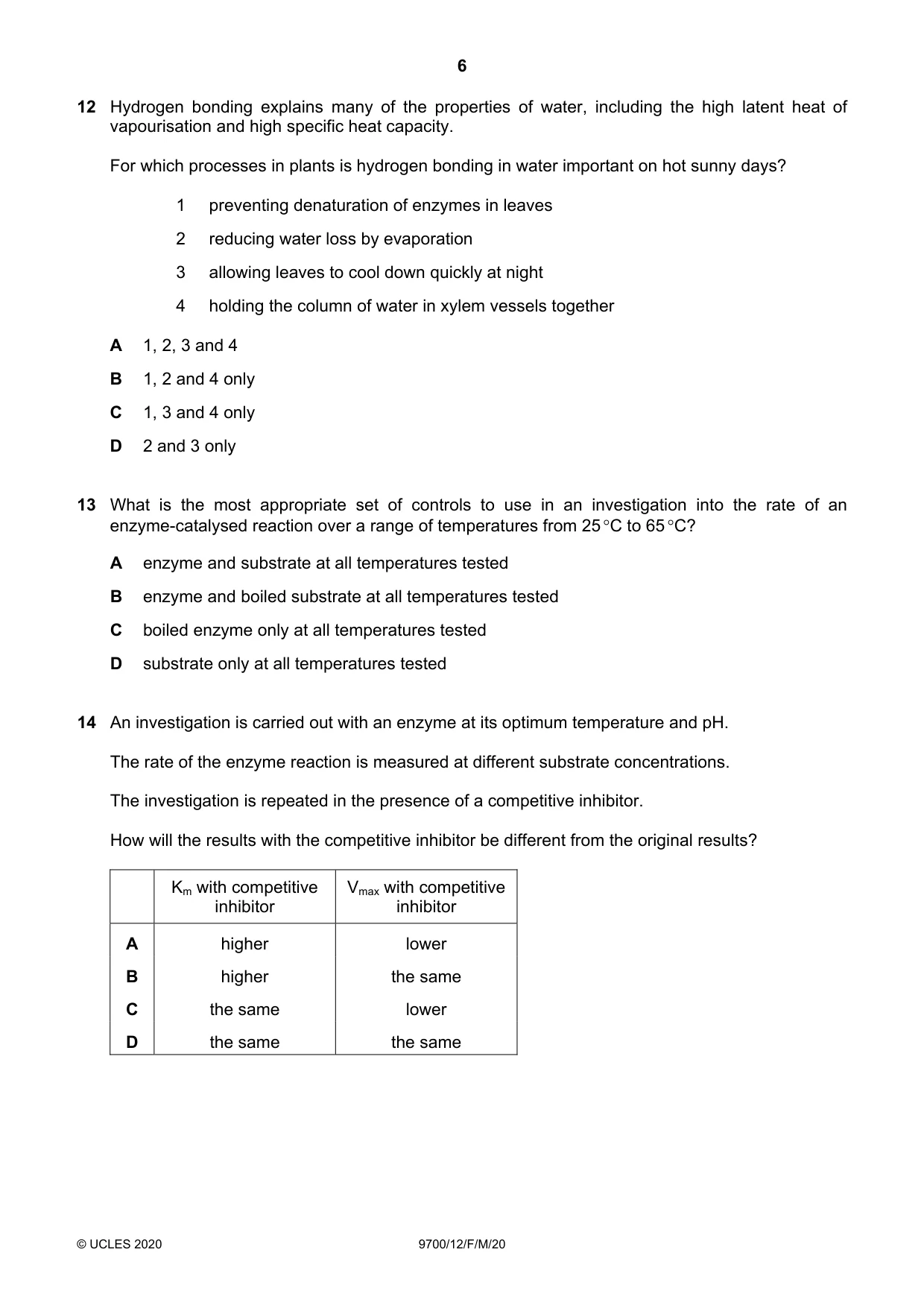
14 An investigation is carried out with an enzyme at its optimum temperature and pH. The rate of the enzyme reaction is measured at different substrate concentrations. The investigation is repeated in the presence of a competitive inhibitor. How will the results with the competitive inhibitor be different from the original results? Km with competitive Vmax with competitive inhibitor inhibitor A higher lower B higher the same C the same lower D the same the same
Mark scheme: B
Q15 · Which description of cell surface membrane permeability is correct?
15 Which description of cell surface membrane permeability is correct? A An increase in the concentration of cholesterol molecules in the cell surface membrane can increase its permeability to hydrophilic substances. B Cell surface membrane permeability to large hydrophilic molecules is high and can be increased by membrane transport proteins involved in facilitated diffusion. C The permeability of the cell surface membrane to ions increases as the proportion of saturated fatty acid chains in the phospholipids increases. D Without the presence of carrier and channel membrane proteins, the cell surface membrane has a low permeability to large polar molecules.
Mark scheme: D
Q16 · Which transport mechanism within a cell can occur in the absence of membranes?
16 Which transport mechanism within a cell can occur in the absence of membranes? A active transport B diffusion C facilitated diffusion D osmosis
Mark scheme: B
Q17 · A student measured the time taken for complete diffusion of a dye into agar blocks of…
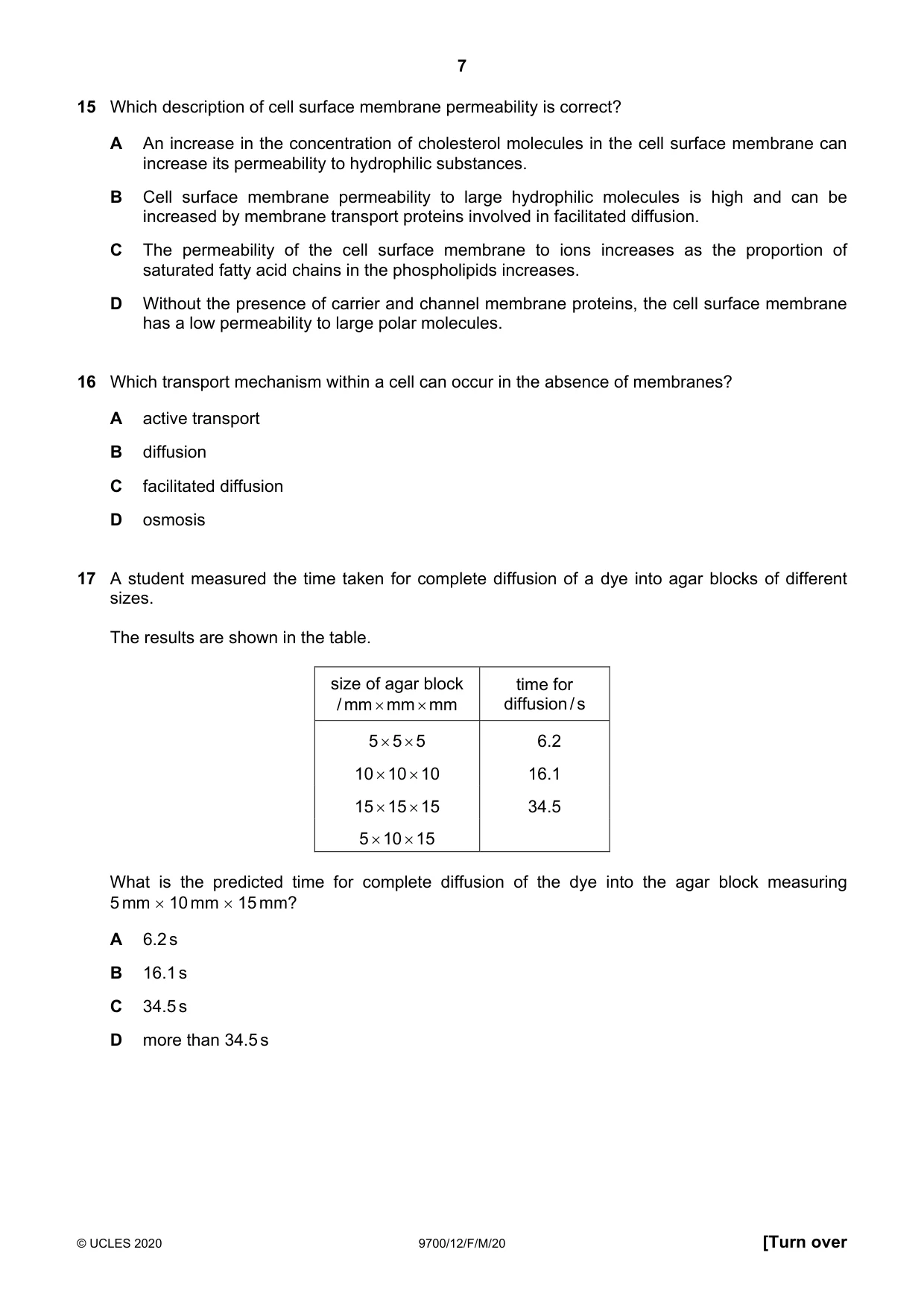
17 A student measured the time taken for complete diffusion of a dye into agar blocks of different sizes. The results are shown in the table. size of agar block time for / mm × mm × mm diffusion / s 5 × 5 × 5 6.2 10 × 10 × 10 16.1 15 × 15 × 15 34.5 5 × 10 × 15 What is the predicted time for complete diffusion of the dye into the agar block measuring 5 mm × 10 mm × 15 mm? A 6.2 s B 16.1 s C 34.5 s D more than 34.5 s
Mark scheme: A
Q18 · A plant cell with a water potential of –600 kPa was placed in a solution with a water…
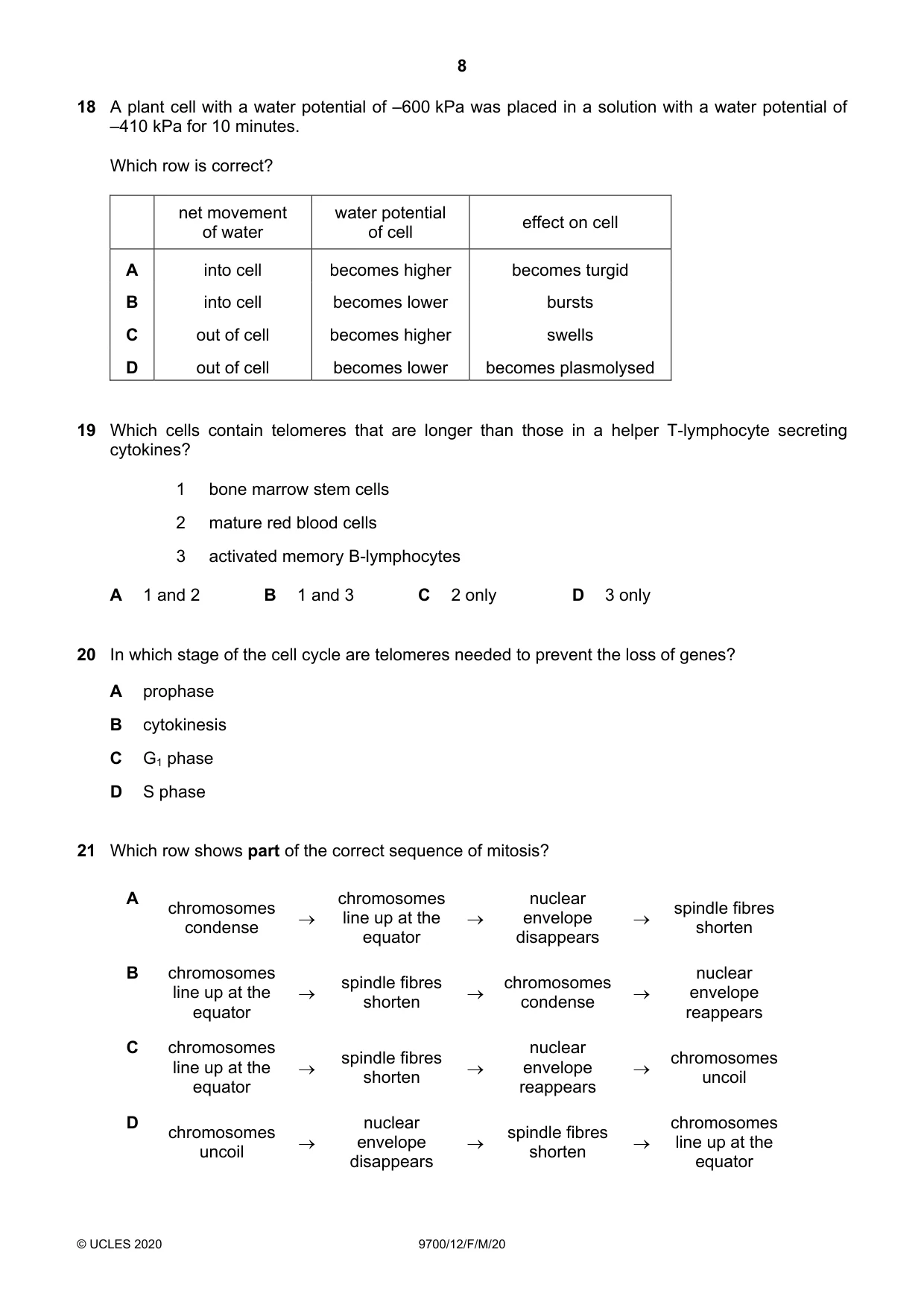
18 A plant cell with a water potential of –600 kPa was placed in a solution with a water potential of –410 kPa for 10 minutes. Which row is correct? net movement water potential effect on cell of water of cell A into cell becomes higher becomes turgid B into cell becomes lower bursts C out of cell becomes higher swells D out of cell becomes lower becomes plasmolysed
Mark scheme: A
Q19 · Which cells contain telomeres that are longer than those in a helper T-lymphocyte…
19 Which cells contain telomeres that are longer than those in a helper T-lymphocyte secreting cytokines? 1 bone marrow stem cells 2 mature red blood cells 3 activated memory B-lymphocytes A 1 and 2 B 1 and 3 C 2 only D 3 only
Mark scheme: B
More questions on Replication and division of nuclei and cells
Q20 · In which stage of the cell cycle are telomeres needed to prevent the loss of genes?
20 In which stage of the cell cycle are telomeres needed to prevent the loss of genes? A prophase B cytokinesis C G1 phase D S phase
Mark scheme: D
More questions on Replication and division of nuclei and cells
Q21 · Which row shows part of the correct sequence of mitosis?
21 Which row shows part of the correct sequence of mitosis? A chromosomes nuclear chromosomes spindle fibres → line up at the → envelope → condense shorten equator disappears B chromosomes nuclear spindle fibres chromosomes line up at the → → → envelope shorten condense equator reappears C chromosomes nuclear spindle fibres chromosomes line up at the → → envelope → shorten uncoil equator reappears D nuclear chromosomes chromosomes spindle fibres → envelope → → line up at the uncoil shorten disappears equator
Mark scheme: C
Q22 · What is correct for cytosine?
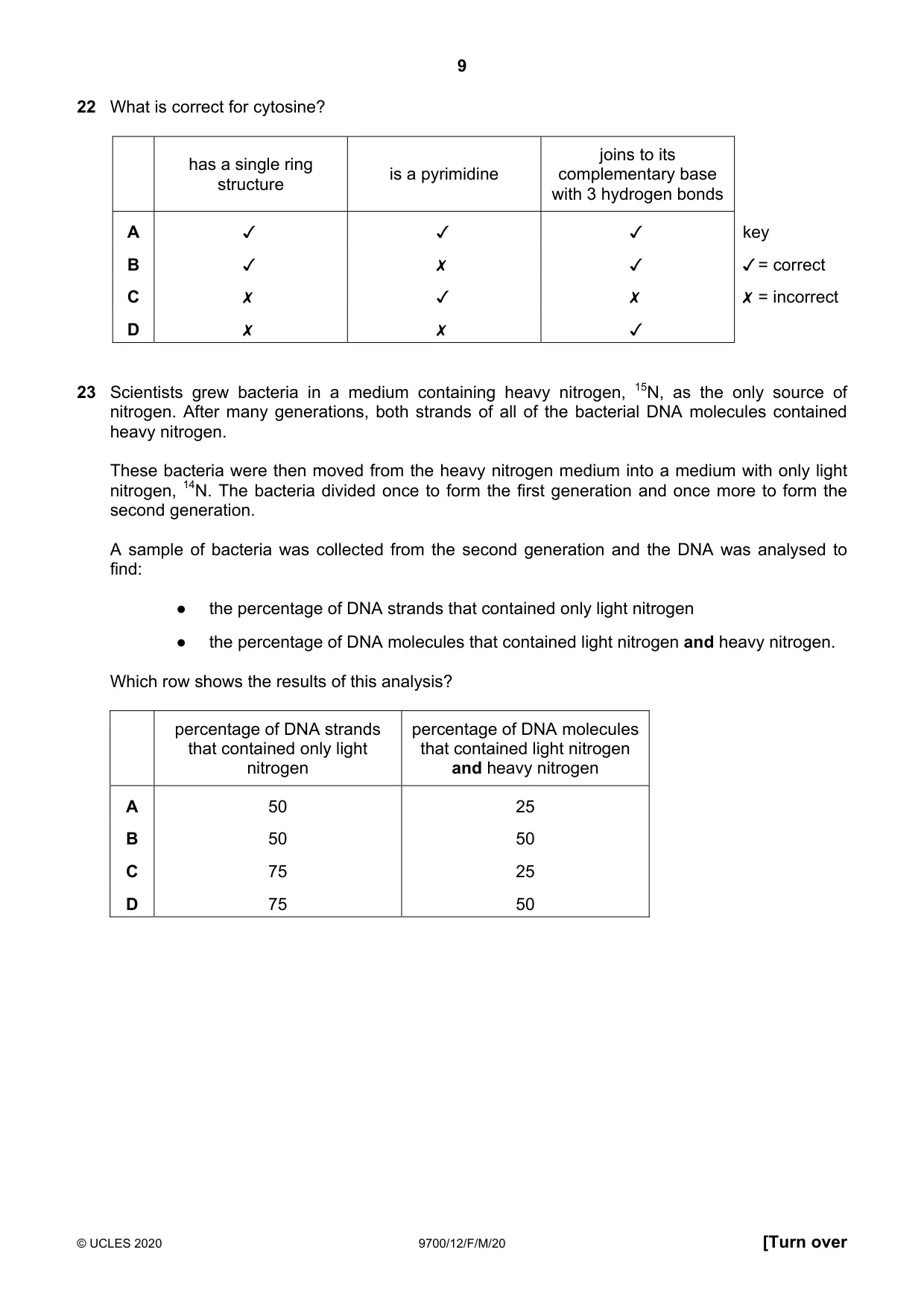
22 What is correct for cytosine? has a single ring is a pyrimidine joins to its complementary base structure with 3 hydrogen bonds A v v v B v x v c x v x D x x v key Y = correct X = incorrect
Mark scheme: A
More questions on Structure of nucleic acids and replication of DNA
Q23 · Scientists grew bacteria in a medium containing heavy nitrogen, 15N, as the only source…
23 Scientists grew bacteria in a medium containing heavy nitrogen, 15N, as the only source of nitrogen. After many generations, both strands of all of the bacterial DNA molecules contained heavy nitrogen. These bacteria were then moved from the heavy nitrogen medium into a medium with only light nitrogen, 14N. The bacteria divided once to form the first generation and once more to form the second generation. A sample of bacteria was collected from the second generation and the DNA was analysed to find: ● the percentage of DNA strands that contained only light nitrogen ● the percentage of DNA molecules that contained light nitrogen and heavy nitrogen. Which row shows the results of this analysis? percentage of DNA strands percentage of DNA molecules that contained only light that contained light nitrogen nitrogen and heavy nitrogen A 50 25 B 50 50 C 75 25 D 75 50
Mark scheme: D
More questions on Structure of nucleic acids and replication of DNA
Q24 · The table shows the tRNA anticodons for four amino acids
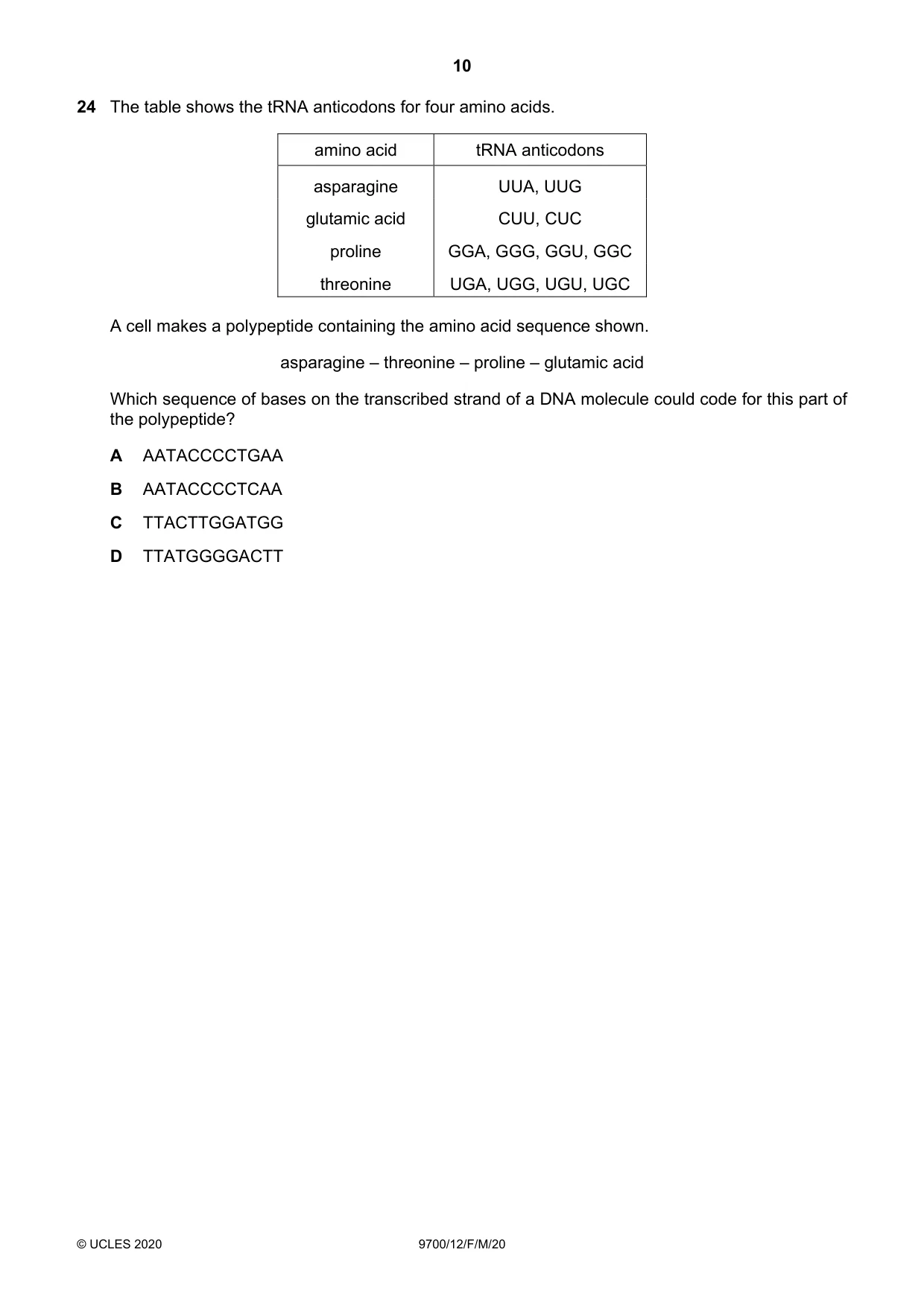
24 The table shows the tRNA anticodons for four amino acids. amino acid tRNA anticodons asparagine UUA, UUG glutamic acid CUU, CUC proline GGA, GGG, GGU, GGC threonine UGA, UGG, UGU, UGC A cell makes a polypeptide containing the amino acid sequence shown. asparagine – threonine – proline – glutamic acid Which sequence of bases on the transcribed strand of a DNA molecule could code for this part of the polypeptide? A AATACCCCTGAA B AATACCCCTCAA C TTACTTGGATGG D TTATGGGGACTT
Mark scheme: D
Q25 · The photomicrograph shows a section of a plant organ
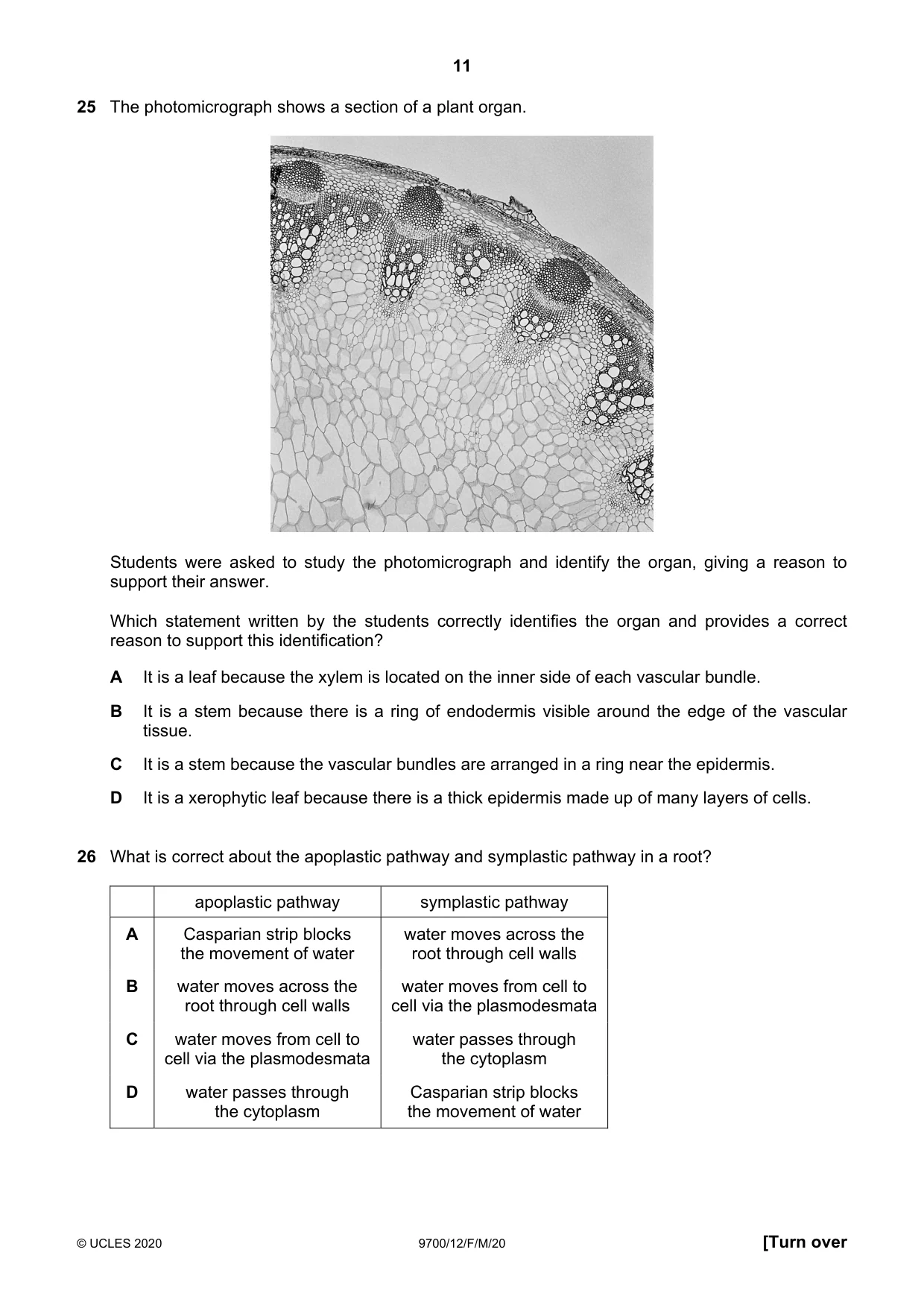
25 The photomicrograph shows a section of a plant organ. Students were asked to study the photomicrograph and identify the organ, giving a reason to support their answer. Which statement written by the students correctly identifies the organ and provides a correct reason to support this identification? A It is a leaf because the xylem is located on the inner side of each vascular bundle. B It is a stem because there is a ring of endodermis visible around the edge of the vascular tissue. C It is a stem because the vascular bundles are arranged in a ring near the epidermis. D It is a xerophytic leaf because there is a thick epidermis made up of many layers of cells.
Mark scheme: C
Q26 · What is correct about the apoplastic pathway and symplastic pathway in a root?
26 What is correct about the apoplastic pathway and symplastic pathway in a root? apoplastic pathway symplastic pathway A Casparian strip blocks water moves across the the movement of water root through cell walls B water moves across the water moves from cell to root through cell walls cell via the plasmodesmata C water moves from cell to water passes through cell via the plasmodesmata the cytoplasm D water passes through Casparian strip blocks the cytoplasm the movement of water
Mark scheme: B
Q27 · Sucrose moves into a phloem sieve tube element from a leaf mesophyll cell
27 Sucrose moves into a phloem sieve tube element from a leaf mesophyll cell. Which changes to the water potential and the volume of solution in the phloem sieve tube element are correct? water potential volume of becomes solution A higher decreases B higher increases C lower decreases D lower increases
Mark scheme: D
Q28 · The photomicrograph shows three white blood cells labelled X, Y and Z
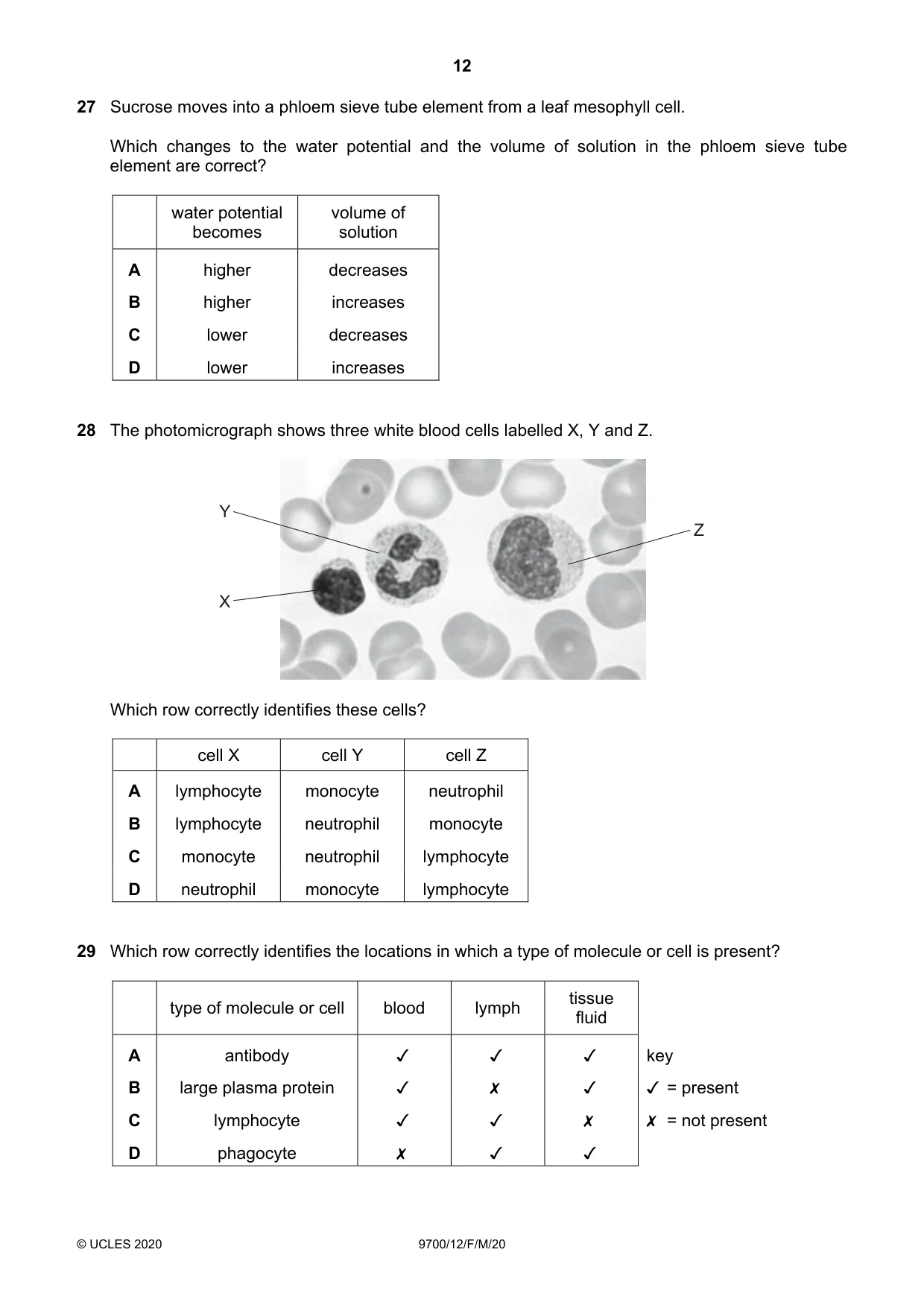
28 The photomicrograph shows three white blood cells labelled X, Y and Z. Y Z X Which row correctly identifies these cells? cell X cell Y cell Z A lymphocyte monocyte neutrophil B lymphocyte neutrophil monocyte C monocyte neutrophil lymphocyte D neutrophil monocyte lymphocyte
Mark scheme: B
Q29 · Which row correctly identifies the locations in which a type of molecule or cell is…
29 Which row correctly identifies the locations in which a type of molecule or cell is present? type of molecule or cell blood lymph tsue antibody v v v key large plasma protein Jv x J v = present lymphocyte v v Xx X =not present phagocyte x v Jv
Mark scheme: A
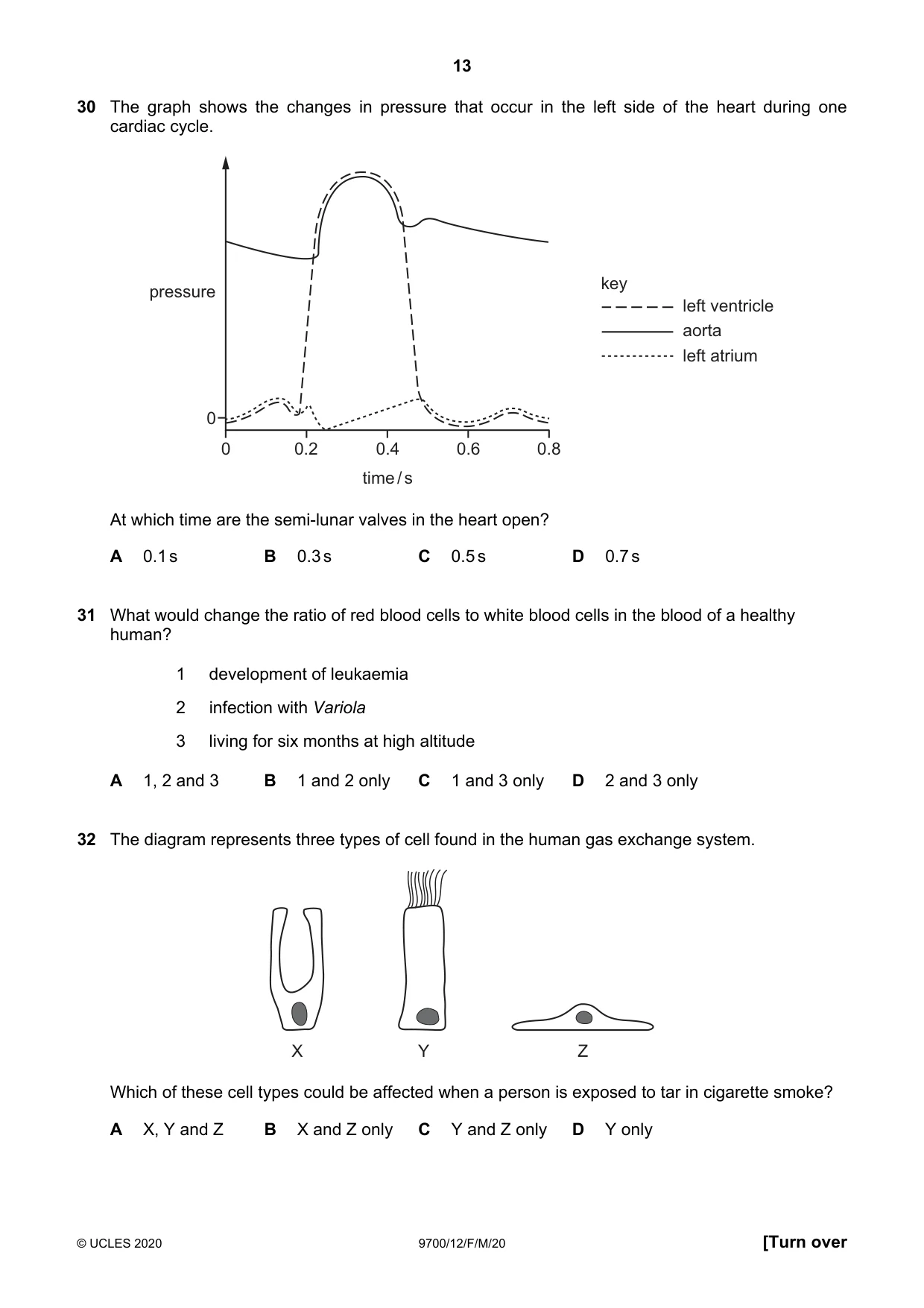
Q30 · The graph shows the changes in pressure that occur in the left side of the heart during…
30 The graph shows the changes in pressure that occur in the left side of the heart during one cardiac cycle. key pressure left ventricle aorta left atrium 0 0 0.2 0.4 0.6 0.8 time / s At which time are the semi-lunar valves in the heart open? A 0.1 s B 0.3 s C 0.5 s D 0.7 s
Mark scheme: B
Q31 · What would change the ratio of red blood cells to white blood cells in the blood of a…
31 What would change the ratio of red blood cells to white blood cells in the blood of a healthy human? 1 development of leukaemia 2 infection with Variola 3 living for six months at high altitude A 1, 2 and 3 B 1 and 2 only C 1 and 3 only D 2 and 3 only
Mark scheme: A
Q32 · The diagram represents three types of cell found in the human gas exchange system
32 The diagram represents three types of cell found in the human gas exchange system. X Y Z Which of these cell types could be affected when a person is exposed to tar in cigarette smoke? A X, Y and Z B X and Z only C Y and Z only D Y only
Mark scheme: A
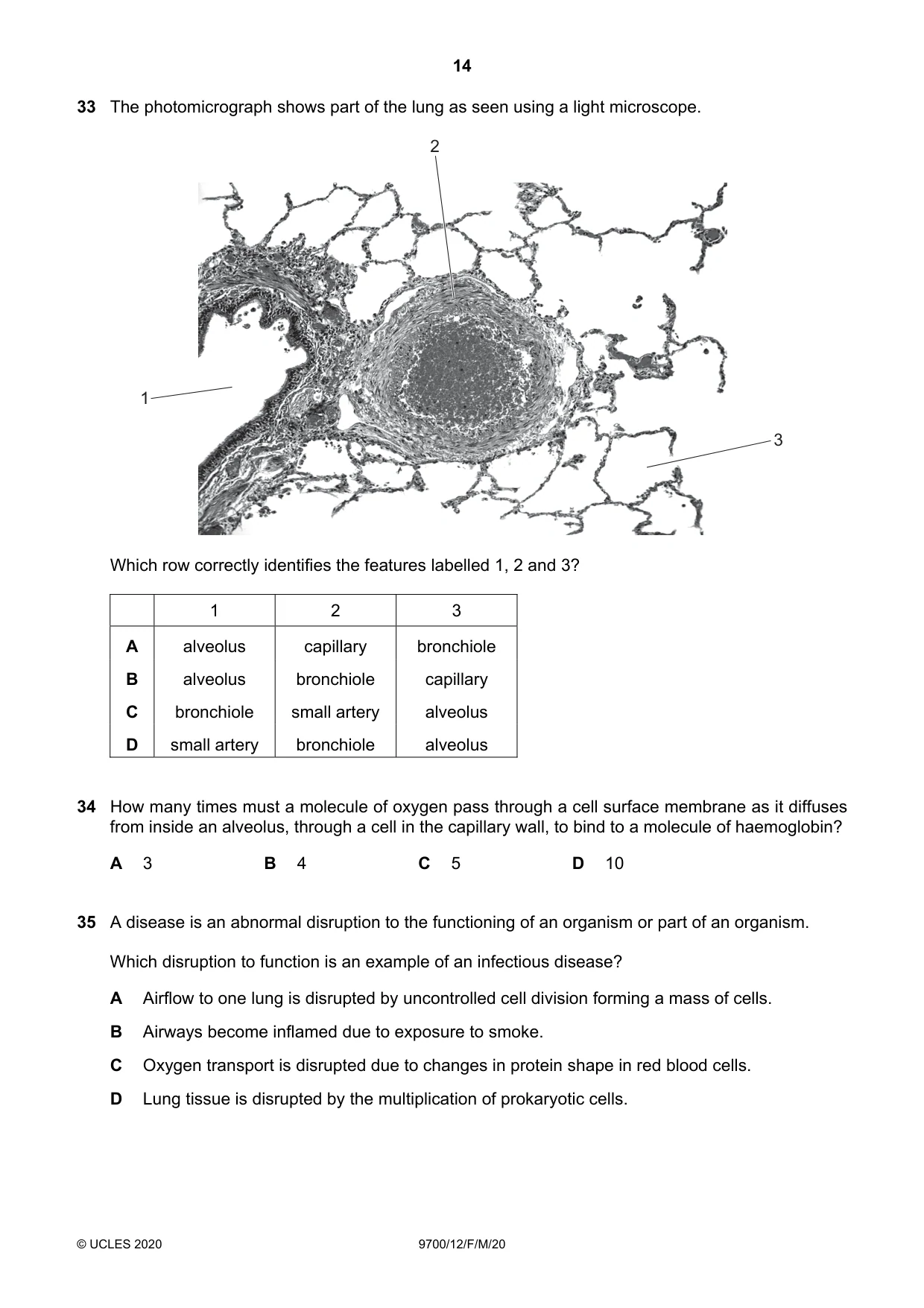
Q33 · The photomicrograph shows part of the lung as seen using a light microscope
33 The photomicrograph shows part of the lung as seen using a light microscope. 2 1 3 Which row correctly identifies the features labelled 1, 2 and 3? 1 2 3 A alveolus capillary bronchiole B alveolus bronchiole capillary C bronchiole small artery alveolus D small artery bronchiole alveolus
Mark scheme: C
Q34 · How many times must a molecule of oxygen pass through a cell surface membrane as it…
34 How many times must a molecule of oxygen pass through a cell surface membrane as it diffuses from inside an alveolus, through a cell in the capillary wall, to bind to a molecule of haemoglobin? A 3 B 4 C 5 D 10
Mark scheme: C
Q35 · A disease is an abnormal disruption to the functioning of an organism or part of an…
35 A disease is an abnormal disruption to the functioning of an organism or part of an organism. Which disruption to function is an example of an infectious disease? A Airflow to one lung is disrupted by uncontrolled cell division forming a mass of cells. B Airways become inflamed due to exposure to smoke. C Oxygen transport is disrupted due to changes in protein shape in red blood cells. D Lung tissue is disrupted by the multiplication of prokaryotic cells.
Mark scheme: D
Q36 · The number of people at risk of contracting malaria has increased due to an increase in…
36 The number of people at risk of contracting malaria has increased due to an increase in the distribution of Anopheles mosquitoes. What could be the cause of this increase in the distribution of Anopheles mosquitoes? A antibiotic resistance B drug resistance in Plasmodium C no effective vaccine D global warming
Mark scheme: D
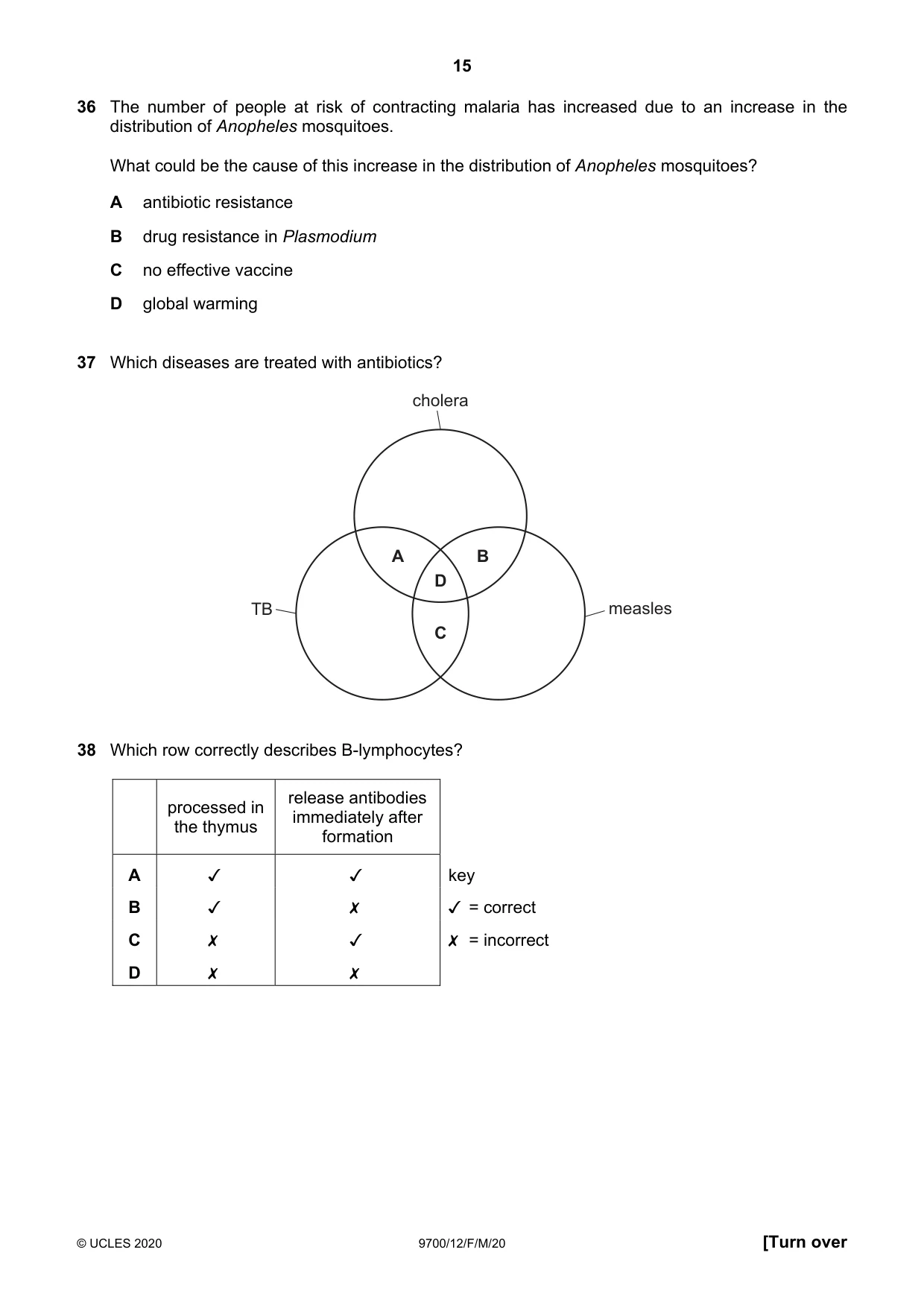
Q37 · Which diseases are treated with antibiotics?
37 Which diseases are treated with antibiotics? cholera A B D TB measles C
Mark scheme: A
Q38 · Which row correctly describes B-lymphocytes?
38 Which row correctly describes B-lymphocytes? release antibodies immediately after formation processed in the thymus Jv key JY =correct X = incorrect x { x
Mark scheme: D
Q39 · Which features of monoclonal antibodies are important to their use in the treatment of…
39 Which features of monoclonal antibodies are important to their use in the treatment of cancer? 1 They can bind to tumour-associated antigens. 2 They can distinguish between different strains of pathogens. 3 They can deliver drugs to specific targets. 1 3 0 Oo WwW > Ke 44 ~*~ <x <li «x < & x key ¥ = is important X = is not important
Mark scheme: B
Q40 · A student was asked to explain why vaccination has successfully eradicated smallpox but…
40 A student was asked to explain why vaccination has successfully eradicated smallpox but not other diseases, such as measles, malaria and sickle cell anaemia. These are the statements made by the student. 1 The antigens of the virus causing smallpox did not change, unlike the antigens of the virus causing measles. 2 Sickle cell anaemia has many different types of mutation, unlike smallpox, so each would require a vaccine. 3 Unlike smallpox, malaria involves animals as part of the transmission cycle and this makes the cycle harder to break. 4 The vaccine against measles often causes a poor primary immune response so that booster vaccines are required, unlike the vaccine against smallpox. Which statements are possible explanations? A 1, 3 and 4 B 1 and 2 C 1 and 4 only D 2 and 4
Mark scheme: A
What was in this paper
The subtopics covered by these 40 questions, and how many questions each got. Open one in a new tab to see every Cambridge question on it.
5Carbohydrates and lipids3Movement into and out of cells3The circulatory system3The gas exchange system3Factors that affect enzyme action2Infectious diseases2Replication and division of nuclei and cells2Structure of nucleic acids and replication of DNA2Transport mechanisms2Antibiotics1Antibodies and vaccination1Chromosome behaviour in mitosis1Fluid mosaic membranes1Genetic technology applied to medicine1Protein synthesis1Proteins1Structure of transport tissues1Testing for biological molecules1The heart1The immune system1The microscope in cell studies1Water1What you needed in this session
Cambridge’s own grade thresholds for 2020 Feb/March, Paper 1 · Variant 2. A higher threshold means an easier paper — the bar moves with how the cohort did.