Cambridge A Level Biology 9700 — 2021 May/June Paper 1 · Variant 2
9700/12/M/J/21 · 40 questions · 40 marks · ≈45 min
The question paper and its mark scheme, free to read here and free to download. This is Cambridge’s own paper, exactly as it was sat.
Question paper16 pages
Mark scheme3 pages
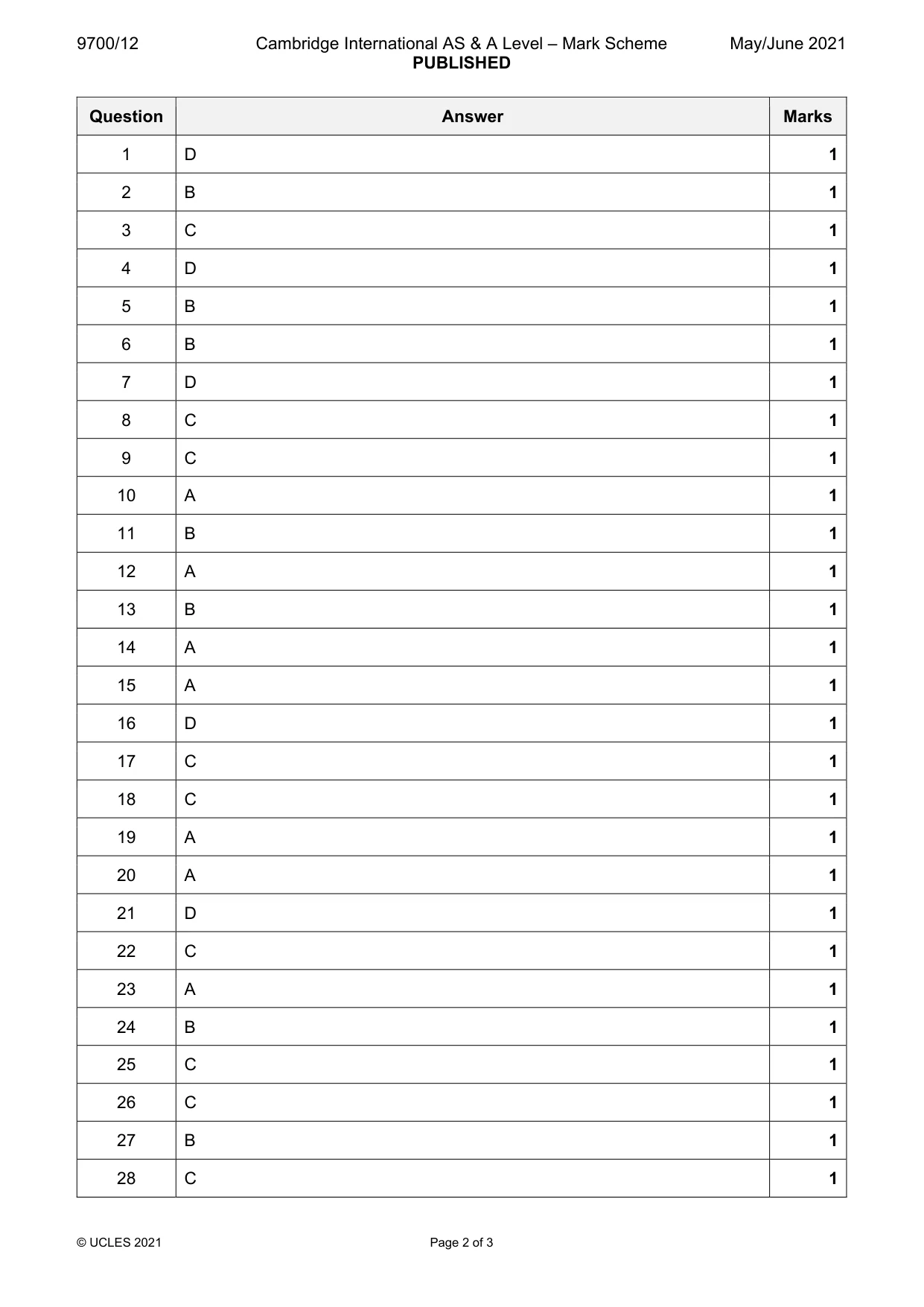
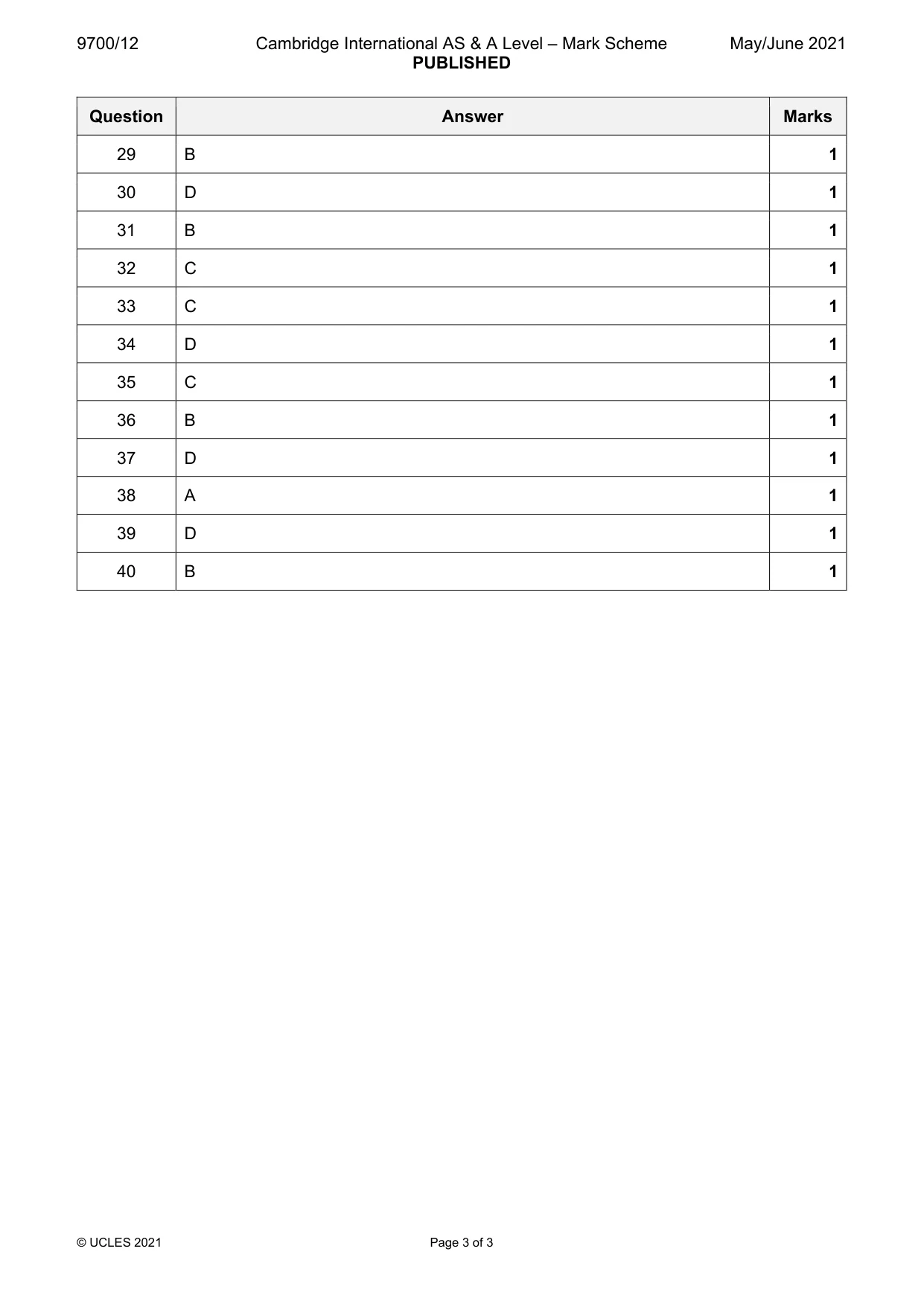
Answers below. Sit the paper first if you are practising.
Questions as text
Q1 · Which row describes the membranes surrounding each cell structure?
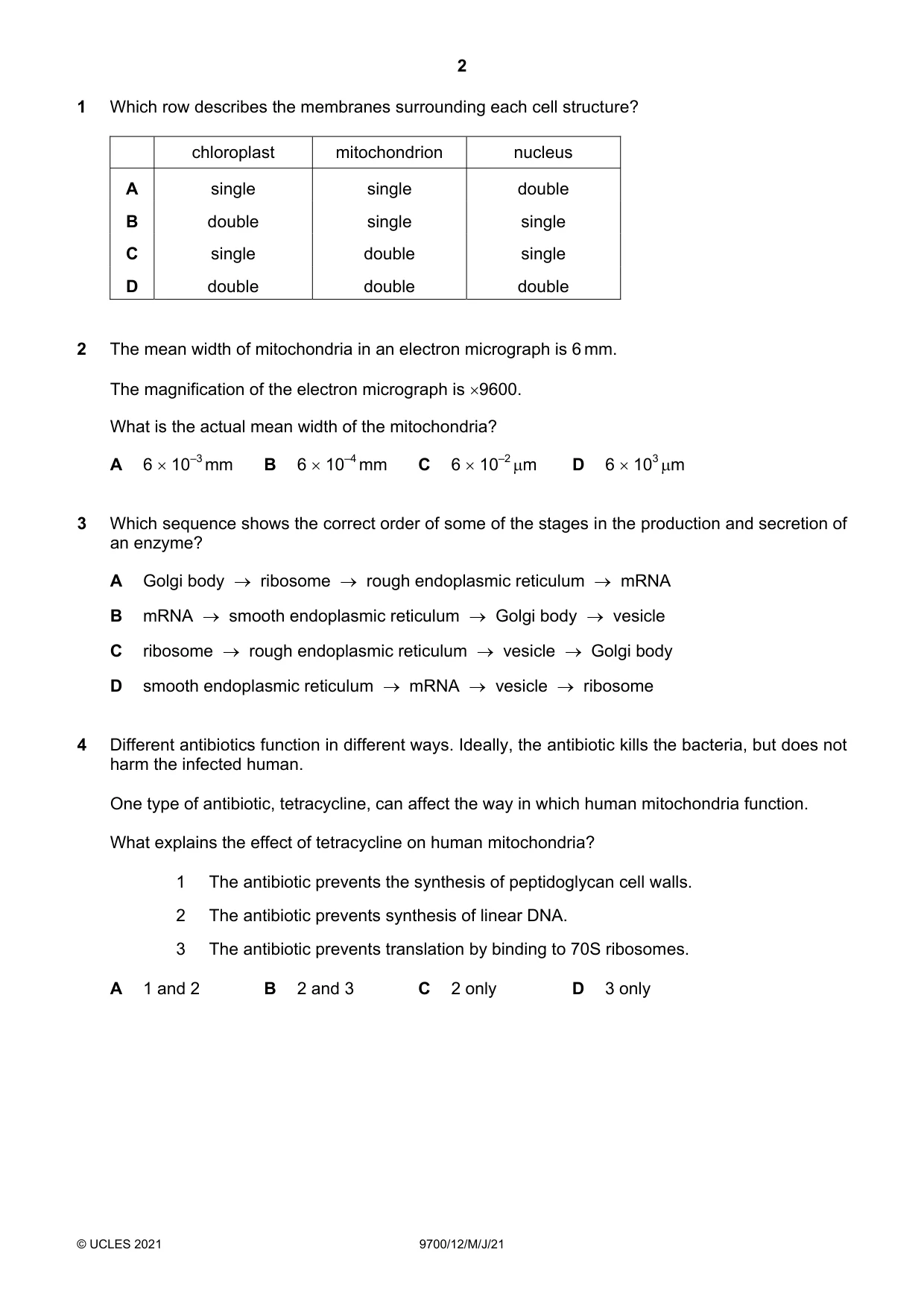
1 Which row describes the membranes surrounding each cell structure? chloroplast mitochondrion nucleus A single single double B double single single C single double single D double double double
Mark scheme: D
More questions on Cells as the basic units of living organisms
Q2 · The mean width of mitochondria in an electron micrograph is 6 mm
2 The mean width of mitochondria in an electron micrograph is 6 mm. The magnification of the electron micrograph is 9600. What is the actual mean width of the mitochondria? A 6 10–3 mm B 6 10–4 mm C 6 10–2 m D 6 103 m
Mark scheme: B
Q3 · Which sequence shows the correct order of some of the stages in the production and…
3 Which sequence shows the correct order of some of the stages in the production and secretion of an enzyme? A Golgi body ribosome rough endoplasmic reticulum mRNA B mRNA smooth endoplasmic reticulum Golgi body vesicle C ribosome rough endoplasmic reticulum vesicle Golgi body D smooth endoplasmic reticulum mRNA vesicle ribosome
Mark scheme: C
More questions on Cells as the basic units of living organisms
Q4 · Different antibiotics function in different ways
4 Different antibiotics function in different ways. Ideally, the antibiotic kills the bacteria, but does not harm the infected human. One type of antibiotic, tetracycline, can affect the way in which human mitochondria function. What explains the effect of tetracycline on human mitochondria? 1 The antibiotic prevents the synthesis of peptidoglycan cell walls. 2 The antibiotic prevents synthesis of linear DNA. 3 The antibiotic prevents translation by binding to 70S ribosomes. A 1 and 2 B 2 and 3 C 2 only D 3 only
Mark scheme: D
Q5 · A prokaryotic cell is 5.0 m in length
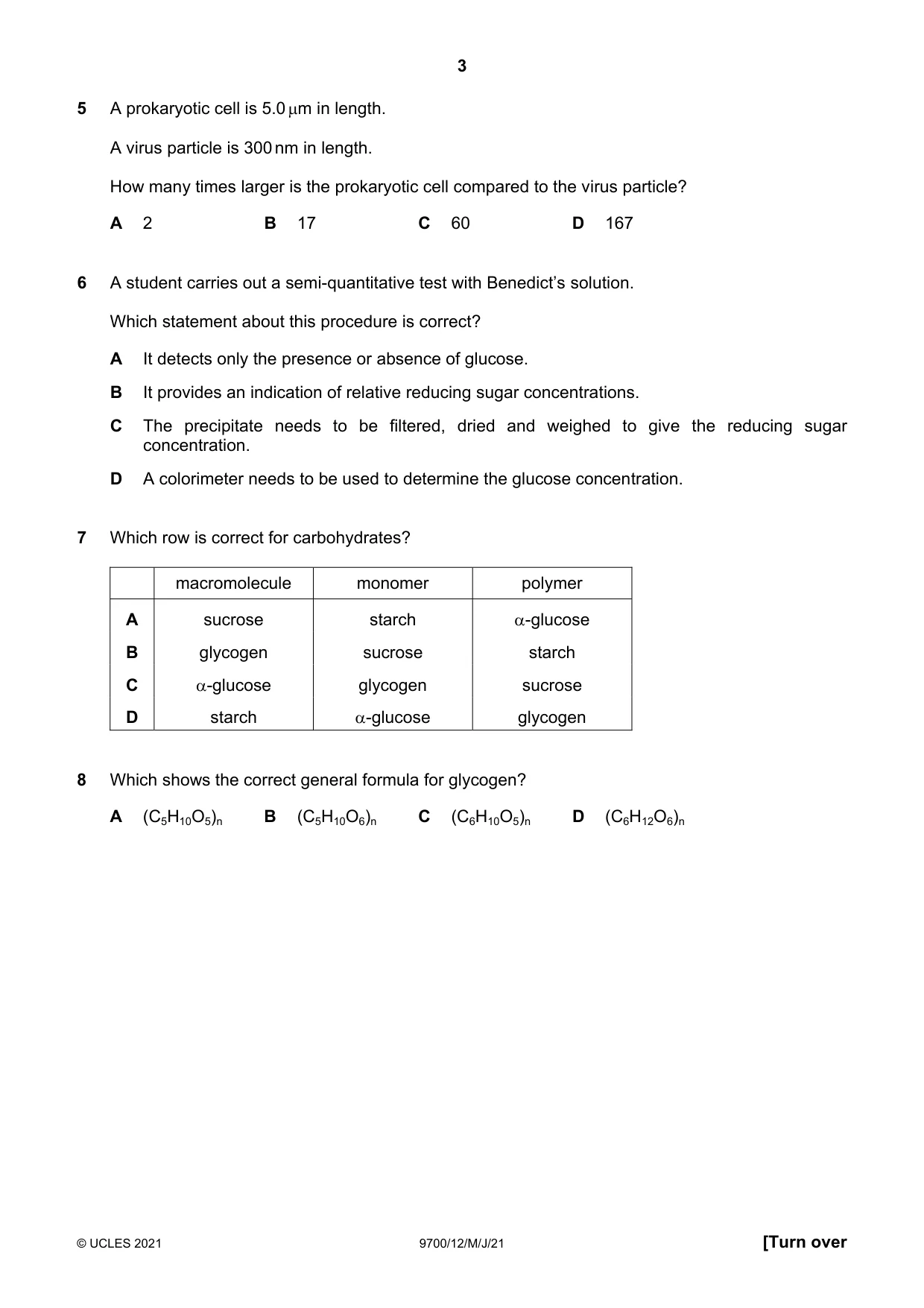
5 A prokaryotic cell is 5.0 m in length. A virus particle is 300 nm in length. How many times larger is the prokaryotic cell compared to the virus particle? A 2 B 17 C 60 D 167
Mark scheme: B
Q6 · A student carries out a semi-quantitative test with Benedict’s solution
6 A student carries out a semi-quantitative test with Benedict’s solution. Which statement about this procedure is correct? A It detects only the presence or absence of glucose. B It provides an indication of relative reducing sugar concentrations. C The precipitate needs to be filtered, dried and weighed to give the reducing sugar concentration. D A colorimeter needs to be used to determine the glucose concentration.
Mark scheme: B
Q7 · Which row is correct for carbohydrates?
7 Which row is correct for carbohydrates? macromolecule monomer polymer A sucrose starch -glucose B glycogen sucrose starch C -glucose glycogen sucrose D starch -glucose glycogen
Mark scheme: D
Q8 · Which shows the correct general formula for glycogen?
8 Which shows the correct general formula for glycogen? A (C5H10O5)n B (C5H10O6)n C (C6H10O5)n D (C6H12O6)n
Mark scheme: C
Q9 · Chitin is a structural polysaccharide found in the hard, outer shells of animals such as…
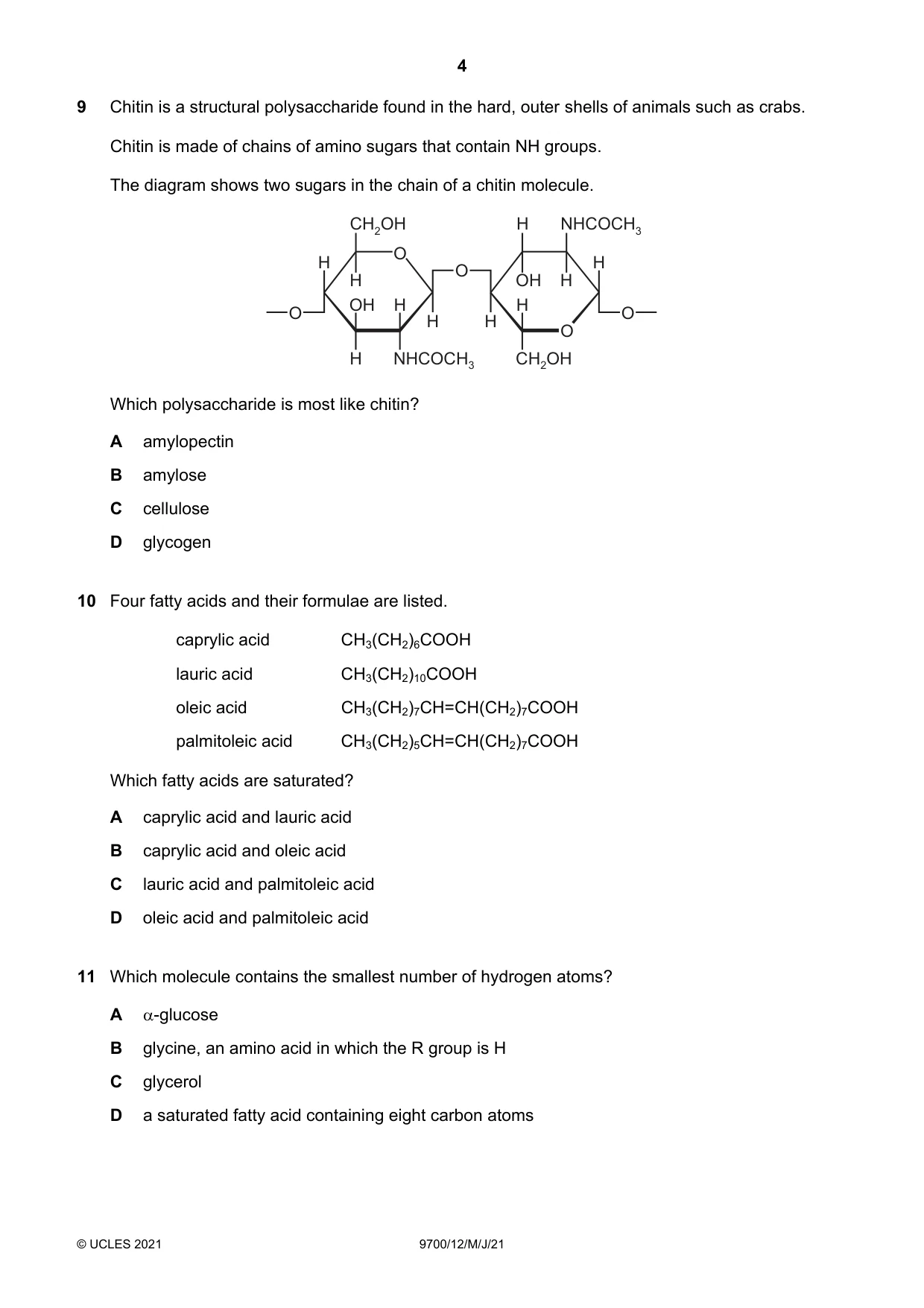
9 Chitin is a structural polysaccharide found in the hard, outer shells of animals such as crabs. Chitin is made of chains of amino sugars that contain NH groups. The diagram shows two sugars in the chain of a chitin molecule. CH2OH H NHCOCH3 O H H O H OH H OH H H O O H H O H NHCOCH3 CH2OH Which polysaccharide is most like chitin? A amylopectin B amylose C cellulose D glycogen
Mark scheme: C
Q10 · Four fatty acids and their formulae are listed
10 Four fatty acids and their formulae are listed. caprylic acid CH3(CH2)6COOH lauric acid CH3(CH2)10COOH oleic acid CH3(CH2)7CH=CH(CH2)7COOH palmitoleic acid CH3(CH2)5CH=CH(CH2)7COOH Which fatty acids are saturated? A caprylic acid and lauric acid B caprylic acid and oleic acid C lauric acid and palmitoleic acid D oleic acid and palmitoleic acid
Mark scheme: A
Q11 · Which molecule contains the smallest number of hydrogen atoms?
11 Which molecule contains the smallest number of hydrogen atoms? A -glucose B glycine, an amino acid in which the R group is H C glycerol D a saturated fatty acid containing eight carbon atoms
Mark scheme: B
Q12 · The diagram shows sucrose and sucralose
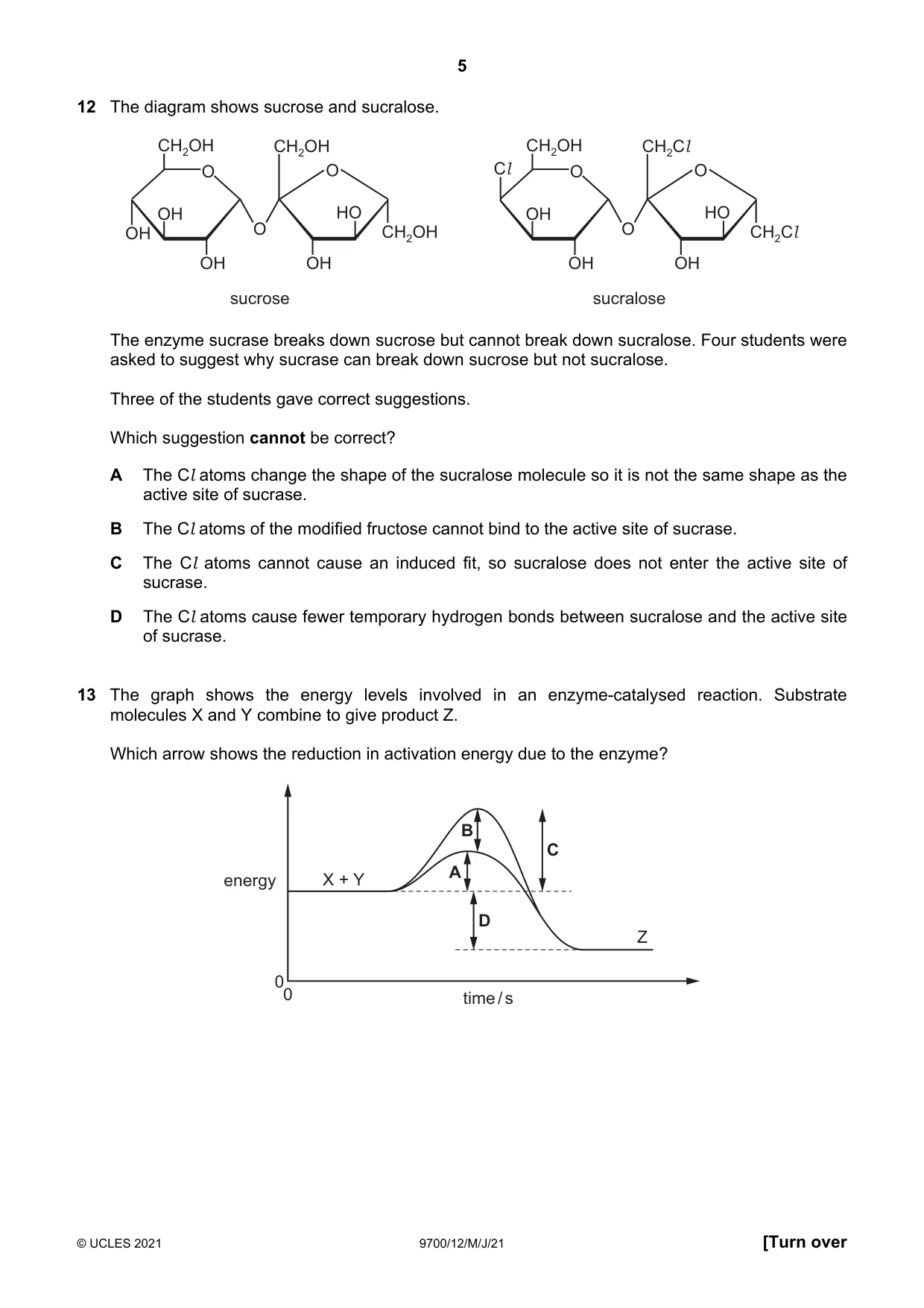
12 The diagram shows sucrose and sucralose. CH2OH CH2OH CH2OH CH2Cl O O Cl O O OH HO OH HO OH O CH2OH O CH2Cl OH OH OH OH sucrose sucralose The enzyme sucrase breaks down sucrose but cannot break down sucralose. Four students were asked to suggest why sucrase can break down sucrose but not sucralose. Three of the students gave correct suggestions. Which suggestion cannot be correct? A The Cl atoms change the shape of the sucralose molecule so it is not the same shape as the active site of sucrase. B The Cl atoms of the modified fructose cannot bind to the active site of sucrase. C The Cl atoms cannot cause an induced fit, so sucralose does not enter the active site of sucrase. D The Cl atoms cause fewer temporary hydrogen bonds between sucralose and the active site of sucrase.
Mark scheme: A
Q13 · The graph shows the energy levels involved in an enzyme-catalysed reaction
13 The graph shows the energy levels involved in an enzyme-catalysed reaction. Substrate molecules X and Y combine to give product Z. Which arrow shows the reduction in activation energy due to the enzyme? B C X + Y A energy D Z 00 time / s
Mark scheme: B
Q14 · Which roles of the cell surface membrane result from the properties of the phospholipids?
14 Which roles of the cell surface membrane result from the properties of the phospholipids? 1 to allow cytokinesis to occur in mitotic cell division 2 to allow entry and exit of oxygen and carbon dioxide 3 to allow the phagocytosis of a bacterium into a cell A 1, 2 and 3 B 1 and 2 only C 1 and 3 only D 2 and 3 only
Mark scheme: A
Q15 · Which factors can be changed to affect the rate of facilitated diffusion across a cell…
15 Which factors can be changed to affect the rate of facilitated diffusion across a cell surface membrane? 1 the surface area of the membrane 2 the concentration gradient 3 the number of specific protein channels A 1, 2 and 3 B 1 and 2 only C 1 and 3 only D 3 only
Mark scheme: A
Q16 · The diagram shows an experiment using a model cell to investigate the movement of…
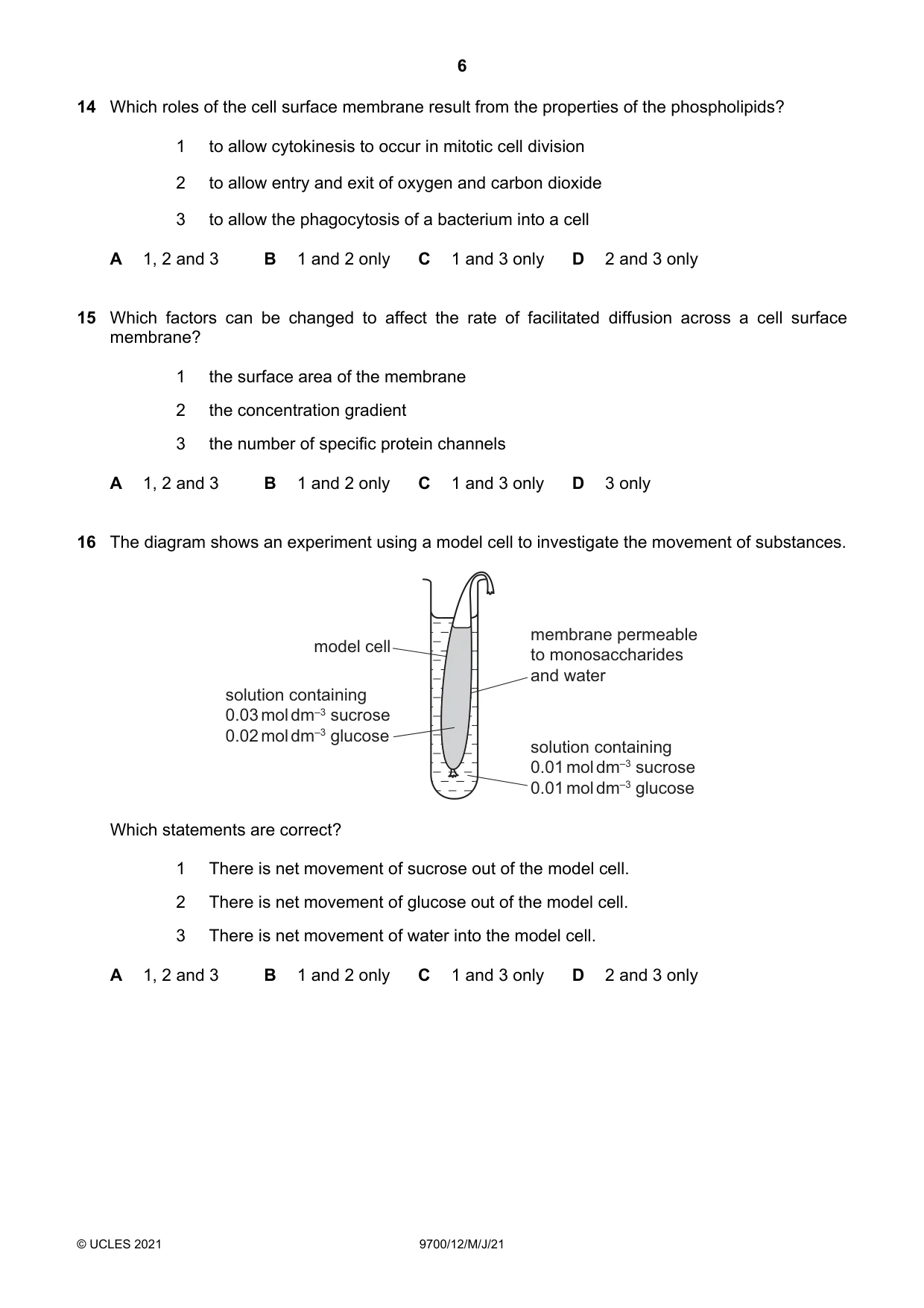
16 The diagram shows an experiment using a model cell to investigate the movement of substances. membrane permeable model cell to monosaccharides and water solution containing 0.03 mol dm–3 sucrose 0.02 mol dm–3 glucose solution containing 0.01 mol dm–3 sucrose 0.01 mol dm–3 glucose Which statements are correct? 1 There is net movement of sucrose out of the model cell. 2 There is net movement of glucose out of the model cell. 3 There is net movement of water into the model cell. A 1, 2 and 3 B 1 and 2 only C 1 and 3 only D 2 and 3 only
Mark scheme: D
Q17 · Human chromosomes have different parts
17 Human chromosomes have different parts. Some parts are more numerous than others. Which parts are listed in order from most numerous to least numerous in a human white blood cell? A centromere nucleotide histone protein B DNA molecule telomere centromere C histone protein telomere DNA molecule D telomere centromere nucleotide
Mark scheme: C
Q18 · The diagram represents the cell cycle of a human cell
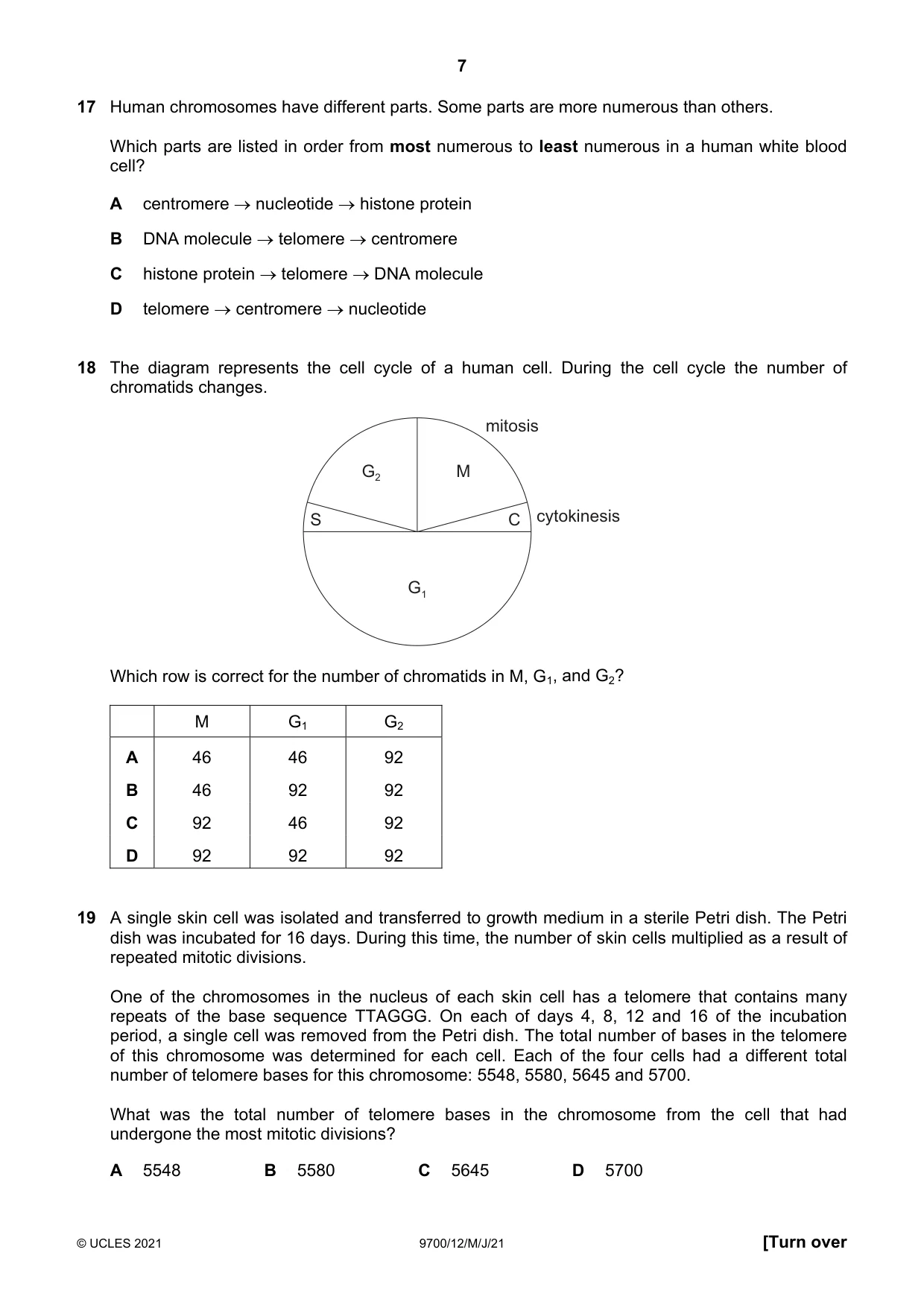
18 The diagram represents the cell cycle of a human cell. During the cell cycle the number of chromatids changes. mitosis G2 M S C cytokinesis G1 Which row is correct for the number of chromatids in M, G1, and G2? M G1 G2 A 46 46 92 B 46 92 92 C 92 46 92 D 92 92 92
Mark scheme: C
More questions on Replication and division of nuclei and cells
Q19 · A single skin cell was isolated and transferred to growth medium in a sterile Petri dish
19 A single skin cell was isolated and transferred to growth medium in a sterile Petri dish. The Petri dish was incubated for 16 days. During this time, the number of skin cells multiplied as a result of repeated mitotic divisions. One of the chromosomes in the nucleus of each skin cell has a telomere that contains many repeats of the base sequence TTAGGG. On each of days 4, 8, 12 and 16 of the incubation period, a single cell was removed from the Petri dish. The total number of bases in the telomere of this chromosome was determined for each cell. Each of the four cells had a different total number of telomere bases for this chromosome: 5548, 5580, 5645 and 5700. What was the total number of telomere bases in the chromosome from the cell that had undergone the most mitotic divisions? A 5548 B 5580 C 5645 D 5700
Mark scheme: A
More questions on Replication and division of nuclei and cells
Q20 · A short piece of DNA, 18 base pairs long, was analysed to find the number of nucleotide…
20 A short piece of DNA, 18 base pairs long, was analysed to find the number of nucleotide bases in each of the polynucleotide strands. Some of the results are shown in the table. number of nucleotide bases adenine cytosine guanine thymine strand 1 4 7 strand 2 5 How many nucleotides containing thymine were present in strand 2? A 2 B 4 C 5 D 7
Mark scheme: A
More questions on Structure of nucleic acids and replication of DNA
Q21 · The diagram shows a strand of DNA and mRNA during transcription
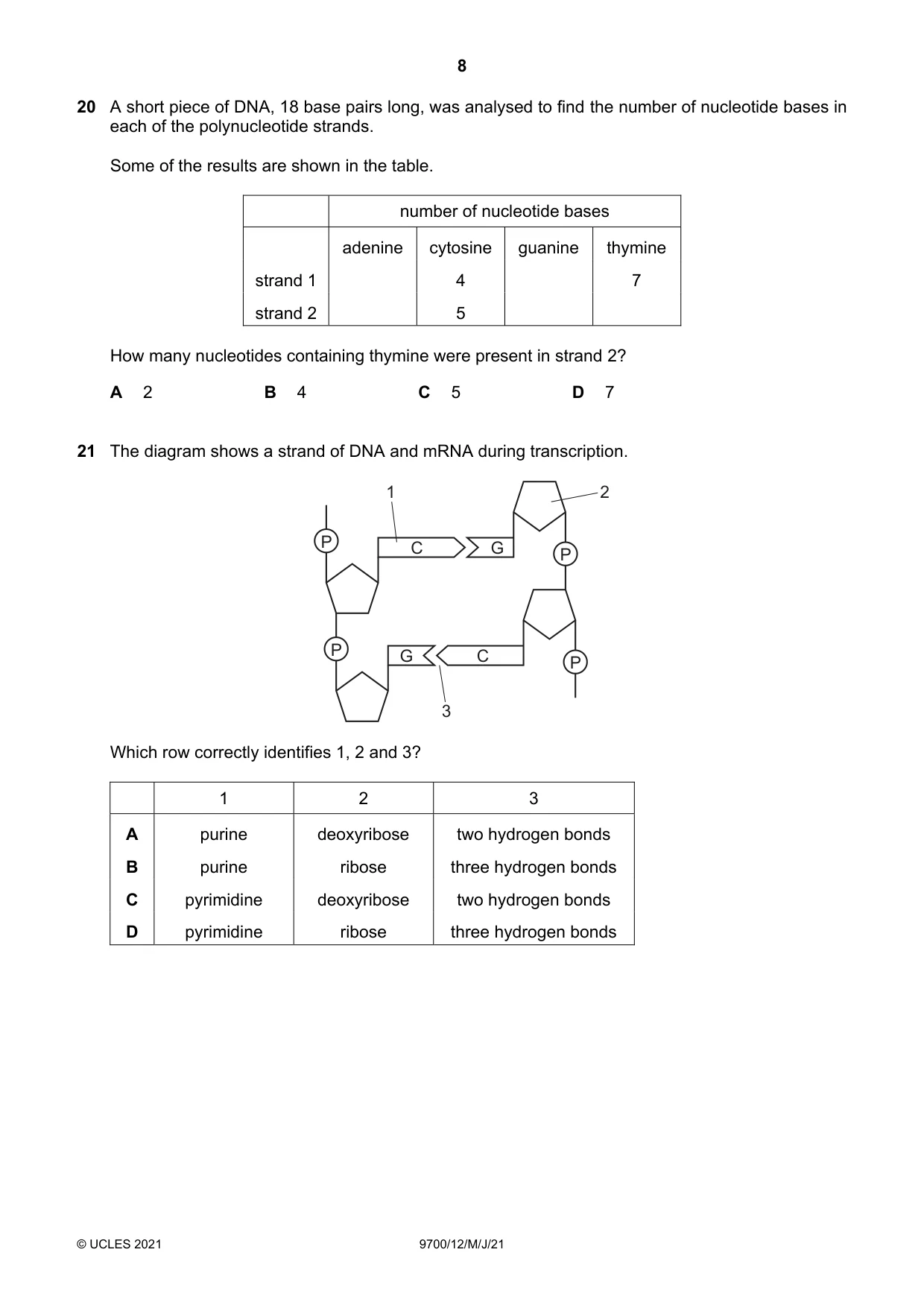
21 The diagram shows a strand of DNA and mRNA during transcription. 1 2 P C G P P G C P 3 Which row correctly identifies 1, 2 and 3? 1 2 3 A purine deoxyribose two hydrogen bonds B purine ribose three hydrogen bonds C pyrimidine deoxyribose two hydrogen bonds D pyrimidine ribose three hydrogen bonds
Mark scheme: D
More questions on Structure of nucleic acids and replication of DNA
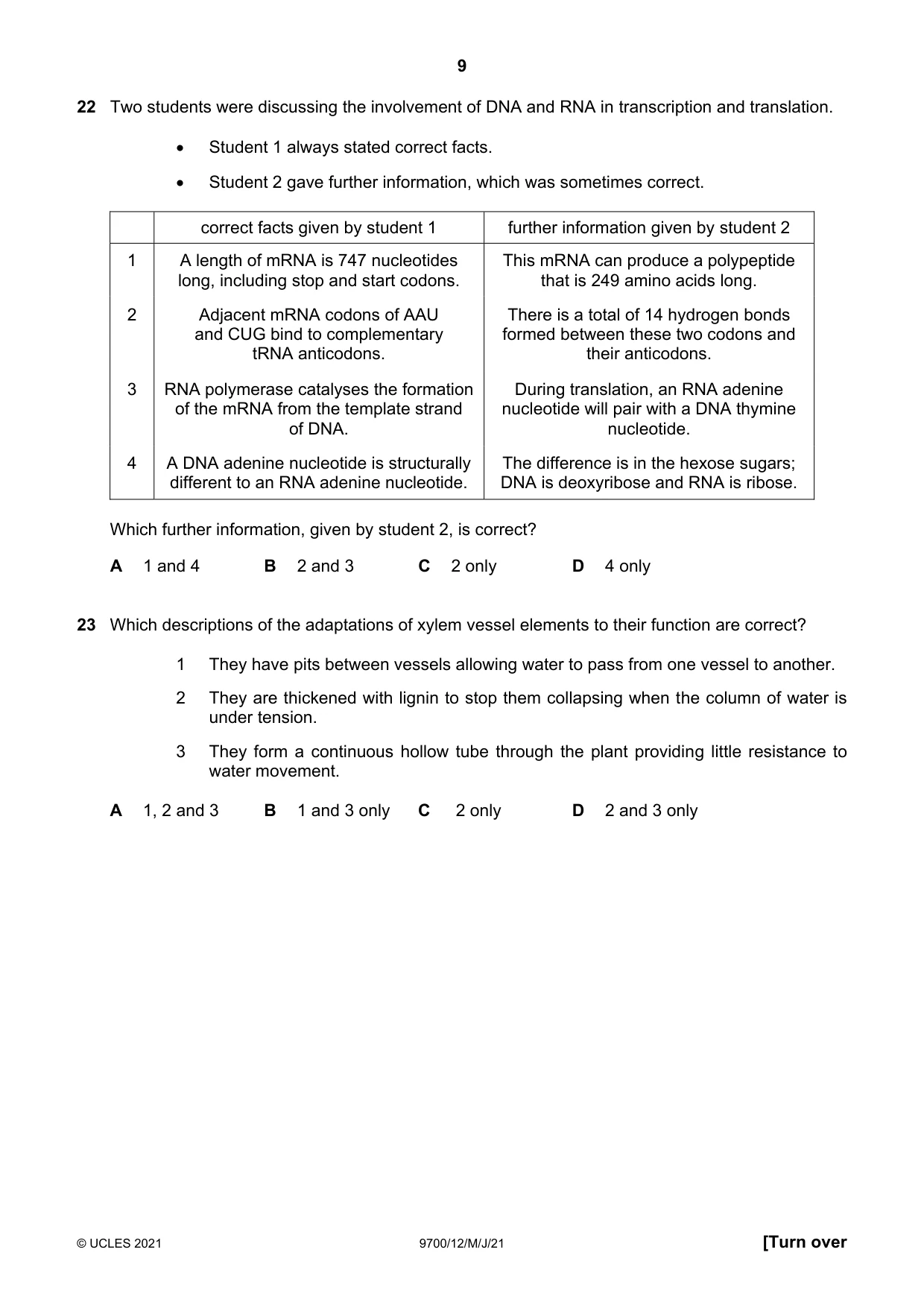
Q22 · Two students were discussing the involvement of DNA and RNA in transcription and…
22 Two students were discussing the involvement of DNA and RNA in transcription and translation. Student 1 always stated correct facts. Student 2 gave further information, which was sometimes correct. correct facts given by student 1 further information given by student 2 1 A length of mRNA is 747 nucleotides This mRNA can produce a polypeptide long, including stop and start codons. that is 249 amino acids long. 2 Adjacent mRNA codons of AAU There is a total of 14 hydrogen bonds and CUG bind to complementary formed between these two codons and tRNA anticodons. their anticodons. 3 RNA polymerase catalyses the formation During translation, an RNA adenine of the mRNA from the template strand nucleotide will pair with a DNA thymine of DNA. nucleotide. 4 A DNA adenine nucleotide is structurally The difference is in the hexose sugars; different to an RNA adenine nucleotide. DNA is deoxyribose and RNA is ribose. Which further information, given by student 2, is correct? A 1 and 4 B 2 and 3 C 2 only D 4 only
Mark scheme: C
Q23 · Which descriptions of the adaptations of xylem vessel elements to their function are…
23 Which descriptions of the adaptations of xylem vessel elements to their function are correct? 1 They have pits between vessels allowing water to pass from one vessel to another. 2 They are thickened with lignin to stop them collapsing when the column of water is under tension. 3 They form a continuous hollow tube through the plant providing little resistance to water movement. A 1, 2 and 3 B 1 and 3 only C 2 only D 2 and 3 only
Mark scheme: A
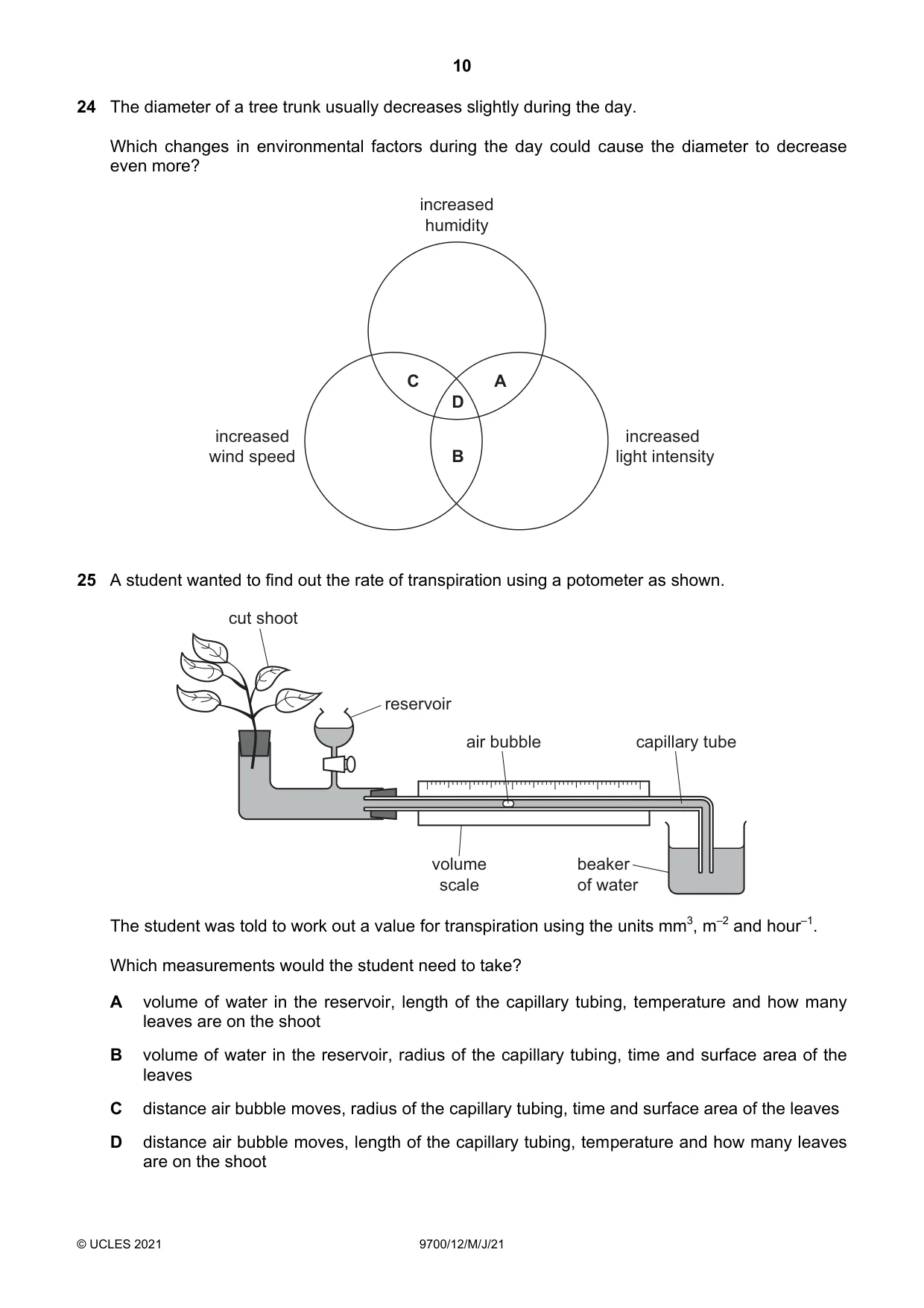
Q24 · The diameter of a tree trunk usually decreases slightly during the day
24 The diameter of a tree trunk usually decreases slightly during the day. Which changes in environmental factors during the day could cause the diameter to decrease even more? increased humidity C A D increased increased wind speed B light intensity
Mark scheme: B
Q25 · A student wanted to find out the rate of transpiration using a potometer as shown
25 A student wanted to find out the rate of transpiration using a potometer as shown. cut shoot reservoir air bubble capillary tube volume beaker scale of water The student was told to work out a value for transpiration using the units mm3, m–2 and hour–1. Which measurements would the student need to take? A volume of water in the reservoir, length of the capillary tubing, temperature and how many leaves are on the shoot B volume of water in the reservoir, radius of the capillary tubing, time and surface area of the leaves C distance air bubble moves, radius of the capillary tubing, time and surface area of the leaves D distance air bubble moves, length of the capillary tubing, temperature and how many leaves are on the shoot
Mark scheme: C
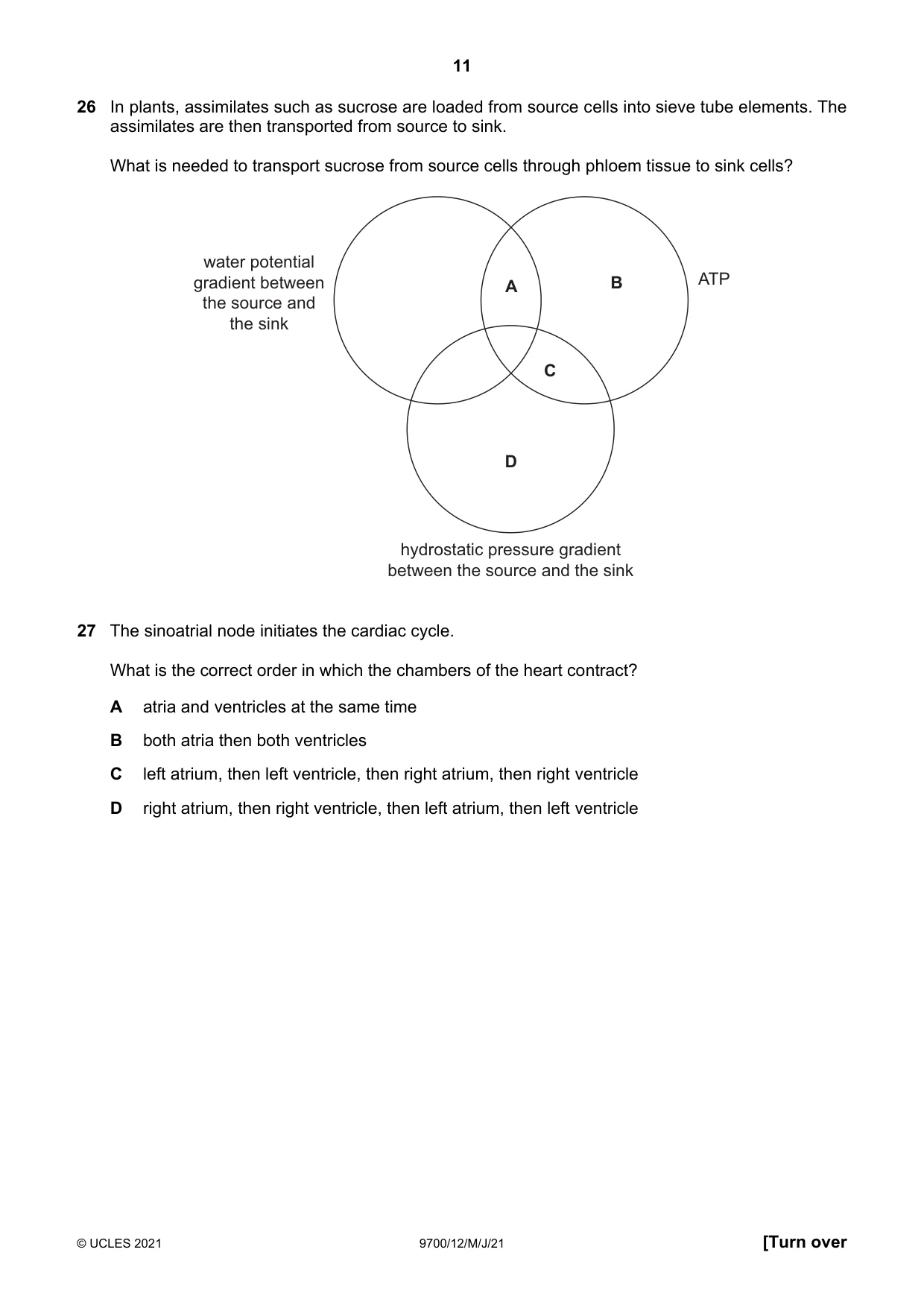
Q26 · In plants, assimilates such as sucrose are loaded from source cells into sieve tube…
26 In plants, assimilates such as sucrose are loaded from source cells into sieve tube elements. The assimilates are then transported from source to sink. What is needed to transport sucrose from source cells through phloem tissue to sink cells? water potential gradient between A B ATP the source and the sink C D hydrostatic pressure gradient between the source and the sink
Mark scheme: C
Q27 · The sinoatrial node initiates the cardiac cycle
27 The sinoatrial node initiates the cardiac cycle. What is the correct order in which the chambers of the heart contract? A atria and ventricles at the same time B both atria then both ventricles C left atrium, then left ventricle, then right atrium, then right ventricle D right atrium, then right ventricle, then left atrium, then left ventricle
Mark scheme: B
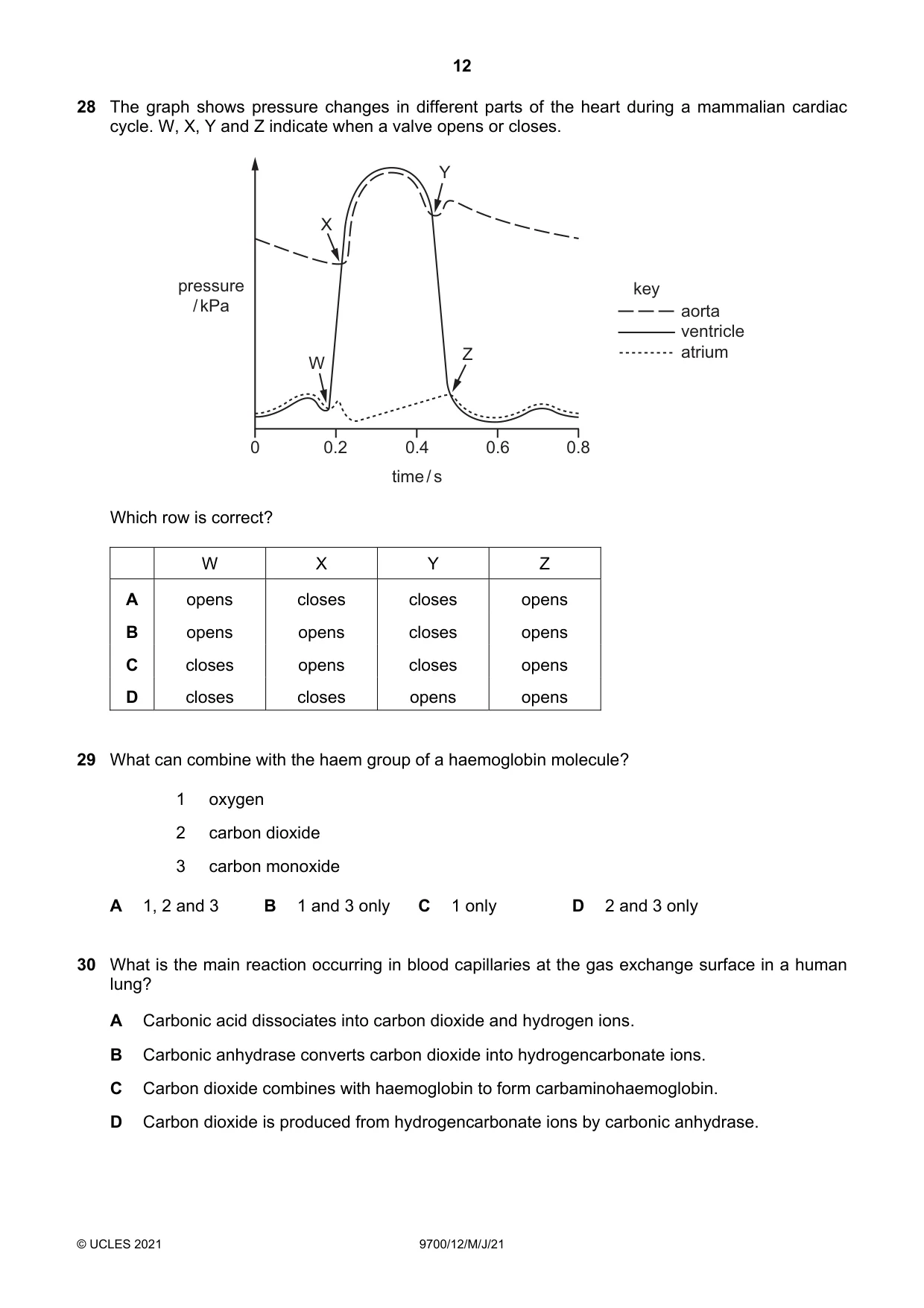
Q28 · The graph shows pressure changes in different parts of the heart during a mammalian…
28 The graph shows pressure changes in different parts of the heart during a mammalian cardiac cycle. W, X, Y and Z indicate when a valve opens or closes. Y X pressure key / kPa aorta ventricle Z atrium W 0 0.2 0.4 0.6 0.8 time / s Which row is correct? W X Y Z A opens closes closes opens B opens opens closes opens C closes opens closes opens D closes closes opens opens
Mark scheme: C
Q29 · What can combine with the haem group of a haemoglobin molecule?
29 What can combine with the haem group of a haemoglobin molecule? 1 oxygen 2 carbon dioxide 3 carbon monoxide A 1, 2 and 3 B 1 and 3 only C 1 only D 2 and 3 only
Mark scheme: B
Q30 · What is the main reaction occurring in blood capillaries at the gas exchange surface in a…
30 What is the main reaction occurring in blood capillaries at the gas exchange surface in a human lung? A Carbonic acid dissociates into carbon dioxide and hydrogen ions. B Carbonic anhydrase converts carbon dioxide into hydrogencarbonate ions. C Carbon dioxide combines with haemoglobin to form carbaminohaemoglobin. D Carbon dioxide is produced from hydrogencarbonate ions by carbonic anhydrase.
Mark scheme: D
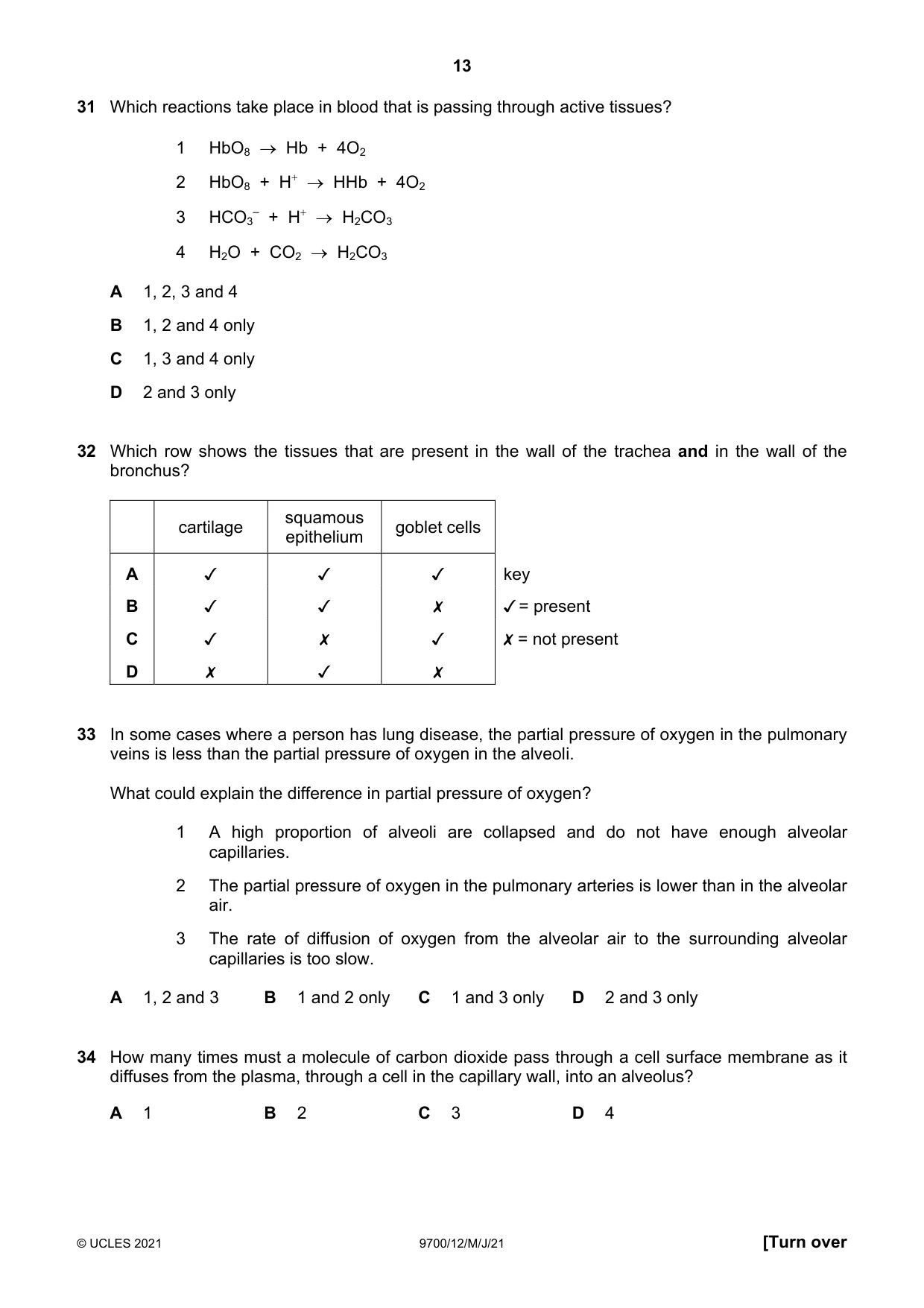
Q31 · Which reactions take place in blood that is passing through active tissues?
31 Which reactions take place in blood that is passing through active tissues? 1 HbO8 Hb + 4O2 2 HbO8 + H HHb + 4O2 3 HCO3 – + H H2CO3 4 H2O + CO2 H2CO3 A 1, 2, 3 and 4 B 1, 2 and 4 only C 1, 3 and 4 only D 2 and 3 only
Mark scheme: B
Q32 · Which row shows the tissues that are present in the wall of the trachea and in the wall…
32 Which row shows the tissues that are present in the wall of the trachea and in the wall of the bronchus? cartilage epithelium goblet cells A v J Jv key B v J x / = present Cc v x Jv X = not present D x Jv x
Mark scheme: C
Q33 · In some cases where a person has lung disease, the partial pressure of oxygen in the…
33 In some cases where a person has lung disease, the partial pressure of oxygen in the pulmonary veins is less than the partial pressure of oxygen in the alveoli. What could explain the difference in partial pressure of oxygen? 1 A high proportion of alveoli are collapsed and do not have enough alveolar capillaries. 2 The partial pressure of oxygen in the pulmonary arteries is lower than in the alveolar air. 3 The rate of diffusion of oxygen from the alveolar air to the surrounding alveolar capillaries is too slow. A 1, 2 and 3 B 1 and 2 only C 1 and 3 only D 2 and 3 only
Mark scheme: C
Q34 · How many times must a molecule of carbon dioxide pass through a cell surface membrane as…
34 How many times must a molecule of carbon dioxide pass through a cell surface membrane as it diffuses from the plasma, through a cell in the capillary wall, into an alveolus? A 1 B 2 C 3 D 4
Mark scheme: D
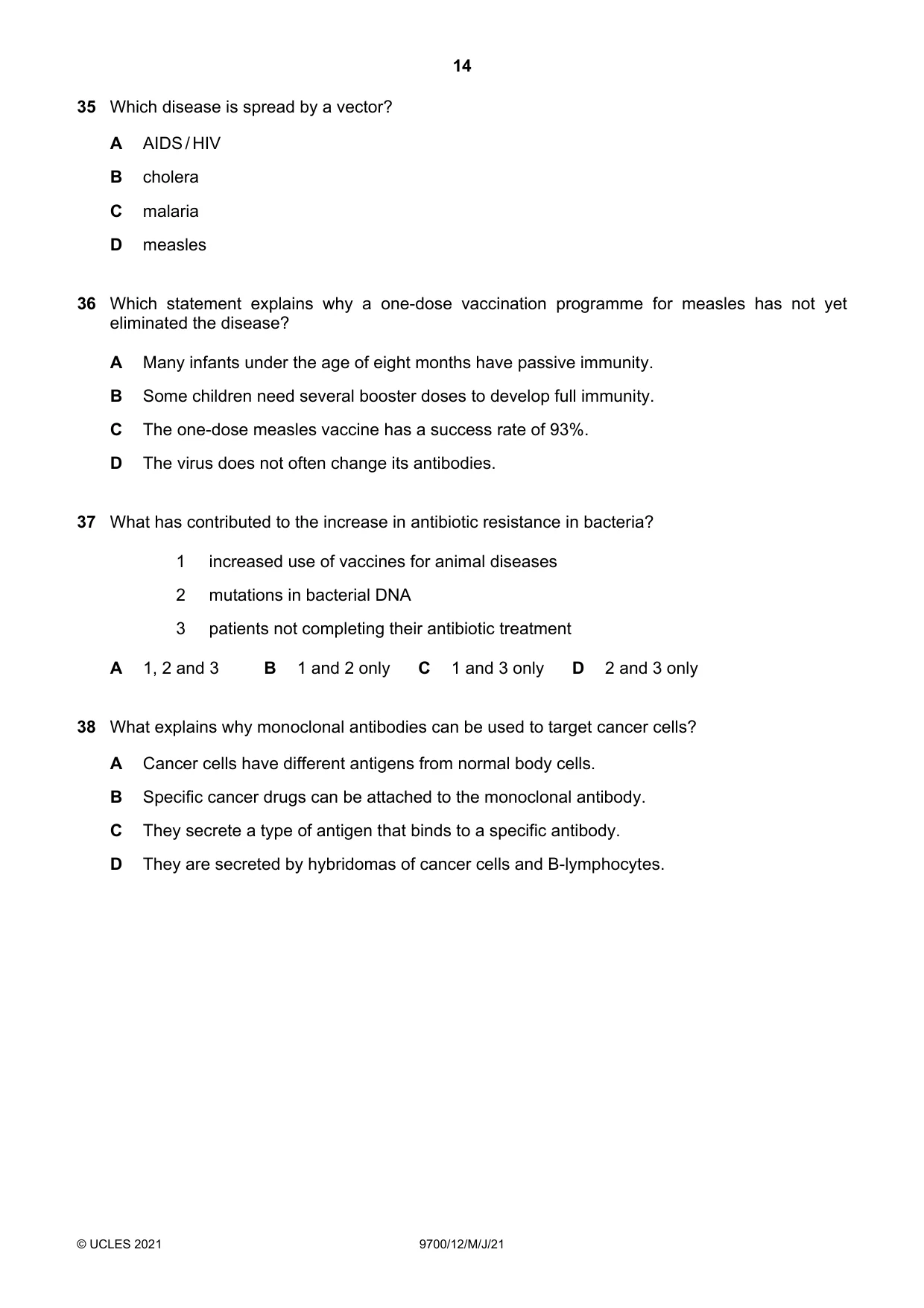
Q35 · Which disease is spread by a vector?
35 Which disease is spread by a vector? A AIDS / HIV B cholera C malaria D measles
Mark scheme: C
Q36 · Which statement explains why a one-dose vaccination programme for measles has not yet…
36 Which statement explains why a one-dose vaccination programme for measles has not yet eliminated the disease? A Many infants under the age of eight months have passive immunity. B Some children need several booster doses to develop full immunity. C The one-dose measles vaccine has a success rate of 93%. D The virus does not often change its antibodies.
Mark scheme: B
Q37 · What has contributed to the increase in antibiotic resistance in bacteria?
37 What has contributed to the increase in antibiotic resistance in bacteria? 1 increased use of vaccines for animal diseases 2 mutations in bacterial DNA 3 patients not completing their antibiotic treatment A 1, 2 and 3 B 1 and 2 only C 1 and 3 only D 2 and 3 only
Mark scheme: D
Q38 · What explains why monoclonal antibodies can be used to target cancer cells?
38 What explains why monoclonal antibodies can be used to target cancer cells? A Cancer cells have different antigens from normal body cells. B Specific cancer drugs can be attached to the monoclonal antibody. C They secrete a type of antigen that binds to a specific antibody. D They are secreted by hybridomas of cancer cells and B-lymphocytes.
Mark scheme: A
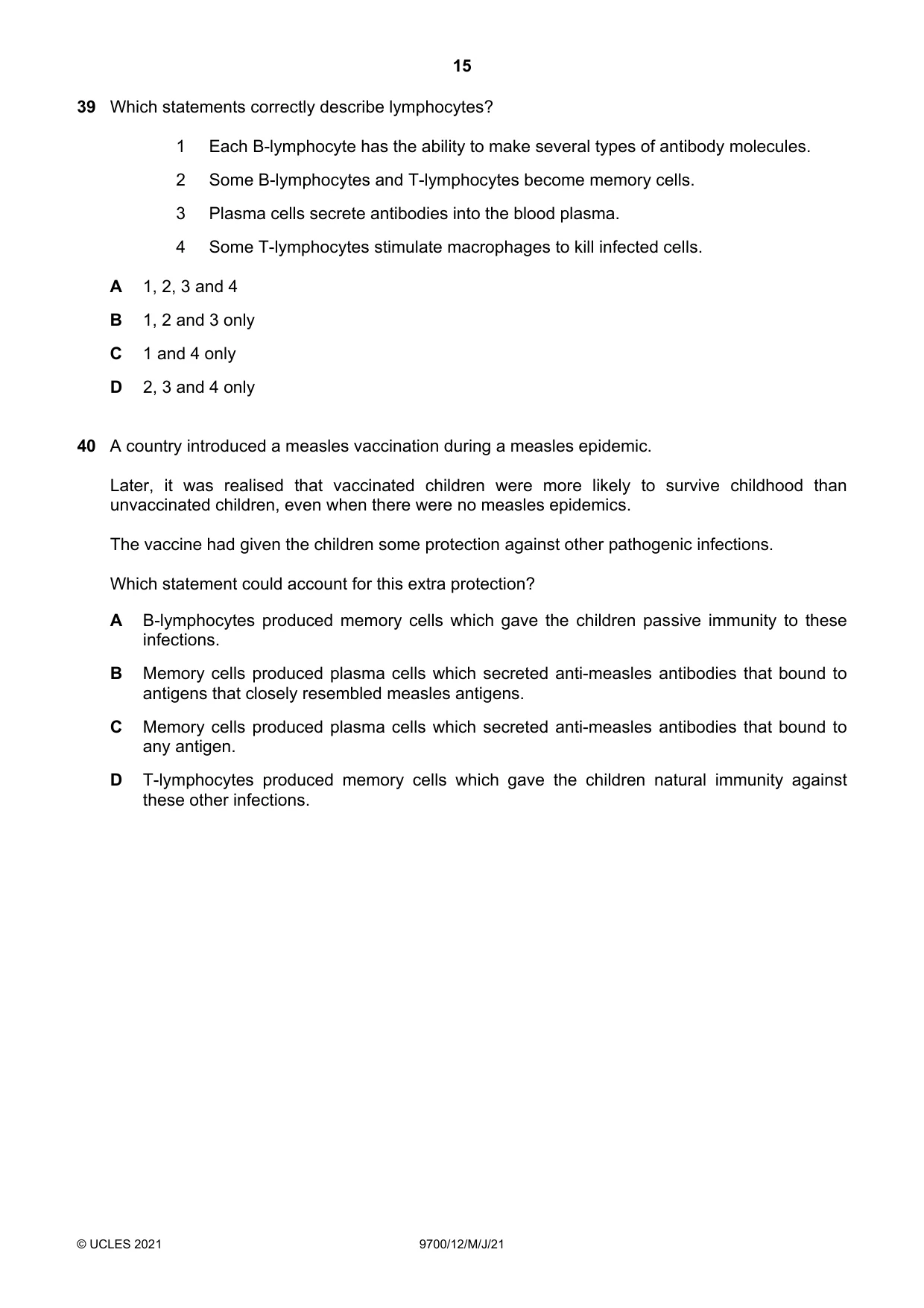
Q39 · Which statements correctly describe lymphocytes?
39 Which statements correctly describe lymphocytes? 1 Each B-lymphocyte has the ability to make several types of antibody molecules. 2 Some B-lymphocytes and T-lymphocytes become memory cells. 3 Plasma cells secrete antibodies into the blood plasma. 4 Some T-lymphocytes stimulate macrophages to kill infected cells. A 1, 2, 3 and 4 B 1, 2 and 3 only C 1 and 4 only D 2, 3 and 4 only
Mark scheme: D
Q40 · A country introduced a measles vaccination during a measles epidemic
40 A country introduced a measles vaccination during a measles epidemic. Later, it was realised that vaccinated children were more likely to survive childhood than unvaccinated children, even when there were no measles epidemics. The vaccine had given the children some protection against other pathogenic infections. Which statement could account for this extra protection? A B-lymphocytes produced memory cells which gave the children passive immunity to these infections. B Memory cells produced plasma cells which secreted anti-measles antibodies that bound to antigens that closely resembled measles antigens. C Memory cells produced plasma cells which secreted anti-measles antibodies that bound to any antigen. D T-lymphocytes produced memory cells which gave the children natural immunity against these other infections.
Mark scheme: B
What was in this paper
The subtopics covered by these 40 questions, and how many questions each got. Open one in a new tab to see every Cambridge question on it.
5Antibodies and vaccination3The gas exchange system3Transport mechanisms3Transport of oxygen and carbon dioxide3Antibiotics2Cells as the basic units of living organisms2Mode of action of enzymes2Movement into and out of cells2Replication and division of nuclei and cells2Structure of nucleic acids and replication of DNA2The heart2The microscope in cell studies2Chromosome behaviour in mitosis1Fluid mosaic membranes1Infectious diseases1Protein synthesis1Structure of transport tissues1Testing for biological molecules1The immune system1What you needed in this session
Cambridge’s own grade thresholds for 2021 May/June, Paper 1 · Variant 2. A higher threshold means an easier paper — the bar moves with how the cohort did.