Cambridge A Level Biology 9700 — 2015 May/June Paper 1 · Variant 2
9700/12/M/J/15 · 40 questions · 40 marks · ≈45 min
The question paper and its mark scheme, free to read here and free to download. This is Cambridge’s own paper, exactly as it was sat.
Question paper20 pages



Mark scheme2 pages
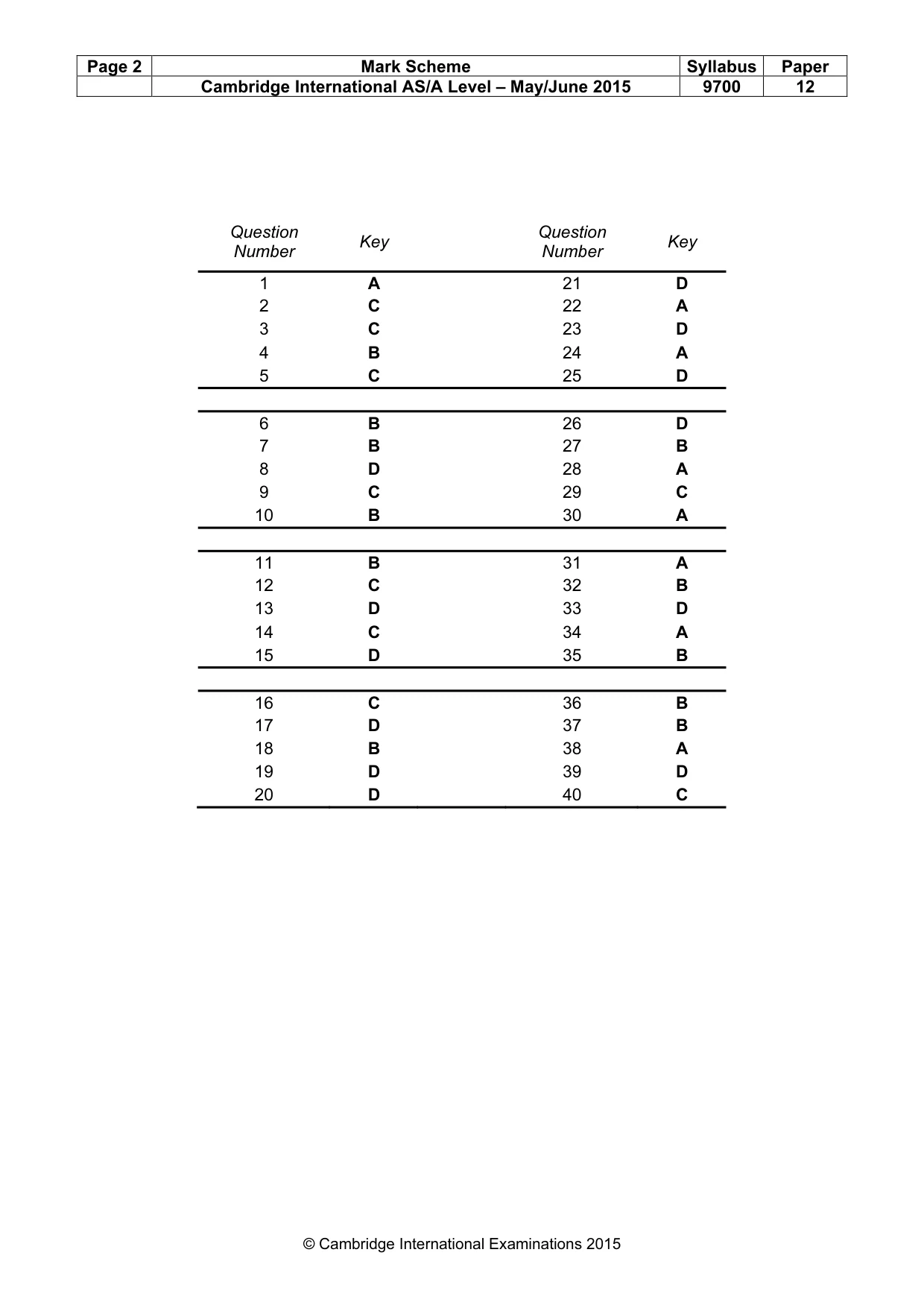
Answers below. Sit the paper first if you are practising.
Questions as text
Q1 · What is the diameter of a typical plant cell?
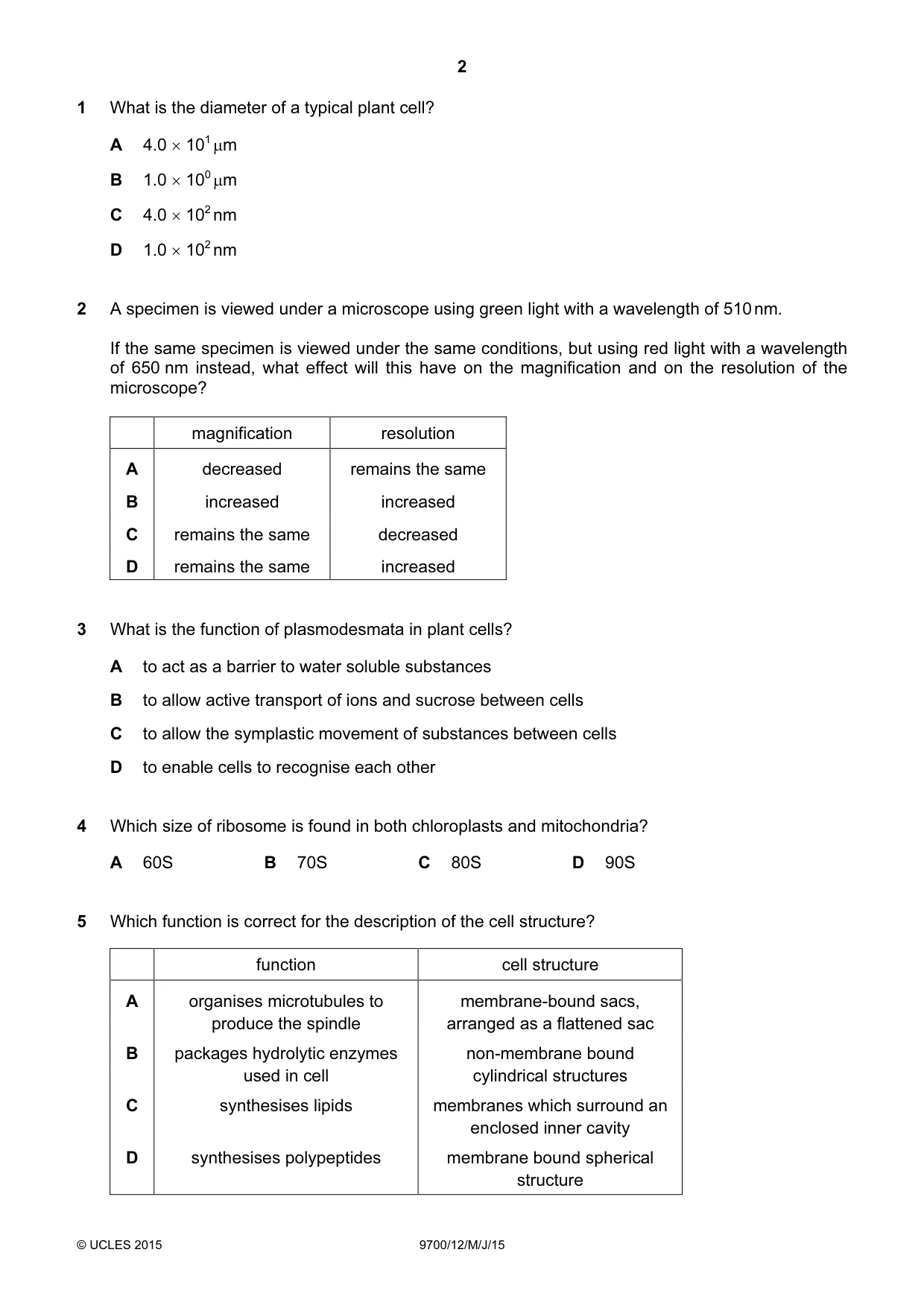
1 What is the diameter of a typical plant cell? A 4.0 × 101 µm B 1.0 × 100 µm C 4.0 × 10² nm D 1.0 × 10² nm
Mark scheme: A
Q2 · A specimen is viewed under a microscope using green light with a wavelength of 510 nm
2 A specimen is viewed under a microscope using green light with a wavelength of 510 nm. If the same specimen is viewed under the same conditions, but using red light with a wavelength of 650 nm instead, what effect will this have on the magnification and on the resolution of the microscope? magnification resolution A decreased remains the same B increased increased C remains the same decreased D remains the same increased
Mark scheme: C
Q3 · What is the function of plasmodesmata in plant cells?
3 What is the function of plasmodesmata in plant cells? A to act as a barrier to water soluble substances B to allow active transport of ions and sucrose between cells C to allow the symplastic movement of substances between cells D to enable cells to recognise each other
Mark scheme: C
More questions on Cells as the basic units of living organisms
Q4 · Which size of ribosome is found in both chloroplasts and mitochondria?
4 Which size of ribosome is found in both chloroplasts and mitochondria? A 60S B 70S C 80S D 90S
Mark scheme: B
More questions on Cells as the basic units of living organisms
Q5 · Which function is correct for the description of the cell structure?
5 Which function is correct for the description of the cell structure? function cell structure A organises microtubules to membrane-bound sacs, produce the spindle arranged as a flattened sac B packages hydrolytic enzymes non-membrane bound used in cell cylindrical structures C synthesises lipids membranes which surround an enclosed inner cavity D synthesises polypeptides membrane bound spherical structure
Mark scheme: C
More questions on Cells as the basic units of living organisms
Q6 · Ribosomes consist of two subunits, each containing rRNA
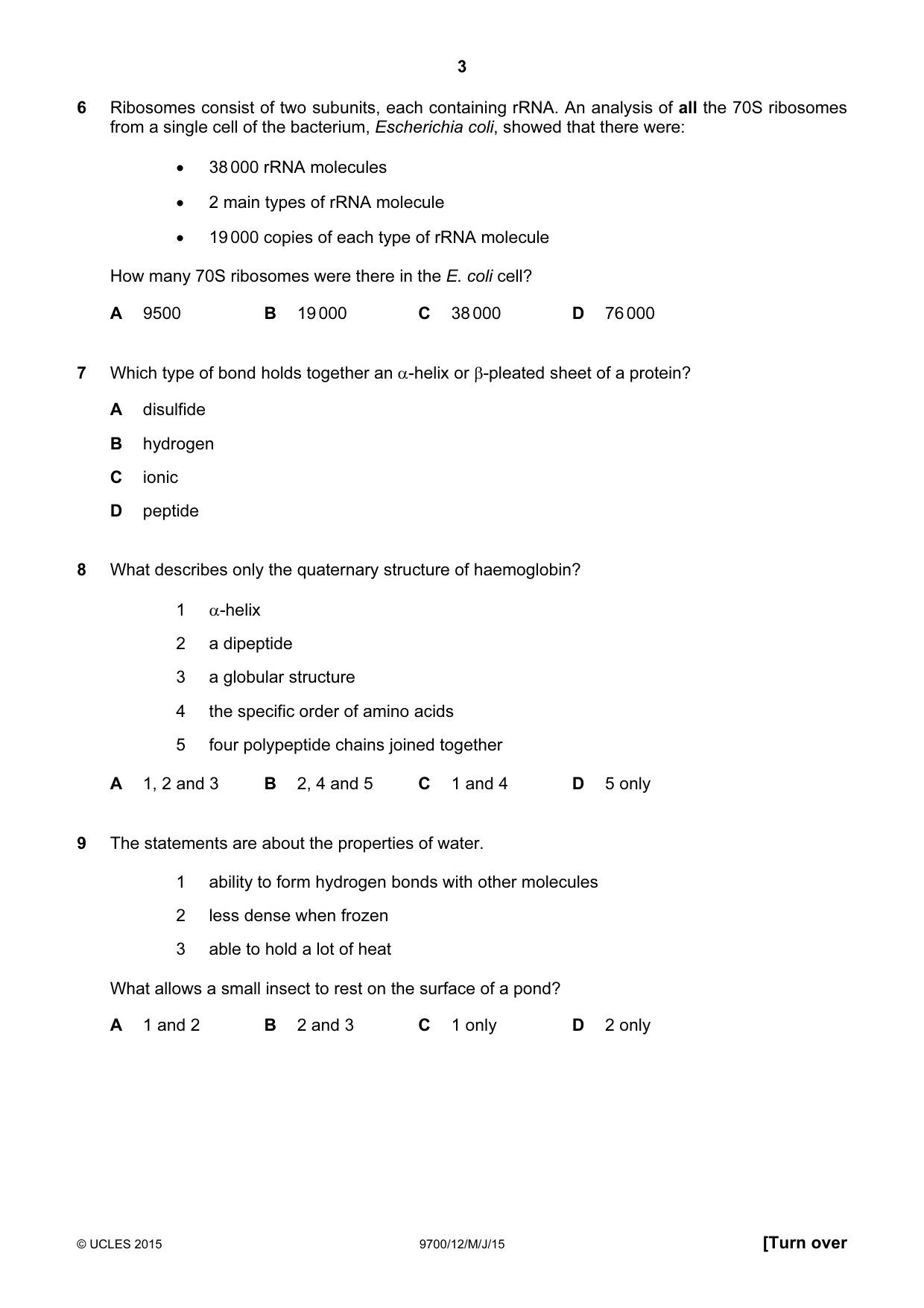
6 Ribosomes consist of two subunits, each containing rRNA. An analysis of all the 70S ribosomes from a single cell of the bacterium, Escherichia coli, showed that there were: • 38 000 rRNA molecules • 2 main types of rRNA molecule • 19 000 copies of each type of rRNA molecule How many 70S ribosomes were there in the E. coli cell? A 9500 B 19 000 C 38 000 D 76 000
Mark scheme: B
More questions on Cells as the basic units of living organisms
Q7 · Which type of bond holds together an α-helix or β-pleated sheet of a protein?
7 Which type of bond holds together an α-helix or β-pleated sheet of a protein? A disulfide B hydrogen C ionic D peptide
Mark scheme: B
Q8 · What describes only the quaternary structure of haemoglobin?
8 What describes only the quaternary structure of haemoglobin? 1 α-helix 2 a dipeptide 3 a globular structure 4 the specific order of amino acids 5 four polypeptide chains joined together A 1, 2 and 3 B 2, 4 and 5 C 1 and 4 D 5 only
Mark scheme: D
Q9 · The statements are about the properties of water
9 The statements are about the properties of water. 1 ability to form hydrogen bonds with other molecules 2 less dense when frozen 3 able to hold a lot of heat What allows a small insect to rest on the surface of a pond? A 1 and 2 B 2 and 3 C 1 only D 2 only
Mark scheme: C
Q10 · Which bonds hold together the structure of cellulose?
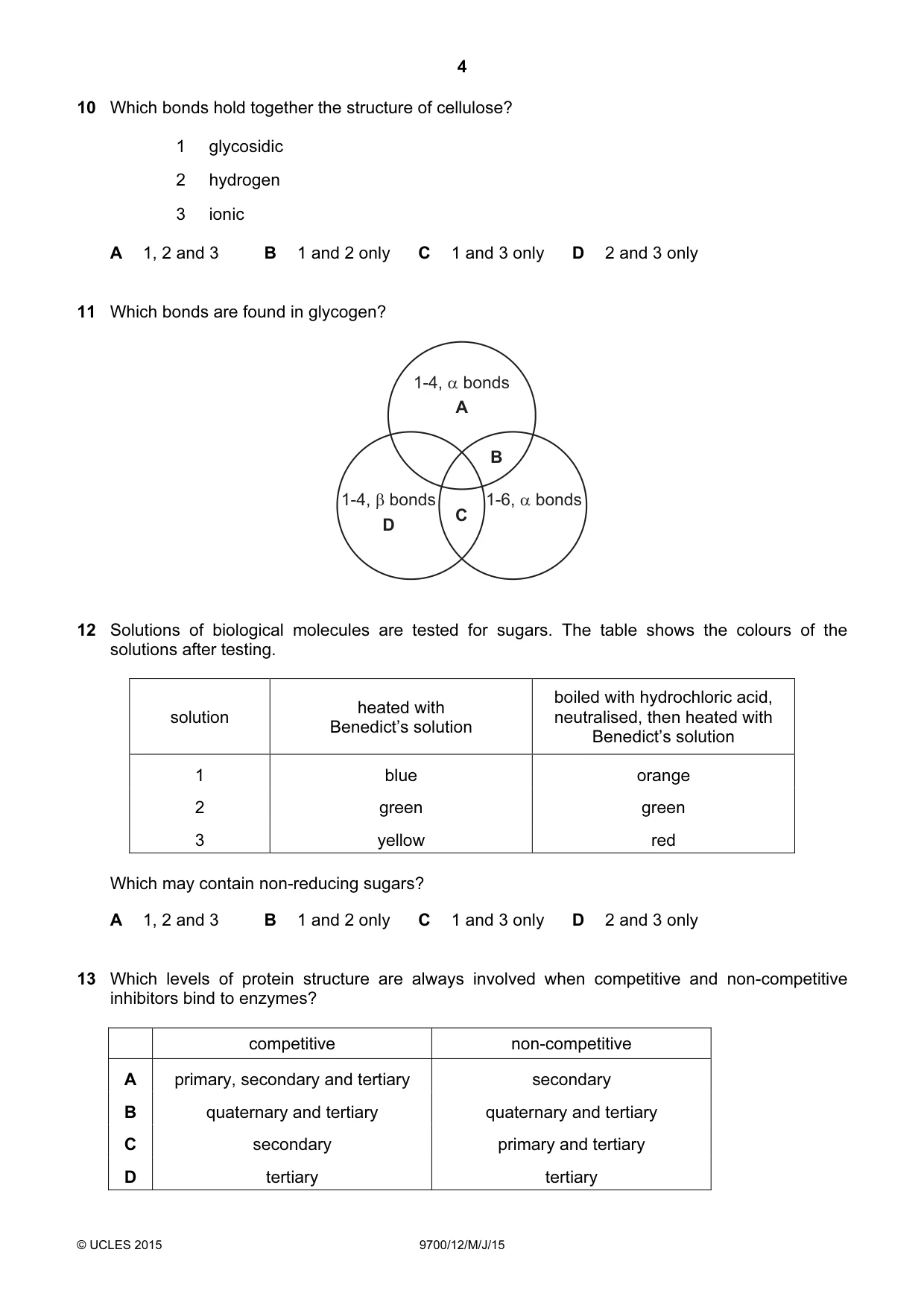
10 Which bonds hold together the structure of cellulose? 1 glycosidic 2 hydrogen 3 ionic A 1, 2 and 3 B 1 and 2 only C 1 and 3 only D 2 and 3 only
Mark scheme: B
Q11 · Which bonds are found in glycogen?
11 Which bonds are found in glycogen? 1-4, α bonds A B 1-4, β bonds 1-6, α bonds C D
Mark scheme: B
Q12 · Solutions of biological molecules are tested for sugars
12 Solutions of biological molecules are tested for sugars. The table shows the colours of the solutions after testing. boiled with hydrochloric acid, heated with solution neutralised, then heated with Benedict’s solution Benedict’s solution 1 blue orange 2 green green 3 yellow red Which may contain non-reducing sugars? A 1, 2 and 3 B 1 and 2 only C 1 and 3 only D 2 and 3 only
Mark scheme: C
Q13 · Which levels of protein structure are always involved when competitive and…
13 Which levels of protein structure are always involved when competitive and non-competitive inhibitors bind to enzymes? competitive non-competitive A primary, secondary and tertiary secondary B quaternary and tertiary quaternary and tertiary C secondary primary and tertiary D tertiary tertiary
Mark scheme: D
Q14 · Which statements are true about the optimum temperature of all enzymes?
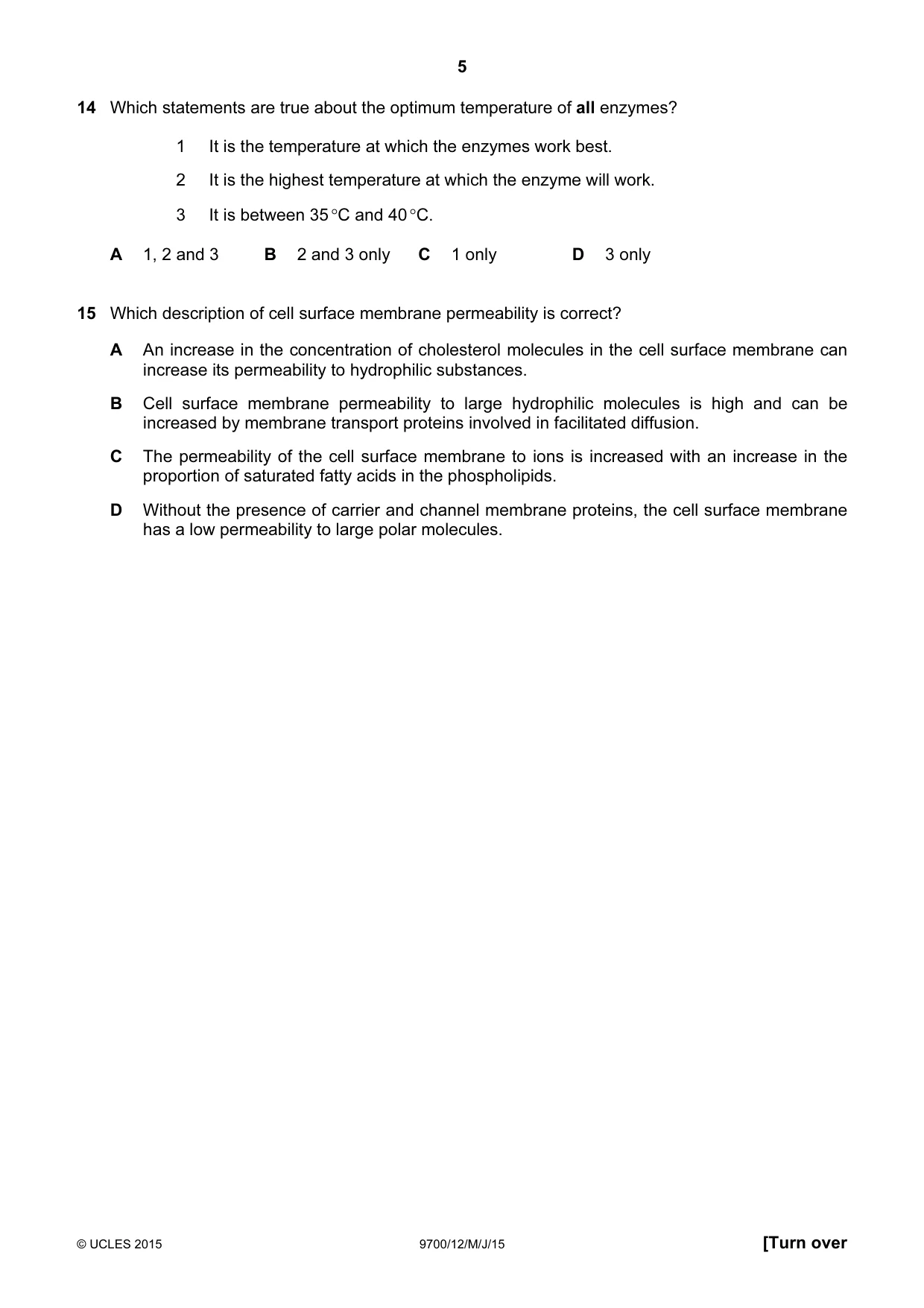
14 Which statements are true about the optimum temperature of all enzymes? 1 It is the temperature at which the enzymes work best. 2 It is the highest temperature at which the enzyme will work. 3 It is between 35 °C and 40 °C. A 1, 2 and 3 B 2 and 3 only C 1 only D 3 only
Mark scheme: C
Q15 · Which description of cell surface membrane permeability is correct?
15 Which description of cell surface membrane permeability is correct? A An increase in the concentration of cholesterol molecules in the cell surface membrane can increase its permeability to hydrophilic substances. B Cell surface membrane permeability to large hydrophilic molecules is high and can be increased by membrane transport proteins involved in facilitated diffusion. C The permeability of the cell surface membrane to ions is increased with an increase in the proportion of saturated fatty acids in the phospholipids. D Without the presence of carrier and channel membrane proteins, the cell surface membrane has a low permeability to large polar molecules.
Mark scheme: D
Q16 · The diagram represents a cell surface membrane
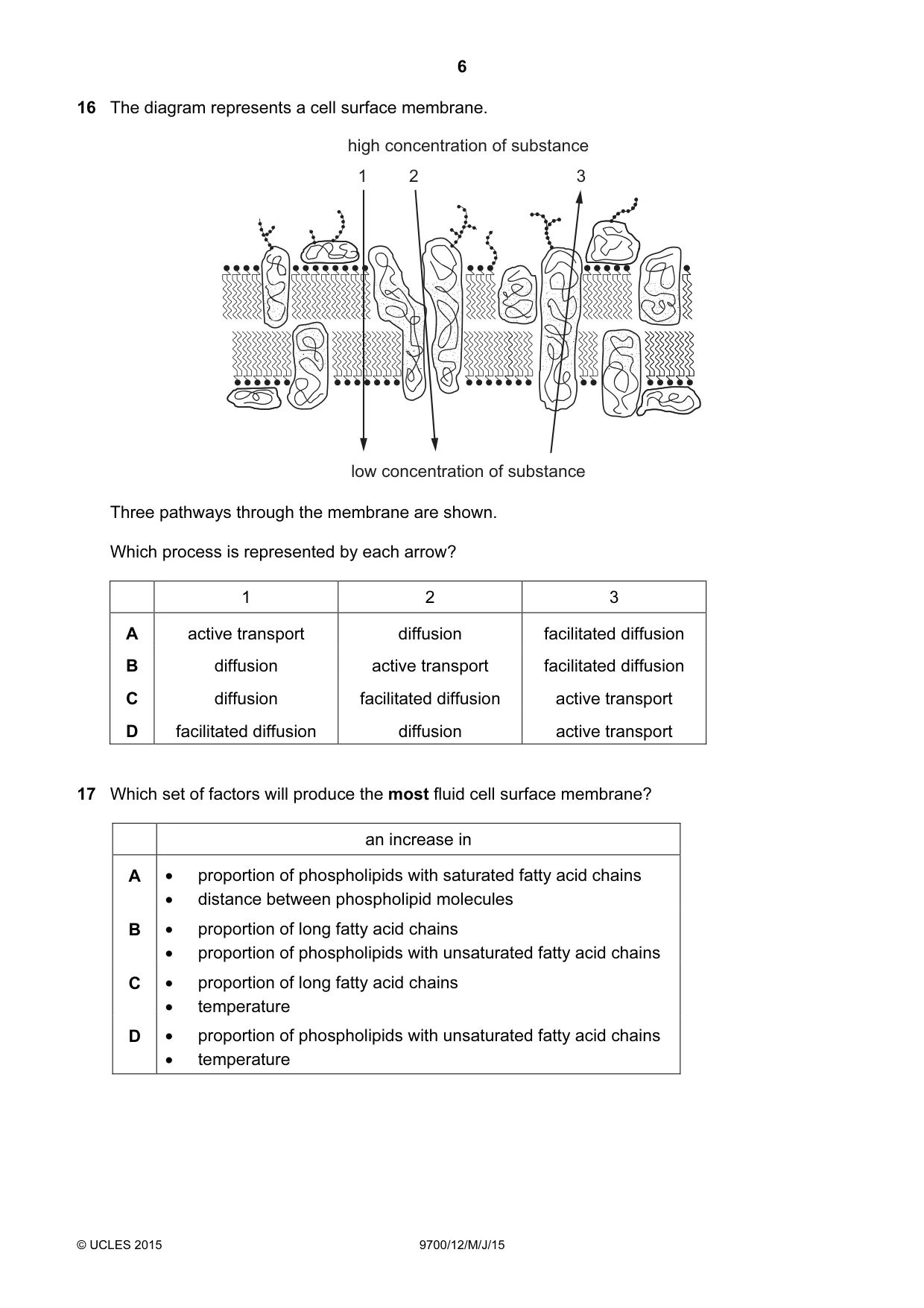
16 The diagram represents a cell surface membrane. high concentration of substance 1 2 3 low concentration of substance Three pathways through the membrane are shown. Which process is represented by each arrow? 1 2 3 A active transport diffusion facilitated diffusion B diffusion active transport facilitated diffusion C diffusion facilitated diffusion active transport D facilitated diffusion diffusion active transport
Mark scheme: C
Q17 · Which set of factors will produce the most fluid cell surface membrane?
17 Which set of factors will produce the most fluid cell surface membrane? an increase in A • proportion of phospholipids with saturated fatty acid chains • distance between phospholipid molecules B • proportion of long fatty acid chains • proportion of phospholipids with unsaturated fatty acid chains C • proportion of long fatty acid chains • temperature D • proportion of phospholipids with unsaturated fatty acid chains • temperature
Mark scheme: D
Q18 · The protein p53 is produced in a cell in response to DNA damage
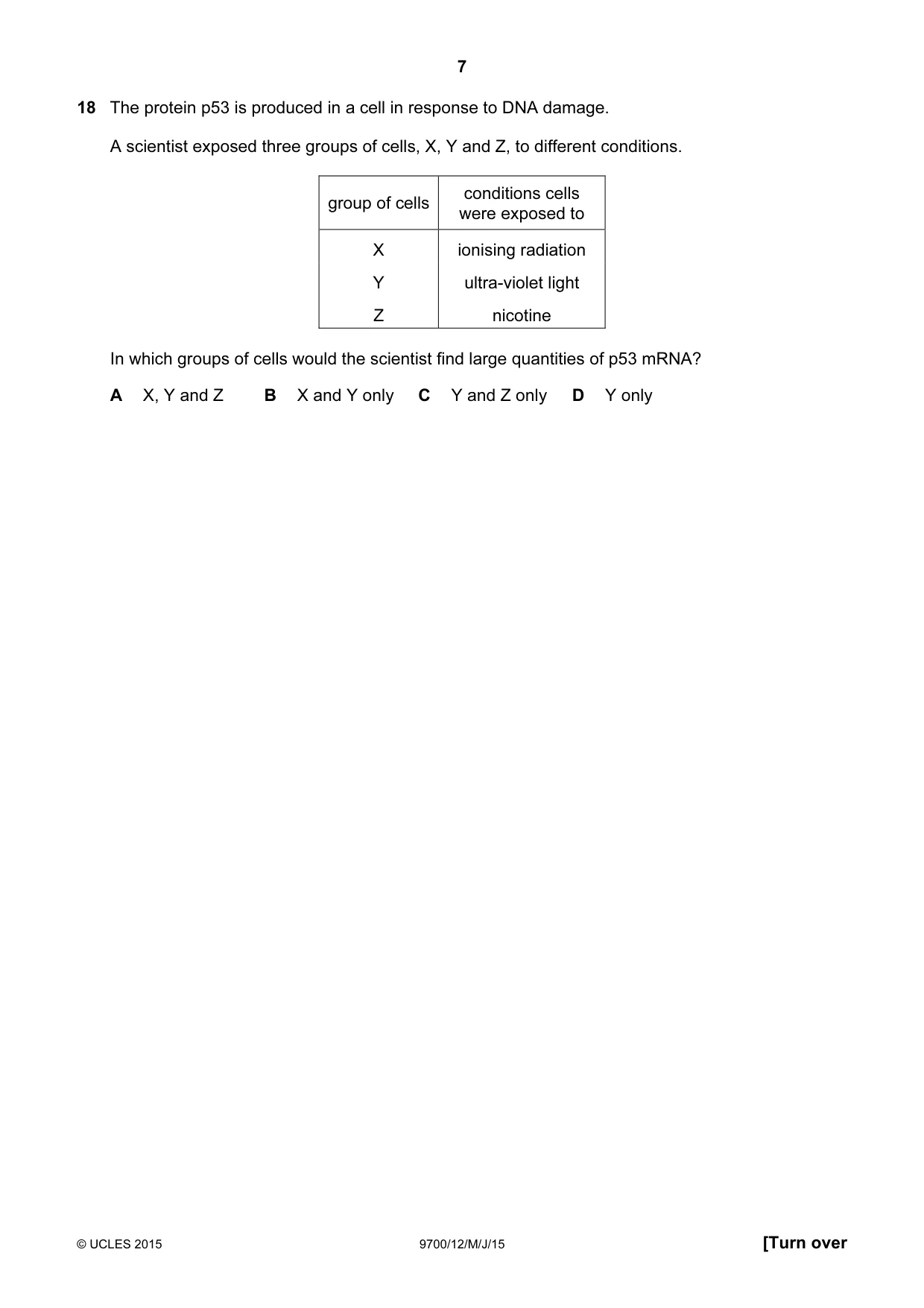
18 The protein p53 is produced in a cell in response to DNA damage. A scientist exposed three groups of cells, X, Y and Z, to different conditions. conditions cells group of cells were exposed to X ionising radiation Y ultra-violet light Z nicotine In which groups of cells would the scientist find large quantities of p53 mRNA? A X, Y and Z B X and Y only C Y and Z only D Y only
Mark scheme: B
Q19 · Which row is correct?
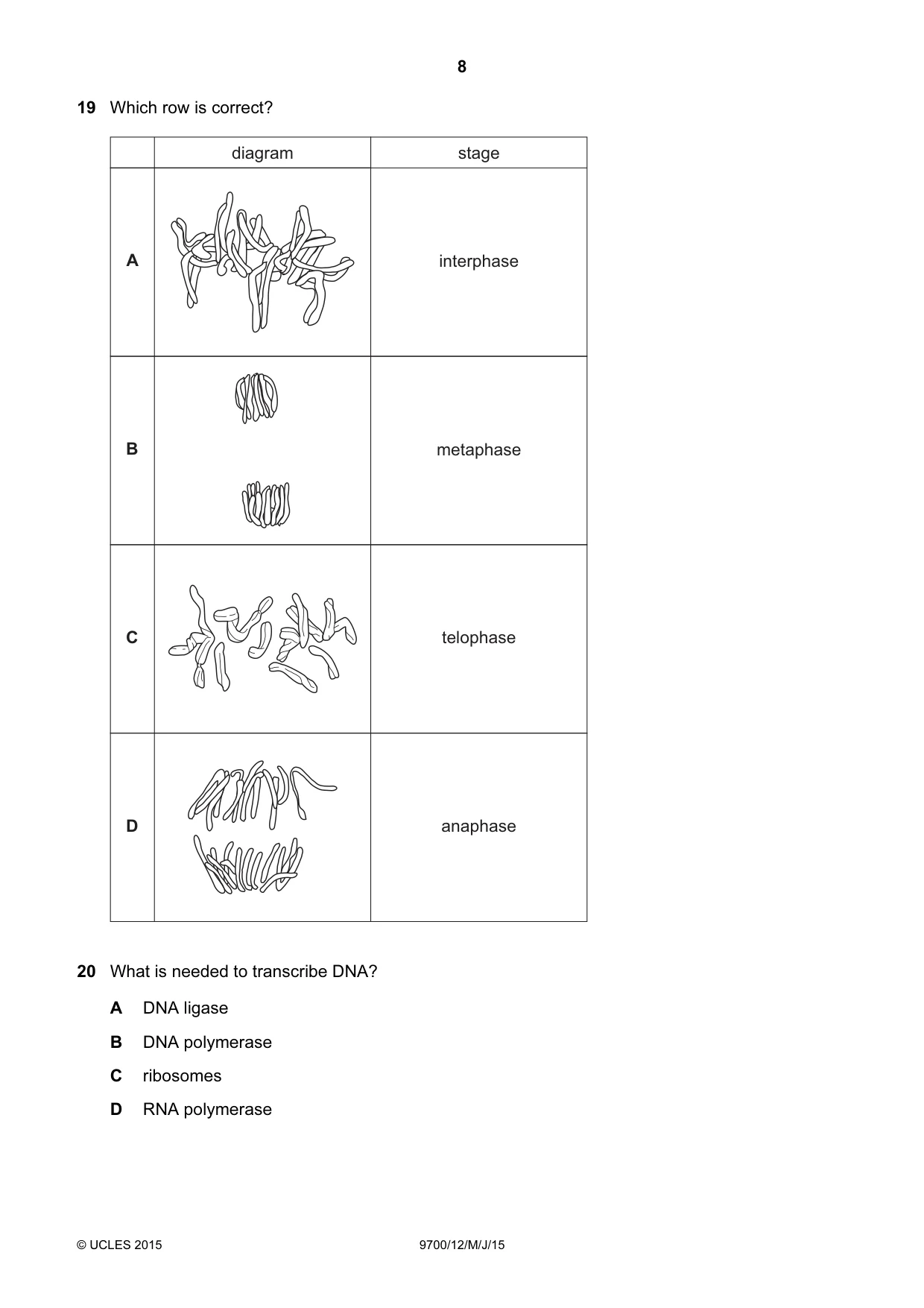
19 Which row is correct? diagram stage A interphase B metaphase C telophase D anaphase
Mark scheme: D
Q20 · What is needed to transcribe DNA?
20 What is needed to transcribe DNA? A DNA ligase B DNA polymerase C ribosomes D RNA polymerase
Mark scheme: D
Q21 · In a ribosome, which bond holds together two adjacent amino acids?
21 In a ribosome, which bond holds together two adjacent amino acids? A disulfide B hydrogen C ionic D peptide
Mark scheme: D
Q22 · The diagram shows part of a DNA molecule
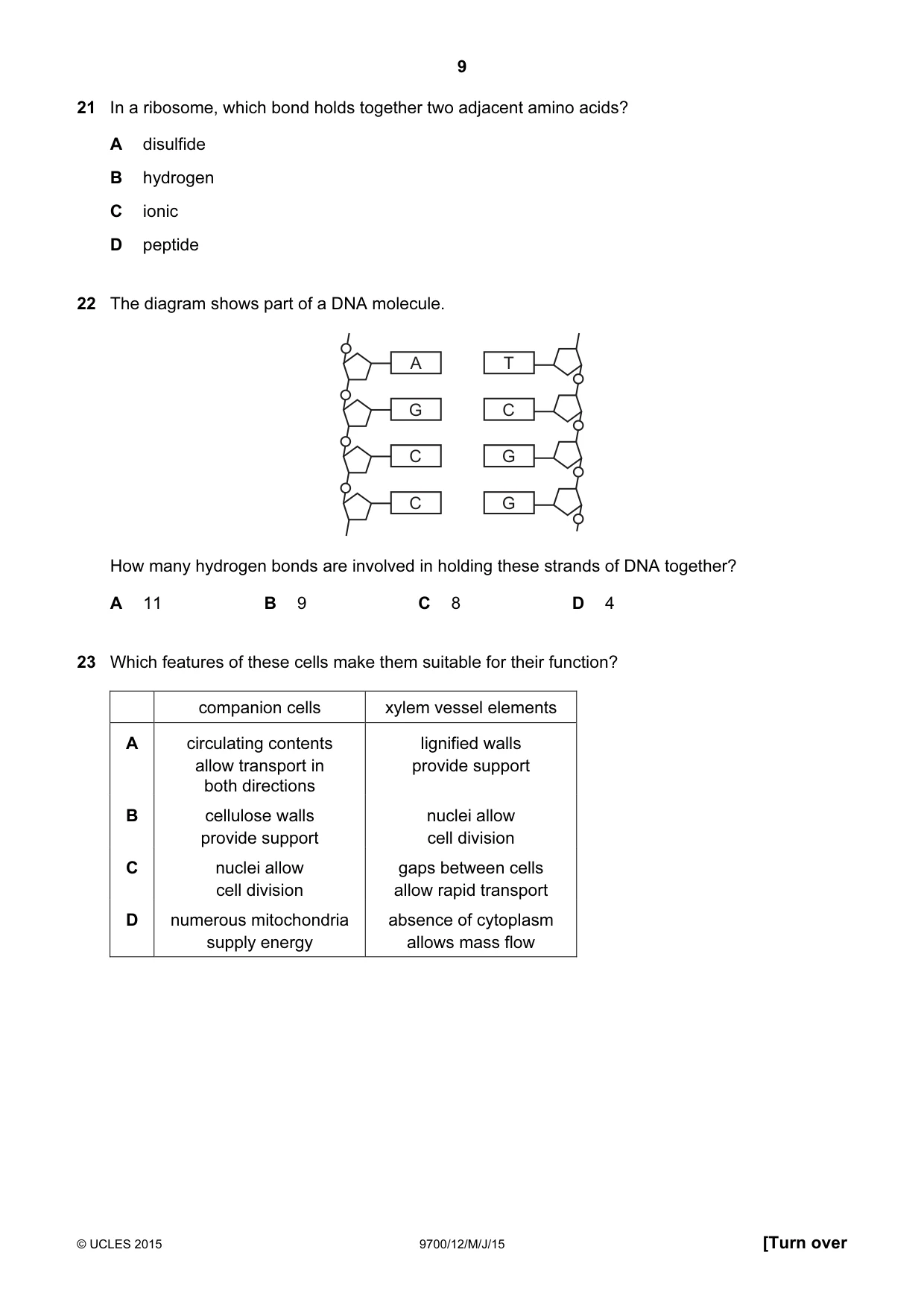
22 The diagram shows part of a DNA molecule. A T G C C G C G How many hydrogen bonds are involved in holding these strands of DNA together? A 11 B 9 C 8 D 4
Mark scheme: A
More questions on Structure of nucleic acids and replication of DNA
Q23 · Which features of these cells make them suitable for their function?
23 Which features of these cells make them suitable for their function? companion cells xylem vessel elements A circulating contents lignified walls allow transport in provide support both directions B cellulose walls nuclei allow provide support cell division C nuclei allow gaps between cells cell division allow rapid transport D numerous mitochondria absence of cytoplasm supply energy allows mass flow
Mark scheme: D
Q24 · What is the sequence of events in the translocation of sucrose?
24 What is the sequence of events in the translocation of sucrose? A active loading of sucrose into sieve elements at the source, increased hydrostatic pressure, mass flow, unloading at the sink B hydrolysis of storage compounds in sinks, lowered water potential, unloading of sucrose from sieve elements, mass flow from the source C lowered pressure in sieve elements at the source, movement of sucrose down the pressure gradient, mass flow down a diffusion gradient to the sink D mass flow of dissolved sucrose into the sieve element at the source, lowered hydrostatic pressure, diffusion of sucrose to sink, active unloading
Mark scheme: A
Q25 · Where does water evaporate from during transpiration?
25 Where does water evaporate from during transpiration? A inside the guard cells B the outer surface of the epidermal cell layer C the sub-stomatal cavity D the surface of spongy mesophyll cell walls
Mark scheme: D
Q26 · Which changes to the water potential and the volume of liquid in the phloem occur when…
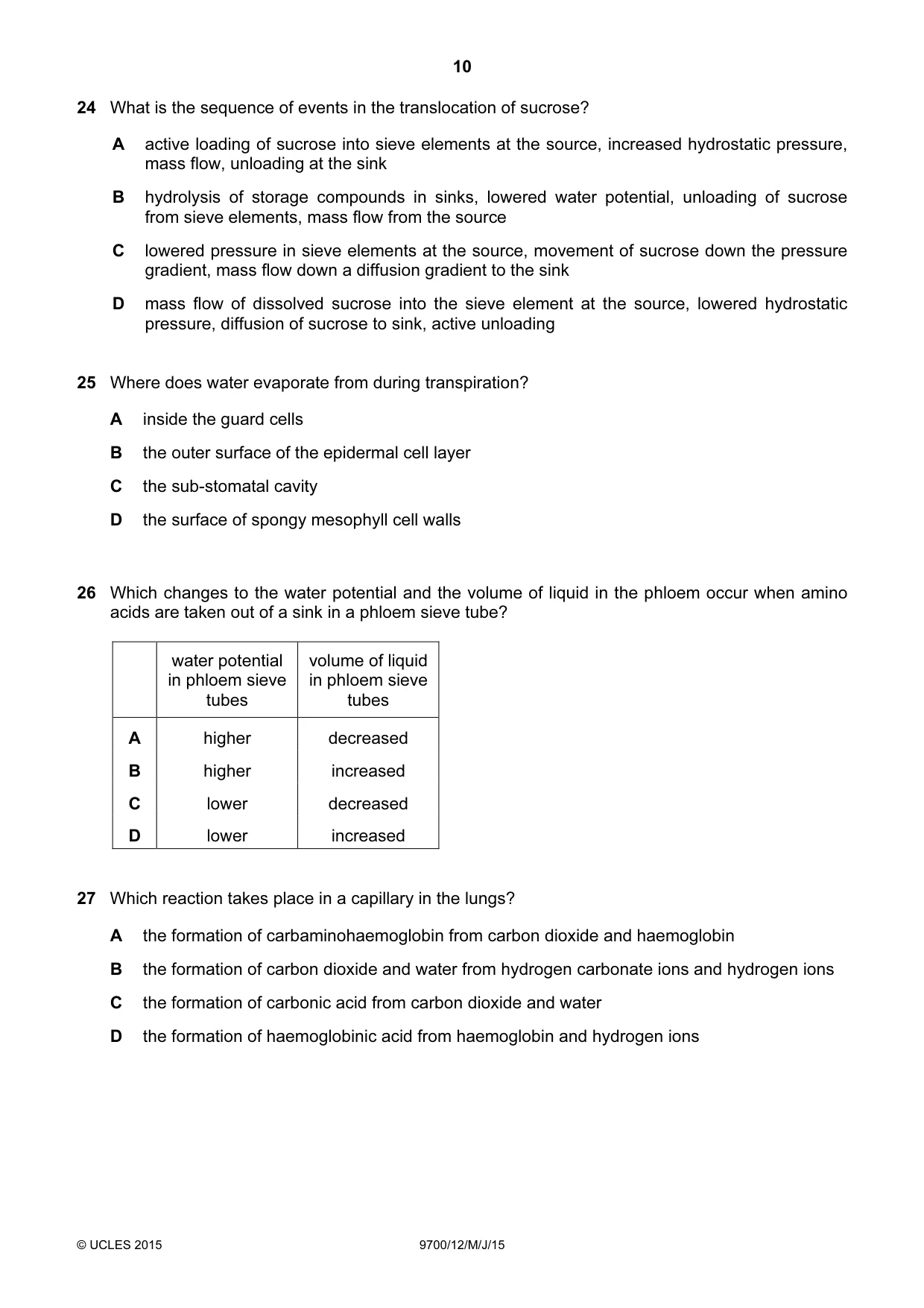
26 Which changes to the water potential and the volume of liquid in the phloem occur when amino acids are taken out of a sink in a phloem sieve tube? water potential volume of liquid in phloem sieve in phloem sieve tubes tubes A higher decreased B higher increased C lower decreased D lower increased
Mark scheme: D
Q27 · Which reaction takes place in a capillary in the lungs?
27 Which reaction takes place in a capillary in the lungs? A the formation of carbaminohaemoglobin from carbon dioxide and haemoglobin B the formation of carbon dioxide and water from hydrogen carbonate ions and hydrogen ions C the formation of carbonic acid from carbon dioxide and water D the formation of haemoglobinic acid from haemoglobin and hydrogen ions
Mark scheme: B
Q28 · Which structure is correctly identified?
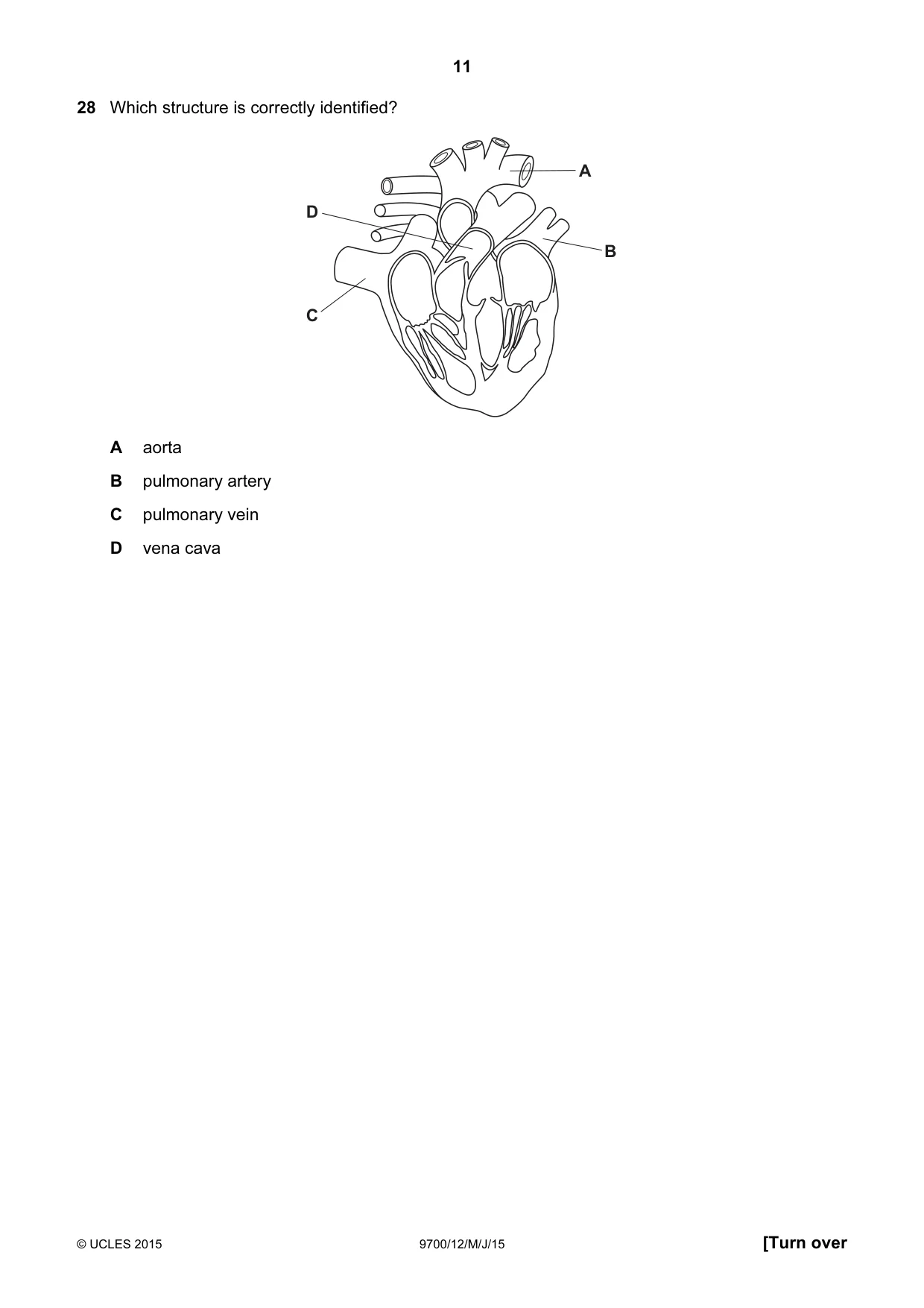
28 Which structure is correctly identified? A D B C A aorta B pulmonary artery C pulmonary vein D vena cava
Mark scheme: A
Q29 · Resting muscle has a lower respiration rate than active muscle
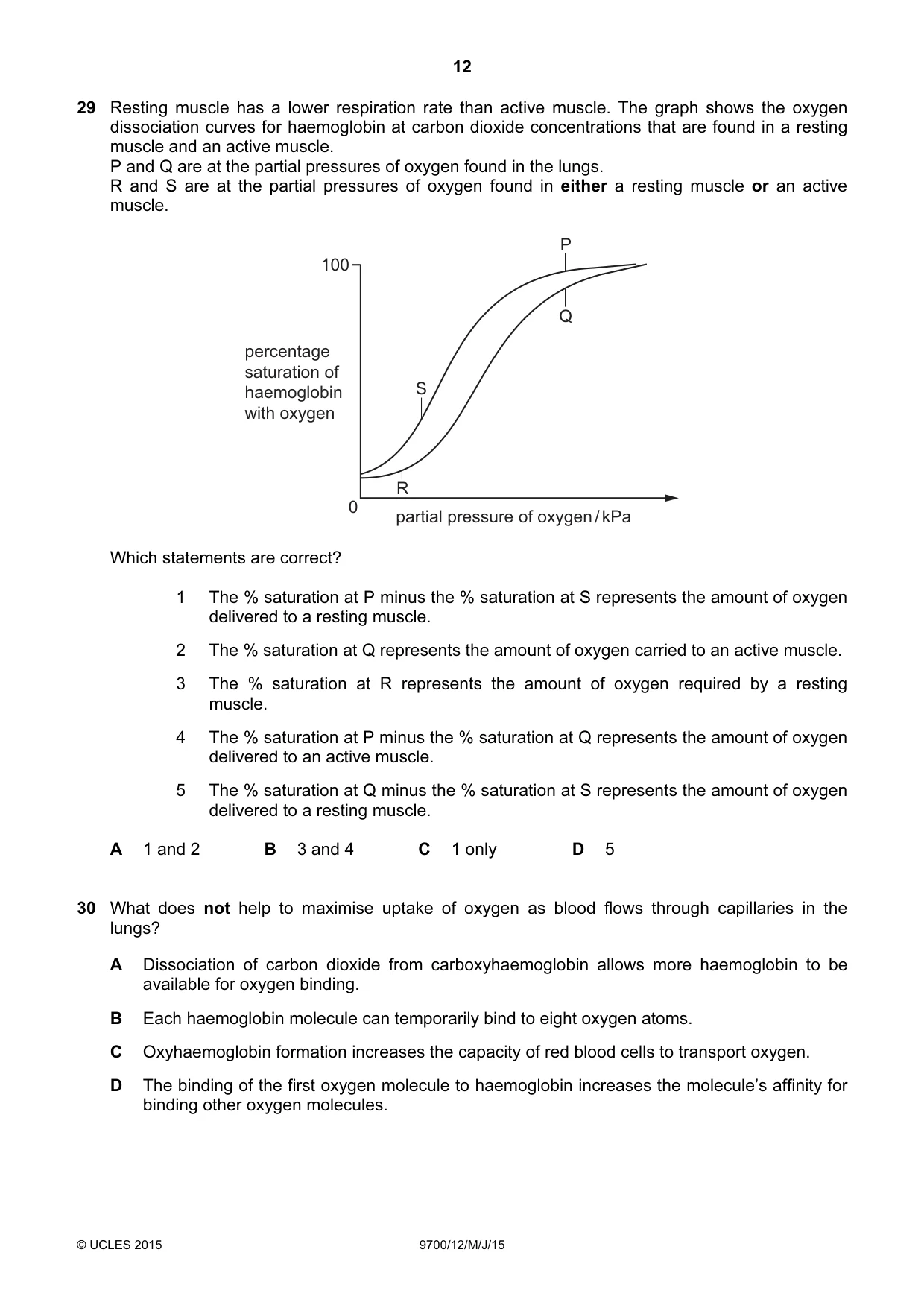
29 Resting muscle has a lower respiration rate than active muscle. The graph shows the oxygen dissociation curves for haemoglobin at carbon dioxide concentrations that are found in a resting muscle and an active muscle. P and Q are at the partial pressures of oxygen found in the lungs. R and S are at the partial pressures of oxygen found in either a resting muscle or an active muscle. P 100 Q percentage saturation of haemoglobin S with oxygen R 0 partial pressure of oxygen / kPa Which statements are correct? 1 The % saturation at P minus the % saturation at S represents the amount of oxygen delivered to a resting muscle. 2 The % saturation at Q represents the amount of oxygen carried to an active muscle. 3 The % saturation at R represents the amount of oxygen required by a resting muscle. 4 The % saturation at P minus the % saturation at Q represents the amount of oxygen delivered to an active muscle. 5 The % saturation at Q minus the % saturation at S represents the amount of oxygen delivered to a resting muscle. A 1 and 2 B 3 and 4 C 1 only D 5
Mark scheme: C
Q30 · What does not help to maximise uptake of oxygen as blood flows through capillaries in the…
30 What does not help to maximise uptake of oxygen as blood flows through capillaries in the lungs? A Dissociation of carbon dioxide from carboxyhaemoglobin allows more haemoglobin to be available for oxygen binding. B Each haemoglobin molecule can temporarily bind to eight oxygen atoms. C Oxyhaemoglobin formation increases the capacity of red blood cells to transport oxygen. D The binding of the first oxygen molecule to haemoglobin increases the molecule’s affinity for binding other oxygen molecules.
Mark scheme: A
Q31 · What correctly describes the role of elastic fibres in the lungs?
31 What correctly describes the role of elastic fibres in the lungs? A They allow the walls of stretched alveoli to recoil as air is breathed out. B They increase in the walls of alveoli as a result of the release of the enzyme elastase. C They increase in the walls of the alveoli as emphysema develops. D They prevent the walls of the alveoli from collapsing as air is breathed in.
Mark scheme: A
Q32 · The diagram represents a section through the wall of a bronchus (not to scale)
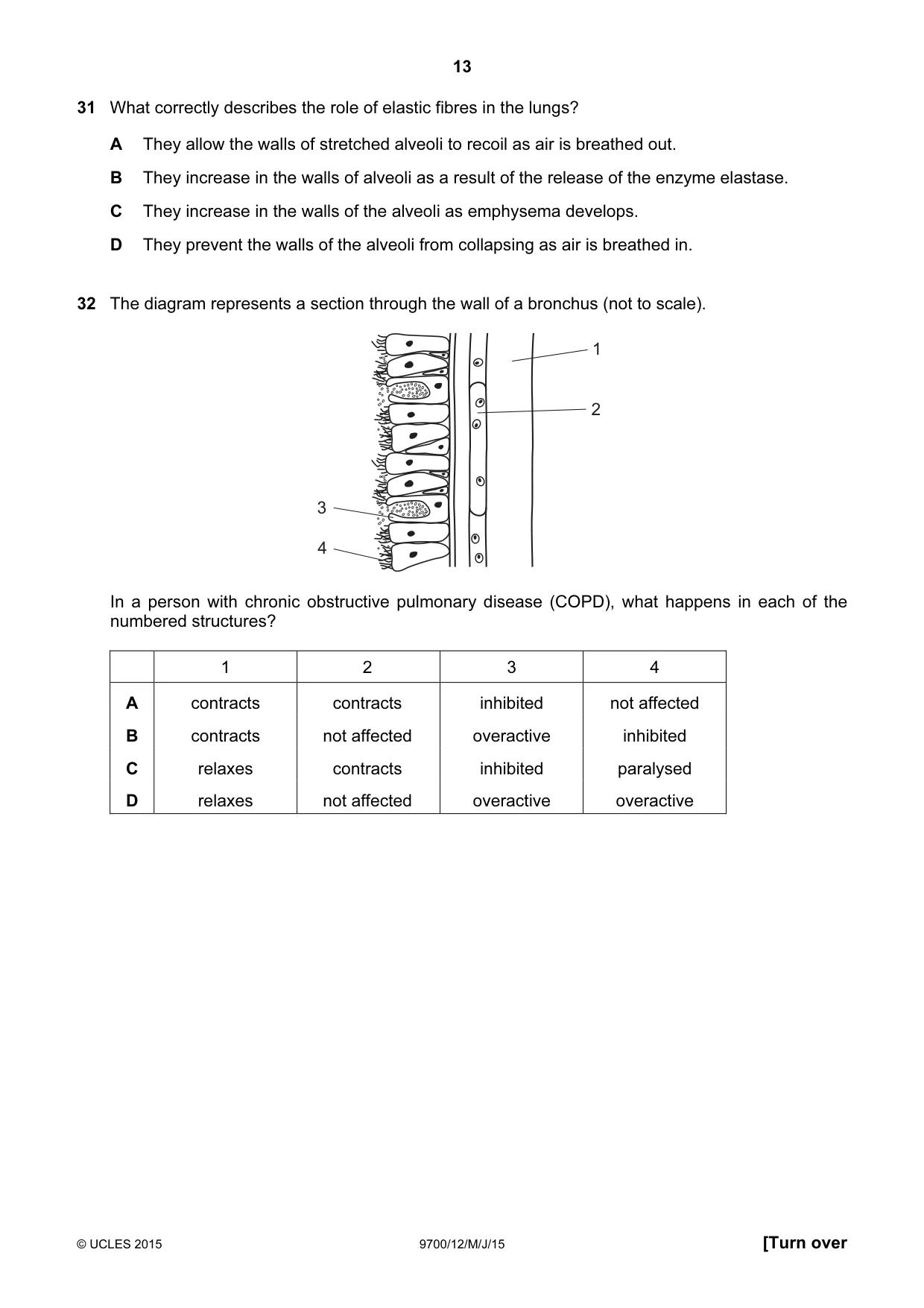
32 The diagram represents a section through the wall of a bronchus (not to scale). 1 2 3 4 In a person with chronic obstructive pulmonary disease (COPD), what happens in each of the numbered structures? 1 2 3 4 A contracts contracts inhibited not affected B contracts not affected overactive inhibited C relaxes contracts inhibited paralysed D relaxes not affected overactive overactive
Mark scheme: B
Q33 · The symptoms of two diseases are listed
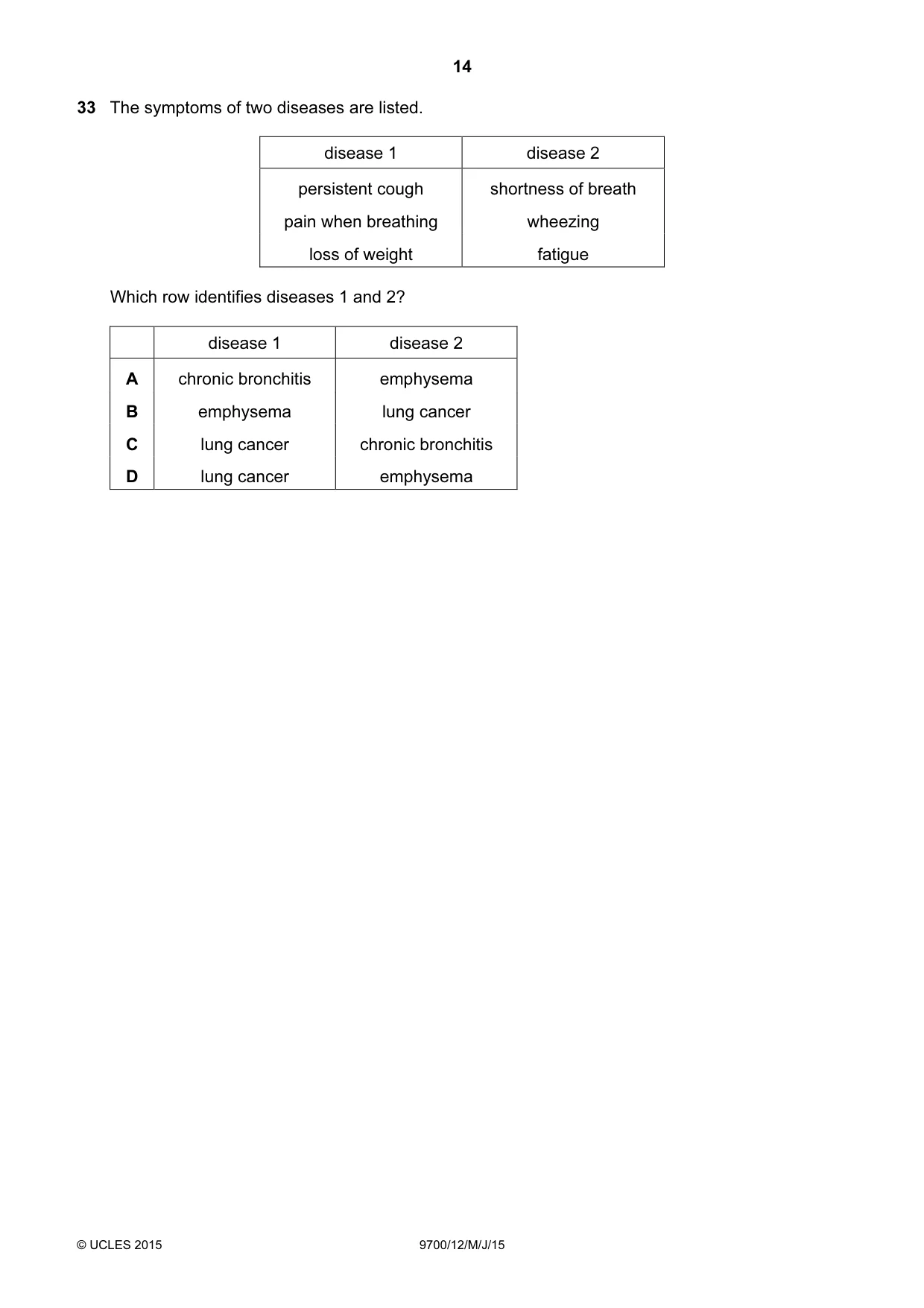
33 The symptoms of two diseases are listed. disease 1 disease 2 persistent cough shortness of breath pain when breathing wheezing loss of weight fatigue Which row identifies diseases 1 and 2? disease 1 disease 2 A chronic bronchitis emphysema B emphysema lung cancer C lung cancer chronic bronchitis D lung cancer emphysema
Mark scheme: D
Q34 · The graph shows the fall in cases of tuberculosis (TB) in a country between 1910 and 2000
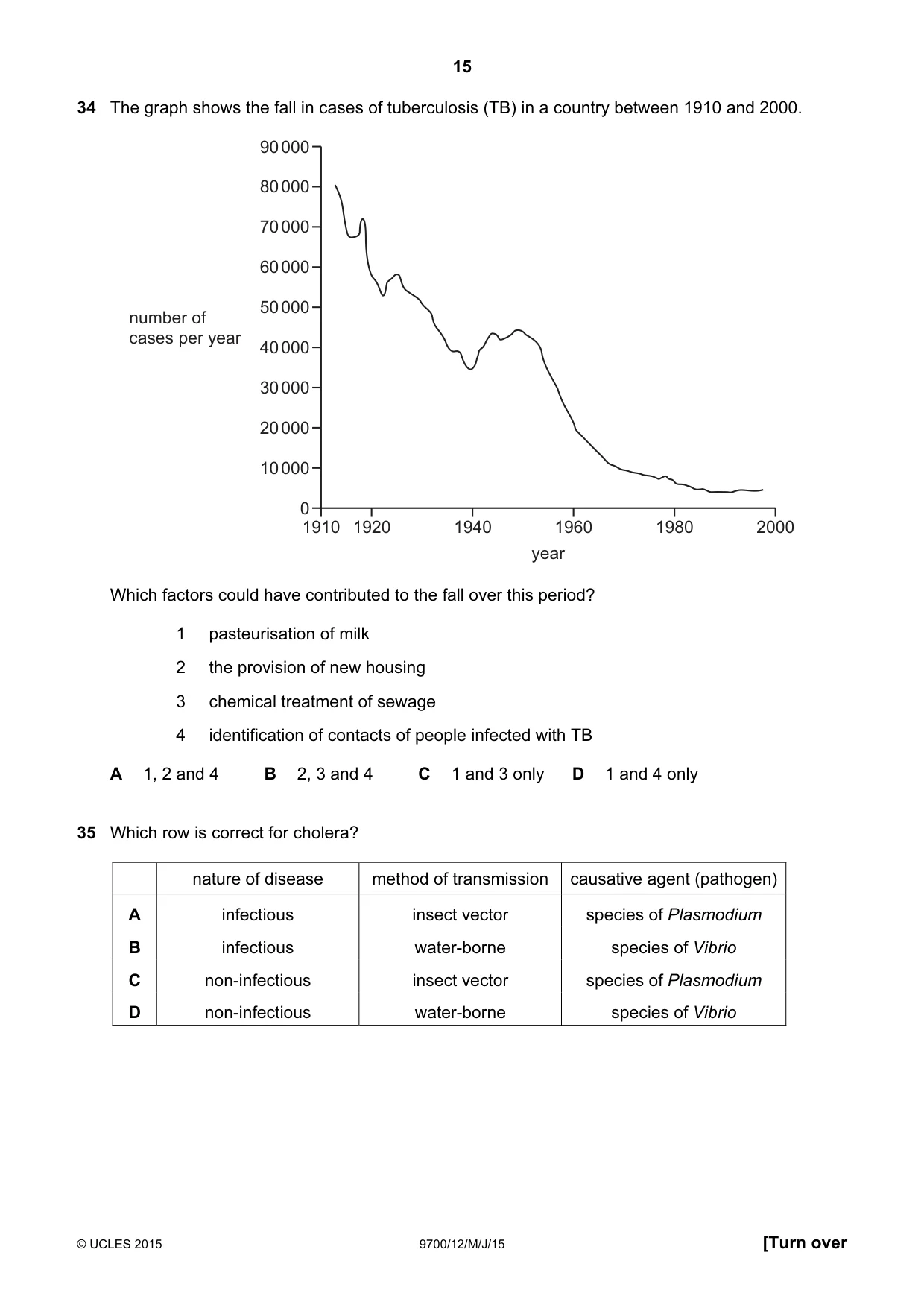
34 The graph shows the fall in cases of tuberculosis (TB) in a country between 1910 and 2000. 90 000 80 000 70 000 60 000 50 000 number of cases per year 40 000 30 000 20 000 10 000 0 1910 1920 1940 1960 1980 2000 year Which factors could have contributed to the fall over this period? 1 pasteurisation of milk 2 the provision of new housing 3 chemical treatment of sewage 4 identification of contacts of people infected with TB A 1, 2 and 4 B 2, 3 and 4 C 1 and 3 only D 1 and 4 only
Mark scheme: A
Q35 · Which row is correct for cholera?
35 Which row is correct for cholera? nature of disease method of transmission causative agent (pathogen) A infectious insect vector species of Plasmodium B infectious water-borne species of Vibrio C non-infectious insect vector species of Plasmodium D non-infectious water-borne species of Vibrio
Mark scheme: B
Q36 · Which action is taken by a B-lymphocyte activated by an antigen?
36 Which action is taken by a B-lymphocyte activated by an antigen? A It attaches to the infected cell displaying the antigen and destroys it. B It divides repeatedly to form a clone of genetically identical plasma cells. C It engulfs the infected body cell which displays the antigen. D It secretes cytokines which stimulate T-lymphocytes to produce plasma cells.
Mark scheme: B
Q37 · The synthesis of specific antibodies in response to vaccination is an example of which…
37 The synthesis of specific antibodies in response to vaccination is an example of which type of immunity? natural artificial active A B passive C D
Mark scheme: B
Q38 · At which stage of a food chain in a tropical grassland is the energy transfer least…
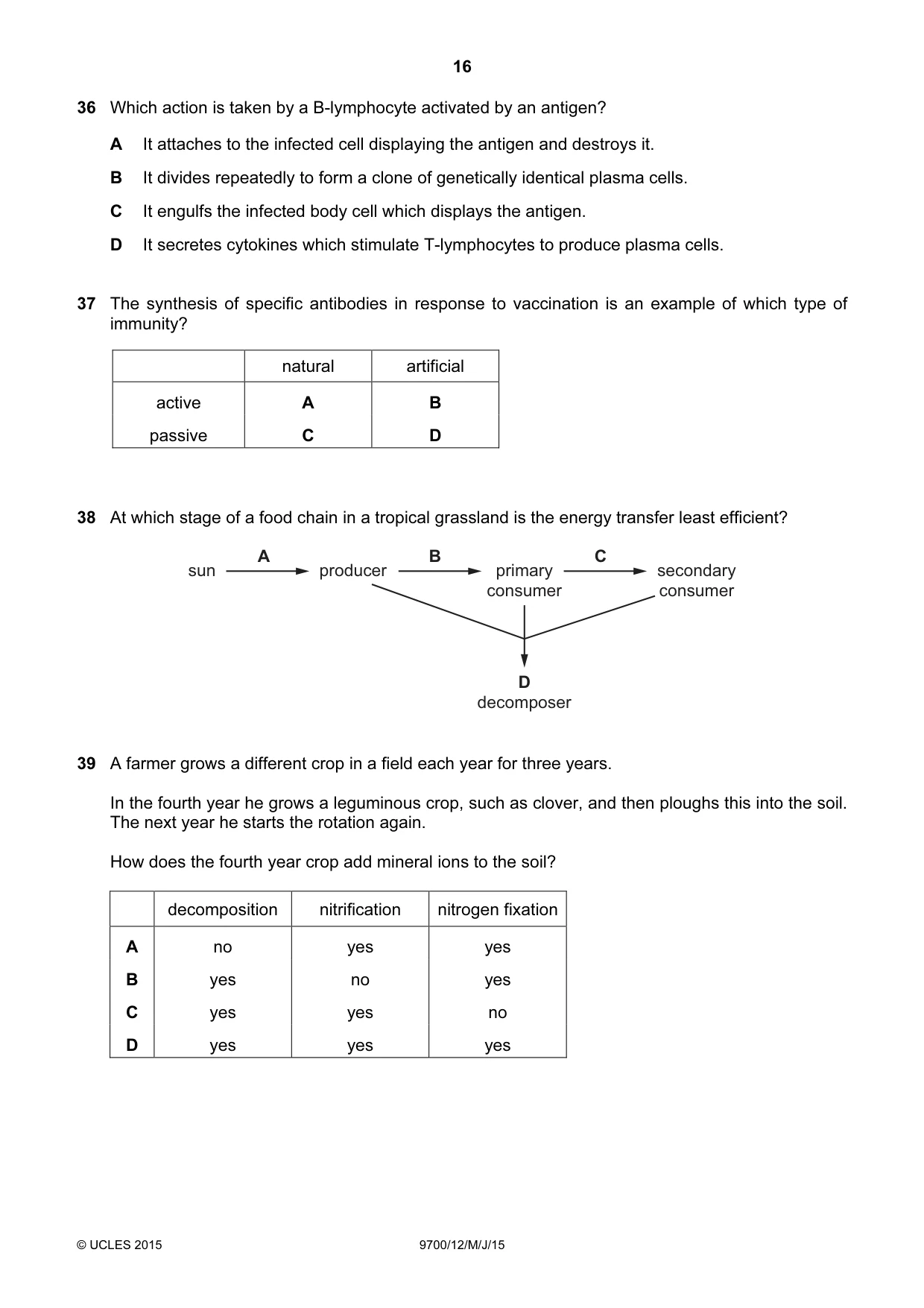
38 At which stage of a food chain in a tropical grassland is the energy transfer least efficient? A B C sun producer primary secondary consumer consumer D decomposer
Mark scheme: A
Q39 · A farmer grows a different crop in a field each year for three years
39 A farmer grows a different crop in a field each year for three years. In the fourth year he grows a leguminous crop, such as clover, and then ploughs this into the soil. The next year he starts the rotation again. How does the fourth year crop add mineral ions to the soil? decomposition nitrification nitrogen fixation A no yes yes B yes no yes C yes yes no D yes yes yes
Mark scheme: D
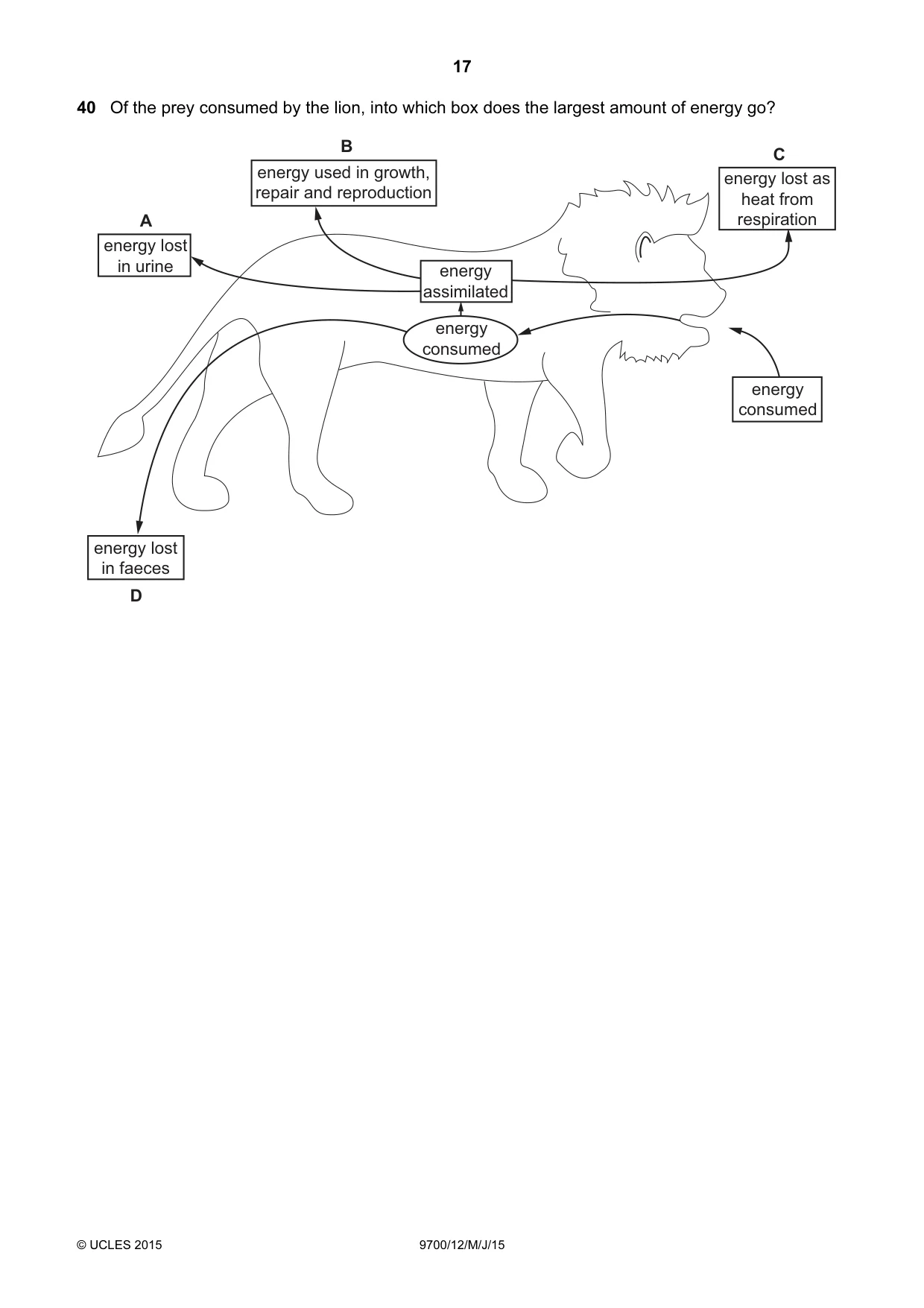
Q40 · Of the prey consumed by the lion, into which box does the largest amount of energy go?
40 Of the prey consumed by the lion, into which box does the largest amount of energy go? B C energy used in growth, energy lost as repair and reproduction heat from A respiration energy lost in urine energy assimilated energy consumed energy consumed energy lost in faeces D
Mark scheme: C
What was in this paper
The subtopics covered by these 40 questions, and how many questions each got. Open one in a new tab to see every Cambridge question on it.
4The gas exchange system3Transport mechanisms3Transport of oxygen and carbon dioxide3Carbohydrates and lipids2Energy2Factors that affect enzyme action2Fluid mosaic membranes2Infectious diseases2Protein synthesis2Proteins2The microscope in cell studies2Antibodies and vaccination1Chromosome behaviour in mitosis1Conservation1Gene control1Movement into and out of cells1Structure of nucleic acids and replication of DNA1Structure of transport tissues1Testing for biological molecules1The heart1The immune system1Water1What you needed in this session
Cambridge’s own grade thresholds for 2015 May/June, Paper 1 · Variant 2. A higher threshold means an easier paper — the bar moves with how the cohort did.