Cambridge A Level Biology 9700 — 2020 May/June Paper 1 · Variant 2
9700/12/M/J/20 · 40 questions · 40 marks · ≈45 min
The question paper and its mark scheme, free to read here and free to download. This is Cambridge’s own paper, exactly as it was sat.
Question paper16 pages
Mark scheme3 pages
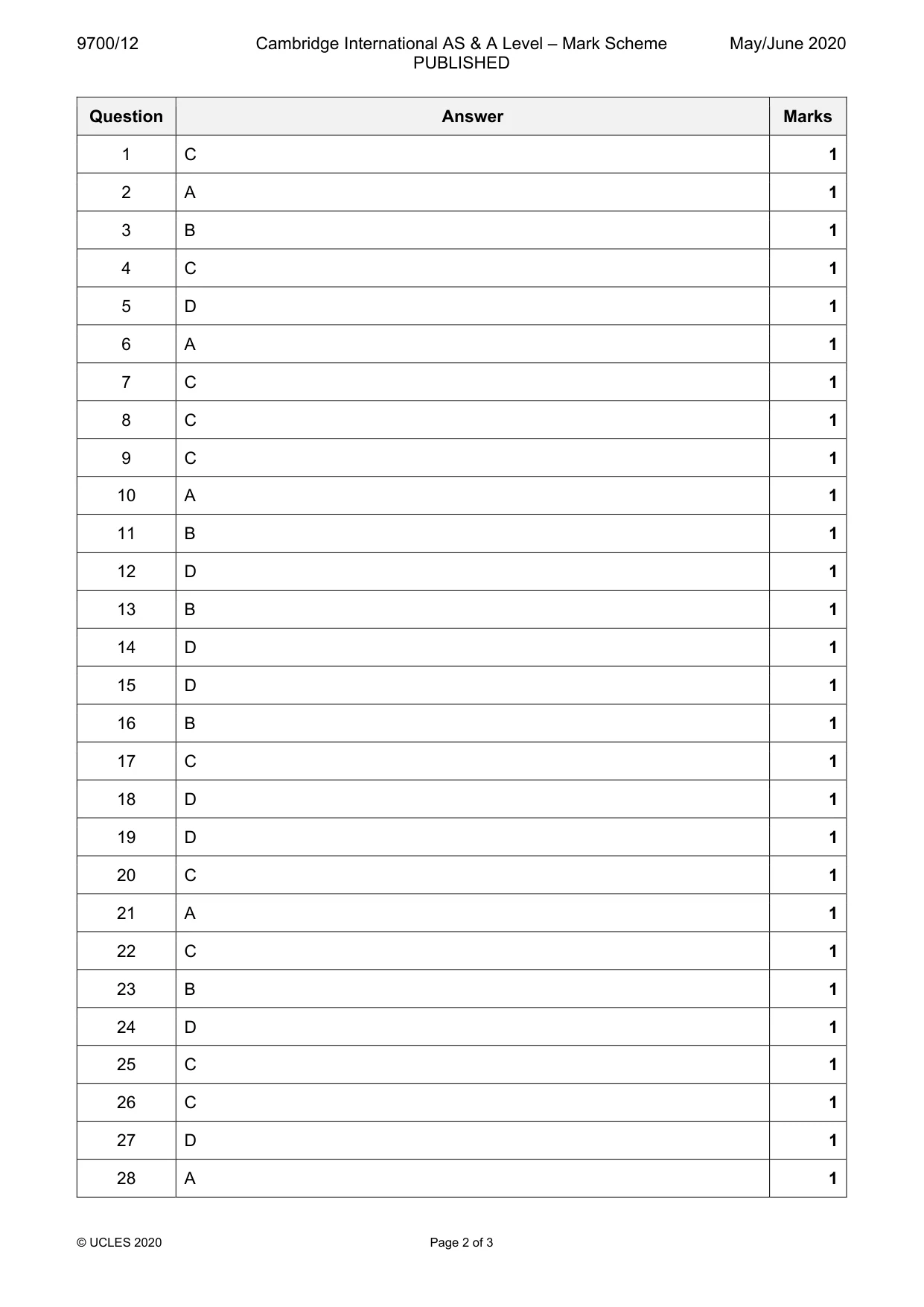
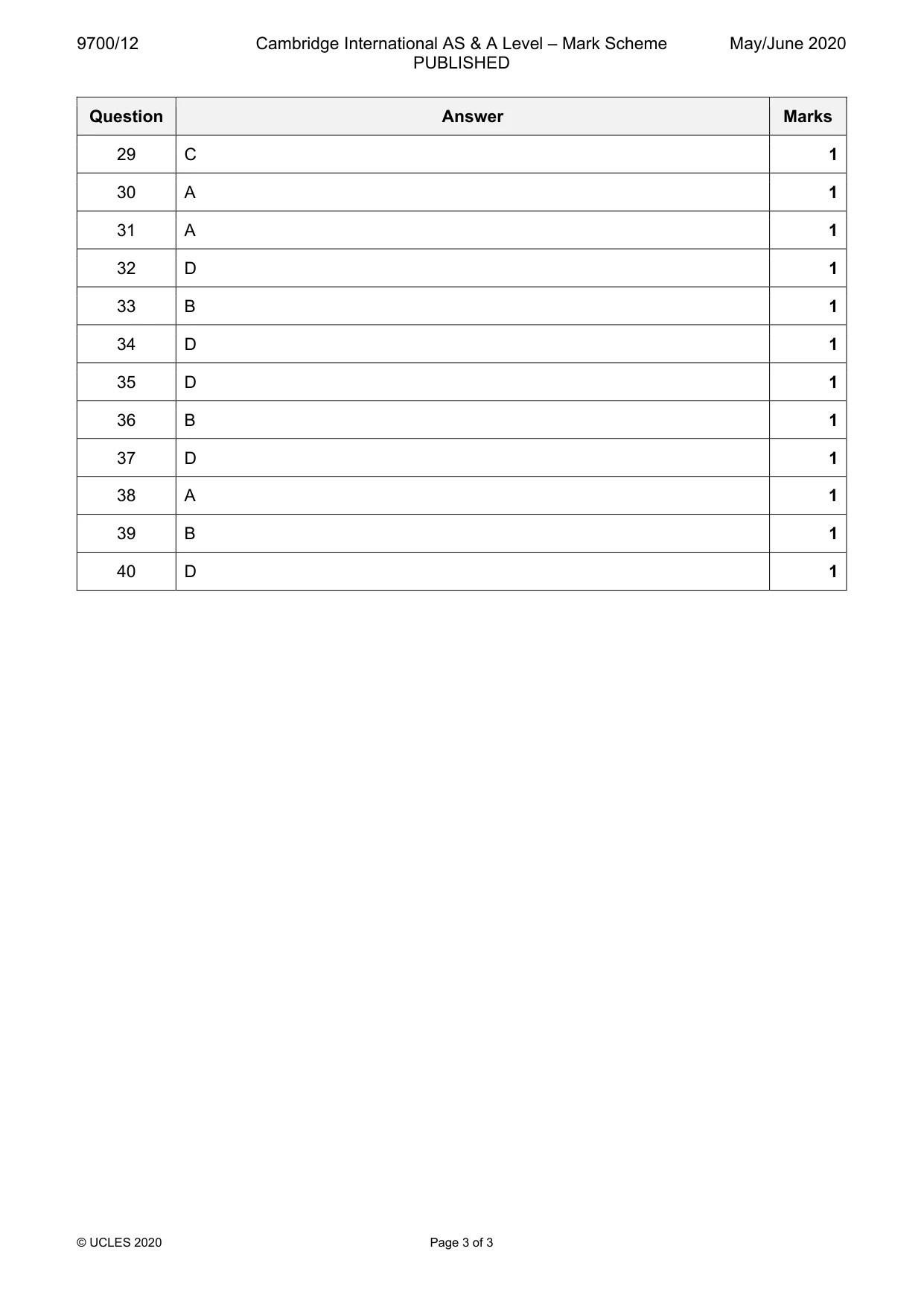
Answers below. Sit the paper first if you are practising.
Questions as text
Q1 · What is the definition of the resolution of a light microscope?
1 What is the definition of the resolution of a light microscope? A the degree of sharpness produced by the microscope B the greatest distance between two objects visible in the same field of view C the minimum distance that allows two objects to be viewed as separate D the size of the smallest object visible using the microscope
Mark scheme: C
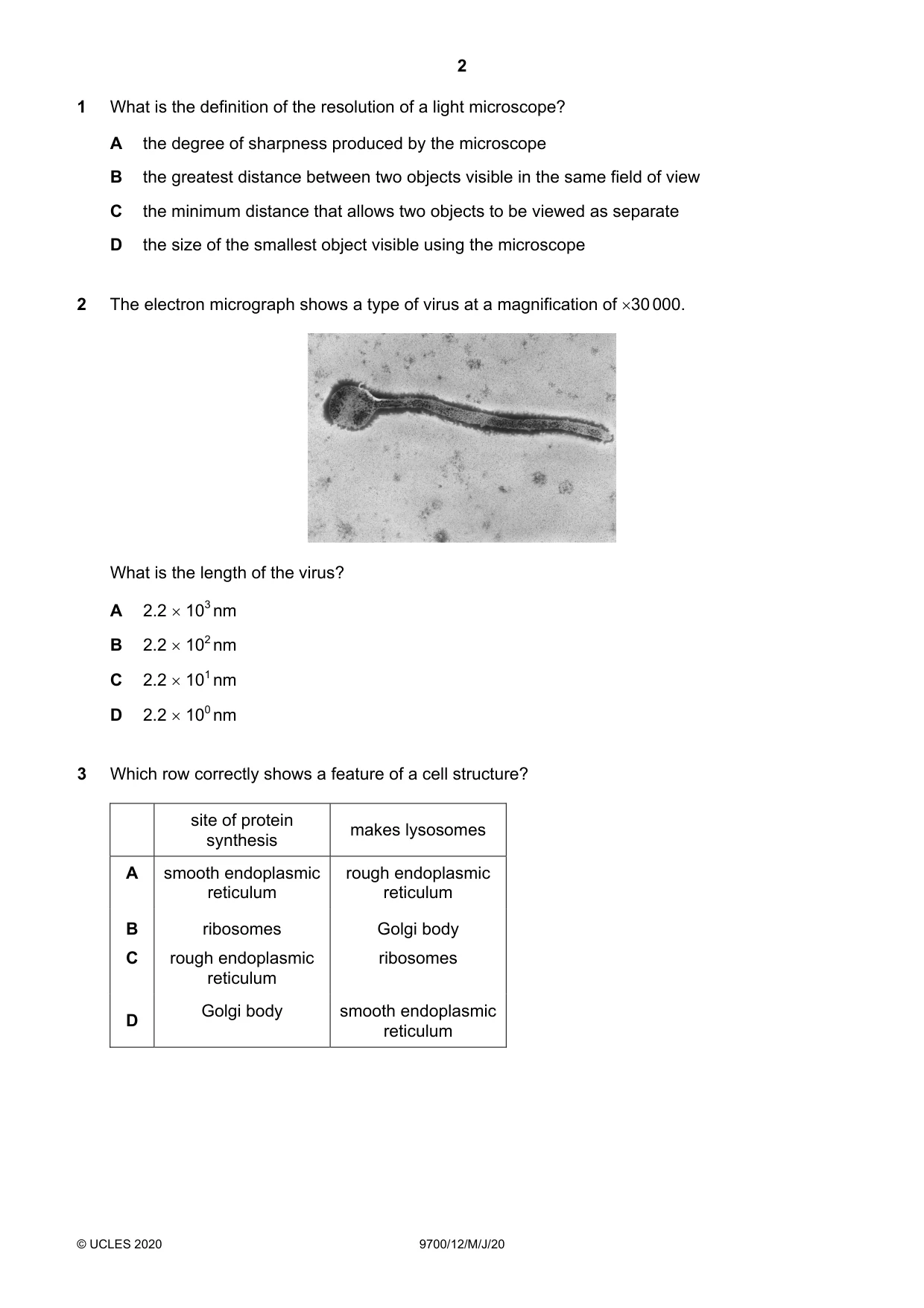
Q2 · The electron micrograph shows a type of virus at a magnification of ×30 000
2 The electron micrograph shows a type of virus at a magnification of ×30 000. What is the length of the virus? A 2.2 × 10³ nm B 2.2 × 10² nm C 2.2 × 101 nm D 2.2 × 100 nm
Mark scheme: A
Q3 · Which row correctly shows a feature of a cell structure?
3 Which row correctly shows a feature of a cell structure? site of protein makes lysosomes synthesis A smooth endoplasmic rough endoplasmic reticulum reticulum B ribosomes Golgi body C rough endoplasmic ribosomes reticulum Golgi body smooth endoplasmic D reticulum
Mark scheme: B
More questions on Cells as the basic units of living organisms
Q4 · Four students were asked to match the function with the appearance of some cell…
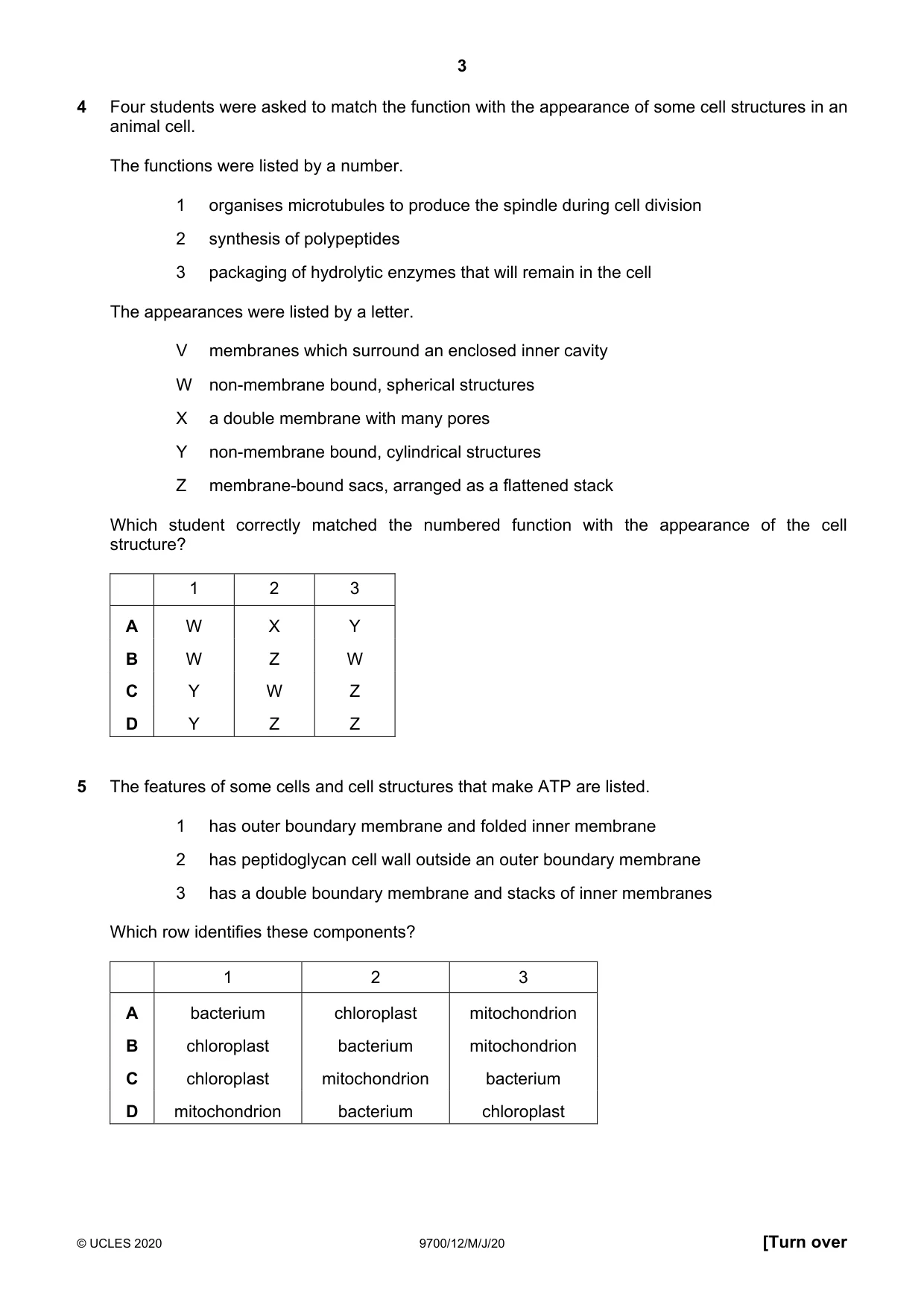
4 Four students were asked to match the function with the appearance of some cell structures in an animal cell. The functions were listed by a number. 1 organises microtubules to produce the spindle during cell division 2 synthesis of polypeptides 3 packaging of hydrolytic enzymes that will remain in the cell The appearances were listed by a letter. V membranes which surround an enclosed inner cavity W non-membrane bound, spherical structures X a double membrane with many pores Y non-membrane bound, cylindrical structures Z membrane-bound sacs, arranged as a flattened stack Which student correctly matched the numbered function with the appearance of the cell structure? 1 2 3 A W X Y B W Z W C Y W Z D Y Z Z
Mark scheme: C
More questions on Cells as the basic units of living organisms
Q5 · The features of some cells and cell structures that make ATP are listed
5 The features of some cells and cell structures that make ATP are listed. 1 has outer boundary membrane and folded inner membrane 2 has peptidoglycan cell wall outside an outer boundary membrane 3 has a double boundary membrane and stacks of inner membranes Which row identifies these components? 1 2 3 A bacterium chloroplast mitochondrion B chloroplast bacterium mitochondrion C chloroplast mitochondrion bacterium D mitochondrion bacterium chloroplast
Mark scheme: D
More questions on Cells as the basic units of living organisms
Q6 · Mitochondria are thought to have evolved from prokaryotic cells that were ingested by an…
6 Mitochondria are thought to have evolved from prokaryotic cells that were ingested by an ancestral cell. Which feature have these prokaryotes lost during their evolution into mitochondria? A cell wall B circular chromosome C internal membranes D ribosomes
Mark scheme: A
More questions on Cells as the basic units of living organisms
Q7 · A student carried out the Benedict’s test on a sample and got a negative result
7 A student carried out the Benedict’s test on a sample and got a negative result. What should the student do to confirm there are no sugars present in the sample? A boil the sample for 5 minutes then repeat the Benedict’s test B boil with alkali, neutralise with hydrochloric acid and repeat the Benedict’s test C boil with hydrochloric acid, neutralise with alkali and repeat the Benedict’s test D repeat the Benedict’s test but add more Benedict’s reagent
Mark scheme: C
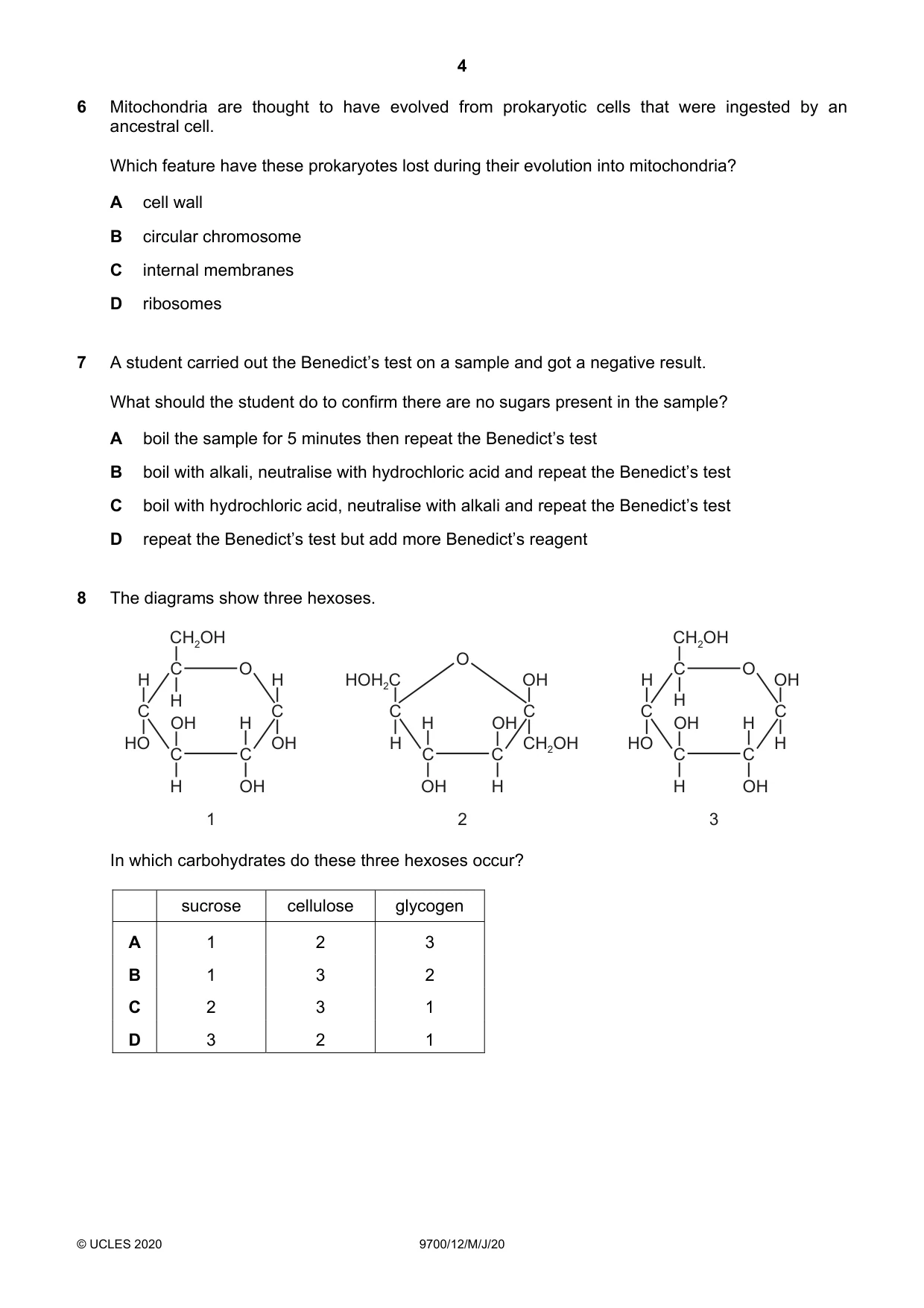
Q8 · The diagrams show three hexoses
8 The diagrams show three hexoses. CH2OH CH2OH O C O C O H H HOH2C OH H OH H H C C C C C C OH H H OH OH H HO OH H CH2OH HO H C C C C C C H OH OH H H OH 1 2 3 In which carbohydrates do these three hexoses occur? sucrose cellulose glycogen A 1 2 3 B 1 3 2 C 2 3 1 D 3 2 1
Mark scheme: C
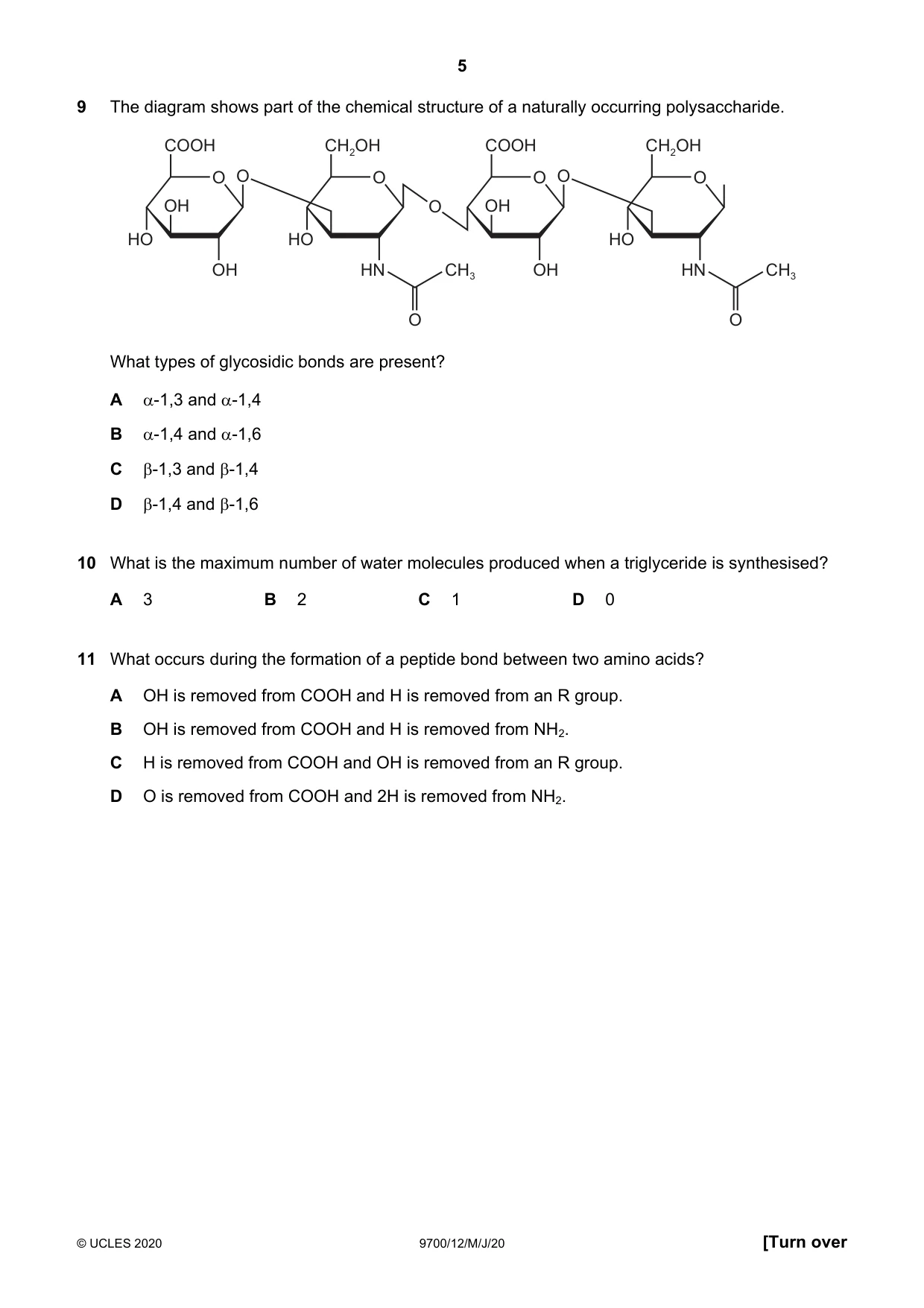
Q9 · The diagram shows part of the chemical structure of a naturally occurring polysaccharide
9 The diagram shows part of the chemical structure of a naturally occurring polysaccharide. COOH CH2OH COOH CH2OH O O O O O O O O O O OH O OH HO HO HO OH HN CH3 OH HN CH3 O O What types of glycosidic bonds are present? A α-1,3 and α-1,4 B α-1,4 and α-1,6 C β-1,3 and β-1,4 D β-1,4 and β-1,6
Mark scheme: C
Q10 · What is the maximum number of water molecules produced when a triglyceride is synthesised?
10 What is the maximum number of water molecules produced when a triglyceride is synthesised? A 3 B 2 C 1 D 0
Mark scheme: A
Q11 · What occurs during the formation of a peptide bond between two amino acids?
11 What occurs during the formation of a peptide bond between two amino acids? A OH is removed from COOH and H is removed from an R group. B OH is removed from COOH and H is removed from NH2. C H is removed from COOH and OH is removed from an R group. D O is removed from COOH and 2H is removed from NH2.
Mark scheme: B
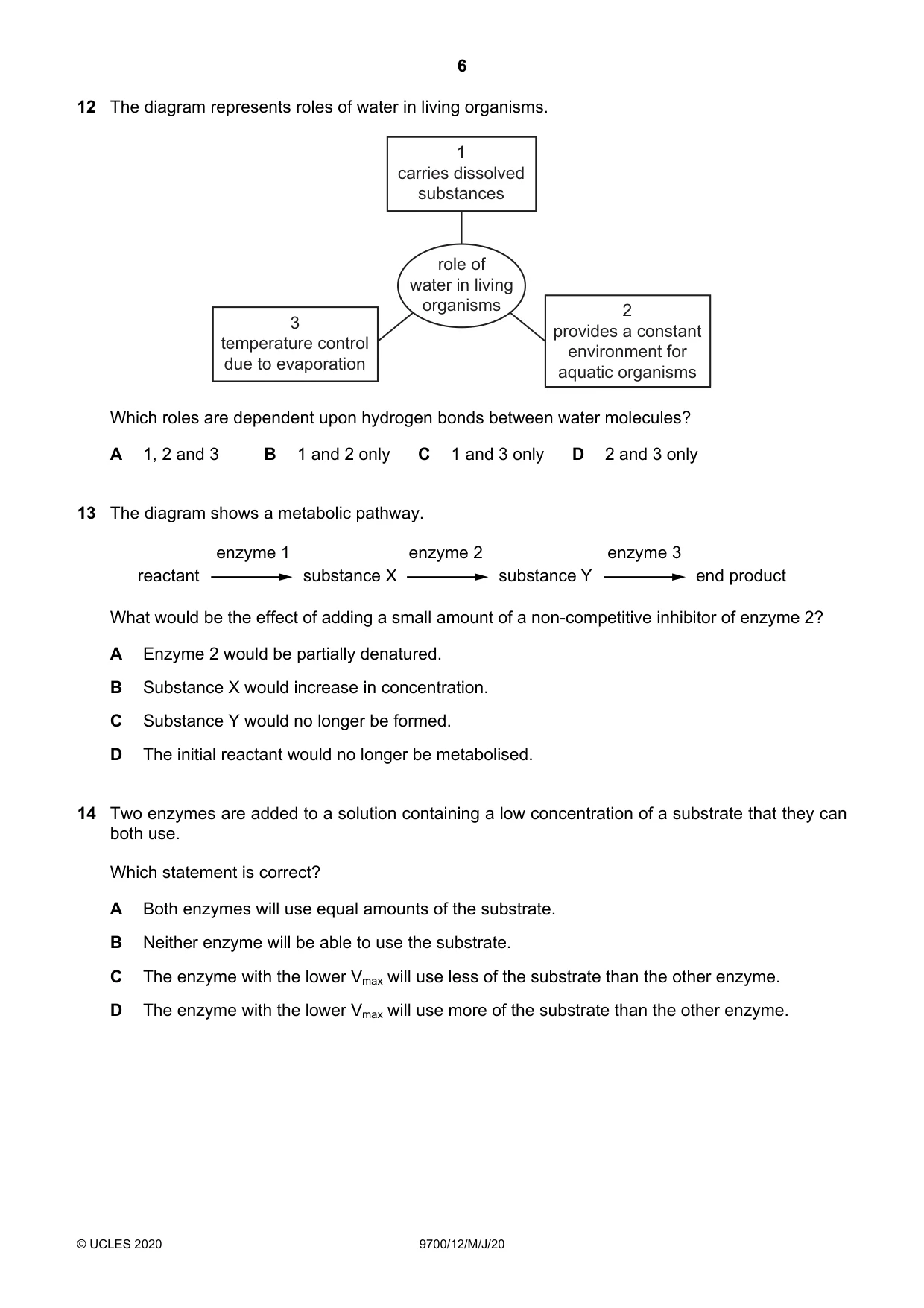
Q12 · The diagram represents roles of water in living organisms
12 The diagram represents roles of water in living organisms. 1 carries dissolved substances role of water in living organisms 2 3 provides a constant temperature control environment for due to evaporation aquatic organisms Which roles are dependent upon hydrogen bonds between water molecules? A 1, 2 and 3 B 1 and 2 only C 1 and 3 only D 2 and 3 only
Mark scheme: D
Q13 · The diagram shows a metabolic pathway
13 The diagram shows a metabolic pathway. enzyme 1 enzyme 2 enzyme 3 reactant substance X substance Y end product What would be the effect of adding a small amount of a non-competitive inhibitor of enzyme 2? A Enzyme 2 would be partially denatured. B Substance X would increase in concentration. C Substance Y would no longer be formed. D The initial reactant would no longer be metabolised.
Mark scheme: B
Q14 · Two enzymes are added to a solution containing a low concentration of a substrate that…
14 Two enzymes are added to a solution containing a low concentration of a substrate that they can both use. Which statement is correct? A Both enzymes will use equal amounts of the substrate. B Neither enzyme will be able to use the substrate. C The enzyme with the lower Vmax will use less of the substrate than the other enzyme. D The enzyme with the lower Vmax will use more of the substrate than the other enzyme.
Mark scheme: D
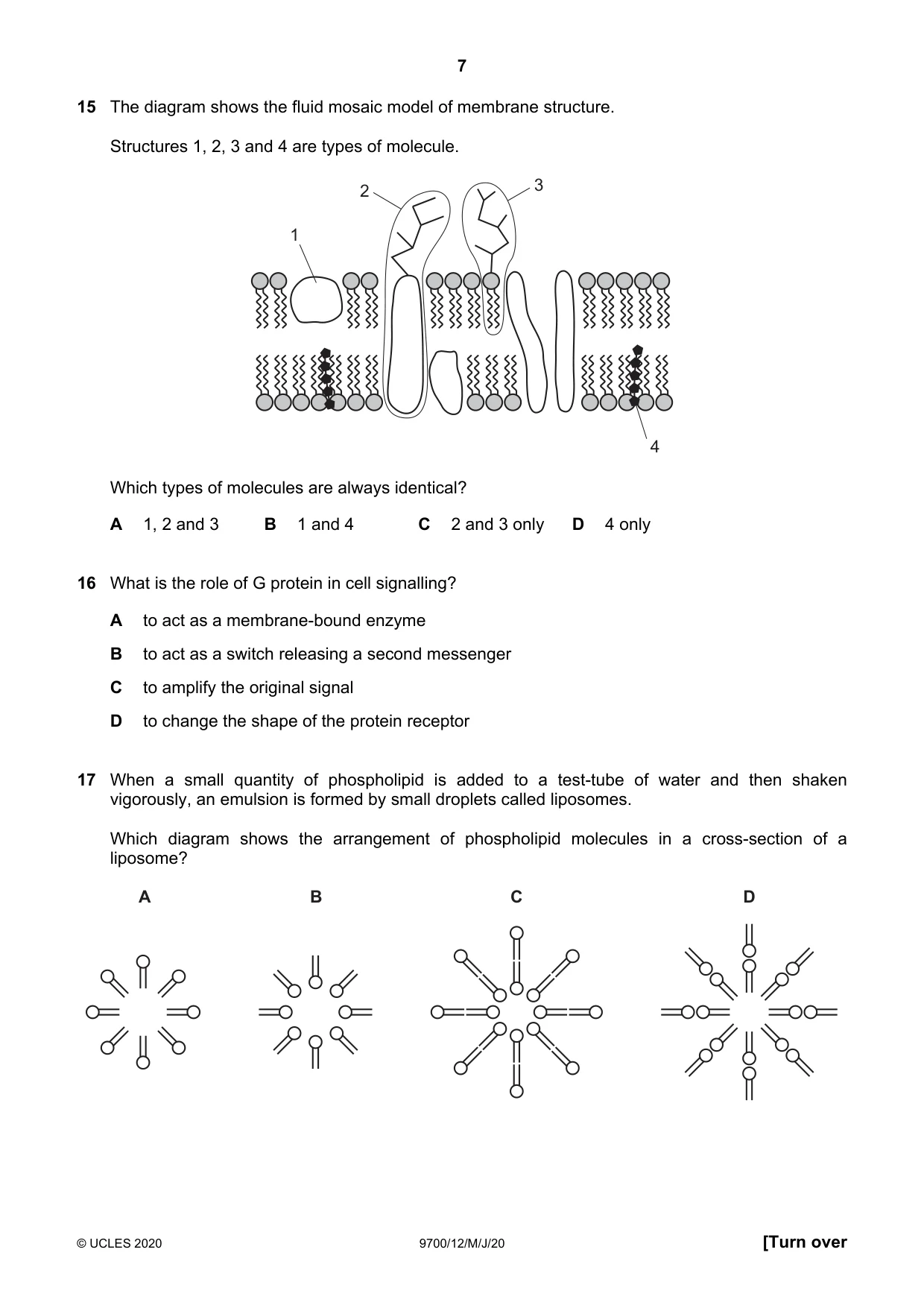
Q15 · The diagram shows the fluid mosaic model of membrane structure
15 The diagram shows the fluid mosaic model of membrane structure. Structures 1, 2, 3 and 4 are types of molecule. 2 3 1 4 Which types of molecules are always identical? A 1, 2 and 3 B 1 and 4 C 2 and 3 only D 4 only
Mark scheme: D
Q16 · What is the role of G protein in cell signalling?
16 What is the role of G protein in cell signalling? A to act as a membrane-bound enzyme B to act as a switch releasing a second messenger C to amplify the original signal D to change the shape of the protein receptor
Mark scheme: B
Q17 · When a small quantity of phospholipid is added to a test-tube of water and then shaken…
17 When a small quantity of phospholipid is added to a test-tube of water and then shaken vigorously, an emulsion is formed by small droplets called liposomes. Which diagram shows the arrangement of phospholipid molecules in a cross-section of a liposome? A B C D
Mark scheme: C
Q18 · What are the features of facilitated diffusion?
18 What are the features of facilitated diffusion? 1 It uses protein channels in the membrane and is driven by the energy from ATP. 2 It moves molecules from regions of higher concentration to lower concentration and is driven by the kinetic energy of the molecules which are diffusing. 3 It uses protein channels in the membrane, and the maximum rate of diffusion depends on the number of these channels. A 1, 2 and 3 B 1 and 2 only C 1 and 3 only D 2 and 3 only
Mark scheme: D
Q19 · Which description of chromosome structure is correct?
19 Which description of chromosome structure is correct? A A chromosome at the beginning of interphase consists of two identical chromatids, each containing one linear molecule of DNA. B Telomeres are lengths of non-coding DNA found at one end of each chromatid to prevent loss of genes during cell division. C The two identical chromatids of a chromosome are held together by a centromere in which there is no DNA. D The very long DNA molecule of each chromatid is coiled and held together by proteins called histones.
Mark scheme: D
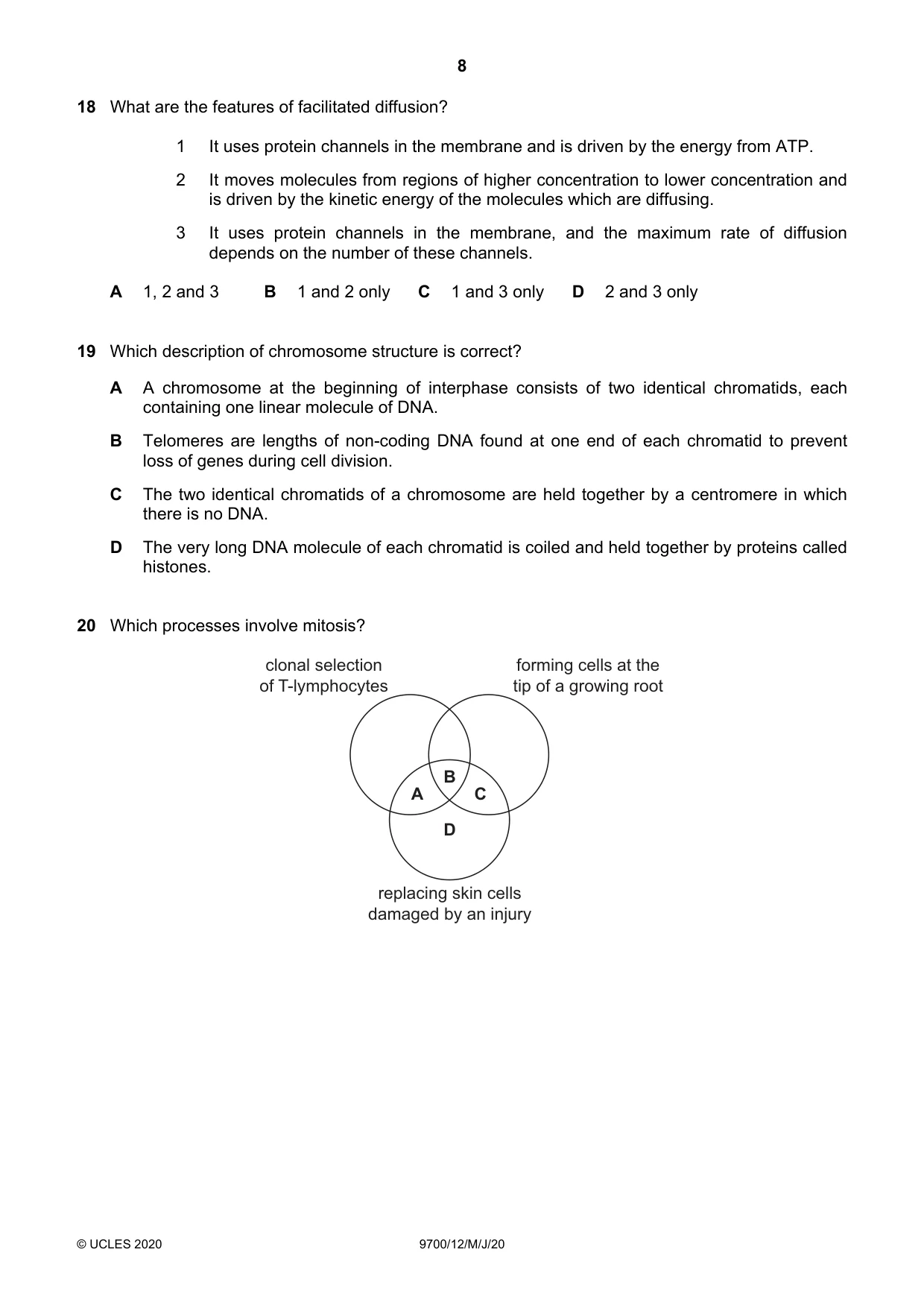
Q20 · Which processes involve mitosis?
20 Which processes involve mitosis? clonal selection forming cells at the of T-lymphocytes tip of a growing root B A C D replacing skin cells damaged by an injury
Mark scheme: C
More questions on Replication and division of nuclei and cells
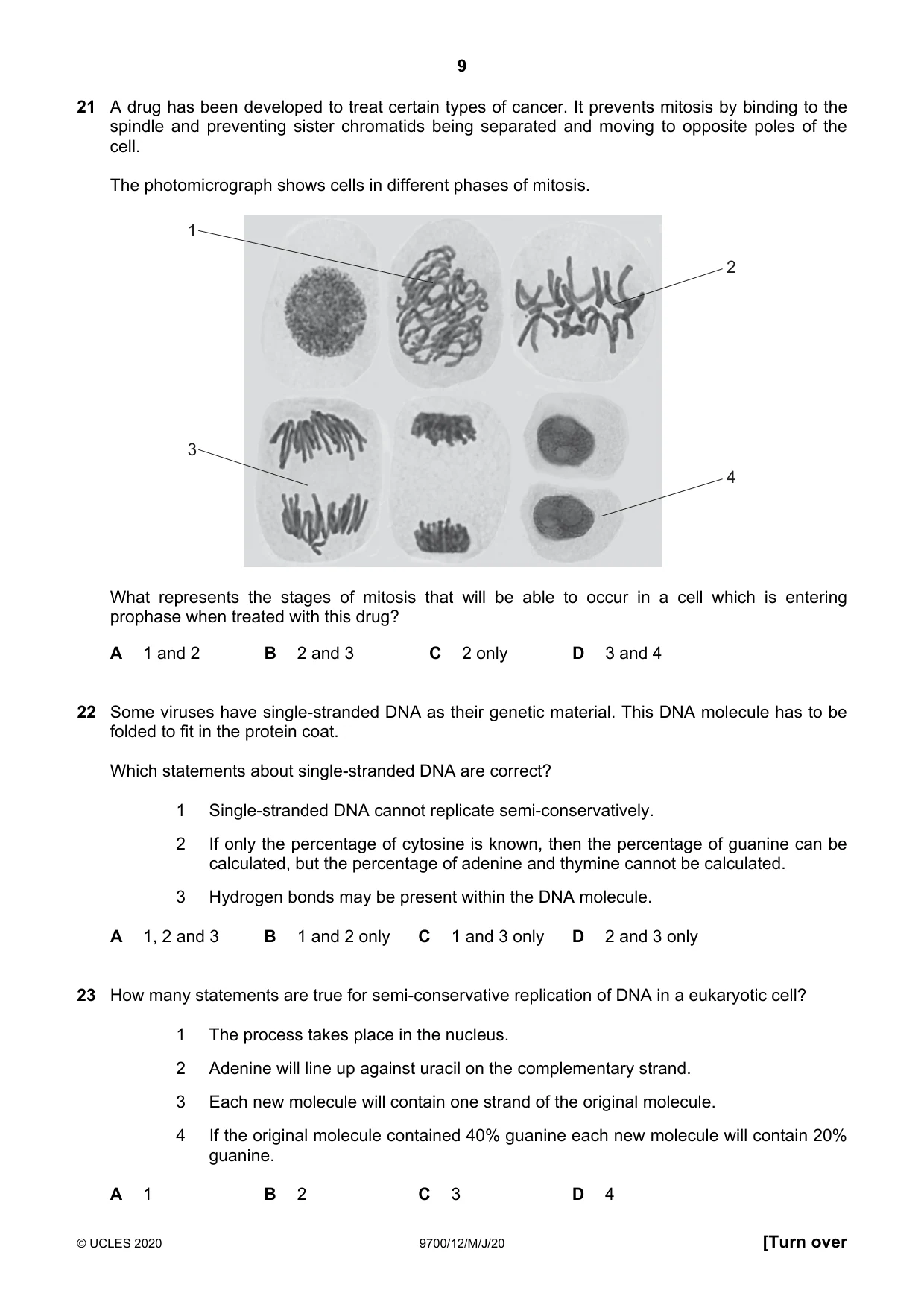
Q21 · A drug has been developed to treat certain types of cancer
21 A drug has been developed to treat certain types of cancer. It prevents mitosis by binding to the spindle and preventing sister chromatids being separated and moving to opposite poles of the cell. The photomicrograph shows cells in different phases of mitosis. 1 2 3 4 What represents the stages of mitosis that will be able to occur in a cell which is entering prophase when treated with this drug? A 1 and 2 B 2 and 3 C 2 only D 3 and 4
Mark scheme: A
Q22 · Some viruses have single-stranded DNA as their genetic material
22 Some viruses have single-stranded DNA as their genetic material. This DNA molecule has to be folded to fit in the protein coat. Which statements about single-stranded DNA are correct? 1 Single-stranded DNA cannot replicate semi-conservatively. 2 If only the percentage of cytosine is known, then the percentage of guanine can be calculated, but the percentage of adenine and thymine cannot be calculated. 3 Hydrogen bonds may be present within the DNA molecule. A 1, 2 and 3 B 1 and 2 only C 1 and 3 only D 2 and 3 only
Mark scheme: C
More questions on Structure of nucleic acids and replication of DNA
Q23 · How many statements are true for semi-conservative replication of DNA in a eukaryotic…
23 How many statements are true for semi-conservative replication of DNA in a eukaryotic cell? 1 The process takes place in the nucleus. 2 Adenine will line up against uracil on the complementary strand. 3 Each new molecule will contain one strand of the original molecule. 4 If the original molecule contained 40% guanine each new molecule will contain 20% guanine. A 1 B 2 C 3 D 4
Mark scheme: B
More questions on Structure of nucleic acids and replication of DNA
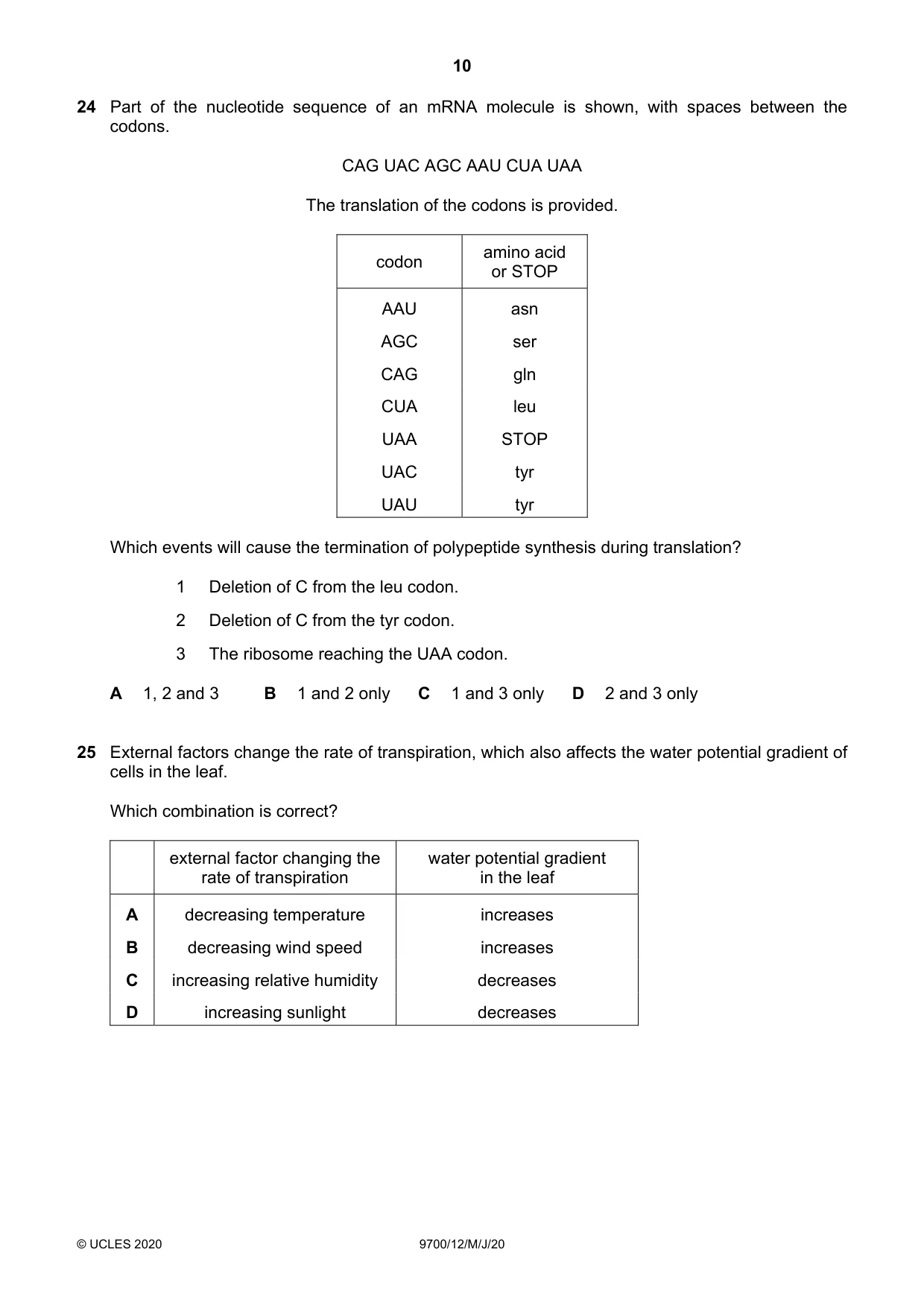
Q24 · Part of the nucleotide sequence of an mRNA molecule is shown, with spaces between the…
24 Part of the nucleotide sequence of an mRNA molecule is shown, with spaces between the codons. CAG UAC AGC AAU CUA UAA The translation of the codons is provided. amino acid codon or STOP AAU asn AGC ser CAG gln CUA leu UAA STOP UAC tyr UAU tyr Which events will cause the termination of polypeptide synthesis during translation? 1 Deletion of C from the leu codon. 2 Deletion of C from the tyr codon. 3 The ribosome reaching the UAA codon. A 1, 2 and 3 B 1 and 2 only C 1 and 3 only D 2 and 3 only
Mark scheme: D
Q25 · External factors change the rate of transpiration, which also affects the water potential…
25 External factors change the rate of transpiration, which also affects the water potential gradient of cells in the leaf. Which combination is correct? external factor changing the water potential gradient rate of transpiration in the leaf A decreasing temperature increases B decreasing wind speed increases C increasing relative humidity decreases D increasing sunlight decreases
Mark scheme: C
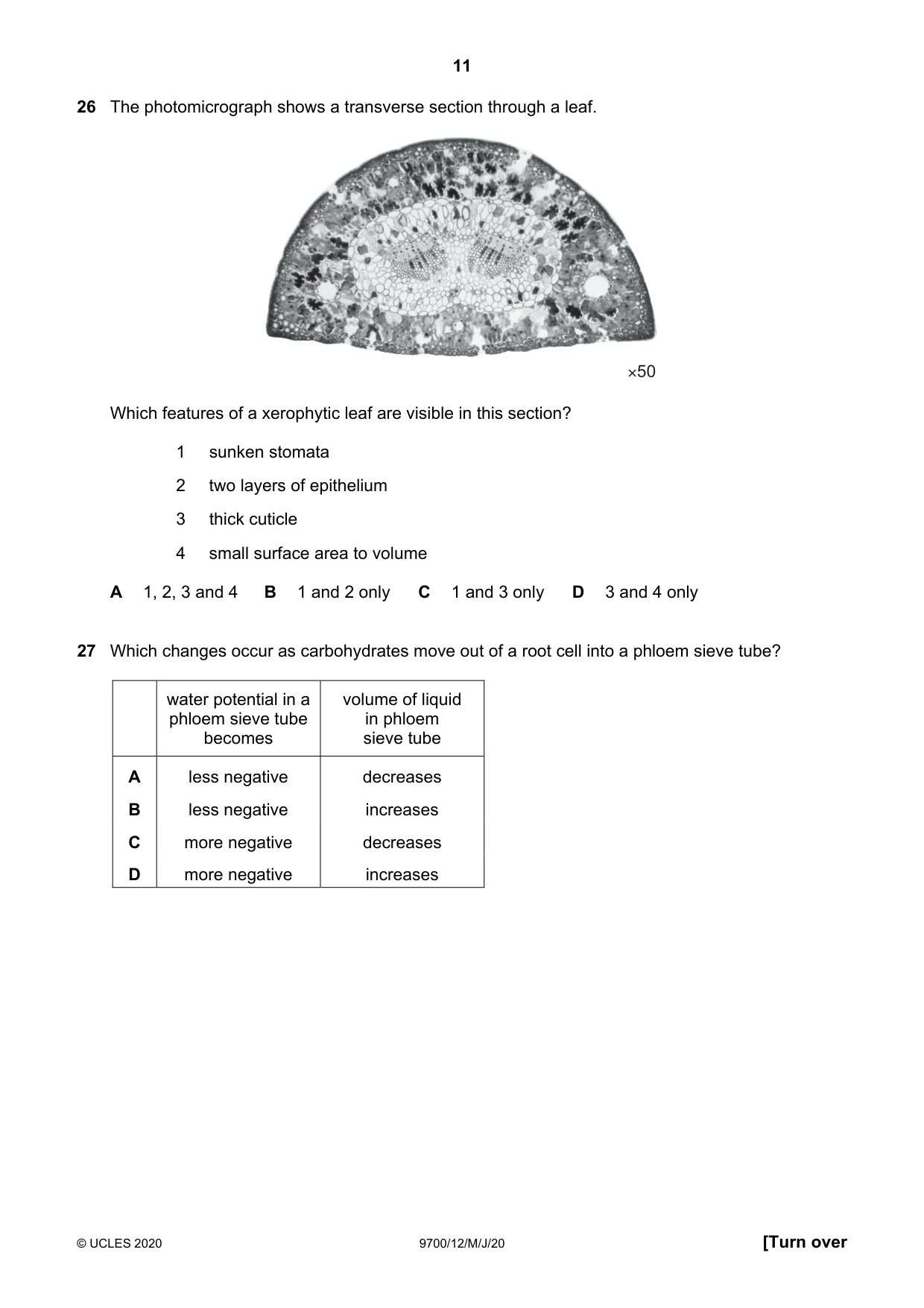
Q26 · The photomicrograph shows a transverse section through a leaf
26 The photomicrograph shows a transverse section through a leaf. ×50 Which features of a xerophytic leaf are visible in this section? 1 sunken stomata 2 two layers of epithelium 3 thick cuticle 4 small surface area to volume A 1, 2, 3 and 4 B 1 and 2 only C 1 and 3 only D 3 and 4 only
Mark scheme: C
Q27 · Which changes occur as carbohydrates move out of a root cell into a phloem sieve tube?
27 Which changes occur as carbohydrates move out of a root cell into a phloem sieve tube? water potential in a volume of liquid phloem sieve tube in phloem becomes sieve tube A less negative decreases B less negative increases C more negative decreases D more negative increases
Mark scheme: D
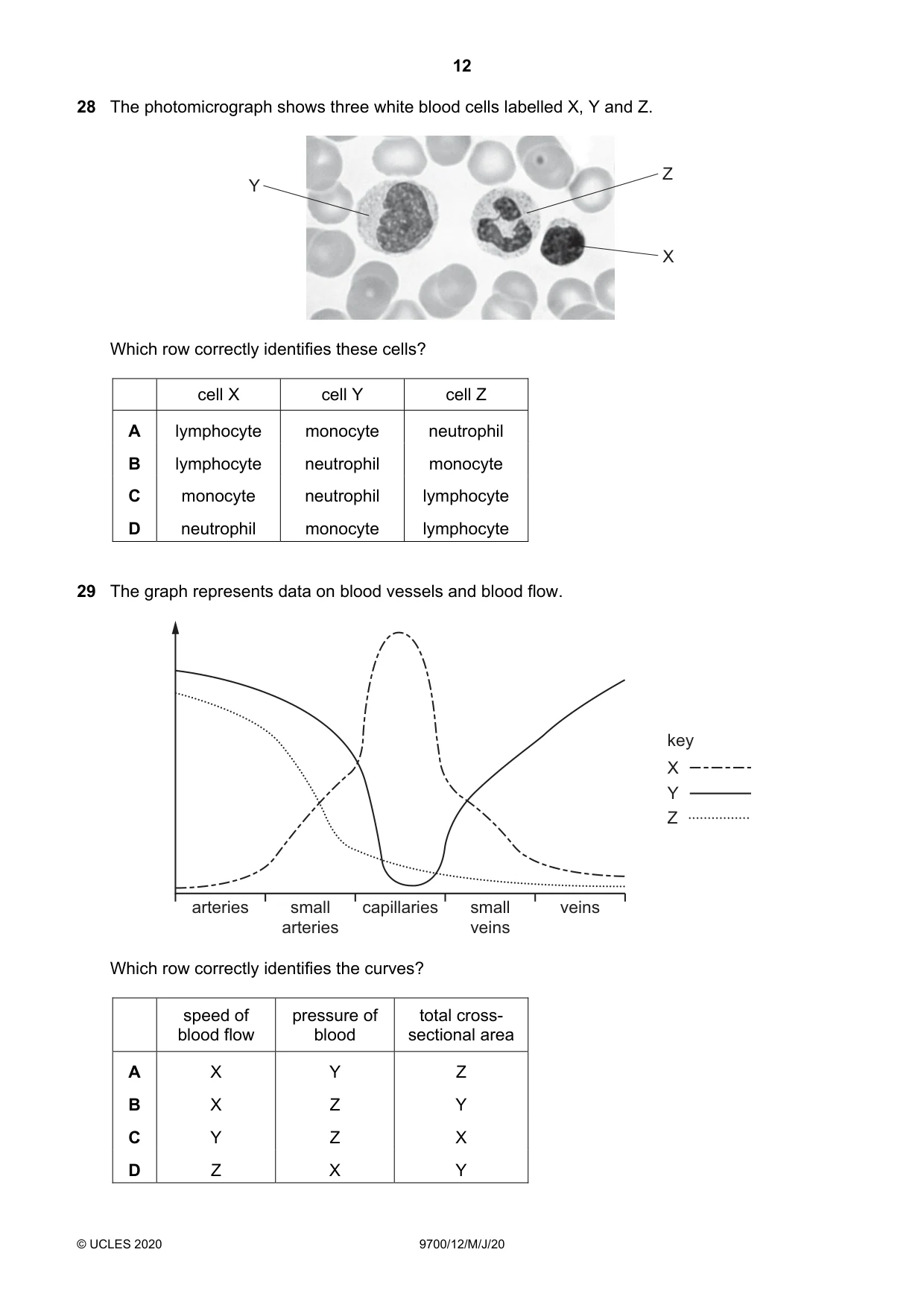
Q28 · The photomicrograph shows three white blood cells labelled X, Y and Z
28 The photomicrograph shows three white blood cells labelled X, Y and Z. Z Y X Which row correctly identifies these cells? cell X cell Y cell Z A lymphocyte monocyte neutrophil B lymphocyte neutrophil monocyte C monocyte neutrophil lymphocyte D neutrophil monocyte lymphocyte
Mark scheme: A
Q29 · The graph represents data on blood vessels and blood flow
29 The graph represents data on blood vessels and blood flow. key X Y Z arteries small capillaries small veins arteries veins Which row correctly identifies the curves? speed of pressure of total cross- blood flow blood sectional area A X Y Z B X Z Y C Y Z X D Z X Y
Mark scheme: C
Q30 · Which components of blood are present in lymph?
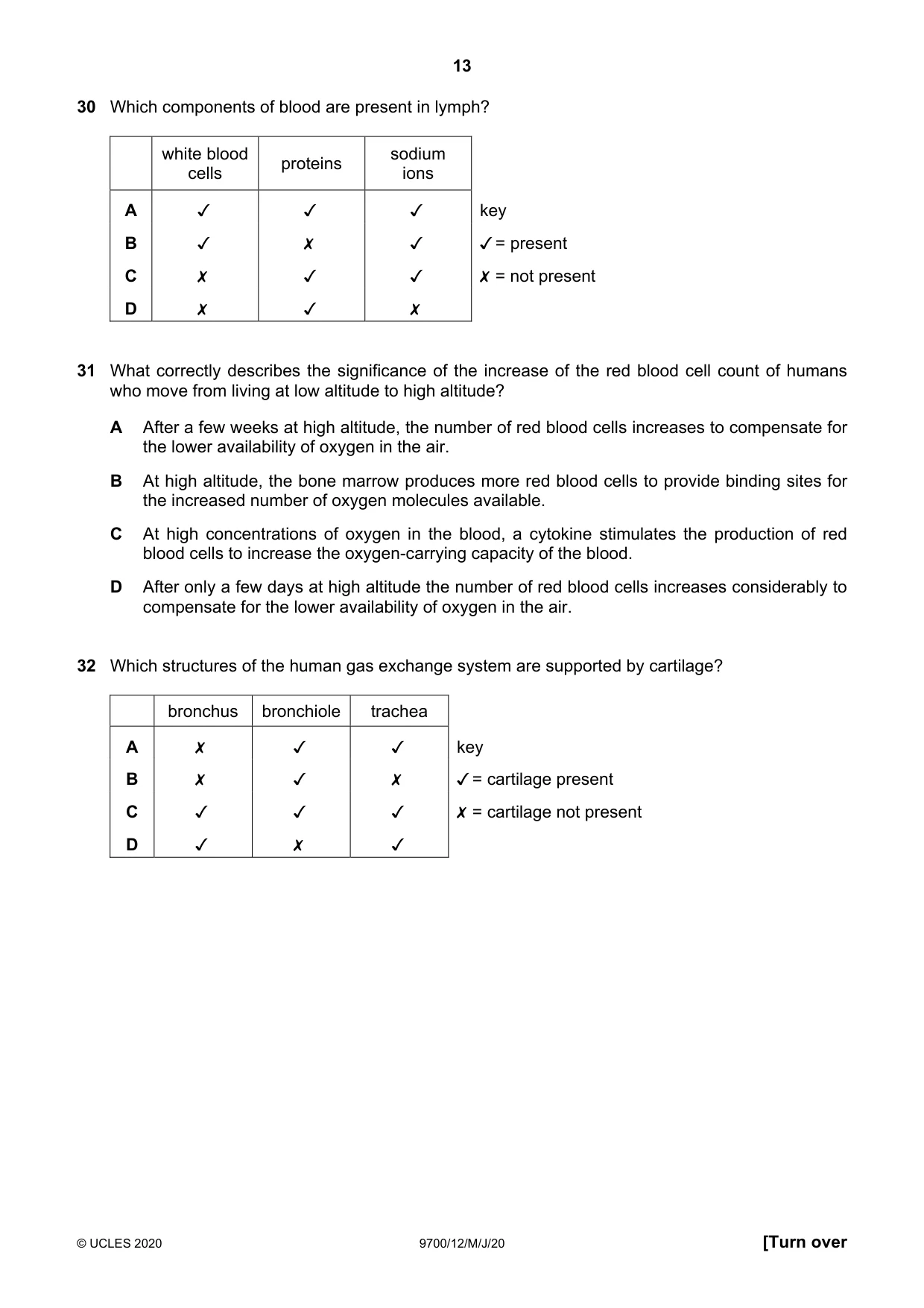
30 Which components of blood are present in lymph? white blood . sodium proteins : cells ions A Jv J Jv key B v x v /¥ = present Cc x v Jv X = not present D x v x
Mark scheme: A
Q31 · What correctly describes the significance of the increase of the red blood cell count of…
31 What correctly describes the significance of the increase of the red blood cell count of humans who move from living at low altitude to high altitude? A After a few weeks at high altitude, the number of red blood cells increases to compensate for the lower availability of oxygen in the air. B At high altitude, the bone marrow produces more red blood cells to provide binding sites for the increased number of oxygen molecules available. C At high concentrations of oxygen in the blood, a cytokine stimulates the production of red blood cells to increase the oxygen-carrying capacity of the blood. D After only a few days at high altitude the number of red blood cells increases considerably to compensate for the lower availability of oxygen in the air.
Mark scheme: A
Q32 · Which structures of the human gas exchange system are supported by cartilage?
32 Which structures of the human gas exchange system are supported by cartilage? bronchus | bronchiole trachea key ¥ = cartilage present X = cartilage not present
Mark scheme: D
Q33 · Carbon monoxide, nicotine and tar are components of tobacco smoke
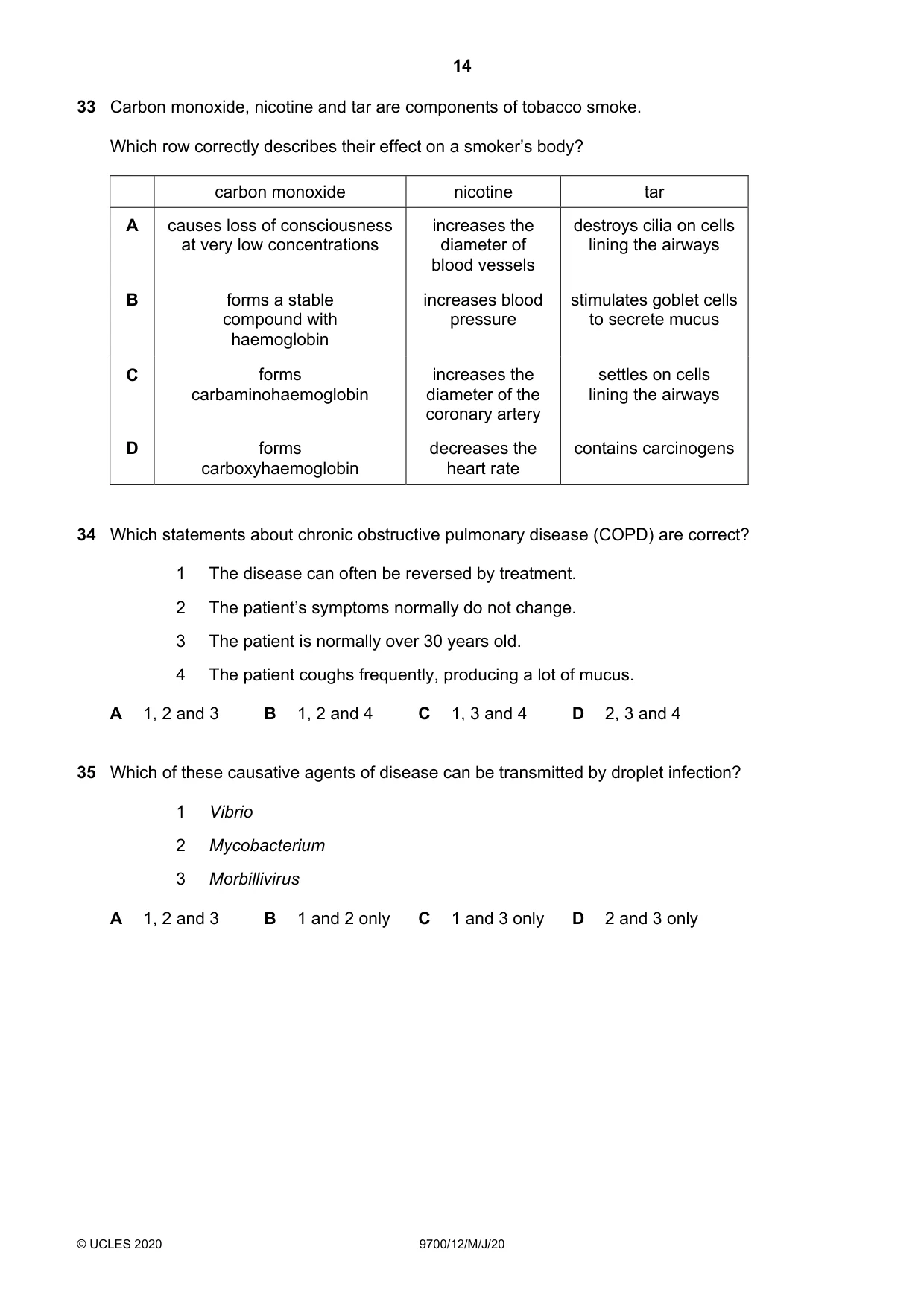
33 Carbon monoxide, nicotine and tar are components of tobacco smoke. Which row correctly describes their effect on a smoker’s body? carbon monoxide nicotine tar A causes loss of consciousness increases the destroys cilia on cells at very low concentrations diameter of lining the airways blood vessels B forms a stable increases blood stimulates goblet cells compound with pressure to secrete mucus haemoglobin C forms increases the settles on cells carbaminohaemoglobin diameter of the lining the airways coronary artery D forms decreases the contains carcinogens carboxyhaemoglobin heart rate
Mark scheme: B
Q34 · Which statements about chronic obstructive pulmonary disease (COPD) are correct?
34 Which statements about chronic obstructive pulmonary disease (COPD) are correct? 1 The disease can often be reversed by treatment. 2 The patient’s symptoms normally do not change. 3 The patient is normally over 30 years old. 4 The patient coughs frequently, producing a lot of mucus. A 1, 2 and 3 B 1, 2 and 4 C 1, 3 and 4 D 2, 3 and 4
Mark scheme: D
Q35 · Which of these causative agents of disease can be transmitted by droplet infection?
35 Which of these causative agents of disease can be transmitted by droplet infection? 1 Vibrio 2 Mycobacterium 3 Morbillivirus A 1, 2 and 3 B 1 and 2 only C 1 and 3 only D 2 and 3 only
Mark scheme: D
Q36 · The table compares total antibiotic use (X) and the percentage of antibiotic-resistant…
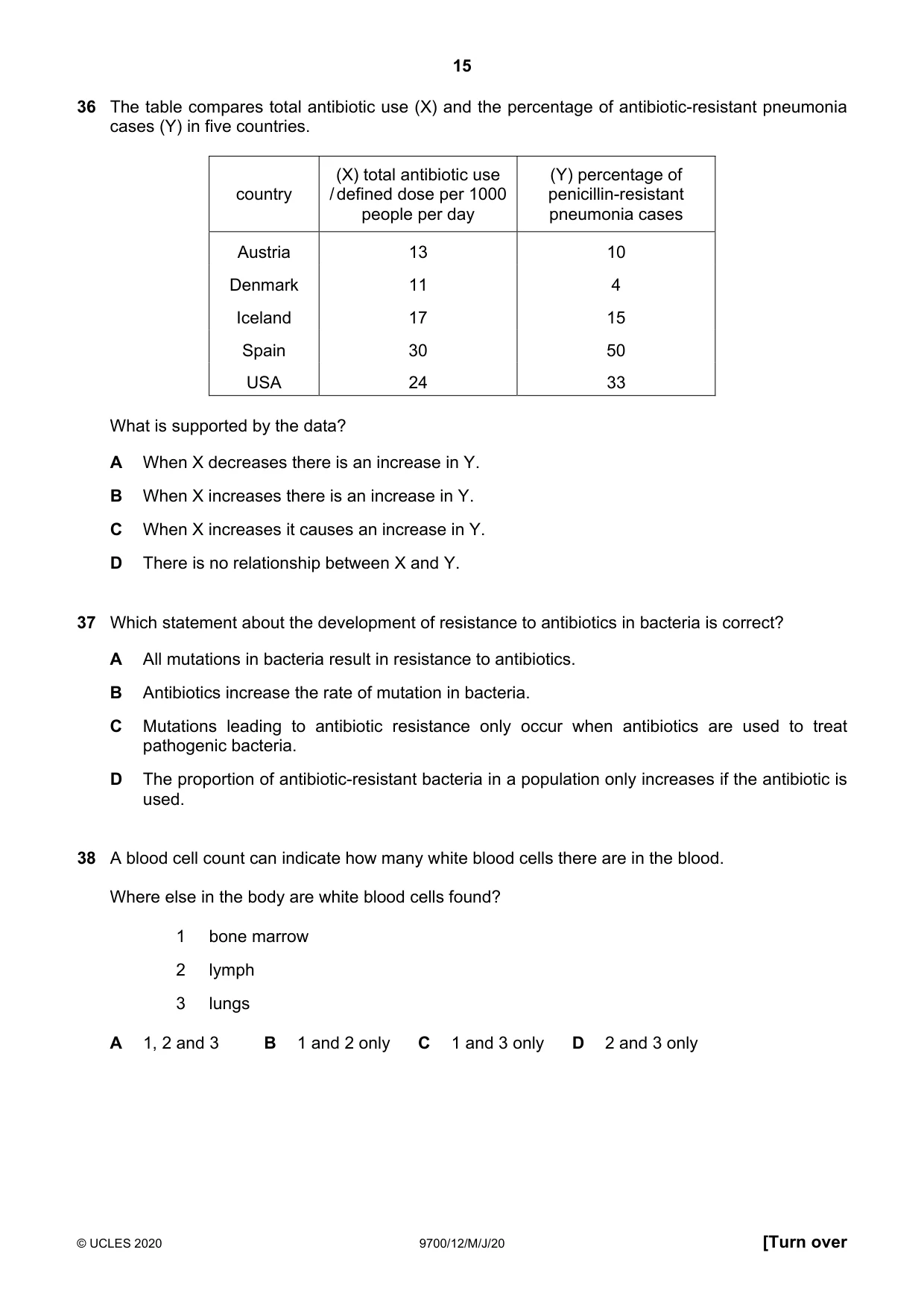
36 The table compares total antibiotic use (X) and the percentage of antibiotic-resistant pneumonia cases (Y) in five countries. (X) total antibiotic use (Y) percentage of country / defined dose per 1000 penicillin-resistant people per day pneumonia cases Austria 13 10 Denmark 11 4 Iceland 17 15 Spain 30 50 USA 24 33 What is supported by the data? A When X decreases there is an increase in Y. B When X increases there is an increase in Y. C When X increases it causes an increase in Y. D There is no relationship between X and Y.
Mark scheme: B
Q37 · Which statement about the development of resistance to antibiotics in bacteria is correct?
37 Which statement about the development of resistance to antibiotics in bacteria is correct? A All mutations in bacteria result in resistance to antibiotics. B Antibiotics increase the rate of mutation in bacteria. C Mutations leading to antibiotic resistance only occur when antibiotics are used to treat pathogenic bacteria. D The proportion of antibiotic-resistant bacteria in a population only increases if the antibiotic is used.
Mark scheme: D
Q38 · A blood cell count can indicate how many white blood cells there are in the blood
38 A blood cell count can indicate how many white blood cells there are in the blood. Where else in the body are white blood cells found? 1 bone marrow 2 lymph 3 lungs A 1, 2 and 3 B 1 and 2 only C 1 and 3 only D 2 and 3 only
Mark scheme: A
Q39 · Myasthenia gravis is a disease that results from the immune system failing to distinguish…
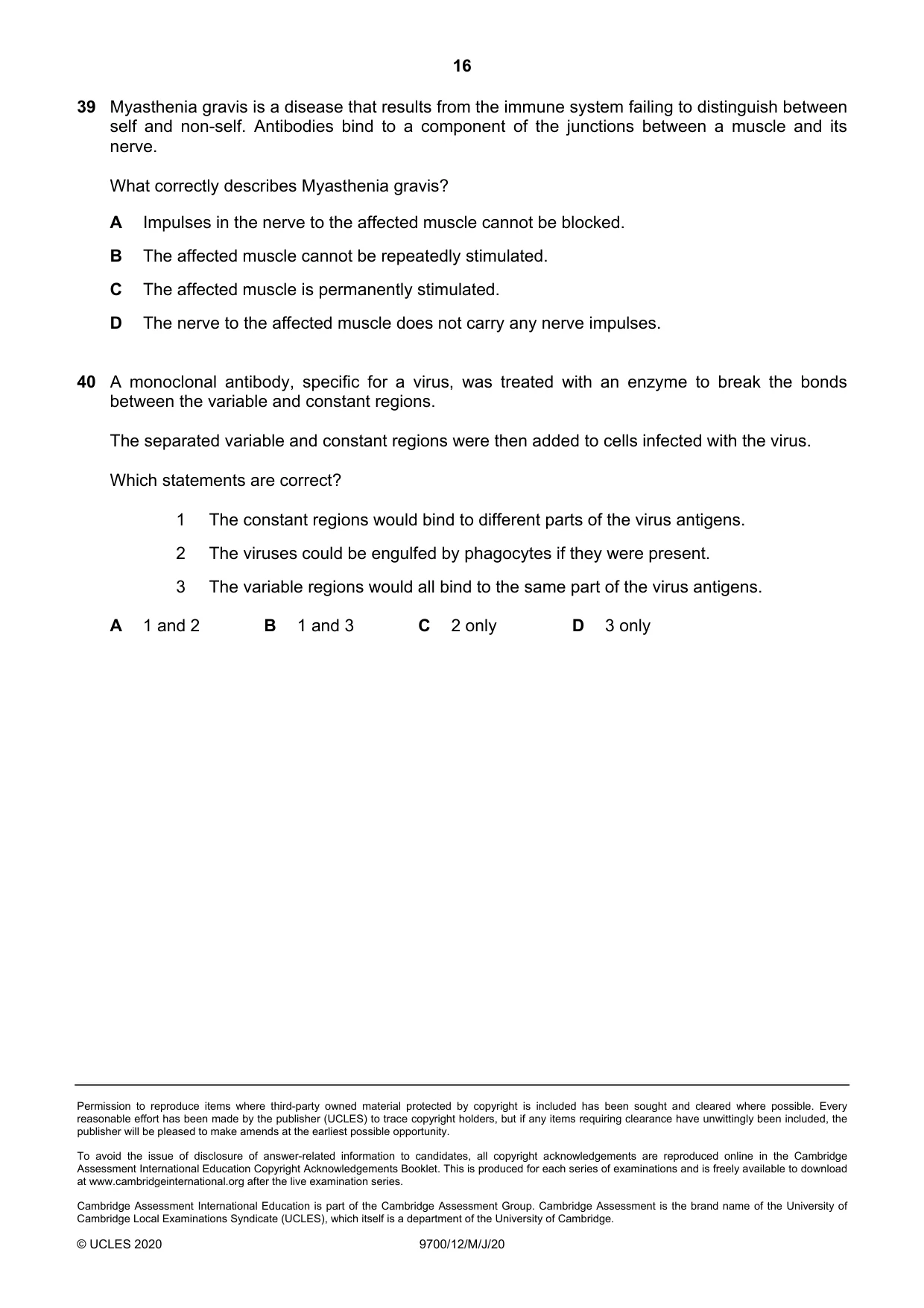
39 Myasthenia gravis is a disease that results from the immune system failing to distinguish between self and non-self. Antibodies bind to a component of the junctions between a muscle and its nerve. What correctly describes Myasthenia gravis? A Impulses in the nerve to the affected muscle cannot be blocked. B The affected muscle cannot be repeatedly stimulated. C The affected muscle is permanently stimulated. D The nerve to the affected muscle does not carry any nerve impulses.
Mark scheme: B
Q40 · A monoclonal antibody, specific for a virus, was treated with an enzyme to break the…
40 A monoclonal antibody, specific for a virus, was treated with an enzyme to break the bonds between the variable and constant regions. The separated variable and constant regions were then added to cells infected with the virus. Which statements are correct? 1 The constant regions would bind to different parts of the virus antigens. 2 The viruses could be engulfed by phagocytes if they were present. 3 The variable regions would all bind to the same part of the virus antigens. A 1 and 2 B 1 and 3 C 2 only D 3 only
Mark scheme: D
What was in this paper
The subtopics covered by these 40 questions, and how many questions each got. Open one in a new tab to see every Cambridge question on it.
4Carbohydrates and lipids3Fluid mosaic membranes3The circulatory system3The gas exchange system3Antibiotics2Chromosome behaviour in mitosis2Factors that affect enzyme action2Structure of nucleic acids and replication of DNA2The immune system2The microscope in cell studies2Transport mechanisms2Antibodies and vaccination1Infectious diseases1Movement into and out of cells1Protein synthesis1Proteins1Replication and division of nuclei and cells1Structure of transport tissues1Testing for biological molecules1Transport of oxygen and carbon dioxide1Water1