Questions as text
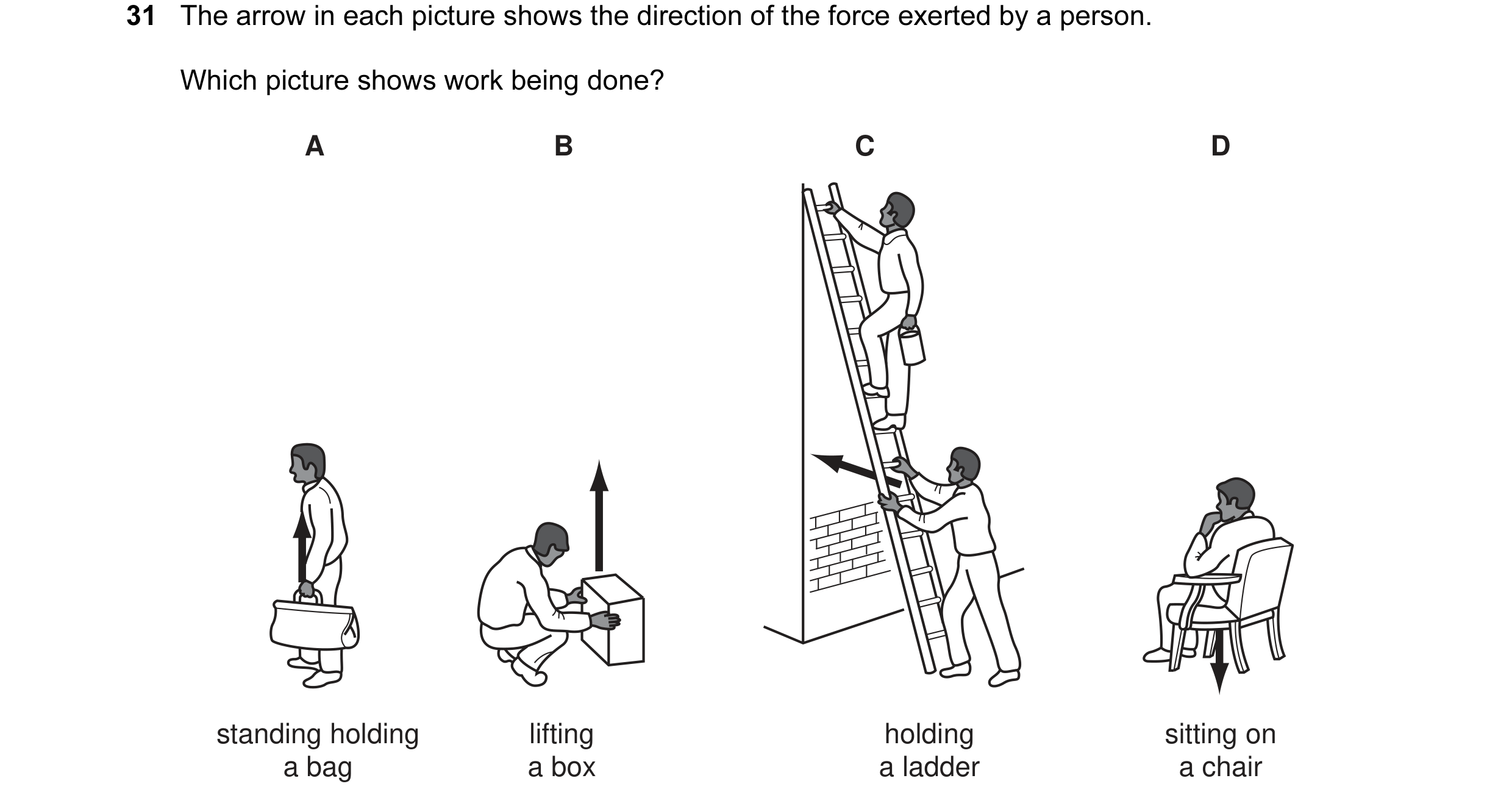
Q1 · The arrow in each picture shows the direction of the force exerted by a person 0653/11 Oct/Nov 2005
31 The arrow in each picture shows the direction of the force exerted by a person. Which picture shows work being done? A B C D standing holding lifting holding sitting on a bag a box a ladder a chair
1 marks
Answer: B
This question in 0653/11 Oct/Nov 2005
Q2 · Which form of energy do we receive directly from the Sun? 0653/11 May/June 2006
31 Which form of energy do we receive directly from the Sun? A chemical B light C nuclear D sound
1 marks
Answer: B
This question in 0653/11 May/June 2006
Q3 · A labourer on a building site lifts a heavy concrete block onto a lorry 0653/11 May/June 2006
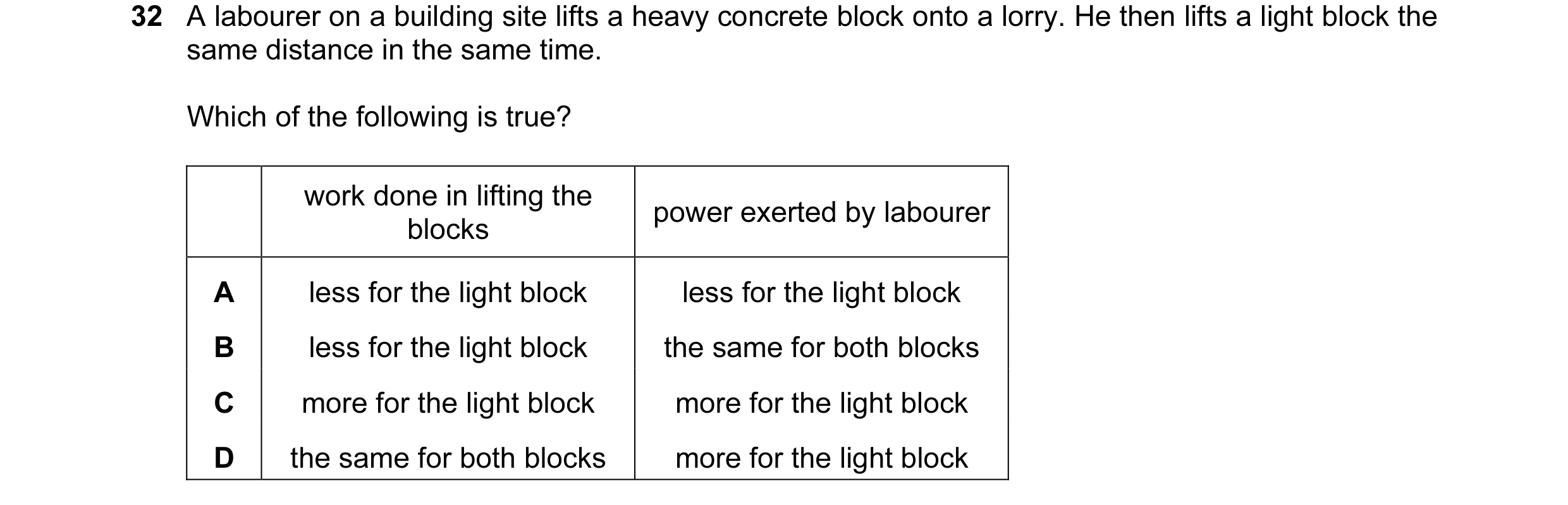
32 A labourer on a building site lifts a heavy concrete block onto a lorry. He then lifts a light block the same distance in the same time. Which of the following is true? work done in lifting the power exerted by labourer blocks A less for the light block less for the light block B less for the light block the same for both blocks C more for the light block more for the light block D the same for both blocks more for the light block
1 marks
Answer: A
This question in 0653/11 May/June 2006
Q4 · Which source of energy uses the production of steam to generate electricity? 0653/11 Oct/Nov 2006
31 Which source of energy uses the production of steam to generate electricity? A hydroelectric B nuclear C tides D waves
1 marks
Answer: B
This question in 0653/11 Oct/Nov 2006
Q5 · A cyclist travels down a hill from rest at point X without pedalling 0653/11 Oct/Nov 2006
32 A cyclist travels down a hill from rest at point X without pedalling. The cyclist applies his brakes and the cycle stops at point Y. X hill Y Which energy changes have taken place between X and Y? A kinetic → heat → potential B kinetic → potential → heat C potential → heat → kinetic D potential → kinetic → heat
1 marks
Answer: D
This question in 0653/11 Oct/Nov 2006
Q6 · A person uses chemical energy to run up some stairs 0653/11 Oct/Nov 2007
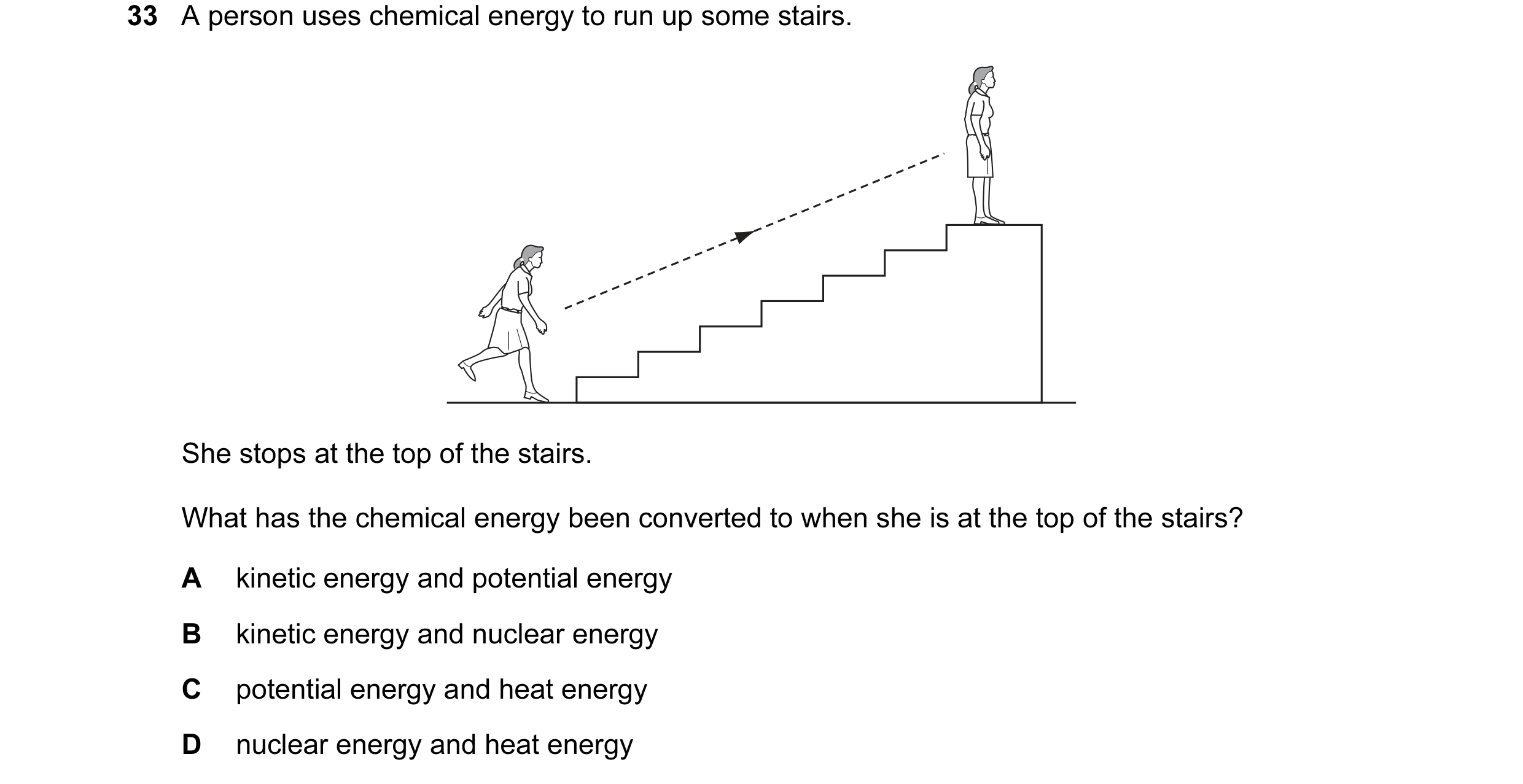
33 A person uses chemical energy to run up some stairs. She stops at the top of the stairs. What has the chemical energy been converted to when she is at the top of the stairs? A kinetic energy and potential energy B kinetic energy and nuclear energy C potential energy and heat energy D nuclear energy and heat energy
1 marks
Answer: C
This question in 0653/11 Oct/Nov 2007
Q7 · How is electricity transmitted over large distances and why is it transmitted in this way? 0653/11 Oct/Nov 2007
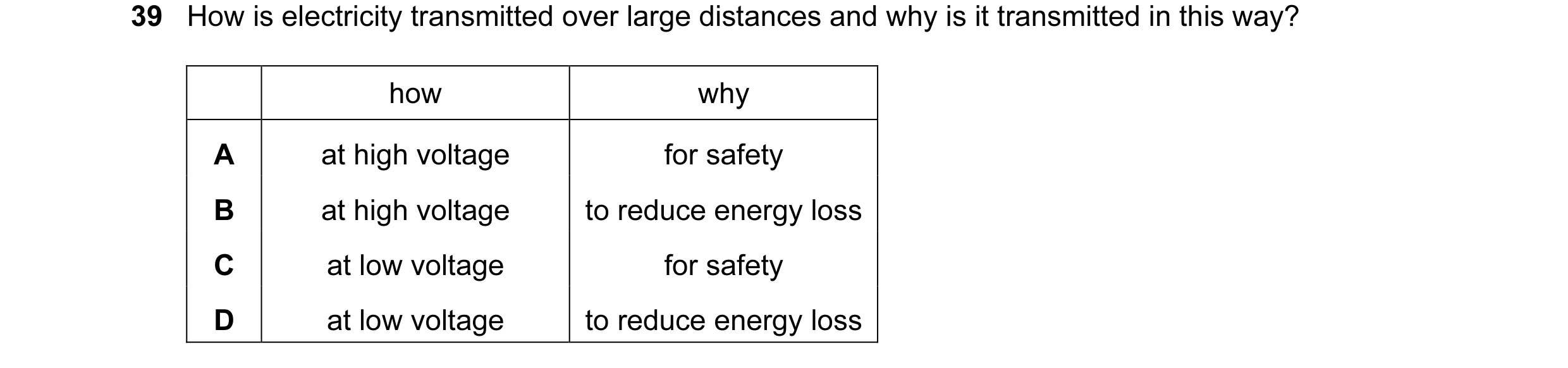
39 How is electricity transmitted over large distances and why is it transmitted in this way? how why A at high voltage for safety B at high voltage to reduce energy loss C at low voltage for safety D at low voltage to reduce energy loss
1 marks
Answer: B
This question in 0653/11 Oct/Nov 2007
Q8 · A stone is thrown from the edge of a cliff 0653/11 May/June 2008
33 A stone is thrown from the edge of a cliff. Its path is shown in the diagram. 2 1 3 ground In which position does the stone have its greatest kinetic energy and in which position does it have its lowest potential energy? greatest kinetic lowest potential energy energy A 1 2 B 2 3 C 3 1 D 3 3
1 marks
Answer: D
This question in 0653/11 May/June 2008
Q9 · Which energy sources burn fossil fuels? 0653/11 Oct/Nov 2008
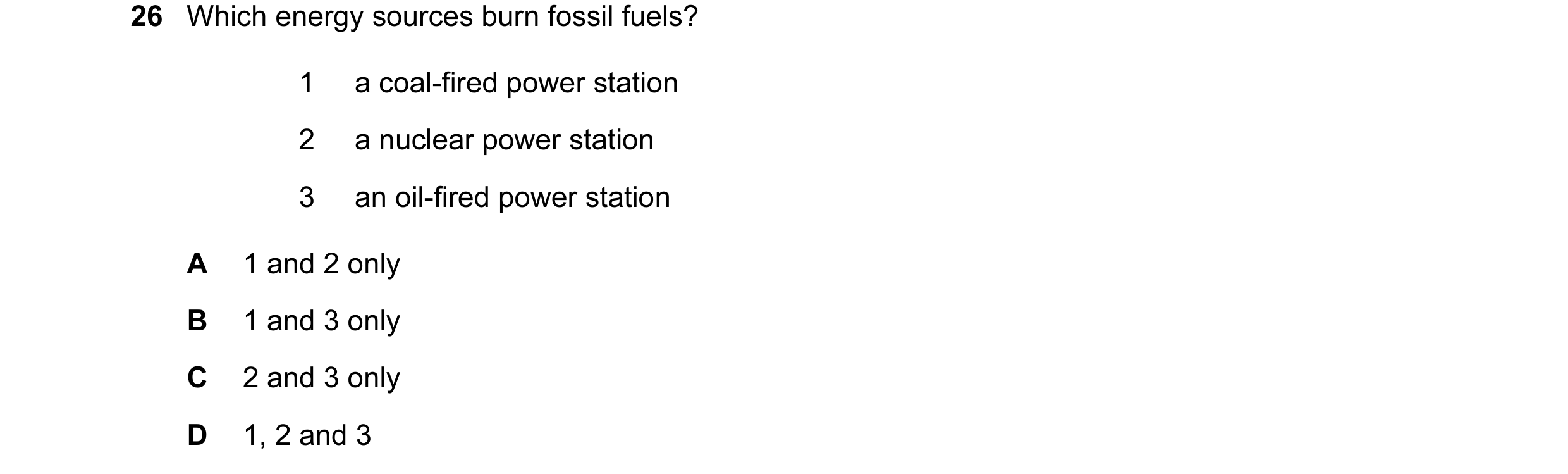
26 Which energy sources burn fossil fuels? 1 a coal-fired power station 2 a nuclear power station 3 an oil-fired power station A 1 and 2 only B 1 and 3 only C 2 and 3 only D 1, 2 and 3
1 marks
Answer: B
This question in 0653/11 Oct/Nov 2008
Q10 · The diagram shows water stored behind a dam 0653/11 Oct/Nov 2008
32 The diagram shows water stored behind a dam. dam water turbine generator water The water flows to a turbine and turns a generator. Which sequence for the conversion of energy is correct? A potential energy → kinetic energy → electrical energy B kinetic energy → potential energy → electrical energy C potential energy → electrical energy → kinetic energy D kinetic energy → electrical energy → potential energy
1 marks
Answer: A
This question in 0653/11 Oct/Nov 2008
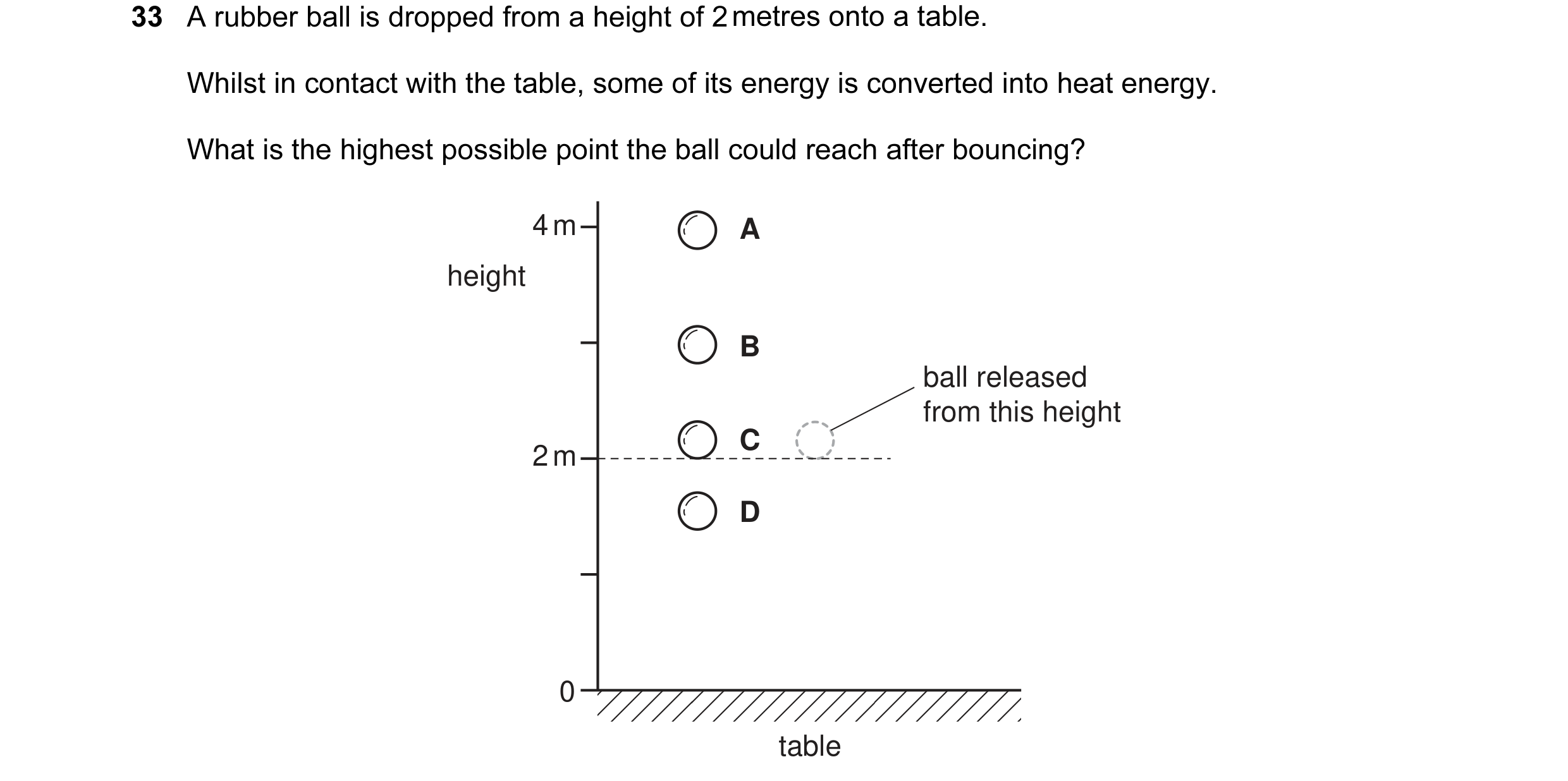
Q11 · A rubber ball is dropped from a height of 2 metres onto a table 0653/11 Oct/Nov 2008
33 A rubber ball is dropped from a height of 2 metres onto a table. Whilst in contact with the table, some of its energy is converted into heat energy. What is the highest possible point the ball could reach after bouncing? 4 m A height B ball released from this height C 2 m D 0 table
1 marks
Answer: D
This question in 0653/11 Oct/Nov 2008
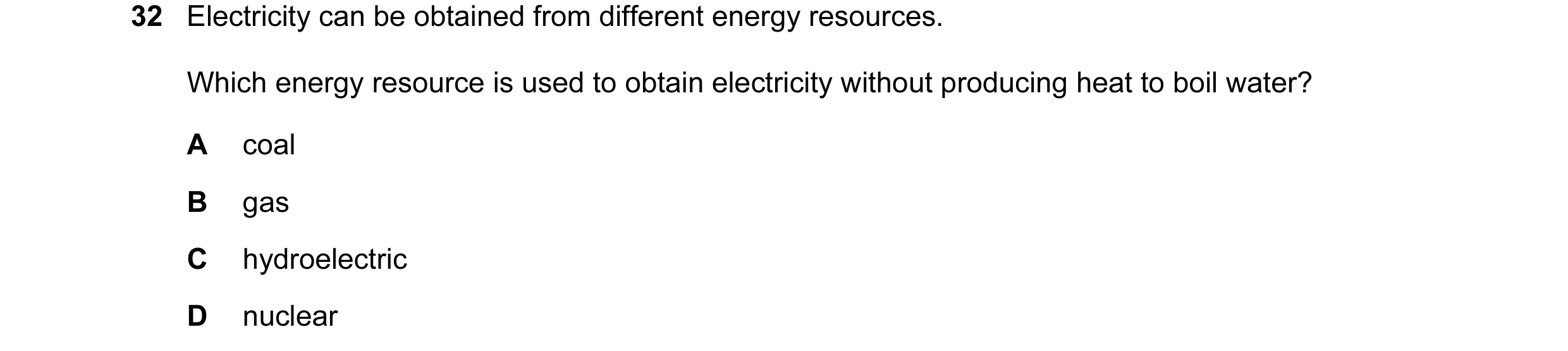
Q12 · Electricity can be obtained from different energy resources 0653/11 May/June 2009
32 Electricity can be obtained from different energy resources. Which energy resource is used to obtain electricity without producing heat to boil water? A coal B gas C hydroelectric D nuclear
1 marks
Answer: C
This question in 0653/11 May/June 2009
Q13 · In which situation would the object described be given an increase in its total energy? 0653/11 May/June 2010
31 In which situation would the object described be given an increase in its total energy? A a battery-powered torch being switched on B a firework exploding C a parachutist falling to the ground D a skier being pulled up a slope
1 marks
Answer: D
This question in 0653/11 May/June 2010
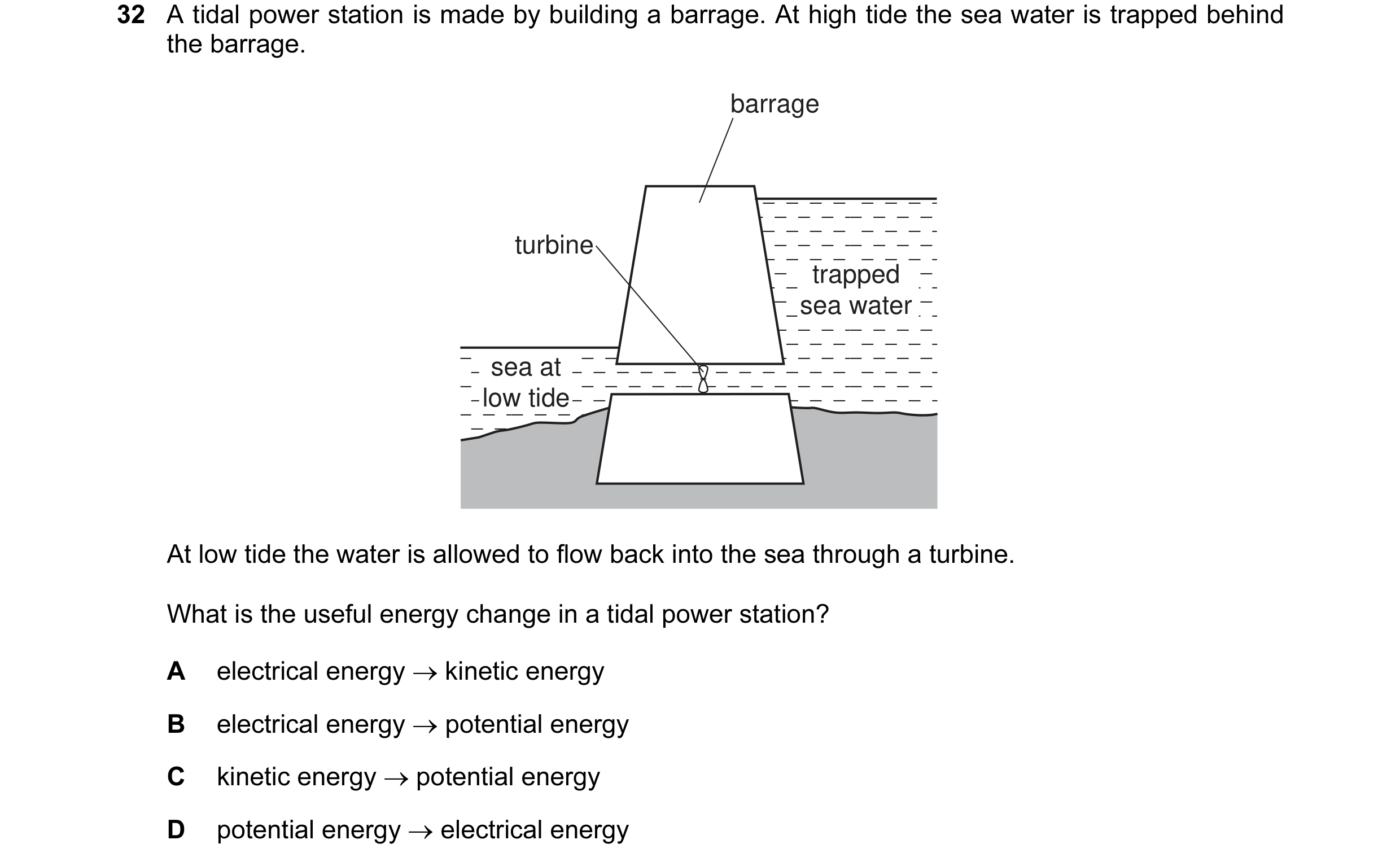
Q14 · A tidal power station is made by building a barrage 0653/11 May/June 2010
32 A tidal power station is made by building a barrage. At high tide the sea water is trapped behind the barrage. barrage turbine trapped sea water sea at low tide At low tide the water is allowed to flow back into the sea through a turbine. What is the useful energy change in a tidal power station? A electrical energy → kinetic energy B electrical energy → potential energy C kinetic energy → potential energy D potential energy → electrical energy
1 marks
Answer: D
This question in 0653/11 May/June 2010
Q15 · In which situation would the object described be given an increase in its total energy? 0653/12 May/June 2010
30 In which situation would the object described be given an increase in its total energy? A a battery-powered torch being switched on B a firework exploding C a parachutist falling to the ground D a skier being pulled up a slope
1 marks
Answer: D
This question in 0653/12 May/June 2010
Q16 · A tidal power station is made by building a barrage 0653/12 May/June 2010
31 A tidal power station is made by building a barrage. At high tide the sea water is trapped behind the barrage. barrage turbine trapped sea water sea at low tide At low tide the water is allowed to flow back into the sea through a turbine. What is the useful energy change in a tidal power station? A electrical energy → kinetic energy B electrical energy → potential energy C kinetic energy → potential energy D potential energy → electrical energy
1 marks
Answer: D
This question in 0653/12 May/June 2010
Q17 · In which situation would the object described be given an increase in its total energy? 0653/13 May/June 2010
30 In which situation would the object described be given an increase in its total energy? A a battery-powered torch being switched on B a firework exploding C a parachutist falling to the ground D a skier being pulled up a slope
1 marks
Answer: D
This question in 0653/13 May/June 2010
Q18 · A tidal power station is made by building a barrage 0653/13 May/June 2010
31 A tidal power station is made by building a barrage. At high tide the sea water is trapped behind the barrage. barrage turbine trapped sea water sea at low tide At low tide the water is allowed to flow back into the sea through a turbine. What is the useful energy change in a tidal power station? A electrical energy → kinetic energy B electrical energy → potential energy C kinetic energy → potential energy D potential energy → electrical energy
1 marks
Answer: D
This question in 0653/13 May/June 2010
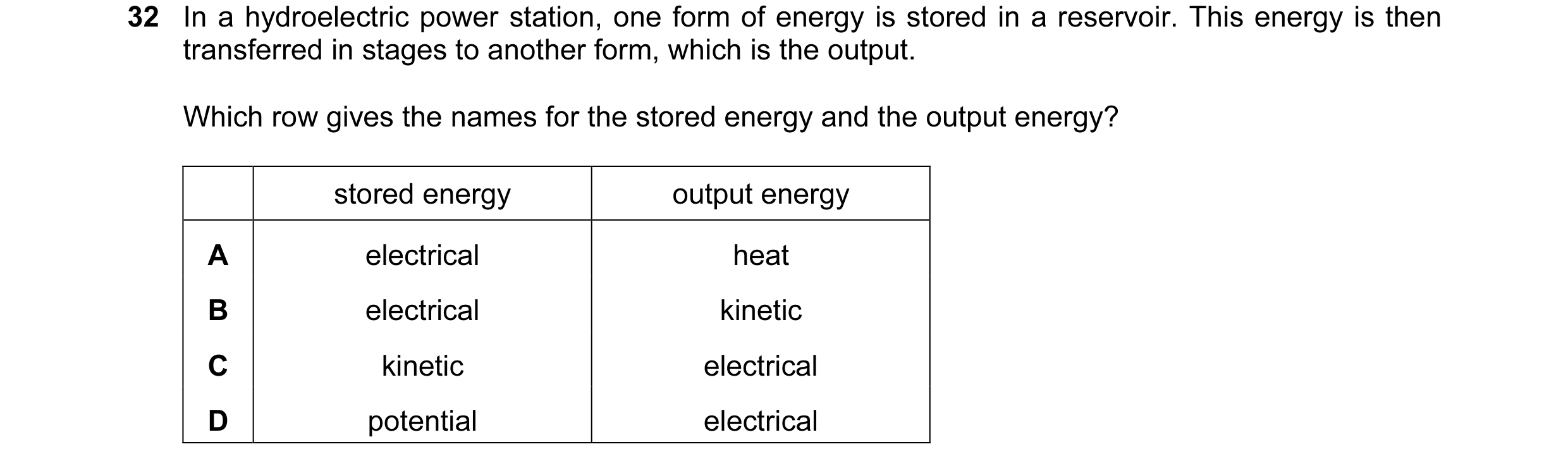
Q19 · In a hydroelectric power station, one form of energy is stored in a reservoir 0653/11 Oct/Nov 2010
32 In a hydroelectric power station, one form of energy is stored in a reservoir. This energy is then transferred in stages to another form, which is the output. Which row gives the names for the stored energy and the output energy? stored energy output energy A electrical heat B electrical kinetic C kinetic electrical D potential electrical
1 marks
Answer: D
This question in 0653/11 Oct/Nov 2010
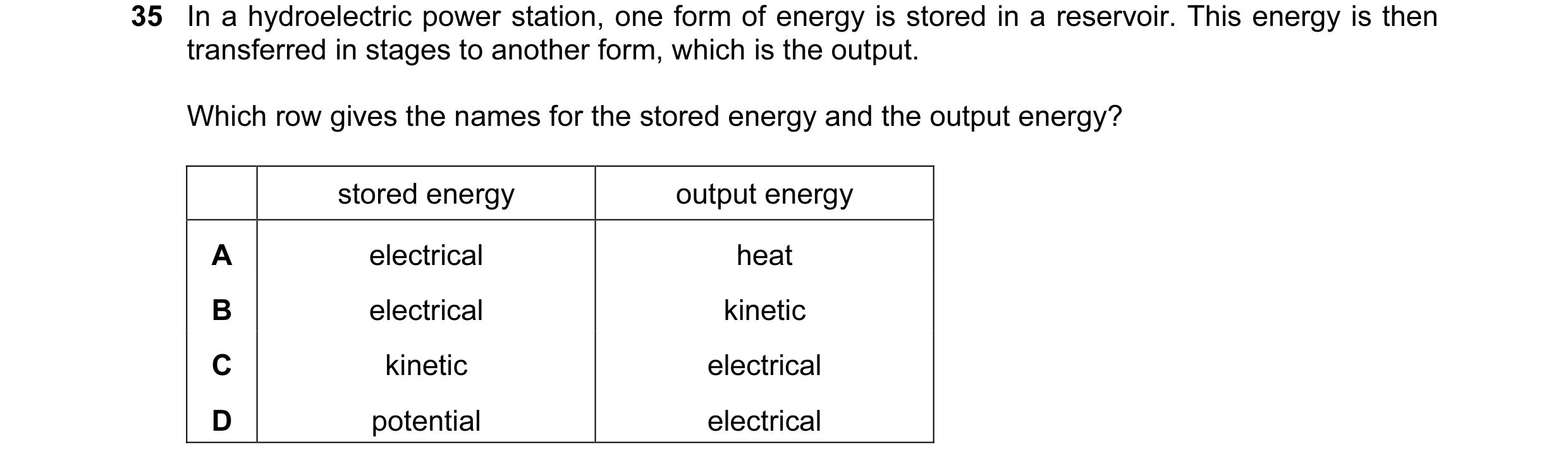
Q20 · In a hydroelectric power station, one form of energy is stored in a reservoir 0653/12 Oct/Nov 2010
35 In a hydroelectric power station, one form of energy is stored in a reservoir. This energy is then transferred in stages to another form, which is the output. Which row gives the names for the stored energy and the output energy? stored energy output energy A electrical heat B electrical kinetic C kinetic electrical D potential electrical
1 marks
Answer: D
This question in 0653/12 Oct/Nov 2010
Q21 · In a hydroelectric power station, one form of energy is stored in a reservoir 0653/13 Oct/Nov 2010
31 In a hydroelectric power station, one form of energy is stored in a reservoir. This energy is then transferred in stages to another form, which is the output. Which row gives the names for the stored energy and the output energy? stored energy output energy A electrical heat B electrical kinetic C kinetic electrical D potential electrical
1 marks
Answer: D
This question in 0653/13 Oct/Nov 2010
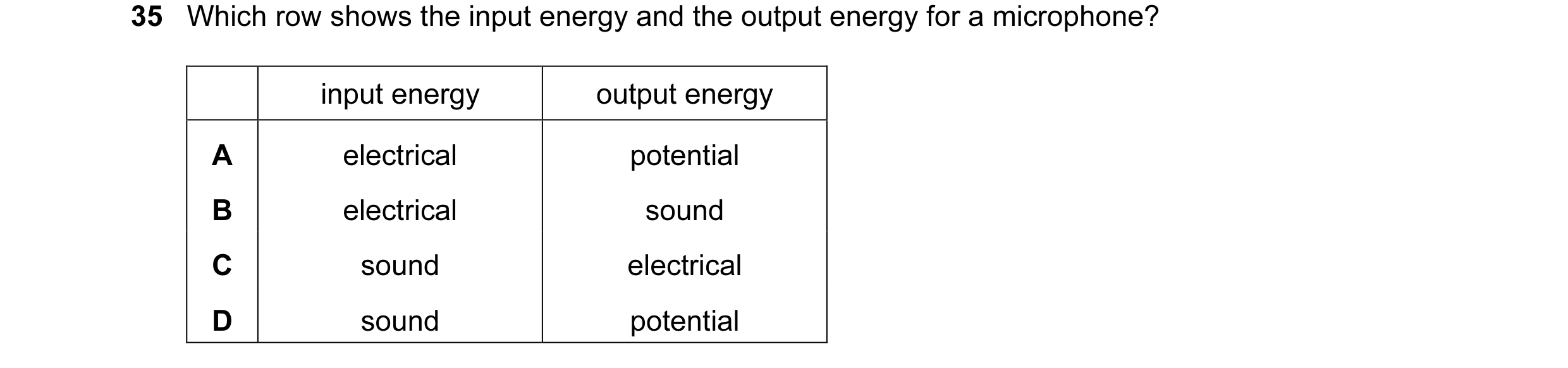
Q22 · Which row shows the input energy and the output energy for a microphone? 0653/11 May/June 2011
35 Which row shows the input energy and the output energy for a microphone? input energy output energy A electrical potential B electrical sound C sound electrical D sound potential
1 marks
Answer: C
This question in 0653/11 May/June 2011
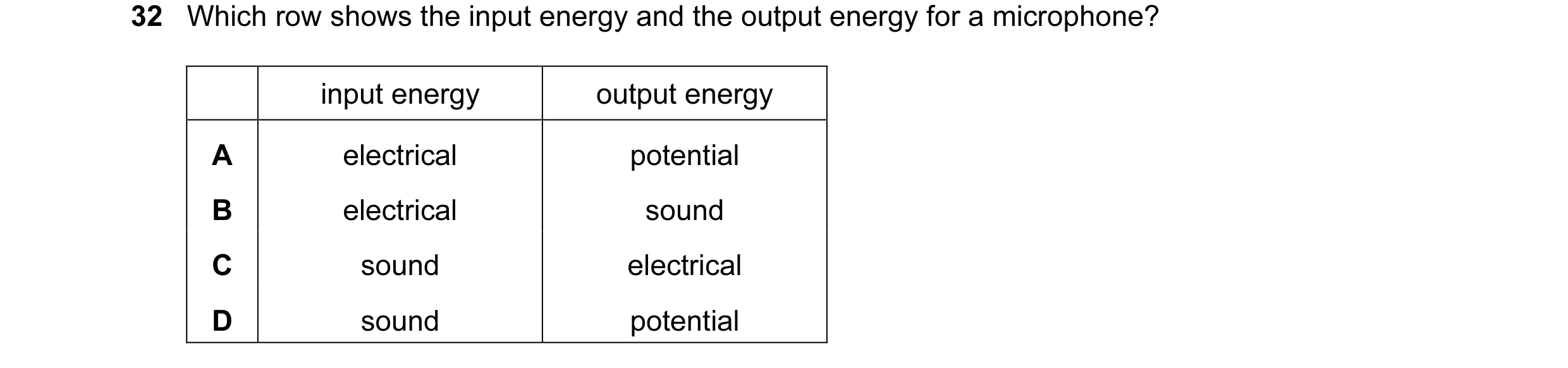
Q23 · Which row shows the input energy and the output energy for a microphone? 0653/12 May/June 2011
32 Which row shows the input energy and the output energy for a microphone? input energy output energy A electrical potential B electrical sound C sound electrical D sound potential
1 marks
Answer: C
This question in 0653/12 May/June 2011
Q24 · Which source releases energy by burning when it is used in the process of generating… 0653/11 Oct/Nov 2011
32 Which source releases energy by burning when it is used in the process of generating electricity? A a fossil fuel B hydroelectric C nuclear D solar
1 marks
Answer: A
This question in 0653/11 Oct/Nov 2011
Q25 · Which source releases energy by burning when it is used in the process of generating… 0653/12 Oct/Nov 2011
31 Which source releases energy by burning when it is used in the process of generating electricity? A a fossil fuel B hydroelectric C nuclear D solar
1 marks
Answer: A
This question in 0653/12 Oct/Nov 2011
Q26 · Which source releases energy by burning when it is used in the process of generating… 0653/13 Oct/Nov 2011
32 Which source releases energy by burning when it is used in the process of generating electricity? A a fossil fuel B hydroelectric C nuclear D solar
1 marks
Answer: A
This question in 0653/13 Oct/Nov 2011
Q27 · In which situation is gravitational energy converted into kinetic energy? 0653/11 May/June 2012
30 In which situation is gravitational energy converted into kinetic energy? A diving from a high platform B kicking a football along the ground C lifting a book on to a high shelf D pumping water up to a storage tank
1 marks
This question in 0653/11 May/June 2012
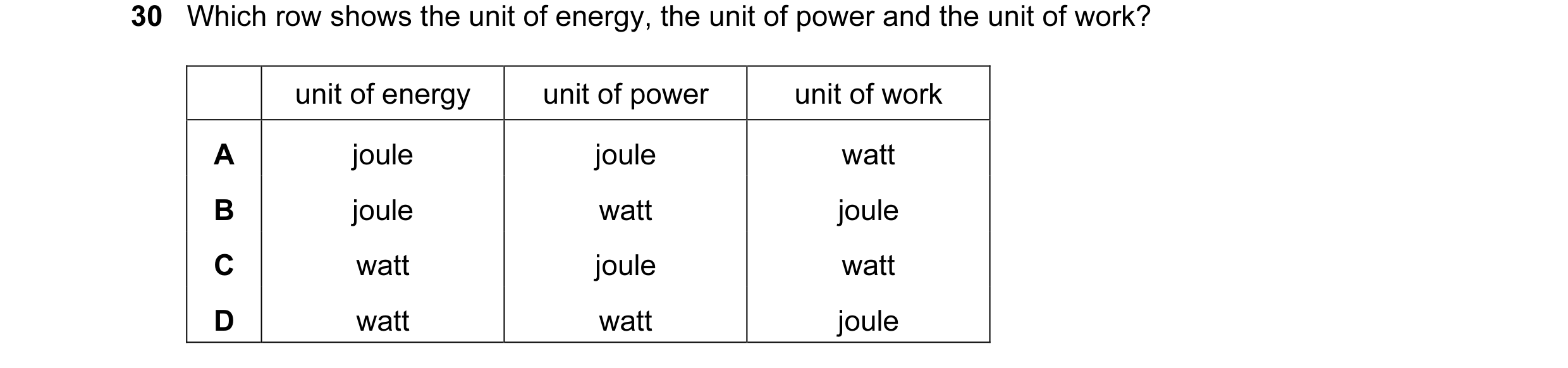
Q28 · Which row shows the unit of energy, the unit of power and the unit of work? 0653/12 May/June 2012
30 Which row shows the unit of energy, the unit of power and the unit of work? unit of energy unit of power unit of work A joule joule watt B joule watt joule C watt joule watt D watt watt joule
1 marks
Answer: B
This question in 0653/12 May/June 2012
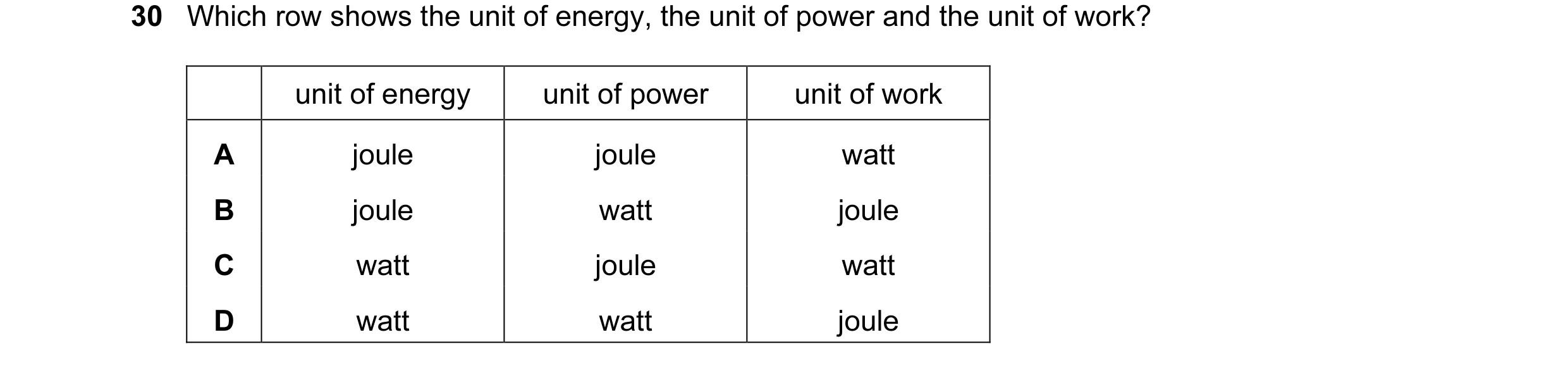
Q29 · Which row shows the unit of energy, the unit of power and the unit of work? 0653/13 May/June 2012
30 Which row shows the unit of energy, the unit of power and the unit of work? unit of energy unit of power unit of work A joule joule watt B joule watt joule C watt joule watt D watt watt joule
1 marks
Answer: B
This question in 0653/13 May/June 2012
Q30 · As part of a festival, a wooden wheel is set on fire 0653/12 May/June 2013
30 As part of a festival, a wooden wheel is set on fire. The burning wheel rolls down a hill. What is one energy conversion that occurs as the wheel burns and rolls down the hill? A gravitational to kinetic B heat to chemical C kinetic to chemical D light to gravitational
1 marks
Answer: A
This question in 0653/12 May/June 2013
Q31 · Which energy resource is non-renewable? 0653/13 May/June 2013
31 Which energy resource is non-renewable? A geothermal energy B hydroelectric energy C nuclear energy D wave energy
1 marks
Answer: C
This question in 0653/13 May/June 2013
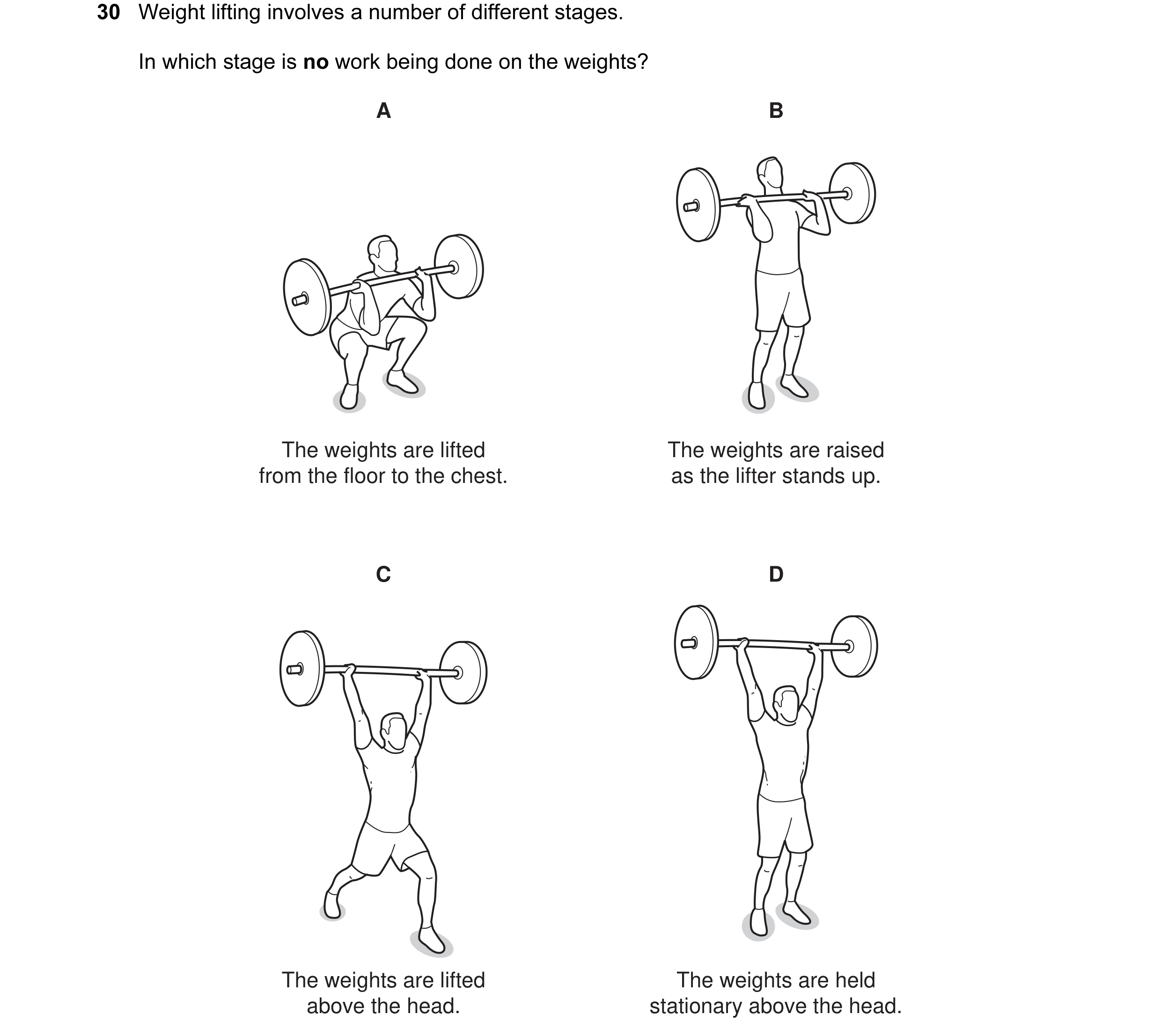
Q32 · Weight lifting involves a number of different stages 0653/11 Oct/Nov 2013
30 Weight lifting involves a number of different stages. In which stage is no work being done on the weights? A B The weights are lifted The weights are raised from the floor to the chest. as the lifter stands up. C D The weights are lifted The weights are held above the head. stationary above the head.
1 marks
Answer: D
This question in 0653/11 Oct/Nov 2013
Q33 · Weight lifting involves a number of different stages 0653/12 Oct/Nov 2013
30 Weight lifting involves a number of different stages. In which stage is no work being done on the weights? A B The weights are lifted The weights are raised from the floor to the chest. as the lifter stands up. C D The weights are lifted The weights are held above the head. stationary above the head.
1 marks
Answer: D
This question in 0653/12 Oct/Nov 2013
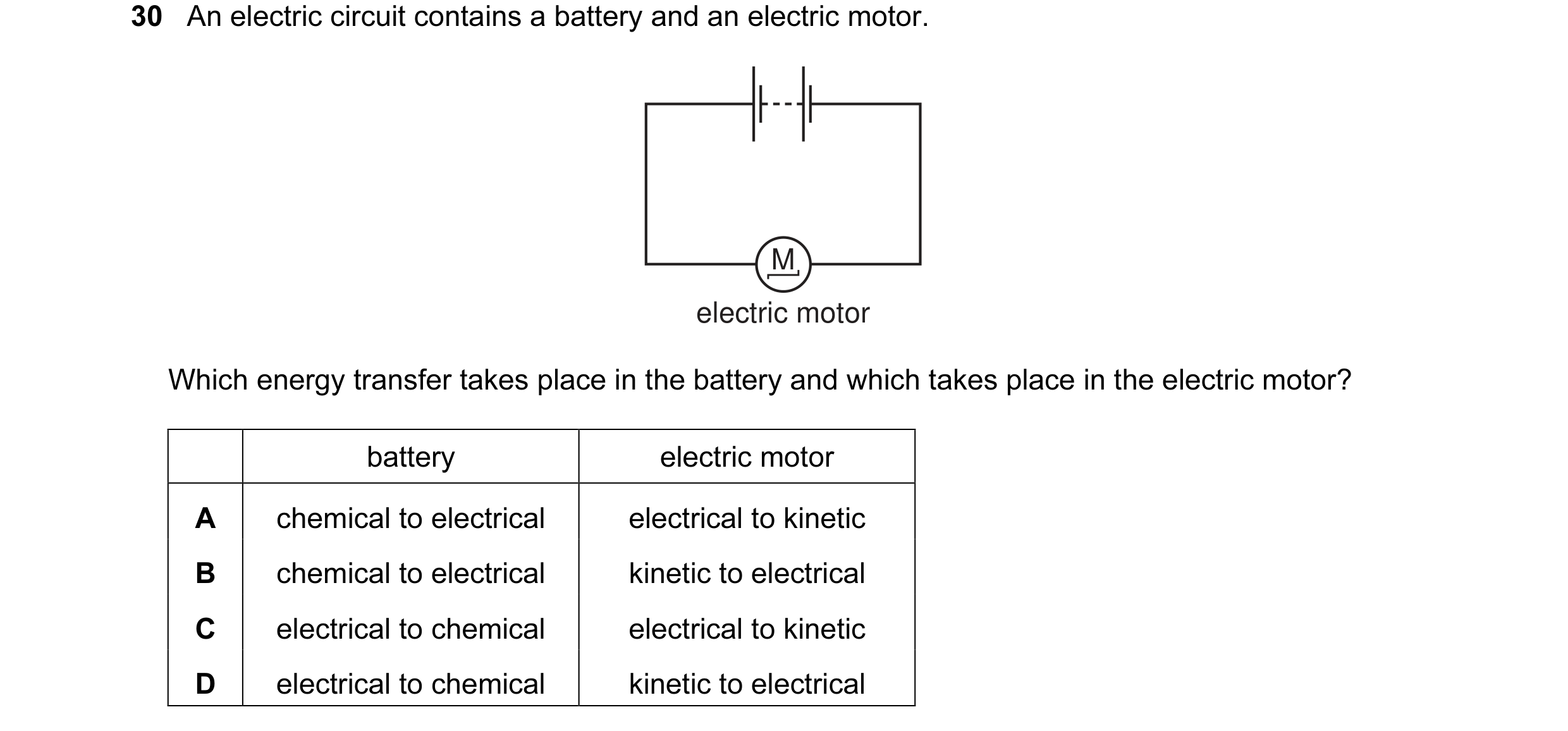
Q34 · An electric circuit contains a battery and an electric motor 0653/13 Oct/Nov 2013
30 An electric circuit contains a battery and an electric motor. M electric motor Which energy transfer takes place in the battery and which takes place in the electric motor? battery electric motor A chemical to electrical electrical to kinetic B chemical to electrical kinetic to electrical C electrical to chemical electrical to kinetic D electrical to chemical kinetic to electrical
1 marks
Answer: A
This question in 0653/13 Oct/Nov 2013
Q35 · A worker on a building site lifts a heavy concrete block onto a lorry 0653/11 May/June 2014
30 A worker on a building site lifts a heavy concrete block onto a lorry. He then lifts a lighter block the same distance in the same time. Which row about the work done and the power exerted is correct? work done in lifting the blocks power exerted by worker A less for the lighter block less for the lighter block B less for the lighter block the same for both blocks C more for the lighter block more for the lighter block D the same for both blocks more for the lighter block
1 marks
Answer: A
This question in 0653/11 May/June 2014
Q36 · A worker on a building site lifts a heavy concrete block onto a lorry 0653/12 May/June 2014
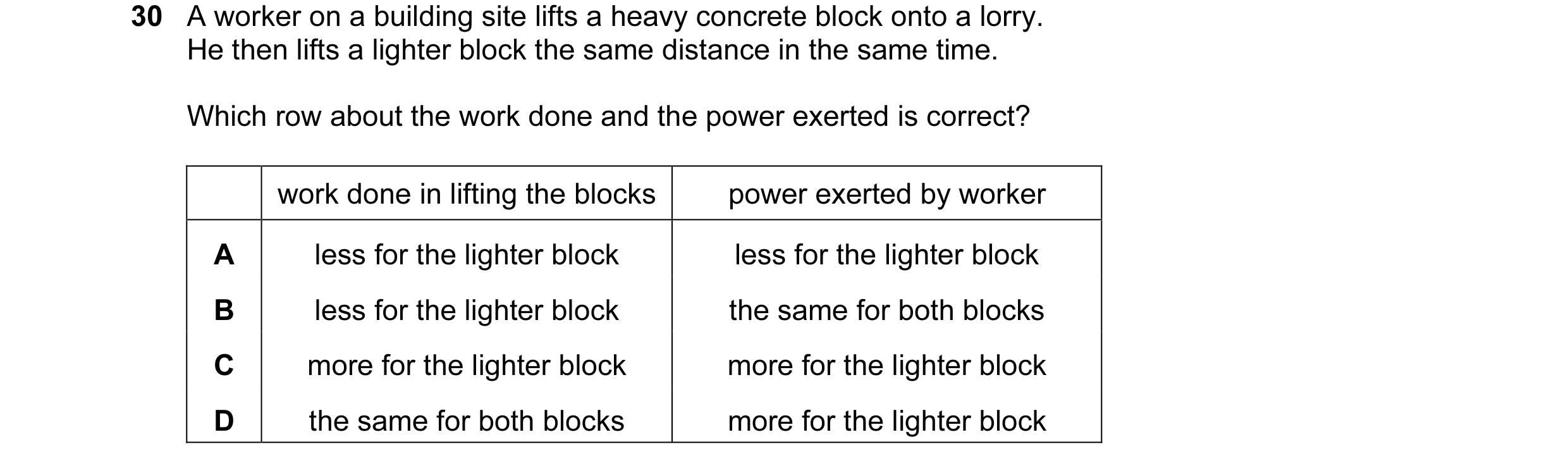
30 A worker on a building site lifts a heavy concrete block onto a lorry. He then lifts a lighter block the same distance in the same time. Which row about the work done and the power exerted is correct? work done in lifting the blocks power exerted by worker A less for the lighter block less for the lighter block B less for the lighter block the same for both blocks C more for the lighter block more for the lighter block D the same for both blocks more for the lighter block
1 marks
Answer: A
This question in 0653/12 May/June 2014
Q37 · A worker on a building site lifts a heavy concrete block onto a lorry 0653/13 May/June 2014
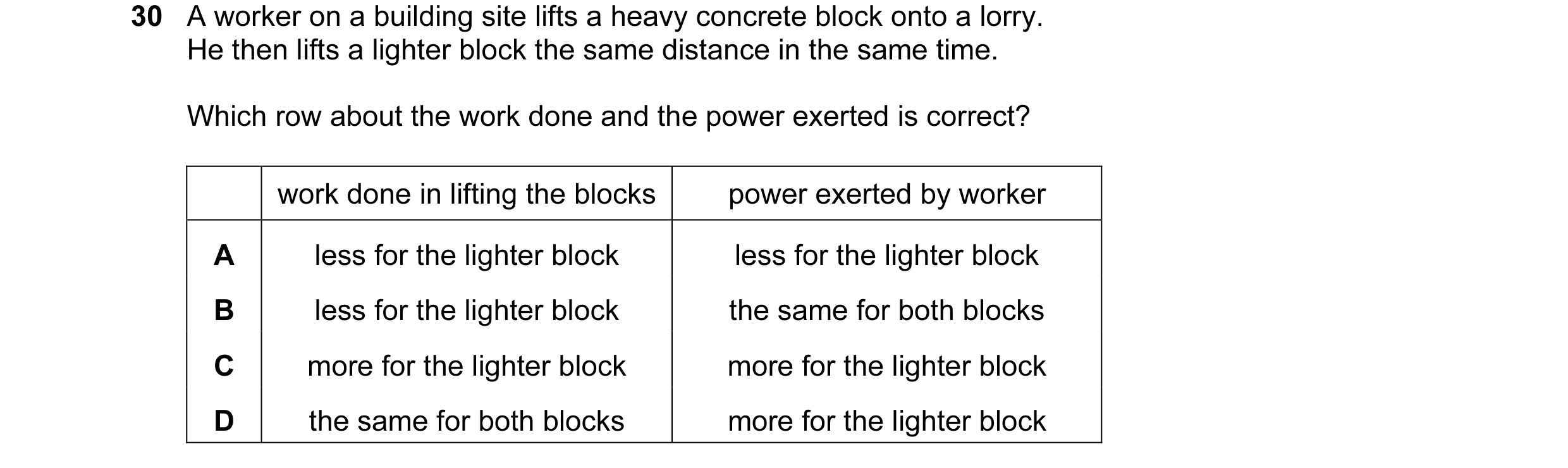
30 A worker on a building site lifts a heavy concrete block onto a lorry. He then lifts a lighter block the same distance in the same time. Which row about the work done and the power exerted is correct? work done in lifting the blocks power exerted by worker A less for the lighter block less for the lighter block B less for the lighter block the same for both blocks C more for the lighter block more for the lighter block D the same for both blocks more for the lighter block
1 marks
Answer: A
This question in 0653/13 May/June 2014
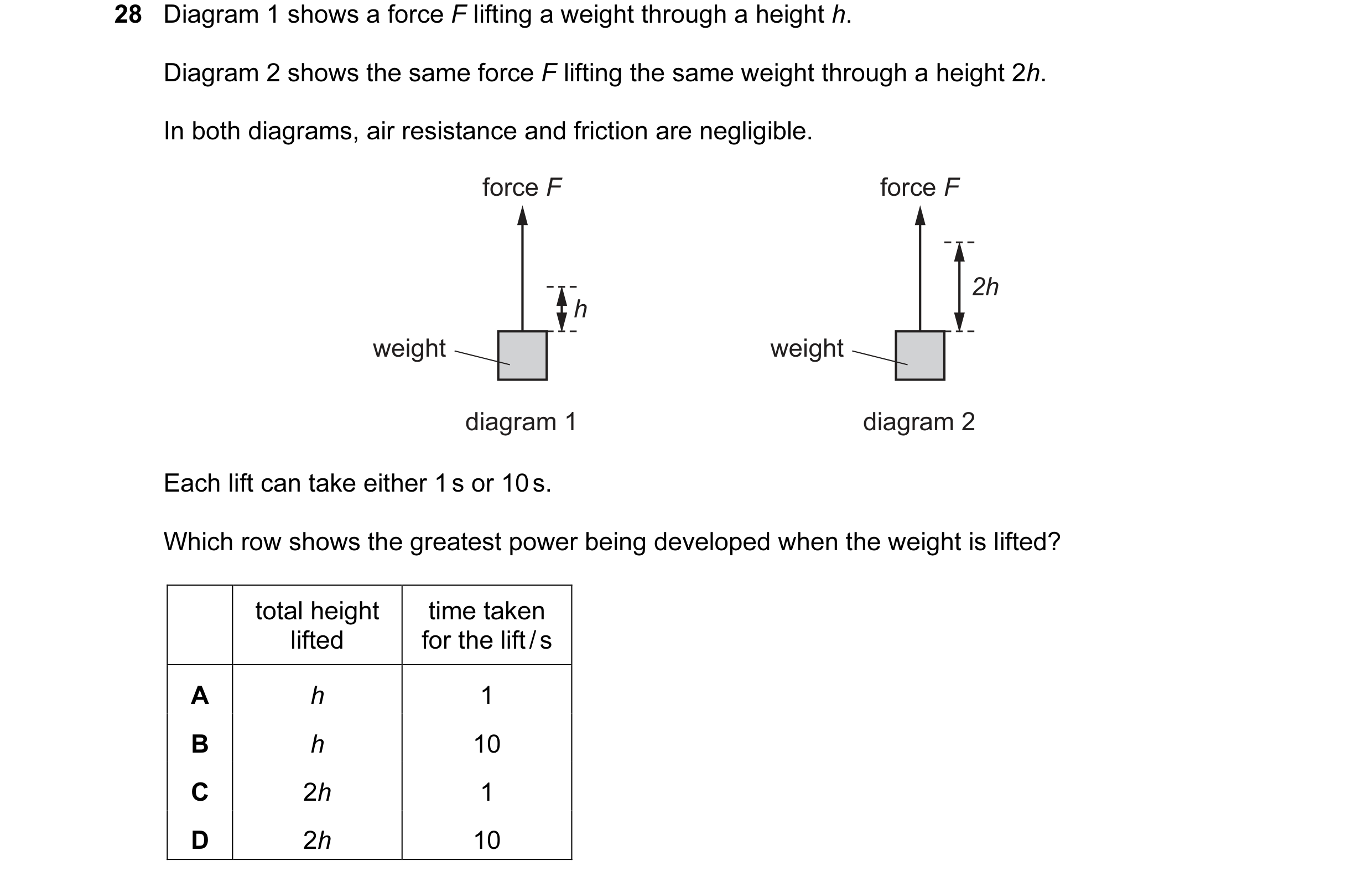
Q38 · A force F lifting a weight through a height h 0653/11 Oct/Nov 2014
30 Diagram 1 shows a force F lifting a weight through a height h. Diagram 2 shows the same force F lifting the same weight through a height 2h. In both diagrams, air resistance and friction are negligible. force F force F 2h h weight weight diagram 1 diagram 2 Each lift can take either 1 s or 10 s. Which row shows the greatest power being developed when the weight is lifted? total height time taken lifted for the lift / s A h 1 B h 10 C 2h 1 D 2h 10
1 marks
Answer: C
This question in 0653/11 Oct/Nov 2014
Q39 · A force F lifting a weight through a height h 0653/12 Oct/Nov 2014
28 Diagram 1 shows a force F lifting a weight through a height h. Diagram 2 shows the same force F lifting the same weight through a height 2h. In both diagrams, air resistance and friction are negligible. force F force F 2h h weight weight diagram 1 diagram 2 Each lift can take either 1 s or 10 s. Which row shows the greatest power being developed when the weight is lifted? total height time taken lifted for the lift / s A h 1 B h 10 C 2h 1 D 2h 10
1 marks
Answer: C
This question in 0653/12 Oct/Nov 2014
Q40 · The speed of a car increases as it moves up a hill 0653/11 May/June 2015
30 The speed of a car increases as it moves up a hill. Which energy changes are taking place? gravitational energy kinetic energy A decreasing decreasing B increasing decreasing C decreasing increasing D increasing increasing
1 marks
Answer: D
This question in 0653/11 May/June 2015
Q41 · A car is driven on a long journey along a horizontal road 0653/12 May/June 2015
30 A car is driven on a long journey along a horizontal road. The car stops several times on the journey and its engine becomes hot. Which type of energy remains constant during the journey? A the chemical energy in the fuel tank B the gravitational energy of the car C the kinetic energy of the car D the thermal energy of the engine
1 marks
Answer: B
This question in 0653/12 May/June 2015
Q42 · Energy is stored in petrol and in a box of matches 0653/13 May/June 2015
30 Energy is stored in petrol and in a box of matches. In which form is the energy stored in each? petrol a box of matches A chemical chemical B chemical thermal C kinetic chemical D kinetic thermal
1 marks
Answer: A
This question in 0653/13 May/June 2015
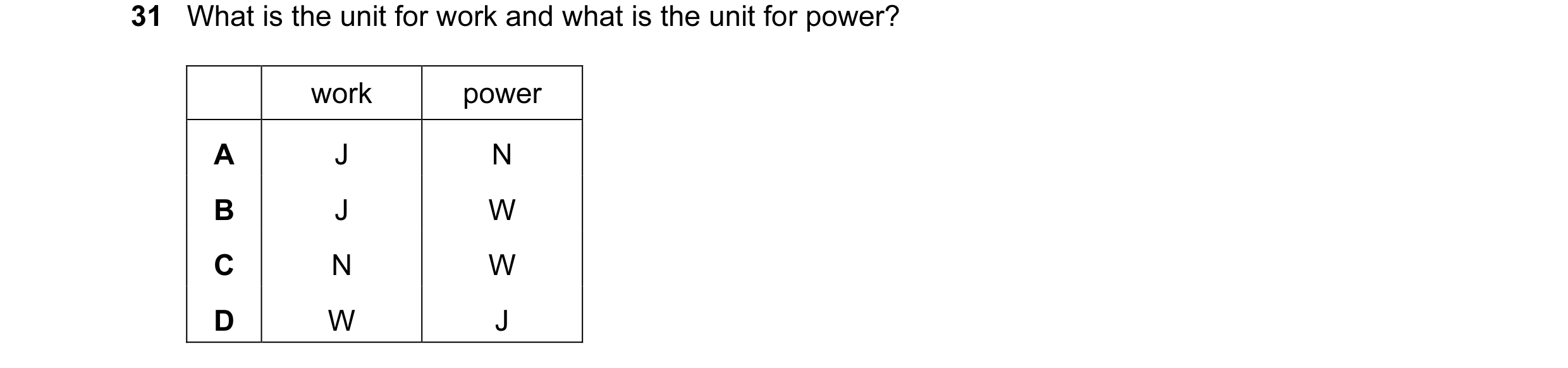
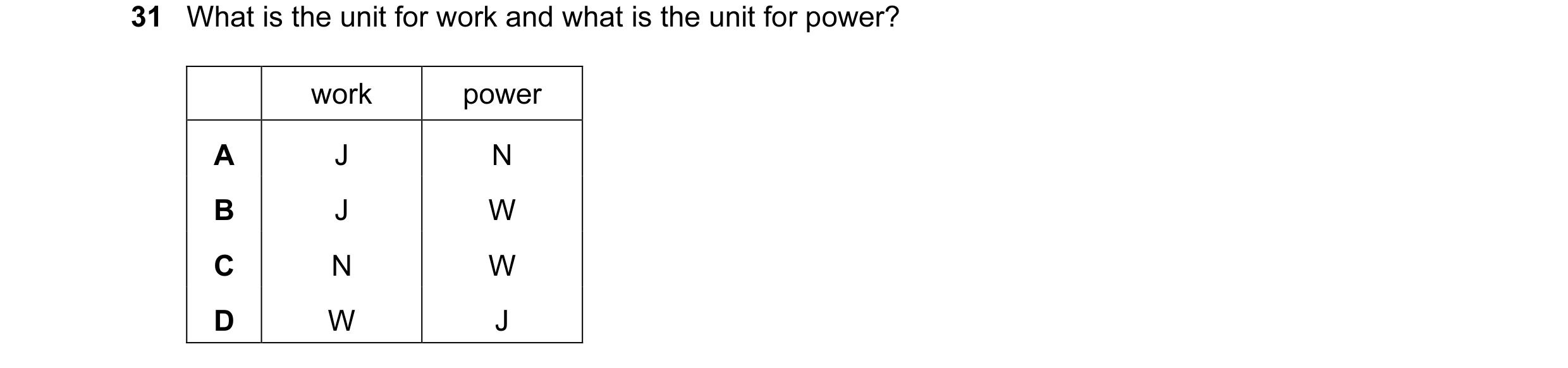
Q43 · What is the unit for work and what is the unit for power? 0653/11 Oct/Nov 2015
31 What is the unit for work and what is the unit for power? work power A J N B J W C N W D W J
1 marks
Answer: B
This question in 0653/11 Oct/Nov 2015
Q44 · Which energy change takes place when a block of wood slows down as it slides across a… 0653/11 Oct/Nov 2015
32 Which energy change takes place when a block of wood slows down as it slides across a rough horizontal table? A chemical energy to kinetic energy B gravitational energy to kinetic energy C gravitational energy to thermal energy D kinetic energy to thermal energy
1 marks
Answer: D
This question in 0653/11 Oct/Nov 2015
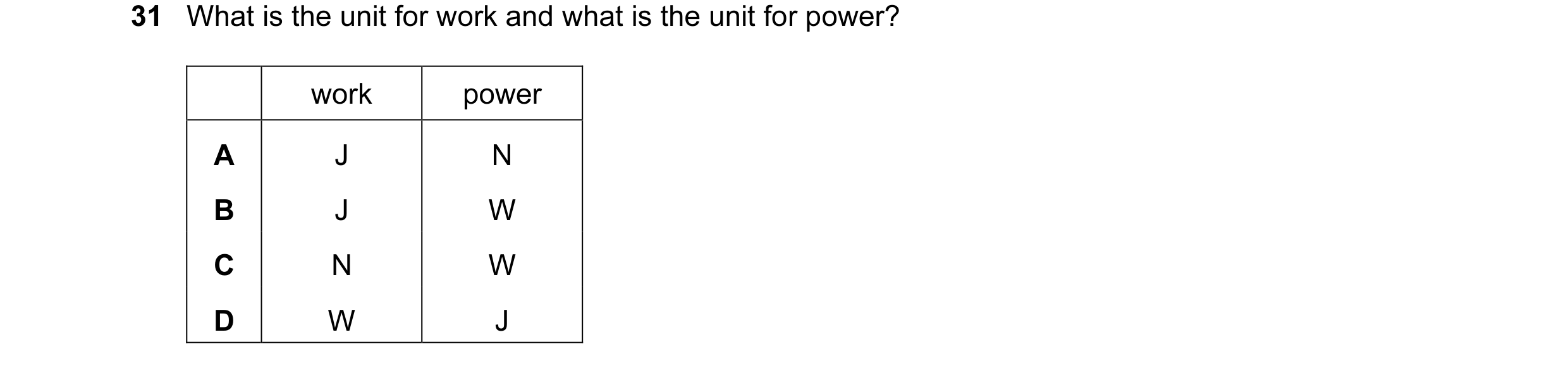
Q45 · What is the unit for work and what is the unit for power? 0653/12 Oct/Nov 2015
31 What is the unit for work and what is the unit for power? work power A J N B J W C N W D W J
1 marks
Answer: B
This question in 0653/12 Oct/Nov 2015
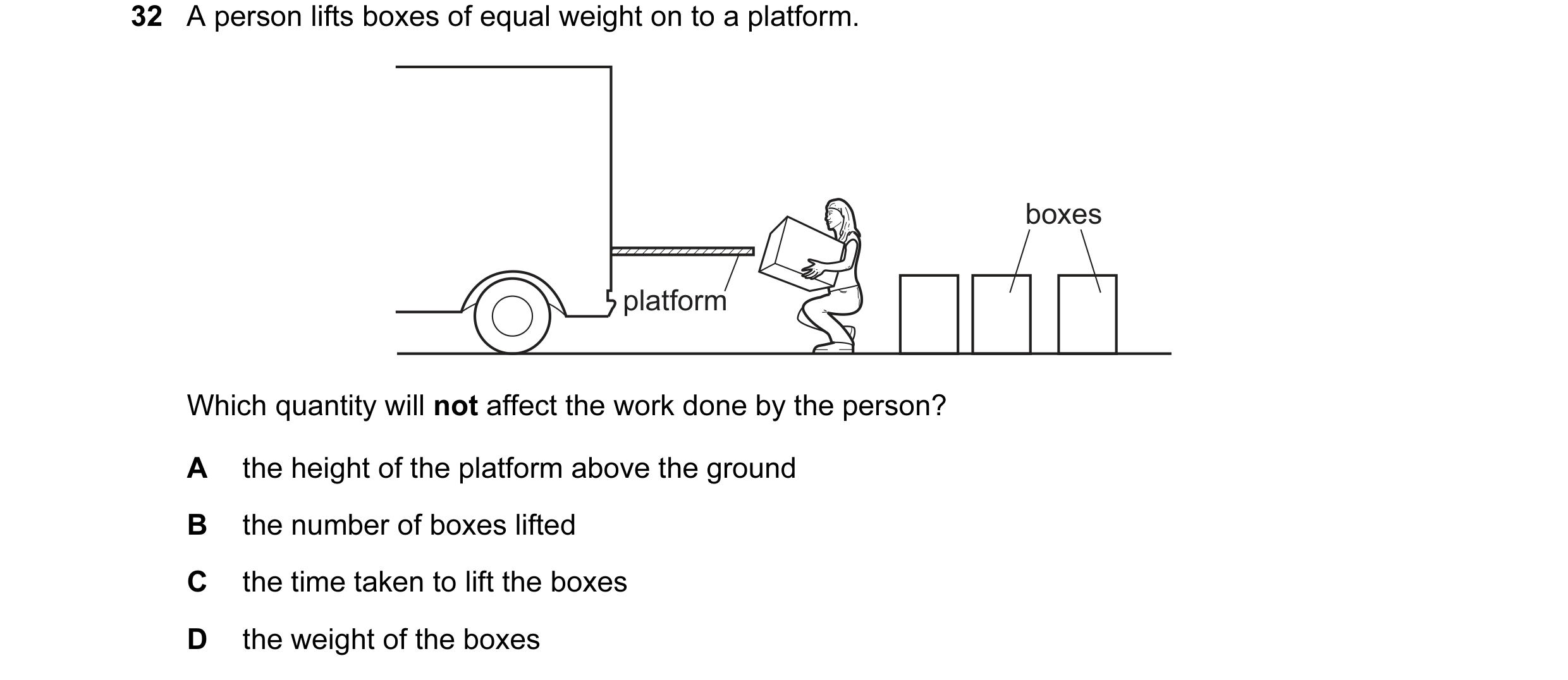
Q46 · A person lifts boxes of equal weight on to a platform 0653/12 Oct/Nov 2015
32 A person lifts boxes of equal weight on to a platform. boxes platform Which quantity will not affect the work done by the person? A the height of the platform above the ground B the number of boxes lifted C the time taken to lift the boxes D the weight of the boxes
1 marks
Answer: C
This question in 0653/12 Oct/Nov 2015
Q47 · What is the unit for work and what is the unit for power? 0653/13 Oct/Nov 2015
31 What is the unit for work and what is the unit for power? work power A J N B J W C N W D W J
1 marks
Answer: B
This question in 0653/13 Oct/Nov 2015
Q48 · The diagram shows a cyclist riding along a hilly road 0653/13 Oct/Nov 2015
32 The diagram shows a cyclist riding along a hilly road. At which position does the cyclist have the least gravitational (potential) energy? B C D A
1 marks
Answer: A
This question in 0653/13 Oct/Nov 2015
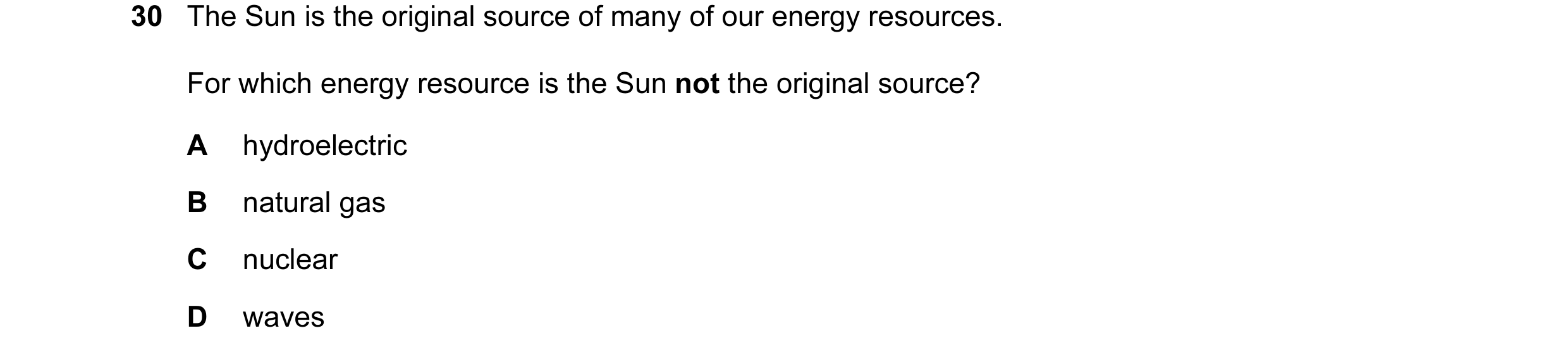
Q49 · The Sun is the original source of many of our energy resources 0653/11 May/June 2016
30 The Sun is the original source of many of our energy resources. For which energy resource is the Sun not the original source? A hydroelectric B natural gas C nuclear D waves
1 marks
Answer: C
This question in 0653/11 May/June 2016
Q50 · In which case is work not being done on the object involved? 0653/12 May/June 2016
30 In which case is work not being done on the object involved? A holding a heavy weight stationary above your head B holding both ends of a spring then stretching it C pushing a heavy chair over a rough, horizontal floor D raising a load off the ground
1 marks
Answer: A
This question in 0653/12 May/June 2016
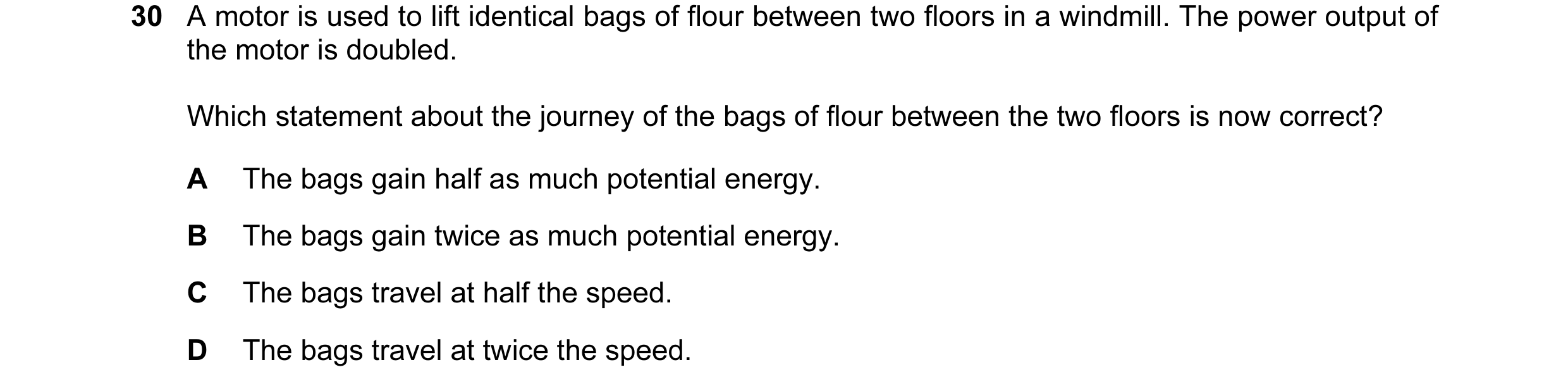
Q51 · A motor is used to lift identical bags of flour between two floors in a windmill 0653/13 May/June 2016
30 A motor is used to lift identical bags of flour between two floors in a windmill. The power output of the motor is doubled. Which statement about the journey of the bags of flour between the two floors is now correct? A The bags gain half as much potential energy. B The bags gain twice as much potential energy. C The bags travel at half the speed. D The bags travel at twice the speed.
1 marks
Answer: D
This question in 0653/13 May/June 2016
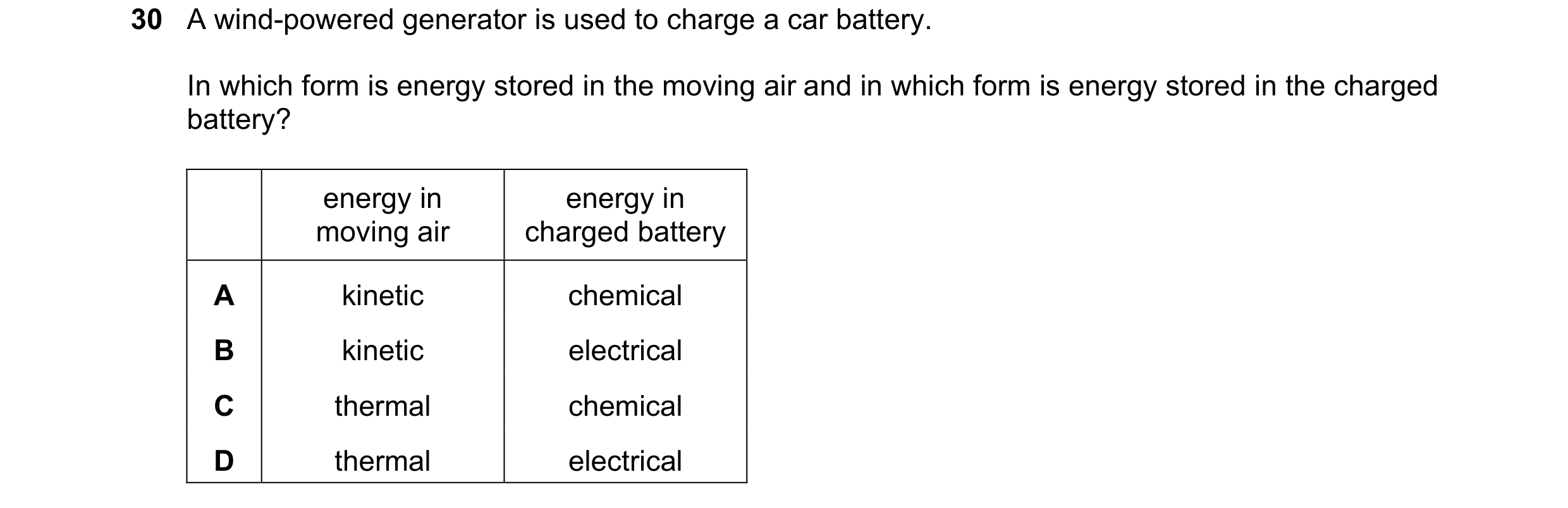
Q52 · A wind-powered generator is used to charge a car battery 0653/11 Oct/Nov 2016
30 A wind-powered generator is used to charge a car battery. In which form is energy stored in the moving air and in which form is energy stored in the charged battery? energy in energy in moving air charged battery A kinetic chemical B kinetic electrical C thermal chemical D thermal electrical
1 marks
Answer: A
This question in 0653/11 Oct/Nov 2016
Q53 · A parachutist falls at a constant speed 0653/12 Oct/Nov 2016
30 A parachutist falls at a constant speed. Her kinetic energy does not change. Which form of energy is increasing as she falls? A chemical energy B gravitational (potential) energy C nuclear energy D thermal energy
1 marks
Answer: D
This question in 0653/12 Oct/Nov 2016
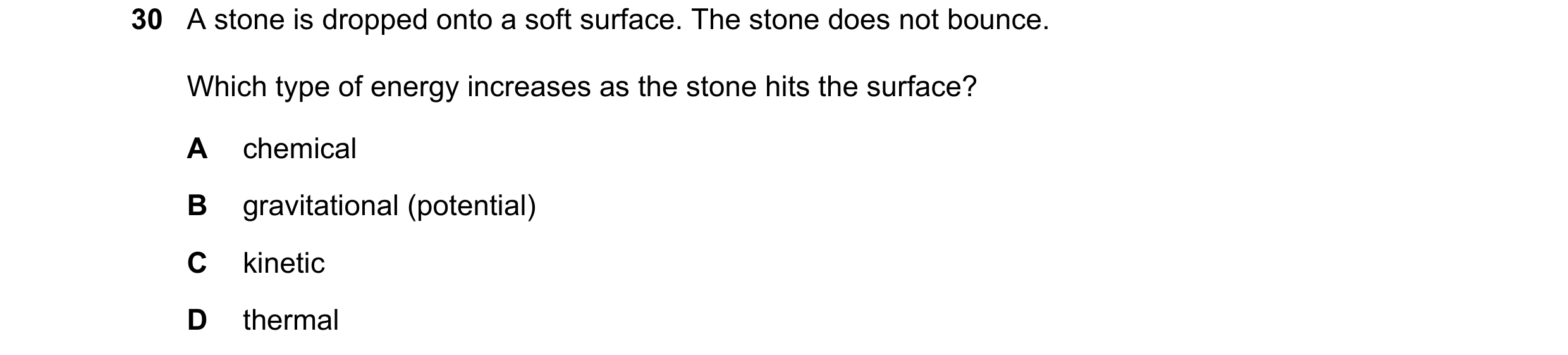
Q54 · A stone is dropped onto a soft surface 0653/13 Oct/Nov 2016
30 A stone is dropped onto a soft surface. The stone does not bounce. Which type of energy increases as the stone hits the surface? A chemical B gravitational (potential) C kinetic D thermal
1 marks
Answer: D
This question in 0653/13 Oct/Nov 2016
Q55 · In which unit is the kinetic energy of a car measured? 0653/12 Feb/March 2017
30 In which unit is the kinetic energy of a car measured? A joule B joule / second C metre / second D metre / second2
1 marks
Answer: A
This question in 0653/12 Feb/March 2017
Q56 · Which energy resource is not renewable? 0653/12 Feb/March 2017
31 Which energy resource is not renewable? A geothermal B nuclear C solar D wind
1 marks
Answer: B
This question in 0653/12 Feb/March 2017
Q57 · A force F lifting a weight through a height h 0653/12 Feb/March 2017
32 Diagram 1 shows a force F lifting a weight through a height h. Diagram 2 shows the same force F lifting the same weight through a height 2h. In both cases, air resistance and friction are negligible. force F force F 2h h weight weight diagram 1 diagram 2 Each lift can take either 1 s or 10 s. Which row shows the greatest power being developed when the weight is lifted? height time taken lifted for the lift / s A h 1 B h 10 C 2h 1 D 2h 10
1 marks
Answer: C
This question in 0653/12 Feb/March 2017
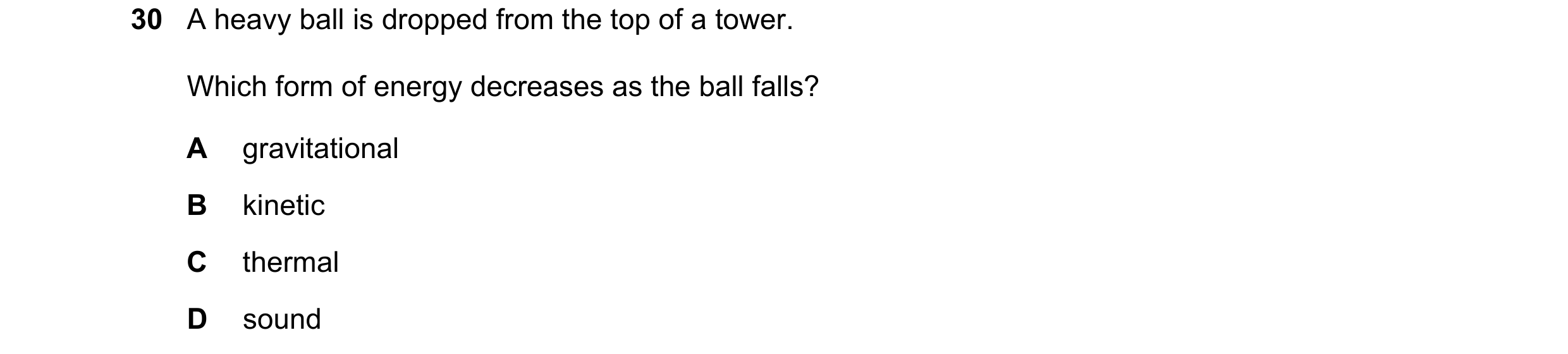
Q58 · A heavy ball is dropped from the top of a tower 0653/11 May/June 2017
30 A heavy ball is dropped from the top of a tower. Which form of energy decreases as the ball falls? A gravitational B kinetic C thermal D sound
1 marks
Answer: A
This question in 0653/11 May/June 2017
Q59 · Which force does the greatest amount of work? 0653/11 May/June 2017
31 Which force does the greatest amount of work? A a force of 10 N moving an object a distance of 3.0 m B a force of 10 N moving an object a distance of 5.0 m C a force of 15 N moving an object a distance of 3.0 m D a force of 15 N moving an object a distance of 5.0 m
1 marks
Answer: D
This question in 0653/11 May/June 2017
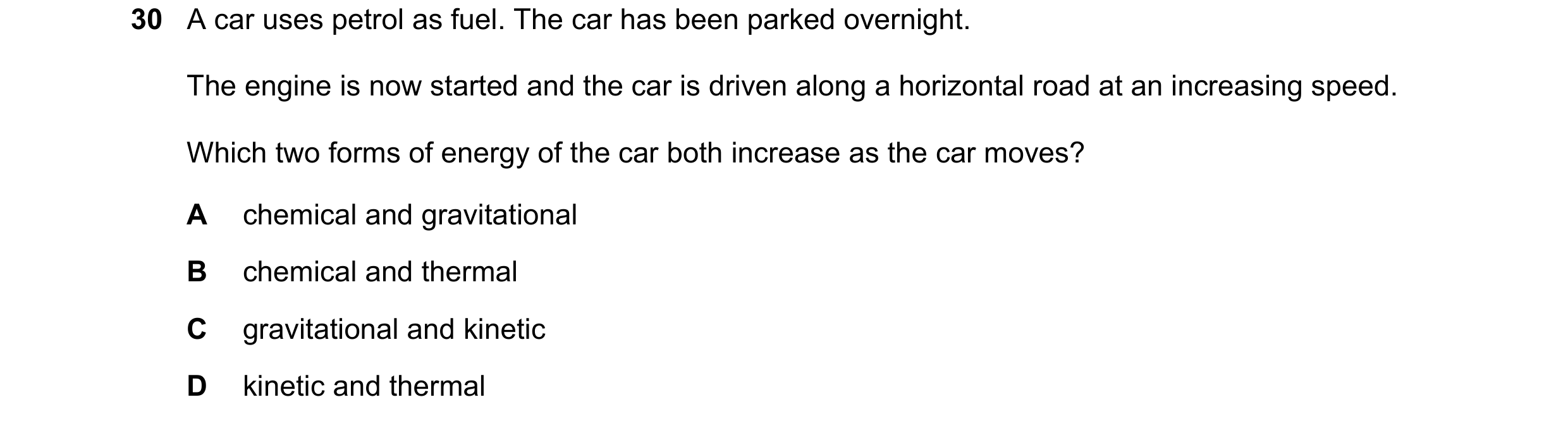
Q60 · A car uses petrol as fuel 0653/12 May/June 2017
30 A car uses petrol as fuel. The car has been parked overnight. The engine is now started and the car is driven along a horizontal road at an increasing speed. Which two forms of energy of the car both increase as the car moves? A chemical and gravitational B chemical and thermal C gravitational and kinetic D kinetic and thermal
1 marks
Answer: D
This question in 0653/12 May/June 2017
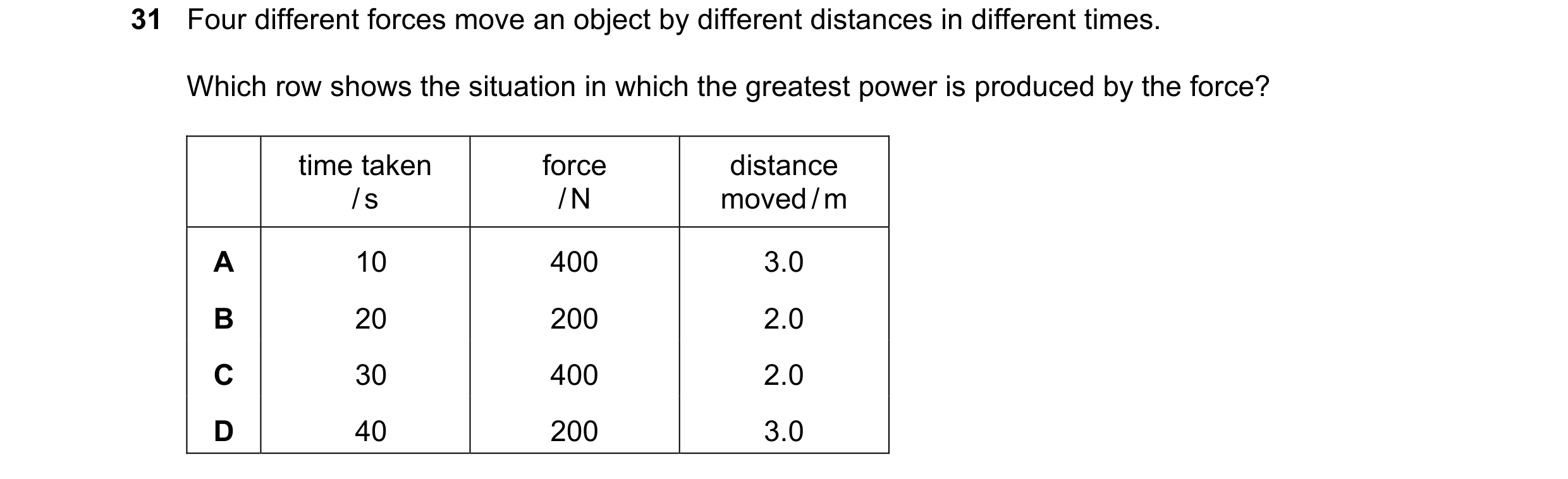
Q61 · Four different forces move an object by different distances in different times 0653/12 May/June 2017
31 Four different forces move an object by different distances in different times. Which row shows the situation in which the greatest power is produced by the force? time taken force distance / s / N moved / m A 10 400 3.0 B 20 200 2.0 C 30 400 2.0 D 40 200 3.0
1 marks
Answer: A
This question in 0653/12 May/June 2017
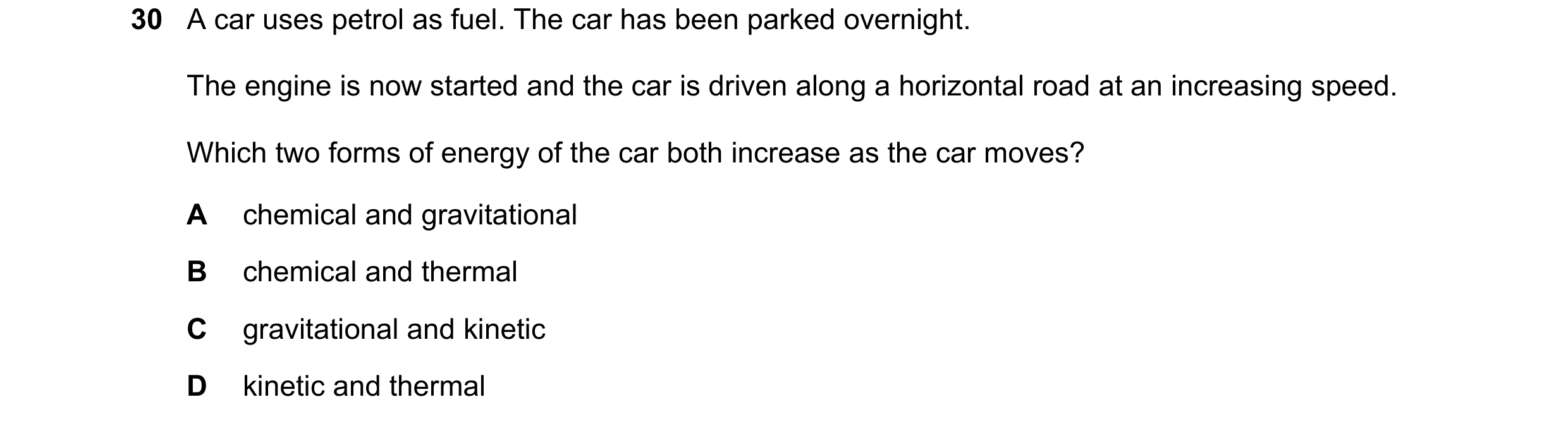
Q62 · A car uses petrol as fuel 0653/13 May/June 2017
30 A car uses petrol as fuel. The car has been parked overnight. The engine is now started and the car is driven along a horizontal road at an increasing speed. Which two forms of energy of the car both increase as the car moves? A chemical and gravitational B chemical and thermal C gravitational and kinetic D kinetic and thermal
1 marks
Answer: D
This question in 0653/13 May/June 2017
Q63 · Four different forces move an object by different distances in different times 0653/13 May/June 2017
31 Four different forces move an object by different distances in different times. Which row shows the situation in which the greatest power is produced by the force? time taken force distance / s / N moved / m A 10 400 3.0 B 20 200 2.0 C 30 400 2.0 D 40 200 3.0
1 marks
Answer: A
This question in 0653/13 May/June 2017
Q64 · Which energy resource is renewable and has the Sun as its source of energy? 0653/11 Oct/Nov 2017
31 Which energy resource is renewable and has the Sun as its source of energy? A coal B geothermal C hydroelectric D nuclear
1 marks
Answer: C
This question in 0653/11 Oct/Nov 2017
Q65 · Which energy resource is non-renewable? 0653/12 Feb/March 2018
31 Which energy resource is non-renewable? A geothermal energy B hydroelectric energy C nuclear energy D wave energy
1 marks
Answer: C
This question in 0653/12 Feb/March 2018
Q66 · In an experiment, four students each lift a different empty metal box from the floor on… 0653/12 Feb/March 2018
32 In an experiment, four students each lift a different empty metal box from the floor on to a stool or a table. Two students lift a box made of aluminium, and two students lift a box made of steel. The diagrams show the height of the stool and the table, and the masses of the boxes. Which student does the most work on the box that he or she is lifting? A B stool stool 0.50 m 0.50 m aluminium steel 1000 g 800 g C D table table 0.80 m 0.80 m aluminium steel 1000 g 800 g
1 marks
Answer: C
This question in 0653/12 Feb/March 2018
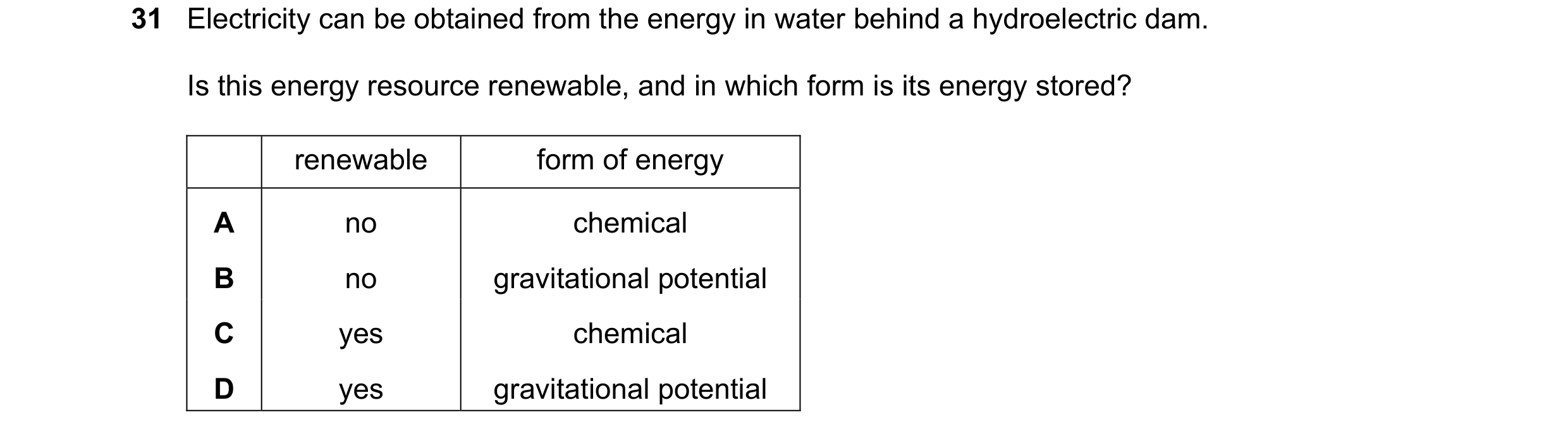
Q67 · Electricity can be obtained from the energy in water behind a hydroelectric dam 0653/11 May/June 2018
31 Electricity can be obtained from the energy in water behind a hydroelectric dam. Is this energy resource renewable, and in which form is its energy stored? renewable form of energy A no chemical B no gravitational potential C yes chemical D yes gravitational potential
1 marks
Answer: D
This question in 0653/11 May/June 2018
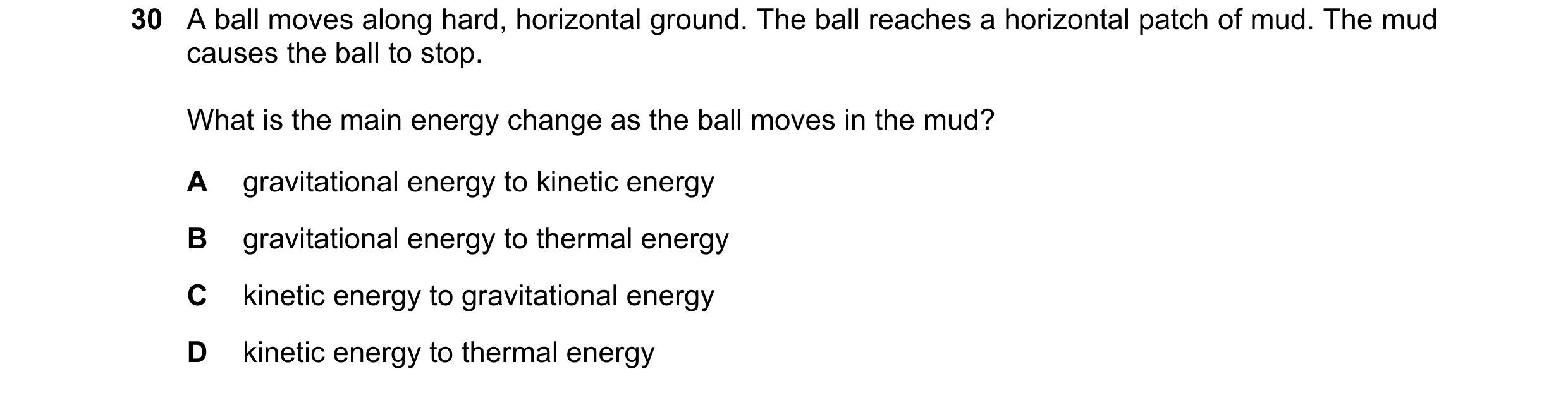
Q68 · A ball moves along hard, horizontal ground 0653/12 May/June 2018
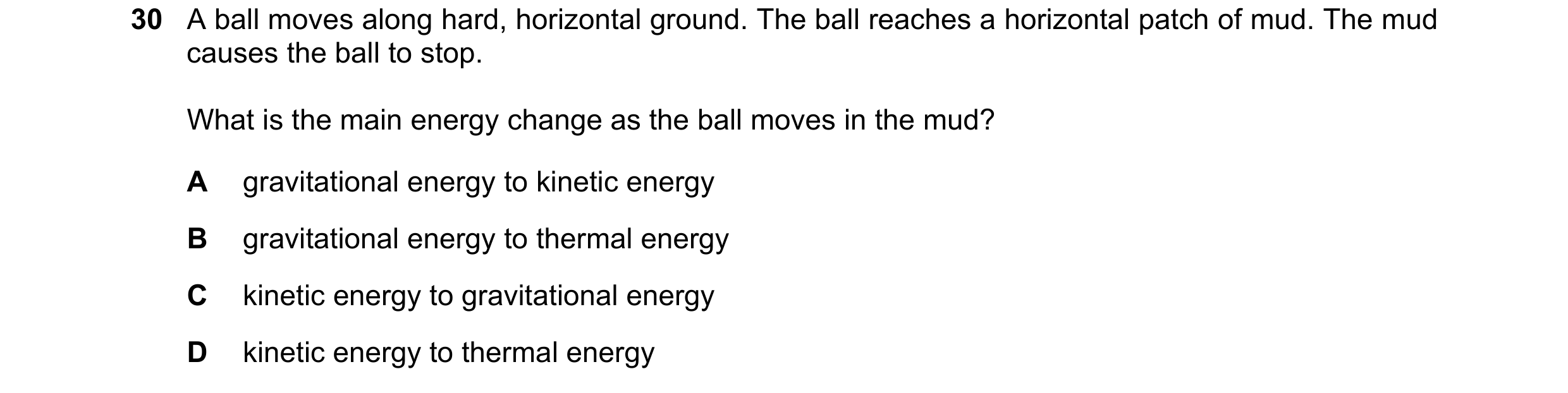
30 A ball moves along hard, horizontal ground. The ball reaches a horizontal patch of mud. The mud causes the ball to stop. What is the main energy change as the ball moves in the mud? A gravitational energy to kinetic energy B gravitational energy to thermal energy C kinetic energy to gravitational energy D kinetic energy to thermal energy
1 marks
Answer: D
This question in 0653/12 May/June 2018
Q69 · A train is travelling along a straight, horizontal track at constant speed 0653/12 May/June 2018
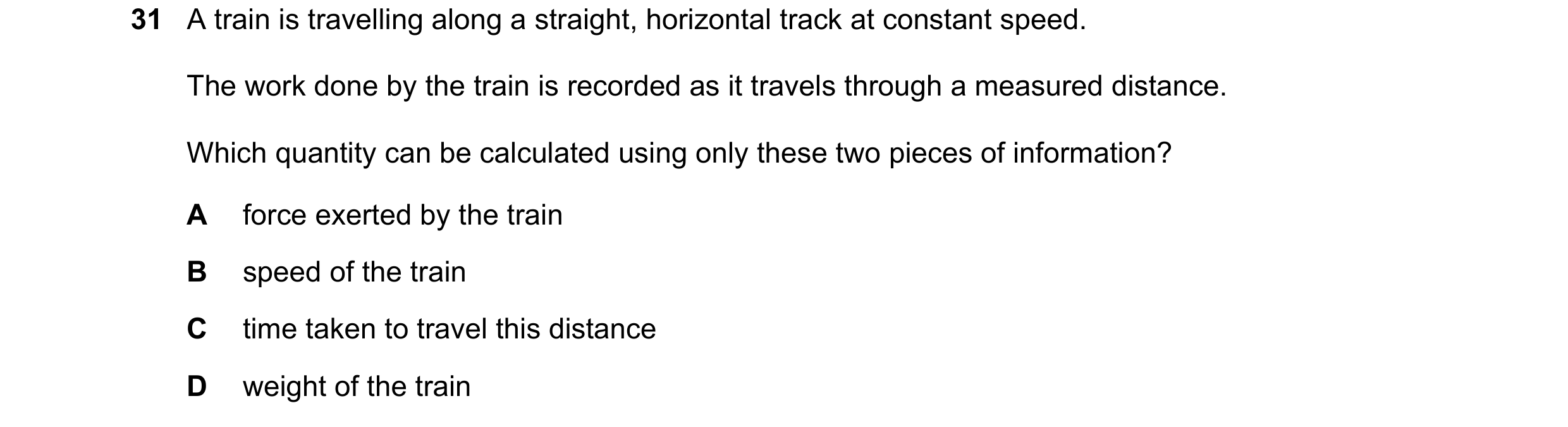
31 A train is travelling along a straight, horizontal track at constant speed. The work done by the train is recorded as it travels through a measured distance. Which quantity can be calculated using only these two pieces of information? A force exerted by the train B speed of the train C time taken to travel this distance D weight of the train
1 marks
Answer: A
This question in 0653/12 May/June 2018
Q70 · A ball moves along hard, horizontal ground 0653/13 May/June 2018
30 A ball moves along hard, horizontal ground. The ball reaches a horizontal patch of mud. The mud causes the ball to stop. What is the main energy change as the ball moves in the mud? A gravitational energy to kinetic energy B gravitational energy to thermal energy C kinetic energy to gravitational energy D kinetic energy to thermal energy
1 marks
Answer: D
This question in 0653/13 May/June 2018
Q71 · A train is travelling along a straight, horizontal track at constant speed 0653/13 May/June 2018
31 A train is travelling along a straight, horizontal track at constant speed. The work done by the train is recorded as it travels through a measured distance. Which quantity can be calculated using only these two pieces of information? A force exerted by the train B speed of the train C time taken to travel this distance D weight of the train
1 marks
Answer: A
This question in 0653/13 May/June 2018
Q72 · A ball is released from rest at position X and falls to the ground 0653/11 Oct/Nov 2018
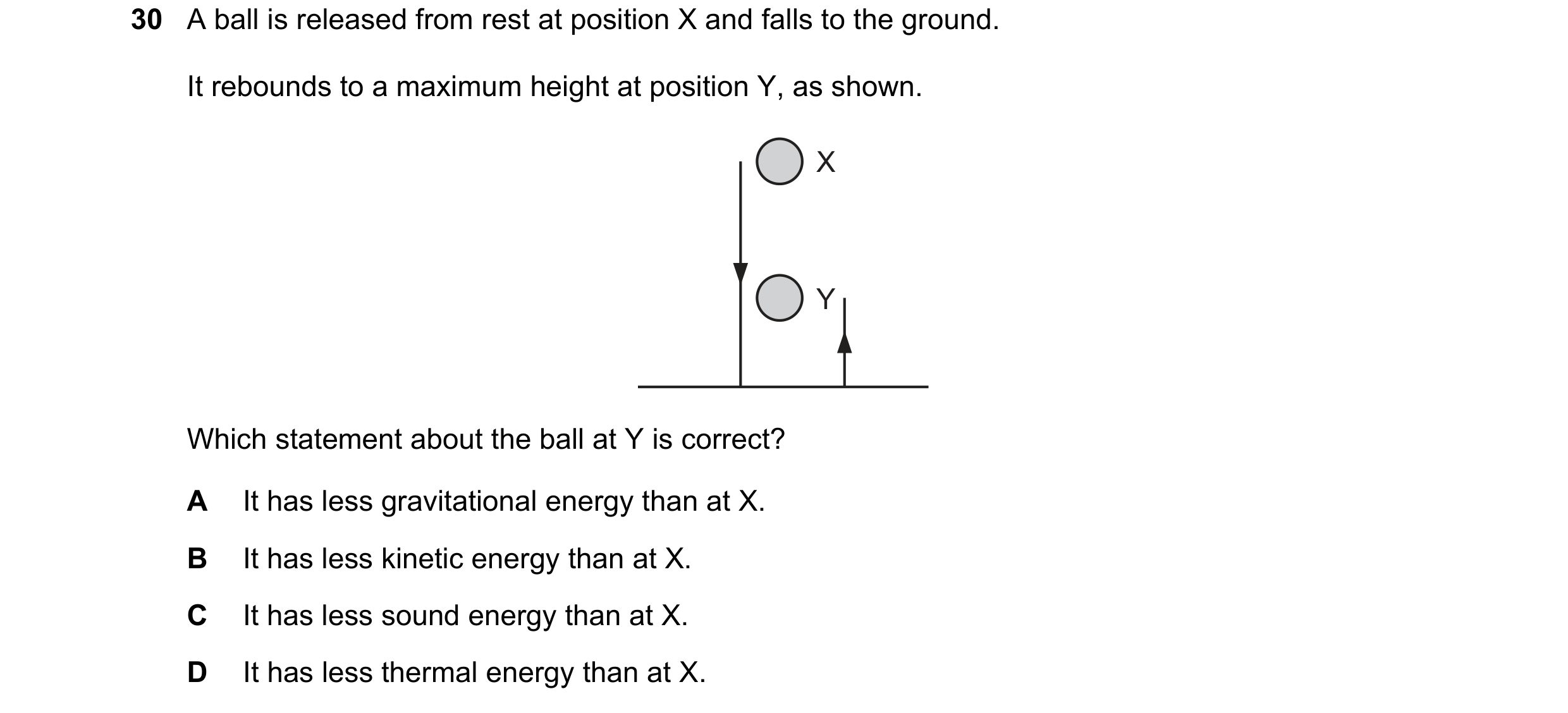
30 A ball is released from rest at position X and falls to the ground. It rebounds to a maximum height at position Y, as shown. X Y Which statement about the ball at Y is correct? A It has less gravitational energy than at X. B It has less kinetic energy than at X. C It has less sound energy than at X. D It has less thermal energy than at X.
1 marks
Answer: A
This question in 0653/11 Oct/Nov 2018
Q73 · Weightlifting involves a number of different stages 0653/11 Oct/Nov 2018
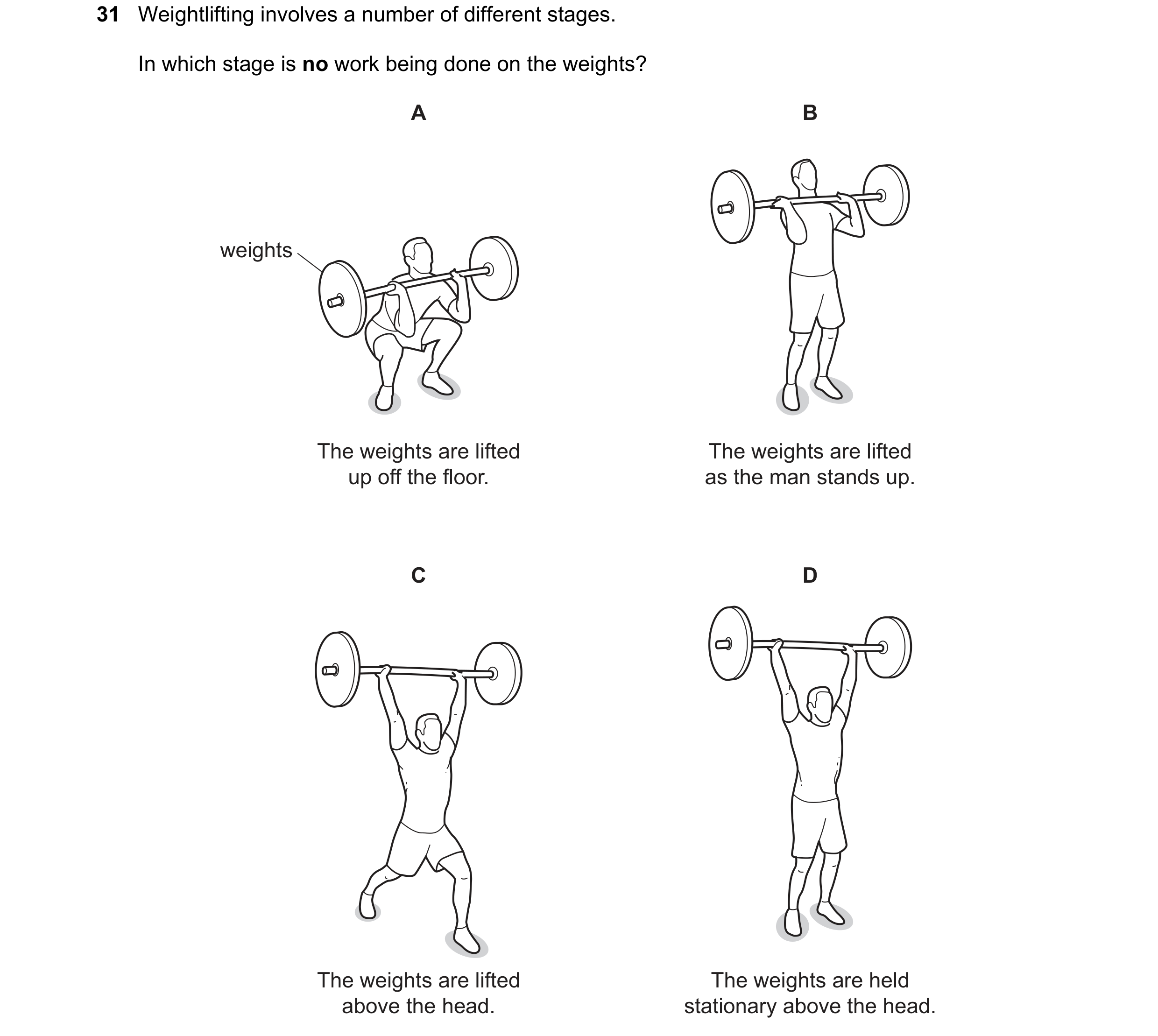
31 Weightlifting involves a number of different stages. In which stage is no work being done on the weights? A B weights The weights are lifted The weights are lifted up off the floor. as the man stands up. C D The weights are lifted The weights are held above the head. stationary above the head.
1 marks
Answer: D
This question in 0653/11 Oct/Nov 2018
Q74 · Weightlifting involves a number of different stages 0653/12 Oct/Nov 2018
31 Weightlifting involves a number of different stages. In which stage is no work being done on the weights? A B weights The weights are lifted The weights are lifted up off the floor. as the man stands up. C D The weights are lifted The weights are held above the head. stationary above the head.
1 marks
Answer: D
This question in 0653/12 Oct/Nov 2018
Q75 · The table compares the output of thermal energy per second from four different lamps 0653/13 Oct/Nov 2018
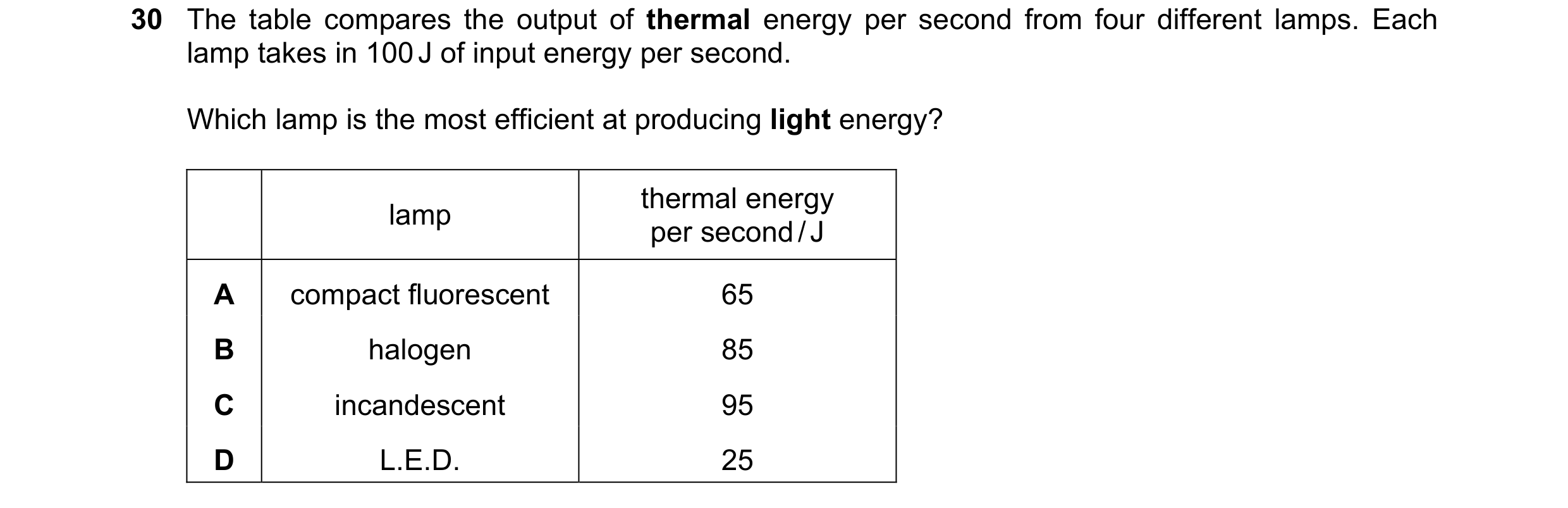
30 The table compares the output of thermal energy per second from four different lamps. Each lamp takes in 100 J of input energy per second. Which lamp is the most efficient at producing light energy? thermal energy lamp per second / J A compact fluorescent 65 B halogen 85 C incandescent 95 D L.E.D. 25
1 marks
Answer: D
This question in 0653/13 Oct/Nov 2018
Q76 · Weightlifting involves a number of different stages 0653/13 Oct/Nov 2018
31 Weightlifting involves a number of different stages. In which stage is no work being done on the weights? A B weights The weights are lifted The weights are lifted up off the floor. as the man stands up. C D The weights are lifted The weights are held above the head. stationary above the head.
1 marks
Answer: D
This question in 0653/13 Oct/Nov 2018
Q77 · The diagram shows a cyclist riding along a hilly road 0653/12 Feb/March 2019
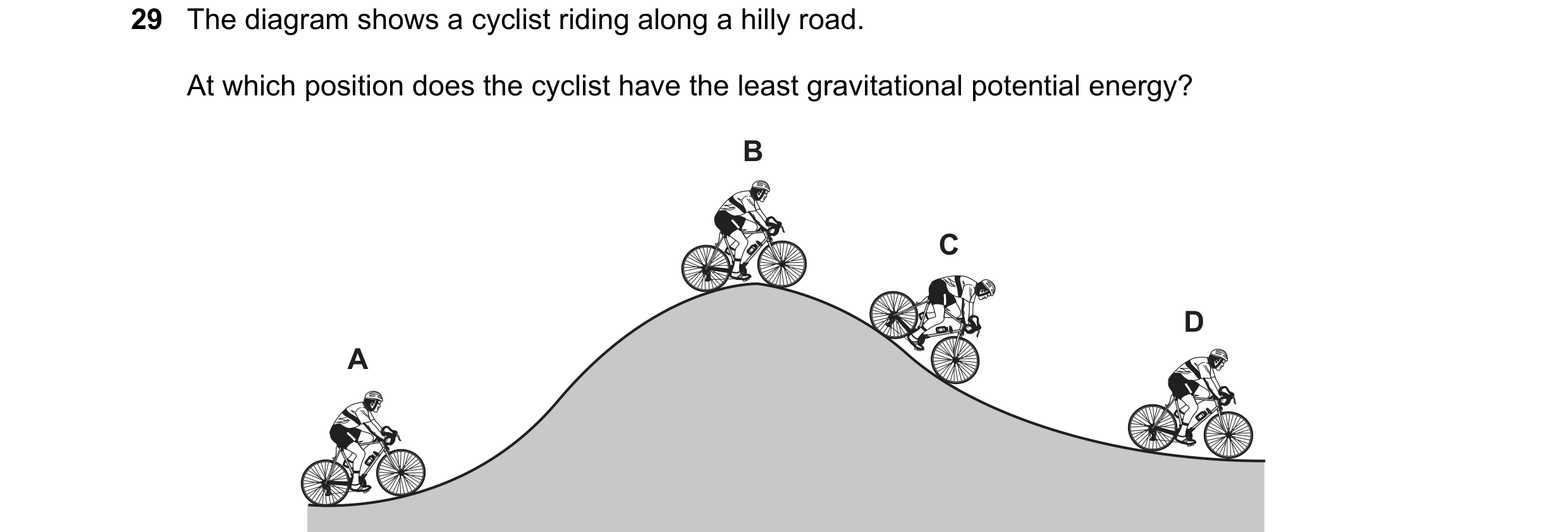
29 The diagram shows a cyclist riding along a hilly road. At which position does the cyclist have the least gravitational potential energy? B C D A
1 marks
Answer: A
This question in 0653/12 Feb/March 2019
Q78 · A ball made of soft clay is dropped and hits the ground 0653/11 May/June 2019
31 A ball made of soft clay is dropped and hits the ground. It does not bounce. soft clay ball ground What energy changes take place as the ball drops and hits the ground? A gravitational potential → kinetic → thermal B gravitational potential → thermal → kinetic C kinetic → gravitational potential → thermal D kinetic → thermal → gravitational potential
1 marks
Answer: A
This question in 0653/11 May/June 2019
Q79 · Which two quantities are used to calculate the power produced by a car engine? 0653/11 May/June 2019
32 Which two quantities are used to calculate the power produced by a car engine? A the speed of the car and the distance the car has travelled B the speed of the car and the time for the journey C the work done by the engine and the distance the car has travelled D the work done by the engine and the time taken to do the work
1 marks
Answer: D
This question in 0653/11 May/June 2019
Q80 · What energy does an object have because of its position above the surface of the Earth? 0653/12 May/June 2019
30 What energy does an object have because of its position above the surface of the Earth? A chemical potential B gravitational potential C kinetic D thermal
1 marks
Answer: B
This question in 0653/12 May/June 2019
Q81 · Which mode of transport uses a renewable energy source? 0653/12 May/June 2019
31 Which mode of transport uses a renewable energy source? A a coal-fired steam train B a nuclear-powered submarine C a petrol-engined car D a sailing boat moved by the wind
1 marks
Answer: D
This question in 0653/12 May/June 2019
Q82 · A crane is used to lift a load vertically 0653/11 Oct/Nov 2019
31 A crane is used to lift a load vertically. Which situation requires a crane that produces greater power? A lifting a lighter load through the same distance in the same time B lifting the same load through a smaller distance in the same time C lifting the same load through the same distance in a longer time D lifting the same load through the same distance in a shorter time
1 marks
Answer: D
This question in 0653/11 Oct/Nov 2019
Q83 · Which device uses a non-renewable energy source? 0653/11 Oct/Nov 2019
32 Which device uses a non-renewable energy source? A diesel engine B solar cell C water turbine D windmill
1 marks
Answer: A
This question in 0653/11 Oct/Nov 2019
Q84 · The diagram shows a load attached to a spring 0653/12 Oct/Nov 2019
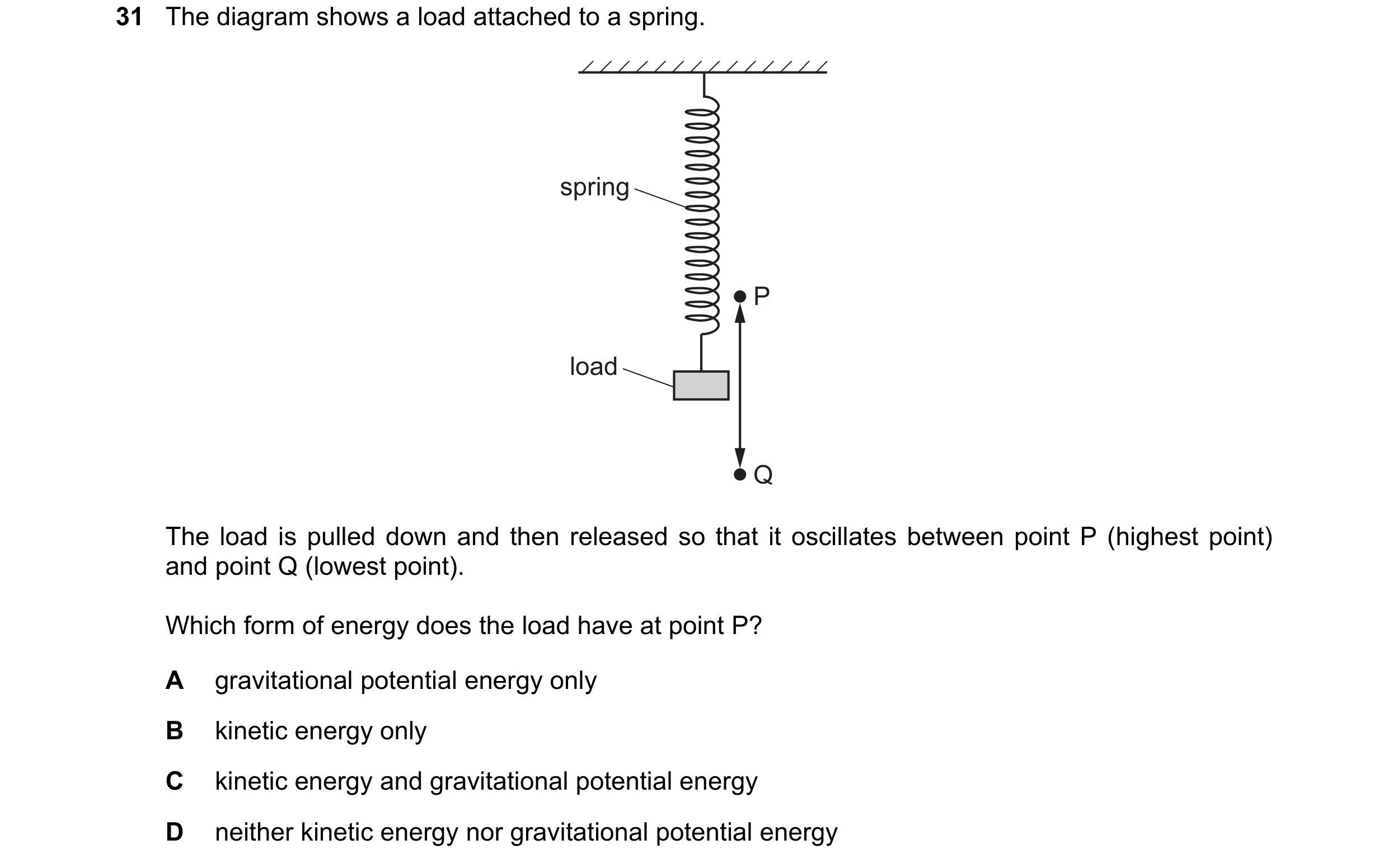
31 The diagram shows a load attached to a spring. spring P load Q The load is pulled down and then released so that it oscillates between point P (highest point) and point Q (lowest point). Which form of energy does the load have at point P? A gravitational potential energy only B kinetic energy only C kinetic energy and gravitational potential energy D neither kinetic energy nor gravitational potential energy
1 marks
Answer: A
This question in 0653/12 Oct/Nov 2019
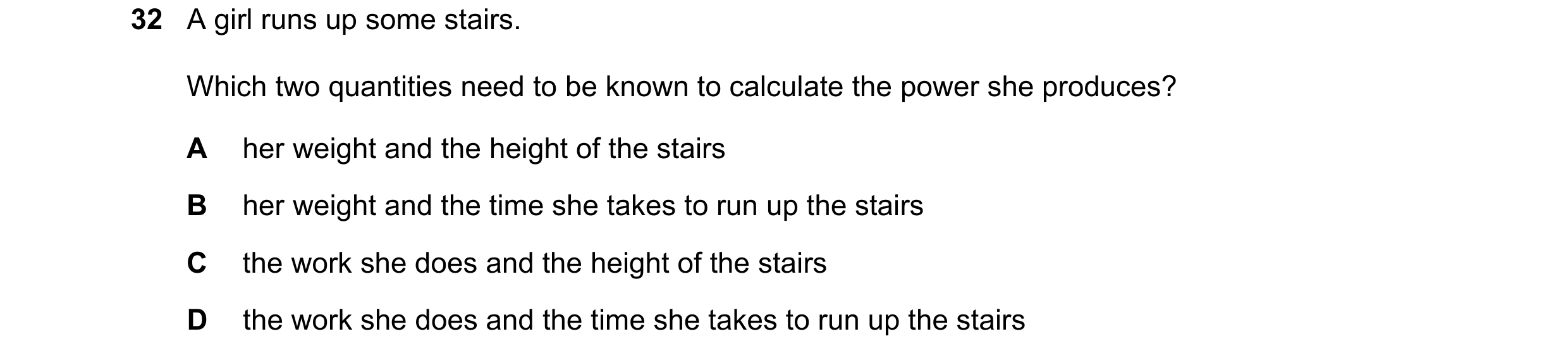
Q85 · A girl runs up some stairs 0653/12 Oct/Nov 2019
32 A girl runs up some stairs. Which two quantities need to be known to calculate the power she produces? A her weight and the height of the stairs B her weight and the time she takes to run up the stairs C the work she does and the height of the stairs D the work she does and the time she takes to run up the stairs
1 marks
Answer: D
This question in 0653/12 Oct/Nov 2019
Q86 · The diagram shows a load attached to a spring 0653/13 Oct/Nov 2019
31 The diagram shows a load attached to a spring. spring P load Q The load is pulled down and then released so that it oscillates between point P (highest point) and point Q (lowest point). Which form of energy does the load have at point P? A gravitational potential energy only B kinetic energy only C kinetic energy and gravitational potential energy D neither kinetic energy nor gravitational potential energy
1 marks
Answer: A
This question in 0653/13 Oct/Nov 2019
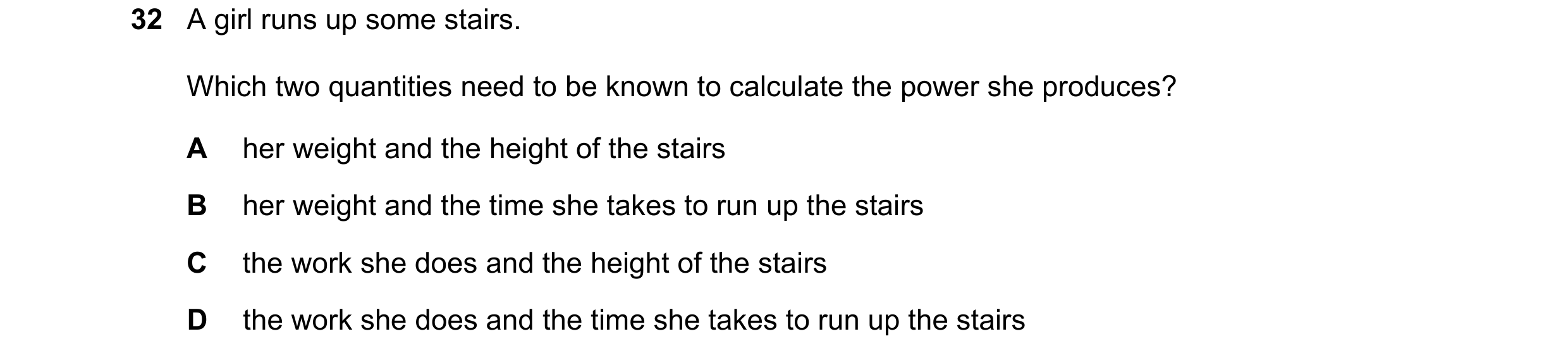
Q87 · A girl runs up some stairs 0653/13 Oct/Nov 2019
32 A girl runs up some stairs. Which two quantities need to be known to calculate the power she produces? A her weight and the height of the stairs B her weight and the time she takes to run up the stairs C the work she does and the height of the stairs D the work she does and the time she takes to run up the stairs
1 marks
Answer: D
This question in 0653/13 Oct/Nov 2019
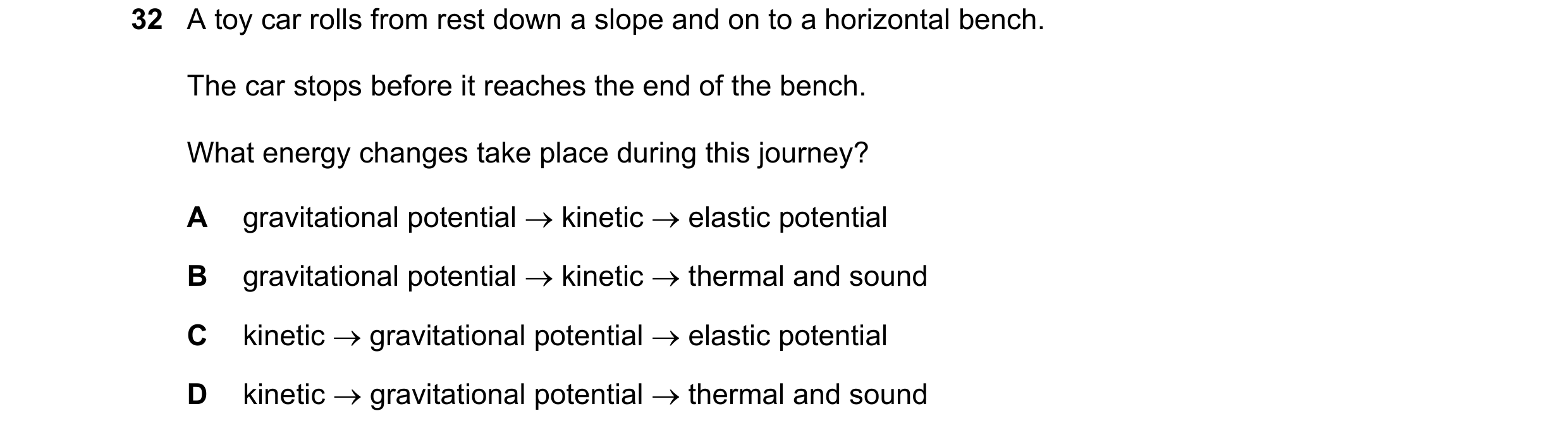
Q88 · A toy car rolls from rest down a slope and on to a horizontal bench 0653/12 Feb/March 2020
32 A toy car rolls from rest down a slope and on to a horizontal bench. The car stops before it reaches the end of the bench. What energy changes take place during this journey? A gravitational potential → kinetic → elastic potential B gravitational potential → kinetic → thermal and sound C kinetic → gravitational potential → elastic potential D kinetic → gravitational potential → thermal and sound
1 marks
Answer: B
This question in 0653/12 Feb/March 2020
Q89 · A load hangs on a spring at point Q 0653/11 May/June 2020
31 A load hangs on a spring at point Q. The load is now pulled down to point R and released. It moves up and down between its highest point P and its lowest point R. P load Q R Which statement describes the kinetic energy of the load? A It is equal at points P, Q and R. B It is greatest at point P. C It is greatest at point Q. D It is greatest at point R.
1 marks
Answer: C
This question in 0653/11 May/June 2020
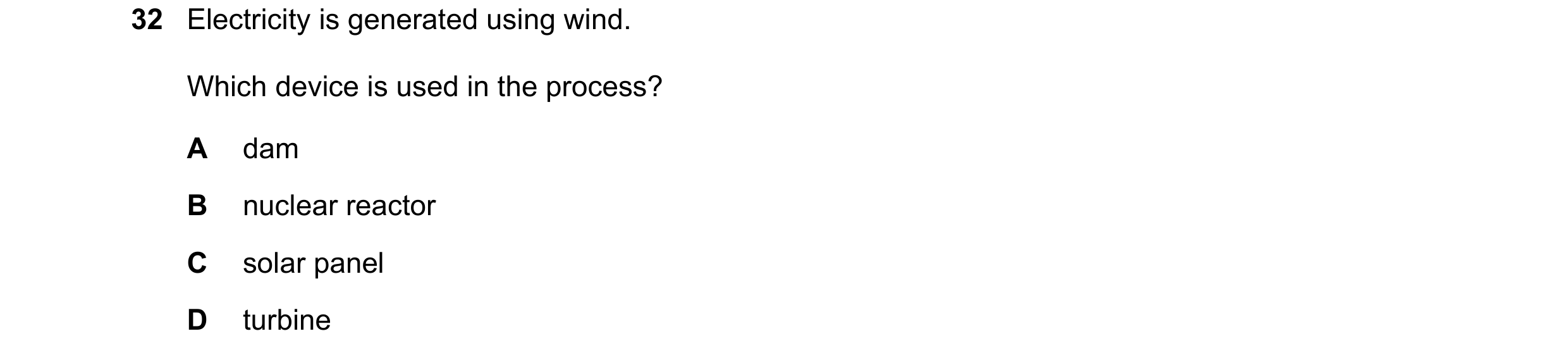
Q90 · Electricity is generated using wind 0653/11 May/June 2020
32 Electricity is generated using wind. Which device is used in the process? A dam B nuclear reactor C solar panel D turbine
1 marks
Answer: D
This question in 0653/11 May/June 2020
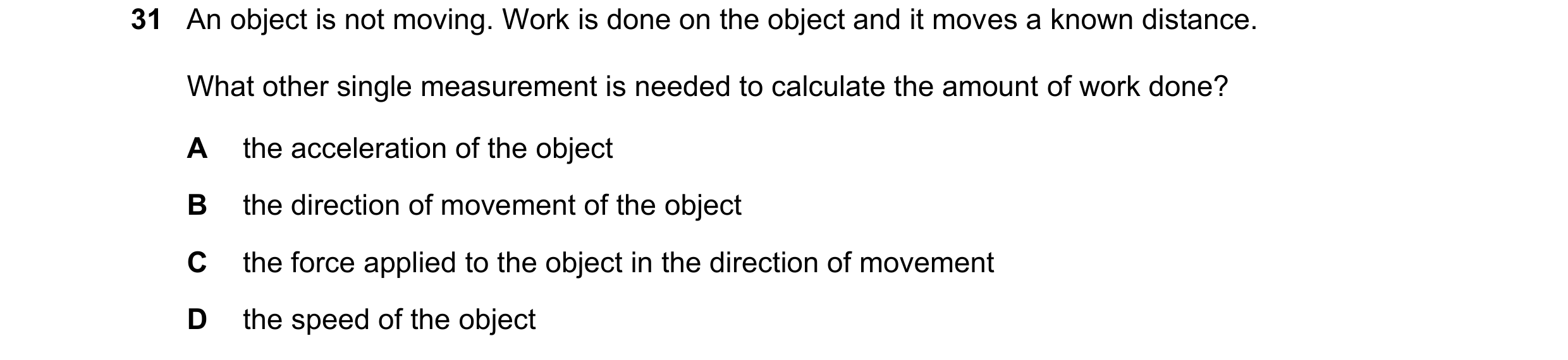
Q91 · An object is not moving 0653/11 Oct/Nov 2020
31 An object is not moving. Work is done on the object and it moves a known distance. What other single measurement is needed to calculate the amount of work done? A the acceleration of the object B the direction of movement of the object C the force applied to the object in the direction of movement D the speed of the object
1 marks
Answer: C
This question in 0653/11 Oct/Nov 2020
Q92 · An apple falls to the ground 0653/11 Oct/Nov 2020
32 An apple falls to the ground. Which form of energy decreases as the apple falls? A chemical potential B gravitational potential C kinetic D sound
1 marks
Answer: B
This question in 0653/11 Oct/Nov 2020
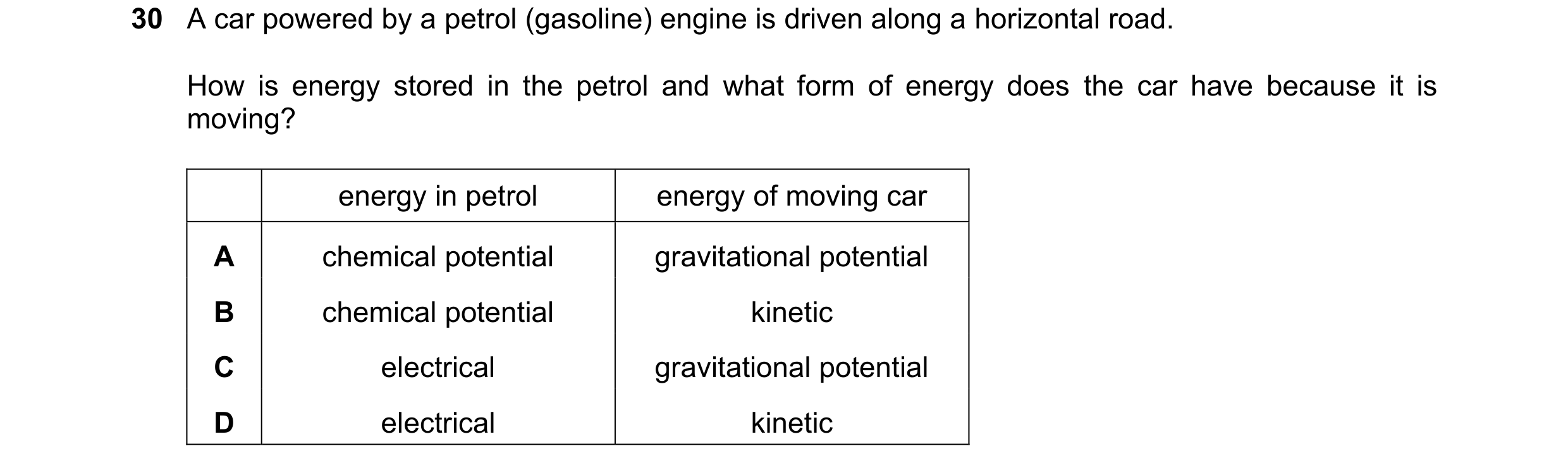
Q93 · A car powered by a petrol (gasoline) engine is driven along a horizontal road 0653/12 Oct/Nov 2020
30 A car powered by a petrol (gasoline) engine is driven along a horizontal road. How is energy stored in the petrol and what form of energy does the car have because it is moving? energy in petrol energy of moving car A chemical potential gravitational potential B chemical potential kinetic C electrical gravitational potential D electrical kinetic
1 marks
Answer: B
This question in 0653/12 Oct/Nov 2020
Q94 · A student carrying a bag walks up some stairs at a constant speed 0653/13 Oct/Nov 2020
31 A student carrying a bag walks up some stairs at a constant speed. Which change does not affect the power developed by the student? A carrying a heavier bag B walking at a higher constant speed C walking at a lower constant speed D walking half-way up the stairs
1 marks
Answer: D
This question in 0653/13 Oct/Nov 2020
Q95 · Which energy source is non-renewable? 0653/13 Oct/Nov 2020
32 Which energy source is non-renewable? A geothermal B hydroelectric C nuclear fission D wind
1 marks
Answer: C
This question in 0653/13 Oct/Nov 2020
Q96 · A load hanging on a spring 0653/12 Feb/March 2021
31 Diagram 1 shows a load hanging on a spring. Diagram 2 shows the load pulled down. diagram 1 diagram 2 When the load is pulled down, what happens to the gravitational potential energy of the load and the elastic potential (strain) energy of the spring? gravitational potential elastic potential energy of load energy of spring A decreases decreases B decreases increases C increases decreases D increases increases
1 marks
Answer: B
This question in 0653/12 Feb/March 2021
Q97 · In which list are all the sources of energy renewable? 0653/12 Feb/March 2021
32 In which list are all the sources of energy renewable? A geothermal, hydroelectric, nuclear fission B geothermal, tides, hydroelectric C tides, nuclear fission, coal D solar, wind, coal
1 marks
Answer: B
This question in 0653/12 Feb/March 2021
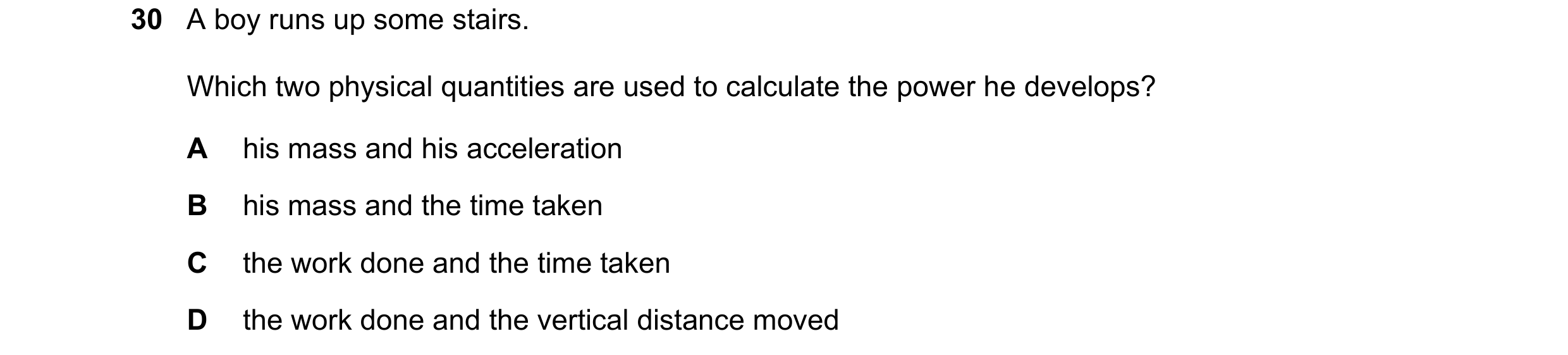
Q98 · A boy runs up some stairs 0653/11 May/June 2021
30 A boy runs up some stairs. Which two physical quantities are used to calculate the power he develops? A his mass and his acceleration B his mass and the time taken C the work done and the time taken D the work done and the vertical distance moved
1 marks
Answer: C
This question in 0653/11 May/June 2021
Q99 · Which row contains a renewable and a non-renewable energy resource in the correct column? 0653/11 May/June 2021
31 Which row contains a renewable and a non-renewable energy resource in the correct column? renewable non-renewable A geothermal wind B geothermal coal C oil wind D oil coal
1 marks
Answer: B
This question in 0653/11 May/June 2021
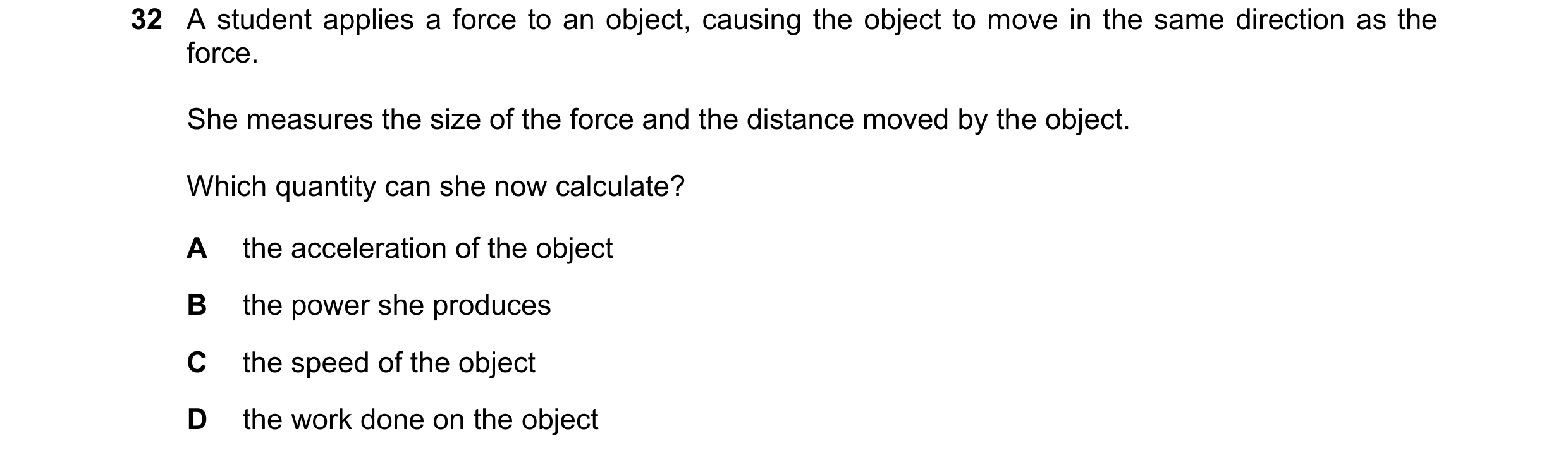
Q100 · A student applies a force to an object, causing the object to move in the same direction… 0653/12 May/June 2021
32 A student applies a force to an object, causing the object to move in the same direction as the force. She measures the size of the force and the distance moved by the object. Which quantity can she now calculate? A the acceleration of the object B the power she produces C the speed of the object D the work done on the object
1 marks
Answer: D
This question in 0653/12 May/June 2021
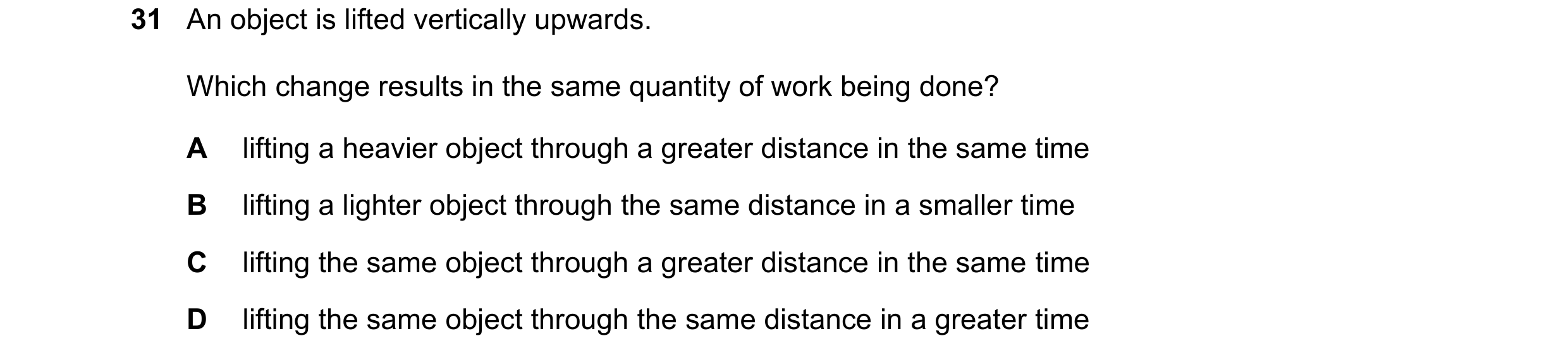
Q101 · An object is lifted vertically upwards 0653/13 May/June 2021
31 An object is lifted vertically upwards. Which change results in the same quantity of work being done? A lifting a heavier object through a greater distance in the same time B lifting a lighter object through the same distance in a smaller time C lifting the same object through a greater distance in the same time D lifting the same object through the same distance in a greater time
1 marks
Answer: D
This question in 0653/13 May/June 2021
Q102 · Which source of energy is non-renewable? 0653/13 May/June 2021
32 Which source of energy is non-renewable? A chemical energy stored in fossil fuels B energy stored in waves C energy stored in water behind a hydroelectric dam D wind energy
1 marks
Answer: A
This question in 0653/13 May/June 2021
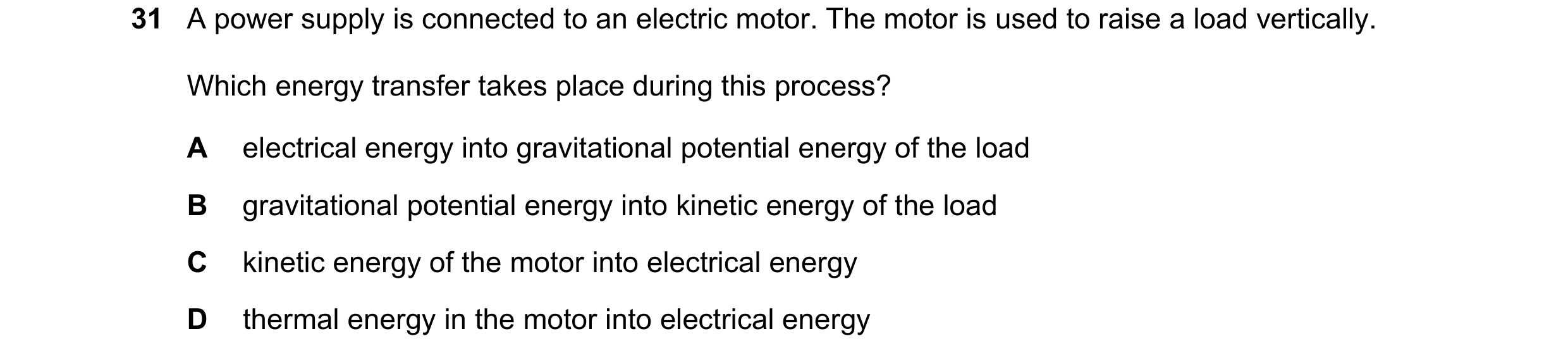
Q103 · A power supply is connected to an electric motor 0653/11 Oct/Nov 2021
31 A power supply is connected to an electric motor. The motor is used to raise a load vertically. Which energy transfer takes place during this process? A electrical energy into gravitational potential energy of the load B gravitational potential energy into kinetic energy of the load C kinetic energy of the motor into electrical energy D thermal energy in the motor into electrical energy
1 marks
Answer: A
This question in 0653/11 Oct/Nov 2021
Q104 · Which method of generating electricity uses a non-renewable energy source? 0653/11 Oct/Nov 2021
32 Which method of generating electricity uses a non-renewable energy source? A nuclear power station B solar panel C hydroelectric power station D wind turbine
1 marks
Answer: A
This question in 0653/11 Oct/Nov 2021
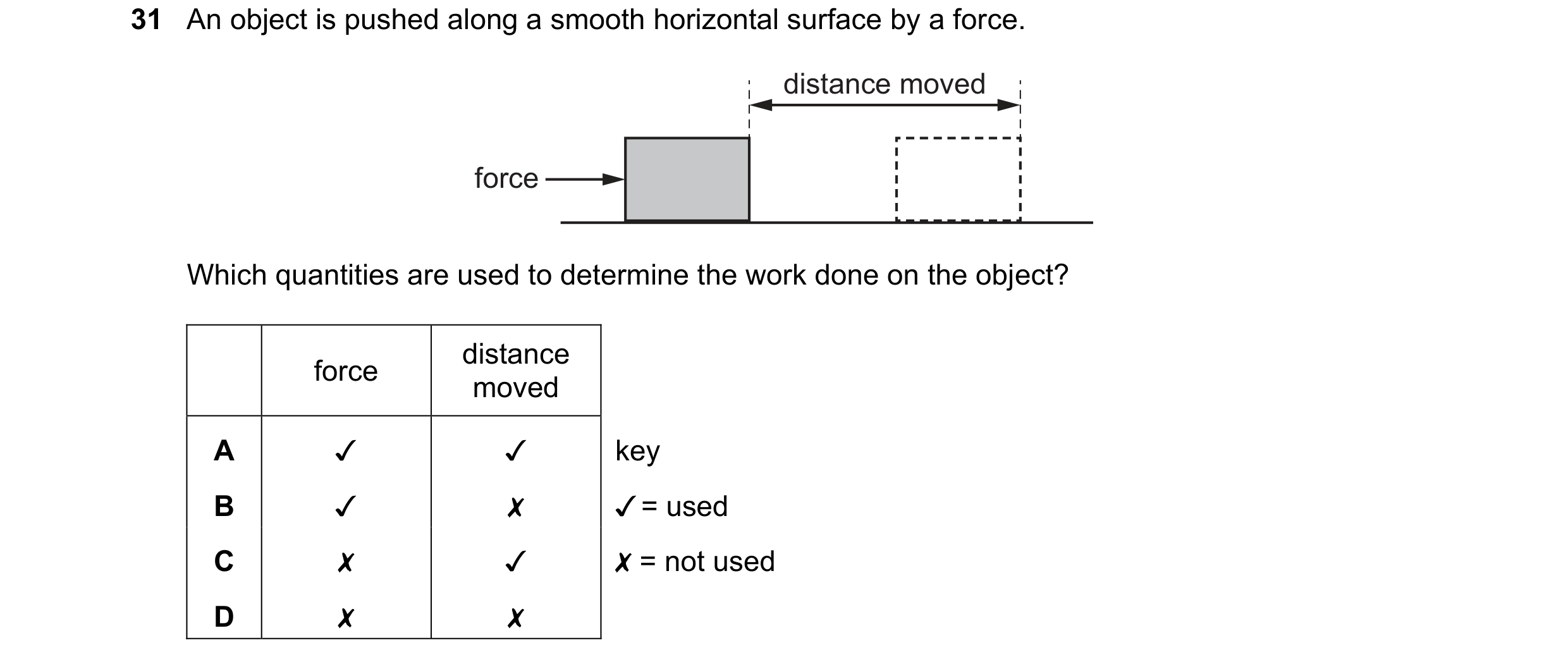
Q105 · An object is pushed along a smooth horizontal surface by a force 0653/12 Feb/March 2022
31 An object is pushed along a smooth horizontal surface by a force.
‘ distance moved _ :
<A
force
Which quantities are used to determine the work done on the object?
distance
moved
key
J¥ = used
X = not used
1 marks
Answer: A
This question in 0653/12 Feb/March 2022
Q106 · Electricity is generated in different power stations that use coal, hydroelectric dams… 0653/12 Feb/March 2022
32 Electricity is generated in different power stations that use coal, hydroelectric dams, nuclear fission or geothermal resources. How is a hydroelectric power station different from the other three types of power station? A It is the only power station that uses steam as part of the process. B It is the only power station that does not use steam as part of the process. C It is the only power station that uses a renewable form of energy. D It is the only power station that does not use a renewable form of energy.
1 marks
Answer: B
This question in 0653/12 Feb/March 2022
Q107 · Which two energy sources are both renewable? 0653/11 May/June 2022
31 Which two energy sources are both renewable? A coal and waves B geothermal and nuclear C oil and tides D wind and solar
1 marks
Answer: D
This question in 0653/11 May/June 2022
Q108 · A ball is released from rest at point A on a curved track 0653/12 May/June 2022
31 A ball is released from rest at point A on a curved track. The ball rolls along the track past points B and C, then reaches point D. At which labelled point does the ball have maximum kinetic energy? ball A D B C track
1 marks
Answer: C
This question in 0653/12 May/June 2022
Q109 · Which group of energy sources consists of only renewable sources? 0653/12 May/June 2022
32 Which group of energy sources consists of only renewable sources? A geothermal, nuclear, solar B geothermal, solar, wind C nuclear, solar, wind D oil, geothermal, solar
1 marks
Answer: B
This question in 0653/12 May/June 2022
Q110 · A man lifts four heavy boxes from the ground onto a high shelf, one at a time 0653/13 May/June 2022
31 A man lifts four heavy boxes from the ground onto a high shelf, one at a time. When does he develop the greatest power? A lifting a box of mass 20 kg in 3.0 s B lifting a box of mass 20 kg in 4.0 s C lifting a box of mass 30 kg in 3.0 s D lifting a box of mass 30 kg in 4.0 s
1 marks
Answer: C
This question in 0653/13 May/June 2022
Q111 · Which two energy resources are both non-renewable? 0653/13 May/June 2022
32 Which two energy resources are both non-renewable? A coal and tides B coal and wind C oil and coal D oil and tides
1 marks
Answer: C
This question in 0653/13 May/June 2022
Q112 · For which energy resource is energy stored as gravitational potential energy? 0653/11 Oct/Nov 2022
32 For which energy resource is energy stored as gravitational potential energy? A geothermal energy B hydroelectric energy C nuclear fission D wind energy
1 marks
Answer: B
This question in 0653/11 Oct/Nov 2022
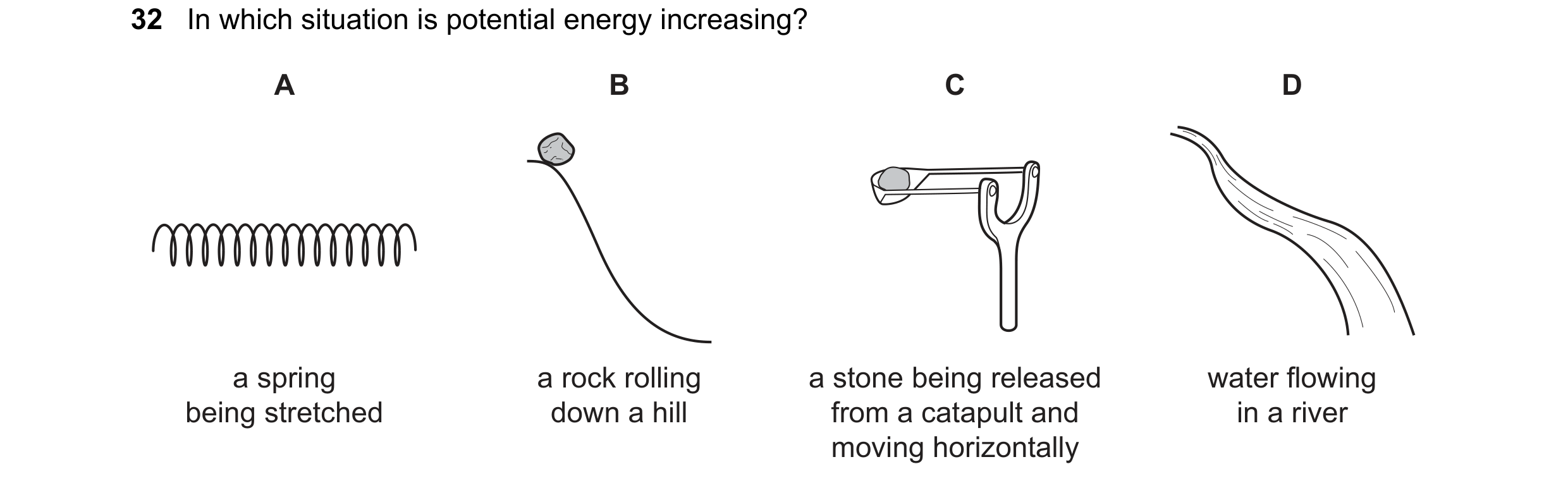
Q113 · In which situation is potential energy increasing? 0653/12 Oct/Nov 2022
32 In which situation is potential energy increasing? A B C D a spring a rock rolling a stone being released water flowing being stretched down a hill from a catapult and in a river moving horizontally
1 marks
Answer: A
This question in 0653/12 Oct/Nov 2022
Q114 · In which situation is potential energy increasing? 0653/13 Oct/Nov 2022
32 In which situation is potential energy increasing? A B C D a spring a rock rolling a stone being released water flowing being stretched down a hill from a catapult and in a river moving horizontally
1 marks
Answer: A
This question in 0653/13 Oct/Nov 2022
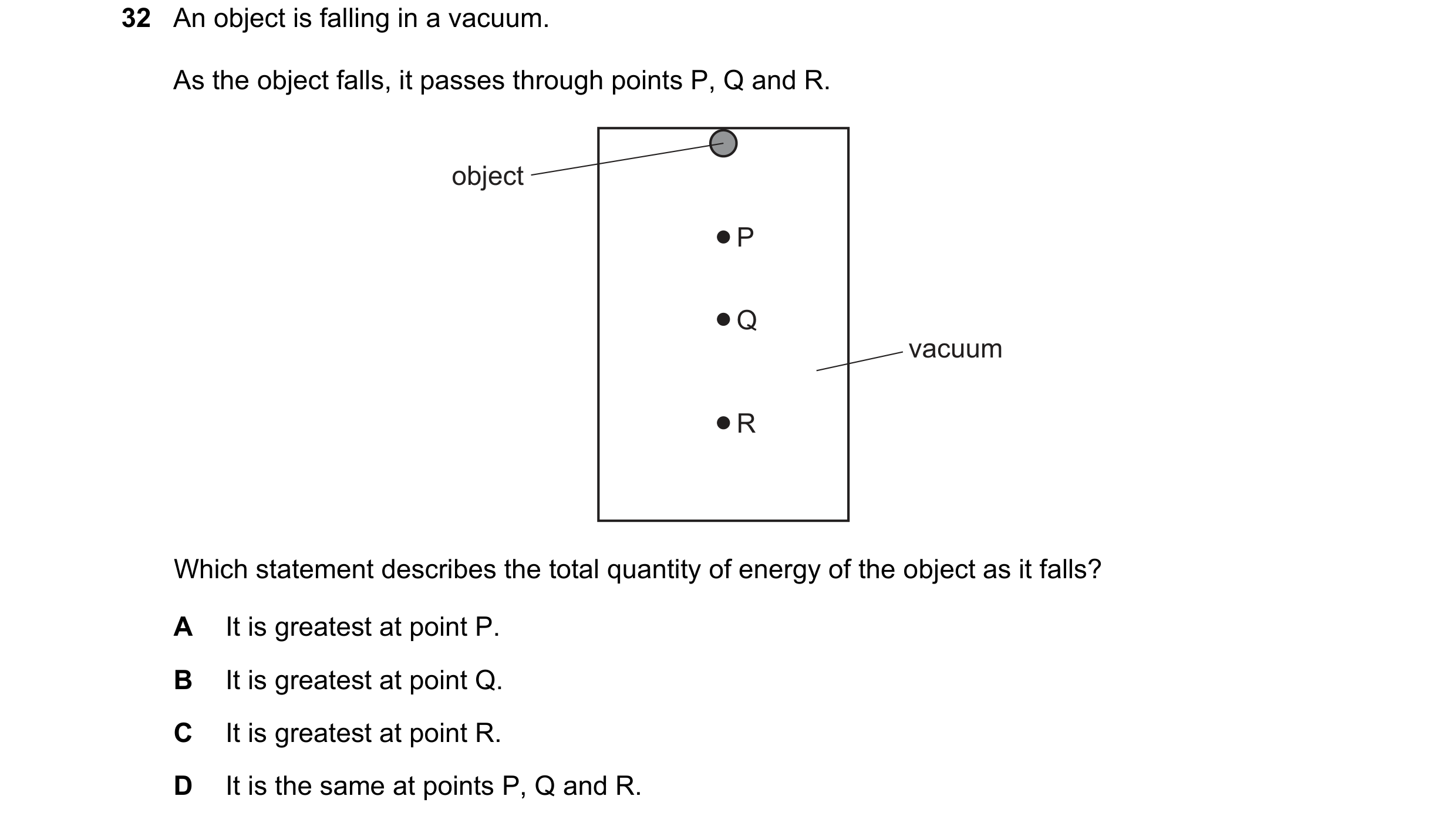
Q115 · An object is falling in a vacuum 0653/12 Feb/March 2023
32 An object is falling in a vacuum. As the object falls, it passes through points P, Q and R. object P Q vacuum R Which statement describes the total quantity of energy of the object as it falls? A It is greatest at point P. B It is greatest at point Q. C It is greatest at point R. D It is the same at points P, Q and R.
1 marks
Answer: D
This question in 0653/12 Feb/March 2023
Q116 · Which statement explains why wind energy is called a renewable source of energy? 0653/12 Feb/March 2023
33 Which statement explains why wind energy is called a renewable source of energy? A It is continuously replaced from natural sources. B It does not cause pollution. C It is only available at certain times. D It provides a large quantity of energy.
1 marks
Answer: A
This question in 0653/12 Feb/March 2023
Q117 · Which list of sources of energy contains non-renewable sources only? 0653/11 May/June 2023
31 Which list of sources of energy contains non-renewable sources only? A natural gas, nuclear fission and petroleum B natural gas, nuclear fission and wind C natural gas, petroleum and wind D nuclear fission, petroleum and wind
1 marks
Answer: A
This question in 0653/11 May/June 2023
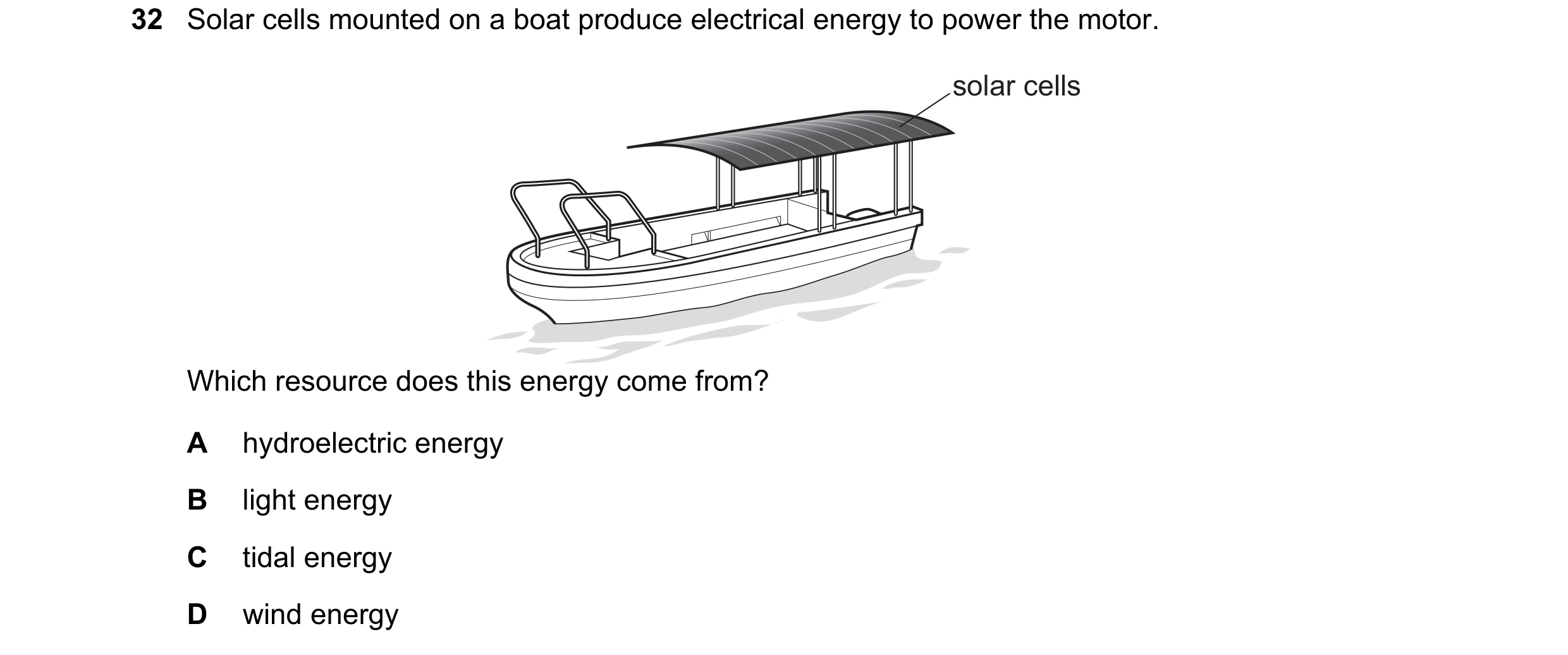
Q118 · Solar cells mounted on a boat produce electrical energy to power the motor 0653/11 May/June 2023
32 Solar cells mounted on a boat produce electrical energy to power the motor. solar cells Which resource does this energy come from? A hydroelectric energy B light energy C tidal energy D wind energy
1 marks
Answer: B
This question in 0653/11 May/June 2023
Q119 · The work done by a force on an object is calculated using the magnitude of the force and… 0653/12 May/June 2023
31 The work done by a force on an object is calculated using the magnitude of the force and only one other quantity. What is this other quantity? A the acceleration of the object B the distance moved by the object in the direction of the force C the speed of the object D the time for which the force acts on the object
1 marks
Answer: B
This question in 0653/12 May/June 2023
Q120 · Which form of energy is not a form of potential energy? 0653/12 May/June 2023
32 Which form of energy is not a form of potential energy? A chemical B elastic C gravitational D sound
1 marks
Answer: D
This question in 0653/12 May/June 2023
Q121 · A motor is used to lift a certain number of bricks through a certain height in a certain… 0653/13 May/June 2023
31 A motor is used to lift a certain number of bricks through a certain height in a certain time. Which action requires the motor to use a greater power? A lifting an equal number of bricks through a smaller height in an equal time B lifting an equal number of bricks through an equal height in a greater time C lifting an equal number of bricks through an equal height in a smaller time D lifting fewer bricks through an equal height in an equal time
1 marks
Answer: C
This question in 0653/13 May/June 2023
Q122 · The generator in a power station is rotated by a turbine 0653/13 May/June 2023
32 The generator in a power station is rotated by a turbine. Steam from boiling water rotates the turbine. Which energy source is used to produce electricity in this way? A hydroelectric energy B nuclear fission C tidal energy D wind energy
1 marks
Answer: B
This question in 0653/13 May/June 2023
Q123 · A man lifts a heavy load vertically, from the ground to above his head 0653/11 Oct/Nov 2023
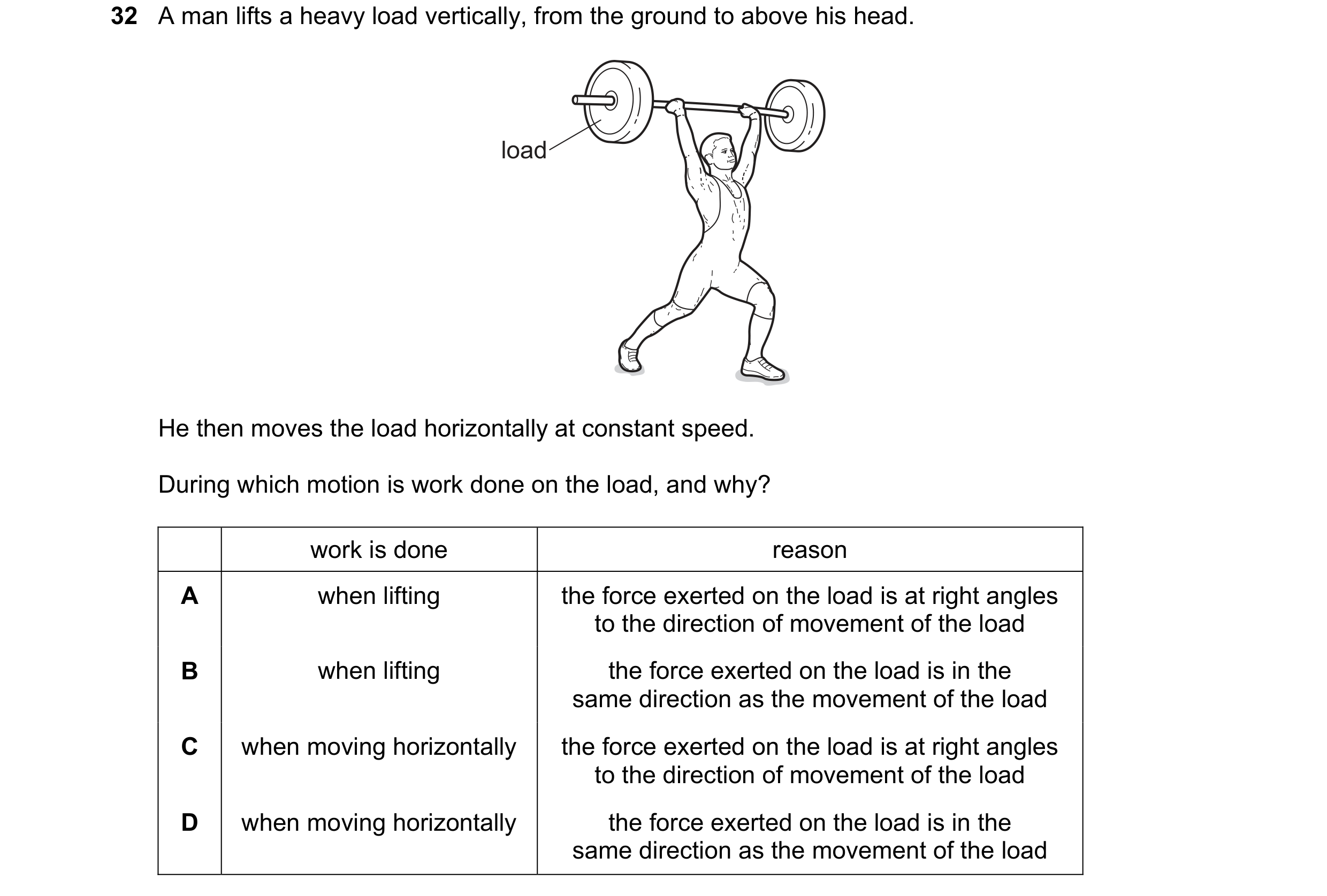
32 A man lifts a heavy load vertically, from the ground to above his head. load He then moves the load horizontally at constant speed. During which motion is work done on the load, and why? work is done reason A when lifting the force exerted on the load is at right angles to the direction of movement of the load B when lifting the force exerted on the load is in the same direction as the movement of the load C when moving horizontally the force exerted on the load is at right angles to the direction of movement of the load D when moving horizontally the force exerted on the load is in the same direction as the movement of the load
1 marks
Answer: B
This question in 0653/11 Oct/Nov 2023
Q124 · A car has an initial kinetic energy of 120 kJ at the bottom of a slope 0653/12 Oct/Nov 2023
31 A car has an initial kinetic energy of 120 kJ at the bottom of a slope. The car is driven up the slope. At the top of the slope, the car has 260 kJ of kinetic energy and has gained 570 kJ of gravitational potential energy. What is the total increase in kinetic energy and gravitational potential energy of the car as it moves up the slope? A 430 kJ B 710 kJ C 830 kJ D 950 kJ
1 marks
Answer: B
This question in 0653/12 Oct/Nov 2023
Q125 · A car has an initial kinetic energy of 120 kJ at the bottom of a slope 0653/13 Oct/Nov 2023
31 A car has an initial kinetic energy of 120 kJ at the bottom of a slope. The car is driven up the slope. At the top of the slope, the car has 260 kJ of kinetic energy and has gained 570 kJ of gravitational potential energy. What is the total increase in kinetic energy and gravitational potential energy of the car as it moves up the slope? A 430 kJ B 710 kJ C 830 kJ D 950 kJ
1 marks
Answer: B
This question in 0653/13 Oct/Nov 2023
Q126 · Work W is done when an object O is lifted vertically upwards 0653/12 Feb/March 2024
31 Work W is done when an object O is lifted vertically upwards. Which change results in the same quantity of W ? A lifting a heavier object through a greater distance in the same time B lifting a lighter object through the same distance in a smaller time C lifting the same object through a greater distance in the same time D lifting the same object through the same distance in a greater time
1 marks
Answer: D
This question in 0653/12 Feb/March 2024
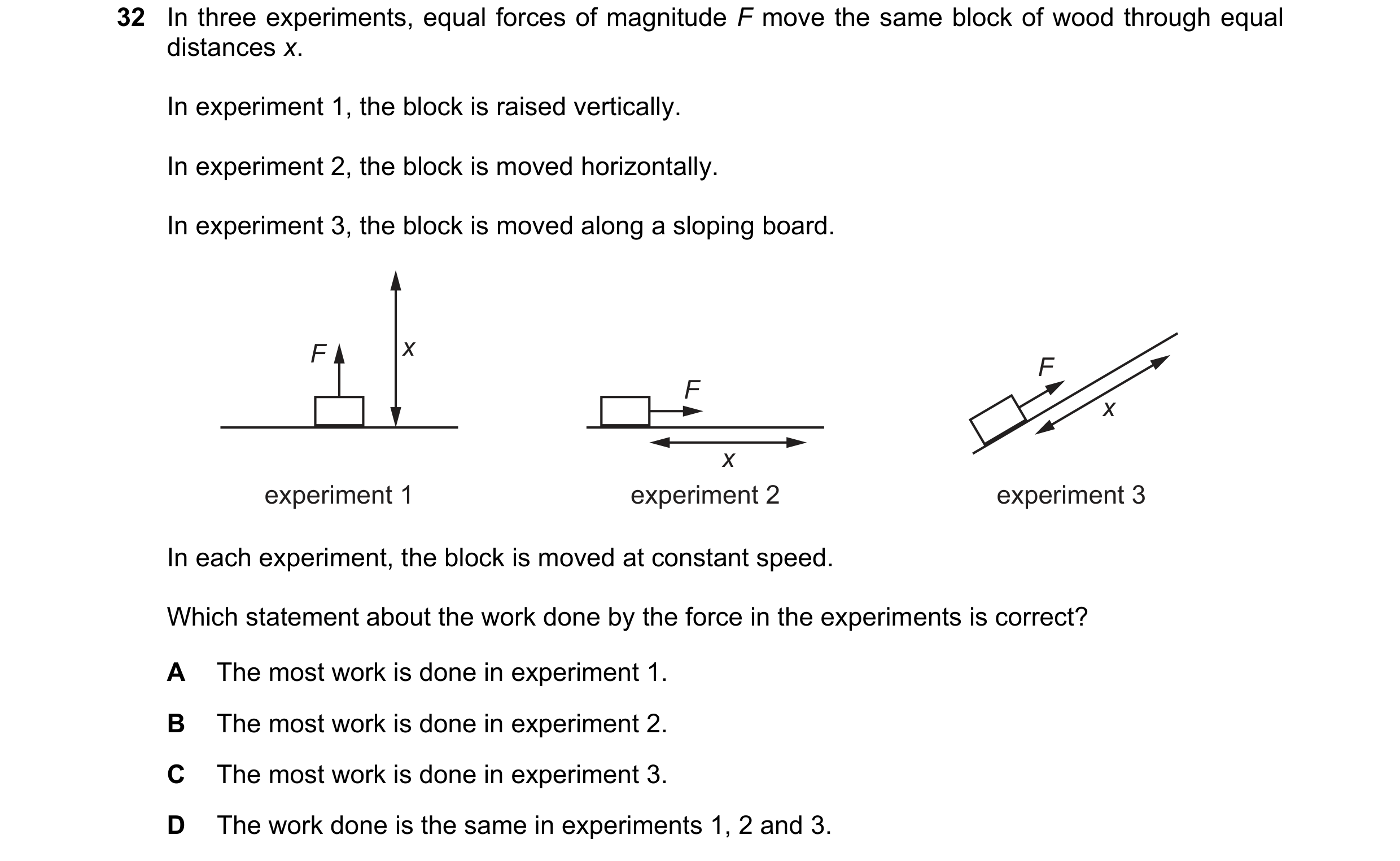
Q127 · In three experiments, equal forces of magnitude F move the same block of wood through… 0653/11 May/June 2024
32 In three experiments, equal forces of magnitude F move the same block of wood through equal distances x. In experiment 1, the block is raised vertically. In experiment 2, the block is moved horizontally. In experiment 3, the block is moved along a sloping board. F x F F x x experiment 1 experiment 2 experiment 3 In each experiment, the block is moved at constant speed. Which statement about the work done by the force in the experiments is correct? A The most work is done in experiment 1. B The most work is done in experiment 2. C The most work is done in experiment 3. D The work done is the same in experiments 1, 2 and 3.
1 marks
Answer: D
This question in 0653/11 May/June 2024
Q128 · In which situation is energy not being transferred? 0653/11 May/June 2024
33 In which situation is energy not being transferred? A a book resting on a shelf B an electric current lighting a lamp C an electric kettle heating water D sound travelling through air
1 marks
Answer: A
This question in 0653/11 May/June 2024
Q129 · A cart is pulled along a horizontal road by a horse 0653/12 May/June 2024
31 A cart is pulled along a horizontal road by a horse. The horse does work on the cart. The work done depends on the force exerted on the cart and on one other quantity. What is the other quantity? A the distance between the horse and the cart B the distance moved by the cart C the height of the horse D the weight of the cart
1 marks
Answer: B
This question in 0653/12 May/June 2024
Q130 · As an electric car starts moving, the car motor transfers energy to the wheels 0653/12 May/June 2024
32 As an electric car starts moving, the car motor transfers energy to the wheels. Which process is involved in this transfer of energy? A work done by heating in the motor B work done by the frictional force between the wheels and the road C work done by the mechanical force from the motor D work done by a decrease in gravitational potential energy
1 marks
Answer: C
This question in 0653/12 May/June 2024
Q131 · Which energy resource is non-renewable? 0653/12 May/June 2024
33 Which energy resource is non-renewable? A geothermal B hydroelectric C nuclear D wind
1 marks
Answer: C
This question in 0653/12 May/June 2024
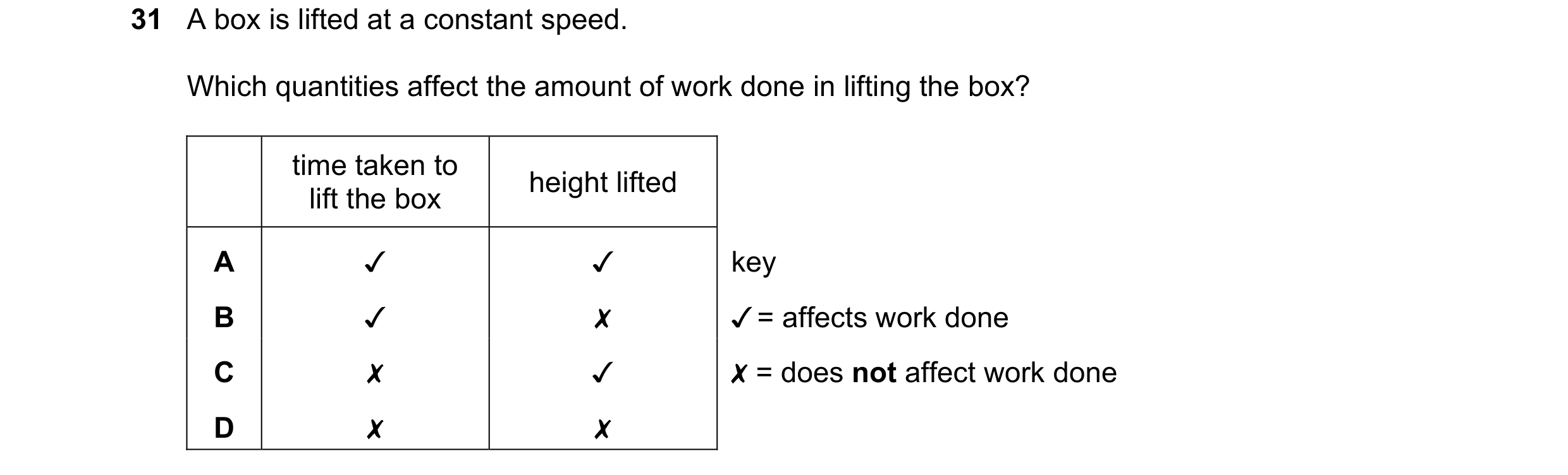
Q132 · A box is lifted at a constant speed 0653/13 May/June 2024
31 A box is lifted at a constant speed.
Which quantities affect the amount of work done in lifting the box?
nied height lifted
Jv v key
v x ¥ = affects work done
x v X = does not affect work done
x x
1 marks
Answer: C
This question in 0653/13 May/June 2024
Q133 · A car is driven to the top of a hill 0653/13 May/June 2024
32 A car is driven to the top of a hill. Which single change would decrease the power needed by the car? A increasing the height of the hill B increasing the mass of the car C increasing the time taken to go up the hill D increasing the weight of the car
1 marks
Answer: C
This question in 0653/13 May/June 2024
Q134 · Which method of generating electricity uses a non-renewable energy resource? 0653/13 May/June 2024
33 Which method of generating electricity uses a non-renewable energy resource? A nuclear power station B solar panel C hydroelectric power station D wind turbine
1 marks
Answer: A
This question in 0653/13 May/June 2024
Q135 · A crane lifts a load vertically 0653/11 Oct/Nov 2024
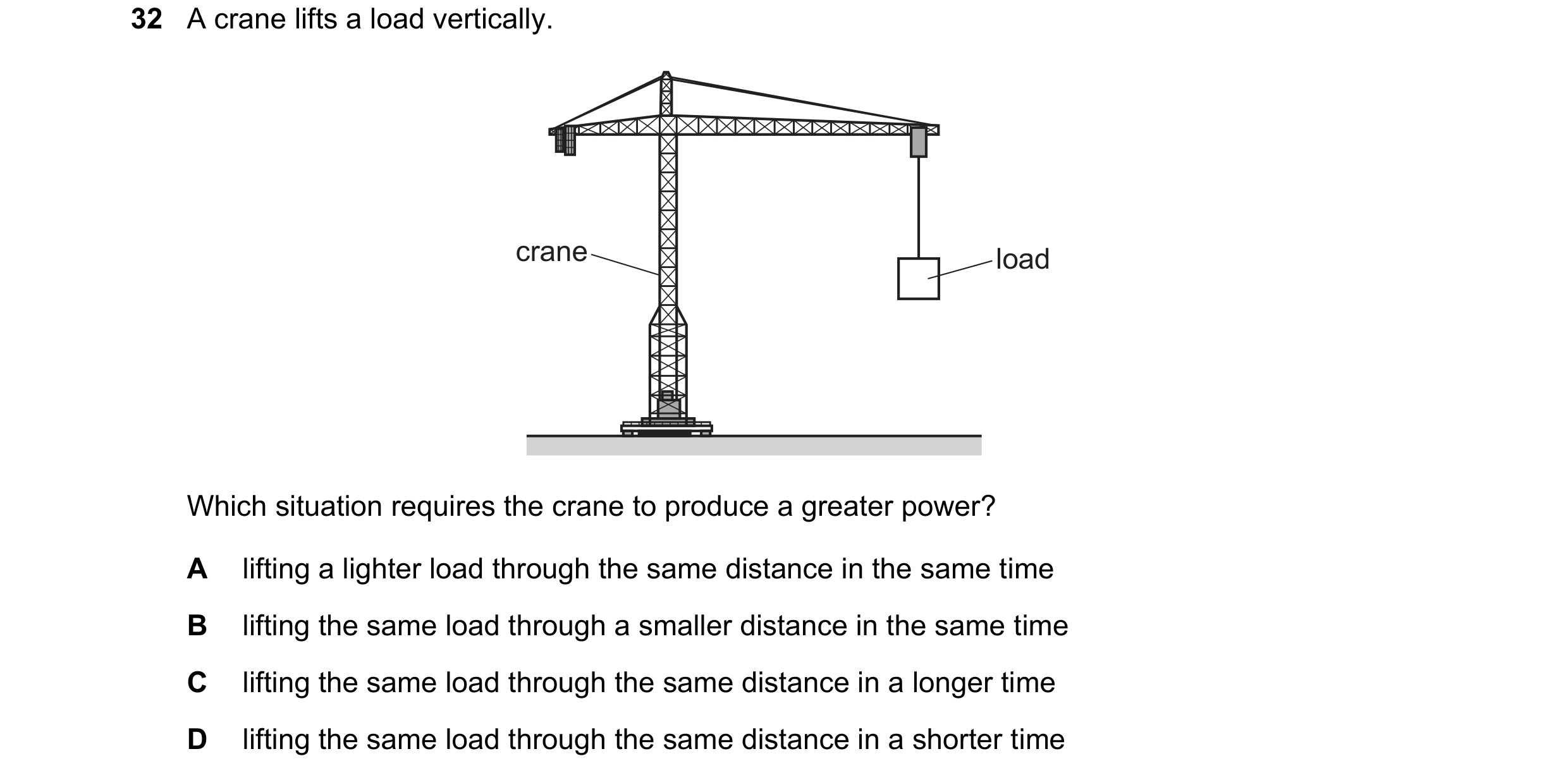
32 A crane lifts a load vertically. crane load Which situation requires the crane to produce a greater power? A lifting a lighter load through the same distance in the same time B lifting the same load through a smaller distance in the same time C lifting the same load through the same distance in a longer time D lifting the same load through the same distance in a shorter time
1 marks
Answer: D
This question in 0653/11 Oct/Nov 2024
Q136 · Student R has a mass of 80 kg 0653/12 Oct/Nov 2024
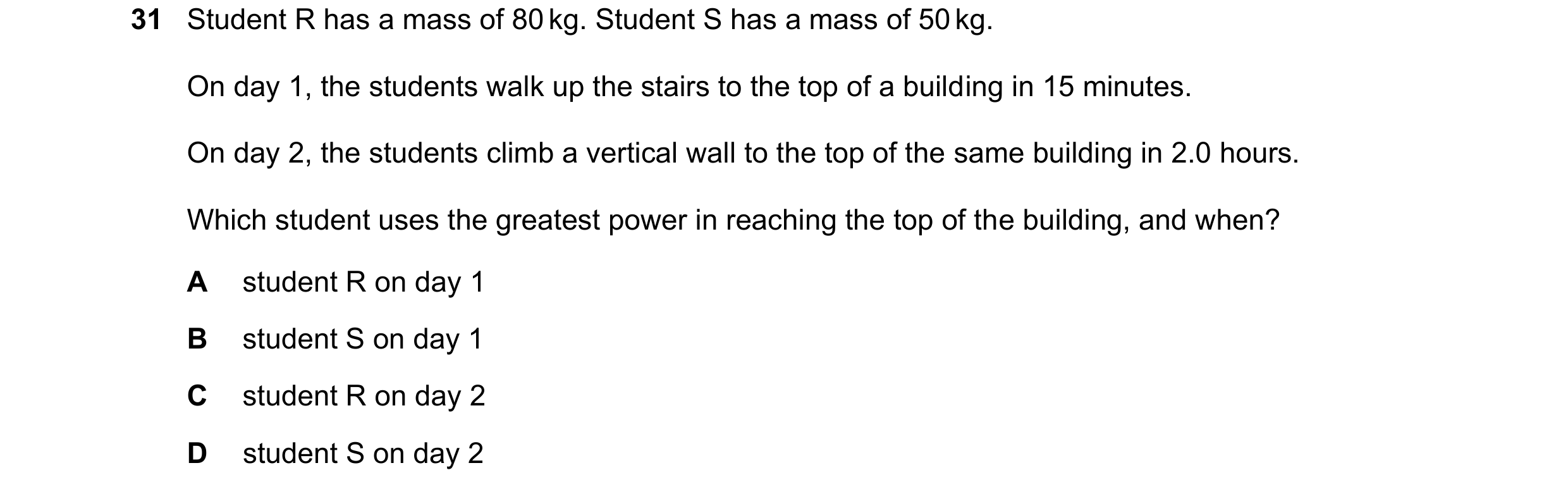
31 Student R has a mass of 80 kg. Student S has a mass of 50 kg. On day 1, the students walk up the stairs to the top of a building in 15 minutes. On day 2, the students climb a vertical wall to the top of the same building in 2.0 hours. Which student uses the greatest power in reaching the top of the building, and when? A student R on day 1 B student S on day 1 C student R on day 2 D student S on day 2
1 marks
Answer: A
This question in 0653/12 Oct/Nov 2024
Q137 · In which situation is no energy transfer occurring? 0653/12 Oct/Nov 2024
32 In which situation is no energy transfer occurring? A a ball falling from rest through the air to the ground B a battery lighting a lamp C a metal block hanging at rest from a stretched spring D a saucepan being heated
1 marks
Answer: C
This question in 0653/12 Oct/Nov 2024
Q138 · Student R has a mass of 80 kg 0653/13 Oct/Nov 2024
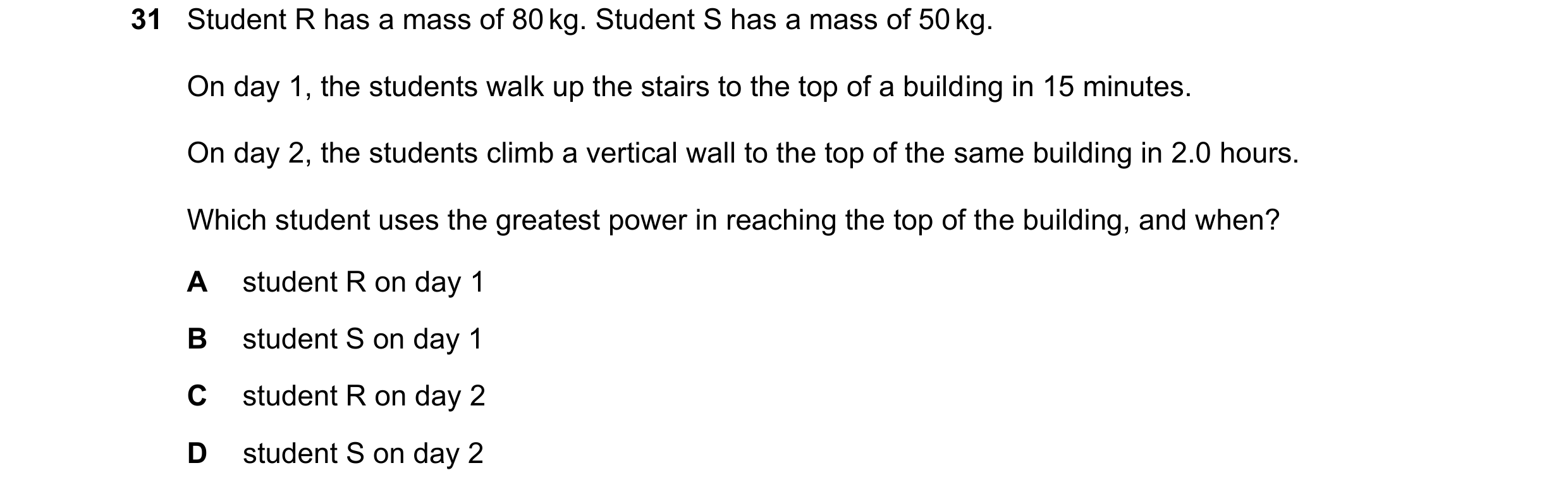
31 Student R has a mass of 80 kg. Student S has a mass of 50 kg. On day 1, the students walk up the stairs to the top of a building in 15 minutes. On day 2, the students climb a vertical wall to the top of the same building in 2.0 hours. Which student uses the greatest power in reaching the top of the building, and when? A student R on day 1 B student S on day 1 C student R on day 2 D student S on day 2
1 marks
Answer: A
This question in 0653/13 Oct/Nov 2024
Q139 · In which situation is no energy transfer occurring? 0653/13 Oct/Nov 2024
32 In which situation is no energy transfer occurring? A a ball falling from rest through the air to the ground B a battery lighting a lamp C a metal block hanging at rest from a stretched spring D a saucepan being heated
1 marks
Answer: C
This question in 0653/13 Oct/Nov 2024
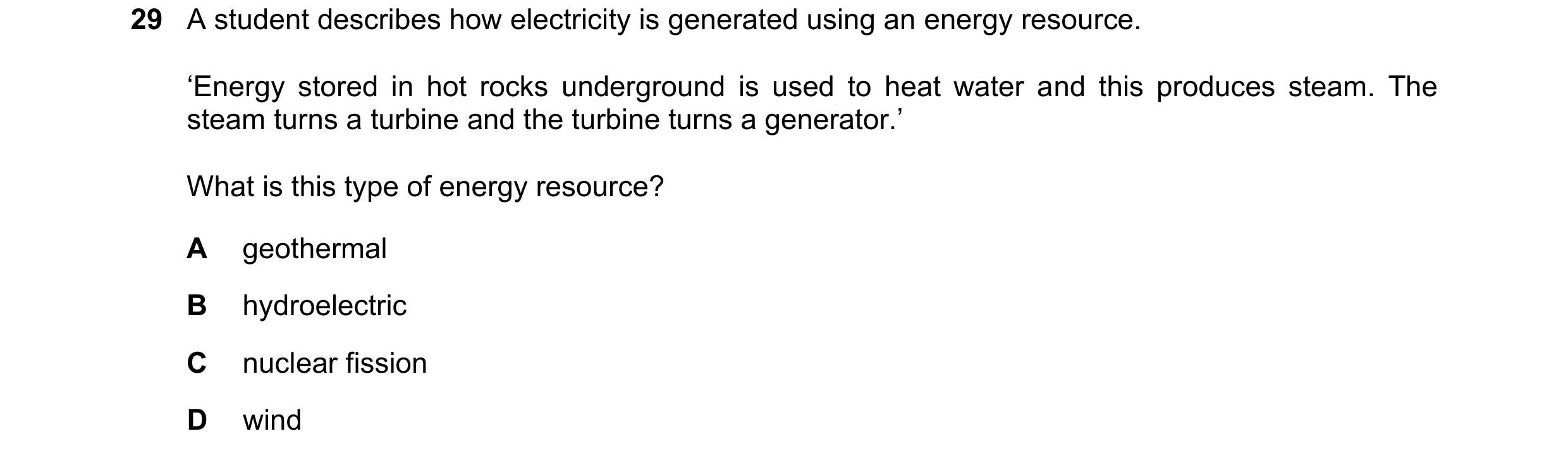
Q140 · A student describes how electricity is generated using an energy resource 0653/12 Feb/March 2025
29 A student describes how electricity is generated using an energy resource. ‘Energy stored in hot rocks underground is used to heat water and this produces steam. The steam turns a turbine and the turbine turns a generator.’ What is this type of energy resource? A geothermal B hydroelectric C nuclear fission D wind
1 marks
Answer: A
This question in 0653/12 Feb/March 2025
Q141 · Which statement about power is correct? 0653/12 Feb/March 2025
30 Which statement about power is correct? A Power is force area. B Power is force area. C Power is work done time. D Power is work done time.
1 marks
Answer: D
This question in 0653/12 Feb/March 2025
Q142 · The same object is moved using four different sets of conditions 0653/11 May/June 2025
29 The same object is moved using four different sets of conditions. The force used, the time taken and the distance moved are measured for each set of conditions. Which row shows the set of conditions that gives the greatest power? force time taken distance / N / s moved / m A 200 20 2.0 B 200 40 3.0 C 400 10 3.0 D 400 30 2.0
1 marks
Answer: C
This question in 0653/11 May/June 2025
Q143 · The voltage across a lamp is 10 V 0653/12 May/June 2025
38 The voltage across a lamp is 10 V. The current in the lamp is 0.010 A. How much energy does the lamp transfer in 50 s? A 0.050 J B 5.0 J C 500 J D 50 000 J
1 marks
Answer: B
This question in 0653/12 May/June 2025
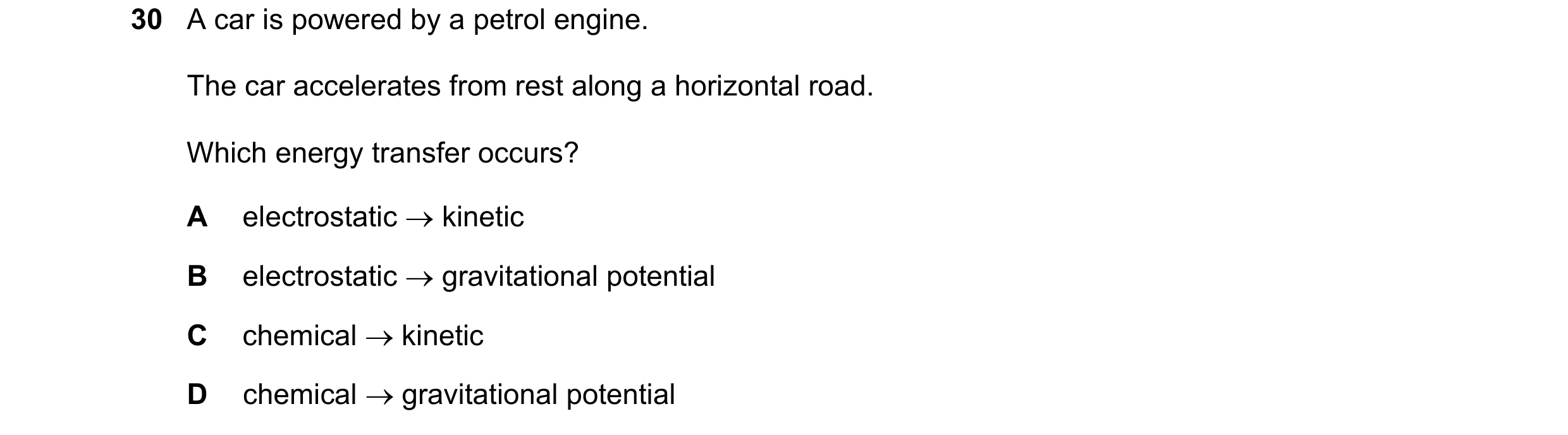
Q144 · A car is powered by a petrol engine 0653/13 May/June 2025
30 A car is powered by a petrol engine. The car accelerates from rest along a horizontal road. Which energy transfer occurs? A electrostatic kinetic B electrostatic gravitational potential C chemical kinetic D chemical gravitational potential
1 marks
Answer: C
This question in 0653/13 May/June 2025
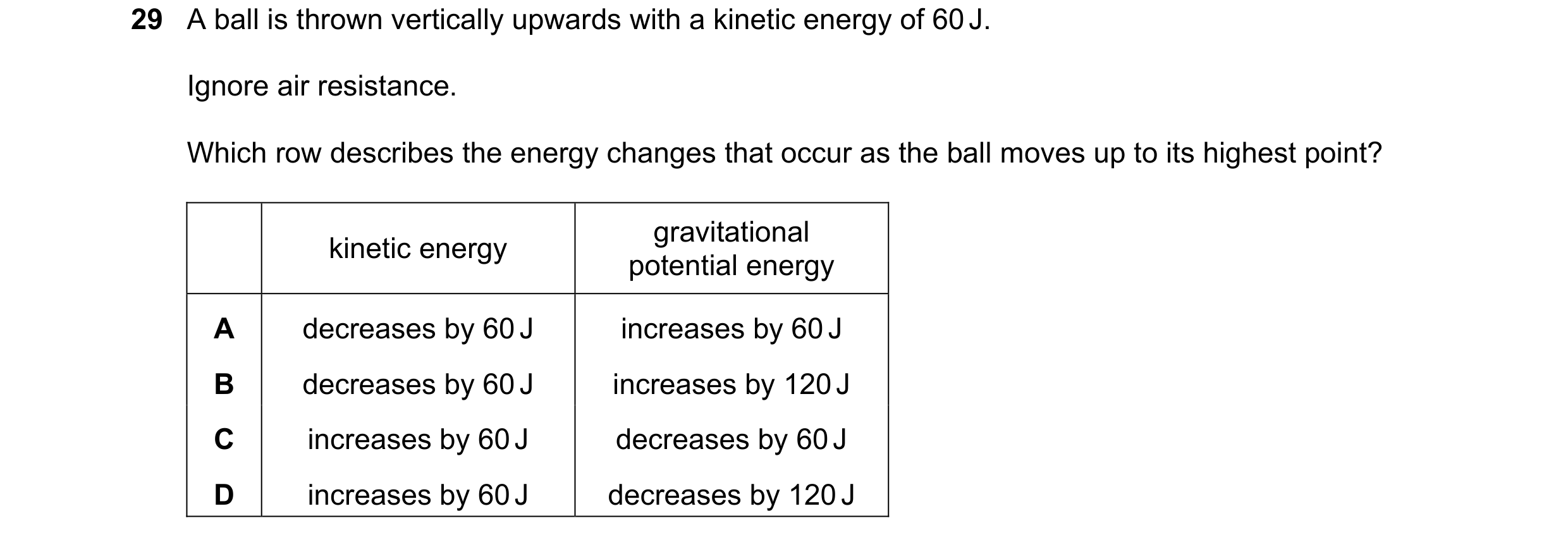
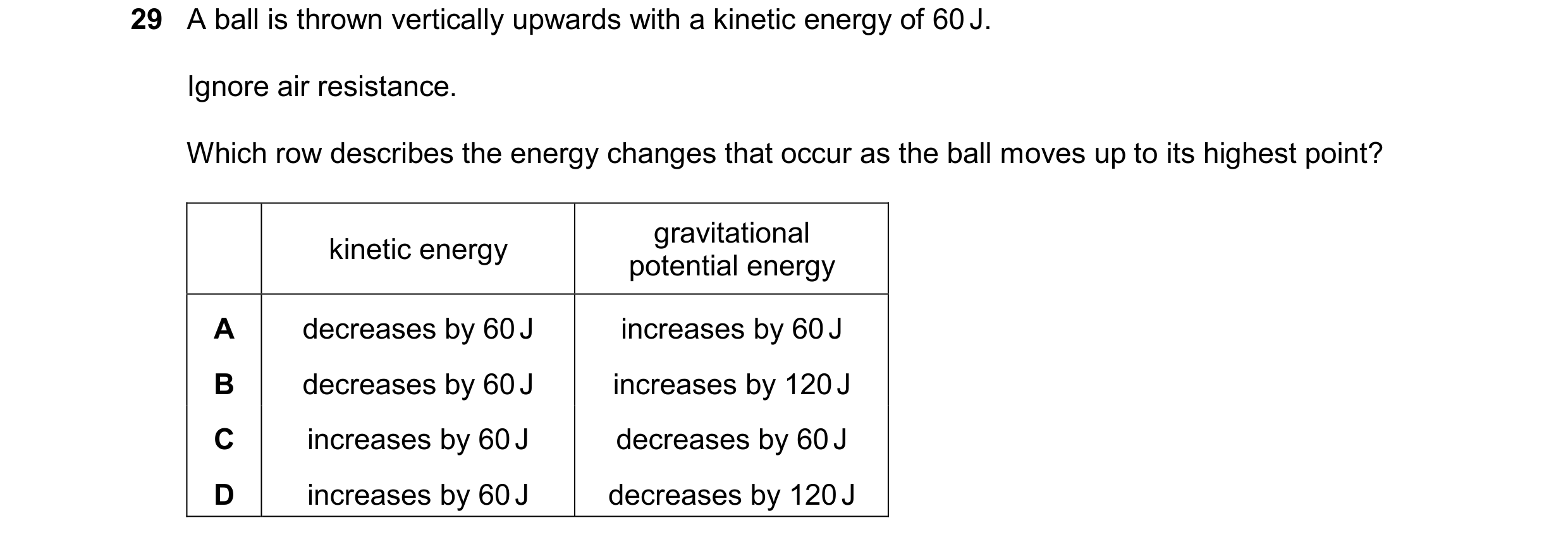
Q145 · A ball is thrown vertically upwards with a kinetic energy of 60 J 0653/12 Oct/Nov 2025
29 A ball is thrown vertically upwards with a kinetic energy of 60 J. Ignore air resistance. Which row describes the energy changes that occur as the ball moves up to its highest point? gravitational kinetic energy potential energy A decreases by 60 J increases by 60 J B decreases by 60 J increases by 120 J C increases by 60 J decreases by 60 J D increases by 60 J decreases by 120 J
1 marks
Answer: A
This question in 0653/12 Oct/Nov 2025
Q146 · A ball is thrown vertically upwards with a kinetic energy of 60 J 0653/13 Oct/Nov 2025
29 A ball is thrown vertically upwards with a kinetic energy of 60 J. Ignore air resistance. Which row describes the energy changes that occur as the ball moves up to its highest point? gravitational kinetic energy potential energy A decreases by 60 J increases by 60 J B decreases by 60 J increases by 120 J C increases by 60 J decreases by 60 J D increases by 60 J decreases by 120 J
1 marks
Answer: A
This question in 0653/13 Oct/Nov 2025

 1 / 42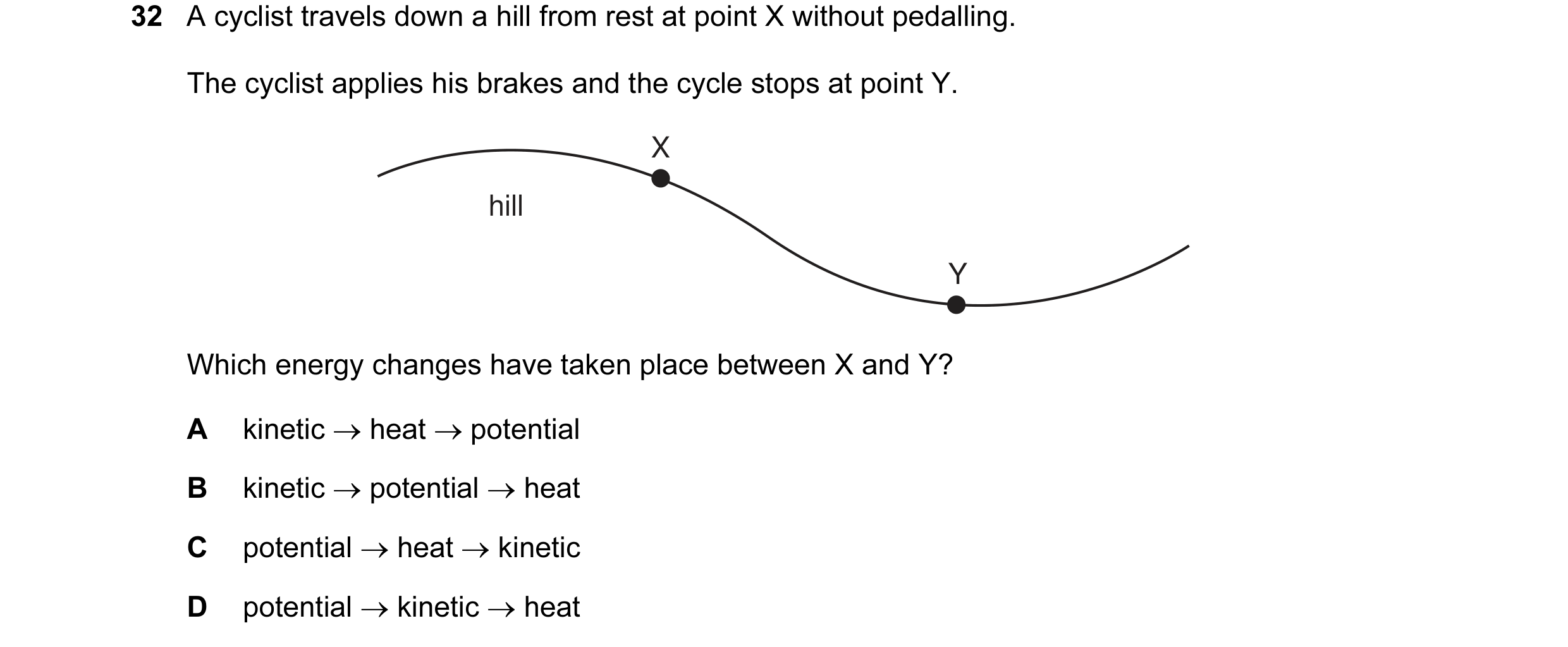
 2 / 42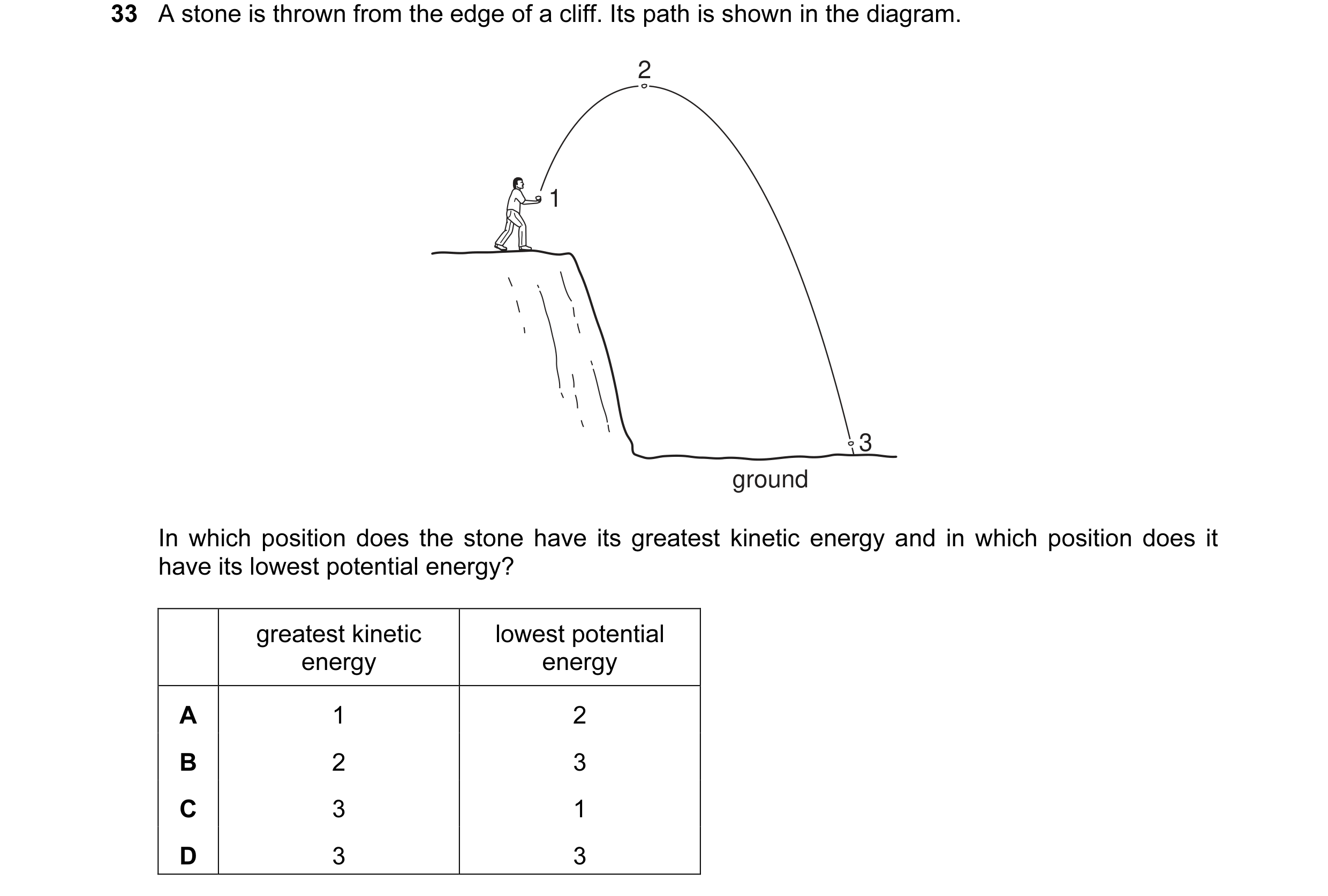
 3 / 42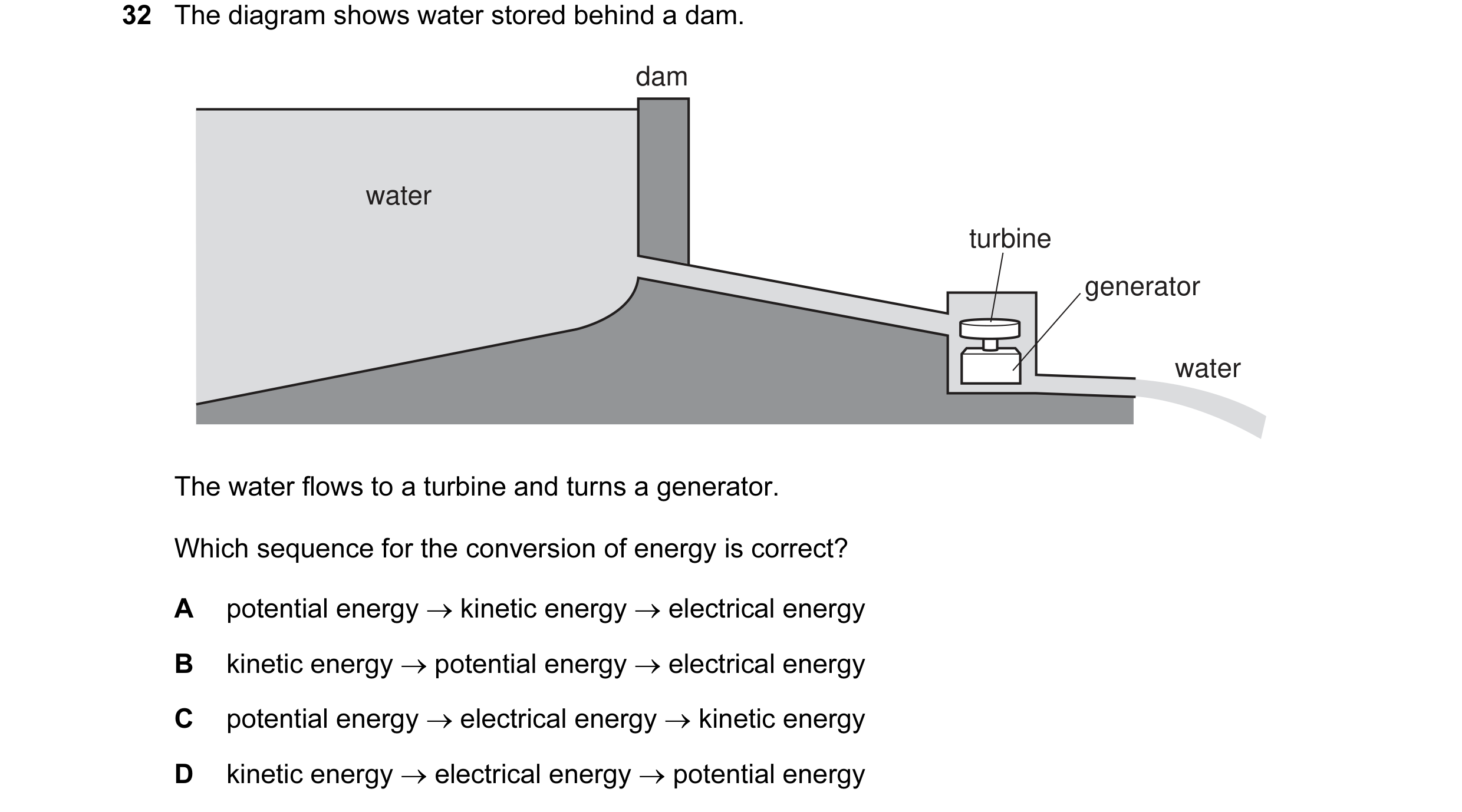
 4 / 42
 5 / 42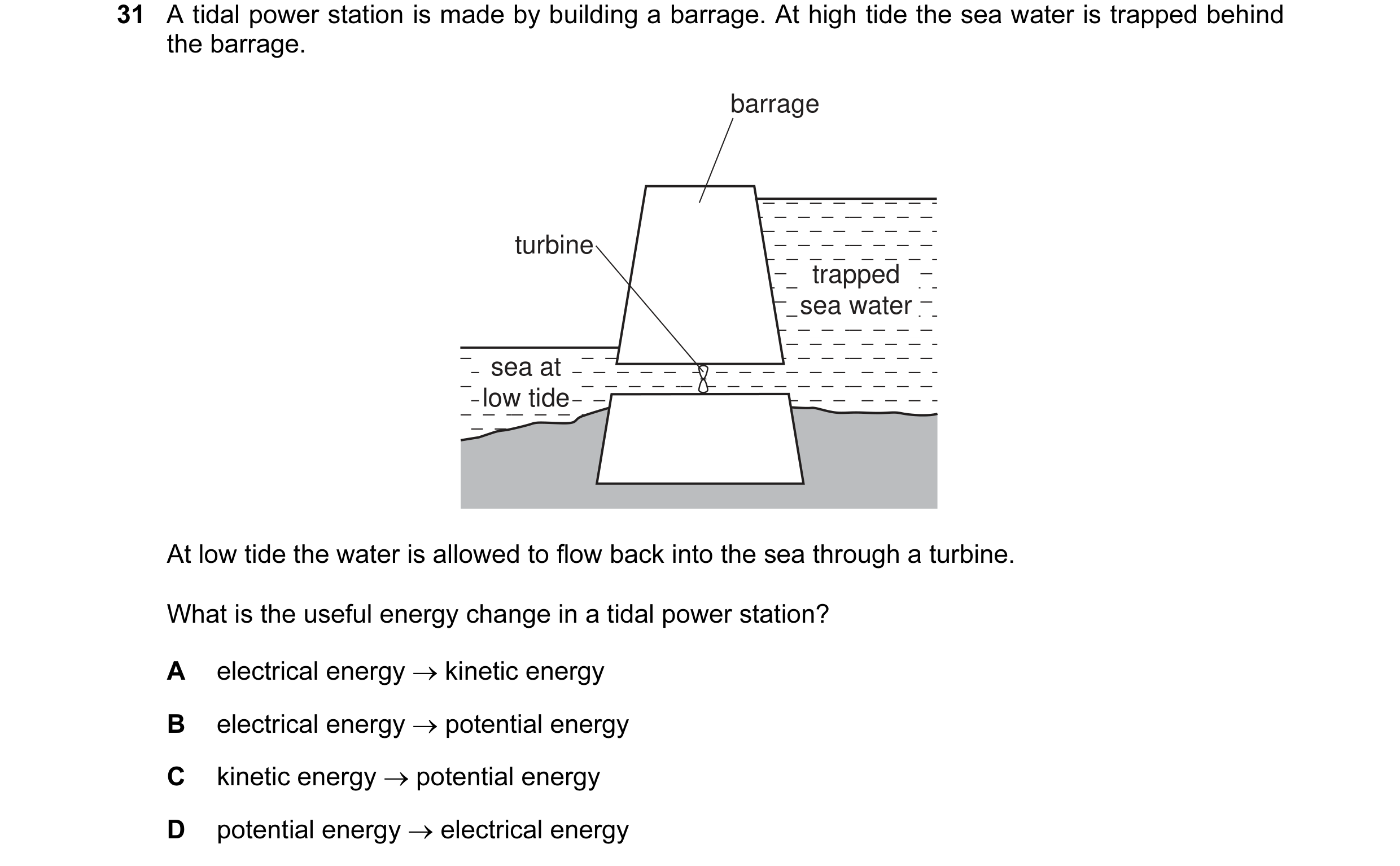
 6 / 42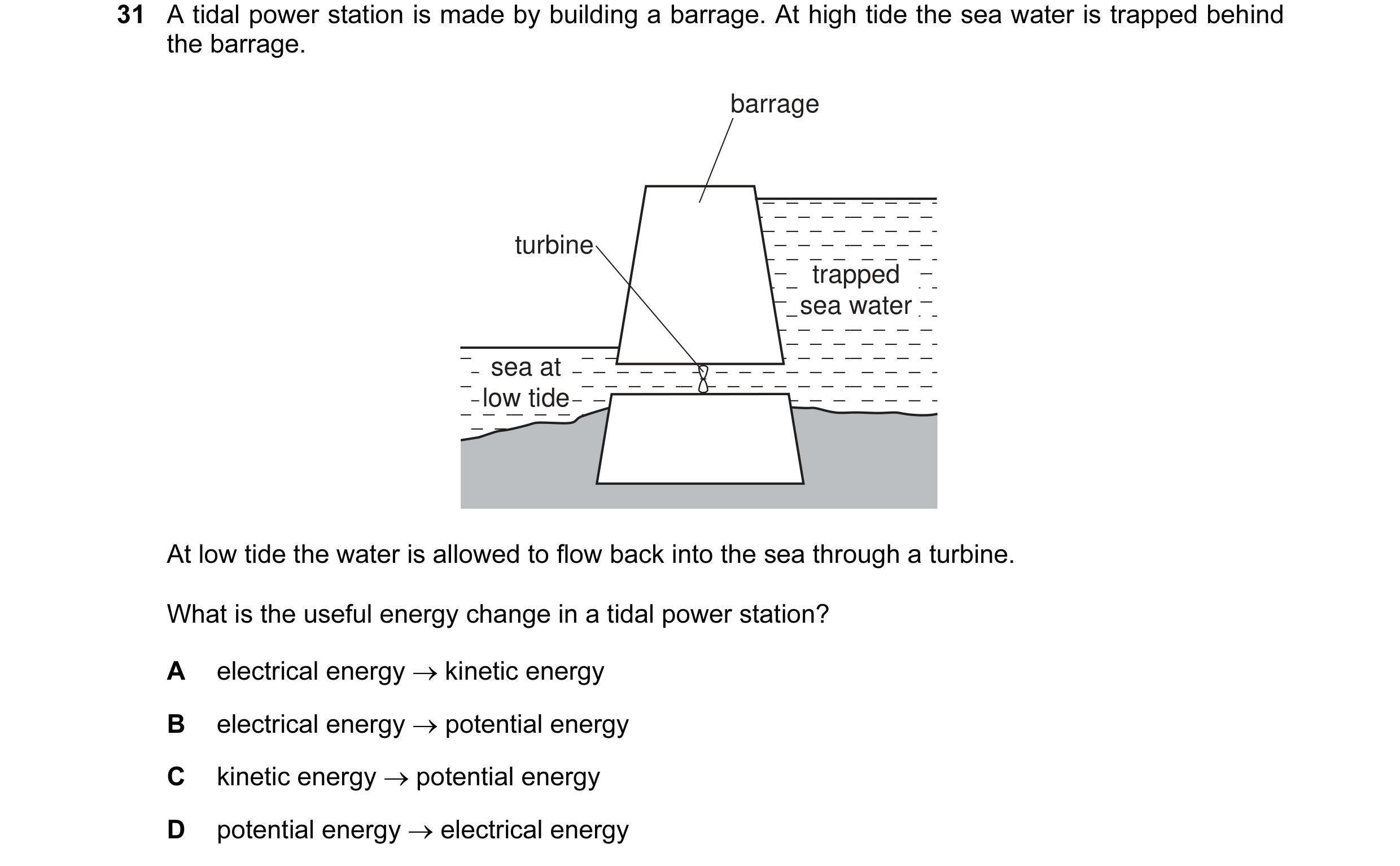
 7 / 42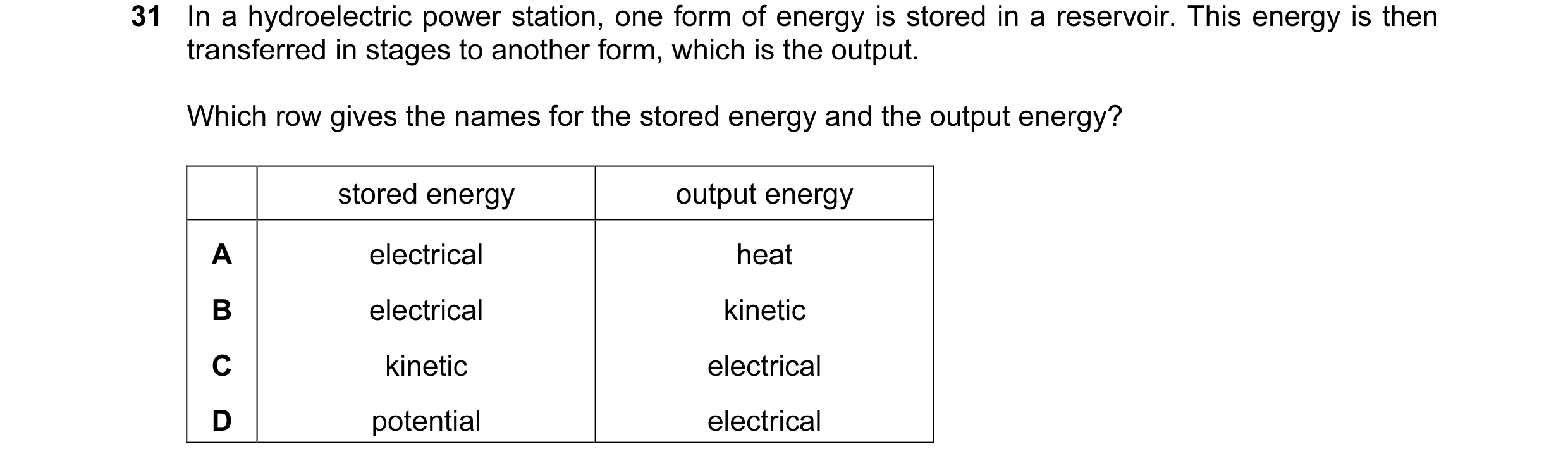

 8 / 42

 9 / 42
 10 / 42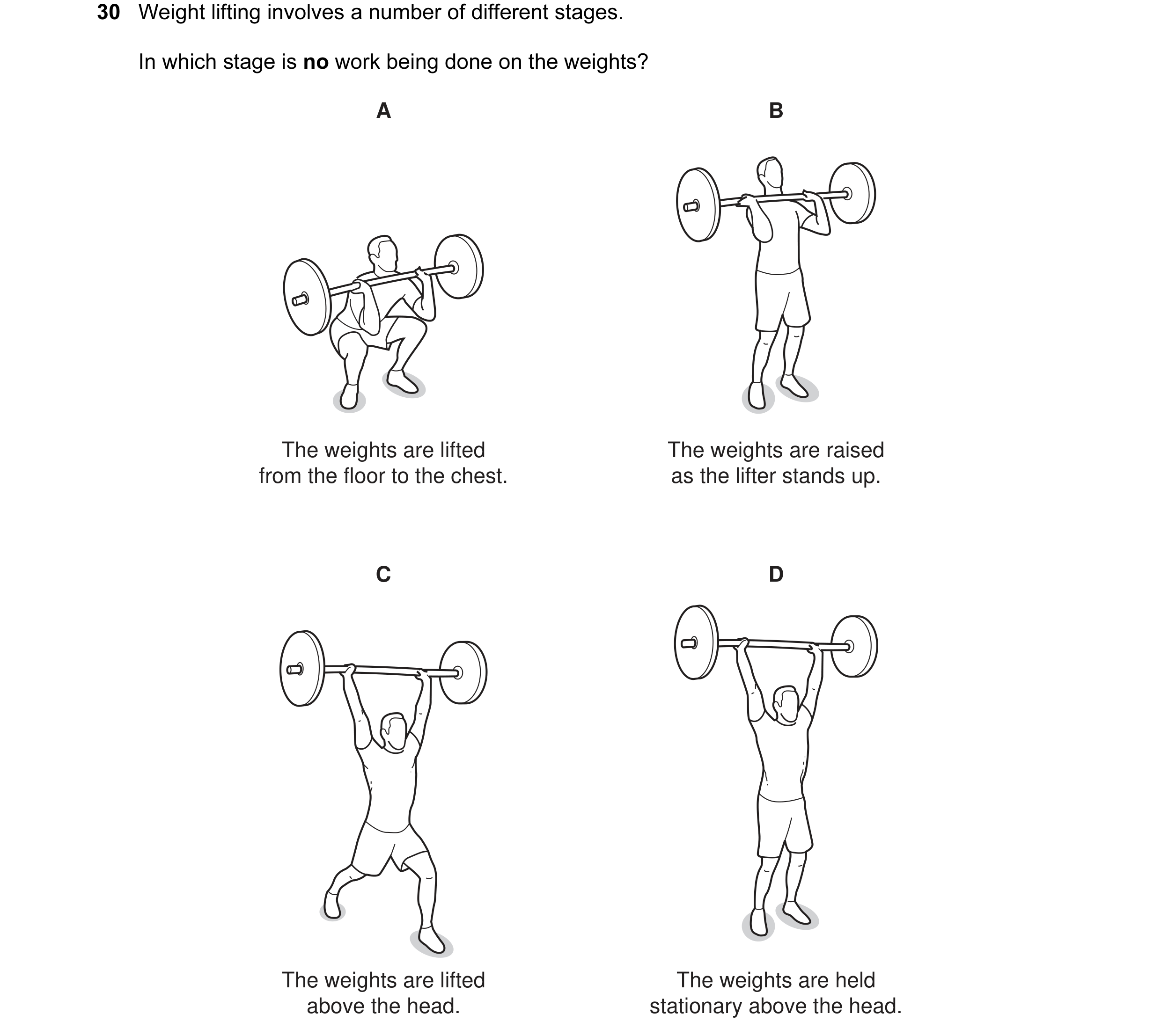
 11 / 42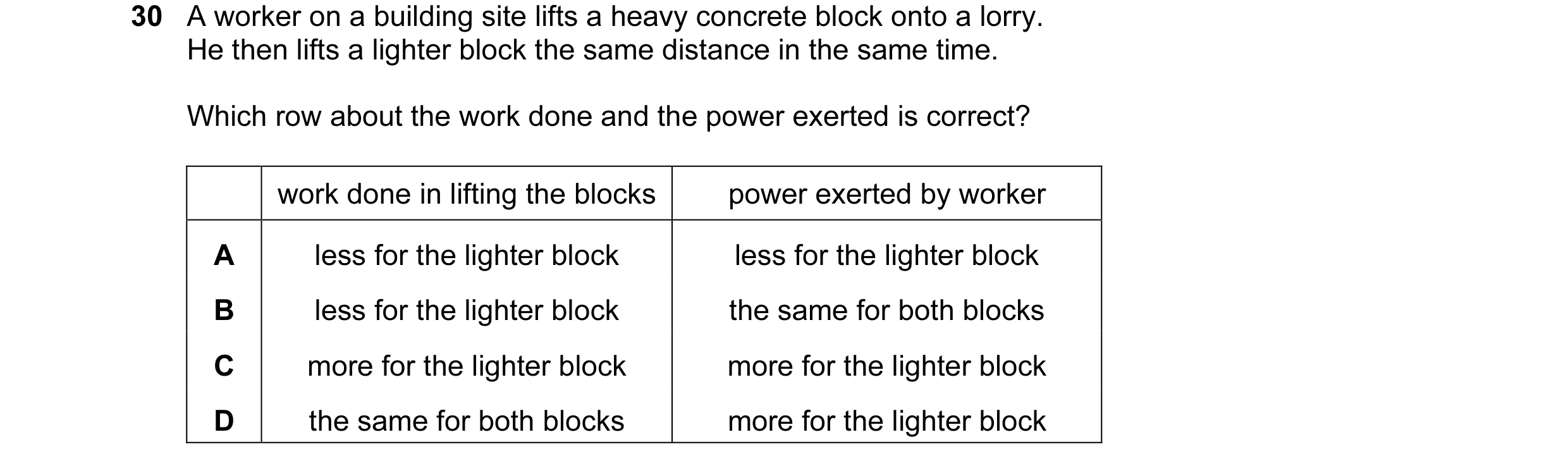
 12 / 42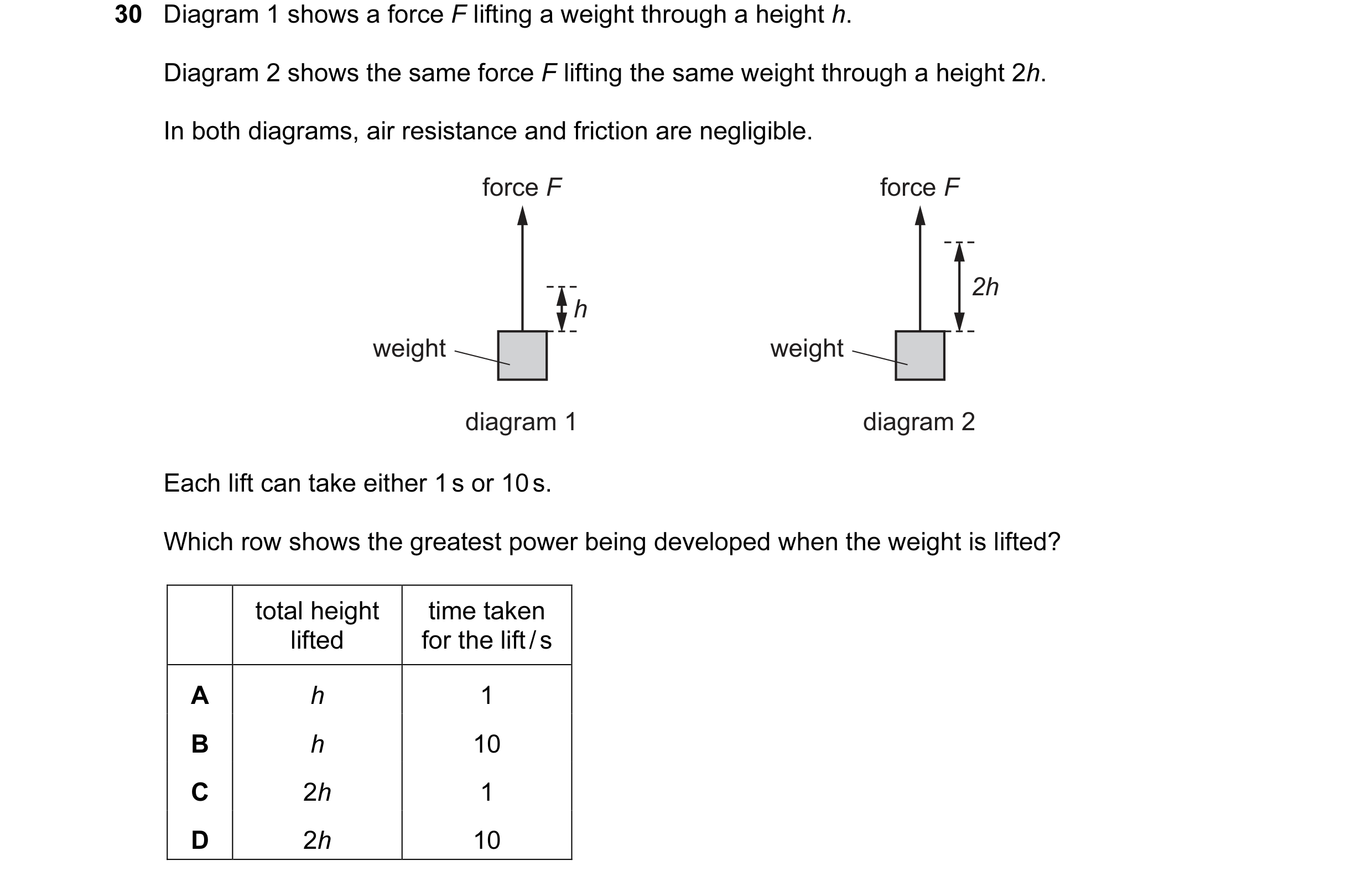
 13 / 42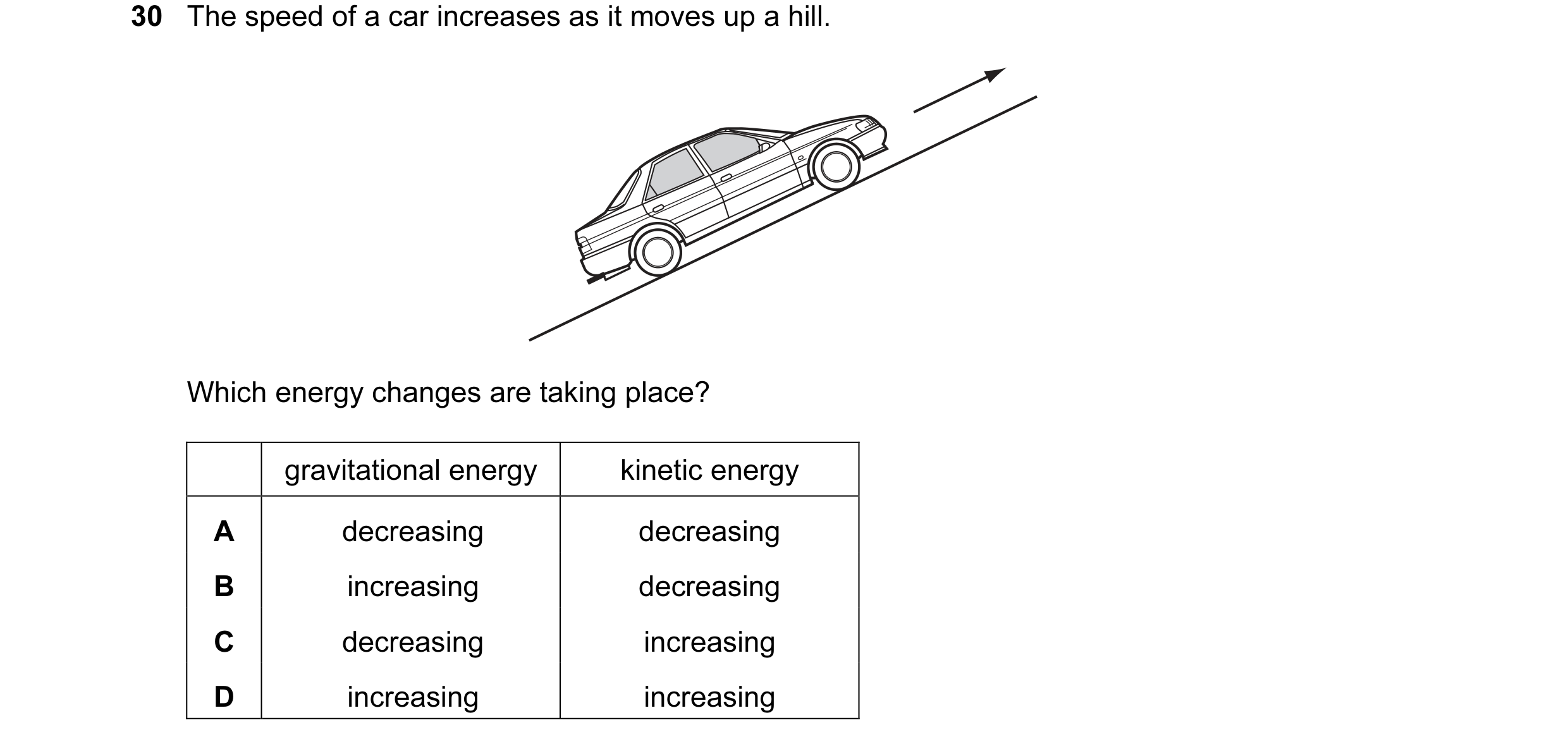
 14 / 42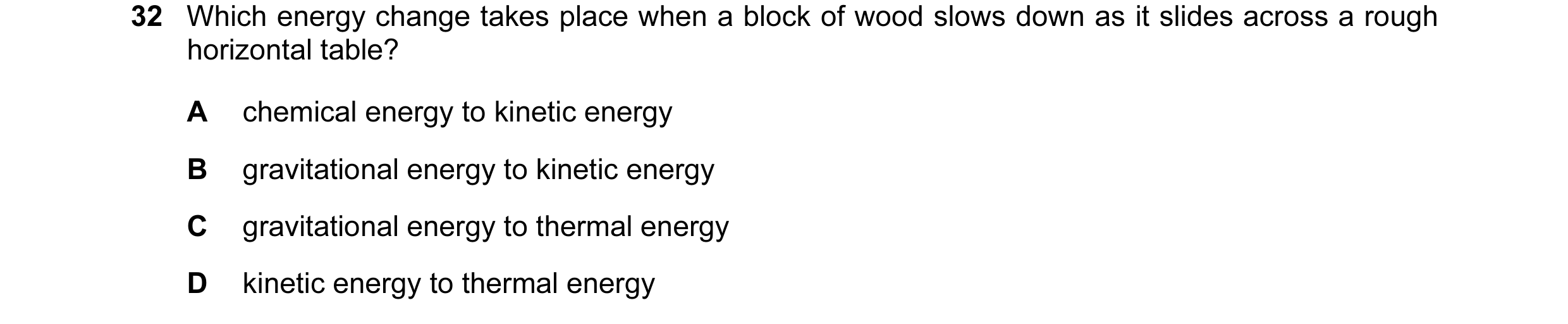
 15 / 42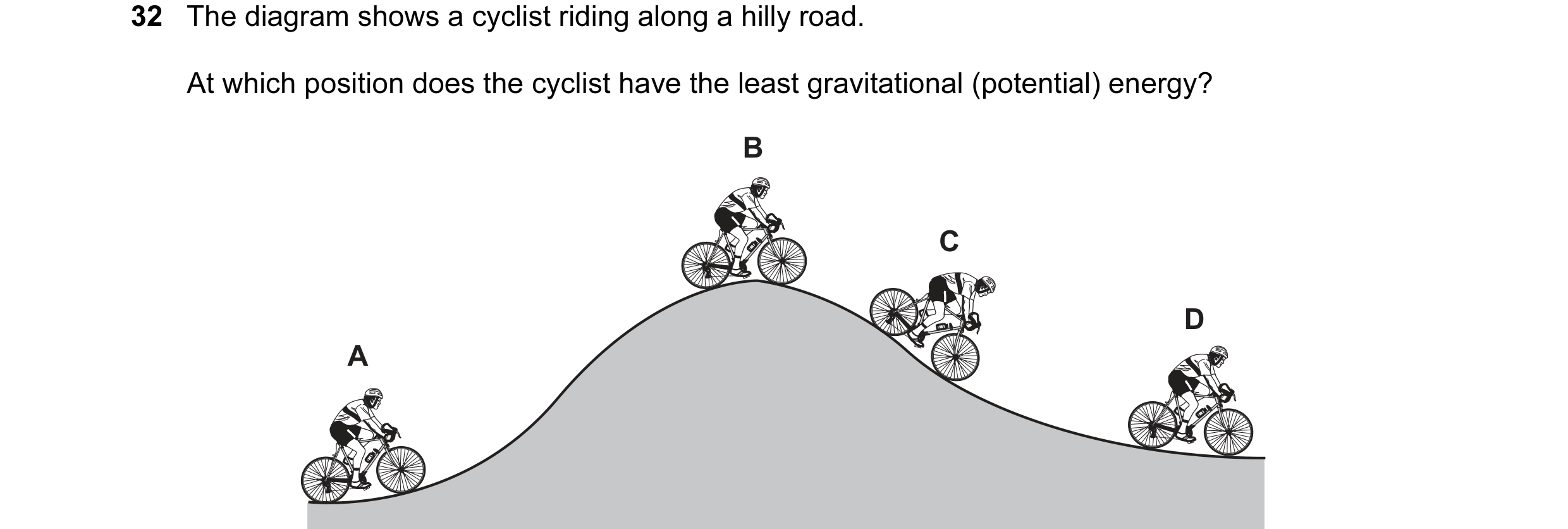

 16 / 42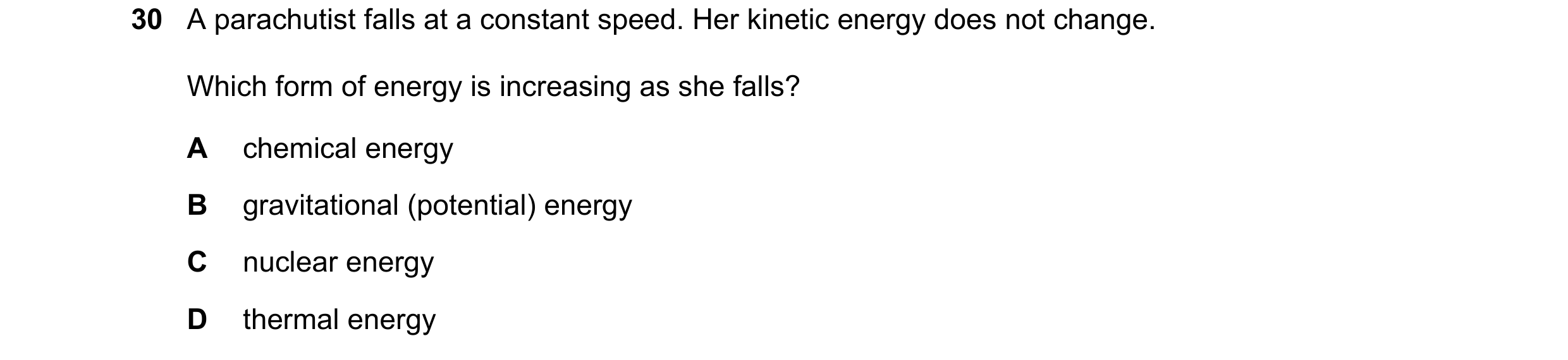

 17 / 42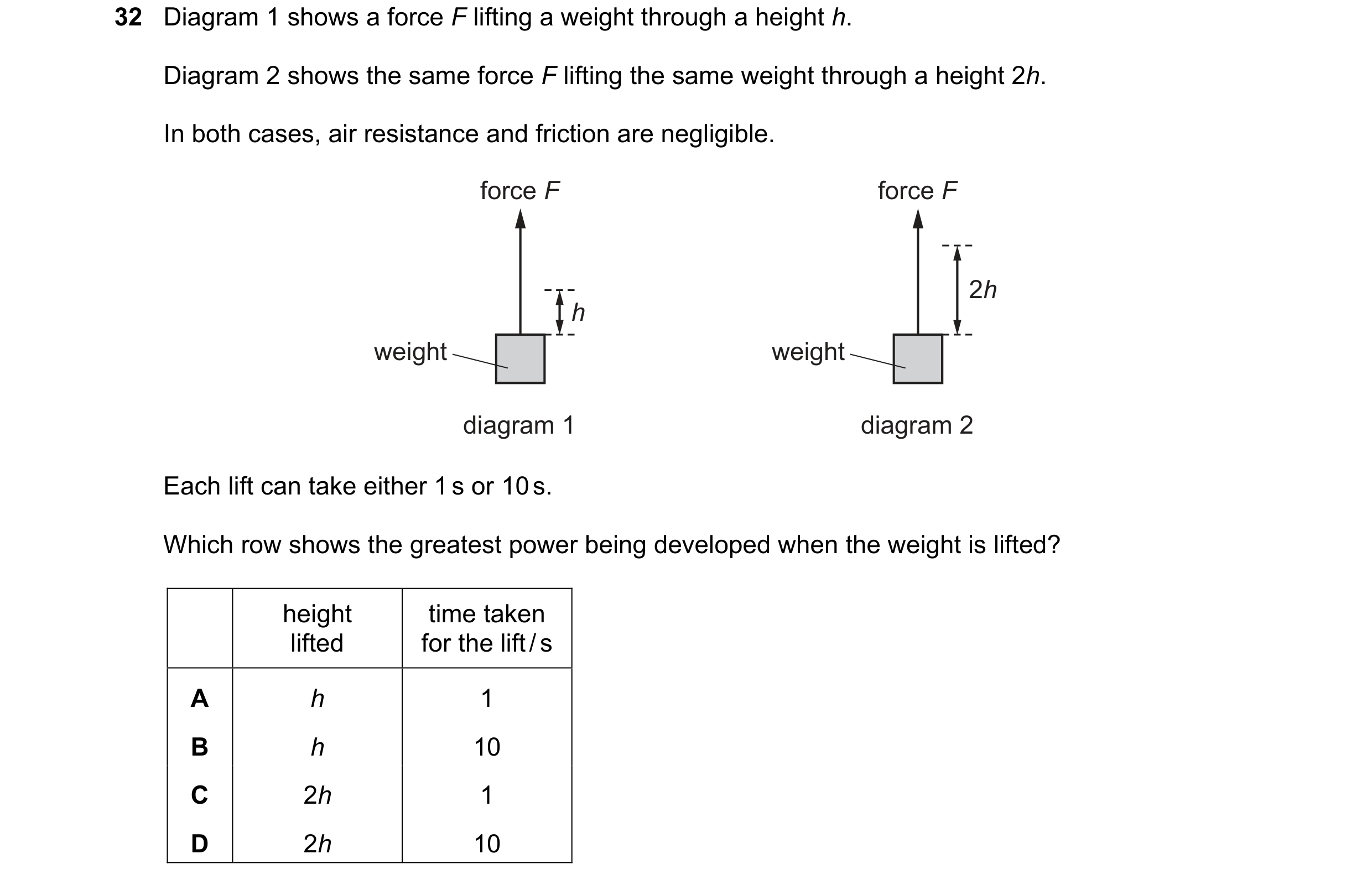

 18 / 42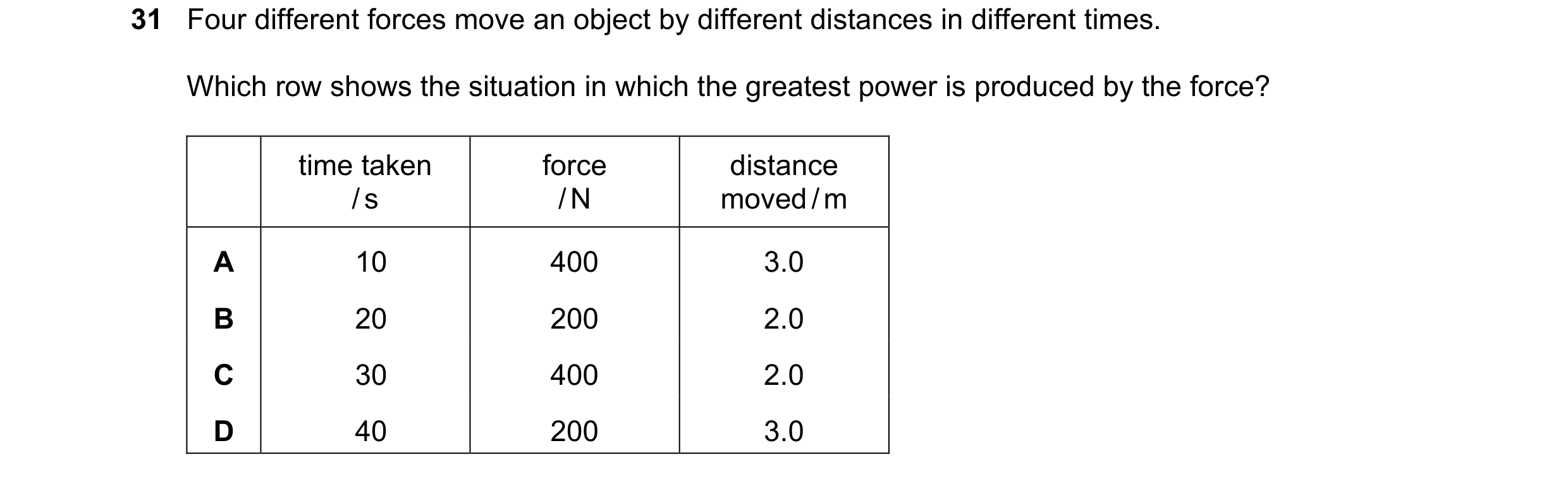

 19 / 42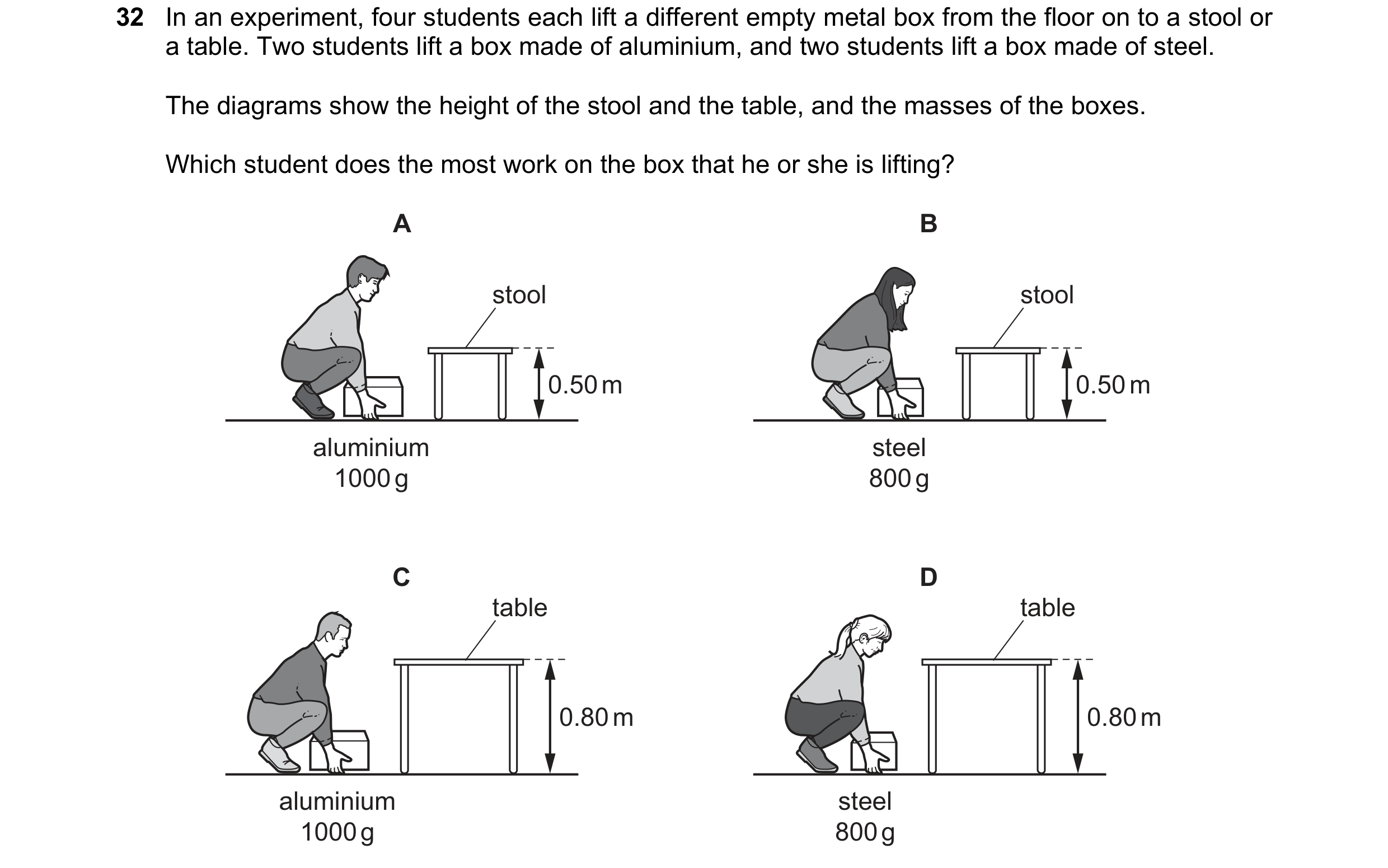
 20 / 42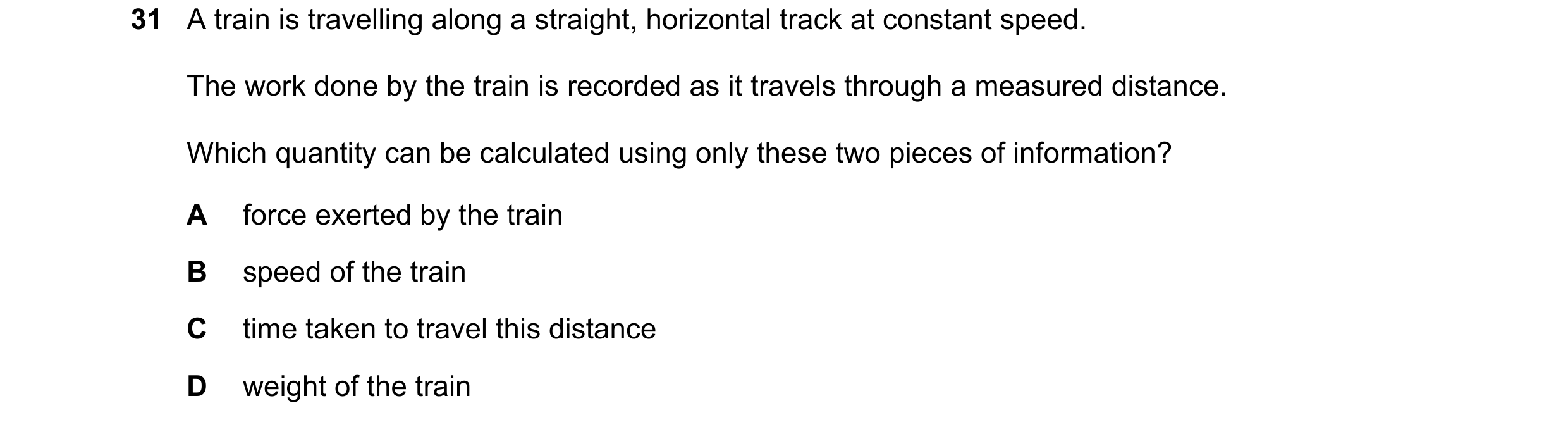
 21 / 42
 22 / 42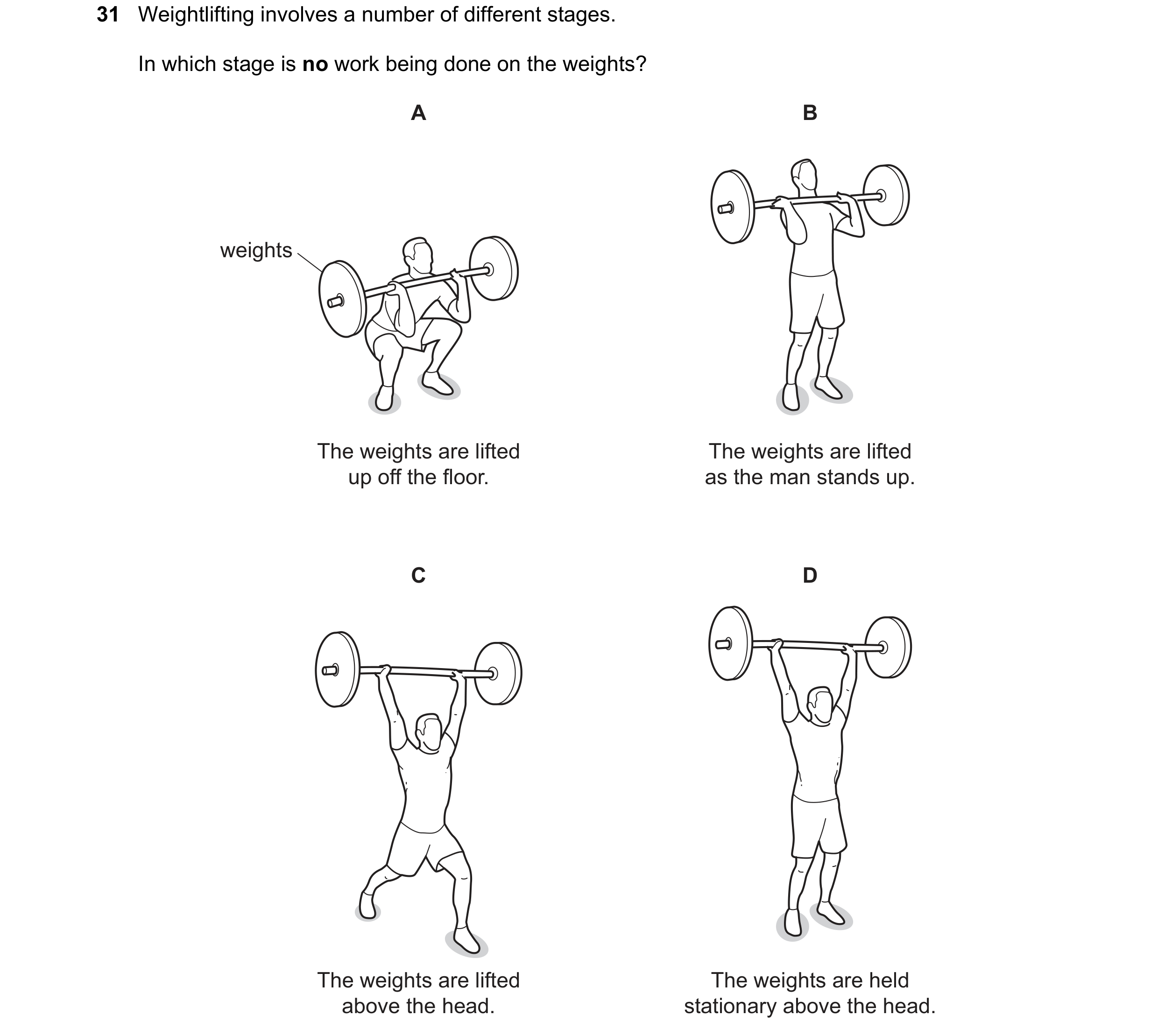
 23 / 42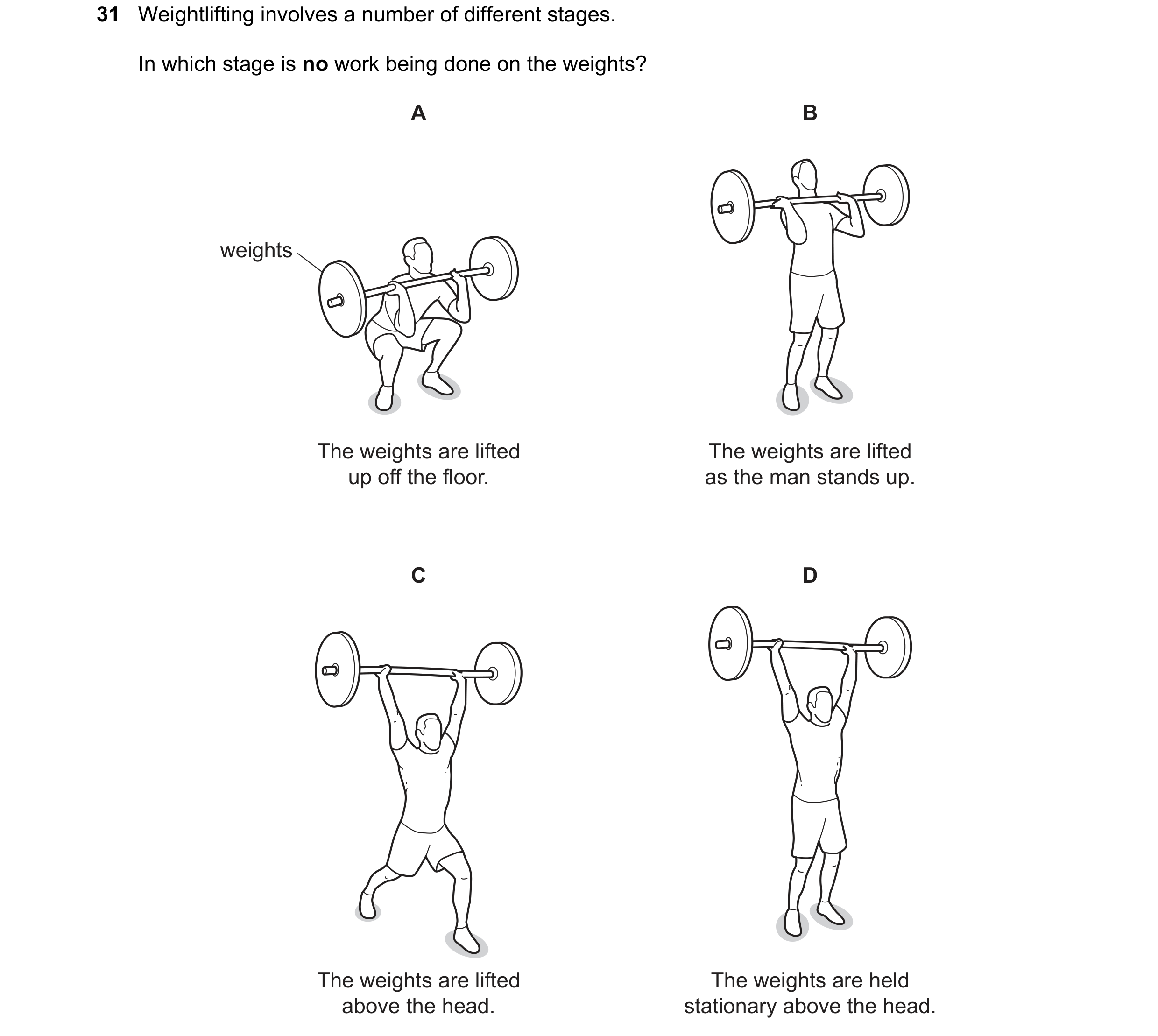
 24 / 42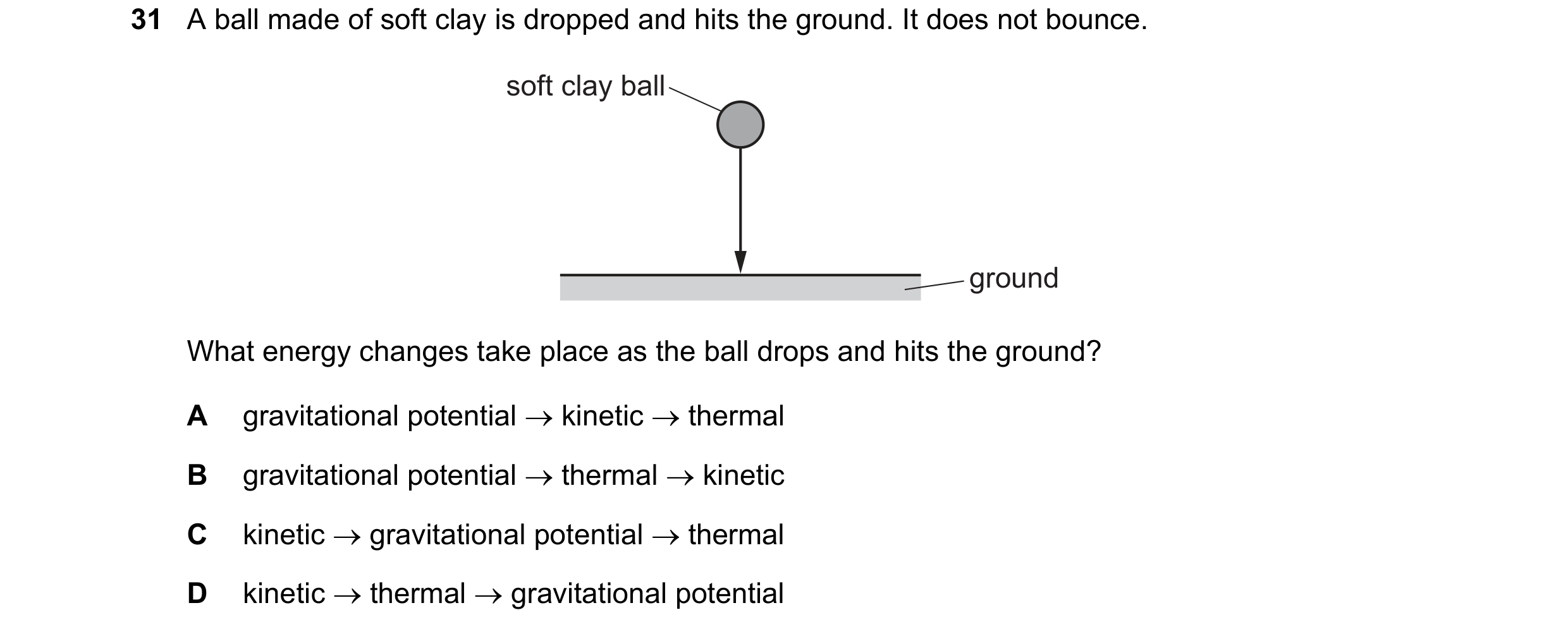



 25 / 42
 26 / 42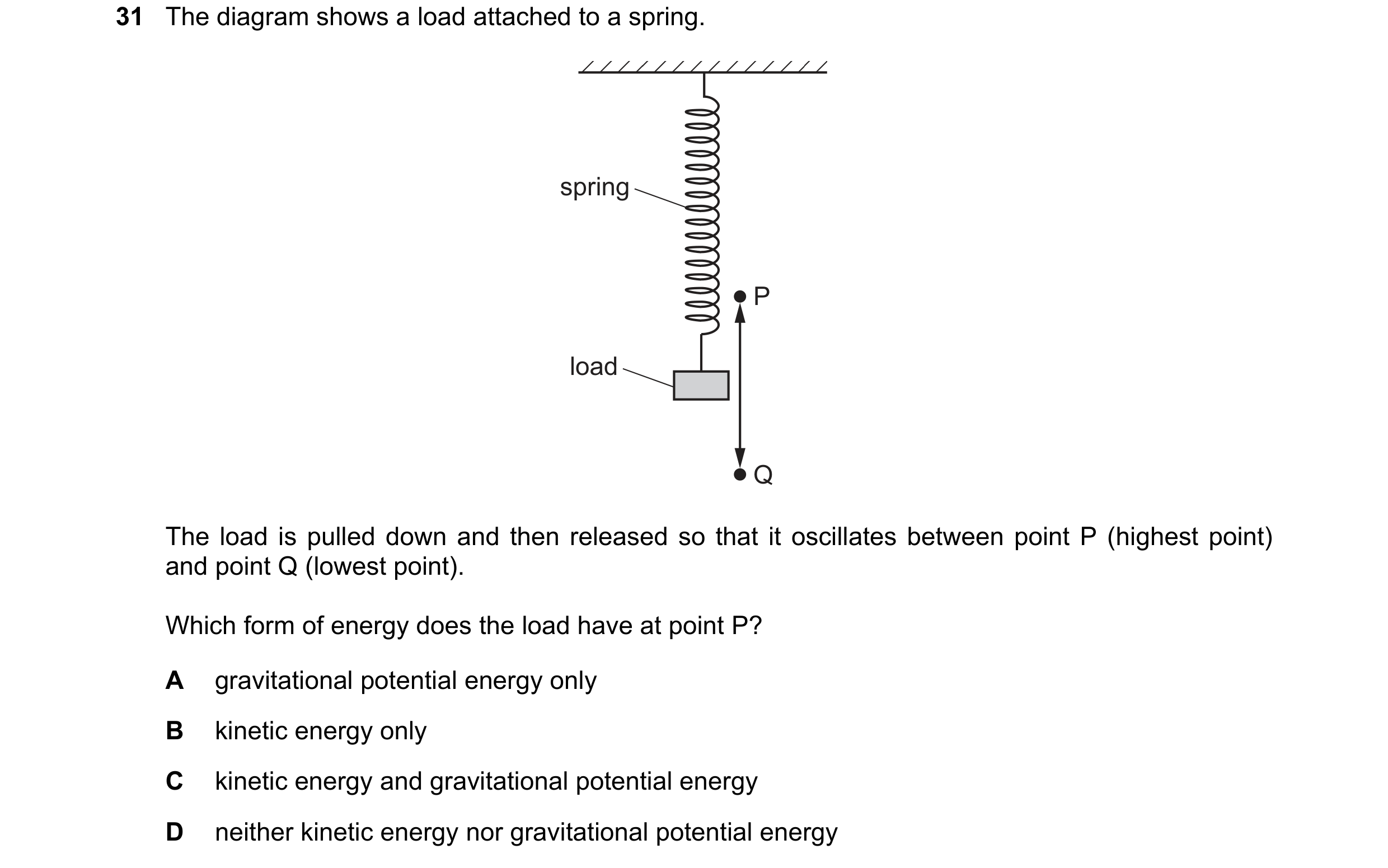
 27 / 42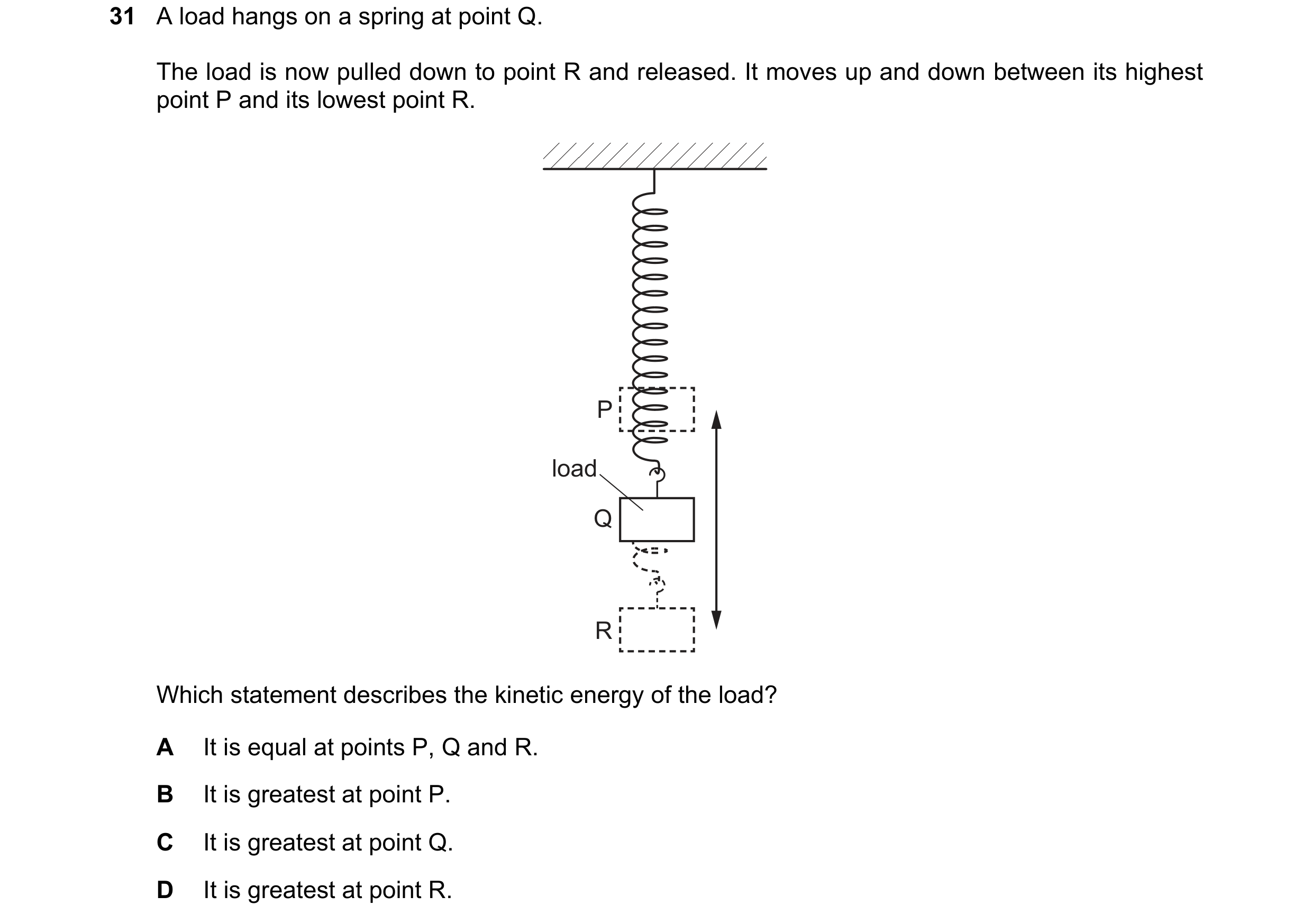
 28 / 42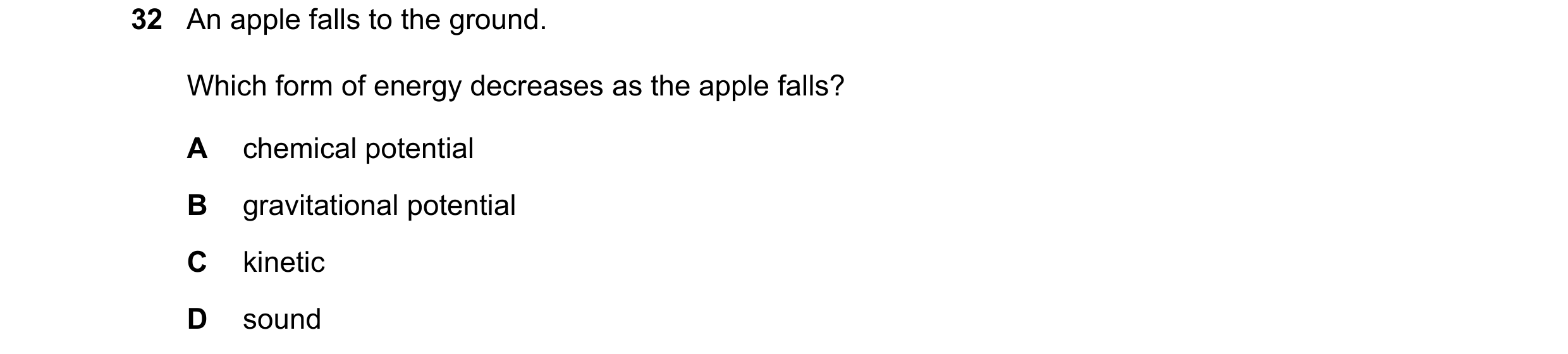

 29 / 42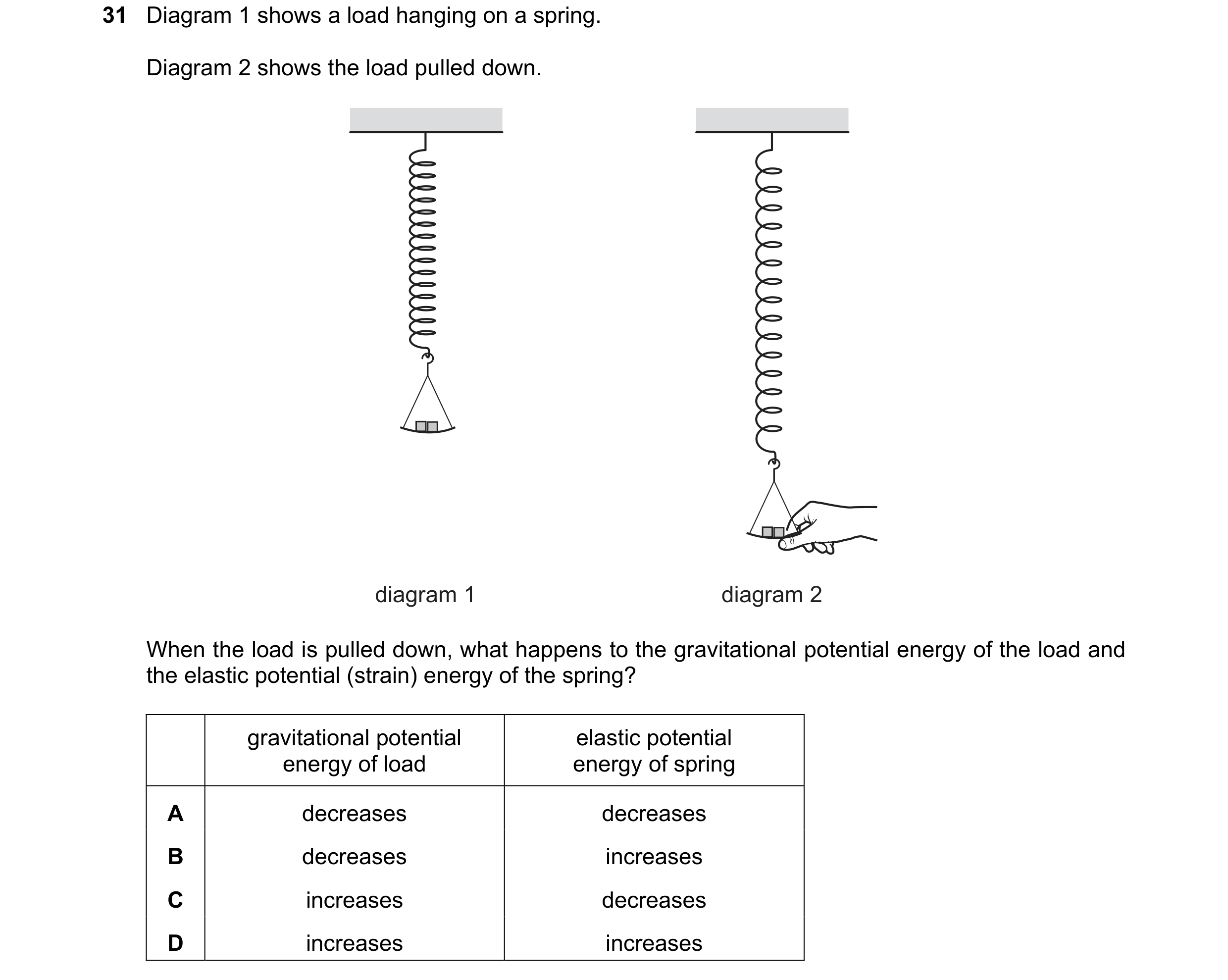

 30 / 42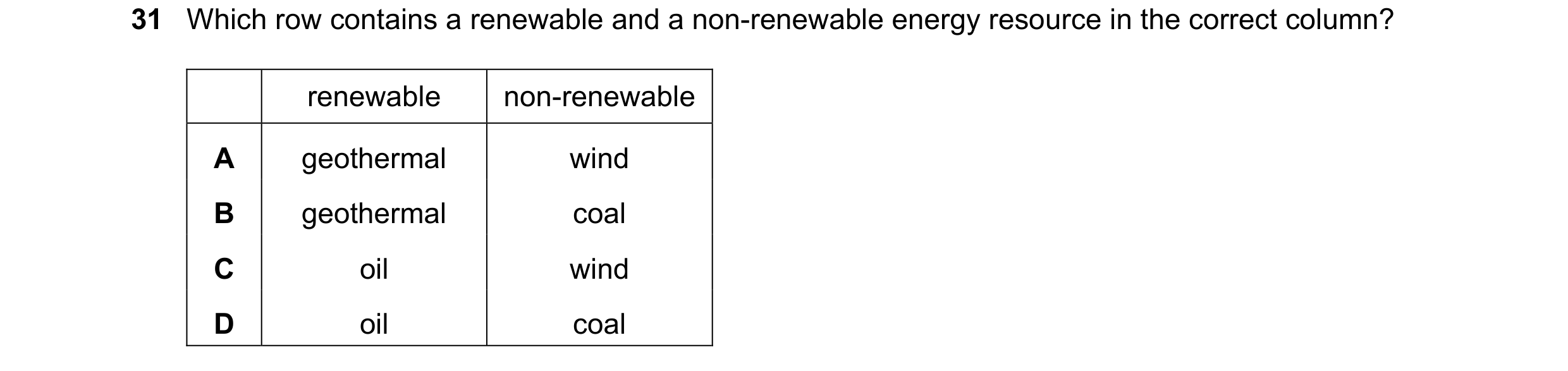

 31 / 42
 32 / 42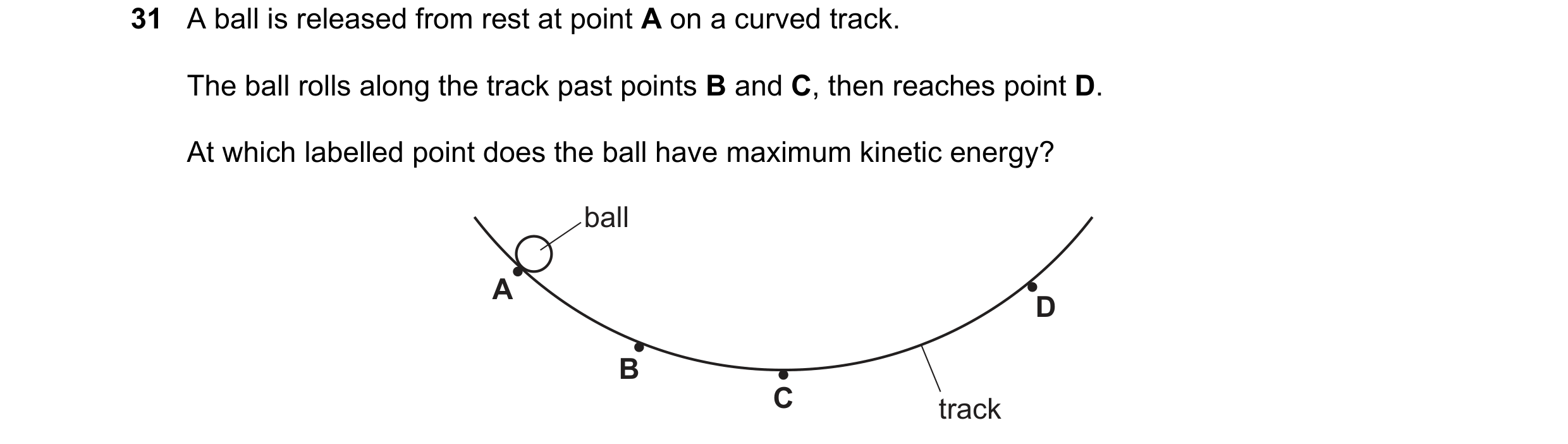


 33 / 42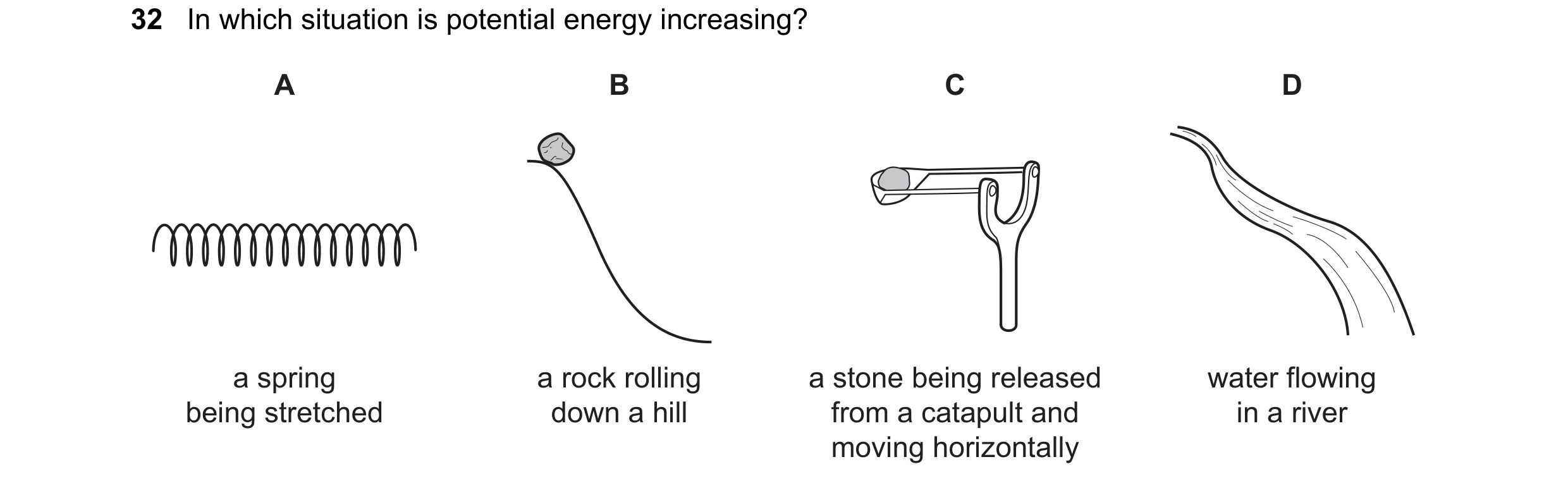
 34 / 42

 35 / 42
 36 / 42
 37 / 42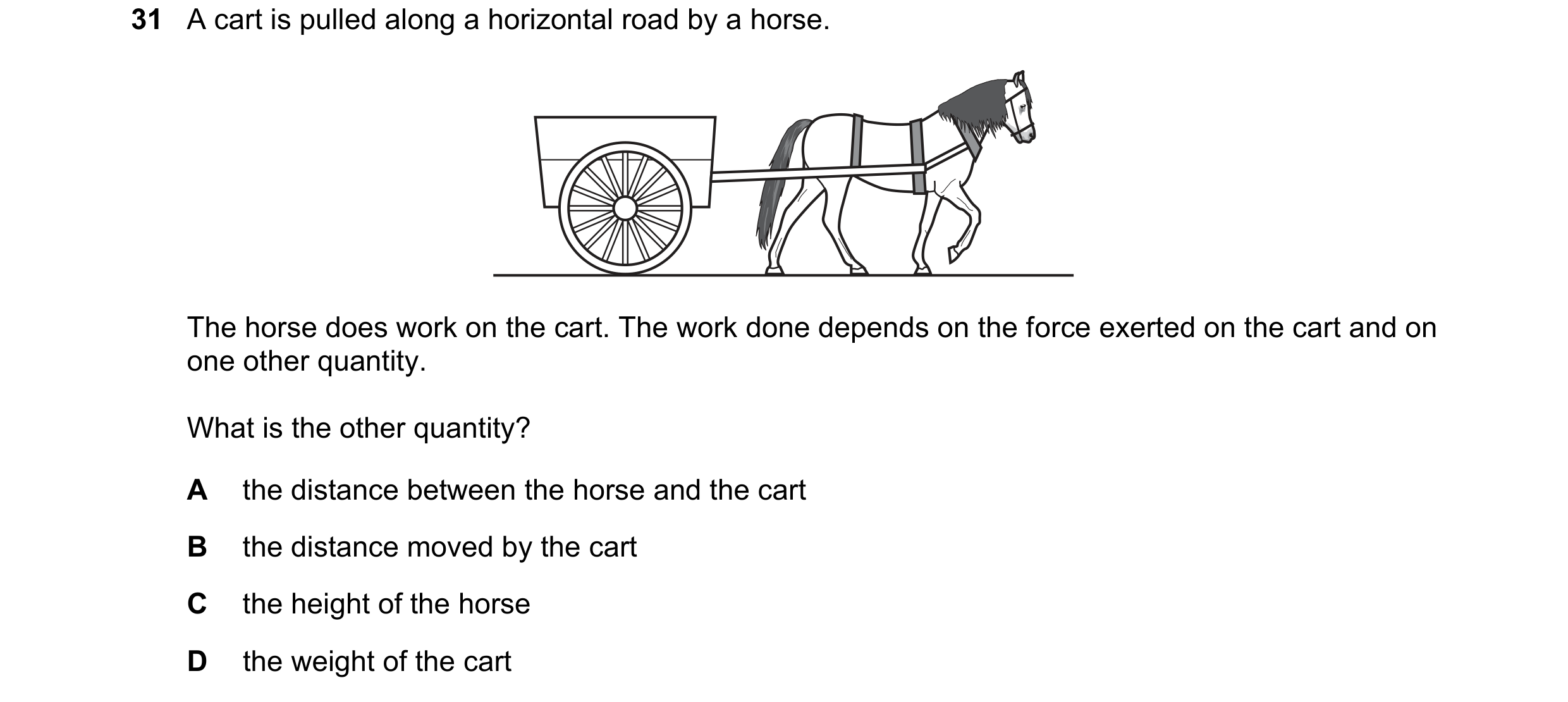

 38 / 42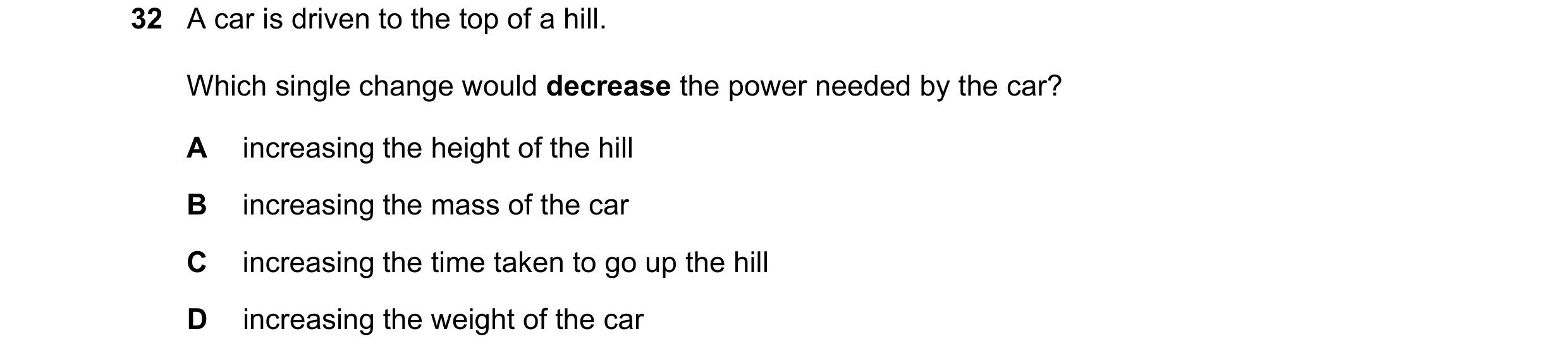

 39 / 42

 40 / 42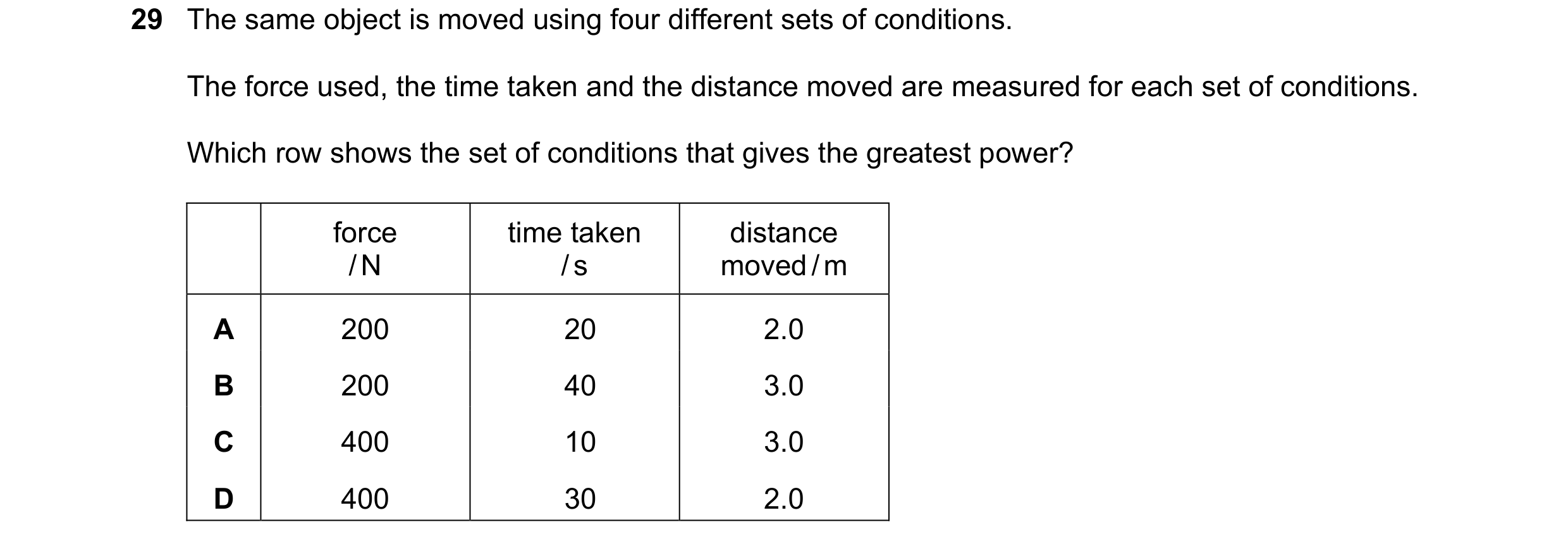

 41 / 42
 42 / 42