Cambridge IGCSE Science - Combined 0653 — 2013 Oct/Nov Paper 1 · Variant 3
0653/13/O/N/13 · 40 questions · 40 marks · ≈45 min
The question paper and its mark scheme, free to read here and free to download. This is Cambridge’s own paper, exactly as it was sat.
Question paper20 pages

Mark scheme2 pages
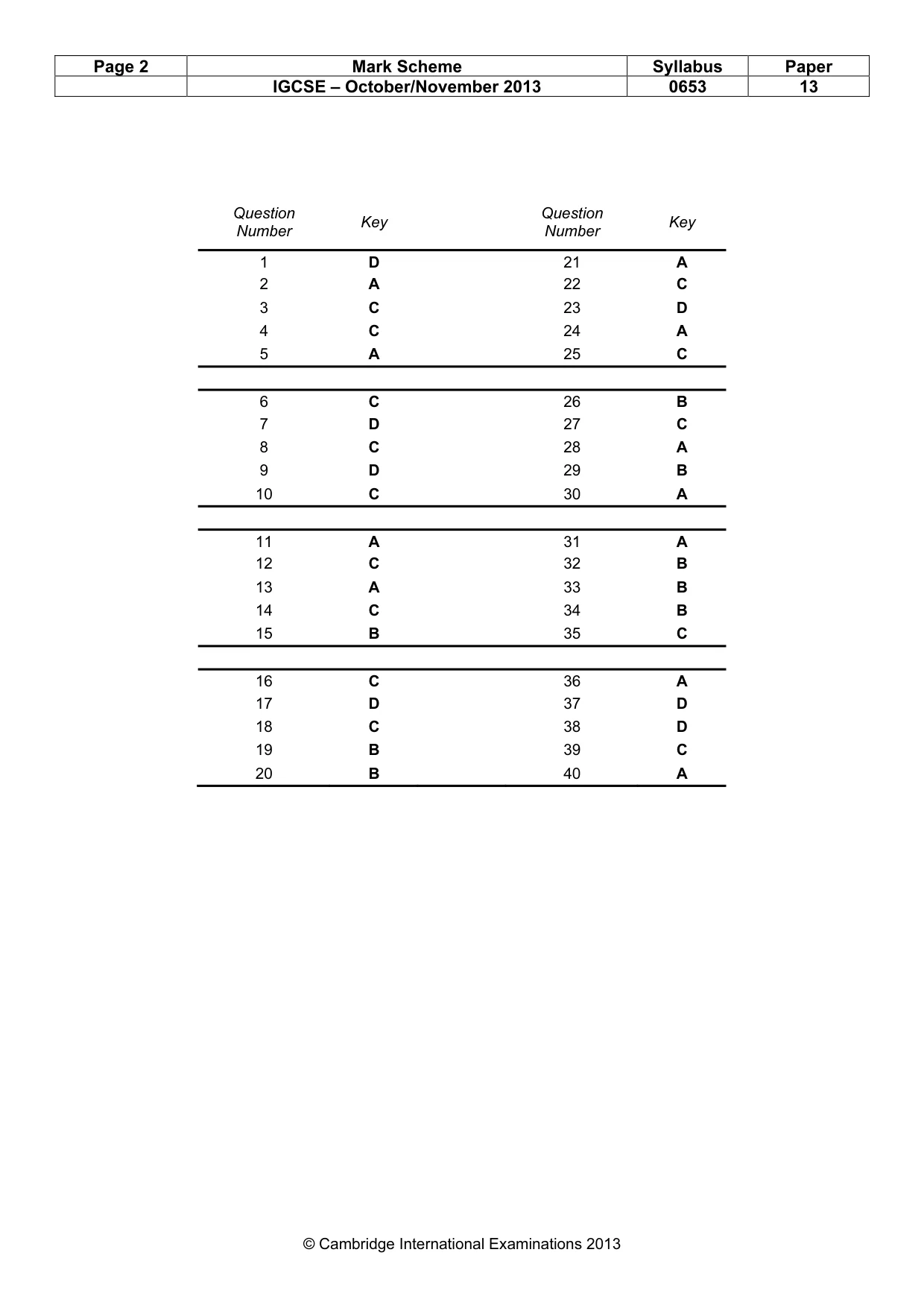
Answers below. Sit the paper first if you are practising.
Questions as text
Q1 · The diagram shows a plant cell
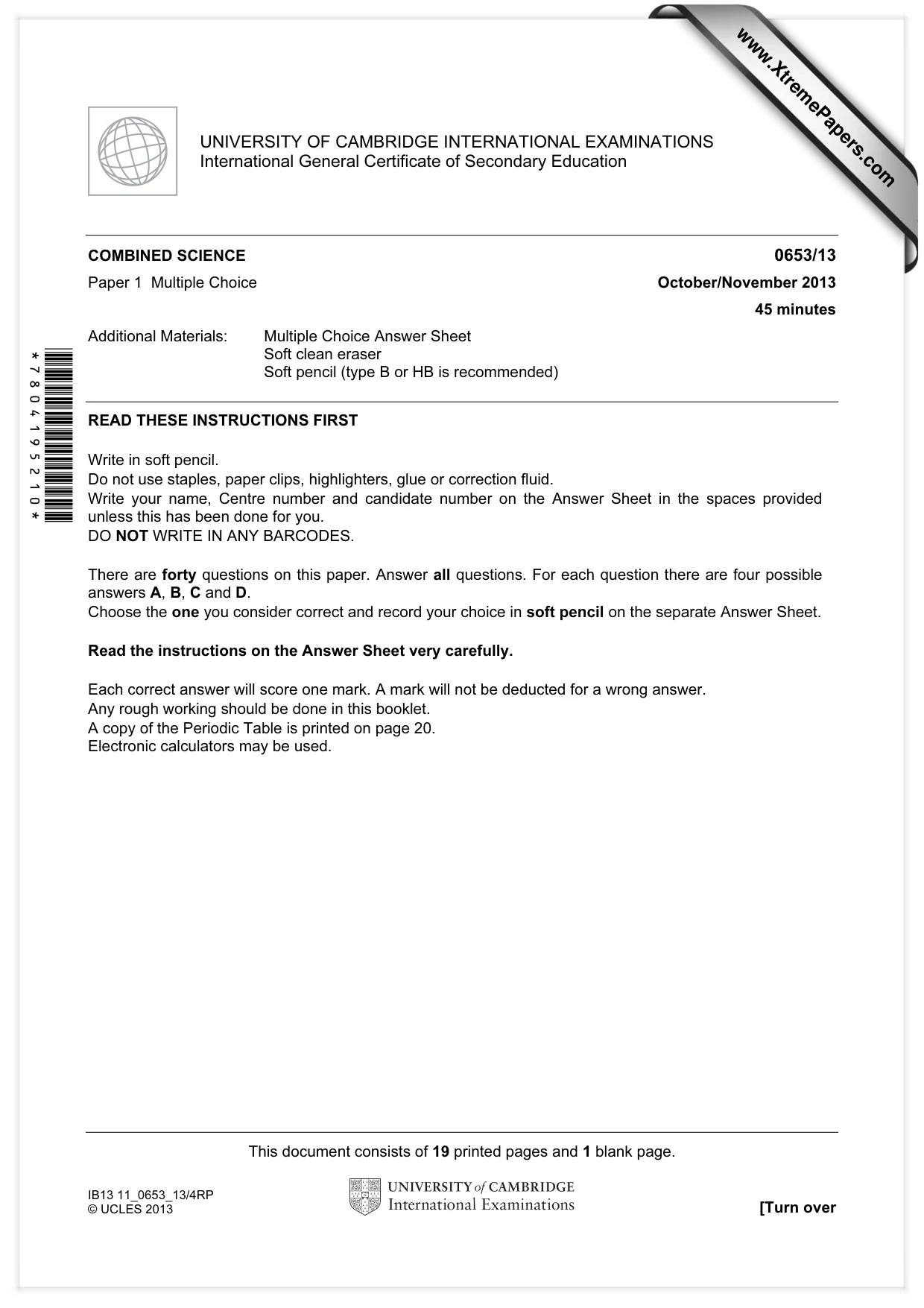
1 The diagram shows a plant cell. 3 2 4 5 6 1 Which parts of the cell are found in plant cells only? A 1, 2 and 3 B 2, 3 and 4 C 4, 5 and 6 D 1, 5 and 6
Mark scheme: D
Q2 · The diagram shows a leaf in sunlight and some of the substances that diffuse into and out…
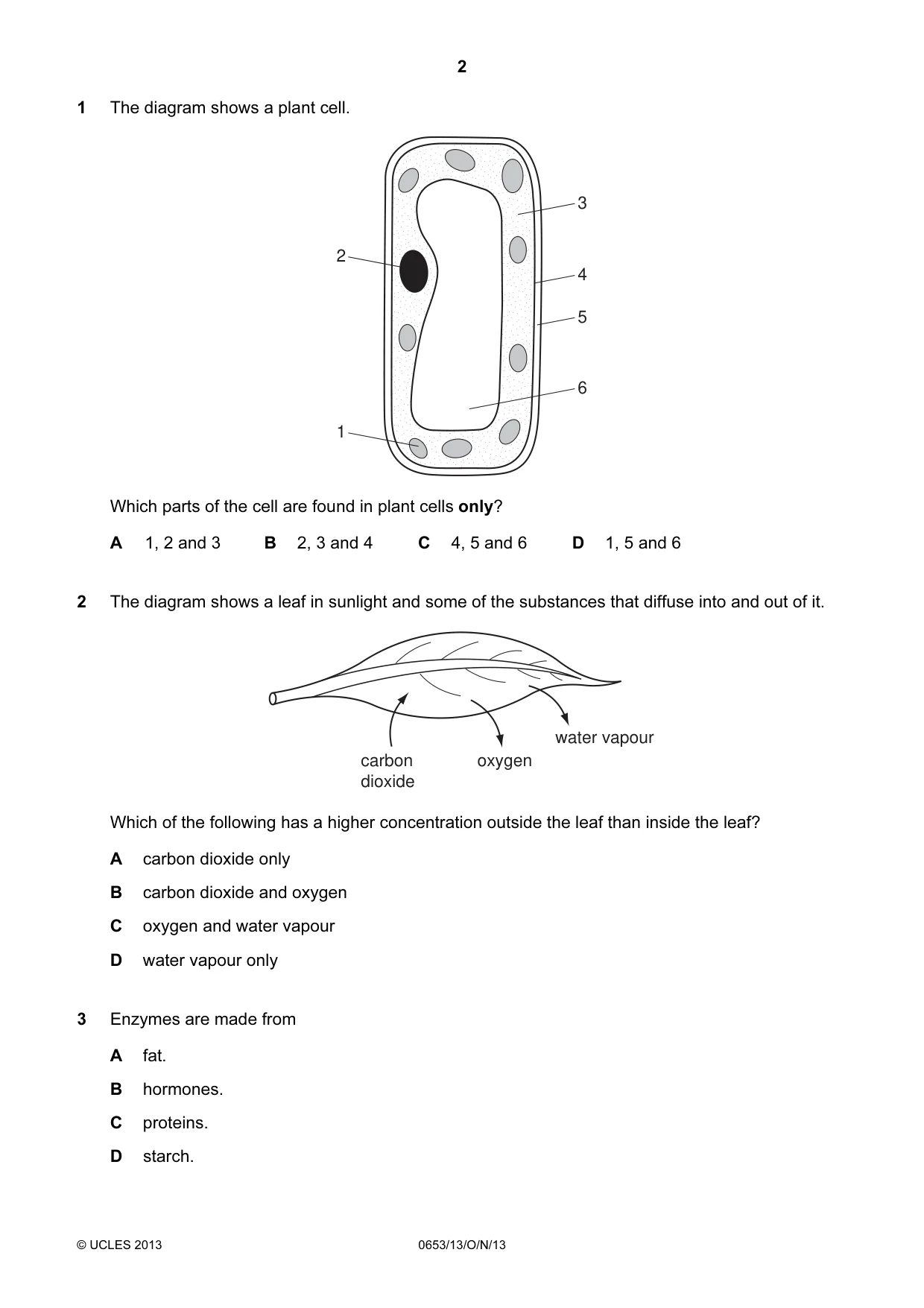
2 The diagram shows a leaf in sunlight and some of the substances that diffuse into and out of it. water vapour carbon oxygen dioxide Which of the following has a higher concentration outside the leaf than inside the leaf? A carbon dioxide only B carbon dioxide and oxygen C oxygen and water vapour D water vapour only
Mark scheme: A
Q3 · Enzymes are made from A fat
3 Enzymes are made from A fat. B hormones. C proteins. D starch.
Mark scheme: C
Q4 · What are the main products of photosynthesis?
4 What are the main products of photosynthesis? A carbon dioxide + oxygen B carbon dioxide + water C simple sugars + oxygen D simple sugars + water
Mark scheme: C
Q5 · The diagram shows a section through a human tooth
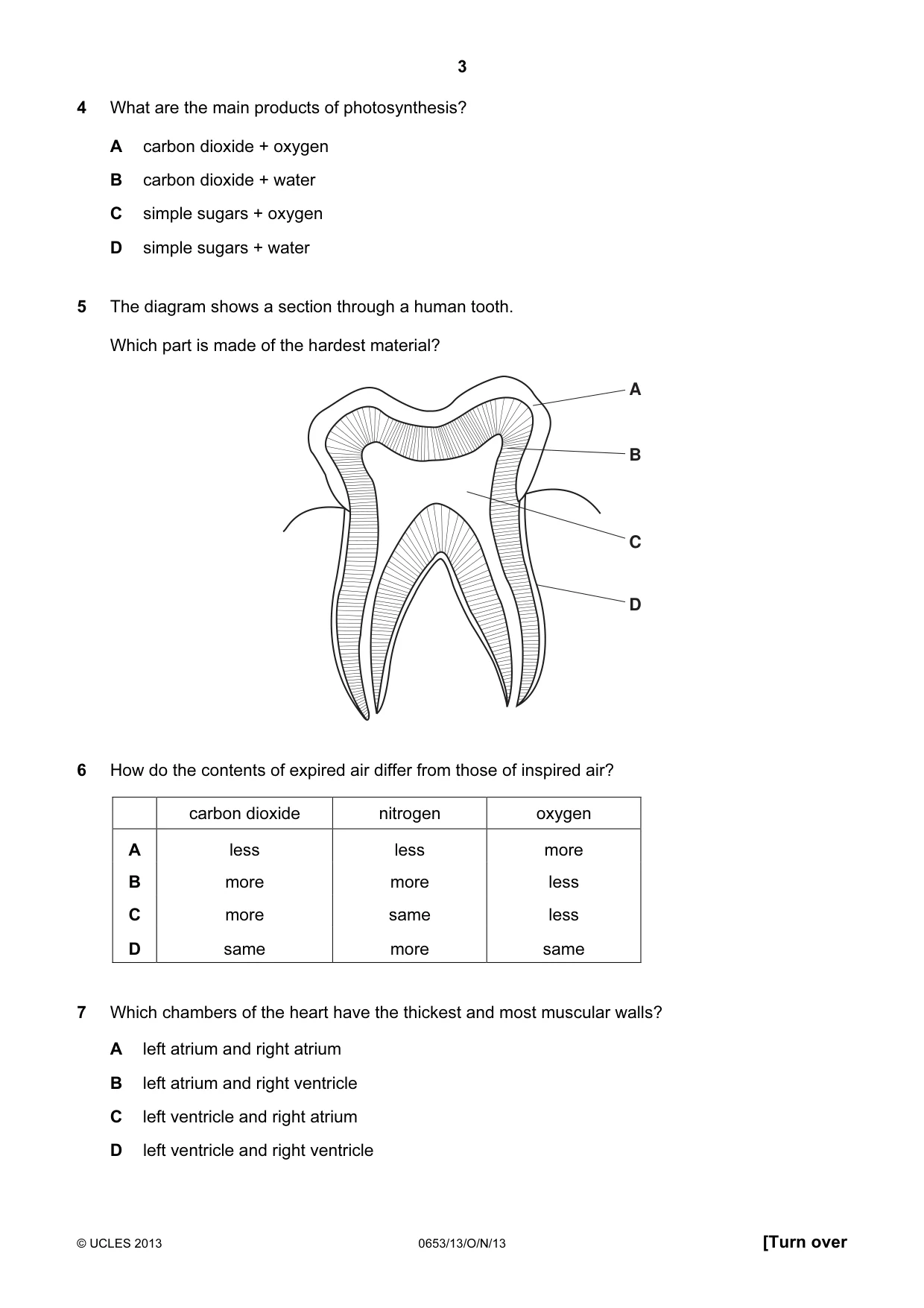
5 The diagram shows a section through a human tooth. Which part is made of the hardest material? A B C D
Mark scheme: A
Q6 · How do the contents of expired air differ from those of inspired air?
6 How do the contents of expired air differ from those of inspired air? carbon dioxide nitrogen oxygen A less less more B more more less C more same less D same more same
Mark scheme: C
Q7 · Which chambers of the heart have the thickest and most muscular walls?
7 Which chambers of the heart have the thickest and most muscular walls? A left atrium and right atrium B left atrium and right ventricle C left ventricle and right atrium D left ventricle and right ventricle
Mark scheme: D
Q8 · The diagram shows an apparatus that was used to measure the uptake of water by a leafy…
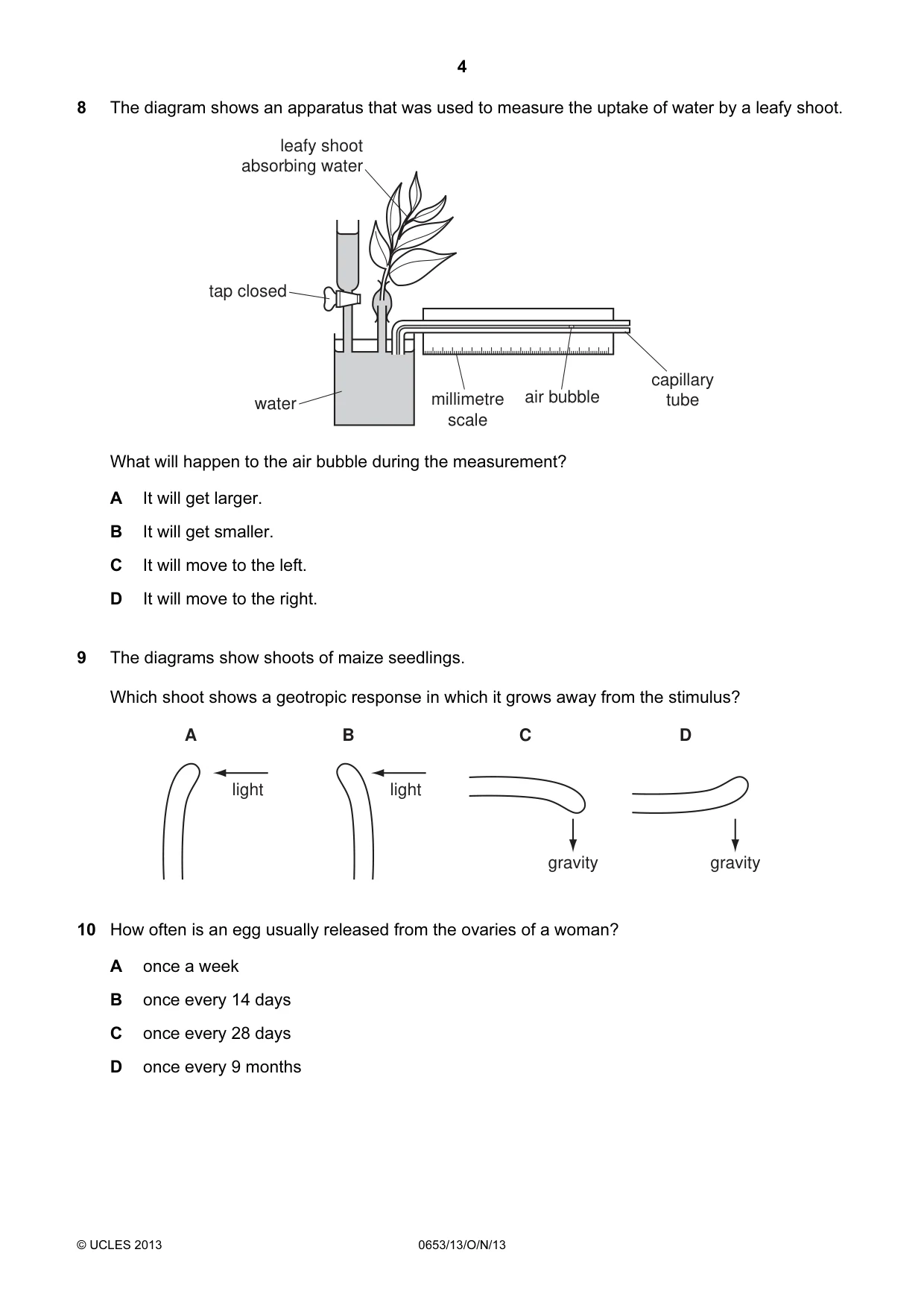
8 The diagram shows an apparatus that was used to measure the uptake of water by a leafy shoot. leafy shoot absorbing water tap closed capillary water millimetre air bubble tube scale What will happen to the air bubble during the measurement? A It will get larger. B It will get smaller. C It will move to the left. D It will move to the right.
Mark scheme: C
Q9 · The diagrams show shoots of maize seedlings
9 The diagrams show shoots of maize seedlings. Which shoot shows a geotropic response in which it grows away from the stimulus? A B C D light light gravity gravity
Mark scheme: D
Q10 · How often is an egg usually released from the ovaries of a woman?
10 How often is an egg usually released from the ovaries of a woman? A once a week B once every 14 days C once every 28 days D once every 9 months
Mark scheme: C
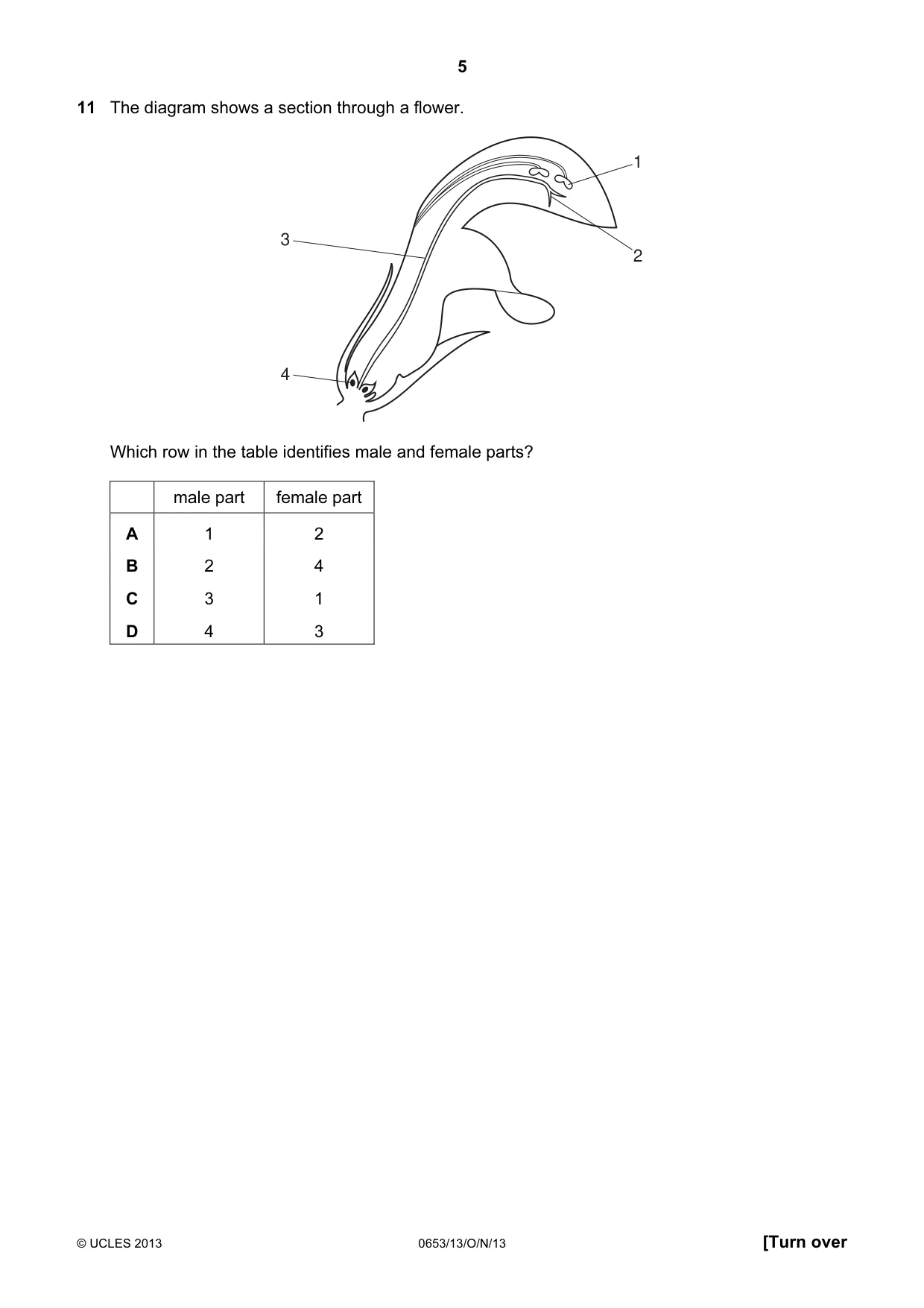
Q11 · The diagram shows a section through a flower
11 The diagram shows a section through a flower. 1 3 2 4 Which row in the table identifies male and female parts? male part female part A 1 2 B 2 4 C 3 1 D 4 3
Mark scheme: A
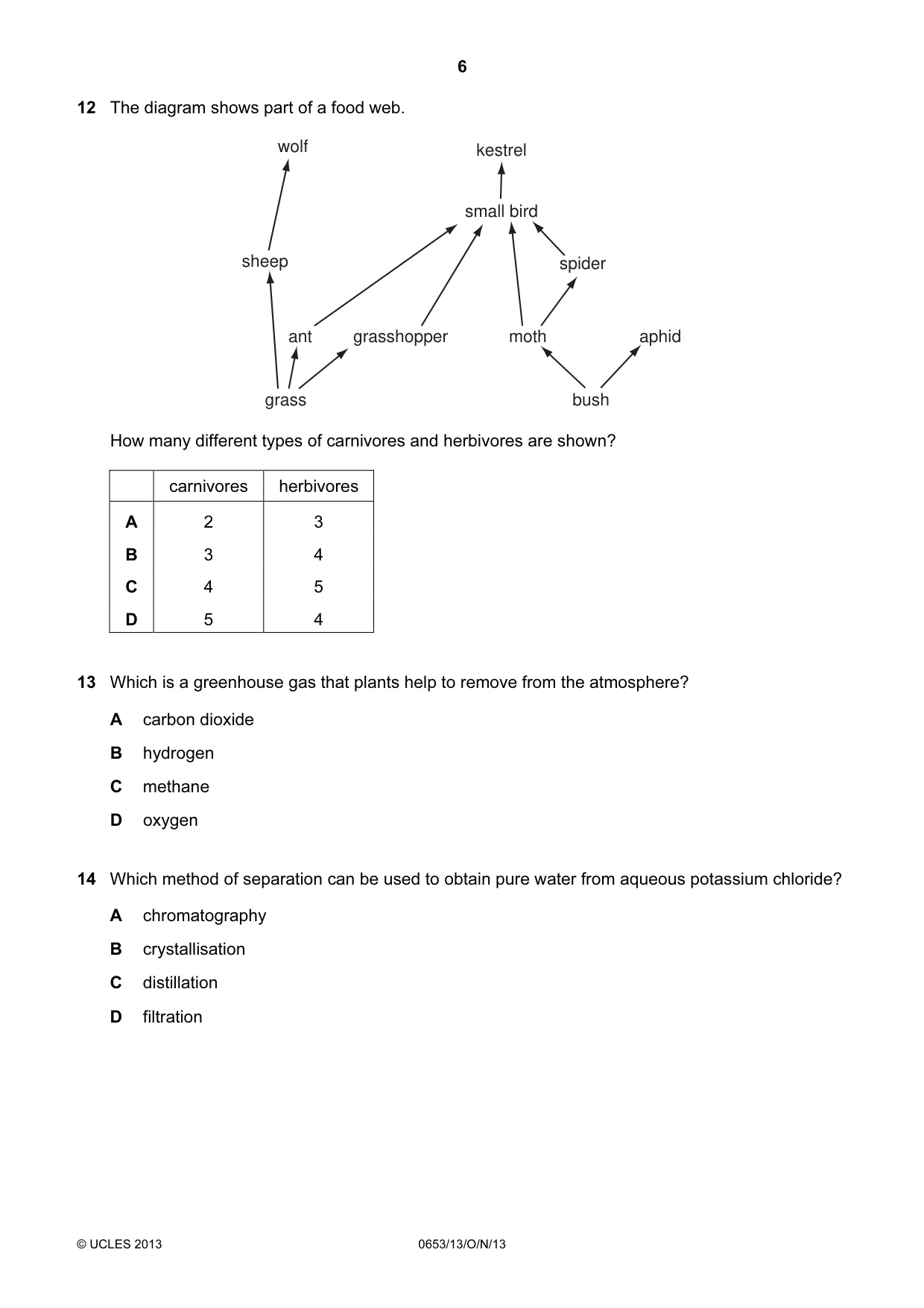
Q12 · The diagram shows part of a food web
12 The diagram shows part of a food web. wolf kestrel small bird sheep spider ant grasshopper moth aphid grass bush How many different types of carnivores and herbivores are shown? carnivores herbivores A 2 3 B 3 4 C 4 5 D 5 4
Mark scheme: C
Q13 · Which is a greenhouse gas that plants help to remove from the atmosphere?
13 Which is a greenhouse gas that plants help to remove from the atmosphere? A carbon dioxide B hydrogen C methane D oxygen
Mark scheme: A
Q14 · Which method of separation can be used to obtain pure water from aqueous potassium…
14 Which method of separation can be used to obtain pure water from aqueous potassium chloride? A chromatography B crystallisation C distillation D filtration
Mark scheme: C
Q15 · Which reaction involves combustion?
15 Which reaction involves combustion? A calcium carbonate → calcium oxide + carbon dioxide B methane + oxygen → carbon dioxide + water C sodium carbonate + hydrochloric acid → sodium chloride + water + carbon dioxide D sodium hydroxide + hydrochloric acid → sodium chloride + water
Mark scheme: B
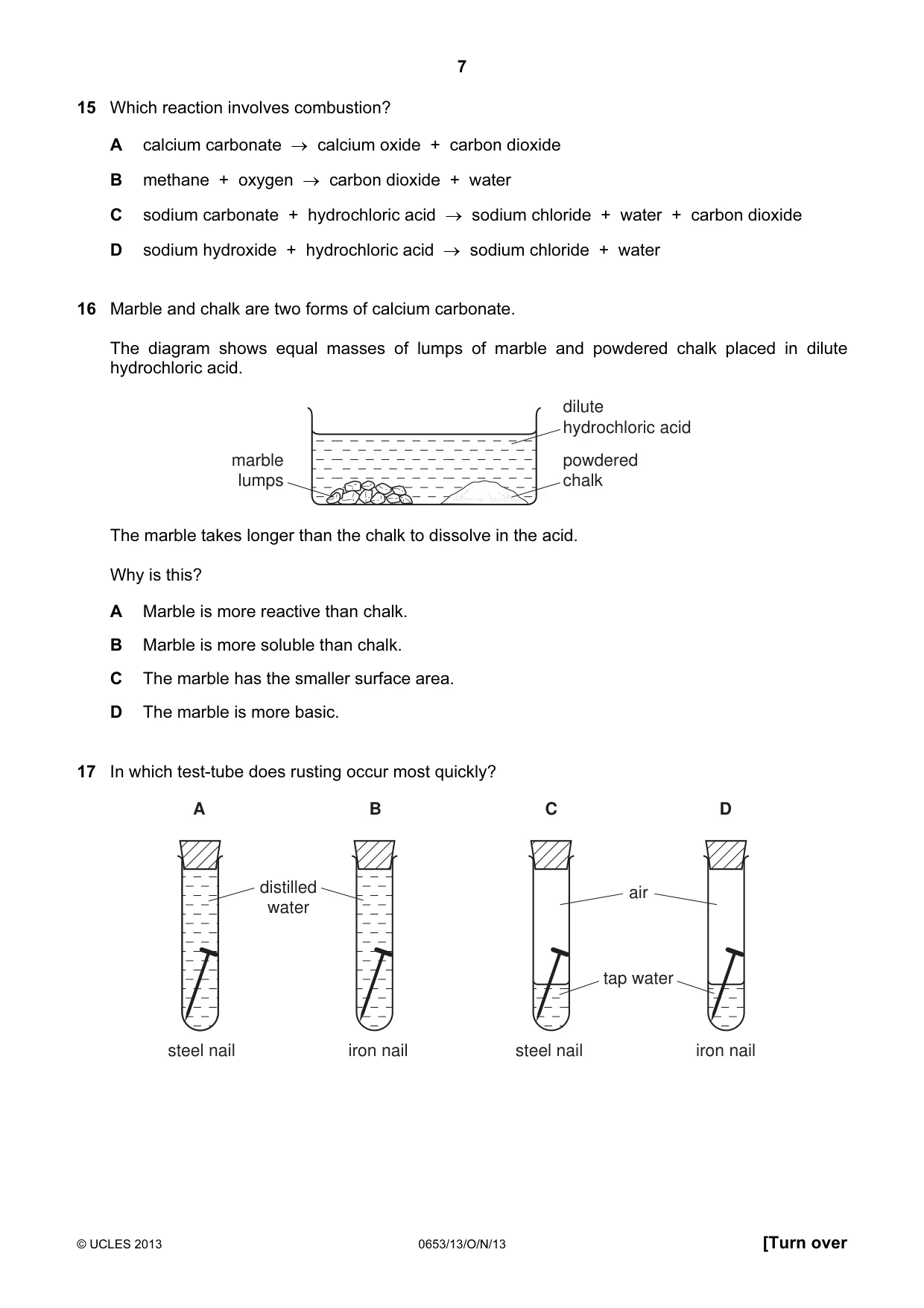
Q16 · Marble and chalk are two forms of calcium carbonate
16 Marble and chalk are two forms of calcium carbonate. The diagram shows equal masses of lumps of marble and powdered chalk placed in dilute hydrochloric acid. dilute hydrochloric acid marble powdered lumps chalk The marble takes longer than the chalk to dissolve in the acid. Why is this? A Marble is more reactive than chalk. B Marble is more soluble than chalk. C The marble has the smaller surface area. D The marble is more basic.
Mark scheme: C
Q17 · In which test-tube does rusting occur most quickly?
17 In which test-tube does rusting occur most quickly? A B C D distilled air water tap water steel nail iron nail steel nail iron nail
Mark scheme: D
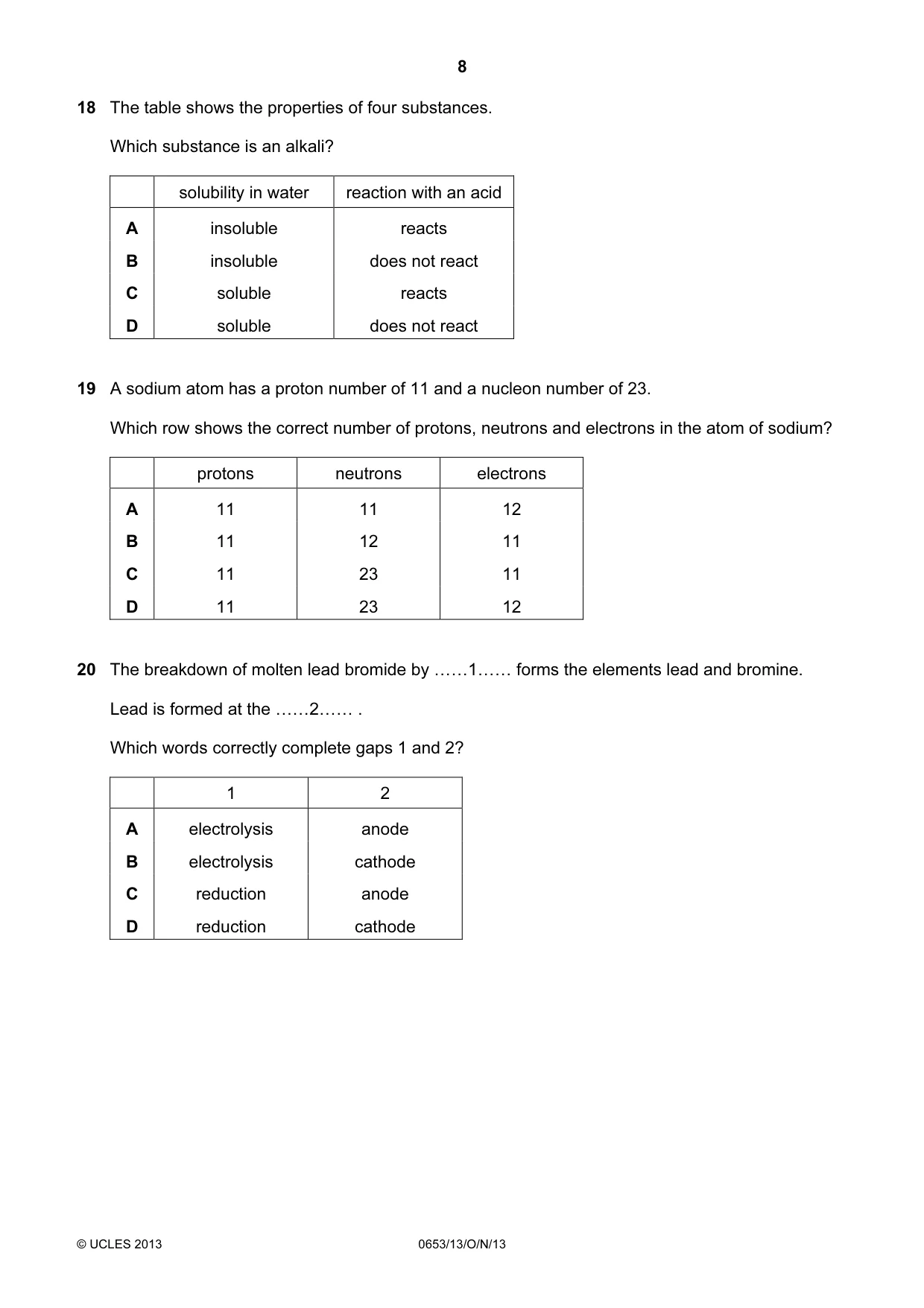
Q18 · The table shows the properties of four substances
18 The table shows the properties of four substances. Which substance is an alkali? solubility in water reaction with an acid A insoluble reacts B insoluble does not react C soluble reacts D soluble does not react
Mark scheme: C
More questions on The characteristic properties of acids and bases
Q19 · A sodium atom has a proton number of 11 and a nucleon number of 23
19 A sodium atom has a proton number of 11 and a nucleon number of 23. Which row shows the correct number of protons, neutrons and electrons in the atom of sodium? protons neutrons electrons A 11 11 12 B 11 12 11 C 11 23 11 D 11 23 12
Mark scheme: B
Q20 · The breakdown of molten lead bromide by ……1…… forms the elements lead and bromine
20 The breakdown of molten lead bromide by ……1…… forms the elements lead and bromine. Lead is formed at the ……2…… . Which words correctly complete gaps 1 and 2? 1 2 A electrolysis anode B electrolysis cathode C reduction anode D reduction cathode
Mark scheme: B
Q21 · An aqueous solution of X is electrolysed
21 An aqueous solution of X is electrolysed. carbon carbon anode + – cathode beaker aqueous solution of X The cathode increases in mass and turns red-brown. What is X? A copper(II) chloride B iodine C lead(II) bromide D sodium chloride
Mark scheme: A
Q22 · 60 cm3 of dry air is passed over hot copper until all the oxygen has reacted
22 60 cm3 of dry air is passed over hot copper until all the oxygen has reacted. dry air copper heat Which volume of gas remains at the end of the reaction? A 6 cm3 B 12 cm3 C 48 cm3 D 54 cm3
Mark scheme: C
Q23 · Steam is passed over a heated metal
23 Steam is passed over a heated metal. metal gas produced steam heat water The metal reacts and a gas is produced. The gas ignites with a pop when tested with a lighted splint. What are the metal and the gas? metal gas A copper hydrogen B copper oxygen C magnesium oxygen D zinc hydrogen
Mark scheme: D
Q24 · Which diagram represents gaseous hydrogen chloride, HCl?
24 Which diagram represents gaseous hydrogen chloride, HCl? A B C D
Mark scheme: A
Q25 · Element X reacts with chlorine to form a red-brown compound
25 Element X reacts with chlorine to form a red-brown compound. chlorine excess chlorine element X heat Which row describes element X and its melting point? type of element melting point of X A alkali metal high B alkali metal low C transition element high D transition element low
Mark scheme: C
Q26 · Which row describes the physical state of some of the Group VII elements at room…
26 Which row describes the physical state of some of the Group VII elements at room temperature? chlorine bromine iodine A gas gas liquid B gas liquid solid C liquid liquid gas D liquid solid solid
Mark scheme: B
Q27 · The diagram shows how the temperature change can be measured when magnesium reacts with…
27 The diagram shows how the temperature change can be measured when magnesium reacts with hydrochloric acid. magnesium powder dilute hydrochloric acid Thermometer reading before adding magnesium powder = 20.6 °C Thermometer reading after adding magnesium powder = 32.4 °C Which statement is correct? A The reaction is endothermic and gives out heat. B The reaction is endothermic and takes in heat. C The reaction is exothermic and gives out heat. D The reaction is exothermic and takes in heat.
Mark scheme: C
Q28 · A car travels between two towns
28 A car travels between two towns. After 1 hour the driver has travelled 120 km. She then stops and rests for an hour. She takes another hour to travel a further 60 km to reach her destination. 120 km 60 km start destination rests for 1 hour What is the average speed of the car for the whole journey? A 60 km / h B 90 km / h C 120 km / h D 180 km / h
Mark scheme: A
Q29 · A measuring cylinder contains 20 cm3 of oil
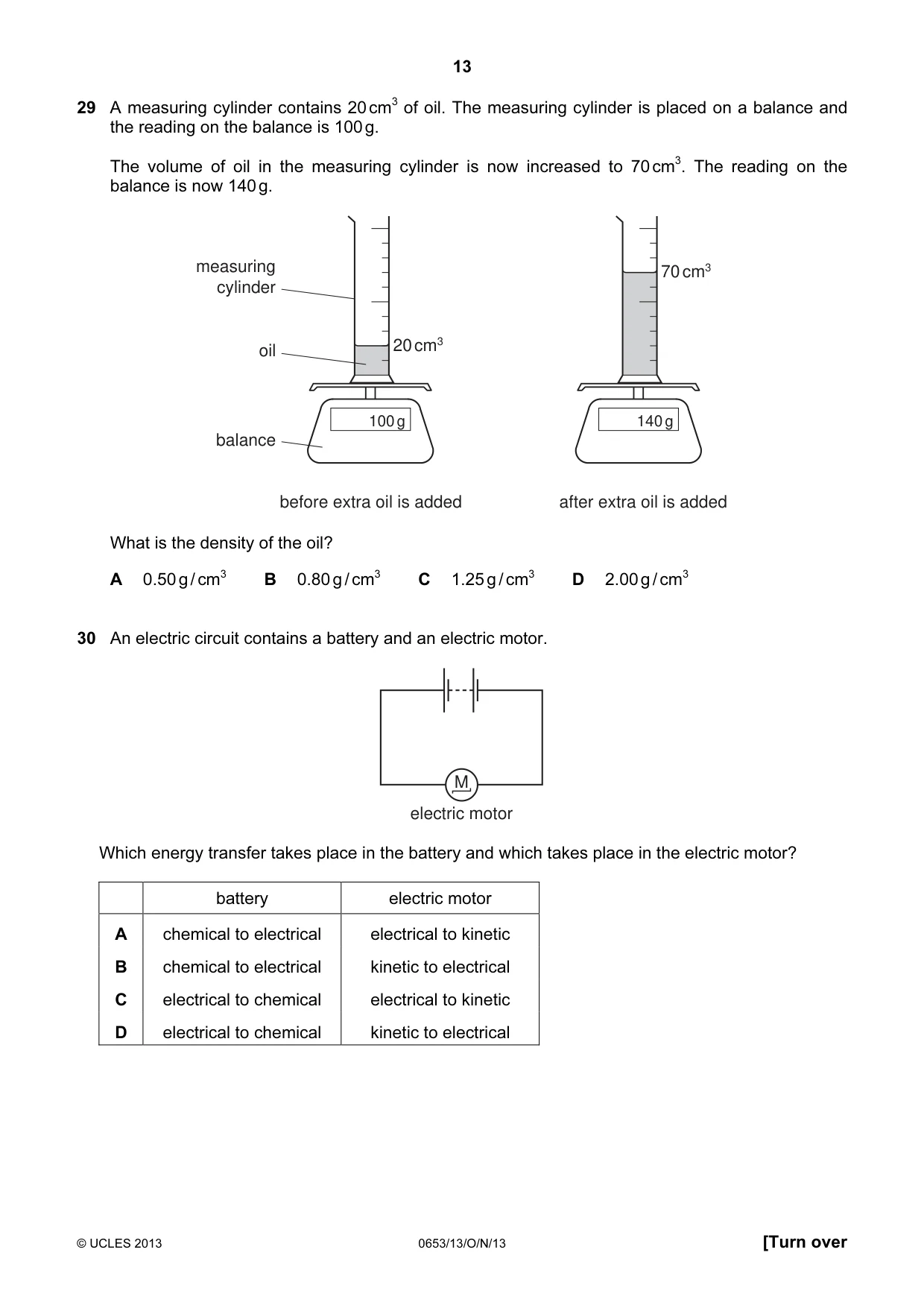
29 A measuring cylinder contains 20 cm3 of oil. The measuring cylinder is placed on a balance and the reading on the balance is 100 g. The volume of oil in the measuring cylinder is now increased to 70 cm3. The reading on the balance is now 140 g. measuring 70 cm3 cylinder oil 20 cm3 100 g 140 g balance before extra oil is added after extra oil is added What is the density of the oil? A 0.50 g / cm3 B 0.80 g / cm3 C 1.25 g / cm3 D 2.00 g / cm3
Mark scheme: B
Q30 · An electric circuit contains a battery and an electric motor
30 An electric circuit contains a battery and an electric motor. M electric motor Which energy transfer takes place in the battery and which takes place in the electric motor? battery electric motor A chemical to electrical electrical to kinetic B chemical to electrical kinetic to electrical C electrical to chemical electrical to kinetic D electrical to chemical kinetic to electrical
Mark scheme: A
Q31 · A drop of liquid falls on a student’s skin and evaporates quickly
31 A drop of liquid falls on a student’s skin and evaporates quickly. What is the effect on the skin and the reason for this effect? A The skin cools because the most energetic molecules escape from the liquid. B The skin cools because the most energetic molecules remain in the liquid. C The skin warms because the most energetic molecules escape from the liquid. D The skin warms because the most energetic molecules remain in the liquid.
Mark scheme: A
Q32 · Benzene and glycerine are two substances
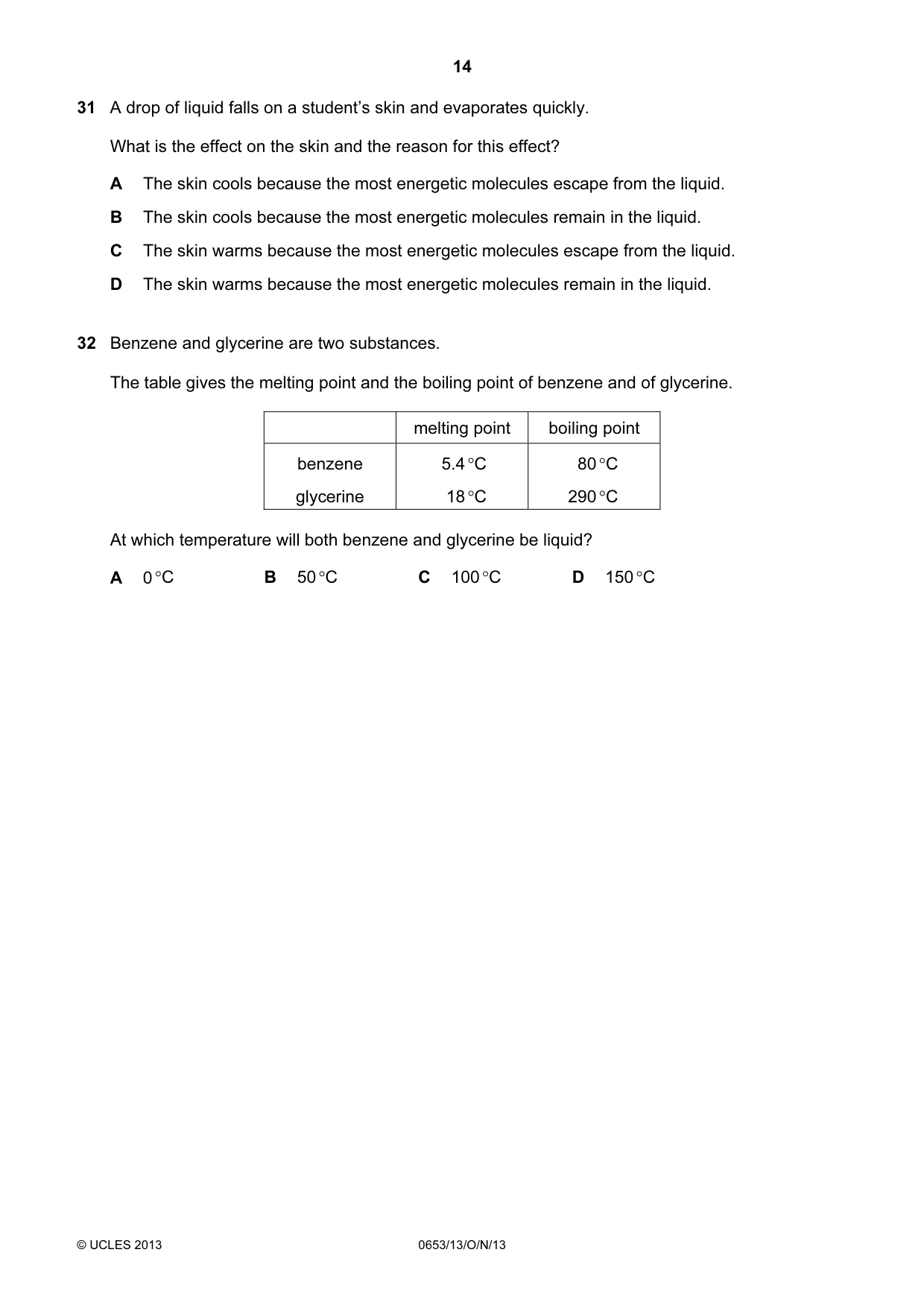
32 Benzene and glycerine are two substances. The table gives the melting point and the boiling point of benzene and of glycerine. melting point boiling point benzene 5.4 °C 80 °C glycerine 18 °C 290 °C At which temperature will both benzene and glycerine be liquid? A 0 °C B 50 °C C 100 °C D 150 °C
Mark scheme: B
Q33 · The diagrams show four identical pieces of ice that are heated in test-tubes of water
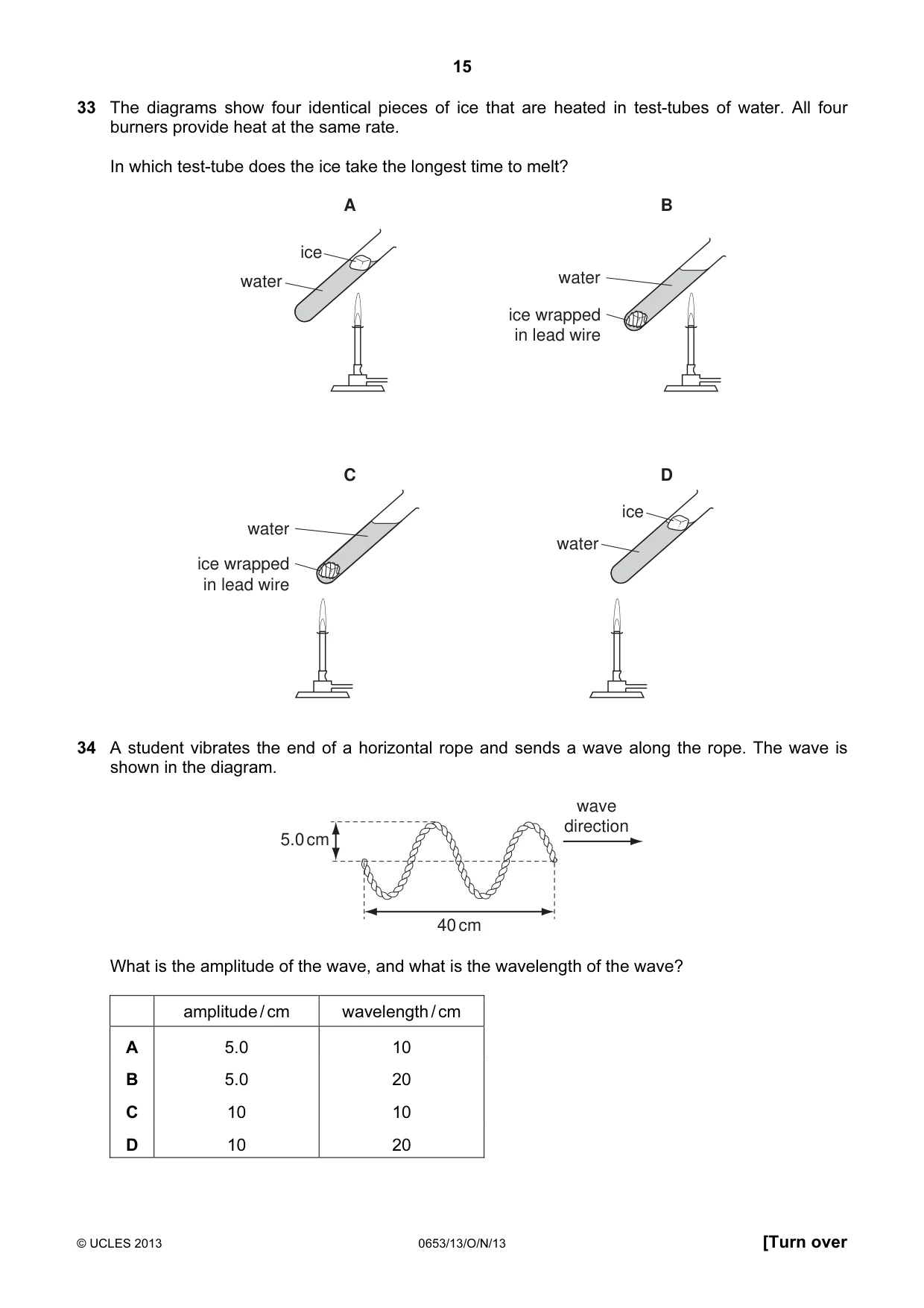
33 The diagrams show four identical pieces of ice that are heated in test-tubes of water. All four burners provide heat at the same rate. In which test-tube does the ice take the longest time to melt? A B ice water water ice wrapped in lead wire C D ice water water ice wrapped in lead wire
Mark scheme: B
Q34 · A student vibrates the end of a horizontal rope and sends a wave along the rope
34 A student vibrates the end of a horizontal rope and sends a wave along the rope. The wave is shown in the diagram. wave direction 5.0 cm 40 cm What is the amplitude of the wave, and what is the wavelength of the wave? amplitude / cm wavelength / cm A 5.0 10 B 5.0 20 C 10 10 D 10 20
Mark scheme: B
Q35 · The diagram shows a ray of light as it enters a block of glass
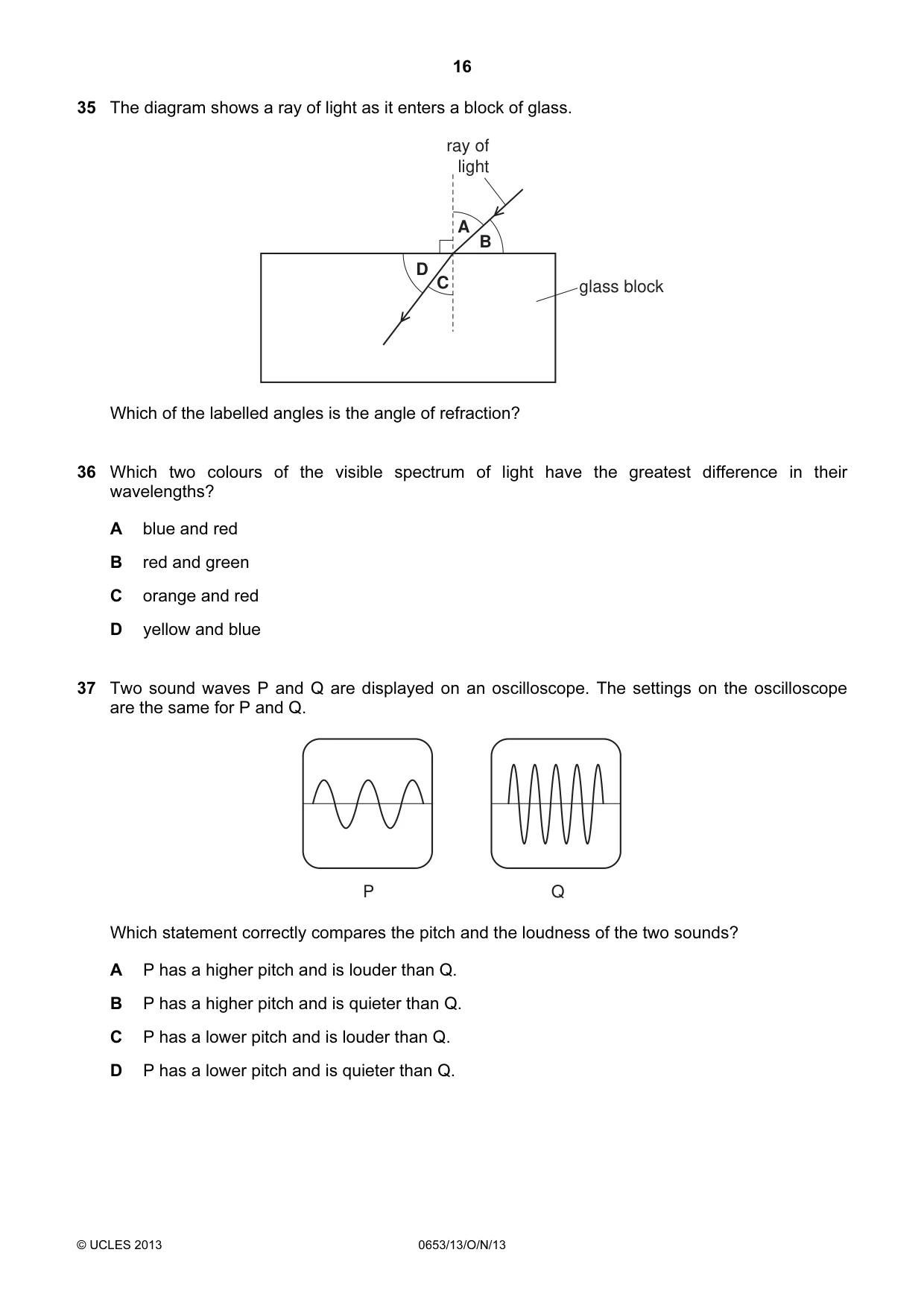
35 The diagram shows a ray of light as it enters a block of glass. ray of light A B D C glass block Which of the labelled angles is the angle of refraction?
Mark scheme: C
Q36 · Which two colours of the visible spectrum of light have the greatest difference in their…
36 Which two colours of the visible spectrum of light have the greatest difference in their wavelengths? A blue and red B red and green C orange and red D yellow and blue
Mark scheme: A
Q37 · Two sound waves P and Q are displayed on an oscilloscope
37 Two sound waves P and Q are displayed on an oscilloscope. The settings on the oscilloscope are the same for P and Q. P Q Which statement correctly compares the pitch and the loudness of the two sounds? A P has a higher pitch and is louder than Q. B P has a higher pitch and is quieter than Q. C P has a lower pitch and is louder than Q. D P has a lower pitch and is quieter than Q.
Mark scheme: D
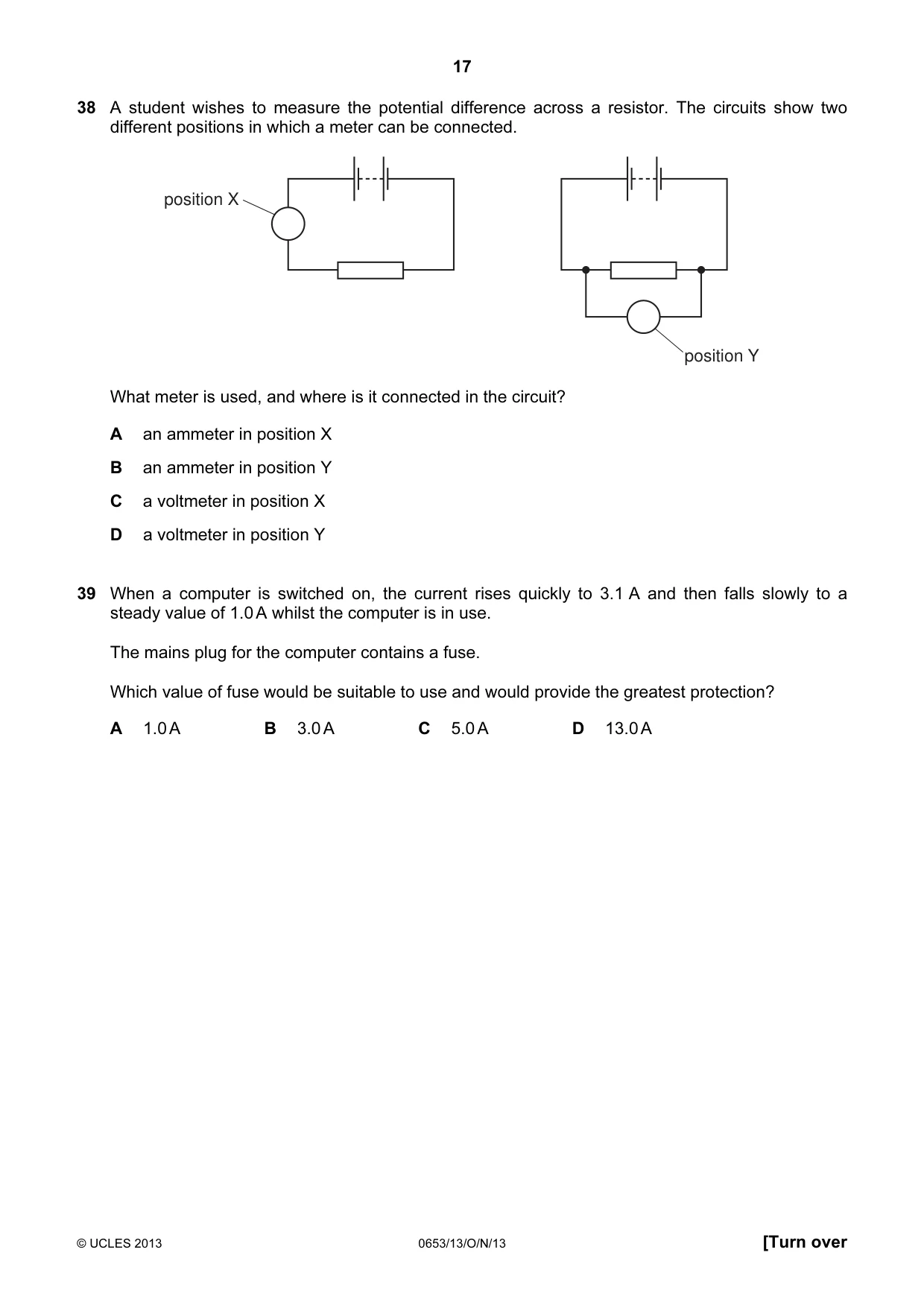
Q38 · A student wishes to measure the potential difference across a resistor
38 A student wishes to measure the potential difference across a resistor. The circuits show two different positions in which a meter can be connected. position X position Y What meter is used, and where is it connected in the circuit? A an ammeter in position X B an ammeter in position Y C a voltmeter in position X D a voltmeter in position Y
Mark scheme: D
Q39 · When a computer is switched on, the current rises quickly to 3.1 A and then falls slowly…
39 When a computer is switched on, the current rises quickly to 3.1 A and then falls slowly to a steady value of 1.0 A whilst the computer is in use. The mains plug for the computer contains a fuse. Which value of fuse would be suitable to use and would provide the greatest protection? A 1.0 A B 3.0 A C 5.0 A D 13.0 A
Mark scheme: C
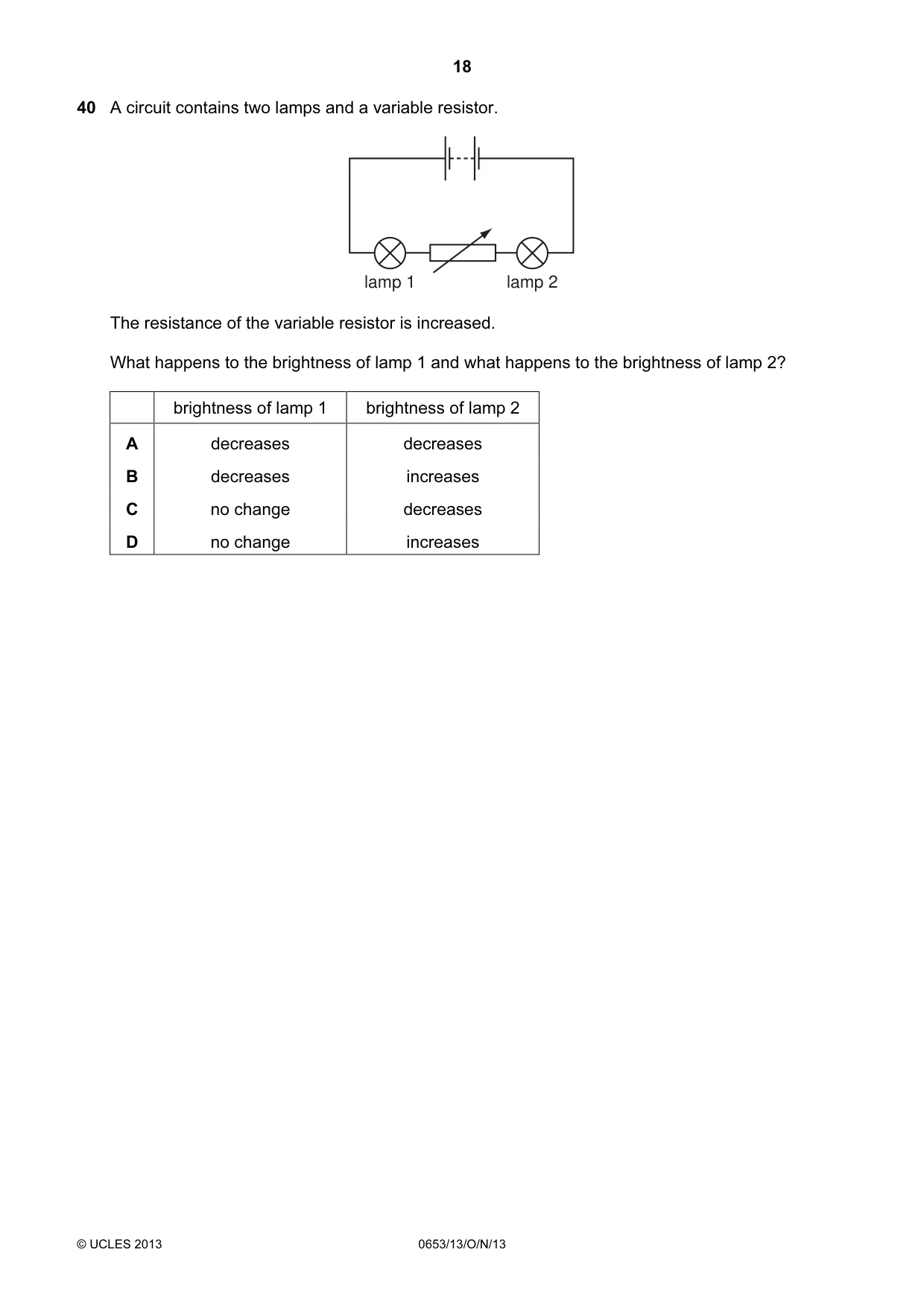
Q40 · A circuit contains two lamps and a variable resistor
40 A circuit contains two lamps and a variable resistor. lamp 1 lamp 2 The resistance of the variable resistor is increased. What happens to the brightness of lamp 1 and what happens to the brightness of lamp 2? brightness of lamp 1 brightness of lamp 2 A decreases decreases B decreases increases C no change decreases D no change increases
Mark scheme: A
What was in this paper
The subtopics covered by these 40 questions, and how many questions each got. Open one in a new tab to see every Cambridge question on it.
2Electrolysis2Air quality and climate1Atomic structure and the Periodic Table1Carbon cycle1Cell structure1Characteristics of living organisms1Corrosion of metals1Density1Diffusion1Digestive system1Electrical safety1Electromagnetic spectrum1Energy, work and power1Enzymes1Exothermic and endothermic reactions1Food chains and food webs1Fuels1Gas exchange in humans1General properties of waves1Group VII properties1Heart1Kinetic particle model of matter1Light1Motion1Photosynthesis1Rate of reaction1Reactivity series1Separation and purification1Sexual reproduction in humans1Sexual reproduction in plants1Simple molecules and covalent bonds1Sound1The characteristic properties of acids and bases1Thermal properties and temperature1Transfer of thermal energy1Transition elements1Transpiration1What you needed in this session
Cambridge’s own grade thresholds for 2013 Oct/Nov, Paper 1 · Variant 3. A higher threshold means an easier paper — the bar moves with how the cohort did.