Cambridge IGCSE Science - Combined 0653 — 2007 Oct/Nov Paper 1 · Variant 1
0653/11/O/N/07 · 40 questions · 40 marks · ≈45 min
The question paper and its mark scheme, free to read here and free to download. This is Cambridge’s own paper, exactly as it was sat.
Question paper16 pages
Mark scheme2 pages
Answers below. Sit the paper first if you are practising.
Questions as text
Q1 · Which cell has no DNA?
1 Which cell has no DNA? A goblet cell B red blood cell C sperm cell D spongy mesophyll cell
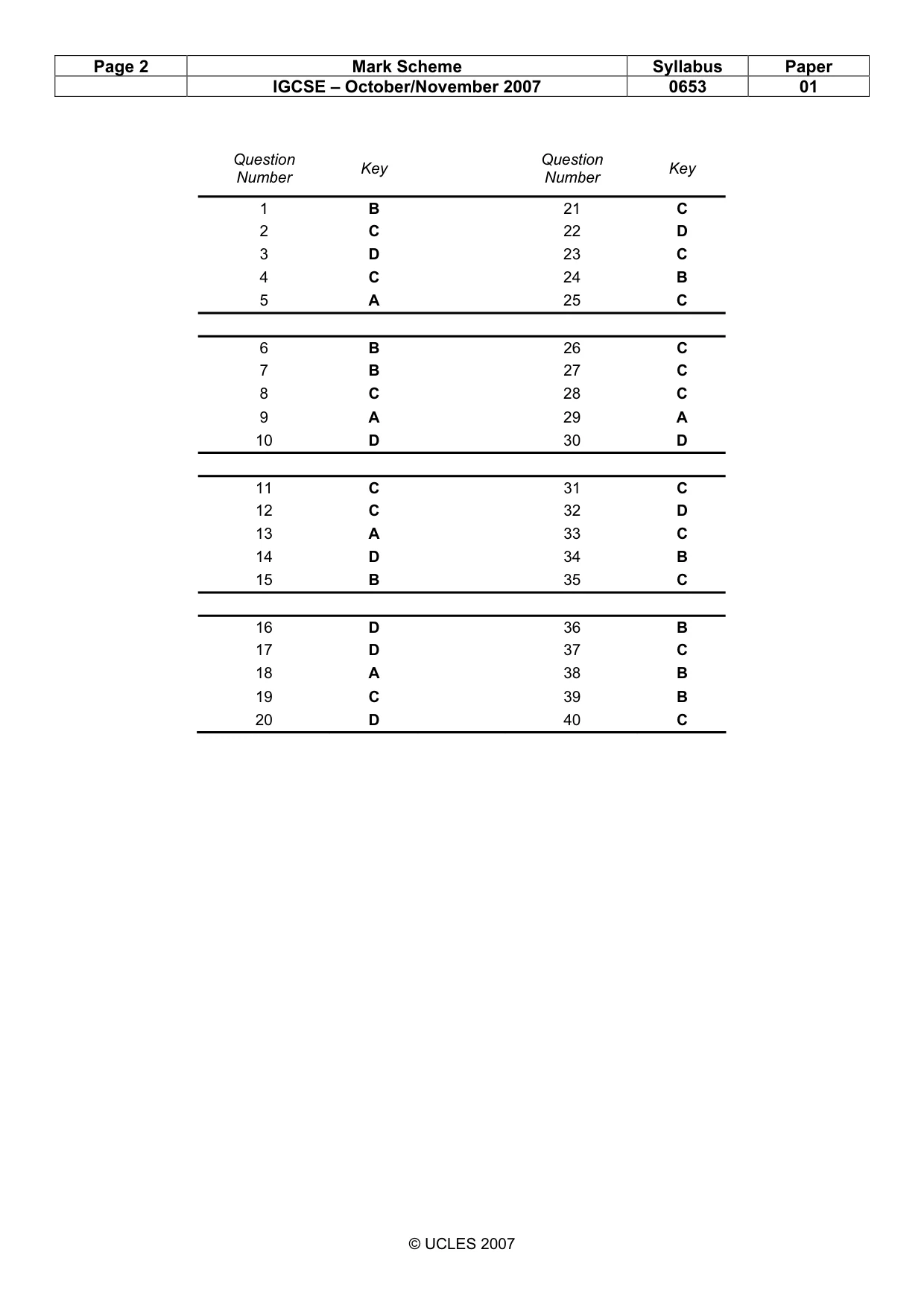
Mark scheme: B
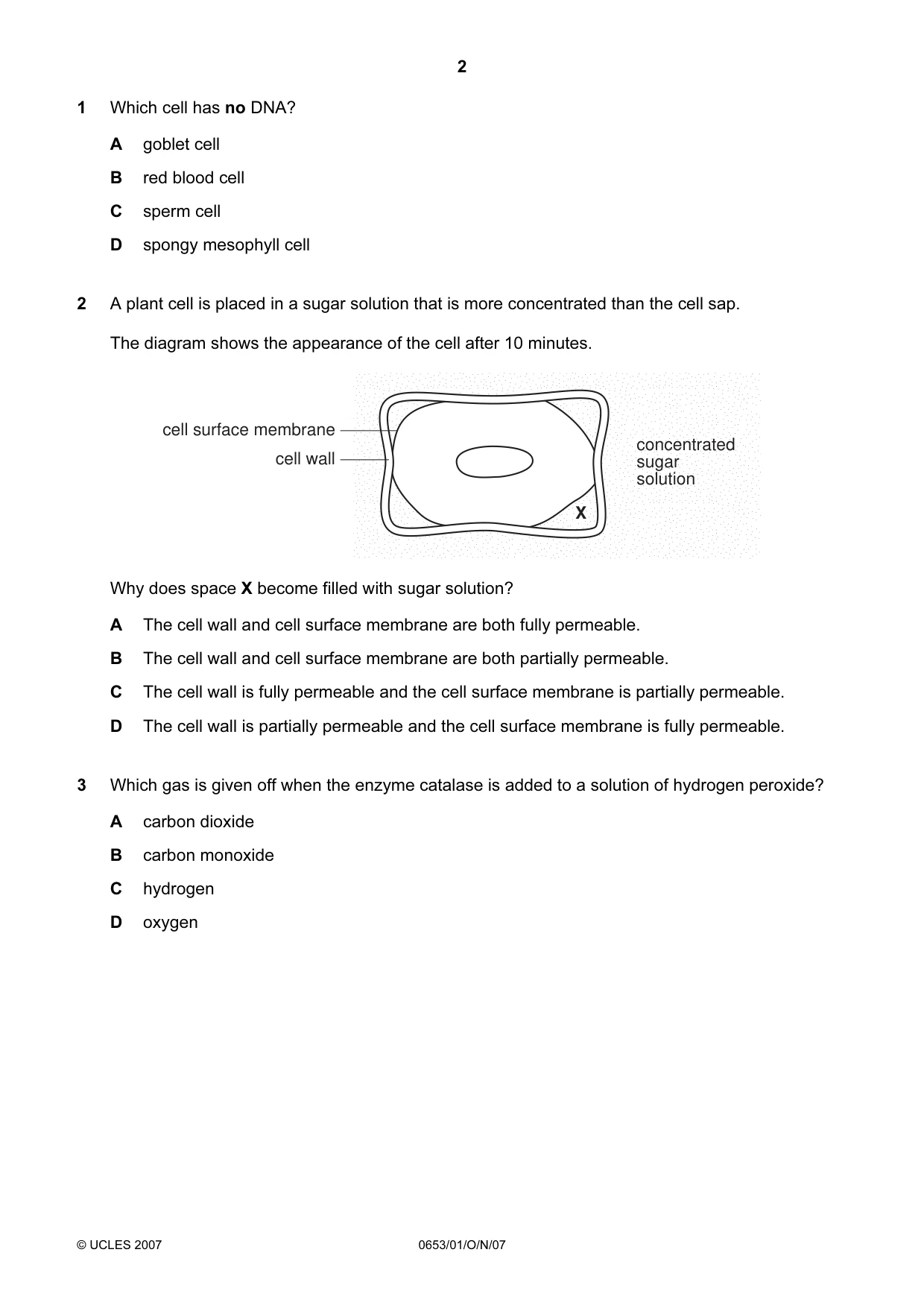
Q2 · A plant cell is placed in a sugar solution that is more concentrated than the cell sap
2 A plant cell is placed in a sugar solution that is more concentrated than the cell sap. The diagram shows the appearance of the cell after 10 minutes. cell surface membrane concentrated cell wall sugar solution X Why does space X become filled with sugar solution? A The cell wall and cell surface membrane are both fully permeable. B The cell wall and cell surface membrane are both partially permeable. C The cell wall is fully permeable and the cell surface membrane is partially permeable. D The cell wall is partially permeable and the cell surface membrane is fully permeable.
Mark scheme: C
Q3 · Which gas is given off when the enzyme catalase is added to a solution of hydrogen…
3 Which gas is given off when the enzyme catalase is added to a solution of hydrogen peroxide? A carbon dioxide B carbon monoxide C hydrogen D oxygen
Mark scheme: D
Q4 · A water plant is exposed to sunlight
4 A water plant is exposed to sunlight. After a short period of time bubbles are given off from the plant. Which gas do the bubbles contain, and which process produces this gas? gas process A carbon dioxide photosynthesis B carbon dioxide respiration C oxygen photosynthesis D oxygen respiration
Mark scheme: C
Q5 · What is a symptom of vitamin C deficiency?
5 What is a symptom of vitamin C deficiency? A bleeding from skin and gums B developing soft bones C low red blood cell count D teeth decay easily
Mark scheme: A
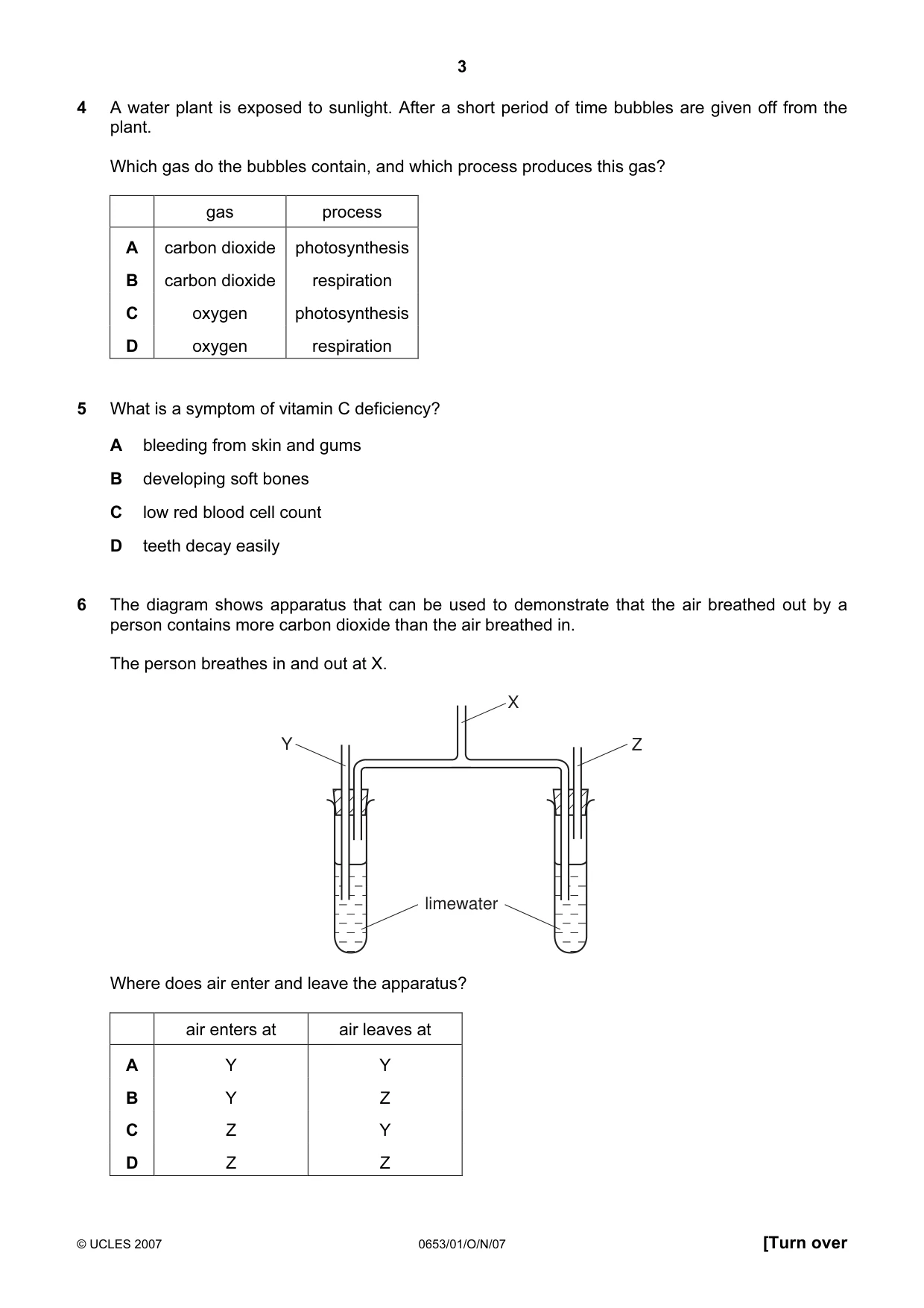
Q6 · The diagram shows apparatus that can be used to demonstrate that the air breathed out by…
6 The diagram shows apparatus that can be used to demonstrate that the air breathed out by a person contains more carbon dioxide than the air breathed in. The person breathes in and out at X. X Y Z limewater Where does air enter and leave the apparatus? air enters at air leaves at A Y Y B Y Z C Z Y D Z Z
Mark scheme: B
Q7 · The diagram shows part of the human nervous system
7 The diagram shows part of the human nervous system. X Y What are X and Y? X Y A brain effector B brain spinal cord C receptor effector D receptor spinal cord
Mark scheme: B
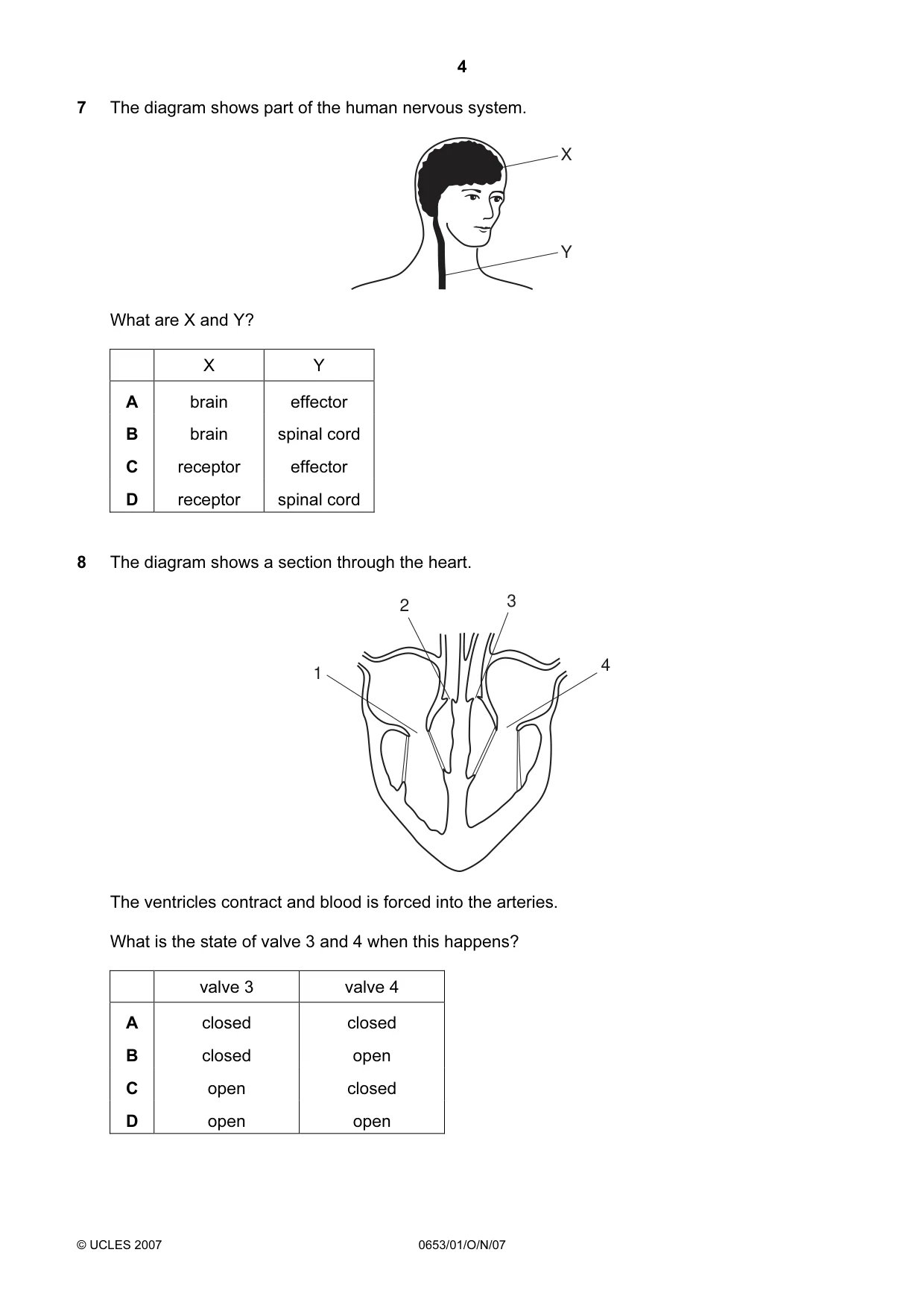
Q8 · The diagram shows a section through the heart
8 The diagram shows a section through the heart. 2 3 4 1 The ventricles contract and blood is forced into the arteries. What is the state of valve 3 and 4 when this happens? valve 3 valve 4 A closed closed B closed open C open closed D open open
Mark scheme: C
Q9 · It is possible to grow plants that are genetically identical
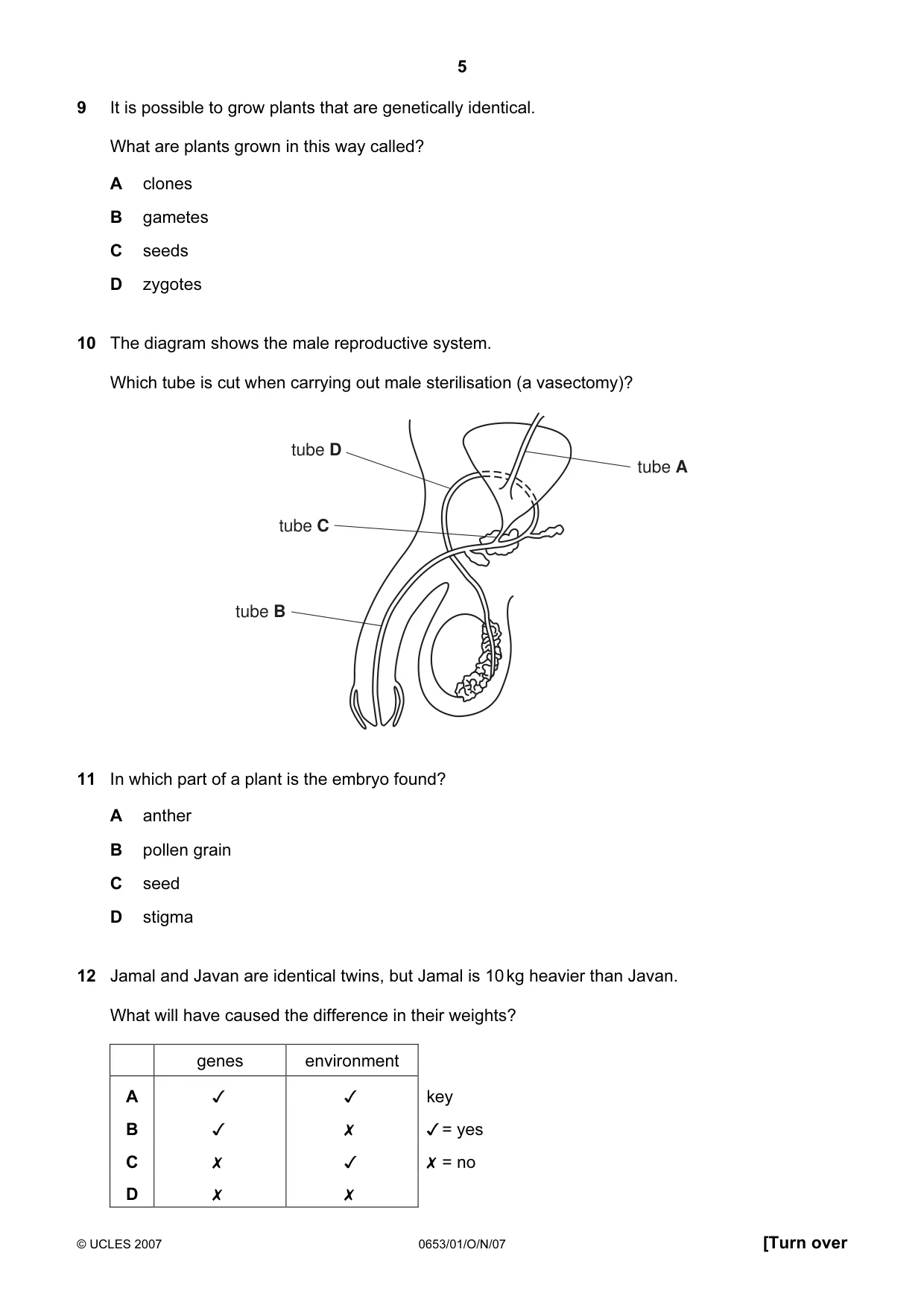
9 It is possible to grow plants that are genetically identical. What are plants grown in this way called? A clones B gametes C seeds D zygotes
Mark scheme: A
Q10 · The diagram shows the male reproductive system
10 The diagram shows the male reproductive system. Which tube is cut when carrying out male sterilisation (a vasectomy)? tube D tube A tube C tube B
Mark scheme: D
Q11 · In which part of a plant is the embryo found?
11 In which part of a plant is the embryo found? A anther B pollen grain C seed D stigma
Mark scheme: C
Q12 · Jamal and Javan are identical twins, but Jamal is 10kg heavier than Javan
12 Jamal and Javan are identical twins, but Jamal is 10kg heavier than Javan. What will have caused the difference in their weights? genes environment A v v B v x Cc x Jv D x x key v/=yes X =no
Mark scheme: C
Q13 · The diagram shows a food chain
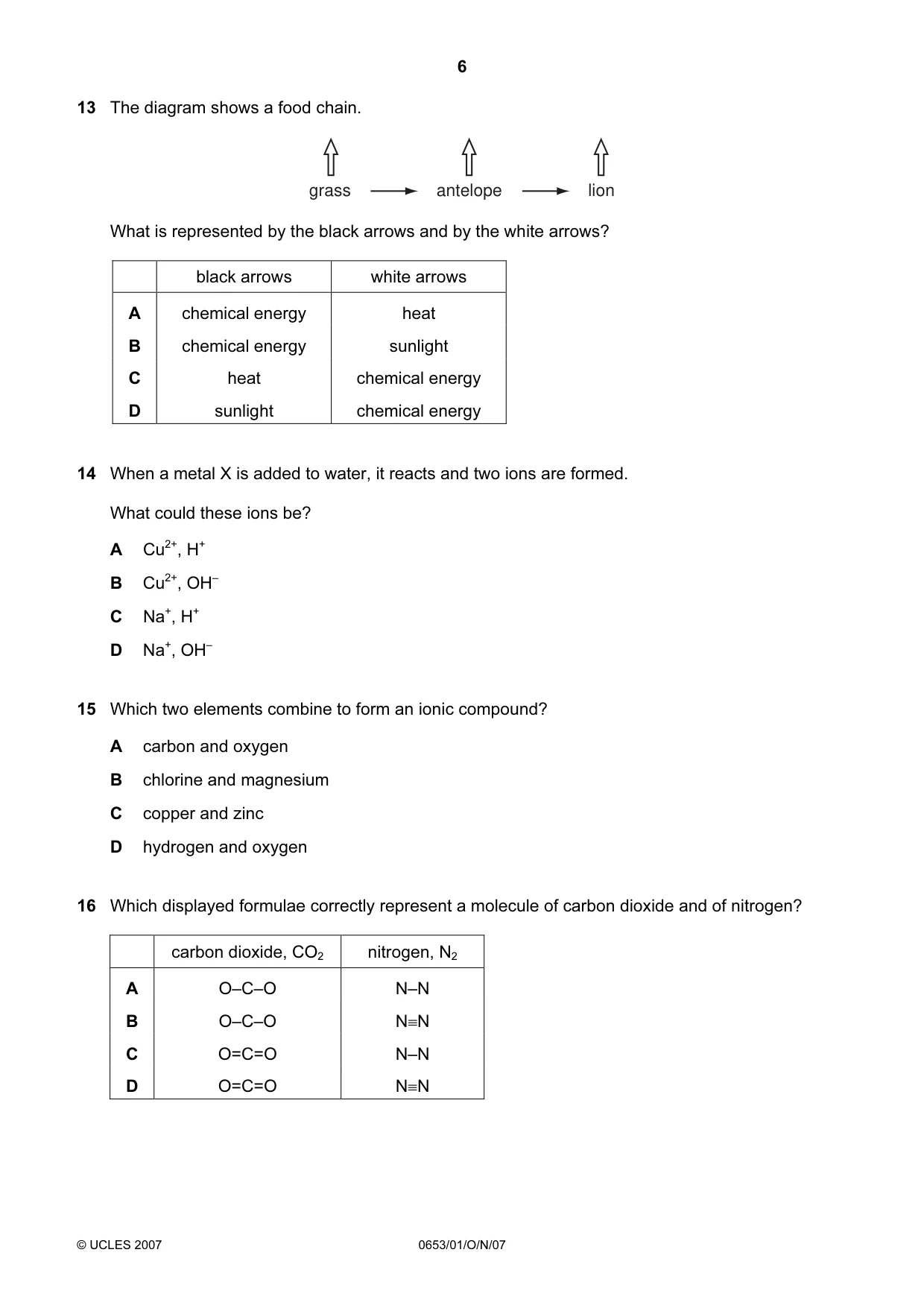
13 The diagram shows a food chain. grass antelope lion What is represented by the black arrows and by the white arrows? black arrows white arrows A chemical energy heat B chemical energy sunlight C heat chemical energy D sunlight chemical energy
Mark scheme: A
Q14 · When a metal X is added to water, it reacts and two ions are formed
14 When a metal X is added to water, it reacts and two ions are formed. What could these ions be? A Cu2+, H+ B Cu2+, OH– C Na+, H+ D Na+, OH–
Mark scheme: D
Q15 · Which two elements combine to form an ionic compound?
15 Which two elements combine to form an ionic compound? A carbon and oxygen B chlorine and magnesium C copper and zinc D hydrogen and oxygen
Mark scheme: B
Q16 · Which displayed formulae correctly represent a molecule of carbon dioxide and of nitrogen?
16 Which displayed formulae correctly represent a molecule of carbon dioxide and of nitrogen? carbon dioxide, CO2 nitrogen, N2 A O–C–O N–N B O–C–O N≡N C O=C=O N–N D O=C=O N≡N
Mark scheme: D
Q17 · Two products, X and Y, are formed in the complete combustion of methane
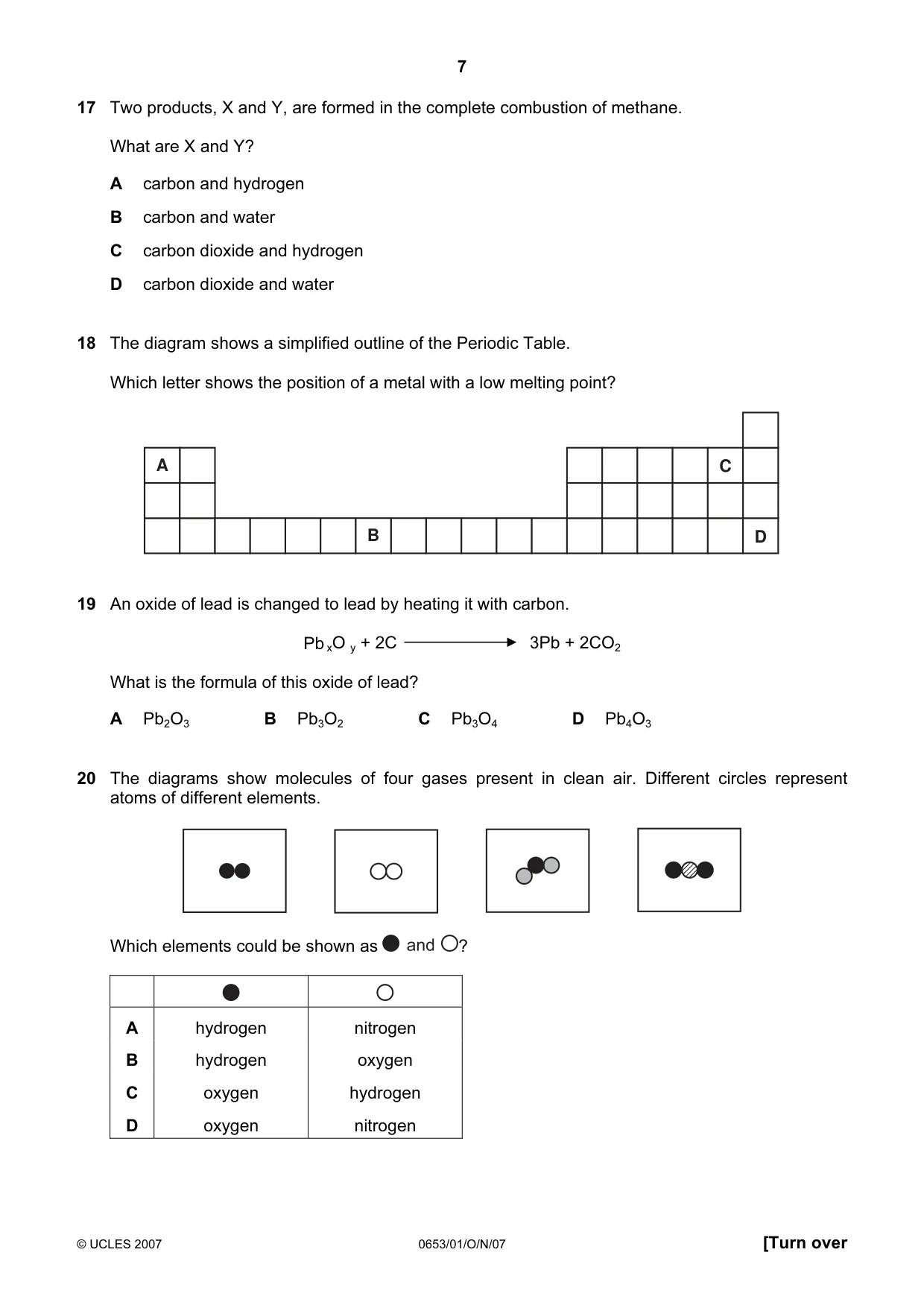
17 Two products, X and Y, are formed in the complete combustion of methane. What are X and Y? A carbon and hydrogen B carbon and water C carbon dioxide and hydrogen D carbon dioxide and water
Mark scheme: D
Q18 · The diagram shows a simplified outline of the Periodic Table
18 The diagram shows a simplified outline of the Periodic Table. Which letter shows the position of a metal with a low melting point? A C B D
Mark scheme: A
Q19 · An oxide of lead is changed to lead by heating it with carbon
19 An oxide of lead is changed to lead by heating it with carbon. Pb xO y + 2C 3Pb + 2CO2 What is the formula of this oxide of lead? A Pb2O3 B Pb3O2 C Pb3O4 D Pb4O3
Mark scheme: C
Q20 · The diagrams show molecules of four gases present in clean air
20 The diagrams show molecules of four gases present in clean air. Different circles represent atoms of different elements. Which elements could be shown as ? A hydrogen nitrogen B hydrogen oxygen C oxygen hydrogen D oxygen nitrogen
Mark scheme: D
Q21 · Which substance has a dangerously explosive reaction with sodium?
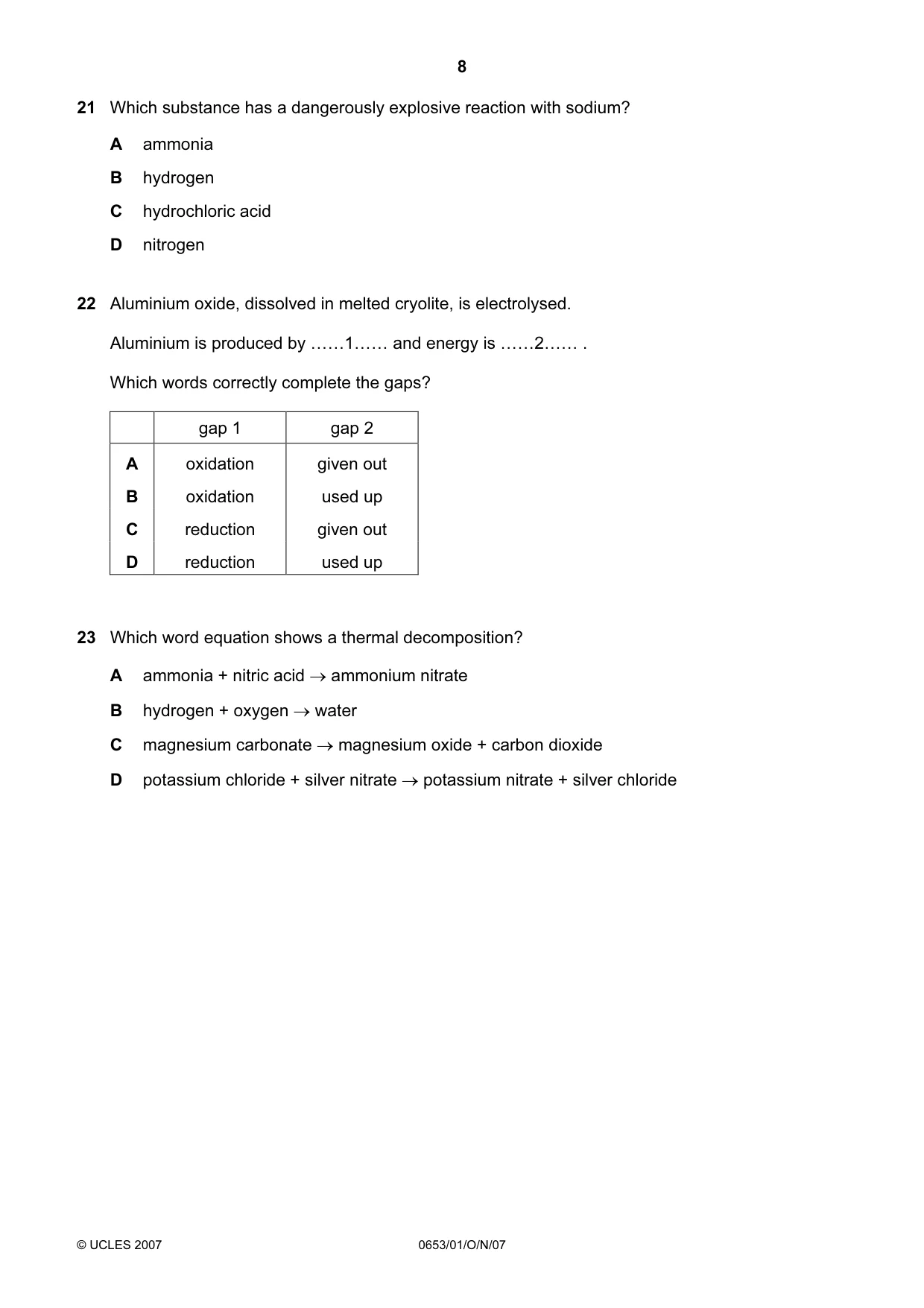
21 Which substance has a dangerously explosive reaction with sodium? A ammonia B hydrogen C hydrochloric acid D nitrogen
Mark scheme: C
Q22 · Aluminium oxide, dissolved in melted cryolite, is electrolysed
22 Aluminium oxide, dissolved in melted cryolite, is electrolysed. Aluminium is produced by ……1…… and energy is ……2…… . Which words correctly complete the gaps? gap 1 gap 2 A oxidation given out B oxidation used up C reduction given out D reduction used up
Mark scheme: D
Q23 · Which word equation shows a thermal decomposition?
23 Which word equation shows a thermal decomposition? A ammonia + nitric acid → ammonium nitrate B hydrogen + oxygen → water C magnesium carbonate → magnesium oxide + carbon dioxide D potassium chloride + silver nitrate → potassium nitrate + silver chloride
Mark scheme: C
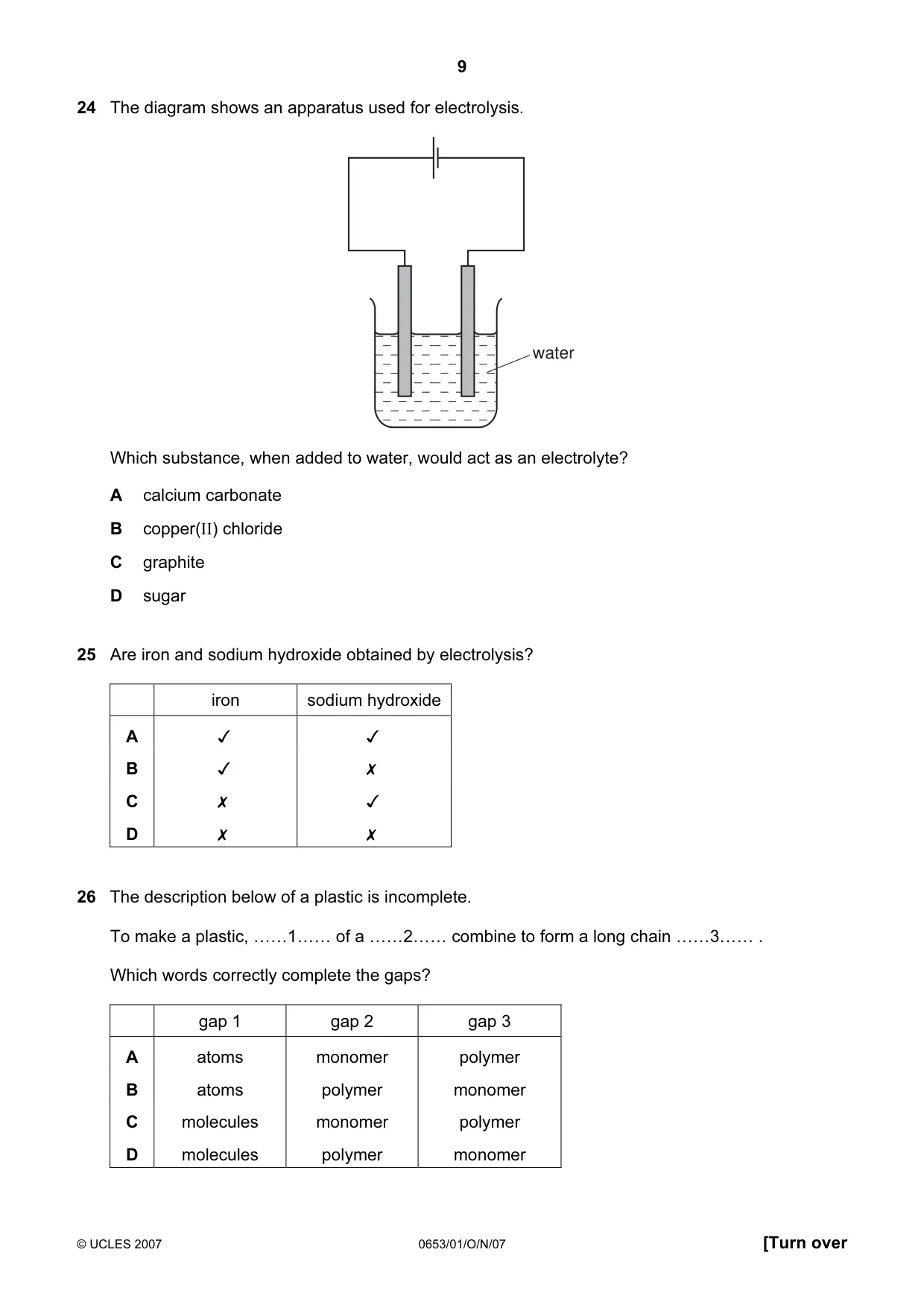
Q24 · The diagram shows an apparatus used for electrolysis
24 The diagram shows an apparatus used for electrolysis. water Which substance, when added to water, would act as an electrolyte? A calcium carbonate B copper(II) chloride C graphite D sugar
Mark scheme: B
Q25 · Are iron and sodium hydroxide obtained by electrolysis?
25 Are iron and sodium hydroxide obtained by electrolysis? iron sodium hydroxide v v 0 0O WwW D> x v x ~ « &
Mark scheme: C
Q26 · The description below of a plastic is incomplete
26 The description below of a plastic is incomplete. To make a plastic, ……1…… of a ……2…… combine to form a long chain ……3…… . Which words correctly complete the gaps? gap 1 gap 2 gap 3 A atoms monomer polymer B atoms polymer monomer C molecules monomer polymer D molecules polymer monomer
Mark scheme: C
Q27 · Ethanol, hydrogen and methane are used as fuels
27 Ethanol, hydrogen and methane are used as fuels. Which line in the table is correct? ethanol hydrogen methane A solid gas gas B solid liquid liquid C liquid gas gas D liquid liquid liquid
Mark scheme: C
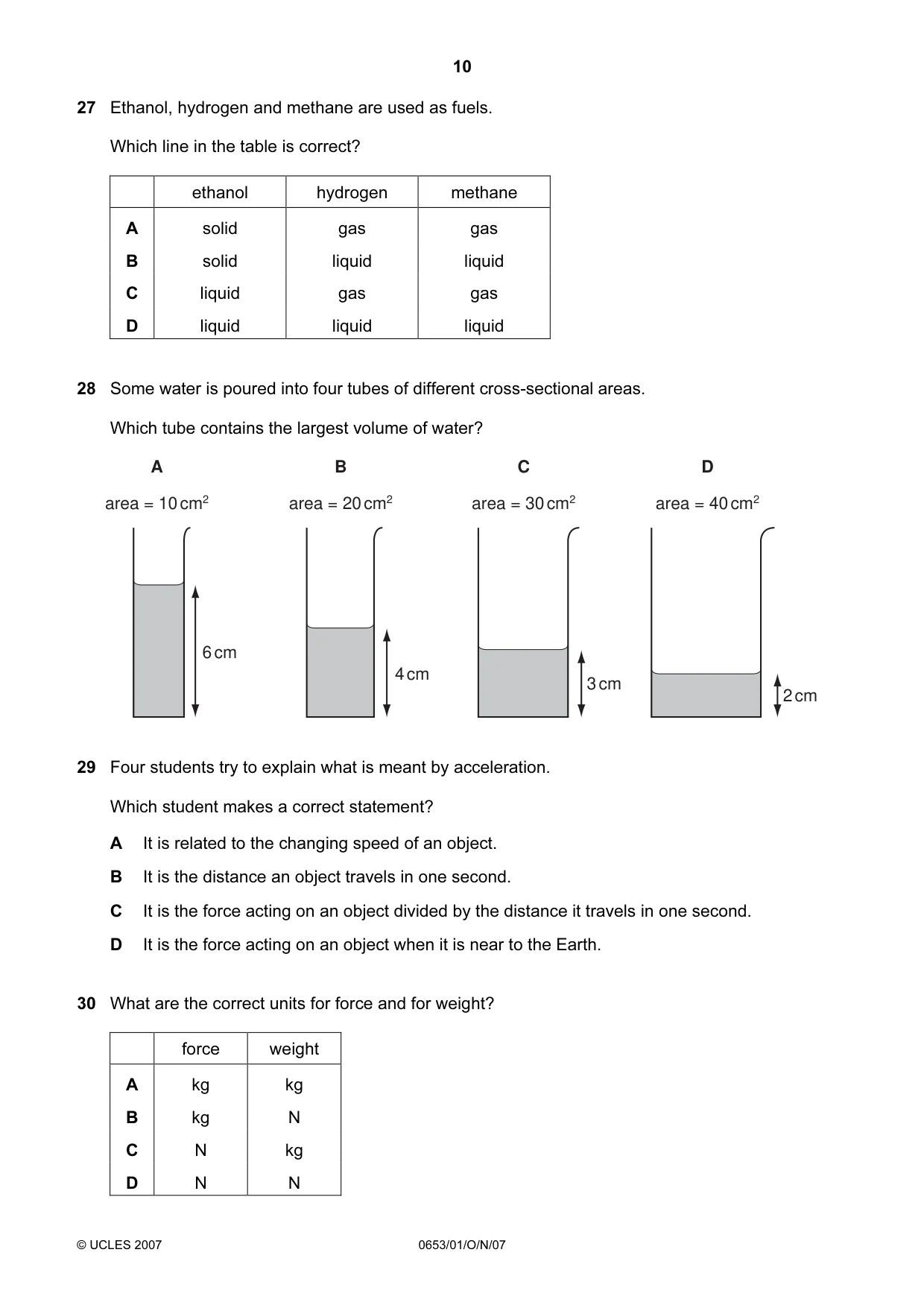
Q28 · Some water is poured into four tubes of different cross-sectional areas
28 Some water is poured into four tubes of different cross-sectional areas. Which tube contains the largest volume of water? A B C D area = 10 cm2 area = 20 cm2 area = 30 cm2 area = 40 cm2 6 cm 4 cm 3 cm 2 cm
Mark scheme: C
More questions on Physical quantities and measurement techniques
Q29 · Four students try to explain what is meant by acceleration
29 Four students try to explain what is meant by acceleration. Which student makes a correct statement? A It is related to the changing speed of an object. B It is the distance an object travels in one second. C It is the force acting on an object divided by the distance it travels in one second. D It is the force acting on an object when it is near to the Earth.
Mark scheme: A
Q30 · What are the correct units for force and for weight?
30 What are the correct units for force and for weight? force weight A kg kg B kg N C N kg D N N
Mark scheme: D
Q31 · A metal drum has a mass of 200 kg when empty and 1000 kg when filled with 1.0 m3 of…
31 A metal drum has a mass of 200 kg when empty and 1000 kg when filled with 1.0 m3 of methylated spirit. What is the density of methylated spirit? A 0.0050 kg / m3 B 0.11 kg / m3 C 800 kg / m3 D 1000 kg / m3
Mark scheme: C
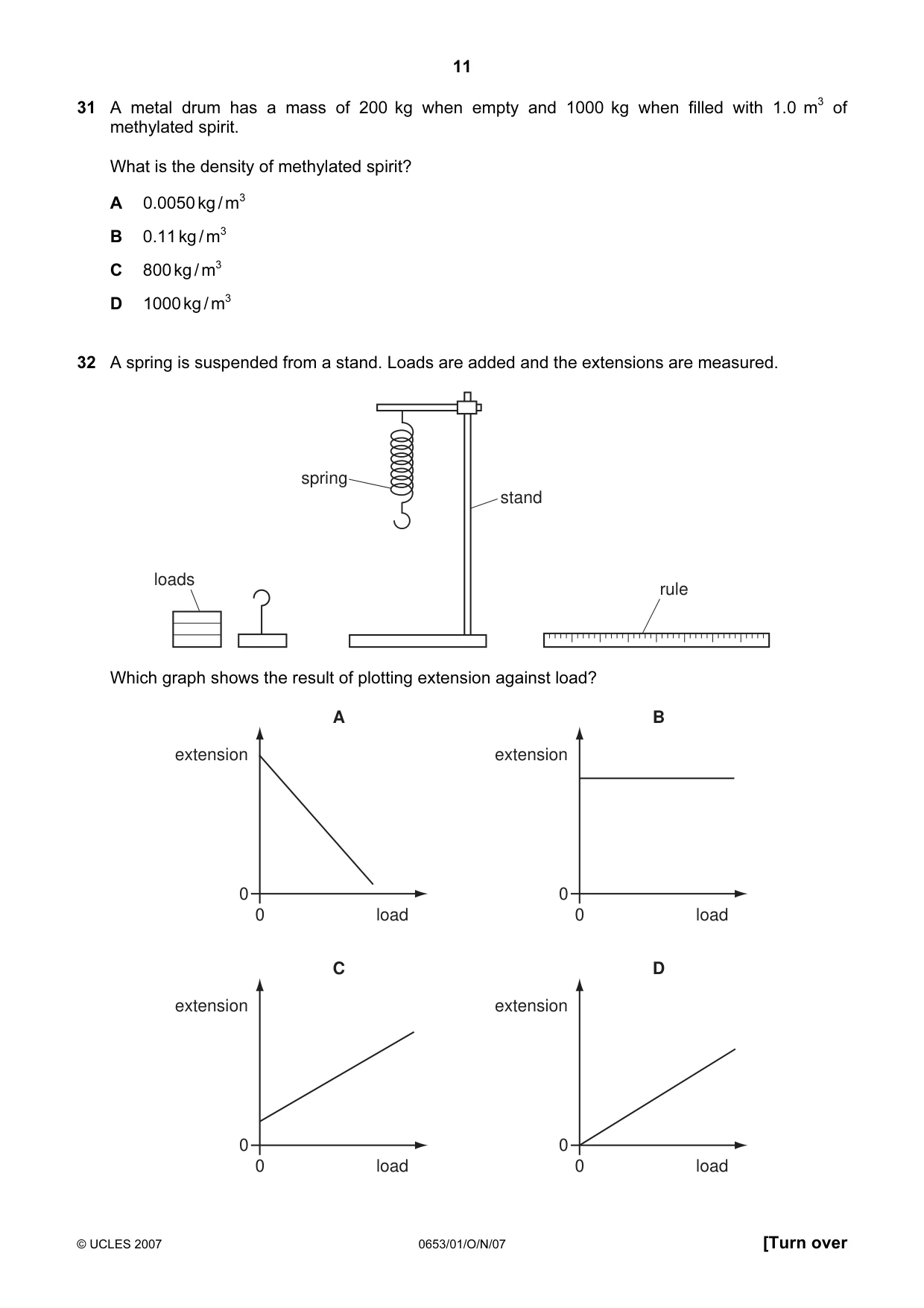
Q32 · A spring is suspended from a stand
32 A spring is suspended from a stand. Loads are added and the extensions are measured. spring stand loads rule Which graph shows the result of plotting extension against load? A B extension extension 0 0 0 load 0 load C D extension extension 0 0 0 load 0 load
Mark scheme: D
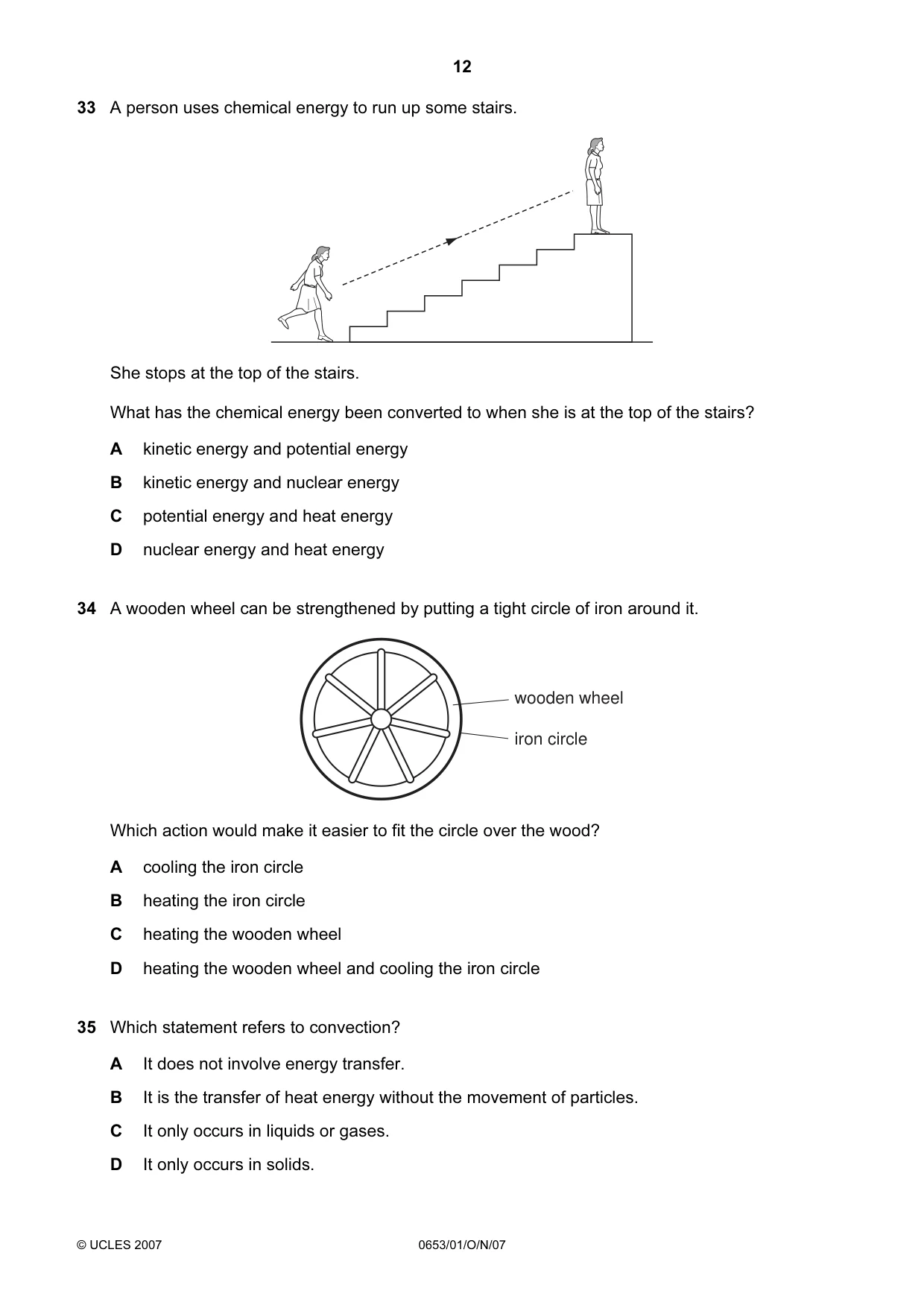
Q33 · A person uses chemical energy to run up some stairs
33 A person uses chemical energy to run up some stairs. She stops at the top of the stairs. What has the chemical energy been converted to when she is at the top of the stairs? A kinetic energy and potential energy B kinetic energy and nuclear energy C potential energy and heat energy D nuclear energy and heat energy
Mark scheme: C
Q34 · A wooden wheel can be strengthened by putting a tight circle of iron around it
34 A wooden wheel can be strengthened by putting a tight circle of iron around it. wooden wheel iron circle Which action would make it easier to fit the circle over the wood? A cooling the iron circle B heating the iron circle C heating the wooden wheel D heating the wooden wheel and cooling the iron circle
Mark scheme: B
Q35 · Which statement refers to convection?
35 Which statement refers to convection? A It does not involve energy transfer. B It is the transfer of heat energy without the movement of particles. C It only occurs in liquids or gases. D It only occurs in solids.
Mark scheme: C
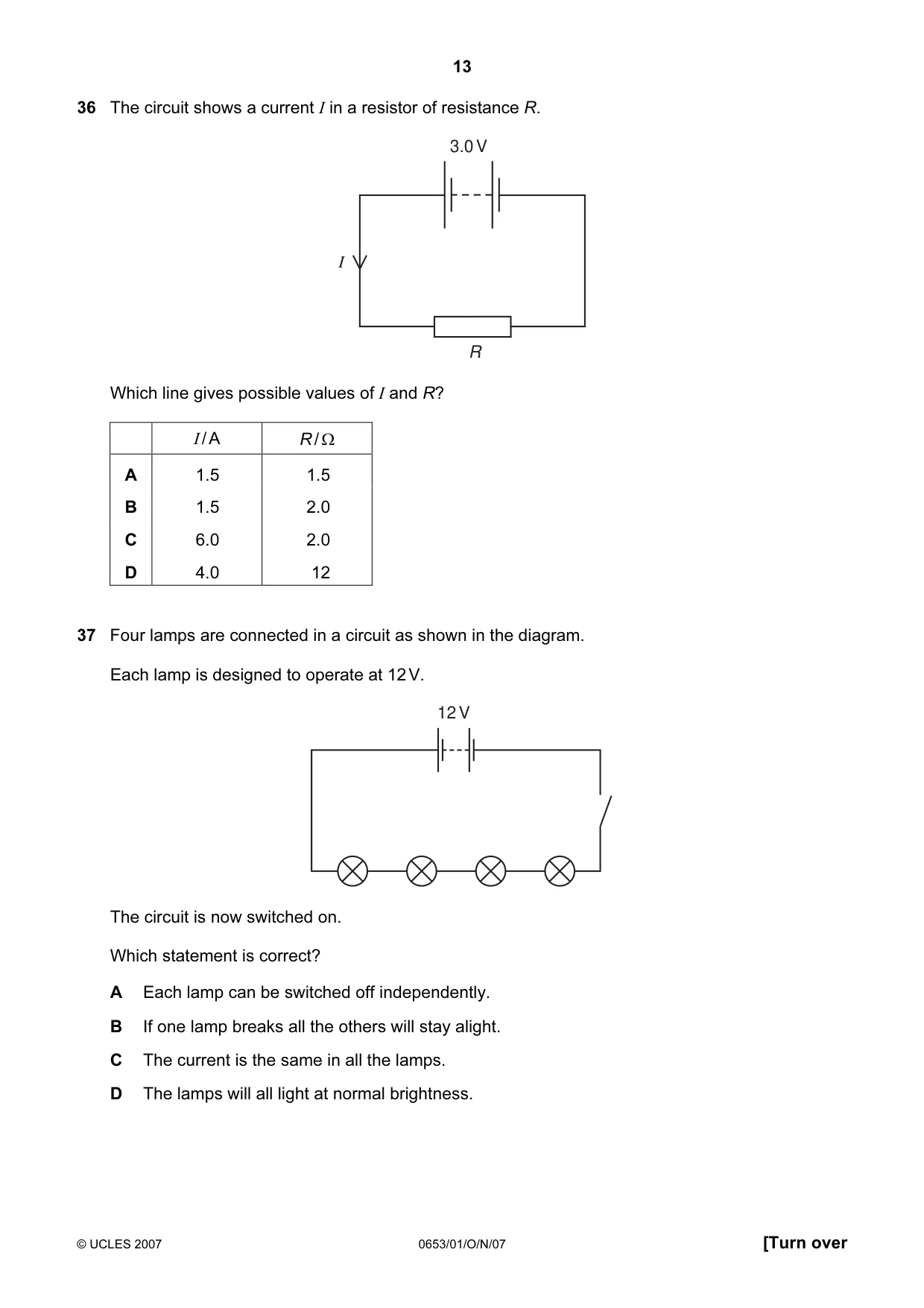
Q36 · The circuit shows a current I in a resistor of resistance R
36 The circuit shows a current I in a resistor of resistance R. 3.0 V I R Which line gives possible values of I and R? I / A R / Ω A 1.5 1.5 B 1.5 2.0 C 6.0 2.0 D 4.0 12
Mark scheme: B
Q37 · Four lamps are connected in a circuit as shown in the diagram
37 Four lamps are connected in a circuit as shown in the diagram. Each lamp is designed to operate at 12 V. 12 V The circuit is now switched on. Which statement is correct? A Each lamp can be switched off independently. B If one lamp breaks all the others will stay alight. C The current is the same in all the lamps. D The lamps will all light at normal brightness.
Mark scheme: C
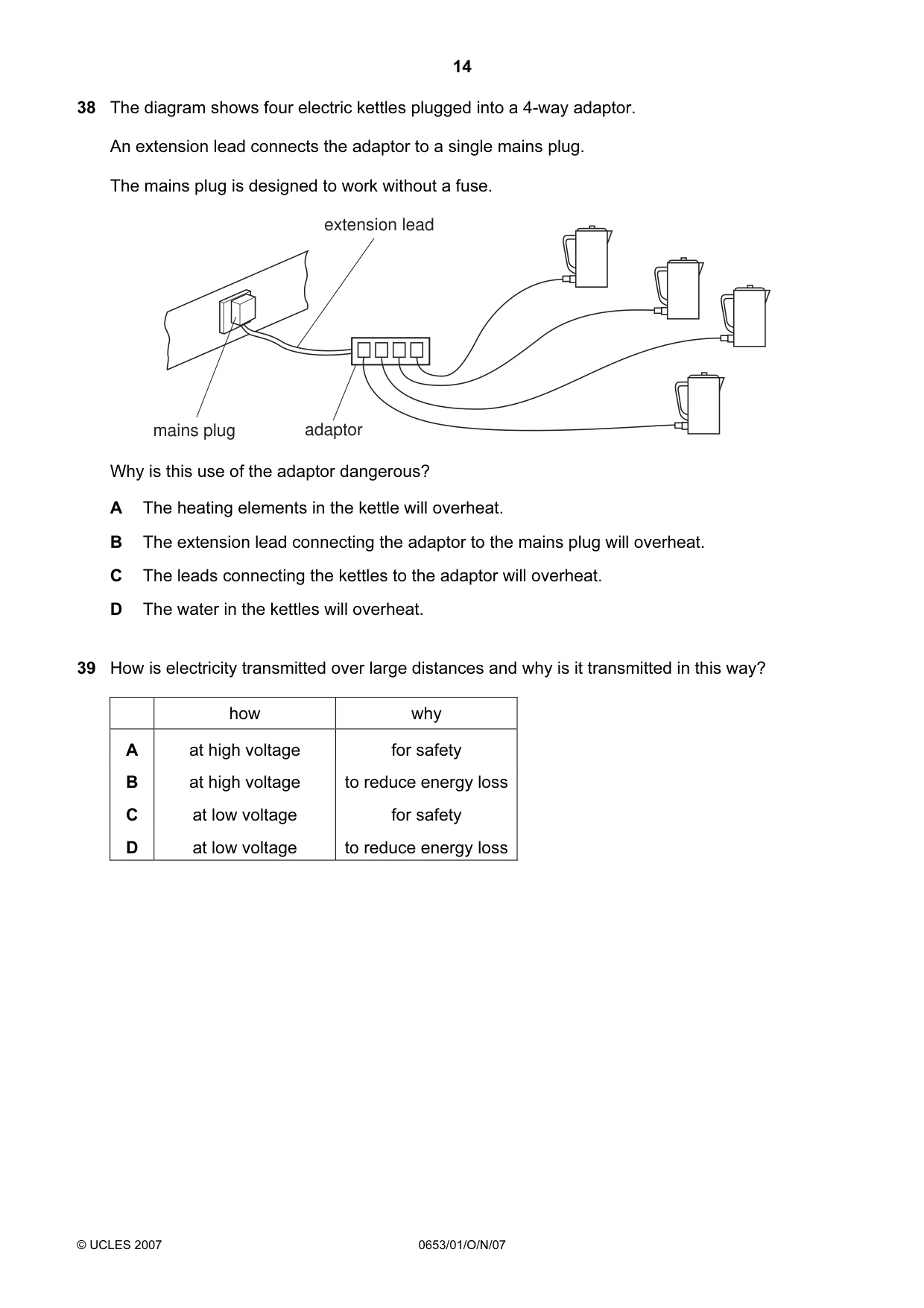
Q38 · The diagram shows four electric kettles plugged into a 4-way adaptor
38 The diagram shows four electric kettles plugged into a 4-way adaptor. An extension lead connects the adaptor to a single mains plug. The mains plug is designed to work without a fuse. extension lead mains plug adaptor Why is this use of the adaptor dangerous? A The heating elements in the kettle will overheat. B The extension lead connecting the adaptor to the mains plug will overheat. C The leads connecting the kettles to the adaptor will overheat. D The water in the kettles will overheat.
Mark scheme: B
Q39 · How is electricity transmitted over large distances and why is it transmitted in this way?
39 How is electricity transmitted over large distances and why is it transmitted in this way? how why A at high voltage for safety B at high voltage to reduce energy loss C at low voltage for safety D at low voltage to reduce energy loss
Mark scheme: B
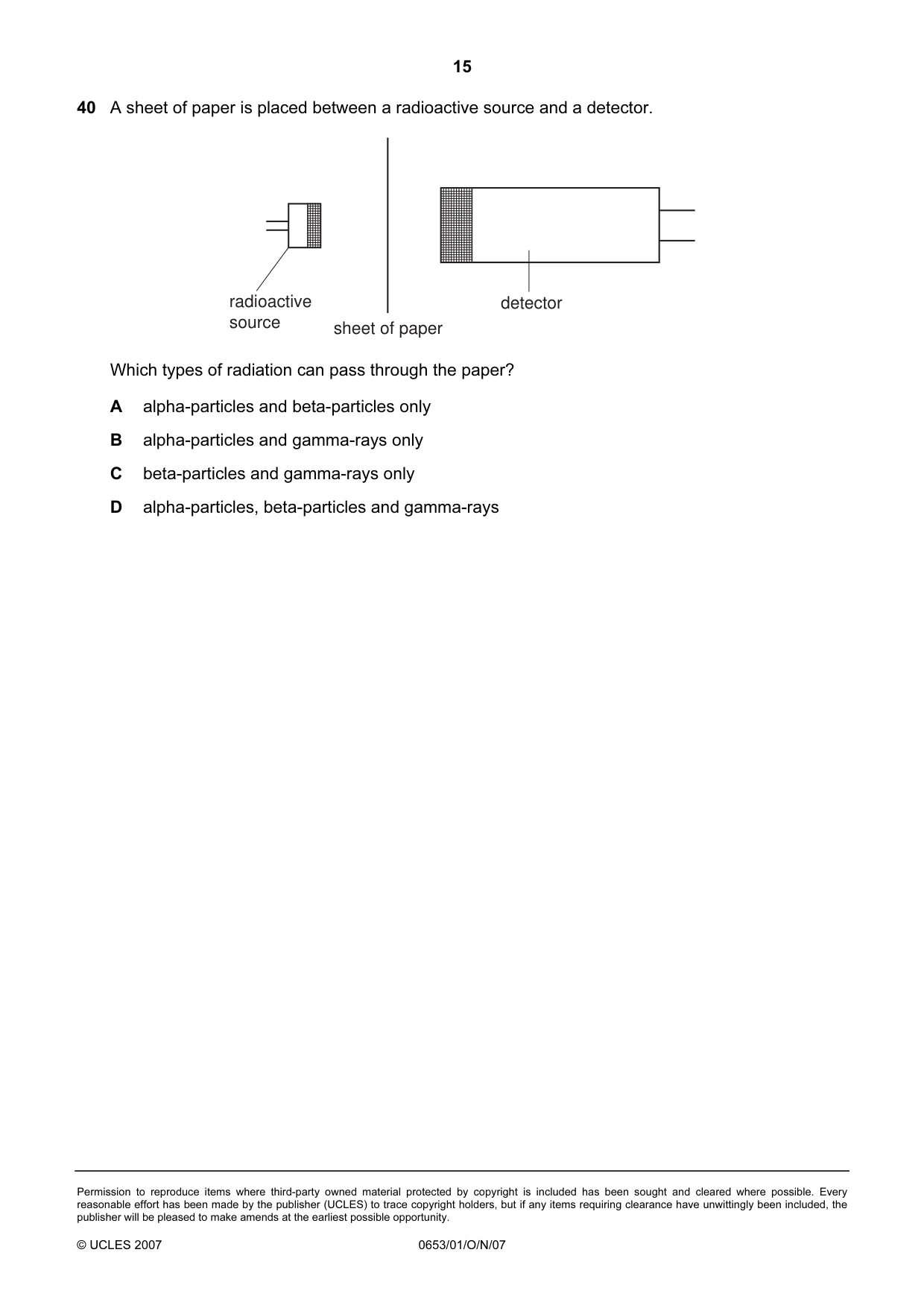
Q40 · A sheet of paper is placed between a radioactive source and a detector
40 A sheet of paper is placed between a radioactive source and a detector. radioactive detector source sheet of paper Which types of radiation can pass through the paper? A alpha-particles and beta-particles only B alpha-particles and gamma-rays only C beta-particles and gamma-rays only D alpha-particles, beta-particles and gamma-rays
Mark scheme: C
What was in this paper
The subtopics covered by these 40 questions, and how many questions each got. Open one in a new tab to see every Cambridge question on it.
3Group I properties3Diet2Forces2Fuels2Sexual reproduction in plants2Air quality and climate1Cell structure1Cells, batteries, generators and motors1Characteristics of living organisms1Density1Electrical circuits1Electrical quantities1Electrical safety1Electromagnetic spectrum1Energy flow1Energy, work and power1Enzymes1Formulas1Gas exchange in humans1Heart1Ions and ionic bonds1Motion1Osmosis1Photosynthesis1Physical and chemical changes1Physical quantities and measurement techniques1Polymers1Sexual reproduction in humans1Simple molecules and covalent bonds1Thermal properties and temperature1Transfer of thermal energy1What you needed in this session
Cambridge’s own grade thresholds for 2007 Oct/Nov, Paper 1 · Variant 1. A higher threshold means an easier paper — the bar moves with how the cohort did.