Cambridge IGCSE Science - Combined 0653 — 2017 Feb/March Paper 1 · Variant 2
0653/12/F/M/17 · 40 questions · 40 marks · ≈45 min
The question paper and its mark scheme, free to read here and free to download. This is Cambridge’s own paper, exactly as it was sat.
Question paper16 pages
Mark scheme3 pages
Answers below. Sit the paper first if you are practising.
Questions as text
Q1 · One characteristic of all living organisms is that they carry out respiration
1 One characteristic of all living organisms is that they carry out respiration. What does this mean? A They break down food to release energy. B They breathe, exchanging gases with the environment. C They release waste into the environment. D They take in food from their surroundings.
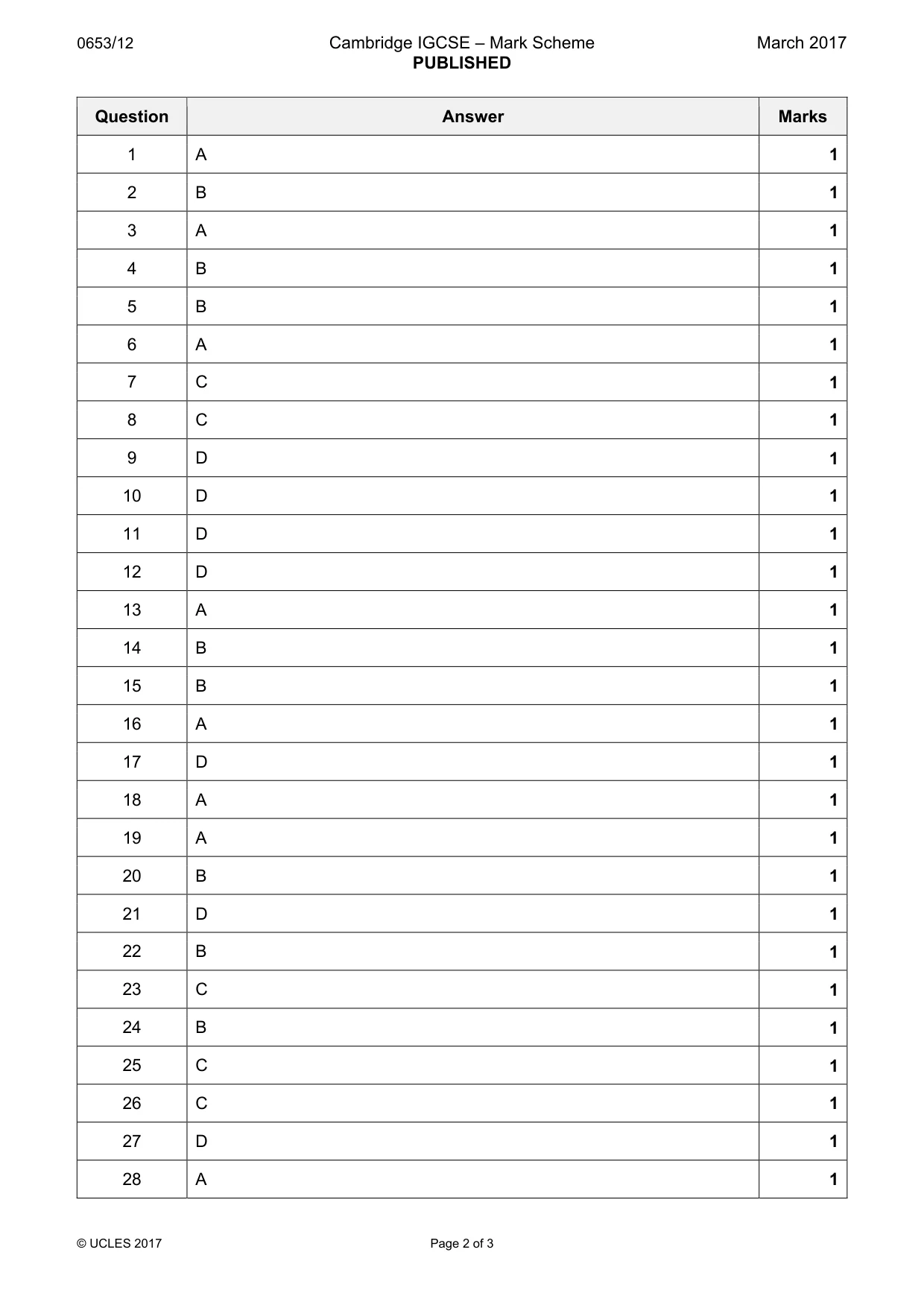
Mark scheme: A
Q2 · The diagram shows a plant cell
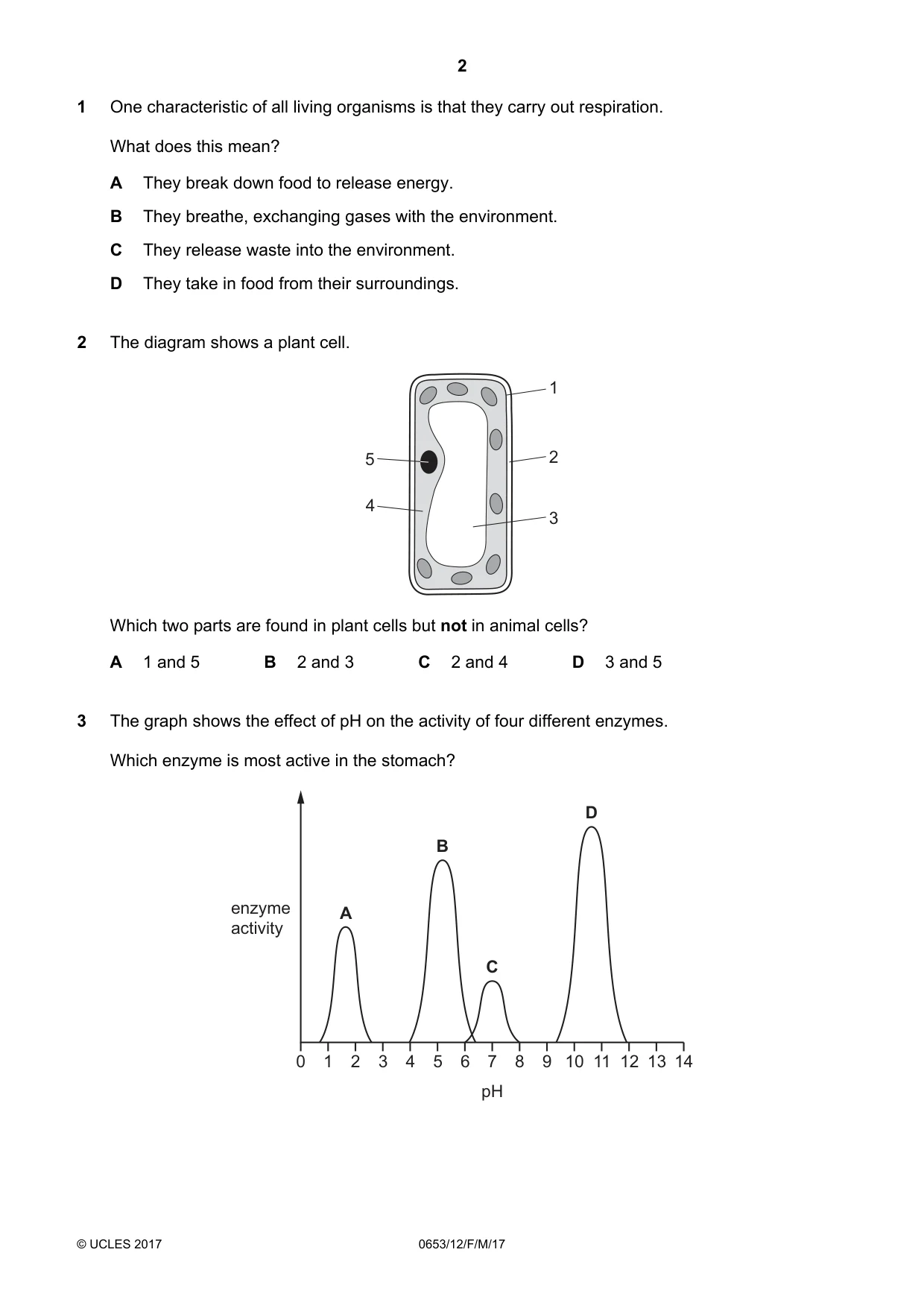
2 The diagram shows a plant cell. 1 5 2 4 3 Which two parts are found in plant cells but not in animal cells? A 1 and 5 B 2 and 3 C 2 and 4 D 3 and 5
Mark scheme: B
Q3 · The graph shows the effect of pH on the activity of four different enzymes
3 The graph shows the effect of pH on the activity of four different enzymes. Which enzyme is most active in the stomach? D B enzyme A activity C 0 1 2 3 4 5 6 7 8 9 10 11 12 13 14 pH
Mark scheme: A
Q4 · What must be present for photosynthesis to occur?
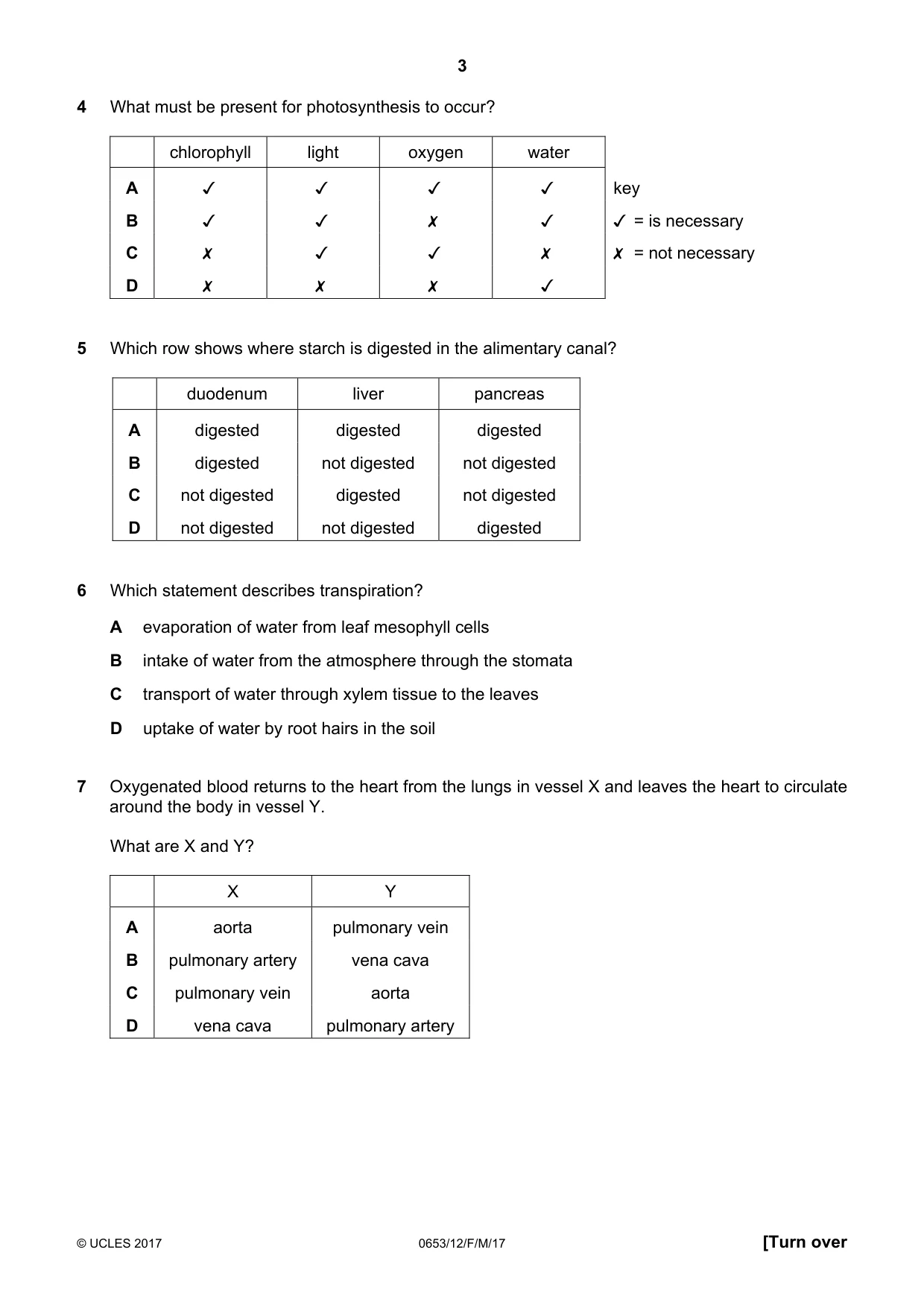
4 What must be present for photosynthesis to occur? chlorophyll light oxygen water A v v v v B v v x v Cc x v v x D x x x Jv key J/ =is necessary X = not necessary
Mark scheme: B
Q5 · Which row shows where starch is digested in the alimentary canal?
5 Which row shows where starch is digested in the alimentary canal? duodenum liver pancreas A digested digested digested B digested not digested not digested C not digested digested not digested D not digested not digested digested
Mark scheme: B
Q6 · Which statement describes transpiration?
6 Which statement describes transpiration? A evaporation of water from leaf mesophyll cells B intake of water from the atmosphere through the stomata C transport of water through xylem tissue to the leaves D uptake of water by root hairs in the soil
Mark scheme: A
Q7 · Oxygenated blood returns to the heart from the lungs in vessel X and leaves the heart to…
7 Oxygenated blood returns to the heart from the lungs in vessel X and leaves the heart to circulate around the body in vessel Y. What are X and Y? X Y A aorta pulmonary vein B pulmonary artery vena cava C pulmonary vein aorta D vena cava pulmonary artery
Mark scheme: C
Q8 · Limewater is a colourless liquid
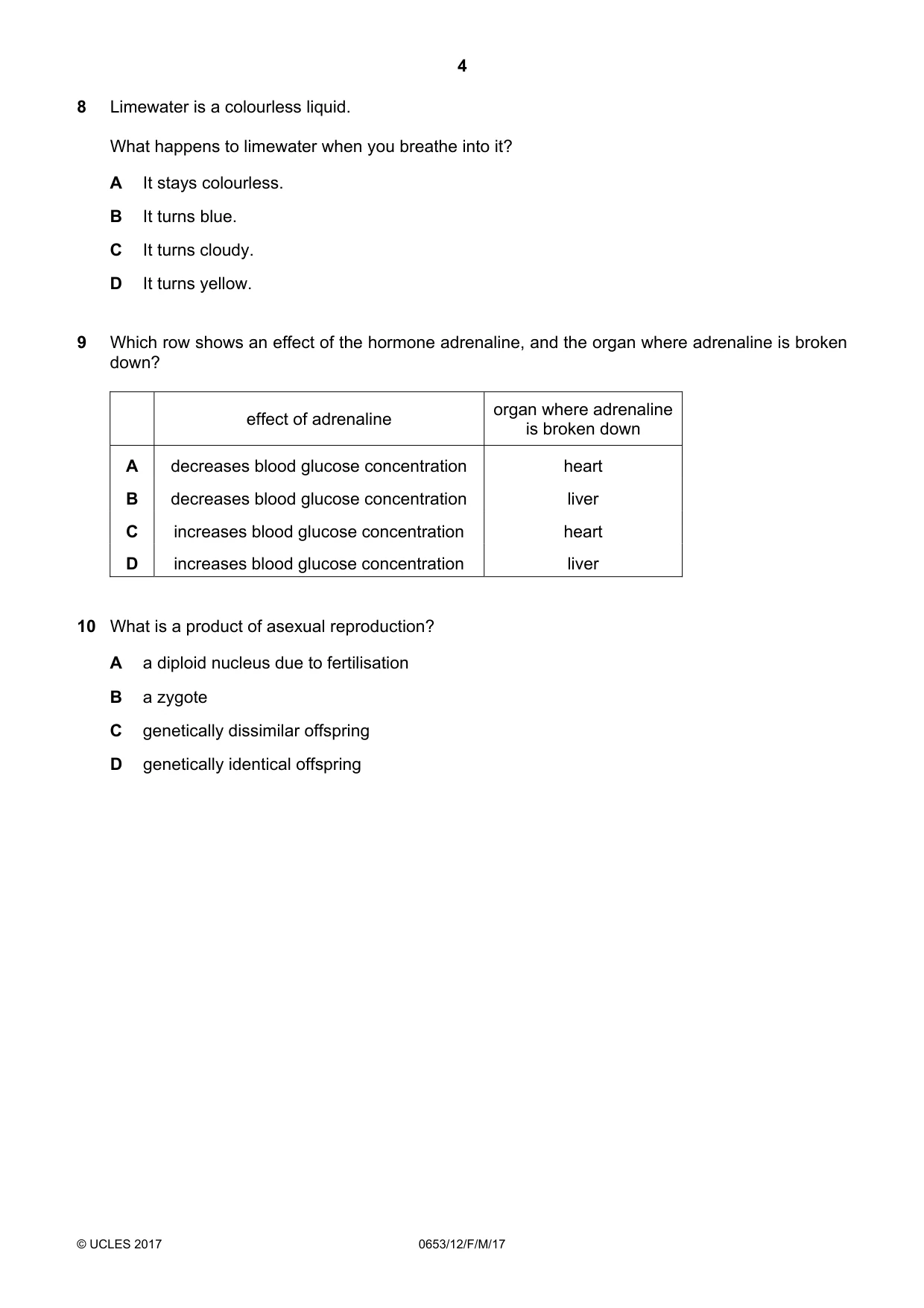
8 Limewater is a colourless liquid. What happens to limewater when you breathe into it? A It stays colourless. B It turns blue. C It turns cloudy. D It turns yellow.
Mark scheme: C
Q9 · Which row shows an effect of the hormone adrenaline, and the organ where adrenaline is…
9 Which row shows an effect of the hormone adrenaline, and the organ where adrenaline is broken down? organ where adrenaline effect of adrenaline is broken down A decreases blood glucose concentration heart B decreases blood glucose concentration liver C increases blood glucose concentration heart D increases blood glucose concentration liver
Mark scheme: D
Q10 · What is a product of asexual reproduction?
10 What is a product of asexual reproduction? A a diploid nucleus due to fertilisation B a zygote C genetically dissimilar offspring D genetically identical offspring
Mark scheme: D
Q11 · The diagram shows the changes that occur to the uterus lining during the menstrual cycle
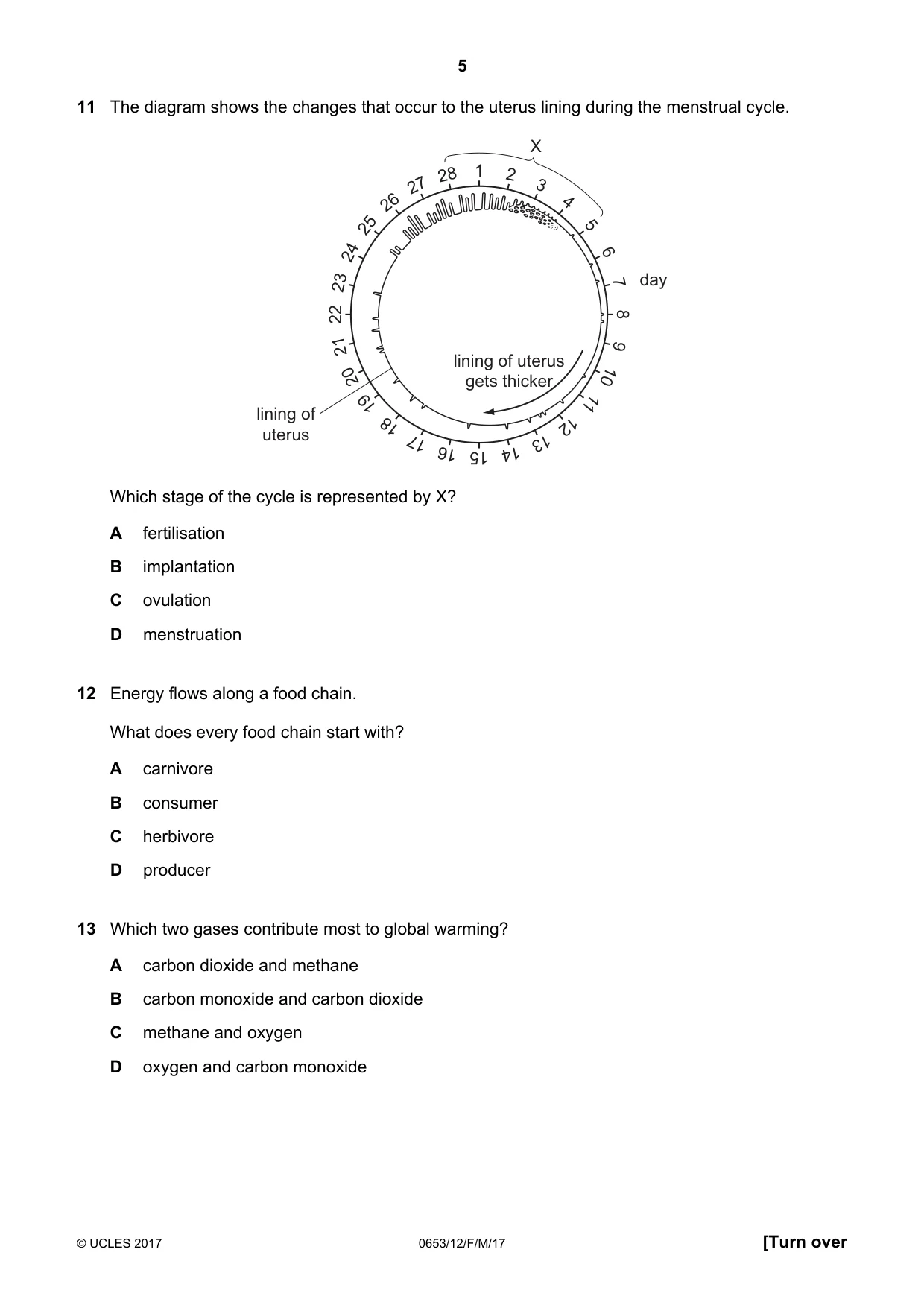
11 The diagram shows the changes that occur to the uterus lining during the menstrual cycle. X 28 1 2 27 3 26 4 25 5 24 6 23 7 day 22 8 21 9 lining of uterus 20 10 gets thicker 19 11 lining of 18 12 uterus 17 13 16 15 14 Which stage of the cycle is represented by X? A fertilisation B implantation C ovulation D menstruation
Mark scheme: D
Q12 · Energy flows along a food chain
12 Energy flows along a food chain. What does every food chain start with? A carnivore B consumer C herbivore D producer
Mark scheme: D
Q13 · Which two gases contribute most to global warming?
13 Which two gases contribute most to global warming? A carbon dioxide and methane B carbon monoxide and carbon dioxide C methane and oxygen D oxygen and carbon monoxide
Mark scheme: A
Q14 · Which diagram represents molecules of hydrogen gas?
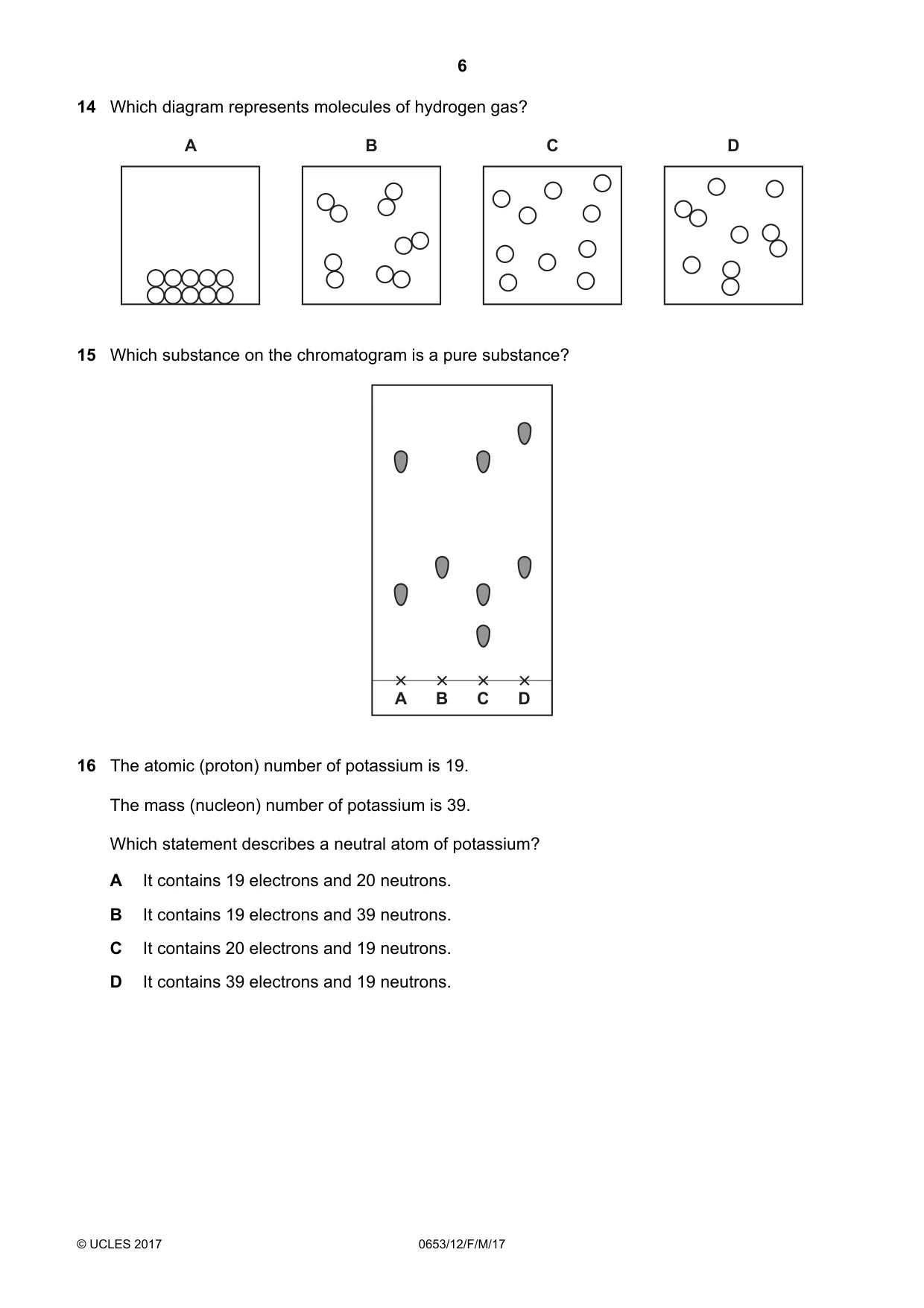
14 Which diagram represents molecules of hydrogen gas? A B C D
Mark scheme: B
Q15 · Which substance on the chromatogram is a pure substance?
15 Which substance on the chromatogram is a pure substance? A B C D
Mark scheme: B
Q16 · The atomic (proton) number of potassium is 19
16 The atomic (proton) number of potassium is 19. The mass (nucleon) number of potassium is 39. Which statement describes a neutral atom of potassium? A It contains 19 electrons and 20 neutrons. B It contains 19 electrons and 39 neutrons. C It contains 20 electrons and 19 neutrons. D It contains 39 electrons and 19 neutrons.
Mark scheme: A
Q17 · Molecules of W, X and Y are shown
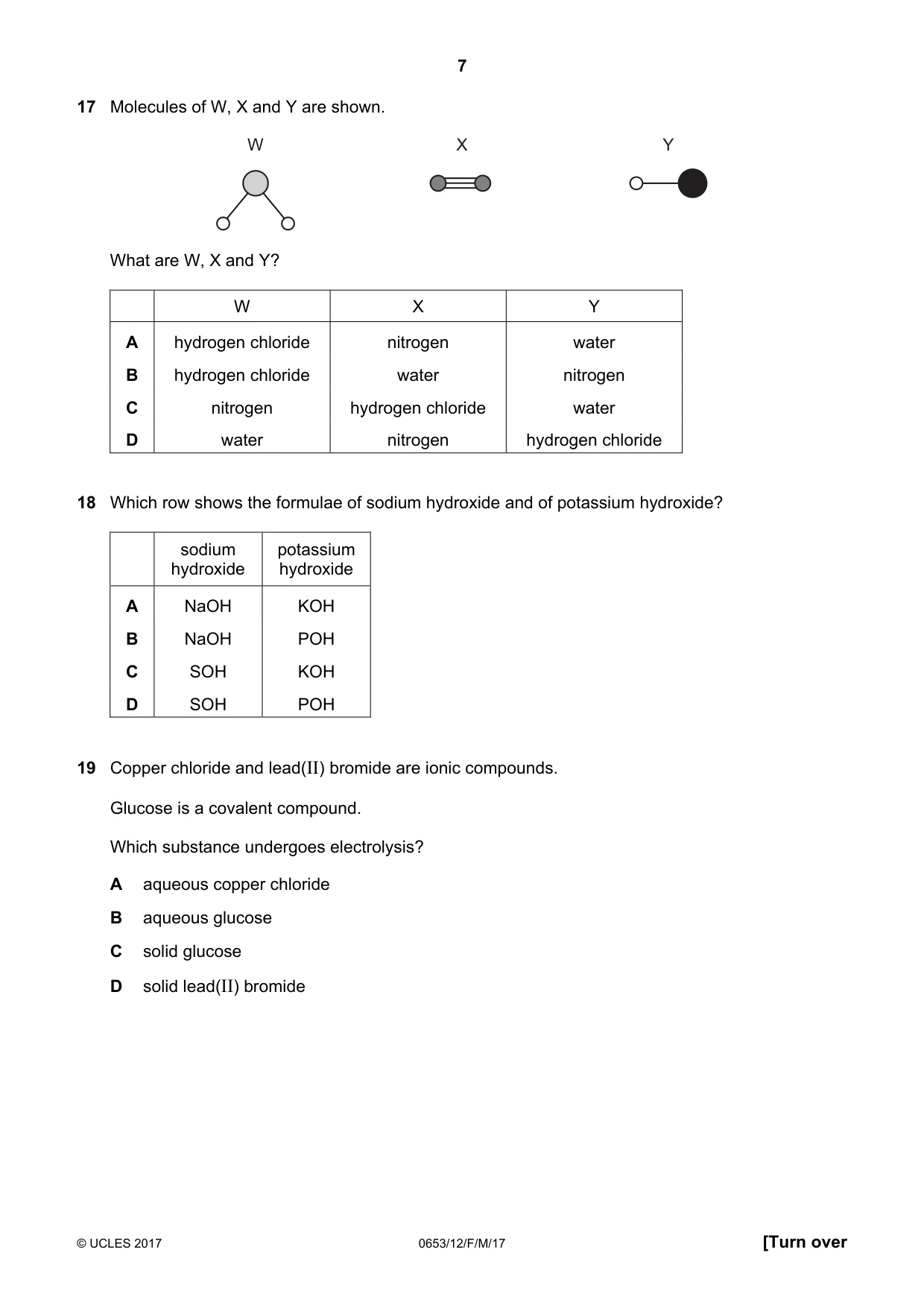
17 Molecules of W, X and Y are shown. W X Y What are W, X and Y? W X Y A hydrogen chloride nitrogen water B hydrogen chloride water nitrogen C nitrogen hydrogen chloride water D water nitrogen hydrogen chloride
Mark scheme: D
Q18 · Which row shows the formulae of sodium hydroxide and of potassium hydroxide?
18 Which row shows the formulae of sodium hydroxide and of potassium hydroxide? sodium potassium hydroxide hydroxide A NaOH KOH B NaOH POH C SOH KOH D SOH POH
Mark scheme: A
Q19 · Copper chloride and lead(II) bromide are ionic compounds
19 Copper chloride and lead(II) bromide are ionic compounds. Glucose is a covalent compound. Which substance undergoes electrolysis? A aqueous copper chloride B aqueous glucose C solid glucose D solid lead(II) bromide
Mark scheme: A
Q20 · Solid ammonium nitrate is soluble in water
20 Solid ammonium nitrate is soluble in water. When a large quantity of ammonium nitrate is added to water, the water freezes. Which statement describes this change? A an endothermic chemical change B an endothermic physical change C an exothermic chemical change D an exothermic physical change
Mark scheme: B
Q21 · Four experiments, each using 2 g of calcium carbonate and dilute nitric acid, are set up
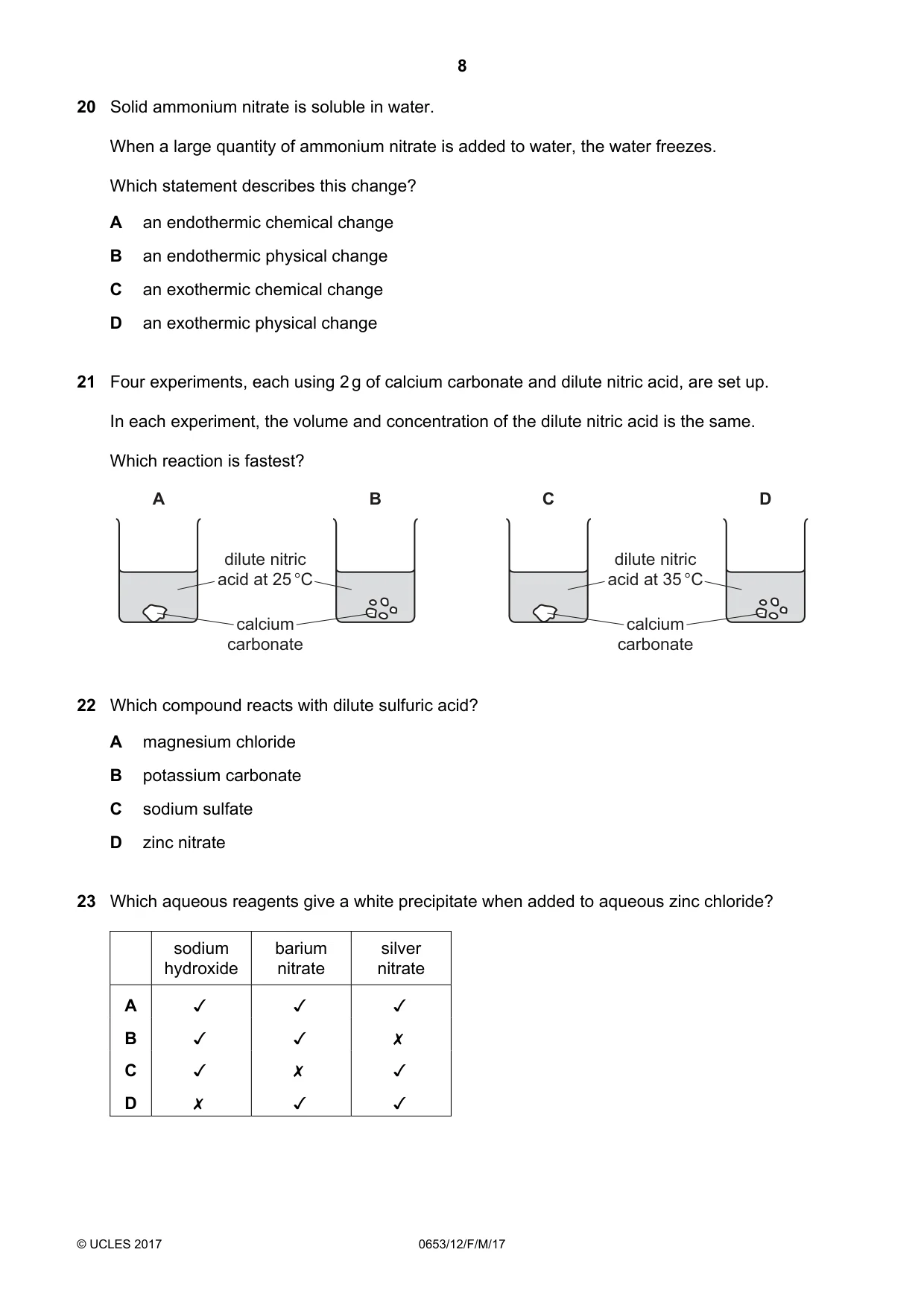
21 Four experiments, each using 2 g of calcium carbonate and dilute nitric acid, are set up. In each experiment, the volume and concentration of the dilute nitric acid is the same. Which reaction is fastest? A B C D dilute nitric dilute nitric acid at 25 °C acid at 35 °C calcium calcium carbonate carbonate
Mark scheme: D
Q22 · Which compound reacts with dilute sulfuric acid?
22 Which compound reacts with dilute sulfuric acid? A magnesium chloride B potassium carbonate C sodium sulfate D zinc nitrate
Mark scheme: B
More questions on The characteristic properties of acids and bases
Q23 · Which aqueous reagents give a white precipitate when added to aqueous zinc chloride?
23 Which aqueous reagents give a white precipitate when added to aqueous zinc chloride? sodium barium silver hydroxide nitrate nitrate v v v 0 Oo WwW > v v x v x v x v v
Mark scheme: C
Q24 · Element X is a very soft solid
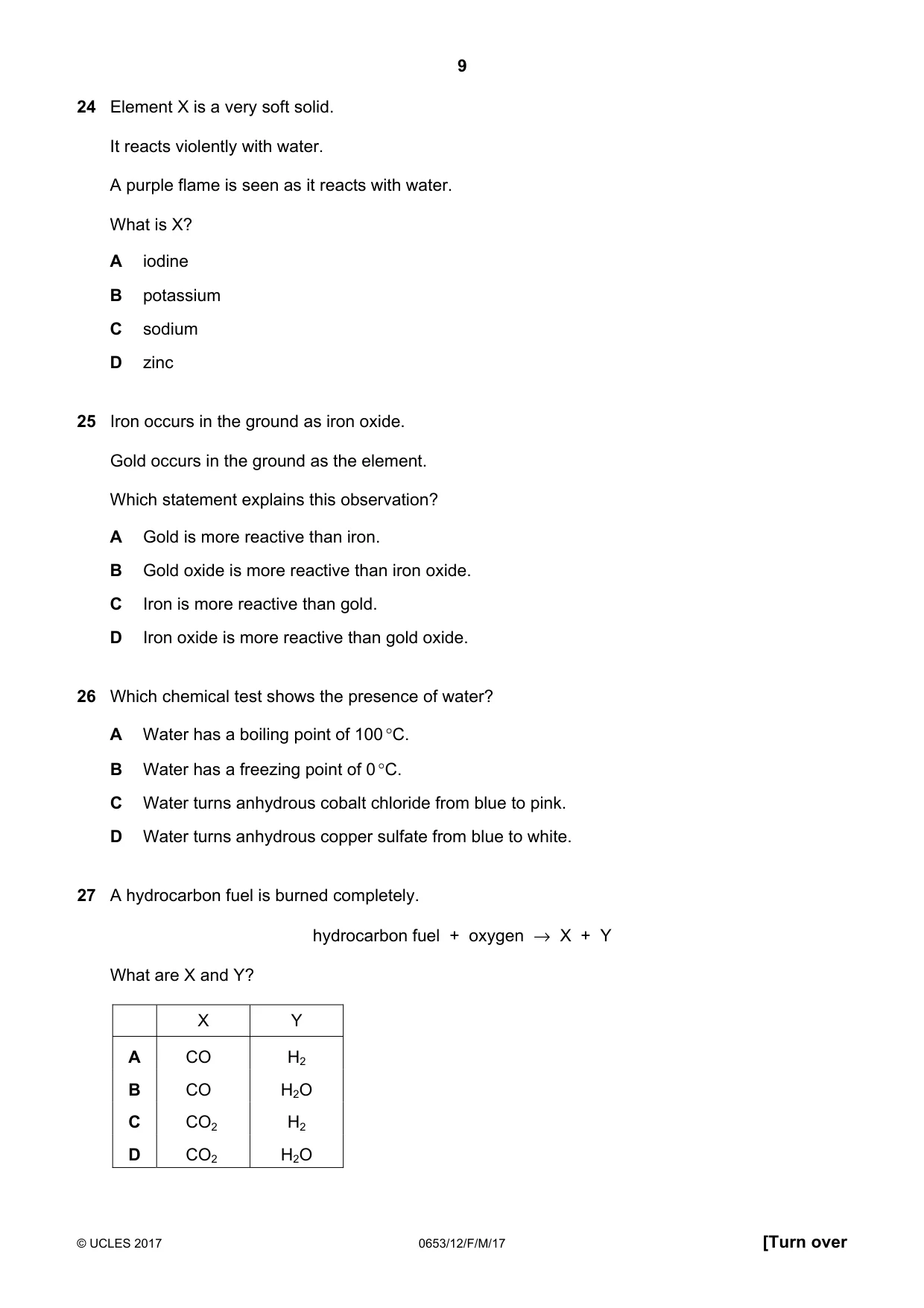
24 Element X is a very soft solid. It reacts violently with water. A purple flame is seen as it reacts with water. What is X? A iodine B potassium C sodium D zinc
Mark scheme: B
Q25 · Iron occurs in the ground as iron oxide
25 Iron occurs in the ground as iron oxide. Gold occurs in the ground as the element. Which statement explains this observation? A Gold is more reactive than iron. B Gold oxide is more reactive than iron oxide. C Iron is more reactive than gold. D Iron oxide is more reactive than gold oxide.
Mark scheme: C
Q26 · Which chemical test shows the presence of water?
26 Which chemical test shows the presence of water? A Water has a boiling point of 100 °C. B Water has a freezing point of 0 °C. C Water turns anhydrous cobalt chloride from blue to pink. D Water turns anhydrous copper sulfate from blue to white.
Mark scheme: C
Q27 · A hydrocarbon fuel is burned completely
27 A hydrocarbon fuel is burned completely. hydrocarbon fuel + oxygen → X + Y What are X and Y? X Y A CO H2 B CO H2O C CO2 H2 D CO2 H2O
Mark scheme: D
Q28 · A car travels between two towns
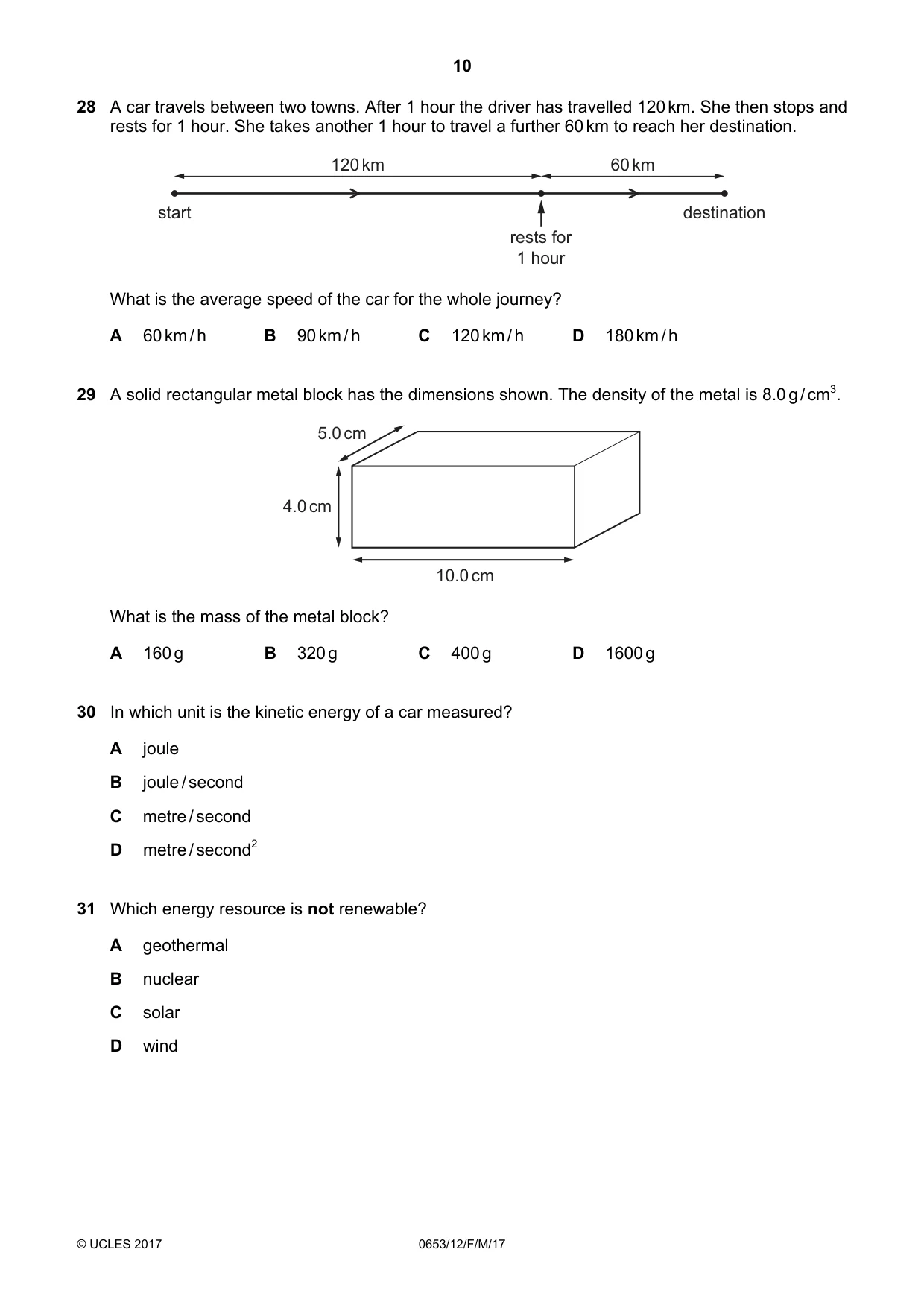
28 A car travels between two towns. After 1 hour the driver has travelled 120 km. She then stops and rests for 1 hour. She takes another 1 hour to travel a further 60 km to reach her destination. 120 km 60 km start destination rests for 1 hour What is the average speed of the car for the whole journey? A 60 km / h B 90 km / h C 120 km / h D 180 km / h
Mark scheme: A
Q29 · A solid rectangular metal block has the dimensions shown
29 A solid rectangular metal block has the dimensions shown. The density of the metal is 8.0 g / cm3. 5.0 cm 4.0 cm 10.0 cm What is the mass of the metal block? A 160 g B 320 g C 400 g D 1600 g
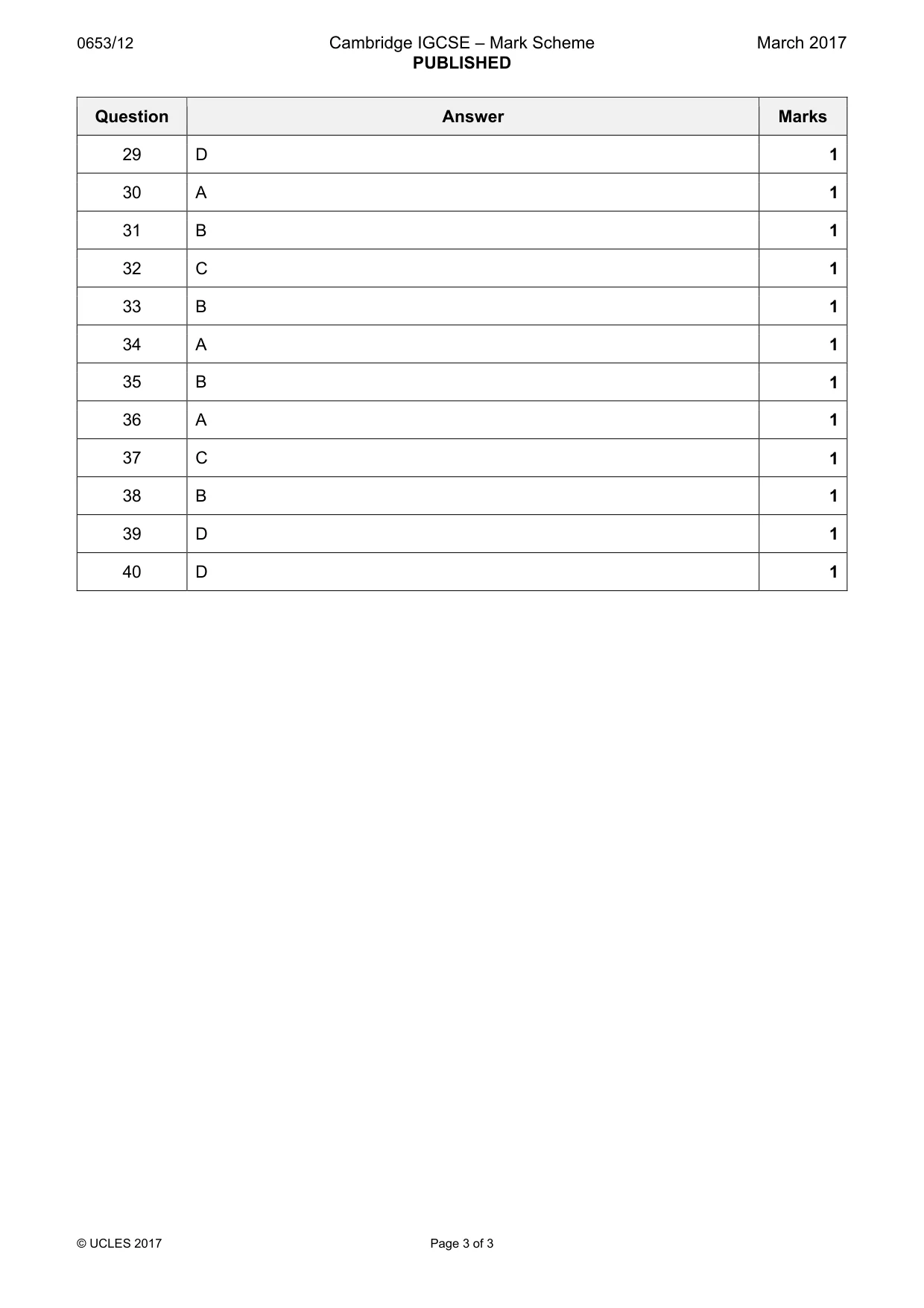
Mark scheme: D
Q30 · In which unit is the kinetic energy of a car measured?
30 In which unit is the kinetic energy of a car measured? A joule B joule / second C metre / second D metre / second2
Mark scheme: A
Q31 · Which energy resource is not renewable?
31 Which energy resource is not renewable? A geothermal B nuclear C solar D wind
Mark scheme: B
Q32 · A force F lifting a weight through a height h
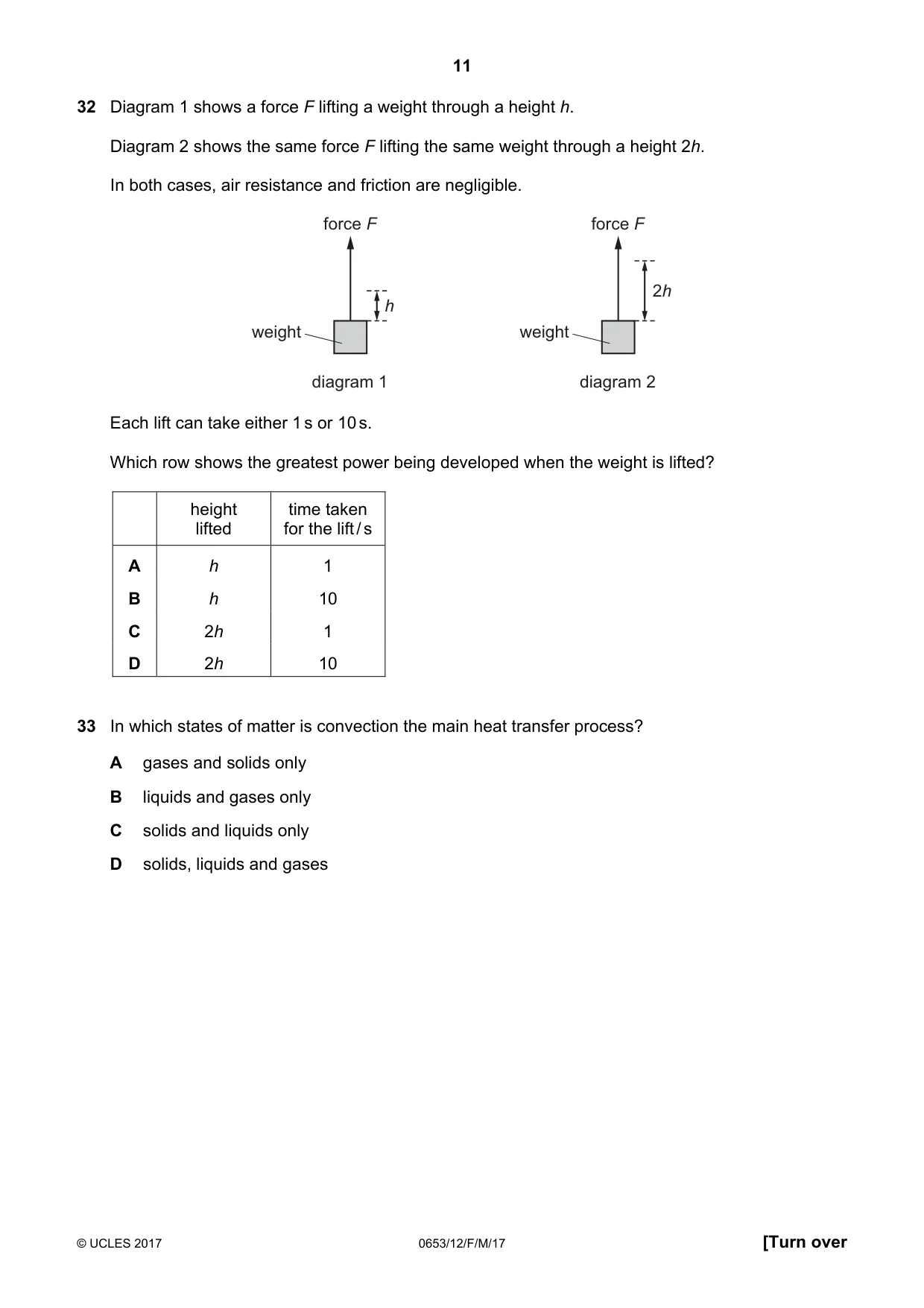
32 Diagram 1 shows a force F lifting a weight through a height h. Diagram 2 shows the same force F lifting the same weight through a height 2h. In both cases, air resistance and friction are negligible. force F force F 2h h weight weight diagram 1 diagram 2 Each lift can take either 1 s or 10 s. Which row shows the greatest power being developed when the weight is lifted? height time taken lifted for the lift / s A h 1 B h 10 C 2h 1 D 2h 10
Mark scheme: C
Q33 · In which states of matter is convection the main heat transfer process?
33 In which states of matter is convection the main heat transfer process? A gases and solids only B liquids and gases only C solids and liquids only D solids, liquids and gases
Mark scheme: B
Q34 · The diagram represents a wave, with two measurements given
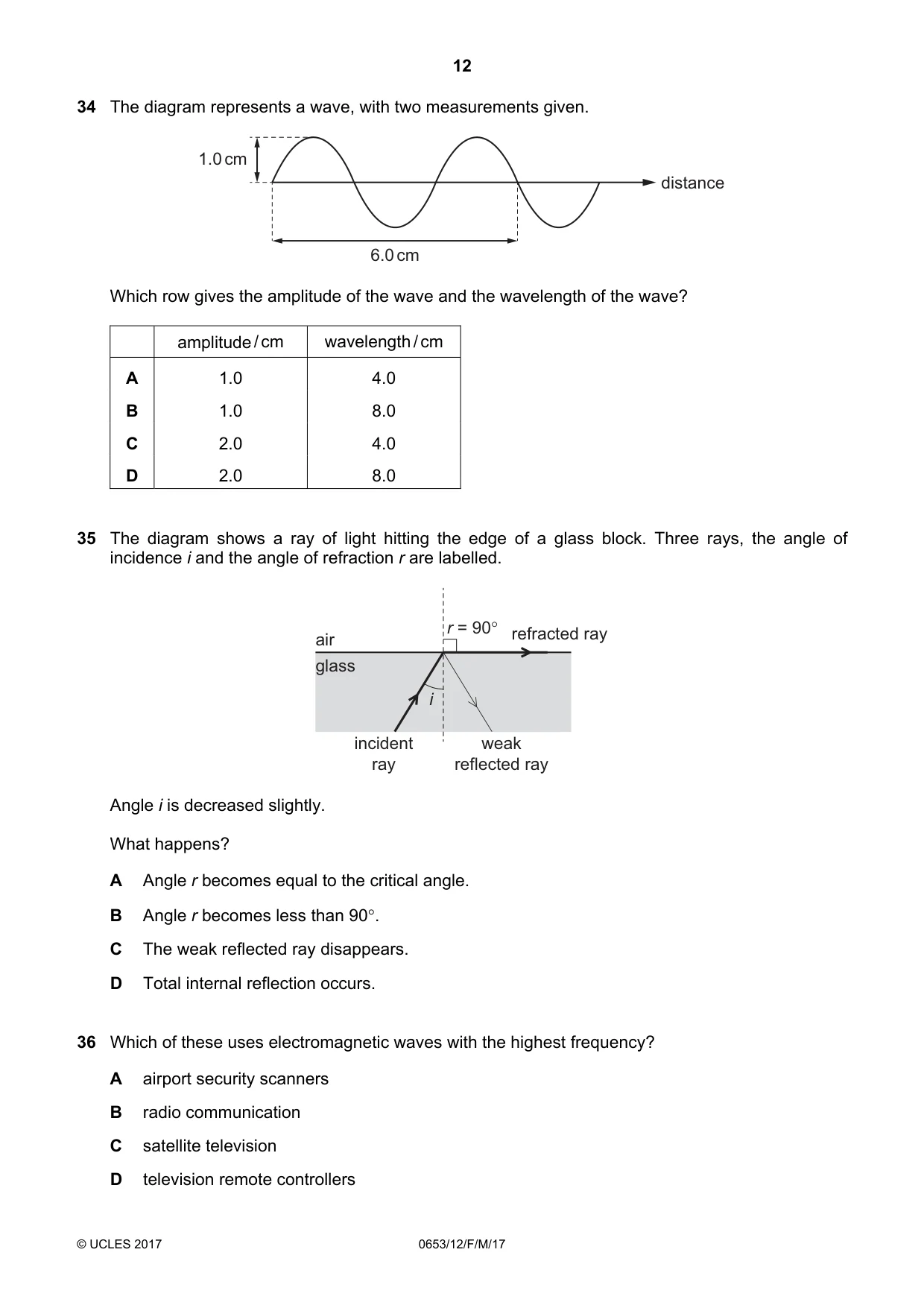
34 The diagram represents a wave, with two measurements given. 1.0 cm distance 6.0 cm Which row gives the amplitude of the wave and the wavelength of the wave? amplitude / cm wavelength / cm A 1.0 4.0 B 1.0 8.0 C 2.0 4.0 D 2.0 8.0
Mark scheme: A
Q35 · The diagram shows a ray of light hitting the edge of a glass block
35 The diagram shows a ray of light hitting the edge of a glass block. Three rays, the angle of incidence i and the angle of refraction r are labelled. r = 90° refracted ray air glass i incident weak ray reflected ray Angle i is decreased slightly. What happens? A Angle r becomes equal to the critical angle. B Angle r becomes less than 90°. C The weak reflected ray disappears. D Total internal reflection occurs.
Mark scheme: B
Q36 · Which of these uses electromagnetic waves with the highest frequency?
36 Which of these uses electromagnetic waves with the highest frequency? A airport security scanners B radio communication C satellite television D television remote controllers
Mark scheme: A
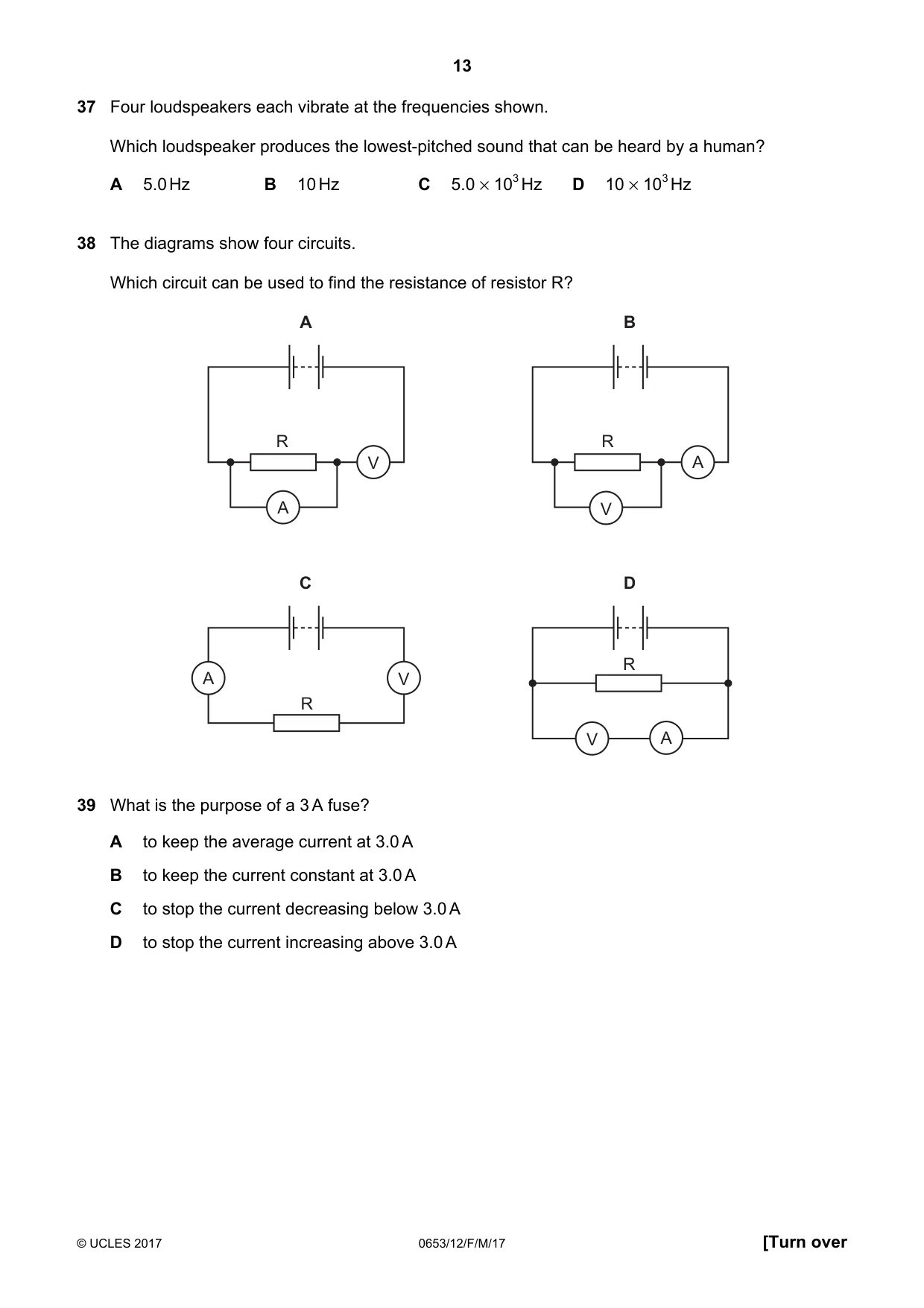
Q37 · Four loudspeakers each vibrate at the frequencies shown
37 Four loudspeakers each vibrate at the frequencies shown. Which loudspeaker produces the lowest-pitched sound that can be heard by a human? A 5.0 Hz B 10 Hz C 5.0 × 10³ Hz D 10 × 103 Hz
Mark scheme: C
Q38 · The diagrams show four circuits
38 The diagrams show four circuits. Which circuit can be used to find the resistance of resistor R? A B R R V A A V C D R A V R V A
Mark scheme: B
Q39 · What is the purpose of a 3 A fuse?
39 What is the purpose of a 3 A fuse? A to keep the average current at 3.0 A B to keep the current constant at 3.0 A C to stop the current decreasing below 3.0 A D to stop the current increasing above 3.0 A
Mark scheme: D
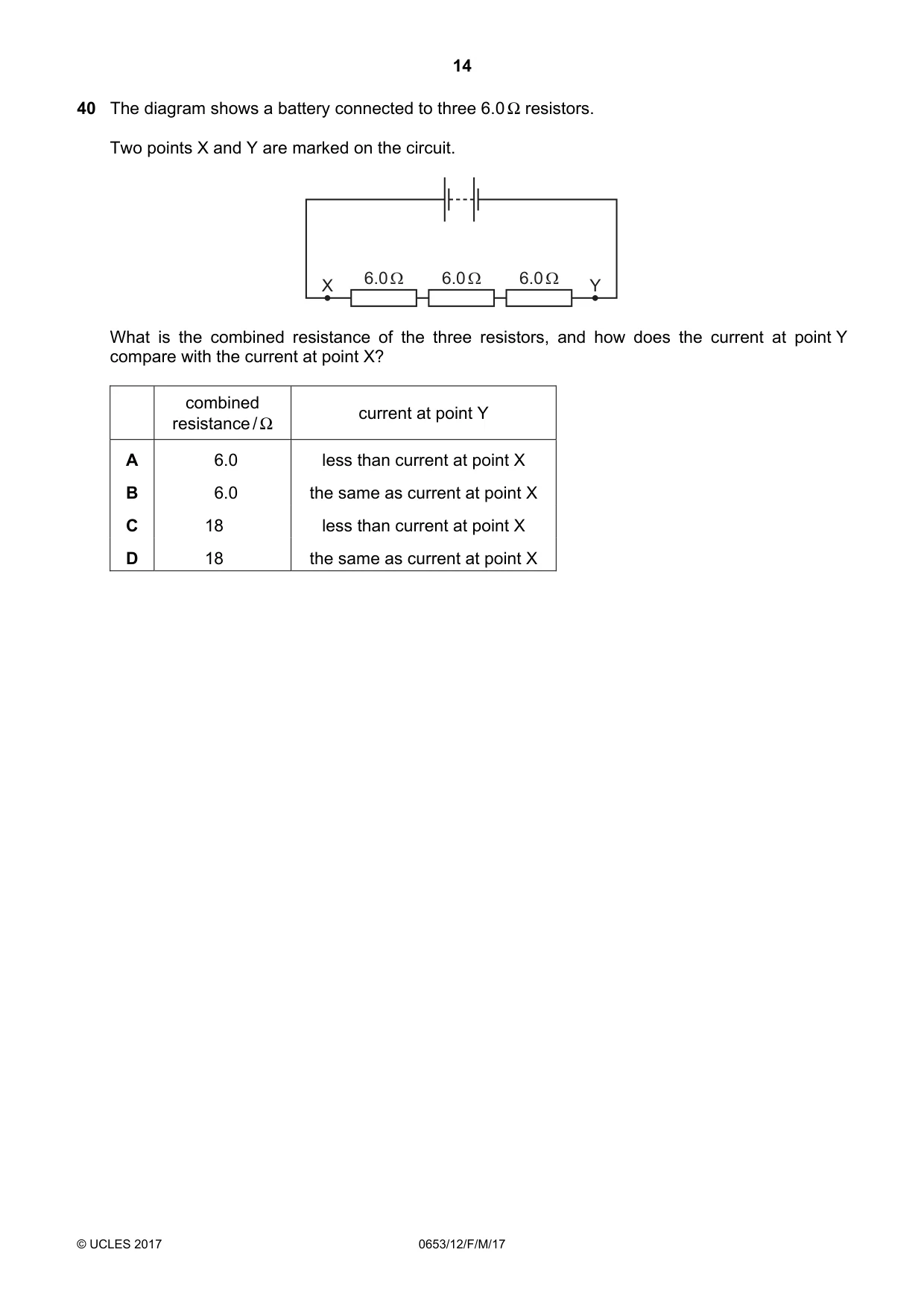
Q40 · The diagram shows a battery connected to three 6.0 Ω resistors
40 The diagram shows a battery connected to three 6.0 Ω resistors. Two points X and Y are marked on the circuit. 6.0 Ω 6.0 Ω 6.0 Ω X Y What is the combined resistance of the three resistors, and how does the current at point Y compare with the current at point X? combined current at point Y resistance / Ω A 6.0 less than current at point X B 6.0 the same as current at point X C 18 less than current at point X D 18 the same as current at point X
Mark scheme: D
What was in this paper
The subtopics covered by these 40 questions, and how many questions each got. Open one in a new tab to see every Cambridge question on it.
3Electrical circuits2Identification of ions and gases2Simple molecules and covalent bonds2Air quality and climate1Atomic structure and the Periodic Table1Cell structure1Chromatography1Density1Digestion1Drugs1Electrical safety1Electrolysis1Electromagnetic spectrum1Enzymes1Exothermic and endothermic reactions1Food chains and food webs1Formulas1Fuels1Gas exchange in humans1General properties of waves1Group I properties1Heart1Light1Motion1Photosynthesis1Rate of reaction1Reactivity series1Respiration1Sexual reproduction in humans1Sexual reproduction in plants1Sound1The characteristic properties of acids and bases1Transfer of thermal energy1Transpiration1What you needed in this session
Cambridge’s own grade thresholds for 2017 Feb/March, Paper 1 · Variant 2. A higher threshold means an easier paper — the bar moves with how the cohort did.