Cambridge IGCSE Science - Combined 0653 — 2023 Feb/March Paper 1 · Variant 2
0653/12/F/M/23 · 40 questions · 40 marks · ≈45 min
The question paper and its mark scheme, free to read here and free to download. This is Cambridge’s own paper, exactly as it was sat.
Question paper16 pages
Mark scheme3 pages
Answers below. Sit the paper first if you are practising.
Questions as text
Q1 · Which characteristics help to define a living organism?
1 Which characteristics help to define a living organism? A diffusion, movement, respiration B excretion, nutrition, sensitivity C excretion, reproduction, transpiration D growth, inspiration, nutrition
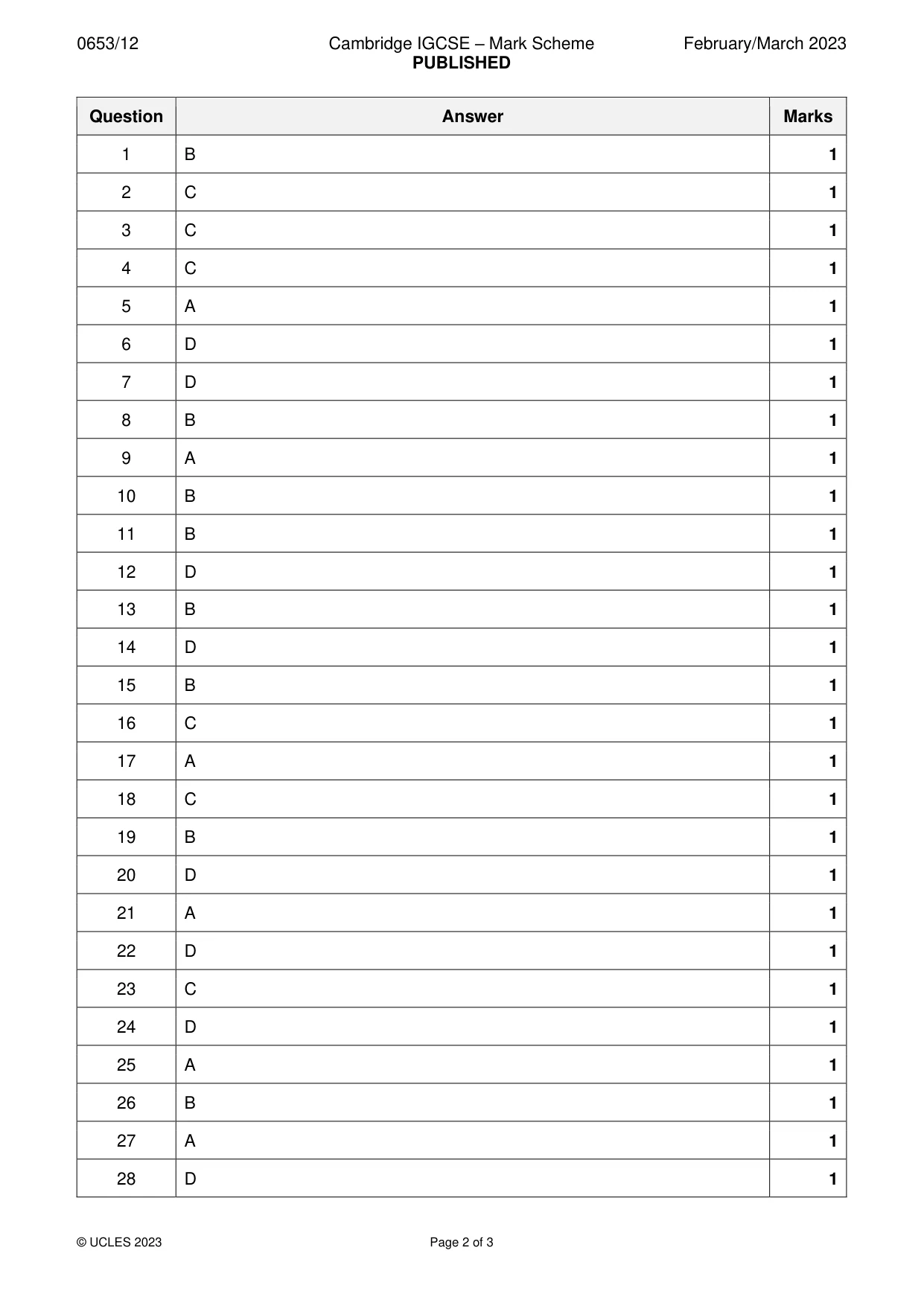
Mark scheme: B
Q2 · Two pieces of potato are cut to have exactly the same mass and shape
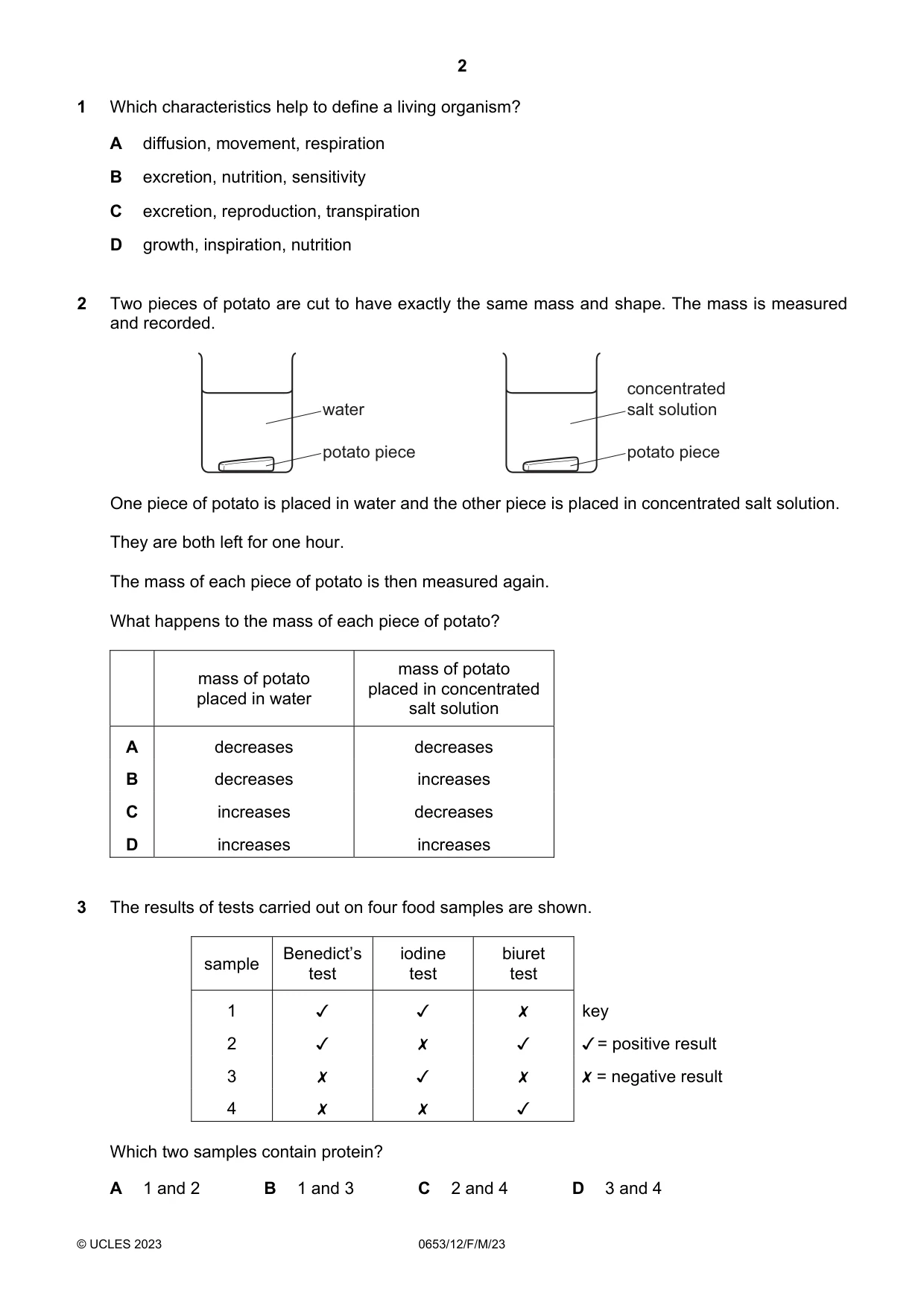
2 Two pieces of potato are cut to have exactly the same mass and shape. The mass is measured and recorded. concentrated water salt solution potato piece potato piece One piece of potato is placed in water and the other piece is placed in concentrated salt solution. They are both left for one hour. The mass of each piece of potato is then measured again. What happens to the mass of each piece of potato? mass of potato mass of potato placed in concentrated placed in water salt solution A decreases decreases B decreases increases C increases decreases D increases increases
Mark scheme: C
Q3 · The results of tests carried out on four food samples are shown
3 The results of tests carried out on four food samples are shown. Which two samples contain protein? A 1 Jv Jv x 2 Jv x J 3 x Jv x 4 x x J key / = positive result X = negative result 1 and 2 B 1 and 3 C 2and4 D 3and4
Mark scheme: C
Q4 · Which type of molecule is an enzyme?
4 Which type of molecule is an enzyme? A carbohydrate B fat C protein D vitamin
Mark scheme: C
Q5 · What is the word equation for photosynthesis?
5 What is the word equation for photosynthesis? A carbon dioxide + water glucose + oxygen B glucose + oxygen carbon dioxide + water C oxygen + carbon dioxide glucose + water D water + oxygen glucose + carbon dioxide
Mark scheme: A
Q6 · Which two nutrients are needed for healthy bone and tooth development?
6 Which two nutrients are needed for healthy bone and tooth development? A calcium and iron B fibre and vitamin C C fibre and vitamin D D vitamin D and calcium
Mark scheme: D
Q7 · Which statement about all arteries is correct?
7 Which statement about all arteries is correct? A They always contain oxygenated blood. B They have many valves on their inner walls. C They have a wide lumen. D They transport blood away from the heart.
Mark scheme: D
Q8 · The table shows the differences in the composition of carbon dioxide, oxygen and water…
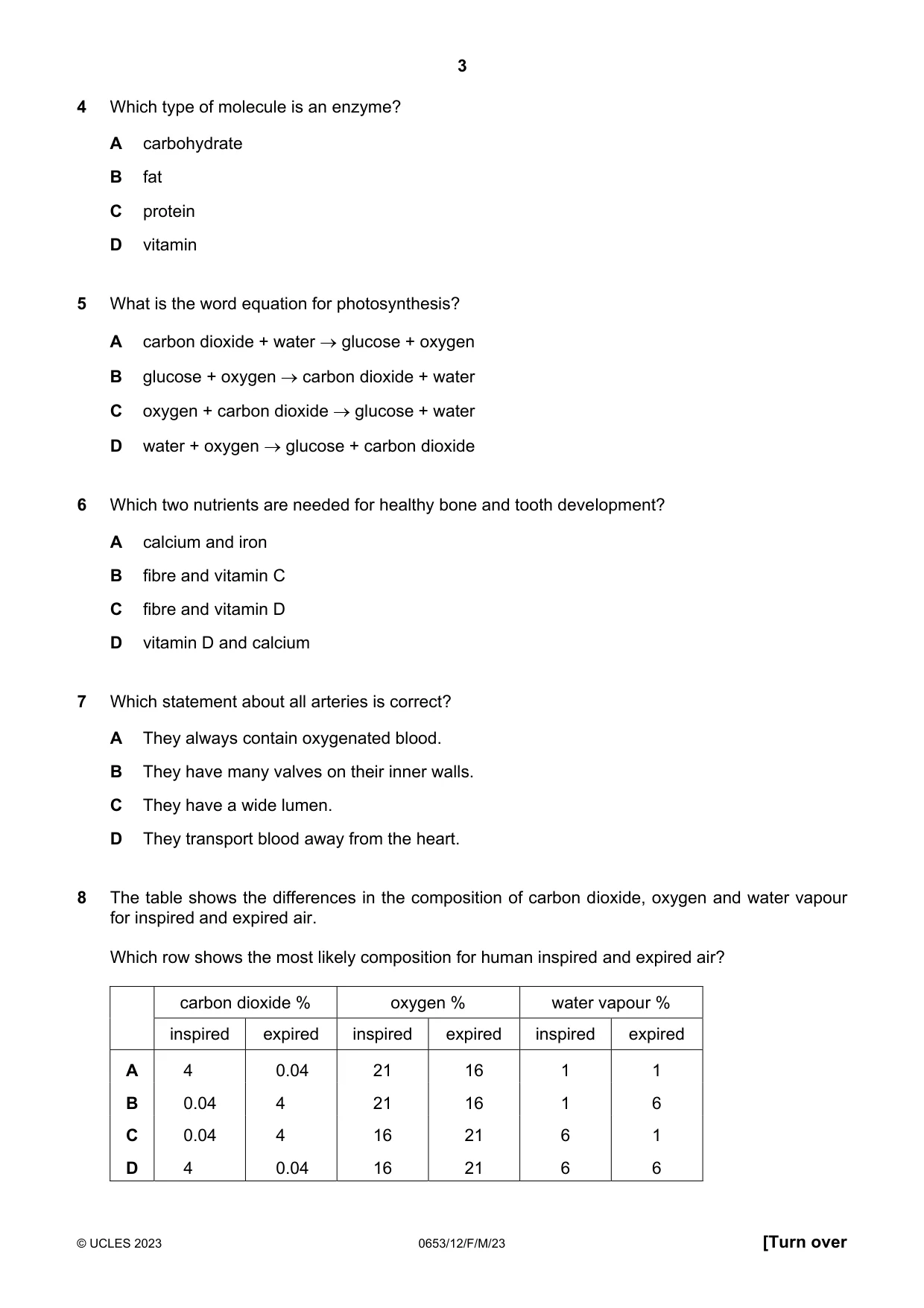
8 The table shows the differences in the composition of carbon dioxide, oxygen and water vapour for inspired and expired air. Which row shows the most likely composition for human inspired and expired air? carbon dioxide % oxygen % water vapour % inspired expired inspired expired inspired expired A 4 0.04 21 16 1 1 B 0.04 4 21 16 1 6 C 0.04 4 16 21 6 1 D 4 0.04 16 21 6 6
Mark scheme: B
Q9 · Which descriptions of food molecules before and after chemical digestion are correct?
9 Which descriptions of food molecules before and after chemical digestion are correct? food molecules before food molecules after chemical digestion chemical digestion A large and insoluble small and soluble B large and soluble small and insoluble C small and insoluble large and soluble D small and soluble large and insoluble
Mark scheme: A
Q10 · In which situations does the secretion of adrenaline increase?
10 In which situations does the secretion of adrenaline increase? 1 an athlete waiting for the starting signal at the beginning of a race 2 a mother zebra seeing a lion moving towards her offspring 3 a child about to fall asleep A 1, 2 and 3 B 1 and 2 only C 1 only D 2 and 3 only
Mark scheme: B
Q11 · The diagram shows a section through a flower
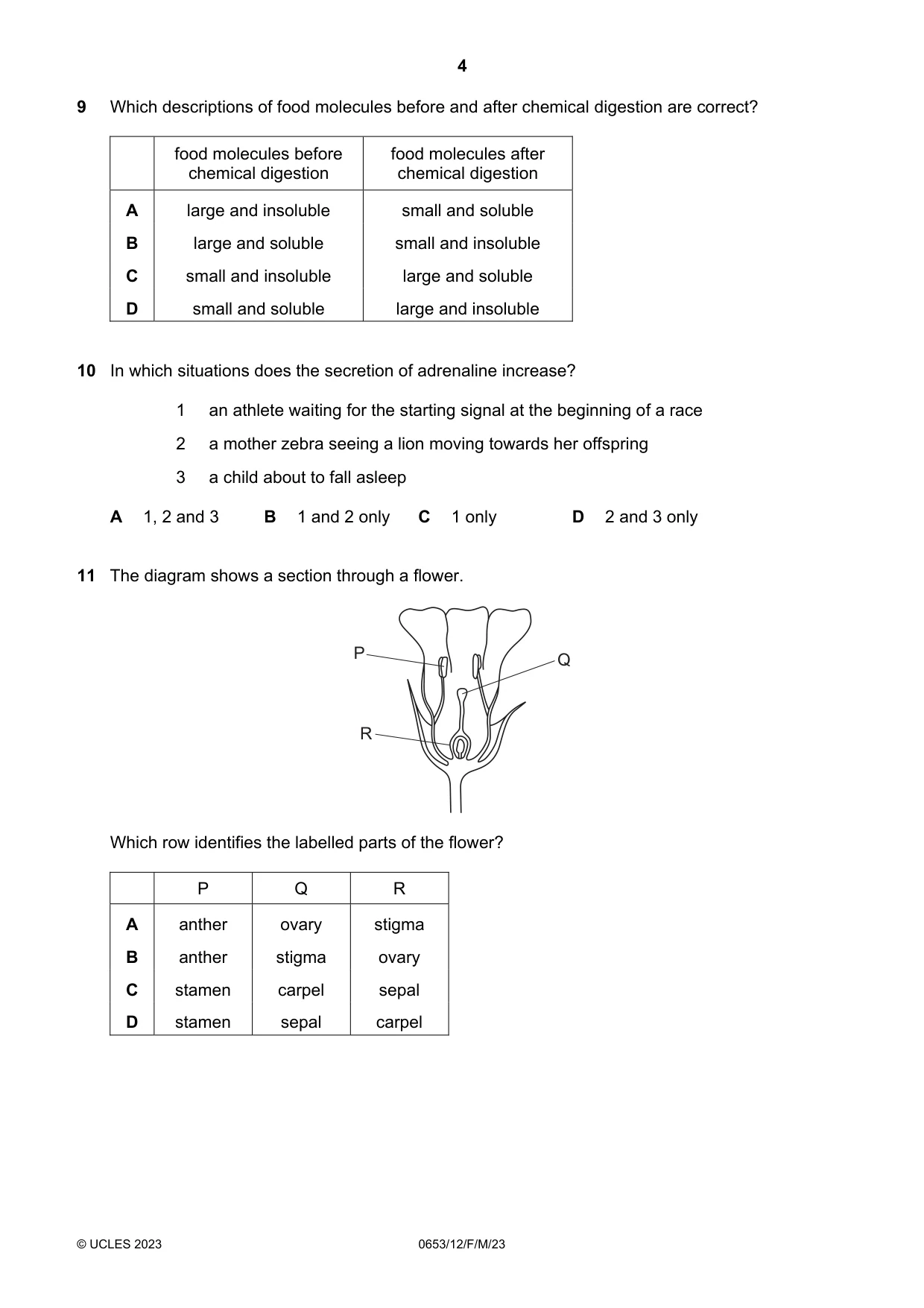
11 The diagram shows a section through a flower. P Q R Which row identifies the labelled parts of the flower? P Q R A anther ovary stigma B anther stigma ovary C stamen carpel sepal D stamen sepal carpel
Mark scheme: B
Q12 · The diagram shows a food chain
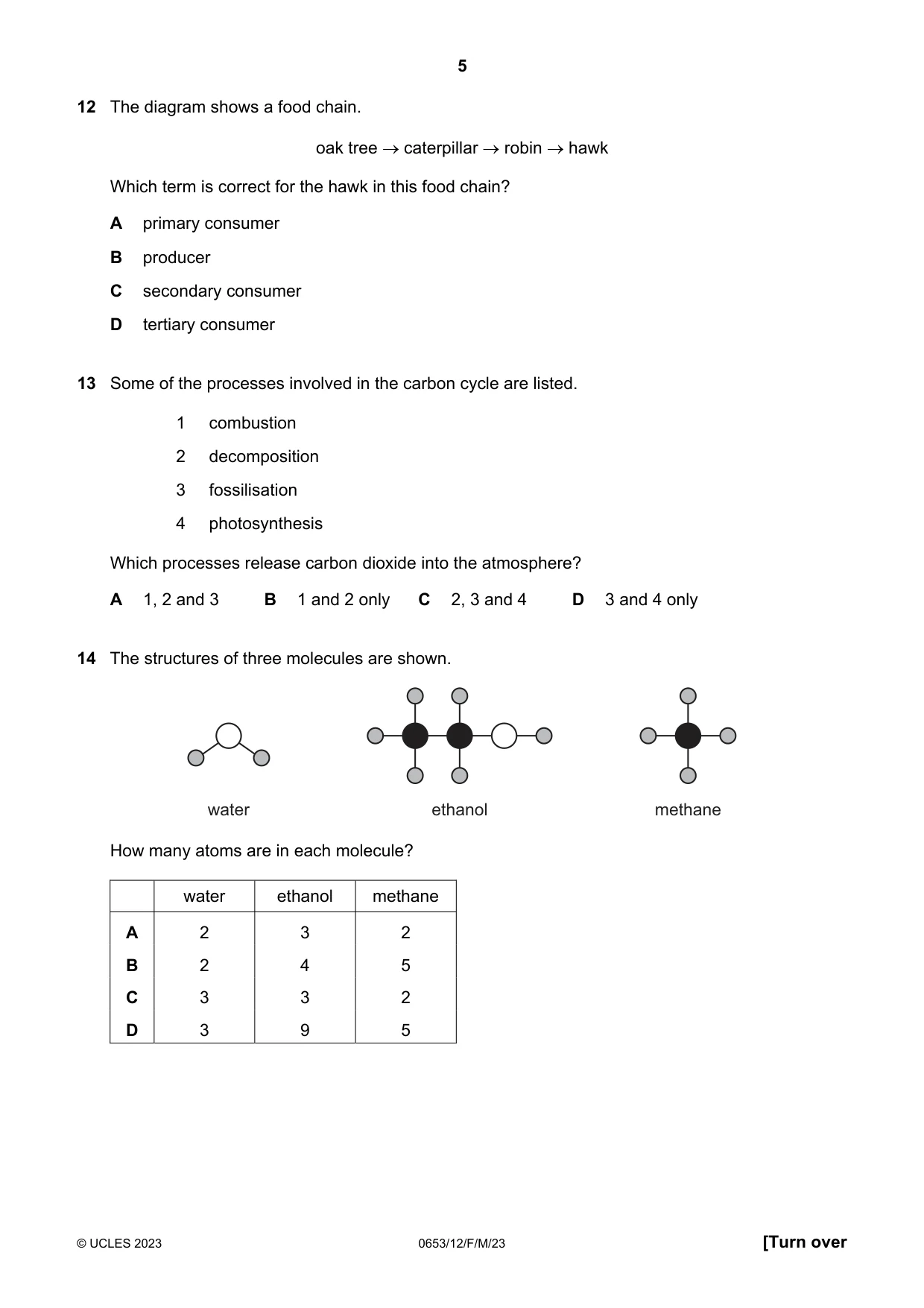
12 The diagram shows a food chain. oak tree caterpillar robin hawk Which term is correct for the hawk in this food chain? A primary consumer B producer C secondary consumer D tertiary consumer
Mark scheme: D
Q13 · Some of the processes involved in the carbon cycle are listed
13 Some of the processes involved in the carbon cycle are listed. 1 combustion 2 decomposition 3 fossilisation 4 photosynthesis Which processes release carbon dioxide into the atmosphere? A 1, 2 and 3 B 1 and 2 only C 2, 3 and 4 D 3 and 4 only
Mark scheme: B
Q14 · The structures of three molecules are shown
14 The structures of three molecules are shown. water ethanol methane How many atoms are in each molecule? water ethanol methane A 2 3 2 B 2 4 5 C 3 3 2 D 3 9 5
Mark scheme: D
Q15 · Which symbol equation is balanced?
15 Which symbol equation is balanced? A H2 + Cl 2 HCl B Mg + 2HCl MgCl 2 + H2 C CH4 + O2 CO2 + 2H2O D Mg + O2 2MgO
Mark scheme: B
Q16 · A student measures the initial temperature and the final temperature in four different…
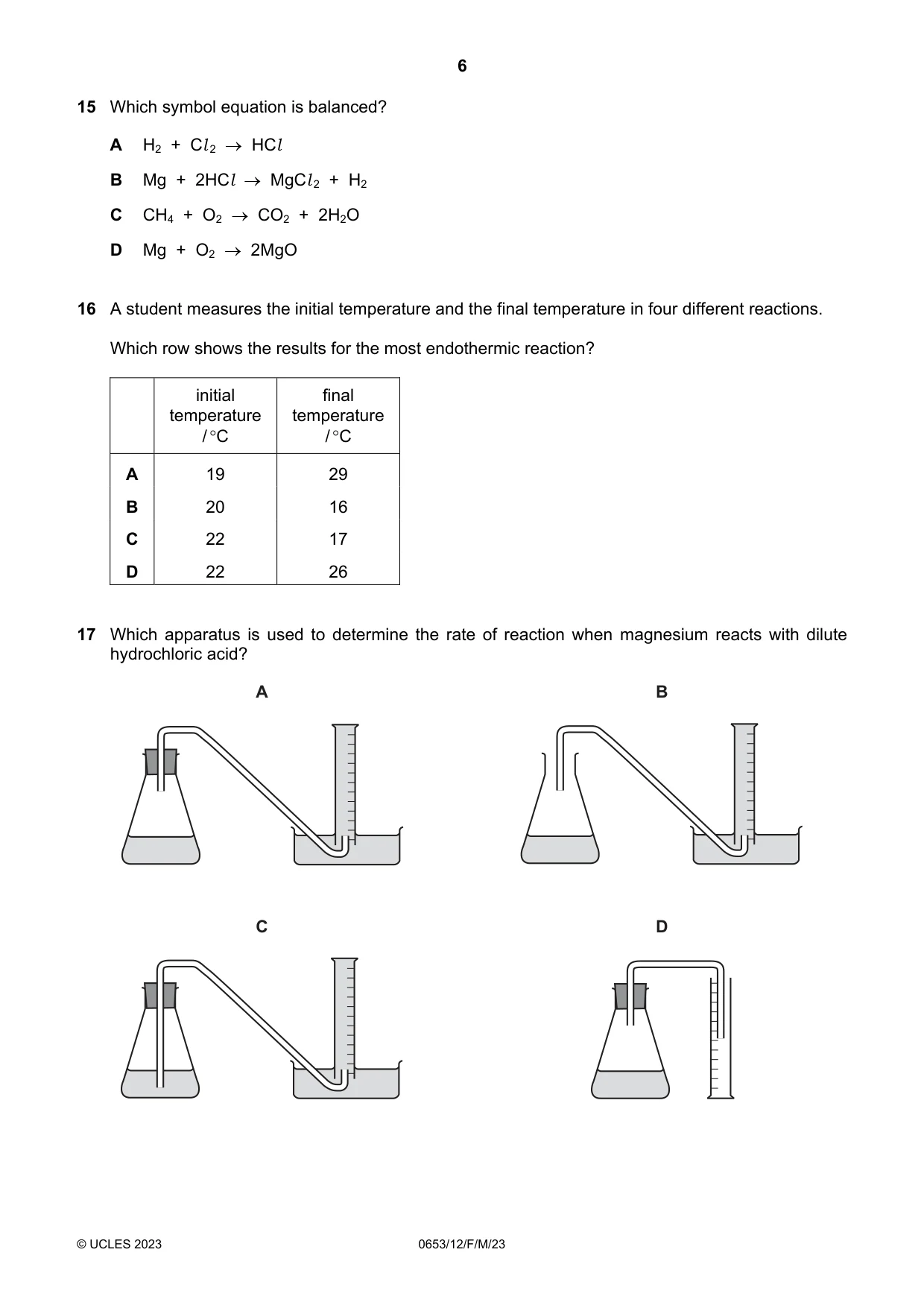
16 A student measures the initial temperature and the final temperature in four different reactions. Which row shows the results for the most endothermic reaction? initial final temperature temperature / C / C A 19 29 B 20 16 C 22 17 D 22 26
Mark scheme: C
Q17 · Which apparatus is used to determine the rate of reaction when magnesium reacts with…
17 Which apparatus is used to determine the rate of reaction when magnesium reacts with dilute hydrochloric acid? A B C D
Mark scheme: A
Q18 · Which statement describes a redox reaction?
18 Which statement describes a redox reaction? A An acid reacts with a base. B Only oxidation takes place. C Oxygen is transferred from one substance to another. D Two substances are both reduced.
Mark scheme: C
Q19 · Which solid reacts with sulfuric acid to produce a gas?
19 Which solid reacts with sulfuric acid to produce a gas? A copper B copper carbonate C copper oxide D copper sulfate
Mark scheme: B
More questions on The characteristic properties of acids and bases
Q20 · Some water is added to a coloured, powdered mixture
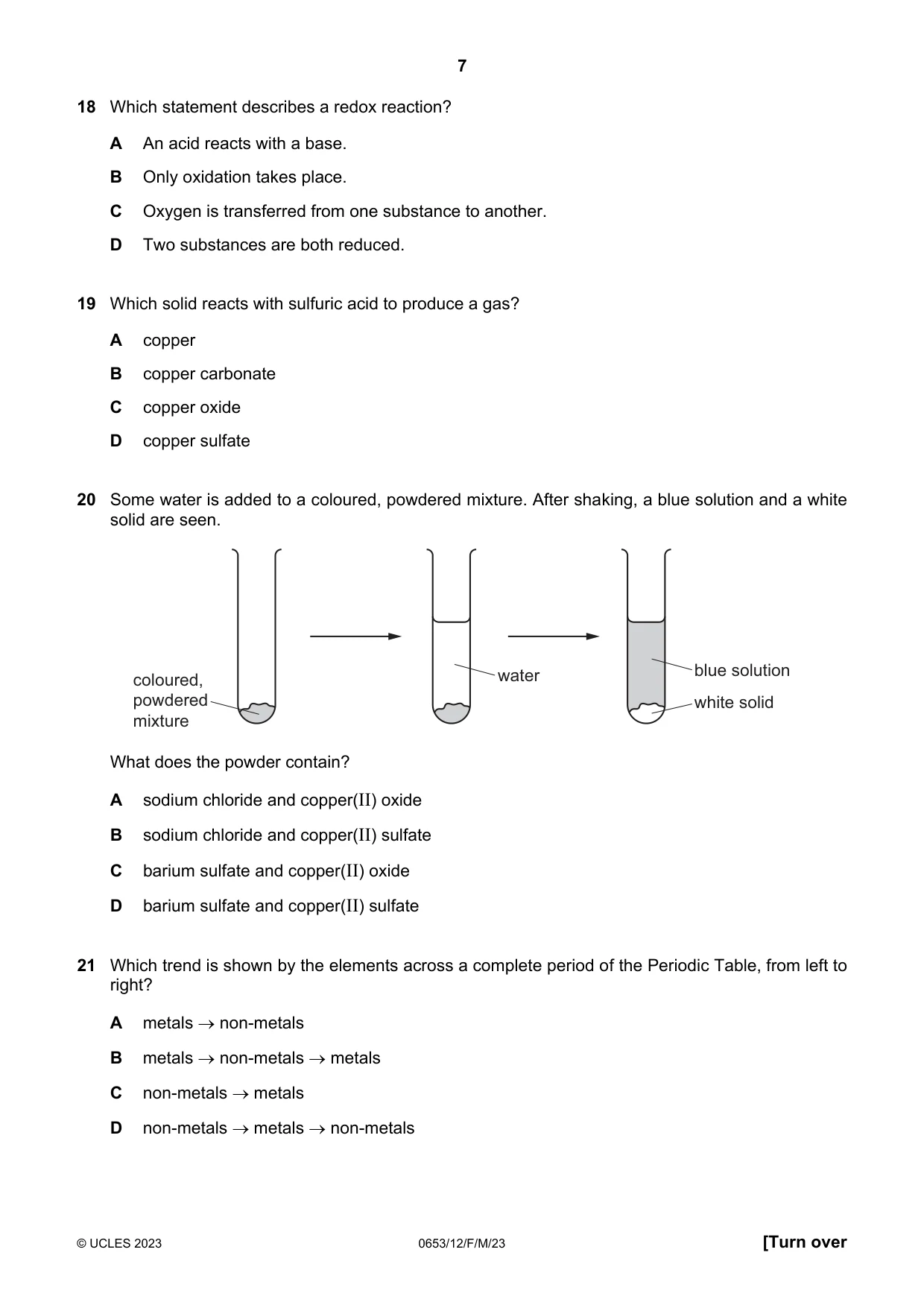
20 Some water is added to a coloured, powdered mixture. After shaking, a blue solution and a white solid are seen. water blue solution coloured, powdered white solid mixture What does the powder contain? A sodium chloride and copper(II) oxide B sodium chloride and copper(II) sulfate C barium sulfate and copper(II) oxide D barium sulfate and copper(II) sulfate
Mark scheme: D
Q21 · Which trend is shown by the elements across a complete period of the Periodic Table, from…
21 Which trend is shown by the elements across a complete period of the Periodic Table, from left to right? A metals non-metals B metals non-metals metals C non-metals metals D non-metals metals non-metals
Mark scheme: A
Q22 · Which row describes a noble gas?
22 Which row describes a noble gas? type of particle reactivity A diatomic high B diatomic low C monatomic high D monatomic low
Mark scheme: D
Q23 · Which statement about the extraction of metals is correct?
23 Which statement about the extraction of metals is correct? A Aluminium is extracted from aluminium oxide by heating with carbon. B Aluminium is less reactive than copper so aluminium can be extracted by electrolysis. C Carbon can be used to remove oxygen from copper(II) oxide. D Copper is extracted from the ore bauxite.
Mark scheme: C
Q24 · Which colour change is seen when water is added to anhydrous cobalt(II) chloride?
24 Which colour change is seen when water is added to anhydrous cobalt(II) chloride? A white to blue B pink to blue C blue to white D blue to pink
Mark scheme: D
Q25 · Which statements about air pollutants are correct?
25 Which statements about air pollutants are correct? 1 Sulfur dioxide can damage buildings. 2 Oxides of nitrogen are harmful to health. 3 Carbon monoxide is a poisonous gas. 4 Carbon monoxide can damage buildings. A 1, 2 and 3 B 1 and 2 only C 2, 3 and 4 D 3 and 4 only
Mark scheme: A
Q26 · Ethane is a hydrocarbon
26 Ethane is a hydrocarbon. What are the products of the complete combustion of ethane? A carbon dioxide and hydrogen B carbon dioxide and water C carbon monoxide and hydrogen D carbon monoxide and water
Mark scheme: B
Q27 · What is produced by cracking?
27 What is produced by cracking? A alkenes B fractions C naphtha D polymers
Mark scheme: A
Q28 · The period of a pendulum is 3.0 s
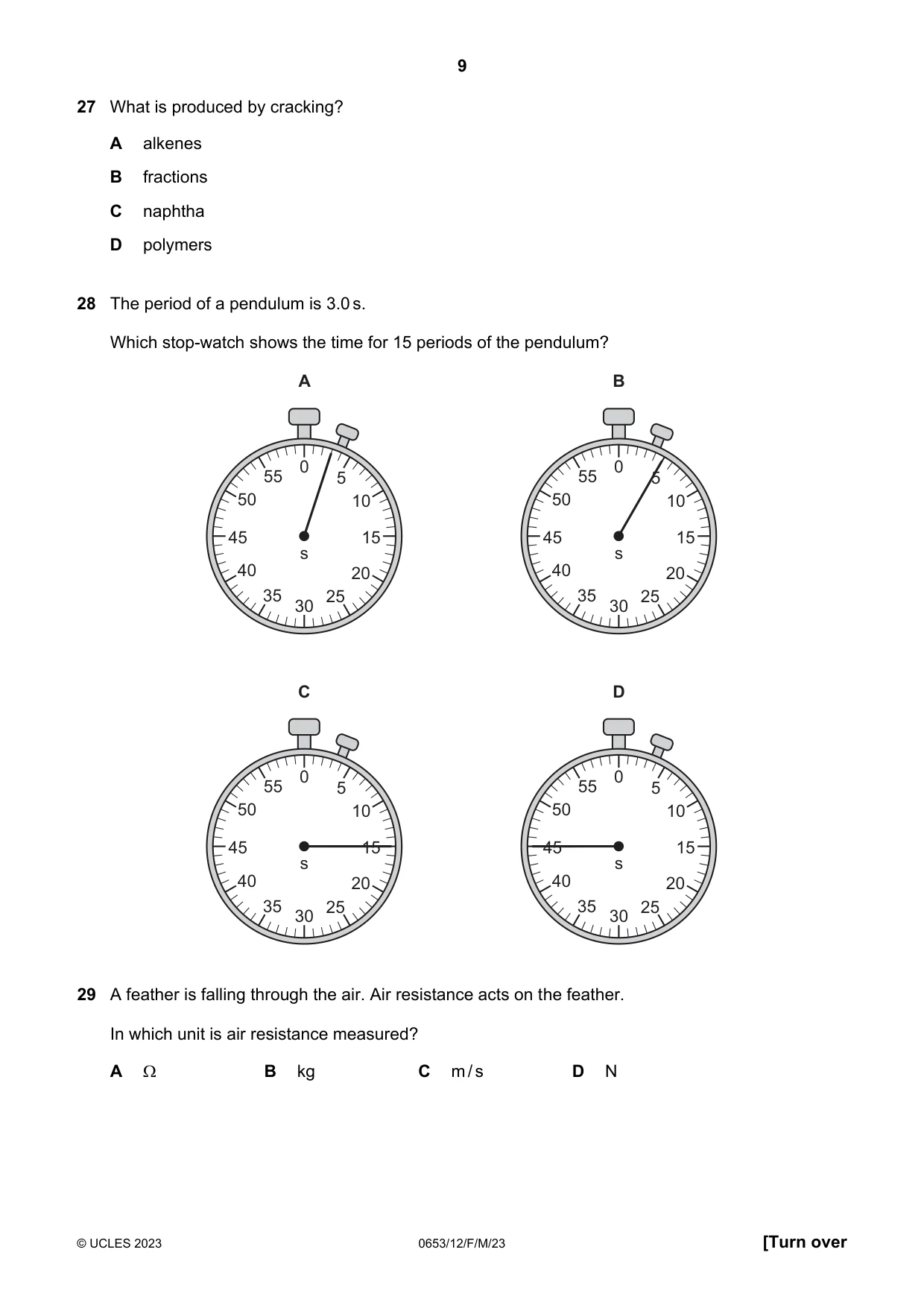
28 The period of a pendulum is 3.0 s. Which stop-watch shows the time for 15 periods of the pendulum? A B 0 0 55 5 55 5 50 10 50 10 45 15 45 15 s s 40 20 40 20 35 25 35 25 30 30 C D 0 0 55 5 55 5 50 10 50 10 45 15 45 15 s s 40 20 40 20 35 25 35 25 30 30
Mark scheme: D
More questions on Physical quantities and measurement techniques
Q29 · A feather is falling through the air
29 A feather is falling through the air. Air resistance acts on the feather. In which unit is air resistance measured? A B kg C m / s D N
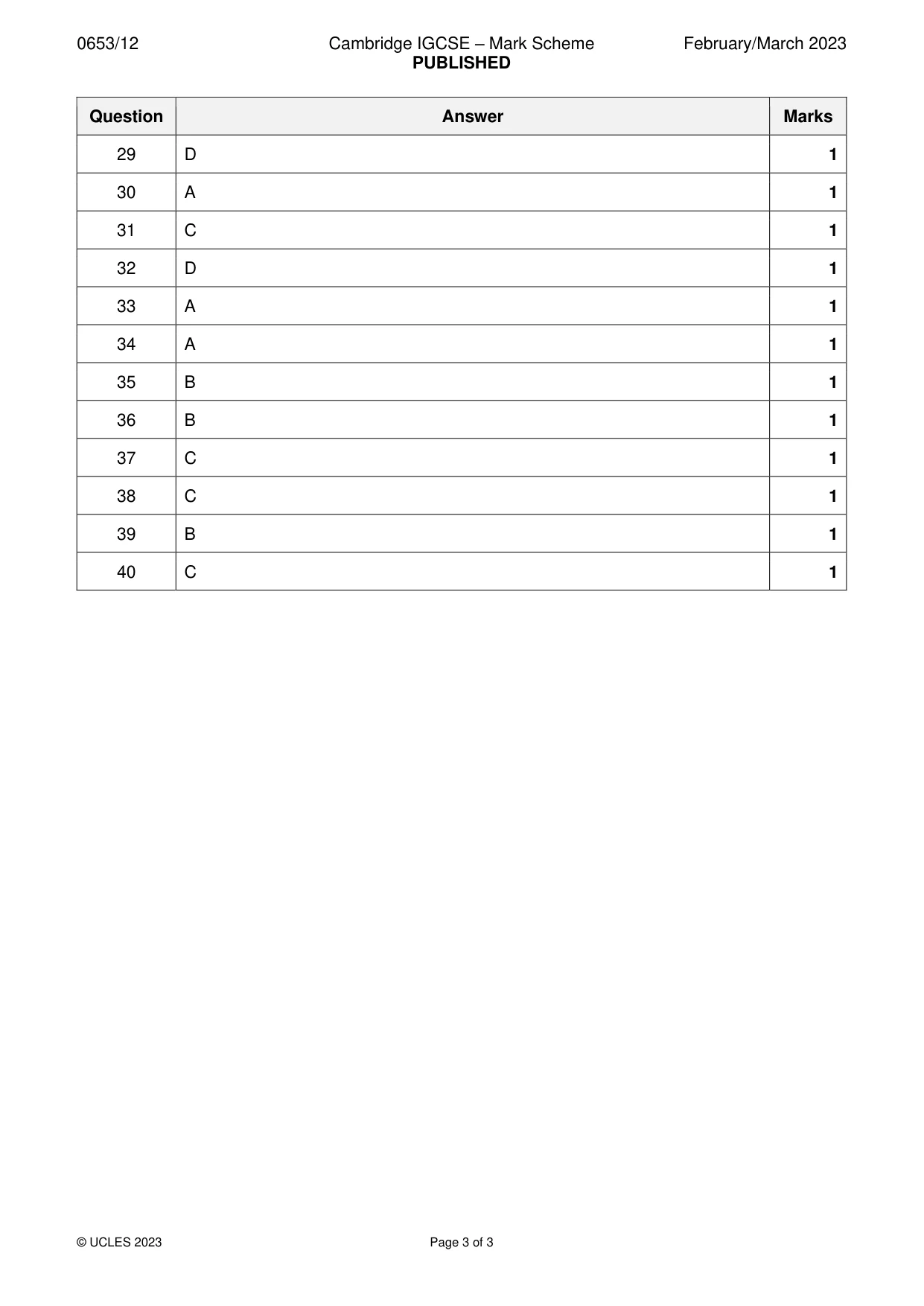
Mark scheme: D
Q30 · A solid object floats on a liquid if its density is less than that of the liquid
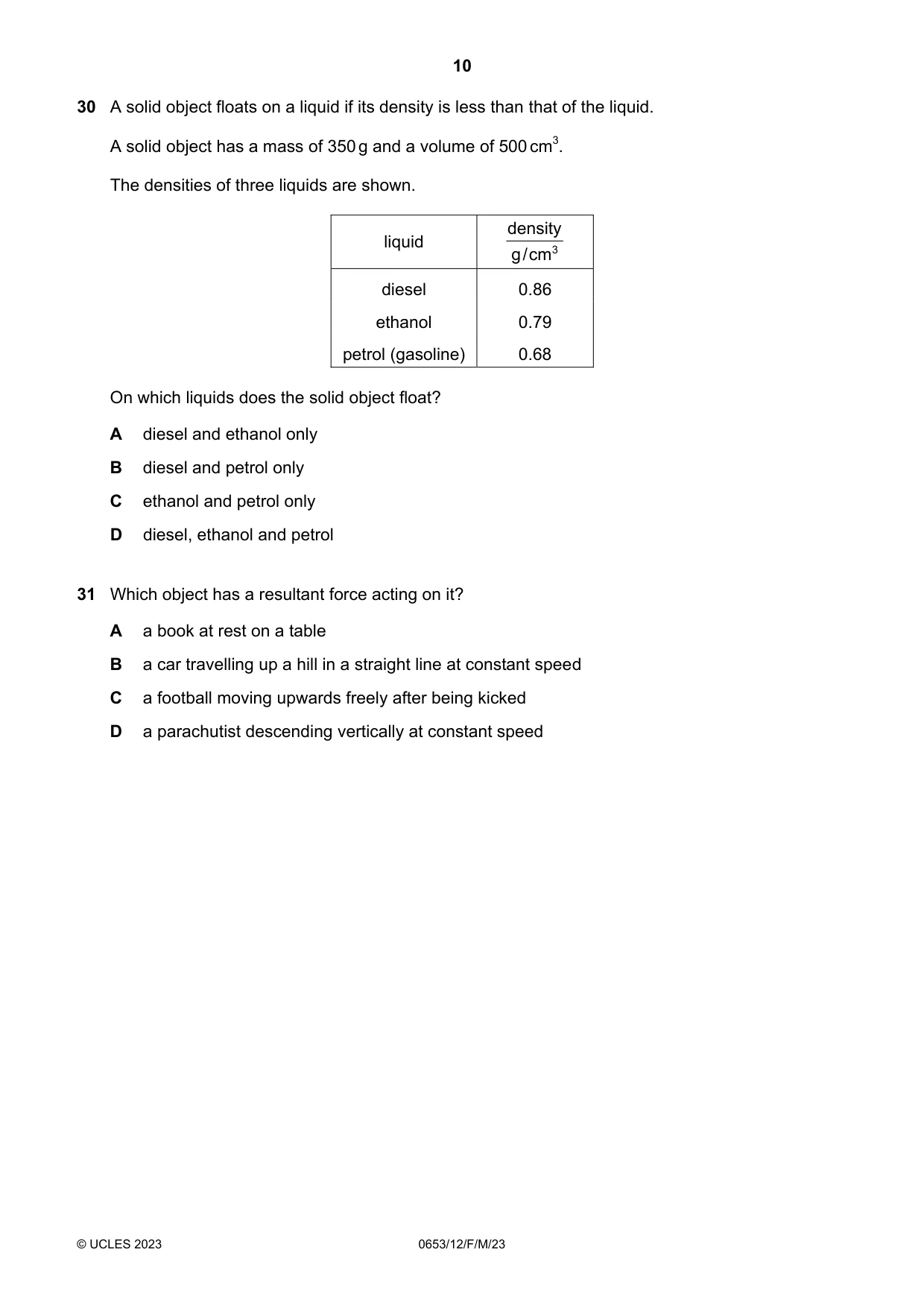
30 A solid object floats on a liquid if its density is less than that of the liquid. A solid object has a mass of 350 g and a volume of 500 cm3. The densities of three liquids are shown. density liquid g cm / 3 diesel 0.86 ethanol 0.79 petrol (gasoline) 0.68 On which liquids does the solid object float? A diesel and ethanol only B diesel and petrol only C ethanol and petrol only D diesel, ethanol and petrol
Mark scheme: A
Q31 · Which object has a resultant force acting on it?
31 Which object has a resultant force acting on it? A a book at rest on a table B a car travelling up a hill in a straight line at constant speed C a football moving upwards freely after being kicked D a parachutist descending vertically at constant speed
Mark scheme: C
Q32 · An object is falling in a vacuum
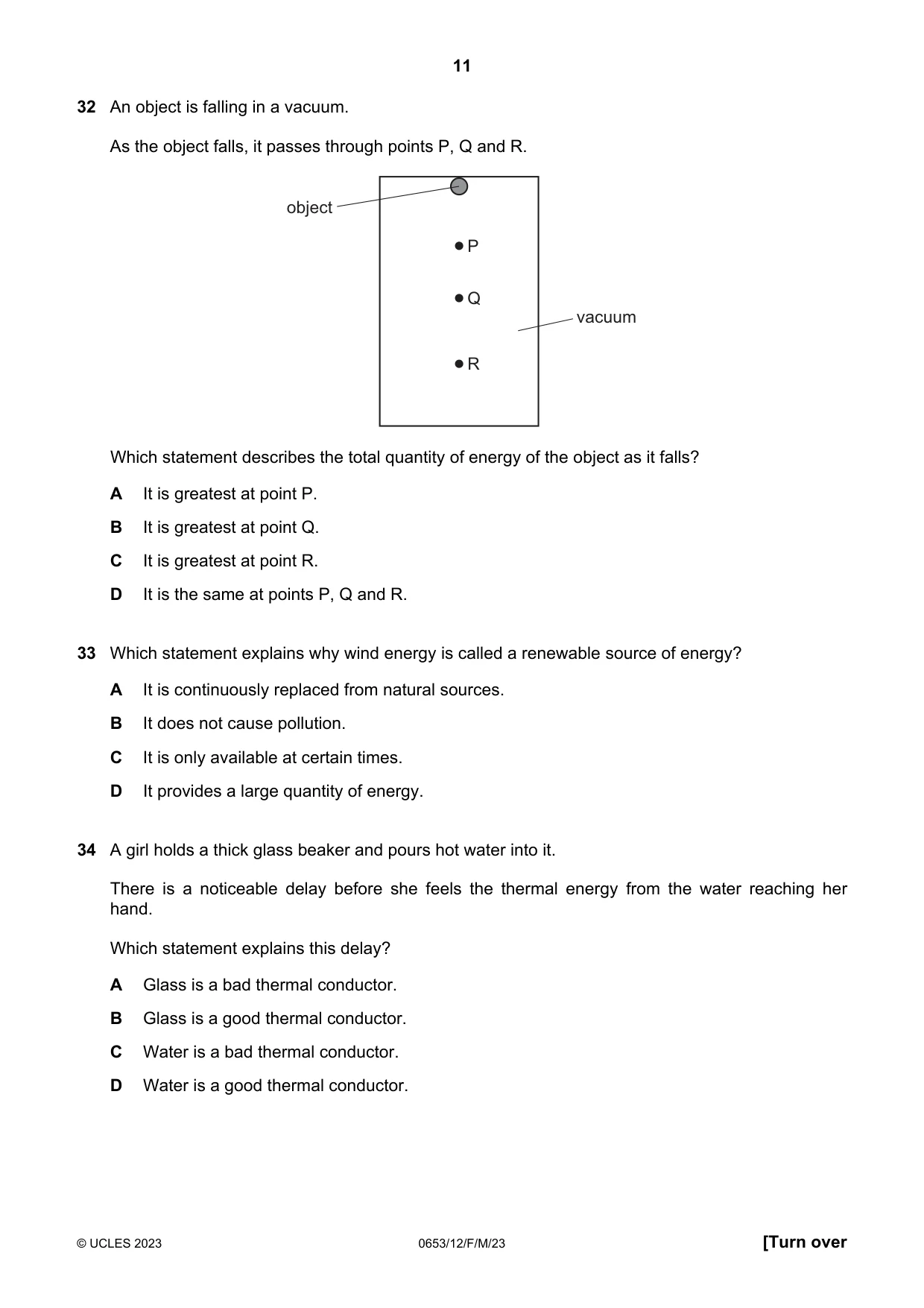
32 An object is falling in a vacuum. As the object falls, it passes through points P, Q and R. object P Q vacuum R Which statement describes the total quantity of energy of the object as it falls? A It is greatest at point P. B It is greatest at point Q. C It is greatest at point R. D It is the same at points P, Q and R.
Mark scheme: D
Q33 · Which statement explains why wind energy is called a renewable source of energy?
33 Which statement explains why wind energy is called a renewable source of energy? A It is continuously replaced from natural sources. B It does not cause pollution. C It is only available at certain times. D It provides a large quantity of energy.
Mark scheme: A
Q34 · A girl holds a thick glass beaker and pours hot water into it
34 A girl holds a thick glass beaker and pours hot water into it. There is a noticeable delay before she feels the thermal energy from the water reaching her hand. Which statement explains this delay? A Glass is a bad thermal conductor. B Glass is a good thermal conductor. C Water is a bad thermal conductor. D Water is a good thermal conductor.
Mark scheme: A
Q35 · In which states of matter can convection occur?
35 In which states of matter can convection occur? in a solid in a liquid in a gas A no no yes B no yes yes C yes no no D yes yes no
Mark scheme: B
Q36 · A ray of light in air is incident on a glass block
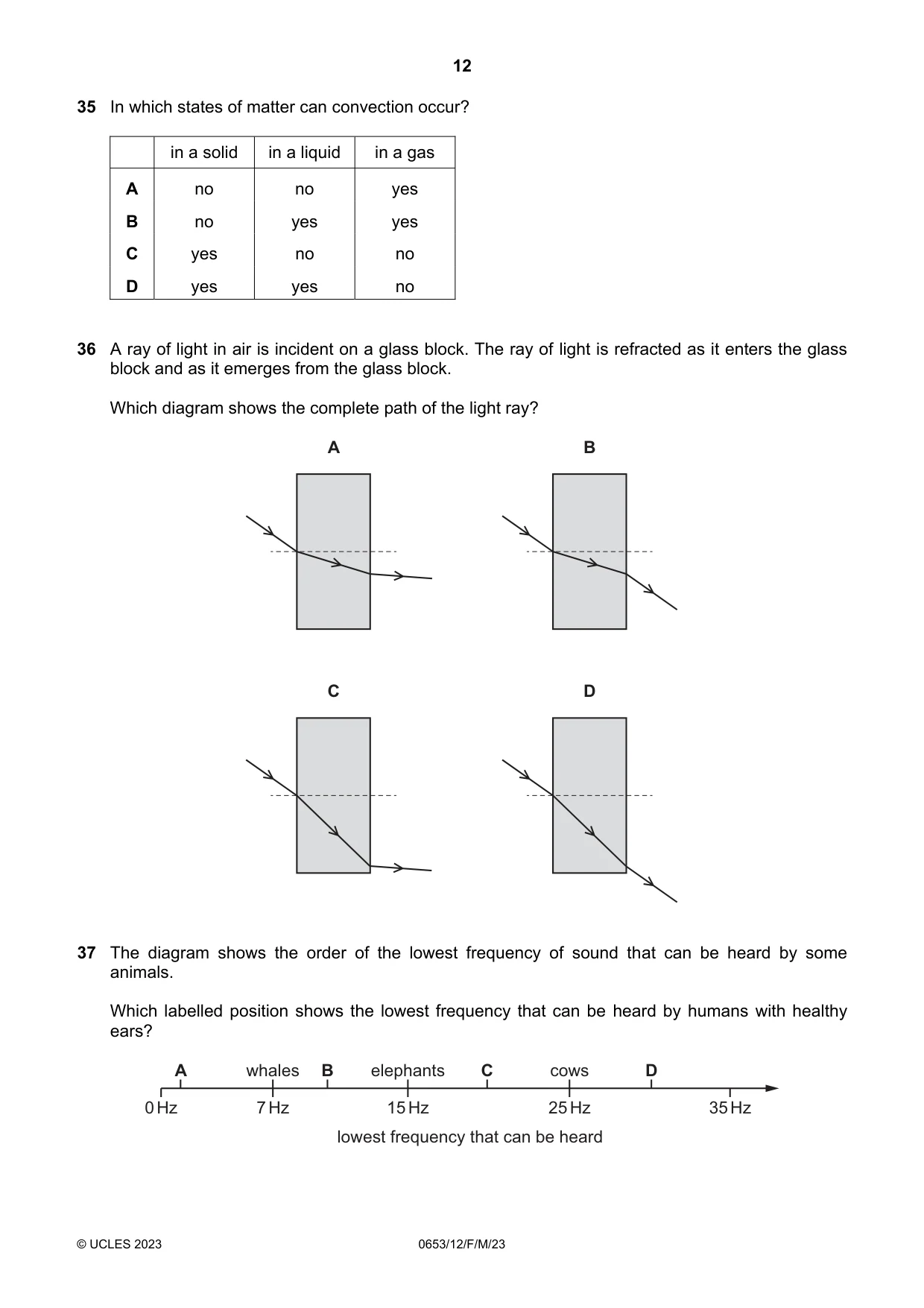
36 A ray of light in air is incident on a glass block. The ray of light is refracted as it enters the glass block and as it emerges from the glass block. Which diagram shows the complete path of the light ray? A B C D
Mark scheme: B
Q37 · The diagram shows the order of the lowest frequency of sound that can be heard by some…
37 The diagram shows the order of the lowest frequency of sound that can be heard by some animals. Which labelled position shows the lowest frequency that can be heard by humans with healthy ears? A whales B elephants C cows D 0 Hz 7 Hz 15 Hz 25 Hz 35 Hz lowest frequency that can be heard
Mark scheme: C
Q38 · A charged sphere is suspended by an insulating thread
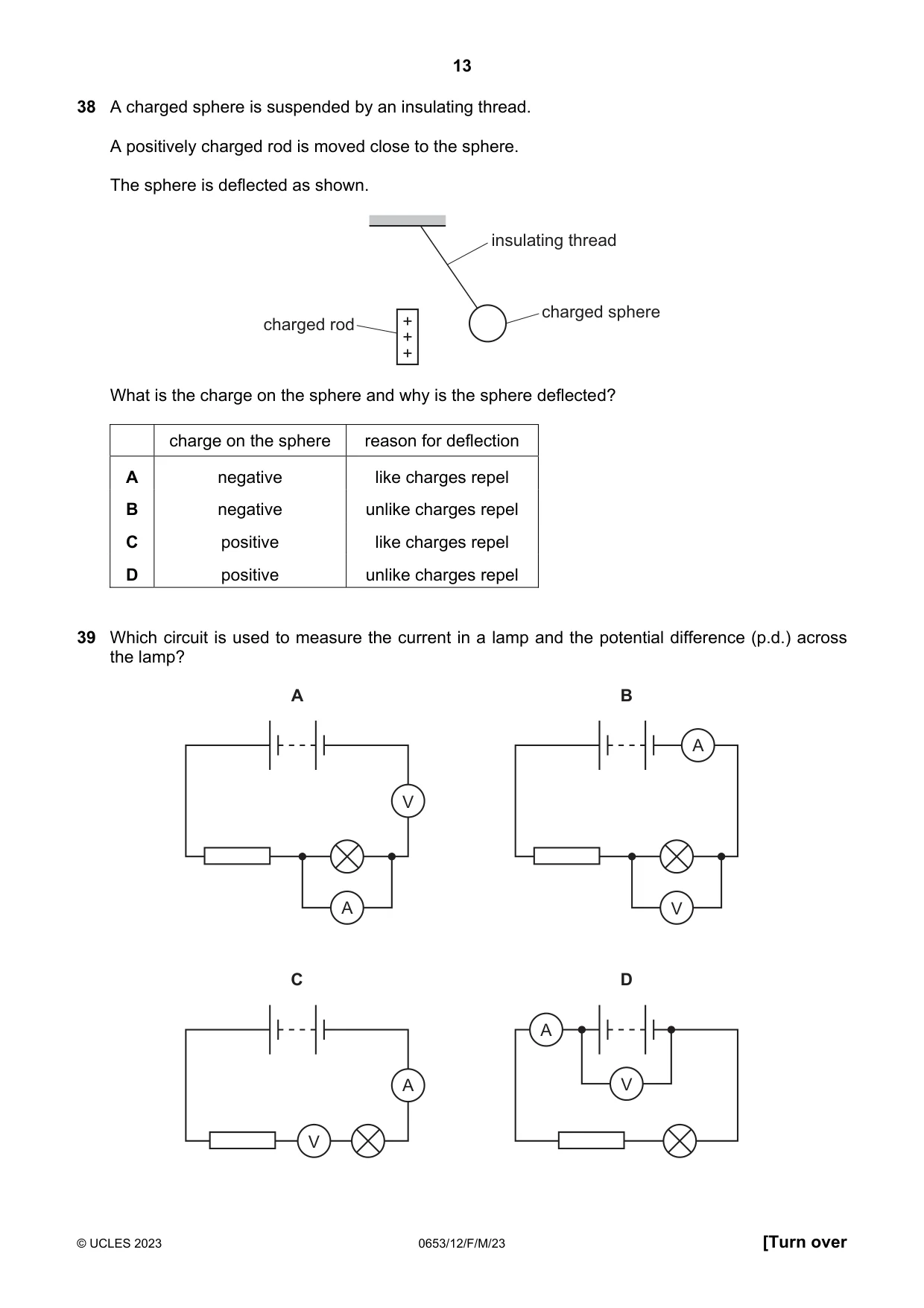
38 A charged sphere is suspended by an insulating thread. A positively charged rod is moved close to the sphere. The sphere is deflected as shown. insulating thread charged sphere charged rod + + + What is the charge on the sphere and why is the sphere deflected? charge on the sphere reason for deflection A negative like charges repel B negative unlike charges repel C positive like charges repel D positive unlike charges repel
Mark scheme: C
Q39 · Which circuit is used to measure the current in a lamp and the potential difference…
39 Which circuit is used to measure the current in a lamp and the potential difference (p.d.) across the lamp? A B A V A V C D A A V V
Mark scheme: B
Q40 · When a computer is switched on, the current increases quickly to 3.1 A and then decreases…
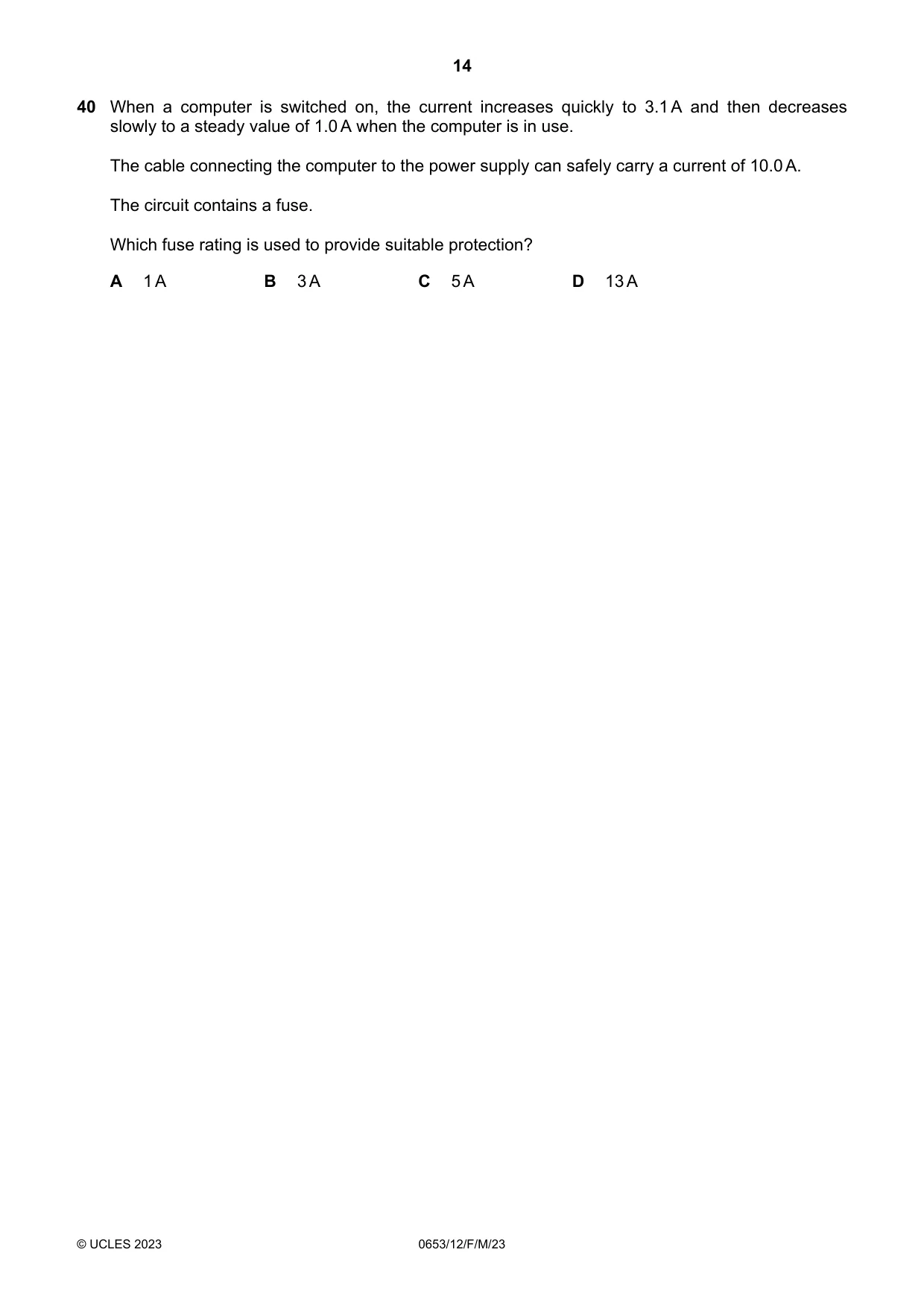
40 When a computer is switched on, the current increases quickly to 3.1 A and then decreases slowly to a steady value of 1.0 A when the computer is in use. The cable connecting the computer to the power supply can safely carry a current of 10.0 A. The circuit contains a fuse. Which fuse rating is used to provide suitable protection? A 1 A B 3 A C 5 A D 13 A
Mark scheme: C
What was in this paper
The subtopics covered by these 40 questions, and how many questions each got. Open one in a new tab to see every Cambridge question on it.
2Forces2Transfer of thermal energy2Air quality and climate1Alkanes1Alkenes1Arrangement of elements1Biological molecules1Blood vessels1Carbon cycle1Characteristics of living organisms1Density1Diet1Digestion1Drugs1Electrical circuits1Electrical quantities1Electrical safety1Enzymes1Exothermic and endothermic reactions1Extraction of metals1Food chains and food webs1Formulas1Gas exchange in humans1Identification of ions and gases1Light1Noble gases1Osmosis1Photosynthesis1Physical quantities and measurement techniques1Rate of reaction1Redox1Separation and purification1Sexual reproduction in plants1Simple molecules and covalent bonds1Sound1The characteristic properties of acids and bases1What you needed in this session
Cambridge’s own grade thresholds for 2023 Feb/March, Paper 1 · Variant 2. A higher threshold means an easier paper — the bar moves with how the cohort did.