Cambridge IGCSE Science - Combined 0653 — 2020 Oct/Nov Paper 1 · Variant 3
0653/13/O/N/20 · 40 questions · 40 marks · ≈45 min
The question paper and its mark scheme, free to read here and free to download. This is Cambridge’s own paper, exactly as it was sat.
Question paper20 pages
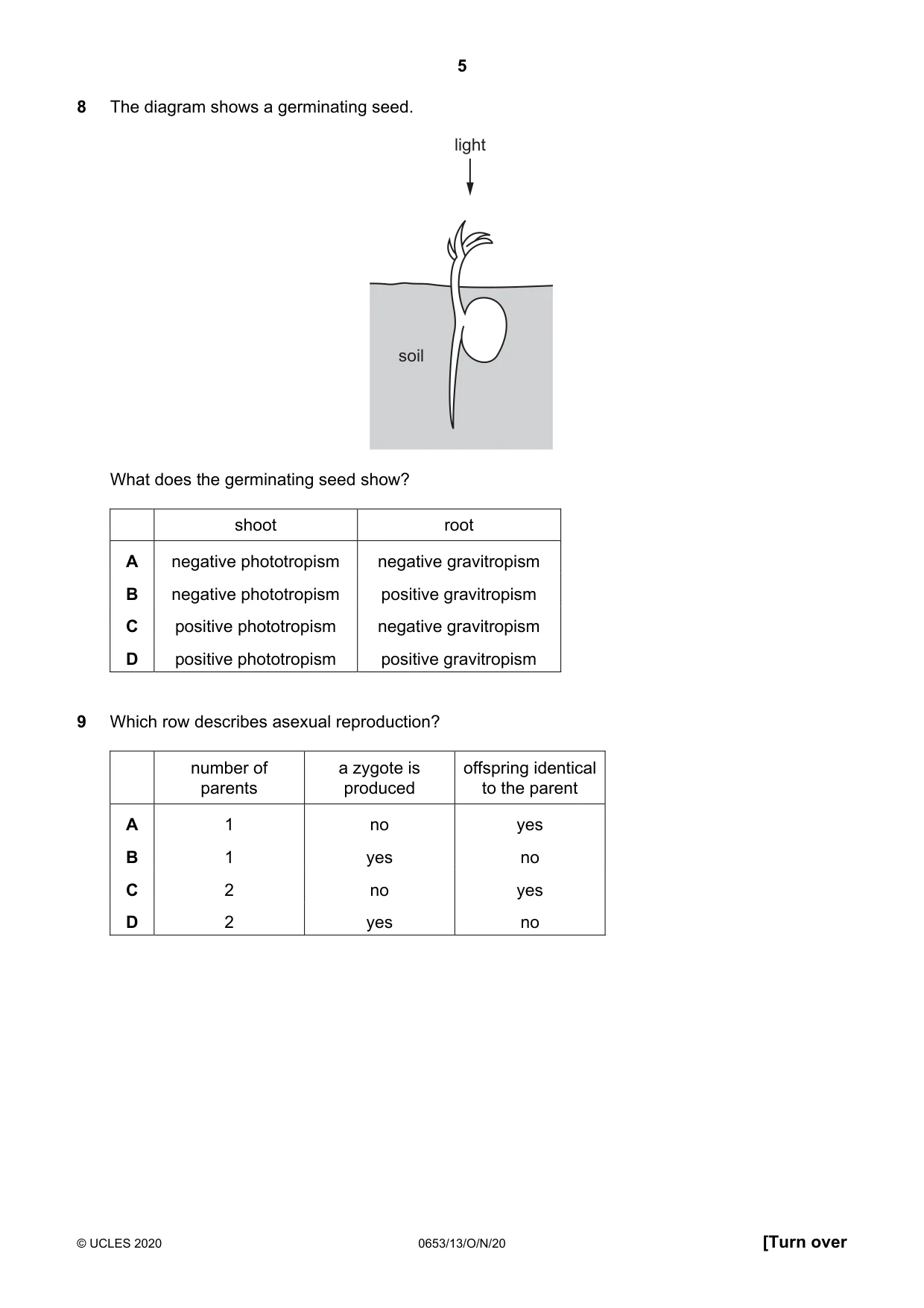
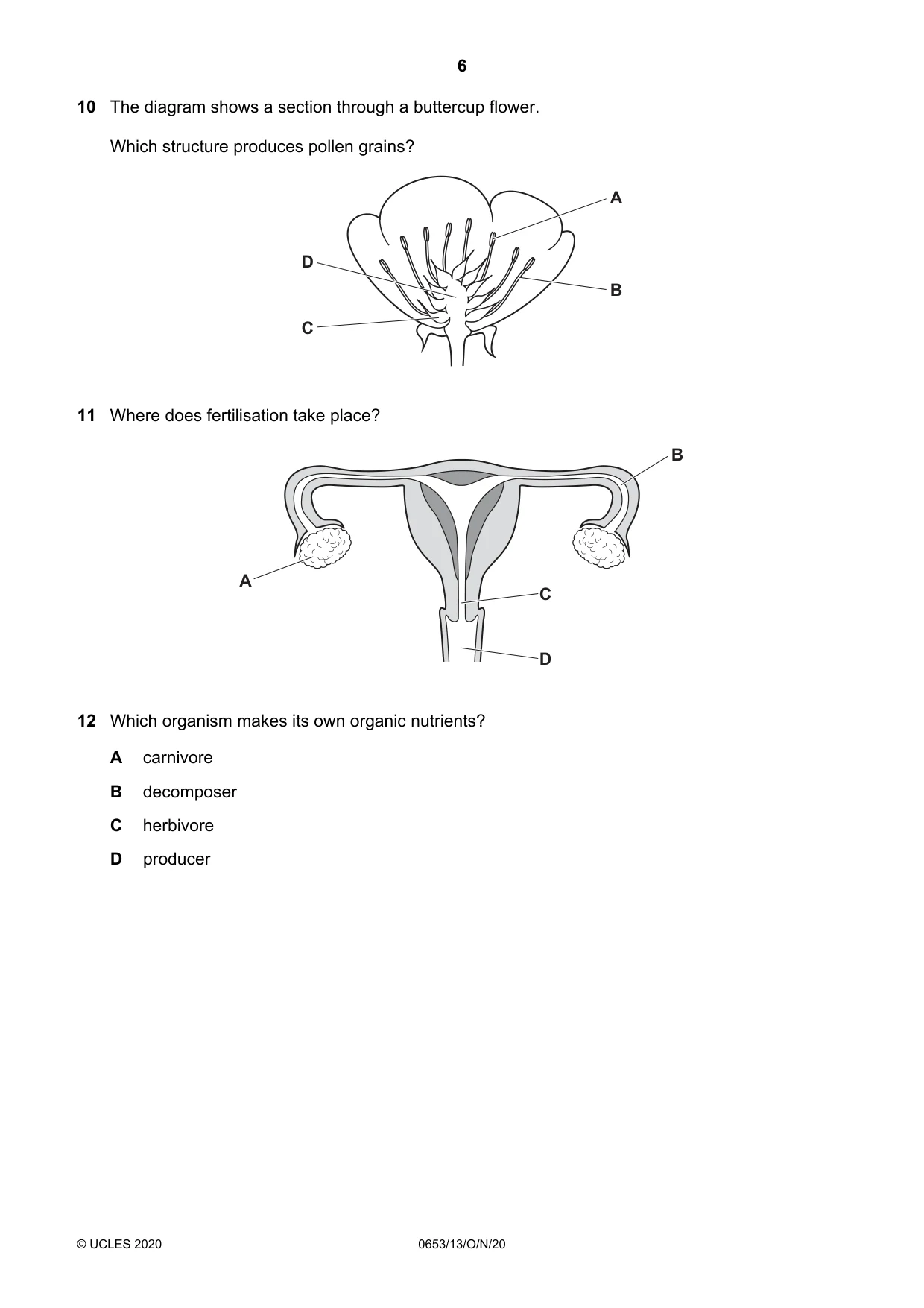
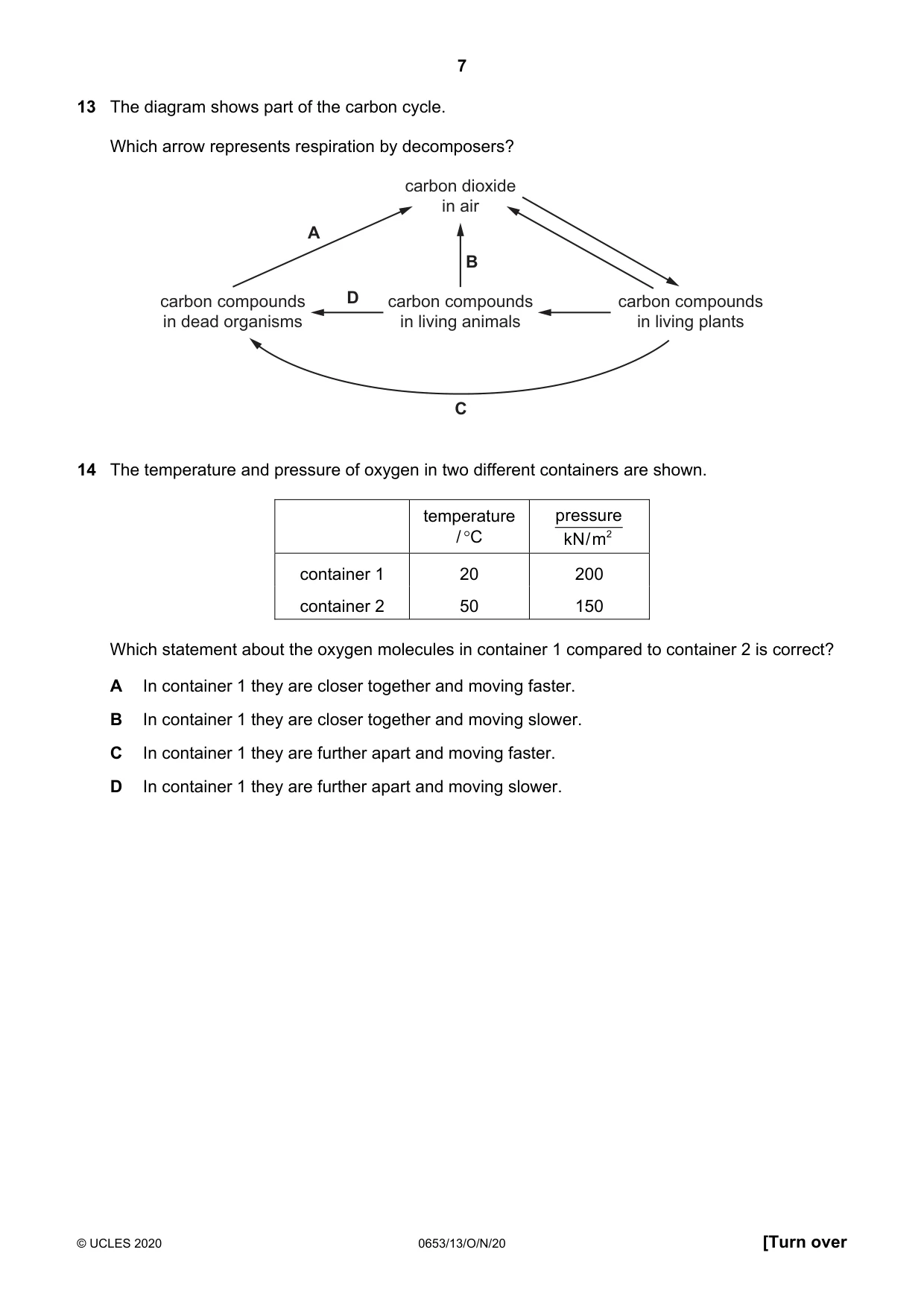
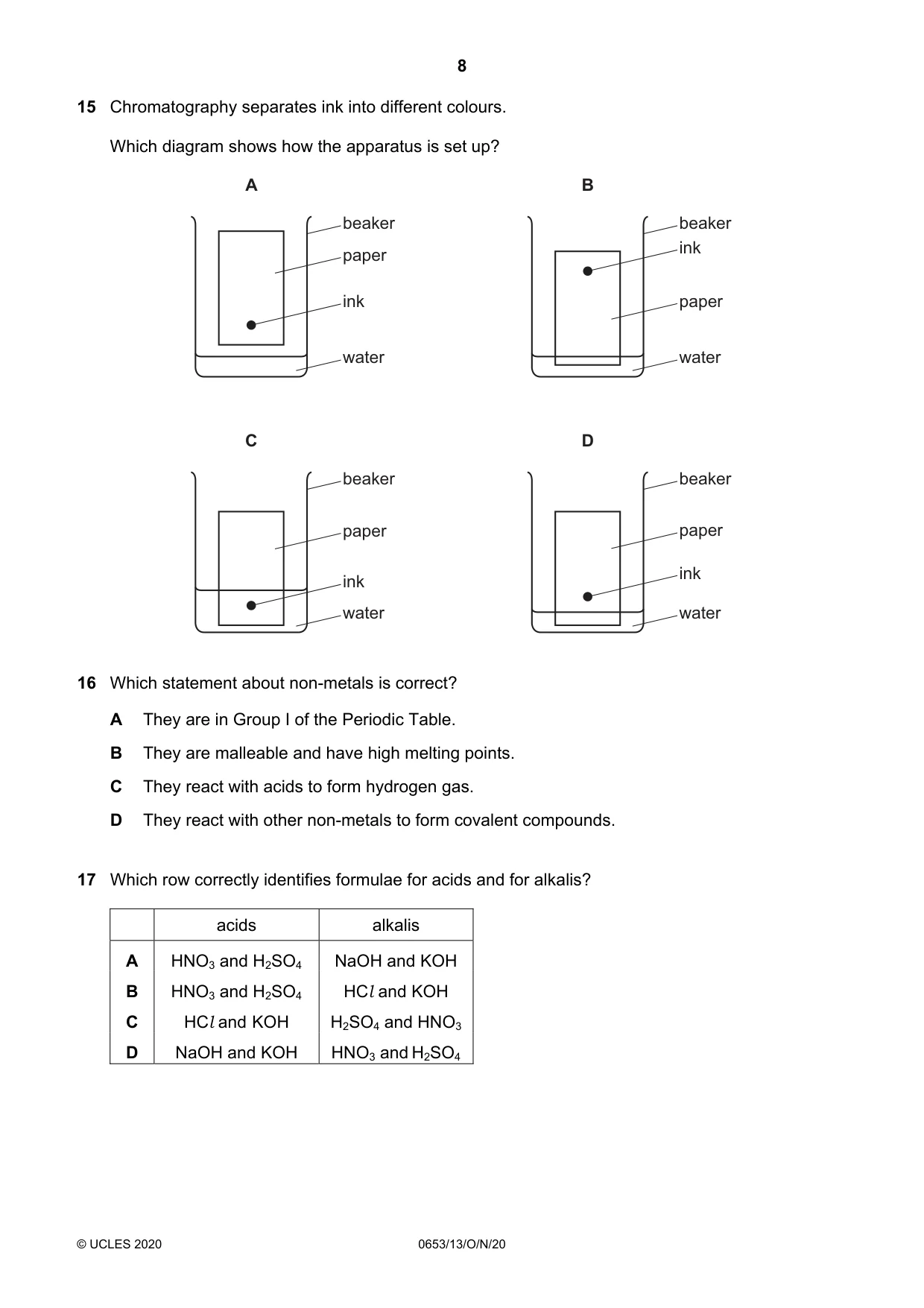


Mark scheme3 pages
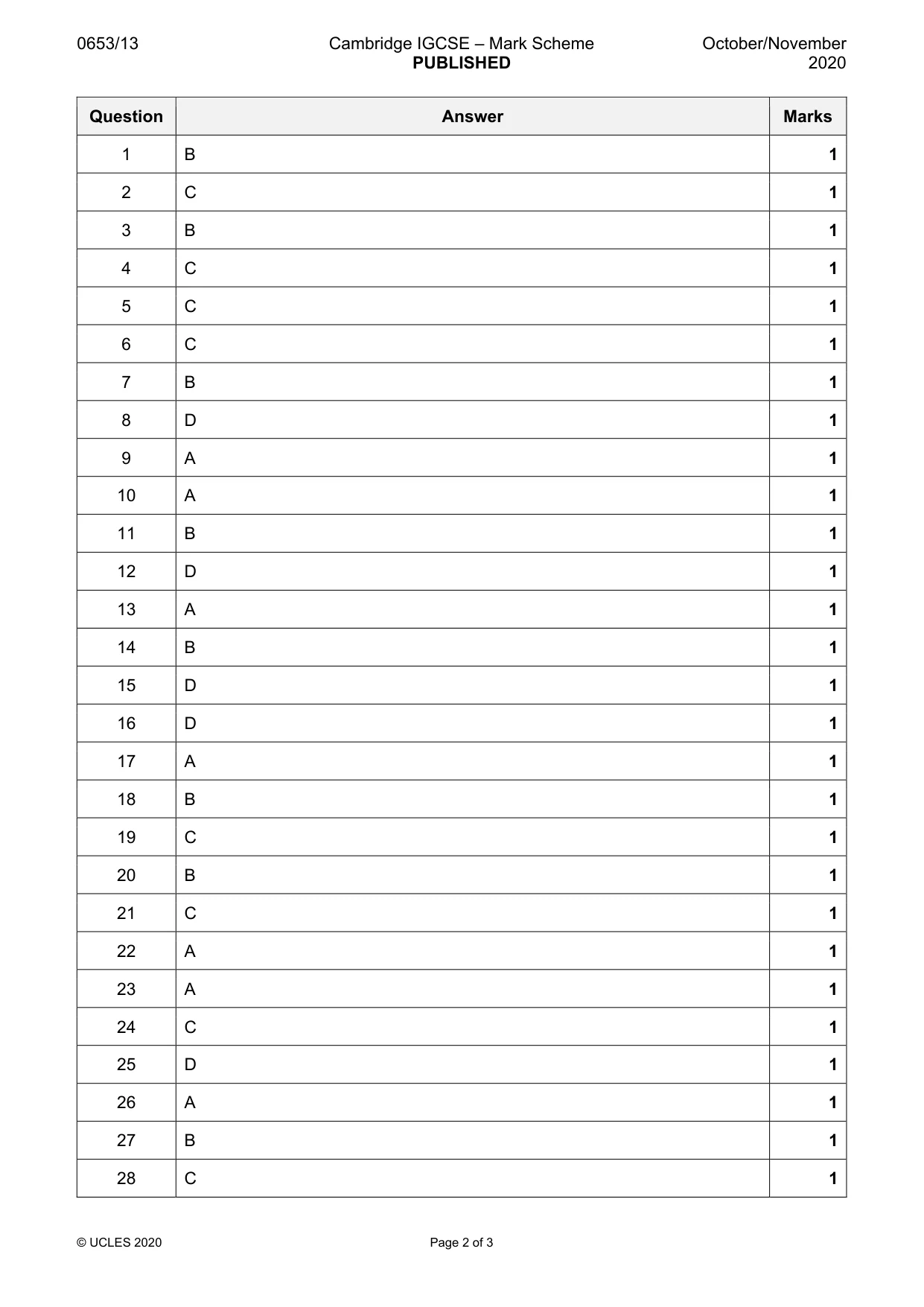
Answers below. Sit the paper first if you are practising.
Questions as text
Q1 · The diagram shows two red blood cells inside a capillary and two tissue cells near this…
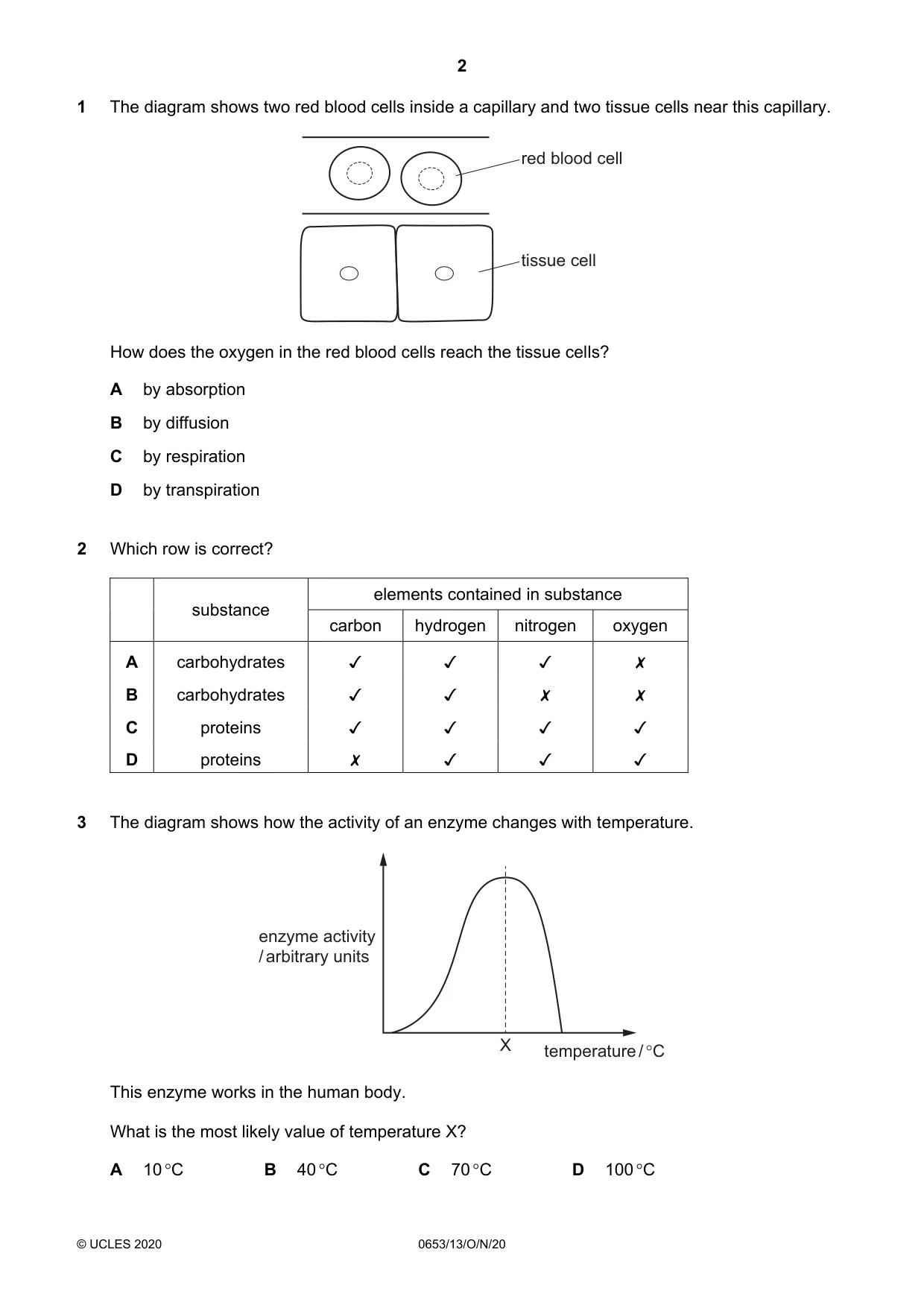
1 The diagram shows two red blood cells inside a capillary and two tissue cells near this capillary. red blood cell tissue cell How does the oxygen in the red blood cells reach the tissue cells? A by absorption B by diffusion C by respiration D by transpiration
Mark scheme: B
Q2 · Which row is correct?
2 Which row is correct? elements contained in substance substance carbon hydrogen | nitrogen oxygen A carbohydrates v v v x B carbohydrates v v x x Cc proteins Jv Jv v v D proteins x Jv Jv Jv
Mark scheme: C
Q3 · The diagram shows how the activity of an enzyme changes with temperature
3 The diagram shows how the activity of an enzyme changes with temperature. enzyme activity / arbitrary units X temperature / °C This enzyme works in the human body. What is the most likely value of temperature X? A 10 C B 40 C C 70 C D 100 C
Mark scheme: B
Q4 · Which label gives the correct function of that region of the alimentary canal and its…
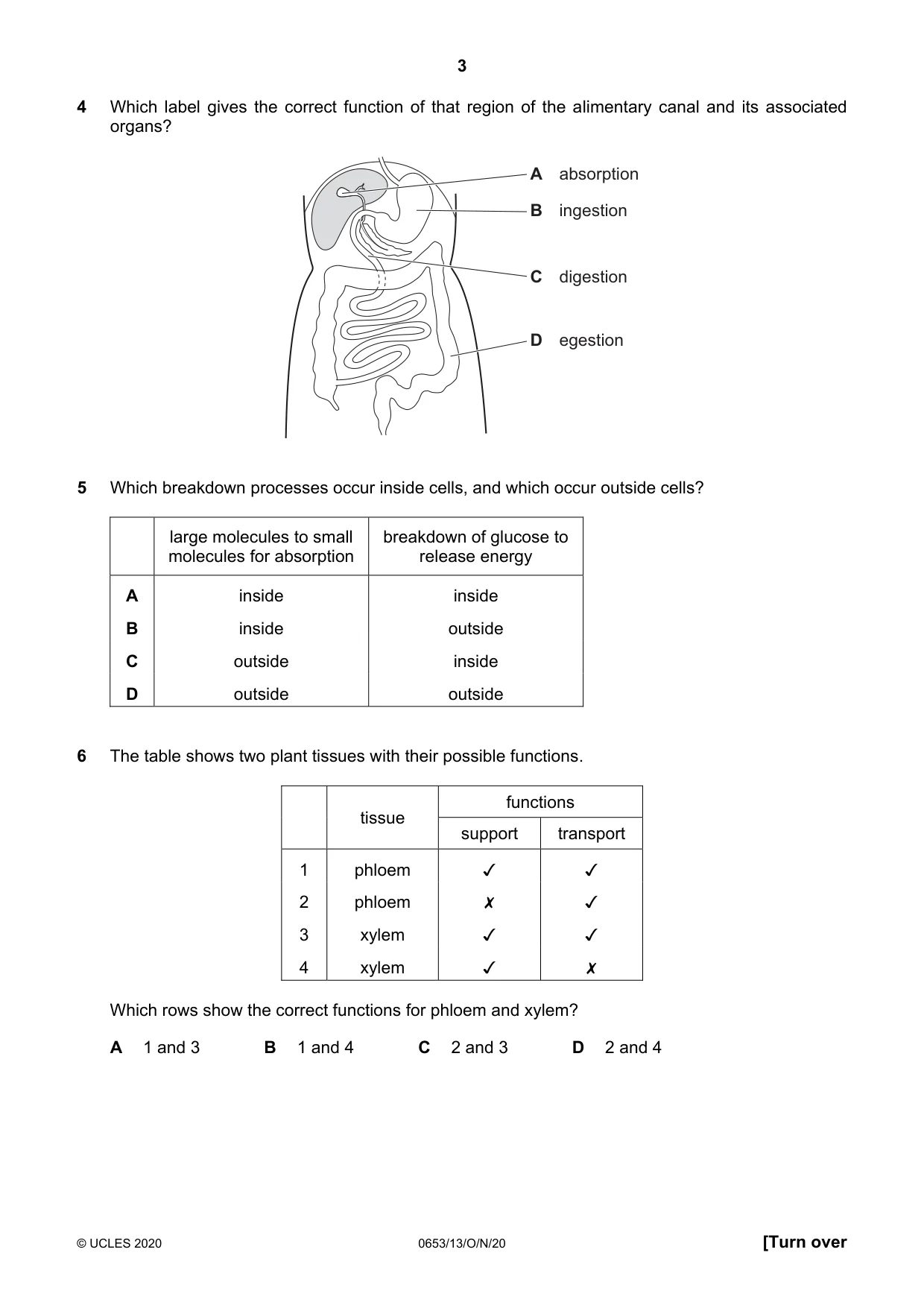
4 Which label gives the correct function of that region of the alimentary canal and its associated organs? A absorption B ingestion C digestion D egestion
Mark scheme: C
Q5 · Which breakdown processes occur inside cells, and which occur outside cells?
5 Which breakdown processes occur inside cells, and which occur outside cells? large molecules to small breakdown of glucose to molecules for absorption release energy A inside inside B inside outside C outside inside D outside outside
Mark scheme: C
Q6 · The table shows two plant tissues with their possible functions
6 The table shows two plant tissues with their possible functions. functions support transport J J x J J J J x Which rows show the correct functions for phloem and xylem? A 1and3 B 1and4 C 2and3 D 2and4
Mark scheme: C
Q7 · A student uses the apparatus shown to investigate the composition of inspired and expired…
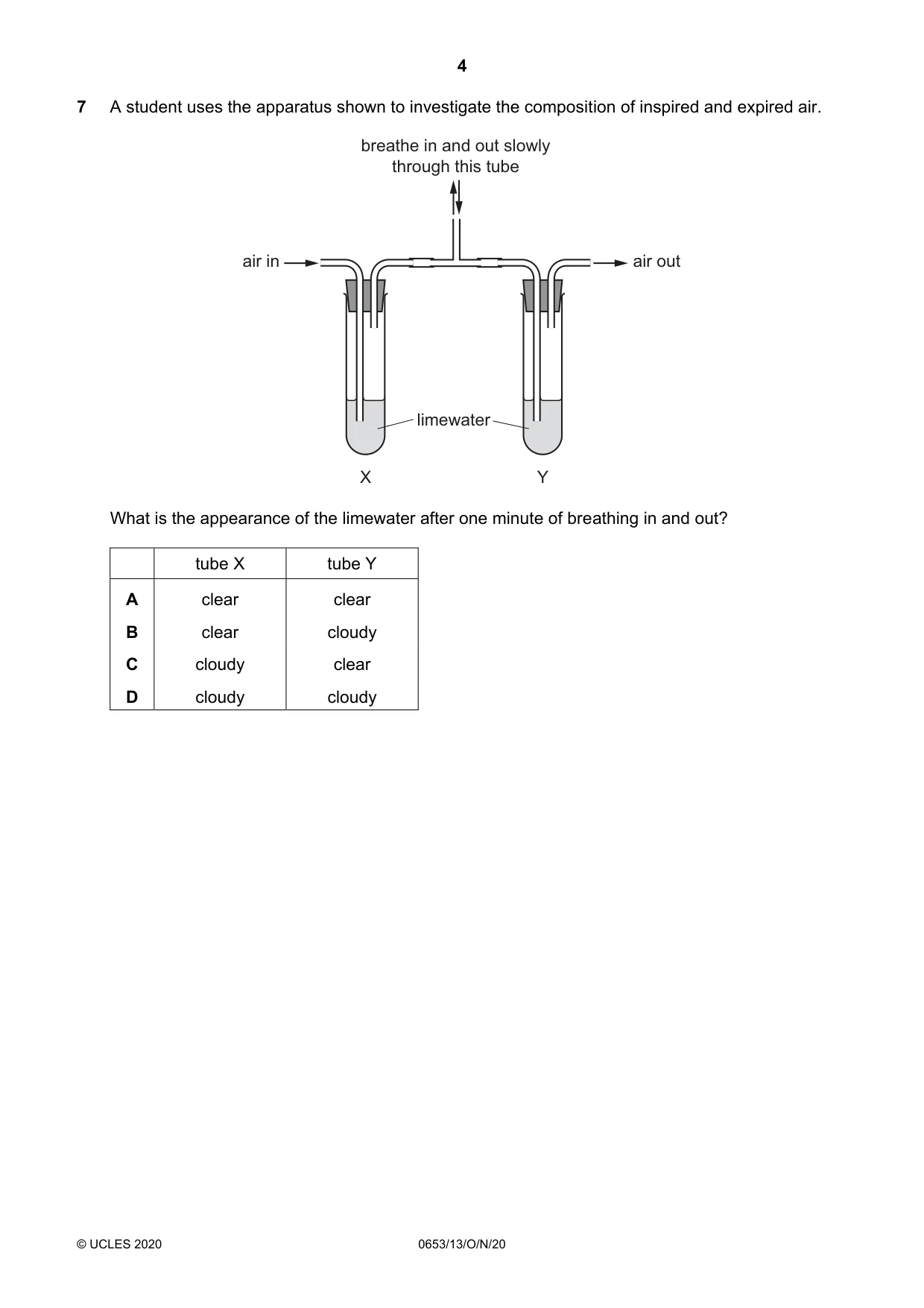
7 A student uses the apparatus shown to investigate the composition of inspired and expired air. breathe in and out slowly through this tube air in air out limewater X Y What is the appearance of the limewater after one minute of breathing in and out? tube X tube Y A clear clear B clear cloudy C cloudy clear D cloudy cloudy
Mark scheme: B
Q8 · The diagram shows a germinating seed
8 The diagram shows a germinating seed. light soil What does the germinating seed show? shoot root A negative phototropism negative gravitropism B negative phototropism positive gravitropism C positive phototropism negative gravitropism D positive phototropism positive gravitropism
Mark scheme: D
Q9 · Which row describes asexual reproduction?
9 Which row describes asexual reproduction? number of a zygote is offspring identical parents produced to the parent A 1 no yes B 1 yes no C 2 no yes D 2 yes no
Mark scheme: A
Q10 · The diagram shows a section through a buttercup flower
10 The diagram shows a section through a buttercup flower. Which structure produces pollen grains? A D B C
Mark scheme: A
Q11 · Where does fertilisation take place?
11 Where does fertilisation take place? B A C D
Mark scheme: B
Q12 · Which organism makes its own organic nutrients?
12 Which organism makes its own organic nutrients? A carnivore B decomposer C herbivore D producer
Mark scheme: D
Q13 · The diagram shows part of the carbon cycle
13 The diagram shows part of the carbon cycle. Which arrow represents respiration by decomposers? carbon dioxide in air A B carbon compounds D carbon compounds carbon compounds in dead organisms in living animals in living plants C
Mark scheme: A
Q14 · The temperature and pressure of oxygen in two different containers are shown
14 The temperature and pressure of oxygen in two different containers are shown. temperature p r es ur s e / C kN / m 2 container 1 20 200 container 2 50 150 Which statement about the oxygen molecules in container 1 compared to container 2 is correct? A In container 1 they are closer together and moving faster. B In container 1 they are closer together and moving slower. C In container 1 they are further apart and moving faster. D In container 1 they are further apart and moving slower.
Mark scheme: B
Q15 · Chromatography separates ink into different colours
15 Chromatography separates ink into different colours. Which diagram shows how the apparatus is set up? A B beaker beaker paper ink ink paper water water C D beaker beaker paper paper ink ink water water
Mark scheme: D
Q16 · Which statement about non-metals is correct?
16 Which statement about non-metals is correct? A They are in Group I of the Periodic Table. B They are malleable and have high melting points. C They react with acids to form hydrogen gas. D They react with other non-metals to form covalent compounds.
Mark scheme: D
Q17 · Which row correctly identifies formulae for acids and for alkalis?
17 Which row correctly identifies formulae for acids and for alkalis? acids alkalis A HNO3 and H2SO4 NaOH and KOH B HNO3 and H2SO4 HCl and KOH C HCl and KOH H2SO4 and HNO3 D NaOH and KOH HNO3 and H2SO4
Mark scheme: A
More questions on The characteristic properties of acids and bases
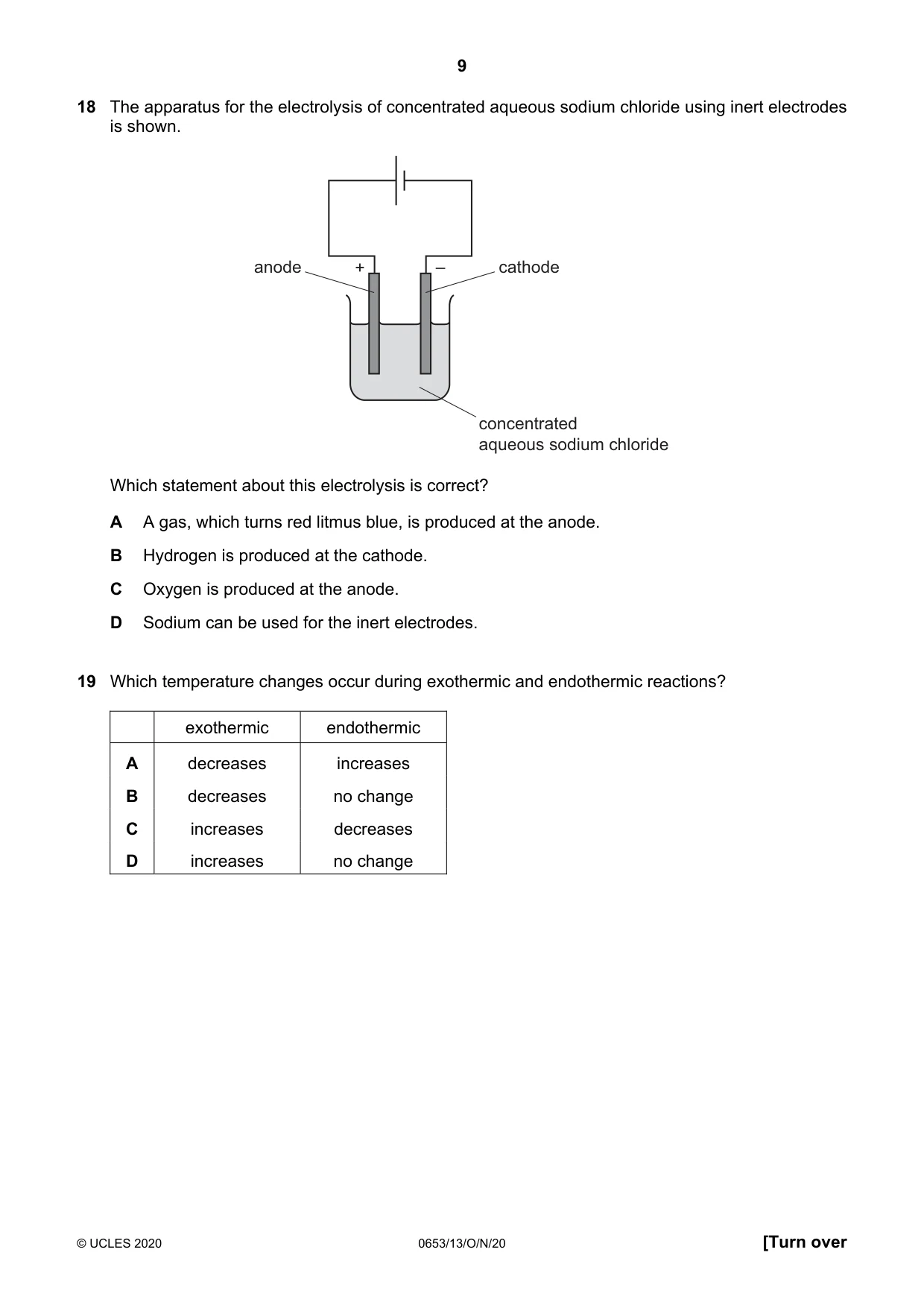
Q18 · The apparatus for the electrolysis of concentrated aqueous sodium chloride using inert…
18 The apparatus for the electrolysis of concentrated aqueous sodium chloride using inert electrodes is shown. anode + – cathode concentrated aqueous sodium chloride Which statement about this electrolysis is correct? A A gas, which turns red litmus blue, is produced at the anode. B Hydrogen is produced at the cathode. C Oxygen is produced at the anode. D Sodium can be used for the inert electrodes.
Mark scheme: B
Q19 · Which temperature changes occur during exothermic and endothermic reactions?
19 Which temperature changes occur during exothermic and endothermic reactions? exothermic endothermic A decreases increases B decreases no change C increases decreases D increases no change
Mark scheme: C
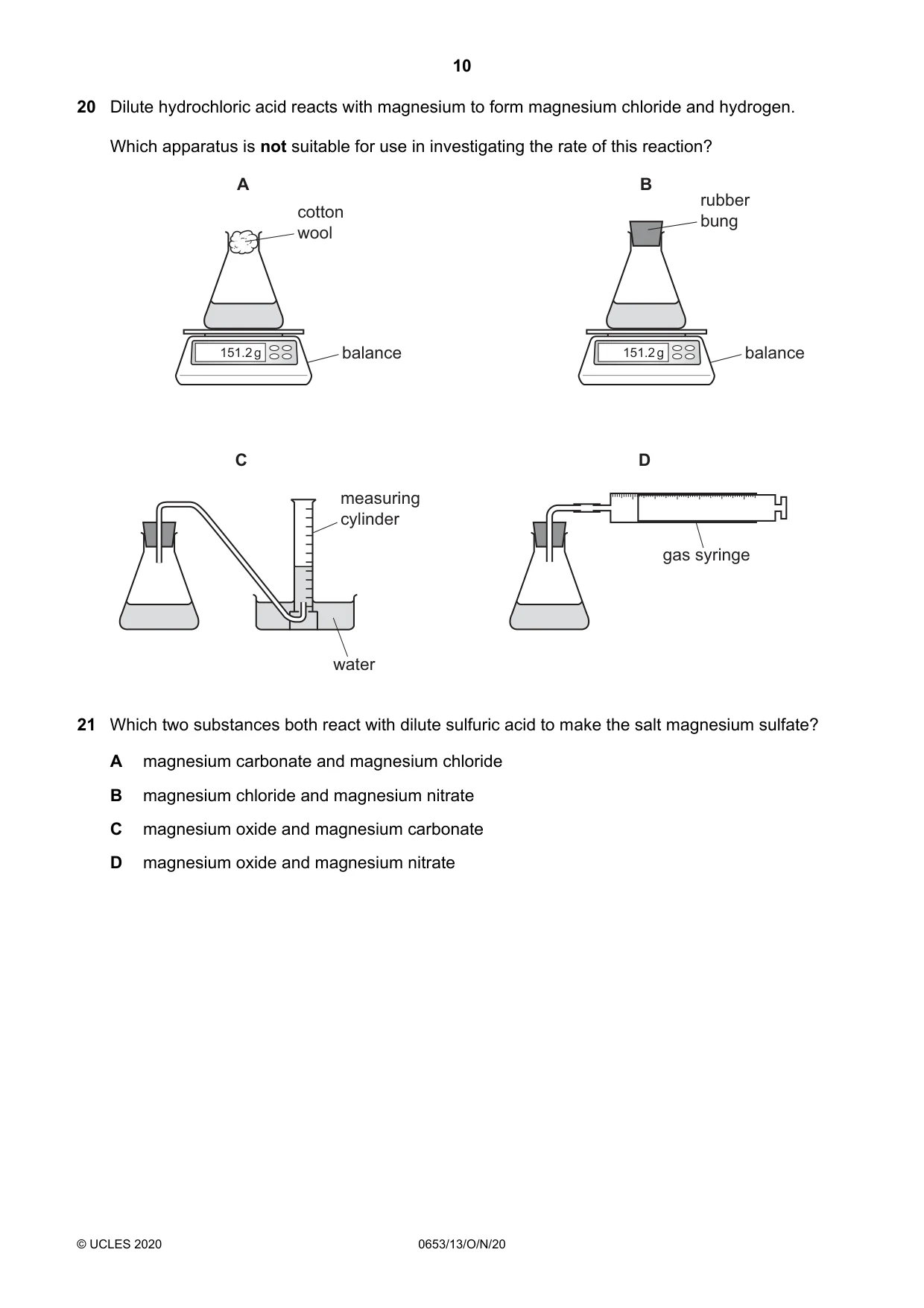
Q20 · Dilute hydrochloric acid reacts with magnesium to form magnesium chloride and hydrogen
20 Dilute hydrochloric acid reacts with magnesium to form magnesium chloride and hydrogen. Which apparatus is not suitable for use in investigating the rate of this reaction? A B rubber cotton bung wool 151.2 g balance 151.2 g balance C D measuring cylinder gas syringe water
Mark scheme: B
Q21 · Which two substances both react with dilute sulfuric acid to make the salt magnesium…
21 Which two substances both react with dilute sulfuric acid to make the salt magnesium sulfate? A magnesium carbonate and magnesium chloride B magnesium chloride and magnesium nitrate C magnesium oxide and magnesium carbonate D magnesium oxide and magnesium nitrate
Mark scheme: C
More questions on The characteristic properties of acids and bases
Q22 · Acid X reacts with metal Y
22 Acid X reacts with metal Y. A colourless gas is given off and a pale green solution is produced. Two tests are carried out on the solution. test reagent(s) added result 1 aqueous silver nitrate and nitric acid white precipitate 2 aqueous sodium hydroxide green precipitate What are acid X and metal Y? acid metal A hydrochloric iron B hydrochloric zinc C sulfuric iron D sulfuric zinc
Mark scheme: A
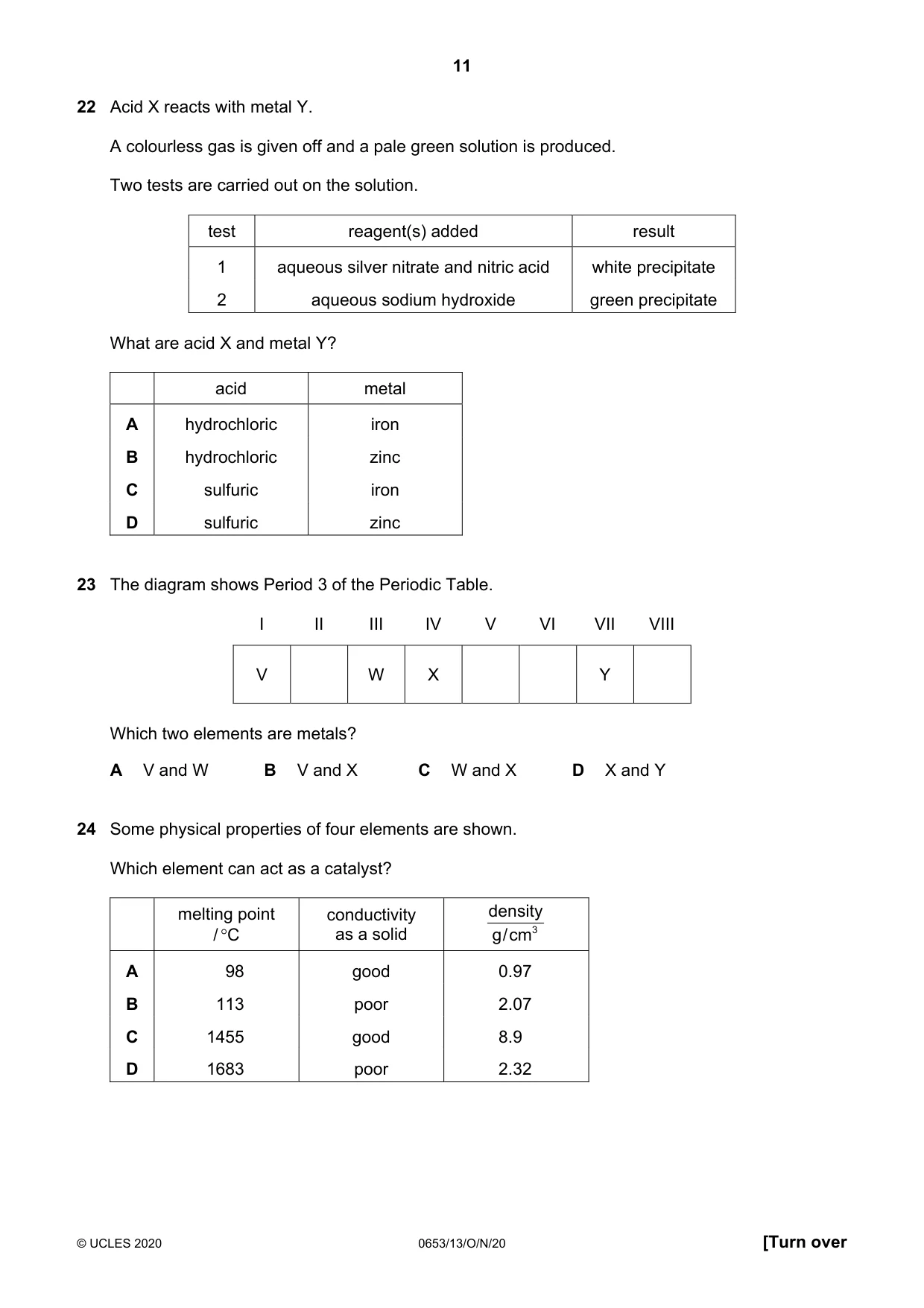
Q23 · The diagram shows Period 3 of the Periodic Table
23 The diagram shows Period 3 of the Periodic Table. I II III IV V VI VII VIII V W X Y Which two elements are metals? A V and W B V and X C W and X D X and Y
Mark scheme: A
Q24 · Some physical properties of four elements are shown
24 Some physical properties of four elements are shown. Which element can act as a catalyst? melting point conductivity d ens ty i / C as a solid g / cm 3 A 98 good 0.97 B 113 poor 2.07 C 1455 good 8.9 D 1683 poor 2.32
Mark scheme: C
Q25 · Which method is used to extract copper from copper(II) oxide?
25 Which method is used to extract copper from copper(II) oxide? A dissolving copper(II) oxide in hydrochloric acid and then filtering B dissolving copper(II) oxide in water and then filtering C heating the copper(II) oxide D heating the copper(II) oxide mixed with carbon
Mark scheme: D
Q26 · Decane is a hydrocarbon
26 Decane is a hydrocarbon. Which greenhouse gas is made during the complete combustion of decane? A carbon dioxide B carbon monoxide C hydrogen D methane
Mark scheme: A
Q27 · Which statement describes a hydrocarbon?
27 Which statement describes a hydrocarbon? A a compound that burns to form carbon dioxide and hydrogen B a compound that contains carbon and hydrogen only C a compound that only contains ionic bonds D a compound that reacts easily with metals
Mark scheme: B
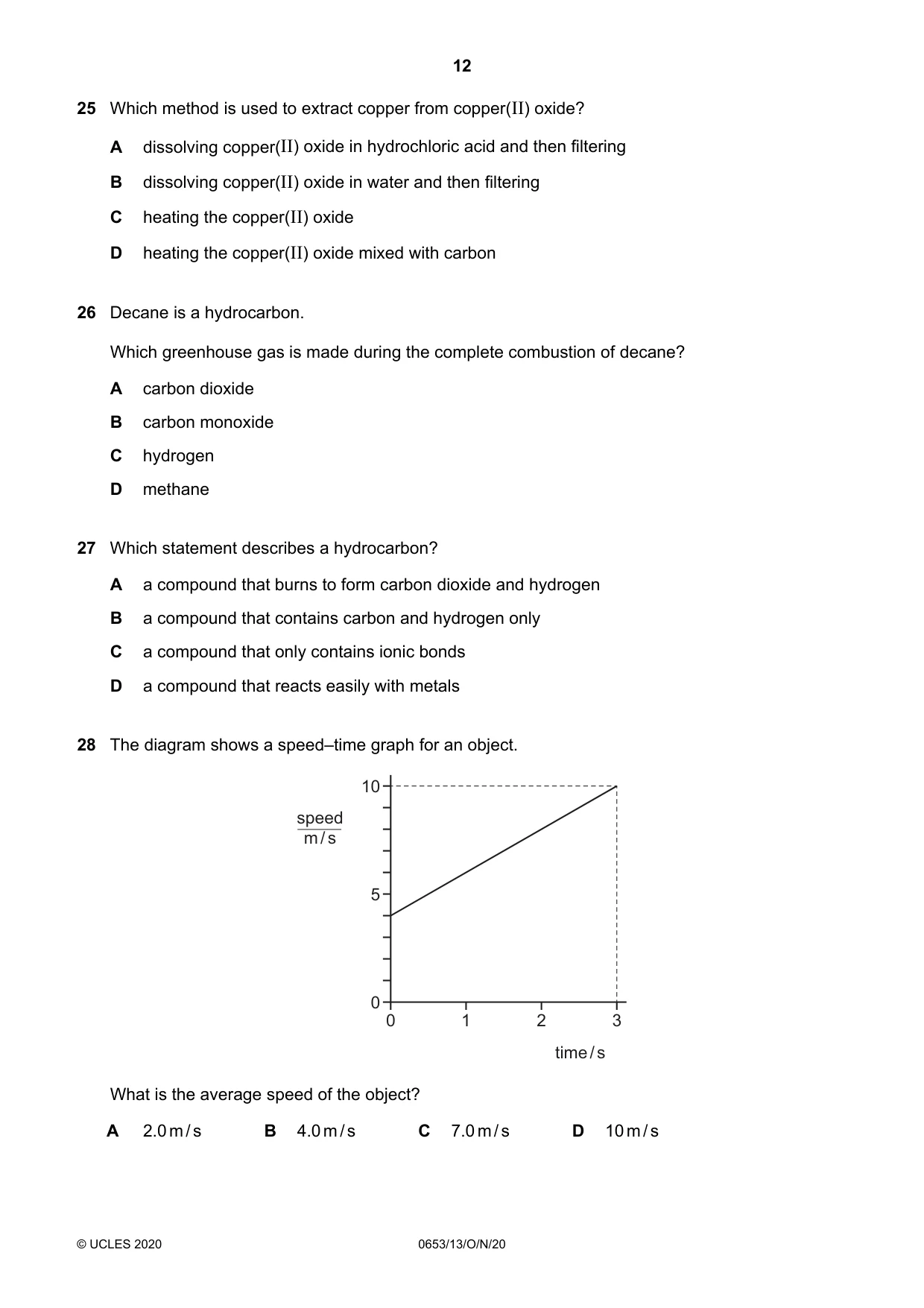
Q28 · The diagram shows a speed–time graph for an object
28 The diagram shows a speed–time graph for an object. 10 speed m / s 5 0 0 1 2 3 time / s What is the average speed of the object? A 2.0 m / s B 4.0 m / s C 7.0 m / s D 10 m / s
Mark scheme: C
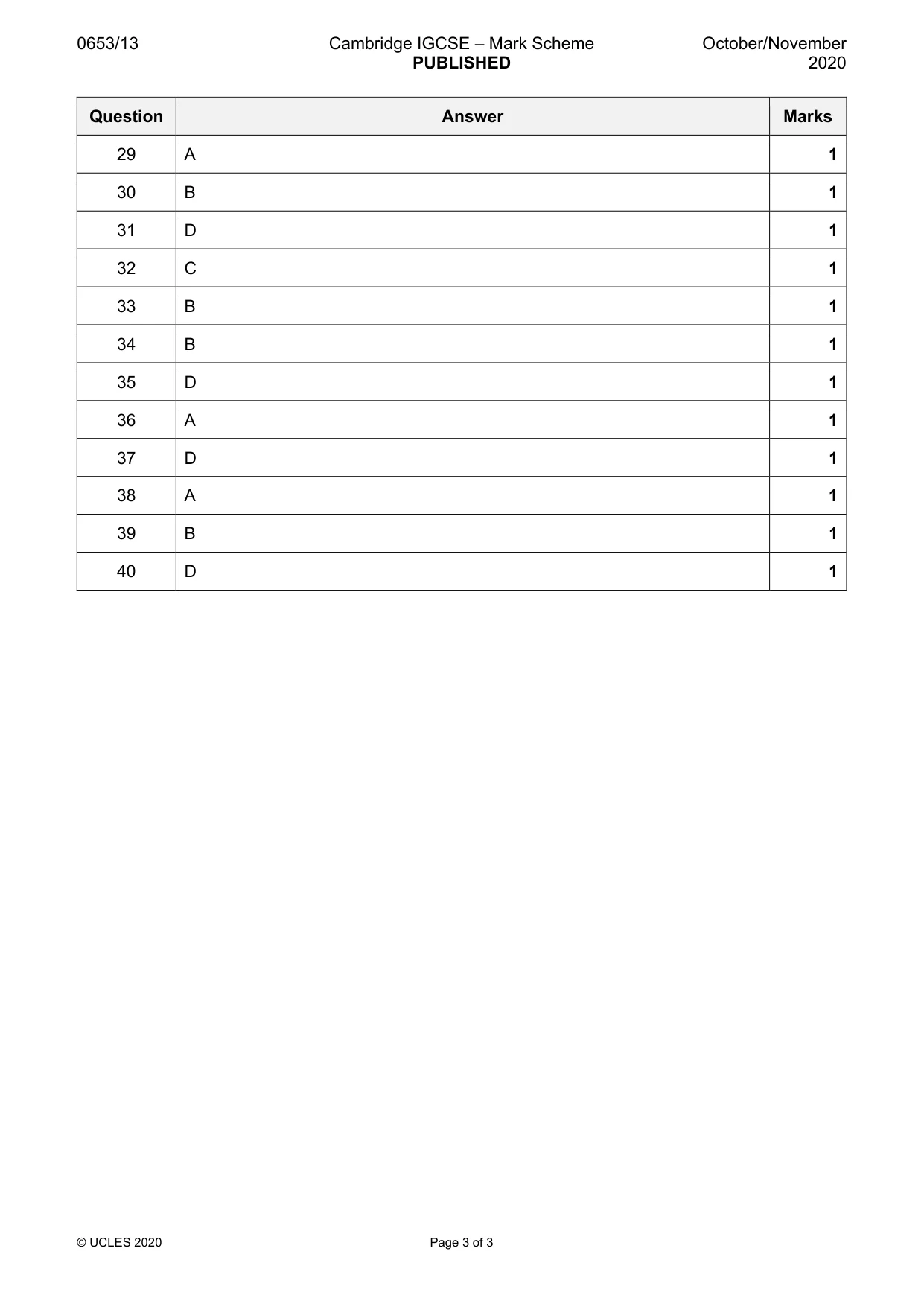
Q29 · The gravitational field strength is 10 N / kg
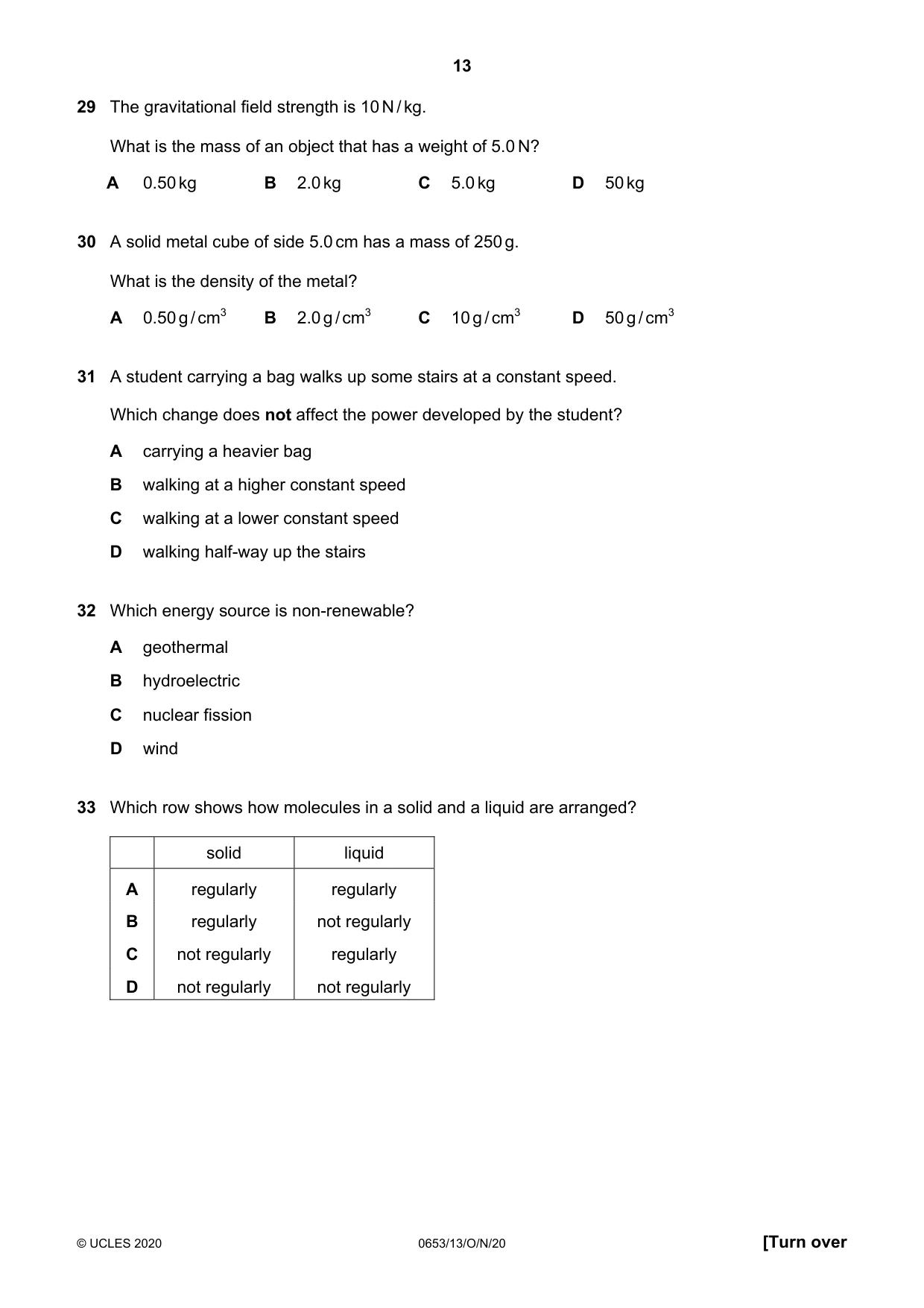
29 The gravitational field strength is 10 N / kg. What is the mass of an object that has a weight of 5.0 N? A 0.50 kg B 2.0 kg C 5.0 kg D 50 kg
Mark scheme: A
Q30 · A solid metal cube of side 5.0 cm has a mass of 250 g
30 A solid metal cube of side 5.0 cm has a mass of 250 g. What is the density of the metal? A 0.50 g / cm3 B 2.0 g / cm3 C 10 g / cm3 D 50 g / cm3
Mark scheme: B
Q31 · A student carrying a bag walks up some stairs at a constant speed
31 A student carrying a bag walks up some stairs at a constant speed. Which change does not affect the power developed by the student? A carrying a heavier bag B walking at a higher constant speed C walking at a lower constant speed D walking half-way up the stairs
Mark scheme: D
Q32 · Which energy source is non-renewable?
32 Which energy source is non-renewable? A geothermal B hydroelectric C nuclear fission D wind
Mark scheme: C
Q33 · Which row shows how molecules in a solid and a liquid are arranged?
33 Which row shows how molecules in a solid and a liquid are arranged? solid liquid A regularly regularly B regularly not regularly C not regularly regularly D not regularly not regularly
Mark scheme: B
Q34 · In which states of matter can convection occur?
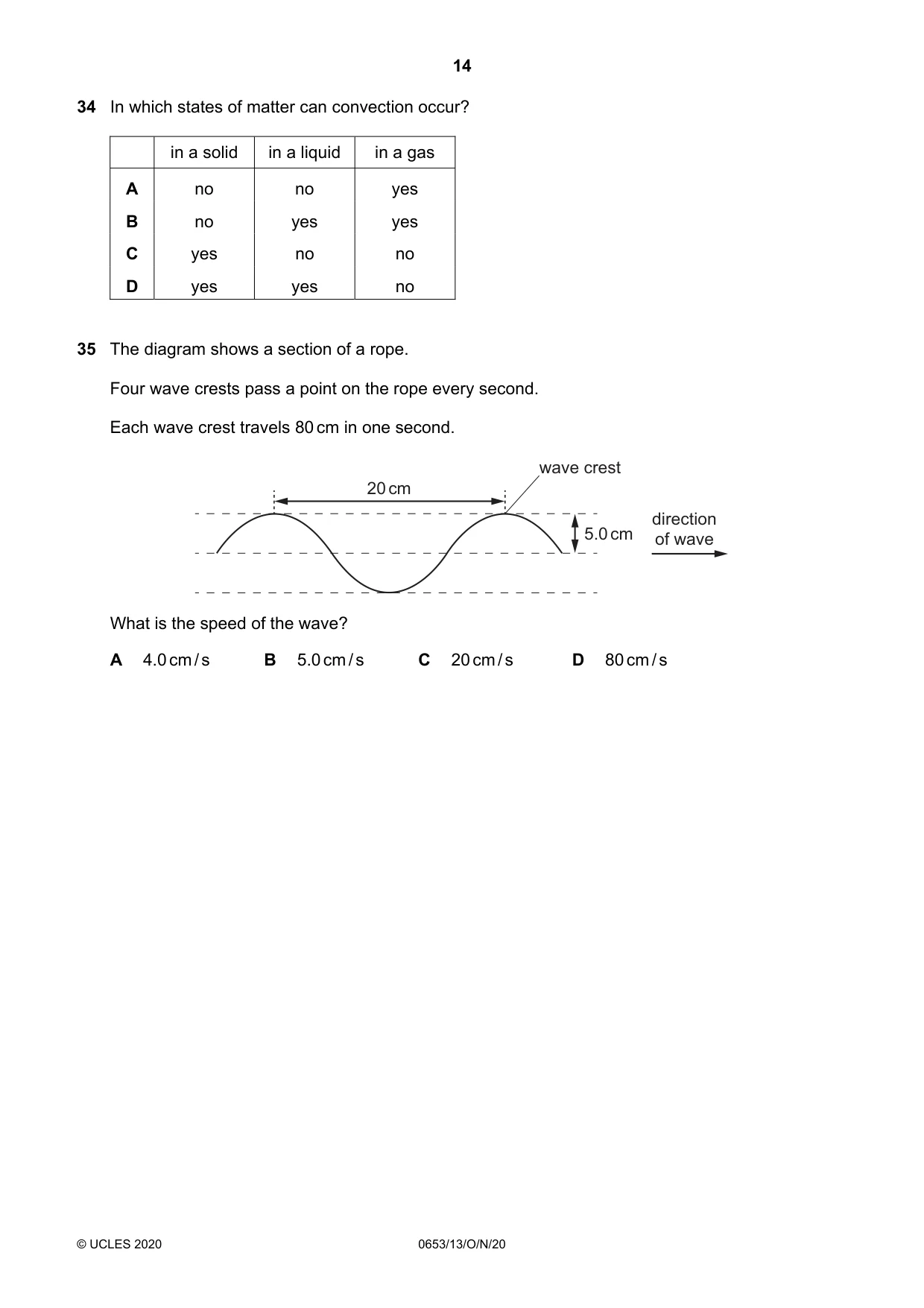
34 In which states of matter can convection occur? in a solid in a liquid in a gas A no no yes B no yes yes C yes no no D yes yes no
Mark scheme: B
Q35 · The diagram shows a section of a rope
35 The diagram shows a section of a rope. Four wave crests pass a point on the rope every second. Each wave crest travels 80 cm in one second. wave crest 20 cm direction 5.0 cm of wave What is the speed of the wave? A 4.0 cm / s B 5.0 cm / s C 20 cm / s D 80 cm / s
Mark scheme: D
Q36 · Light travelling in air strikes a glass block
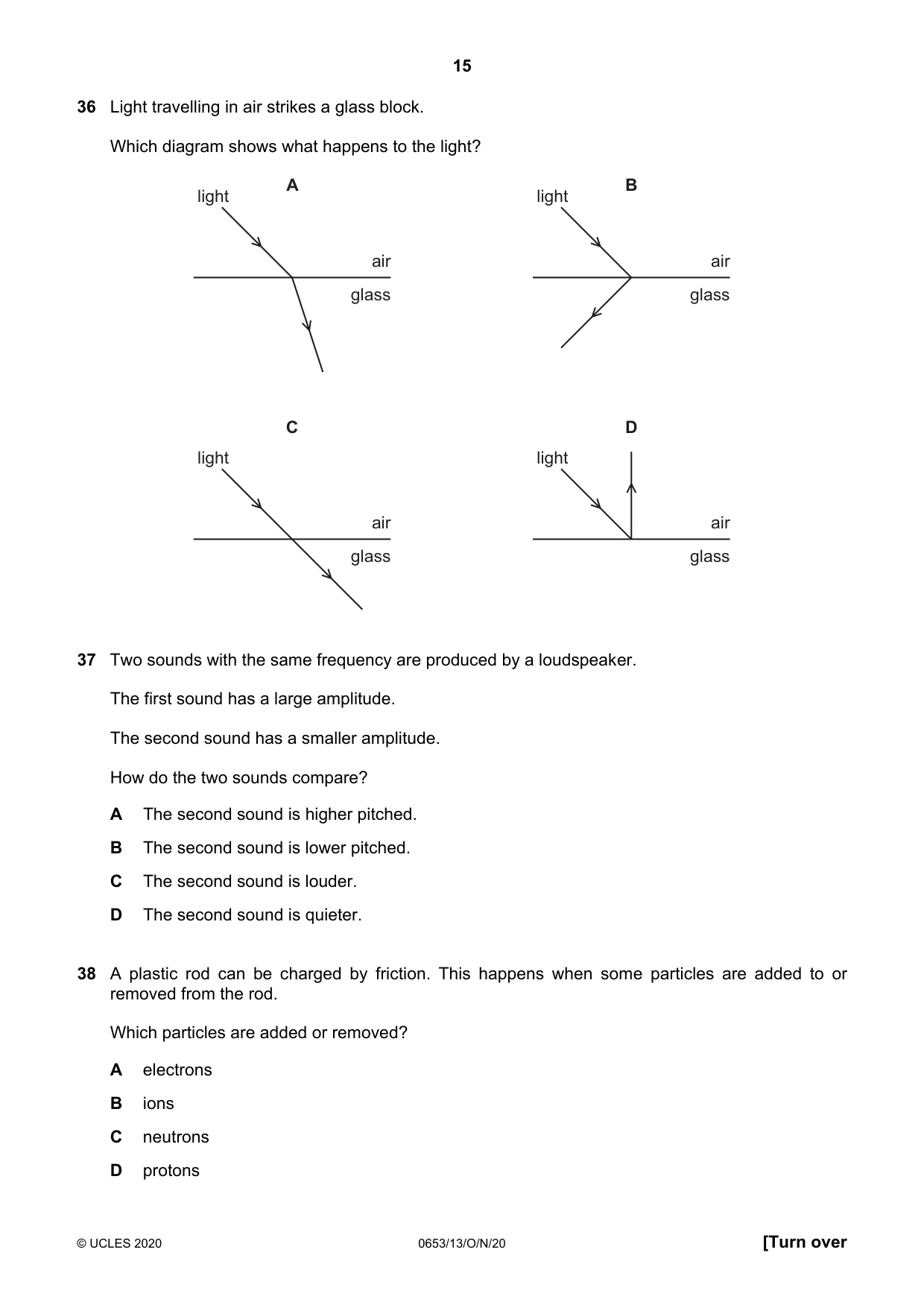
36 Light travelling in air strikes a glass block. Which diagram shows what happens to the light? A B light light air air glass glass C D light light air air glass glass
Mark scheme: A
Q37 · Two sounds with the same frequency are produced by a loudspeaker
37 Two sounds with the same frequency are produced by a loudspeaker. The first sound has a large amplitude. The second sound has a smaller amplitude. How do the two sounds compare? A The second sound is higher pitched. B The second sound is lower pitched. C The second sound is louder. D The second sound is quieter.
Mark scheme: D
Q38 · A plastic rod can be charged by friction
38 A plastic rod can be charged by friction. This happens when some particles are added to or removed from the rod. Which particles are added or removed? A electrons B ions C neutrons D protons
Mark scheme: A
Q39 · A power supply causes a current in a circuit
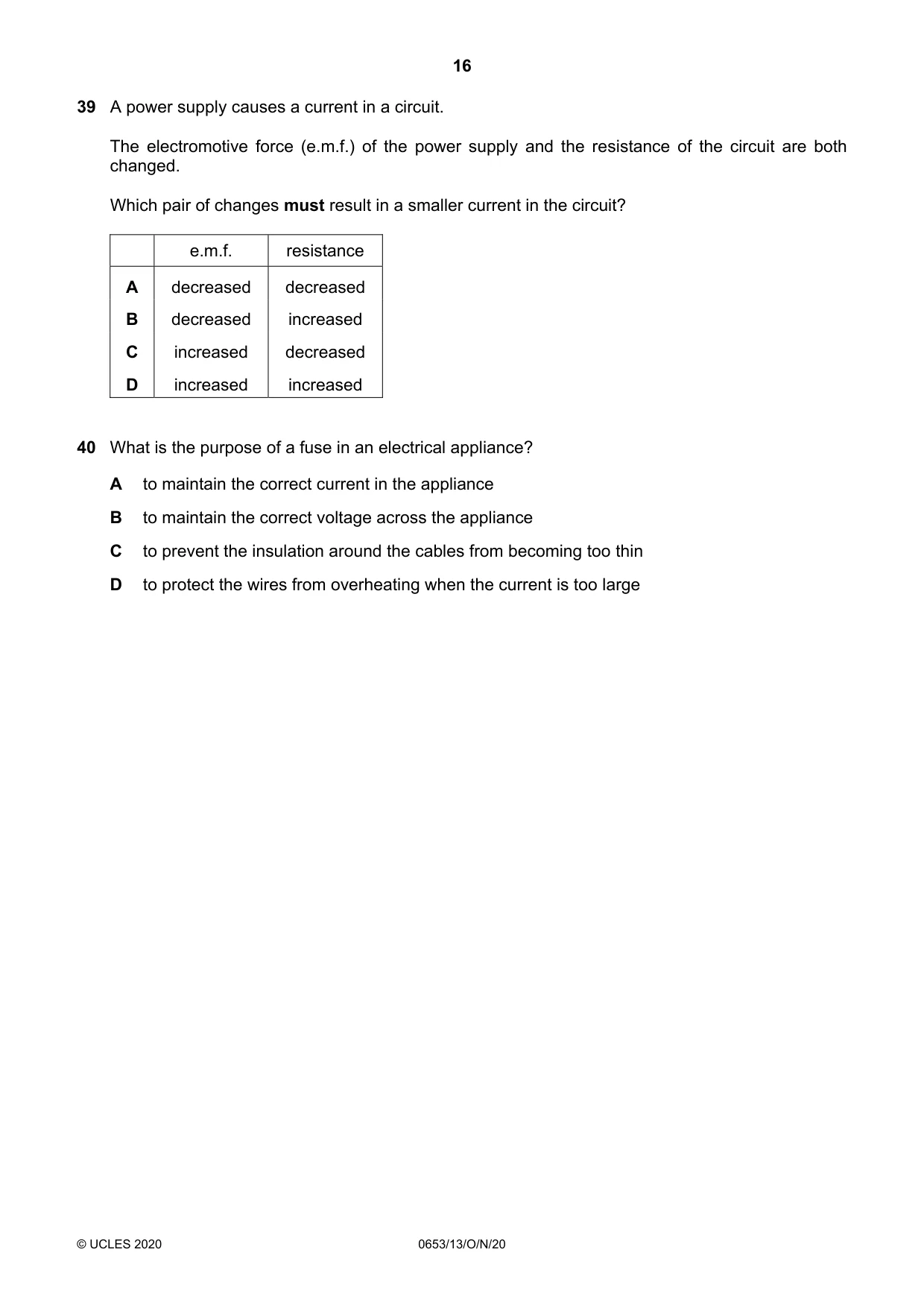
39 A power supply causes a current in a circuit. The electromotive force (e.m.f.) of the power supply and the resistance of the circuit are both changed. Which pair of changes must result in a smaller current in the circuit? e.m.f. resistance A decreased decreased B decreased increased C increased decreased D increased increased
Mark scheme: B
Q40 · What is the purpose of a fuse in an electrical appliance?
40 What is the purpose of a fuse in an electrical appliance? A to maintain the correct current in the appliance B to maintain the correct voltage across the appliance C to prevent the insulation around the cables from becoming too thin D to protect the wires from overheating when the current is too large
Mark scheme: D
What was in this paper
The subtopics covered by these 40 questions, and how many questions each got. Open one in a new tab to see every Cambridge question on it.
2Kinetic particle model of matter2Sexual reproduction in plants2The characteristic properties of acids and bases2Air quality and climate1Arrangement of elements1Biological molecules1Carbon cycle1Characteristics of living organisms1Chromatography1Density1Diffusion1Digestion1Digestive system1Electrical circuits1Electrical quantities1Electrical safety1Electrolysis1Enzymes1Exothermic and endothermic reactions1Extraction of metals1Food chains and food webs1Gas exchange in humans1General properties of waves1Identification of ions and gases1Light1Mass and weight1Motion1Rate of reaction1Sexual reproduction in humans1Simple molecules and covalent bonds1Sound1Terminology1Transfer of thermal energy1Transition elements1Xylem and phloem1What you needed in this session
Cambridge’s own grade thresholds for 2020 Oct/Nov, Paper 1 · Variant 3. A higher threshold means an easier paper — the bar moves with how the cohort did.