Cambridge IGCSE Science - Combined 0653 — 2018 Oct/Nov Paper 1 · Variant 1
0653/11/O/N/18 · 40 questions · 40 marks · ≈45 min
The question paper and its mark scheme, free to read here and free to download. This is Cambridge’s own paper, exactly as it was sat.
Question paper20 pages

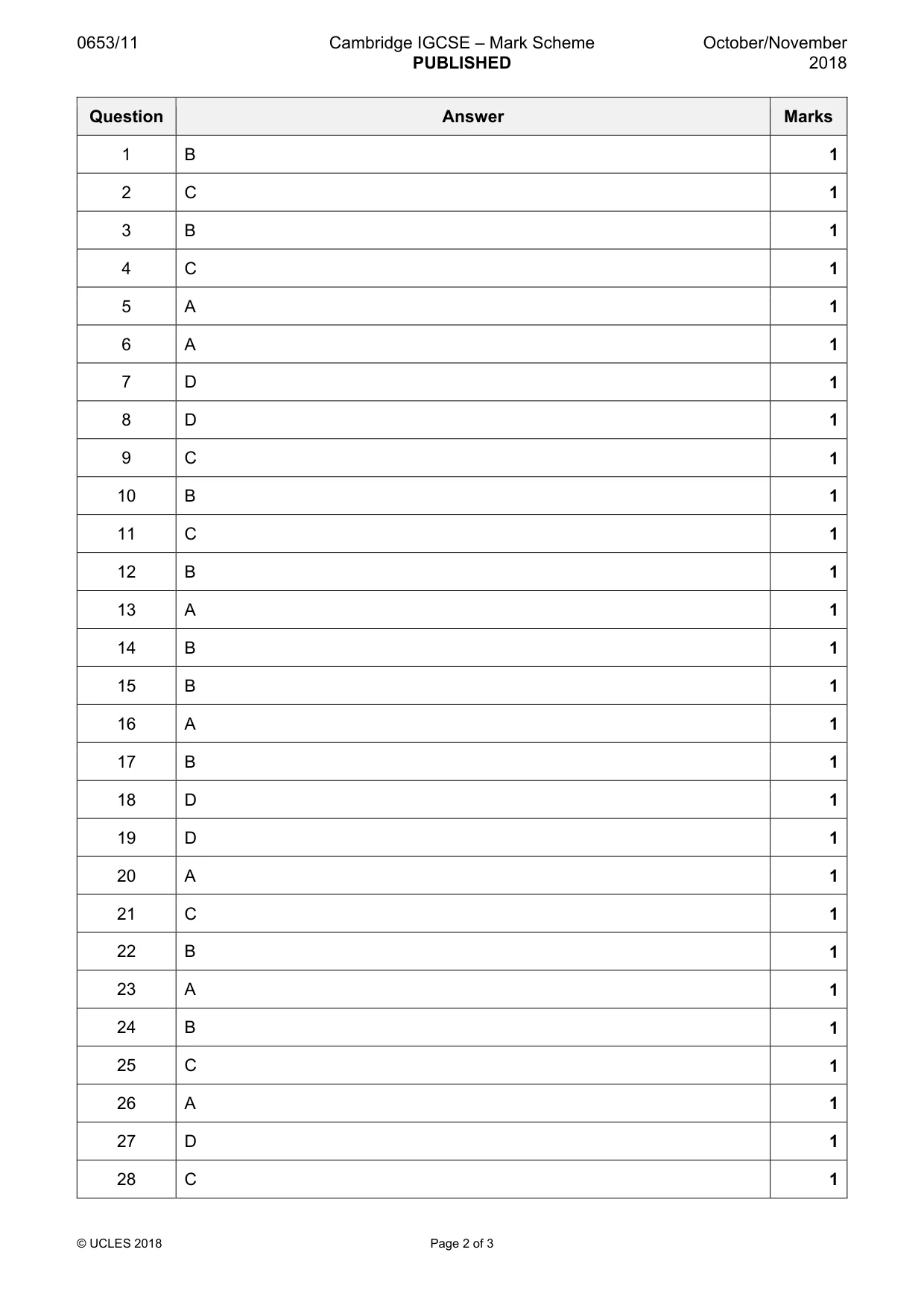
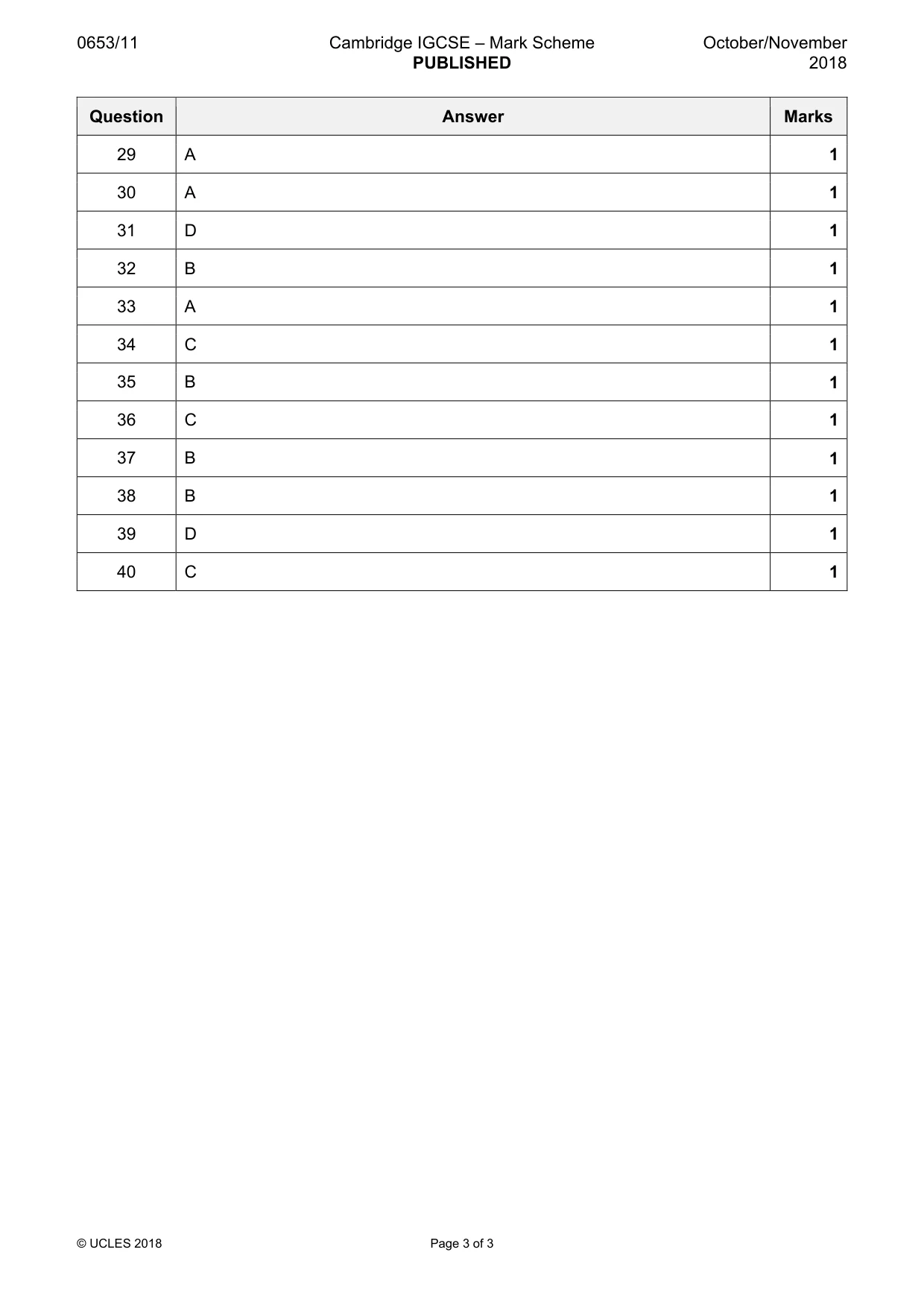
Mark scheme3 pages
Answers below. Sit the paper first if you are practising.
Questions as text
Q1 · Which two structures are found in plant cells but not in animal cells?
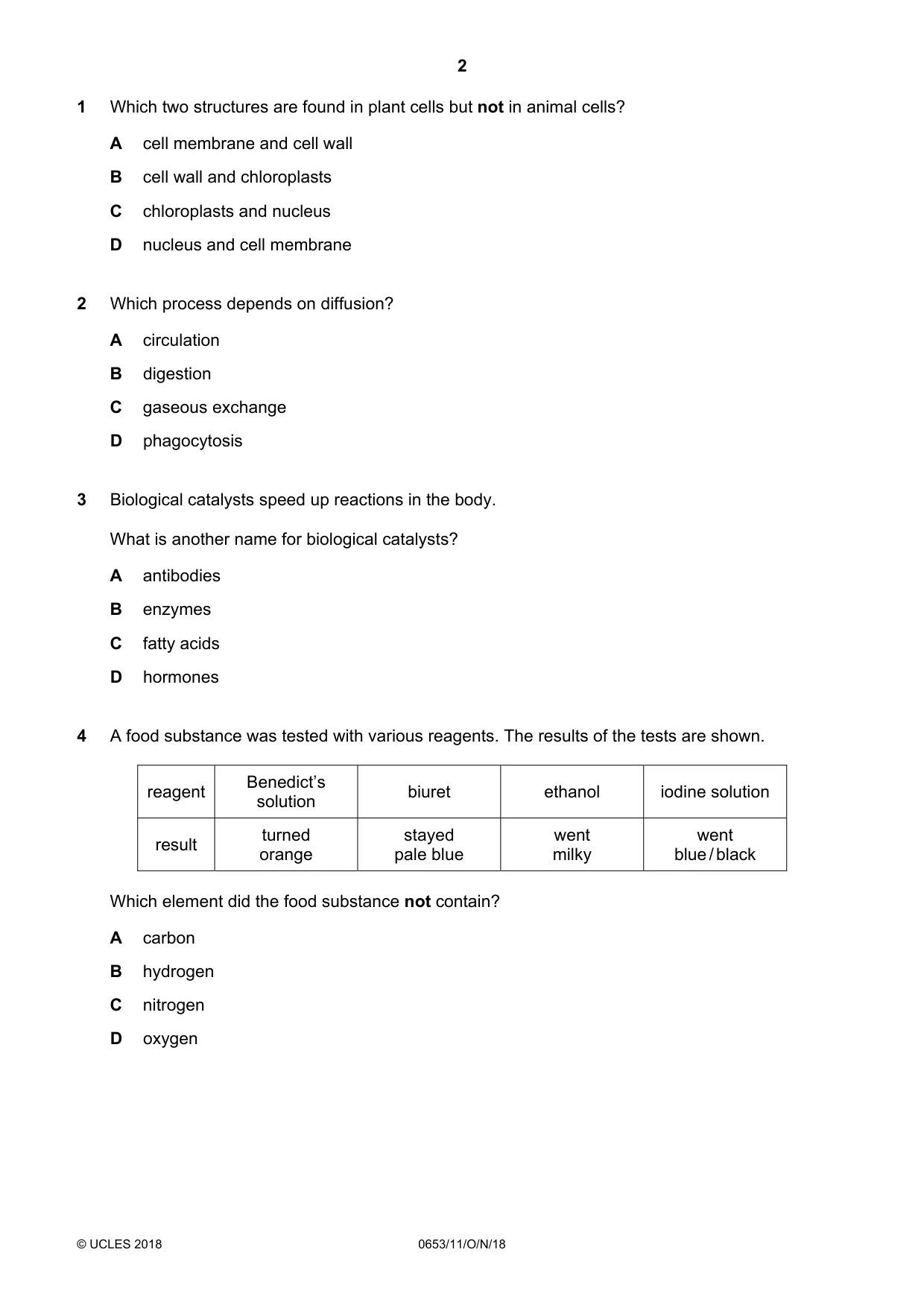
1 Which two structures are found in plant cells but not in animal cells? A cell membrane and cell wall B cell wall and chloroplasts C chloroplasts and nucleus D nucleus and cell membrane
Mark scheme: B
Q2 · Which process depends on diffusion?
2 Which process depends on diffusion? A circulation B digestion C gaseous exchange D phagocytosis
Mark scheme: C
Q3 · Biological catalysts speed up reactions in the body
3 Biological catalysts speed up reactions in the body. What is another name for biological catalysts? A antibodies B enzymes C fatty acids D hormones
Mark scheme: B
Q4 · A food substance was tested with various reagents
4 A food substance was tested with various reagents. The results of the tests are shown. Benedict’s reagent biuret ethanol iodine solution solution turned stayed went went result orange pale blue milky blue / black Which element did the food substance not contain? A carbon B hydrogen C nitrogen D oxygen
Mark scheme: C
Q5 · The diagram shows a water plant surrounded by a black box
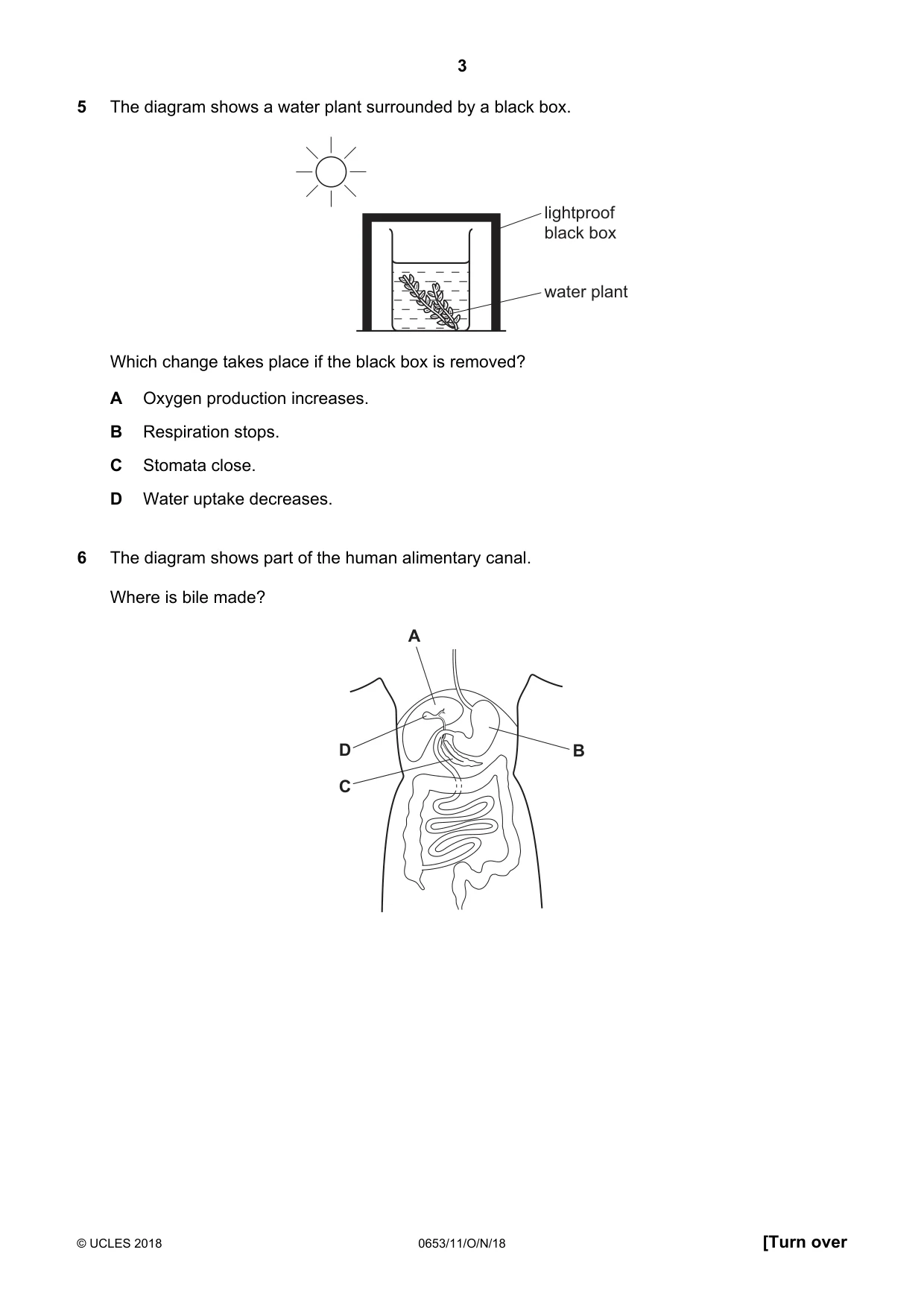
5 The diagram shows a water plant surrounded by a black box. lightproof black box water plant Which change takes place if the black box is removed? A Oxygen production increases. B Respiration stops. C Stomata close. D Water uptake decreases.
Mark scheme: A
Q6 · The diagram shows part of the human alimentary canal
6 The diagram shows part of the human alimentary canal. Where is bile made? A D B C
Mark scheme: A
Q7 · The diagram shows a section through the heart
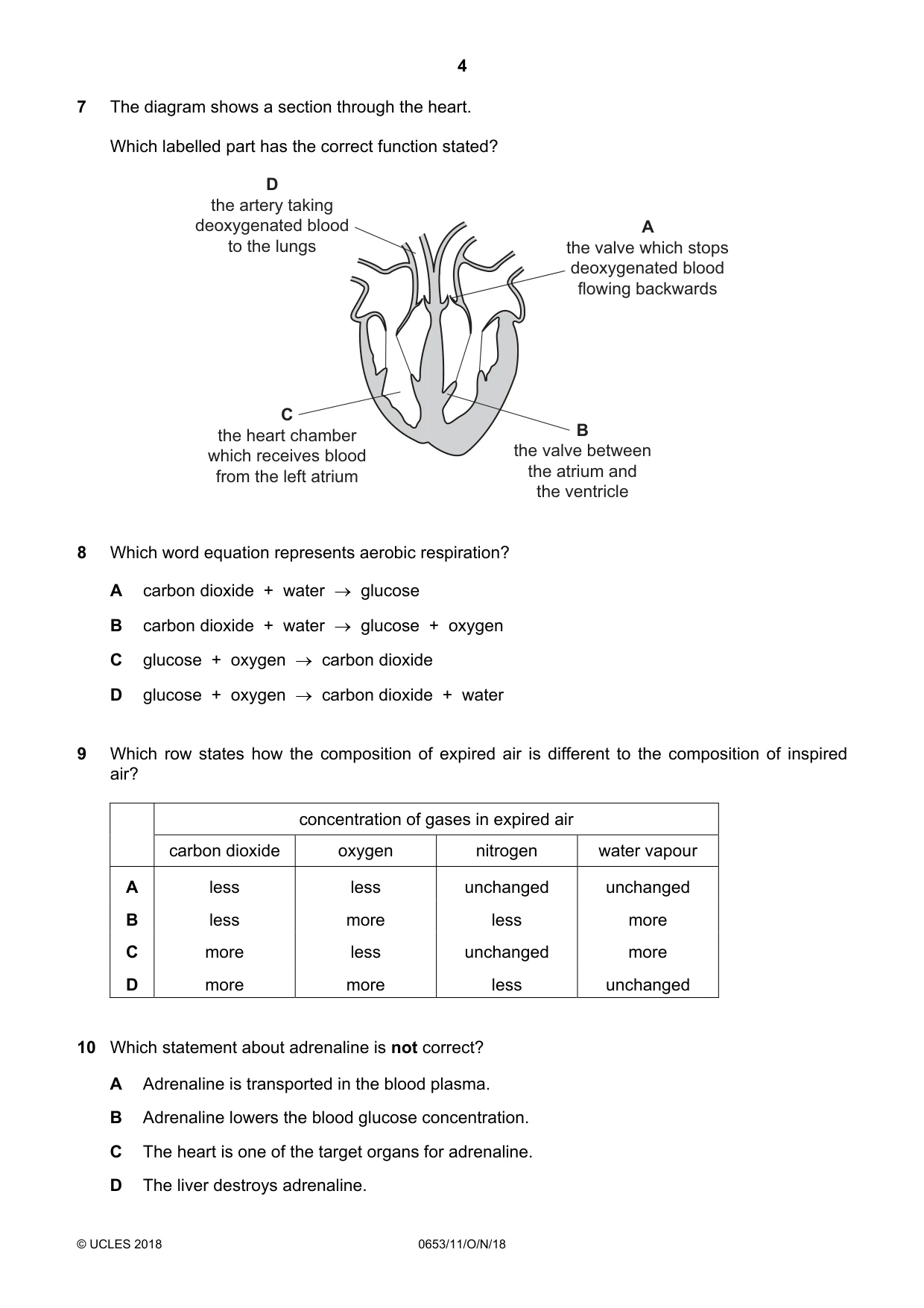
7 The diagram shows a section through the heart. Which labelled part has the correct function stated? D the artery taking deoxygenated blood A to the lungs the valve which stops deoxygenated blood flowing backwards C B the heart chamber which receives blood the valve between from the left atrium the atrium and the ventricle
Mark scheme: D
Q8 · Which word equation represents aerobic respiration?
8 Which word equation represents aerobic respiration? A carbon dioxide + water → glucose B carbon dioxide + water → glucose + oxygen C glucose + oxygen → carbon dioxide D glucose + oxygen → carbon dioxide + water
Mark scheme: D
Q9 · Which row states how the composition of expired air is different to the composition of…
9 Which row states how the composition of expired air is different to the composition of inspired air? concentration of gases in expired air carbon dioxide oxygen nitrogen water vapour A less less unchanged unchanged B less more less more C more less unchanged more D more more less unchanged
Mark scheme: C
Q10 · Which statement about adrenaline is not correct?
10 Which statement about adrenaline is not correct? A Adrenaline is transported in the blood plasma. B Adrenaline lowers the blood glucose concentration. C The heart is one of the target organs for adrenaline. D The liver destroys adrenaline.
Mark scheme: B
Q11 · The diagram shows a calendar for February and March
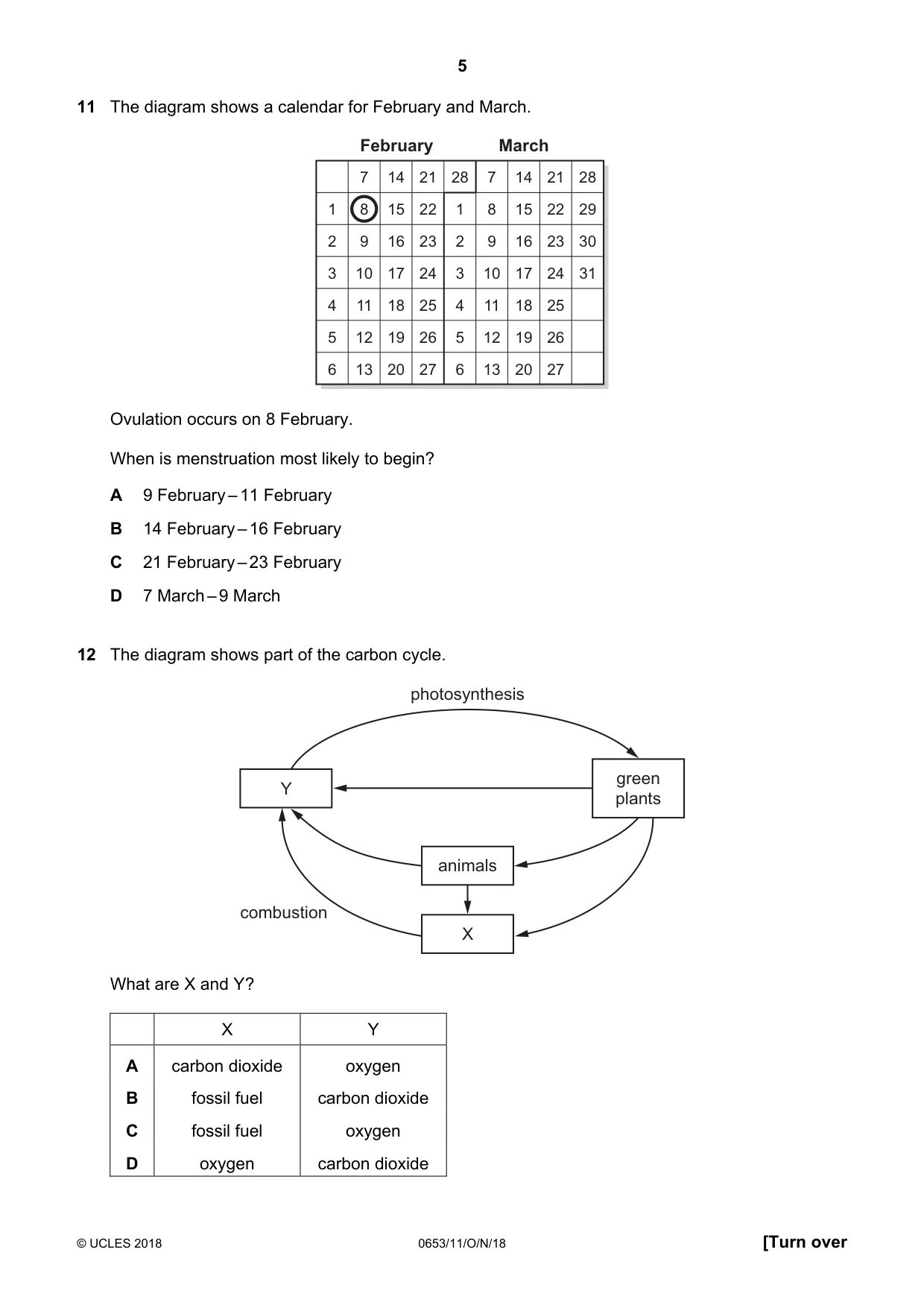
11 The diagram shows a calendar for February and March. February March 7 14 21 28 7 14 21 28 1 8 15 22 1 8 15 22 29 2 9 16 23 2 9 16 23 30 3 10 17 24 3 10 17 24 31 4 11 18 25 4 11 18 25 5 12 19 26 5 12 19 26 6 13 20 27 6 13 20 27 Ovulation occurs on 8 February. When is menstruation most likely to begin? A 9 February – 11 February B 14 February – 16 February C 21 February – 23 February D 7 March – 9 March
Mark scheme: C
Q12 · The diagram shows part of the carbon cycle
12 The diagram shows part of the carbon cycle. photosynthesis green Y plants animals combustion X What are X and Y? X Y A carbon dioxide oxygen B fossil fuel carbon dioxide C fossil fuel oxygen D oxygen carbon dioxide
Mark scheme: B
Q13 · Which are possible harmful effects of deforestation?
13 Which are possible harmful effects of deforestation? global warming species extinction A v v B v x Cc x v D x x
Mark scheme: A
Q14 · The diagram represents a mixture of carbon dioxide, CO2, and carbon monoxide, CO
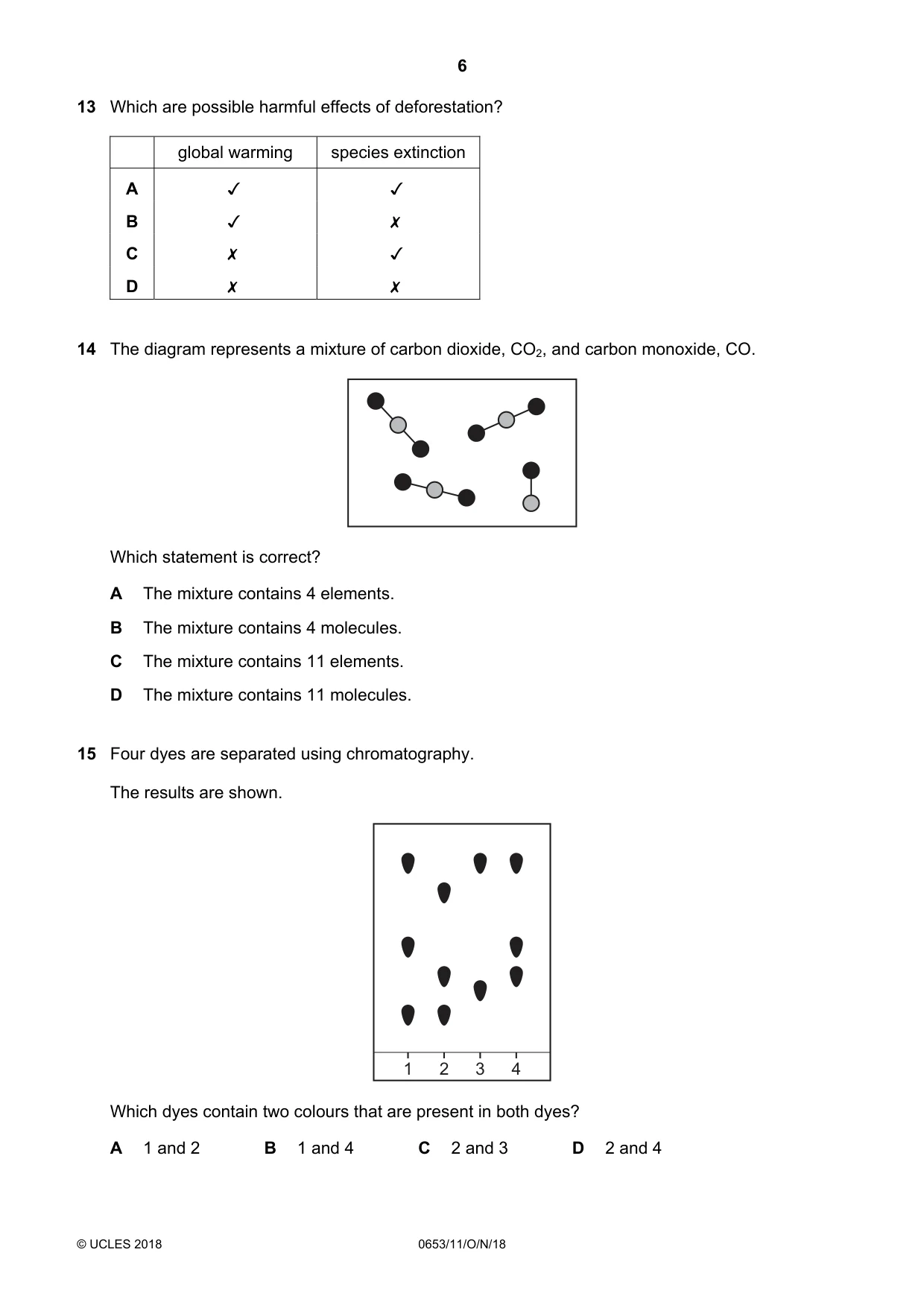
14 The diagram represents a mixture of carbon dioxide, CO2, and carbon monoxide, CO. Which statement is correct? A The mixture contains 4 elements. B The mixture contains 4 molecules. C The mixture contains 11 elements. D The mixture contains 11 molecules.
Mark scheme: B
Q15 · Four dyes are separated using chromatography
15 Four dyes are separated using chromatography. The results are shown. 1 2 3 4 Which dyes contain two colours that are present in both dyes? A 1 and 2 B 1 and 4 C 2 and 3 D 2 and 4
Mark scheme: B
Q16 · On which label does the formula match the name of the acid?
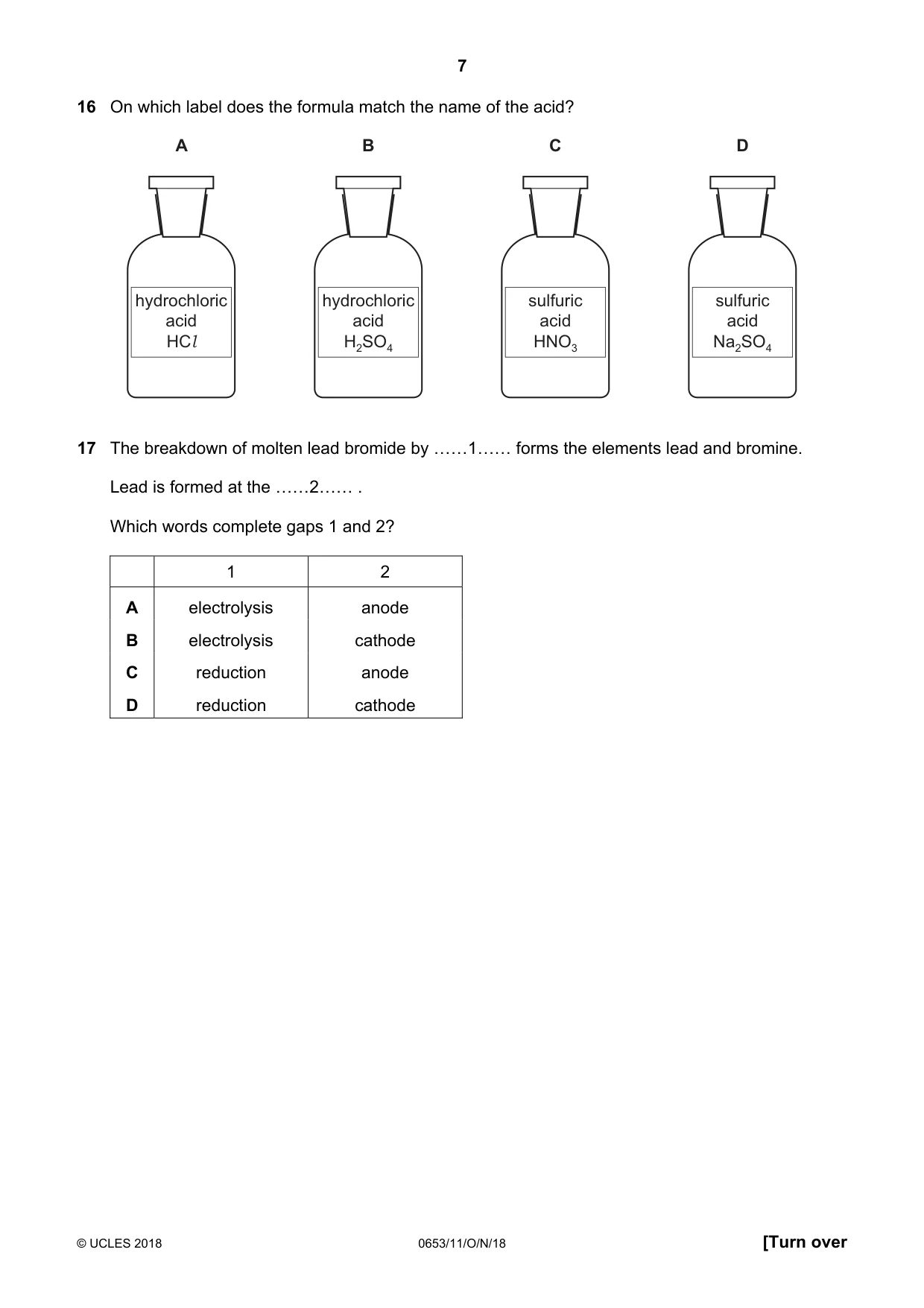
16 On which label does the formula match the name of the acid? A B C D hydrochloric hydrochloric sulfuric sulfuric acid acid acid acid HCl H2SO4 HNO3 Na2SO4
Mark scheme: A
More questions on The characteristic properties of acids and bases
Q17 · The breakdown of molten lead bromide by ««1«« forms the elements lead and bromine
17 The breakdown of molten lead bromide by ««1«« forms the elements lead and bromine. Lead is formed at the ««2«« . Which words complete gaps 1 and 2? 1 2 A electrolysis anode B electrolysis cathode C reduction anode D reduction cathode
Mark scheme: B
Q18 · The temperature of aqueous copper sulfate is measured
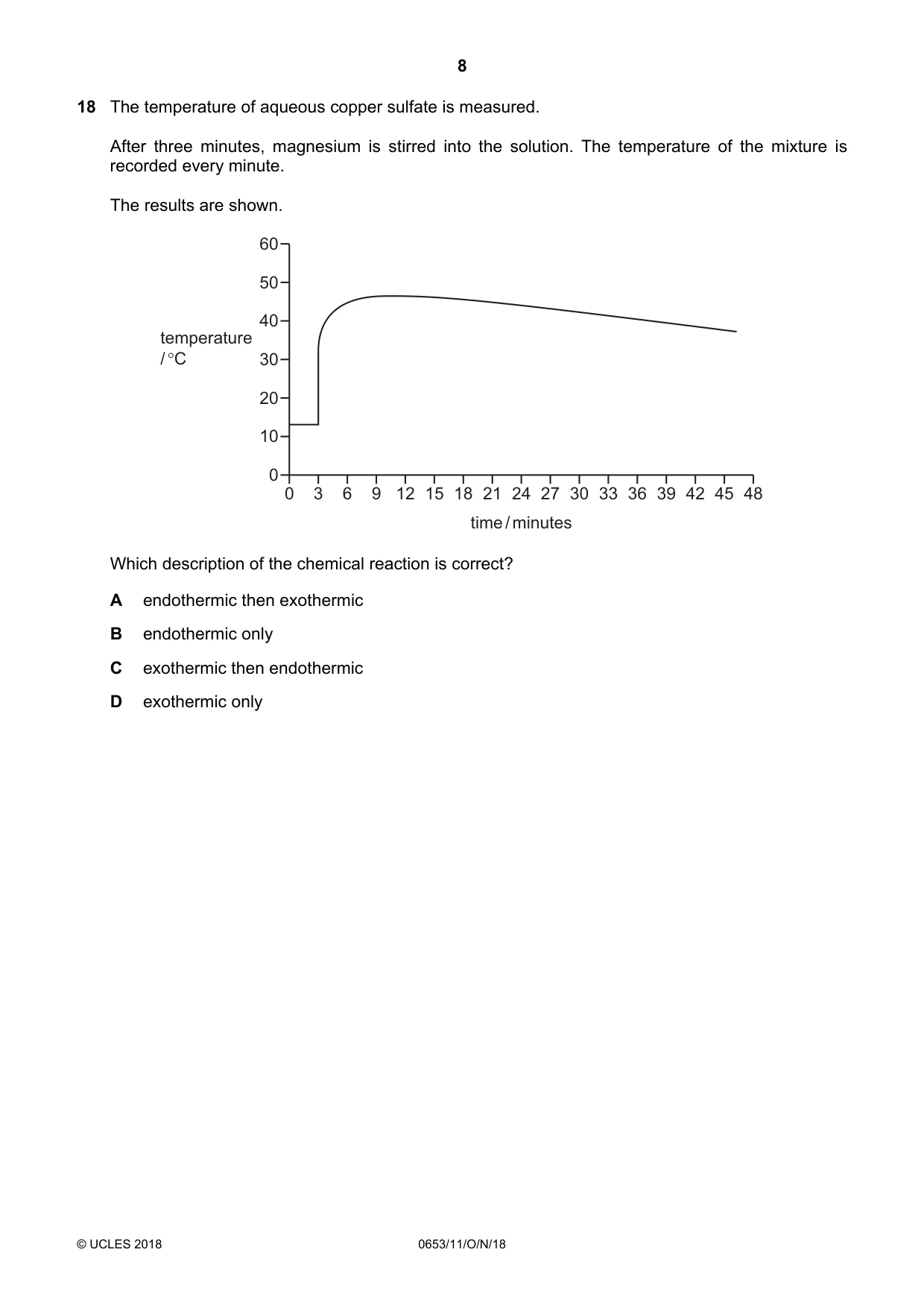
18 The temperature of aqueous copper sulfate is measured. After three minutes, magnesium is stirred into the solution. The temperature of the mixture is recorded every minute. The results are shown. 60 50 40 temperature / °C 30 20 10 0 0 3 6 9 12 15 18 21 24 27 30 33 36 39 42 45 48 time / minutes Which description of the chemical reaction is correct? A endothermic then exothermic B endothermic only C exothermic then endothermic D exothermic only
Mark scheme: D
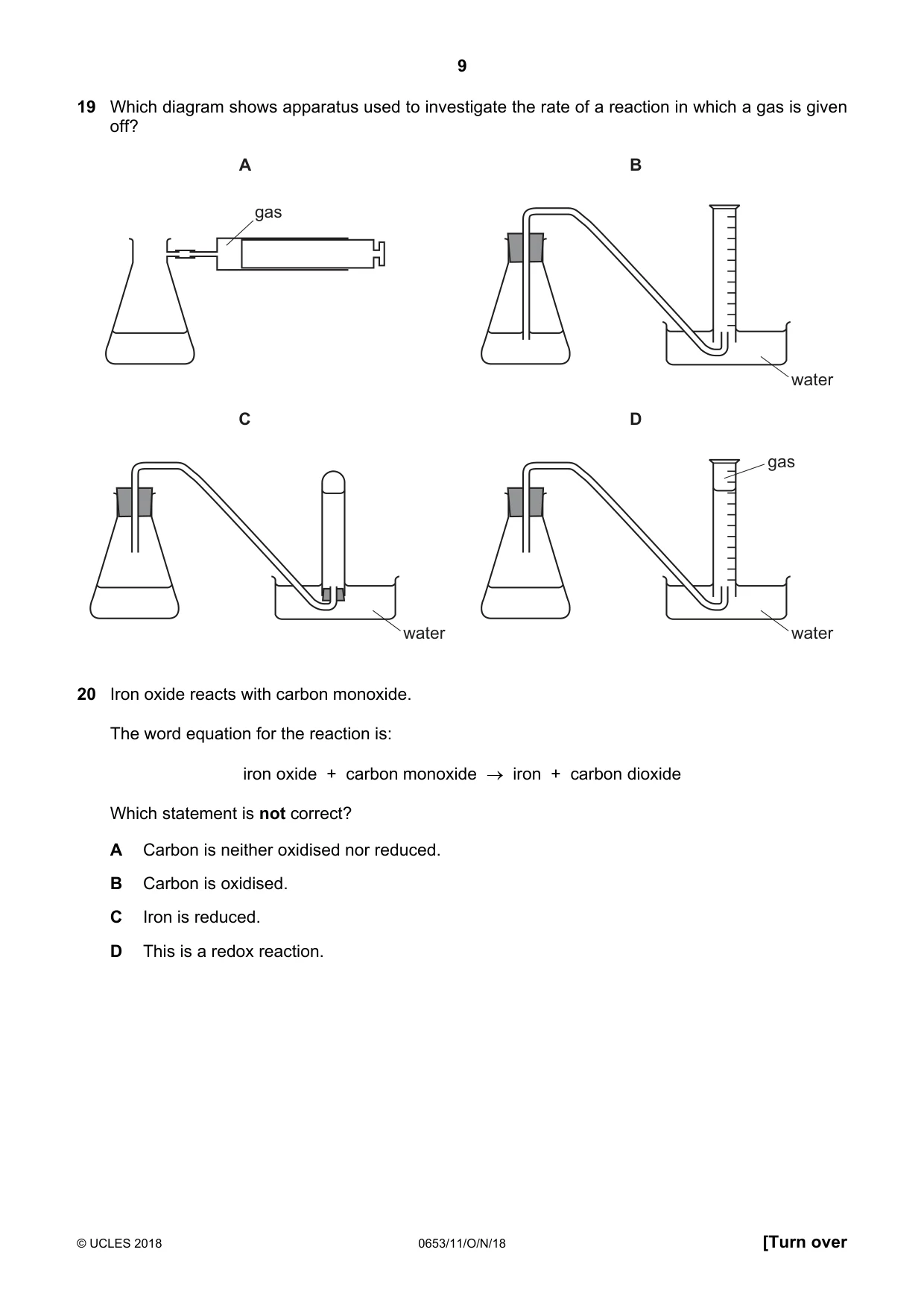
Q19 · Which diagram shows apparatus used to investigate the rate of a reaction in which a gas…
19 Which diagram shows apparatus used to investigate the rate of a reaction in which a gas is given off? A B gas water C D gas water water
Mark scheme: D
Q20 · Iron oxide reacts with carbon monoxide
20 Iron oxide reacts with carbon monoxide. The word equation for the reaction is: iron oxide + carbon monoxide → iron + carbon dioxide Which statement is not correct? A Carbon is neither oxidised nor reduced. B Carbon is oxidised. C Iron is reduced. D This is a redox reaction.
Mark scheme: A
Q21 · The results of two tests on solid P are shown
21 The results of two tests on solid P are shown. test result 1 add aqueous sodium hydroxide gas given off that turns moist red to solid litmus paper blue 2 dissolve solid in water white precipitate formed add dilute aqueous silver nitrate What is P? A aluminium carbonate B aluminium sulfate C ammonium chloride D ammonium nitrate
Mark scheme: C
Q22 · Two substances, X and Y, are connected in a circuit as shown
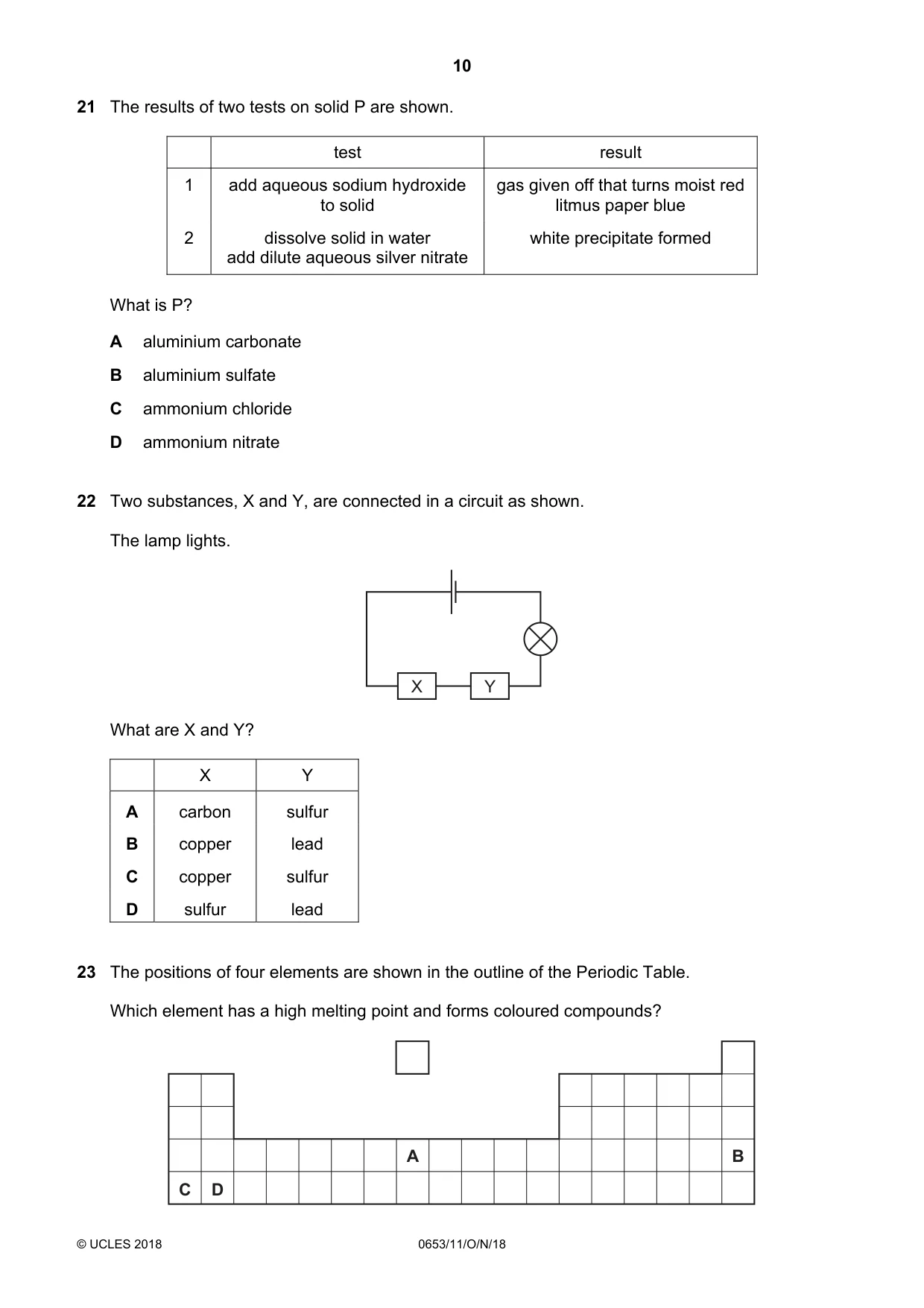
22 Two substances, X and Y, are connected in a circuit as shown. The lamp lights. X Y What are X and Y? X Y A carbon sulfur B copper lead C copper sulfur D sulfur lead
Mark scheme: B
Q23 · The positions of four elements are shown in the outline of the Periodic Table
23 The positions of four elements are shown in the outline of the Periodic Table. Which element has a high melting point and forms coloured compounds? A B C D
Mark scheme: A
Q24 · Which process is used to extract copper from copper oxide?
24 Which process is used to extract copper from copper oxide? A Heat the copper oxide on its own. B Heat the copper oxide with carbon. C Heat the copper oxide with carbon dioxide. D Heat the copper oxide with water and then filter.
Mark scheme: B
Q25 · What is a chemical test for water?
25 What is a chemical test for water? A It has a boiling point of 100 °C. B It has a density of 1 g / cm3. C It turns anhydrous copper sulfate from white to blue. D It turns pink cobalt chloride paper to blue.
Mark scheme: C
Q26 · Gasoline is a hydrocarbon fuel obtained from petroleum
26 Gasoline is a hydrocarbon fuel obtained from petroleum. Which statement is correct? A Gasoline burns to form carbon dioxide and water. B Gasoline contains the elements carbon, hydrogen and oxygen. C Gasoline is used as a fuel in diesel engines. D The combustion of gasoline is an endothermic reaction.
Mark scheme: A
Q27 · What is the structure of ethane?
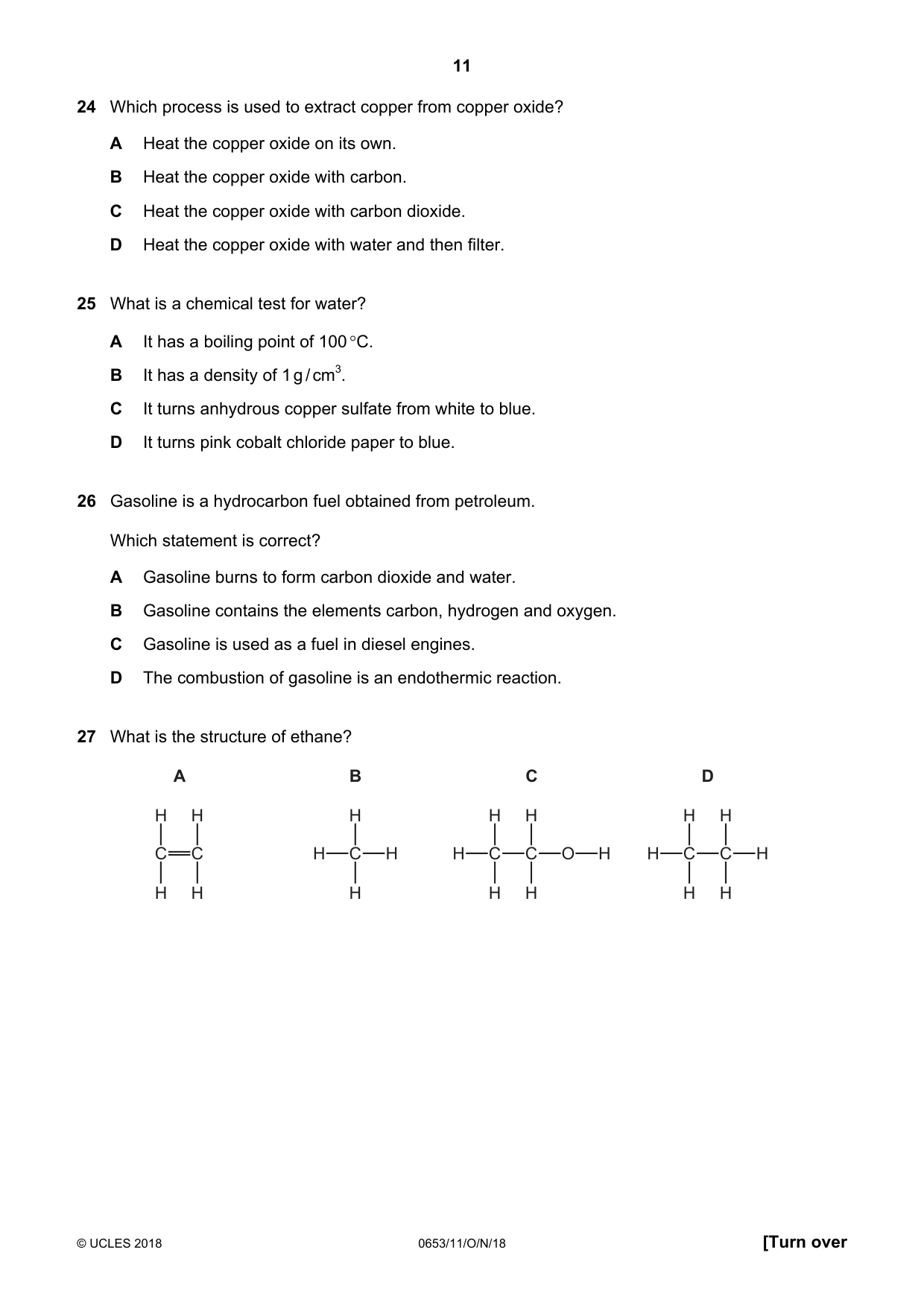
27 What is the structure of ethane? A B C D H H H H H H H C C H C H H C C O H H C C H H H H H H H H
Mark scheme: D
Q28 · Graphs P and Q are speed-time graphs
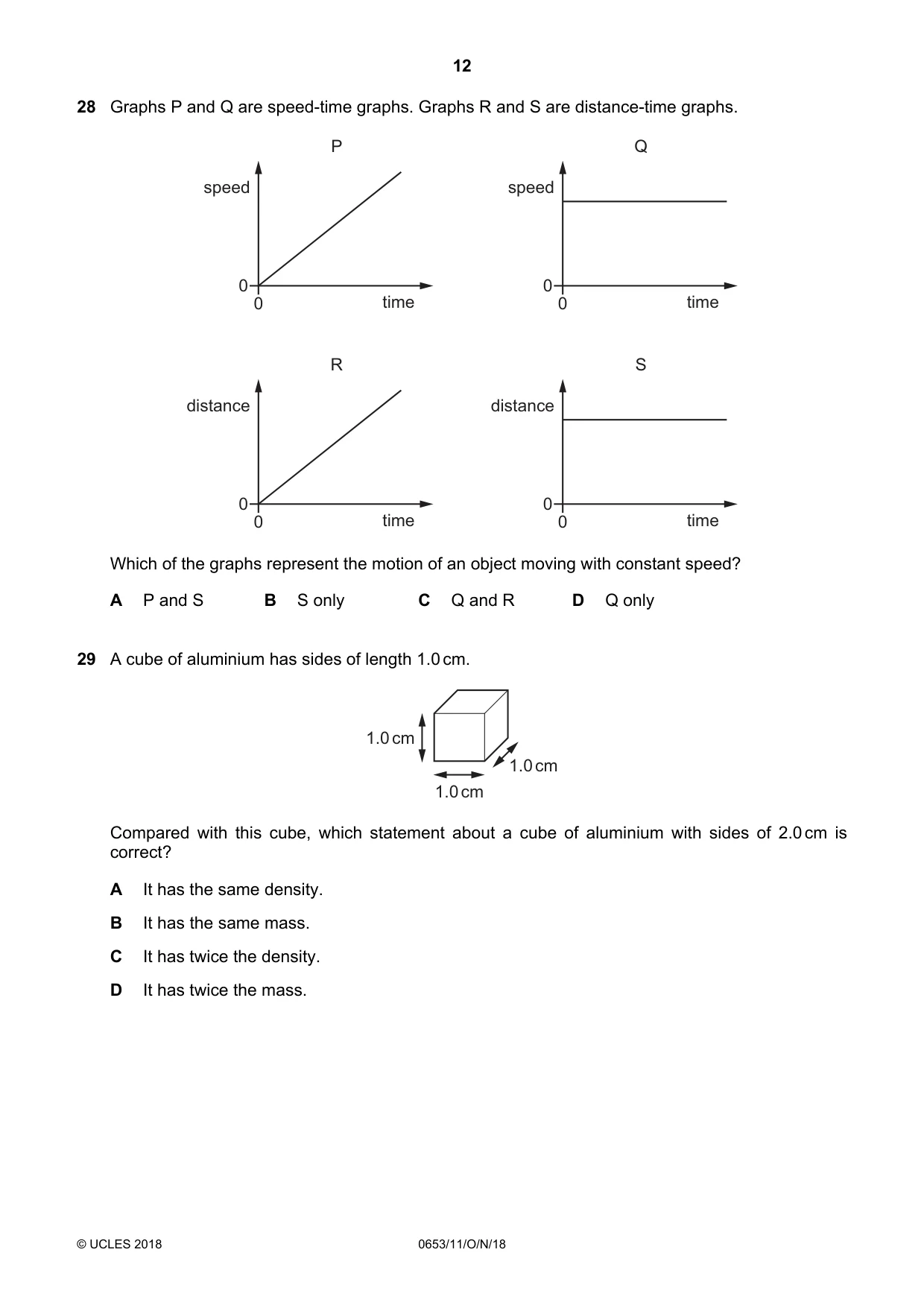
28 Graphs P and Q are speed-time graphs. Graphs R and S are distance-time graphs. P Q speed speed 0 0 0 time 0 time R S distance distance 0 0 0 time 0 time Which of the graphs represent the motion of an object moving with constant speed? A P and S B S only C Q and R D Q only
Mark scheme: C
Q29 · A cube of aluminium has sides of length 1.0 cm
29 A cube of aluminium has sides of length 1.0 cm. 1.0 cm 1.0 cm 1.0 cm Compared with this cube, which statement about a cube of aluminium with sides of 2.0 cm is correct? A It has the same density. B It has the same mass. C It has twice the density. D It has twice the mass.
Mark scheme: A
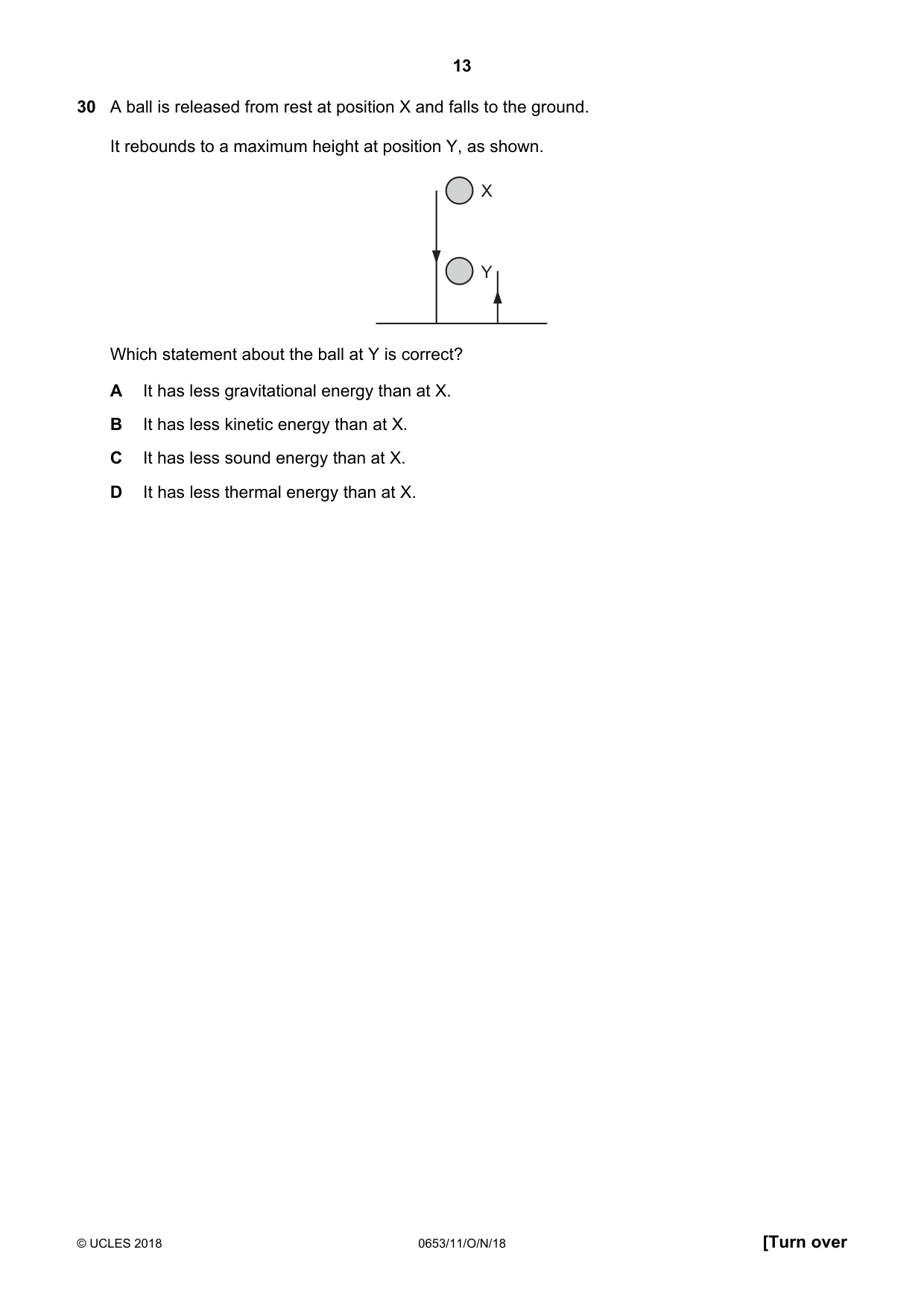
Q30 · A ball is released from rest at position X and falls to the ground
30 A ball is released from rest at position X and falls to the ground. It rebounds to a maximum height at position Y, as shown. X Y Which statement about the ball at Y is correct? A It has less gravitational energy than at X. B It has less kinetic energy than at X. C It has less sound energy than at X. D It has less thermal energy than at X.
Mark scheme: A
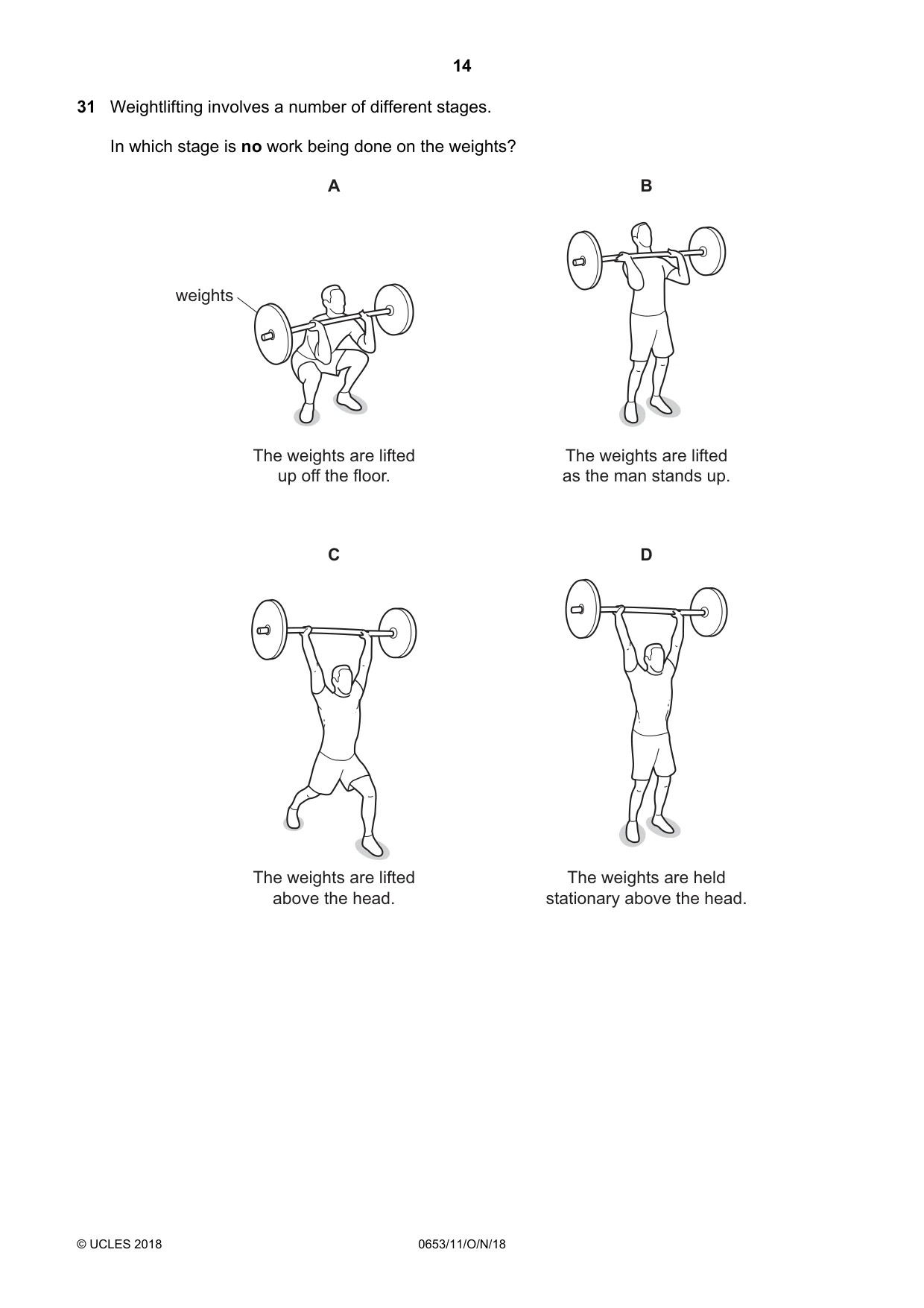
Q31 · Weightlifting involves a number of different stages
31 Weightlifting involves a number of different stages. In which stage is no work being done on the weights? A B weights The weights are lifted The weights are lifted up off the floor. as the man stands up. C D The weights are lifted The weights are held above the head. stationary above the head.
Mark scheme: D
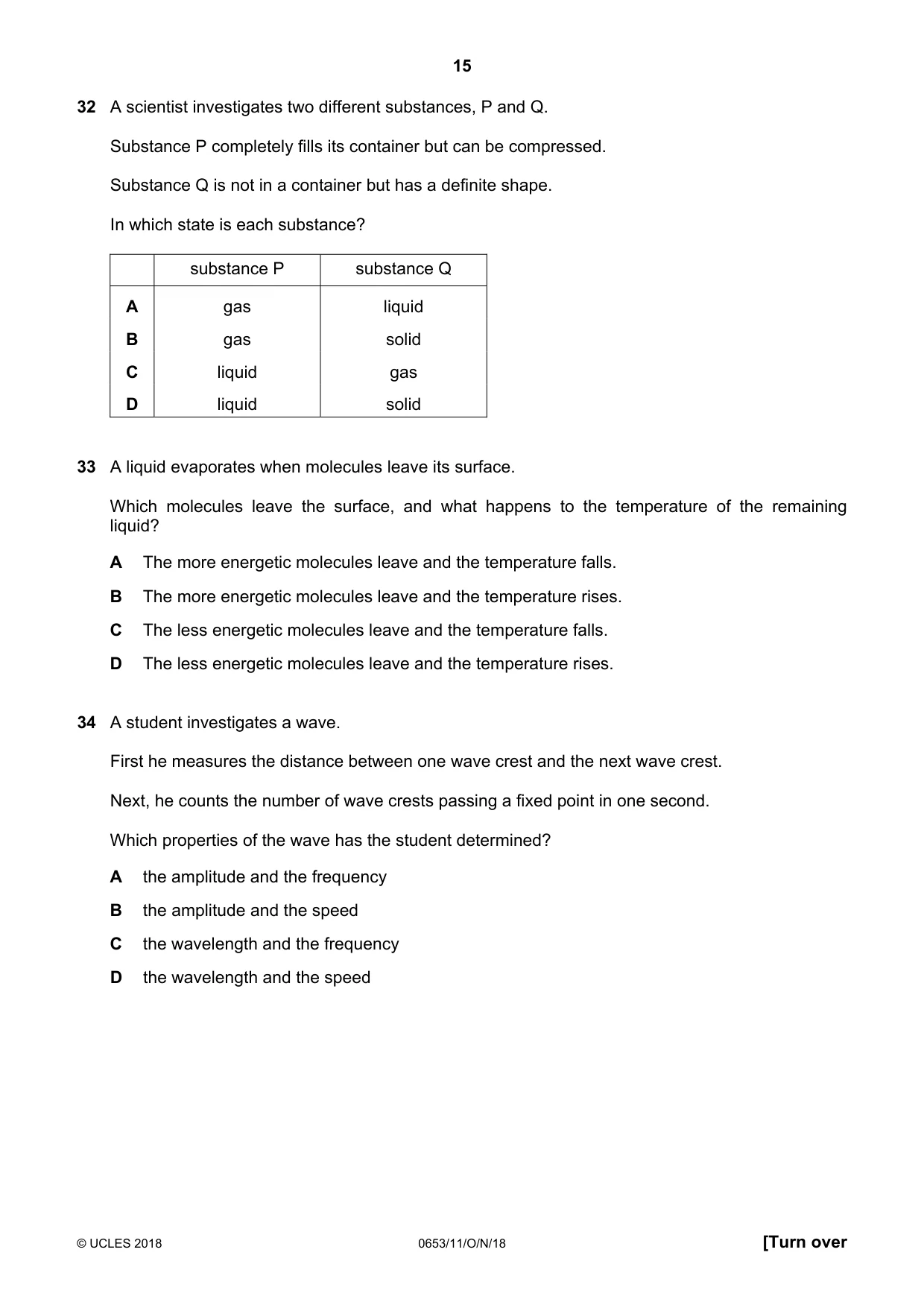
Q32 · A scientist investigates two different substances, P and Q
32 A scientist investigates two different substances, P and Q. Substance P completely fills its container but can be compressed. Substance Q is not in a container but has a definite shape. In which state is each substance? substance P substance Q A gas liquid B gas solid C liquid gas D liquid solid
Mark scheme: B
Q33 · A liquid evaporates when molecules leave its surface
33 A liquid evaporates when molecules leave its surface. Which molecules leave the surface, and what happens to the temperature of the remaining liquid? A The more energetic molecules leave and the temperature falls. B The more energetic molecules leave and the temperature rises. C The less energetic molecules leave and the temperature falls. D The less energetic molecules leave and the temperature rises.
Mark scheme: A
Q34 · A student investigates a wave
34 A student investigates a wave. First he measures the distance between one wave crest and the next wave crest. Next, he counts the number of wave crests passing a fixed point in one second. Which properties of the wave has the student determined? A the amplitude and the frequency B the amplitude and the speed C the wavelength and the frequency D the wavelength and the speed
Mark scheme: C
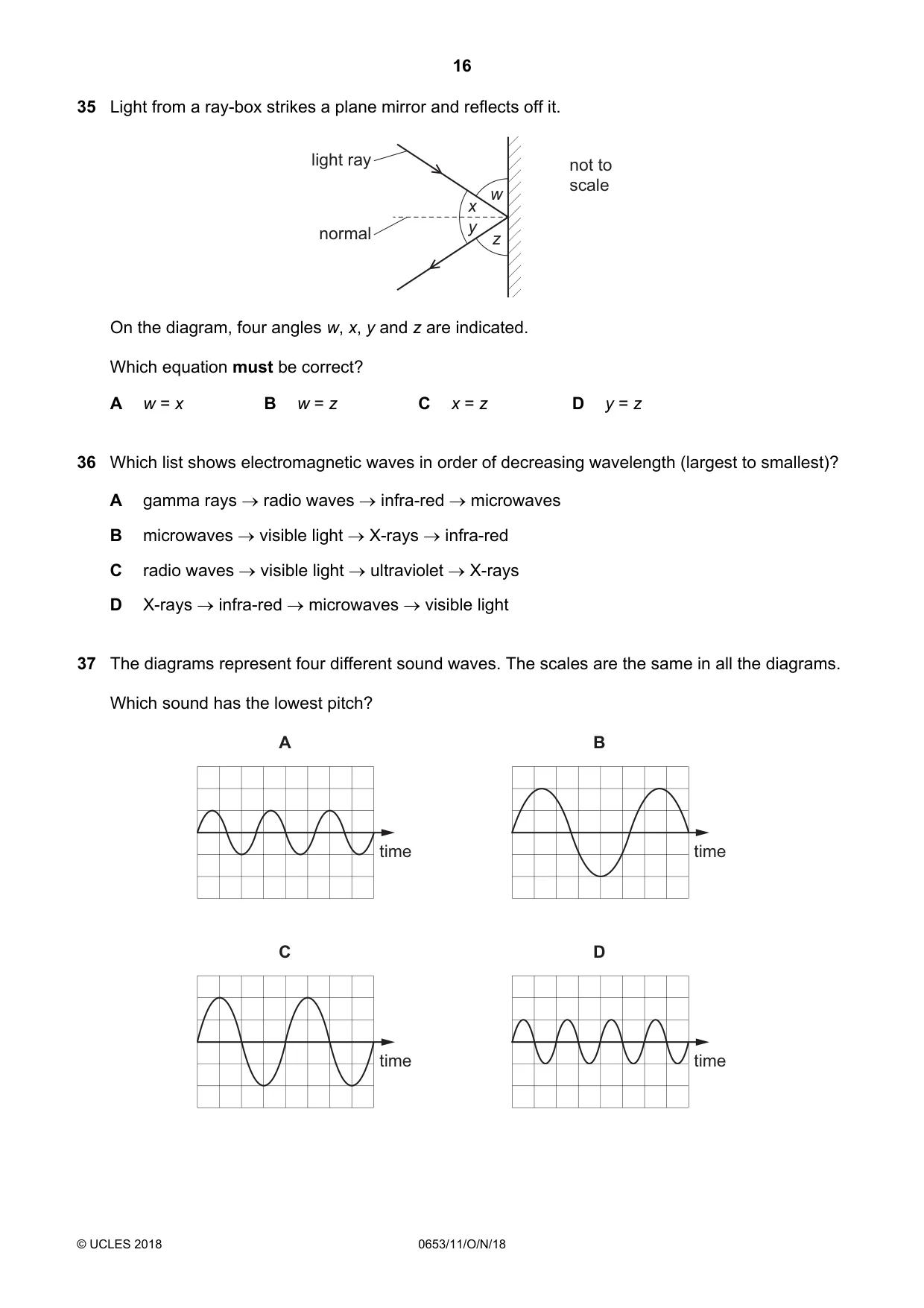
Q35 · Light from a ray-box strikes a plane mirror and reflects off it
35 Light from a ray-box strikes a plane mirror and reflects off it. light ray not to scale w x y normal z On the diagram, four angles w, x, y and z are indicated. Which equation must be correct? A w = x B w = z C x = z D y = z
Mark scheme: B
Q36 · Which list shows electromagnetic waves in order of decreasing wavelength (largest to…
36 Which list shows electromagnetic waves in order of decreasing wavelength (largest to smallest)? A gamma rays → radio waves → infra-red → microwaves B microwaves → visible light → X-rays → infra-red C radio waves → visible light → ultraviolet → X-rays D X-rays → infra-red → microwaves → visible light
Mark scheme: C
Q37 · The diagrams represent four different sound waves
37 The diagrams represent four different sound waves. The scales are the same in all the diagrams. Which sound has the lowest pitch? A B time time C D time time
Mark scheme: B
Q38 · There is a current in a metal wire when a potential difference is applied across its ends
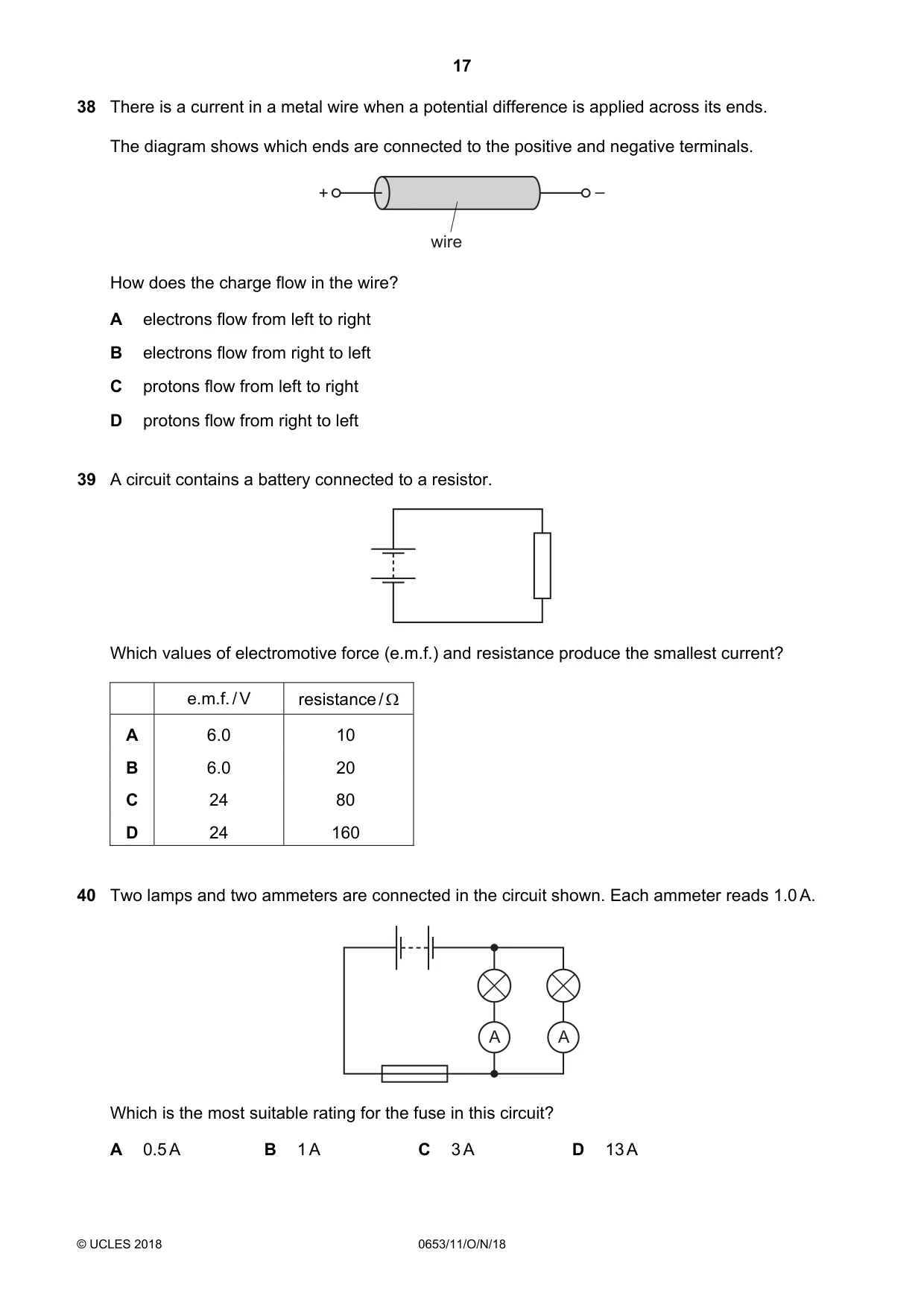
38 There is a current in a metal wire when a potential difference is applied across its ends. The diagram shows which ends are connected to the positive and negative terminals. + – wire How does the charge flow in the wire? A electrons flow from left to right B electrons flow from right to left C protons flow from left to right D protons flow from right to left
Mark scheme: B
Q39 · A circuit contains a battery connected to a resistor
39 A circuit contains a battery connected to a resistor. Which values of electromotive force (e.m.f.) and resistance produce the smallest current? e.m.f. / V resistance / Ω A 6.0 10 B 6.0 20 C 24 80 D 24 160
Mark scheme: D
Q40 · Two lamps and two ammeters are connected in the circuit shown
40 Two lamps and two ammeters are connected in the circuit shown. Each ammeter reads 1.0 A. A A Which is the most suitable rating for the fuse in this circuit? A 0.5 A B 1 A C 3 A D 13 A
Mark scheme: C
What was in this paper
The subtopics covered by these 40 questions, and how many questions each got. Open one in a new tab to see every Cambridge question on it.
2Energy, work and power2Kinetic particle model of matter2Alkanes1Biological molecules1Carbon cycle1Cell structure1Chromatography1Density1Diffusion1Digestive system1Diseases and immunity1Electrical safety1Electrolysis1Electromagnetic spectrum1Elements, compounds and mixtures1Enzymes1Exothermic and endothermic reactions1Extraction of metals1Fuels1Gas exchange in humans1General properties of waves1Habitat destruction1Heart1Identification of ions and gases1Light1Motion1Photosynthesis1Properties of metals1Rate of reaction1Redox1Respiration1Sexual reproduction in humans1Sound1The characteristic properties of acids and bases1Transition elements1Water1What you needed in this session
Cambridge’s own grade thresholds for 2018 Oct/Nov, Paper 1 · Variant 1. A higher threshold means an easier paper — the bar moves with how the cohort did.