Cambridge IGCSE Science - Combined 0653 — 2019 Oct/Nov Paper 1 · Variant 2
0653/12/O/N/19 · 40 questions · 40 marks · ≈45 min
The question paper and its mark scheme, free to read here and free to download. This is Cambridge’s own paper, exactly as it was sat.
Question paper16 pages
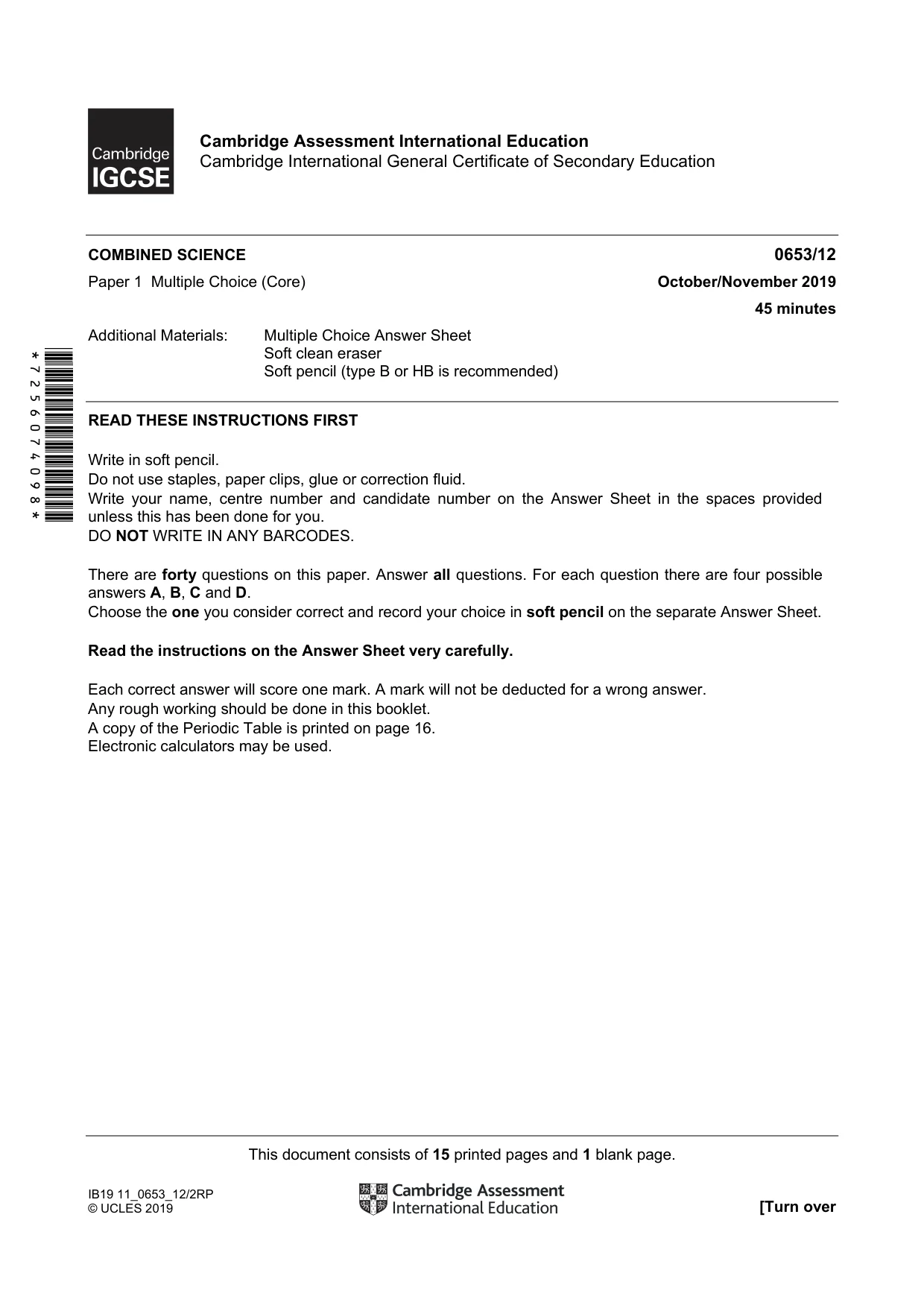

Mark scheme3 pages
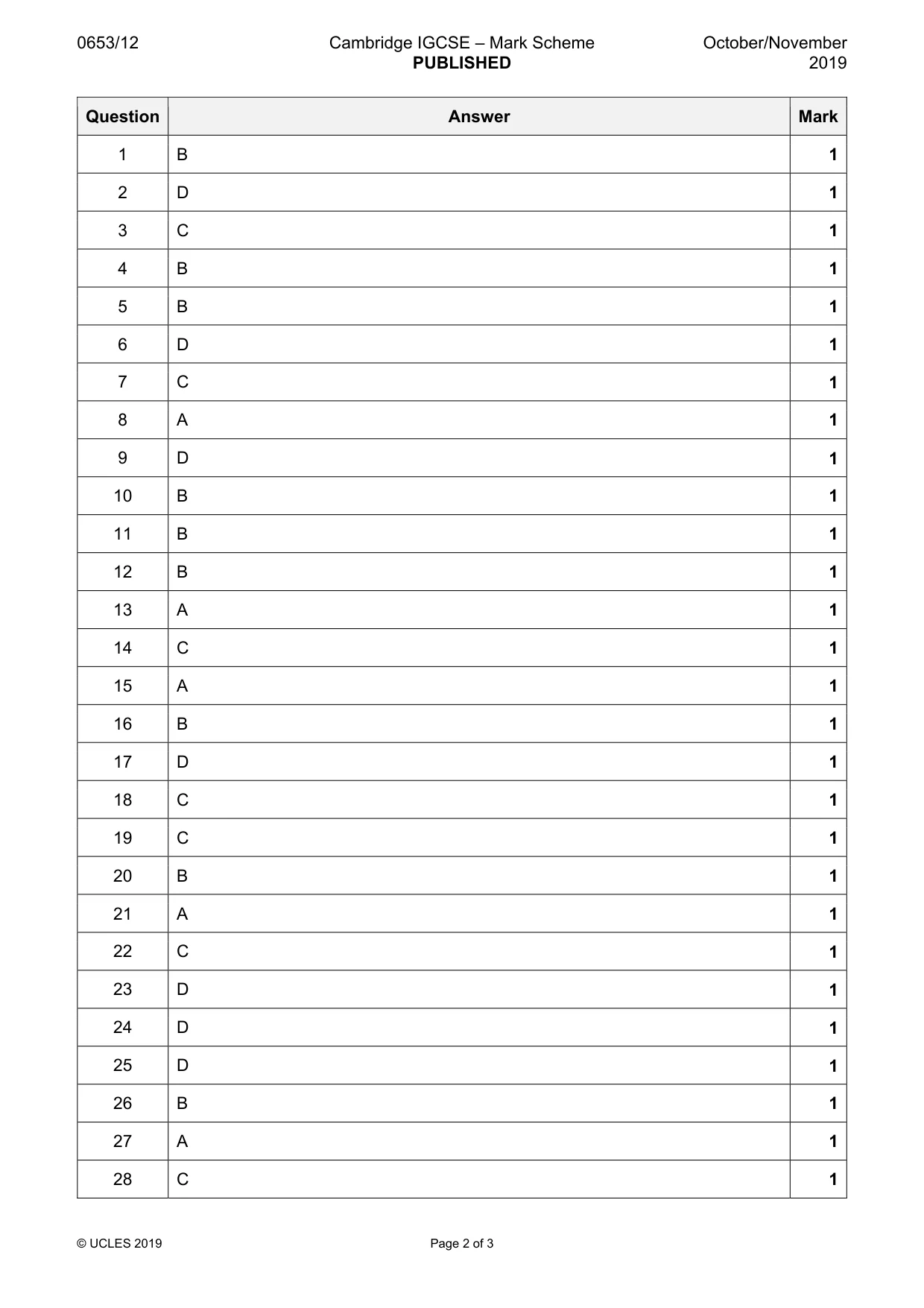
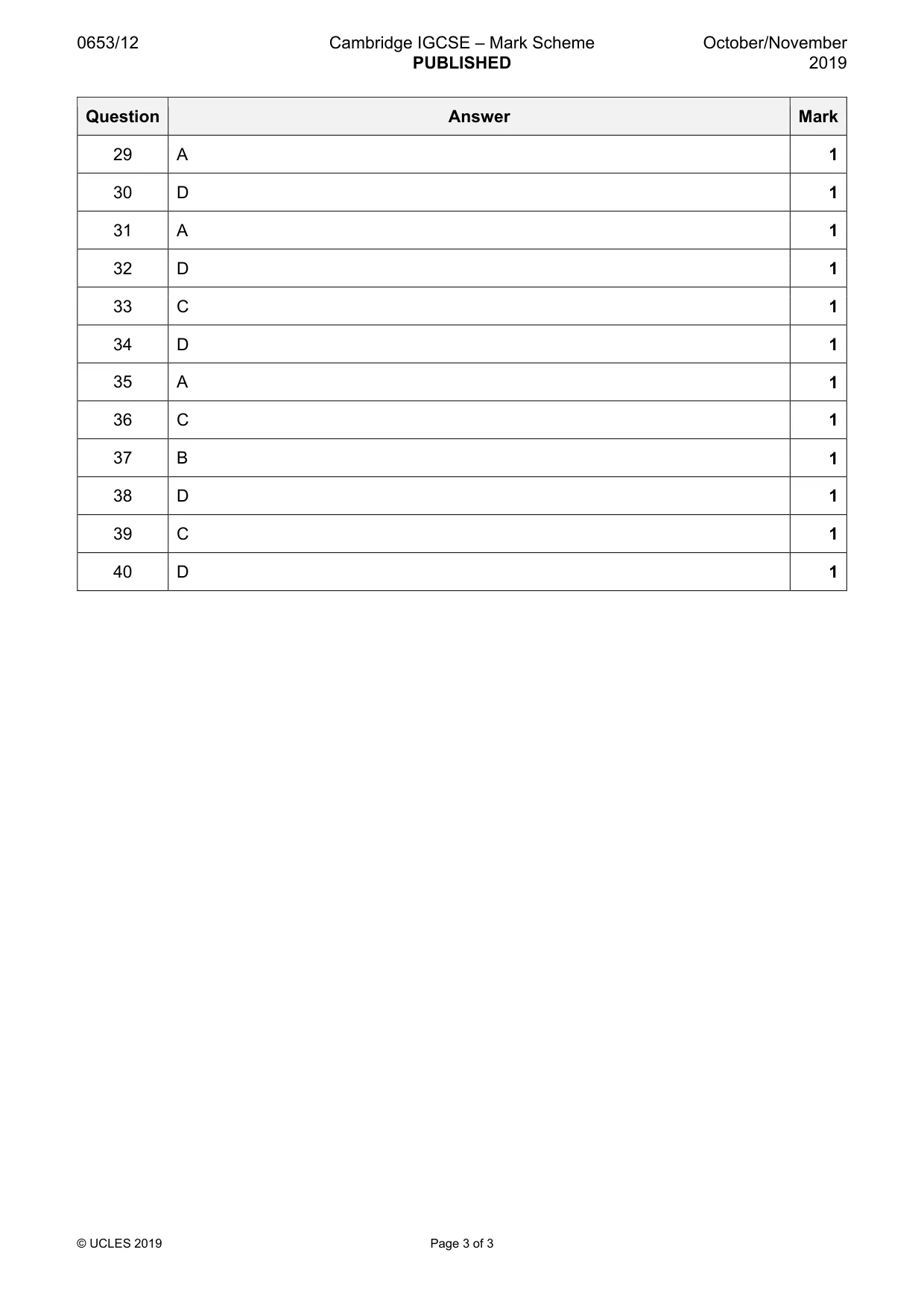
Answers below. Sit the paper first if you are practising.
Questions as text
Q1 · Which characteristic of living organisms describes the taking in of materials for energy…
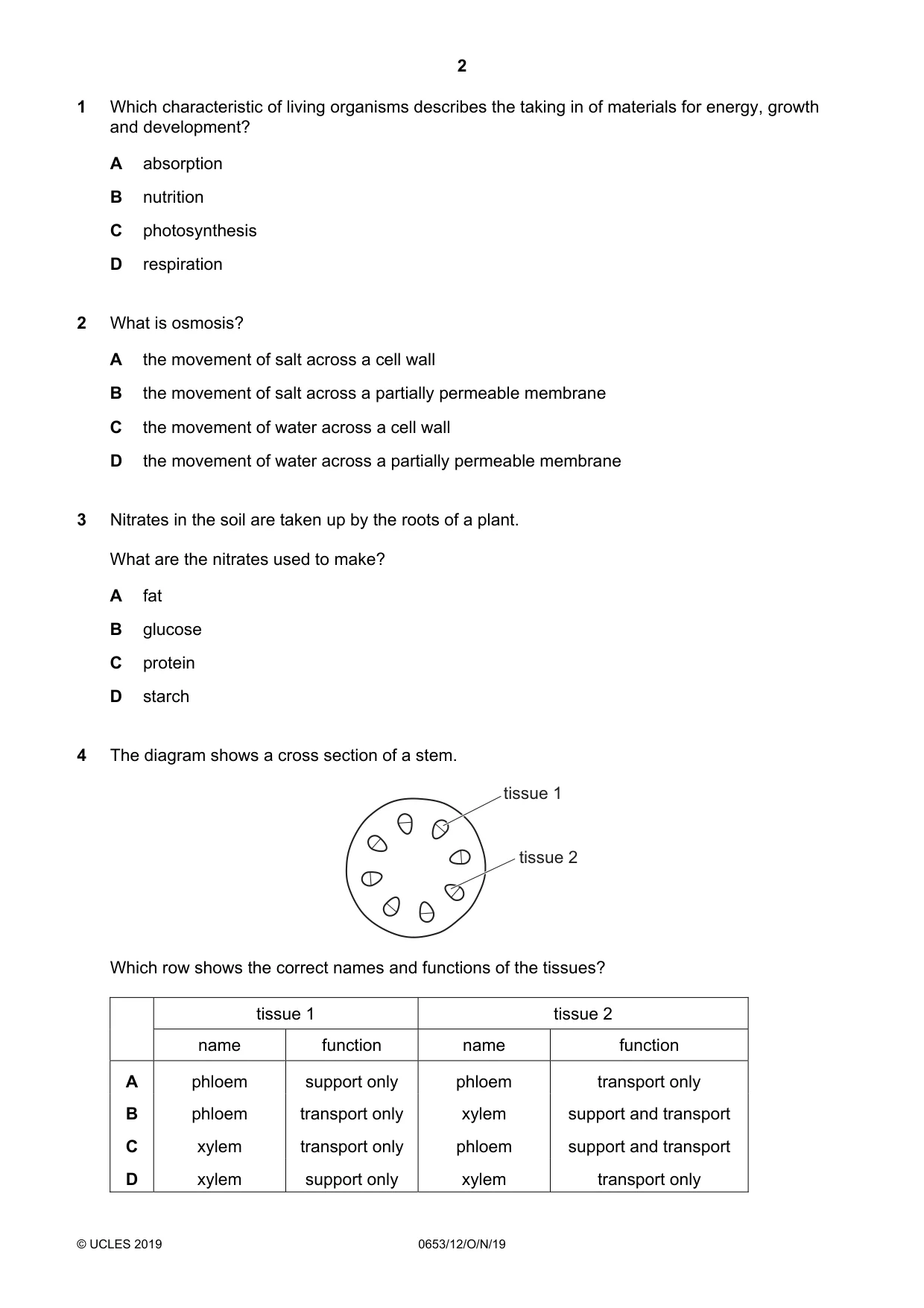
1 Which characteristic of living organisms describes the taking in of materials for energy, growth and development? A absorption B nutrition C photosynthesis D respiration
Mark scheme: B
Question 2
2 What is osmosis? A the movement of salt across a cell wall B the movement of salt across a partially permeable membrane C the movement of water across a cell wall D the movement of water across a partially permeable membrane
Mark scheme: D
Q3 · Nitrates in the soil are taken up by the roots of a plant
3 Nitrates in the soil are taken up by the roots of a plant. What are the nitrates used to make? A fat B glucose C protein D starch
Mark scheme: C
Q4 · The diagram shows a cross section of a stem
4 The diagram shows a cross section of a stem. tissue 1 tissue 2 Which row shows the correct names and functions of the tissues? tissue 1 tissue 2 name function name function A phloem support only phloem transport only B phloem transport only xylem support and transport C xylem transport only phloem support and transport D xylem support only xylem transport only
Mark scheme: B
Q5 · Which statements about the site of valves are correct?
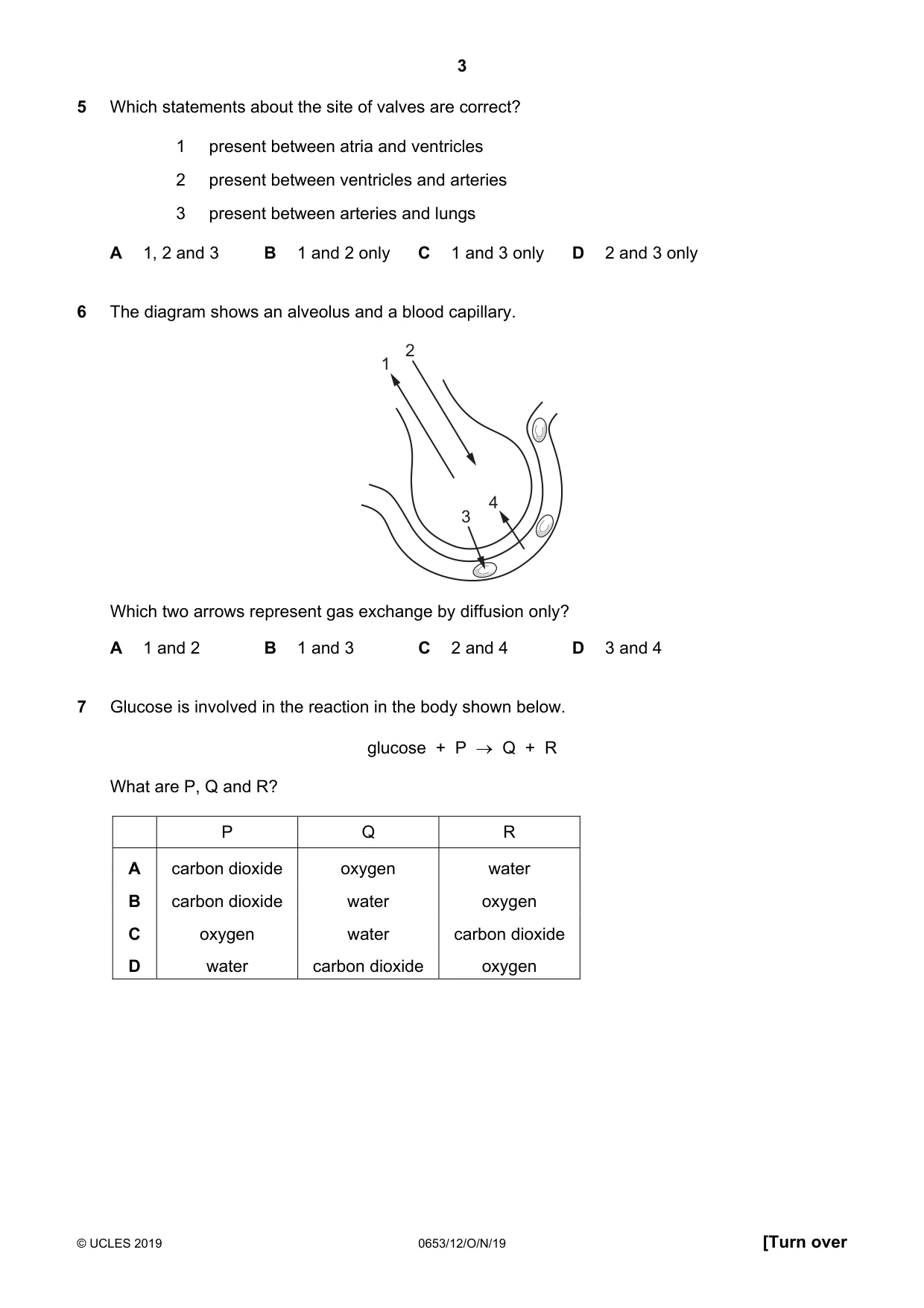
5 Which statements about the site of valves are correct? 1 present between atria and ventricles 2 present between ventricles and arteries 3 present between arteries and lungs A 1, 2 and 3 B 1 and 2 only C 1 and 3 only D 2 and 3 only
Mark scheme: B
Q6 · The diagram shows an alveolus and a blood capillary
6 The diagram shows an alveolus and a blood capillary. 2 1 4 3 Which two arrows represent gas exchange by diffusion only? A 1 and 2 B 1 and 3 C 2 and 4 D 3 and 4
Mark scheme: D
Q7 · Glucose is involved in the reaction in the body shown below
7 Glucose is involved in the reaction in the body shown below. glucose + P → Q + R What are P, Q and R? P Q R A carbon dioxide oxygen water B carbon dioxide water oxygen C oxygen water carbon dioxide D water carbon dioxide oxygen
Mark scheme: C
Q8 · A biologist keeps a potted plant in a laboratory
8 A biologist keeps a potted plant in a laboratory. Which feature of the potted plant shows that it is a living organism? A It grows larger over time. B It has green leaves. C The compost in the pot dries after he waters it. D The stems contain xylem.
Mark scheme: A
Q9 · The diagram shows the shoots of a tray of seedlings in a box
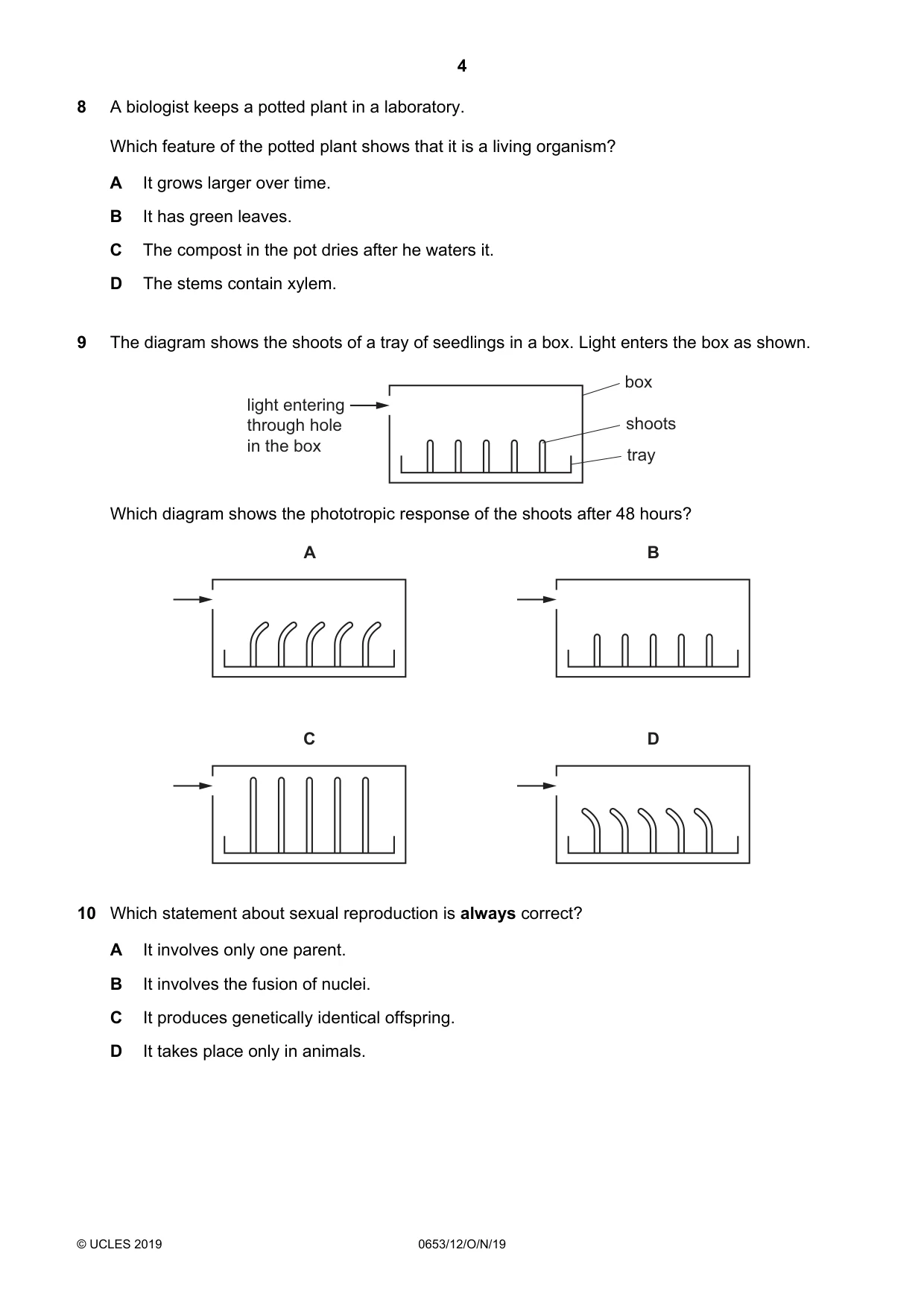
9 The diagram shows the shoots of a tray of seedlings in a box. Light enters the box as shown. box light entering through hole shoots in the box tray Which diagram shows the phototropic response of the shoots after 48 hours? A B C D
Mark scheme: D
Q10 · Which statement about sexual reproduction is always correct?
10 Which statement about sexual reproduction is always correct? A It involves only one parent. B It involves the fusion of nuclei. C It produces genetically identical offspring. D It takes place only in animals.
Mark scheme: B
Q11 · What is the function of the human ovaries?
11 What is the function of the human ovaries? A place where the fetus develops B release of eggs C site of fertilisation D transfer of egg to the uterus
Mark scheme: B
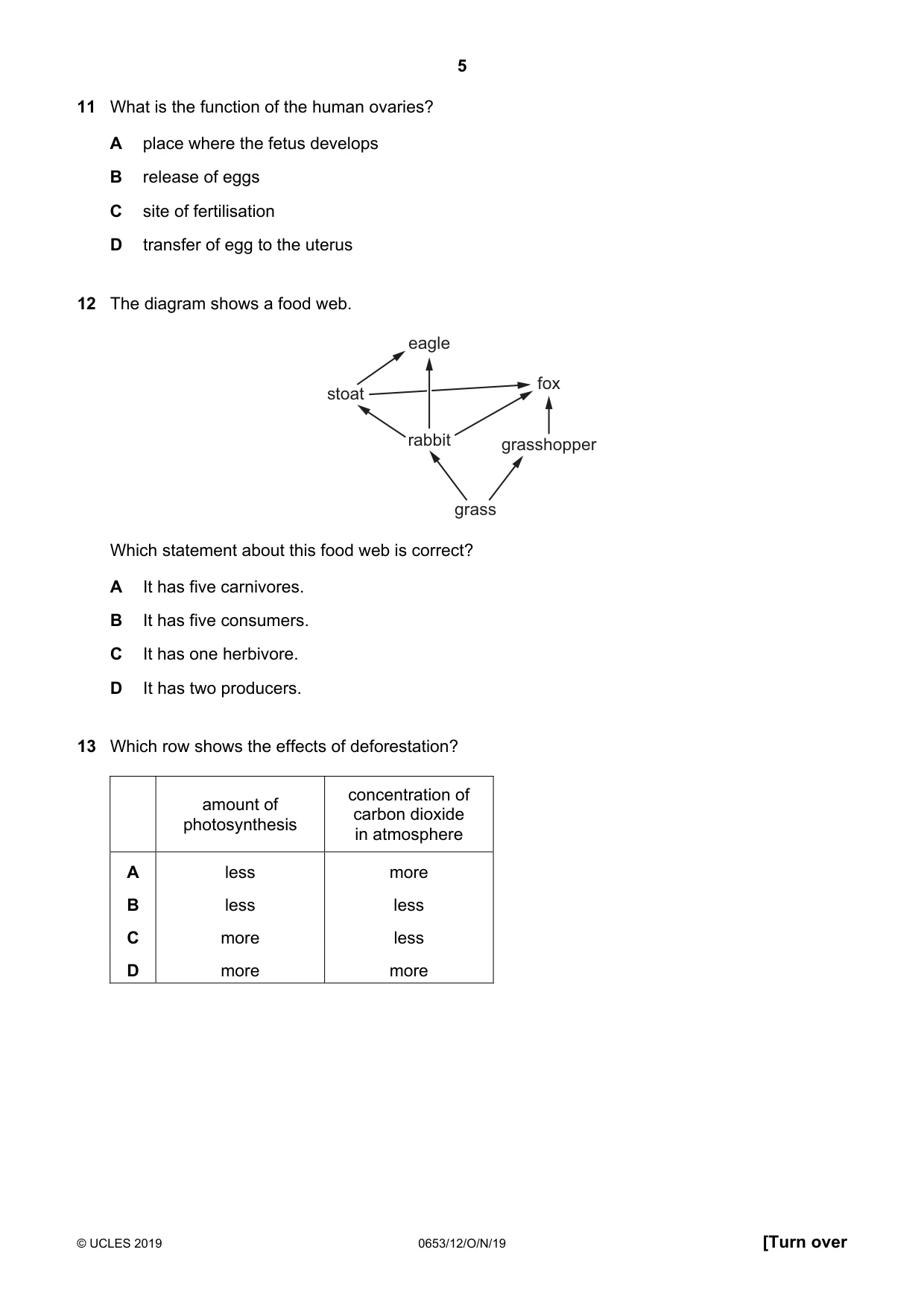
Q12 · The diagram shows a food web
12 The diagram shows a food web. eagle fox stoat rabbit grasshopper grass Which statement about this food web is correct? A It has five carnivores. B It has five consumers. C It has one herbivore. D It has two producers.
Mark scheme: B
Q13 · Which row shows the effects of deforestation?
13 Which row shows the effects of deforestation? concentration of amount of carbon dioxide photosynthesis in atmosphere A less more B less less C more less D more more
Mark scheme: A
Q14 · Four changes are listed
14 Four changes are listed. 1 solid carbon dioxide → carbon dioxide gas 2 the rusting of iron 3 the electrolysis of molten sodium chloride 4 the fractional distillation of crude oil Which row identifies the chemical changes and physical changes? chemical change physical change A 1 and 2 3 and 4 B 1 and 4 2 and 3 C 2 and 3 1 and 4 D 3 and 4 1 and 2
Mark scheme: C
Q15 · A white solid X is formed when magnesium reacts with oxygen
15 A white solid X is formed when magnesium reacts with oxygen. What is X? A a compound B a mixture C an alloy D an element
Mark scheme: A
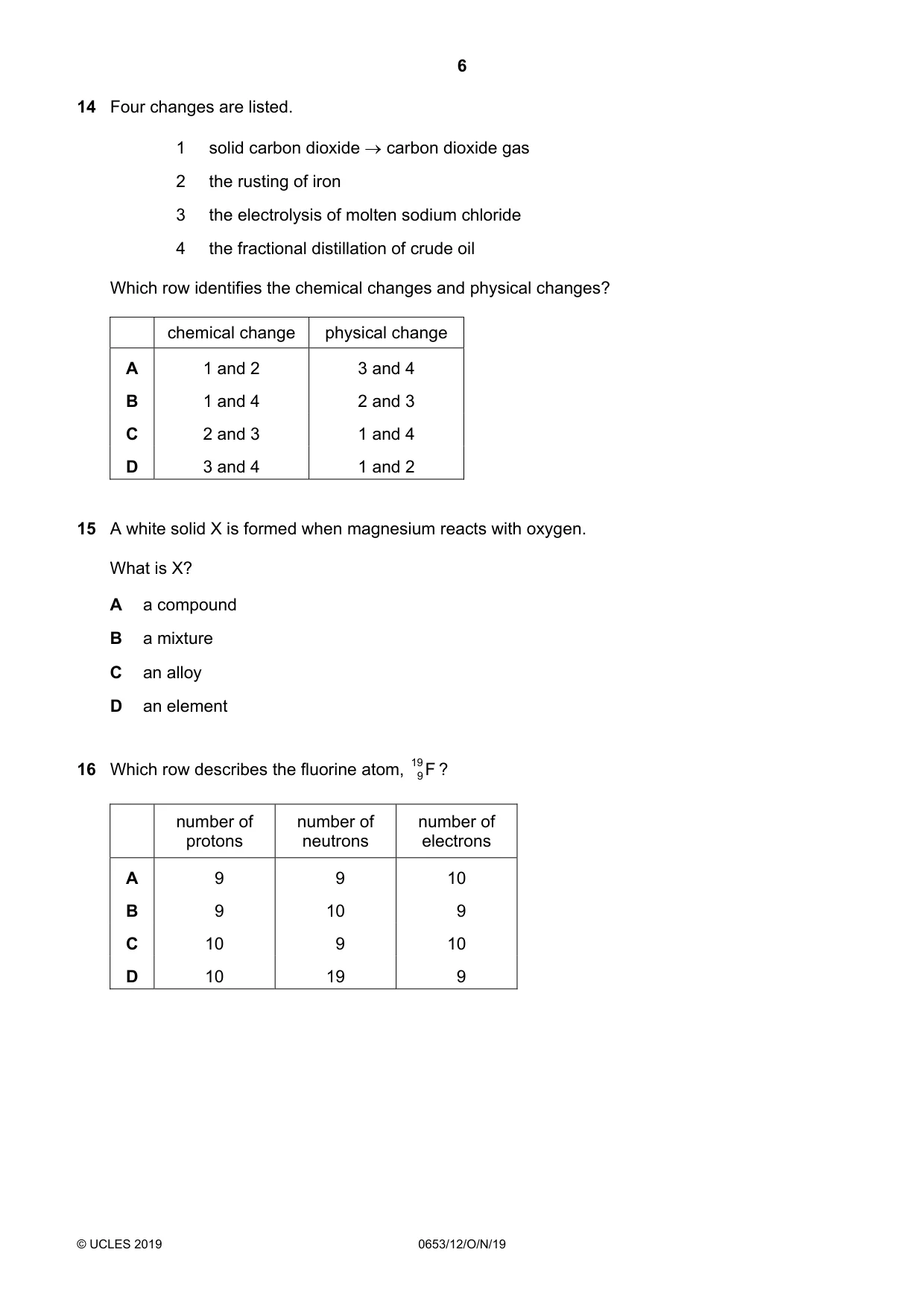
Q16 · Which row describes the fluorine atom, 19 F ?
16 Which row describes the fluorine atom, 19 F ? 9 number of number of number of protons neutrons electrons A 9 9 10 B 9 10 9 C 10 9 10 D 10 19 9
Mark scheme: B
Q17 · The fertiliser ammonium sulfate has the formula (NH4)2SO4
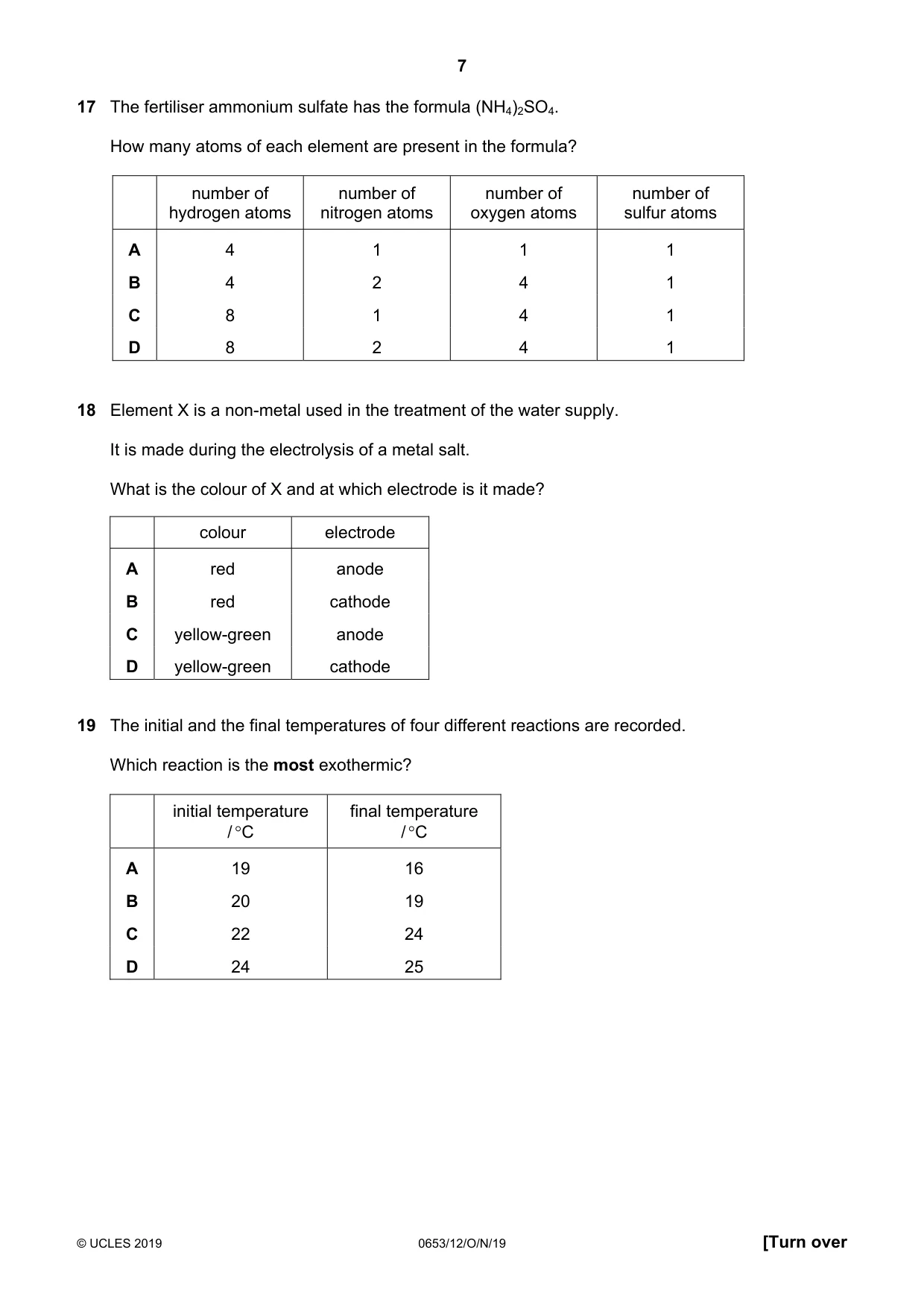
17 The fertiliser ammonium sulfate has the formula (NH4)2SO4. How many atoms of each element are present in the formula? number of number of number of number of hydrogen atoms nitrogen atoms oxygen atoms sulfur atoms A 4 1 1 1 B 4 2 4 1 C 8 1 4 1 D 8 2 4 1
Mark scheme: D
Q18 · Element X is a non-metal used in the treatment of the water supply
18 Element X is a non-metal used in the treatment of the water supply. It is made during the electrolysis of a metal salt. What is the colour of X and at which electrode is it made? colour electrode A red anode B red cathode C yellow-green anode D yellow-green cathode
Mark scheme: C
Q19 · The initial and the final temperatures of four different reactions are recorded
19 The initial and the final temperatures of four different reactions are recorded. Which reaction is the most exothermic? initial temperature final temperature / °C / °C A 19 16 B 20 19 C 22 24 D 24 25
Mark scheme: C
Q20 · Limestone chips react with dilute hydrochloric acid
20 Limestone chips react with dilute hydrochloric acid. Which change decreases the speed of the reaction? A adding a catalyst B decreasing the temperature C increasing the concentration of hydrochloric acid D using limestone powder
Mark scheme: B
Q21 · What are the products of the reaction between dilute hydrochloric acid and copper…
21 What are the products of the reaction between dilute hydrochloric acid and copper carbonate? A copper chloride + carbon dioxide + water B copper chloride + hydrogen carbonate C copper oxide + carbon dioxide + water D copper oxide + chlorine + water
Mark scheme: A
More questions on The characteristic properties of acids and bases
Q22 · Two non-metallic elements, X and Y, are in the same group of the Periodic Table
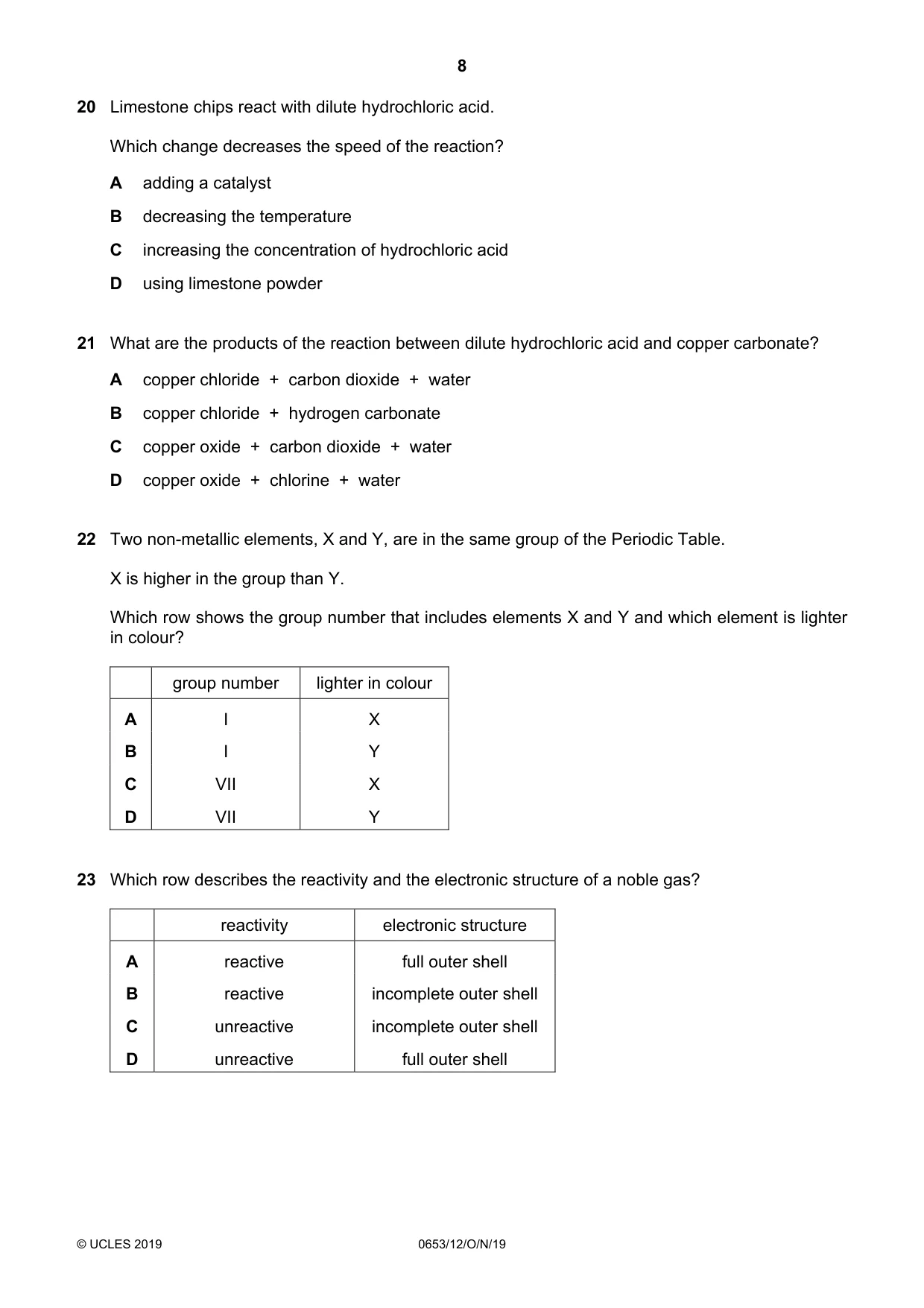
22 Two non-metallic elements, X and Y, are in the same group of the Periodic Table. X is higher in the group than Y. Which row shows the group number that includes elements X and Y and which element is lighter in colour? group number lighter in colour A I X B I Y C VII X D VII Y
Mark scheme: C
Q23 · Which row describes the reactivity and the electronic structure of a noble gas?
23 Which row describes the reactivity and the electronic structure of a noble gas? reactivity electronic structure A reactive full outer shell B reactive incomplete outer shell C unreactive incomplete outer shell D unreactive full outer shell
Mark scheme: D
Q24 · Which statement about alloys is correct?
24 Which statement about alloys is correct? A They are made from metals because metals are poor electrical conductors. B They are mixtures of compounds that contain metals. C They have all the same properties as the metals from which they are made. D They have different properties to the metals from which they are made.
Mark scheme: D
Q25 · Copper oxide reacts with carbon
25 Copper oxide reacts with carbon. The equation is shown. copper oxide + carbon → copper + carbon dioxide What is the role of carbon in this reaction? A It is a catalyst. B It is an electrolyte. C It neutralises the copper oxide. D It reduces the copper oxide.
Mark scheme: D
Q26 · What is the composition of clean air?
26 What is the composition of clean air? A 78% nitrogen, 21% carbon dioxide and small amounts of other gases B 78% nitrogen, 21% oxygen and small amounts of other gases C 78% oxygen, 21% carbon dioxide and small amounts of other gases D 78% oxygen, 21% nitrogen and small amounts of other gases
Mark scheme: B
Q27 · Which two substances are formed during the complete combustion of hydrocarbons?
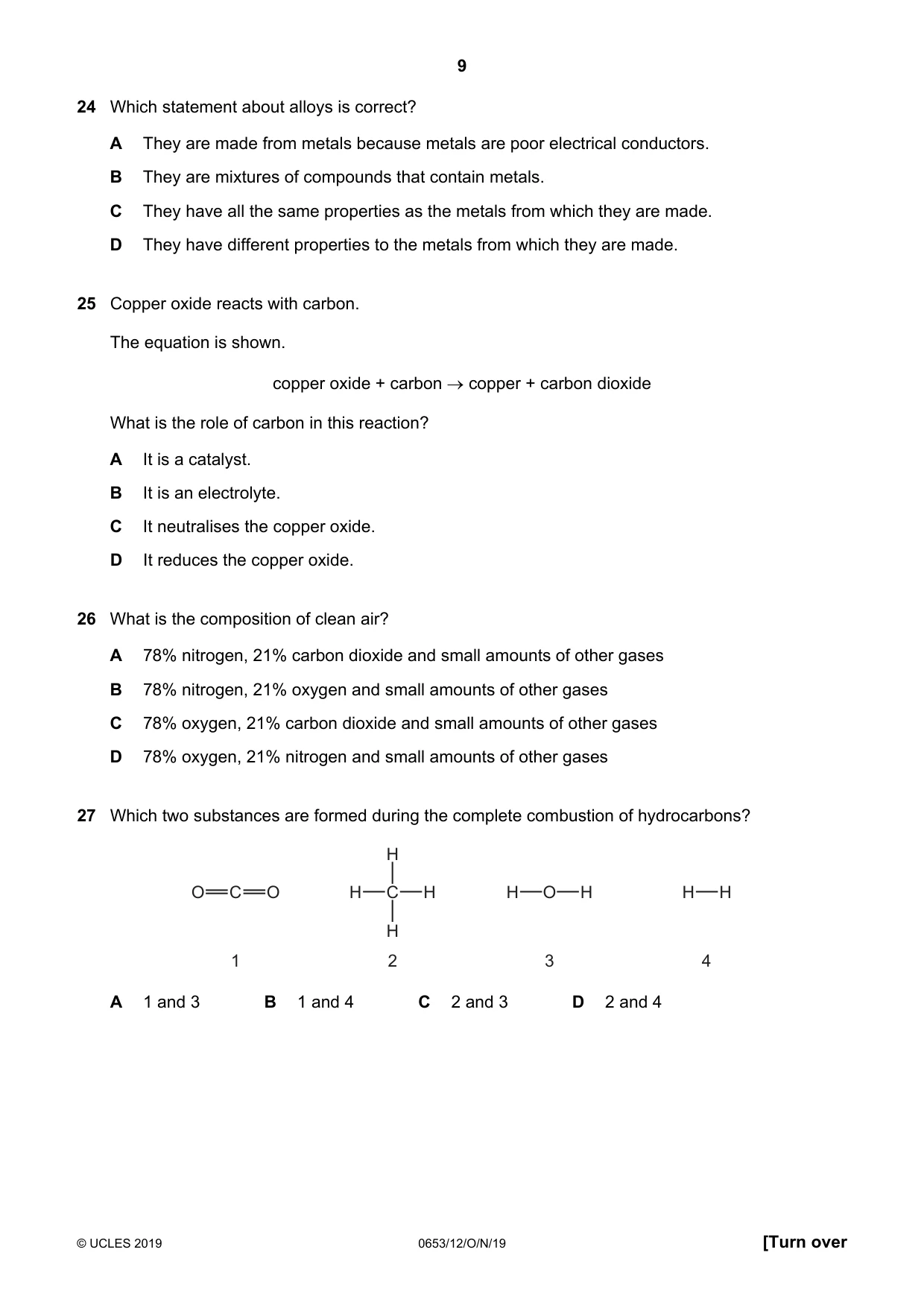
27 Which two substances are formed during the complete combustion of hydrocarbons? H O C O H C H H O H H H H 1 2 3 4 A 1 and 3 B 1 and 4 C 2 and 3 D 2 and 4
Mark scheme: A
Q28 · A measuring cylinder contains liquid
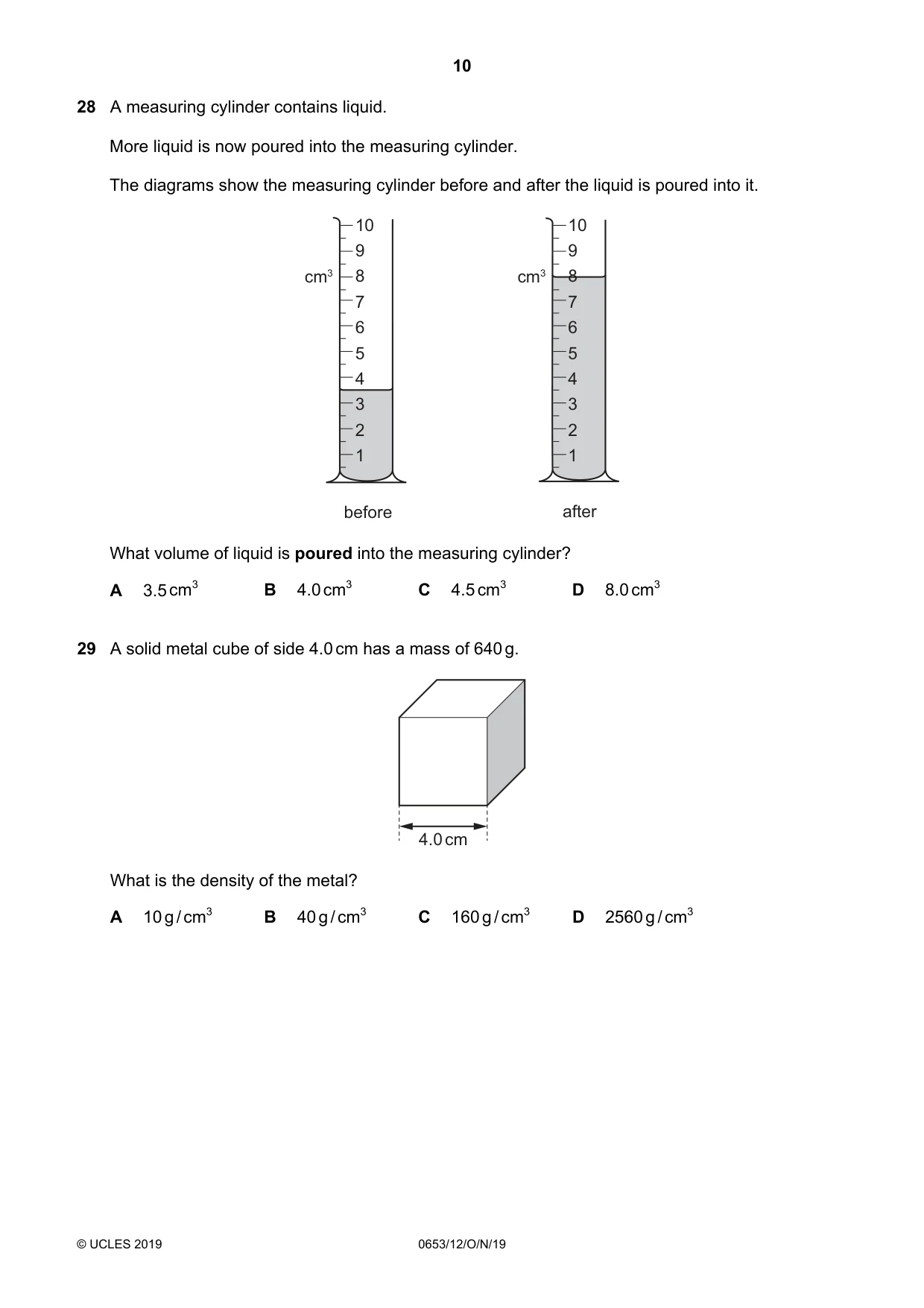
28 A measuring cylinder contains liquid. More liquid is now poured into the measuring cylinder. The diagrams show the measuring cylinder before and after the liquid is poured into it. 10 10 9 9 cm3 8 cm3 8 7 7 6 6 5 5 4 4 3 3 2 2 1 1 before after What volume of liquid is poured into the measuring cylinder? A 3.5 cm3 B 4.0 cm3 C 4.5 cm3 D 8.0 cm3
Mark scheme: C
More questions on Physical quantities and measurement techniques
Q29 · A solid metal cube of side 4.0 cm has a mass of 640 g
29 A solid metal cube of side 4.0 cm has a mass of 640 g. 4.0 cm What is the density of the metal? A 10 g / cm3 B 40 g / cm3 C 160 g / cm3 D 2560 g / cm3
Mark scheme: A
Q30 · A man walking on snow in normal shoes sinks into the snow
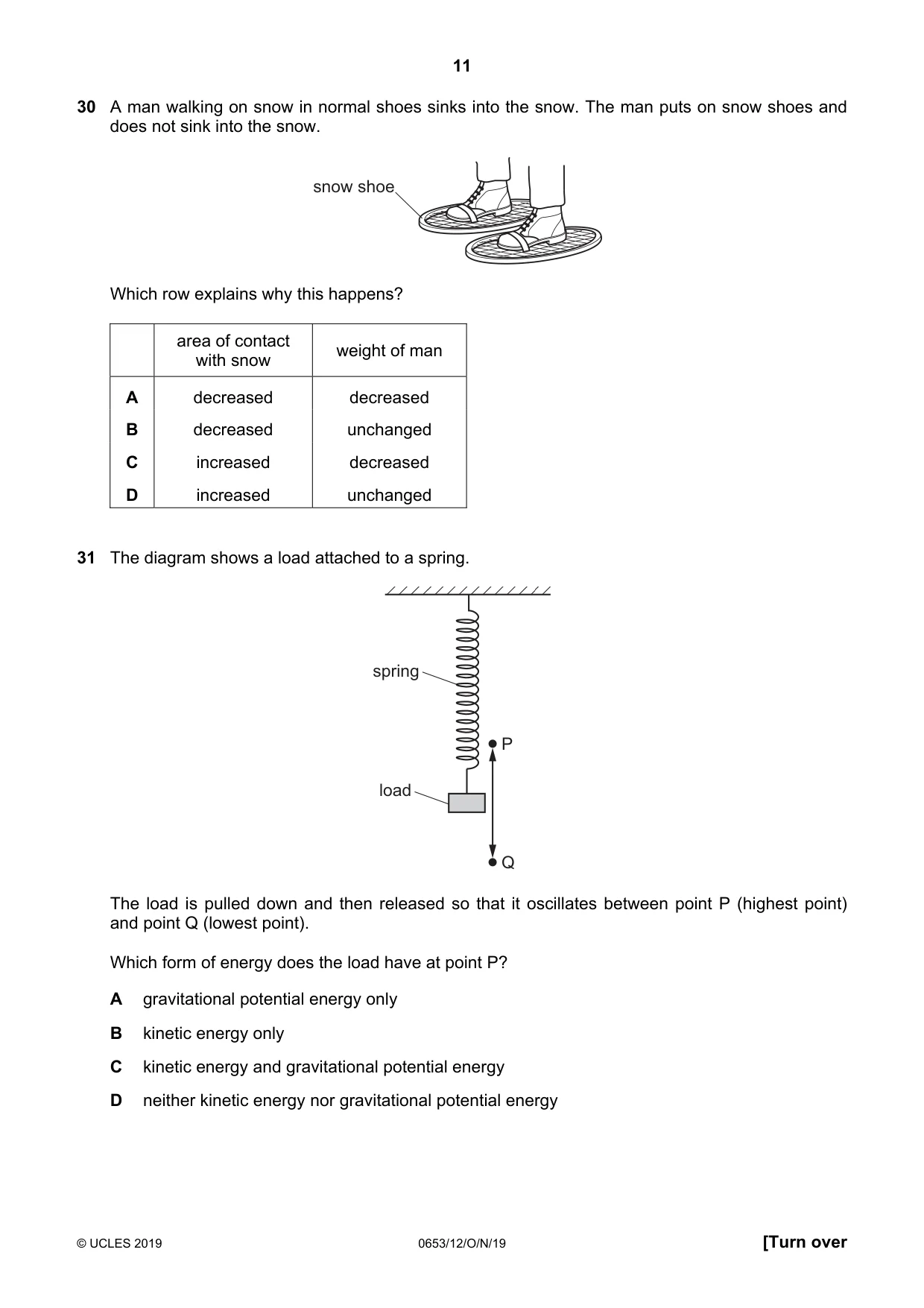
30 A man walking on snow in normal shoes sinks into the snow. The man puts on snow shoes and does not sink into the snow. snow shoe Which row explains why this happens? area of contact weight of man with snow A decreased decreased B decreased unchanged C increased decreased D increased unchanged
Mark scheme: D
Q31 · The diagram shows a load attached to a spring
31 The diagram shows a load attached to a spring. spring P load Q The load is pulled down and then released so that it oscillates between point P (highest point) and point Q (lowest point). Which form of energy does the load have at point P? A gravitational potential energy only B kinetic energy only C kinetic energy and gravitational potential energy D neither kinetic energy nor gravitational potential energy
Mark scheme: A
Q32 · A girl runs up some stairs
32 A girl runs up some stairs. Which two quantities need to be known to calculate the power she produces? A her weight and the height of the stairs B her weight and the time she takes to run up the stairs C the work she does and the height of the stairs D the work she does and the time she takes to run up the stairs
Mark scheme: D
Q33 · A liquid is evaporating but not boiling
33 A liquid is evaporating but not boiling. Which statement about evaporation of the liquid is correct? A Bubbles of vapour are formed beneath the surface of the liquid during evaporation. B Evaporation only takes place at a specific temperature. C Evaporation only takes place from the surface of the liquid. D The temperature of the liquid increases during evaporation.
Mark scheme: C
Q34 · Which row describes the separation and motion of the molecules in solids and gases?
34 Which row describes the separation and motion of the molecules in solids and gases? solids gases A close together and changing close together and changing positions positions B close together and changing far apart and moving freely positions C close together and vibrating close together and vibrating about fixed positions about fixed positions D close together and vibrating far apart and moving freely about fixed positions
Mark scheme: D
Q35 · The diagram shows light striking a plane mirror
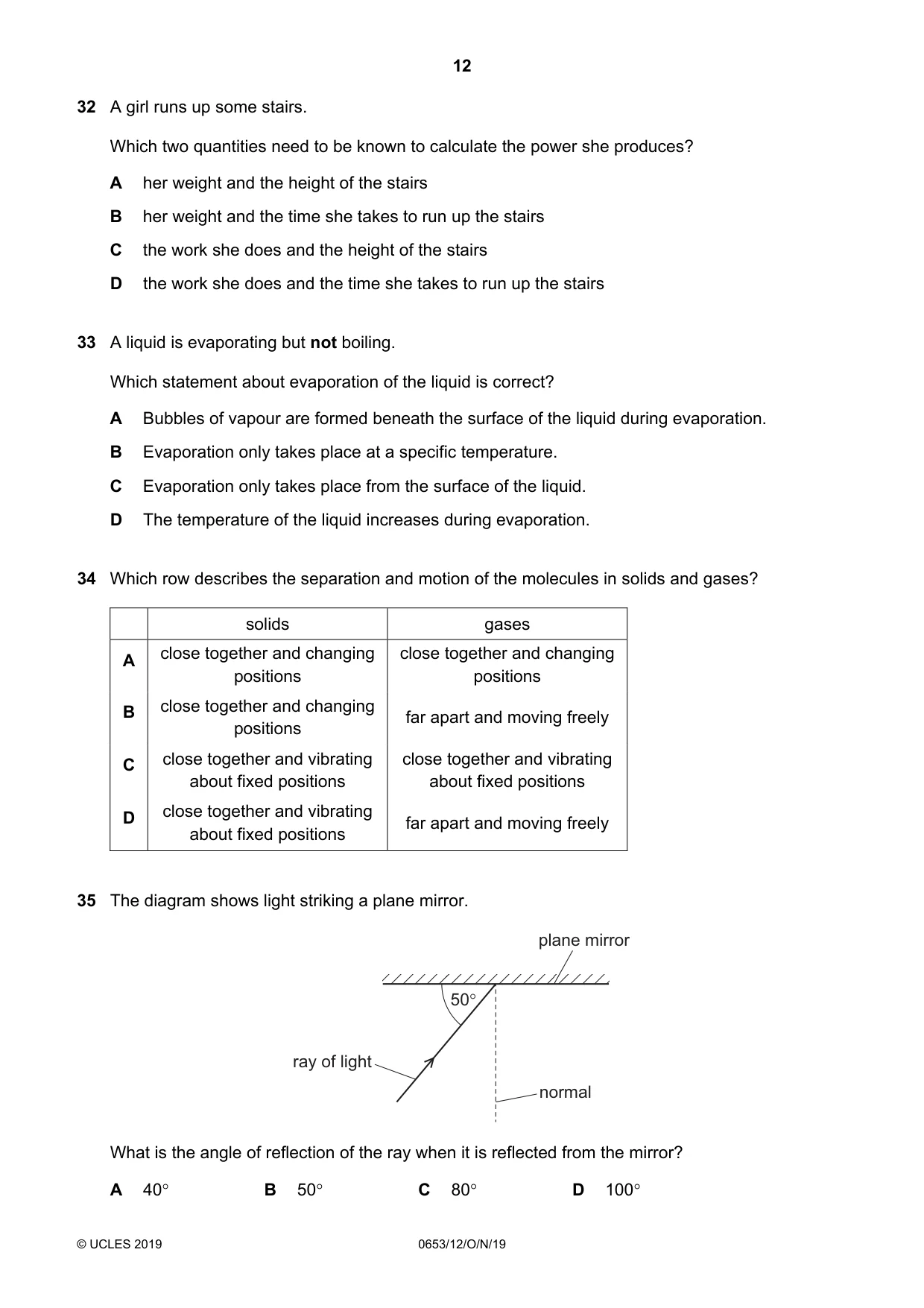
35 The diagram shows light striking a plane mirror. plane mirror 50° ray of light normal What is the angle of reflection of the ray when it is reflected from the mirror? A 40° B 50° C 80° D 100°
Mark scheme: A
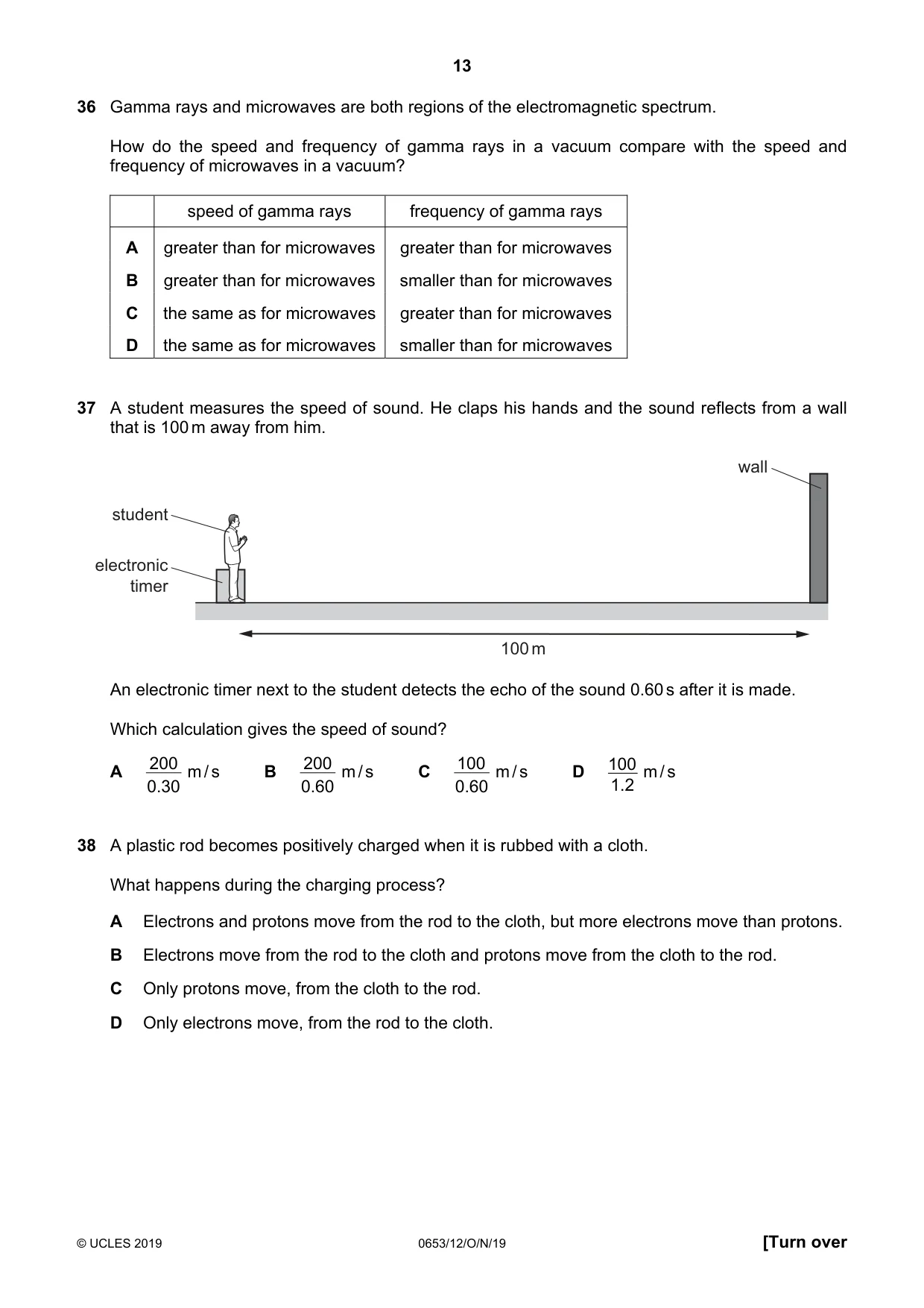
Q36 · Gamma rays and microwaves are both regions of the electromagnetic spectrum
36 Gamma rays and microwaves are both regions of the electromagnetic spectrum. How do the speed and frequency of gamma rays in a vacuum compare with the speed and frequency of microwaves in a vacuum? speed of gamma rays frequency of gamma rays A greater than for microwaves greater than for microwaves B greater than for microwaves smaller than for microwaves C the same as for microwaves greater than for microwaves D the same as for microwaves smaller than for microwaves
Mark scheme: C
Q37 · A student measures the speed of sound
37 A student measures the speed of sound. He claps his hands and the sound reflects from a wall that is 100 m away from him. wall student electronic timer 100 m An electronic timer next to the student detects the echo of the sound 0.60 s after it is made. Which calculation gives the speed of sound? 200 200 100 100 A m / s B m / s C m / s D m / s 0.30 0.60 0.60 1 . 2
Mark scheme: B
Q38 · A plastic rod becomes positively charged when it is rubbed with a cloth
38 A plastic rod becomes positively charged when it is rubbed with a cloth. What happens during the charging process? A Electrons and protons move from the rod to the cloth, but more electrons move than protons. B Electrons move from the rod to the cloth and protons move from the cloth to the rod. C Only protons move, from the cloth to the rod. D Only electrons move, from the rod to the cloth.
Mark scheme: D
Q39 · A student wants to measure the potential difference across a resistor
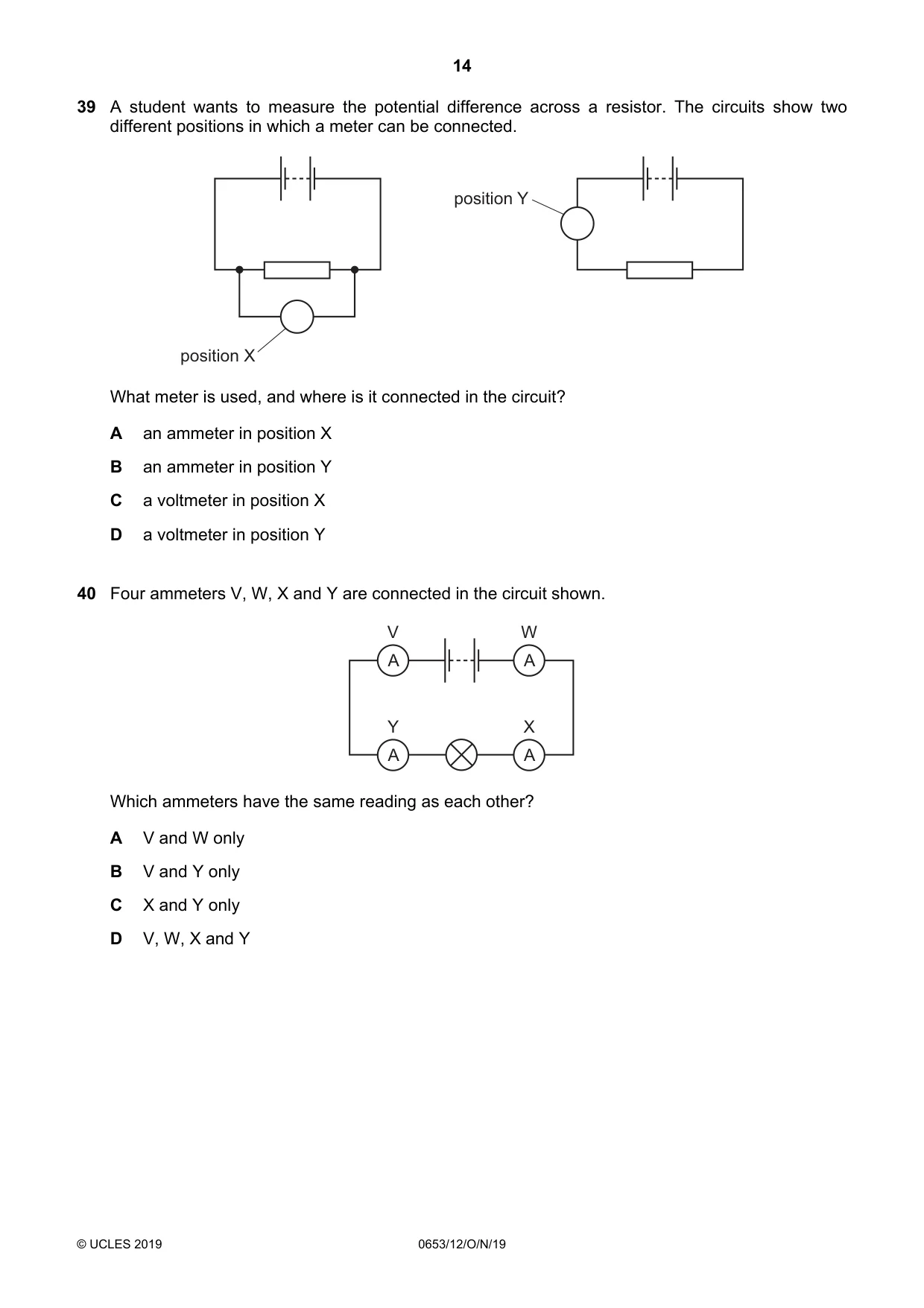
39 A student wants to measure the potential difference across a resistor. The circuits show two different positions in which a meter can be connected. position Y position X What meter is used, and where is it connected in the circuit? A an ammeter in position X B an ammeter in position Y C a voltmeter in position X D a voltmeter in position Y
Mark scheme: C
Q40 · Four ammeters V, W, X and Y are connected in the circuit shown
40 Four ammeters V, W, X and Y are connected in the circuit shown. V W A A Y X A A Which ammeters have the same reading as each other? A V and W only B V and Y only C X and Y only D V, W, X and Y
Mark scheme: D
What was in this paper
The subtopics covered by these 40 questions, and how many questions each got. Open one in a new tab to see every Cambridge question on it.
2Electrical circuits2Energy, work and power2Kinetic particle model of matter2Sexual reproduction in humans2Air quality and climate1Alloys and their properties1Atomic structure and the Periodic Table1Biological molecules1Density1Electrical quantities1Electrolysis1Electromagnetic spectrum1Elements, compounds and mixtures1Exothermic and endothermic reactions1Food chains and food webs1Formulas1Fuels1Gas exchange in humans1Group VII properties1Habitat destruction1Heart1Light1Noble gases1Osmosis1Photosynthesis1Physical and chemical changes1Physical quantities and measurement techniques1Pressure1Rate of reaction1Redox1Respiration1Sound1The characteristic properties of acids and bases1Xylem and phloem1What you needed in this session
Cambridge’s own grade thresholds for 2019 Oct/Nov, Paper 1 · Variant 2. A higher threshold means an easier paper — the bar moves with how the cohort did.