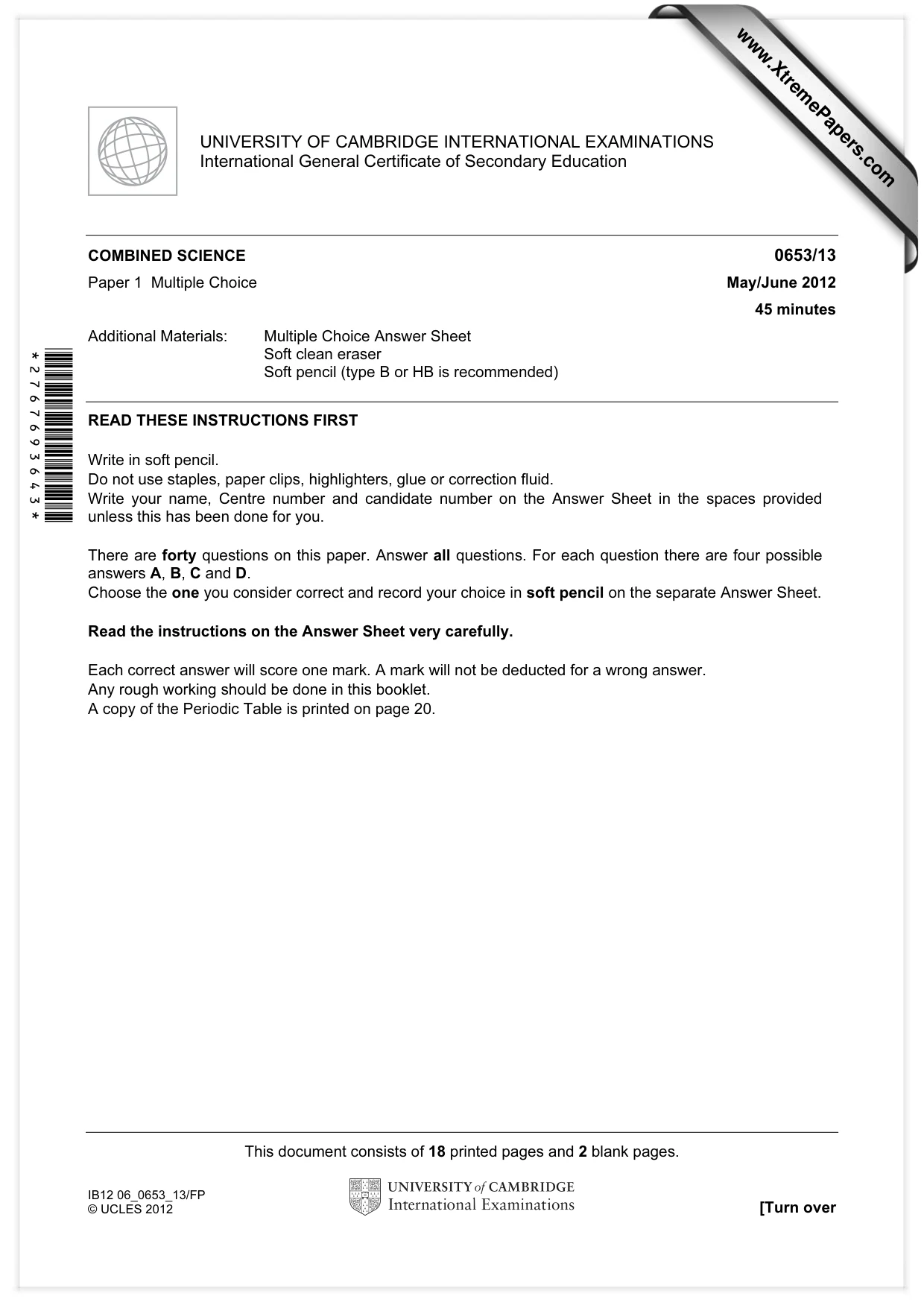
Cambridge IGCSE Science - Combined 0653 — 2012 May/June Paper 1 · Variant 3
0653/13/M/J/12 · 40 questions · 40 marks · ≈45 min
The question paper and its mark scheme, free to read here and free to download. This is Cambridge’s own paper, exactly as it was sat.
Question paper20 pages


Mark scheme2 pages
Answers below. Sit the paper first if you are practising.
Questions as text
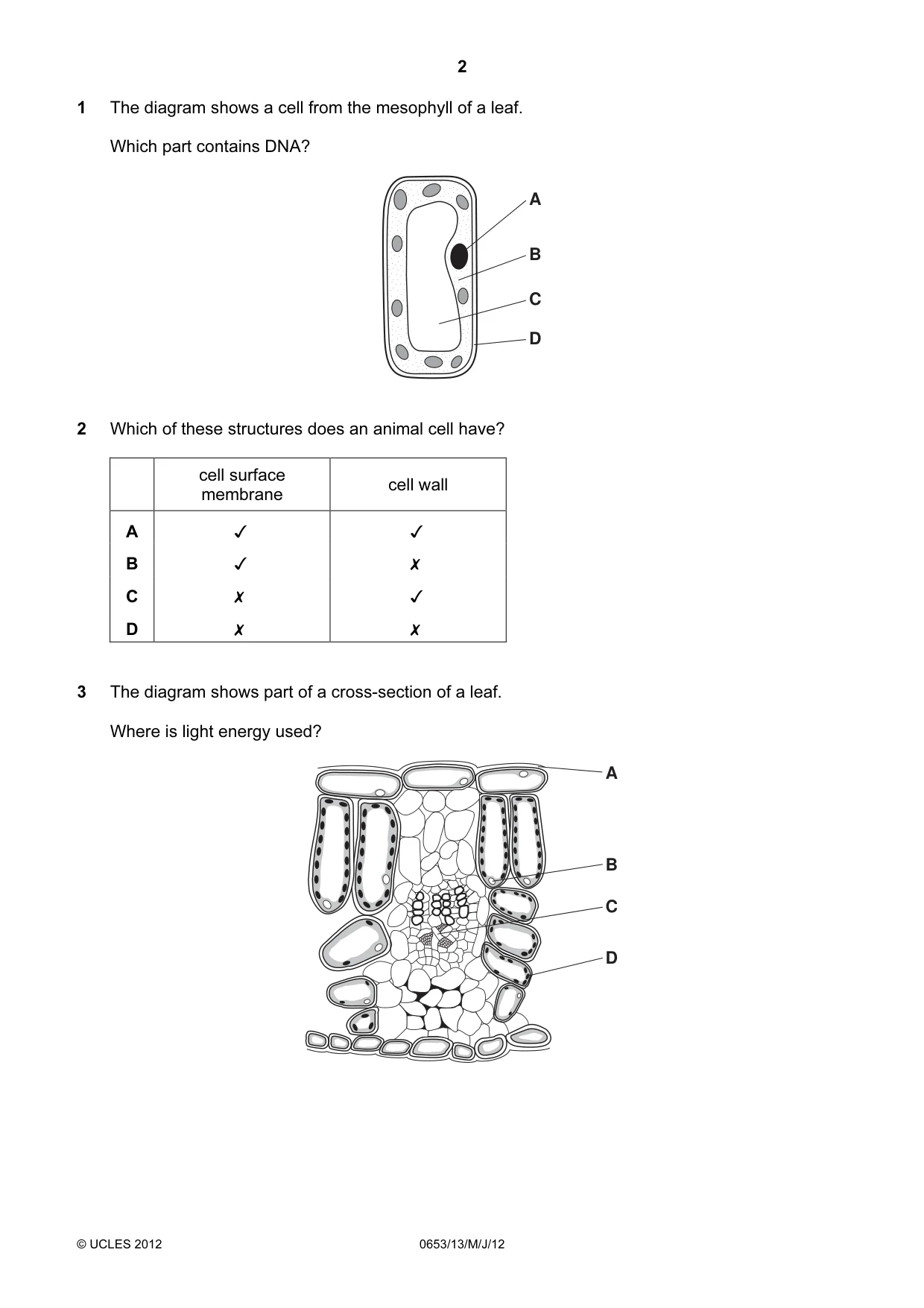
Q1 · The diagram shows a cell from the mesophyll of a leaf
1 The diagram shows a cell from the mesophyll of a leaf. Which part contains DNA? A B C D
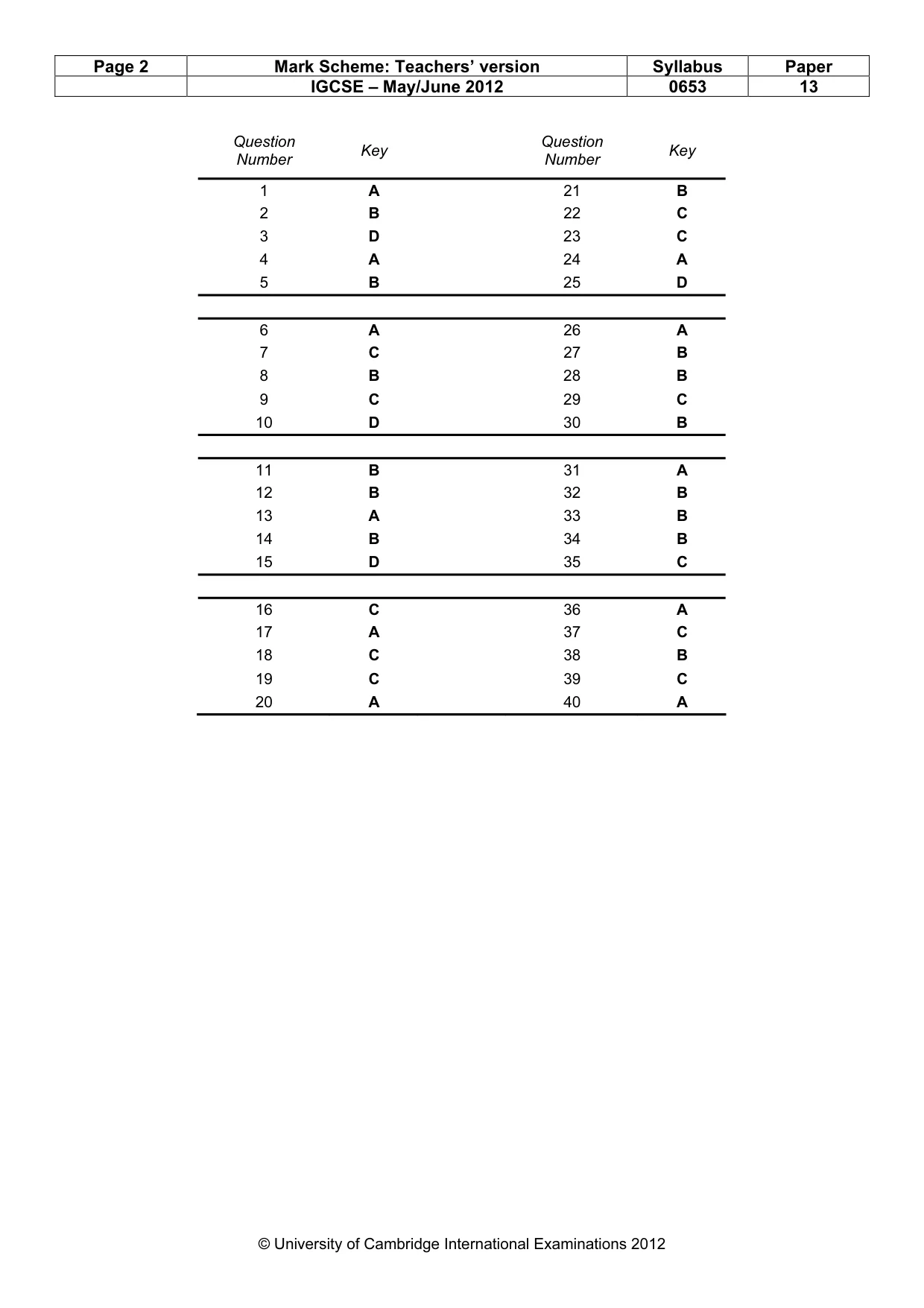
Mark scheme: A
Q2 · Which of these structures does an animal cell have?
2 Which of these structures does an animal cell have? cell surface cell wall membrane A Jv Jv B Jv x Cc x Jv D x x
Mark scheme: B
Q3 · The diagram shows part of a cross-section of a leaf
3 The diagram shows part of a cross-section of a leaf. Where is light energy used? A B C D
Mark scheme: D
Q4 · The statements are about enzymes
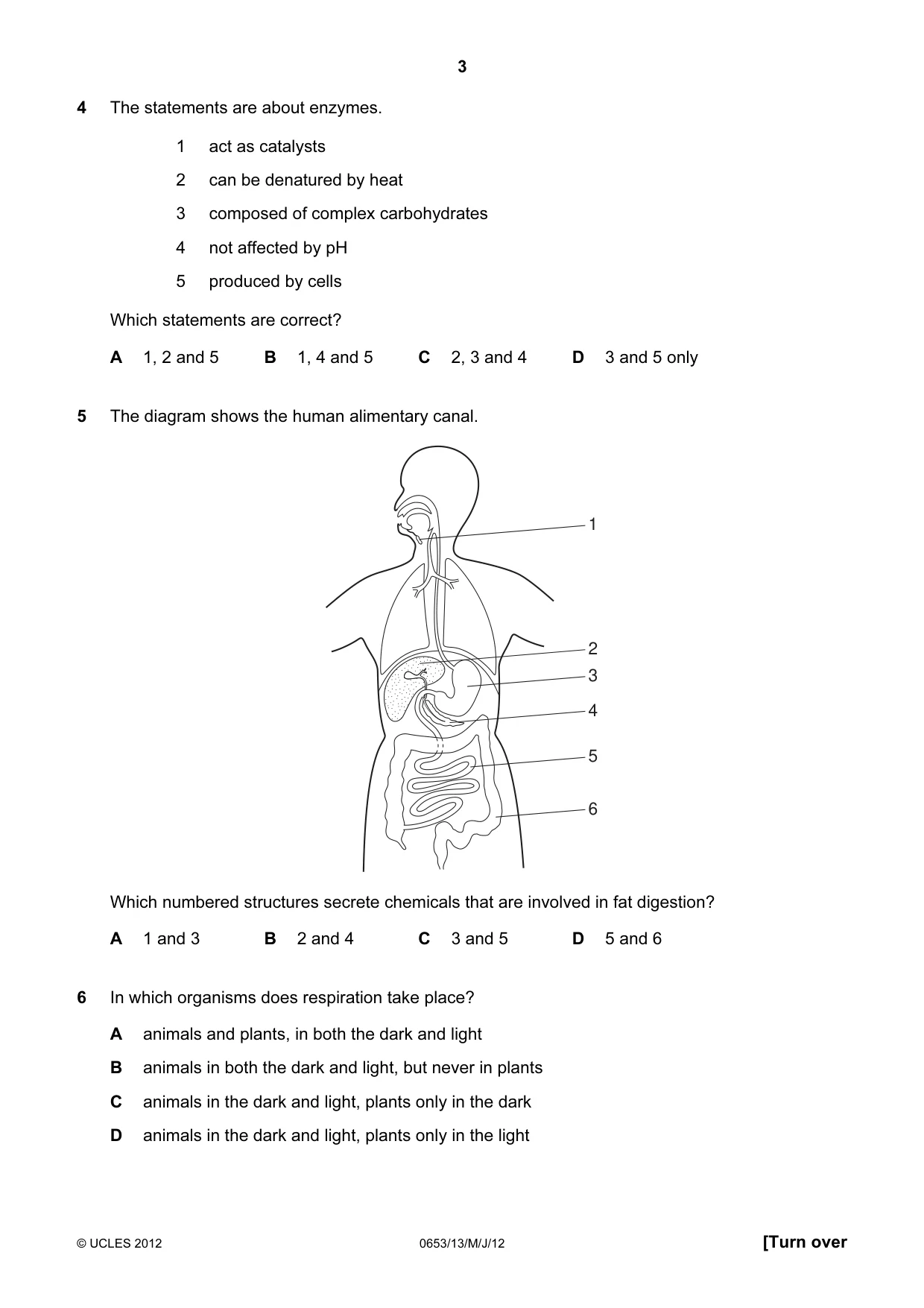
4 The statements are about enzymes. 1 act as catalysts 2 can be denatured by heat 3 composed of complex carbohydrates 4 not affected by pH 5 produced by cells Which statements are correct? A 1, 2 and 5 B 1, 4 and 5 C 2, 3 and 4 D 3 and 5 only
Mark scheme: A
Q5 · The diagram shows the human alimentary canal
5 The diagram shows the human alimentary canal. 1 2 3 4 5 6 Which numbered structures secrete chemicals that are involved in fat digestion? A 1 and 3 B 2 and 4 C 3 and 5 D 5 and 6
Mark scheme: B
Q6 · In which organisms does respiration take place?
6 In which organisms does respiration take place? A animals and plants, in both the dark and light B animals in both the dark and light, but never in plants C animals in the dark and light, plants only in the dark D animals in the dark and light, plants only in the light
Mark scheme: A
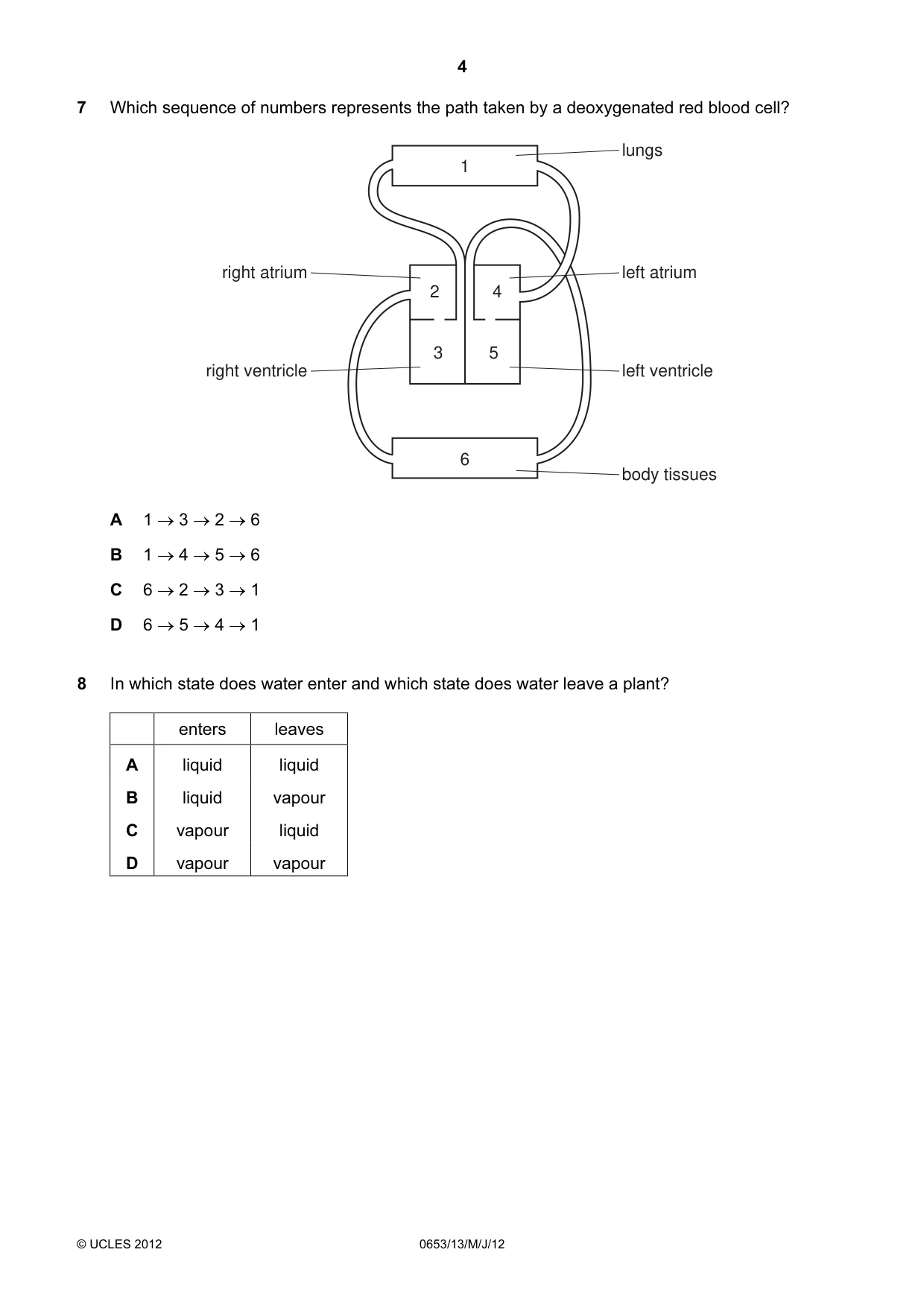
Q7 · Which sequence of numbers represents the path taken by a deoxygenated red blood cell?
7 Which sequence of numbers represents the path taken by a deoxygenated red blood cell? lungs 1 right atrium left atrium 2 4 3 5 right ventricle left ventricle 6 body tissues A 1 → 3 → 2 → 6 B 1 → 4 → 5 → 6 C 6 → 2 → 3 → 1 D 6 → 5 → 4 → 1
Mark scheme: C
Q8 · In which state does water enter and which state does water leave a plant?
8 In which state does water enter and which state does water leave a plant? enters leaves A liquid liquid B liquid vapour C vapour liquid D vapour vapour
Mark scheme: B
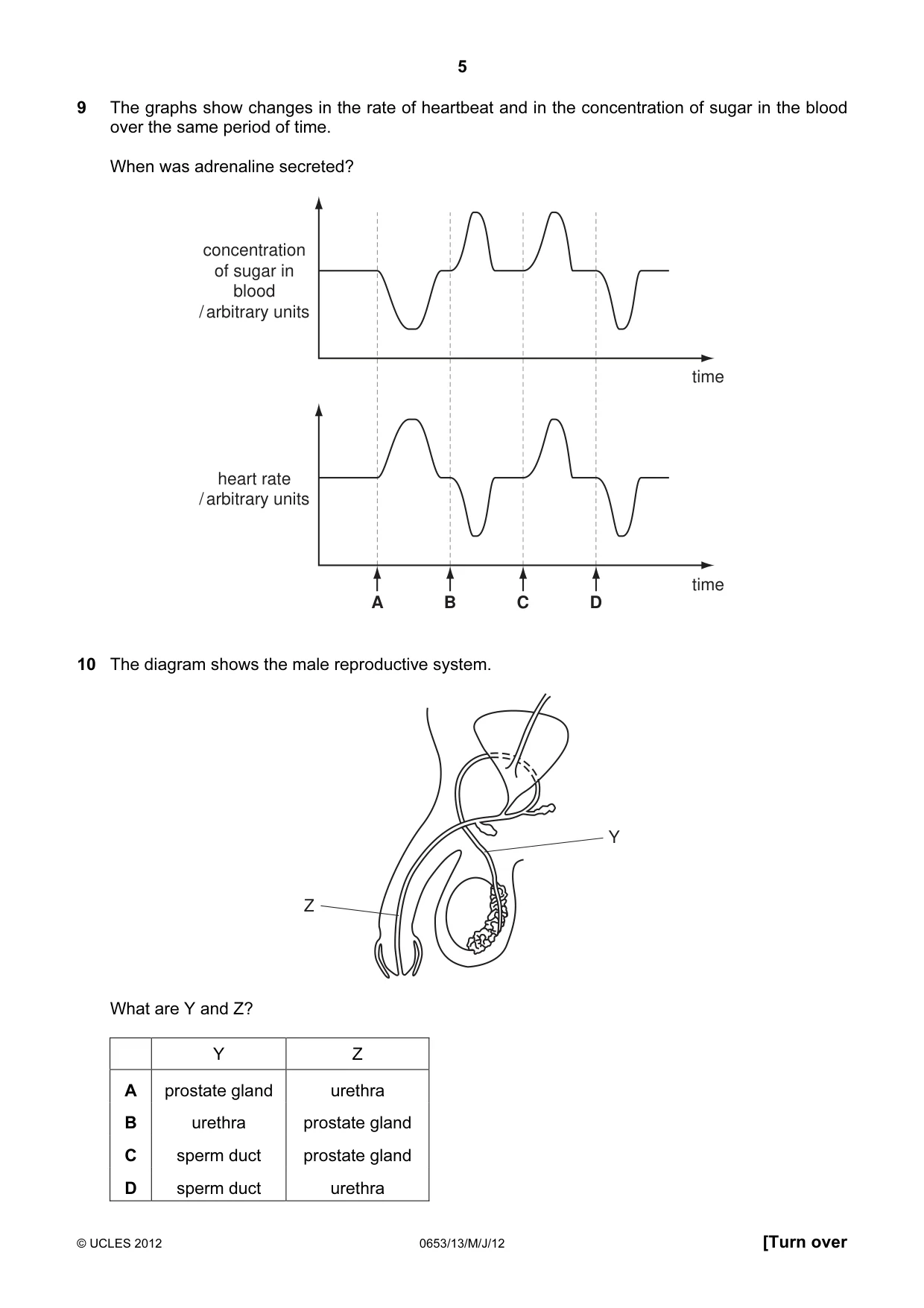
Q9 · The graphs show changes in the rate of heartbeat and in the concentration of sugar in the…
9 The graphs show changes in the rate of heartbeat and in the concentration of sugar in the blood over the same period of time. When was adrenaline secreted? concentration of sugar in blood / arbitrary units time heart rate / arbitrary units time A B C D
Mark scheme: C
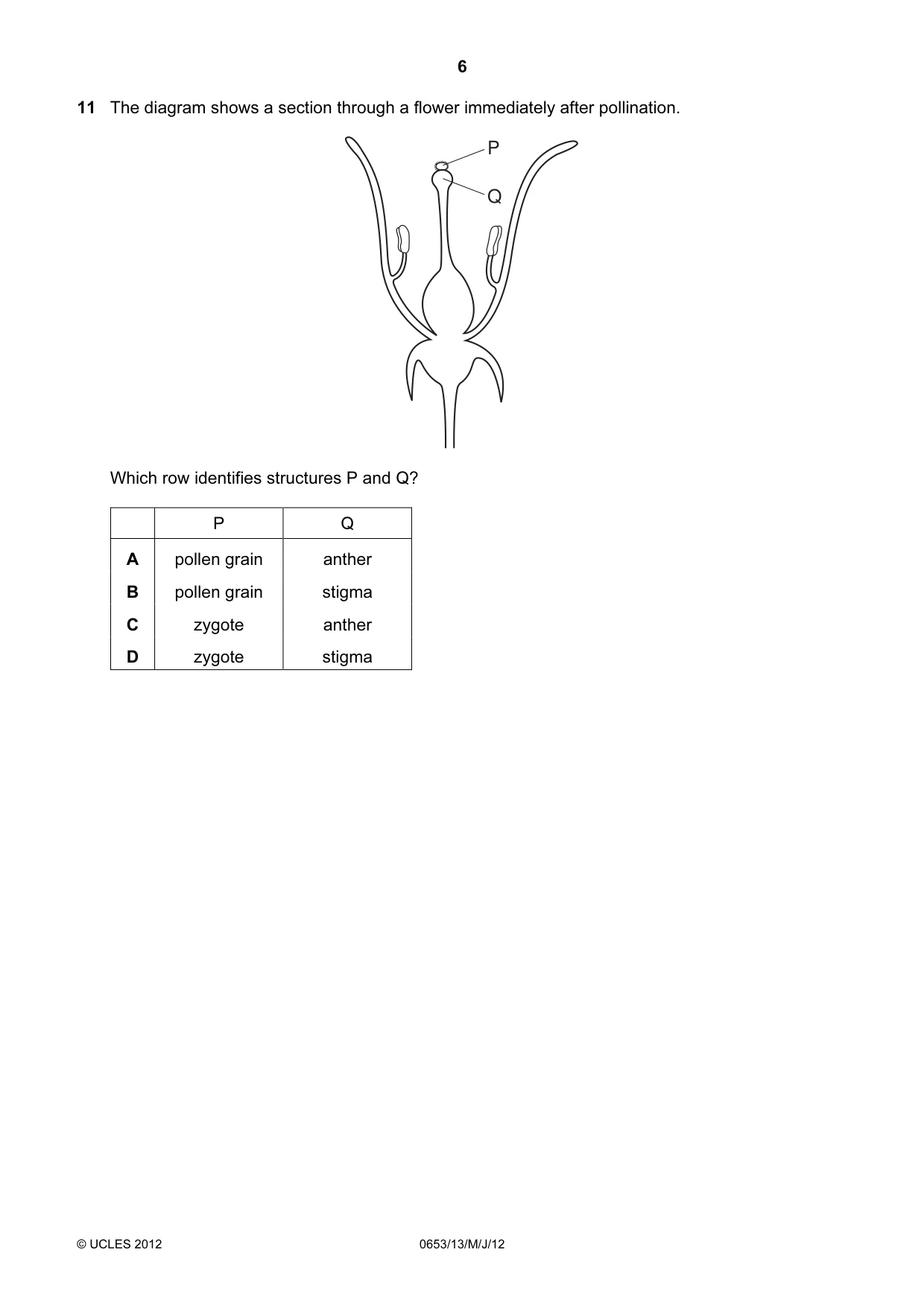
Q10 · The diagram shows the male reproductive system
10 The diagram shows the male reproductive system. Y Z What are Y and Z? Y Z A prostate gland urethra B urethra prostate gland C sperm duct prostate gland D sperm duct urethra
Mark scheme: D
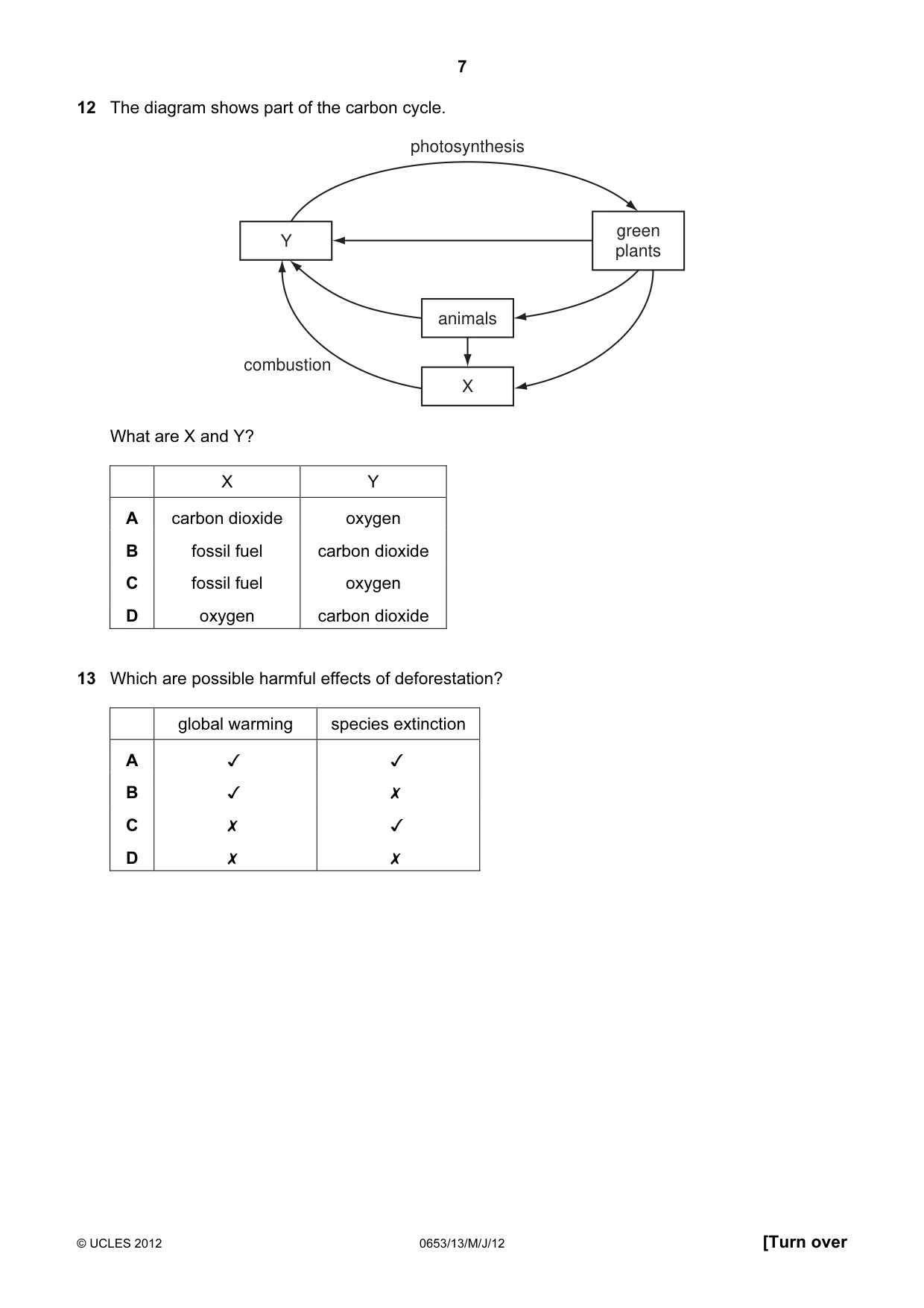
Q11 · The diagram shows a section through a flower immediately after pollination
11 The diagram shows a section through a flower immediately after pollination. P Q Which row identifies structures P and Q? P Q A pollen grain anther B pollen grain stigma C zygote anther D zygote stigma
Mark scheme: B
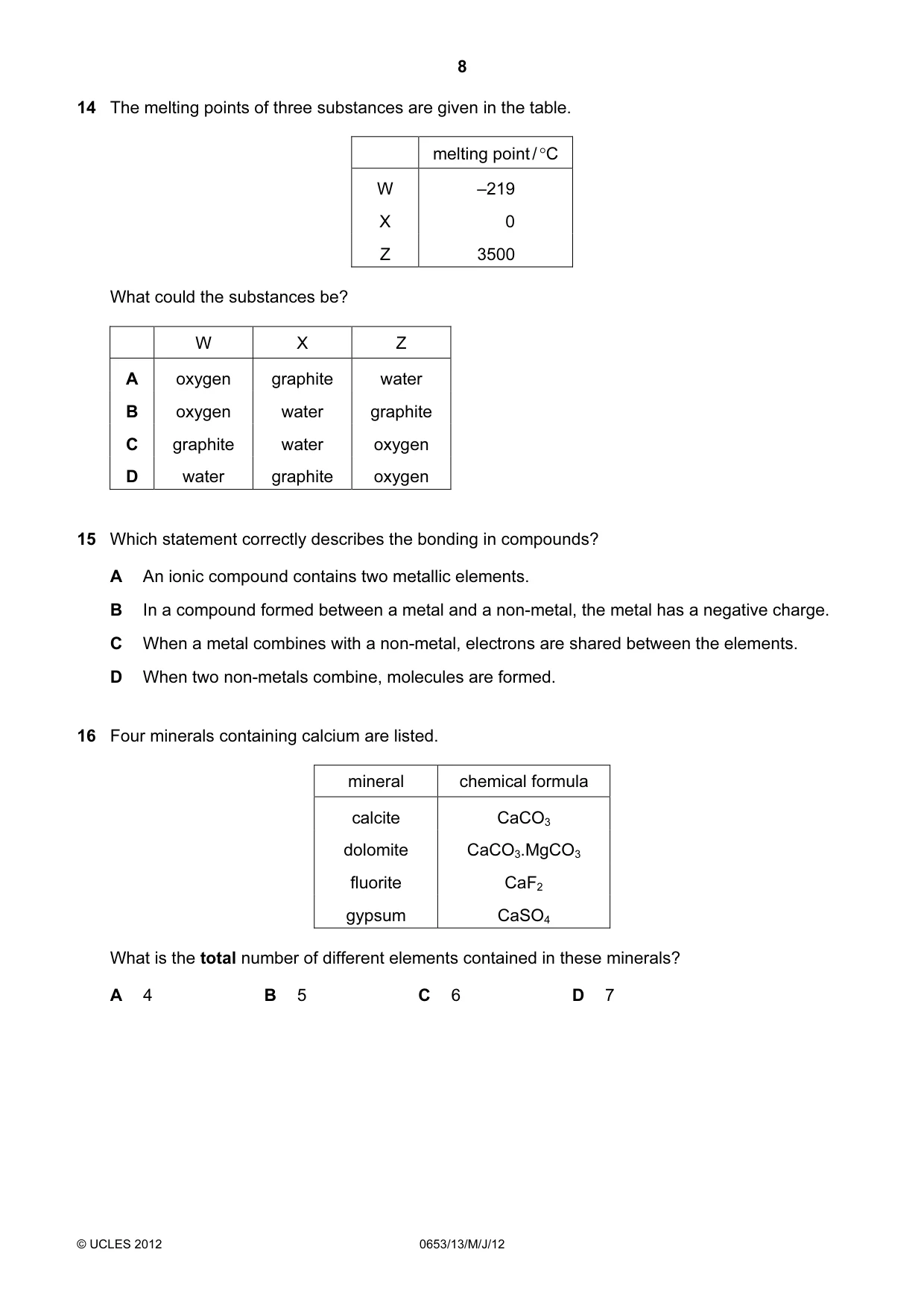
Q12 · The diagram shows part of the carbon cycle
12 The diagram shows part of the carbon cycle. photosynthesis green Y plants animals combustion X What are X and Y? X Y A carbon dioxide oxygen B fossil fuel carbon dioxide C fossil fuel oxygen D oxygen carbon dioxide
Mark scheme: B
Q13 · Which are possible harmful effects of deforestation?
13 Which are possible harmful effects of deforestation? global warming species extinction A v B x Cc v D x
Mark scheme: A
Q14 · The melting points of three substances are given in the table
14 The melting points of three substances are given in the table. melting point / °C W –219 X 0 Z 3500 What could the substances be? W X Z A oxygen graphite water B oxygen water graphite C graphite water oxygen D water graphite oxygen
Mark scheme: B
Q15 · Which statement correctly describes the bonding in compounds?
15 Which statement correctly describes the bonding in compounds? A An ionic compound contains two metallic elements. B In a compound formed between a metal and a non-metal, the metal has a negative charge. C When a metal combines with a non-metal, electrons are shared between the elements. D When two non-metals combine, molecules are formed.
Mark scheme: D
Q16 · Four minerals containing calcium are listed
16 Four minerals containing calcium are listed. mineral chemical formula calcite CaCO3 dolomite CaCO3.MgCO3 fluorite CaF2 gypsum CaSO4 What is the total number of different elements contained in these minerals? A 4 B 5 C 6 D 7
Mark scheme: C
Q17 · Copper(II) oxide reacts as shown
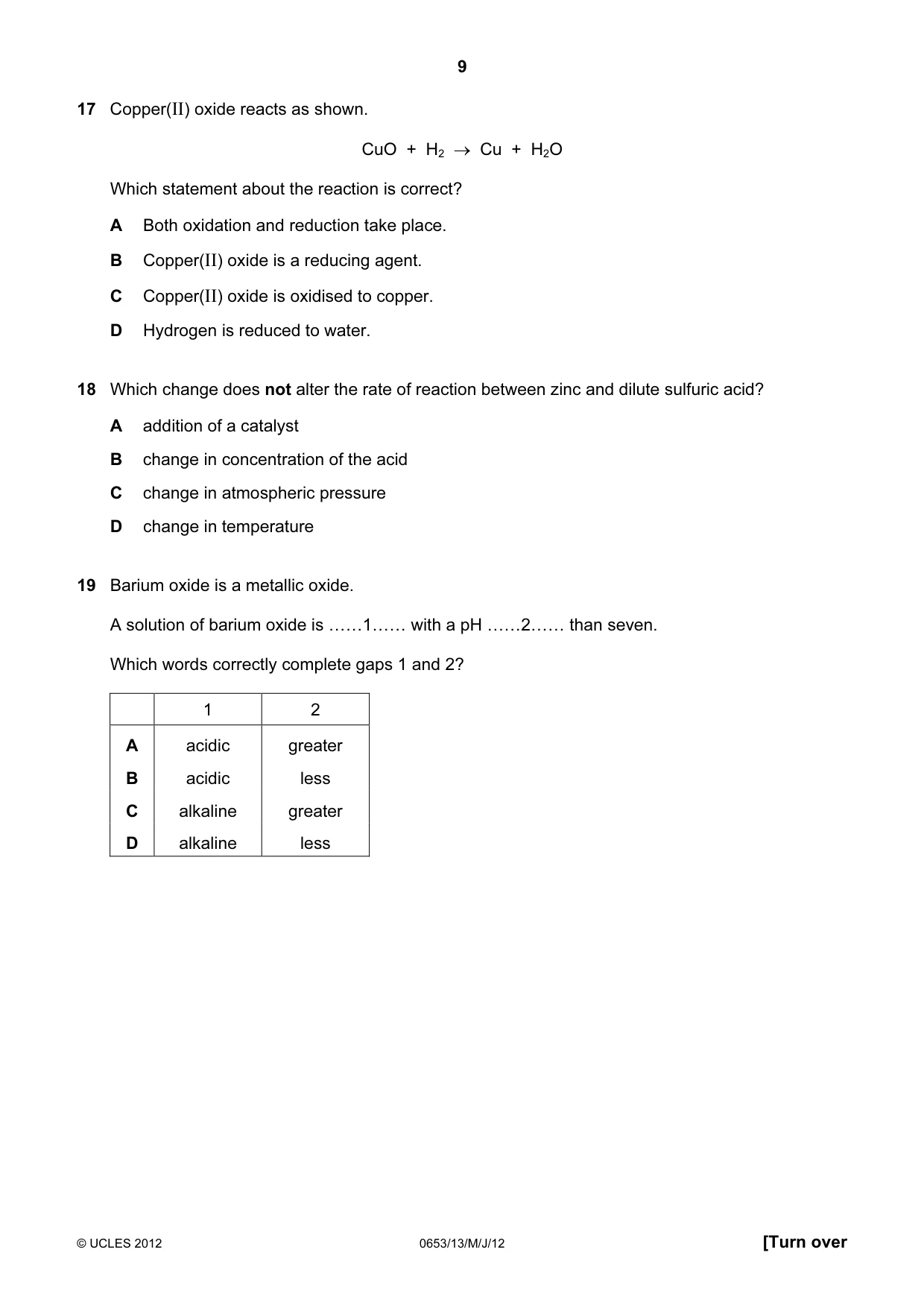
17 Copper(II) oxide reacts as shown. CuO + H2 → Cu + H2O Which statement about the reaction is correct? A Both oxidation and reduction take place. B Copper(II) oxide is a reducing agent. C Copper(II) oxide is oxidised to copper. D Hydrogen is reduced to water.
Mark scheme: A
Q18 · Which change does not alter the rate of reaction between zinc and dilute sulfuric acid?
18 Which change does not alter the rate of reaction between zinc and dilute sulfuric acid? A addition of a catalyst B change in concentration of the acid C change in atmospheric pressure D change in temperature
Mark scheme: C
Q19 · Barium oxide is a metallic oxide
19 Barium oxide is a metallic oxide. A solution of barium oxide is ……1…… with a pH ……2…… than seven. Which words correctly complete gaps 1 and 2? 1 2 A acidic greater B acidic less C alkaline greater D alkaline less
Mark scheme: C
More questions on The characteristic properties of acids and bases
Q20 · Acid X reacts with metal Y
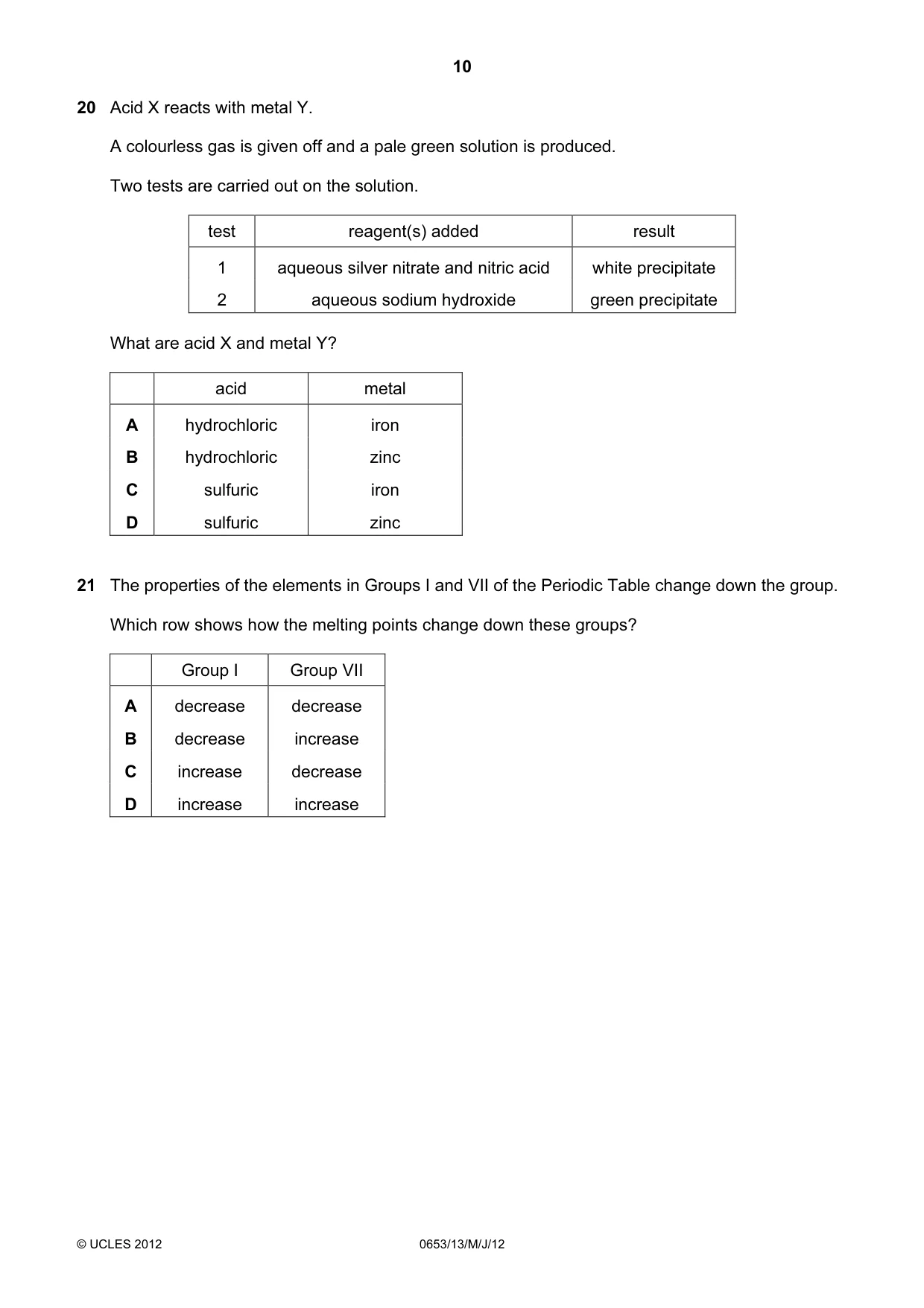
20 Acid X reacts with metal Y. A colourless gas is given off and a pale green solution is produced. Two tests are carried out on the solution. test reagent(s) added result 1 aqueous silver nitrate and nitric acid white precipitate 2 aqueous sodium hydroxide green precipitate What are acid X and metal Y? acid metal A hydrochloric iron B hydrochloric zinc C sulfuric iron D sulfuric zinc
Mark scheme: A
More questions on The characteristic properties of acids and bases
Q21 · The properties of the elements in Groups I and VII of the Periodic Table change down the…
21 The properties of the elements in Groups I and VII of the Periodic Table change down the group. Which row shows how the melting points change down these groups? Group I Group VII A decrease decrease B decrease increase C increase decrease D increase increase
Mark scheme: B
Q22 · The diagram shows elements in part of the Periodic Table
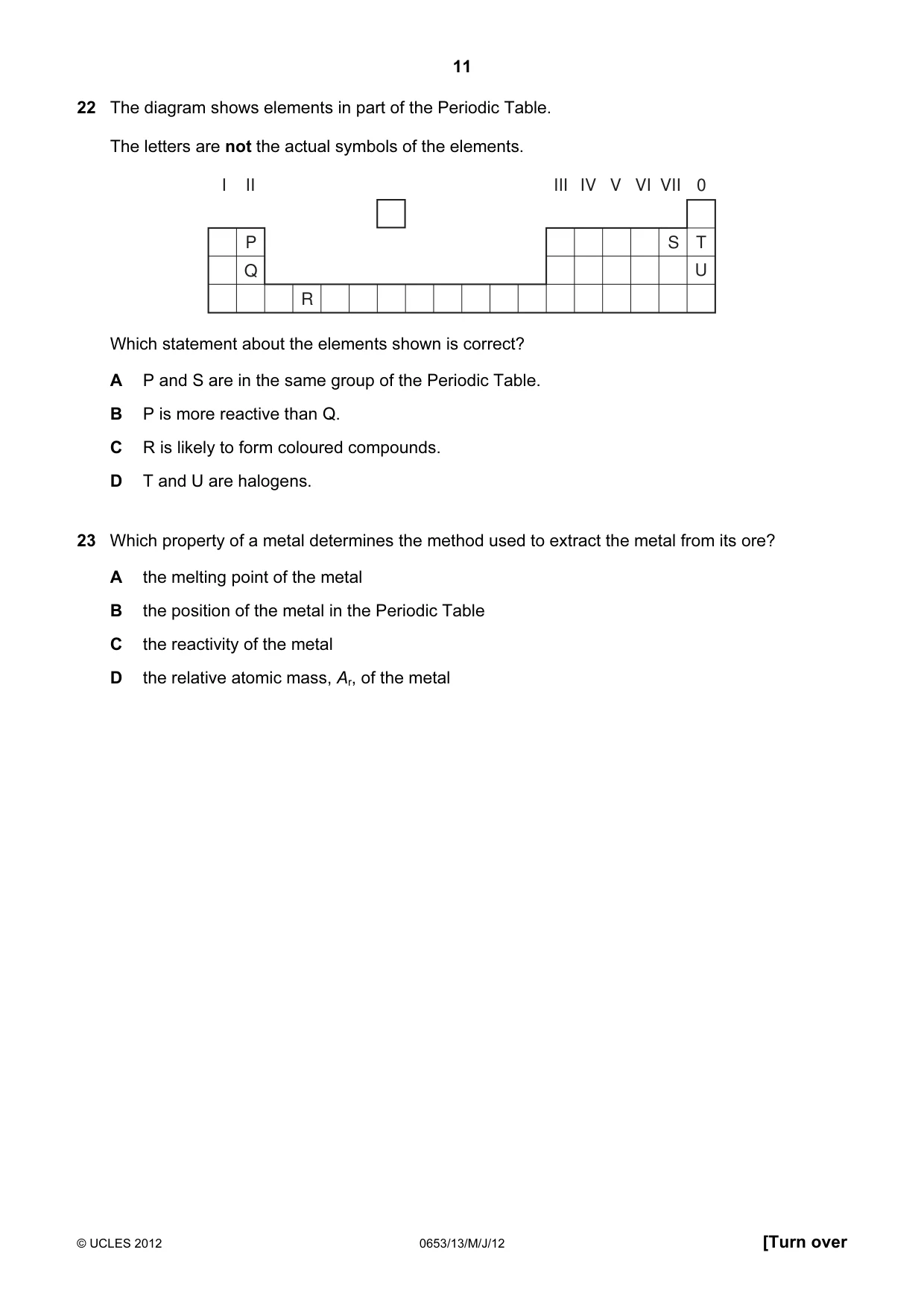
22 The diagram shows elements in part of the Periodic Table. The letters are not the actual symbols of the elements. I II III IV V VI VII 0 P S T Q U R Which statement about the elements shown is correct? A P and S are in the same group of the Periodic Table. B P is more reactive than Q. C R is likely to form coloured compounds. D T and U are halogens.
Mark scheme: C
Q23 · Which property of a metal determines the method used to extract the metal from its ore?
23 Which property of a metal determines the method used to extract the metal from its ore? A the melting point of the metal B the position of the metal in the Periodic Table C the reactivity of the metal D the relative atomic mass, Ar, of the metal
Mark scheme: C
Q24 · Copper(II) oxide is mixed with a solid Q
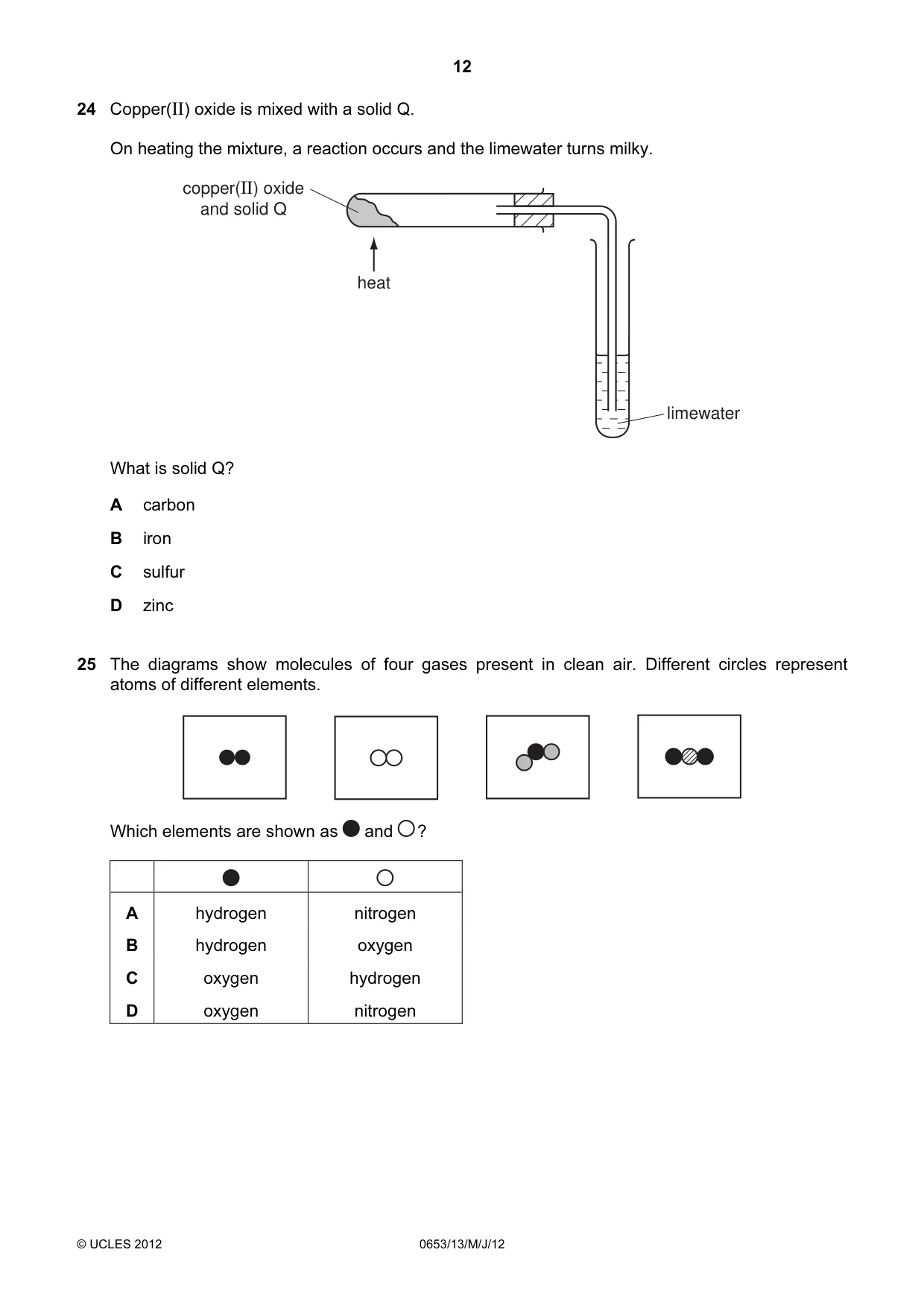
24 Copper(II) oxide is mixed with a solid Q. On heating the mixture, a reaction occurs and the limewater turns milky. copper(II) oxide and solid Q heat limewater What is solid Q? A carbon B iron C sulfur D zinc
Mark scheme: A
Q25 · The diagrams show molecules of four gases present in clean air
25 The diagrams show molecules of four gases present in clean air. Different circles represent atoms of different elements. Which elements are shown as and ? A hydrogen nitrogen B hydrogen oxygen C oxygen hydrogen D oxygen nitrogen
Mark scheme: D
Q26 · Which property of the compounds in petroleum is used to separate it into useful fractions?
26 Which property of the compounds in petroleum is used to separate it into useful fractions? A boiling point B density C melting point D solubility
Mark scheme: A
Q27 · Which equation shows the complete combustion of a hydrocarbon?
27 Which equation shows the complete combustion of a hydrocarbon? A C2H4 + 2O2 → 2CO + 2H2O B C2H4 + 3O2 → 2CO2 + 2H2O C C2H6O + 2O2 → 2CO + 3H2O D C2H6O + 3O2 → 2CO2 + 3H2O
Mark scheme: B
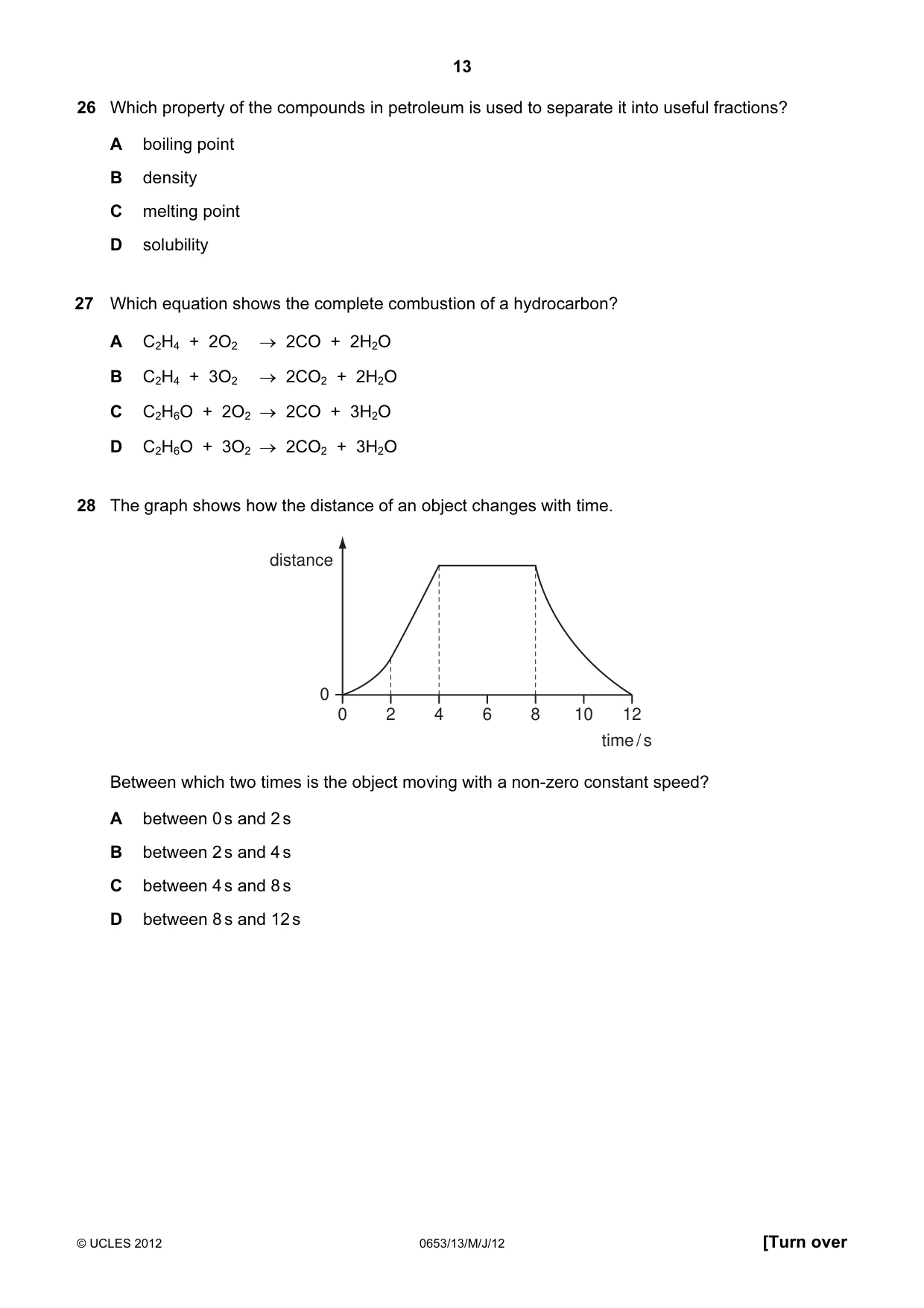
Q28 · The graph shows how the distance of an object changes with time
28 The graph shows how the distance of an object changes with time. distance 0 0 2 4 6 8 10 12 time / s Between which two times is the object moving with a non-zero constant speed? A between 0 s and 2 s B between 2 s and 4 s C between 4 s and 8 s D between 8 s and 12 s
Mark scheme: B
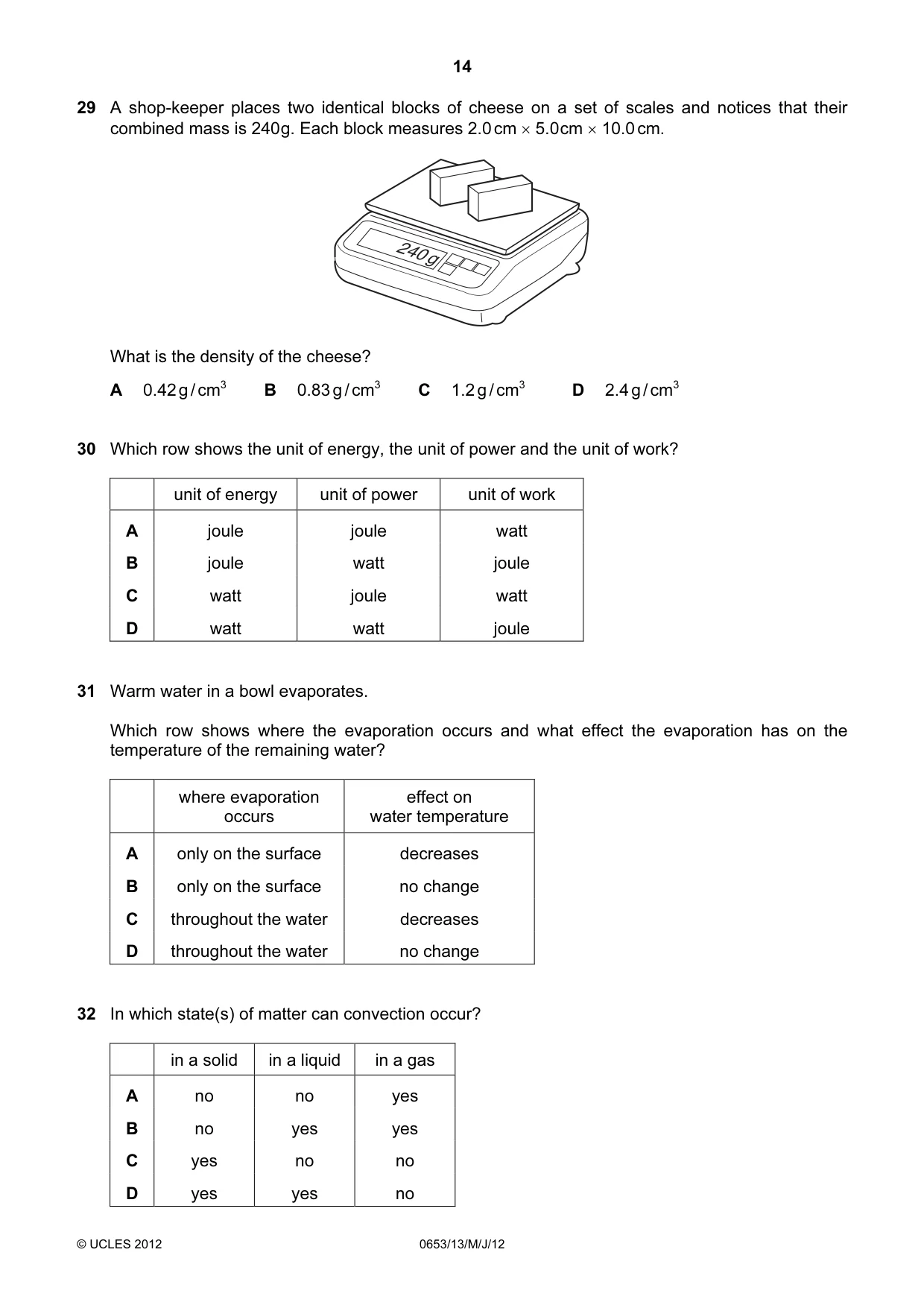
Q29 · A shop-keeper places two identical blocks of cheese on a set of scales and notices that…
29 A shop-keeper places two identical blocks of cheese on a set of scales and notices that their combined mass is 240 g. Each block measures 2.0 cm × 5.0 cm × 10.0 cm. 240 g What is the density of the cheese? A 0.42 g / cm3 B 0.83 g / cm3 C 1.2 g / cm3 D 2.4 g / cm3
Mark scheme: C
Q30 · Which row shows the unit of energy, the unit of power and the unit of work?
30 Which row shows the unit of energy, the unit of power and the unit of work? unit of energy unit of power unit of work A joule joule watt B joule watt joule C watt joule watt D watt watt joule
Mark scheme: B
Q31 · Warm water in a bowl evaporates
31 Warm water in a bowl evaporates. Which row shows where the evaporation occurs and what effect the evaporation has on the temperature of the remaining water? where evaporation effect on occurs water temperature A only on the surface decreases B only on the surface no change C throughout the water decreases D throughout the water no change
Mark scheme: A
Q32 · In which state(s) of matter can convection occur?
32 In which state(s) of matter can convection occur? in a solid in a liquid in a gas A no no yes B no yes yes C yes no no D yes yes no
Mark scheme: B
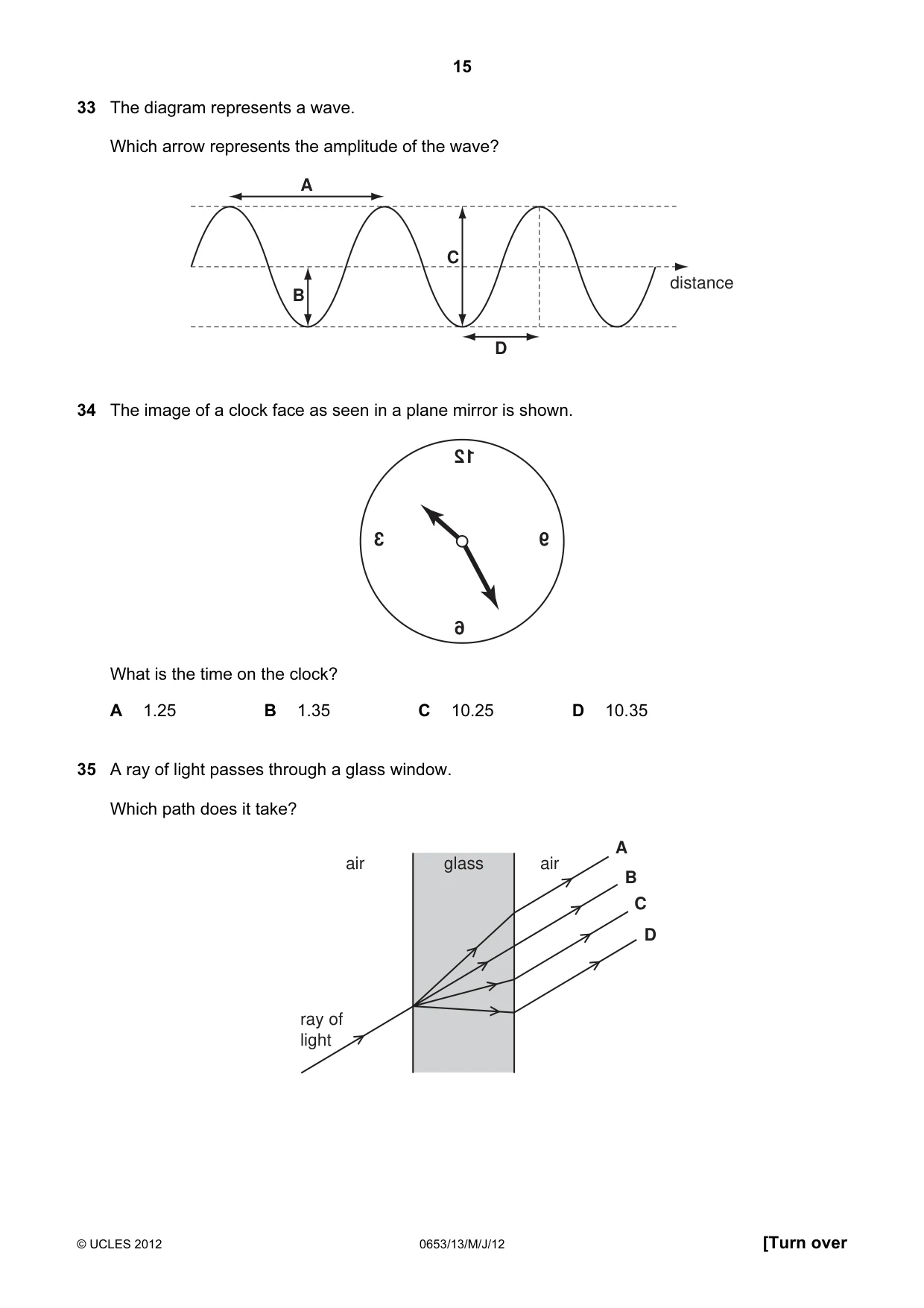
Q33 · The diagram represents a wave
33 The diagram represents a wave. Which arrow represents the amplitude of the wave? A C distance B D
Mark scheme: B
Q34 · The image of a clock face as seen in a plane mirror is shown
34 The image of a clock face as seen in a plane mirror is shown. 12 3 9 6 What is the time on the clock? A 1.25 B 1.35 C 10.25 D 10.35
Mark scheme: B
Q35 · A ray of light passes through a glass window
35 A ray of light passes through a glass window. Which path does it take? A air glass air B C D ray of light
Mark scheme: C
Q36 · Which statement about the electromagnetic spectrum is correct?
36 Which statement about the electromagnetic spectrum is correct? A Gamma rays have the highest frequency. B Microwaves have the smallest wavelength. C Ultraviolet waves have the largest wavelength. D Visible light waves have the lowest frequency.
Mark scheme: A
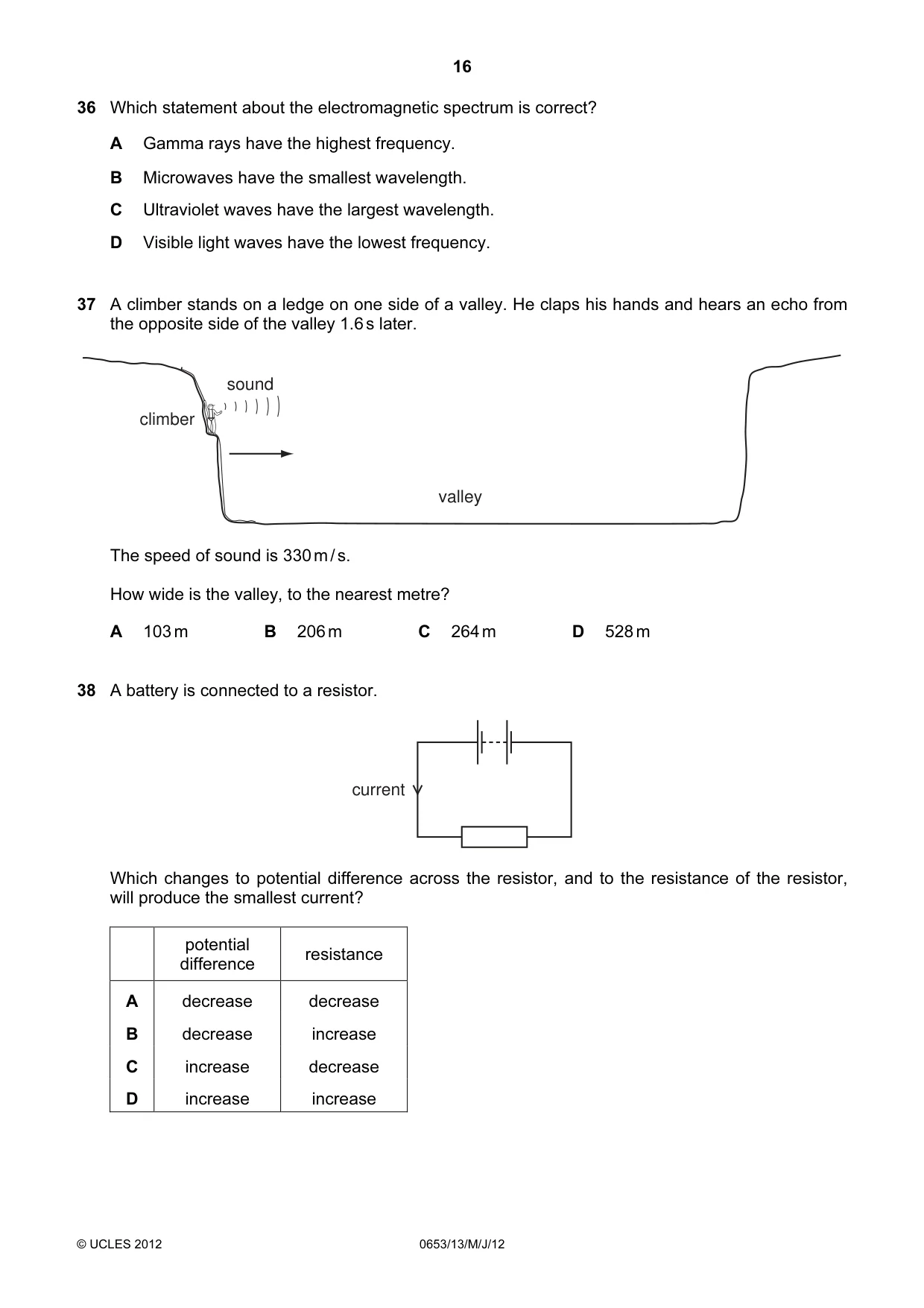
Q37 · A climber stands on a ledge on one side of a valley
37 A climber stands on a ledge on one side of a valley. He claps his hands and hears an echo from the opposite side of the valley 1.6 s later. sound climber valley The speed of sound is 330 m / s. How wide is the valley, to the nearest metre? A 103 m B 206 m C 264 m D 528 m
Mark scheme: C
Q38 · A battery is connected to a resistor
38 A battery is connected to a resistor. current Which changes to potential difference across the resistor, and to the resistance of the resistor, will produce the smallest current? potential resistance difference A decrease decrease B decrease increase C increase decrease D increase increase
Mark scheme: B
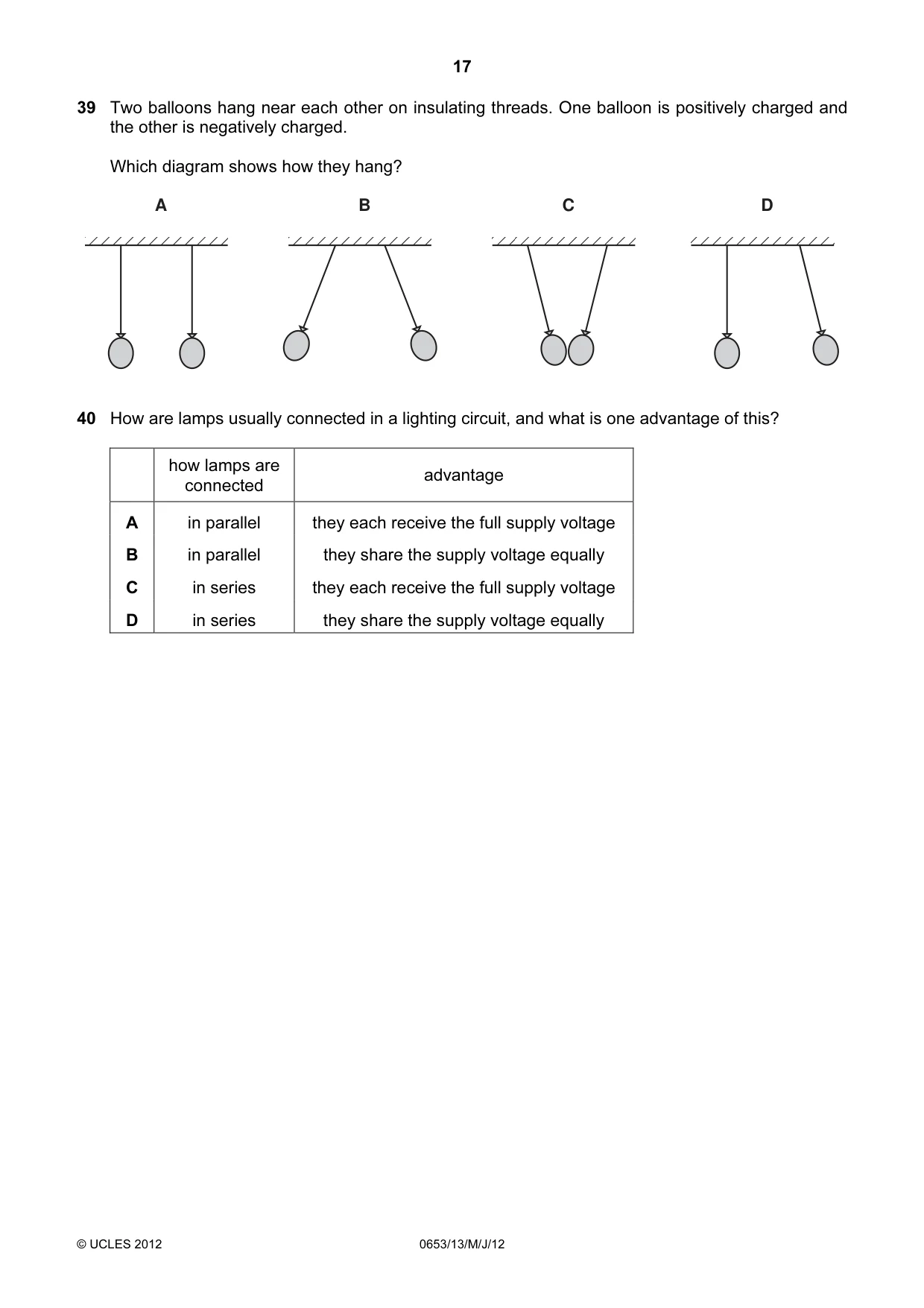
Q39 · Two balloons hang near each other on insulating threads
39 Two balloons hang near each other on insulating threads. One balloon is positively charged and the other is negatively charged. Which diagram shows how they hang? A B C D
Mark scheme: C
Q40 · How are lamps usually connected in a lighting circuit, and what is one advantage of this?
40 How are lamps usually connected in a lighting circuit, and what is one advantage of this? how lamps are advantage connected A in parallel they each receive the full supply voltage B in parallel they share the supply voltage equally C in series they each receive the full supply voltage D in series they share the supply voltage equally
Mark scheme: A
What was in this paper
The subtopics covered by these 40 questions, and how many questions each got. Open one in a new tab to see every Cambridge question on it.
2Electrical quantities2Fuels2Light2The characteristic properties of acids and bases2Air quality and climate1Arrangement of elements1Carbon cycle1Circulatory systems1Density1Digestion1Drugs1Electrical circuits1Electromagnetic spectrum1Elements, compounds and mixtures1Energy, work and power1Enzymes1General properties of waves1Group I properties1Habitat destruction1Identification of ions and gases1Kinetic particle model of matter1Motion1Photosynthesis1Rate of reaction1Reactivity series1Redox1Respiration1Sexual reproduction in humans1Sexual reproduction in plants1Simple molecules and covalent bonds1Solids, liquids and gases1Sound1Transfer of thermal energy1Transpiration1What you needed in this session
Cambridge’s own grade thresholds for 2012 May/June, Paper 1 · Variant 3. A higher threshold means an easier paper — the bar moves with how the cohort did.