Cambridge IGCSE Science - Combined 0653 — 2010 Oct/Nov Paper 1 · Variant 3
0653/13/O/N/10 · 40 questions · 40 marks · ≈45 min
The question paper and its mark scheme, free to read here and free to download. This is Cambridge’s own paper, exactly as it was sat.
Question paper20 pages



Mark scheme2 pages
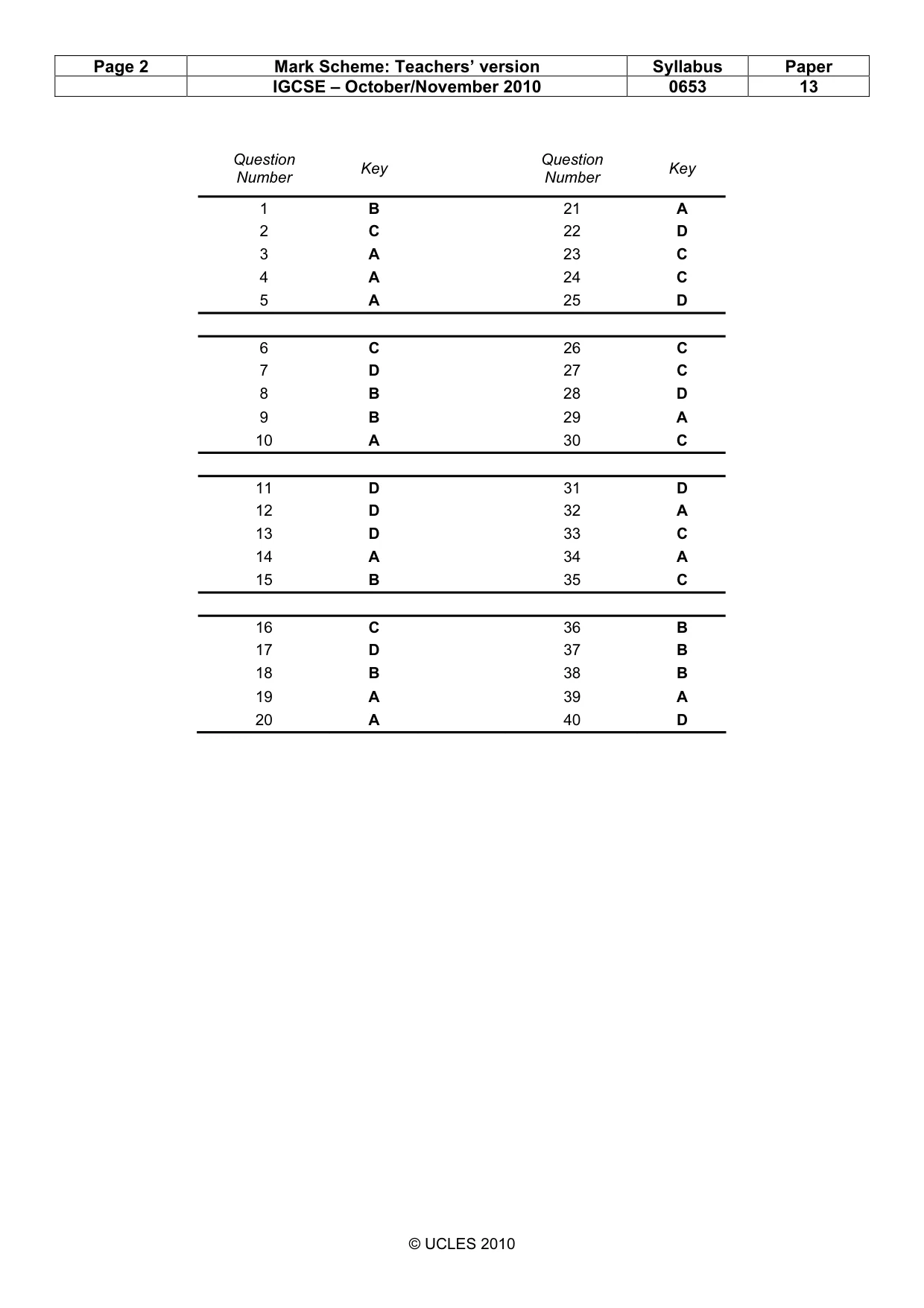
Answers below. Sit the paper first if you are practising.
Questions as text
Q1 · Which part of a plant cell contains starch grains?
1 Which part of a plant cell contains starch grains? A cell wall B chloroplasts C nucleus D vacuole
Mark scheme: B
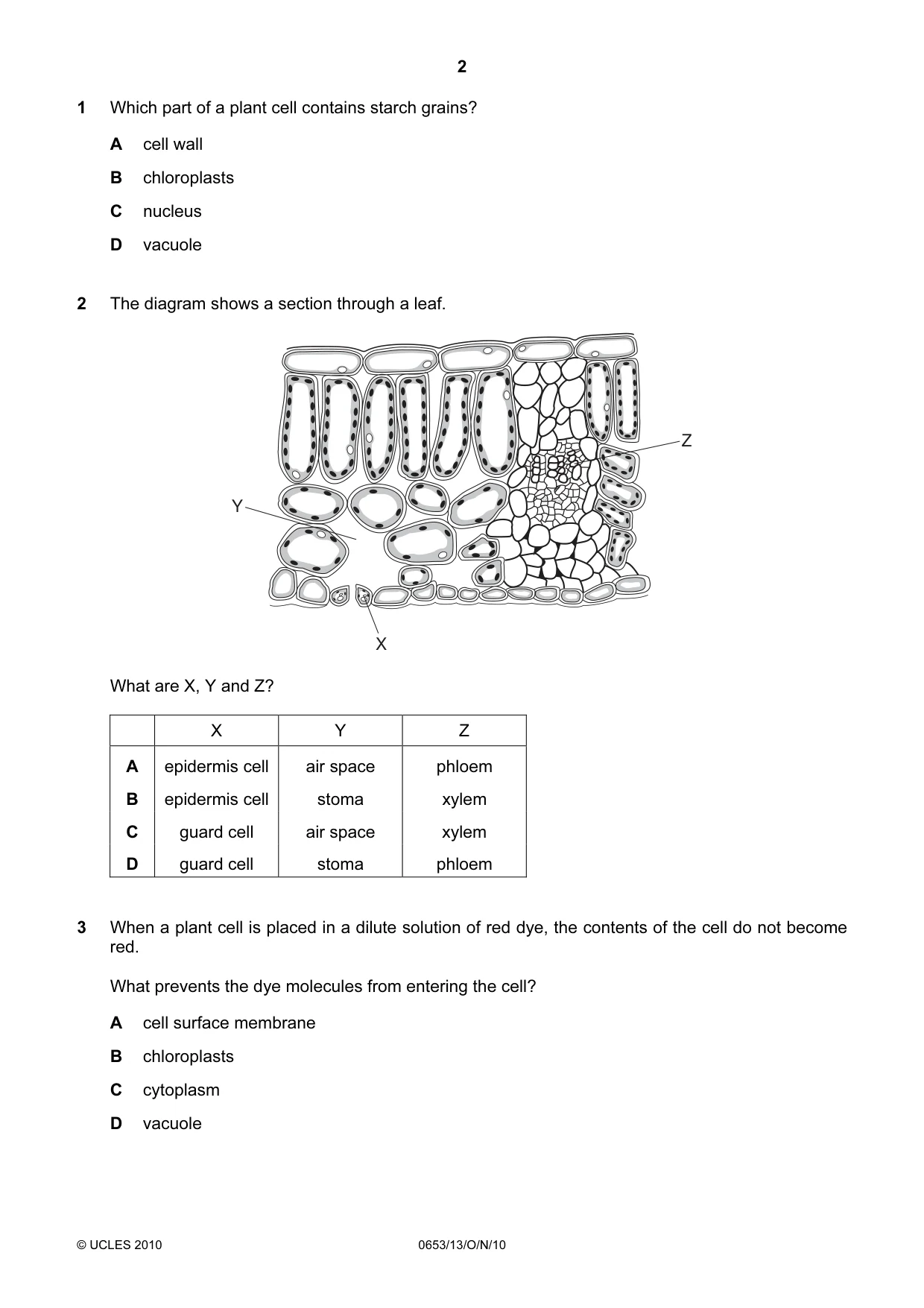
Q2 · The diagram shows a section through a leaf
2 The diagram shows a section through a leaf. Z Y X What are X, Y and Z? X Y Z A epidermis cell air space phloem B epidermis cell stoma xylem C guard cell air space xylem D guard cell stoma phloem
Mark scheme: C
Q3 · When a plant cell is placed in a dilute solution of red dye, the contents of the cell do…
3 When a plant cell is placed in a dilute solution of red dye, the contents of the cell do not become red. What prevents the dye molecules from entering the cell? A cell surface membrane B chloroplasts C cytoplasm D vacuole
Mark scheme: A
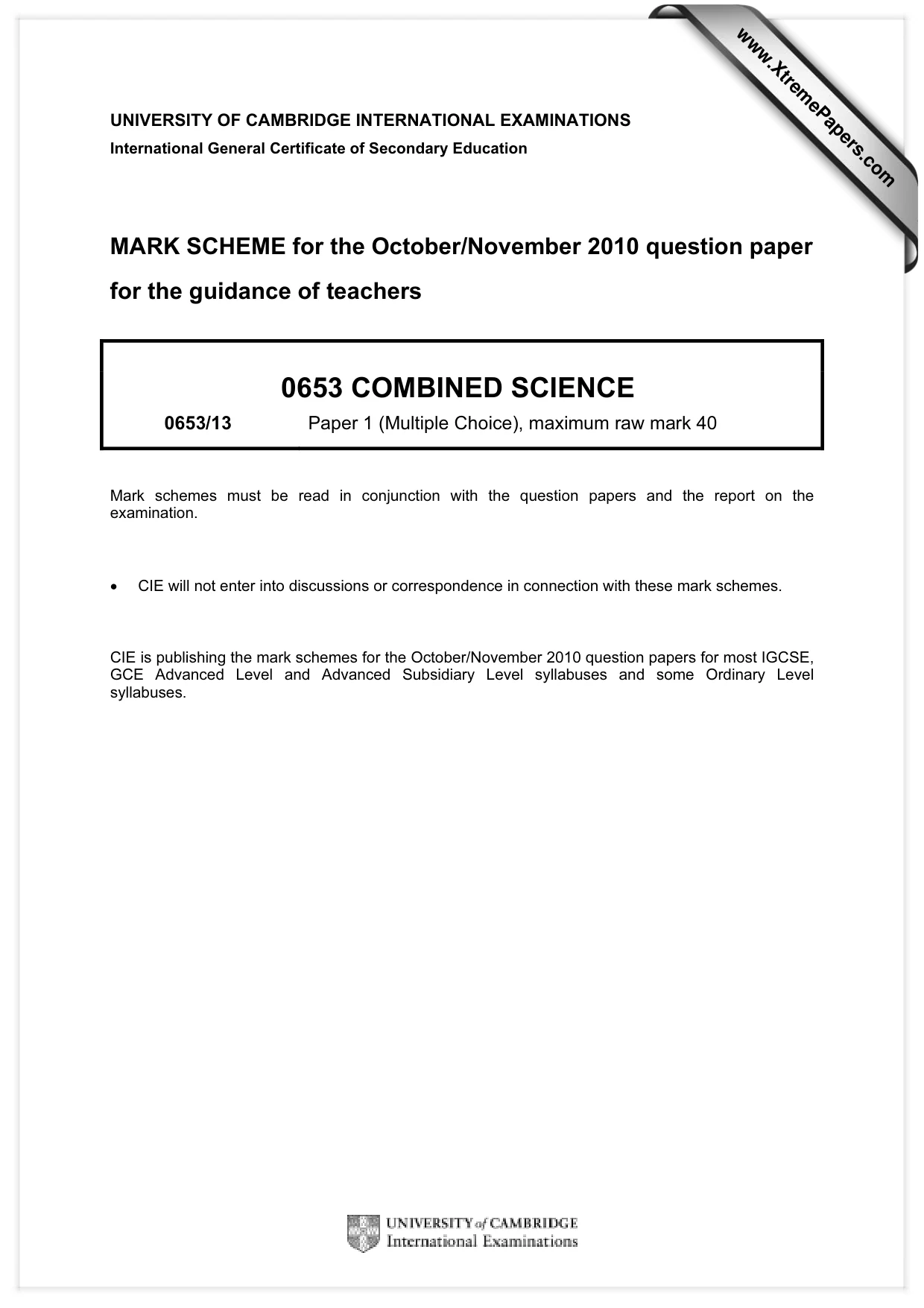
Q4 · Which is correct for all enzymes?
4 Which is correct for all enzymes? 0 0O WD > made of proteins v v x x made inside cells v x v x
Mark scheme: A
Q5 · Which blood vessel carries oxygenated blood away from the heart?
5 Which blood vessel carries oxygenated blood away from the heart? A aorta B pulmonary artery C pulmonary vein D vena cava
Mark scheme: A
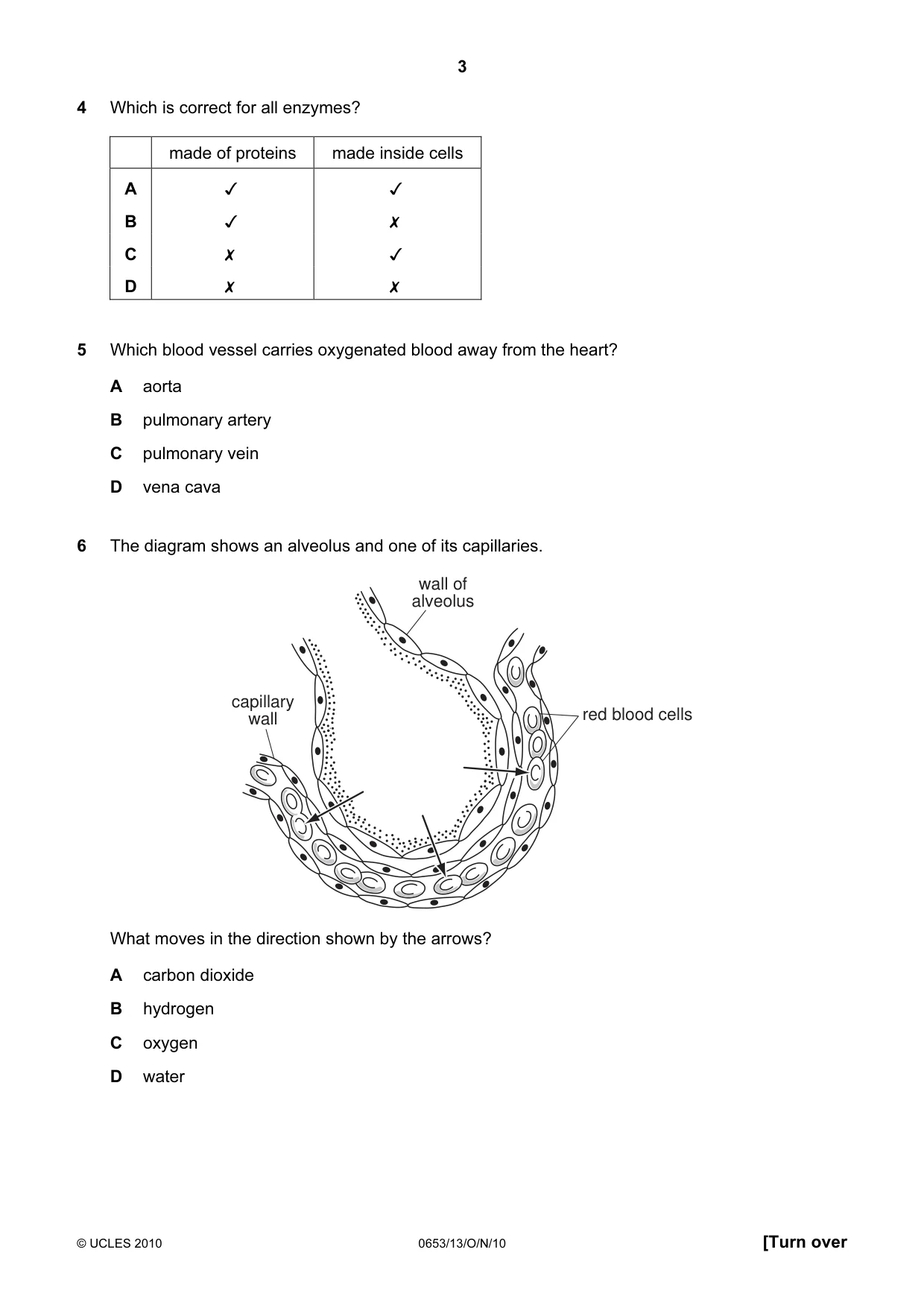
Q6 · The diagram shows an alveolus and one of its capillaries
6 The diagram shows an alveolus and one of its capillaries. wall of alveolus capillary wall red blood cells What moves in the direction shown by the arrows? A carbon dioxide B hydrogen C oxygen D water
Mark scheme: C
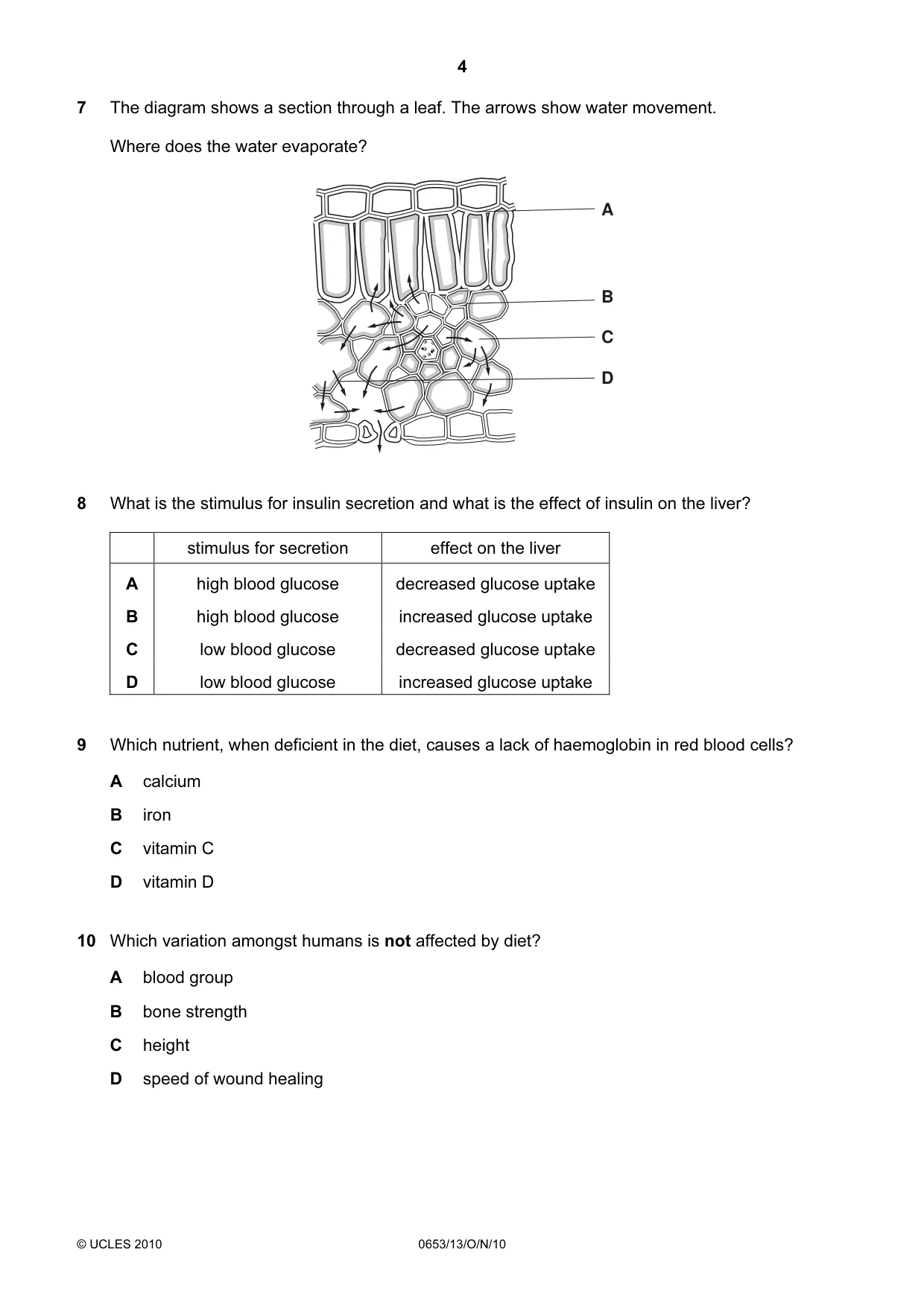
Q7 · The diagram shows a section through a leaf
7 The diagram shows a section through a leaf. The arrows show water movement. Where does the water evaporate? A B C D
Mark scheme: D
Q8 · What is the stimulus for insulin secretion and what is the effect of insulin on the liver?
8 What is the stimulus for insulin secretion and what is the effect of insulin on the liver? stimulus for secretion effect on the liver A high blood glucose decreased glucose uptake B high blood glucose increased glucose uptake C low blood glucose decreased glucose uptake D low blood glucose increased glucose uptake
Mark scheme: B
Q9 · Which nutrient, when deficient in the diet, causes a lack of haemoglobin in red blood…
9 Which nutrient, when deficient in the diet, causes a lack of haemoglobin in red blood cells? A calcium B iron C vitamin C D vitamin D
Mark scheme: B
Q10 · Which variation amongst humans is not affected by diet?
10 Which variation amongst humans is not affected by diet? A blood group B bone strength C height D speed of wound healing
Mark scheme: A
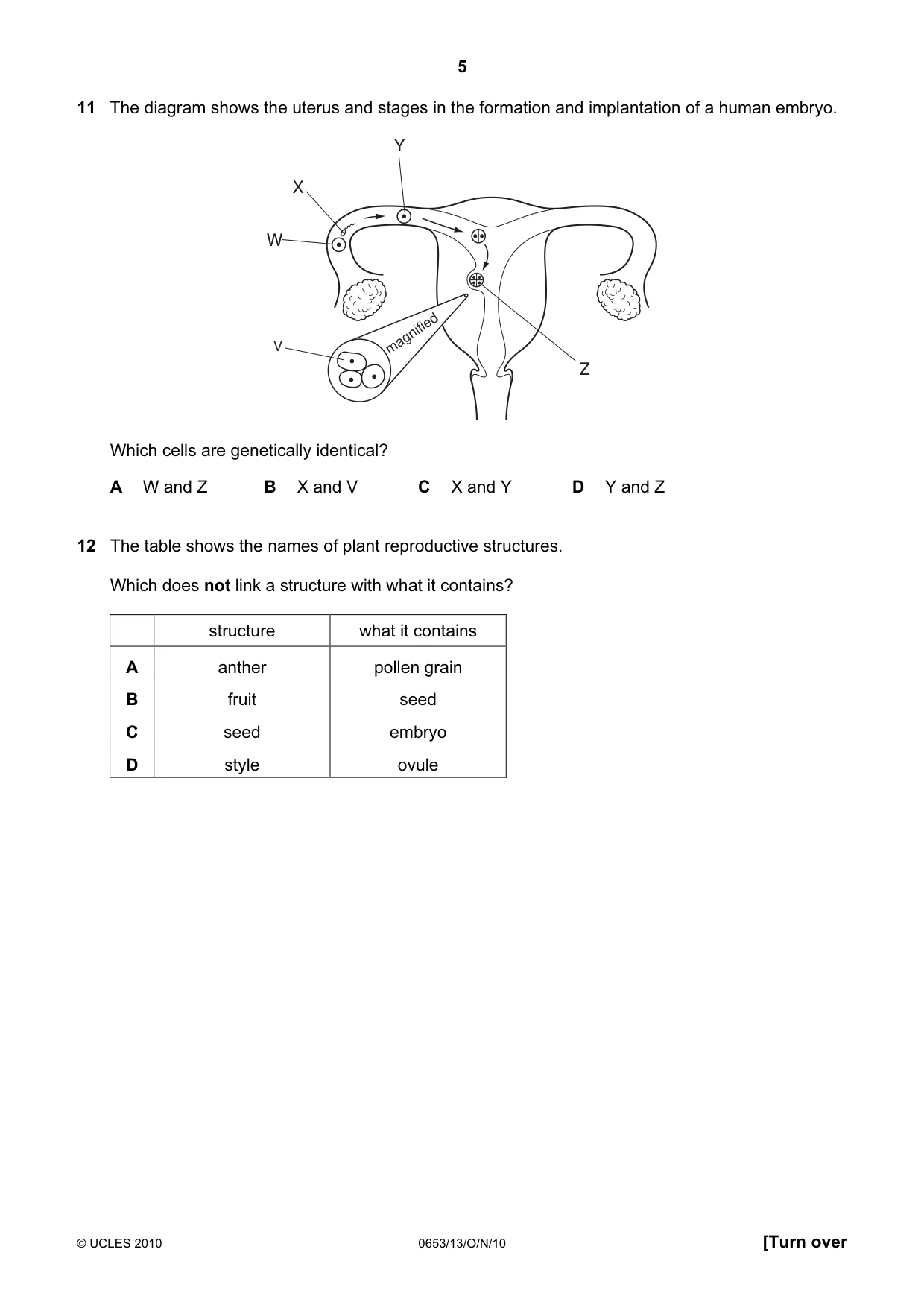
Q11 · The diagram shows the uterus and stages in the formation and implantation of a human…
11 The diagram shows the uterus and stages in the formation and implantation of a human embryo. Y X W magnified V Z Which cells are genetically identical? A W and Z B X and V C X and Y D Y and Z
Mark scheme: D
Q12 · The table shows the names of plant reproductive structures
12 The table shows the names of plant reproductive structures. Which does not link a structure with what it contains? structure what it contains A anther pollen grain B fruit seed C seed embryo D style ovule
Mark scheme: D
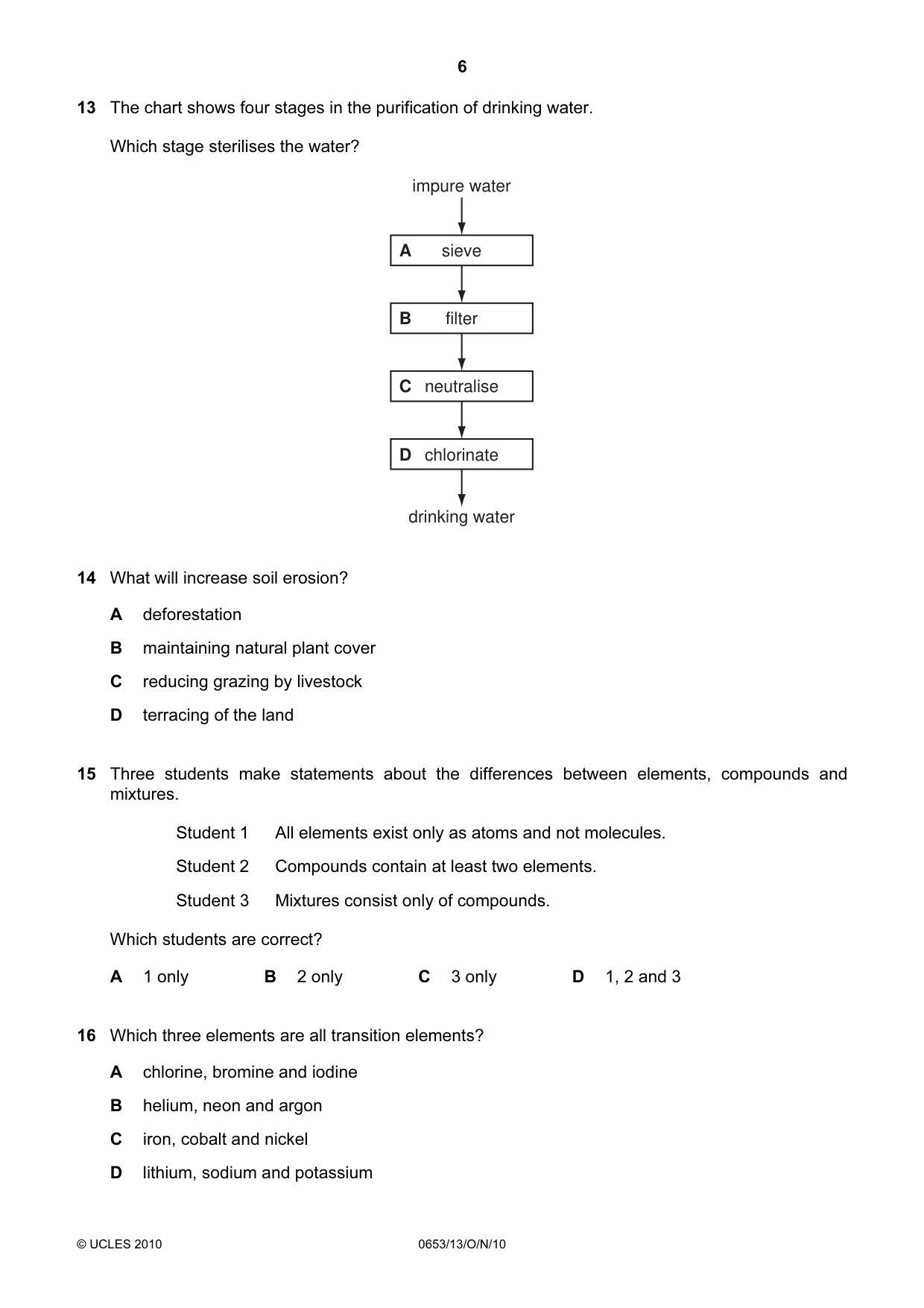
Q13 · The chart shows four stages in the purification of drinking water
13 The chart shows four stages in the purification of drinking water. Which stage sterilises the water? impure water A sieve B filter C neutralise D chlorinate drinking water
Mark scheme: D
Q14 · What will increase soil erosion?
14 What will increase soil erosion? A deforestation B maintaining natural plant cover C reducing grazing by livestock D terracing of the land
Mark scheme: A
Q15 · Three students make statements about the differences between elements, compounds and…
15 Three students make statements about the differences between elements, compounds and mixtures. Student 1 All elements exist only as atoms and not molecules. Student 2 Compounds contain at least two elements. Student 3 Mixtures consist only of compounds. Which students are correct? A 1 only B 2 only C 3 only D 1, 2 and 3
Mark scheme: B
Q16 · Which three elements are all transition elements?
16 Which three elements are all transition elements? A chlorine, bromine and iodine B helium, neon and argon C iron, cobalt and nickel D lithium, sodium and potassium
Mark scheme: C
Q17 · The table shows information about four different compounds
17 The table shows information about four different compounds. Which compound contains ionic bonds? formula of elements present compound in compound A CO2 carbon, oxygen B HCl hydrogen, chlorine C NH3 nitrogen, hydrogen D Na2O sodium, oxygen
Mark scheme: D
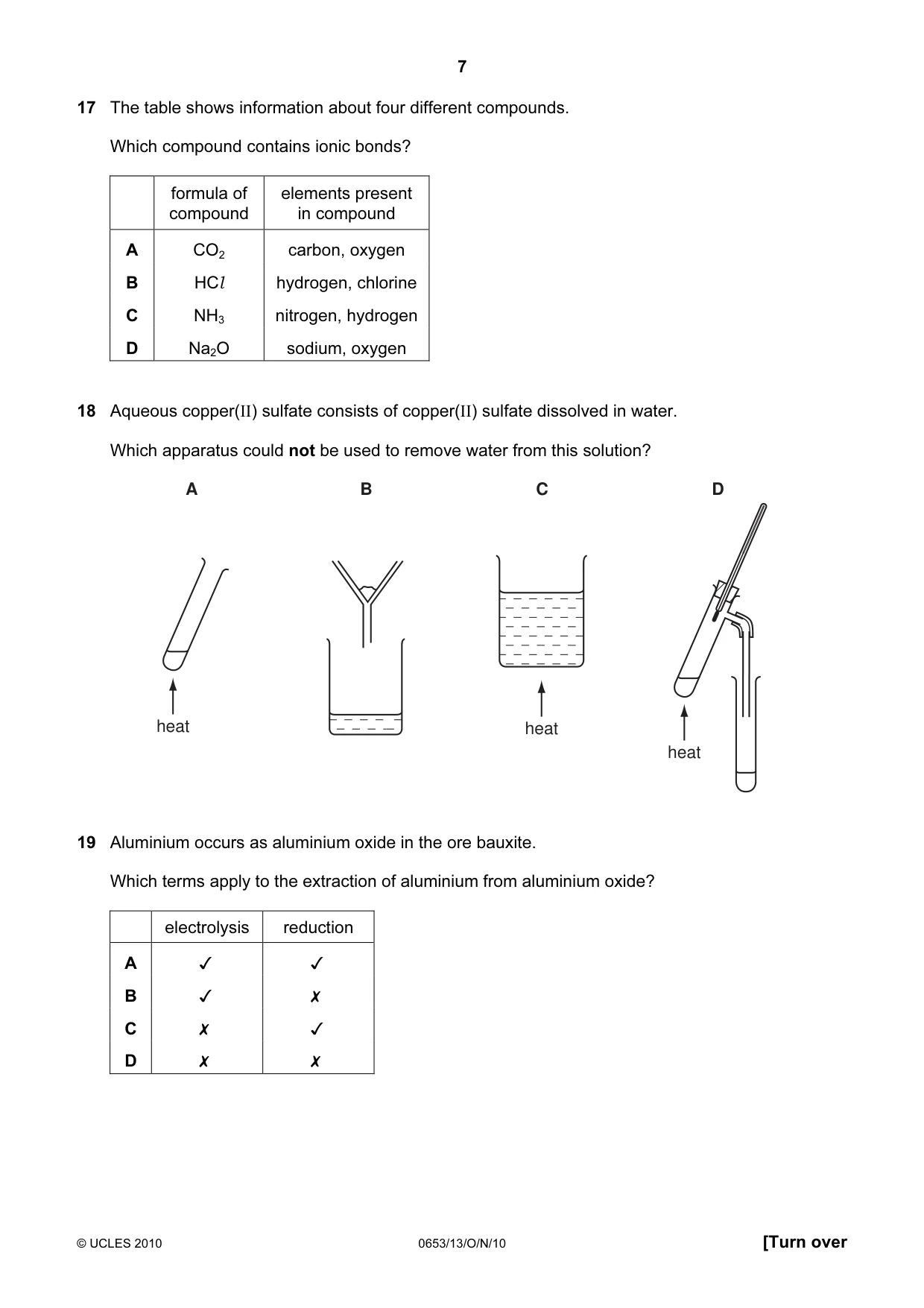
Q18 · Aqueous copper(II) sulfate consists of copper(II) sulfate dissolved in water
18 Aqueous copper(II) sulfate consists of copper(II) sulfate dissolved in water. Which apparatus could not be used to remove water from this solution? A B C D heat heat heat
Mark scheme: B
Q19 · Aluminium occurs as aluminium oxide in the ore bauxite
19 Aluminium occurs as aluminium oxide in the ore bauxite. Which terms apply to the extraction of aluminium from aluminium oxide? electrolysis reduction A v v B v x Cc x v D x x
Mark scheme: A
Q20 · The equation represents the reaction of aluminium with sulfuric acid
20 The equation represents the reaction of aluminium with sulfuric acid. x Al + 3H2SO4 → Al 2(SO4)3 + y H2 What are the correct values of x and y ? x y A 2 3 B 2 6 C 3 3 D 3 6
Mark scheme: A
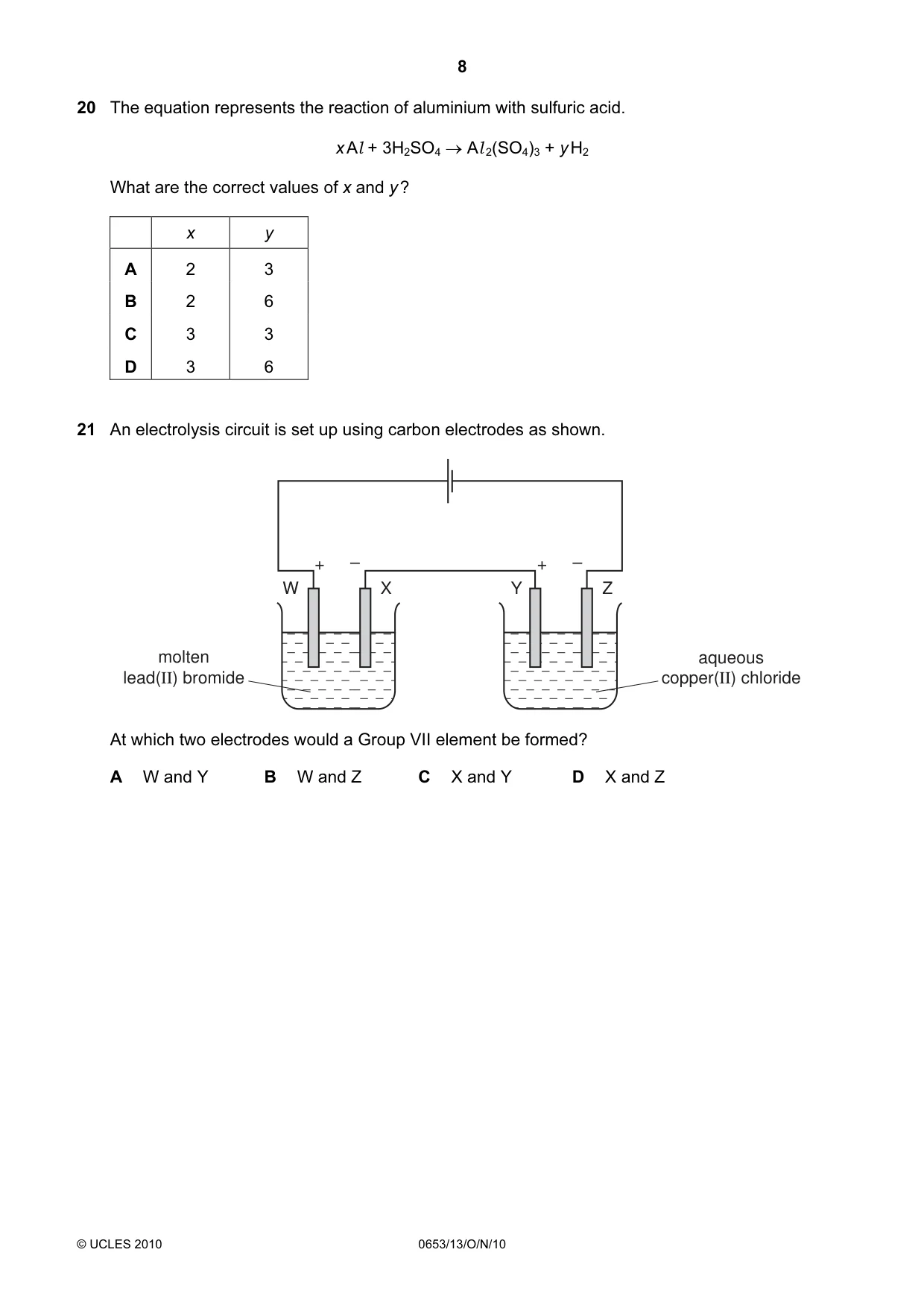
Q21 · An electrolysis circuit is set up using carbon electrodes as shown
21 An electrolysis circuit is set up using carbon electrodes as shown. + – + – W X Y Z molten aqueous lead(II) bromide copper(II) chloride At which two electrodes would a Group VII element be formed? A W and Y B W and Z C X and Y D X and Z
Mark scheme: A
Q22 · Aqueous copper(II) ions, Cu2+(aq), are blue
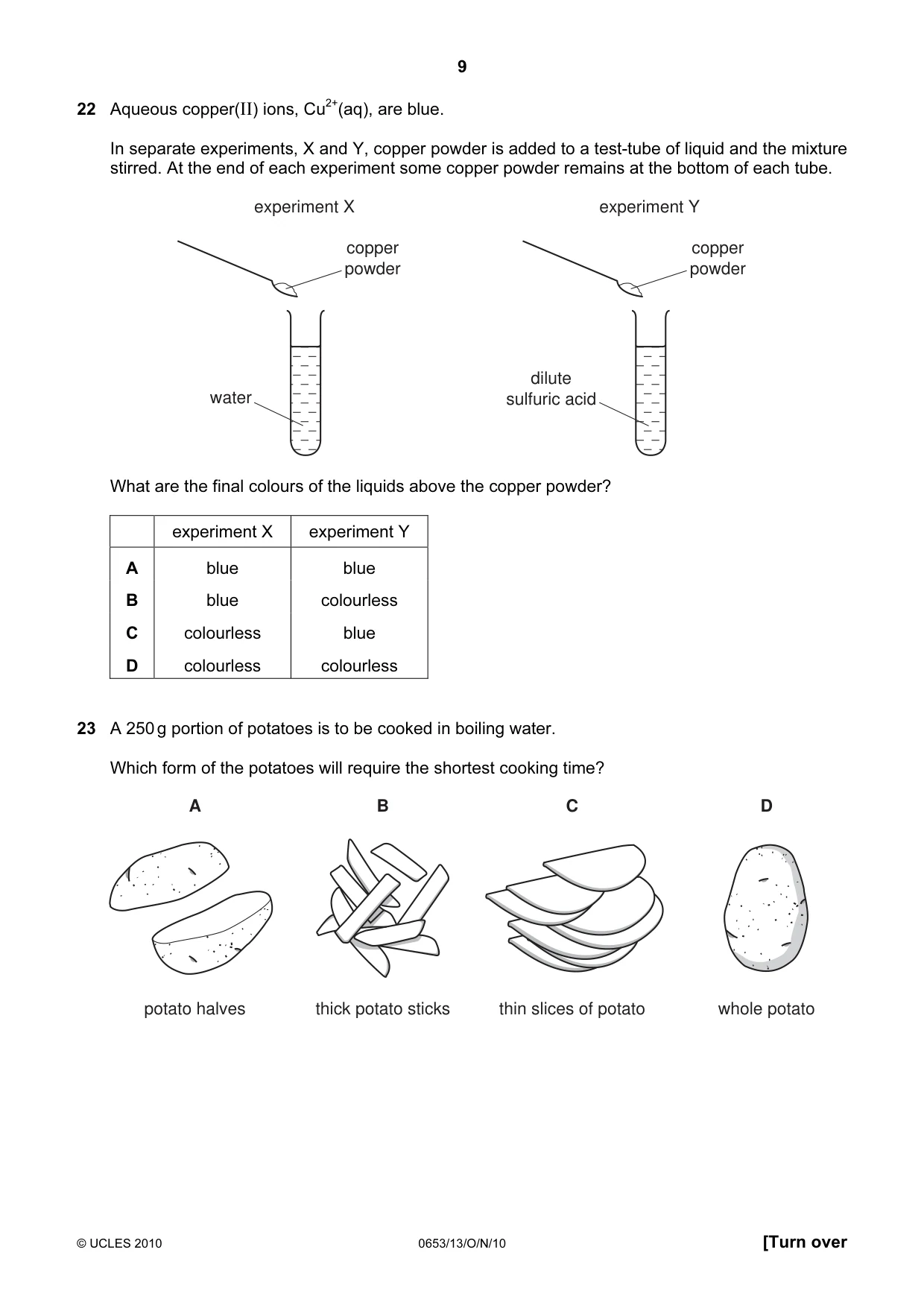
22 Aqueous copper(II) ions, Cu2+(aq), are blue. In separate experiments, X and Y, copper powder is added to a test-tube of liquid and the mixture stirred. At the end of each experiment some copper powder remains at the bottom of each tube. experiment X experiment Y copper copper powder powder dilute water sulfuric acid What are the final colours of the liquids above the copper powder? experiment X experiment Y A blue blue B blue colourless C colourless blue D colourless colourless
Mark scheme: D
Q23 · A 250 g portion of potatoes is to be cooked in boiling water
23 A 250 g portion of potatoes is to be cooked in boiling water. Which form of the potatoes will require the shortest cooking time? A B C D potato halves thick potato sticks thin slices of potato whole potato
Mark scheme: C
Q24 · The equations for two reactions are shown
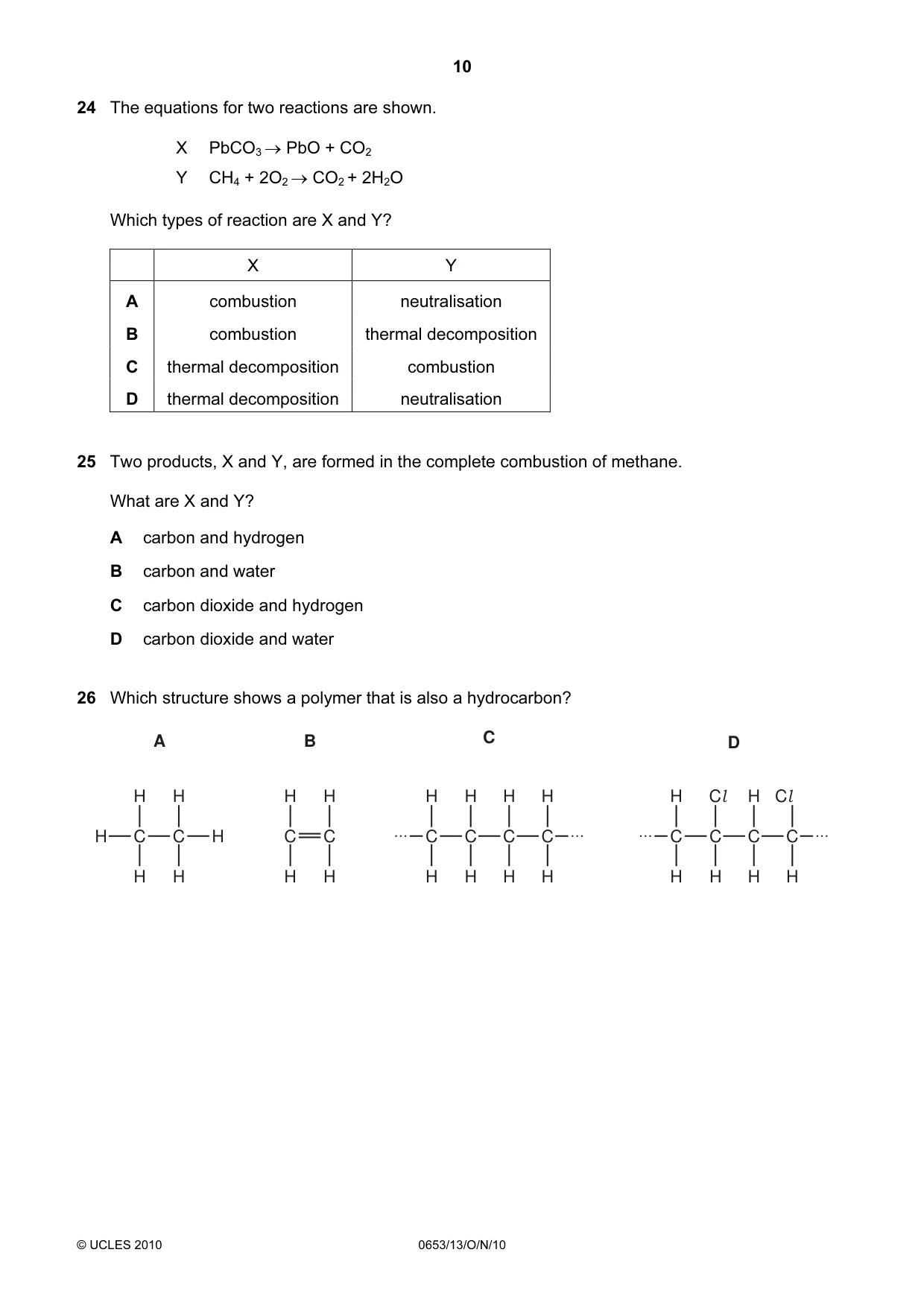
24 The equations for two reactions are shown. X PbCO3 → PbO + CO2 Y CH4 + 2O2 → CO2 + 2H2O Which types of reaction are X and Y? X Y A combustion neutralisation B combustion thermal decomposition C thermal decomposition combustion D thermal decomposition neutralisation
Mark scheme: C
Q25 · Two products, X and Y, are formed in the complete combustion of methane
25 Two products, X and Y, are formed in the complete combustion of methane. What are X and Y? A carbon and hydrogen B carbon and water C carbon dioxide and hydrogen D carbon dioxide and water
Mark scheme: D
Q26 · Which structure shows a polymer that is also a hydrocarbon?
26 Which structure shows a polymer that is also a hydrocarbon? A B C D H H H H H H H H H Cl H Cl H C C H C C C C C C C C C C H H H H H H H H H H H H
Mark scheme: C
Q27 · Crude oil (petroleum) is heated, using the apparatus shown
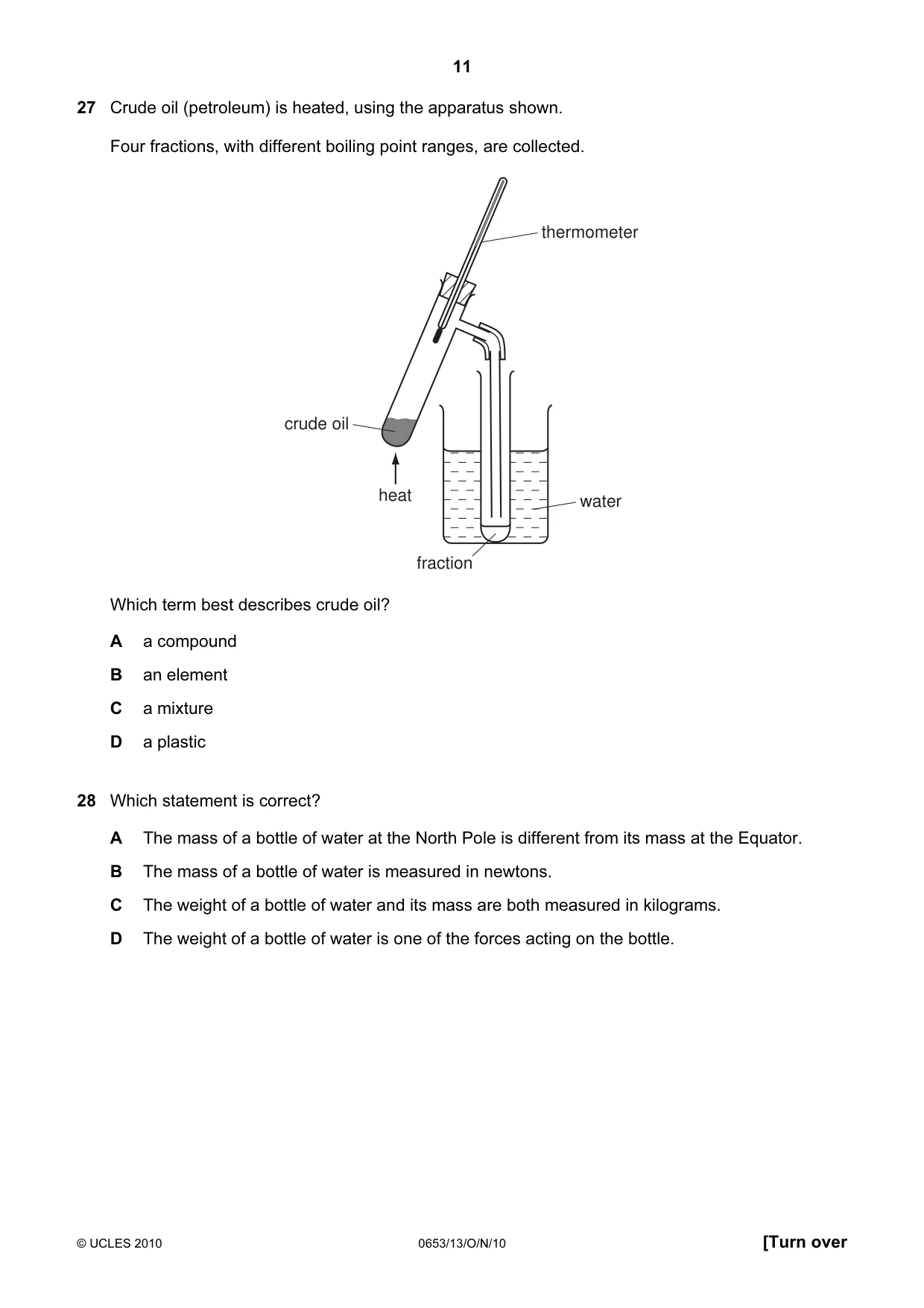
27 Crude oil (petroleum) is heated, using the apparatus shown. Four fractions, with different boiling point ranges, are collected. thermometer crude oil heat water fraction Which term best describes crude oil? A a compound B an element C a mixture D a plastic
Mark scheme: C
Q28 · Which statement is correct?
28 Which statement is correct? A The mass of a bottle of water at the North Pole is different from its mass at the Equator. B The mass of a bottle of water is measured in newtons. C The weight of a bottle of water and its mass are both measured in kilograms. D The weight of a bottle of water is one of the forces acting on the bottle.
Mark scheme: D
Q29 · A ruler and a block of wood are used to find the diameter of some identical metal balls
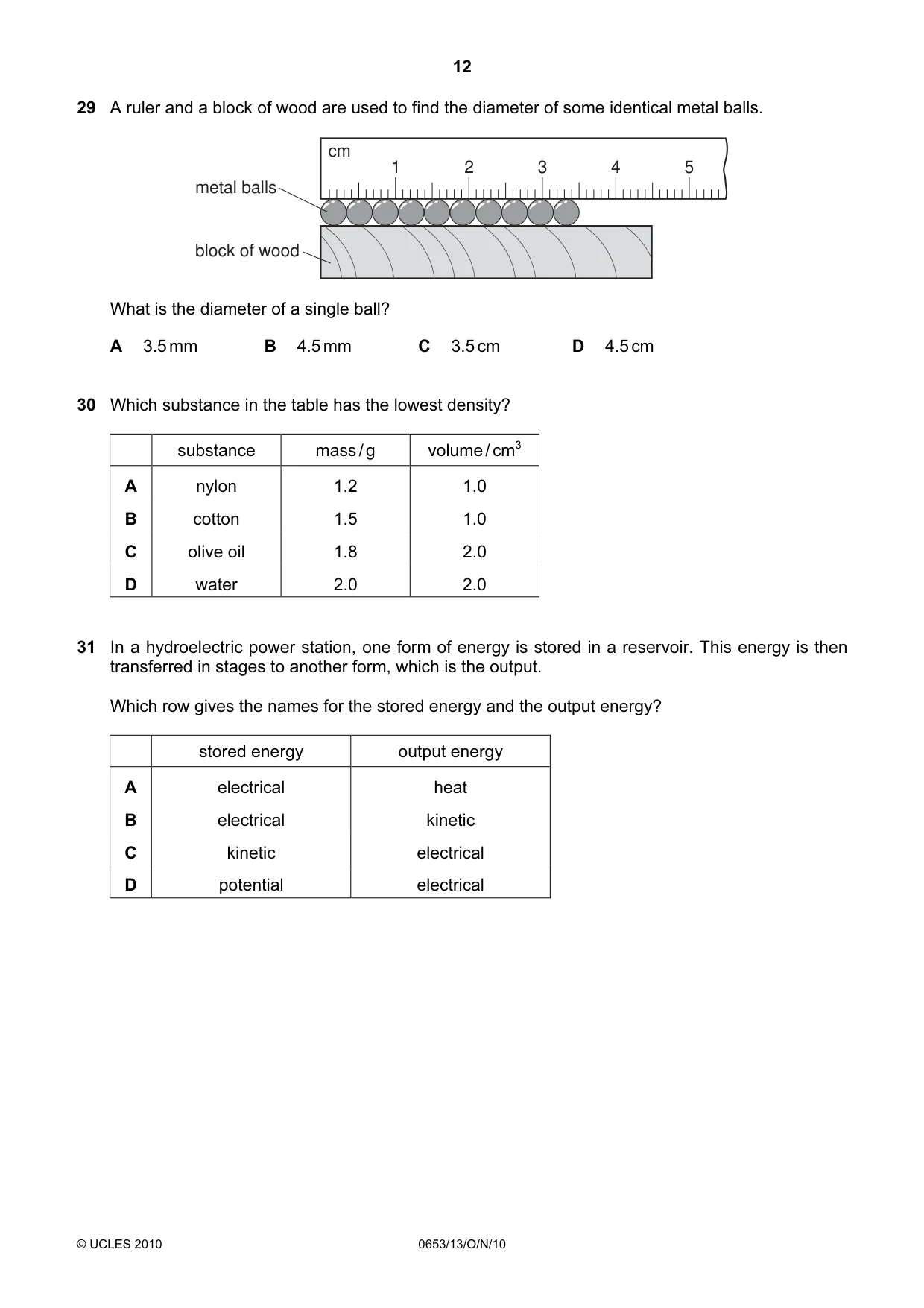
29 A ruler and a block of wood are used to find the diameter of some identical metal balls. cm 1 2 3 4 5 metal balls block of wood What is the diameter of a single ball? A 3.5 mm B 4.5 mm C 3.5 cm D 4.5 cm
Mark scheme: A
More questions on Physical quantities and measurement techniques
Q30 · Which substance in the table has the lowest density?
30 Which substance in the table has the lowest density? substance mass / g volume / cm3 A nylon 1.2 1.0 B cotton 1.5 1.0 C olive oil 1.8 2.0 D water 2.0 2.0
Mark scheme: C
Q31 · In a hydroelectric power station, one form of energy is stored in a reservoir
31 In a hydroelectric power station, one form of energy is stored in a reservoir. This energy is then transferred in stages to another form, which is the output. Which row gives the names for the stored energy and the output energy? stored energy output energy A electrical heat B electrical kinetic C kinetic electrical D potential electrical
Mark scheme: D
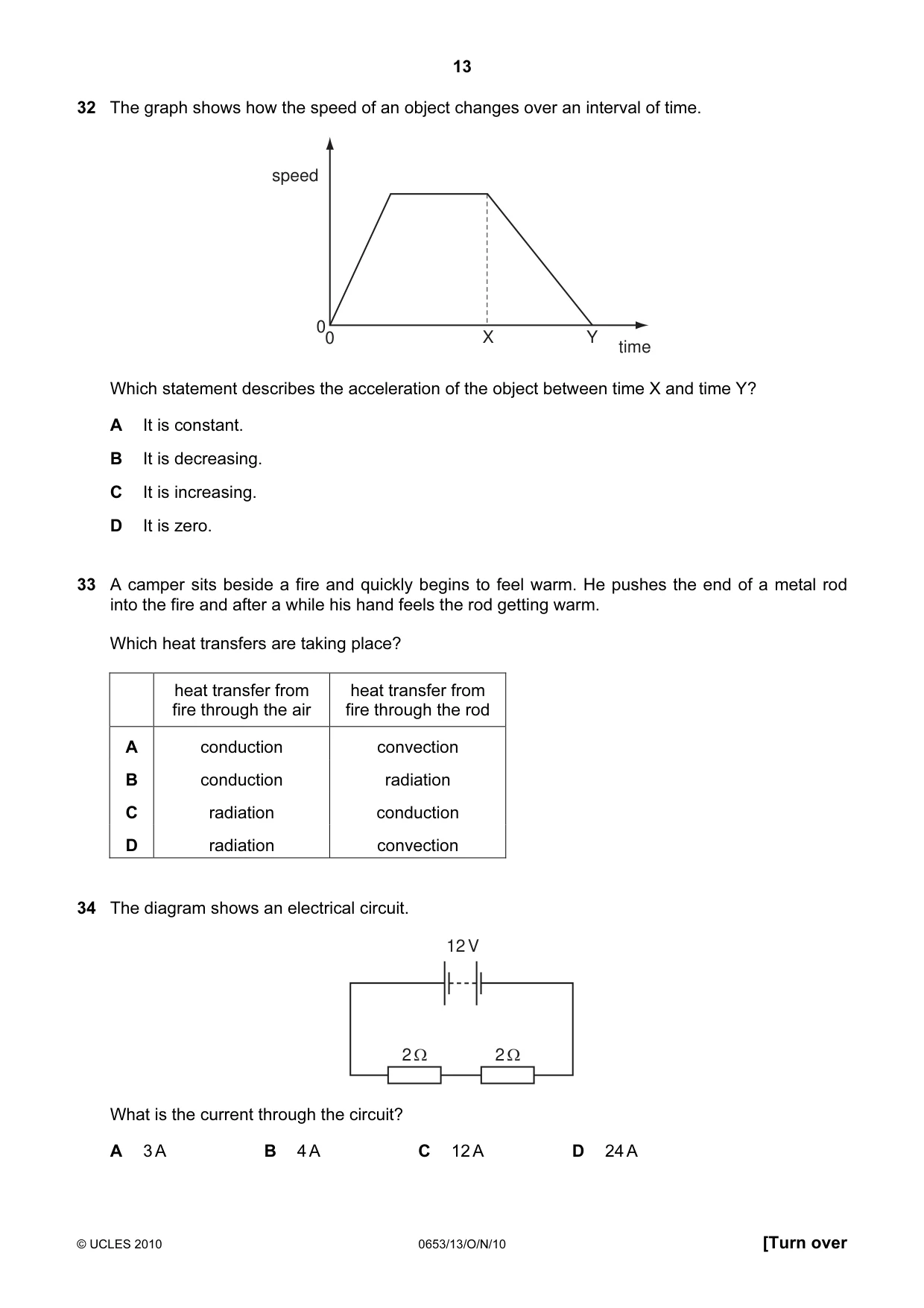
Q32 · The graph shows how the speed of an object changes over an interval of time
32 The graph shows how the speed of an object changes over an interval of time. speed 00 X Y time Which statement describes the acceleration of the object between time X and time Y? A It is constant. B It is decreasing. C It is increasing. D It is zero.
Mark scheme: A
Q33 · A camper sits beside a fire and quickly begins to feel warm
33 A camper sits beside a fire and quickly begins to feel warm. He pushes the end of a metal rod into the fire and after a while his hand feels the rod getting warm. Which heat transfers are taking place? heat transfer from heat transfer from fire through the air fire through the rod A conduction convection B conduction radiation C radiation conduction D radiation convection
Mark scheme: C
Q34 · The diagram shows an electrical circuit
34 The diagram shows an electrical circuit. 12 V 2 Ω 2 Ω What is the current through the circuit? A 3 A B 4 A C 12 A D 24 A
Mark scheme: A
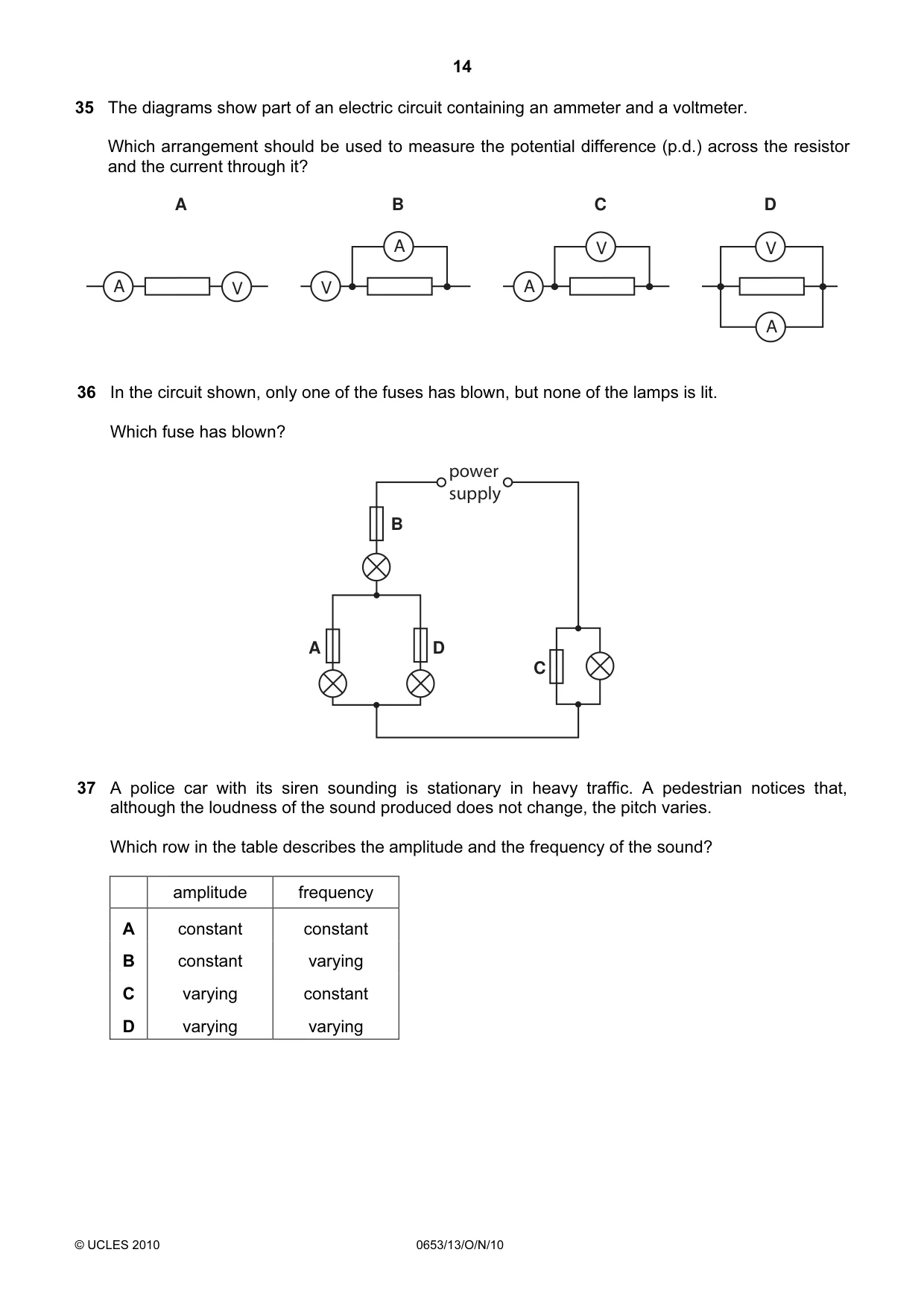
Q35 · The diagrams show part of an electric circuit containing an ammeter and a voltmeter
35 The diagrams show part of an electric circuit containing an ammeter and a voltmeter. Which arrangement should be used to measure the potential difference (p.d.) across the resistor and the current through it? A B C D A V V A V V A A
Mark scheme: C
Q36 · In the circuit shown, only one of the fuses has blown, but none of the lamps is lit
36 In the circuit shown, only one of the fuses has blown, but none of the lamps is lit. Which fuse has blown? power supply B A D C
Mark scheme: B
Q37 · A police car with its siren sounding is stationary in heavy traffic
37 A police car with its siren sounding is stationary in heavy traffic. A pedestrian notices that, although the loudness of the sound produced does not change, the pitch varies. Which row in the table describes the amplitude and the frequency of the sound? amplitude frequency A constant constant B constant varying C varying constant D varying varying
Mark scheme: B
Q38 · The Sun heats the Earth by electromagnetic radiation
38 The Sun heats the Earth by electromagnetic radiation. Which region of the electromagnetic spectrum is responsible for most of this heating? A microwave B infra-red C ultraviolet D X-ray
Mark scheme: B
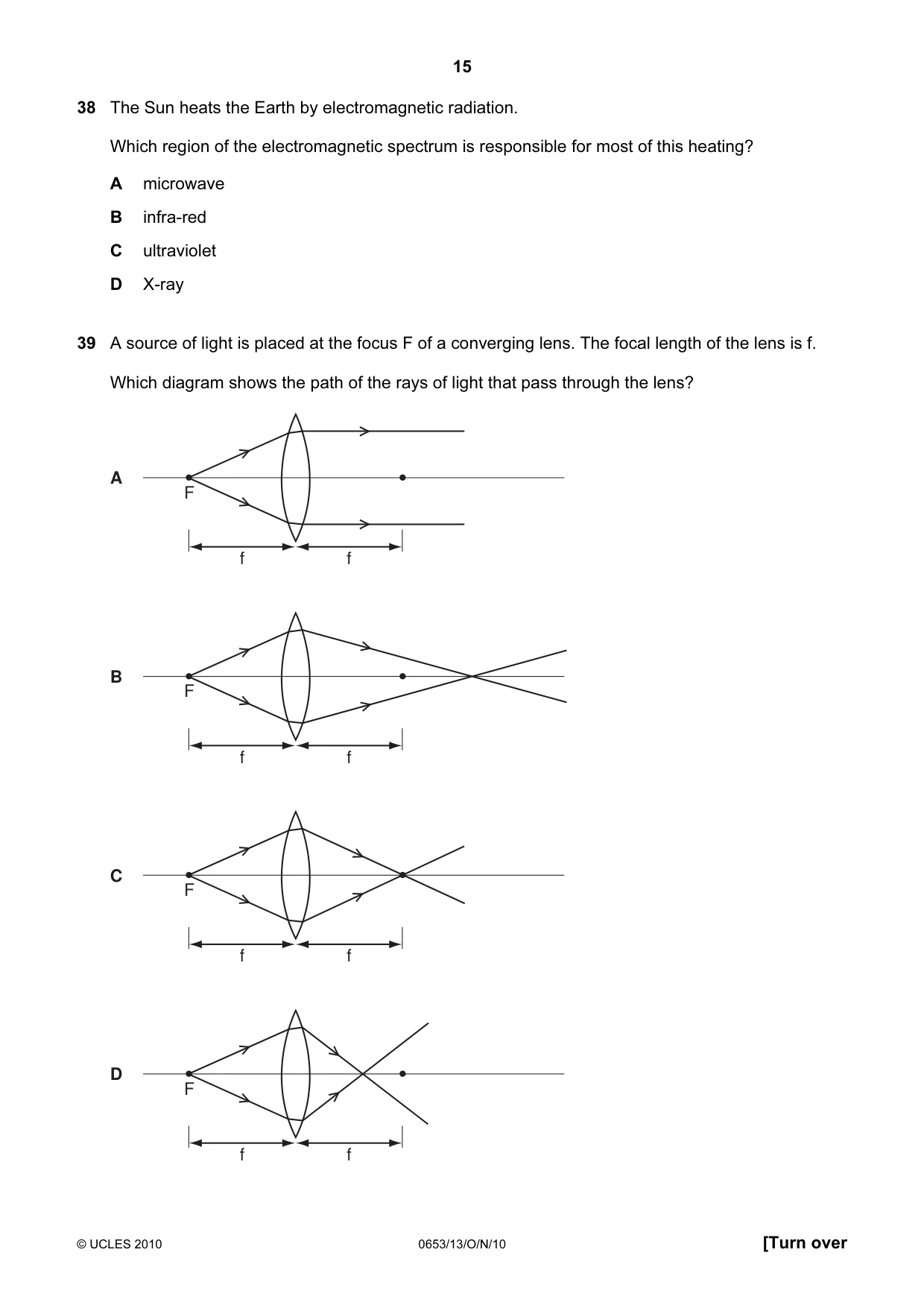
Q39 · A source of light is placed at the focus F of a converging lens
39 A source of light is placed at the focus F of a converging lens. The focal length of the lens is f. Which diagram shows the path of the rays of light that pass through the lens? A F f f B F f f C F f f D F f f
Mark scheme: A
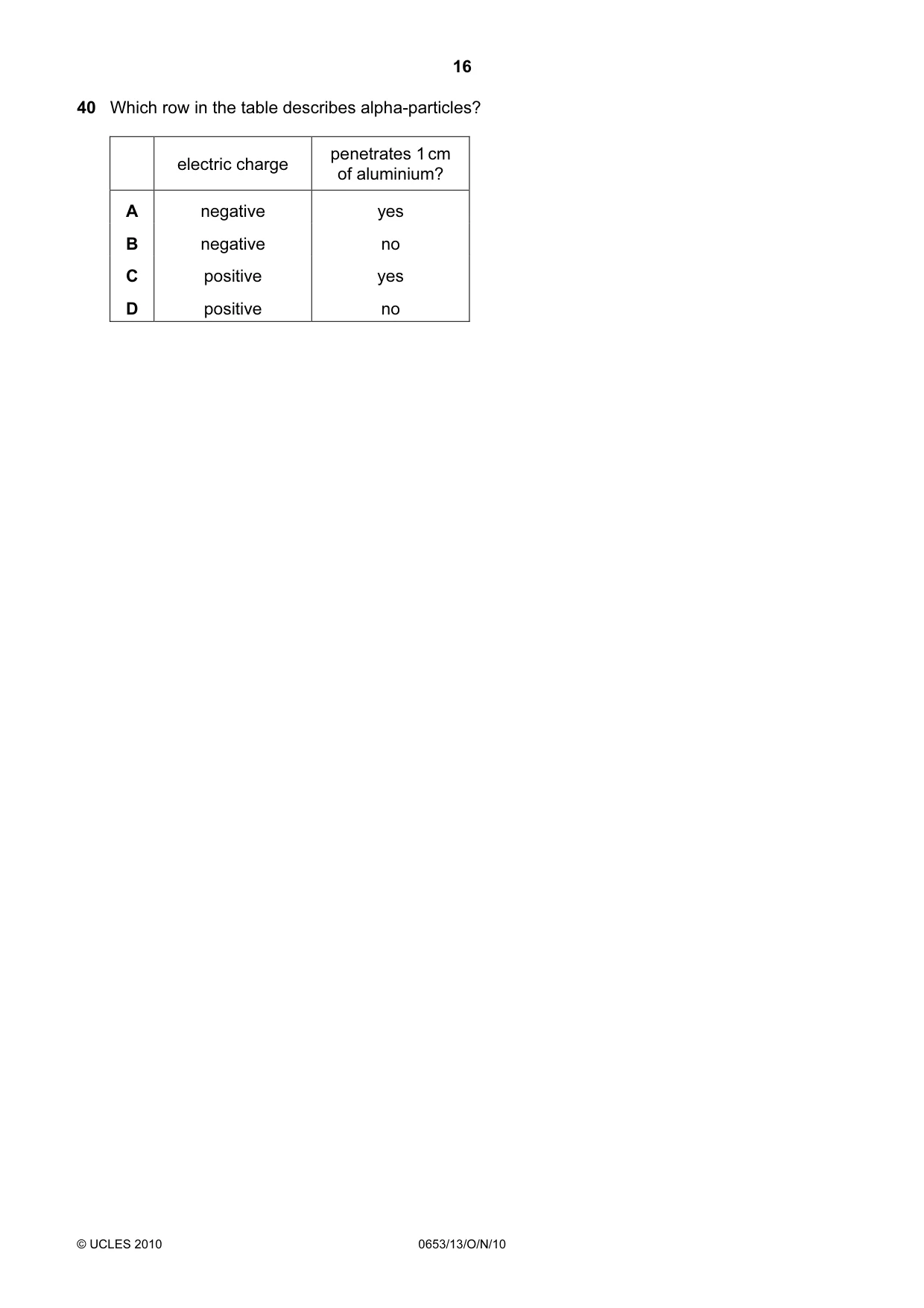
Q40 · Which row in the table describes alpha-particles?
40 Which row in the table describes alpha-particles? penetrates 1 cm electric charge of aluminium? A negative yes B negative no C positive yes D positive no
Mark scheme: D
What was in this paper
The subtopics covered by these 40 questions, and how many questions each got. Open one in a new tab to see every Cambridge question on it.
2Electrical circuits2Fuels2Atomic structure and the Periodic Table1Cell structure1Density1Diffusion1Digestive system1Electrical safety1Electrolysis1Electromagnetic spectrum1Elements, compounds and mixtures1Energy, work and power1Enzymes1Extraction of metals1Formulas1Gas exchange in humans1Habitat destruction1Heart1Ions and ionic bonds1Leaf structure1Light1Mass and weight1Motion1Physical and chemical changes1Physical quantities and measurement techniques1Polymers1Rate of reaction1Reactivity series1Separation and purification1Sexual reproduction in humans1Sexual reproduction in plants1Sound1Transfer of thermal energy1Transition elements1Transpiration1Water1What you needed in this session
Cambridge’s own grade thresholds for 2010 Oct/Nov, Paper 1 · Variant 3. A higher threshold means an easier paper — the bar moves with how the cohort did.