Cambridge IGCSE Science - Combined 0653 — 2016 May/June Paper 1 · Variant 2
0653/12/M/J/16 · 40 questions · 40 marks · ≈45 min
The question paper and its mark scheme, free to read here and free to download. This is Cambridge’s own paper, exactly as it was sat.
Question paper16 pages
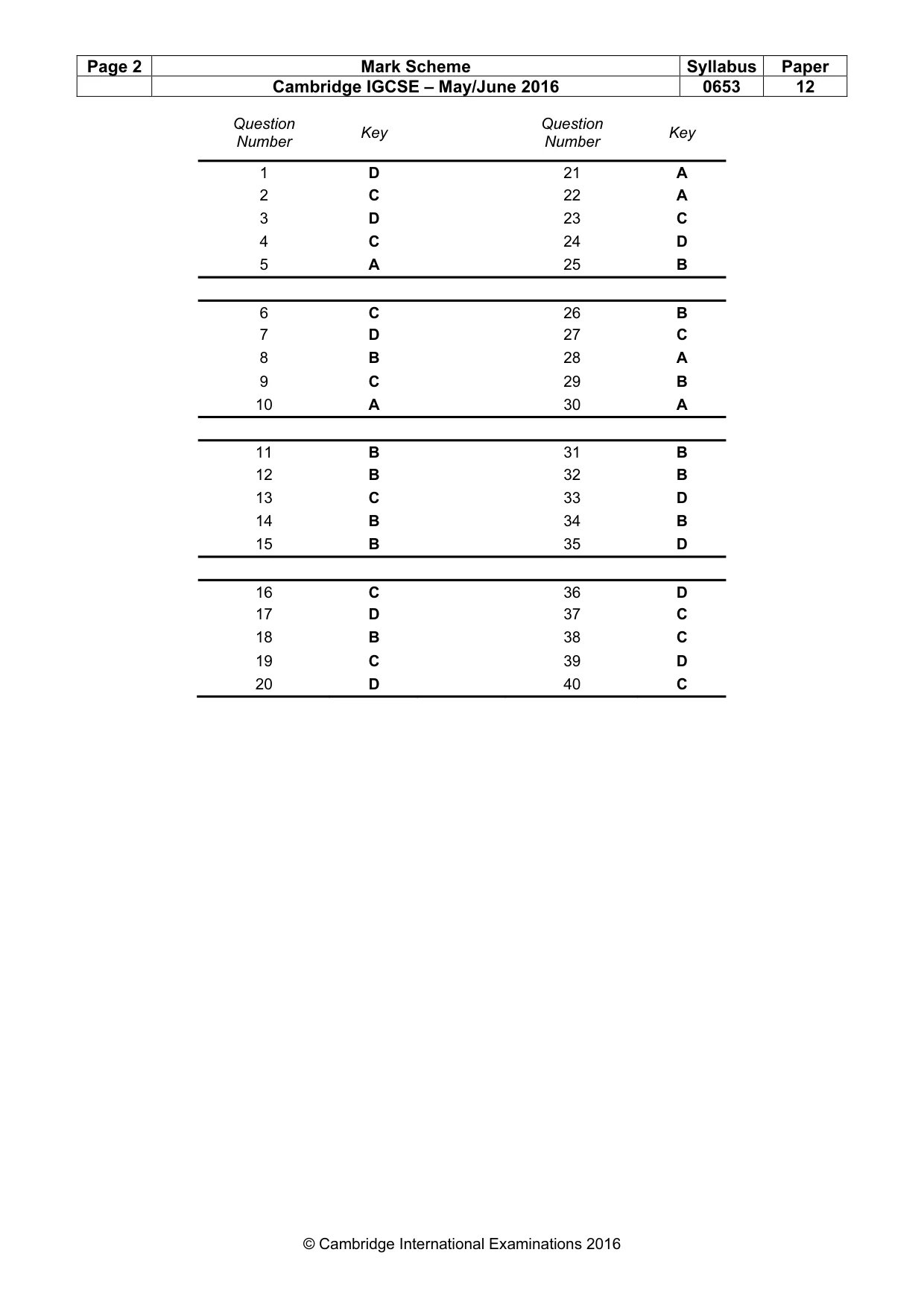
Mark scheme2 pages
Answers below. Sit the paper first if you are practising.
Questions as text
Q1 · Which is a characteristic of all living things?
1 Which is a characteristic of all living things? A breathing B eating C photosynthesis D respiration
Mark scheme: D
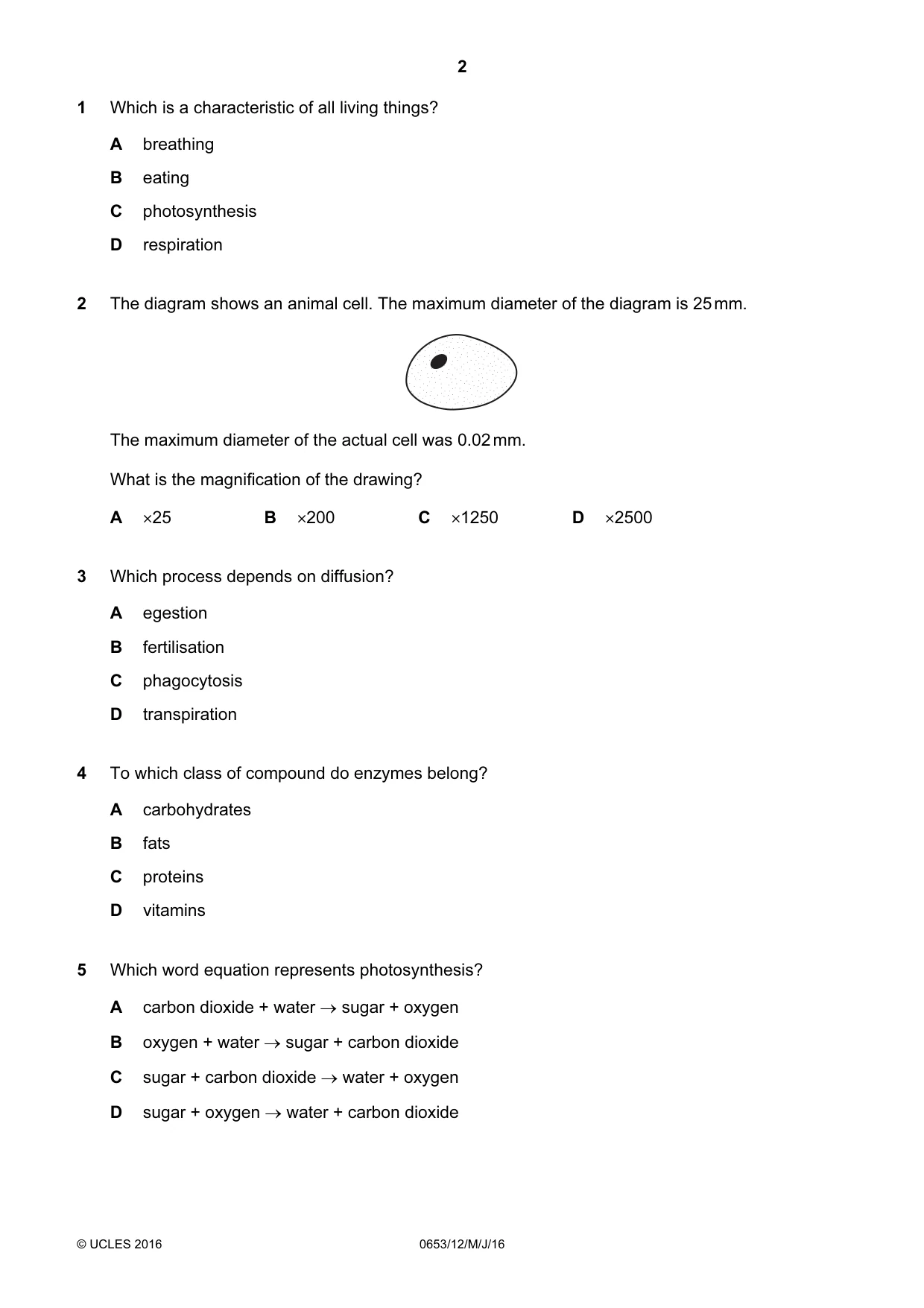
Q2 · The diagram shows an animal cell
2 The diagram shows an animal cell. The maximum diameter of the diagram is 25 mm. The maximum diameter of the actual cell was 0.02 mm. What is the magnification of the drawing? A ×25 B ×200 C ×1250 D ×2500
Mark scheme: C
Q3 · Which process depends on diffusion?
3 Which process depends on diffusion? A egestion B fertilisation C phagocytosis D transpiration
Mark scheme: D
Q4 · To which class of compound do enzymes belong?
4 To which class of compound do enzymes belong? A carbohydrates B fats C proteins D vitamins
Mark scheme: C
Q5 · Which word equation represents photosynthesis?
5 Which word equation represents photosynthesis? A carbon dioxide + water → sugar + oxygen B oxygen + water → sugar + carbon dioxide C sugar + carbon dioxide → water + oxygen D sugar + oxygen → water + carbon dioxide
Mark scheme: A
Q6 · What are the functions of phloem?
6 What are the functions of phloem? transports transports mineral ions sugars A v v B v x Cc x v D x x
Mark scheme: C
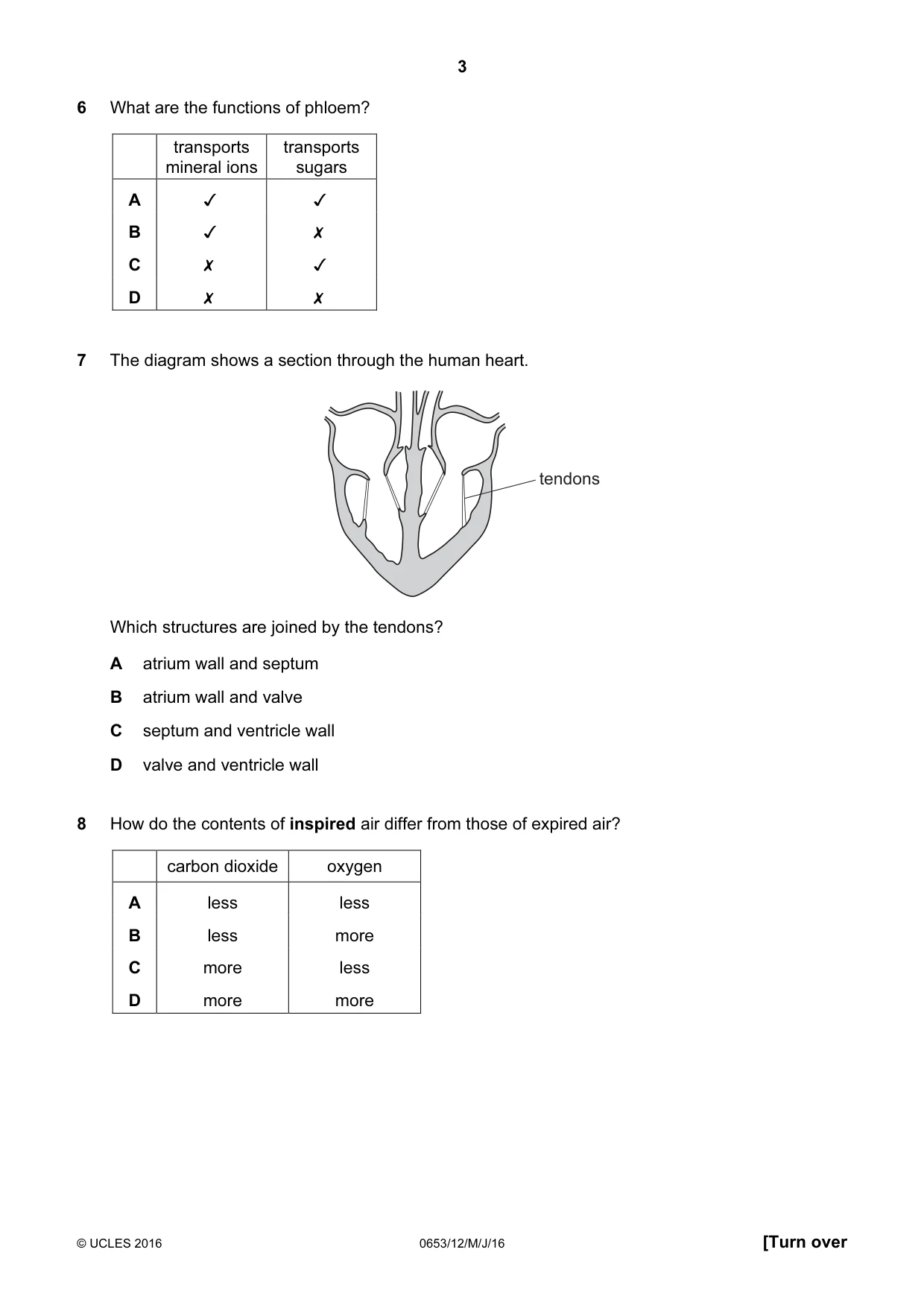
Q7 · The diagram shows a section through the human heart
7 The diagram shows a section through the human heart. tendons Which structures are joined by the tendons? A atrium wall and septum B atrium wall and valve C septum and ventricle wall D valve and ventricle wall
Mark scheme: D
Q8 · How do the contents of inspired air differ from those of expired air?
8 How do the contents of inspired air differ from those of expired air? carbon dioxide oxygen A less less B less more C more less D more more
Mark scheme: B
Q9 · Glucose is involved in the metabolic reaction shown below
9 Glucose is involved in the metabolic reaction shown below. glucose + P → Q + R What are P, Q and R? P Q R A carbon dioxide oxygen water B carbon dioxide water oxygen C oxygen water carbon dioxide D water carbon dioxide oxygen
Mark scheme: C
Q10 · What are the stimuli for geotropism and phototropism?
10 What are the stimuli for geotropism and phototropism? geotropism phototropism A gravity light B heat water C light gravity D water heat
Mark scheme: A
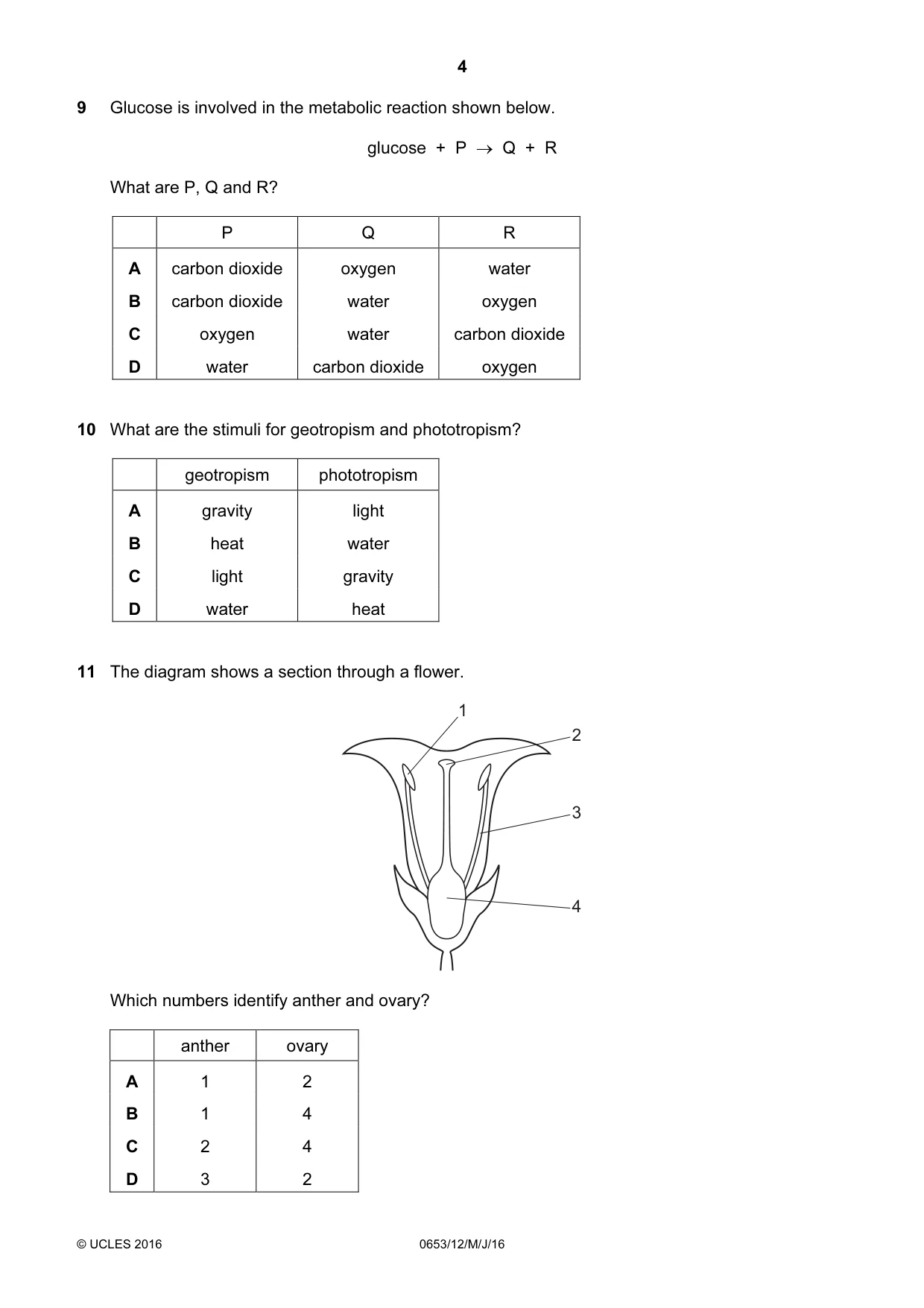
Q11 · The diagram shows a section through a flower
11 The diagram shows a section through a flower. 1 2 3 4 Which numbers identify anther and ovary? anther ovary A 1 2 B 1 4 C 2 4 D 3 2
Mark scheme: B
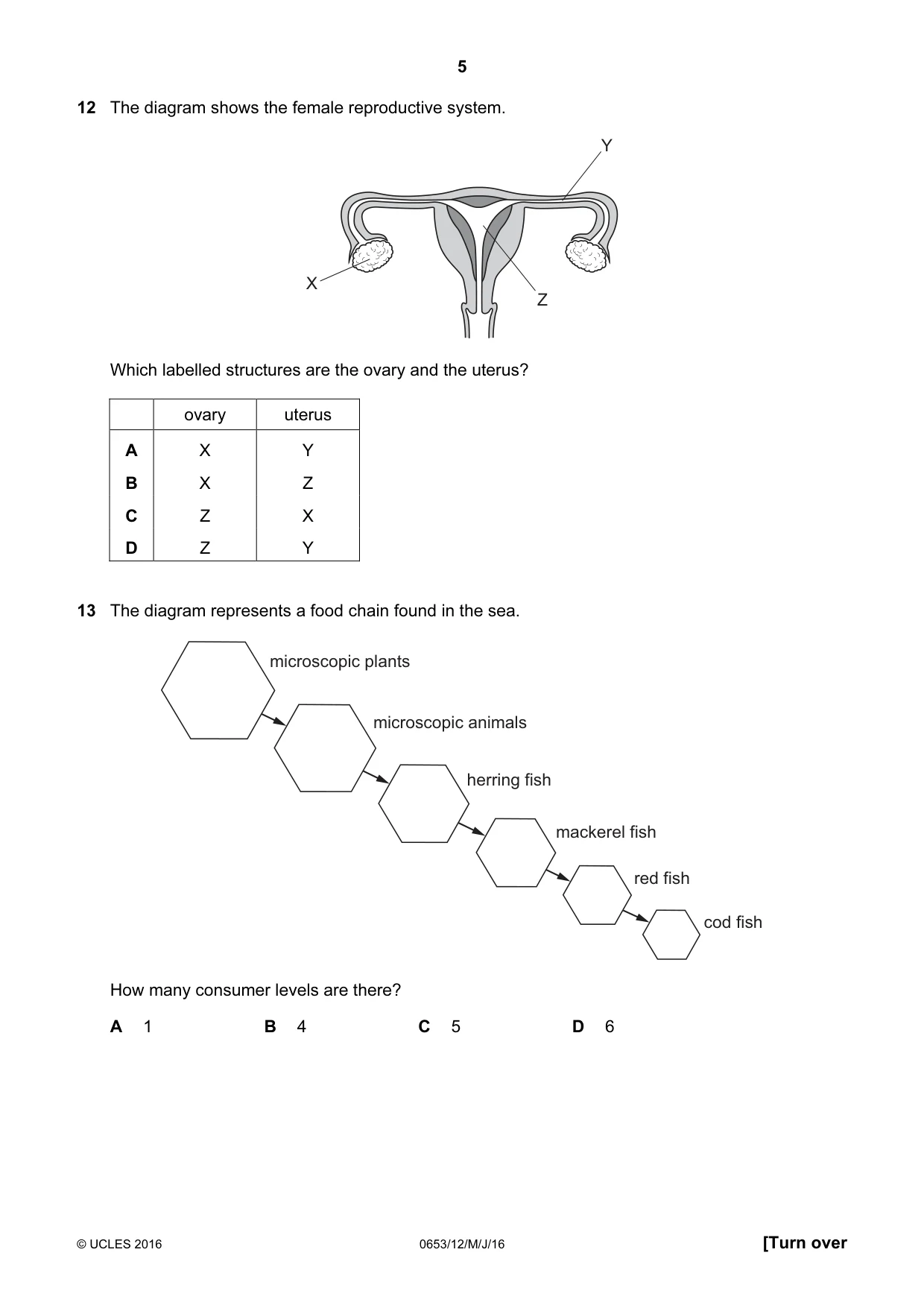
Q12 · The diagram shows the female reproductive system
12 The diagram shows the female reproductive system. Y X Z Which labelled structures are the ovary and the uterus? ovary uterus A X Y B X Z C Z X D Z Y
Mark scheme: B
Q13 · The diagram represents a food chain found in the sea
13 The diagram represents a food chain found in the sea. microscopic plants microscopic animals herring fish mackerel fish red fish cod fish How many consumer levels are there? A 1 B 4 C 5 D 6
Mark scheme: C
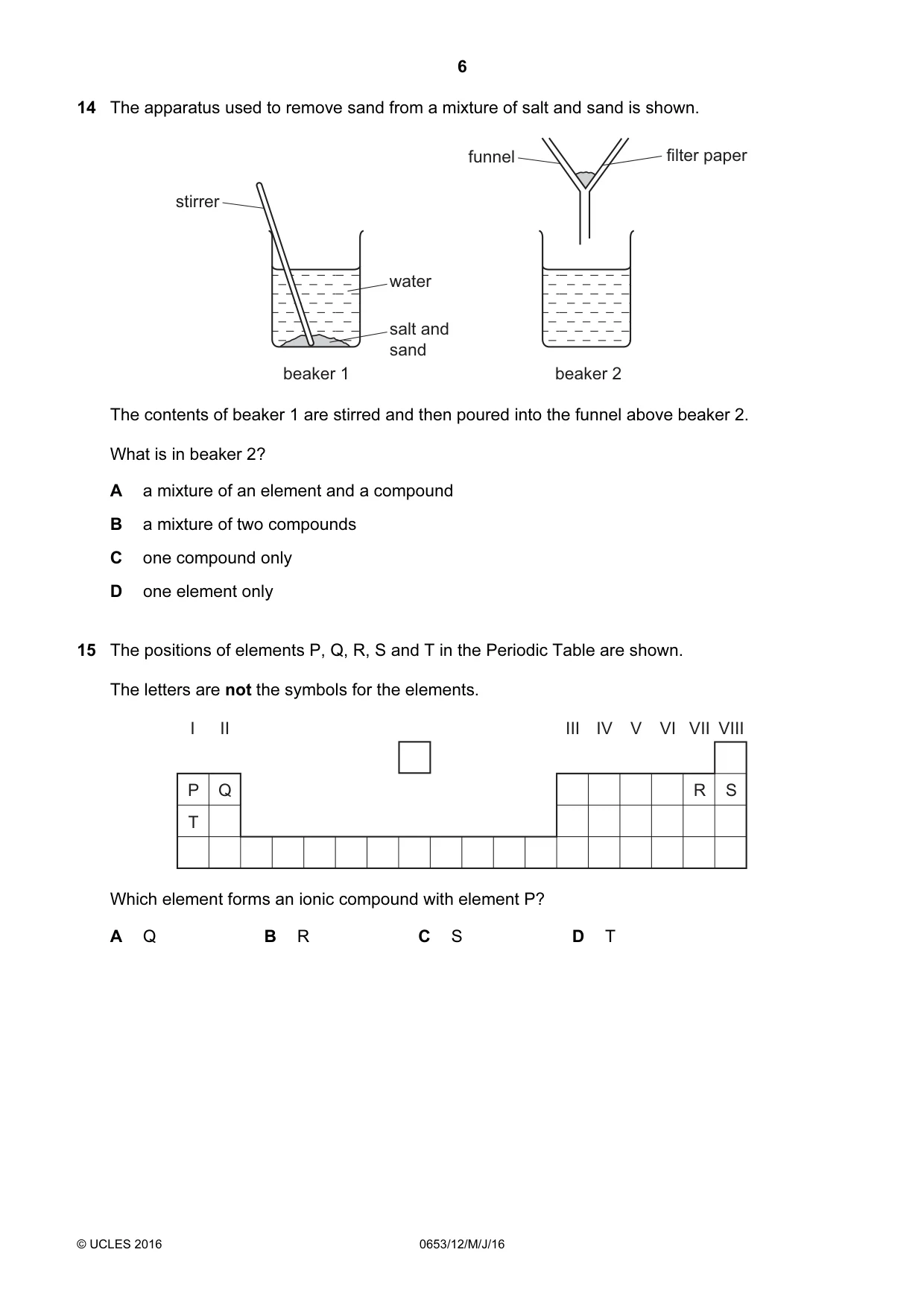
Q14 · The apparatus used to remove sand from a mixture of salt and sand is shown
14 The apparatus used to remove sand from a mixture of salt and sand is shown. funnel filter paper stirrer water salt and sand beaker 1 beaker 2 The contents of beaker 1 are stirred and then poured into the funnel above beaker 2. What is in beaker 2? A a mixture of an element and a compound B a mixture of two compounds C one compound only D one element only
Mark scheme: B
Q15 · The positions of elements P, Q, R, S and T in the Periodic Table are shown
15 The positions of elements P, Q, R, S and T in the Periodic Table are shown. The letters are not the symbols for the elements. I II III IV V VI VII VIII P Q R S T Which element forms an ionic compound with element P? A Q B R C S D T
Mark scheme: B
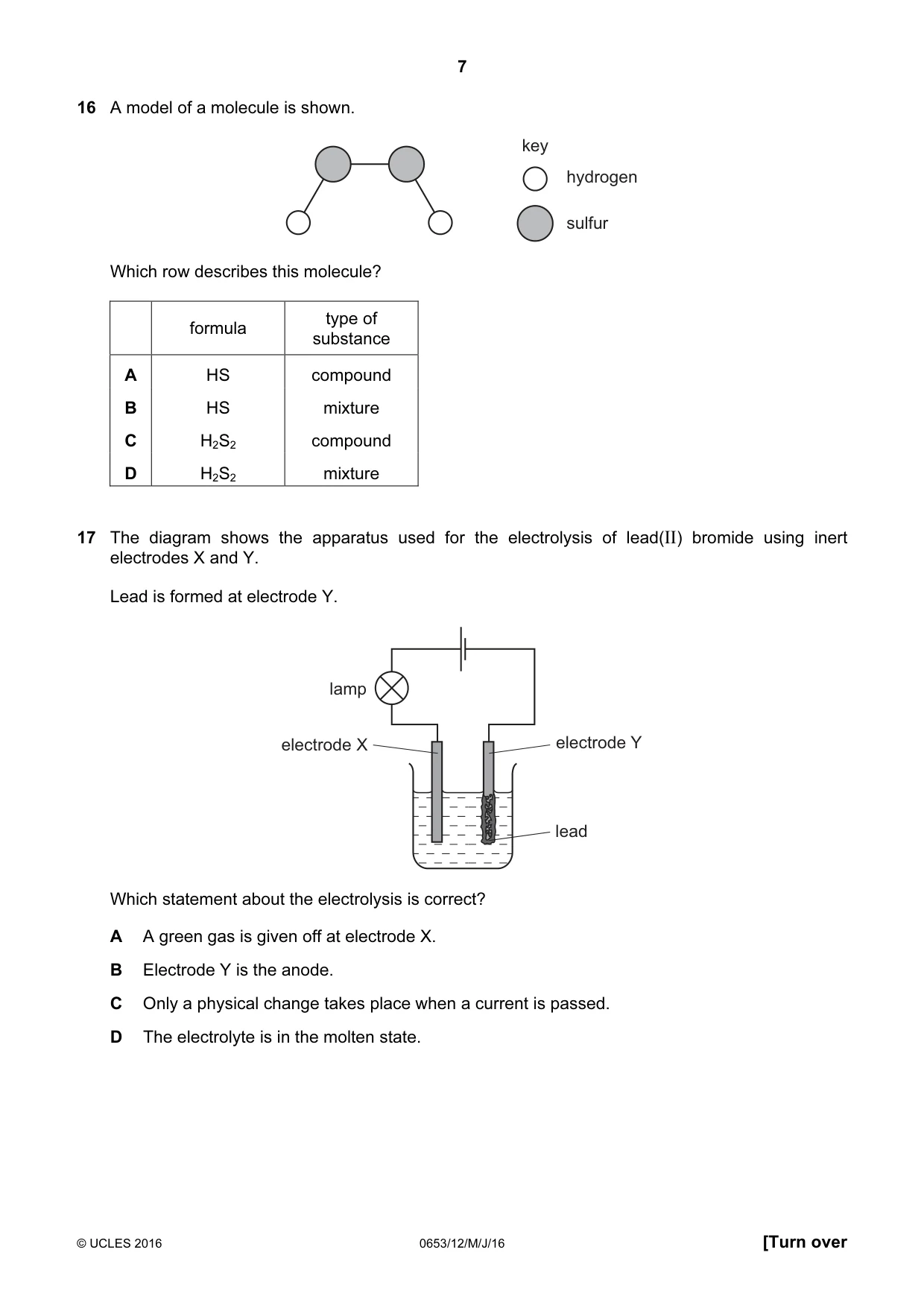
Q16 · A model of a molecule is shown
16 A model of a molecule is shown. key hydrogen sulfur Which row describes this molecule? type of formula substance A HS compound B HS mixture C H2S2 compound D H2S2 mixture
Mark scheme: C
Q17 · The diagram shows the apparatus used for the electrolysis of lead(II) bromide using inert…
17 The diagram shows the apparatus used for the electrolysis of lead(II) bromide using inert electrodes X and Y. Lead is formed at electrode Y. lamp electrode X electrode Y lead Which statement about the electrolysis is correct? A A green gas is given off at electrode X. B Electrode Y is the anode. C Only a physical change takes place when a current is passed. D The electrolyte is in the molten state.
Mark scheme: D
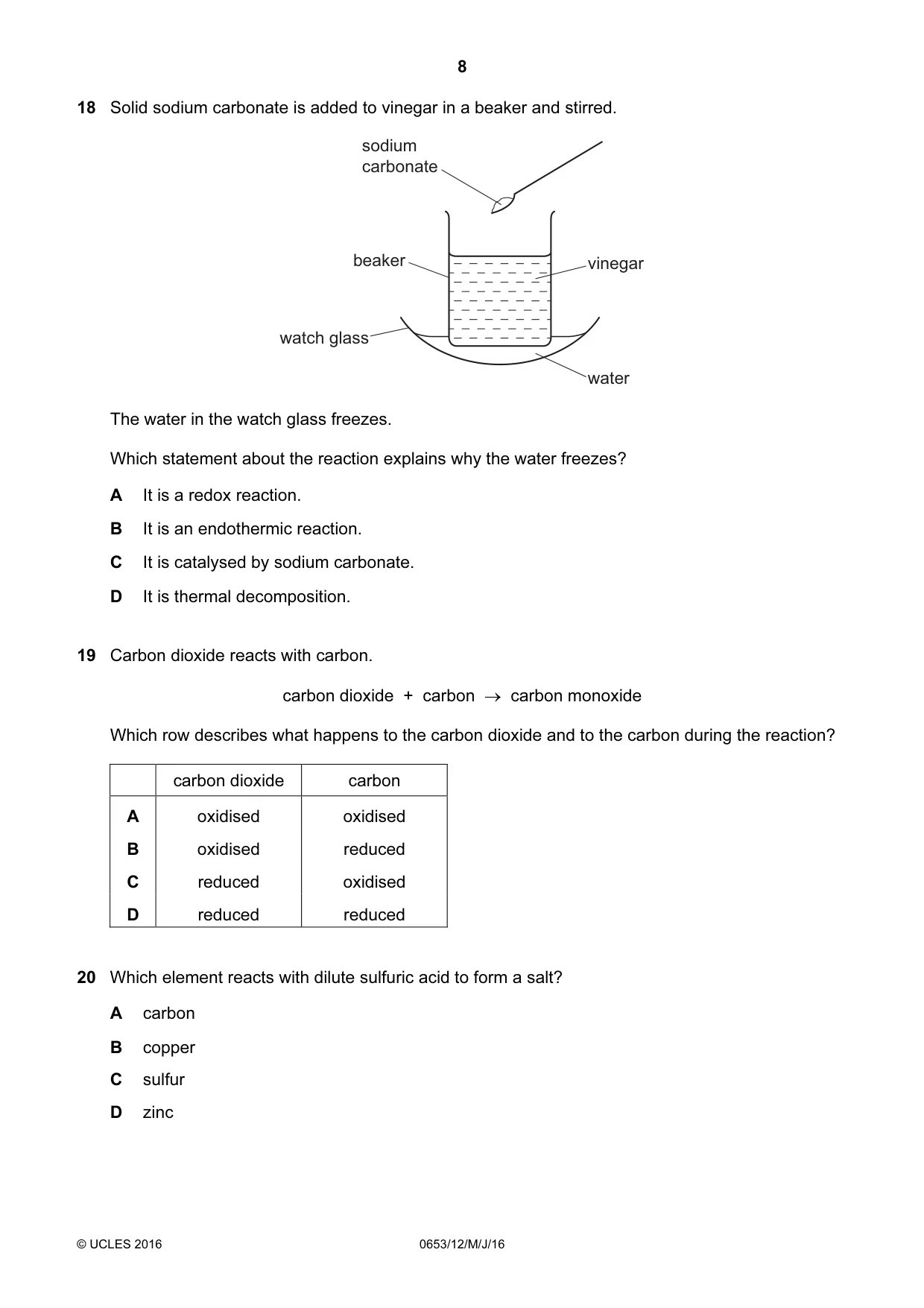
Q18 · Solid sodium carbonate is added to vinegar in a beaker and stirred
18 Solid sodium carbonate is added to vinegar in a beaker and stirred. sodium carbonate beaker vinegar watch glass water The water in the watch glass freezes. Which statement about the reaction explains why the water freezes? A It is a redox reaction. B It is an endothermic reaction. C It is catalysed by sodium carbonate. D It is thermal decomposition.
Mark scheme: B
Q19 · Carbon dioxide reacts with carbon
19 Carbon dioxide reacts with carbon. carbon dioxide + carbon → carbon monoxide Which row describes what happens to the carbon dioxide and to the carbon during the reaction? carbon dioxide carbon A oxidised oxidised B oxidised reduced C reduced oxidised D reduced reduced
Mark scheme: C
Q20 · Which element reacts with dilute sulfuric acid to form a salt?
20 Which element reacts with dilute sulfuric acid to form a salt? A carbon B copper C sulfur D zinc
Mark scheme: D
More questions on The characteristic properties of acids and bases
Q21 · The results of two tests on substance Q are shown
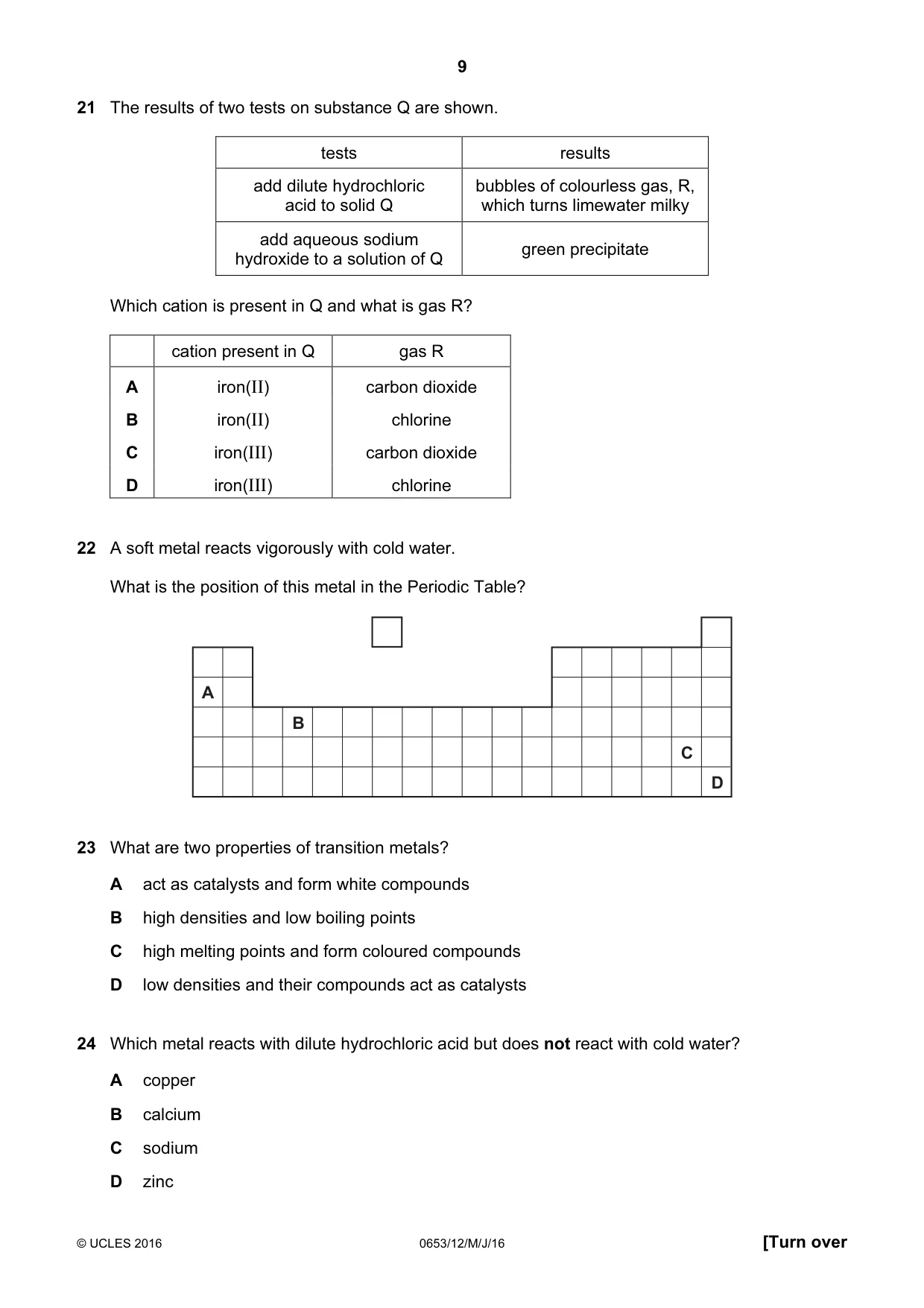
21 The results of two tests on substance Q are shown. tests results add dilute hydrochloric bubbles of colourless gas, R, acid to solid Q which turns limewater milky add aqueous sodium green precipitate hydroxide to a solution of Q Which cation is present in Q and what is gas R? cation present in Q gas R A iron(II) carbon dioxide B iron(II) chlorine C iron(III) carbon dioxide D iron(III) chlorine
Mark scheme: A
Q22 · A soft metal reacts vigorously with cold water
22 A soft metal reacts vigorously with cold water. What is the position of this metal in the Periodic Table? A B C D
Mark scheme: A
Q23 · What are two properties of transition metals?
23 What are two properties of transition metals? A act as catalysts and form white compounds B high densities and low boiling points C high melting points and form coloured compounds D low densities and their compounds act as catalysts
Mark scheme: C
Q24 · Which metal reacts with dilute hydrochloric acid but does not react with cold water?
24 Which metal reacts with dilute hydrochloric acid but does not react with cold water? A copper B calcium C sodium D zinc
Mark scheme: D
Q25 · What is a chemical test for water?
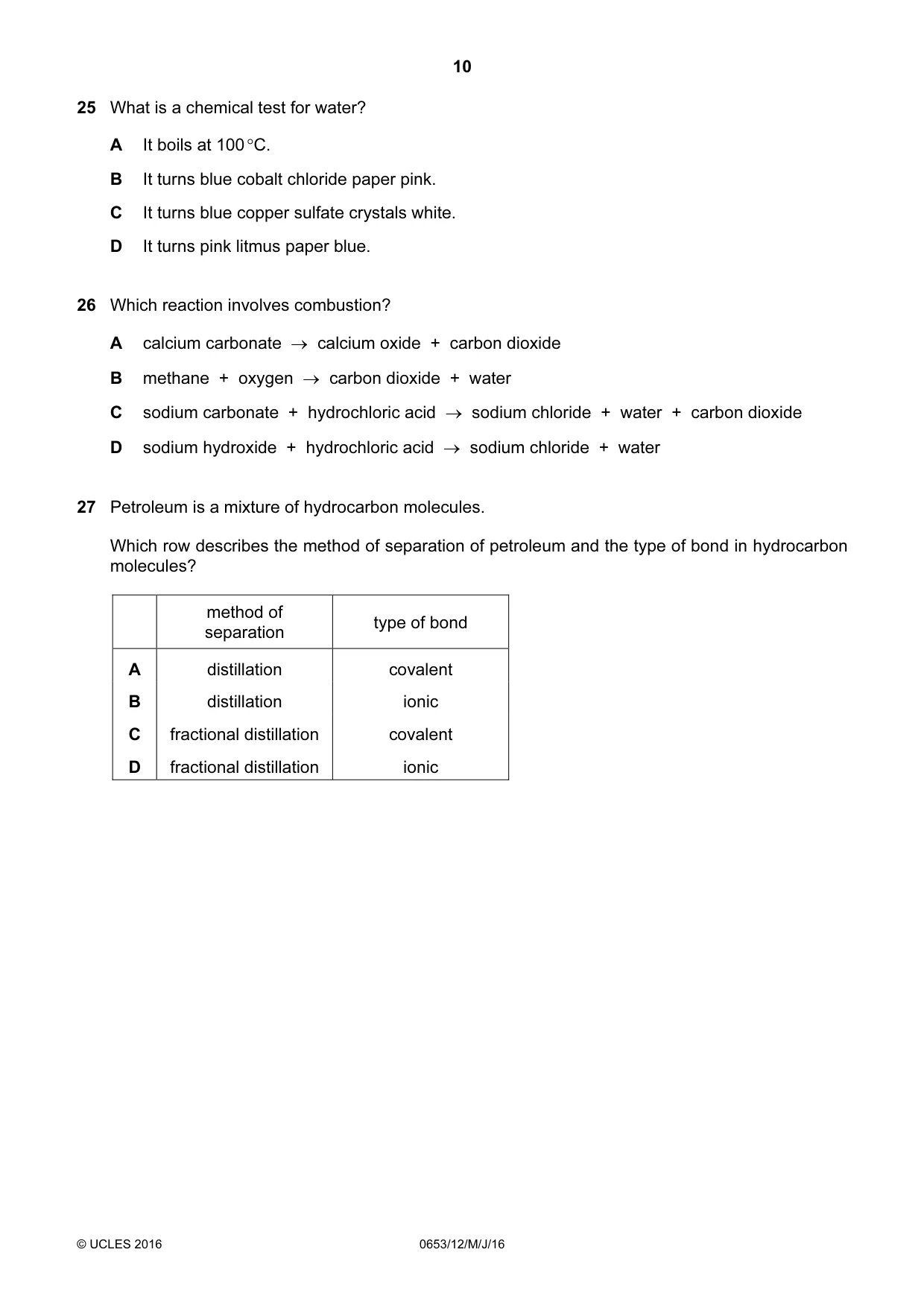
25 What is a chemical test for water? A It boils at 100 °C. B It turns blue cobalt chloride paper pink. C It turns blue copper sulfate crystals white. D It turns pink litmus paper blue.
Mark scheme: B
Q26 · Which reaction involves combustion?
26 Which reaction involves combustion? A calcium carbonate → calcium oxide + carbon dioxide B methane + oxygen → carbon dioxide + water C sodium carbonate + hydrochloric acid → sodium chloride + water + carbon dioxide D sodium hydroxide + hydrochloric acid → sodium chloride + water
Mark scheme: B
Q27 · Petroleum is a mixture of hydrocarbon molecules
27 Petroleum is a mixture of hydrocarbon molecules. Which row describes the method of separation of petroleum and the type of bond in hydrocarbon molecules? method of type of bond separation A distillation covalent B distillation ionic C fractional distillation covalent D fractional distillation ionic
Mark scheme: C
Q28 · The graph shows how the speed of a car varies with time
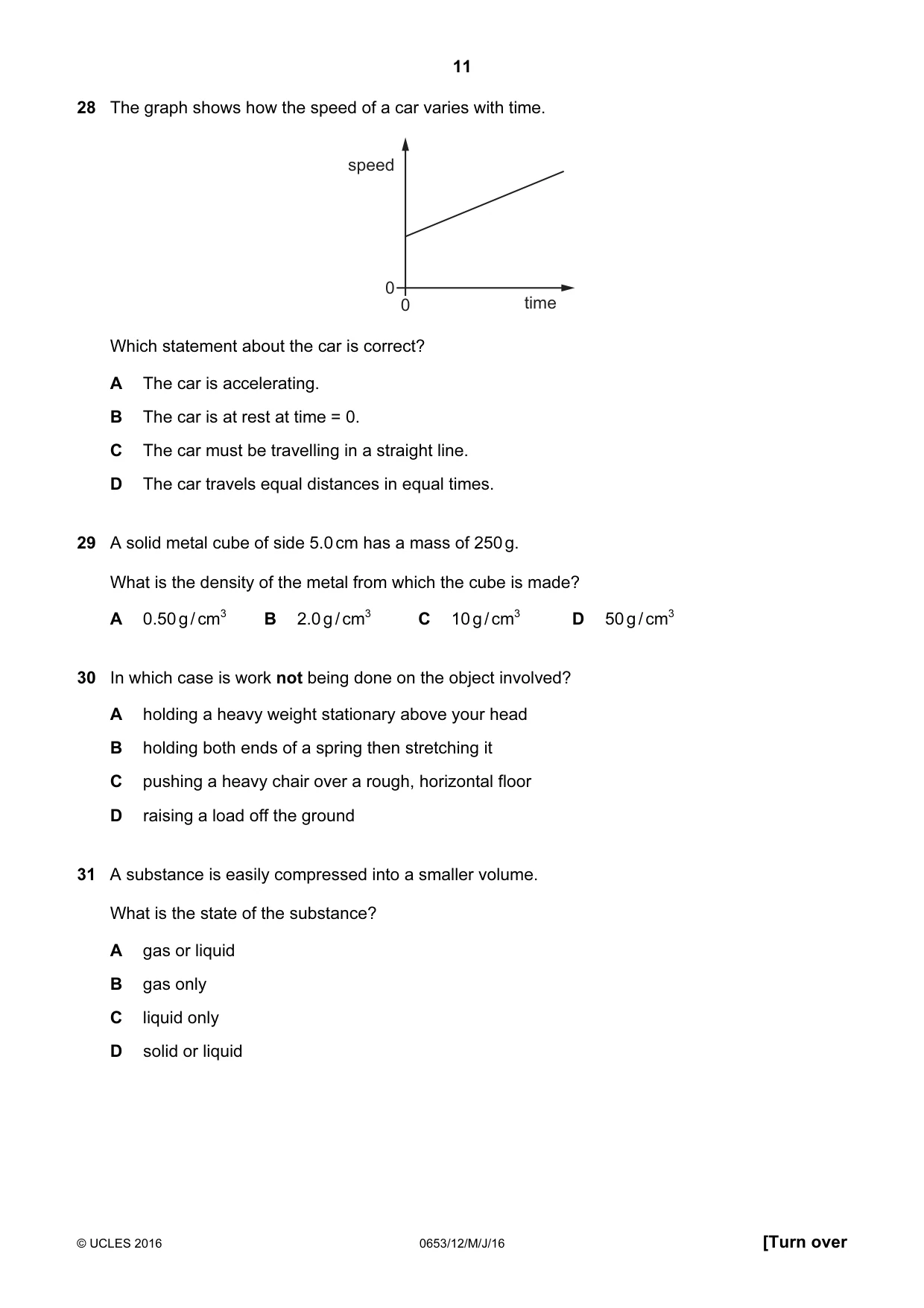
28 The graph shows how the speed of a car varies with time. speed 0 0 time Which statement about the car is correct? A The car is accelerating. B The car is at rest at time = 0. C The car must be travelling in a straight line. D The car travels equal distances in equal times.
Mark scheme: A
Q29 · A solid metal cube of side 5.0 cm has a mass of 250 g
29 A solid metal cube of side 5.0 cm has a mass of 250 g. What is the density of the metal from which the cube is made? A 0.50 g / cm3 B 2.0 g / cm3 C 10 g / cm3 D 50 g / cm3
Mark scheme: B
Q30 · In which case is work not being done on the object involved?
30 In which case is work not being done on the object involved? A holding a heavy weight stationary above your head B holding both ends of a spring then stretching it C pushing a heavy chair over a rough, horizontal floor D raising a load off the ground
Mark scheme: A
Q31 · A substance is easily compressed into a smaller volume
31 A substance is easily compressed into a smaller volume. What is the state of the substance? A gas or liquid B gas only C liquid only D solid or liquid
Mark scheme: B
Q32 · Benzene and glycerine are two substances
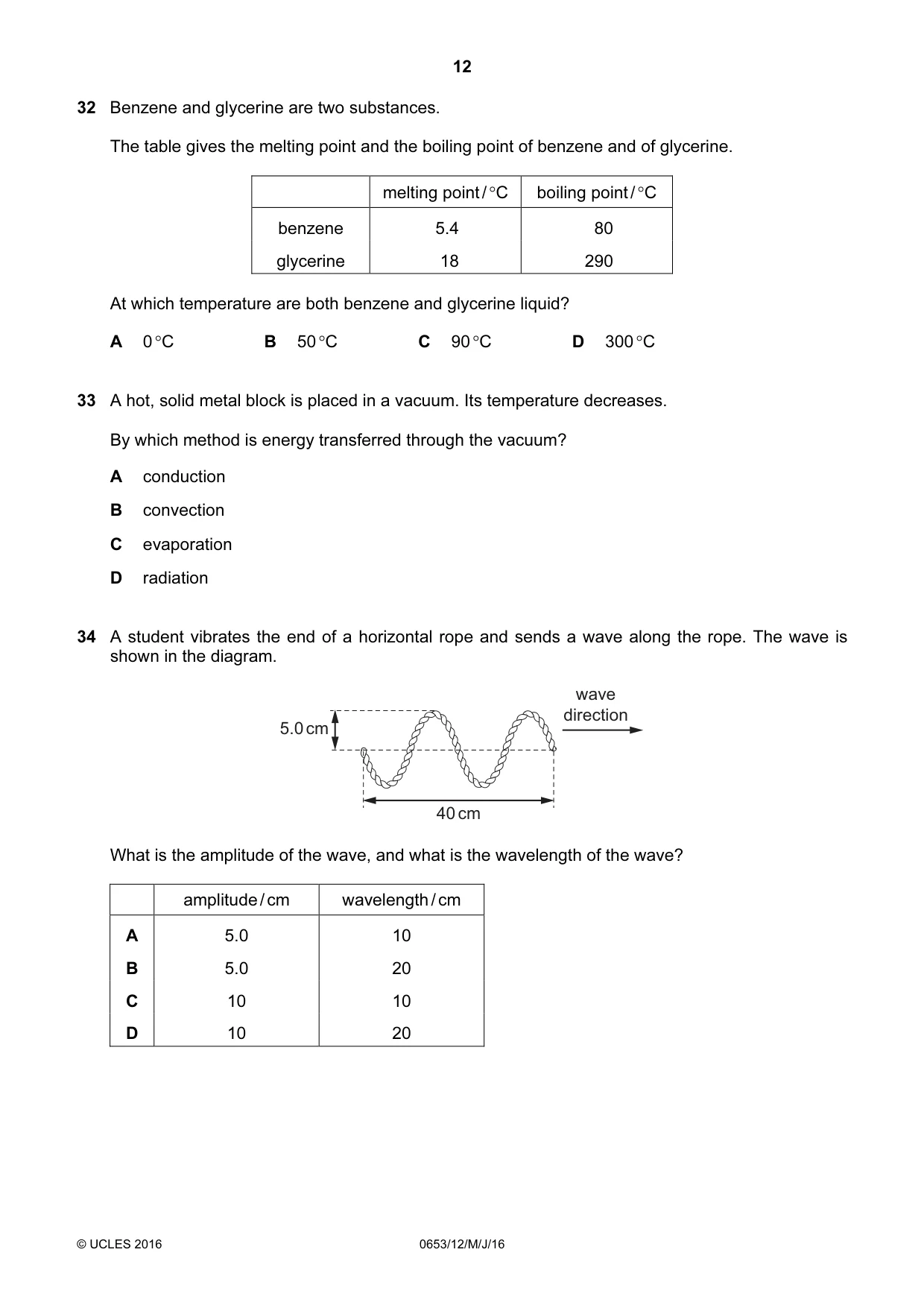
32 Benzene and glycerine are two substances. The table gives the melting point and the boiling point of benzene and of glycerine. melting point / °C boiling point / °C benzene 5.4 80 glycerine 18 290 At which temperature are both benzene and glycerine liquid? A 0 °C B 50 °C C 90 °C D 300 °C
Mark scheme: B
Q33 · A hot, solid metal block is placed in a vacuum
33 A hot, solid metal block is placed in a vacuum. Its temperature decreases. By which method is energy transferred through the vacuum? A conduction B convection C evaporation D radiation
Mark scheme: D
Q34 · A student vibrates the end of a horizontal rope and sends a wave along the rope
34 A student vibrates the end of a horizontal rope and sends a wave along the rope. The wave is shown in the diagram. wave direction 5.0 cm 40 cm What is the amplitude of the wave, and what is the wavelength of the wave? amplitude / cm wavelength / cm A 5.0 10 B 5.0 20 C 10 10 D 10 20
Mark scheme: B
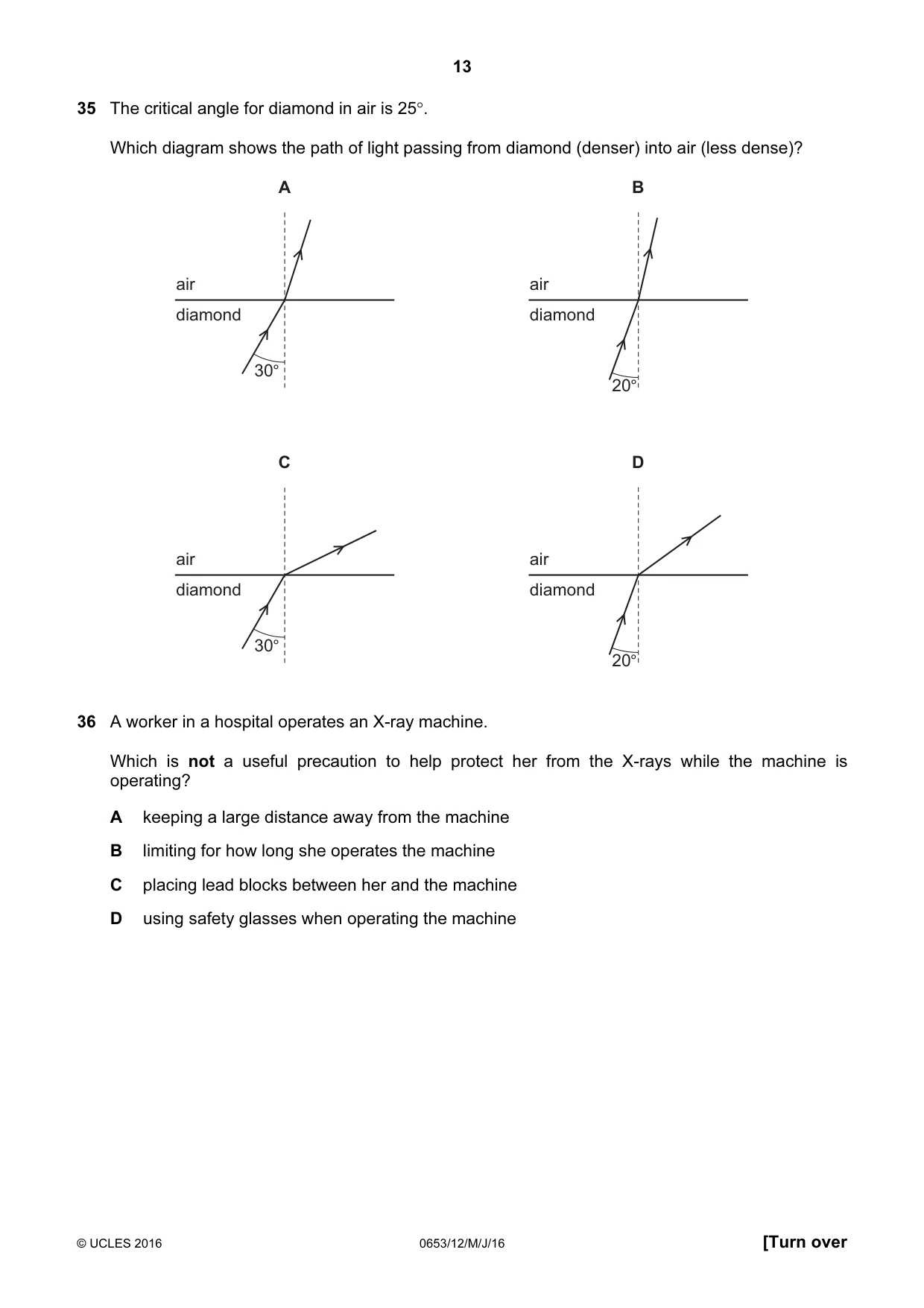
Q35 · The critical angle for diamond in air is 25°
35 The critical angle for diamond in air is 25°. Which diagram shows the path of light passing from diamond (denser) into air (less dense)? A B air air diamond diamond 30° 20° C D air air diamond diamond 30° 20°
Mark scheme: D
Q36 · A worker in a hospital operates an X-ray machine
36 A worker in a hospital operates an X-ray machine. Which is not a useful precaution to help protect her from the X-rays while the machine is operating? A keeping a large distance away from the machine B limiting for how long she operates the machine C placing lead blocks between her and the machine D using safety glasses when operating the machine
Mark scheme: D
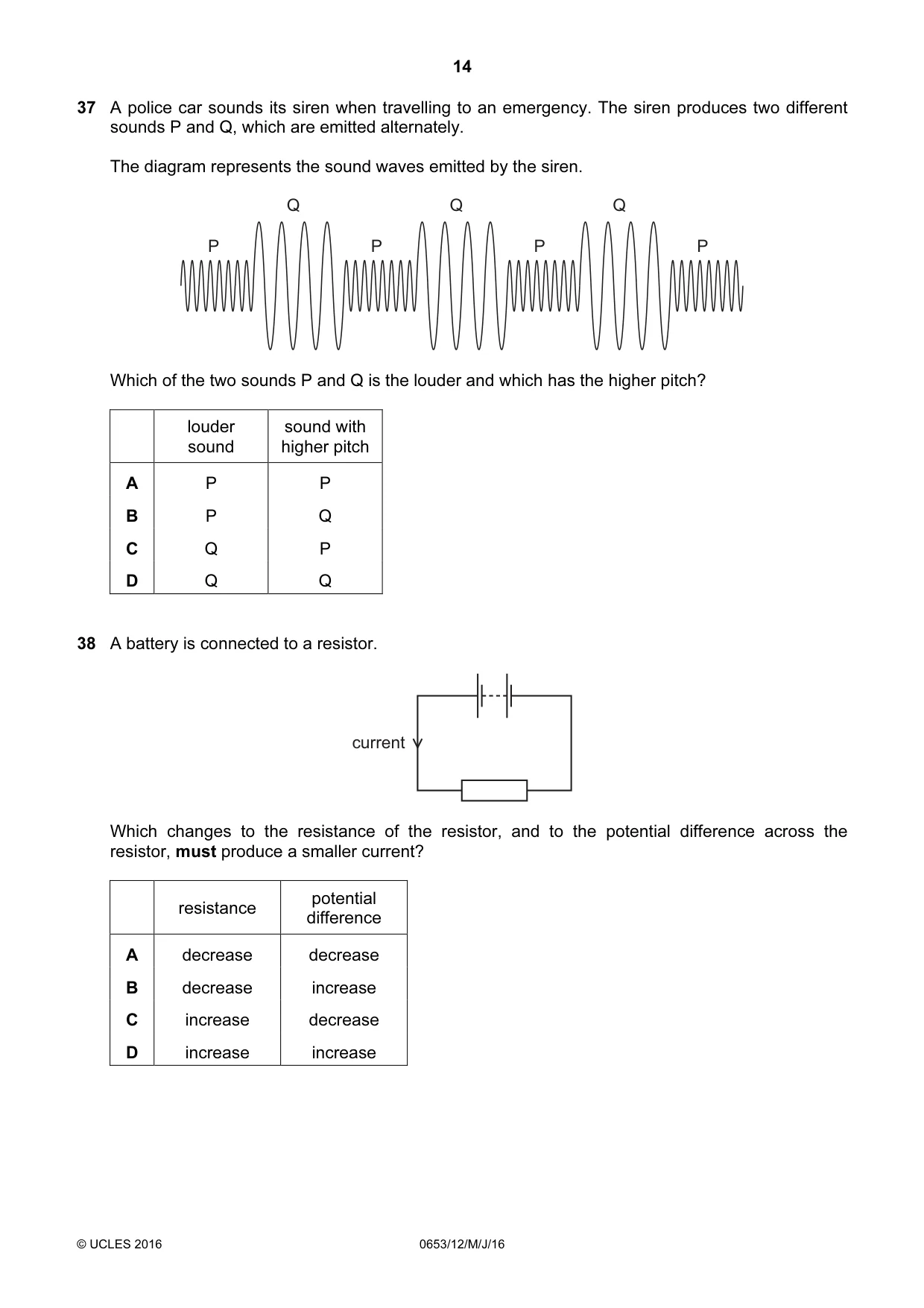
Q37 · A police car sounds its siren when travelling to an emergency
37 A police car sounds its siren when travelling to an emergency. The siren produces two different sounds P and Q, which are emitted alternately. The diagram represents the sound waves emitted by the siren. Q Q Q P P P P Which of the two sounds P and Q is the louder and which has the higher pitch? louder sound with sound higher pitch A P P B P Q C Q P D Q Q
Mark scheme: C
Q38 · A battery is connected to a resistor
38 A battery is connected to a resistor. current Which changes to the resistance of the resistor, and to the potential difference across the resistor, must produce a smaller current? potential resistance difference A decrease decrease B decrease increase C increase decrease D increase increase
Mark scheme: C
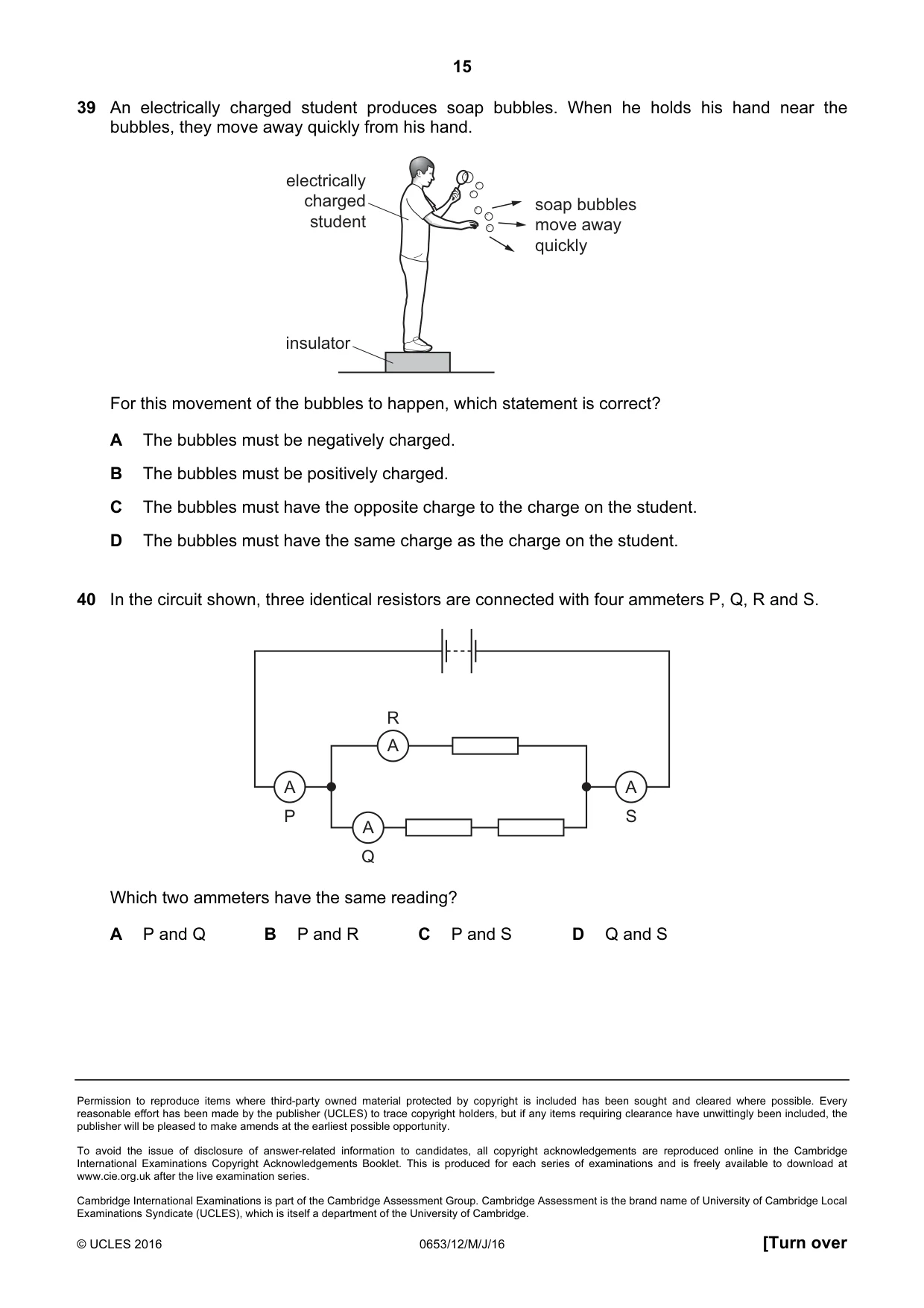
Q39 · An electrically charged student produces soap bubbles
39 An electrically charged student produces soap bubbles. When he holds his hand near the bubbles, they move away quickly from his hand. electrically charged soap bubbles student move away quickly insulator For this movement of the bubbles to happen, which statement is correct? A The bubbles must be negatively charged. B The bubbles must be positively charged. C The bubbles must have the opposite charge to the charge on the student. D The bubbles must have the same charge as the charge on the student.
Mark scheme: D
Q40 · In the circuit shown, three identical resistors are connected with four ammeters P, Q, R…
40 In the circuit shown, three identical resistors are connected with four ammeters P, Q, R and S. R A A A P S A Q Which two ammeters have the same reading? A P and Q B P and R C P and S D Q and S
Mark scheme: C
What was in this paper
The subtopics covered by these 40 questions, and how many questions each got. Open one in a new tab to see every Cambridge question on it.
2Electrical quantities2Identification of ions and gases2Separation and purification2Biological molecules1Density1Diffusion1Electrical circuits1Electrical safety1Electrolysis1Elements, compounds and mixtures1Energy, work and power1Exothermic and endothermic reactions1Food chains and food webs1Gas exchange in humans1General properties of waves1Group I properties1Heart1Ions and ionic bonds1Kinetic particle model of matter1Light1Motion1Photosynthesis1Physical and chemical changes1Reactivity series1Redox1Respiration1Sexual reproduction in humans1Sexual reproduction in plants1Size of specimens1Sound1The characteristic properties of acids and bases1Thermal properties and temperature1Transfer of thermal energy1Transition elements1Xylem and phloem1What you needed in this session
Cambridge’s own grade thresholds for 2016 May/June, Paper 1 · Variant 2. A higher threshold means an easier paper — the bar moves with how the cohort did.