Cambridge IGCSE Science - Combined 0653 — 2021 Feb/March Paper 1 · Variant 2
0653/12/F/M/21 · 40 questions · 40 marks · ≈45 min
The question paper and its mark scheme, free to read here and free to download. This is Cambridge’s own paper, exactly as it was sat.
Question paper16 pages
Mark scheme3 pages
Answers below. Sit the paper first if you are practising.
Questions as text
Q1 · What are the characteristics of living organisms?
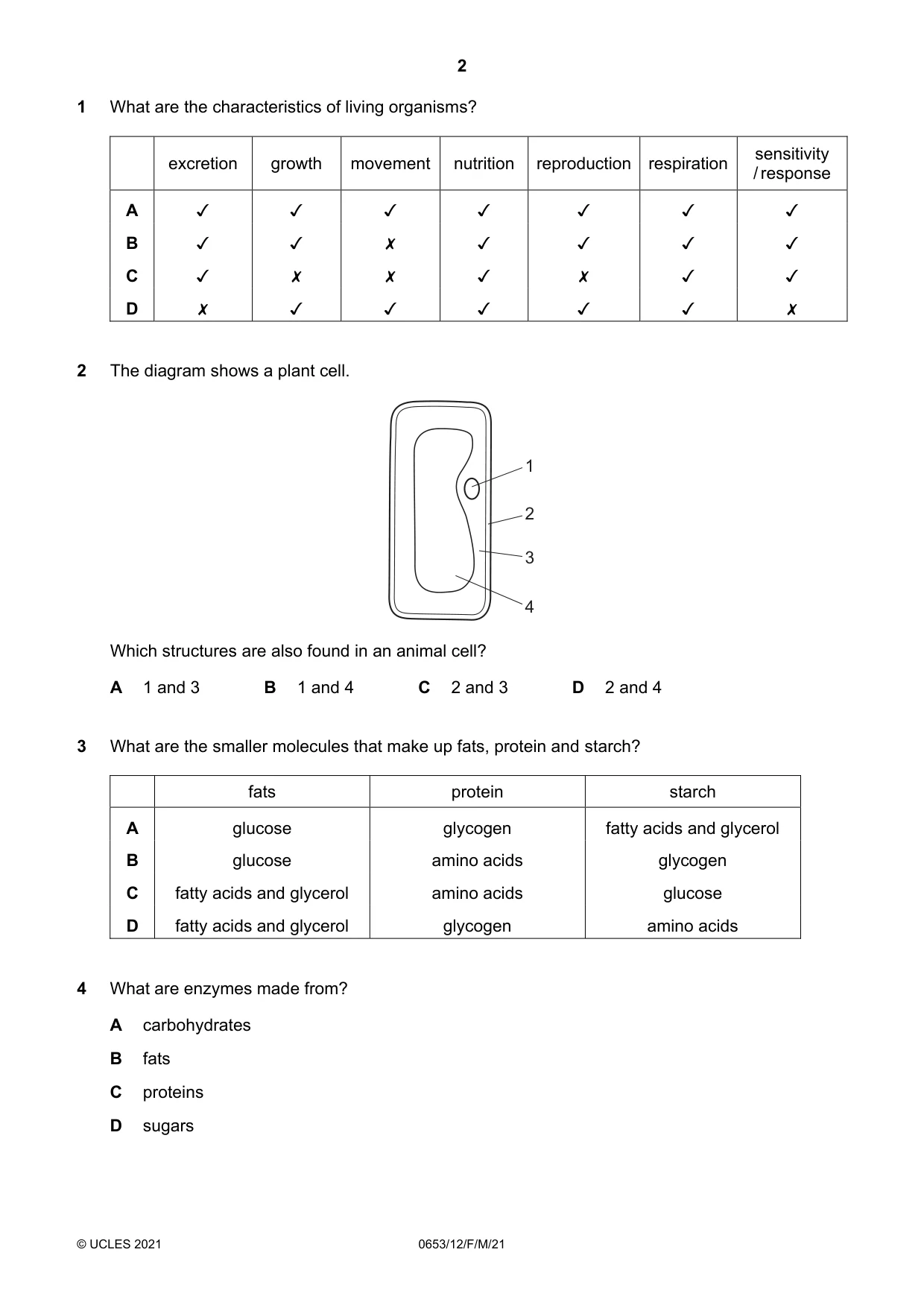
1 What are the characteristics of living organisms? excretion growth | movement | nutrition | reproduction | respiration jresponee A Jv Jv Jv JV JV JV J B J J 4 V JV V V Cc v x x v x Jv Jv D x Jv Jv Jv JV JV x
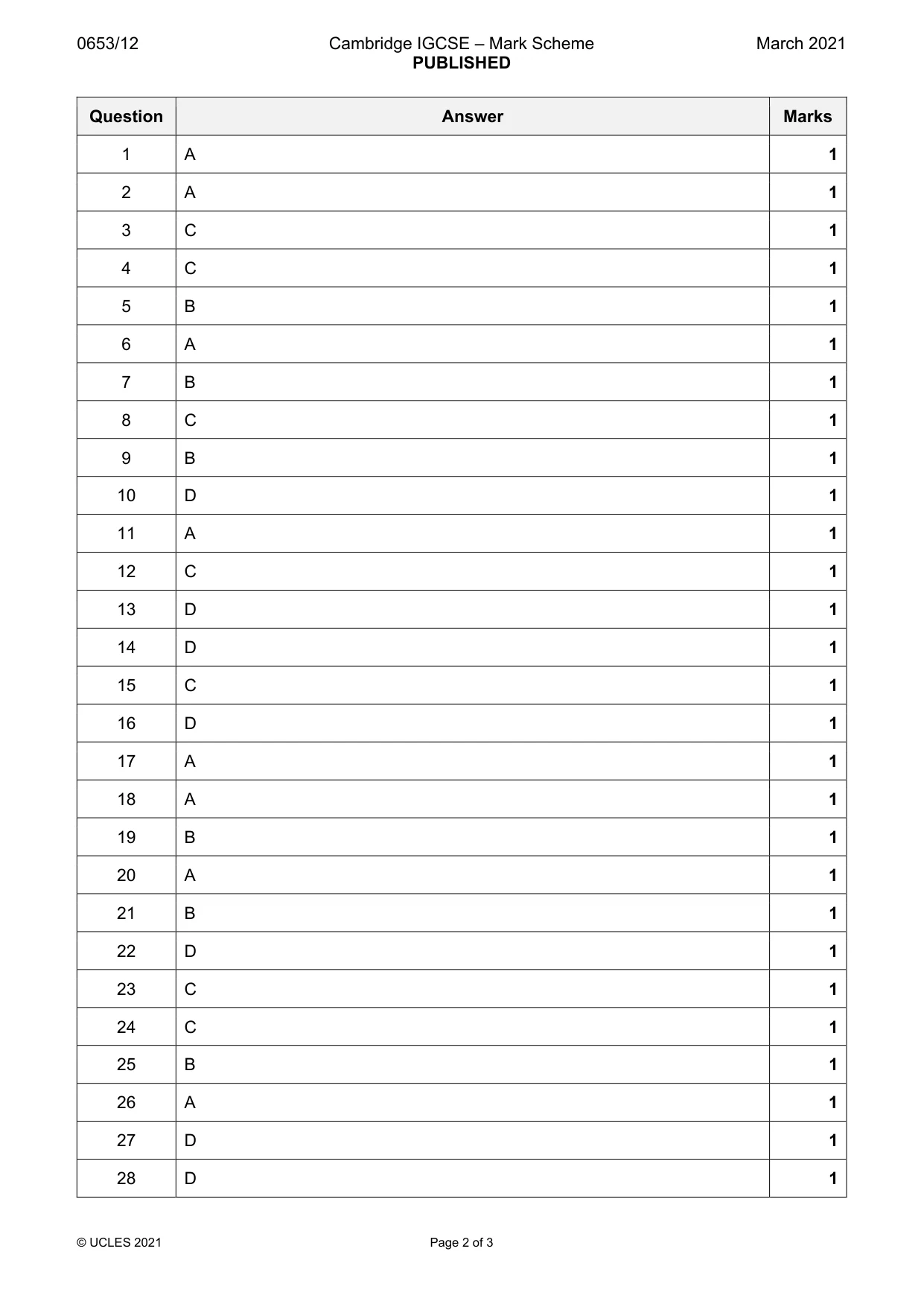
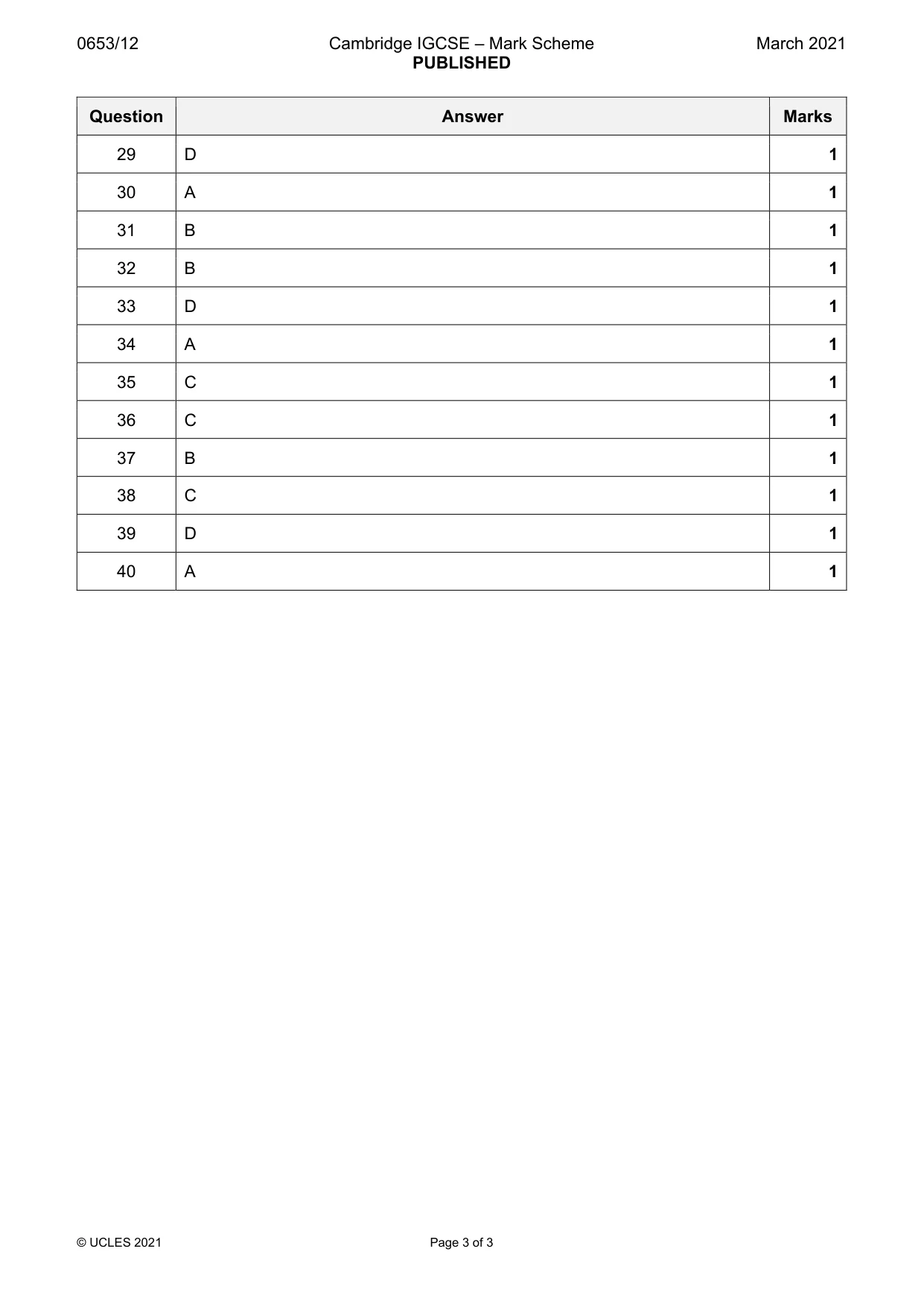
Mark scheme: A
Q2 · The diagram shows a plant cell
2 The diagram shows a plant cell. 1 2 3 4 Which structures are also found in an animal cell? A 1 and 3 B 1 and 4 C 2 and 3 D 2 and 4
Mark scheme: A
Q3 · What are the smaller molecules that make up fats, protein and starch?
3 What are the smaller molecules that make up fats, protein and starch? fats protein starch A glucose glycogen fatty acids and glycerol B glucose amino acids glycogen C fatty acids and glycerol amino acids glucose D fatty acids and glycerol glycogen amino acids
Mark scheme: C
Q4 · What are enzymes made from?
4 What are enzymes made from? A carbohydrates B fats C proteins D sugars
Mark scheme: C
Q5 · The diagram shows a section of a leaf
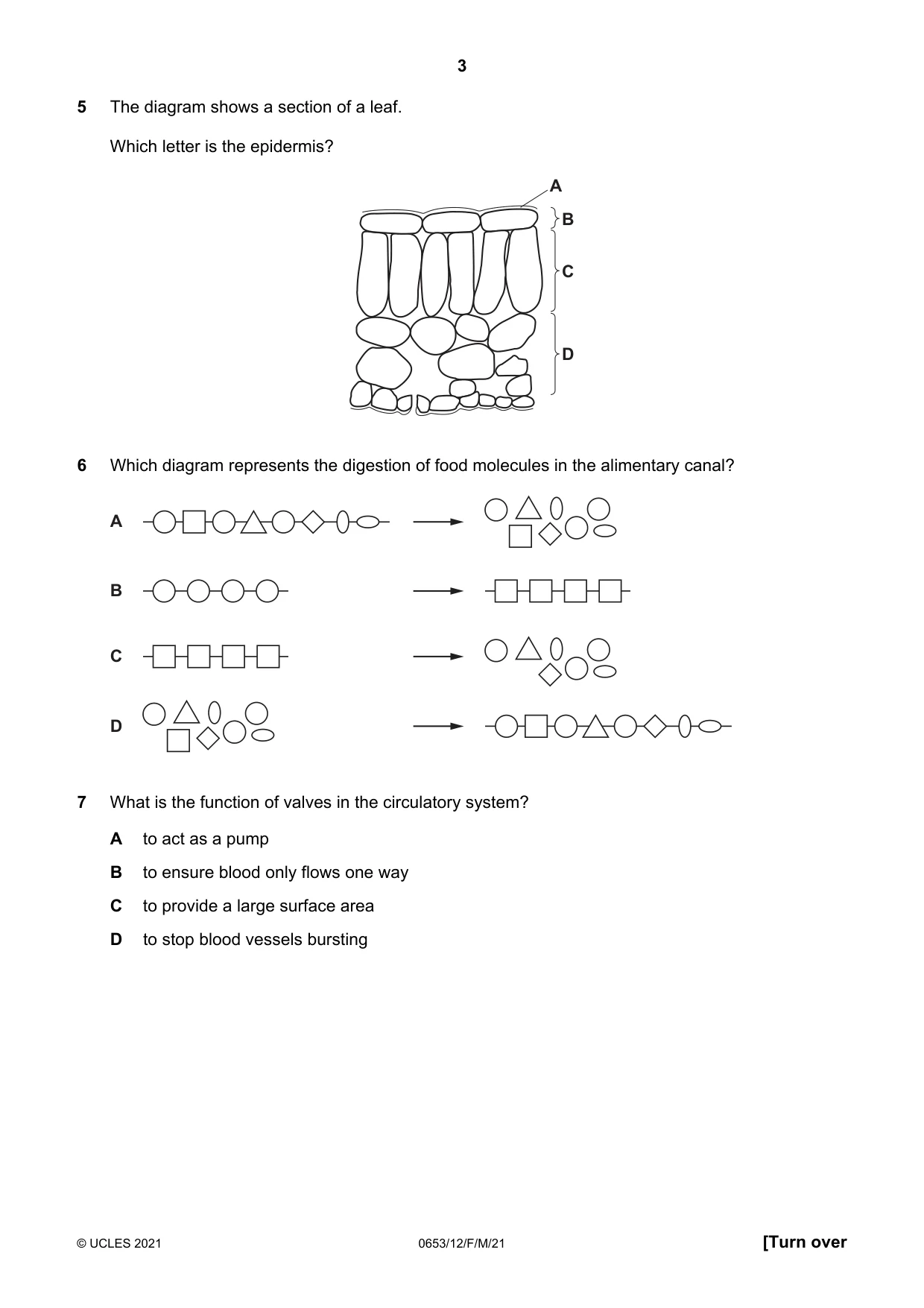
5 The diagram shows a section of a leaf. Which letter is the epidermis? A B C D
Mark scheme: B
Q6 · Which diagram represents the digestion of food molecules in the alimentary canal?
6 Which diagram represents the digestion of food molecules in the alimentary canal? A B C D
Mark scheme: A
Q7 · What is the function of valves in the circulatory system?
7 What is the function of valves in the circulatory system? A to act as a pump B to ensure blood only flows one way C to provide a large surface area D to stop blood vessels bursting
Mark scheme: B
Q8 · The graphs show the effects of different levels of activity on the rate and depth of…
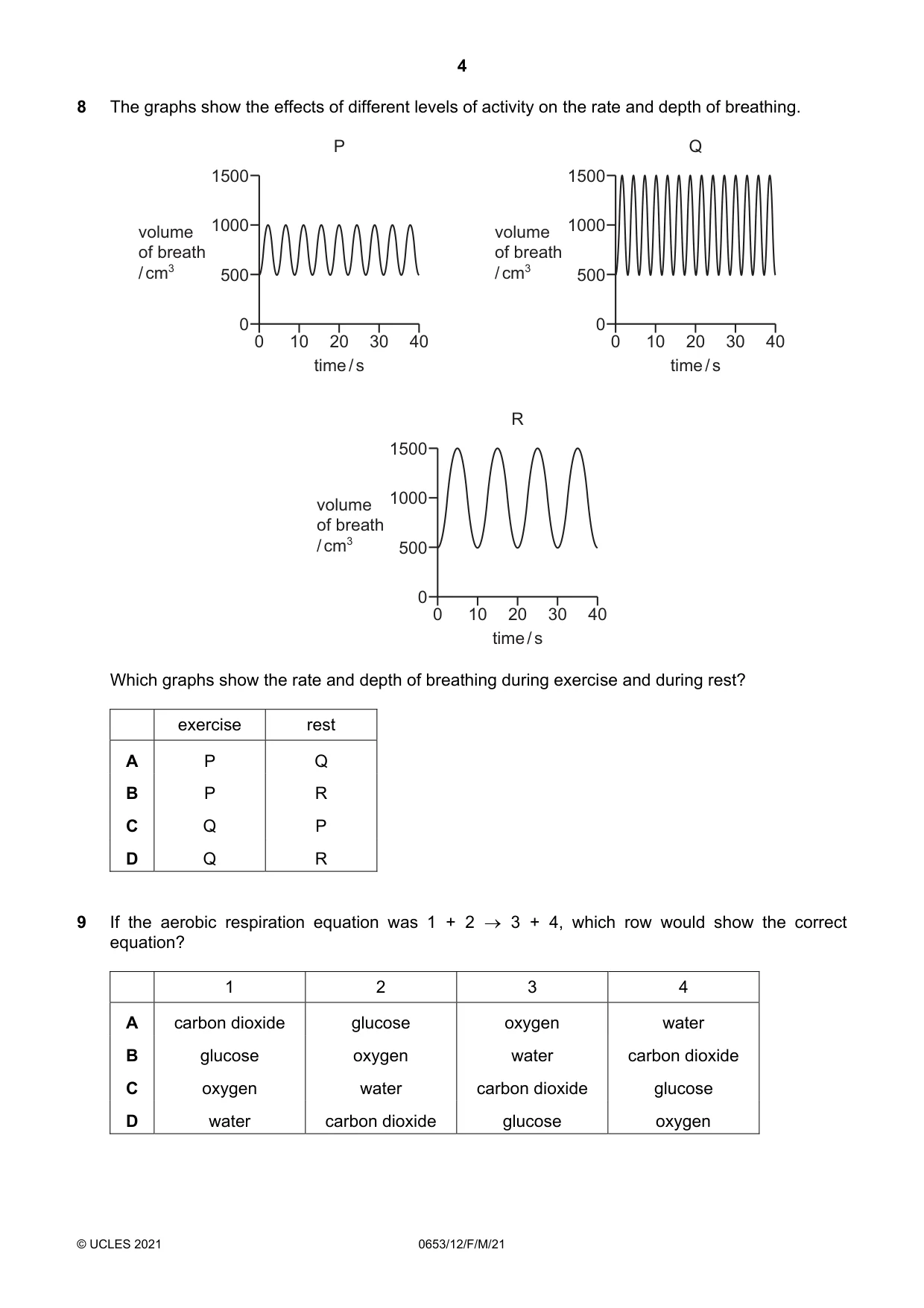
8 The graphs show the effects of different levels of activity on the rate and depth of breathing. P Q 1500 1500 volume 1000 volume 1000 of breath of breath / cm3 500 / cm3 500 0 0 0 10 20 30 40 0 10 20 30 40 time / s time / s R 1500 volume 1000 of breath / cm3 500 0 0 10 20 30 40 time / s Which graphs show the rate and depth of breathing during exercise and during rest? exercise rest A P Q B P R C Q P D Q R
Mark scheme: C
Q9 · If the aerobic respiration equation was 1 + 2 3 + 4, which row would show the correct…
9 If the aerobic respiration equation was 1 + 2 3 + 4, which row would show the correct equation? 1 2 3 4 A carbon dioxide glucose oxygen water B glucose oxygen water carbon dioxide C oxygen water carbon dioxide glucose D water carbon dioxide glucose oxygen
Mark scheme: B
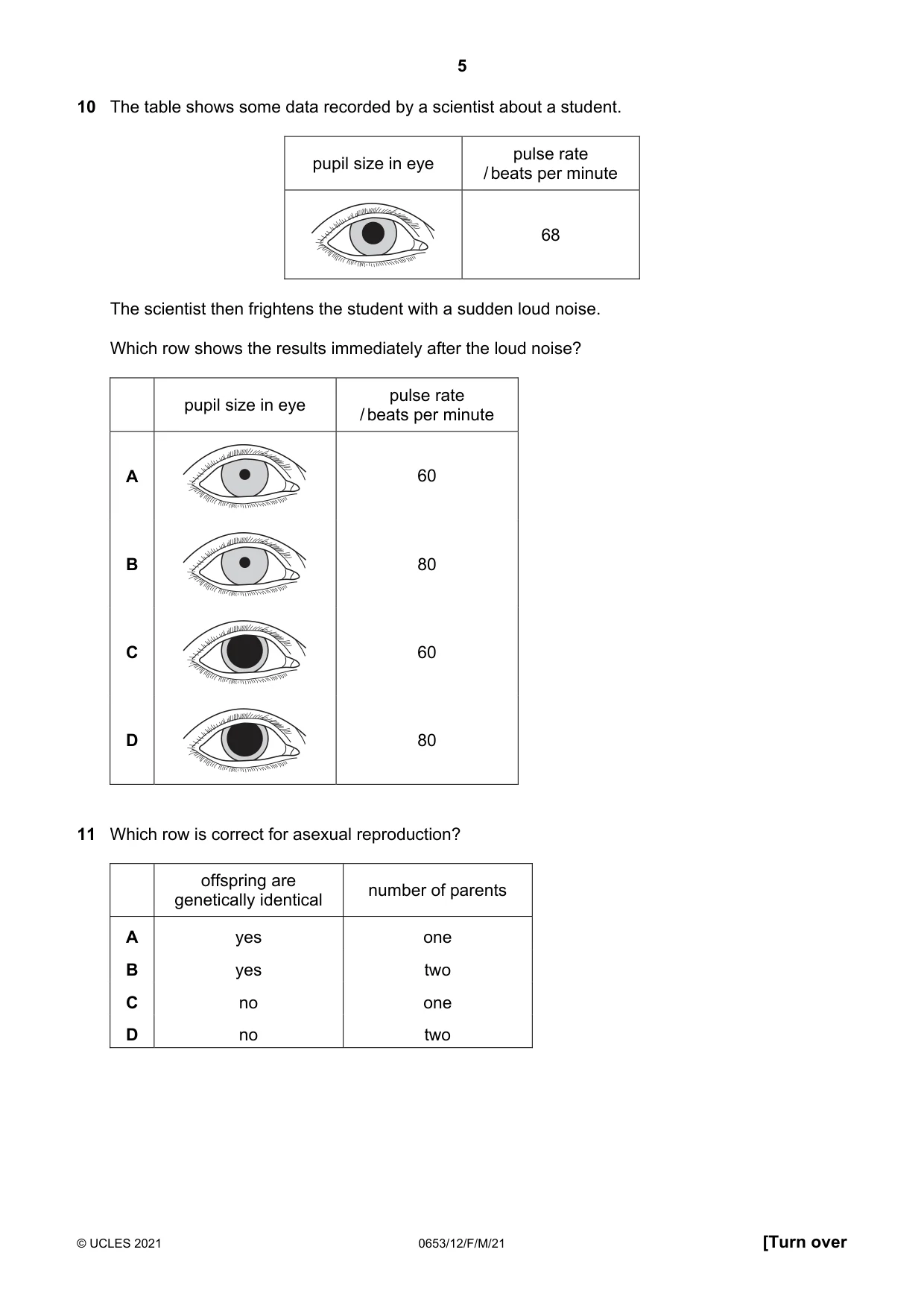
Q10 · The table shows some data recorded by a scientist about a student
10 The table shows some data recorded by a scientist about a student. pulse rate pupil size in eye / beats per minute 68 The scientist then frightens the student with a sudden loud noise. Which row shows the results immediately after the loud noise? pulse rate pupil size in eye / beats per minute A 60 B 80 C 60 D 80
Mark scheme: D
Q11 · Which row is correct for asexual reproduction?
11 Which row is correct for asexual reproduction? offspring are number of parents genetically identical A yes one B yes two C no one D no two
Mark scheme: A
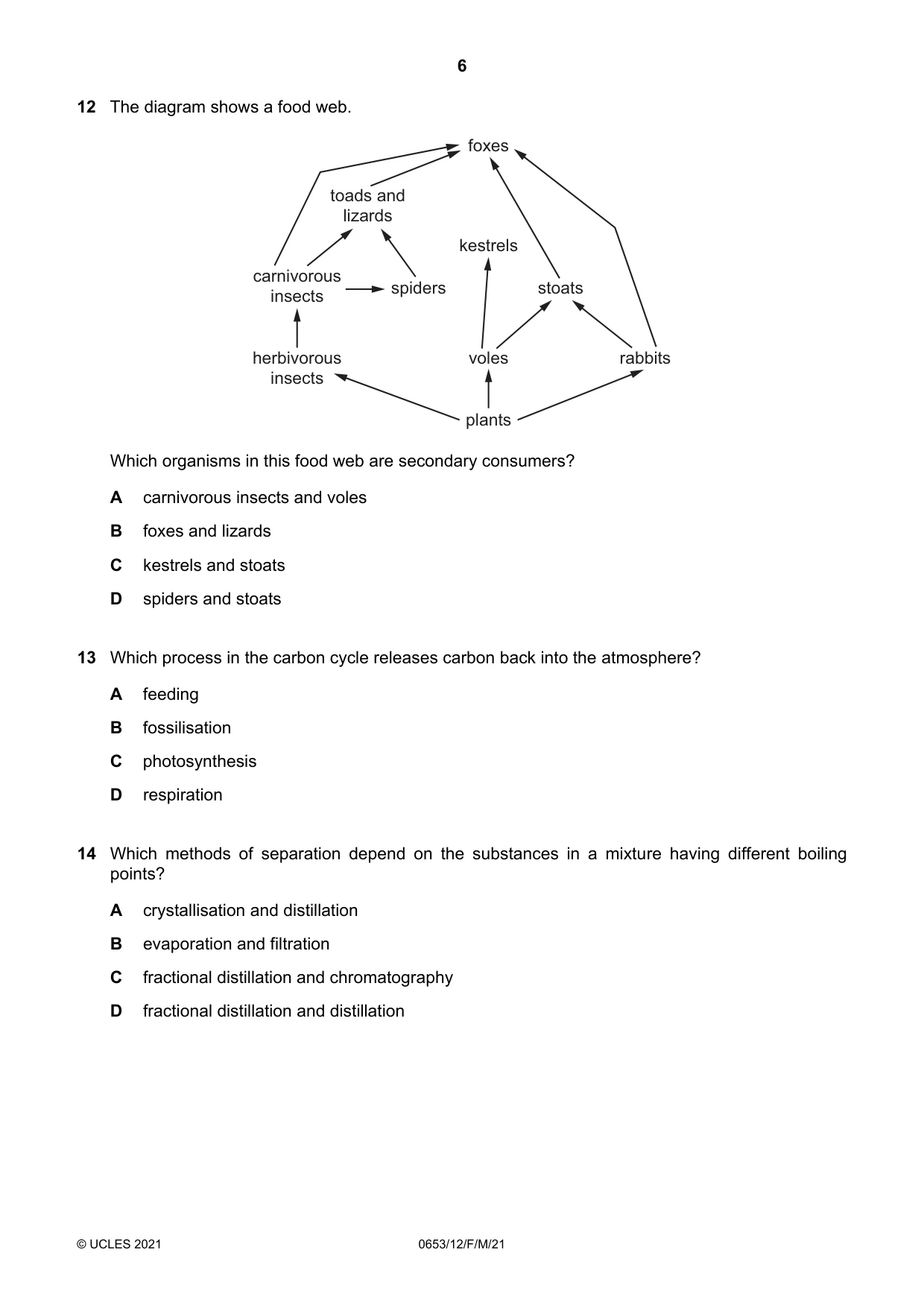
Q12 · The diagram shows a food web
12 The diagram shows a food web. foxes toads and lizards kestrels carnivorous spiders stoats insects herbivorous voles rabbits insects plants Which organisms in this food web are secondary consumers? A carnivorous insects and voles B foxes and lizards C kestrels and stoats D spiders and stoats
Mark scheme: C
Q13 · Which process in the carbon cycle releases carbon back into the atmosphere?
13 Which process in the carbon cycle releases carbon back into the atmosphere? A feeding B fossilisation C photosynthesis D respiration
Mark scheme: D
Q14 · Which methods of separation depend on the substances in a mixture having different…
14 Which methods of separation depend on the substances in a mixture having different boiling points? A crystallisation and distillation B evaporation and filtration C fractional distillation and chromatography D fractional distillation and distillation
Mark scheme: D
Q15 · Which row describes an element and a compound?
15 Which row describes an element and a compound? element compound A contains more than contains elements one type of atom chemically combined B contains more than contains elements one type of atom mixed together C contains only one contains elements type of atom chemically combined D contains only one contains elements type of atom mixed together
Mark scheme: C
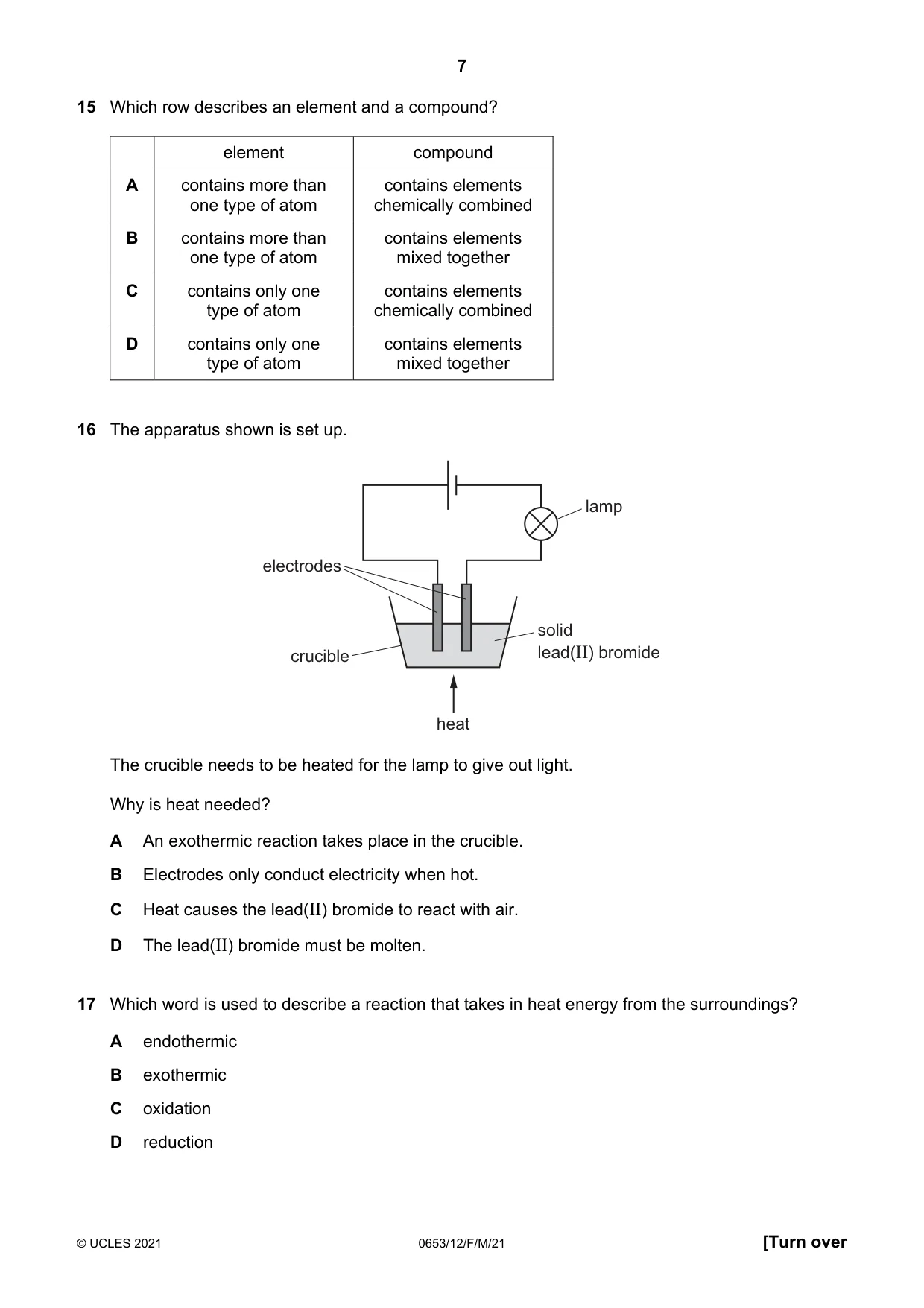
Q16 · The apparatus shown is set up
16 The apparatus shown is set up. lamp electrodes solid crucible lead(II) bromide heat The crucible needs to be heated for the lamp to give out light. Why is heat needed? A An exothermic reaction takes place in the crucible. B Electrodes only conduct electricity when hot. C Heat causes the lead(II) bromide to react with air. D The lead(II) bromide must be molten.
Mark scheme: D
Q17 · Which word is used to describe a reaction that takes in heat energy from the surroundings?
17 Which word is used to describe a reaction that takes in heat energy from the surroundings? A endothermic B exothermic C oxidation D reduction
Mark scheme: A
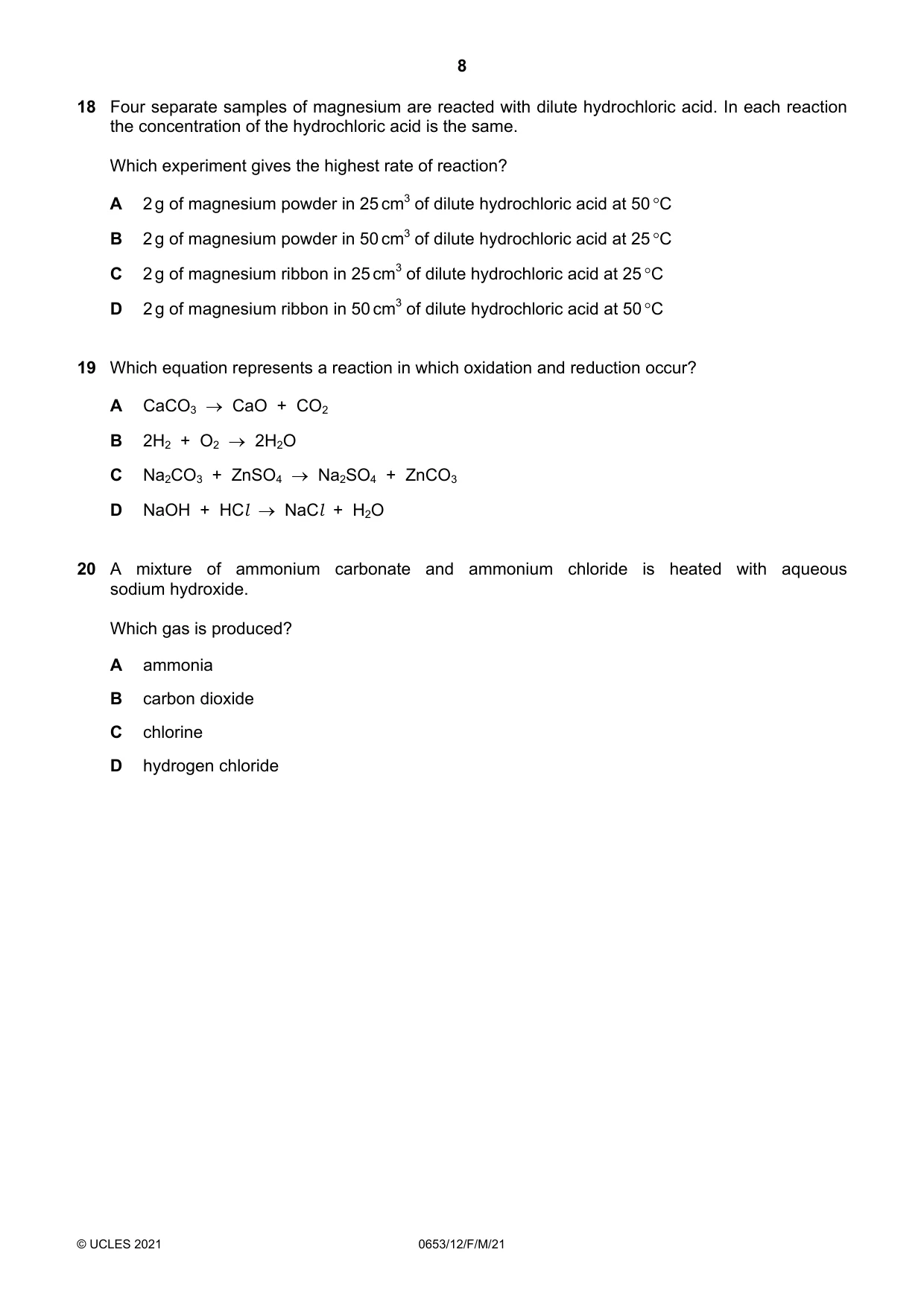
Q18 · Four separate samples of magnesium are reacted with dilute hydrochloric acid
18 Four separate samples of magnesium are reacted with dilute hydrochloric acid. In each reaction the concentration of the hydrochloric acid is the same. Which experiment gives the highest rate of reaction? A 2 g of magnesium powder in 25 cm3 of dilute hydrochloric acid at 50 C B 2 g of magnesium powder in 50 cm3 of dilute hydrochloric acid at 25 C C 2 g of magnesium ribbon in 25 cm3 of dilute hydrochloric acid at 25 C D 2 g of magnesium ribbon in 50 cm3 of dilute hydrochloric acid at 50 C
Mark scheme: A
Q19 · Which equation represents a reaction in which oxidation and reduction occur?
19 Which equation represents a reaction in which oxidation and reduction occur? A CaCO3 CaO + CO2 B 2H2 + O2 2H2O C Na2CO3 + ZnSO4 Na2SO4 + ZnCO3 D NaOH + HCl NaCl + H2O
Mark scheme: B
Q20 · A mixture of ammonium carbonate and ammonium chloride is heated with aqueous sodium…
20 A mixture of ammonium carbonate and ammonium chloride is heated with aqueous sodium hydroxide. Which gas is produced? A ammonia B carbon dioxide C chlorine D hydrogen chloride
Mark scheme: A
More questions on The characteristic properties of acids and bases
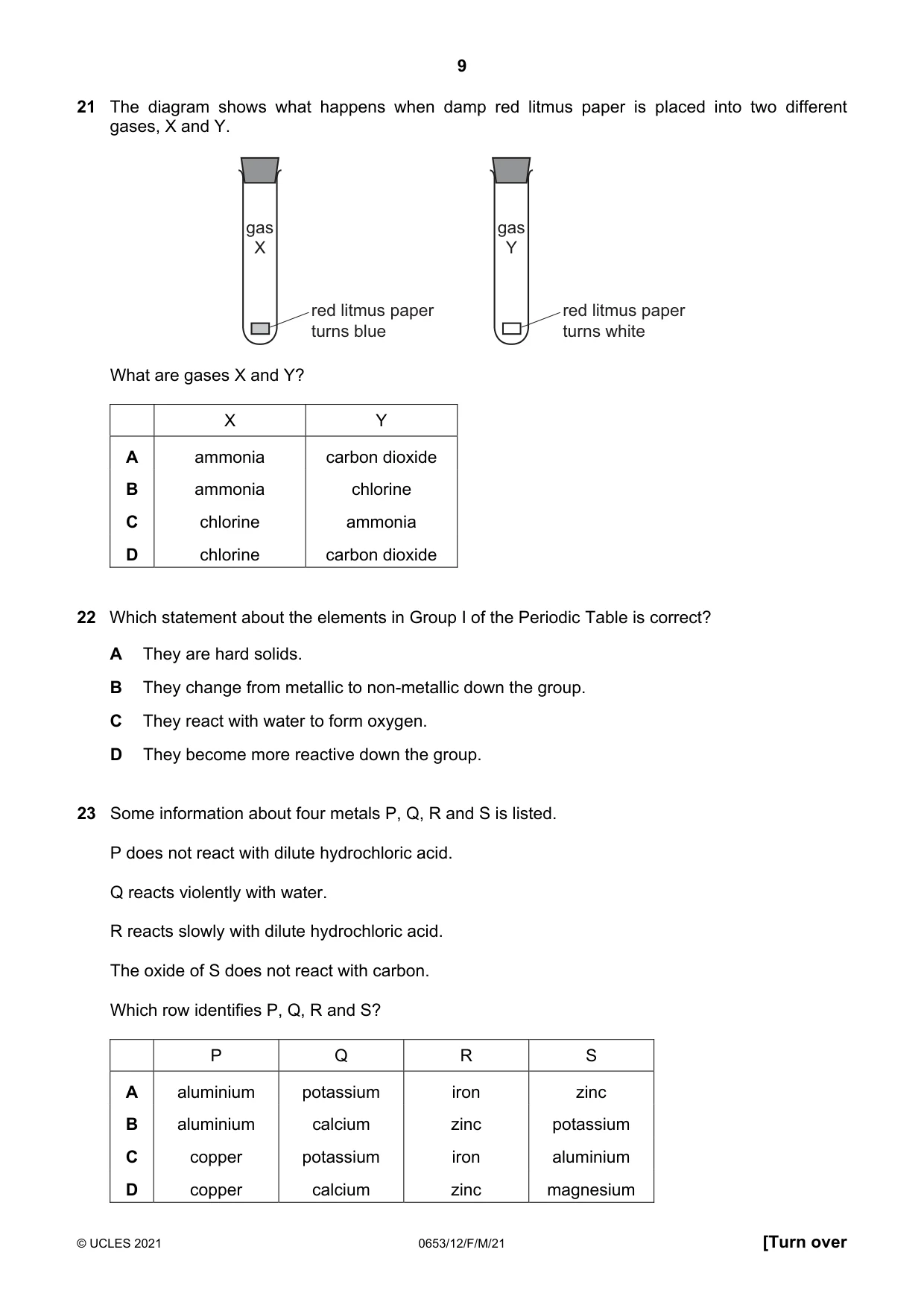
Q21 · The diagram shows what happens when damp red litmus paper is placed into two different…
21 The diagram shows what happens when damp red litmus paper is placed into two different gases, X and Y. gas gas X Y red litmus paper red litmus paper turns blue turns white What are gases X and Y? X Y A ammonia carbon dioxide B ammonia chlorine C chlorine ammonia D chlorine carbon dioxide
Mark scheme: B
Q22 · Which statement about the elements in Group I of the Periodic Table is correct?
22 Which statement about the elements in Group I of the Periodic Table is correct? A They are hard solids. B They change from metallic to non-metallic down the group. C They react with water to form oxygen. D They become more reactive down the group.
Mark scheme: D
Q23 · Some information about four metals P, Q, R and S is listed
23 Some information about four metals P, Q, R and S is listed. P does not react with dilute hydrochloric acid. Q reacts violently with water. R reacts slowly with dilute hydrochloric acid. The oxide of S does not react with carbon. Which row identifies P, Q, R and S? P Q R S A aluminium potassium iron zinc B aluminium calcium zinc potassium C copper potassium iron aluminium D copper calcium zinc magnesium
Mark scheme: C
Q24 · Which change shows the presence of water?
24 Which change shows the presence of water? A Anhydrous copper(II) sulfate turns white. B Anhydrous copper(II) sulfate turns pink. C Cobalt(II) chloride paper turns pink. D Cobalt(II) chloride paper turns blue.
Mark scheme: C
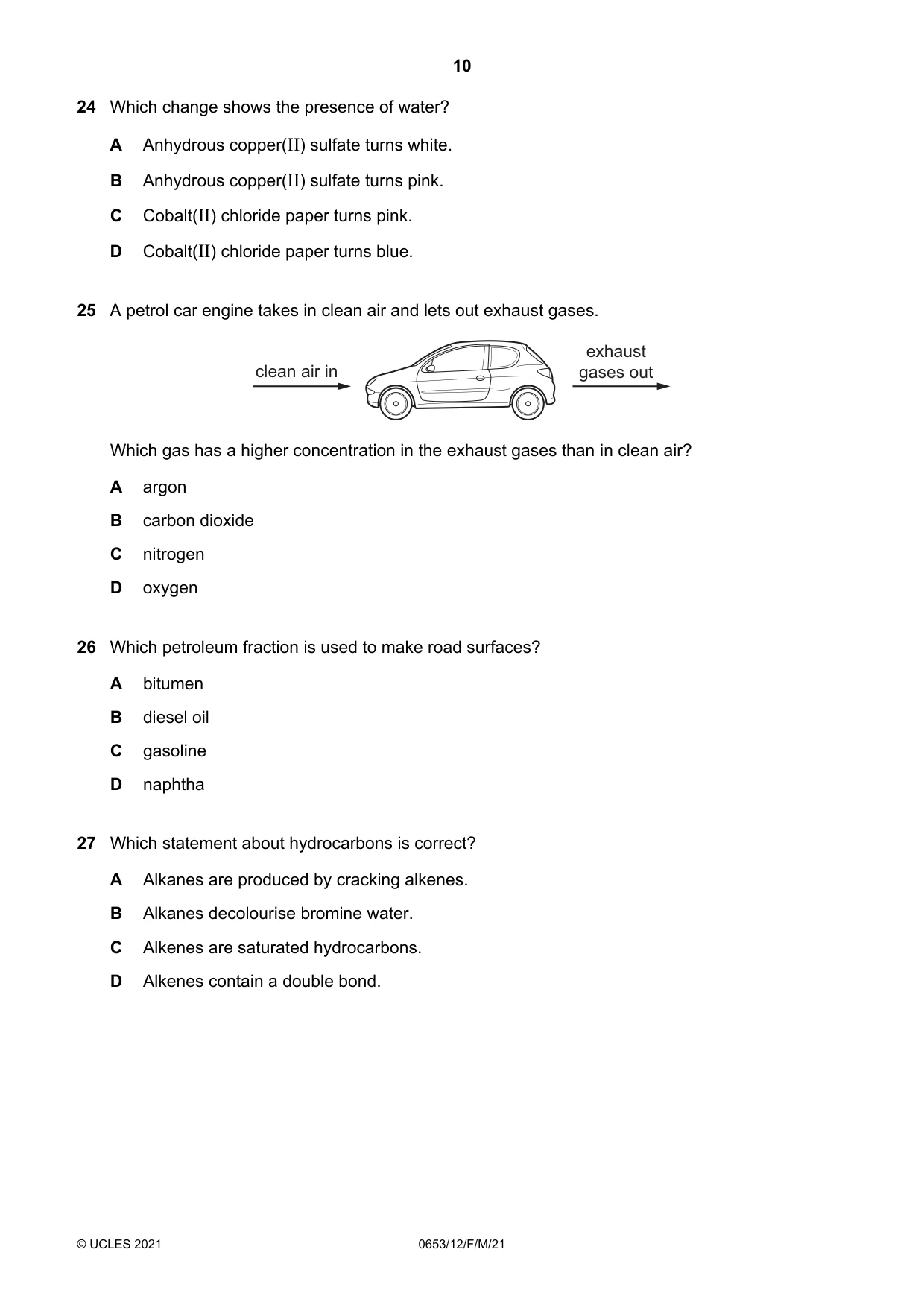
Q25 · A petrol car engine takes in clean air and lets out exhaust gases
25 A petrol car engine takes in clean air and lets out exhaust gases. exhaust clean air in gases out Which gas has a higher concentration in the exhaust gases than in clean air? A argon B carbon dioxide C nitrogen D oxygen
Mark scheme: B
Q26 · Which petroleum fraction is used to make road surfaces?
26 Which petroleum fraction is used to make road surfaces? A bitumen B diesel oil C gasoline D naphtha
Mark scheme: A
Q27 · Which statement about hydrocarbons is correct?
27 Which statement about hydrocarbons is correct? A Alkanes are produced by cracking alkenes. B Alkanes decolourise bromine water. C Alkenes are saturated hydrocarbons. D Alkenes contain a double bond.
Mark scheme: D
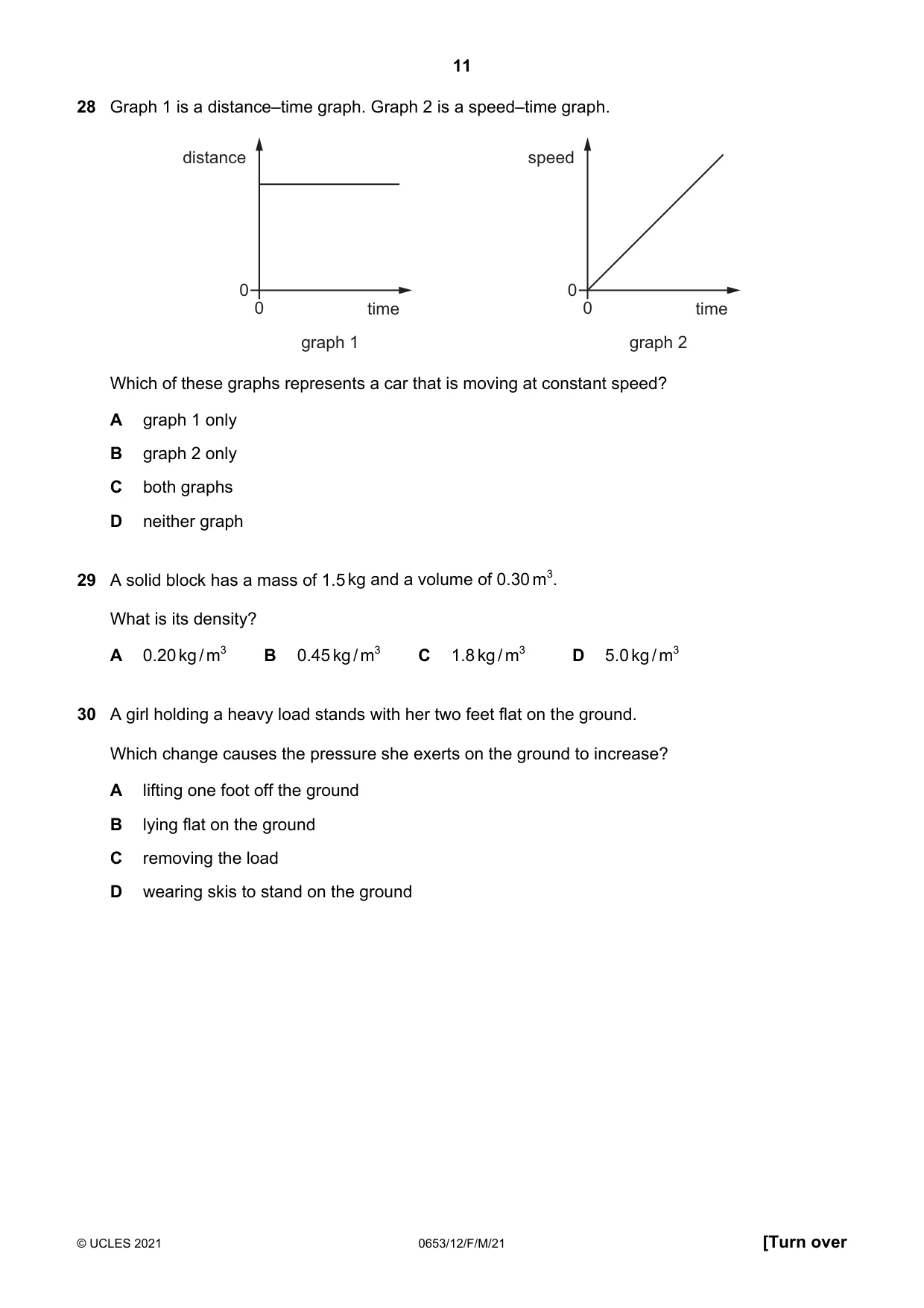
Question 28
28 Graph 1 is a distance–time graph. Graph 2 is a speed–time graph. distance speed 0 0 0 time 0 time graph 1 graph 2 Which of these graphs represents a car that is moving at constant speed? A graph 1 only B graph 2 only C both graphs D neither graph
Mark scheme: D
Q29 · A solid block has a mass of 1.5 kg and a volume of 0.30 m3
29 A solid block has a mass of 1.5 kg and a volume of 0.30 m3. What is its density? A 0.20 kg / m3 B 0.45 kg / m3 C 1.8 kg / m3 D 5.0 kg / m3
Mark scheme: D
Q30 · A girl holding a heavy load stands with her two feet flat on the ground
30 A girl holding a heavy load stands with her two feet flat on the ground. Which change causes the pressure she exerts on the ground to increase? A lifting one foot off the ground B lying flat on the ground C removing the load D wearing skis to stand on the ground
Mark scheme: A
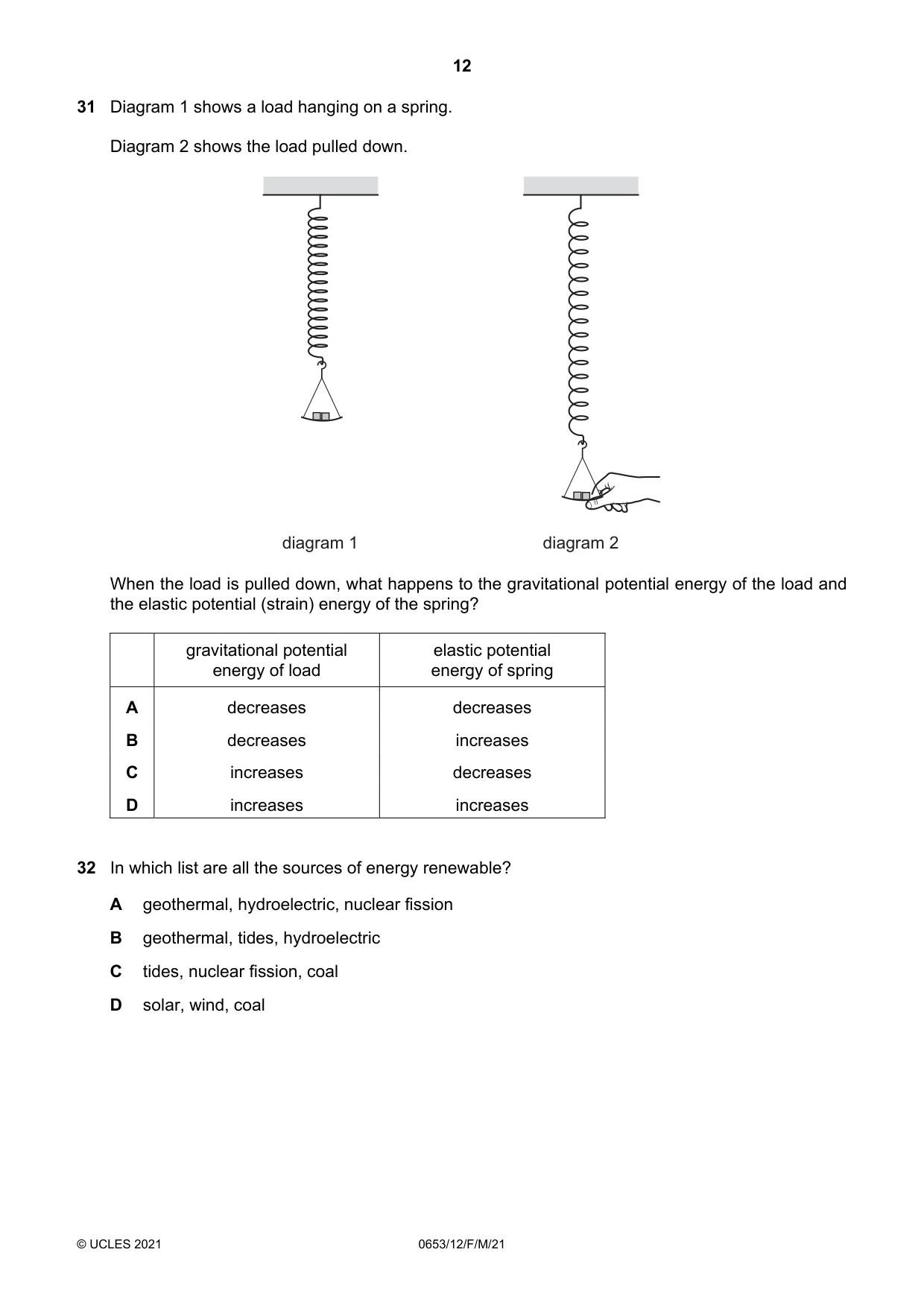
Q31 · A load hanging on a spring
31 Diagram 1 shows a load hanging on a spring. Diagram 2 shows the load pulled down. diagram 1 diagram 2 When the load is pulled down, what happens to the gravitational potential energy of the load and the elastic potential (strain) energy of the spring? gravitational potential elastic potential energy of load energy of spring A decreases decreases B decreases increases C increases decreases D increases increases
Mark scheme: B
Q32 · In which list are all the sources of energy renewable?
32 In which list are all the sources of energy renewable? A geothermal, hydroelectric, nuclear fission B geothermal, tides, hydroelectric C tides, nuclear fission, coal D solar, wind, coal
Mark scheme: B
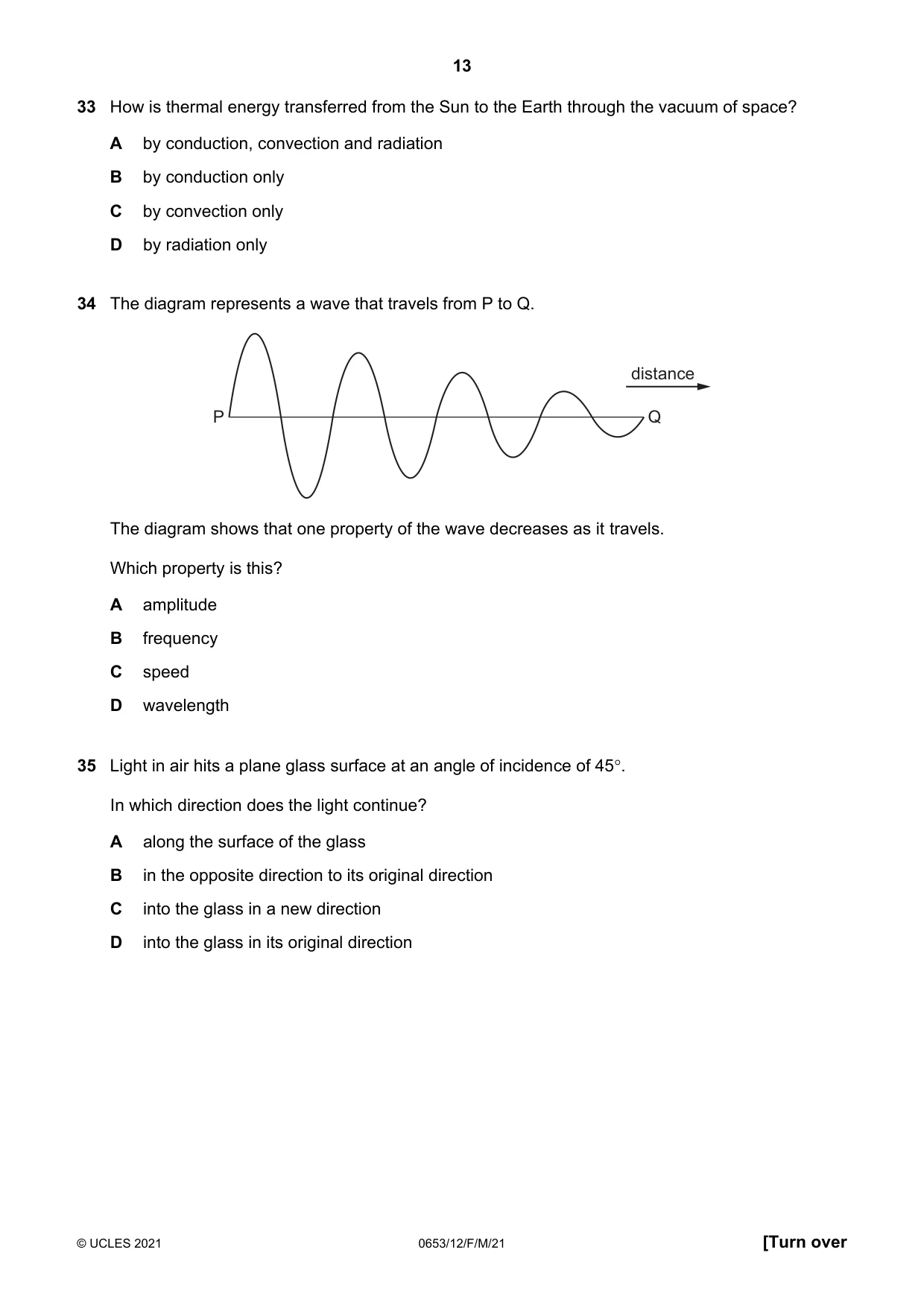
Q33 · How is thermal energy transferred from the Sun to the Earth through the vacuum of space?
33 How is thermal energy transferred from the Sun to the Earth through the vacuum of space? A by conduction, convection and radiation B by conduction only C by convection only D by radiation only
Mark scheme: D
Q34 · The diagram represents a wave that travels from P to Q
34 The diagram represents a wave that travels from P to Q. distance P Q The diagram shows that one property of the wave decreases as it travels. Which property is this? A amplitude B frequency C speed D wavelength
Mark scheme: A
Q35 · Light in air hits a plane glass surface at an angle of incidence of 45
35 Light in air hits a plane glass surface at an angle of incidence of 45. In which direction does the light continue? A along the surface of the glass B in the opposite direction to its original direction C into the glass in a new direction D into the glass in its original direction
Mark scheme: C
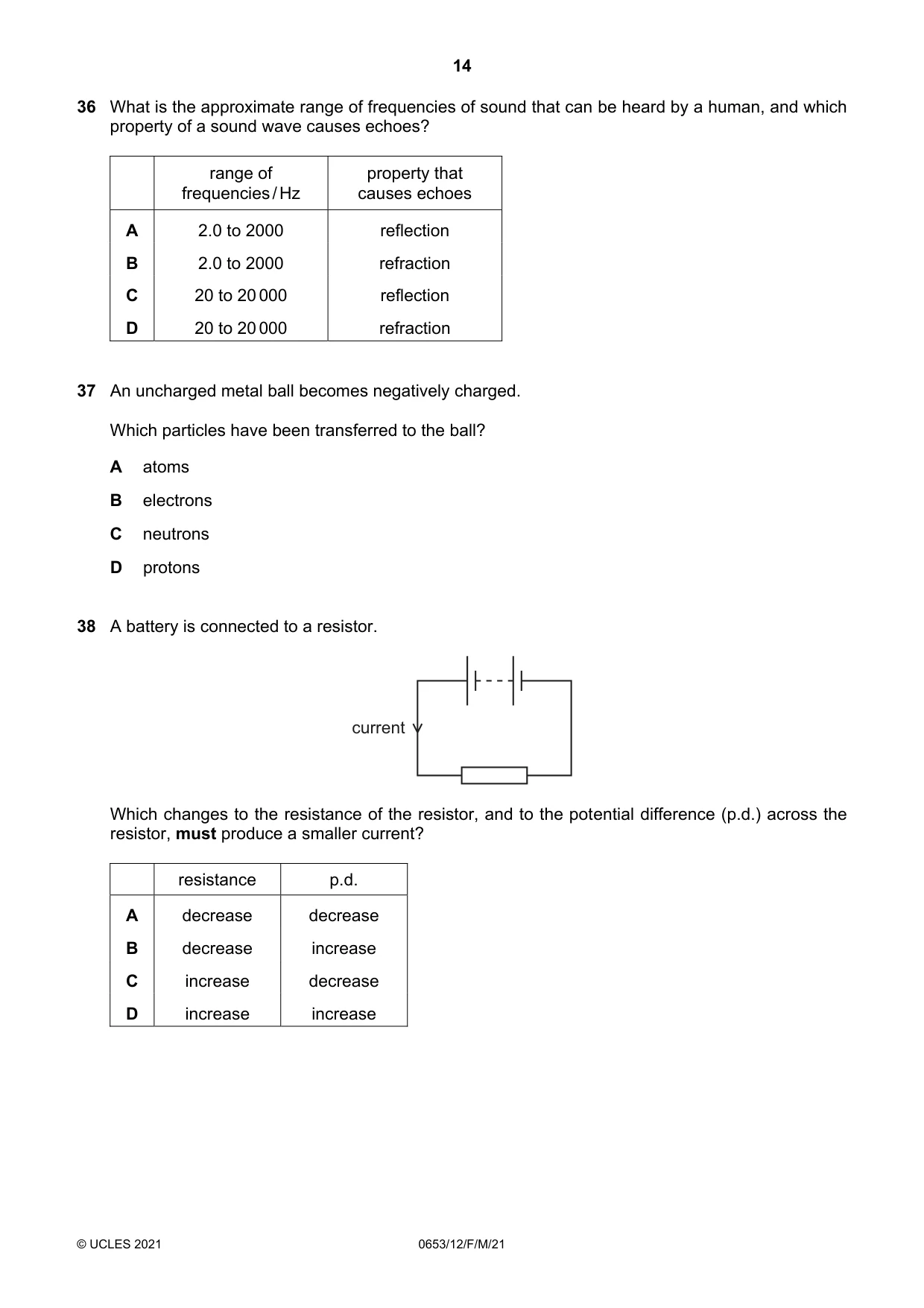
Q36 · What is the approximate range of frequencies of sound that can be heard by a human, and…
36 What is the approximate range of frequencies of sound that can be heard by a human, and which property of a sound wave causes echoes? range of property that frequencies / Hz causes echoes A 2.0 to 2000 reflection B 2.0 to 2000 refraction C 20 to 20 000 reflection D 20 to 20 000 refraction
Mark scheme: C
Q37 · An uncharged metal ball becomes negatively charged
37 An uncharged metal ball becomes negatively charged. Which particles have been transferred to the ball? A atoms B electrons C neutrons D protons
Mark scheme: B
Q38 · A battery is connected to a resistor
38 A battery is connected to a resistor. current Which changes to the resistance of the resistor, and to the potential difference (p.d.) across the resistor, must produce a smaller current? resistance p.d. A decrease decrease B decrease increase C increase decrease D increase increase
Mark scheme: C
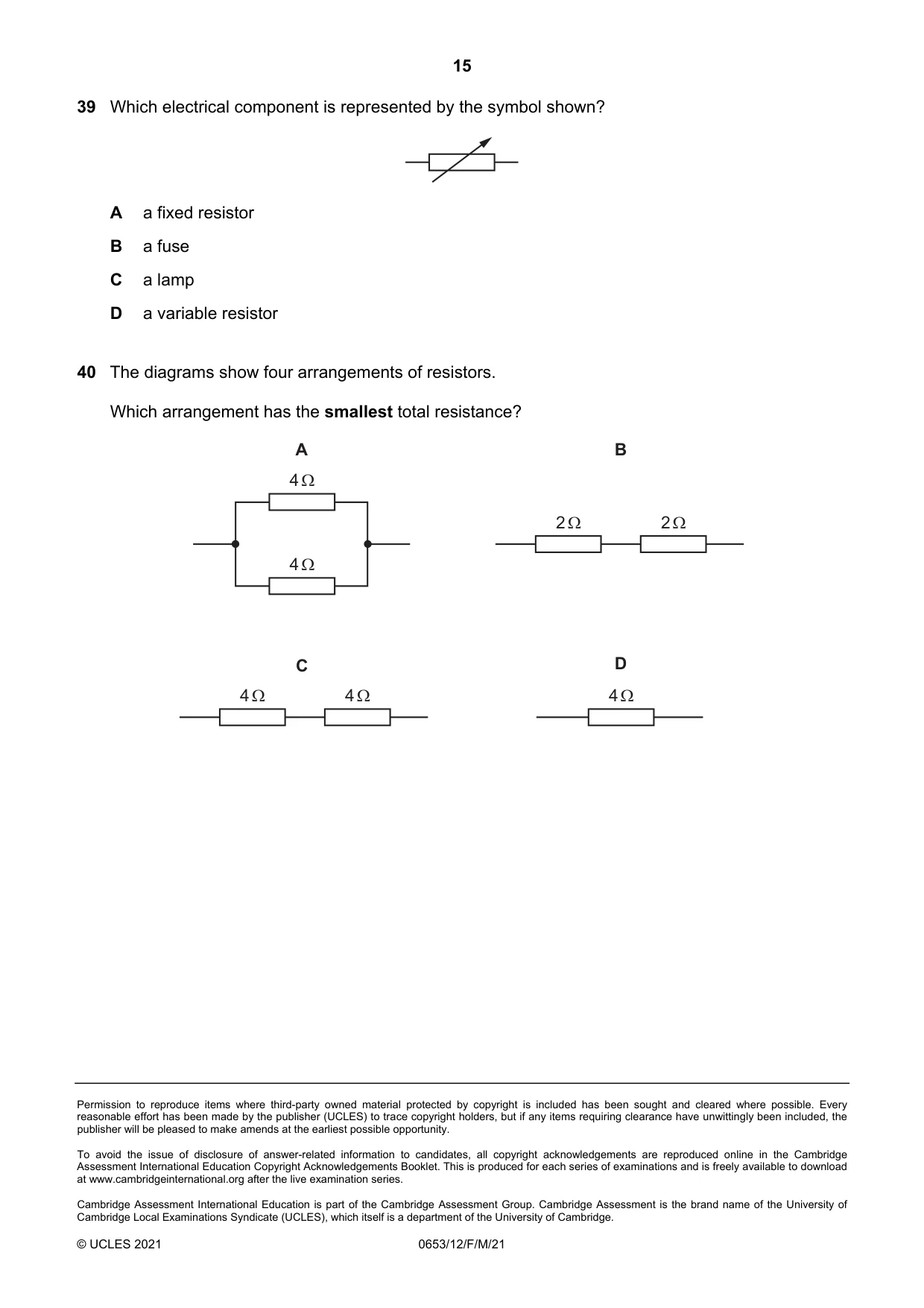
Q39 · Which electrical component is represented by the symbol shown?
39 Which electrical component is represented by the symbol shown? A a fixed resistor B a fuse C a lamp D a variable resistor
Mark scheme: D
Q40 · The diagrams show four arrangements of resistors
40 The diagrams show four arrangements of resistors. Which arrangement has the smallest total resistance? A B 4 Ω 2 Ω 2 Ω 4 Ω C D 4 Ω 4 Ω 4 Ω
Mark scheme: A
What was in this paper
The subtopics covered by these 40 questions, and how many questions each got. Open one in a new tab to see every Cambridge question on it.
2Electrical quantities2Energy, work and power2Air quality and climate1Alkenes1Biological molecules1Carbon cycle1Cell structure1Characteristics of living organisms1Circulatory systems1Density1Digestion1Electrolysis1Elements, compounds and mixtures1Enzymes1Exothermic and endothermic reactions1Food chains and food webs1Fuels1Gas exchange in humans1General properties of waves1Group I properties1Heart1Identification of ions and gases1Leaf structure1Light1Motion1Pressure1Rate of reaction1Reactivity series1Redox1Respiration1Separation and purification1Sexual reproduction in plants1Sound1The characteristic properties of acids and bases1Transfer of thermal energy1Water1What you needed in this session
Cambridge’s own grade thresholds for 2021 Feb/March, Paper 1 · Variant 2. A higher threshold means an easier paper — the bar moves with how the cohort did.