Cambridge IGCSE Science - Combined 0653 — 2013 May/June Paper 1 · Variant 2
0653/12/M/J/13 · 40 questions · 40 marks · ≈45 min
The question paper and its mark scheme, free to read here and free to download. This is Cambridge’s own paper, exactly as it was sat.
Question paper16 pages
Mark scheme2 pages
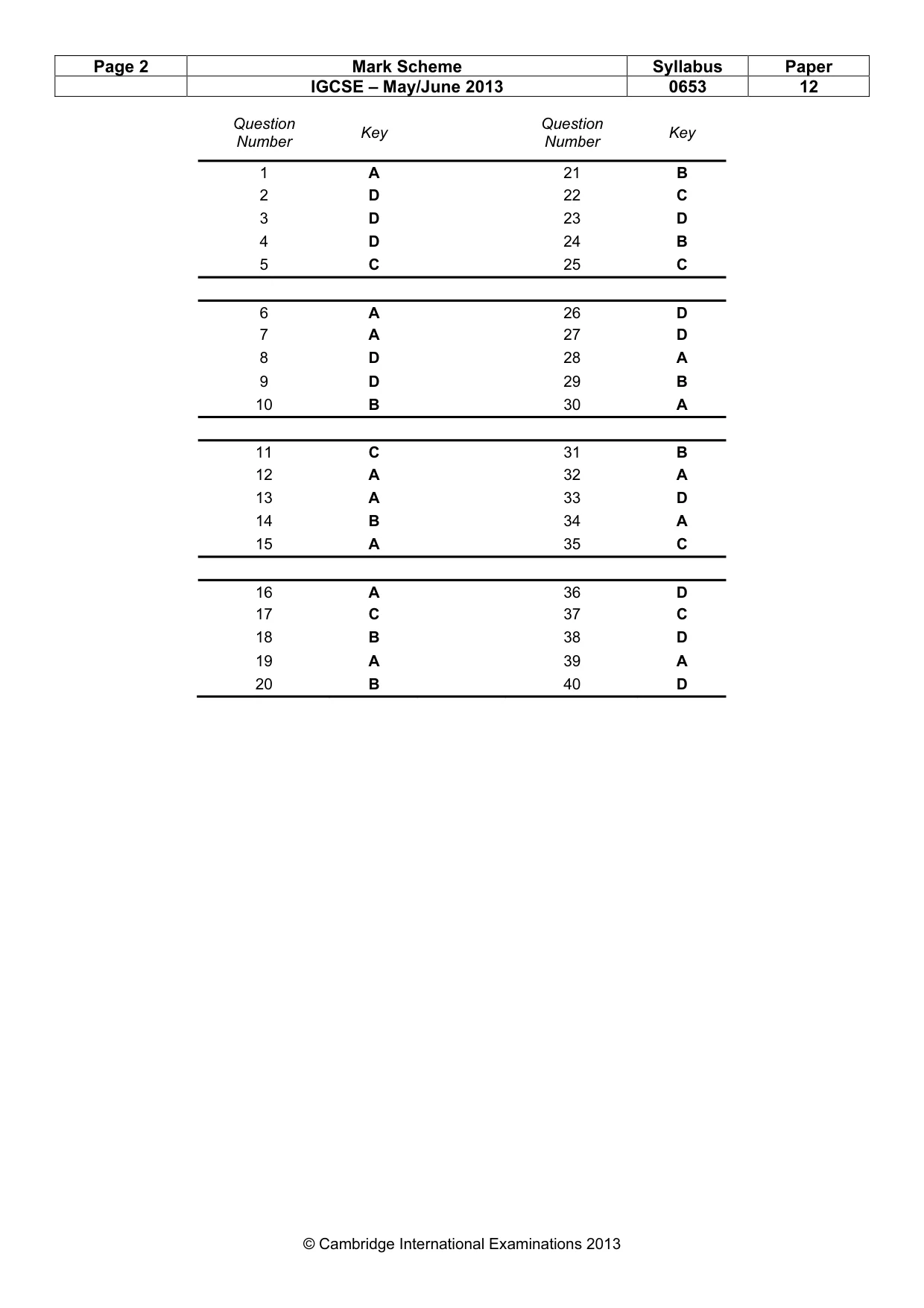
Answers below. Sit the paper first if you are practising.
Questions as text
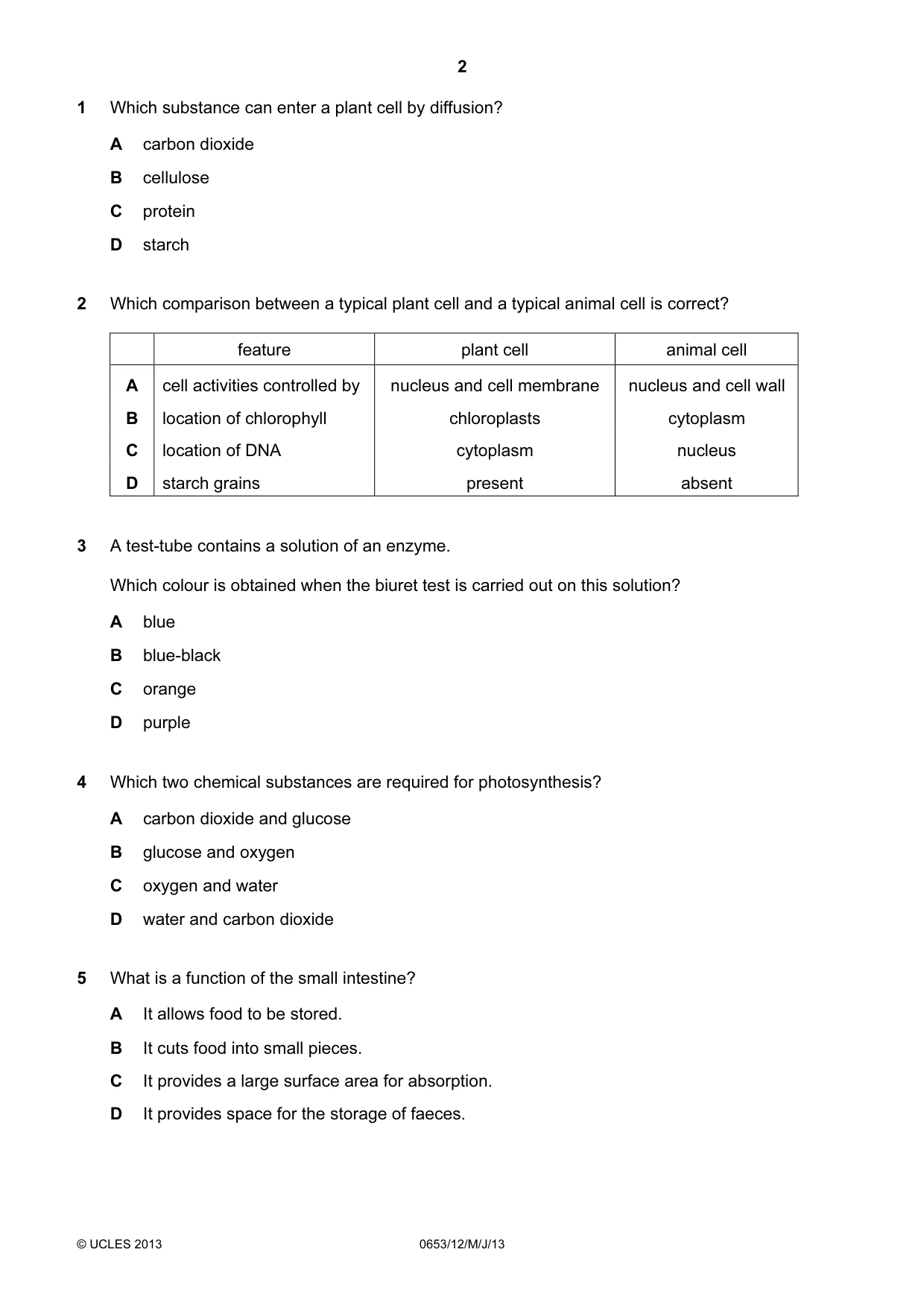
Q1 · Which substance can enter a plant cell by diffusion?
1 Which substance can enter a plant cell by diffusion? A carbon dioxide B cellulose C protein D starch
Mark scheme: A
Q2 · Which comparison between a typical plant cell and a typical animal cell is correct?
2 Which comparison between a typical plant cell and a typical animal cell is correct? feature plant cell animal cell A cell activities controlled by nucleus and cell membrane nucleus and cell wall B location of chlorophyll chloroplasts cytoplasm C location of DNA cytoplasm nucleus D starch grains present absent
Mark scheme: D
Q3 · A test-tube contains a solution of an enzyme
3 A test-tube contains a solution of an enzyme. Which colour is obtained when the biuret test is carried out on this solution? A blue B blue-black C orange D purple
Mark scheme: D
Q4 · Which two chemical substances are required for photosynthesis?
4 Which two chemical substances are required for photosynthesis? A carbon dioxide and glucose B glucose and oxygen C oxygen and water D water and carbon dioxide
Mark scheme: D
Q5 · What is a function of the small intestine?
5 What is a function of the small intestine? A It allows food to be stored. B It cuts food into small pieces. C It provides a large surface area for absorption. D It provides space for the storage of faeces.
Mark scheme: C
Q6 · Which substance makes up a higher percentage of expired air compared to inspired air?
6 Which substance makes up a higher percentage of expired air compared to inspired air? A carbon dioxide B nitrogen C noble gases D oxygen
Mark scheme: A
Q7 · What is the function of the valves in the heart?
7 What is the function of the valves in the heart? A to prevent blood from flowing backwards B to pump blood through the heart C to separate blood cells from plasma D to separate oxygenated and deoxygenated blood
Mark scheme: A
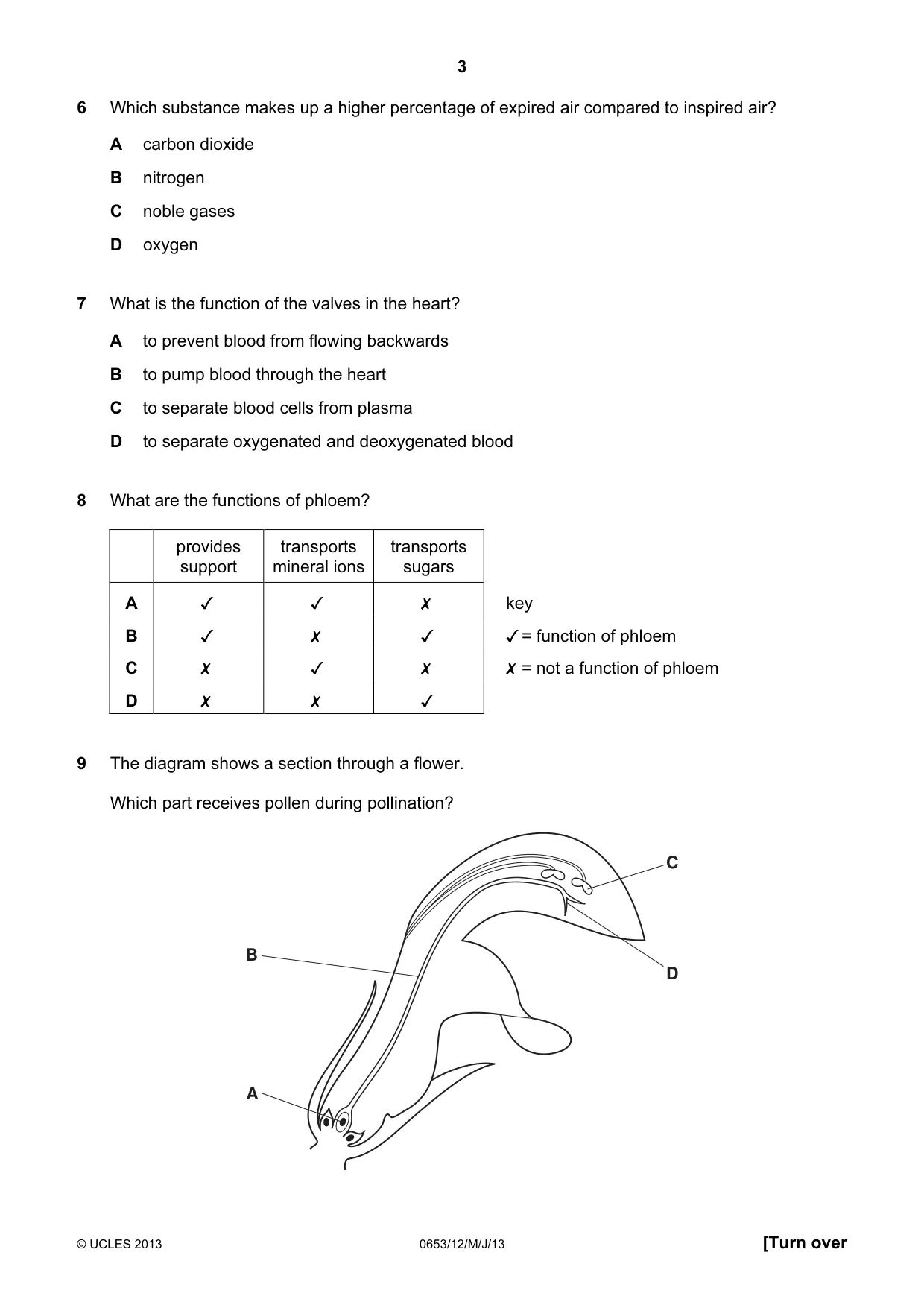
Q8 · What are the functions of phloem?
8 What are the functions of phloem? provides transports transports support mineral ions sugars v v x key / = function of phloem X = not a function of phloem 0 0O WwW > Kx v x x v x x
Mark scheme: D
Q9 · The diagram shows a section through a flower
9 The diagram shows a section through a flower. Which part receives pollen during pollination? C B D A
Mark scheme: D
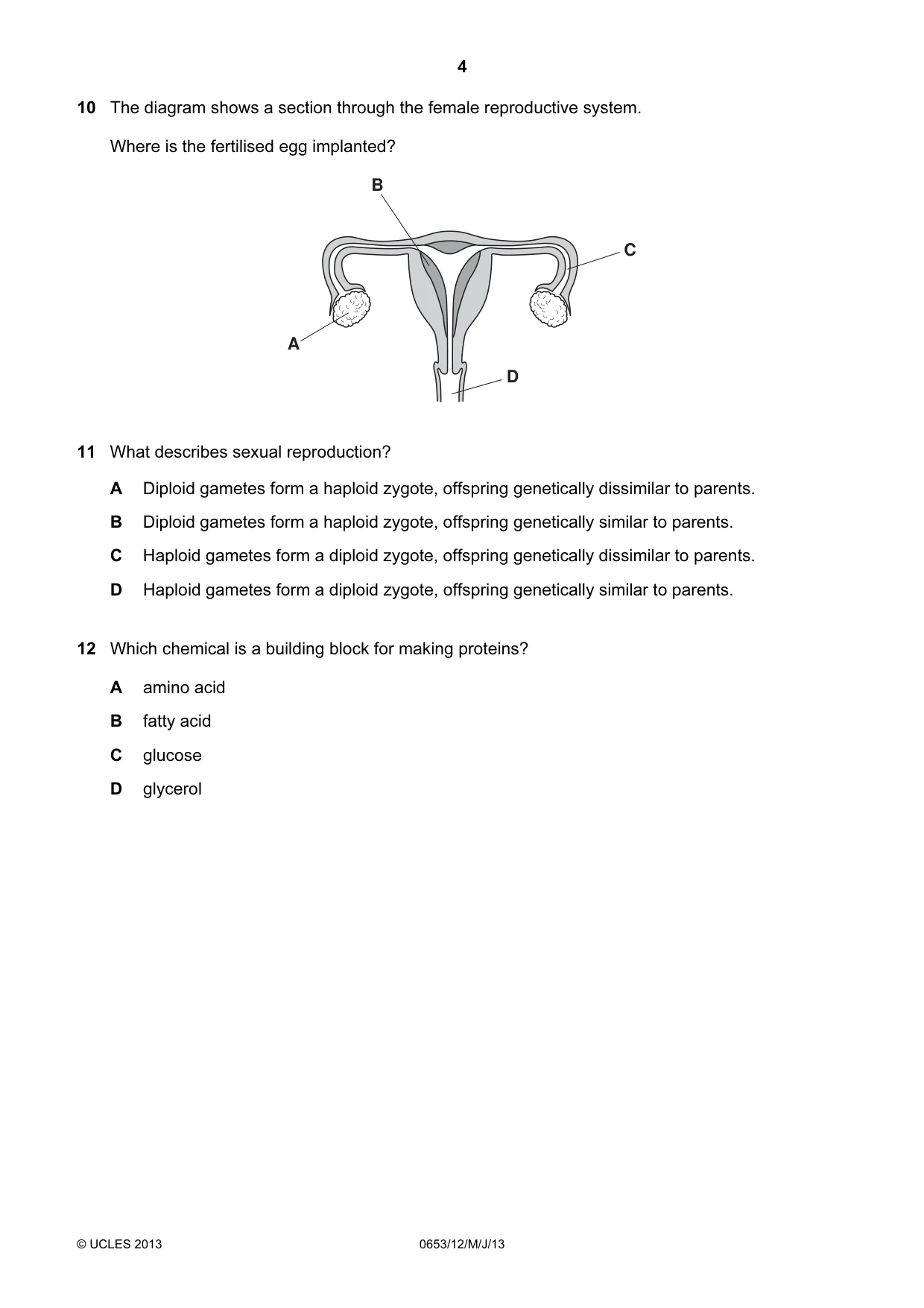
Q10 · The diagram shows a section through the female reproductive system
10 The diagram shows a section through the female reproductive system. Where is the fertilised egg implanted? B C A D
Mark scheme: B
Q11 · What describes sexual reproduction?
11 What describes sexual reproduction? A Diploid gametes form a haploid zygote, offspring genetically dissimilar to parents. B Diploid gametes form a haploid zygote, offspring genetically similar to parents. C Haploid gametes form a diploid zygote, offspring genetically dissimilar to parents. D Haploid gametes form a diploid zygote, offspring genetically similar to parents.
Mark scheme: C
Q12 · Which chemical is a building block for making proteins?
12 Which chemical is a building block for making proteins? A amino acid B fatty acid C glucose D glycerol
Mark scheme: A
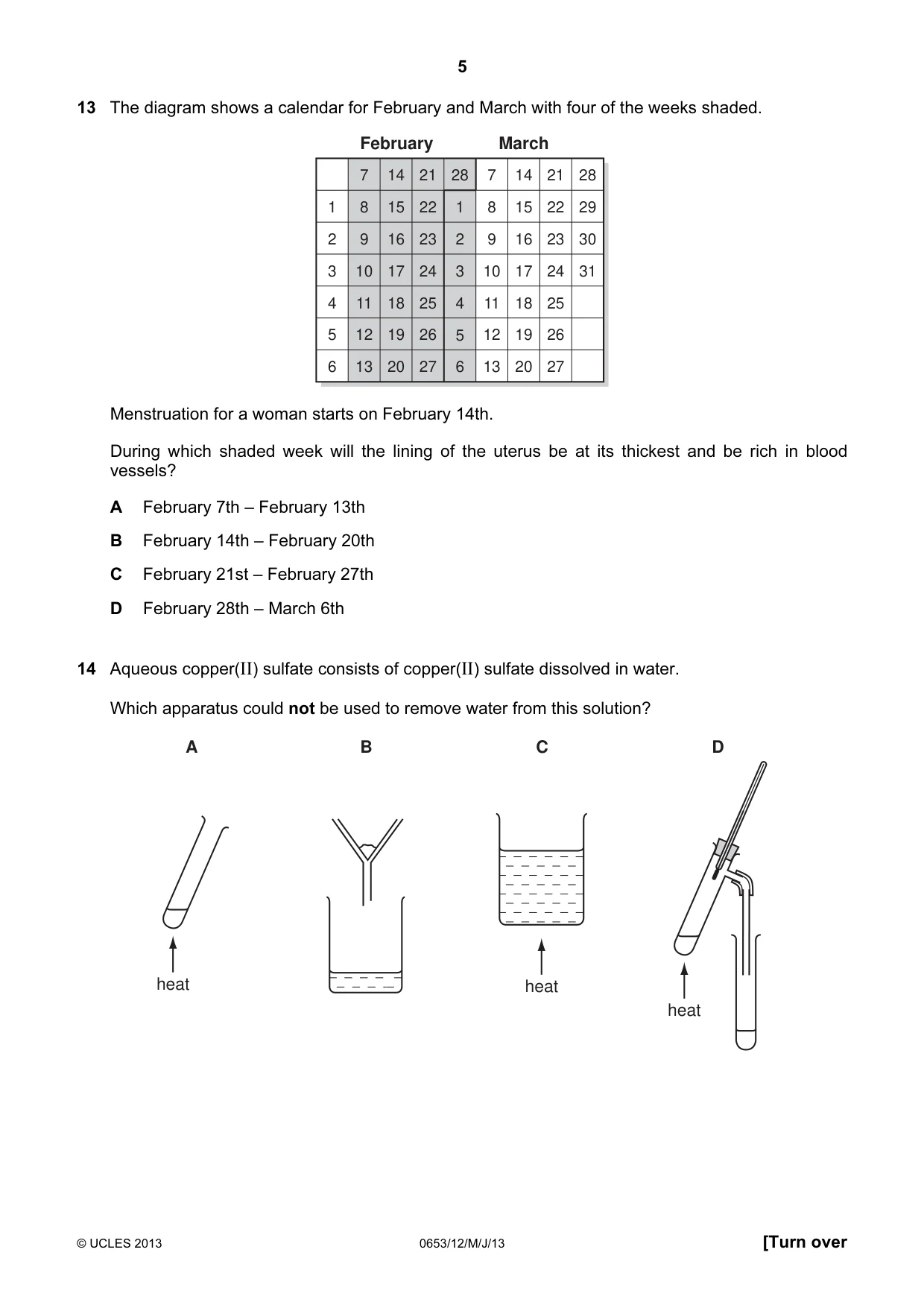
Q13 · The diagram shows a calendar for February and March with four of the weeks shaded
13 The diagram shows a calendar for February and March with four of the weeks shaded. February March 7 14 21 28 7 14 21 28 1 8 15 22 1 8 15 22 29 2 9 16 23 2 9 16 23 30 3 10 17 24 3 10 17 24 31 4 11 18 25 4 11 18 25 5 12 19 26 5 12 19 26 6 13 20 27 6 13 20 27 Menstruation for a woman starts on February 14th. During which shaded week will the lining of the uterus be at its thickest and be rich in blood vessels? A February 7th – February 13th B February 14th – February 20th C February 21st – February 27th D February 28th – March 6th
Mark scheme: A
Q14 · Aqueous copper(II) sulfate consists of copper(II) sulfate dissolved in water
14 Aqueous copper(II) sulfate consists of copper(II) sulfate dissolved in water. Which apparatus could not be used to remove water from this solution? A B C D heat heat heat
Mark scheme: B
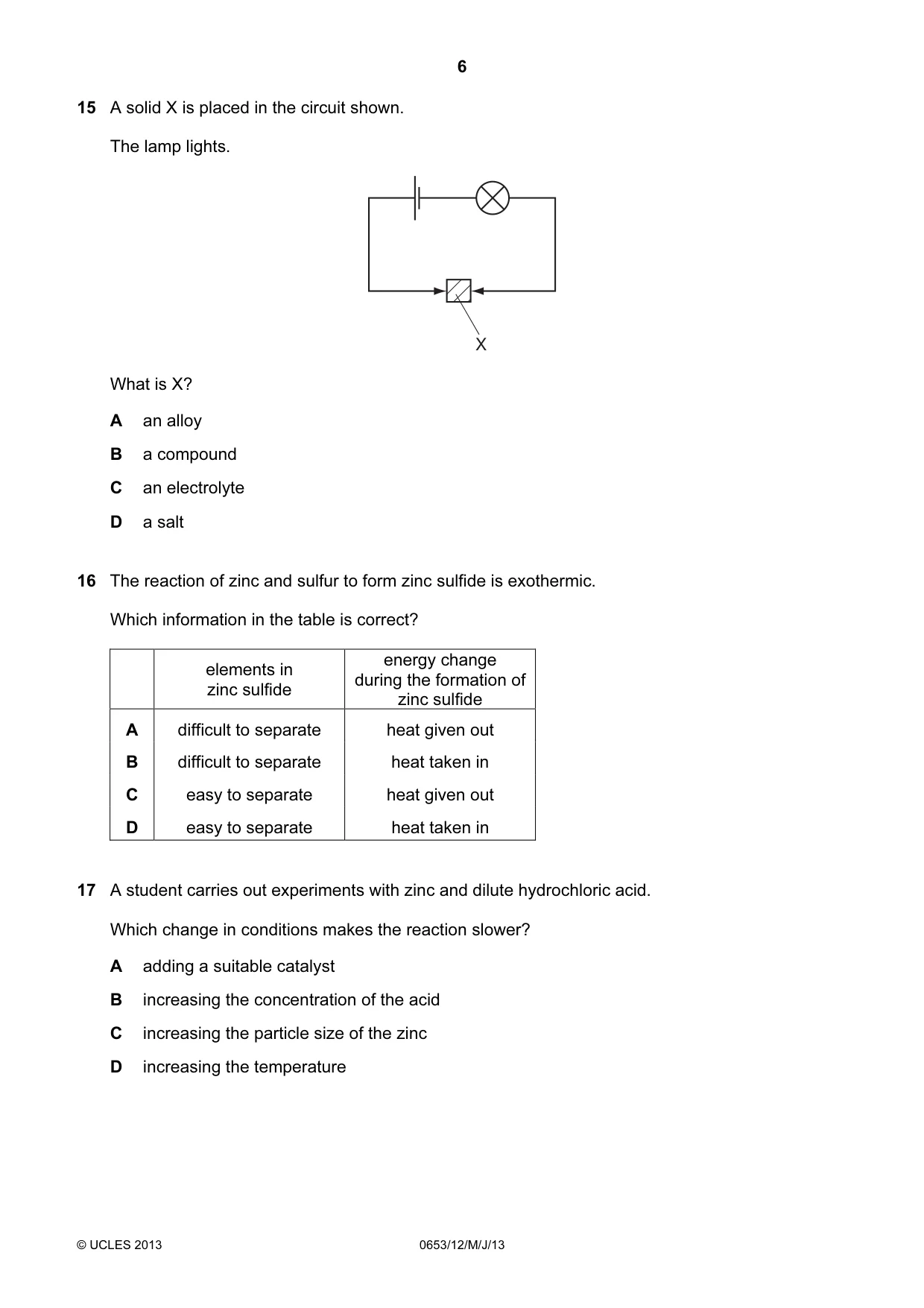
Q15 · A solid X is placed in the circuit shown
15 A solid X is placed in the circuit shown. The lamp lights. X What is X? A an alloy B a compound C an electrolyte D a salt
Mark scheme: A
Q16 · The reaction of zinc and sulfur to form zinc sulfide is exothermic
16 The reaction of zinc and sulfur to form zinc sulfide is exothermic. Which information in the table is correct? energy change elements in during the formation of zinc sulfide zinc sulfide A difficult to separate heat given out B difficult to separate heat taken in C easy to separate heat given out D easy to separate heat taken in
Mark scheme: A
Q17 · A student carries out experiments with zinc and dilute hydrochloric acid
17 A student carries out experiments with zinc and dilute hydrochloric acid. Which change in conditions makes the reaction slower? A adding a suitable catalyst B increasing the concentration of the acid C increasing the particle size of the zinc D increasing the temperature
Mark scheme: C
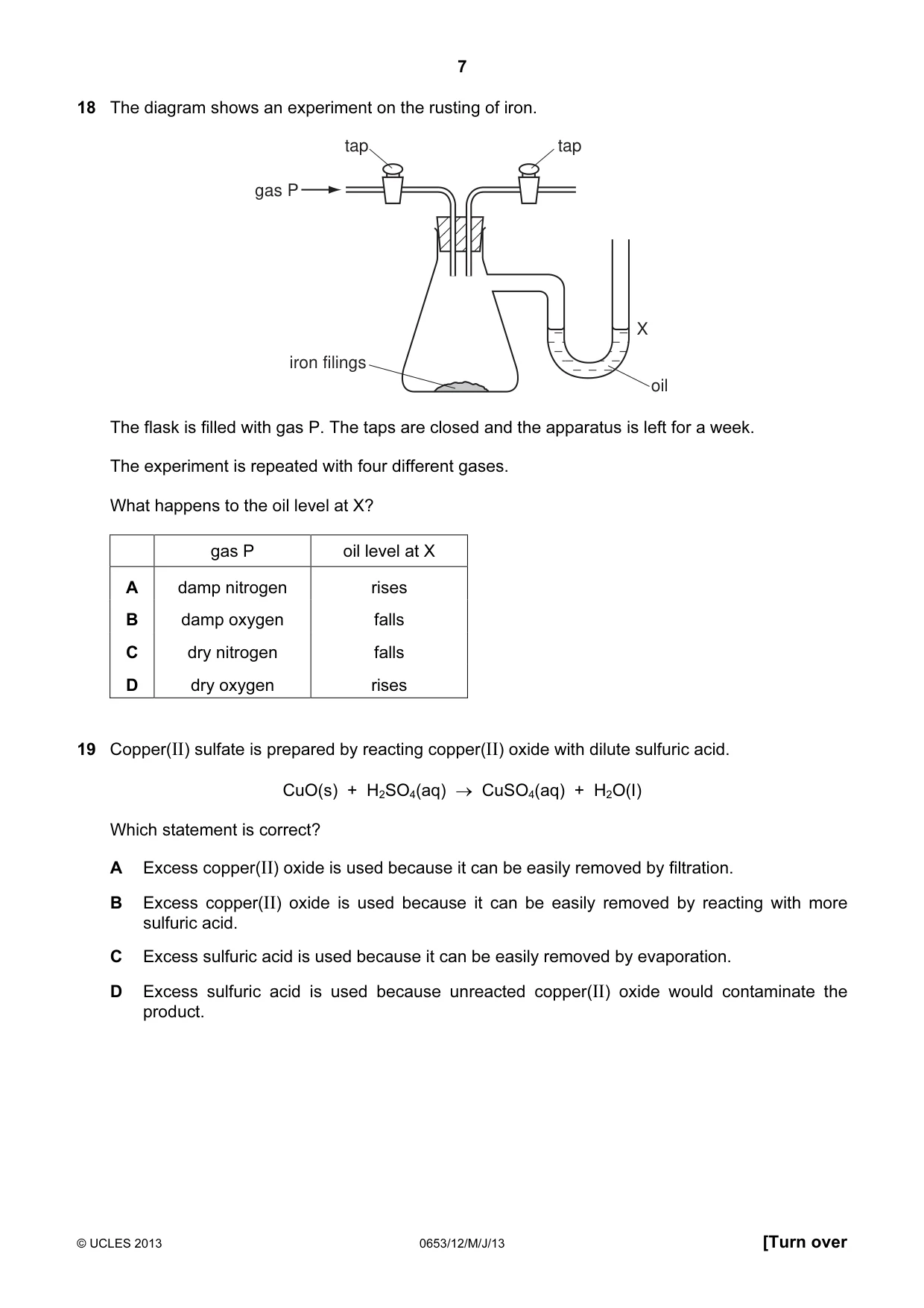
Q18 · The diagram shows an experiment on the rusting of iron
18 The diagram shows an experiment on the rusting of iron. tap tap gas P X iron filings oil The flask is filled with gas P. The taps are closed and the apparatus is left for a week. The experiment is repeated with four different gases. What happens to the oil level at X? gas P oil level at X A damp nitrogen rises B damp oxygen falls C dry nitrogen falls D dry oxygen rises
Mark scheme: B
Q19 · Copper(II) sulfate is prepared by reacting copper(II) oxide with dilute sulfuric acid
19 Copper(II) sulfate is prepared by reacting copper(II) oxide with dilute sulfuric acid. CuO(s) + H2SO4(aq) → CuSO4(aq) + H2O(I) Which statement is correct? A Excess copper(II) oxide is used because it can be easily removed by filtration. B Excess copper(II) oxide is used because it can be easily removed by reacting with more sulfuric acid. C Excess sulfuric acid is used because it can be easily removed by evaporation. D Excess sulfuric acid is used because unreacted copper(II) oxide would contaminate the product.
Mark scheme: A
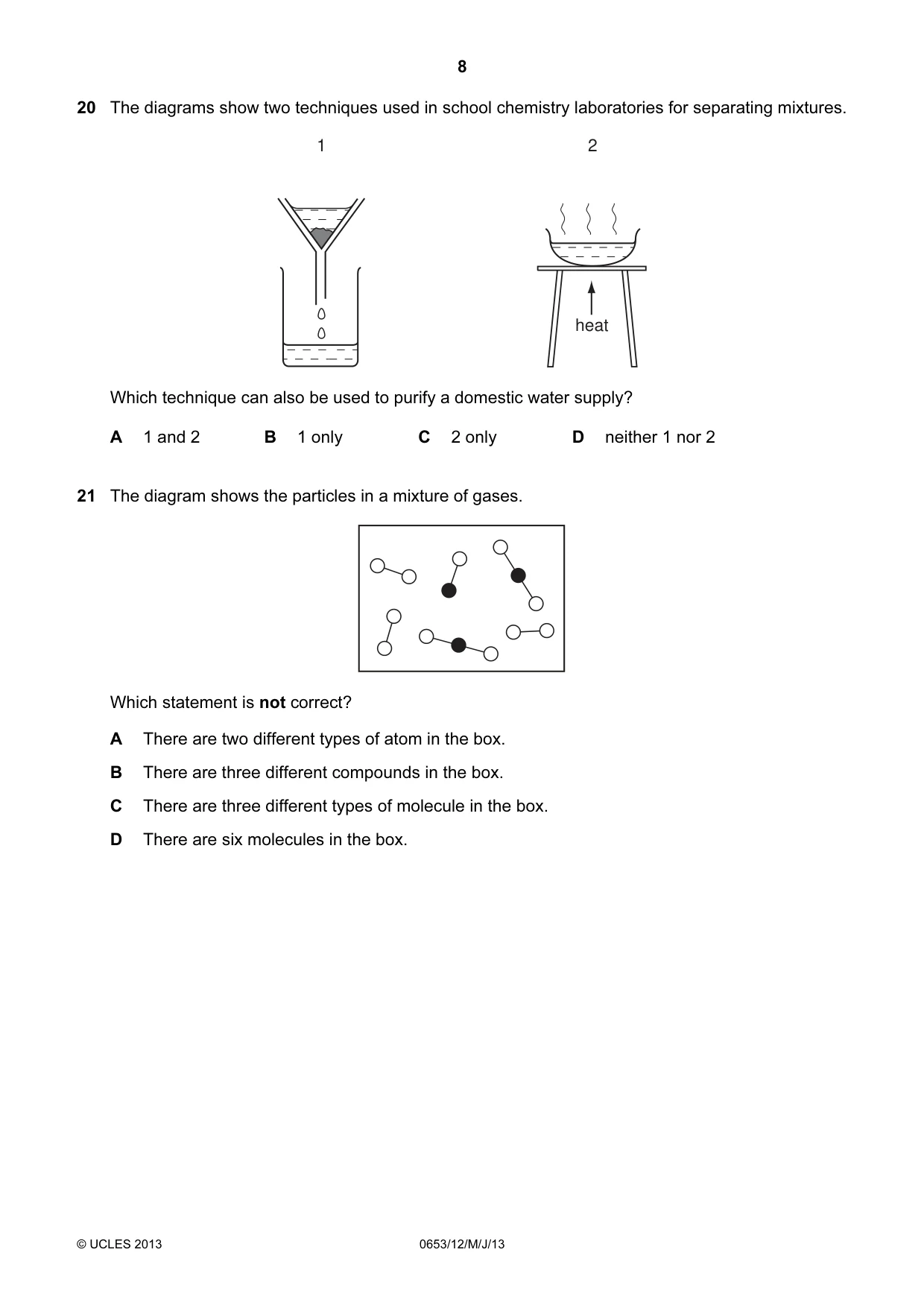
Q20 · The diagrams show two techniques used in school chemistry laboratories for separating…
20 The diagrams show two techniques used in school chemistry laboratories for separating mixtures. 1 2 heat Which technique can also be used to purify a domestic water supply? A 1 and 2 B 1 only C 2 only D neither 1 nor 2
Mark scheme: B
Q21 · The diagram shows the particles in a mixture of gases
21 The diagram shows the particles in a mixture of gases. Which statement is not correct? A There are two different types of atom in the box. B There are three different compounds in the box. C There are three different types of molecule in the box. D There are six molecules in the box.
Mark scheme: B
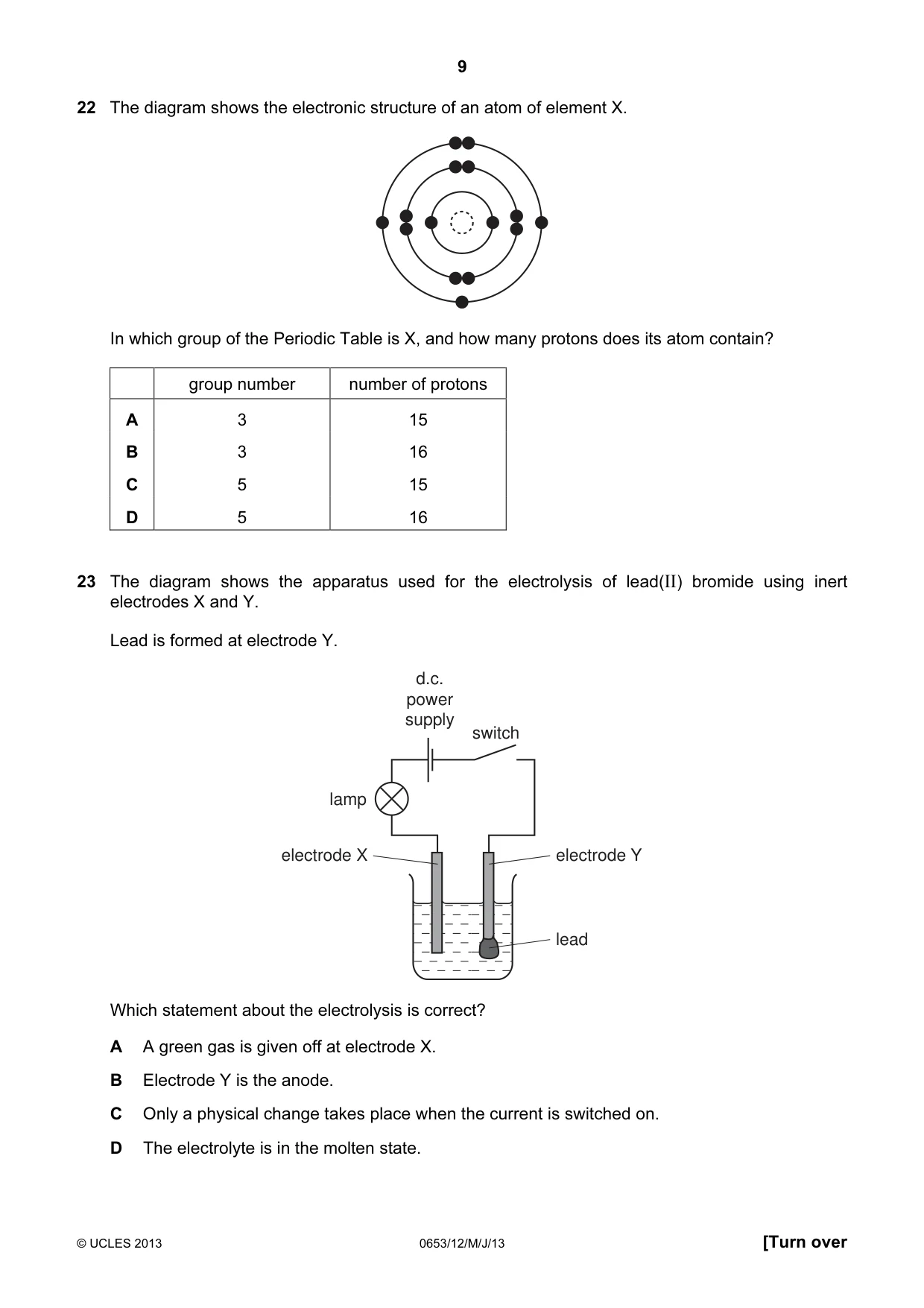
Q22 · The diagram shows the electronic structure of an atom of element X
22 The diagram shows the electronic structure of an atom of element X. In which group of the Periodic Table is X, and how many protons does its atom contain? group number number of protons A 3 15 B 3 16 C 5 15 D 5 16
Mark scheme: C
Q23 · The diagram shows the apparatus used for the electrolysis of lead(II) bromide using inert…
23 The diagram shows the apparatus used for the electrolysis of lead(II) bromide using inert electrodes X and Y. Lead is formed at electrode Y. d.c. power supply switch lamp electrode X electrode Y lead Which statement about the electrolysis is correct? A A green gas is given off at electrode X. B Electrode Y is the anode. C Only a physical change takes place when the current is switched on. D The electrolyte is in the molten state.
Mark scheme: D
Q24 · P, Q, R and S are four gases found in air
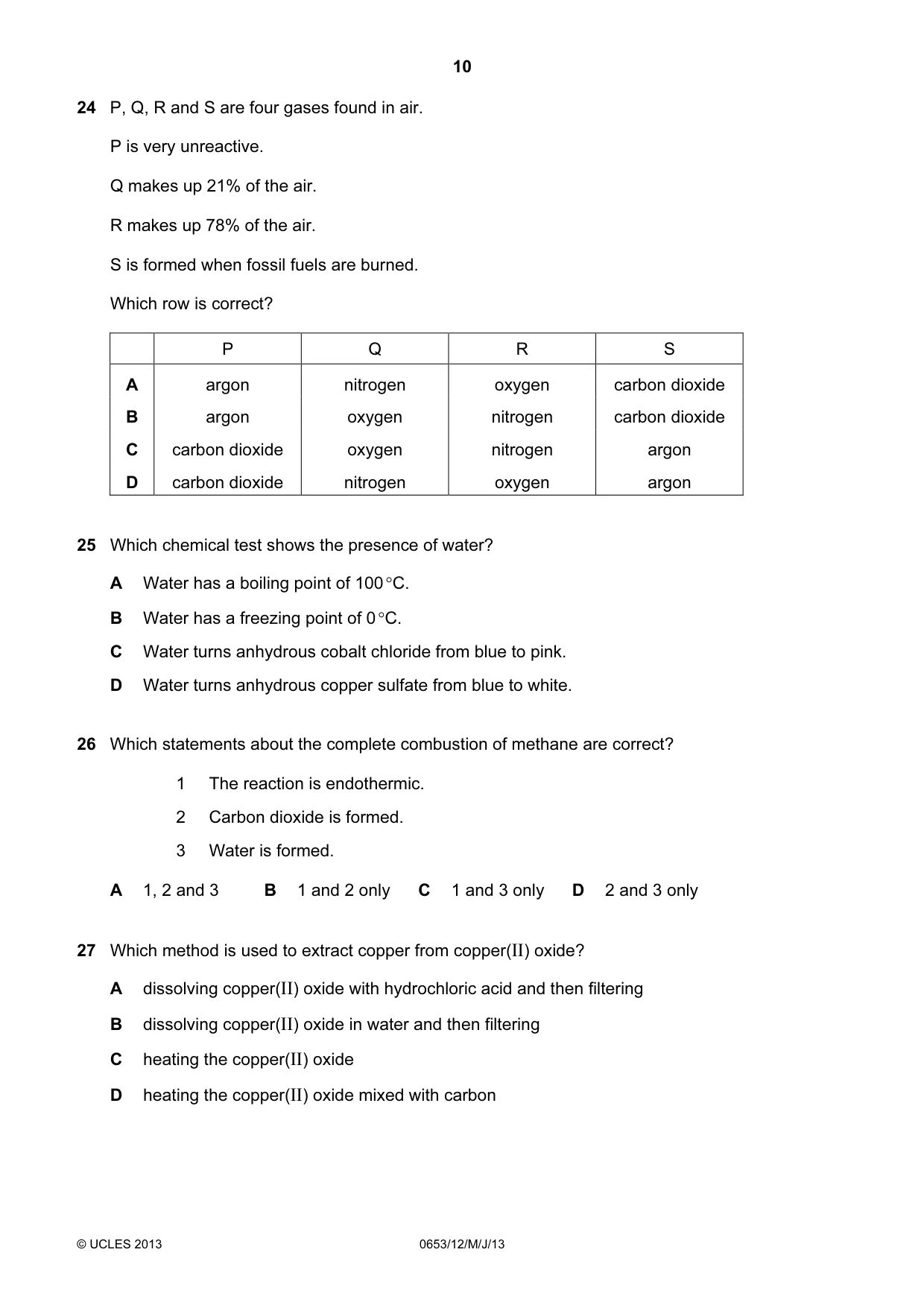
24 P, Q, R and S are four gases found in air. P is very unreactive. Q makes up 21% of the air. R makes up 78% of the air. S is formed when fossil fuels are burned. Which row is correct? P Q R S A argon nitrogen oxygen carbon dioxide B argon oxygen nitrogen carbon dioxide C carbon dioxide oxygen nitrogen argon D carbon dioxide nitrogen oxygen argon
Mark scheme: B
Q25 · Which chemical test shows the presence of water?
25 Which chemical test shows the presence of water? A Water has a boiling point of 100 °C. B Water has a freezing point of 0 °C. C Water turns anhydrous cobalt chloride from blue to pink. D Water turns anhydrous copper sulfate from blue to white.
Mark scheme: C
Q26 · Which statements about the complete combustion of methane are correct?
26 Which statements about the complete combustion of methane are correct? 1 The reaction is endothermic. 2 Carbon dioxide is formed. 3 Water is formed. A 1, 2 and 3 B 1 and 2 only C 1 and 3 only D 2 and 3 only
Mark scheme: D
Q27 · Which method is used to extract copper from copper(II) oxide?
27 Which method is used to extract copper from copper(II) oxide? A dissolving copper(II) oxide with hydrochloric acid and then filtering B dissolving copper(II) oxide in water and then filtering C heating the copper(II) oxide D heating the copper(II) oxide mixed with carbon
Mark scheme: D
Q28 · A small rock moving through space
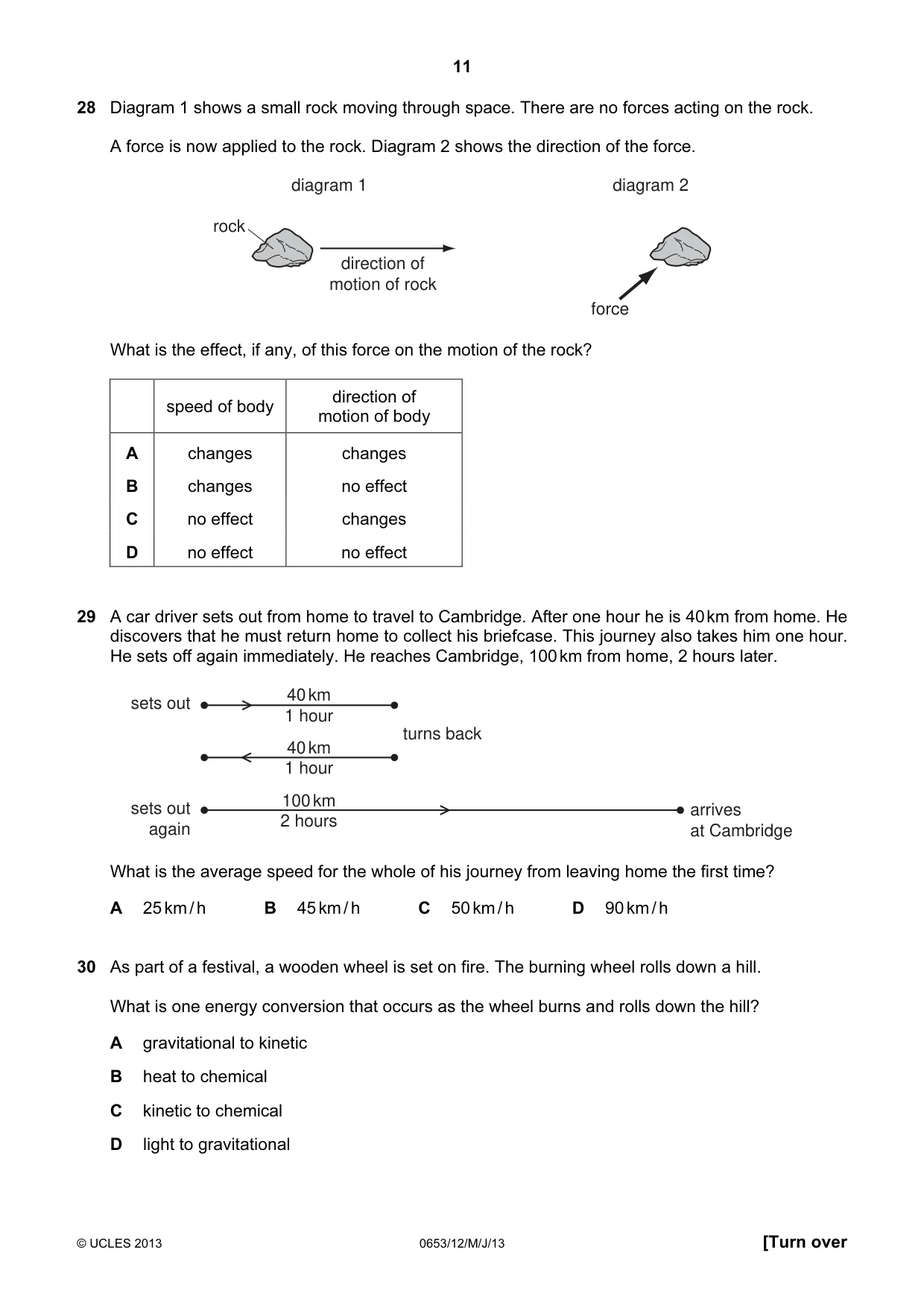
28 Diagram 1 shows a small rock moving through space. There are no forces acting on the rock. A force is now applied to the rock. Diagram 2 shows the direction of the force. diagram 1 diagram 2 rock direction of motion of rock force What is the effect, if any, of this force on the motion of the rock? direction of speed of body motion of body A changes changes B changes no effect C no effect changes D no effect no effect
Mark scheme: A
Q29 · A car driver sets out from home to travel to Cambridge
29 A car driver sets out from home to travel to Cambridge. After one hour he is 40 km from home. He discovers that he must return home to collect his briefcase. This journey also takes him one hour. He sets off again immediately. He reaches Cambridge, 100 km from home, 2 hours later. 40 km sets out 1 hour turns back 40 km 1 hour 100 km sets out arrives 2 hours again at Cambridge What is the average speed for the whole of his journey from leaving home the first time? A 25 km / h B 45 km / h C 50 km / h D 90 km / h
Mark scheme: B
Q30 · As part of a festival, a wooden wheel is set on fire
30 As part of a festival, a wooden wheel is set on fire. The burning wheel rolls down a hill. What is one energy conversion that occurs as the wheel burns and rolls down the hill? A gravitational to kinetic B heat to chemical C kinetic to chemical D light to gravitational
Mark scheme: A
Q31 · When sweat evaporates, which change of state takes place?
31 When sweat evaporates, which change of state takes place? A gas to liquid B liquid to gas C liquid to solid D solid to gas
Mark scheme: B
Q32 · A block of ice is supplied with heat at a constant rate
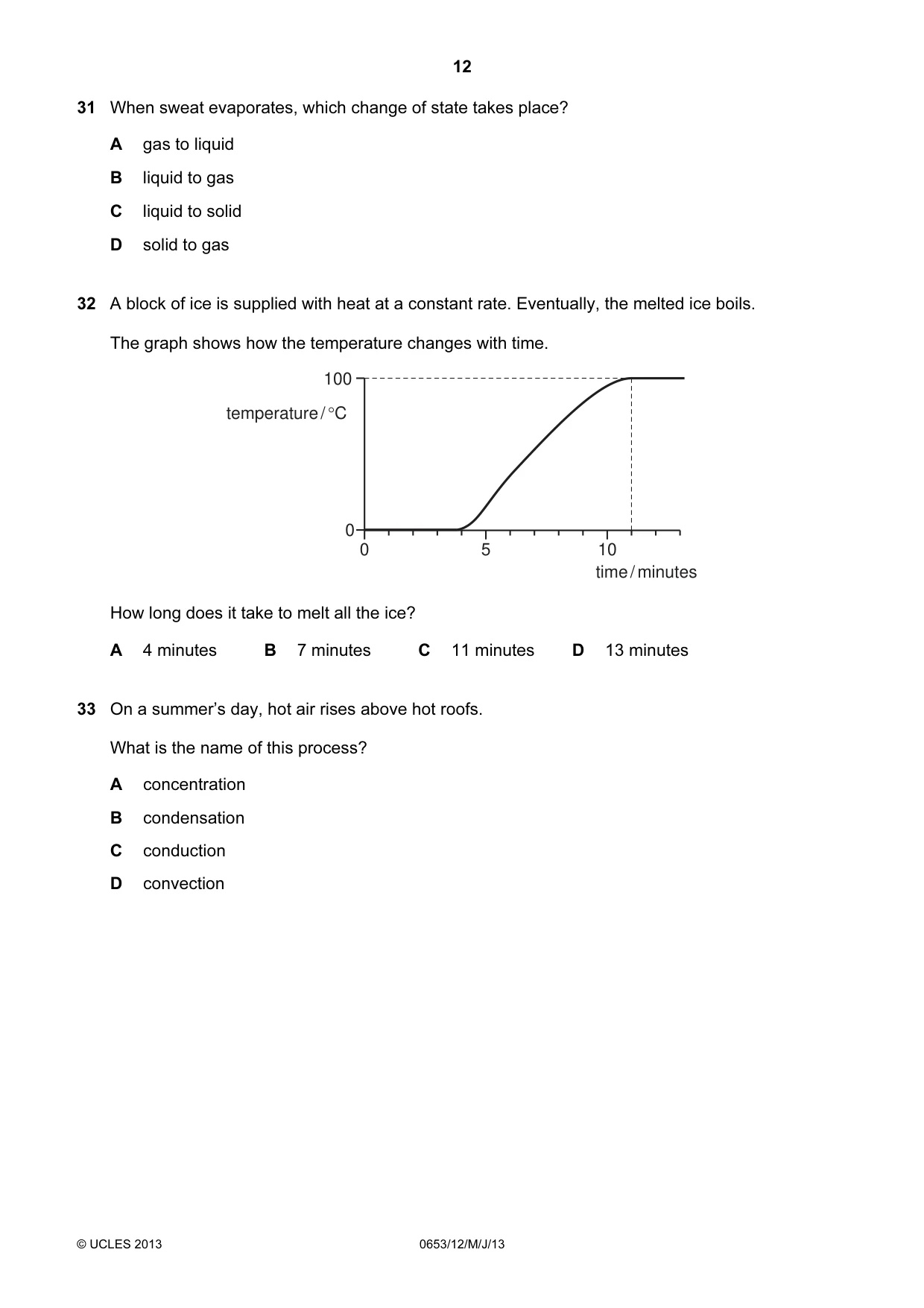
32 A block of ice is supplied with heat at a constant rate. Eventually, the melted ice boils. The graph shows how the temperature changes with time. 100 temperature / °C 0 0 5 10 time / minutes How long does it take to melt all the ice? A 4 minutes B 7 minutes C 11 minutes D 13 minutes
Mark scheme: A
Q33 · On a summer’s day, hot air rises above hot roofs
33 On a summer’s day, hot air rises above hot roofs. What is the name of this process? A concentration B condensation C conduction D convection
Mark scheme: D
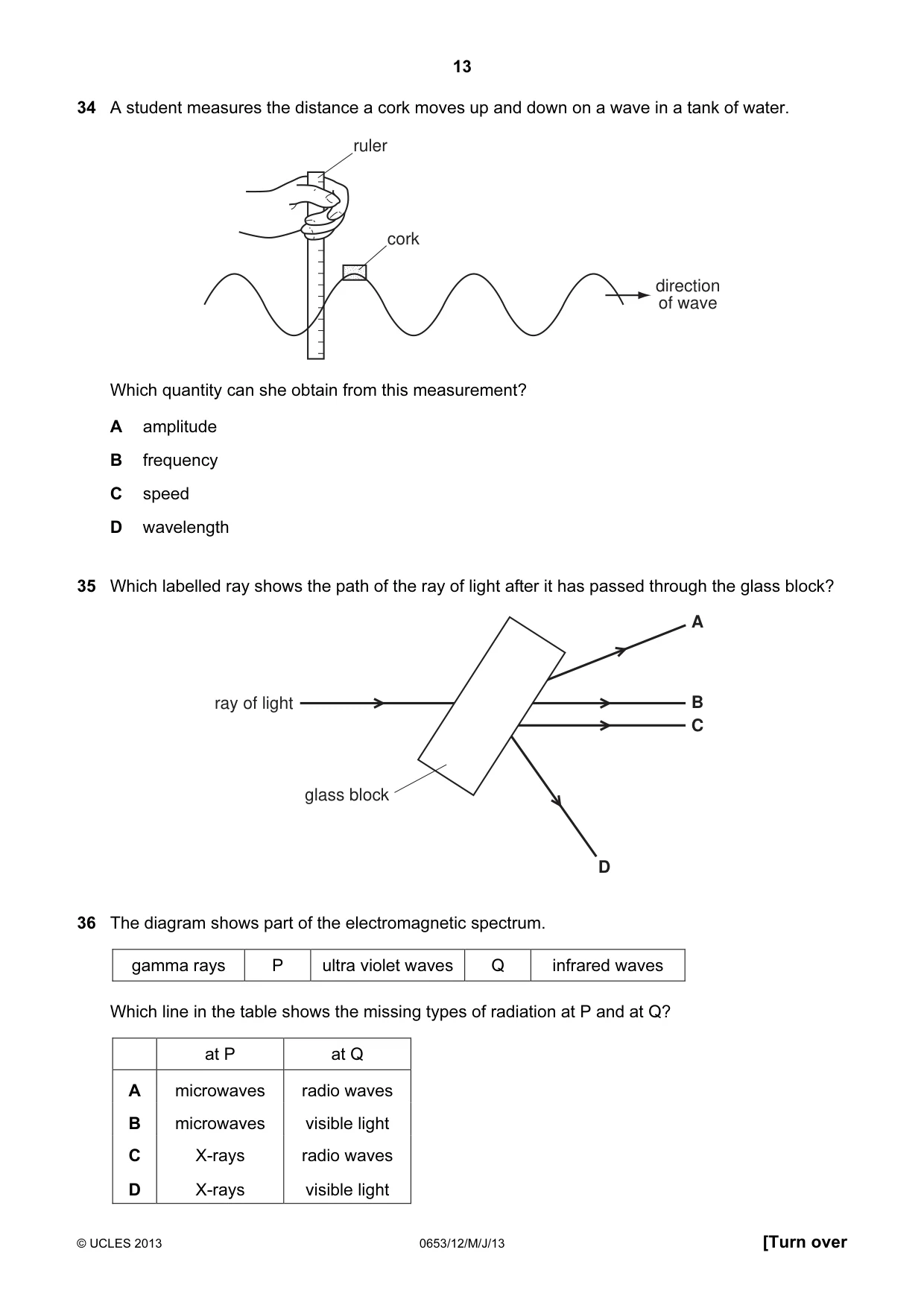
Q34 · A student measures the distance a cork moves up and down on a wave in a tank of water
34 A student measures the distance a cork moves up and down on a wave in a tank of water. ruler cork direction of wave Which quantity can she obtain from this measurement? A amplitude B frequency C speed D wavelength
Mark scheme: A
Q35 · Which labelled ray shows the path of the ray of light after it has passed through the…
35 Which labelled ray shows the path of the ray of light after it has passed through the glass block? A ray of light B C glass block D
Mark scheme: C
Q36 · The diagram shows part of the electromagnetic spectrum
36 The diagram shows part of the electromagnetic spectrum. gamma rays P ultra violet waves Q infrared waves Which line in the table shows the missing types of radiation at P and at Q? at P at Q A microwaves radio waves B microwaves visible light C X-rays radio waves D X-rays visible light
Mark scheme: D
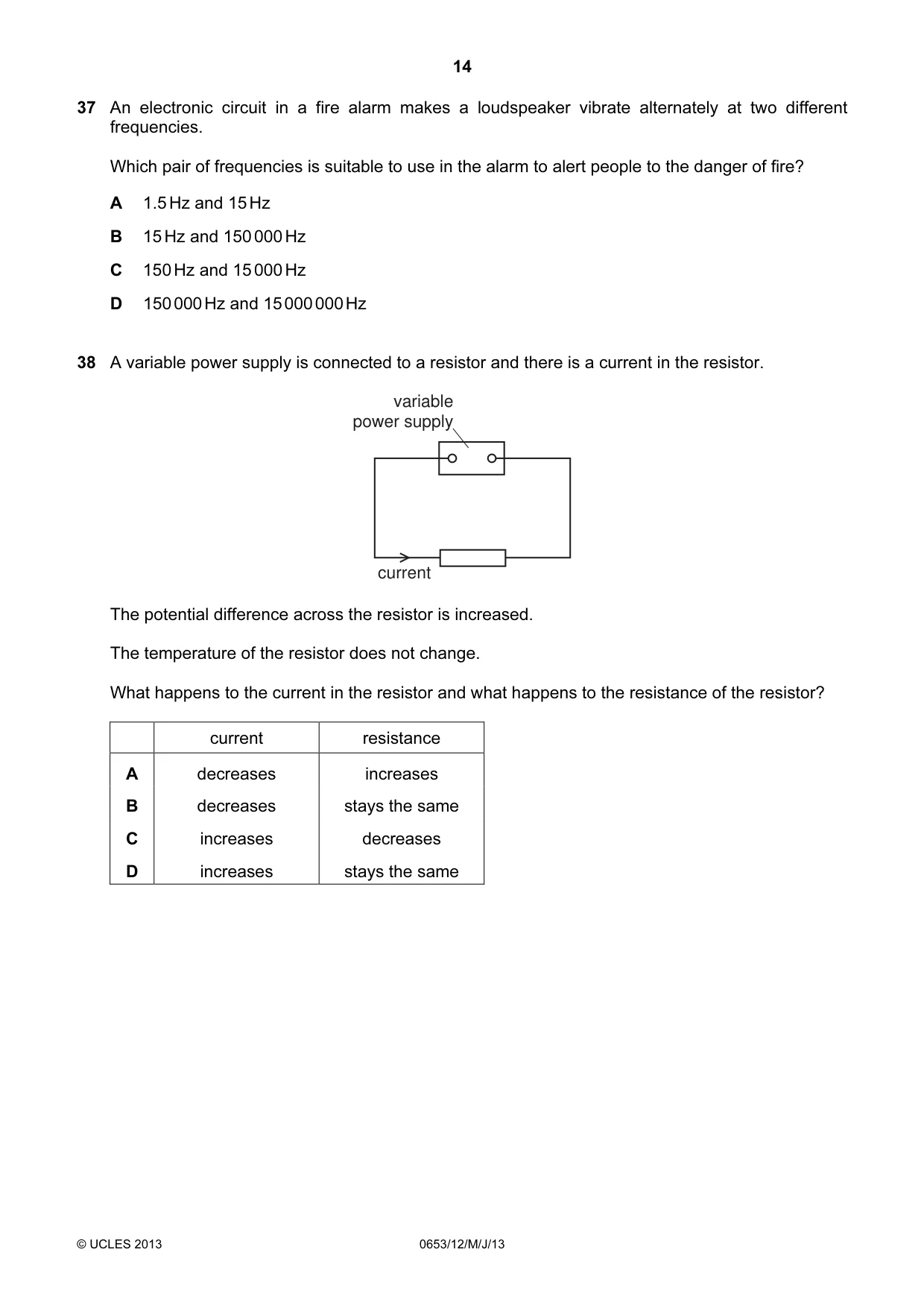
Q37 · An electronic circuit in a fire alarm makes a loudspeaker vibrate alternately at two…
37 An electronic circuit in a fire alarm makes a loudspeaker vibrate alternately at two different frequencies. Which pair of frequencies is suitable to use in the alarm to alert people to the danger of fire? A 1.5 Hz and 15 Hz B 15 Hz and 150 000 Hz C 150 Hz and 15 000 Hz D 150 000 Hz and 15 000 000 Hz
Mark scheme: C
Q38 · A variable power supply is connected to a resistor and there is a current in the resistor
38 A variable power supply is connected to a resistor and there is a current in the resistor. variable power supply current The potential difference across the resistor is increased. The temperature of the resistor does not change. What happens to the current in the resistor and what happens to the resistance of the resistor? current resistance A decreases increases B decreases stays the same C increases decreases D increases stays the same
Mark scheme: D
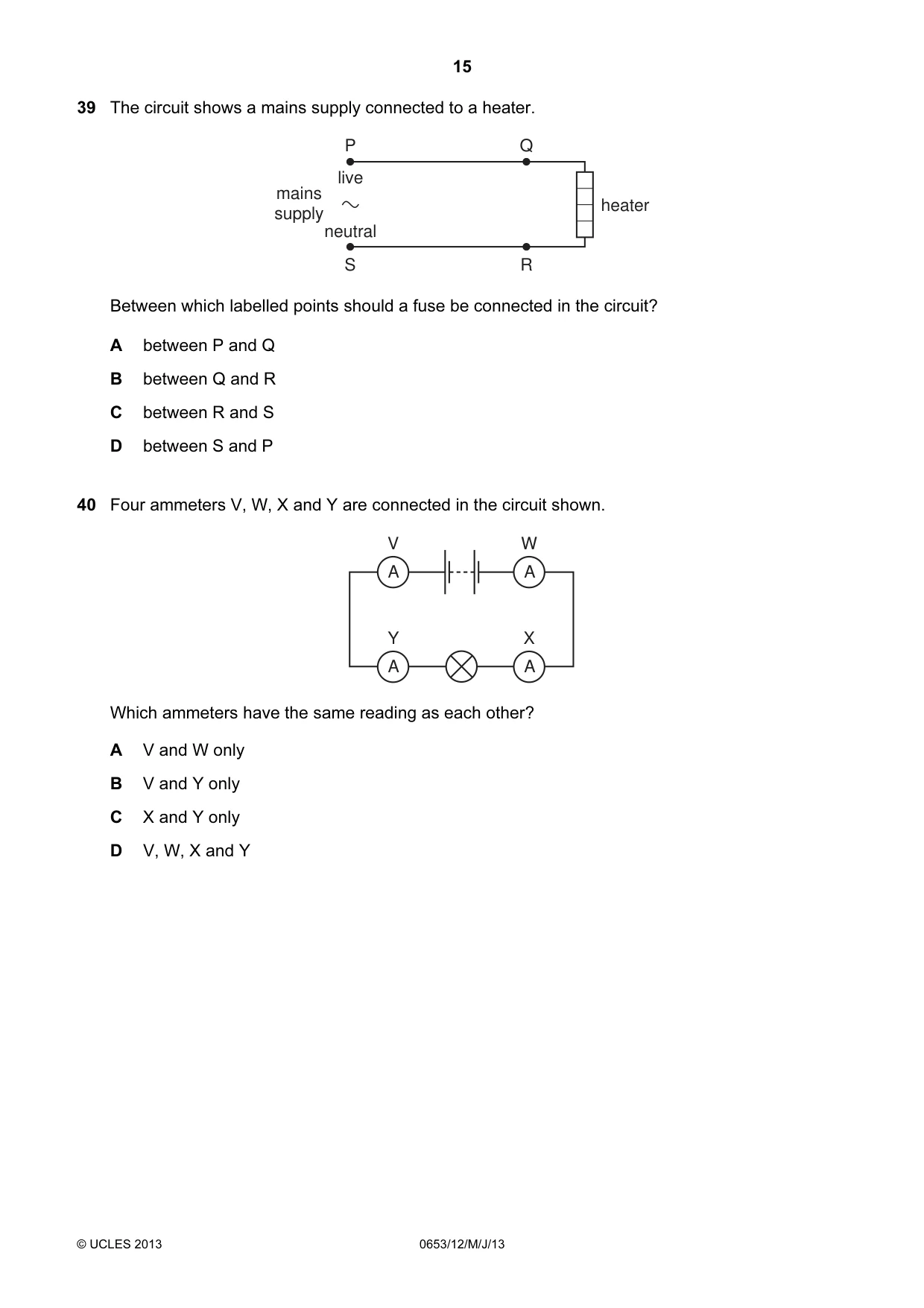
Q39 · The circuit shows a mains supply connected to a heater
39 The circuit shows a mains supply connected to a heater. P Q live mains heater supply neutral S R Between which labelled points should a fuse be connected in the circuit? A between P and Q B between Q and R C between R and S D between S and P
Mark scheme: A
Q40 · Four ammeters V, W, X and Y are connected in the circuit shown
40 Four ammeters V, W, X and Y are connected in the circuit shown. V W A A Y X A A Which ammeters have the same reading as each other? A V and W only B V and Y only C X and Y only D V, W, X and Y
Mark scheme: D
What was in this paper
The subtopics covered by these 40 questions, and how many questions each got. Open one in a new tab to see every Cambridge question on it.
3Biological molecules2Water2Air quality and climate1Alkanes1Atomic structure and the Periodic Table1Cell structure1Corrosion of metals1Diffusion1Digestive system1Electrical circuits1Electrical quantities1Electrical safety1Electrolysis1Electromagnetic spectrum1Elements, compounds and mixtures1Energy, work and power1Exothermic and endothermic reactions1Extraction of metals1Forces1Gas exchange in humans1General properties of waves1Heart1Kinetic particle model of matter1Light1Motion1Photosynthesis1Preparation of salts1Properties of metals1Rate of reaction1Separation and purification1Sexual reproduction in plants1Sound1Thermal properties and temperature1Transfer of thermal energy1Xylem and phloem1What you needed in this session
Cambridge’s own grade thresholds for 2013 May/June, Paper 1 · Variant 2. A higher threshold means an easier paper — the bar moves with how the cohort did.