Cambridge IGCSE Science - Combined 0653 — 2025 Feb/March Paper 1 · Variant 2
0653/12/F/M/25 · 40 questions · 40 marks · 45 min
The question paper and its mark scheme, free to read here and free to download. This is Cambridge’s own paper, exactly as it was sat.
Question paper16 pages
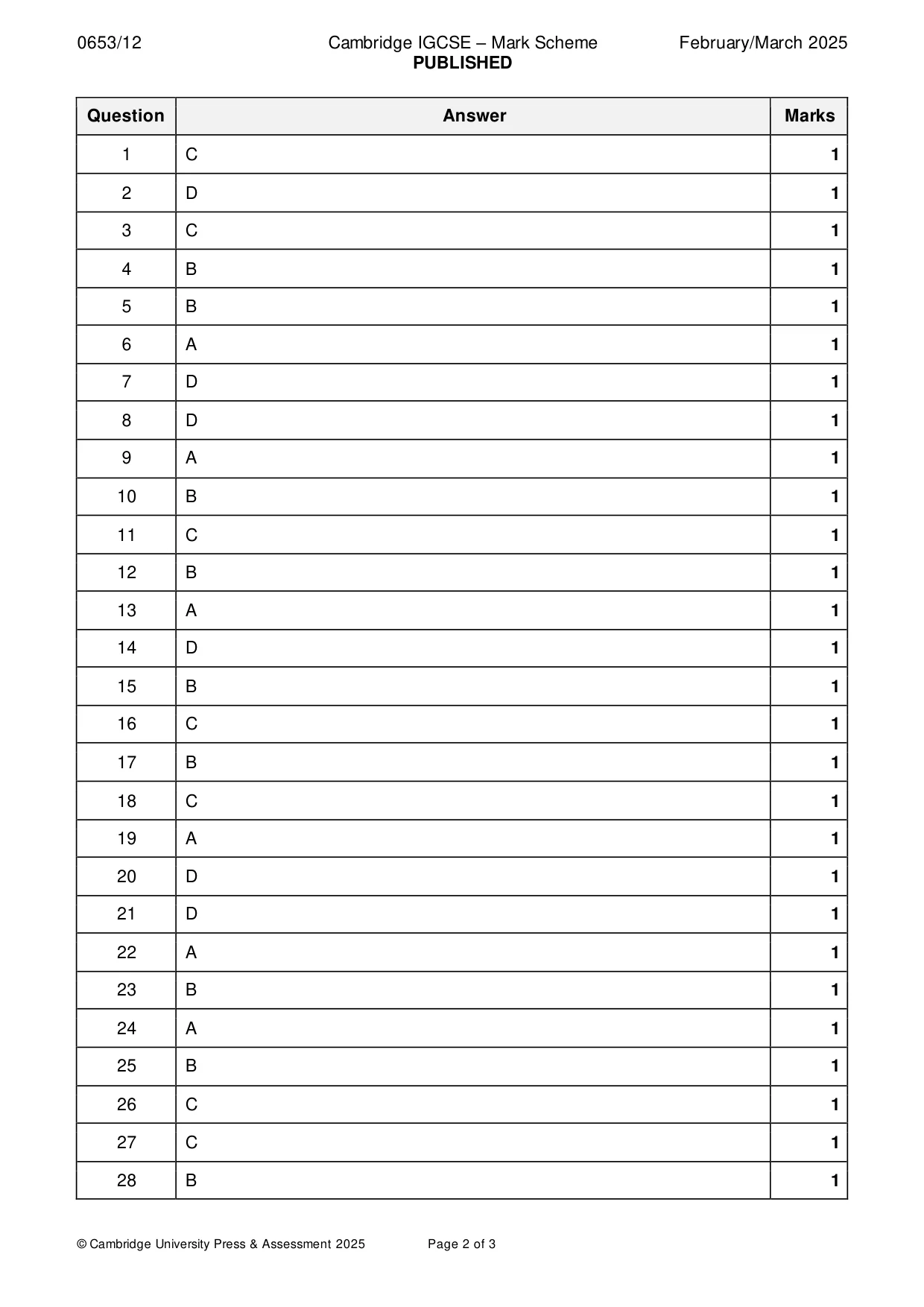
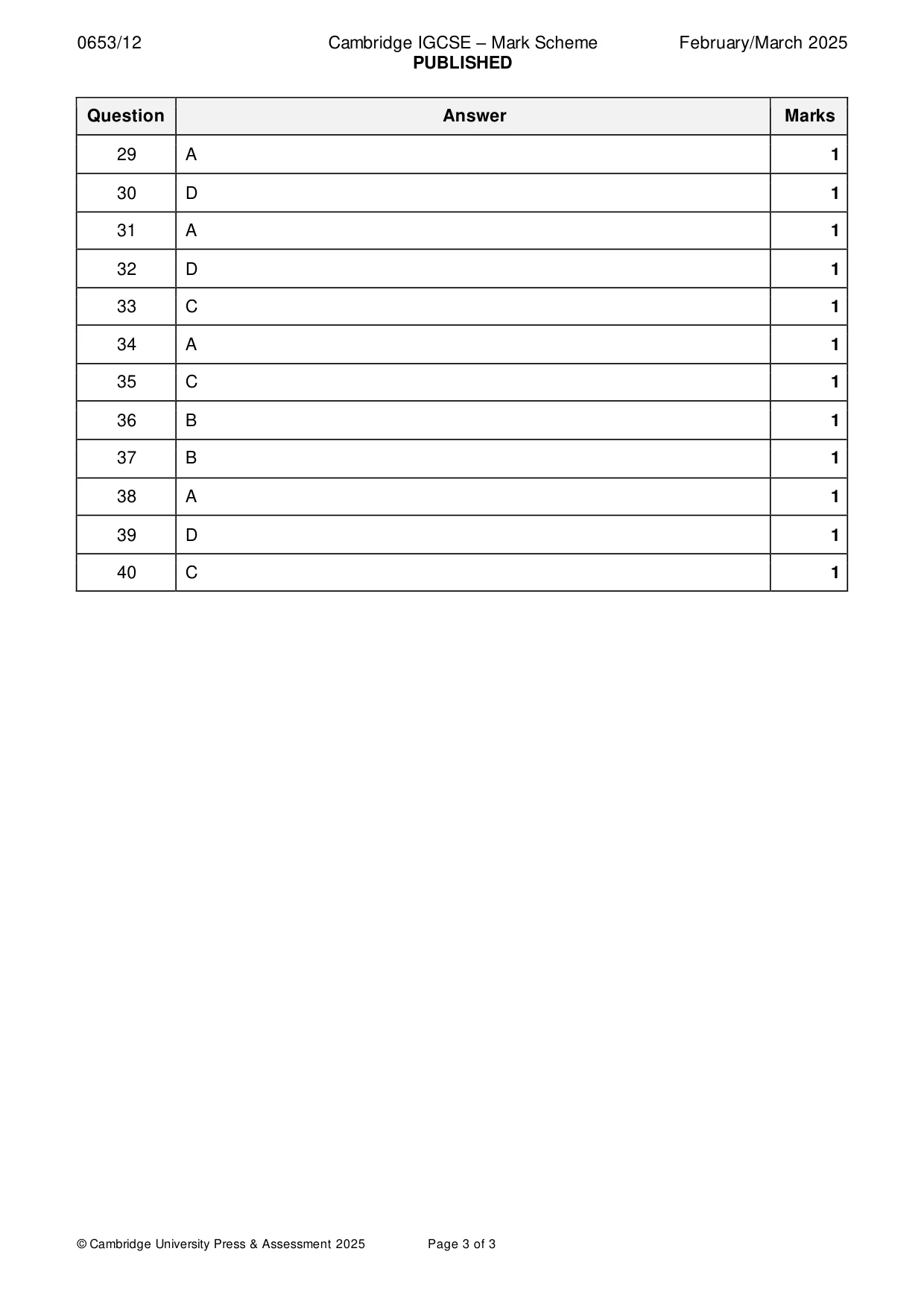
Mark scheme3 pages
Answers below. Sit the paper first if you are practising.
Questions as text
Q1 · Process Q happens in cells
1 Process Q happens in cells. glucose process Q energy released What is process Q? A growth B nutrition C respiration D sensitivity
Mark scheme: C
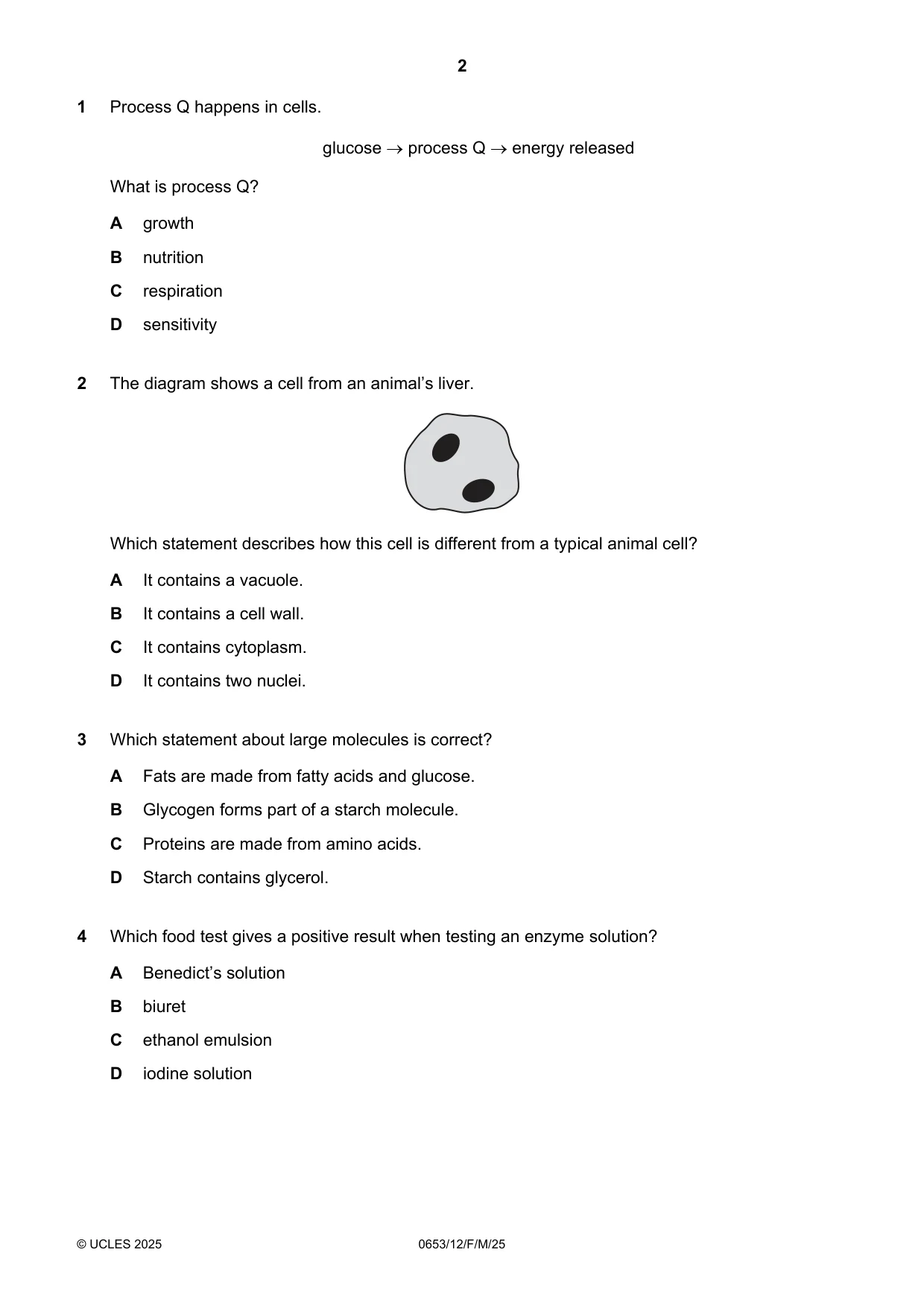
Q2 · The diagram shows a cell from an animal’s liver
2 The diagram shows a cell from an animal’s liver. Which statement describes how this cell is different from a typical animal cell? A It contains a vacuole. B It contains a cell wall. C It contains cytoplasm. D It contains two nuclei.
Mark scheme: D
Q3 · Which statement about large molecules is correct?
3 Which statement about large molecules is correct? A Fats are made from fatty acids and glucose. B Glycogen forms part of a starch molecule. C Proteins are made from amino acids. D Starch contains glycerol.
Mark scheme: C
Q4 · Which food test gives a positive result when testing an enzyme solution?
4 Which food test gives a positive result when testing an enzyme solution? A Benedict’s solution B biuret C ethanol emulsion D iodine solution
Mark scheme: B
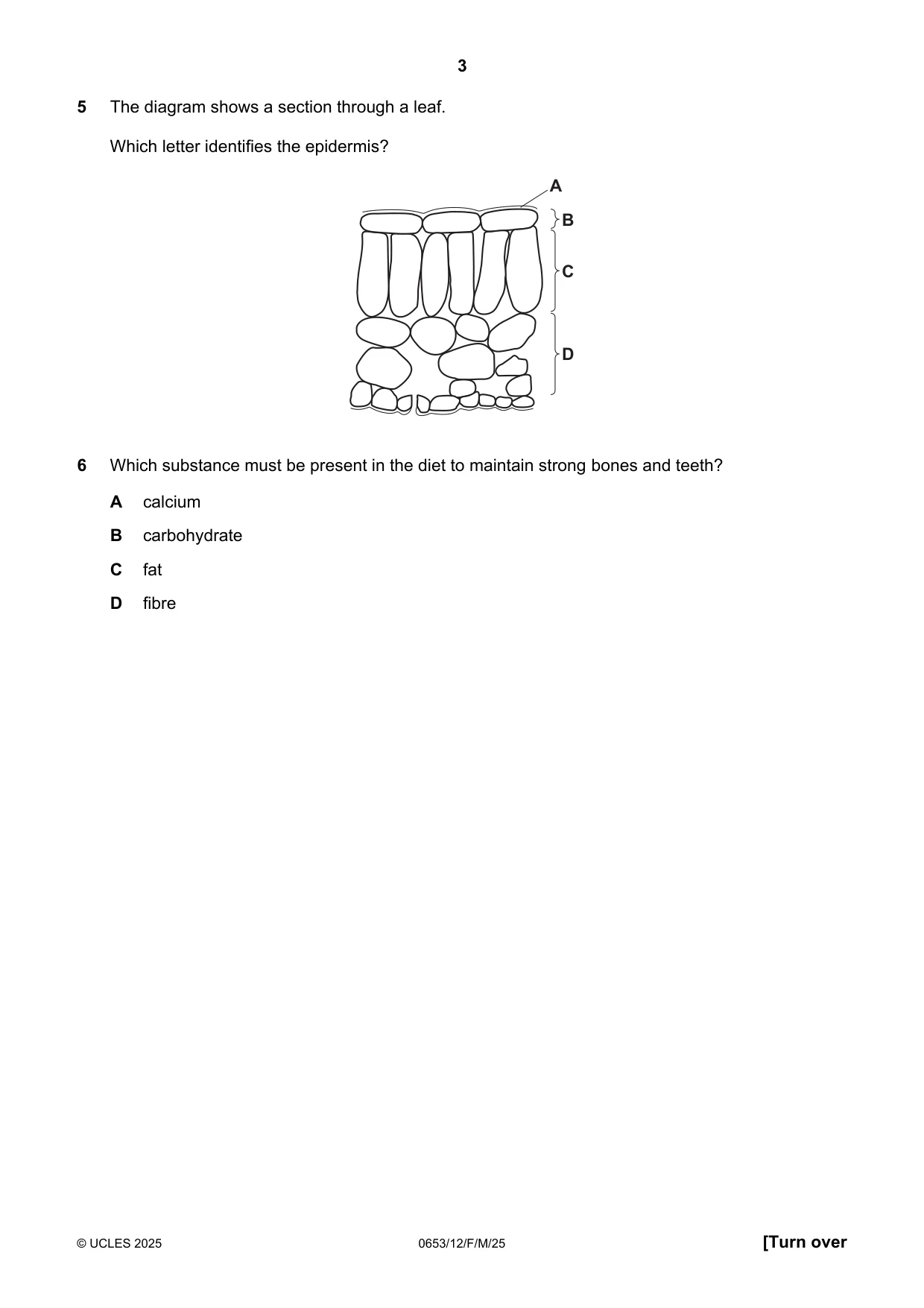
Q5 · The diagram shows a section through a leaf
5 The diagram shows a section through a leaf. Which letter identifies the epidermis? A B C D
Mark scheme: B
Q6 · Which substance must be present in the diet to maintain strong bones and teeth?
6 Which substance must be present in the diet to maintain strong bones and teeth? A calcium B carbohydrate C fat D fibre
Mark scheme: A
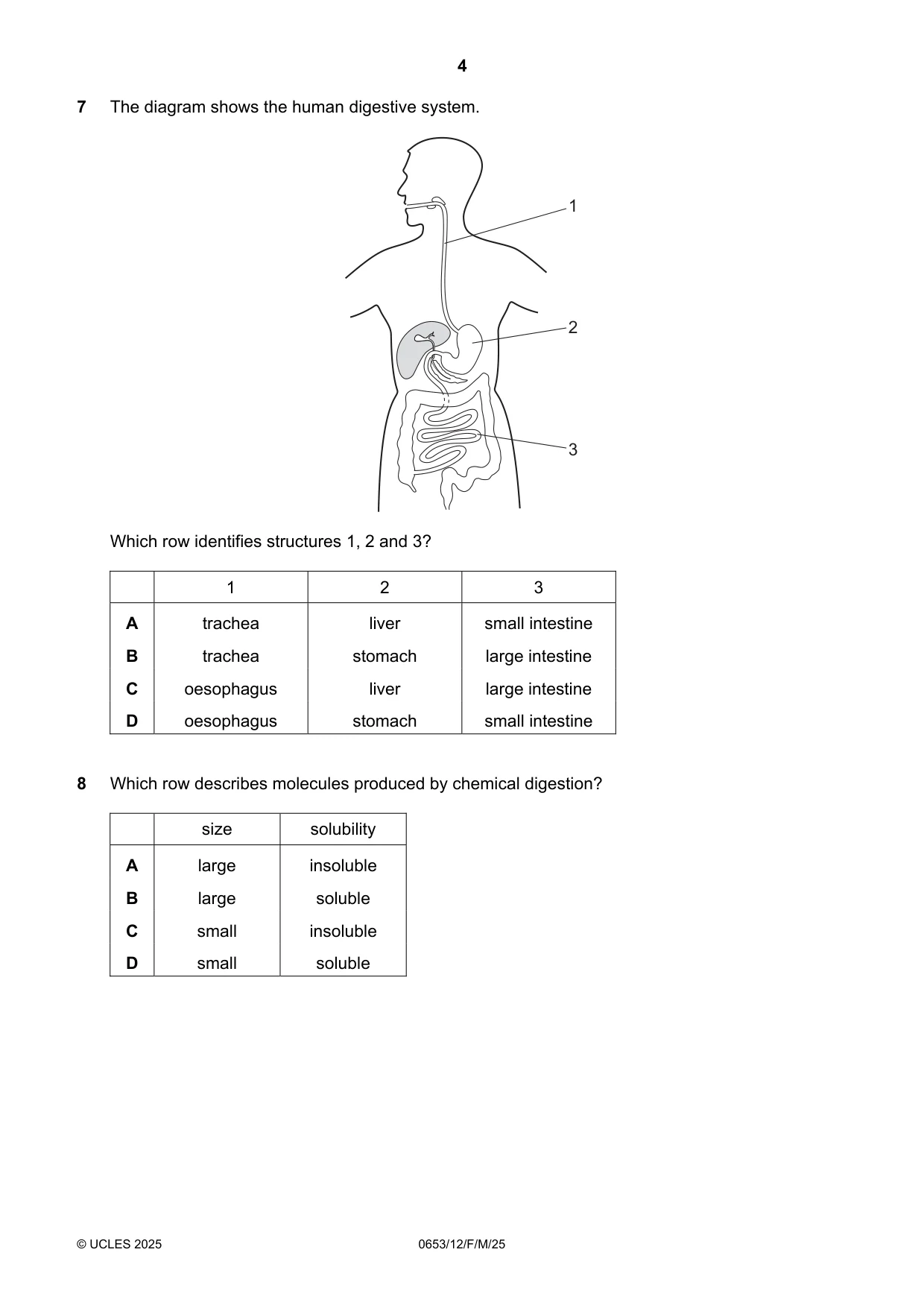
Q7 · The diagram shows the human digestive system
7 The diagram shows the human digestive system. 1 2 3 Which row identifies structures 1, 2 and 3? 1 2 3 A trachea liver small intestine B trachea stomach large intestine C oesophagus liver large intestine D oesophagus stomach small intestine
Mark scheme: D
Q8 · Which row describes molecules produced by chemical digestion?
8 Which row describes molecules produced by chemical digestion? size solubility A large insoluble B large soluble C small insoluble D small soluble
Mark scheme: D
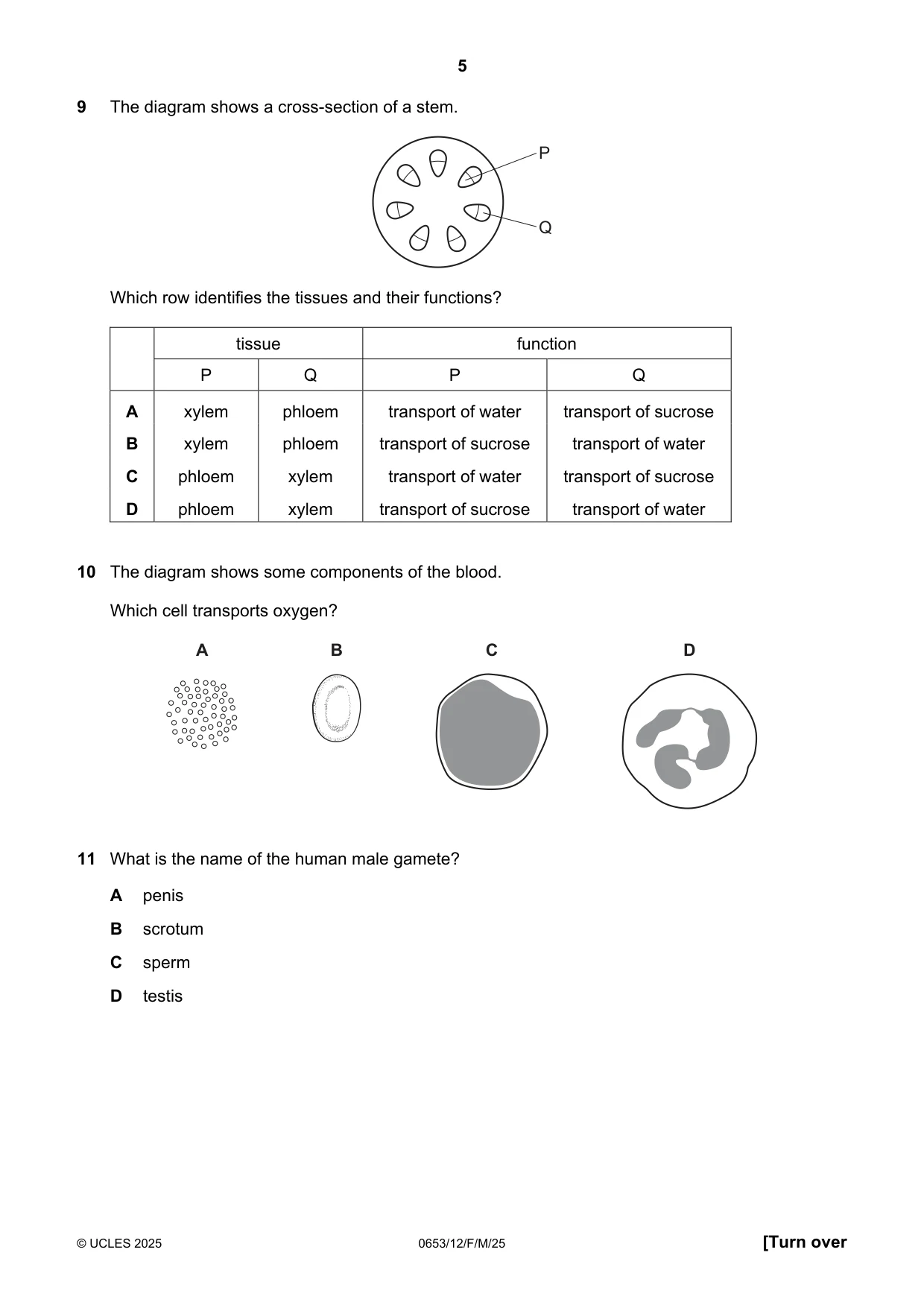
Q9 · The diagram shows a cross-section of a stem
9 The diagram shows a cross-section of a stem. P Q Which row identifies the tissues and their functions? tissue function P Q P Q A xylem phloem transport of water transport of sucrose B xylem phloem transport of sucrose transport of water C phloem xylem transport of water transport of sucrose D phloem xylem transport of sucrose transport of water
Mark scheme: A
Q10 · The diagram shows some components of the blood
10 The diagram shows some components of the blood. Which cell transports oxygen? A B C D
Mark scheme: B
Q11 · What is the name of the human male gamete?
11 What is the name of the human male gamete? A penis B scrotum C sperm D testis
Mark scheme: C
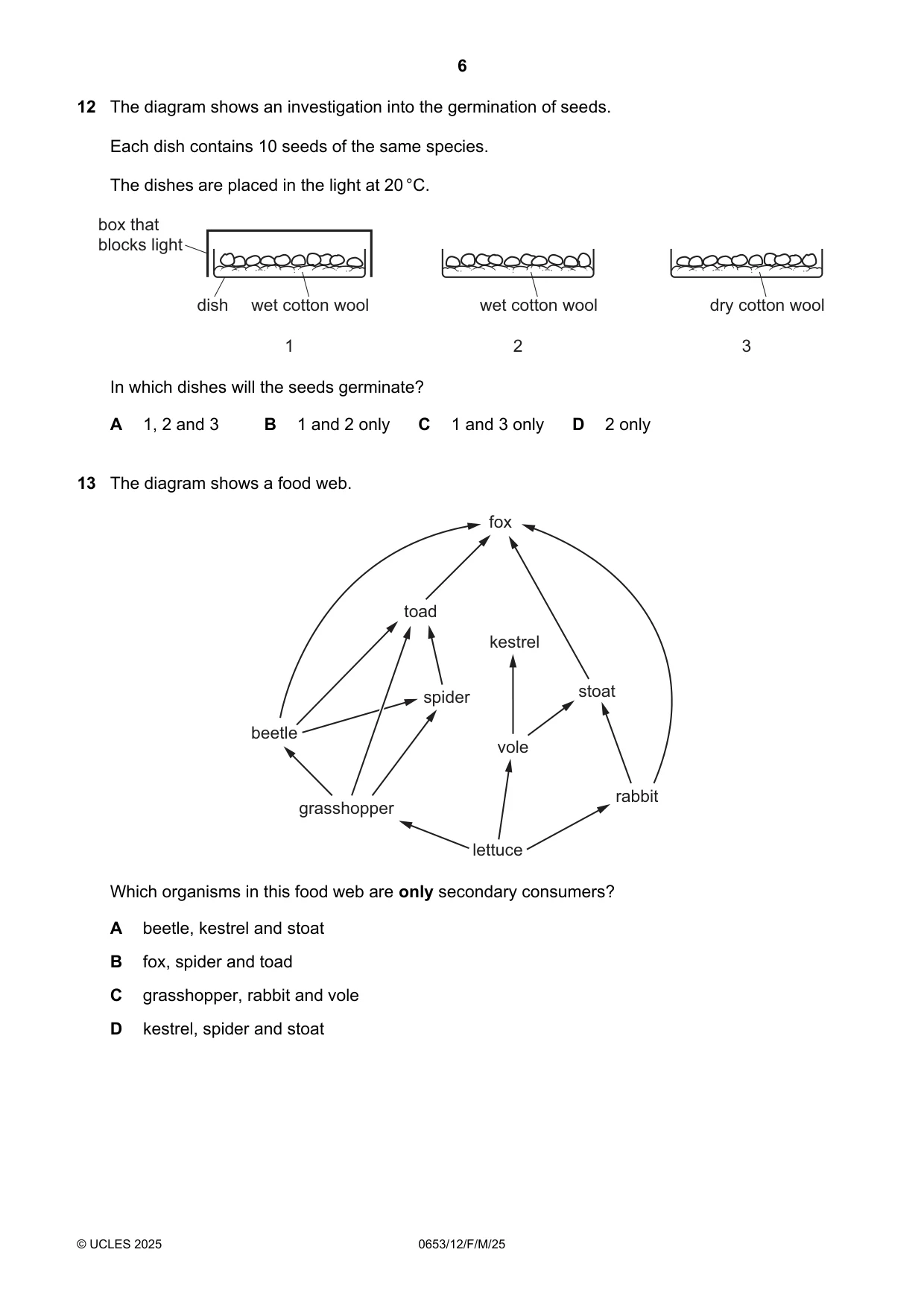
Q12 · The diagram shows an investigation into the germination of seeds
12 The diagram shows an investigation into the germination of seeds. Each dish contains 10 seeds of the same species. The dishes are placed in the light at 20 °C. box that blocks light dish wet cotton wool wet cotton wool dry cotton wool 1 2 3 In which dishes will the seeds germinate? A 1, 2 and 3 B 1 and 2 only C 1 and 3 only D 2 only
Mark scheme: B
Q13 · The diagram shows a food web
13 The diagram shows a food web. fox toad kestrel spider stoat beetle vole rabbit grasshopper lettuce Which organisms in this food web are only secondary consumers? A beetle, kestrel and stoat B fox, spider and toad C grasshopper, rabbit and vole D kestrel, spider and stoat
Mark scheme: A
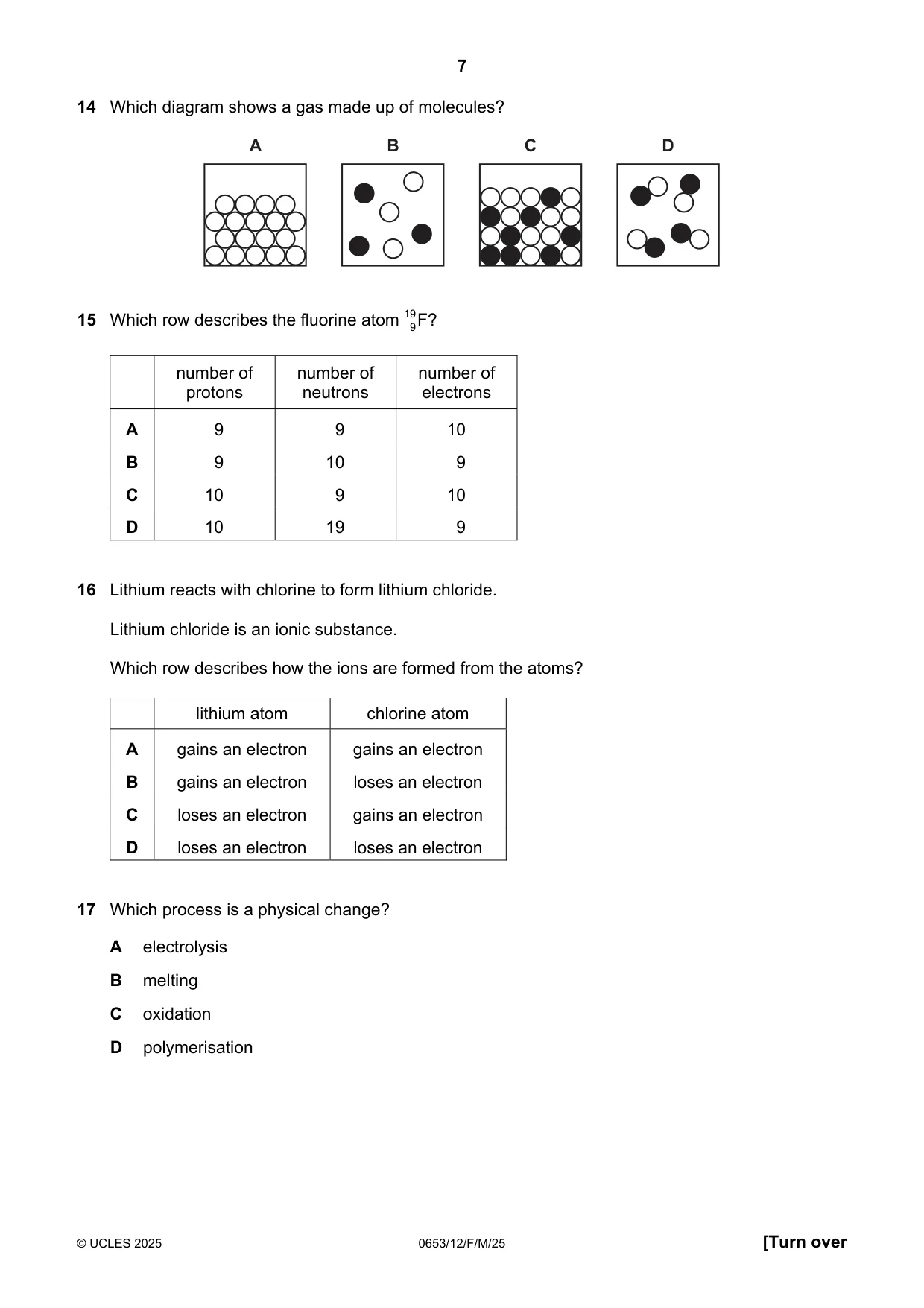
Q14 · Which diagram shows a gas made up of molecules?
14 Which diagram shows a gas made up of molecules? A B C D
Mark scheme: D
Q15 · Which row describes the fluorine atom 19 F?
15 Which row describes the fluorine atom 19 F? 9 number of number of number of protons neutrons electrons A 9 9 10 B 9 10 9 C 10 9 10 D 10 19 9
Mark scheme: B
Q16 · Lithium reacts with chlorine to form lithium chloride
16 Lithium reacts with chlorine to form lithium chloride. Lithium chloride is an ionic substance. Which row describes how the ions are formed from the atoms? lithium atom chlorine atom A gains an electron gains an electron B gains an electron loses an electron C loses an electron gains an electron D loses an electron loses an electron
Mark scheme: C
Q17 · Which process is a physical change?
17 Which process is a physical change? A electrolysis B melting C oxidation D polymerisation
Mark scheme: B
Q18 · Which property is used to arrange elements in order in the Periodic Table?
18 Which property is used to arrange elements in order in the Periodic Table? A the number of neutrons in each atom B the number of neutrons + protons in each atom C the number of protons in each atom D the number of protons + electrons in each atom
Mark scheme: C
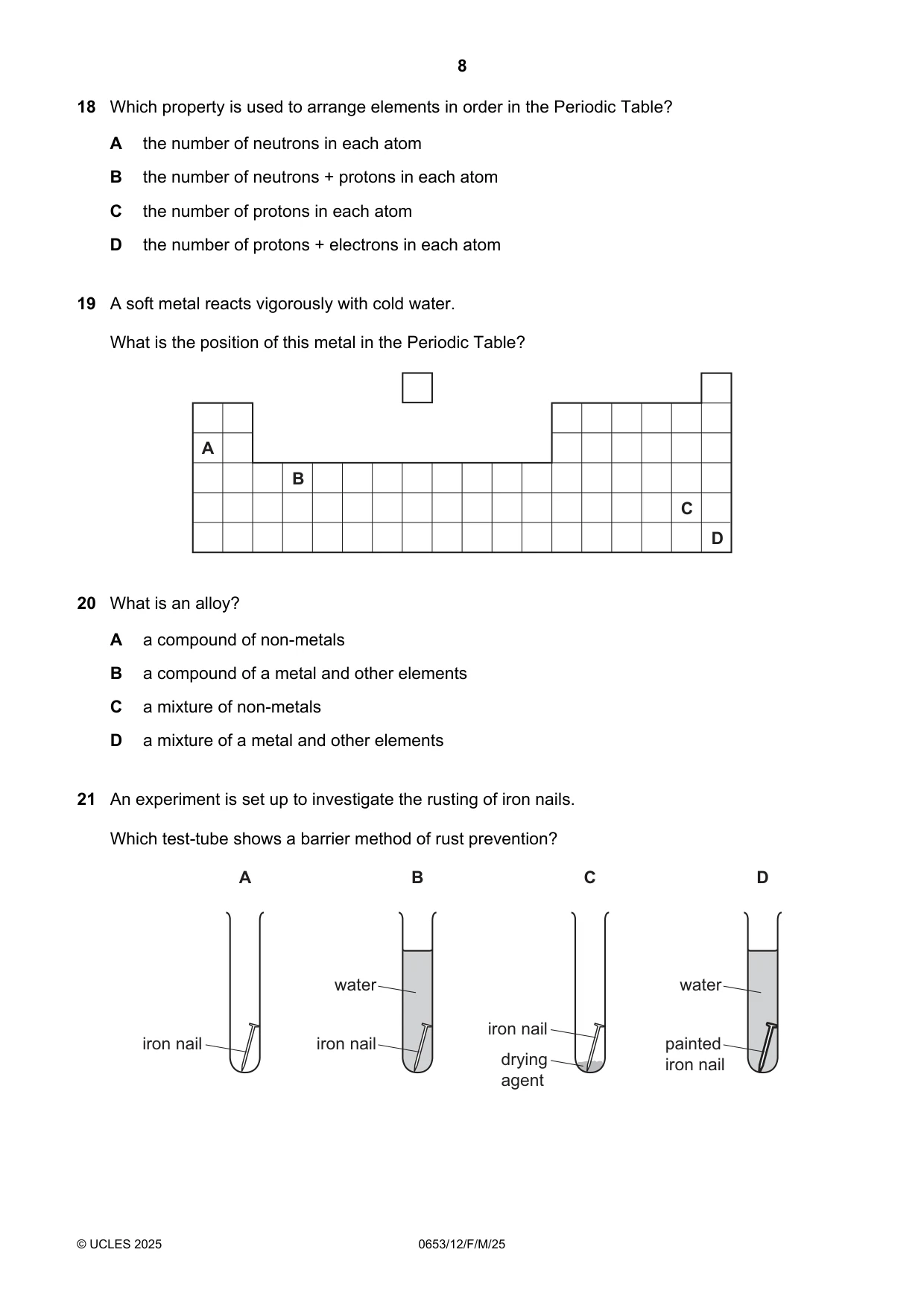
Q19 · A soft metal reacts vigorously with cold water
19 A soft metal reacts vigorously with cold water. What is the position of this metal in the Periodic Table? A B C D
Mark scheme: A
Q20 · What is an alloy?
20 What is an alloy? A a compound of non-metals B a compound of a metal and other elements C a mixture of non-metals D a mixture of a metal and other elements
Mark scheme: D
Q21 · An experiment is set up to investigate the rusting of iron nails
21 An experiment is set up to investigate the rusting of iron nails. Which test-tube shows a barrier method of rust prevention? A B C D water water iron nail iron nail iron nail painted drying iron nail agent
Mark scheme: D
Q22 · Which statement describes the extraction of aluminium?
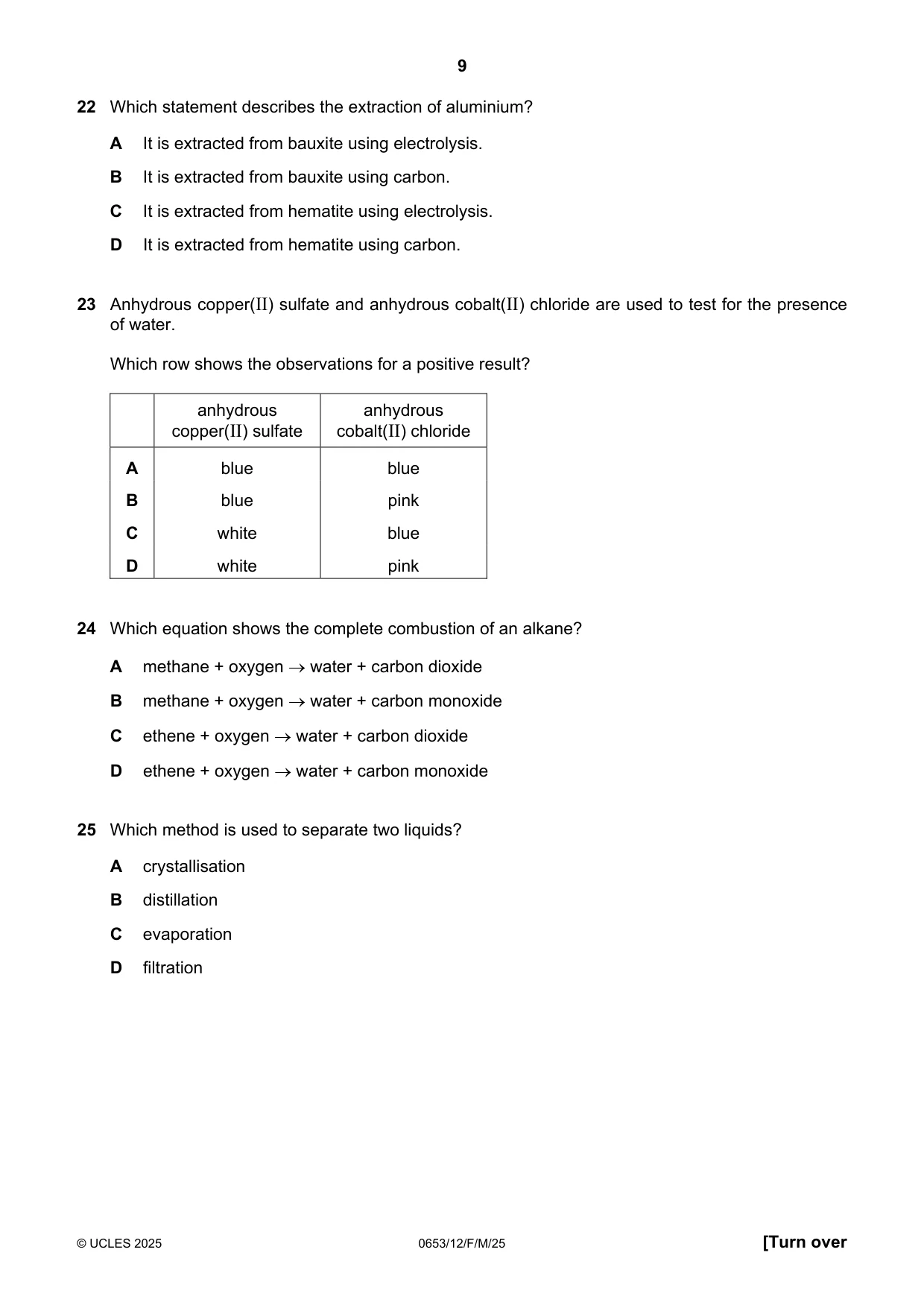
22 Which statement describes the extraction of aluminium? A It is extracted from bauxite using electrolysis. B It is extracted from bauxite using carbon. C It is extracted from hematite using electrolysis. D It is extracted from hematite using carbon.
Mark scheme: A
Q23 · Anhydrous copper(II) sulfate and anhydrous cobalt(II) chloride are used to test for the…
23 Anhydrous copper(II) sulfate and anhydrous cobalt(II) chloride are used to test for the presence of water. Which row shows the observations for a positive result? anhydrous anhydrous copper(II) sulfate cobalt(II) chloride A blue blue B blue pink C white blue D white pink
Mark scheme: B
Q24 · Which equation shows the complete combustion of an alkane?
24 Which equation shows the complete combustion of an alkane? A methane + oxygen water + carbon dioxide B methane + oxygen water + carbon monoxide C ethene + oxygen water + carbon dioxide D ethene + oxygen water + carbon monoxide
Mark scheme: A
Q25 · Which method is used to separate two liquids?
25 Which method is used to separate two liquids? A crystallisation B distillation C evaporation D filtration
Mark scheme: B
Q26 · The results of tests done on three gases, X, Y and Z, are shown
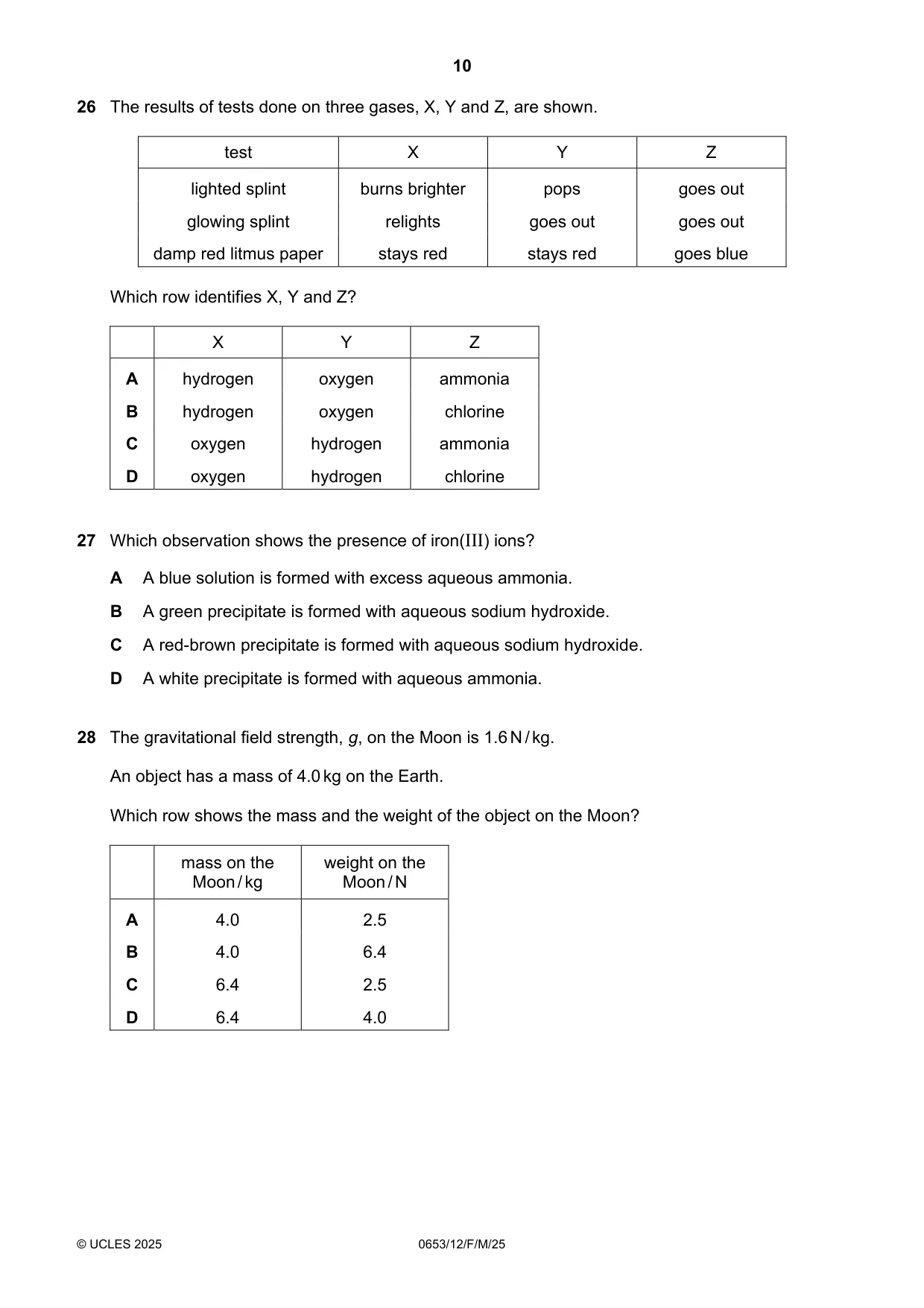
26 The results of tests done on three gases, X, Y and Z, are shown. test X Y Z lighted splint burns brighter pops goes out glowing splint relights goes out goes out damp red litmus paper stays red stays red goes blue Which row identifies X, Y and Z? X Y Z A hydrogen oxygen ammonia B hydrogen oxygen chlorine C oxygen hydrogen ammonia D oxygen hydrogen chlorine
Mark scheme: C
Q27 · Which observation shows the presence of iron(III) ions?
27 Which observation shows the presence of iron(III) ions? A A blue solution is formed with excess aqueous ammonia. B A green precipitate is formed with aqueous sodium hydroxide. C A red-brown precipitate is formed with aqueous sodium hydroxide. D A white precipitate is formed with aqueous ammonia.
Mark scheme: C
Q28 · The gravitational field strength, g, on the Moon is 1.6 N / kg
28 The gravitational field strength, g, on the Moon is 1.6 N / kg. An object has a mass of 4.0 kg on the Earth. Which row shows the mass and the weight of the object on the Moon? mass on the weight on the Moon / kg Moon / N A 4.0 2.5 B 4.0 6.4 C 6.4 2.5 D 6.4 4.0
Mark scheme: B
Q29 · A student describes how electricity is generated using an energy resource
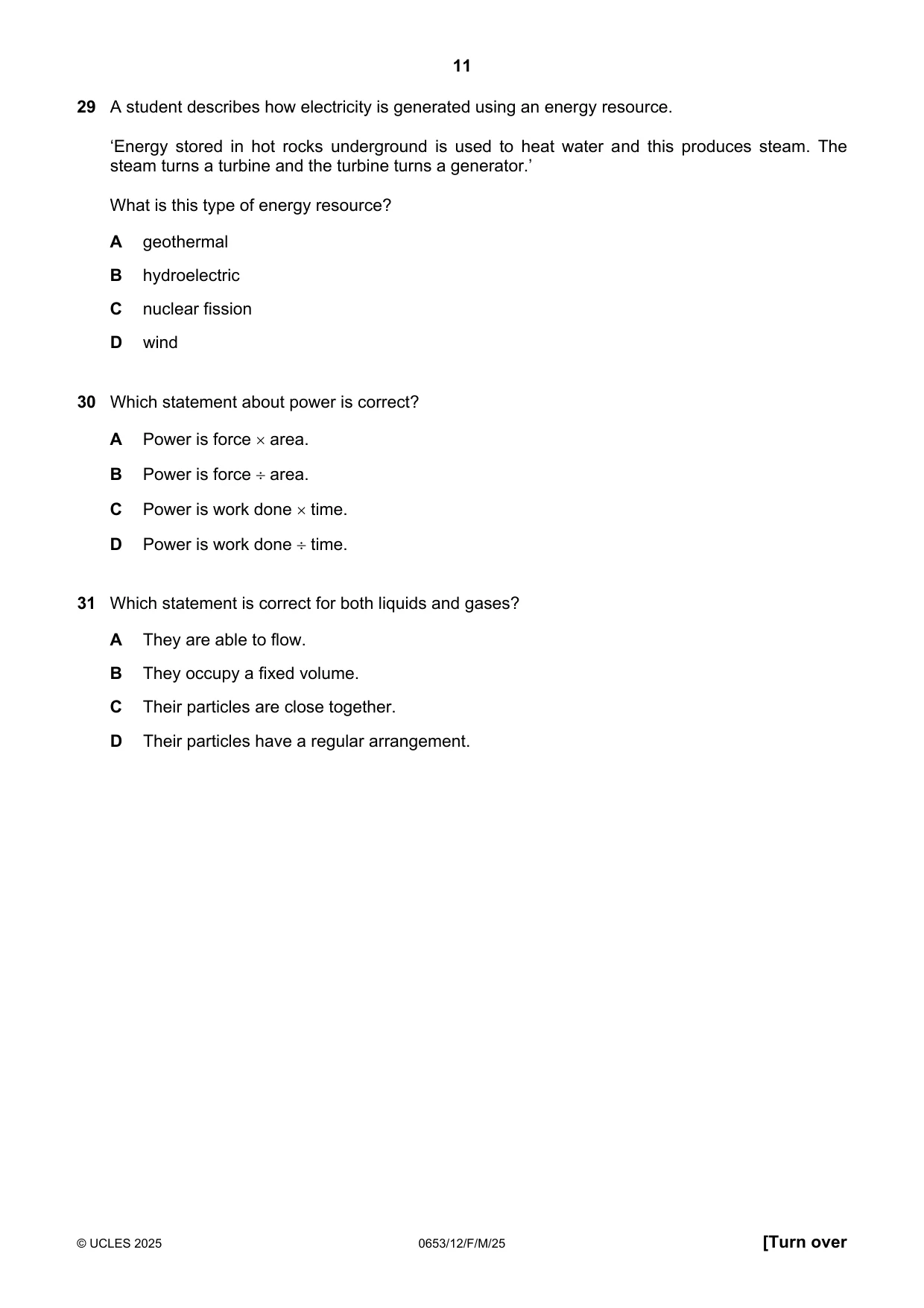
29 A student describes how electricity is generated using an energy resource. ‘Energy stored in hot rocks underground is used to heat water and this produces steam. The steam turns a turbine and the turbine turns a generator.’ What is this type of energy resource? A geothermal B hydroelectric C nuclear fission D wind
Mark scheme: A
Q30 · Which statement about power is correct?
30 Which statement about power is correct? A Power is force area. B Power is force area. C Power is work done time. D Power is work done time.
Mark scheme: D
Q31 · Which statement is correct for both liquids and gases?
31 Which statement is correct for both liquids and gases? A They are able to flow. B They occupy a fixed volume. C Their particles are close together. D Their particles have a regular arrangement.
Mark scheme: A
Q32 · The diagram shows a glass flask with a stopper
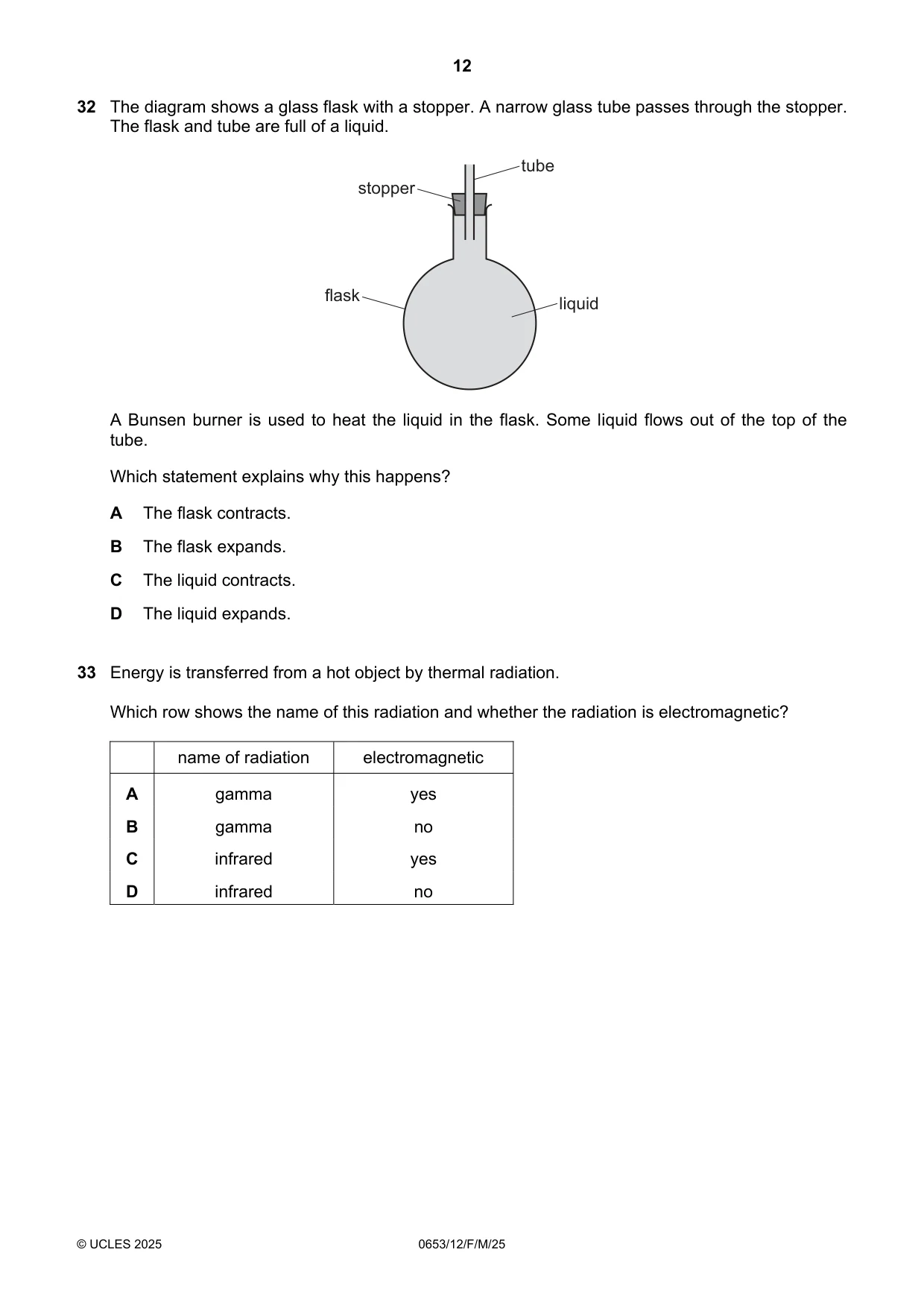
32 The diagram shows a glass flask with a stopper. A narrow glass tube passes through the stopper. The flask and tube are full of a liquid. tube stopper flask liquid A Bunsen burner is used to heat the liquid in the flask. Some liquid flows out of the top of the tube. Which statement explains why this happens? A The flask contracts. B The flask expands. C The liquid contracts. D The liquid expands.
Mark scheme: D
Q33 · Energy is transferred from a hot object by thermal radiation
33 Energy is transferred from a hot object by thermal radiation. Which row shows the name of this radiation and whether the radiation is electromagnetic? name of radiation electromagnetic A gamma yes B gamma no C infrared yes D infrared no
Mark scheme: C
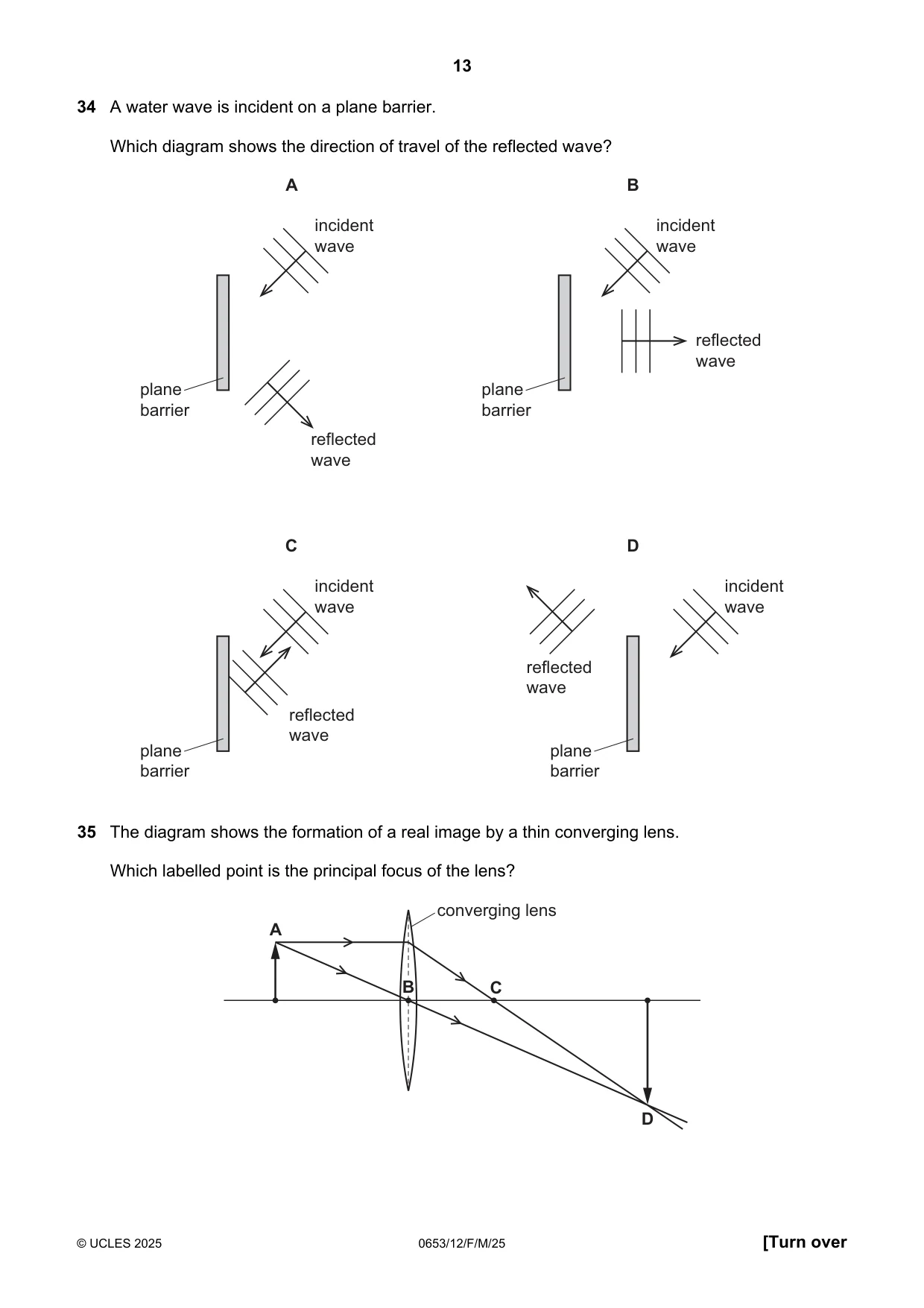
Q34 · A water wave is incident on a plane barrier
34 A water wave is incident on a plane barrier. Which diagram shows the direction of travel of the reflected wave? A B incident incident wave wave reflected wave plane plane barrier barrier reflected wave C D incident incident wave wave reflected wave reflected wave plane plane barrier barrier
Mark scheme: A
Q35 · The diagram shows the formation of a real image by a thin converging lens
35 The diagram shows the formation of a real image by a thin converging lens. Which labelled point is the principal focus of the lens? converging lens A B C D
Mark scheme: C
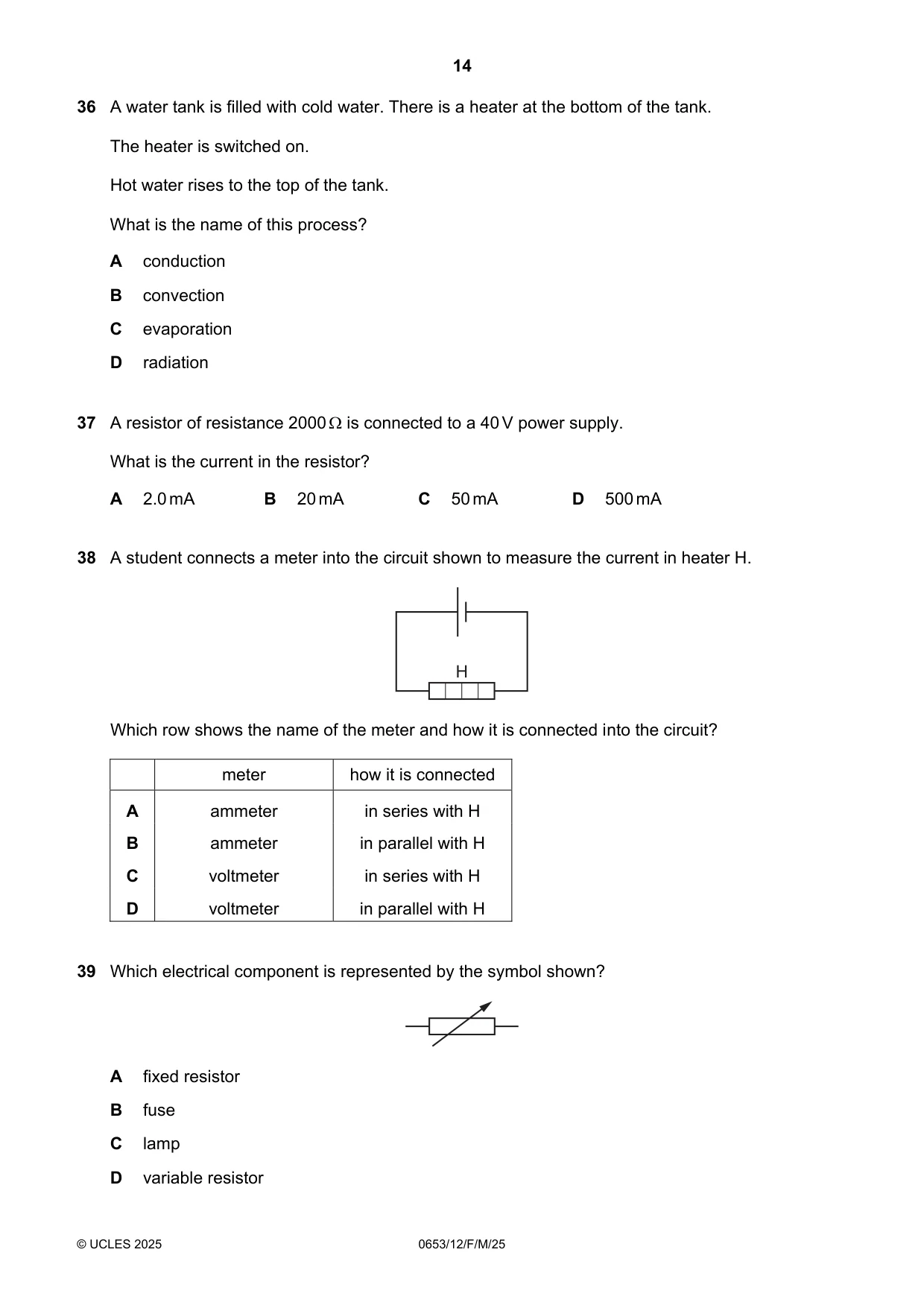
Q36 · A water tank is filled with cold water
36 A water tank is filled with cold water. There is a heater at the bottom of the tank. The heater is switched on. Hot water rises to the top of the tank. What is the name of this process? A conduction B convection C evaporation D radiation
Mark scheme: B
Q37 · A resistor of resistance 2000 is connected to a 40 V power supply
37 A resistor of resistance 2000 is connected to a 40 V power supply. What is the current in the resistor? A 2.0 mA B 20 mA C 50 mA D 500 mA
Mark scheme: B
Q38 · A student connects a meter into the circuit shown to measure the current in heater H
38 A student connects a meter into the circuit shown to measure the current in heater H. H Which row shows the name of the meter and how it is connected into the circuit? meter how it is connected A ammeter in series with H B ammeter in parallel with H C voltmeter in series with H D voltmeter in parallel with H
Mark scheme: A
Q39 · Which electrical component is represented by the symbol shown?
39 Which electrical component is represented by the symbol shown? A fixed resistor B fuse C lamp D variable resistor
Mark scheme: D
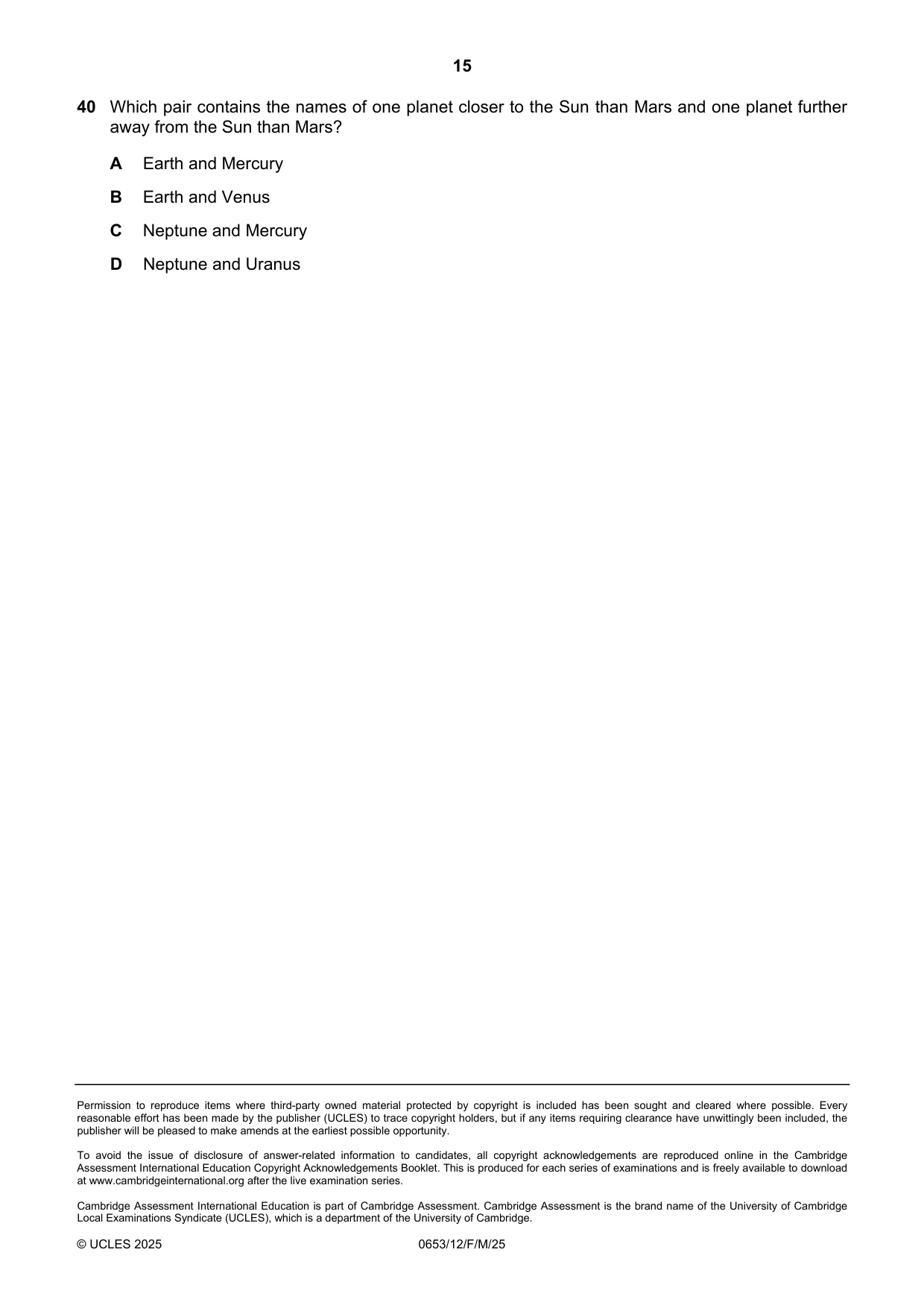
Q40 · Which pair contains the names of one planet closer to the Sun than Mars and one planet…
40 Which pair contains the names of one planet closer to the Sun than Mars and one planet further away from the Sun than Mars? A Earth and Mercury B Earth and Venus C Neptune and Mercury D Neptune and Uranus
Mark scheme: C
What was in this paper
The subtopics covered by these 40 questions, and how many questions each got. Open one in a new tab to see every Cambridge question on it.
2Energy, work and power2Identification of ions and gases2Transfer of thermal energy2Alloys and their properties1Arrangement of elements1Atomic structure and the Periodic Table1Biological molecules1Blood1Cell structure1Characteristics of living organisms1Corrosion of metals1Diet1Digestion1Digestive system1Electrical quantities1Enzymes1Extraction of metals1Food chains and food webs1Fuels1General properties of waves1Group I properties1Ions and ionic bonds1Kinetic particle model of matter1Leaf structure1Light1Mass and weight1Physical and chemical changes1Respiration1Separation and purification1Sexual reproduction in humans1Solids, liquids and gases1The Solar System1Thermal properties and temperature1Water1Xylem and phloem1What you needed in this session
Cambridge’s own grade thresholds for 2025 Feb/March, Paper 1 · Variant 2. A higher threshold means an easier paper — the bar moves with how the cohort did.