Cambridge IGCSE Science - Combined 0653 — 2015 Oct/Nov Paper 1 · Variant 2
0653/12/O/N/15 · 40 questions · 40 marks · ≈45 min
The question paper and its mark scheme, free to read here and free to download. This is Cambridge’s own paper, exactly as it was sat.
Question paper16 pages
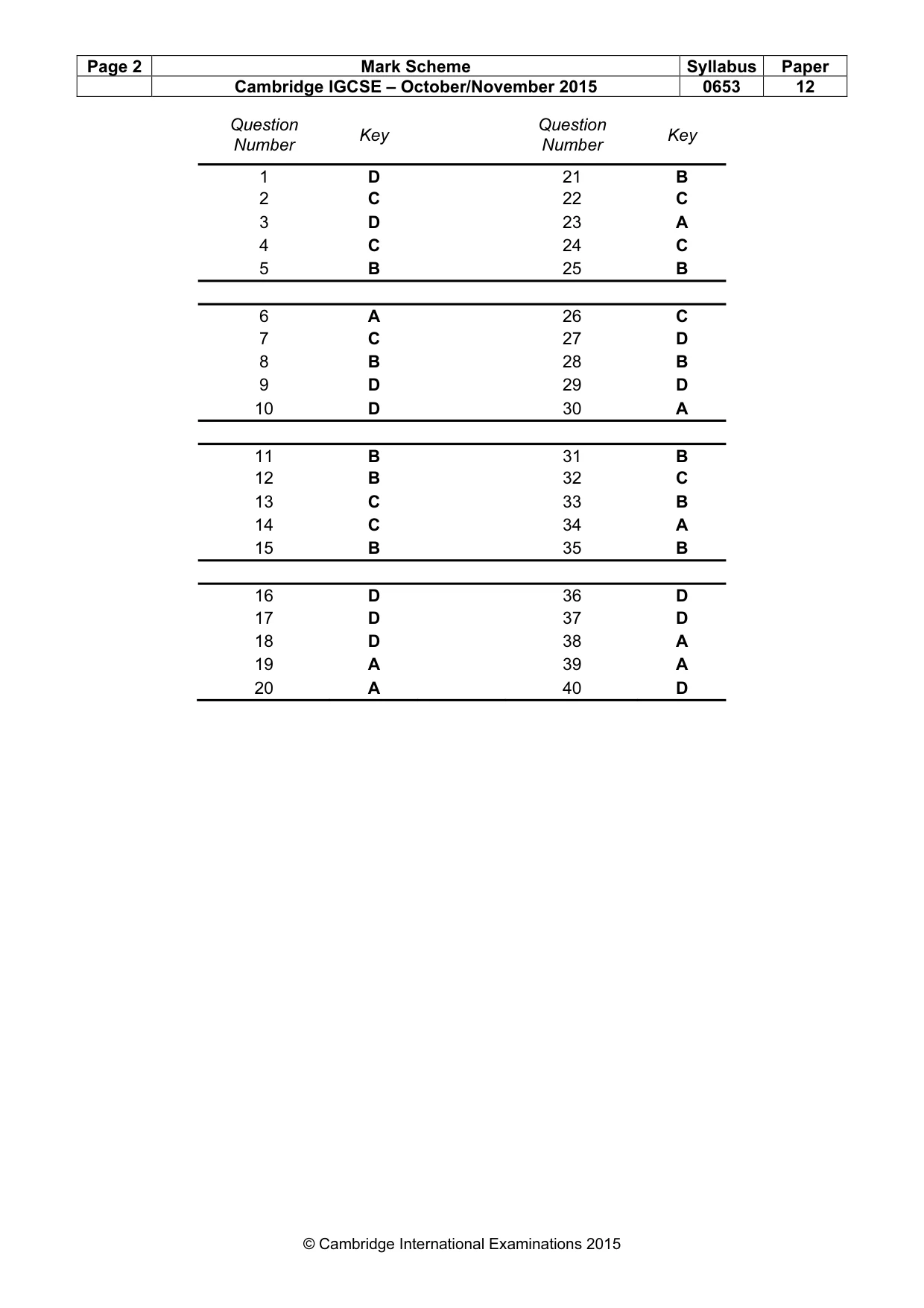
Mark scheme2 pages
Answers below. Sit the paper first if you are practising.
Questions as text
Q1 · Which is a characteristic of all living organisms?
1 Which is a characteristic of all living organisms? A breathing B eating C egestion D movement
Mark scheme: D
Q2 · Which process depends on diffusion?
2 Which process depends on diffusion? A circulation B digestion C gaseous exchange D phagocytosis
Mark scheme: C
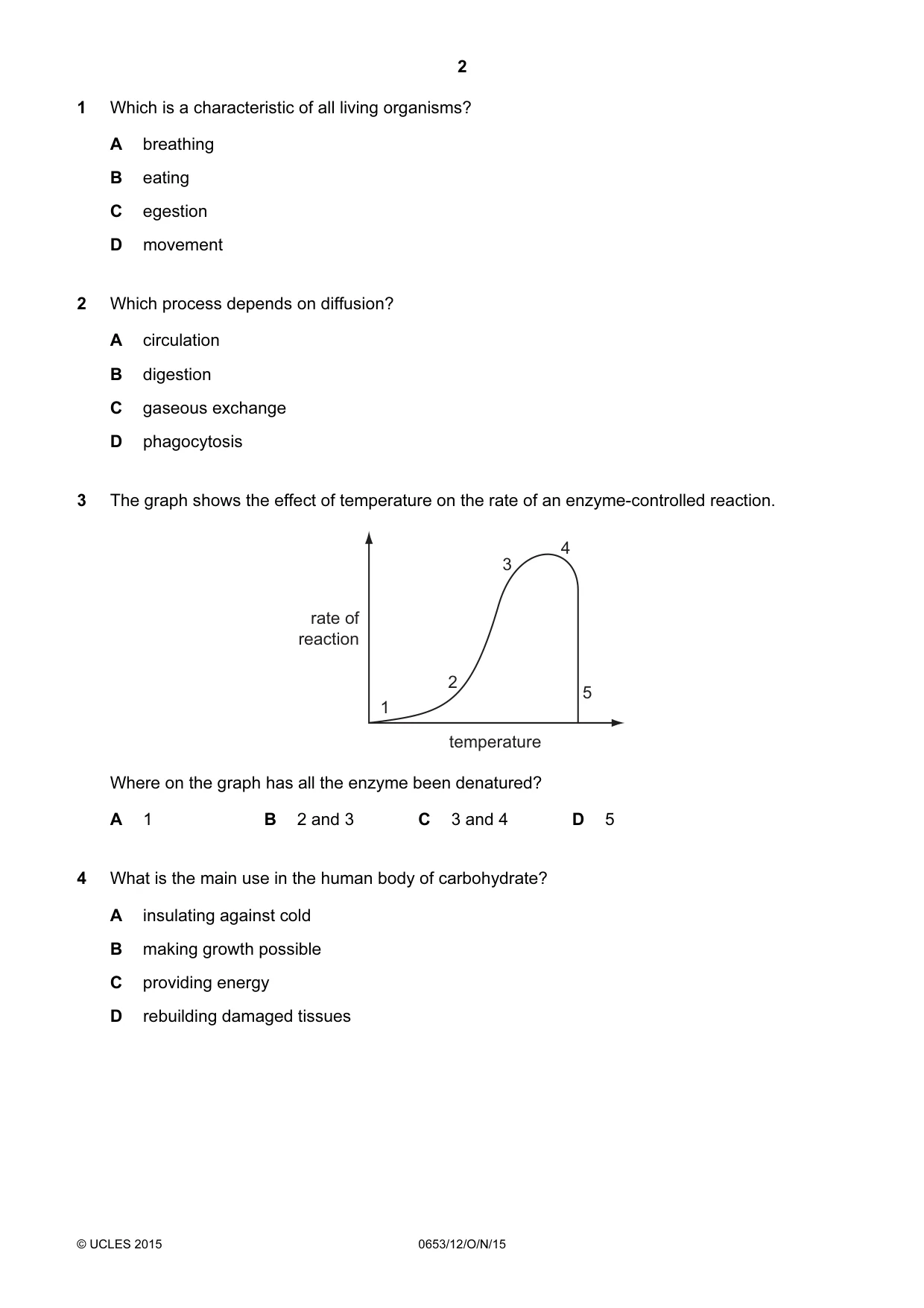
Q3 · The graph shows the effect of temperature on the rate of an enzyme-controlled reaction
3 The graph shows the effect of temperature on the rate of an enzyme-controlled reaction. 4 3 rate of reaction 2 5 1 temperature Where on the graph has all the enzyme been denatured? A 1 B 2 and 3 C 3 and 4 D 5
Mark scheme: D
Q4 · What is the main use in the human body of carbohydrate?
4 What is the main use in the human body of carbohydrate? A insulating against cold B making growth possible C providing energy D rebuilding damaged tissues
Mark scheme: C
Q5 · Which mineral salt and which vitamin does a child need to produce strong bones?
5 Which mineral salt and which vitamin does a child need to produce strong bones? mineral salt vitamin A calcium C B calcium D C iron C D iron D
Mark scheme: B
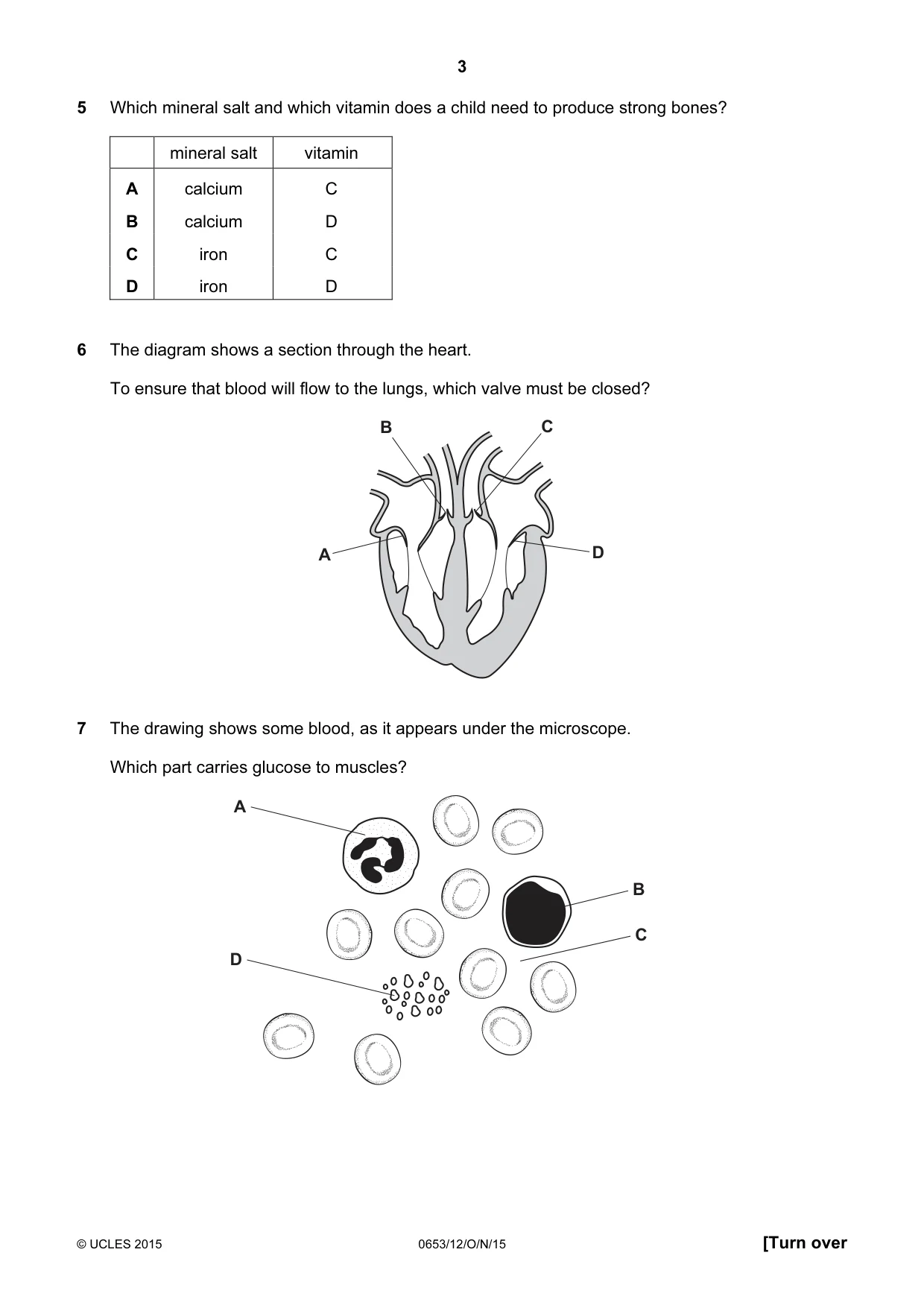
Q6 · The diagram shows a section through the heart
6 The diagram shows a section through the heart. To ensure that blood will flow to the lungs, which valve must be closed? B C A D
Mark scheme: A
Q7 · The drawing shows some blood, as it appears under the microscope
7 The drawing shows some blood, as it appears under the microscope. Which part carries glucose to muscles? A B C D
Mark scheme: C
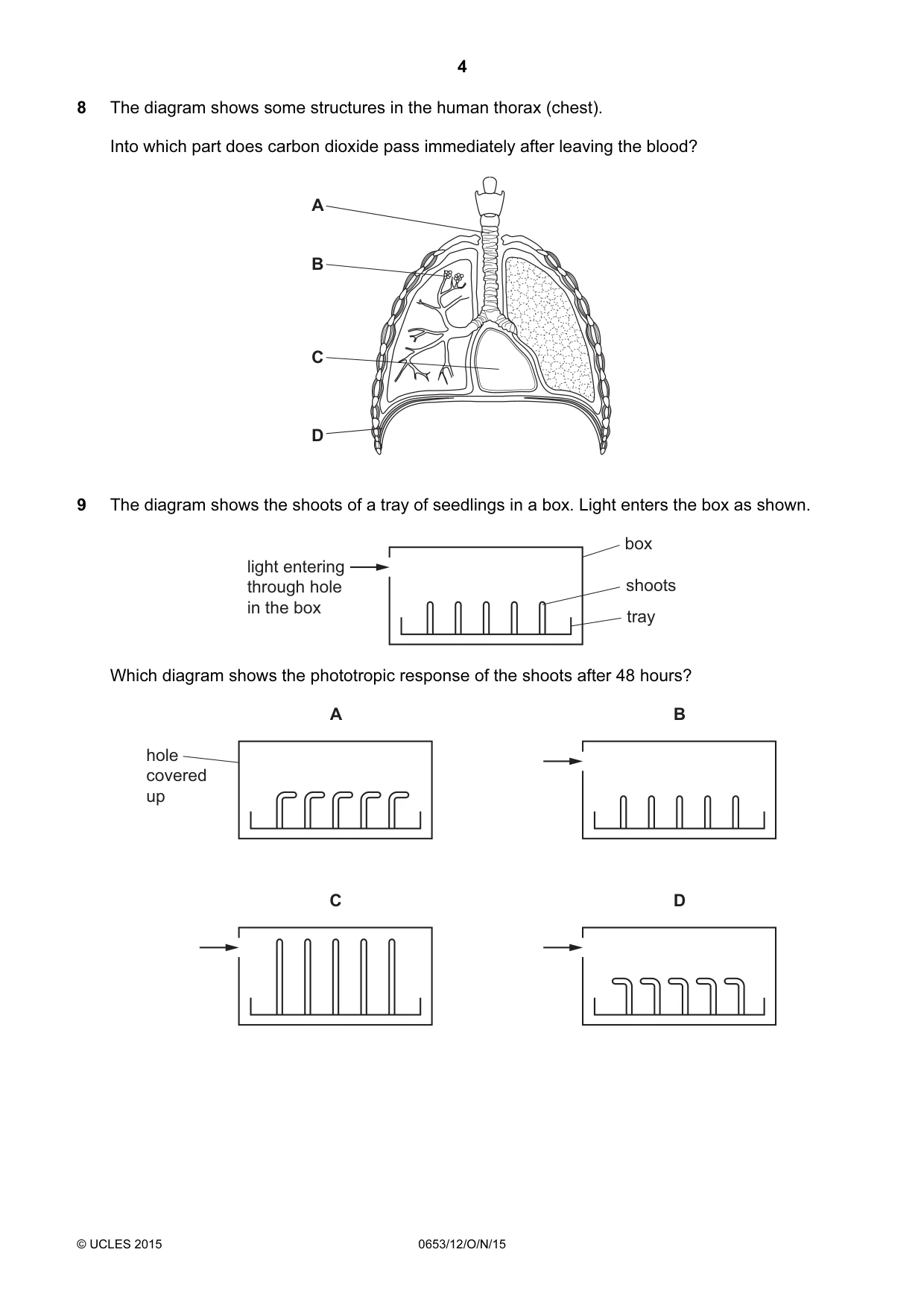
Q8 · The diagram shows some structures in the human thorax (chest)
8 The diagram shows some structures in the human thorax (chest). Into which part does carbon dioxide pass immediately after leaving the blood? A B C D
Mark scheme: B
Q9 · The diagram shows the shoots of a tray of seedlings in a box
9 The diagram shows the shoots of a tray of seedlings in a box. Light enters the box as shown. box light entering through hole shoots in the box tray Which diagram shows the phototropic response of the shoots after 48 hours? A B hole covered up C D
Mark scheme: D
Q10 · When an athlete prepares for the start of a sprint race, excitement causes the…
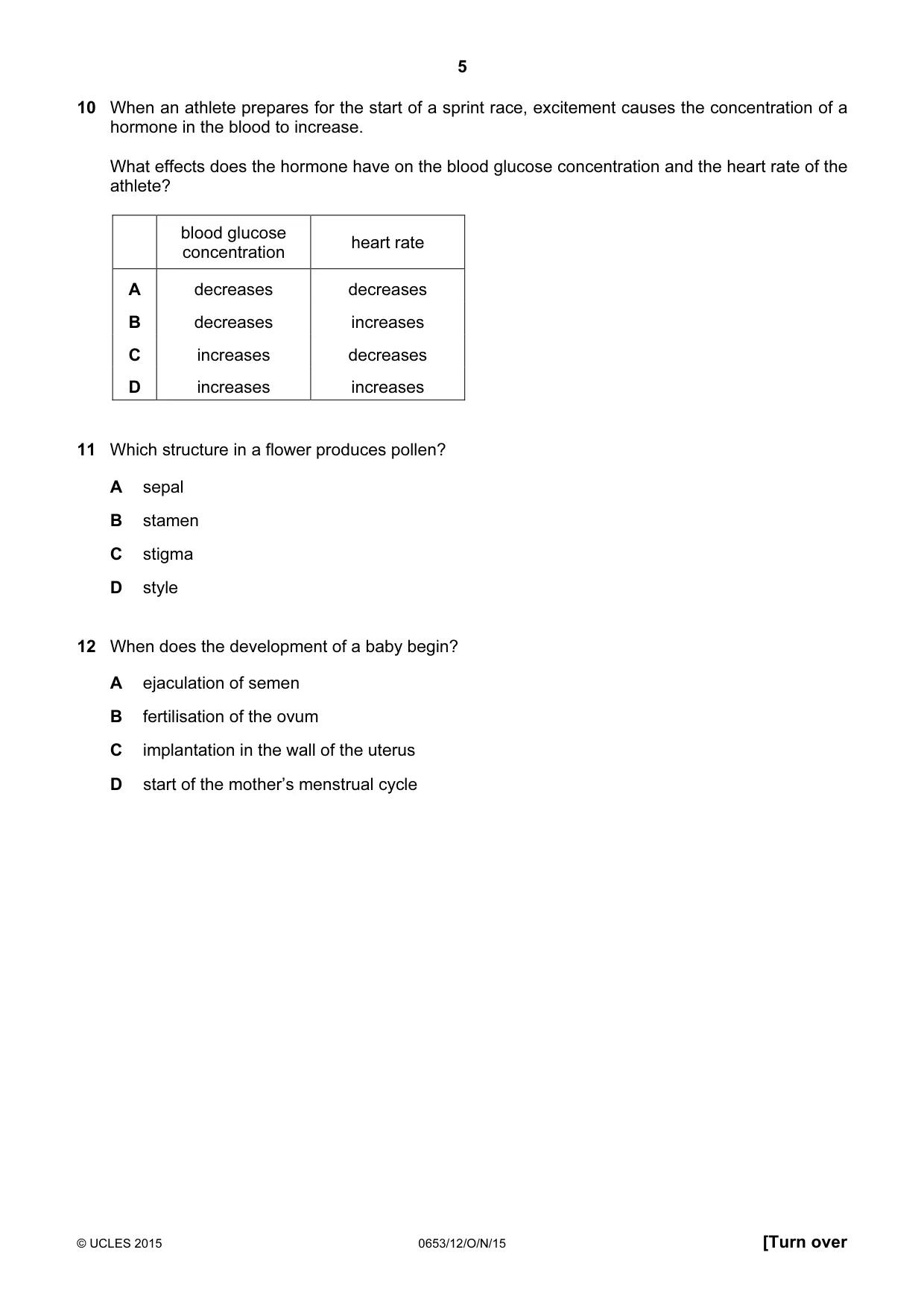
10 When an athlete prepares for the start of a sprint race, excitement causes the concentration of a hormone in the blood to increase. What effects does the hormone have on the blood glucose concentration and the heart rate of the athlete? blood glucose heart rate concentration A decreases decreases B decreases increases C increases decreases D increases increases
Mark scheme: D
Q11 · Which structure in a flower produces pollen?
11 Which structure in a flower produces pollen? A sepal B stamen C stigma D style
Mark scheme: B
Q12 · When does the development of a baby begin?
12 When does the development of a baby begin? A ejaculation of semen B fertilisation of the ovum C implantation in the wall of the uterus D start of the mother’s menstrual cycle
Mark scheme: B
Q13 · The diagram shows part of the carbon cycle
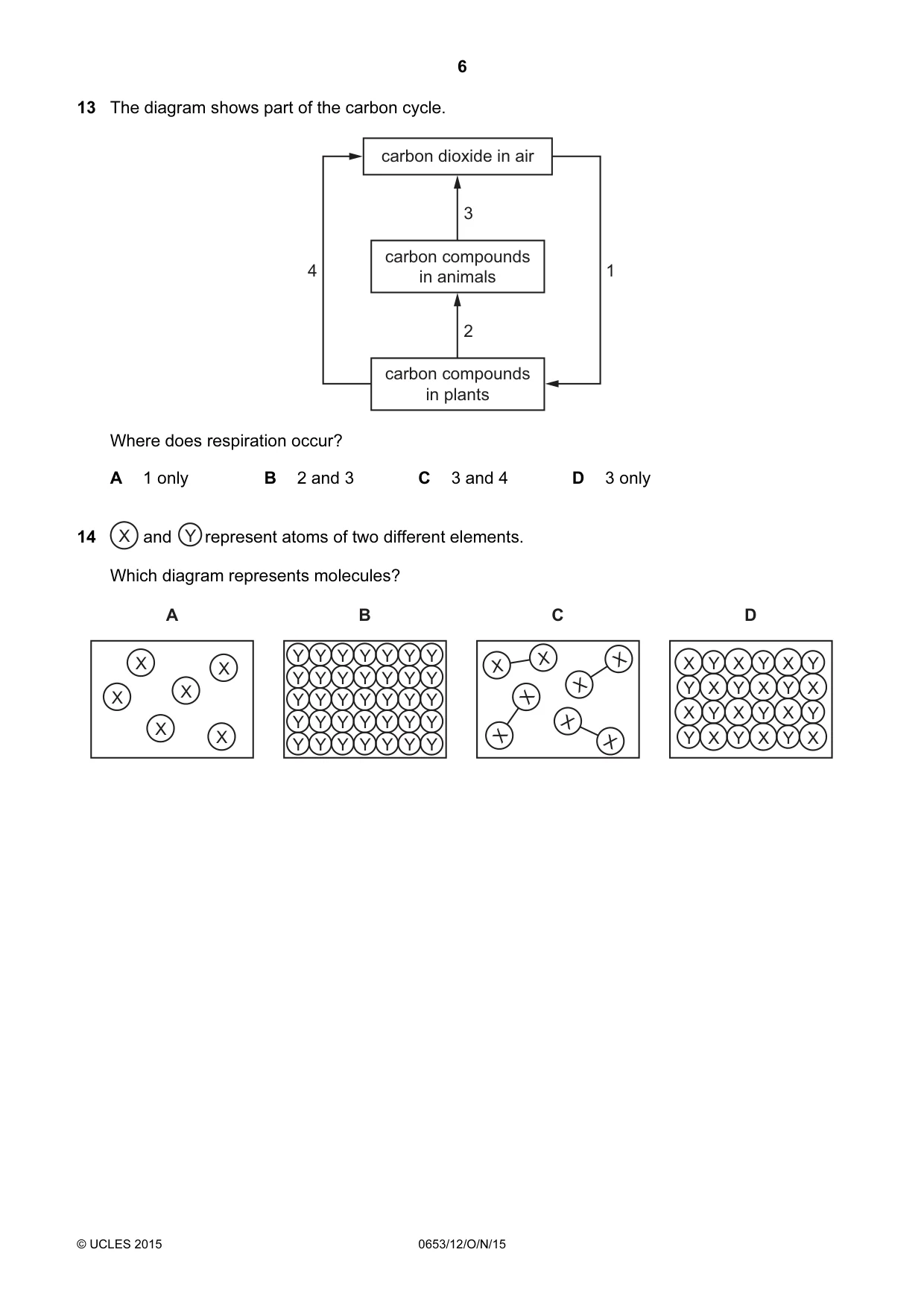
13 The diagram shows part of the carbon cycle. carbon dioxide in air 3 carbon compounds 4 in animals 1 2 carbon compounds in plants Where does respiration occur? A 1 only B 2 and 3 C 3 and 4 D 3 only
Mark scheme: C
Q14 · And represent atoms of two different elements
14 and represent atoms of two different elements. X Y Which diagram represents molecules? A B C D Y Y Y Y Y Y Y X X X Y X Y X X X X Y Y Y Y Y Y Y Y X X X Y X Y X Y X X Y Y Y Y Y Y Y X X Y X Y X Y X Y Y Y Y Y Y Y X X X Y X Y X Y X Y Y Y Y Y Y Y
Mark scheme: C
Q15 · In an experiment, a mixture of 0.5 g of copper and 3 g of zinc is added to an excess of…
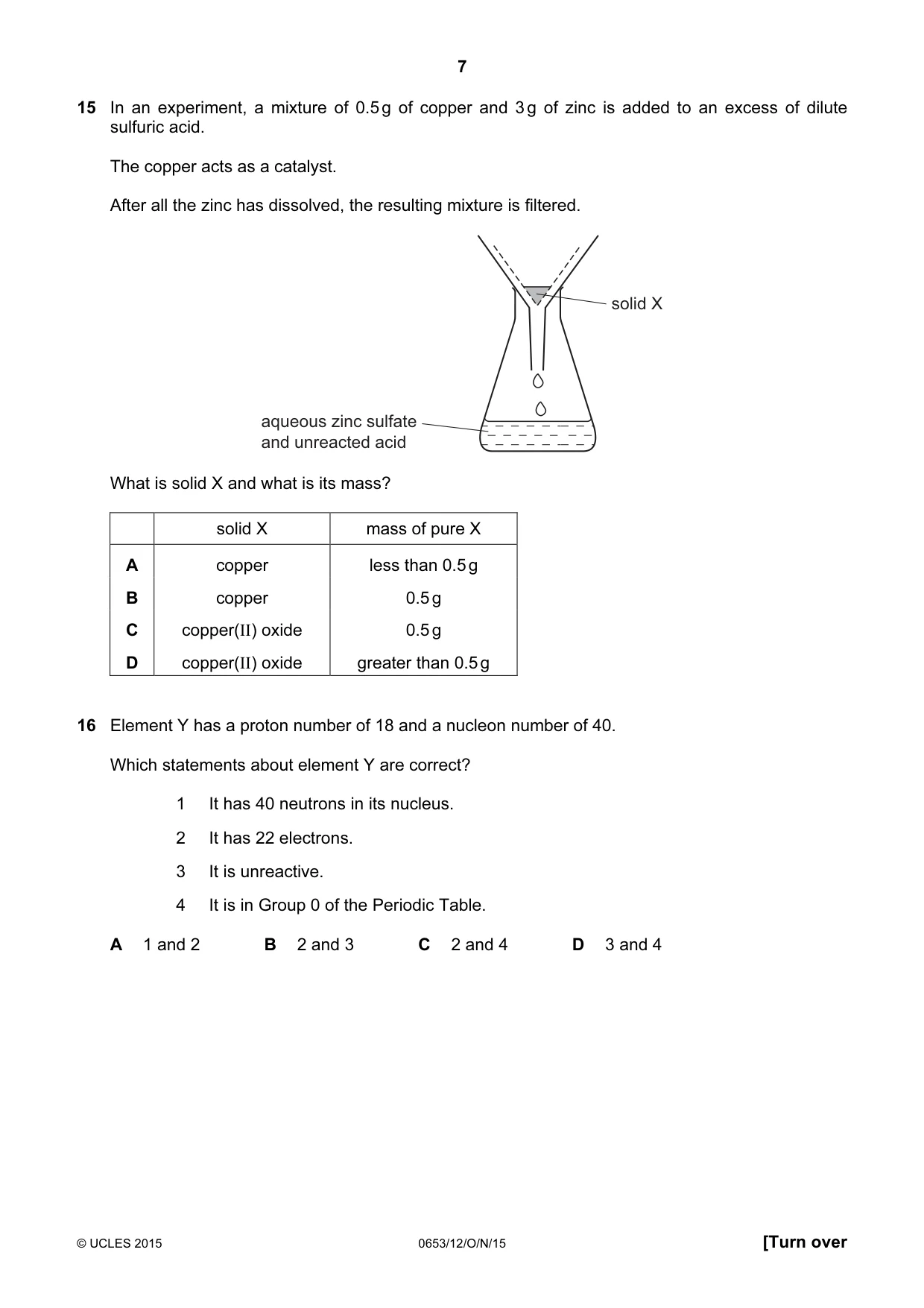
15 In an experiment, a mixture of 0.5 g of copper and 3 g of zinc is added to an excess of dilute sulfuric acid. The copper acts as a catalyst. After all the zinc has dissolved, the resulting mixture is filtered. solid X aqueous zinc sulfate and unreacted acid What is solid X and what is its mass? solid X mass of pure X A copper less than 0.5 g B copper 0.5 g C copper(II) oxide 0.5 g D copper(II) oxide greater than 0.5 g
Mark scheme: B
Q16 · Element Y has a proton number of 18 and a nucleon number of 40
16 Element Y has a proton number of 18 and a nucleon number of 40. Which statements about element Y are correct? 1 It has 40 neutrons in its nucleus. 2 It has 22 electrons. 3 It is unreactive. 4 It is in Group 0 of the Periodic Table. A 1 and 2 B 2 and 3 C 2 and 4 D 3 and 4
Mark scheme: D
Q17 · The structure of a hydrocarbon is shown
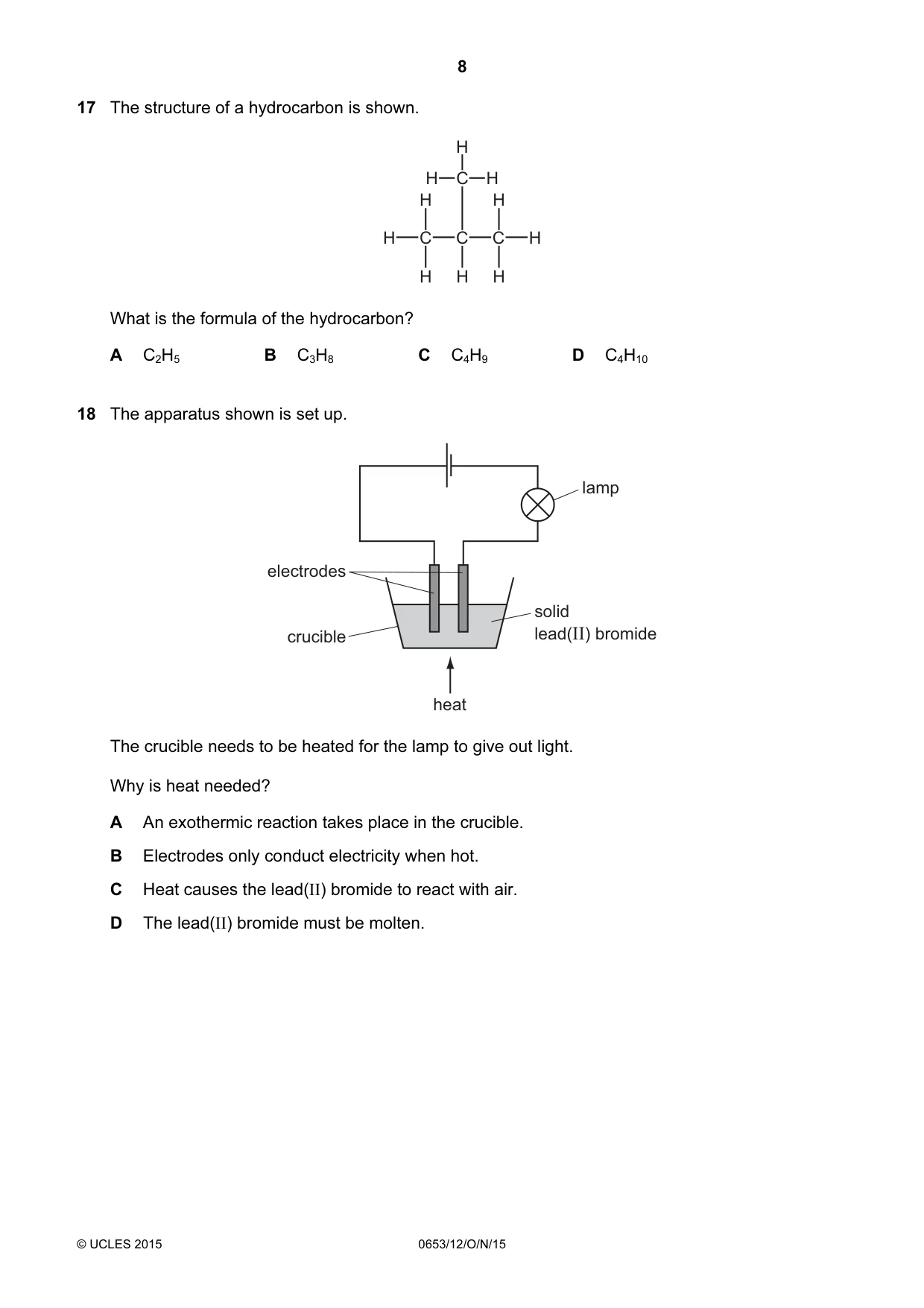
17 The structure of a hydrocarbon is shown. H H C H H H H C C C H H H H What is the formula of the hydrocarbon? A C2H5 B C3H8 C C4H9 D C4H10
Mark scheme: D
Q18 · The apparatus shown is set up
18 The apparatus shown is set up. lamp electrodes solid crucible lead(II) bromide heat The crucible needs to be heated for the lamp to give out light. Why is heat needed? A An exothermic reaction takes place in the crucible. B Electrodes only conduct electricity when hot. C Heat causes the lead(II) bromide to react with air. D The lead(II) bromide must be molten.
Mark scheme: D
Q19 · Four different solids are added to water
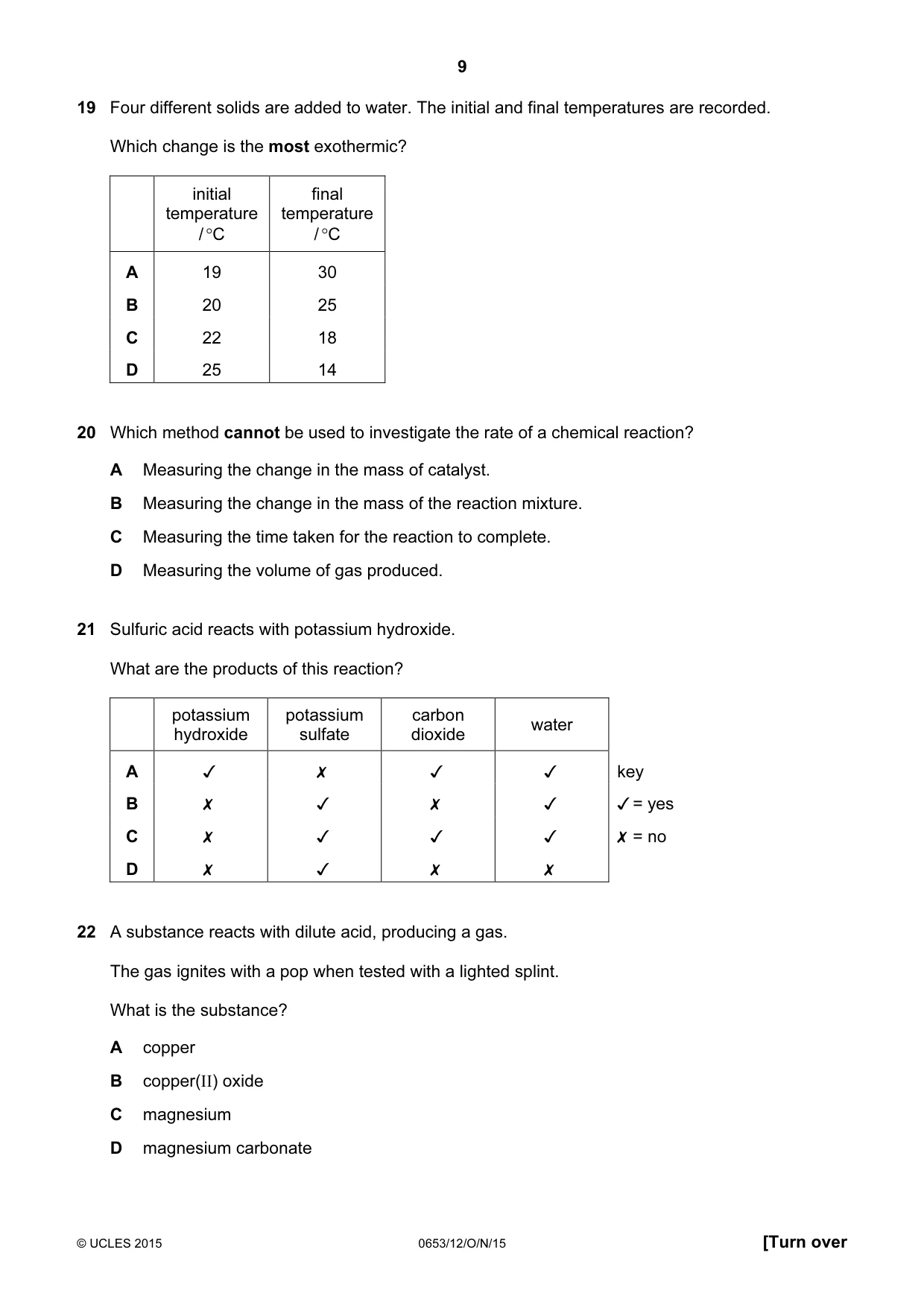
19 Four different solids are added to water. The initial and final temperatures are recorded. Which change is the most exothermic? initial final temperature temperature / °C / °C A 19 30 B 20 25 C 22 18 D 25 14
Mark scheme: A
Q20 · Which method cannot be used to investigate the rate of a chemical reaction?
20 Which method cannot be used to investigate the rate of a chemical reaction? A Measuring the change in the mass of catalyst. B Measuring the change in the mass of the reaction mixture. C Measuring the time taken for the reaction to complete. D Measuring the volume of gas produced.
Mark scheme: A
Q21 · Sulfuric acid reacts with potassium hydroxide
21 Sulfuric acid reacts with potassium hydroxide. What are the products of this reaction? potassium potassium carbon water hydroxide sulfate dioxide A v x v Jv key B x v x v Jv =yes Cc x v v v XxX =no D x v x x
Mark scheme: B
More questions on The characteristic properties of acids and bases
Q22 · A substance reacts with dilute acid, producing a gas
22 A substance reacts with dilute acid, producing a gas. The gas ignites with a pop when tested with a lighted splint. What is the substance? A copper B copper(II) oxide C magnesium D magnesium carbonate
Mark scheme: C
Q23 · The positions of four elements are shown in the outline of the Periodic Table
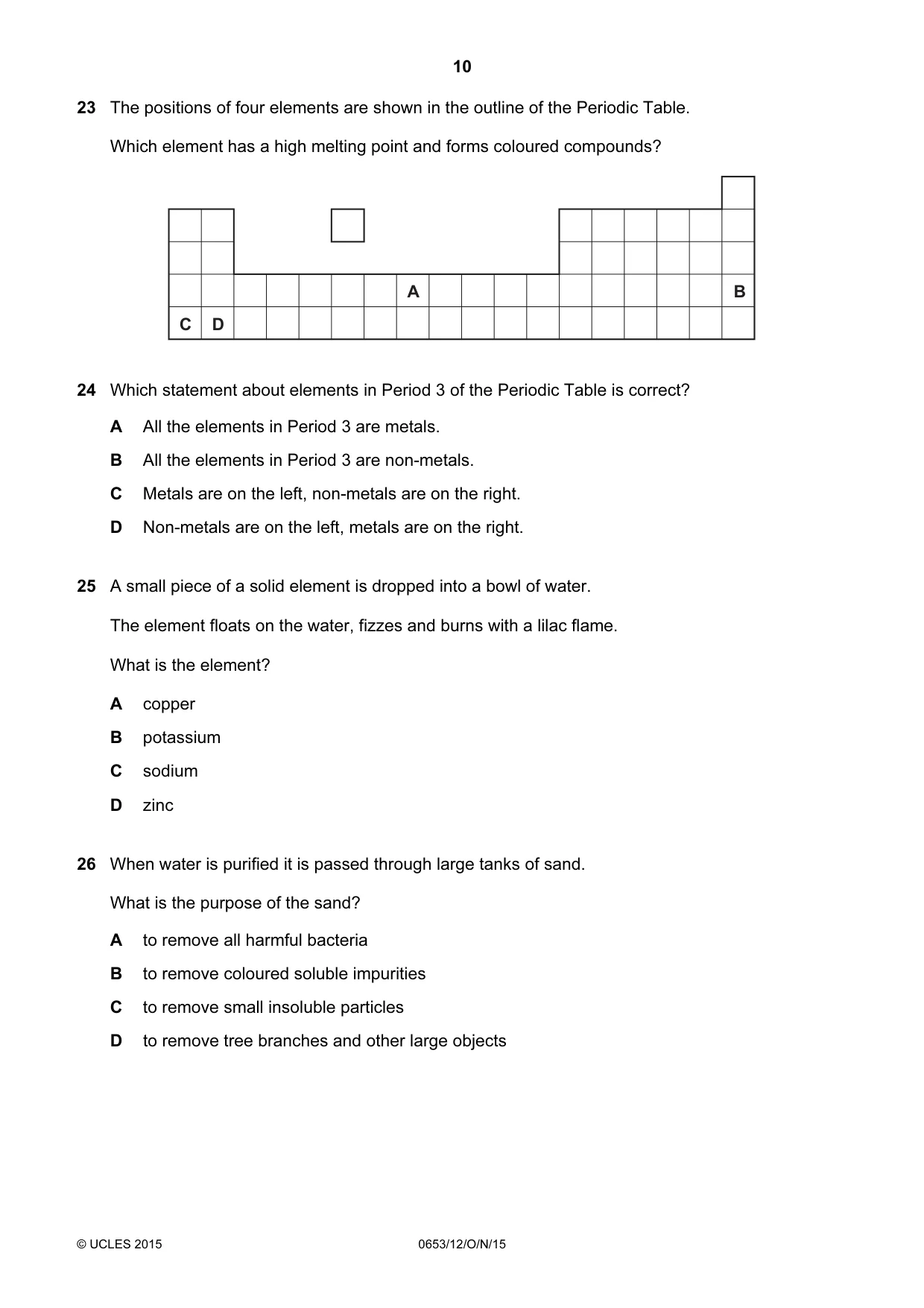
23 The positions of four elements are shown in the outline of the Periodic Table. Which element has a high melting point and forms coloured compounds? A B C D
Mark scheme: A
Q24 · Which statement about elements in Period 3 of the Periodic Table is correct?
24 Which statement about elements in Period 3 of the Periodic Table is correct? A All the elements in Period 3 are metals. B All the elements in Period 3 are non-metals. C Metals are on the left, non-metals are on the right. D Non-metals are on the left, metals are on the right.
Mark scheme: C
Q25 · A small piece of a solid element is dropped into a bowl of water
25 A small piece of a solid element is dropped into a bowl of water. The element floats on the water, fizzes and burns with a lilac flame. What is the element? A copper B potassium C sodium D zinc
Mark scheme: B
Q26 · When water is purified it is passed through large tanks of sand
26 When water is purified it is passed through large tanks of sand. What is the purpose of the sand? A to remove all harmful bacteria B to remove coloured soluble impurities C to remove small insoluble particles D to remove tree branches and other large objects
Mark scheme: C
Q27 · Methane, ethane and propane are all alkanes
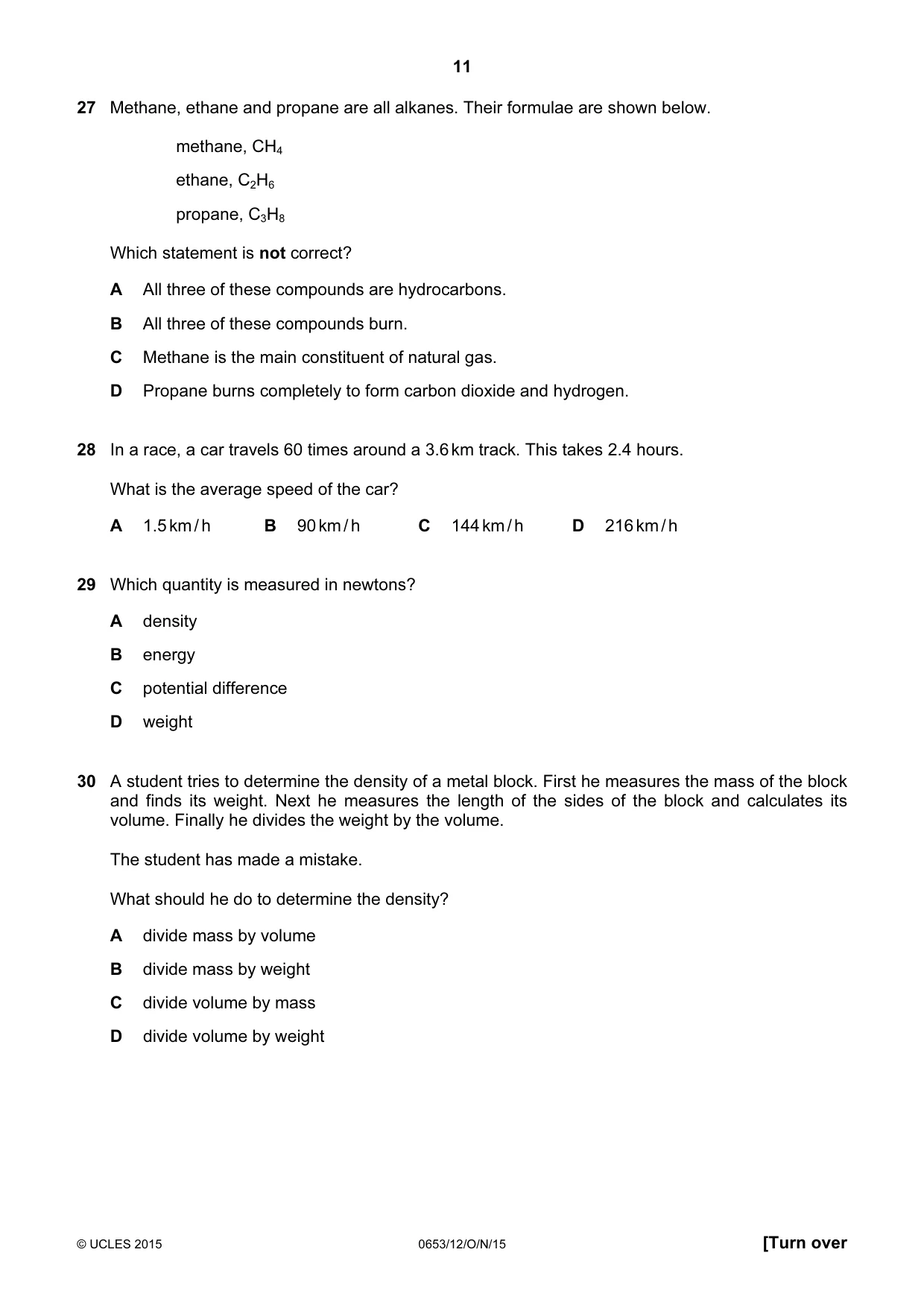
27 Methane, ethane and propane are all alkanes. Their formulae are shown below. methane, CH4 ethane, C2H6 propane, C3H8 Which statement is not correct? A All three of these compounds are hydrocarbons. B All three of these compounds burn. C Methane is the main constituent of natural gas. D Propane burns completely to form carbon dioxide and hydrogen.
Mark scheme: D
Q28 · In a race, a car travels 60 times around a 3.6 km track
28 In a race, a car travels 60 times around a 3.6 km track. This takes 2.4 hours. What is the average speed of the car? A 1.5 km / h B 90 km / h C 144 km / h D 216 km / h
Mark scheme: B
Q29 · Which quantity is measured in newtons?
29 Which quantity is measured in newtons? A density B energy C potential difference D weight
Mark scheme: D
Q30 · A student tries to determine the density of a metal block
30 A student tries to determine the density of a metal block. First he measures the mass of the block and finds its weight. Next he measures the length of the sides of the block and calculates its volume. Finally he divides the weight by the volume. The student has made a mistake. What should he do to determine the density? A divide mass by volume B divide mass by weight C divide volume by mass D divide volume by weight
Mark scheme: A
Q31 · What is the unit for work and what is the unit for power?
31 What is the unit for work and what is the unit for power? work power A J N B J W C N W D W J
Mark scheme: B
Q32 · A person lifts boxes of equal weight on to a platform
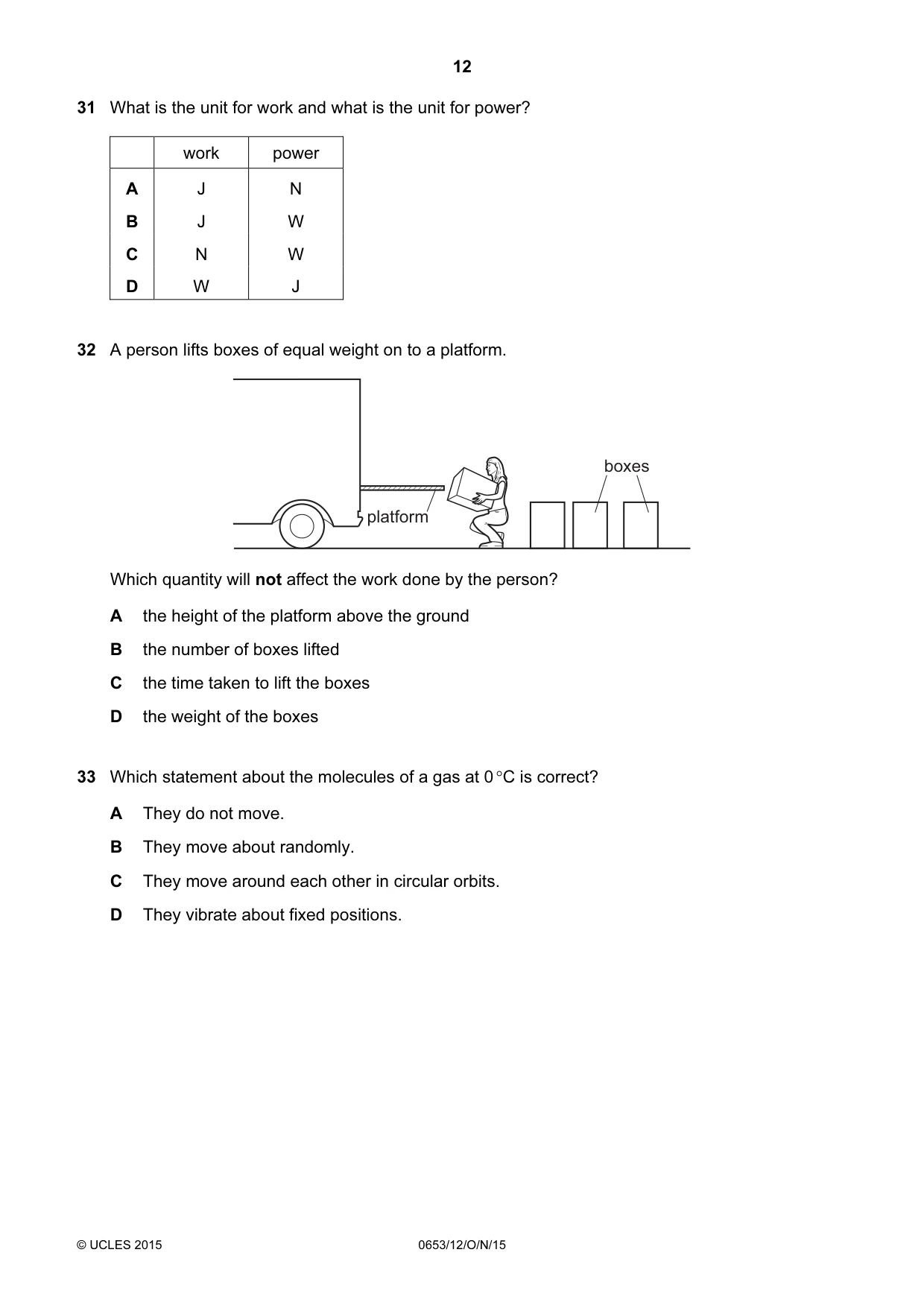
32 A person lifts boxes of equal weight on to a platform. boxes platform Which quantity will not affect the work done by the person? A the height of the platform above the ground B the number of boxes lifted C the time taken to lift the boxes D the weight of the boxes
Mark scheme: C
Q33 · Which statement about the molecules of a gas at 0 °C is correct?
33 Which statement about the molecules of a gas at 0 °C is correct? A They do not move. B They move about randomly. C They move around each other in circular orbits. D They vibrate about fixed positions.
Mark scheme: B
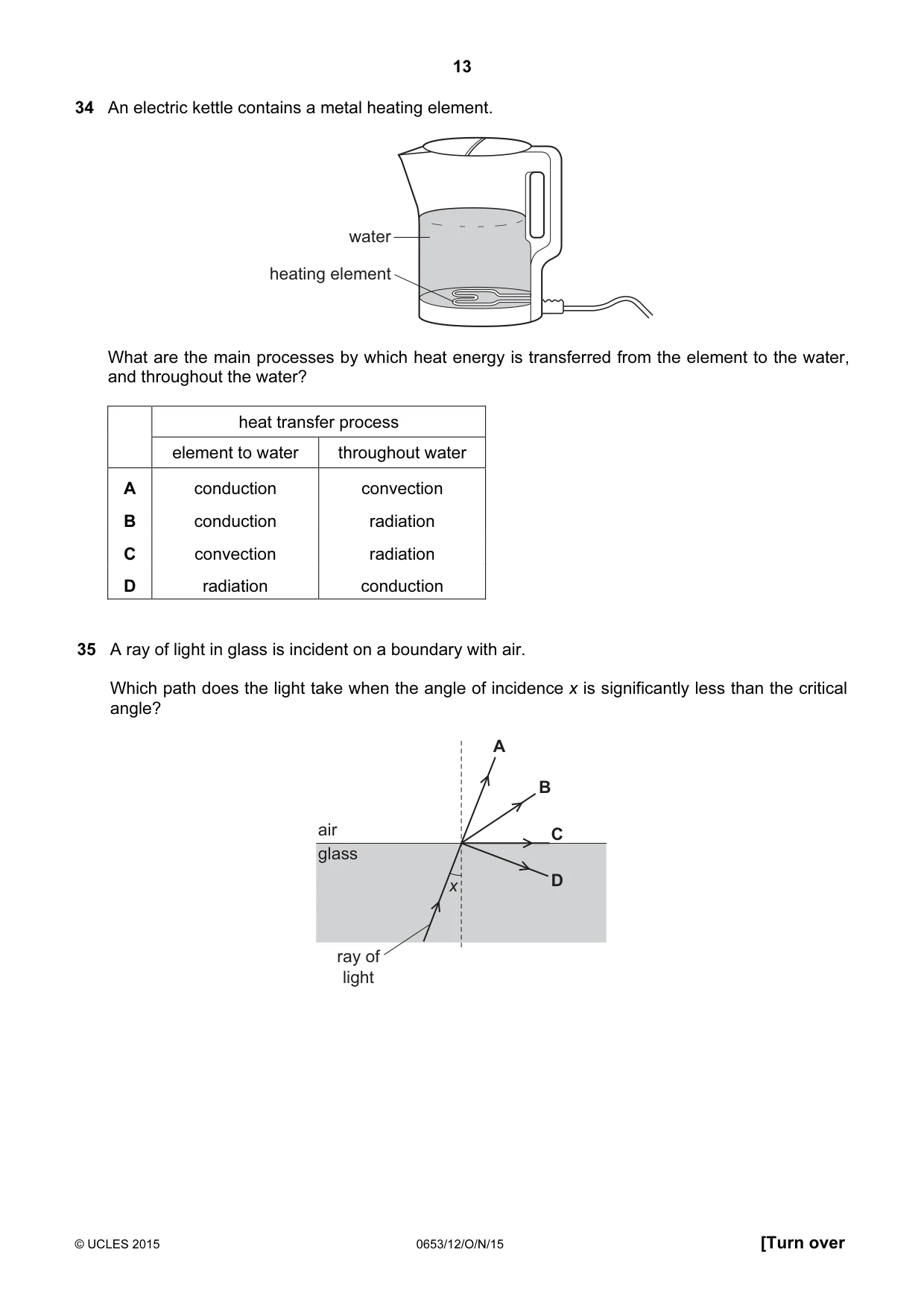
Q34 · An electric kettle contains a metal heating element
34 An electric kettle contains a metal heating element. water heating element What are the main processes by which heat energy is transferred from the element to the water, and throughout the water? heat transfer process element to water throughout water A conduction convection B conduction radiation C convection radiation D radiation conduction
Mark scheme: A
Q35 · A ray of light in glass is incident on a boundary with air
35 A ray of light in glass is incident on a boundary with air. Which path does the light take when the angle of incidence x is significantly less than the critical angle? A B air C glass x D ray of light
Mark scheme: B
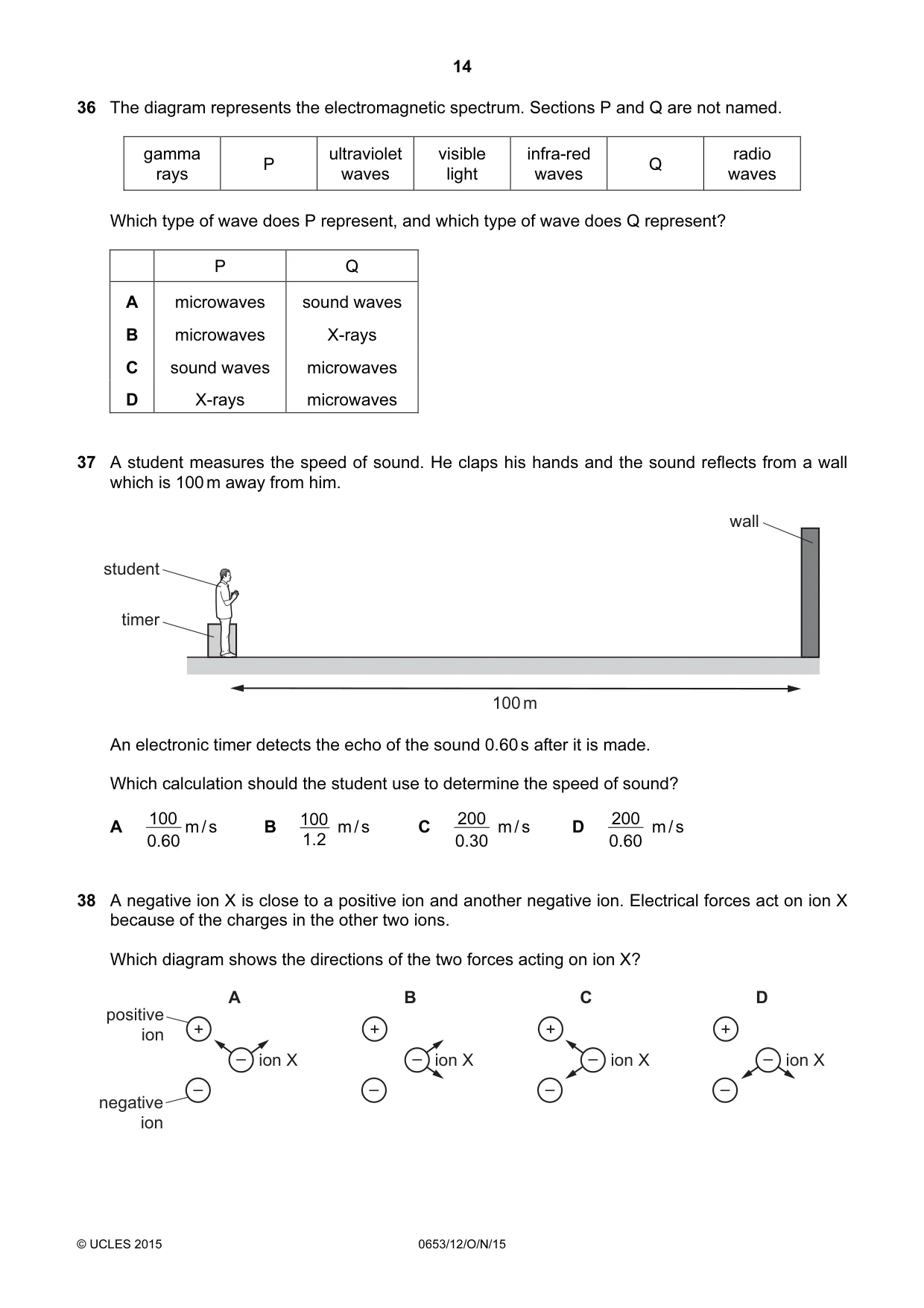
Q36 · The diagram represents the electromagnetic spectrum
36 The diagram represents the electromagnetic spectrum. Sections P and Q are not named. gamma ultraviolet visible infra-red radio P Q rays waves light waves waves Which type of wave does P represent, and which type of wave does Q represent? P Q A microwaves sound waves B microwaves X-rays C sound waves microwaves D X-rays microwaves
Mark scheme: D
Q37 · A student measures the speed of sound
37 A student measures the speed of sound. He claps his hands and the sound reflects from a wall which is 100 m away from him. wall student timer 100 m An electronic timer detects the echo of the sound 0.60 s after it is made. Which calculation should the student use to determine the speed of sound? 100 m / s 100 m / s 200 m / s 200 m / s A B C D 0.60 1 . 2 0.30 0.60
Mark scheme: D
Q38 · A negative ion X is close to a positive ion and another negative ion
38 A negative ion X is close to a positive ion and another negative ion. Electrical forces act on ion X because of the charges in the other two ions. Which diagram shows the directions of the two forces acting on ion X? A B C D positive ion + + + + – ion X – ion X – ion X – ion X – – – – negative ion
Mark scheme: A
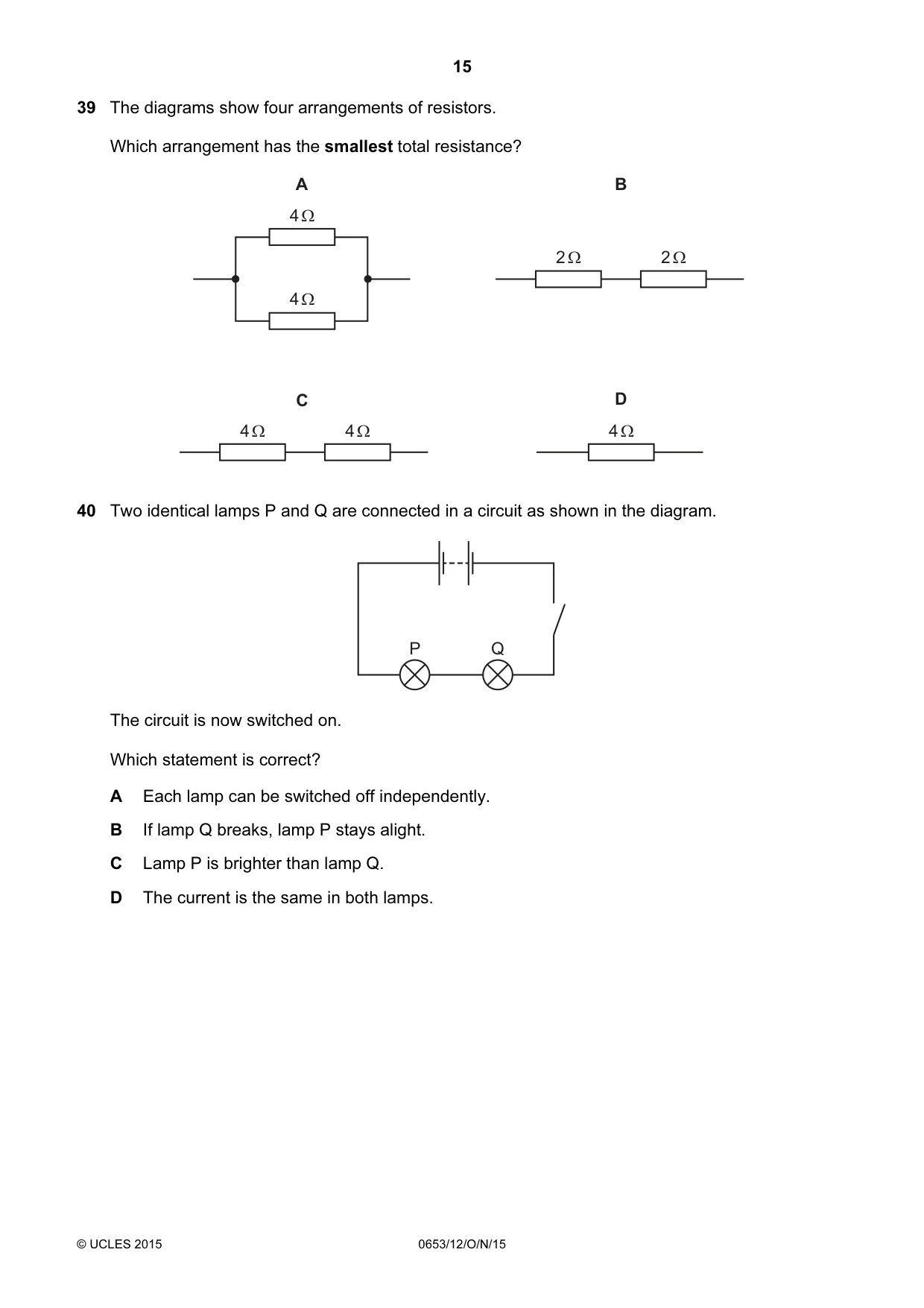
Q39 · The diagrams show four arrangements of resistors
39 The diagrams show four arrangements of resistors. Which arrangement has the smallest total resistance? A B 4 Ω 2 Ω 2 Ω 4 Ω C D 4 Ω 4 Ω 4 Ω
Mark scheme: A
Q40 · Two identical lamps P and Q are connected in a circuit as shown in the diagram
40 Two identical lamps P and Q are connected in a circuit as shown in the diagram. P Q The circuit is now switched on. Which statement is correct? A Each lamp can be switched off independently. B If lamp Q breaks, lamp P stays alight. C Lamp P is brighter than lamp Q. D The current is the same in both lamps.
Mark scheme: D
What was in this paper
The subtopics covered by these 40 questions, and how many questions each got. Open one in a new tab to see every Cambridge question on it.
2Characteristics of living organisms2Electrical circuits2Energy, work and power2Heart2Arrangement of elements1Atomic structure and the Periodic Table1Biological molecules1Blood1Carbon cycle1Density1Diet1Diffusion1Electrical quantities1Electrolysis1Electromagnetic spectrum1Enzymes1Exothermic and endothermic reactions1Gas exchange in humans1Group I properties1Identification of ions and gases1Kinetic particle model of matter1Light1Mass and weight1Motion1Rate of reaction1Reactivity series1Sexual reproduction in humans1Sexual reproduction in plants1Simple molecules and covalent bonds1Sound1The characteristic properties of acids and bases1Transfer of thermal energy1Transition elements1Water1What you needed in this session
Cambridge’s own grade thresholds for 2015 Oct/Nov, Paper 1 · Variant 2. A higher threshold means an easier paper — the bar moves with how the cohort did.