Cambridge IGCSE Science - Combined 0653 — 2025 May/June Paper 1 · Variant 1
0653/11/M/J/25 · 40 questions · 40 marks · 45 min
The question paper and its mark scheme, free to read here and free to download. This is Cambridge’s own paper, exactly as it was sat.
Question paper16 pages
Mark scheme3 pages
Answers below. Sit the paper first if you are practising.
Questions as text
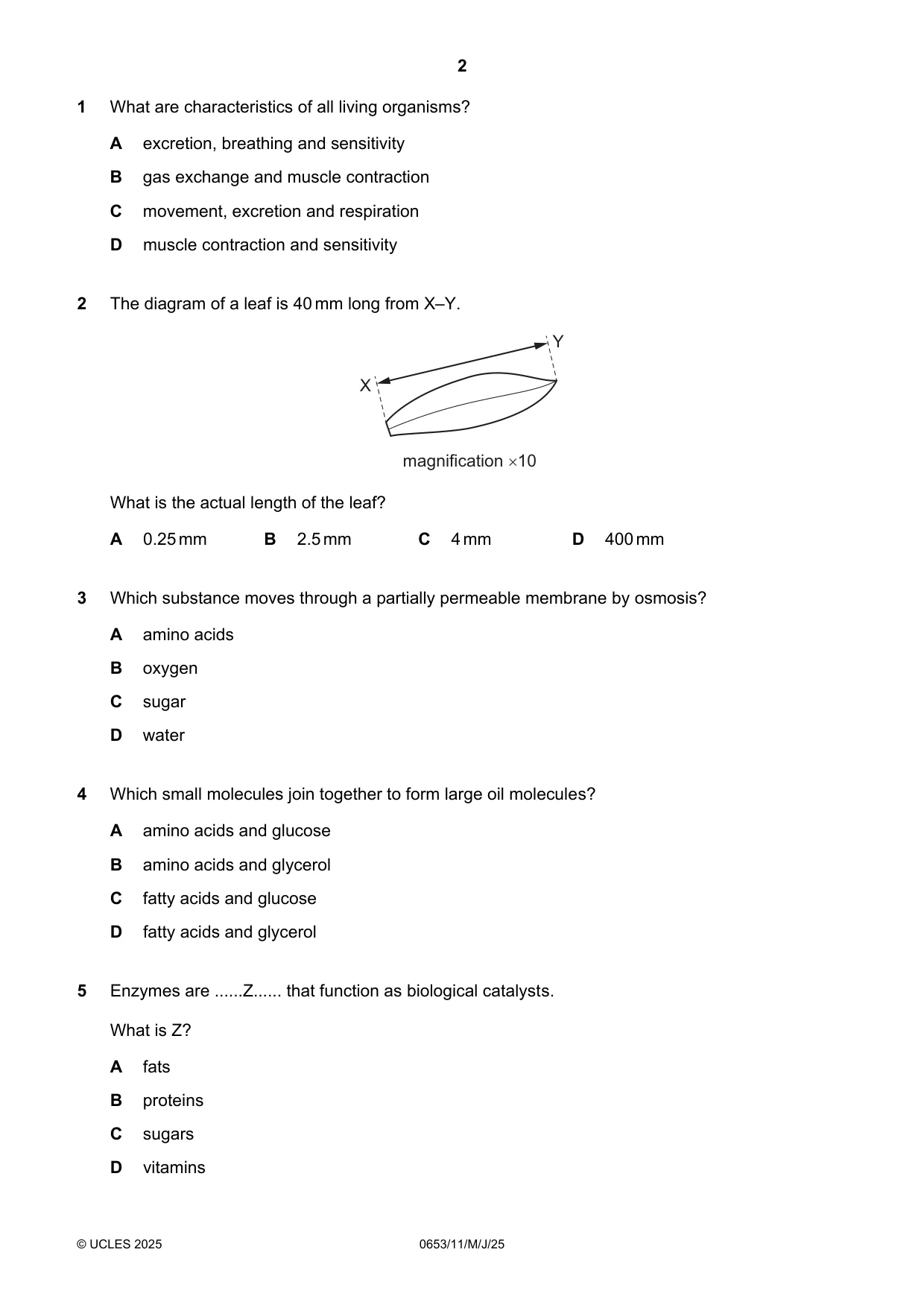
Q1 · What are characteristics of all living organisms?
1 What are characteristics of all living organisms? A excretion, breathing and sensitivity B gas exchange and muscle contraction C movement, excretion and respiration D muscle contraction and sensitivity
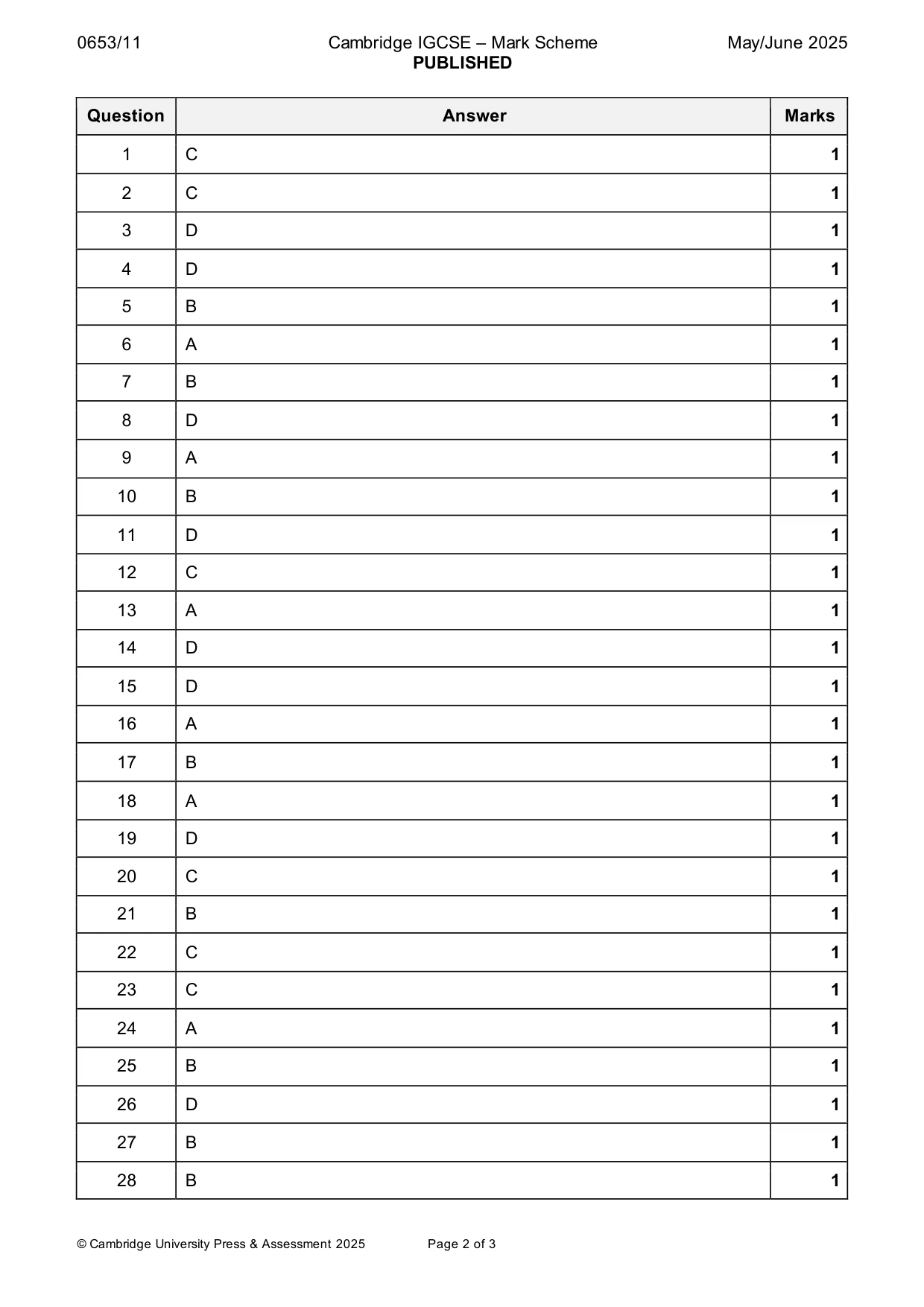
Mark scheme: C
Q2 · ~The diagram of a leaf is 40 mm long from X-Y
2 ~The diagram of a leaf is 40 mm long from X-Y. magnification x10 What is the actual length of the leaf? A 0.25mm B 2.5mm C 4mm D 400mm
Mark scheme: C
Q3 · Which substance moves through a partially permeable membrane by osmosis?
3 Which substance moves through a partially permeable membrane by osmosis? A amino acids B oxygen C sugar D water
Mark scheme: D
Q4 · Which small molecules join together to form large oil molecules?
4 Which small molecules join together to form large oil molecules? A amino acids and glucose B amino acids and glycerol C fatty acids and glucose D fatty acids and glycerol
Mark scheme: D
Question 5
5 Enzymes are ......Z...... that function as biological catalysts. What is Z? A fats B proteins C sugars D vitamins
Mark scheme: B
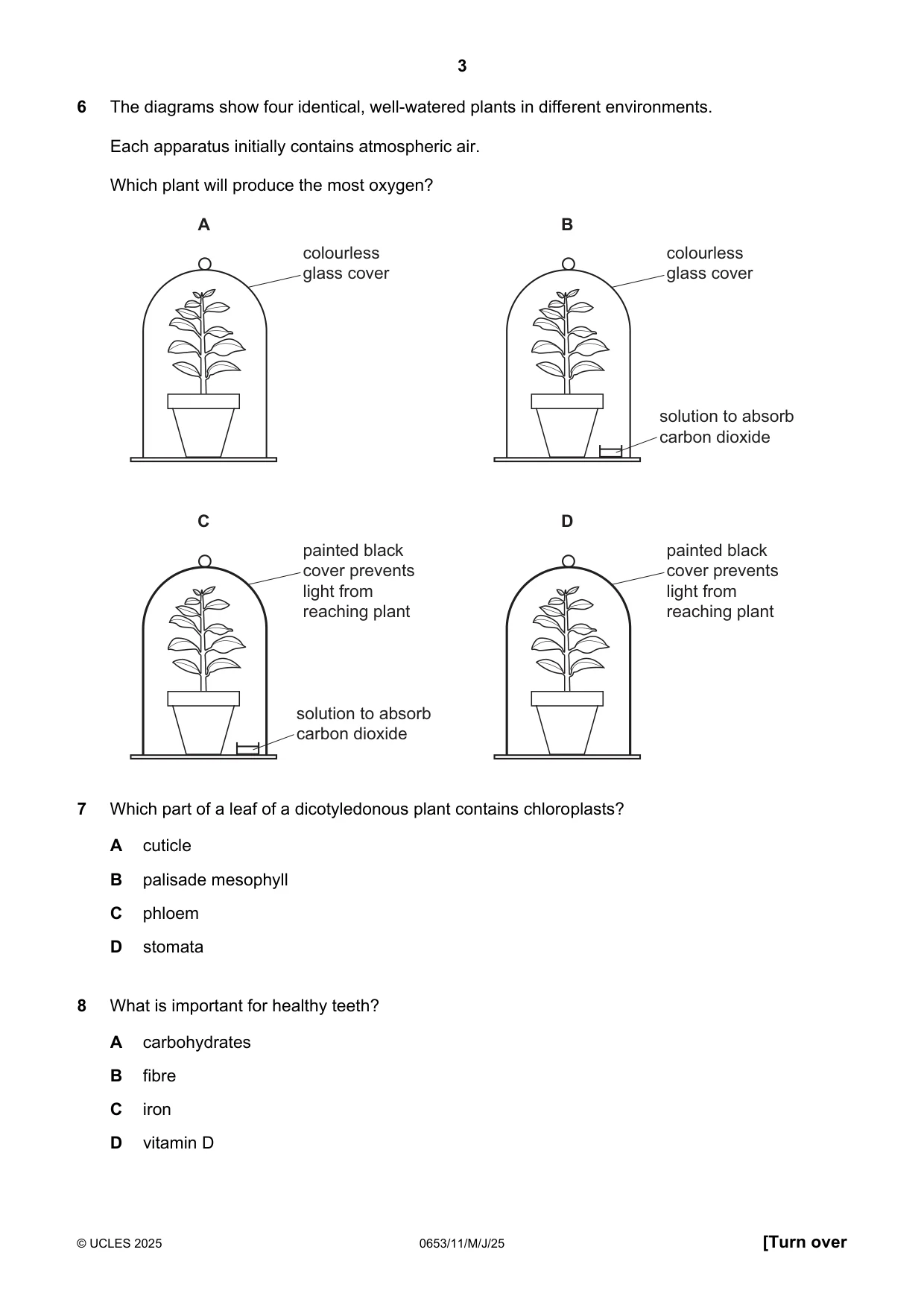
Q6 · The diagrams show four identical, well-watered plants in different environments
6 The diagrams show four identical, well-watered plants in different environments. Each apparatus initially contains atmospheric air. Which plant will produce the most oxygen? A B colourless colourless glass cover glass cover solution to absorb carbon dioxide C D painted black painted black cover prevents cover prevents light from light from reaching plant reaching plant solution to absorb carbon dioxide
Mark scheme: A
Q7 · Which part of a leaf of a dicotyledonous plant contains chloroplasts?
7 Which part of a leaf of a dicotyledonous plant contains chloroplasts? A cuticle B palisade mesophyll C phloem D stomata
Mark scheme: B
Q8 · What is important for healthy teeth?
8 What is important for healthy teeth? A carbohydrates B fibre C iron D vitamin D
Mark scheme: D
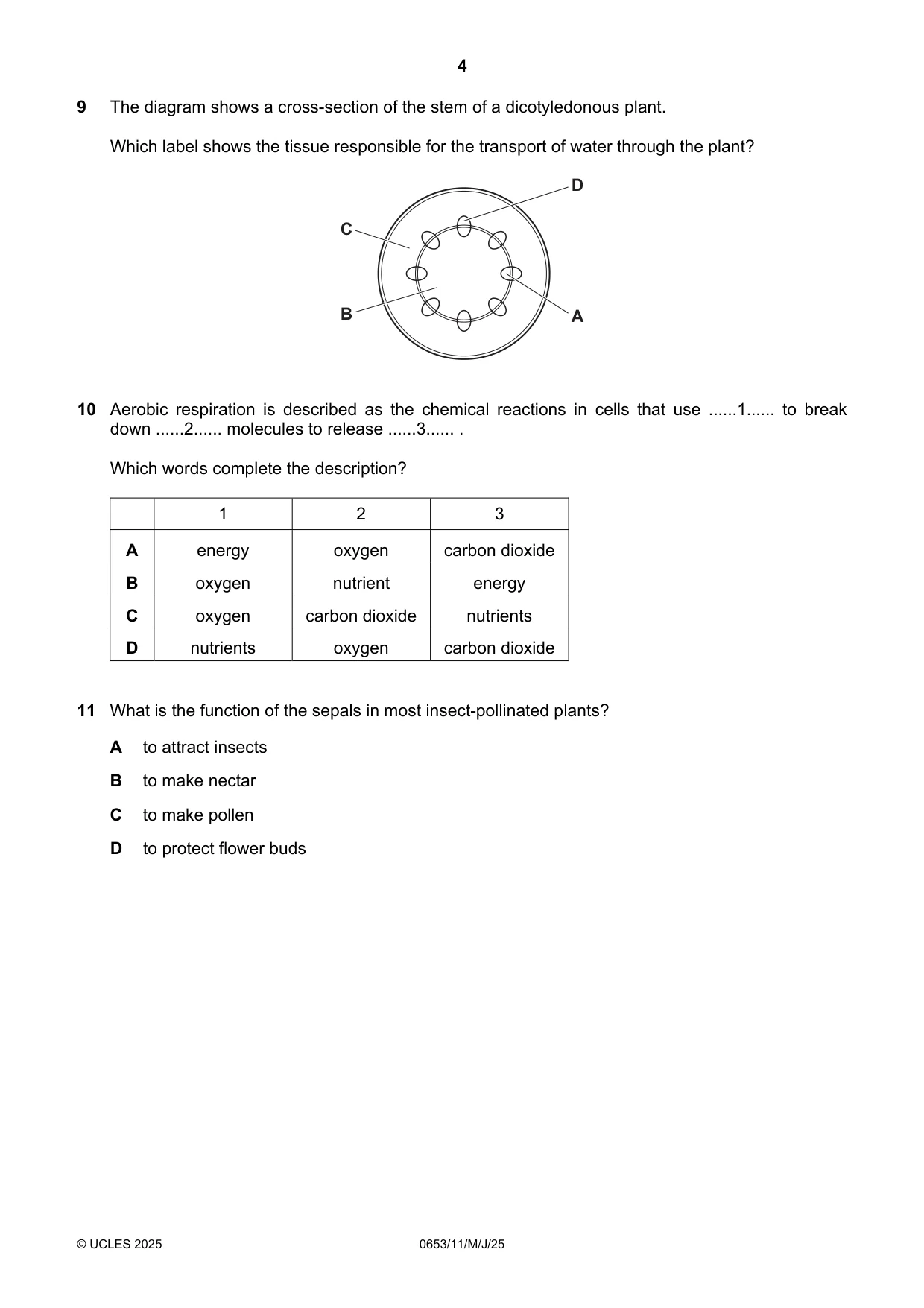
Q9 · The diagram shows a cross-section of the stem of a dicotyledonous plant
9 The diagram shows a cross-section of the stem of a dicotyledonous plant. Which label shows the tissue responsible for the transport of water through the plant? D C B A
Mark scheme: A
Q10 · Aerobic respiration is described as the chemical reactions in cells that use ......1.....
10 Aerobic respiration is described as the chemical reactions in cells that use ......1...... to break down ......2...... molecules to release ......3...... . Which words complete the description? 1 2 3 A energy oxygen carbon dioxide B oxygen nutrient energy C oxygen carbon dioxide nutrients D nutrients oxygen carbon dioxide
Mark scheme: B
Q11 · What is the function of the sepals in most insect-pollinated plants?
11 What is the function of the sepals in most insect-pollinated plants? A to attract insects B to make nectar C to make pollen D to protect flower buds
Mark scheme: D
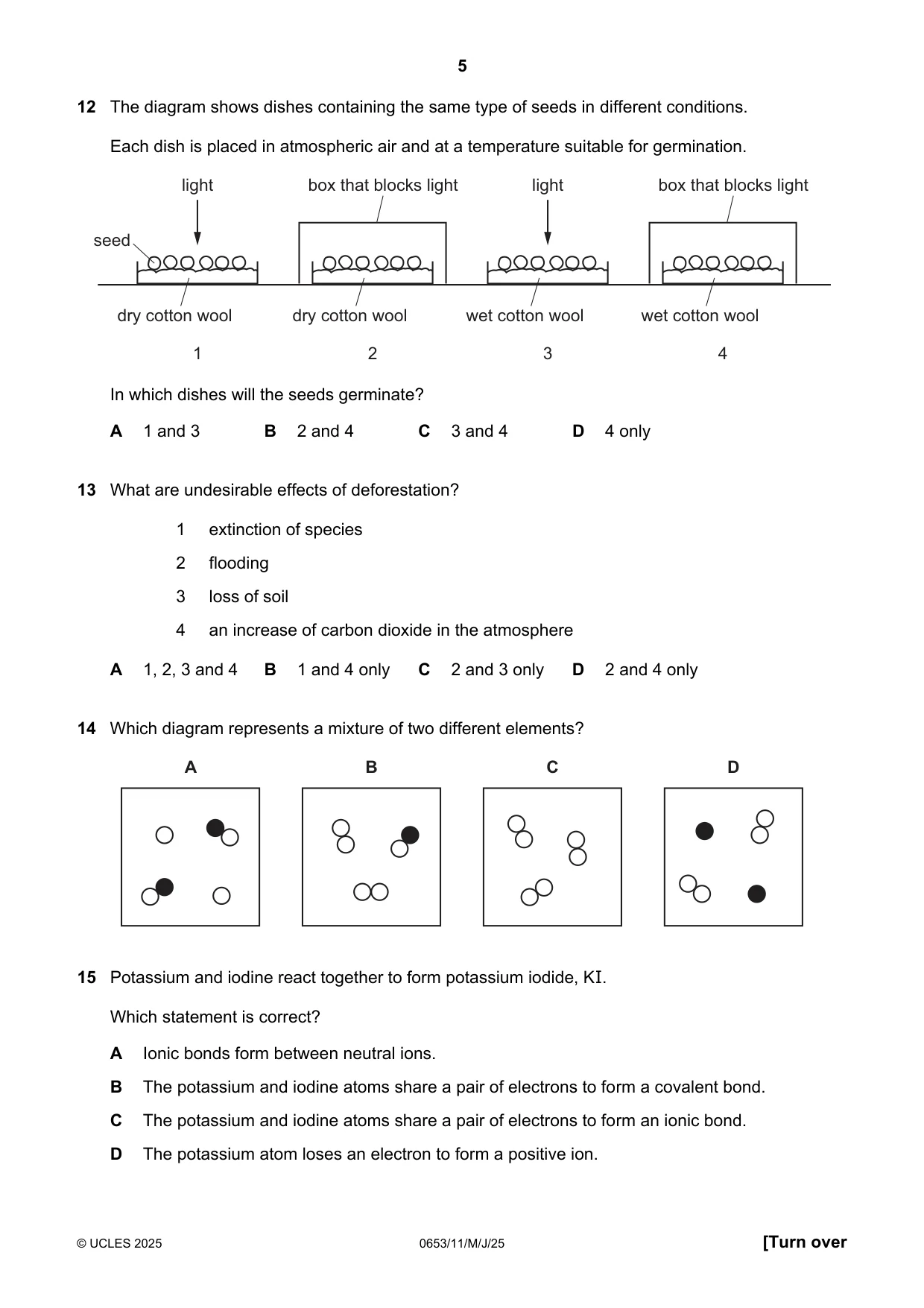
Q12 · The diagram shows dishes containing the same type of seeds in different conditions
12 The diagram shows dishes containing the same type of seeds in different conditions. Each dish is placed in atmospheric air and at a temperature suitable for germination. light box that blocks light light box that blocks light seed dry cotton wool dry cotton wool wet cotton wool wet cotton wool 1 2 3 4 In which dishes will the seeds germinate? A 1 and 3 B 2 and 4 C 3 and 4 D 4 only
Mark scheme: C
Q13 · What are undesirable effects of deforestation?
13 What are undesirable effects of deforestation? 1 extinction of species 2 flooding 3 loss of soil 4 an increase of carbon dioxide in the atmosphere A 1, 2, 3 and 4 B 1 and 4 only C 2 and 3 only D 2 and 4 only
Mark scheme: A
Q14 · Which diagram represents a mixture of two different elements?
14 Which diagram represents a mixture of two different elements? A B C D
Mark scheme: D
Q15 · Potassium and iodine react together to form potassium iodide, KI
15 Potassium and iodine react together to form potassium iodide, KI. Which statement is correct? A Ionic bonds form between neutral ions. B The potassium and iodine atoms share a pair of electrons to form a covalent bond. C The potassium and iodine atoms share a pair of electrons to form an ionic bond. D The potassium atom loses an electron to form a positive ion.
Mark scheme: D
Q16 · The unbalanced equation for the reaction between aqueous sodium hydroxide and dilute…
16 The unbalanced equation for the reaction between aqueous sodium hydroxide and dilute sulfuric acid is shown. wNaOH + xH2SO4 yNa2SO4 + zH2O Which values of w, x, y and z balance the equation? w x y z A 2 1 1 2 B 2 1 2 1 C 1 1 1 1 D 1 2 1 1
Mark scheme: A
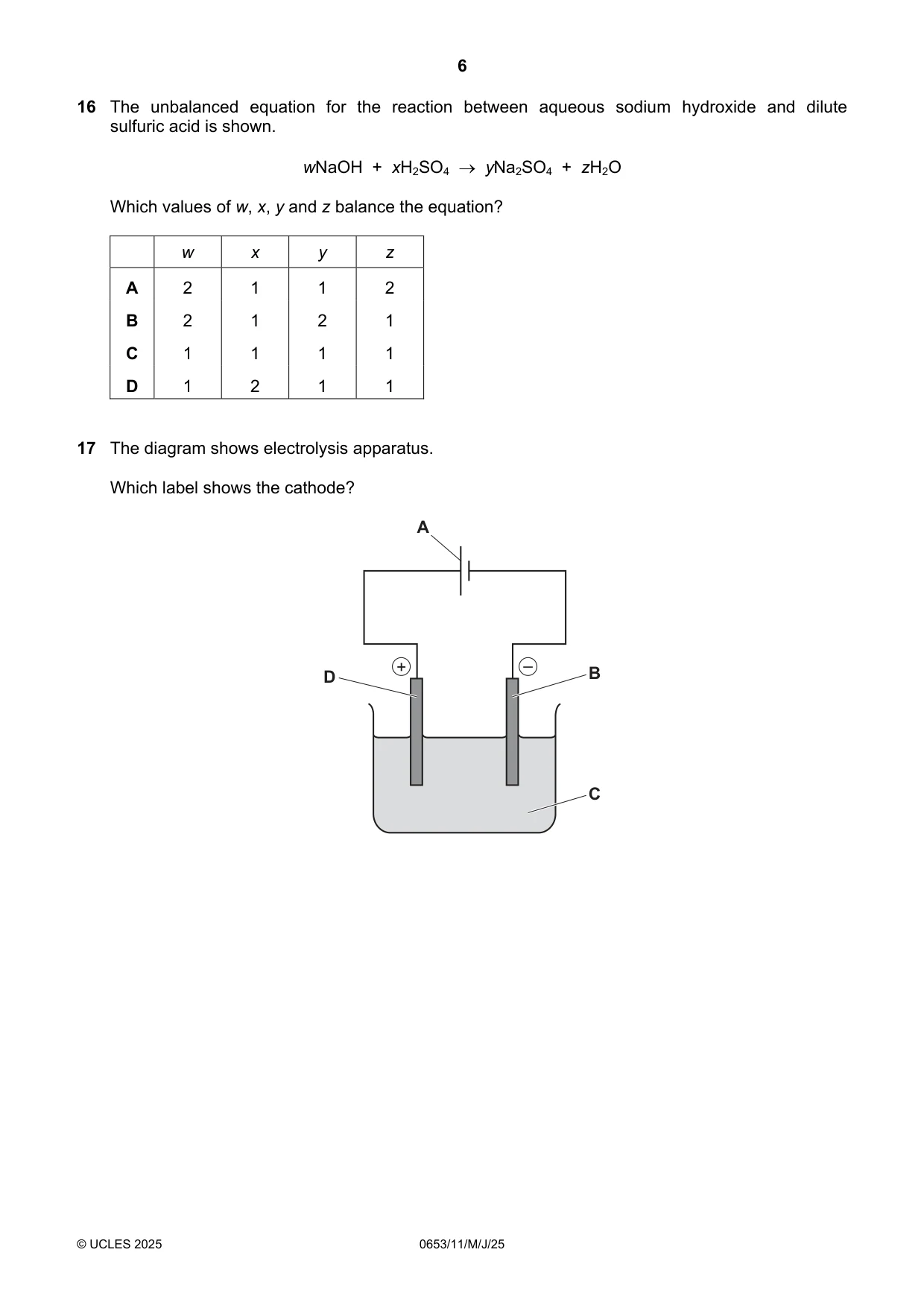
Q17 · The diagram shows electrolysis apparatus
17 The diagram shows electrolysis apparatus. Which label shows the cathode? A D + – B C
Mark scheme: B
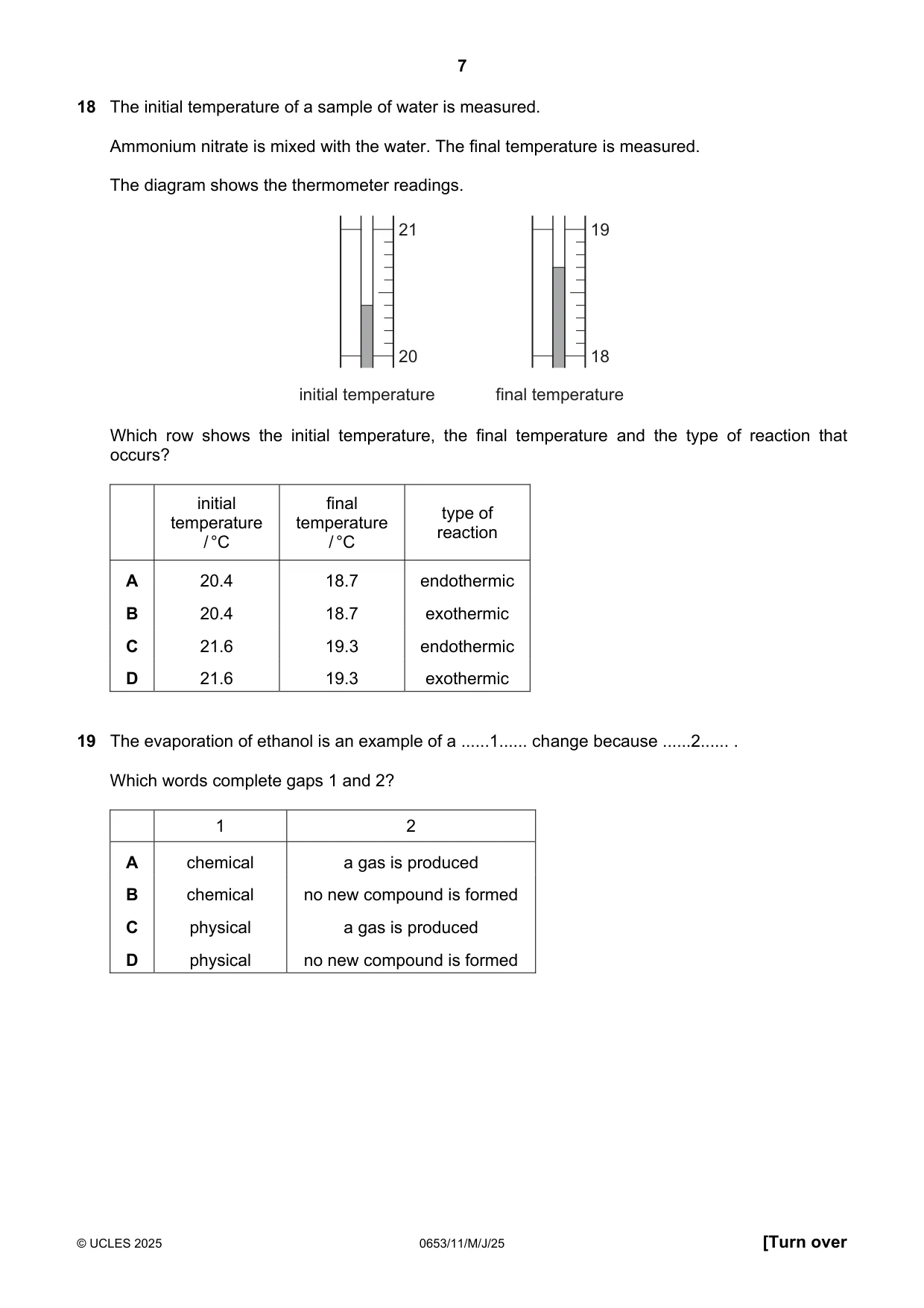
Q18 · The initial temperature of a sample of water is measured
18 The initial temperature of a sample of water is measured. Ammonium nitrate is mixed with the water. The final temperature is measured. The diagram shows the thermometer readings. 21 19 20 18 initial temperature final temperature Which row shows the initial temperature, the final temperature and the type of reaction that occurs? initial final type of temperature temperature reaction / °C / °C A 20.4 18.7 endothermic B 20.4 18.7 exothermic C 21.6 19.3 endothermic D 21.6 19.3 exothermic
Mark scheme: A
Q19 · The evaporation of ethanol is an example of a ......1.....
19 The evaporation of ethanol is an example of a ......1...... change because ......2...... . Which words complete gaps 1 and 2? 1 2 A chemical a gas is produced B chemical no new compound is formed C physical a gas is produced D physical no new compound is formed
Mark scheme: D
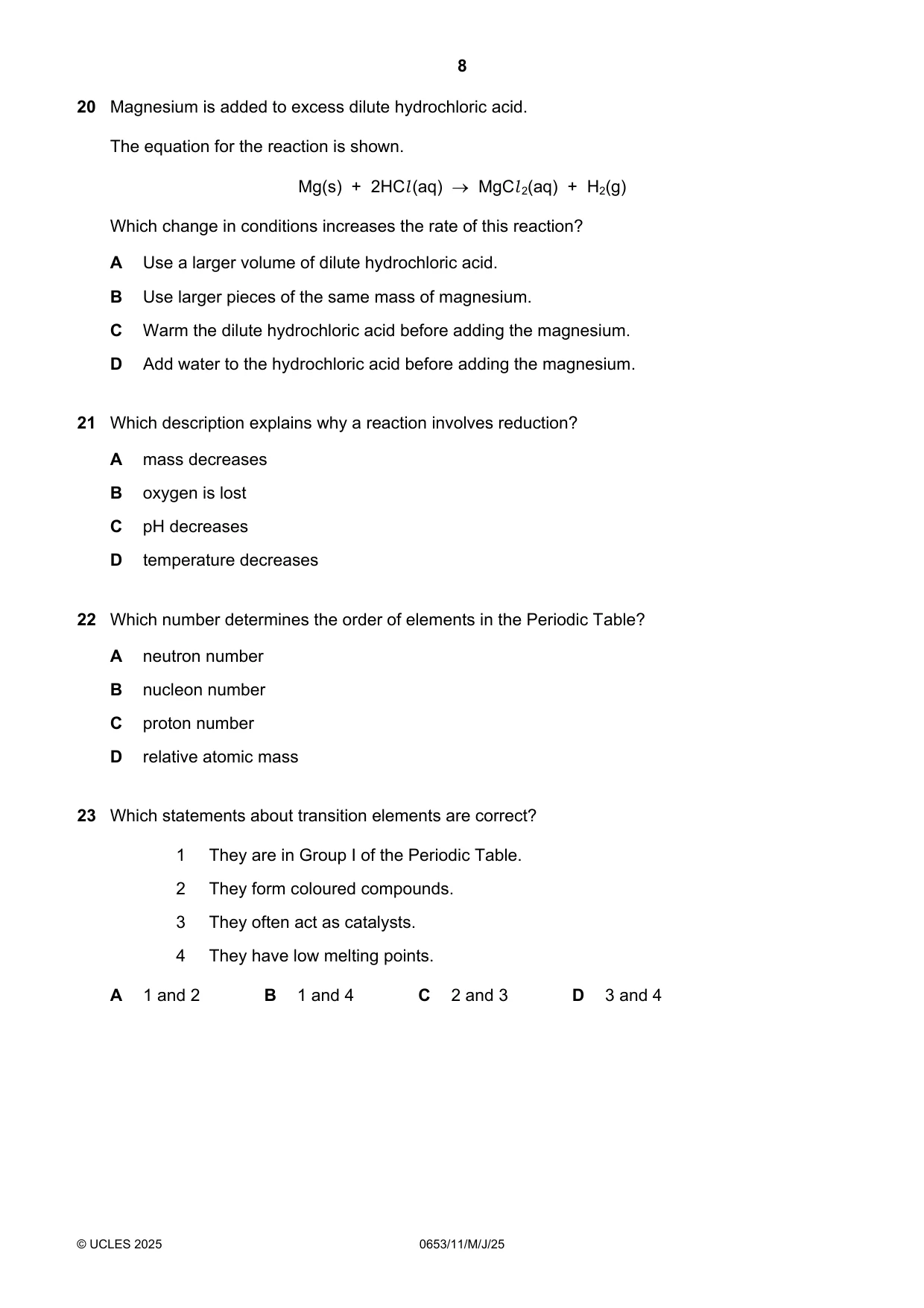
Q20 · Magnesium is added to excess dilute hydrochloric acid
20 Magnesium is added to excess dilute hydrochloric acid. The equation for the reaction is shown. Mg(s) + 2HCl (aq) MgCl 2(aq) + H2(g) Which change in conditions increases the rate of this reaction? A Use a larger volume of dilute hydrochloric acid. B Use larger pieces of the same mass of magnesium. C Warm the dilute hydrochloric acid before adding the magnesium. D Add water to the hydrochloric acid before adding the magnesium.
Mark scheme: C
Q21 · Which description explains why a reaction involves reduction?
21 Which description explains why a reaction involves reduction? A mass decreases B oxygen is lost C pH decreases D temperature decreases
Mark scheme: B
Q22 · Which number determines the order of elements in the Periodic Table?
22 Which number determines the order of elements in the Periodic Table? A neutron number B nucleon number C proton number D relative atomic mass
Mark scheme: C
Q23 · Which statements about transition elements are correct?
23 Which statements about transition elements are correct? 1 They are in Group I of the Periodic Table. 2 They form coloured compounds. 3 They often act as catalysts. 4 They have low melting points. A 1 and 2 B 1 and 4 C 2 and 3 D 3 and 4
Mark scheme: C
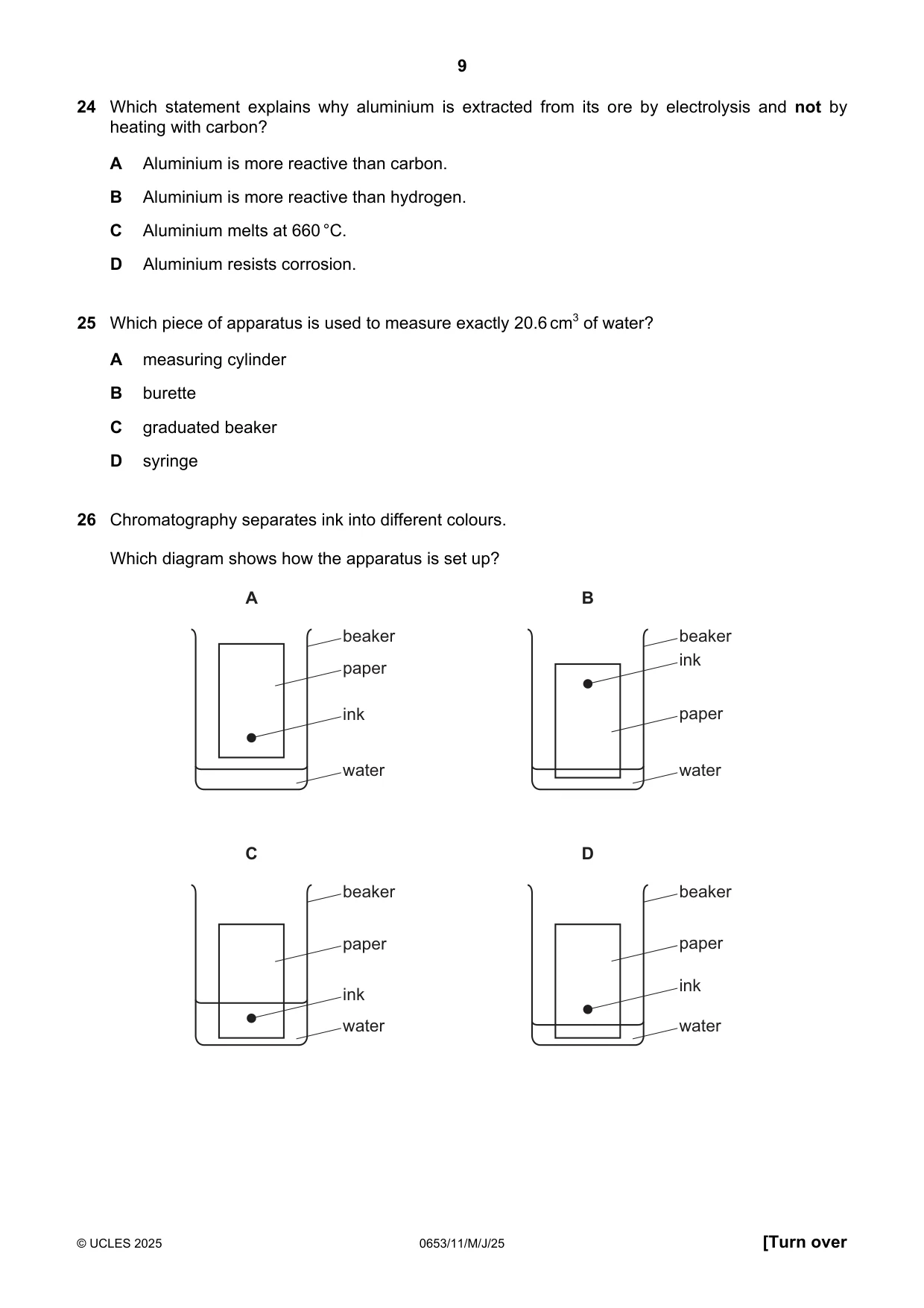
Q24 · Which statement explains why aluminium is extracted from its ore by electrolysis and not…
24 Which statement explains why aluminium is extracted from its ore by electrolysis and not by heating with carbon? A Aluminium is more reactive than carbon. B Aluminium is more reactive than hydrogen. C Aluminium melts at 660 °C. D Aluminium resists corrosion.
Mark scheme: A
Q25 · Which piece of apparatus is used to measure exactly 20.6 cm3 of water?
25 Which piece of apparatus is used to measure exactly 20.6 cm3 of water? A measuring cylinder B burette C graduated beaker D syringe
Mark scheme: B
Q26 · Chromatography separates ink into different colours
26 Chromatography separates ink into different colours. Which diagram shows how the apparatus is set up? A B beaker beaker paper ink ink paper water water C D beaker beaker paper paper ink ink water water
Mark scheme: D
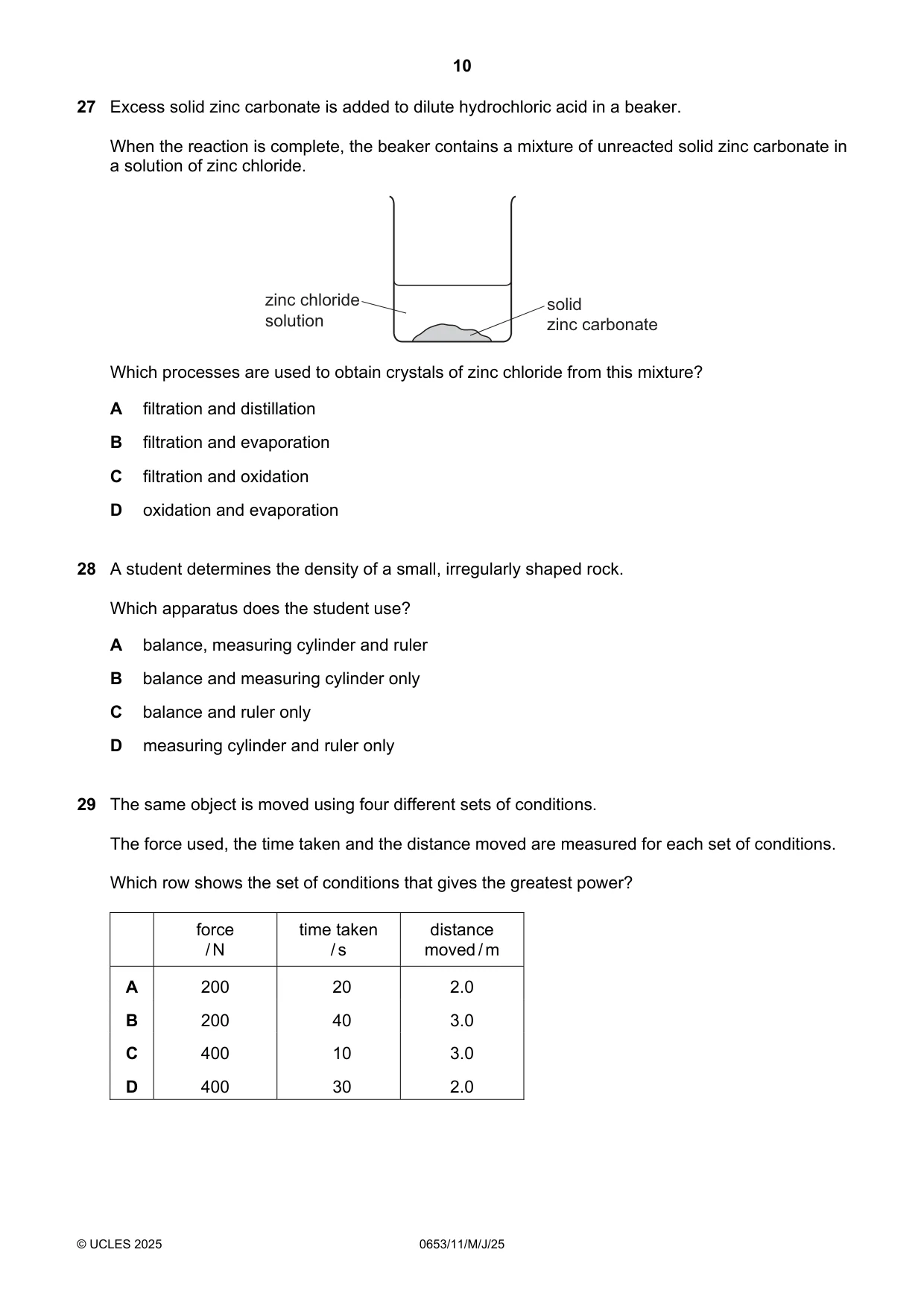
Q27 · Excess solid zinc carbonate is added to dilute hydrochloric acid in a beaker
27 Excess solid zinc carbonate is added to dilute hydrochloric acid in a beaker. When the reaction is complete, the beaker contains a mixture of unreacted solid zinc carbonate in a solution of zinc chloride. zinc chloride solid solution zinc carbonate Which processes are used to obtain crystals of zinc chloride from this mixture? A filtration and distillation B filtration and evaporation C filtration and oxidation D oxidation and evaporation
Mark scheme: B
Q28 · A student determines the density of a small, irregularly shaped rock
28 A student determines the density of a small, irregularly shaped rock. Which apparatus does the student use? A balance, measuring cylinder and ruler B balance and measuring cylinder only C balance and ruler only D measuring cylinder and ruler only
Mark scheme: B
Q29 · The same object is moved using four different sets of conditions
29 The same object is moved using four different sets of conditions. The force used, the time taken and the distance moved are measured for each set of conditions. Which row shows the set of conditions that gives the greatest power? force time taken distance / N / s moved / m A 200 20 2.0 B 200 40 3.0 C 400 10 3.0 D 400 30 2.0
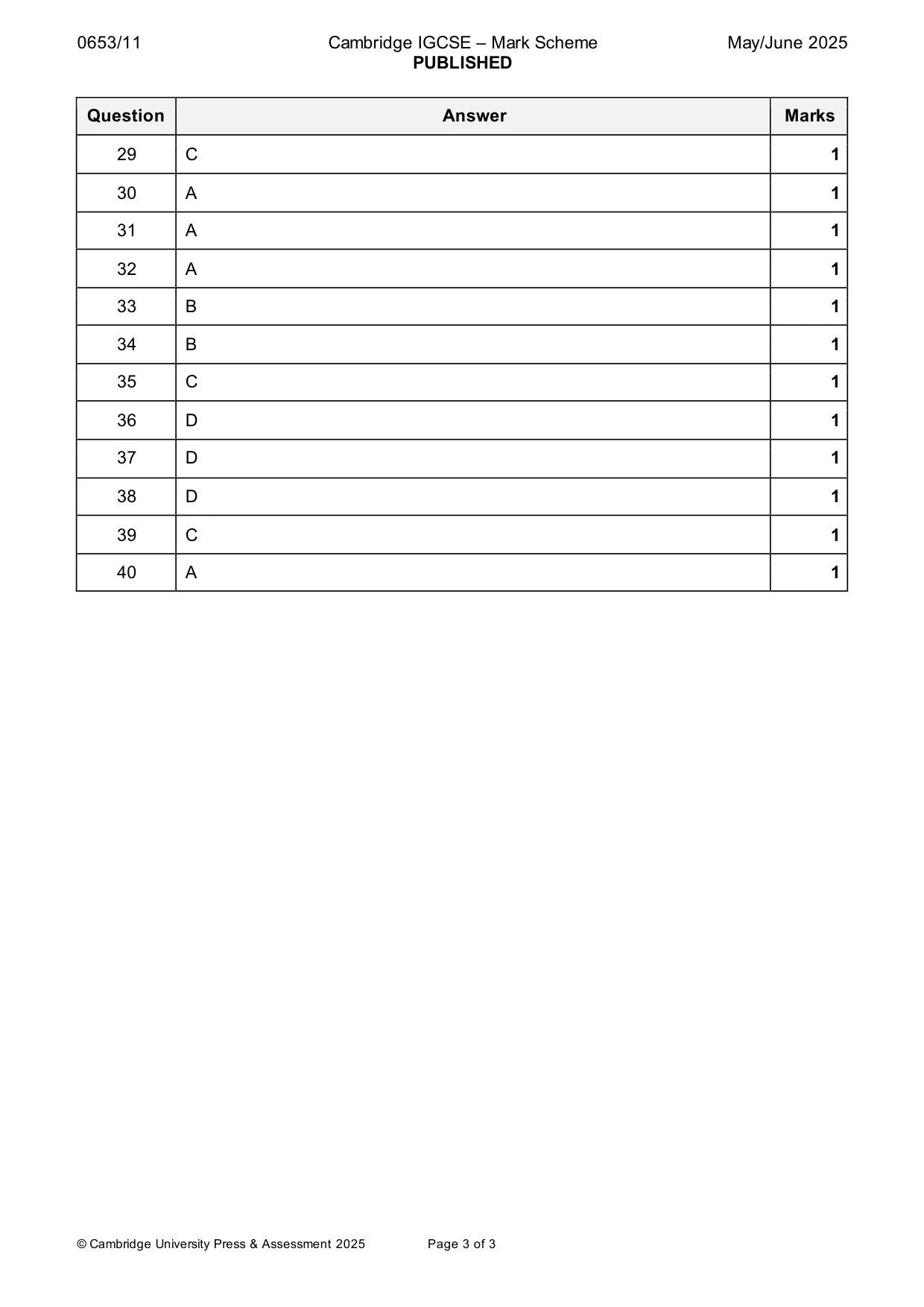
Mark scheme: C
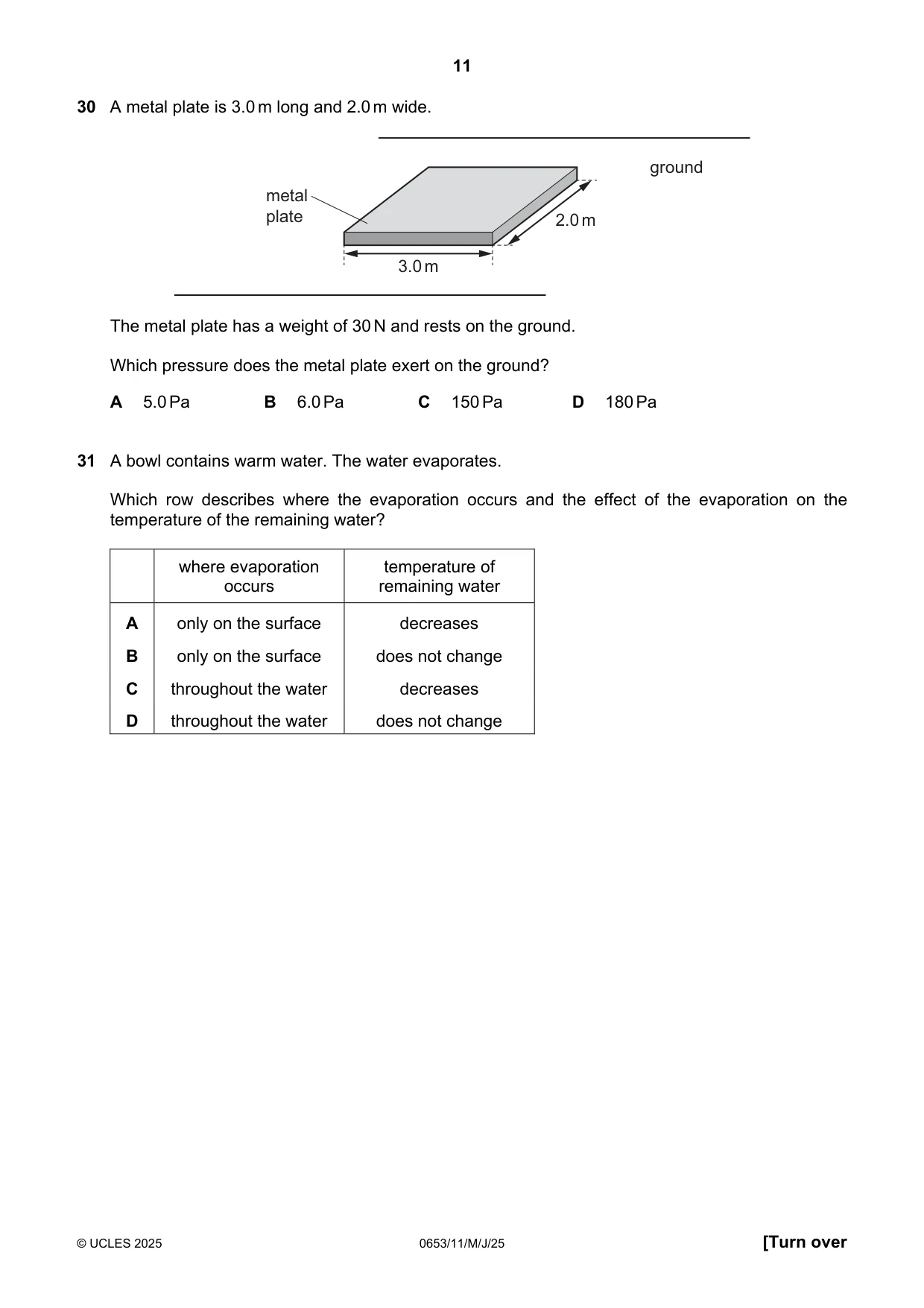
Q30 · A metal plate is 3.0 m long and 2.0 m wide
30 A metal plate is 3.0 m long and 2.0 m wide. ground metal plate 2.0 m 3.0 m The metal plate has a weight of 30 N and rests on the ground. Which pressure does the metal plate exert on the ground? A 5.0 Pa B 6.0 Pa C 150 Pa D 180 Pa
Mark scheme: A
Q31 · A bowl contains warm water
31 A bowl contains warm water. The water evaporates. Which row describes where the evaporation occurs and the effect of the evaporation on the temperature of the remaining water? where evaporation temperature of occurs remaining water A only on the surface decreases B only on the surface does not change C throughout the water decreases D throughout the water does not change
Mark scheme: A
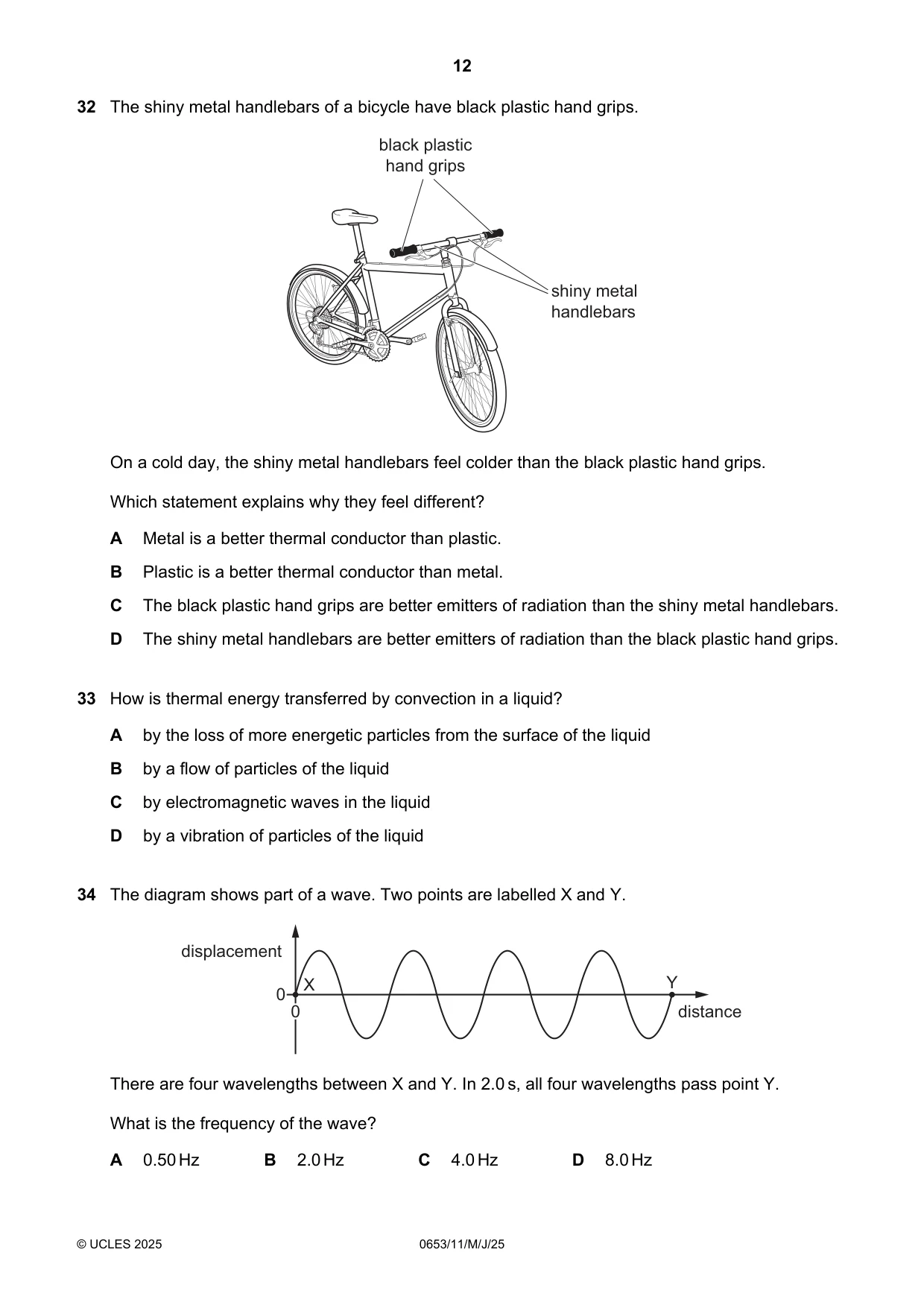
Q32 · The shiny metal handlebars of a bicycle have black plastic hand grips
32 The shiny metal handlebars of a bicycle have black plastic hand grips. black plastic hand grips shiny metal handlebars On a cold day, the shiny metal handlebars feel colder than the black plastic hand grips. Which statement explains why they feel different? A Metal is a better thermal conductor than plastic. B Plastic is a better thermal conductor than metal. C The black plastic hand grips are better emitters of radiation than the shiny metal handlebars. D The shiny metal handlebars are better emitters of radiation than the black plastic hand grips.
Mark scheme: A
Q33 · How is thermal energy transferred by convection in a liquid?
33 How is thermal energy transferred by convection in a liquid? A by the loss of more energetic particles from the surface of the liquid B by a flow of particles of the liquid C by electromagnetic waves in the liquid D by a vibration of particles of the liquid
Mark scheme: B
Q34 · The diagram shows part of a wave
34 The diagram shows part of a wave. Two points are labelled X and Y. displacement X Y 0 0 distance There are four wavelengths between X and Y. In 2.0 s, all four wavelengths pass point Y. What is the frequency of the wave? A 0.50 Hz B 2.0 Hz C 4.0 Hz D 8.0 Hz
Mark scheme: B
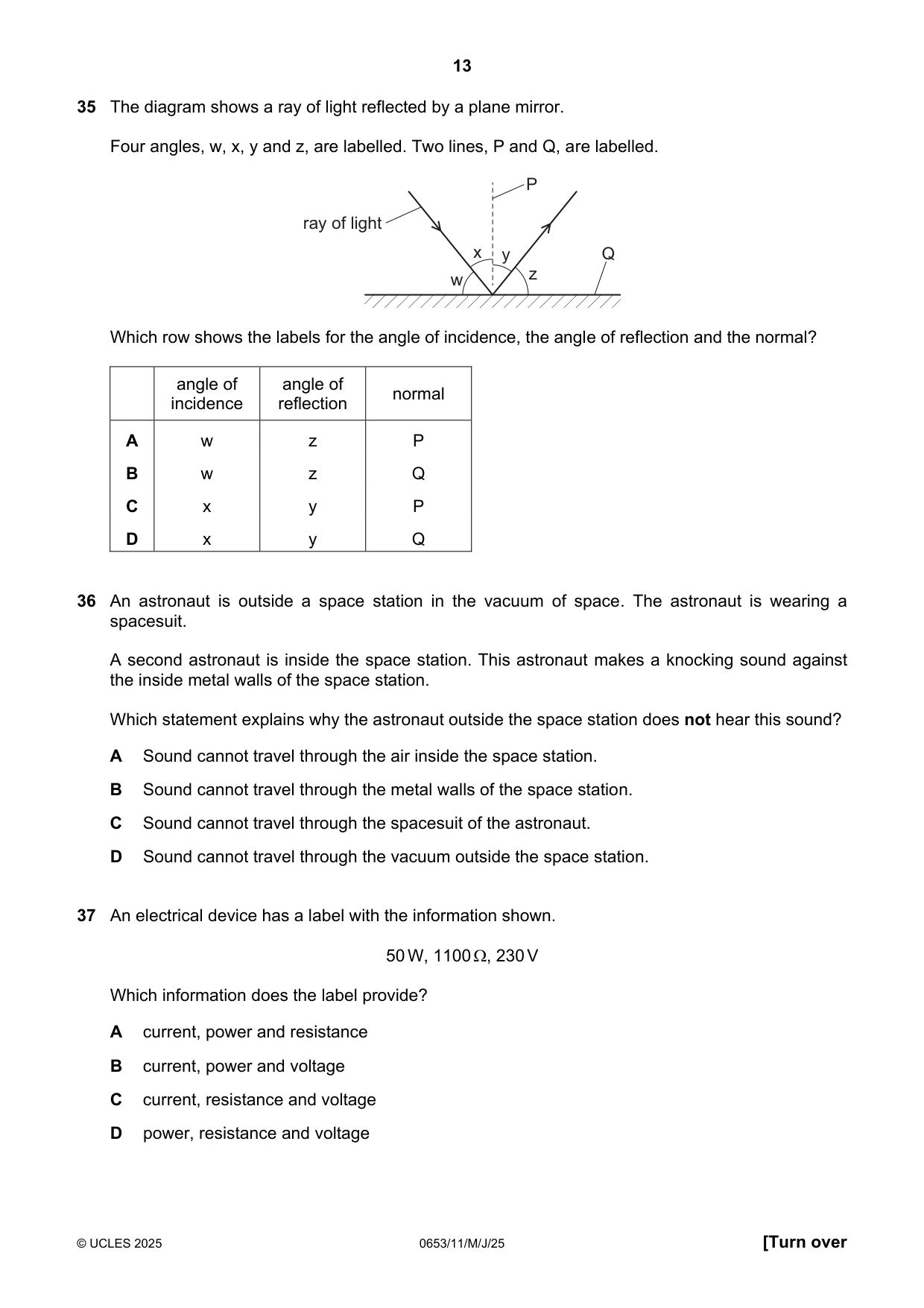
Q35 · The diagram shows a ray of light reflected by a plane mirror
35 The diagram shows a ray of light reflected by a plane mirror. Four angles, w, x, y and z, are labelled. Two lines, P and Q, are labelled. P ray of light x y Q w z Which row shows the labels for the angle of incidence, the angle of reflection and the normal? angle of angle of normal incidence reflection A w z P B w z Q C x y P D x y Q
Mark scheme: C
Q36 · An astronaut is outside a space station in the vacuum of space
36 An astronaut is outside a space station in the vacuum of space. The astronaut is wearing a spacesuit. A second astronaut is inside the space station. This astronaut makes a knocking sound against the inside metal walls of the space station. Which statement explains why the astronaut outside the space station does not hear this sound? A Sound cannot travel through the air inside the space station. B Sound cannot travel through the metal walls of the space station. C Sound cannot travel through the spacesuit of the astronaut. D Sound cannot travel through the vacuum outside the space station.
Mark scheme: D
Q37 · An electrical device has a label with the information shown
37 An electrical device has a label with the information shown. 50 W, 1100 , 230 V Which information does the label provide? A current, power and resistance B current, power and voltage C current, resistance and voltage D power, resistance and voltage
Mark scheme: D
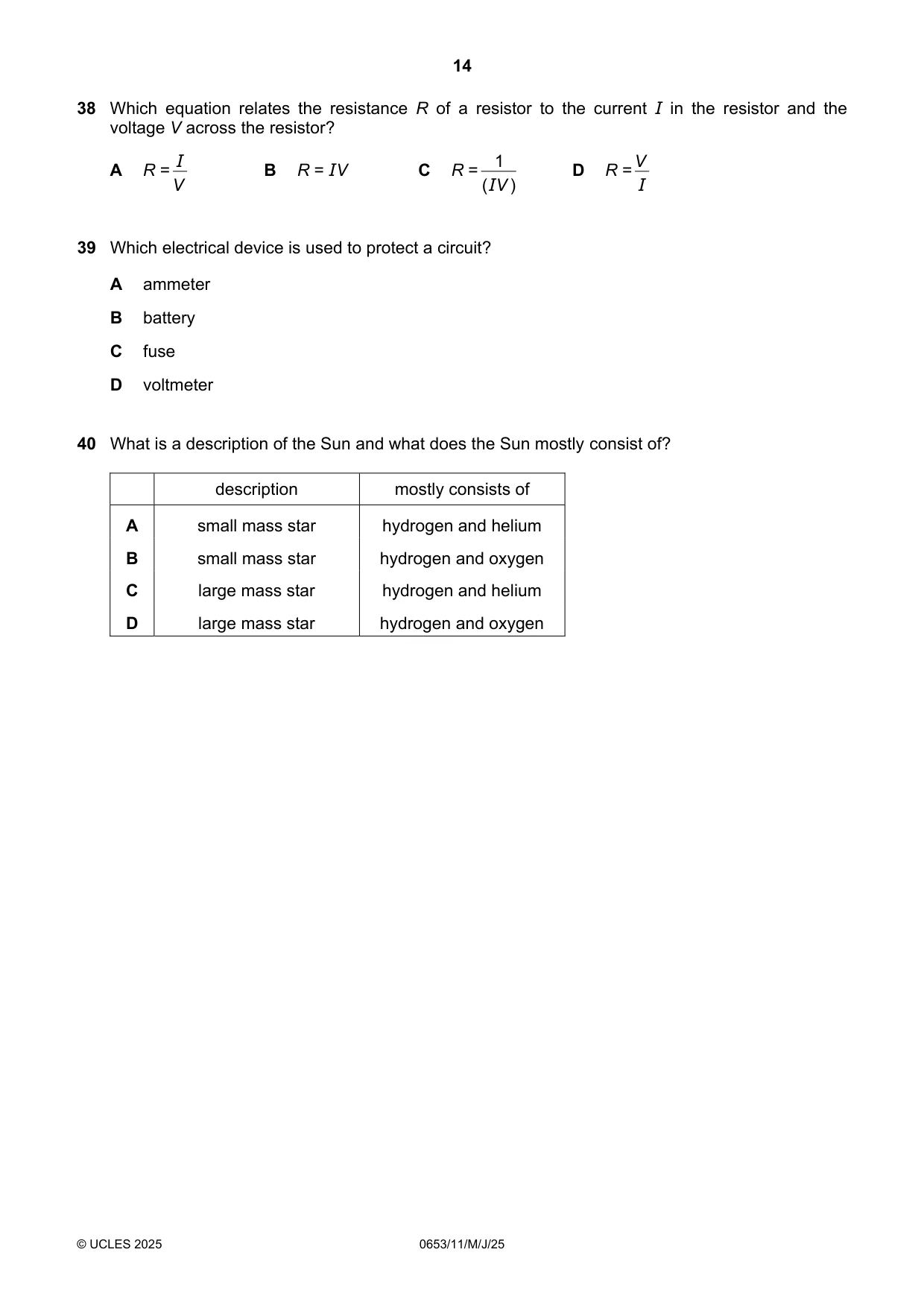
Q38 · Which equation relates the resistance R of a resistor to the current I in the resistor…
38 Which equation relates the resistance R of a resistor to the current I in the resistor and the voltage V across the resistor? I 1 V A R = B R = IV C R = D R = V ( I V ) I
Mark scheme: D
Q39 · Which electrical device is used to protect a circuit?
39 Which electrical device is used to protect a circuit? A ammeter B battery C fuse D voltmeter
Mark scheme: C
Q40 · What is a description of the Sun and what does the Sun mostly consist of?
40 What is a description of the Sun and what does the Sun mostly consist of? description mostly consists of A small mass star hydrogen and helium B small mass star hydrogen and oxygen C large mass star hydrogen and helium D large mass star hydrogen and oxygen
Mark scheme: A
What was in this paper
The subtopics covered by these 40 questions, and how many questions each got. Open one in a new tab to see every Cambridge question on it.
2Sexual reproduction in plants2Transfer of thermal energy2Arrangement of elements1Biological molecules1Characteristics of living organisms1Chromatography1Density1Diet1Electrical safety1Electrolysis1Elements, compounds and mixtures1Energy, work and power1Enzymes1Exothermic and endothermic reactions1Experimental design1Extraction of metals1Formulas1General properties of waves1Habitat destruction1Ions and ionic bonds1Kinetic particle model of matter1Leaf structure1Light1Osmosis1Photosynthesis1Physical and chemical changes1Pressure1Rate of reaction1Redox1Respiration1Separation and purification1Size of specimens1Sound1Stars and the Universe1Transition elements1Xylem and phloem1What you needed in this session
Cambridge’s own grade thresholds for 2025 May/June, Paper 1 · Variant 1. A higher threshold means an easier paper — the bar moves with how the cohort did.