Cambridge IGCSE Science - Combined 0653 — 2015 May/June Paper 1 · Variant 2
0653/12/M/J/15 · 40 questions · 40 marks · ≈45 min
The question paper and its mark scheme, free to read here and free to download. This is Cambridge’s own paper, exactly as it was sat.
Question paper20 pages


Mark scheme2 pages
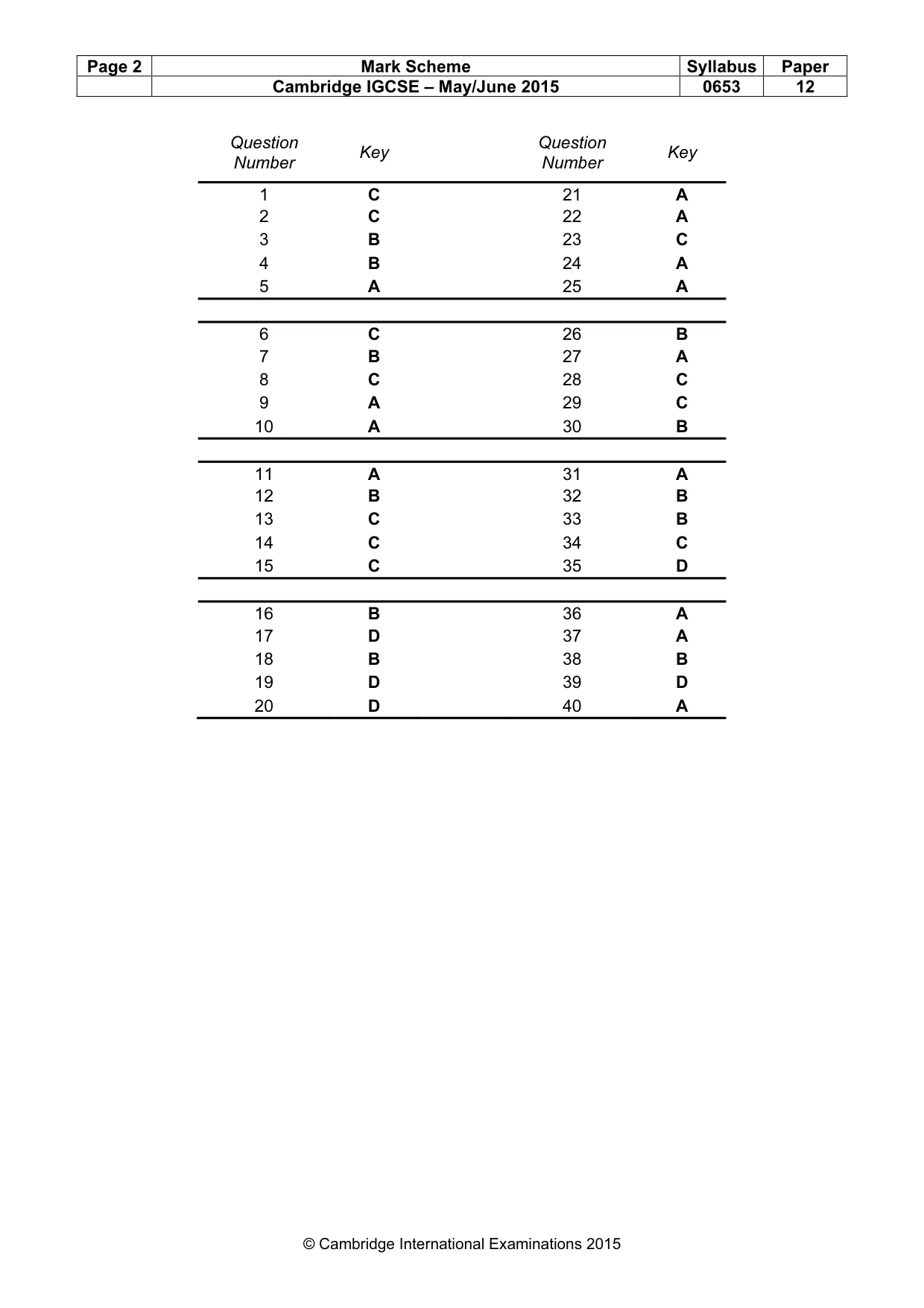
Answers below. Sit the paper first if you are practising.
Questions as text
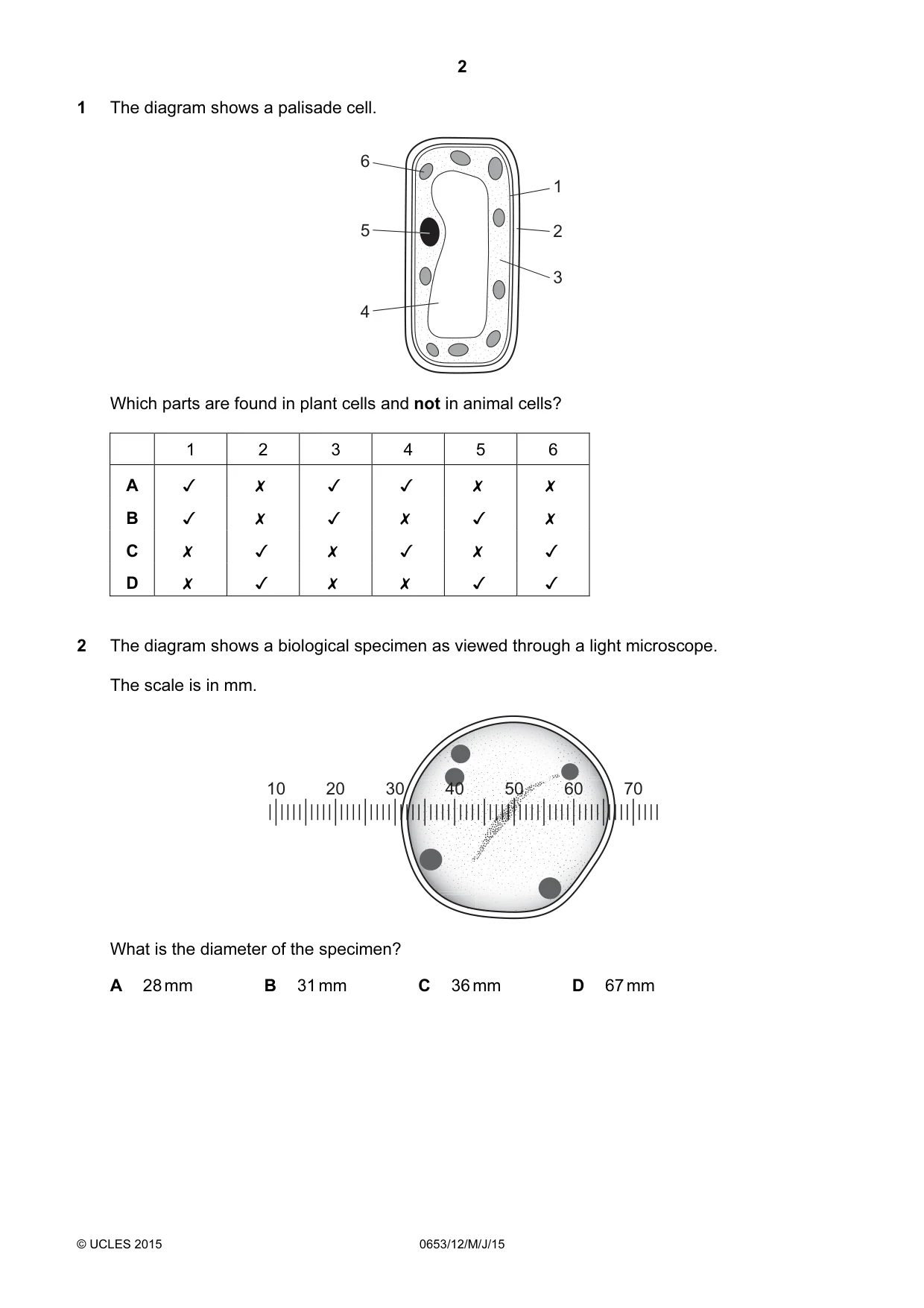
Q1 · The diagram shows a palisade cell
1 The diagram shows a palisade cell. Which parts are found in plant cells and not in animal cells? 1 2 3 4 ) 6 A v x v v x x B v x v x v x Cc x v x v x v D x v x x v v
Mark scheme: C
Q2 · The diagram shows a biological specimen as viewed through a light microscope
2 The diagram shows a biological specimen as viewed through a light microscope. The scale is in mm. 10 20 30 40 50 60 70 What is the diameter of the specimen? A 28 mm B 31 mm C 36 mm D 67 mm
Mark scheme: C
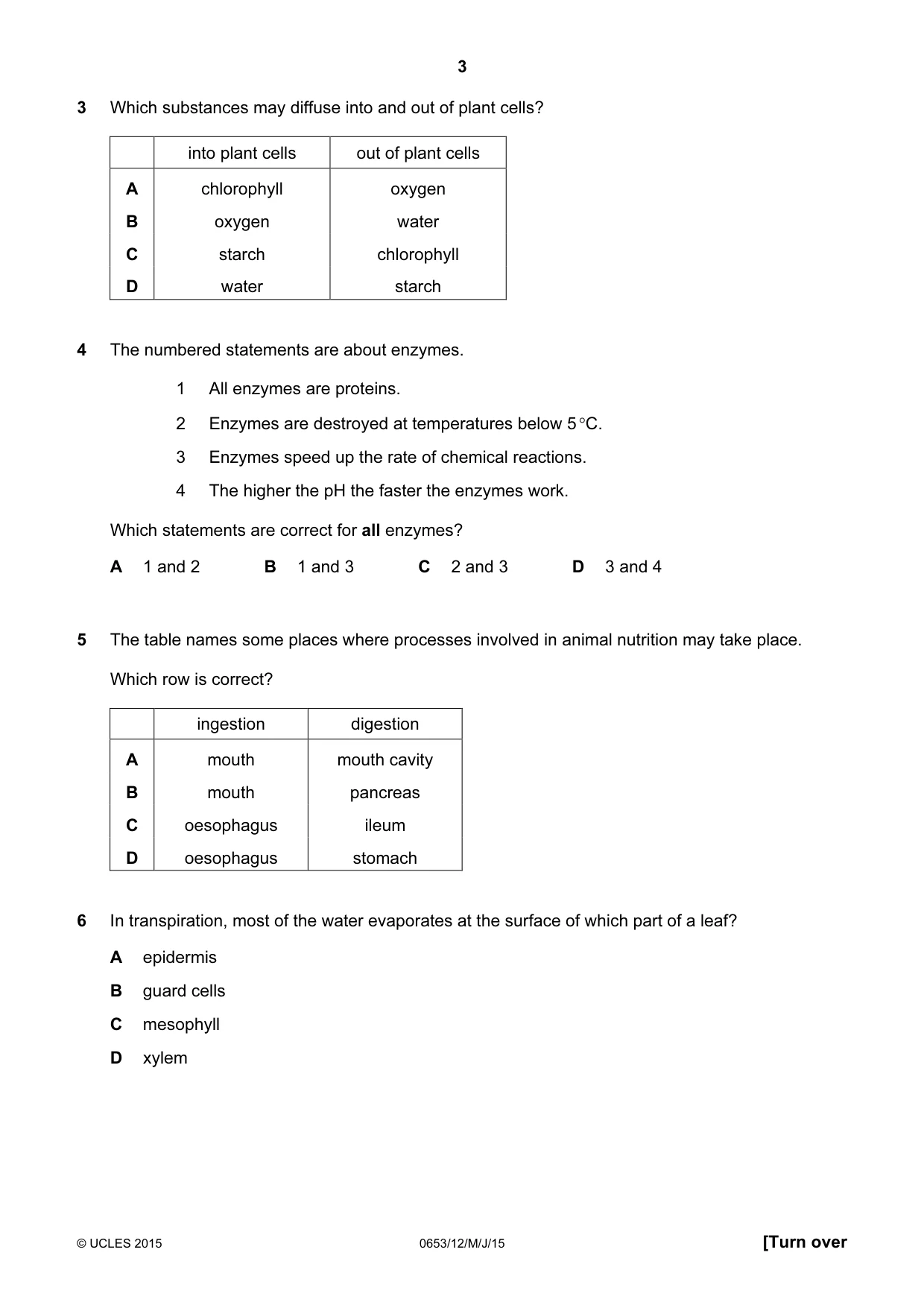
Q3 · Which substances may diffuse into and out of plant cells?
3 Which substances may diffuse into and out of plant cells? into plant cells out of plant cells A chlorophyll oxygen B oxygen water C starch chlorophyll D water starch
Mark scheme: B
Q4 · The numbered statements are about enzymes
4 The numbered statements are about enzymes. 1 All enzymes are proteins. 2 Enzymes are destroyed at temperatures below 5 °C. 3 Enzymes speed up the rate of chemical reactions. 4 The higher the pH the faster the enzymes work. Which statements are correct for all enzymes? A 1 and 2 B 1 and 3 C 2 and 3 D 3 and 4
Mark scheme: B
Q5 · The table names some places where processes involved in animal nutrition may take place
5 The table names some places where processes involved in animal nutrition may take place. Which row is correct? ingestion digestion A mouth mouth cavity B mouth pancreas C oesophagus ileum D oesophagus stomach
Mark scheme: A
Q6 · In transpiration, most of the water evaporates at the surface of which part of a leaf?
6 In transpiration, most of the water evaporates at the surface of which part of a leaf? A epidermis B guard cells C mesophyll D xylem
Mark scheme: C
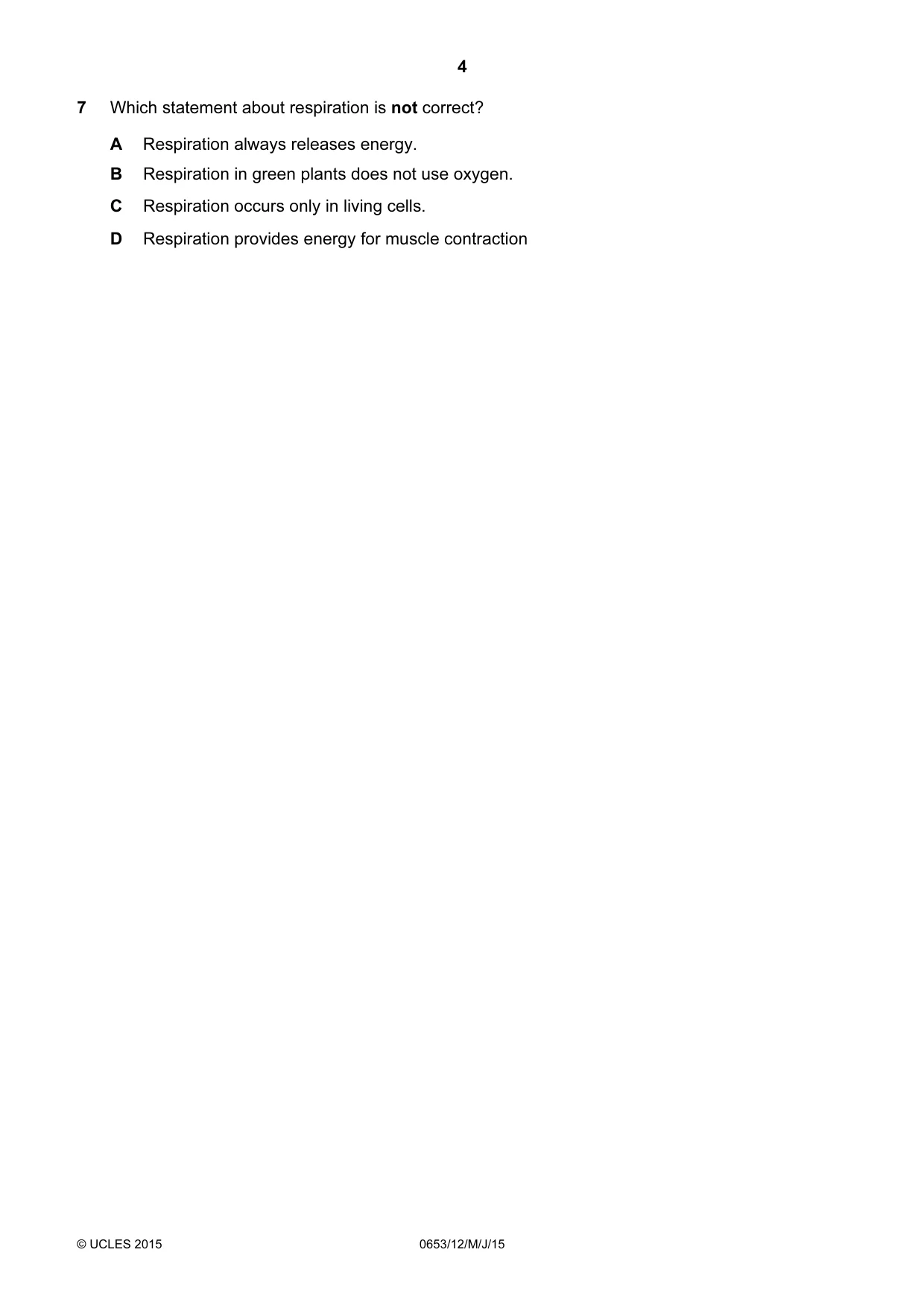
Q7 · Which statement about respiration is not correct?
7 Which statement about respiration is not correct? A Respiration always releases energy. B Respiration in green plants does not use oxygen. C Respiration occurs only in living cells. D Respiration provides energy for muscle contraction
Mark scheme: B
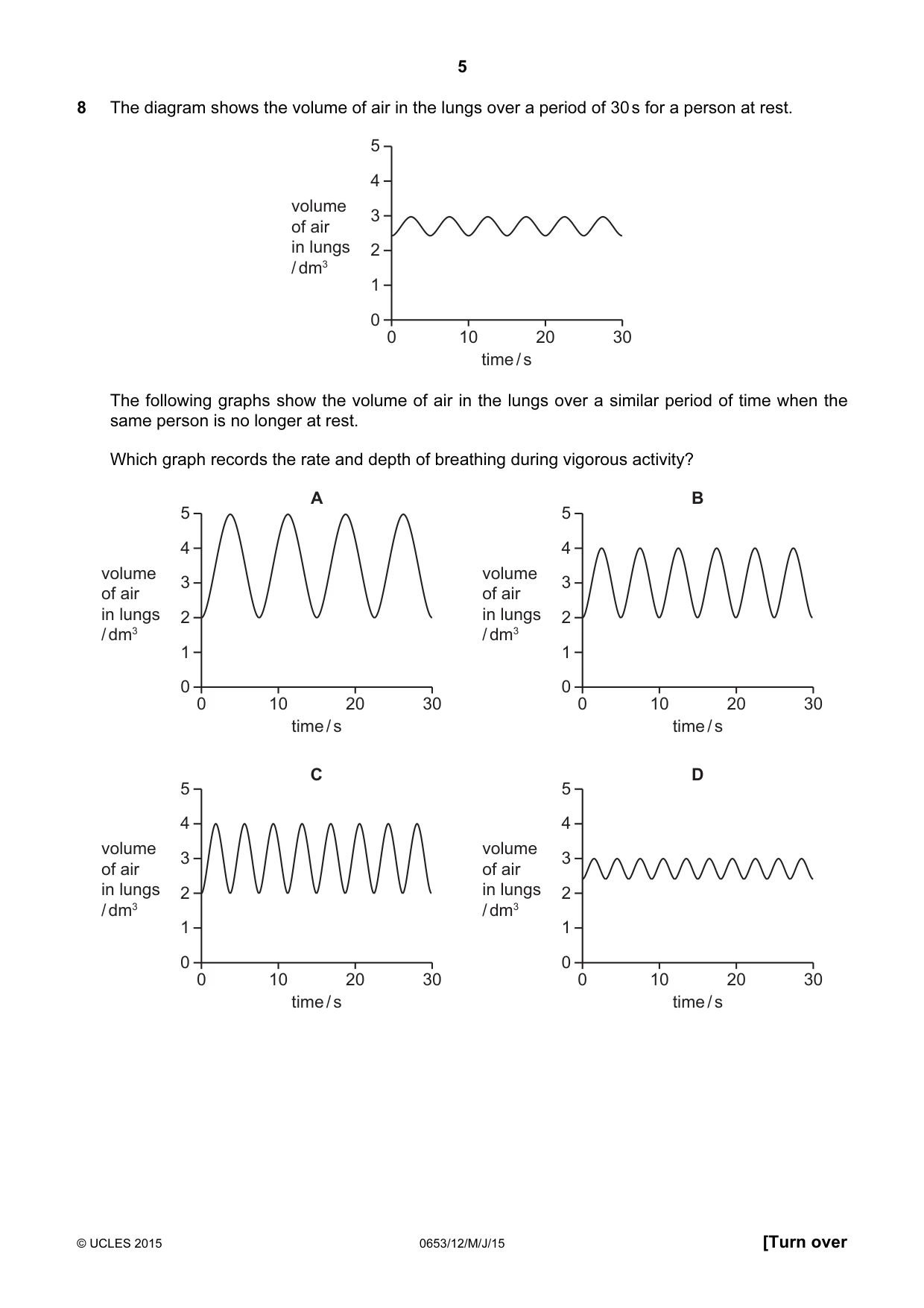
Q8 · The diagram shows the volume of air in the lungs over a period of 30 s for a person at…
8 The diagram shows the volume of air in the lungs over a period of 30 s for a person at rest. 5 4 volume 3 of air in lungs 2 / dm3 1 0 0 10 20 30 time / s The following graphs show the volume of air in the lungs over a similar period of time when the same person is no longer at rest. Which graph records the rate and depth of breathing during vigorous activity? A B 5 5 4 4 volume volume 3 3 of air of air in lungs 2 in lungs 2 / dm3 / dm3 1 1 0 0 0 10 20 30 0 10 20 30 time / s time / s C D 5 5 4 4 volume volume 3 3 of air of air in lungs 2 in lungs 2 / dm3 / dm3 1 1 0 0 0 10 20 30 0 10 20 30 time / s time / s
Mark scheme: C
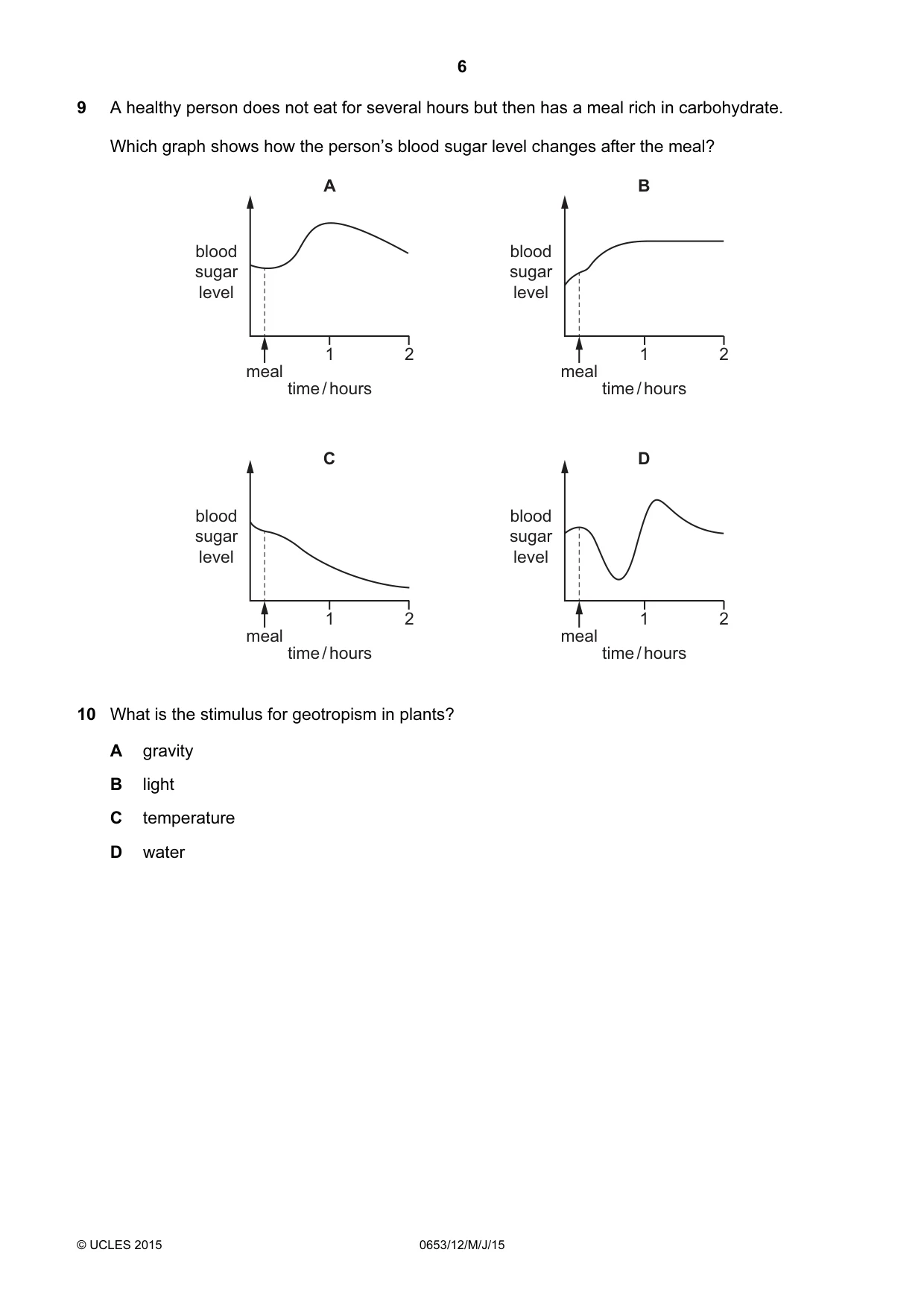
Q9 · A healthy person does not eat for several hours but then has a meal rich in carbohydrate
9 A healthy person does not eat for several hours but then has a meal rich in carbohydrate. Which graph shows how the person’s blood sugar level changes after the meal? A B blood blood sugar sugar level level 1 2 1 2 meal meal time / hours time / hours C D blood blood sugar sugar level level 1 2 1 2 meal meal time / hours time / hours
Mark scheme: A
Q10 · What is the stimulus for geotropism in plants?
10 What is the stimulus for geotropism in plants? A gravity B light C temperature D water
Mark scheme: A
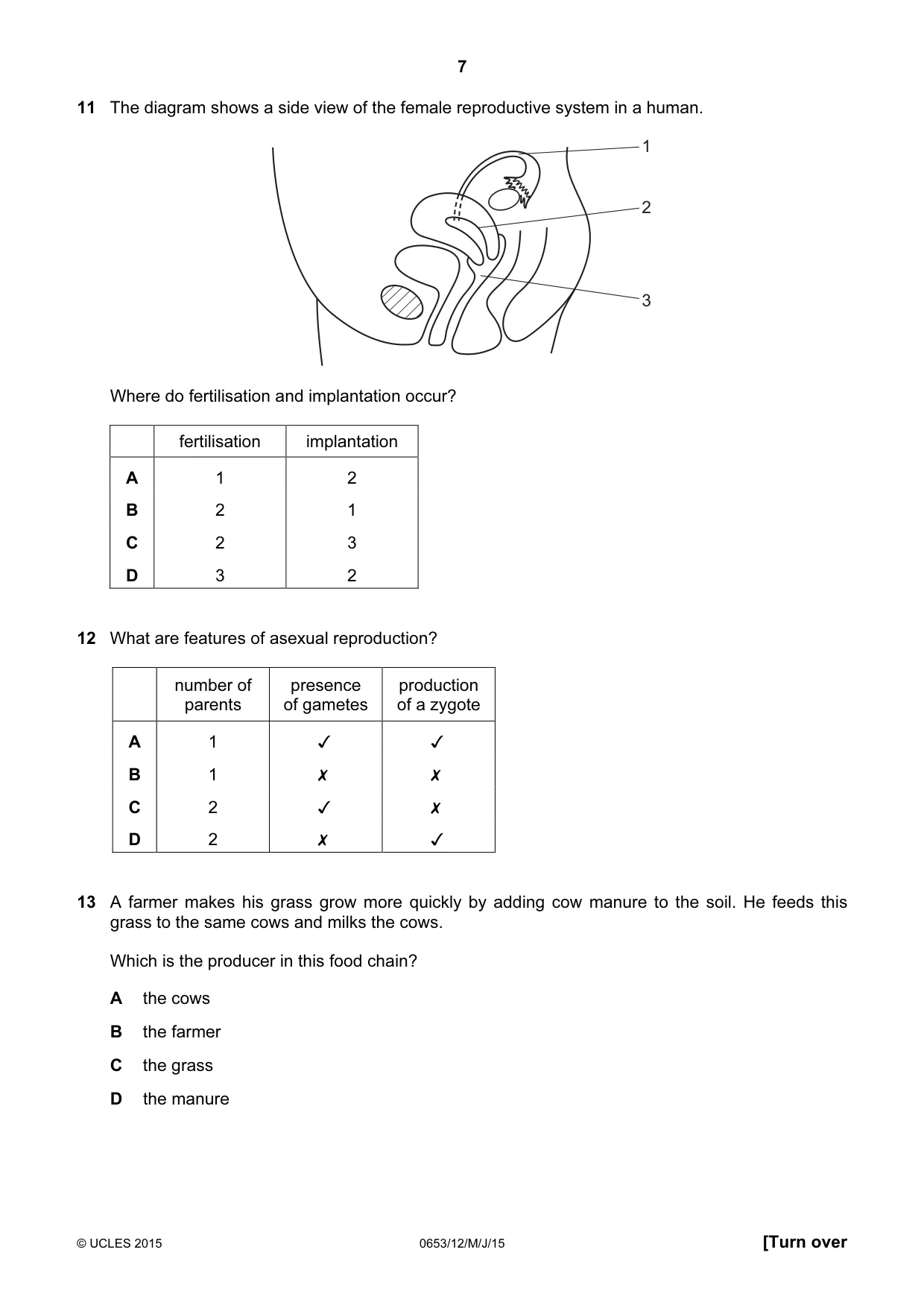
Q11 · The diagram shows a side view of the female reproductive system in a human
11 The diagram shows a side view of the female reproductive system in a human. 1 2 3 Where do fertilisation and implantation occur? fertilisation implantation A 1 2 B 2 1 C 2 3 D 3 2
Mark scheme: A
Q12 · What are features of asexual reproduction?
12 What are features of asexual reproduction? number of presence production parents of gametes | of azygote A 1 v v B 1 x x Cc 2 v x D 2 x v
Mark scheme: B
Q13 · A farmer makes his grass grow more quickly by adding cow manure to the soil
13 A farmer makes his grass grow more quickly by adding cow manure to the soil. He feeds this grass to the same cows and milks the cows. Which is the producer in this food chain? A the cows B the farmer C the grass D the manure
Mark scheme: C
Q14 · How many atoms of hydrogen are present in three molecules of ammonia, NH3
14 How many atoms of hydrogen are present in three molecules of ammonia, NH3. A 3 B 6 C 9 D 12
Mark scheme: C
Q15 · Which processes are involved in the separation of petroleum?
15 Which processes are involved in the separation of petroleum? A condensation and crystallisation B condensation only C evaporation and condensation D evaporation only
Mark scheme: C
Q16 · Fluorine and chlorine are in Group VII of the Periodic Table
16 Fluorine and chlorine are in Group VII of the Periodic Table. Which number increases by eight from fluorine to chlorine? A the number of atoms in one molecule B the number of electrons in one atom C the number of electrons in one molecule D the number of nucleons in one atom
Mark scheme: B
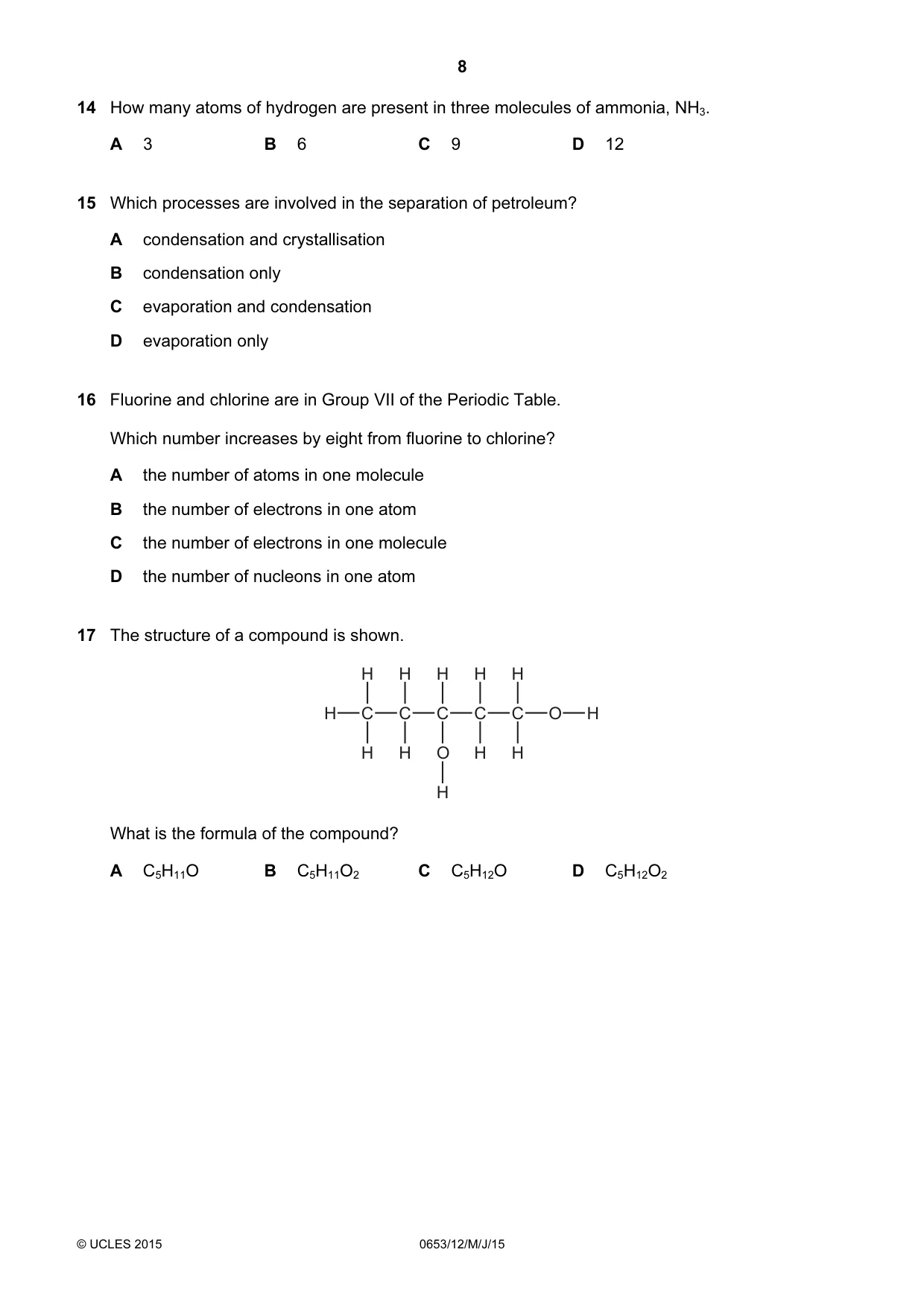
Q17 · The structure of a compound is shown
17 The structure of a compound is shown. H H H H H H C C C C C O H H H O H H H What is the formula of the compound? A C5H11O B C5H11O2 C C5H12O D C5H12O2
Mark scheme: D
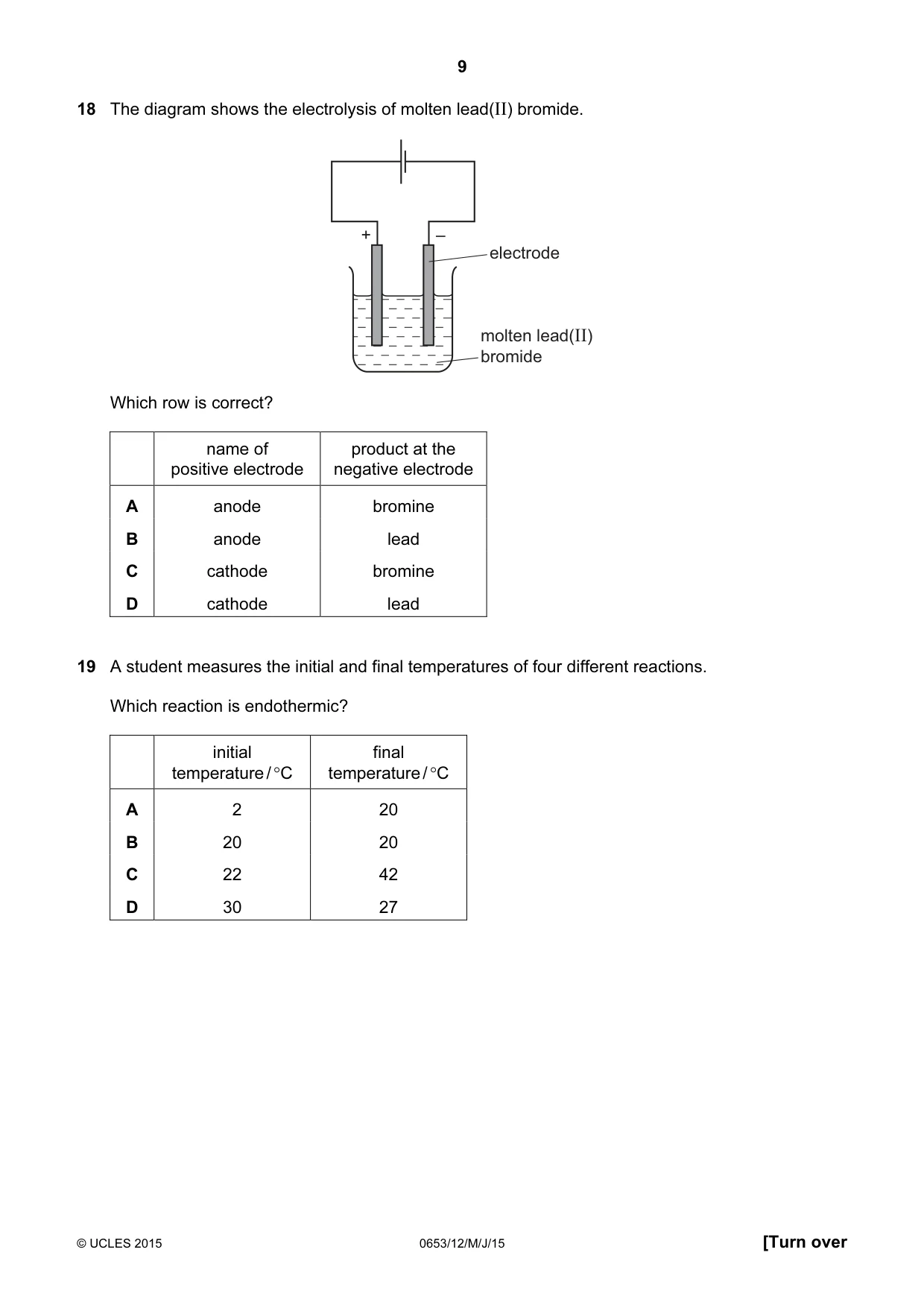
Q18 · The diagram shows the electrolysis of molten lead(II) bromide
18 The diagram shows the electrolysis of molten lead(II) bromide. + – electrode molten lead(II) bromide Which row is correct? name of product at the positive electrode negative electrode A anode bromine B anode lead C cathode bromine D cathode lead
Mark scheme: B
Q19 · A student measures the initial and final temperatures of four different reactions
19 A student measures the initial and final temperatures of four different reactions. Which reaction is endothermic? initial final temperature / °C temperature / °C A 2 20 B 20 20 C 22 42 D 30 27
Mark scheme: D
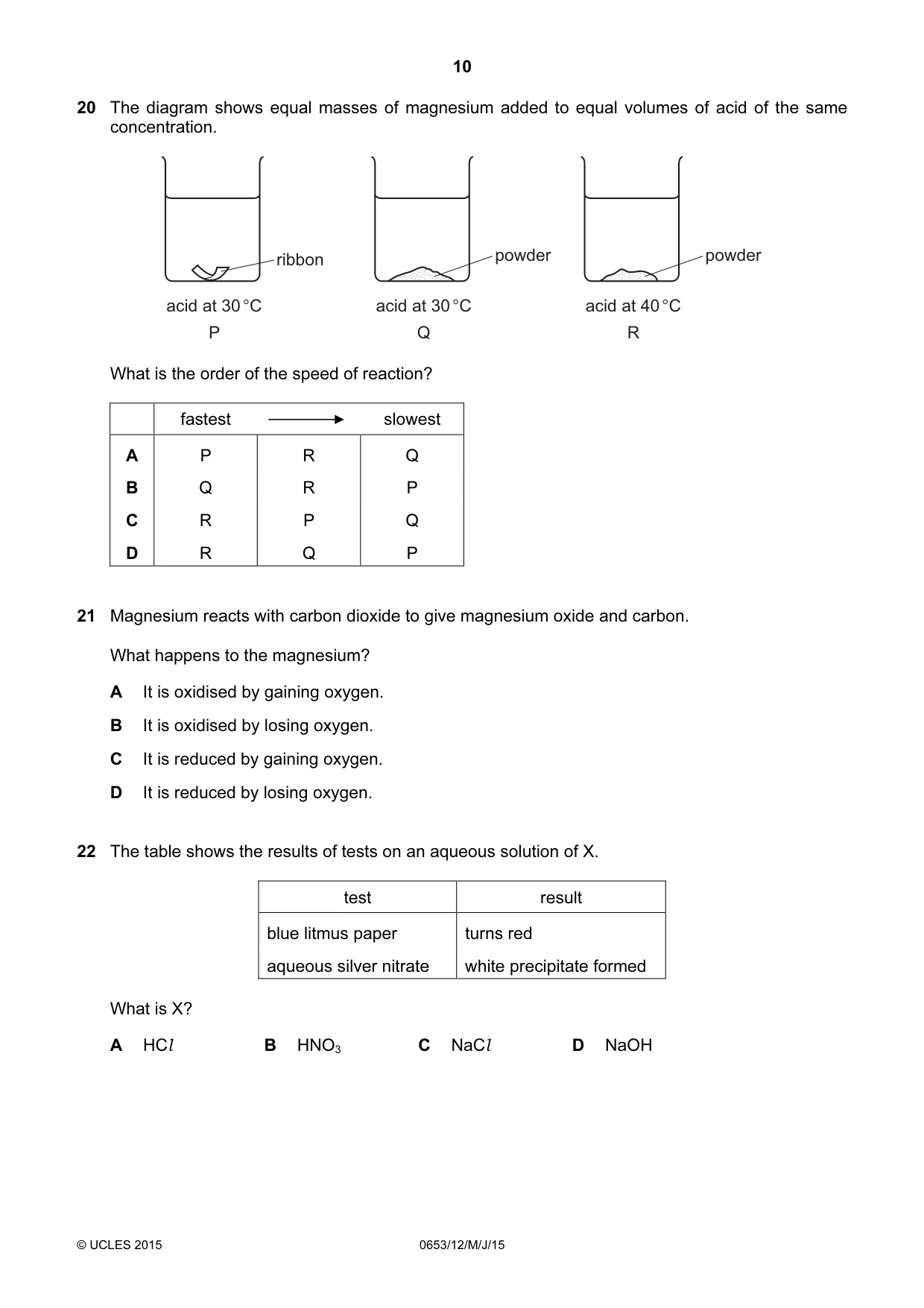
Q20 · The diagram shows equal masses of magnesium added to equal volumes of acid of the same…
20 The diagram shows equal masses of magnesium added to equal volumes of acid of the same concentration. ribbon powder powder acid at 30 °C acid at 30 °C acid at 40 °C P Q R What is the order of the speed of reaction? fastest slowest A P R Q B Q R P C R P Q D R Q P
Mark scheme: D
Q21 · Magnesium reacts with carbon dioxide to give magnesium oxide and carbon
21 Magnesium reacts with carbon dioxide to give magnesium oxide and carbon. What happens to the magnesium? A It is oxidised by gaining oxygen. B It is oxidised by losing oxygen. C It is reduced by gaining oxygen. D It is reduced by losing oxygen.
Mark scheme: A
Q22 · The table shows the results of tests on an aqueous solution of X
22 The table shows the results of tests on an aqueous solution of X. test result blue litmus paper turns red aqueous silver nitrate white precipitate formed What is X? A HCl B HNO3 C NaCl D NaOH
Mark scheme: A
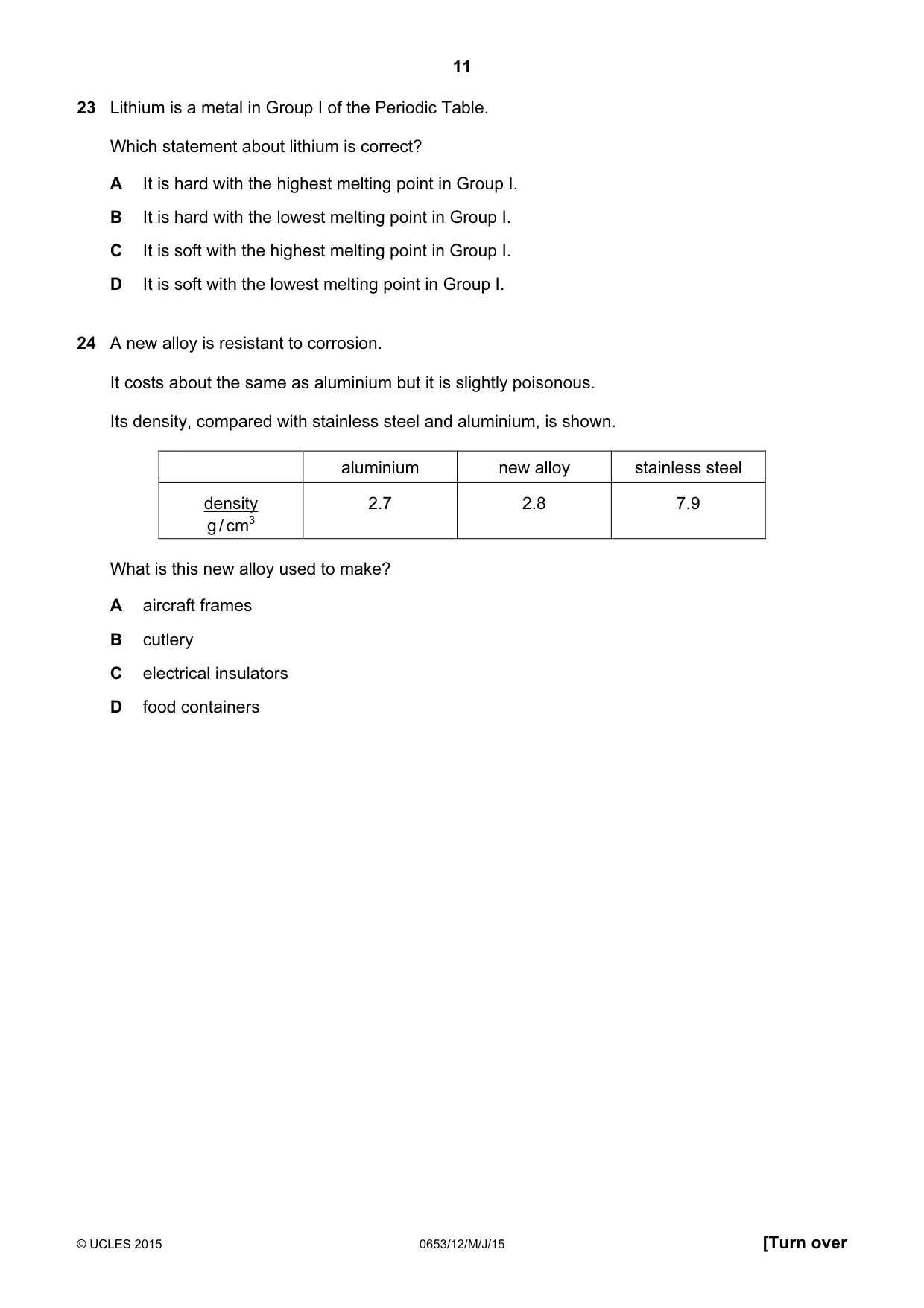
Q23 · Lithium is a metal in Group I of the Periodic Table
23 Lithium is a metal in Group I of the Periodic Table. Which statement about lithium is correct? A It is hard with the highest melting point in Group I. B It is hard with the lowest melting point in Group I. C It is soft with the highest melting point in Group I. D It is soft with the lowest melting point in Group I.
Mark scheme: C
Q24 · A new alloy is resistant to corrosion
24 A new alloy is resistant to corrosion. It costs about the same as aluminium but it is slightly poisonous. Its density, compared with stainless steel and aluminium, is shown. aluminium new alloy stainless steel density 2.7 2.8 7.9 g / cm3 What is this new alloy used to make? A aircraft frames B cutlery C electrical insulators D food containers
Mark scheme: A
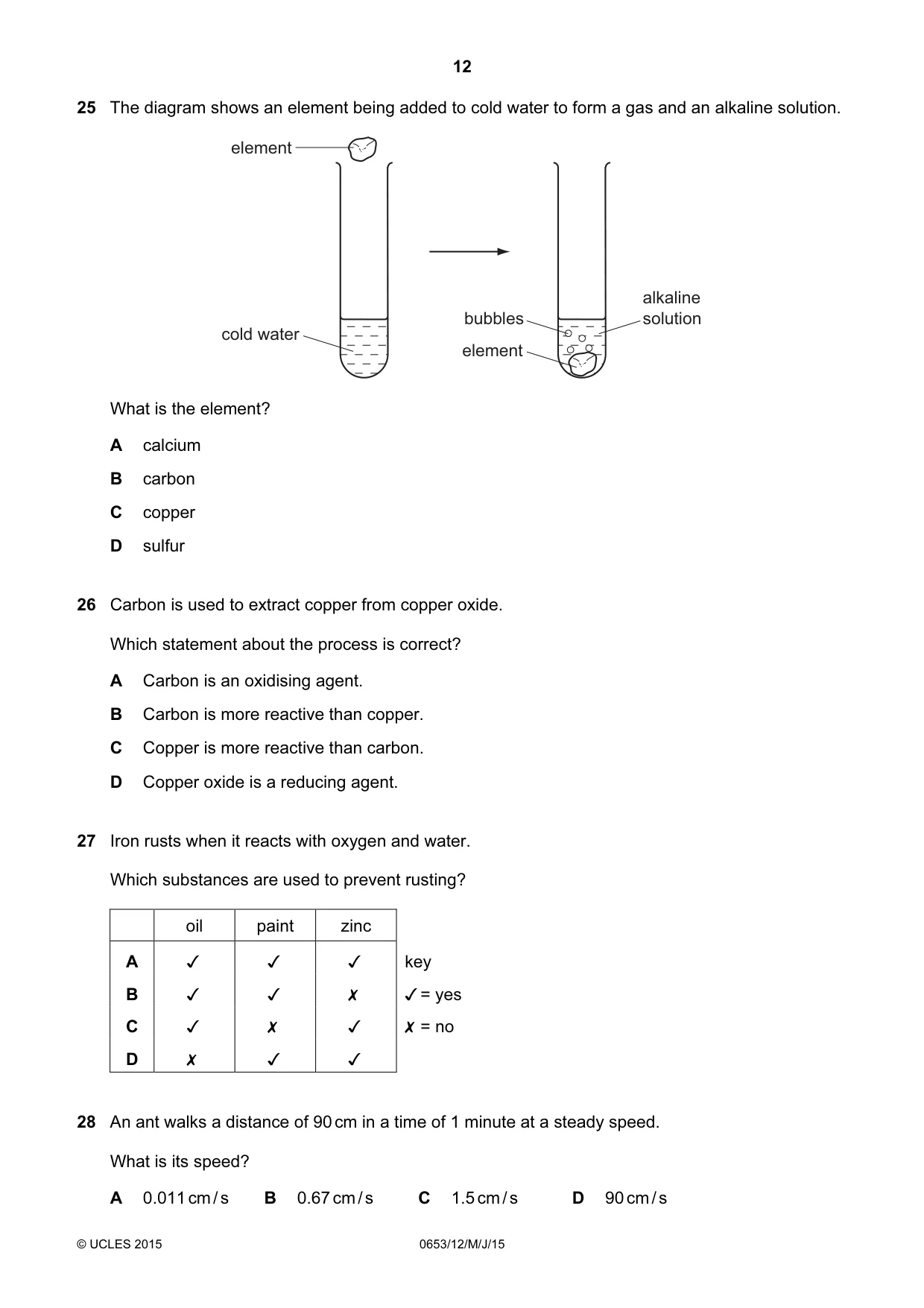
Q25 · The diagram shows an element being added to cold water to form a gas and an alkaline…
25 The diagram shows an element being added to cold water to form a gas and an alkaline solution. element alkaline bubbles solution cold water element What is the element? A calcium B carbon C copper D sulfur
Mark scheme: A
Q26 · Carbon is used to extract copper from copper oxide
26 Carbon is used to extract copper from copper oxide. Which statement about the process is correct? A Carbon is an oxidising agent. B Carbon is more reactive than copper. C Copper is more reactive than carbon. D Copper oxide is a reducing agent.
Mark scheme: B
Q27 · Lron rusts when it reacts with oxygen and water
27 lron rusts when it reacts with oxygen and water. Which substances are used to prevent rusting? oil paint zinc A v v v B v v x Cc v x v D x v v key v=yes X =no
Mark scheme: A
Q28 · An ant walks a distance of 90 cm in a time of 1 minute at a steady speed
28 An ant walks a distance of 90 cm in a time of 1 minute at a steady speed. What is its speed? A 0.011 cm / s B 0.67 cm / s C 1.5 cm / s D 90 cm / s
Mark scheme: C
Q29 · A shop-keeper places two identical blocks of cheese on a balance
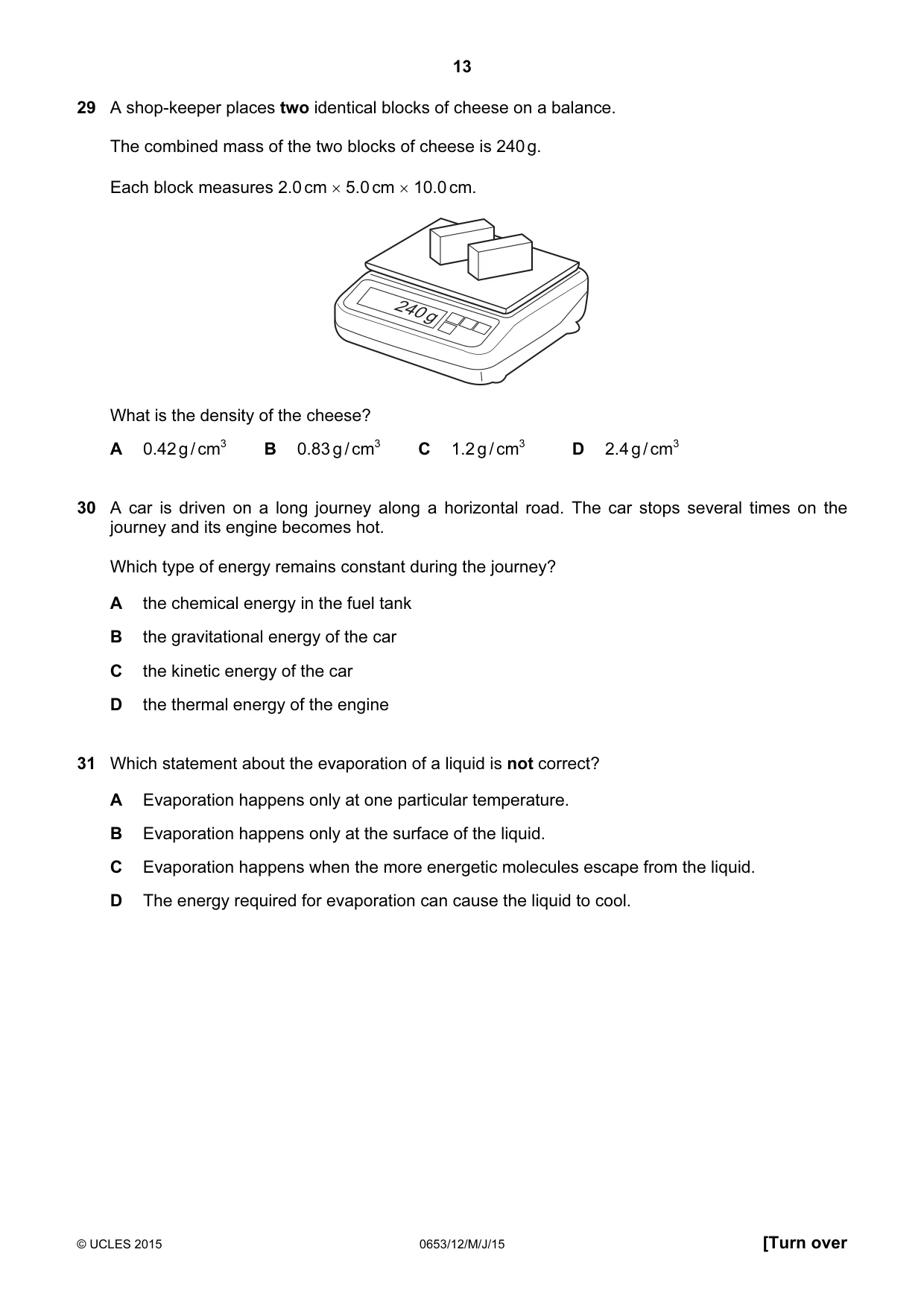
29 A shop-keeper places two identical blocks of cheese on a balance. The combined mass of the two blocks of cheese is 240 g. Each block measures 2.0 cm × 5.0 cm × 10.0 cm. 240 g What is the density of the cheese? A 0.42 g / cm3 B 0.83 g / cm3 C 1.2 g / cm3 D 2.4 g / cm3
Mark scheme: C
Q30 · A car is driven on a long journey along a horizontal road
30 A car is driven on a long journey along a horizontal road. The car stops several times on the journey and its engine becomes hot. Which type of energy remains constant during the journey? A the chemical energy in the fuel tank B the gravitational energy of the car C the kinetic energy of the car D the thermal energy of the engine
Mark scheme: B
Q31 · Which statement about the evaporation of a liquid is not correct?
31 Which statement about the evaporation of a liquid is not correct? A Evaporation happens only at one particular temperature. B Evaporation happens only at the surface of the liquid. C Evaporation happens when the more energetic molecules escape from the liquid. D The energy required for evaporation can cause the liquid to cool.
Mark scheme: A
Q32 · Hot, liquid wax is allowed to cool to room temperature
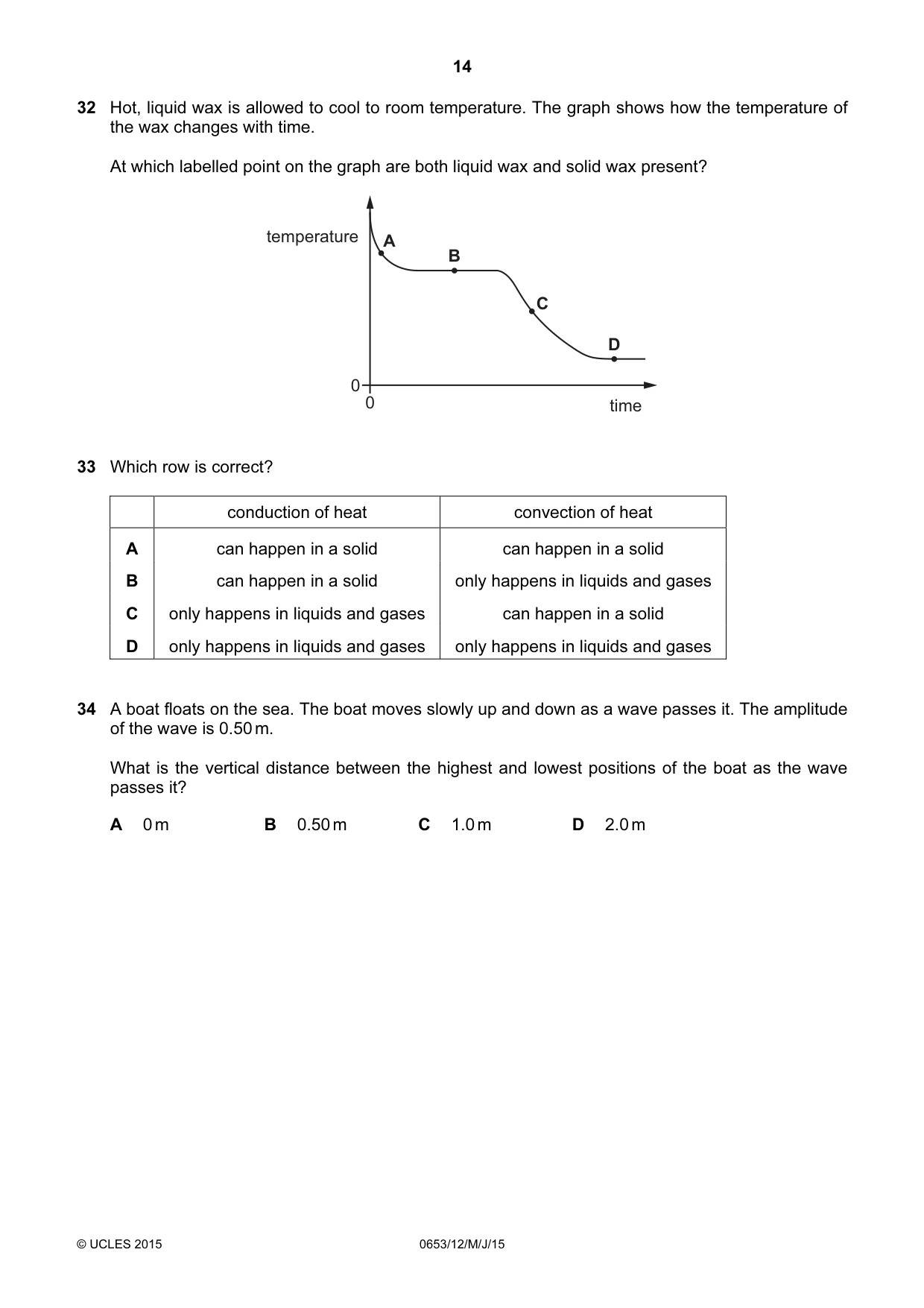
32 Hot, liquid wax is allowed to cool to room temperature. The graph shows how the temperature of the wax changes with time. At which labelled point on the graph are both liquid wax and solid wax present? temperature A B C D 0 0 time
Mark scheme: B
Q33 · Which row is correct?
33 Which row is correct? conduction of heat convection of heat A can happen in a solid can happen in a solid B can happen in a solid only happens in liquids and gases C only happens in liquids and gases can happen in a solid D only happens in liquids and gases only happens in liquids and gases
Mark scheme: B
Q34 · A boat floats on the sea
34 A boat floats on the sea. The boat moves slowly up and down as a wave passes it. The amplitude of the wave is 0.50 m. What is the vertical distance between the highest and lowest positions of the boat as the wave passes it? A 0 m B 0.50 m C 1.0 m D 2.0 m
Mark scheme: C
Q35 · The diagram shows three rays of light passing through a converging lens
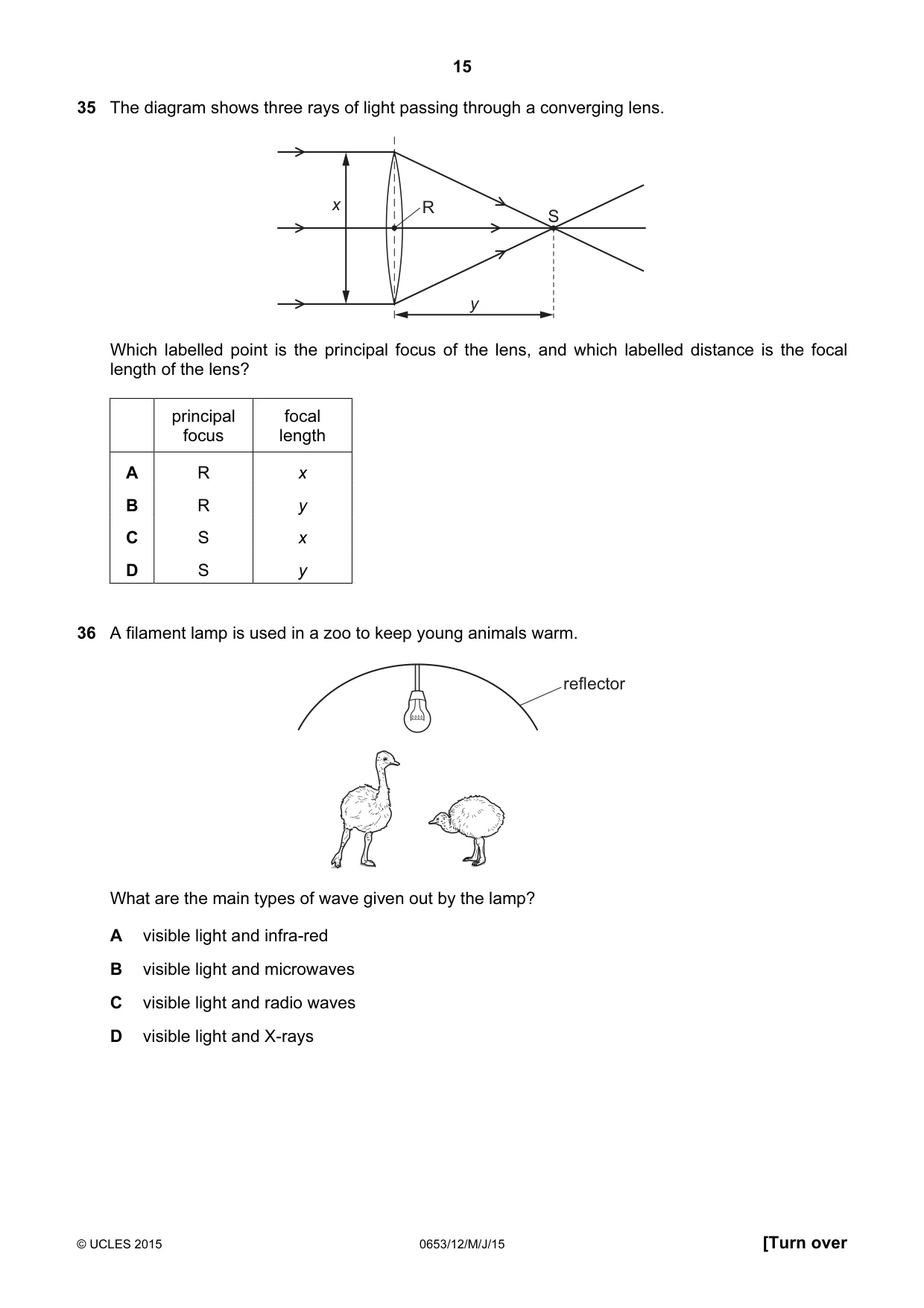
35 The diagram shows three rays of light passing through a converging lens. x R S y Which labelled point is the principal focus of the lens, and which labelled distance is the focal length of the lens? principal focal focus length A R x B R y C S x D S y
Mark scheme: D
Q36 · A filament lamp is used in a zoo to keep young animals warm
36 A filament lamp is used in a zoo to keep young animals warm. reflector What are the main types of wave given out by the lamp? A visible light and infra-red B visible light and microwaves C visible light and radio waves D visible light and X-rays
Mark scheme: A
Q37 · A loudspeaker vibrates with different amplitudes and at different frequencies
37 A loudspeaker vibrates with different amplitudes and at different frequencies. Which amplitude and which frequency produces the louder, higher-pitched sound? A large amplitude and high frequency B large amplitude and low frequency C small amplitude and high frequency D small amplitude and low frequency
Mark scheme: A
Q38 · The current in a lamp is 0.25 A
38 The current in a lamp is 0.25 A. The maximum safe current in the cable to the lamp is 5.0 A. Which fuse should be used to protect the lamp circuit? A 0.2 A B 1.0 A C 5.0 A D 10.0 A
Mark scheme: B
Q39 · A student connects a battery to a lamp
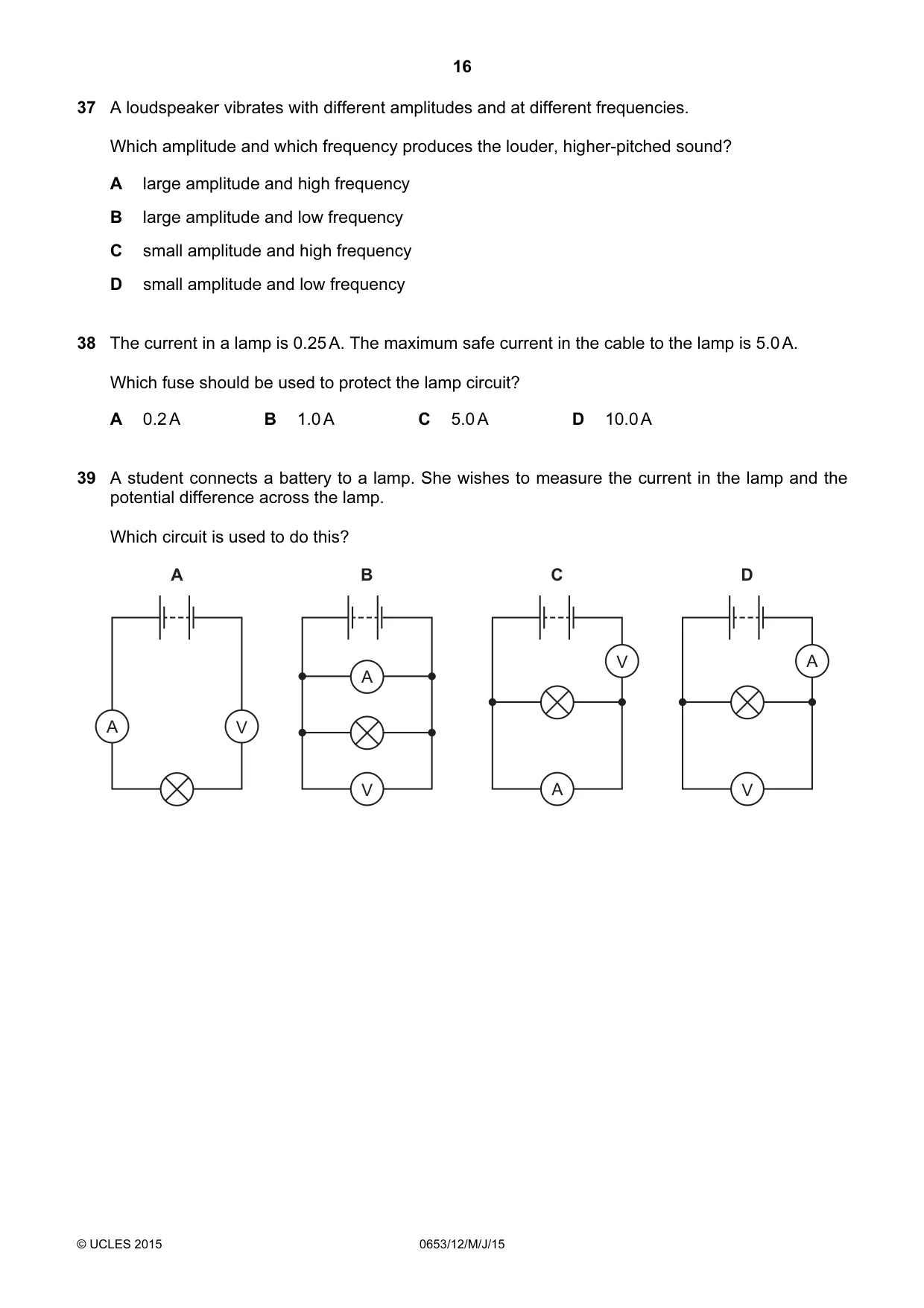
39 A student connects a battery to a lamp. She wishes to measure the current in the lamp and the potential difference across the lamp. Which circuit is used to do this? A B C D V A A A V V A V
Mark scheme: D
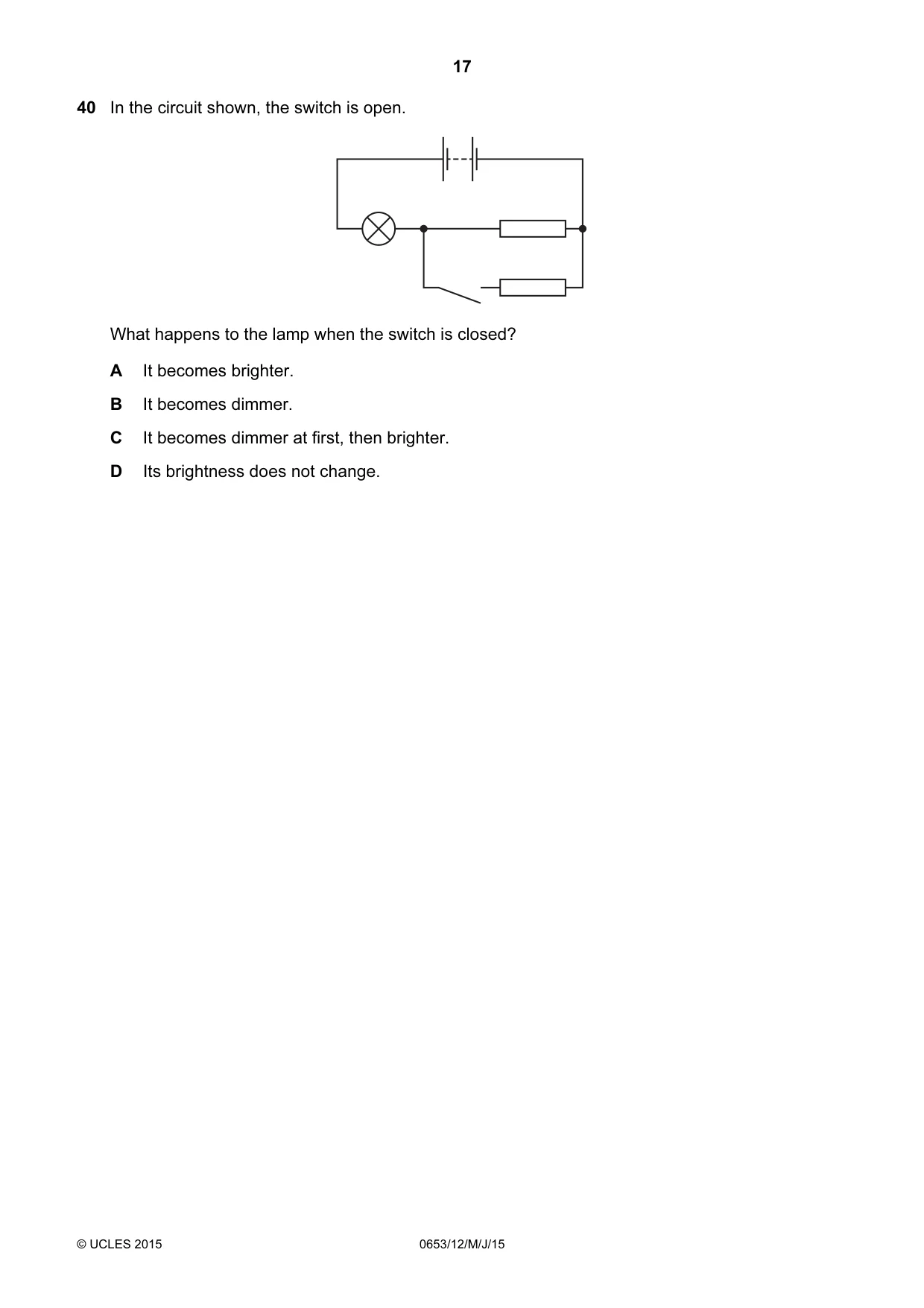
Q40 · In the circuit shown, the switch is open
40 In the circuit shown, the switch is open. What happens to the lamp when the switch is closed? A It becomes brighter. B It becomes dimmer. C It becomes dimmer at first, then brighter. D Its brightness does not change.
Mark scheme: A
What was in this paper
The subtopics covered by these 40 questions, and how many questions each got. Open one in a new tab to see every Cambridge question on it.
2Group I properties2Cell structure1Characteristics of living organisms1Corrosion of metals1Density1Diet1Diffusion1Digestive system1Electrical safety1Electrolysis1Electromagnetic spectrum1Energy, work and power1Enzymes1Exothermic and endothermic reactions1Food chains and food webs1Formulas1Gas exchange in humans1General properties of waves1Group VII properties1Identification of ions and gases1Kinetic particle model of matter1Light1Motion1Rate of reaction1Reactivity series1Redox1Respiration1Separation and purification1Sexual reproduction in humans1Sexual reproduction in plants1Size of specimens1Sound1Terminology1Thermal properties and temperature1Transfer of thermal energy1Transpiration1Uses of metals1What you needed in this session
Cambridge’s own grade thresholds for 2015 May/June, Paper 1 · Variant 2. A higher threshold means an easier paper — the bar moves with how the cohort did.