Cambridge IGCSE Science - Combined 0653 — 2014 May/June Paper 1 · Variant 2
0653/12/M/J/14 · 40 questions · 40 marks · ≈45 min
The question paper and its mark scheme, free to read here and free to download. This is Cambridge’s own paper, exactly as it was sat.
Question paper20 pages



Mark scheme2 pages
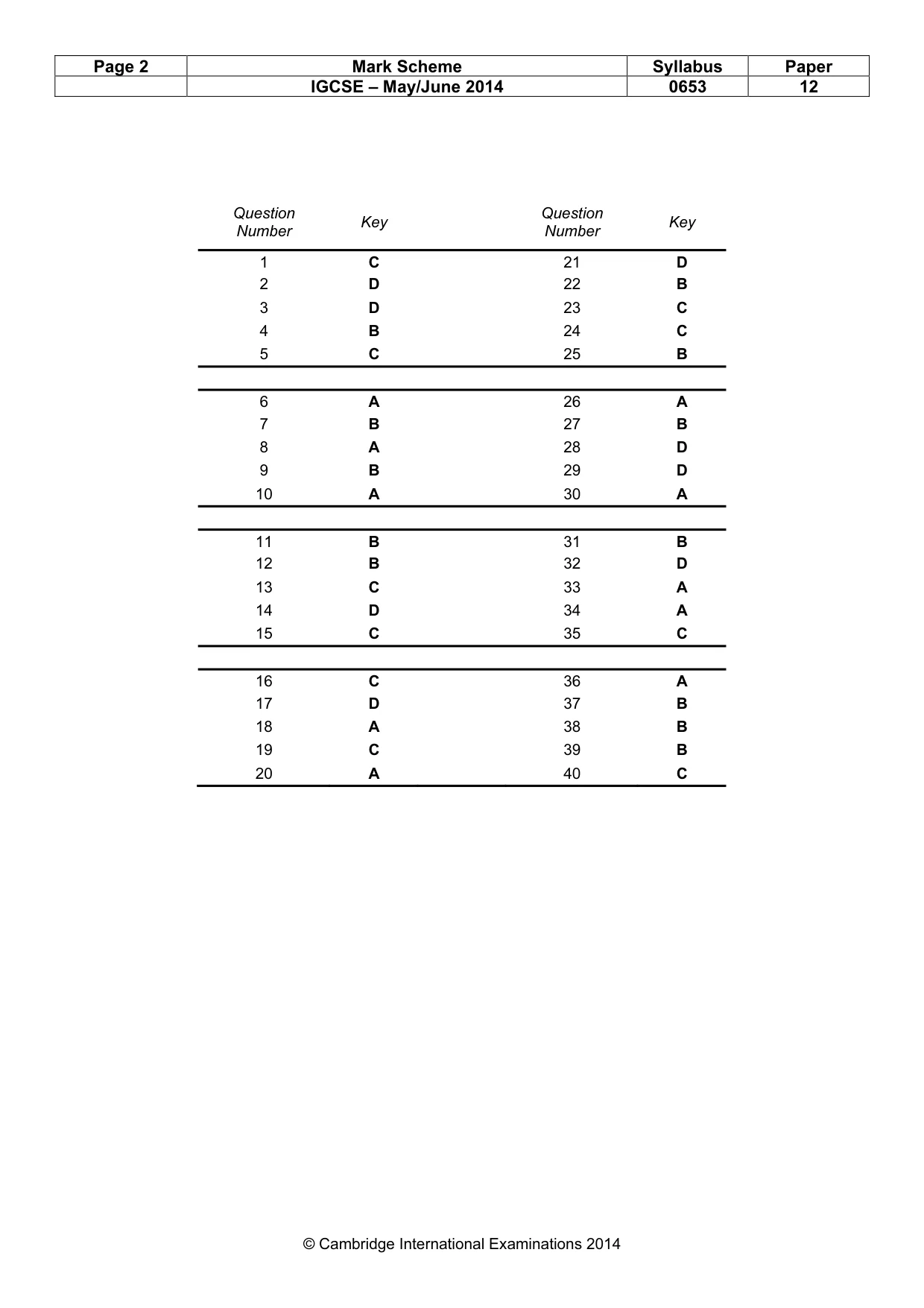
Answers below. Sit the paper first if you are practising.
Questions as text
Q1 · Which feature of a bird is the only one that helps to define it as a living organism?
1 Which feature of a bird is the only one that helps to define it as a living organism? A It can fly. B It has a hard, horny beak or bill. C It is able to reproduce. D The female lays eggs.
Mark scheme: C
Q2 · What causes oxygen to diffuse into the blood from an alveolus in the lungs?
2 What causes oxygen to diffuse into the blood from an alveolus in the lungs? A The oxygen concentration in the alveolus is higher than in the atmosphere. B The oxygen concentration in the alveolus is lower than in the blood. C The oxygen concentration in the atmosphere is higher than the carbon dioxide concentration. D The oxygen concentration in the blood is lower than in the alveolus.
Mark scheme: D
Q3 · What are enzymes made of?
3 What are enzymes made of? A carbohydrate B fat C fibre D protein
Mark scheme: D
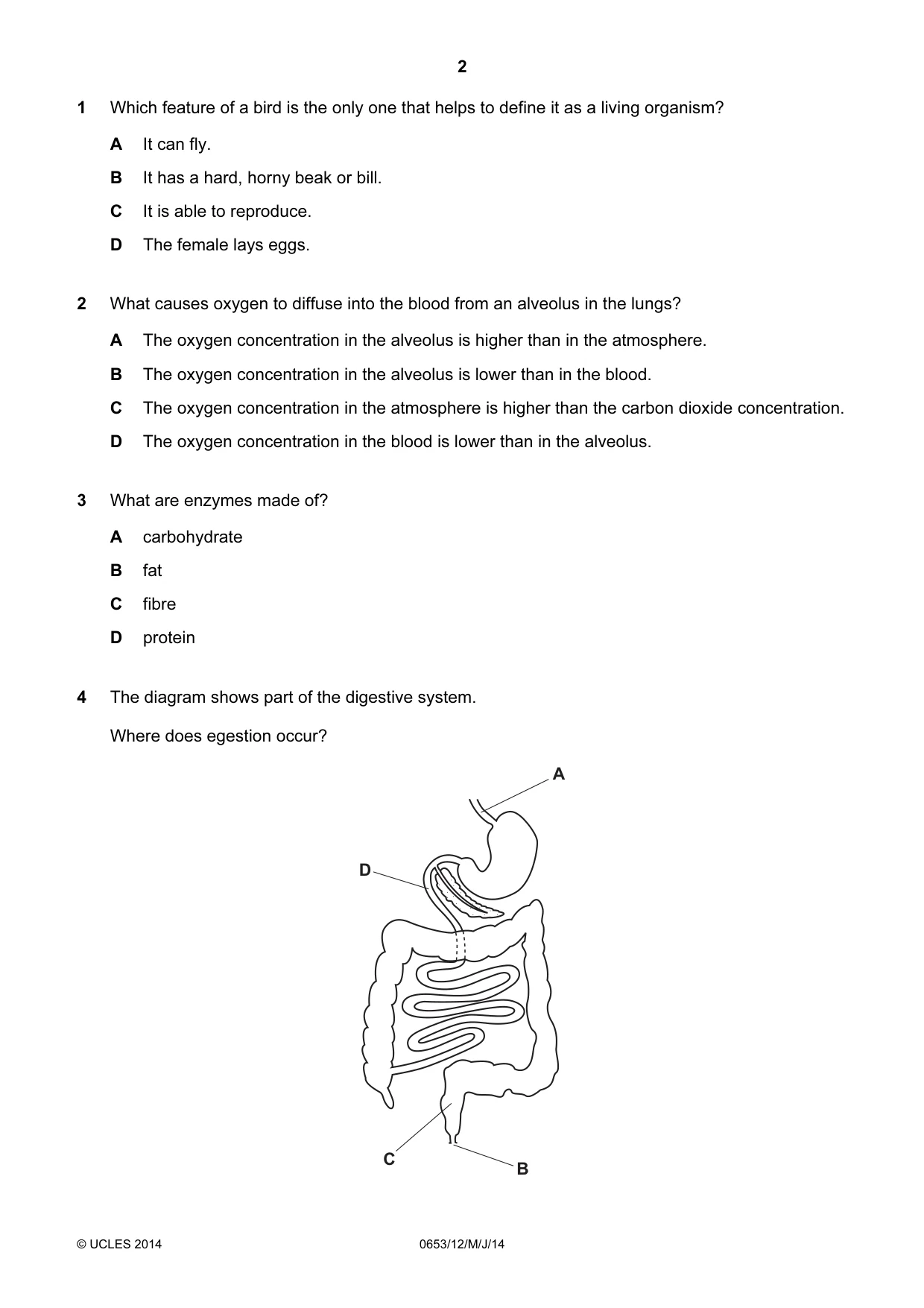
Q4 · The diagram shows part of the digestive system
4 The diagram shows part of the digestive system. Where does egestion occur? A D C B
Mark scheme: B
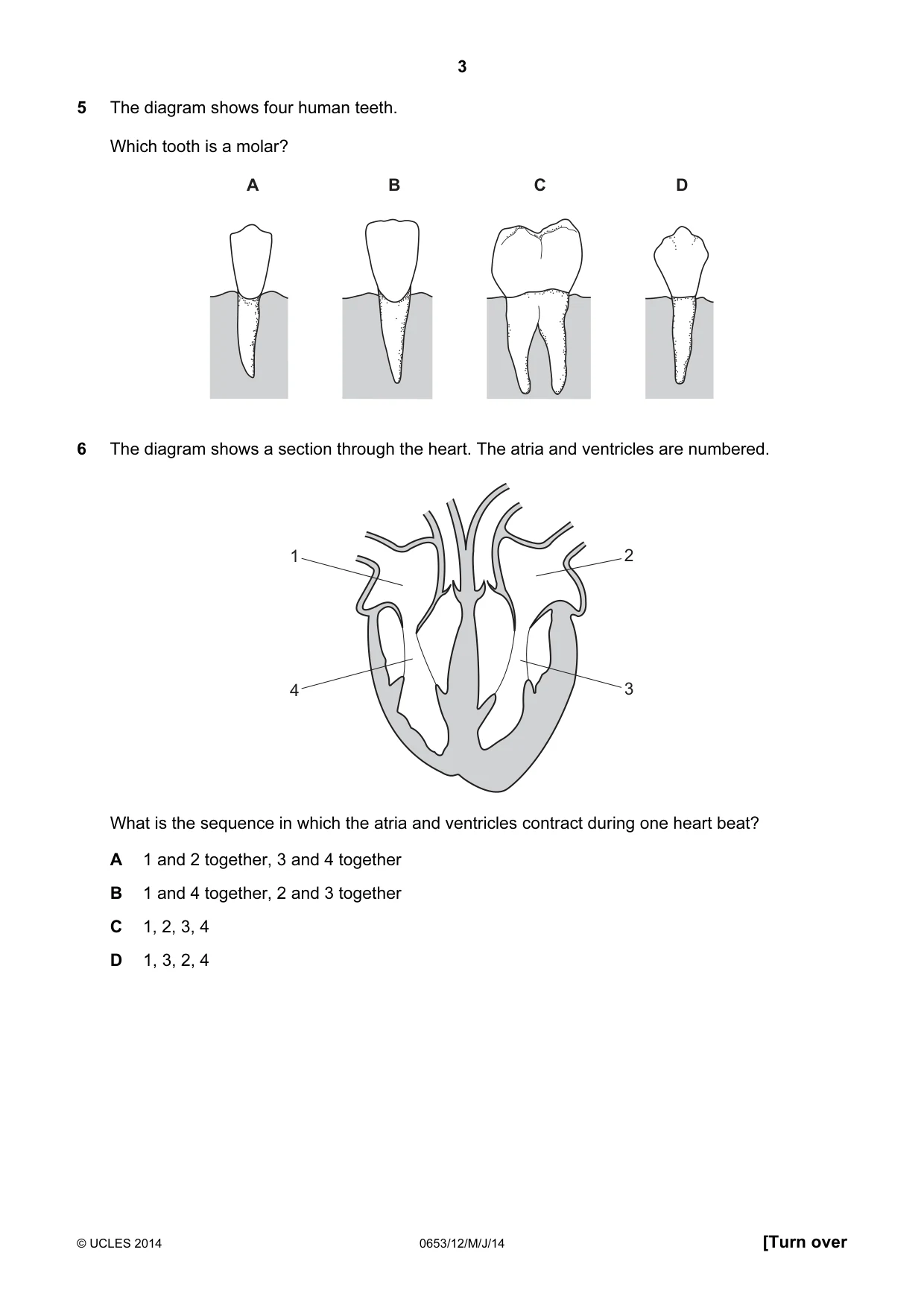
Q5 · The diagram shows four human teeth
5 The diagram shows four human teeth. Which tooth is a molar? A B C D
Mark scheme: C
Q6 · The diagram shows a section through the heart
6 The diagram shows a section through the heart. The atria and ventricles are numbered. 1 2 4 3 What is the sequence in which the atria and ventricles contract during one heart beat? A 1 and 2 together, 3 and 4 together B 1 and 4 together, 2 and 3 together C 1, 2, 3, 4 D 1, 3, 2, 4
Mark scheme: A
Q7 · In which physical state is water when it is absorbed and when it is lost by a plant?
7 In which physical state is water when it is absorbed and when it is lost by a plant? absorbed lost A liquid liquid B liquid vapour C vapour liquid D vapour vapour
Mark scheme: B
Q8 · Which row gives the correct information about aerobic respiration?
8 Which row gives the correct information about aerobic respiration? nutrient molecules broken down produces water releases energy 0 0O WwW D> v v v x Kk 4 4 KS 4&4 key xX ll ll information correct information incorrect
Mark scheme: A
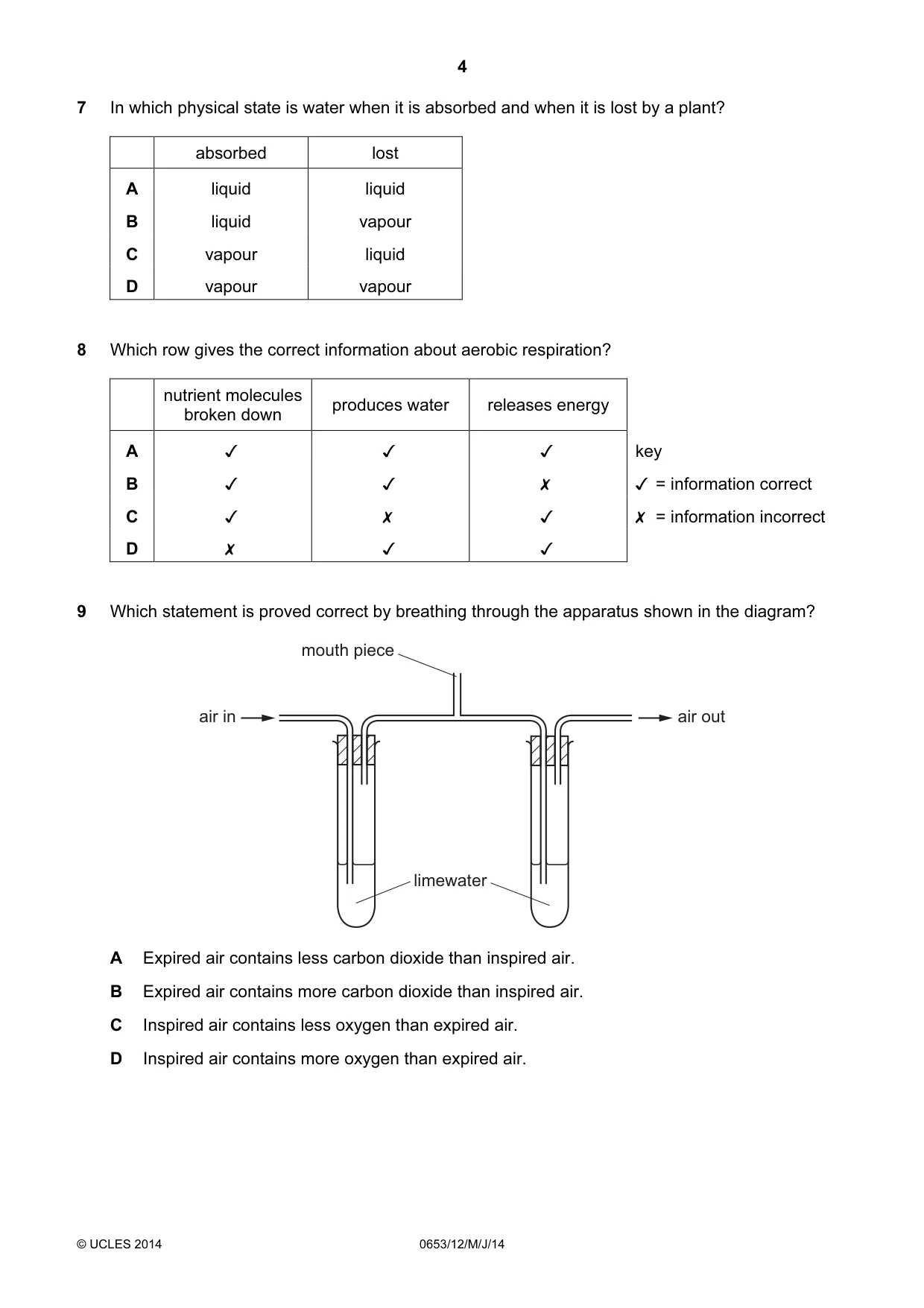
Q9 · Which statement is proved correct by breathing through the apparatus shown in the diagram?
9 Which statement is proved correct by breathing through the apparatus shown in the diagram? mouth piece air in air out limewater A Expired air contains less carbon dioxide than inspired air. B Expired air contains more carbon dioxide than inspired air. C Inspired air contains less oxygen than expired air. D Inspired air contains more oxygen than expired air.
Mark scheme: B
Q10 · What happens after a hormone has had an effect on a target organ?
10 What happens after a hormone has had an effect on a target organ? A It is destroyed by the liver. B It is reabsorbed by the gland that made it. C It is stored for future use. D It is used to increase the rate of heartbeat.
Mark scheme: A
Q11 · What would be effective in preventing the spread of HIV?
11 What would be effective in preventing the spread of HIV? A chlorinating all drinking water B screening of blood before transfusions C sterilisation of showers, baths and toilets D thorough cooking of all food
Mark scheme: B
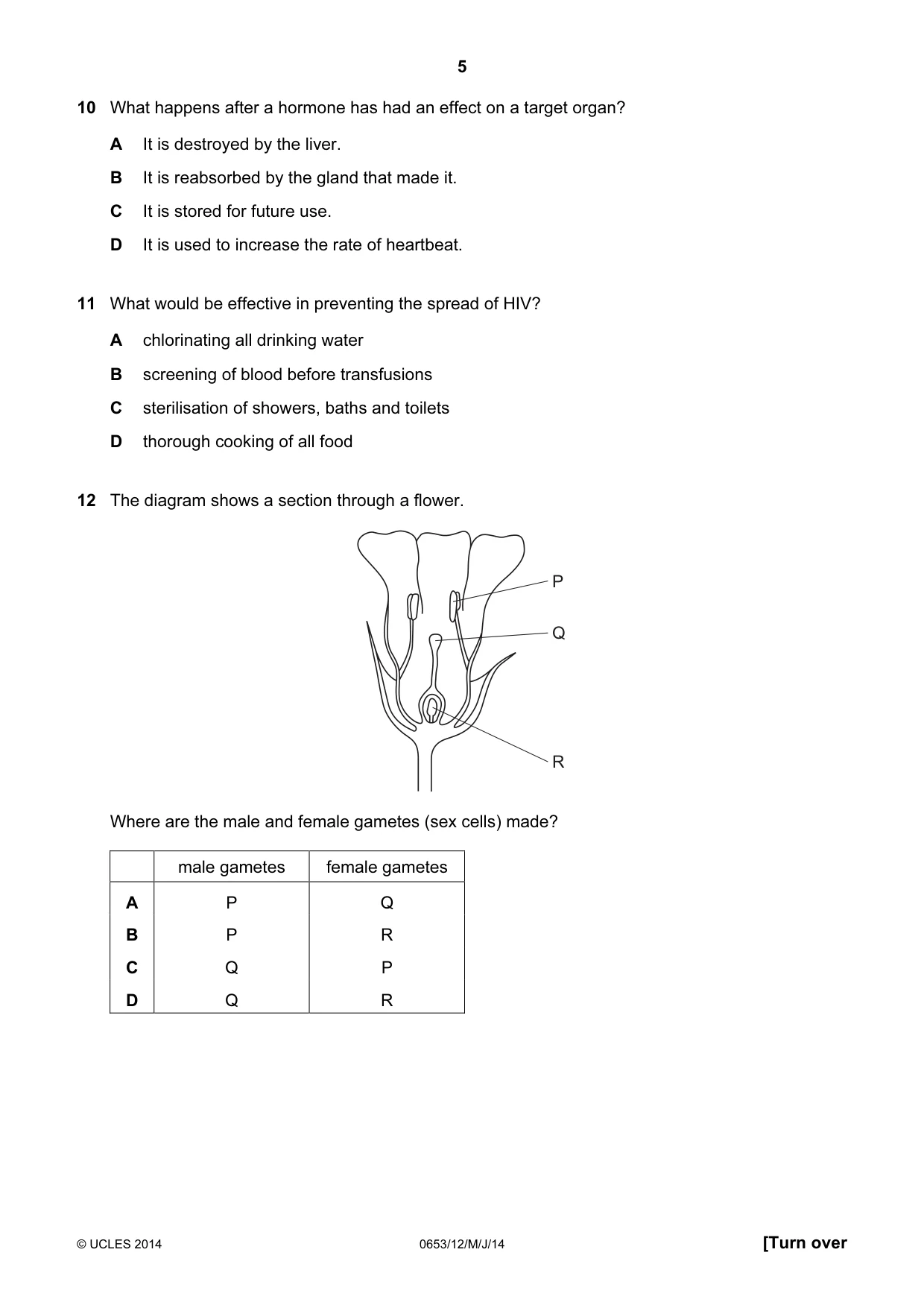
Q12 · The diagram shows a section through a flower
12 The diagram shows a section through a flower. P Q R Where are the male and female gametes (sex cells) made? male gametes female gametes A P Q B P R C Q P D Q R
Mark scheme: B
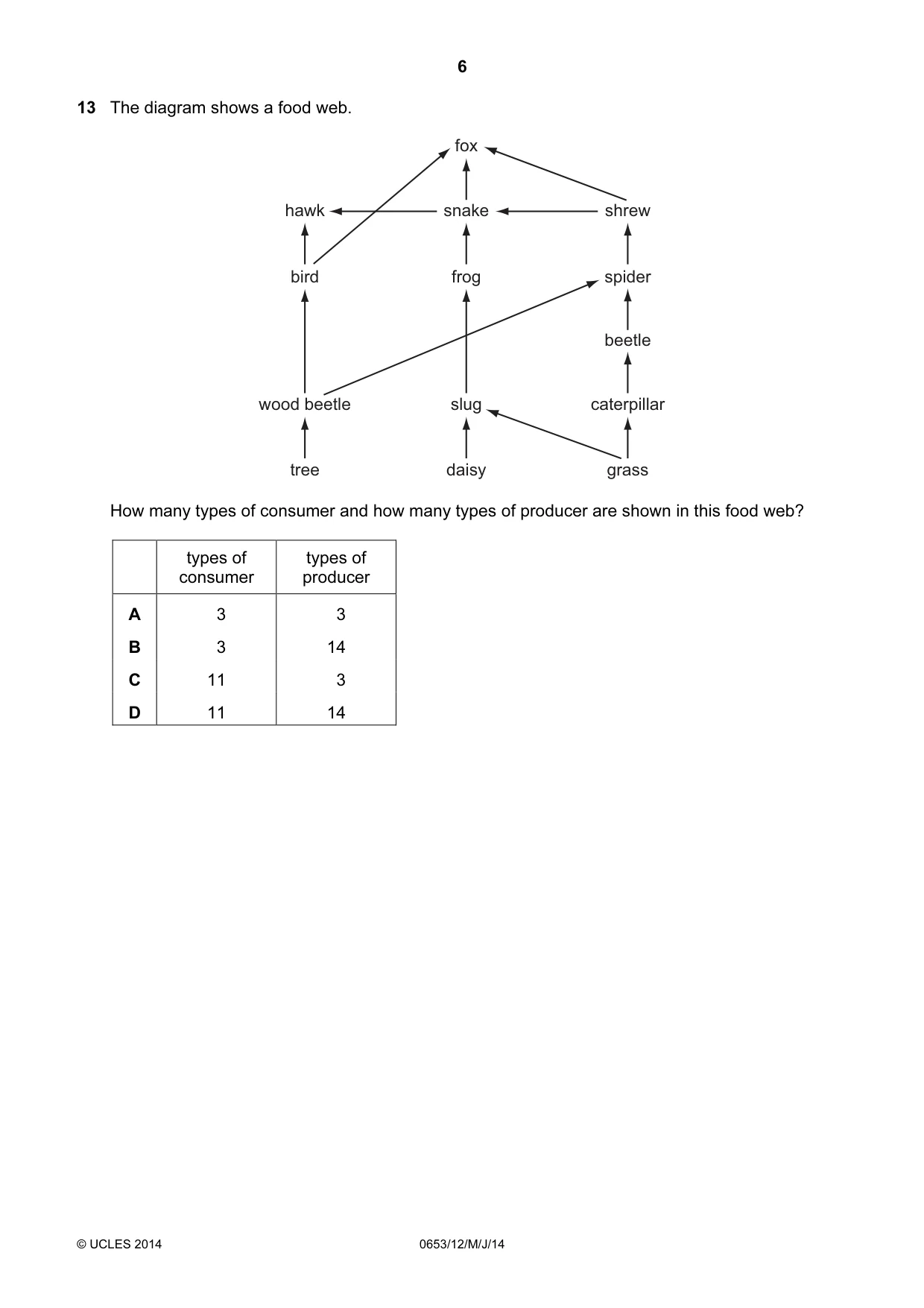
Q13 · The diagram shows a food web
13 The diagram shows a food web. fox hawk snake shrew bird frog spider beetle wood beetle slug caterpillar tree daisy grass How many types of consumer and how many types of producer are shown in this food web? types of types of consumer producer A 3 3 B 3 14 C 11 3 D 11 14
Mark scheme: C
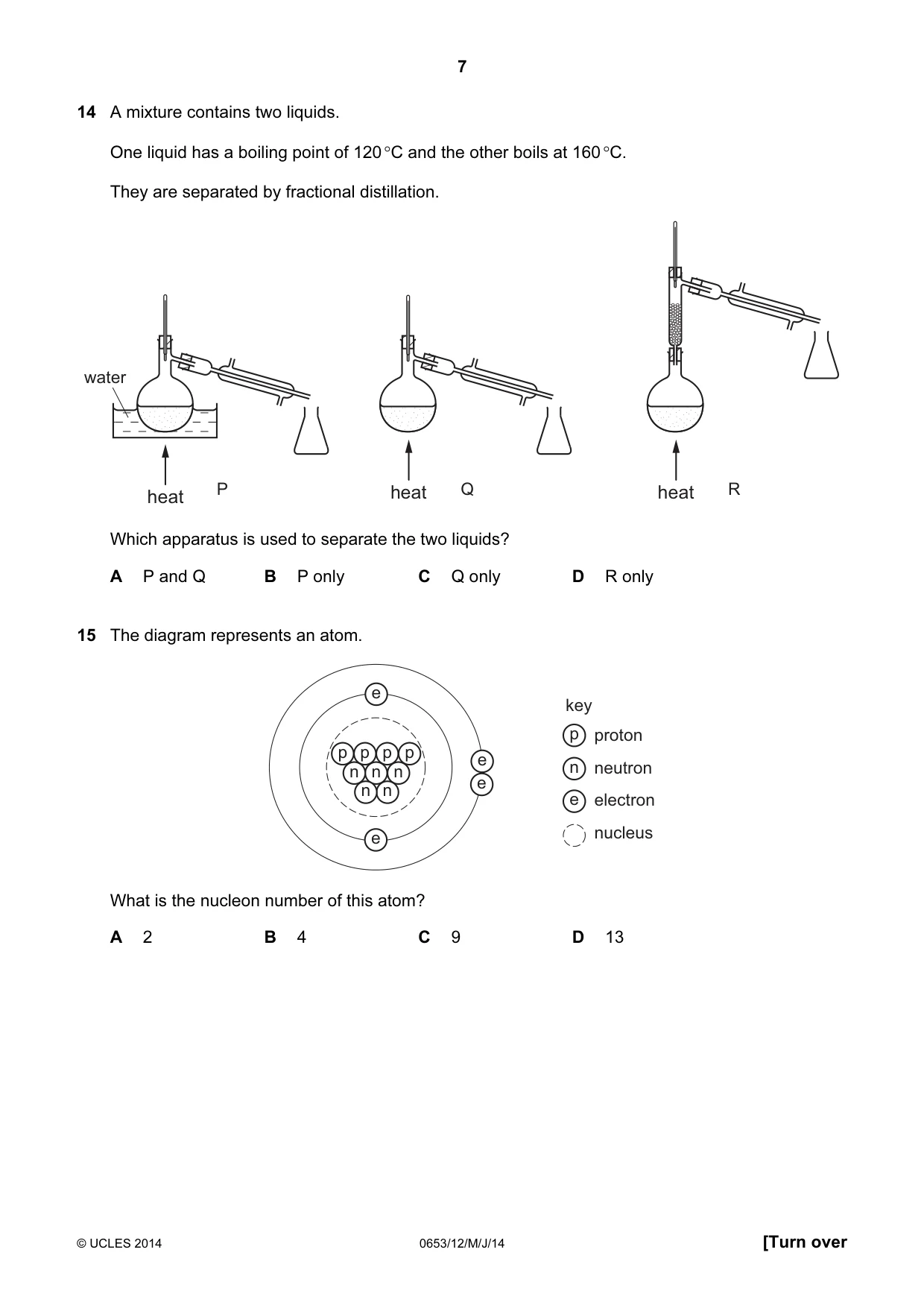
Q14 · A mixture contains two liquids
14 A mixture contains two liquids. One liquid has a boiling point of 120 °C and the other boils at 160 °C. They are separated by fractional distillation. water heat P heat Q heat R Which apparatus is used to separate the two liquids? A P and Q B P only C Q only D R only
Mark scheme: D
Q15 · The diagram represents an atom
15 The diagram represents an atom. e key p proton p p p p e n n n n neutron e n n e electron e nucleus What is the nucleon number of this atom? A 2 B 4 C 9 D 13
Mark scheme: C
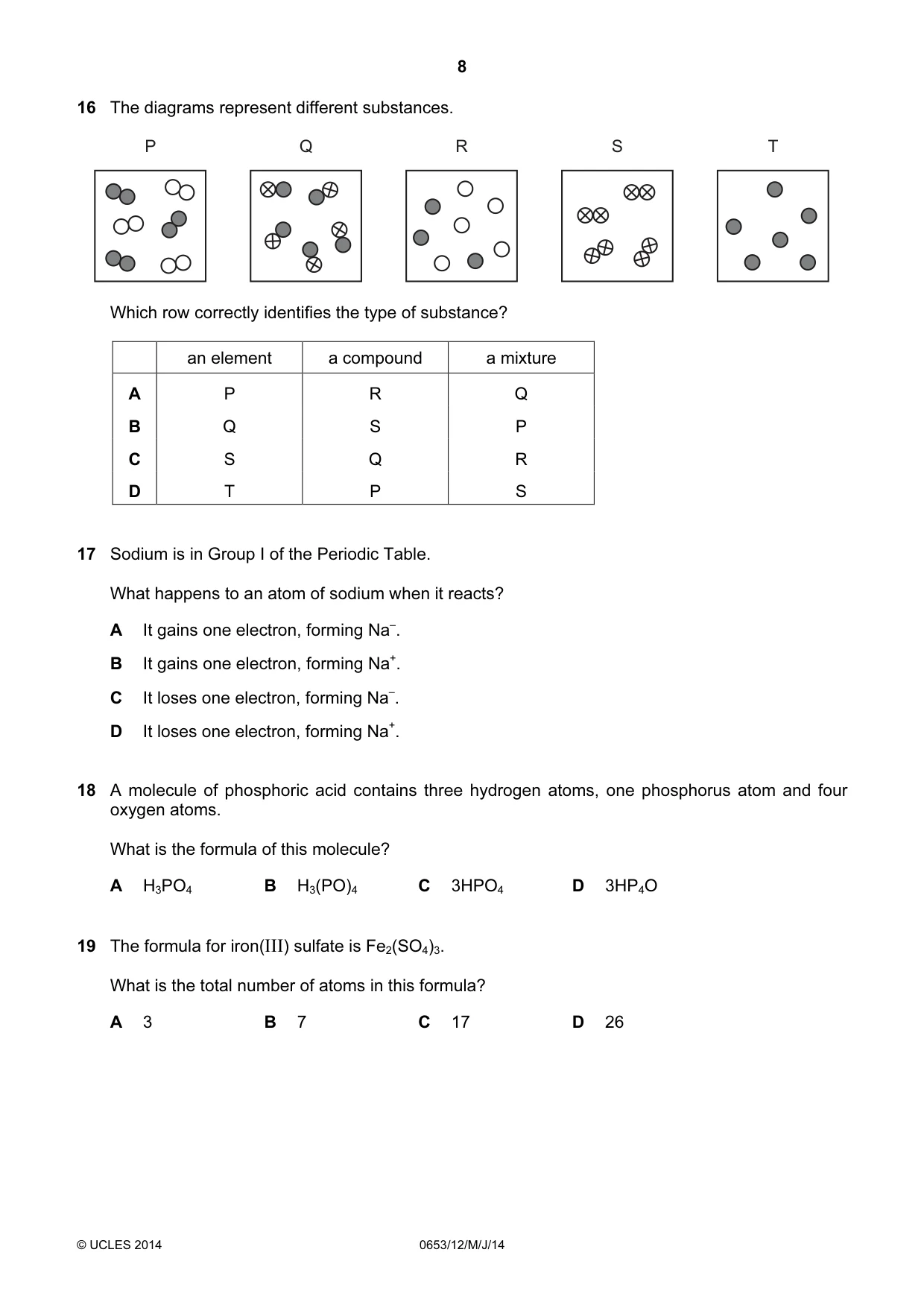
Q16 · The diagrams represent different substances
16 The diagrams represent different substances. P Q R S T Which row correctly identifies the type of substance? an element a compound a mixture A P R Q B Q S P C S Q R D T P S
Mark scheme: C
Q17 · Sodium is in Group I of the Periodic Table
17 Sodium is in Group I of the Periodic Table. What happens to an atom of sodium when it reacts? A It gains one electron, forming Na–. B It gains one electron, forming Na+. C It loses one electron, forming Na–. D It loses one electron, forming Na+.
Mark scheme: D
Q18 · A molecule of phosphoric acid contains three hydrogen atoms, one phosphorus atom and four…
18 A molecule of phosphoric acid contains three hydrogen atoms, one phosphorus atom and four oxygen atoms. What is the formula of this molecule? A H3PO4 B H3(PO)4 C 3HPO4 D 3HP4O
Mark scheme: A
Q19 · The formula for iron(III) sulfate is Fe2(SO4)3
19 The formula for iron(III) sulfate is Fe2(SO4)3. What is the total number of atoms in this formula? A 3 B 7 C 17 D 26
Mark scheme: C
Q20 · Which products are formed when aqueous copper(II) chloride is electrolysed using inert…
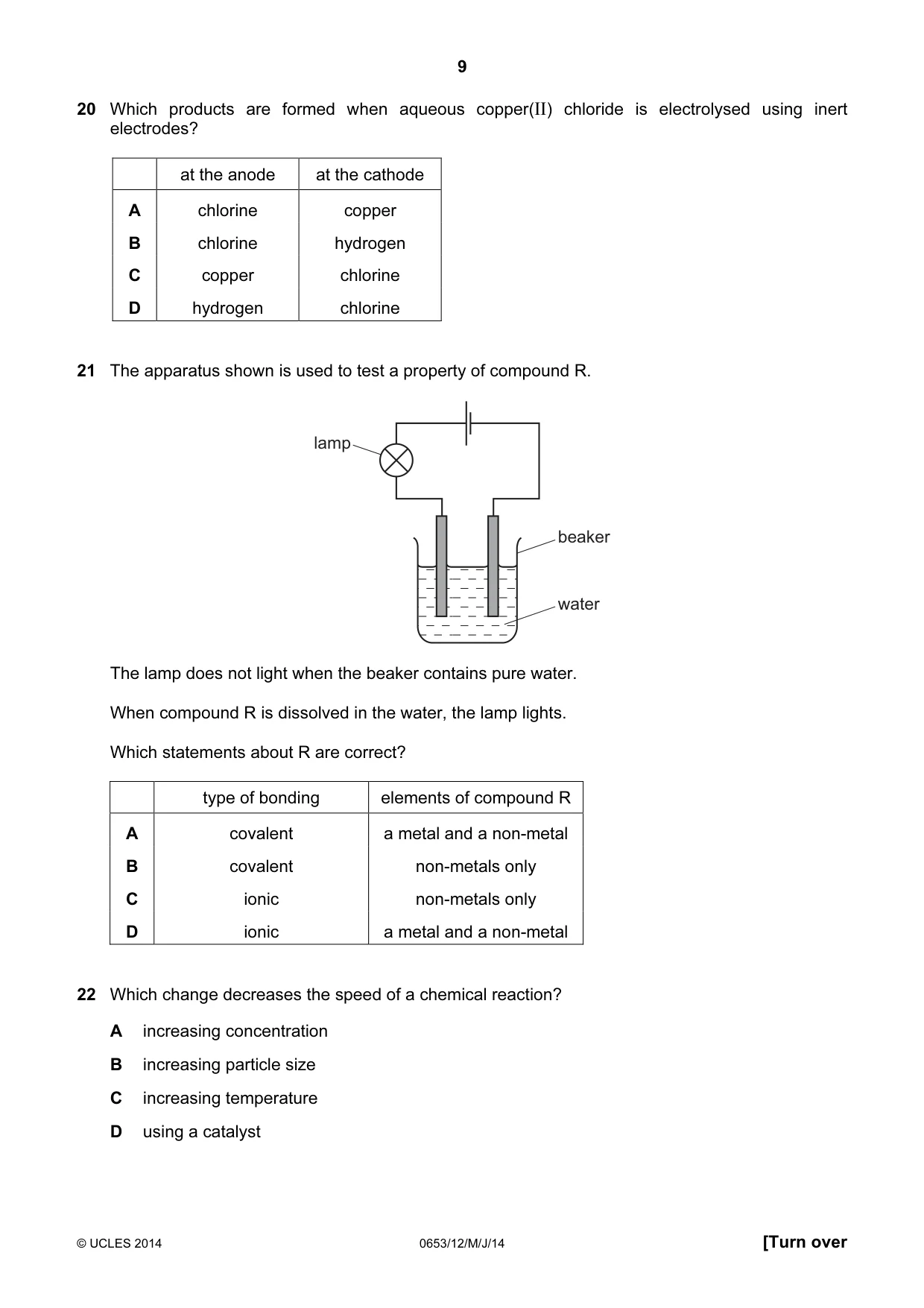
20 Which products are formed when aqueous copper(II) chloride is electrolysed using inert electrodes? at the anode at the cathode A chlorine copper B chlorine hydrogen C copper chlorine D hydrogen chlorine
Mark scheme: A
Q21 · The apparatus shown is used to test a property of compound R
21 The apparatus shown is used to test a property of compound R. lamp beaker water The lamp does not light when the beaker contains pure water. When compound R is dissolved in the water, the lamp lights. Which statements about R are correct? type of bonding elements of compound R A covalent a metal and a non-metal B covalent non-metals only C ionic non-metals only D ionic a metal and a non-metal
Mark scheme: D
Q22 · Which change decreases the speed of a chemical reaction?
22 Which change decreases the speed of a chemical reaction? A increasing concentration B increasing particle size C increasing temperature D using a catalyst
Mark scheme: B
Q23 · Which two reagents form a white precipitate when they are mixed?
23 Which two reagents form a white precipitate when they are mixed? A barium chloride and hydrochloric acid B barium chloride and nitric acid C silver nitrate and hydrochloric acid D silver nitrate and nitric acid
Mark scheme: C
Q24 · A piece of metal is added to water
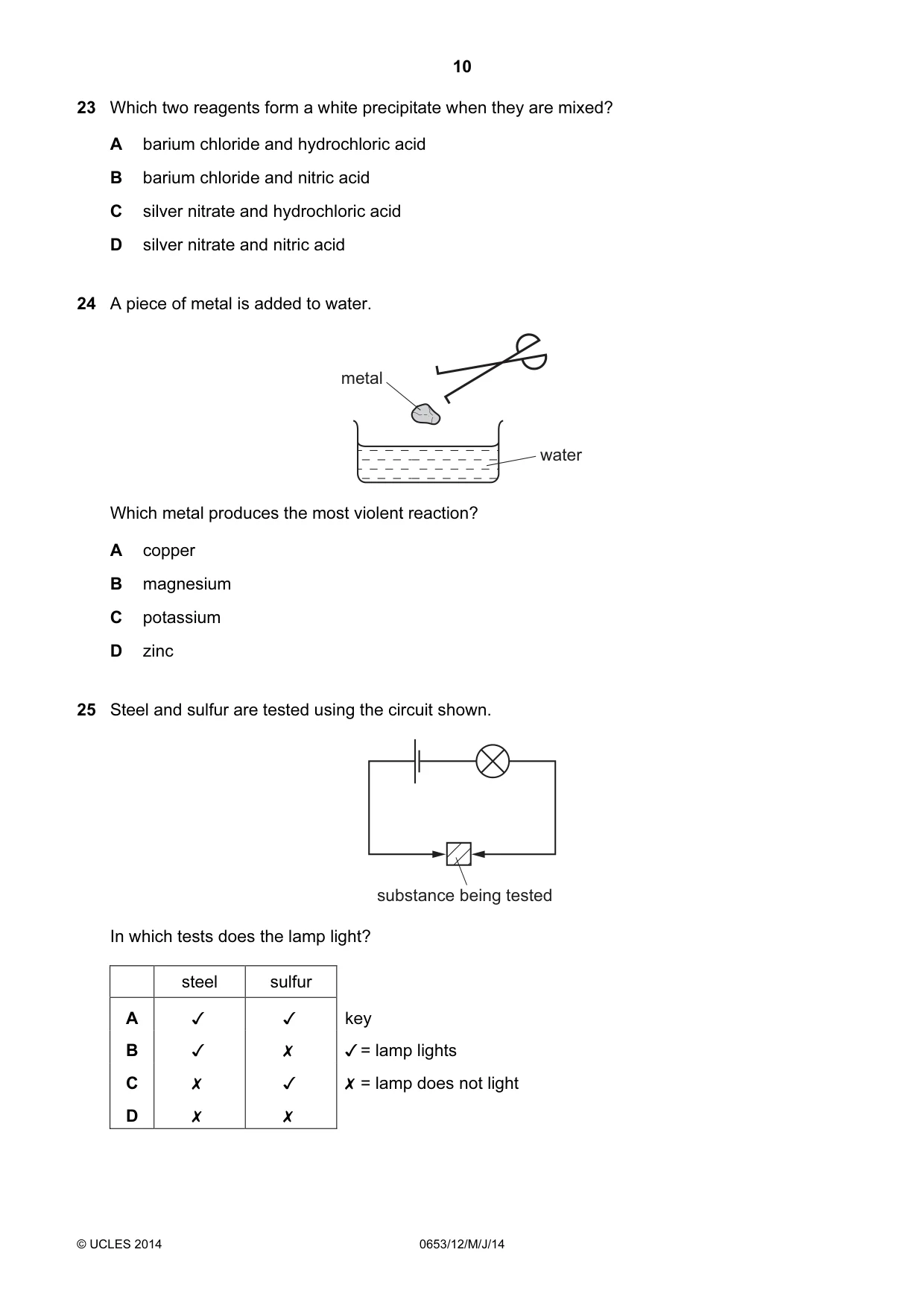
24 A piece of metal is added to water. metal water Which metal produces the most violent reaction? A copper B magnesium C potassium D zinc
Mark scheme: C
Q25 · Steel and sulfur are tested using the circuit shown
25 Steel and sulfur are tested using the circuit shown. substance being tested In which tests does the lamp light? steel sulfur A v key B x ¥ = lamp lights Cc v X = lamp does not light D x
Mark scheme: B
Q26 · Which row gives the percentage by volume of the gases in the air?
26 Which row gives the percentage by volume of the gases in the air? highest lowest percentage percentage A nitrogen oxygen other gases B nitrogen other gases oxygen C oxygen nitrogen other gases D oxygen other gases nitrogen
Mark scheme: A
Q27 · Which statement describes a hydrocarbon?
27 Which statement describes a hydrocarbon? A a compound that burns to form carbon dioxide and hydrogen B a compound that contains carbon and hydrogen only C a compound that only contains ionic bonds D a compound that reacts easily with metals
Mark scheme: B
Q28 · The speed / time graph for a bus journey is shown
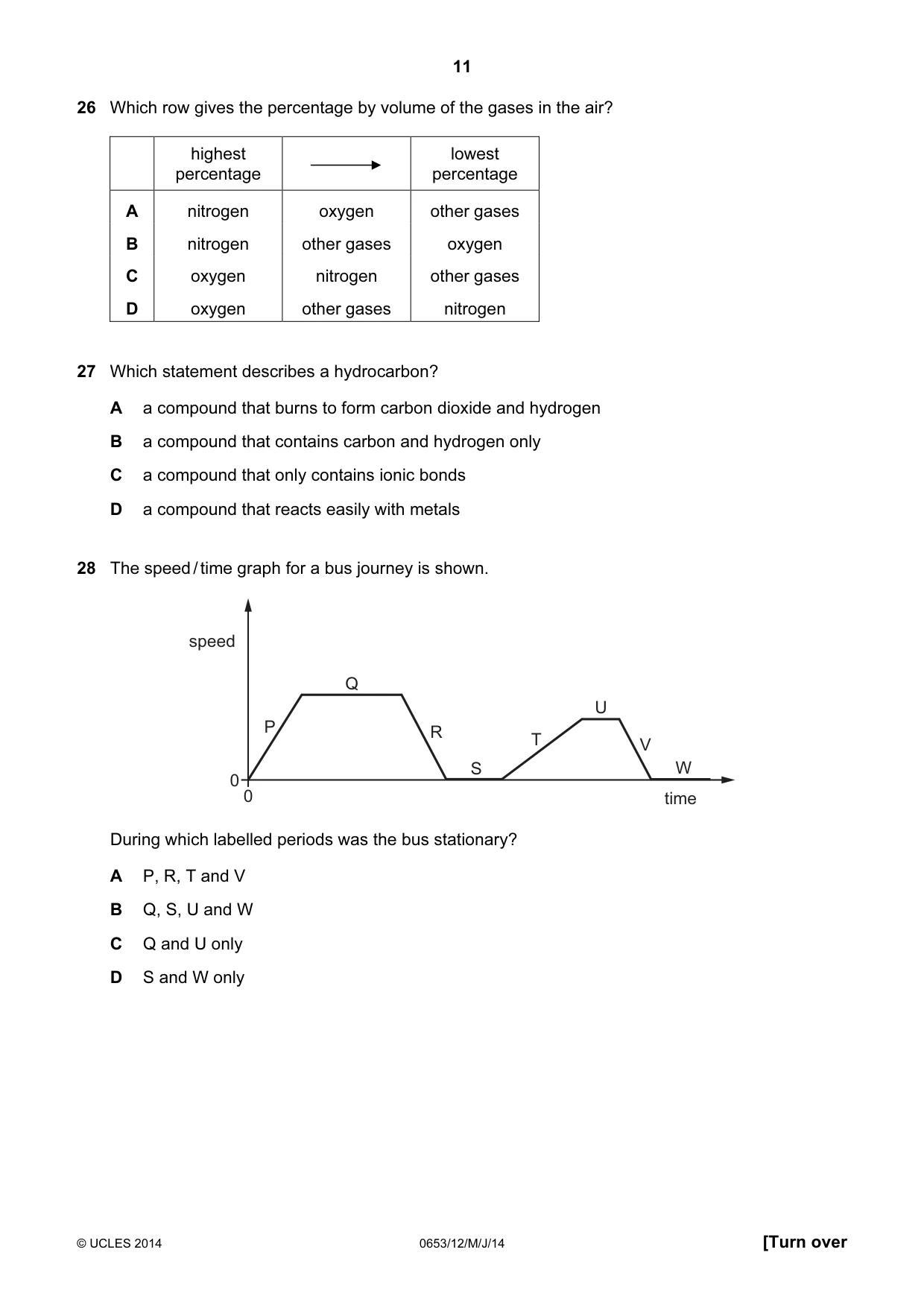
28 The speed / time graph for a bus journey is shown. speed Q U P R T V S W 0 0 time During which labelled periods was the bus stationary? A P, R, T and V B Q, S, U and W C Q and U only D S and W only
Mark scheme: D
Q29 · A glass tank contains some water
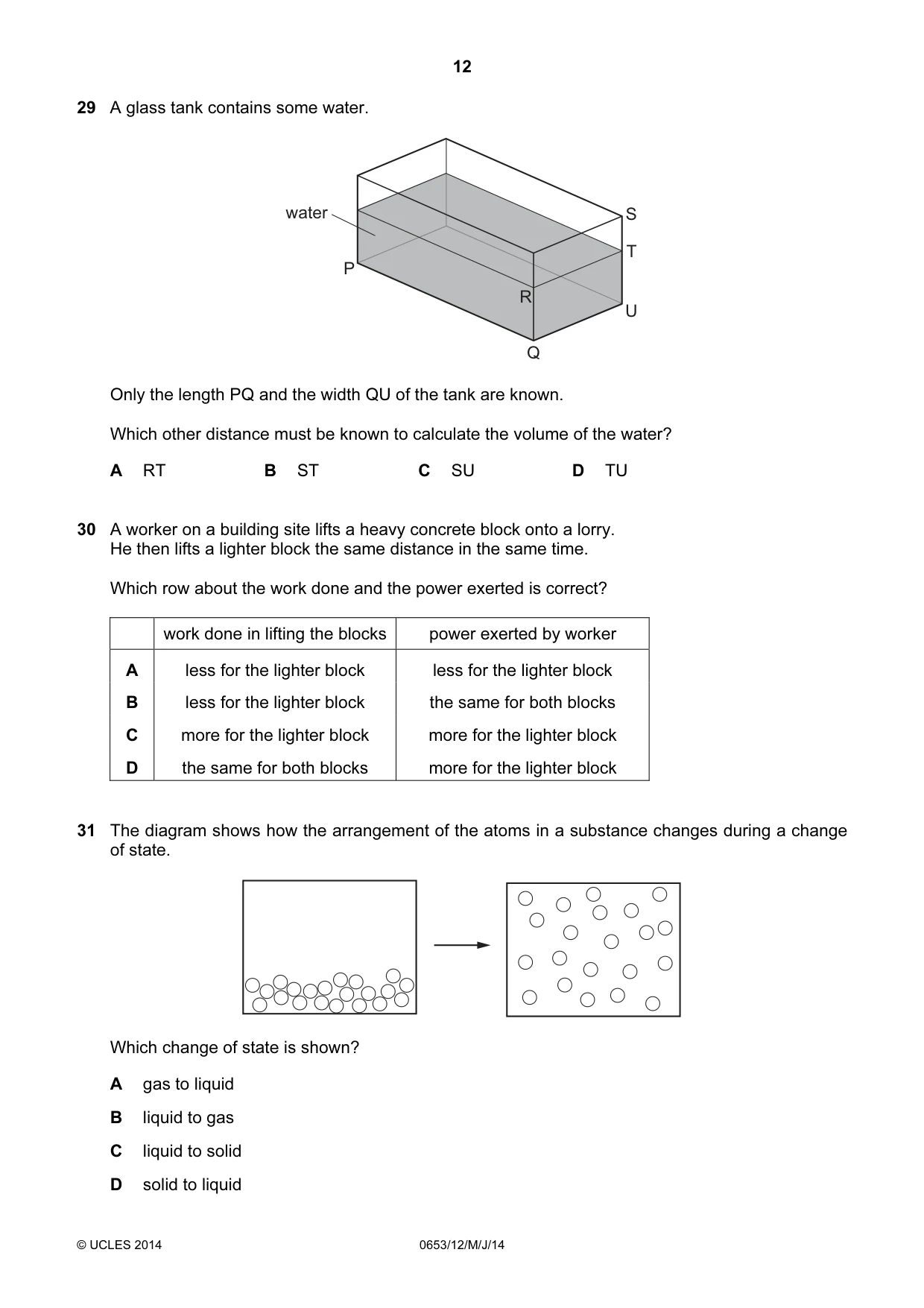
29 A glass tank contains some water. water S T P R U Q Only the length PQ and the width QU of the tank are known. Which other distance must be known to calculate the volume of the water? A RT B ST C SU D TU
Mark scheme: D
More questions on Physical quantities and measurement techniques
Q30 · A worker on a building site lifts a heavy concrete block onto a lorry
30 A worker on a building site lifts a heavy concrete block onto a lorry. He then lifts a lighter block the same distance in the same time. Which row about the work done and the power exerted is correct? work done in lifting the blocks power exerted by worker A less for the lighter block less for the lighter block B less for the lighter block the same for both blocks C more for the lighter block more for the lighter block D the same for both blocks more for the lighter block
Mark scheme: A
Q31 · The diagram shows how the arrangement of the atoms in a substance changes during a change…
31 The diagram shows how the arrangement of the atoms in a substance changes during a change of state. Which change of state is shown? A gas to liquid B liquid to gas C liquid to solid D solid to liquid
Mark scheme: B
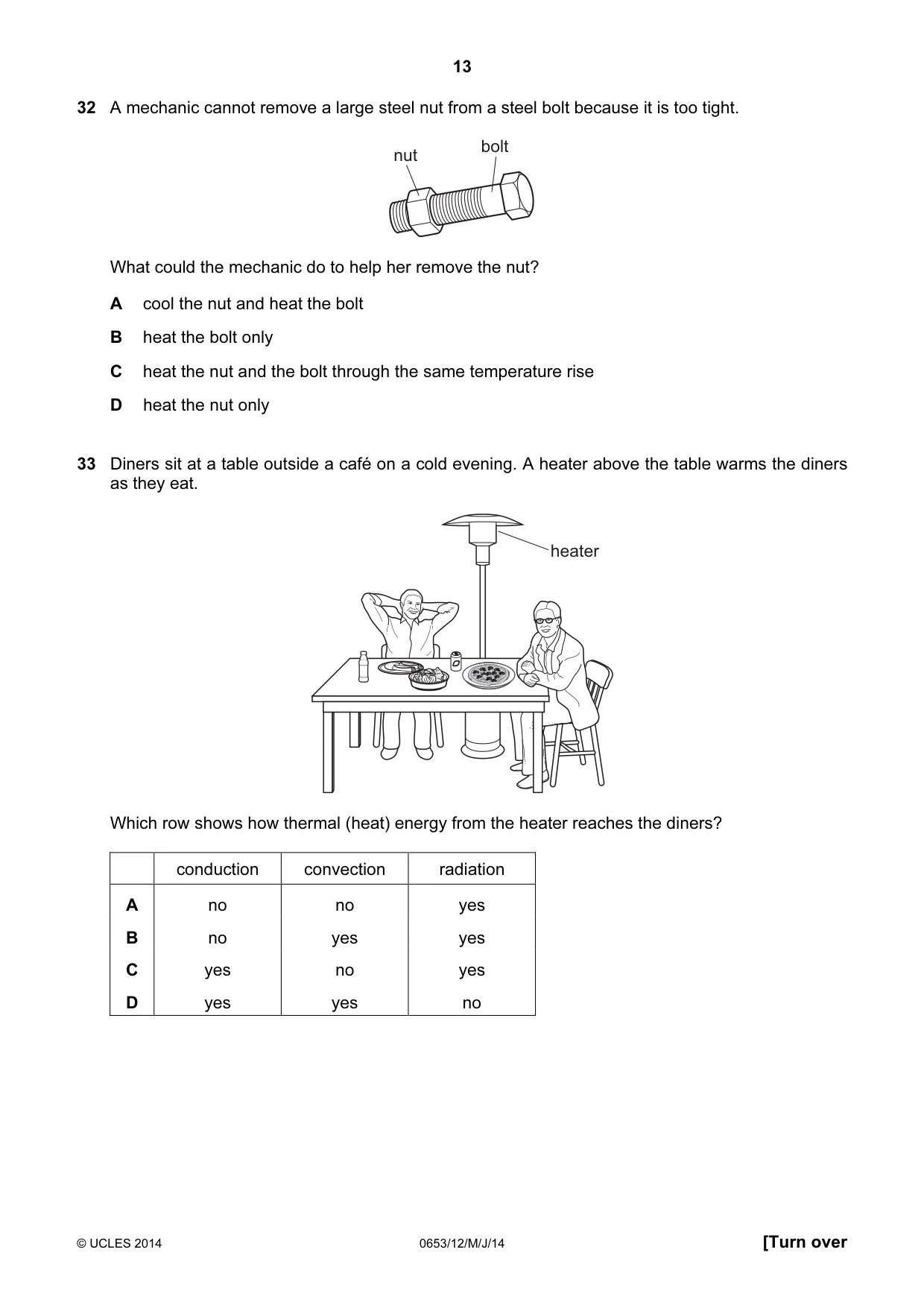
Q32 · A mechanic cannot remove a large steel nut from a steel bolt because it is too tight
32 A mechanic cannot remove a large steel nut from a steel bolt because it is too tight. bolt nut What could the mechanic do to help her remove the nut? A cool the nut and heat the bolt B heat the bolt only C heat the nut and the bolt through the same temperature rise D heat the nut only
Mark scheme: D
Q33 · Diners sit at a table outside a café on a cold evening
33 Diners sit at a table outside a café on a cold evening. A heater above the table warms the diners as they eat. heater Which row shows how thermal (heat) energy from the heater reaches the diners? conduction convection radiation A no no yes B no yes yes C yes no yes D yes yes no
Mark scheme: A
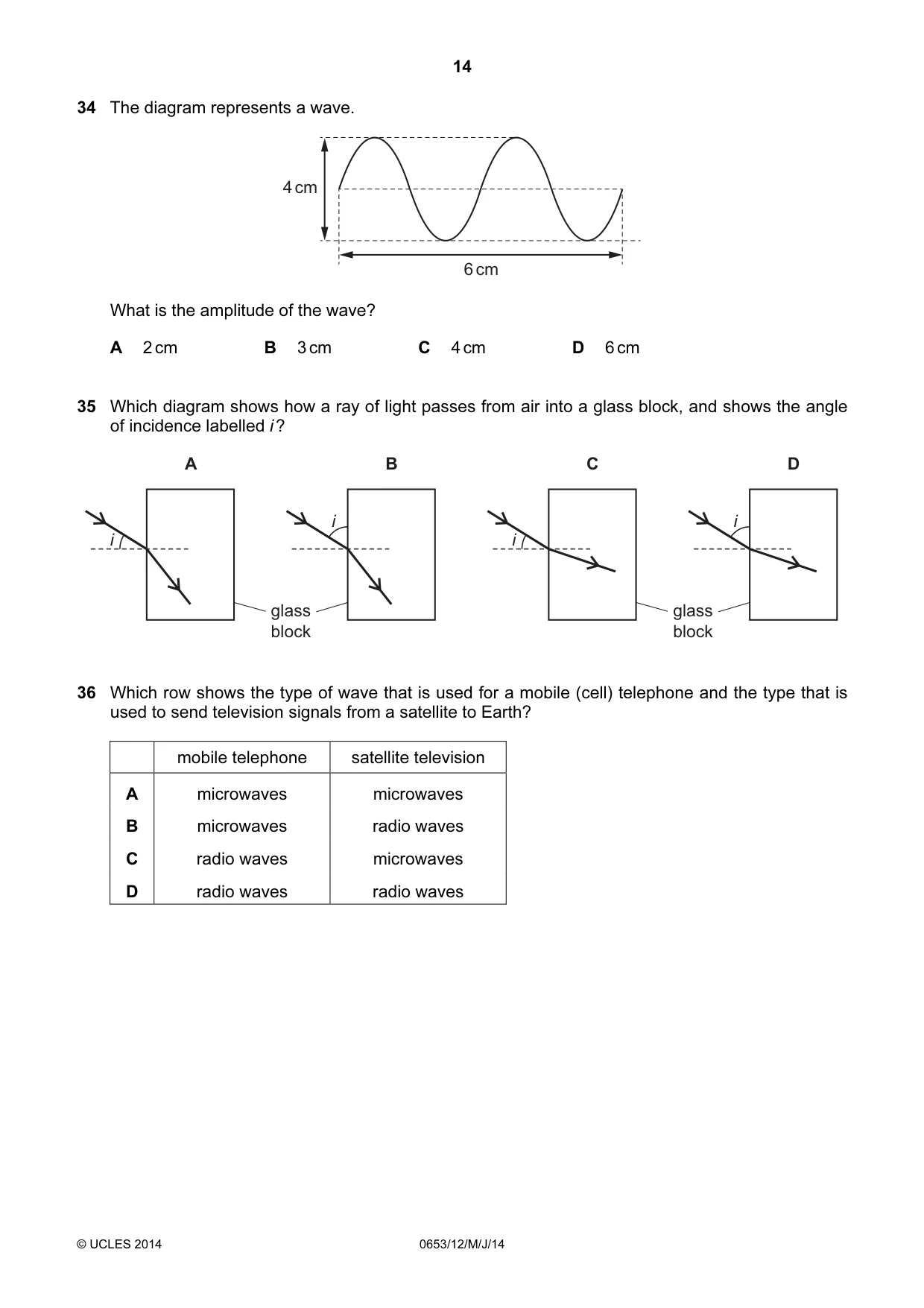
Q34 · The diagram represents a wave
34 The diagram represents a wave. 4 cm 6 cm What is the amplitude of the wave? A 2 cm B 3 cm C 4 cm D 6 cm
Mark scheme: A
Q35 · Which diagram shows how a ray of light passes from air into a glass block, and shows the…
35 Which diagram shows how a ray of light passes from air into a glass block, and shows the angle of incidence labelled i ? A B C D i i i i glass glass block block
Mark scheme: C
Q36 · Which row shows the type of wave that is used for a mobile (cell) telephone and the type…
36 Which row shows the type of wave that is used for a mobile (cell) telephone and the type that is used to send television signals from a satellite to Earth? mobile telephone satellite television A microwaves microwaves B microwaves radio waves C radio waves microwaves D radio waves radio waves
Mark scheme: A
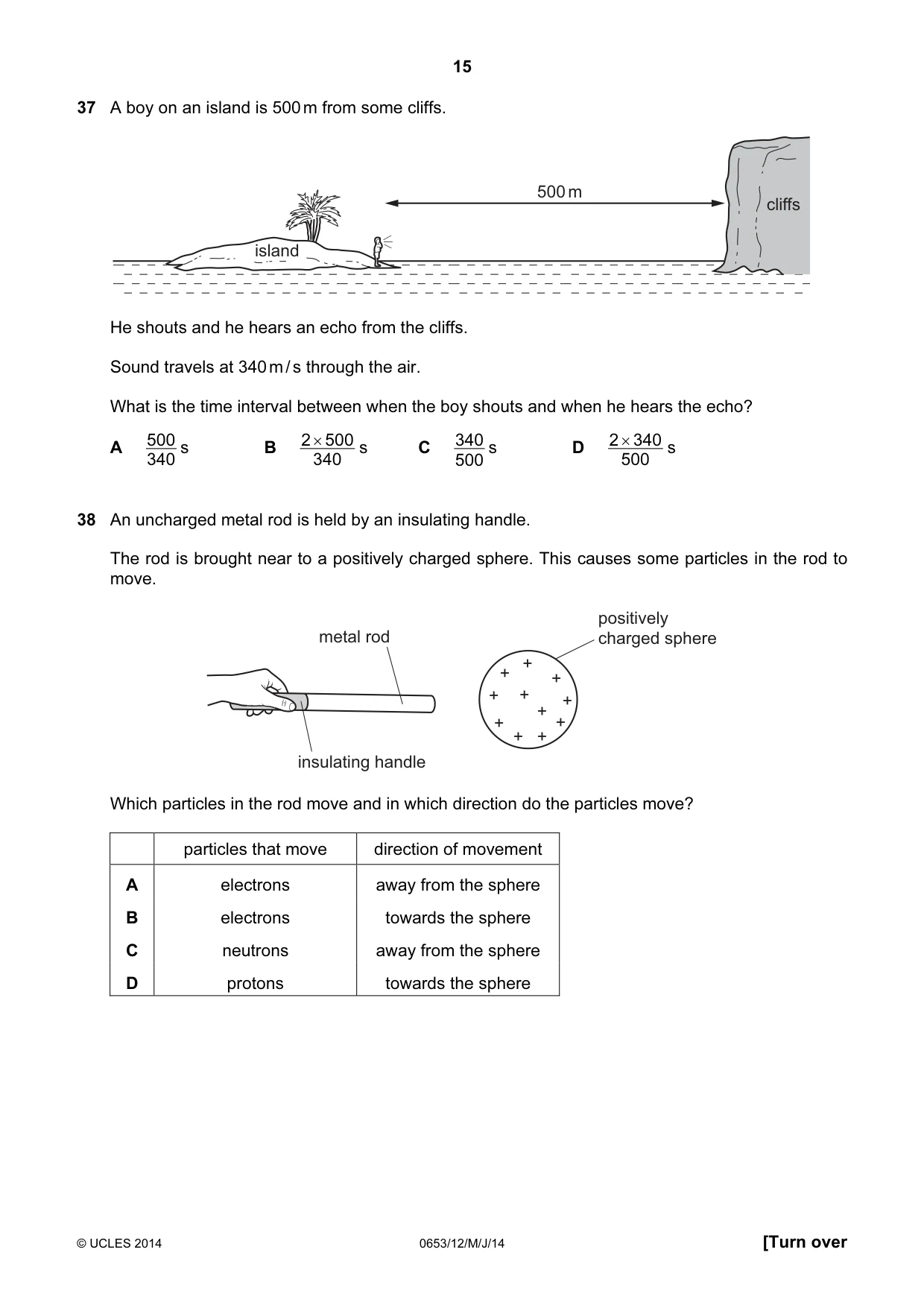
Q37 · A boy on an island is 500 m from some cliffs
37 A boy on an island is 500 m from some cliffs. 500 m cliffs island He shouts and he hears an echo from the cliffs. Sound travels at 340 m / s through the air. What is the time interval between when the boy shouts and when he hears the echo? A 500 s B 2× 500 s C 340 s D 2× 340 s 340 340 5 00 500
Mark scheme: B
Q38 · An uncharged metal rod is held by an insulating handle
38 An uncharged metal rod is held by an insulating handle. The rod is brought near to a positively charged sphere. This causes some particles in the rod to move. positively metal rod charged sphere + + + + + + + + + + + insulating handle Which particles in the rod move and in which direction do the particles move? particles that move direction of movement A electrons away from the sphere B electrons towards the sphere C neutrons away from the sphere D protons towards the sphere
Mark scheme: B
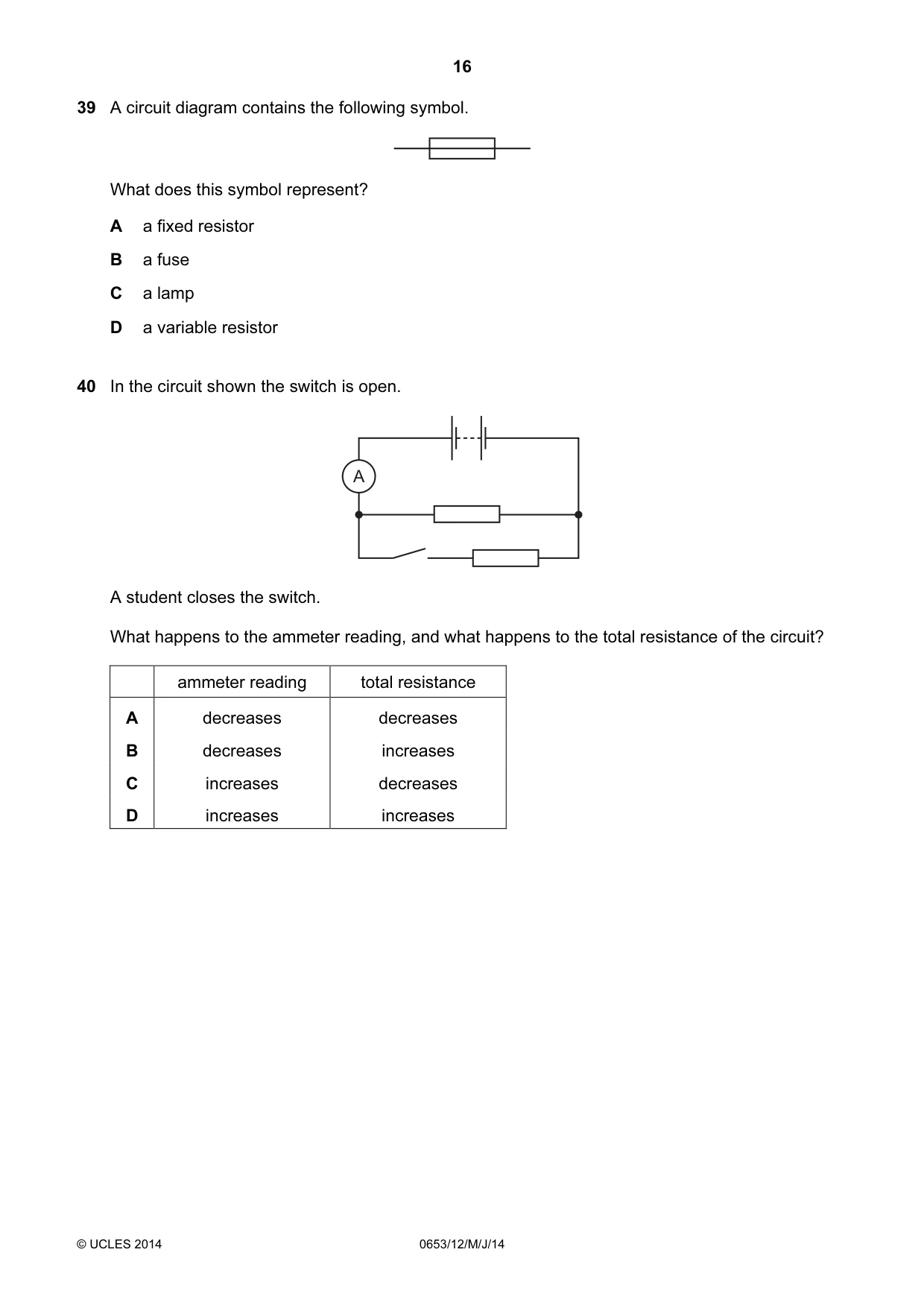
Q39 · A circuit diagram contains the following symbol
39 A circuit diagram contains the following symbol. What does this symbol represent? A a fixed resistor B a fuse C a lamp D a variable resistor
Mark scheme: B
Q40 · In the circuit shown the switch is open
40 In the circuit shown the switch is open. A A student closes the switch. What happens to the ammeter reading, and what happens to the total resistance of the circuit? ammeter reading total resistance A decreases decreases B decreases increases C increases decreases D increases increases
Mark scheme: C
What was in this paper
The subtopics covered by these 40 questions, and how many questions each got. Open one in a new tab to see every Cambridge question on it.
2Formulas2Air quality and climate1Atomic structure and the Periodic Table1Biological molecules1Characteristics of living organisms1Circulatory systems1Diffusion1Digestion1Digestive system1Diseases and immunity1Electrical quantities1Electrolysis1Electromagnetic spectrum1Elements, compounds and mixtures1Energy, work and power1Food chains and food webs1Gas exchange in humans1General properties of waves1Heart1Identification of ions and gases1Ions and ionic bonds1Kinetic particle model of matter1Light1Motion1Physical quantities and measurement techniques1Properties of metals1Rate of reaction1Reactivity series1Respiration1Separation and purification1Sexual reproduction in plants1Simple molecules and covalent bonds1Sound1Terminology1Thermal properties and temperature1Transfer of thermal energy1Transpiration1What you needed in this session
Cambridge’s own grade thresholds for 2014 May/June, Paper 1 · Variant 2. A higher threshold means an easier paper — the bar moves with how the cohort did.