Cambridge IGCSE Science - Combined 0653 — 2018 Oct/Nov Paper 1 · Variant 3
0653/13/O/N/18 · 40 questions · 40 marks · ≈45 min
The question paper and its mark scheme, free to read here and free to download. This is Cambridge’s own paper, exactly as it was sat.
Question paper20 pages
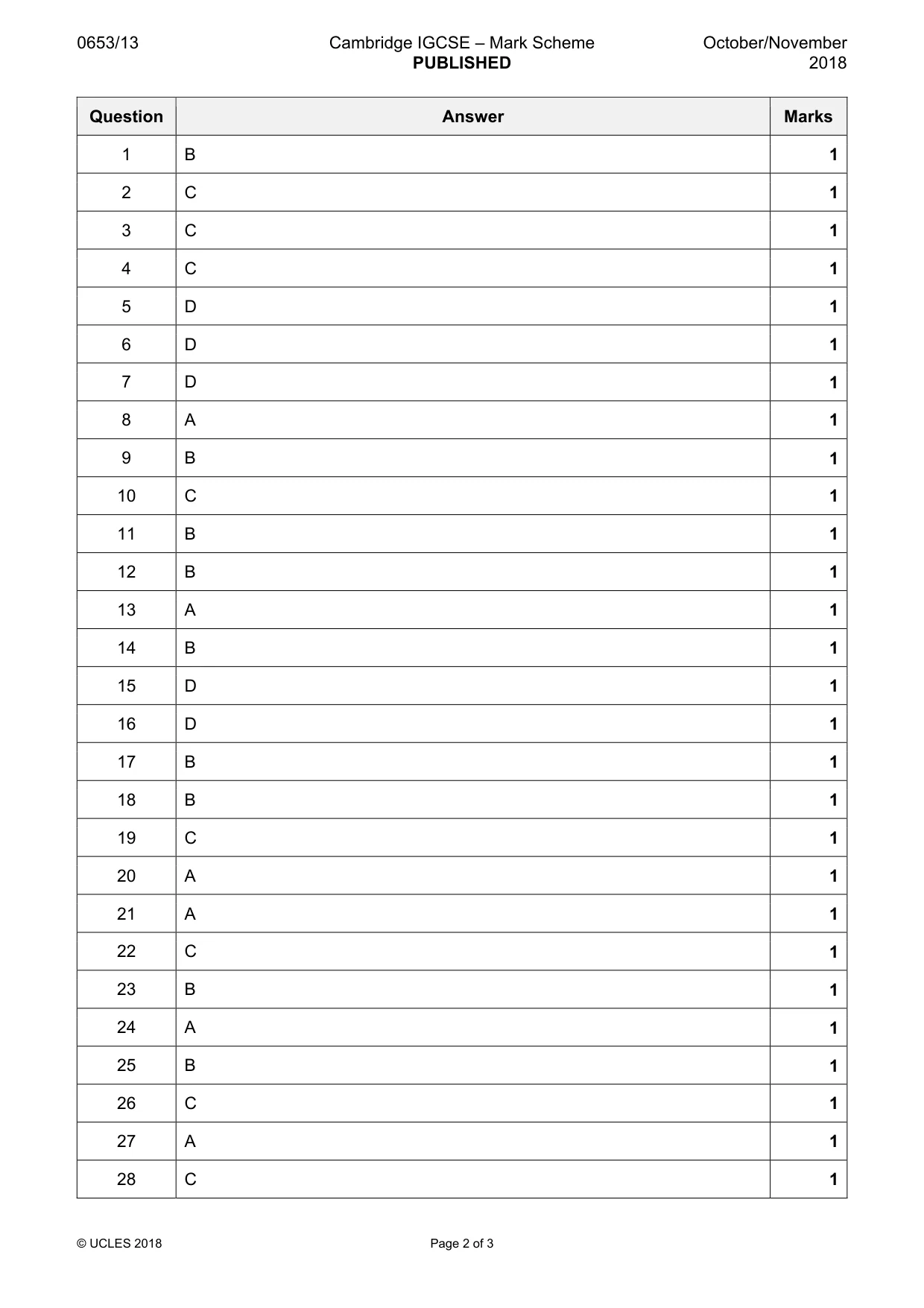
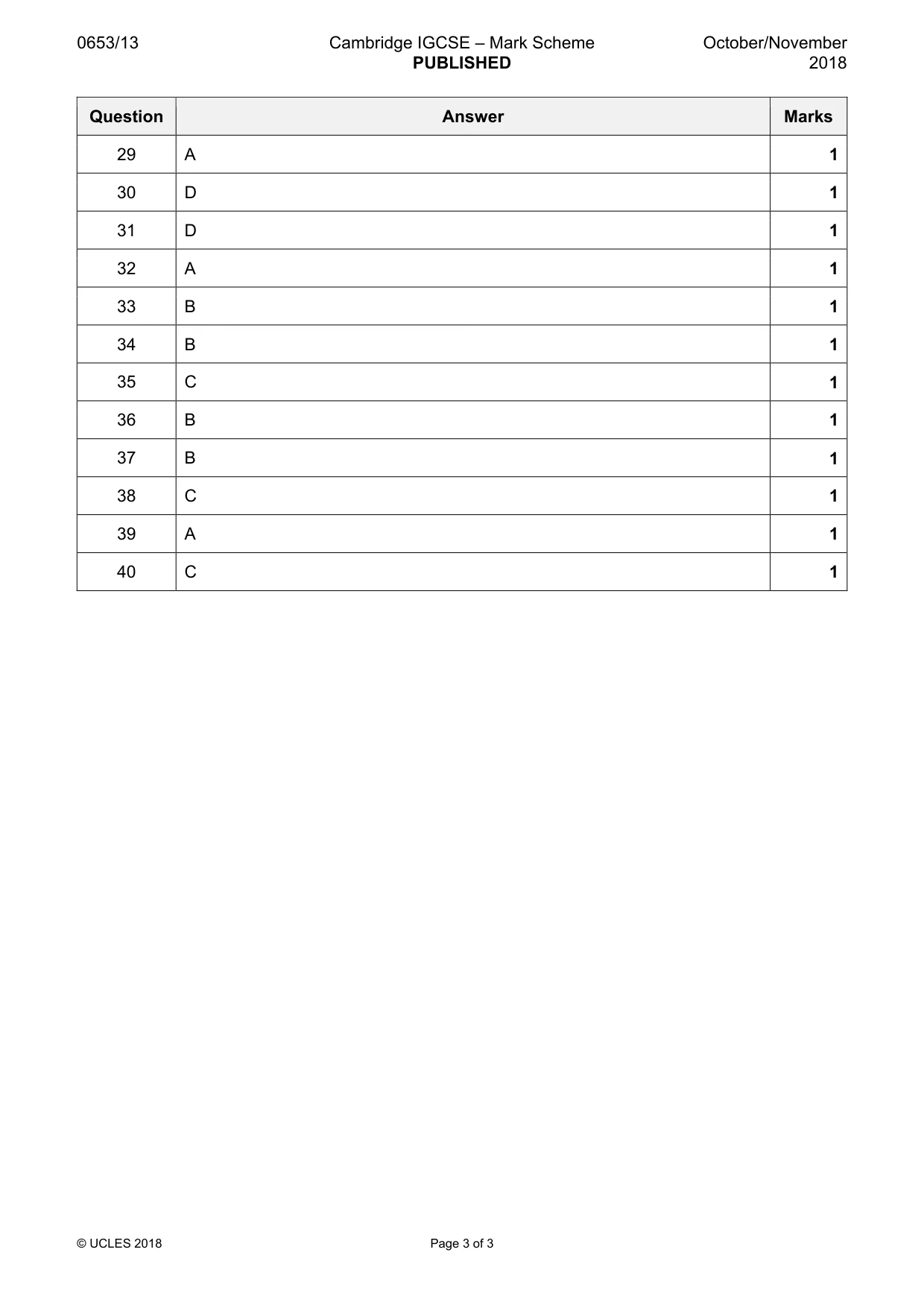
Mark scheme3 pages
Answers below. Sit the paper first if you are practising.
Questions as text
Q1 · What are characteristics of all living organisms?
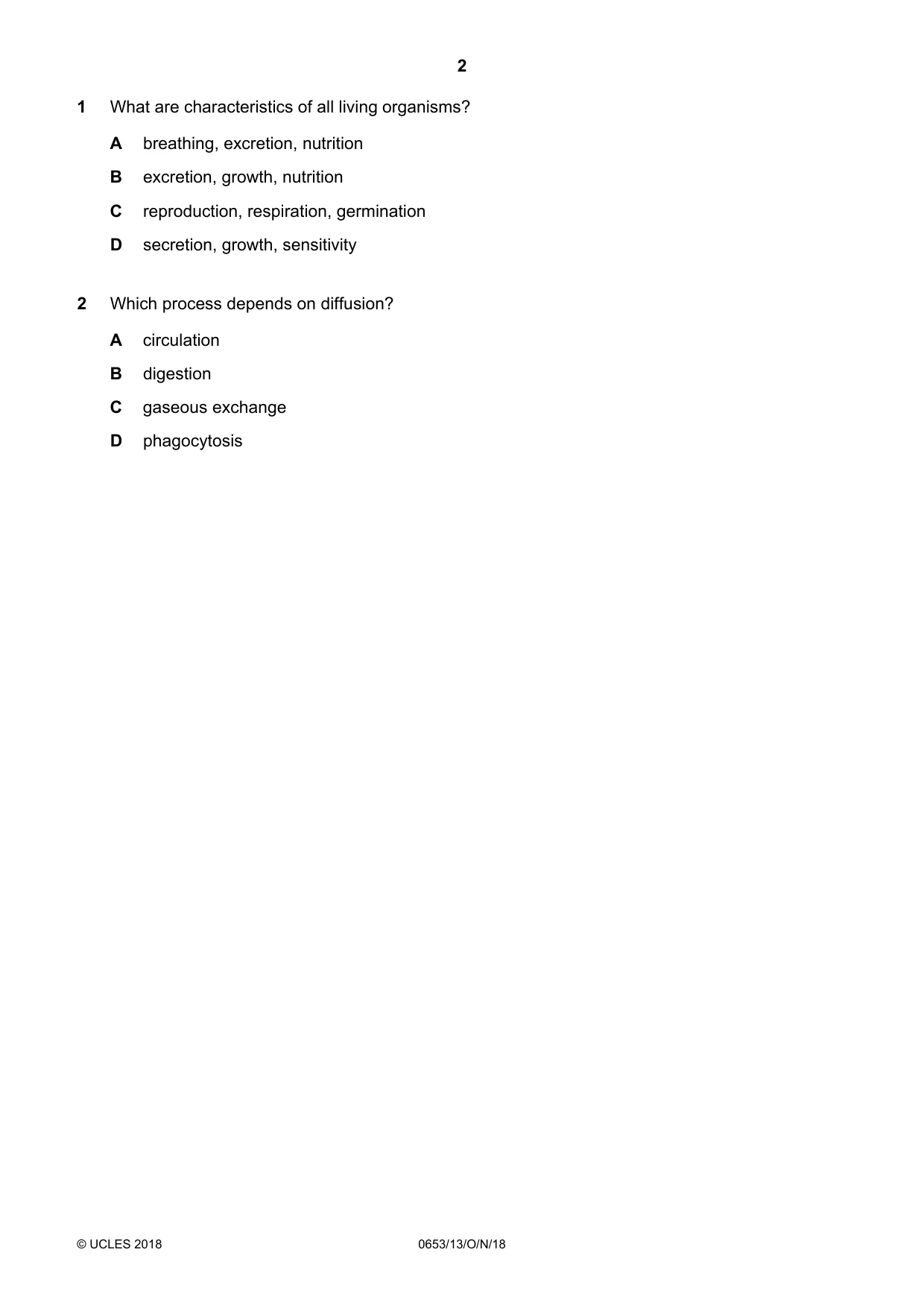
1 What are characteristics of all living organisms? A breathing, excretion, nutrition B excretion, growth, nutrition C reproduction, respiration, germination D secretion, growth, sensitivity
Mark scheme: B
Q2 · Which process depends on diffusion?
2 Which process depends on diffusion? A circulation B digestion C gaseous exchange D phagocytosis
Mark scheme: C
Q3 · A human enzyme breaks down starch into simple sugars
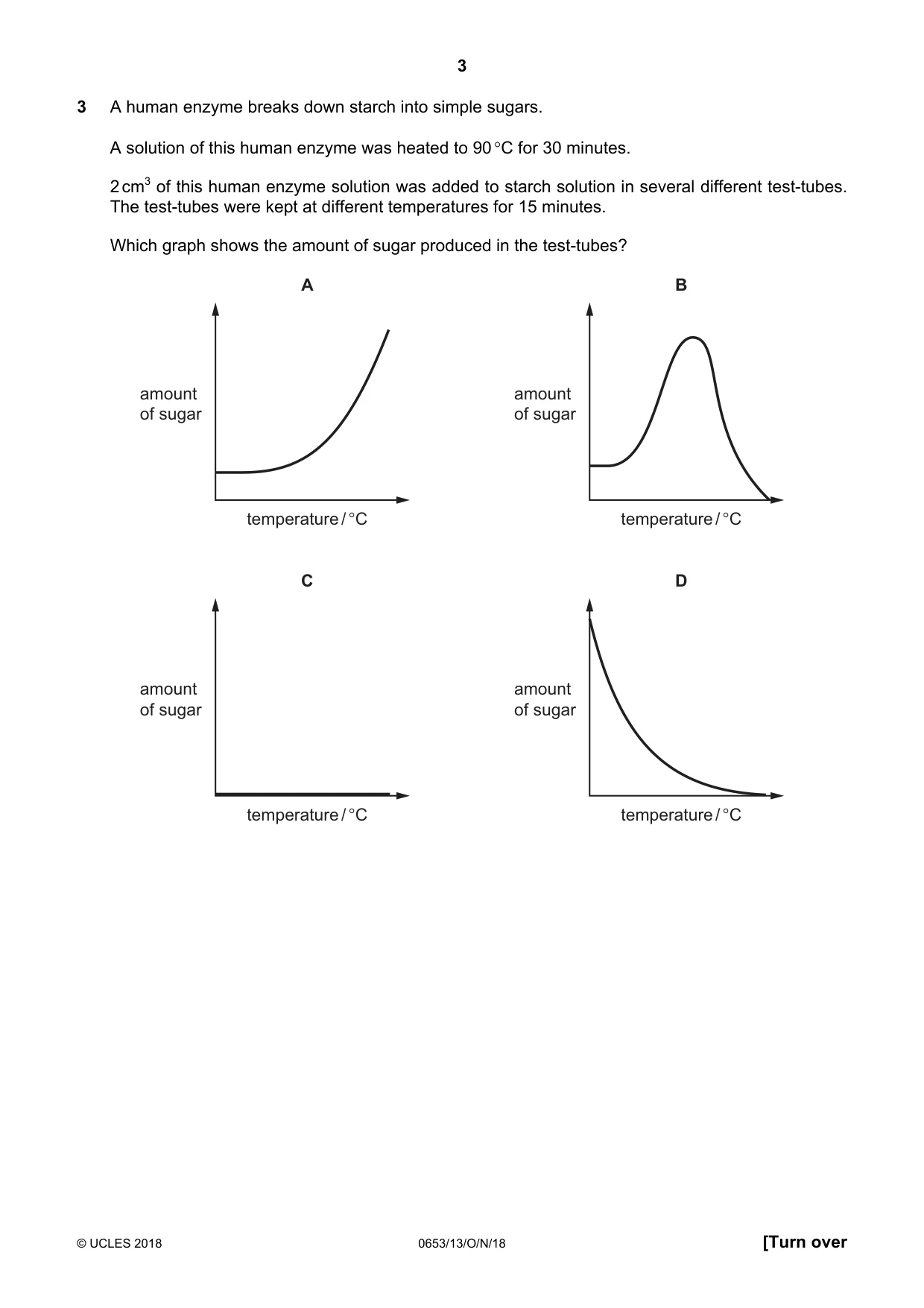
3 A human enzyme breaks down starch into simple sugars. A solution of this human enzyme was heated to 90 °C for 30 minutes. 2 cm3 of this human enzyme solution was added to starch solution in several different test-tubes. The test-tubes were kept at different temperatures for 15 minutes. Which graph shows the amount of sugar produced in the test-tubes? A B amount amount of sugar of sugar temperature / °C temperature / °C C D amount amount of sugar of sugar temperature / °C temperature / °C
Mark scheme: C
Q4 · The table shows the results of three food tests carried out on the same food sample
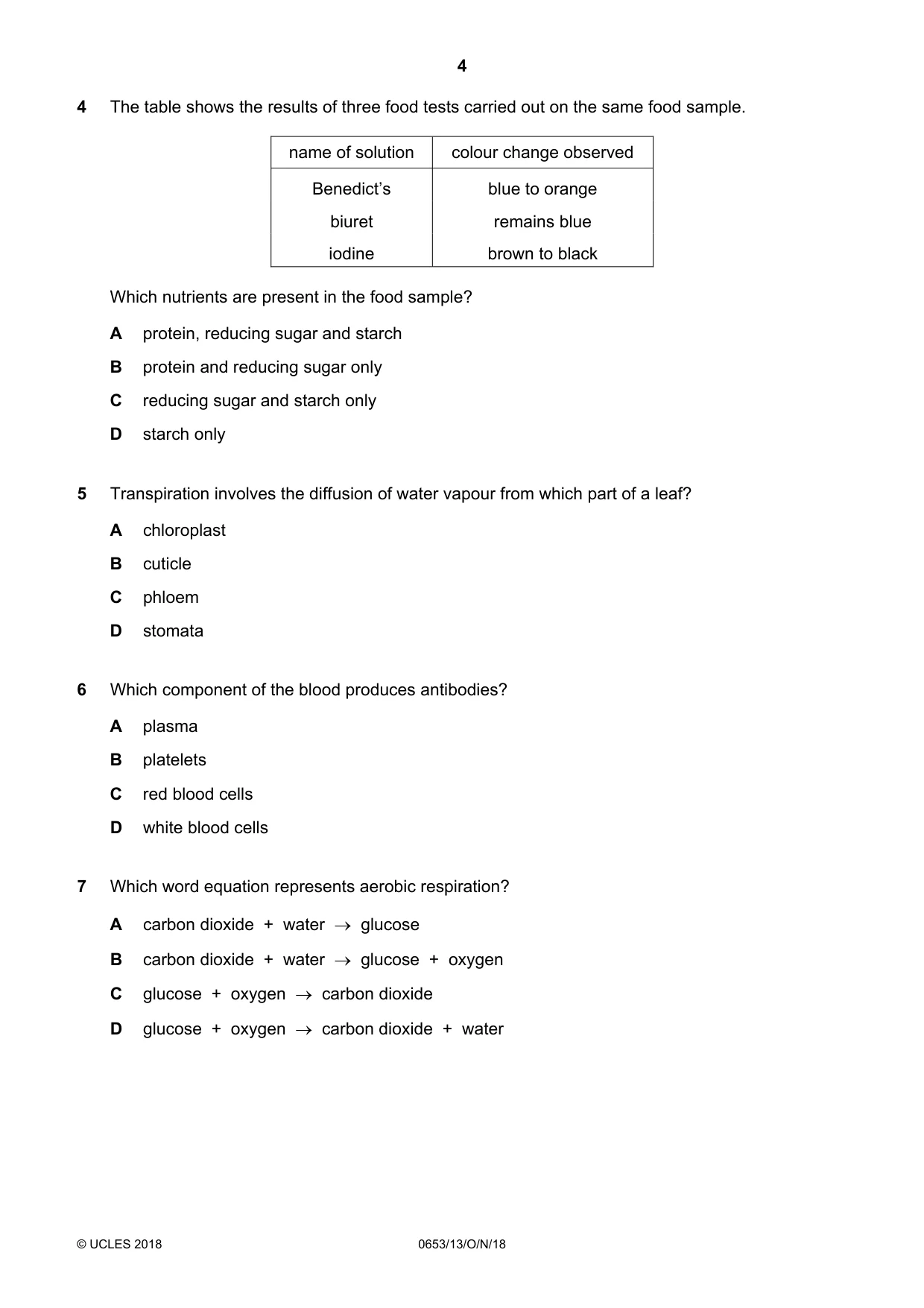
4 The table shows the results of three food tests carried out on the same food sample. name of solution colour change observed Benedict’s blue to orange biuret remains blue iodine brown to black Which nutrients are present in the food sample? A protein, reducing sugar and starch B protein and reducing sugar only C reducing sugar and starch only D starch only
Mark scheme: C
Q5 · Transpiration involves the diffusion of water vapour from which part of a leaf?
5 Transpiration involves the diffusion of water vapour from which part of a leaf? A chloroplast B cuticle C phloem D stomata
Mark scheme: D
Q6 · Which component of the blood produces antibodies?
6 Which component of the blood produces antibodies? A plasma B platelets C red blood cells D white blood cells
Mark scheme: D
Q7 · Which word equation represents aerobic respiration?
7 Which word equation represents aerobic respiration? A carbon dioxide + water → glucose B carbon dioxide + water → glucose + oxygen C glucose + oxygen → carbon dioxide D glucose + oxygen → carbon dioxide + water
Mark scheme: D
Q8 · Which statement about adrenaline is not correct?
8 Which statement about adrenaline is not correct? A It decreases blood glucose concentration. B It is carried by the blood. C It is produced by a gland. D The heart is one of its target organs.
Mark scheme: A
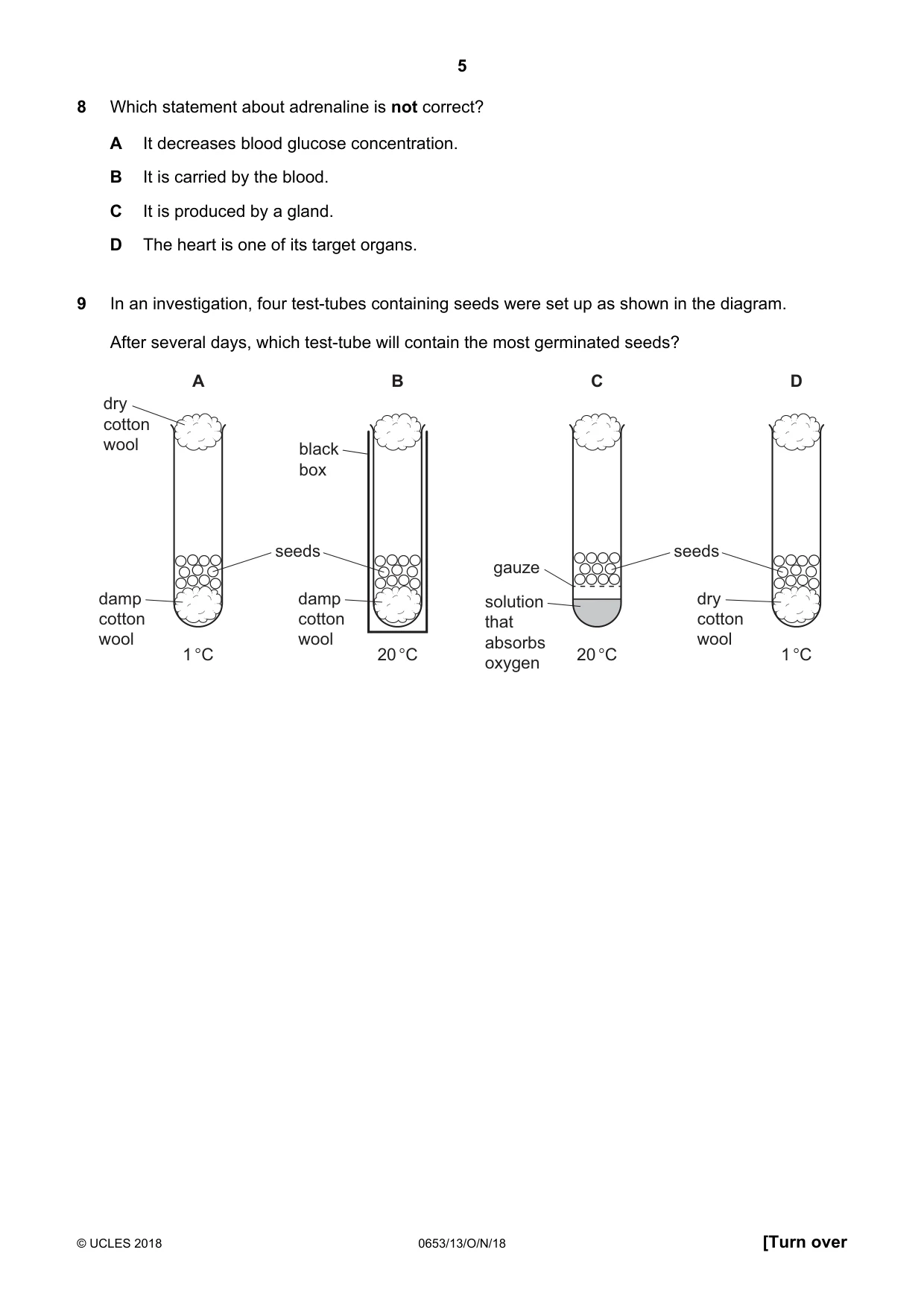
Q9 · In an investigation, four test-tubes containing seeds were set up as shown in the diagram
9 In an investigation, four test-tubes containing seeds were set up as shown in the diagram. After several days, which test-tube will contain the most germinated seeds? A B C D dry cotton wool black box seeds seeds gauze damp damp solution dry cotton cotton that cotton wool wool absorbs wool 1 °C 20 °C 20 °C 1 °C oxygen
Mark scheme: B
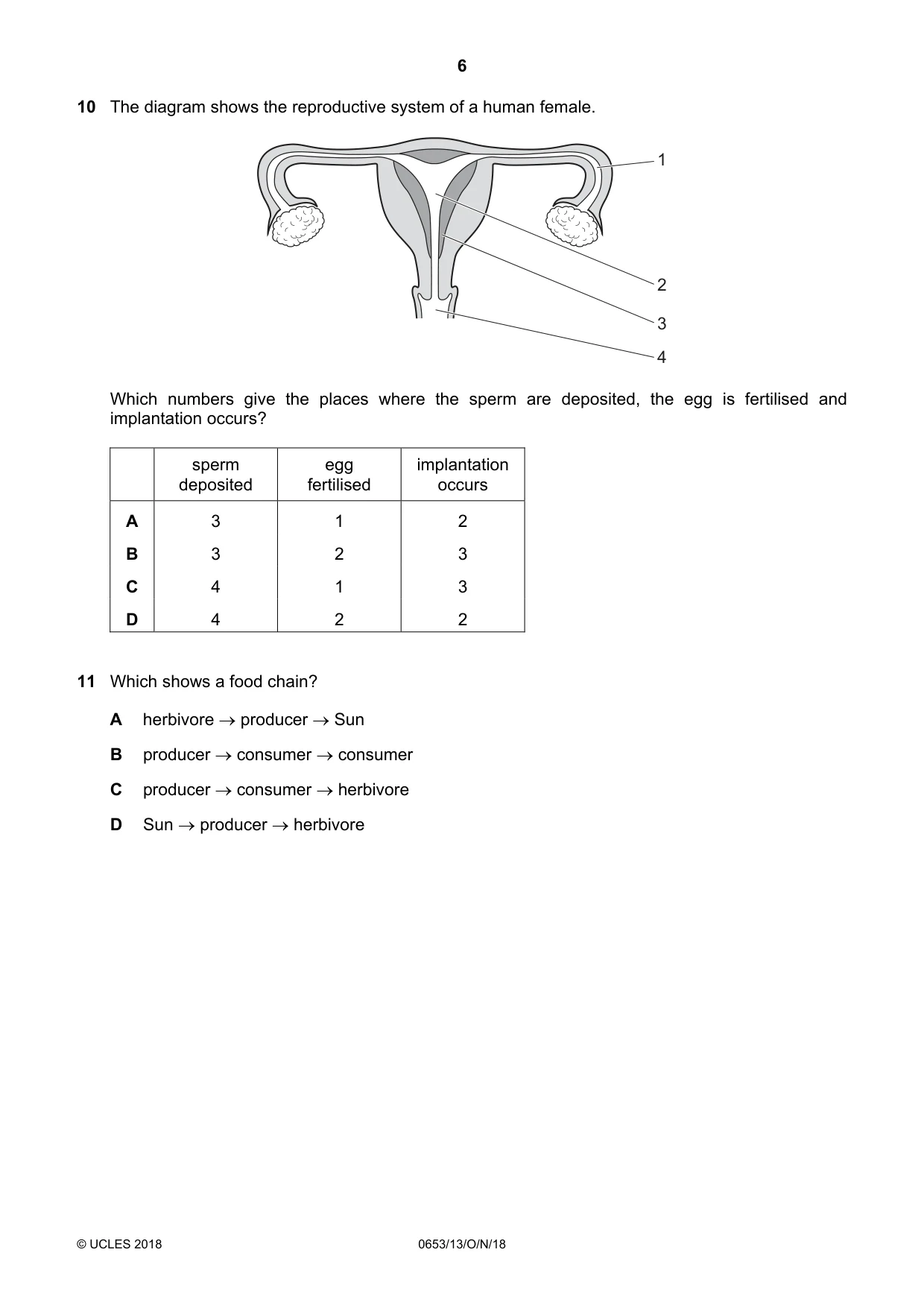
Q10 · The diagram shows the reproductive system of a human female
10 The diagram shows the reproductive system of a human female. 1 2 3 4 Which numbers give the places where the sperm are deposited, the egg is fertilised and implantation occurs? sperm egg implantation deposited fertilised occurs A 3 1 2 B 3 2 3 C 4 1 3 D 4 2 2
Mark scheme: C
Q11 · Which shows a food chain?
11 Which shows a food chain? A herbivore → producer → Sun B producer → consumer → consumer C producer → consumer → herbivore D Sun → producer → herbivore
Mark scheme: B
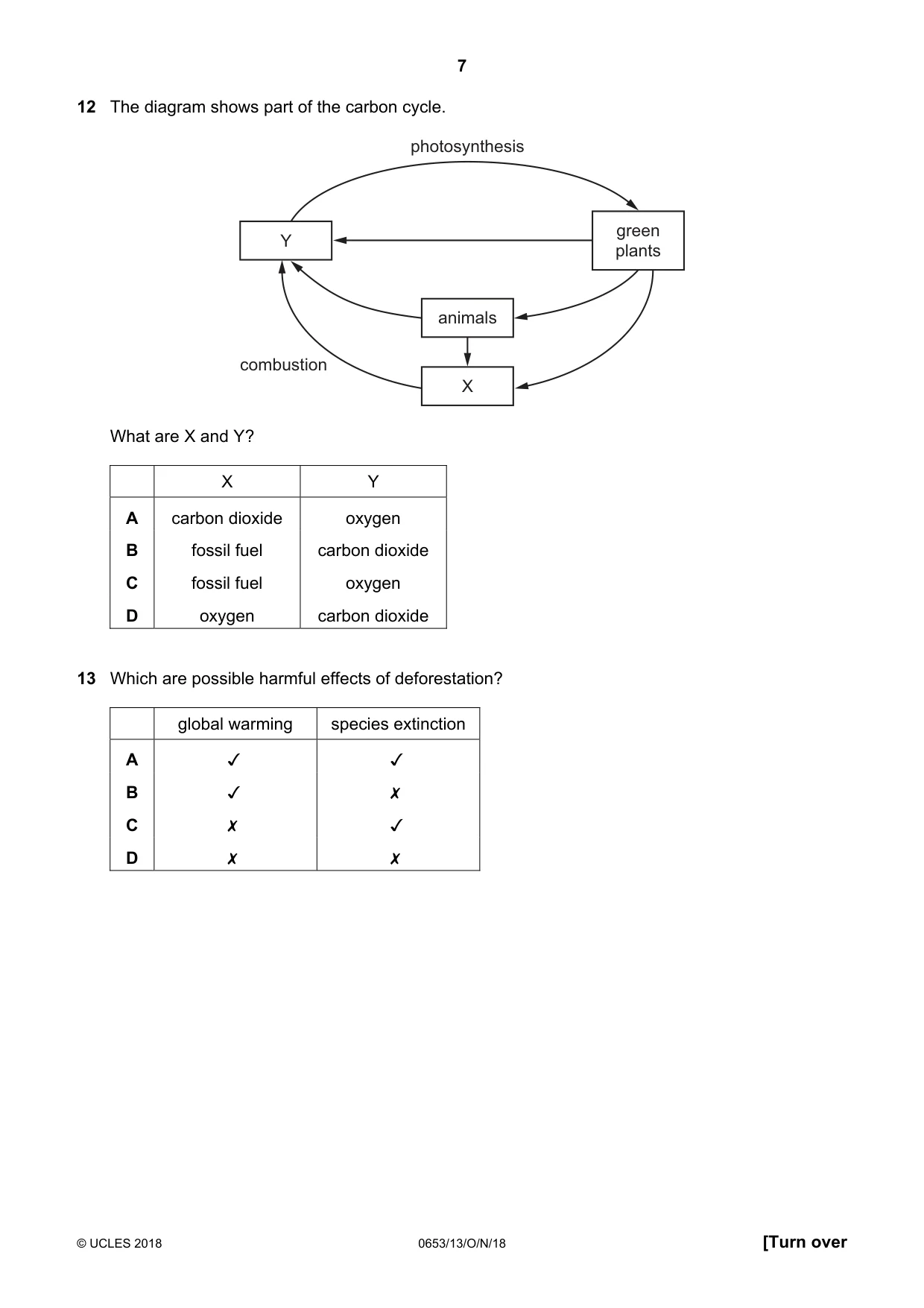
Q12 · The diagram shows part of the carbon cycle
12 The diagram shows part of the carbon cycle. photosynthesis green Y plants animals combustion X What are X and Y? X Y A carbon dioxide oxygen B fossil fuel carbon dioxide C fossil fuel oxygen D oxygen carbon dioxide
Mark scheme: B
Q13 · Which are possible harmful effects of deforestation?
13 Which are possible harmful effects of deforestation? global warming species extinction A v v B v x Cc x v D x x
Mark scheme: A
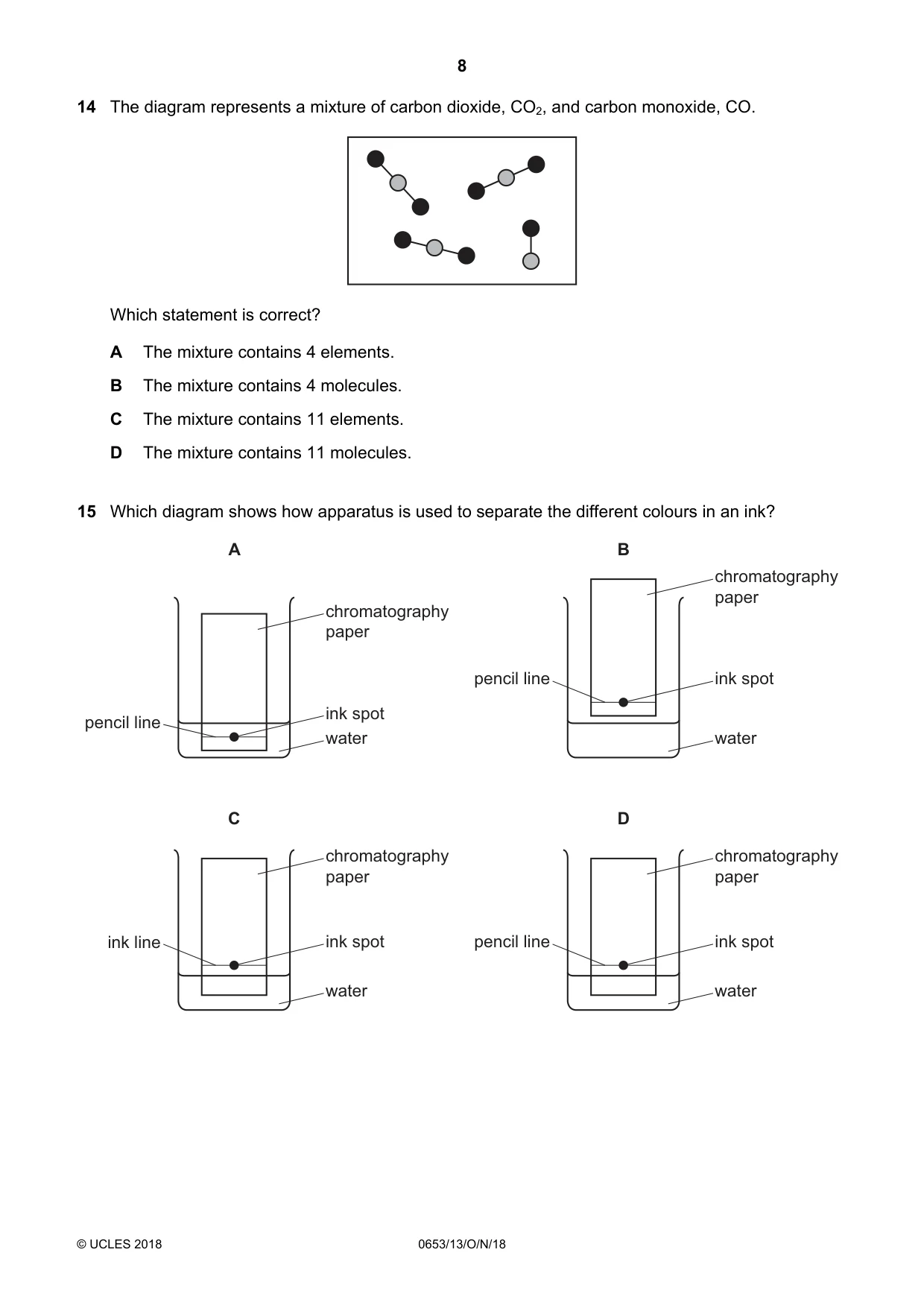
Q14 · The diagram represents a mixture of carbon dioxide, CO2, and carbon monoxide, CO
14 The diagram represents a mixture of carbon dioxide, CO2, and carbon monoxide, CO. Which statement is correct? A The mixture contains 4 elements. B The mixture contains 4 molecules. C The mixture contains 11 elements. D The mixture contains 11 molecules.
Mark scheme: B
Q15 · Which diagram shows how apparatus is used to separate the different colours in an ink?
15 Which diagram shows how apparatus is used to separate the different colours in an ink? A B chromatography paper chromatography paper pencil line ink spot ink spot pencil line water water C D chromatography chromatography paper paper ink line ink spot pencil line ink spot water water
Mark scheme: D
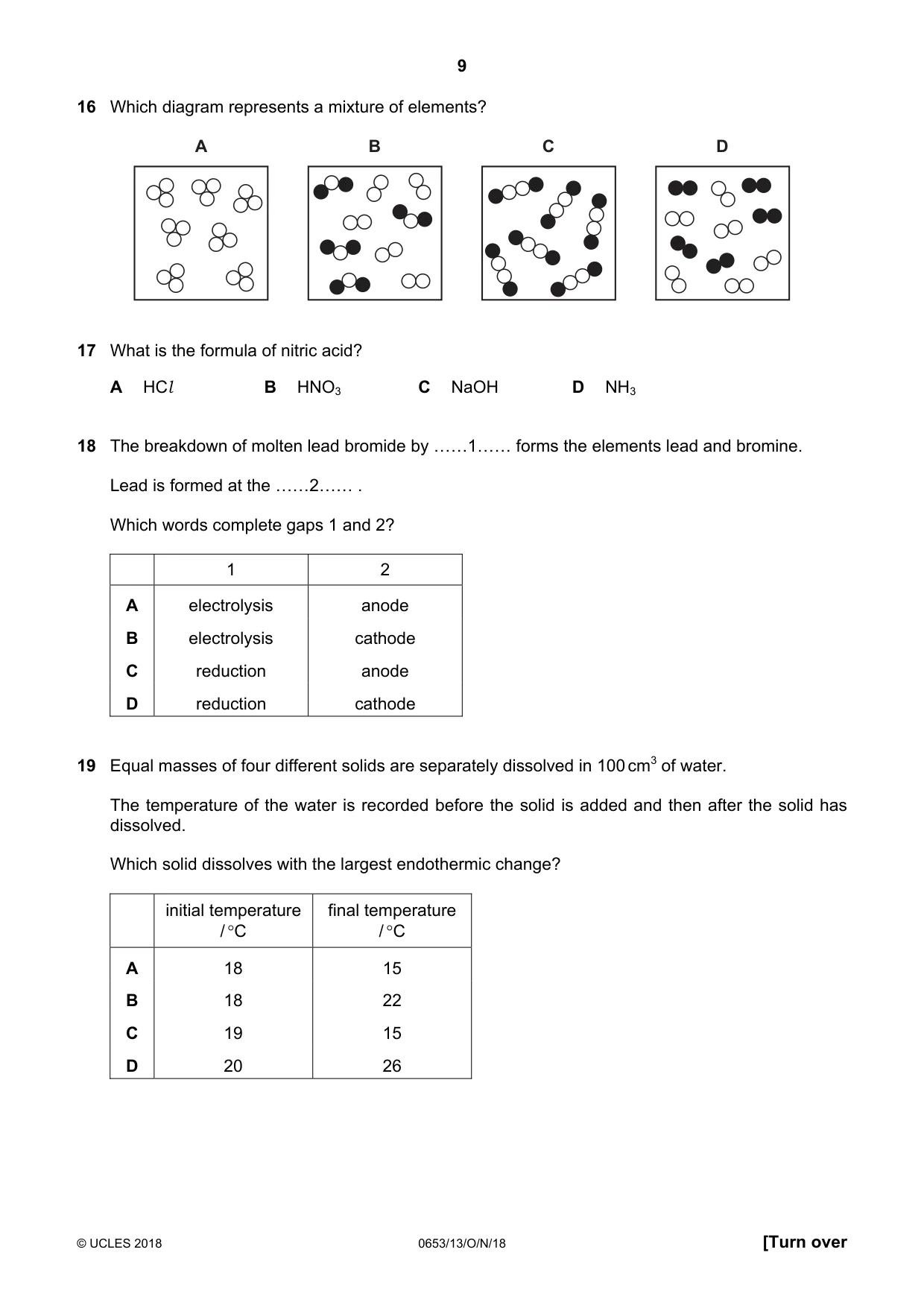
Q16 · Which diagram represents a mixture of elements?
16 Which diagram represents a mixture of elements? A B C D
Mark scheme: D
Q17 · What is the formula of nitric acid?
17 What is the formula of nitric acid? A HCl B HNO3 C NaOH D NH3
Mark scheme: B
More questions on The characteristic properties of acids and bases
Q18 · The breakdown of molten lead bromide by ««1«« forms the elements lead and bromine
18 The breakdown of molten lead bromide by ««1«« forms the elements lead and bromine. Lead is formed at the ««2«« . Which words complete gaps 1 and 2? 1 2 A electrolysis anode B electrolysis cathode C reduction anode D reduction cathode
Mark scheme: B
Q19 · Equal masses of four different solids are separately dissolved in 100 cm3 of water
19 Equal masses of four different solids are separately dissolved in 100 cm3 of water. The temperature of the water is recorded before the solid is added and then after the solid has dissolved. Which solid dissolves with the largest endothermic change? initial temperature final temperature / °C / °C A 18 15 B 18 22 C 19 15 D 20 26
Mark scheme: C
Q20 · Substance X increases the rate of a chemical reaction, but it remains unchanged at the…
20 Substance X increases the rate of a chemical reaction, but it remains unchanged at the end of the reaction. Which word describes substance X? A catalyst B electrolyte C product D unreactive
Mark scheme: A
Q21 · Iron oxide reacts with carbon monoxide
21 Iron oxide reacts with carbon monoxide. The word equation for the reaction is: iron oxide + carbon monoxide → iron + carbon dioxide Which statement is not correct? A Carbon is neither oxidised nor reduced. B Carbon is oxidised. C Iron is reduced. D This is a redox reaction.
Mark scheme: A
Q22 · The results of two tests on a white solid are shown
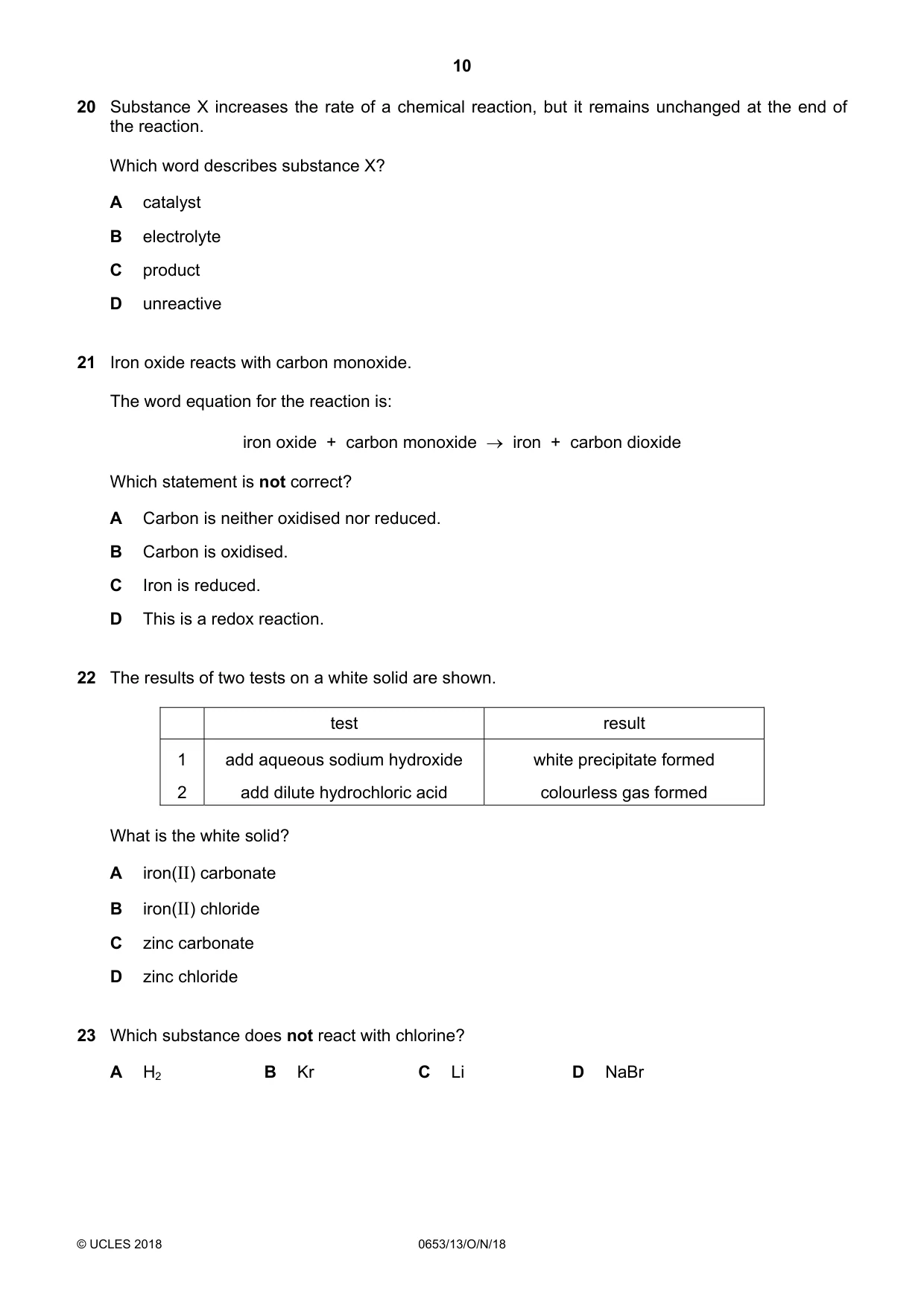
22 The results of two tests on a white solid are shown. test result 1 add aqueous sodium hydroxide white precipitate formed 2 add dilute hydrochloric acid colourless gas formed What is the white solid? A iron(II) carbonate B iron(II) chloride C zinc carbonate D zinc chloride
Mark scheme: C
Q23 · Which substance does not react with chlorine?
23 Which substance does not react with chlorine? A H2 B Kr C Li D NaBr
Mark scheme: B
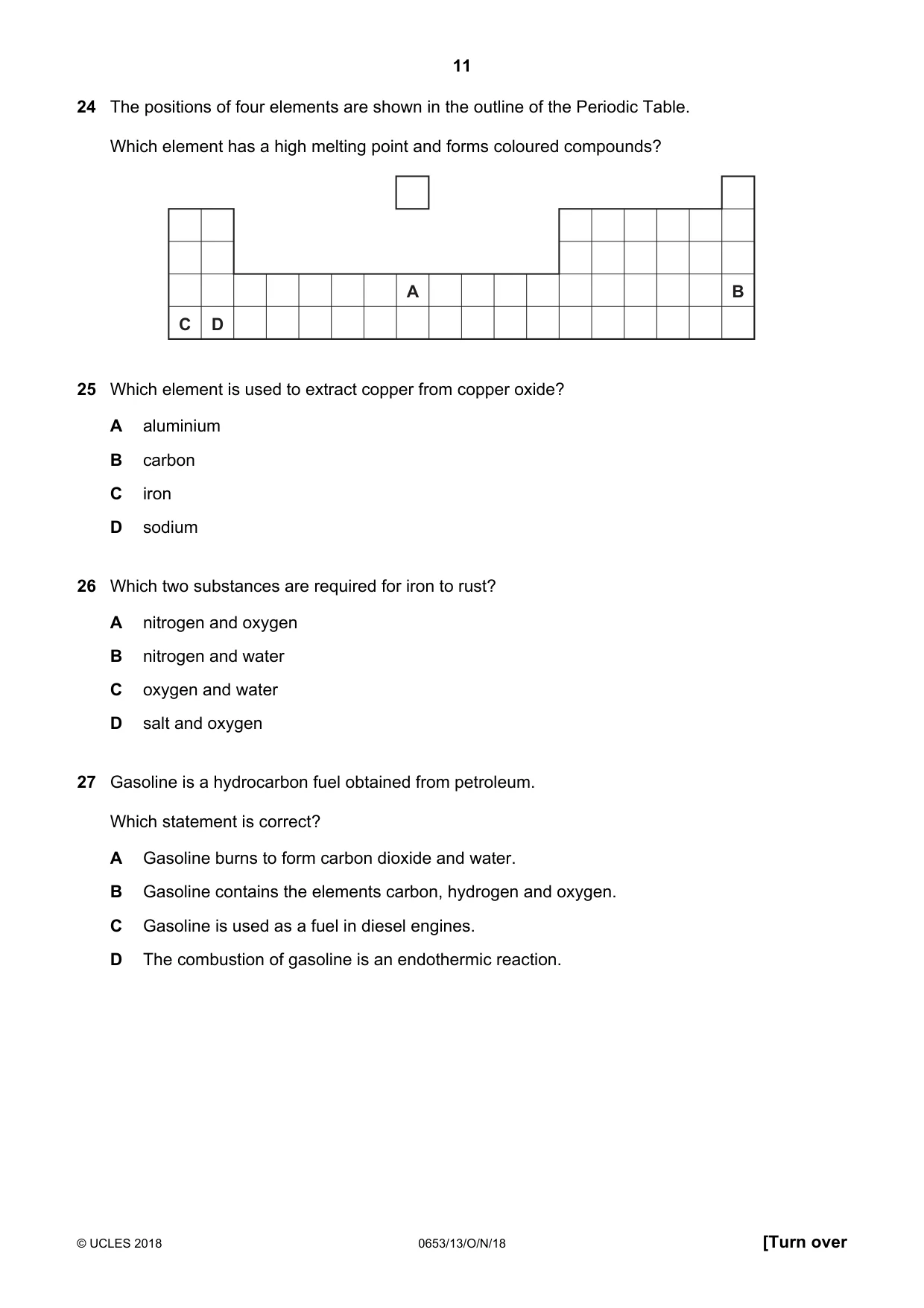
Q24 · The positions of four elements are shown in the outline of the Periodic Table
24 The positions of four elements are shown in the outline of the Periodic Table. Which element has a high melting point and forms coloured compounds? A B C D
Mark scheme: A
Q25 · Which element is used to extract copper from copper oxide?
25 Which element is used to extract copper from copper oxide? A aluminium B carbon C iron D sodium
Mark scheme: B
Q26 · Which two substances are required for iron to rust?
26 Which two substances are required for iron to rust? A nitrogen and oxygen B nitrogen and water C oxygen and water D salt and oxygen
Mark scheme: C
Q27 · Gasoline is a hydrocarbon fuel obtained from petroleum
27 Gasoline is a hydrocarbon fuel obtained from petroleum. Which statement is correct? A Gasoline burns to form carbon dioxide and water. B Gasoline contains the elements carbon, hydrogen and oxygen. C Gasoline is used as a fuel in diesel engines. D The combustion of gasoline is an endothermic reaction.
Mark scheme: A
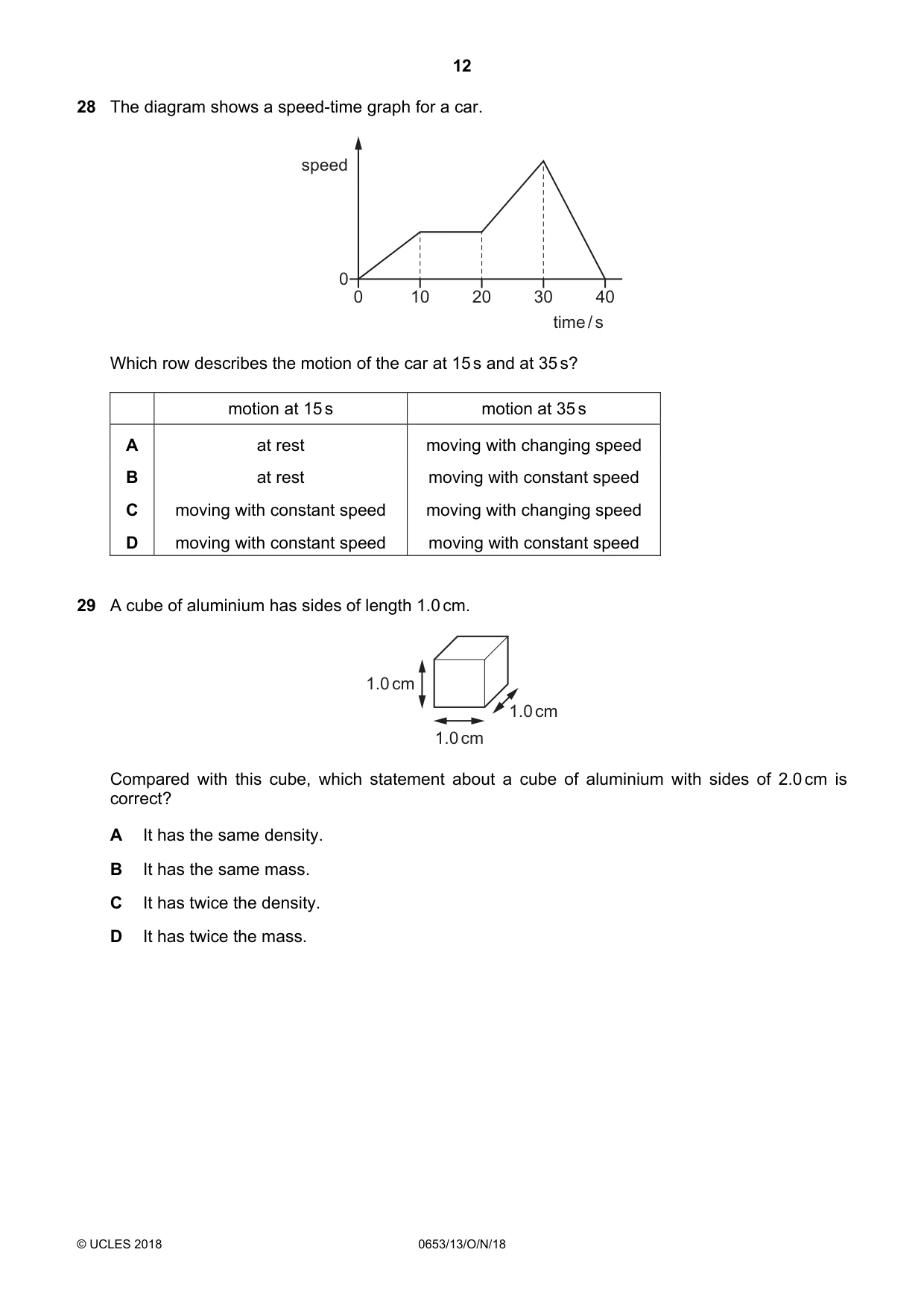
Q28 · The diagram shows a speed-time graph for a car
28 The diagram shows a speed-time graph for a car. speed 0 0 10 20 30 40 time / s Which row describes the motion of the car at 15 s and at 35 s? motion at 15 s motion at 35 s A at rest moving with changing speed B at rest moving with constant speed C moving with constant speed moving with changing speed D moving with constant speed moving with constant speed
Mark scheme: C
Q29 · A cube of aluminium has sides of length 1.0 cm
29 A cube of aluminium has sides of length 1.0 cm. 1.0 cm 1.0 cm 1.0 cm Compared with this cube, which statement about a cube of aluminium with sides of 2.0 cm is correct? A It has the same density. B It has the same mass. C It has twice the density. D It has twice the mass.
Mark scheme: A
Q30 · The table compares the output of thermal energy per second from four different lamps
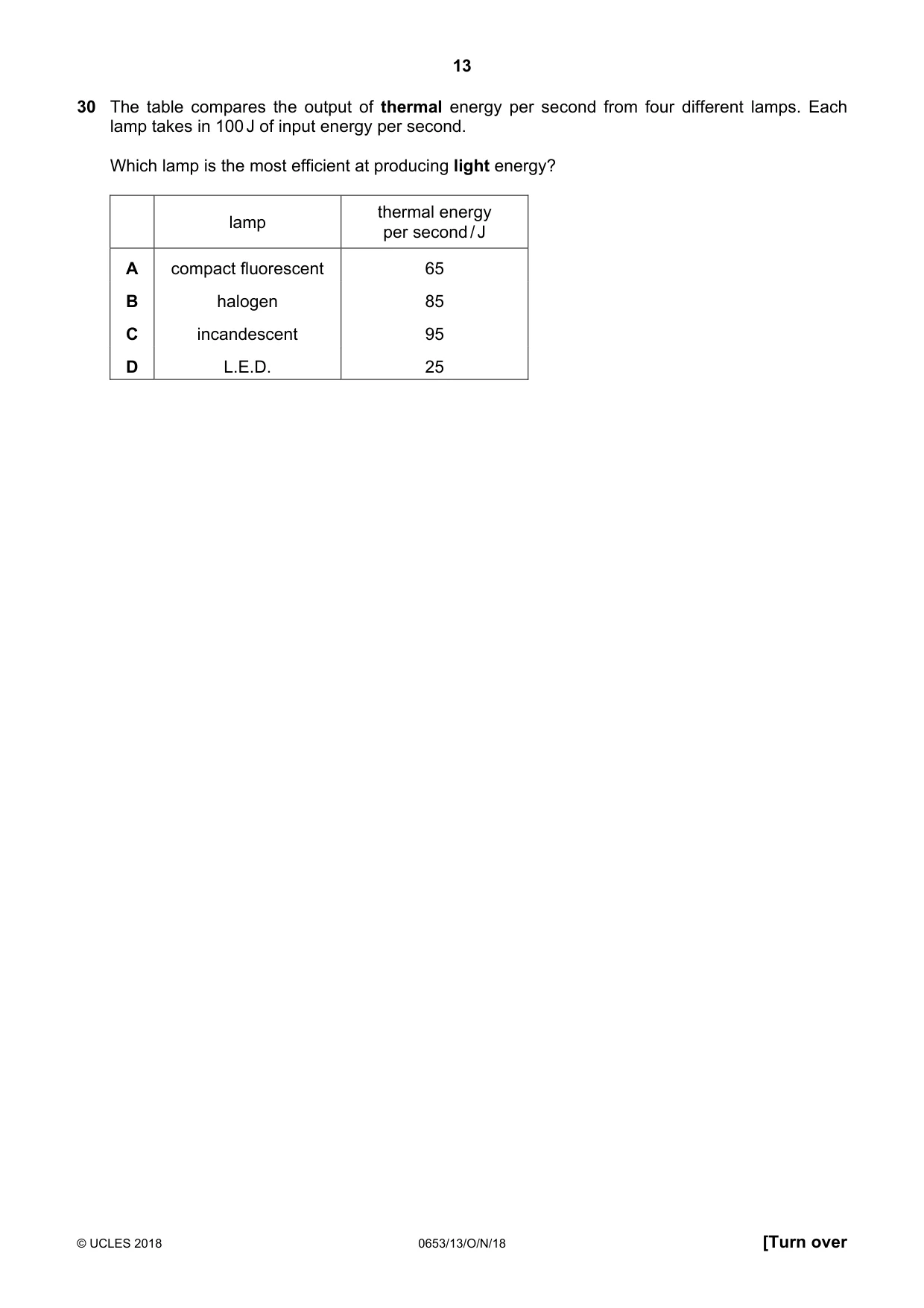
30 The table compares the output of thermal energy per second from four different lamps. Each lamp takes in 100 J of input energy per second. Which lamp is the most efficient at producing light energy? thermal energy lamp per second / J A compact fluorescent 65 B halogen 85 C incandescent 95 D L.E.D. 25
Mark scheme: D
Q31 · Weightlifting involves a number of different stages
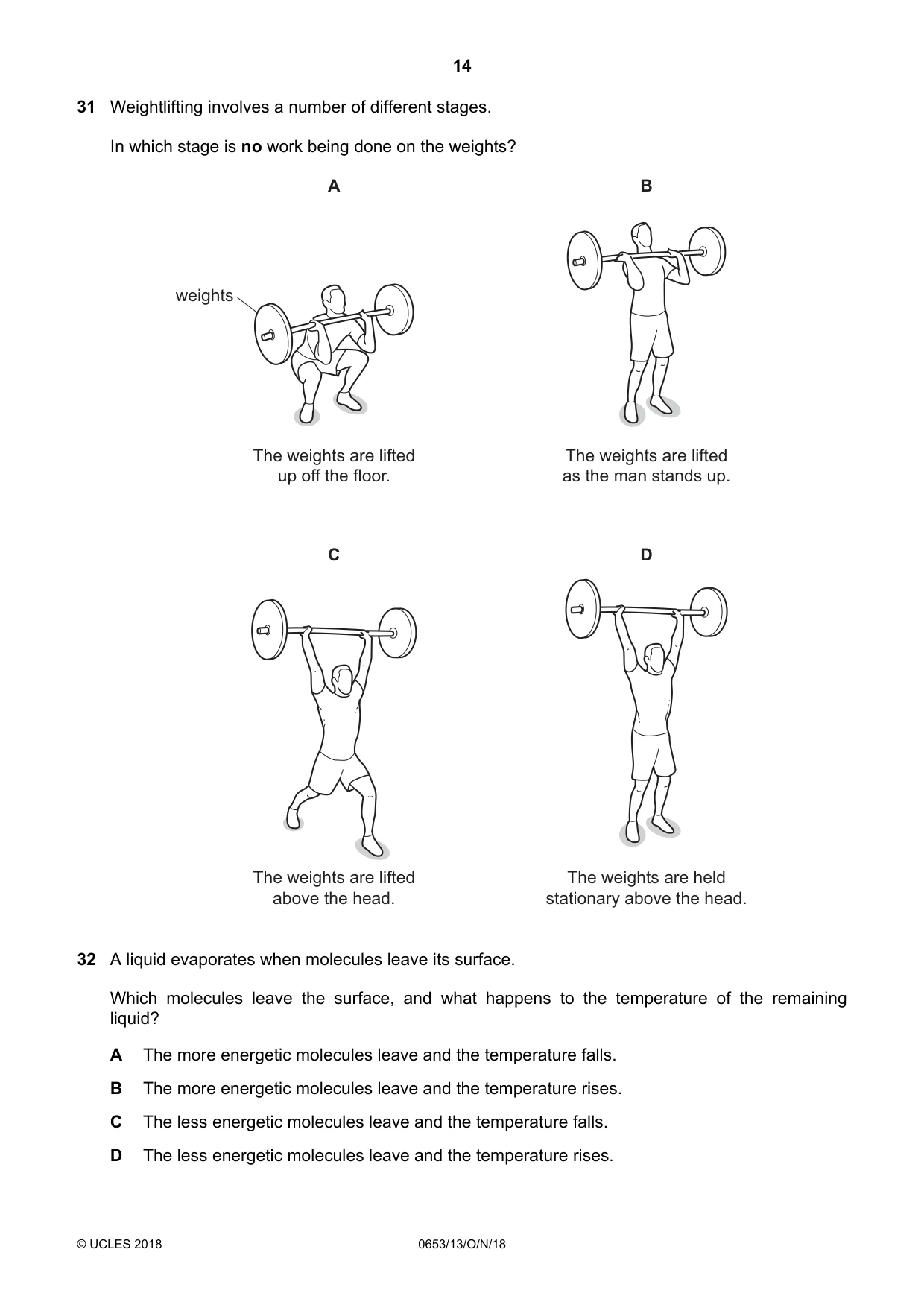
31 Weightlifting involves a number of different stages. In which stage is no work being done on the weights? A B weights The weights are lifted The weights are lifted up off the floor. as the man stands up. C D The weights are lifted The weights are held above the head. stationary above the head.
Mark scheme: D
Q32 · A liquid evaporates when molecules leave its surface
32 A liquid evaporates when molecules leave its surface. Which molecules leave the surface, and what happens to the temperature of the remaining liquid? A The more energetic molecules leave and the temperature falls. B The more energetic molecules leave and the temperature rises. C The less energetic molecules leave and the temperature falls. D The less energetic molecules leave and the temperature rises.
Mark scheme: A
Q33 · Convection is a process by which thermal energy is transferred from one place to another
33 Convection is a process by which thermal energy is transferred from one place to another. Where can convection take place? A in a gas and in a vacuum B in a liquid and in a gas C in a liquid and in a solid D in a solid and in a vacuum
Mark scheme: B
Q34 · The diagram shows a wave travelling along a rope
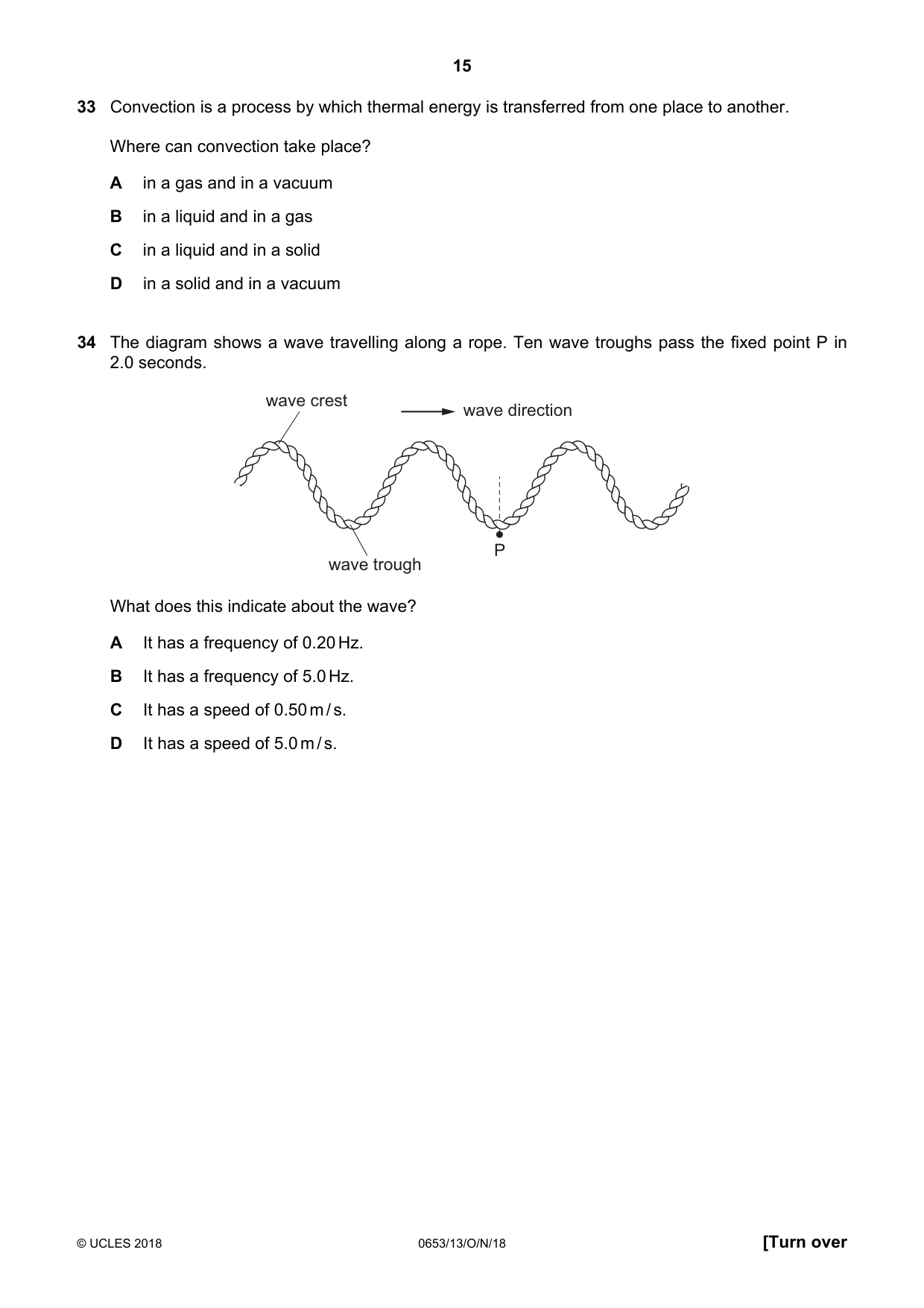
34 The diagram shows a wave travelling along a rope. Ten wave troughs pass the fixed point P in 2.0 seconds. wave crest wave direction P wave trough What does this indicate about the wave? A It has a frequency of 0.20 Hz. B It has a frequency of 5.0 Hz. C It has a speed of 0.50 m / s. D It has a speed of 5.0 m / s.
Mark scheme: B
Q35 · The diagram shows light passing from water into air
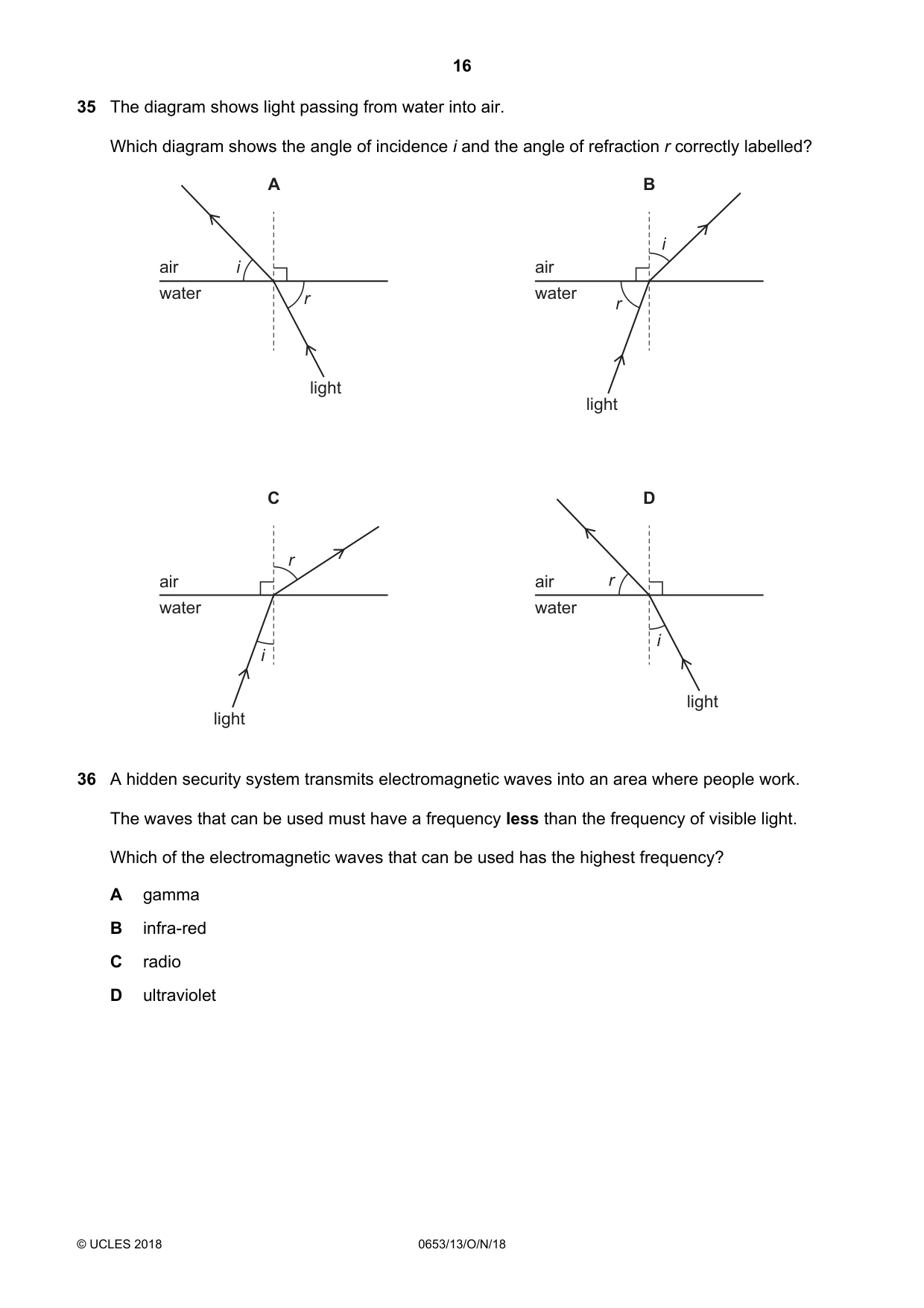
35 The diagram shows light passing from water into air. Which diagram shows the angle of incidence i and the angle of refraction r correctly labelled? A B i air i air water r water r light light C D r air air r water water i i light light
Mark scheme: C
Q36 · A hidden security system transmits electromagnetic waves into an area where people work
36 A hidden security system transmits electromagnetic waves into an area where people work. The waves that can be used must have a frequency less than the frequency of visible light. Which of the electromagnetic waves that can be used has the highest frequency? A gamma B infra-red C radio D ultraviolet
Mark scheme: B
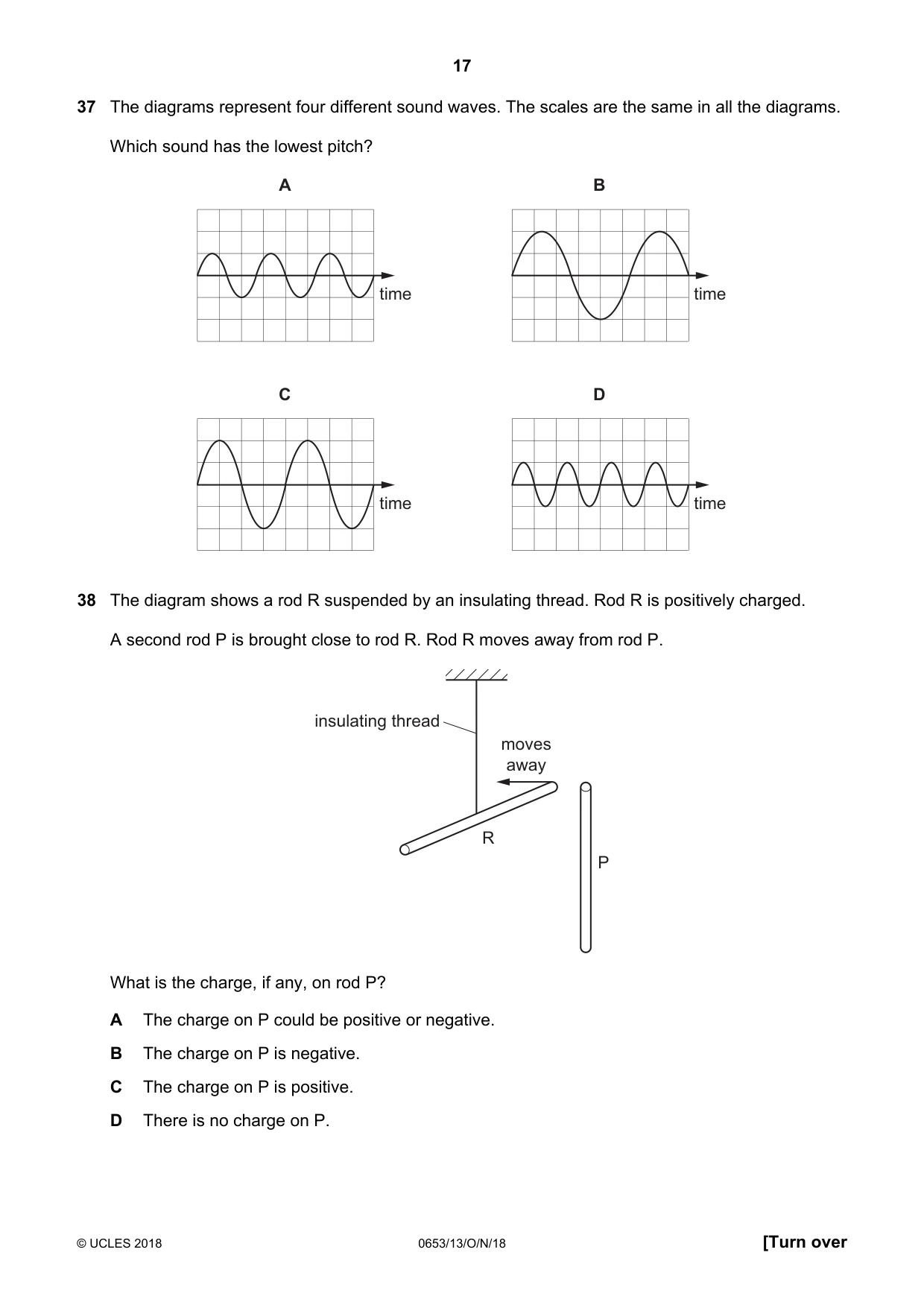
Q37 · The diagrams represent four different sound waves
37 The diagrams represent four different sound waves. The scales are the same in all the diagrams. Which sound has the lowest pitch? A B time time C D time time
Mark scheme: B
Q38 · The diagram shows a rod R suspended by an insulating thread
38 The diagram shows a rod R suspended by an insulating thread. Rod R is positively charged. A second rod P is brought close to rod R. Rod R moves away from rod P. insulating thread moves away R P What is the charge, if any, on rod P? A The charge on P could be positive or negative. B The charge on P is negative. C The charge on P is positive. D There is no charge on P.
Mark scheme: C
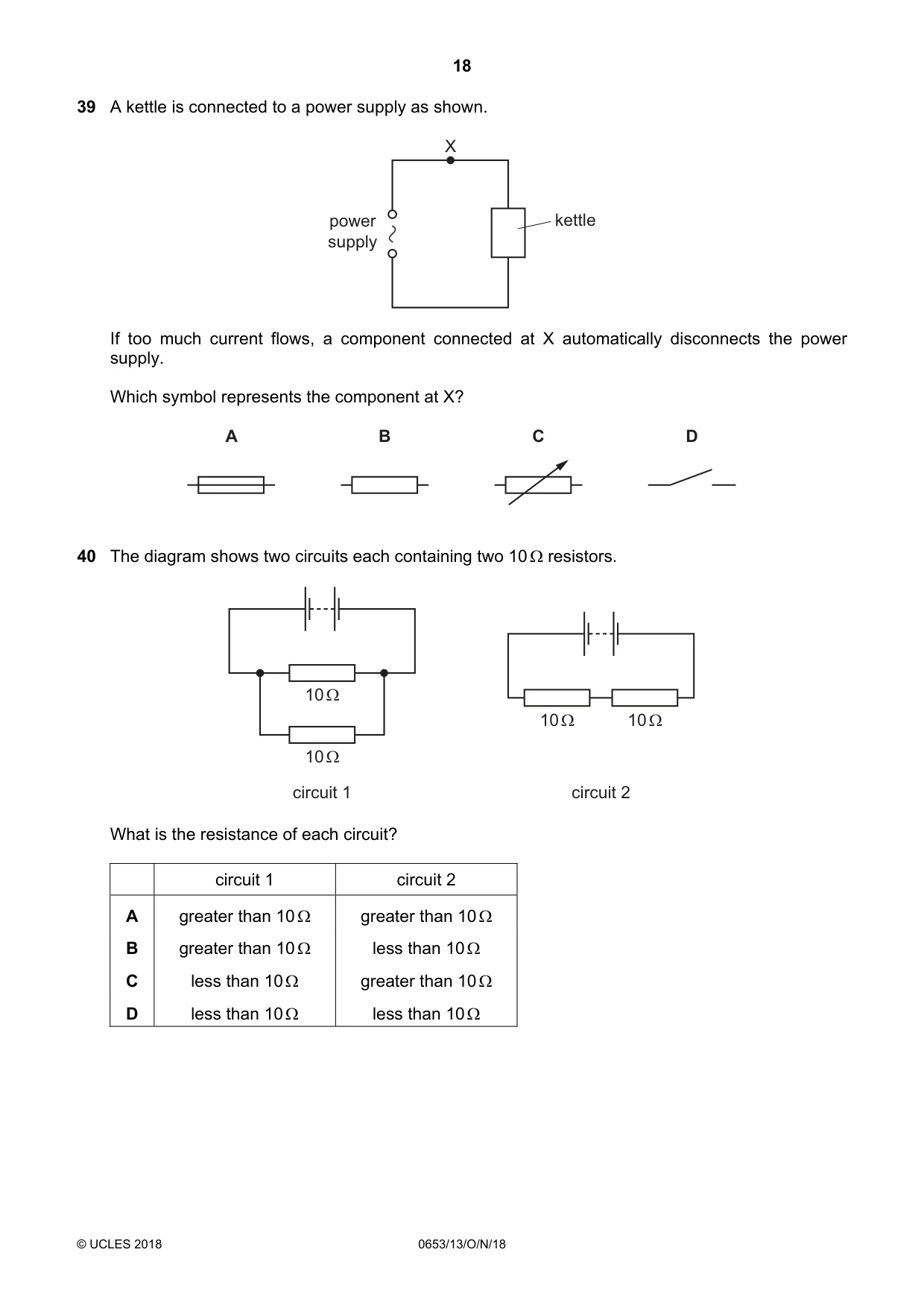
Q39 · A kettle is connected to a power supply as shown
39 A kettle is connected to a power supply as shown. X power kettle supply If too much current flows, a component connected at X automatically disconnects the power supply. Which symbol represents the component at X? A B C D
Mark scheme: A
Q40 · The diagram shows two circuits each containing two 10 Ω resistors
40 The diagram shows two circuits each containing two 10 Ω resistors. 10 Ω 10 Ω 10 Ω 10 Ω circuit 1 circuit 2 What is the resistance of each circuit? circuit 1 circuit 2 A greater than 10 Ω greater than 10 Ω B greater than 10 Ω less than 10 Ω C less than 10 Ω greater than 10 Ω D less than 10 Ω less than 10 Ω
Mark scheme: C
What was in this paper
The subtopics covered by these 40 questions, and how many questions each got. Open one in a new tab to see every Cambridge question on it.
2Elements, compounds and mixtures2Energy, work and power2Biological molecules1Blood1Carbon cycle1Chromatography1Corrosion of metals1Density1Diffusion1Drugs1Electrical circuits1Electrical quantities1Electrical safety1Electrolysis1Electromagnetic spectrum1Enzymes1Exothermic and endothermic reactions1Extraction of metals1Food chains and food webs1Fuels1General properties of waves1Group VII properties1Habitat destruction1Identification of ions and gases1Kinetic particle model of matter1Light1Motion1Rate of reaction1Redox1Respiration1Sexual reproduction in humans1Sound1The characteristic properties of acids and bases1Transfer of thermal energy1Transition elements1Transpiration1What you needed in this session
Cambridge’s own grade thresholds for 2018 Oct/Nov, Paper 1 · Variant 3. A higher threshold means an easier paper — the bar moves with how the cohort did.