Cambridge IGCSE Science - Combined 0653 — 2023 May/June Paper 1 · Variant 3
0653/13/M/J/23 · 40 questions · 40 marks · ≈45 min
The question paper and its mark scheme, free to read here and free to download. This is Cambridge’s own paper, exactly as it was sat.
Question paper16 pages
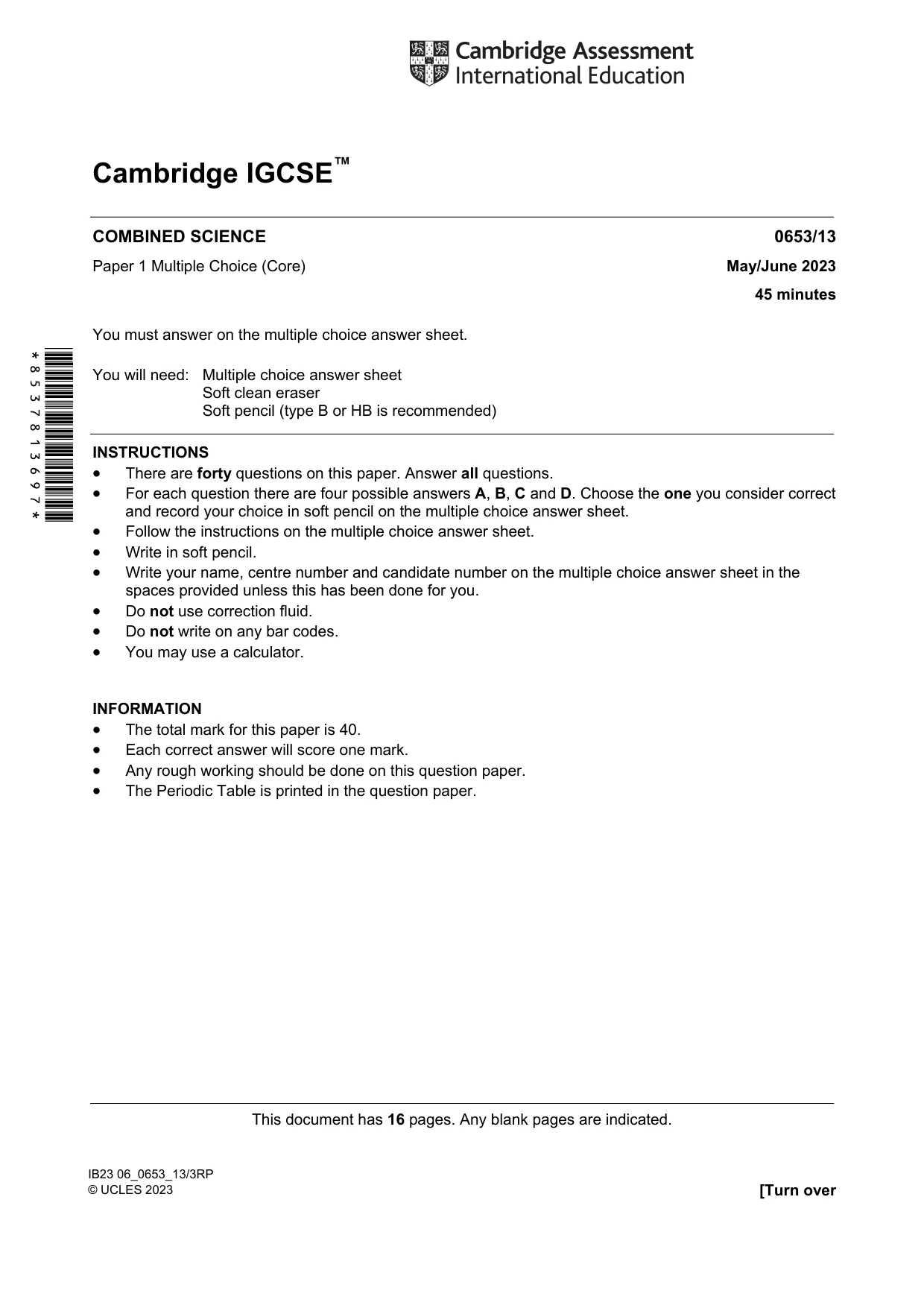

Mark scheme3 pages
Answers below. Sit the paper first if you are practising.
Questions as text
Q1 · What is a characteristic of all living things?
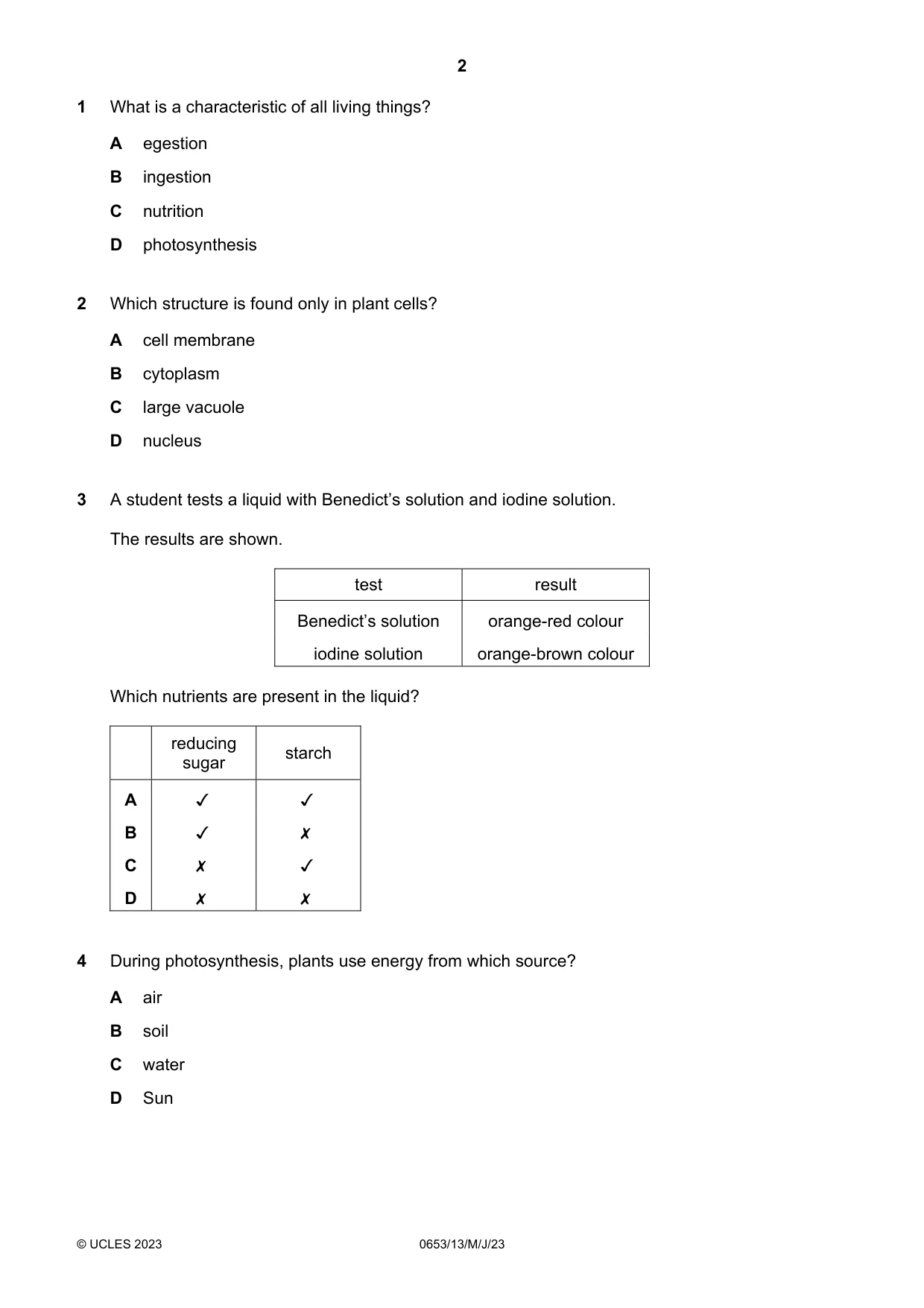
1 What is a characteristic of all living things? A egestion B ingestion C nutrition D photosynthesis
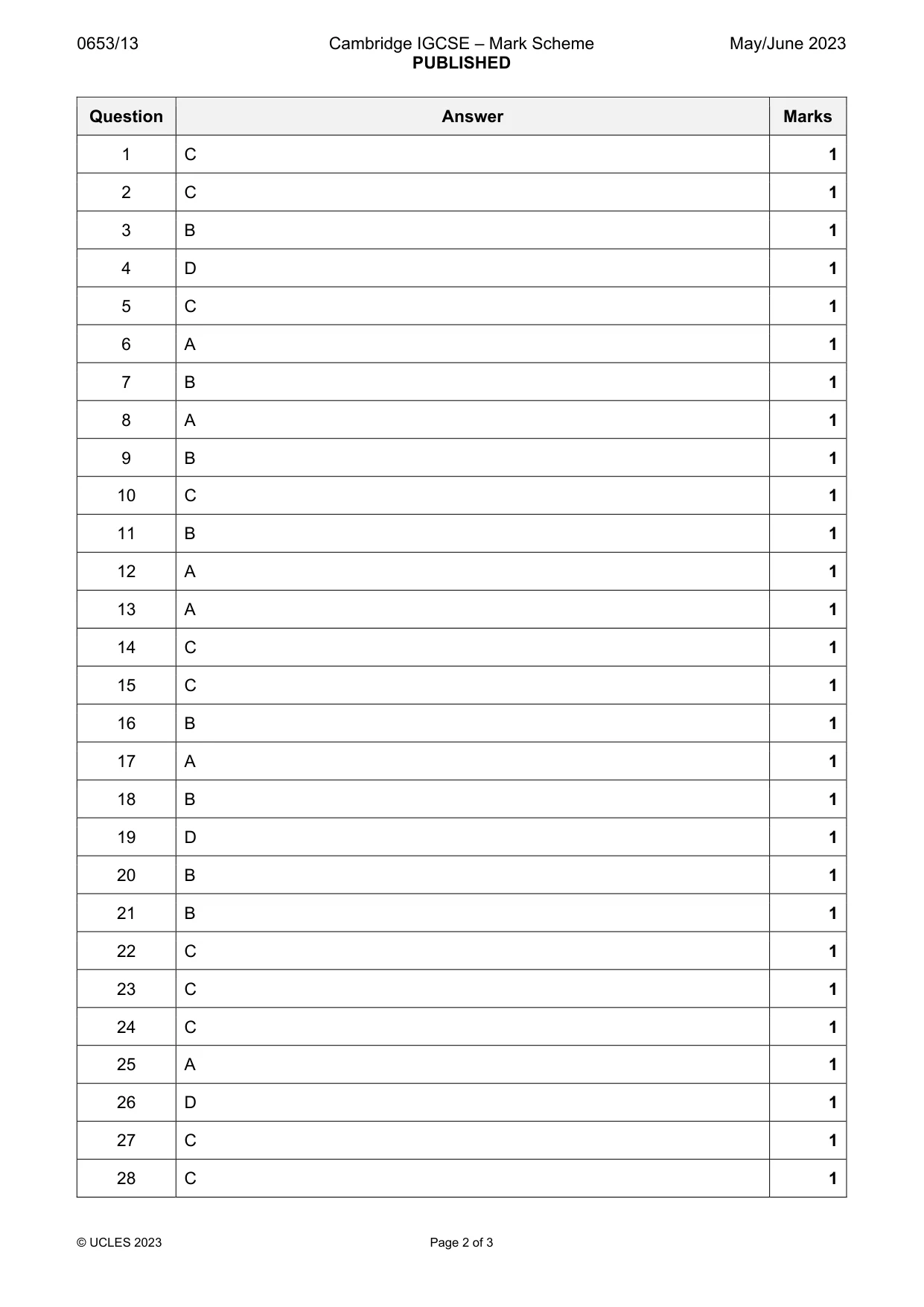
Mark scheme: C
Q2 · Which structure is found only in plant cells?
2 Which structure is found only in plant cells? A cell membrane B cytoplasm C large vacuole D nucleus
Mark scheme: C
Q3 · A student tests a liquid with Benedict’s solution and iodine solution
3 A student tests a liquid with Benedict’s solution and iodine solution. The results are shown. test result Benedict’s solution orange-red colour iodine solution orange-brown colour Which nutrients are present in the liquid? reducing starch sugar A J Jv B Jv x Cc x v D x x
Mark scheme: B
Q4 · During photosynthesis, plants use energy from which source?
4 During photosynthesis, plants use energy from which source? A air B soil C water D Sun
Mark scheme: D
Q5 · Which row matches the part of the alimentary canal to its function?
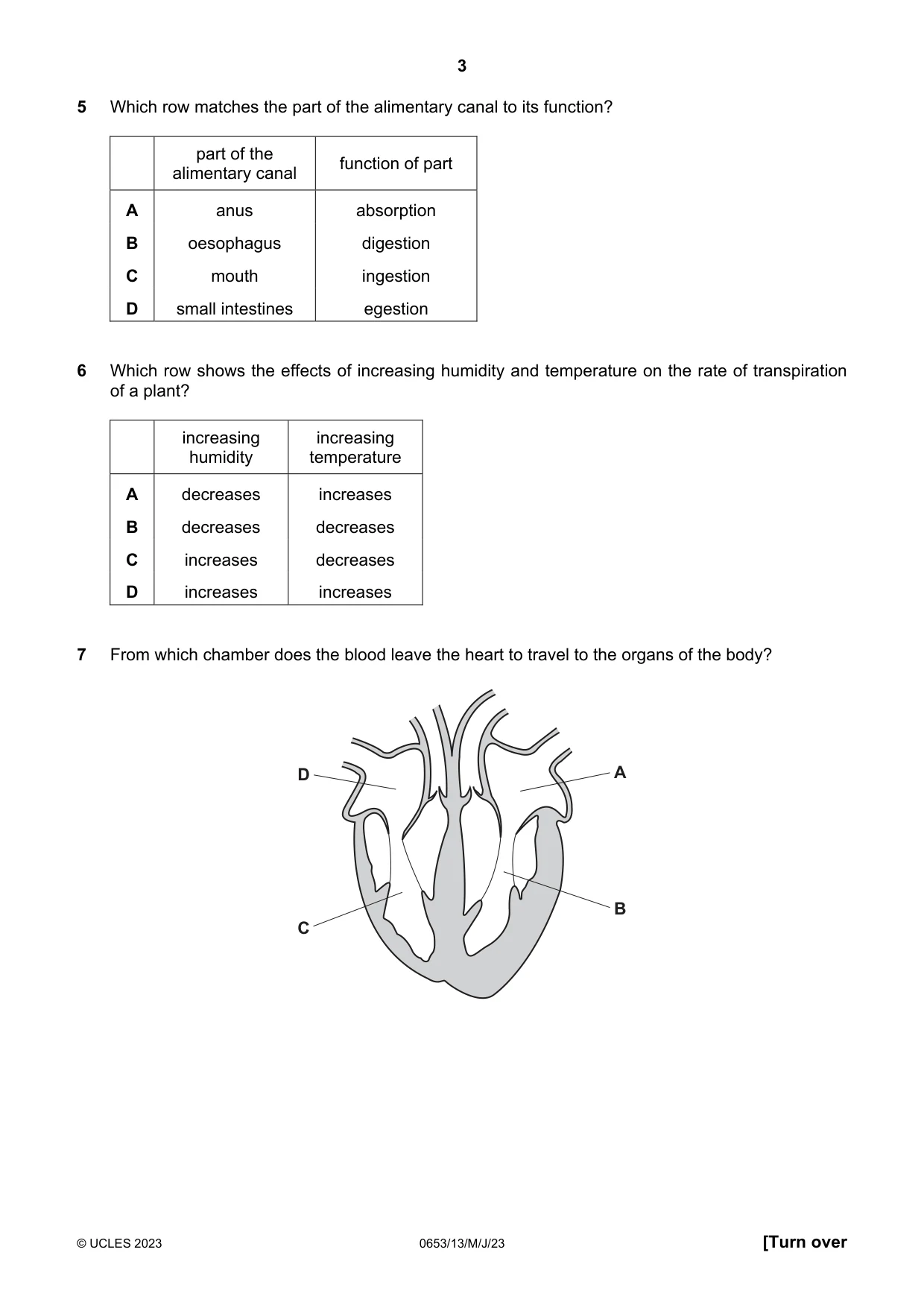
5 Which row matches the part of the alimentary canal to its function? part of the function of part alimentary canal A anus absorption B oesophagus digestion C mouth ingestion D small intestines egestion
Mark scheme: C
Q6 · Which row shows the effects of increasing humidity and temperature on the rate of…
6 Which row shows the effects of increasing humidity and temperature on the rate of transpiration of a plant? increasing increasing humidity temperature A decreases increases B decreases decreases C increases decreases D increases increases
Mark scheme: A
Q7 · From which chamber does the blood leave the heart to travel to the organs of the body?
7 From which chamber does the blood leave the heart to travel to the organs of the body? D A B C
Mark scheme: B
Q8 · A student carries out vigorous exercise for 10 minutes
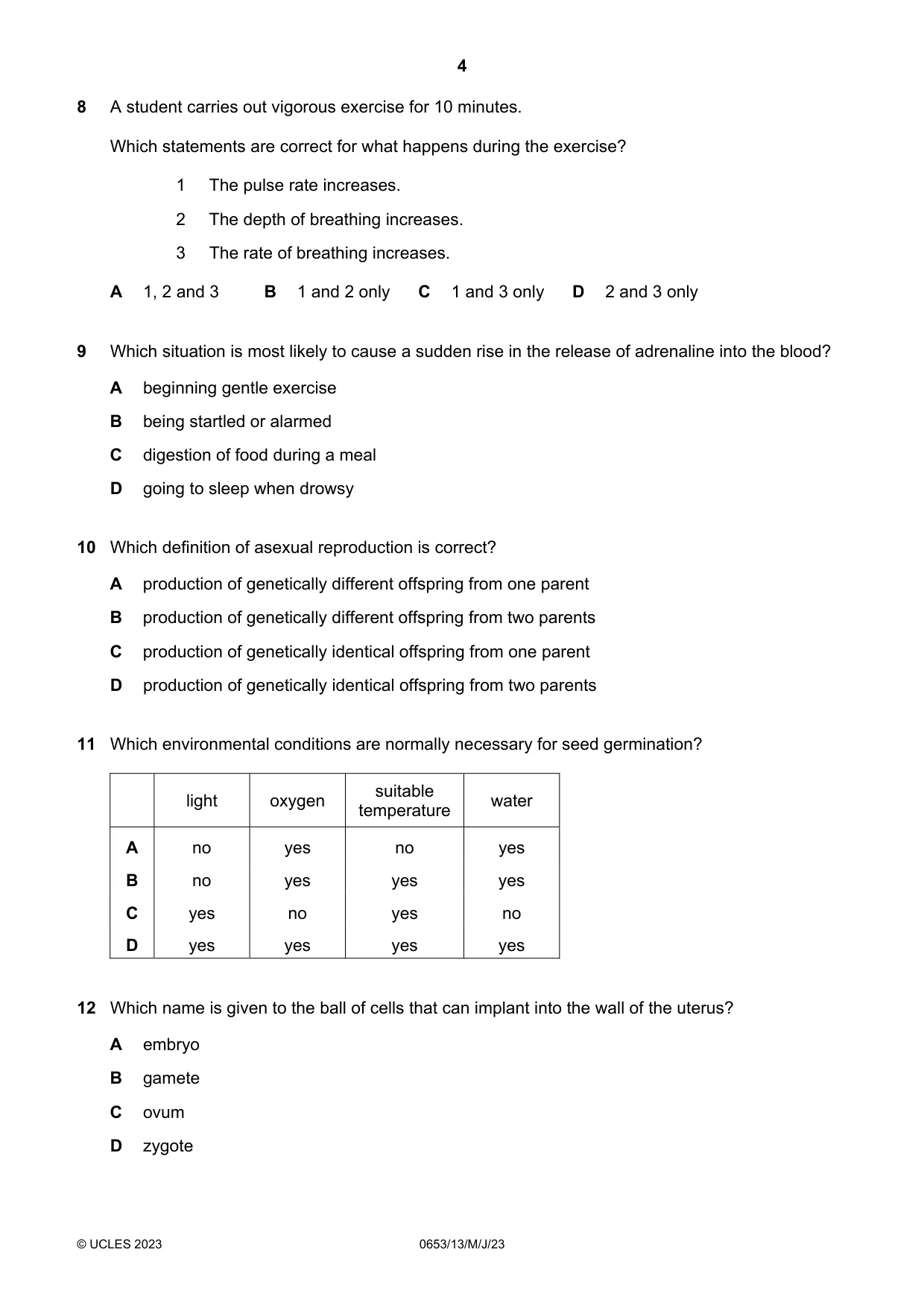
8 A student carries out vigorous exercise for 10 minutes. Which statements are correct for what happens during the exercise? 1 The pulse rate increases. 2 The depth of breathing increases. 3 The rate of breathing increases. A 1, 2 and 3 B 1 and 2 only C 1 and 3 only D 2 and 3 only
Mark scheme: A
Q9 · Which situation is most likely to cause a sudden rise in the release of adrenaline into…
9 Which situation is most likely to cause a sudden rise in the release of adrenaline into the blood? A beginning gentle exercise B being startled or alarmed C digestion of food during a meal D going to sleep when drowsy
Mark scheme: B
Q10 · Which definition of asexual reproduction is correct?
10 Which definition of asexual reproduction is correct? A production of genetically different offspring from one parent B production of genetically different offspring from two parents C production of genetically identical offspring from one parent D production of genetically identical offspring from two parents
Mark scheme: C
Q11 · Which environmental conditions are normally necessary for seed germination?
11 Which environmental conditions are normally necessary for seed germination? suitable light oxygen water temperature A no yes no yes B no yes yes yes C yes no yes no D yes yes yes yes
Mark scheme: B
Q12 · Which name is given to the ball of cells that can implant into the wall of the uterus?
12 Which name is given to the ball of cells that can implant into the wall of the uterus? A embryo B gamete C ovum D zygote
Mark scheme: A
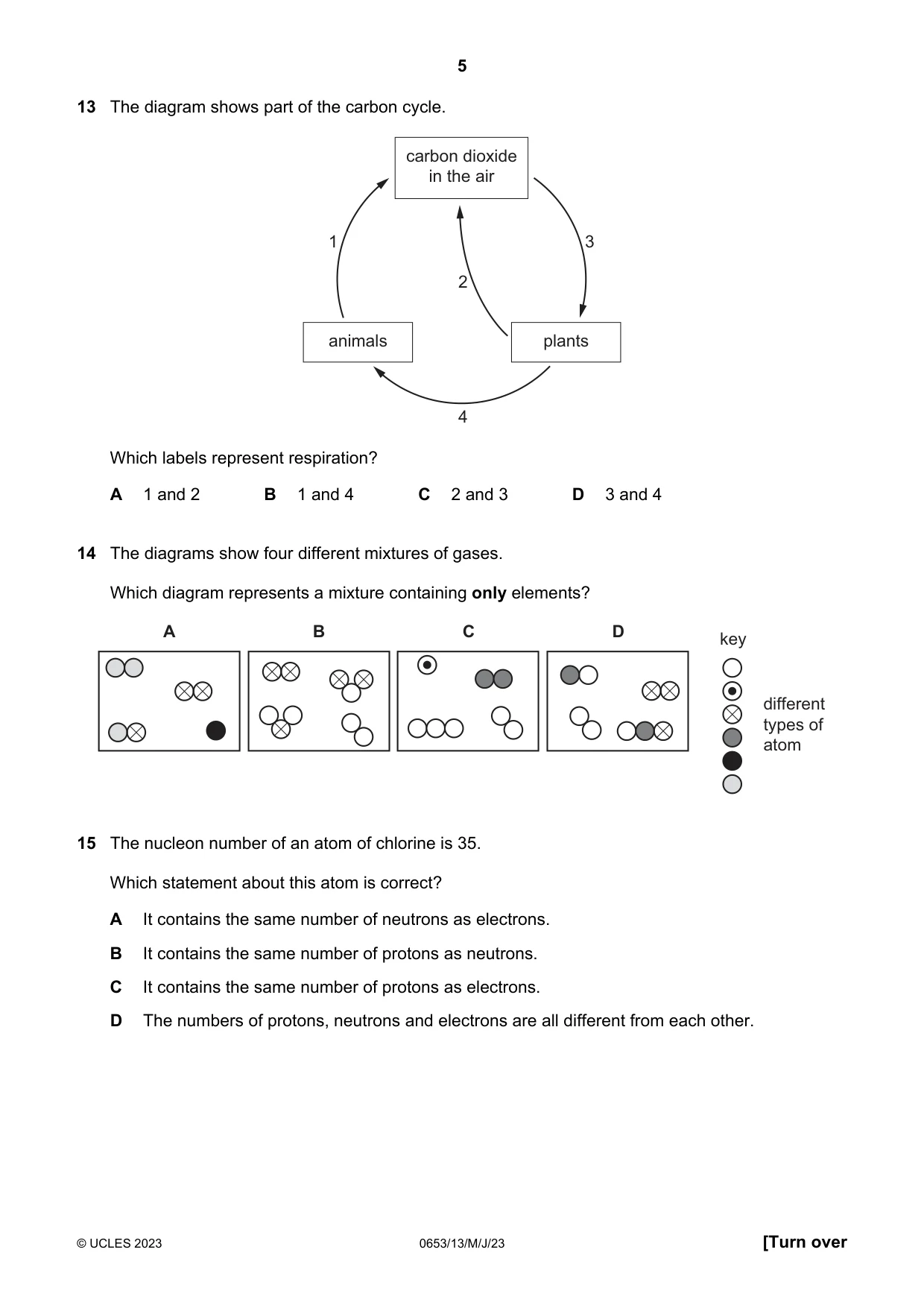
Q13 · The diagram shows part of the carbon cycle
13 The diagram shows part of the carbon cycle. carbon dioxide in the air 1 3 2 animals plants 4 Which labels represent respiration? A 1 and 2 B 1 and 4 C 2 and 3 D 3 and 4
Mark scheme: A
Q14 · The diagrams show four different mixtures of gases
14 The diagrams show four different mixtures of gases. Which diagram represents a mixture containing only elements? A B C D key different types of atom
Mark scheme: C
Q15 · The nucleon number of an atom of chlorine is 35
15 The nucleon number of an atom of chlorine is 35. Which statement about this atom is correct? A It contains the same number of neutrons as electrons. B It contains the same number of protons as neutrons. C It contains the same number of protons as electrons. D The numbers of protons, neutrons and electrons are all different from each other.
Mark scheme: C
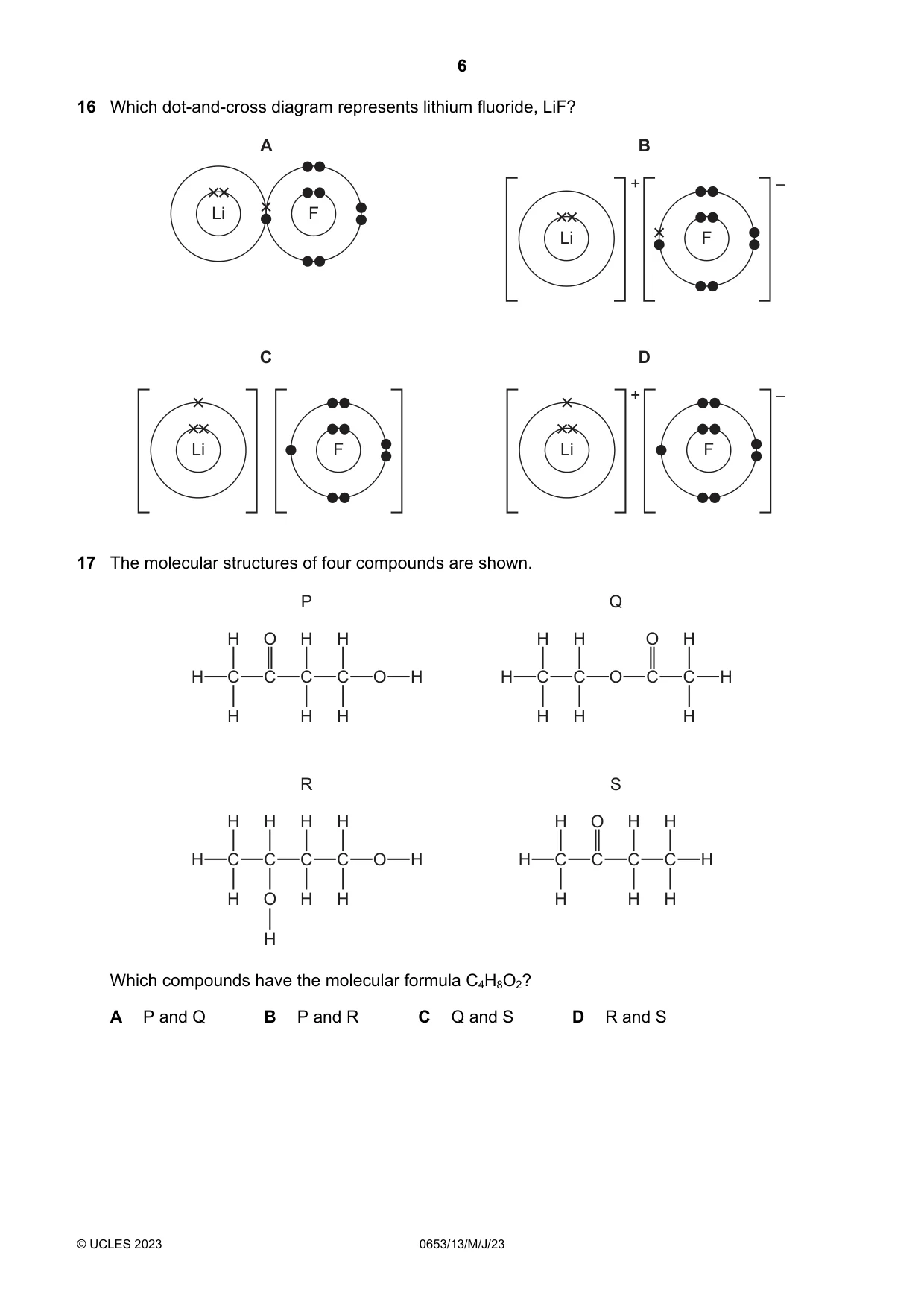
Q16 · Which dot-and-cross diagram represents lithium fluoride, LiF?
16 Which dot-and-cross diagram represents lithium fluoride, LiF? A B + – Li F Li F C D + – Li F Li F
Mark scheme: B
Q17 · The molecular structures of four compounds are shown
17 The molecular structures of four compounds are shown. P Q H O H H H H O H H C C C C O H H C C O C C H H H H H H H R S H H H H H O H H H C C C C O H H C C C C H H O H H H H H H Which compounds have the molecular formula C4H8O2? A P and Q B P and R C Q and S D R and S
Mark scheme: A
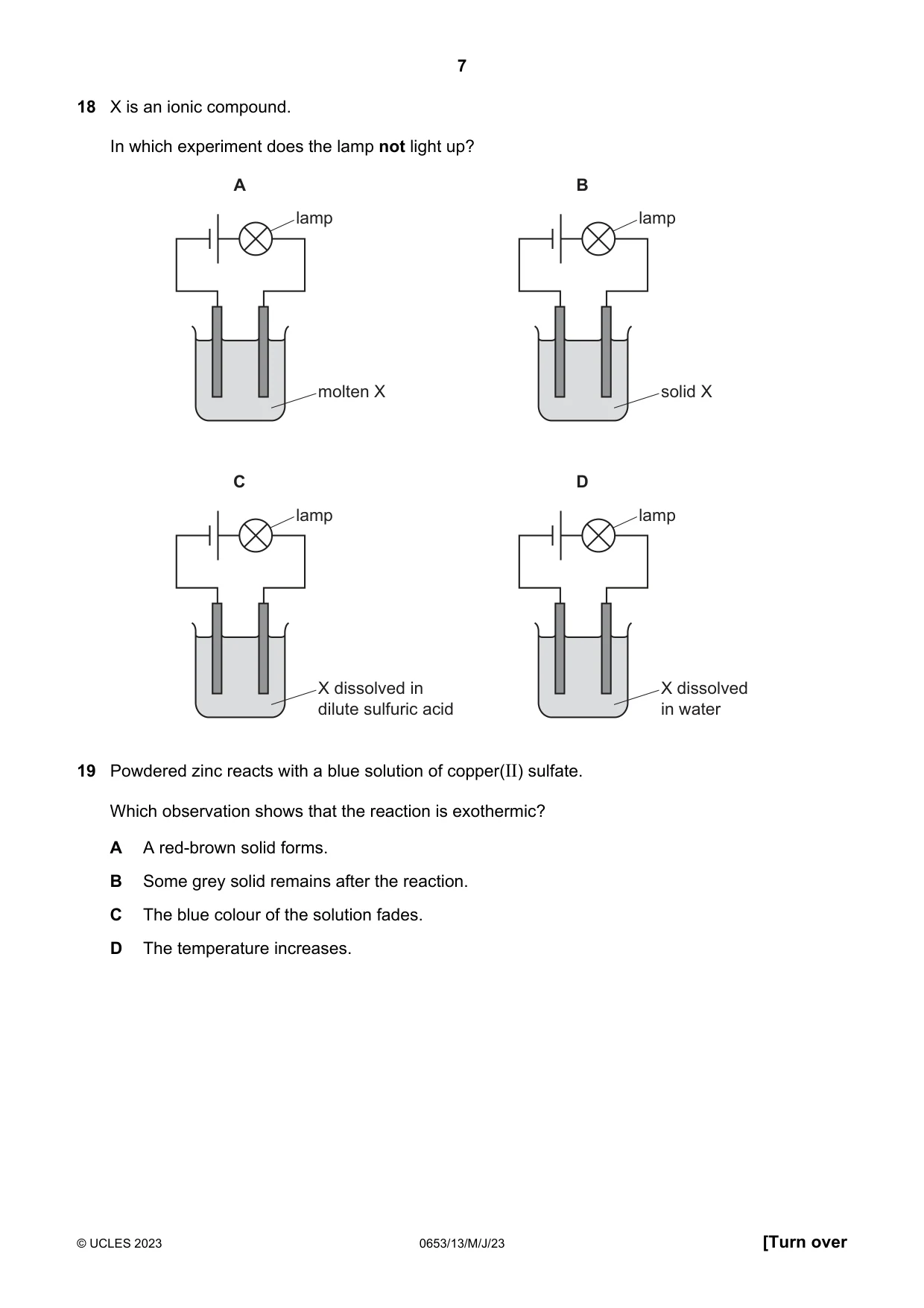
Q18 · X is an ionic compound
18 X is an ionic compound. In which experiment does the lamp not light up? A B lamp lamp molten X solid X C D lamp lamp X dissolved in X dissolved dilute sulfuric acid in water
Mark scheme: B
Q19 · Powdered zinc reacts with a blue solution of copper(II) sulfate
19 Powdered zinc reacts with a blue solution of copper(II) sulfate. Which observation shows that the reaction is exothermic? A A red-brown solid forms. B Some grey solid remains after the reaction. C The blue colour of the solution fades. D The temperature increases.
Mark scheme: D
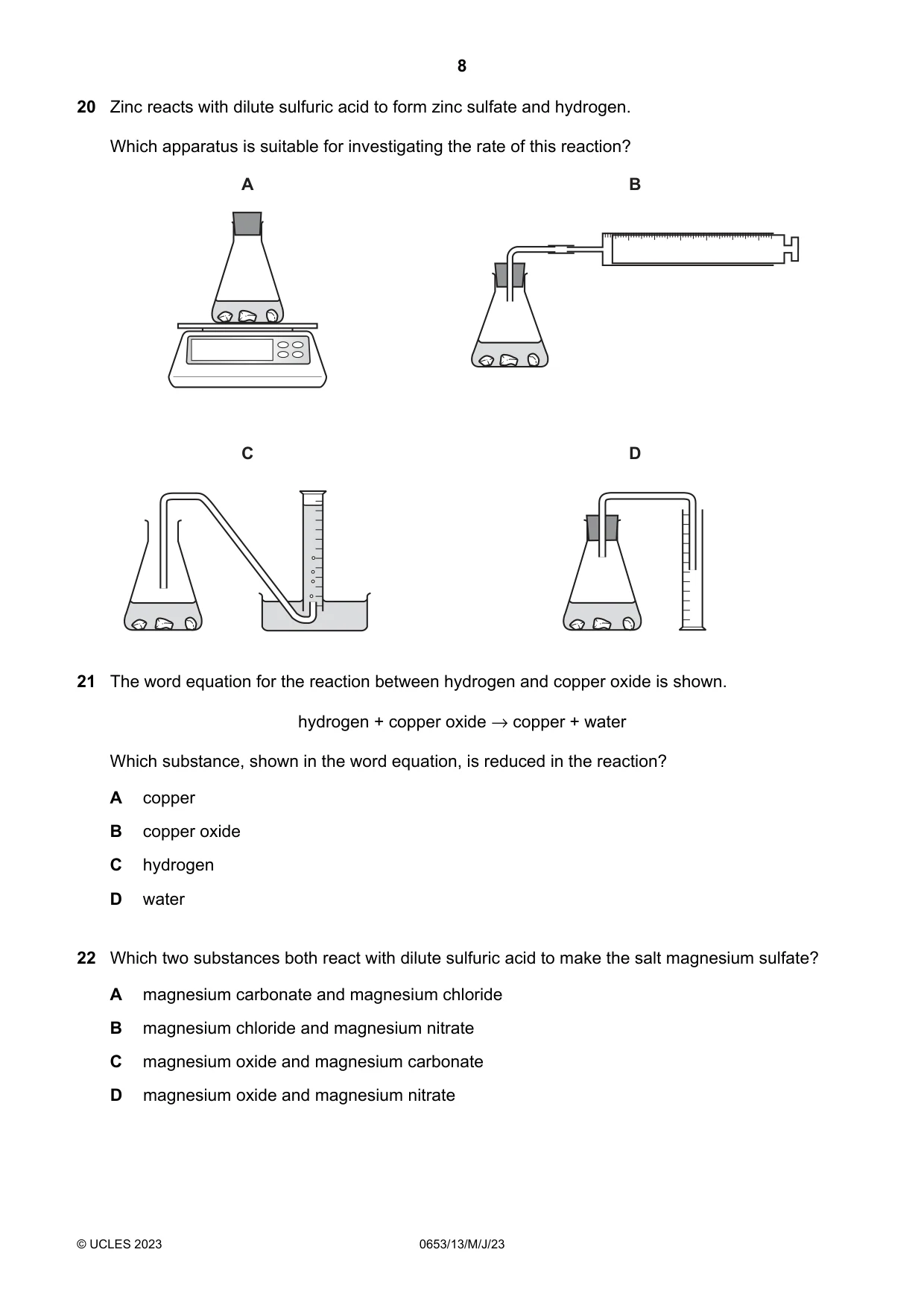
Q20 · Zinc reacts with dilute sulfuric acid to form zinc sulfate and hydrogen
20 Zinc reacts with dilute sulfuric acid to form zinc sulfate and hydrogen. Which apparatus is suitable for investigating the rate of this reaction? A B C D
Mark scheme: B
Q21 · The word equation for the reaction between hydrogen and copper oxide is shown
21 The word equation for the reaction between hydrogen and copper oxide is shown. hydrogen + copper oxide → copper + water Which substance, shown in the word equation, is reduced in the reaction? A copper B copper oxide C hydrogen D water
Mark scheme: B
Q22 · Which two substances both react with dilute sulfuric acid to make the salt magnesium…
22 Which two substances both react with dilute sulfuric acid to make the salt magnesium sulfate? A magnesium carbonate and magnesium chloride B magnesium chloride and magnesium nitrate C magnesium oxide and magnesium carbonate D magnesium oxide and magnesium nitrate
Mark scheme: C
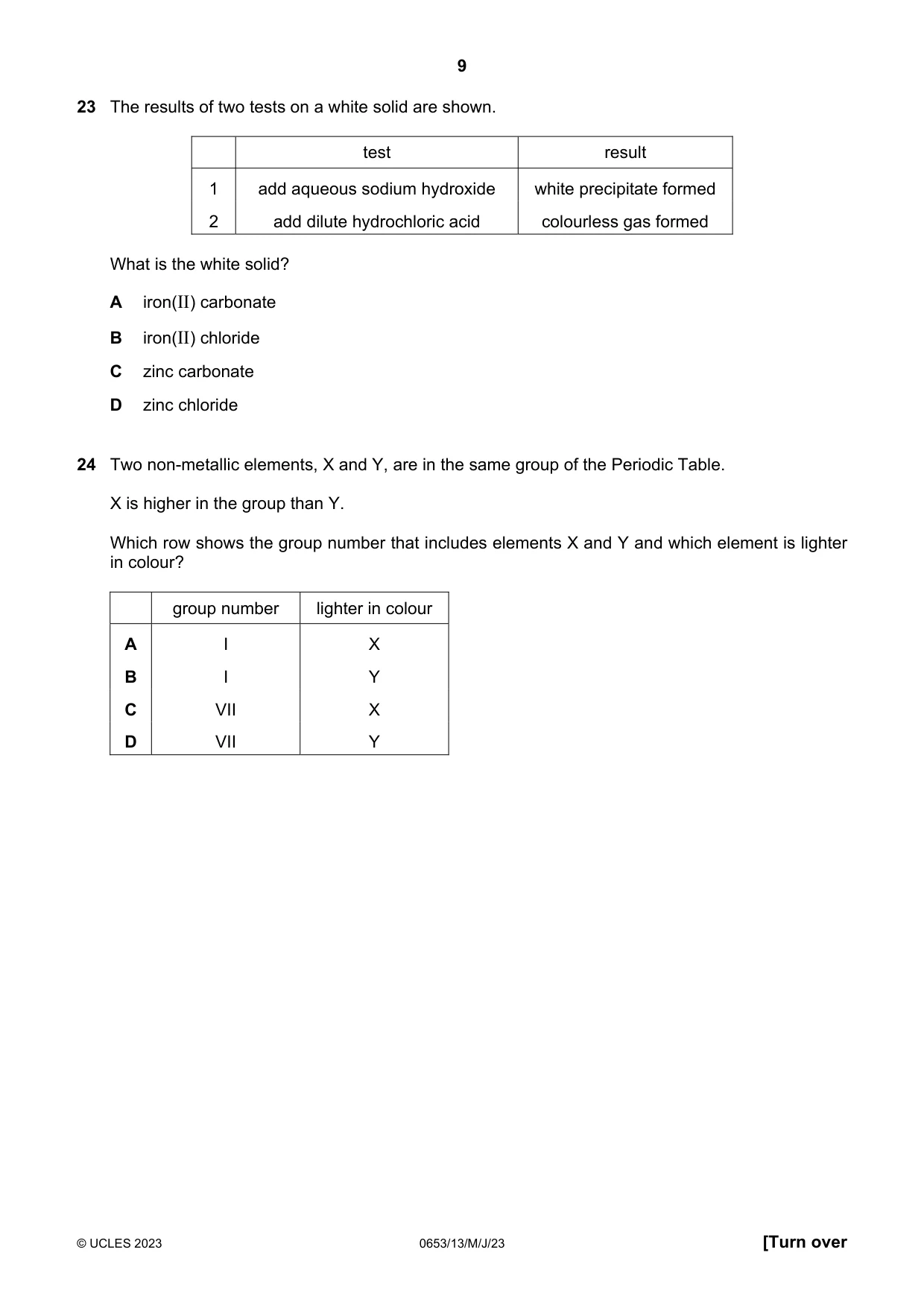
Q23 · The results of two tests on a white solid are shown
23 The results of two tests on a white solid are shown. test result 1 add aqueous sodium hydroxide white precipitate formed 2 add dilute hydrochloric acid colourless gas formed What is the white solid? A iron(II) carbonate B iron(II) chloride C zinc carbonate D zinc chloride
Mark scheme: C
Q24 · Two non-metallic elements, X and Y, are in the same group of the Periodic Table
24 Two non-metallic elements, X and Y, are in the same group of the Periodic Table. X is higher in the group than Y. Which row shows the group number that includes elements X and Y and which element is lighter in colour? group number lighter in colour A I X B I Y C VII X D VII Y
Mark scheme: C
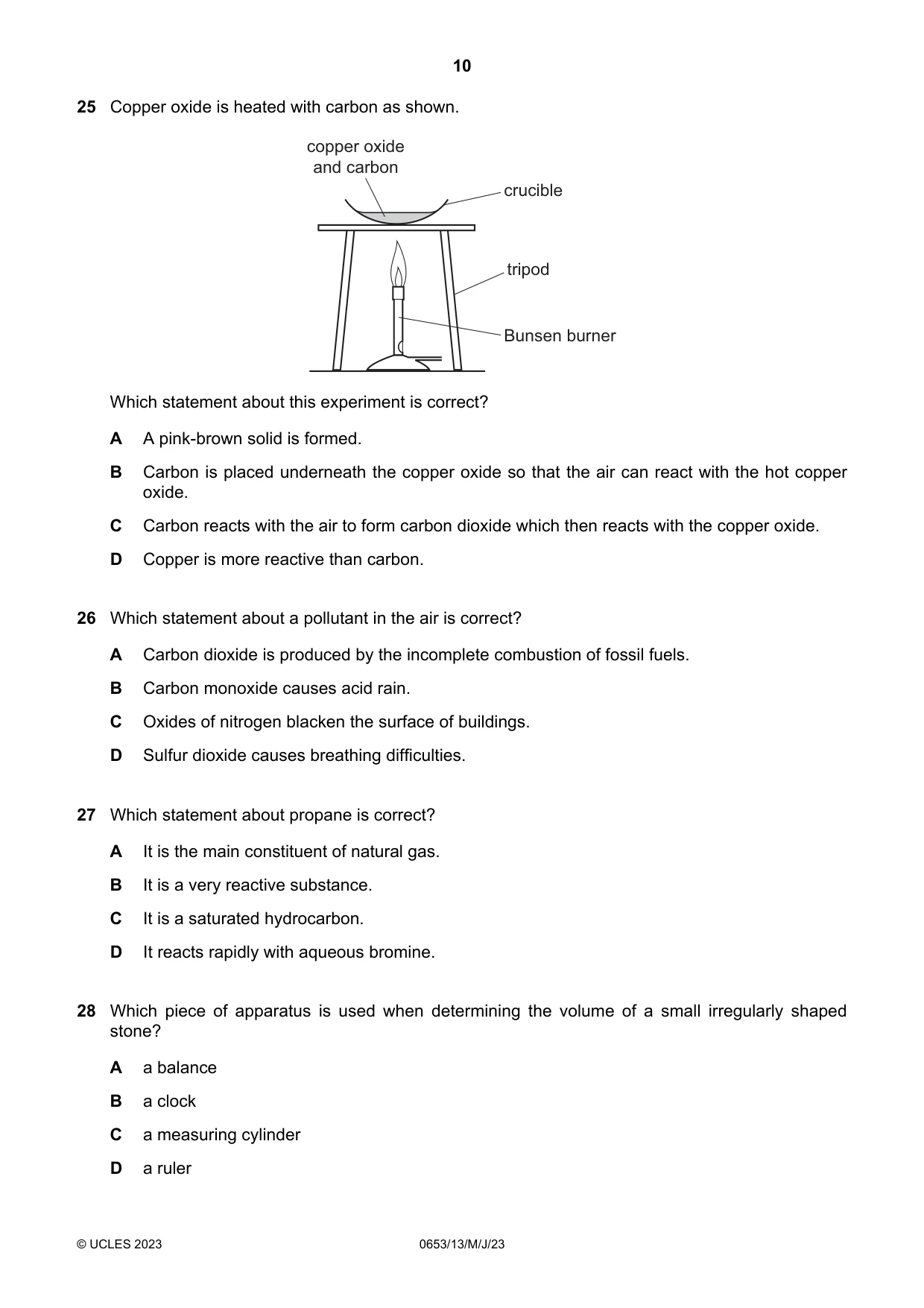
Q25 · Copper oxide is heated with carbon as shown
25 Copper oxide is heated with carbon as shown. copper oxide and carbon crucible tripod Bunsen burner Which statement about this experiment is correct? A A pink-brown solid is formed. B Carbon is placed underneath the copper oxide so that the air can react with the hot copper oxide. C Carbon reacts with the air to form carbon dioxide which then reacts with the copper oxide. D Copper is more reactive than carbon.
Mark scheme: A
Q26 · Which statement about a pollutant in the air is correct?
26 Which statement about a pollutant in the air is correct? A Carbon dioxide is produced by the incomplete combustion of fossil fuels. B Carbon monoxide causes acid rain. C Oxides of nitrogen blacken the surface of buildings. D Sulfur dioxide causes breathing difficulties.
Mark scheme: D
Q27 · Which statement about propane is correct?
27 Which statement about propane is correct? A It is the main constituent of natural gas. B It is a very reactive substance. C It is a saturated hydrocarbon. D It reacts rapidly with aqueous bromine.
Mark scheme: C
Q28 · Which piece of apparatus is used when determining the volume of a small irregularly…
28 Which piece of apparatus is used when determining the volume of a small irregularly shaped stone? A a balance B a clock C a measuring cylinder D a ruler
Mark scheme: C
More questions on Physical quantities and measurement techniques
Q29 · Which statement about mass and weight is correct?
29 Which statement about mass and weight is correct? A Mass and weight are different types of force. B The mass of an object depends on the strength of the gravitational field in which it is placed. C The mass of an object is the same on the Moon as it is on the Earth. D The unit of weight is the kilogram.
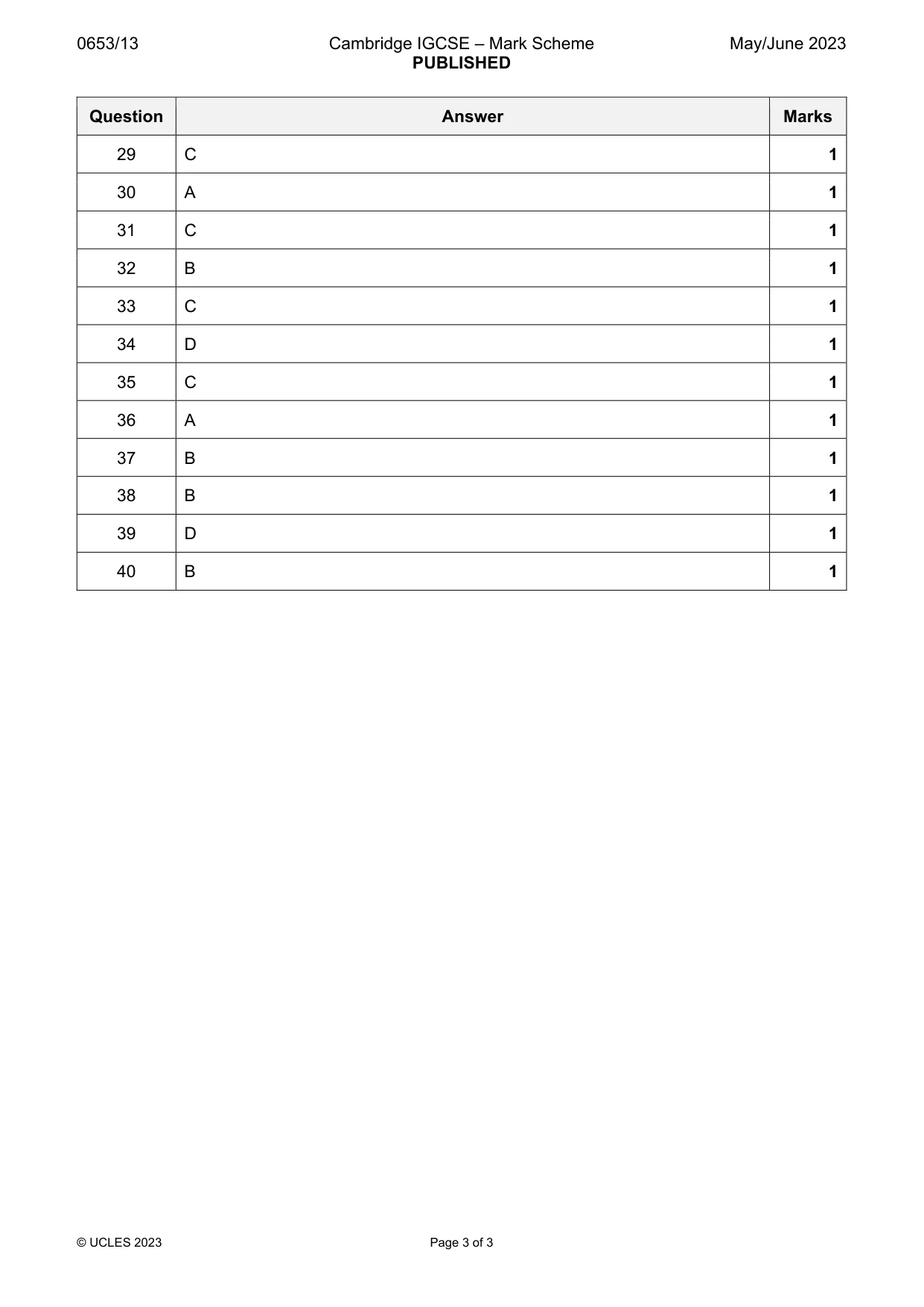
Mark scheme: C
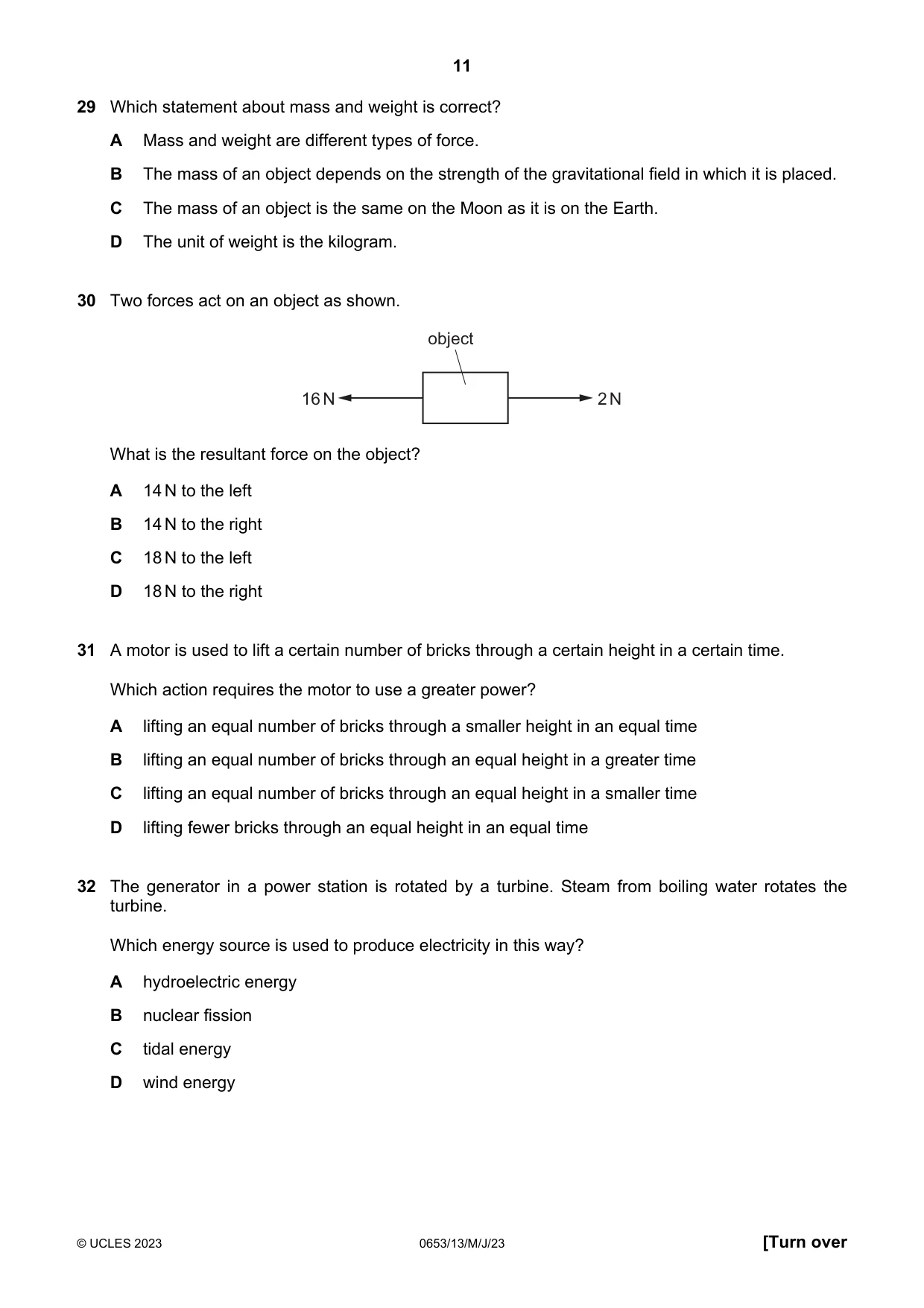
Q30 · Two forces act on an object as shown
30 Two forces act on an object as shown. object 16 N 2 N What is the resultant force on the object? A 14 N to the left B 14 N to the right C 18 N to the left D 18 N to the right
Mark scheme: A
Q31 · A motor is used to lift a certain number of bricks through a certain height in a certain…
31 A motor is used to lift a certain number of bricks through a certain height in a certain time. Which action requires the motor to use a greater power? A lifting an equal number of bricks through a smaller height in an equal time B lifting an equal number of bricks through an equal height in a greater time C lifting an equal number of bricks through an equal height in a smaller time D lifting fewer bricks through an equal height in an equal time
Mark scheme: C
Q32 · The generator in a power station is rotated by a turbine
32 The generator in a power station is rotated by a turbine. Steam from boiling water rotates the turbine. Which energy source is used to produce electricity in this way? A hydroelectric energy B nuclear fission C tidal energy D wind energy
Mark scheme: B
Q33 · Which statement describes the molecules in a gas?
33 Which statement describes the molecules in a gas? A They are close together and move about quickly. B They are close together and move about slowly. C They are far apart and move about quickly. D They are far apart and move about slowly.
Mark scheme: C
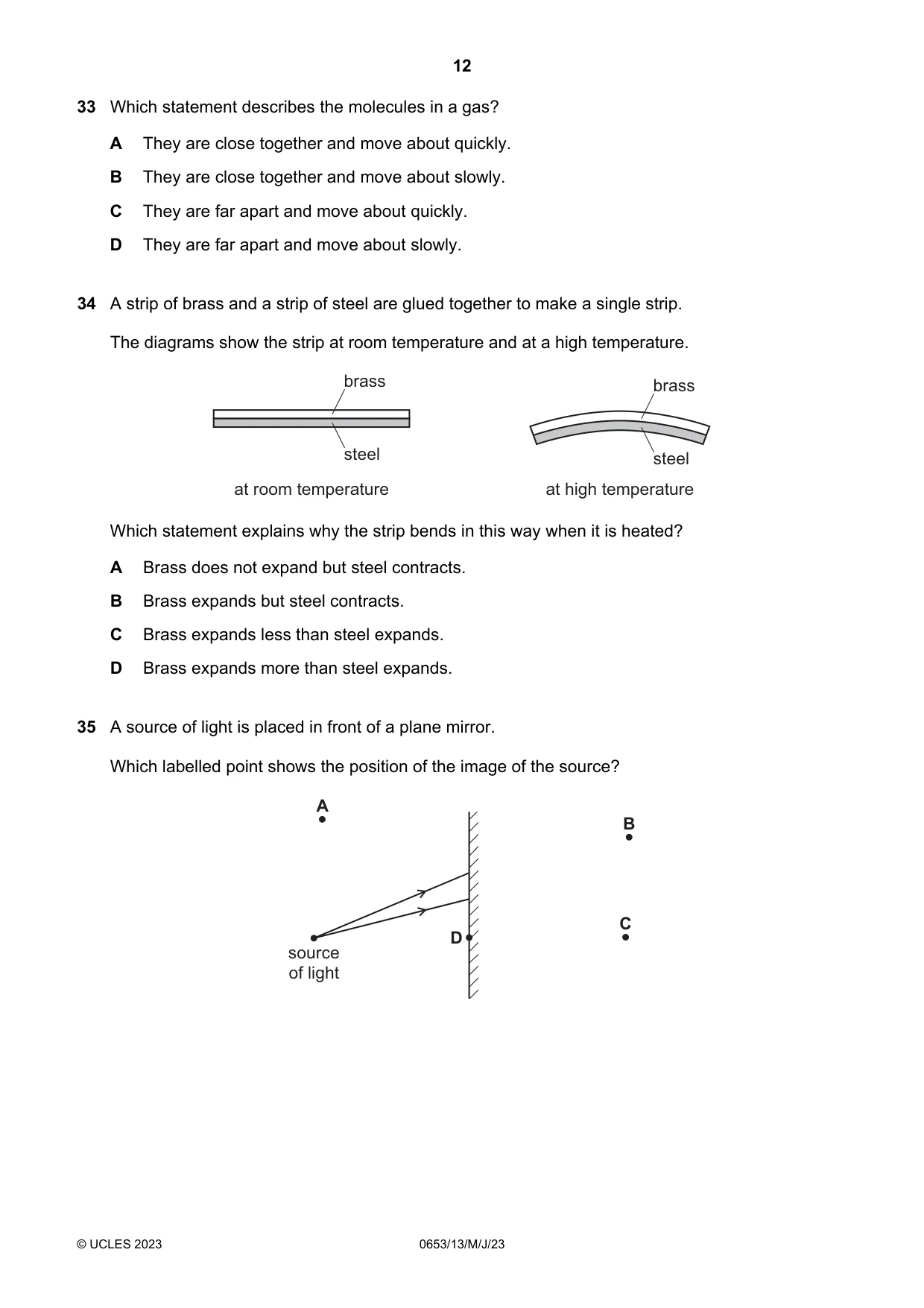
Q34 · A strip of brass and a strip of steel are glued together to make a single strip
34 A strip of brass and a strip of steel are glued together to make a single strip. The diagrams show the strip at room temperature and at a high temperature. brass brass steel steel at room temperature at high temperature Which statement explains why the strip bends in this way when it is heated? A Brass does not expand but steel contracts. B Brass expands but steel contracts. C Brass expands less than steel expands. D Brass expands more than steel expands.
Mark scheme: D
Q35 · A source of light is placed in front of a plane mirror
35 A source of light is placed in front of a plane mirror. Which labelled point shows the position of the image of the source? A B C D source of light
Mark scheme: C
Q36 · X-rays and radio waves are electromagnetic waves
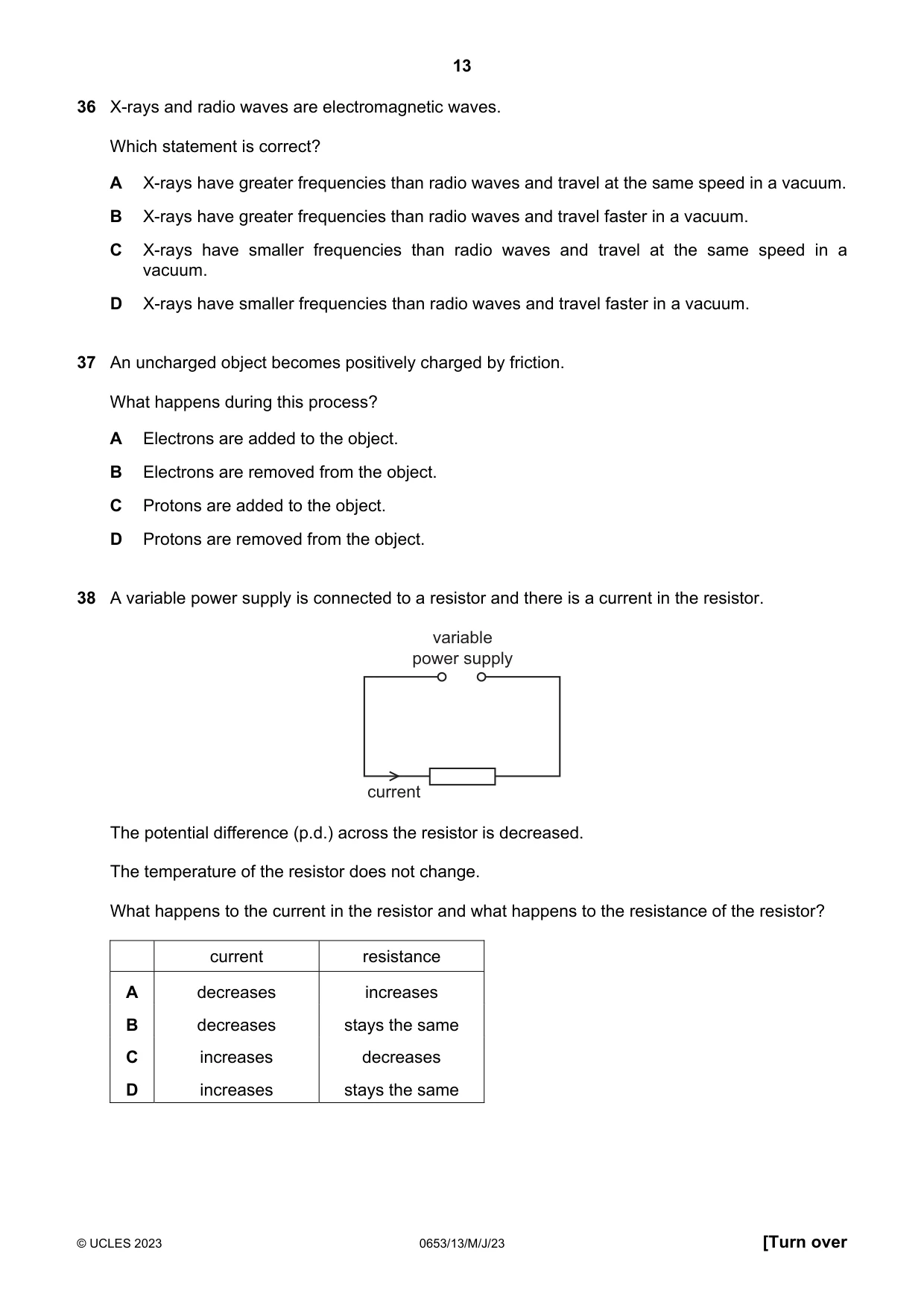
36 X-rays and radio waves are electromagnetic waves. Which statement is correct? A X-rays have greater frequencies than radio waves and travel at the same speed in a vacuum. B X-rays have greater frequencies than radio waves and travel faster in a vacuum. C X-rays have smaller frequencies than radio waves and travel at the same speed in a vacuum. D X-rays have smaller frequencies than radio waves and travel faster in a vacuum.
Mark scheme: A
Q37 · An uncharged object becomes positively charged by friction
37 An uncharged object becomes positively charged by friction. What happens during this process? A Electrons are added to the object. B Electrons are removed from the object. C Protons are added to the object. D Protons are removed from the object.
Mark scheme: B
Q38 · A variable power supply is connected to a resistor and there is a current in the resistor
38 A variable power supply is connected to a resistor and there is a current in the resistor. variable power supply current The potential difference (p.d.) across the resistor is decreased. The temperature of the resistor does not change. What happens to the current in the resistor and what happens to the resistance of the resistor? current resistance A decreases increases B decreases stays the same C increases decreases D increases stays the same
Mark scheme: B
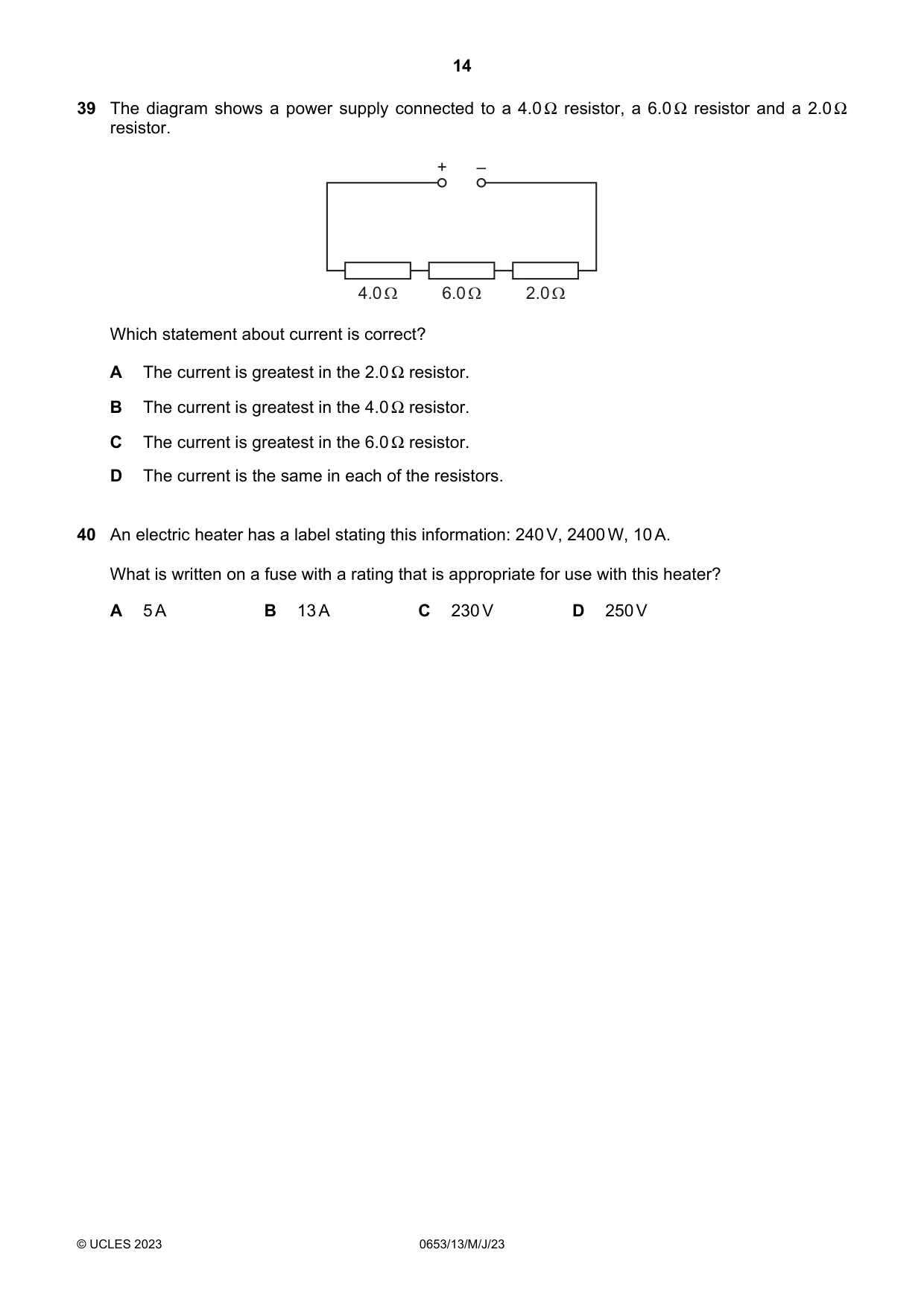
Q39 · The diagram shows a power supply connected to a 4.0Q resistor, a 6.0Q resistor and a 2.0Q…
39 The diagram shows a power supply connected to a 4.0Q resistor, a 6.0Q resistor and a 2.0Q resistor. 4.09 6.02 2.09 Which statement about current is correct? A_ The current is greatest in the 2.0 resistor. The current is greatest in the 4.0 resistor. The current is greatest in the 6.0 resistor. 0 oO DW The current is the same in each of the resistors.
Mark scheme: D
Q40 · An electric heater has a label stating this information: 240 V, 2400 W, 10 A
40 An electric heater has a label stating this information: 240 V, 2400 W, 10 A. What is written on a fuse with a rating that is appropriate for use with this heater? A 5 A B 13 A C 230 V D 250 V
Mark scheme: B
What was in this paper
The subtopics covered by these 40 questions, and how many questions each got. Open one in a new tab to see every Cambridge question on it.
2Energy, work and power2Ions and ionic bonds2Sexual reproduction in plants2Air quality and climate1Alkanes1Atomic structure and the Periodic Table1Biological molecules1Carbon cycle1Cell structure1Characteristics of living organisms1Digestive system1Drugs1Electrical circuits1Electrical safety1Electromagnetic spectrum1Elements, compounds and mixtures1Exothermic and endothermic reactions1Extraction of metals1Forces1Gas exchange in humans1Group VII properties1Heart1Identification of ions and gases1Kinetic particle model of matter1Light1Mass and weight1Photosynthesis1Physical quantities and measurement techniques1Preparation of salts1Rate of reaction1Redox1Sexual reproduction in humans1Terminology1Thermal properties and temperature1Transpiration1What you needed in this session
Cambridge’s own grade thresholds for 2023 May/June, Paper 1 · Variant 3. A higher threshold means an easier paper — the bar moves with how the cohort did.