Cambridge IGCSE Science - Combined 0653 — 2025 May/June Paper 1 · Variant 2
0653/12/M/J/25 · 40 questions · 40 marks · 45 min
The question paper and its mark scheme, free to read here and free to download. This is Cambridge’s own paper, exactly as it was sat.
Question paper16 pages
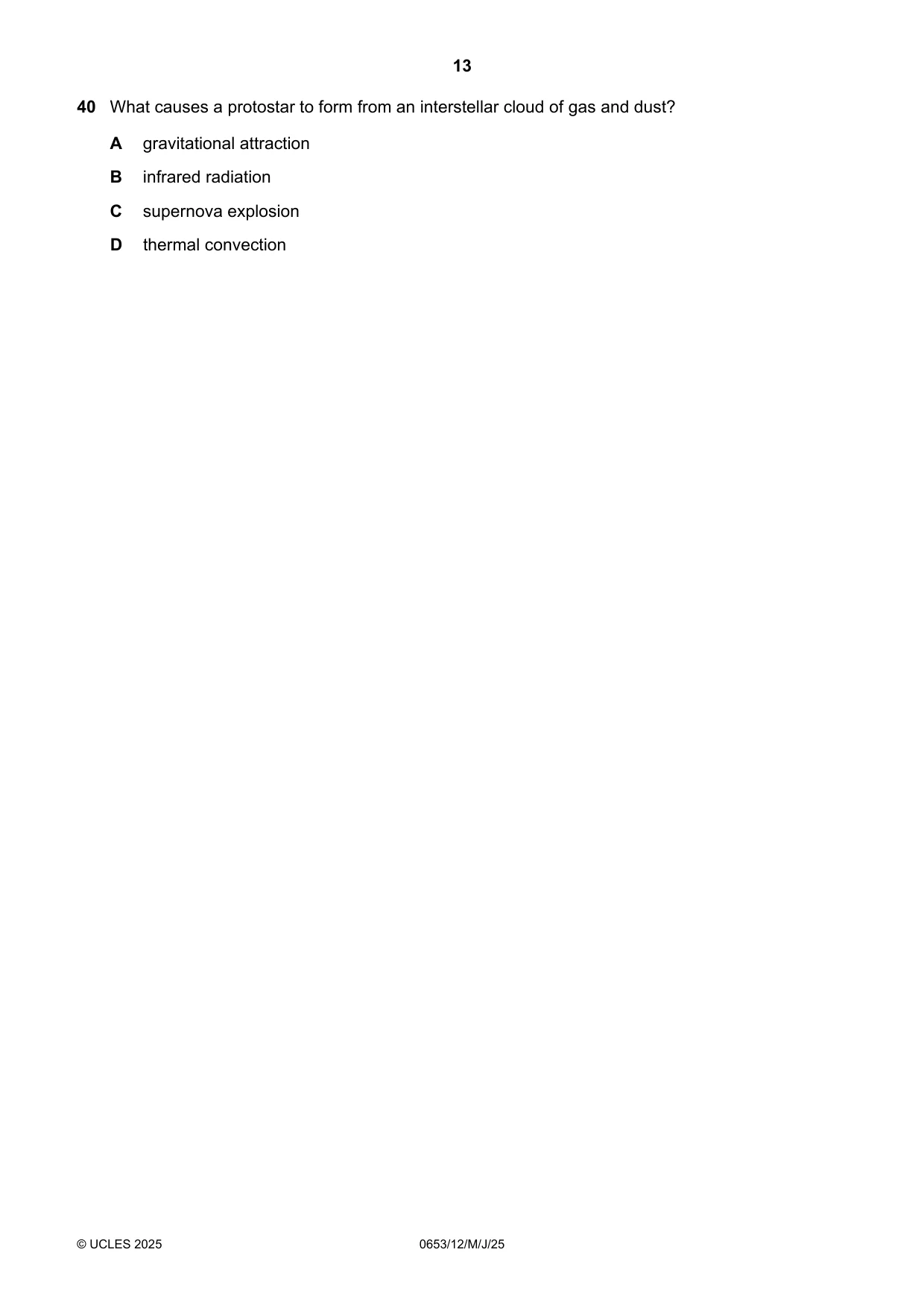

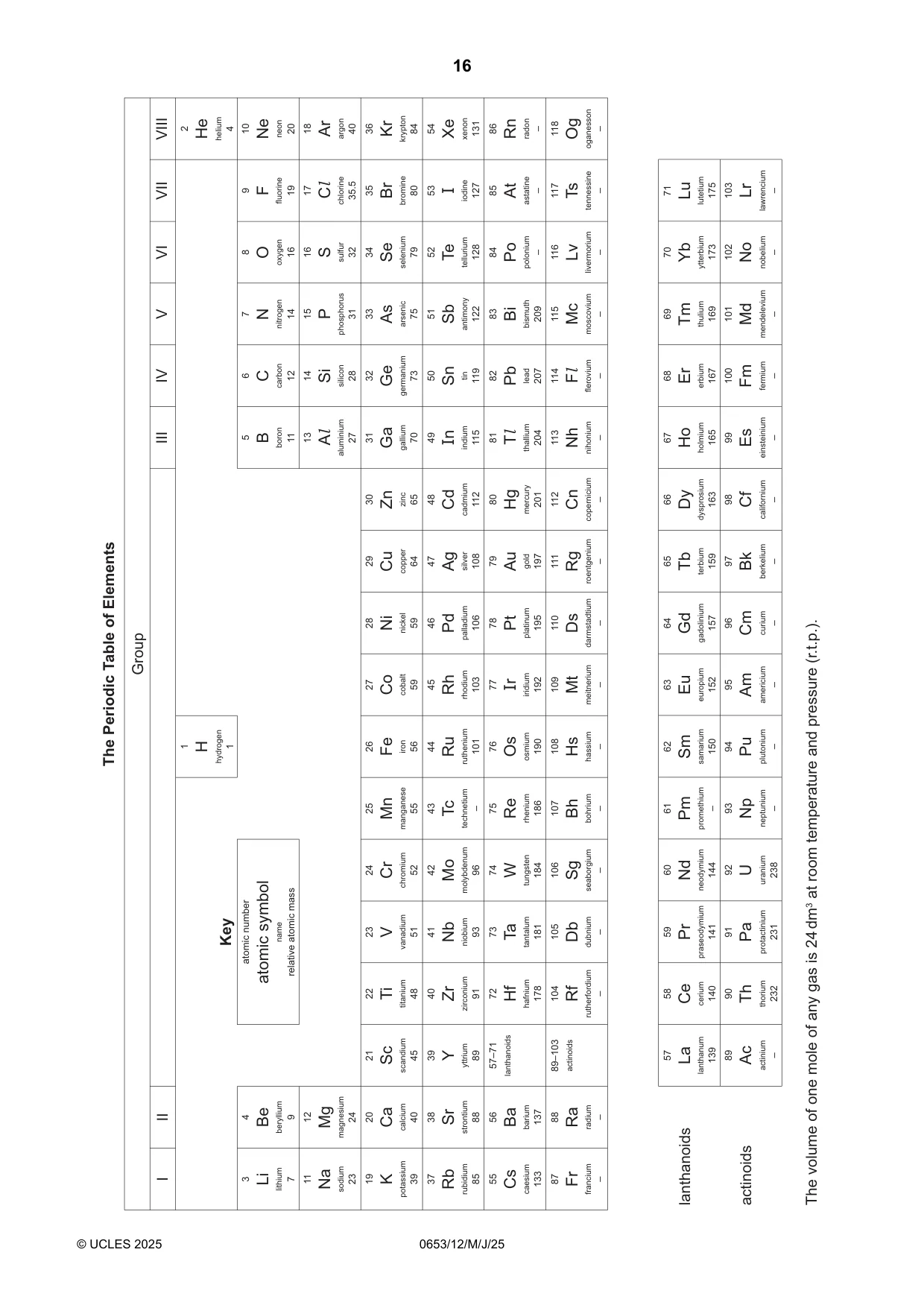
Mark scheme3 pages
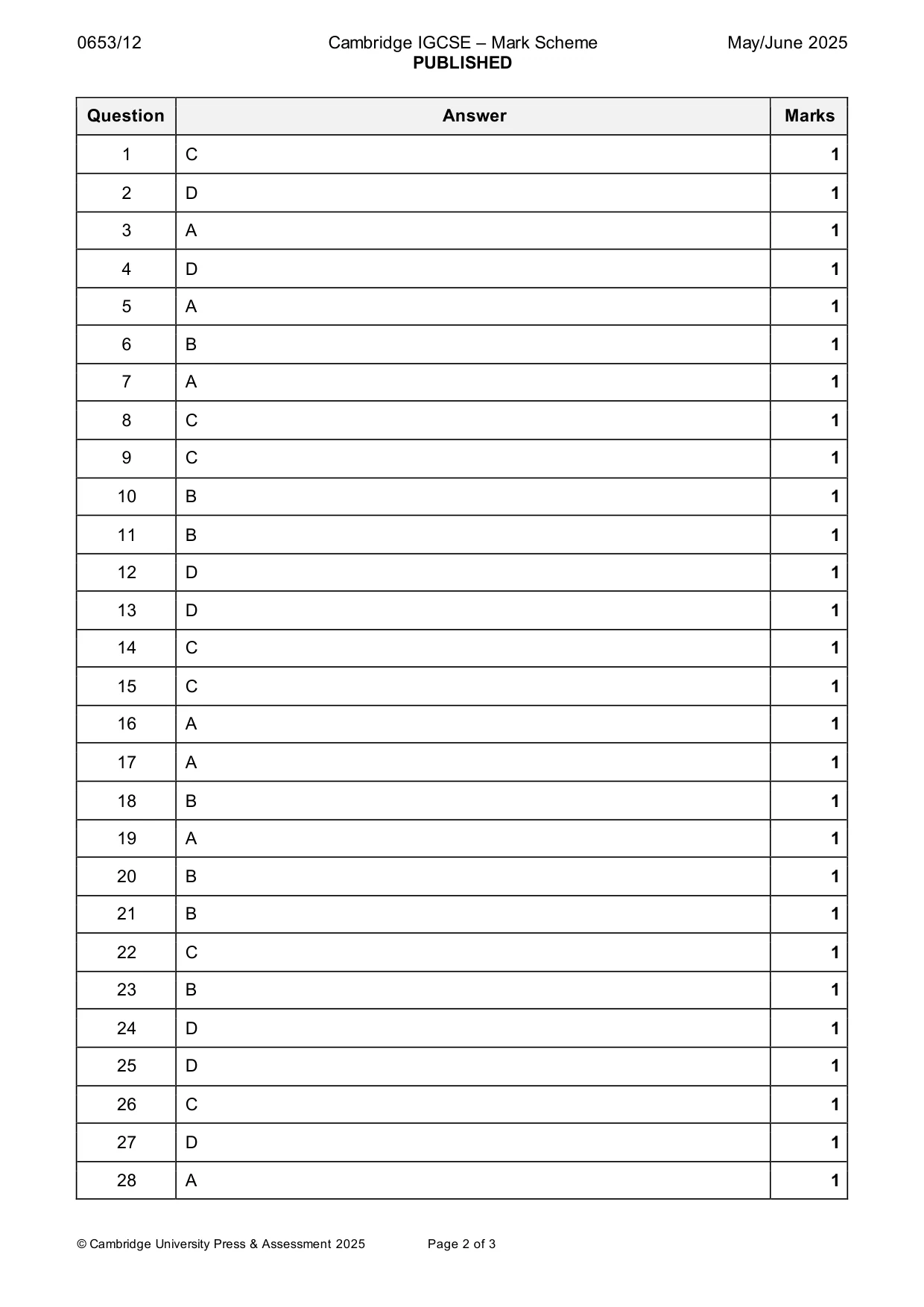
Answers below. Sit the paper first if you are practising.
Questions as text
Q1 · Which word describes the removal of waste products and substances in excess of…
1 Which word describes the removal of waste products and substances in excess of requirements from an organism? A absorption B egestion C excretion D ingestion
Mark scheme: C
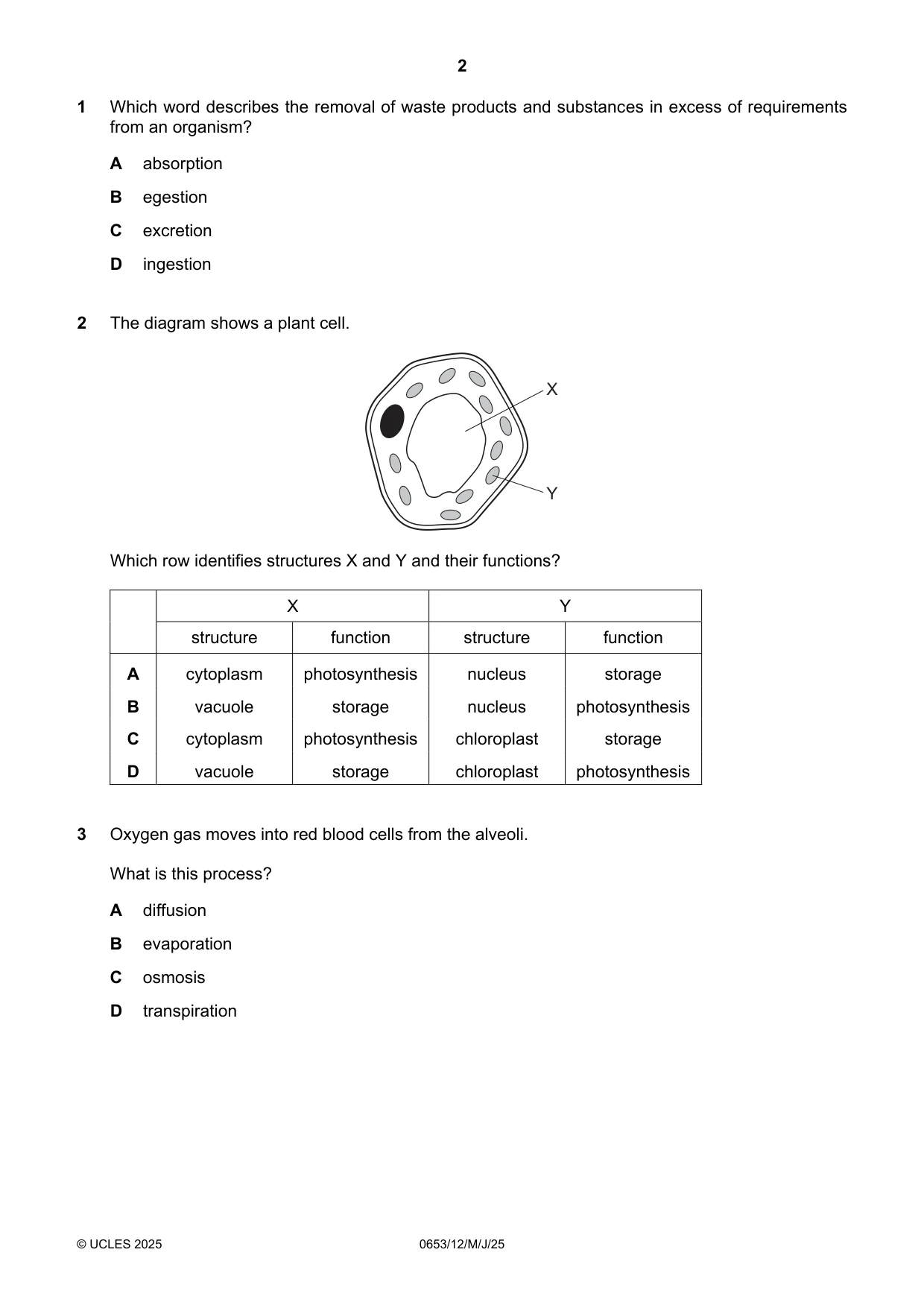
Q2 · The diagram shows a plant cell
2 The diagram shows a plant cell. X Y Which row identifies structures X and Y and their functions? X Y structure function structure function A cytoplasm photosynthesis nucleus storage B vacuole storage nucleus photosynthesis C cytoplasm photosynthesis chloroplast storage D vacuole storage chloroplast photosynthesis
Mark scheme: D
Q3 · Oxygen gas moves into red blood cells from the alveoli
3 Oxygen gas moves into red blood cells from the alveoli. What is this process? A diffusion B evaporation C osmosis D transpiration
Mark scheme: A
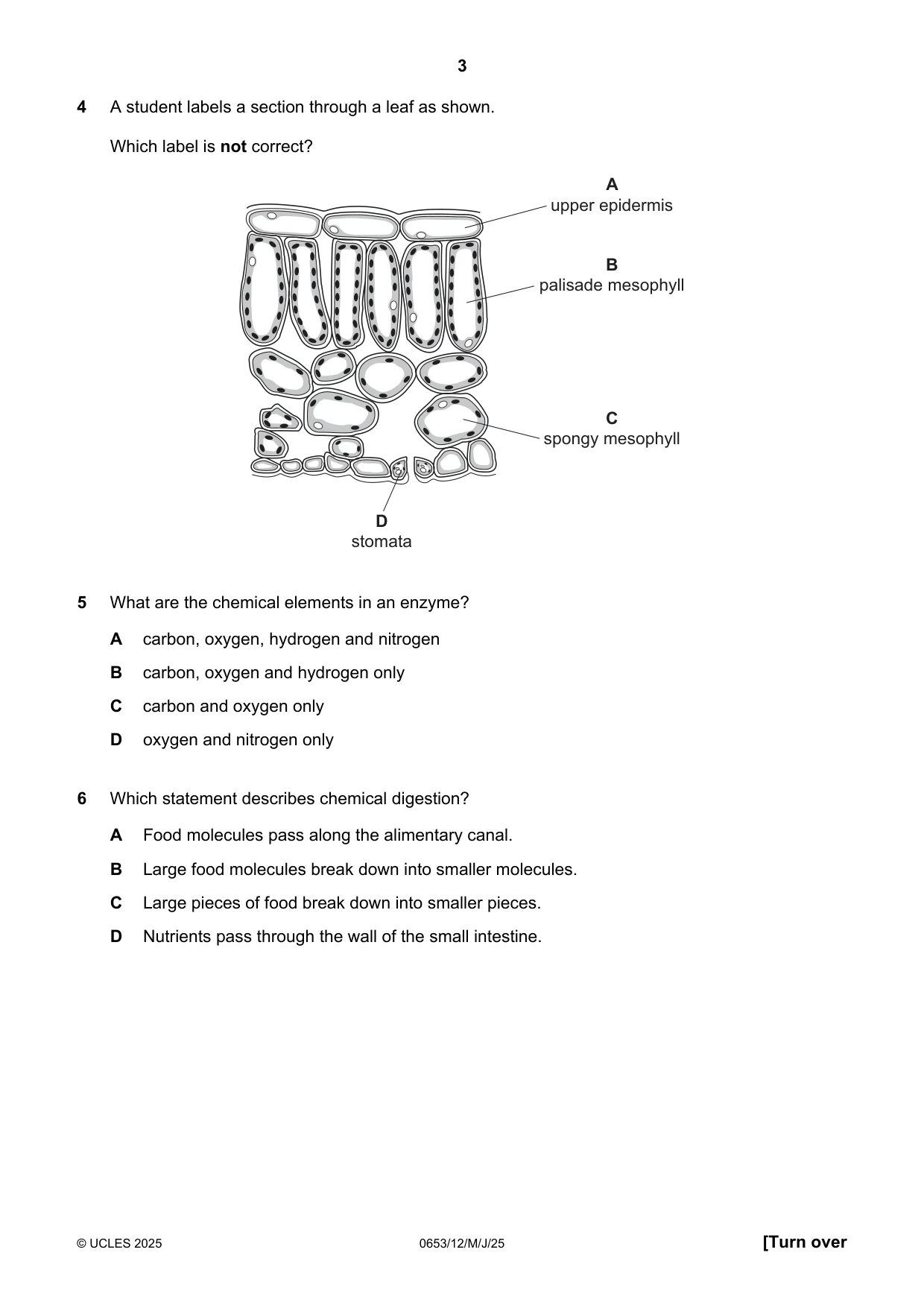
Q4 · A student labels a section through a leaf as shown
4 A student labels a section through a leaf as shown. Which label is not correct? A upper epidermis B palisade mesophyll C spongy mesophyll D stomata
Mark scheme: D
Q5 · What are the chemical elements in an enzyme?
5 What are the chemical elements in an enzyme? A carbon, oxygen, hydrogen and nitrogen B carbon, oxygen and hydrogen only C carbon and oxygen only D oxygen and nitrogen only
Mark scheme: A
Q6 · Which statement describes chemical digestion?
6 Which statement describes chemical digestion? A Food molecules pass along the alimentary canal. B Large food molecules break down into smaller molecules. C Large pieces of food break down into smaller pieces. D Nutrients pass through the wall of the small intestine.
Mark scheme: B
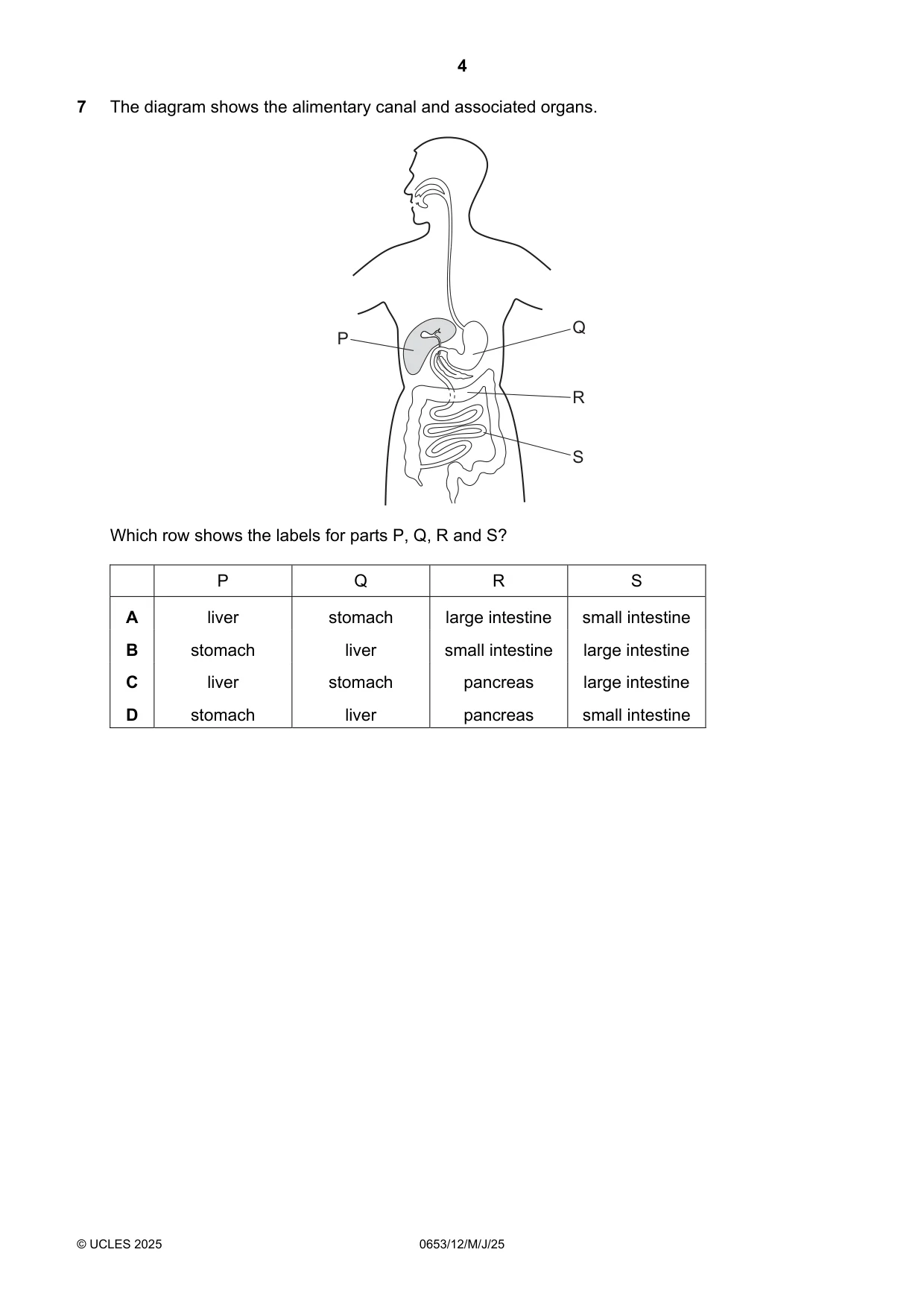
Q7 · The diagram shows the alimentary canal and associated organs
7 The diagram shows the alimentary canal and associated organs. Q P R S Which row shows the labels for parts P, Q, R and S? P Q R S A liver stomach large intestine small intestine B stomach liver small intestine large intestine C liver stomach pancreas large intestine D stomach liver pancreas small intestine
Mark scheme: A
Q8 · The diagrams show cross-sections of roots and stems from non-woody dicotyledonous plants
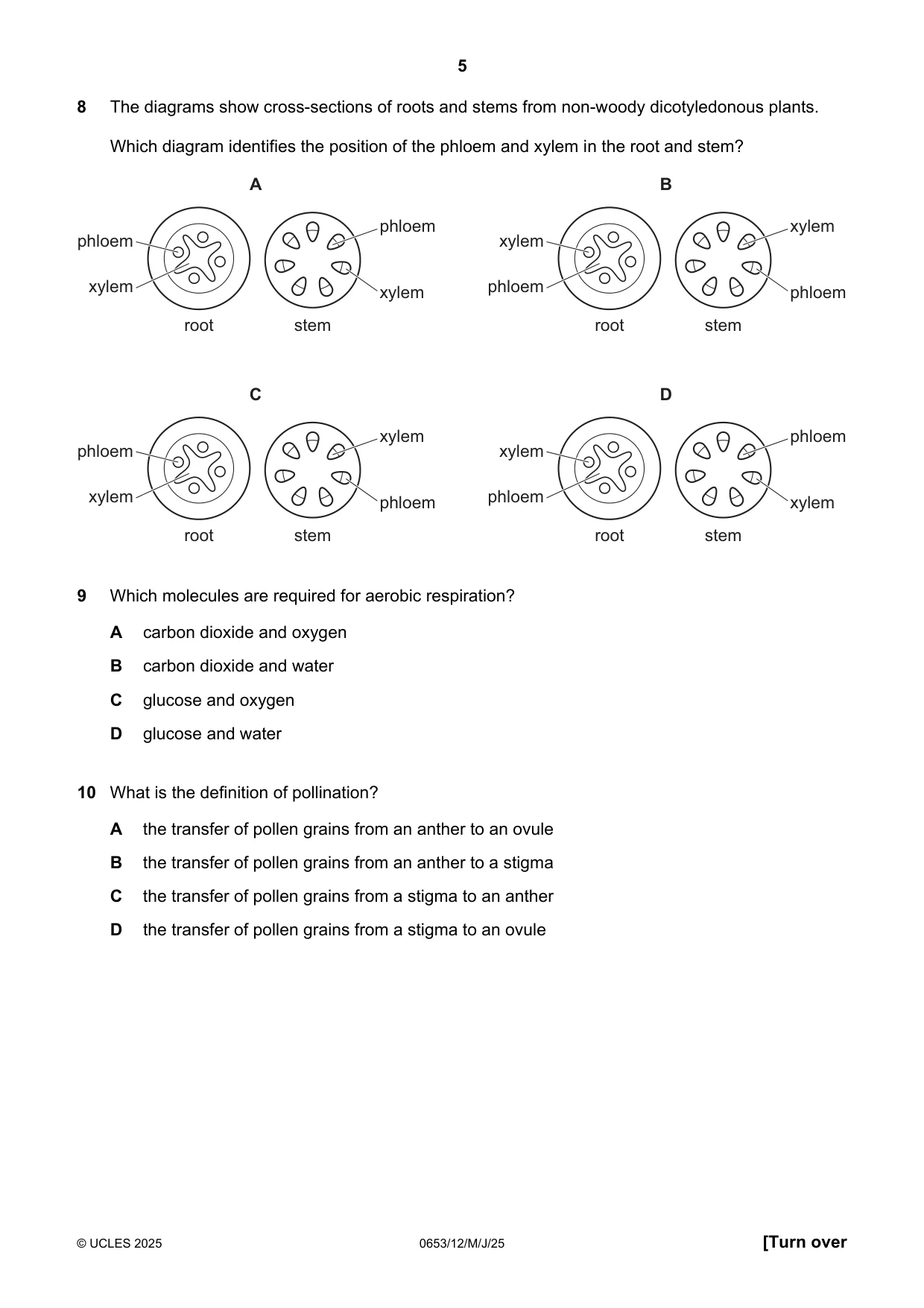
8 The diagrams show cross-sections of roots and stems from non-woody dicotyledonous plants. Which diagram identifies the position of the phloem and xylem in the root and stem? A B phloem xylem phloem xylem xylem xylem phloem phloem root stem root stem C D xylem phloem phloem xylem xylem phloem phloem xylem root stem root stem
Mark scheme: C
Q9 · Which molecules are required for aerobic respiration?
9 Which molecules are required for aerobic respiration? A carbon dioxide and oxygen B carbon dioxide and water C glucose and oxygen D glucose and water
Mark scheme: C
Q10 · What is the definition of pollination?
10 What is the definition of pollination? A the transfer of pollen grains from an anther to an ovule B the transfer of pollen grains from an anther to a stigma C the transfer of pollen grains from a stigma to an anther D the transfer of pollen grains from a stigma to an ovule
Mark scheme: B
Q11 · The diagram shows the human female reproductive system
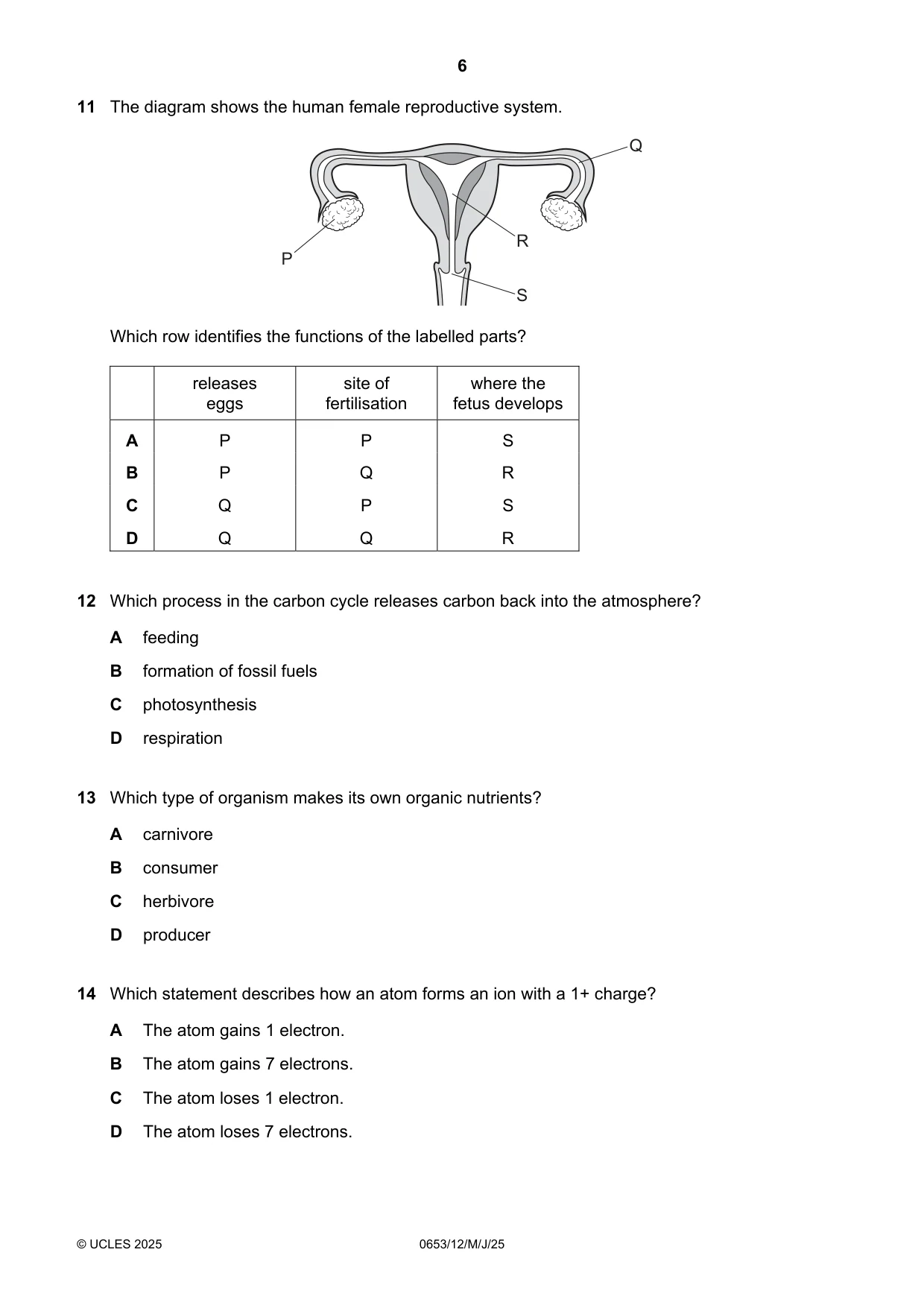
11 The diagram shows the human female reproductive system. Q R P S Which row identifies the functions of the labelled parts? releases site of where the eggs fertilisation fetus develops A P P S B P Q R C Q P S D Q Q R
Mark scheme: B
Q12 · Which process in the carbon cycle releases carbon back into the atmosphere?
12 Which process in the carbon cycle releases carbon back into the atmosphere? A feeding B formation of fossil fuels C photosynthesis D respiration
Mark scheme: D
Q13 · Which type of organism makes its own organic nutrients?
13 Which type of organism makes its own organic nutrients? A carnivore B consumer C herbivore D producer
Mark scheme: D
Q14 · Which statement describes how an atom forms an ion with a 1+ charge?
14 Which statement describes how an atom forms an ion with a 1+ charge? A The atom gains 1 electron. B The atom gains 7 electrons. C The atom loses 1 electron. D The atom loses 7 electrons.
Mark scheme: C
Q15 · Which molecule contains the lowest number of outer-shell electrons?
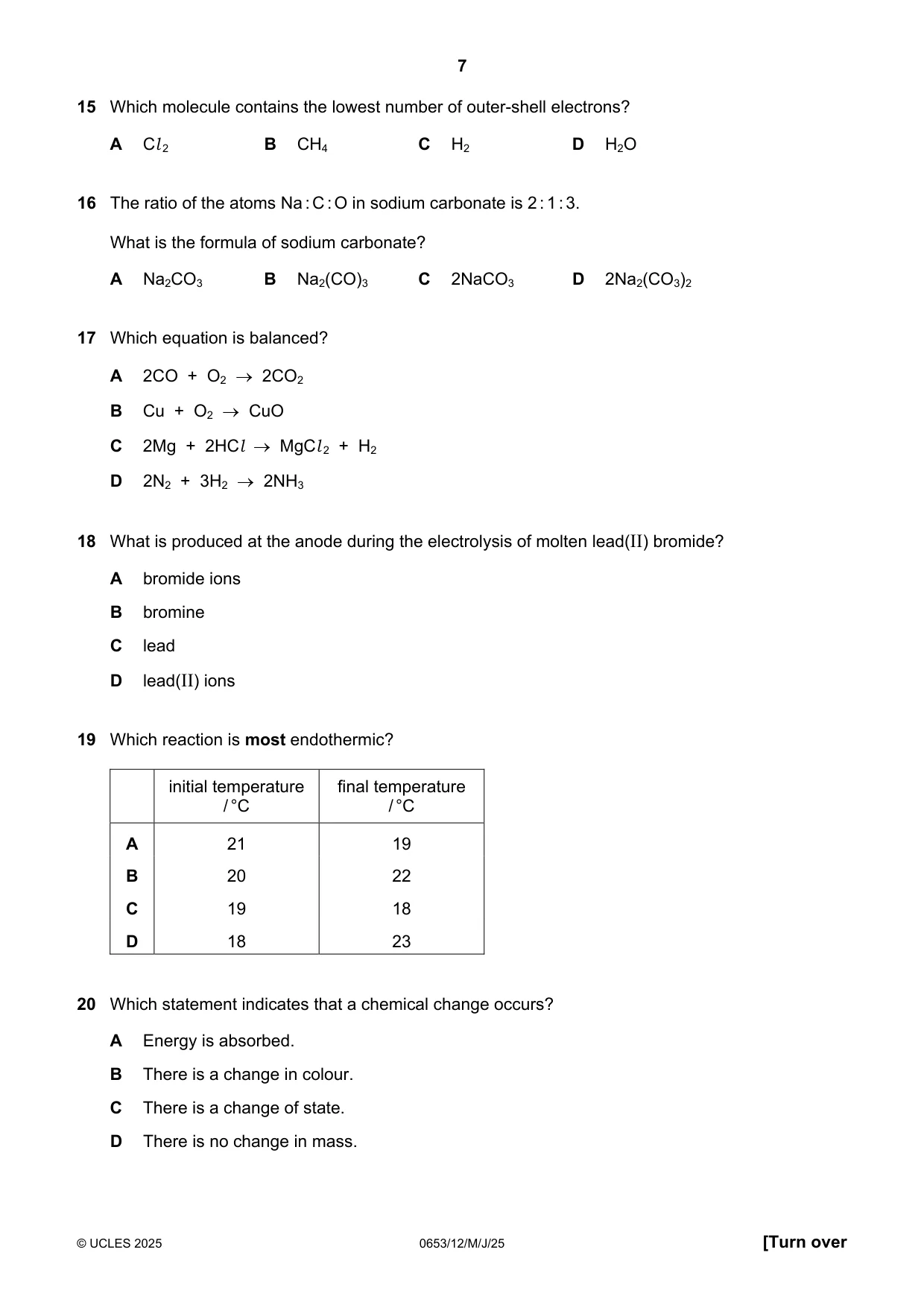
15 Which molecule contains the lowest number of outer-shell electrons? A Cl 2 B CH4 C H2 D H2O
Mark scheme: C
Q16 · The ratio of the atoms Na : C : O in sodium carbonate is 2 : 1 : 3
16 The ratio of the atoms Na : C : O in sodium carbonate is 2 : 1 : 3. What is the formula of sodium carbonate? A Na2CO3 B Na2(CO)3 C 2NaCO3 D 2Na2(CO3)2
Mark scheme: A
Q17 · Which equation is balanced?
17 Which equation is balanced? A 2CO + O2 2CO2 B Cu + O2 CuO C 2Mg + 2HCl MgCl 2 + H2 D 2N2 + 3H2 2NH3
Mark scheme: A
Q18 · What is produced at the anode during the electrolysis of molten lead(II) bromide?
18 What is produced at the anode during the electrolysis of molten lead(II) bromide? A bromide ions B bromine C lead D lead(II) ions
Mark scheme: B
Q19 · Which reaction is most endothermic?
19 Which reaction is most endothermic? initial temperature final temperature / °C / °C A 21 19 B 20 22 C 19 18 D 18 23
Mark scheme: A
Q20 · Which statement indicates that a chemical change occurs?
20 Which statement indicates that a chemical change occurs? A Energy is absorbed. B There is a change in colour. C There is a change of state. D There is no change in mass.
Mark scheme: B
Q21 · Dilute sulfuric acid reacts with excess zinc granules
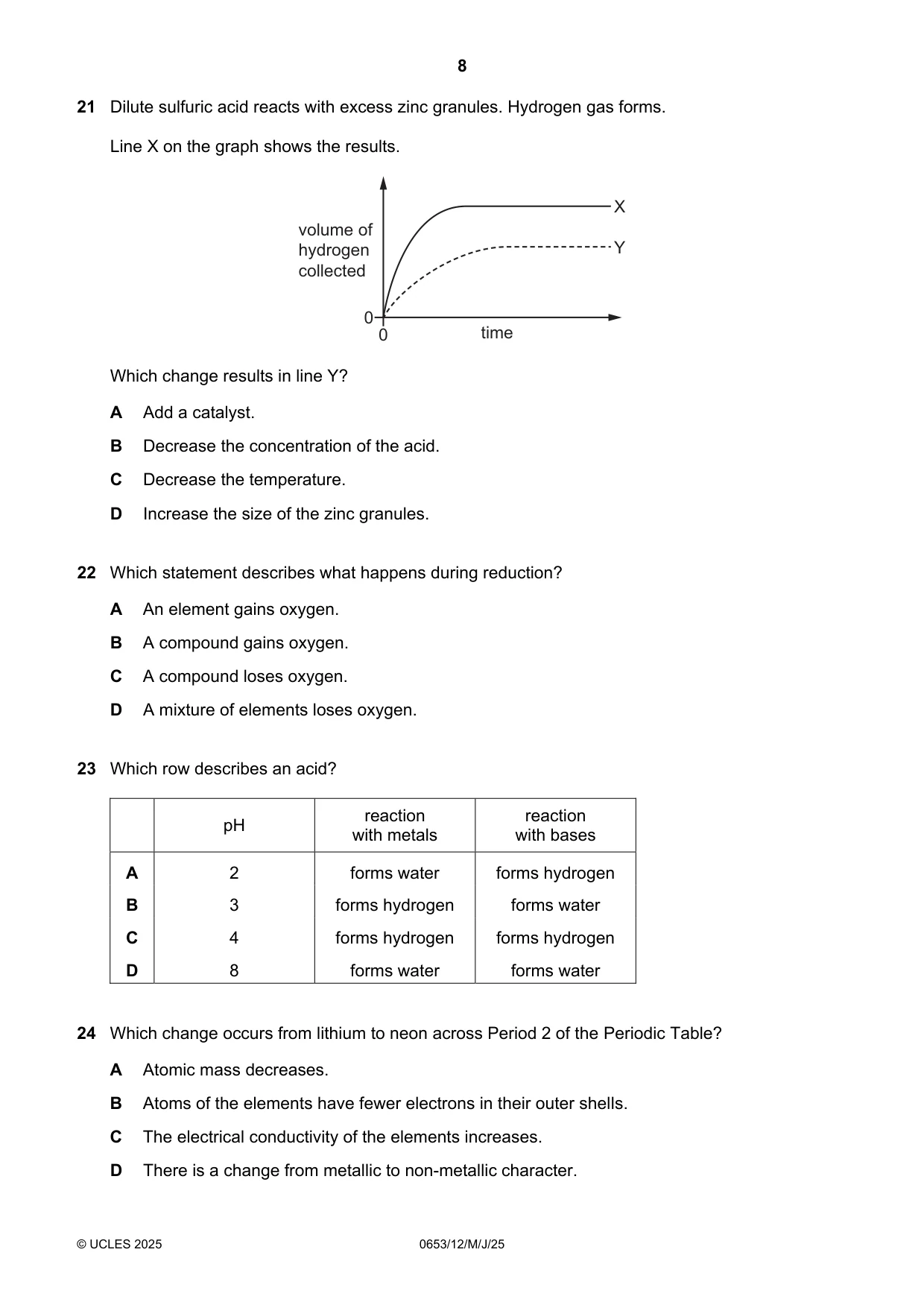
21 Dilute sulfuric acid reacts with excess zinc granules. Hydrogen gas forms. Line X on the graph shows the results. X volume of hydrogen Y collected 0 0 time Which change results in line Y? A Add a catalyst. B Decrease the concentration of the acid. C Decrease the temperature. D Increase the size of the zinc granules.
Mark scheme: B
Q22 · Which statement describes what happens during reduction?
22 Which statement describes what happens during reduction? A An element gains oxygen. B A compound gains oxygen. C A compound loses oxygen. D A mixture of elements loses oxygen.
Mark scheme: C
Q23 · Which row describes an acid?
23 Which row describes an acid? reaction reaction pH with metals with bases A 2 forms water forms hydrogen B 3 forms hydrogen forms water C 4 forms hydrogen forms hydrogen D 8 forms water forms water
Mark scheme: B
More questions on The characteristic properties of acids and bases
Q24 · Which change occurs from lithium to neon across Period 2 of the Periodic Table?
24 Which change occurs from lithium to neon across Period 2 of the Periodic Table? A Atomic mass decreases. B Atoms of the elements have fewer electrons in their outer shells. C The electrical conductivity of the elements increases. D There is a change from metallic to non-metallic character.
Mark scheme: D
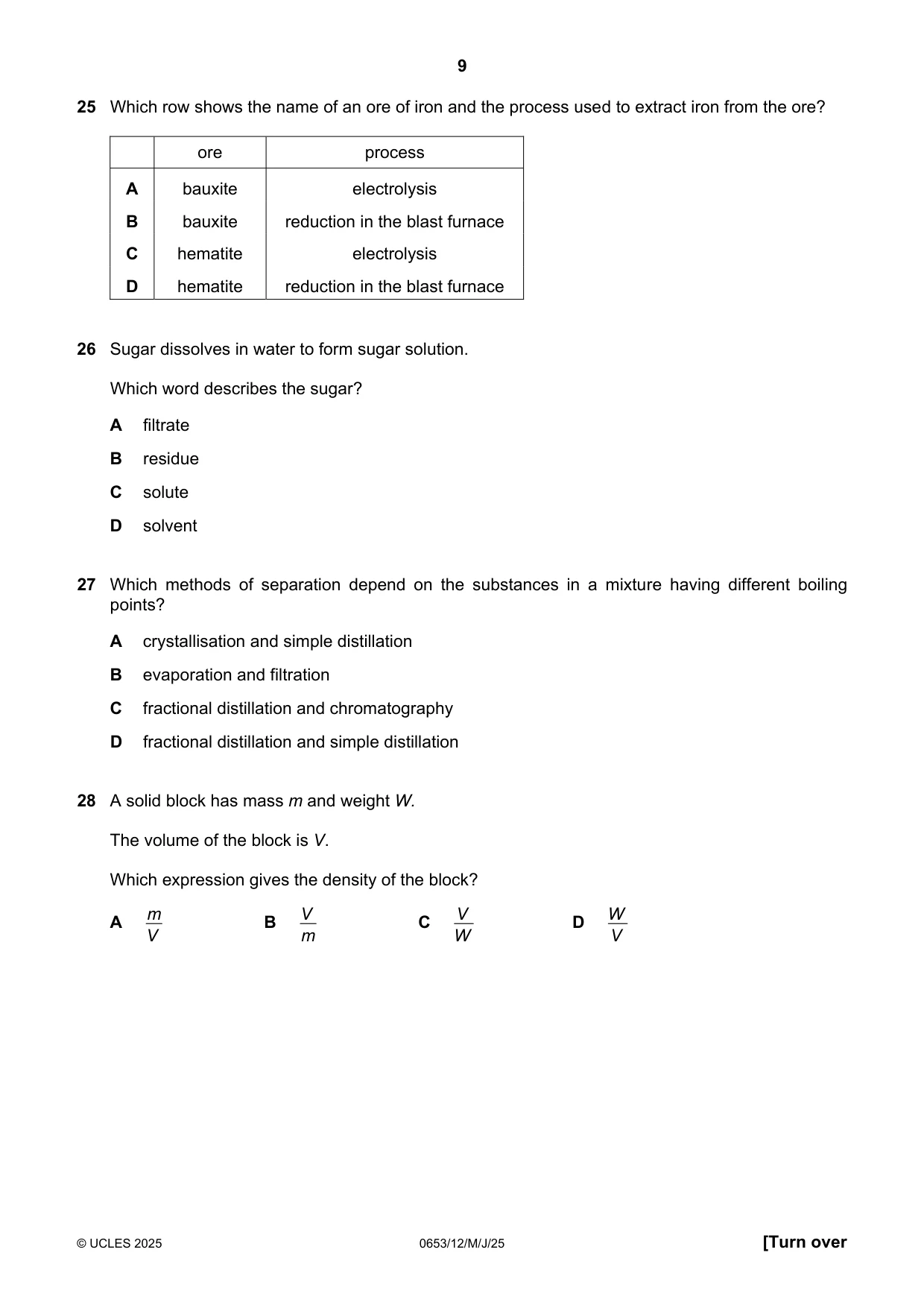
Q25 · Which row shows the name of an ore of iron and the process used to extract iron from the…
25 Which row shows the name of an ore of iron and the process used to extract iron from the ore? ore process A bauxite electrolysis B bauxite reduction in the blast furnace C hematite electrolysis D hematite reduction in the blast furnace
Mark scheme: D
Q26 · Sugar dissolves in water to form sugar solution
26 Sugar dissolves in water to form sugar solution. Which word describes the sugar? A filtrate B residue C solute D solvent
Mark scheme: C
Q27 · Which methods of separation depend on the substances in a mixture having different…
27 Which methods of separation depend on the substances in a mixture having different boiling points? A crystallisation and simple distillation B evaporation and filtration C fractional distillation and chromatography D fractional distillation and simple distillation
Mark scheme: D
Q28 · A solid block has mass m and weight W
28 A solid block has mass m and weight W. The volume of the block is V. Which expression gives the density of the block? m V V W A V B m C W D V
Mark scheme: A
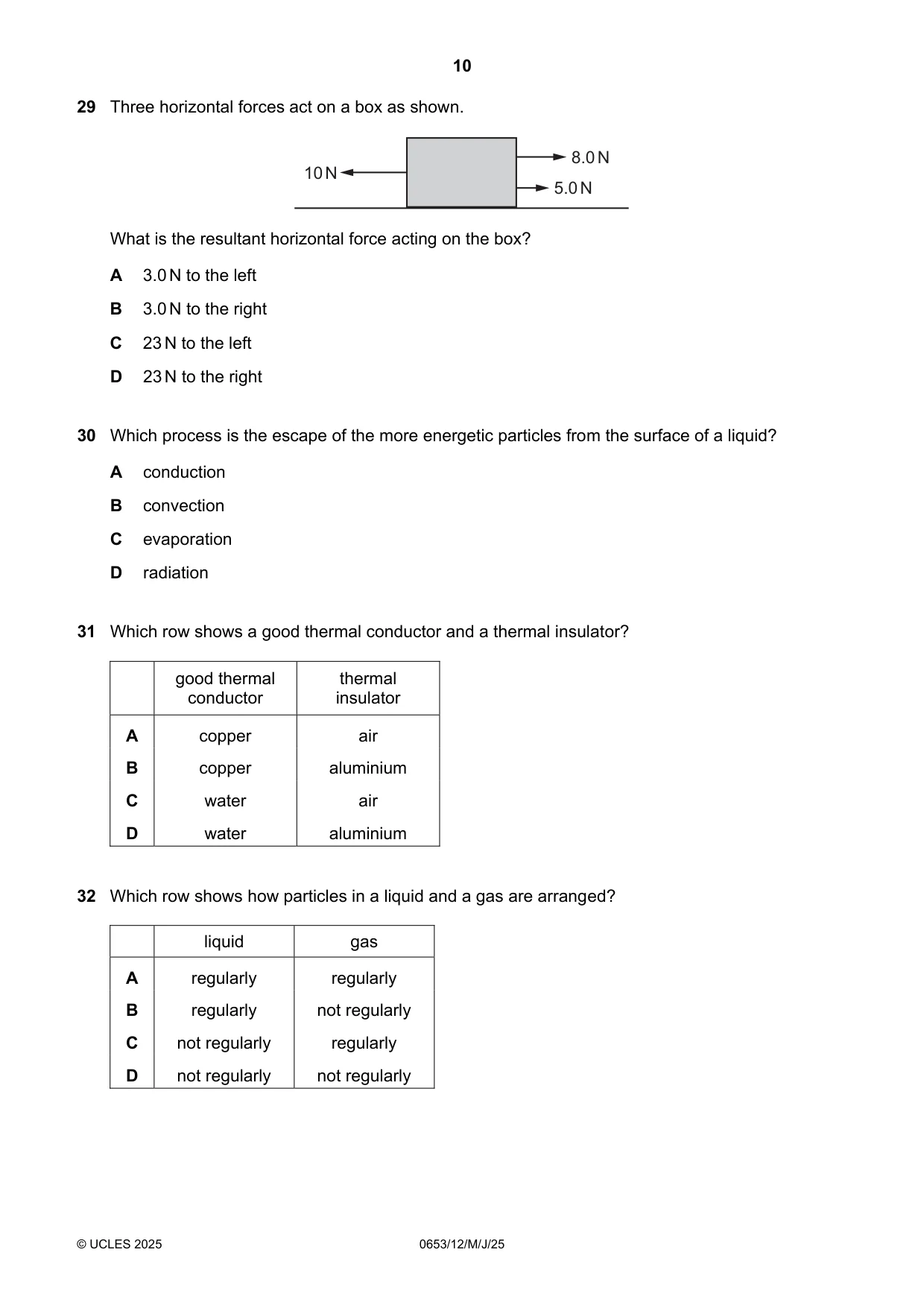
Q29 · Three horizontal forces act on a box as shown
29 Three horizontal forces act on a box as shown. 8.0 N 10 N 5.0 N What is the resultant horizontal force acting on the box? A 3.0 N to the left B 3.0 N to the right C 23 N to the left D 23 N to the right
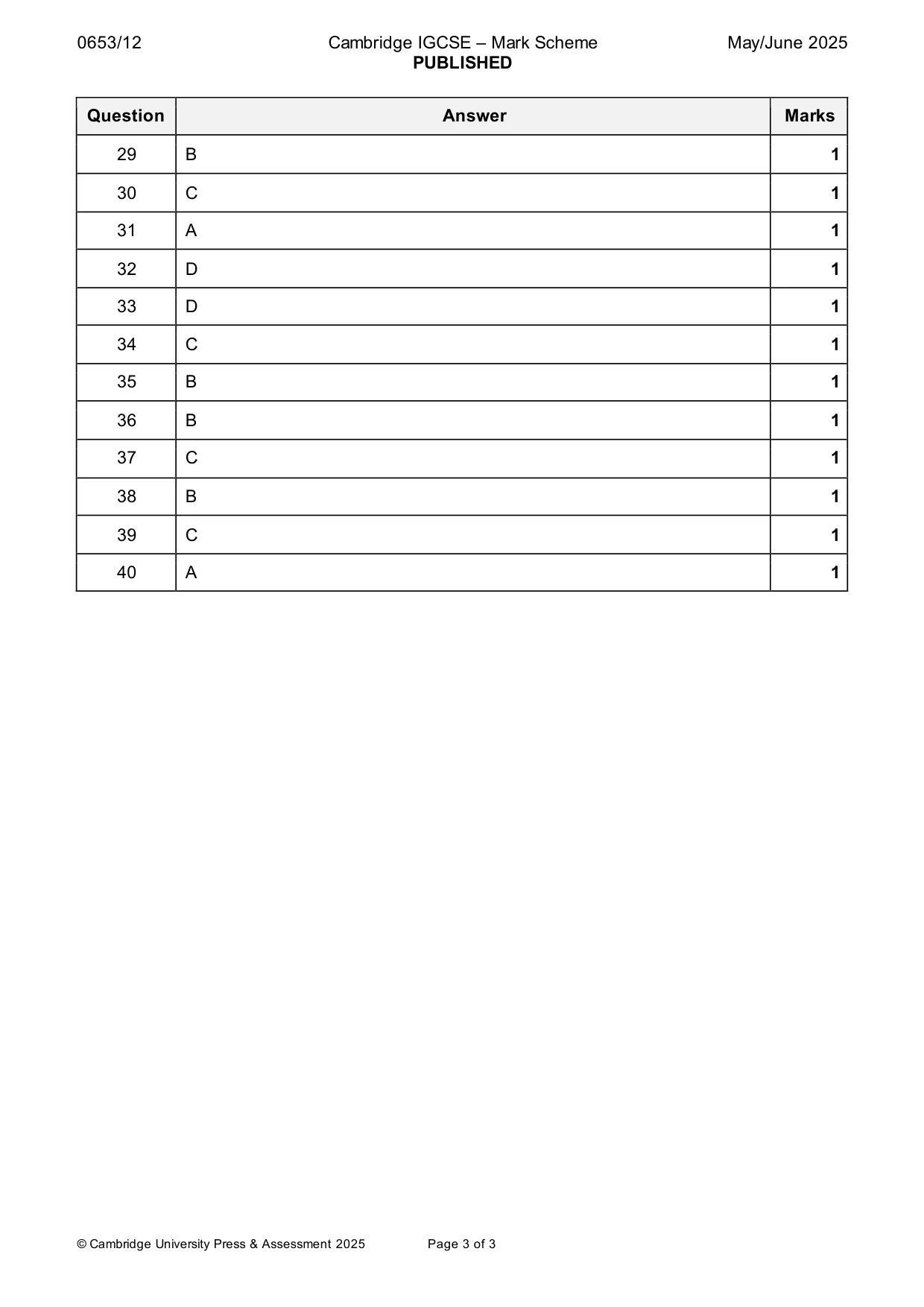
Mark scheme: B
Q30 · Which process is the escape of the more energetic particles from the surface of a liquid?
30 Which process is the escape of the more energetic particles from the surface of a liquid? A conduction B convection C evaporation D radiation
Mark scheme: C
Q31 · Which row shows a good thermal conductor and a thermal insulator?
31 Which row shows a good thermal conductor and a thermal insulator? good thermal thermal conductor insulator A copper air B copper aluminium C water air D water aluminium
Mark scheme: A
Q32 · Which row shows how particles in a liquid and a gas are arranged?
32 Which row shows how particles in a liquid and a gas are arranged? liquid gas A regularly regularly B regularly not regularly C not regularly regularly D not regularly not regularly
Mark scheme: D
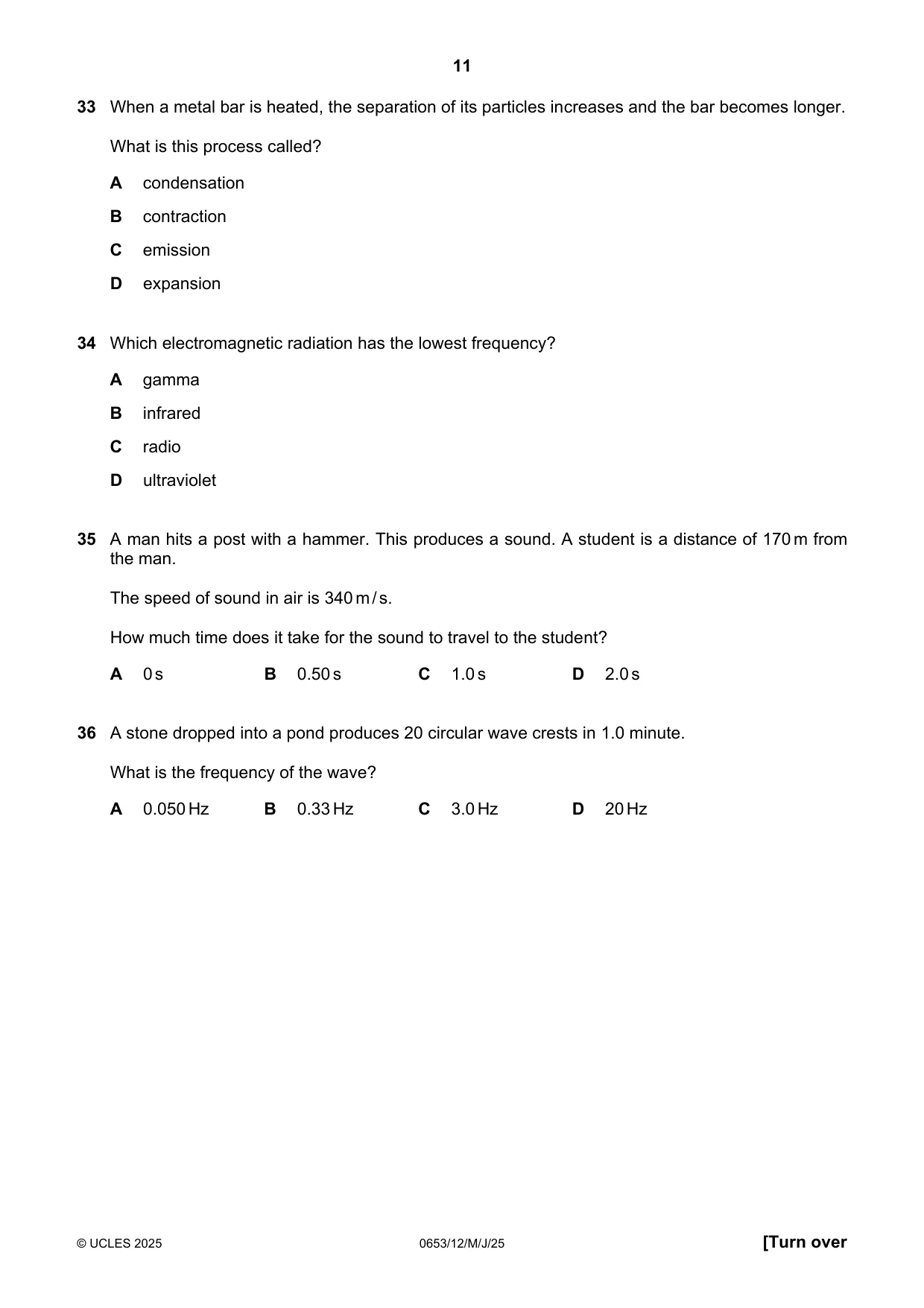
Q33 · When a metal bar is heated, the separation of its particles increases and the bar becomes…
33 When a metal bar is heated, the separation of its particles increases and the bar becomes longer. What is this process called? A condensation B contraction C emission D expansion
Mark scheme: D
Q34 · Which electromagnetic radiation has the lowest frequency?
34 Which electromagnetic radiation has the lowest frequency? A gamma B infrared C radio D ultraviolet
Mark scheme: C
Q35 · A man hits a post with a hammer
35 A man hits a post with a hammer. This produces a sound. A student is a distance of 170 m from the man. The speed of sound in air is 340 m / s. How much time does it take for the sound to travel to the student? A 0 s B 0.50 s C 1.0 s D 2.0 s
Mark scheme: B
Q36 · A stone dropped into a pond produces 20 circular wave crests in 1.0 minute
36 A stone dropped into a pond produces 20 circular wave crests in 1.0 minute. What is the frequency of the wave? A 0.050 Hz B 0.33 Hz C 3.0 Hz D 20 Hz
Mark scheme: B
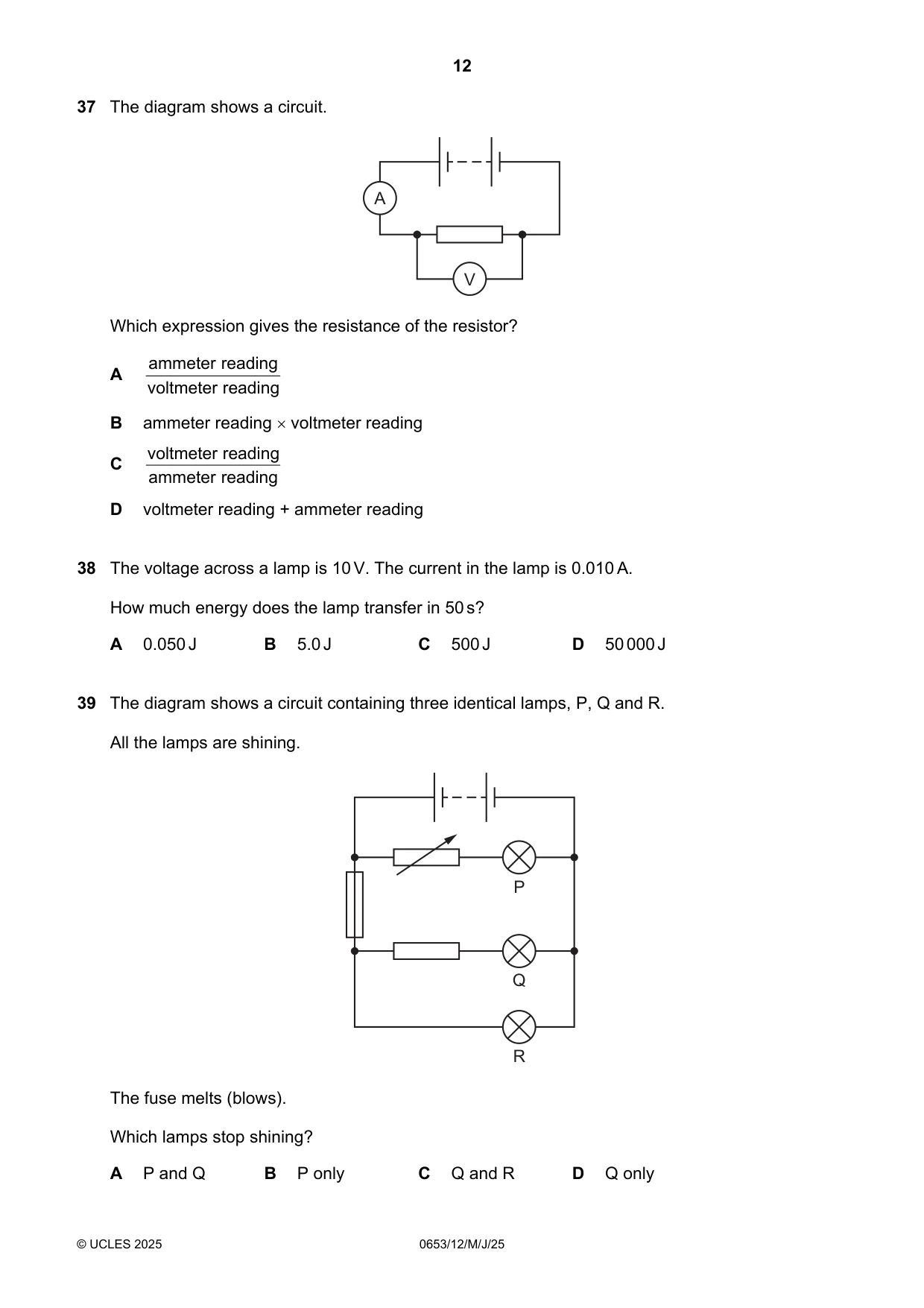
Q37 · The diagram shows a circuit
37 The diagram shows a circuit. A V Which expression gives the resistance of the resistor? ammeter reading A voltmeter reading B ammeter reading voltmeter reading voltmeter reading C ammeter reading D voltmeter reading + ammeter reading
Mark scheme: C
Q38 · The voltage across a lamp is 10 V
38 The voltage across a lamp is 10 V. The current in the lamp is 0.010 A. How much energy does the lamp transfer in 50 s? A 0.050 J B 5.0 J C 500 J D 50 000 J
Mark scheme: B
Q39 · The diagram shows a circuit containing three identical lamps, P, Q and R
39 The diagram shows a circuit containing three identical lamps, P, Q and R. All the lamps are shining. P Q R The fuse melts (blows). Which lamps stop shining? A P and Q B P only C Q and R D Q only
Mark scheme: C
Q40 · What causes a protostar to form from an interstellar cloud of gas and dust?
40 What causes a protostar to form from an interstellar cloud of gas and dust? A gravitational attraction B infrared radiation C supernova explosion D thermal convection
Mark scheme: A
What was in this paper
The subtopics covered by these 40 questions, and how many questions each got. Open one in a new tab to see every Cambridge question on it.
2Kinetic particle model of matter2Arrangement of elements1Biological molecules1Carbon cycle1Cell structure1Characteristics of living organisms1Density1Diffusion1Digestion1Digestive system1Electrical quantities1Electrical safety1Electrolysis1Electromagnetic spectrum1Elements, compounds and mixtures1Energy, work and power1Exothermic and endothermic reactions1Extraction of metals1Food chains and food webs1Forces1General properties of waves1Ions and ionic bonds1Leaf structure1Physical and chemical changes1Rate of reaction1Redox1Respiration1Separation and purification1Sexual reproduction in humans1Sexual reproduction in plants1Simple molecules and covalent bonds1Sound1Stars and the Universe1The characteristic properties of acids and bases1Thermal properties and temperature1Transfer of thermal energy1Xylem and phloem1What you needed in this session
Cambridge’s own grade thresholds for 2025 May/June, Paper 1 · Variant 2. A higher threshold means an easier paper — the bar moves with how the cohort did.