Cambridge IGCSE Science - Combined 0653 — 2018 Oct/Nov Paper 1 · Variant 2
0653/12/O/N/18 · 40 questions · 40 marks · ≈45 min
The question paper and its mark scheme, free to read here and free to download. This is Cambridge’s own paper, exactly as it was sat.
Question paper20 pages

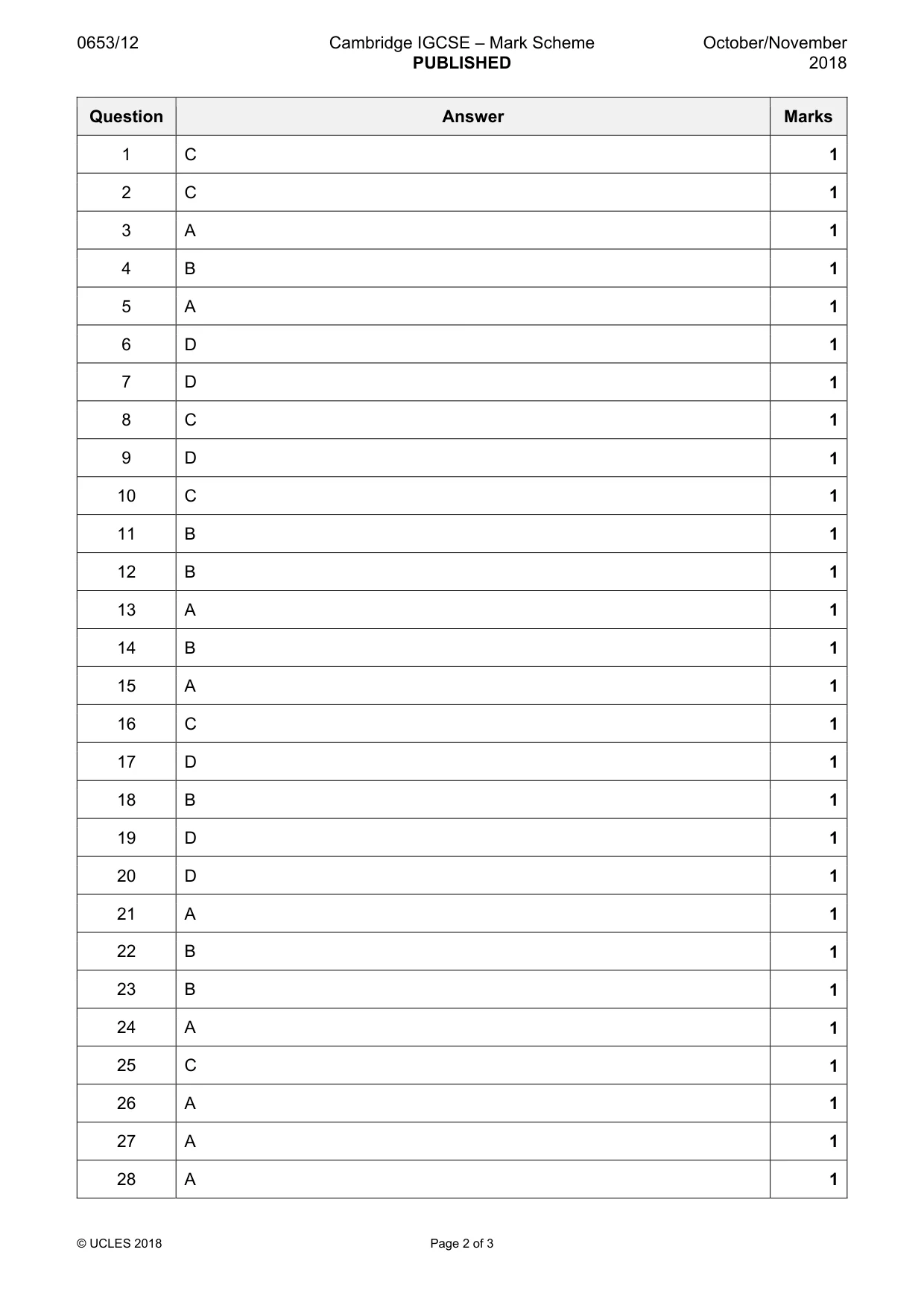
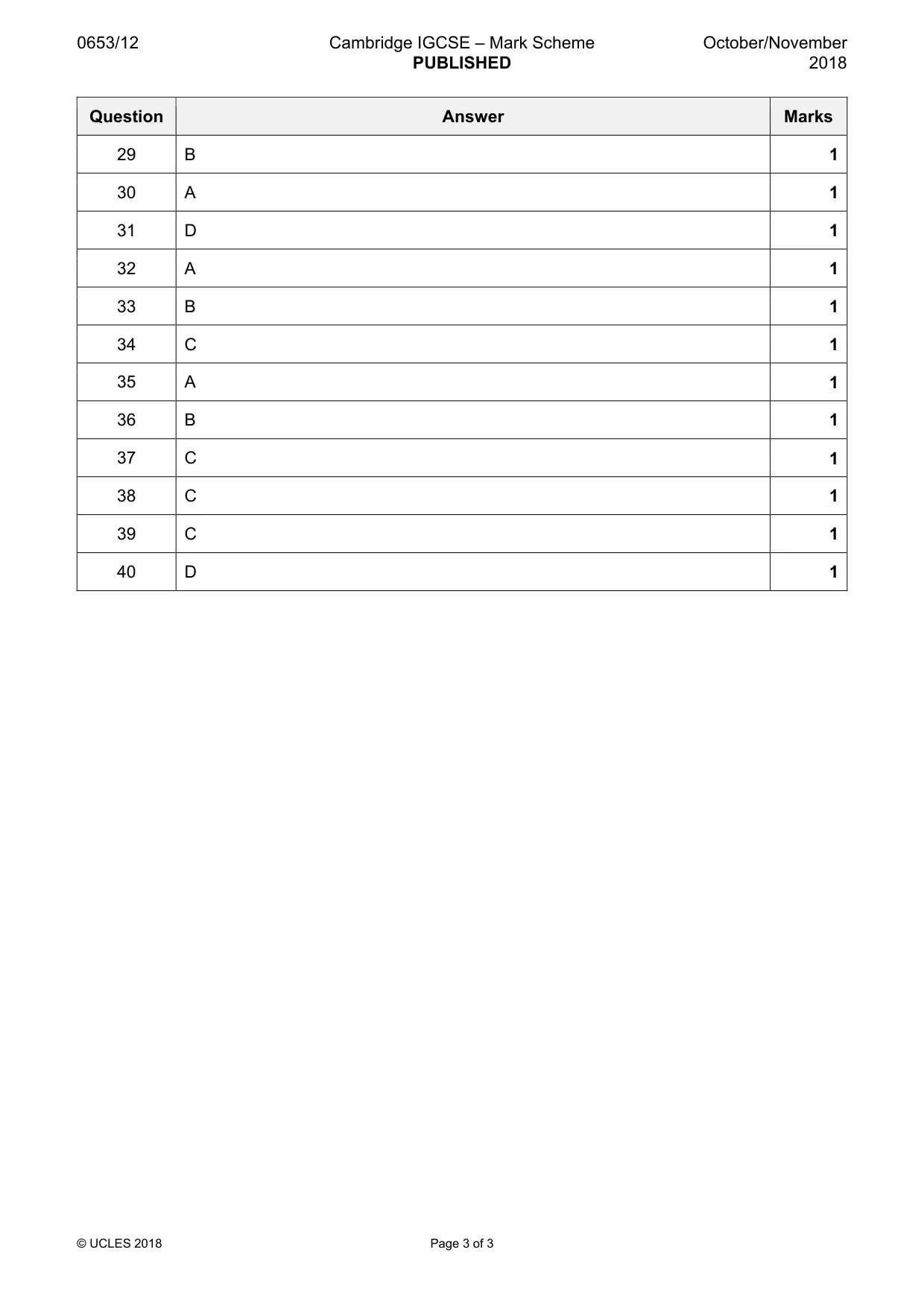
Mark scheme3 pages
Answers below. Sit the paper first if you are practising.
Questions as text
Q1 · Movement is a characteristic of all living organisms
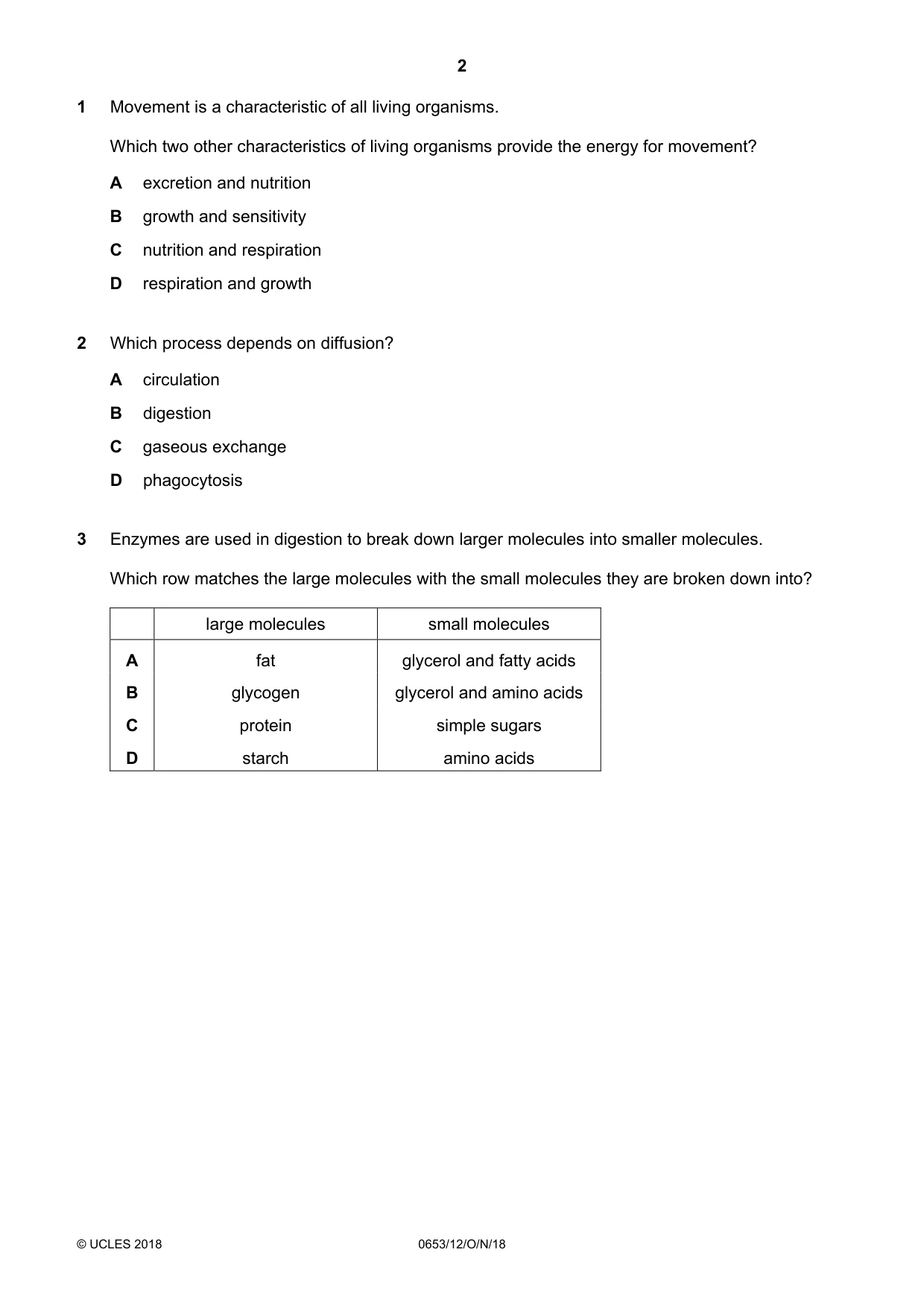
1 Movement is a characteristic of all living organisms. Which two other characteristics of living organisms provide the energy for movement? A excretion and nutrition B growth and sensitivity C nutrition and respiration D respiration and growth
Mark scheme: C
Q2 · Which process depends on diffusion?
2 Which process depends on diffusion? A circulation B digestion C gaseous exchange D phagocytosis
Mark scheme: C
Q3 · Enzymes are used in digestion to break down larger molecules into smaller molecules
3 Enzymes are used in digestion to break down larger molecules into smaller molecules. Which row matches the large molecules with the small molecules they are broken down into? large molecules small molecules A fat glycerol and fatty acids B glycogen glycerol and amino acids C protein simple sugars D starch amino acids
Mark scheme: A
Q4 · The diagram shows the human alimentary canal
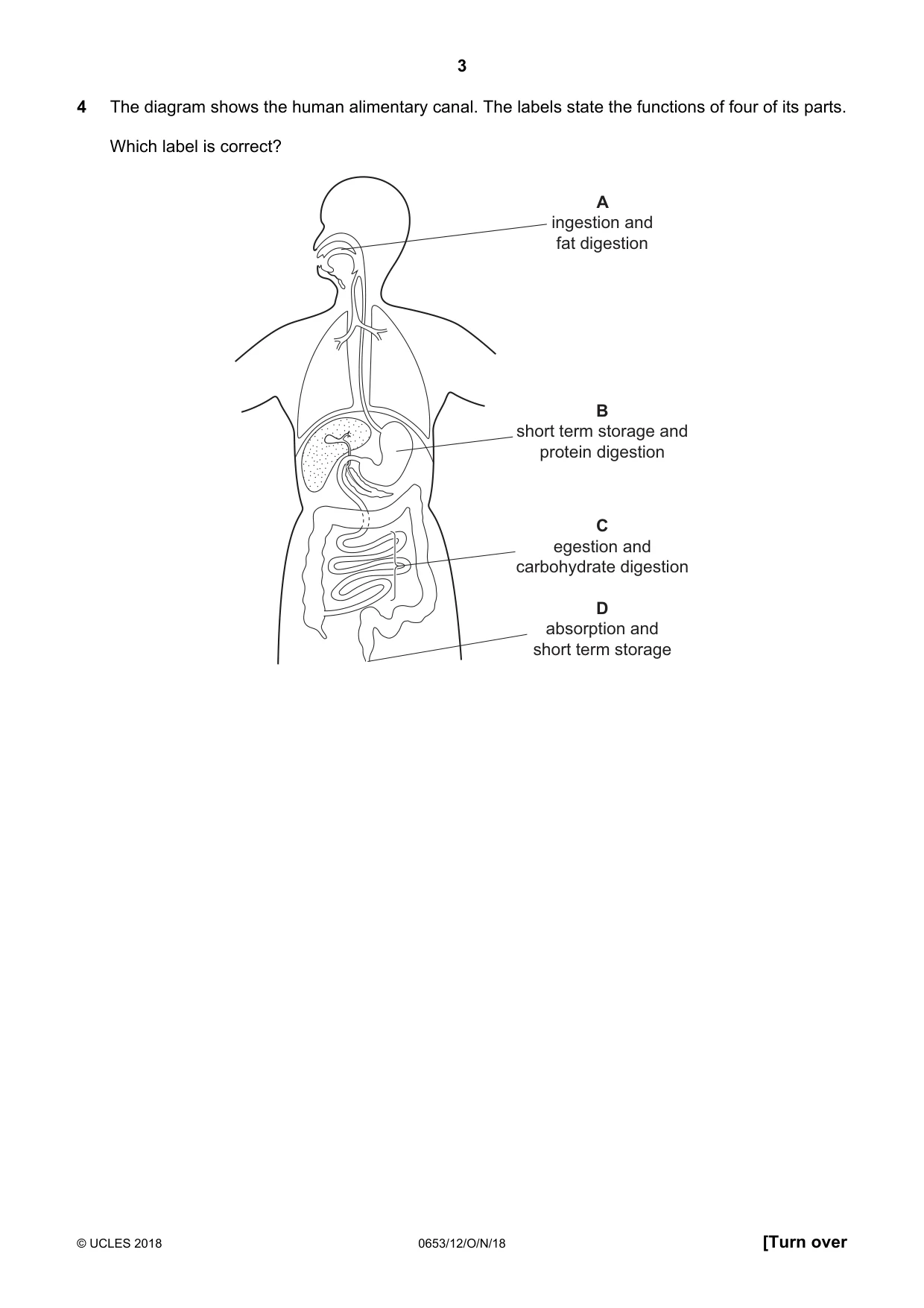
4 The diagram shows the human alimentary canal. The labels state the functions of four of its parts. Which label is correct? A ingestion and fat digestion B short term storage and protein digestion C egestion and carbohydrate digestion D absorption and short term storage
Mark scheme: B
Q5 · The diagram shows apparatus set up to investigate photosynthesis
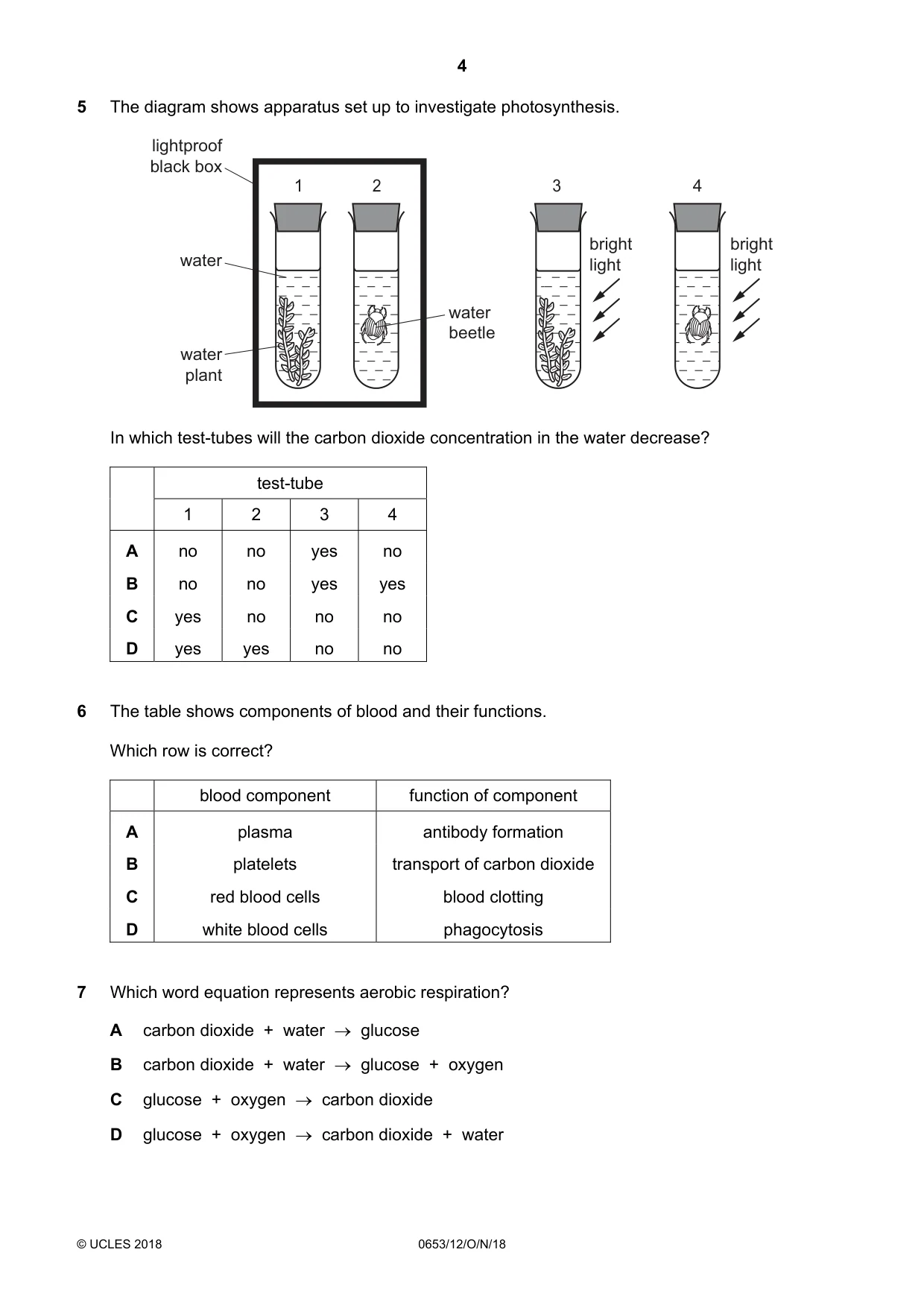
5 The diagram shows apparatus set up to investigate photosynthesis. lightproof black box 1 2 3 4 bright bright water light light water beetle water plant In which test-tubes will the carbon dioxide concentration in the water decrease? test-tube 1 2 3 4 A no no yes no B no no yes yes C yes no no no D yes yes no no
Mark scheme: A
Q6 · The table shows components of blood and their functions
6 The table shows components of blood and their functions. Which row is correct? blood component function of component A plasma antibody formation B platelets transport of carbon dioxide C red blood cells blood clotting D white blood cells phagocytosis
Mark scheme: D
Q7 · Which word equation represents aerobic respiration?
7 Which word equation represents aerobic respiration? A carbon dioxide + water → glucose B carbon dioxide + water → glucose + oxygen C glucose + oxygen → carbon dioxide D glucose + oxygen → carbon dioxide + water
Mark scheme: D
Q8 · What happens to the blood glucose concentration and pulse rate when adrenaline is…
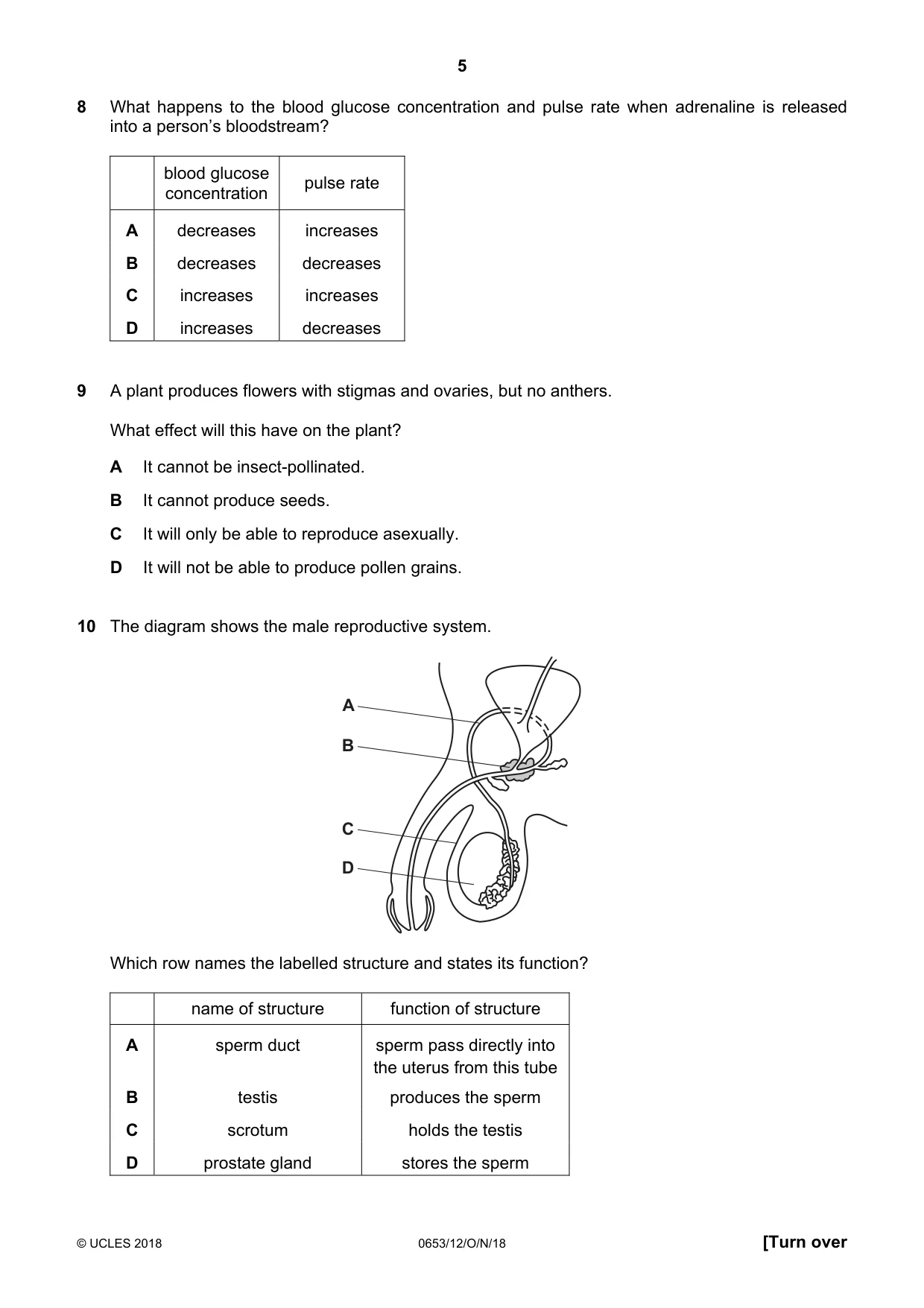
8 What happens to the blood glucose concentration and pulse rate when adrenaline is released into a person’s bloodstream? blood glucose pulse rate concentration A decreases increases B decreases decreases C increases increases D increases decreases
Mark scheme: C
Q9 · A plant produces flowers with stigmas and ovaries, but no anthers
9 A plant produces flowers with stigmas and ovaries, but no anthers. What effect will this have on the plant? A It cannot be insect-pollinated. B It cannot produce seeds. C It will only be able to reproduce asexually. D It will not be able to produce pollen grains.
Mark scheme: D
Q10 · The diagram shows the male reproductive system
10 The diagram shows the male reproductive system. A B C D Which row names the labelled structure and states its function? name of structure function of structure A sperm duct sperm pass directly into the uterus from this tube B testis produces the sperm C scrotum holds the testis D prostate gland stores the sperm
Mark scheme: C
Q11 · What is a herbivore?
11 What is a herbivore? A an organism that gets its energy by eating other animals B an organism that gets its energy by eating plants C an organism that makes its own organic nutrients D the first organism in a food chain
Mark scheme: B
Q12 · The diagram shows part of the carbon cycle
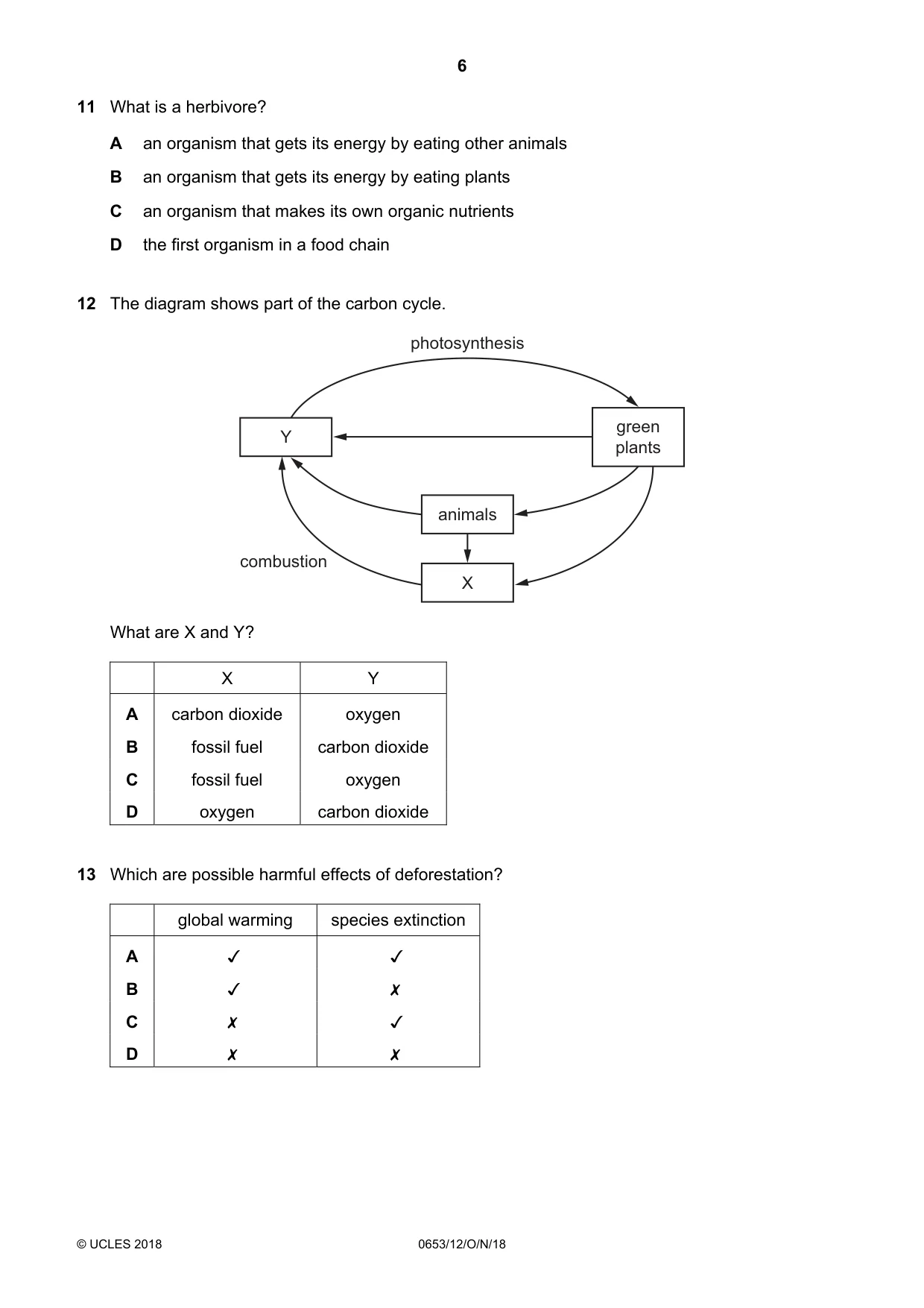
12 The diagram shows part of the carbon cycle. photosynthesis green Y plants animals combustion X What are X and Y? X Y A carbon dioxide oxygen B fossil fuel carbon dioxide C fossil fuel oxygen D oxygen carbon dioxide
Mark scheme: B
Q13 · Which are possible harmful effects of deforestation?
13 Which are possible harmful effects of deforestation? global warming species extinction A v v B v x Cc x v D x x
Mark scheme: A
Q14 · The diagram represents a mixture of carbon dioxide, CO2, and carbon monoxide, CO
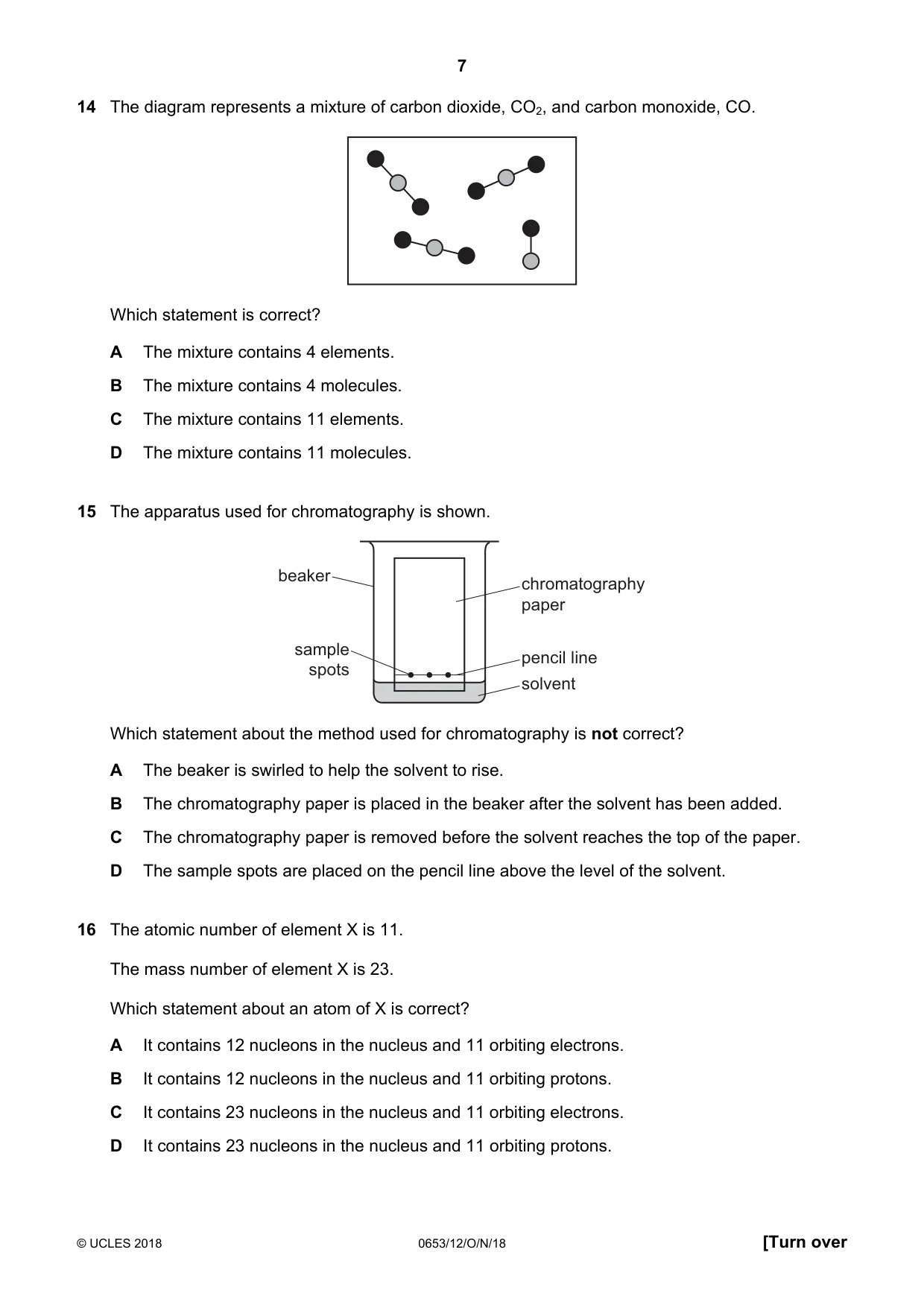
14 The diagram represents a mixture of carbon dioxide, CO2, and carbon monoxide, CO. Which statement is correct? A The mixture contains 4 elements. B The mixture contains 4 molecules. C The mixture contains 11 elements. D The mixture contains 11 molecules.
Mark scheme: B
Q15 · The apparatus used for chromatography is shown
15 The apparatus used for chromatography is shown. beaker chromatography paper sample pencil line spots solvent Which statement about the method used for chromatography is not correct? A The beaker is swirled to help the solvent to rise. B The chromatography paper is placed in the beaker after the solvent has been added. C The chromatography paper is removed before the solvent reaches the top of the paper. D The sample spots are placed on the pencil line above the level of the solvent.
Mark scheme: A
Q16 · The atomic number of element X is 11
16 The atomic number of element X is 11. The mass number of element X is 23. Which statement about an atom of X is correct? A It contains 12 nucleons in the nucleus and 11 orbiting electrons. B It contains 12 nucleons in the nucleus and 11 orbiting protons. C It contains 23 nucleons in the nucleus and 11 orbiting electrons. D It contains 23 nucleons in the nucleus and 11 orbiting protons.
Mark scheme: C
Q17 · Which formula does not represent an acid?
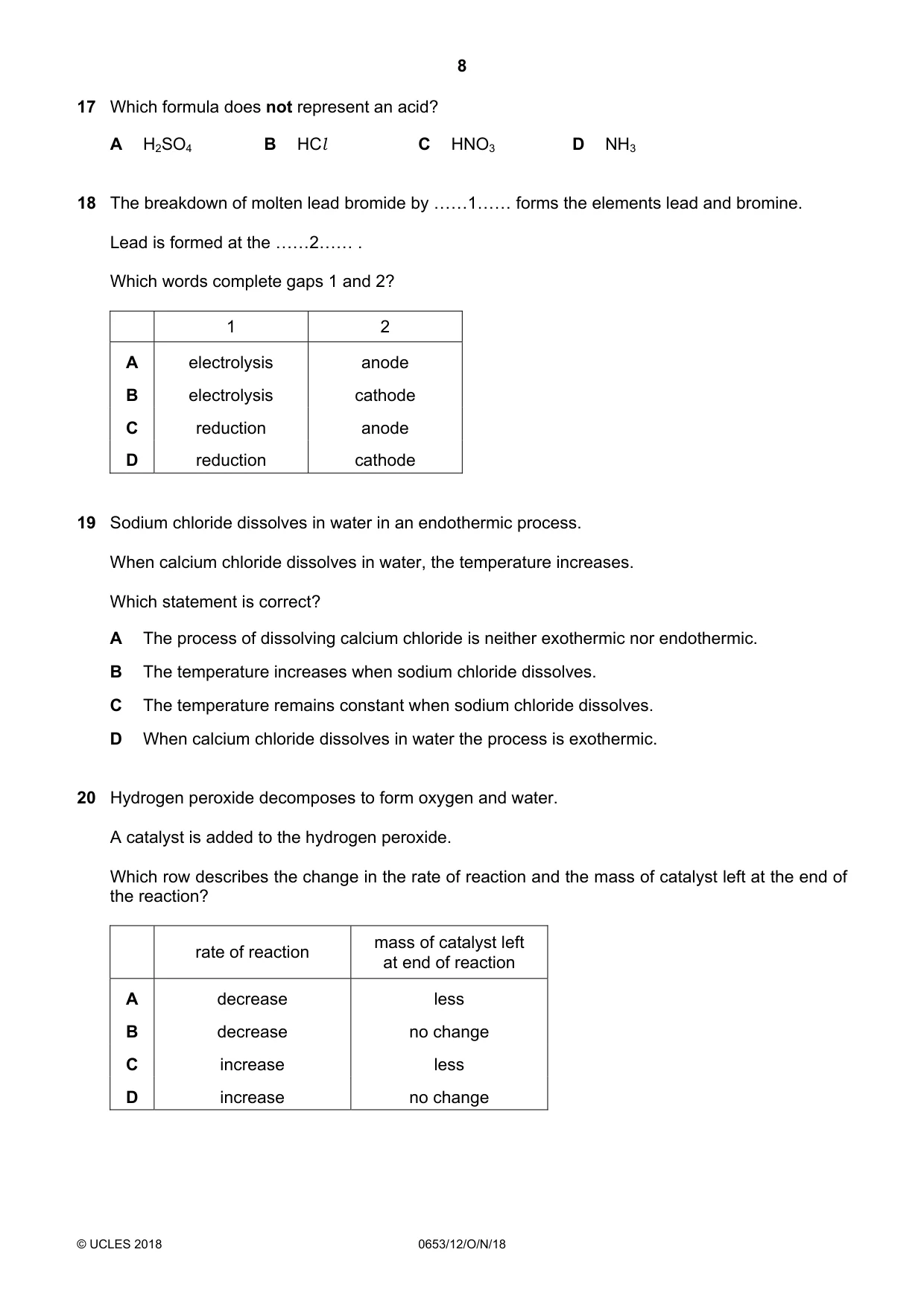
17 Which formula does not represent an acid? A H2SO4 B HCl C HNO3 D NH3
Mark scheme: D
More questions on The characteristic properties of acids and bases
Q18 · The breakdown of molten lead bromide by ««1«« forms the elements lead and bromine
18 The breakdown of molten lead bromide by ««1«« forms the elements lead and bromine. Lead is formed at the ««2«« . Which words complete gaps 1 and 2? 1 2 A electrolysis anode B electrolysis cathode C reduction anode D reduction cathode
Mark scheme: B
Q19 · Sodium chloride dissolves in water in an endothermic process
19 Sodium chloride dissolves in water in an endothermic process. When calcium chloride dissolves in water, the temperature increases. Which statement is correct? A The process of dissolving calcium chloride is neither exothermic nor endothermic. B The temperature increases when sodium chloride dissolves. C The temperature remains constant when sodium chloride dissolves. D When calcium chloride dissolves in water the process is exothermic.
Mark scheme: D
Q20 · Hydrogen peroxide decomposes to form oxygen and water
20 Hydrogen peroxide decomposes to form oxygen and water. A catalyst is added to the hydrogen peroxide. Which row describes the change in the rate of reaction and the mass of catalyst left at the end of the reaction? mass of catalyst left rate of reaction at end of reaction A decrease less B decrease no change C increase less D increase no change
Mark scheme: D
Q21 · Iron oxide reacts with carbon monoxide
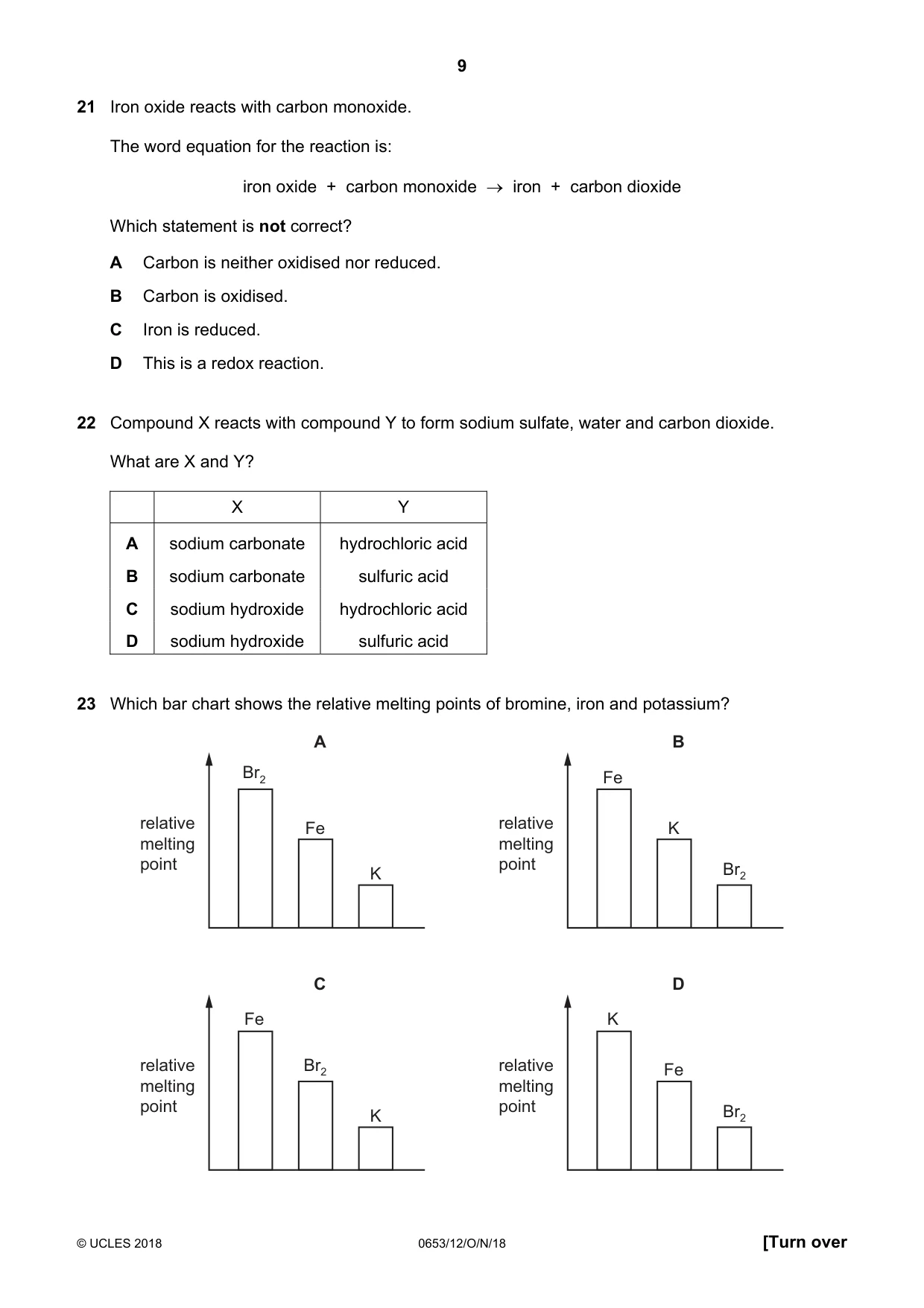
21 Iron oxide reacts with carbon monoxide. The word equation for the reaction is: iron oxide + carbon monoxide → iron + carbon dioxide Which statement is not correct? A Carbon is neither oxidised nor reduced. B Carbon is oxidised. C Iron is reduced. D This is a redox reaction.
Mark scheme: A
Q22 · Compound X reacts with compound Y to form sodium sulfate, water and carbon dioxide
22 Compound X reacts with compound Y to form sodium sulfate, water and carbon dioxide. What are X and Y? X Y A sodium carbonate hydrochloric acid B sodium carbonate sulfuric acid C sodium hydroxide hydrochloric acid D sodium hydroxide sulfuric acid
Mark scheme: B
Q23 · Which bar chart shows the relative melting points of bromine, iron and potassium?
23 Which bar chart shows the relative melting points of bromine, iron and potassium? A B Br2 Fe relative Fe relative K melting melting point point Br2 K C D Fe K relative Br2 relative Fe melting melting point point Br2 K
Mark scheme: B
Q24 · The positions of four elements are shown in the outline of the Periodic Table
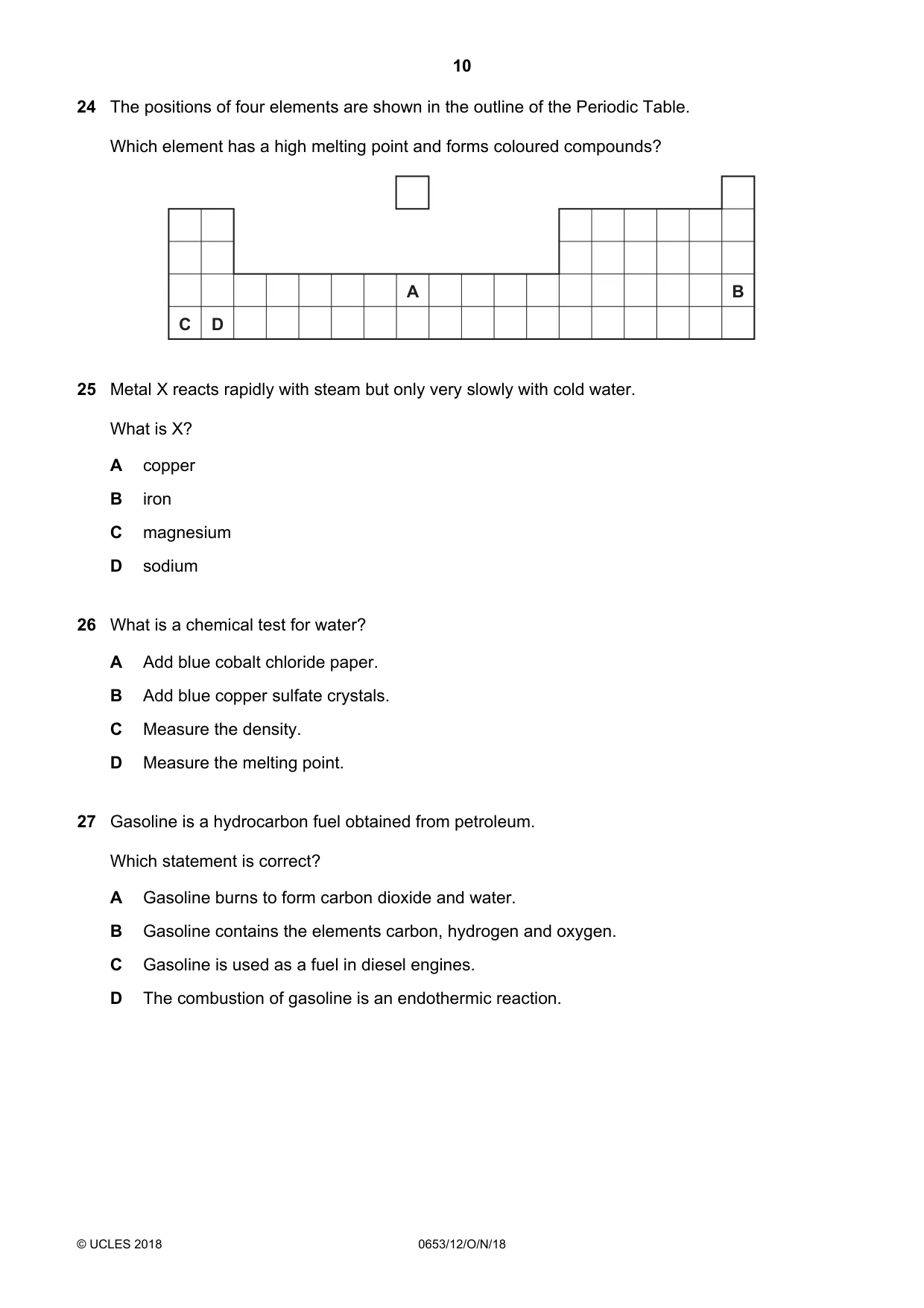
24 The positions of four elements are shown in the outline of the Periodic Table. Which element has a high melting point and forms coloured compounds? A B C D
Mark scheme: A
Q25 · Metal X reacts rapidly with steam but only very slowly with cold water
25 Metal X reacts rapidly with steam but only very slowly with cold water. What is X? A copper B iron C magnesium D sodium
Mark scheme: C
Q26 · What is a chemical test for water?
26 What is a chemical test for water? A Add blue cobalt chloride paper. B Add blue copper sulfate crystals. C Measure the density. D Measure the melting point.
Mark scheme: A
Q27 · Gasoline is a hydrocarbon fuel obtained from petroleum
27 Gasoline is a hydrocarbon fuel obtained from petroleum. Which statement is correct? A Gasoline burns to form carbon dioxide and water. B Gasoline contains the elements carbon, hydrogen and oxygen. C Gasoline is used as a fuel in diesel engines. D The combustion of gasoline is an endothermic reaction.
Mark scheme: A
Q28 · A car is travelling along a straight road
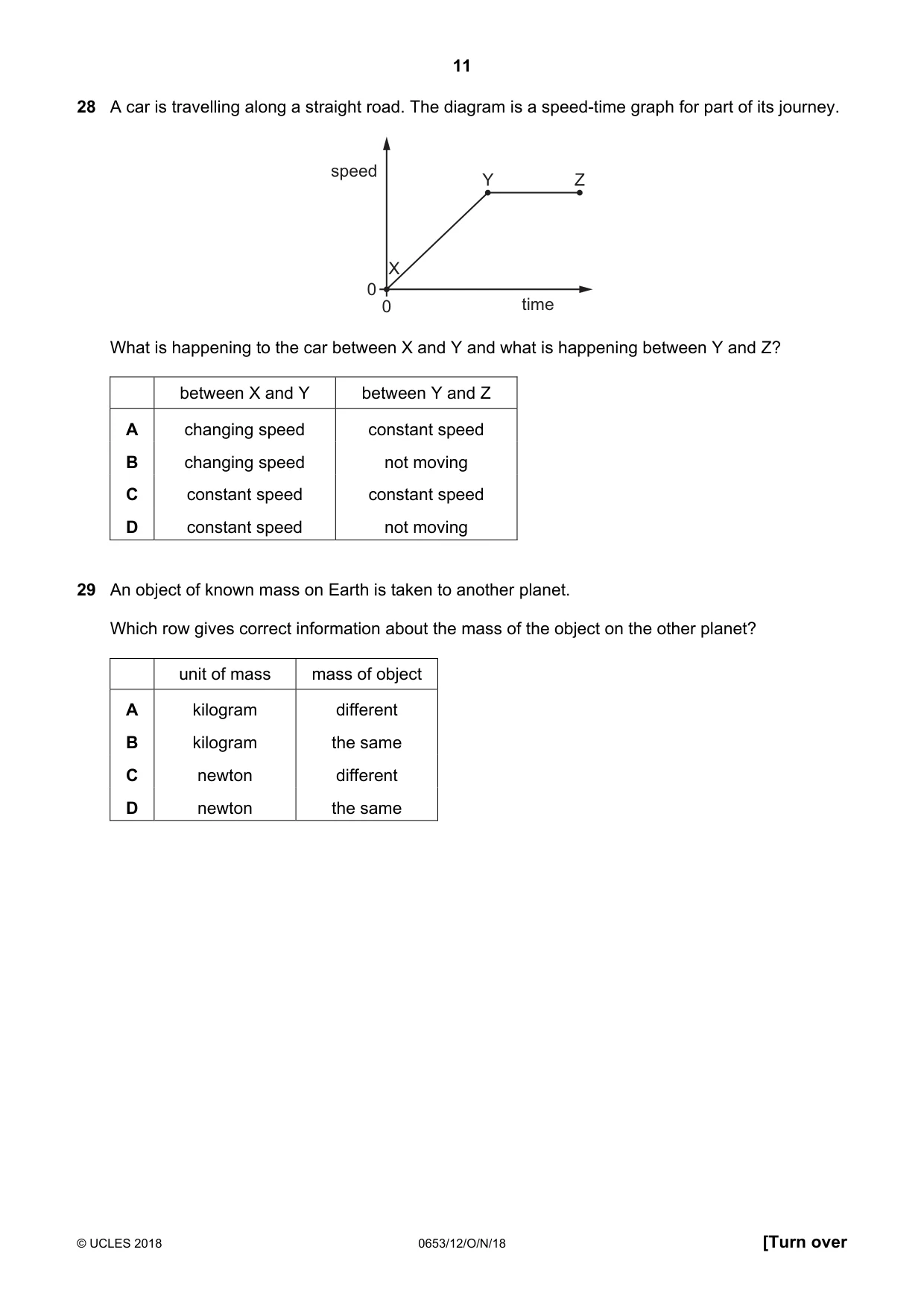
28 A car is travelling along a straight road. The diagram is a speed-time graph for part of its journey. speed Y Z X 0 0 time What is happening to the car between X and Y and what is happening between Y and Z? between X and Y between Y and Z A changing speed constant speed B changing speed not moving C constant speed constant speed D constant speed not moving
Mark scheme: A
Q29 · An object of known mass on Earth is taken to another planet
29 An object of known mass on Earth is taken to another planet. Which row gives correct information about the mass of the object on the other planet? unit of mass mass of object A kilogram different B kilogram the same C newton different D newton the same
Mark scheme: B
Q30 · A cube of aluminium has sides of length 1.0 cm
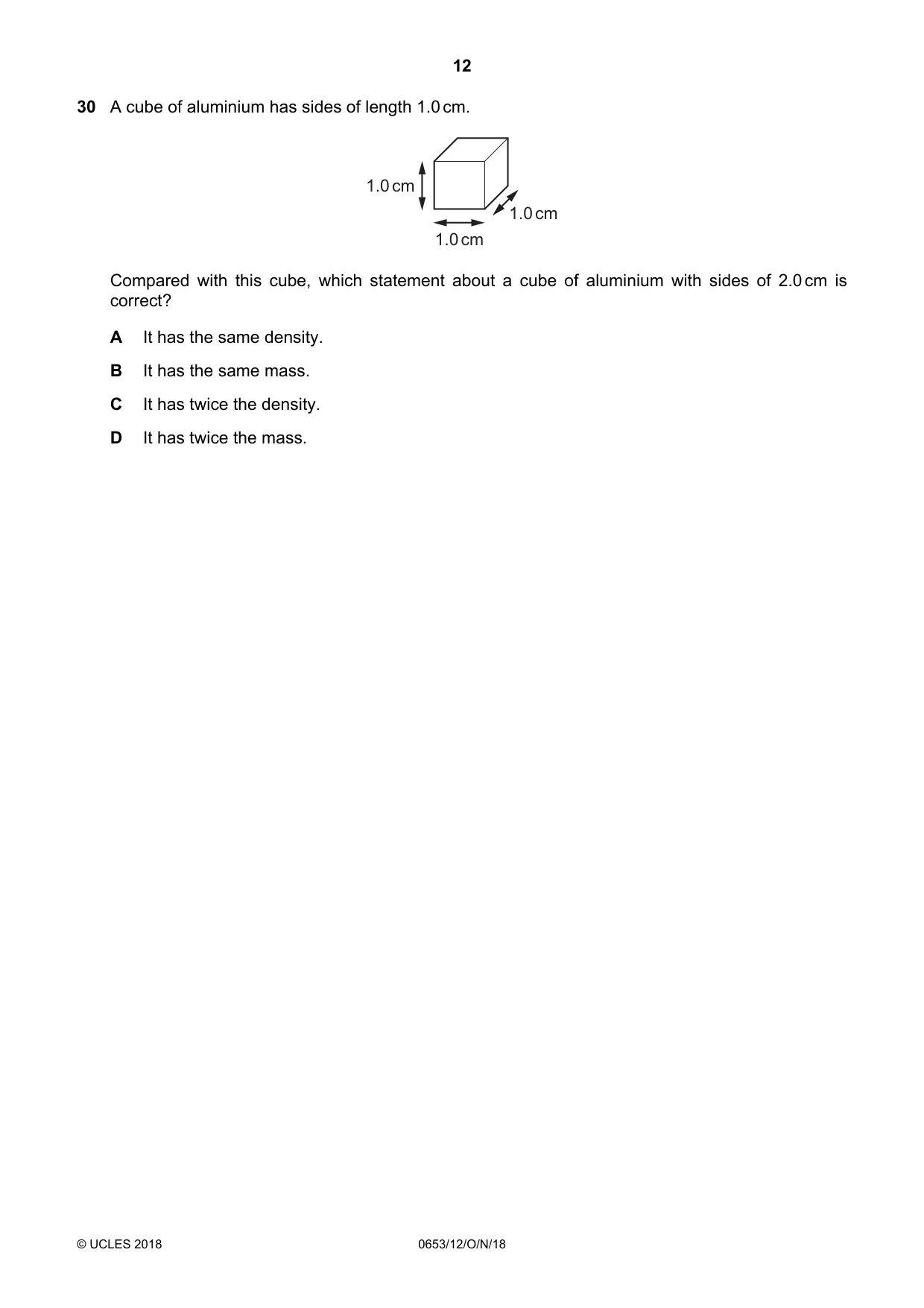
30 A cube of aluminium has sides of length 1.0 cm. 1.0 cm 1.0 cm 1.0 cm Compared with this cube, which statement about a cube of aluminium with sides of 2.0 cm is correct? A It has the same density. B It has the same mass. C It has twice the density. D It has twice the mass.
Mark scheme: A
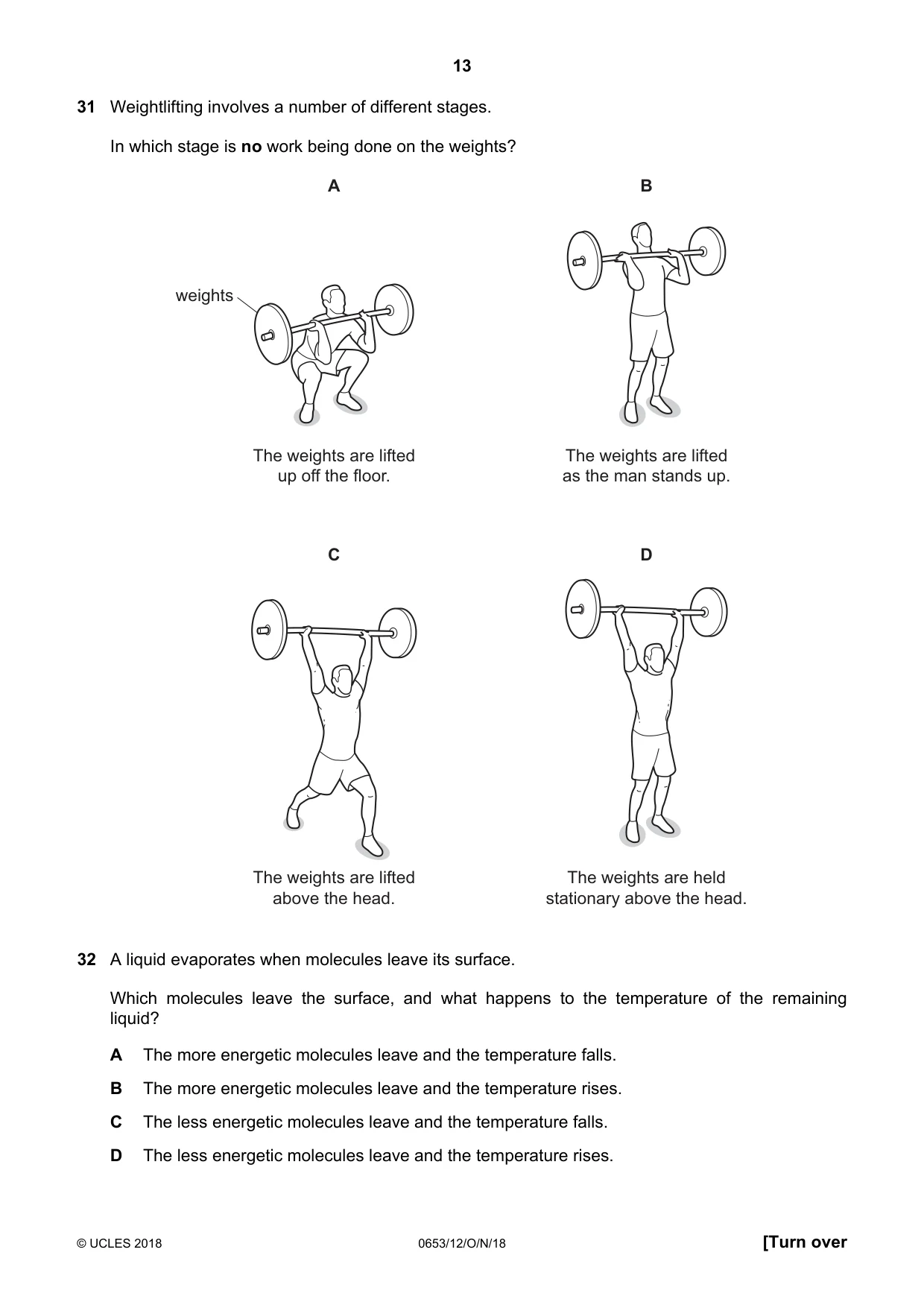
Q31 · Weightlifting involves a number of different stages
31 Weightlifting involves a number of different stages. In which stage is no work being done on the weights? A B weights The weights are lifted The weights are lifted up off the floor. as the man stands up. C D The weights are lifted The weights are held above the head. stationary above the head.
Mark scheme: D
Q32 · A liquid evaporates when molecules leave its surface
32 A liquid evaporates when molecules leave its surface. Which molecules leave the surface, and what happens to the temperature of the remaining liquid? A The more energetic molecules leave and the temperature falls. B The more energetic molecules leave and the temperature rises. C The less energetic molecules leave and the temperature falls. D The less energetic molecules leave and the temperature rises.
Mark scheme: A
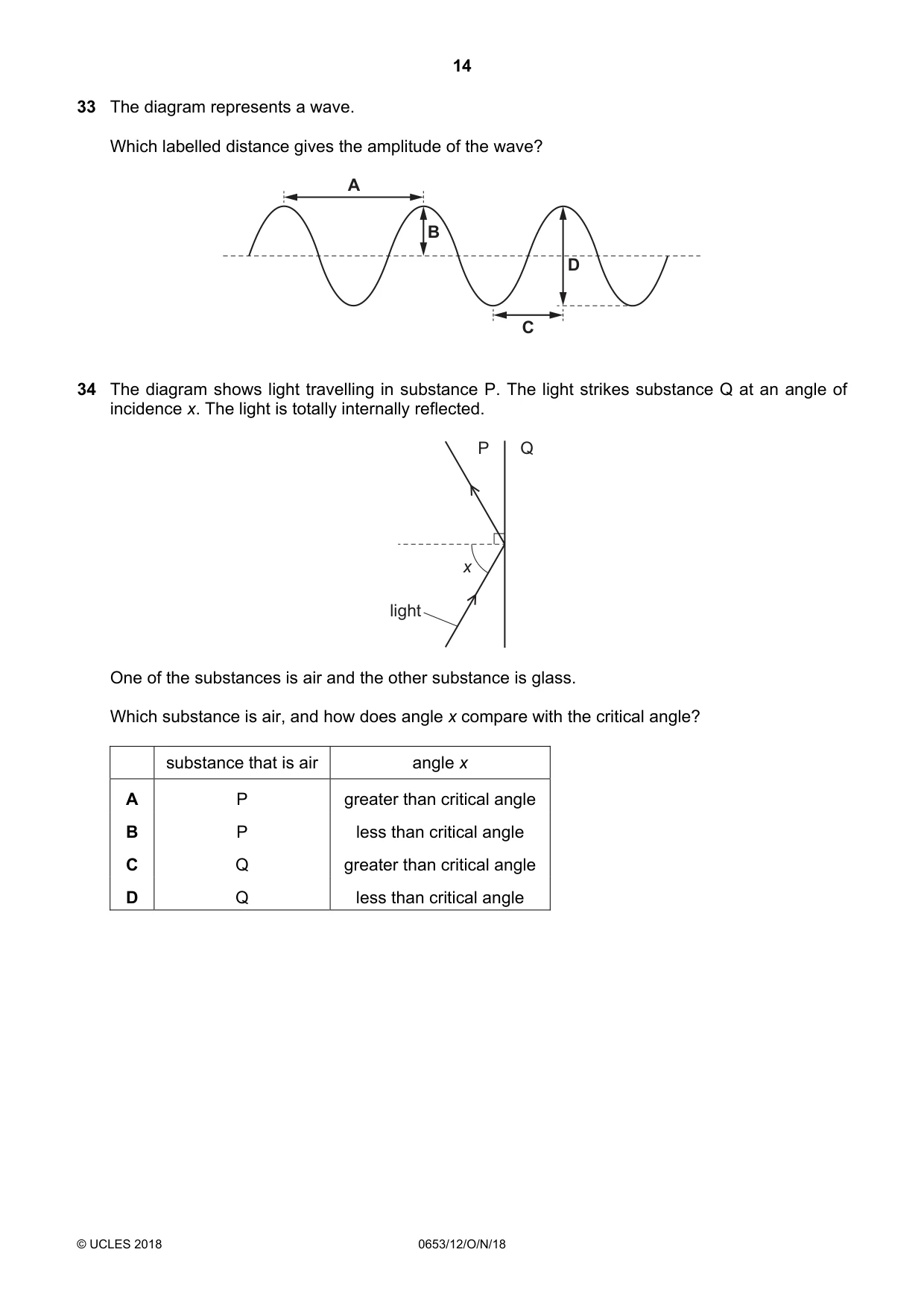
Q33 · The diagram represents a wave
33 The diagram represents a wave. Which labelled distance gives the amplitude of the wave? A B D C
Mark scheme: B
Q34 · The diagram shows light travelling in substance P
34 The diagram shows light travelling in substance P. The light strikes substance Q at an angle of incidence x. The light is totally internally reflected. P Q x light One of the substances is air and the other substance is glass. Which substance is air, and how does angle x compare with the critical angle? substance that is air angle x A P greater than critical angle B P less than critical angle C Q greater than critical angle D Q less than critical angle
Mark scheme: C
Q35 · A student is watching television
35 A student is watching television. He uses a remote controller to change the programme. The remote controller uses electromagnetic waves. Electromagnetic waves are also used to transmit the television signals from a satellite. Which row shows the type of wave used for each purpose? remote controller satellite A infra-red microwaves B infra-red radio waves C ultraviolet microwaves D ultraviolet radio waves
Mark scheme: A
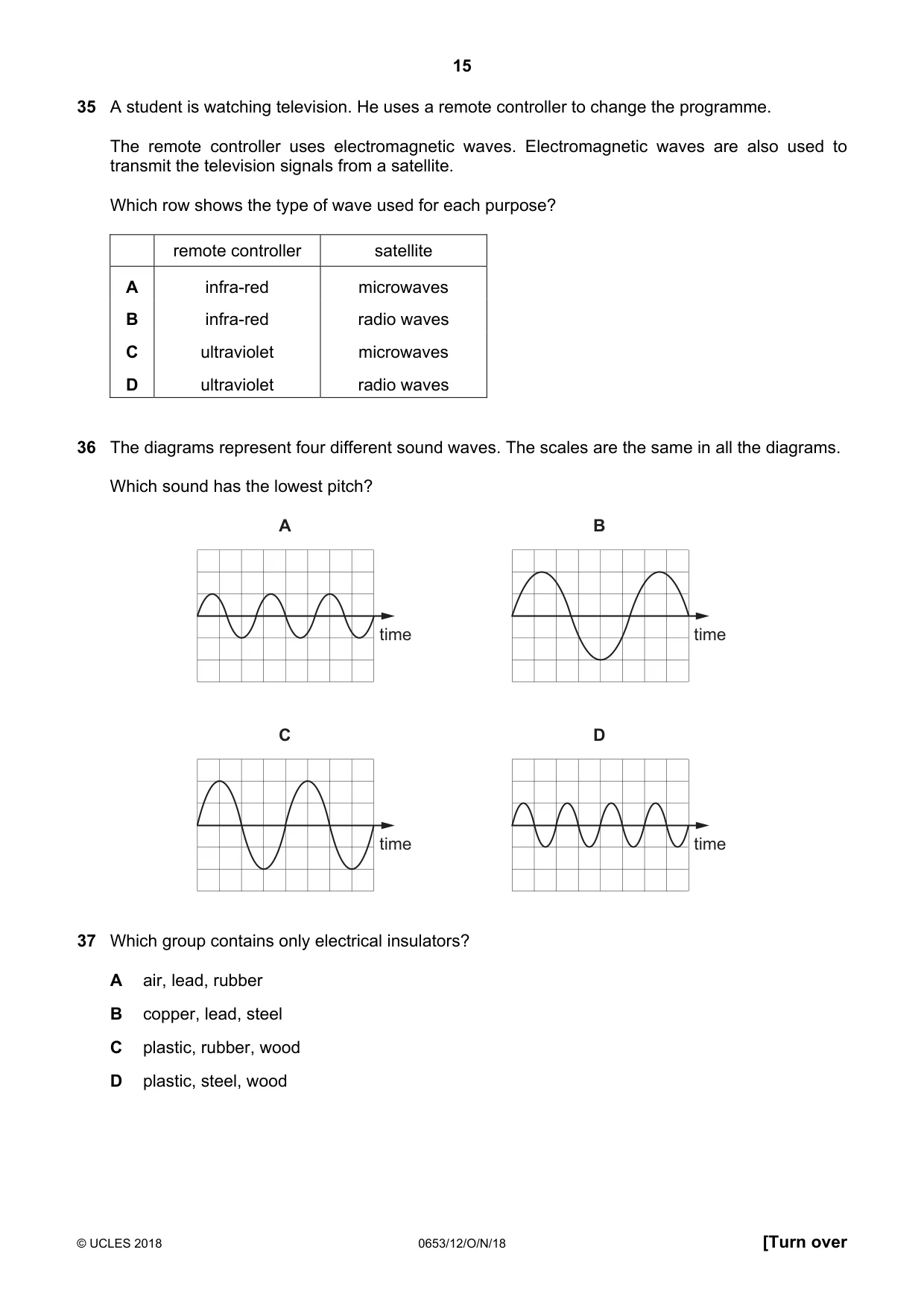
Q36 · The diagrams represent four different sound waves
36 The diagrams represent four different sound waves. The scales are the same in all the diagrams. Which sound has the lowest pitch? A B time time C D time time
Mark scheme: B
Q37 · Which group contains only electrical insulators?
37 Which group contains only electrical insulators? A air, lead, rubber B copper, lead, steel C plastic, rubber, wood D plastic, steel, wood
Mark scheme: C
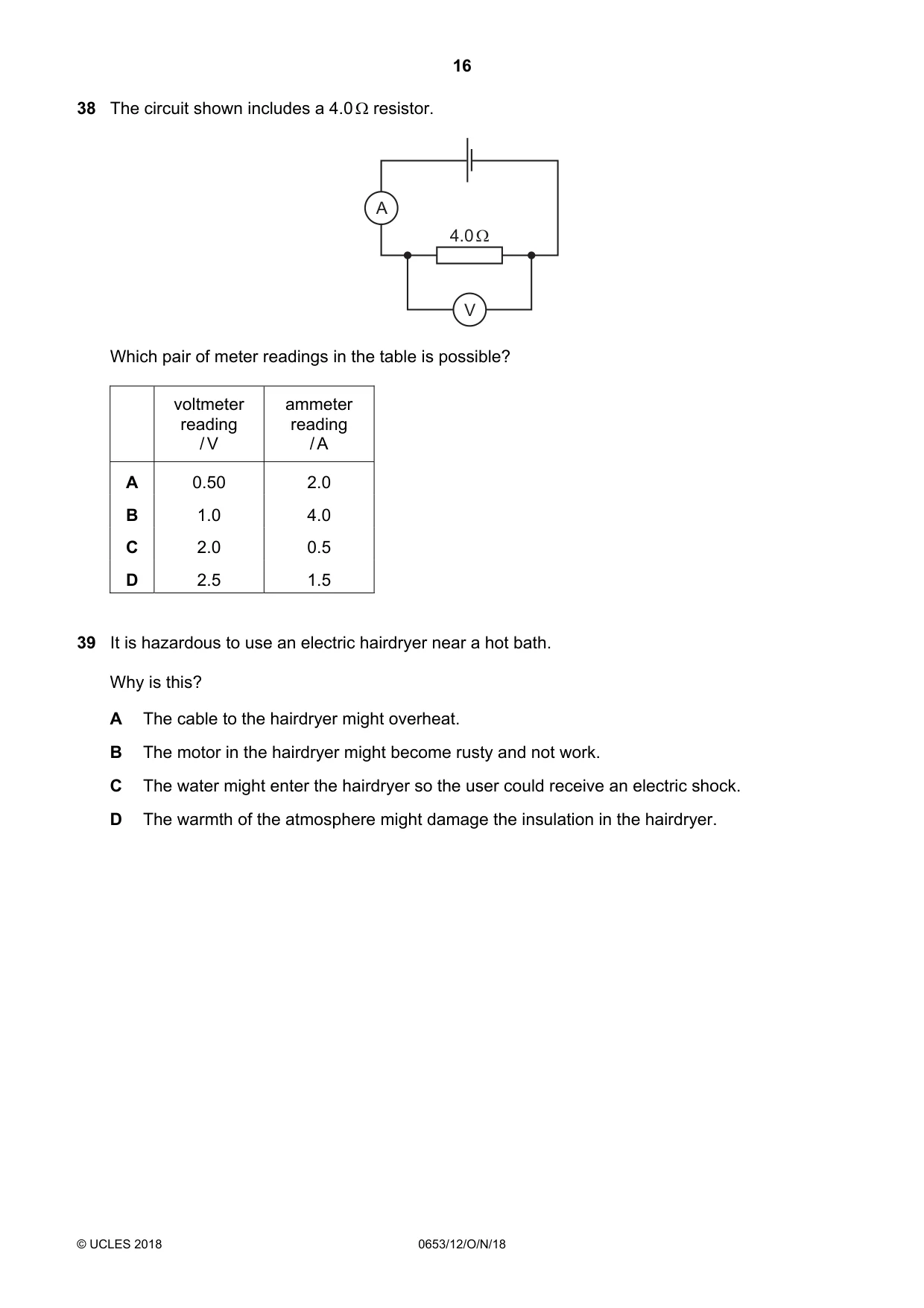
Q38 · The circuit shown includes a 4.0 Ω resistor
38 The circuit shown includes a 4.0 Ω resistor. A 4.0 Ω V Which pair of meter readings in the table is possible? voltmeter ammeter reading reading / V / A A 0.50 2.0 B 1.0 4.0 C 2.0 0.5 D 2.5 1.5
Mark scheme: C
Q39 · It is hazardous to use an electric hairdryer near a hot bath
39 It is hazardous to use an electric hairdryer near a hot bath. Why is this? A The cable to the hairdryer might overheat. B The motor in the hairdryer might become rusty and not work. C The water might enter the hairdryer so the user could receive an electric shock. D The warmth of the atmosphere might damage the insulation in the hairdryer.
Mark scheme: C
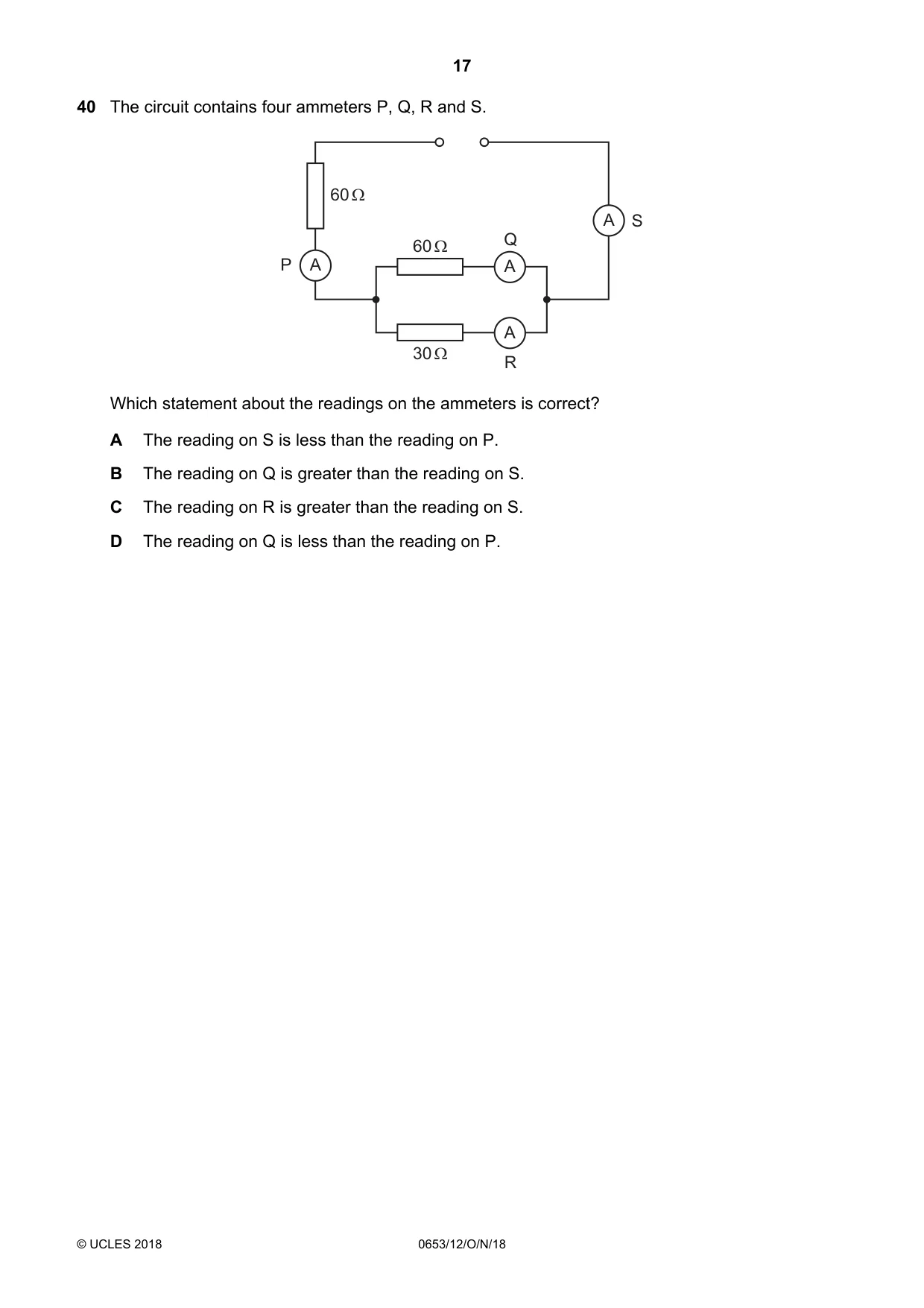
Q40 · The circuit contains four ammeters P, Q, R and S
40 The circuit contains four ammeters P, Q, R and S. 60 Ω A S 60 Ω Q P A A A 30 Ω R Which statement about the readings on the ammeters is correct? A The reading on S is less than the reading on P. B The reading on Q is greater than the reading on S. C The reading on R is greater than the reading on S. D The reading on Q is less than the reading on P.
Mark scheme: D
What was in this paper
The subtopics covered by these 40 questions, and how many questions each got. Open one in a new tab to see every Cambridge question on it.
2Atomic structure and the Periodic Table1Blood1Carbon cycle1Characteristics of living organisms1Chromatography1Density1Diffusion1Digestion1Digestive system1Drugs1Electrical circuits1Electrical safety1Electrolysis1Electromagnetic spectrum1Elements, compounds and mixtures1Energy, work and power1Exothermic and endothermic reactions1Food chains and food webs1Fuels1General properties of waves1Group VII properties1Habitat destruction1Identification of ions and gases1Kinetic particle model of matter1Light1Mass and weight1Motion1Photosynthesis1Preparation of salts1Rate of reaction1Reactivity series1Redox1Respiration1Sexual reproduction in humans1Sexual reproduction in plants1Sound1The characteristic properties of acids and bases1Transition elements1What you needed in this session
Cambridge’s own grade thresholds for 2018 Oct/Nov, Paper 1 · Variant 2. A higher threshold means an easier paper — the bar moves with how the cohort did.