Cambridge IGCSE Science - Combined 0653 — 2024 May/June Paper 1 · Variant 2
0653/12/M/J/24 · 40 questions · 40 marks · ≈45 min
The question paper and its mark scheme, free to read here and free to download. This is Cambridge’s own paper, exactly as it was sat.
Question paper16 pages


Mark scheme3 pages
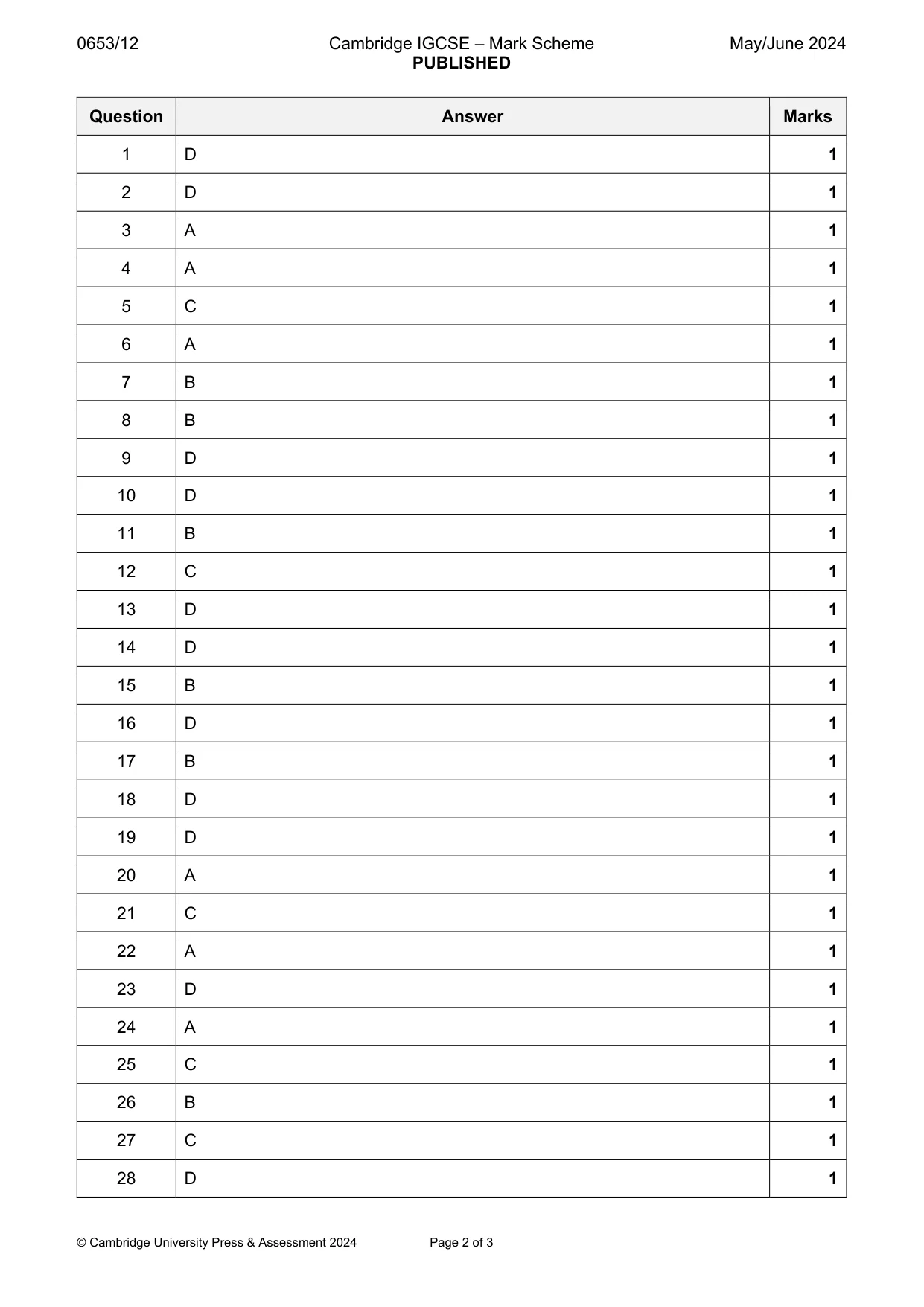
Answers below. Sit the paper first if you are practising.
Questions as text
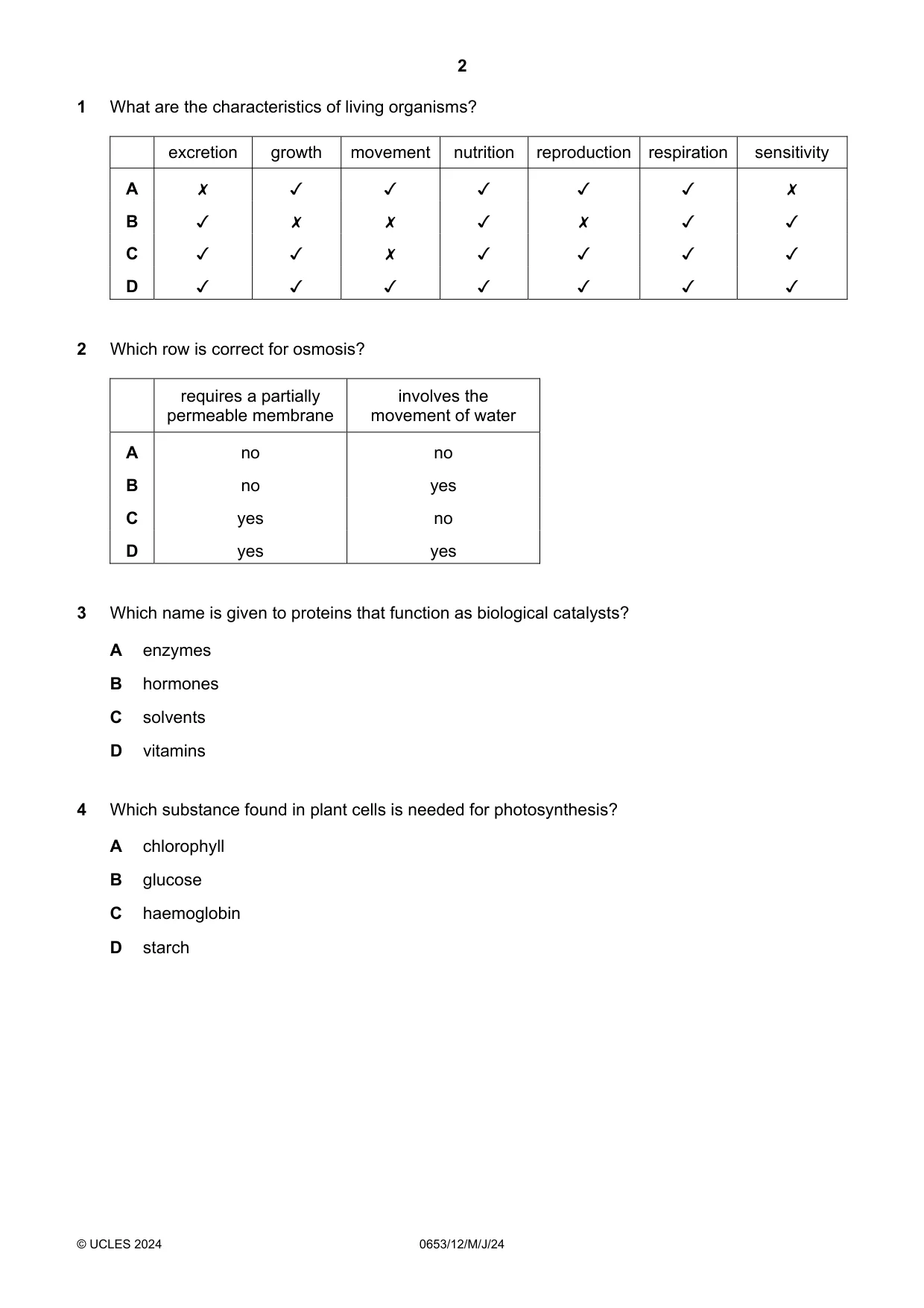
Q1 · What are the characteristics of living organisms?
1 What are the characteristics of living organisms? excretion growth | movement | nutrition | reproduction | respiration | sensitivity A x v v v v v x B v x x v x v v Cc v v x v v v v D v v v v v v v
Mark scheme: D
Q2 · Which row is correct for osmosis?
2 Which row is correct for osmosis? requires a partially involves the permeable membrane movement of water A no no B no yes C yes no D yes yes
Mark scheme: D
Q3 · Which name is given to proteins that function as biological catalysts?
3 Which name is given to proteins that function as biological catalysts? A enzymes B hormones C solvents D vitamins
Mark scheme: A
Q4 · Which substance found in plant cells is needed for photosynthesis?
4 Which substance found in plant cells is needed for photosynthesis? A chlorophyll B glucose C haemoglobin D starch
Mark scheme: A
Q5 · Which nutrient is needed for each function in the human body?
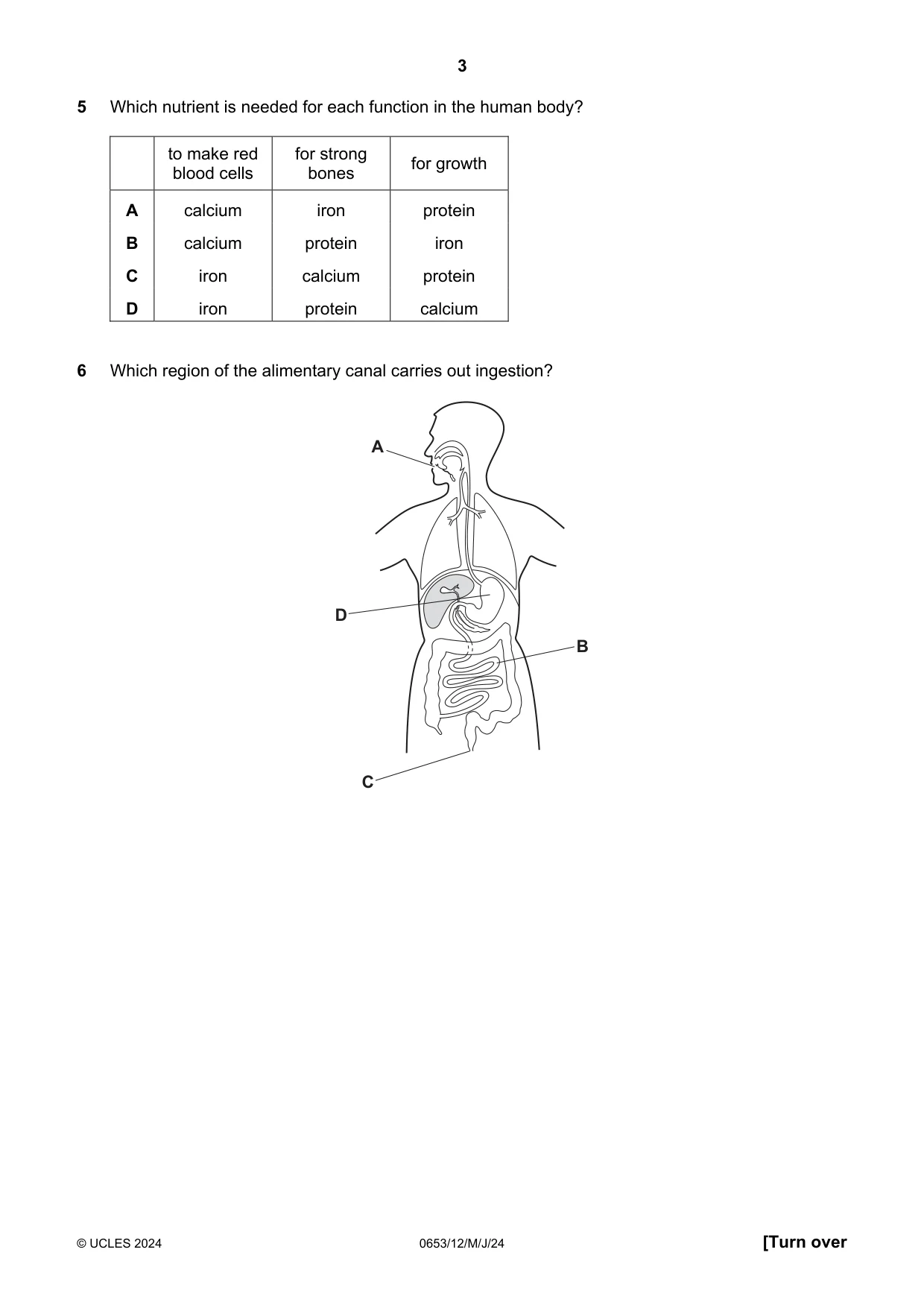
5 Which nutrient is needed for each function in the human body? to make red for strong for growth blood cells bones A calcium iron protein B calcium protein iron C iron calcium protein D iron protein calcium
Mark scheme: C
Q6 · Which region of the alimentary canal carries out ingestion?
6 Which region of the alimentary canal carries out ingestion? A D B C
Mark scheme: A
Q7 · The diagram shows what happens to proteins in the alimentary canal
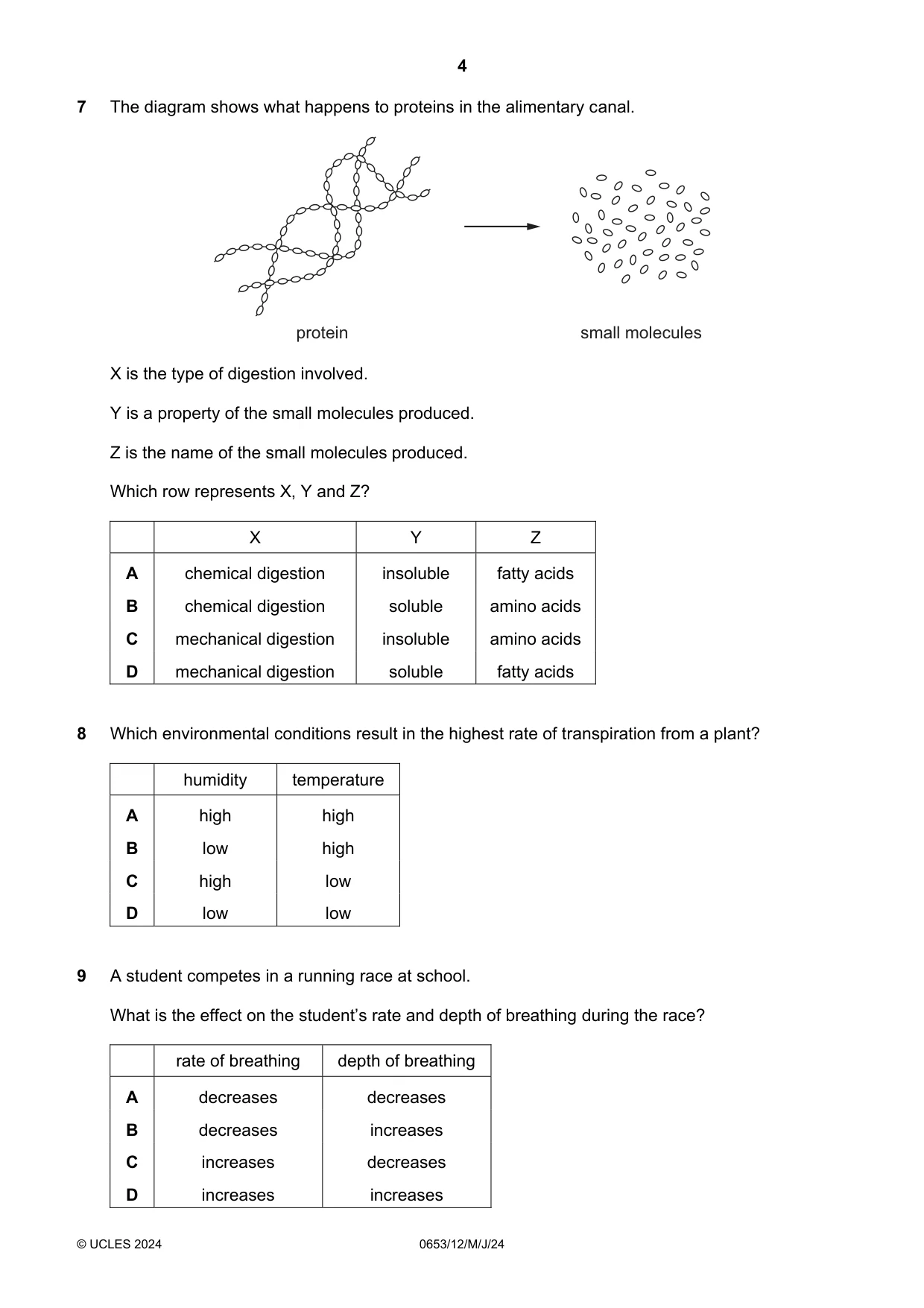
7 The diagram shows what happens to proteins in the alimentary canal. protein small molecules X is the type of digestion involved. Y is a property of the small molecules produced. Z is the name of the small molecules produced. Which row represents X, Y and Z? X Y Z A chemical digestion insoluble fatty acids B chemical digestion soluble amino acids C mechanical digestion insoluble amino acids D mechanical digestion soluble fatty acids
Mark scheme: B
Q8 · Which environmental conditions result in the highest rate of transpiration from a plant?
8 Which environmental conditions result in the highest rate of transpiration from a plant? humidity temperature A high high B low high C high low D low low
Mark scheme: B
Q9 · A student competes in a running race at school
9 A student competes in a running race at school. What is the effect on the student’s rate and depth of breathing during the race? rate of breathing depth of breathing A decreases decreases B decreases increases C increases decreases D increases increases
Mark scheme: D
Q10 · A cat suddenly jumps in front of a person walking down a street
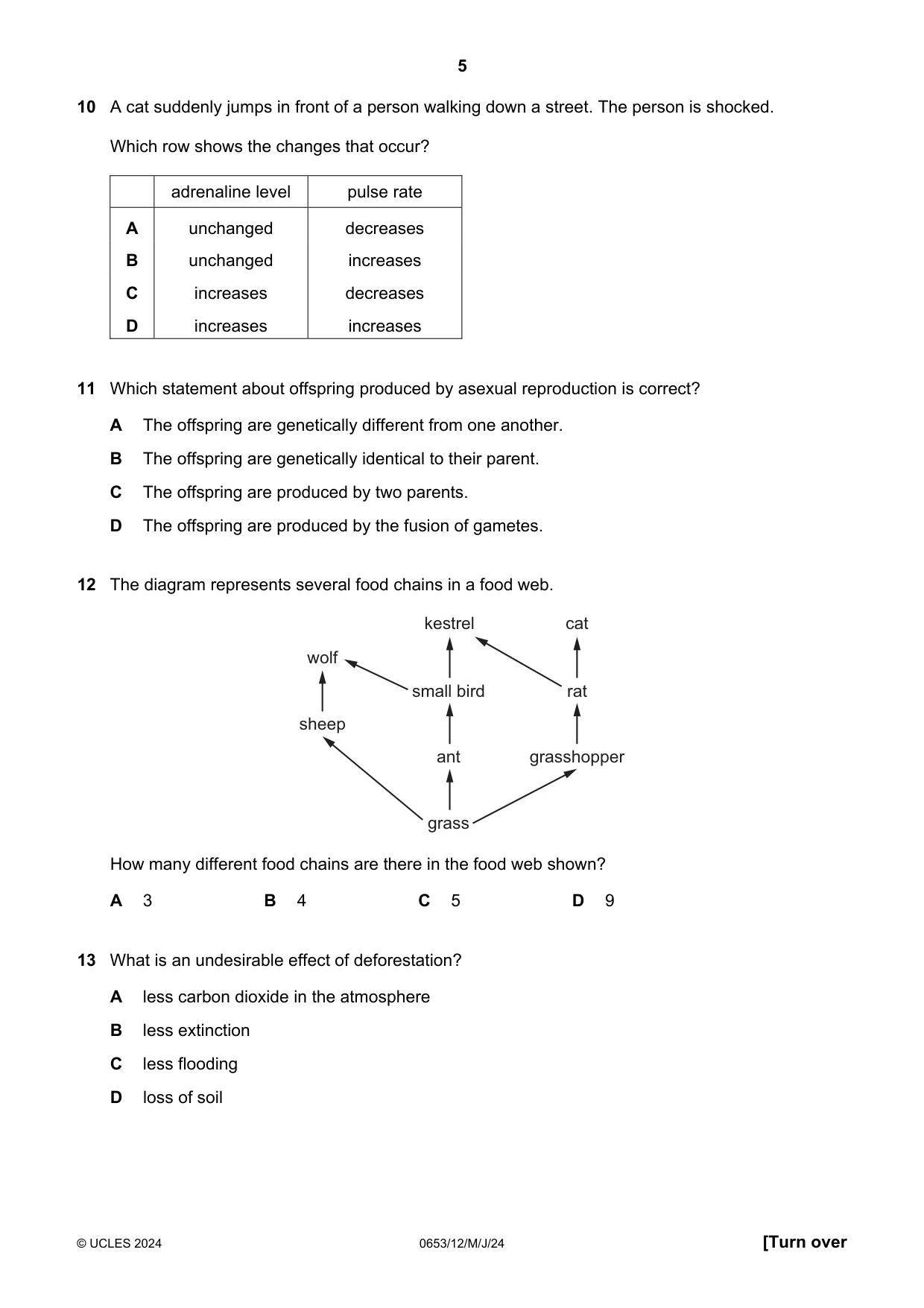
10 A cat suddenly jumps in front of a person walking down a street. The person is shocked. Which row shows the changes that occur? adrenaline level pulse rate A unchanged decreases B unchanged increases C increases decreases D increases increases
Mark scheme: D
Q11 · Which statement about offspring produced by asexual reproduction is correct?
11 Which statement about offspring produced by asexual reproduction is correct? A The offspring are genetically different from one another. B The offspring are genetically identical to their parent. C The offspring are produced by two parents. D The offspring are produced by the fusion of gametes.
Mark scheme: B
Q12 · The diagram represents several food chains in a food web
12 The diagram represents several food chains in a food web. kestrel cat wolf small bird rat sheep ant grasshopper grass How many different food chains are there in the food web shown? A 3 B 4 C 5 D 9
Mark scheme: C
Q13 · What is an undesirable effect of deforestation?
13 What is an undesirable effect of deforestation? A less carbon dioxide in the atmosphere B less extinction C less flooding D loss of soil
Mark scheme: D
Q14 · The diagram shows representations of some substances
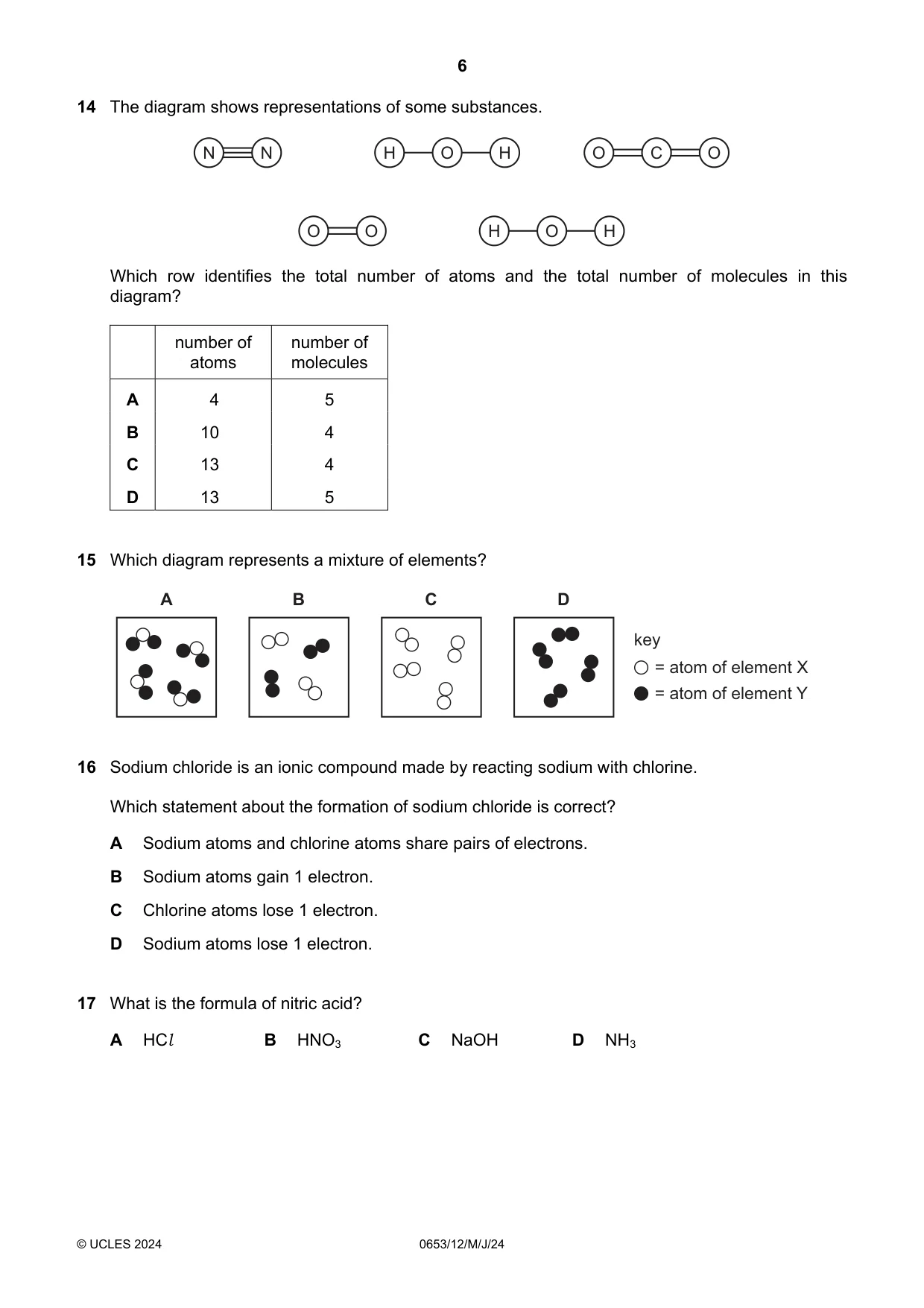
14 The diagram shows representations of some substances. N N H O H O C O O O H O H Which row identifies the total number of atoms and the total number of molecules in this diagram? number of number of atoms molecules A 4 5 B 10 4 C 13 4 D 13 5
Mark scheme: D
Q15 · Which diagram represents a mixture of elements?
15 Which diagram represents a mixture of elements? A B C D key = atom of element X = atom of element Y
Mark scheme: B
Q16 · Sodium chloride is an ionic compound made by reacting sodium with chlorine
16 Sodium chloride is an ionic compound made by reacting sodium with chlorine. Which statement about the formation of sodium chloride is correct? A Sodium atoms and chlorine atoms share pairs of electrons. B Sodium atoms gain 1 electron. C Chlorine atoms lose 1 electron. D Sodium atoms lose 1 electron.
Mark scheme: D
Q17 · What is the formula of nitric acid?
17 What is the formula of nitric acid? A HCl B HNO3 C NaOH D NH3
Mark scheme: B
Q18 · Which row identifies the electrode products in the electrolysis of the named electrolyte?
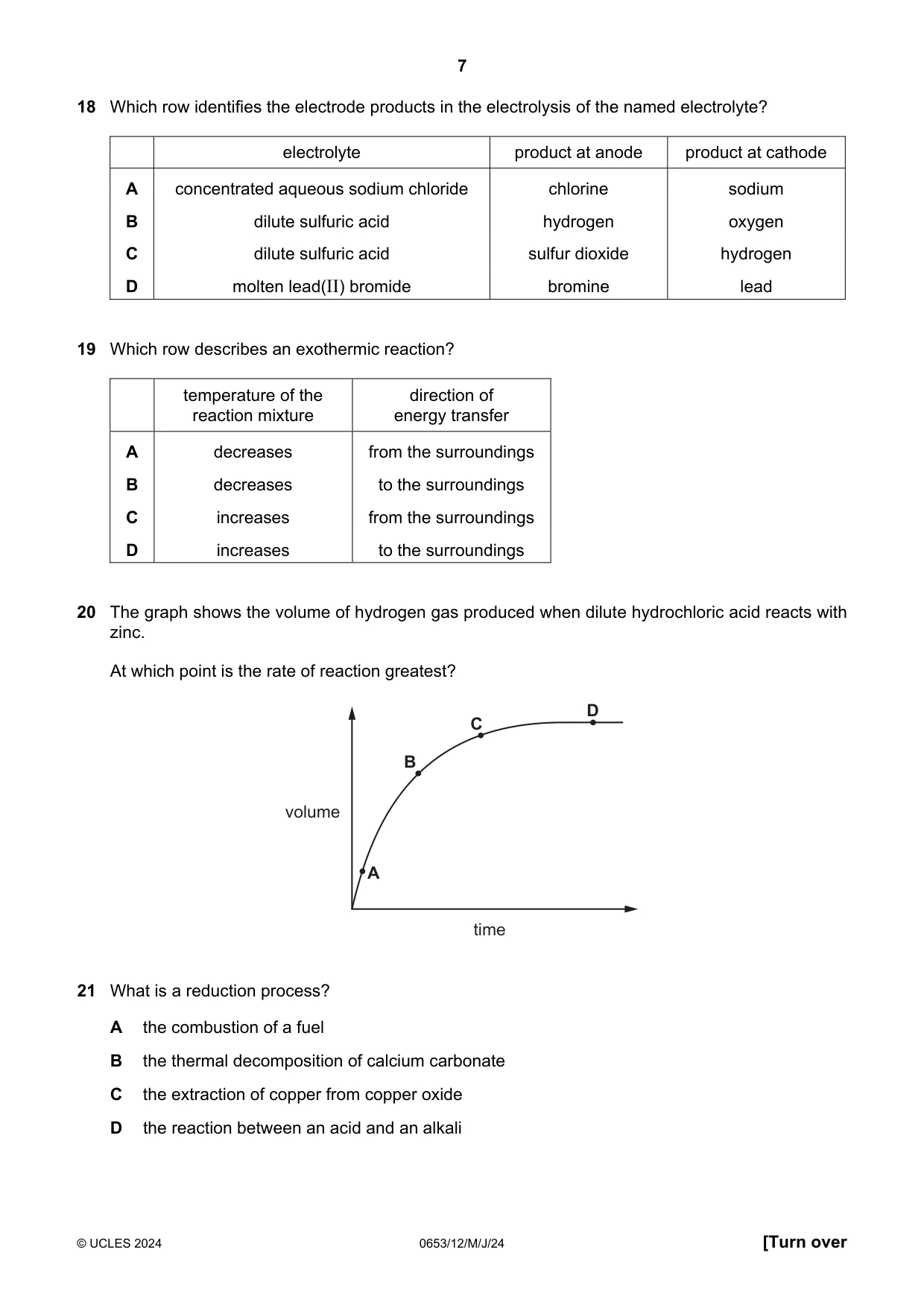
18 Which row identifies the electrode products in the electrolysis of the named electrolyte? electrolyte product at anode product at cathode A concentrated aqueous sodium chloride chlorine sodium B dilute sulfuric acid hydrogen oxygen C dilute sulfuric acid sulfur dioxide hydrogen D molten lead(II) bromide bromine lead
Mark scheme: D
Q19 · Which row describes an exothermic reaction?
19 Which row describes an exothermic reaction? temperature of the direction of reaction mixture energy transfer A decreases from the surroundings B decreases to the surroundings C increases from the surroundings D increases to the surroundings
Mark scheme: D
Q20 · The graph shows the volume of hydrogen gas produced when dilute hydrochloric acid reacts…
20 The graph shows the volume of hydrogen gas produced when dilute hydrochloric acid reacts with zinc. At which point is the rate of reaction greatest? D C B volume A time
Mark scheme: A
Q21 · What is a reduction process?
21 What is a reduction process? A the combustion of a fuel B the thermal decomposition of calcium carbonate C the extraction of copper from copper oxide D the reaction between an acid and an alkali
Mark scheme: C
Q22 · Compound X reacts with dilute nitric acid to give a colourless gas which turns limewater…
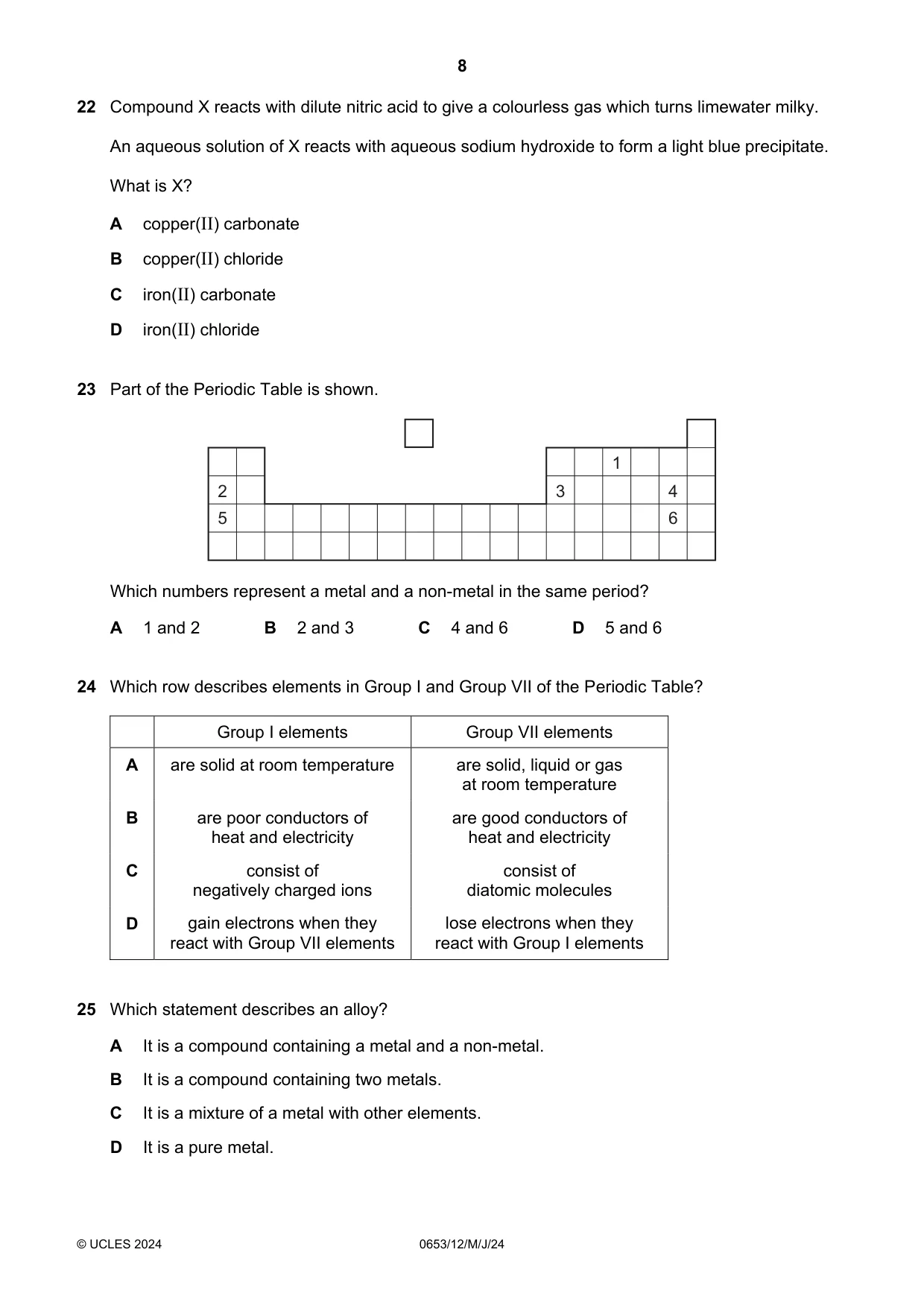
22 Compound X reacts with dilute nitric acid to give a colourless gas which turns limewater milky. An aqueous solution of X reacts with aqueous sodium hydroxide to form a light blue precipitate. What is X? A copper(II) carbonate B copper(II) chloride C iron(II) carbonate D iron(II) chloride
Mark scheme: A
More questions on The characteristic properties of acids and bases
Q23 · Part of the Periodic Table is shown
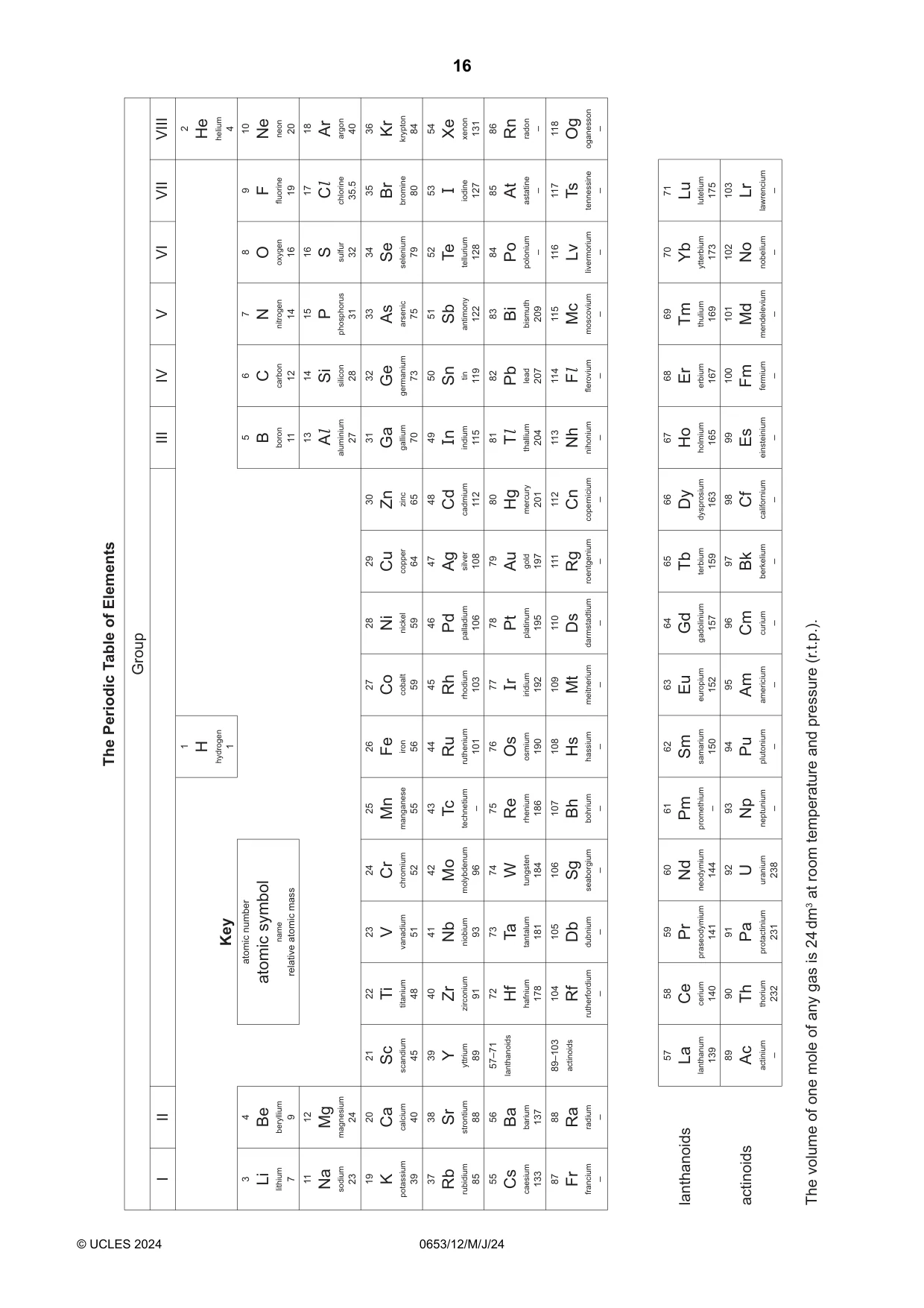
23 Part of the Periodic Table is shown. 1 2 3 4 5 6 Which numbers represent a metal and a non-metal in the same period? A 1 and 2 B 2 and 3 C 4 and 6 D 5 and 6
Mark scheme: D
Q24 · Which row describes elements in Group I and Group VII of the Periodic Table?
24 Which row describes elements in Group I and Group VII of the Periodic Table? Group I elements Group VII elements A are solid at room temperature are solid, liquid or gas at room temperature B are poor conductors of are good conductors of heat and electricity heat and electricity C consist of consist of negatively charged ions diatomic molecules D gain electrons when they lose electrons when they react with Group VII elements react with Group I elements
Mark scheme: A
Q25 · Which statement describes an alloy?
25 Which statement describes an alloy? A It is a compound containing a metal and a non-metal. B It is a compound containing two metals. C It is a mixture of a metal with other elements. D It is a pure metal.
Mark scheme: C
Q26 · Which statements about water are correct?
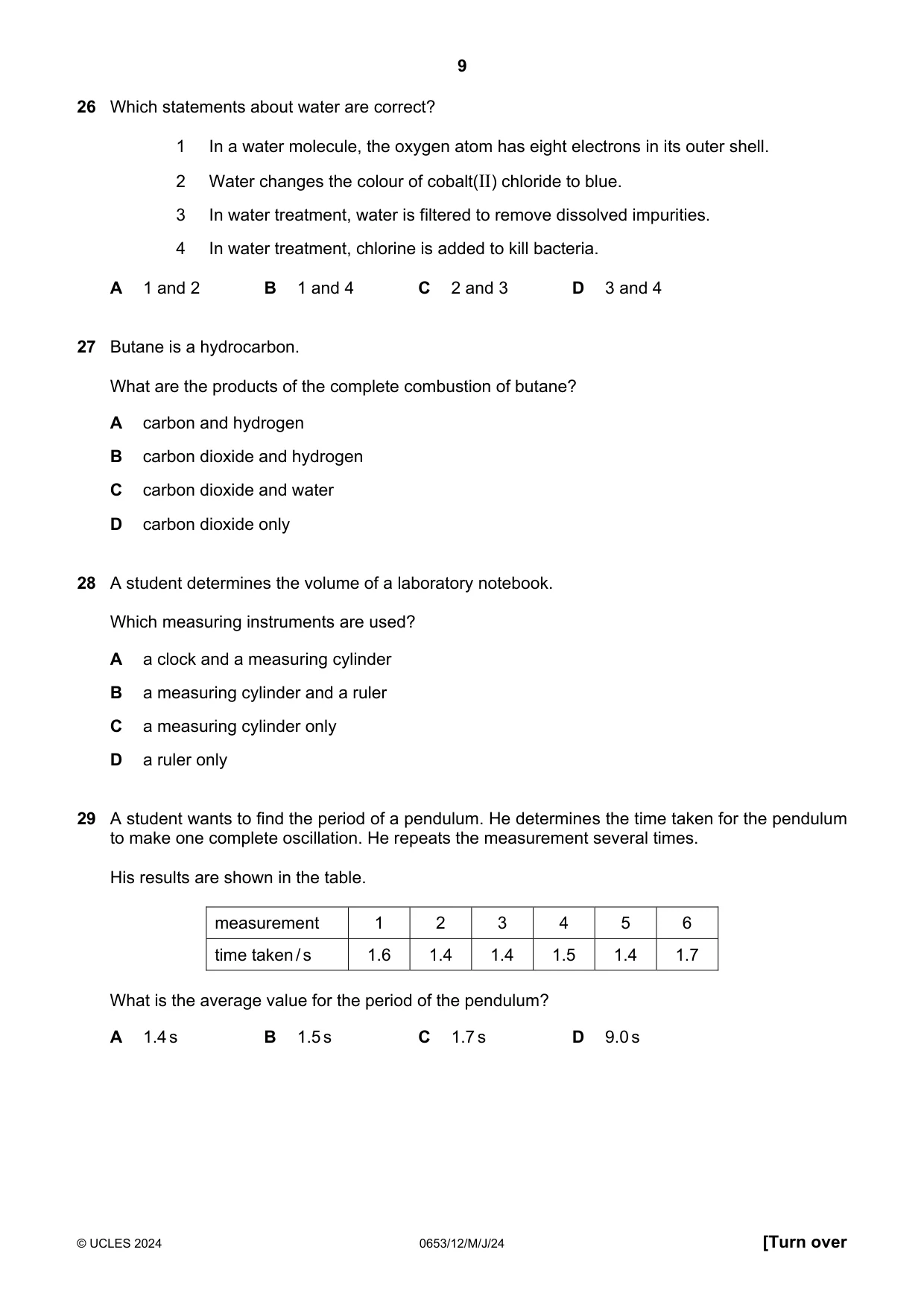
26 Which statements about water are correct? 1 In a water molecule, the oxygen atom has eight electrons in its outer shell. 2 Water changes the colour of cobalt(II) chloride to blue. 3 In water treatment, water is filtered to remove dissolved impurities. 4 In water treatment, chlorine is added to kill bacteria. A 1 and 2 B 1 and 4 C 2 and 3 D 3 and 4
Mark scheme: B
Q27 · Butane is a hydrocarbon
27 Butane is a hydrocarbon. What are the products of the complete combustion of butane? A carbon and hydrogen B carbon dioxide and hydrogen C carbon dioxide and water D carbon dioxide only
Mark scheme: C
Q28 · A student determines the volume of a laboratory notebook
28 A student determines the volume of a laboratory notebook. Which measuring instruments are used? A a clock and a measuring cylinder B a measuring cylinder and a ruler C a measuring cylinder only D a ruler only
Mark scheme: D
More questions on Physical quantities and measurement techniques
Q29 · A student wants to find the period of a pendulum
29 A student wants to find the period of a pendulum. He determines the time taken for the pendulum to make one complete oscillation. He repeats the measurement several times. His results are shown in the table. measurement 1 2 3 4 5 6 time taken / s 1.6 1.4 1.4 1.5 1.4 1.7 What is the average value for the period of the pendulum? A 1.4 s B 1.5 s C 1.7 s D 9.0 s
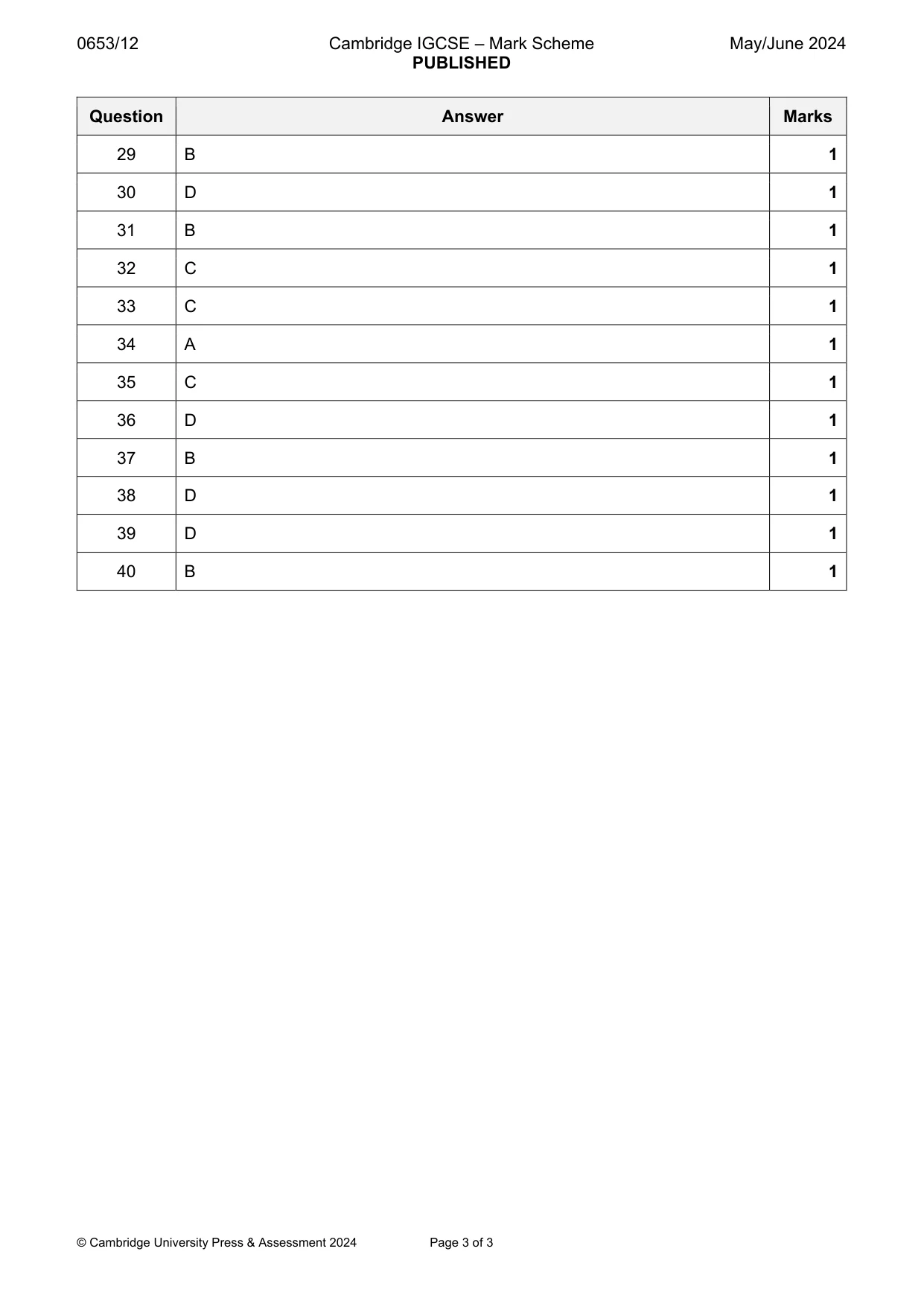
Mark scheme: B
More questions on Physical quantities and measurement techniques
Question 30
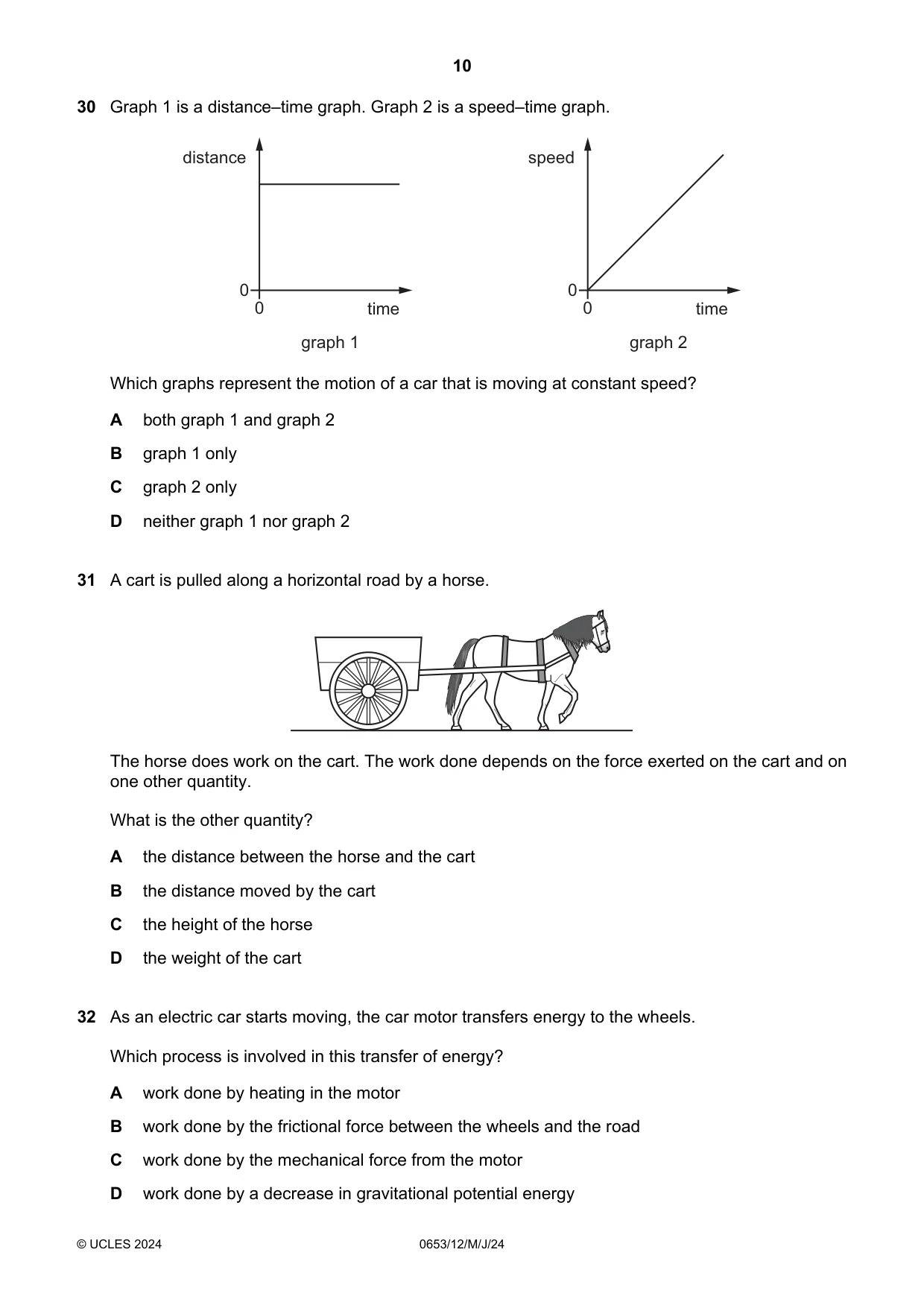
30 Graph 1 is a distance–time graph. Graph 2 is a speed–time graph. distance speed 0 0 0 time 0 time graph 1 graph 2 Which graphs represent the motion of a car that is moving at constant speed? A both graph 1 and graph 2 B graph 1 only C graph 2 only D neither graph 1 nor graph 2
Mark scheme: D
Q31 · A cart is pulled along a horizontal road by a horse
31 A cart is pulled along a horizontal road by a horse. The horse does work on the cart. The work done depends on the force exerted on the cart and on one other quantity. What is the other quantity? A the distance between the horse and the cart B the distance moved by the cart C the height of the horse D the weight of the cart
Mark scheme: B
Q32 · As an electric car starts moving, the car motor transfers energy to the wheels
32 As an electric car starts moving, the car motor transfers energy to the wheels. Which process is involved in this transfer of energy? A work done by heating in the motor B work done by the frictional force between the wheels and the road C work done by the mechanical force from the motor D work done by a decrease in gravitational potential energy
Mark scheme: C
Q33 · Which energy resource is non-renewable?
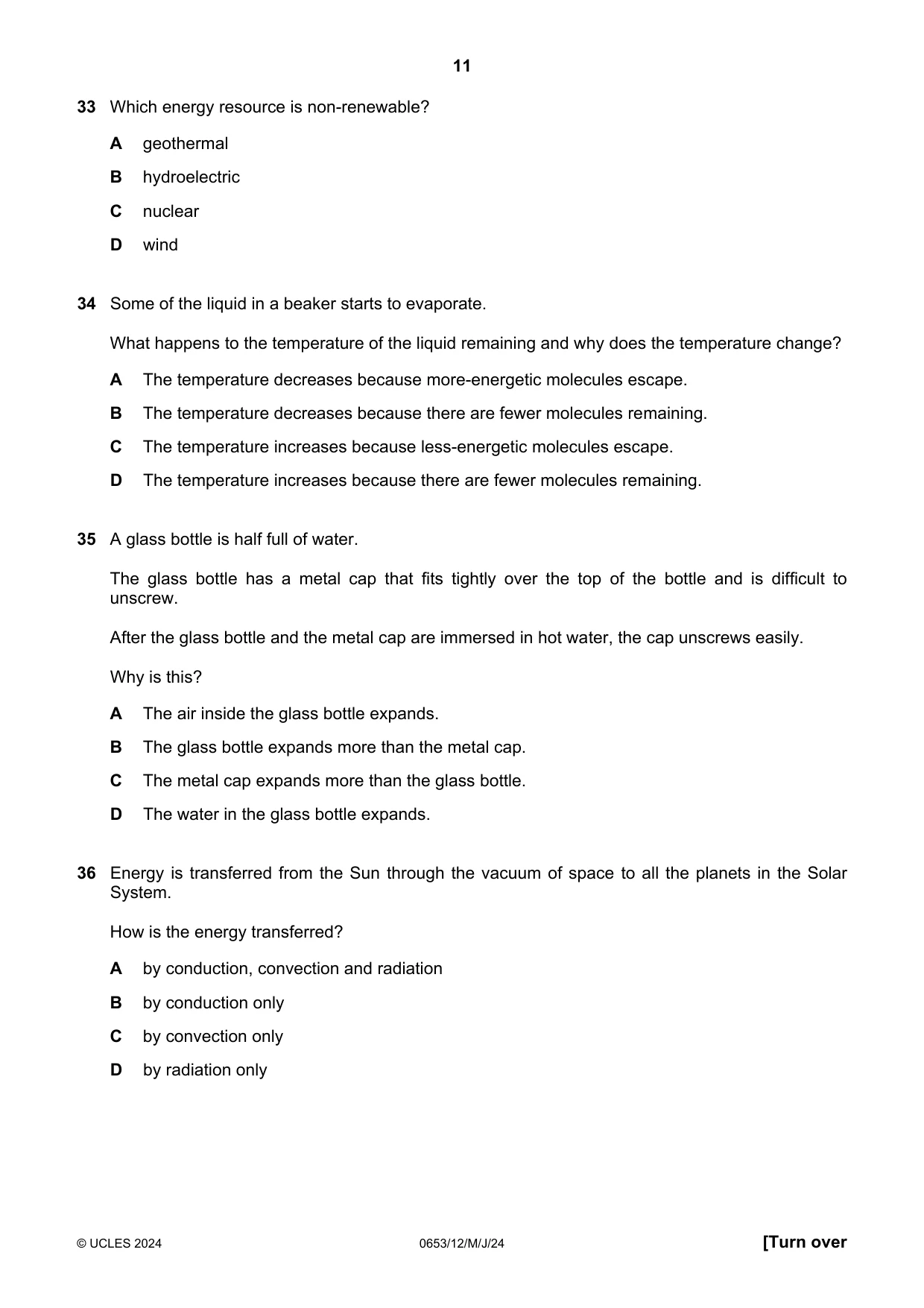
33 Which energy resource is non-renewable? A geothermal B hydroelectric C nuclear D wind
Mark scheme: C
Q34 · Some of the liquid in a beaker starts to evaporate
34 Some of the liquid in a beaker starts to evaporate. What happens to the temperature of the liquid remaining and why does the temperature change? A The temperature decreases because more-energetic molecules escape. B The temperature decreases because there are fewer molecules remaining. C The temperature increases because less-energetic molecules escape. D The temperature increases because there are fewer molecules remaining.
Mark scheme: A
Q35 · A glass bottle is half full of water
35 A glass bottle is half full of water. The glass bottle has a metal cap that fits tightly over the top of the bottle and is difficult to unscrew. After the glass bottle and the metal cap are immersed in hot water, the cap unscrews easily. Why is this? A The air inside the glass bottle expands. B The glass bottle expands more than the metal cap. C The metal cap expands more than the glass bottle. D The water in the glass bottle expands.
Mark scheme: C
Q36 · Energy is transferred from the Sun through the vacuum of space to all the planets in the…
36 Energy is transferred from the Sun through the vacuum of space to all the planets in the Solar System. How is the energy transferred? A by conduction, convection and radiation B by conduction only C by convection only D by radiation only
Mark scheme: D
Q37 · Which diagram shows how a converging lens forms a real image of object O at the point…
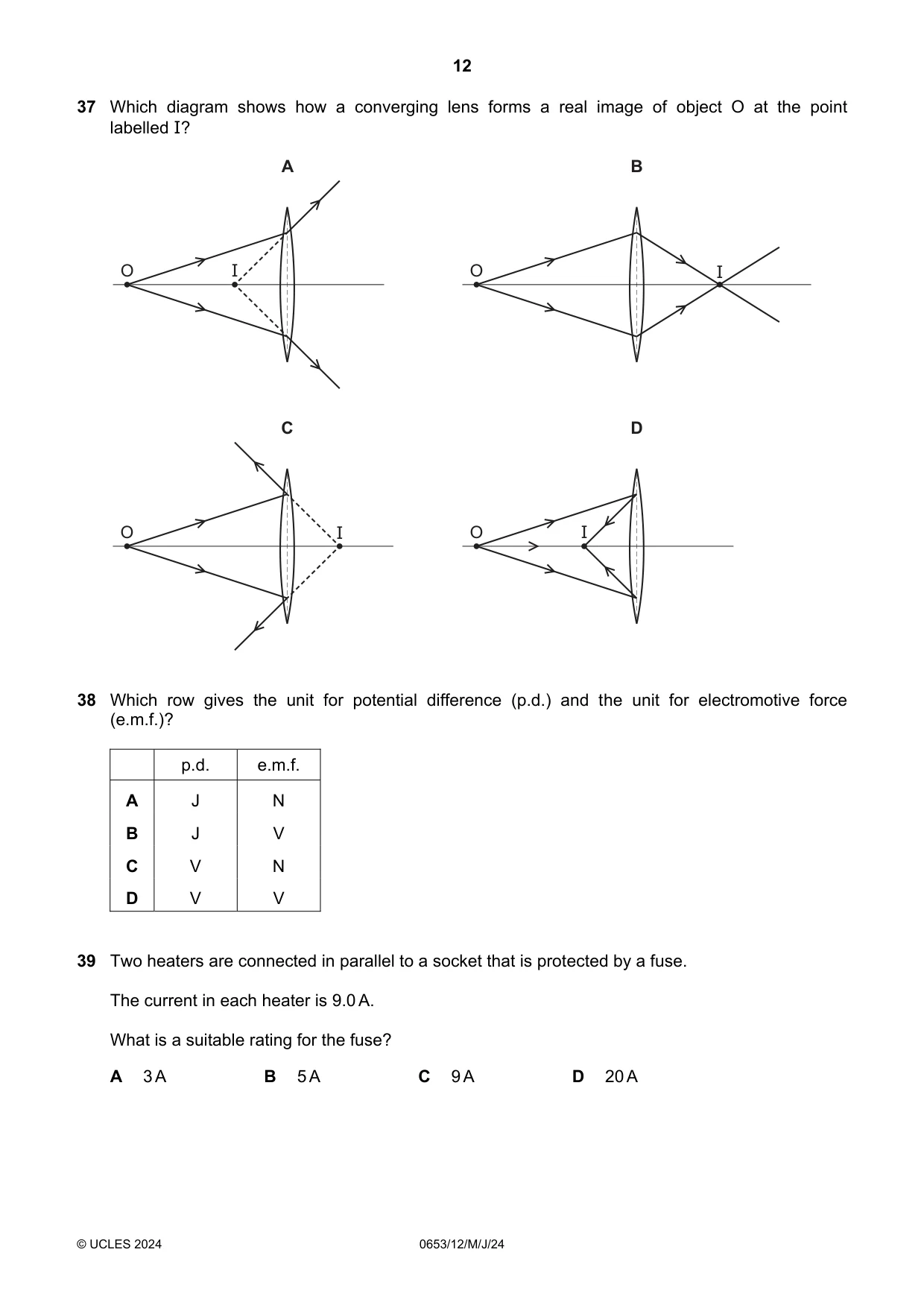
37 Which diagram shows how a converging lens forms a real image of object O at the point labelled I? A B O I O I C D O I O I
Mark scheme: B
Q38 · Which row gives the unit for potential difference (p.d.) and the unit for electromotive…
38 Which row gives the unit for potential difference (p.d.) and the unit for electromotive force (e.m.f.)? p.d. e.m.f. A J N B J V C V N D V V
Mark scheme: D
Q39 · Two heaters are connected in parallel to a socket that is protected by a fuse
39 Two heaters are connected in parallel to a socket that is protected by a fuse. The current in each heater is 9.0 A. What is a suitable rating for the fuse? A 3 A B 5 A C 9 A D 20 A
Mark scheme: D
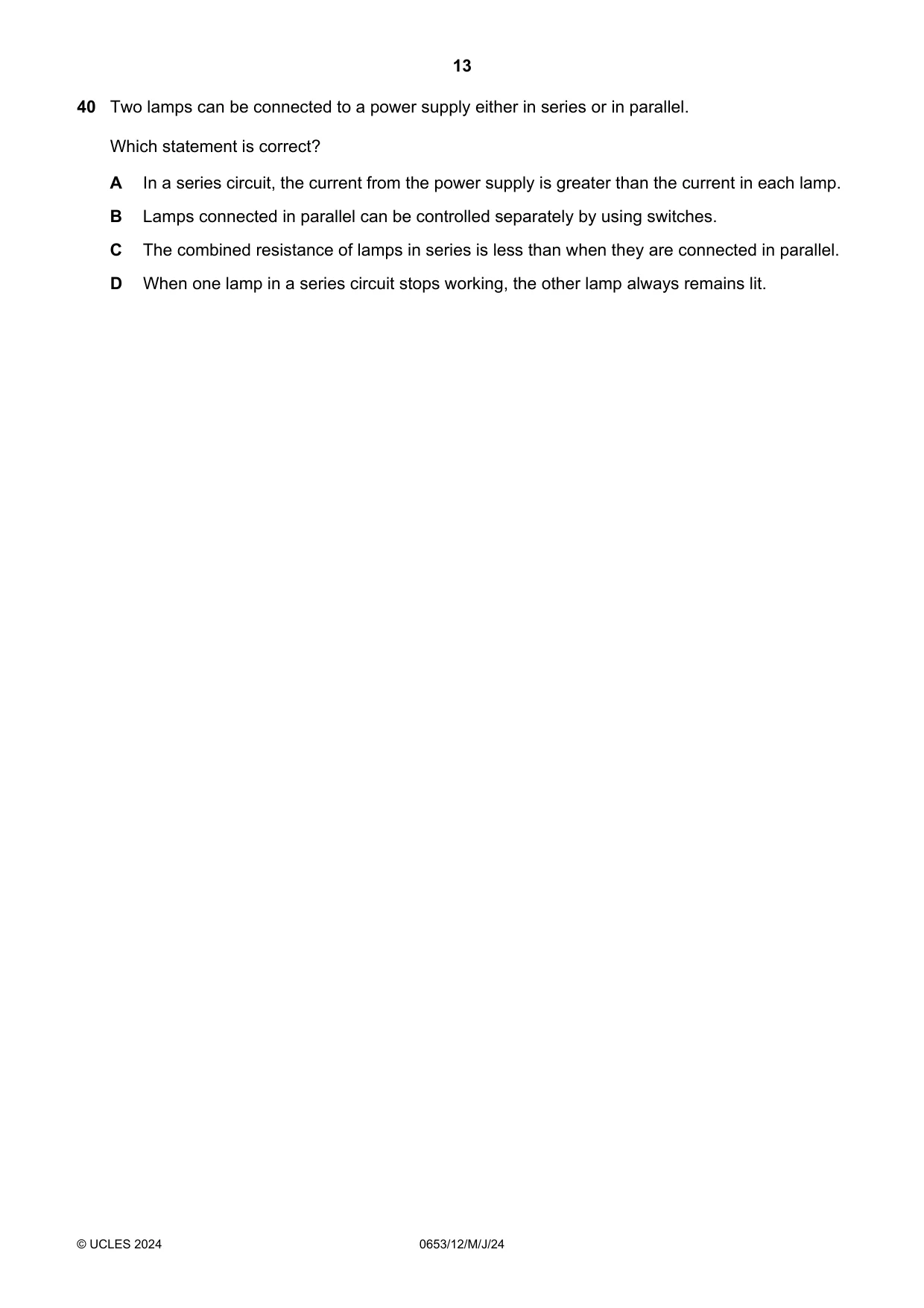
Q40 · Two lamps can be connected to a power supply either in series or in parallel
40 Two lamps can be connected to a power supply either in series or in parallel. Which statement is correct? A In a series circuit, the current from the power supply is greater than the current in each lamp. B Lamps connected in parallel can be controlled separately by using switches. C The combined resistance of lamps in series is less than when they are connected in parallel. D When one lamp in a series circuit stops working, the other lamp always remains lit.
Mark scheme: B
What was in this paper
The subtopics covered by these 40 questions, and how many questions each got. Open one in a new tab to see every Cambridge question on it.
3Formulas2Physical quantities and measurement techniques2Alloys and their properties1Arrangement of elements1Characteristics of living organisms1Diet1Digestion1Digestive system1Drugs1Electrical circuits1Electrical quantities1Electrical safety1Electrolysis1Elements, compounds and mixtures1Enzymes1Exothermic and endothermic reactions1Food chains and food webs1Fuels1Gas exchange in humans1Group I properties1Habitat destruction1Ions and ionic bonds1Kinetic particle model of matter1Light1Motion1Osmosis1Photosynthesis1Rate of reaction1Redox1Sexual reproduction in plants1The characteristic properties of acids and bases1Thermal properties and temperature1Transfer of thermal energy1Transpiration1Water1What you needed in this session
Cambridge’s own grade thresholds for 2024 May/June, Paper 1 · Variant 2. A higher threshold means an easier paper — the bar moves with how the cohort did.