Cambridge IGCSE Science - Combined 0653 — 2020 Oct/Nov Paper 1 · Variant 1
0653/11/O/N/20 · 40 questions · 40 marks · ≈45 min
The question paper and its mark scheme, free to read here and free to download. This is Cambridge’s own paper, exactly as it was sat.
Question paper16 pages
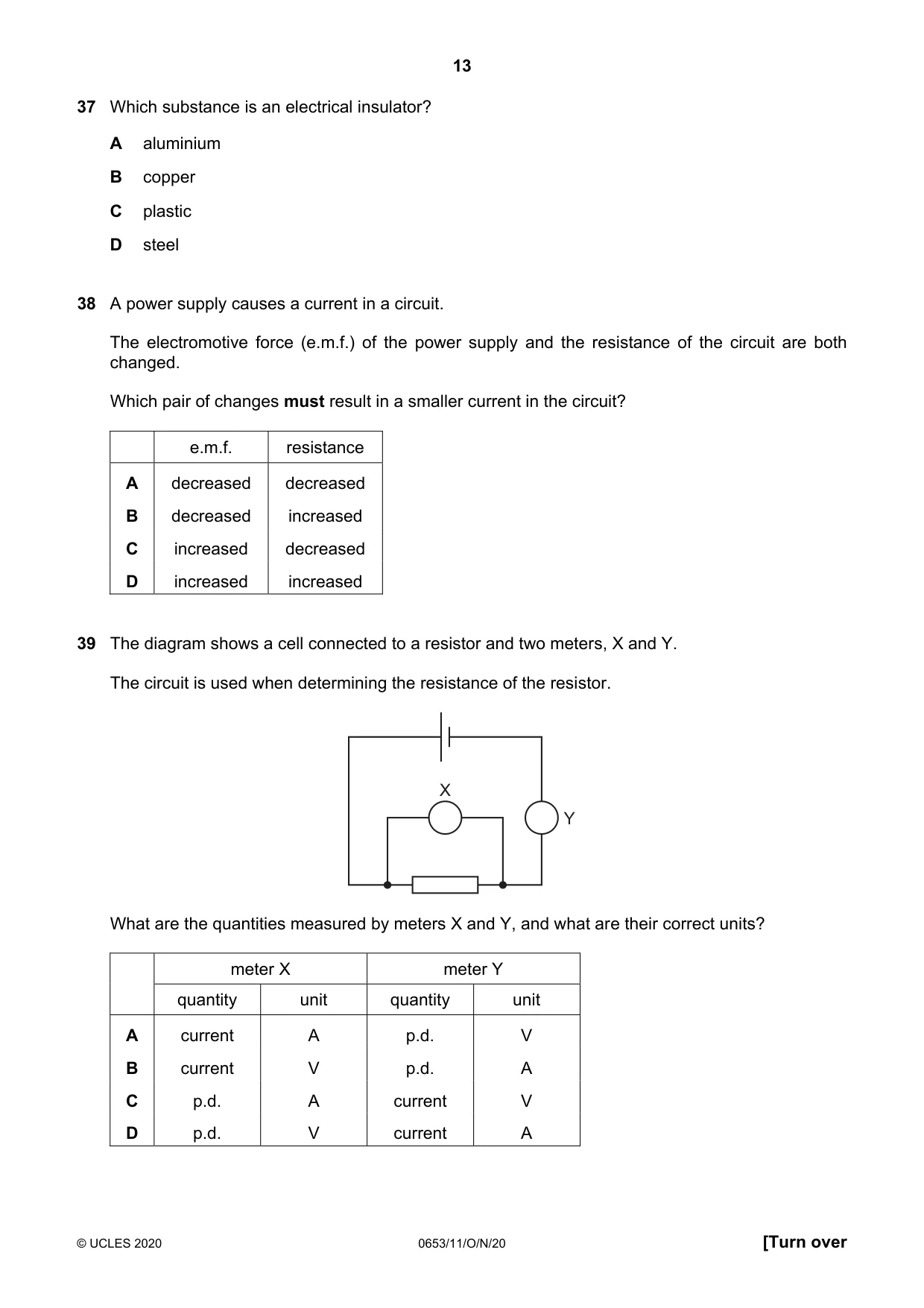
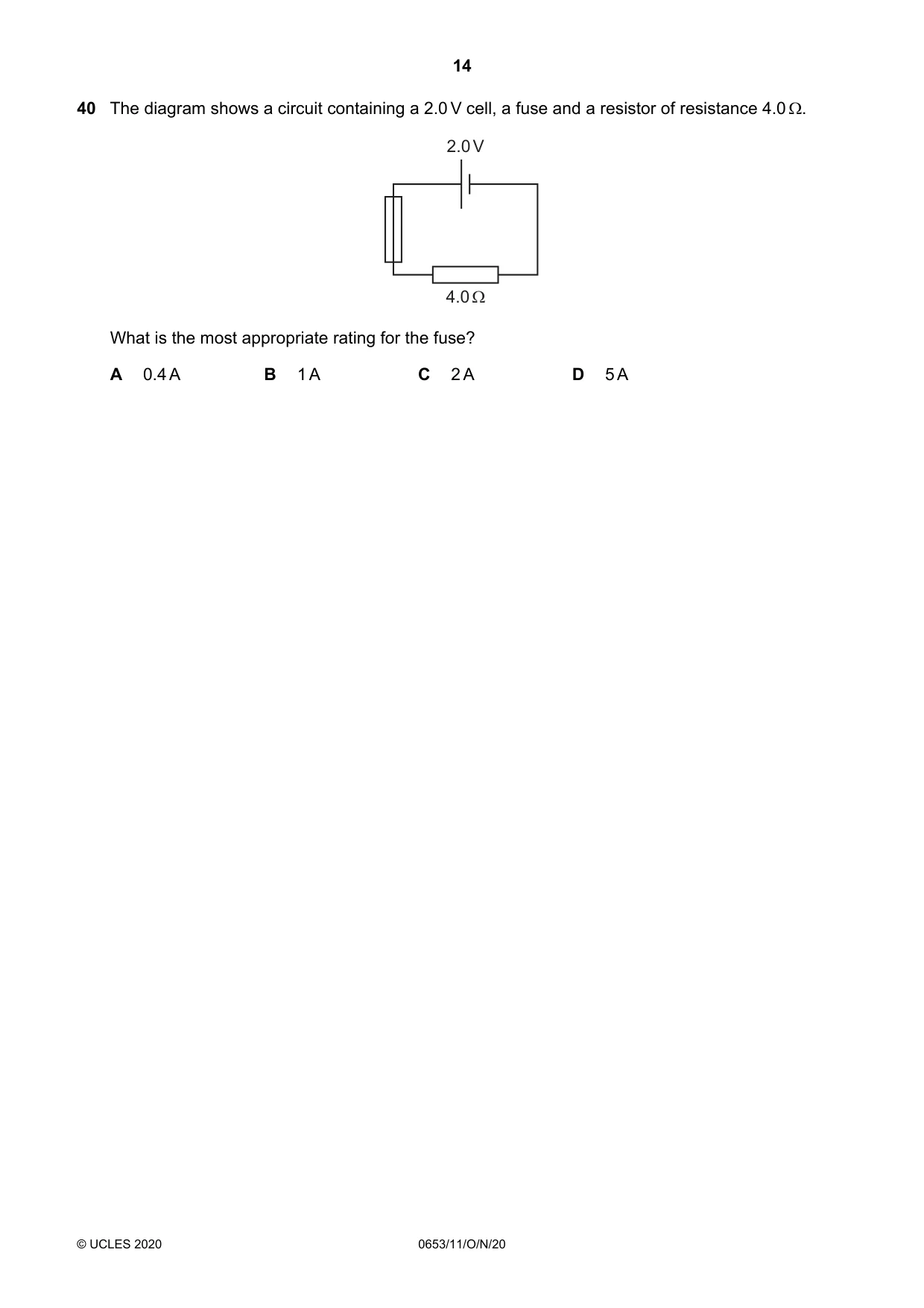
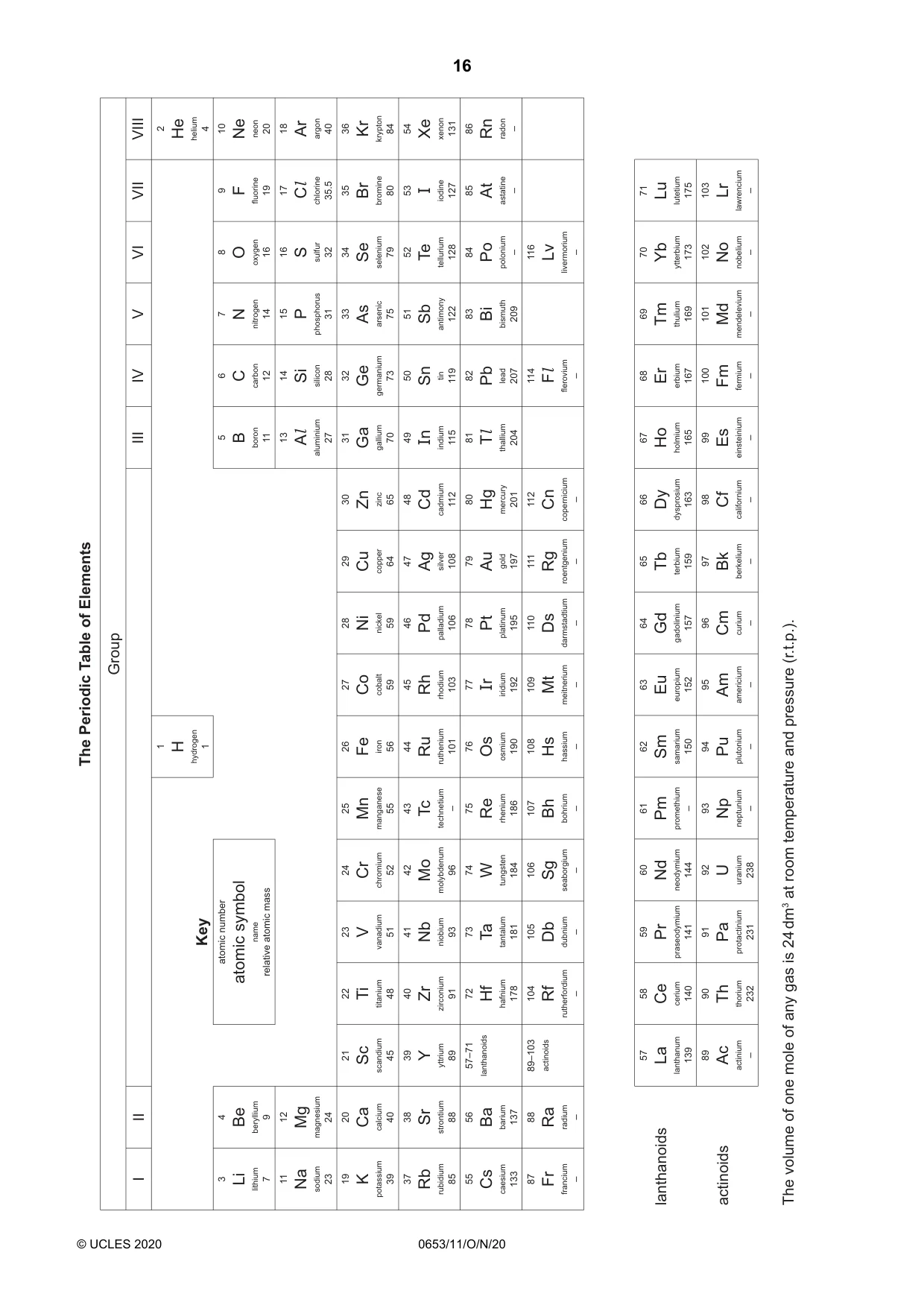
Mark scheme3 pages
Answers below. Sit the paper first if you are practising.
Questions as text
Q1 · A motor car has many features that are similar to the characteristics of living things
1 A motor car has many features that are similar to the characteristics of living things. Which characteristic of living organisms cannot be matched to a feature of a car? A release of energy by breaking down energy-rich molecules B release of waste materials C reproduction of a similar version of itself D takes in materials for energy
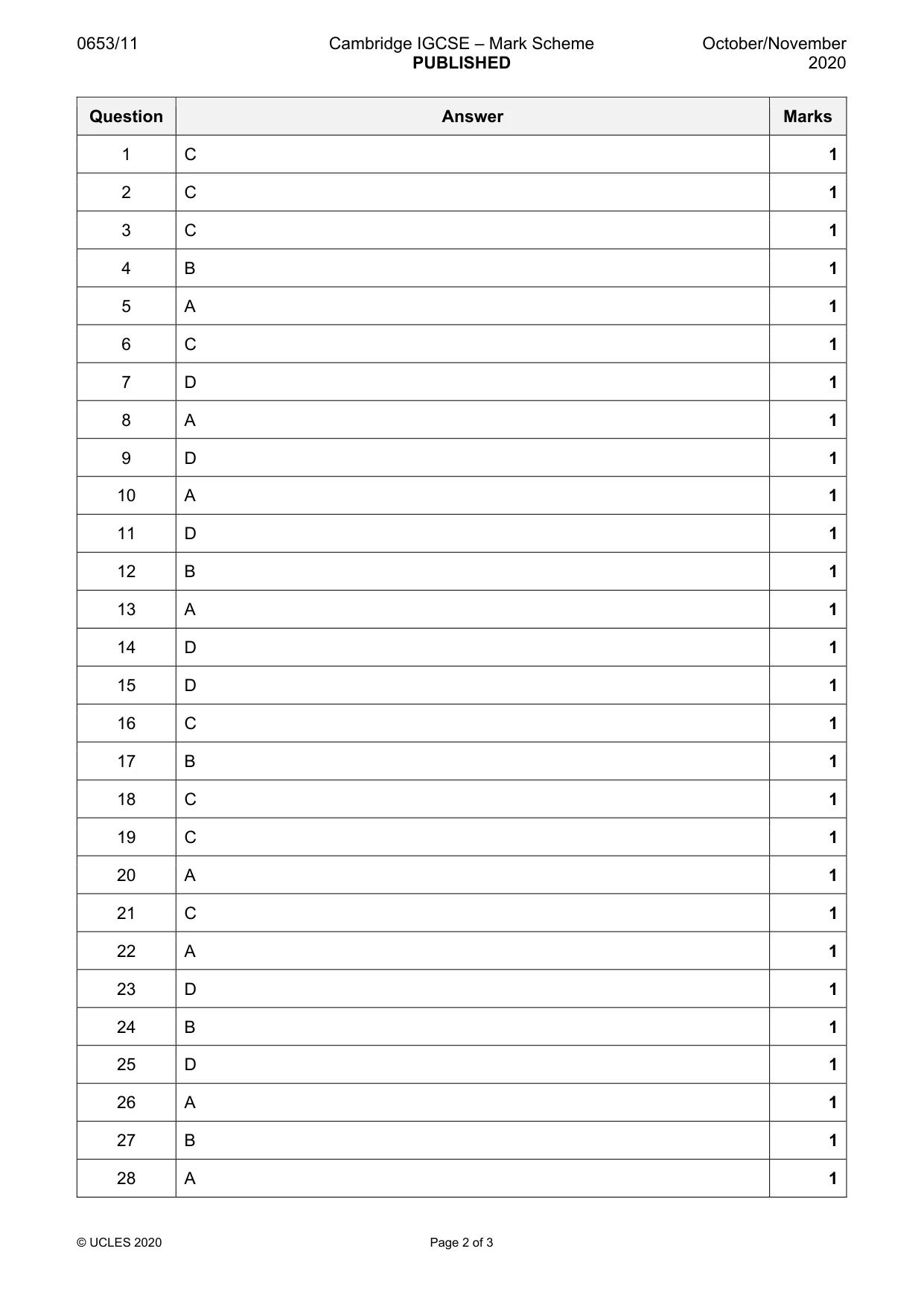
Mark scheme: C
Q2 · The diagram shows a cell
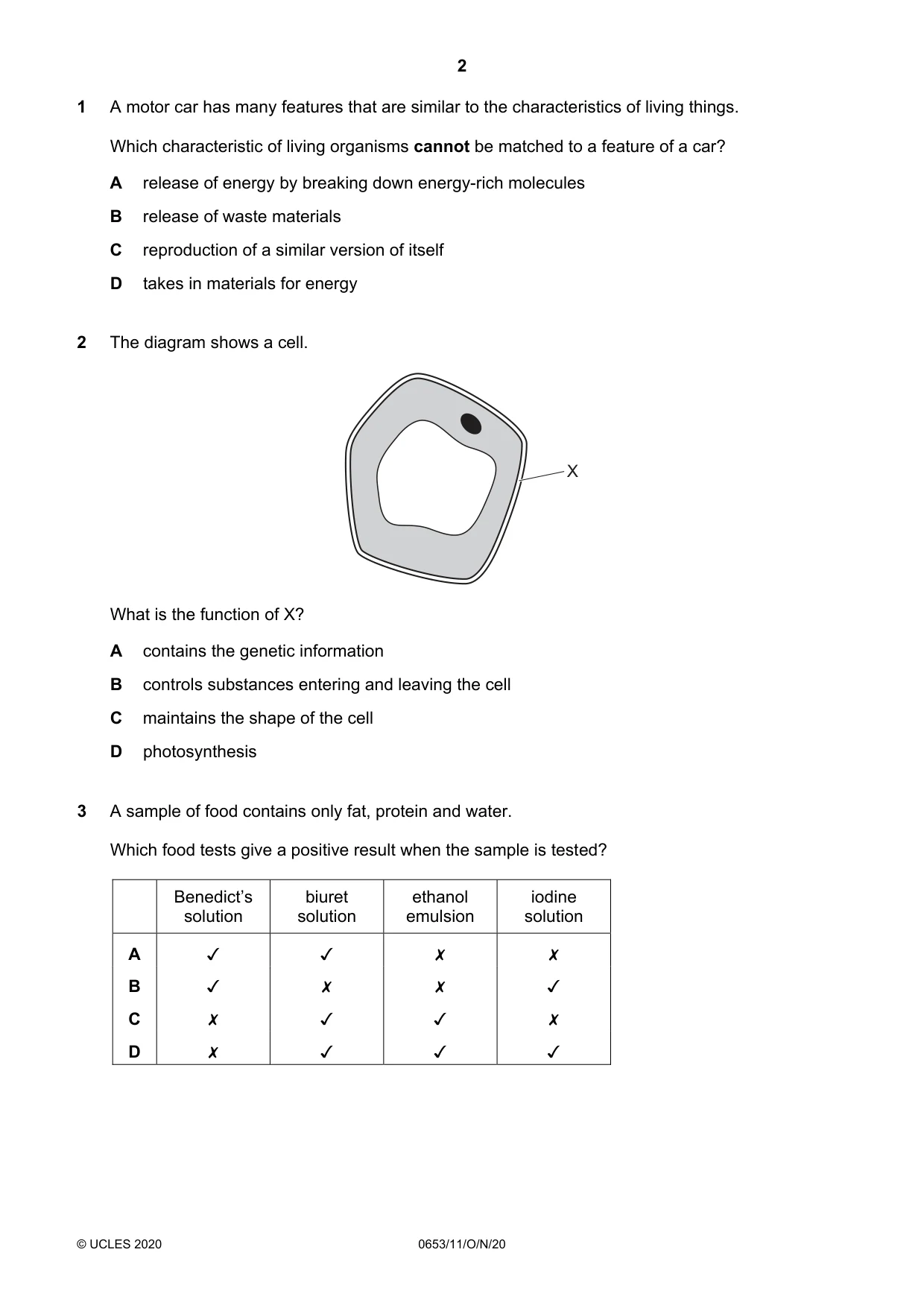
2 The diagram shows a cell. X What is the function of X? A contains the genetic information B controls substances entering and leaving the cell C maintains the shape of the cell D photosynthesis
Mark scheme: C
Q3 · Asample of food contains only fat, protein and water
3 Asample of food contains only fat, protein and water. Which food tests give a positive result when the sample is tested? Benedict's biuret ethanol iodine solution solution emulsion solution Jv Jv x x v x x Jv x Jv J x x Jv J Jv
Mark scheme: C
Q4 · The diagram shows how the activity of an enzyme changes with temperature
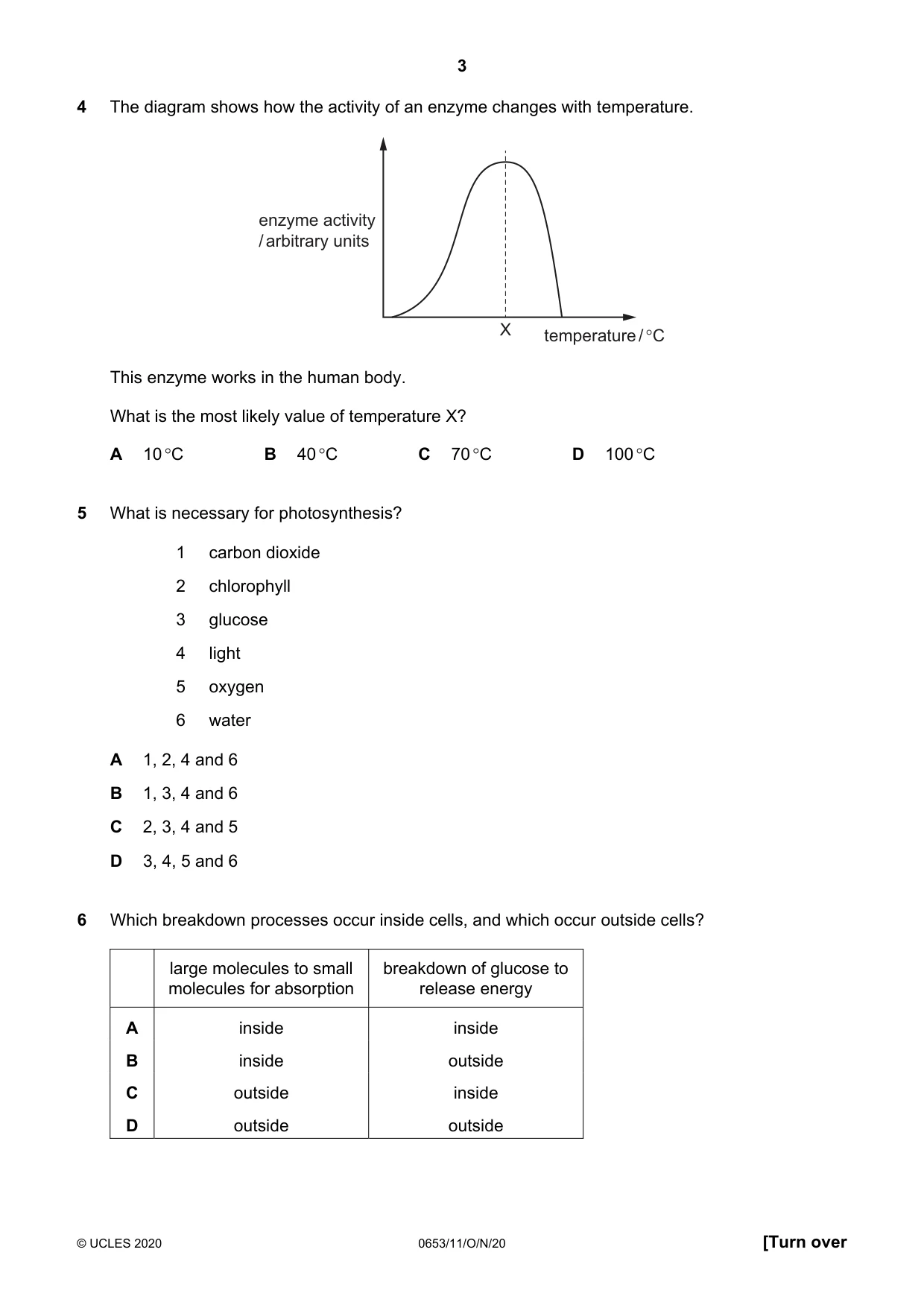
4 The diagram shows how the activity of an enzyme changes with temperature. enzyme activity / arbitrary units X temperature / °C This enzyme works in the human body. What is the most likely value of temperature X? A 10 C B 40 C C 70 C D 100 C
Mark scheme: B
Q5 · What is necessary for photosynthesis?
5 What is necessary for photosynthesis? 1 carbon dioxide 2 chlorophyll 3 glucose 4 light 5 oxygen 6 water A 1, 2, 4 and 6 B 1, 3, 4 and 6 C 2, 3, 4 and 5 D 3, 4, 5 and 6
Mark scheme: A
Q6 · Which breakdown processes occur inside cells, and which occur outside cells?
6 Which breakdown processes occur inside cells, and which occur outside cells? large molecules to small breakdown of glucose to molecules for absorption release energy A inside inside B inside outside C outside inside D outside outside
Mark scheme: C
Q7 · Which statement about the pulmonary vein is correct?
7 Which statement about the pulmonary vein is correct? A It carries blood from the heart to the body. B It carries blood from the heart to the lungs. C It carries blood to the heart from the body. D It carries blood to the heart from the lungs.
Mark scheme: D
Q8 · Which statement about adrenaline is correct?
8 Which statement about adrenaline is correct? A It is produced by a gland. B It is transported in the red blood cells. C It only has one target organ. D It reduces the size of the pupils.
Mark scheme: A
Q9 · Which row about whether roots and shoots respond to gravity is correct?
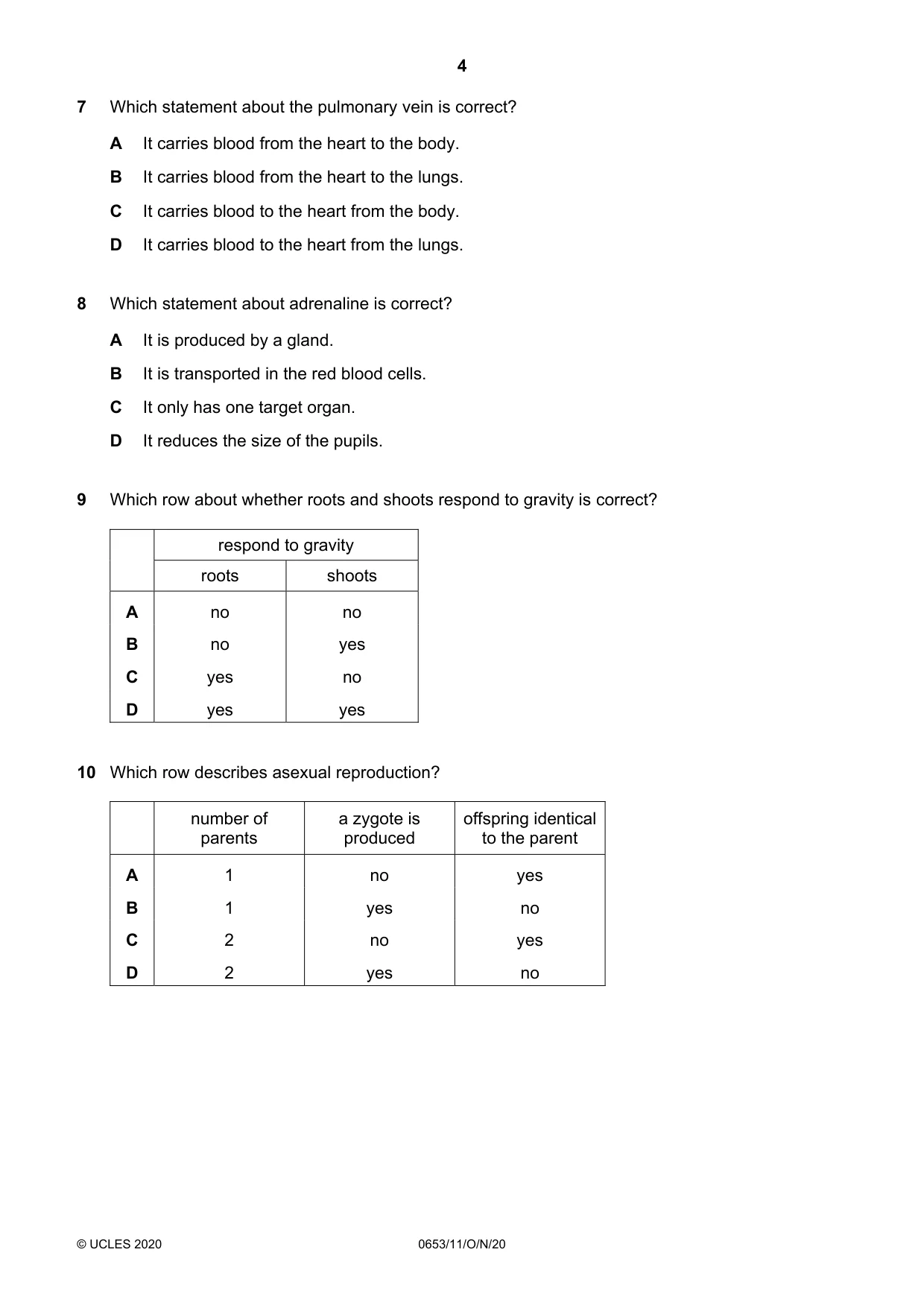
9 Which row about whether roots and shoots respond to gravity is correct? respond to gravity roots shoots A no no B no yes C yes no D yes yes
Mark scheme: D
Q10 · Which row describes asexual reproduction?
10 Which row describes asexual reproduction? number of a zygote is offspring identical parents produced to the parent A 1 no yes B 1 yes no C 2 no yes D 2 yes no
Mark scheme: A
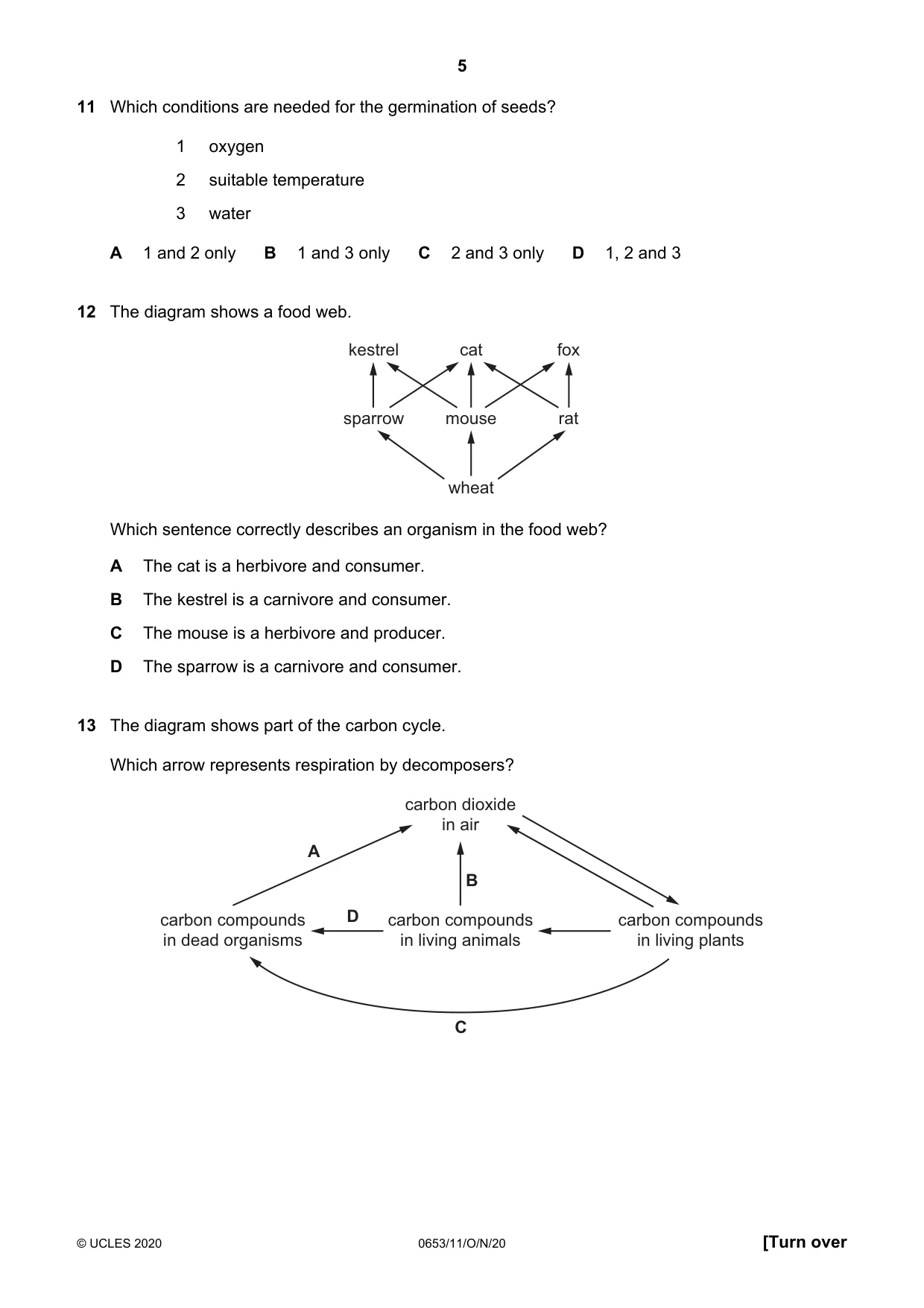
Q11 · Which conditions are needed for the germination of seeds?
11 Which conditions are needed for the germination of seeds? 1 oxygen 2 suitable temperature 3 water A 1 and 2 only B 1 and 3 only C 2 and 3 only D 1, 2 and 3
Mark scheme: D
Q12 · The diagram shows a food web
12 The diagram shows a food web. kestrel cat fox sparrow mouse rat wheat Which sentence correctly describes an organism in the food web? A The cat is a herbivore and consumer. B The kestrel is a carnivore and consumer. C The mouse is a herbivore and producer. D The sparrow is a carnivore and consumer.
Mark scheme: B
Q13 · The diagram shows part of the carbon cycle
13 The diagram shows part of the carbon cycle. Which arrow represents respiration by decomposers? carbon dioxide in air A B carbon compounds D carbon compounds carbon compounds in dead organisms in living animals in living plants C
Mark scheme: A
Q14 · Which term describes ammonia, NH3?
14 Which term describes ammonia, NH3? A element B ion C atom D molecule
Mark scheme: D
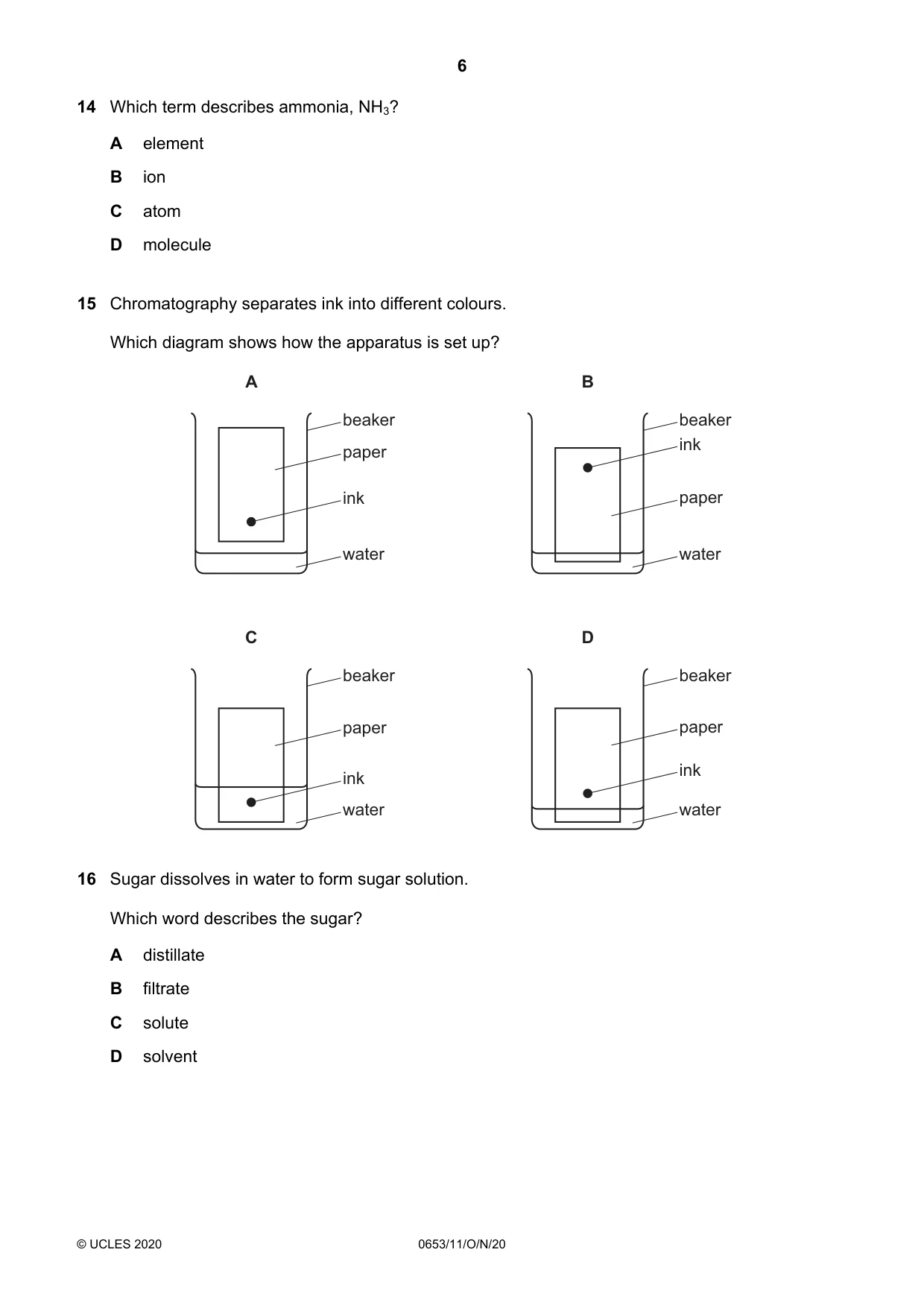
Q15 · Chromatography separates ink into different colours
15 Chromatography separates ink into different colours. Which diagram shows how the apparatus is set up? A B beaker beaker paper ink ink paper water water C D beaker beaker paper paper ink ink water water
Mark scheme: D
Q16 · Sugar dissolves in water to form sugar solution
16 Sugar dissolves in water to form sugar solution. Which word describes the sugar? A distillate B filtrate C solute D solvent
Mark scheme: C
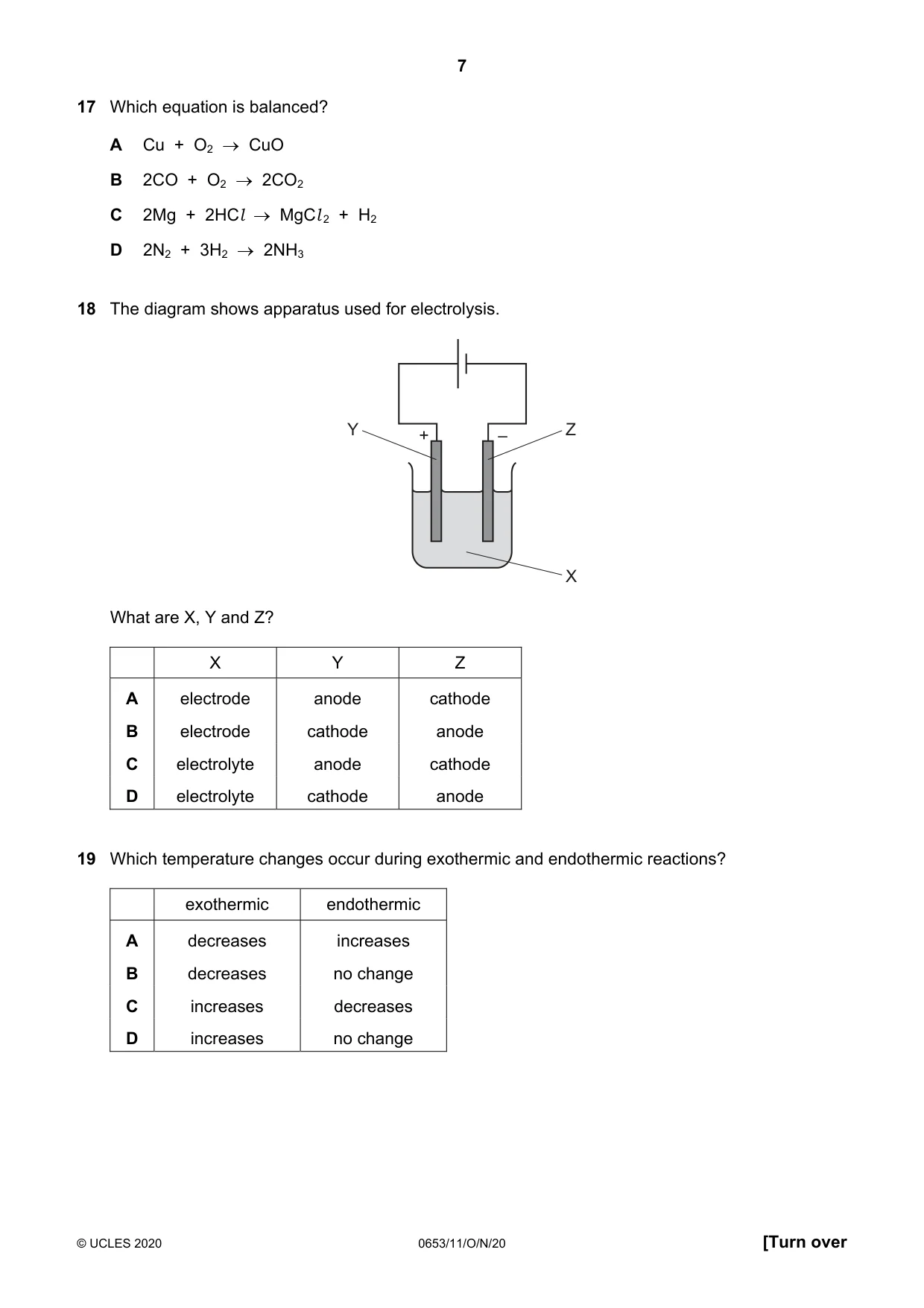
Q17 · Which equation is balanced?
17 Which equation is balanced? A Cu + O2 CuO B 2CO + O2 2CO2 C 2Mg + 2HCl MgCl 2 + H2 D 2N2 + 3H2 2NH3
Mark scheme: B
Q18 · The diagram shows apparatus used for electrolysis
18 The diagram shows apparatus used for electrolysis. Y + – Z X What are X, Y and Z? X Y Z A electrode anode cathode B electrode cathode anode C electrolyte anode cathode D electrolyte cathode anode
Mark scheme: C
Q19 · Which temperature changes occur during exothermic and endothermic reactions?
19 Which temperature changes occur during exothermic and endothermic reactions? exothermic endothermic A decreases increases B decreases no change C increases decreases D increases no change
Mark scheme: C
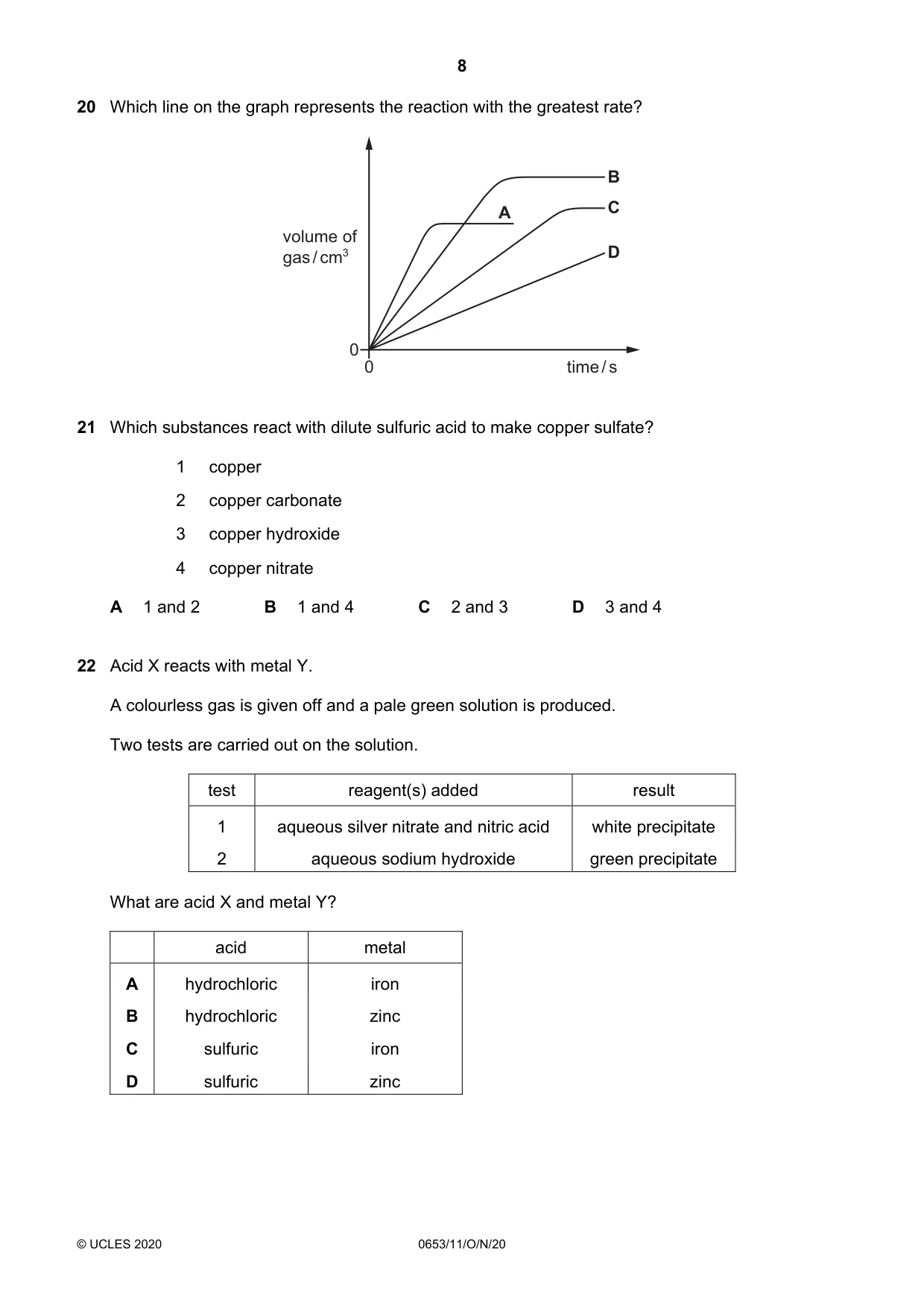
Q20 · Which line on the graph represents the reaction with the greatest rate?
20 Which line on the graph represents the reaction with the greatest rate? B A C volume of gas / cm3 D 0 0 time / s
Mark scheme: A
Q21 · Which substances react with dilute sulfuric acid to make copper sulfate?
21 Which substances react with dilute sulfuric acid to make copper sulfate? 1 copper 2 copper carbonate 3 copper hydroxide 4 copper nitrate A 1 and 2 B 1 and 4 C 2 and 3 D 3 and 4
Mark scheme: C
Q22 · Acid X reacts with metal Y
22 Acid X reacts with metal Y. A colourless gas is given off and a pale green solution is produced. Two tests are carried out on the solution. test reagent(s) added result 1 aqueous silver nitrate and nitric acid white precipitate 2 aqueous sodium hydroxide green precipitate What are acid X and metal Y? acid metal A hydrochloric iron B hydrochloric zinc C sulfuric iron D sulfuric zinc
Mark scheme: A
Q23 · Which statement about the Periodic Table is not correct?
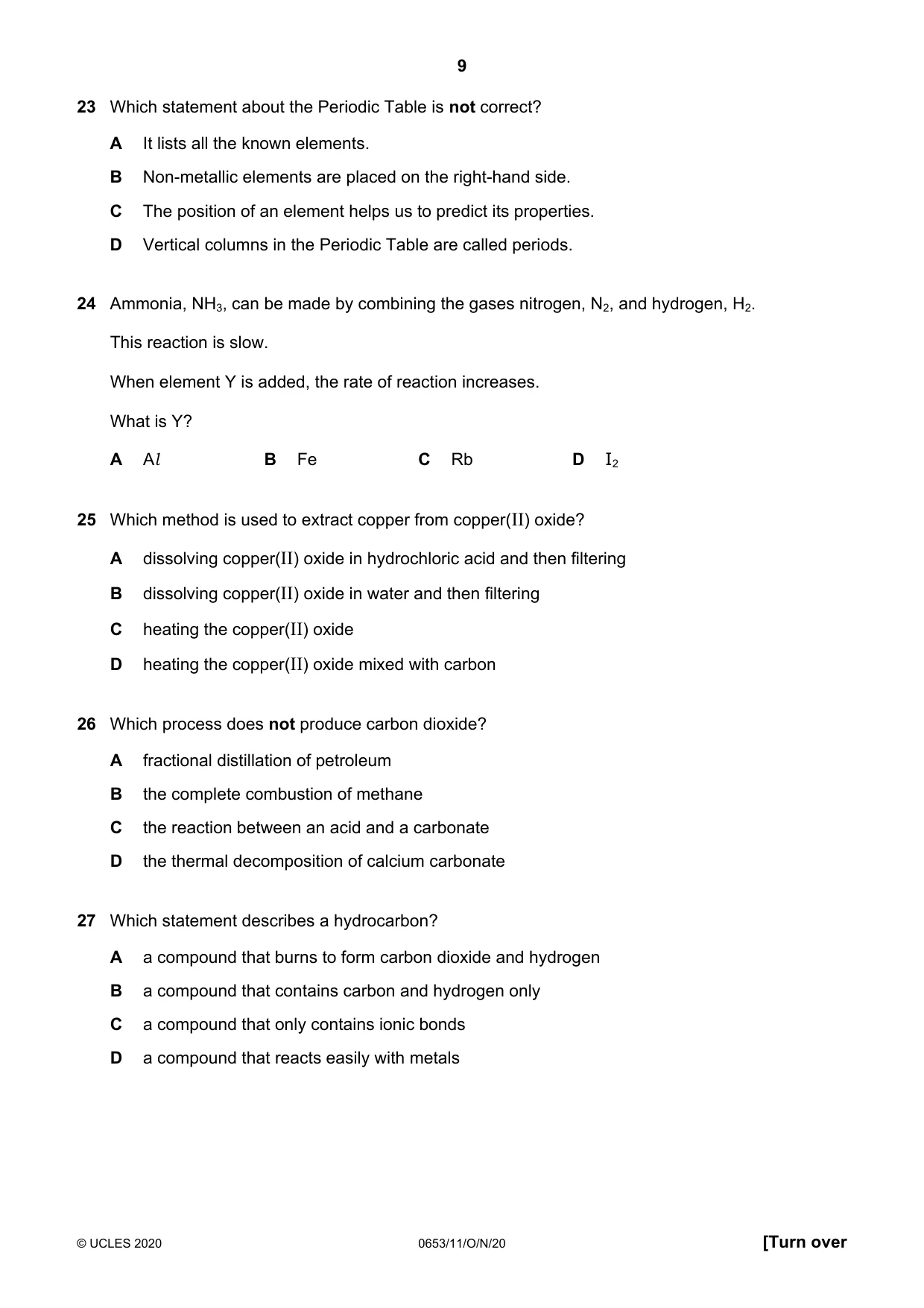
23 Which statement about the Periodic Table is not correct? A It lists all the known elements. B Non-metallic elements are placed on the right-hand side. C The position of an element helps us to predict its properties. D Vertical columns in the Periodic Table are called periods.
Mark scheme: D
Q24 · Ammonia, NH3, can be made by combining the gases nitrogen, N2, and hydrogen, H2
24 Ammonia, NH3, can be made by combining the gases nitrogen, N2, and hydrogen, H2. This reaction is slow. When element Y is added, the rate of reaction increases. What is Y? A Al B Fe C Rb D I2
Mark scheme: B
Q25 · Which method is used to extract copper from copper(II) oxide?
25 Which method is used to extract copper from copper(II) oxide? A dissolving copper(II) oxide in hydrochloric acid and then filtering B dissolving copper(II) oxide in water and then filtering C heating the copper(II) oxide D heating the copper(II) oxide mixed with carbon
Mark scheme: D
Q26 · Which process does not produce carbon dioxide?
26 Which process does not produce carbon dioxide? A fractional distillation of petroleum B the complete combustion of methane C the reaction between an acid and a carbonate D the thermal decomposition of calcium carbonate
Mark scheme: A
Q27 · Which statement describes a hydrocarbon?
27 Which statement describes a hydrocarbon? A a compound that burns to form carbon dioxide and hydrogen B a compound that contains carbon and hydrogen only C a compound that only contains ionic bonds D a compound that reacts easily with metals
Mark scheme: B
Q28 · The diagram shows the speed–time graph for a car travelling along a horizontal road
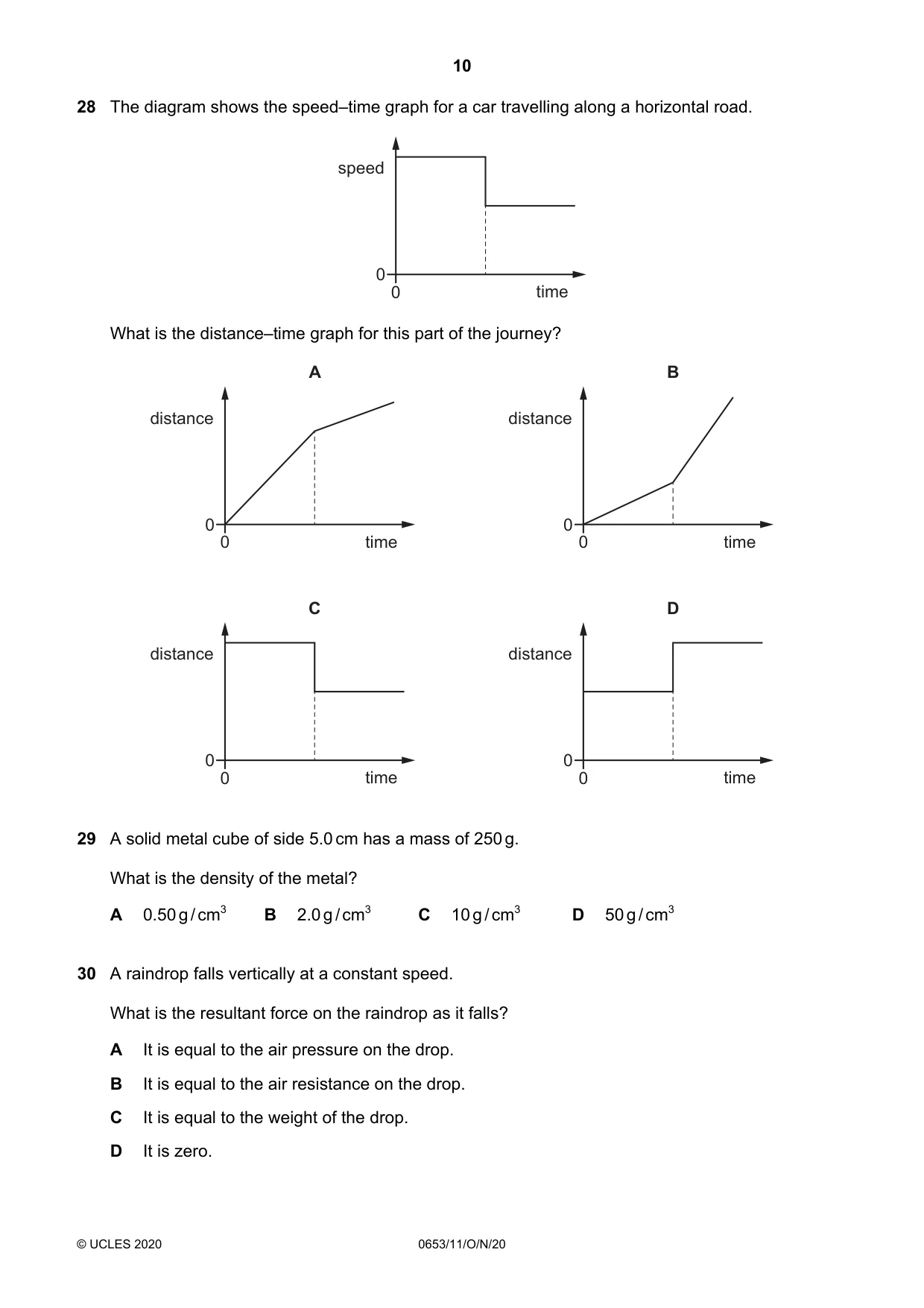
28 The diagram shows the speed–time graph for a car travelling along a horizontal road. speed 0 0 time What is the distance–time graph for this part of the journey? A B distance distance 0 0 0 time 0 time C D distance distance 0 0 0 time 0 time
Mark scheme: A
Q29 · A solid metal cube of side 5.0 cm has a mass of 250 g
29 A solid metal cube of side 5.0 cm has a mass of 250 g. What is the density of the metal? A 0.50 g / cm3 B 2.0 g / cm3 C 10 g / cm3 D 50 g / cm3
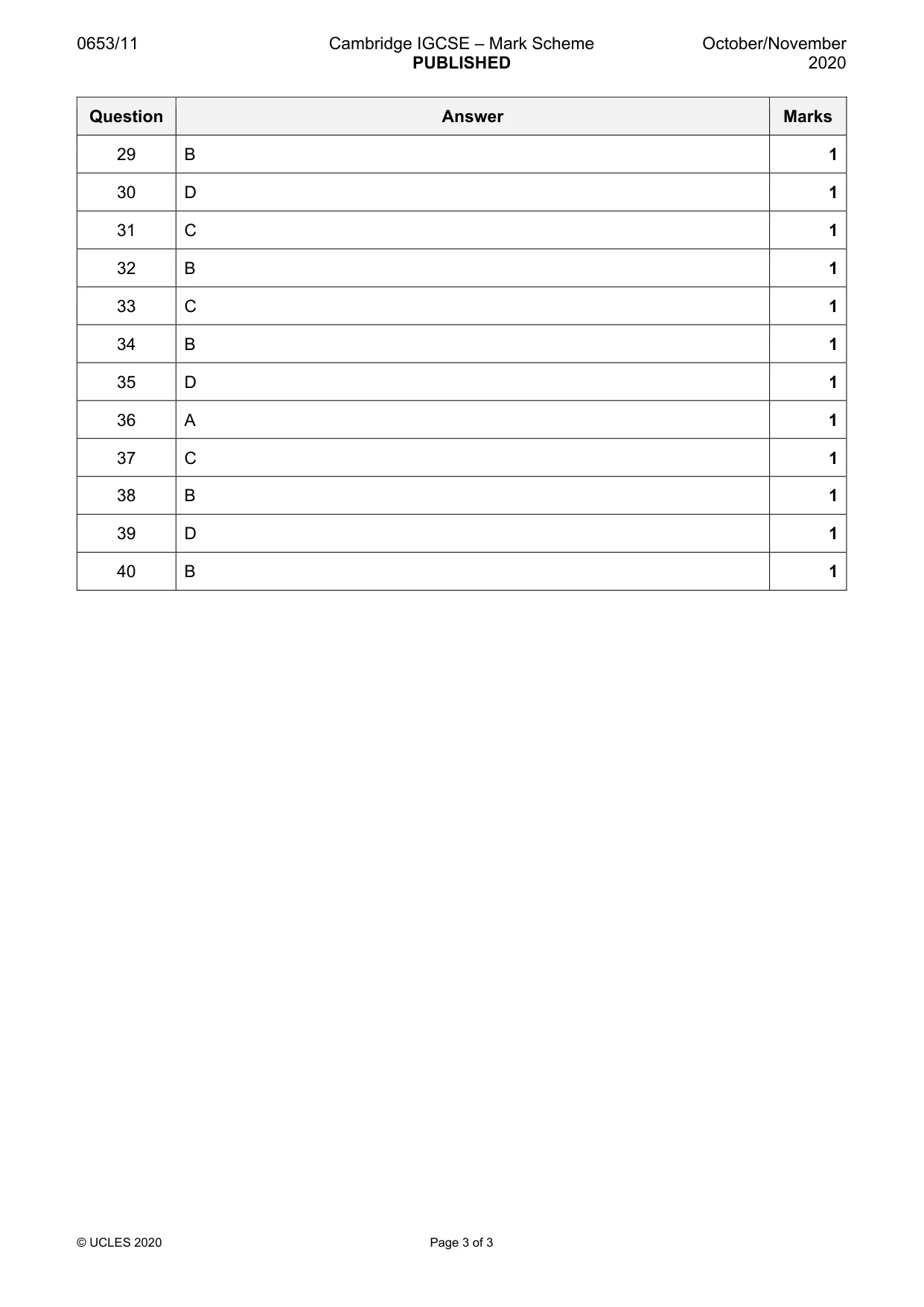
Mark scheme: B
Q30 · A raindrop falls vertically at a constant speed
30 A raindrop falls vertically at a constant speed. What is the resultant force on the raindrop as it falls? A It is equal to the air pressure on the drop. B It is equal to the air resistance on the drop. C It is equal to the weight of the drop. D It is zero.
Mark scheme: D
Q31 · An object is not moving
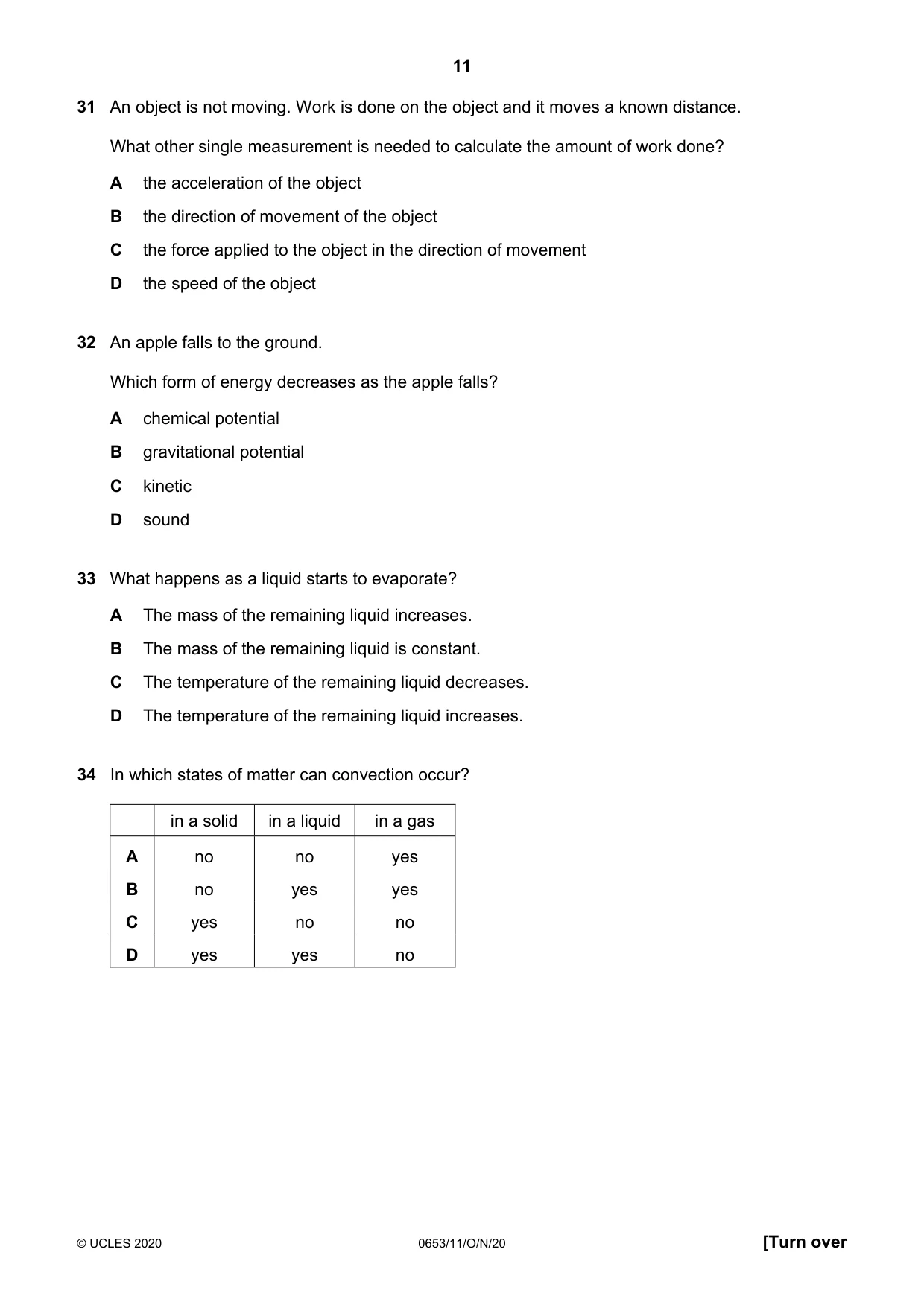
31 An object is not moving. Work is done on the object and it moves a known distance. What other single measurement is needed to calculate the amount of work done? A the acceleration of the object B the direction of movement of the object C the force applied to the object in the direction of movement D the speed of the object
Mark scheme: C
Q32 · An apple falls to the ground
32 An apple falls to the ground. Which form of energy decreases as the apple falls? A chemical potential B gravitational potential C kinetic D sound
Mark scheme: B
Q33 · What happens as a liquid starts to evaporate?
33 What happens as a liquid starts to evaporate? A The mass of the remaining liquid increases. B The mass of the remaining liquid is constant. C The temperature of the remaining liquid decreases. D The temperature of the remaining liquid increases.
Mark scheme: C
Q34 · In which states of matter can convection occur?
34 In which states of matter can convection occur? in a solid in a liquid in a gas A no no yes B no yes yes C yes no no D yes yes no
Mark scheme: B
Q35 · The diagram shows a section of a rope
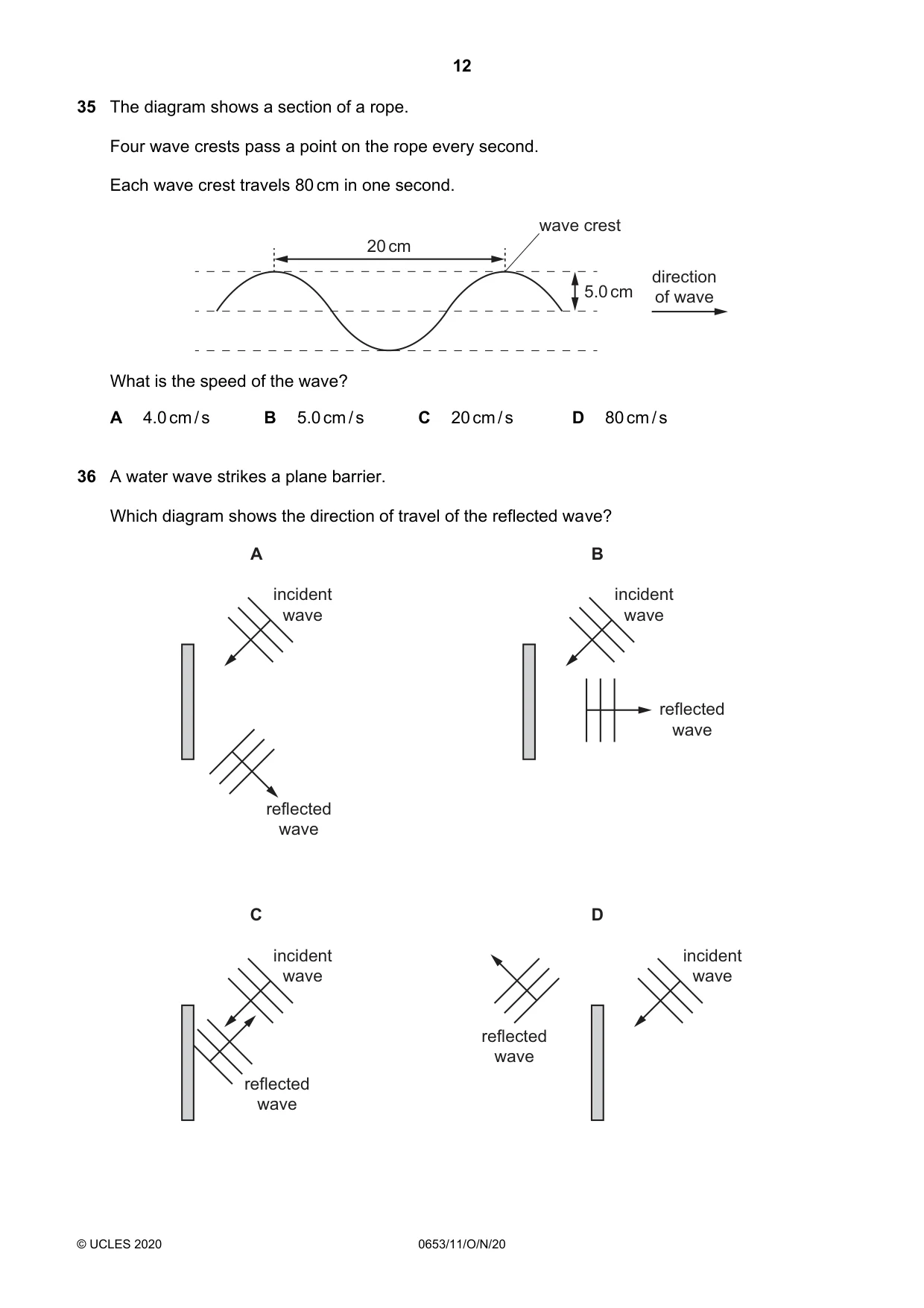
35 The diagram shows a section of a rope. Four wave crests pass a point on the rope every second. Each wave crest travels 80 cm in one second. wave crest 20 cm direction 5.0 cm of wave What is the speed of the wave? A 4.0 cm / s B 5.0 cm / s C 20 cm / s D 80 cm / s
Mark scheme: D
Q36 · A water wave strikes a plane barrier
36 A water wave strikes a plane barrier. Which diagram shows the direction of travel of the reflected wave? A B incident incident wave wave reflected wave reflected wave C D incident incident wave wave reflected wave reflected wave
Mark scheme: A
Q37 · Which substance is an electrical insulator?
37 Which substance is an electrical insulator? A aluminium B copper C plastic D steel
Mark scheme: C
Q38 · A power supply causes a current in a circuit
38 A power supply causes a current in a circuit. The electromotive force (e.m.f.) of the power supply and the resistance of the circuit are both changed. Which pair of changes must result in a smaller current in the circuit? e.m.f. resistance A decreased decreased B decreased increased C increased decreased D increased increased
Mark scheme: B
Q39 · The diagram shows a cell connected to a resistor and two meters, X and Y
39 The diagram shows a cell connected to a resistor and two meters, X and Y. The circuit is used when determining the resistance of the resistor. X Y What are the quantities measured by meters X and Y, and what are their correct units? meter X meter Y quantity unit quantity unit A current A p.d. V B current V p.d. A C p.d. A current V D p.d. V current A
Mark scheme: D
Q40 · The diagram shows a circuit containing a 2.0 V cell, a fuse and a resistor of resistance…
40 The diagram shows a circuit containing a 2.0 V cell, a fuse and a resistor of resistance 4.0 . 2.0 V 4.0 Ω What is the most appropriate rating for the fuse? A 0.4 A B 1 A C 2 A D 5 A
Mark scheme: B
What was in this paper
The subtopics covered by these 40 questions, and how many questions each got. Open one in a new tab to see every Cambridge question on it.
3Characteristics of living organisms2Energy, work and power2Rate of reaction2Sexual reproduction in plants2Air quality and climate1Arrangement of elements1Biological molecules1Carbon cycle1Cell structure1Chromatography1Circulatory systems1Density1Drugs1Electrical safety1Electrolysis1Elements, compounds and mixtures1Enzymes1Exothermic and endothermic reactions1Extraction of metals1Food chains and food webs1Forces1Formulas1General properties of waves1Identification of ions and gases1Kinetic particle model of matter1Light1Motion1Photosynthesis1Preparation of salts1Respiration1Simple molecules and covalent bonds1Terminology1Transfer of thermal energy1What you needed in this session
Cambridge’s own grade thresholds for 2020 Oct/Nov, Paper 1 · Variant 1. A higher threshold means an easier paper — the bar moves with how the cohort did.