Cambridge IGCSE Science - Combined 0653 — 2011 May/June Paper 1 · Variant 1
0653/11/M/J/11 · 40 questions · 40 marks · ≈45 min
The question paper and its mark scheme, free to read here and free to download. This is Cambridge’s own paper, exactly as it was sat.
Question paper16 pages

Mark scheme2 pages
Answers below. Sit the paper first if you are practising.
Questions as text
Q1 · The diagram shows a palisade cell
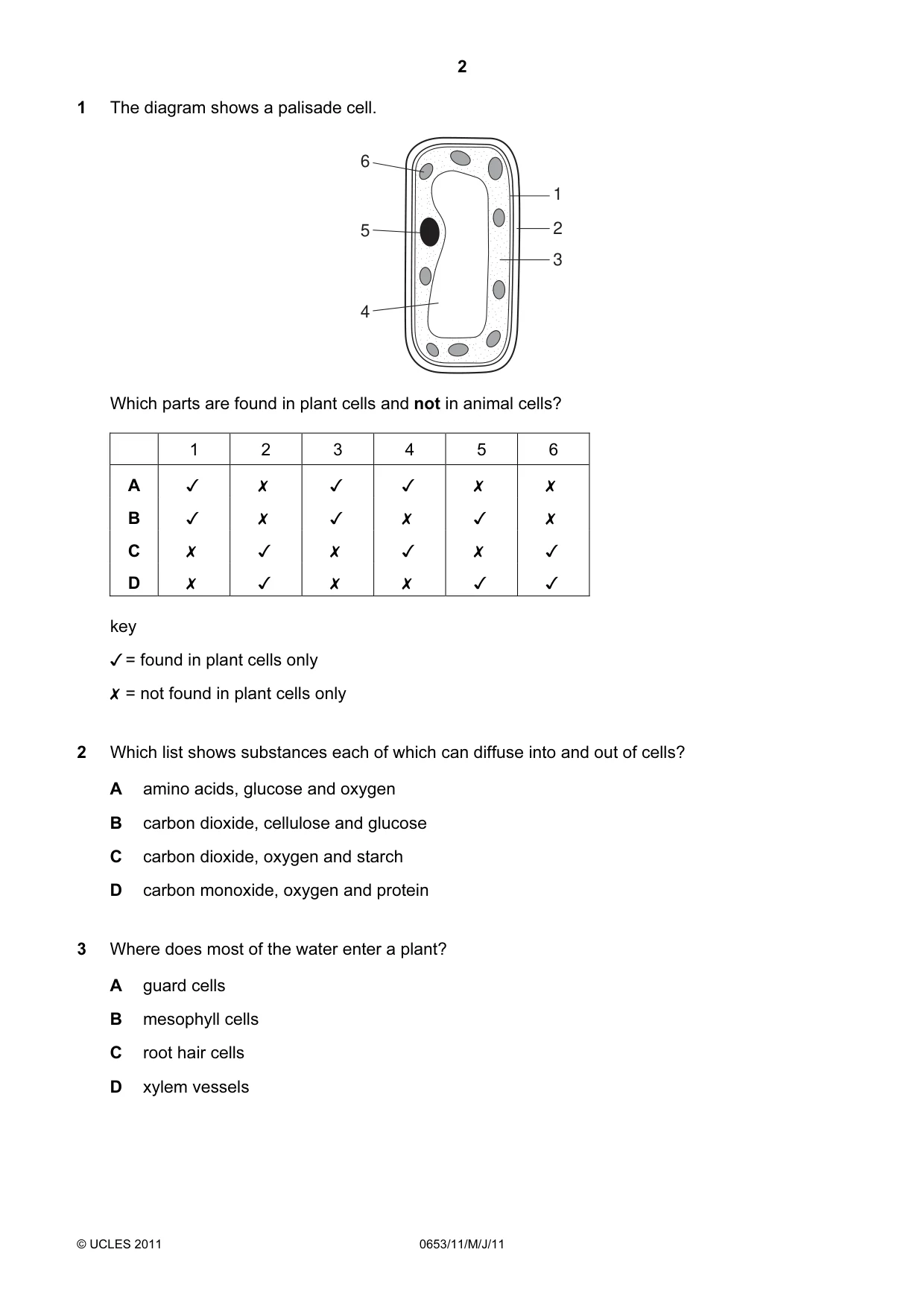
1 The diagram shows a palisade cell. Which parts are found in plant cells and not in animal cells? 1 2 3 4 5 6 A v x v v x x B v x v x v x Cc x v x v x v D x v x x v v key ¥ = found in plant cells only X = not found in plant cells only
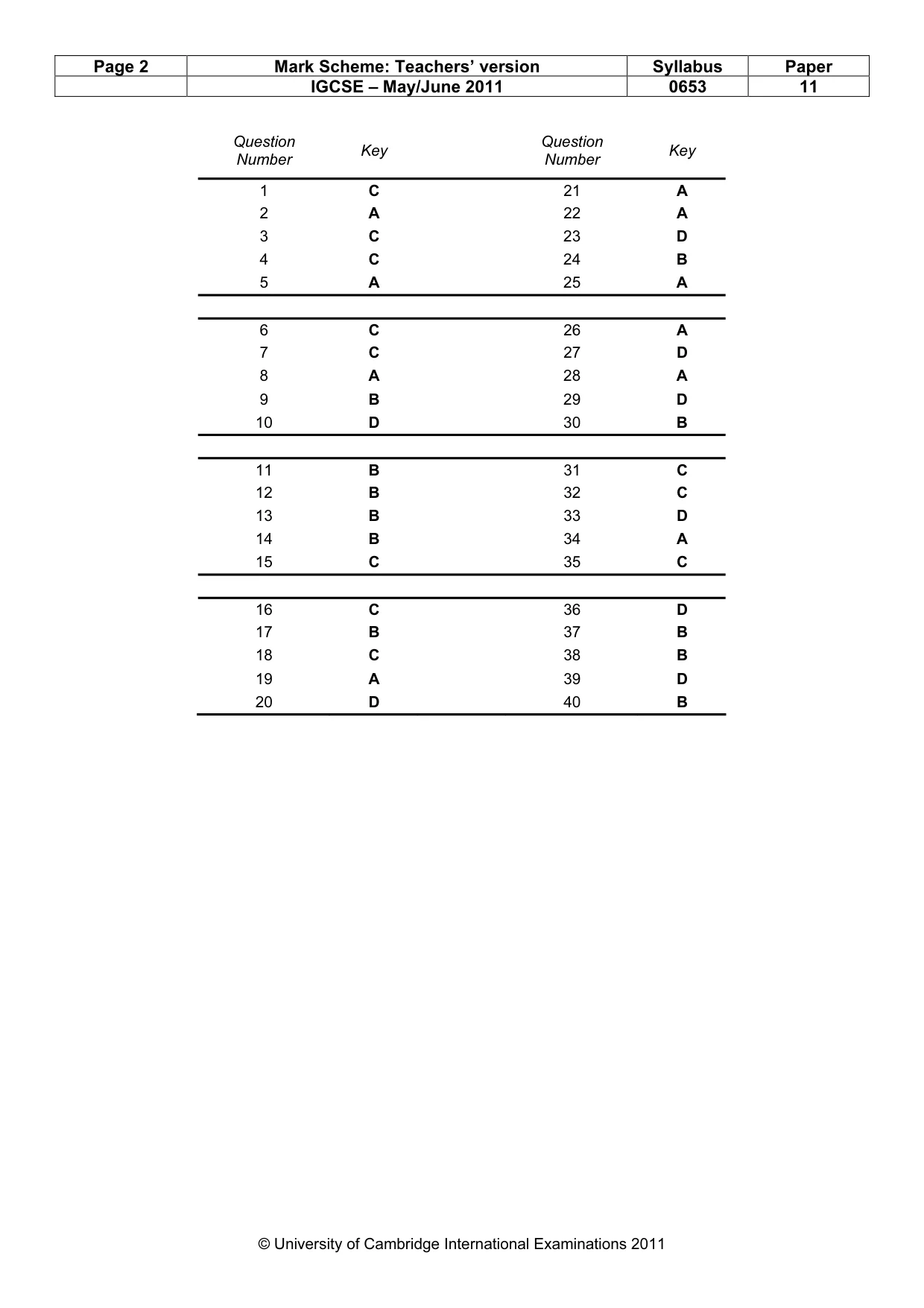
Mark scheme: C
Q2 · Which list shows substances each of which can diffuse into and out of cells?
2 Which list shows substances each of which can diffuse into and out of cells? A amino acids, glucose and oxygen B carbon dioxide, cellulose and glucose C carbon dioxide, oxygen and starch D carbon monoxide, oxygen and protein
Mark scheme: A
Q3 · Where does most of the water enter a plant?
3 Where does most of the water enter a plant? A guard cells B mesophyll cells C root hair cells D xylem vessels
Mark scheme: C
Q4 · Which breakdown processes occur inside cells, and which occur outside cells?
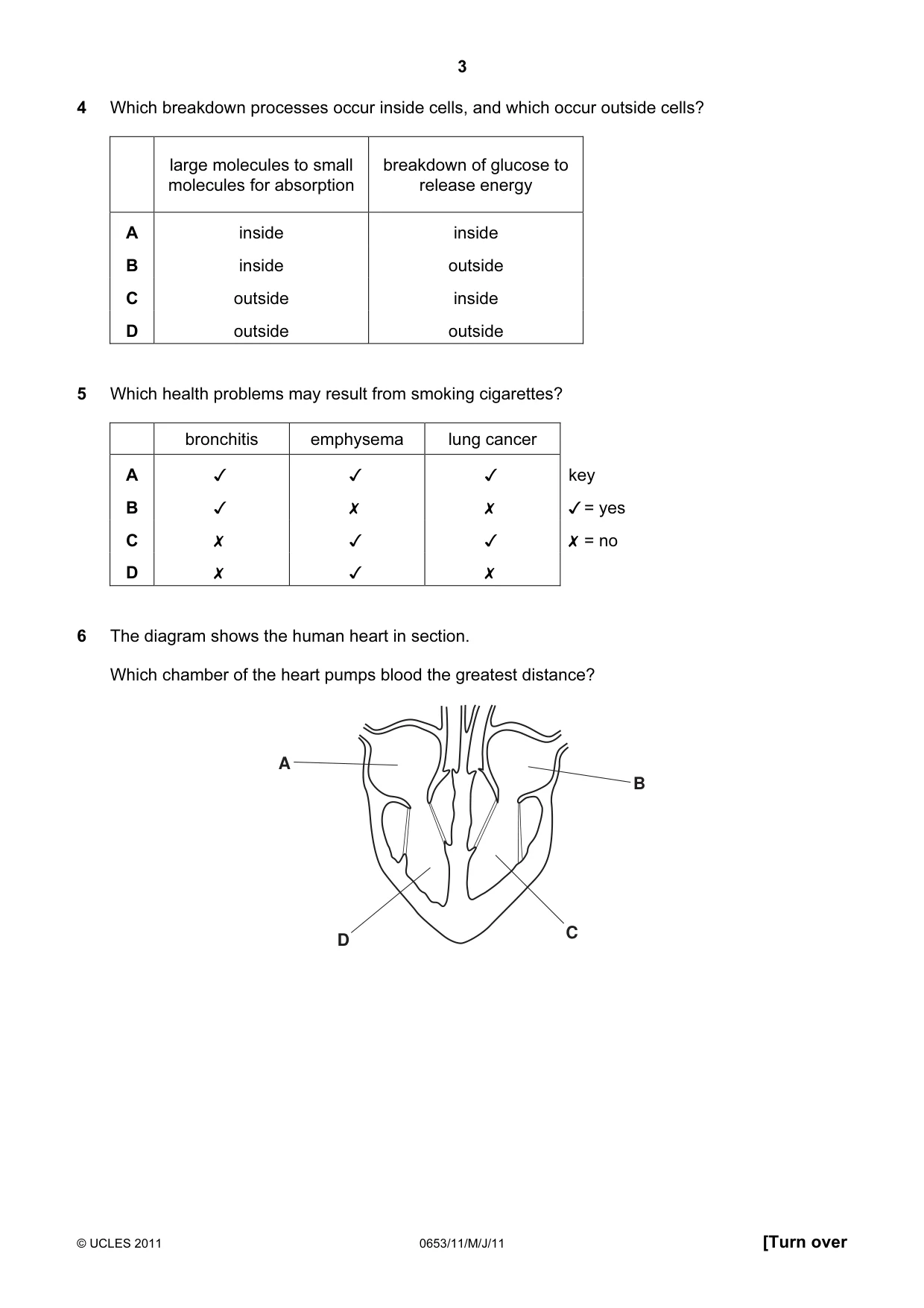
4 Which breakdown processes occur inside cells, and which occur outside cells? large molecules to small breakdown of glucose to molecules for absorption release energy A inside inside B inside outside C outside inside D outside outside
Mark scheme: C
Q5 · Which health problems may result from smoking cigarettes?
5 Which health problems may result from smoking cigarettes? bronchitis emphysema lung cancer A v v v B v x x Cc x v v D x v x key Jv = yes xX =no
Mark scheme: A
Q6 · The diagram shows the human heart in section
6 The diagram shows the human heart in section. Which chamber of the heart pumps blood the greatest distance? A B D C
Mark scheme: C
Q7 · The diagram shows the arrangement of cells in a vertical section of a leaf of a green…
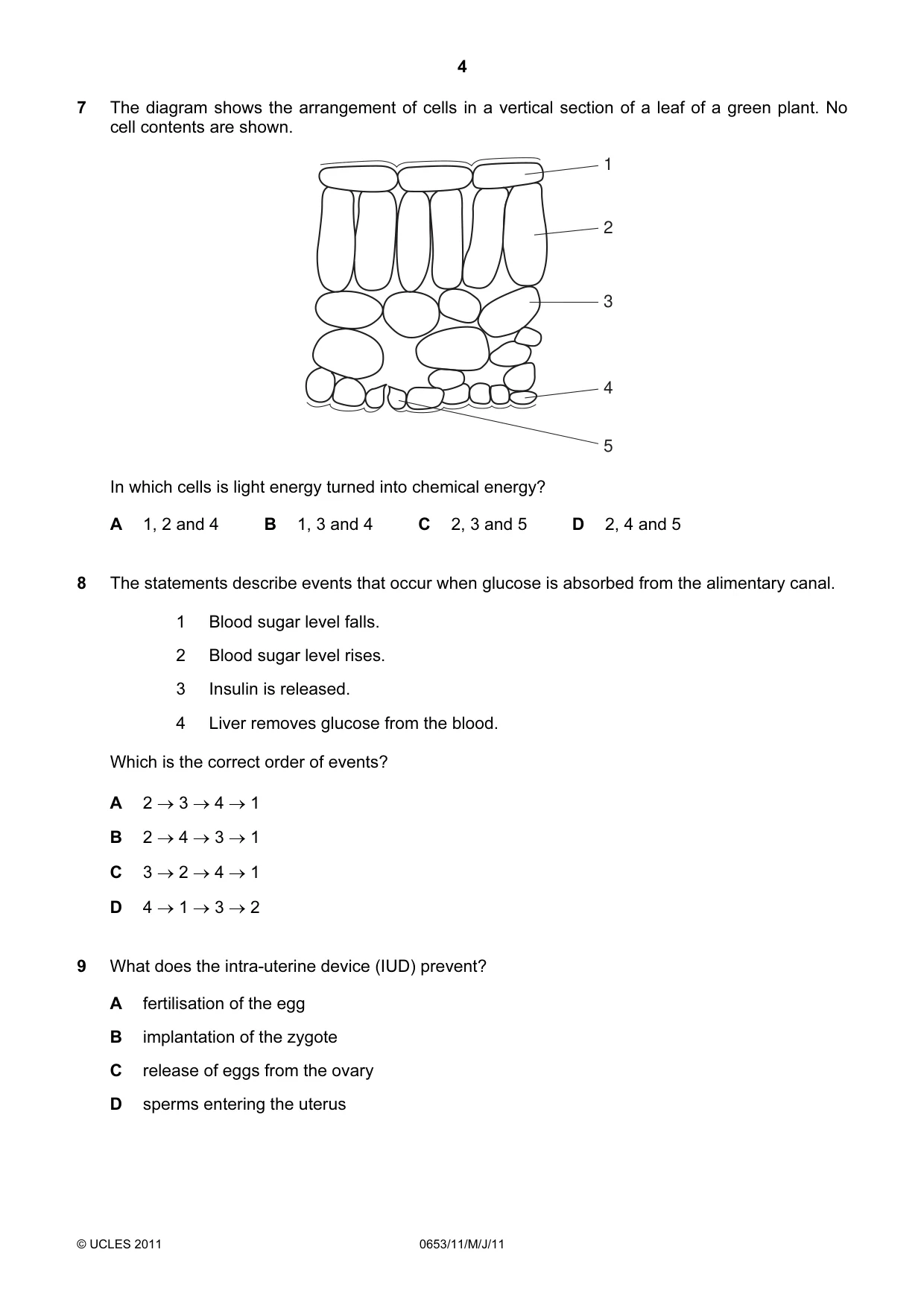
7 The diagram shows the arrangement of cells in a vertical section of a leaf of a green plant. No cell contents are shown. 1 2 3 4 5 In which cells is light energy turned into chemical energy? A 1, 2 and 4 B 1, 3 and 4 C 2, 3 and 5 D 2, 4 and 5
Mark scheme: C
Q8 · The statements describe events that occur when glucose is absorbed from the alimentary…
8 The statements describe events that occur when glucose is absorbed from the alimentary canal. 1 Blood sugar level falls. 2 Blood sugar level rises. 3 Insulin is released. 4 Liver removes glucose from the blood. Which is the correct order of events? A 2 → 3 → 4 → 1 B 2 → 4 → 3 → 1 C 3 → 2 → 4 → 1 D 4 → 1 → 3 → 2
Mark scheme: A
Q9 · What does the intra-uterine device (IUD) prevent?
9 What does the intra-uterine device (IUD) prevent? A fertilisation of the egg B implantation of the zygote C release of eggs from the ovary D sperms entering the uterus
Mark scheme: B
Q10 · Which feature must all members of the same clone of a plant have in common?
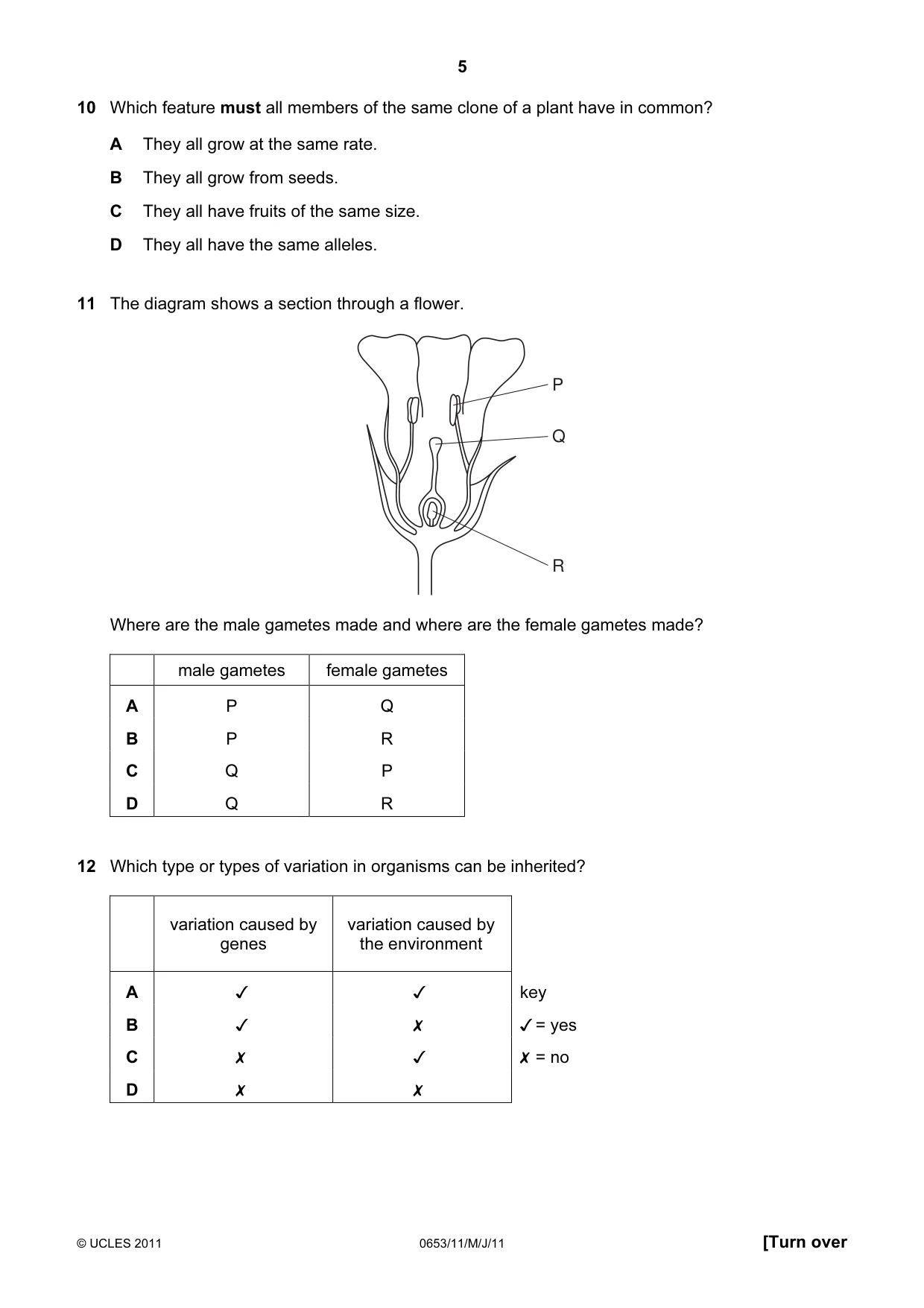
10 Which feature must all members of the same clone of a plant have in common? A They all grow at the same rate. B They all grow from seeds. C They all have fruits of the same size. D They all have the same alleles.
Mark scheme: D
Q11 · The diagram shows a section through a flower
11 The diagram shows a section through a flower. P Q R Where are the male gametes made and where are the female gametes made? male gametes female gametes A P Q B P R C Q P D Q R
Mark scheme: B
Q12 · Which type or types of variation in organisms can be inherited?
12 Which type or types of variation in organisms can be inherited? variation caused by | variation caused by genes the environment A Jv v key B v x v=yes Cc x v X =no D x x
Mark scheme: B
Q13 · Deforestation in tropical rain forests can lead to A decreased carbon dioxide in the air
13 Deforestation in tropical rain forests can lead to A decreased carbon dioxide in the air. B decreased species diversity. C increased number of habitats. D increased oxygen in the air.
Mark scheme: B
Q14 · An atom is represented by the symbol 19 9 X
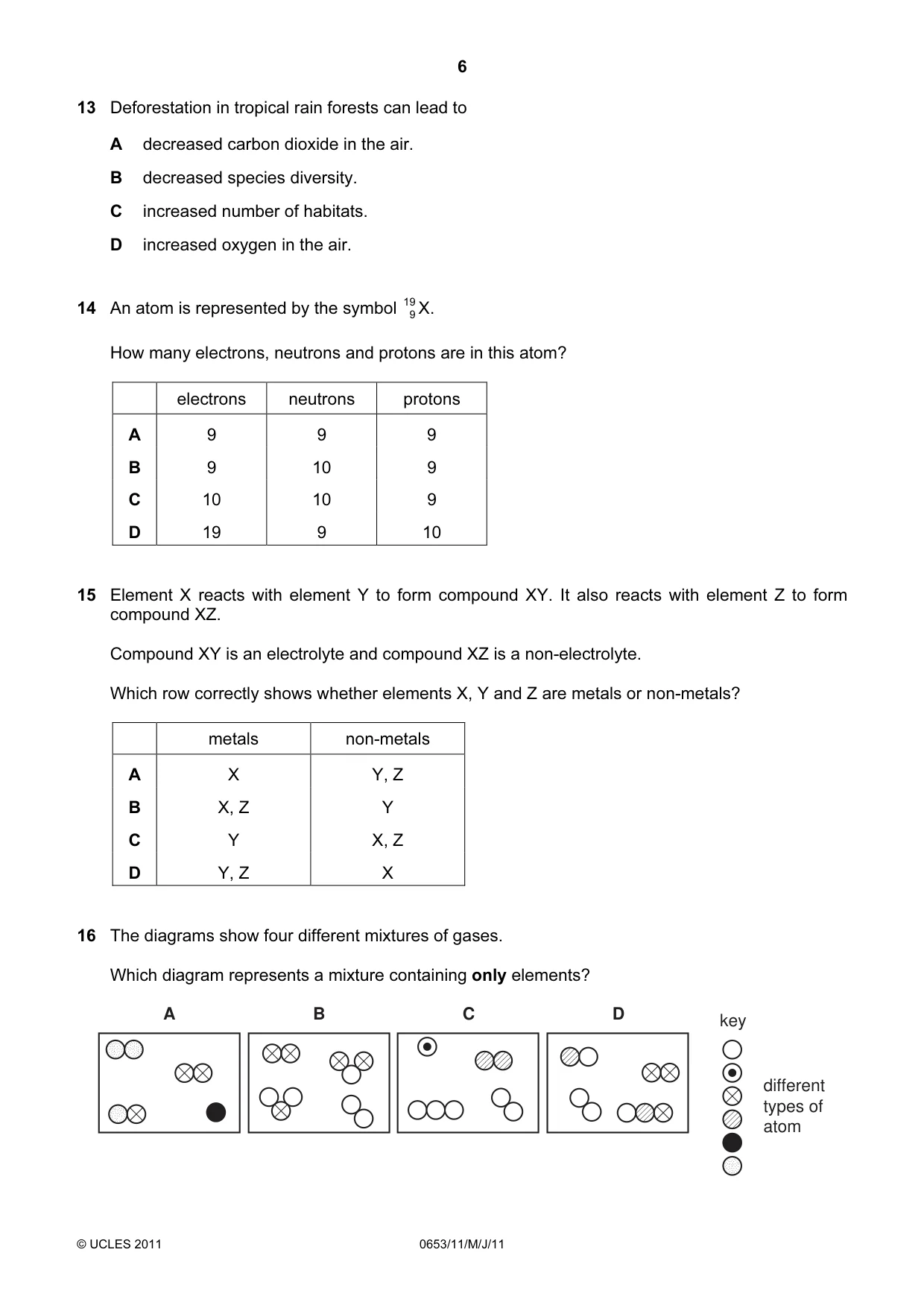
14 An atom is represented by the symbol 19 9 X. How many electrons, neutrons and protons are in this atom? electrons neutrons protons A 9 9 9 B 9 10 9 C 10 10 9 D 19 9 10
Mark scheme: B
Q15 · Element X reacts with element Y to form compound XY
15 Element X reacts with element Y to form compound XY. It also reacts with element Z to form compound XZ. Compound XY is an electrolyte and compound XZ is a non-electrolyte. Which row correctly shows whether elements X, Y and Z are metals or non-metals? metals non-metals A X Y, Z B X, Z Y C Y X, Z D Y, Z X
Mark scheme: C
Q16 · The diagrams show four different mixtures of gases
16 The diagrams show four different mixtures of gases. Which diagram represents a mixture containing only elements? A B C D key different types of atom
Mark scheme: C
Q17 · Which equation is correctly balanced and shows the correct formulae?
17 Which equation is correctly balanced and shows the correct formulae? A H2 + Cl 2 → H2Cl 2 B H2 + Cl 2 → 2HCl C 2H + 2Cl 2 → H2Cl 2 D 2H + Cl 2 → 2HCl 2
Mark scheme: B
Q18 · The position in the Periodic Table of an element Q is shown
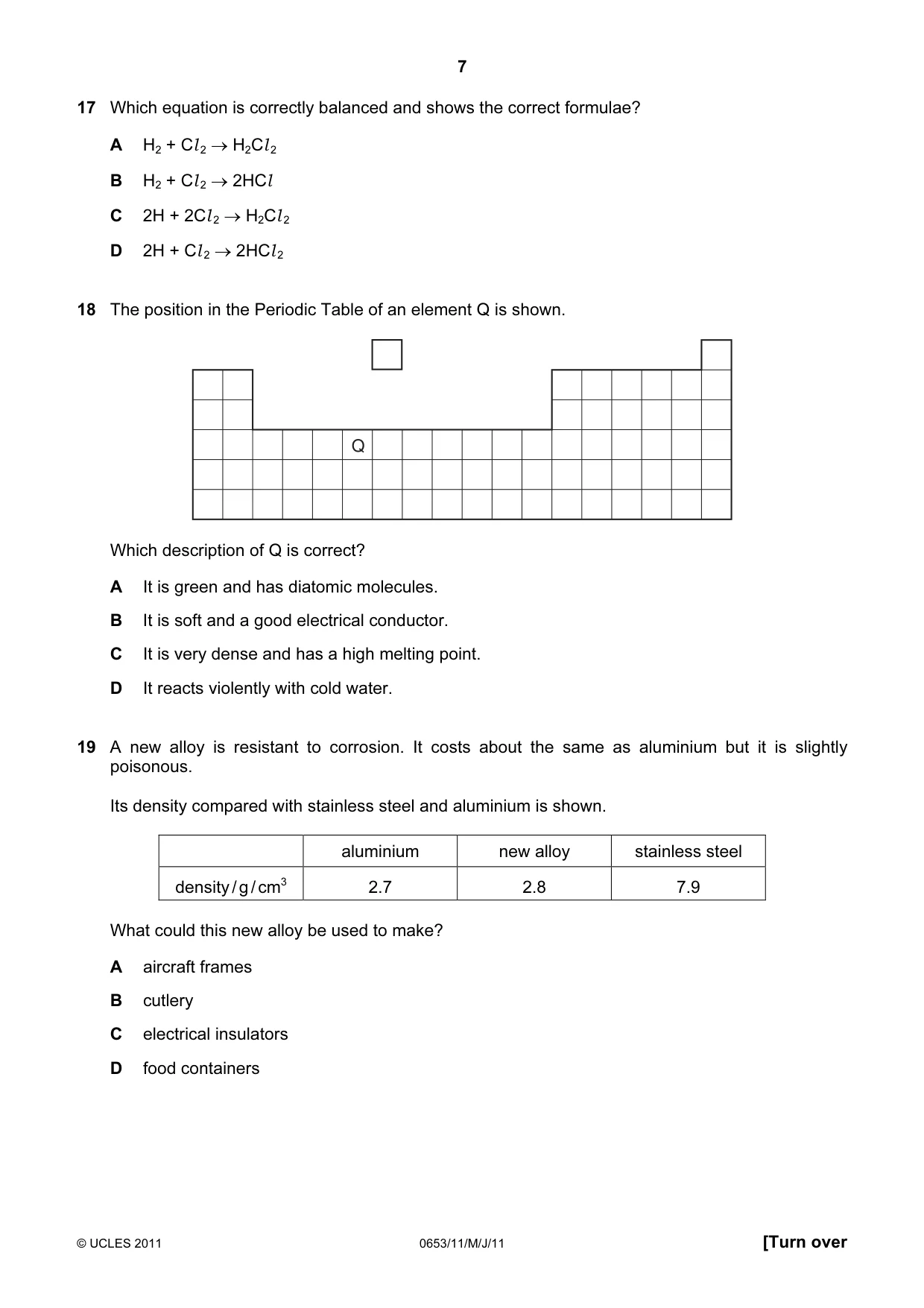
18 The position in the Periodic Table of an element Q is shown. Q Which description of Q is correct? A It is green and has diatomic molecules. B It is soft and a good electrical conductor. C It is very dense and has a high melting point. D It reacts violently with cold water.
Mark scheme: C
Q19 · A new alloy is resistant to corrosion
19 A new alloy is resistant to corrosion. It costs about the same as aluminium but it is slightly poisonous. Its density compared with stainless steel and aluminium is shown. aluminium new alloy stainless steel density / g / cm3 2.7 2.8 7.9 What could this new alloy be used to make? A aircraft frames B cutlery C electrical insulators D food containers
Mark scheme: A
Q20 · Carbon monoxide gas is present in car exhausts
20 Carbon monoxide gas is present in car exhausts. Why is this gas a pollutant? A It causes acid rain. B It causes asthma. C It damages buildings. D It is poisonous.
Mark scheme: D
Q21 · Metal X reacts vigorously with dilute hydrochloric acid
21 Metal X reacts vigorously with dilute hydrochloric acid. Salts of metal X give a red colour in a flame test. What is X? A calcium B copper C potassium D sodium
Mark scheme: A
Q22 · Substance X is added to dilute sulfuric acid until reaction is complete
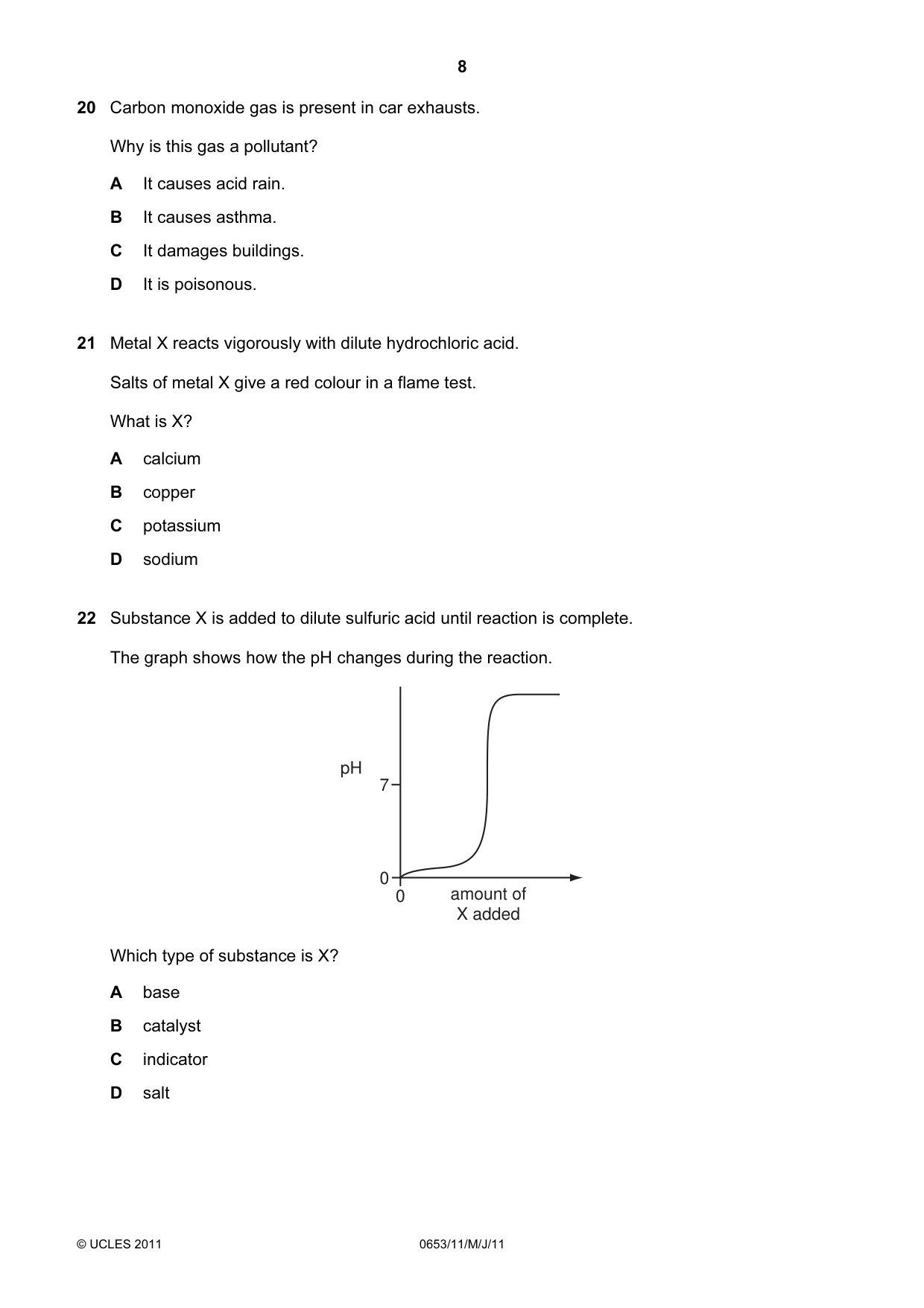
22 Substance X is added to dilute sulfuric acid until reaction is complete. The graph shows how the pH changes during the reaction. pH 7 0 0 amount of X added Which type of substance is X? A base B catalyst C indicator D salt
Mark scheme: A
More questions on The characteristic properties of acids and bases
Q23 · Which chemical equation represents a thermal decomposition reaction?
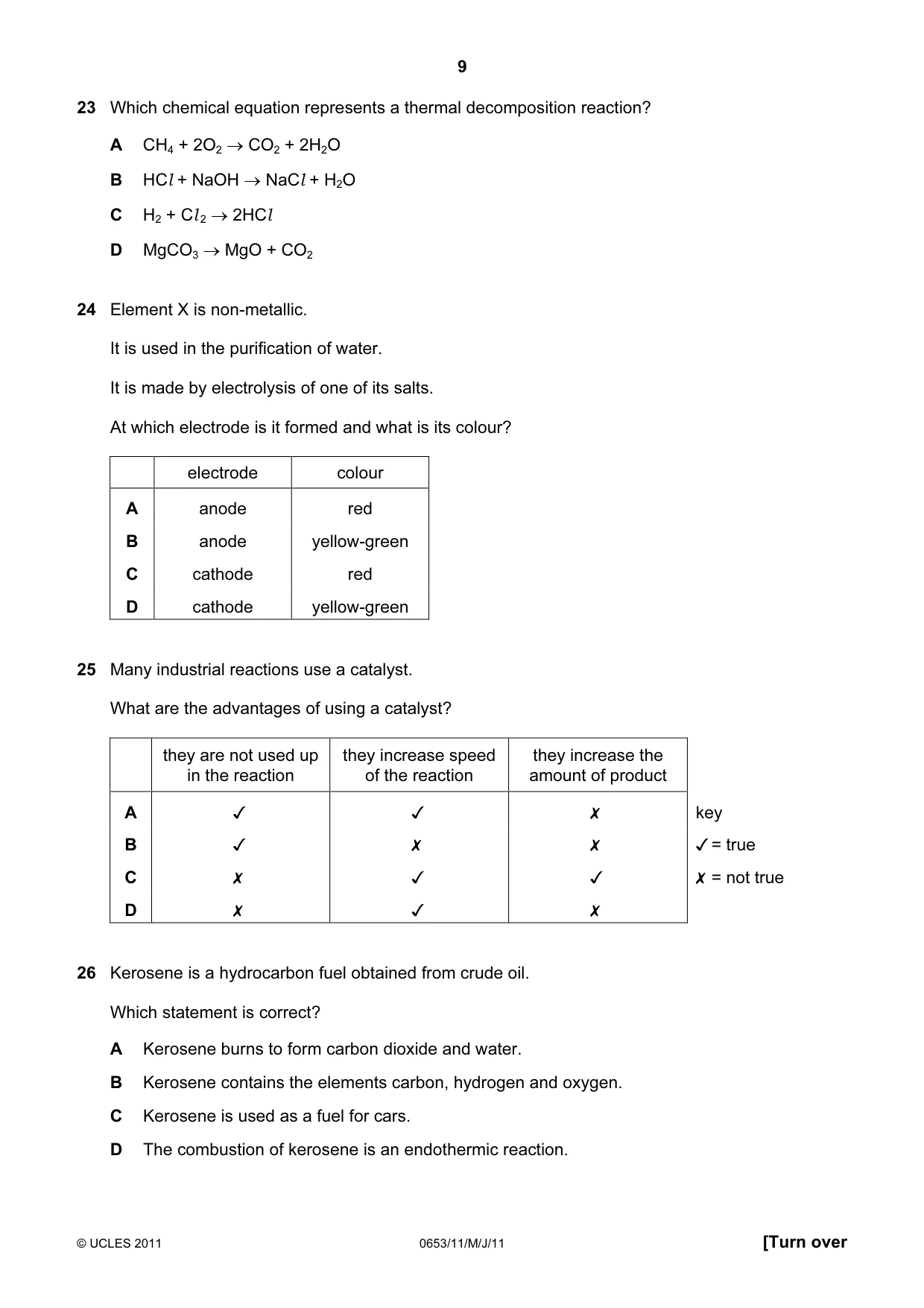
23 Which chemical equation represents a thermal decomposition reaction? A CH4 + 2O2 → CO2 + 2H2O B HCl + NaOH → NaCl + H2O C H2 + Cl 2 → 2HCl D MgCO3 → MgO + CO2
Mark scheme: D
Q24 · Element X is non-metallic
24 Element X is non-metallic. It is used in the purification of water. It is made by electrolysis of one of its salts. At which electrode is it formed and what is its colour? electrode colour A anode red B anode yellow-green C cathode red D cathode yellow-green
Mark scheme: B
Q25 · Many industrial reactions use a catalyst
25 Many industrial reactions use a catalyst. What are the advantages of using a catalyst? they are not used up in the reaction they increase speed of the reaction they increase the amount of product 0 0O WwW > v v x x v x v v x { *& x key Jv = true X = not true
Mark scheme: A
Q26 · Kerosene is a hydrocarbon fuel obtained from crude oil
26 Kerosene is a hydrocarbon fuel obtained from crude oil. Which statement is correct? A Kerosene burns to form carbon dioxide and water. B Kerosene contains the elements carbon, hydrogen and oxygen. C Kerosene is used as a fuel for cars. D The combustion of kerosene is an endothermic reaction.
Mark scheme: A
Q27 · Plastics are used as substitutes for natural materials
27 Plastics are used as substitutes for natural materials. Which statement about the manufacture of plastics is correct? A Plastics are made by breaking long-chain molecules into shorter chain ones. B Plastics are made by joining polymers together. C Plastics are made by fractional distillation of crude oil (petroleum). D Plastics are made by joining short-chain molecules together.
Mark scheme: D
Q28 · A glass tank contains some water
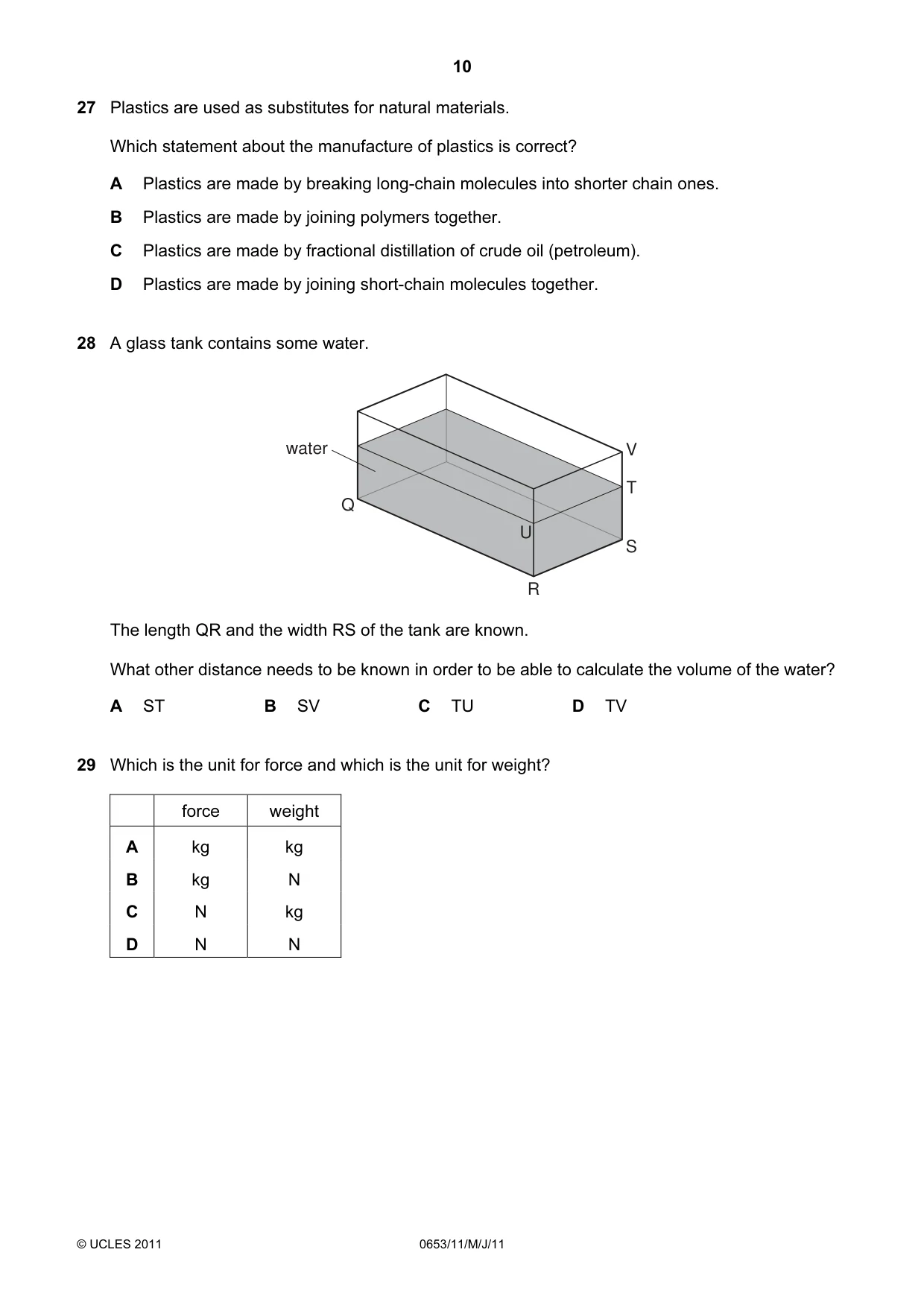
28 A glass tank contains some water. water V T Q U S R The length QR and the width RS of the tank are known. What other distance needs to be known in order to be able to calculate the volume of the water? A ST B SV C TU D TV
Mark scheme: A
More questions on Physical quantities and measurement techniques
Q29 · Which is the unit for force and which is the unit for weight?
29 Which is the unit for force and which is the unit for weight? force weight A kg kg B kg N C N kg D N N
Mark scheme: D
Q30 · The graph shows how the speed of a car changes with time
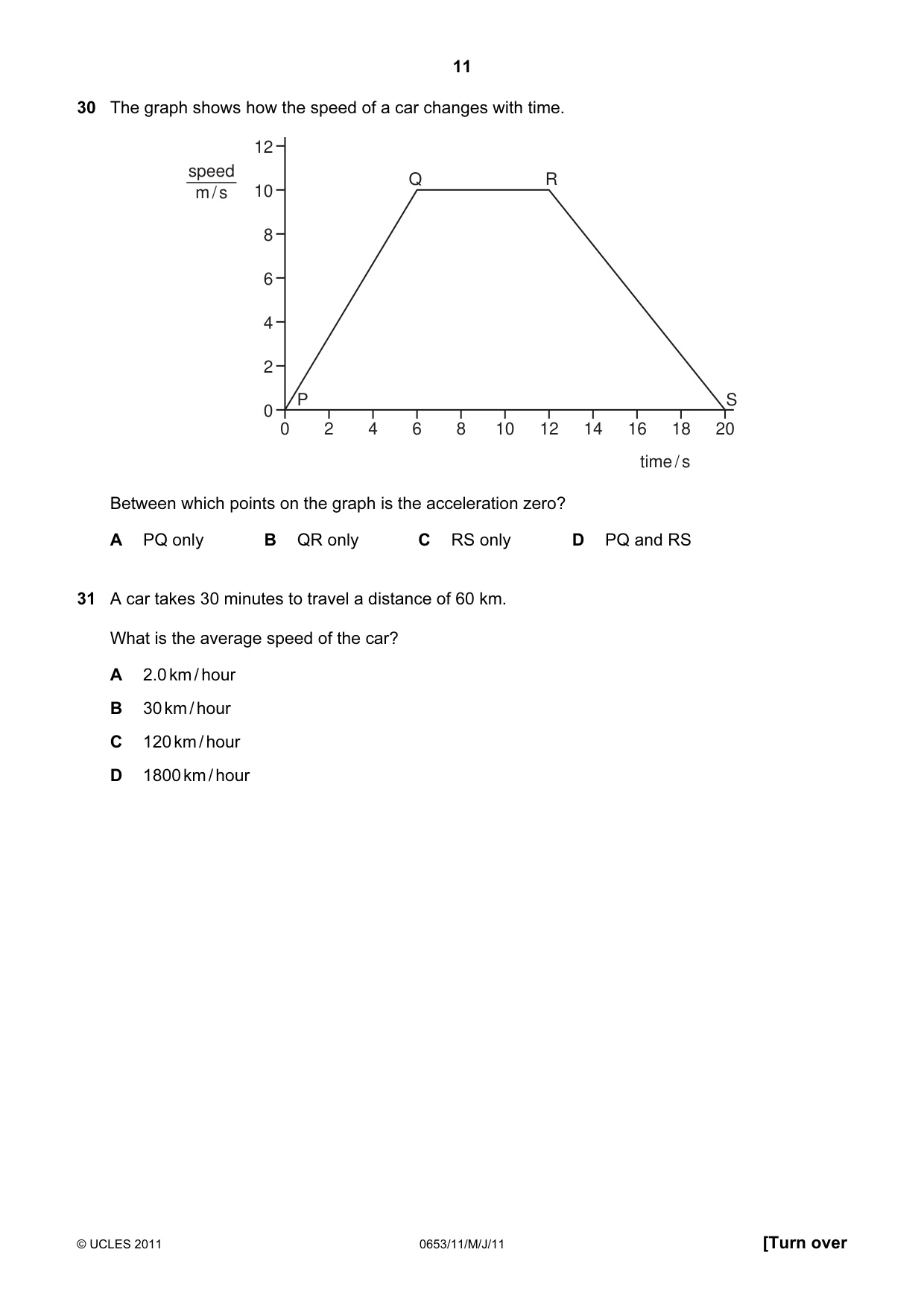
30 The graph shows how the speed of a car changes with time. 12 speed Q R m / s 10 8 6 4 2 P S 0 0 2 4 6 8 10 12 14 16 18 20 time / s Between which points on the graph is the acceleration zero? A PQ only B QR only C RS only D PQ and RS
Mark scheme: B
Q31 · A car takes 30 minutes to travel a distance of 60 km
31 A car takes 30 minutes to travel a distance of 60 km. What is the average speed of the car? A 2.0 km / hour B 30 km / hour C 120 km / hour D 1800 km / hour
Mark scheme: C
Q32 · Which transformer would change a 240 V a.c
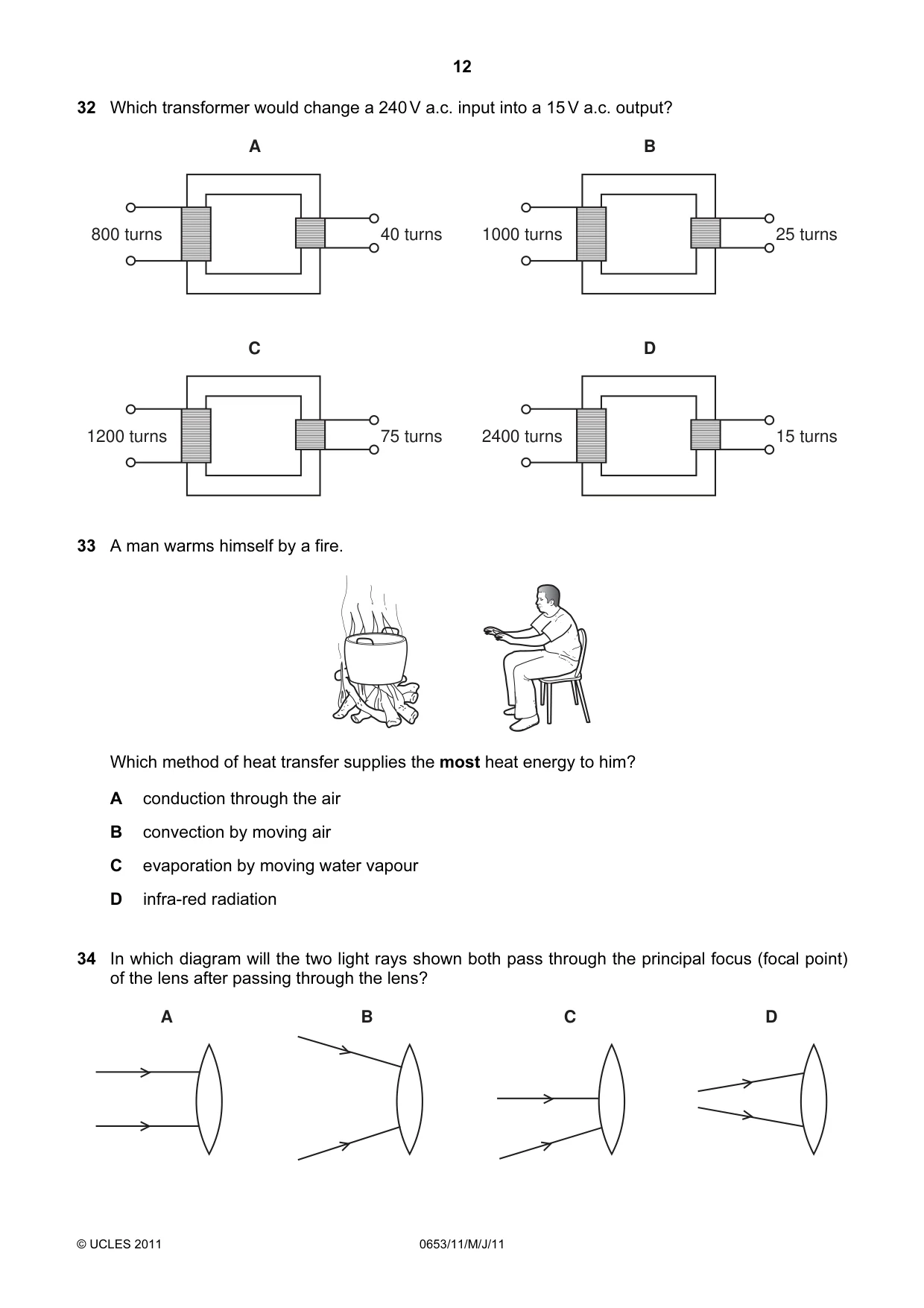
32 Which transformer would change a 240 V a.c. input into a 15 V a.c. output? A B 800 turns 40 turns 1000 turns 25 turns C D 1200 turns 75 turns 2400 turns 15 turns
Mark scheme: C
Q33 · A man warms himself by a fire
33 A man warms himself by a fire. Which method of heat transfer supplies the most heat energy to him? A conduction through the air B convection by moving air C evaporation by moving water vapour D infra-red radiation
Mark scheme: D
Q34 · In which diagram will the two light rays shown both pass through the principal focus…
34 In which diagram will the two light rays shown both pass through the principal focus (focal point) of the lens after passing through the lens? A B C D
Mark scheme: A
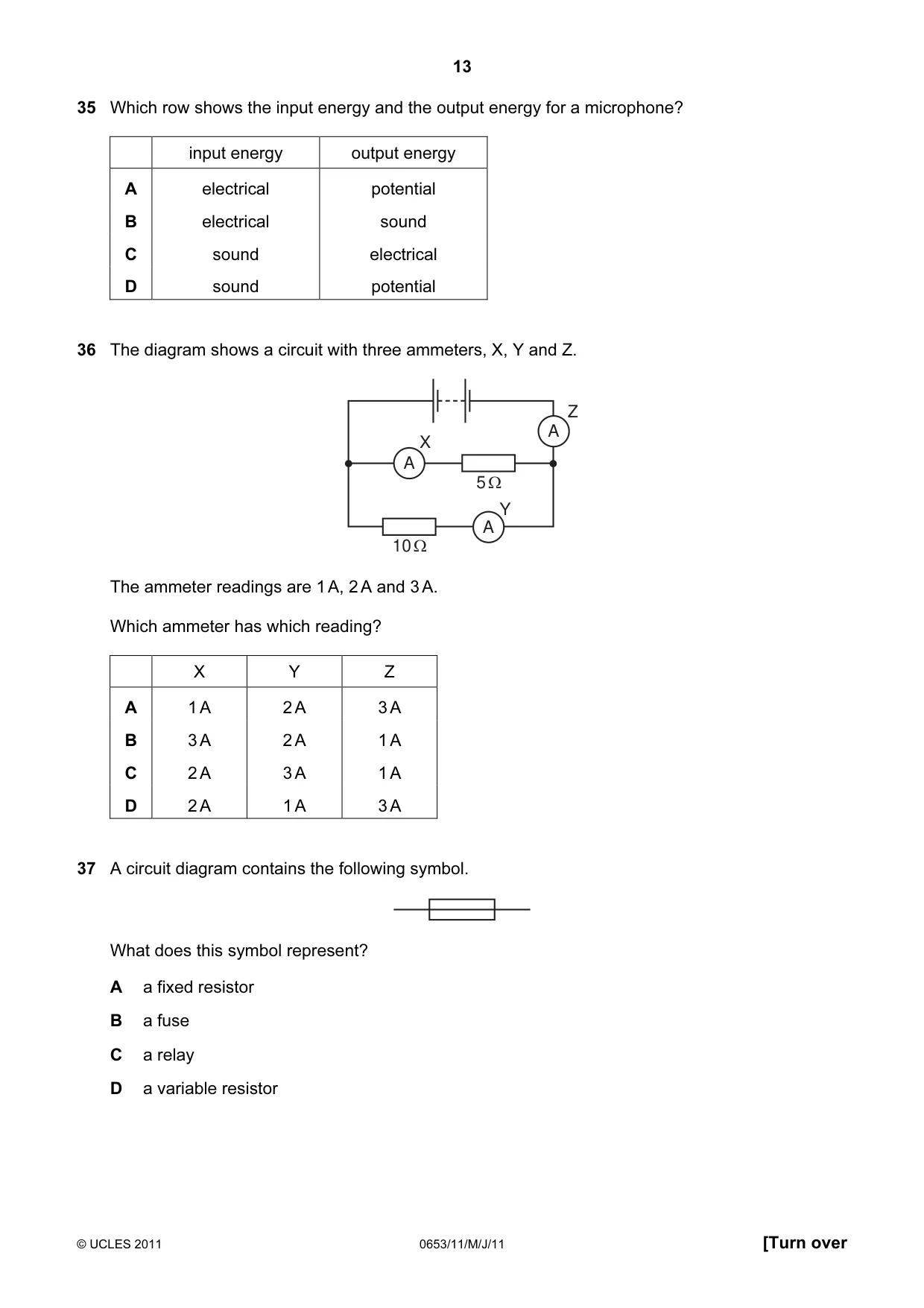
Q35 · Which row shows the input energy and the output energy for a microphone?
35 Which row shows the input energy and the output energy for a microphone? input energy output energy A electrical potential B electrical sound C sound electrical D sound potential
Mark scheme: C
Q36 · The diagram shows a circuit with three ammeters, X, Y and Z
36 The diagram shows a circuit with three ammeters, X, Y and Z. Z A X A 5 Ω Y A 10 Ω The ammeter readings are 1 A, 2 A and 3 A. Which ammeter has which reading? X Y Z A 1 A 2 A 3 A B 3 A 2 A 1 A C 2 A 3 A 1 A D 2 A 1 A 3 A
Mark scheme: D
Q37 · A circuit diagram contains the following symbol
37 A circuit diagram contains the following symbol. What does this symbol represent? A a fixed resistor B a fuse C a relay D a variable resistor
Mark scheme: B
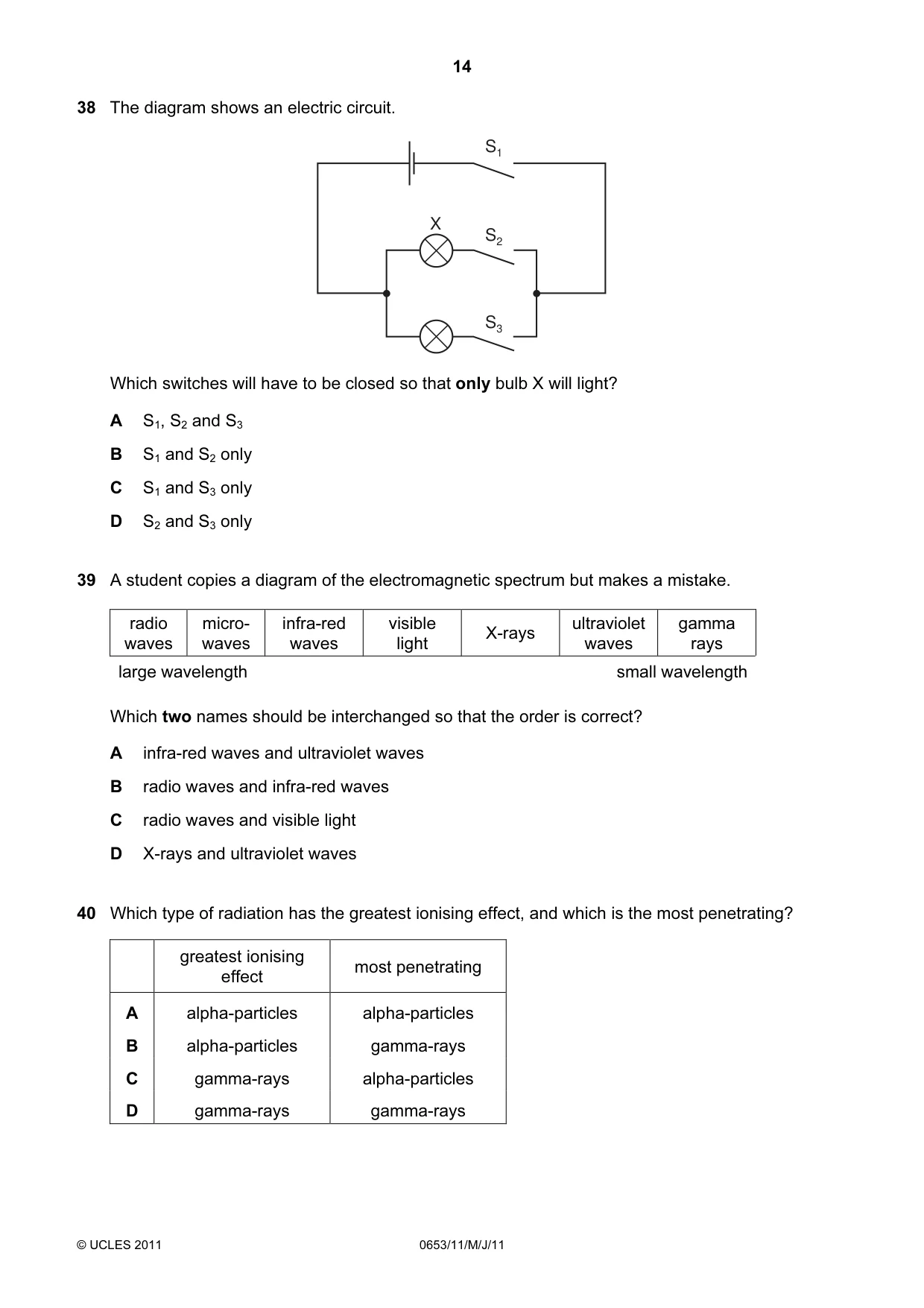
Q38 · The diagram shows an electric circuit
38 The diagram shows an electric circuit. S1 X S2 S3 Which switches will have to be closed so that only bulb X will light? A S1, S2 and S3 B S1 and S2 only C S1 and S3 only D S2 and S3 only
Mark scheme: B
Q39 · A student copies a diagram of the electromagnetic spectrum but makes a mistake
39 A student copies a diagram of the electromagnetic spectrum but makes a mistake. radio micro- infra-red visible ultraviolet gamma X-rays waves waves waves light waves rays large wavelength small wavelength Which two names should be interchanged so that the order is correct? A infra-red waves and ultraviolet waves B radio waves and infra-red waves C radio waves and visible light D X-rays and ultraviolet waves
Mark scheme: D
Q40 · Which type of radiation has the greatest ionising effect, and which is the most…
40 Which type of radiation has the greatest ionising effect, and which is the most penetrating? greatest ionising most penetrating effect A alpha-particles alpha-particles B alpha-particles gamma-rays C gamma-rays alpha-particles D gamma-rays gamma-rays
Mark scheme: B
What was in this paper
The subtopics covered by these 40 questions, and how many questions each got. Open one in a new tab to see every Cambridge question on it.
3Electromagnetic spectrum2Motion2Sexual reproduction in plants2Air quality and climate1Alloys and their properties1Atomic structure and the Periodic Table1Cell structure1Cells, batteries, generators and motors1Characteristics of living organisms1Diffusion1Digestion1Digestive system1Electrolysis1Elements, compounds and mixtures1Energy, work and power1Formulas1Fuels1Gas exchange in humans1Habitat destruction1Heart1Identification of ions and gases1Ions and ionic bonds1Leaf structure1Light1Mass and weight1Physical and chemical changes1Physical quantities and measurement techniques1Polymers1Rate of reaction1Sexual reproduction in humans1The characteristic properties of acids and bases1Transfer of thermal energy1Transition elements1Water uptake1What you needed in this session
Cambridge’s own grade thresholds for 2011 May/June, Paper 1 · Variant 1. A higher threshold means an easier paper — the bar moves with how the cohort did.