Cambridge IGCSE Science - Combined 0653 — 2013 Oct/Nov Paper 1 · Variant 2
0653/12/O/N/13 · 40 questions · 40 marks · ≈45 min
The question paper and its mark scheme, free to read here and free to download. This is Cambridge’s own paper, exactly as it was sat.
Question paper20 pages


Mark scheme2 pages
Answers below. Sit the paper first if you are practising.
Questions as text
Q1 · The plant cell in the diagram has a width of 30 mm when it is magnified by a microscope…
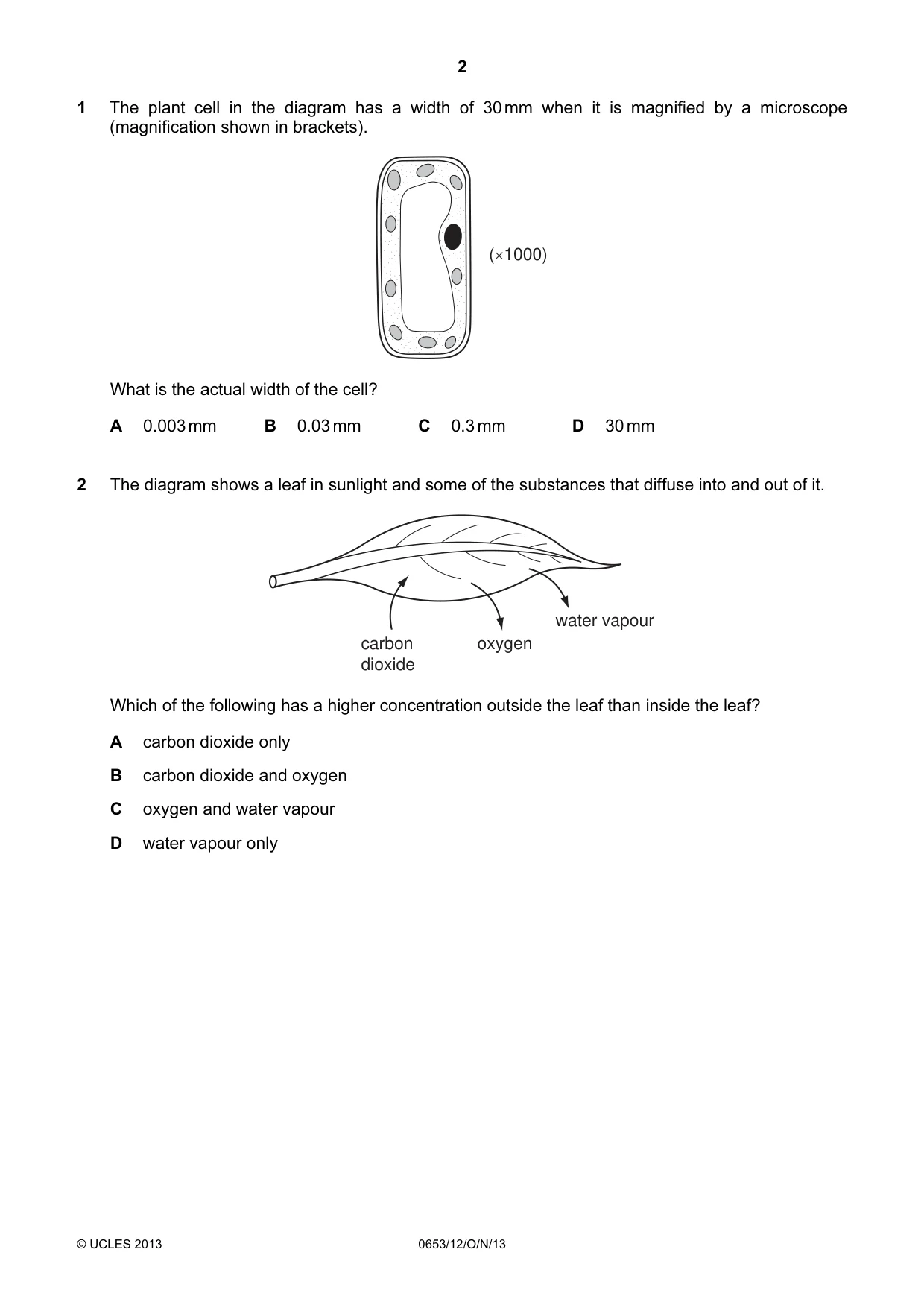
1 The plant cell in the diagram has a width of 30 mm when it is magnified by a microscope (magnification shown in brackets). (×1000) What is the actual width of the cell? A 0.003 mm B 0.03 mm C 0.3 mm D 30 mm
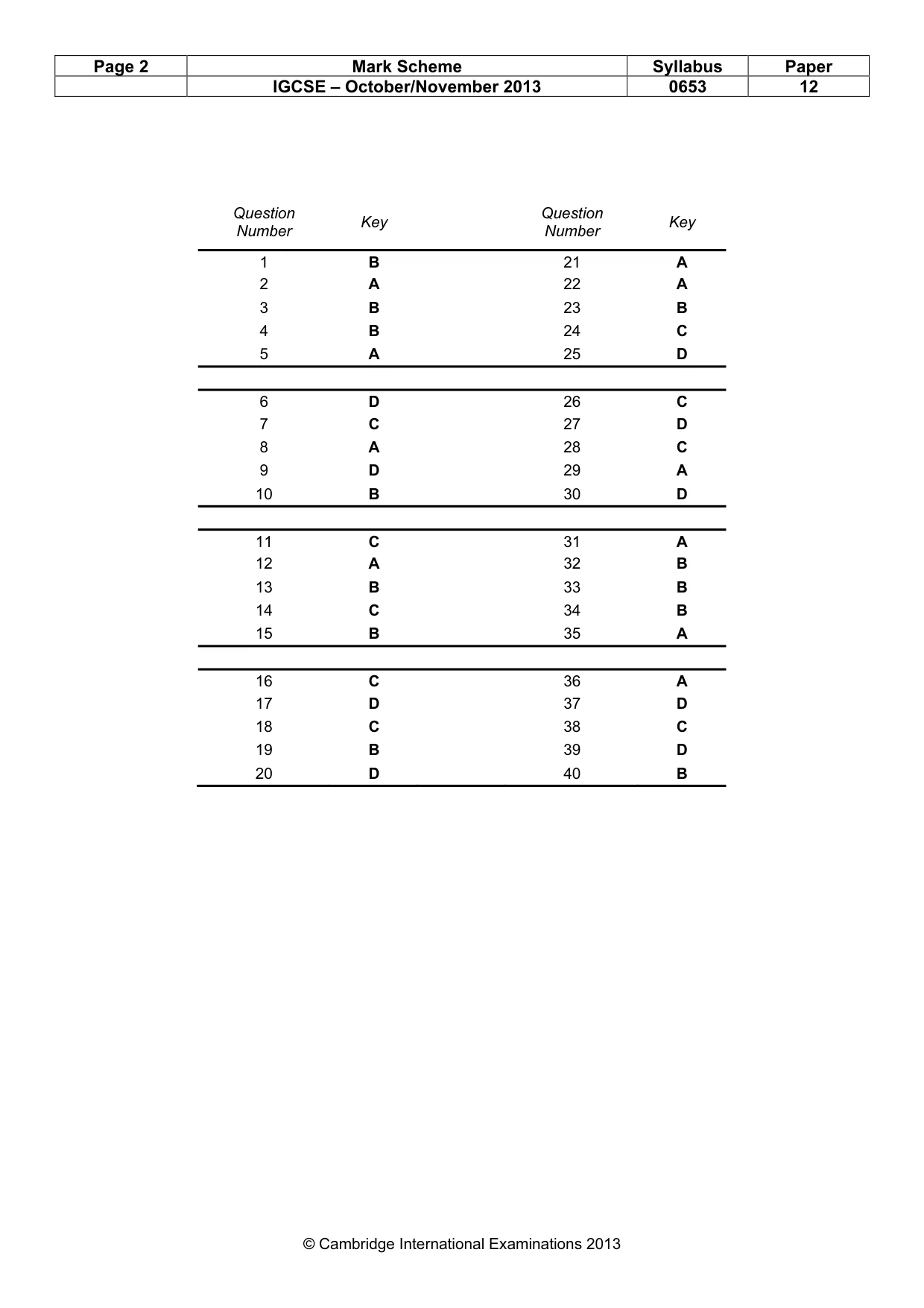
Mark scheme: B
Q2 · The diagram shows a leaf in sunlight and some of the substances that diffuse into and out…
2 The diagram shows a leaf in sunlight and some of the substances that diffuse into and out of it. water vapour carbon oxygen dioxide Which of the following has a higher concentration outside the leaf than inside the leaf? A carbon dioxide only B carbon dioxide and oxygen C oxygen and water vapour D water vapour only
Mark scheme: A
Q3 · The diagram shows how the activity of an enzyme changes with temperature
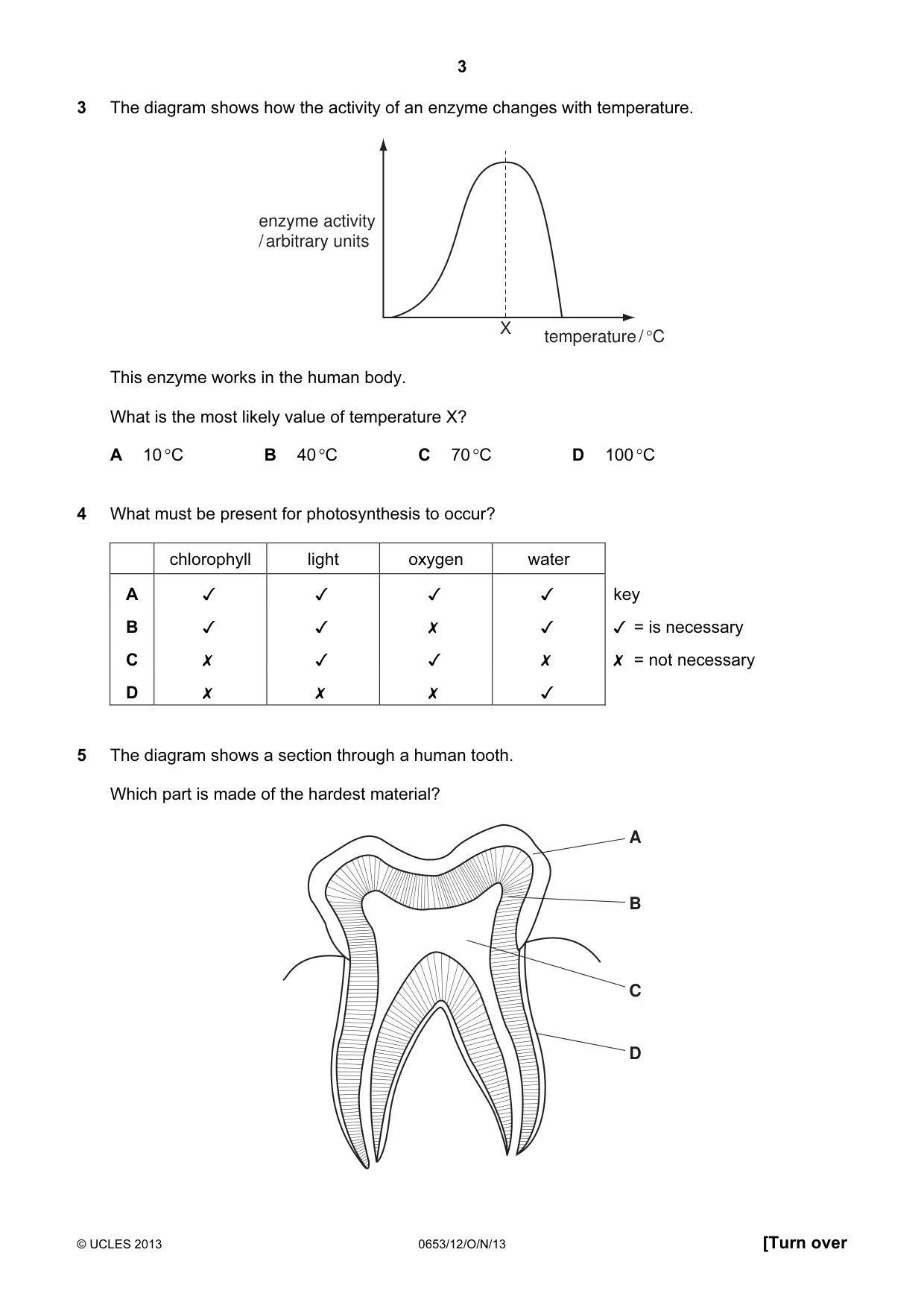
3 The diagram shows how the activity of an enzyme changes with temperature. enzyme activity / arbitrary units X temperature / °C This enzyme works in the human body. What is the most likely value of temperature X? A 10 °C B 40 °C C 70 °C D 100 °C
Mark scheme: B
Q4 · What must be present for photosynthesis to occur?
4 What must be present for photosynthesis to occur? chlorophyll light oxygen water A v v v v B v v x v Cc x v v x D x x x v key v =is necessary X =not necessary
Mark scheme: B
Q5 · The diagram shows a section through a human tooth
5 The diagram shows a section through a human tooth. Which part is made of the hardest material? A B C D
Mark scheme: A
Q6 · Which word equation represents aerobic respiration?
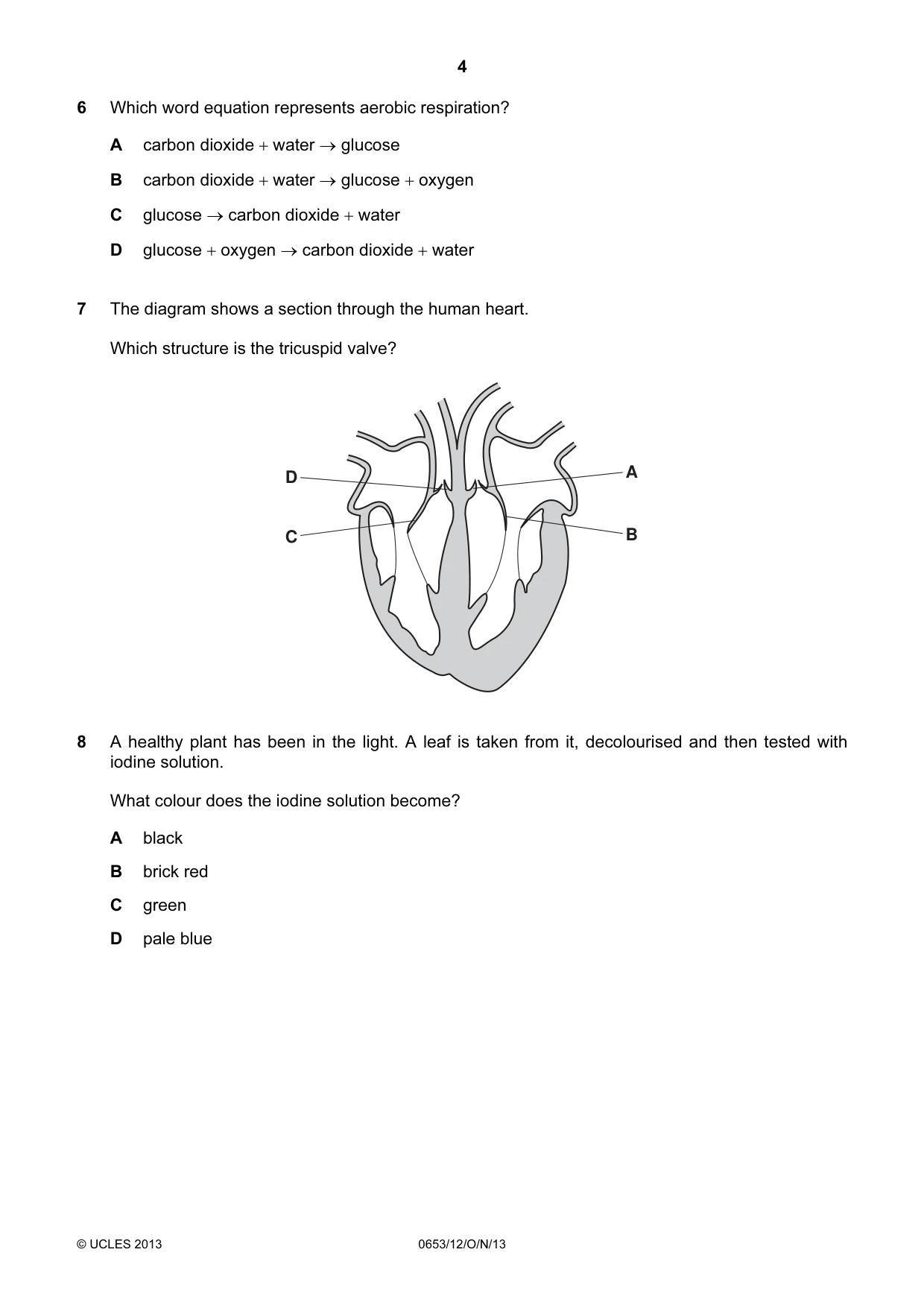
6 Which word equation represents aerobic respiration? A carbon dioxide + water → glucose B carbon dioxide + water → glucose + oxygen C glucose → carbon dioxide + water D glucose + oxygen → carbon dioxide + water
Mark scheme: D
Q7 · The diagram shows a section through the human heart
7 The diagram shows a section through the human heart. Which structure is the tricuspid valve? D A C B
Mark scheme: C
Q8 · A healthy plant has been in the light
8 A healthy plant has been in the light. A leaf is taken from it, decolourised and then tested with iodine solution. What colour does the iodine solution become? A black B brick red C green D pale blue
Mark scheme: A
Q9 · The diagrams show shoots of maize seedlings
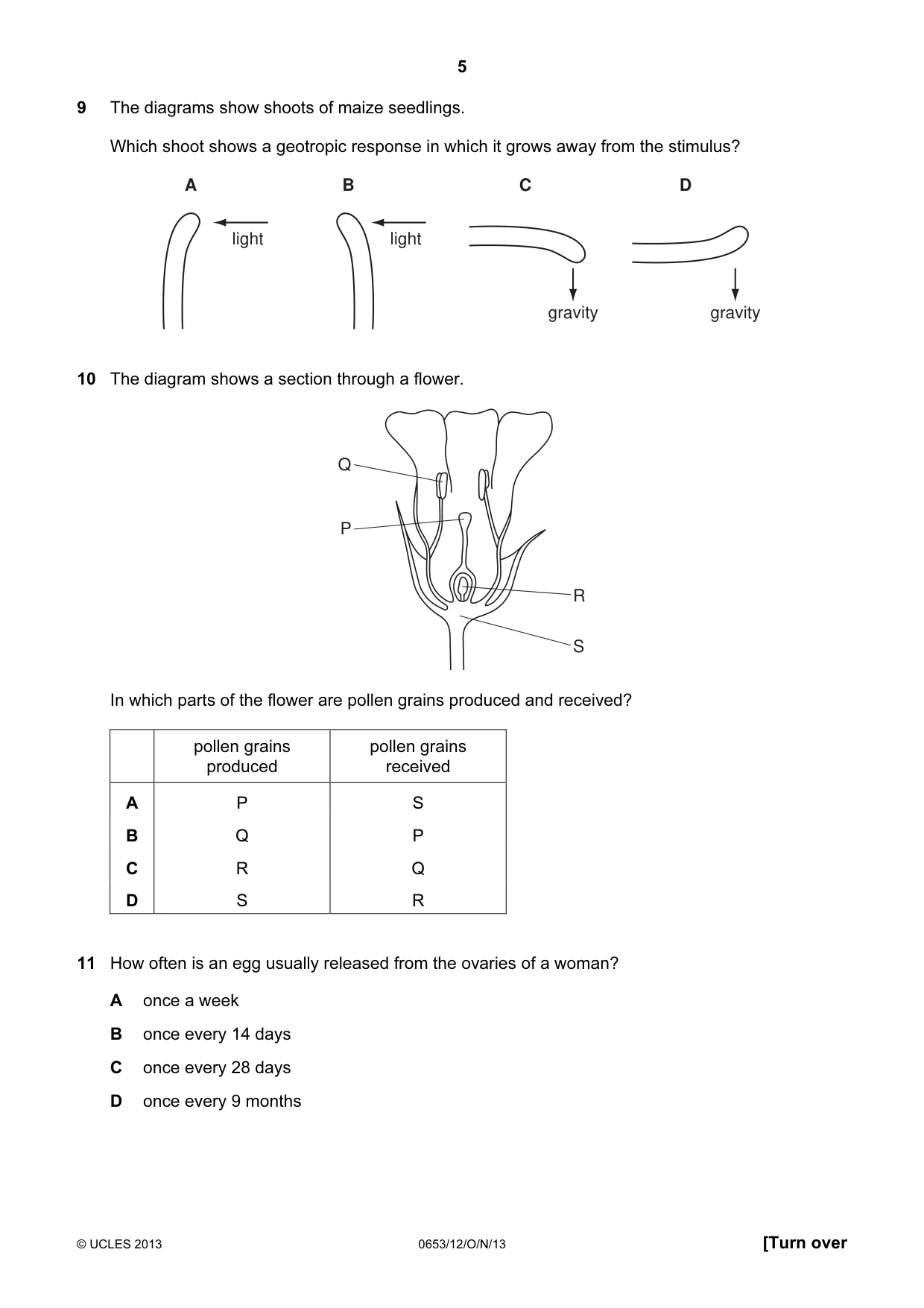
9 The diagrams show shoots of maize seedlings. Which shoot shows a geotropic response in which it grows away from the stimulus? A B C D light light gravity gravity
Mark scheme: D
Q10 · The diagram shows a section through a flower
10 The diagram shows a section through a flower. Q P R S In which parts of the flower are pollen grains produced and received? pollen grains pollen grains produced received A P S B Q P C R Q D S R
Mark scheme: B
Q11 · How often is an egg usually released from the ovaries of a woman?
11 How often is an egg usually released from the ovaries of a woman? A once a week B once every 14 days C once every 28 days D once every 9 months
Mark scheme: C
Q12 · The diagram shows part of the carbon cycle
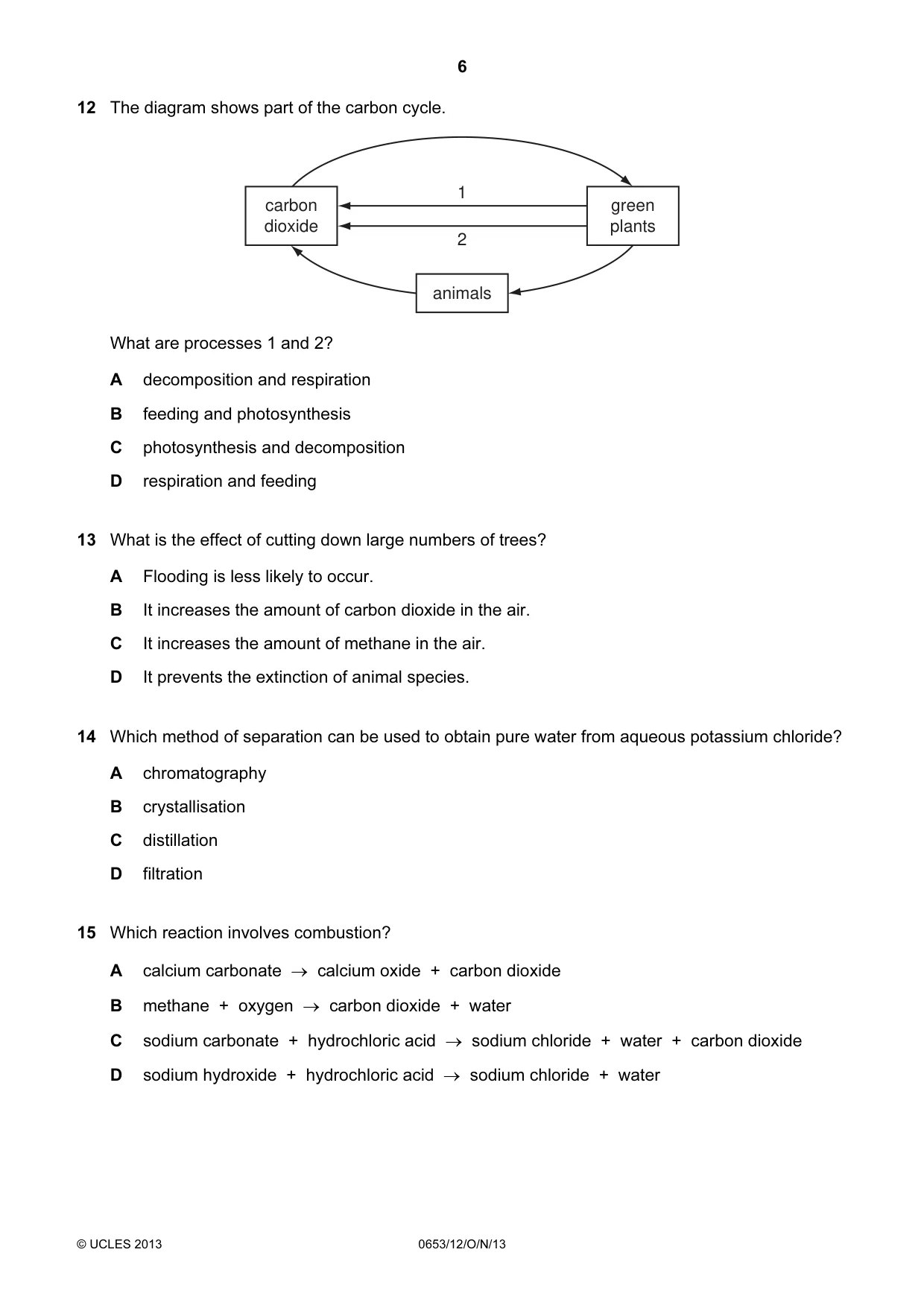
12 The diagram shows part of the carbon cycle. 1 carbon green dioxide plants 2 animals What are processes 1 and 2? A decomposition and respiration B feeding and photosynthesis C photosynthesis and decomposition D respiration and feeding
Mark scheme: A
Q13 · What is the effect of cutting down large numbers of trees?
13 What is the effect of cutting down large numbers of trees? A Flooding is less likely to occur. B It increases the amount of carbon dioxide in the air. C It increases the amount of methane in the air. D It prevents the extinction of animal species.
Mark scheme: B
Q14 · Which method of separation can be used to obtain pure water from aqueous potassium…
14 Which method of separation can be used to obtain pure water from aqueous potassium chloride? A chromatography B crystallisation C distillation D filtration
Mark scheme: C
Q15 · Which reaction involves combustion?
15 Which reaction involves combustion? A calcium carbonate → calcium oxide + carbon dioxide B methane + oxygen → carbon dioxide + water C sodium carbonate + hydrochloric acid → sodium chloride + water + carbon dioxide D sodium hydroxide + hydrochloric acid → sodium chloride + water
Mark scheme: B
Q16 · Marble and chalk are two forms of calcium carbonate
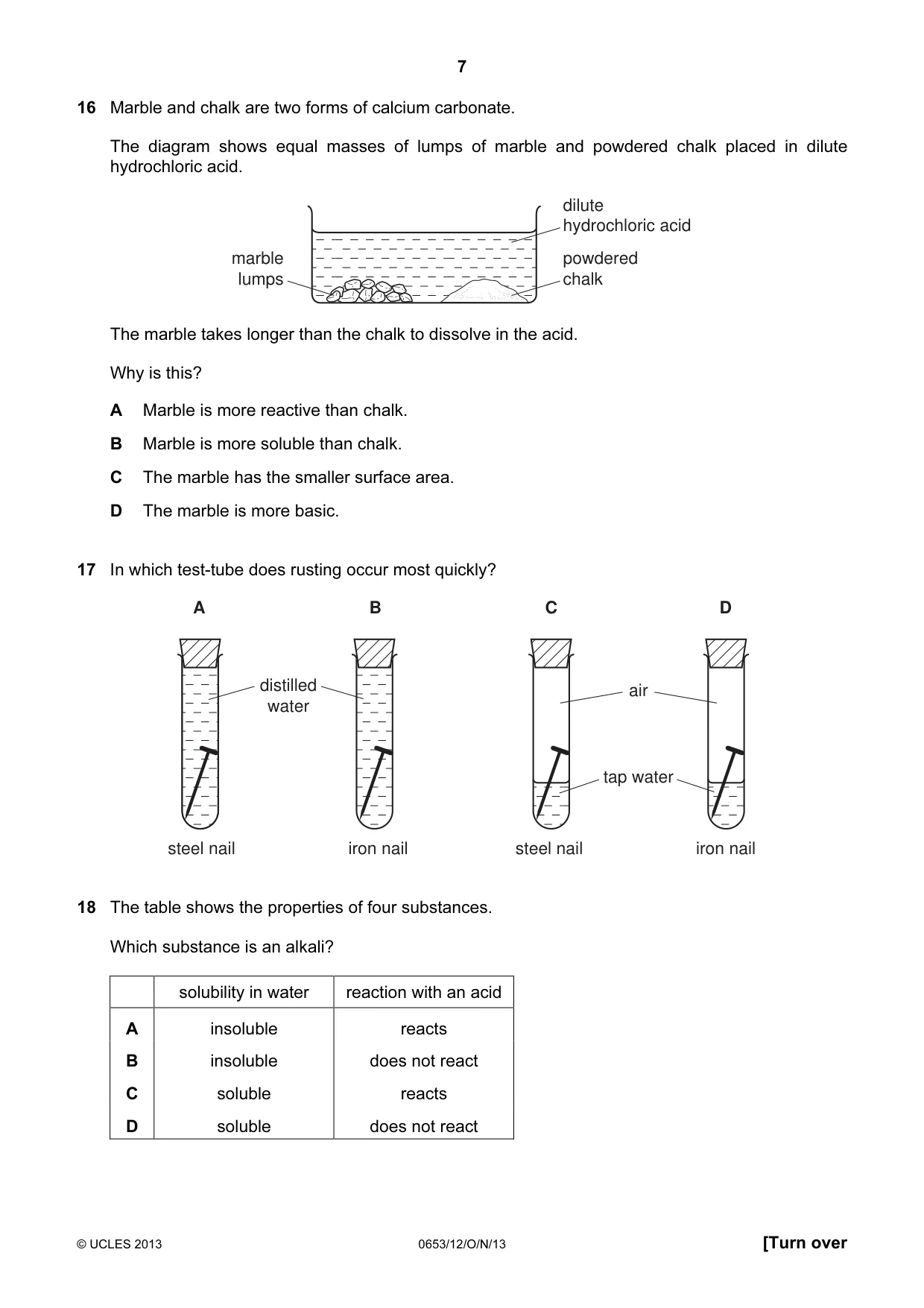
16 Marble and chalk are two forms of calcium carbonate. The diagram shows equal masses of lumps of marble and powdered chalk placed in dilute hydrochloric acid. dilute hydrochloric acid marble powdered lumps chalk The marble takes longer than the chalk to dissolve in the acid. Why is this? A Marble is more reactive than chalk. B Marble is more soluble than chalk. C The marble has the smaller surface area. D The marble is more basic.
Mark scheme: C
Q17 · In which test-tube does rusting occur most quickly?
17 In which test-tube does rusting occur most quickly? A B C D distilled air water tap water steel nail iron nail steel nail iron nail
Mark scheme: D
Q18 · The table shows the properties of four substances
18 The table shows the properties of four substances. Which substance is an alkali? solubility in water reaction with an acid A insoluble reacts B insoluble does not react C soluble reacts D soluble does not react
Mark scheme: C
More questions on The characteristic properties of acids and bases
Q19 · The positions of elements P, Q, R, S and T in the Periodic Table are shown
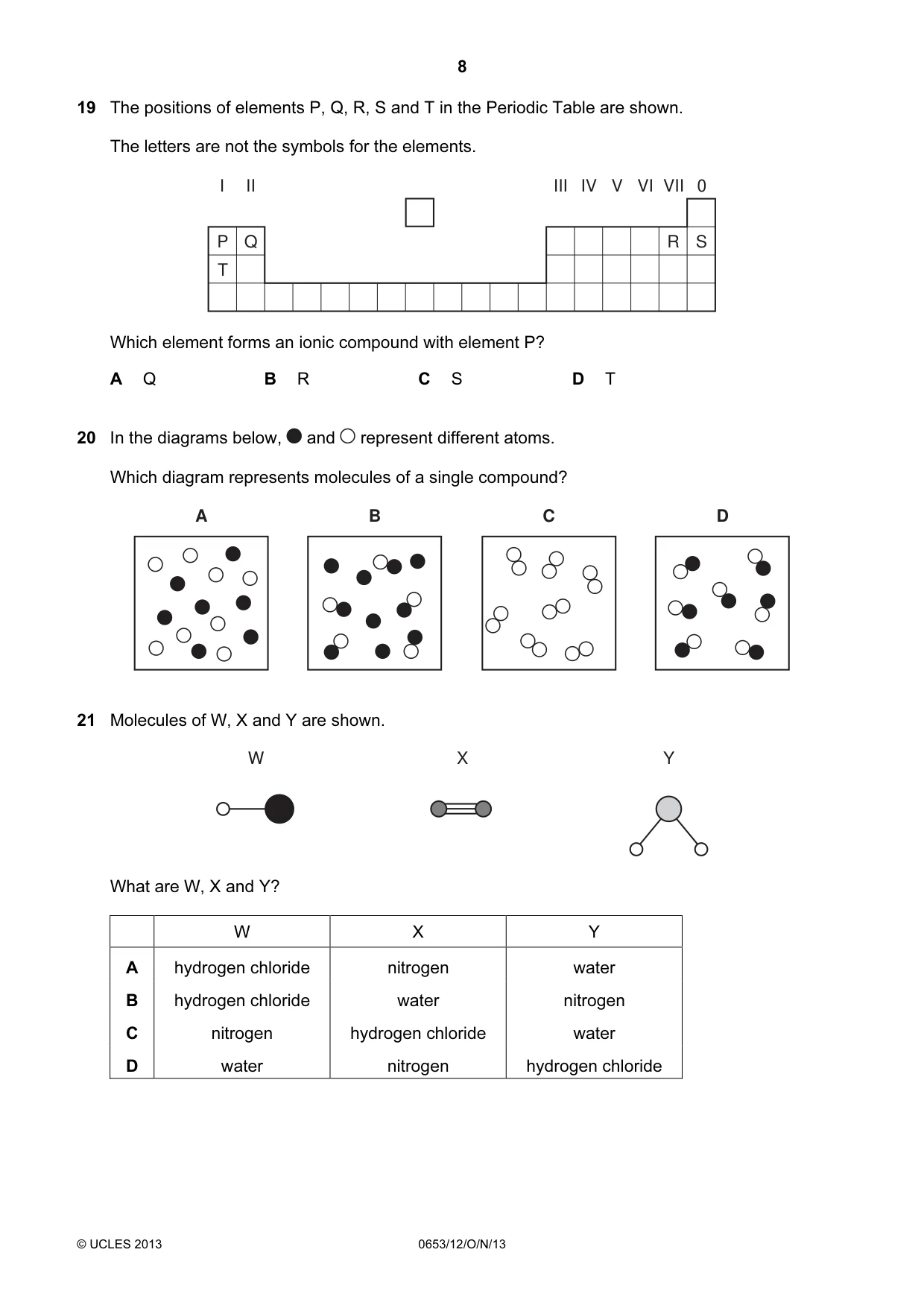
19 The positions of elements P, Q, R, S and T in the Periodic Table are shown. The letters are not the symbols for the elements. I II III IV V VI VII 0 P Q R S T Which element forms an ionic compound with element P? A Q B R C S D T
Mark scheme: B
Q20 · In the diagrams below, and represent different atoms
20 In the diagrams below, and represent different atoms. Which diagram represents molecules of a single compound? A B C D
Mark scheme: D
Q21 · Molecules of W, X and Y are shown
21 Molecules of W, X and Y are shown. W X Y What are W, X and Y? W X Y A hydrogen chloride nitrogen water B hydrogen chloride water nitrogen C nitrogen hydrogen chloride water D water nitrogen hydrogen chloride
Mark scheme: A
Q22 · Copper(II) bromide can be electrolysed in the same way as copper(II) chloride
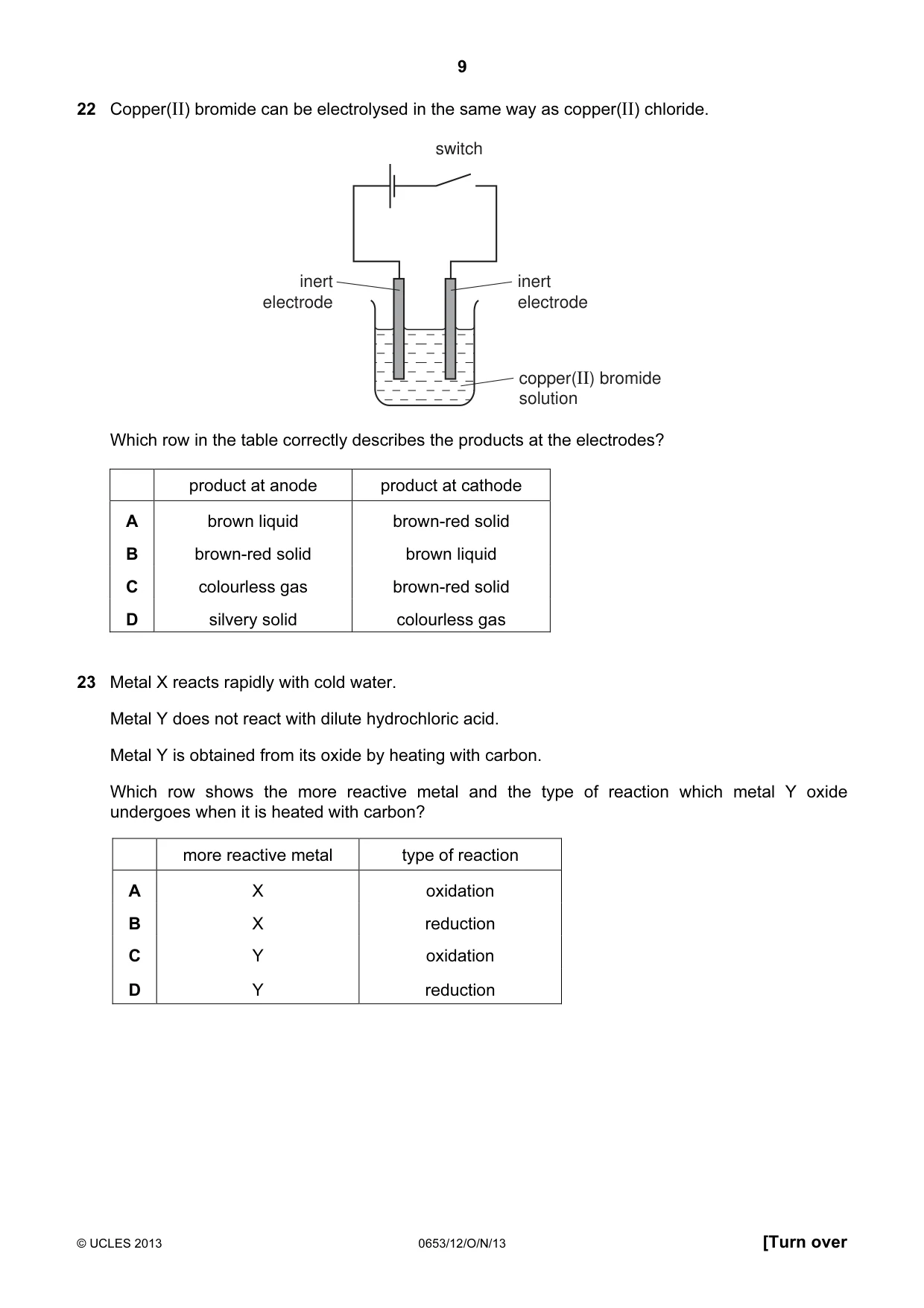
22 Copper(II) bromide can be electrolysed in the same way as copper(II) chloride. switch inert inert electrode electrode copper(II) bromide solution Which row in the table correctly describes the products at the electrodes? product at anode product at cathode A brown liquid brown-red solid B brown-red solid brown liquid C colourless gas brown-red solid D silvery solid colourless gas
Mark scheme: A
Q23 · Metal X reacts rapidly with cold water
23 Metal X reacts rapidly with cold water. Metal Y does not react with dilute hydrochloric acid. Metal Y is obtained from its oxide by heating with carbon. Which row shows the more reactive metal and the type of reaction which metal Y oxide undergoes when it is heated with carbon? more reactive metal type of reaction A X oxidation B X reduction C Y oxidation D Y reduction
Mark scheme: B
Q24 · 80 cm3 of dry air is passed over hot copper until there is no further change in volume
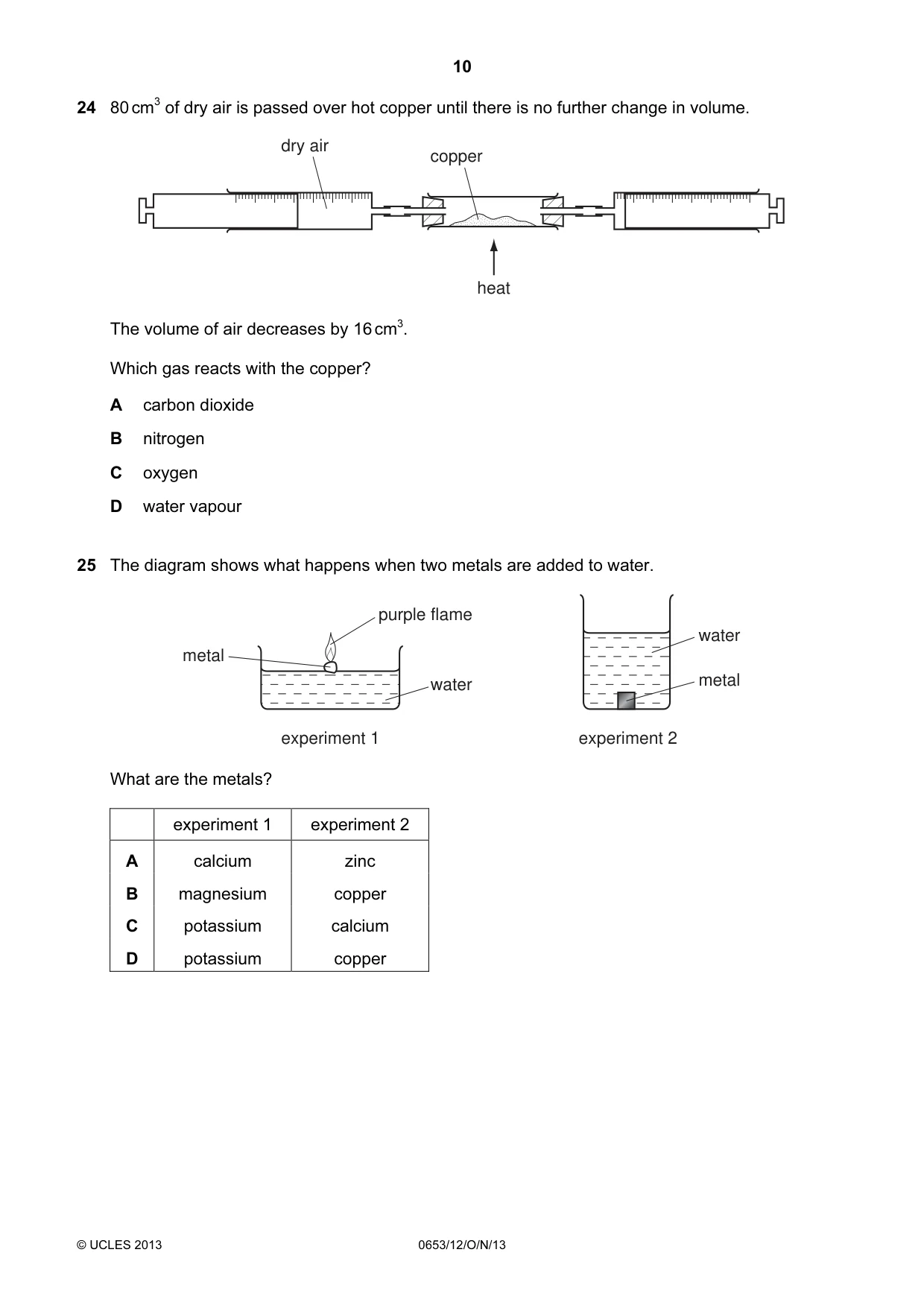
24 80 cm3 of dry air is passed over hot copper until there is no further change in volume. dry air copper heat The volume of air decreases by 16 cm3. Which gas reacts with the copper? A carbon dioxide B nitrogen C oxygen D water vapour
Mark scheme: C
Q25 · The diagram shows what happens when two metals are added to water
25 The diagram shows what happens when two metals are added to water. purple flame water metal water metal experiment 1 experiment 2 What are the metals? experiment 1 experiment 2 A calcium zinc B magnesium copper C potassium calcium D potassium copper
Mark scheme: D
Q26 · The diagram shows a molecule of a compound of silicon and hydrogen
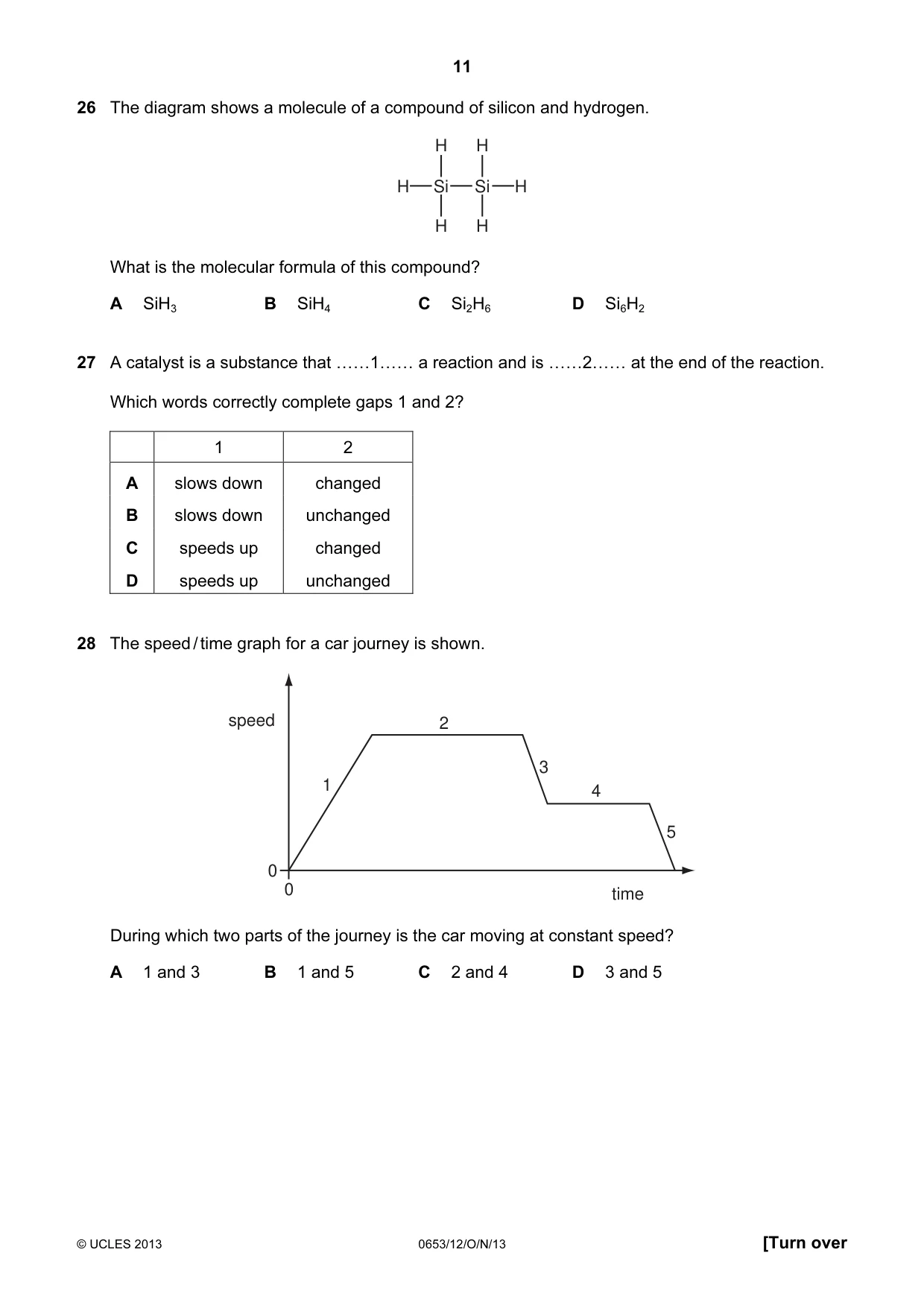
26 The diagram shows a molecule of a compound of silicon and hydrogen. H H H Si Si H H H What is the molecular formula of this compound? A SiH3 B SiH4 C Si2H6 D Si6H2
Mark scheme: C
Q27 · A catalyst is a substance that ……1…… a reaction and is ……2…… at the end of the reaction
27 A catalyst is a substance that ……1…… a reaction and is ……2…… at the end of the reaction. Which words correctly complete gaps 1 and 2? 1 2 A slows down changed B slows down unchanged C speeds up changed D speeds up unchanged
Mark scheme: D
Q28 · The speed / time graph for a car journey is shown
28 The speed / time graph for a car journey is shown. speed 2 3 1 4 5 0 0 time During which two parts of the journey is the car moving at constant speed? A 1 and 3 B 1 and 5 C 2 and 4 D 3 and 5
Mark scheme: C
Q29 · The diagram shows two cubes of different sizes made from the same substance
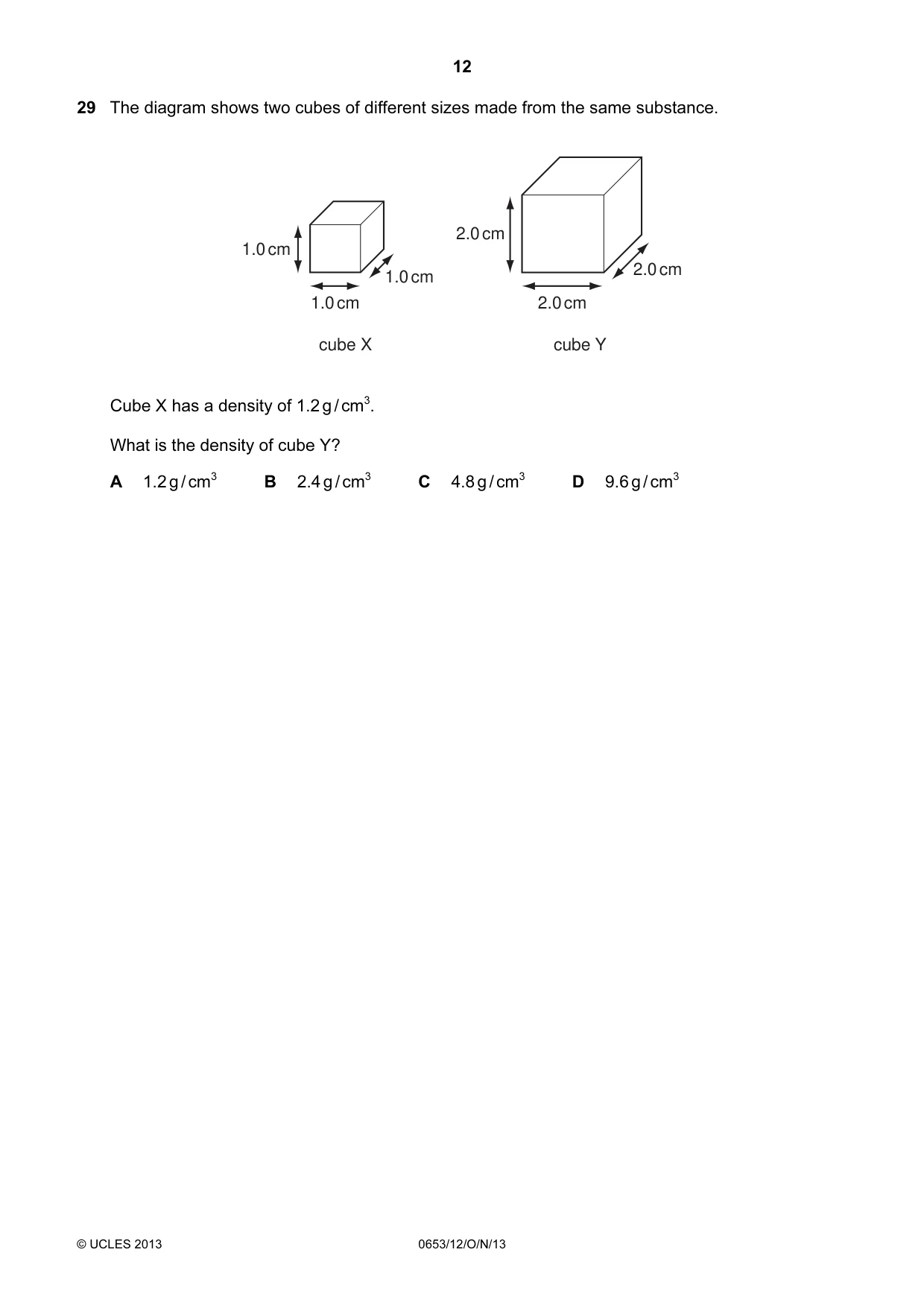
29 The diagram shows two cubes of different sizes made from the same substance. 2.0 cm 1.0 cm 1.0 cm 2.0 cm 1.0 cm 2.0 cm cube X cube Y Cube X has a density of 1.2 g / cm3. What is the density of cube Y? A 1.2 g / cm3 B 2.4 g / cm3 C 4.8 g / cm3 D 9.6 g / cm3
Mark scheme: A
Q30 · Weight lifting involves a number of different stages
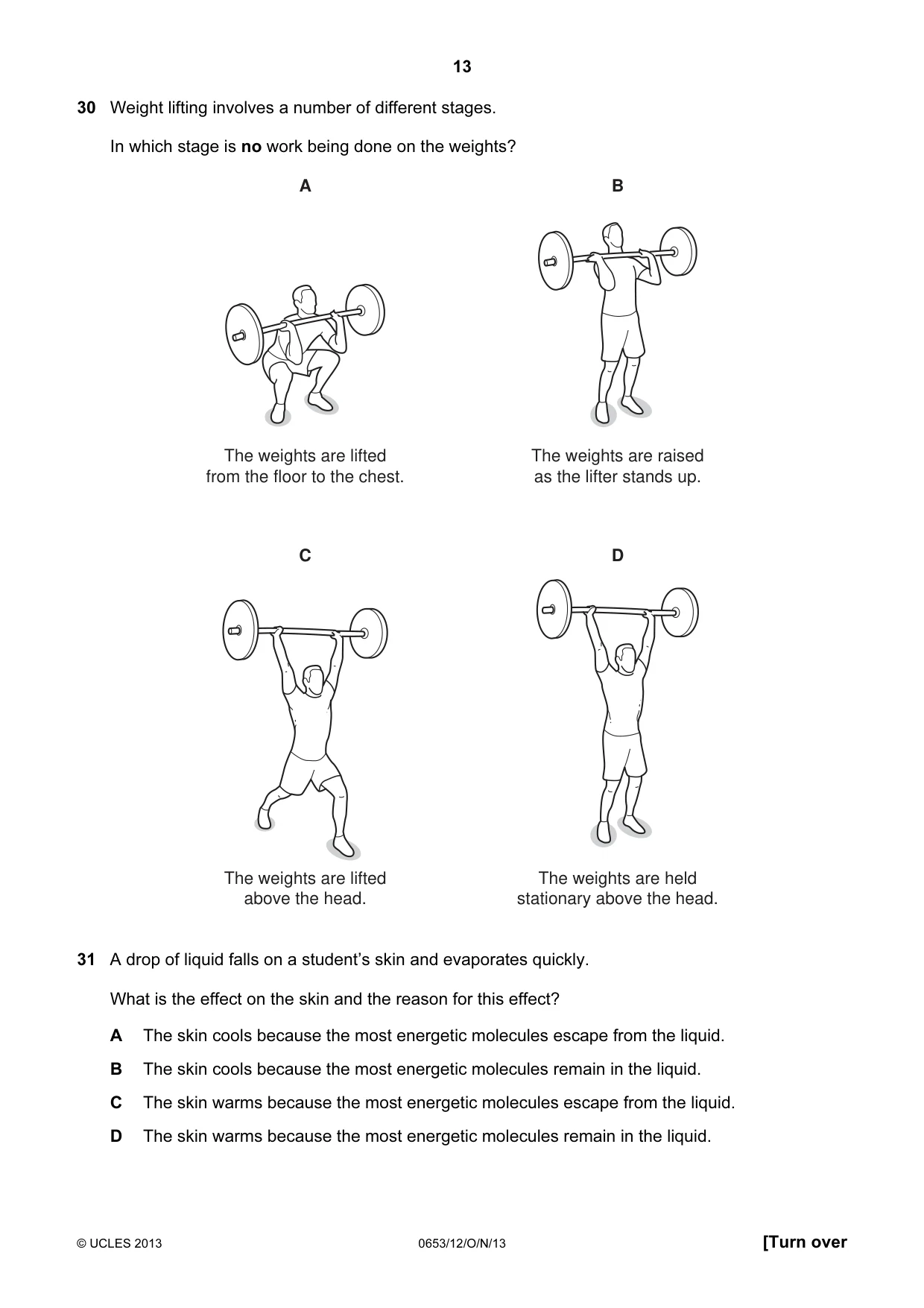
30 Weight lifting involves a number of different stages. In which stage is no work being done on the weights? A B The weights are lifted The weights are raised from the floor to the chest. as the lifter stands up. C D The weights are lifted The weights are held above the head. stationary above the head.
Mark scheme: D
Q31 · A drop of liquid falls on a student’s skin and evaporates quickly
31 A drop of liquid falls on a student’s skin and evaporates quickly. What is the effect on the skin and the reason for this effect? A The skin cools because the most energetic molecules escape from the liquid. B The skin cools because the most energetic molecules remain in the liquid. C The skin warms because the most energetic molecules escape from the liquid. D The skin warms because the most energetic molecules remain in the liquid.
Mark scheme: A
Q32 · Benzene and glycerine are two substances
32 Benzene and glycerine are two substances. The table gives the melting point and the boiling point of benzene and of glycerine. melting point boiling point benzene 5.4 °C 80 °C glycerine 18 °C 290 °C At which temperature will both benzene and glycerine be liquid? A 0 °C B 50 °C C 100 °C D 150 °C
Mark scheme: B
Q33 · The diagrams show four identical pieces of ice that are heated in test-tubes of water
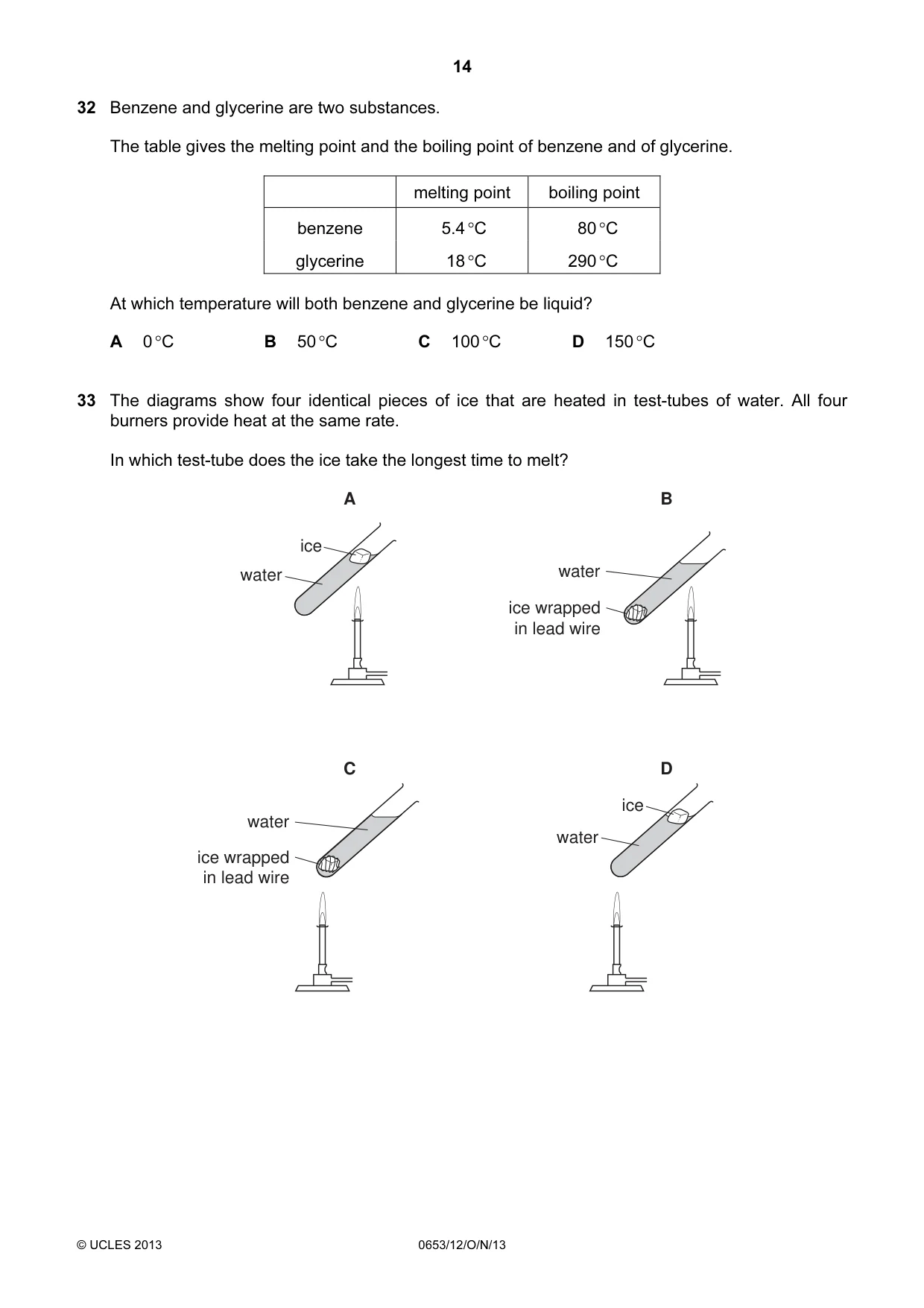
33 The diagrams show four identical pieces of ice that are heated in test-tubes of water. All four burners provide heat at the same rate. In which test-tube does the ice take the longest time to melt? A B ice water water ice wrapped in lead wire C D ice water water ice wrapped in lead wire
Mark scheme: B
Q34 · The diagram shows a rope with one end fixed to a wall
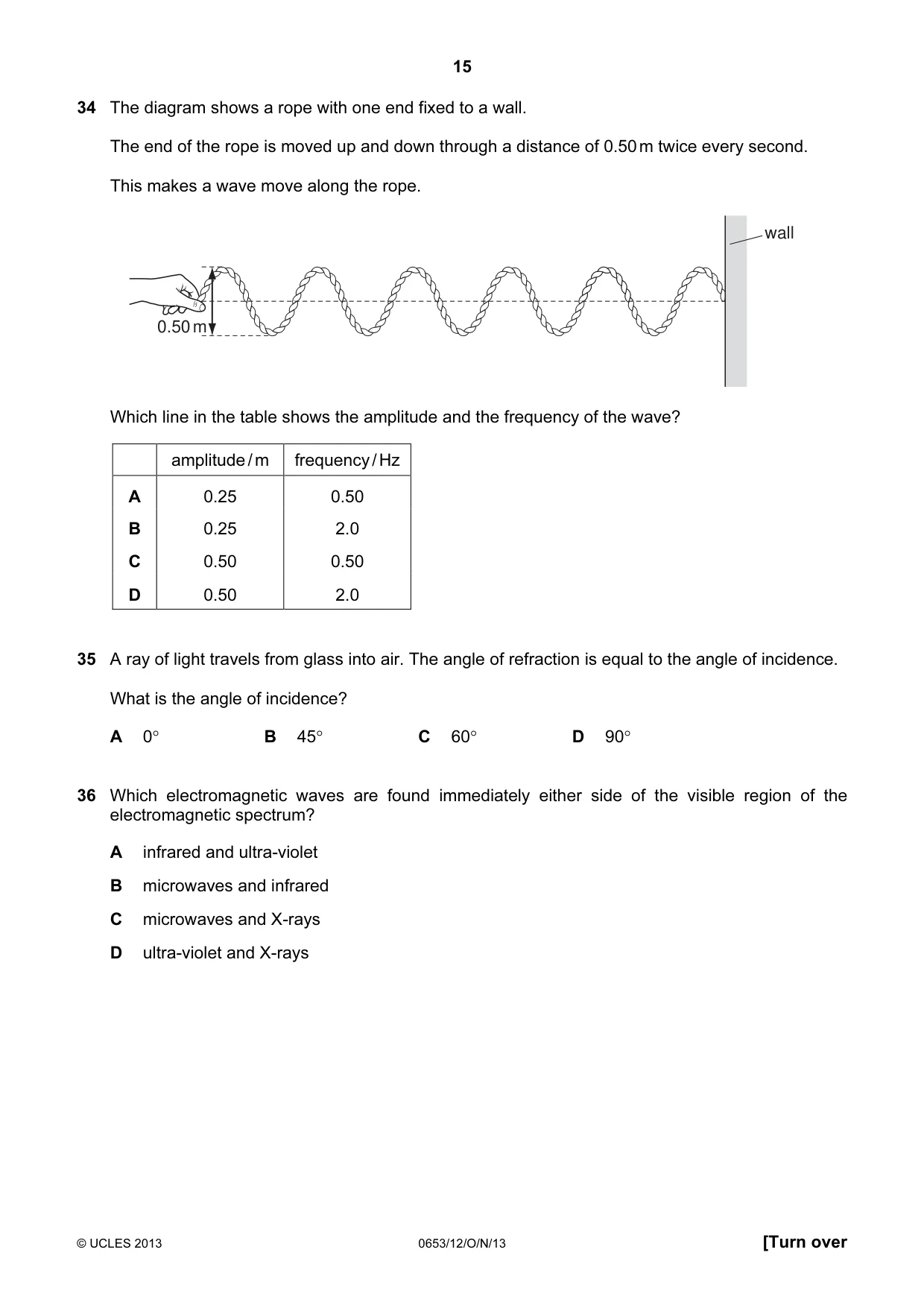
34 The diagram shows a rope with one end fixed to a wall. The end of the rope is moved up and down through a distance of 0.50 m twice every second. This makes a wave move along the rope. wall 0.50 m Which line in the table shows the amplitude and the frequency of the wave? amplitude / m frequency / Hz A 0.25 0.50 B 0.25 2.0 C 0.50 0.50 D 0.50 2.0
Mark scheme: B
Q35 · A ray of light travels from glass into air
35 A ray of light travels from glass into air. The angle of refraction is equal to the angle of incidence. What is the angle of incidence? A 0° B 45° C 60° D 90°
Mark scheme: A
Q36 · Which electromagnetic waves are found immediately either side of the visible region of…
36 Which electromagnetic waves are found immediately either side of the visible region of the electromagnetic spectrum? A infrared and ultra-violet B microwaves and infrared C microwaves and X-rays D ultra-violet and X-rays
Mark scheme: A
Q37 · Two sound waves P and Q are displayed on an oscilloscope
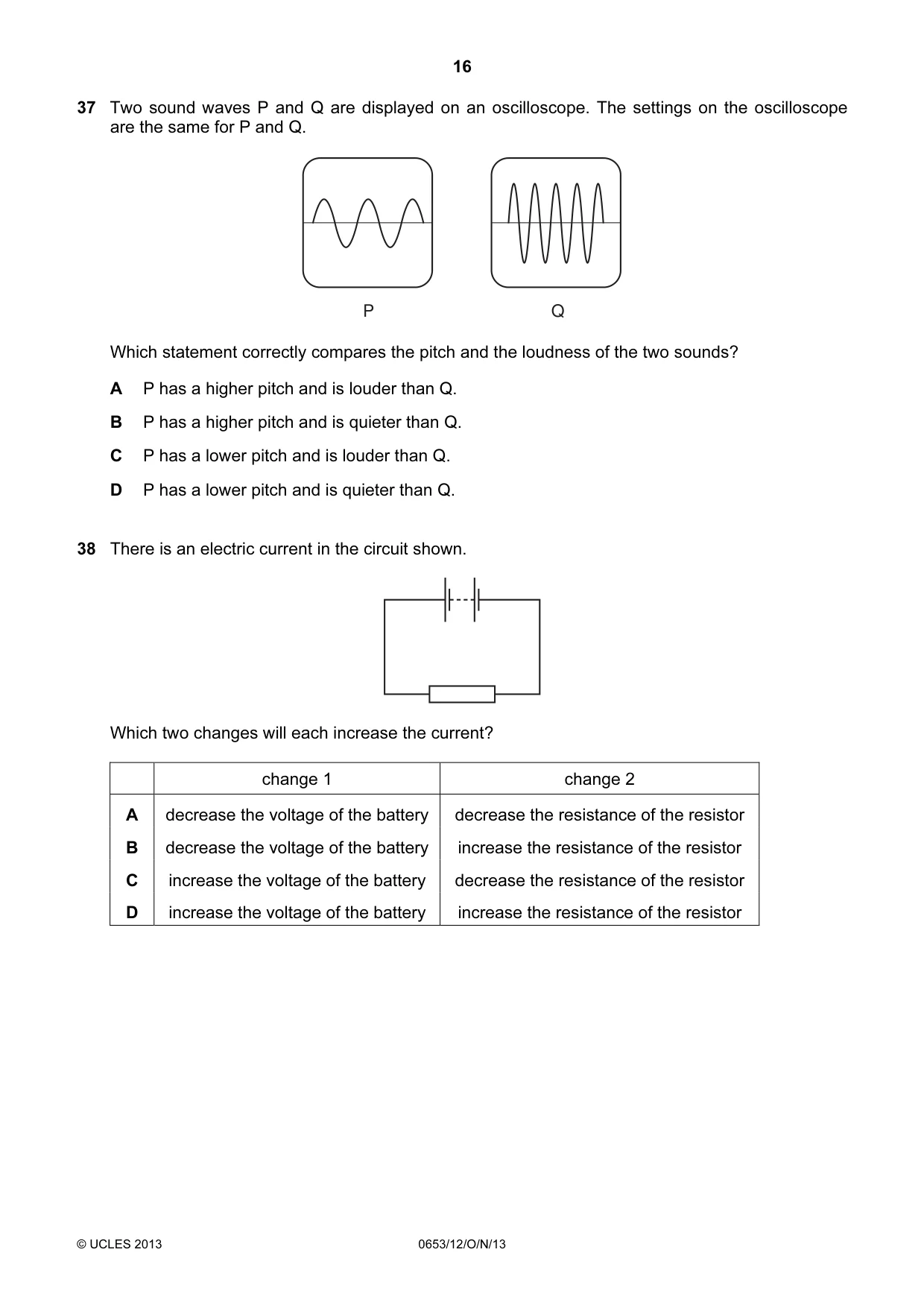
37 Two sound waves P and Q are displayed on an oscilloscope. The settings on the oscilloscope are the same for P and Q. P Q Which statement correctly compares the pitch and the loudness of the two sounds? A P has a higher pitch and is louder than Q. B P has a higher pitch and is quieter than Q. C P has a lower pitch and is louder than Q. D P has a lower pitch and is quieter than Q.
Mark scheme: D
Q38 · There is an electric current in the circuit shown
38 There is an electric current in the circuit shown. Which two changes will each increase the current? change 1 change 2 A decrease the voltage of the battery decrease the resistance of the resistor B decrease the voltage of the battery increase the resistance of the resistor C increase the voltage of the battery decrease the resistance of the resistor D increase the voltage of the battery increase the resistance of the resistor
Mark scheme: C
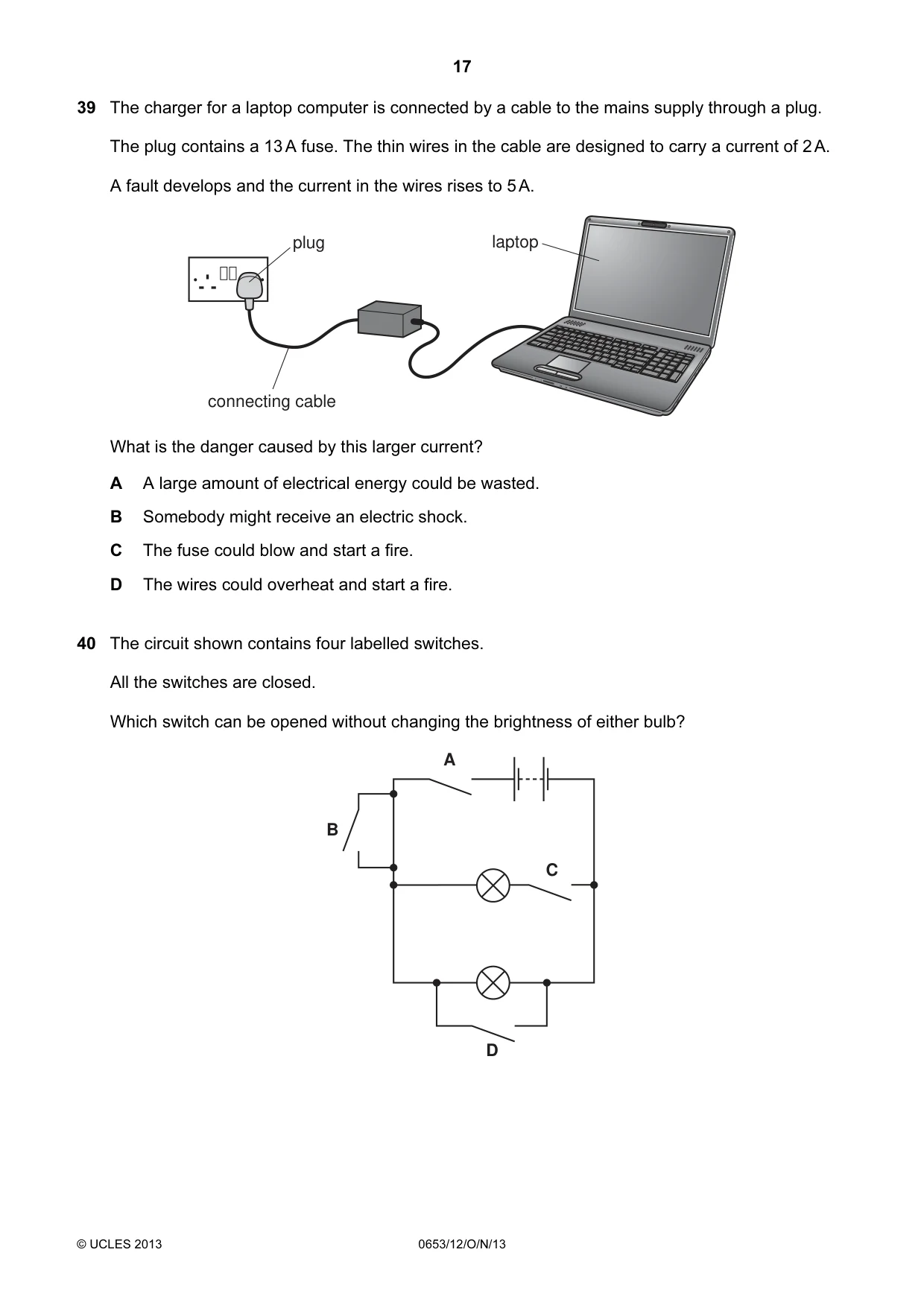
Q39 · The charger for a laptop computer is connected by a cable to the mains supply through a…
39 The charger for a laptop computer is connected by a cable to the mains supply through a plug. The plug contains a 13 A fuse. The thin wires in the cable are designed to carry a current of 2 A. A fault develops and the current in the wires rises to 5 A. plug laptop connecting cable What is the danger caused by this larger current? A A large amount of electrical energy could be wasted. B Somebody might receive an electric shock. C The fuse could blow and start a fire. D The wires could overheat and start a fire.
Mark scheme: D
Q40 · The circuit shown contains four labelled switches
40 The circuit shown contains four labelled switches. All the switches are closed. Which switch can be opened without changing the brightness of either bulb? A B C D
Mark scheme: B
What was in this paper
The subtopics covered by these 40 questions, and how many questions each got. Open one in a new tab to see every Cambridge question on it.
2Rate of reaction2Air quality and climate1Carbon cycle1Characteristics of living organisms1Corrosion of metals1Density1Diffusion1Digestive system1Electrical circuits1Electrical quantities1Electrical safety1Electrolysis1Electromagnetic spectrum1Elements, compounds and mixtures1Energy, work and power1Enzymes1Formulas1General properties of waves1Group I properties1Habitat destruction1Heart1Ions and ionic bonds1Kinetic particle model of matter1Light1Motion1Physical and chemical changes1Reactivity series1Respiration1Separation and purification1Sexual reproduction in humans1Sexual reproduction in plants1Simple molecules and covalent bonds1Size of specimens1Sound1The characteristic properties of acids and bases1Thermal properties and temperature1Transfer of thermal energy1What you needed in this session
Cambridge’s own grade thresholds for 2013 Oct/Nov, Paper 1 · Variant 2. A higher threshold means an easier paper — the bar moves with how the cohort did.