Cambridge IGCSE Science - Combined 0653 — 2024 May/June Paper 1 · Variant 3
0653/13/M/J/24 · 40 questions · 40 marks · ≈45 min
The question paper and its mark scheme, free to read here and free to download. This is Cambridge’s own paper, exactly as it was sat.
Question paper16 pages

Mark scheme3 pages
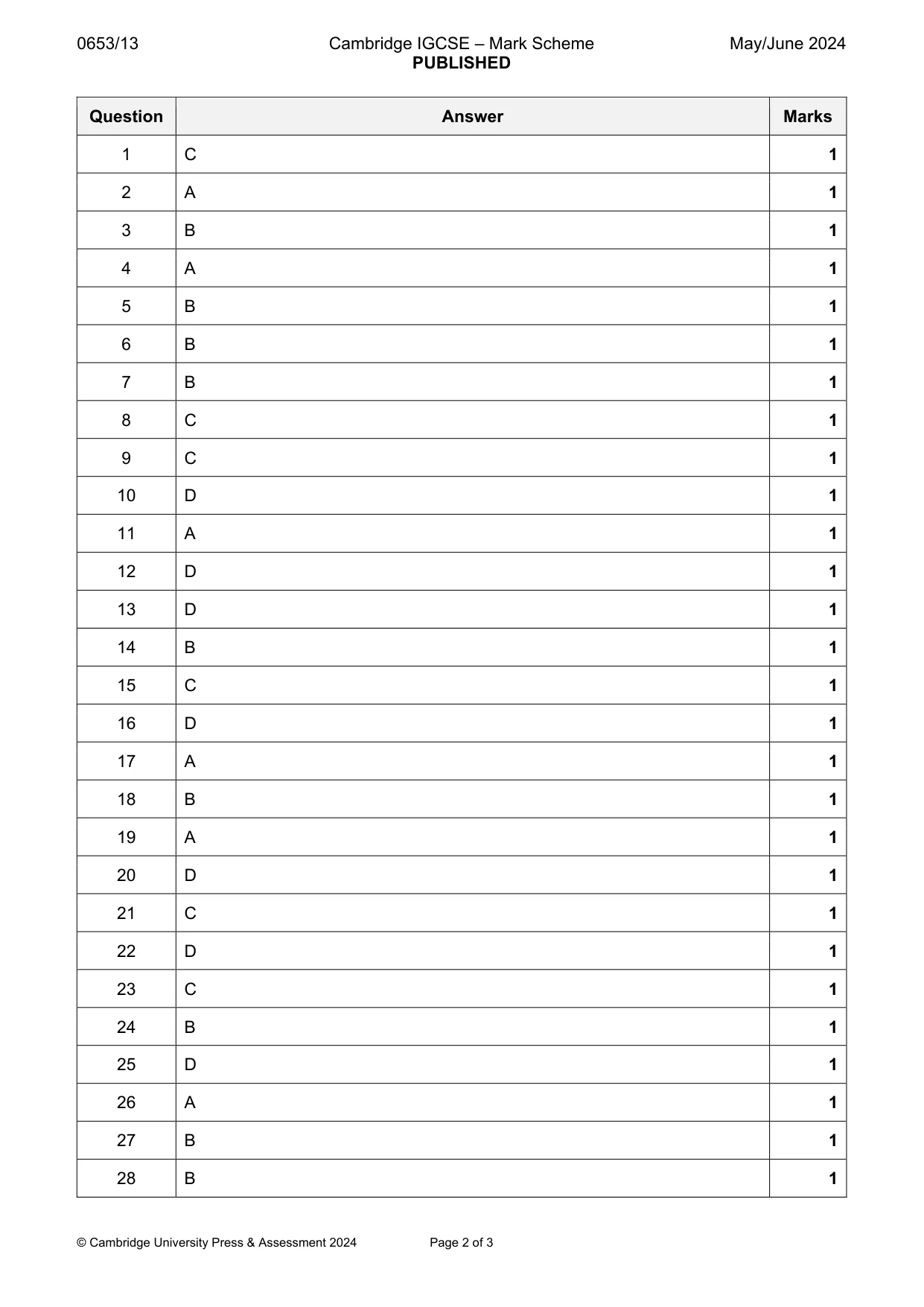
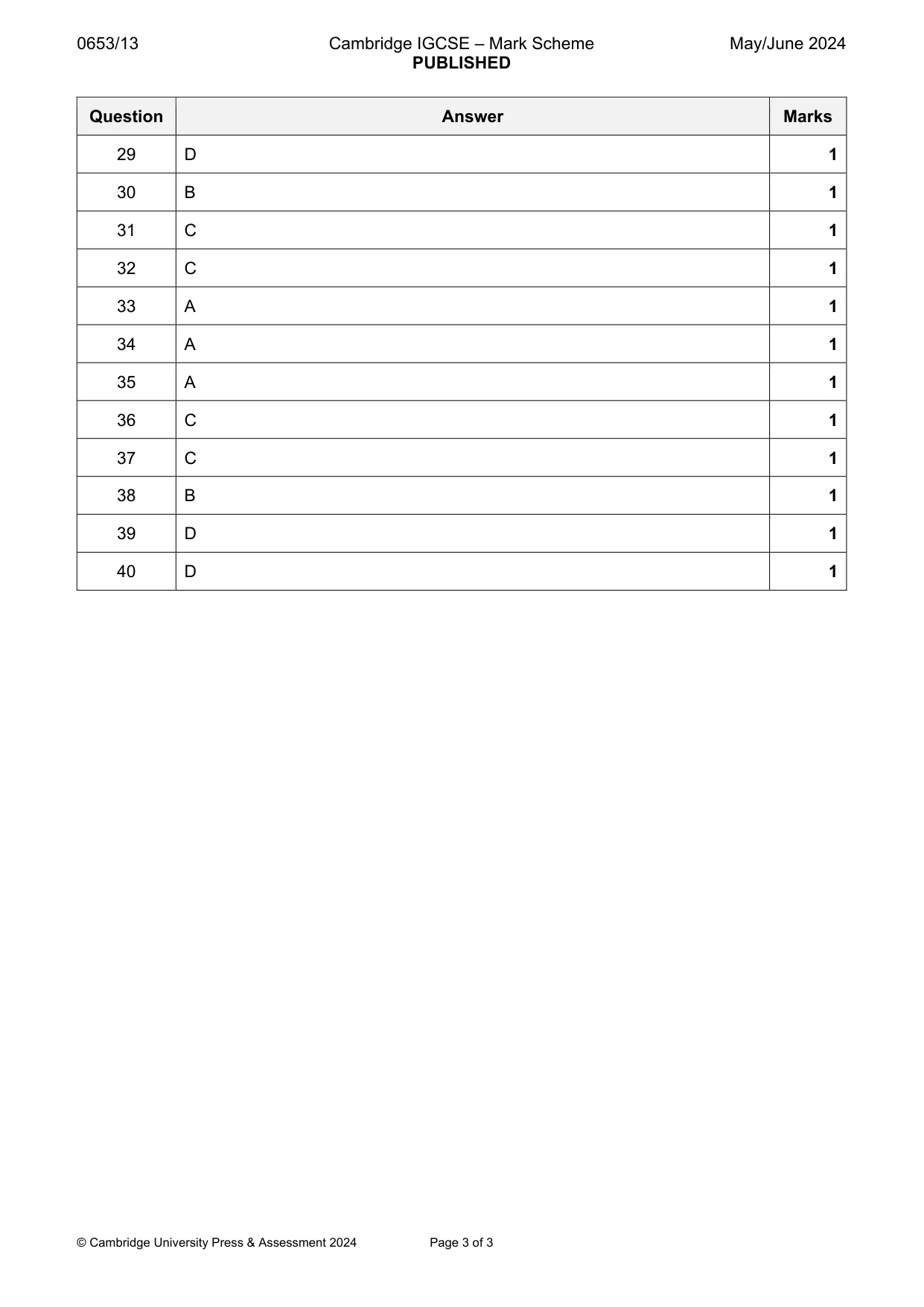
Answers below. Sit the paper first if you are practising.
Questions as text
Q1 · A plant bends towards the light
1 A plant bends towards the light. Which characteristics of living organisms does this show? A movement and nutrition B movement and respiration C movement and sensitivity D sensitivity and respiration
Mark scheme: C
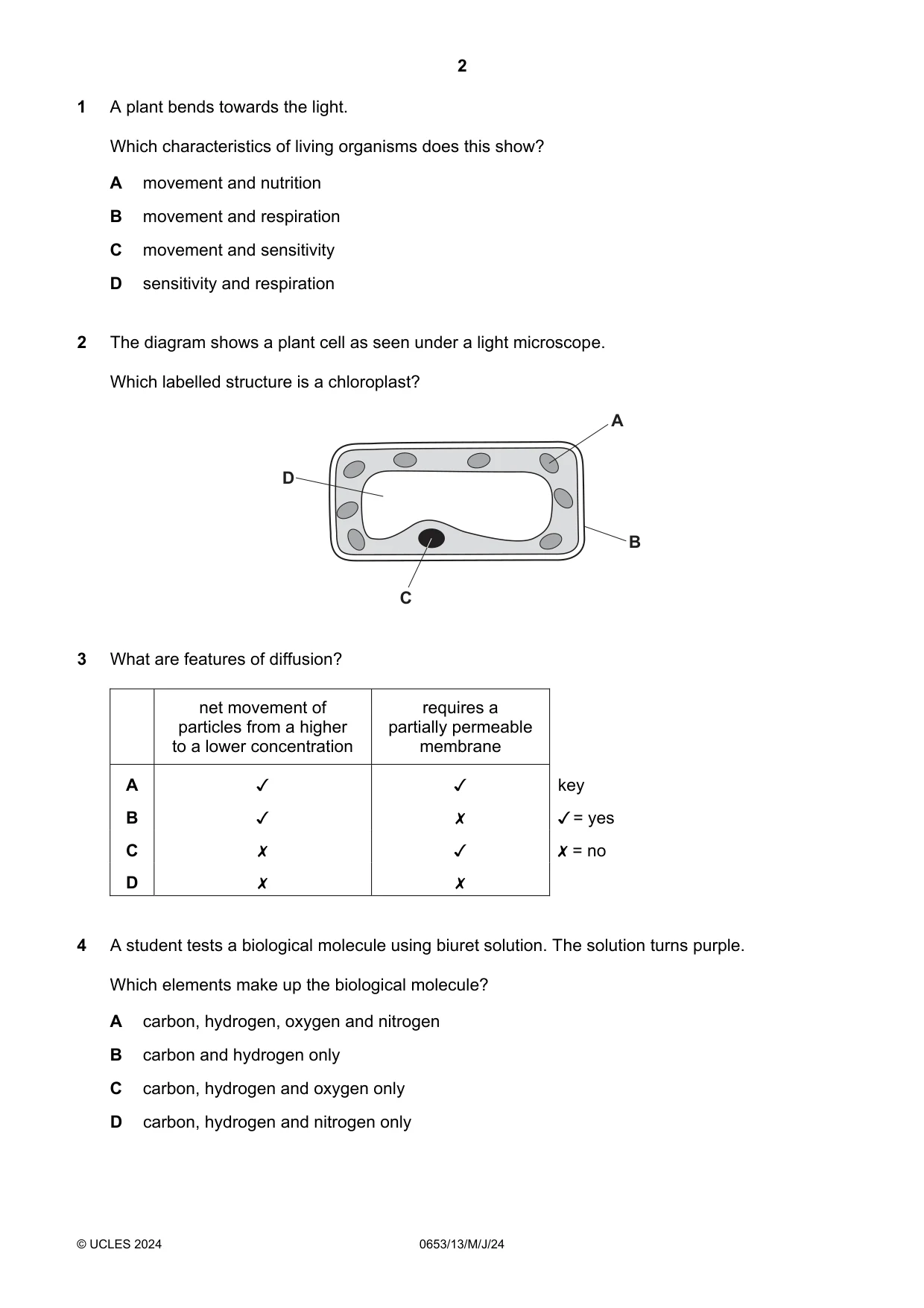
Q2 · The diagram shows a plant cell as seen under a light microscope
2 The diagram shows a plant cell as seen under a light microscope. Which labelled structure is a chloroplast? A D B C
Mark scheme: A
Q3 · What are features of diffusion?
3 What are features of diffusion? net movement of requires a particles from a higher partially permeable to a lower concentration membrane v Jv key /=yes 0 0O WwW D> Jv x x Jv X=no x x
Mark scheme: B
Q4 · A student tests a biological molecule using biuret solution
4 A student tests a biological molecule using biuret solution. The solution turns purple. Which elements make up the biological molecule? A carbon, hydrogen, oxygen and nitrogen B carbon and hydrogen only C carbon, hydrogen and oxygen only D carbon, hydrogen and nitrogen only
Mark scheme: A
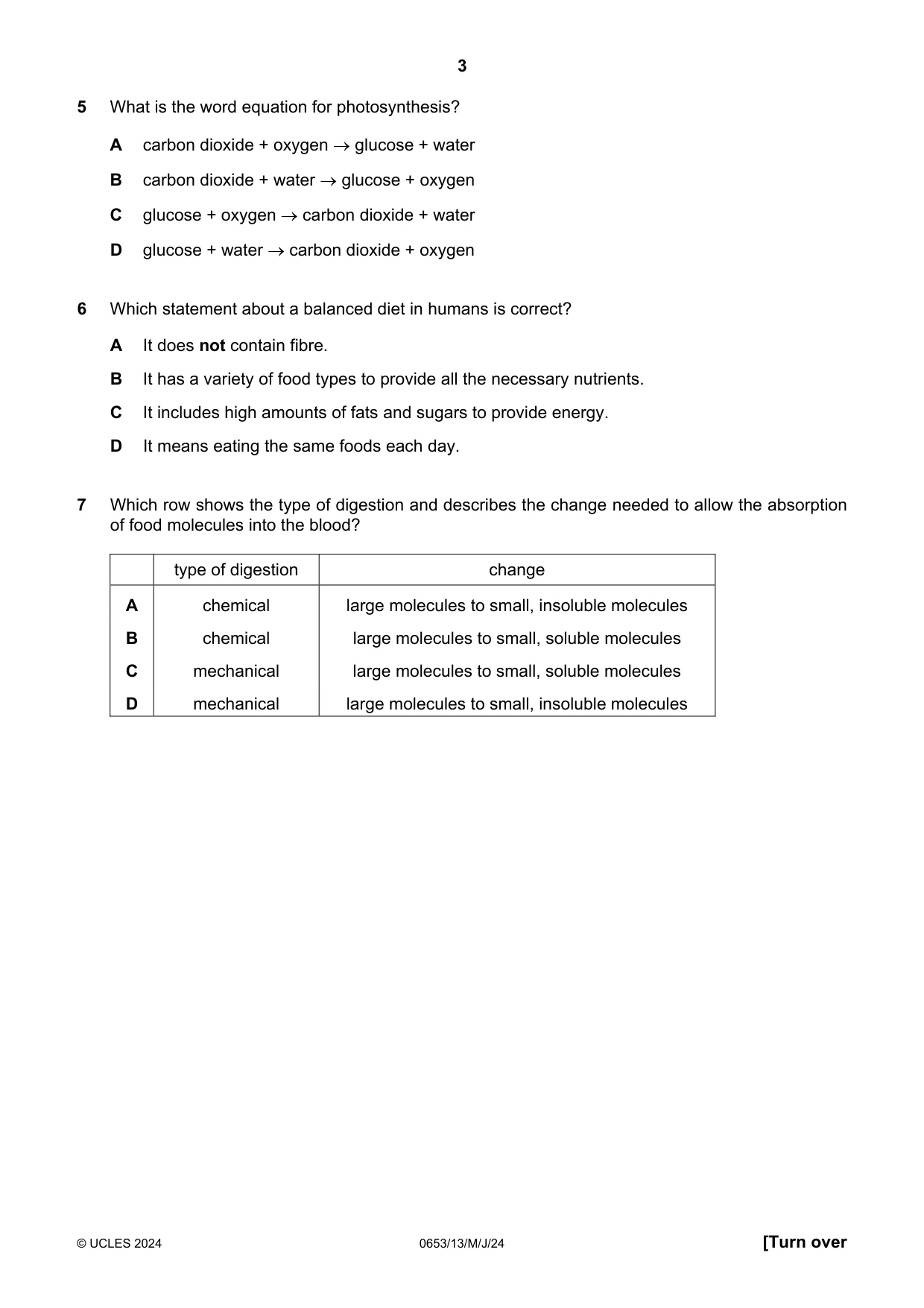
Q5 · What is the word equation for photosynthesis?
5 What is the word equation for photosynthesis? A carbon dioxide + oxygen glucose + water B carbon dioxide + water glucose + oxygen C glucose + oxygen carbon dioxide + water D glucose + water carbon dioxide + oxygen
Mark scheme: B
Q6 · Which statement about a balanced diet in humans is correct?
6 Which statement about a balanced diet in humans is correct? A It does not contain fibre. B It has a variety of food types to provide all the necessary nutrients. C It includes high amounts of fats and sugars to provide energy. D It means eating the same foods each day.
Mark scheme: B
Q7 · Which row shows the type of digestion and describes the change needed to allow the…
7 Which row shows the type of digestion and describes the change needed to allow the absorption of food molecules into the blood? type of digestion change A chemical large molecules to small, insoluble molecules B chemical large molecules to small, soluble molecules C mechanical large molecules to small, soluble molecules D mechanical large molecules to small, insoluble molecules
Mark scheme: B
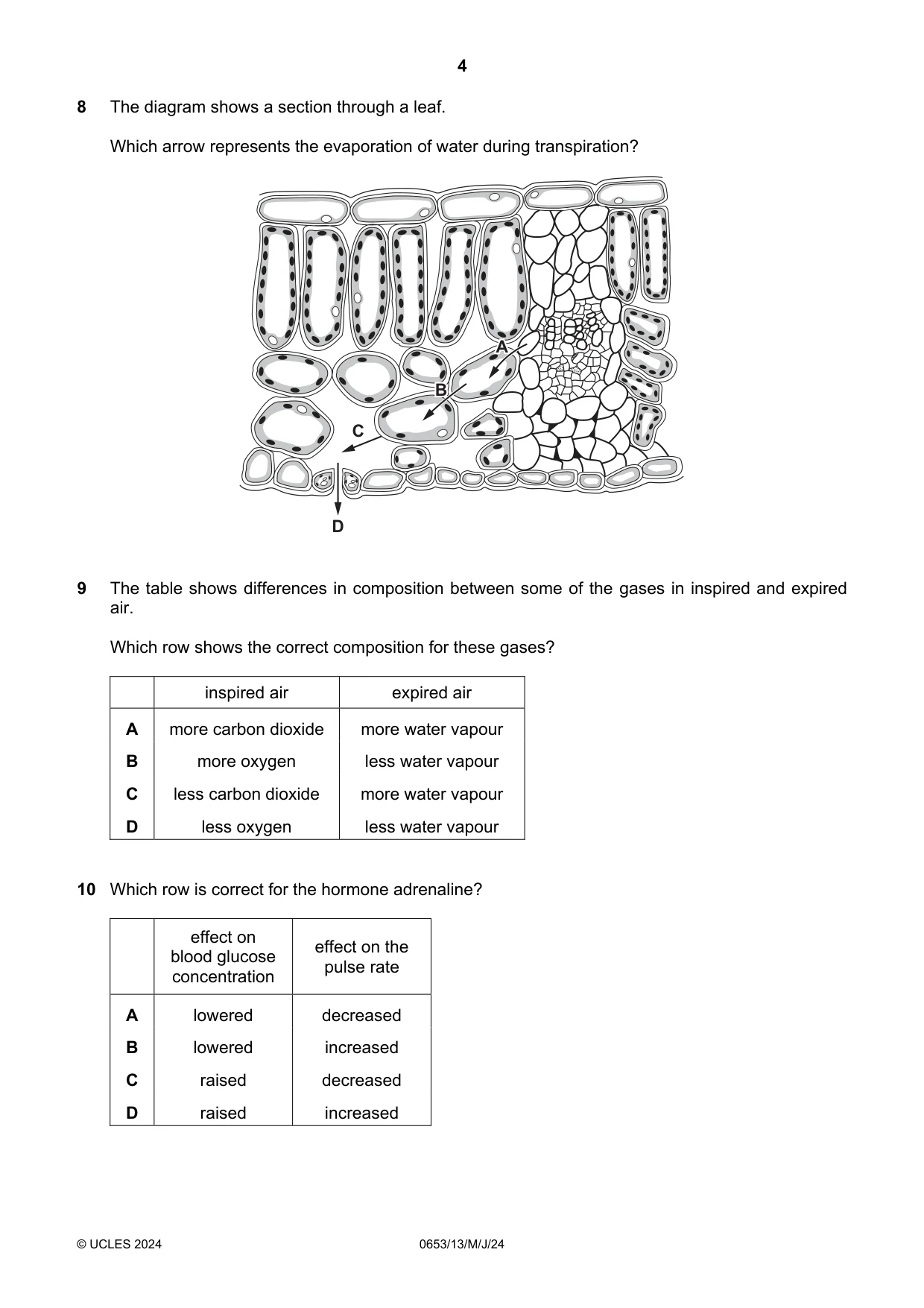
Q8 · The diagram shows a section through a leaf
8 The diagram shows a section through a leaf. Which arrow represents the evaporation of water during transpiration? A A B B C D
Mark scheme: C
Q9 · The table shows differences in composition between some of the gases in inspired and…
9 The table shows differences in composition between some of the gases in inspired and expired air. Which row shows the correct composition for these gases? inspired air expired air A more carbon dioxide more water vapour B more oxygen less water vapour C less carbon dioxide more water vapour D less oxygen less water vapour
Mark scheme: C
Q10 · Which row is correct for the hormone adrenaline?
10 Which row is correct for the hormone adrenaline? effect on effect on the blood glucose pulse rate concentration A lowered decreased B lowered increased C raised decreased D raised increased
Mark scheme: D
Q11 · A plant is grown without light
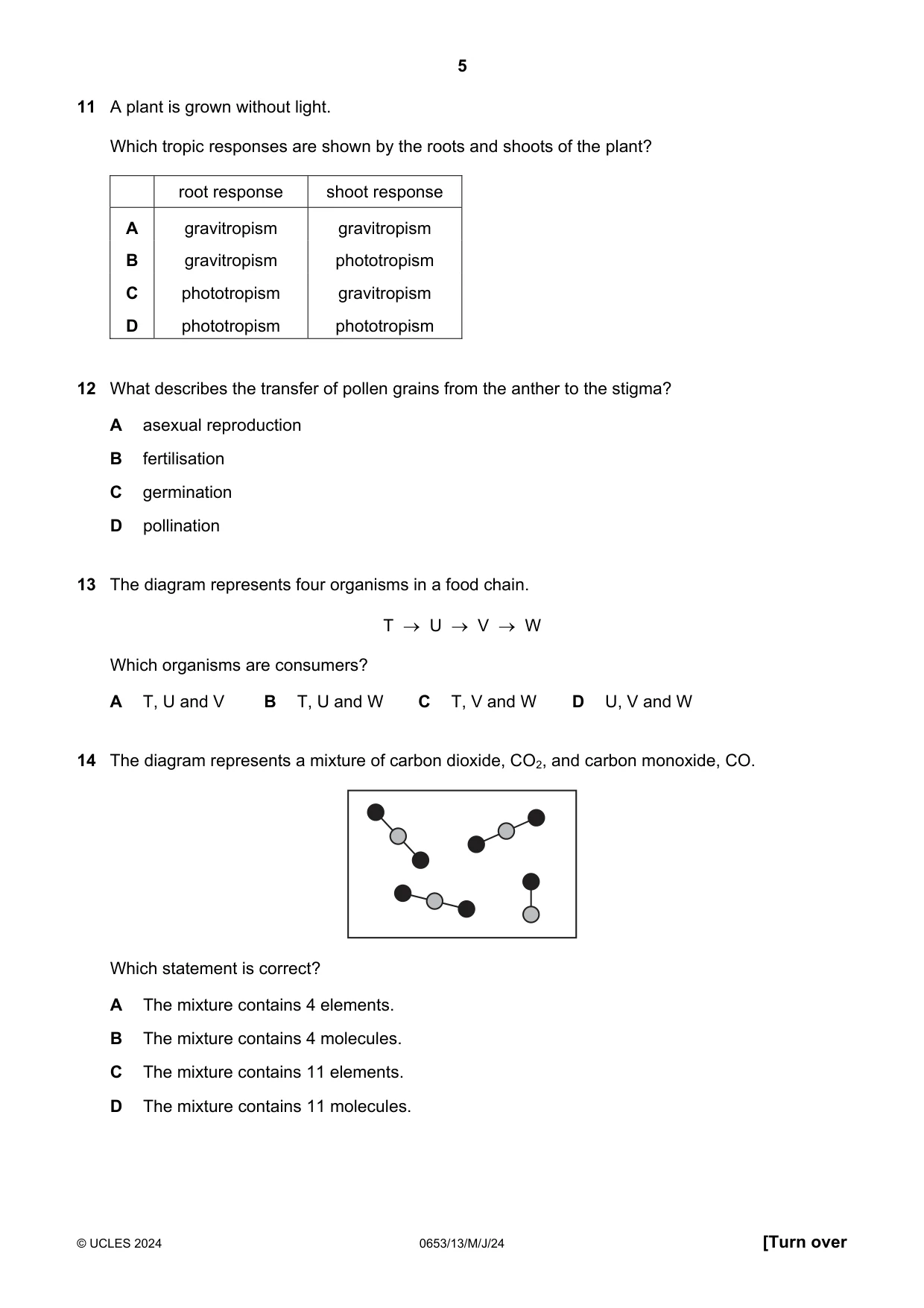
11 A plant is grown without light. Which tropic responses are shown by the roots and shoots of the plant? root response shoot response A gravitropism gravitropism B gravitropism phototropism C phototropism gravitropism D phototropism phototropism
Mark scheme: A
Q12 · What describes the transfer of pollen grains from the anther to the stigma?
12 What describes the transfer of pollen grains from the anther to the stigma? A asexual reproduction B fertilisation C germination D pollination
Mark scheme: D
Q13 · The diagram represents four organisms in a food chain
13 The diagram represents four organisms in a food chain. T U V W Which organisms are consumers? A T, U and V B T, U and W C T, V and W D U, V and W
Mark scheme: D
Q14 · The diagram represents a mixture of carbon dioxide, CO2, and carbon monoxide, CO
14 The diagram represents a mixture of carbon dioxide, CO2, and carbon monoxide, CO. Which statement is correct? A The mixture contains 4 elements. B The mixture contains 4 molecules. C The mixture contains 11 elements. D The mixture contains 11 molecules.
Mark scheme: B
Q15 · Which method is used to separate an insoluble salt from a mixture of the salt and water?
15 Which method is used to separate an insoluble salt from a mixture of the salt and water? A crystallisation B distillation C filtration D fractional distillation
Mark scheme: C
Q16 · Which row about elements and compounds is correct?
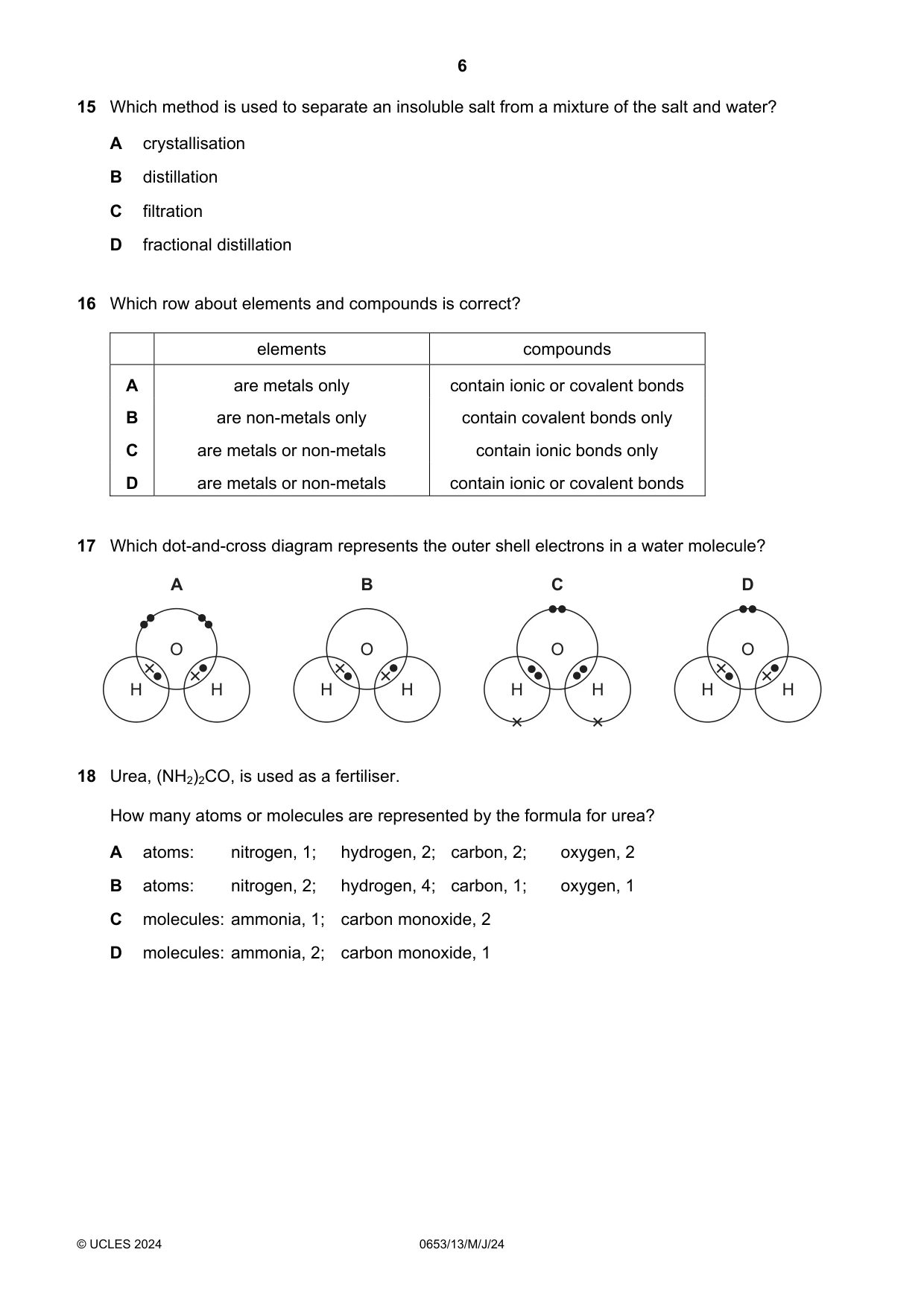
16 Which row about elements and compounds is correct? elements compounds A are metals only contain ionic or covalent bonds B are non-metals only contain covalent bonds only C are metals or non-metals contain ionic bonds only D are metals or non-metals contain ionic or covalent bonds
Mark scheme: D
Q17 · Which dot-and-cross diagram represents the outer shell electrons in a water molecule?
17 Which dot-and-cross diagram represents the outer shell electrons in a water molecule? A B C D O O O O H H H H H H H H
Mark scheme: A
Q18 · Urea, (NH2)2CO, is used as a fertiliser
18 Urea, (NH2)2CO, is used as a fertiliser. How many atoms or molecules are represented by the formula for urea? A atoms: nitrogen, 1; hydrogen, 2; carbon, 2; oxygen, 2 B atoms: nitrogen, 2; hydrogen, 4; carbon, 1; oxygen, 1 C molecules: ammonia, 1; carbon monoxide, 2 D molecules: ammonia, 2; carbon monoxide, 1
Mark scheme: B
Q19 · The apparatus used in an electrolysis experiment is shown
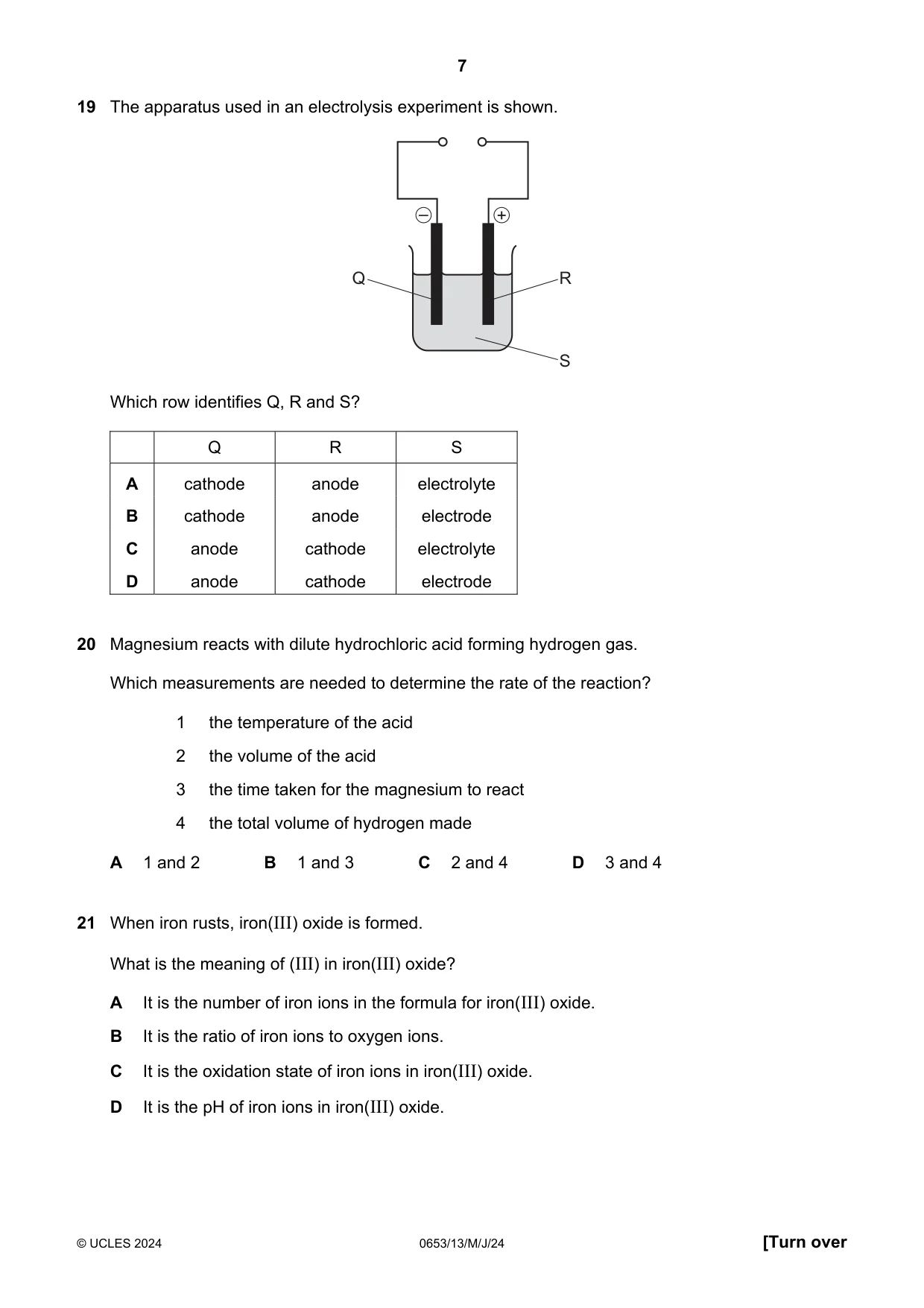
19 The apparatus used in an electrolysis experiment is shown. – + Q R S Which row identifies Q, R and S? Q R S A cathode anode electrolyte B cathode anode electrode C anode cathode electrolyte D anode cathode electrode
Mark scheme: A
Q20 · Magnesium reacts with dilute hydrochloric acid forming hydrogen gas
20 Magnesium reacts with dilute hydrochloric acid forming hydrogen gas. Which measurements are needed to determine the rate of the reaction? 1 the temperature of the acid 2 the volume of the acid 3 the time taken for the magnesium to react 4 the total volume of hydrogen made A 1 and 2 B 1 and 3 C 2 and 4 D 3 and 4
Mark scheme: D
Q21 · When iron rusts, iron(III) oxide is formed
21 When iron rusts, iron(III) oxide is formed. What is the meaning of (III) in iron(III) oxide? A It is the number of iron ions in the formula for iron(III) oxide. B It is the ratio of iron ions to oxygen ions. C It is the oxidation state of iron ions in iron(III) oxide. D It is the pH of iron ions in iron(III) oxide.
Mark scheme: C
Q22 · Astudent mixes a dilute acid with separate samples from the four bottles shown
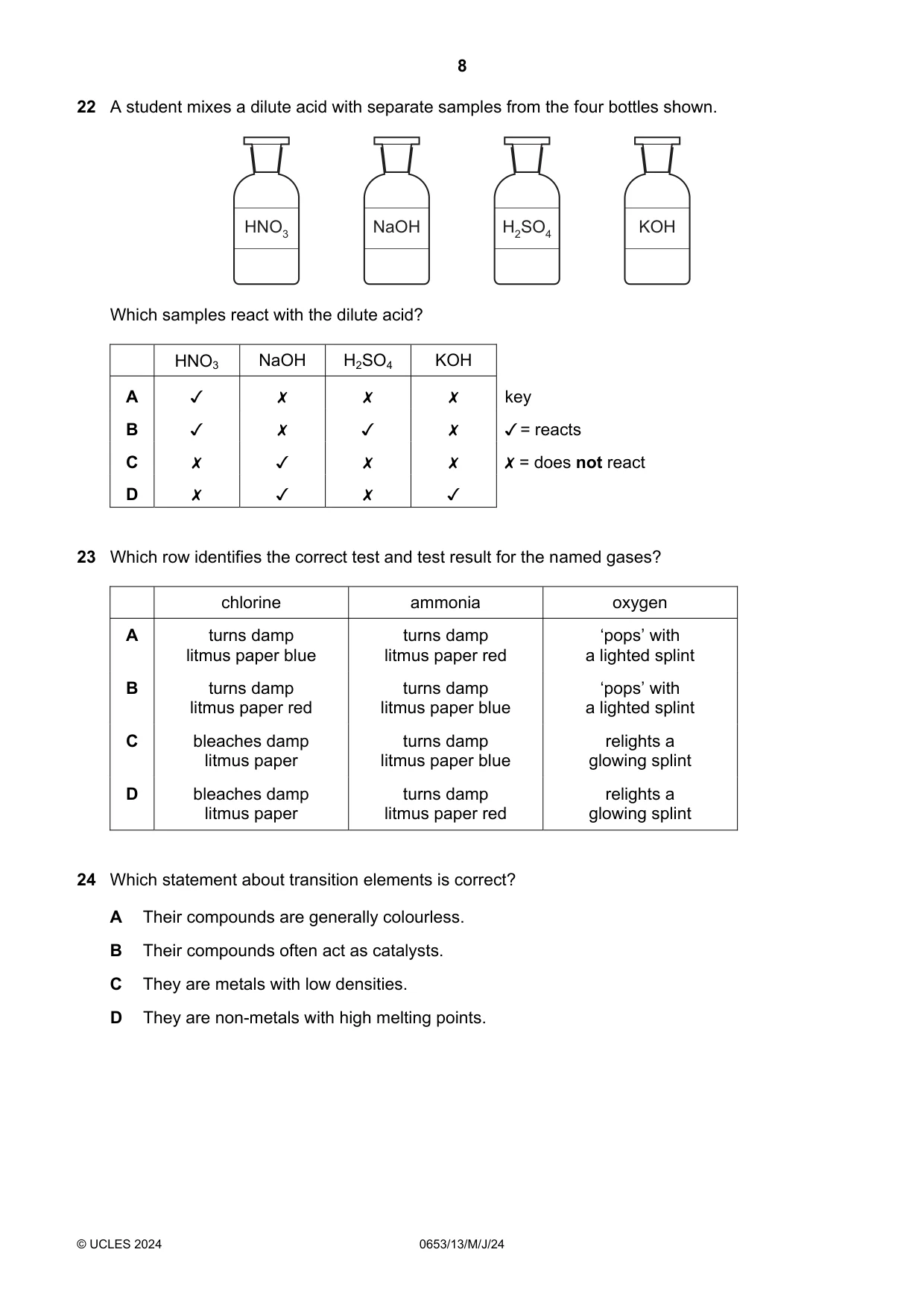
22 Astudent mixes a dilute acid with separate samples from the four bottles shown. Which samples react with the dilute acid? HNOs NaOH H2SO4 KOH A v x x x B v x v x Cc x v x x D x v x v key / = reacts X = does not react
Mark scheme: D
More questions on The characteristic properties of acids and bases
Q23 · Which row identifies the correct test and test result for the named gases?
23 Which row identifies the correct test and test result for the named gases? chlorine ammonia oxygen A turns damp turns damp ‘pops’ with litmus paper blue litmus paper red a lighted splint B turns damp turns damp ‘pops’ with litmus paper red litmus paper blue a lighted splint C bleaches damp turns damp relights a litmus paper litmus paper blue glowing splint D bleaches damp turns damp relights a litmus paper litmus paper red glowing splint
Mark scheme: C
Q24 · Which statement about transition elements is correct?
24 Which statement about transition elements is correct? A Their compounds are generally colourless. B Their compounds often act as catalysts. C They are metals with low densities. D They are non-metals with high melting points.
Mark scheme: B
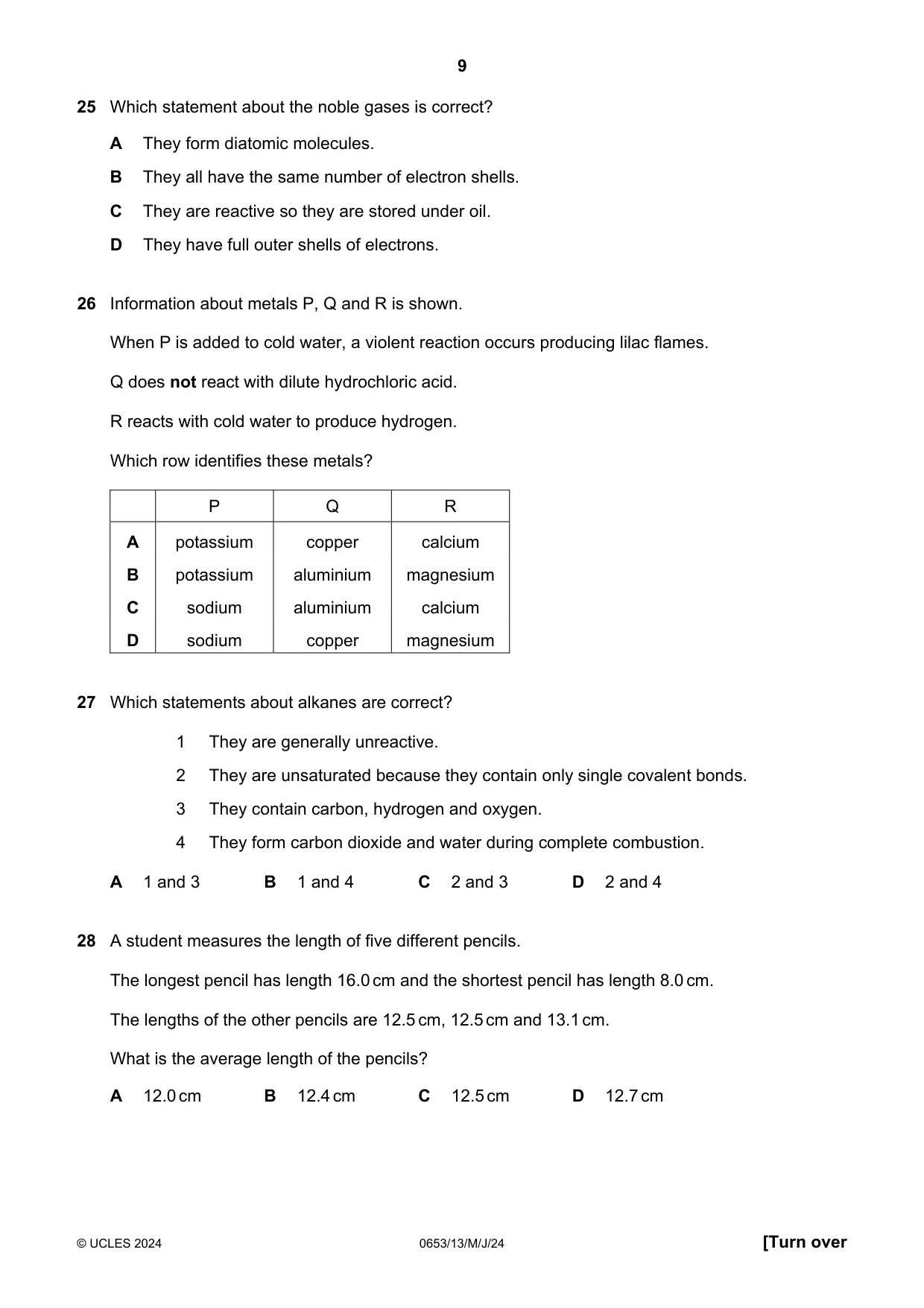
Q25 · Which statement about the noble gases is correct?
25 Which statement about the noble gases is correct? A They form diatomic molecules. B They all have the same number of electron shells. C They are reactive so they are stored under oil. D They have full outer shells of electrons.
Mark scheme: D
Q26 · Information about metals P, Q and R is shown
26 Information about metals P, Q and R is shown. When P is added to cold water, a violent reaction occurs producing lilac flames. Q does not react with dilute hydrochloric acid. R reacts with cold water to produce hydrogen. Which row identifies these metals? P Q R A potassium copper calcium B potassium aluminium magnesium C sodium aluminium calcium D sodium copper magnesium
Mark scheme: A
Q27 · Which statements about alkanes are correct?
27 Which statements about alkanes are correct? 1 They are generally unreactive. 2 They are unsaturated because they contain only single covalent bonds. 3 They contain carbon, hydrogen and oxygen. 4 They form carbon dioxide and water during complete combustion. A 1 and 3 B 1 and 4 C 2 and 3 D 2 and 4
Mark scheme: B
Q28 · A student measures the length of five different pencils
28 A student measures the length of five different pencils. The longest pencil has length 16.0 cm and the shortest pencil has length 8.0 cm. The lengths of the other pencils are 12.5 cm, 12.5 cm and 13.1 cm. What is the average length of the pencils? A 12.0 cm B 12.4 cm C 12.5 cm D 12.7 cm
Mark scheme: B
More questions on Physical quantities and measurement techniques
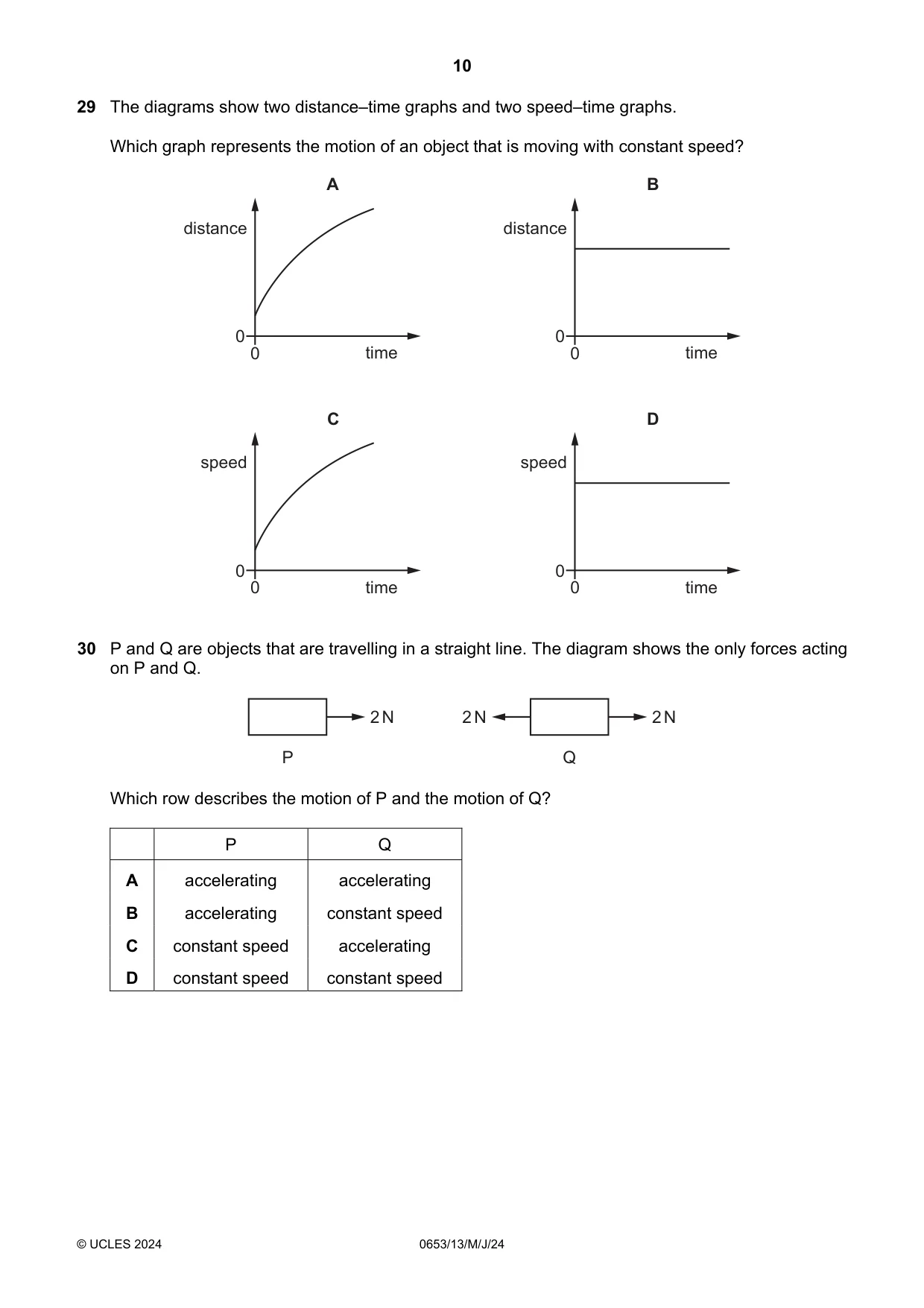
Q29 · The diagrams show two distance–time graphs and two speed–time graphs
29 The diagrams show two distance–time graphs and two speed–time graphs. Which graph represents the motion of an object that is moving with constant speed? A B distance distance 0 0 0 time 0 time C D speed speed 0 0 0 time 0 time
Mark scheme: D
Q30 · P and Q are objects that are travelling in a straight line
30 P and Q are objects that are travelling in a straight line. The diagram shows the only forces acting on P and Q. 2 N 2 N 2 N P Q Which row describes the motion of P and the motion of Q? P Q A accelerating accelerating B accelerating constant speed C constant speed accelerating D constant speed constant speed
Mark scheme: B
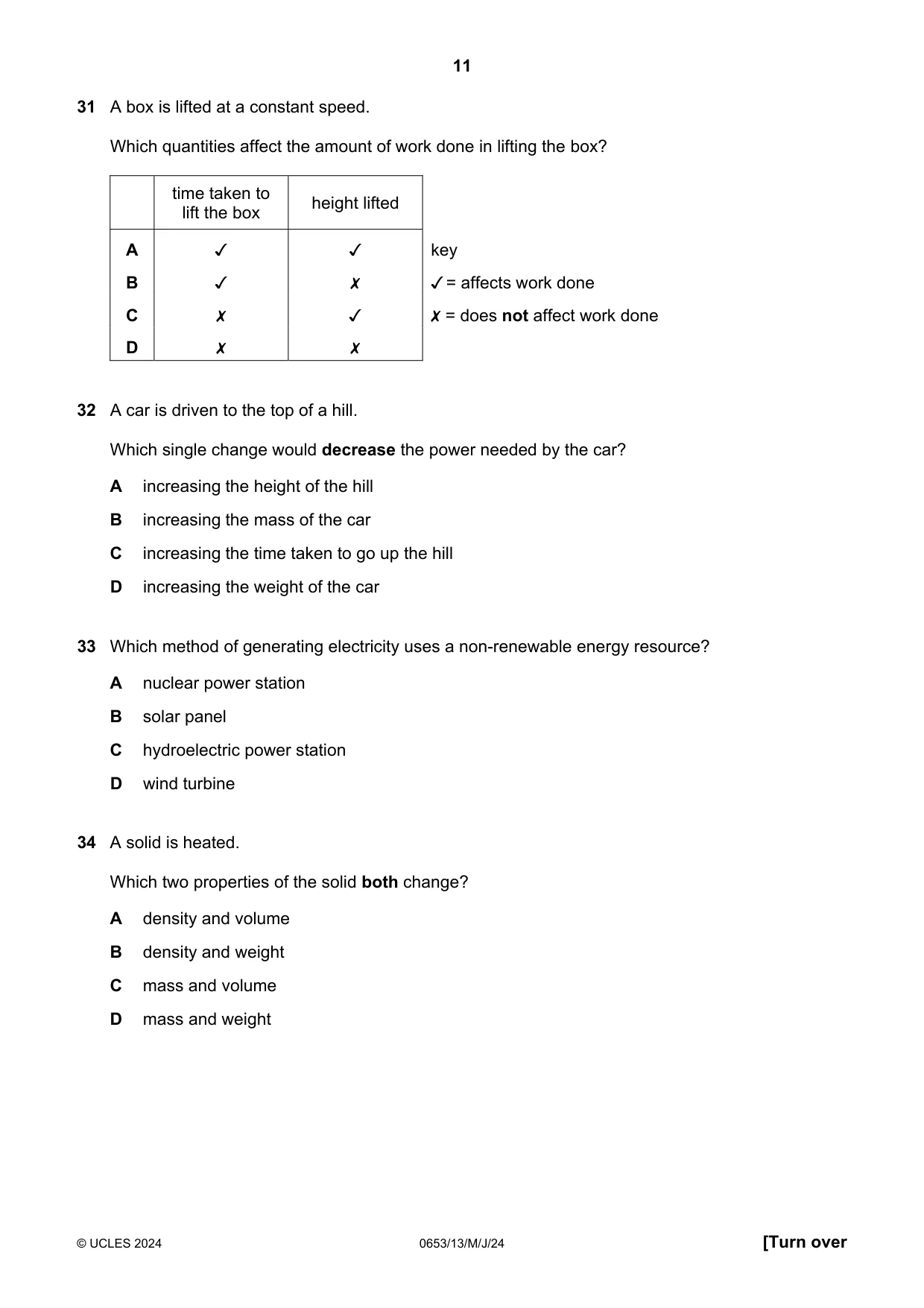
Q31 · A box is lifted at a constant speed
31 A box is lifted at a constant speed. Which quantities affect the amount of work done in lifting the box? nied height lifted Jv v key v x ¥ = affects work done x v X = does not affect work done x x
Mark scheme: C
Q32 · A car is driven to the top of a hill
32 A car is driven to the top of a hill. Which single change would decrease the power needed by the car? A increasing the height of the hill B increasing the mass of the car C increasing the time taken to go up the hill D increasing the weight of the car
Mark scheme: C
Q33 · Which method of generating electricity uses a non-renewable energy resource?
33 Which method of generating electricity uses a non-renewable energy resource? A nuclear power station B solar panel C hydroelectric power station D wind turbine
Mark scheme: A
Q34 · A solid is heated
34 A solid is heated. Which two properties of the solid both change? A density and volume B density and weight C mass and volume D mass and weight
Mark scheme: A
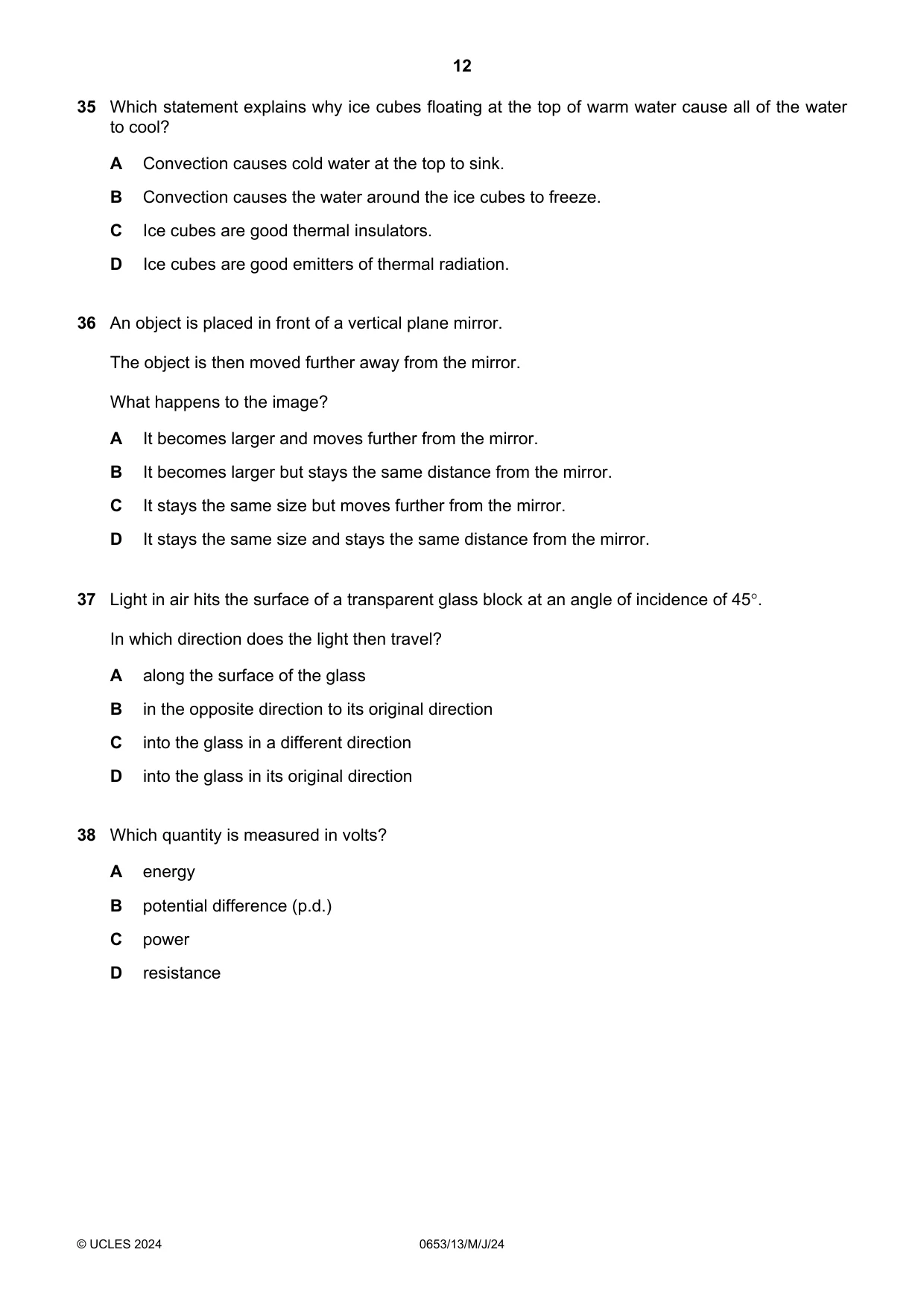
Q35 · Which statement explains why ice cubes floating at the top of warm water cause all of the…
35 Which statement explains why ice cubes floating at the top of warm water cause all of the water to cool? A Convection causes cold water at the top to sink. B Convection causes the water around the ice cubes to freeze. C Ice cubes are good thermal insulators. D Ice cubes are good emitters of thermal radiation.
Mark scheme: A
Q36 · An object is placed in front of a vertical plane mirror
36 An object is placed in front of a vertical plane mirror. The object is then moved further away from the mirror. What happens to the image? A It becomes larger and moves further from the mirror. B It becomes larger but stays the same distance from the mirror. C It stays the same size but moves further from the mirror. D It stays the same size and stays the same distance from the mirror.
Mark scheme: C
Q37 · Light in air hits the surface of a transparent glass block at an angle of incidence of 45
37 Light in air hits the surface of a transparent glass block at an angle of incidence of 45. In which direction does the light then travel? A along the surface of the glass B in the opposite direction to its original direction C into the glass in a different direction D into the glass in its original direction
Mark scheme: C
Q38 · Which quantity is measured in volts?
38 Which quantity is measured in volts? A energy B potential difference (p.d.) C power D resistance
Mark scheme: B
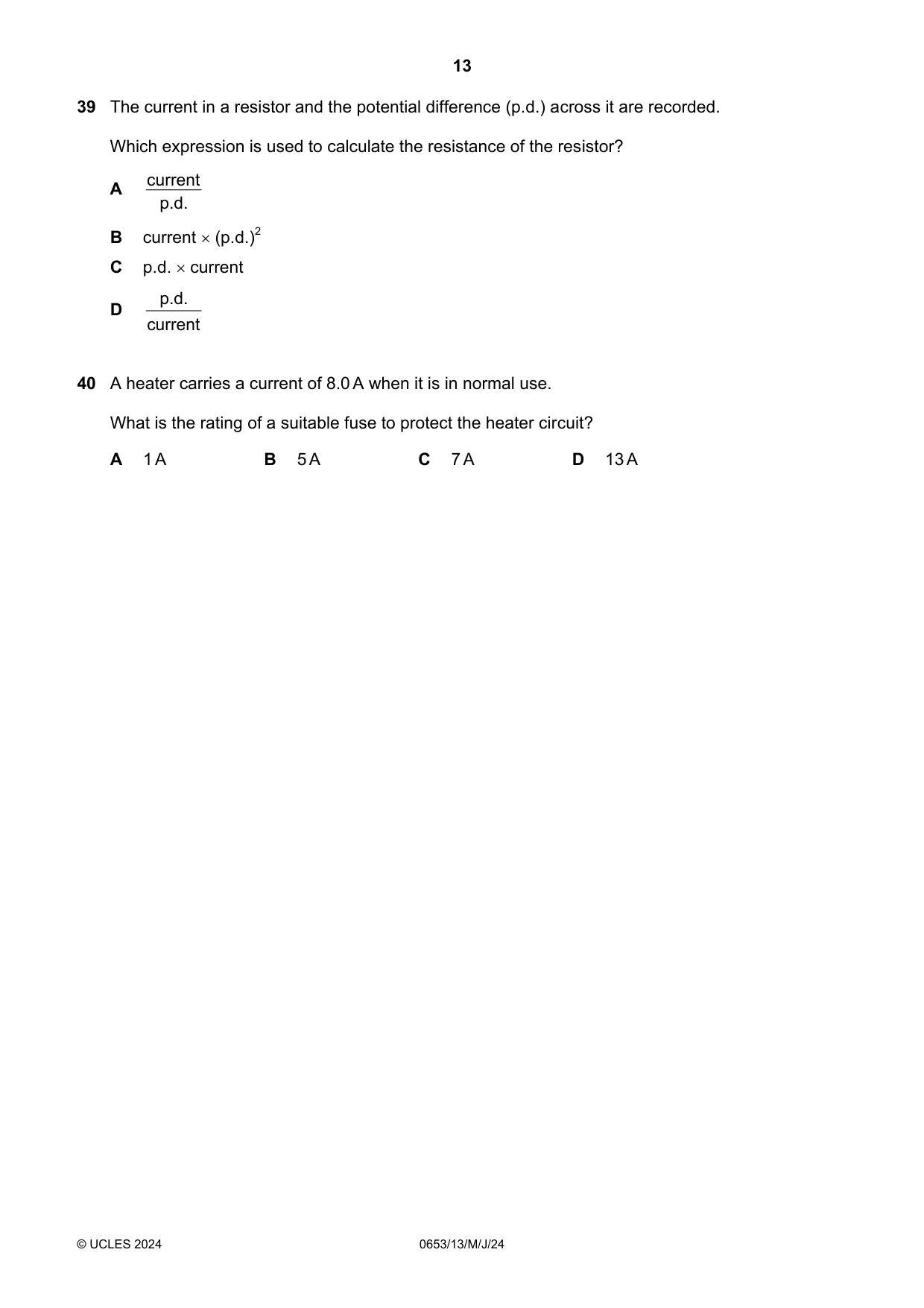
Q39 · The current in a resistor and the potential difference (p.d.) across it are recorded
39 The current in a resistor and the potential difference (p.d.) across it are recorded. Which expression is used to calculate the resistance of the resistor? current A p.d. B current (p.d.)2 C p.d. current p.d. D current
Mark scheme: D
Q40 · A heater carries a current of 8.0 A when it is in normal use
40 A heater carries a current of 8.0 A when it is in normal use. What is the rating of a suitable fuse to protect the heater circuit? A 1 A B 5 A C 7 A D 13 A
Mark scheme: D
What was in this paper
The subtopics covered by these 40 questions, and how many questions each got. Open one in a new tab to see every Cambridge question on it.
3Electrical quantities2Elements, compounds and mixtures2Light2Sexual reproduction in plants2Alkanes1Biological molecules1Cell structure1Characteristics of living organisms1Density1Diet1Diffusion1Digestion1Drugs1Electrical safety1Electrolysis1Food chains and food webs1Forces1Formulas1Gas exchange in humans1Identification of ions and gases1Motion1Noble gases1Photosynthesis1Physical quantities and measurement techniques1Rate of reaction1Reactivity series1Redox1Separation and purification1Simple molecules and covalent bonds1The characteristic properties of acids and bases1Transfer of thermal energy1Transition elements1Transpiration1What you needed in this session
Cambridge’s own grade thresholds for 2024 May/June, Paper 1 · Variant 3. A higher threshold means an easier paper — the bar moves with how the cohort did.