Cambridge IGCSE Science - Combined 0653 — 2015 Oct/Nov Paper 1 · Variant 3
0653/13/O/N/15 · 40 questions · 40 marks · ≈45 min
The question paper and its mark scheme, free to read here and free to download. This is Cambridge’s own paper, exactly as it was sat.
Question paper20 pages


Mark scheme2 pages
Answers below. Sit the paper first if you are practising.
Questions as text
Q1 · What are three characteristics of living organisms?
1 What are three characteristics of living organisms? characteristic 1 characteristic 2 characteristic 3 A breathing reproduction sensitivity B digestion growth movement C excretion nutrition transpiration D nutrition reproduction sensitivity
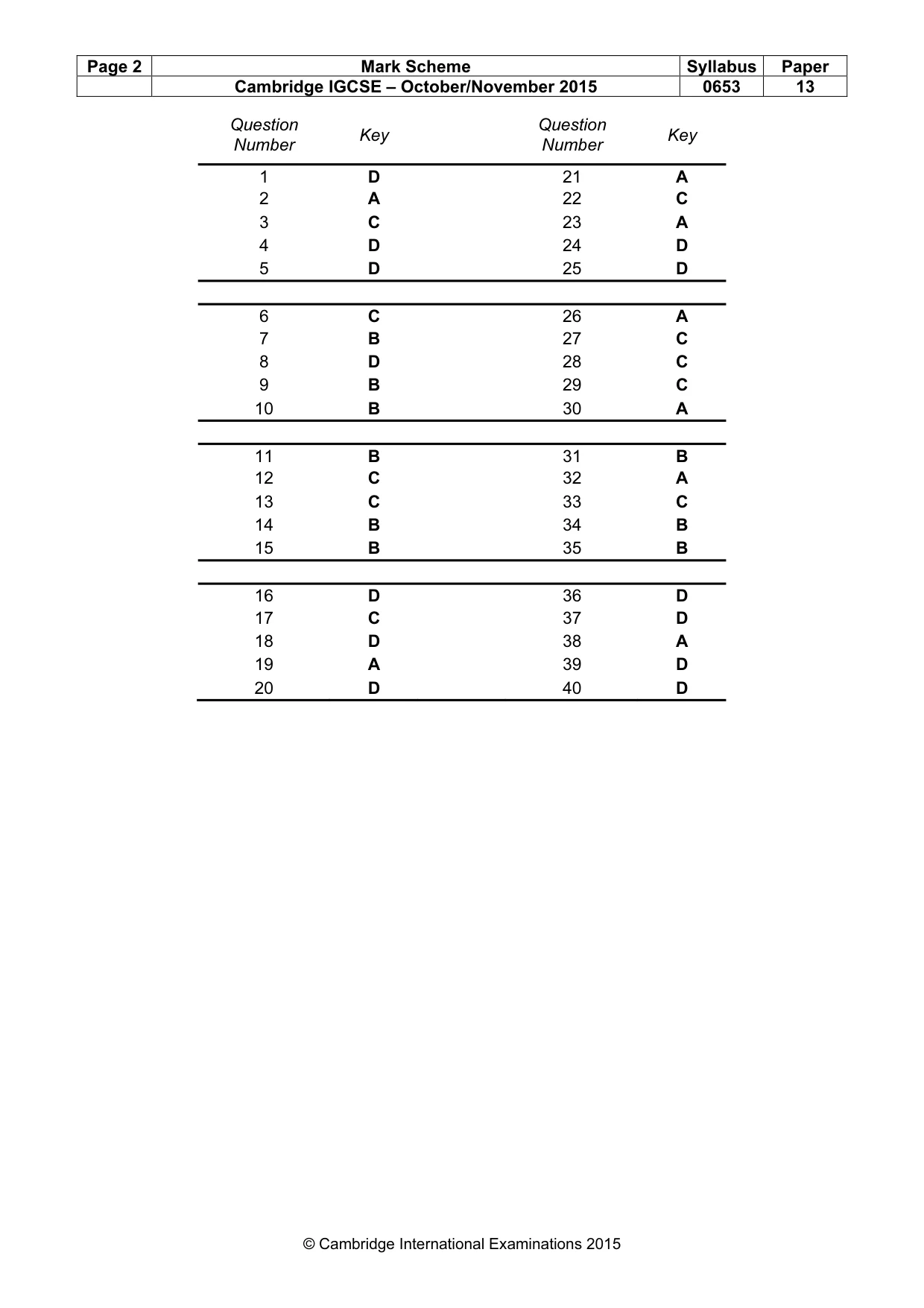
Mark scheme: D
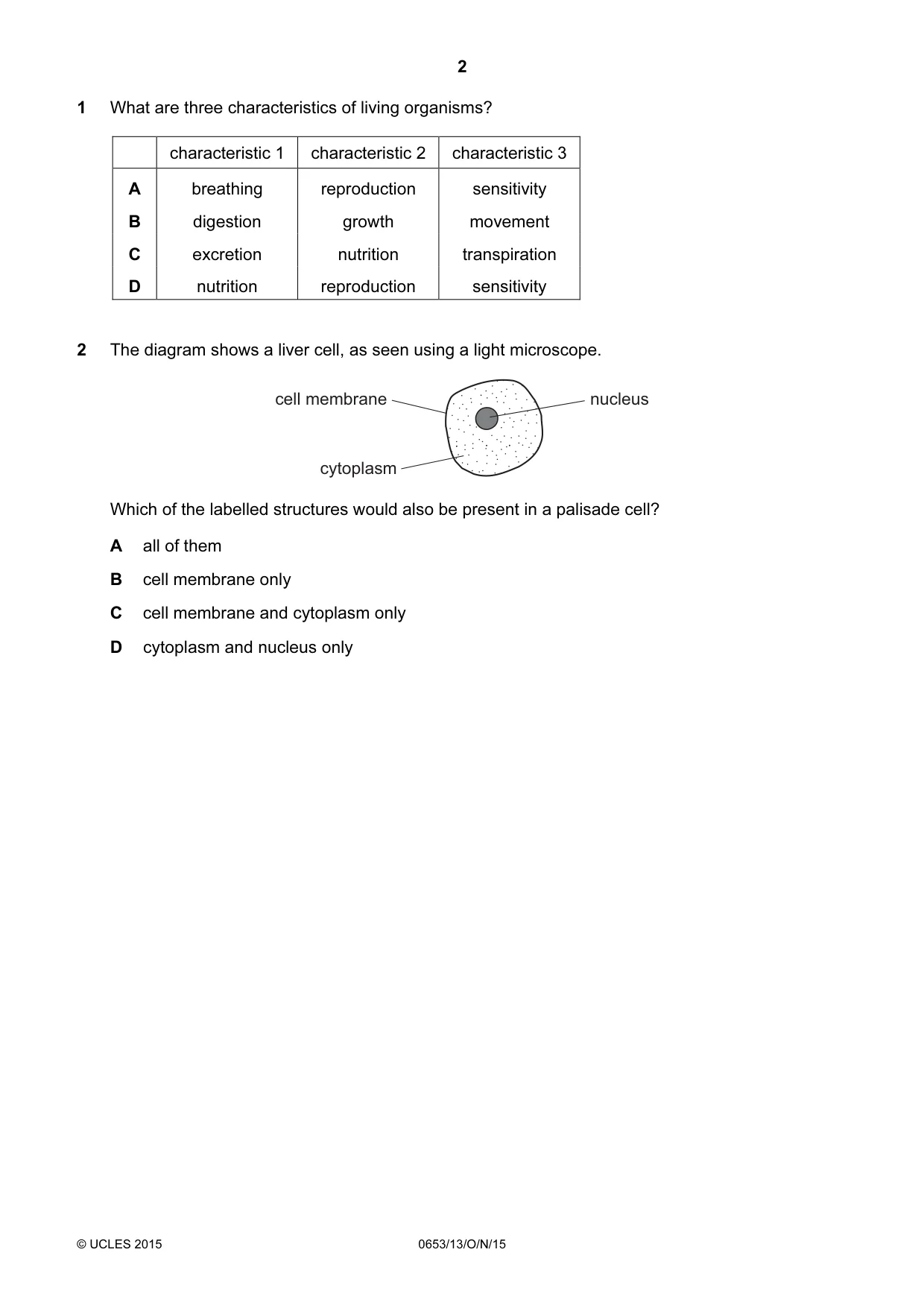
Q2 · The diagram shows a liver cell, as seen using a light microscope
2 The diagram shows a liver cell, as seen using a light microscope. cell membrane nucleus cytoplasm Which of the labelled structures would also be present in a palisade cell? A all of them B cell membrane only C cell membrane and cytoplasm only D cytoplasm and nucleus only
Mark scheme: A
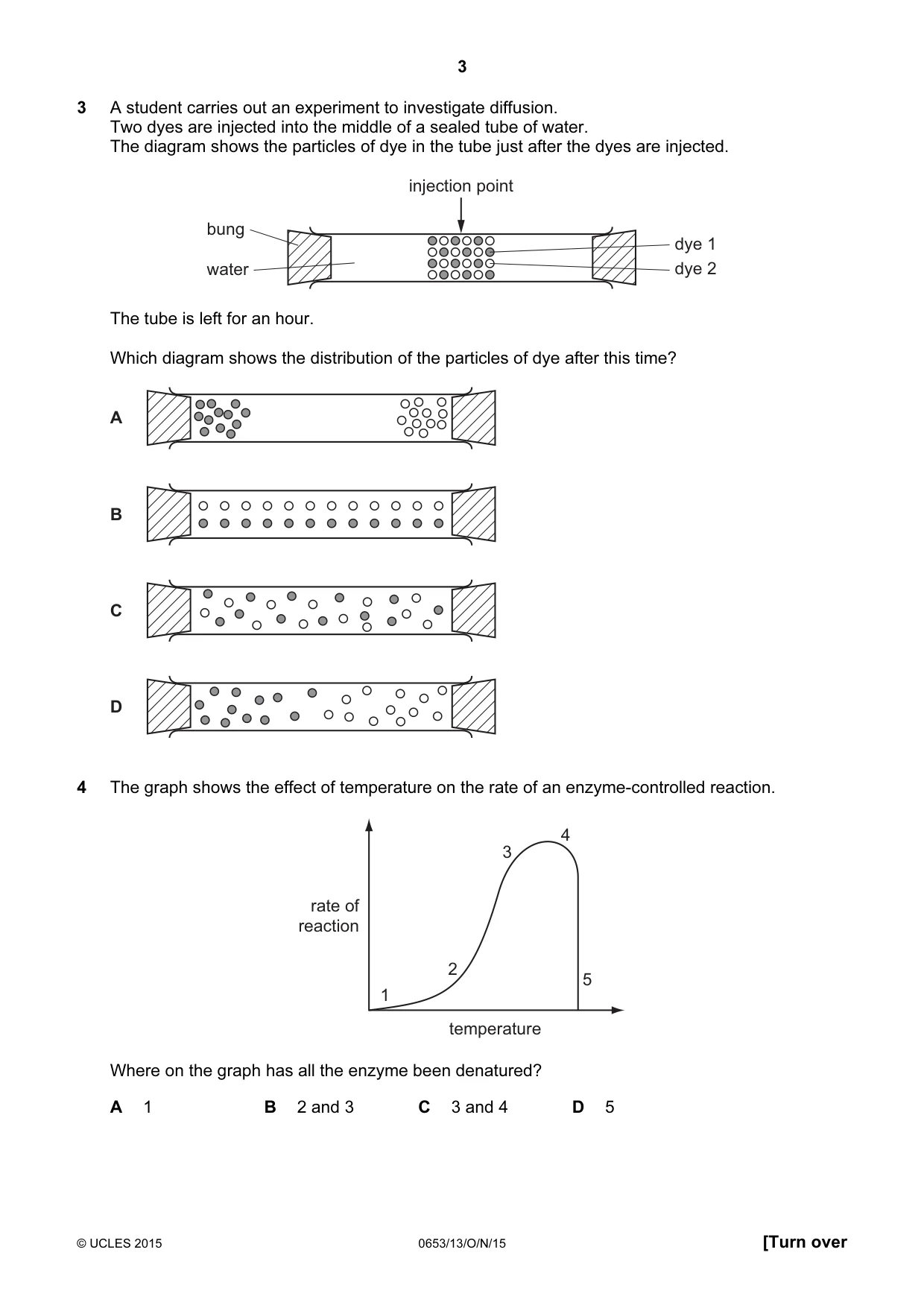
Q3 · A student carries out an experiment to investigate diffusion
3 A student carries out an experiment to investigate diffusion. Two dyes are injected into the middle of a sealed tube of water. The diagram shows the particles of dye in the tube just after the dyes are injected. injection point bung dye 1 water dye 2 The tube is left for an hour. Which diagram shows the distribution of the particles of dye after this time? A B C D
Mark scheme: C
Q4 · The graph shows the effect of temperature on the rate of an enzyme-controlled reaction
4 The graph shows the effect of temperature on the rate of an enzyme-controlled reaction. 4 3 rate of reaction 2 5 1 temperature Where on the graph has all the enzyme been denatured? A 1 B 2 and 3 C 3 and 4 D 5
Mark scheme: D
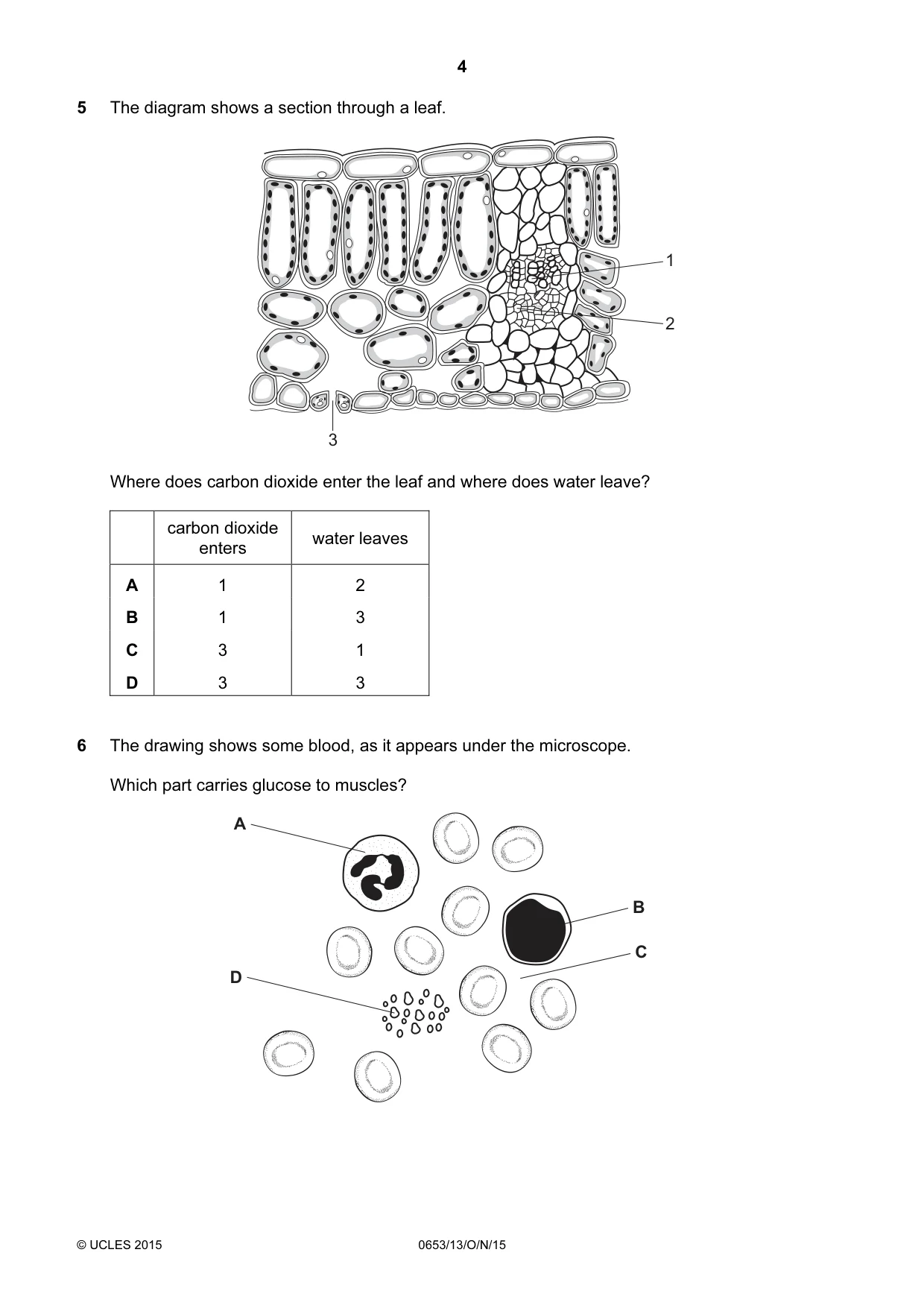
Q5 · The diagram shows a section through a leaf
5 The diagram shows a section through a leaf. 1 2 3 Where does carbon dioxide enter the leaf and where does water leave? carbon dioxide water leaves enters A 1 2 B 1 3 C 3 1 D 3 3
Mark scheme: D
Q6 · The drawing shows some blood, as it appears under the microscope
6 The drawing shows some blood, as it appears under the microscope. Which part carries glucose to muscles? A B C D
Mark scheme: C
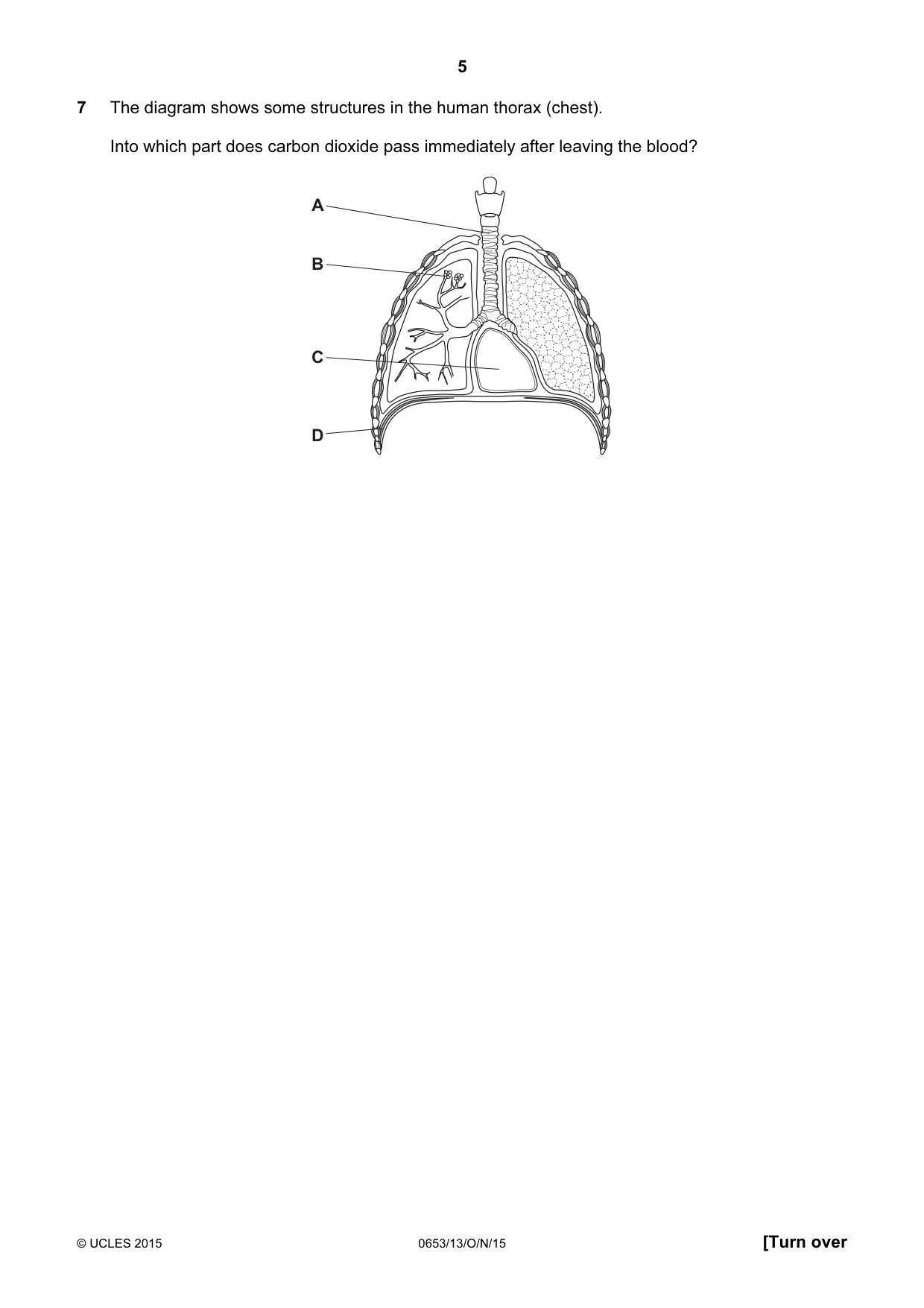
Q7 · The diagram shows some structures in the human thorax (chest)
7 The diagram shows some structures in the human thorax (chest). Into which part does carbon dioxide pass immediately after leaving the blood? A B C D
Mark scheme: B
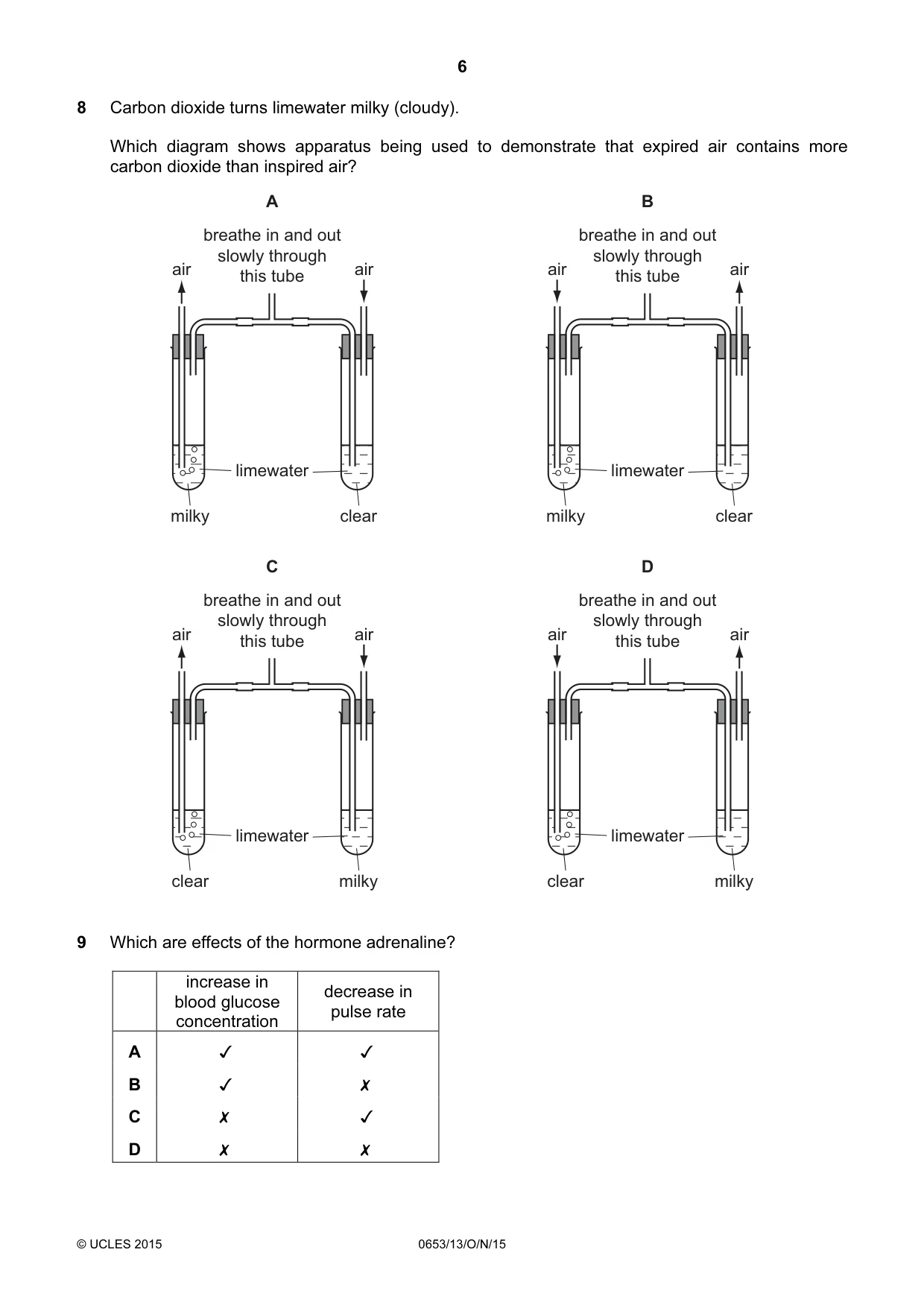
Q8 · Carbon dioxide turns limewater milky (cloudy)
8 Carbon dioxide turns limewater milky (cloudy). Which diagram shows apparatus being used to demonstrate that expired air contains more carbon dioxide than inspired air? A B breathe in and out breathe in and out slowly through slowly through air this tube air air this tube air limewater limewater milky clear milky clear C D breathe in and out breathe in and out slowly through slowly through air this tube air air this tube air limewater limewater clear milky clear milky
Mark scheme: D
Q9 · Which are effects of the hormone adrenaline?
9 Which are effects of the hormone adrenaline? increase in i decrease in blood glucose ulse rate concentration 7 A v v B v x Cc x v D x x
Mark scheme: B
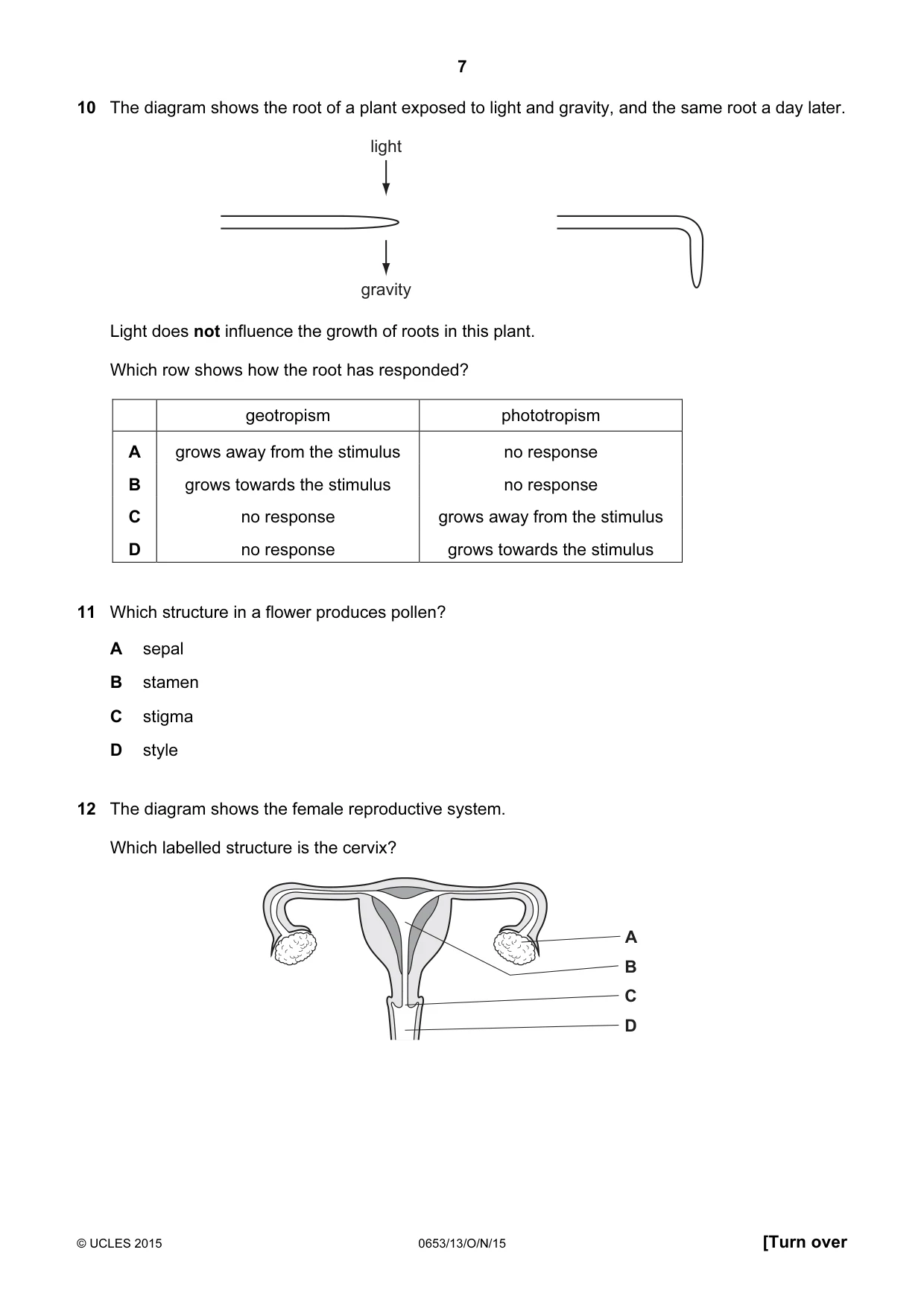
Q10 · The diagram shows the root of a plant exposed to light and gravity, and the same root a…
10 The diagram shows the root of a plant exposed to light and gravity, and the same root a day later. light gravity Light does not influence the growth of roots in this plant. Which row shows how the root has responded? geotropism phototropism A grows away from the stimulus no response B grows towards the stimulus no response C no response grows away from the stimulus D no response grows towards the stimulus
Mark scheme: B
Q11 · Which structure in a flower produces pollen?
11 Which structure in a flower produces pollen? A sepal B stamen C stigma D style
Mark scheme: B
Q12 · The diagram shows the female reproductive system
12 The diagram shows the female reproductive system. Which labelled structure is the cervix? A B C D
Mark scheme: C
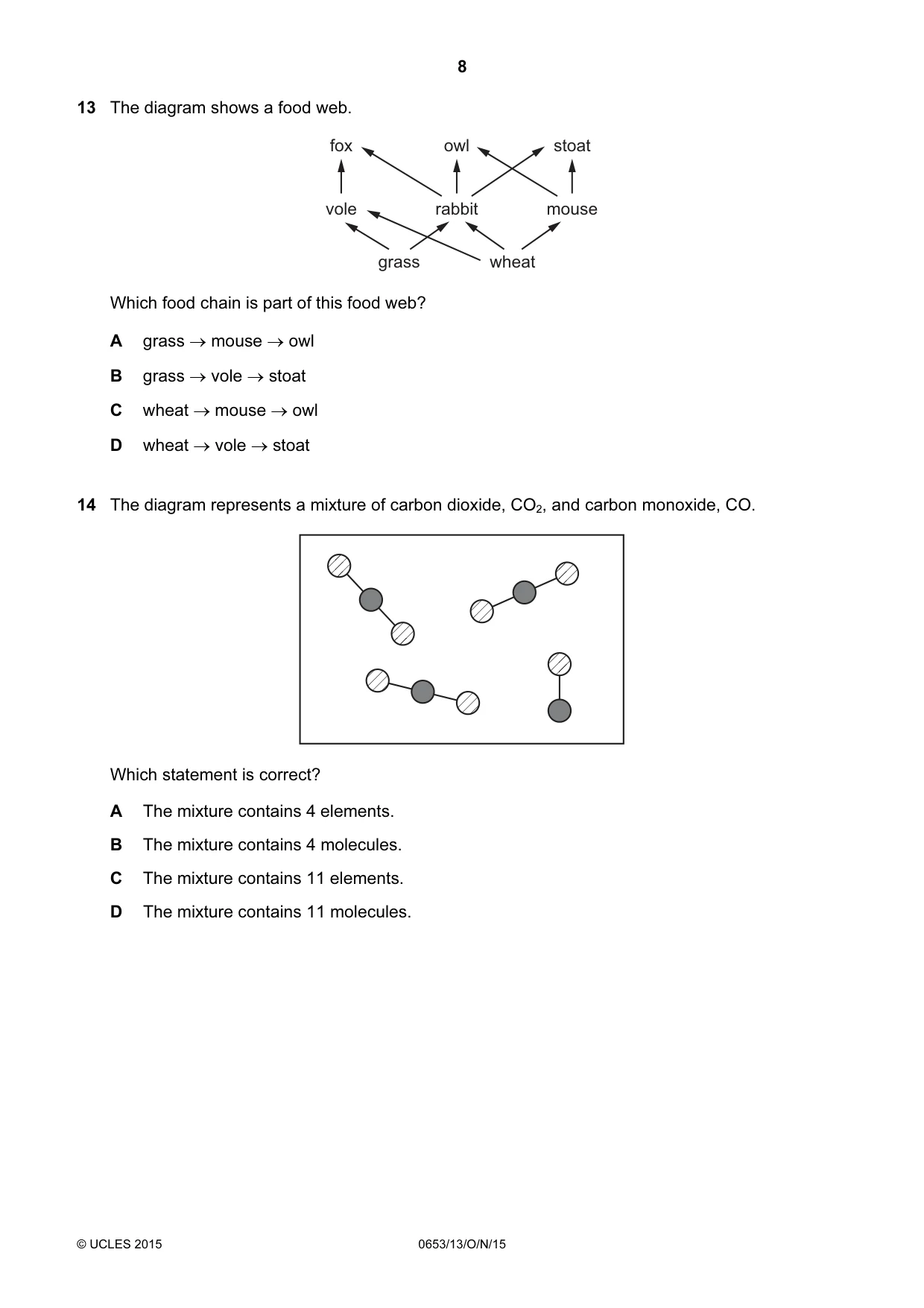
Q13 · The diagram shows a food web
13 The diagram shows a food web. fox owl stoat vole rabbit mouse grass wheat Which food chain is part of this food web? A grass → mouse → owl B grass → vole → stoat C wheat → mouse → owl D wheat → vole → stoat
Mark scheme: C
Q14 · The diagram represents a mixture of carbon dioxide, CO2, and carbon monoxide, CO
14 The diagram represents a mixture of carbon dioxide, CO2, and carbon monoxide, CO. Which statement is correct? A The mixture contains 4 elements. B The mixture contains 4 molecules. C The mixture contains 11 elements. D The mixture contains 11 molecules.
Mark scheme: B
Q15 · In an experiment, a mixture of 0.5 g of copper and 3 g of zinc is added to an excess of…
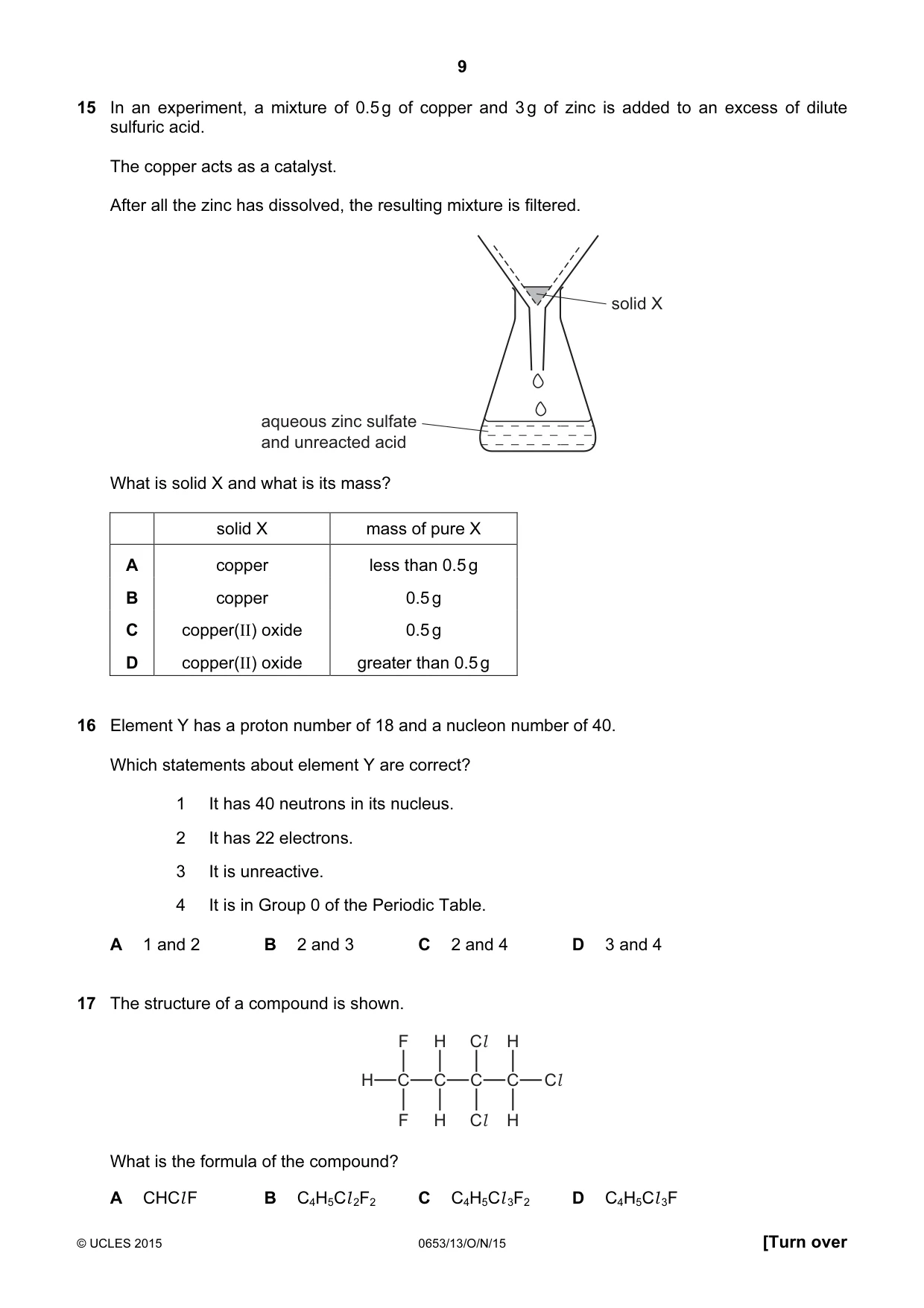
15 In an experiment, a mixture of 0.5 g of copper and 3 g of zinc is added to an excess of dilute sulfuric acid. The copper acts as a catalyst. After all the zinc has dissolved, the resulting mixture is filtered. solid X aqueous zinc sulfate and unreacted acid What is solid X and what is its mass? solid X mass of pure X A copper less than 0.5 g B copper 0.5 g C copper(II) oxide 0.5 g D copper(II) oxide greater than 0.5 g
Mark scheme: B
Q16 · Element Y has a proton number of 18 and a nucleon number of 40
16 Element Y has a proton number of 18 and a nucleon number of 40. Which statements about element Y are correct? 1 It has 40 neutrons in its nucleus. 2 It has 22 electrons. 3 It is unreactive. 4 It is in Group 0 of the Periodic Table. A 1 and 2 B 2 and 3 C 2 and 4 D 3 and 4
Mark scheme: D
Q17 · The structure of a compound is shown
17 The structure of a compound is shown. F H Cl H H C C C C Cl F H Cl H What is the formula of the compound? A CHCl F B C4H5Cl 2F2 C C4H5Cl 3F2 D C4H5Cl 3F
Mark scheme: C
Q18 · The apparatus shown is set up
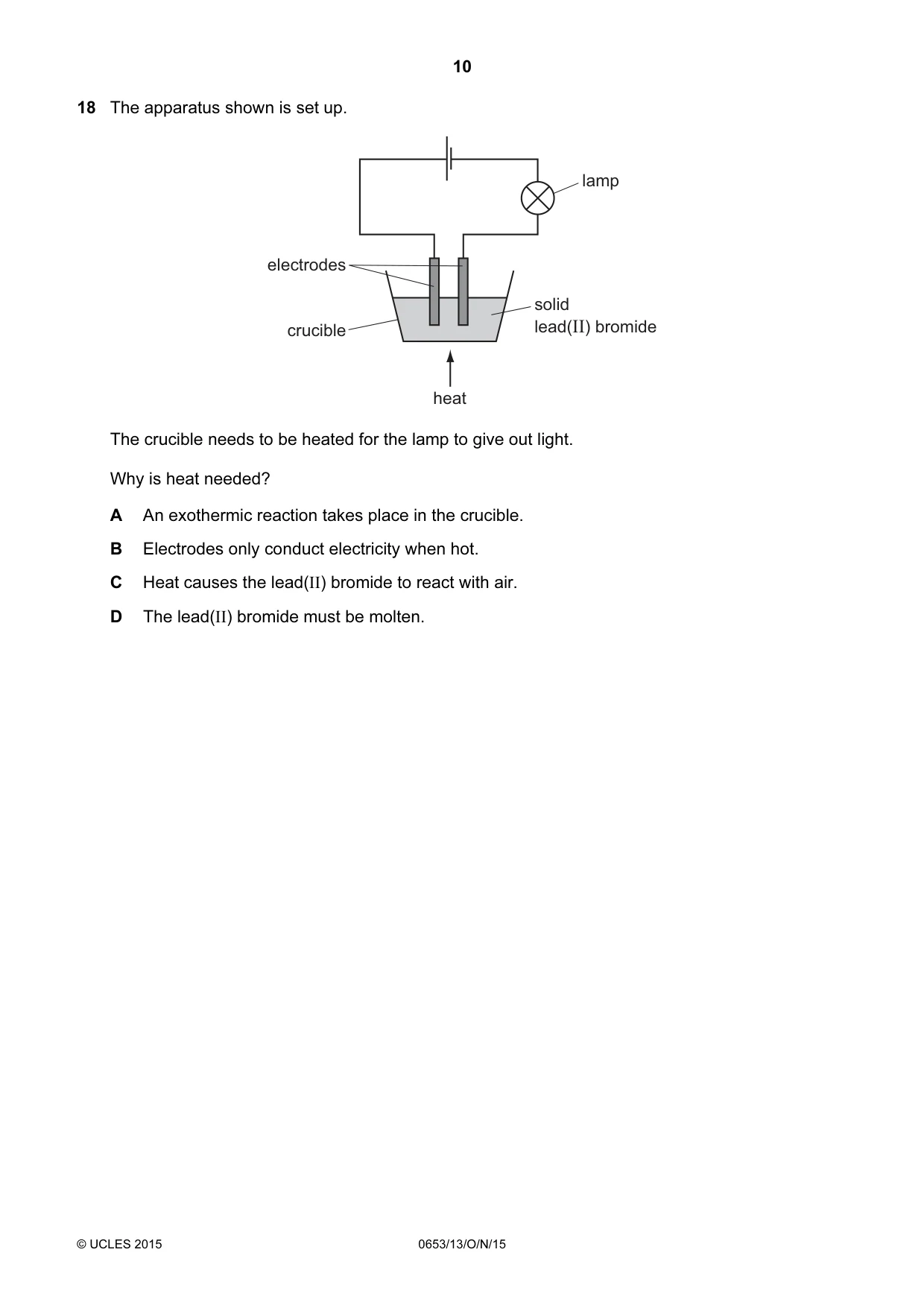
18 The apparatus shown is set up. lamp electrodes solid crucible lead(II) bromide heat The crucible needs to be heated for the lamp to give out light. Why is heat needed? A An exothermic reaction takes place in the crucible. B Electrodes only conduct electricity when hot. C Heat causes the lead(II) bromide to react with air. D The lead(II) bromide must be molten.
Mark scheme: D
Q19 · Hydrochloric acid is slowly added to sodium hydroxide in an insulated beaker
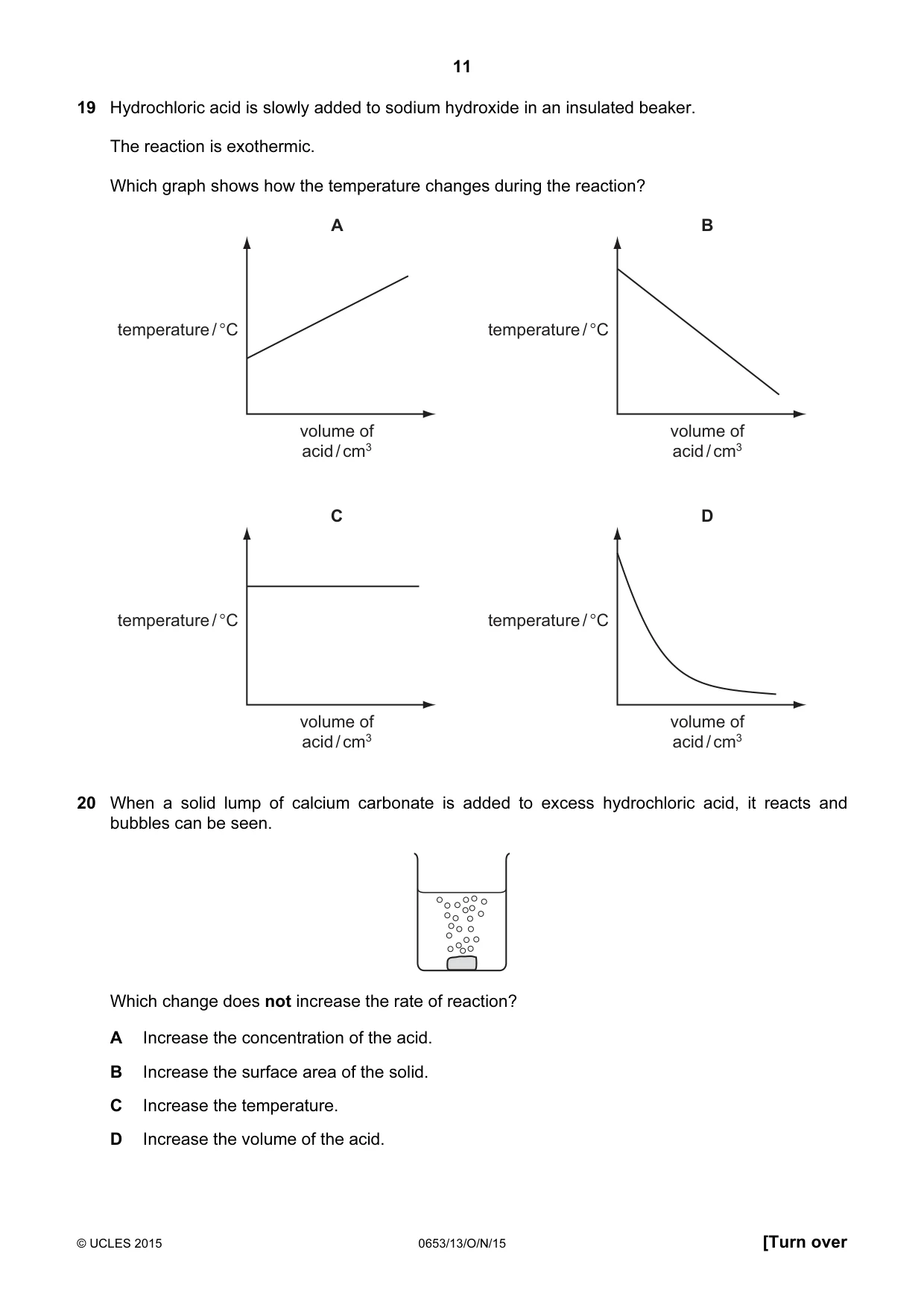
19 Hydrochloric acid is slowly added to sodium hydroxide in an insulated beaker. The reaction is exothermic. Which graph shows how the temperature changes during the reaction? A B temperature / °C temperature / °C volume of volume of acid / cm3 acid / cm3 C D temperature / °C temperature / °C volume of volume of acid / cm3 acid / cm3
Mark scheme: A
Q20 · When a solid lump of calcium carbonate is added to excess hydrochloric acid, it reacts…
20 When a solid lump of calcium carbonate is added to excess hydrochloric acid, it reacts and bubbles can be seen. Which change does not increase the rate of reaction? A Increase the concentration of the acid. B Increase the surface area of the solid. C Increase the temperature. D Increase the volume of the acid.
Mark scheme: D
Q21 · Copper sulfate crystals are prepared by reacting copper oxide with sulfuric acid
21 Copper sulfate crystals are prepared by reacting copper oxide with sulfuric acid. Which process is not used in the preparation of copper sulfate crystals? A chromatography B crystallisation C evaporation D filtration
Mark scheme: A
Q22 · A substance reacts with dilute acid, producing a gas
22 A substance reacts with dilute acid, producing a gas. The gas ignites with a pop when tested with a lighted splint. What is the substance? A copper B copper(II) oxide C magnesium D magnesium carbonate
Mark scheme: C
Q23 · The positions of four elements are shown in the outline of the Periodic Table
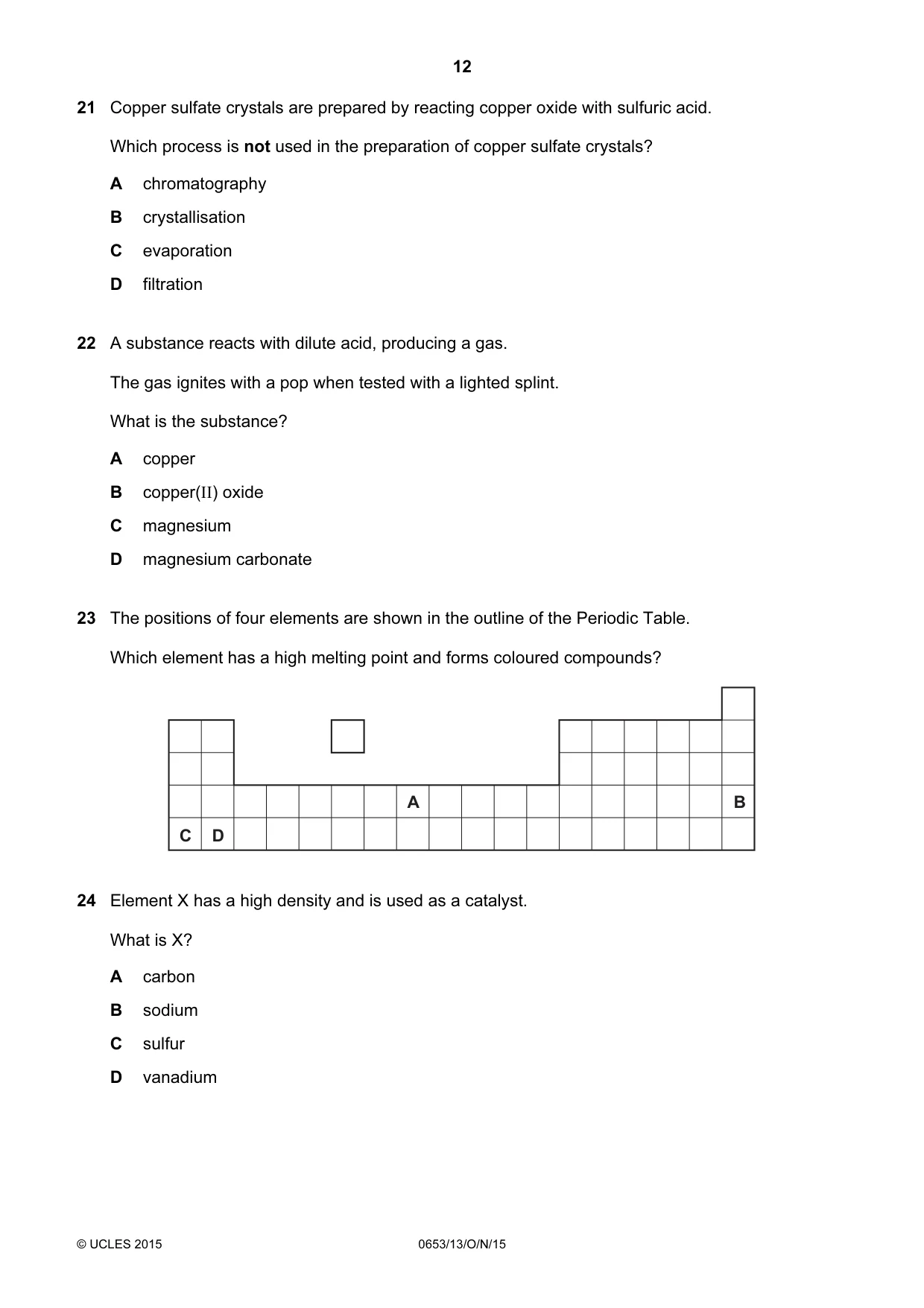
23 The positions of four elements are shown in the outline of the Periodic Table. Which element has a high melting point and forms coloured compounds? A B C D
Mark scheme: A
Q24 · Element X has a high density and is used as a catalyst
24 Element X has a high density and is used as a catalyst. What is X? A carbon B sodium C sulfur D vanadium
Mark scheme: D
Q25 · A metal is added to water
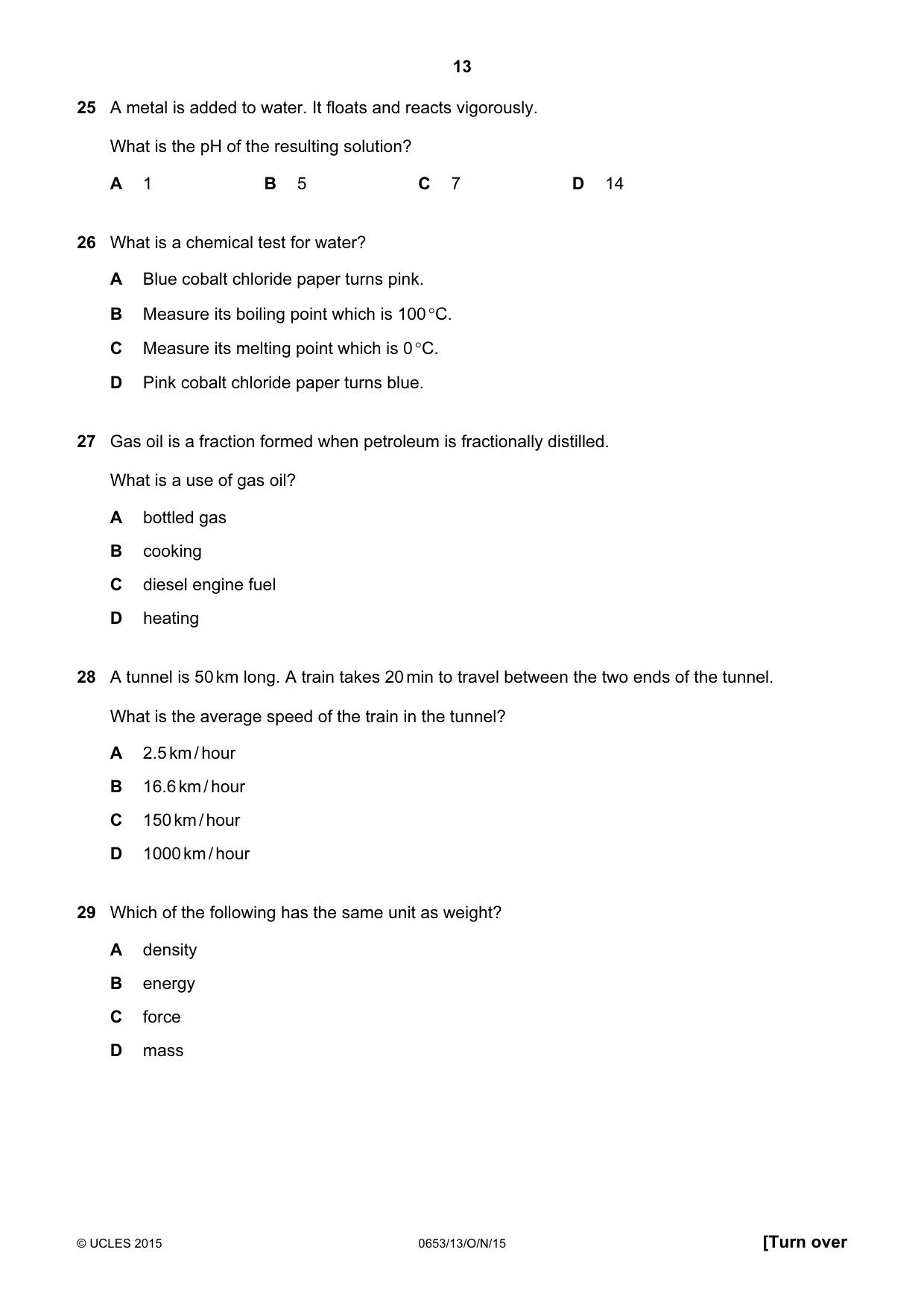
25 A metal is added to water. It floats and reacts vigorously. What is the pH of the resulting solution? A 1 B 5 C 7 D 14
Mark scheme: D
Q26 · What is a chemical test for water?
26 What is a chemical test for water? A Blue cobalt chloride paper turns pink. B Measure its boiling point which is 100 °C. C Measure its melting point which is 0 °C. D Pink cobalt chloride paper turns blue.
Mark scheme: A
Q27 · Gas oil is a fraction formed when petroleum is fractionally distilled
27 Gas oil is a fraction formed when petroleum is fractionally distilled. What is a use of gas oil? A bottled gas B cooking C diesel engine fuel D heating
Mark scheme: C
Q28 · A tunnel is 50 km long
28 A tunnel is 50 km long. A train takes 20 min to travel between the two ends of the tunnel. What is the average speed of the train in the tunnel? A 2.5 km / hour B 16.6 km / hour C 150 km / hour D 1000 km / hour
Mark scheme: C
Q29 · Which of the following has the same unit as weight?
29 Which of the following has the same unit as weight? A density B energy C force D mass
Mark scheme: C
Q30 · Which items of apparatus are used to determine the density of a liquid?
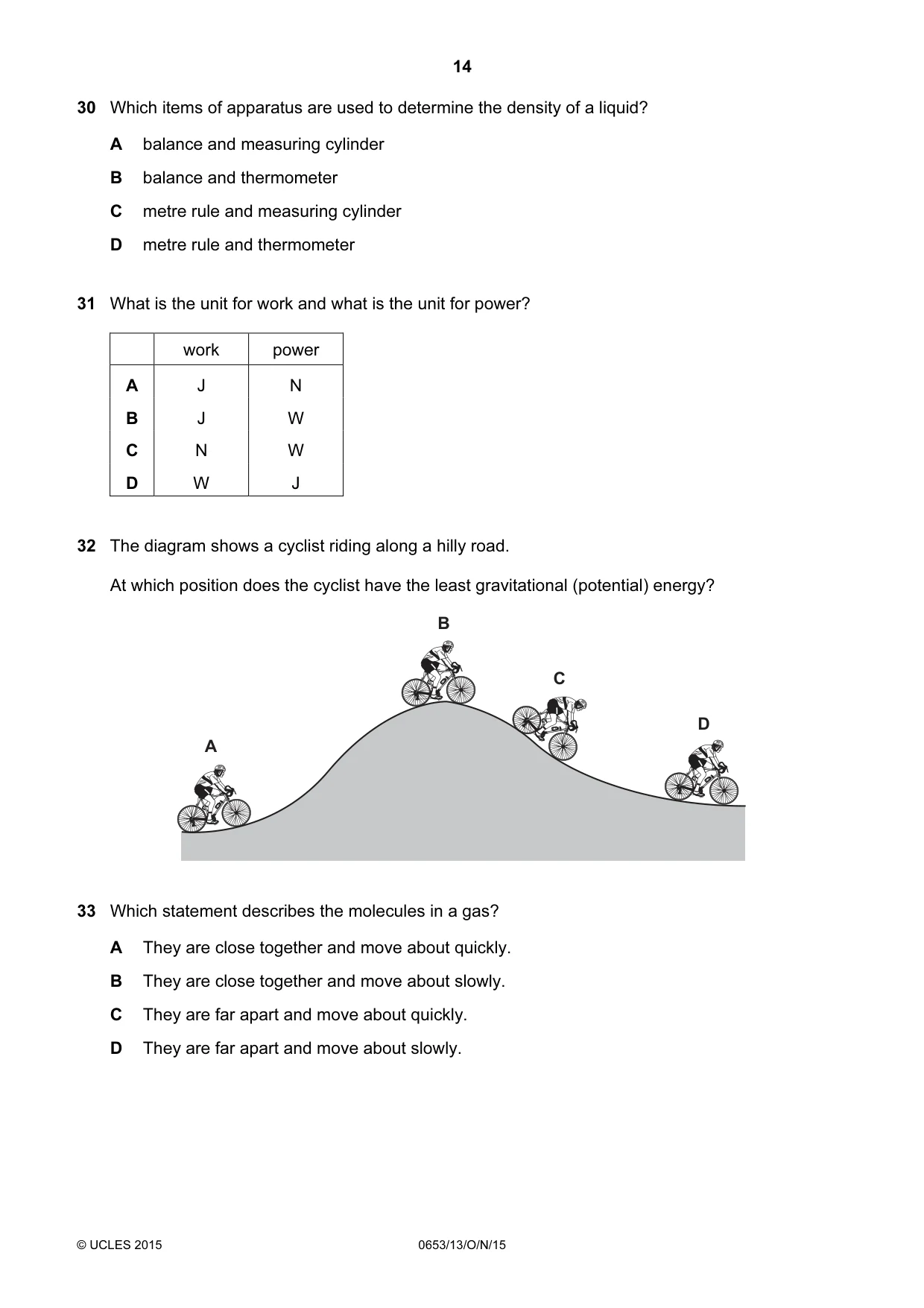
30 Which items of apparatus are used to determine the density of a liquid? A balance and measuring cylinder B balance and thermometer C metre rule and measuring cylinder D metre rule and thermometer
Mark scheme: A
Q31 · What is the unit for work and what is the unit for power?
31 What is the unit for work and what is the unit for power? work power A J N B J W C N W D W J
Mark scheme: B
Q32 · The diagram shows a cyclist riding along a hilly road
32 The diagram shows a cyclist riding along a hilly road. At which position does the cyclist have the least gravitational (potential) energy? B C D A
Mark scheme: A
Q33 · Which statement describes the molecules in a gas?
33 Which statement describes the molecules in a gas? A They are close together and move about quickly. B They are close together and move about slowly. C They are far apart and move about quickly. D They are far apart and move about slowly.
Mark scheme: C
Q34 · On a cold night, two children sit next to a camp fire to warm their hands
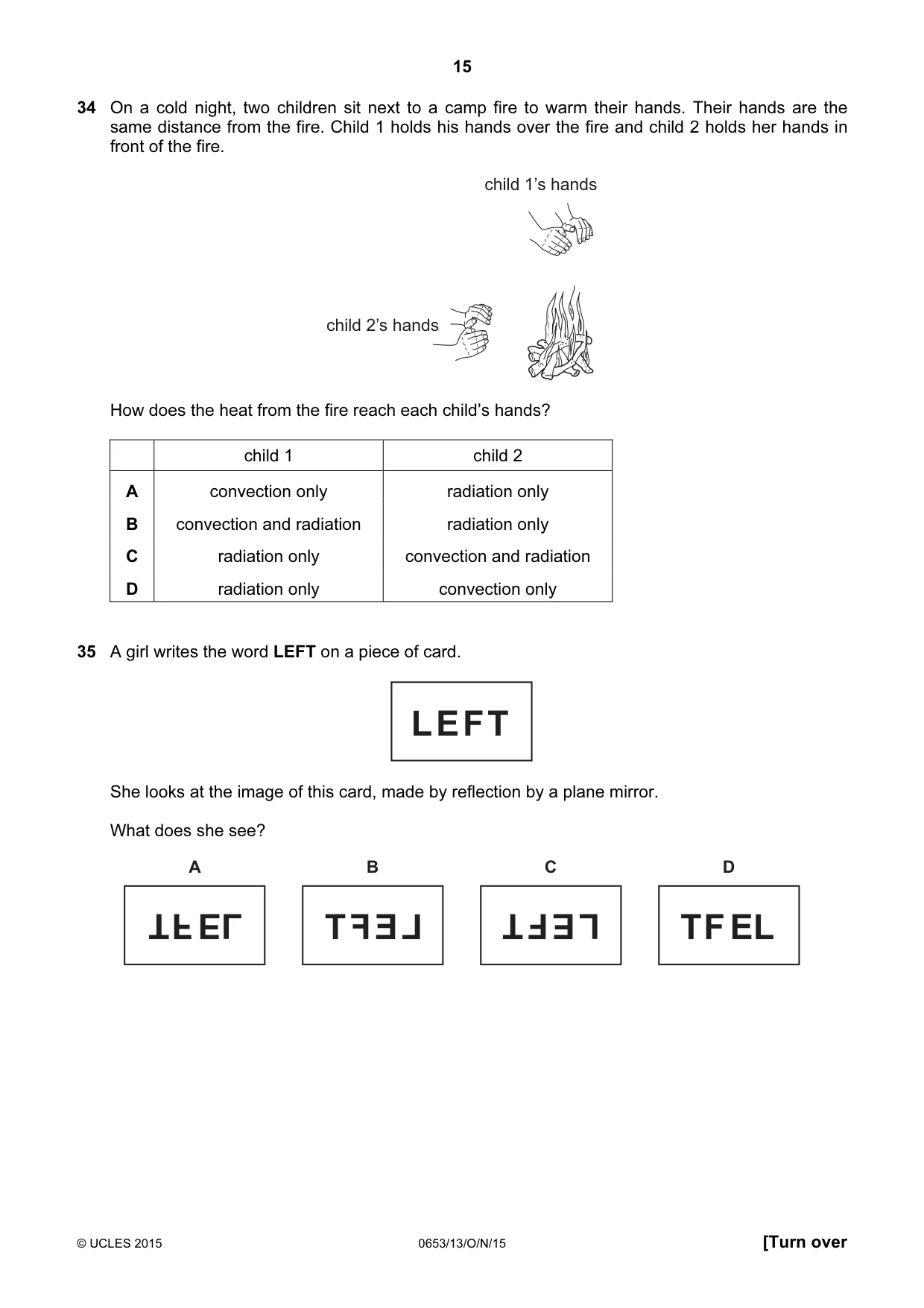
34 On a cold night, two children sit next to a camp fire to warm their hands. Their hands are the same distance from the fire. Child 1 holds his hands over the fire and child 2 holds her hands in front of the fire. child 1’s hands child 2’s hands How does the heat from the fire reach each child’s hands? child 1 child 2 A convection only radiation only B convection and radiation radiation only C radiation only convection and radiation D radiation only convection only
Mark scheme: B
Q35 · A girl writes the word LEFT on a piece of card
35 A girl writes the word LEFT on a piece of card. LEFT She looks at the image of this card, made by reflection by a plane mirror. What does she see? A B C D
Mark scheme: B
Q36 · The diagram shows a ray of light travelling in glass from point P
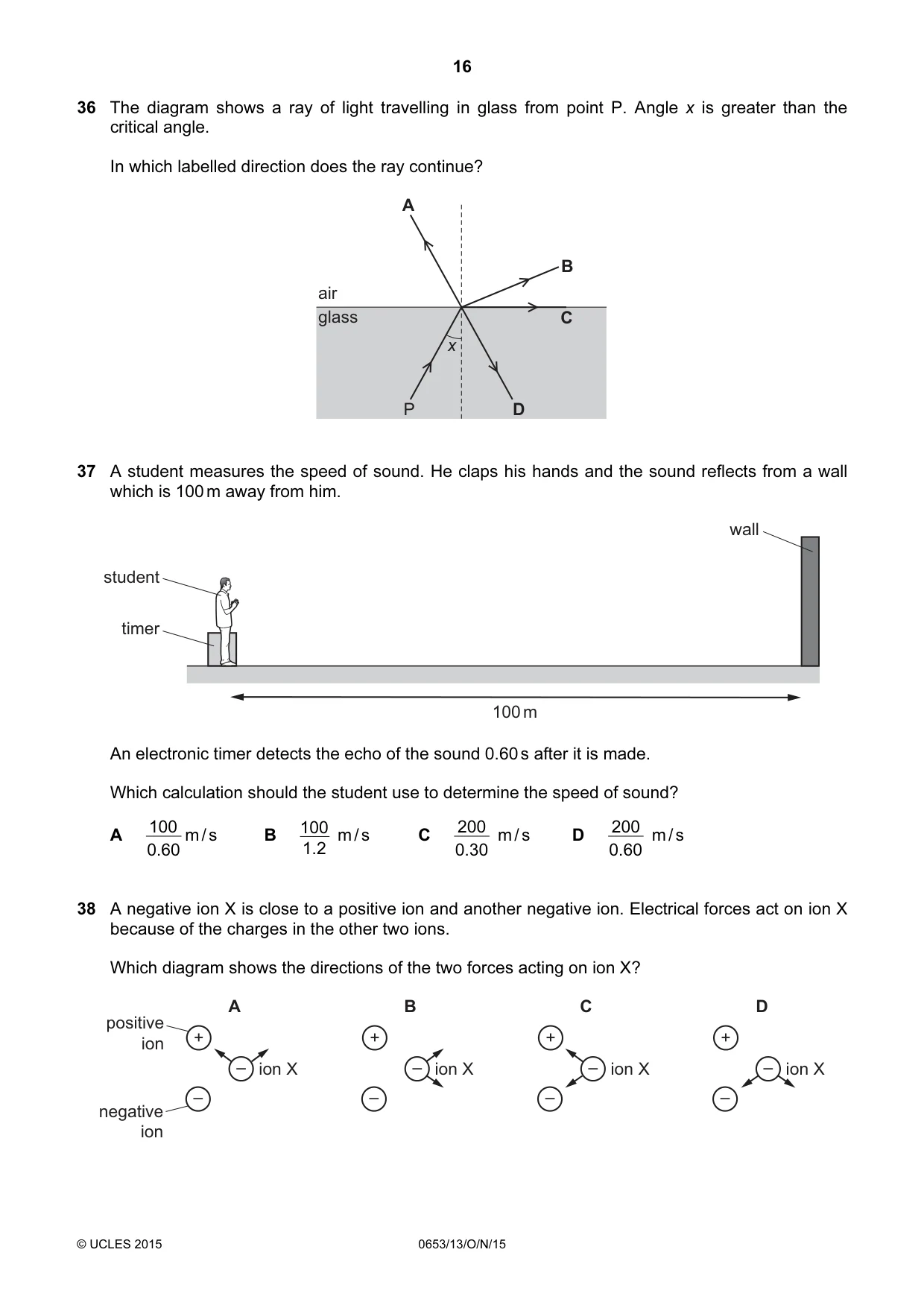
36 The diagram shows a ray of light travelling in glass from point P. Angle x is greater than the critical angle. In which labelled direction does the ray continue? A B air glass C x P D
Mark scheme: D
Q37 · A student measures the speed of sound
37 A student measures the speed of sound. He claps his hands and the sound reflects from a wall which is 100 m away from him. wall student timer 100 m An electronic timer detects the echo of the sound 0.60 s after it is made. Which calculation should the student use to determine the speed of sound? 100 m / s 100 m / s 200 m / s 200 m / s A B C D 0.60 1 . 2 0.30 0.60
Mark scheme: D
Q38 · A negative ion X is close to a positive ion and another negative ion
38 A negative ion X is close to a positive ion and another negative ion. Electrical forces act on ion X because of the charges in the other two ions. Which diagram shows the directions of the two forces acting on ion X? A B C D positive ion + + + + – ion X – ion X – ion X – ion X – – – – negative ion
Mark scheme: A
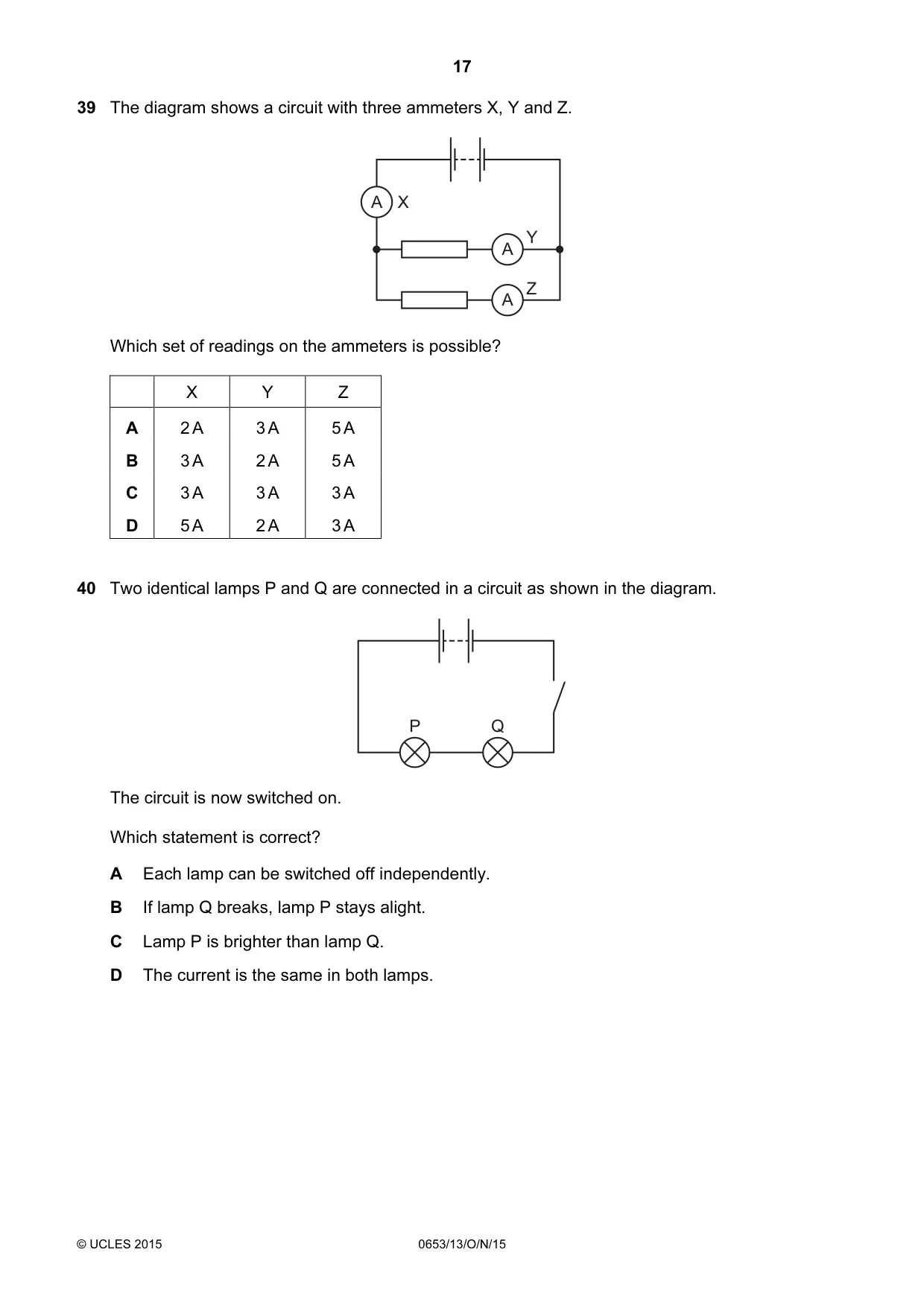
Q39 · The diagram shows a circuit with three ammeters X, Y and Z
39 The diagram shows a circuit with three ammeters X, Y and Z. A X Y A Z A Which set of readings on the ammeters is possible? X Y Z A 2 A 3 A 5 A B 3 A 2 A 5 A C 3 A 3 A 3 A D 5 A 2 A 3 A
Mark scheme: D
Q40 · Two identical lamps P and Q are connected in a circuit as shown in the diagram
40 Two identical lamps P and Q are connected in a circuit as shown in the diagram. P Q The circuit is now switched on. Which statement is correct? A Each lamp can be switched off independently. B If lamp Q breaks, lamp P stays alight. C Lamp P is brighter than lamp Q. D The current is the same in both lamps.
Mark scheme: D
What was in this paper
The subtopics covered by these 40 questions, and how many questions each got. Open one in a new tab to see every Cambridge question on it.
2Energy, work and power2Gas exchange in humans2Light2Rate of reaction2Sexual reproduction in plants2Transition elements2Atomic structure and the Periodic Table1Blood1Cell structure1Characteristics of living organisms1Density1Diffusion1Drugs1Electrolysis1Elements, compounds and mixtures1Enzymes1Exothermic and endothermic reactions1Food chains and food webs1Forces1Fuels1Group I properties1Identification of ions and gases1Kinetic particle model of matter1Leaf structure1Mass and weight1Motion1Preparation of salts1Reactivity series1Sexual reproduction in humans1Sound1Terminology1Transfer of thermal energy1What you needed in this session
Cambridge’s own grade thresholds for 2015 Oct/Nov, Paper 1 · Variant 3. A higher threshold means an easier paper — the bar moves with how the cohort did.