Cambridge IGCSE Science - Combined 0653 — 2014 May/June Paper 1 · Variant 1
0653/11/M/J/14 · 40 questions · 40 marks · ≈45 min
The question paper and its mark scheme, free to read here and free to download. This is Cambridge’s own paper, exactly as it was sat.
Question paper20 pages

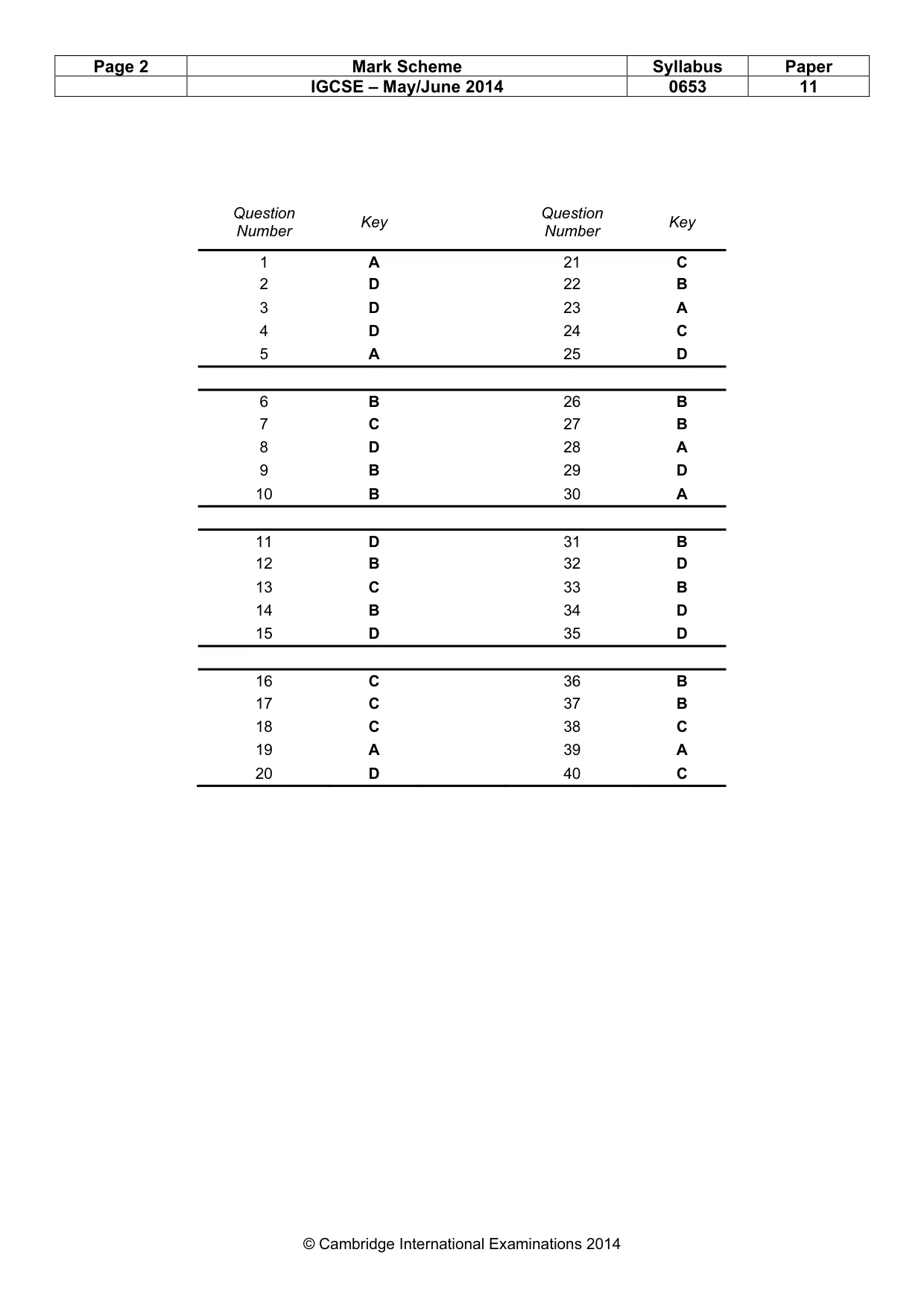
Mark scheme2 pages
Answers below. Sit the paper first if you are practising.
Questions as text
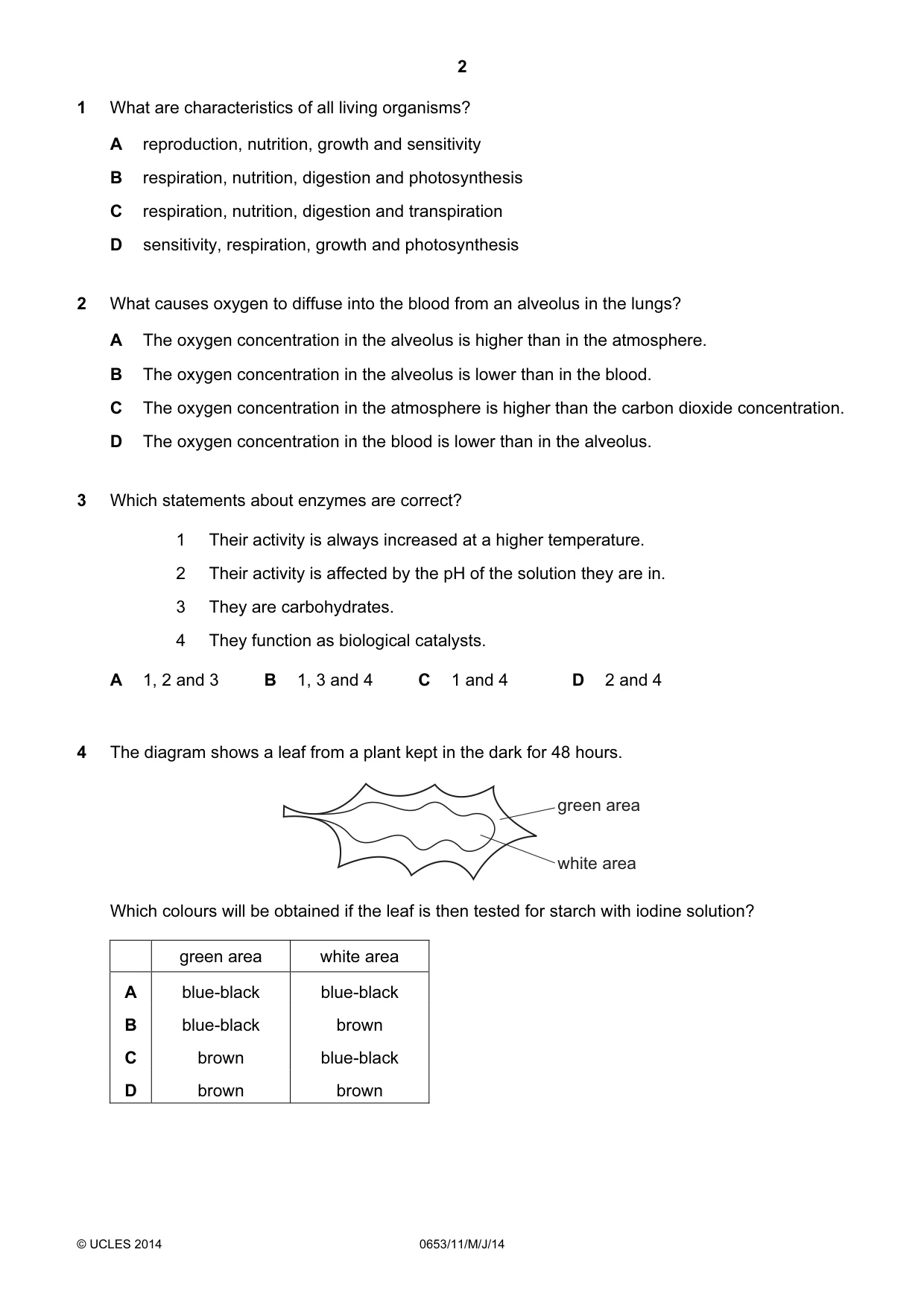
Q1 · What are characteristics of all living organisms?
1 What are characteristics of all living organisms? A reproduction, nutrition, growth and sensitivity B respiration, nutrition, digestion and photosynthesis C respiration, nutrition, digestion and transpiration D sensitivity, respiration, growth and photosynthesis
Mark scheme: A
Q2 · What causes oxygen to diffuse into the blood from an alveolus in the lungs?
2 What causes oxygen to diffuse into the blood from an alveolus in the lungs? A The oxygen concentration in the alveolus is higher than in the atmosphere. B The oxygen concentration in the alveolus is lower than in the blood. C The oxygen concentration in the atmosphere is higher than the carbon dioxide concentration. D The oxygen concentration in the blood is lower than in the alveolus.
Mark scheme: D
Q3 · Which statements about enzymes are correct?
3 Which statements about enzymes are correct? 1 Their activity is always increased at a higher temperature. 2 Their activity is affected by the pH of the solution they are in. 3 They are carbohydrates. 4 They function as biological catalysts. A 1, 2 and 3 B 1, 3 and 4 C 1 and 4 D 2 and 4
Mark scheme: D
Q4 · The diagram shows a leaf from a plant kept in the dark for 48 hours
4 The diagram shows a leaf from a plant kept in the dark for 48 hours. green area white area Which colours will be obtained if the leaf is then tested for starch with iodine solution? green area white area A blue-black blue-black B blue-black brown C brown blue-black D brown brown
Mark scheme: D
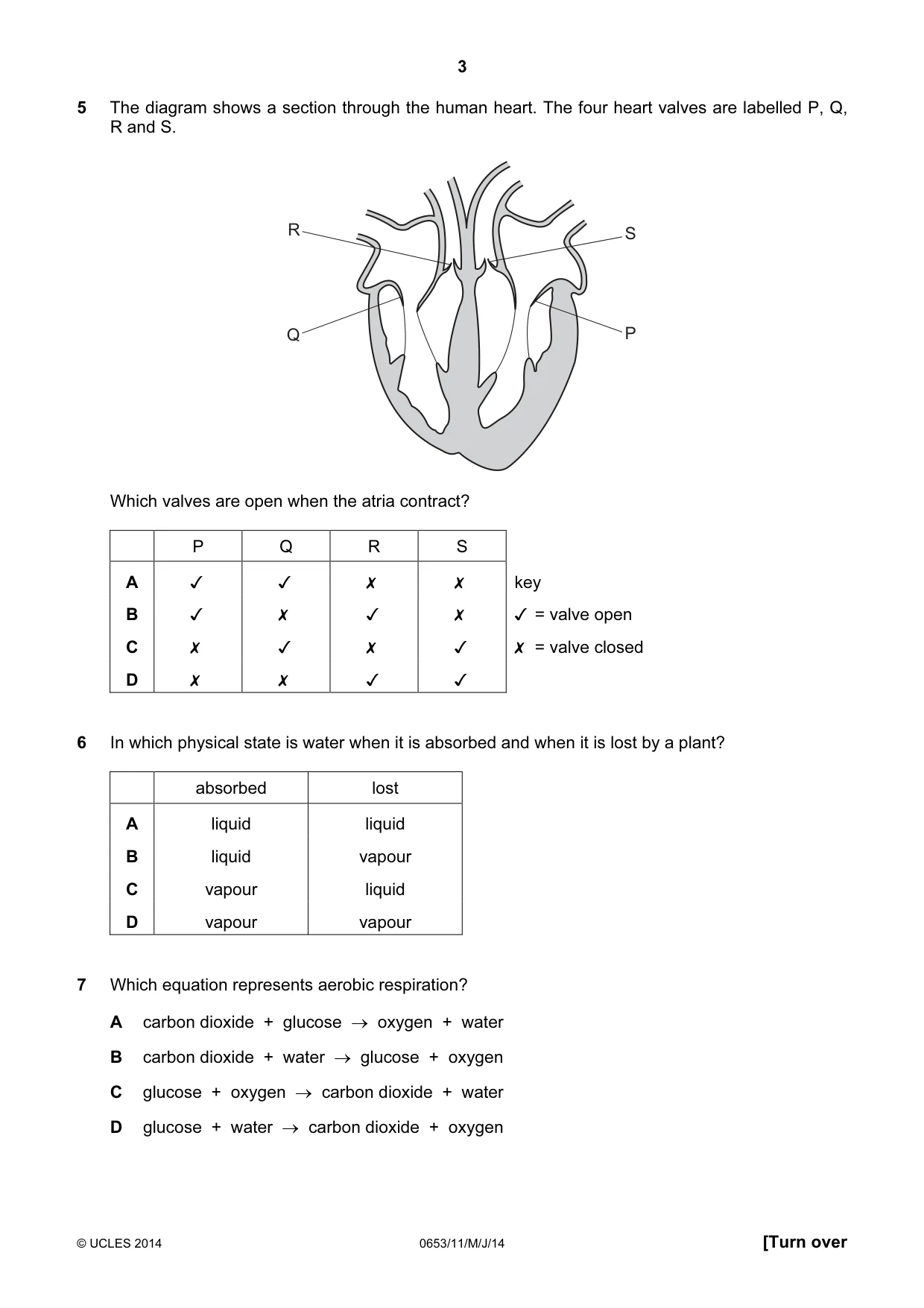
Q5 · The diagram shows a section through the human heart
5 The diagram shows a section through the human heart. The four heart valves are labelled P, Q, R and S. Which valves are open when the atria contract? key v¥ =valve open X =valve closed \N \ €® KL \ &®& \ &€® 1D x << *& <1O 0 0O WwW > ~~ * QL NID
Mark scheme: A
Q6 · In which physical state is water when it is absorbed and when it is lost by a plant?
6 In which physical state is water when it is absorbed and when it is lost by a plant? absorbed lost A liquid liquid B liquid vapour C vapour liquid D vapour vapour
Mark scheme: B
Q7 · Which equation represents aerobic respiration?
7 Which equation represents aerobic respiration? A carbon dioxide + glucose → oxygen + water B carbon dioxide + water → glucose + oxygen C glucose + oxygen → carbon dioxide + water D glucose + water → carbon dioxide + oxygen
Mark scheme: C
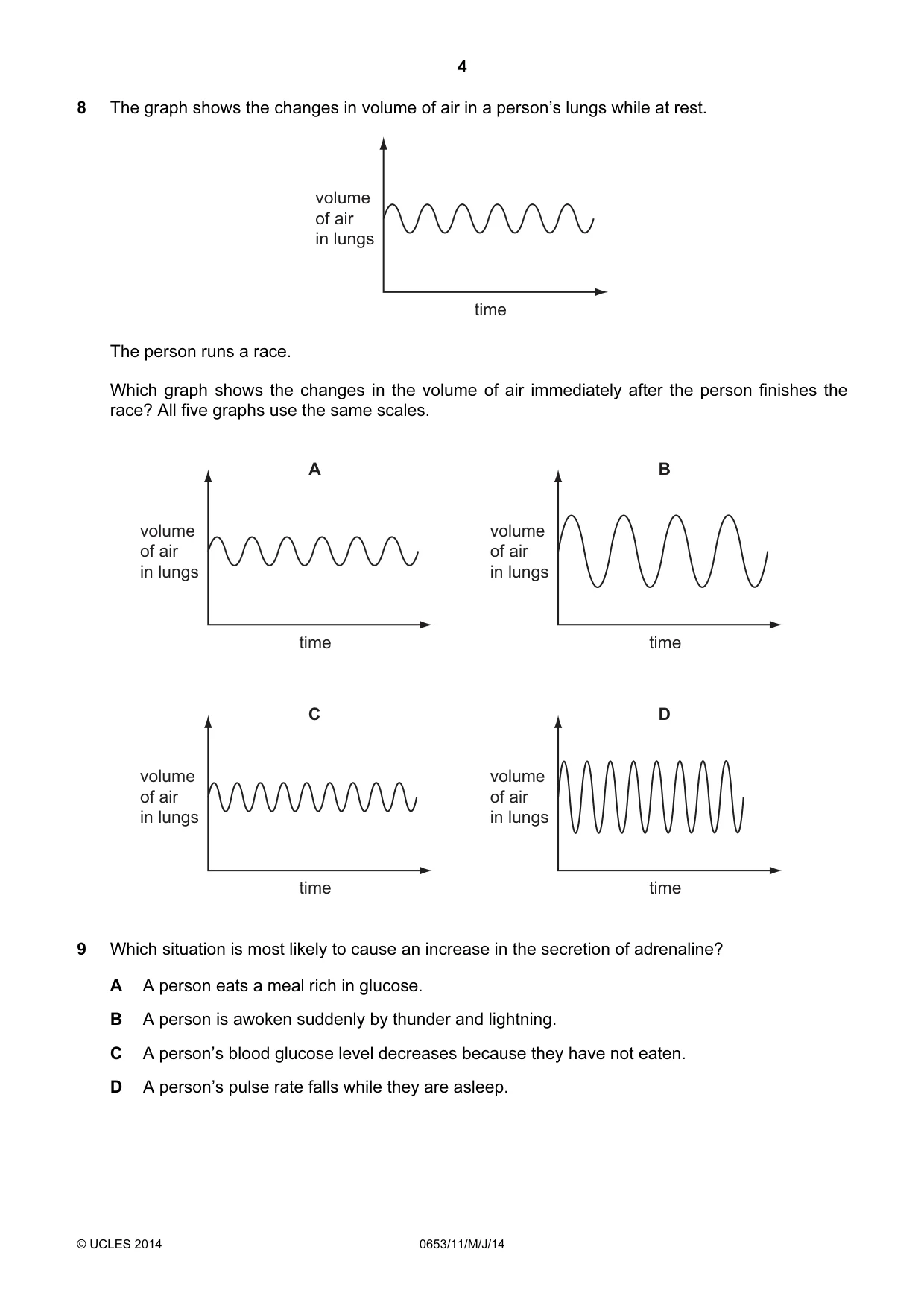
Q8 · The graph shows the changes in volume of air in a person’s lungs while at rest
8 The graph shows the changes in volume of air in a person’s lungs while at rest. volume of air in lungs time The person runs a race. Which graph shows the changes in the volume of air immediately after the person finishes the race? All five graphs use the same scales. A B volume volume of air of air in lungs in lungs time time C D volume volume of air of air in lungs in lungs time time
Mark scheme: D
Q9 · Which situation is most likely to cause an increase in the secretion of adrenaline?
9 Which situation is most likely to cause an increase in the secretion of adrenaline? A A person eats a meal rich in glucose. B A person is awoken suddenly by thunder and lightning. C A person’s blood glucose level decreases because they have not eaten. D A person’s pulse rate falls while they are asleep.
Mark scheme: B
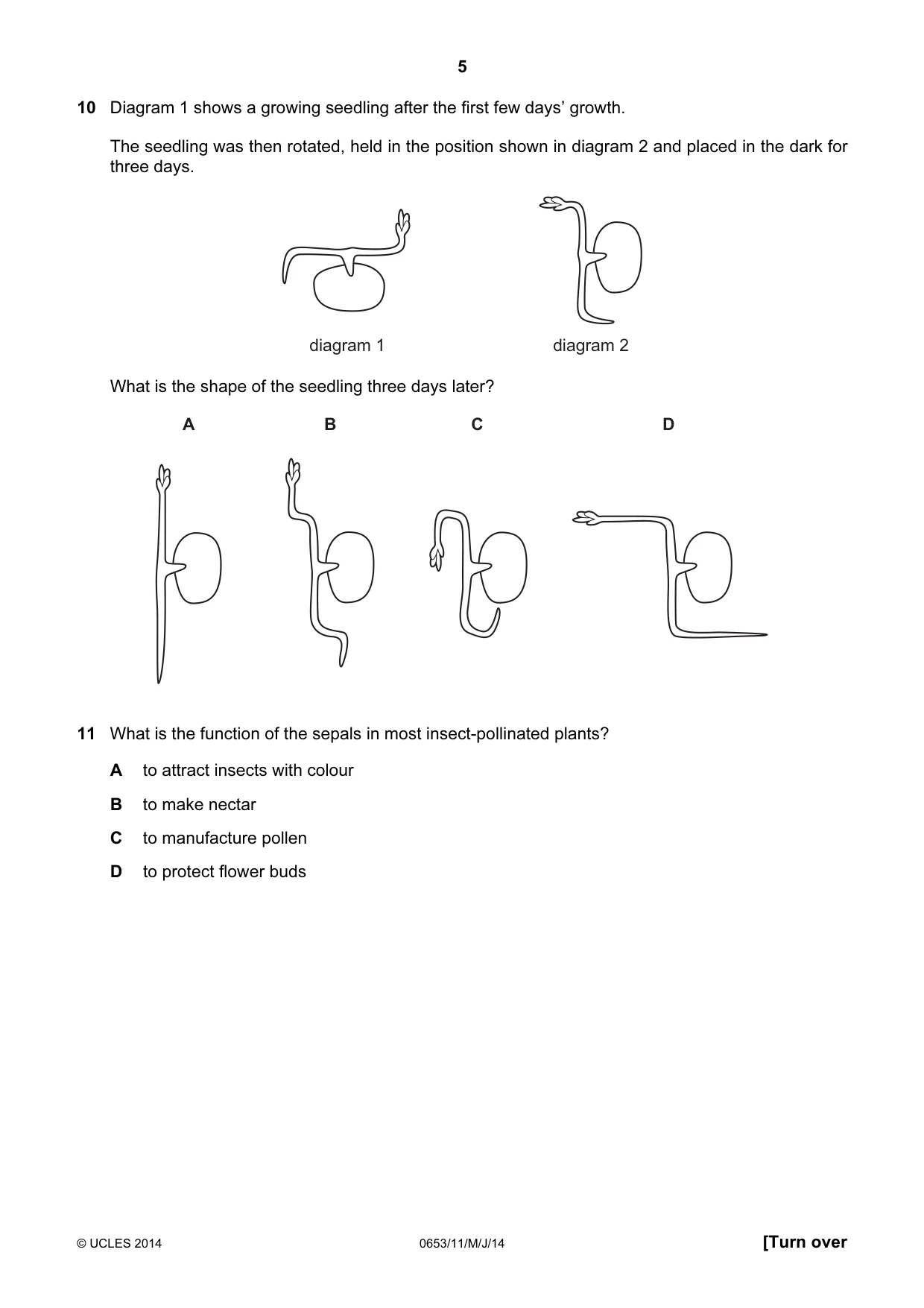
Q10 · A growing seedling after the first few days’ growth
10 Diagram 1 shows a growing seedling after the first few days’ growth. The seedling was then rotated, held in the position shown in diagram 2 and placed in the dark for three days. diagram 1 diagram 2 What is the shape of the seedling three days later? A B C D
Mark scheme: B
Q11 · What is the function of the sepals in most insect-pollinated plants?
11 What is the function of the sepals in most insect-pollinated plants? A to attract insects with colour B to make nectar C to manufacture pollen D to protect flower buds
Mark scheme: D
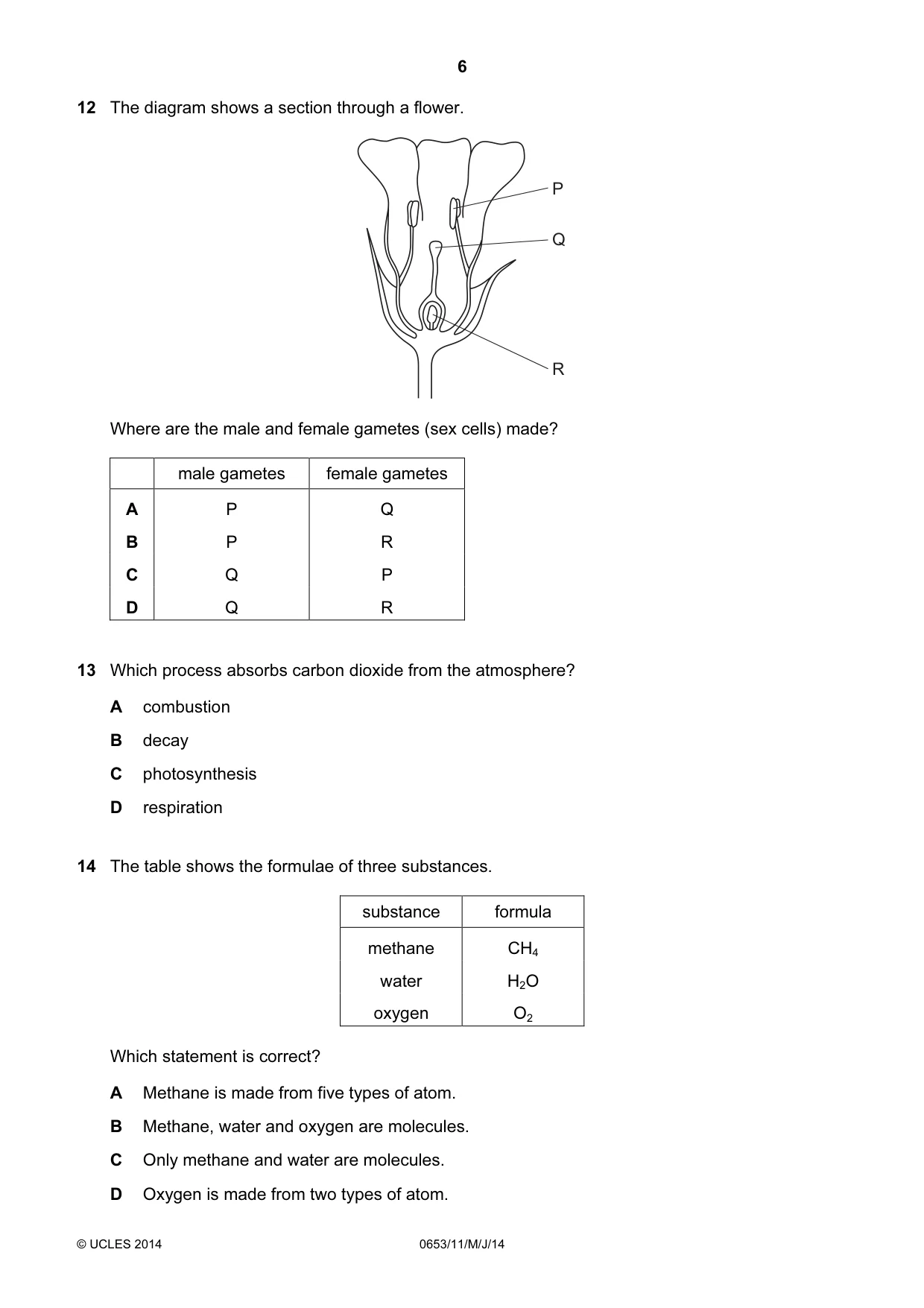
Q12 · The diagram shows a section through a flower
12 The diagram shows a section through a flower. P Q R Where are the male and female gametes (sex cells) made? male gametes female gametes A P Q B P R C Q P D Q R
Mark scheme: B
Q13 · Which process absorbs carbon dioxide from the atmosphere?
13 Which process absorbs carbon dioxide from the atmosphere? A combustion B decay C photosynthesis D respiration
Mark scheme: C
Q14 · The table shows the formulae of three substances
14 The table shows the formulae of three substances. substance formula methane CH4 water H2O oxygen O2 Which statement is correct? A Methane is made from five types of atom. B Methane, water and oxygen are molecules. C Only methane and water are molecules. D Oxygen is made from two types of atom.
Mark scheme: B
Q15 · A mixture contains two liquids
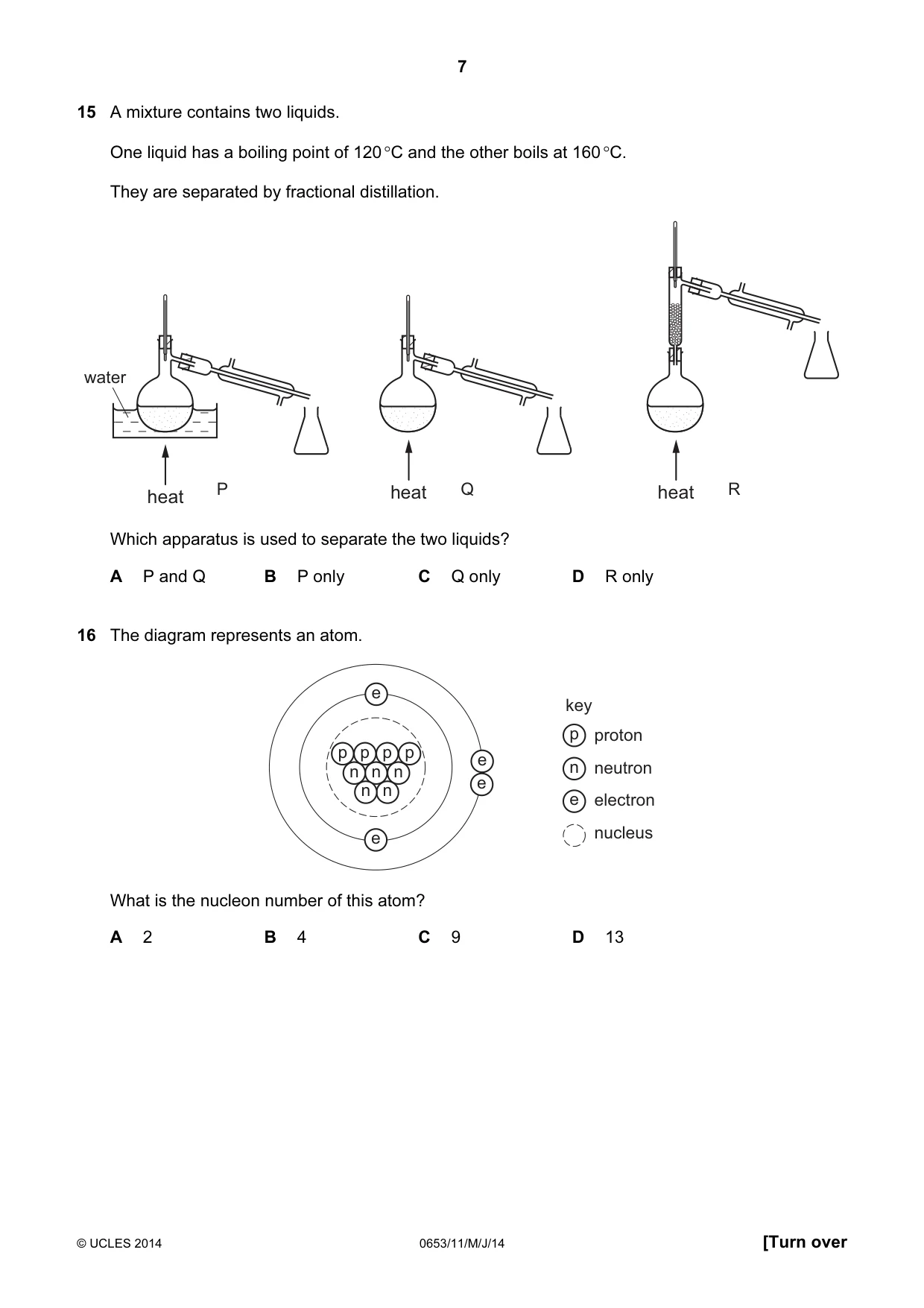
15 A mixture contains two liquids. One liquid has a boiling point of 120 °C and the other boils at 160 °C. They are separated by fractional distillation. water heat P heat Q heat R Which apparatus is used to separate the two liquids? A P and Q B P only C Q only D R only
Mark scheme: D
Q16 · The diagram represents an atom
16 The diagram represents an atom. e key p proton p p p p e n n n n neutron e n n e electron e nucleus What is the nucleon number of this atom? A 2 B 4 C 9 D 13
Mark scheme: C
Q17 · Sodium and fluorine react together violently to form sodium fluoride
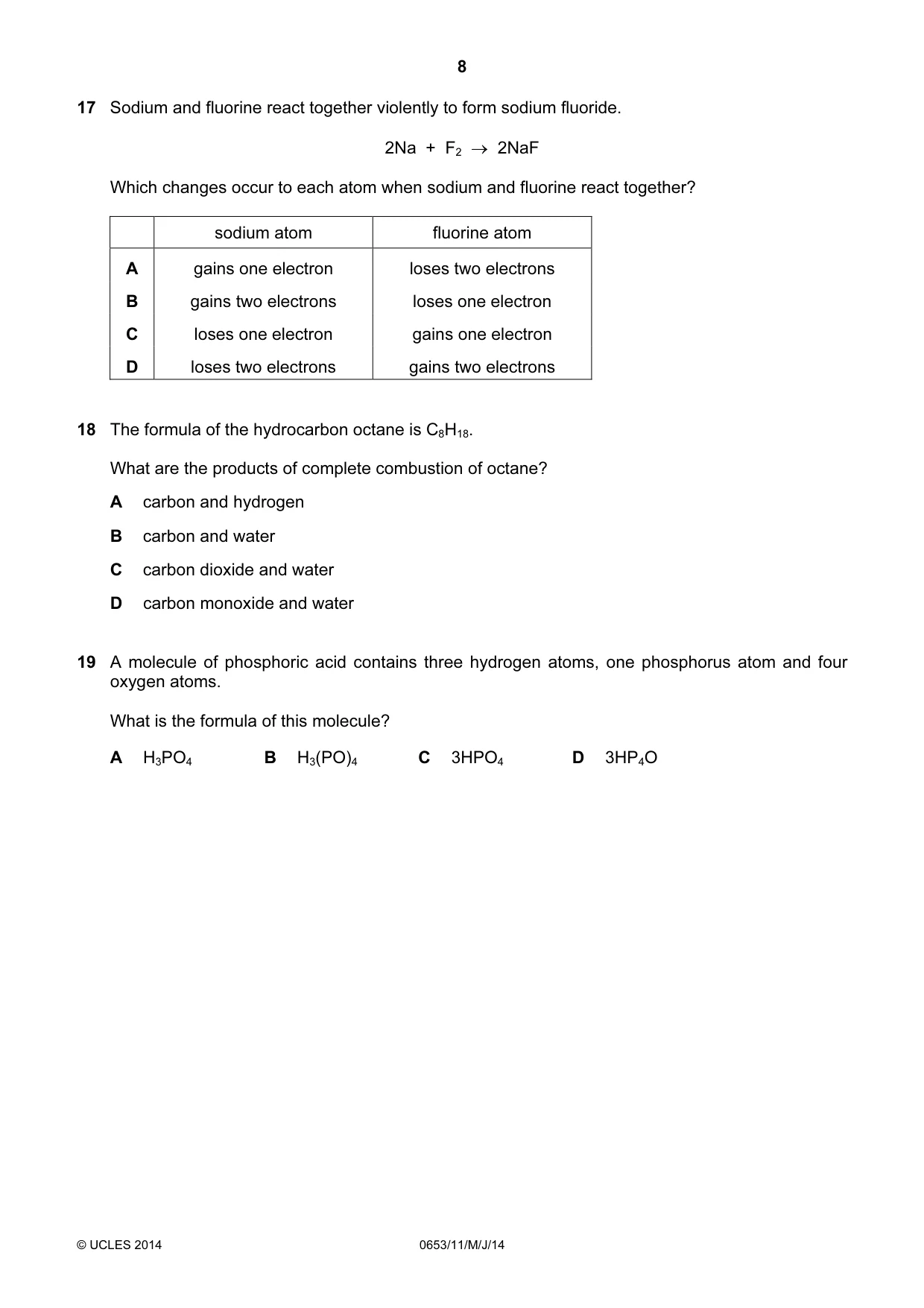
17 Sodium and fluorine react together violently to form sodium fluoride. 2Na + F2 → 2NaF Which changes occur to each atom when sodium and fluorine react together? sodium atom fluorine atom A gains one electron loses two electrons B gains two electrons loses one electron C loses one electron gains one electron D loses two electrons gains two electrons
Mark scheme: C
Q18 · The formula of the hydrocarbon octane is C8H18
18 The formula of the hydrocarbon octane is C8H18. What are the products of complete combustion of octane? A carbon and hydrogen B carbon and water C carbon dioxide and water D carbon monoxide and water
Mark scheme: C
Q19 · A molecule of phosphoric acid contains three hydrogen atoms, one phosphorus atom and four…
19 A molecule of phosphoric acid contains three hydrogen atoms, one phosphorus atom and four oxygen atoms. What is the formula of this molecule? A H3PO4 B H3(PO)4 C 3HPO4 D 3HP4O
Mark scheme: A
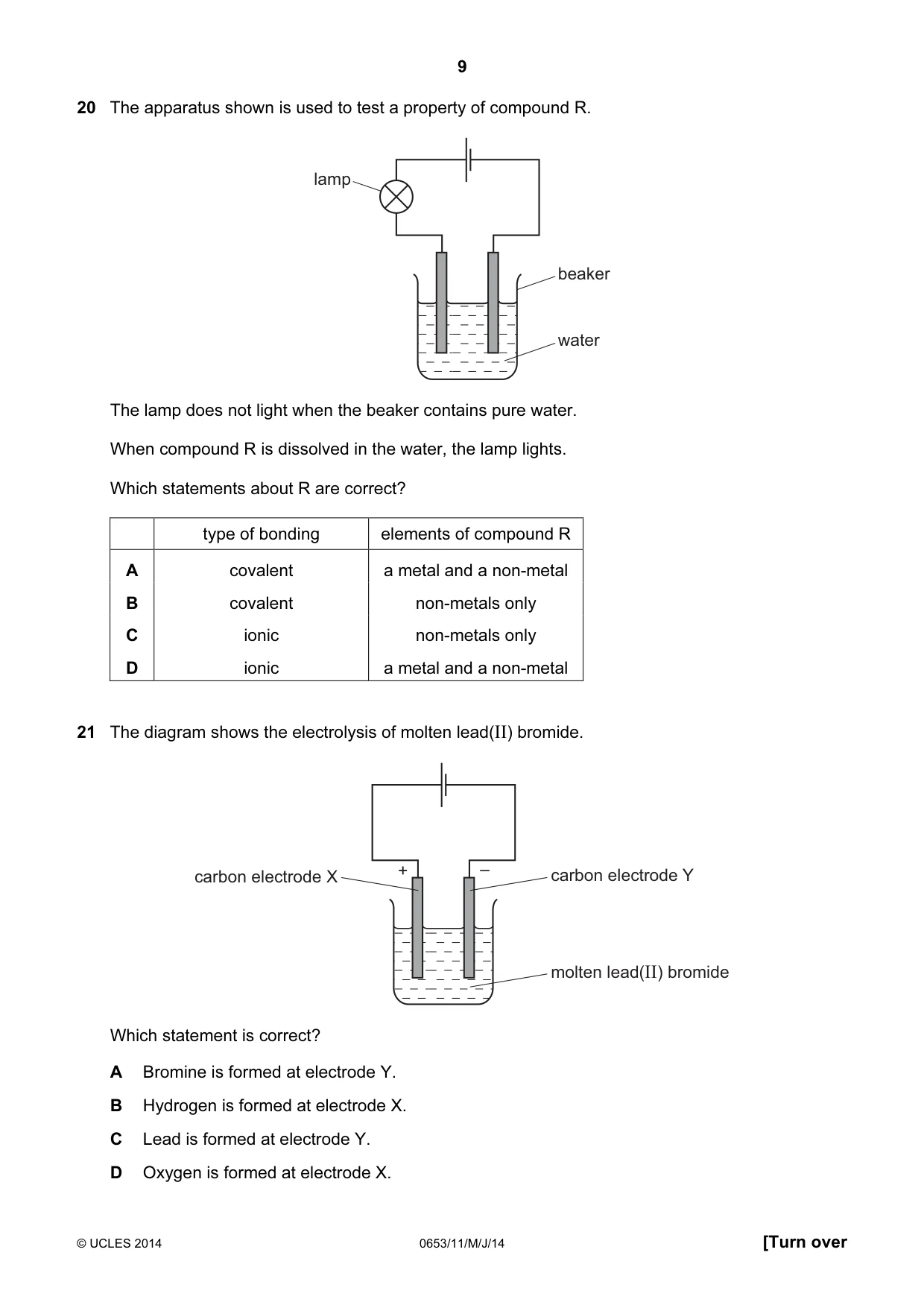
Q20 · The apparatus shown is used to test a property of compound R
20 The apparatus shown is used to test a property of compound R. lamp beaker water The lamp does not light when the beaker contains pure water. When compound R is dissolved in the water, the lamp lights. Which statements about R are correct? type of bonding elements of compound R A covalent a metal and a non-metal B covalent non-metals only C ionic non-metals only D ionic a metal and a non-metal
Mark scheme: D
Q21 · The diagram shows the electrolysis of molten lead(II) bromide
21 The diagram shows the electrolysis of molten lead(II) bromide. carbon electrode X + – carbon electrode Y molten lead(II) bromide Which statement is correct? A Bromine is formed at electrode Y. B Hydrogen is formed at electrode X. C Lead is formed at electrode Y. D Oxygen is formed at electrode X.
Mark scheme: C
Q22 · Limestone chips react with hydrochloric acid
22 Limestone chips react with hydrochloric acid. Which change decreases the speed of the reaction? A adding a catalyst B decreasing the temperature C increasing the concentration of hydrochloric acid D using limestone powder
Mark scheme: B
Q23 · Which substance does not react with dilute hydrochloric acid to form copper(II) chloride?
23 Which substance does not react with dilute hydrochloric acid to form copper(II) chloride? A copper B copper carbonate C copper hydroxide D copper oxide
Mark scheme: A
More questions on The characteristic properties of acids and bases
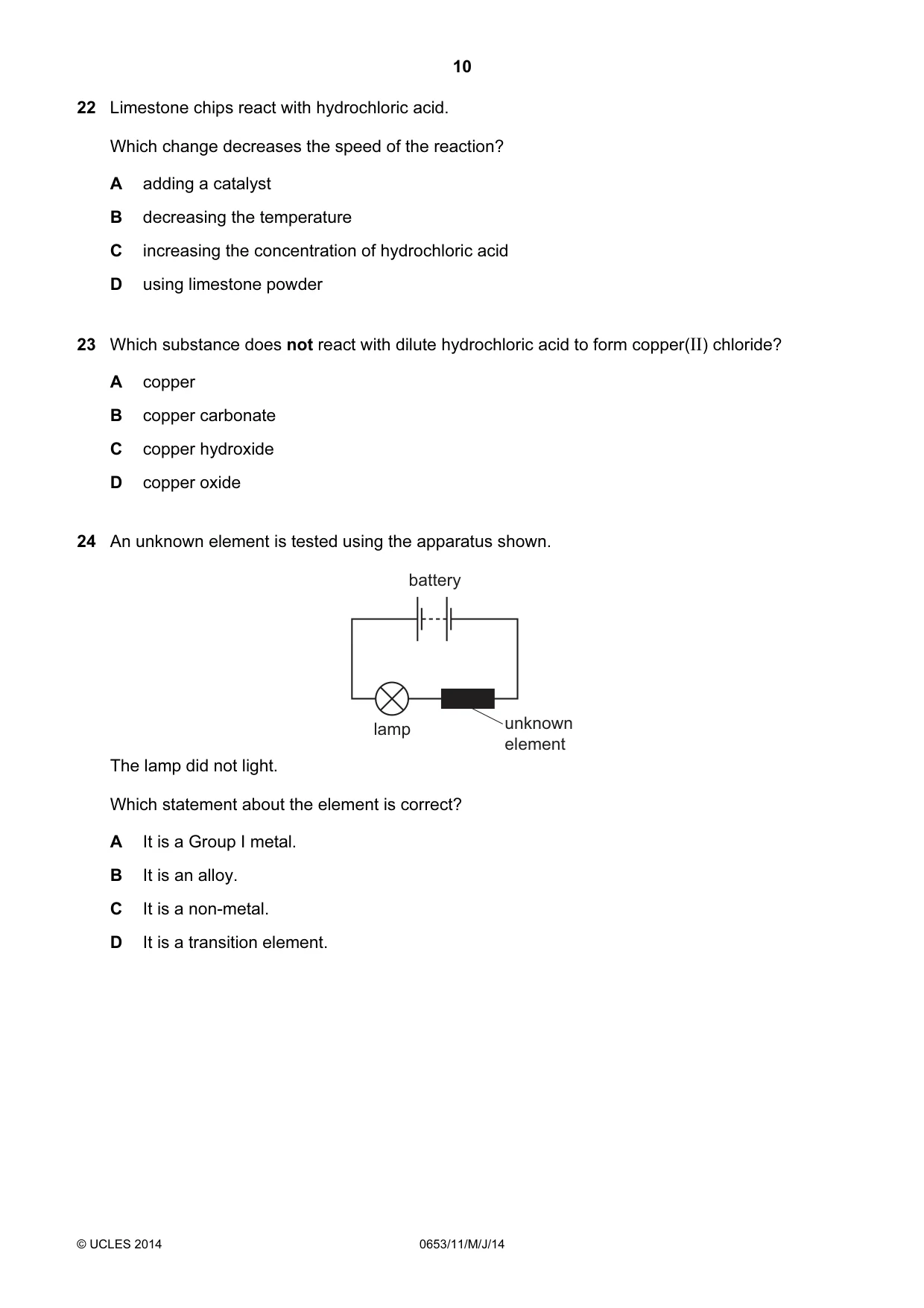
Q24 · An unknown element is tested using the apparatus shown
24 An unknown element is tested using the apparatus shown. battery lamp unknown element The lamp did not light. Which statement about the element is correct? A It is a Group I metal. B It is an alloy. C It is a non-metal. D It is a transition element.
Mark scheme: C
Q25 · Magnesium can be used to extract iron from iron(III) oxide, Fe2O3 to give magnesium oxide…
25 Magnesium can be used to extract iron from iron(III) oxide, Fe2O3 to give magnesium oxide and iron. The equation for the reaction is shown. 2Mg + Fe2O3 → Mg2O3 + 2Fe Why is magnesium used in this reaction? A It is less reactive than iron and oxidises iron(III) oxide. B It is less reactive than iron and reduces iron(III) oxide. C It is more reactive than iron and oxidises iron(III) oxide. D It is more reactive than iron and reduces iron(III) oxide.
Mark scheme: D
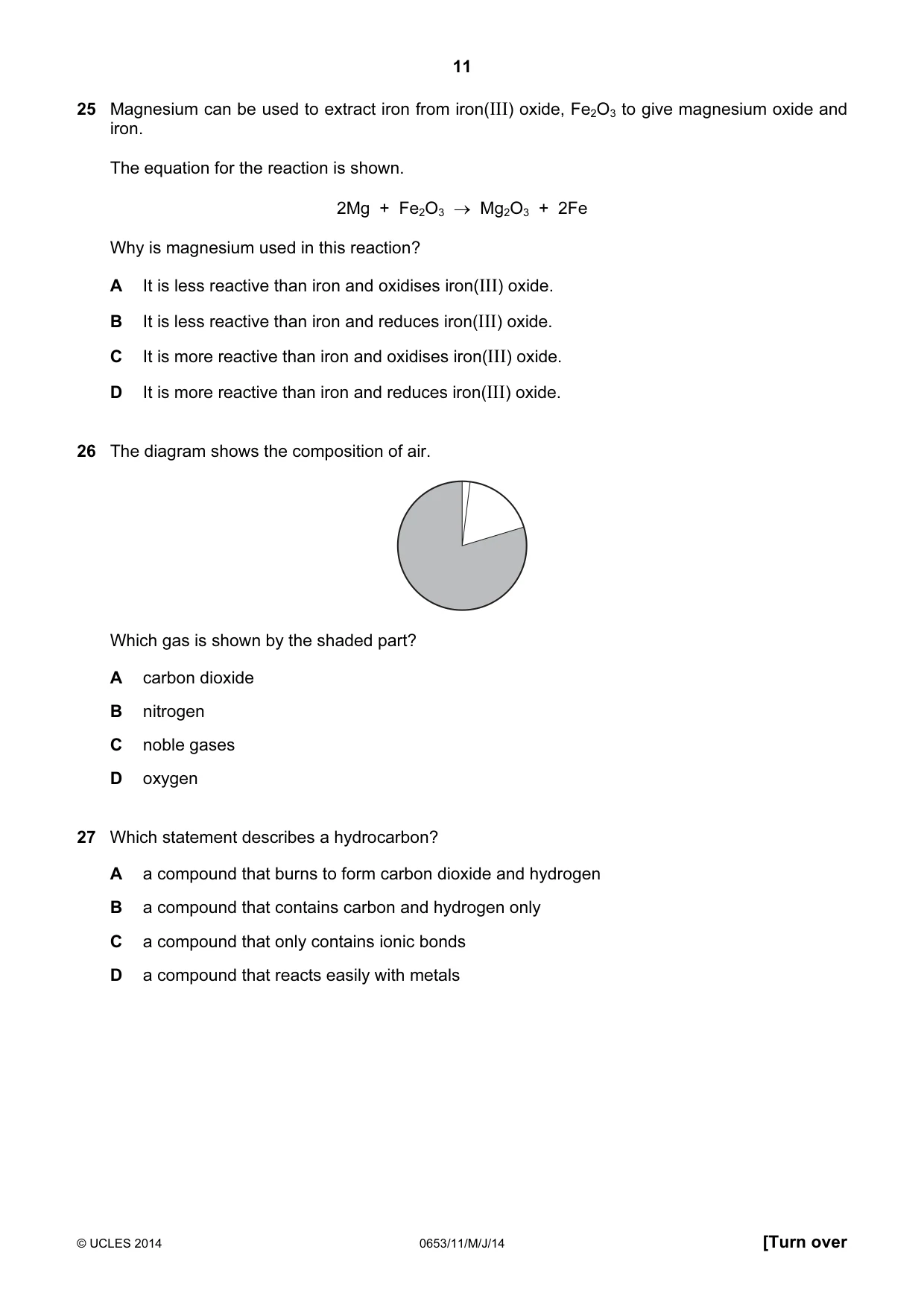
Q26 · The diagram shows the composition of air
26 The diagram shows the composition of air. Which gas is shown by the shaded part? A carbon dioxide B nitrogen C noble gases D oxygen
Mark scheme: B
Q27 · Which statement describes a hydrocarbon?
27 Which statement describes a hydrocarbon? A a compound that burns to form carbon dioxide and hydrogen B a compound that contains carbon and hydrogen only C a compound that only contains ionic bonds D a compound that reacts easily with metals
Mark scheme: B
Q28 · The distance / time graph shows the motion of a car
28 The distance / time graph shows the motion of a car. distance X Y 0 0 time Which row describes the speed of the car in section X and the speed of the car in section Y of the graph? speed in section X speed in section Y A constant constant B constant decreasing C increasing constant D increasing decreasing
Mark scheme: A
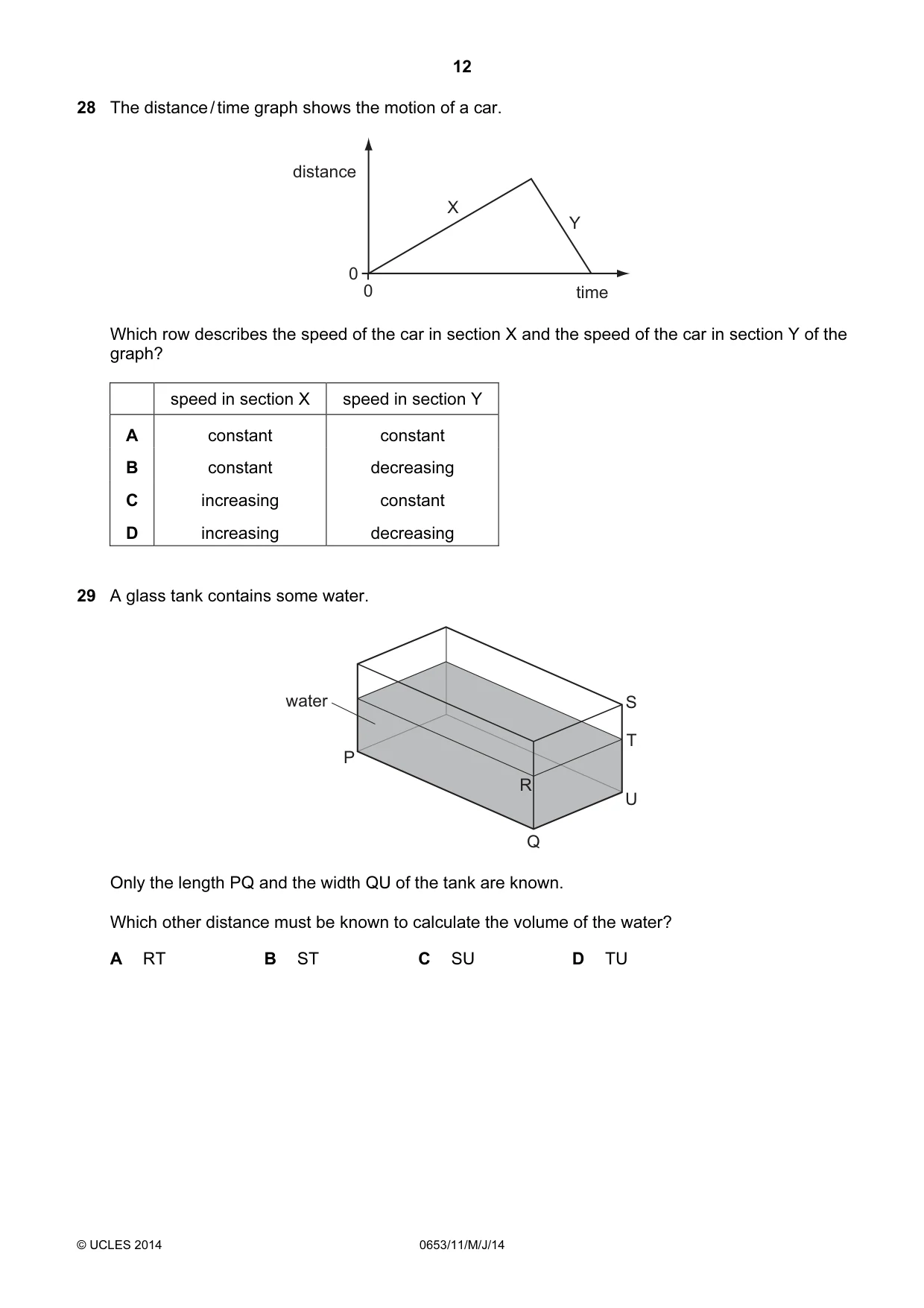
Q29 · A glass tank contains some water
29 A glass tank contains some water. water S T P R U Q Only the length PQ and the width QU of the tank are known. Which other distance must be known to calculate the volume of the water? A RT B ST C SU D TU
Mark scheme: D
More questions on Physical quantities and measurement techniques
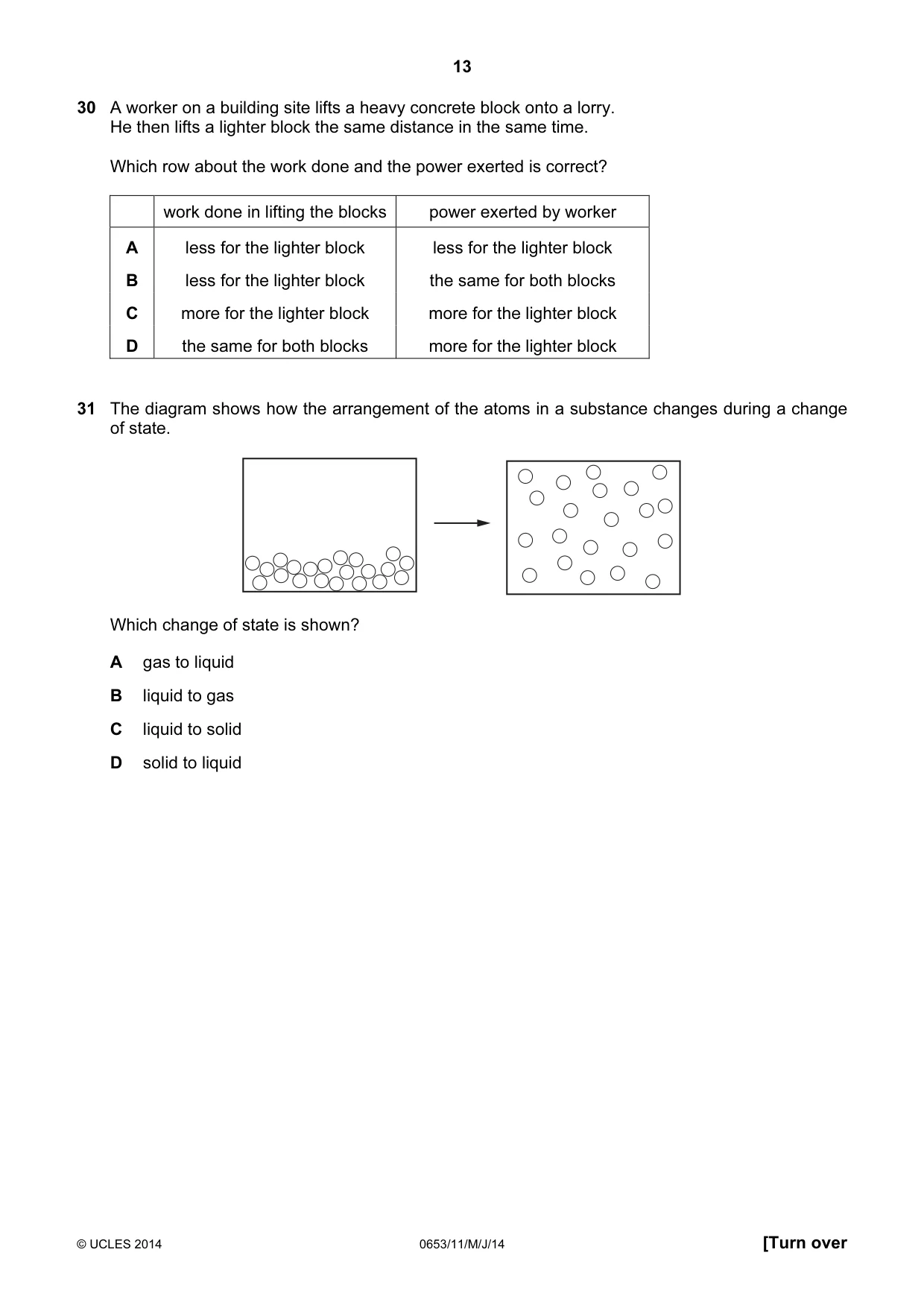
Q30 · A worker on a building site lifts a heavy concrete block onto a lorry
30 A worker on a building site lifts a heavy concrete block onto a lorry. He then lifts a lighter block the same distance in the same time. Which row about the work done and the power exerted is correct? work done in lifting the blocks power exerted by worker A less for the lighter block less for the lighter block B less for the lighter block the same for both blocks C more for the lighter block more for the lighter block D the same for both blocks more for the lighter block
Mark scheme: A
Q31 · The diagram shows how the arrangement of the atoms in a substance changes during a change…
31 The diagram shows how the arrangement of the atoms in a substance changes during a change of state. Which change of state is shown? A gas to liquid B liquid to gas C liquid to solid D solid to liquid
Mark scheme: B
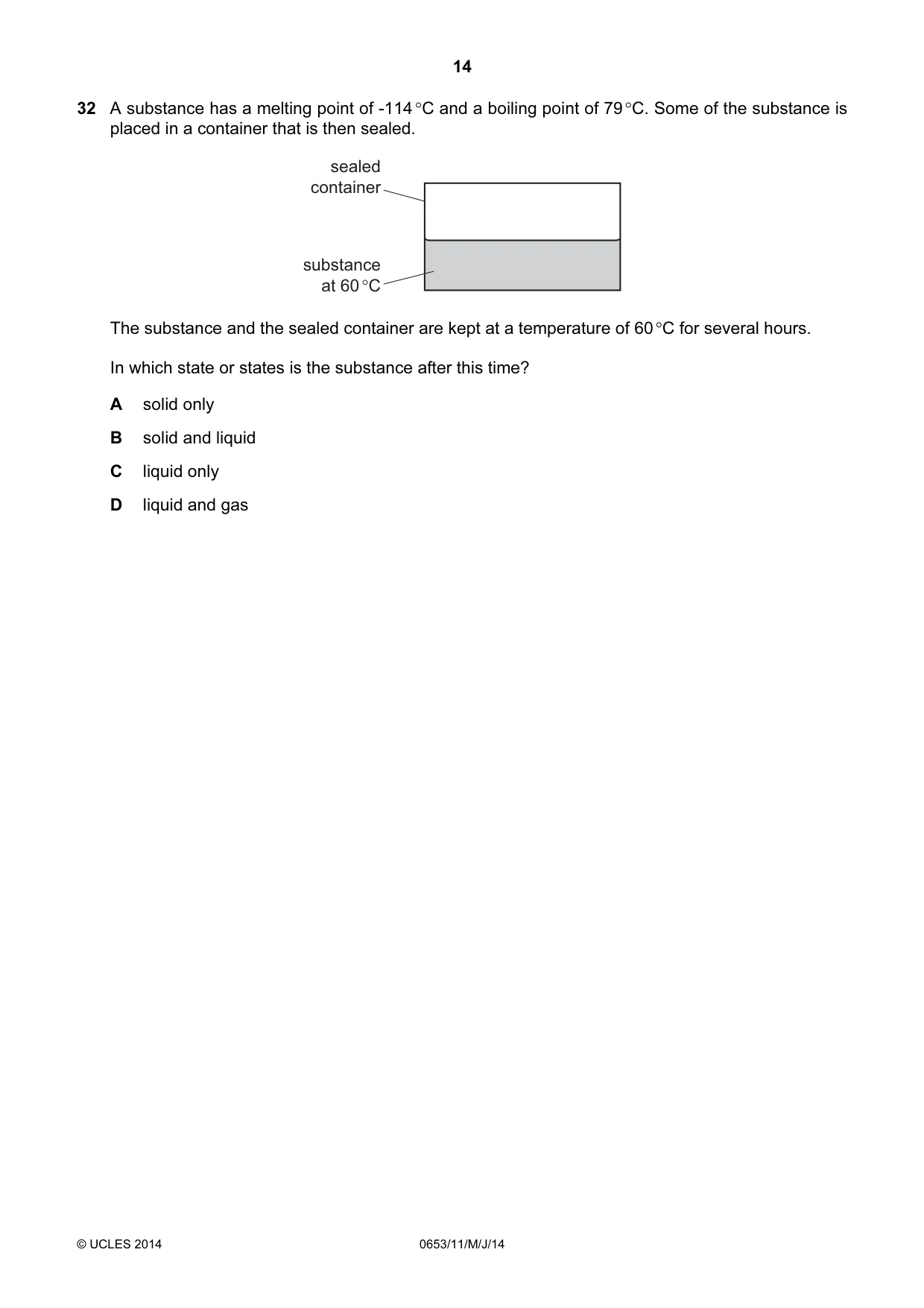
Q32 · A substance has a melting point of -114 °C and a boiling point of 79 °C
32 A substance has a melting point of -114 °C and a boiling point of 79 °C. Some of the substance is placed in a container that is then sealed. sealed container substance at 60 °C The substance and the sealed container are kept at a temperature of 60 °C for several hours. In which state or states is the substance after this time? A solid only B solid and liquid C liquid only D liquid and gas
Mark scheme: D
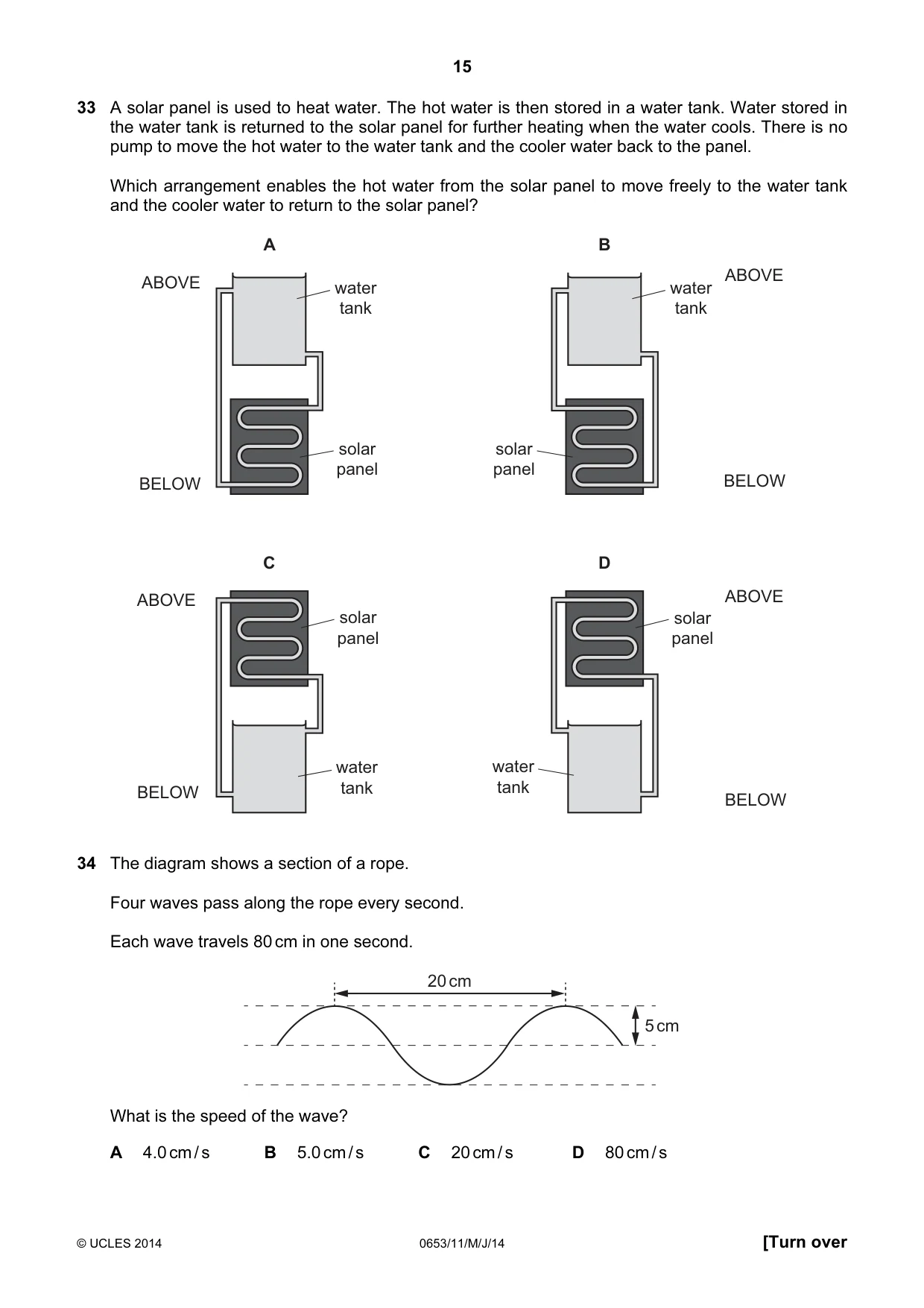
Q33 · A solar panel is used to heat water
33 A solar panel is used to heat water. The hot water is then stored in a water tank. Water stored in the water tank is returned to the solar panel for further heating when the water cools. There is no pump to move the hot water to the water tank and the cooler water back to the panel. Which arrangement enables the hot water from the solar panel to move freely to the water tank and the cooler water to return to the solar panel? A B ABOVE ABOVE water water tank tank solar solar panel panel BELOW BELOW C D ABOVE ABOVE solar solar panel panel water water BELOW tank tank BELOW
Mark scheme: B
Q34 · The diagram shows a section of a rope
34 The diagram shows a section of a rope. Four waves pass along the rope every second. Each wave travels 80 cm in one second. 20 cm 5 cm What is the speed of the wave? A 4.0 cm / s B 5.0 cm / s C 20 cm / s D 80 cm / s
Mark scheme: D
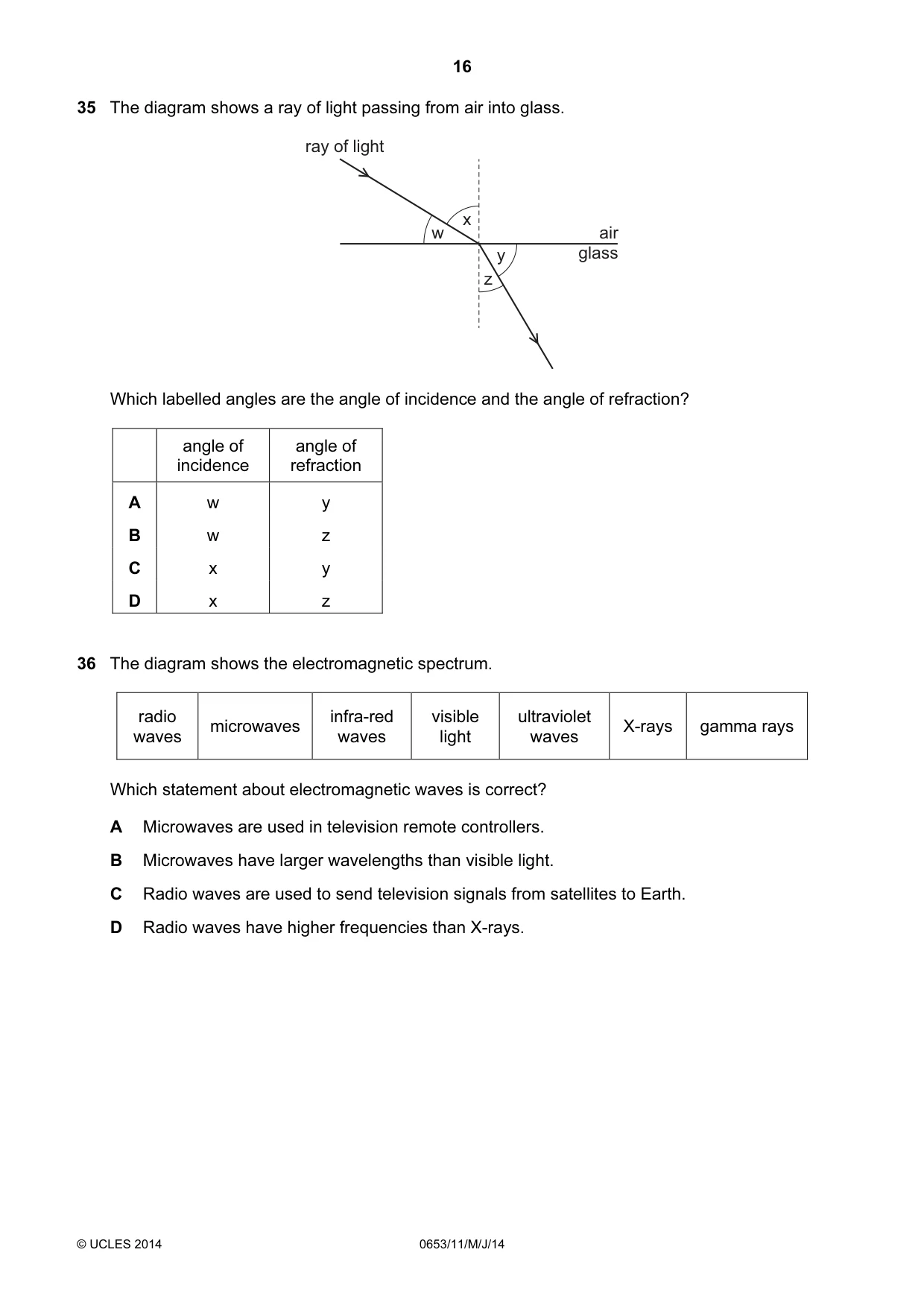
Q35 · The diagram shows a ray of light passing from air into glass
35 The diagram shows a ray of light passing from air into glass. ray of light x w air y glass z Which labelled angles are the angle of incidence and the angle of refraction? angle of angle of incidence refraction A w y B w z C x y D x z
Mark scheme: D
Q36 · The diagram shows the electromagnetic spectrum
36 The diagram shows the electromagnetic spectrum. radio infra-red visible ultraviolet microwaves X-rays gamma rays waves waves light waves Which statement about electromagnetic waves is correct? A Microwaves are used in television remote controllers. B Microwaves have larger wavelengths than visible light. C Radio waves are used to send television signals from satellites to Earth. D Radio waves have higher frequencies than X-rays.
Mark scheme: B
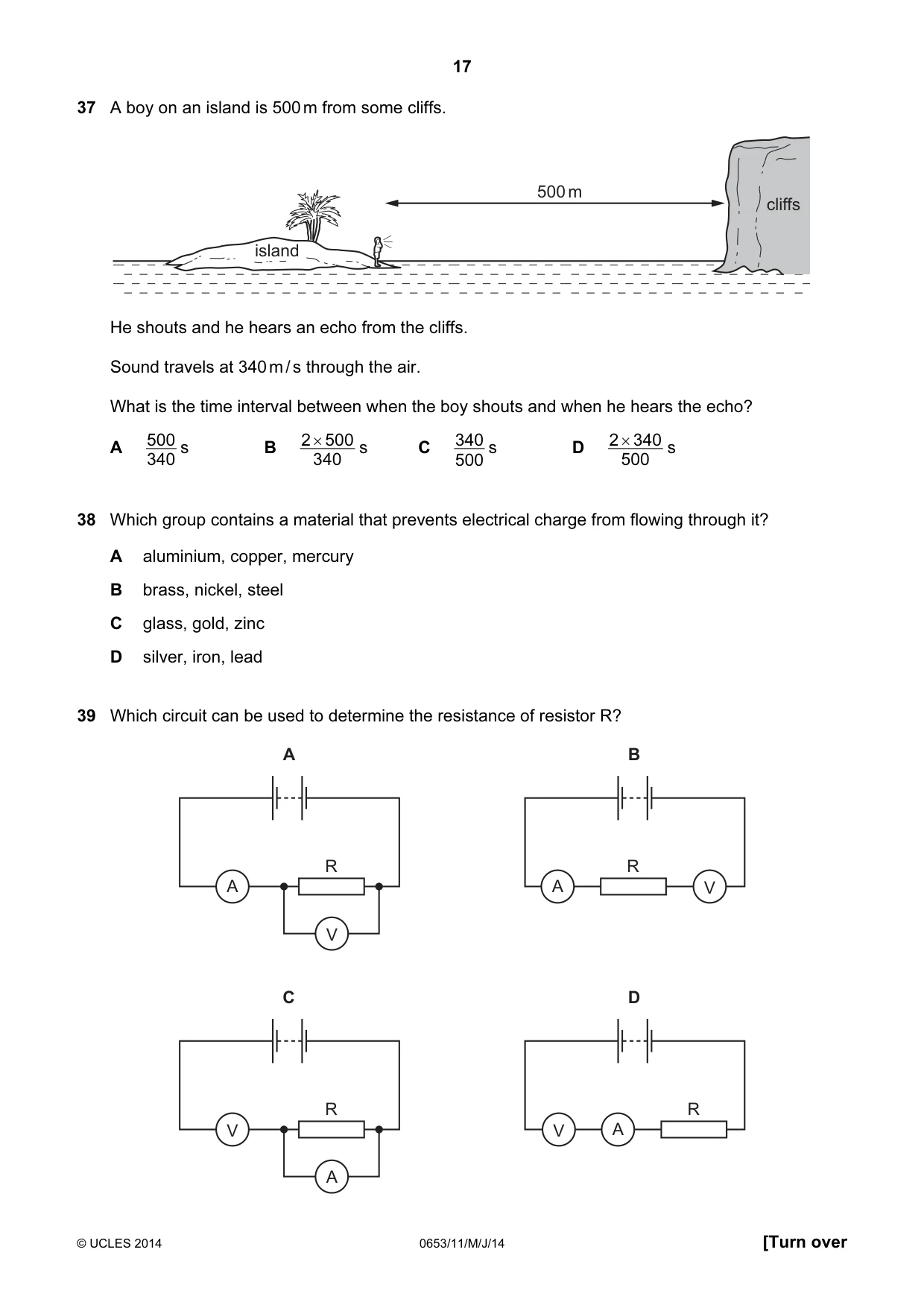
Q37 · A boy on an island is 500 m from some cliffs
37 A boy on an island is 500 m from some cliffs. 500 m cliffs island He shouts and he hears an echo from the cliffs. Sound travels at 340 m / s through the air. What is the time interval between when the boy shouts and when he hears the echo? A 500 s B 2× 500 s C 340 s D 2× 340 s 340 340 5 00 500
Mark scheme: B
Q38 · Which group contains a material that prevents electrical charge from flowing through it?
38 Which group contains a material that prevents electrical charge from flowing through it? A aluminium, copper, mercury B brass, nickel, steel C glass, gold, zinc D silver, iron, lead
Mark scheme: C
Q39 · Which circuit can be used to determine the resistance of resistor R?
39 Which circuit can be used to determine the resistance of resistor R? A B R R A A V V C D R R V V A A
Mark scheme: A
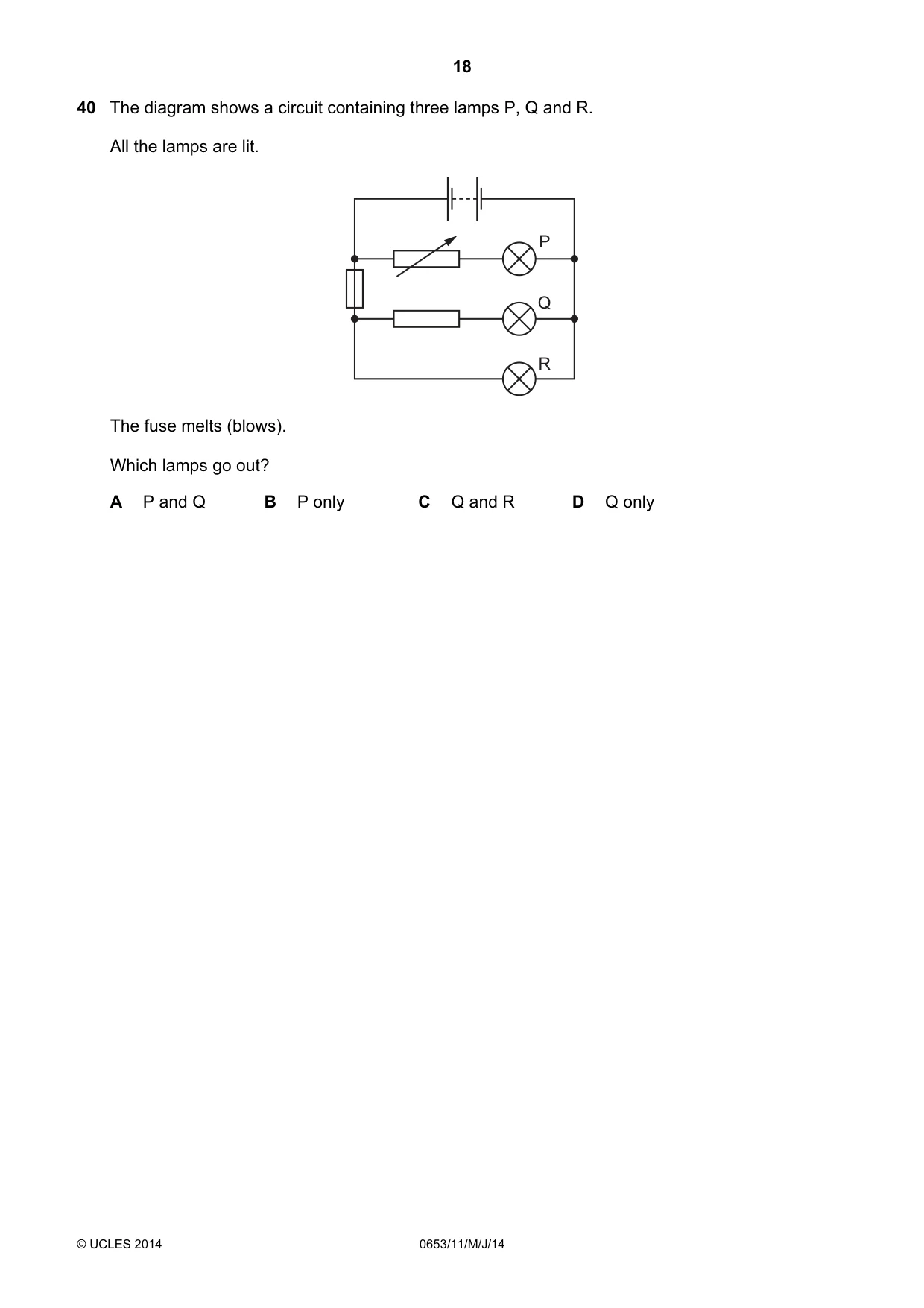
Q40 · The diagram shows a circuit containing three lamps P, Q and R
40 The diagram shows a circuit containing three lamps P, Q and R. All the lamps are lit. P Q R The fuse melts (blows). Which lamps go out? A P and Q B P only C Q and R D Q only
Mark scheme: C
What was in this paper
The subtopics covered by these 40 questions, and how many questions each got. Open one in a new tab to see every Cambridge question on it.
2Electrical circuits2Gas exchange in humans2Ions and ionic bonds2Sexual reproduction in plants2Air quality and climate1Alkanes1Atomic structure and the Periodic Table1Carbon cycle1Drugs1Electrical quantities1Electrolysis1Electromagnetic spectrum1Energy, work and power1Enzymes1Formulas1General properties of waves1Heart1Kinetic particle model of matter1Light1Motion1Photosynthesis1Physical quantities and measurement techniques1Properties of metals1Rate of reaction1Reactivity series1Respiration1Separation and purification1Simple molecules and covalent bonds1Solids, liquids and gases1Sound1Terminology1The characteristic properties of acids and bases1Transfer of thermal energy1Transpiration1What you needed in this session
Cambridge’s own grade thresholds for 2014 May/June, Paper 1 · Variant 1. A higher threshold means an easier paper — the bar moves with how the cohort did.